EP0274200B1 - Polyolefins stabilized against oxidative degradation with mixtures of aralkyl-substituted diarylamines and sterically hindered phosphites - Google Patents
Polyolefins stabilized against oxidative degradation with mixtures of aralkyl-substituted diarylamines and sterically hindered phosphites Download PDFInfo
- Publication number
- EP0274200B1 EP0274200B1 EP87310151A EP87310151A EP0274200B1 EP 0274200 B1 EP0274200 B1 EP 0274200B1 EP 87310151 A EP87310151 A EP 87310151A EP 87310151 A EP87310151 A EP 87310151A EP 0274200 B1 EP0274200 B1 EP 0274200B1
- Authority
- EP
- European Patent Office
- Prior art keywords
- phenyl
- methyl
- phenol
- radicals
- butyl
- Prior art date
- Legal status (The legal status is an assumption and is not a legal conclusion. Google has not performed a legal analysis and makes no representation as to the accuracy of the status listed.)
- Expired - Lifetime
Links
Classifications
-
- C—CHEMISTRY; METALLURGY
- C08—ORGANIC MACROMOLECULAR COMPOUNDS; THEIR PREPARATION OR CHEMICAL WORKING-UP; COMPOSITIONS BASED THEREON
- C08K—Use of inorganic or non-macromolecular organic substances as compounding ingredients
- C08K5/00—Use of organic ingredients
-
- C—CHEMISTRY; METALLURGY
- C08—ORGANIC MACROMOLECULAR COMPOUNDS; THEIR PREPARATION OR CHEMICAL WORKING-UP; COMPOSITIONS BASED THEREON
- C08K—Use of inorganic or non-macromolecular organic substances as compounding ingredients
- C08K5/00—Use of organic ingredients
- C08K5/16—Nitrogen-containing compounds
- C08K5/17—Amines; Quaternary ammonium compounds
- C08K5/18—Amines; Quaternary ammonium compounds with aromatically bound amino groups
-
- C—CHEMISTRY; METALLURGY
- C08—ORGANIC MACROMOLECULAR COMPOUNDS; THEIR PREPARATION OR CHEMICAL WORKING-UP; COMPOSITIONS BASED THEREON
- C08K—Use of inorganic or non-macromolecular organic substances as compounding ingredients
- C08K5/00—Use of organic ingredients
- C08K5/16—Nitrogen-containing compounds
- C08K5/17—Amines; Quaternary ammonium compounds
-
- C—CHEMISTRY; METALLURGY
- C08—ORGANIC MACROMOLECULAR COMPOUNDS; THEIR PREPARATION OR CHEMICAL WORKING-UP; COMPOSITIONS BASED THEREON
- C08K—Use of inorganic or non-macromolecular organic substances as compounding ingredients
- C08K5/00—Use of organic ingredients
- C08K5/49—Phosphorus-containing compounds
- C08K5/51—Phosphorus bound to oxygen
- C08K5/52—Phosphorus bound to oxygen only
- C08K5/524—Esters of phosphorous acids, e.g. of H3PO3
Definitions
- This invention relates to polyolefin homopolymers, copolymers and their blends stabilized against oxidative degradation with a combination of at least one aralkyl-diarylamine and at least one sterically hindered phosphite.
- Aralkyl-substituted diarylamines such as 4,4 ⁇ -bis(alpha,alpha-dimethylbenzyl)diphenylamine (NAUGARD 445, Uniroyal Chemical) and their use as antioxidants for a variety of polymeric materials are known from U.S. Patent Nos. 3,452,956 and 3,505,225.
- Sterically hindered phosphites constitute another known class of antioxidant materials.
- Antioxidant compositions containing both an amine component and a sterically hindered phosphite component, with and without other ingredients, are also known.
- U.S. Patent No. 3,377,315 describes stabilizers for natural and synthetic polymers such as the polyolefins based on acylaminodiphenylamines in optional combination with phosphite esters such as tris-nonylphenyl phosphite, phenyl dioctyl phosphite and trilauryl trithiophosphite.
- U.S. Patent No. 3,655,559 discloses stabilizers for synthetic lubricants based on alkylated diphenylamines and, optionally, any one of numerous other kinds of antioxidants, alkyl, aryl or alkaryl phosphites amongst them.
- U.S. Patent No. 3,886,114 discloses the combination of a phosphite and either a phenol or an amine as an antioxidant for natural rubber.
- U.S. Patent Nos. 4,195,016; 4,233,208; 4,290,941; and 4,351,759 each disclose the use of sterically hindered phosphites to stabilize organic material, including polyolefins such as polypropylene, against thermal, oxidative and ultraviolet light degradation.
- the phosphites may optionally be combined with any one of several other kinds of antioxidants such as aminoaryl derivatives, octylated and nonylated diphenylamine being specifically mentioned in this regard.
- polyolefin homopolymers, copolymers and blends thereof are stabilized against oxidative degradation by the incorporation therein of a stabilizing amount of an antioxidant composition which comprises:
- aralkyl-substituted diarylamines which are useful in the practice of this invention can be represented by the general formula wherein Ar and Ar' each is an aryl radical, at least one of said radicals being substituted with an aralkyl radical.
- Preferred aralkyl-substituted diarylamines are those disclosed in U.S. Patent Nos. 3,452,056 and 3,505,225.
- the preferred aralkyl-substituted diarylamines can be represented by the following general formulas: where
- Typical chemicals useful in the invention are as follows: R9 is phenyl and R10 and R11 are methyl.
- the substituted diphenylamines of the formula where R and R ⁇ are methyl or phenyl are especially preferred.
- the compound wherein R and R ⁇ are methyl is 4,4 ⁇ -bis-(alpha,alpha-dimethylbenzyl)diphenylamine and the compound in which R and R ⁇ are phenyl is 4,4 ⁇ -bis-(alpha-methylbenzhydryl)diphenylamine.
- Sterically hindered phosphites which can be used in combination with the foregoing aralkyl-substituted diarylamines include essentially any of the sterically hindered phosphites heretofore employed as antioxidants/stabilizers. Representative of such compounds are those disclosed in U.S. Patent Nos. 4,195,016; 4,233,208; 4,290,941; and 4,351,759.
- phosphites which can be used herein with generally good results include phosphites of the general formula: P ( ⁇ O-R1)3 (I) wherein R1 is an alkyl, aryl or aralkyl radical, or (R2-O) ⁇ p P(R3) q (II) wherein R2 and R3 independently are alkyl, aryl or aralkyl, p is 1 or 2 and q is 1 or 2, the sum of p and q being 3.
- sterically hindered phosphites which can be used herein with generally outstanding results include arylphosphites of the general formula wherein Ar is an aryl radical possessing substitution on at least two nuclear carbon atoms, m is 1 to 3, n is 0, 1 or 2, the sum of m and n being 3 and R is an art-recognized substituent satisfying the trivalent state of P.
- the preferred arylphosphites are the phenyl phosphites of the general formula wherein R1, R2 and R3 are each hydrogen or alkyl.
- tris(2,4-di-tert-butylphenyl)phosphite NAUGARD 524, Uniroyal Chemical
- tris (mixed mono and dinonyl phenyl)phosphite POLYGARD, Uniroyal Chemical
- tris(monononyl phenyl)phosphite NAUGARD P, Uniroyal Chemical
- phosphites include bis(2,4-di-t-butyl phenyl) pentaerythritol diphosphite (ULTRANOX 626, Borg Warner) and distearylpentaerythritol diphosphite (WESTON 618, Borg Warner).
- tetrakis [2,4-di-tert-butyl phenyl (4,4 ⁇ -biphenylene-diphosphonite)] (P-EPQ, Sandoz) can also be used in synergistic combination with the foregoing aralkyl-substituted diarylamines with excellent results.
- the polyolefins which are stabilized against oxidative degradation employing mixtures of the foregoing aralkyl-substituted diarylamines and sterically hindered phosphites include homopolymers derived from mono- and di-ethylenically unsaturated hydrocarbon monomers such as polyethylene, which can optionally be crosslinked, polypropylene, polyisobutylene, polymethylbutene-1,polymethylpentene-1,polybutene-1,poly-isoprene, polybutadiene, polystyrene, polyisobutylene, and the like; copolymers derived from two or more of such monomers such as ethylene-propylene copolymers, propylene-butene-1 copolymers, propylene-isobutylene copolymers, styrene-butadiene copolymers and terpolymers of ethylene and propylene with a diene, such as, for example,
- polyolefin homopolymers, copolymers and blends thereof can be combined with minor amounts by weight, i.e., less than about 50 weight percent and preferably less than about 20 weight percent, of one or more compatible or compatibilized polymers other than those mentioned, e.g., polyvinylhalides, chlorinated polyolefins, polyesters, polyamides and polyacrylates.
- aralkyl-substituted diarylamine(s) and sterically hindered phosphite(s) incorporated into the foregoing polyolefins will, at a minimum, be that required to impart a significant level of stability against oxidative degradation.
- such amounts can vary from about 0.01 to about 5.0, and preferably from about 0.5 to about 1, weight percent of polyolefin homopolymer, copolymer or polyolefin blend.
- combined amounts of the antioxidants in excess of about 5 weight percent can be employed, such amounts might have a deleterious effect on the physical and mechanical properties of the polyolefin substrate in which case they should ordinary be avoided.
- the relative proportions of aralkyl-substituted diarylamine(s) to sterically hindered phosphite(s) can vary widely.
- the ratios of aralkyl-substituted diarylamine(s) to sterically hindered phosphite(s) can vary from about 20:1 to about 1:20 and preferably from about 10:1 to about 1:10 although ratios somewhat above and below the broader of these ranges can also be used with advantageous results.
- the procedure employed to incorporate the aralkyl-substituted diarylamine(s) and the sterically hindered phosphite(s) into the polyolefin is not critical and can, in fact, be any of those procedures disclosed in the prior U.S. patents incorporated by reference herein.
- these materials can be introduced into the polyolefin as a premix or they can be maintained separately and added to the polyolefin simultaneously or sequentially and then homogenously distributed throughout the polymer by milling, extrusion blending or some other mechanical working procedure.
- Either the aralkyl-substituted diarylamine component(s), the sterically hindered phosphite component(s) or both can be added to the polyolefin by way of a preconcentrate or in a carrier system, e.g., in a suitable solvent or co-solvent.
- additives can be introduced into the polyolefin prior to, during and/or following addition of the antioxidants.
- additives include other stabilizers, colorants, reinforcements, fillers, antistatic agents, lubricants, plasticizers, and the like, present in the customary amounts.
- antioxidants which can be used herein together with the alkaryl-substituted diarylamine antioxidant(s) and sterically hindered phosphite antioxidant(s) to achieve an enhanced level of protection of polyolefins against oxidative degradation
- the sterically hindered phenols are preferred. Representative of such compounds are those disclosed in U.S. Patent Nos. 3,304,283; 3,432,578; 3,886,114; 3,979,180; 4,002,230; 4,290,941; 4,341,677; 4,420,579; 4,440,671; and 4,497,931.
- sterically hindered phenols which can be used herein with generally good results include 2,4-dimethyl-6-octyl phenol; 2,6-di-tert-butyl-4-methyl phenol (i.e., butylated hydroxy toluene); 2,6-ditertiarybutyl-4-ethyl phenol; 2,6-ditertiarybutyl-4-n-butyl phenol; 2,2 ⁇ -methylenebis(4-methyl-6-tertiarybutyl phenol); 2,2 ⁇ -methylenebis(4-ethyl-6-tertiarybutyl-phenol); 2,4-dimethyl-6-tertiarybutyl phenol; 4-hydroxymethyl-2,6-ditertiarybutyl phenol; n-octadecyl-beta (3,5-ditertiarybutyl-4-hydroxyphenyl)propionate; 2,6-dioctadecyl-4-methyl phenol (
- these phenol antioxidants can be used to replace an equivalent weight amount of a portion of the aralyklyl-substituted diarylamine antioxidant(s), e.g., up to about 50 weight percent of the latter.
- antioxidants were incorporated into polypropylene homopolymer (PRO-FAX 6501, Hercules, Inc.) containing 0.1% by weight of calcium stearate as an acid scavenger:
- Example Aralkyl-substituted Diarylamine NAUGARD 4451 Sterically Hindered Phosphite; NAUGARD 5242 Sterically Hindered Phenol (Optional) 1 - 0.1 - 2 0.1 0.1 - 3 - 0.1 NAUGARD 763, 0.1 4 0.05 0.1 NAUGARD 76, 0.05 5 - 0.1 NAUGARD 104, 0.1 6 0.05 0.1 NAUGARD 10, 0.05 7 - 0.1 NAUGARD XL-15, 0.1 8 0.05 0.1 NAUGARD XL-1, 0.05 9 - 0.1 ETHYL 3306, 0.1 10 0.05 0.1 ETHYL 330, 0.05 11 - 0.1 GOODRITE 31147, 0.1 12 0.05 0.1 GOODRITE 3114
- antioxidants/antioxidant compositions were incorporated into the resin in an extruder operating under two sets of conditions: the first extrudate was obtained at 193°C and 25 RPM and the second through fifth extrudates were obtained at 250°C and 50 RPM.
Landscapes
- Chemical & Material Sciences (AREA)
- Health & Medical Sciences (AREA)
- Chemical Kinetics & Catalysis (AREA)
- Medicinal Chemistry (AREA)
- Polymers & Plastics (AREA)
- Organic Chemistry (AREA)
- Compositions Of Macromolecular Compounds (AREA)
- Organic Low-Molecular-Weight Compounds And Preparation Thereof (AREA)
- Anti-Oxidant Or Stabilizer Compositions (AREA)
- Addition Polymer Or Copolymer, Post-Treatments, Or Chemical Modifications (AREA)
Abstract
Description
- This invention relates to polyolefin homopolymers, copolymers and their blends stabilized against oxidative degradation with a combination of at least one aralkyl-diarylamine and at least one sterically hindered phosphite.
- Aralkyl-substituted diarylamines such as 4,4ʹ-bis(alpha,alpha-dimethylbenzyl)diphenylamine (NAUGARD 445, Uniroyal Chemical) and their use as antioxidants for a variety of polymeric materials are known from U.S. Patent Nos. 3,452,956 and 3,505,225.
- Sterically hindered phosphites constitute another known class of antioxidant materials. Antioxidant compositions containing both an amine component and a sterically hindered phosphite component, with and without other ingredients, are also known.
- Thus, U.S. Patent No. 3,377,315 describes stabilizers for natural and synthetic polymers such as the polyolefins based on acylaminodiphenylamines in optional combination with phosphite esters such as tris-nonylphenyl phosphite, phenyl dioctyl phosphite and trilauryl trithiophosphite.
- U.S. Patent No. 3,655,559 discloses stabilizers for synthetic lubricants based on alkylated diphenylamines and, optionally, any one of numerous other kinds of antioxidants, alkyl, aryl or alkaryl phosphites amongst them.
- U.S. Patent No. 3,886,114 discloses the combination of a phosphite and either a phenol or an amine as an antioxidant for natural rubber.
- U.S. Patent Nos. 4,195,016; 4,233,208; 4,290,941; and 4,351,759 each disclose the use of sterically hindered phosphites to stabilize organic material, including polyolefins such as polypropylene, against thermal, oxidative and ultraviolet light degradation. The phosphites may optionally be combined with any one of several other kinds of antioxidants such as aminoaryl derivatives, octylated and nonylated diphenylamine being specifically mentioned in this regard.
- In accordance with the present invention, polyolefin homopolymers, copolymers and blends thereof are stabilized against oxidative degradation by the incorporation therein of a stabilizing amount of an antioxidant composition which comprises:
- a) at least one aralkyl-substituted diarylamine; and,
- b) at least one sterically hindered phosphite.
- On a weight-for-weight basis, the foregoing combination of aralkyl-substituted diarylamine(s) and hindered phosphite(s) has been found to impart a significantly greater degree of protection to polyolefins against oxidative degradation than either of these materials employed separately.
- The aralkyl-substituted diarylamines which are useful in the practice of this invention can be represented by the general formula

wherein Ar and Ar' each is an aryl radical, at least one of said radicals being substituted with an aralkyl radical. - Preferred aralkyl-substituted diarylamines are those disclosed in U.S. Patent Nos. 3,452,056 and 3,505,225. The preferred aralkyl-substituted diarylamines can be represented by the following general formulas:

where - R₁
- is a phenyl or p-tolyl radical;
- R₂ and R₃
- are selected from methyl, phenyl and p-tolyl radicals;
- R₄
- is selected from methyl, phenyl, p-tolyl and neopentyl radicals;
- R₅
- is selected from methyl, phenyl, p-tolyl and 2-phenylisobutyl radicals; and,
- R₆
- is a methyl radical.
- R₁ through R₅
- are selected from the radicals shown in Formula I and R₇ is selected from methyl, phenyl or p-tolyl radicals;
- X
- is selected from the group consisting of the radicals methyl, ethyl, a sec-alkyl containing from three to ten carbon atoms, alpha,alpha-dimethylbenzyl, alpha-methylbenzyl, chlorine, bromine, carboxyl, and metal salts of the carboxylic acids where the metal is zinc, cadmium, nickel, lead, tin, magnesium, or copper; and,
- Y
- is selected from the group consisting of the radicals hydrogen, methyl, ethyl, a sec-alkyl containing from three to ten carbon atoms, chlorine and bromine.
- R₁
- is a phenyl or p-tolyl radical;
- R₂ and R₃
- are selected from methyl, phenyl and p-tolyl radicals;
- R₄
- is selected from the group consisting of the radicals hydrogen, a primary, secondary and tertiary alkyl containing from one to ten carbon atoms and alkoxyl containing from one to ten carbon atoms which may be straight chain or branched; and,
- X and Y
- are selected from the group consisting of the radicals hydrogen, methyl, ethyl, sec-alkyl containing from three to ten carbon atoms, chlorine and bromine.
- R₉
- is a phenyl or p-tolyl radical;
- R₁₀
- is selected from methyl, phenyl p-tolyl and 2-phenyl isobutyl radicals; and,
- R₁₁
- is selected from methyl, phenyl and p-tolyl radicals.
- R₁₂
- is a phenyl or p-tolyl radical;
- R₁₃
- is selected from methyl, phenyl and p-tolyl radicals;
- R₁₄
- is selected from methyl, phenyl, p-tolyl and 2-phenylisobutyl radicals; and,
- R₁₅
- is selected from the group consisting of the radicals hydrogen alpha,alpha-dimethylbenzyl, alpha-methylbenzyl, triphenylmethyl and alpha,alpha,p-trimethylbenzyl.
- Typical chemicals useful in the invention are as follows:


R₉ is phenyl and R₁₀ and R₁₁ are methyl.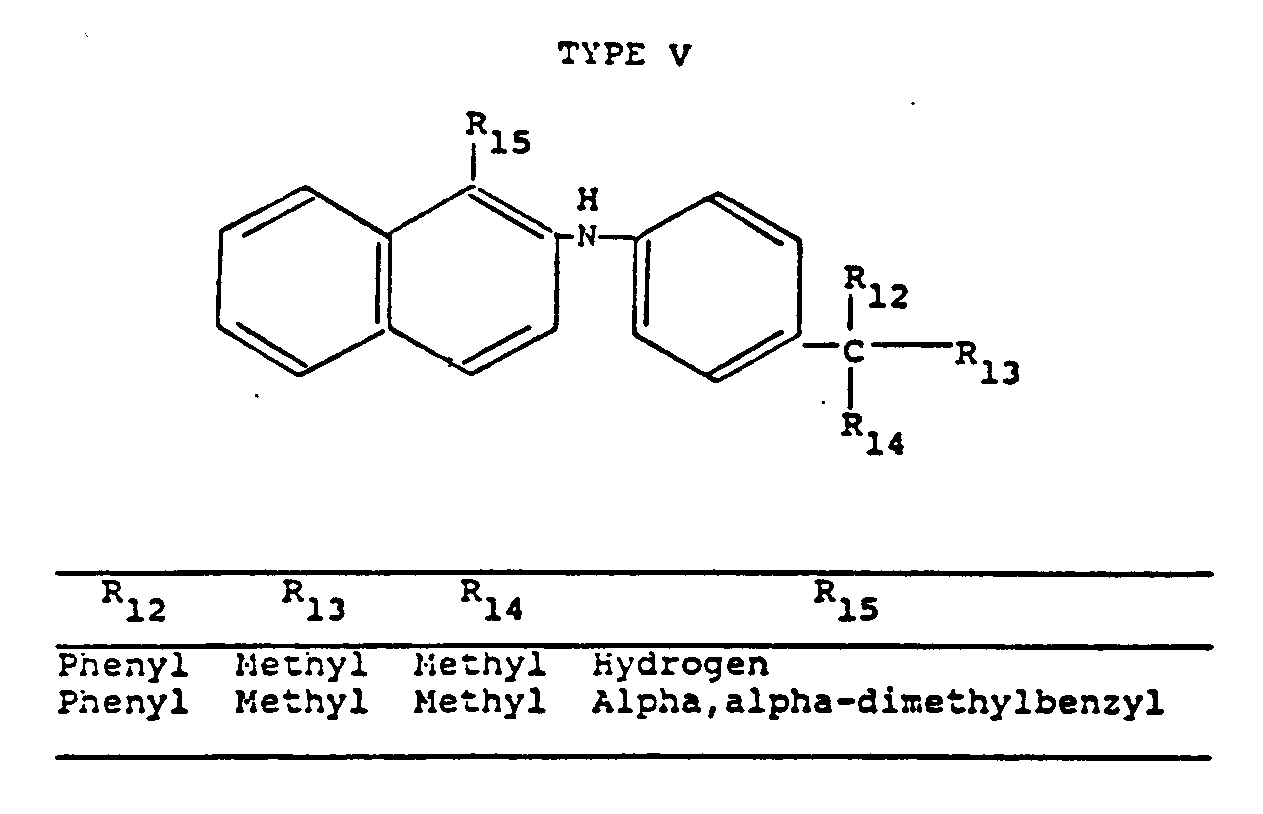
- Of the foregoing preferred aralkyl-substituted diarylamines, the substituted diphenylamines of the formula

where R and Rʹ are methyl or phenyl are especially preferred. The compound wherein R and Rʹ are methyl is 4,4ʹ-bis-(alpha,alpha-dimethylbenzyl)diphenylamine and the compound in which R and Rʹ are phenyl is 4,4ʹ-bis-(alpha-methylbenzhydryl)diphenylamine. - Sterically hindered phosphites which can be used in combination with the foregoing aralkyl-substituted diarylamines include essentially any of the sterically hindered phosphites heretofore employed as antioxidants/stabilizers. Representative of such compounds are those disclosed in U.S. Patent Nos. 4,195,016; 4,233,208; 4,290,941; and 4,351,759. Specifically, sterically hindered phosphites which can be used herein with generally good results include phosphites of the general formula:
P (̵O-R₁)₃ (I)
wherein R₁ is an alkyl, aryl or aralkyl radical, or
(R₂-O)̵pP(R₃)q (II)
wherein R₂ and R₃ independently are alkyl, aryl or aralkyl, p is 1 or 2 and q is 1 or 2, the sum of p and q being 3. More specifically, sterically hindered phosphites which can be used herein with generally outstanding results include arylphosphites of the general formula
wherein Ar is an aryl radical possessing substitution on at least two nuclear carbon atoms, m is 1 to 3, n is 0, 1 or 2, the sum of m and n being 3 and R is an art-recognized substituent satisfying the trivalent state of P. The preferred arylphosphites are the phenyl phosphites of the general formula
wherein R₁, R₂ and R₃ are each hydrogen or alkyl. Among the preferred tris-alkylphenyl phosphites which can be used herein with generally good results are tris(2,4-di-tert-butylphenyl)phosphite (NAUGARD 524, Uniroyal Chemical), tris (mixed mono and dinonyl phenyl)phosphite (POLYGARD, Uniroyal Chemical, and tris(monononyl phenyl)phosphite (NAUGARD P, Uniroyal Chemical). Other preferred phosphites include bis(2,4-di-t-butyl phenyl) pentaerythritol diphosphite (ULTRANOX 626, Borg Warner) and distearylpentaerythritol diphosphite (WESTON 618, Borg Warner). In addition, tetrakis [2,4-di-tert-butyl phenyl (4,4ʹ-biphenylene-diphosphonite)] (P-EPQ, Sandoz) can also be used in synergistic combination with the foregoing aralkyl-substituted diarylamines with excellent results. - The polyolefins which are stabilized against oxidative degradation employing mixtures of the foregoing aralkyl-substituted diarylamines and sterically hindered phosphites include homopolymers derived from mono- and di-ethylenically unsaturated hydrocarbon monomers such as polyethylene, which can optionally be crosslinked, polypropylene, polyisobutylene, polymethylbutene-1,polymethylpentene-1,polybutene-1,poly-isoprene, polybutadiene, polystyrene, polyisobutylene, and the like; copolymers derived from two or more of such monomers such as ethylene-propylene copolymers, propylene-butene-1 copolymers, propylene-isobutylene copolymers, styrene-butadiene copolymers and terpolymers of ethylene and propylene with a diene, such as, for example, hexadiene, dicyclopentadiene or ethylidenenorbornene; and, blends of the foregoing homopolymers and/or copolymers such as those of polypropylene and polyethylene, polypropylene and polybutene-1 and polypropylene and polyisobutylene. The polyolefin homopolymers, copolymers and blends thereof can be combined with minor amounts by weight, i.e., less than about 50 weight percent and preferably less than about 20 weight percent, of one or more compatible or compatibilized polymers other than those mentioned, e.g., polyvinylhalides, chlorinated polyolefins, polyesters, polyamides and polyacrylates.
- The combined amounts of aralkyl-substituted diarylamine(s) and sterically hindered phosphite(s) incorporated into the foregoing polyolefins will, at a minimum, be that required to impart a significant level of stability against oxidative degradation. In general, such amounts can vary from about 0.01 to about 5.0, and preferably from about 0.5 to about 1, weight percent of polyolefin homopolymer, copolymer or polyolefin blend. Although combined amounts of the antioxidants in excess of about 5 weight percent can be employed, such amounts might have a deleterious effect on the physical and mechanical properties of the polyolefin substrate in which case they should ordinary be avoided.
- The relative proportions of aralkyl-substituted diarylamine(s) to sterically hindered phosphite(s) can vary widely. In general, the ratios of aralkyl-substituted diarylamine(s) to sterically hindered phosphite(s) can vary from about 20:1 to about 1:20 and preferably from about 10:1 to about 1:10 although ratios somewhat above and below the broader of these ranges can also be used with advantageous results.
- The procedure employed to incorporate the aralkyl-substituted diarylamine(s) and the sterically hindered phosphite(s) into the polyolefin is not critical and can, in fact, be any of those procedures disclosed in the prior U.S. patents incorporated by reference herein. For example, these materials can be introduced into the polyolefin as a premix or they can be maintained separately and added to the polyolefin simultaneously or sequentially and then homogenously distributed throughout the polymer by milling, extrusion blending or some other mechanical working procedure. Either the aralkyl-substituted diarylamine component(s), the sterically hindered phosphite component(s) or both can be added to the polyolefin by way of a preconcentrate or in a carrier system, e.g., in a suitable solvent or co-solvent.
- Following common practice, other additives can be introduced into the polyolefin prior to, during and/or following addition of the antioxidants. Such additives include other stabilizers, colorants, reinforcements, fillers, antistatic agents, lubricants, plasticizers, and the like, present in the customary amounts.
- With regard to optional antioxidants which can be used herein together with the alkaryl-substituted diarylamine antioxidant(s) and sterically hindered phosphite antioxidant(s) to achieve an enhanced level of protection of polyolefins against oxidative degradation, the sterically hindered phenols are preferred. Representative of such compounds are those disclosed in U.S. Patent Nos. 3,304,283; 3,432,578; 3,886,114; 3,979,180; 4,002,230; 4,290,941; 4,341,677; 4,420,579; 4,440,671; and 4,497,931. More specifically, sterically hindered phenols which can be used herein with generally good results include
2,4-dimethyl-6-octyl phenol; 2,6-di-tert-butyl-4-methyl phenol (i.e., butylated hydroxy toluene);
2,6-ditertiarybutyl-4-ethyl phenol;
2,6-ditertiarybutyl-4-n-butyl phenol;
2,2ʹ-methylenebis(4-methyl-6-tertiarybutyl phenol);
2,2ʹ-methylenebis(4-ethyl-6-tertiarybutyl-phenol);
2,4-dimethyl-6-tertiarybutyl phenol; 4-hydroxymethyl-2,6-ditertiarybutyl phenol; n-octadecyl-beta (3,5-ditertiarybutyl-4-hydroxyphenyl)propionate;
2,6-dioctadecyl-4-methyl phenol; 2,4,6-trimethyl phenol;
2,4,6-triisopropyl phenol; 2,4,6-tri-tert-butyl phenol;
2-tert-butyl-4,6-dimethyl phenol; 2,6-methyl-4-didodecyl phenol; octadecyl-3,5-di-tert-butyl-4-hydroxy hydrocinnamate (NAUGARD 76, Uniroyal Chemical; IRGANOX 1076,
Ciba-Geigy); tetrakis[methylene (3,5-di-tert-butyl-4-hydroxyhydrocinnamate)]methane (NAUGARD 10, Uniroyal Chemical;
IRGANOX 1010, Ciba-Geigy); 2,2ʹ-oxamido bis-[ethyl-3-(3,5-di-tert-butyl-4- hydroxyphenyl)propionate (NAUGARD XL-1, Uniroyal Chemical); 1,3,5-tris(4-tert-butyl-3-hydroxy-2,6-dimethylbenzyl)-s-triazine-2,4,6-(1H,3H,5H)trione (CYANOX 1790, American Cyanamid Co.): 1,3,5-trimethyl-2,4,6-tris(3,5-di-tert-butyl-4-hydroxybenzyl)benzene (ETHANOX 330, Ethyl Corp.); and, tris(3,5-di-tert-butyl-4-hydroxybenzyl) isocyanurate (GOODRITE 3114, B.F. Goodrich); 4,4ʹ-thiobis(6-t-butyl-m-cresol), tris(2-methyl-4-hydroxy-5-t-butylphenyl)butane, 3,5-di-t-butyl4hydroxyhydrocinnamic acid triester with 1,3,5-tris(2-hydroxyethyl)-5-triazine-2,4,6(1H,3H,5H)trione, bis(3,3-bis(4-hydroxy-3-t-butylphenyl)butanoic acid)glycolester. - In general, these phenol antioxidants, where present, can be used to replace an equivalent weight amount of a portion of the aralyklyl-substituted diarylamine antioxidant(s), e.g., up to about 50 weight percent of the latter.
- The following amounts (wt. %) of antioxidants were incorporated into polypropylene homopolymer (PRO-FAX 6501, Hercules, Inc.) containing 0.1% by weight of calcium stearate as an acid scavenger:
Example Aralkyl-substituted Diarylamine; NAUGARD 445¹ Sterically Hindered Phosphite; NAUGARD 524² Sterically Hindered Phenol (Optional) 1 - 0.1 - 2 0.1 0.1 - 3 - 0.1 NAUGARD 76³, 0.1 4 0.05 0.1 NAUGARD 76, 0.05 5 - 0.1 NAUGARD 10⁴, 0.1 6 0.05 0.1 NAUGARD 10, 0.05 7 - 0.1 NAUGARD XL-1⁵, 0.1 8 0.05 0.1 NAUGARD XL-1, 0.05 9 - 0.1 ETHYL 330⁶, 0.1 10 0.05 0.1 ETHYL 330, 0.05 11 - 0.1 GOODRITE 3114⁷, 0.1 12 0.05 0.1 GOODRITE 3114, 0.05 ¹ 4,4'-Bis(alpha,alpha-dimethylbenzyl)diphenylamine ² Tris(2,4-di-tert-butylphenyl)phosphite ³ Octadecyl-3,5-di-tert-butyl-4-hydroxy hydrocinnamate ⁴ Tetrakis[methylene(3,5-di-tert-butyl-4-hydroxy-hydrocinnamate)]methane ⁵ Oxamido bis-[ethyl-3-(3,5-di-tert-butyl-4-hydroxyphenyl) propionate ⁶ 1,3,5-Trimethyl-2,4,6-tris(3,5-di-tert-butyl-4-hydroxybenzyl)benzene ⁷ Tris(3,5-di-t-butyl-4-hydroxybenzyl)isocyanurate - The foregoing antioxidants/antioxidant compositions were incorporated into the resin in an extruder operating under two sets of conditions: the first extrudate was obtained at 193°C and 25 RPM and the second through fifth extrudates were obtained at 250°C and 50 RPM.
- The effect of the foregoing antioxidants/antioxidant compositions on the melt stability of the polypropylene samples (measured as the melt flow rate at 230°C. and 2.16 kg in accordance with ASTM D1238, Condition L) and on the color stability (measured as Hunter b Color carried out upon 65 mil plaques) are set forth below as follows:

- As these data show (Example 2), the combination of aralkyl-substituted diarylamine (NAUGARD 445) and sterically hindered phosphite (NAUGARD 524) resulted in a dramatic improvement in stabilization as indicated by the lower melt flow rate compared to the base polypropylene (Example 1) which contained only the phosphite. In each of the remaining examples (Examples 3 to 12), modest but significant reductions in melt flow rate were obtained with combinations of aralkyl-substituted diarylamine, sterically hindered phosphite and optional sterically hindered phenol (Examples 4, 6, 8, 10 and 12) over the use of combinations of sterically hindered phosphite and sterically hindered phenol (Examples 3, 5, 7, 9 and 11). Serendipitously, a substitution by the amine andioxidants of this invention for a portion of the relatively more costly hindered phenolic antioxidant compounds provides comparable or improved melt stability to the polymer system.
- As for color stability, these data show that the combination of the amines of this invention with the phosphites of this invention gives better or comparable color stability than the hindered phenolic antioxidant/phosphite antioxidant combinations or the amine/hindered phenolic/phosphite antioxidant combinations. In most instances, the three-component antioxidant blends of this invention give comparable or better color stability than the hindered phenolic/phosphite antioxidant combinations with the exceptions of Example 7 and 8 and Example 11 and 12.

where

where

where

where
Claims (13)
- A polyolefin stabilized against oxidative degradation by the presence therein of a stabilizing amount of an antioxidant composition characterised in that the composition comprises:a) at least one aralkyl-substituted diarylamine; and,b) at least one sterically hindered phosphite.
- A polyolefin according to claim 1 characterised in that the aralkyl-substituted diarylamine possesses the general formula

- A polyolefin according to claim 2 characterised in that the aralkyl-substituted diarylamine is selected from
 R₁ is a phenyl or p-tolyl radical;R₂ and R₃ are selected from methyl, phenyl and p-tolyl radicals;R₄ is selected from methyl, phenyl, p-tolyl and neopentyl radicals;R₅ is selected from methyl, phenyl, p-tolyl and 2-phenylisobutyl radicals; and,R₆ is a methyl radical;
 R₁ through R₅ are selected from the radicals shown in Formula I and R₇ is selected from methyl, phenyl or p-tolyl radicals;X is selected from the radicals methyl, ethyl, a sec-alkyl containing from three to ten carbon atoms, alpha,alpha-dimethylbenzyl, alpha-methylbenzyl, chlorine, bromine, carboxyl, and metal salts of the carboxylic acids where the metal is zinc, cadmium, nickel, lead, tin, magnesium, or copper; and,Y is selected from the radicals hydrogen, methyl, ethyl, a sec-alkyl containing from three to ten carbon atoms, chlorine and bromine;
 R₁ is a phenyl or p-tolyl radical;R₂ and R₃ are selected from methyl, phenyl and p-tolyl radicals;R₄ is selected from the radicals hydrogen, a primary, secondary and tertiary alkyl containing from one to ten carbon atoms and alkoxyl containing from one to ten carbon atoms which may be straight chain or branched; and,X and Y are selected from the radicals hydrogen, methyl, ethyl, sec-alkyl containing from three to ten carbon atoms, chlorine and bromine;
 R₉ is a phenyl or p-tolyl radical;R₁₀ is selected from methyl, phenyl p-tolyl and 2-phenyl isobutyl radicals; and,R₁₁ is selected from methyl, phenyl and p-tolyl radicals, and,
 R₁₂ is a phenyl or p-tolyl radical;R₁₃ is selected from methyl, phenyl and p-tolyl radicals;R₁₄ is selected from methyl, phenyl, p-tolyl and 2-phenylisobutyl radicals; and,R₁₅ is selected from the radicals hydrogen alpha,alpha-dimethylbenzyl, alpha-methylbenzyl triphenylmethyl and alpha,alpha,p-trimethylbenzyl.
 - A polyolefin according to claim 3 characterised in that the aralkyl-substituted diarylamine is 4,4ʹ-bis-(alpha,alpha-dimethylbenzyl)diphenylamine or 4,4ʹ-bis-(alpha-methylbenzyl)diphenylamine.
- A polyolefin according to any of the preceding claims characterised in that the sterically hindered phosphite is selected from phosphites of the general formula
P (̵O-R₁)₃ (I)
wherein R₁ is an alkyl, aryl or aralkyl radical and phosphites of the general formula
(R₂-O)̵pP(R₃)q (II)
wherein R₂ and R₃ independently are alkyl, aryl or aralkyl, p is 1 or 2 and q is 1 or 2, the sum of p and q being 3. - A polyolefin according to any of claims 1 to 4 characterised in that the sterically hindered phosphite is an arylphosphite of the general formula

- A polyolefin according to claim 6 characterised in that the arylphosphite is a phenyl phosphite of the general formula

- A polyolefin according to claim 7 characterised in that the phenyl phosphite is tris(2,4-di-tert-butyl; phenyl)phosphite.
- A polyolefin according to any of the preceding claims characterised in that it further contains a sterically hindered phenol.
- A polyolefin according to claim 9 characterised in that the sterically hindered phenol is selected from 2,4-dimethyl-6-octyl phenol;
2,6-di-tert-butyl-4-methyl phenol; 2,6-ditertiarybutyl-4-ethyl phenol; 2,6-ditertiarybutyl-4-n-butyl phenol;
2,2ʹ-methylenebis(4-methyl-6-tertiarybutyl phenol);
2,2ʹ-methylenebis(4-ethyl-6-tertiarybutyl-phenol);
2,4-dimethyl-6-tertiarybutyl phenol; 4-hydroxymethyl-2,6-ditertiarybutyl phenol; n-octadecyl-beta (3,5-ditertiarybutyl-4-hydroxyphenyl)propionate;
2,6-dioctadecyl-4-methyl phenol; 2,4,6-trimethyl phenol;
2,4,6-triisopropyl phenol; 2,4,6-tri-tert-butyl phenol;
2-tert-butyl-4,6-dimethyl phenol; 2,6-methyl-4-didodecyl phenol; octadecyl-3,5-di-tert-butyl-4-hydroxy hydrocinnamate; tetrakis[methylene (3,5-di-tert-butyl-4-hydroxy-hydrocinnamate)]methane; 2,2ʹ-oxamido bis-[ethyl-3-(3,5-di-tert-butyl-4-hydroxyphenyl)propionate;
1,3,5-tris(4-tert-butyl-3-hydroxy-2,6-dimethylbenzyl)-s-triazine-2,4,6-(1H,3H,5H)trione; 1,3,5-trimethyl-2,4,6-tris(3,5-di-tert- butyl-4-hydroxybenzyl)benzene; and tris (3, 5-di-t-butyl-4-hydroxybenzyl)isocyanurate ; 4,4ʹ-thiobis(6-t-butyl-m-cresol), tris(2-methyl-4-hydroxy-5-t-butylphenyl)butane, 3,5-di-t-butyl4hydroxyhydrocinnamic acid triester with 1,3,5-tris(2-hydroxyethyl)-5-triazine-2,4,6(1H,3H,5H)-trione, bis(3,3-bis(4-hydroxy-3-t-butylphenyl)butanoic acid)glycolester. - A polyolefin according to any of the preceding claims characterised in that the polymer is a polyolefin homopolymer, polyolefin copolymer or polyolefin blend.
- A polyolefin according to claim 11 characterised in that the polymer is polypropylene homopolymer.
- A polyolefin according to any of the preceding claims characterised in that the phosphite is tris(2,4-di-tert-butylphenyl)phosphite; tris(mixed mono-and dinonyl phenyl)phosphite, tris(monononyl phenyl)phosphite; bis(2,4-di-tert-butyl phenyl) pentaerylthritol diphosphite; or, distearyl-pentaerylthritol diphosphite.
Priority Applications (1)
| Application Number | Priority Date | Filing Date | Title |
|---|---|---|---|
| AT87310151T ATE101176T1 (en) | 1986-12-11 | 1987-11-18 | POLYOLEFINS STABILIZED AGAINST OXIDATIVE DEGRADATION BY MIXTURES OF ARALKYL-SUBSTITUTED DIARYLAMINES AND STERICALLY HINDERED PHOSPHITES. |
Applications Claiming Priority (2)
| Application Number | Priority Date | Filing Date | Title |
|---|---|---|---|
| US94165786A | 1986-12-11 | 1986-12-11 | |
| US941657 | 1986-12-11 |
Publications (3)
| Publication Number | Publication Date |
|---|---|
| EP0274200A2 EP0274200A2 (en) | 1988-07-13 |
| EP0274200A3 EP0274200A3 (en) | 1990-05-02 |
| EP0274200B1 true EP0274200B1 (en) | 1994-02-02 |
Family
ID=25476845
Family Applications (1)
| Application Number | Title | Priority Date | Filing Date |
|---|---|---|---|
| EP87310151A Expired - Lifetime EP0274200B1 (en) | 1986-12-11 | 1987-11-18 | Polyolefins stabilized against oxidative degradation with mixtures of aralkyl-substituted diarylamines and sterically hindered phosphites |
Country Status (12)
| Country | Link |
|---|---|
| EP (1) | EP0274200B1 (en) |
| JP (1) | JPH0713160B2 (en) |
| KR (1) | KR960003824B1 (en) |
| AT (1) | ATE101176T1 (en) |
| AU (1) | AU594218B2 (en) |
| BR (1) | BR8706116A (en) |
| CA (1) | CA1326094C (en) |
| DE (1) | DE3789011T2 (en) |
| ES (1) | ES2061515T3 (en) |
| IN (1) | IN171792B (en) |
| MX (1) | MX168980B (en) |
| ZA (1) | ZA878398B (en) |
Families Citing this family (6)
| Publication number | Priority date | Publication date | Assignee | Title |
|---|---|---|---|---|
| IT1231769B (en) * | 1989-08-02 | 1991-12-21 | Himont Inc | PROCEDURE FOR THE STABILIZATION OF POLYOLEFINS AND PRODUCTS OBTAINED FROM IT. |
| GB2252324A (en) * | 1990-12-20 | 1992-08-05 | Bp Chem Int Ltd | Stabilizer composition |
| US5256333A (en) * | 1993-03-25 | 1993-10-26 | Uniroyal Chemical Company, Inc. | Stabilized polyether polyol and polyurethane foam obtained therefrom |
| WO1996008532A1 (en) * | 1994-09-13 | 1996-03-21 | Uniroyal Chemical Company, Inc. | Stabilization of polyethylene polymers |
| GB0011189D0 (en) * | 2000-05-10 | 2000-06-28 | Great Lakes Chemical Europ | Anti-oxidant additives |
| WO2017096573A1 (en) | 2015-12-10 | 2017-06-15 | Dow Global Technologies Llc | Crosslinkable composition and coating made therefrom |
Family Cites Families (3)
| Publication number | Priority date | Publication date | Assignee | Title |
|---|---|---|---|---|
| GB1490938A (en) * | 1975-02-20 | 1977-11-02 | Ciba Geigy Ag | Stabilization systems from triarylphosphites and phenols |
| GB8724250D0 (en) * | 1986-11-11 | 1987-11-18 | Ici Plc | Composition |
| CA1318059C (en) * | 1986-12-11 | 1993-05-18 | Thomas Max Chucta | Polyolefins stabilized against oxidative degradation with mixtures of aralkyl-substituted diarylamines and sterically hindered phenols |
-
1987
- 1987-10-30 CA CA000550636A patent/CA1326094C/en not_active Expired - Fee Related
- 1987-11-09 ZA ZA878398A patent/ZA878398B/en unknown
- 1987-11-12 BR BR8706116A patent/BR8706116A/en not_active IP Right Cessation
- 1987-11-18 ES ES87310151T patent/ES2061515T3/en not_active Expired - Lifetime
- 1987-11-18 AT AT87310151T patent/ATE101176T1/en not_active IP Right Cessation
- 1987-11-18 DE DE3789011T patent/DE3789011T2/en not_active Expired - Fee Related
- 1987-11-18 EP EP87310151A patent/EP0274200B1/en not_active Expired - Lifetime
- 1987-12-09 KR KR1019870014016A patent/KR960003824B1/en not_active Expired - Lifetime
- 1987-12-10 MX MX009700A patent/MX168980B/en unknown
- 1987-12-10 JP JP62313120A patent/JPH0713160B2/en not_active Expired - Lifetime
- 1987-12-11 IN IN1063/DEL/87A patent/IN171792B/en unknown
- 1987-12-11 AU AU82476/87A patent/AU594218B2/en not_active Ceased
Also Published As
| Publication number | Publication date |
|---|---|
| DE3789011T2 (en) | 1994-06-16 |
| ES2061515T3 (en) | 1994-12-16 |
| KR960003824B1 (en) | 1996-03-22 |
| BR8706116A (en) | 1988-07-05 |
| KR880007630A (en) | 1988-08-27 |
| ATE101176T1 (en) | 1994-02-15 |
| DE3789011D1 (en) | 1994-03-17 |
| ZA878398B (en) | 1988-05-11 |
| MX168980B (en) | 1993-06-16 |
| AU594218B2 (en) | 1990-03-01 |
| EP0274200A2 (en) | 1988-07-13 |
| CA1326094C (en) | 1994-01-11 |
| EP0274200A3 (en) | 1990-05-02 |
| AU8247687A (en) | 1988-06-16 |
| JPH0713160B2 (en) | 1995-02-15 |
| IN171792B (en) | 1993-01-09 |
| JPS63161043A (en) | 1988-07-04 |
Similar Documents
| Publication | Publication Date | Title |
|---|---|---|
| EP0875530B1 (en) | Olefin polymer composition having low smoke generation and fiber and film prepared therefrom | |
| EP1325069B1 (en) | Thermoplastic resins stabilized by blends of sterically hindered phenols,secondary amines, and lactones | |
| EP2949697B1 (en) | Resin composition | |
| US6277907B1 (en) | Thermoplastic resins stabilized by blends of sterically hindered phenols, secondary amines, and thioethers | |
| US4443572A (en) | Polyolefin stabilizers | |
| US4837259A (en) | Polypropylene stabilized against oxidative degradation with mixtures of diarylamine derivatives and sterically hindered phenols | |
| JPS6163686A (en) | Tris-organophosphite composition having improved hydrolytic stability | |
| EP3660103A1 (en) | Composition and flame-retardant resin composition | |
| US4377651A (en) | Polyolefin stabilization | |
| EP3683288B1 (en) | Composition and flame retardant resin composition | |
| AU615943B2 (en) | Polypropylene stabilized against oxidative degradation with mixtures of diarylamine derivatives and sterically hindered phenols | |
| EP0274200A2 (en) | Polyolefins stabilized against oxidative degradation with mixtures of aralkyl-substituted diarylamines and sterically hindered phosphites | |
| EP0754722B1 (en) | Compositions for the stabilization of synthetic polymers | |
| EP0271235A2 (en) | Polypropylene stabilized against oxidative degradation with mixtures of aralkyl-substituted diarylamines and sterically hindered phenols | |
| US5352830A (en) | Phosphorous organic amides suitable as stabilizers and polymer compositions which comprise them | |
| EP0563578A1 (en) | Color stabilization of filled polyolefins | |
| EP1458800B1 (en) | Stabilising composition ii | |
| JP2001310972A (en) | Discoloration inhibitor composition of organic polymer material by nitric oxide gas and organic polymer material containing the same | |
| EP3725863A1 (en) | Composition and fire-retardant resin composition | |
| EP0803495B1 (en) | Phenolic compounds and uses thereof | |
| WO1992004404A2 (en) | Thermooxidative stabilization of polyolefins with an oxo-piperazinyl-triazine and a phosphorous acid ester |
Legal Events
| Date | Code | Title | Description |
|---|---|---|---|
| PUAI | Public reference made under article 153(3) epc to a published international application that has entered the european phase |
Free format text: ORIGINAL CODE: 0009012 |
|
| AK | Designated contracting states |
Kind code of ref document: A2 Designated state(s): AT BE CH DE ES FR GB GR IT LI LU NL SE |
|
| PUAL | Search report despatched |
Free format text: ORIGINAL CODE: 0009013 |
|
| AK | Designated contracting states |
Kind code of ref document: A3 Designated state(s): AT BE CH DE ES FR GB GR IT LI LU NL SE |
|
| 17P | Request for examination filed |
Effective date: 19901029 |
|
| 17Q | First examination report despatched |
Effective date: 19930208 |
|
| ITF | It: translation for a ep patent filed | ||
| GRAA | (expected) grant |
Free format text: ORIGINAL CODE: 0009210 |
|
| AK | Designated contracting states |
Kind code of ref document: B1 Designated state(s): AT BE CH DE ES FR GB GR IT LI LU NL SE |
|
| REF | Corresponds to: |
Ref document number: 101176 Country of ref document: AT Date of ref document: 19940215 Kind code of ref document: T |
|
| REF | Corresponds to: |
Ref document number: 3789011 Country of ref document: DE Date of ref document: 19940317 |
|
| ET | Fr: translation filed | ||
| REG | Reference to a national code |
Ref country code: GR Ref legal event code: FG4A Free format text: 3011260 |
|
| PLBE | No opposition filed within time limit |
Free format text: ORIGINAL CODE: 0009261 |
|
| STAA | Information on the status of an ep patent application or granted ep patent |
Free format text: STATUS: NO OPPOSITION FILED WITHIN TIME LIMIT |
|
| REG | Reference to a national code |
Ref country code: ES Ref legal event code: FG2A Ref document number: 2061515 Country of ref document: ES Kind code of ref document: T3 |
|
| 26N | No opposition filed | ||
| EAL | Se: european patent in force in sweden |
Ref document number: 87310151.3 |
|
| PGFP | Annual fee paid to national office [announced via postgrant information from national office to epo] |
Ref country code: GR Payment date: 19951128 Year of fee payment: 9 |
|
| PGFP | Annual fee paid to national office [announced via postgrant information from national office to epo] |
Ref country code: SE Payment date: 19961118 Year of fee payment: 10 |
|
| PGFP | Annual fee paid to national office [announced via postgrant information from national office to epo] |
Ref country code: ES Payment date: 19961129 Year of fee payment: 10 |
|
| PGFP | Annual fee paid to national office [announced via postgrant information from national office to epo] |
Ref country code: LU Payment date: 19961201 Year of fee payment: 10 |
|
| PGFP | Annual fee paid to national office [announced via postgrant information from national office to epo] |
Ref country code: CH Payment date: 19961206 Year of fee payment: 10 |
|
| PG25 | Lapsed in a contracting state [announced via postgrant information from national office to epo] |
Ref country code: GR Free format text: THE PATENT HAS BEEN ANNULLED BY A DECISION OF A NATIONAL AUTHORITY Effective date: 19970531 |
|
| REG | Reference to a national code |
Ref country code: GR Ref legal event code: MM2A Free format text: 3011260 |
|
| PG25 | Lapsed in a contracting state [announced via postgrant information from national office to epo] |
Ref country code: LU Free format text: LAPSE BECAUSE OF NON-PAYMENT OF DUE FEES Effective date: 19971118 |
|
| PG25 | Lapsed in a contracting state [announced via postgrant information from national office to epo] |
Ref country code: SE Free format text: LAPSE BECAUSE OF NON-PAYMENT OF DUE FEES Effective date: 19971119 Ref country code: ES Free format text: LAPSE BECAUSE OF NON-PAYMENT OF DUE FEES Effective date: 19971119 |
|
| PG25 | Lapsed in a contracting state [announced via postgrant information from national office to epo] |
Ref country code: LI Free format text: LAPSE BECAUSE OF NON-PAYMENT OF DUE FEES Effective date: 19971130 Ref country code: CH Free format text: LAPSE BECAUSE OF NON-PAYMENT OF DUE FEES Effective date: 19971130 |
|
| REG | Reference to a national code |
Ref country code: CH Ref legal event code: PL |
|
| EUG | Se: european patent has lapsed |
Ref document number: 87310151.3 |
|
| REG | Reference to a national code |
Ref country code: GB Ref legal event code: IF02 |
|
| PGFP | Annual fee paid to national office [announced via postgrant information from national office to epo] |
Ref country code: NL Payment date: 20031031 Year of fee payment: 17 |
|
| PGFP | Annual fee paid to national office [announced via postgrant information from national office to epo] |
Ref country code: AT Payment date: 20031103 Year of fee payment: 17 |
|
| PGFP | Annual fee paid to national office [announced via postgrant information from national office to epo] |
Ref country code: GB Payment date: 20031112 Year of fee payment: 17 |
|
| PGFP | Annual fee paid to national office [announced via postgrant information from national office to epo] |
Ref country code: FR Payment date: 20031119 Year of fee payment: 17 |
|
| PGFP | Annual fee paid to national office [announced via postgrant information from national office to epo] |
Ref country code: DE Payment date: 20031231 Year of fee payment: 17 |
|
| PGFP | Annual fee paid to national office [announced via postgrant information from national office to epo] |
Ref country code: BE Payment date: 20040115 Year of fee payment: 17 |
|
| REG | Reference to a national code |
Ref country code: ES Ref legal event code: FD2A Effective date: 19981212 |
|
| PG25 | Lapsed in a contracting state [announced via postgrant information from national office to epo] |
Ref country code: GB Free format text: LAPSE BECAUSE OF NON-PAYMENT OF DUE FEES Effective date: 20041118 Ref country code: AT Free format text: LAPSE BECAUSE OF NON-PAYMENT OF DUE FEES Effective date: 20041118 |
|
| PG25 | Lapsed in a contracting state [announced via postgrant information from national office to epo] |
Ref country code: BE Free format text: LAPSE BECAUSE OF NON-PAYMENT OF DUE FEES Effective date: 20041130 |
|
| BERE | Be: lapsed |
Owner name: *UNIROYAL CHEMICAL CY INC. Effective date: 20041130 |
|
| PG25 | Lapsed in a contracting state [announced via postgrant information from national office to epo] |
Ref country code: NL Free format text: LAPSE BECAUSE OF NON-PAYMENT OF DUE FEES Effective date: 20050601 Ref country code: DE Free format text: LAPSE BECAUSE OF NON-PAYMENT OF DUE FEES Effective date: 20050601 |
|
| GBPC | Gb: european patent ceased through non-payment of renewal fee |
Effective date: 20041118 |
|
| PG25 | Lapsed in a contracting state [announced via postgrant information from national office to epo] |
Ref country code: FR Free format text: LAPSE BECAUSE OF NON-PAYMENT OF DUE FEES Effective date: 20050729 |
|
| NLV4 | Nl: lapsed or anulled due to non-payment of the annual fee |
Effective date: 20050601 |
|
| REG | Reference to a national code |
Ref country code: FR Ref legal event code: ST |
|
| PG25 | Lapsed in a contracting state [announced via postgrant information from national office to epo] |
Ref country code: IT Free format text: LAPSE BECAUSE OF NON-PAYMENT OF DUE FEES;WARNING: LAPSES OF ITALIAN PATENTS WITH EFFECTIVE DATE BEFORE 2007 MAY HAVE OCCURRED AT ANY TIME BEFORE 2007. THE CORRECT EFFECTIVE DATE MAY BE DIFFERENT FROM THE ONE RECORDED. Effective date: 20051118 |
|
| BERE | Be: lapsed |
Owner name: *UNIROYAL CHEMICAL CY INC. Effective date: 20041130 |