EP0273752A2 - Method of manufacturing heat sensitive recording material - Google Patents
Method of manufacturing heat sensitive recording material Download PDFInfo
- Publication number
- EP0273752A2 EP0273752A2 EP87311474A EP87311474A EP0273752A2 EP 0273752 A2 EP0273752 A2 EP 0273752A2 EP 87311474 A EP87311474 A EP 87311474A EP 87311474 A EP87311474 A EP 87311474A EP 0273752 A2 EP0273752 A2 EP 0273752A2
- Authority
- EP
- European Patent Office
- Prior art keywords
- heat sensitive
- support
- recording material
- sensitive layer
- sensitive recording
- Prior art date
- Legal status (The legal status is an assumption and is not a legal conclusion. Google has not performed a legal analysis and makes no representation as to the accuracy of the status listed.)
- Granted
Links
- 239000000463 material Substances 0.000 title claims description 54
- 238000004519 manufacturing process Methods 0.000 title claims description 10
- 239000006185 dispersion Substances 0.000 claims abstract description 29
- XLYOFNOQVPJJNP-UHFFFAOYSA-N water Substances O XLYOFNOQVPJJNP-UHFFFAOYSA-N 0.000 claims abstract description 29
- 239000003094 microcapsule Substances 0.000 claims abstract description 22
- 239000003960 organic solvent Substances 0.000 claims abstract description 17
- 238000000034 method Methods 0.000 claims abstract description 13
- 239000000203 mixture Substances 0.000 claims abstract description 10
- 239000002243 precursor Substances 0.000 claims abstract description 9
- 238000000576 coating method Methods 0.000 claims description 10
- 239000011248 coating agent Substances 0.000 claims description 7
- 150000002148 esters Chemical class 0.000 claims description 7
- 239000000976 ink Substances 0.000 claims description 5
- 238000001035 drying Methods 0.000 claims description 3
- 206010057040 Temperature intolerance Diseases 0.000 claims 1
- 230000008543 heat sensitivity Effects 0.000 claims 1
- 239000011162 core material Substances 0.000 abstract description 10
- 239000010410 layer Substances 0.000 description 40
- 239000000243 solution Substances 0.000 description 22
- 125000000217 alkyl group Chemical group 0.000 description 18
- 239000004372 Polyvinyl alcohol Substances 0.000 description 17
- 229920002451 polyvinyl alcohol Polymers 0.000 description 17
- 235000019422 polyvinyl alcohol Nutrition 0.000 description 17
- 239000011241 protective layer Substances 0.000 description 15
- 150000001875 compounds Chemical class 0.000 description 13
- XEKOWRVHYACXOJ-UHFFFAOYSA-N Ethyl acetate Chemical compound CCOC(C)=O XEKOWRVHYACXOJ-UHFFFAOYSA-N 0.000 description 12
- 125000004432 carbon atom Chemical group C* 0.000 description 12
- 239000000839 emulsion Substances 0.000 description 12
- -1 spiropyran Chemical class 0.000 description 12
- 239000000306 component Substances 0.000 description 10
- 238000002844 melting Methods 0.000 description 10
- 230000008018 melting Effects 0.000 description 10
- 239000003921 oil Substances 0.000 description 10
- 239000007787 solid Substances 0.000 description 10
- YMWUJEATGCHHMB-UHFFFAOYSA-N Dichloromethane Chemical compound ClCCl YMWUJEATGCHHMB-UHFFFAOYSA-N 0.000 description 9
- 239000012071 phase Substances 0.000 description 9
- 239000000975 dye Substances 0.000 description 8
- 239000002775 capsule Substances 0.000 description 7
- 229920000139 polyethylene terephthalate Polymers 0.000 description 7
- 239000005020 polyethylene terephthalate Substances 0.000 description 7
- 229920000642 polymer Polymers 0.000 description 7
- 239000004094 surface-active agent Substances 0.000 description 7
- PPBRXRYQALVLMV-UHFFFAOYSA-N Styrene Chemical compound C=CC1=CC=CC=C1 PPBRXRYQALVLMV-UHFFFAOYSA-N 0.000 description 6
- XSQUKJJJFZCRTK-UHFFFAOYSA-N Urea Chemical compound NC(N)=O XSQUKJJJFZCRTK-UHFFFAOYSA-N 0.000 description 6
- 239000008346 aqueous phase Substances 0.000 description 6
- 230000000994 depressogenic effect Effects 0.000 description 6
- DOIRQSBPFJWKBE-UHFFFAOYSA-N dibutyl phthalate Chemical compound CCCCOC(=O)C1=CC=CC=C1C(=O)OCCCC DOIRQSBPFJWKBE-UHFFFAOYSA-N 0.000 description 6
- 150000005690 diesters Chemical class 0.000 description 6
- 238000003756 stirring Methods 0.000 description 6
- VYPSYNLAJGMNEJ-UHFFFAOYSA-N Silicium dioxide Chemical compound O=[Si]=O VYPSYNLAJGMNEJ-UHFFFAOYSA-N 0.000 description 5
- XUIMIQQOPSSXEZ-UHFFFAOYSA-N Silicon Chemical compound [Si] XUIMIQQOPSSXEZ-UHFFFAOYSA-N 0.000 description 5
- 239000011230 binding agent Substances 0.000 description 5
- 125000004435 hydrogen atom Chemical group [H]* 0.000 description 5
- 229920000126 latex Polymers 0.000 description 5
- 239000004816 latex Substances 0.000 description 5
- 229910052751 metal Inorganic materials 0.000 description 5
- 239000002184 metal Substances 0.000 description 5
- 238000002360 preparation method Methods 0.000 description 5
- 229910052710 silicon Inorganic materials 0.000 description 5
- 239000010703 silicon Substances 0.000 description 5
- VTYYLEPIZMXCLO-UHFFFAOYSA-L Calcium carbonate Chemical compound [Ca+2].[O-]C([O-])=O VTYYLEPIZMXCLO-UHFFFAOYSA-L 0.000 description 4
- 108010010803 Gelatin Proteins 0.000 description 4
- XLOMVQKBTHCTTD-UHFFFAOYSA-N Zinc monoxide Chemical compound [Zn]=O XLOMVQKBTHCTTD-UHFFFAOYSA-N 0.000 description 4
- TZCXTZWJZNENPQ-UHFFFAOYSA-L barium sulfate Chemical compound [Ba+2].[O-]S([O-])(=O)=O TZCXTZWJZNENPQ-UHFFFAOYSA-L 0.000 description 4
- 239000008199 coating composition Substances 0.000 description 4
- 239000000084 colloidal system Substances 0.000 description 4
- 235000019439 ethyl acetate Nutrition 0.000 description 4
- 229940093499 ethyl acetate Drugs 0.000 description 4
- 229920000159 gelatin Polymers 0.000 description 4
- 239000008273 gelatin Substances 0.000 description 4
- 235000019322 gelatine Nutrition 0.000 description 4
- 235000011852 gelatine desserts Nutrition 0.000 description 4
- 229920002521 macromolecule Polymers 0.000 description 4
- 230000001681 protective effect Effects 0.000 description 4
- YJTKZCDBKVTVBY-UHFFFAOYSA-N 1,3-Diphenylbenzene Chemical group C1=CC=CC=C1C1=CC=CC(C=2C=CC=CC=2)=C1 YJTKZCDBKVTVBY-UHFFFAOYSA-N 0.000 description 3
- PLLCCSYEGQDAIW-UHFFFAOYSA-N 5-ethyl-1,6-dimethyl-5-phenylcyclohexa-1,3-diene Chemical compound C=1C=CC=CC=1C1(CC)C=CC=C(C)C1C PLLCCSYEGQDAIW-UHFFFAOYSA-N 0.000 description 3
- 239000005995 Aluminium silicate Substances 0.000 description 3
- BJQHLKABXJIVAM-UHFFFAOYSA-N Diethylhexyl phthalate Natural products CCCCC(CC)COC(=O)C1=CC=CC=C1C(=O)OCC(CC)CCCC BJQHLKABXJIVAM-UHFFFAOYSA-N 0.000 description 3
- WSFSSNUMVMOOMR-UHFFFAOYSA-N Formaldehyde Chemical compound O=C WSFSSNUMVMOOMR-UHFFFAOYSA-N 0.000 description 3
- 229920002396 Polyurea Polymers 0.000 description 3
- 235000012211 aluminium silicate Nutrition 0.000 description 3
- 230000008901 benefit Effects 0.000 description 3
- 239000004202 carbamide Substances 0.000 description 3
- 238000006243 chemical reaction Methods 0.000 description 3
- 239000003795 chemical substances by application Substances 0.000 description 3
- 239000003086 colorant Substances 0.000 description 3
- 230000001276 controlling effect Effects 0.000 description 3
- 229920001577 copolymer Polymers 0.000 description 3
- 229960002380 dibutyl phthalate Drugs 0.000 description 3
- 235000019329 dioctyl sodium sulphosuccinate Nutrition 0.000 description 3
- YHAIUSTWZPMYGG-UHFFFAOYSA-L disodium;2,2-dioctyl-3-sulfobutanedioate Chemical class [Na+].[Na+].CCCCCCCCC(C([O-])=O)(C(C([O-])=O)S(O)(=O)=O)CCCCCCCC YHAIUSTWZPMYGG-UHFFFAOYSA-L 0.000 description 3
- 230000009477 glass transition Effects 0.000 description 3
- NLYAJNPCOHFWQQ-UHFFFAOYSA-N kaolin Chemical compound O.O.O=[Al]O[Si](=O)O[Si](=O)O[Al]=O NLYAJNPCOHFWQQ-UHFFFAOYSA-N 0.000 description 3
- 238000005259 measurement Methods 0.000 description 3
- 229940073584 methylene chloride Drugs 0.000 description 3
- 150000002989 phenols Chemical class 0.000 description 3
- 239000000049 pigment Substances 0.000 description 3
- 239000004814 polyurethane Substances 0.000 description 3
- 229920000036 polyvinylpyrrolidone Polymers 0.000 description 3
- 239000001267 polyvinylpyrrolidone Substances 0.000 description 3
- 235000013855 polyvinylpyrrolidone Nutrition 0.000 description 3
- 239000000047 product Substances 0.000 description 3
- 239000000344 soap Substances 0.000 description 3
- 239000001993 wax Substances 0.000 description 3
- XOOUIPVCVHRTMJ-UHFFFAOYSA-L zinc stearate Chemical compound [Zn+2].CCCCCCCCCCCCCCCCCC([O-])=O.CCCCCCCCCCCCCCCCCC([O-])=O XOOUIPVCVHRTMJ-UHFFFAOYSA-L 0.000 description 3
- QNLZIZAQLLYXTC-UHFFFAOYSA-N 1,2-dimethylnaphthalene Chemical compound C1=CC=CC2=C(C)C(C)=CC=C21 QNLZIZAQLLYXTC-UHFFFAOYSA-N 0.000 description 2
- RTTZISZSHSCFRH-UHFFFAOYSA-N 1,3-bis(isocyanatomethyl)benzene Chemical compound O=C=NCC1=CC=CC(CN=C=O)=C1 RTTZISZSHSCFRH-UHFFFAOYSA-N 0.000 description 2
- PYSRRFNXTXNWCD-UHFFFAOYSA-N 3-(2-phenylethenyl)furan-2,5-dione Chemical compound O=C1OC(=O)C(C=CC=2C=CC=CC=2)=C1 PYSRRFNXTXNWCD-UHFFFAOYSA-N 0.000 description 2
- 244000215068 Acacia senegal Species 0.000 description 2
- FERIUCNNQQJTOY-UHFFFAOYSA-N Butyric acid Chemical compound CCCC(O)=O FERIUCNNQQJTOY-UHFFFAOYSA-N 0.000 description 2
- 229920002134 Carboxymethyl cellulose Polymers 0.000 description 2
- MQIUGAXCHLFZKX-UHFFFAOYSA-N Di-n-octyl phthalate Natural products CCCCCCCCOC(=O)C1=CC=CC=C1C(=O)OCCCCCCCC MQIUGAXCHLFZKX-UHFFFAOYSA-N 0.000 description 2
- RTZKZFJDLAIYFH-UHFFFAOYSA-N Diethyl ether Chemical compound CCOCC RTZKZFJDLAIYFH-UHFFFAOYSA-N 0.000 description 2
- 229920000084 Gum arabic Polymers 0.000 description 2
- JKRZOJADNVOXPM-UHFFFAOYSA-N Oxalic acid dibutyl ester Chemical compound CCCCOC(=O)C(=O)OCCCC JKRZOJADNVOXPM-UHFFFAOYSA-N 0.000 description 2
- 229910019142 PO4 Inorganic materials 0.000 description 2
- 239000005062 Polybutadiene Substances 0.000 description 2
- 239000004793 Polystyrene Substances 0.000 description 2
- 229920000147 Styrene maleic anhydride Polymers 0.000 description 2
- YSMRWXYRXBRSND-UHFFFAOYSA-N TOTP Chemical compound CC1=CC=CC=C1OP(=O)(OC=1C(=CC=CC=1)C)OC1=CC=CC=C1C YSMRWXYRXBRSND-UHFFFAOYSA-N 0.000 description 2
- GWEVSGVZZGPLCZ-UHFFFAOYSA-N Titan oxide Chemical compound O=[Ti]=O GWEVSGVZZGPLCZ-UHFFFAOYSA-N 0.000 description 2
- ZFOZVQLOBQUTQQ-UHFFFAOYSA-N Tributyl citrate Chemical compound CCCCOC(=O)CC(O)(C(=O)OCCCC)CC(=O)OCCCC ZFOZVQLOBQUTQQ-UHFFFAOYSA-N 0.000 description 2
- 239000000205 acacia gum Substances 0.000 description 2
- 235000010489 acacia gum Nutrition 0.000 description 2
- WNROFYMDJYEPJX-UHFFFAOYSA-K aluminium hydroxide Chemical compound [OH-].[OH-].[OH-].[Al+3] WNROFYMDJYEPJX-UHFFFAOYSA-K 0.000 description 2
- 125000000129 anionic group Chemical group 0.000 description 2
- 239000007864 aqueous solution Substances 0.000 description 2
- 238000000149 argon plasma sintering Methods 0.000 description 2
- 125000003710 aryl alkyl group Chemical group 0.000 description 2
- 125000003118 aryl group Chemical group 0.000 description 2
- 125000004104 aryloxy group Chemical group 0.000 description 2
- 239000002585 base Substances 0.000 description 2
- SESFRYSPDFLNCH-UHFFFAOYSA-N benzyl benzoate Chemical compound C=1C=CC=CC=1C(=O)OCC1=CC=CC=C1 SESFRYSPDFLNCH-UHFFFAOYSA-N 0.000 description 2
- 230000000903 blocking effect Effects 0.000 description 2
- 238000009835 boiling Methods 0.000 description 2
- XSIFPSYPOVKYCO-UHFFFAOYSA-N butyl benzoate Chemical compound CCCCOC(=O)C1=CC=CC=C1 XSIFPSYPOVKYCO-UHFFFAOYSA-N 0.000 description 2
- 125000000484 butyl group Chemical group [H]C([*])([H])C([H])([H])C([H])([H])C([H])([H])[H] 0.000 description 2
- 229910000019 calcium carbonate Inorganic materials 0.000 description 2
- 239000001768 carboxy methyl cellulose Substances 0.000 description 2
- 235000010948 carboxy methyl cellulose Nutrition 0.000 description 2
- 239000008112 carboxymethyl-cellulose Substances 0.000 description 2
- 239000005018 casein Substances 0.000 description 2
- BECPQYXYKAMYBN-UHFFFAOYSA-N casein, tech. Chemical compound NCCCCC(C(O)=O)N=C(O)C(CC(O)=O)N=C(O)C(CCC(O)=N)N=C(O)C(CC(C)C)N=C(O)C(CCC(O)=O)N=C(O)C(CC(O)=O)N=C(O)C(CCC(O)=O)N=C(O)C(C(C)O)N=C(O)C(CCC(O)=N)N=C(O)C(CCC(O)=N)N=C(O)C(CCC(O)=N)N=C(O)C(CCC(O)=O)N=C(O)C(CCC(O)=O)N=C(O)C(COP(O)(O)=O)N=C(O)C(CCC(O)=N)N=C(O)C(N)CC1=CC=CC=C1 BECPQYXYKAMYBN-UHFFFAOYSA-N 0.000 description 2
- 235000021240 caseins Nutrition 0.000 description 2
- 230000000052 comparative effect Effects 0.000 description 2
- 238000011161 development Methods 0.000 description 2
- FLKPEMZONWLCSK-UHFFFAOYSA-N diethyl phthalate Chemical compound CCOC(=O)C1=CC=CC=C1C(=O)OCC FLKPEMZONWLCSK-UHFFFAOYSA-N 0.000 description 2
- USIUVYZYUHIAEV-UHFFFAOYSA-N diphenyl ether Chemical class C=1C=CC=CC=1OC1=CC=CC=C1 USIUVYZYUHIAEV-UHFFFAOYSA-N 0.000 description 2
- 239000002270 dispersing agent Substances 0.000 description 2
- POULHZVOKOAJMA-UHFFFAOYSA-N dodecanoic acid Chemical compound CCCCCCCCCCCC(O)=O POULHZVOKOAJMA-UHFFFAOYSA-N 0.000 description 2
- GVGUFUZHNYFZLC-UHFFFAOYSA-N dodecyl benzenesulfonate;sodium Chemical compound [Na].CCCCCCCCCCCCOS(=O)(=O)C1=CC=CC=C1 GVGUFUZHNYFZLC-UHFFFAOYSA-N 0.000 description 2
- MTZQAGJQAFMTAQ-UHFFFAOYSA-N ethyl benzoate Chemical compound CCOC(=O)C1=CC=CC=C1 MTZQAGJQAFMTAQ-UHFFFAOYSA-N 0.000 description 2
- 125000005843 halogen group Chemical group 0.000 description 2
- IPCSVZSSVZVIGE-UHFFFAOYSA-N hexadecanoic acid Chemical compound CCCCCCCCCCCCCCCC(O)=O IPCSVZSSVZVIGE-UHFFFAOYSA-N 0.000 description 2
- 230000006872 improvement Effects 0.000 description 2
- BDAGIHXWWSANSR-UHFFFAOYSA-N methanoic acid Natural products OC=O BDAGIHXWWSANSR-UHFFFAOYSA-N 0.000 description 2
- 229920000609 methyl cellulose Polymers 0.000 description 2
- 125000002496 methyl group Chemical group [H]C([H])([H])* 0.000 description 2
- 239000001923 methylcellulose Substances 0.000 description 2
- 235000010981 methylcellulose Nutrition 0.000 description 2
- 238000002156 mixing Methods 0.000 description 2
- 230000007935 neutral effect Effects 0.000 description 2
- WRKCIHRWQZQBOL-UHFFFAOYSA-N octyl dihydrogen phosphate Chemical compound CCCCCCCCOP(O)(O)=O WRKCIHRWQZQBOL-UHFFFAOYSA-N 0.000 description 2
- 230000003287 optical effect Effects 0.000 description 2
- 239000012188 paraffin wax Substances 0.000 description 2
- 235000021317 phosphate Nutrition 0.000 description 2
- 229920002857 polybutadiene Polymers 0.000 description 2
- 229920000515 polycarbonate Polymers 0.000 description 2
- 239000004417 polycarbonate Substances 0.000 description 2
- 229920000728 polyester Polymers 0.000 description 2
- 229920002223 polystyrene Polymers 0.000 description 2
- 229920002635 polyurethane Polymers 0.000 description 2
- 239000011118 polyvinyl acetate Substances 0.000 description 2
- 229920002689 polyvinyl acetate Polymers 0.000 description 2
- 230000002265 prevention Effects 0.000 description 2
- 229920005989 resin Polymers 0.000 description 2
- 239000011347 resin Substances 0.000 description 2
- 150000003839 salts Chemical class 0.000 description 2
- 238000004513 sizing Methods 0.000 description 2
- 159000000000 sodium salts Chemical class 0.000 description 2
- 229920003048 styrene butadiene rubber Polymers 0.000 description 2
- 239000000126 substance Substances 0.000 description 2
- OGIDPMRJRNCKJF-UHFFFAOYSA-N titanium oxide Inorganic materials [Ti]=O OGIDPMRJRNCKJF-UHFFFAOYSA-N 0.000 description 2
- URAYPUMNDPQOKB-UHFFFAOYSA-N triacetin Chemical compound CC(=O)OCC(OC(C)=O)COC(C)=O URAYPUMNDPQOKB-UHFFFAOYSA-N 0.000 description 2
- 239000011787 zinc oxide Substances 0.000 description 2
- LIZLYZVAYZQVPG-UHFFFAOYSA-N (3-bromo-2-fluorophenyl)methanol Chemical compound OCC1=CC=CC(Br)=C1F LIZLYZVAYZQVPG-UHFFFAOYSA-N 0.000 description 1
- WRIDQFICGBMAFQ-UHFFFAOYSA-N (E)-8-Octadecenoic acid Natural products CCCCCCCCCC=CCCCCCCC(O)=O WRIDQFICGBMAFQ-UHFFFAOYSA-N 0.000 description 1
- IAUKWGFWINVWKS-UHFFFAOYSA-N 1,2-di(propan-2-yl)naphthalene Chemical compound C1=CC=CC2=C(C(C)C)C(C(C)C)=CC=C21 IAUKWGFWINVWKS-UHFFFAOYSA-N 0.000 description 1
- UUCHLIAGHZJJER-UHFFFAOYSA-N 1,2-diethylnaphthalene Chemical compound C1=CC=CC2=C(CC)C(CC)=CC=C21 UUCHLIAGHZJJER-UHFFFAOYSA-N 0.000 description 1
- JMEAQNQEOMCBGB-UHFFFAOYSA-N 1-(2-methylpropyl)-4-[4-(2-methylpropyl)phenyl]benzene Chemical group C1=CC(CC(C)C)=CC=C1C1=CC=C(CC(C)C)C=C1 JMEAQNQEOMCBGB-UHFFFAOYSA-N 0.000 description 1
- TVBYFUMVFJKKNJ-UHFFFAOYSA-N 1-cyclohex-2-en-1-yl-4-cyclohex-3-en-1-ylbenzene Chemical group C1CCC=CC1C1=CC=C(C2CC=CCC2)C=C1 TVBYFUMVFJKKNJ-UHFFFAOYSA-N 0.000 description 1
- UMSGIWAAMHRVQI-UHFFFAOYSA-N 1-ethyl-4-(4-ethylphenyl)benzene Chemical group C1=CC(CC)=CC=C1C1=CC=C(CC)C=C1 UMSGIWAAMHRVQI-UHFFFAOYSA-N 0.000 description 1
- RZTDESRVPFKCBH-UHFFFAOYSA-N 1-methyl-4-(4-methylphenyl)benzene Chemical group C1=CC(C)=CC=C1C1=CC=C(C)C=C1 RZTDESRVPFKCBH-UHFFFAOYSA-N 0.000 description 1
- AMBHHSBRXZAGDZ-UHFFFAOYSA-N 1-phenyl-2,3-di(propan-2-yl)benzene Chemical group CC(C)C1=CC=CC(C=2C=CC=CC=2)=C1C(C)C AMBHHSBRXZAGDZ-UHFFFAOYSA-N 0.000 description 1
- OGYMWUMPVDTUCW-UHFFFAOYSA-N 2,2-bis(2-ethylhexyl)-3-sulfobutanedioic acid Chemical compound CCCCC(CC)CC(C(O)=O)(C(C(O)=O)S(O)(=O)=O)CC(CC)CCCC OGYMWUMPVDTUCW-UHFFFAOYSA-N 0.000 description 1
- LTMRRSWNXVJMBA-UHFFFAOYSA-L 2,2-diethylpropanedioate Chemical compound CCC(CC)(C([O-])=O)C([O-])=O LTMRRSWNXVJMBA-UHFFFAOYSA-L 0.000 description 1
- GNWOYELOKWAKIL-UHFFFAOYSA-N 2,2-dihexyl-3-sulfobutanedioic acid Chemical compound CCCCCCC(C(O)=O)(C(C(O)=O)S(O)(=O)=O)CCCCCC GNWOYELOKWAKIL-UHFFFAOYSA-N 0.000 description 1
- LQJBNNIYVWPHFW-UHFFFAOYSA-N 20:1omega9c fatty acid Natural products CCCCCCCCCCC=CCCCCCCCC(O)=O LQJBNNIYVWPHFW-UHFFFAOYSA-N 0.000 description 1
- MLLAPOCBLWUFAP-UHFFFAOYSA-N 3-Methylbutyl benzoate Chemical compound CC(C)CCOC(=O)C1=CC=CC=C1 MLLAPOCBLWUFAP-UHFFFAOYSA-N 0.000 description 1
- OSWFIVFLDKOXQC-UHFFFAOYSA-N 4-(3-methoxyphenyl)aniline Chemical compound COC1=CC=CC(C=2C=CC(N)=CC=2)=C1 OSWFIVFLDKOXQC-UHFFFAOYSA-N 0.000 description 1
- QJIVRICYWXNTKE-UHFFFAOYSA-N 4-(8-methylnonoxy)-4-oxobutanoic acid Chemical compound CC(C)CCCCCCCOC(=O)CCC(O)=O QJIVRICYWXNTKE-UHFFFAOYSA-N 0.000 description 1
- QSBYPNXLFMSGKH-UHFFFAOYSA-N 9-Heptadecensaeure Natural products CCCCCCCC=CCCCCCCCC(O)=O QSBYPNXLFMSGKH-UHFFFAOYSA-N 0.000 description 1
- AGUBCDYYAKENKG-UHFFFAOYSA-N Abietinsaeure-aethylester Natural products C1CC(C(C)C)=CC2=CCC3C(C(=O)OCC)(C)CCCC3(C)C21 AGUBCDYYAKENKG-UHFFFAOYSA-N 0.000 description 1
- DKPFZGUDAPQIHT-UHFFFAOYSA-N Butyl acetate Natural products CCCCOC(C)=O DKPFZGUDAPQIHT-UHFFFAOYSA-N 0.000 description 1
- 229920002284 Cellulose triacetate Polymers 0.000 description 1
- IEPRKVQEAMIZSS-UHFFFAOYSA-N Di-Et ester-Fumaric acid Natural products CCOC(=O)C=CC(=O)OCC IEPRKVQEAMIZSS-UHFFFAOYSA-N 0.000 description 1
- PYGXAGIECVVIOZ-UHFFFAOYSA-N Dibutyl decanedioate Chemical compound CCCCOC(=O)CCCCCCCCC(=O)OCCCC PYGXAGIECVVIOZ-UHFFFAOYSA-N 0.000 description 1
- OIFBSDVPJOWBCH-UHFFFAOYSA-N Diethyl carbonate Chemical compound CCOC(=O)OCC OIFBSDVPJOWBCH-UHFFFAOYSA-N 0.000 description 1
- IEPRKVQEAMIZSS-WAYWQWQTSA-N Diethyl maleate Chemical compound CCOC(=O)\C=C/C(=O)OCC IEPRKVQEAMIZSS-WAYWQWQTSA-N 0.000 description 1
- DKMROQRQHGEIOW-UHFFFAOYSA-N Diethyl succinate Chemical compound CCOC(=O)CCC(=O)OCC DKMROQRQHGEIOW-UHFFFAOYSA-N 0.000 description 1
- AGUBCDYYAKENKG-YVNJGZBMSA-N Ethyl abietate Chemical compound C1CC(C(C)C)=CC2=CC[C@H]3[C@@](C(=O)OCC)(C)CCC[C@]3(C)[C@H]21 AGUBCDYYAKENKG-YVNJGZBMSA-N 0.000 description 1
- KMTRUDSVKNLOMY-UHFFFAOYSA-N Ethylene carbonate Chemical compound O=C1OCCO1 KMTRUDSVKNLOMY-UHFFFAOYSA-N 0.000 description 1
- LYCAIKOWRPUZTN-UHFFFAOYSA-N Ethylene glycol Chemical class OCCO LYCAIKOWRPUZTN-UHFFFAOYSA-N 0.000 description 1
- 229920002153 Hydroxypropyl cellulose Polymers 0.000 description 1
- DGAQECJNVWCQMB-PUAWFVPOSA-M Ilexoside XXIX Chemical compound C[C@@H]1CC[C@@]2(CC[C@@]3(C(=CC[C@H]4[C@]3(CC[C@@H]5[C@@]4(CC[C@@H](C5(C)C)OS(=O)(=O)[O-])C)C)[C@@H]2[C@]1(C)O)C)C(=O)O[C@H]6[C@@H]([C@H]([C@@H]([C@H](O6)CO)O)O)O.[Na+] DGAQECJNVWCQMB-PUAWFVPOSA-M 0.000 description 1
- 239000005639 Lauric acid Substances 0.000 description 1
- 229920000877 Melamine resin Polymers 0.000 description 1
- 239000004640 Melamine resin Substances 0.000 description 1
- KWKVAGQCDSHWFK-VNKDHWASSA-N Methyl sorbate Chemical compound COC(=O)\C=C\C=C\C KWKVAGQCDSHWFK-VNKDHWASSA-N 0.000 description 1
- 239000005642 Oleic acid Substances 0.000 description 1
- ZQPPMHVWECSIRJ-UHFFFAOYSA-N Oleic acid Natural products CCCCCCCCC=CCCCCCCCC(O)=O ZQPPMHVWECSIRJ-UHFFFAOYSA-N 0.000 description 1
- 235000021314 Palmitic acid Nutrition 0.000 description 1
- 239000004952 Polyamide Substances 0.000 description 1
- 239000004698 Polyethylene Substances 0.000 description 1
- PMZURENOXWZQFD-UHFFFAOYSA-L Sodium Sulfate Chemical compound [Na+].[Na+].[O-]S([O-])(=O)=O PMZURENOXWZQFD-UHFFFAOYSA-L 0.000 description 1
- 229920002472 Starch Polymers 0.000 description 1
- 235000021355 Stearic acid Nutrition 0.000 description 1
- 239000002174 Styrene-butadiene Substances 0.000 description 1
- ULUAUXLGCMPNKK-UHFFFAOYSA-N Sulfobutanedioic acid Chemical group OC(=O)CC(C(O)=O)S(O)(=O)=O ULUAUXLGCMPNKK-UHFFFAOYSA-N 0.000 description 1
- RAHZWNYVWXNFOC-UHFFFAOYSA-N Sulphur dioxide Chemical class O=S=O RAHZWNYVWXNFOC-UHFFFAOYSA-N 0.000 description 1
- 229920001807 Urea-formaldehyde Polymers 0.000 description 1
- NNLVGZFZQQXQNW-ADJNRHBOSA-N [(2r,3r,4s,5r,6s)-4,5-diacetyloxy-3-[(2s,3r,4s,5r,6r)-3,4,5-triacetyloxy-6-(acetyloxymethyl)oxan-2-yl]oxy-6-[(2r,3r,4s,5r,6s)-4,5,6-triacetyloxy-2-(acetyloxymethyl)oxan-3-yl]oxyoxan-2-yl]methyl acetate Chemical compound O([C@@H]1O[C@@H]([C@H]([C@H](OC(C)=O)[C@H]1OC(C)=O)O[C@H]1[C@@H]([C@@H](OC(C)=O)[C@H](OC(C)=O)[C@@H](COC(C)=O)O1)OC(C)=O)COC(=O)C)[C@@H]1[C@@H](COC(C)=O)O[C@@H](OC(C)=O)[C@H](OC(C)=O)[C@H]1OC(C)=O NNLVGZFZQQXQNW-ADJNRHBOSA-N 0.000 description 1
- 239000002250 absorbent Substances 0.000 description 1
- 230000002745 absorbent Effects 0.000 description 1
- 238000010521 absorption reaction Methods 0.000 description 1
- 239000002253 acid Substances 0.000 description 1
- 239000013543 active substance Substances 0.000 description 1
- 239000000654 additive Substances 0.000 description 1
- 239000002390 adhesive tape Substances 0.000 description 1
- 238000007754 air knife coating Methods 0.000 description 1
- 239000000783 alginic acid Substances 0.000 description 1
- 235000010443 alginic acid Nutrition 0.000 description 1
- 229920000615 alginic acid Polymers 0.000 description 1
- 229960001126 alginic acid Drugs 0.000 description 1
- 150000004781 alginic acids Chemical class 0.000 description 1
- 229910052783 alkali metal Inorganic materials 0.000 description 1
- 125000004183 alkoxy alkyl group Chemical group 0.000 description 1
- 125000003545 alkoxy group Chemical group 0.000 description 1
- 229910021502 aluminium hydroxide Inorganic materials 0.000 description 1
- CEGOLXSVJUTHNZ-UHFFFAOYSA-K aluminium tristearate Chemical compound [Al+3].CCCCCCCCCCCCCCCCCC([O-])=O.CCCCCCCCCCCCCCCCCC([O-])=O.CCCCCCCCCCCCCCCCCC([O-])=O CEGOLXSVJUTHNZ-UHFFFAOYSA-K 0.000 description 1
- 229940063655 aluminum stearate Drugs 0.000 description 1
- 150000001408 amides Chemical class 0.000 description 1
- 150000003863 ammonium salts Chemical class 0.000 description 1
- 239000002216 antistatic agent Substances 0.000 description 1
- 238000007611 bar coating method Methods 0.000 description 1
- 239000011324 bead Substances 0.000 description 1
- 238000010009 beating Methods 0.000 description 1
- 150000001558 benzoic acid derivatives Chemical class 0.000 description 1
- UDEWPOVQBGFNGE-UHFFFAOYSA-N benzoic acid n-propyl ester Natural products CCCOC(=O)C1=CC=CC=C1 UDEWPOVQBGFNGE-UHFFFAOYSA-N 0.000 description 1
- 229960002903 benzyl benzoate Drugs 0.000 description 1
- 230000005540 biological transmission Effects 0.000 description 1
- ZFMQKOWCDKKBIF-UHFFFAOYSA-N bis(3,5-difluorophenyl)phosphane Chemical compound FC1=CC(F)=CC(PC=2C=C(F)C=C(F)C=2)=C1 ZFMQKOWCDKKBIF-UHFFFAOYSA-N 0.000 description 1
- 238000010504 bond cleavage reaction Methods 0.000 description 1
- KGBXLFKZBHKPEV-UHFFFAOYSA-N boric acid Chemical class OB(O)O KGBXLFKZBHKPEV-UHFFFAOYSA-N 0.000 description 1
- LRTQWXGNPCHTFW-UHFFFAOYSA-N buta-1,3-diene;methyl prop-2-enoate Chemical compound C=CC=C.COC(=O)C=C LRTQWXGNPCHTFW-UHFFFAOYSA-N 0.000 description 1
- NTXGQCSETZTARF-UHFFFAOYSA-N buta-1,3-diene;prop-2-enenitrile Chemical compound C=CC=C.C=CC#N NTXGQCSETZTARF-UHFFFAOYSA-N 0.000 description 1
- RUAMBRAYCVSRGQ-UHFFFAOYSA-N buta-1,3-diene;prop-2-enenitrile Chemical compound C=CC=C.C=CC=C.C=CC#N RUAMBRAYCVSRGQ-UHFFFAOYSA-N 0.000 description 1
- MTAZNLWOLGHBHU-UHFFFAOYSA-N butadiene-styrene rubber Chemical compound C=CC=C.C=CC1=CC=CC=C1 MTAZNLWOLGHBHU-UHFFFAOYSA-N 0.000 description 1
- SCVZKPKDMFXESQ-VSAQMIDASA-N butyl (2e,4e)-hexa-2,4-dienoate Chemical compound CCCCOC(=O)\C=C\C=C\C SCVZKPKDMFXESQ-VSAQMIDASA-N 0.000 description 1
- 229940043232 butyl acetate Drugs 0.000 description 1
- CJZGTCYPCWQAJB-UHFFFAOYSA-L calcium stearate Chemical compound [Ca+2].CCCCCCCCCCCCCCCCCC([O-])=O.CCCCCCCCCCCCCCCCCC([O-])=O CJZGTCYPCWQAJB-UHFFFAOYSA-L 0.000 description 1
- 239000008116 calcium stearate Substances 0.000 description 1
- 235000013539 calcium stearate Nutrition 0.000 description 1
- 150000004657 carbamic acid derivatives Chemical class 0.000 description 1
- 125000003178 carboxy group Chemical group [H]OC(*)=O 0.000 description 1
- 239000004203 carnauba wax Substances 0.000 description 1
- 235000013869 carnauba wax Nutrition 0.000 description 1
- 239000001913 cellulose Substances 0.000 description 1
- 229920002678 cellulose Polymers 0.000 description 1
- 235000010980 cellulose Nutrition 0.000 description 1
- 239000008119 colloidal silica Substances 0.000 description 1
- 238000004040 coloring Methods 0.000 description 1
- 238000009833 condensation Methods 0.000 description 1
- 230000005494 condensation Effects 0.000 description 1
- 239000003431 cross linking reagent Substances 0.000 description 1
- JBSLOWBPDRZSMB-FPLPWBNLSA-N dibutyl (z)-but-2-enedioate Chemical compound CCCCOC(=O)\C=C/C(=O)OCCCC JBSLOWBPDRZSMB-FPLPWBNLSA-N 0.000 description 1
- 235000014113 dietary fatty acids Nutrition 0.000 description 1
- 239000000539 dimer Substances 0.000 description 1
- LDCRTTXIJACKKU-ARJAWSKDSA-N dimethyl maleate Chemical compound COC(=O)\C=C/C(=O)OC LDCRTTXIJACKKU-ARJAWSKDSA-N 0.000 description 1
- MIMDHDXOBDPUQW-UHFFFAOYSA-N dioctyl decanedioate Chemical compound CCCCCCCCOC(=O)CCCCCCCCC(=O)OCCCCCCCC MIMDHDXOBDPUQW-UHFFFAOYSA-N 0.000 description 1
- XWVQUJDBOICHGH-UHFFFAOYSA-N dioctyl nonanedioate Chemical compound CCCCCCCCOC(=O)CCCCCCCC(=O)OCCCCCCCC XWVQUJDBOICHGH-UHFFFAOYSA-N 0.000 description 1
- 238000003618 dip coating Methods 0.000 description 1
- XAHVPYNDLCTDTE-UHFFFAOYSA-N dipentyl oxalate Chemical compound CCCCCOC(=O)C(=O)OCCCCC XAHVPYNDLCTDTE-UHFFFAOYSA-N 0.000 description 1
- ROORDVPLFPIABK-UHFFFAOYSA-N diphenyl carbonate Chemical compound C=1C=CC=CC=1OC(=O)OC1=CC=CC=C1 ROORDVPLFPIABK-UHFFFAOYSA-N 0.000 description 1
- CZZYITDELCSZES-UHFFFAOYSA-N diphenylmethane Chemical class C=1C=CC=CC=1CC1=CC=CC=C1 CZZYITDELCSZES-UHFFFAOYSA-N 0.000 description 1
- 229960000878 docusate sodium Drugs 0.000 description 1
- 230000000694 effects Effects 0.000 description 1
- 238000004945 emulsification Methods 0.000 description 1
- 230000001804 emulsifying effect Effects 0.000 description 1
- OZZYKXXGCOLLLO-TWTPFVCWSA-N ethyl (2e,4e)-hexa-2,4-dienoate Chemical compound CCOC(=O)\C=C\C=C\C OZZYKXXGCOLLLO-TWTPFVCWSA-N 0.000 description 1
- 125000001495 ethyl group Chemical group [H]C([H])([H])C([H])([H])* 0.000 description 1
- 239000005038 ethylene vinyl acetate Substances 0.000 description 1
- 238000011156 evaluation Methods 0.000 description 1
- 238000000605 extraction Methods 0.000 description 1
- 239000000194 fatty acid Substances 0.000 description 1
- 229930195729 fatty acid Natural products 0.000 description 1
- 150000004665 fatty acids Chemical class 0.000 description 1
- 239000010419 fine particle Substances 0.000 description 1
- 125000001153 fluoro group Chemical group F* 0.000 description 1
- 235000019253 formic acid Nutrition 0.000 description 1
- 239000001087 glyceryl triacetate Substances 0.000 description 1
- 235000013773 glyceryl triacetate Nutrition 0.000 description 1
- 238000007756 gravure coating Methods 0.000 description 1
- 230000036541 health Effects 0.000 description 1
- 125000003187 heptyl group Chemical group [H]C([*])([H])C([H])([H])C([H])([H])C([H])([H])C([H])([H])C([H])([H])C([H])([H])[H] 0.000 description 1
- FUZZWVXGSFPDMH-UHFFFAOYSA-N hexanoic acid Chemical compound CCCCCC(O)=O FUZZWVXGSFPDMH-UHFFFAOYSA-N 0.000 description 1
- 150000002440 hydroxy compounds Chemical class 0.000 description 1
- 229920003063 hydroxymethyl cellulose Polymers 0.000 description 1
- 229940031574 hydroxymethyl cellulose Drugs 0.000 description 1
- 239000001863 hydroxypropyl cellulose Substances 0.000 description 1
- 235000010977 hydroxypropyl cellulose Nutrition 0.000 description 1
- 239000003112 inhibitor Substances 0.000 description 1
- 230000003993 interaction Effects 0.000 description 1
- QXJSBBXBKPUZAA-UHFFFAOYSA-N isooleic acid Natural products CCCCCCCC=CCCCCCCCCC(O)=O QXJSBBXBKPUZAA-UHFFFAOYSA-N 0.000 description 1
- JMMWKPVZQRWMSS-UHFFFAOYSA-N isopropanol acetate Natural products CC(C)OC(C)=O JMMWKPVZQRWMSS-UHFFFAOYSA-N 0.000 description 1
- 229940011051 isopropyl acetate Drugs 0.000 description 1
- GWYFCOCPABKNJV-UHFFFAOYSA-N isovaleric acid Chemical compound CC(C)CC(O)=O GWYFCOCPABKNJV-UHFFFAOYSA-N 0.000 description 1
- 150000003951 lactams Chemical class 0.000 description 1
- 150000002596 lactones Chemical class 0.000 description 1
- 150000002688 maleic acid derivatives Chemical class 0.000 description 1
- 229910044991 metal oxide Inorganic materials 0.000 description 1
- 150000004706 metal oxides Chemical class 0.000 description 1
- 239000001375 methyl (2E,4E)-hexa-2,4-dienoate Substances 0.000 description 1
- OLXYLDUSSBULGU-UHFFFAOYSA-N methyl pyridine-4-carboxylate Chemical compound COC(=O)C1=CC=NC=C1 OLXYLDUSSBULGU-UHFFFAOYSA-N 0.000 description 1
- 239000004200 microcrystalline wax Substances 0.000 description 1
- 229940114937 microcrystalline wax Drugs 0.000 description 1
- 235000019808 microcrystalline wax Nutrition 0.000 description 1
- 239000012046 mixed solvent Substances 0.000 description 1
- DJDSLBVSSOQSLW-UHFFFAOYSA-N mono(2-ethylhexyl) phthalate Chemical compound CCCCC(CC)COC(=O)C1=CC=CC=C1C(O)=O DJDSLBVSSOQSLW-UHFFFAOYSA-N 0.000 description 1
- JHOKTNSTUVKGJC-UHFFFAOYSA-N n-(hydroxymethyl)octadecanamide Chemical compound CCCCCCCCCCCCCCCCCC(=O)NCO JHOKTNSTUVKGJC-UHFFFAOYSA-N 0.000 description 1
- WQEPLUUGTLDZJY-UHFFFAOYSA-N n-Pentadecanoic acid Natural products CCCCCCCCCCCCCCC(O)=O WQEPLUUGTLDZJY-UHFFFAOYSA-N 0.000 description 1
- 239000000346 nonvolatile oil Substances 0.000 description 1
- QIQXTHQIDYTFRH-UHFFFAOYSA-N octadecanoic acid Chemical compound CCCCCCCCCCCCCCCCCC(O)=O QIQXTHQIDYTFRH-UHFFFAOYSA-N 0.000 description 1
- OQCDKBAXFALNLD-UHFFFAOYSA-N octadecanoic acid Natural products CCCCCCCC(C)CCCCCCCCC(O)=O OQCDKBAXFALNLD-UHFFFAOYSA-N 0.000 description 1
- 125000002347 octyl group Chemical group [H]C([*])([H])C([H])([H])C([H])([H])C([H])([H])C([H])([H])C([H])([H])C([H])([H])C([H])([H])[H] 0.000 description 1
- ZQPPMHVWECSIRJ-KTKRTIGZSA-N oleic acid Chemical compound CCCCCCCC\C=C/CCCCCCCC(O)=O ZQPPMHVWECSIRJ-KTKRTIGZSA-N 0.000 description 1
- 150000007524 organic acids Chemical class 0.000 description 1
- 235000005985 organic acids Nutrition 0.000 description 1
- 150000003901 oxalic acid esters Chemical class 0.000 description 1
- 230000035515 penetration Effects 0.000 description 1
- 125000001147 pentyl group Chemical group C(CCCC)* 0.000 description 1
- 239000012466 permeate Substances 0.000 description 1
- 239000010452 phosphate Substances 0.000 description 1
- 150000003013 phosphoric acid derivatives Chemical class 0.000 description 1
- 125000005498 phthalate group Chemical class 0.000 description 1
- XNGIFLGASWRNHJ-UHFFFAOYSA-L phthalate(2-) Chemical compound [O-]C(=O)C1=CC=CC=C1C([O-])=O XNGIFLGASWRNHJ-UHFFFAOYSA-L 0.000 description 1
- 239000004014 plasticizer Substances 0.000 description 1
- 229920001200 poly(ethylene-vinyl acetate) Polymers 0.000 description 1
- 229920002401 polyacrylamide Polymers 0.000 description 1
- 229920000058 polyacrylate Polymers 0.000 description 1
- 229920001515 polyalkylene glycol Polymers 0.000 description 1
- 229920002647 polyamide Polymers 0.000 description 1
- 229920000573 polyethylene Polymers 0.000 description 1
- 239000005518 polymer electrolyte Substances 0.000 description 1
- 229920006254 polymer film Polymers 0.000 description 1
- 229920001296 polysiloxane Polymers 0.000 description 1
- 229920003226 polyurethane urea Polymers 0.000 description 1
- 238000001556 precipitation Methods 0.000 description 1
- 238000004321 preservation Methods 0.000 description 1
- 238000012545 processing Methods 0.000 description 1
- RUOJZAUFBMNUDX-UHFFFAOYSA-N propylene carbonate Chemical compound CC1COC(=O)O1 RUOJZAUFBMNUDX-UHFFFAOYSA-N 0.000 description 1
- 229940032159 propylene carbonate Drugs 0.000 description 1
- 239000000376 reactant Substances 0.000 description 1
- 238000007142 ring opening reaction Methods 0.000 description 1
- 238000006748 scratching Methods 0.000 description 1
- 230000002393 scratching effect Effects 0.000 description 1
- 230000035945 sensitivity Effects 0.000 description 1
- 239000000377 silicon dioxide Substances 0.000 description 1
- 229910052708 sodium Inorganic materials 0.000 description 1
- 239000011734 sodium Substances 0.000 description 1
- APSBXTVYXVQYAB-UHFFFAOYSA-M sodium docusate Chemical compound [Na+].CCCCC(CC)COC(=O)CC(S([O-])(=O)=O)C(=O)OCC(CC)CCCC APSBXTVYXVQYAB-UHFFFAOYSA-M 0.000 description 1
- 229910052938 sodium sulfate Inorganic materials 0.000 description 1
- 235000011152 sodium sulphate Nutrition 0.000 description 1
- HFQQZARZPUDIFP-UHFFFAOYSA-M sodium;2-dodecylbenzenesulfonate Chemical compound [Na+].CCCCCCCCCCCCC1=CC=CC=C1S([O-])(=O)=O HFQQZARZPUDIFP-UHFFFAOYSA-M 0.000 description 1
- 239000011877 solvent mixture Substances 0.000 description 1
- WSWCOQWTEOXDQX-MQQKCMAXSA-N sorbic acid group Chemical group C(\C=C\C=C\C)(=O)O WSWCOQWTEOXDQX-MQQKCMAXSA-N 0.000 description 1
- 238000005507 spraying Methods 0.000 description 1
- 230000006641 stabilisation Effects 0.000 description 1
- 238000011105 stabilization Methods 0.000 description 1
- 238000010186 staining Methods 0.000 description 1
- 239000008107 starch Substances 0.000 description 1
- 235000019698 starch Nutrition 0.000 description 1
- 239000008117 stearic acid Substances 0.000 description 1
- 239000011115 styrene butadiene Substances 0.000 description 1
- 125000001424 substituent group Chemical group 0.000 description 1
- 150000003456 sulfonamides Chemical class 0.000 description 1
- 150000008053 sultones Chemical class 0.000 description 1
- 230000003746 surface roughness Effects 0.000 description 1
- 229920003002 synthetic resin Polymers 0.000 description 1
- 239000000057 synthetic resin Substances 0.000 description 1
- 239000000454 talc Substances 0.000 description 1
- 229910052623 talc Inorganic materials 0.000 description 1
- 238000012360 testing method Methods 0.000 description 1
- 125000003718 tetrahydrofuranyl group Chemical group 0.000 description 1
- 150000004897 thiazines Chemical class 0.000 description 1
- 150000003585 thioureas Chemical class 0.000 description 1
- 238000002834 transmittance Methods 0.000 description 1
- 229960002622 triacetin Drugs 0.000 description 1
- LGQXXHMEBUOXRP-UHFFFAOYSA-N tributyl borate Chemical compound CCCCOB(OCCCC)OCCCC LGQXXHMEBUOXRP-UHFFFAOYSA-N 0.000 description 1
- STCOOQWBFONSKY-UHFFFAOYSA-N tributyl phosphate Chemical compound CCCCOP(=O)(OCCCC)OCCCC STCOOQWBFONSKY-UHFFFAOYSA-N 0.000 description 1
- JLPJTCGUKOBWRJ-UHFFFAOYSA-N tripentyl borate Chemical compound CCCCCOB(OCCCCC)OCCCCC JLPJTCGUKOBWRJ-UHFFFAOYSA-N 0.000 description 1
- XZZNDPSIHUTMOC-UHFFFAOYSA-N triphenyl phosphate Chemical compound C=1C=CC=CC=1OP(OC=1C=CC=CC=1)(=O)OC1=CC=CC=C1 XZZNDPSIHUTMOC-UHFFFAOYSA-N 0.000 description 1
- 239000003981 vehicle Substances 0.000 description 1
- 229920003169 water-soluble polymer Polymers 0.000 description 1
- 125000001834 xanthenyl group Chemical class C1=CC=CC=2OC3=CC=CC=C3C(C12)* 0.000 description 1
Images

Classifications
-
- B—PERFORMING OPERATIONS; TRANSPORTING
- B41—PRINTING; LINING MACHINES; TYPEWRITERS; STAMPS
- B41M—PRINTING, DUPLICATING, MARKING, OR COPYING PROCESSES; COLOUR PRINTING
- B41M5/00—Duplicating or marking methods; Sheet materials for use therein
- B41M5/26—Thermography ; Marking by high energetic means, e.g. laser otherwise than by burning, and characterised by the material used
- B41M5/30—Thermography ; Marking by high energetic means, e.g. laser otherwise than by burning, and characterised by the material used using chemical colour formers
- B41M5/337—Additives; Binders
- B41M5/3375—Non-macromolecular compounds
-
- B—PERFORMING OPERATIONS; TRANSPORTING
- B41—PRINTING; LINING MACHINES; TYPEWRITERS; STAMPS
- B41M—PRINTING, DUPLICATING, MARKING, OR COPYING PROCESSES; COLOUR PRINTING
- B41M5/00—Duplicating or marking methods; Sheet materials for use therein
- B41M5/124—Duplicating or marking methods; Sheet materials for use therein using pressure to make a masked colour visible, e.g. to make a coloured support visible, to create an opaque or transparent pattern, or to form colour by uniting colour-forming components
- B41M5/165—Duplicating or marking methods; Sheet materials for use therein using pressure to make a masked colour visible, e.g. to make a coloured support visible, to create an opaque or transparent pattern, or to form colour by uniting colour-forming components characterised by the use of microcapsules; Special solvents for incorporating the ingredients
- B41M5/1655—Solvents
-
- B—PERFORMING OPERATIONS; TRANSPORTING
- B41—PRINTING; LINING MACHINES; TYPEWRITERS; STAMPS
- B41M—PRINTING, DUPLICATING, MARKING, OR COPYING PROCESSES; COLOUR PRINTING
- B41M5/00—Duplicating or marking methods; Sheet materials for use therein
- B41M5/26—Thermography ; Marking by high energetic means, e.g. laser otherwise than by burning, and characterised by the material used
- B41M5/30—Thermography ; Marking by high energetic means, e.g. laser otherwise than by burning, and characterised by the material used using chemical colour formers
- B41M5/323—Organic colour formers, e.g. leuco dyes
- B41M5/327—Organic colour formers, e.g. leuco dyes with a lactone or lactam ring
- B41M5/3275—Fluoran compounds
-
- B—PERFORMING OPERATIONS; TRANSPORTING
- B41—PRINTING; LINING MACHINES; TYPEWRITERS; STAMPS
- B41M—PRINTING, DUPLICATING, MARKING, OR COPYING PROCESSES; COLOUR PRINTING
- B41M5/00—Duplicating or marking methods; Sheet materials for use therein
- B41M5/26—Thermography ; Marking by high energetic means, e.g. laser otherwise than by burning, and characterised by the material used
- B41M5/30—Thermography ; Marking by high energetic means, e.g. laser otherwise than by burning, and characterised by the material used using chemical colour formers
- B41M5/333—Colour developing components therefor, e.g. acidic compounds
- B41M5/3333—Non-macromolecular compounds
- B41M5/3335—Compounds containing phenolic or carboxylic acid groups or metal salts thereof
-
- B—PERFORMING OPERATIONS; TRANSPORTING
- B41—PRINTING; LINING MACHINES; TYPEWRITERS; STAMPS
- B41M—PRINTING, DUPLICATING, MARKING, OR COPYING PROCESSES; COLOUR PRINTING
- B41M5/00—Duplicating or marking methods; Sheet materials for use therein
- B41M5/26—Thermography ; Marking by high energetic means, e.g. laser otherwise than by burning, and characterised by the material used
- B41M5/30—Thermography ; Marking by high energetic means, e.g. laser otherwise than by burning, and characterised by the material used using chemical colour formers
- B41M5/337—Additives; Binders
- B41M5/3377—Inorganic compounds, e.g. metal salts of organic acids
-
- Y—GENERAL TAGGING OF NEW TECHNOLOGICAL DEVELOPMENTS; GENERAL TAGGING OF CROSS-SECTIONAL TECHNOLOGIES SPANNING OVER SEVERAL SECTIONS OF THE IPC; TECHNICAL SUBJECTS COVERED BY FORMER USPC CROSS-REFERENCE ART COLLECTIONS [XRACs] AND DIGESTS
- Y10—TECHNICAL SUBJECTS COVERED BY FORMER USPC
- Y10S—TECHNICAL SUBJECTS COVERED BY FORMER USPC CROSS-REFERENCE ART COLLECTIONS [XRACs] AND DIGESTS
- Y10S428/00—Stock material or miscellaneous articles
- Y10S428/913—Material designed to be responsive to temperature, light, moisture
-
- Y—GENERAL TAGGING OF NEW TECHNOLOGICAL DEVELOPMENTS; GENERAL TAGGING OF CROSS-SECTIONAL TECHNOLOGIES SPANNING OVER SEVERAL SECTIONS OF THE IPC; TECHNICAL SUBJECTS COVERED BY FORMER USPC CROSS-REFERENCE ART COLLECTIONS [XRACs] AND DIGESTS
- Y10—TECHNICAL SUBJECTS COVERED BY FORMER USPC
- Y10T—TECHNICAL SUBJECTS COVERED BY FORMER US CLASSIFICATION
- Y10T428/00—Stock material or miscellaneous articles
- Y10T428/24—Structurally defined web or sheet [e.g., overall dimension, etc.]
- Y10T428/24802—Discontinuous or differential coating, impregnation or bond [e.g., artwork, printing, retouched photograph, etc.]
- Y10T428/24851—Intermediate layer is discontinuous or differential
- Y10T428/24868—Translucent outer layer
- Y10T428/24876—Intermediate layer contains particulate material [e.g., pigment, etc.]
Definitions
- the present invention relates to a method of manufacturing heat sensitive recording material having excellent transparency and being convenient for a special use.
- a heat sensitive recording method has many advantages in that (1) no particular developing step is required, (2) if paper is used as a support, the recording material can have a quality akin to that of plain paper, (3) handling of the recording material used is easy, (4) the images recorded have high color density, (5) this method can be effected using a simple and cheap apparatus and (6) no noise is caused during recording. Therefore, heat-sensitive recording materials have recently enjoyed a markedly increasing demand, particularly for use with a facsimile or printer, and have come to be used for many purposes such as a pass, a label or a score card. Moreover, it has been desired to devise transparent heat-sensitive recording materials which enable direct recording with a thermal head in order to adapt them for multicolor development, or to make them usable for an overhead projector (hereinafter abbreviated as OHP).
- OHP overhead projector
- a heat sensitive layer is usually coated on a support, then the required format such as a ruled line, a trade name or quantity, is thermally printed on the heat sensitive layer.
- a stain which is caused by unexpected coloring occurs when an organic solvent etc. is adsorbed on the heat sensitive layer. Therefore, a protective layer comprised of a material which is not damaged by the organic solvent should be provided on the heat sensitive layer to prevent the above mentioned staining.
- water such as rain is often adsorbed so that water soluble printing ink cannot then be used.
- a transparent heat sensitive recording material which is known so far cannot fulfil the above mentioned new needs, since the transparent heat sensitive recording material is of a type which is used by contacting with the original document and then exposing the recording material to light; the temperature of an image part is increased by absorption of infrared light by the image part of the original and the recording material is then colored imagewisely.
- the objects of the present invention are to provide a method of producing a transparent heat sensitive material having a transparent heat sensitive layer, and of controlling the transparency of the transparent heat sensitive layer; to provide a heat sensitive recording material comprising a transparent heat sensitive layer through which matter printed on a support is visible; and to provide a heat sensitive recording label comprising a transparent heat sensitive layer coated on a support on which desired matter is already printed.
- a transparent heat sensitive layer can be obtained by coating a mixed composition of a vehicle containing the microcapsules and the dispersion of the developer. It has also been found that the transparency of the heat sensitive layer can be adjusted by selecting the ratio of two refractive indexes, one refractive index being that of the micro-encapsulated component and the other that of the oily component contained in the developer emulsion.
- Electron donating dye precursors to be employed in the present invention are selected suitably from known colorless or light colored compounds of the kind which can develop their colors by donating an electron or accepting a proton of an acid or the like. These compounds have a skeleton such as that of lactone, lactam, sultone, spiropyran, ester and amide, as a part of their structures, and these skeletons undergo ring-opening or bond cleavage upon contact with a color developer.
- Preferred examples of such compounds include triarylmethane compounds, diphenylmethane compounds, xanthene compounds, thiazine compounds and spiropyran compounds.
- R1 represents an alkyl group containing 1 to 8 carbon atoms
- R2 represents an alkyl or alkoxyalkyl group containing 4 to 18 carbon atoms, or a tetrahydrofuryl group
- R3 represents a hydrogen atom, an alkyl group containing 1 to 15 carbon atoms, or a halogen atom
- R4 represents a substituted or unsubstituted aryl group containing 6 to 20 carbon atoms.
- substituent group for R4 alkyl, alkoxy and halogenated alkyl groups containing 1 to 5 carbon atoms, and halogen atoms are preferred.
- Microencapsulation of the above-described color former in the present invention can prevent generation of fog during production of a heat sensitive material and, at the same time, can improve the keeping qualities of the heat sensitive material and the keeping qualities of the record formed.
- the image density at the time of recording can be heightened by suitably selecting a material and a method for forming a microcapsule wall.
- a preferred amount of the color former used is 0.05 to 5.0 g per square meter.
- polyurethane, polyurea, polyamide, polyester, and polycarbonate are preferred in the present invention.
- polyurethane and polyurea can bring about good results.
- Microcapsules to be employed in the present invention are preferably prepared by emulsifying a core material containing a reactive substance like a color former, and then forming a wall of a macromolecular substance around the droplets of the core material to microencapsulate the core material. Therein, reactants to produce a macromolecular substance are added to the inside and/or the outside of the oily droplets.
- a reactive substance like a color former
- reactants to produce a macromolecular substance are added to the inside and/or the outside of the oily droplets.
- An organic solvent to constitute the above-described oil droplets can be suitably selected from those used generally for pressure sensitive material.
- R1 represents a hydrogen atom, or an alkyl group containing 1 to 18 carbon atoms
- R2 represents an alkyl group containing 1 to 18 carbon atoms
- p1 and q1 each represents an integer of 1 to 4, provided that the total number of alkyl groups therein is 4 or less.
- Preferred alkyl groups represented by R1 and R2 are those containing 1 to 8 carbon atoms.
- R5 and R6 which may be the same or different, each represents a hydrogen atom, or an alkyl group containing 1 to 18 carbon atoms.
- m represents an integer of 1 to 13.
- p3 and q3 each represents an integer of 1 to 3, provided that the total number of alkyl groups is 3 or less.
- alkyl groups represented by R5 and R6 those containing 2 to 4 carbon atoms are particularly preferred.
- Specific examples of the compounds represented by the formula (I) include dimethylnaphthalene, diethylnaphthalene and diisopropylnaphthalene.
- Specific examples of the compounds represented by the formula (II) include dimethylbiphenyl, diethylbiphenyl, diisopropylbiphenyl and diisobutylbiphenyl.
- Specific examples of the compounds represented by the formula (III)in include 1-methyl-1-dimethylphenyl-1-phenylmethane, 1-ethyl-1-dimethylphenyl-1-phenylmethane and 1-propyl-1-dimethylphenyl-1-phenylmethane.
- oils can be used as a mixture of two or more thereof, or in combination with other oils.
- a preferred size of microcapsules to be employed in the present invention is 4 microns or less, particularly 2, 5 micron or less, on a volume average basis according to the evaluation method described, e.g., in Japanese Patent Application (OPI) No. 214990/85.
- Desirable microcapsules which are produced in the above-described manner are not those of the kind which are disrupted by heat or pressure, but those of the kind which have a microcapsule wall through which reactive substances present inside and outside the individual microcapsules respectively can permeate at high temperature to react with each other.
- Multicolored neutral tints can be effected by preparing some kinds of microcapsules having walls differing in glass transition point through suitable selection of wall materials, and optional addition of glass transition point controlling agents (e.g., plasticizers described in Japanese Patent Application (OPI)No. 277490/86) to the wall materials, respectively, and further by combining selectively colorless electron donating dye precursors differing in hue with their respective color developers. Therefore, the present invention is not limited to a monochromatic heat sensitive recording material but can be applied to a two-color or multicolor heat sensitive recording material and a heat sensitive recording material suitable for recording of a graded image.
- glass transition point controlling agents e.g., plasticizers described in Japanese Patent Application (OPI)No. 277490/86
- OPI Japanese Patent Application
- the present invention is not limited to a monochromatic heat sensitive recording material but can be applied to a two-color or multicolor heat sensitive recording material and a heat sensitive recording material suitable for recording of a graded image.
- a photodiscoloration inhibitor as described e.g., in Japanese Patent Application (OPI) Nos. 283589/86, 283590/86 and 283591/86 can be added, if desired.
- metal soaps usable are an emulsion of a metal salt of a higher fatty acid (e.g., zinc stearate, calcium stearate, aluminum stearate) etc., and its amount to be added is 0.5 - 20 weight %, preferivelyably 1 - 10 weight % of the total weight of the protective layer.
- Some of the waxes are a paraffin wax, a microcrystalline wax, a carnauba wax, a methylol stearoamide, a polyethylene wax, an emulsion of silicone etc., and an amount thereof to be added is 0.5 - 40 weight %, preferably 1 - 20 weight % of the total weight of the protective layer.
- a surface active agent may be added to ensure that the protective layer is uniformly received on the heat sensitive layer.
- the active agents usable are an alkali metal salt of sulfosuccinic acid group and an active surface agent containing fluorine atoms etc., specifically the former may be a sodium salt or an ammonium salt etc., of a di-(2-ethylhexyl) sulfosuccinic acid or di-(n-hexyl) sulfosuccinic acid.
- a preferable amount of the protective layer to be coated is usually 0.2 - 5 g/m2, particularly 1 g - 3 g/m2 at the solids coverage.
- an opaque base such as a paper or an undercoated paper as well as a known transparent polymer film can be used in the present invention.
- a heat sensitive recording material of the present invention is intended to use for OHP, A polyethyleneterephthalate film (PET) and cellulosetriacetate film (TAc) are preferably use as the support from a view point of dimensional stability and strength etc.
- neutralized paper which is sized with a neutral sizing agent like an alkylketene dimer and shows pH 6-9 upon hot extraction (Japanese Patent Application (OPI) No. 14281/ ⁇ 80) is employed to advantage in the respect of long-range preservation.
- the transparency of the heat sensitive recording layer of the present invention can easily be adjusted by controlling the refractive index of the component contained in the microcapsules and that of the oily phase in a color developer emulsified dispersion.
- the color developers (a), (b) and (c) represented by the structural formulae illustrated below were added in amounts of 8 g, 4 g and 30 g, respectively, to a solvent mixture of 2.0 g of 1-phenyl-1-xylylethane, 6.0 g of dibutylphthalate and 30 g of ethyl acetate, and dissolved therein.
- the thus obtained solution of the color developers was mixed with 100 g of a 8 % water solution of polyvinyl alcohol, 150 g of water and 0.5 g of sodium dodecylbenzensulfonate, and emulsified by stirring at 10,000 r.p.m. for 5 minutes at room temperature using Ace Homogenizer made by Nippon Seiki k.k. to prepare an emulsified dispersion having a grain size of 0.5 micron.
- a 5.0 g portion of the foregoing capsule solution, a 10.0 g portion of the foregoing color developer-emulsified dispersion and 5.0 g of water were mixed by stirring, coated on a 70 micron-thick transparent polyethylene terephthalate (PET) film support at a coverage of 15 g/m2 on a solids basis, and dried. Thereon, a 2 micron -thick protective layer having the following composition was further provided to produce a transparent heat sensitive film.
- PET polyethylene terephthalate
- thermal recording was carried out using a G III-mode thermal printer (Mitsubishi Melfas 600 (trade name) manufactured by Mitsubishi Denki K.K.) and a blue image was obtained.
- a transmittal image density was measured as 0.7 using McBeth densitometer and the image could be seen by OHP.
- a transparent black image was obtained by the same procedure as in Example 1 except using the following oil cited in Table 1 instead of the 1-phenyl-1-xylylethane and the dibutyl phthalate used for the preparation of a color developer emulsified dispersion.
- FIG. 1 of the accompanying drawings is a cross section through the present heat sensitive recording material which is used for labels.
- 1 is a support
- 2 represents an image printed on the support
- 3 is the present transparent heat sensitive layer as prepared in Example 1. Since the transparency of the heat sensitive layer is excellent, images printed on the support are able to be seen through the heat sensitive layer. This enables desired matter to be printed on a support before a heat sensitive layer is coated on the support. Therefore, a paper, which is able to absorb ink easily, can be used as a support and printing on the support using a cheap aqueous ink is possible, while a blocking phenomenon can be prevented. It easily foreseen that if necessary, a transparent film and the like can be used as the support.
- a 5.0 g portion of the foregoing capsule solution, a 10.0 g portion of the foregoing color developer-emulsified dispersion and 5.0 g of water were mixed by stirring, coated on a 70 micron-thick transparent polyethylene terephthalate (PET) film support providing a coverage of 15 g/m2 on a solid basis, and dried. Thereon, a 2 micron-thick protective layer having the following composition was further provided to produce a transparent heat sensitive film.
- PET polyethylene terephthalate
- the refractive index of a component contained in a microcapsule (core material) and that of nonvolatile component oil of phase of the color developer dispersion were measured with Abee refractometer.
- the measurement of the refractive indexes were carried out on solutions obtained as follows; the core material or the nonvolatile component of developer dispersion was heated together with a small amount of ethylacetae to give a solution, then ethylacetate was distilled off.
- the results of above measurements were shown in Table 3 together with Haze % measured using HTR meter (integrating-sphere photometer) manufactured by Nippon Seimitsu Kogyo K.K..
Landscapes
- Chemical & Material Sciences (AREA)
- Chemical Kinetics & Catalysis (AREA)
- General Chemical & Material Sciences (AREA)
- Physics & Mathematics (AREA)
- Optics & Photonics (AREA)
- Heat Sensitive Colour Forming Recording (AREA)
Abstract
Description
- The present invention relates to a method of manufacturing heat sensitive recording material having excellent transparency and being convenient for a special use.
- A heat sensitive recording method has many advantages in that (1) no particular developing step is required, (2) if paper is used as a support, the recording material can have a quality akin to that of plain paper, (3) handling of the recording material used is easy, (4) the images recorded have high color density, (5) this method can be effected using a simple and cheap apparatus and (6) no noise is caused during recording. Therefore, heat-sensitive recording materials have recently enjoyed a markedly increasing demand, particularly for use with a facsimile or printer, and have come to be used for many purposes such as a pass, a label or a score card. Moreover, it has been desired to devise transparent heat-sensitive recording materials which enable direct recording with a thermal head in order to adapt them for multicolor development, or to make them usable for an overhead projector (hereinafter abbreviated as OHP).
- The possibility of providing such transparent heat sensitive recording materials depends on the possibility of providing a transparent heat sensitive layer, and it is easily foreseen that the demand for heat-sensitive recording material will be increased if said transparent heat-sensitive recording material is effectively provided.
- For example, in the case where a heat sensitive recording material is used for the afore-mentioned label, a heat sensitive layer is usually coated on a support, then the required format such as a ruled line, a trade name or quantity, is thermally printed on the heat sensitive layer. In this case, however, a stain which is caused by unexpected coloring occurs when an organic solvent etc. is adsorbed on the heat sensitive layer. Therefore, a protective layer comprised of a material which is not damaged by the organic solvent should be provided on the heat sensitive layer to prevent the above mentioned staining. Moreover, on these labels water such as rain is often adsorbed so that water soluble printing ink cannot then be used. Therefore, a special ink which contains selected organic solvents should be employed, but in this case, these organic solvents are often harmful to health, manufacturing costs become higher, and moreover a blocking phenomenon is apt to occur in the manufacturing process since a long time is necessary to dry the printed labels. These disadvantages are avoided if it is possible to set a transparent heat sensitive layer on a support already bearing desired printed matter. However, the heat sensitive layer of a conventional heat sensitive recording material which can be recorded by a thermal head is not transparent, so that desired transparency of the heat sensitive recording material cannot be realized even if the conventional heat sensitive layer is provided on a transparent support.
- A transparent heat sensitive recording material which is known so far cannot fulfil the above mentioned new needs, since the transparent heat sensitive recording material is of a type which is used by contacting with the original document and then exposing the recording material to light; the temperature of an image part is increased by absorption of infrared light by the image part of the original and the recording material is then colored imagewisely.
- The objects of the present invention are to provide a method of producing a transparent heat sensitive material having a transparent heat sensitive layer, and of controlling the transparency of the transparent heat sensitive layer; to provide a heat sensitive recording material comprising a transparent heat sensitive layer through which matter printed on a support is visible; and to provide a heat sensitive recording label comprising a transparent heat sensitive layer coated on a support on which desired matter is already printed.
- It has been found that when adopting a combination of a colorless or a light colored electron donating dye precursor and a color developer as coloring agents, and microencapsulating the former and dispersing the latter under special conditions, a transparent heat sensitive layer can be obtained by coating a mixed composition of a vehicle containing the microcapsules and the dispersion of the developer. It has also been found that the transparency of the heat sensitive layer can be adjusted by selecting the ratio of two refractive indexes, one refractive index being that of the micro-encapsulated component and the other that of the oily component contained in the developer emulsion.
- According to the present invention the above-described objects may thus be attained by coating on a support a composition containing an emulsified dispersion prepared by dispersing in an aqueous phase color developer dissolved in an organic solvent which is slightly soluble or insoluble in water, and microcapsules containing at least a colorless or light colored electron donating dye precursor; and preferably adjusting the refractive index of the core material contained in the microcapsules and that of the non-volatile oily phase of the dispersion comprising developer and organic solvent.
- An excellent label, pass etc. can be easily obtained by providing the transparent heat sensitive layer on a suitable printed support.
- Details of the transparent heat sensitive layer and the heat sensitive materials used to manufacture said layer will now be described.
- Electron donating dye precursors to be employed in the present invention are selected suitably from known colorless or light colored compounds of the kind which can develop their colors by donating an electron or accepting a proton of an acid or the like. These compounds have a skeleton such as that of lactone, lactam, sultone, spiropyran, ester and amide, as a part of their structures, and these skeletons undergo ring-opening or bond cleavage upon contact with a color developer. Preferred examples of such compounds include triarylmethane compounds, diphenylmethane compounds, xanthene compounds, thiazine compounds and spiropyran compounds.
- Particularly preferred compounds are those represented by the following general formula:

- In the above formula, R₁ represents an alkyl group containing 1 to 8 carbon atoms; R₂ represents an alkyl or alkoxyalkyl group containing 4 to 18 carbon atoms, or a tetrahydrofuryl group; R₃ represents a hydrogen atom, an alkyl group containing 1 to 15 carbon atoms, or a halogen atom; and R₄ represents a substituted or unsubstituted aryl group containing 6 to 20 carbon atoms. As substituent group for R₄, alkyl, alkoxy and halogenated alkyl groups containing 1 to 5 carbon atoms, and halogen atoms are preferred.
- Microencapsulation of the above-described color former in the present invention can prevent generation of fog during production of a heat sensitive material and, at the same time, can improve the keeping qualities of the heat sensitive material and the keeping qualities of the record formed. Therein, the image density at the time of recording can be heightened by suitably selecting a material and a method for forming a microcapsule wall. A preferred amount of the color former used is 0.05 to 5.0 g per square meter.
- Suitable examples of wall materials for microcapsules include polyurethane, polyurea, polyester, polycarbonate, urea/formaldehyde resin, malamine resin, polystyrene, styrene/methacrylate copolymer, styrene/acrylate copolymer, gelatin, polyvinyl pyrrolidone and polyvinyl alcohol. These macromolecular substances can be used in combination of two or more thereof in the present invention.
- Of the above-cited macromolecular substances, polyurethane, polyurea, polyamide, polyester, and polycarbonate are preferred in the present invention. In particular, polyurethane and polyurea can bring about good results.
- Microcapsules to be employed in the present invention are preferably prepared by emulsifying a core material containing a reactive substance like a color former, and then forming a wall of a macromolecular substance around the droplets of the core material to microencapsulate the core material. Therein, reactants to produce a macromolecular substance are added to the inside and/or the outside of the oily droplets. For details of microcapsules which can be preferably employed in the present invention, e.g., for production methods of microcapsules which can be preferably used, the description in Japanese Patent Application (OPI) No. 242094/85 (the term "OPI" as used herein means an "unexamined published application"),can be referred to.
- An organic solvent to constitute the above-described oil droplets can be suitably selected from those used generally for pressure sensitive material.
- Some desirable oils are compounds represented by the following general formulae (I) to (III), triarylmethanes (such as tritoluylmethane, toluyldiphenylmethane), terphenyl compounds (such as terphenyl), alkylated diphenyl ethers (such as propyldiphenyl ether), hydrogenated terphenyl compounds (such as hexahydroterphenyl), diphenyl ethers, chlorinated paraffins and so on.

- In the above formula, R¹ represents a hydrogen atom, or an alkyl group containing 1 to 18 carbon atoms; R² represents an alkyl group containing 1 to 18 carbon atoms; and p¹ and q¹ each represents an integer of 1 to 4, provided that the total number of alkyl groups therein is 4 or less. Preferred alkyl groups represented by R¹ and R² are those containing 1 to 8 carbon atoms.

- In the above formula, R³ represents a hydrogen atom, or an alkyl group containing 1 to 12 carbon atoms; R⁴ represents an alkyl group containing 1 to 12 carbon atoms; and n is 1 or 2. p² and q² each represents an integer of 1 to 4. The total number of alkyl groups is 4 or less in case of n=1, while it is 6 or less in case of n=2.

- In the above formula, R⁵ and R⁶, which may be the same or different, each represents a hydrogen atom, or an alkyl group containing 1 to 18 carbon atoms. m represents an integer of 1 to 13. p³ and q³ each represents an integer of 1 to 3, provided that the total number of alkyl groups is 3 or less.
- Of alkyl groups represented by R⁵ and R⁶, those containing 2 to 4 carbon atoms are particularly preferred.
- Specific examples of the compounds represented by the formula (I) include dimethylnaphthalene, diethylnaphthalene and diisopropylnaphthalene.
- Specific examples of the compounds represented by the formula (II) include dimethylbiphenyl, diethylbiphenyl, diisopropylbiphenyl and diisobutylbiphenyl.
- Specific examples of the compounds represented by the formula (III)include 1-methyl-1-dimethylphenyl-1-phenylmethane, 1-ethyl-1-dimethylphenyl-1-phenylmethane and 1-propyl-1-dimethylphenyl-1-phenylmethane.
- The above-cited oils can be used as a mixture of two or more thereof, or in combination with other oils.
- A preferred size of microcapsules to be employed in the present invention is 4 microns or less, particularly 2, 5 micron or less, on a volume average basis according to the evaluation method described, e.g., in Japanese Patent Application (OPI) No. 214990/85.
- Desirable microcapsules which are produced in the above-described manner are not those of the kind which are disrupted by heat or pressure, but those of the kind which have a microcapsule wall through which reactive substances present inside and outside the individual microcapsules respectively can permeate at high temperature to react with each other.
- Multicolored neutral tints can be effected by preparing some kinds of microcapsules having walls differing in glass transition point through suitable selection of wall materials, and optional addition of glass transition point controlling agents (e.g., plasticizers described in Japanese Patent Application (OPI)No. 277490/86) to the wall materials, respectively, and further by combining selectively colorless electron donating dye precursors differing in hue with their respective color developers. Therefore, the present invention is not limited to a monochromatic heat sensitive recording material but can be applied to a two-color or multicolor heat sensitive recording material and a heat sensitive recording material suitable for recording of a graded image.
- In addition, a photodiscoloration inhibitor as described, e.g., in Japanese Patent Application (OPI) Nos. 283589/86, 283590/86 and 283591/86 can be added, if desired.
- Color developers to be employed in the present invention, which undergo the color development reaction with electron donating colorless precursors when heated, can be those selected suitably from known color developers. For instance, suitable examples of color developers to be combined with leuco dyes include phenol compounds, sulfur-contained phenolic compounds, carboxylic acid compounds, sulfon compounds, urea or thiourea compounds. Details of the color developers are described, e.g., in "Kami Pulp Gijutsu Times," pp. 49-54, and pp. 65-70 (1985). Of such color developers, those having melting points of 50 to 250°C, particularly phenols and organic acids which have melting points of 60 to 200°C and are barely soluble in water.
are preferred over others. Combined use of two or more of color developers is desirable because of increase in solubility.
- Color developers preferred particularly in the present invention are represented by the following general formulae (IV) to (VII):

- R⁷ is an alkyl group, an aryl group, an aryloxy group, or an aralkyl group. In particular, a methyl group, ethyl group or butyl group is preferred as R⁷.

- R⁹ is a hydrogen atom or methyl group and n is 0-2.

- R¹⁰ is an alkyl group, an aryloxy group, or an aralkyl group.
- In the present invention, such a color developer is used in the form of emulsified dispersion. The dispersion can be prepared by dissolving color developer in an organic solvent slightly soluble or insoluble in water, and mixing the resulting solution with an aqueous phase which contains a surface active agent, and a water-soluble high polymer as a protective colloid to emulsify and to disperse the solution in the aqueous phase.
- An organic solvent to be used for dissolving the color developers can be suitably selected from known oils.
- In the present invention, esters having high boiling point or before mentioned oils used for pressure sensitive materials are preferable. In particular, esters are more preferable from a view point of a stability of the color developer emulsion.
- Specific examples of esters include phosphates (e.g., triphenyl phosphate, tricresyl phosphate, butyl phosphate, octyl phosphate, cresyl-bi-phenyl phosphate), phthalates (e.g., dibutyl phthalate, 2-ethylhexyl phthalate, ethyl phthalate, octyl phthalate, buthlbenzyl phthalate, tetrahydro dioctyl phthalate, benzoates (e.g., ethyl benzoate, propyl benzoate, butyl benzoate, isopentyl benzoate, benzyl benzoate), abietates(e.g., ethyl abietate, benzyl abietate ), dioctyl adipate, diethyl succinate, isodecyl succinate, dioctyl azelate, oxalates (e.g., dibutyl oxalate, dipentyl oxalate), diethyl malonate, maleates (e.g., dimethyl maleate, diethyl maleate, dibutyl maleate), tributyl citrate, sorbic esters (methyl sorbate, ethyl sorbate, butyl sorbate), sebacic esters (dibutyl sebacate, dioctyl sebacate), ethyleneglycol esters (e.g., formic acid monoesters and diesters, butyric acid monoesters and diesters, lauric acid monoesters and diesters, palmitic acid monoesters and diesters, stearic acid monoesters and diesters, oleic acid monoesters and diesters), triacetin, diethylcarbonate, diphenylcarbonate, ethylenecarbonate, propylenecarbonate, boric acid esters (e.g., tributyl borate, tripentyl borate ). Of these esters, it is particularly preferred to use tricresyl phosphate from the standpoint of stabilization of emulsified dispersion of the color developers.
- Organic solvents having a boiling point lower than 150 °C can be added to the foregoing organic solvents. Some of these organic solvents are ethylacetate, isopropyl acetate, butyl acetate, methylene chloride, and the like.
- Water soluble high polymers to be contained as a protective colloid in an aqueous phase, which is to be mixed with an oily phase wherein color developers are dissolved, can be selected suitably from known anionic, nonionic or amphoteric high polymers. Of these high polymers, polyvinylalcohol, gelatin, cellulose derivatives and the like are preferred.
- Surface active agents to be contained additionally in the aqueous phase can be selected suitably from anionic or nonionic surface active agents of the kind which do not cause any precipitation or condensation by interaction with the above-described protective colloids. As examples of surface active agents which can be preferably used, mention may be made of sodium alkylbenzenesulfonates (such as sodium laurylbenzenesulfonate), sodium dioctylsulfosuccinates, and polyalkylene glycols (such as polyoxyethylene nonylphenyl ether).
- An emulsified dispersion of color developer to be used in the present invention can be prepared with ease by mixing an oil phase containing the color developers and an aqueous phase containing a protective colloid and a surface active agent with a general means for preparing a fine grain emulsion, such as a high speed stirrer, an ultrasonic disperser or so on, to disperse the former phase into the latter phase.
- To the emulsified dispersion thus obtained, melting point depressant for the color developer can be added, if desired. Some of these melting point depressants have such a function as to control glass transition points of the capsule walls described hereinbefore, too. Specific examples of such melting point depressants include hydroxy compounds, carbamate compounds, sulfonamide compounds, and aromatic methoxy compounds. Details of these compounds are described in Japanese Patent Application No. 244190/84.
- This melting point depressant can be used in an amount of 0.1 to 2 parts by weight, preferably 0.5 to 1 part by weight, per 1 part by weight of color developer whose melting point is to be depressed. It is desirable that the melting point depressant and the color developer, whose melting point can be depressed thereby, should be added at the same time. When they are added at different times, a preferred addition amount of the melting point depressant is 1 to 3 times that of the color developer.
- The heat sensitive recording material of the present invention is produced by providing a heat sensitive layer on a support, such as paper or a synthetic resin film, by coating and drying a coating composition, in which microcapsules enclosing a color former therein and a dispersion containing at least a color developer in an emulsified condition are contained as main components, and further a binder and other additives are incorporated, according to a conventional coating method, such as a bar coating method, a blade coating method, an air knife coating method, a gravure coating method, a roll coating method, a spray coating method, or a dip coating method. A coverage of the heat sensitive layer is controlled to 2.5 to 25 g/m² on a solid basis.
- It was surprising to find that the prepared heat sensitive layer had very excellent transparency.
- The transparency can be estimated by measuring Haze (%) using HTR meter (integrating - sphere photometer) manufactured by Nippon Seimitsu Kogyo K.K. However, as the transparency of a heat sensitive layer of a test sample is remarkably affected by light-scattering caused by minute roughness of a surface of the heat sensitive layer. Therefore, a transparent adhesive tape is stuck on the surface of the heat sensitive layer to prevent the light scattering when measurement is carried out to estimate the intrinsic transparency of the heat sensitive layer.
- Now, it is known that the closer the refractive indexes of materials on each side of a boundary layer becomes, the larger the transmittance obtained when light passes through the boundary layer. The present inventors discovered that the same account is possible concerning the refractive index of a component contained in the microcapsules (core material), and that of a nonvolatile oil phase of a dispersion comprising a developer and an organic solvent, even though a number of components are contained in the heat sensitive layer.
- In fact, haze % of the heat sensitive layer can be reduced to less than 30% when the refractive index of the former is 0.97 to 1.03 times that of the latter. Especially, haze % can be reduced to less than 20% by making said ratio in the range of 0.99 to 1.01.
- This means that the transparency of the heat sensitive layer can easily be controlled by adjusting the refractive index of the component contained in the microcapsules (core material) and that of aforementioned oil phase in the emulsified dispersion.
- Above refractive indexes are measured with Abbe Refractometer manufactured by Atago Co., Ltd.
- For the purpose of prevention of sticking to a thermal head, and improvement in writing quality, pigments such as silica, barium sulfate, titanium oxide, aluminium hydroxide, zinc oxide, calcium carbonate, etc., styrene beads, or fine particles of urea/melamine resin can be added to the heat sensitive recording material of the present invention.
- Also, metal soaps can be added for the purpose of prevention of the sticking phenomenon. They are used at a coverage of 0.2 to 7 g/m².
- The heat sensitive recording material of the present invention can be formed using a coating technique with the aid of an appropriate binder.
- As for the binder, water soluble polymers and various kinds of emulsions, such as a polyvinyl alcohol, a methyl cellulose, a carboxymethyl cellulose, a hydroxypropyl cellulose, a gum arabic, a gelatin, a polyvinyl pyrrolidone, a casein, a styrene-butadiene latex, an acrylonitrile-butadiene latex, a polyvinyl acetate emulsion, a polyacrylate emulsion, and an ethylene-vinyl acetate copolymer emulsion can be employed. The amount of the binder used is 0.2 to 5 g per square meter on a solids basis.
- In order to prevent sticking to a thermal head and scratching of the heat sensitive layer or to add various qualities such as a water resisting property, flatness and antistatic property, it is preferable to provide at least one protective layer on the heat sensitive layer.
- Some of polymers used in the protective layer are a methylcellulose, a carboxymethylcellulose, a hydroxymethylcellulose, a starch, a gelatin, a gum arabic, a casein, a hydrolyzed product of styrene-maleic anhydride copolymer, a hydrolyzed half-ester product of styrenemaleic anhydride copolymer, hydrolyzed product of isobutylene-maleic anhydride copolymer, a polyvinylalcohol, a modified polyvinylalcohol with silicon, a modified polyvinylalcohol with carboxyl group, a polyacrylamide derivatives, a polyvinyl pyrrolidone, a polystyrene sodium sulfate, a metal salt of alginic acid, styrene-butadiene rubber latex, acrylonitrile-butadiene-butadiene rubber latex, methylacrylate-butadiene rubber latex, polyvinylacetate emulsion. Particularly, the modified polyvinylalcohol with silicon is preferable. These binders can be used singly or in combination. When a modified polyvinylalcohol with silicon is used together with other polymer, a preferred amount of the latter is from 0.01 to 0.5 part by weight per 1 part by weight of modified polyvinylalcohol with silicon.
- In the protective layer, a pigment, metal soap, wax or cross-linking agent etc. can be added in order to improve matching of the heat sensitive material with a thermal head when thermal recording is performed or to improve the water resisting property of the protective layer.
- Some of the pigments usable are zinc oxide, calcium carbonate, barium sulfate, titanium oxide, lithopone, talc, agalmatolite, kaolin, aluminum hydroxide and amorphous silica; an amount added of 0.05 - 2 times the total weight of the polymer, especially 0.1 - 0.5 times, is preferable. An amount less than 0.05 times cannot improve the matching of the heat sensitive recording material with the thermal head, on the other hand an amount more than 2 times reduces both the transparency and sensitivity of the heat sensitive recording material remarkably, which causes damage to commercial value.
- Some of the metal soaps usable are an emulsion of a metal salt of a higher fatty acid (e.g., zinc stearate, calcium stearate, aluminum stearate) etc., and its amount to be added is 0.5 - 20 weight %, preferably 1 - 10 weight % of the total weight of the protective layer. Some of the waxes are a paraffin wax, a microcrystalline wax, a carnauba wax, a methylol stearoamide, a polyethylene wax, an emulsion of silicone etc., and an amount thereof to be added is 0.5 - 40 weight %, preferably 1 - 20 weight % of the total weight of the protective layer.
- To the coating solution for the protective layer a surface active agent may be added to ensure that the protective layer is uniformly received on the heat sensitive layer. Some of the active agents usable are an alkali metal salt of sulfosuccinic acid group and an active surface agent containing fluorine atoms etc., specifically the former may be a sodium salt or an ammonium salt etc., of a di-(2-ethylhexyl) sulfosuccinic acid or di-(n-hexyl) sulfosuccinic acid.
- Other surface active agents, polymer electrolytes or metal oxides can also be added to the protective layer as an antistatic agent.
- A preferable amount of the protective layer to be coated is usually 0.2 - 5 g/m², particularly 1 g - 3 g/m² at the solids coverage.
- As a support, an opaque base such as a paper or an undercoated paper as well as a known transparent polymer film can be used in the present invention. When a heat sensitive recording material of the present invention is intended to use for OHP, A polyethyleneterephthalate film (PET) and cellulosetriacetate film (TAc) are preferably use as the support from a view point of dimensional stability and strength etc.
- As for the paper to be used as a support, neutralized paper which is sized with a neutral sizing agent like an alkylketene dimer and shows pH 6-9 upon hot extraction (Japanese Patent Application (OPI) No. 14281/ʹ80) is employed to advantage in the respect of long-range preservation.
- In order to prevent the penetration of a coating composition into paper, and in order to effect a close contact between a heat recording head and a heat sensitive recording layer, paper described in Japanese Patent Application (OPI) No. 116687/82, which is characterized by
Stökigt sizing degree/(meter basis weight)²≧3×10⁻³ and Beck smoothness of 90 seconds or more, is used to advantage. - In addition, paper having optical surface roughness of 8 microns or less and a thickness of 40 to 75 microns, as described in Japanese Patent Application (OPI) No. 136492/83; paper having a density of 0.9 g/cm³ or less and optical contact rate of 15 % or more, as described in Japanese Patent Application (OPI) No. 69097/83; paper which is prepared from pulp having received a beating treatment till its freeness has come to 400 cc or more on a basis of Canadian Standard Freeness (JIS P8121) to prevent permeation of a coating composition thereinto, as described in Japanese Patent Application (OPI) No. 69097/83; raw paper made with a Yankee paper machine, which is to be coated with a coating composition on the glossy side and thereby, improvements on developed color density and resolution are intended, as described in Japanese Patent Application (OPI) No. 65695/83; raw paper which has received a corona discharge processing and thereby, its coating aptitude has been enchanced, as described in Japanese Patent Application (OPI) No. 35985/84; and so on can be employed in the present invention, and can bring about good results. In addition to the above-described papers, all supports which have so far been used for general heat sensitive recording papers can be employed as the support of the present invention.
- The transparency of the heat sensitive recording layer of the present invention can easily be adjusted by controlling the refractive index of the component contained in the microcapsules and that of the oily phase in a color developer emulsified dispersion.
- Since the transparency of the heat sensitive layer of the present invention is quite excellent, printed matter can be seen through the heat sensitive layer. Moreover not only is the reproducibility of multi-colors improved, but also when it is applied on a transparent support to use for an OHP, the quality of the OHP is the same as that of known OHP.
- The present invention is illustrated in greater detail by reference to the following Examples. However, the invention should not be construed as being limited to the Examples.
- 14 g of Crystal Violet lactone (leuco dye), 60 g of Takenate D 110N (Trade name of capsule wall material, produced by Takeda Yakuhin K.K. ) and 2 g of Sumisoap 200 (Trade name of ultraviolet absorbent, produced by Sumitomo Kagaku K.K.) were added to a mixed solvent consisting of 55 g of 1-phenyl-1-xylylethane and 55 g of methylene chloride, and dissolved therein. The solution of the above-described leuco dye was mixed with an aqueous solution constituted with 100 g of a 8 % water solution of polyvinyl alcohol, 40 g of water and 1.4 g of a 2 % water solution of sodium dioctylsulfosuccinate (dispersant), and emulsified by stirring at 10,000 r.p.m. for 5 minutes using Ace Homogenizer made by Nippon Seiki K.K.. Then, the resulting emulsion was diluted with 150 g of water, and allowed to stand at 40 °C for 3 hours to conduct the microencapsulation reaction therein. Thus, a solution containing microcapsules having a size of 0.7 micron was obtained.
- The color developers (a), (b) and (c) represented by the structural formulae illustrated below were added in amounts of 8 g, 4 g and 30 g, respectively, to a solvent mixture of 2.0 g of 1-phenyl-1-xylylethane, 6.0 g of dibutylphthalate and 30 g of ethyl acetate, and dissolved therein. The thus obtained solution of the color developers was mixed with 100 g of a 8 % water solution of polyvinyl alcohol, 150 g of water and 0.5 g of sodium dodecylbenzensulfonate, and emulsified by stirring at 10,000 r.p.m. for 5 minutes at room temperature using Ace Homogenizer made by Nippon Seiki k.k. to prepare an emulsified dispersion having a grain size of 0.5 micron.


- A 5.0 g portion of the foregoing capsule solution, a 10.0 g portion of the foregoing color developer-emulsified dispersion and 5.0 g of water were mixed by stirring, coated on a 70 micron-thick transparent polyethylene terephthalate (PET) film support at a coverage of 15 g/m² on a solids basis, and dried. Thereon, a 2 micron -thick protective layer having the following composition was further provided to produce a transparent heat sensitive film.
- 10 % water solution of polyvinylalcohol 20 g
Water 30 g
Sodium salt of 2 % dioctyl sulfosuccinate 0.3 g
Kaolin dispersion of 3 g of polyvinylalcohol, 100 g of
water and 35 g of Kaolin dispersed by ball mill. 3 g
Zinc stearate 0.5 weight part
(Hidolin Z-7: manufactured by Chukyo Yushi K.K.) (solid basis)
- On the thus obtained heat sensitive recording material, thermal recording was carried out using a G III-mode thermal printer (Mitsubishi Melfas 600 (trade name) manufactured by Mitsubishi Denki K.K.) and a blue image was obtained. A transmittal image density was measured as 0.7 using McBeth densitometer and the image could be seen by OHP.
- A transparent black image was obtained by the same procedure as in Example 1 except using the following oil cited in Table 1 instead of the 1-phenyl-1-xylylethane and the dibutyl phthalate used for the preparation of a color developer emulsified dispersion.

- Each of the thus obtained color developer-emulsified dispersions was diluted by adding 0.5 parts of water, stirred for 6 hours with a stirrer, and then coated on a PET base The surface condition of each coat was observed
of emulsification stability were made. The above results were shown in Table 1 together with the McBeth transmission density. - Figure 1 of the accompanying drawings is a cross section through the present heat sensitive recording material which is used for labels. In the figure, 1 is a support, 2 represents an image printed on the support and 3 is the present transparent heat sensitive layer as prepared in Example 1. Since the transparency of the heat sensitive layer is excellent, images printed on the support are able to be seen through the heat sensitive layer. This enables desired matter to be printed on a support before a heat sensitive layer is coated on the support. Therefore, a paper, which is able to absorb ink easily, can be used as a support and printing on the support using a cheap aqueous ink is possible, while a blocking phenomenon can be prevented. It easily foreseen that if necessary, a transparent film and the like can be used as the support.
- Compounds A shown in Table 2 and 20 g of Takenate D-110N (capsule wall material produced by TAKEDA YAKUHIN K.K.) were added to 25 g of methylenechloride and dissolved. This solution cortaining the leuco dye was mixed with an aqueous solution constituted with 50 g of a 8 % water solution of polyvinylalcohol, 15 g of water and 0.2g of 2% water solution of sodium dioctylsulfosuccinate (dispersant), and emulsified by stirring at 10,000 r.p.m. for 5 minutes using an Ace Homogenizer made by Nippon Seiki K.K.. Then, the resulting emulsion was diluted with 150 g of water and allowed to stand at 40°C for 3 hours to conduct the microencapsulation reaction therein. Thus a solution containing microcapsules having a size of 0.7 micron was obtained.


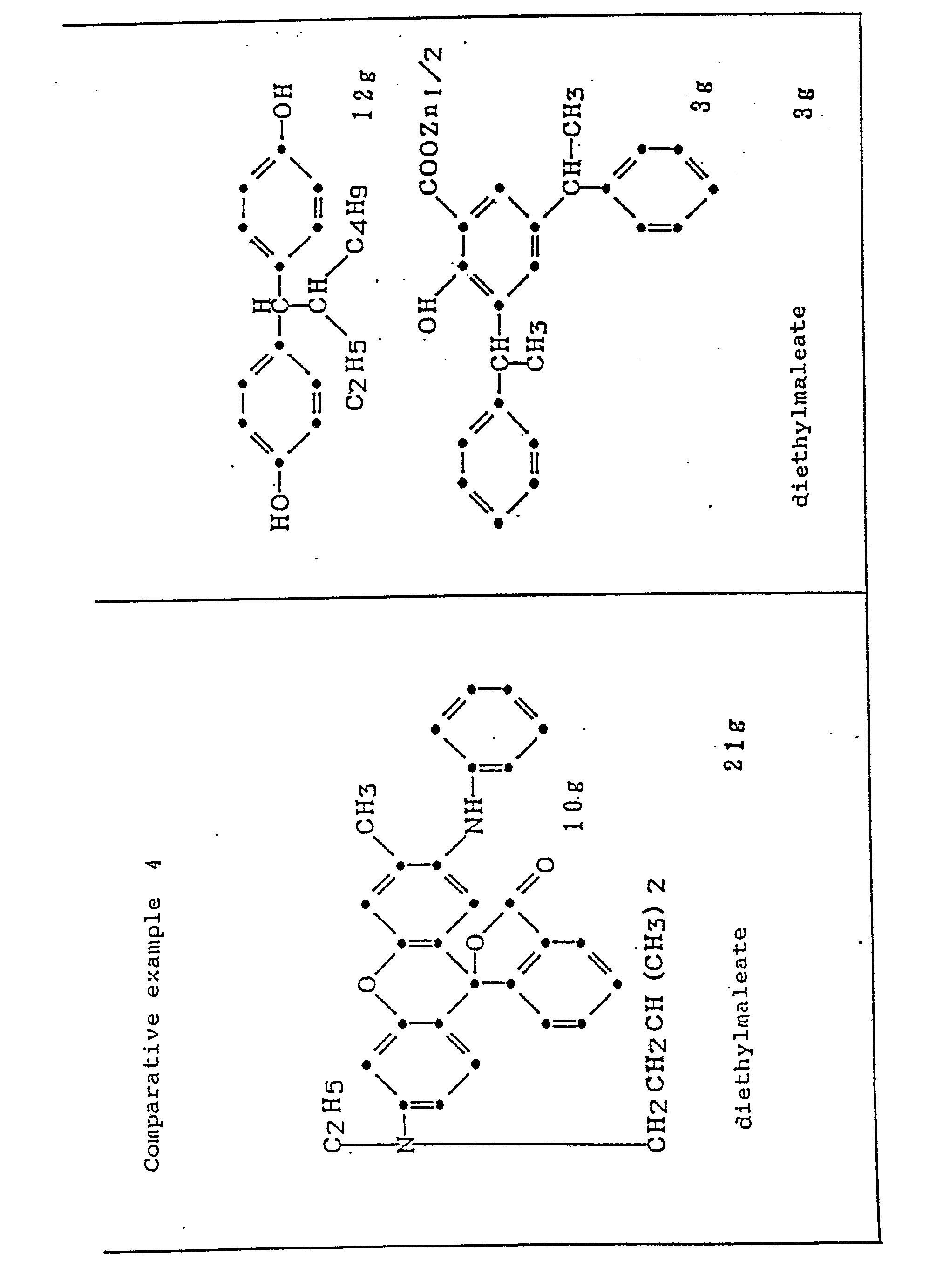
- Compounds B shown in the Table 2 were dissolved in 10 g of ethylacetate. The obtained solution of the color developers was mixed with 50 g of a 8 % water solution of polyvinylalcohol, 50 g of water and 0.5 g of sodium dodecylbenzensulfonate, and emulsified by stirring at 10,000 r.p.m. for 5 minutes at ordinary temperature using Ace Homogenizer made by Nippon Seiki k.k. to prepare an emulsified dispersion having a grain size of 0.5 micron.
- A 5.0 g portion of the foregoing capsule solution, a 10.0 g portion of the foregoing color developer-emulsified dispersion and 5.0 g of water were mixed by stirring, coated on a 70 micron-thick transparent polyethylene terephthalate (PET) film support providing a coverage of 15 g/m² on a solid basis, and dried. Thereon, a 2 micron-thick protective layer having the following composition was further provided to produce a transparent heat sensitive film.
- Modified Polyvinylalcohol with silicon 1 weight part
(PVA R2105: manufactured by Kurare K.K.) (solid basis)
Colloidal silica 1.5 weight part
(Snowtex 30: manufactured by Nissan Kagaku K.K.) (solid basis)
Zinc stearate 0.02 weight part
(Hidolin Z-7: manufactured by Chukyo Yushi k.k.) (solid basis)
Paraffin wax 0.01 weight part
(Hidolin P-7: manufactured by Chukyo Yushi k.k.) (solid basis)
- On each sample produced by using each material shown in Table 2, the refractive index of a component contained in a microcapsule (core material) and that of nonvolatile component oil of phase of the color developer dispersion were measured with Abee refractometer. The measurement of the refractive indexes were carried out on solutions obtained as follows; the core material or the nonvolatile component of developer dispersion was heated together with a small amount of ethylacetae to give a solution, then ethylacetate was distilled off. The results of above measurements were shown in Table 3 together with Haze % measured using HTR meter (integrating-sphere photometer) manufactured by Nippon Seimitsu Kogyo K.K..

- The results in Table 3 indicate that the Haze % of a heat sensitive recording material of the present invention is small and transparency of the heat sensitive recording material is quite excellent.
Claims (10)
Applications Claiming Priority (6)
| Application Number | Priority Date | Filing Date | Title |
|---|---|---|---|
| JP20374886U JPS63104054U (en) | 1986-12-25 | 1986-12-25 | |
| JP203748/86 | 1986-12-25 | ||
| JP62088196A JPH0662011B2 (en) | 1987-04-09 | 1987-04-09 | Thermal recording material |
| JP88197/87 | 1987-04-09 | ||
| JP88196/87 | 1987-04-09 | ||
| JP62088197A JPH074986B2 (en) | 1986-05-26 | 1987-04-09 | Thermal recording material |
Publications (3)
| Publication Number | Publication Date |
|---|---|
| EP0273752A2 true EP0273752A2 (en) | 1988-07-06 |
| EP0273752A3 EP0273752A3 (en) | 1989-06-07 |
| EP0273752B1 EP0273752B1 (en) | 1992-08-19 |
Family
ID=27305763
Family Applications (1)
| Application Number | Title | Priority Date | Filing Date |
|---|---|---|---|
| EP87311474A Expired - Lifetime EP0273752B1 (en) | 1986-12-25 | 1987-12-24 | Method of manufacturing heat sensitive recording material |
Country Status (3)
| Country | Link |
|---|---|
| US (1) | US4857501A (en) |
| EP (1) | EP0273752B1 (en) |
| DE (2) | DE3781259D1 (en) |
Cited By (7)
| Publication number | Priority date | Publication date | Assignee | Title |
|---|---|---|---|---|
| GB2213280A (en) * | 1987-12-01 | 1989-08-09 | Fuji Photo Film Co Ltd | Heat-sensitive recording material |
| EP0715964A3 (en) * | 1994-12-09 | 1996-07-10 | Ricoh Kk | |
| EP0718116A3 (en) * | 1994-12-19 | 1996-07-31 | Fuji Photo Film Co Ltd | |
| US6127314A (en) * | 1997-08-29 | 2000-10-03 | Fuji Photo Film Co., Ltd. | Heat-sensitive recording material |
| EP1254780A3 (en) * | 2001-05-01 | 2003-09-17 | Fuji Photo Film Co., Ltd. | Recording material and image forming method |
| EP3069894A4 (en) * | 2013-11-15 | 2017-08-09 | Osaka Sealing Printing Co., Ltd. | Thermal recording sheet |
| EP3680110A1 (en) | 2019-01-14 | 2020-07-15 | Ricoh Company, Ltd. | Thermosensitive recording material |
Families Citing this family (12)
| Publication number | Priority date | Publication date | Assignee | Title |
|---|---|---|---|---|
| US5260715A (en) * | 1988-06-28 | 1993-11-09 | Fuji Photo Film Co., Ltd. | Method of and apparatus for thermally recording image on a transparent heat sensitive material |
| JPH04141485A (en) * | 1990-10-03 | 1992-05-14 | Fuji Photo Film Co Ltd | Forming method of picture |
| US5665670A (en) * | 1995-08-30 | 1997-09-09 | Eastman Kodak Company | Recording element for direct thermosensitive printing |
| FR2878185B1 (en) | 2004-11-22 | 2008-11-07 | Sidel Sas | PROCESS FOR MANUFACTURING CONTAINERS COMPRISING A HEATING STEP BY MEANS OF A COHERENT ELECTROMAGNETIC RADIATION BEAM |
| US7425296B2 (en) | 2004-12-03 | 2008-09-16 | Pressco Technology Inc. | Method and system for wavelength specific thermal irradiation and treatment |
| US10857722B2 (en) | 2004-12-03 | 2020-12-08 | Pressco Ip Llc | Method and system for laser-based, wavelength specific infrared irradiation treatment |
| US8932706B2 (en) | 2005-10-27 | 2015-01-13 | Multi-Color Corporation | Laminate with a heat-activatable expandable layer |
| US7829163B2 (en) * | 2005-10-18 | 2010-11-09 | Multi-Color Corporation | Shrink sleeve for an article closure |
| US7735251B2 (en) * | 2006-07-17 | 2010-06-15 | Ward/Kraft, Inc. | Card carrying business communication product and method of producing same |
| FR2913210B1 (en) | 2007-03-02 | 2009-05-29 | Sidel Participations | IMPROVEMENTS IN THE HEATING OF PLASTIC MATERIALS BY INFRARED RADIATION |
| FR2917005B1 (en) | 2007-06-11 | 2009-08-28 | Sidel Participations | HEATING FACILITY FOR PREFORMING BODIES FOR BLOWING CONTAINERS |
| WO2017122311A1 (en) * | 2016-01-14 | 2017-07-20 | 大阪シーリング印刷株式会社 | Packaging sheet, and packaging container and packaging method using same |
Family Cites Families (11)
| Publication number | Priority date | Publication date | Assignee | Title |
|---|---|---|---|---|
| US2929736A (en) * | 1957-07-25 | 1960-03-22 | Ncr Co | Heat and pressure responsive record material |
| JPS492126B1 (en) * | 1970-10-27 | 1974-01-18 | ||
| BE776015A (en) * | 1970-12-28 | 1972-03-16 | Mitsui Toatsu Chemicals | PRESSURE SENSITIVE RECORDING EQUIPMENT |
| JPS5016967B1 (en) * | 1971-08-04 | 1975-06-17 | ||
| DE2909950A1 (en) * | 1979-03-14 | 1980-10-02 | Bayer Ag | MICROCAPSULES |
| US4343652A (en) * | 1979-08-24 | 1982-08-10 | Monsanto Europe S.A. | Chromogen solutions for pressure-sensitive mark-recording systems |
| JPS59218890A (en) * | 1983-05-27 | 1984-12-10 | Mitsubishi Paper Mills Ltd | Single layer type self-color formable pressure sensitive recording paper |
| JPS60242094A (en) * | 1984-05-17 | 1985-12-02 | Fuji Photo Film Co Ltd | Thermal recording material |
| US4577205A (en) * | 1984-05-25 | 1986-03-18 | Ricoh Electronics, Inc. | Releasable heat-sensitive label with E. B. setting printing ink |
| JPS6141593A (en) * | 1984-08-06 | 1986-02-27 | Nippon Petrochem Co Ltd | Solvent for dye of pressure-sensitive paper |
| DE3529781A1 (en) * | 1984-08-20 | 1986-02-20 | Ricoh Co., Ltd., Tokio/Tokyo | HEAT-SENSITIVE ADHESIVE RECORDING MATERIAL |
-
1987
- 1987-12-24 DE DE8787311474T patent/DE3781259D1/en not_active Expired - Lifetime
- 1987-12-24 EP EP87311474A patent/EP0273752B1/en not_active Expired - Lifetime
- 1987-12-24 DE DE8787311474T patent/DE3781259T2/en not_active Expired - Lifetime
- 1987-12-28 US US07/138,163 patent/US4857501A/en not_active Expired - Lifetime
Cited By (10)
| Publication number | Priority date | Publication date | Assignee | Title |
|---|---|---|---|---|
| GB2213280A (en) * | 1987-12-01 | 1989-08-09 | Fuji Photo Film Co Ltd | Heat-sensitive recording material |
| GB2213280B (en) * | 1987-12-01 | 1992-01-02 | Fuji Photo Film Co Ltd | Heat-sensitive recording material |
| EP0715964A3 (en) * | 1994-12-09 | 1996-07-10 | Ricoh Kk | |
| EP0718116A3 (en) * | 1994-12-19 | 1996-07-31 | Fuji Photo Film Co Ltd | |
| US6127314A (en) * | 1997-08-29 | 2000-10-03 | Fuji Photo Film Co., Ltd. | Heat-sensitive recording material |
| EP1254780A3 (en) * | 2001-05-01 | 2003-09-17 | Fuji Photo Film Co., Ltd. | Recording material and image forming method |
| US6890879B2 (en) | 2001-05-01 | 2005-05-10 | Fuji Photo Film Co., Ltd. | Recording material and image forming apparatus |
| EP3069894A4 (en) * | 2013-11-15 | 2017-08-09 | Osaka Sealing Printing Co., Ltd. | Thermal recording sheet |
| US9878567B2 (en) | 2013-11-15 | 2018-01-30 | Osaka Sealing Printing Co., Ltd. | Thermal recording sheet |
| EP3680110A1 (en) | 2019-01-14 | 2020-07-15 | Ricoh Company, Ltd. | Thermosensitive recording material |
Also Published As
| Publication number | Publication date |
|---|---|
| EP0273752B1 (en) | 1992-08-19 |
| DE3781259T2 (en) | 1993-03-11 |
| US4857501A (en) | 1989-08-15 |
| DE3781259D1 (en) | 1992-09-24 |
| EP0273752A3 (en) | 1989-06-07 |
Similar Documents
| Publication | Publication Date | Title |
|---|---|---|
| US4820682A (en) | Heat sensitive recording materials | |
| EP0247816B1 (en) | Heat-sensitive microcapsular colour recording material | |
| EP0273752B1 (en) | Method of manufacturing heat sensitive recording material | |
| US4999333A (en) | Heat sensitive recording material | |
| US6613716B2 (en) | Thermal print paper and process | |
| US4929411A (en) | Heat-sensitive recording material | |
| JPH0120074B2 (en) | ||
| JPS61244587A (en) | Thermal recording material | |
| US4845071A (en) | Heatsensitive recording material | |
| JP2514068B2 (en) | Thermal recording material | |
| US5593938A (en) | Thermal-sensitive recording material | |
| JPH0745261B2 (en) | Thermal recording material | |
| JPH0825335B2 (en) | Thermal recording material | |
| JP3182254B2 (en) | Thermal recording material | |
| JPH0662011B2 (en) | Thermal recording material | |
| JPH04325285A (en) | Thermal recording material | |
| JPH0698836B2 (en) | Thermal recording material | |
| JPS63189286A (en) | Thermal recording material | |
| JPH01105780A (en) | Thermal recording material | |
| JPS61283590A (en) | Thermal recording material | |
| JPH085248B2 (en) | Thermal recording material | |
| JPH05104849A (en) | Carbonless pressure sensitive recording sheet | |
| JPS6241082A (en) | Thermal recording material | |
| JPH01204785A (en) | Thermal recording material | |
| JPH0739218B2 (en) | Thermal recording material |
Legal Events
| Date | Code | Title | Description |
|---|---|---|---|
| PUAI | Public reference made under article 153(3) epc to a published international application that has entered the european phase |
Free format text: ORIGINAL CODE: 0009012 |
|
| AK | Designated contracting states |
Kind code of ref document: A2 Designated state(s): DE GB |
|
| PUAL | Search report despatched |
Free format text: ORIGINAL CODE: 0009013 |
|
| AK | Designated contracting states |
Kind code of ref document: A3 Designated state(s): DE GB |
|
| 17P | Request for examination filed |
Effective date: 19891109 |
|
| 17Q | First examination report despatched |
Effective date: 19910621 |
|
| GRAA | (expected) grant |
Free format text: ORIGINAL CODE: 0009210 |
|
| AK | Designated contracting states |
Kind code of ref document: B1 Designated state(s): DE GB |
|
| REF | Corresponds to: |
Ref document number: 3781259 Country of ref document: DE Date of ref document: 19920924 |
|
| PLBE | No opposition filed within time limit |
Free format text: ORIGINAL CODE: 0009261 |
|
| STAA | Information on the status of an ep patent application or granted ep patent |
Free format text: STATUS: NO OPPOSITION FILED WITHIN TIME LIMIT |
|
| 26N | No opposition filed | ||
| REG | Reference to a national code |
Ref country code: GB Ref legal event code: IF02 |
|
| PGFP | Annual fee paid to national office [announced via postgrant information from national office to epo] |
Ref country code: GB Payment date: 20021213 Year of fee payment: 16 |
|
| PGFP | Annual fee paid to national office [announced via postgrant information from national office to epo] |
Ref country code: DE Payment date: 20021223 Year of fee payment: 16 |
|
| PG25 | Lapsed in a contracting state [announced via postgrant information from national office to epo] |
Ref country code: GB Free format text: LAPSE BECAUSE OF NON-PAYMENT OF DUE FEES Effective date: 20031224 |
|
| PG25 | Lapsed in a contracting state [announced via postgrant information from national office to epo] |
Ref country code: DE Free format text: LAPSE BECAUSE OF NON-PAYMENT OF DUE FEES Effective date: 20040701 |
|
| GBPC | Gb: european patent ceased through non-payment of renewal fee |
Effective date: 20031224 |