EP0271851A2 - Light sensitive mixtures for making repeatedly tonable layers - Google Patents
Light sensitive mixtures for making repeatedly tonable layers Download PDFInfo
- Publication number
- EP0271851A2 EP0271851A2 EP87118440A EP87118440A EP0271851A2 EP 0271851 A2 EP0271851 A2 EP 0271851A2 EP 87118440 A EP87118440 A EP 87118440A EP 87118440 A EP87118440 A EP 87118440A EP 0271851 A2 EP0271851 A2 EP 0271851A2
- Authority
- EP
- European Patent Office
- Prior art keywords
- sulfonic acid
- photosensitive composition
- accordance
- organic sulfonic
- light sensitive
- Prior art date
- Legal status (The legal status is an assumption and is not a legal conclusion. Google has not performed a legal analysis and makes no representation as to the accuracy of the status listed.)
- Granted
Links
Classifications
-
- G—PHYSICS
- G03—PHOTOGRAPHY; CINEMATOGRAPHY; ANALOGOUS TECHNIQUES USING WAVES OTHER THAN OPTICAL WAVES; ELECTROGRAPHY; HOLOGRAPHY
- G03F—PHOTOMECHANICAL PRODUCTION OF TEXTURED OR PATTERNED SURFACES, e.g. FOR PRINTING, FOR PROCESSING OF SEMICONDUCTOR DEVICES; MATERIALS THEREFOR; ORIGINALS THEREFOR; APPARATUS SPECIALLY ADAPTED THEREFOR
- G03F7/00—Photomechanical, e.g. photolithographic, production of textured or patterned surfaces, e.g. printing surfaces; Materials therefor, e.g. comprising photoresists; Apparatus specially adapted therefor
- G03F7/26—Processing photosensitive materials; Apparatus therefor
- G03F7/28—Processing photosensitive materials; Apparatus therefor for obtaining powder images
-
- G—PHYSICS
- G03—PHOTOGRAPHY; CINEMATOGRAPHY; ANALOGOUS TECHNIQUES USING WAVES OTHER THAN OPTICAL WAVES; ELECTROGRAPHY; HOLOGRAPHY
- G03F—PHOTOMECHANICAL PRODUCTION OF TEXTURED OR PATTERNED SURFACES, e.g. FOR PRINTING, FOR PROCESSING OF SEMICONDUCTOR DEVICES; MATERIALS THEREFOR; ORIGINALS THEREFOR; APPARATUS SPECIALLY ADAPTED THEREFOR
- G03F7/00—Photomechanical, e.g. photolithographic, production of textured or patterned surfaces, e.g. printing surfaces; Materials therefor, e.g. comprising photoresists; Apparatus specially adapted therefor
- G03F7/004—Photosensitive materials
- G03F7/0045—Photosensitive materials with organic non-macromolecular light-sensitive compounds not otherwise provided for, e.g. dissolution inhibitors
-
- Y—GENERAL TAGGING OF NEW TECHNOLOGICAL DEVELOPMENTS; GENERAL TAGGING OF CROSS-SECTIONAL TECHNOLOGIES SPANNING OVER SEVERAL SECTIONS OF THE IPC; TECHNICAL SUBJECTS COVERED BY FORMER USPC CROSS-REFERENCE ART COLLECTIONS [XRACs] AND DIGESTS
- Y10—TECHNICAL SUBJECTS COVERED BY FORMER USPC
- Y10S—TECHNICAL SUBJECTS COVERED BY FORMER USPC CROSS-REFERENCE ART COLLECTIONS [XRACs] AND DIGESTS
- Y10S430/00—Radiation imagery chemistry: process, composition, or product thereof
- Y10S430/1053—Imaging affecting physical property or radiation sensitive material, or producing nonplanar or printing surface - process, composition, or product: radiation sensitive composition or product or process of making binder containing
- Y10S430/1055—Radiation sensitive composition or product or process of making
- Y10S430/114—Initiator containing
- Y10S430/12—Nitrogen compound containing
- Y10S430/121—Nitrogen in heterocyclic ring
Definitions
- the invention involves a photosensitive composition useful for producing repeatedly tonable layers for the manufacture of fluorescent screens with a black matrix for color television tubes and a process for the production of these fluorescent screens.
- Reproduction processes are known in which differences in the tackiness of exposed and unexposed areas of a light sensitive layer are used for image production.
- the images are made visible by application of a suitable toning material, which adheres only in the tacky areas and can be removed from the nontacky areas.
- Certain of such imaging materials have a special significance in that multiple, successive exposure and toning steps can be performed with the use of different toners on the same light sensitive layer.
- Such repeatably tonable photosensitive materials are known and are used commercially for producing multicolor images, for running color proof processes, for preparing color filter masks and electronic circuits as well as for the production of fluorescent screens for color television tubes.
- imaging materials for the foregoing purposes have been shown to be those containing a 4-(2 ⁇ -nitrophenyl)-1,4-dihydropyridine compound.
- a 4-(2 ⁇ -nitrophenyl)-1,4-dihydropyridine compound is disclosed in German Patent 3,429,615 (U.S. Patent 4,604,340).
- This imaging material can also be used for the fluorescent screens of color television tubes, which have a black matrix in addition to the dots or lines in the fluorescent mask, that is, in which the interstices among the light emitting sites are filled or coated with a light absorbing material.
- the black matrix improves the contrast of the image screen and reduces the reflection of ambient light.
- the production of a black matrix that is, the application of a fourth color on the fluorescent screen, is technically demanding and causes considerable extra expense.
- the black matrix is produced either in a first process step or as an adjunct to the preparation of the colored image elements.
- a light sensitive negatively tonable material is overall exposed after the production of the fluorescent material mask, to make the remaining areas tacky and is then toned with a black pigment powder.
- a major disadvantage of this method is that the diameter of the fluorescent material dots or the width of the fluorescent material lines must be smaller than the openings of the lens mask. To achieve this, the corresponding image areas are underexposed, so that it is difficult to attain an adequate toned density and therefore, the image reproduction brightness required in the industry.
- the image elements consisting of comparatively large particles of fluorescent material are contaminated by finely divided particles of the black toner. This also leads to a loss of brightness in image reproduction. Furthermore, the accuracy of the image is affected adversely by the thrice repeated insertion of the lens mask.
- German Patent 3,540,796 U.S. Patent 4,698,293 discloses a process in which the black matrix is produced on a first negative-working light sensitive layer by image reversal. Then a second negative-working light sensitive layer must be applied on this layer to make the fluorescent material mask.
- the problem to which the present invention is directed is that of providing a photosensitive composition for the production of repeatedly tonable layers in the manufacture of fluorescent screens with a black matrix for color television tubes, which composition makes it possible to produce on a single light sensitive layer first the black matrix and then the fluorescent material mask for all types of screens.
- the present invention relates to photosensitive compositions for the production of repeatedly tonable layers for the manufacture of fluorescent screens with a black matrix for color television tubes, said composition comprising at least one 1,4-dihydropyridine compound substituted in the 4 position with a 2 ⁇ -nitrophenyl ring, the improvement wherein the composition also comprises at least one organic sulfonic acid. It also relates to processes whereby a layer of such composition can be used to produce fluorescent screens with a black matrix for color television tubes.
- layers can be produced on which a positive image can be produced first, followed by multiple negative images.
- the invention is based on the realization that organic sulfonic acids cause tackiness in unexposed light sensitive layers containing at least one 4-(2 ⁇ -nitrophenyl)-1,4-dihydropyridine compound, yet eliminate the tackiness of the partially exposed areas, so that these partially exposed areas can be exposed imagewise again and be made tacky again.
- Suitable organic sulfonic acids for the production of the light sensitive mixture are known to the expert. Especially good results have been obtained with sulfonic acids corresponding to one of the following formulas:
- polymeric sulfonic acids such as polystyrene sulfonic acid with a molecular weight >100,000, sulfonated copolymers of styrene with maleic acid anhydride and isobutylene, or sulfonated copolymers of vinyl toluene with acrylic acid esters.
- Sulfonic acids of low volatility such as 5-sulfosalicylic acid and o-toluene sulfonic acid have proven to be especially suitable.
- organic sulfonic acids can be used alone or in combination with each other.
- the light sensitive layer For the production of the light sensitive layer, at least one 4- 2 ⁇ -nitrophenyl)-1,4-dihydropyridine compound and at least one organic sulfonic acid are dissolved in an organic solvent.
- the resulting solution is applied by known methods to the fluorescent screen so that a non-crystalline film 0.8-2 ⁇ m thick forms.
- the formation of a non-crystalline film can be achieved, for example, by the use of mixtures of light sensitive compounds, by melting and rapid cooling of the light sensitive compounds, or by dissolving the compounds in highly volatile solvents with high solvent capability. Suitable solvents are methyl ethyl ketone, acetone or methylene chloride.
- the choice of light sensitive compounds and organic sulfonic acids must be such that the light sensitive composition is tacky at the temperature of toner application.
- the layers contain 1 equivalent of acid for 2 to 6 equivalents of light sensitive compound.
- a light sensitive compound or a mixture of these compounds with a low glass transition temperature it is advantageous to use an organic sulfonic acid with a higher melting point and a correspondingly higher glass transition temperature. If, on the other hand, the light sensitive compound or the light sensitive mixture has a higher glass transition temperature, an organic sulfonic acid with a lower melting point is used.
- the original tackiness of the light sensitive mixture be effected by the addition of plasticizers, in which case it is desirable to use plasticizers that are neither photoactive nor strongly acidic.
- plasticizers that are neither photoactive nor strongly acidic.
- Suitable examples for this purpose are dioctyl phthalate, tricresyl phosphate, polyoxyethylene lauryl ether, triethylene glycol diacetate or hexanoic and octanoic acid esters of triethylene glycol.
- Suitable 1,4-dihydropyridine compounds substituted in the 4 position with a 2 ⁇ -nitrophenyl ring correspond to the following general formula: where R is 2 ⁇ -nitrophenyl, in which the phenyl radical can be substituted with alkyl, oxalkyl, hydroxyl or halogen groups, R1 and/or R2 can be CN, COOR ⁇ or COR ⁇ , where R ⁇ is an alkyl group with 1-11 carbon atoms, which can also be substituted with OCH3 or O-C2H5 and in which R1 and R2 can be the same or different, R3 and R4 are alkyl, in which R3 and R4 can be the same or different, and R1 and R3 and/or R2 and R4 are the atoms necessary to complete a 5 or 6 membered carbocyclic or heterocyclic ring containing a carbonyl group.
- the light sensitive compounds can be used alone, in combination with one another, or with a binder. Although it is preferred to use a composition consisting essentially of mixtures of 1,4-dihydropyridine compounds, the light sensitive material can also be used with binders.
- the concentration of the light sensitive material in the binder can vary within wide limits and lies in the range of 0.2 to 9 parts by weight for one part by weight of the binder.
- Suitable binders are polyacrylic acid or methacrylic acid esters as well as copolymers with acrylic or methacrylic acid or other acrylic or vinyl monomers, copolymers of maleic acid anhydrides, of maleic acid or its diesters or half esters with styrene or other vinyl monomers, chlorine containing vinyl polymers or copolymers such as polyvinyl chloride as well as its post-chlorinated products, polyvinylidene chloride, chlorinated polyethylene, etc., polystyrene and polystyrene copolymers, ethylene and ethylene copolymers, for example, with maleic acid, etc., types of synthetic rubber on the basis of butadiene, chloroprene etc. and their copolymers, for example, with styrene, acrylonitrile, etc, polyethers such as high molecular weight polyethylene oxide or polyepichlorohydrin, etc.
- the mixtures can optionally contain other additives, such as, for example, wetting agents, stabilizers, optical brighteners, matte agents and others.
- the radiation sources used are those that deliver an effective quantity of these rays, such as, for example, mercury vapor lamps, xenon lamps or fluorescent lamps.
- the exposure of a fluorescent screen provided with a light sensitive layer is conducted on a television exposure table, as is customary for this purpose, provided with a mercury vapor lamp and through a corresponding lens mask.
- the sensitivity of the light sensitive layers is a function of the toning temperature and of the composition of the toner, it is advantageous to determine the optimum exposure time in the usual manner with the use of a step wedge.
- the fluorescent material mask is produced by applying fluorescent material powder to the exposed areas as is customary for this purpose, such as, for example, zinc sulfide or rare earth oxysulfides, which can be optionally doped with another metal.
- iron oxide or graphite powder in pure form or on a powdered carrier are preferred.
- the powdered toner can be applied to the fluorescent screen, for example, by adding an excess of toner into the tub-shaped screen and shaking the structure appropriately. Thus the powder is distributed over the screen and adheres to the tacky areas. The excess is removed by the use of air pressure.
- a thin, light sensitive layer is applied to the inner surface of a fluorescent screen by spin coating and dried.
- the layer is exposed on the usual television exposure table through a line or dot screen mask successively in the three positions of green, blue and red. After the mask is removed, the unexposed tacky areas are toned with a finely divided black pigment.
- the mask is applied again and the layer is exposed again in a first position. The exposed tacky line or dot image elements are then toned with blue, green or red fluorescent powder.
- the corresponding areas of the light sensitive layer similarly in the form of line or dot image elements are toned with a second color.
- a third shifted exposure other areas of the light sensitive layer also in the form of line or dot image elements become tacky and are toned with fluorescent powder of the third color.
- the light sensitive layer is removed by heating to temperatures between 400° and 450°C.
- an acid treatment as described in German Patent 35 40 804 (U.S.S.N. 6/930,102) is conducted after each toning step.
- a solution of 2.7 g of dimethyl ester of 2,6-dimethyl-4-(2 ⁇ -nitrophenyl)-1,4-dihydropyridine-3,5-dicarboxylic acid and 0.8 g of p-toluene sulfonic acid in 60 ml of methyl ethyl ketone is applied by spin coating on the inner surface of a fluorescent screen so that the thickness of the dried layer is 1.2 ⁇ m.
- a lens mask with slits 160 micrometers wide) is placed in position. The screen is exposed on the usual television exposure table with a 1000 watt mercury vapor lamp in the three positions of red, blue and green, successively, for 10 seconds each.
- the tacky remaining areas are toned with a carbon pigment (average grain diameter 3 ⁇ m). Black matrix lines 80 um wide are obtained.
- the mask is applied again and the same layer is exposed for 50 seconds in the green position.
- the newly tacky areas are toned with a green fluorescent powder.
- the same exposure process is repeated in the blue and in the red position, and after each exposure the corresponding fluorescent powder is applied.
- the fluorescent material lines show no contamination by the black pigment.
- a solution of 3.0 g of di-n-propyl ester of 2,6-dimethyl-4-(2 ⁇ -nitrophenyl)-1,4-dihydropyridine-3,5-dicarboxylic acid and 0.8 g of 5-sulfosalicylic acid in 60 ml of methyl ethyl ketone is applied by spin coating on the inner surface of a fluorescent screen so that the thickness of the dry layer is 1.4 ⁇ m.
- the screen is exposed on the usual television exposure table with a 2000 watt mercury vapor lamp in the three positions for red, blue and green successively for 30 seconds each.
- the tacky remaining areas are toned with a black iron oxide powder (average grain diameter of 3.5 ⁇ m). The result is a black positive image of the mask.
- the mask is applied again and the same layer is exposed in the green position for 2 minutes.
- the newly tacky areas are toned with a green fluorescent powder.
- the same exposure process is repeated in the blue and in the red position, and after each exposure the corresponding fluorescent toning material is applied.
- the fluorescent material dots fill the free spaces of the matrix.
- the screen is exposed on the usual television exposure table with a 1000 watt mercury vapor lamp in the three positions of green, blue and red successively for 15 seconds each.
- the lens mask is removed and the tacky remaining areas are toned with graphite powder (4 ⁇ m average grain size). Black lines 90 ⁇ m wide are obtained.
- the mask is inserted again and the same layer is exposed for 60 seconds in the green position.
- the newly tacky areas are toned with a green fluorescent powder.
- the screen is treated, as described in German Patent 35 40 804 (U.S.S.N.
- a Solution A of 2.7 g of dimethyl ester of 2,6-dimethyl-4-(2 ⁇ -nitrophenyl)-1,4-dihydropyridine-3,5-dicarboxylic acid, and 0.8 g of p-toluene sulfonic acid; and a Solution B of 2.7 g of dimethyl ester of 2,6-dimethyl-4-(2 ⁇ -nitrophenyl)-1,4-dihydropyridine-3,5-dicarboxylic acid, and 0.48 g of sulfuric acid (96% by volume); each in 60 ml of methyl ethyl ketone, are coated on two glass plates so that the layer thicknesses are 0.9 ⁇ m after drying. Each sample is exposed with a 1000 watt mercury vapor lamp at a distance of 60 cm for 2 minutes through a step wedge (k 0.1) and then toned with a zinc sulfide fluorescent screen powder.
Landscapes
- Physics & Mathematics (AREA)
- General Physics & Mathematics (AREA)
- Spectroscopy & Molecular Physics (AREA)
- Formation Of Various Coating Films On Cathode Ray Tubes And Lamps (AREA)
- Non-Silver Salt Photosensitive Materials And Non-Silver Salt Photography (AREA)
- Luminescent Compositions (AREA)
- Photosensitive Polymer And Photoresist Processing (AREA)
- Investigating Or Analysing Materials By The Use Of Chemical Reactions (AREA)
- Compositions Of Macromolecular Compounds (AREA)
Abstract
Description
- The invention involves a photosensitive composition useful for producing repeatedly tonable layers for the manufacture of fluorescent screens with a black matrix for color television tubes and a process for the production of these fluorescent screens.
- Reproduction processes are known in which differences in the tackiness of exposed and unexposed areas of a light sensitive layer are used for image production. The images are made visible by application of a suitable toning material, which adheres only in the tacky areas and can be removed from the nontacky areas. Certain of such imaging materials have a special significance in that multiple, successive exposure and toning steps can be performed with the use of different toners on the same light sensitive layer. Such repeatably tonable photosensitive materials are known and are used commercially for producing multicolor images, for running color proof processes, for preparing color filter masks and electronic circuits as well as for the production of fluorescent screens for color television tubes.
- Especially useful imaging materials for the foregoing purposes have been shown to be those containing a 4-(2ʹ-nitrophenyl)-1,4-dihydropyridine compound. Such a material is disclosed in German Patent 3,429,615 (U.S. Patent 4,604,340). This imaging material can also be used for the fluorescent screens of color television tubes, which have a black matrix in addition to the dots or lines in the fluorescent mask, that is, in which the interstices among the light emitting sites are filled or coated with a light absorbing material. The black matrix improves the contrast of the image screen and reduces the reflection of ambient light. However, the production of a black matrix, that is, the application of a fourth color on the fluorescent screen, is technically demanding and causes considerable extra expense.
- In the currently known processes, the black matrix is produced either in a first process step or as an adjunct to the preparation of the colored image elements. In the latter case, for example, according to statements in U.S. Patent 4,263,385, a light sensitive negatively tonable material is overall exposed after the production of the fluorescent material mask, to make the remaining areas tacky and is then toned with a black pigment powder.
- A major disadvantage of this method is that the diameter of the fluorescent material dots or the width of the fluorescent material lines must be smaller than the openings of the lens mask. To achieve this, the corresponding image areas are underexposed, so that it is difficult to attain an adequate toned density and therefore, the image reproduction brightness required in the industry. There is also a disadvantage in that the image elements consisting of comparatively large particles of fluorescent material are contaminated by finely divided particles of the black toner. This also leads to a loss of brightness in image reproduction. Furthermore, the accuracy of the image is affected adversely by the thrice repeated insertion of the lens mask.
- These disadvantages can be avoided if the black matrix material is applied during the production of the fluorescent screen mask. However, this type of process requires the use of two light sensitive layers. For example, German Patent 3,540,796 (U.S. Patent 4,698,293) discloses a process in which the black matrix is produced on a first negative-working light sensitive layer by image reversal. Then a second negative-working light sensitive layer must be applied on this layer to make the fluorescent material mask.
- Another process has been developed in which the matrix mask can be exposed first with offset lamp positions and then toned. Aside from this process being useful only for the production of fluorescent screens with line image masks, both methods require complicated, additional process steps.
- The problem to which the present invention is directed is that of providing a photosensitive composition for the production of repeatedly tonable layers in the manufacture of fluorescent screens with a black matrix for color television tubes, which composition makes it possible to produce on a single light sensitive layer first the black matrix and then the fluorescent material mask for all types of screens.
- The present invention relates to photosensitive compositions for the production of repeatedly tonable layers for the manufacture of fluorescent screens with a black matrix for color television tubes, said composition comprising at least one 1,4-dihydropyridine compound substituted in the 4 position with a 2ʹ-nitrophenyl ring, the improvement wherein the composition also comprises at least one organic sulfonic acid. It also relates to processes whereby a layer of such composition can be used to produce fluorescent screens with a black matrix for color television tubes.
- By use of the above photosensitive mixtures, layers can be produced on which a positive image can be produced first, followed by multiple negative images.
- The invention is based on the realization that organic sulfonic acids cause tackiness in unexposed light sensitive layers containing at least one 4-(2ʹ-nitrophenyl)-1,4-dihydropyridine compound, yet eliminate the tackiness of the partially exposed areas, so that these partially exposed areas can be exposed imagewise again and be made tacky again.
- Suitable organic sulfonic acids for the production of the light sensitive mixture are known to the expert. Especially good results have been obtained with sulfonic acids corresponding to one of the following formulas:
- (a) R-SO₃H
- (b) HO₃S-R-SO₃H,
- In addition, good results have been obtained with polymeric sulfonic acids such as polystyrene sulfonic acid with a molecular weight >100,000, sulfonated copolymers of styrene with maleic acid anhydride and isobutylene, or sulfonated copolymers of vinyl toluene with acrylic acid esters.
- Sulfonic acids of low volatility such as 5-sulfosalicylic acid and o-toluene sulfonic acid have proven to be especially suitable.
- The organic sulfonic acids can be used alone or in combination with each other.
- For the production of the light sensitive layer, at least one 4- 2ʹ-nitrophenyl)-1,4-dihydropyridine compound and at least one organic sulfonic acid are dissolved in an organic solvent. The resulting solution is applied by known methods to the fluorescent screen so that a non-crystalline film 0.8-2 µm thick forms. The formation of a non-crystalline film can be achieved, for example, by the use of mixtures of light sensitive compounds, by melting and rapid cooling of the light sensitive compounds, or by dissolving the compounds in highly volatile solvents with high solvent capability. Suitable solvents are methyl ethyl ketone, acetone or methylene chloride.
- The choice of light sensitive compounds and organic sulfonic acids must be such that the light sensitive composition is tacky at the temperature of toner application. In general, the layers contain 1 equivalent of acid for 2 to 6 equivalents of light sensitive compound.
- Making the unexposed material tacky is possible in various ways and does not pose any difficulty for the expert.
- If, for example, a light sensitive compound or a mixture of these compounds with a low glass transition temperature is used, it is advantageous to use an organic sulfonic acid with a higher melting point and a correspondingly higher glass transition temperature. If, on the other hand, the light sensitive compound or the light sensitive mixture has a higher glass transition temperature, an organic sulfonic acid with a lower melting point is used.
- Obviously, it is also possible that the original tackiness of the light sensitive mixture be effected by the addition of plasticizers, in which case it is desirable to use plasticizers that are neither photoactive nor strongly acidic. Suitable examples for this purpose are dioctyl phthalate, tricresyl phosphate, polyoxyethylene lauryl ether, triethylene glycol diacetate or hexanoic and octanoic acid esters of triethylene glycol.
- Suitable 1,4-dihydropyridine compounds substituted in the 4 position with a 2ʹ-nitrophenyl ring correspond to the following general formula:

R is 2ʹ-nitrophenyl, in which the phenyl radical can be substituted with alkyl, oxalkyl, hydroxyl or halogen groups,
R₁ and/or R₂ can be CN, COORʹ or CORʹ, where Rʹ is an alkyl group with 1-11 carbon atoms, which can also be substituted with OCH₃ or O-C₂H₅ and in which R₁ and R₂ can be the same or different,
R₃ and R₄ are alkyl, in which R₃ and R₄ can be the same or different, and
R₁ and R₃ and/or R₂ and R₄ are the atoms necessary to complete a 5 or 6 membered carbocyclic or heterocyclic ring containing a carbonyl group. - The following compounds have proven to be especially suitable:
dimethyl ester of 2,6-dimethyl-4-(2ʹ-nitrophenyl)-1,4-dihydropyridine-3,5-dicarboxylic acid; diethyl ester of 2,6-dimethyl-4-(2ʹ-nitrophenyl)-1,4-dihydropyridine-3,5-dicarboxylic acid; diethyl ester of 2,6-dimethyl-4-(2ʹ-nitro-4ʹ,5ʹ-dimethoxyphenyl)-1,4-dihydropyridine-3,5-dicarboxylic acid; di-n-propyl ester of 2,6-dimethyl-4-(2ʹ-nitrophenyl)-1,4-dihydropyridine-3,5-dicarboxylic acid; diisopropyl ester of 2,6-dimethyl-4-(2ʹ-nitrophenyl)-1,4-dihydropyridine-3,5-dicarboxylic acid: diisopropyl ester of 2,6-dimethyl-4-(2ʹ-nitrophenyl)-1,4-dihydropyridine3,5-dicarboxylic acid; di(β-ethoxyethyl)ester of 2,6-dimethyl-4-(2ʹ-nitrophenyl-1,4-dihydropyridine-3,5-dicarboxylic acid; 3-methyl-5-ethyl ester of 2,6-dimethyl-4-(2ʹ-nitrophenyl)-1,4-dihydropyridine-3,5-dicarboxylic acid; 3-isopropyl-5-methyl-ester of 2,6-dimethyl-4-(2ʹ-nitrophenyl)-1,4-dihydropyridine-3,5-dicarboxylic acid; ethyl ester of 4-(2ʹ-nitrophenyl)-2,6-dimethyl-3-aceto-1,4-dihydropyridine-5-carboxylic acid; 2,6-dimethyl-4-(2ʹ-nitrophenyl)-3,5-di-aceto-1,4-dihydropyridine; and 2,6-dimethyl-4-(2ʹ-nitrophenyl)-3,5-dicyano-1,4-dihydropyridine. - The light sensitive compounds can be used alone, in combination with one another, or with a binder. Although it is preferred to use a composition consisting essentially of mixtures of 1,4-dihydropyridine compounds, the light sensitive material can also be used with binders. The concentration of the light sensitive material in the binder can vary within wide limits and lies in the range of 0.2 to 9 parts by weight for one part by weight of the binder.
- Suitable binders are polyacrylic acid or methacrylic acid esters as well as copolymers with acrylic or methacrylic acid or other acrylic or vinyl monomers, copolymers of maleic acid anhydrides, of maleic acid or its diesters or half esters with styrene or other vinyl monomers, chlorine containing vinyl polymers or copolymers such as polyvinyl chloride as well as its post-chlorinated products, polyvinylidene chloride, chlorinated polyethylene, etc., polystyrene and polystyrene copolymers, ethylene and ethylene copolymers, for example, with maleic acid, etc., types of synthetic rubber on the basis of butadiene, chloroprene etc. and their copolymers, for example, with styrene, acrylonitrile, etc, polyethers such as high molecular weight polyethylene oxide or polyepichlorohydrin, etc.
- The mixtures can optionally contain other additives, such as, for example, wetting agents, stabilizers, optical brighteners, matte agents and others.
- As the light sensitive layer has its maximum sensitivity in the ultraviolet range between 300 and 400 nm, the radiation sources used are those that deliver an effective quantity of these rays, such as, for example, mercury vapor lamps, xenon lamps or fluorescent lamps. The exposure of a fluorescent screen provided with a light sensitive layer is conducted on a television exposure table, as is customary for this purpose, provided with a mercury vapor lamp and through a corresponding lens mask. As the sensitivity of the light sensitive layers is a function of the toning temperature and of the composition of the toner, it is advantageous to determine the optimum exposure time in the usual manner with the use of a step wedge.
- After exposure, the fluorescent material mask is produced by applying fluorescent material powder to the exposed areas as is customary for this purpose, such as, for example, zinc sulfide or rare earth oxysulfides, which can be optionally doped with another metal.
- For the production of the black matrix, iron oxide or graphite powder in pure form or on a powdered carrier are preferred.
- The powdered toner can be applied to the fluorescent screen, for example, by adding an excess of toner into the tub-shaped screen and shaking the structure appropriately. Thus the powder is distributed over the screen and adheres to the tacky areas. The excess is removed by the use of air pressure.
- For the production of a fluorescent screen with a black matrix, a thin, light sensitive layer according to the invention is applied to the inner surface of a fluorescent screen by spin coating and dried. The layer is exposed on the usual television exposure table through a line or dot screen mask successively in the three positions of green, blue and red. After the mask is removed, the unexposed tacky areas are toned with a finely divided black pigment. The mask is applied again and the layer is exposed again in a first position. The exposed tacky line or dot image elements are then toned with blue, green or red fluorescent powder.
- After a subsequent second, shifted exposure, the corresponding areas of the light sensitive layer similarly in the form of line or dot image elements are toned with a second color. By a third shifted exposure, other areas of the light sensitive layer also in the form of line or dot image elements become tacky and are toned with fluorescent powder of the third color. Finally, the light sensitive layer is removed by heating to temperatures between 400° and 450°C.
- In one especially advantageous embodiment, an acid treatment, as described in German Patent 35 40 804 (U.S.S.N. 6/930,102) is conducted after each toning step.
- The following examples illustrate the invention.
- A solution of 2.7 g of dimethyl ester of 2,6-dimethyl-4-(2ʹ-nitrophenyl)-1,4-dihydropyridine-3,5-dicarboxylic acid and 0.8 g of p-toluene sulfonic acid in 60 ml of methyl ethyl ketone is applied by spin coating on the inner surface of a fluorescent screen so that the thickness of the dried layer is 1.2 µm. A lens mask with slits (160 micrometers wide) is placed in position. The screen is exposed on the usual television exposure table with a 1000 watt mercury vapor lamp in the three positions of red, blue and green, successively, for 10 seconds each. After the lens mask is removed, the tacky remaining areas are toned with a carbon pigment (average grain diameter 3µm). Black matrix lines 80 um wide are obtained. The mask is applied again and the same layer is exposed for 50 seconds in the green position. The newly tacky areas are toned with a green fluorescent powder. The same exposure process is repeated in the blue and in the red position, and after each exposure the corresponding fluorescent powder is applied.
- Fluorescent material lines 130 µm wide fill the interstices of the matrix. The fluorescent material lines show no contamination by the black pigment.
- A solution of 3.0 g of di-n-propyl ester of 2,6-dimethyl-4-(2ʹ-nitrophenyl)-1,4-dihydropyridine-3,5-dicarboxylic acid and 0.8 g of 5-sulfosalicylic acid in 60 ml of methyl ethyl ketone is applied by spin coating on the inner surface of a fluorescent screen so that the thickness of the dry layer is 1.4 µm.
- After the application of a dot mask, the screen is exposed on the usual television exposure table with a 2000 watt mercury vapor lamp in the three positions for red, blue and green successively for 30 seconds each. After the dot mask is removed, the tacky remaining areas are toned with a black iron oxide powder (average grain diameter of 3.5 µm). The result is a black positive image of the mask. The mask is applied again and the same layer is exposed in the green position for 2 minutes. The newly tacky areas are toned with a green fluorescent powder. The same exposure process is repeated in the blue and in the red position, and after each exposure the corresponding fluorescent toning material is applied. The fluorescent material dots fill the free spaces of the matrix.
- A solution of 3.5 g of dimethyl ester of 2,6-dimethyl-4-(2ʹ-nitrophenyl)-1,4-dihydropyridine-3,5-dicarboxylic acid, 12.0 g of diethyl ester of 2,6-dimethyl-4-(2ʹ-nitrophenyl)-1,4-dihydropyridine-3,5-dicarboxylic acid and 1.2 g of ethane sulfonic acid in 150 ml of methyl ethyl ketone is applied on the inner surface of a fluorescent screen by spin coating so that the thickness of the dry layer is 1.3 µm.
- After a lens mask with slits (160 µm wide) is inserted, the screen is exposed on the usual television exposure table with a 1000 watt mercury vapor lamp in the three positions of green, blue and red successively for 15 seconds each. The lens mask is removed and the tacky remaining areas are toned with graphite powder (4 µm average grain size). Black lines 90 µm wide are obtained. The mask is inserted again and the same layer is exposed for 60 seconds in the green position. The newly tacky areas are toned with a green fluorescent powder. After removal of the excess fluorescent powder, the screen is treated, as described in German Patent 35 40 804 (U.S.S.N. 6/930,102) with a powdery mixture of 3 parts by weight of amorphous silica that has been activated with 1 part of 20% by weight aqueous hydrochloric acid. The acid treated powder is removed pneumatically. After the lens mask is inserted again, the exposure step is repeated in the red and in the blue positions, and after each exposure the newly tacky areas are toned with the corresponding fluorescent powder. Before each such exposure, the application of acid-treated powder is similarly repeated. Fluorescent material lines 120 µm wide fill the interstices of the matrix.
- A Solution A of 2.7 g of dimethyl ester of 2,6-dimethyl-4-(2ʹ-nitrophenyl)-1,4-dihydropyridine-3,5-dicarboxylic acid, and 0.8 g of p-toluene sulfonic acid;
and a Solution B of 2.7 g of dimethyl ester of 2,6-dimethyl-4-(2ʹ-nitrophenyl)-1,4-dihydropyridine-3,5-dicarboxylic acid, and 0.48 g of sulfuric acid (96% by volume);
each in 60 ml of methyl ethyl ketone, are coated on two glass plates so that the layer thicknesses are 0.9 µm after drying. Each sample is exposed with a 1000 watt mercury vapor lamp at a distance of 60 cm for 2 minutes through a step wedge (k = 0.1) and then toned with a zinc sulfide fluorescent screen powder. - The results are summarized in Table 1:
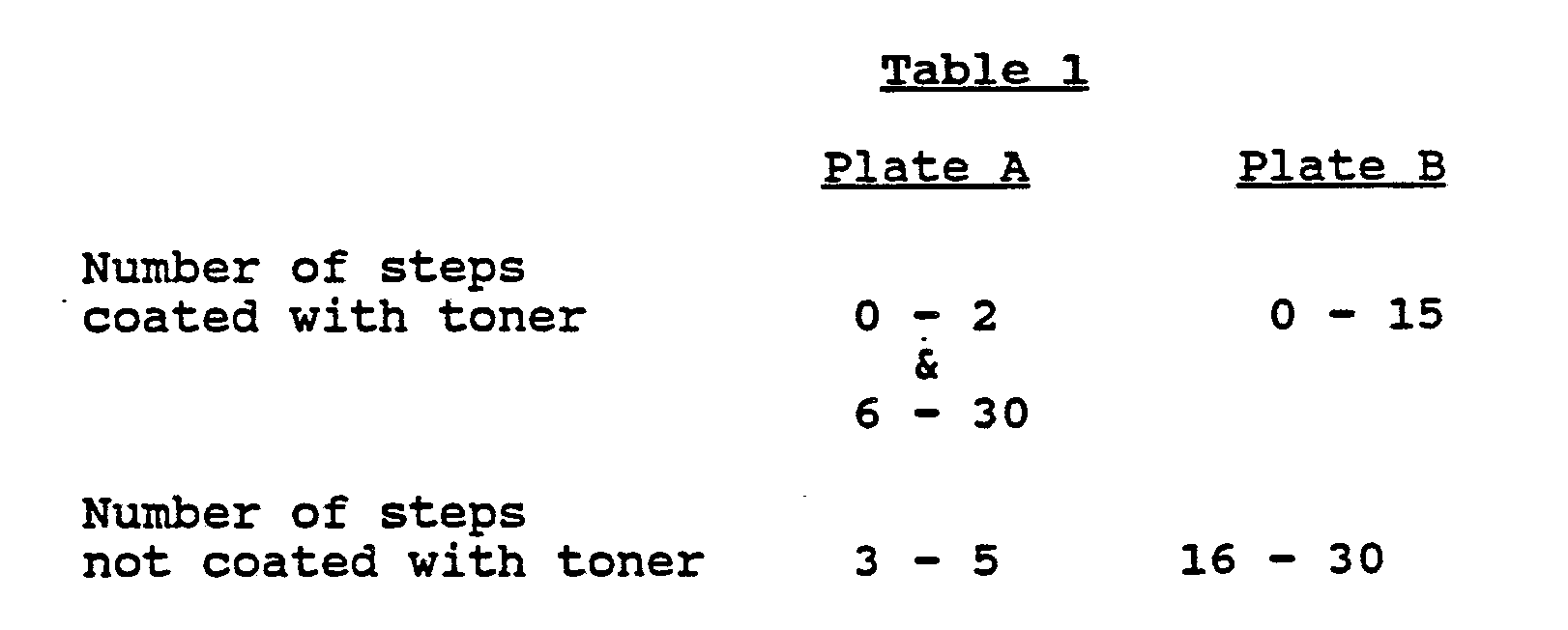
- It is evident from Table 1 that the use of an inorganic acid of comparable strength does not yield partially exposed, non-tonable areas which can be rendered newly tacky by another exposure. In other words, in the presence of such an inorganic acid, the light sensitive layer cannot be toned first in the positive mode and then repeatedly in the negative mode.
Claims (10)
an aryl radical and the radicals can be substituted with alkyl groups of 1-4 carbon atoms, oxalkyl groups, hydroxyl groups or carboxyl groups.
the improvement wherein the light sensitive layer comprises a photosensitive composition in accordance with any of Claims 1-7.
Priority Applications (1)
| Application Number | Priority Date | Filing Date | Title |
|---|---|---|---|
| AT87118440T ATE86769T1 (en) | 1986-12-16 | 1987-12-12 | PHOTOSENSITIVE COMPOSITIONS FOR MULTIPLE POWDERABLE LAYERS. |
Applications Claiming Priority (2)
| Application Number | Priority Date | Filing Date | Title |
|---|---|---|---|
| DE3642855 | 1986-12-16 | ||
| DE3642855A DE3642855C1 (en) | 1986-12-16 | 1986-12-16 | Photosensitive mixture |
Publications (3)
| Publication Number | Publication Date |
|---|---|
| EP0271851A2 true EP0271851A2 (en) | 1988-06-22 |
| EP0271851A3 EP0271851A3 (en) | 1990-02-28 |
| EP0271851B1 EP0271851B1 (en) | 1993-03-10 |
Family
ID=6316248
Family Applications (1)
| Application Number | Title | Priority Date | Filing Date |
|---|---|---|---|
| EP87118440A Expired - Lifetime EP0271851B1 (en) | 1986-12-16 | 1987-12-12 | Light sensitive mixtures for making repeatedly tonable layers |
Country Status (7)
| Country | Link |
|---|---|
| US (1) | US4904555A (en) |
| EP (1) | EP0271851B1 (en) |
| JP (1) | JPS63163339A (en) |
| CN (1) | CN87101157A (en) |
| AT (1) | ATE86769T1 (en) |
| CA (1) | CA1330268C (en) |
| DE (1) | DE3642855C1 (en) |
Cited By (48)
| Publication number | Priority date | Publication date | Assignee | Title |
|---|---|---|---|---|
| EP0432465A3 (en) * | 1989-11-16 | 1992-07-08 | Du Pont De Nemours (Deutschland) Gmbh | Method for making optical color filters |
| EP0747768A2 (en) | 1995-06-05 | 1996-12-11 | Fuji Photo Film Co., Ltd. | Chemically amplified positive resist composition |
| EP1615073A1 (en) | 2004-07-06 | 2006-01-11 | Fuji Photo Film Co., Ltd. | Photosensitive composition and image recording method using the same |
| EP1619023A2 (en) | 2004-07-20 | 2006-01-25 | Fuji Photo Film Co., Ltd. | Image forming material |
| EP1662318A1 (en) | 1999-03-09 | 2006-05-31 | Fuji Photo Film Co., Ltd. | 1,3-dihydro-1-oxo-2H-indene derivative |
| EP1693704A2 (en) | 2005-02-02 | 2006-08-23 | Fuji Photo Film Co., Ltd. | Resist composition and pattern forming method using the same |
| EP1700890A2 (en) | 2005-03-08 | 2006-09-13 | Fuji Photo Film Co., Ltd. | Ink composition, inkjet recording method, printed material, method of producing planographic printing plate, and planographic printing plate |
| EP1701213A2 (en) | 2005-03-08 | 2006-09-13 | Fuji Photo Film Co., Ltd. | Photosensitive composition |
| EP1707352A1 (en) | 2005-03-31 | 2006-10-04 | Fuji Photo Film Co., Ltd. | Method of producing a planographic printing plate |
| EP1757635A1 (en) | 2005-08-23 | 2007-02-28 | Fuji Photo Film Co., Ltd. | Curable modified oxetane compound and ink composition comprising it |
| EP1762599A1 (en) | 2005-09-07 | 2007-03-14 | FUJIFILM Corporation | Ink composition, inkjet recording method, printed material, process for producing lithographic plate, and lithographic printing plate |
| EP1829684A1 (en) | 2006-03-03 | 2007-09-05 | FUJIFILM Corporation | Curable composition, ink composition, inkjet-recording method, and planographic printing plate |
| EP1952982A1 (en) | 2007-02-02 | 2008-08-06 | FUJIFILM Corporation | Radiation-curable polymerizable composition, ink composition, inkjet recording method, printed material, planographic printing plate, and method for forming planographic printing plate |
| EP1955858A1 (en) | 2007-02-06 | 2008-08-13 | FUJIFILM Corporation | Undercoat solution, ink-jet recording method and ink-jet recording device |
| EP1964894A2 (en) | 2007-02-27 | 2008-09-03 | FUJIFILM Corporation | Ink composition, inkjetrecording method, printed material, method for producing planographic printing plate, and planographic printing plate |
| EP1964893A1 (en) | 2007-02-26 | 2008-09-03 | FUJIFILM Corporation | Ink composition, inkjet recording method, printed material, and ink set |
| EP1975160A1 (en) | 2007-03-30 | 2008-10-01 | Fujifilm Corporation | Polymerizable compound, polymer, ink composition, printed articles and inkjet recording method |
| EP1975212A2 (en) | 2007-03-30 | 2008-10-01 | FUJIFILM Corporation | Ink composition, inkjet recording method, printed material, planographic printing plate, and method for forming planographic printing plate |
| EP1975211A1 (en) | 2007-03-30 | 2008-10-01 | FUJIFILM Corporation | Ink composition and image recording method and image recorded matter using same |
| EP1975213A1 (en) | 2006-07-03 | 2008-10-01 | FUJIFILM Corporation | Ink composition, injet recording method, printed material, and process for producing lithographic printing plate |
| EP1988136A1 (en) | 2007-03-01 | 2008-11-05 | FUJIFILM Corporation | Ink composition, inkjet recording method, printed material, method for producing planographic printing plate, and planographic printing plate |
| EP2042572A1 (en) | 2007-09-28 | 2009-04-01 | FUJIFILM Corporation | Ink composition, inkjet recording method, printed material, and process for producing molded printed material |
| EP2042335A2 (en) | 2007-09-28 | 2009-04-01 | FUJIFILM Corporation | Inkjet recording method |
| EP2042570A1 (en) | 2007-09-27 | 2009-04-01 | FUJIFILM Corporation | Photo-curable composition including polymerizable compound, polymerization initiator, and dye |
| EP2065449A2 (en) | 2007-11-29 | 2009-06-03 | FUJIFILM Corporation | Ink composition for inkjet recording, inkjet recording method, and printed material |
| EP2088176A1 (en) | 2008-02-07 | 2009-08-12 | FUJIFILM Corporation | Ink composition, inkjet recording method, printed material, and molded printed material |
| EP2093265A1 (en) | 2008-02-25 | 2009-08-26 | FUJIFILM Corporation | Inkjet ink composition, and inkjet recording method and printed material employing same |
| EP2100925A2 (en) | 2008-03-11 | 2009-09-16 | FUJIFILM Corporation | Pigment composition, ink composition, printed article, inkjet recording method and polyallylamine derivative |
| EP2103639A1 (en) | 2005-11-04 | 2009-09-23 | Fujifilm Corporation | Curable polycyclic epoxy composition, ink composition and inkjet recording method therewith |
| EP2105478A1 (en) | 2008-03-26 | 2009-09-30 | FUJIFILM Corporation | Inkjet recording method and inkjet recording system |
| EP2130881A1 (en) | 2008-06-02 | 2009-12-09 | FUJIFILM Corporation | Pigment dispersion and ink composition using the same |
| EP2166049A1 (en) | 2008-09-19 | 2010-03-24 | Fujifilm Corporation | Ink composition, inkjet recording method and method for producing printed formed article |
| EP2169021A1 (en) | 2008-09-25 | 2010-03-31 | Fujifilm Corporation | Ink composition, inkjet recording method, and printed material |
| EP2169018A2 (en) | 2008-09-26 | 2010-03-31 | Fujifilm Corporation | Ink composition and inkjet recording method |
| EP2169022A1 (en) | 2008-09-29 | 2010-03-31 | Fujifilm Corporation | Ink composition and inkjet recording method |
| EP2180467A1 (en) | 2003-06-27 | 2010-04-28 | Fujifilm Corporation | Photon-mode recording method |
| EP2216377A1 (en) | 2009-02-09 | 2010-08-11 | FUJIFILM Corporation | Ink composition, and inkjet recording method |
| EP2216378A1 (en) | 2009-02-05 | 2010-08-11 | Fujifilm Corporation | Nonaqueous ink, image-recording method, image-recording apparatus and recorded article |
| EP2230285A1 (en) | 2009-03-19 | 2010-09-22 | Fujifilm Corporation | Ink composition, inkjet recording method, printed material, and process for producing molded printed material |
| EP2230284A1 (en) | 2009-03-17 | 2010-09-22 | Fujifilm Corporation | Ink composition and inkjet recording method |
| EP2236570A2 (en) | 2009-03-31 | 2010-10-06 | Fujifilm Corporation | Ink composition, ink composition for inkjet recording, inkjet recording method, and printed article obtained by inkjet recording method |
| EP2278399A2 (en) | 2002-05-31 | 2011-01-26 | Fujifilm Corporation | Positive-working resist composition |
| EP2298841A1 (en) | 2009-09-18 | 2011-03-23 | FUJIFILM Corporation | Ink composition, and inkjet recording method |
| EP2311918A1 (en) | 2009-09-29 | 2011-04-20 | FUJIFILM Corporation | Ink composition, and inkjet recording method |
| EP2477073A1 (en) | 2002-02-13 | 2012-07-18 | Fujifilm Corporation | Resist composition for electron beam, EUV or X-ray |
| EP2644664A1 (en) | 2012-03-29 | 2013-10-02 | Fujifilm Corporation | Actinic radiation-curing type ink composition, inkjet recording method, decorative sheet, decorative sheet molded product, process for producing in-mold molded article, and in-mold molded article |
| WO2014136923A1 (en) | 2013-03-07 | 2014-09-12 | 富士フイルム株式会社 | Inkjet ink composition, inkjet recording method, printed matter and method of producing formed printed matter |
| EP2842763A2 (en) | 2013-08-30 | 2015-03-04 | Fujifilm Corporation | Image formation method, decorative sheet, decorative sheet molding, process for producing in-mold molded product, in-mold molded product, and ink set |
Families Citing this family (5)
| Publication number | Priority date | Publication date | Assignee | Title |
|---|---|---|---|---|
| US5637432A (en) * | 1992-06-01 | 1997-06-10 | Canon Kabushiki Kaisha | Toner for developing electrostatic image comprising titanium oxide particles |
| US5361967A (en) * | 1993-11-10 | 1994-11-08 | Motorola, Inc. | Monolithic circuit fabrication method |
| EP1955850B1 (en) | 2007-02-07 | 2011-04-20 | FUJIFILM Corporation | Ink-jet recording device having ink-jet head maintenance device and ink-jet head maintenance method |
| JP5265165B2 (en) | 2007-09-28 | 2013-08-14 | 富士フイルム株式会社 | Coating apparatus and ink jet recording apparatus using the same |
| CN114574191B (en) * | 2022-03-16 | 2023-12-22 | 安阳工学院 | Method for obtaining acid and alkali resistant blue fluorescent powder by coating 5-sulfosalicylic acid with barium sulfate |
Family Cites Families (6)
| Publication number | Priority date | Publication date | Assignee | Title |
|---|---|---|---|---|
| US4292394A (en) * | 1978-11-13 | 1981-09-29 | E. I. Du Pont De Nemours And Company | Process for preparing multicolor toned images on a single photosensitive layer |
| US4263385A (en) * | 1980-03-06 | 1981-04-21 | Rca Corporation | Method for the manufacture of multi-color microlithographic displays |
| US4307173A (en) * | 1980-06-23 | 1981-12-22 | American Hoechst Corporation | Light-sensitive composition comprising phthalic anhydride |
| DE3429615C1 (en) * | 1984-08-11 | 1985-12-12 | Du Pont de Nemours (Deutschland) GmbH, 4000 Düsseldorf | Process for producing patterns consisting of powders |
| DE3540804C1 (en) * | 1985-11-16 | 1987-04-16 | Du Pont Deutschland | Process for the production of negative samples consisting of several different powders |
| DE3540796C1 (en) * | 1985-11-16 | 1987-04-16 | Du Pont Deutschland | Process for the production of positive patterns consisting of powders |
-
1986
- 1986-12-16 DE DE3642855A patent/DE3642855C1/en not_active Expired
-
1987
- 1987-12-12 EP EP87118440A patent/EP0271851B1/en not_active Expired - Lifetime
- 1987-12-12 AT AT87118440T patent/ATE86769T1/en not_active IP Right Cessation
- 1987-12-14 US US07/132,477 patent/US4904555A/en not_active Expired - Fee Related
- 1987-12-15 CA CA000554349A patent/CA1330268C/en not_active Expired - Fee Related
- 1987-12-16 JP JP62316362A patent/JPS63163339A/en active Granted
- 1987-12-16 CN CN198787101157A patent/CN87101157A/en active Pending
Cited By (50)
| Publication number | Priority date | Publication date | Assignee | Title |
|---|---|---|---|---|
| EP0432465A3 (en) * | 1989-11-16 | 1992-07-08 | Du Pont De Nemours (Deutschland) Gmbh | Method for making optical color filters |
| EP0747768A2 (en) | 1995-06-05 | 1996-12-11 | Fuji Photo Film Co., Ltd. | Chemically amplified positive resist composition |
| EP1662318A1 (en) | 1999-03-09 | 2006-05-31 | Fuji Photo Film Co., Ltd. | 1,3-dihydro-1-oxo-2H-indene derivative |
| EP2477073A1 (en) | 2002-02-13 | 2012-07-18 | Fujifilm Corporation | Resist composition for electron beam, EUV or X-ray |
| EP2278399A2 (en) | 2002-05-31 | 2011-01-26 | Fujifilm Corporation | Positive-working resist composition |
| EP2278398A2 (en) | 2002-05-31 | 2011-01-26 | Fujifilm Corporation | Positive-working resist composition |
| EP2278400A2 (en) | 2002-05-31 | 2011-01-26 | Fujifilm Corporation | Positive-working resist composition |
| EP2180467A1 (en) | 2003-06-27 | 2010-04-28 | Fujifilm Corporation | Photon-mode recording method |
| EP1615073A1 (en) | 2004-07-06 | 2006-01-11 | Fuji Photo Film Co., Ltd. | Photosensitive composition and image recording method using the same |
| EP1619023A2 (en) | 2004-07-20 | 2006-01-25 | Fuji Photo Film Co., Ltd. | Image forming material |
| EP1693704A2 (en) | 2005-02-02 | 2006-08-23 | Fuji Photo Film Co., Ltd. | Resist composition and pattern forming method using the same |
| EP1700890A2 (en) | 2005-03-08 | 2006-09-13 | Fuji Photo Film Co., Ltd. | Ink composition, inkjet recording method, printed material, method of producing planographic printing plate, and planographic printing plate |
| EP1701213A2 (en) | 2005-03-08 | 2006-09-13 | Fuji Photo Film Co., Ltd. | Photosensitive composition |
| EP1707352A1 (en) | 2005-03-31 | 2006-10-04 | Fuji Photo Film Co., Ltd. | Method of producing a planographic printing plate |
| EP1757635A1 (en) | 2005-08-23 | 2007-02-28 | Fuji Photo Film Co., Ltd. | Curable modified oxetane compound and ink composition comprising it |
| EP1762599A1 (en) | 2005-09-07 | 2007-03-14 | FUJIFILM Corporation | Ink composition, inkjet recording method, printed material, process for producing lithographic plate, and lithographic printing plate |
| EP2103639A1 (en) | 2005-11-04 | 2009-09-23 | Fujifilm Corporation | Curable polycyclic epoxy composition, ink composition and inkjet recording method therewith |
| EP1829684A1 (en) | 2006-03-03 | 2007-09-05 | FUJIFILM Corporation | Curable composition, ink composition, inkjet-recording method, and planographic printing plate |
| EP1975213A1 (en) | 2006-07-03 | 2008-10-01 | FUJIFILM Corporation | Ink composition, injet recording method, printed material, and process for producing lithographic printing plate |
| EP1952982A1 (en) | 2007-02-02 | 2008-08-06 | FUJIFILM Corporation | Radiation-curable polymerizable composition, ink composition, inkjet recording method, printed material, planographic printing plate, and method for forming planographic printing plate |
| EP1955858A1 (en) | 2007-02-06 | 2008-08-13 | FUJIFILM Corporation | Undercoat solution, ink-jet recording method and ink-jet recording device |
| EP1964893A1 (en) | 2007-02-26 | 2008-09-03 | FUJIFILM Corporation | Ink composition, inkjet recording method, printed material, and ink set |
| EP1964894A2 (en) | 2007-02-27 | 2008-09-03 | FUJIFILM Corporation | Ink composition, inkjetrecording method, printed material, method for producing planographic printing plate, and planographic printing plate |
| EP1988136A1 (en) | 2007-03-01 | 2008-11-05 | FUJIFILM Corporation | Ink composition, inkjet recording method, printed material, method for producing planographic printing plate, and planographic printing plate |
| EP1975211A1 (en) | 2007-03-30 | 2008-10-01 | FUJIFILM Corporation | Ink composition and image recording method and image recorded matter using same |
| EP1975212A2 (en) | 2007-03-30 | 2008-10-01 | FUJIFILM Corporation | Ink composition, inkjet recording method, printed material, planographic printing plate, and method for forming planographic printing plate |
| EP1975160A1 (en) | 2007-03-30 | 2008-10-01 | Fujifilm Corporation | Polymerizable compound, polymer, ink composition, printed articles and inkjet recording method |
| EP2042570A1 (en) | 2007-09-27 | 2009-04-01 | FUJIFILM Corporation | Photo-curable composition including polymerizable compound, polymerization initiator, and dye |
| EP2042335A2 (en) | 2007-09-28 | 2009-04-01 | FUJIFILM Corporation | Inkjet recording method |
| EP2042572A1 (en) | 2007-09-28 | 2009-04-01 | FUJIFILM Corporation | Ink composition, inkjet recording method, printed material, and process for producing molded printed material |
| EP2065449A2 (en) | 2007-11-29 | 2009-06-03 | FUJIFILM Corporation | Ink composition for inkjet recording, inkjet recording method, and printed material |
| EP2088176A1 (en) | 2008-02-07 | 2009-08-12 | FUJIFILM Corporation | Ink composition, inkjet recording method, printed material, and molded printed material |
| EP2093265A1 (en) | 2008-02-25 | 2009-08-26 | FUJIFILM Corporation | Inkjet ink composition, and inkjet recording method and printed material employing same |
| EP2100925A2 (en) | 2008-03-11 | 2009-09-16 | FUJIFILM Corporation | Pigment composition, ink composition, printed article, inkjet recording method and polyallylamine derivative |
| EP2105478A1 (en) | 2008-03-26 | 2009-09-30 | FUJIFILM Corporation | Inkjet recording method and inkjet recording system |
| EP2130881A1 (en) | 2008-06-02 | 2009-12-09 | FUJIFILM Corporation | Pigment dispersion and ink composition using the same |
| EP2166049A1 (en) | 2008-09-19 | 2010-03-24 | Fujifilm Corporation | Ink composition, inkjet recording method and method for producing printed formed article |
| EP2169021A1 (en) | 2008-09-25 | 2010-03-31 | Fujifilm Corporation | Ink composition, inkjet recording method, and printed material |
| EP2169018A2 (en) | 2008-09-26 | 2010-03-31 | Fujifilm Corporation | Ink composition and inkjet recording method |
| EP2169022A1 (en) | 2008-09-29 | 2010-03-31 | Fujifilm Corporation | Ink composition and inkjet recording method |
| EP2216378A1 (en) | 2009-02-05 | 2010-08-11 | Fujifilm Corporation | Nonaqueous ink, image-recording method, image-recording apparatus and recorded article |
| EP2216377A1 (en) | 2009-02-09 | 2010-08-11 | FUJIFILM Corporation | Ink composition, and inkjet recording method |
| EP2230284A1 (en) | 2009-03-17 | 2010-09-22 | Fujifilm Corporation | Ink composition and inkjet recording method |
| EP2230285A1 (en) | 2009-03-19 | 2010-09-22 | Fujifilm Corporation | Ink composition, inkjet recording method, printed material, and process for producing molded printed material |
| EP2236570A2 (en) | 2009-03-31 | 2010-10-06 | Fujifilm Corporation | Ink composition, ink composition for inkjet recording, inkjet recording method, and printed article obtained by inkjet recording method |
| EP2298841A1 (en) | 2009-09-18 | 2011-03-23 | FUJIFILM Corporation | Ink composition, and inkjet recording method |
| EP2311918A1 (en) | 2009-09-29 | 2011-04-20 | FUJIFILM Corporation | Ink composition, and inkjet recording method |
| EP2644664A1 (en) | 2012-03-29 | 2013-10-02 | Fujifilm Corporation | Actinic radiation-curing type ink composition, inkjet recording method, decorative sheet, decorative sheet molded product, process for producing in-mold molded article, and in-mold molded article |
| WO2014136923A1 (en) | 2013-03-07 | 2014-09-12 | 富士フイルム株式会社 | Inkjet ink composition, inkjet recording method, printed matter and method of producing formed printed matter |
| EP2842763A2 (en) | 2013-08-30 | 2015-03-04 | Fujifilm Corporation | Image formation method, decorative sheet, decorative sheet molding, process for producing in-mold molded product, in-mold molded product, and ink set |
Also Published As
| Publication number | Publication date |
|---|---|
| DE3642855C1 (en) | 1988-06-23 |
| EP0271851B1 (en) | 1993-03-10 |
| CN87101157A (en) | 1988-06-29 |
| ATE86769T1 (en) | 1993-03-15 |
| EP0271851A3 (en) | 1990-02-28 |
| JPS63163339A (en) | 1988-07-06 |
| JPH0421182B2 (en) | 1992-04-08 |
| US4904555A (en) | 1990-02-27 |
| CA1330268C (en) | 1994-06-21 |
Similar Documents
| Publication | Publication Date | Title |
|---|---|---|
| EP0271851B1 (en) | Light sensitive mixtures for making repeatedly tonable layers | |
| EP0171748B1 (en) | Negative-toning imaging system with re-imaging capability using 4-(2'-nitrophenyl)-1,4-dihydropyridine compounds | |
| US4299906A (en) | Light-sensitive color proofing film with surfactant in a light-sensitive coating | |
| US4243741A (en) | Negative tonable systems containing dihydropyridines and photooxidants | |
| US5120629A (en) | Positive-working photosensitive electrostatic master | |
| US4812171A (en) | Irreversible photochromic markings | |
| US4698293A (en) | Process for forming positive tonable images using a photosensitive material containing at least 1,4-dihydropyridine | |
| US4292394A (en) | Process for preparing multicolor toned images on a single photosensitive layer | |
| EP0650093A1 (en) | Polysilane type photosensitive resin composition and method for forming pattern using the same | |
| US3589907A (en) | Photosensitive lacquer and the use of this lacquer in manufacturing picture screens for cathode-ray tubes | |
| JPH03241355A (en) | Photosensitive element | |
| US4348472A (en) | Method of applying a layer in accordance with a pattern on a substrate, a negative resist material and a substrate coated with the resist | |
| EP0223206B1 (en) | Method for reducing color cross-contamination during re-imaging of phototackifiable materials | |
| US4735880A (en) | Photosensitive composition and pattern forming process using same | |
| US4262083A (en) | Positive resist for electron beam and x-ray lithography and method of using same | |
| GB2035591A (en) | Process for preparing multicolor toned images on a single photosensitive layer | |
| JP2743111B2 (en) | Photo-adhesive photosensitive composition | |
| SU739462A1 (en) | Photopolymerizing composition | |
| GB1323984A (en) | Photosensitive composition | |
| JPS6247298B2 (en) | ||
| KR19980020318A (en) | A toner composition for forming a cathode ray tube black matrix pattern and a method of forming a black matrix pattern using the same | |
| CS225040B1 (en) | The visualization of the latent image of light sensitive negative working polymeric coating | |
| WO1992002855A1 (en) | Single layer dry processible photosensitive composition and toning process |
Legal Events
| Date | Code | Title | Description |
|---|---|---|---|
| PUAI | Public reference made under article 153(3) epc to a published international application that has entered the european phase |
Free format text: ORIGINAL CODE: 0009012 |
|
| AK | Designated contracting states |
Kind code of ref document: A2 Designated state(s): AT FR GB IT NL |
|
| PUAL | Search report despatched |
Free format text: ORIGINAL CODE: 0009013 |
|
| AK | Designated contracting states |
Kind code of ref document: A3 Designated state(s): AT FR GB IT NL |
|
| 17P | Request for examination filed |
Effective date: 19900427 |
|
| 17Q | First examination report despatched |
Effective date: 19920518 |
|
| GRAA | (expected) grant |
Free format text: ORIGINAL CODE: 0009210 |
|
| AK | Designated contracting states |
Kind code of ref document: B1 Designated state(s): AT FR GB IT NL |
|
| REF | Corresponds to: |
Ref document number: 86769 Country of ref document: AT Date of ref document: 19930315 Kind code of ref document: T |
|
| ITF | It: translation for a ep patent filed | ||
| ET | Fr: translation filed | ||
| PGFP | Annual fee paid to national office [announced via postgrant information from national office to epo] |
Ref country code: FR Payment date: 19930817 Year of fee payment: 7 |
|
| PGFP | Annual fee paid to national office [announced via postgrant information from national office to epo] |
Ref country code: GB Payment date: 19931202 Year of fee payment: 7 |
|
| PGFP | Annual fee paid to national office [announced via postgrant information from national office to epo] |
Ref country code: AT Payment date: 19931210 Year of fee payment: 7 |
|
| PGFP | Annual fee paid to national office [announced via postgrant information from national office to epo] |
Ref country code: NL Payment date: 19931231 Year of fee payment: 7 |
|
| PLBE | No opposition filed within time limit |
Free format text: ORIGINAL CODE: 0009261 |
|
| STAA | Information on the status of an ep patent application or granted ep patent |
Free format text: STATUS: NO OPPOSITION FILED WITHIN TIME LIMIT |
|
| 26N | No opposition filed | ||
| PG25 | Lapsed in a contracting state [announced via postgrant information from national office to epo] |
Ref country code: GB Effective date: 19941212 Ref country code: AT Effective date: 19941212 |
|
| PG25 | Lapsed in a contracting state [announced via postgrant information from national office to epo] |
Ref country code: NL Effective date: 19950701 |
|
| GBPC | Gb: european patent ceased through non-payment of renewal fee |
Effective date: 19941212 |
|
| PG25 | Lapsed in a contracting state [announced via postgrant information from national office to epo] |
Ref country code: FR Effective date: 19950831 |
|
| NLV4 | Nl: lapsed or anulled due to non-payment of the annual fee |
Effective date: 19950701 |
|
| REG | Reference to a national code |
Ref country code: FR Ref legal event code: ST |
|
| PG25 | Lapsed in a contracting state [announced via postgrant information from national office to epo] |
Ref country code: IT Free format text: LAPSE BECAUSE OF NON-PAYMENT OF DUE FEES;WARNING: LAPSES OF ITALIAN PATENTS WITH EFFECTIVE DATE BEFORE 2007 MAY HAVE OCCURRED AT ANY TIME BEFORE 2007. THE CORRECT EFFECTIVE DATE MAY BE DIFFERENT FROM THE ONE RECORDED. Effective date: 20051212 |