EP0270914B1 - Use of a thermoplastic polyester as an additive for epoxy resins - Google Patents
Use of a thermoplastic polyester as an additive for epoxy resins Download PDFInfo
- Publication number
- EP0270914B1 EP0270914B1 EP87117335A EP87117335A EP0270914B1 EP 0270914 B1 EP0270914 B1 EP 0270914B1 EP 87117335 A EP87117335 A EP 87117335A EP 87117335 A EP87117335 A EP 87117335A EP 0270914 B1 EP0270914 B1 EP 0270914B1
- Authority
- EP
- European Patent Office
- Prior art keywords
- polyester
- epoxide groups
- composition
- epoxide
- containing materials
- Prior art date
- Legal status (The legal status is an assumption and is not a legal conclusion. Google has not performed a legal analysis and makes no representation as to the accuracy of the status listed.)
- Expired - Lifetime
Links
- 229920000728 polyester Polymers 0.000 title claims description 47
- 229920001169 thermoplastic Polymers 0.000 title claims description 15
- 239000004416 thermosoftening plastic Substances 0.000 title claims description 15
- 239000000654 additive Substances 0.000 title claims description 6
- 230000000996 additive effect Effects 0.000 title claims description 5
- 229920000647 polyepoxide Polymers 0.000 title description 20
- 239000003822 epoxy resin Substances 0.000 title description 3
- LNEPOXFFQSENCJ-UHFFFAOYSA-N haloperidol Chemical compound C1CC(O)(C=2C=CC(Cl)=CC=2)CCN1CCCC(=O)C1=CC=C(F)C=C1 LNEPOXFFQSENCJ-UHFFFAOYSA-N 0.000 title description 3
- 239000000203 mixture Substances 0.000 claims description 68
- 150000002118 epoxides Chemical group 0.000 claims description 41
- 239000000463 material Substances 0.000 claims description 25
- 239000000853 adhesive Substances 0.000 claims description 17
- 230000001070 adhesive effect Effects 0.000 claims description 17
- 239000000758 substrate Substances 0.000 claims description 17
- 239000003795 chemical substances by application Substances 0.000 claims description 12
- 125000003118 aryl group Chemical group 0.000 claims description 8
- 229920006395 saturated elastomer Polymers 0.000 claims description 8
- 239000004615 ingredient Substances 0.000 claims description 6
- IISBACLAFKSPIT-UHFFFAOYSA-N bisphenol A Chemical compound C=1C=C(O)C=CC=1C(C)(C)C1=CC=C(O)C=C1 IISBACLAFKSPIT-UHFFFAOYSA-N 0.000 claims description 4
- 150000001412 amines Chemical class 0.000 claims description 3
- QGBSISYHAICWAH-UHFFFAOYSA-N dicyandiamide Chemical group NC(N)=NC#N QGBSISYHAICWAH-UHFFFAOYSA-N 0.000 claims description 2
- GYZLOYUZLJXAJU-UHFFFAOYSA-N diglycidyl ether Chemical compound C1OC1COCC1CO1 GYZLOYUZLJXAJU-UHFFFAOYSA-N 0.000 claims description 2
- 125000003277 amino group Chemical group 0.000 claims 1
- 239000004593 Epoxy Substances 0.000 description 9
- 239000004793 Polystyrene Substances 0.000 description 9
- 239000002184 metal Substances 0.000 description 9
- 229920002223 polystyrene Polymers 0.000 description 9
- LYCAIKOWRPUZTN-UHFFFAOYSA-N Ethylene glycol Chemical compound OCCO LYCAIKOWRPUZTN-UHFFFAOYSA-N 0.000 description 6
- PEDCQBHIVMGVHV-UHFFFAOYSA-N Glycerine Chemical compound OCC(O)CO PEDCQBHIVMGVHV-UHFFFAOYSA-N 0.000 description 6
- WYURNTSHIVDZCO-UHFFFAOYSA-N Tetrahydrofuran Chemical compound C1CCOC1 WYURNTSHIVDZCO-UHFFFAOYSA-N 0.000 description 6
- 239000002253 acid Substances 0.000 description 6
- MTHSVFCYNBDYFN-UHFFFAOYSA-N diethylene glycol Chemical compound OCCOCCO MTHSVFCYNBDYFN-UHFFFAOYSA-N 0.000 description 6
- DNIAPMSPPWPWGF-UHFFFAOYSA-N Propylene glycol Chemical compound CC(O)CO DNIAPMSPPWPWGF-UHFFFAOYSA-N 0.000 description 5
- XLYOFNOQVPJJNP-UHFFFAOYSA-N water Substances O XLYOFNOQVPJJNP-UHFFFAOYSA-N 0.000 description 5
- KKEYFWRCBNTPAC-UHFFFAOYSA-N Terephthalic acid Chemical compound OC(=O)C1=CC=C(C(O)=O)C=C1 KKEYFWRCBNTPAC-UHFFFAOYSA-N 0.000 description 4
- 150000007513 acids Chemical class 0.000 description 4
- 125000001931 aliphatic group Chemical group 0.000 description 4
- 238000011088 calibration curve Methods 0.000 description 4
- 150000001875 compounds Chemical class 0.000 description 4
- 235000014113 dietary fatty acids Nutrition 0.000 description 4
- 229930195729 fatty acid Natural products 0.000 description 4
- 239000000194 fatty acid Substances 0.000 description 4
- 150000004665 fatty acids Chemical class 0.000 description 4
- 238000005227 gel permeation chromatography Methods 0.000 description 4
- 125000005702 oxyalkylene group Chemical group 0.000 description 4
- 150000005846 sugar alcohols Polymers 0.000 description 4
- 229920001634 Copolyester Polymers 0.000 description 3
- BRLQWZUYTZBJKN-UHFFFAOYSA-N Epichlorohydrin Chemical compound ClCC1CO1 BRLQWZUYTZBJKN-UHFFFAOYSA-N 0.000 description 3
- MUBZPKHOEPUJKR-UHFFFAOYSA-N Oxalic acid Chemical compound OC(=O)C(O)=O MUBZPKHOEPUJKR-UHFFFAOYSA-N 0.000 description 3
- YXFVVABEGXRONW-UHFFFAOYSA-N Toluene Chemical compound CC1=CC=CC=C1 YXFVVABEGXRONW-UHFFFAOYSA-N 0.000 description 3
- -1 alicyclic olefins Chemical class 0.000 description 3
- 238000006243 chemical reaction Methods 0.000 description 3
- 125000002887 hydroxy group Chemical group [H]O* 0.000 description 3
- 230000014759 maintenance of location Effects 0.000 description 3
- 230000000704 physical effect Effects 0.000 description 3
- 235000013824 polyphenols Nutrition 0.000 description 3
- 238000012360 testing method Methods 0.000 description 3
- YLQBMQCUIZJEEH-UHFFFAOYSA-N tetrahydrofuran Natural products C=1C=COC=1 YLQBMQCUIZJEEH-UHFFFAOYSA-N 0.000 description 3
- KZMGYPLQYOPHEL-UHFFFAOYSA-N Boron trifluoride etherate Chemical compound FB(F)F.CCOCC KZMGYPLQYOPHEL-UHFFFAOYSA-N 0.000 description 2
- VZCYOOQTPOCHFL-OWOJBTEDSA-N Fumaric acid Chemical compound OC(=O)\C=C\C(O)=O VZCYOOQTPOCHFL-OWOJBTEDSA-N 0.000 description 2
- QIGBRXMKCJKVMJ-UHFFFAOYSA-N Hydroquinone Chemical compound OC1=CC=C(O)C=C1 QIGBRXMKCJKVMJ-UHFFFAOYSA-N 0.000 description 2
- KFSLWBXXFJQRDL-UHFFFAOYSA-N Peracetic acid Chemical compound CC(=O)OO KFSLWBXXFJQRDL-UHFFFAOYSA-N 0.000 description 2
- 239000004952 Polyamide Substances 0.000 description 2
- ZJCCRDAZUWHFQH-UHFFFAOYSA-N Trimethylolpropane Chemical compound CCC(CO)(CO)CO ZJCCRDAZUWHFQH-UHFFFAOYSA-N 0.000 description 2
- WNLRTRBMVRJNCN-UHFFFAOYSA-N adipic acid Chemical compound OC(=O)CCCCC(O)=O WNLRTRBMVRJNCN-UHFFFAOYSA-N 0.000 description 2
- 125000000217 alkyl group Chemical group 0.000 description 2
- 150000008064 anhydrides Chemical class 0.000 description 2
- 239000003054 catalyst Substances 0.000 description 2
- YCIMNLLNPGFGHC-UHFFFAOYSA-N catechol Chemical compound OC1=CC=CC=C1O YCIMNLLNPGFGHC-UHFFFAOYSA-N 0.000 description 2
- 150000002009 diols Chemical class 0.000 description 2
- 238000010828 elution Methods 0.000 description 2
- 238000006735 epoxidation reaction Methods 0.000 description 2
- 150000002148 esters Chemical class 0.000 description 2
- 239000011521 glass Substances 0.000 description 2
- NAQMVNRVTILPCV-UHFFFAOYSA-N hexane-1,6-diamine Chemical compound NCCCCCCN NAQMVNRVTILPCV-UHFFFAOYSA-N 0.000 description 2
- 229910052739 hydrogen Inorganic materials 0.000 description 2
- 239000001257 hydrogen Substances 0.000 description 2
- QQVIHTHCMHWDBS-UHFFFAOYSA-N isophthalic acid Chemical compound OC(=O)C1=CC=CC(C(O)=O)=C1 QQVIHTHCMHWDBS-UHFFFAOYSA-N 0.000 description 2
- 238000011068 loading method Methods 0.000 description 2
- BDJRBEYXGGNYIS-UHFFFAOYSA-N nonanedioic acid Chemical compound OC(=O)CCCCCCCC(O)=O BDJRBEYXGGNYIS-UHFFFAOYSA-N 0.000 description 2
- 150000002989 phenols Chemical class 0.000 description 2
- XNGIFLGASWRNHJ-UHFFFAOYSA-N phthalic acid Chemical compound OC(=O)C1=CC=CC=C1C(O)=O XNGIFLGASWRNHJ-UHFFFAOYSA-N 0.000 description 2
- 229920002647 polyamide Polymers 0.000 description 2
- 150000008442 polyphenolic compounds Chemical class 0.000 description 2
- 239000001294 propane Substances 0.000 description 2
- KIDHWZJUCRJVML-UHFFFAOYSA-N putrescine Chemical compound NCCCCN KIDHWZJUCRJVML-UHFFFAOYSA-N 0.000 description 2
- 229920005989 resin Polymers 0.000 description 2
- 239000011347 resin Substances 0.000 description 2
- GHMLBKRAJCXXBS-UHFFFAOYSA-N resorcinol Chemical compound OC1=CC=CC(O)=C1 GHMLBKRAJCXXBS-UHFFFAOYSA-N 0.000 description 2
- CXMXRPHRNRROMY-UHFFFAOYSA-N sebacic acid Chemical compound OC(=O)CCCCCCCCC(O)=O CXMXRPHRNRROMY-UHFFFAOYSA-N 0.000 description 2
- VZCYOOQTPOCHFL-UHFFFAOYSA-N trans-butenedioic acid Natural products OC(=O)C=CC(O)=O VZCYOOQTPOCHFL-UHFFFAOYSA-N 0.000 description 2
- PUPZLCDOIYMWBV-UHFFFAOYSA-N (+/-)-1,3-Butanediol Chemical compound CC(O)CCO PUPZLCDOIYMWBV-UHFFFAOYSA-N 0.000 description 1
- ZWVMLYRJXORSEP-UHFFFAOYSA-N 1,2,6-Hexanetriol Chemical compound OCCCCC(O)CO ZWVMLYRJXORSEP-UHFFFAOYSA-N 0.000 description 1
- WZCQRUWWHSTZEM-UHFFFAOYSA-N 1,3-phenylenediamine Chemical compound NC1=CC=CC(N)=C1 WZCQRUWWHSTZEM-UHFFFAOYSA-N 0.000 description 1
- WTFAGPBUAGFMQX-UHFFFAOYSA-N 1-[2-[2-(2-aminopropoxy)propoxy]propoxy]propan-2-amine Chemical compound CC(N)COCC(C)OCC(C)OCC(C)N WTFAGPBUAGFMQX-UHFFFAOYSA-N 0.000 description 1
- RTBFRGCFXZNCOE-UHFFFAOYSA-N 1-methylsulfonylpiperidin-4-one Chemical compound CS(=O)(=O)N1CCC(=O)CC1 RTBFRGCFXZNCOE-UHFFFAOYSA-N 0.000 description 1
- MQCPOLNSJCWPGT-UHFFFAOYSA-N 2,2'-Bisphenol F Chemical compound OC1=CC=CC=C1CC1=CC=CC=C1O MQCPOLNSJCWPGT-UHFFFAOYSA-N 0.000 description 1
- VILCJCGEZXAXTO-UHFFFAOYSA-N 2,2,2-tetramine Chemical compound NCCNCCNCCN VILCJCGEZXAXTO-UHFFFAOYSA-N 0.000 description 1
- YNJSNEKCXVFDKW-UHFFFAOYSA-N 3-(5-amino-1h-indol-3-yl)-2-azaniumylpropanoate Chemical compound C1=C(N)C=C2C(CC(N)C(O)=O)=CNC2=C1 YNJSNEKCXVFDKW-UHFFFAOYSA-N 0.000 description 1
- RXNYJUSEXLAVNQ-UHFFFAOYSA-N 4,4'-Dihydroxybenzophenone Chemical compound C1=CC(O)=CC=C1C(=O)C1=CC=C(O)C=C1 RXNYJUSEXLAVNQ-UHFFFAOYSA-N 0.000 description 1
- YBRVSVVVWCFQMG-UHFFFAOYSA-N 4,4'-diaminodiphenylmethane Chemical compound C1=CC(N)=CC=C1CC1=CC=C(N)C=C1 YBRVSVVVWCFQMG-UHFFFAOYSA-N 0.000 description 1
- FBPFZTCFMRRESA-FSIIMWSLSA-N D-Glucitol Natural products OC[C@H](O)[C@H](O)[C@@H](O)[C@H](O)CO FBPFZTCFMRRESA-FSIIMWSLSA-N 0.000 description 1
- FBPFZTCFMRRESA-JGWLITMVSA-N D-glucitol Chemical compound OC[C@H](O)[C@@H](O)[C@H](O)[C@H](O)CO FBPFZTCFMRRESA-JGWLITMVSA-N 0.000 description 1
- RPNUMPOLZDHAAY-UHFFFAOYSA-N Diethylenetriamine Chemical compound NCCNCCN RPNUMPOLZDHAAY-UHFFFAOYSA-N 0.000 description 1
- RWSOTUBLDIXVET-UHFFFAOYSA-N Dihydrogen sulfide Chemical class S RWSOTUBLDIXVET-UHFFFAOYSA-N 0.000 description 1
- LFQSCWFLJHTTHZ-UHFFFAOYSA-N Ethanol Chemical compound CCO LFQSCWFLJHTTHZ-UHFFFAOYSA-N 0.000 description 1
- PIICEJLVQHRZGT-UHFFFAOYSA-N Ethylenediamine Chemical compound NCCN PIICEJLVQHRZGT-UHFFFAOYSA-N 0.000 description 1
- 239000004606 Fillers/Extenders Substances 0.000 description 1
- UFHFLCQGNIYNRP-UHFFFAOYSA-N Hydrogen Chemical compound [H][H] UFHFLCQGNIYNRP-UHFFFAOYSA-N 0.000 description 1
- OYHQOLUKZRVURQ-HZJYTTRNSA-N Linoleic acid Chemical compound CCCCC\C=C/C\C=C/CCCCCCCC(O)=O OYHQOLUKZRVURQ-HZJYTTRNSA-N 0.000 description 1
- CTQNGGLPUBDAKN-UHFFFAOYSA-N O-Xylene Chemical compound CC1=CC=CC=C1C CTQNGGLPUBDAKN-UHFFFAOYSA-N 0.000 description 1
- ALQSHHUCVQOPAS-UHFFFAOYSA-N Pentane-1,5-diol Chemical compound OCCCCCO ALQSHHUCVQOPAS-UHFFFAOYSA-N 0.000 description 1
- OFOBLEOULBTSOW-UHFFFAOYSA-N Propanedioic acid Natural products OC(=O)CC(O)=O OFOBLEOULBTSOW-UHFFFAOYSA-N 0.000 description 1
- 239000005700 Putrescine Substances 0.000 description 1
- KDYFGRWQOYBRFD-UHFFFAOYSA-N Succinic acid Natural products OC(=O)CCC(O)=O KDYFGRWQOYBRFD-UHFFFAOYSA-N 0.000 description 1
- 125000002015 acyclic group Chemical group 0.000 description 1
- 239000002313 adhesive film Substances 0.000 description 1
- 239000001361 adipic acid Substances 0.000 description 1
- 235000011037 adipic acid Nutrition 0.000 description 1
- 238000013019 agitation Methods 0.000 description 1
- 150000001334 alicyclic compounds Chemical class 0.000 description 1
- 125000002723 alicyclic group Chemical group 0.000 description 1
- 239000003513 alkali Substances 0.000 description 1
- 229920000180 alkyd Polymers 0.000 description 1
- JFCQEDHGNNZCLN-UHFFFAOYSA-N anhydrous glutaric acid Natural products OC(=O)CCCC(O)=O JFCQEDHGNNZCLN-UHFFFAOYSA-N 0.000 description 1
- 239000003963 antioxidant agent Substances 0.000 description 1
- 159000000032 aromatic acids Chemical class 0.000 description 1
- 150000004982 aromatic amines Chemical class 0.000 description 1
- QVGXLLKOCUKJST-UHFFFAOYSA-N atomic oxygen Chemical compound [O] QVGXLLKOCUKJST-UHFFFAOYSA-N 0.000 description 1
- 238000010533 azeotropic distillation Methods 0.000 description 1
- 239000011324 bead Substances 0.000 description 1
- RGTXVXDNHPWPHH-UHFFFAOYSA-N butane-1,3-diamine Chemical compound CC(N)CCN RGTXVXDNHPWPHH-UHFFFAOYSA-N 0.000 description 1
- WERYXYBDKMZEQL-UHFFFAOYSA-N butane-1,4-diol Chemical compound OCCCCO WERYXYBDKMZEQL-UHFFFAOYSA-N 0.000 description 1
- KDYFGRWQOYBRFD-NUQCWPJISA-N butanedioic acid Chemical compound O[14C](=O)CC[14C](O)=O KDYFGRWQOYBRFD-NUQCWPJISA-N 0.000 description 1
- WIHMDCQAEONXND-UHFFFAOYSA-M butyl-hydroxy-oxotin Chemical compound CCCC[Sn](O)=O WIHMDCQAEONXND-UHFFFAOYSA-M 0.000 description 1
- 125000004432 carbon atom Chemical group C* 0.000 description 1
- 150000001735 carboxylic acids Chemical class 0.000 description 1
- 239000007795 chemical reaction product Substances 0.000 description 1
- 150000001805 chlorine compounds Chemical class 0.000 description 1
- 239000011248 coating agent Substances 0.000 description 1
- 238000000576 coating method Methods 0.000 description 1
- 239000010960 cold rolled steel Substances 0.000 description 1
- 238000009833 condensation Methods 0.000 description 1
- 230000005494 condensation Effects 0.000 description 1
- 239000007859 condensation product Substances 0.000 description 1
- 239000000470 constituent Substances 0.000 description 1
- 238000005260 corrosion Methods 0.000 description 1
- 230000007797 corrosion Effects 0.000 description 1
- 125000004122 cyclic group Chemical group 0.000 description 1
- YMHQVDAATAEZLO-UHFFFAOYSA-N cyclohexane-1,1-diamine Chemical compound NC1(N)CCCCC1 YMHQVDAATAEZLO-UHFFFAOYSA-N 0.000 description 1
- JGFBRKRYDCGYKD-UHFFFAOYSA-N dibutyl(oxo)tin Chemical compound CCCC[Sn](=O)CCCC JGFBRKRYDCGYKD-UHFFFAOYSA-N 0.000 description 1
- SZXQTJUDPRGNJN-UHFFFAOYSA-N dipropylene glycol Chemical compound OCCCOCCCO SZXQTJUDPRGNJN-UHFFFAOYSA-N 0.000 description 1
- 238000004821 distillation Methods 0.000 description 1
- 230000000694 effects Effects 0.000 description 1
- GKIPXFAANLTWBM-UHFFFAOYSA-N epibromohydrin Chemical compound BrCC1CO1 GKIPXFAANLTWBM-UHFFFAOYSA-N 0.000 description 1
- 230000032050 esterification Effects 0.000 description 1
- 238000005886 esterification reaction Methods 0.000 description 1
- JDVIRCVIXCMTPU-UHFFFAOYSA-N ethanamine;trifluoroborane Chemical compound CCN.FB(F)F JDVIRCVIXCMTPU-UHFFFAOYSA-N 0.000 description 1
- 125000001033 ether group Chemical group 0.000 description 1
- 150000002170 ethers Chemical class 0.000 description 1
- 230000007717 exclusion Effects 0.000 description 1
- 238000001125 extrusion Methods 0.000 description 1
- 238000001914 filtration Methods 0.000 description 1
- SLGWESQGEUXWJQ-UHFFFAOYSA-N formaldehyde;phenol Chemical compound O=C.OC1=CC=CC=C1 SLGWESQGEUXWJQ-UHFFFAOYSA-N 0.000 description 1
- 238000009472 formulation Methods 0.000 description 1
- 125000002485 formyl group Chemical class [H]C(*)=O 0.000 description 1
- 239000001530 fumaric acid Substances 0.000 description 1
- 229910052736 halogen Inorganic materials 0.000 description 1
- 150000002367 halogens Chemical class 0.000 description 1
- 238000010438 heat treatment Methods 0.000 description 1
- 125000000623 heterocyclic group Chemical group 0.000 description 1
- 125000004435 hydrogen atom Chemical group [H]* 0.000 description 1
- 239000001282 iso-butane Substances 0.000 description 1
- 235000020778 linoleic acid Nutrition 0.000 description 1
- OYHQOLUKZRVURQ-IXWMQOLASA-N linoleic acid Natural products CCCCC\C=C/C\C=C\CCCCCCCC(O)=O OYHQOLUKZRVURQ-IXWMQOLASA-N 0.000 description 1
- VZCYOOQTPOCHFL-UPHRSURJSA-N maleic acid Chemical compound OC(=O)\C=C/C(O)=O VZCYOOQTPOCHFL-UPHRSURJSA-N 0.000 description 1
- 239000011976 maleic acid Substances 0.000 description 1
- 238000000034 method Methods 0.000 description 1
- 238000002156 mixing Methods 0.000 description 1
- 230000004048 modification Effects 0.000 description 1
- 238000012986 modification Methods 0.000 description 1
- KFDIDIIKNMZLRZ-UHFFFAOYSA-N n'-propan-2-ylpropane-1,3-diamine Chemical compound CC(C)NCCCN KFDIDIIKNMZLRZ-UHFFFAOYSA-N 0.000 description 1
- JFNWATIZEGZGSY-UHFFFAOYSA-N n,n-diethylethanamine;trifluoroborane Chemical compound FB(F)F.CCN(CC)CC JFNWATIZEGZGSY-UHFFFAOYSA-N 0.000 description 1
- TUCCFRCXHUPZGH-UHFFFAOYSA-N n,n-dimethyl-1-phenylmethanamine;trifluoroborane Chemical compound FB(F)F.CN(C)CC1=CC=CC=C1 TUCCFRCXHUPZGH-UHFFFAOYSA-N 0.000 description 1
- STQYDSASXIHUJU-UHFFFAOYSA-N n-ethylethanamine;trifluoroborane Chemical compound FB(F)F.CCNCC STQYDSASXIHUJU-UHFFFAOYSA-N 0.000 description 1
- RXOHFPCZGPKIRD-UHFFFAOYSA-N naphthalene-2,6-dicarboxylic acid Chemical compound C1=C(C(O)=O)C=CC2=CC(C(=O)O)=CC=C21 RXOHFPCZGPKIRD-UHFFFAOYSA-N 0.000 description 1
- 229920003986 novolac Polymers 0.000 description 1
- 235000006408 oxalic acid Nutrition 0.000 description 1
- 229910052760 oxygen Inorganic materials 0.000 description 1
- 239000001301 oxygen Substances 0.000 description 1
- WXZMFSXDPGVJKK-UHFFFAOYSA-N pentaerythritol Chemical compound OCC(CO)(CO)CO WXZMFSXDPGVJKK-UHFFFAOYSA-N 0.000 description 1
- ISWSIDIOOBJBQZ-UHFFFAOYSA-N phenol group Chemical group C1(=CC=CC=C1)O ISWSIDIOOBJBQZ-UHFFFAOYSA-N 0.000 description 1
- 229920001568 phenolic resin Polymers 0.000 description 1
- YRZFHTRSHNGOSR-UHFFFAOYSA-N phenylmethanamine;trifluoroborane Chemical compound FB(F)F.NCC1=CC=CC=C1 YRZFHTRSHNGOSR-UHFFFAOYSA-N 0.000 description 1
- 239000000049 pigment Substances 0.000 description 1
- 239000004014 plasticizer Substances 0.000 description 1
- 229920000768 polyamine Polymers 0.000 description 1
- 229920000570 polyether Polymers 0.000 description 1
- 229920000642 polymer Polymers 0.000 description 1
- DKGVLWUCRGFFMN-UHFFFAOYSA-N pyridine;trifluoroborane Chemical compound FB(F)F.C1=CC=NC=C1 DKGVLWUCRGFFMN-UHFFFAOYSA-N 0.000 description 1
- 239000000376 reactant Substances 0.000 description 1
- 239000011541 reaction mixture Substances 0.000 description 1
- 230000002787 reinforcement Effects 0.000 description 1
- 239000007787 solid Substances 0.000 description 1
- 239000002904 solvent Substances 0.000 description 1
- 239000000600 sorbitol Substances 0.000 description 1
- 238000005507 spraying Methods 0.000 description 1
- 239000003381 stabilizer Substances 0.000 description 1
- 238000010561 standard procedure Methods 0.000 description 1
- 239000000126 substance Substances 0.000 description 1
- 125000001424 substituent group Chemical group 0.000 description 1
- FAGUFWYHJQFNRV-UHFFFAOYSA-N tetraethylenepentamine Chemical compound NCCNCCNCCNCCN FAGUFWYHJQFNRV-UHFFFAOYSA-N 0.000 description 1
- 150000003606 tin compounds Chemical class 0.000 description 1
- ZIBGPFATKBEMQZ-UHFFFAOYSA-N triethylene glycol Chemical compound OCCOCCOCCO ZIBGPFATKBEMQZ-UHFFFAOYSA-N 0.000 description 1
- 239000008096 xylene Substances 0.000 description 1
Classifications
-
- C—CHEMISTRY; METALLURGY
- C08—ORGANIC MACROMOLECULAR COMPOUNDS; THEIR PREPARATION OR CHEMICAL WORKING-UP; COMPOSITIONS BASED THEREON
- C08G—MACROMOLECULAR COMPOUNDS OBTAINED OTHERWISE THAN BY REACTIONS ONLY INVOLVING UNSATURATED CARBON-TO-CARBON BONDS
- C08G59/00—Polycondensates containing more than one epoxy group per molecule; Macromolecules obtained by polymerising compounds containing more than one epoxy group per molecule using curing agents or catalysts which react with the epoxy groups
- C08G59/18—Macromolecules obtained by polymerising compounds containing more than one epoxy group per molecule using curing agents or catalysts which react with the epoxy groups ; e.g. general methods of curing
-
- C—CHEMISTRY; METALLURGY
- C08—ORGANIC MACROMOLECULAR COMPOUNDS; THEIR PREPARATION OR CHEMICAL WORKING-UP; COMPOSITIONS BASED THEREON
- C08G—MACROMOLECULAR COMPOUNDS OBTAINED OTHERWISE THAN BY REACTIONS ONLY INVOLVING UNSATURATED CARBON-TO-CARBON BONDS
- C08G59/00—Polycondensates containing more than one epoxy group per molecule; Macromolecules obtained by polymerising compounds containing more than one epoxy group per molecule using curing agents or catalysts which react with the epoxy groups
- C08G59/18—Macromolecules obtained by polymerising compounds containing more than one epoxy group per molecule using curing agents or catalysts which react with the epoxy groups ; e.g. general methods of curing
- C08G59/40—Macromolecules obtained by polymerising compounds containing more than one epoxy group per molecule using curing agents or catalysts which react with the epoxy groups ; e.g. general methods of curing characterised by the curing agents used
- C08G59/50—Amines
-
- C—CHEMISTRY; METALLURGY
- C08—ORGANIC MACROMOLECULAR COMPOUNDS; THEIR PREPARATION OR CHEMICAL WORKING-UP; COMPOSITIONS BASED THEREON
- C08L—COMPOSITIONS OF MACROMOLECULAR COMPOUNDS
- C08L63/00—Compositions of epoxy resins; Compositions of derivatives of epoxy resins
Definitions
- the present invention relates to the use of a thermoplastic polyester as a shrinkage reducing additive for epoxy resins.
- US-A-4,055,606 refers to copolyester-polyepoxide compositions composed of a copolyester and a polyepoxide mixture containing high, intermediate and low molecular weight components.
- the compositions are useful as adhesives.
- the copolyesters have a number average molecular weight from 6,000 to 50,000.
- the polyepoxides are present in an amount of at least 50 % but not more than 200 % by weight based on said copolyester.
- Adhesive compositions prepared from epoxy resins exhibit a number of advantages including good strength, adhesion, corrosion resistance and suitability for formulation at high solids levels.
- One marked disadvantage is that epoxy based adhesives deform the substrates to which they bond because of shrinkage during cure.
- thermoplastic polyester as a shrinkage reducing additive in a curable structural adhesive composition for forming a bonded structure between two surfaces of substrates without deforming said substrates, said adhesive composition comprising
- the curable structural adhesive composition to be used according to the present invention comprises three principal components.
- the first component is one or more epoxide group containing materials containing at least two epoxide groups per molecule. These materials are also referred to as polyepoxides. Hydroxyl groups may also be present and often are. In general, the epoxide equivalent weight can range from 70 to 4,000. These polyepoxides can be saturated or unsaturated, cyclic or acyclic, aliphatic, alicyclic, aromatic or heterocyclic. They can contain substituents such as halogen, hydroxyl and ether groups.
- One useful class of polyepoxides comprises the epoxy polyethers obtained by reacting an epihalohydrin (such as epichlorohydrin or epibromohydrin) with a polyphenol in the presence of an alkali.
- Suitable polyphenols include resorcinol, catechol, hydroquinone, bis(4-hydroxyphenyl)-2,2-propane, i.e., bisphenol A; bis(4-hydroxyphenyl)-1,1-isobutane; 4,4-dihydroxybenzophenone; bis(4-hydroxyphenol)-1,1-ethane; bis(2-hydroxyphenyl)-methane; and 1,5-hydroxynaphthalene.
- One very common polyepoxide is the diglycidyl ether of bisphenol A.
- polyepoxides are the polyglycidyl ethers of polyhydric alcohols. These compounds may be derived from such polyhydric alcohols as ethylene glycol, diethylene glycol, triethylene glycol, 1,2-propylene glycol, 1,4-butylene glycol, 1,5-pentanediol, 1,2,6-hexanetriol, glycerol, trimethylolpropane, and bis (4-hydroxycyclohexyl)-2,2-propane.
- polyepoxides are the polyglycidyl esters of polycarboxylic acids. These compounds are produced by the reaction of epichlorohydrin or a similar epoxy compound with an aliphatic or aromatic polycarboxylic acid such as oxalic acid, succinic acid, glutaric acid, terephthalic acid, 2,6-naphthalene dicarboxylic acid and dimerized linoleic acid.
- Still another class of polyepoxides are derived from the epoxidation of an olefinically unsaturated alicyclic compound. These polyepoxides are non-phenolic and are obtained by epoxidation of alicyclic olefins, for example, by oxygen and selected metal catalysts, by perbenzoic acid, by acid-aldehyde monoperacetate or by peracetic acid. Among such polyepoxides are the epoxy alicyclic ethers and esters well known in the art.
- Useful polyepoxides also include those containing oxyalkylene groups in the epoxy molecule.
- oxyalkylene groups have the general formula: where R is hydrogen or alkyl, preferably a lower alkyl having from 1 to 6 carbon atoms, m is 1 to 4 and n is 2 to 50.
- R is hydrogen or alkyl, preferably a lower alkyl having from 1 to 6 carbon atoms, m is 1 to 4 and n is 2 to 50.
- Such groups are pendant to the main molecular chain of the polyepoxide or are part of the main chain itself.
- the proportion of oxyalkylene groups in the polyepoxide depends upon many factors, including the chain length of the oxyalkylene group, the nature of the epoxy and the degree of water solubility desired.
- polyepoxides consists of the epoxy novolac resins. These resins are obtained by reacting an epihalohydrin with the condensation product of aldehyde and monohydric or polyhydric phenols.
- a typical example is the reaction product of epichlorohydrin with a phenol- formaldehyde condensate.
- the polyepoxides can be partially defunctionalized by carboxylic acids, alcohol, water, phenols, mercaptans or other active hydrogen-containing compounds to give hydroxyl-containing polymers if desired.
- the used curable composition can comprise more than one epoxide group containing material. Any number of epoxide group containing materials can be present in the mixture in any desired proportion.
- the curable composition to be used according to the present invention contains from 70 percent by weight to 99 percent by weight of epoxide group containing component, (a). Preferably there is present from 70 percent by weight to 90 percent by weight of the epoxide group containing component, the percentages being based upon the total weight of the epoxide and polyester components of the composition.
- the second principal constituent of the curable composition to be used according to the present invention is an effectively thermoplastic polyester having a weight average molecular weight from 1000 to 8000.
- One very important feature of the aforesaid polyester is that it is insoluble in the one or more epoxide group containing materials.
- insoluble is meant that the mixture of epoxide component and effectively thermoplastic polyester results in a hazy, heterogeneous phase.
- the polyester is not reactive with the one or more epoxide group containing materials.
- the effectively thermoplastic polyester is a saturated polyester although it should be understood that these saturated polyesters can contain some percentage of unsaturated units. The amount of unsaturation can vary widely so long as the thermoplastic nature of the polyester is maintained, i.e., it does not react into the curable composition but rather is present as a blended ingredient.
- the saturated polyester contains no more than 10 percent by weight of unsaturated units, the percentage being based on the total weight of all the ingredients of the polyester.
- the effectively thermoplastic polyester is substantially free of aromatic units.
- substantially free is meant that it contains no more than 10 percent by weight of aromatic units, the percentage based upon the total weight of all of the ingredients of the polyester.
- an aromatic unit is intended to mean which has a molecular weight of 76.
- the aromatic units are generally derived from aromatic acids or anhydrides such as phthalic acid, isophthalic acid and terephthalic acid.
- Polyesters with weight average molecular weights of greater than 10,000 are not useful, because the viscosity of the curable compositions becomes too high for satisfactory application.
- Molecular weight is determined by gel permeation chromatography (GPC) using a differential refractometer as the detector.
- the instrument is first calibrated using a polystyrene standard.
- Polystyrene standards used were purchased from pressure Chemicals Company, Pittsburgh, Pennsylvania.
- the viscosity average molecular weights of the polystyrene standards used were 900,000; 233,000; 50,000; 17,500; 4,000.
- a set of 0.1 percent (10 milligram polystyrene/1.0 ml tetrahydrofuran) polystyrene solutions in tetrahydrofuran were prepared and a 0.5 ml sample size was injected into the columns and a GPC chromatogram was obtained.
- the elution volume of each peak corresponding to a given molecular weight of the polystyrene standard was measured and the data was plotted on a semilogarithmic paper (logarithm scale in the ordinate and linear scale in the abscissa).
- a linear least squares plot of log10 (molecular weight) versus elution volume in milliliters is used as a calibration curve.
- the lowest molecular weight of the polystyrene standard used was 4,000, and the calibration curve beyond that was extrapolated down to 100.
- the upper and lower exclusion limits of this set of columns are 5,000,000 and 100, respectively, in terms of polystyrene molecular weight.
- the sample whose molecular weights are to be determined was prepared as a 1.0 percent tetrahydrofuran solution. After filtration through a 0.5 micron filter, available from Millapore Corporation, a 0.5 ml sample size was injected into the columns and a GPC chromatogram obtained under the same experimental conditions as the calibration. From the resulting calibration curve of molecular weight versus retention time, a molecular weight relative to the standard can be assigned to the retention times of the sample. The height (H) of the curve at the corresponding retention times is recorded by the computer. From these height-molecular weight (M) combinations the following averages are calculated: This is the number reported.
- Suitable polyesters are those which satisfy the aforedescribed requirements and are prepared from polyfunctional acids and polyhydric alcohols.
- saturated acids for preparing the preferred saturated polyesters include adipic acid, azelaic acid, sebacic acid and the anhydrides thereof where they exist. When some proportion of unsaturation is present, it is commonly introduced by the use of unsaturated polyfunctional acids such as maleic acid and fumaric acid.
- polyhydric alcohols are ethylene glycol, propylene glycol, diethylene glycol, dipropylene glycol, butylene glycol, glycerol, trimethylolpropane, pentaerythritol and sorbitol.
- the polyester is prepared from a diol and diacid.
- the polyesters useful in the present invention are prepared by standard procedures well known in the art.
- One very useful procedure involves charging the diols and diacids to a reaction vessel, heating to a temperature ranging from 200°C to 300°C and removing the water of condensation by distillation. Care must be taken to avoid the loss of any of the reactants while removing the water since this of course will have an effect on the composition and molecular weight.
- Solvents such as xylene or toluene may be employed in the reaction mixture to help remove water by azeotropic distillation and an esterification catalyst such as a tin compound, for example, dibutyltin oxide or butyl stannoic acid can also be employed to increase the rate of reaction.
- functional derivatives of the diacids such as esters anhydrides or acid chlorides may be employed.
- polyester as used herein also applies to resins which contain oil or fatty acid modification, i.e. alkyd resins.
- the effectively thermoplastic polyester is present in the claimed curable compositions to be used according to the invention in a positive amount which does not exceed 30 percent by weight based on the total weight of the epoxide and polyester components of the composition.
- the polyester is present in an amount ranging from 10 to 30 percent by weight.
- the third principal component, the curing agent to cure the one or more epoxide group containing materials, can be selected from a variety of materials.
- Suitable curing agents for the epoxide(s) include aliphatic, cycloaliphatic and aromatic polyfunctional amines; and polyamides.
- suitable amines include ethylene diamine, diethylene triamine, triethylene tetraamine, tetraethylene pentamine, 1,4-diaminobutane; 1,3-diaminobutane, hexamethylene diamine, 3-(N-isopropylamino) propylamine, diaminocyclohexane, and polyoxypropyleneamines commercially available under the trademark designation JEFFAMINE®.
- Aromatic amines although not preferred, can also be utilized herein, for example metaphenylene diamine, P,P'-methylene dianiline, and 1,4-aminonaphthalene.
- latent curing agents such as boron trifluoride monoethylamine complex, boron trifluoride diethylamine complex, boron trifluoride triethylamine complex, boron trifluoride pyridine complex, boron trifluoride benzyldimethylamine complex, boron trifluoride benzylamine, boron trifluoride etherate, and dicyandiamide.
- latent is meant that these materials are inactive until activated by the application of heat.
- Polyamides which are useful in the present compositions are those derived from fatty acids or dimerized fatty acids or polymeric fatty acids and aliphatic polyamines.
- fatty acids or dimerized fatty acids or polymeric fatty acids and aliphatic polyamines are particularly useful herein.
- VERSAMIDE® 220 or 125 are quite useful herein.
- the aforedescribed curing agent is present in the claimed curable compositions in an amount ranging from 1 percent by weight to 50 percent by weight, preferably from 3 to 15 percent by weight, the percentages being based on the total weight of the curable composition.
- the curable compositions to be used according to the present invention can contain a variety of additives including pigments, reinforcements, thixotropes, plasticizers, extenders, stabilizers and antioxidants.
- the compositions can be prepared in a number of ways either as a one-package type of composition or as a two-package composition.
- One package compositions can be prepared with the use of a latent curing agent.
- the curable compositions are typically prepared by combining the ingredients at the time immediately before use. If a one-package composition is prepared, this can be prepared in advance of use and stored.
- the compositions can be applied in a number of ways including spraying, extrusion, or by hand with a blade. They can be cured by allowing them to stand at ambient temperature, or a combination of ambient temperature cure and baking, or by baking alone.
- the compositions can be cured at ambient temperature typically in a period ranging from 1 hour to 48 hours, preferably from 3 hours to 5 hours.
- the composition is typically allowed to stand for a period of from 5 hours to 24 hours followed by baking at a temperature of from 75°C to 200°C, preferably from 100°C to 150°C, for a period of time ranging from 20 minutes to 1 hour.
- the number average molecular weight is determined in the same fashion as is detailed above for weight average molecular weight determinations. Each of the components has been discussed in detail above therefore further elaboration is not deemed to be necessary.
- the curable compositions to be used according to the present invention exhibit excellent physical properties and in addition have markedly reduced shrinkage. This is quite important in applications where the appearance of the substrate is critical, such as automotive applications, because the reduced shrinkage translates into substantially reduced deformation of the substrate. As a result, there is a substantial labor and cost reduction because the need for additional labor to restore the deformed substrate is markedly reduced.
- the use for preparing an adhesive bond between two surfaces of substrate to form a bonded structure comprises applying to at least one of the surfaces the curable composition detailed above and then at least partially curing the curable composition to form the bonded structure.
- the curable composition is particularly applicable to structural building components of vehicles, e.g., doors, frames, hoods and the like of cars, vans, buses, and other vehicles.
- Each of the adhesive compositions was prepared by combining the ingredients together with mild agitation. Each composition was tested for physical properties as follows.
- Lap Shear Strength Lap shear bonds for testing were prepared using two strips of cold rolled steel 2.5 x 10.16 x 0.16 cm (1 inch x 4 inches x 0.062 inch). A 152.4 ⁇ m (6 mil) thick film of a composition was applied onto one of the metal strips and then a second strip was placed over top of the first strip so that only 6.5 cm2 (one square inch) strip overlapped. The composition was cured at 177°C. for 20 minutes. The lap shear strength of the bond in N/m2 (pounds per square inch (psi)) was determined according to ASTM D-1002-65. (The ends of the strips were pulled with an INSTRON TESTER device and the lap shear strength of the bond measured.)
- Flexural Strength A panel for testing was prepared by coating a 2.54 x 15.2 x 0.08 cm (1 inch x 6 inches x 0.031) inch metal panel with a 2.8 mm (0.110 inch) thick layer of a composition. The composition was cured by baking the panel for one hour at 177°C and then the panel was cooled to room temperature. Flexural strength was measured in pounds by using a three point loading system utilizing center loading on a simply supported beam. That is, the panel was supported at two edges and the load was placed in the center. A load was applied at a rate of 5.1 mm (0.2 inch) per minute and the variable measured was the amount of force in pounds required to deflect the specimen a distance of 3.2 mm (0.125 inch). Each value is an average of two separate determinations.
- Tensile Strength and Tensile Modulus A 2.54 mm (0.100 inch) thick layer of a composition was applied onto a glass panel measuring 30.5 x 30.5 x 0.254 cm (12 inches X 12 inches X 0.100 inch). A second glass panel of the same dimensions was placed over top of this first panel and the panels were clamped together. The composition was cured by baking at 177°C for 40 minutes and then the panels were cooled to room temperature. The clamps were removed and the free adhesive film was removed from between the panels. The free films were prepared and evaluated for tensile strength and tensile modulus according to ASTM D 638. Each value in N/m2 (psi) is an average of two separate determinations.
- a panel was prepared by applying a 2.54 x 15.2 x 0.28 cm (1 inch x 6 inches x 0.11 inch) adhesive bead onto a metal panel measuring 10.16 x 30.5 x 0.08 cm (4 inches x 12 inches x 0.031 inch) and baking at 177°C. for 20 minutes. The panel was visually observed for the amount of metal deformation which was an indication of the shrinkage of the composition.
- Solubility of each Polyester in the Epoxide Component The solubility of each of the polyesters in the epoxide component of each the compositions was determined by mixing the polyester with the epoxide component at room temperature. After the air bubbles had disappeared the clarity or haziness of the mixture was noted. A hazy mixture indicated that the polyester was insoluble in the epoxide component while a clear mixture indicated that the polyester was soluble in the epoxide component.
Landscapes
- Chemical & Material Sciences (AREA)
- Health & Medical Sciences (AREA)
- Chemical Kinetics & Catalysis (AREA)
- Medicinal Chemistry (AREA)
- Polymers & Plastics (AREA)
- Organic Chemistry (AREA)
- Epoxy Resins (AREA)
- Compositions Of Macromolecular Compounds (AREA)
- Adhesives Or Adhesive Processes (AREA)
Description
- The present invention relates to the use of a thermoplastic polyester as a shrinkage reducing additive for epoxy resins.
- US-A-4,055,606 refers to copolyester-polyepoxide compositions composed of a copolyester and a polyepoxide mixture containing high, intermediate and low molecular weight components. The compositions are useful as adhesives.
- The copolyesters have a number average molecular weight from 6,000 to 50,000. The polyepoxides are present in an amount of at least 50 % but not more than 200 % by weight based on said copolyester.
- Adhesive compositions prepared from epoxy resins exhibit a number of advantages including good strength, adhesion, corrosion resistance and suitability for formulation at high solids levels. One marked disadvantage is that epoxy based adhesives deform the substrates to which they bond because of shrinkage during cure.
- In structural adhesive applications this deformation is of particular concern, especially in the automobile industry wherein the appearance of the substrate is of critical importance. This substrate deformation is not only unsightly, but it also necessitates the expenditure of additional costs in labor and materials in order to restore the intended appearance of the substrate.
- There is a need, therefore, for a curable epoxy based structural adhesive composition which exhibits excellent physical properties but has markedly reduced shrinkage for forming bonded structures without deforming the substrates.
- This object is achieved by the use of a thermoplastic polyester as a shrinkage reducing additive in a curable structural adhesive composition for forming a bonded structure between two surfaces of substrates without deforming said substrates, said adhesive composition comprising
- (a) one or more epoxide groups containing materials containing at least two epoxide groups per molecule,
- (b) a thermoplastic polyester which is not reactive with one or more epoxide groups containing materials and being insoluble in the one or more epoxide groups containing materials of (a) and having a weight average molecular weight of from 1000 to 8000 and being present in an amount ranging from 1 to 30 percent by weight based on the total weight of the epoxide and polyester components in the composition,
- (c) a curing agent for the one or more epoxide groups containing materials of (a),
- The curable structural adhesive composition to be used according to the present invention comprises three principal components.
- The first component is one or more epoxide group containing materials containing at least two epoxide groups per molecule. These materials are also referred to as polyepoxides. Hydroxyl groups may also be present and often are. In general, the epoxide equivalent weight can range from 70 to 4,000. These polyepoxides can be saturated or unsaturated, cyclic or acyclic, aliphatic, alicyclic, aromatic or heterocyclic. They can contain substituents such as halogen, hydroxyl and ether groups.
- One useful class of polyepoxides comprises the epoxy polyethers obtained by reacting an epihalohydrin (such as epichlorohydrin or epibromohydrin) with a polyphenol in the presence of an alkali. Suitable polyphenols include resorcinol, catechol, hydroquinone, bis(4-hydroxyphenyl)-2,2-propane, i.e., bisphenol A; bis(4-hydroxyphenyl)-1,1-isobutane; 4,4-dihydroxybenzophenone; bis(4-hydroxyphenol)-1,1-ethane; bis(2-hydroxyphenyl)-methane; and 1,5-hydroxynaphthalene. One very common polyepoxide is the diglycidyl ether of bisphenol A.
- Another class of polyepoxides are the polyglycidyl ethers of polyhydric alcohols. These compounds may be derived from such polyhydric alcohols as ethylene glycol, diethylene glycol, triethylene glycol, 1,2-propylene glycol, 1,4-butylene glycol, 1,5-pentanediol, 1,2,6-hexanetriol, glycerol, trimethylolpropane, and bis (4-hydroxycyclohexyl)-2,2-propane.
- Another class of polyepoxides are the polyglycidyl esters of polycarboxylic acids. These compounds are produced by the reaction of epichlorohydrin or a similar epoxy compound with an aliphatic or aromatic polycarboxylic acid such as oxalic acid, succinic acid, glutaric acid, terephthalic acid, 2,6-naphthalene dicarboxylic acid and dimerized linoleic acid.
- Still another class of polyepoxides are derived from the epoxidation of an olefinically unsaturated alicyclic compound. These polyepoxides are non-phenolic and are obtained by epoxidation of alicyclic olefins, for example, by oxygen and selected metal catalysts, by perbenzoic acid, by acid-aldehyde monoperacetate or by peracetic acid. Among such polyepoxides are the epoxy alicyclic ethers and esters well known in the art.
- Useful polyepoxides also include those containing oxyalkylene groups in the epoxy molecule. Such oxyalkylene groups have the general formula:

where R is hydrogen or alkyl, preferably a lower alkyl having from 1 to 6 carbon atoms, m is 1 to 4 and n is 2 to 50. Such groups are pendant to the main molecular chain of the polyepoxide or are part of the main chain itself. The proportion of oxyalkylene groups in the polyepoxide depends upon many factors, including the chain length of the oxyalkylene group, the nature of the epoxy and the degree of water solubility desired. - Another class of polyepoxides consists of the epoxy novolac resins. These resins are obtained by reacting an epihalohydrin with the condensation product of aldehyde and monohydric or polyhydric phenols. A typical example is the reaction product of epichlorohydrin with a phenol- formaldehyde condensate.
- The polyepoxides can be partially defunctionalized by carboxylic acids, alcohol, water, phenols, mercaptans or other active hydrogen-containing compounds to give hydroxyl-containing polymers if desired.
- As has been stated above, the used curable composition can comprise more than one epoxide group containing material. Any number of epoxide group containing materials can be present in the mixture in any desired proportion.
- Usually the curable composition to be used according to the present invention contains from 70 percent by weight to 99 percent by weight of epoxide group containing component, (a). Preferably there is present from 70 percent by weight to 90 percent by weight of the epoxide group containing component, the percentages being based upon the total weight of the epoxide and polyester components of the composition.
- The second principal constituent of the curable composition to be used according to the present invention is an effectively thermoplastic polyester having a weight average molecular weight from 1000 to 8000. One very important feature of the aforesaid polyester is that it is insoluble in the one or more epoxide group containing materials. By "insoluble" is meant that the mixture of epoxide component and effectively thermoplastic polyester results in a hazy, heterogeneous phase.
- By "effectively thermoplastic" is meant that the polyester is not reactive with the one or more epoxide group containing materials. Preferably the effectively thermoplastic polyester is a saturated polyester although it should be understood that these saturated polyesters can contain some percentage of unsaturated units. The amount of unsaturation can vary widely so long as the thermoplastic nature of the polyester is maintained, i.e., it does not react into the curable composition but rather is present as a blended ingredient. In one preferred embodiment the saturated polyester contains no more than 10 percent by weight of unsaturated units, the percentage being based on the total weight of all the ingredients of the polyester.
- In a further preferred embodiment, the effectively thermoplastic polyester is substantially free of aromatic units. By "substantially free" is meant that it contains no more than 10 percent by weight of aromatic units, the percentage based upon the total weight of all of the ingredients of the polyester. As used herein, an aromatic unit is intended to mean
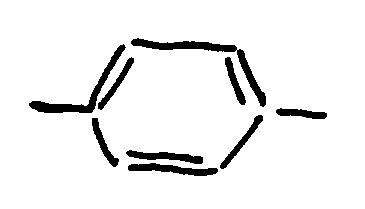
which has a molecular weight of 76. The aromatic units are generally derived from aromatic acids or anhydrides such as phthalic acid, isophthalic acid and terephthalic acid. - Polyesters with weight average molecular weights of greater than 10,000 are not useful, because the viscosity of the curable compositions becomes too high for satisfactory application.
- Molecular weight is determined by gel permeation chromatography (GPC) using a differential refractometer as the detector. The instrument is first calibrated using a polystyrene standard. Polystyrene standards used were purchased from pressure Chemicals Company, Pittsburgh, Pennsylvania. The polystyrene standards have dispersities (dispersity = weight average molecular weight/number average molecular weight) ranging from 1.05 to 1.10. The viscosity average molecular weights of the polystyrene standards used were 900,000; 233,000; 50,000; 17,500; 4,000. To obtain a calibration curve, a set of 0.1 percent (10 milligram polystyrene/1.0 ml tetrahydrofuran) polystyrene solutions in tetrahydrofuran were prepared and a 0.5 ml sample size was injected into the columns and a GPC chromatogram was obtained. The elution volume of each peak corresponding to a given molecular weight of the polystyrene standard was measured and the data was plotted on a semilogarithmic paper (logarithm scale in the ordinate and linear scale in the abscissa). A linear least squares plot of log₁₀ (molecular weight) versus elution volume in milliliters is used as a calibration curve. The lowest molecular weight of the polystyrene standard used was 4,000, and the calibration curve beyond that was extrapolated down to 100. The upper and lower exclusion limits of this set of columns are 5,000,000 and 100, respectively, in terms of polystyrene molecular weight. The sample whose molecular weights are to be determined was prepared as a 1.0 percent tetrahydrofuran solution. After filtration through a 0.5 micron filter, available from Millapore Corporation, a 0.5 ml sample size was injected into the columns and a GPC chromatogram obtained under the same experimental conditions as the calibration. From the resulting calibration curve of molecular weight versus retention time, a molecular weight relative to the standard can be assigned to the retention times of the sample. The height (H) of the curve at the corresponding retention times is recorded by the computer. From these height-molecular weight (M) combinations the following averages are calculated:

This is the number reported. - Suitable polyesters are those which satisfy the aforedescribed requirements and are prepared from polyfunctional acids and polyhydric alcohols. Examples of saturated acids for preparing the preferred saturated polyesters include adipic acid, azelaic acid, sebacic acid and the anhydrides thereof where they exist. When some proportion of unsaturation is present, it is commonly introduced by the use of unsaturated polyfunctional acids such as maleic acid and fumaric acid. Commonly utilized polyhydric alcohols are ethylene glycol, propylene glycol, diethylene glycol, dipropylene glycol, butylene glycol, glycerol, trimethylolpropane, pentaerythritol and sorbitol. Preferably the polyester is prepared from a diol and diacid.
- The polyesters useful in the present invention are prepared by standard procedures well known in the art. One very useful procedure involves charging the diols and diacids to a reaction vessel, heating to a temperature ranging from 200°C to 300°C and removing the water of condensation by distillation. Care must be taken to avoid the loss of any of the reactants while removing the water since this of course will have an effect on the composition and molecular weight. Solvents such as xylene or toluene may be employed in the reaction mixture to help remove water by azeotropic distillation and an esterification catalyst such as a tin compound, for example, dibutyltin oxide or butyl stannoic acid can also be employed to increase the rate of reaction. Of course, functional derivatives of the diacids such as esters anhydrides or acid chlorides may be employed.
- It should be understood that the term polyester as used herein also applies to resins which contain oil or fatty acid modification, i.e. alkyd resins.
- As was mentioned above, the effectively thermoplastic polyester is present in the claimed curable compositions to be used according to the invention in a positive amount which does not exceed 30 percent by weight based on the total weight of the epoxide and polyester components of the composition. Preferably the polyester is present in an amount ranging from 10 to 30 percent by weight.
- The third principal component, the curing agent to cure the one or more epoxide group containing materials, can be selected from a variety of materials.
- Suitable curing agents for the epoxide(s) include aliphatic, cycloaliphatic and aromatic polyfunctional amines; and polyamides. Examples of suitable amines include ethylene diamine, diethylene triamine, triethylene tetraamine, tetraethylene pentamine, 1,4-diaminobutane; 1,3-diaminobutane, hexamethylene diamine, 3-(N-isopropylamino) propylamine, diaminocyclohexane, and polyoxypropyleneamines commercially available under the trademark designation JEFFAMINE®. Aromatic amines, although not preferred, can also be utilized herein, for example metaphenylene diamine, P,P'-methylene dianiline, and 1,4-aminonaphthalene. Also very useful herein are latent curing agents such as boron trifluoride monoethylamine complex, boron trifluoride diethylamine complex, boron trifluoride triethylamine complex, boron trifluoride pyridine complex, boron trifluoride benzyldimethylamine complex, boron trifluoride benzylamine, boron trifluoride etherate, and dicyandiamide. By latent is meant that these materials are inactive until activated by the application of heat.
- Polyamides which are useful in the present compositions are those derived from fatty acids or dimerized fatty acids or polymeric fatty acids and aliphatic polyamines. For example, the materials commercially available from Henkel under the trademark designations VERSAMIDE® 220 or 125 are quite useful herein.
- The aforedescribed curing agent is present in the claimed curable compositions in an amount ranging from 1 percent by weight to 50 percent by weight, preferably from 3 to 15 percent by weight, the percentages being based on the total weight of the curable composition.
- The curable compositions to be used according to the present invention can contain a variety of additives including pigments, reinforcements, thixotropes, plasticizers, extenders, stabilizers and antioxidants. The compositions can be prepared in a number of ways either as a one-package type of composition or as a two-package composition. One package compositions can be prepared with the use of a latent curing agent.
- The curable compositions are typically prepared by combining the ingredients at the time immediately before use. If a one-package composition is prepared, this can be prepared in advance of use and stored. The compositions can be applied in a number of ways including spraying, extrusion, or by hand with a blade. They can be cured by allowing them to stand at ambient temperature, or a combination of ambient temperature cure and baking, or by baking alone. The compositions can be cured at ambient temperature typically in a period ranging from 1 hour to 48 hours, preferably from 3 hours to 5 hours. If ambient temperature and baking are utilized in combination, the composition is typically allowed to stand for a period of from 5 hours to 24 hours followed by baking at a temperature of from 75°C to 200°C, preferably from 100°C to 150°C, for a period of time ranging from 20 minutes to 1 hour.
- The number average molecular weight is determined in the same fashion as is detailed above for weight average molecular weight determinations. Each of the components has been discussed in detail above therefore further elaboration is not deemed to be necessary.
- The curable compositions to be used according to the present invention exhibit excellent physical properties and in addition have markedly reduced shrinkage. This is quite important in applications where the appearance of the substrate is critical, such as automotive applications, because the reduced shrinkage translates into substantially reduced deformation of the substrate. As a result, there is a substantial labor and cost reduction because the need for additional labor to restore the deformed substrate is markedly reduced.
- The use for preparing an adhesive bond between two surfaces of substrate to form a bonded structure comprises applying to at least one of the surfaces the curable composition detailed above and then at least partially curing the curable composition to form the bonded structure. Both the polymerizable composition and the mode of effecting cure have been discussed in detail above. As has been mentioned, the use of the curable composition is particularly applicable to structural building components of vehicles, e.g., doors, frames, hoods and the like of cars, vans, buses, and other vehicles.
- The following Examples are illustrative of the invention and are not intended to limit it to their details.
- In this example several adhesive compositions were prepared and evaluated as is detailed below.


- Each of the adhesive compositions was prepared by combining the ingredients together with mild agitation. Each composition was tested for physical properties as follows.
- Lap Shear Strength: Lap shear bonds for testing were prepared using two strips of cold rolled steel 2.5 x 10.16 x 0.16 cm (1 inch x 4 inches x 0.062 inch). A 152.4 µm (6 mil) thick film of a composition was applied onto one of the metal strips and then a second strip was placed over top of the first strip so that only 6.5 cm² (one square inch) strip overlapped. The composition was cured at 177°C. for 20 minutes. The lap shear strength of the bond in N/m² (pounds per square inch (psi)) was determined according to ASTM D-1002-65. (The ends of the strips were pulled with an INSTRON TESTER device and the lap shear strength of the bond measured.)
- Flexural Strength: A panel for testing was prepared by coating a 2.54 x 15.2 x 0.08 cm (1 inch x 6 inches x 0.031) inch metal panel with a 2.8 mm (0.110 inch) thick layer of a composition. The composition was cured by baking the panel for one hour at 177°C and then the panel was cooled to room temperature. Flexural strength was measured in pounds by using a three point loading system utilizing center loading on a simply supported beam. That is, the panel was supported at two edges and the load was placed in the center. A load was applied at a rate of 5.1 mm (0.2 inch) per minute and the variable measured was the amount of force in pounds required to deflect the specimen a distance of 3.2 mm (0.125 inch). Each value is an average of two separate determinations.
- Tensile Strength and Tensile Modulus: A 2.54 mm (0.100 inch) thick layer of a composition was applied onto a glass panel measuring 30.5 x 30.5 x 0.254 cm (12 inches X 12 inches X 0.100 inch). A second glass panel of the same dimensions was placed over top of this first panel and the panels were clamped together. The composition was cured by baking at 177°C for 40 minutes and then the panels were cooled to room temperature. The clamps were removed and the free adhesive film was removed from between the panels. The free films were prepared and evaluated for tensile strength and tensile modulus according to ASTM D 638. Each value in N/m² (psi) is an average of two separate determinations.
- Metal Deformation: A panel was prepared by applying a 2.54 x 15.2 x 0.28 cm (1 inch x 6 inches x 0.11 inch) adhesive bead onto a metal panel measuring 10.16 x 30.5 x 0.08 cm (4 inches x 12 inches x 0.031 inch) and baking at 177°C. for 20 minutes. The panel was visually observed for the amount of metal deformation which was an indication of the shrinkage of the composition.
- Solubility of each Polyester in the Epoxide Component: The solubility of each of the polyesters in the epoxide component of each the compositions was determined by mixing the polyester with the epoxide component at room temperature. After the air bubbles had disappeared the clarity or haziness of the mixture was noted. A hazy mixture indicated that the polyester was insoluble in the epoxide component while a clear mixture indicated that the polyester was soluble in the epoxide component.
- The results of each of the tests is recorded in Table I. As the data shows, the polyesters which were insoluble in the epoxide component gave compositions which resulted in the least amount of metal deformation. The control composition, A, which contained no polyester; and the composition F, which contained a polyester soluble in the epoxide component resulted in severe metal deformation.
Table I Compositions Solubility of Polyester in Epoxy Component Flexural Strength (pounds) Kilograms Lap Shear Strength x10⁴N/m²(psi) Tensile Strength (psi) x10⁴N/m² Tensile Modulus (psi) x10⁸N/m² Metal Deformation A (control) contained no polyester 19.5 (32) 2639 (3828) 4013 (5821) 45(650504) severe B not soluble 10.9 (24) 2220 (3220) 3560 (5164) 33(483484) none C not soluble 14.1 (31) 2243 (3543) 2671 (3874) 38(554546) very slight D not soluble 11.4 (25) 2007 (2911) 3112 (4513) 29(422029) none E not soluble 15 (33) 1789 (2593) 3789 (5496) 41(588123) slight F soluble 3.3 (7.2) 227 (329) 552 (800) 11(163191) severe G not soluble 12.7 (28) 2021 (2931) 2119 (3073) 35(503869) slight H not soluble 11.1 (24.5) 2539 (3682) 3794 (5502) 39(564099) slight
Claims (10)
- Use of a thermoplastic polyester as a shrinkage-reducing additive in a curable structural adhesive composition for forming a bonded structure between two surfaces of substrates without deformation of the substrates, said adhesive composition comprising
(a) one or more epoxide groups containing materials containing at least two epoxide groups per molecule, and (c) a curing agent for the one or more epoxide groups containing materials of (a); and
wherein said thermoplastic polyester (b) is not reactive with one or more epoxide groups containing materials and being insoluble in the one or more epoxide groups containing materials of (a) and having a weight average molecular weight of from 1000-8000 and being present in an amount ranging from 1-30 w% based on the total weight of the epoxide and polyester components in the composition. - Use of a thermoplastic polyester as a shrinkage-reducing additive in a curable structural adhesive composition for forming a bonded structure between two surfaces of substrates without deformation of the substrates, said adhesive composition comprising
(a) one or more epoxide groups containing materials containing at least two epoxide groups per molecule, and (c) a curing agent for the one or more epoxide groups containing materials of (a),
wherein said thermoplastic polyester (b) is not reactive with one or more epoxide groups containing materials and being insoluble in the one or more epoxide groups containing materials of (a) and having a number average molecular weight of from 400-5000 and being present in an amount ranging from 1-30 w% based on the total weight of the epoxide and polyester components in the composition. - The use of claims 1 or 2,
characterized in that
the polyester is a saturated polyester containing not more than 10 percent by weight of unsaturated units, the percentage based on the total weight of all the ingredients of the polyester. - The use of claim 3,
characterized in that
the saturated polyester is substantially free of aromatic units. - The use of claims 1 or 2,
characterized in that
(a) is comprised of a single epoxide group containing material which is a diglycidyl ether of bisphenol A. - The use of claims 1 or 2,
characterized in that
(a) is comprised of a mixture of two or more epoxide groups containing materials. - The use of claims 1 or 2,
characterized in that
the curing agent is an amine curing agent. - The use of claim 7,
characterized in that
the amine curing agent is dicyandiamide. - The use of claims 1 or 2,
characterized in that
the curing agent is present in the curable composition in an amount ranging from 1 percent by weight to 50 percent by weight, the percentages based on the total weight of the composition. - The use of any of the preceding claims by applying to at least one of the surfaces of substrates the curable composition according to any of the preceding claims and at least partially curing the curable composition to form the bonded structure.
Applications Claiming Priority (2)
| Application Number | Priority Date | Filing Date | Title |
|---|---|---|---|
| US06/938,923 US4739019A (en) | 1986-12-08 | 1986-12-08 | Curable epoxy based compositions having reduced shrinkage during cure |
| US938923 | 1997-09-26 |
Publications (3)
| Publication Number | Publication Date |
|---|---|
| EP0270914A2 EP0270914A2 (en) | 1988-06-15 |
| EP0270914A3 EP0270914A3 (en) | 1990-03-07 |
| EP0270914B1 true EP0270914B1 (en) | 1994-11-17 |
Family
ID=25472211
Family Applications (1)
| Application Number | Title | Priority Date | Filing Date |
|---|---|---|---|
| EP87117335A Expired - Lifetime EP0270914B1 (en) | 1986-12-08 | 1987-11-25 | Use of a thermoplastic polyester as an additive for epoxy resins |
Country Status (7)
| Country | Link |
|---|---|
| US (1) | US4739019A (en) |
| EP (1) | EP0270914B1 (en) |
| JP (1) | JPH0668011B2 (en) |
| KR (1) | KR910009273B1 (en) |
| CA (1) | CA1277793C (en) |
| DE (1) | DE3750761T2 (en) |
| ES (1) | ES2066758T3 (en) |
Families Citing this family (60)
| Publication number | Priority date | Publication date | Assignee | Title |
|---|---|---|---|---|
| US5888654A (en) * | 1988-02-08 | 1999-03-30 | Courtaulds Performance Films | High performance epoxy based laminating adhesive |
| EP0591174B1 (en) * | 1990-06-08 | 1997-07-16 | Minnesota Mining And Manufacturing Company | Reworkable adhesive for electronic applications |
| GB9013678D0 (en) * | 1990-06-19 | 1990-08-08 | Ici Plc | Curable composition comprising a crystallisable polymer |
| GB9013679D0 (en) * | 1990-06-19 | 1990-08-08 | Ici Plc | Curable composition comprising a crystallisable polymer |
| US5664324A (en) | 1990-11-09 | 1997-09-09 | Eubanks Engineering Company | Wire and cable cutting and stripping using adjacent blades |
| US5470886A (en) * | 1994-03-31 | 1995-11-28 | Ppg Industries, Inc. | Curable, sprayable compositions for reinforced thin rigid plates |
| US5936021A (en) * | 1996-11-27 | 1999-08-10 | Cabot Corporation | Masterbatch and resin systems incorporating same |
| US6521706B1 (en) | 1998-01-12 | 2003-02-18 | Ppg Industries Ohio, Inc. | Composition of epoxy polymer, thermoplastic polymer, rubber particles and curing agent |
| US20080125247A1 (en) * | 2004-06-02 | 2008-05-29 | Murali Rajagopalan | Compositions for Golf Equipment |
| US7105628B2 (en) * | 2002-08-27 | 2006-09-12 | Acushnet Company | Compositions for golf equipment |
| US6531541B1 (en) | 2000-05-19 | 2003-03-11 | Ppg Industries Ohio, Inc. | Coating compositions, coated substrates and methods for inhibiting sound transmission through a substrate |
| US7098274B2 (en) * | 2002-08-27 | 2006-08-29 | Acushnet Company | Compositions for golf equipment |
| US6841251B2 (en) * | 2002-02-19 | 2005-01-11 | Ppg Industries Ohio, Inc. | Composition having sealing and sound dampening properties and methods related thereto |
| US6749939B2 (en) | 2002-02-19 | 2004-06-15 | Ppg Industries, Ohio, Inc. | Composition having sealing and sound dampening properties and methods related thereto |
| US7014574B2 (en) * | 2002-07-15 | 2006-03-21 | Acushnet Company | Compositions for golf balls |
| US7138477B2 (en) * | 2002-08-27 | 2006-11-21 | Acushnet Company | Compositions for golf equipment |
| US7157545B2 (en) * | 2002-08-27 | 2007-01-02 | Acushnet Company | Compositions for golf equipment |
| US7101951B2 (en) * | 2002-08-27 | 2006-09-05 | Acushnet Company | Compositions for golf equipment |
| US7105623B2 (en) * | 2002-08-27 | 2006-09-12 | Acushnet Company | Compositions for golf equipment |
| US7138475B2 (en) * | 2002-08-27 | 2006-11-21 | Acushnet Company | Compositions for golf equipment |
| US7138476B2 (en) * | 2002-08-27 | 2006-11-21 | Acushnet Company | Compositions for golf equipment |
| US7259222B2 (en) * | 2002-08-27 | 2007-08-21 | Acushnet Company | Compositions for use in golf balls |
| US7115703B2 (en) * | 2002-08-27 | 2006-10-03 | Acushnet Company | Compositions for golf equipment |
| US7378483B2 (en) * | 2002-08-27 | 2008-05-27 | Acushnet Company | Compositions for golf equipment |
| US20110136587A1 (en) * | 2003-05-09 | 2011-06-09 | Shawn Ricci | Golf balls comprising thermoplastic or thermoset composition having controlled gel time |
| US7557168B2 (en) * | 2003-07-07 | 2009-07-07 | Dow Global Technologies, Inc. | Applying adhesive stream of epoxy resin, rubber modified epoxy resin and capped isocyanate prepolymer |
| CA2529737C (en) * | 2003-07-07 | 2013-05-07 | Dow Global Technologies Inc. | Adhesive epoxy composition and process for applying it |
| ATE352576T1 (en) * | 2004-03-12 | 2007-02-15 | Dow Global Technologies Inc | EPOXY RESIN ADHESIVE COMPOSITION |
| US7288290B2 (en) * | 2004-05-26 | 2007-10-30 | Ppg Industries Ohio, Inc. | Process for applying multi-component composite coatings to substrates to provide sound damping and print-through resistance |
| EP1602702B2 (en) * | 2004-06-01 | 2020-09-16 | Dow Global Technologies LLC | Epoxy adhesive composition |
| US7276570B2 (en) * | 2004-06-02 | 2007-10-02 | Acushnet Company | Compositions for golf equipment |
| US7253245B2 (en) * | 2004-06-02 | 2007-08-07 | Acushnet Company | Compositions for golf equipment |
| US7265195B2 (en) * | 2004-06-02 | 2007-09-04 | Acushnet Company | Compositions for golf equipment |
| US7256249B2 (en) * | 2004-06-02 | 2007-08-14 | Acushnet Company | Compositions for golf equipment |
| US7253242B2 (en) * | 2004-06-02 | 2007-08-07 | Acushnet Company | Compositions for golf equipment |
| EP1695990A1 (en) * | 2005-02-28 | 2006-08-30 | Dow Global Technologies Inc. | Two-component epoxy adhesive composition |
| ATE462762T1 (en) * | 2005-06-02 | 2010-04-15 | Dow Global Technologies Inc | IMPACT MODIFIED EPOXY-BASED STRUCTURAL ADHESIVE |
| US7658967B2 (en) * | 2005-08-25 | 2010-02-09 | Pittsburgh Glass Works, Llc | Methods for applying sound dampening and/or aesthetic coatings and articles made thereby |
| US20070048504A1 (en) * | 2005-08-25 | 2007-03-01 | Dimario Joseph | Methods for applying sound dampening and/or aesthetic coatings and articles made thereby |
| JP5145354B2 (en) * | 2006-12-21 | 2013-02-13 | ダウ グローバル テクノロジーズ エルエルシー | Compositions useful as adhesives for mounting vehicle windows |
| WO2009015149A1 (en) * | 2007-07-23 | 2009-01-29 | Dow Global Technologies Inc. | Two part polyurethane curable composition having substantially consistent g-modulus across the range of use temperatures |
| US20100004353A1 (en) * | 2008-07-01 | 2010-01-07 | Ppg Industries Ohio, Inc. | Waterborne film-forming compositions having heat reflective properties |
| US7763350B2 (en) * | 2008-07-01 | 2010-07-27 | Ppg Industries Ohio, Inc. | Coated articles demonstrating heat reduction and noise reduction properties |
| EP2318448B1 (en) * | 2008-08-22 | 2018-08-22 | Dow Global Technologies LLC | Adhesive composition adapted for bonding large mass parts to structures |
| US20110037013A1 (en) | 2009-08-14 | 2011-02-17 | Ppg Industries Ohio, Inc. | Coatings comprising itaconate latex particles and methods for using the same |
| US20120024703A1 (en) | 2010-07-28 | 2012-02-02 | Ppg Industries Ohio, Inc. | Compositions useful for electrocoating metal substrates and electrodeposition processes using the coatings |
| US9982146B2 (en) | 2012-06-18 | 2018-05-29 | Ppg Industries Ohio, Inc. | Dual-cure compositions useful for coating metal substrates and processes using the compositions |
| US8758862B2 (en) | 2012-06-26 | 2014-06-24 | Prc Desoto International, Inc. | Coating compositions with an isocyanate-functional prepolymer derived from a tricyclodecane polyol, methods for their use, and related coated substrates |
| US9546296B2 (en) | 2014-12-15 | 2017-01-17 | Ppg Industries Ohio, Inc. | Coating compositions, coatings and methods for sound and vibration damping and water resistance |
| US10100216B2 (en) | 2014-12-15 | 2018-10-16 | Ppg Industries Ohio, Inc. | Coating compositions, coatings and methods for sound and vibration damping and water resistance |
| US20160333220A1 (en) | 2015-05-11 | 2016-11-17 | Ppg Industries Ohio, Inc. | Curable film-forming compositions containing photothermally active materials, coated metal substrates, and methods of coating substrates |
| AU2016271598B2 (en) | 2015-05-29 | 2018-10-25 | Prc-Desoto International, Inc. | Curable film-forming compositions containing lithium silicates as corrosion inhibitors and multilayer coated metal substrates |
| US10626308B2 (en) | 2015-09-15 | 2020-04-21 | 3M Innovative Properties Company | Adhesive composition and an article manufactured therefrom |
| US11554385B2 (en) | 2015-11-17 | 2023-01-17 | Ppg Industries Ohio, Inc. | Coated substrates prepared with waterborne sealer and primer compositions |
| MX2020006569A (en) | 2017-12-20 | 2021-01-08 | Ppg Ind Ohio Inc | Coating compositions having improved corrosion resistance. |
| AU2019265883A1 (en) | 2018-05-10 | 2020-12-10 | Ppg Architectural Finishes, Inc. | Low VOC adhesive composition |
| EP4136185A4 (en) | 2020-04-15 | 2024-06-12 | 3M Innovative Properties Company | BRANCHED AMORPHOUS POLYAMIDE (CO)POLYMERS AND ASSOCIATED METHODS OF MAKING AND USE |
| US20240228822A9 (en) | 2021-02-23 | 2024-07-11 | Ppg Industries Ohio, Inc. | Curable film-forming compositions demonstrating adhesion to diverse substrates and fast sandability |
| KR20240156400A (en) | 2022-03-02 | 2024-10-29 | 피알시-데소토 인터내쇼날, 인코포레이티드 | Multilayer coated metal substrate |
| IT202300019572A1 (en) | 2023-09-22 | 2025-03-22 | Ppg Ind Ohio Inc | AQUEOUS DISPERSIONS OF PARTICLES, FILM-FORMING COMPOSITIONS AND MULTILAYER COATED SUBSTRATES PREPARED THEREOF, AND METHODS FOR IMPROVING ADHESION/COHESION OF COATING LAYERS IN MULTILAYER COATED SUBSTRATES |
Family Cites Families (22)
| Publication number | Priority date | Publication date | Assignee | Title |
|---|---|---|---|---|
| CA666920A (en) * | 1963-07-16 | A. Kurka Kurt | Epoxy resin compositions | |
| CH505866A (en) * | 1969-04-01 | 1971-04-15 | Ciba Geigy Ag | Process for the production of crystalline, elastomeric plastic products based on diepoxides and branched polyester-dicarboxylic acids |
| ZA704999B (en) * | 1969-07-30 | 1971-04-28 | Ciba Ltd | New adducts,containing epoxide groups,from polyepoxide compounds and acid,slightly branched polyester dicarboxylic acids,processes for their manufacture and use |
| US3793398A (en) * | 1972-01-26 | 1974-02-19 | Showa Highpolymer | Adhesive composition of unsaturated polyester,epoxy-ester and thermoplastic resin |
| BE794029A (en) * | 1972-02-28 | 1973-05-02 | Du Pont | THERMOPLASTIC COPOLYESTERS WITH SEGMENTS MODIFIED BY POLYEPOXIDES |
| US3723569A (en) * | 1972-03-20 | 1973-03-27 | Du Pont | Blends of copolyesters with cured epoxy resins |
| NL7508324A (en) * | 1974-07-12 | 1976-01-14 | Mitsubishi Petrochemical Co | HARDABLE RESIN MATERIALS. |
| US4032593A (en) * | 1974-07-12 | 1977-06-28 | Mitsubishi Petrochemical Co., Ltd. | Curable resin compositions |
| US3943623A (en) * | 1974-08-23 | 1976-03-16 | Nitto Electric Industrial Co., Ltd. | Hollow cavity package electronic unit |
| JPS5142726A (en) * | 1974-10-10 | 1976-04-12 | Nitto Electric Ind Co | TORYO |
| US4101601A (en) * | 1975-12-24 | 1978-07-18 | Celanese Corporation | Epoxy-catalyst additive system to produce higher I.V. polybutylene terephthalate from low I.V. polymer |
| US4055606A (en) * | 1976-06-21 | 1977-10-25 | Allied Chemical Corporation | Novel copolyester-polyepoxide compositions |
| JPS5321300A (en) * | 1976-08-11 | 1978-02-27 | Hitachi Cable Ltd | Epoxy resin composition |
| JPS54125299A (en) * | 1978-03-23 | 1979-09-28 | Hitachi Cable Ltd | Epoxy resin composition |
| FR2432541A1 (en) * | 1978-08-01 | 1980-02-29 | Rhone Poulenc Ind | CROSSLINKABLE SATURATED COMPOSITIONS FOR POWDER PAINT |
| DE2935446A1 (en) * | 1979-09-01 | 1981-03-19 | Bayer Ag, 5090 Leverkusen | POWDER LAUGHTER AND METHOD FOR THE PRODUCTION THEREOF |
| JPS5649749A (en) * | 1979-10-01 | 1981-05-06 | Teijin Ltd | Polyester resin composition |
| US4332713A (en) * | 1979-11-09 | 1982-06-01 | Ciba-Geigy Corporation | Liquid or pasty thermosetting adhesive which can be pre-gelled and which is based on epoxide resin, and the use of this adhesive |
| JPS56104918A (en) * | 1980-01-24 | 1981-08-21 | Hitachi Chem Co Ltd | Highly adhesive resin composition |
| JPS5857423A (en) * | 1981-09-30 | 1983-04-05 | Toshiba Corp | Low-shrinkage epoxy resin composition |
| JPS59199712A (en) * | 1983-04-27 | 1984-11-12 | Mitsui Toatsu Chem Inc | Curable resin composition |
| US4507441A (en) * | 1983-05-16 | 1985-03-26 | Scott Bader Company Limited | Accelerators for the cure of epoxy resins |
-
1986
- 1986-12-08 US US06/938,923 patent/US4739019A/en not_active Expired - Lifetime
-
1987
- 1987-11-25 EP EP87117335A patent/EP0270914B1/en not_active Expired - Lifetime
- 1987-11-25 ES ES87117335T patent/ES2066758T3/en not_active Expired - Lifetime
- 1987-11-25 DE DE3750761T patent/DE3750761T2/en not_active Expired - Fee Related
- 1987-11-30 CA CA000553124A patent/CA1277793C/en not_active Expired - Lifetime
- 1987-12-07 KR KR1019870013937A patent/KR910009273B1/en not_active Expired
- 1987-12-08 JP JP62311797A patent/JPH0668011B2/en not_active Expired - Fee Related
Non-Patent Citations (1)
| Title |
|---|
| "Polymere Werkstoffe", Ed. H.Batzer, Bd.I, page 589, table 6.2, G. Thieme Verlag Stuttgart (1985). * |
Also Published As
| Publication number | Publication date |
|---|---|
| KR910009273B1 (en) | 1991-11-08 |
| DE3750761D1 (en) | 1994-12-22 |
| JPS63159421A (en) | 1988-07-02 |
| JPH0668011B2 (en) | 1994-08-31 |
| DE3750761T2 (en) | 1995-03-16 |
| EP0270914A3 (en) | 1990-03-07 |
| EP0270914A2 (en) | 1988-06-15 |
| KR880007683A (en) | 1988-08-29 |
| US4739019A (en) | 1988-04-19 |
| CA1277793C (en) | 1990-12-11 |
| ES2066758T3 (en) | 1995-03-16 |
Similar Documents
| Publication | Publication Date | Title |
|---|---|---|
| US4739019A (en) | Curable epoxy based compositions having reduced shrinkage during cure | |
| AU671896B2 (en) | Automotive refinish primer surfacer containing acetoacetate functional polyesterpolyol, a polyacrylate, and an amine functional epoxy resin | |
| EP0199889B1 (en) | High performance two-component epoxy structural adhesives with chemical thixotropy | |
| US4728384A (en) | Two component epoxy structural adhesives with improved flexibility | |
| US6015865A (en) | Hot melt adhesive from epoxy resin/amine-terminated polyalkylene glycol adduct | |
| EP0256162B1 (en) | Polyol/polyepoxide/polyisocyanate adhesive composition and its use | |
| EP0301720A2 (en) | Rubber-modified epoxy adhesive composition | |
| EP0454271B1 (en) | Polyacetoacetate-containing epoxy resin compositions | |
| US4822683A (en) | Method for preparing an adhesive bond with a curable composition having reduced shrinkage during cure | |
| US6787188B1 (en) | Coating composition | |
| US4683282A (en) | Novel boron trifluoride-poly (alkylene oxide) amine catalysts for curing epoxy resins | |
| JPS6129987B2 (en) | ||
| EP0309903A1 (en) | Epoxide and rubber based curable compositions having good adhesion direct to metal | |
| US4861832A (en) | Flexible epoxy film from an epoxy resin reacted with a ketimine/amine terminated butadiene/acrylonitrile copolymer blend | |
| EP0598131A1 (en) | Cross-linking agent and curable composition | |
| US4652492A (en) | Use of a polyamide to thicken an amine | |
| EP3167004B2 (en) | Delayed curing high tg crash durable adhesive | |
| EP0257513B1 (en) | Process for coating substrates with thermosetting high solids coating compositions of epoxies, polyols and anhydrides | |
| EP1983013B1 (en) | Epoxy resins with improved elasticity | |
| US4728737A (en) | High performance two-component epoxy structural adhesive with chemical thixotropy | |
| GB2091736A (en) | Thermosetting adhesive compositions and use thereof | |
| JP5398541B2 (en) | Epoxy-terminated thickener pre-chain extended with hydroxy ester and process for producing the same | |
| JP2001003030A (en) | Moisture-curable polyurethane hot-melt adhesive composition | |
| JPS6348377A (en) | Adhesion method and adhesive composition | |
| KR100193037B1 (en) | High Content Solid Coating Composition |
Legal Events
| Date | Code | Title | Description |
|---|---|---|---|
| PUAI | Public reference made under article 153(3) epc to a published international application that has entered the european phase |
Free format text: ORIGINAL CODE: 0009012 |
|
| AK | Designated contracting states |
Kind code of ref document: A2 Designated state(s): DE ES FR GB IT |
|
| PUAL | Search report despatched |
Free format text: ORIGINAL CODE: 0009013 |
|
| AK | Designated contracting states |
Kind code of ref document: A3 Designated state(s): DE ES FR GB IT |
|
| 17P | Request for examination filed |
Effective date: 19900719 |
|
| 17Q | First examination report despatched |
Effective date: 19910701 |
|
| GRAA | (expected) grant |
Free format text: ORIGINAL CODE: 0009210 |
|
| AK | Designated contracting states |
Kind code of ref document: B1 Designated state(s): DE ES FR GB IT |
|
| REF | Corresponds to: |
Ref document number: 3750761 Country of ref document: DE Date of ref document: 19941222 |
|
| ET | Fr: translation filed | ||
| ITF | It: translation for a ep patent filed | ||
| REG | Reference to a national code |
Ref country code: ES Ref legal event code: FG2A Ref document number: 2066758 Country of ref document: ES Kind code of ref document: T3 |
|
| PLBE | No opposition filed within time limit |
Free format text: ORIGINAL CODE: 0009261 |
|
| STAA | Information on the status of an ep patent application or granted ep patent |
Free format text: STATUS: NO OPPOSITION FILED WITHIN TIME LIMIT |
|
| 26N | No opposition filed | ||
| REG | Reference to a national code |
Ref country code: FR Ref legal event code: TP |
|
| REG | Reference to a national code |
Ref country code: GB Ref legal event code: 732E |
|
| REG | Reference to a national code |
Ref country code: GB Ref legal event code: IF02 |
|
| PGFP | Annual fee paid to national office [announced via postgrant information from national office to epo] |
Ref country code: GB Payment date: 20041117 Year of fee payment: 18 |
|
| PGFP | Annual fee paid to national office [announced via postgrant information from national office to epo] |
Ref country code: FR Payment date: 20041119 Year of fee payment: 18 |
|
| PGFP | Annual fee paid to national office [announced via postgrant information from national office to epo] |
Ref country code: ES Payment date: 20041209 Year of fee payment: 18 |
|
| PGFP | Annual fee paid to national office [announced via postgrant information from national office to epo] |
Ref country code: DE Payment date: 20041230 Year of fee payment: 18 |
|
| PG25 | Lapsed in a contracting state [announced via postgrant information from national office to epo] |
Ref country code: IT Free format text: LAPSE BECAUSE OF NON-PAYMENT OF DUE FEES;WARNING: LAPSES OF ITALIAN PATENTS WITH EFFECTIVE DATE BEFORE 2007 MAY HAVE OCCURRED AT ANY TIME BEFORE 2007. THE CORRECT EFFECTIVE DATE MAY BE DIFFERENT FROM THE ONE RECORDED. Effective date: 20051125 Ref country code: GB Free format text: LAPSE BECAUSE OF NON-PAYMENT OF DUE FEES Effective date: 20051125 |
|
| PG25 | Lapsed in a contracting state [announced via postgrant information from national office to epo] |
Ref country code: ES Free format text: LAPSE BECAUSE OF NON-PAYMENT OF DUE FEES Effective date: 20051126 |
|
| PG25 | Lapsed in a contracting state [announced via postgrant information from national office to epo] |
Ref country code: DE Free format text: LAPSE BECAUSE OF NON-PAYMENT OF DUE FEES Effective date: 20060601 |
|
| GBPC | Gb: european patent ceased through non-payment of renewal fee |
Effective date: 20051125 |
|
| PG25 | Lapsed in a contracting state [announced via postgrant information from national office to epo] |
Ref country code: FR Free format text: LAPSE BECAUSE OF NON-PAYMENT OF DUE FEES Effective date: 20060731 |
|
| REG | Reference to a national code |
Ref country code: FR Ref legal event code: ST Effective date: 20060731 |
|
| REG | Reference to a national code |
Ref country code: ES Ref legal event code: FD2A Effective date: 20051126 |