EP0270867B1 - Steroid derivatives and processes of preparing same - Google Patents
Steroid derivatives and processes of preparing same Download PDFInfo
- Publication number
- EP0270867B1 EP0270867B1 EP87116687A EP87116687A EP0270867B1 EP 0270867 B1 EP0270867 B1 EP 0270867B1 EP 87116687 A EP87116687 A EP 87116687A EP 87116687 A EP87116687 A EP 87116687A EP 0270867 B1 EP0270867 B1 EP 0270867B1
- Authority
- EP
- European Patent Office
- Prior art keywords
- formula
- compound
- ergosta
- tetraen
- acetate
- Prior art date
- Legal status (The legal status is an assumption and is not a legal conclusion. Google has not performed a legal analysis and makes no representation as to the accuracy of the status listed.)
- Expired - Lifetime
Links
- 238000000034 method Methods 0.000 title claims description 29
- 150000003431 steroids Chemical class 0.000 title description 4
- 150000001875 compounds Chemical class 0.000 claims description 63
- 238000006243 chemical reaction Methods 0.000 claims description 39
- HKXBNHCUPKIYDM-CGMHZMFXSA-N doxercalciferol Chemical compound C1(/[C@@H]2CC[C@@H]([C@]2(CCC1)C)[C@H](C)/C=C/[C@H](C)C(C)C)=C\C=C1\C[C@@H](O)C[C@H](O)C1=C HKXBNHCUPKIYDM-CGMHZMFXSA-N 0.000 claims description 24
- 238000002360 preparation method Methods 0.000 claims description 15
- -1 1,3-diol compound Chemical class 0.000 claims description 11
- HETCEOQFVDFGSY-UHFFFAOYSA-N Isopropenyl acetate Chemical compound CC(=C)OC(C)=O HETCEOQFVDFGSY-UHFFFAOYSA-N 0.000 claims description 9
- XQFJZHAVTPYDIQ-BIADAZNZSA-N (1s)-3-[(z)-2-[(1r,3ar,7ar)-1-[(e,2r,5r)-5,6-dimethylhept-3-en-2-yl]-7a-methyl-1,2,3,3a,6,7-hexahydroinden-4-yl]ethenyl]-4-methylcyclohex-3-en-1-ol Chemical compound C=1([C@@H]2CC[C@@H]([C@]2(CCC=1)C)[C@H](C)/C=C/[C@H](C)C(C)C)\C=C/C1=C(C)CC[C@H](O)C1 XQFJZHAVTPYDIQ-BIADAZNZSA-N 0.000 claims description 7
- 238000005698 Diels-Alder reaction Methods 0.000 claims description 7
- 239000003377 acid catalyst Substances 0.000 claims description 7
- 125000006239 protecting group Chemical group 0.000 claims description 7
- ISULLEUFOQSBGY-UHFFFAOYSA-N 4-phenyl-1,2,4-triazole-3,5-dione Chemical compound O=C1N=NC(=O)N1C1=CC=CC=C1 ISULLEUFOQSBGY-UHFFFAOYSA-N 0.000 claims description 5
- VEXZGXHMUGYJMC-UHFFFAOYSA-N Hydrochloric acid Chemical compound Cl VEXZGXHMUGYJMC-UHFFFAOYSA-N 0.000 claims description 5
- 125000002887 hydroxy group Chemical group [H]O* 0.000 claims description 5
- 239000003960 organic solvent Substances 0.000 claims description 5
- JOXIMZWYDAKGHI-UHFFFAOYSA-N toluene-4-sulfonic acid Chemical group CC1=CC=C(S(O)(=O)=O)C=C1 JOXIMZWYDAKGHI-UHFFFAOYSA-N 0.000 claims description 5
- AFVFQIVMOAPDHO-UHFFFAOYSA-N Methanesulfonic acid Chemical compound CS(O)(=O)=O AFVFQIVMOAPDHO-UHFFFAOYSA-N 0.000 claims description 4
- QAOWNCQODCNURD-UHFFFAOYSA-N Sulfuric acid Chemical compound OS(O)(=O)=O QAOWNCQODCNURD-UHFFFAOYSA-N 0.000 claims description 4
- 229910001516 alkali metal iodide Inorganic materials 0.000 claims description 3
- 230000006196 deacetylation Effects 0.000 claims description 3
- 238000003381 deacetylation reaction Methods 0.000 claims description 3
- 238000006317 isomerization reaction Methods 0.000 claims description 3
- QTBSBXVTEAMEQO-UHFFFAOYSA-M Acetate Chemical compound CC([O-])=O QTBSBXVTEAMEQO-UHFFFAOYSA-M 0.000 claims description 2
- 239000002253 acid Substances 0.000 claims description 2
- 229940098779 methanesulfonic acid Drugs 0.000 claims description 2
- 239000007858 starting material Substances 0.000 claims description 2
- ZLMJMSJWJFRBEC-UHFFFAOYSA-N Potassium Chemical compound [K] ZLMJMSJWJFRBEC-UHFFFAOYSA-N 0.000 claims 1
- QAOWNCQODCNURD-UHFFFAOYSA-L Sulfate Chemical compound [O-]S([O-])(=O)=O QAOWNCQODCNURD-UHFFFAOYSA-L 0.000 claims 1
- 230000000397 acetylating effect Effects 0.000 claims 1
- 230000001678 irradiating effect Effects 0.000 claims 1
- 239000011591 potassium Substances 0.000 claims 1
- 229910052700 potassium Inorganic materials 0.000 claims 1
- 229910021653 sulphate ion Inorganic materials 0.000 claims 1
- XEKOWRVHYACXOJ-UHFFFAOYSA-N Ethyl acetate Chemical compound CCOC(C)=O XEKOWRVHYACXOJ-UHFFFAOYSA-N 0.000 description 30
- 239000000243 solution Substances 0.000 description 21
- LFQSCWFLJHTTHZ-UHFFFAOYSA-N Ethanol Chemical compound CCO LFQSCWFLJHTTHZ-UHFFFAOYSA-N 0.000 description 20
- VLKZOEOYAKHREP-UHFFFAOYSA-N n-Hexane Chemical compound CCCCCC VLKZOEOYAKHREP-UHFFFAOYSA-N 0.000 description 19
- CSCPPACGZOOCGX-UHFFFAOYSA-N Acetone Chemical compound CC(C)=O CSCPPACGZOOCGX-UHFFFAOYSA-N 0.000 description 18
- RTZKZFJDLAIYFH-UHFFFAOYSA-N Diethyl ether Chemical compound CCOCC RTZKZFJDLAIYFH-UHFFFAOYSA-N 0.000 description 17
- WYURNTSHIVDZCO-UHFFFAOYSA-N Tetrahydrofuran Chemical compound C1CCOC1 WYURNTSHIVDZCO-UHFFFAOYSA-N 0.000 description 14
- HEDRZPFGACZZDS-MICDWDOJSA-N Trichloro(2H)methane Chemical compound [2H]C(Cl)(Cl)Cl HEDRZPFGACZZDS-MICDWDOJSA-N 0.000 description 14
- HEDRZPFGACZZDS-UHFFFAOYSA-N Chloroform Chemical compound ClC(Cl)Cl HEDRZPFGACZZDS-UHFFFAOYSA-N 0.000 description 12
- 239000002904 solvent Substances 0.000 description 11
- 230000015572 biosynthetic process Effects 0.000 description 10
- XLYOFNOQVPJJNP-UHFFFAOYSA-N water Substances O XLYOFNOQVPJJNP-UHFFFAOYSA-N 0.000 description 10
- OKKJLVBELUTLKV-UHFFFAOYSA-N Methanol Chemical compound OC OKKJLVBELUTLKV-UHFFFAOYSA-N 0.000 description 9
- PMZURENOXWZQFD-UHFFFAOYSA-L Sodium Sulfate Chemical compound [Na+].[Na+].[O-]S([O-])(=O)=O PMZURENOXWZQFD-UHFFFAOYSA-L 0.000 description 8
- 239000000543 intermediate Substances 0.000 description 8
- 229910052938 sodium sulfate Inorganic materials 0.000 description 8
- 235000011152 sodium sulphate Nutrition 0.000 description 8
- 238000002425 crystallisation Methods 0.000 description 7
- 230000008025 crystallization Effects 0.000 description 7
- 235000019441 ethanol Nutrition 0.000 description 7
- YLQBMQCUIZJEEH-UHFFFAOYSA-N tetrahydrofuran Natural products C=1C=COC=1 YLQBMQCUIZJEEH-UHFFFAOYSA-N 0.000 description 7
- 150000000185 1,3-diols Chemical class 0.000 description 6
- ZWEHNKRNPOVVGH-UHFFFAOYSA-N 2-Butanone Chemical compound CCC(C)=O ZWEHNKRNPOVVGH-UHFFFAOYSA-N 0.000 description 6
- WFDIJRYMOXRFFG-UHFFFAOYSA-N Acetic anhydride Chemical compound CC(=O)OC(C)=O WFDIJRYMOXRFFG-UHFFFAOYSA-N 0.000 description 6
- WEVYAHXRMPXWCK-UHFFFAOYSA-N Acetonitrile Chemical compound CC#N WEVYAHXRMPXWCK-UHFFFAOYSA-N 0.000 description 6
- UHOVQNZJYSORNB-UHFFFAOYSA-N Benzene Chemical compound C1=CC=CC=C1 UHOVQNZJYSORNB-UHFFFAOYSA-N 0.000 description 6
- JUJWROOIHBZHMG-UHFFFAOYSA-N Pyridine Chemical compound C1=CC=NC=C1 JUJWROOIHBZHMG-UHFFFAOYSA-N 0.000 description 6
- YXFVVABEGXRONW-UHFFFAOYSA-N Toluene Chemical compound CC1=CC=CC=C1 YXFVVABEGXRONW-UHFFFAOYSA-N 0.000 description 6
- RAXXELZNTBOGNW-UHFFFAOYSA-N imidazole Natural products C1=CNC=N1 RAXXELZNTBOGNW-UHFFFAOYSA-N 0.000 description 6
- 239000000047 product Substances 0.000 description 6
- FVAUCKIRQBBSSJ-UHFFFAOYSA-M sodium iodide Chemical compound [Na+].[I-] FVAUCKIRQBBSSJ-UHFFFAOYSA-M 0.000 description 6
- 238000005160 1H NMR spectroscopy Methods 0.000 description 5
- QTBSBXVTEAMEQO-UHFFFAOYSA-N Acetic acid Chemical compound CC(O)=O QTBSBXVTEAMEQO-UHFFFAOYSA-N 0.000 description 5
- 239000012280 lithium aluminium hydride Substances 0.000 description 5
- 238000010898 silica gel chromatography Methods 0.000 description 5
- 238000003786 synthesis reaction Methods 0.000 description 5
- MHAJPDPJQMAIIY-UHFFFAOYSA-N Hydrogen peroxide Chemical compound OO MHAJPDPJQMAIIY-UHFFFAOYSA-N 0.000 description 4
- UIIMBOGNXHQVGW-UHFFFAOYSA-M Sodium bicarbonate Chemical compound [Na+].OC([O-])=O UIIMBOGNXHQVGW-UHFFFAOYSA-M 0.000 description 4
- 230000021736 acetylation Effects 0.000 description 4
- 238000006640 acetylation reaction Methods 0.000 description 4
- OFHCOWSQAMBJIW-AVJTYSNKSA-N alfacalcidol Chemical compound C1(/[C@@H]2CC[C@@H]([C@]2(CCC1)C)[C@H](C)CCCC(C)C)=C\C=C1\C[C@@H](O)C[C@H](O)C1=C OFHCOWSQAMBJIW-AVJTYSNKSA-N 0.000 description 4
- 239000003153 chemical reaction reagent Substances 0.000 description 4
- 229940125898 compound 5 Drugs 0.000 description 4
- 239000000203 mixture Substances 0.000 description 4
- 239000011541 reaction mixture Substances 0.000 description 4
- 238000010992 reflux Methods 0.000 description 4
- FPGGTKZVZWFYPV-UHFFFAOYSA-M tetrabutylammonium fluoride Chemical compound [F-].CCCC[N+](CCCC)(CCCC)CCCC FPGGTKZVZWFYPV-UHFFFAOYSA-M 0.000 description 4
- 229960001124 trientine Drugs 0.000 description 4
- QAEDZJGFFMLHHQ-UHFFFAOYSA-N trifluoroacetic anhydride Chemical compound FC(F)(F)C(=O)OC(=O)C(F)(F)F QAEDZJGFFMLHHQ-UHFFFAOYSA-N 0.000 description 4
- DKPFZGUDAPQIHT-UHFFFAOYSA-N Butyl acetate Natural products CCCCOC(C)=O DKPFZGUDAPQIHT-UHFFFAOYSA-N 0.000 description 3
- ZMXDDKWLCZADIW-UHFFFAOYSA-N N,N-Dimethylformamide Chemical compound CN(C)C=O ZMXDDKWLCZADIW-UHFFFAOYSA-N 0.000 description 3
- KWYUFKZDYYNOTN-UHFFFAOYSA-M Potassium hydroxide Chemical compound [OH-].[K+] KWYUFKZDYYNOTN-UHFFFAOYSA-M 0.000 description 3
- ZMANZCXQSJIPKH-UHFFFAOYSA-N Triethylamine Chemical compound CCN(CC)CC ZMANZCXQSJIPKH-UHFFFAOYSA-N 0.000 description 3
- 239000011575 calcium Substances 0.000 description 3
- 229940125782 compound 2 Drugs 0.000 description 3
- 229940126214 compound 3 Drugs 0.000 description 3
- 238000006735 epoxidation reaction Methods 0.000 description 3
- FUZZWVXGSFPDMH-UHFFFAOYSA-N hexanoic acid Chemical compound CCCCCC(O)=O FUZZWVXGSFPDMH-UHFFFAOYSA-N 0.000 description 3
- 229910052987 metal hydride Inorganic materials 0.000 description 3
- 150000004681 metal hydrides Chemical class 0.000 description 3
- 125000001181 organosilyl group Chemical group [SiH3]* 0.000 description 3
- 239000002243 precursor Substances 0.000 description 3
- UMJSCPRVCHMLSP-UHFFFAOYSA-N pyridine Natural products COC1=CC=CN=C1 UMJSCPRVCHMLSP-UHFFFAOYSA-N 0.000 description 3
- 239000012279 sodium borohydride Substances 0.000 description 3
- 229910000033 sodium borohydride Inorganic materials 0.000 description 3
- NHQDETIJWKXCTC-UHFFFAOYSA-N 3-chloroperbenzoic acid Chemical compound OOC(=O)C1=CC=CC(Cl)=C1 NHQDETIJWKXCTC-UHFFFAOYSA-N 0.000 description 2
- QGZKDVFQNNGYKY-UHFFFAOYSA-N Ammonia Chemical compound N QGZKDVFQNNGYKY-UHFFFAOYSA-N 0.000 description 2
- IJGRMHOSHXDMSA-UHFFFAOYSA-N Atomic nitrogen Chemical compound N#N IJGRMHOSHXDMSA-UHFFFAOYSA-N 0.000 description 2
- 239000004215 Carbon black (E152) Substances 0.000 description 2
- WHXSMMKQMYFTQS-UHFFFAOYSA-N Lithium Chemical compound [Li] WHXSMMKQMYFTQS-UHFFFAOYSA-N 0.000 description 2
- 238000005481 NMR spectroscopy Methods 0.000 description 2
- 239000007795 chemical reaction product Substances 0.000 description 2
- 239000003638 chemical reducing agent Substances 0.000 description 2
- 238000003776 cleavage reaction Methods 0.000 description 2
- 229940125904 compound 1 Drugs 0.000 description 2
- JBTWLSYIZRCDFO-UHFFFAOYSA-N ethyl methyl carbonate Chemical compound CCOC(=O)OC JBTWLSYIZRCDFO-UHFFFAOYSA-N 0.000 description 2
- 229930195733 hydrocarbon Natural products 0.000 description 2
- 150000002430 hydrocarbons Chemical class 0.000 description 2
- 150000002576 ketones Chemical class 0.000 description 2
- 229910052744 lithium Inorganic materials 0.000 description 2
- 238000001819 mass spectrum Methods 0.000 description 2
- 229910052751 metal Inorganic materials 0.000 description 2
- 239000002184 metal Substances 0.000 description 2
- 150000007524 organic acids Chemical class 0.000 description 2
- 235000005985 organic acids Nutrition 0.000 description 2
- BWHMMNNQKKPAPP-UHFFFAOYSA-L potassium carbonate Chemical compound [K+].[K+].[O-]C([O-])=O BWHMMNNQKKPAPP-UHFFFAOYSA-L 0.000 description 2
- 230000007017 scission Effects 0.000 description 2
- 229910000030 sodium bicarbonate Inorganic materials 0.000 description 2
- 235000017557 sodium bicarbonate Nutrition 0.000 description 2
- 235000009518 sodium iodide Nutrition 0.000 description 2
- BCNZYOJHNLTNEZ-UHFFFAOYSA-N tert-butyldimethylsilyl chloride Chemical compound CC(C)(C)[Si](C)(C)Cl BCNZYOJHNLTNEZ-UHFFFAOYSA-N 0.000 description 2
- 239000011701 zinc Substances 0.000 description 2
- OILXMJHPFNGGTO-UHFFFAOYSA-N (22E)-(24xi)-24-methylcholesta-5,22-dien-3beta-ol Natural products C1C=C2CC(O)CCC2(C)C2C1C1CCC(C(C)C=CC(C)C(C)C)C1(C)CC2 OILXMJHPFNGGTO-UHFFFAOYSA-N 0.000 description 1
- RQOCXCFLRBRBCS-UHFFFAOYSA-N (22E)-cholesta-5,7,22-trien-3beta-ol Natural products C1C(O)CCC2(C)C(CCC3(C(C(C)C=CCC(C)C)CCC33)C)C3=CC=C21 RQOCXCFLRBRBCS-UHFFFAOYSA-N 0.000 description 1
- MWMRKMYVEZHELG-FFTFKNOJSA-N (9s,10r,13r,14r,17r)-10,13-dimethyl-17-[(2r)-6-methylheptan-2-yl]-2,3,4,9,11,12,14,15,16,17-decahydro-1h-cyclopenta[a]phenanthrene Chemical compound C1CCC[C@]2(C)[C@@H](CC[C@@]3([C@@H]([C@H](C)CCCC(C)C)CC[C@H]33)C)C3=CC=C21 MWMRKMYVEZHELG-FFTFKNOJSA-N 0.000 description 1
- YNJSNEKCXVFDKW-UHFFFAOYSA-N 3-(5-amino-1h-indol-3-yl)-2-azaniumylpropanoate Chemical compound C1=C(N)C=C2C(CC(N)C(O)=O)=CNC2=C1 YNJSNEKCXVFDKW-UHFFFAOYSA-N 0.000 description 1
- OQMZNAMGEHIHNN-UHFFFAOYSA-N 7-Dehydrostigmasterol Natural products C1C(O)CCC2(C)C(CCC3(C(C(C)C=CC(CC)C(C)C)CCC33)C)C3=CC=C21 OQMZNAMGEHIHNN-UHFFFAOYSA-N 0.000 description 1
- KLMIDWXRGWMZNH-RPYAGOCSSA-N CC(C)[C@@H](C)/C=C/[C@@H](C)C(CC1)C(C)(CCC2C3(C)C=C4)C1C2=CC=C3C=C4OC(C)=O Chemical compound CC(C)[C@@H](C)/C=C/[C@@H](C)C(CC1)C(C)(CCC2C3(C)C=C4)C1C2=CC=C3C=C4OC(C)=O KLMIDWXRGWMZNH-RPYAGOCSSA-N 0.000 description 1
- OYPRJOBELJOOCE-UHFFFAOYSA-N Calcium Chemical compound [Ca] OYPRJOBELJOOCE-UHFFFAOYSA-N 0.000 description 1
- UXVMQQNJUSDDNG-UHFFFAOYSA-L Calcium chloride Chemical compound [Cl-].[Cl-].[Ca+2] UXVMQQNJUSDDNG-UHFFFAOYSA-L 0.000 description 1
- DNVPQKQSNYMLRS-NXVQYWJNSA-N Ergosterol Natural products CC(C)[C@@H](C)C=C[C@H](C)[C@H]1CC[C@H]2C3=CC=C4C[C@@H](O)CC[C@]4(C)[C@@H]3CC[C@]12C DNVPQKQSNYMLRS-NXVQYWJNSA-N 0.000 description 1
- LJNASASDNLCNOS-UHFFFAOYSA-N Isoergosteron Natural products C1=CC2=CC(=O)CCC2(C)C2C1C1CCC(C(C)C=CC(C)C(C)C)C1(C)CC2 LJNASASDNLCNOS-UHFFFAOYSA-N 0.000 description 1
- RJVOBQMTKIIZFL-UHFFFAOYSA-N Isoergosterone Natural products CC(C)C(C)C=CC(C)C1CCC2C1CCC3C4(C)CCC(=O)C=C4C=CC23C RJVOBQMTKIIZFL-UHFFFAOYSA-N 0.000 description 1
- VYPSYNLAJGMNEJ-UHFFFAOYSA-N Silicium dioxide Chemical compound O=[Si]=O VYPSYNLAJGMNEJ-UHFFFAOYSA-N 0.000 description 1
- DWAQJAXMDSEUJJ-UHFFFAOYSA-M Sodium bisulfite Chemical compound [Na+].OS([O-])=O DWAQJAXMDSEUJJ-UHFFFAOYSA-M 0.000 description 1
- 229930003316 Vitamin D Natural products 0.000 description 1
- MECHNRXZTMCUDQ-UHFFFAOYSA-N Vitamin D2 Natural products C1CCC2(C)C(C(C)C=CC(C)C(C)C)CCC2C1=CC=C1CC(O)CCC1=C MECHNRXZTMCUDQ-UHFFFAOYSA-N 0.000 description 1
- QYSXJUFSXHHAJI-XFEUOLMDSA-N Vitamin D3 Natural products C1(/[C@@H]2CC[C@@H]([C@]2(CCC1)C)[C@H](C)CCCC(C)C)=C/C=C1\C[C@@H](O)CCC1=C QYSXJUFSXHHAJI-XFEUOLMDSA-N 0.000 description 1
- HCHKCACWOHOZIP-UHFFFAOYSA-N Zinc Chemical compound [Zn] HCHKCACWOHOZIP-UHFFFAOYSA-N 0.000 description 1
- WETWJCDKMRHUPV-UHFFFAOYSA-N acetyl chloride Chemical compound CC(Cl)=O WETWJCDKMRHUPV-UHFFFAOYSA-N 0.000 description 1
- 239000012346 acetyl chloride Substances 0.000 description 1
- 239000012345 acetylating agent Substances 0.000 description 1
- 229960002535 alfacalcidol Drugs 0.000 description 1
- 239000007864 aqueous solution Substances 0.000 description 1
- 239000002585 base Substances 0.000 description 1
- 239000011230 binding agent Substances 0.000 description 1
- 230000037396 body weight Effects 0.000 description 1
- 239000006227 byproduct Substances 0.000 description 1
- 229910052791 calcium Inorganic materials 0.000 description 1
- 239000001110 calcium chloride Substances 0.000 description 1
- 229910001628 calcium chloride Inorganic materials 0.000 description 1
- 239000007810 chemical reaction solvent Substances 0.000 description 1
- 238000004587 chromatography analysis Methods 0.000 description 1
- 238000007796 conventional method Methods 0.000 description 1
- 238000001816 cooling Methods 0.000 description 1
- 239000013078 crystal Substances 0.000 description 1
- 238000006356 dehydrogenation reaction Methods 0.000 description 1
- 150000002009 diols Chemical class 0.000 description 1
- 229940079593 drug Drugs 0.000 description 1
- 239000003814 drug Substances 0.000 description 1
- 230000000694 effects Effects 0.000 description 1
- 125000003700 epoxy group Chemical group 0.000 description 1
- 229960002061 ergocalciferol Drugs 0.000 description 1
- DNVPQKQSNYMLRS-SOWFXMKYSA-N ergosterol Chemical compound C1[C@@H](O)CC[C@]2(C)[C@H](CC[C@]3([C@H]([C@H](C)/C=C/[C@@H](C)C(C)C)CC[C@H]33)C)C3=CC=C21 DNVPQKQSNYMLRS-SOWFXMKYSA-N 0.000 description 1
- MDKXBBPLEGPIRI-UHFFFAOYSA-N ethoxyethane;methanol Chemical compound OC.CCOCC MDKXBBPLEGPIRI-UHFFFAOYSA-N 0.000 description 1
- 125000000816 ethylene group Chemical group [H]C([H])([*:1])C([H])([H])[*:2] 0.000 description 1
- 230000001747 exhibiting effect Effects 0.000 description 1
- 230000002349 favourable effect Effects 0.000 description 1
- 238000010438 heat treatment Methods 0.000 description 1
- 238000009776 industrial production Methods 0.000 description 1
- 239000013067 intermediate product Substances 0.000 description 1
- 231100001231 less toxic Toxicity 0.000 description 1
- 238000004519 manufacturing process Methods 0.000 description 1
- 239000000463 material Substances 0.000 description 1
- QSHDDOUJBYECFT-UHFFFAOYSA-N mercury Chemical compound [Hg] QSHDDOUJBYECFT-UHFFFAOYSA-N 0.000 description 1
- 229910052753 mercury Inorganic materials 0.000 description 1
- 150000007522 mineralic acids Chemical class 0.000 description 1
- CIXSDMKDSYXUMJ-UHFFFAOYSA-N n,n-diethylcyclohexanamine Chemical compound CCN(CC)C1CCCCC1 CIXSDMKDSYXUMJ-UHFFFAOYSA-N 0.000 description 1
- 230000007935 neutral effect Effects 0.000 description 1
- 229910052757 nitrogen Inorganic materials 0.000 description 1
- 150000004965 peroxy acids Chemical class 0.000 description 1
- CHKVPAROMQMJNQ-UHFFFAOYSA-M potassium bisulfate Chemical compound [K+].OS([O-])(=O)=O CHKVPAROMQMJNQ-UHFFFAOYSA-M 0.000 description 1
- 229910000027 potassium carbonate Inorganic materials 0.000 description 1
- 238000000746 purification Methods 0.000 description 1
- 239000000741 silica gel Substances 0.000 description 1
- 229910002027 silica gel Inorganic materials 0.000 description 1
- 235000010267 sodium hydrogen sulphite Nutrition 0.000 description 1
- 125000001424 substituent group Chemical group 0.000 description 1
- MHYGQXWCZAYSLJ-UHFFFAOYSA-N tert-butyl-chloro-diphenylsilane Chemical compound C=1C=CC=CC=1[Si](Cl)(C(C)(C)C)C1=CC=CC=C1 MHYGQXWCZAYSLJ-UHFFFAOYSA-N 0.000 description 1
- 229940088594 vitamin Drugs 0.000 description 1
- 229930003231 vitamin Natural products 0.000 description 1
- 235000013343 vitamin Nutrition 0.000 description 1
- 239000011782 vitamin Substances 0.000 description 1
- 235000019166 vitamin D Nutrition 0.000 description 1
- 239000011710 vitamin D Substances 0.000 description 1
- 150000003710 vitamin D derivatives Chemical class 0.000 description 1
- 235000001892 vitamin D2 Nutrition 0.000 description 1
- 239000011653 vitamin D2 Substances 0.000 description 1
- MECHNRXZTMCUDQ-RKHKHRCZSA-N vitamin D2 Chemical compound C1(/[C@@H]2CC[C@@H]([C@]2(CCC1)C)[C@H](C)/C=C/[C@H](C)C(C)C)=C\C=C1\C[C@@H](O)CCC1=C MECHNRXZTMCUDQ-RKHKHRCZSA-N 0.000 description 1
- 229940046008 vitamin d Drugs 0.000 description 1
- 150000003722 vitamin derivatives Chemical class 0.000 description 1
- 229910052725 zinc Inorganic materials 0.000 description 1
Classifications
-
- C—CHEMISTRY; METALLURGY
- C07—ORGANIC CHEMISTRY
- C07J—STEROIDS
- C07J51/00—Normal steroids with unmodified cyclopenta(a)hydrophenanthrene skeleton not provided for in groups C07J1/00 - C07J43/00
-
- A—HUMAN NECESSITIES
- A61—MEDICAL OR VETERINARY SCIENCE; HYGIENE
- A61P—SPECIFIC THERAPEUTIC ACTIVITY OF CHEMICAL COMPOUNDS OR MEDICINAL PREPARATIONS
- A61P3/00—Drugs for disorders of the metabolism
- A61P3/02—Nutrients, e.g. vitamins, minerals
-
- A—HUMAN NECESSITIES
- A61—MEDICAL OR VETERINARY SCIENCE; HYGIENE
- A61P—SPECIFIC THERAPEUTIC ACTIVITY OF CHEMICAL COMPOUNDS OR MEDICINAL PREPARATIONS
- A61P3/00—Drugs for disorders of the metabolism
- A61P3/12—Drugs for disorders of the metabolism for electrolyte homeostasis
- A61P3/14—Drugs for disorders of the metabolism for electrolyte homeostasis for calcium homeostasis
-
- C—CHEMISTRY; METALLURGY
- C07—ORGANIC CHEMISTRY
- C07C—ACYCLIC OR CARBOCYCLIC COMPOUNDS
- C07C401/00—Irradiation products of cholesterol or its derivatives; Vitamin D derivatives, 9,10-seco cyclopenta[a]phenanthrene or analogues obtained by chemical preparation without irradiation
-
- C—CHEMISTRY; METALLURGY
- C07—ORGANIC CHEMISTRY
- C07J—STEROIDS
- C07J43/00—Normal steroids having a nitrogen-containing hetero ring spiro-condensed or not condensed with the cyclopenta(a)hydrophenanthrene skeleton
- C07J43/003—Normal steroids having a nitrogen-containing hetero ring spiro-condensed or not condensed with the cyclopenta(a)hydrophenanthrene skeleton not condensed
-
- C—CHEMISTRY; METALLURGY
- C07—ORGANIC CHEMISTRY
- C07J—STEROIDS
- C07J71/00—Steroids in which the cyclopenta(a)hydrophenanthrene skeleton is condensed with a heterocyclic ring
- C07J71/0005—Oxygen-containing hetero ring
- C07J71/001—Oxiranes
-
- C—CHEMISTRY; METALLURGY
- C07—ORGANIC CHEMISTRY
- C07J—STEROIDS
- C07J71/00—Steroids in which the cyclopenta(a)hydrophenanthrene skeleton is condensed with a heterocyclic ring
- C07J71/0036—Nitrogen-containing hetero ring
- C07J71/0042—Nitrogen only
-
- C—CHEMISTRY; METALLURGY
- C07—ORGANIC CHEMISTRY
- C07J—STEROIDS
- C07J9/00—Normal steroids containing carbon, hydrogen, halogen or oxygen substituted in position 17 beta by a chain of more than two carbon atoms, e.g. cholane, cholestane, coprostane
Definitions
- This invention relates to new steroid derivatives which are useful intermediates in the preparation of 1 ⁇ -hydroxy vitamin D2, and also to a process of preparing the intermediates and 1 ⁇ -hydroxy vitamin D2.
- 1 ⁇ -Hydroxy vitamin D2 exhibiting strong vitamin D activity is disclosed in U.S. Patent 3,907,843.
- a synthetic route to 1 ⁇ -hydroxy vitamin D2 disclosed therein is shown in the following reaction scheme I, which includes conversion of isoergosterone (compound 1) prepared from ergosterol to ergosta-1,4,6,22-tetraen-3-one (compound 2) followed by reaction with hydrogen peroxide to give 1 ⁇ ,-2 ⁇ -epoxy-ergosta-4,6,22-trien-3-one (compound 3), reaction of this compound with liquid ammonia and metal lithium to give 1 ⁇ -hydroxy-7,8-dihydroergosterol (compound 4) followed by acetylation to give 1 ⁇ -acetoxy-7,8-dihydroergosteryl acetate (compound 5), dehydrogenation of this compound to 1 ⁇ -hydroxyergosteryl diacetate (1 ⁇ ,3 ⁇ -diacetoxy-ergosta-5,7,22-trien)(compound 6
- An object of this invention is to provide a new intermediate compound, ergosta-1,5,7,22-tetraen-3 ⁇ -ol and a process for the preparation thereof.
- Another object of the invention is to provide 1 ⁇ -hydroxyergosteryl diacetate, the precursor for 1 ⁇ -hydroxy vitamin D2 by a process comprising the new steps via ergosta-1,5,7,22-tetraen-3 ⁇ -ol.
- Further object of the invention is to provide a simpler process for the preparation of 1 ⁇ -hydroxy vitamin D2 in high yield.
- the process of the invention is for example illustrated by the following reaction scheme II, including the synthesis of the new intermediate compound, ergosta-1,5,7,22-tetraen-3 ⁇ -ol and that of 1 ⁇ -hydroxyergosteryl diacetate via the said 3 ⁇ -ol.
- reaction scheme II the intermediate products and the reaction route in the present invention are different from those shown in the reaction scheme I.
- the compounds in the reaction scheme II are designated by using different numbers from those in the reaction scheme I.
- the process of the invention is particularly applicable to the preparation of the intermediate compounds including ergosta-1,5,7,22-tetraen-3 ⁇ -ol of formula (I) and 1 ⁇ -hydroxy erogostearyl diacetate of formula (X), the precursor for 1 ⁇ -hydroxy vitamin D2.
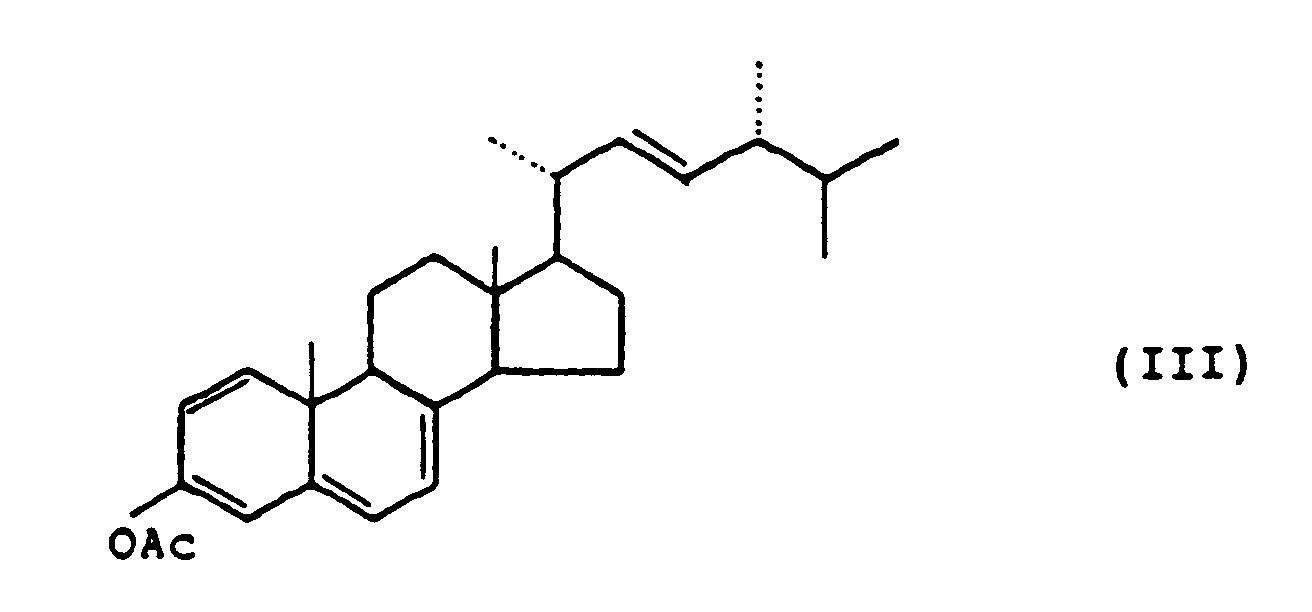
- reaction of ergosta-1,4,6,22-tetraen-3-one of formula (II) with isopropenyl acetate leads to formation of ergosta-1,3,5,7,22-pentaen-3-yl-acetate of formula (III).
- the reaction in the first step is preferably carried out in an organic solvent, e.g., a hydrocarbon solvent such as n-hexane, benzene and toluene, a ketone solvent such as acetone and methyl ethyl ketone and an ester solvent such as ethyl acetate and butyl acetate, at a temperature between ordinary temperature and a reflux temperature, preferably a temperature between 80 and 150°C and in the presence of an acid catalyst.
- the acid catalysts used in the reaction include organic acids such as p-toluenesulfonic acid, methanesulfonic acid and the like and inorganic acids such as hydrochloric acid, sulfuric acid, acid potassium sulfate and the like. These acid catalysts are generally used in the range of 0.1 to 10 moles per mole of the compound of formula (II).
- Isopropenyl acetate is used in the range of 1 to 100 moles and preferably 10 to 50 moles per mole of the compound of formula (II). If isopropenyl acetate is used in large excess, no additional solvent is required since isopropenyl acetate serves by itself as a reaction solvent.
- ergosta-1,3,5,7,22-pentaen-3-yl-acetate of formula (III) thus prepared is subjected to reduction to form ergosta-1,5,7,22-tetraen-3 ⁇ -ol of formula (I).
- the reducing agents used in the reaction of this step include metal hydrides such as lithium aluminumhydride (LiAlH4), sodium borohydride (NaBH4), calcium borohydride (Ca(BH4)2), zinc borohydride (Zn(BH4)2) and the like. Of these metal hydrides, Ca(BH4)2 is preferred. These metal hydrides are generally used in more excess amount than the theoretical amount. In general, 5 to 20 times the theoretical amount are used.
- the reduction is carried out in an organic solvent, e.g., ether and at a temperature between -20°C and room temperature, preferably a temperature between -5°C and 5°C.
- the compound of formula (I), ergosta-1,5,7,22-tetraen-3 ⁇ -ol thus prepared is reacted with 4-phenyl-1,2,4-triazoline-3,5-dione to yield the compound of formula (IV) which is a Diels-Alder adduct.
- the reaction is carried out at a temperature between 0°C and room temperature in the presence of a conventional organic solvent, e.g., a hydrocarbon solvent such as n-hexane, benzene and toluene, a ketone solvent such as acetone and methyl ethyl ketone and an ester solvent such as ethyl acetate and butyl acetate.
- 4-Phenyl-1,2,4-triazoline-3,5-dione is used in the amount of 1.0 to 1.5 moles per mole of the compound of formula (I).
- the compound of formula (IV) is converted to the compound of formula (V) by protecting a hydroxyl group at the 3-position of the compound (IV), e.g., with an eliminable protecting group.
- Suitable protecting groups are sterically bulky groups which are easily eliminable under mild conditions.
- the compounds for introduction of the protecting group include silyl compounds, e.g., t-butyldimethylsilyl chloride. In addition, t-butyldiphenylsilyl chloride can be taken into consideration.
- the reaction is preferably caused to proceed in the presence of a base as an acid binding agent, e.g., imidazole, triethylamine and diethylcyclohexylamine.
- the compound of formula (V) having the protected hydroxyl group at the 3-position is converted to the compound of formula (VI) by epoxidizing the 1,2-double bond and the 22,23-double bond in the compound (V).
- the reagent is used including a variety of peracids or mixtures of organic acids and hydrogen peroxide.
- Preferred reagents include perbenzoic acid, m-chloroperbenzoic acid and the like.
- the epoxidation is carried out at a temperature between 0°C and room temperature using the reagent in the amount of 1.5 to 5.0 times the theoretical amount for the compound of formula (V).
- the epoxidized compound of formula (VI) is then subjected to the reaction for removal of the protecting group at the 3-position.
- This reaction is carried out e.g., using a solution of tetrabutylammonium fluoride in tetrahydrofuran. Likewise, CH3COOH/H2O can be used.
- the reaction temperature is in the range between 0°C and room temperature.
- the compound of formula (VII) having a free hydroxyl group at the 3-position is converted to the compound of formula (VIII) by subjecting to reduction.
- This reduction employs the conditions similar to those used in reduction of the compound (III) to the compound (I).
- Lithium aluminum hydride is especially preferred for the reducing agents used herein.
- the reduced product i.e., the compound of formula (VIII) is then converted to the diacetylated product of formula (IX) by acetylation.
- the acetylation can be carried out using known acetylating agents, e.g., pyridine/acetic anhydride or acetyl chloride/pyridine.
- the diacetylated product, the compound of formula (IX) thus prepared is treated with an alkali metal iodide, e.g., sodium iodide in the presence of a suitable solvent such as trifluoroacetic anhydride, thereby converting the epoxy group at the 22,23-position to the ethylene group, leading to the formation of 1 ⁇ -hydroxy ergosteryl diacetate of formula (X).
- an alkali metal iodide e.g., sodium iodide
- a suitable solvent such as trifluoroacetic anhydride
- the compound of formula (X) prepared in accordance with the process of the present invention is subjected to irradiation with light in the usual way, thereby leading to the cleavage of the steroid ring to form 1 ⁇ ,3 ⁇ -diacetoxy previtamin D2 (the compound of formula (XI)), followed by thermal isomerisation and deacetylation according to a conventional method to produce the desired 1 ⁇ -hydroxy vitamin D2, i.e., the compound of formula (XII).
- the steroids including the compounds of formulas (I), (IV), (V), (VI), (VII), (VIII), (IX) and (X) prepared in accordance with the present invention are valuable intermediates in the synthesis of a wide range of biologically useful materials, particularly 1 ⁇ -hydroxy vitamin D derivatives and related compounds.
- the process of the present invention using the reaction route and intermediates different from the prior art process, the following advantages are achieved.
- the desired 1 ⁇ -hydroxy-ergosteryl diacetate can be produced in much better yield than the prior art process, the overall yield in the present invention starting from the compound of formula (II) amounting to approximately 11.1%, whereas the overall yield in the prior art starting from compound 2 being only 1.2%.
- the overall yield leading to 1 ⁇ -hydroxy vitamin D2 amounts to as high as 1.9% according to the process of the present invention, in comparison with 0.20% according to the prior art process.
- the reaction reagents used in the present invention are easy to handle, e.g., because of their safety and the desired products are of high purities, as compared with those of the prior art.
- the processes of the present invention are of great significance in industrial production of the vitamin D2.
- 1 ⁇ -Hydroxy vitamin D2 is less toxic than 1 ⁇ -hydroxy vitamin D3 in the rat as disclosed in "Proceedings of the Society for Experimental Biology and Medicine 178, 432-436 (1985)".
- An LD50 of 0.2 mg/kg body weight has been determined for 1 ⁇ -hydroxy vitamin D3 in the rat.
- the LD50 for 1 ⁇ -hydroxy vitamin D2 is between 3.5 and 6.5 mg/kg.
- Ergosta-1,4,6,22-tetraen-3-one (II) (10.0 g), p-toluene sulfonic acid (10.0 g) and isopropenyl acetate (100 ml) were added to butyl acetate (100 ml). After heating under reflux for 16 hours, a reaction solution was washed with water until it was neutral, dried over sodium sulfate (Na2SO4) and thereafter the solvent was distilled off. Crystallization of the residue from acetone gave 7.6 g (69% yield) of ergosta-1,3,5,7,22-pentaen-3-yl-acetate (III), m.p. 154-156°C.
- the Diels-Alder adduct (IV) (1.4 g) from Example 3 was dissolved in dimethylformamide (3.0 ml). To a solution was added imidazole (0.6 g) and t-butyldimethylsilyl chloride (0.6 g), the solution was warmed to 40°C and kept at this temperature for 30 minutes. The reaction mixture was extracted with ether, washed with water, dried over Na2SO4 and the ether was distilled off. Crystallization of the residue from methanol-ether gave the title compound, m.p. 186-188°C, yield 1.5 g(90%).
- reaction mixture was extracted with ethyl acetate, washed with water and dried over Na2SO4.
- the solvent was distilled off and the residue was purified by silica gel chromatography (eluted with 4/1 chloroform/ ethyl acetate) to give the title compound, yield 0.4 g (62%), m.p. 157°-158°C (after crystallization from acetone).
- the diol (VIII) (0.6 g) from Example 6 was charged with pyridine (2 ml) and acetic anhydride (2 ml) and reacted at a temperature between 80° and 85°C for 1 hr.
- the reaction product was extracted with hexane, washed with sodium bicarbonate solution, then water and dried over Na2SO4.
- the solvent was distilled off to give 0.7 g of the compound (IX).
- Sodium iodide (3.5 g) was dissolved in tetrahydrofuran/acetonitrile (1/1, 30 ml), to which trifluoroacetic anhydride (1 ml) was added.
Landscapes
- Chemical & Material Sciences (AREA)
- Organic Chemistry (AREA)
- Health & Medical Sciences (AREA)
- General Health & Medical Sciences (AREA)
- Medicinal Chemistry (AREA)
- Pharmacology & Pharmacy (AREA)
- Obesity (AREA)
- Diabetes (AREA)
- Chemical Kinetics & Catalysis (AREA)
- General Chemical & Material Sciences (AREA)
- Bioinformatics & Cheminformatics (AREA)
- Nuclear Medicine, Radiotherapy & Molecular Imaging (AREA)
- Engineering & Computer Science (AREA)
- Hematology (AREA)
- Life Sciences & Earth Sciences (AREA)
- Animal Behavior & Ethology (AREA)
- Veterinary Medicine (AREA)
- Public Health (AREA)
- Nutrition Science (AREA)
- Endocrinology (AREA)
- Rheumatology (AREA)
- Steroid Compounds (AREA)
- Pharmaceuticals Containing Other Organic And Inorganic Compounds (AREA)
Description
- This invention relates to new steroid derivatives which are useful intermediates in the preparation of 1α-hydroxy vitamin D₂, and also to a process of preparing the intermediates and 1α-hydroxy vitamin D₂.
- 1α-Hydroxy vitamin D₂ exhibiting strong vitamin D activity is disclosed in U.S. Patent 3,907,843. A synthetic route to 1α-hydroxy vitamin D₂ disclosed therein is shown in the following reaction scheme I, which includes conversion of isoergosterone (compound 1) prepared from ergosterol to ergosta-1,4,6,22-tetraen-3-one (compound 2) followed by reaction with hydrogen peroxide to give 1α,-2α-epoxy-ergosta-4,6,22-trien-3-one (compound 3), reaction of this compound with liquid ammonia and metal lithium to give 1α-hydroxy-7,8-dihydroergosterol (compound 4) followed by acetylation to give 1α-acetoxy-7,8-dihydroergosteryl acetate (compound 5), dehydrogenation of this compound to 1α-hydroxyergosteryl diacetate (1α,3β-diacetoxy-ergosta-5,7,22-trien)(compound 6), irradiation of this compound with light, causing cleavage of the ring to give 1α,3β-diacetoxy previtamin D₂ (compound 7) and thermal isomerization and deacetylation of this compound to give 1α-hydroxy vitamin D₂ (compound 8). The synthesis of 1α-hydroxy vitamin D₂ by the above processes, however, gives rise to a number of problems. The reaction yield of the compounds is low including 16% yield in the formation of compound 5 from compound 3 and less than 10% yield in the formation of compound 6 from compound 5, and hence the overall yield through the synthesis of compound 6 from compound 1 amounts to less than 0.4%. In the conversion of compound 3 into compound 4, use of liquid ammonia and metal lithium is highly dangerous. In the conversion of compound 5 into compound 6, there is formed as by-products an isomeric compound 9 (1α,3β-diacetoxy ergosta-4,6,22-trien) which is difficult to separate and is responsible for reducing the purity of 1α-hydroxy vitamin D₂. In view of the foregoing problems, the prior processes are not satisfactory for the production of 1α-hydroxy vitamin D₂ in industrial scale.

- By the overall reaction route described above, it is difficult to overcome the problems of low yield of the desired 1α-hydroxy vitamin D₂, difficulties in the reaction operation and low purity of the product. There is thus a need for a method for the synthesis of 1α-hydroxy ergosteryl diacetate (compound 6) in good yield according to a different reaction route from the prior art, said compound 6 leading to a previtamin D₂ by photoreaction.
J. C. S. Perkin I (1977) p. 820-822 describes the preparation of 1-α-hydroxycholecalciferol from cholesta-1,4,7-trien-3-one including the steps of acetylation to form the cholesta-1,3,5,7-tetraen-3-yl acetate, reduction to form the cholesta-1,5,7-trien-3-ol, formation of an aduct with 4-phenyl-1,2,4-triazoline-3,5-dione, protection of the 3-hydroxy group, epoxidation of the 1-double bond and reduction of the monoepoxide to form cholesta-5,7-diene, 1,3-diol. This sequence does not involve any reaction of double bonds of the substituent in 17-position. - Now, we have studied the prior art process for the preparation of 1α-hydroxyergosteryl diacetate starting from ergosta-1,4,6,22-tetraen-3-one and as a result it is found that a process via the intermediate, ergosta-1,5,7,22-tetraen-3β-ol can provide the desired compounds in more favorable yields, simpler reaction operation and higher purity of the product as compared with the above prior art processes.
- An object of this invention is to provide a new intermediate compound, ergosta-1,5,7,22-tetraen-3β-ol and a process for the preparation thereof. Another object of the invention is to provide 1α-hydroxyergosteryl diacetate, the precursor for 1α-hydroxy vitamin D₂ by a process comprising the new steps via ergosta-1,5,7,22-tetraen-3β-ol. Further object of the invention is to provide a simpler process for the preparation of 1α-hydroxy vitamin D₂ in high yield.
- Other objects, advantages and aspects of this invention will become apparent from the following description.
- The process of the invention is for example illustrated by the following reaction scheme II, including the synthesis of the new intermediate compound, ergosta-1,5,7,22-tetraen-3β-ol and that of 1α-hydroxyergosteryl diacetate via the said 3β-ol. As is apparent from the reaction scheme II, the intermediate products and the reaction route in the present invention are different from those shown in the reaction scheme I. In this situation, the compounds in the reaction scheme II are designated by using different numbers from those in the reaction scheme I. In the reaction scheme II, the starting material, ergosta-1,4,6,22-tetraen-3-one is designated by formula (II) (compound 2 in the reaction scheme I) and the precursor 1α-hydroxyergosteryl diacetate is designated by formula (X) (compound 6 in the reaction scheme I).

- The process of the invention is particularly applicable to the preparation of the intermediate compounds including ergosta-1,5,7,22-tetraen-3β-ol of formula (I) and 1α-hydroxy erogostearyl diacetate of formula (X), the precursor for 1α-hydroxy vitamin D₂.
- In the first step of the process, reaction of ergosta-1,4,6,22-tetraen-3-one of formula (II) with isopropenyl acetate leads to formation of ergosta-1,3,5,7,22-pentaen-3-yl-acetate of formula (III).
- The reaction in the first step is preferably carried out in an organic solvent, e.g., a hydrocarbon solvent such as n-hexane, benzene and toluene, a ketone solvent such as acetone and methyl ethyl ketone and an ester solvent such as ethyl acetate and butyl acetate, at a temperature between ordinary temperature and a reflux temperature, preferably a temperature between 80 and 150°C and in the presence of an acid catalyst. The acid catalysts used in the reaction include organic acids such as p-toluenesulfonic acid, methanesulfonic acid and the like and inorganic acids such as hydrochloric acid, sulfuric acid, acid potassium sulfate and the like. These acid catalysts are generally used in the range of 0.1 to 10 moles per mole of the compound of formula (II).
- Isopropenyl acetate is used in the range of 1 to 100 moles and preferably 10 to 50 moles per mole of the compound of formula (II). If isopropenyl acetate is used in large excess, no additional solvent is required since isopropenyl acetate serves by itself as a reaction solvent.
- In the second step, ergosta-1,3,5,7,22-pentaen-3-yl-acetate of formula (III) thus prepared is subjected to reduction to form ergosta-1,5,7,22-tetraen-3β-ol of formula (I). The reducing agents used in the reaction of this step include metal hydrides such as lithium aluminumhydride (LiAlH₄), sodium borohydride (NaBH₄), calcium borohydride (Ca(BH₄)₂), zinc borohydride (Zn(BH₄)₂) and the like. Of these metal hydrides, Ca(BH₄)₂ is preferred. These metal hydrides are generally used in more excess amount than the theoretical amount. In general, 5 to 20 times the theoretical amount are used. The reduction is carried out in an organic solvent, e.g., ether and at a temperature between -20°C and room temperature, preferably a temperature between -5°C and 5°C.
- The compound of formula (I), ergosta-1,5,7,22-tetraen-3β-ol thus prepared is reacted with 4-phenyl-1,2,4-triazoline-3,5-dione to yield the compound of formula (IV) which is a Diels-Alder adduct. The reaction is carried out at a temperature between 0°C and room temperature in the presence of a conventional organic solvent, e.g., a hydrocarbon solvent such as n-hexane, benzene and toluene, a ketone solvent such as acetone and methyl ethyl ketone and an ester solvent such as ethyl acetate and butyl acetate. 4-Phenyl-1,2,4-triazoline-3,5-dione is used in the amount of 1.0 to 1.5 moles per mole of the compound of formula (I).
- The Diels-Alder adduct, the compound of formula (IV) is converted to the compound of formula (V) by protecting a hydroxyl group at the 3-position of the compound (IV), e.g., with an eliminable protecting group. Suitable protecting groups are sterically bulky groups which are easily eliminable under mild conditions. The compounds for introduction of the protecting group include silyl compounds, e.g., t-butyldimethylsilyl chloride. In addition, t-butyldiphenylsilyl chloride can be taken into consideration. In the introduction of the protecting group, the reaction is preferably caused to proceed in the presence of a base as an acid binding agent, e.g., imidazole, triethylamine and diethylcyclohexylamine.
- The compound of formula (V) having the protected hydroxyl group at the 3-position is converted to the compound of formula (VI) by epoxidizing the 1,2-double bond and the 22,23-double bond in the compound (V). For the epoxidation, the reagent is used including a variety of peracids or mixtures of organic acids and hydrogen peroxide. Preferred reagents include perbenzoic acid, m-chloroperbenzoic acid and the like. The epoxidation is carried out at a temperature between 0°C and room temperature using the reagent in the amount of 1.5 to 5.0 times the theoretical amount for the compound of formula (V).
- The epoxidized compound of formula (VI) is then subjected to the reaction for removal of the protecting group at the 3-position. This reaction is carried out e.g., using a solution of tetrabutylammonium fluoride in tetrahydrofuran. Likewise, CH₃COOH/H₂O can be used. The reaction temperature is in the range between 0°C and room temperature.
- The compound of formula (VII) having a free hydroxyl group at the 3-position is converted to the compound of formula (VIII) by subjecting to reduction. This reduction employs the conditions similar to those used in reduction of the compound (III) to the compound (I). Lithium aluminum hydride is especially preferred for the reducing agents used herein.
- The reduced product, i.e., the compound of formula (VIII) is then converted to the diacetylated product of formula (IX) by acetylation. The acetylation can be carried out using known acetylating agents, e.g., pyridine/acetic anhydride or acetyl chloride/pyridine.
- The diacetylated product, the compound of formula (IX) thus prepared is treated with an alkali metal iodide, e.g., sodium iodide in the presence of a suitable solvent such as trifluoroacetic anhydride, thereby converting the epoxy group at the 22,23-position to the ethylene group, leading to the formation of 1α-hydroxy ergosteryl diacetate of formula (X). In this reaction, the alkali metal iodide is used in the amount of 5 to 40 times that of the compound of formula (IX). The reaction temperature is in the range between 0° and 40°C.
- The compound of formula (X) prepared in accordance with the process of the present invention is subjected to irradiation with light in the usual way, thereby leading to the cleavage of the steroid ring to form 1α,3β-diacetoxy previtamin D₂ (the compound of formula (XI)), followed by thermal isomerisation and deacetylation according to a conventional method to produce the desired 1α-hydroxy vitamin D₂, i.e., the compound of formula (XII).
- It will thus be apparent that the steroids including the compounds of formulas (I), (IV), (V), (VI), (VII), (VIII), (IX) and (X) prepared in accordance with the present invention are valuable intermediates in the synthesis of a wide range of biologically useful materials, particularly 1α-hydroxy vitamin D derivatives and related compounds.
- According to the process of the present invention using the reaction route and intermediates different from the prior art process, the following advantages are achieved. The desired 1α-hydroxy-ergosteryl diacetate can be produced in much better yield than the prior art process, the overall yield in the present invention starting from the compound of formula (II) amounting to approximately 11.1%, whereas the overall yield in the prior art starting from compound 2 being only 1.2%. Accordingly, the overall yield leading to 1α-hydroxy vitamin D₂ amounts to as high as 1.9% according to the process of the present invention, in comparison with 0.20% according to the prior art process. Further, the reaction reagents used in the present invention are easy to handle, e.g., because of their safety and the desired products are of high purities, as compared with those of the prior art. Thus, the processes of the present invention are of great significance in industrial production of the vitamin D₂.
- 1α-Hydroxy vitamin D₂ is less toxic than 1α-hydroxy vitamin D₃ in the rat as disclosed in "Proceedings of the Society for Experimental Biology and Medicine 178, 432-436 (1985)". An LD₅₀ of 0.2 mg/kg body weight has been determined for 1α-hydroxy vitamin D₃ in the rat. In comparison, the LD₅₀ for 1α-hydroxy vitamin D₂ is between 3.5 and 6.5 mg/kg.
- The invention is further illustrated by the following examples.
- Ergosta-1,4,6,22-tetraen-3-one (II) (10.0 g), p-toluene sulfonic acid (10.0 g) and isopropenyl acetate (100 ml) were added to butyl acetate (100 ml). After heating under reflux for 16 hours, a reaction solution was washed with water until it was neutral, dried over sodium sulfate (Na₂SO₄) and thereafter the solvent was distilled off. Crystallization of the residue from acetone gave 7.6 g (69% yield) of ergosta-1,3,5,7,22-pentaen-3-yl-acetate (III), m.p. 154-156°C.
- UV:
- λmax (ethanol) 252 nm (ε=9,200)
- mass spectrum:
- m/e 434(M⁺)
- NMR(δ, CDCl₃):
- 5.64-5.98(m,5H), 5.21(m,2H, H-22,H-23), 2.20(s,3H,COCH₃)
- Calcium chloride (15.0 g) was dissolved in methanol (150 ml) and cooled to -10°C. To a cooled solution was added dropwise while keeping at -10°C a solution of sodium borohydride (7.5 g) in ethyl alcohol (150 ml) and the solution was stirred at the same temperature for 30 minutes. A solution of ergosta-1,3,5,7,22-pentaen-3-yl-acetate (III) (5.0 g) from Example 1 in diethyl ether (100 ml) was added dropwise at a temperature between -5° and -10°C. The reaction mixture was stirred at a temperature between 0° and -5°C for 3 hrs. and then at room temperature for 3 hrs. 50% Acetic acid was added to prepare a uniform solution and the solution was extracted with ethyl acetate. The extract was washed with water, then an aqueous sodium bicarbonate solution and dried. Ethyl acetate was concentrated and the residue was purified by silica gel chromatography (eluted with chloroform) followed by crystallization with acetone to give 4.2 g (90% yield) of ergosta-1,5,7,22-tetraen-3β-ol (I), m.p. 156-157°C.
- UV:
- λmax 282 nm(ε=11,000)
- mass spectrum:
- m/e 394(M⁺)
- NMR(δ, CDCl₃):
- 5.47-5.78(m,4H), 5.21(m,2H, H-22,H-23), 4.31(1H,m,H-3)
- The ergosta-1,5,7,22-tetraen-3β-ol (I) (3.2 g) from Example 2 was dissolved in ethyl acetate (30 ml) and 4-phenyl-1,2,4-triazoline-3,5-dione (1.6 g) was added by drops. The solvent was distilled off and the residue was purified by silica gel chromatography (eluted with chloroform), yield 4.2 g (90%), m.p. 169-170°C (after crystallization with methanol).
- ¹H NMR δ(CDCl₃):
- 7.40(5H,m,C₆H₅), 6.36(2H, q,H-6,H-7), 6.04(2H,m,H-1,H-2), 5.20(2H,m,H-22,H-23), 5.06(1H, m,H-3)
- The Diels-Alder adduct (IV) (1.4 g) from Example 3 was dissolved in dimethylformamide (3.0 ml). To a solution was added imidazole (0.6 g) and t-butyldimethylsilyl chloride (0.6 g), the solution was warmed to 40°C and kept at this temperature for 30 minutes. The reaction mixture was extracted with ether, washed with water, dried over Na₂SO₄ and the ether was distilled off. Crystallization of the residue from methanol-ether gave the title compound, m.p. 186-188°C, yield 1.5 g(90%).
- ¹H NMR δ(CDCl₃):
- 7.40(5H,m,C₆H₅), 6.37(2H, q, H-6,H-7), 5.69(2H,m,H-1,H-2), 5.18(2H,m,H-22,H-23), 4.99 (1H,m,H-3)
- The silyl derivative (V) (1.5 g) from Example 4 was dissolved in chloroform (50 ml), m-chloroperbenzoic acid (1.5 g) was added to a solution and the mixture was reacted at room temperature for 24 hrs. The reaction solution was washed with 10% aqueous solution of potassium carbonate, then water, dried over Na₂SO₄ and crystallized with methanol to give the title compound, m.p. 194-195°C, yield 1.4 g(90%).
- ¹H NMR δ(CDCl₃):
- 7.32(5H,m,C₆H₅), 6.19(2H,q, H-6,H-7), 4.81(1H m,H-3)
-
- To a solution of the diepoxide (VI) (1.4 g) from Example 5 in tetrahydrofuran (10 ml) was added at a temperature between 0° and 5°C a 1M tetrahydrofuran solution of tetrabutylammonium fluoride (3 ml). The mixture was reacted at the same temperature for 18 hrs, extracted with ethyl acetate, washed with water, dried over Na₂SO₄ and the solvent was distilled off. the residue was purified by silica gel chromatography (eluted with chloroform). The distillate (VII, 0.9 g) (79% yield) was dissolved in tetrahydrofuran (20 ml), added dropwise to a tetrahydrofuran solution (40 ml) of lithium aluminium hydride (2.0 g) and refluxed for 1.5 hrs. Excess lithium aluminum hydride was decomposed with water and adjusted to pH 1-2 with diluted hydrochloric acid.
- The reaction mixture was extracted with ethyl acetate, washed with water and dried over Na₂SO₄. The solvent was distilled off and the residue was purified by silica gel chromatography (eluted with 4/1 chloroform/ ethyl acetate) to give the title compound, yield 0.4 g (62%), m.p. 157°-158°C (after crystallization from acetone).
- ¹H NMR δ(CDCl₃):
- 5.70, 5.38(2H,m,H-6,H-7), 4.05(1H,m,H-3), 3.73(1H,bs,H-1)
- The diol (VIII) (0.6 g) from Example 6 was charged with pyridine (2 ml) and acetic anhydride (2 ml) and reacted at a temperature between 80° and 85°C for 1 hr. The reaction product was extracted with hexane, washed with sodium bicarbonate solution, then water and dried over Na₂SO₄. The solvent was distilled off to give 0.7 g of the compound (IX). Sodium iodide (3.5 g) was dissolved in tetrahydrofuran/acetonitrile (1/1, 30 ml), to which trifluoroacetic anhydride (1 ml) was added. A solution of the compound (IX) (0.7 g) in tetrahydrofuran/ acetonitrile (1/1, 10 ml) was added dropwise at a temperature between 0° and 5°C and kept at the same temperature for 40 hrs. After completion of the reaction, the reaction mixture was extracted with hexane, washed with 5% aqueous sodium bisulfite solution, then water and dried over NA₂SO₄. Distilling off hexane, purification of the residue by silica gel chromatography (eluted with 95/5 hexane/ethyl acetate) and crystallization of the distillate from ethanol gave the title compound, yield 0.33 g (50%), m.p. 128-130°C.
- ¹H NMR δ (CDCl₃):
- 5.68, 5.40(2H,m,H-6,H-7), 5.19(2H,m,H-22,H-23), 5.01(2H,m, H-1,H-3), 2.08, 2.03(6H,s,COCH₃)
-
- 1α,3β-Diacetoxy-ergosta-5,7,22-trien (X) (200 mg) from Example 7 was dissolved in ether (400 ml) and the solution was irradiated with high pressure mercury lamp (UM-452, Ushio Electric Co., Ltd.) for 10 minutes. After distilling off ether under reduced pressure, ethanol (50 ml) was added and the mixture was heated under reflux for 1 hr. Subsequently, a solution of potassium hydroxide (1 g) in ethanol (10 ml) was added and further heated under reflux for 10 minutes. The whole reaction was carried out in a nitrogen stream. After cooling, the reaction product was extracted with ether (200 ml). The extract was washed with water, dried over Na₂SO₄ and ether was distilled off under reduced pressure. Chromatography on silica gel of the residue (eluted with 95/5 chloroform / ethyl acetate) gave 55 mg of a crude 1α-hydroxy vitamin D₂ (XI). Crystallization of the crude vitamin from hexane/acetone gave 35 mg (17.5% yield) of a pure 1α-hydroxy vitamin D₂ (XI) as crystals, m.p. 146-147°C, λ max 265 nm (ε=18500, ethanol), [ α ]

| Calc. for | |||
| C₃₆H₄₇N₃O₃: | C 75.87%; | H 8.33%; | N 7.37% |
| Found: | C 75.74%; | H 8.34%; | N 7.29% |
| Calc. for | |||
| C₄₂H₆₁N₃O₃Si: | C 73.73%; | H 9.01%; | N 6.14% |
| Found: | C 73.71%; | H 9.08%; | N 6.15% |
| Calc. for | |||
| C₄₂H₆₁N₃O₅Si: | C 70.43%; | H 8.60%; | N 5.87% |
| Found: | C 70.34%; | H 8.61%; | N 5.85% |
| Calc. for | ||
| C₂₈H₄₄O₃: | C 78.44%; | H 10.37% |
| Found: | C 77.16%; | H 10.01% |
| Calc. for | ||
| C₃₂H₄₈O₄: | C 77.36%; | H 9.76% |
| Found: | C 77.14%; | H 9.78% |
Claims (10)
- Ergosta-1,5,7,22-tetraen-3β-ol of formula (I)

- A process of preparing ergosta-1,5,7,22-tetraen-3β-ol of Claim 1 which comprises reacting ergosta-1,4,6,22-tetraen-3-one of formula (II)


- The process of Claim 2 wherein the acid catalyst is paratoluenesulfonic acid, methanesulfonic acid, hydrochloric acid, sulfuric acid or potassium acid sulphate.
- The process of Claims 2 or 3 wherein the acid catalyst is used in the range of from 0.1 to 10 moles per mole of ergosta-1,4,6,22-tetraen-3-one.
- The process of Claims 2 to 4 wherein isopropenyl acetate is used in the range of from 1 to 100 moles per mole of ergosta-1,4,6,22-tetraen-3-one.
- The process of Claims 2 to 5 wherein ergosta-1,4,6,22-tetraen-3-one is reacted with the isopropenyl acetate in an organic solvent.
- The process of Claims 2 to 6 wherein the reduction is carried out at a temperature between -20°C and room temperature in an organic solvent.
- A process of preparing 1α-hydroxy vitamin D₂ of formula (XII)

reacting ergosta-1,5,7,22-tetraen-3β-ol of formula (I)


epoxidizing the 1,2- and 22,23-double bonds in said compound of formula (V) to form the epoxidized compound of formula (VI),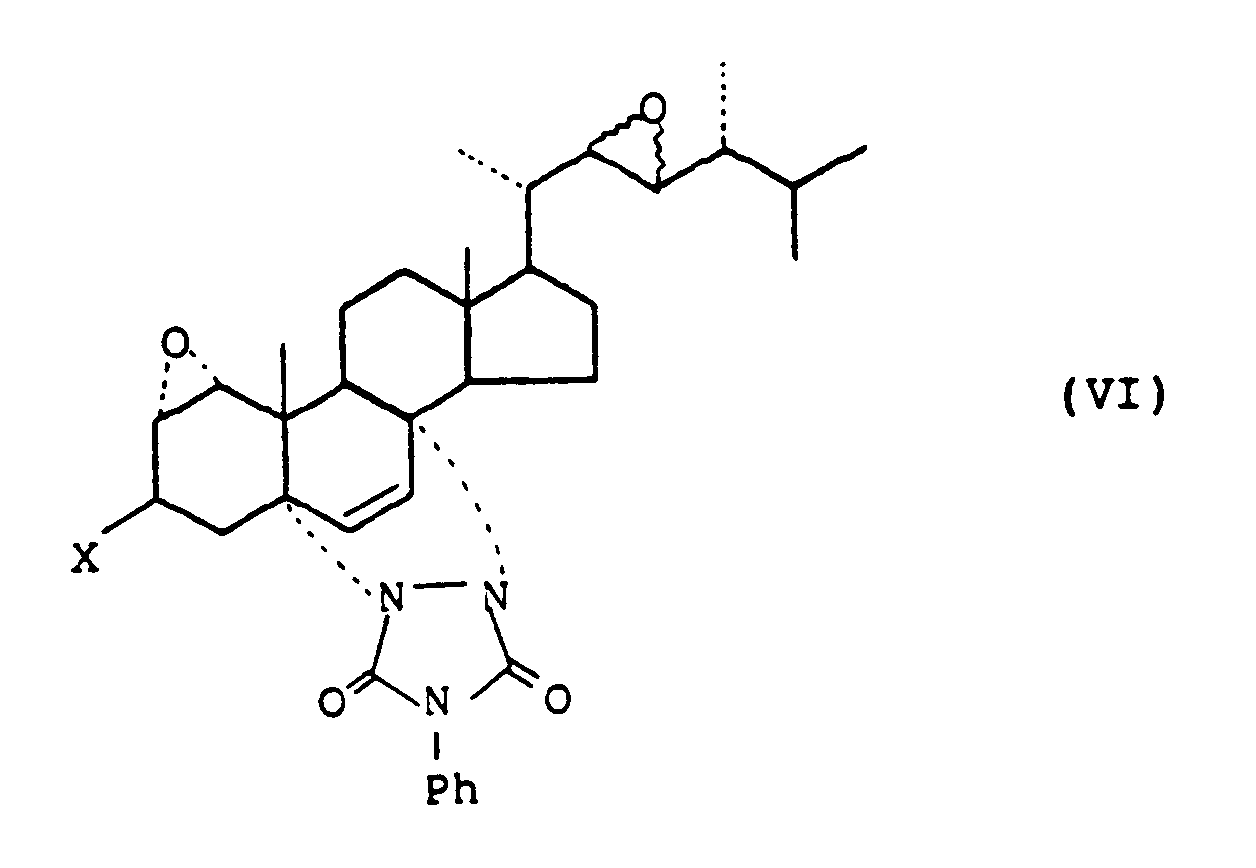


- The process of claim 8 wherein the starting compound ergosta-1,5,7,22-tetraen-3β-ol of formula I is prepared by reacting ergosta-1,4,6,22-tetraen-3-one of formula (II)

- Use of ergosta-1,5,7,22-tetraen-3β-ol of claim 1 for the preparation of 1α-hydroxy vitamin D₂.
Applications Claiming Priority (2)
| Application Number | Priority Date | Filing Date | Title |
|---|---|---|---|
| JP61270951A JPH0755960B2 (en) | 1986-11-14 | 1986-11-14 | Steroid derivative and method for producing the same |
| JP270951/86 | 1986-11-14 |
Publications (2)
| Publication Number | Publication Date |
|---|---|
| EP0270867A1 EP0270867A1 (en) | 1988-06-15 |
| EP0270867B1 true EP0270867B1 (en) | 1992-06-17 |
Family
ID=17493289
Family Applications (1)
| Application Number | Title | Priority Date | Filing Date |
|---|---|---|---|
| EP87116687A Expired - Lifetime EP0270867B1 (en) | 1986-11-14 | 1987-11-12 | Steroid derivatives and processes of preparing same |
Country Status (5)
| Country | Link |
|---|---|
| US (1) | US4758383A (en) |
| EP (1) | EP0270867B1 (en) |
| JP (1) | JPH0755960B2 (en) |
| KR (1) | KR950011596B1 (en) |
| DE (1) | DE3779881T2 (en) |
Families Citing this family (12)
| Publication number | Priority date | Publication date | Assignee | Title |
|---|---|---|---|---|
| US5260290A (en) * | 1990-02-14 | 1993-11-09 | Wisconsin Alumni Research Foundation | Homologated vitamin D2 compounds and the corresponding 1α-hydroxylated derivatives |
| US5756783A (en) * | 1990-09-21 | 1998-05-26 | Bone Care International, Inc. | 1α-Hydroxy-24-EPI-vitamin D4 |
| EP0914825B1 (en) * | 1991-01-08 | 2003-05-21 | Bone Care International, Inc. | Methods for preparation of 1 alpha, 24-dihydroxy vitamin D2 |
| US20040009958A1 (en) * | 1991-01-08 | 2004-01-15 | Bone Care International, Inc. | Methods for preparation and use of 1alpha,24(S)-dihydroxyvitamin D2 |
| US5565589A (en) * | 1993-11-03 | 1996-10-15 | Wisconsin Alumni Research Foundation | 17-formyl-5,6-trans-vitamin D compounds |
| US6080879A (en) * | 1998-05-19 | 2000-06-27 | Tetrionics, Inc. | Hexafluoro-vitamin synthesis and crystallization method, solvent and product |
| US6432936B1 (en) | 1999-01-20 | 2002-08-13 | Wisconsin Alumni Research Foundation | Crystalline 1α-hydroxyvitamin D2 and method of purification thereof |
| US6362350B1 (en) | 1999-07-01 | 2002-03-26 | Wisconsin Alumni Research Foundation | Crystalline 1α, 24(S)-dihydroxyvitamin D2 and method of purification thereof |
| US6359012B1 (en) * | 1999-12-22 | 2002-03-19 | Bone Care International, Inc. | Method for making 24(S)-hydroxyvitamin D2 |
| IL153378A0 (en) * | 2000-07-18 | 2003-07-06 | Bone Care Internat Inc | STABILIZED 1alpha-HYDROXY VITAMIN D |
| US7094775B2 (en) * | 2004-06-30 | 2006-08-22 | Bone Care International, Llc | Method of treating breast cancer using a combination of vitamin D analogues and other agents |
| US20060003950A1 (en) * | 2004-06-30 | 2006-01-05 | Bone Care International, Inc. | Method of treating prostatic diseases using a combination of vitamin D analogues and other agents |
Family Cites Families (4)
| Publication number | Priority date | Publication date | Assignee | Title |
|---|---|---|---|---|
| US3907843A (en) | 1974-06-14 | 1975-09-23 | Wisconsin Alumni Res Found | 1{60 -Hydroxyergocalciferol and processes for preparing same |
| US4022768A (en) * | 1976-02-12 | 1977-05-10 | Wisconsin Alumni Research Foundation | Process for preparation of 1α,25-dihydroxycholecalciferol |
| US4287129A (en) | 1980-07-28 | 1981-09-01 | Diamond Shamrock Corp. | Synthesis of 1α-hydroxy-7-dehydrosteroids |
| JPH0725790B2 (en) * | 1986-02-05 | 1995-03-22 | 日清製粉株式会社 | Method for producing steroid derivative |
-
1986
- 1986-11-14 JP JP61270951A patent/JPH0755960B2/en not_active Expired - Fee Related
-
1987
- 1987-11-04 US US07/117,462 patent/US4758383A/en not_active Expired - Lifetime
- 1987-11-12 EP EP87116687A patent/EP0270867B1/en not_active Expired - Lifetime
- 1987-11-12 DE DE8787116687T patent/DE3779881T2/en not_active Expired - Fee Related
- 1987-11-13 KR KR1019870012776A patent/KR950011596B1/en not_active Expired - Fee Related
Also Published As
| Publication number | Publication date |
|---|---|
| KR880006261A (en) | 1988-07-22 |
| JPH0755960B2 (en) | 1995-06-14 |
| EP0270867A1 (en) | 1988-06-15 |
| DE3779881D1 (en) | 1992-07-23 |
| DE3779881T2 (en) | 1993-03-25 |
| US4758383A (en) | 1988-07-19 |
| JPS63126891A (en) | 1988-05-30 |
| KR950011596B1 (en) | 1995-10-06 |
Similar Documents
| Publication | Publication Date | Title |
|---|---|---|
| EP3967700B1 (en) | Method for preparing cholesterol, derivative thereof, and analog thereof | |
| US4411833A (en) | Method for preparing 26,26,26,27,27,27-hexafluoro-1α,25-dihydroxycholesterol | |
| US4758383A (en) | Ergosta-1,5,7,22-tetraen-3β-ol and its use as an intermediate for 1α-hydroxy vitamin D2 | |
| IE50425B1 (en) | Vitamin d derivatives | |
| Iida et al. | Potential bile acid metabolites. 14. Hyocholic and muricholic acid stereoisomers. | |
| WO2020225830A1 (en) | Novel method for synthesizing 25-oh cholesterol/calcifediol from phytosterol | |
| US4284577A (en) | Novel vitamin D3 derivative and process for preparing the same | |
| EP0080381B1 (en) | Homobrassinolide, and its production and use | |
| US4292249A (en) | 25-Hydroxy-24-oxocholestane derivatives and preparation thereof | |
| IE58104B1 (en) | Vitamin d derivatives, pharmaceutical compositions containing them and percursors thereof | |
| US4861875A (en) | 3α,5-cyclo-22,23-dihydroxy-5α-steroid compounds | |
| US4298537A (en) | Process for producing steroid compounds having an oxo group in the side chain | |
| JPH0339058B2 (en) | ||
| Tachibana | A convenient synthesis of 1. ALPHA.-hydroxyvitamin D2. | |
| US5087709A (en) | Process for the preparation of 1α,25-dihydroxyvitamin D2 and the 24-epimer thereof | |
| JP2953665B2 (en) | Method for producing steroid derivative | |
| JPH0714912B2 (en) | 1α-Hydroxyvitamin D (2) Production method | |
| JP2714392B2 (en) | Method for producing steroid derivatives | |
| US4199518A (en) | 1α,3β-Dihydroxy-steroid-5-enes from 1α,2α-epoxy-steroid-4,6-dien-3-ones | |
| JP2984406B2 (en) | Method for producing steroid derivatives | |
| US4723045A (en) | Processes for preparing cholesta-1,5,7-trien-3-ol | |
| US5128464A (en) | 6,6-ethylenedioxy-22R-hydroxy-2R,3S-isopropylidendioxy-5α-cholst-23-yne | |
| WO2025203035A1 (en) | An improved process for preparation of 25-oh provitamin d3(calcifediol) | |
| Nicotra et al. | Stereospecific synthesis of Δ24‐sterols labelled on the 26‐or 27‐methyl group | |
| US4171306A (en) | Diepoxy-androstanes and a process for the preparation thereof |
Legal Events
| Date | Code | Title | Description |
|---|---|---|---|
| PUAI | Public reference made under article 153(3) epc to a published international application that has entered the european phase |
Free format text: ORIGINAL CODE: 0009012 |
|
| AK | Designated contracting states |
Kind code of ref document: A1 Designated state(s): CH DE FR GB IT LI NL SE |
|
| 17P | Request for examination filed |
Effective date: 19881206 |
|
| 17Q | First examination report despatched |
Effective date: 19891222 |
|
| GRAA | (expected) grant |
Free format text: ORIGINAL CODE: 0009210 |
|
| AK | Designated contracting states |
Kind code of ref document: B1 Designated state(s): CH DE FR GB IT LI NL SE |
|
| REF | Corresponds to: |
Ref document number: 3779881 Country of ref document: DE Date of ref document: 19920723 |
|
| ET | Fr: translation filed | ||
| ITF | It: translation for a ep patent filed | ||
| PLBE | No opposition filed within time limit |
Free format text: ORIGINAL CODE: 0009261 |
|
| STAA | Information on the status of an ep patent application or granted ep patent |
Free format text: STATUS: NO OPPOSITION FILED WITHIN TIME LIMIT |
|
| 26N | No opposition filed | ||
| EAL | Se: european patent in force in sweden |
Ref document number: 87116687.2 |
|
| PGFP | Annual fee paid to national office [announced via postgrant information from national office to epo] |
Ref country code: SE Payment date: 20001106 Year of fee payment: 14 Ref country code: DE Payment date: 20001106 Year of fee payment: 14 |
|
| PGFP | Annual fee paid to national office [announced via postgrant information from national office to epo] |
Ref country code: GB Payment date: 20001108 Year of fee payment: 14 |
|
| PGFP | Annual fee paid to national office [announced via postgrant information from national office to epo] |
Ref country code: FR Payment date: 20001110 Year of fee payment: 14 |
|
| PGFP | Annual fee paid to national office [announced via postgrant information from national office to epo] |
Ref country code: CH Payment date: 20001113 Year of fee payment: 14 |
|
| PGFP | Annual fee paid to national office [announced via postgrant information from national office to epo] |
Ref country code: NL Payment date: 20001130 Year of fee payment: 14 |
|
| PG25 | Lapsed in a contracting state [announced via postgrant information from national office to epo] |
Ref country code: GB Free format text: LAPSE BECAUSE OF NON-PAYMENT OF DUE FEES Effective date: 20011112 |
|
| PG25 | Lapsed in a contracting state [announced via postgrant information from national office to epo] |
Ref country code: SE Free format text: LAPSE BECAUSE OF NON-PAYMENT OF DUE FEES Effective date: 20011113 |
|
| PG25 | Lapsed in a contracting state [announced via postgrant information from national office to epo] |
Ref country code: LI Free format text: LAPSE BECAUSE OF NON-PAYMENT OF DUE FEES Effective date: 20011130 Ref country code: CH Free format text: LAPSE BECAUSE OF NON-PAYMENT OF DUE FEES Effective date: 20011130 |
|
| REG | Reference to a national code |
Ref country code: GB Ref legal event code: IF02 |
|
| PG25 | Lapsed in a contracting state [announced via postgrant information from national office to epo] |
Ref country code: NL Free format text: LAPSE BECAUSE OF NON-PAYMENT OF DUE FEES Effective date: 20020601 |
|
| EUG | Se: european patent has lapsed |
Ref document number: 87116687.2 |
|
| PG25 | Lapsed in a contracting state [announced via postgrant information from national office to epo] |
Ref country code: DE Free format text: LAPSE BECAUSE OF NON-PAYMENT OF DUE FEES Effective date: 20020702 |
|
| REG | Reference to a national code |
Ref country code: CH Ref legal event code: PL |
|
| PG25 | Lapsed in a contracting state [announced via postgrant information from national office to epo] |
Ref country code: FR Free format text: LAPSE BECAUSE OF NON-PAYMENT OF DUE FEES Effective date: 20020730 |
|
| NLV4 | Nl: lapsed or anulled due to non-payment of the annual fee |
Effective date: 20020601 |
|
| REG | Reference to a national code |
Ref country code: FR Ref legal event code: ST |
|
| REG | Reference to a national code |
Ref country code: FR Ref legal event code: ST |
|
| PG25 | Lapsed in a contracting state [announced via postgrant information from national office to epo] |
Ref country code: IT Free format text: LAPSE BECAUSE OF NON-PAYMENT OF DUE FEES;WARNING: LAPSES OF ITALIAN PATENTS WITH EFFECTIVE DATE BEFORE 2007 MAY HAVE OCCURRED AT ANY TIME BEFORE 2007. THE CORRECT EFFECTIVE DATE MAY BE DIFFERENT FROM THE ONE RECORDED. Effective date: 20051112 |