EP0269105A2 - Derivatives of cyclohexane, preparations containing them and their use - Google Patents
Derivatives of cyclohexane, preparations containing them and their use Download PDFInfo
- Publication number
- EP0269105A2 EP0269105A2 EP87117481A EP87117481A EP0269105A2 EP 0269105 A2 EP0269105 A2 EP 0269105A2 EP 87117481 A EP87117481 A EP 87117481A EP 87117481 A EP87117481 A EP 87117481A EP 0269105 A2 EP0269105 A2 EP 0269105A2
- Authority
- EP
- European Patent Office
- Prior art keywords
- defined previously
- substituted
- radical
- amino
- compound according
- Prior art date
- Legal status (The legal status is an assumption and is not a legal conclusion. Google has not performed a legal analysis and makes no representation as to the accuracy of the status listed.)
- Granted
Links
- 125000000113 cyclohexyl group Chemical class [H]C1([H])C([H])([H])C([H])([H])C([H])(*)C([H])([H])C1([H])[H] 0.000 title abstract description 9
- 238000002360 preparation method Methods 0.000 title 1
- 150000001875 compounds Chemical class 0.000 claims abstract description 48
- 239000000203 mixture Substances 0.000 claims abstract description 29
- 239000002253 acid Substances 0.000 claims abstract description 17
- 150000002148 esters Chemical class 0.000 claims abstract description 4
- 150000003839 salts Chemical group 0.000 claims abstract description 3
- 239000003814 drug Substances 0.000 claims abstract 2
- -1 aralkenyl Chemical group 0.000 claims description 175
- 125000002887 hydroxy group Chemical group [H]O* 0.000 claims description 72
- CDAISMWEOUEBRE-UHFFFAOYSA-N scyllo-inosotol Natural products OC1C(O)C(O)C(O)C(O)C1O CDAISMWEOUEBRE-UHFFFAOYSA-N 0.000 claims description 64
- 125000000217 alkyl group Chemical group 0.000 claims description 63
- 125000002924 primary amino group Chemical group [H]N([H])* 0.000 claims description 57
- CDAISMWEOUEBRE-GPIVLXJGSA-N inositol Chemical compound O[C@H]1[C@H](O)[C@@H](O)[C@H](O)[C@H](O)[C@@H]1O CDAISMWEOUEBRE-GPIVLXJGSA-N 0.000 claims description 54
- 229960000367 inositol Drugs 0.000 claims description 53
- QVGXLLKOCUKJST-UHFFFAOYSA-N atomic oxygen Chemical compound [O] QVGXLLKOCUKJST-UHFFFAOYSA-N 0.000 claims description 44
- 125000003178 carboxy group Chemical group [H]OC(*)=O 0.000 claims description 42
- 229910052760 oxygen Inorganic materials 0.000 claims description 40
- 239000001301 oxygen Substances 0.000 claims description 40
- 229910052739 hydrogen Inorganic materials 0.000 claims description 38
- 239000001257 hydrogen Substances 0.000 claims description 38
- 125000003118 aryl group Chemical group 0.000 claims description 36
- 125000005499 phosphonyl group Chemical group 0.000 claims description 25
- 125000003917 carbamoyl group Chemical group [H]N([H])C(*)=O 0.000 claims description 21
- IJGRMHOSHXDMSA-UHFFFAOYSA-N Atomic nitrogen Chemical compound N#N IJGRMHOSHXDMSA-UHFFFAOYSA-N 0.000 claims description 20
- 229910052736 halogen Inorganic materials 0.000 claims description 20
- 150000002367 halogens Chemical class 0.000 claims description 20
- 125000004432 carbon atom Chemical group C* 0.000 claims description 17
- 150000001413 amino acids Chemical class 0.000 claims description 15
- FVZVCSNXTFCBQU-UHFFFAOYSA-N phosphanyl Chemical group [PH2] FVZVCSNXTFCBQU-UHFFFAOYSA-N 0.000 claims description 14
- 102000004169 proteins and genes Human genes 0.000 claims description 14
- 108090000623 proteins and genes Proteins 0.000 claims description 14
- HVCOBJNICQPDBP-UHFFFAOYSA-N 3-[3-[3,5-dihydroxy-6-methyl-4-(3,4,5-trihydroxy-6-methyloxan-2-yl)oxyoxan-2-yl]oxydecanoyloxy]decanoic acid;hydrate Chemical compound O.OC1C(OC(CC(=O)OC(CCCCCCC)CC(O)=O)CCCCCCC)OC(C)C(O)C1OC1C(O)C(O)C(O)C(C)O1 HVCOBJNICQPDBP-UHFFFAOYSA-N 0.000 claims description 13
- 125000003342 alkenyl group Chemical group 0.000 claims description 12
- 125000003147 glycosyl group Chemical group 0.000 claims description 12
- 102000003886 Glycoproteins Human genes 0.000 claims description 11
- 108090000288 Glycoproteins Proteins 0.000 claims description 11
- DQJCDTNMLBYVAY-ZXXIYAEKSA-N (2S,5R,10R,13R)-16-{[(2R,3S,4R,5R)-3-{[(2S,3R,4R,5S,6R)-3-acetamido-4,5-dihydroxy-6-(hydroxymethyl)oxan-2-yl]oxy}-5-(ethylamino)-6-hydroxy-2-(hydroxymethyl)oxan-4-yl]oxy}-5-(4-aminobutyl)-10-carbamoyl-2,13-dimethyl-4,7,12,15-tetraoxo-3,6,11,14-tetraazaheptadecan-1-oic acid Chemical compound NCCCC[C@H](C(=O)N[C@@H](C)C(O)=O)NC(=O)CC[C@H](C(N)=O)NC(=O)[C@@H](C)NC(=O)C(C)O[C@@H]1[C@@H](NCC)C(O)O[C@H](CO)[C@H]1O[C@H]1[C@H](NC(C)=O)[C@@H](O)[C@H](O)[C@@H](CO)O1 DQJCDTNMLBYVAY-ZXXIYAEKSA-N 0.000 claims description 10
- 229930186217 Glycolipid Natural products 0.000 claims description 10
- 102000002068 Glycopeptides Human genes 0.000 claims description 10
- 108010015899 Glycopeptides Proteins 0.000 claims description 10
- 229910052757 nitrogen Inorganic materials 0.000 claims description 10
- 108090000765 processed proteins & peptides Proteins 0.000 claims description 10
- 125000000623 heterocyclic group Chemical group 0.000 claims description 9
- 125000000449 nitro group Chemical group [O-][N+](*)=O 0.000 claims description 9
- 125000000472 sulfonyl group Chemical group *S(*)(=O)=O 0.000 claims description 9
- 125000003545 alkoxy group Chemical group 0.000 claims description 8
- 125000000753 cycloalkyl group Chemical group 0.000 claims description 8
- 125000004435 hydrogen atom Chemical class [H]* 0.000 claims description 8
- 125000001181 organosilyl group Chemical group [SiH3]* 0.000 claims description 8
- NINIDFKCEFEMDL-UHFFFAOYSA-N Sulfur Chemical compound [S] NINIDFKCEFEMDL-UHFFFAOYSA-N 0.000 claims description 7
- 239000005864 Sulphur Substances 0.000 claims description 7
- 125000000852 azido group Chemical group *N=[N+]=[N-] 0.000 claims description 7
- 125000001261 isocyanato group Chemical group *N=C=O 0.000 claims description 7
- 125000004469 siloxy group Chemical group [SiH3]O* 0.000 claims description 7
- 125000000475 sulfinyl group Chemical group [*:2]S([*:1])=O 0.000 claims description 7
- 125000004429 atom Chemical group 0.000 claims description 6
- 125000002915 carbonyl group Chemical group [*:2]C([*:1])=O 0.000 claims description 6
- 125000004093 cyano group Chemical group *C#N 0.000 claims description 6
- 125000005328 phosphinyl group Chemical group [PH2](=O)* 0.000 claims description 6
- 125000001475 halogen functional group Chemical group 0.000 claims description 5
- RYYWUUFWQRZTIU-UHFFFAOYSA-K thiophosphate Chemical compound [O-]P([O-])([O-])=S RYYWUUFWQRZTIU-UHFFFAOYSA-K 0.000 claims description 5
- 239000012991 xanthate Substances 0.000 claims description 5
- 125000004442 acylamino group Chemical group 0.000 claims description 4
- 125000000392 cycloalkenyl group Chemical group 0.000 claims description 4
- ZOOODBUHSVUZEM-UHFFFAOYSA-N ethoxymethanedithioic acid Chemical compound CCOC(S)=S ZOOODBUHSVUZEM-UHFFFAOYSA-N 0.000 claims description 4
- 125000001841 imino group Chemical group [H]N=* 0.000 claims description 4
- 125000002252 acyl group Chemical group 0.000 claims description 3
- 125000004423 acyloxy group Chemical group 0.000 claims description 3
- 125000002485 formyl group Chemical group [H]C(*)=O 0.000 claims description 3
- 102000004895 Lipoproteins Human genes 0.000 claims description 2
- 108090001030 Lipoproteins Proteins 0.000 claims description 2
- 102000011931 Nucleoproteins Human genes 0.000 claims description 2
- 108010061100 Nucleoproteins Proteins 0.000 claims description 2
- 125000005024 alkenyl aryl group Chemical group 0.000 claims description 2
- 125000002877 alkyl aryl group Chemical group 0.000 claims description 2
- 125000004414 alkyl thio group Chemical group 0.000 claims description 2
- 125000003710 aryl alkyl group Chemical group 0.000 claims description 2
- 125000005110 aryl thio group Chemical group 0.000 claims description 2
- 125000004104 aryloxy group Chemical group 0.000 claims description 2
- 125000005067 haloformyl group Chemical group 0.000 claims description 2
- 125000004356 hydroxy functional group Chemical group O* 0.000 claims description 2
- PXQLVRUNWNTZOS-UHFFFAOYSA-N sulfanyl Chemical class [SH] PXQLVRUNWNTZOS-UHFFFAOYSA-N 0.000 claims 4
- 239000003381 stabilizer Substances 0.000 abstract description 2
- 239000002778 food additive Substances 0.000 abstract 1
- 235000013373 food additive Nutrition 0.000 abstract 1
- 150000003254 radicals Chemical group 0.000 description 77
- 125000000484 butyl group Chemical group [H]C([*])([H])C([H])([H])C([H])([H])C([H])([H])[H] 0.000 description 36
- 125000002496 methyl group Chemical group [H]C([H])([H])* 0.000 description 30
- 125000001495 ethyl group Chemical group [H]C([H])([H])C([H])([H])* 0.000 description 29
- DHMQDGOQFOQNFH-UHFFFAOYSA-N Glycine Chemical compound NCC(O)=O DHMQDGOQFOQNFH-UHFFFAOYSA-N 0.000 description 28
- 125000001997 phenyl group Chemical group [H]C1=C([H])C([H])=C(*)C([H])=C1[H] 0.000 description 28
- HEMHJVSKTPXQMS-UHFFFAOYSA-M Sodium hydroxide Chemical compound [OH-].[Na+] HEMHJVSKTPXQMS-UHFFFAOYSA-M 0.000 description 27
- SNRUBQQJIBEYMU-UHFFFAOYSA-N Dodecane Natural products CCCCCCCCCCCC SNRUBQQJIBEYMU-UHFFFAOYSA-N 0.000 description 20
- UFHFLCQGNIYNRP-UHFFFAOYSA-N Hydrogen Chemical compound [H][H] UFHFLCQGNIYNRP-UHFFFAOYSA-N 0.000 description 20
- 125000003438 dodecyl group Chemical group [H]C([H])([H])C([H])([H])C([H])([H])C([H])([H])C([H])([H])C([H])([H])C([H])([H])C([H])([H])C([H])([H])C([H])([H])C([H])([H])C([H])([H])* 0.000 description 20
- 238000006467 substitution reaction Methods 0.000 description 19
- GKDKOMAJZATYAY-GCVPSNMTSA-N [(1r,2s,4r,5r)-2,3,4-trihydroxy-5,6-diphosphonooxycyclohexyl] dihydrogen phosphate Chemical compound OC1[C@H](O)[C@@H](OP(O)(O)=O)C(OP(O)(O)=O)[C@H](OP(O)(O)=O)[C@@H]1O GKDKOMAJZATYAY-GCVPSNMTSA-N 0.000 description 18
- FFEARJCKVFRZRR-BYPYZUCNSA-N L-methionine Chemical compound CSCC[C@H](N)C(O)=O FFEARJCKVFRZRR-BYPYZUCNSA-N 0.000 description 17
- 229930182817 methionine Natural products 0.000 description 17
- 229960004452 methionine Drugs 0.000 description 17
- 125000002347 octyl group Chemical group [H]C([*])([H])C([H])([H])C([H])([H])C([H])([H])C([H])([H])C([H])([H])C([H])([H])C([H])([H])[H] 0.000 description 17
- LCTORNIWLGOBPB-GASJEMHNSA-N (3r,4s,5s,6r)-2-amino-6-(hydroxymethyl)oxane-2,3,4,5-tetrol Chemical group NC1(O)O[C@H](CO)[C@@H](O)[C@H](O)[C@H]1O LCTORNIWLGOBPB-GASJEMHNSA-N 0.000 description 15
- QTBSBXVTEAMEQO-UHFFFAOYSA-N Acetic acid Chemical compound CC(O)=O QTBSBXVTEAMEQO-UHFFFAOYSA-N 0.000 description 15
- PXGOKWXKJXAPGV-UHFFFAOYSA-N Fluorine Chemical compound FF PXGOKWXKJXAPGV-UHFFFAOYSA-N 0.000 description 15
- 229910052731 fluorine Inorganic materials 0.000 description 15
- 239000011737 fluorine Substances 0.000 description 15
- ZAMOUSCENKQFHK-UHFFFAOYSA-N Chlorine atom Chemical compound [Cl] ZAMOUSCENKQFHK-UHFFFAOYSA-N 0.000 description 14
- 239000004471 Glycine Substances 0.000 description 14
- 229940024606 amino acid Drugs 0.000 description 14
- 235000001014 amino acid Nutrition 0.000 description 14
- 150000001723 carbon free-radicals Chemical class 0.000 description 14
- 239000000460 chlorine Substances 0.000 description 14
- 229910052801 chlorine Inorganic materials 0.000 description 14
- 229960002449 glycine Drugs 0.000 description 14
- WQZGKKKJIJFFOK-GASJEMHNSA-N Glucose Natural products OC[C@H]1OC(O)[C@H](O)[C@@H](O)[C@@H]1O WQZGKKKJIJFFOK-GASJEMHNSA-N 0.000 description 13
- WPYMKLBDIGXBTP-UHFFFAOYSA-N benzoic acid group Chemical group C(C1=CC=CC=C1)(=O)O WPYMKLBDIGXBTP-UHFFFAOYSA-N 0.000 description 13
- WQZGKKKJIJFFOK-VFUOTHLCSA-N beta-D-glucose Chemical compound OC[C@H]1O[C@@H](O)[C@H](O)[C@@H](O)[C@@H]1O WQZGKKKJIJFFOK-VFUOTHLCSA-N 0.000 description 13
- 239000008103 glucose Substances 0.000 description 13
- 235000018102 proteins Nutrition 0.000 description 13
- POULHZVOKOAJMA-UHFFFAOYSA-N dodecanoic acid Chemical compound CCCCCCCCCCCC(O)=O POULHZVOKOAJMA-UHFFFAOYSA-N 0.000 description 12
- 125000003396 thiol group Chemical class [H]S* 0.000 description 12
- LCTORNIWLGOBPB-PHYPRBDBSA-N (2s,3r,4s,5r,6r)-2-amino-6-(hydroxymethyl)oxane-2,3,4,5-tetrol Chemical compound N[C@@]1(O)O[C@H](CO)[C@H](O)[C@H](O)[C@H]1O LCTORNIWLGOBPB-PHYPRBDBSA-N 0.000 description 11
- 239000001226 triphosphate Substances 0.000 description 11
- FERIUCNNQQJTOY-UHFFFAOYSA-N Butyric acid Chemical compound CCCC(O)=O FERIUCNNQQJTOY-UHFFFAOYSA-N 0.000 description 10
- RAHZWNYVWXNFOC-UHFFFAOYSA-N Sulphur dioxide Chemical group O=S=O RAHZWNYVWXNFOC-UHFFFAOYSA-N 0.000 description 10
- 230000006378 damage Effects 0.000 description 10
- ZUOUZKKEUPVFJK-UHFFFAOYSA-N diphenyl Chemical compound C1=CC=CC=C1C1=CC=CC=C1 ZUOUZKKEUPVFJK-UHFFFAOYSA-N 0.000 description 10
- 150000002431 hydrogen Chemical class 0.000 description 10
- 125000001424 substituent group Chemical group 0.000 description 10
- MTCFGRXMJLQNBG-REOHCLBHSA-N (2S)-2-Amino-3-hydroxypropansäure Chemical compound OC[C@H](N)C(O)=O MTCFGRXMJLQNBG-REOHCLBHSA-N 0.000 description 9
- SQUHHTBVTRBESD-UHFFFAOYSA-N Hexa-Ac-myo-Inositol Natural products CC(=O)OC1C(OC(C)=O)C(OC(C)=O)C(OC(C)=O)C(OC(C)=O)C1OC(C)=O SQUHHTBVTRBESD-UHFFFAOYSA-N 0.000 description 9
- HNDVDQJCIGZPNO-YFKPBYRVSA-N L-histidine Chemical compound OC(=O)[C@@H](N)CC1=CN=CN1 HNDVDQJCIGZPNO-YFKPBYRVSA-N 0.000 description 9
- MTCFGRXMJLQNBG-UHFFFAOYSA-N Serine Natural products OCC(N)C(O)=O MTCFGRXMJLQNBG-UHFFFAOYSA-N 0.000 description 9
- 125000003277 amino group Chemical group 0.000 description 9
- 229960002885 histidine Drugs 0.000 description 9
- HNDVDQJCIGZPNO-UHFFFAOYSA-N histidine Natural products OC(=O)C(N)CC1=CN=CN1 HNDVDQJCIGZPNO-UHFFFAOYSA-N 0.000 description 9
- 239000000047 product Substances 0.000 description 9
- 229960001153 serine Drugs 0.000 description 9
- 235000011121 sodium hydroxide Nutrition 0.000 description 9
- 239000000243 solution Substances 0.000 description 9
- WQZGKKKJIJFFOK-QTVWNMPRSA-N D-mannopyranose Chemical compound OC[C@H]1OC(O)[C@@H](O)[C@@H](O)[C@@H]1O WQZGKKKJIJFFOK-QTVWNMPRSA-N 0.000 description 8
- RTZKZFJDLAIYFH-UHFFFAOYSA-N Diethyl ether Chemical compound CCOCC RTZKZFJDLAIYFH-UHFFFAOYSA-N 0.000 description 8
- DCXYFEDJOCDNAF-REOHCLBHSA-N L-asparagine Chemical compound OC(=O)[C@@H](N)CC(N)=O DCXYFEDJOCDNAF-REOHCLBHSA-N 0.000 description 8
- 125000001204 arachidyl group Chemical group [H]C([*])([H])C([H])([H])C([H])([H])C([H])([H])C([H])([H])C([H])([H])C([H])([H])C([H])([H])C([H])([H])C([H])([H])C([H])([H])C([H])([H])C([H])([H])C([H])([H])C([H])([H])C([H])([H])C([H])([H])C([H])([H])C([H])([H])C([H])([H])[H] 0.000 description 8
- 159000000007 calcium salts Chemical class 0.000 description 8
- XLYOFNOQVPJJNP-UHFFFAOYSA-N water Substances O XLYOFNOQVPJJNP-UHFFFAOYSA-N 0.000 description 8
- 125000001559 cyclopropyl group Chemical group [H]C1([H])C([H])([H])C1([H])* 0.000 description 7
- 229930182830 galactose Natural products 0.000 description 7
- 229940083608 sodium hydroxide Drugs 0.000 description 7
- 125000000335 thiazolyl group Chemical group 0.000 description 7
- ZCYVEMRRCGMTRW-UHFFFAOYSA-N 7553-56-2 Chemical compound [I] ZCYVEMRRCGMTRW-UHFFFAOYSA-N 0.000 description 6
- DCXYFEDJOCDNAF-UHFFFAOYSA-N Asparagine Natural products OC(=O)C(N)CC(N)=O DCXYFEDJOCDNAF-UHFFFAOYSA-N 0.000 description 6
- YMWUJEATGCHHMB-UHFFFAOYSA-N Dichloromethane Chemical compound ClCCl YMWUJEATGCHHMB-UHFFFAOYSA-N 0.000 description 6
- XYFCBTPGUUZFHI-UHFFFAOYSA-N Phosphine Chemical compound P XYFCBTPGUUZFHI-UHFFFAOYSA-N 0.000 description 6
- WQZGKKKJIJFFOK-PHYPRBDBSA-N alpha-D-galactose Chemical compound OC[C@H]1O[C@H](O)[C@H](O)[C@@H](O)[C@H]1O WQZGKKKJIJFFOK-PHYPRBDBSA-N 0.000 description 6
- 229960001230 asparagine Drugs 0.000 description 6
- 235000009582 asparagine Nutrition 0.000 description 6
- 125000004369 butenyl group Chemical group C(=CCC)* 0.000 description 6
- FUZZWVXGSFPDMH-UHFFFAOYSA-N hexanoic acid Chemical compound CCCCCC(O)=O FUZZWVXGSFPDMH-UHFFFAOYSA-N 0.000 description 6
- 125000002883 imidazolyl group Chemical group 0.000 description 6
- 239000011630 iodine Substances 0.000 description 6
- 229910052740 iodine Inorganic materials 0.000 description 6
- 238000000034 method Methods 0.000 description 6
- AFENDNXGAFYKQO-VKHMYHEASA-N (S)-2-hydroxybutyric acid Chemical compound CC[C@H](O)C(O)=O AFENDNXGAFYKQO-VKHMYHEASA-N 0.000 description 5
- SMZOUWXMTYCWNB-UHFFFAOYSA-N 2-(2-methoxy-5-methylphenyl)ethanamine Chemical compound COC1=CC=C(C)C=C1CCN SMZOUWXMTYCWNB-UHFFFAOYSA-N 0.000 description 5
- NIXOWILDQLNWCW-UHFFFAOYSA-N 2-Propenoic acid Natural products OC(=O)C=C NIXOWILDQLNWCW-UHFFFAOYSA-N 0.000 description 5
- 125000003903 2-propenyl group Chemical group [H]C([*])([H])C([H])=C([H])[H] 0.000 description 5
- 102000009027 Albumins Human genes 0.000 description 5
- 108010088751 Albumins Proteins 0.000 description 5
- 239000005711 Benzoic acid Substances 0.000 description 5
- WKBOTKDWSSQWDR-UHFFFAOYSA-N Bromine atom Chemical compound [Br] WKBOTKDWSSQWDR-UHFFFAOYSA-N 0.000 description 5
- UXVMQQNJUSDDNG-UHFFFAOYSA-L Calcium chloride Chemical compound [Cl-].[Cl-].[Ca+2] UXVMQQNJUSDDNG-UHFFFAOYSA-L 0.000 description 5
- 102000015779 HDL Lipoproteins Human genes 0.000 description 5
- 108010010234 HDL Lipoproteins Proteins 0.000 description 5
- AYFVYJQAPQTCCC-GBXIJSLDSA-N L-threonine Chemical compound C[C@@H](O)[C@H](N)C(O)=O AYFVYJQAPQTCCC-GBXIJSLDSA-N 0.000 description 5
- 102000007330 LDL Lipoproteins Human genes 0.000 description 5
- 108010007622 LDL Lipoproteins Proteins 0.000 description 5
- 239000005639 Lauric acid Substances 0.000 description 5
- 239000002202 Polyethylene glycol Substances 0.000 description 5
- AYFVYJQAPQTCCC-UHFFFAOYSA-N Threonine Natural products CC(O)C(N)C(O)=O AYFVYJQAPQTCCC-UHFFFAOYSA-N 0.000 description 5
- 239000004473 Threonine Substances 0.000 description 5
- 102000004338 Transferrin Human genes 0.000 description 5
- 108090000901 Transferrin Proteins 0.000 description 5
- 125000003668 acetyloxy group Chemical group [H]C([H])([H])C(=O)O[*] 0.000 description 5
- 235000010233 benzoic acid Nutrition 0.000 description 5
- 239000004305 biphenyl Substances 0.000 description 5
- 235000010290 biphenyl Nutrition 0.000 description 5
- GDTBXPJZTBHREO-UHFFFAOYSA-N bromine Substances BrBr GDTBXPJZTBHREO-UHFFFAOYSA-N 0.000 description 5
- 229910052794 bromium Inorganic materials 0.000 description 5
- 125000006309 butyl amino group Chemical group 0.000 description 5
- 125000006251 butylcarbonyl group Chemical group 0.000 description 5
- 239000001110 calcium chloride Substances 0.000 description 5
- 229960002713 calcium chloride Drugs 0.000 description 5
- 235000011148 calcium chloride Nutrition 0.000 description 5
- 229910001628 calcium chloride Inorganic materials 0.000 description 5
- 150000001732 carboxylic acid derivatives Chemical class 0.000 description 5
- 239000012634 fragment Substances 0.000 description 5
- 125000000524 functional group Chemical group 0.000 description 5
- 125000000842 isoxazolyl group Chemical group 0.000 description 5
- 125000000250 methylamino group Chemical group [H]N(*)C([H])([H])[H] 0.000 description 5
- 125000004674 methylcarbonyl group Chemical group CC(=O)* 0.000 description 5
- 125000001624 naphthyl group Chemical group 0.000 description 5
- 229920001223 polyethylene glycol Polymers 0.000 description 5
- 229920001451 polypropylene glycol Polymers 0.000 description 5
- 239000002244 precipitate Substances 0.000 description 5
- 230000005855 radiation Effects 0.000 description 5
- 239000011541 reaction mixture Substances 0.000 description 5
- 229960002898 threonine Drugs 0.000 description 5
- 239000012581 transferrin Substances 0.000 description 5
- 125000000391 vinyl group Chemical group [H]C([*])=C([H])[H] 0.000 description 5
- 229920002554 vinyl polymer Polymers 0.000 description 5
- JSPNNZKWADNWHI-PNANGNLXSA-N (2r)-2-hydroxy-n-[(2s,3r,4e,8e)-3-hydroxy-9-methyl-1-[(2r,3r,4s,5s,6r)-3,4,5-trihydroxy-6-(hydroxymethyl)oxan-2-yl]oxyoctadeca-4,8-dien-2-yl]heptadecanamide Chemical compound CCCCCCCCCCCCCCC[C@@H](O)C(=O)N[C@H]([C@H](O)\C=C\CC\C=C(/C)CCCCCCCCC)CO[C@@H]1O[C@H](CO)[C@@H](O)[C@H](O)[C@H]1O JSPNNZKWADNWHI-PNANGNLXSA-N 0.000 description 4
- IAZDPXIOMUYVGZ-UHFFFAOYSA-N Dimethylsulphoxide Chemical compound CS(C)=O IAZDPXIOMUYVGZ-UHFFFAOYSA-N 0.000 description 4
- GUBGYTABKSRVRQ-QKKXKWKRSA-N Lactose Natural products OC[C@H]1O[C@@H](O[C@H]2[C@H](O)[C@@H](O)C(O)O[C@@H]2CO)[C@H](O)[C@@H](O)[C@H]1O GUBGYTABKSRVRQ-QKKXKWKRSA-N 0.000 description 4
- 241001465754 Metazoa Species 0.000 description 4
- PXHVJJICTQNCMI-UHFFFAOYSA-N Nickel Chemical compound [Ni] PXHVJJICTQNCMI-UHFFFAOYSA-N 0.000 description 4
- OAICVXFJPJFONN-UHFFFAOYSA-N Phosphorus Chemical group [P] OAICVXFJPJFONN-UHFFFAOYSA-N 0.000 description 4
- QAOWNCQODCNURD-UHFFFAOYSA-N Sulfuric acid Chemical compound OS(O)(=O)=O QAOWNCQODCNURD-UHFFFAOYSA-N 0.000 description 4
- WYURNTSHIVDZCO-UHFFFAOYSA-N Tetrahydrofuran Chemical compound C1CCOC1 WYURNTSHIVDZCO-UHFFFAOYSA-N 0.000 description 4
- 125000001931 aliphatic group Chemical group 0.000 description 4
- 125000004453 alkoxycarbonyl group Chemical group 0.000 description 4
- 125000003282 alkyl amino group Chemical group 0.000 description 4
- 229930183167 cerebroside Natural products 0.000 description 4
- RIZIAUKTHDLMQX-UHFFFAOYSA-N cerebroside D Natural products CCCCCCCCCCCCCCCCC(O)C(=O)NC(C(O)C=CCCC=C(C)CCCCCCCCC)COC1OC(CO)C(O)C(O)C1O RIZIAUKTHDLMQX-UHFFFAOYSA-N 0.000 description 4
- 150000001934 cyclohexanes Chemical class 0.000 description 4
- 229960001760 dimethyl sulfoxide Drugs 0.000 description 4
- 239000008101 lactose Substances 0.000 description 4
- HQKMJHAJHXVSDF-UHFFFAOYSA-L magnesium stearate Chemical compound [Mg+2].CCCCCCCCCCCCCCCCCC([O-])=O.CCCCCCCCCCCCCCCCCC([O-])=O HQKMJHAJHXVSDF-UHFFFAOYSA-L 0.000 description 4
- 125000000951 phenoxy group Chemical group [H]C1=C([H])C([H])=C(O*)C([H])=C1[H] 0.000 description 4
- WLJVXDMOQOGPHL-UHFFFAOYSA-N phenylacetic acid Chemical compound OC(=O)CC1=CC=CC=C1 WLJVXDMOQOGPHL-UHFFFAOYSA-N 0.000 description 4
- 229910052698 phosphorus Inorganic materials 0.000 description 4
- 239000011574 phosphorus Substances 0.000 description 4
- 125000000547 substituted alkyl group Chemical group 0.000 description 4
- 239000001117 sulphuric acid Substances 0.000 description 4
- 235000011149 sulphuric acid Nutrition 0.000 description 4
- OWEGMIWEEQEYGQ-UHFFFAOYSA-N 100676-05-9 Natural products OC1C(O)C(O)C(CO)OC1OCC1C(O)C(O)C(O)C(OC2C(OC(O)C(O)C2O)CO)O1 OWEGMIWEEQEYGQ-UHFFFAOYSA-N 0.000 description 3
- 108010087504 Beta-Globulins Proteins 0.000 description 3
- 0 C[C@@]1*CC*C1 Chemical compound C[C@@]1*CC*C1 0.000 description 3
- QGJOPFRUJISHPQ-UHFFFAOYSA-N Carbon disulfide Chemical compound S=C=S QGJOPFRUJISHPQ-UHFFFAOYSA-N 0.000 description 3
- 108010062580 Concanavalin A Proteins 0.000 description 3
- 108010016626 Dipeptides Proteins 0.000 description 3
- 108010049003 Fibrinogen Proteins 0.000 description 3
- 102000008946 Fibrinogen Human genes 0.000 description 3
- VEXZGXHMUGYJMC-UHFFFAOYSA-N Hydrochloric acid Chemical compound Cl VEXZGXHMUGYJMC-UHFFFAOYSA-N 0.000 description 3
- QNAYBMKLOCPYGJ-REOHCLBHSA-N L-alanine Chemical compound C[C@H](N)C(O)=O QNAYBMKLOCPYGJ-REOHCLBHSA-N 0.000 description 3
- GUBGYTABKSRVRQ-PICCSMPSSA-N Maltose Natural products O[C@@H]1[C@@H](O)[C@H](O)[C@@H](CO)O[C@@H]1O[C@@H]1[C@@H](CO)OC(O)[C@H](O)[C@H]1O GUBGYTABKSRVRQ-PICCSMPSSA-N 0.000 description 3
- OKKJLVBELUTLKV-UHFFFAOYSA-N Methanol Chemical compound OC OKKJLVBELUTLKV-UHFFFAOYSA-N 0.000 description 3
- 229910019142 PO4 Inorganic materials 0.000 description 3
- 108010046016 Peanut Agglutinin Proteins 0.000 description 3
- VYPSYNLAJGMNEJ-UHFFFAOYSA-N Silicium dioxide Chemical compound O=[Si]=O VYPSYNLAJGMNEJ-UHFFFAOYSA-N 0.000 description 3
- 108010046516 Wheat Germ Agglutinins Proteins 0.000 description 3
- 229960003767 alanine Drugs 0.000 description 3
- 235000004279 alanine Nutrition 0.000 description 3
- 150000005840 aryl radicals Chemical class 0.000 description 3
- 125000001584 benzyloxycarbonyl group Chemical group C(=O)(OCC1=CC=CC=C1)* 0.000 description 3
- GUBGYTABKSRVRQ-QUYVBRFLSA-N beta-maltose Chemical compound OC[C@H]1O[C@H](O[C@H]2[C@H](O)[C@@H](O)[C@H](O)O[C@@H]2CO)[C@H](O)[C@@H](O)[C@@H]1O GUBGYTABKSRVRQ-QUYVBRFLSA-N 0.000 description 3
- 125000004744 butyloxycarbonyl group Chemical group 0.000 description 3
- 125000001589 carboacyl group Chemical group 0.000 description 3
- BVKZGUZCCUSVTD-UHFFFAOYSA-N carbonic acid Chemical compound OC(O)=O BVKZGUZCCUSVTD-UHFFFAOYSA-N 0.000 description 3
- 210000000170 cell membrane Anatomy 0.000 description 3
- 238000001816 cooling Methods 0.000 description 3
- LDHQCZJRKDOVOX-NSCUHMNNSA-N crotonic acid Chemical compound C\C=C\C(O)=O LDHQCZJRKDOVOX-NSCUHMNNSA-N 0.000 description 3
- 125000002433 cyclopentenyl group Chemical group C1(=CCCC1)* 0.000 description 3
- 125000002704 decyl group Chemical group [H]C([H])([H])C([H])([H])C([H])([H])C([H])([H])C([H])([H])C([H])([H])C([H])([H])C([H])([H])C([H])([H])C([H])([H])* 0.000 description 3
- 229940012952 fibrinogen Drugs 0.000 description 3
- 108010074605 gamma-Globulins Proteins 0.000 description 3
- 150000002270 gangliosides Chemical class 0.000 description 3
- 238000005227 gel permeation chromatography Methods 0.000 description 3
- QSHDDOUJBYECFT-UHFFFAOYSA-N mercury Chemical compound [Hg] QSHDDOUJBYECFT-UHFFFAOYSA-N 0.000 description 3
- 229910052753 mercury Inorganic materials 0.000 description 3
- 229940041669 mercury Drugs 0.000 description 3
- 229910021645 metal ion Inorganic materials 0.000 description 3
- VLKZOEOYAKHREP-UHFFFAOYSA-N n-Hexane Chemical compound CCCCCC VLKZOEOYAKHREP-UHFFFAOYSA-N 0.000 description 3
- 239000012299 nitrogen atmosphere Substances 0.000 description 3
- UYWQUFXKFGHYNT-UHFFFAOYSA-N phenylmethyl ester of formic acid Natural products O=COCC1=CC=CC=C1 UYWQUFXKFGHYNT-UHFFFAOYSA-N 0.000 description 3
- 235000021317 phosphate Nutrition 0.000 description 3
- 150000003904 phospholipids Chemical class 0.000 description 3
- 229910000073 phosphorus hydride Inorganic materials 0.000 description 3
- 239000000741 silica gel Substances 0.000 description 3
- 229910002027 silica gel Inorganic materials 0.000 description 3
- LDHQCZJRKDOVOX-UHFFFAOYSA-N trans-crotonic acid Natural products CC=CC(O)=O LDHQCZJRKDOVOX-UHFFFAOYSA-N 0.000 description 3
- 125000000026 trimethylsilyl group Chemical group [H]C([H])([H])[Si]([*])(C([H])([H])[H])C([H])([H])[H] 0.000 description 3
- YJTKZCDBKVTVBY-UHFFFAOYSA-N 1,3-Diphenylbenzene Chemical group C1=CC=CC=C1C1=CC=CC(C=2C=CC=CC=2)=C1 YJTKZCDBKVTVBY-UHFFFAOYSA-N 0.000 description 2
- MSWZFWKMSRAUBD-IVMDWMLBSA-N 2-amino-2-deoxy-D-glucopyranose Chemical compound N[C@H]1C(O)O[C@H](CO)[C@@H](O)[C@@H]1O MSWZFWKMSRAUBD-IVMDWMLBSA-N 0.000 description 2
- 241000220479 Acacia Species 0.000 description 2
- GUBGYTABKSRVRQ-XLOQQCSPSA-N Alpha-Lactose Chemical compound O[C@@H]1[C@@H](O)[C@@H](O)[C@@H](CO)O[C@H]1O[C@@H]1[C@@H](CO)O[C@H](O)[C@H](O)[C@H]1O GUBGYTABKSRVRQ-XLOQQCSPSA-N 0.000 description 2
- HEDRZPFGACZZDS-UHFFFAOYSA-N Chloroform Chemical compound ClC(Cl)Cl HEDRZPFGACZZDS-UHFFFAOYSA-N 0.000 description 2
- MMWCIQZXVOZEGG-XJTPDSDZSA-N D-myo-Inositol 1,4,5-trisphosphate Chemical compound O[C@@H]1[C@H](O)[C@@H](OP(O)(O)=O)[C@H](OP(O)(O)=O)[C@@H](O)[C@@H]1OP(O)(O)=O MMWCIQZXVOZEGG-XJTPDSDZSA-N 0.000 description 2
- SRBFZHDQGSBBOR-IOVATXLUSA-N D-xylopyranose Chemical compound O[C@@H]1COC(O)[C@H](O)[C@H]1O SRBFZHDQGSBBOR-IOVATXLUSA-N 0.000 description 2
- YXHKONLOYHBTNS-UHFFFAOYSA-N Diazomethane Chemical compound C=[N+]=[N-] YXHKONLOYHBTNS-UHFFFAOYSA-N 0.000 description 2
- KKUKTXOBAWVSHC-UHFFFAOYSA-N Dimethylphosphate Chemical compound COP(O)(=O)OC KKUKTXOBAWVSHC-UHFFFAOYSA-N 0.000 description 2
- 241000196324 Embryophyta Species 0.000 description 2
- LFQSCWFLJHTTHZ-UHFFFAOYSA-N Ethanol Chemical compound CCO LFQSCWFLJHTTHZ-UHFFFAOYSA-N 0.000 description 2
- 229930091371 Fructose Natural products 0.000 description 2
- 239000005715 Fructose Substances 0.000 description 2
- RFSUNEUAIZKAJO-ARQDHWQXSA-N Fructose Chemical compound OC[C@H]1O[C@](O)(CO)[C@@H](O)[C@@H]1O RFSUNEUAIZKAJO-ARQDHWQXSA-N 0.000 description 2
- WTDHULULXKLSOZ-UHFFFAOYSA-N Hydroxylamine hydrochloride Chemical compound Cl.ON WTDHULULXKLSOZ-UHFFFAOYSA-N 0.000 description 2
- IMQLKJBTEOYOSI-GPIVLXJGSA-N Inositol-hexakisphosphate Chemical compound OP(O)(=O)O[C@H]1[C@H](OP(O)(O)=O)[C@@H](OP(O)(O)=O)[C@H](OP(O)(O)=O)[C@H](OP(O)(O)=O)[C@@H]1OP(O)(O)=O IMQLKJBTEOYOSI-GPIVLXJGSA-N 0.000 description 2
- ONIBWKKTOPOVIA-BYPYZUCNSA-N L-Proline Chemical compound OC(=O)[C@@H]1CCCN1 ONIBWKKTOPOVIA-BYPYZUCNSA-N 0.000 description 2
- 108090001090 Lectins Proteins 0.000 description 2
- 102000004856 Lectins Human genes 0.000 description 2
- 235000010643 Leucaena leucocephala Nutrition 0.000 description 2
- MZRVEZGGRBJDDB-UHFFFAOYSA-N N-Butyllithium Chemical compound [Li]CCCC MZRVEZGGRBJDDB-UHFFFAOYSA-N 0.000 description 2
- 108010061952 Orosomucoid Proteins 0.000 description 2
- 102000012404 Orosomucoid Human genes 0.000 description 2
- IMQLKJBTEOYOSI-UHFFFAOYSA-N Phytic acid Natural products OP(O)(=O)OC1C(OP(O)(O)=O)C(OP(O)(O)=O)C(OP(O)(O)=O)C(OP(O)(O)=O)C1OP(O)(O)=O IMQLKJBTEOYOSI-UHFFFAOYSA-N 0.000 description 2
- 229920000388 Polyphosphate Polymers 0.000 description 2
- ONIBWKKTOPOVIA-UHFFFAOYSA-N Proline Natural products OC(=O)C1CCCN1 ONIBWKKTOPOVIA-UHFFFAOYSA-N 0.000 description 2
- PMZURENOXWZQFD-UHFFFAOYSA-L Sodium Sulfate Chemical compound [Na+].[Na+].[O-]S([O-])(=O)=O PMZURENOXWZQFD-UHFFFAOYSA-L 0.000 description 2
- 125000005103 alkyl silyl group Chemical group 0.000 description 2
- 125000002178 anthracenyl group Chemical group C1(=CC=CC2=CC3=CC=CC=C3C=C12)* 0.000 description 2
- PYMYPHUHKUWMLA-UHFFFAOYSA-N arabinose Natural products OCC(O)C(O)C(O)C=O PYMYPHUHKUWMLA-UHFFFAOYSA-N 0.000 description 2
- YZXBAPSDXZZRGB-DOFZRALJSA-N arachidonic acid Chemical compound CCCCC\C=C/C\C=C/C\C=C/C\C=C/CCCC(O)=O YZXBAPSDXZZRGB-DOFZRALJSA-N 0.000 description 2
- 125000001691 aryl alkyl amino group Chemical group 0.000 description 2
- 125000005101 aryl methoxy carbonyl group Chemical group 0.000 description 2
- 125000005161 aryl oxy carbonyl group Chemical group 0.000 description 2
- 125000002511 behenyl group Chemical group [H]C([*])([H])C([H])([H])C([H])([H])C([H])([H])C([H])([H])C([H])([H])C([H])([H])C([H])([H])C([H])([H])C([H])([H])C([H])([H])C([H])([H])C([H])([H])C([H])([H])C([H])([H])C([H])([H])C([H])([H])C([H])([H])C([H])([H])C([H])([H])C([H])([H])C([H])([H])[H] 0.000 description 2
- SRBFZHDQGSBBOR-UHFFFAOYSA-N beta-D-Pyranose-Lyxose Natural products OC1COC(O)C(O)C1O SRBFZHDQGSBBOR-UHFFFAOYSA-N 0.000 description 2
- MSWZFWKMSRAUBD-UHFFFAOYSA-N beta-D-galactosamine Natural products NC1C(O)OC(CO)C(O)C1O MSWZFWKMSRAUBD-UHFFFAOYSA-N 0.000 description 2
- 230000015572 biosynthetic process Effects 0.000 description 2
- 150000001735 carboxylic acids Chemical class 0.000 description 2
- 125000003678 cyclohexadienyl group Chemical group C1(=CC=CCC1)* 0.000 description 2
- 125000000596 cyclohexenyl group Chemical group C1(=CCCCC1)* 0.000 description 2
- 125000001511 cyclopentyl group Chemical group [H]C1([H])C([H])([H])C([H])([H])C([H])(*)C1([H])[H] 0.000 description 2
- 125000003493 decenyl group Chemical group [H]C([*])=C([H])C([H])([H])C([H])([H])C([H])([H])C([H])([H])C([H])([H])C([H])([H])C([H])([H])C([H])([H])[H] 0.000 description 2
- 229960004132 diethyl ether Drugs 0.000 description 2
- 125000005066 dodecenyl group Chemical group C(=CCCCCCCCCCC)* 0.000 description 2
- 230000000694 effects Effects 0.000 description 2
- 125000002541 furyl group Chemical group 0.000 description 2
- 230000035784 germination Effects 0.000 description 2
- 229960002442 glucosamine Drugs 0.000 description 2
- 238000004128 high performance liquid chromatography Methods 0.000 description 2
- 239000002523 lectin Substances 0.000 description 2
- 235000019359 magnesium stearate Nutrition 0.000 description 2
- 238000004519 manufacturing process Methods 0.000 description 2
- 125000002960 margaryl group Chemical group [H]C([*])([H])C([H])([H])C([H])([H])C([H])([H])C([H])([H])C([H])([H])C([H])([H])C([H])([H])C([H])([H])C([H])([H])C([H])([H])C([H])([H])C([H])([H])C([H])([H])C([H])([H])C([H])([H])C([H])([H])[H] 0.000 description 2
- 229910052751 metal Inorganic materials 0.000 description 2
- 239000002184 metal Substances 0.000 description 2
- 125000001160 methoxycarbonyl group Chemical group [H]C([H])([H])OC(*)=O 0.000 description 2
- 238000002156 mixing Methods 0.000 description 2
- 125000001421 myristyl group Chemical group [H]C([*])([H])C([H])([H])C([H])([H])C([H])([H])C([H])([H])C([H])([H])C([H])([H])C([H])([H])C([H])([H])C([H])([H])C([H])([H])C([H])([H])C([H])([H])C([H])([H])[H] 0.000 description 2
- 125000001400 nonyl group Chemical group [H]C([*])([H])C([H])([H])C([H])([H])C([H])([H])C([H])([H])C([H])([H])C([H])([H])C([H])([H])C([H])([H])[H] 0.000 description 2
- 125000005064 octadecenyl group Chemical group C(=CCCCCCCCCCCCCCCCC)* 0.000 description 2
- 125000004365 octenyl group Chemical group C(=CCCCCCC)* 0.000 description 2
- 125000000913 palmityl group Chemical group [H]C([*])([H])C([H])([H])C([H])([H])C([H])([H])C([H])([H])C([H])([H])C([H])([H])C([H])([H])C([H])([H])C([H])([H])C([H])([H])C([H])([H])C([H])([H])C([H])([H])C([H])([H])C([H])([H])[H] 0.000 description 2
- 125000002958 pentadecyl group Chemical group [H]C([*])([H])C([H])([H])C([H])([H])C([H])([H])C([H])([H])C([H])([H])C([H])([H])C([H])([H])C([H])([H])C([H])([H])C([H])([H])C([H])([H])C([H])([H])C([H])([H])C([H])([H])[H] 0.000 description 2
- 239000000825 pharmaceutical preparation Substances 0.000 description 2
- 125000001792 phenanthrenyl group Chemical group C1(=CC=CC=2C3=CC=CC=C3C=CC12)* 0.000 description 2
- 239000003279 phenylacetic acid Substances 0.000 description 2
- 229960003424 phenylacetic acid Drugs 0.000 description 2
- 239000010452 phosphate Substances 0.000 description 2
- 229940068041 phytic acid Drugs 0.000 description 2
- 235000002949 phytic acid Nutrition 0.000 description 2
- 239000000467 phytic acid Substances 0.000 description 2
- 239000001205 polyphosphate Substances 0.000 description 2
- 235000011176 polyphosphates Nutrition 0.000 description 2
- 102000004196 processed proteins & peptides Human genes 0.000 description 2
- 229960002429 proline Drugs 0.000 description 2
- 125000004368 propenyl group Chemical group C(=CC)* 0.000 description 2
- 125000006239 protecting group Chemical group 0.000 description 2
- 239000008213 purified water Substances 0.000 description 2
- LEHBURLTIWGHEM-UHFFFAOYSA-N pyridinium chlorochromate Chemical compound [O-][Cr](Cl)(=O)=O.C1=CC=[NH+]C=C1 LEHBURLTIWGHEM-UHFFFAOYSA-N 0.000 description 2
- 125000004076 pyridyl group Chemical group 0.000 description 2
- 159000000000 sodium salts Chemical class 0.000 description 2
- 125000004079 stearyl group Chemical group [H]C([*])([H])C([H])([H])C([H])([H])C([H])([H])C([H])([H])C([H])([H])C([H])([H])C([H])([H])C([H])([H])C([H])([H])C([H])([H])C([H])([H])C([H])([H])C([H])([H])C([H])([H])C([H])([H])C([H])([H])C([H])([H])[H] 0.000 description 2
- 238000003756 stirring Methods 0.000 description 2
- 239000000454 talc Substances 0.000 description 2
- 235000012222 talc Nutrition 0.000 description 2
- 229910052623 talc Inorganic materials 0.000 description 2
- 125000005063 tetradecenyl group Chemical group C(=CCCCCCCCCCCCC)* 0.000 description 2
- YLQBMQCUIZJEEH-UHFFFAOYSA-N tetrahydrofuran Natural products C=1C=COC=1 YLQBMQCUIZJEEH-UHFFFAOYSA-N 0.000 description 2
- 210000001519 tissue Anatomy 0.000 description 2
- 238000005303 weighing Methods 0.000 description 2
- WRIDQFICGBMAFQ-UHFFFAOYSA-N (E)-8-Octadecenoic acid Natural products CCCCCCCCCC=CCCCCCCC(O)=O WRIDQFICGBMAFQ-UHFFFAOYSA-N 0.000 description 1
- JQCSUVJDBHJKNG-UHFFFAOYSA-N 1-methoxy-ethyl Chemical group C[CH]OC JQCSUVJDBHJKNG-UHFFFAOYSA-N 0.000 description 1
- LQJBNNIYVWPHFW-UHFFFAOYSA-N 20:1omega9c fatty acid Natural products CCCCCCCCCCC=CCCCCCCCC(O)=O LQJBNNIYVWPHFW-UHFFFAOYSA-N 0.000 description 1
- QSBYPNXLFMSGKH-UHFFFAOYSA-N 9-Heptadecensaeure Natural products CCCCCCCC=CCCCCCCCC(O)=O QSBYPNXLFMSGKH-UHFFFAOYSA-N 0.000 description 1
- 102000012440 Acetylcholinesterase Human genes 0.000 description 1
- 108010022752 Acetylcholinesterase Proteins 0.000 description 1
- 102000002260 Alkaline Phosphatase Human genes 0.000 description 1
- 108020004774 Alkaline Phosphatase Proteins 0.000 description 1
- 229920000945 Amylopectin Polymers 0.000 description 1
- 229920000856 Amylose Polymers 0.000 description 1
- 101710081722 Antitrypsin Proteins 0.000 description 1
- 239000004475 Arginine Substances 0.000 description 1
- KCGKYAORRXGWMN-UHFFFAOYSA-N CNS(=O)=O Chemical compound CNS(=O)=O KCGKYAORRXGWMN-UHFFFAOYSA-N 0.000 description 1
- OYPRJOBELJOOCE-UHFFFAOYSA-N Calcium Chemical compound [Ca] OYPRJOBELJOOCE-UHFFFAOYSA-N 0.000 description 1
- 239000004215 Carbon black (E152) Substances 0.000 description 1
- 208000024172 Cardiovascular disease Diseases 0.000 description 1
- 108010075016 Ceruloplasmin Proteins 0.000 description 1
- 235000008645 Chenopodium bonus henricus Nutrition 0.000 description 1
- 244000138502 Chenopodium bonus henricus Species 0.000 description 1
- VYZAMTAEIAYCRO-UHFFFAOYSA-N Chromium Chemical compound [Cr] VYZAMTAEIAYCRO-UHFFFAOYSA-N 0.000 description 1
- GUBGYTABKSRVRQ-CUHNMECISA-N D-Cellobiose Chemical compound O[C@@H]1[C@@H](O)[C@H](O)[C@@H](CO)O[C@H]1O[C@@H]1[C@@H](CO)OC(O)[C@H](O)[C@H]1O GUBGYTABKSRVRQ-CUHNMECISA-N 0.000 description 1
- YTBSYETUWUMLBZ-UHFFFAOYSA-N D-Erythrose Natural products OCC(O)C(O)C=O YTBSYETUWUMLBZ-UHFFFAOYSA-N 0.000 description 1
- WQZGKKKJIJFFOK-CBPJZXOFSA-N D-Gulose Chemical compound OC[C@H]1OC(O)[C@H](O)[C@H](O)[C@H]1O WQZGKKKJIJFFOK-CBPJZXOFSA-N 0.000 description 1
- WQZGKKKJIJFFOK-WHZQZERISA-N D-aldose Chemical compound OC[C@H]1OC(O)[C@@H](O)[C@@H](O)[C@H]1O WQZGKKKJIJFFOK-WHZQZERISA-N 0.000 description 1
- WQZGKKKJIJFFOK-IVMDWMLBSA-N D-allopyranose Chemical compound OC[C@H]1OC(O)[C@H](O)[C@H](O)[C@@H]1O WQZGKKKJIJFFOK-IVMDWMLBSA-N 0.000 description 1
- LEVWYRKDKASIDU-QWWZWVQMSA-N D-cystine Chemical compound OC(=O)[C@H](N)CSSC[C@@H](N)C(O)=O LEVWYRKDKASIDU-QWWZWVQMSA-N 0.000 description 1
- YTBSYETUWUMLBZ-IUYQGCFVSA-N D-erythrose Chemical compound OC[C@@H](O)[C@@H](O)C=O YTBSYETUWUMLBZ-IUYQGCFVSA-N 0.000 description 1
- HMFHBZSHGGEWLO-SOOFDHNKSA-N D-ribofuranose Chemical compound OC[C@H]1OC(O)[C@H](O)[C@@H]1O HMFHBZSHGGEWLO-SOOFDHNKSA-N 0.000 description 1
- YTBSYETUWUMLBZ-QWWZWVQMSA-N D-threose Chemical compound OC[C@@H](O)[C@H](O)C=O YTBSYETUWUMLBZ-QWWZWVQMSA-N 0.000 description 1
- 201000004624 Dermatitis Diseases 0.000 description 1
- 206010014561 Emphysema Diseases 0.000 description 1
- 206010056474 Erythrosis Diseases 0.000 description 1
- KRHYYFGTRYWZRS-UHFFFAOYSA-N Fluorane Chemical compound F KRHYYFGTRYWZRS-UHFFFAOYSA-N 0.000 description 1
- 208000005577 Gastroenteritis Diseases 0.000 description 1
- WHUUTDBJXJRKMK-UHFFFAOYSA-N Glutamic acid Natural products OC(=O)C(N)CCC(O)=O WHUUTDBJXJRKMK-UHFFFAOYSA-N 0.000 description 1
- 102000014702 Haptoglobin Human genes 0.000 description 1
- 108050005077 Haptoglobin Proteins 0.000 description 1
- 229920002971 Heparan sulfate Polymers 0.000 description 1
- 206010020751 Hypersensitivity Diseases 0.000 description 1
- 206010020772 Hypertension Diseases 0.000 description 1
- 206010061598 Immunodeficiency Diseases 0.000 description 1
- 208000029462 Immunodeficiency disease Diseases 0.000 description 1
- WQZGKKKJIJFFOK-VSOAQEOCSA-N L-altropyranose Chemical compound OC[C@@H]1OC(O)[C@H](O)[C@@H](O)[C@H]1O WQZGKKKJIJFFOK-VSOAQEOCSA-N 0.000 description 1
- ODKSFYDXXFIFQN-BYPYZUCNSA-P L-argininium(2+) Chemical compound NC(=[NH2+])NCCC[C@H]([NH3+])C(O)=O ODKSFYDXXFIFQN-BYPYZUCNSA-P 0.000 description 1
- CKLJMWTZIZZHCS-REOHCLBHSA-N L-aspartic acid Chemical compound OC(=O)[C@@H](N)CC(O)=O CKLJMWTZIZZHCS-REOHCLBHSA-N 0.000 description 1
- WHUUTDBJXJRKMK-VKHMYHEASA-N L-glutamic acid Chemical compound OC(=O)[C@@H](N)CCC(O)=O WHUUTDBJXJRKMK-VKHMYHEASA-N 0.000 description 1
- AGPKZVBTJJNPAG-WHFBIAKZSA-N L-isoleucine Chemical compound CC[C@H](C)[C@H](N)C(O)=O AGPKZVBTJJNPAG-WHFBIAKZSA-N 0.000 description 1
- ROHFNLRQFUQHCH-YFKPBYRVSA-N L-leucine Chemical compound CC(C)C[C@H](N)C(O)=O ROHFNLRQFUQHCH-YFKPBYRVSA-N 0.000 description 1
- KDXKERNSBIXSRK-YFKPBYRVSA-N L-lysine Chemical compound NCCCC[C@H](N)C(O)=O KDXKERNSBIXSRK-YFKPBYRVSA-N 0.000 description 1
- COLNVLDHVKWLRT-QMMMGPOBSA-N L-phenylalanine Chemical compound OC(=O)[C@@H](N)CC1=CC=CC=C1 COLNVLDHVKWLRT-QMMMGPOBSA-N 0.000 description 1
- QIVBCDIJIAJPQS-VIFPVBQESA-N L-tryptophane Chemical compound C1=CC=C2C(C[C@H](N)C(O)=O)=CNC2=C1 QIVBCDIJIAJPQS-VIFPVBQESA-N 0.000 description 1
- OUYCCCASQSFEME-QMMMGPOBSA-N L-tyrosine Chemical compound OC(=O)[C@@H](N)CC1=CC=C(O)C=C1 OUYCCCASQSFEME-QMMMGPOBSA-N 0.000 description 1
- KZSNJWFQEVHDMF-BYPYZUCNSA-N L-valine Chemical compound CC(C)[C@H](N)C(O)=O KZSNJWFQEVHDMF-BYPYZUCNSA-N 0.000 description 1
- ROHFNLRQFUQHCH-UHFFFAOYSA-N Leucine Natural products CC(C)CC(N)C(O)=O ROHFNLRQFUQHCH-UHFFFAOYSA-N 0.000 description 1
- 206010067125 Liver injury Diseases 0.000 description 1
- KDXKERNSBIXSRK-UHFFFAOYSA-N Lysine Natural products NCCCCC(N)C(O)=O KDXKERNSBIXSRK-UHFFFAOYSA-N 0.000 description 1
- 239000004472 Lysine Substances 0.000 description 1
- 241000124008 Mammalia Species 0.000 description 1
- 208000037093 Menstruation Disturbances Diseases 0.000 description 1
- 208000019695 Migraine disease Diseases 0.000 description 1
- 206010028980 Neoplasm Diseases 0.000 description 1
- 239000005642 Oleic acid Substances 0.000 description 1
- ZQPPMHVWECSIRJ-UHFFFAOYSA-N Oleic acid Natural products CCCCCCCCC=CCCCCCCCC(O)=O ZQPPMHVWECSIRJ-UHFFFAOYSA-N 0.000 description 1
- PYMYPHUHKUWMLA-LMVFSUKVSA-N Ribose Natural products OC[C@@H](O)[C@@H](O)[C@@H](O)C=O PYMYPHUHKUWMLA-LMVFSUKVSA-N 0.000 description 1
- XUIMIQQOPSSXEZ-UHFFFAOYSA-N Silicon Chemical group [Si] XUIMIQQOPSSXEZ-UHFFFAOYSA-N 0.000 description 1
- VMHLLURERBWHNL-UHFFFAOYSA-M Sodium acetate Chemical compound [Na+].CC([O-])=O VMHLLURERBWHNL-UHFFFAOYSA-M 0.000 description 1
- 235000021355 Stearic acid Nutrition 0.000 description 1
- 229930006000 Sucrose Natural products 0.000 description 1
- CZMRCDWAGMRECN-UGDNZRGBSA-N Sucrose Chemical compound O[C@H]1[C@H](O)[C@@H](CO)O[C@@]1(CO)O[C@@H]1[C@H](O)[C@@H](O)[C@H](O)[C@@H](CO)O1 CZMRCDWAGMRECN-UGDNZRGBSA-N 0.000 description 1
- 101150052863 THY1 gene Proteins 0.000 description 1
- 241000534944 Thia Species 0.000 description 1
- 208000007536 Thrombosis Diseases 0.000 description 1
- QIVBCDIJIAJPQS-UHFFFAOYSA-N Tryptophan Natural products C1=CC=C2C(CC(N)C(O)=O)=CNC2=C1 QIVBCDIJIAJPQS-UHFFFAOYSA-N 0.000 description 1
- KZSNJWFQEVHDMF-UHFFFAOYSA-N Valine Natural products CC(C)C(N)C(O)=O KZSNJWFQEVHDMF-UHFFFAOYSA-N 0.000 description 1
- MMWCIQZXVOZEGG-HOZKJCLWSA-N [(1S,2R,3S,4S,5R,6S)-2,3,5-trihydroxy-4,6-diphosphonooxycyclohexyl] dihydrogen phosphate Chemical compound O[C@H]1[C@@H](O)[C@H](OP(O)(O)=O)[C@@H](OP(O)(O)=O)[C@H](O)[C@H]1OP(O)(O)=O MMWCIQZXVOZEGG-HOZKJCLWSA-N 0.000 description 1
- VVSHAVUWLGOYPG-UHFFFAOYSA-N acetyl chloride;2,2,2-trifluoroacetic acid Chemical compound CC(Cl)=O.OC(=O)C(F)(F)F VVSHAVUWLGOYPG-UHFFFAOYSA-N 0.000 description 1
- 125000002777 acetyl group Chemical group [H]C([H])([H])C(*)=O 0.000 description 1
- 229940022698 acetylcholinesterase Drugs 0.000 description 1
- 239000013543 active substance Substances 0.000 description 1
- 125000005073 adamantyl group Chemical group C12(CC3CC(CC(C1)C3)C2)* 0.000 description 1
- 239000000654 additive Substances 0.000 description 1
- 150000007933 aliphatic carboxylic acids Chemical class 0.000 description 1
- 125000005236 alkanoylamino group Chemical group 0.000 description 1
- 125000004644 alkyl sulfinyl group Chemical group 0.000 description 1
- 125000004422 alkyl sulphonamide group Chemical group 0.000 description 1
- 208000026935 allergic disease Diseases 0.000 description 1
- 230000007815 allergy Effects 0.000 description 1
- HMFHBZSHGGEWLO-UHFFFAOYSA-N alpha-D-Furanose-Ribose Natural products OCC1OC(O)C(O)C1O HMFHBZSHGGEWLO-UHFFFAOYSA-N 0.000 description 1
- SRBFZHDQGSBBOR-STGXQOJASA-N alpha-D-lyxopyranose Chemical compound O[C@@H]1CO[C@H](O)[C@@H](O)[C@H]1O SRBFZHDQGSBBOR-STGXQOJASA-N 0.000 description 1
- 239000004411 aluminium Substances 0.000 description 1
- XAGFODPZIPBFFR-UHFFFAOYSA-N aluminium Chemical compound [Al] XAGFODPZIPBFFR-UHFFFAOYSA-N 0.000 description 1
- 229910052782 aluminium Inorganic materials 0.000 description 1
- 235000010210 aluminium Nutrition 0.000 description 1
- 230000001475 anti-trypsic effect Effects 0.000 description 1
- 239000007864 aqueous solution Substances 0.000 description 1
- PYMYPHUHKUWMLA-WDCZJNDASA-N arabinose Chemical compound OC[C@@H](O)[C@@H](O)[C@H](O)C=O PYMYPHUHKUWMLA-WDCZJNDASA-N 0.000 description 1
- 229940114079 arachidonic acid Drugs 0.000 description 1
- 235000021342 arachidonic acid Nutrition 0.000 description 1
- 125000004097 arachidonyl group Chemical group [H]C([*])([H])C([H])([H])C([H])([H])C([H])([H])/C([H])=C([H])\C([H])([H])/C([H])=C([H])\C([H])([H])/C([H])=C([H])\C([H])([H])/C([H])=C([H])\C([H])([H])C([H])([H])C([H])([H])C([H])([H])C([H])([H])[H] 0.000 description 1
- ODKSFYDXXFIFQN-UHFFFAOYSA-N arginine Natural products OC(=O)C(N)CCCNC(N)=N ODKSFYDXXFIFQN-UHFFFAOYSA-N 0.000 description 1
- 229960003121 arginine Drugs 0.000 description 1
- 125000003435 aroyl group Chemical group 0.000 description 1
- 230000002917 arthritic effect Effects 0.000 description 1
- 229960005261 aspartic acid Drugs 0.000 description 1
- 235000003704 aspartic acid Nutrition 0.000 description 1
- 125000003236 benzoyl group Chemical group [H]C1=C([H])C([H])=C(C([H])=C1[H])C(*)=O 0.000 description 1
- 125000001797 benzyl group Chemical group [H]C1=C([H])C([H])=C(C([H])=C1[H])C([H])([H])* 0.000 description 1
- 125000000649 benzylidene group Chemical group [H]C(=[*])C1=C([H])C([H])=C([H])C([H])=C1[H] 0.000 description 1
- SQVRNKJHWKZAKO-UHFFFAOYSA-N beta-N-Acetyl-D-neuraminic acid Natural products CC(=O)NC1C(O)CC(O)(C(O)=O)OC1C(O)C(O)CO SQVRNKJHWKZAKO-UHFFFAOYSA-N 0.000 description 1
- OQFSQFPPLPISGP-UHFFFAOYSA-N beta-carboxyaspartic acid Natural products OC(=O)C(N)C(C(O)=O)C(O)=O OQFSQFPPLPISGP-UHFFFAOYSA-N 0.000 description 1
- 230000006931 brain damage Effects 0.000 description 1
- 231100000874 brain damage Toxicity 0.000 description 1
- 208000029028 brain injury Diseases 0.000 description 1
- 206010006451 bronchitis Diseases 0.000 description 1
- OVIZSQRQYWEGON-UHFFFAOYSA-N butane-1-sulfonamide Chemical compound CCCCS(N)(=O)=O OVIZSQRQYWEGON-UHFFFAOYSA-N 0.000 description 1
- 229910052793 cadmium Inorganic materials 0.000 description 1
- BDOSMKKIYDKNTQ-UHFFFAOYSA-N cadmium atom Chemical compound [Cd] BDOSMKKIYDKNTQ-UHFFFAOYSA-N 0.000 description 1
- TVFDJXOCXUVLDH-UHFFFAOYSA-N caesium atom Chemical class [Cs] TVFDJXOCXUVLDH-UHFFFAOYSA-N 0.000 description 1
- 229960005069 calcium Drugs 0.000 description 1
- 239000011575 calcium Substances 0.000 description 1
- 229910052791 calcium Inorganic materials 0.000 description 1
- 201000011510 cancer Diseases 0.000 description 1
- 230000004663 cell proliferation Effects 0.000 description 1
- 239000001913 cellulose Substances 0.000 description 1
- 229920002678 cellulose Polymers 0.000 description 1
- 210000003169 central nervous system Anatomy 0.000 description 1
- 229910052804 chromium Inorganic materials 0.000 description 1
- 239000011651 chromium Substances 0.000 description 1
- 229910001430 chromium ion Inorganic materials 0.000 description 1
- CDAISMWEOUEBRE-JMVOWJSSSA-N cis-inositol Chemical compound O[C@@H]1[C@H](O)[C@H](O)[C@H](O)[C@H](O)[C@@H]1O CDAISMWEOUEBRE-JMVOWJSSSA-N 0.000 description 1
- 210000002808 connective tissue Anatomy 0.000 description 1
- 230000000332 continued effect Effects 0.000 description 1
- 125000001047 cyclobutenyl group Chemical group C1(=CCC1)* 0.000 description 1
- 125000001995 cyclobutyl group Chemical group [H]C1([H])C([H])([H])C([H])(*)C1([H])[H] 0.000 description 1
- 125000001162 cycloheptenyl group Chemical group C1(=CCCCCC1)* 0.000 description 1
- 125000000582 cycloheptyl group Chemical group [H]C1([H])C([H])([H])C([H])([H])C([H])([H])C([H])(*)C([H])([H])C1([H])[H] 0.000 description 1
- 125000006547 cyclononyl group Chemical group [H]C1([H])C([H])([H])C([H])([H])C([H])([H])C([H])([H])C([H])(*)C([H])([H])C([H])([H])C1([H])[H] 0.000 description 1
- 125000001945 cyclooctatrienyl group Chemical group C1(=CC=CC=CCC1)* 0.000 description 1
- 125000000522 cyclooctenyl group Chemical group C1(=CCCCCCC1)* 0.000 description 1
- 125000000640 cyclooctyl group Chemical group [H]C1([H])C([H])([H])C([H])([H])C([H])([H])C([H])(*)C([H])([H])C([H])([H])C1([H])[H] 0.000 description 1
- 125000000058 cyclopentadienyl group Chemical group C1(=CC=CC1)* 0.000 description 1
- 229960003067 cystine Drugs 0.000 description 1
- 238000010908 decantation Methods 0.000 description 1
- 230000001687 destabilization Effects 0.000 description 1
- 230000001627 detrimental effect Effects 0.000 description 1
- 206010012601 diabetes mellitus Diseases 0.000 description 1
- 150000005690 diesters Chemical class 0.000 description 1
- 235000020931 dietary conditions Nutrition 0.000 description 1
- VAYGXNSJCAHWJZ-UHFFFAOYSA-N dimethyl sulfate Chemical compound COS(=O)(=O)OC VAYGXNSJCAHWJZ-UHFFFAOYSA-N 0.000 description 1
- 125000005879 dioxolanyl group Chemical group 0.000 description 1
- 125000005982 diphenylmethyl group Chemical group [H]C1=C([H])C([H])=C(C([H])=C1[H])C([H])(*)C1=C([H])C([H])=C([H])C([H])=C1[H] 0.000 description 1
- ZSWFCLXCOIISFI-UHFFFAOYSA-N endo-cyclopentadiene Natural products C1C=CC=C1 ZSWFCLXCOIISFI-UHFFFAOYSA-N 0.000 description 1
- 210000003038 endothelium Anatomy 0.000 description 1
- CDAISMWEOUEBRE-NIPYSYMMSA-N epi-inositol Chemical compound O[C@H]1[C@H](O)[C@@H](O)[C@@H](O)[C@@H](O)[C@H]1O CDAISMWEOUEBRE-NIPYSYMMSA-N 0.000 description 1
- KAQKFAOMNZTLHT-VVUHWYTRSA-N epoprostenol Chemical compound O1C(=CCCCC(O)=O)C[C@@H]2[C@@H](/C=C/[C@@H](O)CCCCC)[C@H](O)C[C@@H]21 KAQKFAOMNZTLHT-VVUHWYTRSA-N 0.000 description 1
- 235000020774 essential nutrients Nutrition 0.000 description 1
- 235000019441 ethanol Nutrition 0.000 description 1
- 229940035423 ethyl ether Drugs 0.000 description 1
- 229960002989 glutamic acid Drugs 0.000 description 1
- 235000013922 glutamic acid Nutrition 0.000 description 1
- 239000004220 glutamic acid Substances 0.000 description 1
- 150000004676 glycans Chemical class 0.000 description 1
- PEDCQBHIVMGVHV-UHFFFAOYSA-N glycerol group Chemical group OCC(O)CO PEDCQBHIVMGVHV-UHFFFAOYSA-N 0.000 description 1
- 231100000234 hepatic damage Toxicity 0.000 description 1
- 125000003187 heptyl group Chemical group [H]C([*])([H])C([H])([H])C([H])([H])C([H])([H])C([H])([H])C([H])([H])C([H])([H])[H] 0.000 description 1
- 125000006038 hexenyl group Chemical group 0.000 description 1
- 125000004051 hexyl group Chemical group [H]C([H])([H])C([H])([H])C([H])([H])C([H])([H])C([H])([H])C([H])([H])* 0.000 description 1
- DKAGJZJALZXOOV-UHFFFAOYSA-N hydrate;hydrochloride Chemical compound O.Cl DKAGJZJALZXOOV-UHFFFAOYSA-N 0.000 description 1
- 229930195733 hydrocarbon Natural products 0.000 description 1
- 229910000040 hydrogen fluoride Inorganic materials 0.000 description 1
- 125000002951 idosyl group Chemical class C1([C@@H](O)[C@H](O)[C@@H](O)[C@H](O1)CO)* 0.000 description 1
- 230000007813 immunodeficiency Effects 0.000 description 1
- 125000001041 indolyl group Chemical group 0.000 description 1
- 230000004968 inflammatory condition Effects 0.000 description 1
- 230000005764 inhibitory process Effects 0.000 description 1
- 238000002347 injection Methods 0.000 description 1
- 239000007924 injection Substances 0.000 description 1
- 229910052816 inorganic phosphate Inorganic materials 0.000 description 1
- 150000004001 inositols Chemical class 0.000 description 1
- 230000035987 intoxication Effects 0.000 description 1
- 231100000566 intoxication Toxicity 0.000 description 1
- 230000003834 intracellular effect Effects 0.000 description 1
- INQOMBQAUSQDDS-UHFFFAOYSA-N iodomethane Chemical compound IC INQOMBQAUSQDDS-UHFFFAOYSA-N 0.000 description 1
- 238000004255 ion exchange chromatography Methods 0.000 description 1
- 229960000310 isoleucine Drugs 0.000 description 1
- AGPKZVBTJJNPAG-UHFFFAOYSA-N isoleucine Natural products CCC(C)C(N)C(O)=O AGPKZVBTJJNPAG-UHFFFAOYSA-N 0.000 description 1
- QXJSBBXBKPUZAA-UHFFFAOYSA-N isooleic acid Natural products CCCCCCCC=CCCCCCCCCC(O)=O QXJSBBXBKPUZAA-UHFFFAOYSA-N 0.000 description 1
- 125000001449 isopropyl group Chemical group [H]C([H])([H])C([H])(*)C([H])([H])[H] 0.000 description 1
- 210000003734 kidney Anatomy 0.000 description 1
- 229960003136 leucine Drugs 0.000 description 1
- 150000002632 lipids Chemical class 0.000 description 1
- 230000008818 liver damage Effects 0.000 description 1
- 229960003646 lysine Drugs 0.000 description 1
- 210000004962 mammalian cell Anatomy 0.000 description 1
- MJGFBOZCAJSGQW-UHFFFAOYSA-N mercury sodium Chemical compound [Na].[Hg] MJGFBOZCAJSGQW-UHFFFAOYSA-N 0.000 description 1
- HZVOZRGWRWCICA-UHFFFAOYSA-N methanediyl Chemical compound [CH2] HZVOZRGWRWCICA-UHFFFAOYSA-N 0.000 description 1
- 125000000956 methoxy group Chemical group [H]C([H])([H])O* 0.000 description 1
- 150000005217 methyl ethers Chemical class 0.000 description 1
- 244000005700 microbiome Species 0.000 description 1
- 206010027599 migraine Diseases 0.000 description 1
- 125000002950 monocyclic group Chemical group 0.000 description 1
- 150000002772 monosaccharides Chemical class 0.000 description 1
- CDAISMWEOUEBRE-GNIYUCBRSA-N muco-inositol Chemical compound O[C@H]1[C@H](O)[C@@H](O)[C@@H](O)[C@H](O)[C@H]1O CDAISMWEOUEBRE-GNIYUCBRSA-N 0.000 description 1
- 201000006417 multiple sclerosis Diseases 0.000 description 1
- 125000004108 n-butyl group Chemical group [H]C([H])([H])C([H])([H])C([H])([H])C([H])([H])* 0.000 description 1
- 125000003136 n-heptyl group Chemical group [H]C([H])([H])C([H])([H])C([H])([H])C([H])([H])C([H])([H])C([H])([H])C([H])([H])* 0.000 description 1
- 125000001280 n-hexyl group Chemical group C(CCCCC)* 0.000 description 1
- 125000000740 n-pentyl group Chemical group [H]C([H])([H])C([H])([H])C([H])([H])C([H])([H])C([H])([H])* 0.000 description 1
- 125000004123 n-propyl group Chemical group [H]C([H])([H])C([H])([H])C([H])([H])* 0.000 description 1
- 125000001971 neopentyl group Chemical group [H]C([*])([H])C(C([H])([H])[H])(C([H])([H])[H])C([H])([H])[H] 0.000 description 1
- 230000000926 neurological effect Effects 0.000 description 1
- 238000006386 neutralization reaction Methods 0.000 description 1
- 229910052759 nickel Inorganic materials 0.000 description 1
- 229910001453 nickel ion Inorganic materials 0.000 description 1
- 125000001196 nonadecyl group Chemical group [H]C([*])([H])C([H])([H])C([H])([H])C([H])([H])C([H])([H])C([H])([H])C([H])([H])C([H])([H])C([H])([H])C([H])([H])C([H])([H])C([H])([H])C([H])([H])C([H])([H])C([H])([H])C([H])([H])C([H])([H])C([H])([H])C([H])([H])[H] 0.000 description 1
- QIQXTHQIDYTFRH-UHFFFAOYSA-N octadecanoic acid Chemical compound CCCCCCCCCCCCCCCCCC(O)=O QIQXTHQIDYTFRH-UHFFFAOYSA-N 0.000 description 1
- OQCDKBAXFALNLD-UHFFFAOYSA-N octadecanoic acid Natural products CCCCCCCC(C)CCCCCCCCC(O)=O OQCDKBAXFALNLD-UHFFFAOYSA-N 0.000 description 1
- ZQPPMHVWECSIRJ-KTKRTIGZSA-N oleic acid Chemical compound CCCCCCCC\C=C/CCCCCCCC(O)=O ZQPPMHVWECSIRJ-KTKRTIGZSA-N 0.000 description 1
- 239000012074 organic phase Substances 0.000 description 1
- 125000002971 oxazolyl group Chemical group 0.000 description 1
- 125000000466 oxiranyl group Chemical group 0.000 description 1
- 125000002255 pentenyl group Chemical group C(=CCCC)* 0.000 description 1
- 125000001147 pentyl group Chemical group C(CCCC)* 0.000 description 1
- 239000012071 phase Substances 0.000 description 1
- COLNVLDHVKWLRT-UHFFFAOYSA-N phenylalanine Natural products OC(=O)C(N)CC1=CC=CC=C1 COLNVLDHVKWLRT-UHFFFAOYSA-N 0.000 description 1
- 229960005190 phenylalanine Drugs 0.000 description 1
- ZJMIYEVAUHHZPU-UHFFFAOYSA-N phosphanyloxymethanedithioic acid Chemical compound C(=S)(OP)S ZJMIYEVAUHHZPU-UHFFFAOYSA-N 0.000 description 1
- NBIIXXVUZAFLBC-UHFFFAOYSA-K phosphate Chemical compound [O-]P([O-])([O-])=O NBIIXXVUZAFLBC-UHFFFAOYSA-K 0.000 description 1
- 125000002467 phosphate group Chemical group [H]OP(=O)(O[H])O[*] 0.000 description 1
- 150000003906 phosphoinositides Chemical class 0.000 description 1
- 150000003013 phosphoric acid derivatives Chemical class 0.000 description 1
- 125000003386 piperidinyl group Chemical group 0.000 description 1
- 210000002826 placenta Anatomy 0.000 description 1
- 125000003367 polycyclic group Chemical group 0.000 description 1
- 229920001282 polysaccharide Polymers 0.000 description 1
- 239000005017 polysaccharide Substances 0.000 description 1
- 230000002265 prevention Effects 0.000 description 1
- 125000001436 propyl group Chemical group [H]C([*])([H])C([H])([H])C([H])([H])[H] 0.000 description 1
- 210000002307 prostate Anatomy 0.000 description 1
- 208000005069 pulmonary fibrosis Diseases 0.000 description 1
- JUJWROOIHBZHMG-UHFFFAOYSA-N pyridine Substances C1=CC=NC=C1 JUJWROOIHBZHMG-UHFFFAOYSA-N 0.000 description 1
- 125000000719 pyrrolidinyl group Chemical group 0.000 description 1
- 125000000168 pyrrolyl group Chemical group 0.000 description 1
- 238000010992 reflux Methods 0.000 description 1
- 210000001525 retina Anatomy 0.000 description 1
- CDAISMWEOUEBRE-CDRYSYESSA-N scyllo-inositol Chemical compound O[C@H]1[C@H](O)[C@@H](O)[C@H](O)[C@@H](O)[C@@H]1O CDAISMWEOUEBRE-CDRYSYESSA-N 0.000 description 1
- 230000035939 shock Effects 0.000 description 1
- SQVRNKJHWKZAKO-OQPLDHBCSA-N sialic acid Chemical compound CC(=O)N[C@@H]1[C@@H](O)C[C@@](O)(C(O)=O)OC1[C@H](O)[C@H](O)CO SQVRNKJHWKZAKO-OQPLDHBCSA-N 0.000 description 1
- 229910052710 silicon Inorganic materials 0.000 description 1
- 125000003808 silyl group Chemical group [H][Si]([H])([H])[*] 0.000 description 1
- 239000001632 sodium acetate Substances 0.000 description 1
- 235000017281 sodium acetate Nutrition 0.000 description 1
- 229910001023 sodium amalgam Inorganic materials 0.000 description 1
- WBHQBSYUUJJSRZ-UHFFFAOYSA-M sodium bisulfate Chemical compound [Na+].OS([O-])(=O)=O WBHQBSYUUJJSRZ-UHFFFAOYSA-M 0.000 description 1
- 229910052938 sodium sulfate Inorganic materials 0.000 description 1
- 235000011152 sodium sulphate Nutrition 0.000 description 1
- 208000010110 spontaneous platelet aggregation Diseases 0.000 description 1
- 239000008117 stearic acid Substances 0.000 description 1
- 239000005720 sucrose Substances 0.000 description 1
- 239000006228 supernatant Substances 0.000 description 1
- 210000001550 testis Anatomy 0.000 description 1
- 125000001730 thiiranyl group Chemical group 0.000 description 1
- FUDSEWOJLUGPJL-UHFFFAOYSA-N tributyl(phenylmethoxymethyl)stannane Chemical compound CCCC[Sn](CCCC)(CCCC)COCC1=CC=CC=C1 FUDSEWOJLUGPJL-UHFFFAOYSA-N 0.000 description 1
- 125000002889 tridecyl group Chemical group [H]C([*])([H])C([H])([H])C([H])([H])C([H])([H])C([H])([H])C([H])([H])C([H])([H])C([H])([H])C([H])([H])C([H])([H])C([H])([H])C([H])([H])C([H])([H])[H] 0.000 description 1
- 150000005219 trimethyl ethers Chemical class 0.000 description 1
- 229940048102 triphosphoric acid Drugs 0.000 description 1
- 239000002753 trypsin inhibitor Substances 0.000 description 1
- 229960004799 tryptophan Drugs 0.000 description 1
- 229960004441 tyrosine Drugs 0.000 description 1
- OUYCCCASQSFEME-UHFFFAOYSA-N tyrosine Natural products OC(=O)C(N)CC1=CC=C(O)C=C1 OUYCCCASQSFEME-UHFFFAOYSA-N 0.000 description 1
- 125000002948 undecyl group Chemical group [H]C([*])([H])C([H])([H])C([H])([H])C([H])([H])C([H])([H])C([H])([H])C([H])([H])C([H])([H])C([H])([H])C([H])([H])C([H])([H])[H] 0.000 description 1
- 229960004295 valine Drugs 0.000 description 1
- 239000004474 valine Substances 0.000 description 1
Classifications
-
- C—CHEMISTRY; METALLURGY
- C07—ORGANIC CHEMISTRY
- C07F—ACYCLIC, CARBOCYCLIC OR HETEROCYCLIC COMPOUNDS CONTAINING ELEMENTS OTHER THAN CARBON, HYDROGEN, HALOGEN, OXYGEN, NITROGEN, SULFUR, SELENIUM OR TELLURIUM
- C07F9/00—Compounds containing elements of Groups 5 or 15 of the Periodic Table
- C07F9/02—Phosphorus compounds
- C07F9/06—Phosphorus compounds without P—C bonds
- C07F9/08—Esters of oxyacids of phosphorus
- C07F9/09—Esters of phosphoric acids
- C07F9/117—Esters of phosphoric acids with cycloaliphatic alcohols
-
- A—HUMAN NECESSITIES
- A61—MEDICAL OR VETERINARY SCIENCE; HYGIENE
- A61P—SPECIFIC THERAPEUTIC ACTIVITY OF CHEMICAL COMPOUNDS OR MEDICINAL PREPARATIONS
- A61P1/00—Drugs for disorders of the alimentary tract or the digestive system
-
- A—HUMAN NECESSITIES
- A61—MEDICAL OR VETERINARY SCIENCE; HYGIENE
- A61P—SPECIFIC THERAPEUTIC ACTIVITY OF CHEMICAL COMPOUNDS OR MEDICINAL PREPARATIONS
- A61P1/00—Drugs for disorders of the alimentary tract or the digestive system
- A61P1/16—Drugs for disorders of the alimentary tract or the digestive system for liver or gallbladder disorders, e.g. hepatoprotective agents, cholagogues, litholytics
-
- A—HUMAN NECESSITIES
- A61—MEDICAL OR VETERINARY SCIENCE; HYGIENE
- A61P—SPECIFIC THERAPEUTIC ACTIVITY OF CHEMICAL COMPOUNDS OR MEDICINAL PREPARATIONS
- A61P11/00—Drugs for disorders of the respiratory system
-
- A—HUMAN NECESSITIES
- A61—MEDICAL OR VETERINARY SCIENCE; HYGIENE
- A61P—SPECIFIC THERAPEUTIC ACTIVITY OF CHEMICAL COMPOUNDS OR MEDICINAL PREPARATIONS
- A61P13/00—Drugs for disorders of the urinary system
- A61P13/02—Drugs for disorders of the urinary system of urine or of the urinary tract, e.g. urine acidifiers
-
- A—HUMAN NECESSITIES
- A61—MEDICAL OR VETERINARY SCIENCE; HYGIENE
- A61P—SPECIFIC THERAPEUTIC ACTIVITY OF CHEMICAL COMPOUNDS OR MEDICINAL PREPARATIONS
- A61P15/00—Drugs for genital or sexual disorders; Contraceptives
-
- A—HUMAN NECESSITIES
- A61—MEDICAL OR VETERINARY SCIENCE; HYGIENE
- A61P—SPECIFIC THERAPEUTIC ACTIVITY OF CHEMICAL COMPOUNDS OR MEDICINAL PREPARATIONS
- A61P25/00—Drugs for disorders of the nervous system
-
- A—HUMAN NECESSITIES
- A61—MEDICAL OR VETERINARY SCIENCE; HYGIENE
- A61P—SPECIFIC THERAPEUTIC ACTIVITY OF CHEMICAL COMPOUNDS OR MEDICINAL PREPARATIONS
- A61P27/00—Drugs for disorders of the senses
- A61P27/02—Ophthalmic agents
-
- A—HUMAN NECESSITIES
- A61—MEDICAL OR VETERINARY SCIENCE; HYGIENE
- A61P—SPECIFIC THERAPEUTIC ACTIVITY OF CHEMICAL COMPOUNDS OR MEDICINAL PREPARATIONS
- A61P27/00—Drugs for disorders of the senses
- A61P27/02—Ophthalmic agents
- A61P27/14—Decongestants or antiallergics
-
- A—HUMAN NECESSITIES
- A61—MEDICAL OR VETERINARY SCIENCE; HYGIENE
- A61P—SPECIFIC THERAPEUTIC ACTIVITY OF CHEMICAL COMPOUNDS OR MEDICINAL PREPARATIONS
- A61P29/00—Non-central analgesic, antipyretic or antiinflammatory agents, e.g. antirheumatic agents; Non-steroidal antiinflammatory drugs [NSAID]
-
- A—HUMAN NECESSITIES
- A61—MEDICAL OR VETERINARY SCIENCE; HYGIENE
- A61P—SPECIFIC THERAPEUTIC ACTIVITY OF CHEMICAL COMPOUNDS OR MEDICINAL PREPARATIONS
- A61P3/00—Drugs for disorders of the metabolism
- A61P3/08—Drugs for disorders of the metabolism for glucose homeostasis
-
- A—HUMAN NECESSITIES
- A61—MEDICAL OR VETERINARY SCIENCE; HYGIENE
- A61P—SPECIFIC THERAPEUTIC ACTIVITY OF CHEMICAL COMPOUNDS OR MEDICINAL PREPARATIONS
- A61P35/00—Antineoplastic agents
-
- A—HUMAN NECESSITIES
- A61—MEDICAL OR VETERINARY SCIENCE; HYGIENE
- A61P—SPECIFIC THERAPEUTIC ACTIVITY OF CHEMICAL COMPOUNDS OR MEDICINAL PREPARATIONS
- A61P37/00—Drugs for immunological or allergic disorders
-
- A—HUMAN NECESSITIES
- A61—MEDICAL OR VETERINARY SCIENCE; HYGIENE
- A61P—SPECIFIC THERAPEUTIC ACTIVITY OF CHEMICAL COMPOUNDS OR MEDICINAL PREPARATIONS
- A61P37/00—Drugs for immunological or allergic disorders
- A61P37/08—Antiallergic agents
-
- A—HUMAN NECESSITIES
- A61—MEDICAL OR VETERINARY SCIENCE; HYGIENE
- A61P—SPECIFIC THERAPEUTIC ACTIVITY OF CHEMICAL COMPOUNDS OR MEDICINAL PREPARATIONS
- A61P39/00—General protective or antinoxious agents
- A61P39/02—Antidotes
-
- A—HUMAN NECESSITIES
- A61—MEDICAL OR VETERINARY SCIENCE; HYGIENE
- A61P—SPECIFIC THERAPEUTIC ACTIVITY OF CHEMICAL COMPOUNDS OR MEDICINAL PREPARATIONS
- A61P43/00—Drugs for specific purposes, not provided for in groups A61P1/00-A61P41/00
-
- A—HUMAN NECESSITIES
- A61—MEDICAL OR VETERINARY SCIENCE; HYGIENE
- A61P—SPECIFIC THERAPEUTIC ACTIVITY OF CHEMICAL COMPOUNDS OR MEDICINAL PREPARATIONS
- A61P7/00—Drugs for disorders of the blood or the extracellular fluid
- A61P7/02—Antithrombotic agents; Anticoagulants; Platelet aggregation inhibitors
-
- A—HUMAN NECESSITIES
- A61—MEDICAL OR VETERINARY SCIENCE; HYGIENE
- A61P—SPECIFIC THERAPEUTIC ACTIVITY OF CHEMICAL COMPOUNDS OR MEDICINAL PREPARATIONS
- A61P9/00—Drugs for disorders of the cardiovascular system
-
- A—HUMAN NECESSITIES
- A61—MEDICAL OR VETERINARY SCIENCE; HYGIENE
- A61P—SPECIFIC THERAPEUTIC ACTIVITY OF CHEMICAL COMPOUNDS OR MEDICINAL PREPARATIONS
- A61P9/00—Drugs for disorders of the cardiovascular system
- A61P9/12—Antihypertensives
Definitions
- the present invention relates to novel derivatives of cyclohexane and compositions containing the same.
- inositols The family of isomeric hexahydroxy derivatives of cyclohexane are known as inositols. There exist nine different isomers and one of these, myo-inositol, is of biological importance. Chiroinositols and scyllo-inositols are also of natural occurence, but nothing is known of their biological role.
- Myo-inositol is an essential nutrient for microorganisms and under special dietary condition for different animals.
- myo-inositol such as phosphates and phospholipids.
- Myo-inositol is found in plants principally as its hexaphosphateester, called phytic acid. It is further known that derivatives with a lower number of phosphate groups are formed during germination. The final products of the germination are myo-inositol and inorganic phosphate.
- Phospholipids are components of cell membranes.
- One type of phospholipids is the phosphoinositides in which myo-inositol is covalently linked to derivatives of glycerol.
- methyl ethers of myo-inositol occur in plants. The most common one is the 5-methyl ether called seqnoyitol.
- derivatives of cyclohexane of the structural formula (I) have been produced in either acid or ester or salt form with high purity, wherein: R1, R2 and R3 independently are (a) hydrogen (b) oxygen (c) A, where A is
- R1, R2, R3, R4, R5 and R6 can be placed in any order to each other.
- the configuration isomers of myoinositol according to the invention are epi-, muco-, neo-, chiro-, scyllo-, allo- and cisinositol.
- Formula (I) is not to cover compounds like inositol, inositoltriphosphate or phytic acid.
- Alkyl with 1 to 24 carbon atoms is for example, lower alkyl such as methyl, ethyl, n-propyl, isopropyl, n-butyl, tributyl, sec.-butyl or tert.-butyl, also n-pentyl, neopentyl, n-hexyl or n-heptyl or higher alkyl such as straight-chain or branched octyl, nonyl, decyl, undecyl, dodecyl, tridecyl, tetradecyl, pentadecyl, hexadecyl, heptadecyl, octadecyl, nonadecyl, ei
- the radical A can also be a heterocyclic group containing at least one atom selected from the group of oxygen, nitrogen and sulphur and is for example pyridyl, pyrrolyl, pyrrolidinyl, piperidinyl, indolyl, imidazolyl, furyl, dioxolanyl, oxiranyl, thiiranyl, thiopyranyl, oxazolyl and thiazolyl.
- substitution could consist of free functional groups such as hydroxyl, carbonyl, carboxyl, mercapto or amino or these groups could be present in protected form.
- carboxyl groups are usually protected in esterified form and contain as esterifying groups especially lower alkyl groups, which could be branched in the 1-position or suitably substituted in the 1- or 2-position.
- Preferred carboxyl groups protected in esterified form are inter alia methoxycarbonyl, butoxycarbonyl, tert. alkoxycarbonyl, for example tert.
- Further preferred protected carboxyl groups in esterified form are silyloxycarbonyl groups, especially organic silyloxycarbonyl groups.
- the silicon atom contains as substituent preferably lower alkyl, especially methyl, also alkoxy, especially methoxy and/or halogen, for example chlorine.
- Suitable silyl-protecting groups are for example trimethylsilyl and dimethyl-tert.-butylsilyl.
- a protected amino group may be, for example, in the form of an acylaminogroup or in the form of arylalkylamino group or azido group or sulphonated amino group.
- acyl is for example the acyl radical of an organic carboxylic acid having for example up to 18 carbon atoms, especially of an alkanecarboxylic acid that is preferably substituted for example by halogen or aryl or of a carbonic acid semiester.
- Such acyl groups are for example lower alkanoyl such as formyl or acetyl; halo-lower alkanoyl such as 2-chloro-and 2-bromoacetyl or lower alkoxycarbonyl straight or branched in the 1-position of the lower alkyl radical or suitably substituted in the 1- or 2-position, for example tert. butyl carbonyl; arylmethoxycarbonyl having one or two aryl radicals that are unsubstituted or, in the case of phenyl, may be substituted for example by lower alkyl, especially tert.
- lower alkanoyl such as formyl or acetyl
- halo-lower alkanoyl such as 2-chloro-and 2-bromoacetyl or lower alkoxycarbonyl straight or branched in the 1-position of the lower alkyl radical or suitably substituted in the 1- or 2-position, for example tert. butyl carbonyl
- lower alkyl, lower alkoxy, hydroxy, halogen and/or nitro such as unsubstituted or substituted aryloxycarbonyl, for example benzyloxycarbonyl or 4-nitrobenzyloxycarbonyl or diphenylmethoxycarbonyl, for example benzhydroxycarbonyl or di-(4-methoxyphenyl)-methoxycarbonyl; aroylmethoxycarbonyl for example phenacyloxycarbonyl in which the aroyl group is benzoyl that is unsubstituted or substituted for example by halogen; halo-lower alkoxycarbonyl, for example 2-bromo- or 2-iodoethoxycarbonyl; or 2-(trisubstituted silyl)-ethoxycarbonyl such as for example 2-trimethylsilylethoxycarbonyl or 2-triphenylsilylethoxycarbonyl.
- aryloxycarbonyl for example benzyloxycarbonyl
- An arylalkylamino group is a mono-, di- or especially a triarylalkylamino group in which the aryl radicals are especially unsubstituted or substituted phenyl radicals.
- Such groups are for example benzylamino, diphenylmethylamino or tritylamino.
- Amino s may also contain organic silyl groups as protecting groups.
- Suitable silylprotecting groups are especially tri-lower alkylsilyl, such as trimethylsilyl and dimethyl-tert.-butylsilyl.
- Preferred aminoprotecing groups are acyl radicals of carbonic acid semiesters especially tert.-butoxycarbonyl or aryloxycarbonyl that is unsubstituted or substituted for example benzyloxycarbonyl or 4-nitrobenzyloxycarbonyl or diphenylmethoxycarbonyl or 2.2.2-trichloroethoxycarbonyl.
- sulphonated amino groups such as lower alkyl sulphonamides especially N-methyl sulphonamide and N-butylsulphonamide.
- Hydroxy- and mercapto-protecting groups are for example acyl radicals such as lower alkanoyl that is unsubstituted or substituted, for example by halogen, such as 2.2-dichloroacetyl or especially the acyl radicals of carbonic acid semiesters mentioned in connection with the amino-protecting groups and also etherifying groups such as tert.-butyl or 2-oxa- or 2-thia-aliphatic hydrocarbon radicals, for example 1-methoxyethyl, 1-methyl-thiomethyl or 2-oxa- or 2-thia-cycloaliphatic hydrocarbon radicals, for example 2-tetrahydrofuryl or 2-tetrahydropyranyl or corresponding thia analogues and unsubstituted or substituted benzyl, diphenylmethyl there coming into consideration as substituents of the phenyl radicals, for example halogen, lower alkoxy and/or nitro.
- halogen such as 2.2-dichlor
- Suitable silyl protecting groups are especially lower alkylsilyl such as trimethylsilyl or dimethyl-tert.-butyl-silyl.
- Two free functional groups may also be substituted by a common protecting group.
- hydroxy groups may be substituted by a methylene radical that is unsubstituted or preferably substituted for example by lower alkyl, such as methyl or aryl, such as phenyl or such as methylene, isopropylidene, propylidene or benzylidene.
- substitutions on the radical A could also consist of a halogen especially fluorine, chlorine and iodine and further by a cyano group.
- the radical A could also be substituted with phosphorus containing radicals, such as phosphine, phosphinyl and phosphonyl and with nitrogen containing radicals such as nitro or azido.
- the radical F can further be substituted with sulphurcontaining groups such as sulphinyl or sulphonyl and siliconcontaining groups such as silyl, silyloxy or silylthio.
- R1, R2 and R3 can independently be etherified hydroxyl with the substitutent B.
- B can be A as defined previously, but preferably B is a straight or branched alkyl, especially a lower alkyl such as methyl, ethyl or butyl or a higher alkyl such as octyl, decyl, dodecyl or eicosyl or an alkenyl especially vinyl, allyl or butenyl.
- B can also be a cycloalkyl, especially cyclopropyl or cyclohexyl or a cycloalkenyl, especially cyclopentenyl or cyclooctadienyl.
- B is an aryl, especially phenyl, biphenyl and naphtyl.
- B radical is identical with the A radical it can be in unsubstituted or substituted form.
- the substitution could consist of free functional groups, such as hydroxyl, carbonyl, carboxyl, mercapto or amino or these groups could be present in protected form as described above.
- the substitution could also consist of halogen and phosphorus- and nitrogencontaining radicals.
- the substitution consists of hydroxy or repeated fragments of hydroxyl groups etherified with carbon radicals such as polyethyleneglycol and polypropyleneglycol.
- Other preferred substitution groups consist of a halogen, especially fluorine or chlorine or amino or protected aminogroups with carbon radicals especially alkoxycarbonyl such as methoxycarbonyl, butoxycarbonyl or aminocarbonyl or sulphur radicals such as methylsulphonyl or butylsulphonyl.
- substitution is mercapto or phosphine.
- B can also be an etherified hydroxyl with a carbon radical which is a glycosyl residue.
- the glycosyl residue is derived for example from a monosaccharide such as erythrose, ribose, arabinose, allose, altrose, glucose, mannose, threose, xylose, lyxose, gulose, idose, galactose, talose, fructose or from a polysaccharide such as maltose,lactose, cellobiose or sucrose or nonhydrolyzed or partially hydrolyzed cellulose, amylose or amylopectin.
- a monosaccharide such as erythrose, ribose, arabinose, allose, altrose, glucose, mannose, threose, xylose, lyxose, gulose, idose, galactose, talose, fructose or from
- glycosyl residue is derived from glucose, fructose, mannose or lactose.
- glycosyl residue could also be substituted with for example carboxyl, amino- or phosphonyl groups such as glucoseamine or galactoseamine or glucosephosphate or glucopyranosyl phosphate or sialic acid.
- B can also be an etherified hydroxyl with a carbon radical which is a glycopeptide.
- This radical is derived for example from one or more sugar residues which are attached primarily to serine, threonine or aspargine side chains of the peptide, where the peptide is formed by different combinations of amino acids up to a molecular weight of 10.000.
- Prefered radicals are those which include glucoseamine or galactoseamine attached to especially di- and tripeptides.
- B can also be an etherified hydroxyl with a carbon radical which is a glycoprotein.
- This radical is derived for example from one or more sugar residues which are attached primarily to serine, threonine or aspargine side chains of the proteins, especially alkaline phosphatase, acetylcholinesterase, 5-nucleotidase, Thy-1, Th B and heparan sulphate proteoglycan.
- Preferred radicals are those which include glucoseamine and galactoseamine attached to the protein.
- Especially preferred radicals are lectins such as concanavalin A, wheat germ agglutinin, peanutagglutinin and seromucoid and orosomucoid.
- B can also be an etherified hydroxyl with a carbon radical which is glycolipid.
- This radical is derived for example from one or more sugar residues which are attached to a lipid.
- Preferred radicals are those which include glucose or galactose. Further preferred radicals are cerebroside and ganglioside.
- B can also be a halogen, especially fluorine and chlorine or a functional group such as carboxyl, phosphonyl or sulfonyl.
- R1, R2 and R3 can independently be esterified hydroxyl with the substituent D.
- D can be A as defined previously, but preferably the radical is derived from an organic carboxylic acid, especially an aliphatic, but also a cycloaliphatic, cycloaliphatic-aliphatic, aromatic or araliphatic carboxylic acid.
- Aliphatic carboxylic acids are inter alia alkane carboxylic acids that are unsubstituted or substituted for example by hydroxy or etherified or esterified hydroxy such as lower alkoxy or lower alkanoyloxy, by unsubstituted or substituted amino, such as lower alkylamino, di-lower alkylamino or by acylamino for example alkanoylamino and corresponding alkene- or alkyne carboxylic acids that may have one or more double or triple bonds.
- the radical is unsubstituted or hydroxysubstituted lower alkanecarboxylic acid such as acetic acid, butyric acid, caproic acid or 2-hydroxybutyric acid or unsubstituted or hydroxysubstituted higher alkanecarboxylic acid such as lauric acid or stearic acid.
- the radical is also a lower alkene- and lower alkyne-carboxylic acid such as acrylic acid or crotonic acid or higher alkene- and higher alkyne-carboxylic acid such as oleic acid and arachidonic acid.
- cycloaliphatic-aliphatic radicals the cycloaliphatic moiety and the aliphatic moiety have the meanings described above and are especially monocyclic or polycyclic cyclo-lower alkyl.
- Aromatic and araliphatic carboxy acids are inter alia benzoic or phenyl-lower alkanecarboxylic that are unsubstituted or substituted for example by alkyl, hydroxy, lower alkoxy or halogen.
- the radical is benzoic acid or phenolacetic acid.
- D can also be an esterified hydroxy with a carbonradical which is a carboxy group or esterified caboxy group to form a semiester or a diester.
- Preferred carboxygroups are lower alkane carboxyl such as acetoxy and butyryloxy.
- D can also be an esterified hydroxyl with a radical containing nitrogen such as amino or substituted amino.
- the radical is lower alkylamino for example methylamino, ethylamino and isopropylamino.
- R1, R2 and R3 can independently be esterified hydroxyl with the substituent E.
- E can be an amino acid, for example lysine, histidine, asparagine, arginine, aspartic acid, threonine, serine, glutamic acid, proline, glycine, alanine, cystine, valine, methionine, isoleucine, leucine, tyrosine, phenylalanine or tryptophan.
- amino acid is alanine, serine, glycine, threonine, methionine, asparagine and histidine.
- E can also be a peptide consisting of the above mentioned amino acids up to a molecular weight of 10.000.
- Preferred radicals are dipeptides such as alanyl-alanyl, prolyl-methionyl, glycyl-glycyl or threonyl-histidyl.
- E can also be a protein such as albumin, antitrypsin, macroglobulin, haptoglobin, caeruloplasmin, transferrin, ⁇ - or ⁇ -lipoprotein, ⁇ - or ⁇ -globulin or fibrinogen.
- a protein such as albumin, antitrypsin, macroglobulin, haptoglobin, caeruloplasmin, transferrin, ⁇ - or ⁇ -lipoprotein, ⁇ - or ⁇ -globulin or fibrinogen.
- R1, R2, R3, R4, R5, R6 can independently be the substituent F.
- F can be a free functional group such as hydroxy, carbonyl, carboxyl, mercapto or amino or these could be protected with other groups as described for the radical A.
- F can also be a halogen such as fluorine, chlorine, bromine and iodine and further a cyano or an isocyanato group.
- F can also consist of phosphorus containing radicals such as phosphine, phosphinyl and phosphonyl or phosphorothioate and with nitrogen containing radicals such as nitro and azido.
- F can further consist of sulphurcontaining radicals such as xanthate, sulfinyl or sulfonyl or siliconcontaining radicals such as silyl, silyloxy or silylthio.
- F can also be a heterocyclic group containing at least one atom selected from the group of oxygen, nitrogen or sulphur.
- F can further also be a carbamyl or substituted carbamyl.
- R1, R2 or R3 are F the preferred radical is hydroxy, mercapto or halogen, especially fluorine and chlorine.
- Further preferred radicals are those where F is phosphino or amino or substituted amino.
- the substitution for the aminogroup is preferably a lower alkyl carbonyl radical such as methyl- or butylcarbonyl or sulphinyl or alkyl sulphinyl such as methylsulphinyl or butylsulphinyl or an aminocarbonyl such as N-methylaminocarbonyl.
- R4, R5 or R6 are F the preferred radical is carboxy, carbamyl or substituted carbamyl, sulphonyl or substituted sulphonyl or phosphinyl or phosphonyl or substituted phosphinyl or phosphonyl.
- F can also preferably be a heterocyclic group especially isoxazolyl, imidazolyl or thiazolyl.
- Y is oxygen and especially preferred is when Y is oxygen and when R4, R5 and R6 all have the above formula, i.e.
- R7 and R8 can independently be hydrogen or B as defined previously.
- the radical is alkyl or aryl especially lower alkyl such as methyl, ethyl or butyl or higher alkyl such as octyl or dodecyl or aryl such as phenyl.
- B is substituted alkyl such as dihydroxy propyl or esterified dihydroxypropyl.
- R7 is hydrogen and R8 is lower alkyl especially methyl, ethyl or butyl.
- R7 and R8 can also be another phosphoruscontaining group with the formula where R9 is hydrogen, hydroxyl or B as defined previously.
- R9 is B the radical is alkyl or aryl especially lower alkyl such as methyl, ethyl or butyl or higher alkyl such as octyl or dodecyl or aryl such as phenyl.
- R9 can also be an etherified hydroxyl with a radical B and preferably in this form B is alkyl or aryl as described above.
- R4, R5, R6 are a mono- or polyphosphate or alkylated or arylated mono- or polyphosphates.
- R7 and/or R8 can also be a radical of myo-inositol or a radical of a configuration isomer thereof or a further phosphorylated radical of a configuration isomer of myo-inositol.
- R4, R5, R6 could independently be a phosphorus containing radical with the formula: with R7 and R9 as defined previously.
- R7 is hydrogen and R9 is amino or substituted amino such as alkylamino, especially methyl- or butylamino.
- One embodiment of this invention relates to a compound of Formula (I), wherin R1, R2, R3 independently are
- R1 or preferably R1 and R2 are hydroxyl while R2 and R3 or preferably only R3 are selected from the group of hydrogen, oxygen, F or A as defined previously.
- R2 and R3 or only R3 are chlorine, bromine or iodine or most preferably fluorine.
- R2 and R3 or only R3 are amino or substituted amino especially where the substitution on the aminogroup is a lower alkyl carbonyl radical such as methyl- or butylcarbonyl or sulphinyl or alkylsulphinyl radical such as methyl- or butylsulphinyl or an aminocarbonyl or a substituted aminocarbonyl such as N-methylaminocarbonyl.
- R2 and R3 or only R3 are unsubstituted or substituted mercapto, the substitution being preferably lower alkyl such as methyl- or butylmercapto.
- R2 and R3 or only R3 are a phosphino, a xanthate or an isocyanatogroup.
- R2 and R3 or only R3 are alkyl or aryl in unsubstituted or substituted form, especially lower alkyl such as ethyl and butyl and substituted ethyl and butyl with hydroxyl, mercapto, amino or phosphino or aryl such as phenyl.
- R2 and R3 or only R3 are hydrogen or oxygen.
- R1, R2, R3 are the same selected from
- R4 and R5 are while R6 is F.
- R4, R5 and R6 are where Y is oxygen and R7, R8 are hydrogen or alkyl such as methyl, ethyl or butyl or aryl such as phenyl.
- R1, R2, R3 are the same and preferably hydrogen, oxygen, chlorine, bromine and iodine or most preferably fluorine.
- R1, R2 and R3 are amino or substituted amino especially where the substitution on the amino group is a lower alkylcarbonyl radical such as methyl- or butylcarbonyl or sulphinyl or alkylsulphinyl radical such as methyl- and butylsulphinyl or an aminocarbonyl or substituted aminocarbonyl such as N-methylaminocarbonyl.
- R1, R2 and R3 are unsubstituted or substituted mercapto, the substitution being preferably lower alkyl such as methyl- or butylmercapto.
- R1, R2 and R3 are phosphino, xanthate or isocyanatogroups.
- R1, R2 and R3 are alkyl or aryl in unsubstituted form, especially lower alkyl such as ethyl and butyl or substituted ethyl and butyl with hydroxyl, mercapto, amino or phosphino or aryl such as phenyl.
- R1, R2 and R3 independently are covalently bound to C3, C4 and C5 and where R4, R5 and R6 independently are covalently bound to C1, C2 and C6 in myo-inositol such as follows:
- R1, R2 and R3 are independently bound to C4, C5 and C6 and where R4, R5 and R6 independently are covalently bound to C1, C2 and C3 in myo-inositol such as follows: or where R1, R2 and R3 are independently covalently bound to C2, C5 and C6 and R4, R5 and R6 independently are covalently bound to C1, C3 and C4 in myo-inositol such as follows:
- R1 and R2 are hydroxyl and R3 are as described above and R4, R5 and R6 are where Y is oxygen and R7 and R8 are hydrogen:
- R3 is especially selected from the group of hydrogen, oxygen, fluorine, chlorine, bromine and iodine and most preferably fluorine or selected from the group of amino or substituted amino especially where the substitution is a lower alkyl carbonyl radical such as methyl- or butylcarbonyl or sulphinyl or alkylsulphinyl radical such as methyl- or butylsulphinyl or an aminocarbonyl or a substituted aminocarbonyl such as N-methylaminocarbonyl or selected from the group of unsubstituted or substituted mercapto, the substitution being preferably lower alkyl such as methyl- or butylmercapto or phosphino; or selected from the group of alkyl or aryl in unsubstituted form, especially lower alkyl such as ethyl and butyl or substituted ethyl or butyl with hydroxyl
- R1 and R2 are hydroxyl and R3 are as described above and R4, R5 R6 are where Y is oxygen and where R7, R8 preferably are lower alkyl such as methyl and butyl:
- R1, R2 and R3 are the same and as described above and R4, R5, R6 are where Y is oxygen and R7, R8 are hydrogen:
- R1, R2, R3 are especially selected from the group of hydrogen, oxygen, fluorine, chlorine, bromine and iodine and most preferably fluorine; or selected from the group of amino or substituted amino, especially where the substitution is a lower alkylcarbonyl radical such as methyl- or butylcarbonyl radicals or sulphinyl or alkylsulphinyl radical such as methyl- or butylsulphinyl or an aminocarbonyl or a substituted aminocarbonyl such as N-methyl aminocarbonyl or selected from the group of unsubstituted or substituted mercapto, the substitution being preferably lower alkyl such as methyl- or butyl mercapto or phosphino; or selected from the group of alkyl or aryl in unsubstituted from, especially lower alkyl such as ethyl and butyl or substituted ethyl or butyl with hydroxyl, mercapto, amino or phosphino or ary
- R1, R2 and R3 are as described above and R4, R5 and R6 are where Y is oxygen and where R7 and R8 preferably is lower alkyl such as methyl and butyl:
- One embodiment of this invention relates to a compound of Formula (I) wherein R1, R2 and R3 independently are:
- R1 or preferably R1 and R2 are hydroxyl, while R2 and R3 or preferably only R3 are etherified hydroxyl with the substituent B, where B is A as defined previously or a glycosyl residue, a glycopeptide, a glycoprotein, a glycolipid or selected from the group of halogen, carboxy, phosphonyl or sulphonyl.
- B is preferably a straight or branched alkyl, especially a lower alkyl such as methyl, ethyl or butyl or a higher alkyl such as octyl, dodecyl and eicosyl or an alkenyl, especially vinyl, alkyl or butenyl.
- B can also be a cycloalkyl, especially cyclopropyl or cyclohexyl or aryl, especially phenyl, biphenyl or naphtyl.
- the above mentioned radicals can be unsubstituted or substituted especially with hydroxyl, mercapto, carboxyl, amino or phosphino.
- By preference B can also be a glycosyl residue especially glucose, mannose, maltose, glucoseamine or glucosephosphate; or a glycopeptide especially a glycopeptide including glucoseamine or galactoseamine attached to di- and tripeptides such as alanyl-alanyl, prolyl-methionyl or glycyl-glycyl; or a glycoprotein, especially a glycoprotein including glucoseamine or galactoseamine attached to a protein such as concanavalin A, wheat germ agglutinin and peanutagglutinin; or a glycolipid especially a glycolipid including glucose or galactose such as cerebroside and ganglioside.
- a glycosyl residue especially glucose, mannose, maltose, glucoseamine or glucosephosphate
- a glycopeptide especially a glycopeptide including glucoseamine or galactoseamine attached to di- and tripeptides such as alanyl-alanyl, prolyl-methionyl or
- B can preferably also be halogen, especially fluorine or chlorine or carboxyl, phosphonyl or sulphinyl.
- substitution OB are repeated fragments of hydroxyl groups etherified with carbon radicals such as polyethyleneglycol or polypropyleneglycol.
- R1, R2 and R3 are the same i.e. etherified hydroxyls with the carbon radical B as previously defined.
- X is a radical of a configuration isomer of inositol and preferably a radical of myo-inositol.
- R4, R5 and R6 are where Y, R7, R8 and F are as defined previously.
- R4 and R5 are while R6 is F.
- R4, R5 and R6 are where Y is oxygen and R7 and R8 are hydrogen or alkyl such as methyl, ethyl or butyl or aryl such as phenyl.
- R1, R2 and R3 are the same, that is etherified hydroxyl with the substituent B, which preferably is a straight or branched alkyl, especially a lower alkyl such as methyl, ethyl or butyl or a higher alkyl such as octyl, dodecyl or eicosyl or an alkenyl, especially vinyl, alkyl or butenyl.
- B can also be a cycloalkyl, especially cyclopropyl or cyclohexyl or aryl, especially phenyl, biphenyl or naphtyl.
- the above mentioned radicals can be unsubstituted or substituted, especially with hydroxyl, mercapto, carboxyl, amino or phosphino.
- B can also be a glycosyl residue, especially glucose, mannose, maltose, glucoseamine or glucosephosphate; or a glycopeptide, especially a glycopeptide including glucoseamine or galactoseamine attached to di- and tripeptides such as alanyl-alanyl, prolyl-methionyl or glycyl-glycyl; or a glycoprotein, especially a glycoprotein including glucoseamine or galactoseamine attached to a protein such as concanavalin A, wheat germ agglutinin and peanutagglutinin; or a glycolipid especially a glycolipid including glucose or galactose such as cerebroside and ganglioside.
- a glycosyl residue especially glucose, mannose, maltose, glucoseamine or glucosephosphate
- a glycopeptide especially a glycopeptide including glucoseamine or galactoseamine attached to di- and tripeptides such as alanyl-alanyl, prolyl-methionyl or
- B can preferably also be a halogen, especially fluorine or chlorine or carboxyl, phosphonyl or sulphinyl.
- substitution OB are repeated fragments of hydroxyl groups etherified with carbon radicals such as polyethyleneglycol or polypropyleneglycol.
- R1, R2 and R3 independently are covalently bound to C3, C4 and C5 and where R4, R5 and R6 independently are covalently bound to C1, C2 and C6 in myo-inositol such as follows:
- R1, R2 and R3 independently are covalently bound to C4, C5 and C6 and where R4, R5 and R6 independently are covalently bound to C1, C2 and C3 in myo-inositol such as follows: or where R1, R2 and R3 independently are covalently bound to C2, C5 and C6 and R4, R5 and R6 independently are covalently bound to C1, C3 and C4 in myo-inositol such as follows:
- R1 and R2 are hydroxyl and R3 are as described above and R4, R5 and R6 are where Y is oxygen and R7 and R8 are hydrogen:
- B is especially selected from the group of straight or branched alkyl such as methyl, butyl, dodecyl or eicosyl or alkenyl such as allyl or butenyl or cycloalkyl such as cyclopropyl or cyclohexyl or aryl such as phenyl unsubstituted or substituted especially with hydroxyl, mercapto, carboxyl, amino or phosphino; or selected from the group of a glycosyl residue especially glucose, mannose, glucoseamine or glucosephosphate or a glycopeptide especially including a glucoseamine or galactoseamine attached to a di- or tripeptide, or a glycoprotein especially including a glucoseamine or galactoseamine attached to the protein or a glycolipid including glucose or galactose; or selected from the group of halogen, especially fluorine or chlorine, or carboxy, phosphonyl or sulphinyl; or selected from the group consisting of repeated fragments of
- R1 and R2 are hydroxyl and R3 are described as above and R4, R5 and R6 are where Y is oxygen and where R7 and R8 preferably are lower alkyl such as methyl and butyl:
- R1, R2 and R3 are the same and as described above and R4, R5 and R6 are where Y is oxygen and R7 and R8 are hydrogen:
- B is especially selected from the group of straight or branched alkyl, such as methyl-, butyl, dodecyl or eicosyl or alkenyl such as allyl or butenyl or cycloalkyl such as cyclopropyl or cyclohexyl or aryl such as phenyl, unsubstituted or substituted especially with hydroxyl, mercapto, carboxyl, amino or phosphino; or selected from the group of a glycosyl residue especially glucose, mannose, glucoseamine or glucosephosphate or a glycopeptide especially including a glucoseamine or galactoseamine attached to a di- or tripeptide, or a glycoprotein especially including a glucoseamine or galactoseamine attached to the protein or a glycolipid including glucose or galactose, or selected from the group of halogen, especially fluorine or chlorine or carboxy, phosphonyl or sulphinyl; or selected from the group consisting of repeated fragments
- R1, R2 and R3 are the same and as described above and R4, R5 and R6 are where Y is oxygen and where R7 and R8 preferably are lower alkyl such as methyl and butyl:
- One embodiment of this invention relates to a compound of Formula (I) wherein R1, R2 and R3 independently are
- R1 or preferably R1 and R2 are hydroxyl while R2 and R3 or preferably only R3 are selected from the group of esterified hydroxyl with the substituents D or E, where D is A as defined previously, carboxy or esterified carboxy, amino or substituted amino and where E is an amino acid, peptide or a protein.
- D is preferably a radical derived from an organic carboxylic acid, especially an unsubstituted or substituted aliphatic acid such as acetic acid, butyric acid, caproic acid, lauric acid or 2-hydroxy butyric acid or an alkenic acid, such as acrylic acid or crotonic acid or an aromatic acid such as benzoic acid or phenylacetic acid.
- D is also an esterified hydroxyl with a carbon radical which is a carboxy group or esterified carboxy group, especially acetoxy and butyryloxygroups or a radical containing nitrogen such as amino or substituted amino, especially methyl-, ethyl- and isopropylamino.
- E is an amino acid, especially asparginine, histidine, methionine and serine or a peptide consisting of amino acids up to a molecular weight of 10.000, especially dipeptides such as alanyl-alanyl, prolyl-methionyl and glycyl-glycyl or a protein, especially albumin, transferrin, ⁇ - and ⁇ -lipoprotein, ⁇ - and ⁇ -globulin and fibrinogen.
- dipeptides such as alanyl-alanyl, prolyl-methionyl and glycyl-glycyl or a protein, especially albumin, transferrin, ⁇ - and ⁇ -lipoprotein, ⁇ - and ⁇ -globulin and fibrinogen.
- R1, R2 and R3 are the same selected from:
- R4 and R5 are while R6 is F.
- R4, R5 and R6 are where Y is oxygen and R7 and R8 are hydrogen or alkyl, such as methyl, ethyl or butyl or aryl such as phenyl.
- R1, R2 and R3 are the same, that is esterified hydroxyl with the substituents D or E, where D preferably is a radical derived from an organic carboxylic acid, especially an unsubstituted or substituted aliphatic acid, such as acetic acid, butyric acid, caproic acid, lauric acid and 2-hydroxy butyric acid or an alkenic acid, such as acrylic acid or crotonic acid or an aromatic acid, such as benzoic acid or phenylacetic acid.
- D preferably is a radical derived from an organic carboxylic acid, especially an unsubstituted or substituted aliphatic acid, such as acetic acid, butyric acid, caproic acid, lauric acid and 2-hydroxy butyric acid or an alkenic acid, such as acrylic acid or crotonic acid or an aromatic acid, such as benzoic acid or phenylacetic acid.
- D is also an esterified hydroxyl with a carbon radical which is a carboxy group or esterified carboxy group, especially acetoxy and butyryloxy groups or a radical containing nitrogen, such as amino or substituted amino, especially methyl-, ethyl- and isopropylamino.
- E is an amino acid, especially asparagine, histidine, methionine and serine or a peptide consisting of amino acids up to a molecular weight of 10.000, especially dipeptides such as alanyl-alanyl, prolyl-methionyl and glycyl-glycyl or a protein, especially albumin, transferrin, ⁇ - and ⁇ -lipoprotein, ⁇ - and ⁇ -globulin and fibrinogen.
- dipeptides such as alanyl-alanyl, prolyl-methionyl and glycyl-glycyl or a protein, especially albumin, transferrin, ⁇ - and ⁇ -lipoprotein, ⁇ - and ⁇ -globulin and fibrinogen.
- R1, R2 and R3 independently are covalently bound to C3, C4 and C5 and where R4, R5 and R6 independently are covalently bound to C1, C2 and C6 in myo-inositol such as follows:
- R1, R2 and R3 independently are covalently bound to C4, C5 and C6 and where R4, R5 and R6 independently are covalently bound to C1, C2 and C3 in myo-inositol such as follows: or where R1, R2 and R3 independently are covalently bound to C2, C5 and C6 and R4, R5 and R6 independently are covalently bound to C1, C3 and C4 in myo-inositol such as follows:
- R1 and R2 are hydroxyl and R3 are as described above and R4, R5 and R6 are where Y is oxygen and R7 and R8 are hydrogen:
- D is especially selected from the group of radicals derived from organic carboxylic acids such as acetic acid, butyric acid, lauric acid, 2-hydroxy butyric acid, acrylic acid and benzoic acid; or selected from the group of carboxy or esterified carboxy such as acetoxy and butyryloxy; or selected from the group of amino or substituted amino such as methyl- or isopropylamino.
- E is especially selected from the group of amino acids, such as asparagine, histidine, methionine or serine or selected from the group of peptides such as alanyl-alanyl, or prolyl-methionyl or selected from the group of proteins, such as albumin, transferrin and ⁇ - and ⁇ -lipoprotein.
- amino acids such as asparagine, histidine, methionine or serine
- peptides such as alanyl-alanyl, or prolyl-methionyl
- proteins such as albumin, transferrin and ⁇ - and ⁇ -lipoprotein.
- R1 and R2 are hydroxyl and R3 are as described above and R4, R5 and R6 are where Y is oxygen and where R7 and R8 preferably are lower alkyl such as methyl and butyl:
- R1, R2 and R3 are the same and as described above and R4, R5 and R6 are where Y is oxygen and R7 and R8 are hydrogen:
- R1, R2 and R3 are the same and are O - - D, where D is especially selected from the group of radicals derived from organic carboxylic acids such as acetic acid, butyric acid, lauric acid, 2-hydroxybutyric acid, acrylic acid and benzoic acid; or selected from the group of carboxy or esterified carboxy, such as acetoxy and butyryloxy; or selected from the group of amino or substituted amino, such as methyl- or isopropylamino; or E where E is especially selected from the group of amino acids, such as asparagine, histidine, methionine and serine; or selected from the group of peptides such as alanyl-alanyl or prolyl-methionyl or selected from the group of proteins such as albumin, transferrin and ⁇ - and ⁇ -lipoproteins.
- D is especially selected from the group of radicals derived from organic carboxylic acids such as acetic acid, butyric acid, lauric acid, 2-hydroxybuty
- R1, R2 and R3 are the same and as described above and R4, R5 and R6 are where Y is oxygen and where R7 and R8 preferably are lower alkyl such as methyl and butyl:
- One embodiment of this invention relates to a compound of Formula (I), wherein R1, R2 and R3 independently are as defined previously and where X is a radical of myo-inositol or a radical of a configuration isomer thereof and where R4, R5 and R6 are where Y, R7 and R8 are as defined previously.
- Y is preferably oxygen and R7 and R8 are independently hydrogen or the radical B, especially unsubstituted alkyl such as methyl, ethyl, butyl, octyl or dodecyl or aryl such as phenyl or substituted alkyl such as dihydroxypropyl or esterified dihydroxypropyl; or E, especially an aminc acid such as methionine or glycine.
- B especially unsubstituted alkyl such as methyl, ethyl, butyl, octyl or dodecyl or aryl such as phenyl or substituted alkyl such as dihydroxypropyl or esterified dihydroxypropyl
- E especially an aminc acid such as methionine or glycine.
- R7 and R8 independently are another phosphorus containing group with the formula: wherein R9 is hydrogen, hydroxyl or B, especially selected from the group of alkyl such as methyl, ethyl, butyl, octyl or dodecyl or aryl such as phenyl or OB, especially methoxy, ethoxy, butoxy or phenoxy, or E, especially methionine or glycine, or X i.e. another configuration isomer of inositol or a phosphorylated configuration isomer of inositol or amino or substituted amino such as methyl- or butylamino.
- R9 is hydrogen, hydroxyl or B, especially selected from the group of alkyl such as methyl, ethyl, butyl, octyl or dodecyl or aryl such as phenyl or OB, especially methoxy, ethoxy, butoxy or phenoxy, or E, especially methi
- R1, R2 and R3 are as defined previously, X is a radical of myo-inositol or a radical of a configuration isomer thereof and R4, R5 and R6 are where R7 and R9 are as defined previously.
- R7 is preferably hydrogen or the radical B, especially unsubstituted alkyl such as methyl, ethyl, butyl, octyl or dodecyl or aryl such as phenyl or substituted alkyl such as dihydroxypropyl or esterified dihydroxypropyl or E, especially an amino acid such as methionine or glycine.
- R9 is preferably hydrogen, hydroxyl or B, especially selected from the group of alkyl such as methyl, ethyl, butyl, octyl, dodecyl or aryl such as phenyl or OB, especially methoxy, ethoxy, butoxy or phenoxy or E, especially methionine or glycine or X, i.e. another configuration isomer of inositol or a phosphorylated configuration isomer or amino or substituted amino such as methyl- or butylamino.
- R1, R2 and R3 are as defined previously, X is a radical of myo-inositol or a radical of a configuration isomer thereof and R4, R5 and R6 are F, where F is as defined previously.
- F is preferably carboxyl or unsubstituted or substituted carbamyl, the substitution being preferably N-methyl-, N-propyl- or N-cyanocarbamyl or sulphonyl or substituted sulphonyl, especially aminosulphinyl or N-methyl- or N-butylaminosulphinyl.
- Other preferred forms of F are where F is phosphonyl or substituted phosphonyl such as aminophosphonyl or phosphorothioate.
- F can also be a heterocyclic group, especially isoxazolyl, imidazolyl or thiazolyl.
- R1, R2 and R3 independently are as defined previously and X is a radical of a configuration isomer of inositol and preferably a radical of myo-inositol.
- R4, R5 and R6 are and R6 is F, where Y, R7, R8, R9 and F is as defined previously.
- Y is preferably oxygen and R7 and R8 are independently hydrogen or the radical B, especially unsubstituted alkyl such as methyl, ethyl, butyl, octyl or dodecyl or aryl such as phenyl or substituted alkyl such as dihydroxypropyl or esterified dihydroxypropyl; or E, especially an amino acid such as methionine or glycine.
- B especially unsubstituted alkyl such as methyl, ethyl, butyl, octyl or dodecyl or aryl such as phenyl or substituted alkyl such as dihydroxypropyl or esterified dihydroxypropyl
- E especially an amino acid such as methionine or glycine.
- R9 is preferably hydrogen, hydroxyl or the radical B, especially selected from the group of alkyl such as methyl, ethyl, butyl, octyl or dodecyl or aryl such as phenyl; or OB, especially methoxy, ethoxy, butoxy or phenoxy; or E, especially methionine or glycine or X i.e. another configuration isomer of inositol, preferably myo-inositol or a phosphorylated isomer of myo-inositol; or amino or substituted amino such as methyl- or butylamino.
- B especially selected from the group of alkyl such as methyl, ethyl, butyl, octyl or dodecyl or aryl such as phenyl
- OB especially methoxy, ethoxy, butoxy or phenoxy
- E especially methionine or glycine or X i.e
- F is preferably carboxyl; or unsubstituted or substituted carbamyl, especially N-methyl-, N-propyl- or N-cyanocarbamyl; or sulphonyl or substituted sulphonyl, especially aminosulphonyl or N-methyl- or N-butyl aminosulphonyl; or phosphonyl or substituted phosphonyl, especially aminophosphinyl; or a heterocyclic group, especially isoxazolyl, imidazolyl or thiazolyl.
- R1, R2 and R3 independently are covalently bound to C3, C4 and C5 and where R4, R5 and R6 independently are covalently bound to C1, C2 and C6 in myo-inositol such as follows:
- R1, R2 and R3 independently are covalently bound to C4, C5 and C6 and where R4, R5 and R6 independently are covalently bound to C1, C2 and C3 in myo-inositol such as follows: or where R1, R2 and R3 independently are covalently bound to C2, C5 and C6 and where R4, R5 and R6 independently are covalently bound to C1, C3 and C4 in myo-inositol such as follows:
- R1, R2 and R3 are hydroxyl and R4, R5 and R6 are
- Y is oxygen and R7 and/or R8 are hydrogen; or methyl, ethyl, butyl, octyl, dodecyl, phenyl, dihydroxypropyl or esterified dihydroxypropyl, especially with C14 to C20 alkylcarbonyl groups; or glycine, methionine or histidine.
- R1, R2 and R3 are hydroxyl and R4, R5 and R6 are
- R7 is hydrogen; or methyl, ethyl, butyl, octyl, dodecyl, phenyl, dihydroxypropyl or esterified dihydroxypropyl with C14 to C20 -alkylcarbonyl groups; or glycine, methionine or histidine and R9 is preferably hydrogen or hydroxyl; or methyl, ethyl, butyl, octyl, dodecyl or phenyl; or methoxy, ethoxy, butoxy or phenoxy; or glycine or methionine; or another configuration isomer of myo-inositol or a phosphorylated isomer of myo-inositol; or amino, methyl- or butylamino.
- R1, R2 and R3 are hydroxyl and R4, R5 and R6 are F:
- F is carboxyl; or carbamyl, N-methylcarbamyl, N-propylcarbamyl or N-cyanocarbamyl; or sulphonyl, aminosulphonyl, N-methyl- or N-butylaminosulphonyl; or phosphonyl or aminophosphonyl; or isoxazolyl, imidazolyl or thiazolyl.
- R1, R2 and R3 are hydroxyl and R4 and R5 are and R6 is F.
- F and R4 and R5 could be in changed positions independently to each other.
- Y is oxygen and R7 and/or R8 are hydrogen or methyl, ethyl, butyl, octyl, dodecyl, phenyl, dihydroxypropyl or esterified dihydroxypropyl, especially with C14 to C20 -alkyl carbonyl groups; or glycine, methionine or histidine, and F is hydroxyl or carboxyl; or carbamyl, N-methylcarbamyl, N-propylcarbamyl or N-cyanocarbamyl; or sulphonyl, aminosulphonyl, N-methyl- or N-butylaminosulphonyl; or phosphonyl or aminophosphonyl; or isoxazolyl, imidazolyl or thiazolyl.
- R1, R2, R3 and R6 are hydroxyl and R4 and R5 are phosphate:
- R1 is OB and R2 is hydroxyl or OB, R3, R4, R5 are hydroxyl and R6 are with the following formula: In this formula R2, R6 and OB could be in changed positions independently to each other.
- Y is oxygen and R7 and/or R8 are hydrogen; or dodecyl or eicosyl; or esterified dihydroxypropyl, especially with C14 to C20 -alkylcarbonyl groups and R9 is hydrogen, hydroxyl or amino or another configuration isomer of myo-inositol or a phosphorylated isomer of myo-inositol.
- B is a glycosyl residue, especially glucose or mannose or glucosamine or a glycoprotein.
- the described compounds can also exist in dimeric or polymeric forms.
- the described substituents could per se be e.g. pharmaceutically active compounds.
- the invention also relates to a composition comprising one or more compounds of Formula (I) as defined previously.
- the composition usually contains 10 to 99.5 %, preferably 20 to 99.5 % of these compounds.
- the invention relates to the above mentioned compounds as pharmaceutically active substances, their use for the manufacture of pharmaceutical preparations and to pharmaceutical preparations containing these compounds.
- the invention also relates to the above mentioned compounds as additives for foodstuffs or stabilizers for different products.
- the present invention particularly aims at a method of reducing the negative effect of various metal ions, e.g. cadmium, alumi nium, lead, mercury, nickel or chromium ions or free radicals in the body tissues.
- Said method comprises administering to a person or an animal, i.e. mammals, an amount of inventive compounds to interfere with such metal ion or inhibit or reduce the formation of free radicals in the body.
- the invention also comprises a method of preventing or alleviating one of the following conditions: an arthritic condition, bronchitis, a cell proliferation change, a cancer, high blood pressure, a cardiovascular disease, age diabetes, damage to the placenta, damage to the testicles, damage of different parts of the eye such as retina tissue and lens, damage to the prostate, damage to cell membranes, damage to the central nervous system, damage to the conducting system of the heart, emphysema, lung fibrosis, migraine headache, menstruation disorders, endothelium damage, kidney damage, thrombosis, multiple sclerosis, increased platelet aggregation, inhibition of the prostacycline production, metal intoxication, allergy caused by lead, mercury, nickel or chromium, inflammatory conditions, damage to the connective tissue, liver damage, brain damage, immunodeficiency, conditions of shock, gastroenteritis, dermatitis and neurological disturbance. Said conditions are attributable to or are caused or aggravated by
- the method comprises administering to a human or an animal an amount of chosen compound sufficient to obtain said prevention or alleviation.
- the invention covers a method of alleviating the detrimental effect of radiation in the body, which method comprises administering to a human or an animal an amount of the inventive compound sufficient to alleviate said effect of radiation.
- the radiation can be X-ray or nuclear radiation, but other kinds of radiation are also contemplated.
- D-myo-inositol-1,2,6-triphosphate in acid form was freeze-dried in a vial.
- Two hundred mg sodiumhydroxide was dissolved in 5 ml dimethylsulphoxide (DMSO) and added to the vial.
- Five hundred ⁇ l dimethylsulphate was added and the mixture was stirred under dry nitrogen atmosphere for one hour.
- DMSO dimethylsulphoxide
- the mixture was sonicated for 60 hrs and then evaporated to dryness.
- Structural determination showed the product to be D-3,4,5-tri-O-acetyloxy-myo-inositol-1,2,6-triphosphate.
- D-myo-inositol-1,2,6-triphosphate was mixed with 600 mg sodiumhydroxide in two ml water. To this solution 550 mg sodiumchloracetate was added and the reaction mixture was heated to 70°C for 5 hrs. After cooling to room temperature the mixture was neutralized with 2.0 M hydrochloric acid and calcium chloride was added to give a precipitate, which was shown to be D-3,4,5-tri-O-carboxy-myo-inositol-1,2,6-triphosphate.
- D-4-oxy-myo-inositol-1,2,6-triphosphate was dissolved in 10 ml water and hydroxylamine hydrochloride (110 mg) and an aqueous solution of sodium acetate (100 mg in 5 ml water) was added dropwise under stirring. The mixture was stirred further for 2.5 hours at room temperature.
- D-myo-inositol-1,2,6-triphosphate was freeze-dried in a vial.
- One ml of N,O-bis(trimethylsilyl)trifluoracetamide-chlorotrimethylsilane-pyridine (9:9:10;v:v:v) was added and taken to dryness under a stream of nitrogen and then dissolved in 1.0 ml of 10 % anhydrous methanol in diethyl ether at 0°C. After 15 minutes the mixture was evaporated and structural determination of the residue showed it to be D-3,4,5-tri-O-trimethylsilyl-myo-inositol--1,2,6-triphosphate.
- Tablets of the calcium salt of triethylether of myo-inositol-1,2,3-triphosphate were produced in the following way. 50 g calcium salt of triethylether of myo-inositol-1,2,3-triphosphate, 132 g lactose and 6 g acacia were mixed. Purified water was then added to the mixture, whereupon the mixing was continued until a suitable consistency was obtained. The mixture was sieved and dried. Then the mixture was blended with 10 g talcum and 2 g magnesium stearate. The mixture was compressed into tablets each weighing 200 mg.
- Tablets of the calcium salt of monododecylester of D-myo-inositol-1,2,6-triphosphate were produced in the following way. 50 g calcium salt of monodedecylester of D-myo-inositol-1,2,6-triphosphate, 132 g lactose and 6 g acacia were mixed. Purified water was then added to the mixture, whereupon the mixing was continued until a suitable consistency was obtained. The mixture was sieved and dried. Then the mixture was blended with 10 g talcum and 2 g magnesium stearate. The mixture was compressed into tablets each weighing 200 mg.
Landscapes
- Health & Medical Sciences (AREA)
- Chemical & Material Sciences (AREA)
- Organic Chemistry (AREA)
- General Health & Medical Sciences (AREA)
- Life Sciences & Earth Sciences (AREA)
- Medicinal Chemistry (AREA)
- Chemical Kinetics & Catalysis (AREA)
- General Chemical & Material Sciences (AREA)
- Veterinary Medicine (AREA)
- Nuclear Medicine, Radiotherapy & Molecular Imaging (AREA)
- Pharmacology & Pharmacy (AREA)
- Animal Behavior & Ethology (AREA)
- Public Health (AREA)
- Bioinformatics & Cheminformatics (AREA)
- Engineering & Computer Science (AREA)
- Diabetes (AREA)
- Endocrinology (AREA)
- Ophthalmology & Optometry (AREA)
- Heart & Thoracic Surgery (AREA)
- Molecular Biology (AREA)
- Immunology (AREA)
- Biochemistry (AREA)
- Pulmonology (AREA)
- Hematology (AREA)
- Cardiology (AREA)
- Pain & Pain Management (AREA)
- Reproductive Health (AREA)
- Neurosurgery (AREA)
- Biomedical Technology (AREA)
- Obesity (AREA)
- Rheumatology (AREA)
- Gastroenterology & Hepatology (AREA)
- Emergency Medicine (AREA)
- Toxicology (AREA)
- Neurology (AREA)
- Urology & Nephrology (AREA)
- Organic Low-Molecular-Weight Compounds And Preparation Thereof (AREA)
- Pharmaceuticals Containing Other Organic And Inorganic Compounds (AREA)
- Acyclic And Carbocyclic Compounds In Medicinal Compositions (AREA)
- Saccharide Compounds (AREA)
Abstract
Description
- The present invention relates to novel derivatives of cyclohexane and compositions containing the same.
- The family of isomeric hexahydroxy derivatives of cyclohexane are known as inositols. There exist nine different isomers and one of these, myo-inositol, is of biological importance. Chiroinositols and scyllo-inositols are also of natural occurence, but nothing is known of their biological role.
- Myo-inositol is an essential nutrient for microorganisms and under special dietary condition for different animals.
- There are some known derivatives of myo-inositol, such as phosphates and phospholipids.
- Myo-inositol is found in plants principally as its hexaphosphateester, called phytic acid. It is further known that derivatives with a lower number of phosphate groups are formed during germination. The final products of the germination are myo-inositol and inorganic phosphate.
- One specific isomer of myo-inositoltriphosphate i.e. D-myo-inositol-1.4.5-triphosphate has been reported in Biochem. Biophys. Res. Commun. 120.2 (1984) p. 481. This compound is known as an intracellular calcium mobilizer in mammalian cells.
- Other specific isomers of myo-inositoltriphosphate have been disclosed in the Swedish patent appln. No. 8504968-2.
- Phospholipids are components of cell membranes. One type of phospholipids is the phosphoinositides in which myo-inositol is covalently linked to derivatives of glycerol.
- Some methyl ethers of myo-inositol occur in plants. The most common one is the 5-methyl ether called seqnoyitol.
- According to the present invention, it has quite unexpectedly been possible to produce novel derivatives of cyclohexane in substantially pure form.
- According to the invention, derivatives of cyclohexane of the structural formula (I)

R₁, R₂ and R₃ independently are (a) hydrogen (b) oxygen (c) A, where A is - (1) straight or branched alkyl with 1 to 24 carbon atoms, such as methyl, ethyl, propyl, butyl, pentyl, hexyl, heptyl, octyl, nonyl, decyl, dodecyl, tetradecyl, pentadecyl, hexadecyl, heptadecyl, octadecyl, eicosyl and docosyl;
- (2) cycloalkyl with 3 to 16 carbon atoms, such as cyclopropyl, cyclopentyl and cyclohexyl;
- (3) alkenyl with 2 to 24 carbon atoms, such as vinyl, allyl, propenyl, octadienyl, octenyl, decenyl, dodecenyl, tetradecenyl, hexadecenyl, octadecenyl, octadecadienyl, nonadecenyl, octadecatrienyl andarachidonyl;
- (4) cycloalkenyl with 5 to 16 carbon atoms, such as cyclopentenyl, cyclopentadienyl, cyclohexenyl and cyclohexadienyl;
- (5) aryl with 6 to 24 carbon atoms, such as phenyl, biphenyl, terphenyl, naphtyl, anthracenyl and phenanthrenyl;
- (6) aralkyl, alkaryl, aralkenyl, alkenylaryl, wherein alkyl, aryl and alkenyl are as previously defined;
- (7) heterocyclic group containing at least one atom selected from the group of oxygen, nitrogen and sulphur, such as pyridyl, furyl and thiazolyl.
- (d) OB, where B is
- (1) A as defined previously
- (2) a glycosyl residue, such as glucose, mannose or glucosamine
- (3) a glycopeptide
- (4) a glycoprotein, such as lectins
- (5) a glycolipid, such as cerebroside
- (6) a halo, carboxy, phosphonyl, sulfonyl or the like.
- (e)
O--D, where D is
- (1) A as defined previously
- (2) carboxy or esterified carboxy
- (3) amino or substituted amino
- (f) E, where E is
- (1) an amino acid, such as alanine, glycine, proline, methionine, serine, threonine or asparagine
- (2) a peptide, such as alanyl-alanyl, prolyl-methionyl or glycyl-glycyl
- (3) a protein including a lipoprotein and a nucleoprotein
- (g) F, where F is
- (1) halo or haloformyl
- (2) carbonyl or substituted carbonyl
- (3) carbamyl or substituted carbamyl
- (4) carboxy or esterified carboxy
- (5) imino or amino or substituted imino or amino
- (6) mercapto or substituted mercapto
- (7) cyano or isocyanato
- (8) phosphino, phosphinyl or phosphonyl or substituted phosphino, phosphinyl or phosphonyl
- (9) sulfinyl or sulfonyl or substituted sulfinyl or sulfonyl
- (10) silyl, silyloxy or silylthio
- (11) nitro
- (12) azido
- (13) heterocyclic group containing at least one atom selected from the group of oxygen, nitrogen or sulphur
- (14) xanthate or phosphorothioate
- (15) hydroxyl
- (a)

- (1) oxygen or
- (2) (-CH₂-)n, where n = 1-4
- (3) (-CH₂-)nO, where n = 1-4
- where R₇ and R₈ independently are
- (1) hydrogen
- (2) B as defined previously
- (3) E as defined previously
- (4)
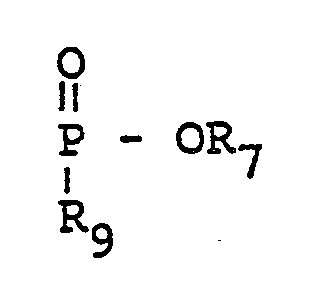
- (A) hydrogen
- (B) hydroxyl
- (C) B as defined previously
- (D) OB, where B is defined previously
- (E) E as defined previously
- (F) amino or substituted amino
- (5) - X as defined previously or phosphorylated X
- (b)

- (c) F as defined previously.
- In Formula (I) R₁, R₂, R₃, R₄, R₅ and R₆ can be placed in any order to each other. The configuration isomers of myoinositol according to the invention are epi-, muco-, neo-, chiro-, scyllo-, allo- and cisinositol.
- The intention of Formula (I) is not to cover compounds like inositol, inositoltriphosphate or phytic acid.
- In the context of the present description, the general terms used above have the following meanings, radicals and compounds that are termed "lower" containing up to and including 7, preferably up to and including 4 carbon atoms:
Alkyl with 1 to 24 carbon atoms is for example, lower alkyl such as methyl, ethyl, n-propyl, isopropyl, n-butyl, tributyl, sec.-butyl or tert.-butyl, also n-pentyl, neopentyl, n-hexyl or n-heptyl or higher alkyl such as straight-chain or branched octyl, nonyl, decyl, undecyl, dodecyl, tridecyl, tetradecyl, pentadecyl, hexadecyl, heptadecyl, octadecyl, nonadecyl, eicosyl, docosyl and n-tetracosyl;
Cycloalkyl with 3 to 16 carbon atoms is, for example, cyclopropyl, cyclobutyl, cyclopentyl, cyclohexyl, cycloheptyl, cyclooctyl, cyclononyl and adamantyl;
Alkenyl with 2 to 24 carbon atoms is, for example, lower alkenyl such as vinyl, allyl, propenyl, butenyl, pentenyl and hexenyl or higher alkenyl such as octadienyl, octenyl, decenyl, dodecenyl, tetradecenyl, hexadecenyl, octadecenyl, octadecadienyl, octadecatrienyl, nonadecenyl and arachidonyl;
Cycloalkenyl with 4 to 16 carbon atoms is, for example, cyclobutenyl, cyclopentenyl, cyclohexenyl, cyclohexadienyl, cycloheptenyl, cyclooctenyl, cyclooctadienyl and cyclooctatrienyl;
Aryl with 6 to 24 carbon atoms is, for example, phenyl, biphenyl, terphenyl, naphtyl, anthracenyl, phenanthrenyl; - The radical A can also be a heterocyclic group containing at least one atom selected from the group of oxygen, nitrogen and sulphur and is for example pyridyl, pyrrolyl, pyrrolidinyl, piperidinyl, indolyl, imidazolyl, furyl, dioxolanyl, oxiranyl, thiiranyl, thiopyranyl, oxazolyl and thiazolyl.
- The above mentioned radicals are unsubstituted or substituted.
- The substitution could consist of free functional groups such as hydroxyl, carbonyl, carboxyl, mercapto or amino or these groups could be present in protected form.
- Thus, carboxyl groups are usually protected in esterified form and contain as esterifying groups especially lower alkyl groups, which could be branched in the 1-position or suitably substituted in the 1- or 2-position. Preferred carboxyl groups protected in esterified form are inter alia methoxycarbonyl, butoxycarbonyl, tert. alkoxycarbonyl, for example tert. butoxycarbonyl, arylmethoxycarbonyl having one or two aryl radicals, these being especially phenyl radicals optionally substituted for example by lower alkyl, lower alkoxy, hydroxy, halogen and/or nitro, such as benzyloxycarbonyl, methoxybenzyloxycarbonyl, diphenylmethoxycarbonyl, 2-bromoethoxycarbonyl or 2-iodoethoxycarbonyl. Further preferred protected carboxyl groups in esterified form are silyloxycarbonyl groups, especially organic silyloxycarbonyl groups. In these the silicon atom contains as substituent preferably lower alkyl, especially methyl, also alkoxy, especially methoxy and/or halogen, for example chlorine. Suitable silyl-protecting groups are for example trimethylsilyl and dimethyl-tert.-butylsilyl.
- A protected amino group may be, for example, in the form of an acylaminogroup or in the form of arylalkylamino group or azido group or sulphonated amino group. In a corresponding acylamino group acyl is for example the acyl radical of an organic carboxylic acid having for example up to 18 carbon atoms, especially of an alkanecarboxylic acid that is preferably substituted for example by halogen or aryl or of a carbonic acid semiester.
Such acyl groups are for example lower alkanoyl such as formyl or acetyl; halo-lower alkanoyl such as 2-chloro-and 2-bromoacetyl or lower alkoxycarbonyl straight or branched in the 1-position of the lower alkyl radical or suitably substituted in the 1- or 2-position, for example tert. butyl carbonyl; arylmethoxycarbonyl having one or two aryl radicals that are unsubstituted or, in the case of phenyl, may be substituted for example by lower alkyl, especially tert. lower alkyl, lower alkoxy, hydroxy, halogen and/or nitro; such as unsubstituted or substituted aryloxycarbonyl, for example benzyloxycarbonyl or 4-nitrobenzyloxycarbonyl or diphenylmethoxycarbonyl, for example benzhydroxycarbonyl or di-(4-methoxyphenyl)-methoxycarbonyl; aroylmethoxycarbonyl for example phenacyloxycarbonyl in which the aroyl group is benzoyl that is unsubstituted or substituted for example by halogen; halo-lower alkoxycarbonyl, for example 2-bromo- or 2-iodoethoxycarbonyl; or 2-(trisubstituted silyl)-ethoxycarbonyl such as for example 2-trimethylsilylethoxycarbonyl or 2-triphenylsilylethoxycarbonyl. - An arylalkylamino group is a mono-, di- or especially a triarylalkylamino group in which the aryl radicals are especially unsubstituted or substituted phenyl radicals. Such groups are for example benzylamino, diphenylmethylamino or tritylamino.
- Amino grups may also contain organic silyl groups as protecting groups. Suitable silylprotecting groups are especially tri-lower alkylsilyl, such as trimethylsilyl and dimethyl-tert.-butylsilyl.
- Preferred aminoprotecing groups are acyl radicals of carbonic acid semiesters especially tert.-butoxycarbonyl or aryloxycarbonyl that is unsubstituted or substituted for example benzyloxycarbonyl or 4-nitrobenzyloxycarbonyl or diphenylmethoxycarbonyl or 2.2.2-trichloroethoxycarbonyl.
- Other protected amino groups are sulphonated amino groups such as lower alkyl sulphonamides especially N-methyl sulphonamide and N-butylsulphonamide.
- Hydroxy- and mercapto-protecting groups are for example acyl radicals such as lower alkanoyl that is unsubstituted or substituted, for example by halogen, such as 2.2-dichloroacetyl or especially the acyl radicals of carbonic acid semiesters mentioned in connection with the amino-protecting groups and also etherifying groups such as tert.-butyl or 2-oxa- or 2-thia-aliphatic hydrocarbon radicals, for example 1-methoxyethyl, 1-methyl-thiomethyl or 2-oxa- or 2-thia-cycloaliphatic hydrocarbon radicals, for example 2-tetrahydrofuryl or 2-tetrahydropyranyl or corresponding thia analogues and unsubstituted or substituted benzyl, diphenylmethyl there coming into consideration as substituents of the phenyl radicals, for example halogen, lower alkoxy and/or nitro.
- Hydroxy and mercapto groups may also be protected in the form of corresponding organic silyloxy or silylthio groups. Suitable silyl protecting groups are especially lower alkylsilyl such as trimethylsilyl or dimethyl-tert.-butyl-silyl.
- Two free functional groups may also be substituted by a common protecting group. Thus, for example hydroxy groups may be substituted by a methylene radical that is unsubstituted or preferably substituted for example by lower alkyl, such as methyl or aryl, such as phenyl or such as methylene, isopropylidene, propylidene or benzylidene.
- The substitutions on the radical A could also consist of a halogen especially fluorine, chlorine and iodine and further by a cyano group. The radical A could also be substituted with phosphorus containing radicals, such as phosphine, phosphinyl and phosphonyl and with nitrogen containing radicals such as nitro or azido.
- The radical F can further be substituted with sulphurcontaining groups such as sulphinyl or sulphonyl and siliconcontaining groups such as silyl, silyloxy or silylthio.
- One or two or three of R₁, R₂ and R₃ can independently be etherified hydroxyl with the substitutent B. B can be A as defined previously, but preferably B is a straight or branched alkyl, especially a lower alkyl such as methyl, ethyl or butyl or a higher alkyl such as octyl, decyl, dodecyl or eicosyl or an alkenyl especially vinyl, allyl or butenyl. Preferably B can also be a cycloalkyl, especially cyclopropyl or cyclohexyl or a cycloalkenyl, especially cyclopentenyl or cyclooctadienyl.
- In another preferred form, B is an aryl, especially phenyl, biphenyl and naphtyl. When the B radical is identical with the A radical it can be in unsubstituted or substituted form. The substitution could consist of free functional groups, such as hydroxyl, carbonyl, carboxyl, mercapto or amino or these groups could be present in protected form as described above. The substitution could also consist of halogen and phosphorus- and nitrogencontaining radicals.
- Preferably, the substitution consists of hydroxy or repeated fragments of hydroxyl groups etherified with carbon radicals such as polyethyleneglycol and polypropyleneglycol. Other preferred substitution groups consist of a halogen, especially fluorine or chlorine or amino or protected aminogroups with carbon radicals especially alkoxycarbonyl such as methoxycarbonyl, butoxycarbonyl or aminocarbonyl or sulphur radicals such as methylsulphonyl or butylsulphonyl.
- In another preferred form the substitution is mercapto or phosphine.
- B can also be an etherified hydroxyl with a carbon radical which is a glycosyl residue. The glycosyl residue is derived for example from a monosaccharide such as erythrose, ribose, arabinose, allose, altrose, glucose, mannose, threose, xylose, lyxose, gulose, idose, galactose, talose, fructose or from a polysaccharide such as maltose,lactose, cellobiose or sucrose or nonhydrolyzed or partially hydrolyzed cellulose, amylose or amylopectin.
- Preferably the glycosyl residue is derived from glucose, fructose, mannose or lactose.
- The glycosyl residue could also be substituted with for example carboxyl, amino- or phosphonyl groups such as glucoseamine or galactoseamine or glucosephosphate or glucopyranosyl phosphate or sialic acid.
- B can also be an etherified hydroxyl with a carbon radical which is a glycopeptide. This radical is derived for example from one or more sugar residues which are attached primarily to serine, threonine or aspargine side chains of the peptide, where the peptide is formed by different combinations of amino acids up to a molecular weight of 10.000. Prefered radicals are those which include glucoseamine or galactoseamine attached to especially di- and tripeptides.
- B can also be an etherified hydroxyl with a carbon radical which is a glycoprotein. This radical is derived for example from one or more sugar residues which are attached primarily to serine, threonine or aspargine side chains of the proteins, especially alkaline phosphatase, acetylcholinesterase, 5-nucleotidase, Thy-1, Th B and heparan sulphate proteoglycan. Preferred radicals are those which include glucoseamine and galactoseamine attached to the protein. Especially preferred radicals are lectins such as concanavalin A, wheat germ agglutinin, peanutagglutinin and seromucoid and orosomucoid.
- B can also be an etherified hydroxyl with a carbon radical which is glycolipid. This radical is derived for example from one or more sugar residues which are attached to a lipid.
- Preferred radicals are those which include glucose or galactose. Further preferred radicals are cerebroside and ganglioside.
- B can also be a halogen, especially fluorine and chlorine or a functional group such as carboxyl, phosphonyl or sulfonyl.
- One or two or three of R₁, R₂ and R₃ can independently be esterified hydroxyl with the substituent D. D can be A as defined previously, but preferably the radical is derived from an organic carboxylic acid, especially an aliphatic, but also a cycloaliphatic, cycloaliphatic-aliphatic, aromatic or araliphatic carboxylic acid. Aliphatic carboxylic acids are inter alia alkane carboxylic acids that are unsubstituted or substituted for example by hydroxy or etherified or esterified hydroxy such as lower alkoxy or lower alkanoyloxy, by unsubstituted or substituted amino, such as lower alkylamino, di-lower alkylamino or by acylamino for example alkanoylamino and corresponding alkene- or alkyne carboxylic acids that may have one or more double or triple bonds. Preferably the radical is unsubstituted or hydroxysubstituted lower alkanecarboxylic acid such as acetic acid, butyric acid, caproic acid or 2-hydroxybutyric acid or unsubstituted or hydroxysubstituted higher alkanecarboxylic acid such as lauric acid or stearic acid. Preferably the radical is also a lower alkene- and lower alkyne-carboxylic acid such as acrylic acid or crotonic acid or higher alkene- and higher alkyne-carboxylic acid such as oleic acid and arachidonic acid.
- In cycloaliphatic-aliphatic radicals the cycloaliphatic moiety and the aliphatic moiety have the meanings described above and are especially monocyclic or polycyclic cyclo-lower alkyl. Aromatic and araliphatic carboxy acids are inter alia benzoic or phenyl-lower alkanecarboxylic that are unsubstituted or substituted for example by alkyl, hydroxy, lower alkoxy or halogen. Preferably the radical is benzoic acid or phenolacetic acid.
- D can also be an esterified hydroxy with a carbonradical which is a carboxy group or esterified caboxy group to form a semiester or a diester. Preferred carboxygroups are lower alkane carboxyl such as acetoxy and butyryloxy. D can also be an esterified hydroxyl with a radical containing nitrogen such as amino or substituted amino. Preferably the radical is lower alkylamino for example methylamino, ethylamino and isopropylamino.
- One or two or three of R₁, R₂ and R₃ can independently be esterified hydroxyl with the substituent E.
E can be an amino acid, for example lysine, histidine, asparagine, arginine, aspartic acid, threonine, serine, glutamic acid, proline, glycine, alanine, cystine, valine, methionine, isoleucine, leucine, tyrosine, phenylalanine or tryptophan. - Preferably the amino acid is alanine, serine, glycine, threonine, methionine, asparagine and histidine.
- E can also be a peptide consisting of the above mentioned amino acids up to a molecular weight of 10.000. Preferred radicals are dipeptides such as alanyl-alanyl, prolyl-methionyl, glycyl-glycyl or threonyl-histidyl.
- E can also be a protein such as albumin, antitrypsin, macroglobulin, haptoglobin, caeruloplasmin, transferrin, α- or β-lipoprotein, β- or γ-globulin or fibrinogen.
- One or more of R₁, R₂, R₃, R₄, R₅, R₆ can independently be the substituent F.
F can be a free functional group such as hydroxy, carbonyl, carboxyl, mercapto or amino or these could be protected with other groups as described for the radical A. - F can also be a halogen such as fluorine, chlorine, bromine and iodine and further a cyano or an isocyanato group.
- F can also consist of phosphorus containing radicals such as phosphine, phosphinyl and phosphonyl or phosphorothioate and with nitrogen containing radicals such as nitro and azido.
- F can further consist of sulphurcontaining radicals such as xanthate, sulfinyl or sulfonyl or siliconcontaining radicals such as silyl, silyloxy or silylthio.
- F can also be a heterocyclic group containing at least one atom selected from the group of oxygen, nitrogen or sulphur.
- F can further also be a carbamyl or substituted carbamyl.
- When R₁, R₂ or R₃ are F the preferred radical is hydroxy, mercapto or halogen, especially fluorine and chlorine. Further preferred radicals are those where F is phosphino or amino or substituted amino. The substitution for the aminogroup is preferably a lower alkyl carbonyl radical such as methyl- or butylcarbonyl or sulphinyl or alkyl sulphinyl such as methylsulphinyl or butylsulphinyl or an aminocarbonyl such as N-methylaminocarbonyl.
- When R₄, R₅ or R₆ are F the preferred radical is carboxy, carbamyl or substituted carbamyl, sulphonyl or substituted sulphonyl or phosphinyl or phosphonyl or substituted phosphinyl or phosphonyl. In this case F can also preferably be a heterocyclic group especially isoxazolyl, imidazolyl or thiazolyl.
- One or two or three of R₄, R₅ and R₆ could independently be a phosphoruscontaining radical with the formula

- In one preferred form Y is oxygen and especially preferred is when Y is oxygen and when R₄, R₅ and R₆ all have the above formula, i.e.

- R₇ and R₈ can independently be hydrogen or B as defined previously. Preferably when R₇ and/or R₈ is B the radical is alkyl or aryl especially lower alkyl such as methyl, ethyl or butyl or higher alkyl such as octyl or dodecyl or aryl such as phenyl. In another preferred form B is substituted alkyl such as dihydroxy propyl or esterified dihydroxypropyl.
- In another preferred form R₇ is hydrogen and R₈ is lower alkyl especially methyl, ethyl or butyl.
- R₇ and R₈ can also be another phosphoruscontaining group with the formula

R₉ can also be an etherified hydroxyl with a radical B and preferably in this form B is alkyl or aryl as described above. - In one preferred form R₄, R₅, R₆ are a mono- or polyphosphate or alkylated or arylated mono- or polyphosphates.
- R₇ and/or R₈ can also be a radical of myo-inositol or a radical of a configuration isomer thereof or a further phosphorylated radical of a configuration isomer of myo-inositol.
- One or two or three of R₄, R₅, R₆ could independently be a phosphorus containing radical with the formula:

- In one preferred form R₇ is hydrogen and R₉ is amino or substituted amino such as alkylamino, especially methyl- or butylamino.
- One embodiment of this invention relates to a compound of Formula (I), wherin R₁, R₂, R₃ independently are
- a) F, where F is as defined previously or
- b) hydrogen or oxygen or
- c) A, where A is as defined previously,
- In this embodiment R₁ or preferably R₁ and R₂ are hydroxyl while R₂ and R₃ or preferably only R₃ are selected from the group of hydrogen, oxygen, F or A as defined previously.
- Preferably, R₂ and R₃ or only R₃ are chlorine, bromine or iodine or most preferably fluorine. In another preferred form R₂ and R₃ or only R₃ are amino or substituted amino especially where the substitution on the aminogroup is a lower alkyl carbonyl radical such as methyl- or butylcarbonyl or sulphinyl or alkylsulphinyl radical such as methyl- or butylsulphinyl or an aminocarbonyl or a substituted aminocarbonyl such as N-methylaminocarbonyl.
- In another preferred form R₂ and R₃ or only R₃ are unsubstituted or substituted mercapto, the substitution being preferably lower alkyl such as methyl- or butylmercapto.
- In another form of this embodiment R₂ and R₃ or only R₃ are a phosphino, a xanthate or an isocyanatogroup. Other preferred forms are those where R₂ and R₃ or only R₃ are alkyl or aryl in unsubstituted or substituted form, especially lower alkyl such as ethyl and butyl and substituted ethyl and butyl with hydroxyl, mercapto, amino or phosphino or aryl such as phenyl.
- In another preferred form R₂ and R₃ or only R₃ are hydrogen or oxygen.
- In another preferred form of this invention R₁, R₂, R₃ are the same selected from
- a) F, where F is as defined previously or
- b) hydrogen or oxygen or
- c) A, where A is as defined previously
- Preferably, R₄ and R₅ are

- Most preferably R₄, R₅ and R₆ are

- In this embodiment of the invention R₁, R₂, R₃ are the same and preferably hydrogen, oxygen, chlorine, bromine and iodine or most preferably fluorine.
- In another preferred from R₁, R₂ and R₃ are amino or substituted amino especially where the substitution on the amino group is a lower alkylcarbonyl radical such as methyl- or butylcarbonyl or sulphinyl or alkylsulphinyl radical such as methyl- and butylsulphinyl or an aminocarbonyl or substituted aminocarbonyl such as N-methylaminocarbonyl.
- In another preferred form R₁, R₂ and R₃ are unsubstituted or substituted mercapto, the substitution being preferably lower alkyl such as methyl- or butylmercapto.
- In another form of this embodiment R₁, R₂ and R₃ are phosphino, xanthate or isocyanatogroups.
- Other preferred forms are those where R₁, R₂ and R₃ are alkyl or aryl in unsubstituted form,
especially lower alkyl such as ethyl and butyl or substituted ethyl and butyl with hydroxyl, mercapto, amino or phosphino or aryl such as phenyl. - The most preferred embodiment of this type of the invention is where R₁, R₂ and R₃ independently are covalently bound to C₃, C₄ and C₅ and where R₄, R₅ and R₆ independently are covalently bound to C₁, C₂ and C₆ in myo-inositol such as follows:

- Other preferred embodiments of this invention are where R₁, R₂ and R₃ are independently bound to C₄, C₅ and C₆ and where R₄, R₅ and R₆ independently are covalently bound to C₁, C₂ and C₃ in myo-inositol such as follows:

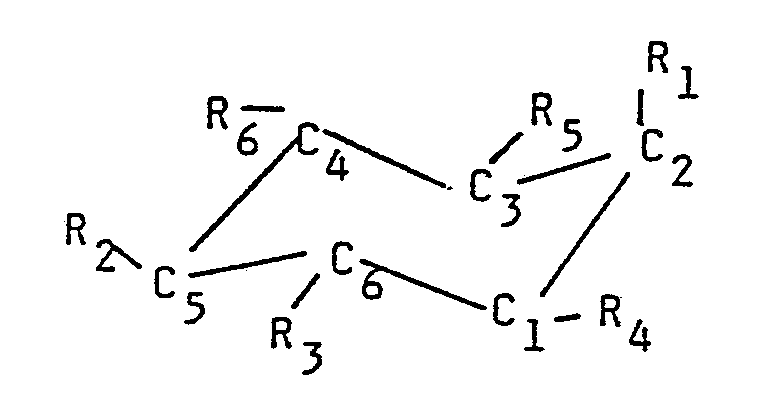
- In one of the most preferred embodiments of this type of the invention R₁ and R₂ are hydroxyl and R₃ are as described above and R₄, R₅ and R₆ are

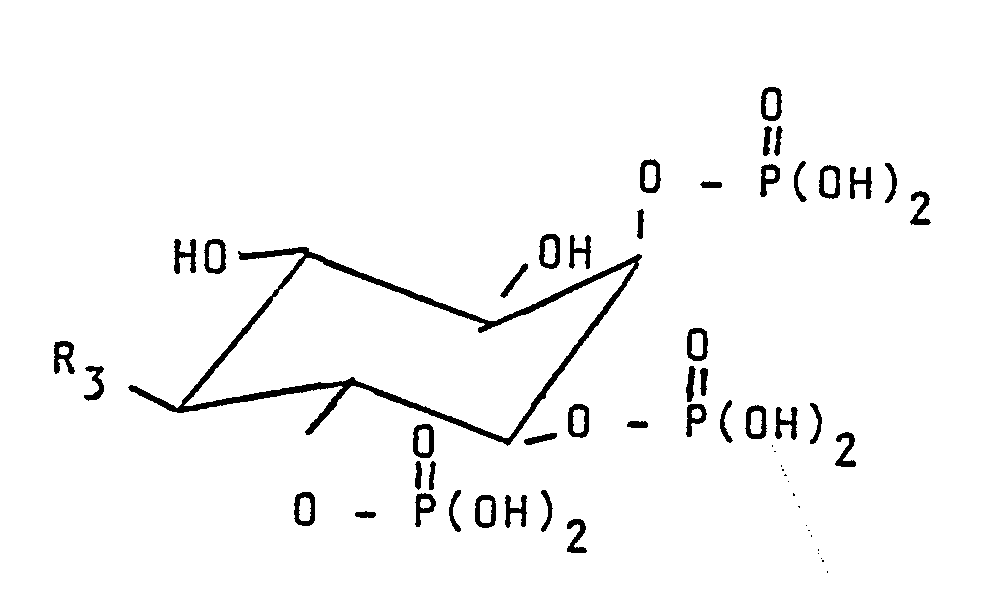
- In this formula R₃ and the two hydroxyls could be in changed positions independently to each other. R₃ is especially selected from the group of hydrogen, oxygen, fluorine, chlorine, bromine and iodine and most preferably fluorine or selected from the group of amino or substituted amino especially where the substitution is a lower alkyl carbonyl radical such as methyl- or butylcarbonyl or sulphinyl or alkylsulphinyl radical such as methyl- or butylsulphinyl or an aminocarbonyl or a substituted aminocarbonyl such as N-methylaminocarbonyl or selected from the group of unsubstituted or substituted mercapto, the substitution being preferably lower alkyl such as methyl- or butylmercapto or phosphino; or selected from the group of alkyl or aryl in unsubstituted form, especially lower alkyl such as ethyl and butyl or substituted ethyl or butyl with hydroxyl, mercapto, amino or phosphino or aryl such as phenyl.
- In another form of this most preferred embodiment of this type of the invention R₁ and R₂ are hydroxyl and R₃ are as described above and R₄, R₅ R₆ are


- In another of the most preferred embodiments of this type of the invention R₁, R₂ and R₃ are the same and as described above and R₄, R₅, R₆ are


- R₁, R₂, R₃ are especially selected from the group of hydrogen, oxygen, fluorine, chlorine, bromine and iodine and most preferably fluorine; or selected from the group of amino or substituted amino, especially where the substitution is a lower alkylcarbonyl radical such as methyl- or butylcarbonyl radicals or sulphinyl or alkylsulphinyl radical such as methyl- or butylsulphinyl or an aminocarbonyl or a substituted aminocarbonyl such as N-methyl aminocarbonyl or selected from the group of unsubstituted or substituted mercapto, the substitution being preferably lower alkyl such as methyl- or butyl mercapto or phosphino; or selected from the group of alkyl or aryl in unsubstituted from, especially lower alkyl such as ethyl and butyl or substituted ethyl or butyl with hydroxyl, mercapto, amino or phosphino or aryl such as phenyl.
- In another form of this preferred embodiment of this type of the invention R₁, R₂ and R₃ are as described above and R₄, R₅ and R₆ are

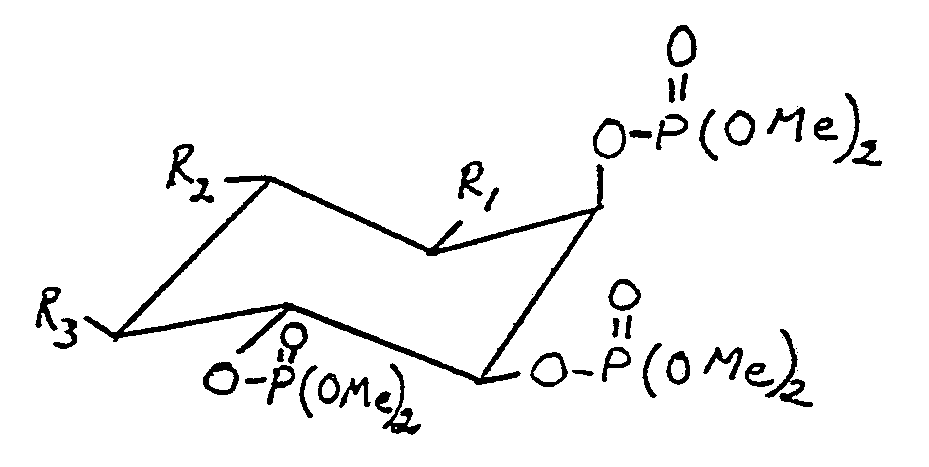
- One embodiment of this invention relates to a compound of Formula (I) wherein R₁, R₂ and R₃ independently are:
- a) hydroxyl or
- b) OB, where B is as defined previously
- In this embodiment R₁ or preferably R₁ and R₂ are hydroxyl, while R₂ and R₃ or preferably only R₃ are etherified hydroxyl with the substituent B, where B is A as defined previously or a glycosyl residue, a glycopeptide, a glycoprotein, a glycolipid or selected from the group of halogen, carboxy, phosphonyl or sulphonyl. When B is A as defined previously, B is preferably a straight or branched alkyl, especially a lower alkyl such as methyl, ethyl or butyl or a higher alkyl such as octyl, dodecyl and eicosyl or an alkenyl, especially vinyl, alkyl or butenyl. Preferably, B can also be a cycloalkyl, especially cyclopropyl or cyclohexyl or aryl, especially phenyl, biphenyl or naphtyl. The above mentioned radicals can be unsubstituted or substituted especially with hydroxyl, mercapto, carboxyl, amino or phosphino.
- By preference B can also be a glycosyl residue especially glucose, mannose, maltose, glucoseamine or glucosephosphate; or a glycopeptide especially a glycopeptide including glucoseamine or galactoseamine attached to di- and tripeptides such as alanyl-alanyl, prolyl-methionyl or glycyl-glycyl; or a glycoprotein, especially a glycoprotein including glucoseamine or galactoseamine attached to a protein such as concanavalin A, wheat germ agglutinin and peanutagglutinin; or a glycolipid especially a glycolipid including glucose or galactose such as cerebroside and ganglioside.
- B can preferably also be halogen, especially fluorine or chlorine or carboxyl, phosphonyl or sulphinyl. In another preferred form the substitution OB are repeated fragments of hydroxyl groups etherified with carbon radicals such as polyethyleneglycol or polypropyleneglycol.
- In another preferred form of this invention R₁, R₂ and R₃ are the same i.e. etherified hydroxyls with the carbon radical B as previously defined. X is a radical of a configuration isomer of inositol and preferably a radical of myo-inositol.
- R₄, R₅ and R₆ are

- Preferably, R₄ and R₅ are

- Most preferably R₄, R₅ and R₆ are

- In this embodiment of the invention R₁, R₂ and R₃ are the same, that is etherified hydroxyl with the substituent B, which preferably is a straight or branched alkyl, especially a lower alkyl such as methyl, ethyl or butyl or a higher alkyl such as octyl, dodecyl or eicosyl or an alkenyl, especially vinyl, alkyl or butenyl. Preferably, B can also be a cycloalkyl, especially cyclopropyl or cyclohexyl or aryl, especially phenyl, biphenyl or naphtyl. The above mentioned radicals can be unsubstituted or substituted, especially with hydroxyl, mercapto, carboxyl, amino or phosphino.
- By preference, B can also be a glycosyl residue, especially glucose, mannose, maltose, glucoseamine or glucosephosphate; or a glycopeptide, especially a glycopeptide including glucoseamine or galactoseamine attached to di- and tripeptides such as alanyl-alanyl, prolyl-methionyl or glycyl-glycyl; or a glycoprotein, especially a glycoprotein including glucoseamine or galactoseamine attached to a protein such as concanavalin A, wheat germ agglutinin and peanutagglutinin; or a glycolipid especially a glycolipid including glucose or galactose such as cerebroside and ganglioside.
- B can preferably also be a halogen, especially fluorine or chlorine or carboxyl, phosphonyl or sulphinyl. In another preferred form the substitution OB are repeated fragments of hydroxyl groups etherified with carbon radicals such as polyethyleneglycol or polypropyleneglycol.
- The most preferred embodiment of this type of the invention is where R₁, R₂ and R₃ independently are covalently bound to C₃, C₄ and C₅ and where R₄, R₅ and R₆ independently are covalently bound to C₁, C₂ and C₆ in myo-inositol such as follows:

- Other preferred embodiments of this invention are where R₁, R₂ and R₃ independently are covalently bound to C₄, C₅ and C₆ and where R₄, R₅ and R₆ independently are covalently bound to C₁, C₂ and C₃ in myo-inositol such as follows:
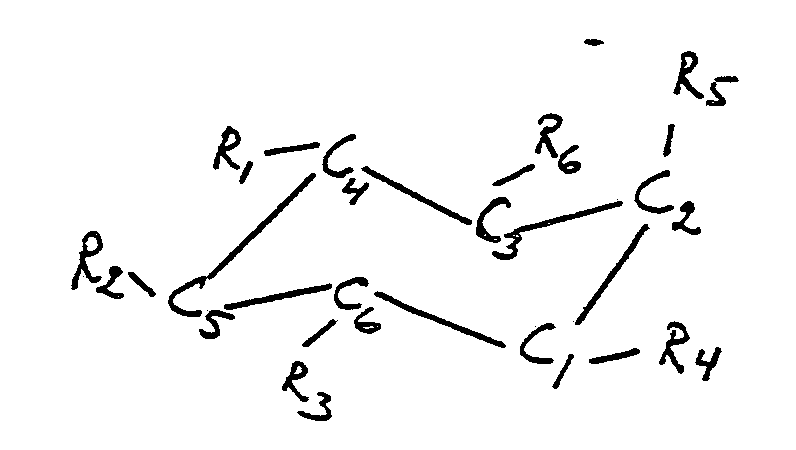

- In one of the most preferred embodiments of this type of the invention R₁ and R₂ are hydroxyl and R₃ are as described above and R₄, R₅ and R₆ are


- In this formula -OB and the two hydroxyls could be in changed positions independently to each other.
- B is especially selected from the group of straight or branched alkyl such as methyl, butyl, dodecyl or eicosyl or alkenyl such as allyl or butenyl or cycloalkyl such as cyclopropyl or cyclohexyl or aryl such as phenyl unsubstituted or substituted especially with hydroxyl, mercapto, carboxyl, amino or phosphino; or selected from the group of a glycosyl residue especially glucose, mannose, glucoseamine or glucosephosphate or a glycopeptide especially including a glucoseamine or galactoseamine attached to a di- or tripeptide, or a glycoprotein especially including a glucoseamine or galactoseamine attached to the protein or a glycolipid including glucose or galactose; or selected from the group of halogen, especially fluorine or chlorine, or carboxy, phosphonyl or sulphinyl; or selected from the group consisting of repeated fragments of hydroxyl groups etherified with carbon radicals such as polyethyleneglycol or polypropyleneglycol.
- In another form of this most preferred embodiment of this type of the invention R₁ and R₂ are hydroxyl and R₃ are described as above and R₄, R₅ and R₆ are


- In another of the most preferred embodiments of this type of the invention R₁, R₂ and R₃ are the same and as described above and R₄, R₅ and R₆ are

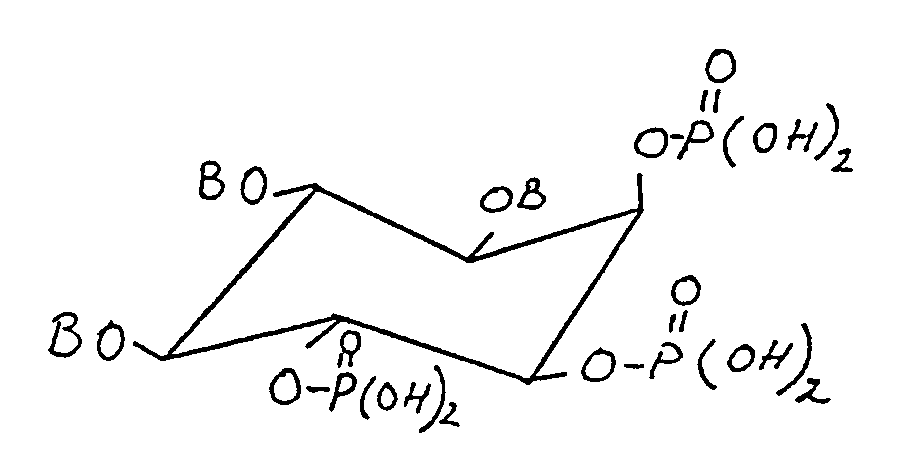
- B is especially selected from the group of straight or branched alkyl, such as methyl-, butyl, dodecyl or eicosyl or alkenyl such as allyl or butenyl or cycloalkyl such as cyclopropyl or cyclohexyl or aryl such as phenyl, unsubstituted or substituted especially with hydroxyl, mercapto, carboxyl, amino or phosphino; or selected from the group of a glycosyl residue especially glucose, mannose, glucoseamine or glucosephosphate or a glycopeptide especially including a glucoseamine or galactoseamine attached to a di- or tripeptide, or a glycoprotein especially including a glucoseamine or galactoseamine attached to the protein or a glycolipid including glucose or galactose, or selected from the group of halogen, especially fluorine or chlorine or carboxy, phosphonyl or sulphinyl; or selected from the group consisting of repeated fragments of hydroxyl groups etherified with carbon radicals such as polyethyleneglycol or polypropyleneglycol.
- In another form of this most preferred embodiment of this type of the invention R₁, R₂ and R₃ are the same and as described above and R₄, R₅ and R₆ are


- One embodiment of this invention relates to a compound of Formula (I) wherein R₁, R₂ and R₃ independently are
- a) hydroxyl or
- b)
O -- D where D is as defined previously or
- c) E, where E is as defined previously,
- In this embodiment R₁ or preferably R₁ and R₂ are hydroxyl while R₂ and R₃ or preferably only R₃ are selected from the group of esterified hydroxyl with the substituents D or E, where D is A as defined previously, carboxy or esterified carboxy, amino or substituted amino and where E is an amino acid, peptide or a protein. When D is A as defined previously, D is preferably a radical derived from an organic carboxylic acid, especially an unsubstituted or substituted aliphatic acid such as acetic acid, butyric acid, caproic acid, lauric acid or 2-hydroxy butyric acid or an alkenic acid, such as acrylic acid or crotonic acid or an aromatic acid such as benzoic acid or phenylacetic acid.
- By preference, D is also an esterified hydroxyl with a carbon radical which is a carboxy group or esterified carboxy group, especially acetoxy and butyryloxygroups or a radical containing nitrogen such as amino or substituted amino, especially methyl-, ethyl- and isopropylamino. Preferably, E is an amino acid, especially asparginine, histidine, methionine and serine or a peptide consisting of amino acids up to a molecular weight of 10.000, especially dipeptides such as alanyl-alanyl, prolyl-methionyl and glycyl-glycyl or a protein, especially albumin, transferrin, α- and β-lipoprotein, β- and γ-globulin and fibrinogen.
- In another preferred form of this invention R₁, R₂ and R₃ are the same selected from:
- a)
O -- D where D is as defined previously or
- b) E, where E is as defined previously
- Preferably, R₄ and R₅ are
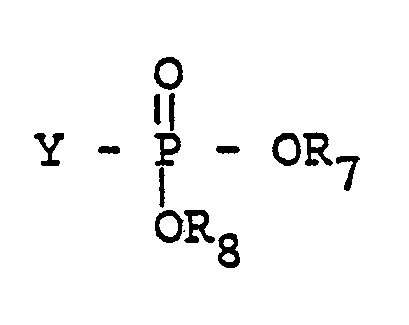
- Most preferably R₄, R₅ and R₆ are

- In this embodiment of the invention R₁, R₂ and R₃ are the same, that is esterified hydroxyl with the substituents D or E, where D preferably is a radical derived from an organic carboxylic acid, especially an unsubstituted or substituted aliphatic acid, such as acetic acid, butyric acid, caproic acid, lauric acid and 2-hydroxy butyric acid or an alkenic acid, such as acrylic acid or crotonic acid or an aromatic acid, such as benzoic acid or phenylacetic acid.
- By preference, D is also an esterified hydroxyl with a carbon radical which is a carboxy group or esterified carboxy group, especially acetoxy and butyryloxy groups or a radical containing nitrogen, such as amino or substituted amino, especially methyl-, ethyl- and isopropylamino.
- Preferably, E is an amino acid, especially asparagine, histidine, methionine and serine or a peptide consisting of amino acids up to a molecular weight of 10.000, especially dipeptides such as alanyl-alanyl, prolyl-methionyl and glycyl-glycyl or a protein, especially albumin, transferrin, α- and β-lipoprotein, β- and γ-globulin and fibrinogen.
- The most preferred embodiment of this type of the invention is where R₁, R₂ and R₃ independently are covalently bound to C₃, C₄ and C₅ and where R₄, R₅ and R₆ independently are covalently bound to C₁, C₂ and C₆ in myo-inositol such as follows:
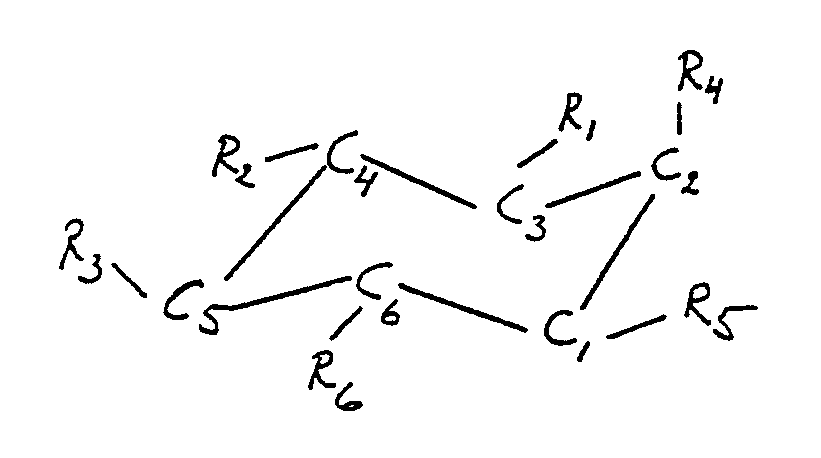
- Other preferred embodiments of this invention are where R₁, R₂ and R₃ independently are covalently bound to C₄, C₅ and C₆ and where R₄, R₅ and R₆ independently are covalently bound to C₁, C₂ and C₃ in myo-inositol such as follows:
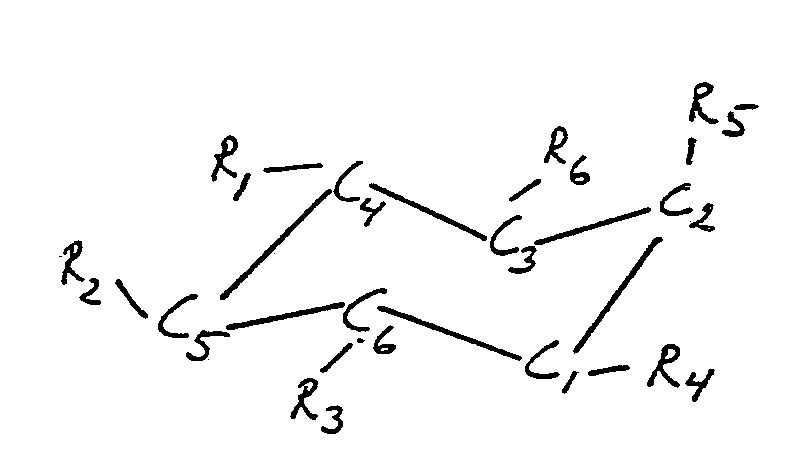

- In one of the most preferred embodiments of this type of the invention R₁ and R₂ are hydroxyl and R₃ are as described above and R₄, R₅ and R₆ are


In this formula O -- D or E and the two hydroxyls could be in changed positions independently to each other.
D is especially selected from the group of radicals derived from organic carboxylic acids such as acetic acid, butyric acid, lauric acid, 2-hydroxy butyric acid, acrylic acid and benzoic acid; or selected from the group of carboxy or esterified carboxy such as acetoxy and butyryloxy; or selected from the group of amino or substituted amino such as methyl- or isopropylamino.
E is especially selected from the group of amino acids, such as asparagine, histidine, methionine or serine or selected from the group of peptides such as alanyl-alanyl, or prolyl-methionyl or selected from the group of proteins, such as albumin, transferrin and α- and β-lipoprotein. - In another form of this most preferred embodiment of this type of the invention R₁ and R₂ are hydroxyl and R₃ are as described above and R₄, R₅ and R₆ are

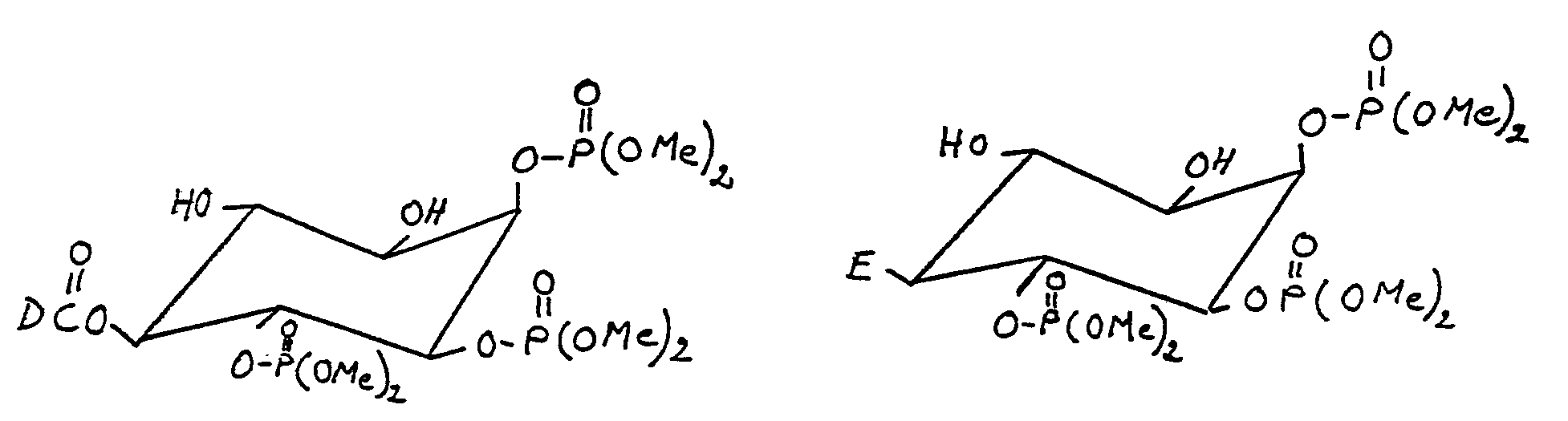
- In another form of this most preferred embodiment of this type of the invention R₁, R₂ and R₃ are the same and as described above and R₄, R₅ and R₆ are


- R₁, R₂ and R₃ are the same and are
O -- D, where D is especially selected from the group of radicals derived from organic carboxylic acids such as acetic acid, butyric acid, lauric acid, 2-hydroxybutyric acid, acrylic acid and benzoic acid; or selected from the group of carboxy or esterified carboxy, such as acetoxy and butyryloxy; or selected from the group of amino or substituted amino, such as methyl- or isopropylamino; or E where E is especially selected from the group of amino acids, such as asparagine, histidine, methionine and serine; or selected from the group of peptides such as alanyl-alanyl or prolyl-methionyl or selected from the group of proteins such as albumin, transferrin and α- and β-lipoproteins.
- In another from of this most preferred embodiment of this type of the invention R₁, R₂ and R₃ are the same and as described above and R₄, R₅ and R₆ are
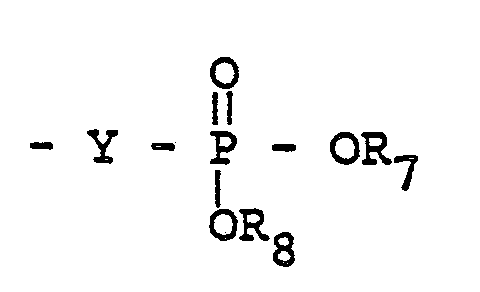

- One embodiment of this invention relates to a compound of Formula (I), wherein R₁, R₂ and R₃ independently are as defined previously and where X is a radical of myo-inositol or a radical of a configuration isomer thereof and where R₄, R₅ and R₆ are
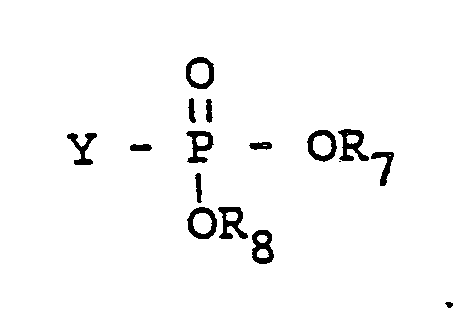
- Y is preferably oxygen and R₇ and R₈ are independently hydrogen or the radical B, especially unsubstituted alkyl such as methyl, ethyl, butyl, octyl or dodecyl or aryl such as phenyl or substituted alkyl such as dihydroxypropyl or esterified dihydroxypropyl; or E, especially an aminc acid such as methionine or glycine.
- In another preferred form R₇ and R₈ independently are another phosphorus containing group with the formula:
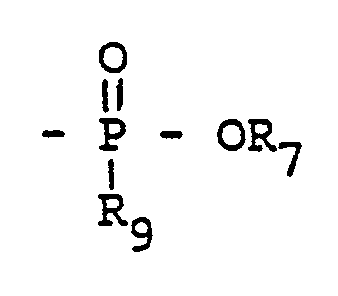
- In another preferred form of this embodiment R₁, R₂ and R₃ are as defined previously, X is a radical of myo-inositol or a radical of a configuration isomer thereof and R₄, R₅ and R₆ are
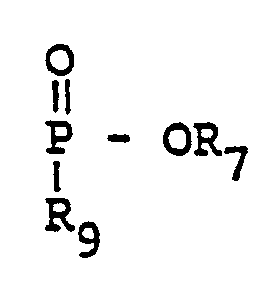
- R₇ is preferably hydrogen or the radical B, especially unsubstituted alkyl such as methyl, ethyl, butyl, octyl or dodecyl or aryl such as phenyl or substituted alkyl such as dihydroxypropyl or esterified dihydroxypropyl or E, especially an amino acid such as methionine or glycine.
- R₉ is preferably hydrogen, hydroxyl or B, especially selected from the group of alkyl such as methyl, ethyl, butyl, octyl, dodecyl or aryl such as phenyl or OB, especially methoxy, ethoxy, butoxy or phenoxy or E, especially methionine or glycine or X, i.e. another configuration isomer of inositol or a phosphorylated configuration isomer or amino or substituted amino such as methyl- or butylamino.
- In another preferred form of this embodiment R₁, R₂ and R₃ are as defined previously, X is a radical of myo-inositol or a radical of a configuration isomer thereof and R₄, R₅ and R₆ are F, where F is as defined previously. F is preferably carboxyl or unsubstituted or substituted carbamyl, the substitution being preferably N-methyl-, N-propyl- or N-cyanocarbamyl or sulphonyl or substituted sulphonyl, especially aminosulphinyl or N-methyl- or N-butylaminosulphinyl. Other preferred forms of F are where F is phosphonyl or substituted phosphonyl such as aminophosphonyl or phosphorothioate. Preferably, F can also be a heterocyclic group, especially isoxazolyl, imidazolyl or thiazolyl.
- In another preferred form of this invention R₁, R₂ and R₃ independently are as defined previously and X is a radical of a configuration isomer of inositol and preferably a radical of myo-inositol. R₄, R₅ and R₆ are

- In this form Y is preferably oxygen and R₇ and R₈ are independently hydrogen or the radical B, especially unsubstituted alkyl such as methyl, ethyl, butyl, octyl or dodecyl or aryl such as phenyl or substituted alkyl such as dihydroxypropyl or esterified dihydroxypropyl; or E, especially an amino acid such as methionine or glycine. R₉ is preferably hydrogen, hydroxyl or the radical B, especially selected from the group of alkyl such as methyl, ethyl, butyl, octyl or dodecyl or aryl such as phenyl; or OB, especially methoxy, ethoxy, butoxy or phenoxy; or E, especially methionine or glycine or X i.e. another configuration isomer of inositol, preferably myo-inositol or a phosphorylated isomer of myo-inositol; or amino or substituted amino such as methyl- or butylamino.
- F is preferably carboxyl; or unsubstituted or substituted carbamyl, especially N-methyl-, N-propyl- or N-cyanocarbamyl; or sulphonyl or substituted sulphonyl, especially aminosulphonyl or N-methyl- or N-butyl aminosulphonyl; or phosphonyl or substituted phosphonyl, especially aminophosphinyl; or a heterocyclic group, especially isoxazolyl, imidazolyl or thiazolyl.
- The most preferred embodiment of this type of this type of the invention is where R₁, R₂ and R₃ independently are covalently bound to C₃, C₄ and C₅ and where R₄, R₅ and R₆ independently are covalently bound to C₁, C₂ and C₆ in myo-inositol such as follows:

- Other preferred forms of this invention are where R₁, R₂ and R₃ independently are covalently bound to C₄, C₅ and C₆ and where R₄, R₅ and R₆ independently are covalently bound to C₁, C₂ and C₃ in myo-inositol such as follows:
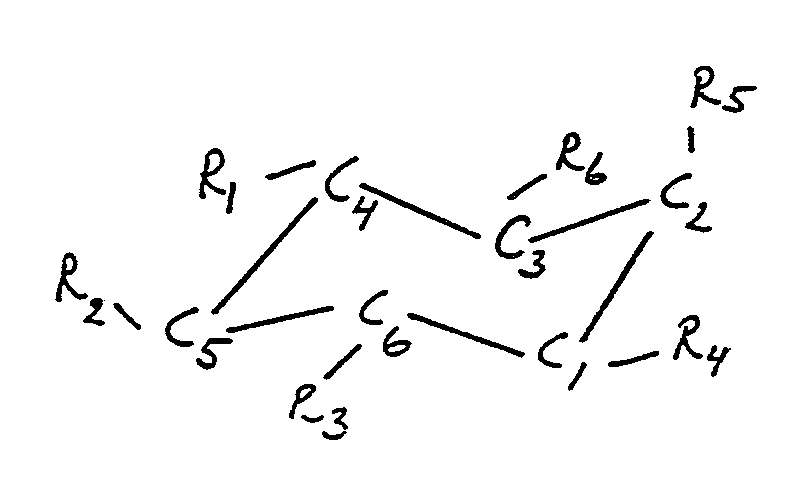

- In one of the most preferred embodiments of this type of the invention R₁, R₂ and R₃ are hydroxyl and R₄, R₅ and R₆ are
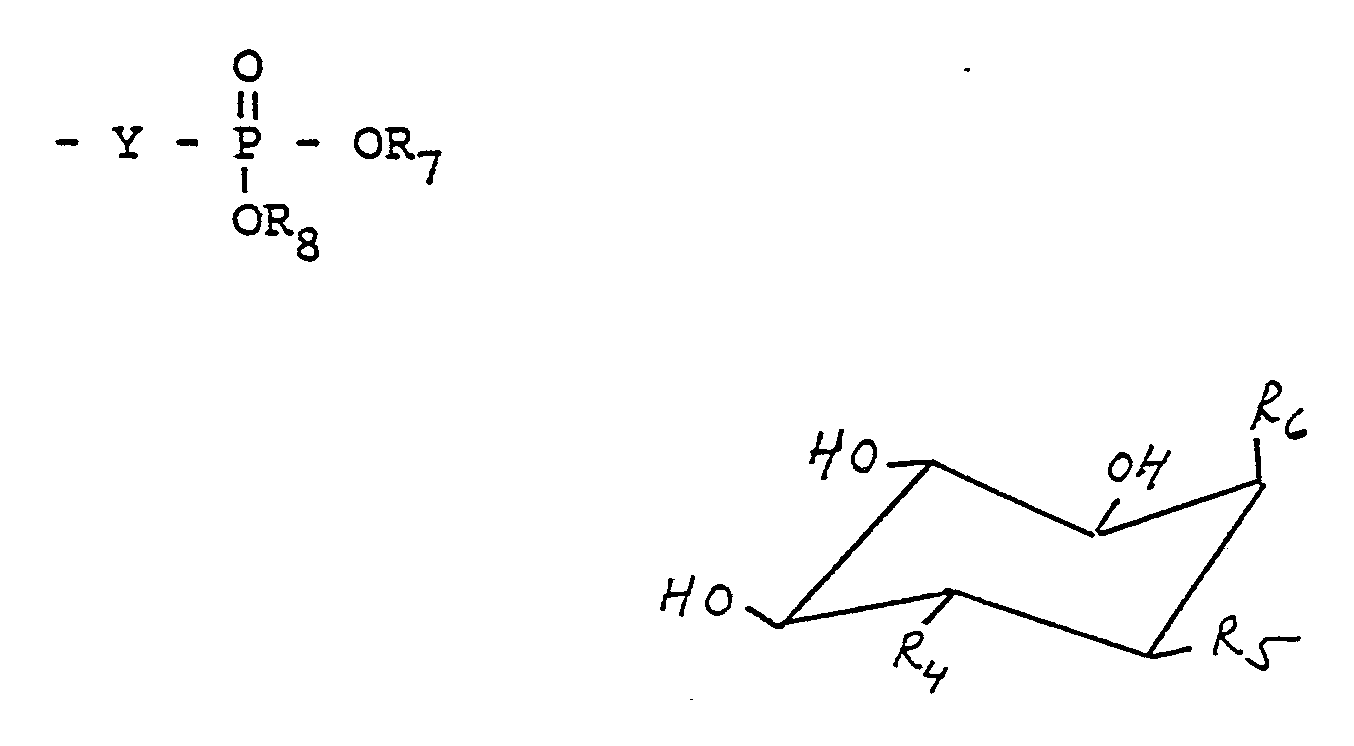
- Preferably, Y is oxygen and R₇ and/or R₈ are hydrogen; or methyl, ethyl, butyl, octyl, dodecyl, phenyl, dihydroxypropyl or esterified dihydroxypropyl, especially with C₁₄ to C₂₀ alkylcarbonyl groups; or glycine, methionine or histidine.
- In another of the most preferred embodiments of the invention R₁, R₂ and R₃ are hydroxyl and R₄, R₅ and R₆ are

- Preferably, R₇ is hydrogen; or methyl, ethyl, butyl, octyl, dodecyl, phenyl, dihydroxypropyl or esterified dihydroxypropyl with C₁₄ to C₂₀ -alkylcarbonyl groups; or glycine, methionine or histidine and R₉ is preferably hydrogen or hydroxyl; or methyl, ethyl, butyl, octyl, dodecyl or phenyl; or methoxy, ethoxy, butoxy or phenoxy; or glycine or methionine; or another configuration isomer of myo-inositol or a phosphorylated isomer of myo-inositol; or amino, methyl- or butylamino.
- In another of the most preferred embodiments of this invention R₁, R₂ and R₃ are hydroxyl and R₄, R₅ and R₆ are F:

- Preferably, F is carboxyl; or carbamyl, N-methylcarbamyl, N-propylcarbamyl or N-cyanocarbamyl; or sulphonyl, aminosulphonyl, N-methyl- or N-butylaminosulphonyl; or phosphonyl or aminophosphonyl; or isoxazolyl, imidazolyl or thiazolyl.
- In another of the most preferred embodiments of this invention R₁, R₂ and R₃ are hydroxyl and R₄ and R₅ are


- Preferably, Y is oxygen and R₇ and/or R₈ are hydrogen or methyl, ethyl, butyl, octyl, dodecyl, phenyl, dihydroxypropyl or esterified dihydroxypropyl, especially with C₁₄ to C₂₀ -alkyl carbonyl groups; or glycine, methionine or histidine, and F is hydroxyl or carboxyl; or carbamyl, N-methylcarbamyl, N-propylcarbamyl or N-cyanocarbamyl; or sulphonyl, aminosulphonyl, N-methyl- or N-butylaminosulphonyl; or phosphonyl or aminophosphonyl; or isoxazolyl, imidazolyl or thiazolyl.
- In one preferred form R₁, R₂, R₃ and R₆ are hydroxyl and R₄ and R₅ are phosphate:

- These latter three described forms of the invention are pharmaceutically active towards conditions characterized by metal disturbance, free radical formation and cell membrane destabilization.
- In one preferred form of this invention R₁ is OB and R₂ is hydroxyl or OB, R₃, R₄, R₅ are hydroxyl and R₆ are

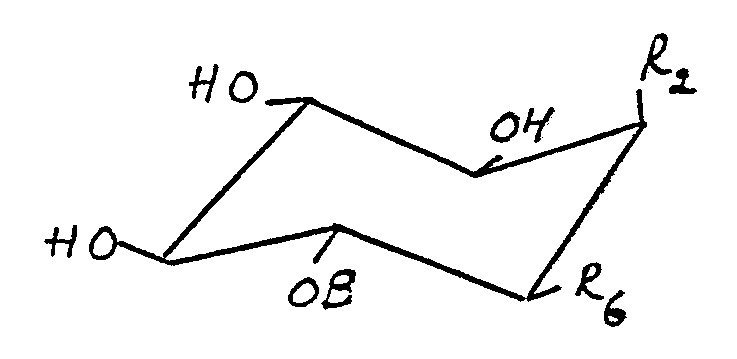
- Preferably Y is oxygen and R₇ and/or R₈ are hydrogen; or dodecyl or eicosyl; or esterified dihydroxypropyl, especially with C₁₄ to C₂₀ -alkylcarbonyl groups and R₉ is hydrogen, hydroxyl or amino or another configuration isomer of myo-inositol or a phosphorylated isomer of myo-inositol. Preferably, B is a glycosyl residue, especially glucose or mannose or glucosamine or a glycoprotein.
- The described compounds can also exist in dimeric or polymeric forms. The described substituents could per se be e.g. pharmaceutically active compounds. The invention also relates to a composition comprising one or more compounds of Formula (I) as defined previously.
- The composition usually contains 10 to 99.5 %, preferably 20 to 99.5 % of these compounds.
- The invention relates to the above mentioned compounds as pharmaceutically active substances, their use for the manufacture of pharmaceutical preparations and to pharmaceutical preparations containing these compounds.
- The invention also relates to the above mentioned compounds as additives for foodstuffs or stabilizers for different products.
- The present invention particularly aims at a method of reducing the negative effect of various metal ions, e.g. cadmium, alumi nium, lead, mercury, nickel or chromium ions or free radicals in the body tissues. Said method comprises administering to a person or an animal, i.e. mammals, an amount of inventive compounds to interfere with such metal ion or inhibit or reduce the formation of free radicals in the body.
- The invention also comprises a method of preventing or alleviating one of the following conditions: an arthritic condition, bronchitis, a cell proliferation change, a cancer, high blood pressure, a cardiovascular disease, age diabetes, damage to the placenta, damage to the testicles, damage of different parts of the eye such as retina tissue and lens, damage to the prostate, damage to cell membranes, damage to the central nervous system, damage to the conducting system of the heart, emphysema, lung fibrosis, migraine headache, menstruation disorders, endothelium damage, kidney damage, thrombosis, multiple sclerosis, increased platelet aggregation, inhibition of the prostacycline production, metal intoxication, allergy caused by lead, mercury, nickel or chromium, inflammatory conditions, damage to the connective tissue, liver damage, brain damage, immunodeficiency, conditions of shock, gastroenteritis, dermatitis and neurological disturbance. Said conditions are attributable to or are caused or aggravated by the presence of metal ion or free radicals in the body.
- The method comprises administering to a human or an animal an amount of chosen compound sufficient to obtain said prevention or alleviation.
- Furthermore, the invention covers a method of alleviating the detrimental effect of radiation in the body, which method comprises administering to a human or an animal an amount of the inventive compound sufficient to alleviate said effect of radiation. For instance the radiation can be X-ray or nuclear radiation, but other kinds of radiation are also contemplated.
- The following examples illustrate the invention but do not restrict it in any way.
- Two hundred µmol of D-myo-inositol-1,2,6-triphosphate in acid form was freeze-dried in a vial. Four hundred mg sodium hydroxide (NaOH) was dissolved in 10 ml dimethylsulphoxide (DMSO) and added to the vial.
- Two ml methyliodide was added and the mixture was stirred under dry nitrogen atmosphere for one hour. After neutralization with 1.0 M sodiumhydroxide an excess of calciumchloride was added to give a precipitate of the formed methyleter.
- Structural determination with NMR and IR showed the product to be the trimethylether of D-myo-inositol-1,2,6-triphosphate.
- One hundred ml of a solution of the sodiumsalt of myo-inositol-1,2,3-triphosphate with a concentration of 0.05 M was added to 100 ml of a mixture of 15 % aqueous sodium bisulphate and ethyl alcohol at room temperature. The mixture was neutralized with 1.0 M sodiumhydroxide and calciumchloride was added to give a precipitate of the calciumsalt of the formed ethylether.
- Structural determination with NMR and IR showed the product to be the triethylether of myo-inositol-1,2,3-triphosphate.
- One hundred µmol of D-myo-inositol-1,2,6-triphosphate in acid form was freeze-dried in a vial. Two hundred mg sodiumhydroxide was dissolved in 5 ml dimethylsulphoxide (DMSO) and added to the vial. Five hundred µl dimethylsulphate was added and the mixture was stirred under dry nitrogen atmosphere for one hour.
- After addition of one ml water the mixture was purified via gel chromatography using silica gel.
- Structural determination with NMR and IR showed the product to be D-myo-inositol-1,2,6 tri(dimethylphosphate).
- Two ml of a 80 % solution of myo-inositol-1,3,4-triphosphate in acid form was added to 4 ml methylene chloride followed by an addition of 2 ml of a diazomethane solution containing excess of diazomethane. After standing at room temperature for 30 minutes the reaction mixture was evaporated to dryness.
- Structural determination with NMR and IR showed the product to be myo-inositol-1,3,4 tri(dimethylphosphate).
- Five hundred mg D-myo-inositol-1,2,6-triphosphate in acid form was mixed with five ml acetylchloride-trifluoracetic acid (1:2) at room temperature.
- The mixture was sonicated for 60 hrs and then evaporated to dryness.
- Structural determination showed the product to be D-3,4,5-tri-O-acetyloxy-myo-inositol-1,2,6-triphosphate.
- Five ml of a 80 % solution of D-myo-inositol-1,2,6-triphosphoric acid was added to 10 ml of dodecanoic acid at room temperature.
- The mixture was stirred for two hours and then neutralized with 0.1 M sodium hydroxide. Six grams of calcium chloride was added to give a precipitate of the calciumsalt of the formed dodecylester. Structural determination with NMR and IR showed the product to be the monododecylester of D-myo-inositol-1,2,6-triphosphate.
- An excess of hydrogenfluoride was added to one hundred mg freeze-dried D-myo-inositol-1,2,6-triphosphate in the presence of one ml concentrated sulphuric acid. After stirrig of the mixture for one hour in room temperature the residue was evaporated and purified with HPLC (reversed phase). The purified compound was D-3,4,5-tri-fluoro-myo-inositol-triphosphate.
- Five hundred mg D-myo-inositol-1,2,6-triphosphate in freeze-dried form was mixed with 1.0 ml concentrated sulphuric acid at 0°C for 30 min.
- Excess of sulphuric acid was removed by gelchromatography and the resulting purified compound was shown to be D-3,4,5-trisulpho-myo-inositol-1,2,6-triphosphate.
- To two hundred mg of the sodiumsalt of D-myo-inositol-1,2,6-triphosphate was added five ml 5.0 M sodium hydroxide in a closed vial. Excess of carbon disulfide was introduced and maintained at 40°C for three hrs under stirrig. The mixture was evaporated and the resulting compound was identified as the xanthate ester of D-myo-inositol-1,2,6--triphosphate.
- One hundred µmol of D-myo-inositol-1,2,6-triphosphate was mixed with 600 mg sodiumhydroxide in two ml water. To this solution 550 mg sodiumchloracetate was added and the reaction mixture was heated to 70°C for 5 hrs. After cooling to room temperature the mixture was neutralized with 2.0 M hydrochloric acid and calcium chloride was added to give a precipitate, which was shown to be D-3,4,5-tri-O-carboxy-myo-inositol-1,2,6-triphosphate.
- 0.5 g of the tetrabutylammoniumsalt of D-myo-inositol-1,2,6-triphosphate was dissolved in dichloromethane. To this solution 0.2 g of pyridinium chlorochromate was added and the mixture was stirred for 48 hrs at 25°C. The reaction mixture was filtered through silica gel and the purified compound was determined to be D-4-oxy-myo-inositol-1,2,6-triphosphate.
- A solution of (benzyloxymethyl)tributylstannane (0.7 g) in tetrahydrofuran was cooled to -78°C under a nitrogen atmosphere and n-butyllithium (1.0 ml 1.6 M in hexane) was added.
- After 20 minutes at -78°C 0.5 g of the compound formed in example 11, D-4-oxy-myo-inositol-1,2,6-triphosphate in tetrahydrofuran (2 ml) was added. After 30 minutes the reaction mixture was partitioned between diethylether and water. The organic phase was dried with sodium sulphate and evaporated. The residue was purified by HPLC and was shown to be D-4-C-benzyloxymethyl-myo-inositol-1,2,6-triphosphate.
- 0.6 g of the compound formed in example 11, D-4-oxy-myo-inositol-1,2,6-triphosphate was dissolved in 10 ml water and hydroxylamine hydrochloride (110 mg) and an aqueous solution of sodium acetate (100 mg in 5 ml water) was added dropwise under stirring. The mixture was stirred further for 2.5 hours at room temperature.
- To the reaction mixture 5 % sodium amalgam (total 20 g) was added at 5 min intervals for one hour under stirring and cooling to below 25°C in a water bath. After removal of mercury by decantation the supernatant was purified with ion-exchange chromatography.
- Structural determination showed the product to be D-4-amino-myo-inositol-1,2,6-triphosphate.
- Five ml of a 80 % solution of D-myo-inositol-1,2,6-triphosphate in acid form was added to the cesium salt of glycine (2.5 g) and further 1.0 ml of concentrated sulphuric acid was added. The mixture was stirred for two hours in room temperature and then neutralized with 1.0 M NaOH. Six grams of calcium chloride was added to give a precipitate which was shown to be the monoglycyl ester of D-myo-inositol-1,2,6-triphosphate.
- 1.0 g of the tetrabutylammoniumsalt of D-myo-inositol-1,2,6-triphosphate was dissolved in chloroform. Galactose (850 mg) and anhydrous hydrogen chloride (1.0 ml) was added and the mixture was heated under reflux for 12 hours.
- After cooling to room temperature the mixture was purified with gelchromatography (silica gel) and a compound determined by NMR to be 4-O-galactosyl-myo-inositol-1,2,6-triphosphate was isolated.
- One hundred mg of D-myo-inositol-1,2,6-triphosphate was freeze-dried in a vial. One ml of N,O-bis(trimethylsilyl)trifluoracetamide-chlorotrimethylsilane-pyridine (9:9:10;v:v:v) was added and taken to dryness under a stream of nitrogen and then dissolved in 1.0 ml of 10 % anhydrous methanol in diethyl ether at 0°C. After 15 minutes the mixture was evaporated and structural determination of the residue showed it to be
D-3,4,5-tri-O-trimethylsilyl-myo-inositol--1,2,6-triphosphate. - Tablets of the calcium salt of triethylether of myo-inositol-1,2,3-triphosphate were produced in the following way. 50 g calcium salt of triethylether of myo-inositol-1,2,3-triphosphate, 132 g lactose and 6 g acacia were mixed. Purified water was then added to the mixture, whereupon the mixing was continued until a suitable consistency was obtained. The mixture was sieved and dried. Then the mixture was blended with 10 g talcum and 2 g magnesium stearate. The mixture was compressed into tablets each weighing 200 mg.
- Tablets of the calcium salt of monododecylester of D-myo-inositol-1,2,6-triphosphate were produced in the following way. 50 g calcium salt of monodedecylester of D-myo-inositol-1,2,6-triphosphate, 132 g lactose and 6 g acacia were mixed. Purified water was then added to the mixture, whereupon the mixing was continued until a suitable consistency was obtained. The mixture was sieved and dried. Then the mixture was blended with 10 g talcum and 2 g magnesium stearate. The mixture was compressed into tablets each weighing 200 mg.
- In those cases where the compounds of the present invention are soluble, solutions suitable for injection can easily be prepared too.
R₄, R₅ and R₆ independently are
R₄, R₅, R₆ are

R₄, R₅ and R₆ are
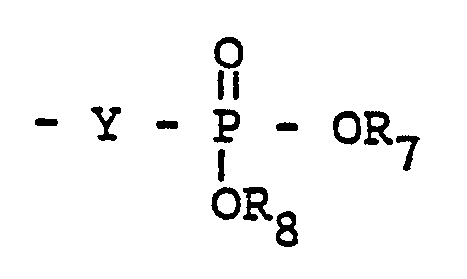
Claims (22)
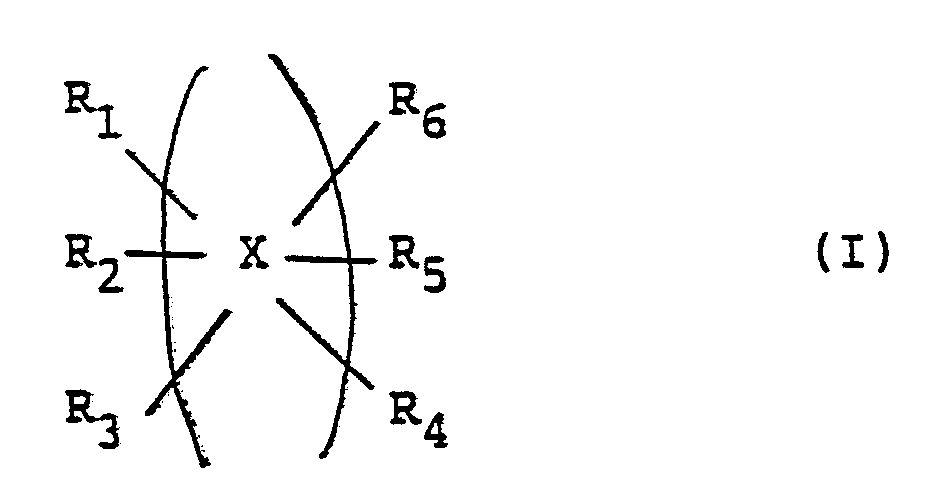
O


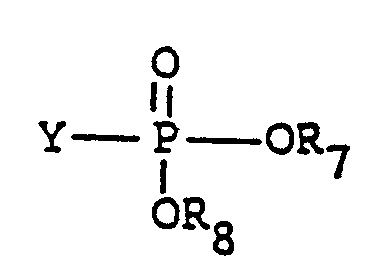
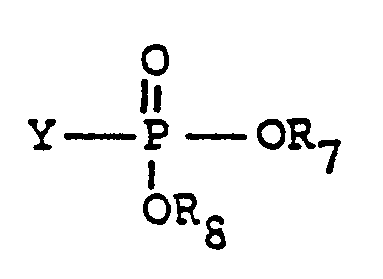


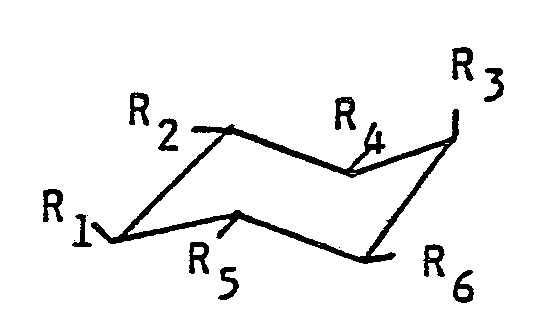
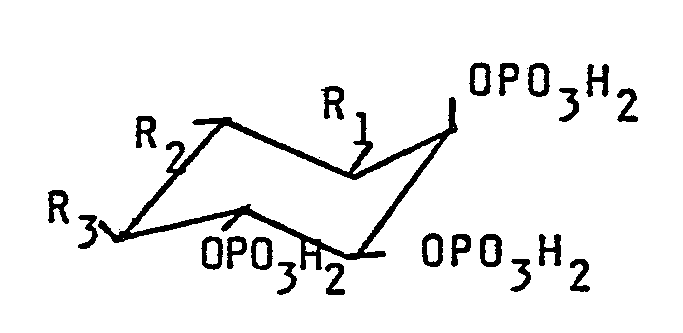

Applications Claiming Priority (2)
| Application Number | Priority Date | Filing Date | Title |
|---|---|---|---|
| SE8605063A SE8605063D0 (en) | 1986-11-26 | 1986-11-26 | DERIVATIVES OF CYCLOHEXANE |
| SE8605063 | 1986-11-26 |
Publications (3)
| Publication Number | Publication Date |
|---|---|
| EP0269105A2 true EP0269105A2 (en) | 1988-06-01 |
| EP0269105A3 EP0269105A3 (en) | 1990-05-02 |
| EP0269105B1 EP0269105B1 (en) | 1999-02-03 |
Family
ID=20366413
Family Applications (1)
| Application Number | Title | Priority Date | Filing Date |
|---|---|---|---|
| EP87117481A Expired - Lifetime EP0269105B1 (en) | 1986-11-26 | 1987-11-26 | Derivatives of cyclohexane, preparations containing them and their use |
Country Status (11)
| Country | Link |
|---|---|
| US (2) | US5157140A (en) |
| EP (1) | EP0269105B1 (en) |
| JP (1) | JP2528149B2 (en) |
| AT (1) | ATE176474T1 (en) |
| AU (1) | AU603158B2 (en) |
| CA (1) | CA1339660C (en) |
| DE (2) | DE3752250T2 (en) |
| ES (1) | ES2130111T3 (en) |
| GB (2) | GB8727483D0 (en) |
| GR (1) | GR3030124T3 (en) |
| SE (1) | SE8605063D0 (en) |
Cited By (13)
| Publication number | Priority date | Publication date | Assignee | Title |
|---|---|---|---|---|
| WO1989000156A1 (en) * | 1987-07-02 | 1989-01-12 | 3I Research Exploitation Limited | Preparation of isomers of myo-inositol derivatives |
| EP0520372A1 (en) * | 1991-06-26 | 1992-12-30 | Hoechst Aktiengesellschaft | Inositol phosphate analogues as calcium-antagonistic substances |
| WO1993001197A1 (en) * | 1991-07-03 | 1993-01-21 | Perstorp Ab | Derivatives of inositol, preparations containing them and their use |
| WO1995014475A1 (en) * | 1993-11-22 | 1995-06-01 | Perstorp Ab | The use of an ester of inositoltrisphosphate for the preparing of medicaments |
| WO1995014477A1 (en) * | 1993-11-22 | 1995-06-01 | Perstorp Ab | The use of an ester of inositoltrisphosphate for the treatment of inflammatory conditions |
| WO1995014476A1 (en) * | 1993-11-22 | 1995-06-01 | Perstorp Ab | The use of an ester of inositoltrisphosphate for the preparing of an analgetic medicament |
| WO1997023229A1 (en) * | 1995-12-21 | 1997-07-03 | Perstorp Ab | The use of an ester of inositoltrisphosphate for the preparing of medicaments |
| WO1997049408A1 (en) * | 1996-06-24 | 1997-12-31 | Perstorp Ab | The use of growth factor modulating compounds |
| US7479535B2 (en) | 2002-02-25 | 2009-01-20 | Guilford Pharmaceuticals, Inc. | Phosphorous-containing compounds with polymeric chains, and methods of making and using the same |
| WO2017098047A1 (en) * | 2015-12-11 | 2017-06-15 | ETH Zürich | Inositol derivatives for use in pathological crystallization |
| US10487097B2 (en) | 2015-12-11 | 2019-11-26 | Eth Zurich | 4,6-di-(O-thiophosphate)-inositol-1,2,3,5-tetra-O-sulfate for C. difficile infection |
| US11028112B2 (en) | 2015-12-11 | 2021-06-08 | Eth Zurich | Inositol derivatives for use in pathological crystallization |
| US11707470B2 (en) | 2015-12-11 | 2023-07-25 | Eth Zurich | Inositol derivatives for use in pathological crystallization |
Families Citing this family (12)
| Publication number | Priority date | Publication date | Assignee | Title |
|---|---|---|---|---|
| SE8605063D0 (en) * | 1986-11-26 | 1986-11-26 | Matti Siren | DERIVATIVES OF CYCLOHEXANE |
| US5274161A (en) * | 1986-11-26 | 1993-12-28 | Perstorp Ab | Derivatives of cyclohexane |
| EP0579957A1 (en) | 1987-07-02 | 1994-01-26 | 3i RESEARCH EXPLOITATION LIMITED | Preparation of isomers of myoinositol derivatives |
| EP1272201B1 (en) * | 2000-04-12 | 2004-11-24 | Bitop Aktiengesellschaft Für Biotechnische Optimierung | Use of compatible solutes as substances having free radical scavenging properties |
| ES2336545T3 (en) * | 2000-08-18 | 2010-04-14 | Bitop Gesellschaft Fur Biotechnische Optimierung Mbh | EMPLOYMENT OF DISKARIC ALCOHOL PHOSPHATES FOR THE PROTECTION OF HUMAN CUTANEOUS CELLS AGAINST UV AND / OR IR IRRADIATION. |
| CA2430190A1 (en) | 2000-11-21 | 2002-05-30 | Alexis Traynor-Kaplan | Inositol derivatives for increasing chloride secretion and inhibiting inflammation |
| AU2004225969A1 (en) * | 2003-03-27 | 2004-10-14 | Inologic, Inc. | Camphanylidene and phenylalkyl inositol polyphosphate compounds, compositions, and methods of their use |
| EP2114151A4 (en) * | 2007-03-01 | 2010-03-17 | Concourse Health Sciences Llc | Isomers of inositol niacinate and uses thereof |
| JP4925461B2 (en) * | 2007-12-25 | 2012-04-25 | 株式会社錢高組 | Earth retaining structure using steel pipe, construction method thereof and shield machine start-up construction method |
| GB0920985D0 (en) * | 2009-11-30 | 2010-01-13 | Queen Mary & Westfield College | Novel inositol phosphate derivatives |
| US9751903B2 (en) | 2011-09-29 | 2017-09-05 | Eth Zurich | Pharmaceutical compounds for use in the therapy of clostridium difficile infection |
| ES2727633T3 (en) * | 2011-09-29 | 2019-10-17 | Eth Zuerich | Pharmaceutical compounds for use in the therapy of Clostridium difficile infection |
Family Cites Families (6)
| Publication number | Priority date | Publication date | Assignee | Title |
|---|---|---|---|---|
| FR1604995A (en) * | 1968-12-27 | 1972-06-26 | Metal inositol hexaphosphates - from inositol hexaphosphoric acid and organo metal cpd in anhydrous medium | |
| SE465951B (en) * | 1984-10-23 | 1991-11-25 | Perstorp Ab | ISOMER OF INOSITOL TRIPHOSPHATE PHARMACEUTICAL STATEMENTS FOR SALT FOR USE AS THERAPEUTIC OR PROPHYLACTIC AGENTS AND COMPOSITIONS THEREOF |
| US4952717A (en) * | 1986-03-11 | 1990-08-28 | Mitsui Toatsu Chemicals, Incorporated | Myoinositol derivatives and preparation process thereof |
| SE8605063D0 (en) * | 1986-11-26 | 1986-11-26 | Matti Siren | DERIVATIVES OF CYCLOHEXANE |
| US4873355A (en) * | 1987-05-29 | 1989-10-10 | E. I. Du Pont De Nemours And Company | Process for regioselectively preparing phosphorylated inositols and other cyclitols |
| JPS63198642U (en) * | 1987-06-11 | 1988-12-21 |
-
1986
- 1986-11-26 SE SE8605063A patent/SE8605063D0/en unknown
-
1987
- 1987-11-24 GB GB878727483A patent/GB8727483D0/en active Pending
- 1987-11-24 GB GB8727482A patent/GB2198135B/en not_active Expired - Lifetime
- 1987-11-25 CA CA000552693A patent/CA1339660C/en not_active Expired - Fee Related
- 1987-11-25 AU AU81682/87A patent/AU603158B2/en not_active Ceased
- 1987-11-26 DE DE3752250T patent/DE3752250T2/en not_active Expired - Fee Related
- 1987-11-26 EP EP87117481A patent/EP0269105B1/en not_active Expired - Lifetime
- 1987-11-26 AT AT87117481T patent/ATE176474T1/en active
- 1987-11-26 DE DE19873740152 patent/DE3740152A1/en not_active Withdrawn
- 1987-11-26 ES ES87117481T patent/ES2130111T3/en not_active Expired - Lifetime
- 1987-11-26 JP JP62298880A patent/JP2528149B2/en not_active Expired - Lifetime
-
1989
- 1989-12-29 US US07/458,904 patent/US5157140A/en not_active Expired - Lifetime
-
1992
- 1992-08-05 US US07/926,153 patent/US5278332A/en not_active Expired - Fee Related
-
1999
- 1999-04-30 GR GR990401206T patent/GR3030124T3/en unknown
Non-Patent Citations (1)
| Title |
|---|
| BIOCHEM. BIOPHYS. RES. COMMUN., vol. 120, no. 2, 1984, pages 481 |
Cited By (29)
| Publication number | Priority date | Publication date | Assignee | Title |
|---|---|---|---|---|
| WO1989000156A1 (en) * | 1987-07-02 | 1989-01-12 | 3I Research Exploitation Limited | Preparation of isomers of myo-inositol derivatives |
| EP0520372A1 (en) * | 1991-06-26 | 1992-12-30 | Hoechst Aktiengesellschaft | Inositol phosphate analogues as calcium-antagonistic substances |
| US5395828A (en) * | 1991-06-26 | 1995-03-07 | Hoechst Aktiengesellschaft | Inositol phosphate analogues as calcium-antagonistic substances |
| WO1993001197A1 (en) * | 1991-07-03 | 1993-01-21 | Perstorp Ab | Derivatives of inositol, preparations containing them and their use |
| US5306841A (en) * | 1991-07-03 | 1994-04-26 | Bundgaard Hans | Derivatives of inositol, preparations containing them and their use |
| WO1995014475A1 (en) * | 1993-11-22 | 1995-06-01 | Perstorp Ab | The use of an ester of inositoltrisphosphate for the preparing of medicaments |
| WO1995014477A1 (en) * | 1993-11-22 | 1995-06-01 | Perstorp Ab | The use of an ester of inositoltrisphosphate for the treatment of inflammatory conditions |
| WO1995014476A1 (en) * | 1993-11-22 | 1995-06-01 | Perstorp Ab | The use of an ester of inositoltrisphosphate for the preparing of an analgetic medicament |
| US5846957A (en) * | 1993-11-22 | 1998-12-08 | Perstorp Ab | Use of an ester of inositoltrisphosphate for the preparing of medicaments |
| US5866557A (en) * | 1993-11-22 | 1999-02-02 | Perstorp Ab | Use of an ester of inositoltrisphosphate for the treatment of inflammatory conditions |
| WO1997023229A1 (en) * | 1995-12-21 | 1997-07-03 | Perstorp Ab | The use of an ester of inositoltrisphosphate for the preparing of medicaments |
| WO1997049408A1 (en) * | 1996-06-24 | 1997-12-31 | Perstorp Ab | The use of growth factor modulating compounds |
| US8258255B2 (en) | 2002-02-25 | 2012-09-04 | Eisai Inc. | Phosphorus-containing compounds with polymeric chains, and methods of making and using the same |
| US7674875B2 (en) | 2002-02-25 | 2010-03-09 | Eisai Inc. | Phosphorus-containing compounds with polymeric chains, and methods of making and using the same |
| US7479535B2 (en) | 2002-02-25 | 2009-01-20 | Guilford Pharmaceuticals, Inc. | Phosphorous-containing compounds with polymeric chains, and methods of making and using the same |
| US11028112B2 (en) | 2015-12-11 | 2021-06-08 | Eth Zurich | Inositol derivatives for use in pathological crystallization |
| EP3848053A1 (en) * | 2015-12-11 | 2021-07-14 | Universität Bern | Inositol derivatives for use in pathological crystallization |
| US10487097B2 (en) | 2015-12-11 | 2019-11-26 | Eth Zurich | 4,6-di-(O-thiophosphate)-inositol-1,2,3,5-tetra-O-sulfate for C. difficile infection |
| EP3386994B1 (en) * | 2015-12-11 | 2019-12-11 | ETH Zürich | 4,6-di-(o-thiophosphate)-inositol-1,2,3,5-tetra-o-sulfate for c. difficile infection |
| US10624909B2 (en) | 2015-12-11 | 2020-04-21 | Eth Zurich | Inositol derivatives for use in pathological crystallization |
| EA037572B1 (en) * | 2015-12-11 | 2021-04-15 | Этх Цюрих | Inositol derivatives for use in pathological crystallization |
| WO2017098047A1 (en) * | 2015-12-11 | 2017-06-15 | ETH Zürich | Inositol derivatives for use in pathological crystallization |
| KR20180088411A (en) * | 2015-12-11 | 2018-08-03 | 에테하 쭈리히 | Inositol derivatives for use in pathological crystallization |
| AU2016368547B2 (en) * | 2015-12-11 | 2021-11-18 | ETH Zürich | Inositol derivatives for use in pathological crystallization |
| CN113788855A (en) * | 2015-12-11 | 2021-12-14 | 苏黎世联邦理工学院 | Inositol Derivatives for Pathological Crystallization |
| US11707470B2 (en) | 2015-12-11 | 2023-07-25 | Eth Zurich | Inositol derivatives for use in pathological crystallization |
| AU2022200542B2 (en) * | 2015-12-11 | 2024-01-04 | ETH Zürich | Inositol derivatives for use in pathological crystallization |
| CN113788855B (en) * | 2015-12-11 | 2024-03-01 | 苏黎世联邦理工学院 | Inositol derivatives for pathological crystallization |
| US12076331B2 (en) | 2015-12-11 | 2024-09-03 | Eth Zurich | Inositol derivatives for use in pathological crystallization |
Also Published As
| Publication number | Publication date |
|---|---|
| GR3030124T3 (en) | 1999-07-30 |
| JPS63198694A (en) | 1988-08-17 |
| DE3752250D1 (en) | 1999-03-18 |
| EP0269105B1 (en) | 1999-02-03 |
| GB8727483D0 (en) | 1987-12-23 |
| GB2198135A (en) | 1988-06-08 |
| EP0269105A3 (en) | 1990-05-02 |
| DE3752250T2 (en) | 1999-06-24 |
| AU8168287A (en) | 1988-06-02 |
| AU603158B2 (en) | 1990-11-08 |
| US5278332A (en) | 1994-01-11 |
| GB2198135B (en) | 1991-07-31 |
| ATE176474T1 (en) | 1999-02-15 |
| SE8605063D0 (en) | 1986-11-26 |
| US5157140A (en) | 1992-10-20 |
| DE3740152A1 (en) | 1988-06-09 |
| CA1339660C (en) | 1998-02-03 |
| GB8727482D0 (en) | 1987-12-23 |
| JP2528149B2 (en) | 1996-08-28 |
| ES2130111T3 (en) | 1999-07-01 |
Similar Documents
| Publication | Publication Date | Title |
|---|---|---|
| EP0269105B1 (en) | Derivatives of cyclohexane, preparations containing them and their use | |
| EP0009183B1 (en) | Phosphoryl aminoacid derivatives and composition for treating hypertension containing the same | |
| US5391800A (en) | Method for inhibition of cell motility by sphingosine-1-phosphate, its derivatives and mimetics and method of synthesizing sphingosine-1-phosphate and its derivatives | |
| EP0252505B1 (en) | 1-hydroxy-3-(n-methyl-n-propyl amino)propane-1,1-diphosphonic acid, process for its preparation and medicines containing this compound | |
| EP0534546A1 (en) | Farnesyl pyrophosphate analogs | |
| EP0056992A1 (en) | Phosphorylated derivatives, pharmaceutical compositions containing such derivatives, and their use | |
| US5274161A (en) | Derivatives of cyclohexane | |
| GB1580899A (en) | Hydroxyaminohydrocarbonphosphonic acid derivatives and production and use thereof | |
| KR850000064B1 (en) | Process for preparing derivative of aldohexoses | |
| EP0730460B1 (en) | The use of an ester of inositoltrisphosphate for the treatment of inflammatory conditions | |
| JP3102798B2 (en) | Inositol derivatives, formulations containing them and their use | |
| EP0793668B1 (en) | Derivatives of carbohydrates and compositions containing them | |
| AU596800B2 (en) | Improvements in or relating to organic compounds | |
| US4916249A (en) | Glycero-3(2)-phospho-L-serine derivatives and salts thereof | |
| AU595987B2 (en) | Disaccharide derivatives | |
| FI111369B (en) | New 1,1-di:halo:alkyl -phosphonate(s) and -phosphinyl:methyl-phosphonate(s) | |
| FI82473C (en) | Process for the preparation of pharmacologically valuable glycero-3 (2) -phospho-L-cerine derivatives | |
| FI81807C (en) | PROCEDURE FOR FRAMSTATION OF 2,3-DIAMINO-2,3-DIDESOXYHEXOSDERIVATIVER. | |
| IE910491A1 (en) | Method for the preparation of polyphosphorylated derivatives¹of galactopyranosides with a potential insulin-like activity | |
| SI9300001A (en) | PEPTIDOGLYCAN MONOMER (PGM) COMPLEXES WITH TRIVALENT METALS, PROCEDURE FOR THEIR PREPARATION AND THEIR USE | |
| DD239209A1 (en) | PROCESS FOR THE PREPARATION OF O-ALKYL SUBSTITUTED GLYCERO AND DESOXYGLYCEROPHOSPHO SERINES |
Legal Events
| Date | Code | Title | Description |
|---|---|---|---|
| PUAI | Public reference made under article 153(3) epc to a published international application that has entered the european phase |
Free format text: ORIGINAL CODE: 0009012 |
|
| AK | Designated contracting states |
Kind code of ref document: A2 Designated state(s): AT BE CH DE ES FR GB GR IT LI LU NL SE |
|
| PUAL | Search report despatched |
Free format text: ORIGINAL CODE: 0009013 |
|
| AK | Designated contracting states |
Kind code of ref document: A3 Designated state(s): AT BE CH DE ES FR GB GR IT LI LU NL SE |
|
| RAP1 | Party data changed (applicant data changed or rights of an application transferred) |
Owner name: PERSTORP AB |
|
| RIN1 | Information on inventor provided before grant (corrected) |
Inventor name: SIREN, MATTI |
|
| 17P | Request for examination filed |
Effective date: 19900816 |
|
| 17Q | First examination report despatched |
Effective date: 19940128 |
|
| GRAG | Despatch of communication of intention to grant |
Free format text: ORIGINAL CODE: EPIDOS AGRA |
|
| GRAG | Despatch of communication of intention to grant |
Free format text: ORIGINAL CODE: EPIDOS AGRA |
|
| GRAG | Despatch of communication of intention to grant |
Free format text: ORIGINAL CODE: EPIDOS AGRA |
|
| GRAH | Despatch of communication of intention to grant a patent |
Free format text: ORIGINAL CODE: EPIDOS IGRA |
|
| RBV | Designated contracting states (corrected) |
Designated state(s): AT BE CH DE ES FR GR IT LI LU NL SE |
|
| GRAH | Despatch of communication of intention to grant a patent |
Free format text: ORIGINAL CODE: EPIDOS IGRA |
|
| GRAA | (expected) grant |
Free format text: ORIGINAL CODE: 0009210 |
|
| AK | Designated contracting states |
Kind code of ref document: B1 Designated state(s): AT BE CH DE ES FR GR IT LI LU NL SE |
|
| REF | Corresponds to: |
Ref document number: 176474 Country of ref document: AT Date of ref document: 19990215 Kind code of ref document: T |
|
| REG | Reference to a national code |
Ref country code: CH Ref legal event code: EP |
|
| REF | Corresponds to: |
Ref document number: 3752250 Country of ref document: DE Date of ref document: 19990318 |
|
| ITF | It: translation for a ep patent filed | ||
| REG | Reference to a national code |
Ref country code: CH Ref legal event code: NV Representative=s name: BUECHEL & PARTNER AG PATENTBUERO |
|
| ET | Fr: translation filed | ||
| REG | Reference to a national code |
Ref country code: ES Ref legal event code: FG2A Ref document number: 2130111 Country of ref document: ES Kind code of ref document: T3 |
|
| PGFP | Annual fee paid to national office [announced via postgrant information from national office to epo] |
Ref country code: SE Payment date: 19991130 Year of fee payment: 13 |
|
| PLBE | No opposition filed within time limit |
Free format text: ORIGINAL CODE: 0009261 |
|
| STAA | Information on the status of an ep patent application or granted ep patent |
Free format text: STATUS: NO OPPOSITION FILED WITHIN TIME LIMIT |
|
| 26N | No opposition filed | ||
| PGFP | Annual fee paid to national office [announced via postgrant information from national office to epo] |
Ref country code: FR Payment date: 20000530 Year of fee payment: 13 Ref country code: ES Payment date: 20000530 Year of fee payment: 13 |
|
| PGFP | Annual fee paid to national office [announced via postgrant information from national office to epo] |
Ref country code: NL Payment date: 20000531 Year of fee payment: 13 Ref country code: GR Payment date: 20000531 Year of fee payment: 13 Ref country code: CH Payment date: 20000531 Year of fee payment: 13 Ref country code: BE Payment date: 20000531 Year of fee payment: 13 Ref country code: AT Payment date: 20000531 Year of fee payment: 13 |
|
| PGFP | Annual fee paid to national office [announced via postgrant information from national office to epo] |
Ref country code: LU Payment date: 20000606 Year of fee payment: 13 |
|
| PGFP | Annual fee paid to national office [announced via postgrant information from national office to epo] |
Ref country code: DE Payment date: 20000710 Year of fee payment: 13 |
|
| PG25 | Lapsed in a contracting state [announced via postgrant information from national office to epo] |
Ref country code: LU Free format text: LAPSE BECAUSE OF NON-PAYMENT OF DUE FEES Effective date: 20001126 Ref country code: AT Free format text: LAPSE BECAUSE OF NON-PAYMENT OF DUE FEES Effective date: 20001126 |
|
| PG25 | Lapsed in a contracting state [announced via postgrant information from national office to epo] |
Ref country code: ES Free format text: LAPSE BECAUSE OF NON-PAYMENT OF DUE FEES Effective date: 20001127 |
|
| PG25 | Lapsed in a contracting state [announced via postgrant information from national office to epo] |
Ref country code: SE Free format text: THE PATENT HAS BEEN ANNULLED BY A DECISION OF A NATIONAL AUTHORITY Effective date: 20001129 |
|
| PG25 | Lapsed in a contracting state [announced via postgrant information from national office to epo] |
Ref country code: LI Free format text: LAPSE BECAUSE OF NON-PAYMENT OF DUE FEES Effective date: 20001130 Ref country code: GR Free format text: LAPSE BECAUSE OF NON-PAYMENT OF DUE FEES Effective date: 20001130 Ref country code: CH Free format text: LAPSE BECAUSE OF NON-PAYMENT OF DUE FEES Effective date: 20001130 Ref country code: BE Free format text: LAPSE BECAUSE OF NON-PAYMENT OF DUE FEES Effective date: 20001130 |
|
| BERE | Be: lapsed |
Owner name: PERSTORP A.B. Effective date: 20001130 |
|
| PG25 | Lapsed in a contracting state [announced via postgrant information from national office to epo] |
Ref country code: NL Free format text: LAPSE BECAUSE OF NON-PAYMENT OF DUE FEES Effective date: 20010601 |
|
| REG | Reference to a national code |
Ref country code: CH Ref legal event code: PL |
|
| EUG | Se: european patent has lapsed |
Ref document number: 87117481.9 |
|
| PG25 | Lapsed in a contracting state [announced via postgrant information from national office to epo] |
Ref country code: FR Free format text: LAPSE BECAUSE OF NON-PAYMENT OF DUE FEES Effective date: 20010731 |
|
| NLV4 | Nl: lapsed or anulled due to non-payment of the annual fee |
Effective date: 20010601 |
|
| PG25 | Lapsed in a contracting state [announced via postgrant information from national office to epo] |
Ref country code: DE Free format text: LAPSE BECAUSE OF NON-PAYMENT OF DUE FEES Effective date: 20010801 |
|
| REG | Reference to a national code |
Ref country code: FR Ref legal event code: ST |
|
| REG | Reference to a national code |
Ref country code: ES Ref legal event code: FD2A Effective date: 20011214 |
|
| PG25 | Lapsed in a contracting state [announced via postgrant information from national office to epo] |
Ref country code: IT Free format text: LAPSE BECAUSE OF NON-PAYMENT OF DUE FEES;WARNING: LAPSES OF ITALIAN PATENTS WITH EFFECTIVE DATE BEFORE 2007 MAY HAVE OCCURRED AT ANY TIME BEFORE 2007. THE CORRECT EFFECTIVE DATE MAY BE DIFFERENT FROM THE ONE RECORDED. Effective date: 20051126 |