EP0266849B1 - Process for introducing a thiocarboxylic ester group at the ortho-position of phenols or phenylamines - Google Patents
Process for introducing a thiocarboxylic ester group at the ortho-position of phenols or phenylamines Download PDFInfo
- Publication number
- EP0266849B1 EP0266849B1 EP87202150A EP87202150A EP0266849B1 EP 0266849 B1 EP0266849 B1 EP 0266849B1 EP 87202150 A EP87202150 A EP 87202150A EP 87202150 A EP87202150 A EP 87202150A EP 0266849 B1 EP0266849 B1 EP 0266849B1
- Authority
- EP
- European Patent Office
- Prior art keywords
- alkyl
- aralkyl
- process according
- alkoxy
- thiocyanate
- Prior art date
- Legal status (The legal status is an assumption and is not a legal conclusion. Google has not performed a legal analysis and makes no representation as to the accuracy of the status listed.)
- Expired - Lifetime
Links
- 238000000034 method Methods 0.000 title claims abstract description 24
- ISWSIDIOOBJBQZ-UHFFFAOYSA-N phenol group Chemical group C1(=CC=CC=C1)O ISWSIDIOOBJBQZ-UHFFFAOYSA-N 0.000 title claims abstract description 5
- 125000002490 anilino group Chemical group [H]N(*)C1=C([H])C([H])=C([H])C([H])=C1[H] 0.000 title claims abstract 3
- 125000004185 ester group Chemical group 0.000 title claims description 4
- -1 phenyl compound Chemical class 0.000 claims abstract description 34
- ZMZDMBWJUHKJPS-UHFFFAOYSA-N hydrogen thiocyanate Natural products SC#N ZMZDMBWJUHKJPS-UHFFFAOYSA-N 0.000 claims abstract description 9
- ZOXJGFHDIHLPTG-UHFFFAOYSA-N Boron Chemical compound [B] ZOXJGFHDIHLPTG-UHFFFAOYSA-N 0.000 claims abstract description 4
- 229910052796 boron Inorganic materials 0.000 claims abstract description 4
- 125000002887 hydroxy group Chemical group [H]O* 0.000 claims abstract description 3
- 230000002378 acidificating effect Effects 0.000 claims abstract 2
- 125000003277 amino group Chemical group 0.000 claims abstract 2
- 125000004122 cyclic group Chemical group 0.000 claims abstract 2
- 230000003301 hydrolyzing effect Effects 0.000 claims abstract 2
- 125000002924 primary amino group Chemical group [H]N([H])* 0.000 claims abstract 2
- 238000006243 chemical reaction Methods 0.000 claims description 34
- VSCWAEJMTAWNJL-UHFFFAOYSA-K aluminium trichloride Chemical compound Cl[Al](Cl)Cl VSCWAEJMTAWNJL-UHFFFAOYSA-K 0.000 claims description 22
- UHOVQNZJYSORNB-UHFFFAOYSA-N Benzene Chemical compound C1=CC=CC=C1 UHOVQNZJYSORNB-UHFFFAOYSA-N 0.000 claims description 18
- 125000003545 alkoxy group Chemical group 0.000 claims description 15
- 150000001875 compounds Chemical class 0.000 claims description 13
- 125000000217 alkyl group Chemical group 0.000 claims description 12
- 125000003710 aryl alkyl group Chemical group 0.000 claims description 12
- 229910052736 halogen Inorganic materials 0.000 claims description 12
- 150000002367 halogens Chemical class 0.000 claims description 12
- FAQYAMRNWDIXMY-UHFFFAOYSA-N trichloroborane Chemical compound ClB(Cl)Cl FAQYAMRNWDIXMY-UHFFFAOYSA-N 0.000 claims description 12
- 125000006527 (C1-C5) alkyl group Chemical group 0.000 claims description 10
- JUJWROOIHBZHMG-UHFFFAOYSA-N Pyridine Chemical compound C1=CC=NC=C1 JUJWROOIHBZHMG-UHFFFAOYSA-N 0.000 claims description 8
- 239000013067 intermediate product Substances 0.000 claims description 6
- 125000001997 phenyl group Chemical group [H]C1=C([H])C([H])=C(*)C([H])=C1[H] 0.000 claims description 6
- KJCVRFUGPWSIIH-UHFFFAOYSA-N 1-naphthol Chemical compound C1=CC=C2C(O)=CC=CC2=C1 KJCVRFUGPWSIIH-UHFFFAOYSA-N 0.000 claims description 4
- JWAZRIHNYRIHIV-UHFFFAOYSA-N 2-naphthol Chemical compound C1=CC=CC2=CC(O)=CC=C21 JWAZRIHNYRIHIV-UHFFFAOYSA-N 0.000 claims description 4
- UJOBWOGCFQCDNV-UHFFFAOYSA-N 9H-carbazole Chemical compound C1=CC=C2C3=CC=CC=C3NC2=C1 UJOBWOGCFQCDNV-UHFFFAOYSA-N 0.000 claims description 4
- 239000007795 chemical reaction product Substances 0.000 claims description 4
- 125000000113 cyclohexyl group Chemical group [H]C1([H])C([H])([H])C([H])([H])C([H])(*)C([H])([H])C1([H])[H] 0.000 claims description 4
- UMJSCPRVCHMLSP-UHFFFAOYSA-N pyridine Natural products COC1=CC=CN=C1 UMJSCPRVCHMLSP-UHFFFAOYSA-N 0.000 claims description 4
- 125000002373 5 membered heterocyclic group Chemical group 0.000 claims description 3
- 125000004070 6 membered heterocyclic group Chemical group 0.000 claims description 3
- GPWHDDKQSYOYBF-UHFFFAOYSA-N ac1l2u0q Chemical compound Br[Br-]Br GPWHDDKQSYOYBF-UHFFFAOYSA-N 0.000 claims description 3
- 125000004442 acylamino group Chemical group 0.000 claims description 3
- 125000004414 alkyl thio group Chemical group 0.000 claims description 3
- 125000003118 aryl group Chemical group 0.000 claims description 3
- 229910052757 nitrogen Inorganic materials 0.000 claims description 3
- 150000003254 radicals Chemical class 0.000 claims description 3
- 229910052717 sulfur Inorganic materials 0.000 claims description 3
- WJFKNYWRSNBZNX-UHFFFAOYSA-N 10H-phenothiazine Chemical compound C1=CC=C2NC3=CC=CC=C3SC2=C1 WJFKNYWRSNBZNX-UHFFFAOYSA-N 0.000 claims description 2
- YRLORWPBJZEGBX-UHFFFAOYSA-N 3,4-dihydro-2h-1,4-benzoxazine Chemical compound C1=CC=C2NCCOC2=C1 YRLORWPBJZEGBX-UHFFFAOYSA-N 0.000 claims description 2
- 239000002841 Lewis acid Substances 0.000 claims description 2
- 229910021627 Tin(IV) chloride Inorganic materials 0.000 claims description 2
- 229910052739 hydrogen Inorganic materials 0.000 claims description 2
- 239000001257 hydrogen Substances 0.000 claims description 2
- 150000007517 lewis acids Chemical class 0.000 claims description 2
- 229910052760 oxygen Inorganic materials 0.000 claims description 2
- 229950000688 phenothiazine Drugs 0.000 claims description 2
- HPGGPRDJHPYFRM-UHFFFAOYSA-J tin(iv) chloride Chemical compound Cl[Sn](Cl)(Cl)Cl HPGGPRDJHPYFRM-UHFFFAOYSA-J 0.000 claims description 2
- XJDNKRIXUMDJCW-UHFFFAOYSA-J titanium tetrachloride Chemical compound Cl[Ti](Cl)(Cl)Cl XJDNKRIXUMDJCW-UHFFFAOYSA-J 0.000 claims description 2
- 125000006272 (C3-C7) cycloalkyl group Chemical group 0.000 claims 2
- LBUJPTNKIBCYBY-UHFFFAOYSA-N 1,2,3,4-tetrahydroquinoline Chemical compound C1=CC=C2CCCNC2=C1 LBUJPTNKIBCYBY-UHFFFAOYSA-N 0.000 claims 2
- YBBLSBDJIKMXNQ-UHFFFAOYSA-N 3,4-dihydro-2h-1,4-benzothiazine Chemical compound C1=CC=C2NCCSC2=C1 YBBLSBDJIKMXNQ-UHFFFAOYSA-N 0.000 claims 1
- SXLZJUPRTINRQQ-UHFFFAOYSA-N 4-methyl-2,3-dihydro-1h-quinoxaline Chemical compound C1=CC=C2N(C)CCNC2=C1 SXLZJUPRTINRQQ-UHFFFAOYSA-N 0.000 claims 1
- SIKJAQJRHWYJAI-UHFFFAOYSA-N Indole Chemical compound C1=CC=C2NC=CC2=C1 SIKJAQJRHWYJAI-UHFFFAOYSA-N 0.000 claims 1
- 150000002431 hydrogen Chemical class 0.000 claims 1
- 230000015572 biosynthetic process Effects 0.000 abstract description 2
- 239000000975 dye Substances 0.000 abstract description 2
- 150000002148 esters Chemical class 0.000 abstract description 2
- 239000000575 pesticide Substances 0.000 abstract description 2
- 238000003786 synthesis reaction Methods 0.000 abstract description 2
- YXFVVABEGXRONW-UHFFFAOYSA-N Toluene Chemical compound CC1=CC=CC=C1 YXFVVABEGXRONW-UHFFFAOYSA-N 0.000 description 87
- 239000000243 solution Substances 0.000 description 26
- 238000001816 cooling Methods 0.000 description 21
- 239000003921 oil Substances 0.000 description 19
- 239000007858 starting material Substances 0.000 description 17
- WSLDOOZREJYCGB-UHFFFAOYSA-N 1,2-Dichloroethane Chemical compound ClCCCl WSLDOOZREJYCGB-UHFFFAOYSA-N 0.000 description 16
- YMWUJEATGCHHMB-UHFFFAOYSA-N Dichloromethane Chemical compound ClCCl YMWUJEATGCHHMB-UHFFFAOYSA-N 0.000 description 15
- 239000000203 mixture Substances 0.000 description 15
- VYHVQEYOFIYNJP-UHFFFAOYSA-N methyl thiocyanate Chemical compound CSC#N VYHVQEYOFIYNJP-UHFFFAOYSA-N 0.000 description 11
- 238000003756 stirring Methods 0.000 description 11
- CSNNHWWHGAXBCP-UHFFFAOYSA-L Magnesium sulfate Chemical compound [Mg+2].[O-][S+2]([O-])([O-])[O-] CSNNHWWHGAXBCP-UHFFFAOYSA-L 0.000 description 10
- VYPSYNLAJGMNEJ-UHFFFAOYSA-N Silicium dioxide Chemical compound O=[Si]=O VYPSYNLAJGMNEJ-UHFFFAOYSA-N 0.000 description 9
- 238000010438 heat treatment Methods 0.000 description 9
- 239000011541 reaction mixture Substances 0.000 description 9
- 239000000741 silica gel Substances 0.000 description 9
- 229910002027 silica gel Inorganic materials 0.000 description 9
- XLYOFNOQVPJJNP-UHFFFAOYSA-N water Substances O XLYOFNOQVPJJNP-UHFFFAOYSA-N 0.000 description 9
- 0 C*c1c(*CCC2C)c2cc(C)c1C Chemical compound C*c1c(*CCC2C)c2cc(C)c1C 0.000 description 8
- RTZKZFJDLAIYFH-UHFFFAOYSA-N Diethyl ether Chemical compound CCOCC RTZKZFJDLAIYFH-UHFFFAOYSA-N 0.000 description 8
- 239000013078 crystal Substances 0.000 description 8
- VEXZGXHMUGYJMC-UHFFFAOYSA-N Hydrochloric acid Chemical compound Cl VEXZGXHMUGYJMC-UHFFFAOYSA-N 0.000 description 7
- 150000002989 phenols Chemical group 0.000 description 7
- ILAHWRKJUDSMFH-UHFFFAOYSA-N boron tribromide Chemical compound BrB(Br)Br ILAHWRKJUDSMFH-UHFFFAOYSA-N 0.000 description 6
- 238000000746 purification Methods 0.000 description 6
- 150000001448 anilines Chemical group 0.000 description 5
- 238000002844 melting Methods 0.000 description 5
- 230000008018 melting Effects 0.000 description 5
- 239000000047 product Substances 0.000 description 5
- 150000003567 thiocyanates Chemical class 0.000 description 5
- 239000005457 ice water Substances 0.000 description 4
- 239000002904 solvent Substances 0.000 description 4
- PNEYBMLMFCGWSK-UHFFFAOYSA-N Alumina Chemical compound [O-2].[O-2].[O-2].[Al+3].[Al+3] PNEYBMLMFCGWSK-UHFFFAOYSA-N 0.000 description 3
- 239000002198 insoluble material Substances 0.000 description 3
- TYMLQMJAAGSEID-UHFFFAOYSA-N 1,2-dichloroethane;trichloroborane Chemical compound ClCCCl.ClB(Cl)Cl TYMLQMJAAGSEID-UHFFFAOYSA-N 0.000 description 2
- ASHGTJPOSUFTGB-UHFFFAOYSA-N 3-methoxyphenol Chemical compound COC1=CC=CC(O)=C1 ASHGTJPOSUFTGB-UHFFFAOYSA-N 0.000 description 2
- AFBPFSWMIHJQDM-UHFFFAOYSA-N N-methylaniline Chemical compound CNC1=CC=CC=C1 AFBPFSWMIHJQDM-UHFFFAOYSA-N 0.000 description 2
- CDBYLPFSWZWCQE-UHFFFAOYSA-L Sodium Carbonate Chemical compound [Na+].[Na+].[O-]C([O-])=O CDBYLPFSWZWCQE-UHFFFAOYSA-L 0.000 description 2
- QAOWNCQODCNURD-UHFFFAOYSA-N Sulfuric acid Chemical compound OS(O)(=O)=O QAOWNCQODCNURD-UHFFFAOYSA-N 0.000 description 2
- ZMZDMBWJUHKJPS-UHFFFAOYSA-M Thiocyanate anion Chemical compound [S-]C#N ZMZDMBWJUHKJPS-UHFFFAOYSA-M 0.000 description 2
- 125000004104 aryloxy group Chemical group 0.000 description 2
- ABNDFSOIUFLJAH-UHFFFAOYSA-N benzyl thiocyanate Chemical compound N#CSCC1=CC=CC=C1 ABNDFSOIUFLJAH-UHFFFAOYSA-N 0.000 description 2
- 239000012230 colorless oil Substances 0.000 description 2
- DMBHHRLKUKUOEG-UHFFFAOYSA-N diphenylamine Chemical compound C=1C=CC=CC=1NC1=CC=CC=C1 DMBHHRLKUKUOEG-UHFFFAOYSA-N 0.000 description 2
- ZKQFHRVKCYFVCN-UHFFFAOYSA-N ethoxyethane;hexane Chemical compound CCOCC.CCCCCC ZKQFHRVKCYFVCN-UHFFFAOYSA-N 0.000 description 2
- 230000007062 hydrolysis Effects 0.000 description 2
- 238000006460 hydrolysis reaction Methods 0.000 description 2
- 125000002496 methyl group Chemical group [H]C([H])([H])* 0.000 description 2
- 239000003208 petroleum Substances 0.000 description 2
- 238000010992 reflux Methods 0.000 description 2
- QAYRXLPAULKQKU-UHFFFAOYSA-N s-methyl 2-hydroxybenzenecarbothioate Chemical compound CSC(=O)C1=CC=CC=C1O QAYRXLPAULKQKU-UHFFFAOYSA-N 0.000 description 2
- GXJSWUKLJQHQFZ-UHFFFAOYSA-N 1-methyl-n-phenylpiperidin-4-amine Chemical compound C1CN(C)CCC1NC1=CC=CC=C1 GXJSWUKLJQHQFZ-UHFFFAOYSA-N 0.000 description 1
- 125000000094 2-phenylethyl group Chemical group [H]C1=C([H])C([H])=C(C([H])=C1[H])C([H])([H])C([H])([H])* 0.000 description 1
- HUKWNFVGBRDJIM-UHFFFAOYSA-N 2-phenylethyl thiocyanate Chemical compound N#CSCCC1=CC=CC=C1 HUKWNFVGBRDJIM-UHFFFAOYSA-N 0.000 description 1
- PAYRUJLWNCNPSJ-UHFFFAOYSA-N Aniline Chemical compound NC1=CC=CC=C1 PAYRUJLWNCNPSJ-UHFFFAOYSA-N 0.000 description 1
- CTQNGGLPUBDAKN-UHFFFAOYSA-N O-Xylene Chemical compound CC1=CC=CC=C1C CTQNGGLPUBDAKN-UHFFFAOYSA-N 0.000 description 1
- 239000002253 acid Substances 0.000 description 1
- 150000001350 alkyl halides Chemical class 0.000 description 1
- 230000029936 alkylation Effects 0.000 description 1
- 238000005804 alkylation reaction Methods 0.000 description 1
- 239000007864 aqueous solution Substances 0.000 description 1
- 150000001502 aryl halides Chemical class 0.000 description 1
- OZEGRYFPISIJSP-UHFFFAOYSA-N benzene trichloroborane Chemical compound C1=CC=CC=C1.B(Cl)(Cl)Cl OZEGRYFPISIJSP-UHFFFAOYSA-N 0.000 description 1
- 125000001797 benzyl group Chemical group [H]C1=C([H])C([H])=C(C([H])=C1[H])C([H])([H])* 0.000 description 1
- 238000009835 boiling Methods 0.000 description 1
- HXNXAEYAXNPLHJ-UHFFFAOYSA-N butyl thiocyanate Chemical compound CCCCSC#N HXNXAEYAXNPLHJ-UHFFFAOYSA-N 0.000 description 1
- 238000004587 chromatography analysis Methods 0.000 description 1
- 125000000753 cycloalkyl group Chemical group 0.000 description 1
- 150000008050 dialkyl sulfates Chemical class 0.000 description 1
- NPOMSUOUAZCMBL-UHFFFAOYSA-N dichloromethane;ethoxyethane Chemical compound ClCCl.CCOCC NPOMSUOUAZCMBL-UHFFFAOYSA-N 0.000 description 1
- 125000001495 ethyl group Chemical group [H]C([H])([H])C([H])([H])* 0.000 description 1
- WFCLYEAZTHWNEH-UHFFFAOYSA-N ethylthiocyanate Chemical compound CCSC#N WFCLYEAZTHWNEH-UHFFFAOYSA-N 0.000 description 1
- 125000002541 furyl group Chemical group 0.000 description 1
- 150000002430 hydrocarbons Chemical group 0.000 description 1
- 125000004435 hydrogen atom Chemical class [H]* 0.000 description 1
- 239000012442 inert solvent Substances 0.000 description 1
- 125000000959 isobutyl group Chemical group [H]C([H])([H])C([H])(C([H])([H])[H])C([H])([H])* 0.000 description 1
- 125000001972 isopentyl group Chemical group [H]C([H])([H])C([H])(C([H])([H])[H])C([H])([H])C([H])([H])* 0.000 description 1
- 125000004108 n-butyl group Chemical group [H]C([H])([H])C([H])([H])C([H])([H])C([H])([H])* 0.000 description 1
- 125000000740 n-pentyl group Chemical group [H]C([H])([H])C([H])([H])C([H])([H])C([H])([H])C([H])([H])* 0.000 description 1
- 125000004123 n-propyl group Chemical group [H]C([H])([H])C([H])([H])C([H])([H])* 0.000 description 1
- 125000001624 naphthyl group Chemical group 0.000 description 1
- 125000004923 naphthylmethyl group Chemical group C1(=CC=CC2=CC=CC=C12)C* 0.000 description 1
- 125000001971 neopentyl group Chemical group [H]C([*])([H])C(C([H])([H])[H])(C([H])([H])[H])C([H])([H])[H] 0.000 description 1
- YXCDJKQYFBEAOU-UHFFFAOYSA-N phenyl thiocyanate Chemical compound N#CSC1=CC=CC=C1 YXCDJKQYFBEAOU-UHFFFAOYSA-N 0.000 description 1
- 125000004344 phenylpropyl group Chemical group 0.000 description 1
- VDQRHYCVPYJPHU-UHFFFAOYSA-N propyl thiocyanate Chemical compound CCCSC#N VDQRHYCVPYJPHU-UHFFFAOYSA-N 0.000 description 1
- 125000004076 pyridyl group Chemical group 0.000 description 1
- 238000001953 recrystallisation Methods 0.000 description 1
- GZTRKVAIXNCHNY-UHFFFAOYSA-N s-methyl 1-hydroxynaphthalene-2-carbothioate Chemical compound C1=CC=CC2=C(O)C(C(=O)SC)=CC=C21 GZTRKVAIXNCHNY-UHFFFAOYSA-N 0.000 description 1
- FOAYCIALGMUEAU-UHFFFAOYSA-N s-methyl 10h-phenothiazine-1-carbothioate Chemical compound S1C2=CC=CC=C2NC2=C1C=CC=C2C(=O)SC FOAYCIALGMUEAU-UHFFFAOYSA-N 0.000 description 1
- HSUHESFZZMOTAC-UHFFFAOYSA-N s-methyl 2-(methylamino)benzenecarbothioate Chemical compound CNC1=CC=CC=C1C(=O)SC HSUHESFZZMOTAC-UHFFFAOYSA-N 0.000 description 1
- BSQXRRHNGDEWBR-UHFFFAOYSA-N s-methyl 2-[(1-methylpiperidin-4-yl)amino]benzenecarbothioate Chemical compound CSC(=O)C1=CC=CC=C1NC1CCN(C)CC1 BSQXRRHNGDEWBR-UHFFFAOYSA-N 0.000 description 1
- UCJABQKCFJJGBB-UHFFFAOYSA-N s-methyl 2-anilinobenzenecarbothioate Chemical compound CSC(=O)C1=CC=CC=C1NC1=CC=CC=C1 UCJABQKCFJJGBB-UHFFFAOYSA-N 0.000 description 1
- WUOOBMNWXYUTCR-UHFFFAOYSA-N s-methyl 2-hydroxy-4-methoxybenzenecarbothioate Chemical compound COC1=CC=C(C(=O)SC)C(O)=C1 WUOOBMNWXYUTCR-UHFFFAOYSA-N 0.000 description 1
- MBBHLGSDTTVLLN-UHFFFAOYSA-N s-methyl 2-hydroxynaphthalene-1-carbothioate Chemical compound C1=CC=C2C(C(=O)SC)=C(O)C=CC2=C1 MBBHLGSDTTVLLN-UHFFFAOYSA-N 0.000 description 1
- SILAIPSFZIFQTQ-UHFFFAOYSA-N s-methyl 3,4-dihydro-2h-1,4-benzoxazine-5-carbothioate Chemical compound O1CCNC2=C1C=CC=C2C(=O)SC SILAIPSFZIFQTQ-UHFFFAOYSA-N 0.000 description 1
- WCISOLVWPFBZIS-UHFFFAOYSA-N s-methyl 9h-carbazole-1-carbothioate Chemical compound C12=CC=CC=C2NC2=C1C=CC=C2C(=O)SC WCISOLVWPFBZIS-UHFFFAOYSA-N 0.000 description 1
- 229920006395 saturated elastomer Polymers 0.000 description 1
- 125000002914 sec-butyl group Chemical group [H]C([H])([H])C([H])([H])C([H])(*)C([H])([H])[H] 0.000 description 1
- 125000003548 sec-pentyl group Chemical group [H]C([H])([H])C([H])([H])C([H])([H])C([H])(*)C([H])([H])[H] 0.000 description 1
- 229910000029 sodium carbonate Inorganic materials 0.000 description 1
- 239000000126 substance Substances 0.000 description 1
- 125000001424 substituent group Chemical group 0.000 description 1
- 125000000999 tert-butyl group Chemical group [H]C([H])([H])C(*)(C([H])([H])[H])C([H])([H])[H] 0.000 description 1
- 125000001973 tert-pentyl group Chemical group [H]C([H])([H])C([H])([H])C(*)(C([H])([H])[H])C([H])([H])[H] 0.000 description 1
- 125000001544 thienyl group Chemical group 0.000 description 1
- PLDAEAHODDBZCL-UHFFFAOYSA-N toluene;trichloroborane Chemical compound ClB(Cl)Cl.CC1=CC=CC=C1 PLDAEAHODDBZCL-UHFFFAOYSA-N 0.000 description 1
- 125000003944 tolyl group Chemical group 0.000 description 1
- IMFACGCPASFAPR-UHFFFAOYSA-N tributylamine Chemical compound CCCCN(CCCC)CCCC IMFACGCPASFAPR-UHFFFAOYSA-N 0.000 description 1
- 239000008096 xylene Substances 0.000 description 1
- 125000005023 xylyl group Chemical group 0.000 description 1
Classifications
-
- C—CHEMISTRY; METALLURGY
- C07—ORGANIC CHEMISTRY
- C07D—HETEROCYCLIC COMPOUNDS
- C07D279/00—Heterocyclic compounds containing six-membered rings having one nitrogen atom and one sulfur atom as the only ring hetero atoms
- C07D279/10—1,4-Thiazines; Hydrogenated 1,4-thiazines
- C07D279/14—1,4-Thiazines; Hydrogenated 1,4-thiazines condensed with carbocyclic rings or ring systems
- C07D279/16—1,4-Thiazines; Hydrogenated 1,4-thiazines condensed with carbocyclic rings or ring systems condensed with one six-membered ring
-
- C—CHEMISTRY; METALLURGY
- C07—ORGANIC CHEMISTRY
- C07B—GENERAL METHODS OF ORGANIC CHEMISTRY; APPARATUS THEREFOR
- C07B45/00—Formation or introduction of functional groups containing sulfur
-
- C—CHEMISTRY; METALLURGY
- C07—ORGANIC CHEMISTRY
- C07C—ACYCLIC OR CARBOCYCLIC COMPOUNDS
- C07C327/00—Thiocarboxylic acids
-
- C—CHEMISTRY; METALLURGY
- C07—ORGANIC CHEMISTRY
- C07D—HETEROCYCLIC COMPOUNDS
- C07D207/00—Heterocyclic compounds containing five-membered rings not condensed with other rings, with one nitrogen atom as the only ring hetero atom
- C07D207/02—Heterocyclic compounds containing five-membered rings not condensed with other rings, with one nitrogen atom as the only ring hetero atom with only hydrogen or carbon atoms directly attached to the ring nitrogen atom
- C07D207/04—Heterocyclic compounds containing five-membered rings not condensed with other rings, with one nitrogen atom as the only ring hetero atom with only hydrogen or carbon atoms directly attached to the ring nitrogen atom having no double bonds between ring members or between ring members and non-ring members
- C07D207/10—Heterocyclic compounds containing five-membered rings not condensed with other rings, with one nitrogen atom as the only ring hetero atom with only hydrogen or carbon atoms directly attached to the ring nitrogen atom having no double bonds between ring members or between ring members and non-ring members with hetero atoms or with carbon atoms having three bonds to hetero atoms with at the most one bond to halogen, e.g. ester or nitrile radicals, directly attached to ring carbon atoms
- C07D207/14—Nitrogen atoms not forming part of a nitro radical
-
- C—CHEMISTRY; METALLURGY
- C07—ORGANIC CHEMISTRY
- C07D—HETEROCYCLIC COMPOUNDS
- C07D209/00—Heterocyclic compounds containing five-membered rings, condensed with other rings, with one nitrogen atom as the only ring hetero atom
- C07D209/02—Heterocyclic compounds containing five-membered rings, condensed with other rings, with one nitrogen atom as the only ring hetero atom condensed with one carbocyclic ring
- C07D209/04—Indoles; Hydrogenated indoles
- C07D209/08—Indoles; Hydrogenated indoles with only hydrogen atoms or radicals containing only hydrogen and carbon atoms, directly attached to carbon atoms of the hetero ring
-
- C—CHEMISTRY; METALLURGY
- C07—ORGANIC CHEMISTRY
- C07D—HETEROCYCLIC COMPOUNDS
- C07D211/00—Heterocyclic compounds containing hydrogenated pyridine rings, not condensed with other rings
- C07D211/04—Heterocyclic compounds containing hydrogenated pyridine rings, not condensed with other rings with only hydrogen or carbon atoms directly attached to the ring nitrogen atom
- C07D211/06—Heterocyclic compounds containing hydrogenated pyridine rings, not condensed with other rings with only hydrogen or carbon atoms directly attached to the ring nitrogen atom having no double bonds between ring members or between ring members and non-ring members
- C07D211/36—Heterocyclic compounds containing hydrogenated pyridine rings, not condensed with other rings with only hydrogen or carbon atoms directly attached to the ring nitrogen atom having no double bonds between ring members or between ring members and non-ring members with hetero atoms or with carbon atoms having three bonds to hetero atoms with at the most one bond to halogen, e.g. ester or nitrile radicals, directly attached to ring carbon atoms
- C07D211/56—Nitrogen atoms
- C07D211/58—Nitrogen atoms attached in position 4
-
- C—CHEMISTRY; METALLURGY
- C07—ORGANIC CHEMISTRY
- C07D—HETEROCYCLIC COMPOUNDS
- C07D215/00—Heterocyclic compounds containing quinoline or hydrogenated quinoline ring systems
- C07D215/02—Heterocyclic compounds containing quinoline or hydrogenated quinoline ring systems having no bond between the ring nitrogen atom and a non-ring member or having only hydrogen atoms or carbon atoms directly attached to the ring nitrogen atom
- C07D215/04—Heterocyclic compounds containing quinoline or hydrogenated quinoline ring systems having no bond between the ring nitrogen atom and a non-ring member or having only hydrogen atoms or carbon atoms directly attached to the ring nitrogen atom with only hydrogen atoms or radicals containing only hydrogen and carbon atoms, directly attached to the ring carbon atoms
- C07D215/06—Heterocyclic compounds containing quinoline or hydrogenated quinoline ring systems having no bond between the ring nitrogen atom and a non-ring member or having only hydrogen atoms or carbon atoms directly attached to the ring nitrogen atom with only hydrogen atoms or radicals containing only hydrogen and carbon atoms, directly attached to the ring carbon atoms having only hydrogen atoms, hydrocarbon or substituted hydrocarbon radicals, attached to the ring nitrogen atom
-
- C—CHEMISTRY; METALLURGY
- C07—ORGANIC CHEMISTRY
- C07D—HETEROCYCLIC COMPOUNDS
- C07D241/00—Heterocyclic compounds containing 1,4-diazine or hydrogenated 1,4-diazine rings
- C07D241/36—Heterocyclic compounds containing 1,4-diazine or hydrogenated 1,4-diazine rings condensed with carbocyclic rings or ring systems
- C07D241/38—Heterocyclic compounds containing 1,4-diazine or hydrogenated 1,4-diazine rings condensed with carbocyclic rings or ring systems with only hydrogen or carbon atoms directly attached to the ring nitrogen atoms
- C07D241/40—Benzopyrazines
- C07D241/42—Benzopyrazines with only hydrogen atoms, hydrocarbon or substituted hydrocarbon radicals, directly attached to carbon atoms of the hetero ring
Definitions
- the present invention relates to a process for introducing a thiocarboxylic ester group at the ortho-position of phenols or phenylamines. More particularly, this invention is directed to a process for introducing a thiocarboxylic ester group at the ortho-position of phenols or phenylamines which have been found to be useful in the synthesis of medicinals, pesticides and dyes.
- a process for introducing a thiocarboxylic ester group at the ortho-position of phenols or phenylamines which process is characterized by reacting a phenyl compound having a hydroxy group or an optionally substituted amino or cyclic amino group, of which at least one ortho-position is vacant, with a C1- C5 alkyl thiocyanate, C7-C13 aralkyl thiocyanate or C6-C12 aryl thiocyanate in the presence of boron trichloride or tribromide and hydrolyzing the resulting boron-containing intermediate product under acidic conditions to give a desired end product.
- R1, R2, R3 and R4 each are hydrogen, halogen, C1 - C5 alkyl, C1 - C5 alkoxy, C1 - C5 alkylthio,C6-C12 aryloxy, C7 - C15 aralkyl, C7 - C15 aralkoxy or C1 - C10 acylamino, or (R1 and R2) or (R2 and R3) taken together form a condensed benzene ring optionally substituted by halogen or C1 - C5 alkyl or C1 - C5 alkoxy, Y is hydroxy, amino or -NHR, and R is C1 -C5 alkyl C7 - C13 aralkyl, C6 - C12 aryl or N-(methyl- or benzyl-substituted)-aza(C3 - C7 cycloalkyl), and R5 is C
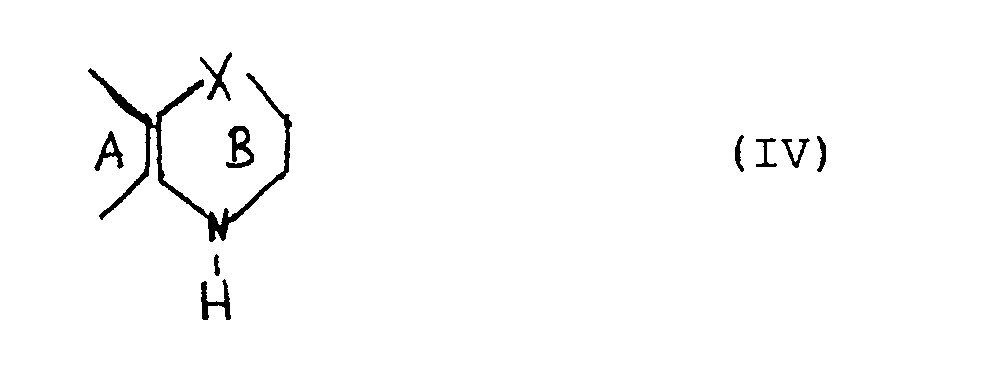
- NHR and R1 taken together will form a 5- or 6-membered heterocyclic ring B condensed with the initial benzene ring A and represented by the formula: in which X is a single bond or CH2, 0, S or N(methyl)-and the B ring may optionally be condensed with a benzene, pyridine or cyclohexane ring which may optionally be substituted by halogen or C1-C5 alkyl or C1-C5 alkoxy.
- alkyl, alkoxy, aryl, aryloxy, aralkyl and aralkoxy radicals may optionally be substituted by C1-C5-alkyl, C1-C5-alkoxy or halogen.
- C1 - C5 alkyl herein employed refers to a straight or branched saturated aliphatic hydrocarbon radical such as methyl, ethyl, n-propyl, n-butyl, isobutyl, sec-butyl, tert-butyl, n-pentyl, isopentyl, sec-pentyl, tert-pentyl and neo-pentyl.
- C1 - C5 alkoxy represents methoxy, ethoxy, n-propoxy, isopropoxy, n-butoxy, isobutoxy, sec-butoxy, tert-butoxy, neo-pentyloxy and sec-pentyloxy.
- C1 - C5 alkylthio represents methylthio, ethylthio, propylthio, isopropylthio, butylthio, pentylthio and isopentylthio.
- C6 - C12 aryl means phenyl, tolyl, xylyl, naphthyl, pyridyl, thienyl and furyl.
- C6 - C12 aryloxy means phenoxy, naphthoxy, pyridyloxy and tolyloxy.
- C7 - C15 aralkyl includes benzyl, phenethyl, phenylpropyl, phenylbutyl, naphthylmethyl and naphthylpropyl.
- C7 - C15 aralkoxy includes benzyloxy, phenethyloxy, phenylpropyloxy, phenylbutyloxy and naphthylmethoxy.
- C1 - C10 acylamino includes formylamino, acetylamino, propionylamino, butyrylamino, benzoylamino, phenylacetylamino and phenylbutyrylamino.
- alkyl, alkoxy, aryl, aryloxy, aralkyl and aralkoxy radicals may be optionally substituted by C1 - C5 alkyl,C1 - C5 alkoxy or halogen.
- the thiocyanate usable as one of the other starting materials includes alkyl thiocyanates, aralkyl thiocyanates and aryl thiocyanates, and the hydrocarbon groups thereof may have one or more substituents selected from alkyl, alkoxy and halogen.
- thiocyanates examples include alkyl thiocyanates such as methyl thiocyanate, ethyl thiocyanate, propyl thiocyanate or butyl thiocyanate, aralkyl thiocyanates such as benzyl thiocyanate or phenethyl thiocyanate and aryl thiocyanates such as phenyl thiocyanate or naphthyl thiocyanate.
- alkyl thiocyanates such as methyl thiocyanate, ethyl thiocyanate, propyl thiocyanate or butyl thiocyanate
- aralkyl thiocyanates such as benzyl thiocyanate or phenethyl thiocyanate
- aryl thiocyanates such as phenyl thiocyanate or naphthyl thiocyanate.
- the phenylamines (II a) are allowed to react with thiocyanates in the presence of boron trichloride or boron tribromide to give boron -containing intermediate products (IIIa) and such intermediate products (IIIa) are then hydrolyzed with water to give the objective compounds (Ia).
- phenylamine (IIa) with thiocyanate is performed in the presence of boron trichloride or tribromide in an appropriate inert solvent (e.g. methylene chloride, 1,2-dichloroethane, benzene, toluene, xylene) at room temperature (1-300C) or at a temperature from room temperature to about the boiling point of the solvent used.
- an appropriate inert solvent e.g. methylene chloride, 1,2-dichloroethane, benzene, toluene, xylene
- the hydrolysis can be performed in an aqueous solution at ordinary temperature (0 -30° C) or under heating ( 30 - 100 °C).
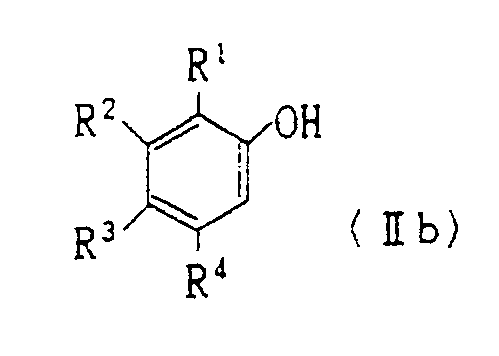
- the phenols (II b) are allowed to react with thiocyanates in the presence of boron trichloride or boron tribromide to give boron-containing intermediate products (IIIb) and such intermediate products (IIIb) are hydrolyzed thereupon with water to give the objective compounds (lb).
- the reaction of phenols (II b) with thiocyanates can be performed as described for the A type of starting materials. The reaction proceeds smoothly, but the yield can be increased by adding still another Lewis acid (e.g. aluminium chloride, tin tetrachloride, titanium tetrachloride) to the reaction mix-ture. Then the resulting intermediate product is hydrolyzed with dilute acid (e.g.
- the cyclic amines (II c) and (II d) can be allowed to react with thiocyanates in the same way as in the case of phenylamines (II a).
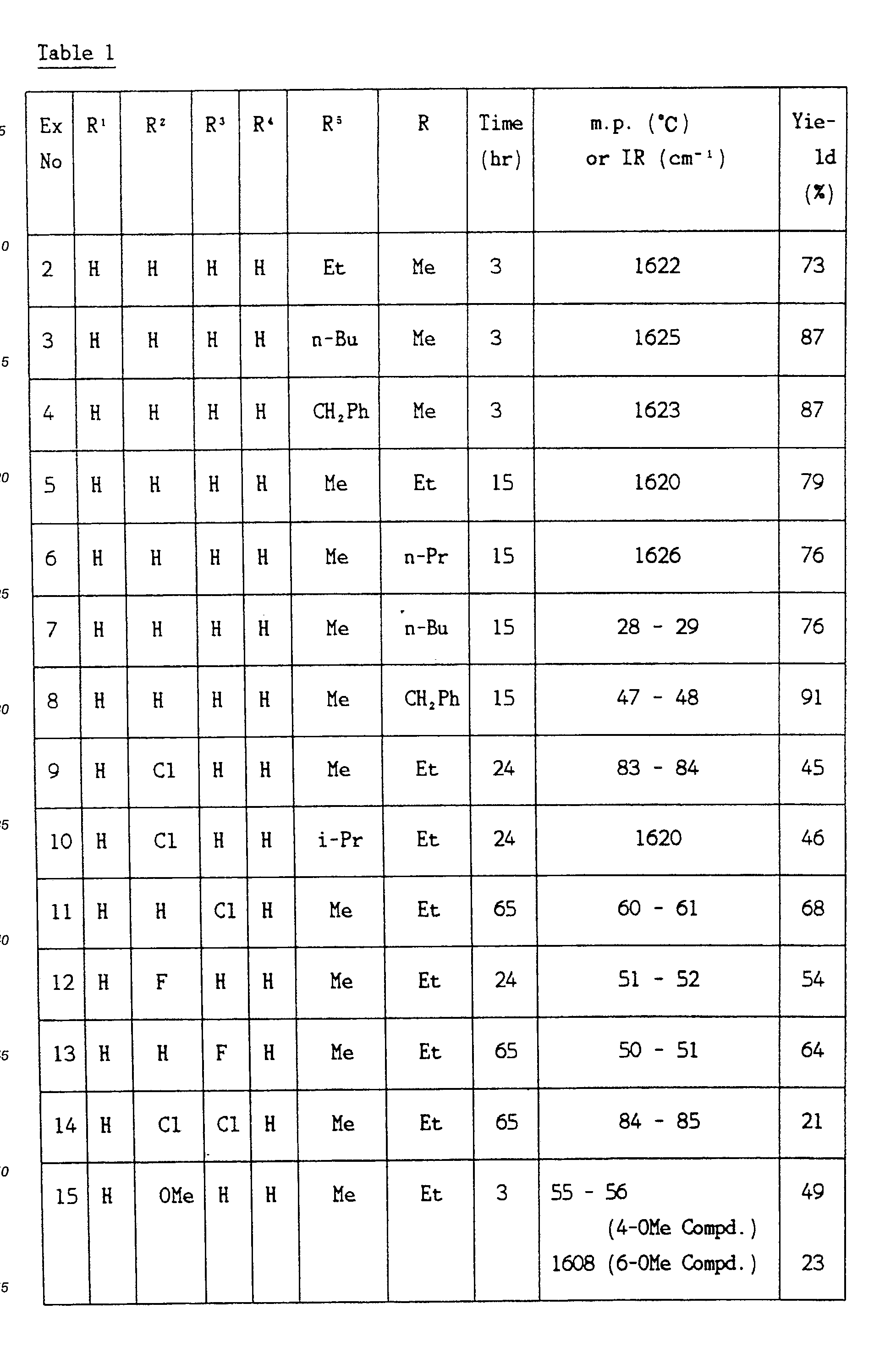
- Example 1 The process of Example 1 was repeated with other starting materials of formula IIa in order to obtain the corresponding objective compounds of formula Ia, according to the following reaction scheme: wherein R1, R2, R3, R4, R5 and R have the same meanings as defined above.
- the toluene layer was dried over anhydrous magnesium sulfate, chromatographed on a column of 20 g of aluminium oxide for purification, eluted with methylene chloride and concentrated.
- the crystalline residue (1.35 g) was recrystallized from ether - petroleum ether to give 1.21 g of N-(1-methyl-4-piperidinyl)thioanthranilic acid S-methyl ester melting at 64 - 65 °C as yellow crystals.
- Example 16 The process of Example 16 was repeated with other starting materials of formula IIa in order to obtain the corresponding objective compounds of formula Ia1 in accordance with the following reaction scheme: wherein R1, R2, R3, R4 and R have the same meanings as defined above.
- Example 24 The process of Example 24 was repeated with other starting materials of formula IIc1 in order to obtain the corresponding objective compounds of formula Ic1 according to the following reaction scheme: wherein n is a integer of 1 or 2 . Reation conditions and results are shown in Table 3.
- the reaction mixture was mixed with 5 ml of 2 N HCl and 40 ml of water, and heated at 110 °C on an oil bath to evaporate 1,2-dichloroethane and further stirred for 1 hr.
- the product was extracted with toluene, dried over anhydrous magnesium sulfate, chromatographed on a column of 10 g of silica gel and eluted with methylene chloride. The solvent was concentrated to give 1.60 g of 3,4-dihydro-2H-1,4-benzoxazin-5-thiocarboxylic acid S-methyl ester as a yellow oil.
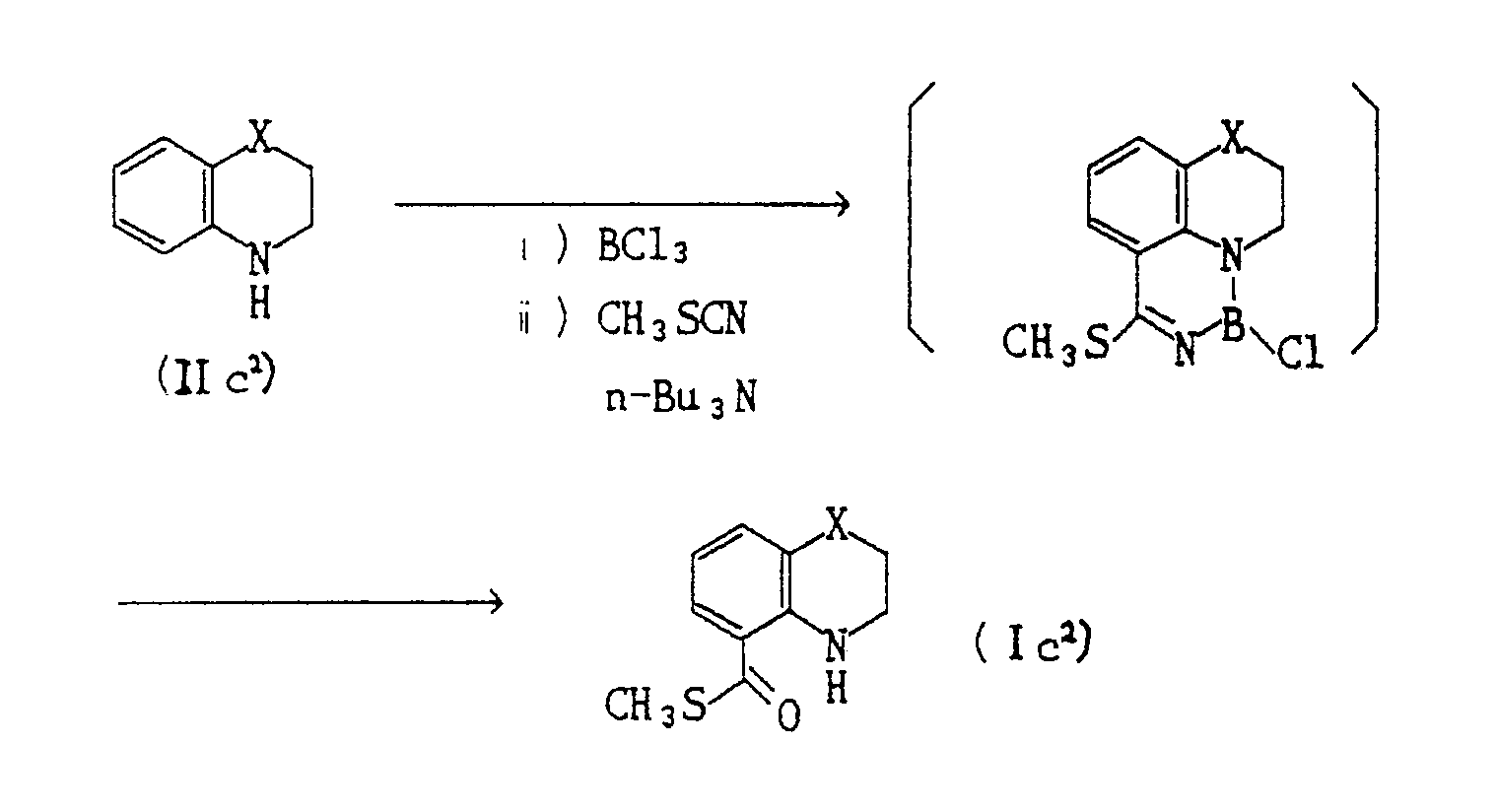
- Example 27 The process of Example 27 was repeated with other starting materials of formula IIc2 in order to obtain the corresponding objective compounds of formula Ic2 in accordance with the following reaction scheme: wherein X has the same meaning as defined above. Reaction conditions and results are shown in Table 4.
- Example 30 Using 1.99 g of phenothiazine as a starting material, the process of Example 30 was repeated. As a result,
- Example 32 The process of Example 32 was repeated with other starting materials of formula IIb in order to obtain the corresponding compounds of formula Ib according to the following reaction scheme: wherein R1, R2, R3, R4 and R5 have the same meanings as defined above.
- the toluene layer was dried over anhydrous magnesium sulfate and chromatographed on a column of 20 g of silica gel for purification.
- the product (1.48 g) eluted was recrystallized from ether - petroleum ether to give 1.33 g of 2-hydroxy-4-methoxythiobenzoic acid S-methyl ester melting at 56 - 57 °C as white needles.
- Example 47 The process of Example 47 was repeated with other starting materials of formula IIb in order to obtain the corresponding objective compounds (Ib1) according to the following reaction scheme:
Landscapes
- Chemical & Material Sciences (AREA)
- Organic Chemistry (AREA)
- Organic Low-Molecular-Weight Compounds And Preparation Thereof (AREA)
- Low-Molecular Organic Synthesis Reactions Using Catalysts (AREA)
Abstract
Description
- The present invention relates to a process for introducing a thiocarboxylic ester group at the ortho-position of phenols or phenylamines. More particularly, this invention is directed to a process for introducing a thiocarboxylic ester group at the ortho-position of phenols or phenylamines which have been found to be useful in the synthesis of medicinals, pesticides and dyes.
- The prior art comprised already the following reactions:
- a) A reaction described by:
- R. J. Kaufmann et al.in J. Am. Chem. Soc. 45 1744 (1923)

- This reaction gives an objective compound only by using polyhydric phenols. When simple phenols are subjected to this reaction, however, no ortho- is substituted product is obtained.
- b) A reaction described by:
- Dow Chemical in US-A-3338947 and US-A-3377372:

- c) A reaction described by:
- S. Ohta et al. in Tetrahedron Lett., 22, 3245 (1981):

- These conventional reactions do not always give satisfactory yields, and ortho-substituted thiobenzoic acid ester derivatives having another desirable substituent at any desired position cannot be obtained.
- According to the present invention, there is provided a process for introducing a thiocarboxylic ester group at the ortho-position of phenols or phenylamines which process is characterized by reacting a phenyl compound having a hydroxy group or an optionally substituted amino or cyclic amino group, of which at least one ortho-position is vacant, with a C₁- C₅ alkyl thiocyanate, C₇-C₁₃ aralkyl thiocyanate or C₆-C₁₂ aryl thiocyanate in the presence of boron trichloride or tribromide and hydrolyzing the resulting boron-containing intermediate product under acidic conditions to give a desired end product.
- Said process is illustrated by the undermentioned overall reaction scheme:

- Among the starting phenyl compounds (II) two types A and B (phenylamines of formula IIa and phenols of formula IIb) may be distinguished. The reactions with these starting compounds will proceed in accordance with the following reaction schemes:

- Further two types C and D of starting compounds may be distinguished as special subtypes of type A. These starting compounds wherein NHR and R¹ of formula II have formed together a 5- or 6-membered heterocyclic ring, can be represented by formulae IIc and IId. The reactions with them will proceed in accordance with the following reaction schemes:

- The terms used in the above definitions are illustratively explained below.
- The term "C₁ - C₅ alkyl" herein employed refers to a straight or branched saturated aliphatic hydrocarbon radical such as methyl, ethyl, n-propyl, n-butyl, isobutyl, sec-butyl, tert-butyl, n-pentyl, isopentyl, sec-pentyl, tert-pentyl and neo-pentyl.
- The term "C₁ - C₅ alkoxy" represents methoxy, ethoxy, n-propoxy, isopropoxy, n-butoxy, isobutoxy, sec-butoxy, tert-butoxy, neo-pentyloxy and sec-pentyloxy.
- The term "C₁ - C₅ alkylthio" represents methylthio, ethylthio, propylthio, isopropylthio, butylthio, pentylthio and isopentylthio.
- The term "C₆ - C₁₂ aryl" means phenyl, tolyl, xylyl, naphthyl, pyridyl, thienyl and furyl.
- The term "C₆ - C₁₂ aryloxy" means phenoxy, naphthoxy, pyridyloxy and tolyloxy.
- The term "C₇ - C₁₅ aralkyl" includes benzyl, phenethyl, phenylpropyl, phenylbutyl, naphthylmethyl and naphthylpropyl.
- The term "C₇ - C₁₅ aralkoxy" includes benzyloxy, phenethyloxy, phenylpropyloxy, phenylbutyloxy and naphthylmethoxy.
- The term "C₁ - C₁₀ acylamino" includes formylamino, acetylamino, propionylamino, butyrylamino, benzoylamino, phenylacetylamino and phenylbutyrylamino.
- Moreover,the above mentioned alkyl, alkoxy, aryl, aryloxy, aralkyl and aralkoxy radicals may be optionally substituted by C₁ - C₅ alkyl,C₁ - C₅ alkoxy or halogen.
- The thiocyanate usable as one of the other starting materials includes alkyl thiocyanates, aralkyl thiocyanates and aryl thiocyanates, and the hydrocarbon groups thereof may have one or more substituents selected from alkyl, alkoxy and halogen. Examples of the thiocyanates used herein, are alkyl thiocyanates such as methyl thiocyanate, ethyl thiocyanate, propyl thiocyanate or butyl thiocyanate, aralkyl thiocyanates such as benzyl thiocyanate or phenethyl thiocyanate and aryl thiocyanates such as phenyl thiocyanate or naphthyl thiocyanate.
- The process of the present invention as applied to starting materials of the A-type, B-type, C-type or D-type is explained below in more detail.
- The phenylamines (II a) are allowed to react with thiocyanates in the presence of boron
trichloride or boron tribromide to give boron -containing intermediate products (IIIa) and such intermediate products (IIIa) are then hydrolyzed with water to give the objective compounds (Ia). - The reaction of phenylamine (IIa) with thiocyanate is performed in the presence of boron trichloride or tribromide in an appropriate inert solvent (e.g. methylene chloride, 1,2-dichloroethane, benzene, toluene, xylene) at room temperature (1-30⁰C) or at a temperature from room temperature to about the boiling point of the solvent used. The hydrolysis can be performed in an aqueous solution at ordinary temperature (0 -30° C) or under heating ( 30 - 100 °C).
- The phenols (II b) are allowed to react with thiocyanates in the presence of boron trichloride or boron tribromide to give boron-containing intermediate products (IIIb) and such intermediate products (IIIb) are hydrolyzed thereupon with water to give the objective compounds (lb). The reaction of phenols (II b) with thiocyanates can be performed as described for the A type of starting materials. The reaction proceeds smoothly, but the yield can be increased by adding still another Lewis acid (e.g. aluminium chloride, tin tetrachloride, titanium tetrachloride) to the reaction mix-ture. Then the resulting intermediate product is hydrolyzed with dilute acid (e.g. hydrochloric acid, sulfuric acid, etc.) to give the objective compound (I b). The hydrolysis proceeds in a conventional manner. The hydroxy group of the thiocarboxylic esters (I b) obtained in this reaction can be easily subjected to alkylation with alkyl halides, aryl halides, aralkyl halides, dialkyl sulfates or epihalohydrins in a conventional manner.
- The cyclic amines (II c) and (II d) can be allowed to react with thiocyanates in the same way as in the case of phenylamines (II a).
- Presently preferred and practical embodiments of the process of the present invention are illustratively shown in the following working examples, which do not limit the technical scope of the invention.
- The abbreviations used in this specification have the following meanings.

- To a solution of 1.07 g of N-methylaniline in 10 ml of toluene was added 5.5 ml of a solution of 2.02 M boron trichloride in toluene under ice-cooling, and the mixture was refluxed with heating on an oil bath for 1 hr. and concentrated under atmospheric pressure. The residue was cooled with ice-water, mixed with 1 ml of methyl thiocyanate and stirred for 30 min. under ice-cooling and 2.5 hr. at room temperature. The reaction mixture was mixed with 20 ml of water and heated under reflux for 30 min. The product was extracted with toluene, dried over anhydrous magnesium sulfate, concentrated and subjected to chromatography on silica gel. The eluate with toluene was concentrated to give 1.62 g of N-methylthioanthranilic acid S-methyl ester as a pale yellow oil.
- Yield : 90 %
- IR : 3360, 1626 cm⁻¹
- The process of Example 1 was repeated with other starting materials of formula IIa in order to obtain the corresponding objective compounds of formula Ia, according to the following reaction scheme:

- The reaction was performed at room temperature. Reaction conditions and results as well as the nature of starting materials and end products are shown in Table 1.
- To a solution of 1.14 g of N-(1-methyl-4-piperidinyl)-aniline in 20 ml of toluene was added 3.6 ml of a solution of 2.04 M boron trichloride in toluene and the mixture was refluxed with heating on an oil bath for 2 hr. After cooling, the reaction mixture was mixed with 0.49 ml of methyl thiocyanate and refluxed with heating on an oil bath for 2 hr. After cooling, 20 ml of water was added and the mixture was stirred at 110 °C on an oil bath for 1 hr. The reaction mixture was turned to basic conditions with aqueous 2 N sodium carbonate and extracted with toluene. The toluene layer was dried over anhydrous magnesium sulfate, chromatographed on a column of 20 g of aluminium oxide for purification, eluted with methylene chloride and concentrated. The crystalline residue (1.35 g) was recrystallized from ether - petroleum ether to give 1.21 g of N-(1-methyl-4-piperidinyl)thioanthranilic acid S-methyl ester melting at 64 - 65 °C as yellow crystals.

- The process of Example 16 was repeated with other starting materials of formula IIa in order to obtain the corresponding objective compounds of formula Ia¹ in accordance with the following reaction scheme:

- The reaction was performed under refluxing conditions. Further conditions and results as well as the nature of starting materials and end products are shown in Table 2.

- To a solution of 1.69 g of diphenylamine in 10 ml of toluene was added 5.5 ml of a solution of 2.02 M boron trichloride in toluene under ice-cooling, and the mixture was refluxed with heating on an oil bath for 1 hr. After ice-cooling, the reaction mixture was mixed with 1 ml of methyl thiocyanate and stirred at room temperature for 16 hr. The reaction mixture was mixed with 20 ml of water and refluxed with heating on an oil bath for 30 min. The insoluble materials were filtered off and the toluene layer was dried over anhydrous magnesium sulfate, chromatographed on a column of silica gel and eluted with toluene. The solvent was concentrated to give 1.03 g of N-phenylthioanthranilic acid S-methyl ester as a yellow oil.
- Yield : 42 %
- IR (film) : 3300, 1628 cm⁻¹
- The process of Example 24 was repeated with other starting materials of formula IIc¹ in order to obtain the corresponding objective compounds of formula Ic¹ according to the following reaction scheme:


- To a solution of 1.35 g of 3,4-dihydro-2H-1,4-benzoxazine in 10 ml of 1,2-dichloroethane was added 5 ml of a solution of 2.02 M boron trichloride in 1,2-dichloroethane and a mixture solution of 0.82 ml of methyl thiocyanate, 2.9 ml of tri-n-butylamine and 10 ml of 1,2-dichloroethane under ice-cooling. The resulting mixture was stirred at room temperature for 4 hr. The reaction mixture was mixed with 5 ml of 2 N HCl and 40 ml of water, and heated at 110 °C on an oil bath to evaporate 1,2-dichloroethane and further stirred for 1 hr. The product was extracted with toluene, dried over anhydrous magnesium sulfate, chromatographed on a column of 10 g of silica gel and eluted with methylene chloride. The solvent was concentrated to give 1.60 g of 3,4-dihydro-2H-1,4-benzoxazin-5-thiocarboxylic acid S-methyl ester as a yellow oil.
- Yield : 76 %
- IR (film) : 3350, 1622 cm⁻¹
- The process of Example 27 was repeated with other starting materials of formula IIc² in order to obtain the corresponding objective compounds of formula Ic² in accordance with the following reaction scheme:

- To a solution of 1.67 g of carbazole in 10 ml of toluene was added 5.4 ml of a solution of 2.04 M boron trichloride -toluene under ice-cooling, and the mixture was refluxed with heating on an oil bath for 1 hr. After ice-cooling, the mixture was mixed with 1 ml of methyl thiocyanate, stirred at room temperature for 3 hr., mixed with 30 ml of water and refluxed with heating on an oil bath for 1 hr. The product was extracted with toluene, dried over anhydrous magnesium sulfate, chromatographed on a column of 10 g of silica gel and eluted with toluene. The eluate was concentrated to give 2.16 g of the crude crystals. Recrystallization from methylene chloride - ether gave 2.08 g of carbazol-1-thiocarboxylic acid S-methyl ester melting at 122 - 123 °C as crystals.

- Using 1.99 g of phenothiazine as a starting material, the process of Example 30 was repeated. As a result,
- 0.798 g of phenothiazin-1-thiocarboxylic acid S-methyl ester was obtained as crystals melting at 92 - 93 °C.

- To 5.5 ml of a solution of 2.2 M boron trichloride in 1,2-dichloroethane were added a solution of 941 mg of phenol in 10 ml of 1,2-dichloroethane and 0.82 ml of methyl thiocyanate and 1.33 g of aluminium chloride under ice-cooling. After dissolving the aluminium chloride with stirring at room temperature, the mixture was heated at 80 °C on an oil bath for 3 hr. After ice-cooling, the reaction solution was mixed with 6 g of ice and 15 ml of 2 N HCl and heated at 110 °C on an oil bath under stirring to evaporate 1,2-dichloroethane and further stirred for 1 hr. After cooling, the mixture was extracted with toluene. The toluene layer was dried over anhydrous magnesium sulfate and chromatographed on a column of 20 g of silica gel for purification. The eluate with toluene was concentrated to give 1.47 g of 2-hydroxy-thiobenzoic acid S-methyl ester as a colorless oil.
- Yield : 88 %
- IR (film) : 1628 cm⁻¹
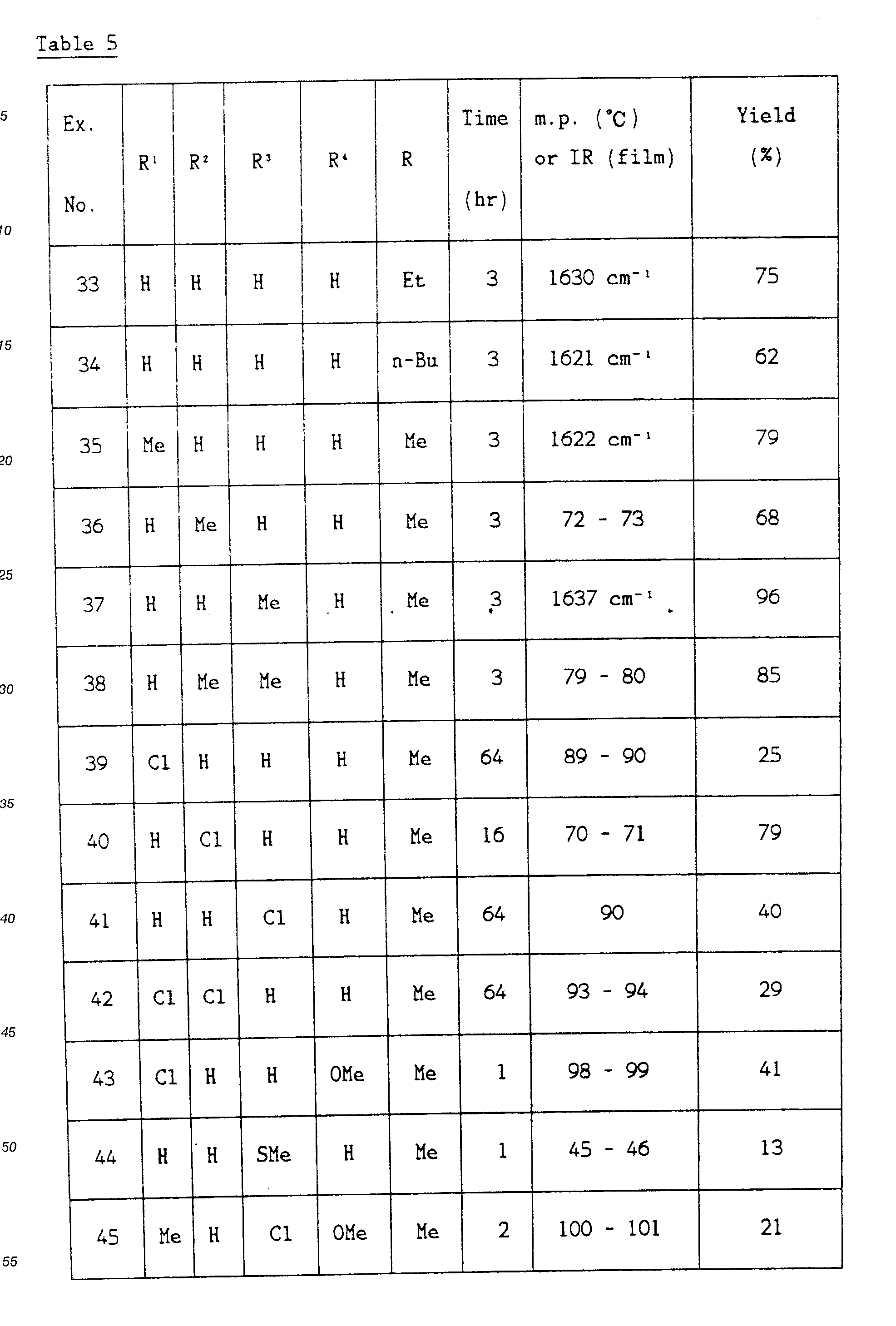
- The process of Example 32 was repeated with other starting materials of formula IIb in order to obtain the corresponding compounds of formula Ib according to the following reaction scheme:

- The reaction was performed with boron trichloride and aluminium chloride in l,2-dichloroethane at 80°C. Other reaction conditions and results as well as the nature of starting materials and end products are shown in Table 5.
- To a solution of 1.13 ml of boron tribromide in 6 ml of 1,2-dichloroethane were added a solution of 941 mg of phenol in 10 ml of 1,2-dichloroethane, as well as 0.82 ml of methyl thiocyanate and 1.33 g of aluminium chloride under ice-cooling. After dissolving aluminium chloride with stirring at room temperature, the mixture was heated at 80 °C on an oil bath for 3 hr. After ice-cooling, the reaction solution was mixed with 6 g of ice and 15 ml of 2 N HCl and heated at 110 °C on an oil bath under stirring to evaporate 1,2-dichloroethane and further stirred for 1 hr. After cooling, the mixture was extracted with toluene. The toluene layer was dried over anhydrous magnesium sulfate and chromatographed on a column of 20 g of silica gel for purification. The eluate with toluene was concentrated to give 1.41 g of 2-hydroxythiobenzoic acid S-methyl ester as a colorless oil.
- Yield : 84 %
- To 5 ml of a solution of 2.02 M boron trichloride - benzene were added a solution of 1.24 g of 3-methoxyphenol in 12 ml of benzene, as well as 0.82 ml of methyl thiocyanate and 1.33 g of aluminium chloride under ice-cooling. After stirring at room temperature for 16 hr., the reaction mixture was cooled with ice water, mixed with 5 g of ice and 15 ml of 2 N HCl and stirred with heating at 110 °C on an oil bath to evaporate 1,2-dichloroethane and further stirred for 2 hr. After cooling, the mixture was extracted with toluene. The toluene layer was dried over anhydrous magnesium sulfate and chromatographed on a column of 20 g of silica gel for purification. The product (1.48 g) eluted was recrystallized from ether - petroleum ether to give 1.33 g of 2-hydroxy-4-methoxythiobenzoic acid S-methyl ester melting at 56 - 57 °C as white needles.

- The process of Example 47 was repeated with other starting materials of formula IIb in order to obtain the corresponding objective compounds (Ib¹) according to the following reaction scheme:

- The reaction was performed with boron trichloride and aluminium chloride at room temperature. Other reaction conditions as well as starting materials and end results are shown in Table 6.

- To 5.5 ml of a solution of 2.2 M boron trichloride - 1,2-dichloroethane were added a solution of 1.44 g of α-naphthol in 30 ml of 1,2-dichloroethane, as well as 0.82 ml of methyl thiocyanate and 1.33 g of aluminium chloride under ice-cooling. A fter stirring at room temperature for 17 hr., the reaction solution was cooled with ice water and mixed with 15 ml of 2 N HCl and 30 ml of water. Then the mixture was heated at 110 °C on an oil bath under stirring to evaporate 1,2-dichloroethane and further stirred for 24 hr. After cooling, the mixture was mixed with 50 ml of methylene chloride under stirring and filtered to remove insoluble materials. The methylene chloride solution was dried over anhydrous magnesium sulfate and the solvent was evaporated. The crude crystals were chromatographed on a column of 20 g of silica gel for purification and 1.51 g of the eluate with toluene was recrystallized from ether - n-hexane to give 1.36 g of 1-hydroxy-2-thionaphthoic acid S-methyl ester at 60 - 61 °C as pale yellow crystals.
- Yield : 63 %
- To 5.5 ml of a solution of 2.2 M boron trichloride - 1,2-dichloroethane were added a solution of 1.44 g of β-naphthol in 30 ml of 1,2-dichloroethane, as well as 0.82 ml of methyl thiocyanate and 1.33 g of aluminium chloride under ice-cooling. After stirring at room temperature for 16 hr., the reaction mixture was cooled with ice water and mixed with 10 g of ice and 40 ml of water, heated at 110 °C on an oil bath under stirring to evaporate 1,2-dichloroethane, and further stirred for 24 hr. After cooling, the resultant was mixed with 50 ml of toluene under stirring and filtered to remove insoluble materials. The toluene solution was dried over anhydrous magnesium sulfate and concentrated. The crude crystals were chromatographed on a column of 30 g of silica gel for purification and 1.19 g of the eluate with toluene was recrystallized from ether - n-hexane to give 1.10 g of 2-hydroxy-1-thionaphthoic acid S-methyl ester melting at 111 - 112 °C as crystals.
- Yield : 51 %
Claims (9)
- A process for introducing a thiocarboxylic ester group at the ortho-position of phenols or phenylamines, characterised by reacting a phenyl compound having a hydroxy group or an optionally substituted amino or cyclic amino group, of which at least one ortho-position is vacant, with a C₁-C₅ alkyl thiocyanate, C₇-C₁₃ aralkyl thiocyanate or C₆-C₁₂ aryl thiocyanate in the presence of boron trichloride or tribromide and hydrolysing the resulting boron-containing intermediate product under acidic conditions to give a desired end product according to the overall reaction scheme:


- A process according to claim 1, in which the starting phenyl compound is represented by the formula:

- A process according to claim 1, in which the starting phenyl compound is represented by the formula:
- A process according to claim 1, in which the starting phenyl compound is represented by the formula:

- A process according to claim 1, in which the starting phenyl compound is represented by the formula:

- A process according to claim 3, in which the compound (IIb) is α-naphthol or β-naphthol.
- A process according to claim 4, in which the compound (IIc) is 1,2,3,4-tetrahydroquinoline, indoline, 2,3-dihydro-4H-1,4-benzothiazine, N-methylbenzopiperazine or 3,4-dihydro-2H-1,4-benzoxazine.
- A process according to claim 5, in which the compound (IId) is carbazole or phenothiazine.
- A process according to claims 3, in which the reaction is carried out in the presence of boron trichloride or tribromide and another Lewis acid selected from aluminium chloride, tin tetrachloride and titanium tetrachloride.
Priority Applications (1)
| Application Number | Priority Date | Filing Date | Title |
|---|---|---|---|
| AT87202150T ATE61558T1 (en) | 1986-11-06 | 1987-11-05 | PROCESS FOR INTRODUCING A THIOCARBOXYLESTER GROUP IN THE ORTHOPOSITION OF PHENOLS OR PHENYLAMINES. |
Applications Claiming Priority (2)
| Application Number | Priority Date | Filing Date | Title |
|---|---|---|---|
| JP264658/86 | 1986-11-06 | ||
| JP26465886 | 1986-11-06 |
Publications (2)
| Publication Number | Publication Date |
|---|---|
| EP0266849A1 EP0266849A1 (en) | 1988-05-11 |
| EP0266849B1 true EP0266849B1 (en) | 1991-03-13 |
Family
ID=17406410
Family Applications (1)
| Application Number | Title | Priority Date | Filing Date |
|---|---|---|---|
| EP87202150A Expired - Lifetime EP0266849B1 (en) | 1986-11-06 | 1987-11-05 | Process for introducing a thiocarboxylic ester group at the ortho-position of phenols or phenylamines |
Country Status (7)
| Country | Link |
|---|---|
| US (1) | US4857645A (en) |
| EP (1) | EP0266849B1 (en) |
| JP (1) | JPH0796544B2 (en) |
| AT (1) | ATE61558T1 (en) |
| DE (1) | DE3768608D1 (en) |
| ES (1) | ES2021022B3 (en) |
| GR (1) | GR3001601T3 (en) |
Families Citing this family (5)
| Publication number | Priority date | Publication date | Assignee | Title |
|---|---|---|---|---|
| JPH0796544B2 (en) * | 1986-11-06 | 1995-10-18 | 塩野義製薬株式会社 | Method for ortho-thiocarboxylic acid esterification of phenylamines or phenols |
| GB8820129D0 (en) * | 1988-08-24 | 1988-09-28 | Schering Agrochemicals Ltd | Fungicides |
| US5155148A (en) * | 1989-09-25 | 1992-10-13 | The Goodyear Tire & Rubber Company | Ester derivatives from p-hydroxydiphenylamine |
| US7632866B2 (en) * | 2002-10-21 | 2009-12-15 | Ramot At Tel Aviv University | Derivatives of N-phenylanthranilic acid and 2-benzimidazolone as potassium channel and/or neuron activity modulators |
| EP2203411B1 (en) * | 2007-09-20 | 2016-01-06 | Ramot at Tel-Aviv University Ltd. | N-phenyl anthranilic acid derivatives and uses thereof |
Family Cites Families (8)
| Publication number | Priority date | Publication date | Assignee | Title |
|---|---|---|---|---|
| US3338947A (en) * | 1961-09-27 | 1967-08-29 | Dow Chemical Co | Esters of hydroxy-aromatic thioacids |
| US3231598A (en) * | 1961-09-27 | 1966-01-25 | Dow Chemical Co | Esters of thio acids |
| DE1220412B (en) * | 1965-04-03 | 1966-07-07 | Roehm & Haas Gmbh | Process for the preparation of cyanoformic acid ethiol esters |
| BE794033A (en) * | 1972-01-14 | 1973-05-02 | Degussa | PROCESS FOR THE PREPARATION OF ORGANIC COMPOUNDS WHICH CONTAIN A MERCAPTOETHYL GROUP |
| US3929852A (en) * | 1974-05-01 | 1975-12-30 | Pennwalt Corp | Process for preparing {60 ,{62 -unsaturated thiolesters |
| US4165333A (en) * | 1978-02-21 | 1979-08-21 | The Goodyear Tire & Rubber Company | Antioxidants |
| US4600576A (en) * | 1985-06-21 | 1986-07-15 | International Flavors & Fragrances Inc. | Thiogeranyl esters and organoleptic uses thereof |
| JPH0796544B2 (en) * | 1986-11-06 | 1995-10-18 | 塩野義製薬株式会社 | Method for ortho-thiocarboxylic acid esterification of phenylamines or phenols |
-
1987
- 1987-10-16 JP JP62262425A patent/JPH0796544B2/en not_active Expired - Fee Related
- 1987-11-05 AT AT87202150T patent/ATE61558T1/en not_active IP Right Cessation
- 1987-11-05 EP EP87202150A patent/EP0266849B1/en not_active Expired - Lifetime
- 1987-11-05 ES ES87202150T patent/ES2021022B3/en not_active Expired - Lifetime
- 1987-11-05 DE DE8787202150T patent/DE3768608D1/en not_active Expired - Fee Related
- 1987-11-05 US US07/116,792 patent/US4857645A/en not_active Expired - Lifetime
-
1991
- 1991-03-14 GR GR91400222T patent/GR3001601T3/en unknown
Also Published As
| Publication number | Publication date |
|---|---|
| ATE61558T1 (en) | 1991-03-15 |
| EP0266849A1 (en) | 1988-05-11 |
| ES2021022B3 (en) | 1991-10-16 |
| US4857645A (en) | 1989-08-15 |
| JPS63239265A (en) | 1988-10-05 |
| DE3768608D1 (en) | 1991-04-18 |
| JPH0796544B2 (en) | 1995-10-18 |
| GR3001601T3 (en) | 1992-11-23 |
Similar Documents
| Publication | Publication Date | Title |
|---|---|---|
| CA2048511A1 (en) | Tricyclic compound or salts thereof, method for producing the same and antimicrobial agent containing the same | |
| KR0157610B1 (en) | Preparation of (S) -α-ethyl-2-oxo-1-pyrrolidineacetamide | |
| EP0257583B1 (en) | Process for ortho-cyanation of phenols or phenylamines | |
| EP0266849A1 (en) | Process for introducing a thiocarboxylic ester group at the ortho-position of phenols or phenylamines | |
| US4160784A (en) | Process for the production of o-aminophenyl ketone derivatives | |
| FI79838B (en) | PROCEDURE FOR THE FRAMEWORK OF THE PHARMACOLOGICAL PROCEDURE AZABICYKLO / 3.1.0 / HEXAN-2,4-DIONER | |
| Briggs et al. | 16. Reactions of hydrazoic acid. Part I | |
| US3740415A (en) | Dihaloalkyl phthalimides | |
| JPH08134041A (en) | Production of pyrazoleamides | |
| AU643215B2 (en) | Reagents for rapid peptide synthesis | |
| FI87770C (en) | Process for the preparation of mercaptoacylproline | |
| US3419561A (en) | 2,3,4,4a,5,6,10b-heptahydro-1-oxaphenanthridines and production thereof | |
| GB2036723A (en) | Mercaptoacylpiperazine carboxylic acid compounds | |
| EP0131921B1 (en) | Ortho-(mono-substituted amino)phenylimines and production thereof | |
| US4255335A (en) | Preparation of 5-aroyl-1-loweralkylpyrrole-2-acetic acid derivatives | |
| CA1054630A (en) | Substituted indanylpropionic acids | |
| US3641045A (en) | Hydroxy-phenyl oxadiazoles | |
| CA1137498A (en) | Mercaptoacylpyrazolidinone carboxylic acid derivatives | |
| GB2051806A (en) | Hexahydrazepine piperidine and pyrrolidine derivatives | |
| KR940009935B1 (en) | N-benzoyl-c-thiophenoxyimidoyl chloride derivatives and manufacturing method thereof | |
| Stahmann et al. | Some N-(2-Diethylaminoethyl)-anilines1 | |
| IE902545A1 (en) | PYRROLO[2,1-b]THIAZOLE DERIVATIVES | |
| RU1299101C (en) | Hydrochlorides of 4-(2-oxy-3-tret-butylaminopropoxy)indole derivatives having beta-adrenoblocker activity and derivative of 4-(2,3-epoxypropyl)indole as intermediate product for synthesis hydrochloride derivatives of 4-(2-oxy-3- tret-butylaminopropoxy)indole having beta-adrenoblocker activity | |
| US3712925A (en) | Acenaphthene derivatives | |
| IE47075B1 (en) | N-acylated thiazolidine, thiazane and morpholine carboxylic acids and esters |
Legal Events
| Date | Code | Title | Description |
|---|---|---|---|
| PUAI | Public reference made under article 153(3) epc to a published international application that has entered the european phase |
Free format text: ORIGINAL CODE: 0009012 |
|
| AK | Designated contracting states |
Kind code of ref document: A1 Designated state(s): AT BE CH DE ES FR GB GR IT LI LU NL SE |
|
| 17P | Request for examination filed |
Effective date: 19880531 |
|
| 17Q | First examination report despatched |
Effective date: 19890227 |
|
| RAP1 | Party data changed (applicant data changed or rights of an application transferred) |
Owner name: SHIONOGI SEIYAKU KABUSHIKI KAISHA TRADING UNDER TH |
|
| ITF | It: translation for a ep patent filed | ||
| GRAA | (expected) grant |
Free format text: ORIGINAL CODE: 0009210 |
|
| AK | Designated contracting states |
Kind code of ref document: B1 Designated state(s): AT BE CH DE ES FR GB GR IT LI LU NL SE |
|
| REF | Corresponds to: |
Ref document number: 61558 Country of ref document: AT Date of ref document: 19910315 Kind code of ref document: T |
|
| REF | Corresponds to: |
Ref document number: 3768608 Country of ref document: DE Date of ref document: 19910418 |
|
| ET | Fr: translation filed | ||
| PLBE | No opposition filed within time limit |
Free format text: ORIGINAL CODE: 0009261 |
|
| STAA | Information on the status of an ep patent application or granted ep patent |
Free format text: STATUS: NO OPPOSITION FILED WITHIN TIME LIMIT |
|
| 26N | No opposition filed | ||
| REG | Reference to a national code |
Ref country code: GR Ref legal event code: FG4A Free format text: 3001601 |
|
| PGFP | Annual fee paid to national office [announced via postgrant information from national office to epo] |
Ref country code: GB Payment date: 19931115 Year of fee payment: 7 |
|
| PGFP | Annual fee paid to national office [announced via postgrant information from national office to epo] |
Ref country code: GR Payment date: 19931118 Year of fee payment: 7 |
|
| PGFP | Annual fee paid to national office [announced via postgrant information from national office to epo] |
Ref country code: FR Payment date: 19931119 Year of fee payment: 7 |
|
| PGFP | Annual fee paid to national office [announced via postgrant information from national office to epo] |
Ref country code: SE Payment date: 19931122 Year of fee payment: 7 Ref country code: AT Payment date: 19931122 Year of fee payment: 7 |
|
| PGFP | Annual fee paid to national office [announced via postgrant information from national office to epo] |
Ref country code: ES Payment date: 19931126 Year of fee payment: 7 Ref country code: BE Payment date: 19931126 Year of fee payment: 7 |
|
| PGFP | Annual fee paid to national office [announced via postgrant information from national office to epo] |
Ref country code: NL Payment date: 19931130 Year of fee payment: 7 Ref country code: DE Payment date: 19931130 Year of fee payment: 7 |
|
| PGFP | Annual fee paid to national office [announced via postgrant information from national office to epo] |
Ref country code: LU Payment date: 19931216 Year of fee payment: 7 |
|
| EPTA | Lu: last paid annual fee | ||
| PGFP | Annual fee paid to national office [announced via postgrant information from national office to epo] |
Ref country code: CH Payment date: 19940124 Year of fee payment: 7 |
|
| PG25 | Lapsed in a contracting state [announced via postgrant information from national office to epo] |
Ref country code: LU Free format text: LAPSE BECAUSE OF NON-PAYMENT OF DUE FEES Effective date: 19941105 Ref country code: GB Effective date: 19941105 Ref country code: AT Effective date: 19941105 |
|
| PG25 | Lapsed in a contracting state [announced via postgrant information from national office to epo] |
Ref country code: SE Effective date: 19941106 |
|
| PG25 | Lapsed in a contracting state [announced via postgrant information from national office to epo] |
Ref country code: ES Free format text: LAPSE BECAUSE OF EXPIRATION OF PROTECTION Effective date: 19941107 |
|
| PG25 | Lapsed in a contracting state [announced via postgrant information from national office to epo] |
Ref country code: LI Effective date: 19941130 Ref country code: CH Effective date: 19941130 Ref country code: BE Effective date: 19941130 |
|
| EAL | Se: european patent in force in sweden |
Ref document number: 87202150.6 |
|
| BERE | Be: lapsed |
Owner name: SHIONOGI SEIYAKU K.K. TRADING UNDER THE NAME OF S Effective date: 19941130 |
|
| PG25 | Lapsed in a contracting state [announced via postgrant information from national office to epo] |
Ref country code: GR Free format text: THE PATENT HAS BEEN ANNULLED BY A DECISION OF A NATIONAL AUTHORITY Effective date: 19950531 |
|
| PG25 | Lapsed in a contracting state [announced via postgrant information from national office to epo] |
Ref country code: NL Effective date: 19950601 |
|
| GBPC | Gb: european patent ceased through non-payment of renewal fee |
Effective date: 19941105 |
|
| NLV4 | Nl: lapsed or anulled due to non-payment of the annual fee | ||
| PG25 | Lapsed in a contracting state [announced via postgrant information from national office to epo] |
Ref country code: FR Effective date: 19950731 |
|
| REG | Reference to a national code |
Ref country code: CH Ref legal event code: PL Ref country code: GR Ref legal event code: MM2A Free format text: 3001601 |
|
| PG25 | Lapsed in a contracting state [announced via postgrant information from national office to epo] |
Ref country code: DE Effective date: 19950801 |
|
| EUG | Se: european patent has lapsed |
Ref document number: 87202150.6 |
|
| REG | Reference to a national code |
Ref country code: FR Ref legal event code: ST |
|
| REG | Reference to a national code |
Ref country code: ES Ref legal event code: FD2A Effective date: 20010201 |
|
| PG25 | Lapsed in a contracting state [announced via postgrant information from national office to epo] |
Ref country code: IT Free format text: LAPSE BECAUSE OF NON-PAYMENT OF DUE FEES;WARNING: LAPSES OF ITALIAN PATENTS WITH EFFECTIVE DATE BEFORE 2007 MAY HAVE OCCURRED AT ANY TIME BEFORE 2007. THE CORRECT EFFECTIVE DATE MAY BE DIFFERENT FROM THE ONE RECORDED. Effective date: 20051105 |