EP0265846B1 - Method for preparing n-sulfomethyl acrylamide, acrylic acid terpolymers from polyacrylonitrile - Google Patents
Method for preparing n-sulfomethyl acrylamide, acrylic acid terpolymers from polyacrylonitrile Download PDFInfo
- Publication number
- EP0265846B1 EP0265846B1 EP87115509A EP87115509A EP0265846B1 EP 0265846 B1 EP0265846 B1 EP 0265846B1 EP 87115509 A EP87115509 A EP 87115509A EP 87115509 A EP87115509 A EP 87115509A EP 0265846 B1 EP0265846 B1 EP 0265846B1
- Authority
- EP
- European Patent Office
- Prior art keywords
- polyacrylonitrile
- acrylamide
- acrylic acid
- sulfomethyl
- preparing
- Prior art date
- Legal status (The legal status is an assumption and is not a legal conclusion. Google has not performed a legal analysis and makes no representation as to the accuracy of the status listed.)
- Expired - Lifetime
Links
- 229920002239 polyacrylonitrile Polymers 0.000 title claims description 21
- HRPVXLWXLXDGHG-UHFFFAOYSA-N Acrylamide Chemical compound NC(=O)C=C HRPVXLWXLXDGHG-UHFFFAOYSA-N 0.000 title claims description 11
- 238000000034 method Methods 0.000 title claims description 10
- 229920001897 terpolymer Polymers 0.000 title claims description 10
- SMZOUWXMTYCWNB-UHFFFAOYSA-N 2-(2-methoxy-5-methylphenyl)ethanamine Chemical compound COC1=CC=C(C)C=C1CCN SMZOUWXMTYCWNB-UHFFFAOYSA-N 0.000 title claims description 9
- NIXOWILDQLNWCW-UHFFFAOYSA-N 2-Propenoic acid Natural products OC(=O)C=C NIXOWILDQLNWCW-UHFFFAOYSA-N 0.000 title claims description 9
- XLYOFNOQVPJJNP-UHFFFAOYSA-N water Substances O XLYOFNOQVPJJNP-UHFFFAOYSA-N 0.000 claims description 11
- 239000003054 catalyst Substances 0.000 claims description 10
- 229920000642 polymer Polymers 0.000 claims description 9
- UOULCEYHQNCFFH-UHFFFAOYSA-M sodium;hydroxymethanesulfonate Chemical compound [Na+].OCS([O-])(=O)=O UOULCEYHQNCFFH-UHFFFAOYSA-M 0.000 claims description 9
- KKSNTCYLMGYFFB-UHFFFAOYSA-N (prop-2-enoylamino)methanesulfonic acid Chemical compound OS(=O)(=O)CNC(=O)C=C KKSNTCYLMGYFFB-UHFFFAOYSA-N 0.000 claims description 7
- 125000003368 amide group Chemical group 0.000 claims description 5
- 125000002560 nitrile group Chemical group 0.000 claims description 4
- 239000000376 reactant Substances 0.000 claims description 4
- 229910052751 metal Inorganic materials 0.000 claims description 3
- 239000002184 metal Substances 0.000 claims description 3
- NLHHRLWOUZZQLW-UHFFFAOYSA-N Acrylonitrile Chemical group C=CC#N NLHHRLWOUZZQLW-UHFFFAOYSA-N 0.000 claims description 2
- 238000006243 chemical reaction Methods 0.000 description 13
- WSFSSNUMVMOOMR-UHFFFAOYSA-N Formaldehyde Chemical compound O=C WSFSSNUMVMOOMR-UHFFFAOYSA-N 0.000 description 9
- 229920002401 polyacrylamide Polymers 0.000 description 8
- RYGMFSIKBFXOCR-UHFFFAOYSA-N Copper Chemical compound [Cu] RYGMFSIKBFXOCR-UHFFFAOYSA-N 0.000 description 3
- 239000000203 mixture Substances 0.000 description 3
- 239000002245 particle Substances 0.000 description 3
- OBESRABRARNZJB-UHFFFAOYSA-N aminomethanesulfonic acid Chemical group NCS(O)(=O)=O OBESRABRARNZJB-UHFFFAOYSA-N 0.000 description 2
- 230000009286 beneficial effect Effects 0.000 description 2
- 229910052802 copper Inorganic materials 0.000 description 2
- 239000010949 copper Substances 0.000 description 2
- 238000005580 one pot reaction Methods 0.000 description 2
- 238000002360 preparation method Methods 0.000 description 2
- 239000000243 solution Substances 0.000 description 2
- 238000007039 two-step reaction Methods 0.000 description 2
- VHUUQVKOLVNVRT-UHFFFAOYSA-N Ammonium hydroxide Chemical compound [NH4+].[OH-] VHUUQVKOLVNVRT-UHFFFAOYSA-N 0.000 description 1
- LSNNMFCWUKXFEE-UHFFFAOYSA-M Bisulfite Chemical compound OS([O-])=O LSNNMFCWUKXFEE-UHFFFAOYSA-M 0.000 description 1
- DWAQJAXMDSEUJJ-UHFFFAOYSA-M Sodium bisulfite Chemical compound [Na+].OS([O-])=O DWAQJAXMDSEUJJ-UHFFFAOYSA-M 0.000 description 1
- 239000002253 acid Substances 0.000 description 1
- 229920006322 acrylamide copolymer Polymers 0.000 description 1
- 150000003926 acrylamides Chemical class 0.000 description 1
- 229910052782 aluminium Inorganic materials 0.000 description 1
- XAGFODPZIPBFFR-UHFFFAOYSA-N aluminium Chemical compound [Al] XAGFODPZIPBFFR-UHFFFAOYSA-N 0.000 description 1
- 235000011114 ammonium hydroxide Nutrition 0.000 description 1
- 125000000129 anionic group Chemical group 0.000 description 1
- 239000007864 aqueous solution Substances 0.000 description 1
- 239000007900 aqueous suspension Substances 0.000 description 1
- 230000003197 catalytic effect Effects 0.000 description 1
- 125000002091 cationic group Chemical group 0.000 description 1
- 239000003795 chemical substances by application Substances 0.000 description 1
- 238000001816 cooling Methods 0.000 description 1
- 229920001577 copolymer Polymers 0.000 description 1
- 238000011161 development Methods 0.000 description 1
- 230000018109 developmental process Effects 0.000 description 1
- 239000002270 dispersing agent Substances 0.000 description 1
- 230000000694 effects Effects 0.000 description 1
- 239000000839 emulsion Substances 0.000 description 1
- 239000010419 fine particle Substances 0.000 description 1
- DXRFSTNITSDOKK-UHFFFAOYSA-N formaldehyde;sulfurous acid Chemical compound O=C.OS(O)=O DXRFSTNITSDOKK-UHFFFAOYSA-N 0.000 description 1
- 238000004519 manufacturing process Methods 0.000 description 1
- 239000011541 reaction mixture Substances 0.000 description 1
- 239000002002 slurry Substances 0.000 description 1
- WBHQBSYUUJJSRZ-UHFFFAOYSA-M sodium bisulfate Chemical compound [Na+].OS([O-])(=O)=O WBHQBSYUUJJSRZ-UHFFFAOYSA-M 0.000 description 1
- 229910000342 sodium bisulfate Inorganic materials 0.000 description 1
- 235000010267 sodium hydrogen sulphite Nutrition 0.000 description 1
- 239000007858 starting material Substances 0.000 description 1
Classifications
-
- C—CHEMISTRY; METALLURGY
- C08—ORGANIC MACROMOLECULAR COMPOUNDS; THEIR PREPARATION OR CHEMICAL WORKING-UP; COMPOSITIONS BASED THEREON
- C08F—MACROMOLECULAR COMPOUNDS OBTAINED BY REACTIONS ONLY INVOLVING CARBON-TO-CARBON UNSATURATED BONDS
- C08F8/00—Chemical modification by after-treatment
- C08F8/34—Introducing sulfur atoms or sulfur-containing groups
Definitions
- This invention relates generally to the preparation of terpolymers and, more particularly, to a method for preparing N-sulfomethyl acrylamide, acrylamide, acrylic acid terpolymers from polyacrylonitrile.
- polyacrylamide can have a portion or all of its amide groups converted to N-sulfomethyl amide groups by reacting polyacrylamide with sodium formaldehyde bisulfite to sulfomethylate the amide group.
- This chemistry has been generally described in the article entitled "Ionic Derivative of Polyacrylamide” taken from the publication Industrial and Engineering Chemistry, December, 1956, by A. M. Schiller and T. J. Suen.
- USSR Inventor's Certificate 724 523 discloses high molecular weight compositions which are the product of the polymerisation of acrylonitrile.
- the polyacrylonitrile is disclosed as being hydrolyzed when formaldehyde and sodium bisulfate are added and the solution is subjected to temperatures ranging from 90-96°C.
- U. S. Patent No. 3,979,348 discloses an improved method for producing cationic and anionic acrylamide polymers through the reaction of formaldehyde-secondary amine or formaldehyde-sulfurous acid adduct with finely divided acrylamide in water-in-oil emulsions. The resulting products are disclosed as being easily inverted into aqueous solutions.
- N-sulfomethylated acrylamide polymer One of the drawbacks of preparing the N-sulfomethylated acrylamide polymer is that is requires the use of polyacrylamide as a starting material. If it were possible to prepare N-sulfomethylated polymers without necessitating the use of polyacrylamide as a starting polymer but rather an inexpensive polymer, e.g. polyacrylonitrile, an advance in the art would be afforded.
- the present invention provides for a method for preparing N-sulfomethyl acrylamide, acrylamide, acrylic acid terpolymers from polyacrylonitrile characterized by reacting the reactants polyacrylonitrile, water and sodium formaldehyde bisulfite at a temperature ranging from 125°-250°C for a period of time sufficient to convert the reactants to an N-sulfomethyl acrylamide, acrylamide, acrylic acid terpolymer and then recovering this terpolymer.
- N-sulfomethyl acrylamide copolymers may be prepared from polyacrylonitrile via a one- or two-step reaction:
- the starting polyacrylonitrile should have a molecular weight within the range of at least 1,000-500,000, with a preferred molecular weight range being 3,000-200,000. Polymers within this molecular weight range readily undergo the reactions described herein and produce a finished polymer having a variety of industrial uses such as scale control agents for cooling towers and boilers and dispersants for a variety of aqueous suspensions.
- the surface area of the polyacrylonitrile be sufficiently large so as to increase the reaction rate. Therefore fine particles e.g. in the particle size range of a few microns or less, facilitate the speed and completeness of the reaction.
- the amount of water may vary although it is necessary that sufficient water be provided in the reaction mixture to furnish at a minimum at least 0.5 mols per mol of nitrile groups present in the starting polymer. A general range is 0.5-55 mols. Generally the amount of water is not critical since it is beneficial that a large excess of water be present to allow for the polyacrylonitrile-water mixture to be reacted in the form of a slurry.
- the temperature at which the amide groups are formed during the reactions or converted to the N-sulfomethylamide groups must be within the range of 125-250°C. A preferred temperature is 150°C.
- polyacrylonitrile is reacted with water at either acid or basic pH's, there is formed a copolymer of acrylamide and acrylic acid. Depending on the pH and the reaction temperature, the ratio of acrylic acid to acrylamide groups may be varied. It is preferred to conduct the reaction at a pH greater than 8.
- Metallic copper catalysts are preferred with a most preferred catalyst being a special Raney copper catalyst which contains from about 2 to 45% by weight of aluminum.
- This catalyst in its preferred embodiment contains particles having an average particle diameter ranging from 0.01 to 1.27 cm (0.002 to 0.5 inches) and has a relative activity of at least about 2.
- Catalysts of this type as well as their method of preparation are disclosed in U.S. Patent 3,920,740.
- the molecular weight of the finished polymer will generally correspond with a molecular weight of the starting polyacrylonitrile.
- the sodium formaldehyde bisulfite is formed when formaldehyde and sodium bisulfite are added to water. This reaction is almost instantaneous.
- the sodium formaldehyde bisulfite can be added either as a pre-prepared solution or the formaldehyde and the bisulfite can be added separately.
- the amount of the sodium formaldehyde bisulfite should be sufficient to react with at least 5% if the nitrile groups present in the starting polymers in amounts ranging between 5-15% or more are preferred.
Landscapes
- Chemical & Material Sciences (AREA)
- General Chemical & Material Sciences (AREA)
- Health & Medical Sciences (AREA)
- Chemical Kinetics & Catalysis (AREA)
- Medicinal Chemistry (AREA)
- Polymers & Plastics (AREA)
- Organic Chemistry (AREA)
- Addition Polymer Or Copolymer, Post-Treatments, Or Chemical Modifications (AREA)
- Organic Low-Molecular-Weight Compounds And Preparation Thereof (AREA)
Description
- This invention relates generally to the preparation of terpolymers and, more particularly, to a method for preparing N-sulfomethyl acrylamide, acrylamide, acrylic acid terpolymers from polyacrylonitrile.
- It is known that polyacrylamide can have a portion or all of its amide groups converted to N-sulfomethyl amide groups by reacting polyacrylamide with sodium formaldehyde bisulfite to sulfomethylate the amide group. This chemistry has been generally described in the article entitled "Ionic Derivative of Polyacrylamide" taken from the publication Industrial and Engineering Chemistry, December, 1956, by A. M. Schiller and T. J. Suen.
- USSR Inventor's Certificate 724 523 discloses high molecular weight compositions which are the product of the polymerisation of acrylonitrile. The polyacrylonitrile is disclosed as being hydrolyzed when formaldehyde and sodium bisulfate are added and the solution is subjected to temperatures ranging from 90-96°C.
- U. S. Patent No. 3,979,348 discloses an improved method for producing cationic and anionic acrylamide polymers through the reaction of formaldehyde-secondary amine or formaldehyde-sulfurous acid adduct with finely divided acrylamide in water-in-oil emulsions. The resulting products are disclosed as being easily inverted into aqueous solutions.
- Recent developments have shown that the sulfomethylation reaction does not occur unless the temperature of the reaction between the polyacrylamide and sodium formaldehyde bisulfite is at least 100°C.
- One of the drawbacks of preparing the N-sulfomethylated acrylamide polymer is that is requires the use of polyacrylamide as a starting material. If it were possible to prepare N-sulfomethylated polymers without necessitating the use of polyacrylamide as a starting polymer but rather an inexpensive polymer, e.g. polyacrylonitrile, an advance in the art would be afforded.
- The present invention provides for a method for preparing N-sulfomethyl acrylamide, acrylamide, acrylic acid terpolymers from polyacrylonitrile characterized by reacting the reactants polyacrylonitrile, water and sodium formaldehyde bisulfite at a temperature ranging from 125°-250°C for a period of time sufficient to convert the reactants to an N-sulfomethyl acrylamide, acrylamide, acrylic acid terpolymer and then recovering this terpolymer.
- In the practice of the invention the N-sulfomethyl acrylamide copolymers may be prepared from polyacrylonitrile via a one- or two-step reaction:
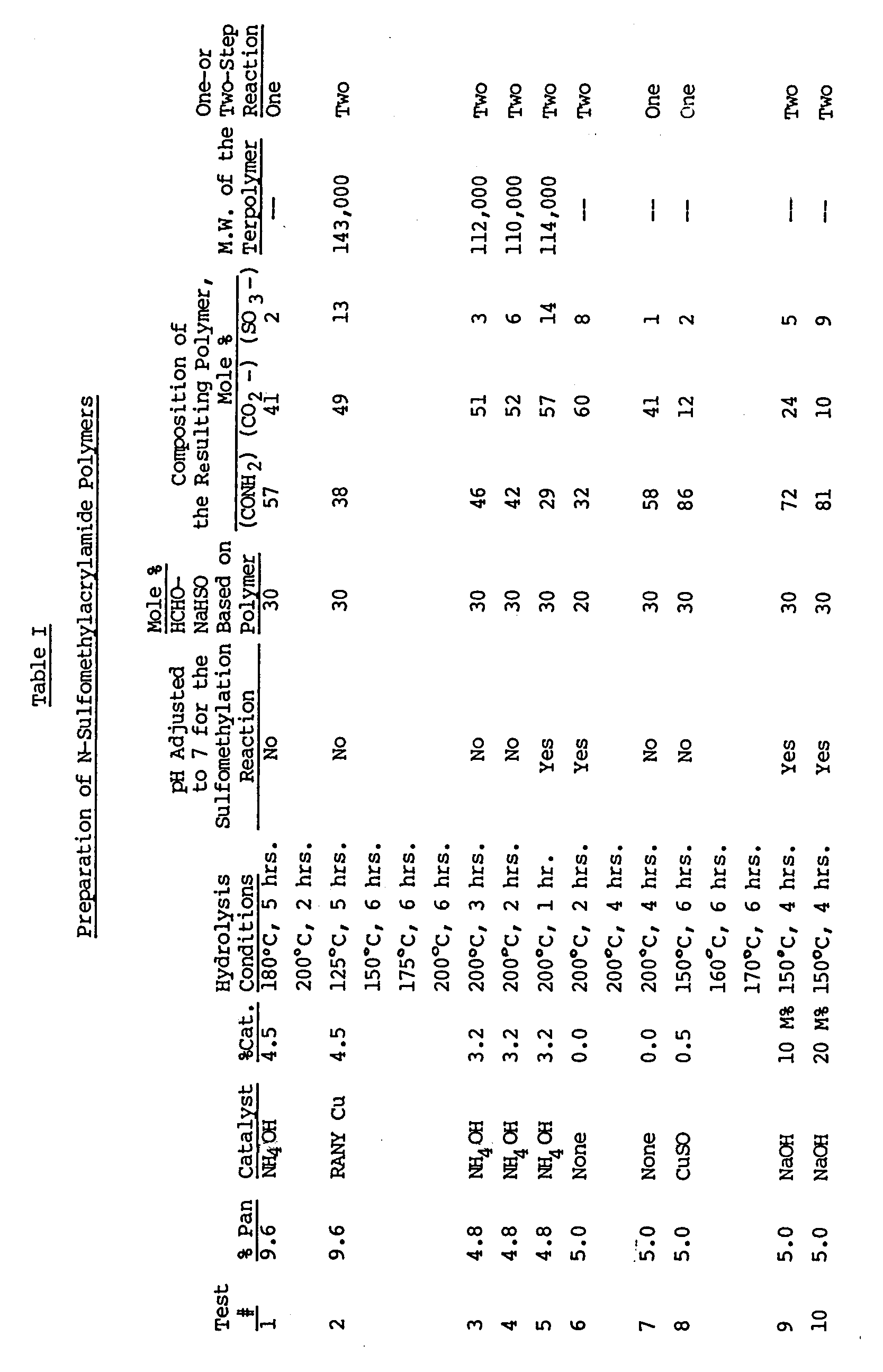
- A. One-step reaction: A mixture of polyacrylonitrile and sodium formaldehyde bisulfite in water with or without a catalyst (e.g., NH₄OH or a catalytic metal such as copper) is heated up to 200°C until a desired degree of conversion is obtained;
- B. Two-step reaction: Polyacrylonitrile is first hydrolyzed with or without a catalyst at a temperature up to 200°C. the hydrolyzed polyacrylonitrile is sulfomethylated with NaHSO₃-HCHO at 150°C.
- The starting polyacrylonitrile should have a molecular weight within the range of at least 1,000-500,000, with a preferred molecular weight range being 3,000-200,000. Polymers within this molecular weight range readily undergo the reactions described herein and produce a finished polymer having a variety of industrial uses such as scale control agents for cooling towers and boilers and dispersants for a variety of aqueous suspensions.
- It is also beneficial that the surface area of the polyacrylonitrile be sufficiently large so as to increase the reaction rate. Therefore fine particles e.g. in the particle size range of a few microns or less, facilitate the speed and completeness of the reaction.
- The amount of water may vary although it is necessary that sufficient water be provided in the reaction mixture to furnish at a minimum at least 0.5 mols per mol of nitrile groups present in the starting polymer. A general range is 0.5-55 mols. Generally the amount of water is not critical since it is beneficial that a large excess of water be present to allow for the polyacrylonitrile-water mixture to be reacted in the form of a slurry.
- The temperature at which the amide groups are formed during the reactions or converted to the N-sulfomethylamide groups must be within the range of 125-250°C. A preferred temperature is 150°C. When polyacrylonitrile is reacted with water at either acid or basic pH's, there is formed a copolymer of acrylamide and acrylic acid. Depending on the pH and the reaction temperature, the ratio of acrylic acid to acrylamide groups may be varied. It is preferred to conduct the reaction at a pH greater than 8.
- The reaction procedure whereby the polyacrylonitrile is reacted with a metal catalyst capable of converting nitrile groups in the presence of water to amide groups uses catalysts which are well-known and described in detail in cols. 2 and 3 of U.S. Patent 3,997,606.
- Metallic copper catalysts are preferred with a most preferred catalyst being a special Raney copper catalyst which contains from about 2 to 45% by weight of aluminum. This catalyst in its preferred embodiment contains particles having an average particle diameter ranging from 0.01 to 1.27 cm (0.002 to 0.5 inches) and has a relative activity of at least about 2. Catalysts of this type as well as their method of preparation are disclosed in U.S. Patent 3,920,740.
- The molecular weight of the finished polymer will generally correspond with a molecular weight of the starting polyacrylonitrile.
- The sodium formaldehyde bisulfite is formed when formaldehyde and sodium bisulfite are added to water. This reaction is almost instantaneous. In practicing the processes of the invention, the sodium formaldehyde bisulfite can be added either as a pre-prepared solution or the formaldehyde and the bisulfite can be added separately.
- The amount of the sodium formaldehyde bisulfite should be sufficient to react with at least 5% if the nitrile groups present in the starting polymers in amounts ranging between 5-15% or more are preferred.
- To illustrate the invention, a variety of polyacrylonitrile polymers were subjected to the reaction conditions described above. The results are set forth in Table I.
Claims (4)
- A method for preparing N-sulfomethyl acrylamide, acrylamide, acrylic acid terpolymers from polyacrylonitrile characterized by reacting the reactants polyacrylonitrile, water and sodium formaldehyde bisulfite at a temperature ranging from 125°-250°C for a period of time sufficient to convert the reactants to an N-sulfomethyl acrylamide, acrylamide, acrylic acid terpolymer and then recovering this terpolymer.
- The method of claim 1, characterized in that the polyacrylonitrile is first reacted with a metal-containing catalyst capable of converting a portion of the nitrile groups of the polyacrylonitrile to amide groups and then reacting said polymer with sodium formaldehyde bisulfite to convert a portion of the acrylamide groups into N-sulfomethyl acrylonitrile groups thereby producing an N-sulfomethyl acrylamide, acrylamide, acrylic acid terpolymer.
- The method of claims 1 or 2, characterized in that the molecular weight of the starting polyacrylonitrile is between 1,000-500,000.
- The method of claim 3, characterized in that the molecular weight is between 3,000-200,000.
Applications Claiming Priority (2)
| Application Number | Priority Date | Filing Date | Title |
|---|---|---|---|
| US92221986A | 1986-10-23 | 1986-10-23 | |
| US922219 | 2001-08-03 |
Publications (3)
| Publication Number | Publication Date |
|---|---|
| EP0265846A2 EP0265846A2 (en) | 1988-05-04 |
| EP0265846A3 EP0265846A3 (en) | 1989-09-20 |
| EP0265846B1 true EP0265846B1 (en) | 1994-09-21 |
Family
ID=25446717
Family Applications (1)
| Application Number | Title | Priority Date | Filing Date |
|---|---|---|---|
| EP87115509A Expired - Lifetime EP0265846B1 (en) | 1986-10-23 | 1987-10-22 | Method for preparing n-sulfomethyl acrylamide, acrylic acid terpolymers from polyacrylonitrile |
Country Status (9)
| Country | Link |
|---|---|
| EP (1) | EP0265846B1 (en) |
| JP (1) | JPH085932B2 (en) |
| CA (1) | CA1293583C (en) |
| DE (1) | DE3750568T2 (en) |
| DK (1) | DK553387A (en) |
| ES (1) | ES2059343T3 (en) |
| PT (1) | PT85958B (en) |
| TR (1) | TR23881A (en) |
| ZA (1) | ZA877976B (en) |
Families Citing this family (5)
| Publication number | Priority date | Publication date | Assignee | Title |
|---|---|---|---|---|
| DE4107397A1 (en) * | 1991-03-08 | 1992-09-10 | Bayer Ag | POLYMERISATES WITH SULFONAMIDE UNITS AS A COMPATIBILITY MEDIATOR FOR POLYAMIDE / POLYCARBONATE BLENDS |
| US20020028860A1 (en) * | 1999-04-16 | 2002-03-07 | E. Michael Kerr | Method of modifying rheology of slurries in mineral processing |
| DE10101671A1 (en) | 2000-08-25 | 2002-03-14 | Bayer Ag | Method of conditioning stagnant and flowing water systems |
| DE10310414A1 (en) | 2003-03-11 | 2004-09-23 | Bayer Chemicals Ag | Water conditioner for use in still or flowing water (e.g. in oil exploration 'squeeze' operations) contains a polysuccinimide and a biostat |
| DE102005010855A1 (en) | 2005-03-10 | 2006-09-14 | Lanxess Deutschland Gmbh | Aqueous conditioning agent, useful as a pelleting agent, comprises polysuccinimide or its partial hydrolysate in combination with fatty acid amides |
Family Cites Families (2)
| Publication number | Priority date | Publication date | Assignee | Title |
|---|---|---|---|---|
| US3979348A (en) * | 1974-06-17 | 1976-09-07 | Nalco Chemical Company | Ionic polymers from acrylamide latex polymers |
| US3997606A (en) * | 1975-12-03 | 1976-12-14 | Nalco Chemical Company | Method of producing dry acrylamide |
-
1987
- 1987-10-06 CA CA000548685A patent/CA1293583C/en not_active Expired - Fee Related
- 1987-10-20 PT PT85958A patent/PT85958B/en not_active IP Right Cessation
- 1987-10-21 TR TR87/0727A patent/TR23881A/en unknown
- 1987-10-22 EP EP87115509A patent/EP0265846B1/en not_active Expired - Lifetime
- 1987-10-22 ES ES87115509T patent/ES2059343T3/en not_active Expired - Lifetime
- 1987-10-22 DE DE3750568T patent/DE3750568T2/en not_active Expired - Fee Related
- 1987-10-22 DK DK553387A patent/DK553387A/en not_active Application Discontinuation
- 1987-10-22 JP JP62267588A patent/JPH085932B2/en not_active Expired - Lifetime
- 1987-10-23 ZA ZA877976A patent/ZA877976B/en unknown
Non-Patent Citations (2)
| Title |
|---|
| Encyclopedia of Polymer Science and Technology, J. Wiley & Sons, Inc. , 1964, vol. 1, page 185 * |
| Methoden der organischen Chemie (Houben-Weyl), 4th edition, Georg Thieme-Verlag, 1963, Vol. XIV/2, pages 708 - 713 * |
Also Published As
| Publication number | Publication date |
|---|---|
| TR23881A (en) | 1990-10-16 |
| PT85958B (en) | 1990-07-31 |
| PT85958A (en) | 1987-11-01 |
| CA1293583C (en) | 1991-12-24 |
| JPH085932B2 (en) | 1996-01-24 |
| JPS63132904A (en) | 1988-06-04 |
| DK553387A (en) | 1988-04-24 |
| EP0265846A2 (en) | 1988-05-04 |
| DE3750568D1 (en) | 1994-10-27 |
| EP0265846A3 (en) | 1989-09-20 |
| ES2059343T3 (en) | 1994-11-16 |
| DK553387D0 (en) | 1987-10-22 |
| ZA877976B (en) | 1988-09-28 |
| DE3750568T2 (en) | 1995-04-13 |
Similar Documents
| Publication | Publication Date | Title |
|---|---|---|
| EP0238852B1 (en) | A process for synthesizing carboxylate containing modified acrylamide polymers and the polymers thereof | |
| US6323306B1 (en) | Preparation of water-soluble cross-linked cationic polymers | |
| EP0461399B1 (en) | Amine functional polymers containing aminal groups | |
| US3539535A (en) | Cationic carbamoyl polymers | |
| US3567659A (en) | Water-soluble cationic polymers from epichlorohydrin and methylamine | |
| DE68912388T2 (en) | Process for the preparation of poly (vinyl alcohol) -copoly (vinylamine) by a two-step process. | |
| US5300566A (en) | Method for preparing poly(vinyl alcohol)-co-poly(vinylamine) via a two-phase process | |
| US5627260A (en) | Quaternized tertiary aminomethyl acrylamide polymer microemulsions with improved performance | |
| US4024328A (en) | Method for alkylating aminomethylacrylamide polymers | |
| US5194492A (en) | Two-phase process for preparing poly(vinyl alcohol)-co-poly(vinylamine) | |
| AU720068B2 (en) | Method of making polymers containing hydroxamate functional groups | |
| KR100294588B1 (en) | Polymerization and Manufacturing Process Using Amine-Thiol Chain Transfer Agent | |
| JPS62270603A (en) | Polymer containing amido alkoxylated/modified by cation and its production | |
| EP0140309A2 (en) | Process for the preparation of copolymers of monoallylamine and diallylamine derivatives | |
| US3380947A (en) | Process for the preparation of aqueous solutions of flocculating agents of the polyacrylic amide type having high molecular weight | |
| CA1293583C (en) | Method for preparing n-sulfomethyl acrylamide, acrylic acid terpolymers from polyacrylonitrile | |
| US4179424A (en) | Method for rapidly producing amino methylated polymers and quaternary ammonium salts thereof | |
| US3946061A (en) | Organo-silica polymers | |
| EP0002254B1 (en) | Preparation of n-(aminomethyl)-alpha,beta-ethylenically unsaturated carboxamides, their polymers and the quaternized carboxamides thereof | |
| US5395897A (en) | High molecular weight substituted amides from polycarboxylic acids | |
| US4042772A (en) | Urea as an additive to improve the viscosity and activity of acrylamide-acrylamide acrylic acid polymers prepared from poor quality acrylamide | |
| EP0031928B1 (en) | Preparation of water-immiscible, acid-soluble n-(aminomethyl)carboxamides, quaternary derivatives and polymers thereof | |
| EP0310099A3 (en) | Sulfomethylation of high molecular weight polyarylamide polymers | |
| EP0171661B1 (en) | Method of preparing cationic terpolymers and product derived therefrom | |
| US5446107A (en) | Method for the preparation of cationic, water-soluble polymers and their use |
Legal Events
| Date | Code | Title | Description |
|---|---|---|---|
| PUAI | Public reference made under article 153(3) epc to a published international application that has entered the european phase |
Free format text: ORIGINAL CODE: 0009012 |
|
| AK | Designated contracting states |
Kind code of ref document: A2 Designated state(s): DE ES GR IT |
|
| PUAL | Search report despatched |
Free format text: ORIGINAL CODE: 0009013 |
|
| AK | Designated contracting states |
Kind code of ref document: A3 Designated state(s): DE ES GR IT |
|
| 17P | Request for examination filed |
Effective date: 19900223 |
|
| 17Q | First examination report despatched |
Effective date: 19910326 |
|
| GRAA | (expected) grant |
Free format text: ORIGINAL CODE: 0009210 |
|
| AK | Designated contracting states |
Kind code of ref document: B1 Designated state(s): DE ES GR IT |
|
| PG25 | Lapsed in a contracting state [announced via postgrant information from national office to epo] |
Ref country code: GR Free format text: LAPSE BECAUSE OF FAILURE TO SUBMIT A TRANSLATION OF THE DESCRIPTION OR TO PAY THE FEE WITHIN THE PRESCRIBED TIME-LIMIT Effective date: 19940921 |
|
| REF | Corresponds to: |
Ref document number: 3750568 Country of ref document: DE Date of ref document: 19941027 |
|
| REG | Reference to a national code |
Ref country code: ES Ref legal event code: FG2A Ref document number: 2059343 Country of ref document: ES Kind code of ref document: T3 |
|
| ITF | It: translation for a ep patent filed | ||
| PLBE | No opposition filed within time limit |
Free format text: ORIGINAL CODE: 0009261 |
|
| STAA | Information on the status of an ep patent application or granted ep patent |
Free format text: STATUS: NO OPPOSITION FILED WITHIN TIME LIMIT |
|
| 26N | No opposition filed | ||
| PGFP | Annual fee paid to national office [announced via postgrant information from national office to epo] |
Ref country code: DE Payment date: 19970925 Year of fee payment: 11 |
|
| PGFP | Annual fee paid to national office [announced via postgrant information from national office to epo] |
Ref country code: ES Payment date: 19971015 Year of fee payment: 11 |
|
| PG25 | Lapsed in a contracting state [announced via postgrant information from national office to epo] |
Ref country code: ES Free format text: LAPSE BECAUSE OF NON-PAYMENT OF DUE FEES Effective date: 19981023 |
|
| PG25 | Lapsed in a contracting state [announced via postgrant information from national office to epo] |
Ref country code: DE Free format text: LAPSE BECAUSE OF NON-PAYMENT OF DUE FEES Effective date: 19990803 |
|
| REG | Reference to a national code |
Ref country code: ES Ref legal event code: FD2A Effective date: 19991113 |
|
| PG25 | Lapsed in a contracting state [announced via postgrant information from national office to epo] |
Ref country code: IT Free format text: LAPSE BECAUSE OF NON-PAYMENT OF DUE FEES;WARNING: LAPSES OF ITALIAN PATENTS WITH EFFECTIVE DATE BEFORE 2007 MAY HAVE OCCURRED AT ANY TIME BEFORE 2007. THE CORRECT EFFECTIVE DATE MAY BE DIFFERENT FROM THE ONE RECORDED. Effective date: 20051022 |