EP0264623B1 - Curable linear polyphenylene ether interpenetrating polymer network compositions and process - Google Patents
Curable linear polyphenylene ether interpenetrating polymer network compositions and process Download PDFInfo
- Publication number
- EP0264623B1 EP0264623B1 EP19870113546 EP87113546A EP0264623B1 EP 0264623 B1 EP0264623 B1 EP 0264623B1 EP 19870113546 EP19870113546 EP 19870113546 EP 87113546 A EP87113546 A EP 87113546A EP 0264623 B1 EP0264623 B1 EP 0264623B1
- Authority
- EP
- European Patent Office
- Prior art keywords
- component
- composition
- polyphenylene ether
- halogen
- styrene
- Prior art date
- Legal status (The legal status is an assumption and is not a legal conclusion. Google has not performed a legal analysis and makes no representation as to the accuracy of the status listed.)
- Expired
Links
- 239000000203 mixture Substances 0.000 title claims description 98
- 229920001955 polyphenylene ether Polymers 0.000 title claims description 60
- 229920000642 polymer Polymers 0.000 title claims description 42
- 238000000034 method Methods 0.000 title description 28
- 230000008569 process Effects 0.000 title description 5
- -1 organic acid halide Chemical class 0.000 claims description 46
- 150000001875 compounds Chemical class 0.000 claims description 41
- PPBRXRYQALVLMV-UHFFFAOYSA-N Styrene Chemical compound C=CC1=CC=CC=C1 PPBRXRYQALVLMV-UHFFFAOYSA-N 0.000 claims description 37
- 229920002554 vinyl polymer Polymers 0.000 claims description 31
- 125000000391 vinyl group Chemical group [H]C([*])=C([H])[H] 0.000 claims description 30
- 239000007788 liquid Substances 0.000 claims description 26
- 239000001257 hydrogen Substances 0.000 claims description 21
- 229910052739 hydrogen Inorganic materials 0.000 claims description 21
- 125000004435 hydrogen atom Chemical group [H]* 0.000 claims description 21
- 125000000217 alkyl group Chemical group 0.000 claims description 19
- 238000002156 mixing Methods 0.000 claims description 19
- 239000003054 catalyst Substances 0.000 claims description 18
- 229910052736 halogen Inorganic materials 0.000 claims description 18
- 150000002367 halogens Chemical class 0.000 claims description 18
- 125000002887 hydroxy group Chemical group [H]O* 0.000 claims description 15
- 150000003254 radicals Chemical class 0.000 claims description 15
- IEPRKVQEAMIZSS-AATRIKPKSA-N diethyl fumarate Chemical compound CCOC(=O)\C=C\C(=O)OCC IEPRKVQEAMIZSS-AATRIKPKSA-N 0.000 claims description 12
- NJMOHBDCGXJLNJ-UHFFFAOYSA-N trimellitic anhydride chloride Chemical compound ClC(=O)C1=CC=C2C(=O)OC(=O)C2=C1 NJMOHBDCGXJLNJ-UHFFFAOYSA-N 0.000 claims description 12
- 125000004432 carbon atom Chemical group C* 0.000 claims description 11
- 125000001997 phenyl group Chemical group [H]C1=C([H])C([H])=C(*)C([H])=C1[H] 0.000 claims description 10
- 239000000835 fiber Substances 0.000 claims description 9
- 125000002496 methyl group Chemical group [H]C([H])([H])* 0.000 claims description 9
- 239000000843 powder Substances 0.000 claims description 9
- QEQBMZQFDDDTPN-UHFFFAOYSA-N (2-methylpropan-2-yl)oxy benzenecarboperoxoate Chemical compound CC(C)(C)OOOC(=O)C1=CC=CC=C1 QEQBMZQFDDDTPN-UHFFFAOYSA-N 0.000 claims description 8
- HIDBROSJWZYGSZ-UHFFFAOYSA-N 1-phenylpyrrole-2,5-dione Chemical compound O=C1C=CC(=O)N1C1=CC=CC=C1 HIDBROSJWZYGSZ-UHFFFAOYSA-N 0.000 claims description 8
- 239000002253 acid Substances 0.000 claims description 8
- 238000004519 manufacturing process Methods 0.000 claims description 8
- 238000006116 polymerization reaction Methods 0.000 claims description 8
- 229920005989 resin Polymers 0.000 claims description 8
- 239000011347 resin Substances 0.000 claims description 8
- RNFJDJUURJAICM-UHFFFAOYSA-N 2,2,4,4,6,6-hexaphenoxy-1,3,5-triaza-2$l^{5},4$l^{5},6$l^{5}-triphosphacyclohexa-1,3,5-triene Chemical compound N=1P(OC=2C=CC=CC=2)(OC=2C=CC=CC=2)=NP(OC=2C=CC=CC=2)(OC=2C=CC=CC=2)=NP=1(OC=1C=CC=CC=1)OC1=CC=CC=C1 RNFJDJUURJAICM-UHFFFAOYSA-N 0.000 claims description 7
- 239000007795 chemical reaction product Substances 0.000 claims description 7
- 239000003063 flame retardant Substances 0.000 claims description 7
- 239000003365 glass fiber Substances 0.000 claims description 7
- 150000004820 halides Chemical class 0.000 claims description 7
- 239000008188 pellet Substances 0.000 claims description 7
- 239000004609 Impact Modifier Substances 0.000 claims description 6
- RREGISFBPQOLTM-UHFFFAOYSA-N alumane;trihydrate Chemical compound O.O.O.[AlH3] RREGISFBPQOLTM-UHFFFAOYSA-N 0.000 claims description 6
- 125000001188 haloalkyl group Chemical group 0.000 claims description 6
- 238000010128 melt processing Methods 0.000 claims description 6
- 150000007524 organic acids Chemical class 0.000 claims description 6
- 150000001451 organic peroxides Chemical class 0.000 claims description 6
- 229920000728 polyester Polymers 0.000 claims description 6
- 125000003545 alkoxy group Chemical group 0.000 claims description 5
- 229920001519 homopolymer Polymers 0.000 claims description 5
- 239000012744 reinforcing agent Substances 0.000 claims description 5
- 125000001424 substituent group Chemical group 0.000 claims description 5
- 150000008065 acid anhydrides Chemical class 0.000 claims description 4
- 229910052794 bromium Inorganic materials 0.000 claims description 4
- CQEYYJKEWSMYFG-UHFFFAOYSA-N butyl acrylate Chemical group CCCCOC(=O)C=C CQEYYJKEWSMYFG-UHFFFAOYSA-N 0.000 claims description 4
- 229910052801 chlorine Inorganic materials 0.000 claims description 4
- 229920001577 copolymer Polymers 0.000 claims description 4
- RTZKZFJDLAIYFH-UHFFFAOYSA-N ether Substances CCOCC RTZKZFJDLAIYFH-UHFFFAOYSA-N 0.000 claims description 4
- 239000012757 flame retardant agent Substances 0.000 claims description 4
- 229910052731 fluorine Inorganic materials 0.000 claims description 4
- 125000000524 functional group Chemical group 0.000 claims description 4
- 229910052740 iodine Inorganic materials 0.000 claims description 4
- 125000004103 aminoalkyl group Chemical group 0.000 claims description 3
- CCGKOQOJPYTBIH-UHFFFAOYSA-N ethenone Chemical compound C=C=O CCGKOQOJPYTBIH-UHFFFAOYSA-N 0.000 claims description 3
- 239000003112 inhibitor Substances 0.000 claims description 3
- 229910052757 nitrogen Inorganic materials 0.000 claims description 3
- 125000004433 nitrogen atom Chemical group N* 0.000 claims description 3
- 125000004430 oxygen atom Chemical group O* 0.000 claims description 3
- 230000003014 reinforcing effect Effects 0.000 claims description 3
- 239000004215 Carbon black (E152) Substances 0.000 claims description 2
- 150000001408 amides Chemical class 0.000 claims description 2
- 150000005840 aryl radicals Chemical class 0.000 claims description 2
- 150000001732 carboxylic acid derivatives Chemical class 0.000 claims description 2
- 150000001733 carboxylic acid esters Chemical class 0.000 claims description 2
- 229930195733 hydrocarbon Natural products 0.000 claims description 2
- 125000002924 primary amino group Chemical group [H]N([H])* 0.000 claims description 2
- 229920001169 thermoplastic Polymers 0.000 claims description 2
- 239000004416 thermosoftening plastic Substances 0.000 claims description 2
- VZCYOOQTPOCHFL-OWOJBTEDSA-N Fumaric acid Chemical compound OC(=O)\C=C\C(O)=O VZCYOOQTPOCHFL-OWOJBTEDSA-N 0.000 claims 2
- 229920006132 styrene block copolymer Polymers 0.000 claims 2
- VZCYOOQTPOCHFL-UHFFFAOYSA-N trans-butenedioic acid Natural products OC(=O)C=CC(O)=O VZCYOOQTPOCHFL-UHFFFAOYSA-N 0.000 claims 2
- 150000002430 hydrocarbons Chemical class 0.000 claims 1
- 239000000463 material Substances 0.000 description 17
- 239000003795 chemical substances by application Substances 0.000 description 14
- YXFVVABEGXRONW-UHFFFAOYSA-N Toluene Chemical compound CC1=CC=CC=C1 YXFVVABEGXRONW-UHFFFAOYSA-N 0.000 description 12
- 239000000178 monomer Substances 0.000 description 10
- OKKJLVBELUTLKV-UHFFFAOYSA-N Methanol Chemical compound OC OKKJLVBELUTLKV-UHFFFAOYSA-N 0.000 description 9
- 239000004721 Polyphenylene oxide Substances 0.000 description 9
- 150000008064 anhydrides Chemical class 0.000 description 8
- 238000006243 chemical reaction Methods 0.000 description 7
- PWHULOQIROXLJO-UHFFFAOYSA-N Manganese Chemical compound [Mn] PWHULOQIROXLJO-UHFFFAOYSA-N 0.000 description 5
- 229910052748 manganese Inorganic materials 0.000 description 5
- 239000011572 manganese Substances 0.000 description 5
- 230000004048 modification Effects 0.000 description 5
- 238000012986 modification Methods 0.000 description 5
- 229920013636 polyphenyl ether polymer Polymers 0.000 description 5
- NXXYKOUNUYWIHA-UHFFFAOYSA-N 2,6-Dimethylphenol Chemical compound CC1=CC=CC(C)=C1O NXXYKOUNUYWIHA-UHFFFAOYSA-N 0.000 description 4
- OZAIFHULBGXAKX-UHFFFAOYSA-N 2-(2-cyanopropan-2-yldiazenyl)-2-methylpropanenitrile Chemical compound N#CC(C)(C)N=NC(C)(C)C#N OZAIFHULBGXAKX-UHFFFAOYSA-N 0.000 description 4
- 239000000654 additive Substances 0.000 description 4
- 229920001400 block copolymer Polymers 0.000 description 4
- 230000001419 dependent effect Effects 0.000 description 4
- 238000009472 formulation Methods 0.000 description 4
- 150000002561 ketenes Chemical class 0.000 description 4
- 229920006380 polyphenylene oxide Polymers 0.000 description 4
- 238000001556 precipitation Methods 0.000 description 4
- 238000012545 processing Methods 0.000 description 4
- 239000002904 solvent Substances 0.000 description 4
- 238000012360 testing method Methods 0.000 description 4
- WFDIJRYMOXRFFG-UHFFFAOYSA-N Acetic anhydride Chemical compound CC(=O)OC(C)=O WFDIJRYMOXRFFG-UHFFFAOYSA-N 0.000 description 3
- UHOVQNZJYSORNB-UHFFFAOYSA-N Benzene Chemical compound C1=CC=CC=C1 UHOVQNZJYSORNB-UHFFFAOYSA-N 0.000 description 3
- RYGMFSIKBFXOCR-UHFFFAOYSA-N Copper Chemical compound [Cu] RYGMFSIKBFXOCR-UHFFFAOYSA-N 0.000 description 3
- 229920000265 Polyparaphenylene Polymers 0.000 description 3
- 239000000460 chlorine Substances 0.000 description 3
- 238000000748 compression moulding Methods 0.000 description 3
- 229910052802 copper Inorganic materials 0.000 description 3
- 239000010949 copper Substances 0.000 description 3
- 238000001125 extrusion Methods 0.000 description 3
- 238000010438 heat treatment Methods 0.000 description 3
- FPYJFEHAWHCUMM-UHFFFAOYSA-N maleic anhydride Chemical compound O=C1OC(=O)C=C1 FPYJFEHAWHCUMM-UHFFFAOYSA-N 0.000 description 3
- 238000002360 preparation method Methods 0.000 description 3
- 230000002787 reinforcement Effects 0.000 description 3
- AZQWKYJCGOJGHM-UHFFFAOYSA-N 1,4-benzoquinone Chemical compound O=C1C=CC(=O)C=C1 AZQWKYJCGOJGHM-UHFFFAOYSA-N 0.000 description 2
- HIXDQWDOVZUNNA-UHFFFAOYSA-N 2-(3,4-dimethoxyphenyl)-5-hydroxy-7-methoxychromen-4-one Chemical compound C=1C(OC)=CC(O)=C(C(C=2)=O)C=1OC=2C1=CC=C(OC)C(OC)=C1 HIXDQWDOVZUNNA-UHFFFAOYSA-N 0.000 description 2
- DDTHMESPCBONDT-UHFFFAOYSA-N 4-(4-oxocyclohexa-2,5-dien-1-ylidene)cyclohexa-2,5-dien-1-one Chemical compound C1=CC(=O)C=CC1=C1C=CC(=O)C=C1 DDTHMESPCBONDT-UHFFFAOYSA-N 0.000 description 2
- KZMGYPLQYOPHEL-UHFFFAOYSA-N Boron trifluoride etherate Chemical compound FB(F)F.CCOCC KZMGYPLQYOPHEL-UHFFFAOYSA-N 0.000 description 2
- HEDRZPFGACZZDS-UHFFFAOYSA-N Chloroform Chemical compound ClC(Cl)Cl HEDRZPFGACZZDS-UHFFFAOYSA-N 0.000 description 2
- ROSDSFDQCJNGOL-UHFFFAOYSA-N Dimethylamine Chemical compound CNC ROSDSFDQCJNGOL-UHFFFAOYSA-N 0.000 description 2
- 239000004743 Polypropylene Substances 0.000 description 2
- 239000004793 Polystyrene Substances 0.000 description 2
- 150000001412 amines Chemical class 0.000 description 2
- 230000008901 benefit Effects 0.000 description 2
- PASDCCFISLVPSO-UHFFFAOYSA-N benzoyl chloride Chemical compound ClC(=O)C1=CC=CC=C1 PASDCCFISLVPSO-UHFFFAOYSA-N 0.000 description 2
- 230000015572 biosynthetic process Effects 0.000 description 2
- 239000010941 cobalt Substances 0.000 description 2
- 229910017052 cobalt Inorganic materials 0.000 description 2
- GUTLYIVDDKVIGB-UHFFFAOYSA-N cobalt atom Chemical compound [Co] GUTLYIVDDKVIGB-UHFFFAOYSA-N 0.000 description 2
- 238000007906 compression Methods 0.000 description 2
- 230000006835 compression Effects 0.000 description 2
- 239000011258 core-shell material Substances 0.000 description 2
- WHHGLZMJPXIBIX-UHFFFAOYSA-N decabromodiphenyl ether Chemical compound BrC1=C(Br)C(Br)=C(Br)C(Br)=C1OC1=C(Br)C(Br)=C(Br)C(Br)=C1Br WHHGLZMJPXIBIX-UHFFFAOYSA-N 0.000 description 2
- 125000005265 dialkylamine group Chemical group 0.000 description 2
- JQVDAXLFBXTEQA-UHFFFAOYSA-N dibutylamine Chemical compound CCCCNCCCC JQVDAXLFBXTEQA-UHFFFAOYSA-N 0.000 description 2
- 229920001971 elastomer Polymers 0.000 description 2
- 125000001033 ether group Chemical group 0.000 description 2
- 125000001495 ethyl group Chemical group [H]C([H])([H])C([H])([H])* 0.000 description 2
- 125000001449 isopropyl group Chemical group [H]C([H])([H])C([H])(*)C([H])([H])[H] 0.000 description 2
- 125000004108 n-butyl group Chemical group [H]C([H])([H])C([H])([H])C([H])([H])C([H])([H])* 0.000 description 2
- 238000005691 oxidative coupling reaction Methods 0.000 description 2
- 229920001155 polypropylene Polymers 0.000 description 2
- 229920002223 polystyrene Polymers 0.000 description 2
- 229920005604 random copolymer Polymers 0.000 description 2
- 239000011541 reaction mixture Substances 0.000 description 2
- 238000007493 shaping process Methods 0.000 description 2
- 150000003512 tertiary amines Chemical class 0.000 description 2
- AFTZDCQOKWGCAB-UHFFFAOYSA-N (1,5-dichlorocyclohexa-2,4-diene-1-carbonyl) 1,5-dichlorocyclohexa-2,4-diene-1-carboxylate Chemical compound C1C(Cl)=CC=CC1(Cl)C(=O)OC(=O)C1(Cl)C=CC=C(Cl)C1 AFTZDCQOKWGCAB-UHFFFAOYSA-N 0.000 description 1
- MEFKFJOEVLUFAY-UHFFFAOYSA-N (2,2,2-trichloroacetyl) 2,2,2-trichloroacetate Chemical compound ClC(Cl)(Cl)C(=O)OC(=O)C(Cl)(Cl)Cl MEFKFJOEVLUFAY-UHFFFAOYSA-N 0.000 description 1
- AAMGTDBAQQMXQN-UHFFFAOYSA-N (2,3,4,5,6-pentachlorobenzoyl) 2,3,4,5,6-pentachlorobenzoate Chemical compound ClC1=C(Cl)C(Cl)=C(Cl)C(Cl)=C1C(=O)OC(=O)C1=C(Cl)C(Cl)=C(Cl)C(Cl)=C1Cl AAMGTDBAQQMXQN-UHFFFAOYSA-N 0.000 description 1
- 125000004178 (C1-C4) alkyl group Chemical group 0.000 description 1
- WOGITNXCNOTRLK-VOTSOKGWSA-N (e)-3-phenylprop-2-enoyl chloride Chemical compound ClC(=O)\C=C\C1=CC=CC=C1 WOGITNXCNOTRLK-VOTSOKGWSA-N 0.000 description 1
- PGZVFRAEAAXREB-UHFFFAOYSA-N 2,2-dimethylpropanoyl 2,2-dimethylpropanoate Chemical compound CC(C)(C)C(=O)OC(=O)C(C)(C)C PGZVFRAEAAXREB-UHFFFAOYSA-N 0.000 description 1
- KPTMGJRRIXXKKW-UHFFFAOYSA-N 2,3,5-trimethyl-7-oxabicyclo[2.2.1]hepta-1,3,5-triene Chemical group O1C2=C(C)C(C)=C1C=C2C KPTMGJRRIXXKKW-UHFFFAOYSA-N 0.000 description 1
- OJMZQYGIPTULAQ-UHFFFAOYSA-N 2,5-dioxooxolane-3-carbonyl chloride Chemical compound ClC(=O)C1CC(=O)OC1=O OJMZQYGIPTULAQ-UHFFFAOYSA-N 0.000 description 1
- XMNIXWIUMCBBBL-UHFFFAOYSA-N 2-(2-phenylpropan-2-ylperoxy)propan-2-ylbenzene Chemical compound C=1C=CC=CC=1C(C)(C)OOC(C)(C)C1=CC=CC=C1 XMNIXWIUMCBBBL-UHFFFAOYSA-N 0.000 description 1
- FALRKNHUBBKYCC-UHFFFAOYSA-N 2-(chloromethyl)pyridine-3-carbonitrile Chemical compound ClCC1=NC=CC=C1C#N FALRKNHUBBKYCC-UHFFFAOYSA-N 0.000 description 1
- YBXJZGOTBMPKNO-UHFFFAOYSA-N 2-ethylhex-1-en-1-one Chemical compound CCCCC(CC)=C=O YBXJZGOTBMPKNO-UHFFFAOYSA-N 0.000 description 1
- 125000004493 2-methylbut-1-yl group Chemical group CC(C*)CC 0.000 description 1
- 125000005916 2-methylpentyl group Chemical group 0.000 description 1
- VDOKWPVSGXHSNP-UHFFFAOYSA-N 2-methylprop-1-en-1-one Chemical compound CC(C)=C=O VDOKWPVSGXHSNP-UHFFFAOYSA-N 0.000 description 1
- KGIGUEBEKRSTEW-UHFFFAOYSA-N 2-vinylpyridine Chemical compound C=CC1=CC=CC=N1 KGIGUEBEKRSTEW-UHFFFAOYSA-N 0.000 description 1
- GVLZQVREHWQBJN-UHFFFAOYSA-N 3,5-dimethyl-7-oxabicyclo[2.2.1]hepta-1,3,5-triene Chemical group CC1=C(O2)C(C)=CC2=C1 GVLZQVREHWQBJN-UHFFFAOYSA-N 0.000 description 1
- FNEKYGYYCSEBNI-UHFFFAOYSA-N 3-(2-chloroacetyl)oxolane-2,5-dione Chemical compound ClCC(=O)C1CC(=O)OC1=O FNEKYGYYCSEBNI-UHFFFAOYSA-N 0.000 description 1
- 125000005917 3-methylpentyl group Chemical group 0.000 description 1
- KFDVPJUYSDEJTH-UHFFFAOYSA-N 4-ethenylpyridine Chemical compound C=CC1=CC=NC=C1 KFDVPJUYSDEJTH-UHFFFAOYSA-N 0.000 description 1
- ZCYVEMRRCGMTRW-UHFFFAOYSA-N 7553-56-2 Chemical compound [I] ZCYVEMRRCGMTRW-UHFFFAOYSA-N 0.000 description 1
- NIXOWILDQLNWCW-UHFFFAOYSA-M Acrylate Chemical group [O-]C(=O)C=C NIXOWILDQLNWCW-UHFFFAOYSA-M 0.000 description 1
- 239000004342 Benzoyl peroxide Substances 0.000 description 1
- OMPJBNCRMGITSC-UHFFFAOYSA-N Benzoylperoxide Chemical compound C=1C=CC=CC=1C(=O)OOC(=O)C1=CC=CC=C1 OMPJBNCRMGITSC-UHFFFAOYSA-N 0.000 description 1
- CPELXLSAUQHCOX-UHFFFAOYSA-M Bromide Chemical compound [Br-] CPELXLSAUQHCOX-UHFFFAOYSA-M 0.000 description 1
- WKBOTKDWSSQWDR-UHFFFAOYSA-N Bromine atom Chemical compound [Br] WKBOTKDWSSQWDR-UHFFFAOYSA-N 0.000 description 1
- 229920000049 Carbon (fiber) Polymers 0.000 description 1
- VEXZGXHMUGYJMC-UHFFFAOYSA-M Chloride anion Chemical compound [Cl-] VEXZGXHMUGYJMC-UHFFFAOYSA-M 0.000 description 1
- ZAMOUSCENKQFHK-UHFFFAOYSA-N Chlorine atom Chemical compound [Cl] ZAMOUSCENKQFHK-UHFFFAOYSA-N 0.000 description 1
- 229920001081 Commodity plastic Polymers 0.000 description 1
- 240000000491 Corchorus aestuans Species 0.000 description 1
- 235000011777 Corchorus aestuans Nutrition 0.000 description 1
- 235000010862 Corchorus capsularis Nutrition 0.000 description 1
- 229920000742 Cotton Polymers 0.000 description 1
- 239000004641 Diallyl-phthalate Substances 0.000 description 1
- PXGOKWXKJXAPGV-UHFFFAOYSA-N Fluorine Chemical compound FF PXGOKWXKJXAPGV-UHFFFAOYSA-N 0.000 description 1
- DJEQZVQFEPKLOY-UHFFFAOYSA-N N,N-dimethylbutylamine Chemical compound CCCCN(C)C DJEQZVQFEPKLOY-UHFFFAOYSA-N 0.000 description 1
- 239000004677 Nylon Substances 0.000 description 1
- OAICVXFJPJFONN-UHFFFAOYSA-N Phosphorus Chemical compound [P] OAICVXFJPJFONN-UHFFFAOYSA-N 0.000 description 1
- LGRFSURHDFAFJT-UHFFFAOYSA-N Phthalic anhydride Natural products C1=CC=C2C(=O)OC(=O)C2=C1 LGRFSURHDFAFJT-UHFFFAOYSA-N 0.000 description 1
- 239000004698 Polyethylene Substances 0.000 description 1
- 229920000297 Rayon Polymers 0.000 description 1
- VMHLLURERBWHNL-UHFFFAOYSA-M Sodium acetate Chemical compound [Na+].CC([O-])=O VMHLLURERBWHNL-UHFFFAOYSA-M 0.000 description 1
- RTAQQCXQSZGOHL-UHFFFAOYSA-N Titanium Chemical compound [Ti] RTAQQCXQSZGOHL-UHFFFAOYSA-N 0.000 description 1
- XTXRWKRVRITETP-UHFFFAOYSA-N Vinyl acetate Chemical compound CC(=O)OC=C XTXRWKRVRITETP-UHFFFAOYSA-N 0.000 description 1
- QYKIQEUNHZKYBP-UHFFFAOYSA-N Vinyl ether Chemical class C=COC=C QYKIQEUNHZKYBP-UHFFFAOYSA-N 0.000 description 1
- 238000010521 absorption reaction Methods 0.000 description 1
- FXXACINHVKSMDR-UHFFFAOYSA-N acetyl bromide Chemical compound CC(Br)=O FXXACINHVKSMDR-UHFFFAOYSA-N 0.000 description 1
- WETWJCDKMRHUPV-UHFFFAOYSA-N acetyl chloride Chemical compound CC(Cl)=O WETWJCDKMRHUPV-UHFFFAOYSA-N 0.000 description 1
- 239000012346 acetyl chloride Substances 0.000 description 1
- 150000001252 acrylic acid derivatives Chemical class 0.000 description 1
- 229920006397 acrylic thermoplastic Polymers 0.000 description 1
- PWAXUOGZOSVGBO-UHFFFAOYSA-N adipoyl chloride Chemical compound ClC(=O)CCCCC(Cl)=O PWAXUOGZOSVGBO-UHFFFAOYSA-N 0.000 description 1
- 150000001299 aldehydes Chemical class 0.000 description 1
- 125000001931 aliphatic group Chemical group 0.000 description 1
- 150000004703 alkoxides Chemical class 0.000 description 1
- 125000005263 alkylenediamine group Chemical group 0.000 description 1
- XYLMUPLGERFSHI-UHFFFAOYSA-N alpha-Methylstyrene Chemical compound CC(=C)C1=CC=CC=C1 XYLMUPLGERFSHI-UHFFFAOYSA-N 0.000 description 1
- 238000004458 analytical method Methods 0.000 description 1
- 150000001450 anions Chemical class 0.000 description 1
- 239000003963 antioxidant agent Substances 0.000 description 1
- 239000002216 antistatic agent Substances 0.000 description 1
- 238000013459 approach Methods 0.000 description 1
- 150000001491 aromatic compounds Chemical class 0.000 description 1
- QVGXLLKOCUKJST-UHFFFAOYSA-N atomic oxygen Chemical compound [O] QVGXLLKOCUKJST-UHFFFAOYSA-N 0.000 description 1
- 230000009286 beneficial effect Effects 0.000 description 1
- FDQSRULYDNDXQB-UHFFFAOYSA-N benzene-1,3-dicarbonyl chloride Chemical compound ClC(=O)C1=CC=CC(C(Cl)=O)=C1 FDQSRULYDNDXQB-UHFFFAOYSA-N 0.000 description 1
- 235000019400 benzoyl peroxide Nutrition 0.000 description 1
- QUDWYFHPNIMBFC-UHFFFAOYSA-N bis(prop-2-enyl) benzene-1,2-dicarboxylate Chemical compound C=CCOC(=O)C1=CC=CC=C1C(=O)OCC=C QUDWYFHPNIMBFC-UHFFFAOYSA-N 0.000 description 1
- GDTBXPJZTBHREO-UHFFFAOYSA-N bromine Substances BrBr GDTBXPJZTBHREO-UHFFFAOYSA-N 0.000 description 1
- FACXGONDLDSNOE-UHFFFAOYSA-N buta-1,3-diene;styrene Chemical group C=CC=C.C=CC1=CC=CC=C1.C=CC1=CC=CC=C1 FACXGONDLDSNOE-UHFFFAOYSA-N 0.000 description 1
- IRXBNHGNHKNOJI-UHFFFAOYSA-N butanedioyl dichloride Chemical compound ClC(=O)CCC(Cl)=O IRXBNHGNHKNOJI-UHFFFAOYSA-N 0.000 description 1
- ICPDUNHTGPONBR-UHFFFAOYSA-N butanedioyl difluoride Chemical compound FC(=O)CCC(F)=O ICPDUNHTGPONBR-UHFFFAOYSA-N 0.000 description 1
- YHASWHZGWUONAO-UHFFFAOYSA-N butanoyl butanoate Chemical compound CCCC(=O)OC(=O)CCC YHASWHZGWUONAO-UHFFFAOYSA-N 0.000 description 1
- JHIWVOJDXOSYLW-UHFFFAOYSA-N butyl 2,2-difluorocyclopropane-1-carboxylate Chemical compound CCCCOC(=O)C1CC1(F)F JHIWVOJDXOSYLW-UHFFFAOYSA-N 0.000 description 1
- 125000000484 butyl group Chemical group [H]C([*])([H])C([H])([H])C([H])([H])C([H])([H])[H] 0.000 description 1
- 239000006227 byproduct Substances 0.000 description 1
- 239000004917 carbon fiber Substances 0.000 description 1
- 125000002915 carbonyl group Chemical group [*:2]C([*:1])=O 0.000 description 1
- 230000015556 catabolic process Effects 0.000 description 1
- 239000002738 chelating agent Substances 0.000 description 1
- UHZZMRAGKVHANO-UHFFFAOYSA-M chlormequat chloride Chemical compound [Cl-].C[N+](C)(C)CCCl UHZZMRAGKVHANO-UHFFFAOYSA-M 0.000 description 1
- 150000001869 cobalt compounds Chemical class 0.000 description 1
- 238000004737 colorimetric analysis Methods 0.000 description 1
- 230000000052 comparative effect Effects 0.000 description 1
- 230000000536 complexating effect Effects 0.000 description 1
- 239000008139 complexing agent Substances 0.000 description 1
- 238000000354 decomposition reaction Methods 0.000 description 1
- 238000006731 degradation reaction Methods 0.000 description 1
- TVWTZAGVNBPXHU-FOCLMDBBSA-N dioctyl (e)-but-2-enedioate Chemical compound CCCCCCCCOC(=O)\C=C\C(=O)OCCCCCCCC TVWTZAGVNBPXHU-FOCLMDBBSA-N 0.000 description 1
- ZWJPCOALBPMBIC-UHFFFAOYSA-N diphenylketene Chemical compound C=1C=CC=CC=1C(=C=O)C1=CC=CC=C1 ZWJPCOALBPMBIC-UHFFFAOYSA-N 0.000 description 1
- 238000004090 dissolution Methods 0.000 description 1
- NQGIJDNPUZEBRU-UHFFFAOYSA-N dodecanoyl chloride Chemical compound CCCCCCCCCCCC(Cl)=O NQGIJDNPUZEBRU-UHFFFAOYSA-N 0.000 description 1
- 239000000975 dye Substances 0.000 description 1
- 238000010894 electron beam technology Methods 0.000 description 1
- 150000002148 esters Chemical class 0.000 description 1
- 239000011152 fibreglass Substances 0.000 description 1
- 239000011737 fluorine Substances 0.000 description 1
- 239000011953 free-radical catalyst Substances 0.000 description 1
- VZCYOOQTPOCHFL-OWOJBTEDSA-L fumarate(2-) Chemical class [O-]C(=O)\C=C\C([O-])=O VZCYOOQTPOCHFL-OWOJBTEDSA-L 0.000 description 1
- 239000007789 gas Substances 0.000 description 1
- 238000005227 gel permeation chromatography Methods 0.000 description 1
- 229910001385 heavy metal Inorganic materials 0.000 description 1
- 125000003187 heptyl group Chemical group [H]C([*])([H])C([H])([H])C([H])([H])C([H])([H])C([H])([H])C([H])([H])C([H])([H])[H] 0.000 description 1
- XMBWDFGMSWQBCA-UHFFFAOYSA-N hydrogen iodide Chemical compound I XMBWDFGMSWQBCA-UHFFFAOYSA-N 0.000 description 1
- 230000000977 initiatory effect Effects 0.000 description 1
- 230000003993 interaction Effects 0.000 description 1
- 239000011630 iodine Substances 0.000 description 1
- 230000005865 ionizing radiation Effects 0.000 description 1
- 150000002500 ions Chemical class 0.000 description 1
- 125000000959 isobutyl group Chemical group [H]C([H])([H])C([H])(C([H])([H])[H])C([H])([H])* 0.000 description 1
- 125000004491 isohexyl group Chemical group C(CCC(C)C)* 0.000 description 1
- 125000001972 isopentyl group Chemical group [H]C([H])([H])C([H])(C([H])([H])[H])C([H])([H])C([H])([H])* 0.000 description 1
- LVHBHZANLOWSRM-UHFFFAOYSA-N itaconic acid Chemical class OC(=O)CC(=C)C(O)=O LVHBHZANLOWSRM-UHFFFAOYSA-N 0.000 description 1
- 239000000314 lubricant Substances 0.000 description 1
- 150000002688 maleic acid derivatives Chemical class 0.000 description 1
- 238000002844 melting Methods 0.000 description 1
- 230000008018 melting Effects 0.000 description 1
- 150000002736 metal compounds Chemical class 0.000 description 1
- 238000003801 milling Methods 0.000 description 1
- 238000000465 moulding Methods 0.000 description 1
- 125000001280 n-hexyl group Chemical group C(CCCCC)* 0.000 description 1
- 125000004123 n-propyl group Chemical group [H]C([H])([H])C([H])([H])C([H])([H])* 0.000 description 1
- 229920001778 nylon Polymers 0.000 description 1
- ULGHGPGLVYEVQV-UHFFFAOYSA-N octadecanoyl fluoride Chemical compound CCCCCCCCCCCCCCCCCC(F)=O ULGHGPGLVYEVQV-UHFFFAOYSA-N 0.000 description 1
- WVJVHUWVQNLPCR-UHFFFAOYSA-N octadecanoyl octadecanoate Chemical compound CCCCCCCCCCCCCCCCCC(=O)OC(=O)CCCCCCCCCCCCCCCCC WVJVHUWVQNLPCR-UHFFFAOYSA-N 0.000 description 1
- 125000002347 octyl group Chemical group [H]C([*])([H])C([H])([H])C([H])([H])C([H])([H])C([H])([H])C([H])([H])C([H])([H])C([H])([H])[H] 0.000 description 1
- 230000003647 oxidation Effects 0.000 description 1
- 238000007254 oxidation reaction Methods 0.000 description 1
- 239000001301 oxygen Substances 0.000 description 1
- 229910052760 oxygen Inorganic materials 0.000 description 1
- 125000003538 pentan-3-yl group Chemical group [H]C([H])([H])C([H])([H])C([H])(*)C([H])([H])C([H])([H])[H] 0.000 description 1
- 150000002978 peroxides Chemical class 0.000 description 1
- ISWSIDIOOBJBQZ-UHFFFAOYSA-N phenol group Chemical group C1(=CC=CC=C1)O ISWSIDIOOBJBQZ-UHFFFAOYSA-N 0.000 description 1
- ISWSIDIOOBJBQZ-UHFFFAOYSA-M phenolate Chemical compound [O-]C1=CC=CC=C1 ISWSIDIOOBJBQZ-UHFFFAOYSA-M 0.000 description 1
- 150000003014 phosphoric acid esters Chemical class 0.000 description 1
- 229910052698 phosphorus Inorganic materials 0.000 description 1
- 239000011574 phosphorus Substances 0.000 description 1
- 230000000704 physical effect Effects 0.000 description 1
- 239000000049 pigment Substances 0.000 description 1
- 229920003229 poly(methyl methacrylate) Polymers 0.000 description 1
- 239000004417 polycarbonate Substances 0.000 description 1
- 229920000515 polycarbonate Polymers 0.000 description 1
- 229920001225 polyester resin Polymers 0.000 description 1
- 239000004645 polyester resin Substances 0.000 description 1
- 229920000573 polyethylene Polymers 0.000 description 1
- 229920000139 polyethylene terephthalate Polymers 0.000 description 1
- 239000005020 polyethylene terephthalate Substances 0.000 description 1
- 239000000047 product Substances 0.000 description 1
- HJWLCRVIBGQPNF-UHFFFAOYSA-N prop-2-enylbenzene Chemical compound C=CCC1=CC=CC=C1 HJWLCRVIBGQPNF-UHFFFAOYSA-N 0.000 description 1
- SXYFKXOFMCIXQW-UHFFFAOYSA-N propanedioyl dichloride Chemical compound ClC(=O)CC(Cl)=O SXYFKXOFMCIXQW-UHFFFAOYSA-N 0.000 description 1
- WYVAMUWZEOHJOQ-UHFFFAOYSA-N propionic anhydride Chemical compound CCC(=O)OC(=O)CC WYVAMUWZEOHJOQ-UHFFFAOYSA-N 0.000 description 1
- 125000001436 propyl group Chemical group [H]C([*])([H])C([H])([H])C([H])([H])[H] 0.000 description 1
- 230000005855 radiation Effects 0.000 description 1
- 239000002964 rayon Substances 0.000 description 1
- 230000009257 reactivity Effects 0.000 description 1
- 230000009467 reduction Effects 0.000 description 1
- 239000012783 reinforcing fiber Substances 0.000 description 1
- 238000009877 rendering Methods 0.000 description 1
- 125000002914 sec-butyl group Chemical group [H]C([H])([H])C([H])([H])C([H])(*)C([H])([H])[H] 0.000 description 1
- 239000000779 smoke Substances 0.000 description 1
- 239000001632 sodium acetate Substances 0.000 description 1
- 235000017281 sodium acetate Nutrition 0.000 description 1
- 238000000935 solvent evaporation Methods 0.000 description 1
- 238000010561 standard procedure Methods 0.000 description 1
- 239000007858 starting material Substances 0.000 description 1
- 229920000468 styrene butadiene styrene block copolymer Polymers 0.000 description 1
- 239000000126 substance Substances 0.000 description 1
- 229940014800 succinic anhydride Drugs 0.000 description 1
- LXEJRKJRKIFVNY-UHFFFAOYSA-N terephthaloyl chloride Chemical compound ClC(=O)C1=CC=C(C(Cl)=O)C=C1 LXEJRKJRKIFVNY-UHFFFAOYSA-N 0.000 description 1
- ISXSCDLOGDJUNJ-UHFFFAOYSA-N tert-butyl prop-2-enoate Chemical compound CC(C)(C)OC(=O)C=C ISXSCDLOGDJUNJ-UHFFFAOYSA-N 0.000 description 1
- 239000003017 thermal stabilizer Substances 0.000 description 1
- 229920001187 thermosetting polymer Polymers 0.000 description 1
- 239000010936 titanium Substances 0.000 description 1
- 229910052719 titanium Inorganic materials 0.000 description 1
- 239000000326 ultraviolet stabilizing agent Substances 0.000 description 1
- 229920001567 vinyl ester resin Polymers 0.000 description 1
- XLYOFNOQVPJJNP-UHFFFAOYSA-N water Substances O XLYOFNOQVPJJNP-UHFFFAOYSA-N 0.000 description 1
- 210000002268 wool Anatomy 0.000 description 1
Classifications
-
- C—CHEMISTRY; METALLURGY
- C08—ORGANIC MACROMOLECULAR COMPOUNDS; THEIR PREPARATION OR CHEMICAL WORKING-UP; COMPOSITIONS BASED THEREON
- C08G—MACROMOLECULAR COMPOUNDS OBTAINED OTHERWISE THAN BY REACTIONS ONLY INVOLVING UNSATURATED CARBON-TO-CARBON BONDS
- C08G65/00—Macromolecular compounds obtained by reactions forming an ether link in the main chain of the macromolecule
- C08G65/34—Macromolecular compounds obtained by reactions forming an ether link in the main chain of the macromolecule from hydroxy compounds or their metallic derivatives
- C08G65/48—Polymers modified by chemical after-treatment
- C08G65/485—Polyphenylene oxides
-
- C—CHEMISTRY; METALLURGY
- C08—ORGANIC MACROMOLECULAR COMPOUNDS; THEIR PREPARATION OR CHEMICAL WORKING-UP; COMPOSITIONS BASED THEREON
- C08F—MACROMOLECULAR COMPOUNDS OBTAINED BY REACTIONS ONLY INVOLVING CARBON-TO-CARBON UNSATURATED BONDS
- C08F283/00—Macromolecular compounds obtained by polymerising monomers on to polymers provided for in subclass C08G
- C08F283/06—Macromolecular compounds obtained by polymerising monomers on to polymers provided for in subclass C08G on to polyethers, polyoxymethylenes or polyacetals
- C08F283/08—Macromolecular compounds obtained by polymerising monomers on to polymers provided for in subclass C08G on to polyethers, polyoxymethylenes or polyacetals on to polyphenylene oxides
-
- C—CHEMISTRY; METALLURGY
- C08—ORGANIC MACROMOLECULAR COMPOUNDS; THEIR PREPARATION OR CHEMICAL WORKING-UP; COMPOSITIONS BASED THEREON
- C08L—COMPOSITIONS OF MACROMOLECULAR COMPOUNDS
- C08L71/00—Compositions of polyethers obtained by reactions forming an ether link in the main chain; Compositions of derivatives of such polymers
- C08L71/08—Polyethers derived from hydroxy compounds or from their metallic derivatives
- C08L71/10—Polyethers derived from hydroxy compounds or from their metallic derivatives from phenols
- C08L71/12—Polyphenylene oxides
- C08L71/126—Polyphenylene oxides modified by chemical after-treatment
Definitions
- the present invention relates to curable polymer compositions and to methods to make shaped articles using them. More particularly it relates to interpolymerizable compositions of a polyphenylene ether resin, free of groups which inhibit free radicals, at least one liquid vinyl unsaturated monomer in combination with at least one monovinyl unsaturated compound copolymerizable with and different from previous liquid vinyl unsaturated monomer and an optional catalyst as well as optional reinforcing agents, flame retardant agents and/or impact modifying agents. Articles are produced by shaping the novel compositions below normal decomposition temperatures and allowing the vinyl component of the composition to cure into a polymer network.
- compositions comprising hydroxy-terminated polyphenylene ethers, liquid vinyl monomers, such as styrene and vinyl pyridine, alone, or in further combination with free radical-generating catalysts, such as peroxides. It is taught that a primary advantage is to form products containing polyphenylene ethers at low temperatures, e.g., well below 300°C., to avoid thermal degradation of the polyphenylene ethers at such high temperatures, as might otherwise be required.
- compositions comprising hydroxy-terminated polyphenylene ethers, liquid vinyl monomers, and a reactive-type polyester resin in combination with a free radical catalyst.
- interpolymers are produced by curing, but, again, recommended curing times are very slow, e.g., 20 minutes at 150°C., or the use of a highly reactive liquid vinyl monomer, such as diallyl phthalate is required to cure in 5 minutes at a higher temperature, 160°C., and these are major drawbacks.
- US-A-4148843 is directed toward a process for the preparation of a composition which comprises :
- the process comprises a first step of forming a mixture of a capped polyphenylene oxide in an alkenyl aromatic monomer and a second step of heating this mixture for at least 2 hours to form the final composition.
- the alkenyl aromatic polymer in the final composition is said to have a higher molecular weight as compared with a composition prepared under similar conditions with an uncapped polyphenylene oxide.
- polyphenylene ether with a plasticizing monomer, such as styrene
- a plasticizing monomer such as styrene
- slow curing is a major drawback and, if curing rates can be accelerated, then such compositions should become widely useful.
- numerous additives could then be employed which cannot take normal polyphenylene ether processing temperatures.
- excellent, low cost flame retardant, aluminum trihydrate, and inexpensive forms of polyester fibers which can not now be used.
- block copolymers of styrene-butadiene-styrene and acrylate core-styrene shell polymers which are very efficient impact modifiers can be used.
- curable compositions comprising
- shaped articles of manufacture formed by melt processing a composition as defined above by
- curable compositions comprising
- shaped articles of manufacture formed by melt processing the immediately preceding composition by
- the compounds (ii)(a) and (ii)(b) comprise from 15 to 40 percent by weight of (i) and (ii)(a) and (ii)(b) combined.
- the polyphenylene ethers also known as polyphenylene oxides
- the polyphenylene ethers are a well known class of polymers which have become very useful commercially as a result of the discovery by Allan S. Hay of an efficient and economical method of production (See, for example, U.S.-A- 3,306,874 and 3,306,875). After modification, they are still characterized as a class by the presence of arylenoxy structural units.
- the polyphenylene ethers favored for modification and use in the practice of this invention generally contain structural units of the following formula in which each of these units independently each Q1 is hydrogen, halogen, primary or secondary lower alkyl (i.e., alkyl containing up to 7 carbon atoms), phenyl, haloalkyl or aminoalkyl wherein at least two carbon atoms separate the halogen or nitrogen atom from the benzene ring, hydrocarbonoxy, or halohydrocarbonoxy wherein at least two carbon atoms separate the halogen and oxygen atoms; and each Q2 is independently hydrogen, halogen, primary or secondary lower alkyl, phenyl, haloalkyl, hydrocarbonoxy or halohydrocarbonoxy as defined for Q1.
- each Q1 is hydrogen, halogen, primary or secondary lower alkyl (i.e., alkyl containing up to 7 carbon atoms), phenyl, haloalkyl or aminoalkyl wherein at least two carbon
- Suitable primary lower alkyl groups are methyl, ethyl, n-propyl, n-butyl, isobutyl, n-amyl, isoamyl, 2-methylbutyl, n-hexyl, 2,3-dimethylbutyl, 2-, 3- or 4-methylpentyl and the corresponding heptyl groups.
- secondary lower alkyl groups are isopropyl, sec-butyl and 3-pentyl.
- any alkyl radicals are straight chain rather than branched.
- each Q1 is alkyl or phenyl, especially C 1-4 alkyl, and each Q2 is hydrogen.
- Suitable homopolymers are those containing, for example, 2,6-dimethyl-1,4-phenylene ether units.
- Suitable copolymers include random copolymers containing such units in combination with, for example, 2,3,6-trimethyl-1,4-phenylene ether units.
- Many suitable random copolymers, as well as homopolymers, are disclosed in the patent literature, including various Hay patents.
- the polyphenylene ether generally has a molecular weight (number average, as determined by gel permeation chromatography, whenever used herein) within the range of 5,000 to 40,000.
- the intrinsic viscosity of the polymer is usually in the range of 0.4 to 0.6 deciliters per gram (dl./g.), as measured in solution in chloroform at 25°C.
- the polyphenylene ethers may be prepared by known methods, and typically by the oxidative coupling of at least one corresponding monohydroxyaromatic (e.g., phenolic) compound.
- a particularly useful and readily available monohydroxyaromatic compound is 2,6-xylenol (in which for the above formula each Q1 is methyl and each Q2 is hydrogen), the corresponding polymer of which may be characterized as a poly(2,6-dimethyl-1,4-phenylene ether).
- any of the various catalyst systems known in the art to be useful for the preparation of polyphenylene ethers can be used in preparing those employed in this invention.
- they contain at least one heavy metal compound, such as a copper, manganese or cobalt compound, usually in combination with various other materials.
- catalysts those containing copper.
- Such catalysts are disclosed, for example, in the aforementioned U.S-A- 3,306,874 and 3,306,875, and elsewhere. They are usually combinations of cuprous or cupric ions, halide ions (i.e., chloride, bromide or iodide), and at least one amine.
- catalyst systems containing manganese are generally alkaline systems containing divalent managanese and such anions as halide, alkoxide or phenoxide. Most often, the manganese is present as a complex with one or more complexing and/or chelating agents such as dialkylamines, alkanolamines, alkylenediamines, o-hydroxyaromatic aldehydes, o-hydroxyazo compounds, alpha-hydroxyoximes (both monomeric and polymeric), o-hydroxyaryl oximes, and beta-diketones. Also useful are cobalt-containing catalyst systems. Those skilled in the art will be familiar with patents disclosing manganese and cobalt-containing catalyst systems for polyphenylene ether preparation.
- Especially useful polyphenylene ethers for modification according to this invention are those which comprise molecules having at least one of the end groups of formulas II and III, below, in which Q1 and Q2 are as previously defined, each R1 is independently hydrogen or alkyl, providing that the total number of carbon atoms in both R1 radicals is 6 or less, and each R2 is independently hydrogen or a C 1-6 primary alkyl radical.
- each R1 is hydrogen and each R2 is alkyl, especially methyl or n-butyl.
- Polymers containing the aminoalkyl-substituted end groups of formula II may be obtained by incorporating an appropriate primary or secondary monoamine as one of the constitutents of the oxidative coupling reaction mixture, especially when a copper- or manganese-containing catalyst is used.
- Such amines, especially the dialkylamines and preferably di-n-butylamine and dimethylamine frequently become chemically bound to the polyphenylene ether, most often by replacing one of the alpha-hydrogen atoms on one or more Q1 radicals adjacent to the hydroxy group on the terminal unit of the polymer chain.
- the aminoalkyl-substituted end groups may undergo various reactions, probably involving a quinone methide-type intermediate of formula IV, below (R1 is defined as above), with beneficial effects often including an increase in impact strength and compatibilization with other blend components.
- Polymers with biphenol end groups of formula III are typically obtained from reaction mixtures in which a by-product diphenoquinone of formula V, below, is present, especially in a copper-halide-secondary or tertiary amine system.
- a by-product diphenoquinone of formula V below
- the disclosures of the U.S.-A-4,234,706, 4,477,649 and 4,482,697 are particularly pertinent.
- the diphenoquinone is ultimately incorporated into the polymer in substantial amounts, chiefly as an end group.
- terminal groups selected from the reaction products thereof with an organic acid, an organic acid halide, an organic acid anhydride, a ketene, or a compound having one or more of such functional groups or a mixture of any of foregoing.
- modified polyphenylene ethers can be modified using either a one-step or a two-step capping procedure.
- a solution is prepared by dissolving both the polymer and a capping agent in a mutual solvent such as toluene, benzene, or any other liquid non-reactive with the polymer and capping agent.
- the solution is heated to an elevated temperature, preferably to temperatures in excess of (250°F) 121°C and most preferably, to temperatures varying between (400) 204 and (650°F) 343°C. Heating may be performed in an autoclave using pressures exceeding atmospheric.
- the temperature is held for a period of time sufficient to allow any incipient hydroxyl groups to be generated. This is, of course, dependent upon the temperature used and the reactivity of the materials. In general times varying between 30 seconds and 2 hours have been found suitable. Hydroxyl groups are generated at the elevated temperature and simultaneously react with capping agent to form substituents substantially inert to free radicals.
- the solution is cooled and the polymer recovered by precipitation with a polymer non-solvent such as methanol.
- the one-step capping reaction can be carried out dry by blending polymer in powder form with a capping agent and extruding the blend at the elevated temperatures.
- the two-step capping procedure is similar to the one-step process and involves a first step of preheating the polymer, either in powder or solution form to generate hydroxyl groups in accordance with the procedure outlined above.
- the polymer may then be cooled and reacted with the capping agent, at ambient or elevated temperatures to stabilize the polymer. At lower temperatures, it is desirable to use a catalyst such as boron trifluoride etherate, sodium acetate or a tertiary amine.
- capping agents are not critical providing they are reactive with hydroxyl groups to form a substituent inert to free radicals.
- Typical examples of capping agents include acid halides, anhydrides, ketenes, etc.
- acid halides include, but are not limited to, acetyl chloride, acetyl bromide, benzoyl chloride, cinnamoyl chloride, succinoyl chloride, succinoyl fluoride, adipoyl chloride, stearoyl fluoride, lauroyl chloride, malonoyl chloride, terephthaloyl chloride, isophthaloyl chloride, etc.
- anhydrides include for example, maleic anhydride, butyric anhydride, trichloroacetic anhydride, propionic anhydride, pivalic anhydride, phthalic anhydride, succinic anhydride, m-dichlorobenzoic anhydride, 2,3,4,5,6-pentachlorobenzoic anhydride, pentaoic anhydride, palmatoic anhydride, stearic anhydride, etc.
- Typical ketenes include, for example, diphenyl ketene, unsubstituted ketene, butyl ethylketene, dimethyl ketene, etc.
- the group (I) portion of the capping agent has been generalized as an acyl-functional group depicted by the following formula: where X is F, Cl, Br, I, OH, OR or etc. and where R is H or an aliphatic or aromatic radical having up to about 10 carbon atoms.
- Group (I) is covalently bonded to a Group II, e.g., an anhydride group.
- suitable materials of general formula (I) ⁇ Z ⁇ (II) include but are not limited to the following: Chloroethanoylsuccinic anhydride trimellitic anhydride acid chloride (TAAC) chloroformylsuccinic anhydride 1-acetoxyacetyl-3,4-dibenzoic acid anhydride
- TAAC trimellitic anhydride acid chloride
- the liquid monovinyl unsaturated compound is meant to include a compound or a mixture of compounds liquid at room temperature or at elevated temperatures of up to 100°C. and selected from: or a mixture of the foregoing, where R is hydrogen or methyl; Z is hydrogen, halogen (e.g., chlorine, bromine, iodine and fluorine), alkyl (e.g., methyl, ethyl, propyl, isopropyl, butyl, octyl, etc.) or alkoxy (e.g., methoxy, ethoxy, propoxy, isopropoxy, butoxy, etc); and p is 0 or a whole number equal to from 1 to 3.
- R is hydrogen or methyl
- Z is hydrogen, halogen (e.g., chlorine, bromine, iodine and fluorine), alkyl (e.g., methyl, ethyl, propyl, isopropyl, butyl, octy
- the preferred vinyl unsaturated material is styrene.
- component (ii)(b) this will comprise at least one monovinyl unsaturated compound compolymerizable with and different from (ii)(a).
- the compounds can be unsaturated esters, e.g., dialkyl fumarates, e.g., diethyl fumarate and dioctyl fumarate, dialkyl itaconates, dialkyl maleates, N-substituted maleimides, e.g., N-phenyl maleimide, acrylates, such as butyl acrylate, vinyl ethers, vinyl esters, such as vinyl acetate, and the like.
- the component (ii)(b) will be diethyl fumarate or N-phenyl maleimide.
- any conventional reinforcing agent can be used, in conventional amounts, so long as it does not inhibit the interpolymerization reaction.
- these will comprise reinforcing glass fibers, carbon fibers, polyester fibers, titanium whiskers, generally in amounts of from 5 parts to 50 parts by weight, per 100 parts by weight of the total composition.
- the reinforcing fibers comprise glass fibers, polyester fibers or a mixture thereof.
- component (iv)(b) can vary widely in type and amount.
- a halogenated aromatic compound or low polymer can be used, e.g., decabromodiphenyl ether, or brominated polycarbonate oligomer can be used, as well as phosphate esters, and the like, in amounts of from 1 to 40 parts by weight per 100 parts by weight of the total composition.
- non-halogen, non-phosphorus, polyphenylene ether-containing compositions of this invention rendered flame retardant with aluminum trihydrate, when contacted with flame, these give only water as an off gas, and the flame retardant does not contribute to smoke formation.
- component (iv)(c) the (c) can vary widely in type and amount, although some are better than others.
- rubber, synthetic or natural can be included.
- polymeric impact modifiers well known to those skilled in this art such as block copolymers and core shell polymers.
- Preferred block copolymers are styrene-ethylene-butylene-styrene compositions and preferred core shell polymers have a polymerized butyl acrylate core and a polystyrene shell.
- the method of forming the blend of the vinyl material and other components and the modified polyphenylene ether is not critical, any of the methods well known in the prior art being suitable.
- the components may be mixed in a blender such as a Waring Blender, a Haake mixing bowl, or in conventional rubber milling equipment.
- the vinyl material and other components an polymer may be dissolved in a common solvent and recovered therefrom by solvent evaporation or by precipitation with a non-solvent.
- the quantity of vinyl material and other components combined with the polyphenylene ether may vary within broad limits, but should not be used in an amount that would cause complete dissolution of the polymer.
- the mixture of vinyl material and polymer is in the form of free flowing powder or pellets.
- a paste or viscous liquid forms.
- the quantity of vinyl material may vary between 1.0 and 60.0%, by weight, of the total composition, but it should be understood that this is dependent upon the specific materials used and the molecular weight of the polymer. From 15.0 to 40.0% by weight, of vinyl material in the total composition, constitutes a preferred embodiment of this invention.
- the composition may be formed into shaped articles by melt processing using conventional procedures.
- film and fiber of substantial cross section can be formed by extrusion.
- the temperature of processing is dependent upon the quantity of vinyl material in the composition and the molecular weight of the polymer.
- the extrusion temperature through the orifice is about 80°C.
- the same polymer free of styrene has an extrusion temperature in excess of 275°C.
- composition used to form the shaped article is in the form of free flowing powder or pellets, the so formed shaped article will maintain its structural integrity and can be handled and processed without damage.
- Curing or polymerization of the vinyl starting material may be initiated by almost any source of free radicals including organic peroxide materials and organic azo compounds, such as benzoyl peroxide, dicumyl peroxide, azobisisobutyronitrile, etc., any of which can be included in the initial formulation.
- organic peroxides may be used including organic diperoxides. Special mention is made of t-butyl peroxybenzoate.
- ionizing radiation such as X-radiation, electron beam irradiation, promoted UV radiation, and similar application of ionizing energy.
- a further alternative is to use heat alone without added catalyst. This approach requires extended cure time, but has the advantage of not requiring catalysts and provides for very extensive shelf life of the pre-mix.
- the following procedure can be used to provide a polyphenylene ether substantially free of inhibitors of free radicals by capping with trimellitic anhydride acid chloride.
- the TAAC was obtained from Aldrich Chemical at a purity of 99%, molecular weight 210.57 g/mole, and melting point of 66 to 68°C.
- reaction products were purified by precipitation in methanol and thereafter dried overnight in a vacuum oven at 60 to 80°C.
- PPE-TAAC The formation of PPE-TAAC was verified by infrared analysis which indicated a reduction of a known PPE hydroxyl peak at 2650 to 2900 nm and the appearance of a carbonyl absorption peak at 1730-1740 cm ⁇ 1.
- compositions are prepared comprising PPE-TAAC, styrene, N-phenyl maleimide or diethyl fumarate and t-butyl peroxybenzoate and subjected to cure time testing by differential scanning colorimetry, and the time to achieve 100% cure is noted.
- compositions are also prepared, but using hydroxy-terminated PPE in accordance with the prior art. The compositions used and the results obtained are set forth in Table 1:
- Linear polyphenylene ether interpenetrating network polymers were prepared by melt mixing poly(2,6-dimethyl-1,4-phenylene ether) TAAC (Procedure), styrene monomer and diethyl fumarate in a Haake bowl (set temperature, 75°C.) for 2 minutes at 90 revolutions per minute (rpm). The compositions were subsequently compression molded at 150°C., for 5 minutes, to polymerize the unsaturated components, and the heat distortion temperature of the shaped article measured by ASTM Standard Method D 648. The formulations used and the results obtained are set forth in Table 2:
- a glass-reinforced interpolymer according to this invention was prepared.
- polyphenylene ether-TAAC 54.5 parts was melted, mixed in the presence of 19 parts of styrene monomer, 8.1 parts diethyl fumarate and 0.41 wt-% of t-butyl peroxybenzoate.
- 18.2 parts of (1/4 ⁇ ) 6.35 mm Owens Corning chopped fibrous reinforcement was added (Fiberglass 405AA). After mixing for 2 minutes at 90 rpm, the mixture was removed and subsequently compression molded at 150°C. for 5 minutes.
- the resulting shaped article had a heat distortion temperature at 1.82 MPa (264 psi) of 153°C., a flexural strength of 121.76 MPa (17,660 psi), and a flexural modulus of 4550.5 MPa (660,000 psi).
- Impact modified interpolymers according to this invention were made in a Haake mixing bowl by melt mixing at 75°C. polyphenylene ether-TAAC, 60 parts, 21 parts of styrene, 9 parts of diethyl fumarate and 0.45 parts of t-butylperoxybenzoate as catalyst.
- the resulting material was formed into a shaped article by compression molding at 150°C. for 5 minutes to polymerize the styrene and the diethyl fumarate.
- the workpieces were subjected to impact strength testing according to the standard notched Izod Method of ASTM D 256.
- the composition used and the results obtained are set forth in Table 3:
- compositions according to this invention were made by the general procedure of Examples 1-6, substituting N-phenyl maleimide for the diethyl fumarate.
- the mixing bowl was carried out at 80°C. in the Haake mixing and the compression molding and curing were conducted at 150°C., for 5 minutes.
- the compositions used and the results obtained are set forth in Table 4:
- a flame retardant composition according to this invention was prepared by mixing 50 parts by weight of poly(2,6-dimethyl-1,4-phenylene ether)TAAC, 20 parts of styrene, 5 parts of diethylfumarate, 0.375 parts t-butylperoxybenzoate and 25 parts of aluminum trihydrate.
- the composition was compounded in a Haake bowl at 80°C. for 3 minutes, and molded and cured at 150°C. for 6 minutes to give a shaped article having a heat distortion temperature at 1.82 MPa (264 psi) of (310°F) 154°C.
- UL-94 When tested for flammability in the Underwriters Laboratories Vertical Burn Test, UL-94, the shaped article self-extinguished in less than ten seconds and did not drip flaming resin (rating V-0).
- polyphenylene ether capped with TAAC polyphenylene ether capped with acetic anhydride
- maleic anhydride and benzoyl chloride can be used.
- styrene monomer alpha-methyl styrene, vinyl toluene, and 4-vinyl pyridine can be used.
- t-butyl peroxybenzoate azobisisobutyronitrile can be used.
- As a flame retardant aluminum trihydrate and decabromodiphenyl ether can be used.
- fibers comprising polypropylene, cellulosics (rayon, cotton, jute, etc.), nylon, acrylics, wool, and the like can be used.
- Other additives such as chlorinated polymers, antioxidants, thermal and ultraviolet stabilizers, lubricants, organic dyes and pigments, anti-static agents and the like can be employed.
- any additives conventional for use in commodity plastics e.g., polyethylene, polypropylene, polystyrene and vinyls can now be used in an engineering system.
Landscapes
- Chemical & Material Sciences (AREA)
- Health & Medical Sciences (AREA)
- Chemical Kinetics & Catalysis (AREA)
- Medicinal Chemistry (AREA)
- Polymers & Plastics (AREA)
- Organic Chemistry (AREA)
- General Chemical & Material Sciences (AREA)
- Compositions Of Macromolecular Compounds (AREA)
Description
- This application is related to EP-A-87113543.0.
- The present invention relates to curable polymer compositions and to methods to make shaped articles using them. More particularly it relates to interpolymerizable compositions of a polyphenylene ether resin, free of groups which inhibit free radicals, at least one liquid vinyl unsaturated monomer in combination with at least one monovinyl unsaturated compound copolymerizable with and different from previous liquid vinyl unsaturated monomer and an optional catalyst as well as optional reinforcing agents, flame retardant agents and/or impact modifying agents. Articles are produced by shaping the novel compositions below normal decomposition temperatures and allowing the vinyl component of the composition to cure into a polymer network.
- In U.S.-A- 3,356,761, are disclosed compositions comprising hydroxy-terminated polyphenylene ethers, liquid vinyl monomers, such as styrene and vinyl pyridine, alone, or in further combination with free radical-generating catalysts, such as peroxides. It is taught that a primary advantage is to form products containing polyphenylene ethers at low temperatures, e.g., well below 300°C., to avoid thermal degradation of the polyphenylene ethers at such high temperatures, as might otherwise be required. Although this patent teaches the production of linear polyphenylene ether containing interpenetrating polymer networks by curing the liquid styrene monomer, it does not suggest that additives which are normally thermally degradable at 300°C. can be included in such composition. Moreover the compositions of this patent cure rather slowly and this is a major drawback.
- In U.S.-A- U.S 3,637,578, compositions are disclosed comprising hydroxy-terminated polyphenylene ethers, liquid vinyl monomers, and a reactive-type polyester resin in combination with a free radical catalyst. In general, interpolymers are produced by curing, but, again, recommended curing times are very slow, e.g., 20 minutes at 150°C., or the use of a highly reactive liquid vinyl monomer, such as diallyl phthalate is required to cure in 5 minutes at a higher temperature, 160°C., and these are major drawbacks.
- From U.S.-A- 3,375,228, it is known to modify polyphenylene ethers to improve their stability to oxidation, by reacting them with a so-called end-capping agent, which functionalizes the terminal hydroxyl groups of the polymers, rendering them less subject to interaction with oxygen. Suitable end-capping agents are, for example, acid halides, anhydrides and ketenes. There is no suggestion in this patent, however, that such end-capped polyphenylene ether resins can be used to make rapidly curing interpenetrating polymer networks with monomers, such as styrene.
- In U.S.-A- 4,287,321, there is disclosed the production of interpolymers by subjecting solutions of polyphenylene ethers in liquid styrene to polymerization. Among the techniques disclosed is the reaction of the terminal hydroxyl groups of the polyphenylene ethers with an unsaturated anhydride, such as maleic anhydride. This is done to provide a reactive site for grafting styrene monomer off the end of the modified polyphenylene ether. There is no suggestion in this patent that such a modification will give an increased rate of cure when making interpolymers.
- US-A-4148843 is directed toward a process for the preparation of a composition which comprises :
- (a) a capped polyphenylene oxide resin ; and
- (b) an alkenyl aromatic resin.
- The process comprises a first step of forming a mixture of a capped polyphenylene oxide in an alkenyl aromatic monomer and a second step of heating this mixture for at least 2 hours to form the final composition.The alkenyl aromatic polymer in the final composition is said to have a higher molecular weight as compared with a composition prepared under similar conditions with an uncapped polyphenylene oxide.
- In the present state of the art, therefore, it is known to use polyphenylene ether with a plasticizing monomer, such as styrene, to achieve low processing temperatures. However, slow curing is a major drawback and, if curing rates can be accelerated, then such compositions should become widely useful. For example, numerous additives could then be employed which cannot take normal polyphenylene ether processing temperatures. Among these can be mentioned the excellent, low cost flame retardant, aluminum trihydrate, and inexpensive forms of polyester fibers which can not now be used. In addition block copolymers of styrene-butadiene-styrene and acrylate core-styrene shell polymers which are very efficient impact modifiers can be used.
- It has now been discovered that a polyphenylene ether resin substantially free of groups which interfere with free radicals is necessary to provide rapid curing when interpolymerized with a liquid, plasticizing monomer. It is believed that the hydroxyl terminal groups and any ether groups normally present and easily convertible to hydroxyl groups, i.e., incipient hydroxyl groups, must be removed or converted to inert functional groups prior to forming the interpenetrating polymer networks. Although numerous methods suggest themselves to so modify the polyphenylene ethers prior to use, especially convenient methods, as will be described, involve reacting them with capping agents, for example, an anhydride or an acid halide, prior to use. The compositions thereafter produced by blending the modified polyphenylene ethers with the liquid plasticizing monomers have been found to be uniquely suitable, in light of their vastly increased cure rates, for shaping and curing into articles having a wide variety of end uses.
- According to the present invention there are provided curable compositions comprising
- (i) a thermoplastic polyphenylene ether resin substantially free of substituents which are inhibitors of free radicals;
- (ii)(a) at least one liquid, mono vinyl unsaturated compound having a general formula selected from

- (ii)(b) at least one monovinyl unsaturated compound copolymerizable with and different from component (ii)(a), said vinyl unsaturated compounds (ii)(a) and (ii)(b) comprising from 1 to 60 percent by weight of (i) and (ii)(a) and (ii)(b) combined; and, optionally,
- (iii) an effective amount of a catalyst capable of generating free radicals to initiate polymerization of the vinyl unsaturated compounds (ii)(a) and (ii)(b); and at least one of:
- (iv)(a) an effective amount of a reinforcing agent;
- (iv)(b) an effective amount of a flame retardant agent;
- (iv)(c) an effective amount of an impact modifier.
- Also contemplated by this invention are shaped articles of manufacture formed by melt processing a composition as defined above by
- (1) blending powder or pellets of component (i), with liquid component (ii)(a), liquid component (ii)(b); optionally, component (iii), and at least one of components (iv)(a); (iv)(b) or (iv)(c).
- (2) extruding the composition to a desired shape at a temperature below 150°C.; and
- (3) curing component (ii)(a) and component (ii)(b).
- Among the preferred features of the invention are curable compositions comprising
- (i) the reaction product of (A) a polyphenylene ether polymer; and (B) a compound having the general formula (I) ― Z ―(II) which is a compound that contains in its molecule both group (I) which is at least one group having the formula


- (ii)(a) at least one liquid, mono vinyl unsaturated compound having a general formula selected from

- (ii)(b) at least one monovinyl unsaturated compound copolymerizable with and different from component (ii)(a), said vinyl unsaturated compounds (ii)(a) and (ii)(b) comprising from 1 to 60 percent by weight of (i) and (ii)(a) and (ii)(b) combined; and, optionally,
- (iii) an effective amount of a catalyst capable of generating free radicals to initiate polymerization of the vinyl unsaturated compounds (ii)(a) and (ii)(b).
- Also contemplated are shaped articles of manufacture formed by melt processing the immediately preceding composition by
- (1) blending powder or pellets of components (i), with liquid component (ii)(a), component (ii)(b) and, optionally, component (iii);
- (2) extruding the composition to a desired shape at a temperature below 150°C.; and
- (3) curing component (ii)(a) and optional component (ii)(b).
- Preferably the compounds (ii)(a) and (ii)(b) comprise from 15 to 40 percent by weight of (i) and (ii)(a) and (ii)(b) combined.
- Before modification, the polyphenylene ethers (also known as polyphenylene oxides) used in the present invention are a well known class of polymers which have become very useful commercially as a result of the discovery by Allan S. Hay of an efficient and economical method of production (See, for example, U.S.-A- 3,306,874 and 3,306,875). After modification, they are still characterized as a class by the presence of arylenoxy structural units.
- The polyphenylene ethers favored for modification and use in the practice of this invention generally contain structural units of the following formula

in which each of these units independently each Q¹ is hydrogen, halogen, primary or secondary lower alkyl (i.e., alkyl containing up to 7 carbon atoms), phenyl, haloalkyl or aminoalkyl wherein at least two carbon atoms separate the halogen or nitrogen atom from the benzene ring, hydrocarbonoxy, or halohydrocarbonoxy wherein at least two carbon atoms separate the halogen and oxygen atoms; and each Q² is independently hydrogen, halogen, primary or secondary lower alkyl, phenyl, haloalkyl, hydrocarbonoxy or halohydrocarbonoxy as defined for Q¹. Examples of suitable primary lower alkyl groups are methyl, ethyl, n-propyl, n-butyl, isobutyl, n-amyl, isoamyl, 2-methylbutyl, n-hexyl, 2,3-dimethylbutyl, 2-, 3- or 4-methylpentyl and the corresponding heptyl groups. Examples of secondary lower alkyl groups are isopropyl, sec-butyl and 3-pentyl. Preferably, any alkyl radicals are straight chain rather than branched. Most often, each Q¹ is alkyl or phenyl, especially C1-4 alkyl, and each Q² is hydrogen. - Both homopolymers and copolymers are included. Suitable homopolymers are those containing, for example, 2,6-dimethyl-1,4-phenylene ether units. Suitable copolymers include random copolymers containing such units in combination with, for example, 2,3,6-trimethyl-1,4-phenylene ether units. Many suitable random copolymers, as well as homopolymers, are disclosed in the patent literature, including various Hay patents.
- The polyphenylene ether generally has a molecular weight (number average, as determined by gel permeation chromatography, whenever used herein) within the range of 5,000 to 40,000. The intrinsic viscosity of the polymer is usually in the range of 0.4 to 0.6 deciliters per gram (dl./g.), as measured in solution in chloroform at 25°C.
- The polyphenylene ethers may be prepared by known methods, and typically by the oxidative coupling of at least one corresponding monohydroxyaromatic (e.g., phenolic) compound. A particularly useful and readily available monohydroxyaromatic compound is 2,6-xylenol (in which for the above formula each Q₁ is methyl and each Q² is hydrogen), the corresponding polymer of which may be characterized as a poly(2,6-dimethyl-1,4-phenylene ether).
- Any of the various catalyst systems known in the art to be useful for the preparation of polyphenylene ethers can be used in preparing those employed in this invention. For the most part, they contain at least one heavy metal compound, such as a copper, manganese or cobalt compound, usually in combination with various other materials.
- Among the preferred catalyst systems are those containing copper. Such catalysts are disclosed, for example, in the aforementioned U.S-A- 3,306,874 and 3,306,875, and elsewhere. They are usually combinations of cuprous or cupric ions, halide ions (i.e., chloride, bromide or iodide), and at least one amine.
- Also preferred are catalyst systems containing manganese. They are generally alkaline systems containing divalent managanese and such anions as halide, alkoxide or phenoxide. Most often, the manganese is present as a complex with one or more complexing and/or chelating agents such as dialkylamines, alkanolamines, alkylenediamines, o-hydroxyaromatic aldehydes, o-hydroxyazo compounds, alpha-hydroxyoximes (both monomeric and polymeric), o-hydroxyaryl oximes, and beta-diketones. Also useful are cobalt-containing catalyst systems. Those skilled in the art will be familiar with patents disclosing manganese and cobalt-containing catalyst systems for polyphenylene ether preparation.
- Especially useful polyphenylene ethers for modification according to this invention are those which comprise molecules having at least one of the end groups of formulas II and III, below, in which Q¹ and Q² are as previously defined, each R¹ is independently hydrogen or alkyl, providing that the total number of carbon atoms in both R¹ radicals is 6 or less, and each R² is independently hydrogen or a C1-6 primary alkyl radical. Preferably, each R¹ is hydrogen and each R² is alkyl, especially methyl or n-butyl.

- Polymers containing the aminoalkyl-substituted end groups of formula II may be obtained by incorporating an appropriate primary or secondary monoamine as one of the constitutents of the oxidative coupling reaction mixture, especially when a copper- or manganese-containing catalyst is used. Such amines, especially the dialkylamines and preferably di-n-butylamine and dimethylamine, frequently become chemically bound to the polyphenylene ether, most often by replacing one of the alpha-hydrogen atoms on one or more Q¹ radicals adjacent to the hydroxy group on the terminal unit of the polymer chain. During further processing and/or blending, the aminoalkyl-substituted end groups may undergo various reactions, probably involving a quinone methide-type intermediate of formula IV, below (R¹ is defined as above), with beneficial effects often including an increase in impact strength and compatibilization with other blend components.

- Polymers with biphenol end groups of formula III are typically obtained from reaction mixtures in which a by-product diphenoquinone of formula V, below, is present, especially in a copper-halide-secondary or tertiary amine system. In this regard, the disclosures of the U.S.-A-4,234,706, 4,477,649 and 4,482,697 are particularly pertinent. In mixtures of this type, the diphenoquinone is ultimately incorporated into the polymer in substantial amounts, chiefly as an end group.

- In many polyphenylene ethers obtained under the conditions described above, a substantial proportion of the polymer molecules, usually as much as about 90% by weight of the polymer, contain end groups having one or frequently both of formulas II and III. It should be understood, however, that other end groups may be present and that the invention in its broadest sense may not be dependent on the molecular structures of the polyphenylene ether end groups.
- To modify the foregoing polyphenylene ethers, they are preferably provided with terminal groups selected from the reaction products thereof with an organic acid, an organic acid halide, an organic acid anhydride, a ketene, or a compound having one or more of such functional groups or a mixture of any of foregoing.
- Many ways are known to those skilled in this art for forming such modified polyphenylene ethers. For example,US-A-3375228. describes heat treatment of the polymer to generate incipient, reactive hydroxyl groups on the polymer chain followed by reaction of generated hydroxyl groups with a material capable of reacting therewith to form the inert substituents. According to the patent, the polyphenylene ethers can be modified using either a one-step or a two-step capping procedure. In the one step process, a solution is prepared by dissolving both the polymer and a capping agent in a mutual solvent such as toluene, benzene, or any other liquid non-reactive with the polymer and capping agent. The solution is heated to an elevated temperature, preferably to temperatures in excess of (250°F) 121°C and most preferably, to temperatures varying between (400) 204 and (650°F) 343°C. Heating may be performed in an autoclave using pressures exceeding atmospheric. The temperature is held for a period of time sufficient to allow any incipient hydroxyl groups to be generated. This is, of course, dependent upon the temperature used and the reactivity of the materials. In general times varying between 30 seconds and 2 hours have been found suitable. Hydroxyl groups are generated at the elevated temperature and simultaneously react with capping agent to form substituents substantially inert to free radicals. Upon completion of the capping reaction, the solution is cooled and the polymer recovered by precipitation with a polymer non-solvent such as methanol.
- Alternatively, the one-step capping reaction can be carried out dry by blending polymer in powder form with a capping agent and extruding the blend at the elevated temperatures.
- The two-step capping procedure is similar to the one-step process and involves a first step of preheating the polymer, either in powder or solution form to generate hydroxyl groups in accordance with the procedure outlined above. The polymer may then be cooled and reacted with the capping agent, at ambient or elevated temperatures to stabilize the polymer. At lower temperatures, it is desirable to use a catalyst such as boron trifluoride etherate, sodium acetate or a tertiary amine.
- The specific capping agents used are not critical providing they are reactive with hydroxyl groups to form a substituent inert to free radicals. Typical examples of capping agents include acid halides, anhydrides, ketenes, etc. Typical examples of acid halides include, but are not limited to, acetyl chloride, acetyl bromide, benzoyl chloride, cinnamoyl chloride, succinoyl chloride, succinoyl fluoride, adipoyl chloride, stearoyl fluoride, lauroyl chloride, malonoyl chloride, terephthaloyl chloride, isophthaloyl chloride, etc. Typical examples of anhydrides, include for example, maleic anhydride, butyric anhydride, trichloroacetic anhydride, propionic anhydride, pivalic anhydride, phthalic anhydride, succinic anhydride, m-dichlorobenzoic anhydride, 2,3,4,5,6-pentachlorobenzoic anhydride, pentaoic anhydride, palmatoic anhydride, stearic anhydride, etc. Typical ketenes include, for example, diphenyl ketene, unsubstituted ketene, butyl ethylketene, dimethyl ketene, etc.
- Special mention is made of an especially preferred family of capping agents. These are of the formula:
(I)―Z―(II), wherein I and (II) are as defined above. - Illustratively, the group (I) portion of the capping agent has been generalized as an acyl-functional group depicted by the following formula:

where X is F, Cl, Br, I, OH, OR or
etc. and where R is H or an aliphatic or aromatic radical having up to about 10 carbon atoms. Group (I) is covalently bonded to a Group II, e.g., an anhydride group. - Examples of suitable materials of general formula (I)―Z―(II) include but are not limited to the following:
Chloroethanoylsuccinic anhydride
trimellitic anhydride acid chloride (TAAC)
chloroformylsuccinic anhydride
1-acetoxyacetyl-3,4-dibenzoic acid anhydride
- Special mention is made of the most preferred such compound, trimellitic anhydride acid chloride. Its use as a capping agent and the use of the polyphenylene ethers reacted therewith in the compositions of this invention are exemplified hereinafter.
- With respect to component (ii)(a), the liquid monovinyl unsaturated compound is meant to include a compound or a mixture of compounds liquid at room temperature or at elevated temperatures of up to 100°C. and selected from:

or a mixture of the foregoing, where R is hydrogen or methyl; Z is hydrogen, halogen (e.g., chlorine, bromine, iodine and fluorine), alkyl (e.g., methyl, ethyl, propyl, isopropyl, butyl, octyl, etc.) or alkoxy (e.g., methoxy, ethoxy, propoxy, isopropoxy, butoxy, etc); and p is 0 or a whole number equal to from 1 to 3. - The preferred vinyl unsaturated material is styrene.
- With respect to component (ii)(b), this will comprise at least one monovinyl unsaturated compound compolymerizable with and different from (ii)(a). Illustratively, the compounds can be unsaturated esters, e.g., dialkyl fumarates, e.g., diethyl fumarate and dioctyl fumarate, dialkyl itaconates, dialkyl maleates, N-substituted maleimides, e.g., N-phenyl maleimide, acrylates, such as butyl acrylate, vinyl ethers, vinyl esters, such as vinyl acetate, and the like. Preferably, the component (ii)(b) will be diethyl fumarate or N-phenyl maleimide.
- In those embodiments of the invention which are reinforced, any conventional reinforcing agent can be used, in conventional amounts, so long as it does not inhibit the interpolymerization reaction. Illustratively, these will comprise reinforcing glass fibers, carbon fibers, polyester fibers, titanium whiskers, generally in amounts of from 5 parts to 50 parts by weight, per 100 parts by weight of the total composition. Preferably in component (iv)(a) the reinforcing fibers comprise glass fibers, polyester fibers or a mixture thereof.
- In those embodiments of the invention which are flame retarded, component (iv)(b) can vary widely in type and amount. For example a halogenated aromatic compound or low polymer can be used, e.g., decabromodiphenyl ether, or brominated polycarbonate oligomer can be used, as well as phosphate esters, and the like, in amounts of from 1 to 40 parts by weight per 100 parts by weight of the total composition. Special mention is made non-halogen, non-phosphorus, polyphenylene ether-containing compositions of this invention rendered flame retardant with aluminum trihydrate, when contacted with flame, these give only water as an off gas, and the flame retardant does not contribute to smoke formation.
- In those embodiments of the invention which are impact modified, component (iv)(c) the (c)can vary widely in type and amount, although some are better than others. For example, rubber, synthetic or natural, can be included. However, it is preferred to use polymeric impact modifiers well known to those skilled in this art such as block copolymers and core shell polymers. Preferred block copolymers are styrene-ethylene-butylene-styrene compositions and preferred core shell polymers have a polymerized butyl acrylate core and a polystyrene shell.
- The method of forming the blend of the vinyl material and other components and the modified polyphenylene ether is not critical, any of the methods well known in the prior art being suitable. For example, the components may be mixed in a blender such as a Waring Blender, a Haake mixing bowl, or in conventional rubber milling equipment. Alternatively, the vinyl material and other components an polymer may be dissolved in a common solvent and recovered therefrom by solvent evaporation or by precipitation with a non-solvent.
- The quantity of vinyl material and other components combined with the polyphenylene ether may vary within broad limits, but should not be used in an amount that would cause complete dissolution of the polymer. Prefer ably, the mixture of vinyl material and polymer is in the form of free flowing powder or pellets. When an excessive amount of vinyl material is used, a paste or viscous liquid forms. In general, the quantity of vinyl material may vary between 1.0 and 60.0%, by weight, of the total composition, but it should be understood that this is dependent upon the specific materials used and the molecular weight of the polymer. From 15.0 to 40.0% by weight, of vinyl material in the total composition, constitutes a preferred embodiment of this invention.
- Following combination of the vinyl material with the polyphenylene ether, the composition may be formed into shaped articles by melt processing using conventional procedures. For example, film and fiber of substantial cross section can be formed by extrusion. The temperature of processing is dependent upon the quantity of vinyl material in the composition and the molecular weight of the polymer. For example, with a mixture consisting of styrene and a linear poly-(2,6-dimethyl-1,4-phenylene) ether having an intrinsic viscosity of about 0.50 dl./g., the extrusion temperature through the orifice is about 80°C. The same polymer free of styrene has an extrusion temperature in excess of 275°C.
- If the composition used to form the shaped article is in the form of free flowing powder or pellets, the so formed shaped article will maintain its structural integrity and can be handled and processed without damage. Curing or polymerization of the vinyl starting material may be initiated by almost any source of free radicals including organic peroxide materials and organic azo compounds, such as benzoyl peroxide, dicumyl peroxide, azobisisobutyronitrile, etc., any of which can be included in the initial formulation. A wide variety of organic peroxides may be used including organic diperoxides. Special mention is made of t-butyl peroxybenzoate.
- Other means of initiating and carrying out the polymerization include the use of ionizing radiation such as X-radiation, electron beam irradiation, promoted UV radiation, and similar application of ionizing energy.
- A further alternative is to use heat alone without added catalyst. This approach requires extended cure time, but has the advantage of not requiring catalysts and provides for very extensive shelf life of the pre-mix.
- Articles formed by the above procedures possess excellent physical properties as will be described in the following examples.
- As an aid in practicing the present invention the following procedure can be used to provide a polyphenylene ether substantially free of inhibitors of free radicals by capping with trimellitic anhydride acid chloride.
- Various polyphenylene ether-trimellitic anhydride acid chloride reaction products were prepared. In one method, a 30% by weight solution of poly(2,6 dimethyl-1,4-phenylene) ether in toluene (obtained directly from the polymerization of 2,6-xylenol in toluene after removal of copper catalyst) was utilized ("PRE CON" PPE). In another method, an "isolated PPE" obtained by methanol precipitation and dissolved in 500 parts toluene was used. In either case, one hundred parts of PPE was reacted with between 1.7 and 2.3 parts of trimellitic anhydride acid chloride (TAAC), and between 4.1 to 5.8 parts of dimethyl-n-butylamine (DMBA) was utilized as an acid acceptor. The reactions were carried out at 95°C. for between 0.5 to 3.0 hours.
- The TAAC was obtained from Aldrich Chemical at a purity of 99%, molecular weight 210.57 g/mole, and melting point of 66 to 68°C.
- The reaction products were purified by precipitation in methanol and thereafter dried overnight in a vacuum oven at 60 to 80°C.
- The formation of PPE-TAAC was verified by infrared analysis which indicated a reduction of a known PPE hydroxyl peak at 2650 to 2900 nm and the appearance of a carbonyl absorption peak at 1730-1740 cm⁻¹.
- The following examples illustrate the present invention.
- Compositions are prepared comprising PPE-TAAC, styrene, N-phenyl maleimide or diethyl fumarate and t-butyl peroxybenzoate and subjected to cure time testing by differential scanning colorimetry, and the time to achieve 100% cure is noted. For comparison purposes, compositions are also prepared, but using hydroxy-terminated PPE in accordance with the prior art. The compositions used and the results obtained are set forth in Table 1:

- The foregoing results demonstrate the vastly superior cure rates obtained following the use of capped polyphenylene ethers in comparison to the uncapped polyphenylene ethers when curing styrene and either N-phenyl maleimide or diethyl fumarate (1A* and 2A*).
- Linear polyphenylene ether interpenetrating network polymers were prepared by melt mixing poly(2,6-dimethyl-1,4-phenylene ether) TAAC (Procedure), styrene monomer and diethyl fumarate in a Haake bowl (set temperature, 75°C.) for 2 minutes at 90 revolutions per minute (rpm). The compositions were subsequently compression molded at 150°C., for 5 minutes, to polymerize the unsaturated components, and the heat distortion temperature of the shaped article measured by ASTM Standard Method D 648. The formulations used and the results obtained are set forth in Table 2:

- A glass-reinforced interpolymer according to this invention was prepared. In a Haake mixing bowl with set temperatures at 75°C. polyphenylene ether-TAAC, 54.5 parts was melted, mixed in the presence of 19 parts of styrene monomer, 8.1 parts diethyl fumarate and 0.41 wt-% of t-butyl peroxybenzoate. 18.2 parts of (1/4˝) 6.35 mm Owens Corning chopped fibrous reinforcement was added (Fiberglass 405AA). After mixing for 2 minutes at 90 rpm, the mixture was removed and subsequently compression molded at 150°C. for 5 minutes. The resulting shaped article had a heat distortion temperature at 1.82 MPa (264 psi) of 153°C., a flexural strength of 121.76 MPa (17,660 psi), and a flexural modulus of 4550.5 MPa (660,000 psi).
- Impact modified interpolymers according to this invention were made in a Haake mixing bowl by melt mixing at 75°C. polyphenylene ether-TAAC, 60 parts, 21 parts of styrene, 9 parts of diethyl fumarate and 0.45 parts of t-butylperoxybenzoate as catalyst. The resulting material was formed into a shaped article by compression molding at 150°C. for 5 minutes to polymerize the styrene and the diethyl fumarate. The workpieces were subjected to impact strength testing according to the standard notched Izod Method of ASTM D 256. The composition used and the results obtained are set forth in Table 3:

- The foregoing results indicate that efficiently impact modified shaped articles can be obtained in accordance with this invention.
- Compositions according to this invention were made by the general procedure of Examples 1-6, substituting N-phenyl maleimide for the diethyl fumarate. The mixing bowl was carried out at 80°C. in the Haake mixing and the compression molding and curing were conducted at 150°C., for 5 minutes. The compositions used and the results obtained are set forth in Table 4:

- Shaped articles in accordance with the present invention were obtained.
- The general procedure of Examples 8-10 was repeated, substituting N-phenyl maleimide and using impact modifiers. Melt mixing was carried out at 80°C. for 3 minutes. Compression molding and curing were carried out at 150°C. for 3 minutes. A falling dart impact tester (Dynatup) using a 10.16 cm (4˝) sample and 1.27 cm (1/2˝) dart and speed at impact of 3.35 m/s (11 feet/sec.) was used to measure impact strength. The compositions used and the results obtained are set forth in Table 5:

- In addition to the foregoing tests, articles molded from Examples 25, 29, 33 and 36 were also tested for physical strength with the following results:

- Reinforced articles were prepared in accordance with this invention by following the general procedure of Examples 13-21, but also including glass fiber reinforcement and poly(ethylene terephthalate) fiber reinforcement. Mixing temperatures were 80°C. for 3 minutes. Molding was carried out at 150°C. for 3 minutes. The formulations used and the results obtained are set forth in Table 6:
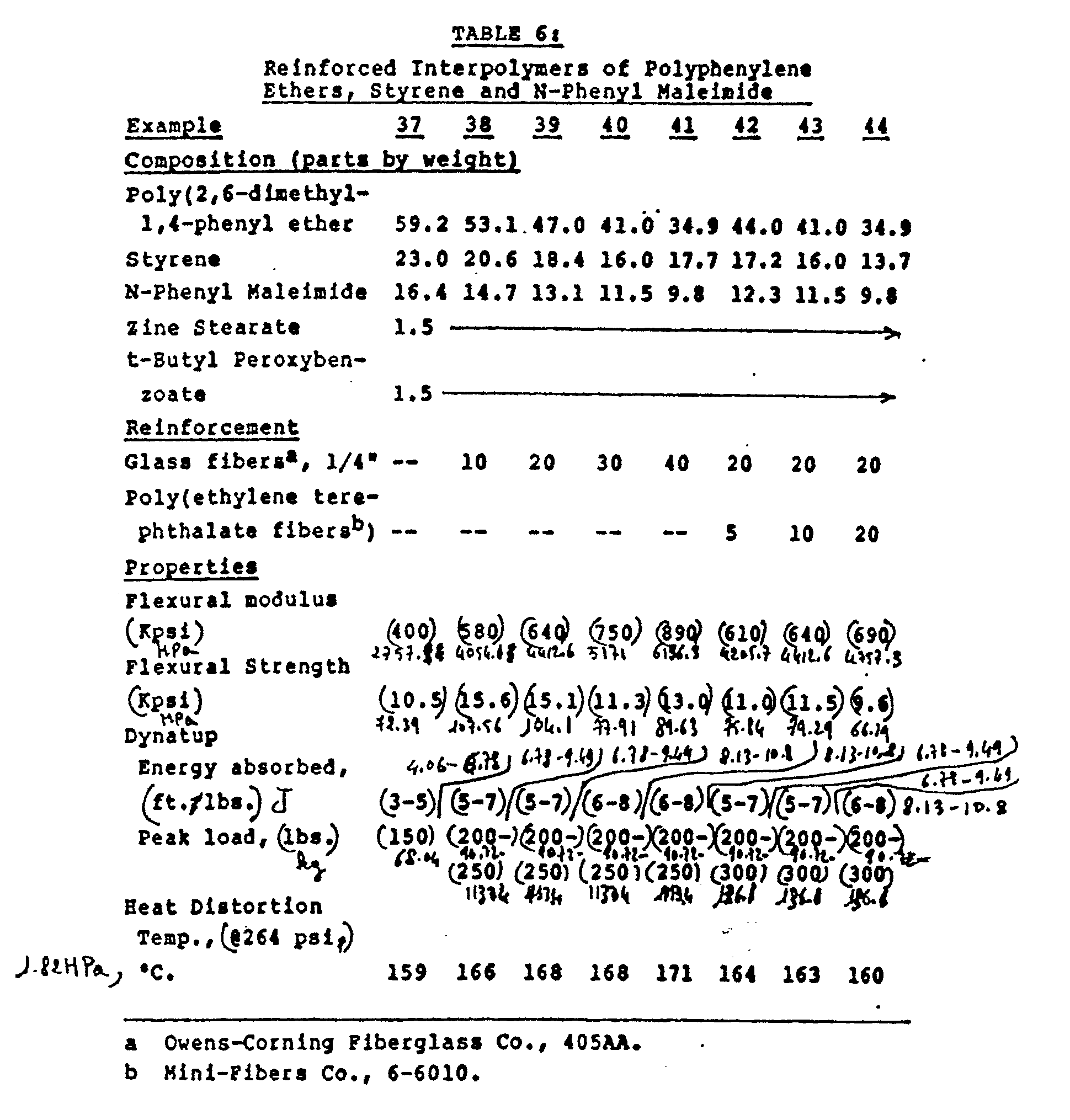
- Reinforced and impact modified articles were prepared in accordance with this invention by following the general procedure of Examples 13-21, but also including glass fibers, and two block copolymers. The formulations used and the results obtained are set forth in Table 7:

- A flame retardant composition according to this invention was prepared by mixing 50 parts by weight of poly(2,6-dimethyl-1,4-phenylene ether)TAAC, 20 parts of styrene, 5 parts of diethylfumarate, 0.375 parts t-butylperoxybenzoate and 25 parts of aluminum trihydrate. The composition was compounded in a Haake bowl at 80°C. for 3 minutes, and molded and cured at 150°C. for 6 minutes to give a shaped article having a heat distortion temperature at 1.82 MPa (264 psi) of (310°F) 154°C. When tested for flammability in the Underwriters Laboratories Vertical Burn Test, UL-94, the shaped article self-extinguished in less than ten seconds and did not drip flaming resin (rating V-0).
- The above-mentioned patents and publications are incorporated herein by reference.
- Many variations will suggest themselves to those skilled in this art in light of the above, detailed decription. For example, instead of using polyphenylene ether capped with TAAC, polyphenylene ether capped with acetic anhydride, maleic anhydride and benzoyl chloride can be used. Instead of styrene monomer, alpha-methyl styrene, vinyl toluene, and 4-vinyl pyridine can be used. Instead of t-butyl peroxybenzoate, azobisisobutyronitrile can be used. As a flame retardant, aluminum trihydrate and decabromodiphenyl ether can be used. Instead of glass fibers and polyester fibers, fibers comprising polypropylene, cellulosics (rayon, cotton, jute, etc.), nylon, acrylics, wool, and the like can be used. Other additives, such as chlorinated polymers, antioxidants, thermal and ultraviolet stabilizers, lubricants, organic dyes and pigments, anti-static agents and the like can be employed. In general, any additives conventional for use in commodity plastics, e.g., polyethylene, polypropylene, polystyrene and vinyls can now be used in an engineering system.
Claims (28)
- A curable composition comprising:(i) a thermoplastic polyphenylene ether resin substantially free of substituents which are inhibitors of free radicals;(ii)(a) at least one liquid, monovinyl unsaturated compound having a general formula selected from
 (ii)(b) at least one monovinyl unsaturated compound copolymerizable with and different from component (ii)(a), said vinyl unsaturated compound (ii)(a) and (ii)(b) comprising from 1 to 60 percent by weight of (i) and (ii)(a) and (ii)(b) combined; and, optionally,(iii) an effective amount of a catalyst capable of generating free radicals to initiate polymerization of the vinyl unsaturated compounds (ii)(a) and (ii)(b); and at least one of:(iv)(a) an effective amount of a reinforcing agent;(iv)(b) an effective amount of a flame retardant agent; or(iv)(c) an effective amount of an impact modifier.
 - A composition as defined in Claim 1 wherein the compounds (ii)(a) and (ii)(b) comprise from 15 to 40 percent by weight of (i) and (ii)(a) and (ii)(b) combined.
- A composition as defined in Claim 1 wherein said polyphenylene ether is a homopolymer or copolymer containing structural units of the formula:

- A composition as defined in Claim 3 wherein said polyphenylene ether is a poly(2,6-dimethyl-1,4-phenylene ether) or a poly(2,6-dimethyl-co-2,3,6-trimethyl-1,4-phenylene ether) end capped with an acid halide, and acid anhydride or compound having both acid halide and acid anhydride functional groups.
- A composition as defined in Claim 4 wherein said polyphenylene ether is end capped with trimellitic anhydride acid chloride.
- A composition as defined in Claim 1 wherein component (ii)(a) comprises a vinyl aromatic hydrocarbon and component (ii)(b) comprises a dialkyl fumarate or an N-substituted maleimide.
- A composition as defined in Claim 6 wherein component (ii)(a) comprises styrene and component (ii)(b) comprises diethyl fumarate or N-phenyl maleimide.
- A composition as defined in Claim 1 wherein component (iii) comprises an organic peroxide or an organic azo compound.
- A composition as defined in Claim 8 wherein said organic peroxide comprises t-butylperoxybenzoate.
- A composition as defined in Claim 1 wherein component (iv)(a) comprises a reinforcing amount of glass fibers, polyester fibers or a mixture thereof.
- A composition as defined in Claim 1 wherein component (iv)(b) comprises a flame retardant amount of aluminum trihydrate.
- A composition as defined in Claim 1 wherein component (iv)(c) comprises an impact improving amount of a styrene-ethylene-butylene-styrene block copolymer or a polymer having a polymerized butyl acrylate core and a styrene shell.
- A shaped article of manufacture formed by melt processing a composition as defined in Claim 1 by(1) blending powder or pellets of component (i), with liquid component (ii)(a), liquid component (ii)(b); optionally, component (iii), and at least one of components (iv)(a); (iv)(b) or (iv)(c);(2) extruding the composition to a desired shape at a temperature below 150°C.; and(3) curing component (ii)(a) and component (ii)(b).
- A curable composition comprising(i) the reaction product of (A) a polyphenylene ether polymer; and (B) a compound having the general formula (I)―Z―(II) which is a compound that contains in its molecule both group (I) which is at least one group having the formula

 (ii)(a) at least one liquid, mono vinyl unsaturated compound having a general formula selected from
 (ii)(b) at least one monovinyl unsaturated compound copolymerizable with and different from component (ii)(a), said vinyl unsaturated compound (ii)(a) and (ii)(b) comprising from 1 to 60 percent by weight of (i) and (ii)(a) and (ii)(b) combined; and, optionally,(iii) an effective amount of a catalyst capable of generating free radicals to initiate polymerization of the vinyl unsaturated compounds (ii)(a) and (ii)(b).
 - A composition as defined in Claim 14 wherein the compounds (ii)(a) and (ii)(b) comprise from 15 to 40 percent by weight of (i) and (ii)(a) and (ii)(b) combined.
- A composition as defined in Claim 14 wherein said polyphenylene ether is a homopolymer or copolymer containing structural units of the formula:

- A composition as defined in Claim 16 wherein said polyphenylene ether is a poly(2,6-dimethyl-1,4-phenylene ether) or a poly(2,6-dimethyl-co-2,3,6-trimethyl-1,4-phenylene ether).
- A composition as defined in Claim 16 wherein said polyphenylene ether is end capped with trimellitic anhydride acid chloride.
- A composition as defined in Claim 14 wherein component (ii)(a) comprises a vinyl aromatic hydrocarbon and component (ii)(b) comprises a dialkyl fumarate or an N-substituted maleimide.
- A composition as defined in Claim 14 wherein component (ii)(a) comprises styrene and component (ii)(b) comprises diethyl fumarate or N-phenyl maleimide.
- A composition as defined in Claim 14 wherein component (iii) comprises an organic peroxide or an organic azo compound.
- A composition as defined in Claim 21 wherein said organic peroxide comprises t-butyl peroxybenzoate.
- A curable composition as defined in Claim 14 which also includes(iv)(a) an effective amount of a reinforcing agent;(iv)(b) an effective amount of a flame retardant agent;(iv)(c) an effective amount of an impact modifier; or a combination of any of the foregoing.
- A composition as defined in Claim 23 wherein component (iv)(a) comprises a reinforcing amount of glass fibers, polyester fibers or a mixture thereof.
- A composition as defined in Claim 23 wherein component (iv)(b) comprises a flame retardant amount of aluminum trihydrate.
- A composition as defined in Claim 23 wherein component (iv)(c) comprises an impact improving amount of a styrene-ethylene-butylene-styrene block copolymer or a polymer having a polymerized butyl acrylate core and a styrene shell.
- A shaped article of manufacture formed by melt processing a composition as defined in Claim 14 by(1) blending powder or pellets of components (i), with liquid component (ii)(a), liquid component (ii)(b) and, optionally, component (iii);(2) extruding the composition to a desired shape at a temperature below 150°C.; and(3) curing component (ii)(a) and component (ii)(b).
- A shaped article of manufacture formed by melt processing a composition as defined in Claim 23 by(1) blending powder or pellets of component (i), with liquid component (ii)(a), liquid component (ii)(b); optionally, component (iii), and at least one of components (iv)(a); (iv)(b) or (iv)(c); or a mixture of any of said components (iv)(a), (iv)(b) or (iv)(c);(2) extruding the composition to a desired shape at a temperature below 150°C.; and(3) curing component (ii)(a) and component (ii)(b).
Applications Claiming Priority (2)
| Application Number | Priority Date | Filing Date | Title |
|---|---|---|---|
| US90987186A | 1986-09-22 | 1986-09-22 | |
| US909871 | 1986-09-22 |
Publications (3)
| Publication Number | Publication Date |
|---|---|
| EP0264623A2 EP0264623A2 (en) | 1988-04-27 |
| EP0264623A3 EP0264623A3 (en) | 1988-08-10 |
| EP0264623B1 true EP0264623B1 (en) | 1991-11-06 |
Family
ID=25427961
Family Applications (1)
| Application Number | Title | Priority Date | Filing Date |
|---|---|---|---|
| EP19870113546 Expired EP0264623B1 (en) | 1986-09-22 | 1987-09-16 | Curable linear polyphenylene ether interpenetrating polymer network compositions and process |
Country Status (3)
| Country | Link |
|---|---|
| EP (1) | EP0264623B1 (en) |
| JP (1) | JPH01118570A (en) |
| DE (1) | DE3774390D1 (en) |
Families Citing this family (8)
| Publication number | Priority date | Publication date | Assignee | Title |
|---|---|---|---|---|
| KR0147376B1 (en) * | 1988-07-07 | 1998-08-17 | 오노 알버어스 | Process for preparing modified polyphenylene ether and use thereof in modified high temperature hard polymer of vinyl substituted aromatics |
| US5219951A (en) * | 1988-07-07 | 1993-06-15 | Shell Internationale Research Maatschappij B.V. | Process for preparation of modified polyphenylene ether or related polymers and the use thereof in modified high temperature rigid polymer of vinyl substituted aromatics |
| GB8913542D0 (en) * | 1989-06-13 | 1989-08-02 | Shell Int Research | Process for modification of polyphenylene ether or related polymers with a cyclic anhydride and the use thereof in modified,high temperature rigid polymer |
| DE69227649T2 (en) * | 1991-05-13 | 1999-06-17 | General Electric Co., Schenectady, N.Y. | Polyphenylene ether-EPDM compositions |
| US5212255A (en) * | 1992-04-03 | 1993-05-18 | General Electric Company | Functionalization of polyphenylene ether with graftable orthoester |
| US6391082B1 (en) * | 1999-07-02 | 2002-05-21 | Holl Technologies Company | Composites of powdered fillers and polymer matrix |
| DE102005008551A1 (en) * | 2005-02-23 | 2006-08-31 | Röhm GmbH & Co. KG | Preparation of easily cross linkable polyphenyleneoxide fluid, useful for preparing e.g. polymer foams, comprises adding radical initiators and/or vinylic unsaturated cross linking agents before or during the process in the extruder |
| US8466253B1 (en) * | 2012-06-29 | 2013-06-18 | Sabic Innovative Plastics Ip B.V. | Poly(phenylene ether) process |
Family Cites Families (5)
| Publication number | Priority date | Publication date | Assignee | Title |
|---|---|---|---|---|
| DK134784C (en) * | 1968-12-28 | 1977-06-06 | Sumitomo Chemical Co | PROCEDURE FOR THE PRODUCTION OF MODIFIED POLYPHENYLENOXIDES WITH IMPROVED HEAT RESISTANCE |
| US4189417A (en) * | 1977-12-23 | 1980-02-19 | General Electric Company | Process for the polymerization of alkenyl aromatic monomers in the presence of polyphenylene oxides |
| US4148843A (en) * | 1977-12-23 | 1979-04-10 | General Electric Company | Compositions of capped polyphenylene oxides and alkenyl aromatic resins |
| JPS62121758A (en) * | 1985-08-26 | 1987-06-03 | Matsushita Electric Works Ltd | Polyphenylene oxide resin composition and sheet composed of said resin composition |
| JPS62121759A (en) * | 1985-08-27 | 1987-06-03 | Matsushita Electric Works Ltd | Polyphenylene oxide resin composition and sheet composed of said resin composition |
-
1987
- 1987-09-16 EP EP19870113546 patent/EP0264623B1/en not_active Expired
- 1987-09-16 DE DE8787113546T patent/DE3774390D1/en not_active Expired - Lifetime
- 1987-09-21 JP JP23505687A patent/JPH01118570A/en active Pending
Also Published As
| Publication number | Publication date |
|---|---|
| EP0264623A2 (en) | 1988-04-27 |
| EP0264623A3 (en) | 1988-08-10 |
| DE3774390D1 (en) | 1991-12-12 |
| JPH01118570A (en) | 1989-05-11 |
Similar Documents
| Publication | Publication Date | Title |
|---|---|---|
| EP0261574B1 (en) | Curable cross-linked polyphenylene ether interpenetrating polymer network compositions and process | |
| US4148843A (en) | Compositions of capped polyphenylene oxides and alkenyl aromatic resins | |
| US4760118A (en) | Polyphenylene ether capped with salicylic acid ester | |
| US4814392A (en) | Silicone-polyarylene ether block copolymers, and method for making | |
| EP1159335B1 (en) | Capping of polyphenylene ether resin | |
| US4816515A (en) | Impact modified polyphenylene ether interpolymer resins | |
| US4131598A (en) | Polyphenylene ether composition | |
| EP0257586B1 (en) | Hydroxyalkyl- and aminoalkyl-functionalized polyphenylene ethers | |
| US4808671A (en) | Catalytic method of preparing carboxy derivatives of polyphenylene ethers | |
| US5216089A (en) | Modified polyphenylene ether resins having improved processability and oxidative stability | |
| US4206154A (en) | Thermoplastic molding compositions containing a flame retardant and a smoke suppressant | |
| EP0530442B1 (en) | Process for producing a hydroxy-substituted poly (phenylene ether) resin | |
| US4845160A (en) | Polyphenylene ether-polyester copolymers and method for their preparation | |
| EP0264623A2 (en) | Curable linear polyphenylene ether interpenetrating polymer network compositions and process | |
| US4777221A (en) | Polyphenylene ether-polycarbonate copolymers and method of preparation | |
| JPS63108059A (en) | Modified polyphenylene ether resin improved in processability and oxidation stability | |
| EP0248264B1 (en) | Carbodiimide-functionalized polyphenylene ethers and method of preparation | |
| EP0304621B1 (en) | Process for preparing phenylene ether-amide graft copolymers | |
| EP0253332B1 (en) | Method for the preparation of polyphenylene ether-polyester copolymers | |
| EP0313840A2 (en) | Composition | |
| JPH0660223B2 (en) | Reactive graft polymer | |
| EP0649876A1 (en) | Method for making polyarylene ether-organopolysiloxane copolymers | |
| EP0514087A2 (en) | Polyphenylene ether-EPDM compositions | |
| US4757107A (en) | Flame retardant polyphenylene ether blends | |
| JPH01168731A (en) | Polyphenyleneetheramine salt fire retardant extrudate of blend thereof and production thereof |
Legal Events
| Date | Code | Title | Description |
|---|---|---|---|
| PUAI | Public reference made under article 153(3) epc to a published international application that has entered the european phase |
Free format text: ORIGINAL CODE: 0009012 |
|
| AK | Designated contracting states |
Kind code of ref document: A2 Designated state(s): DE FR GB IT NL |
|
| PUAL | Search report despatched |
Free format text: ORIGINAL CODE: 0009013 |
|
| AK | Designated contracting states |
Kind code of ref document: A3 Designated state(s): DE FR GB IT NL |
|
| 17P | Request for examination filed |
Effective date: 19890120 |
|
| 17Q | First examination report despatched |
Effective date: 19900507 |
|
| GRAA | (expected) grant |
Free format text: ORIGINAL CODE: 0009210 |
|
| AK | Designated contracting states |
Kind code of ref document: B1 Designated state(s): DE FR GB IT NL |
|
| ET | Fr: translation filed | ||
| REF | Corresponds to: |
Ref document number: 3774390 Country of ref document: DE Date of ref document: 19911212 |
|
| ITF | It: translation for a ep patent filed | ||
| PLBE | No opposition filed within time limit |
Free format text: ORIGINAL CODE: 0009261 |
|
| STAA | Information on the status of an ep patent application or granted ep patent |
Free format text: STATUS: NO OPPOSITION FILED WITHIN TIME LIMIT |
|
| 26N | No opposition filed | ||
| PGFP | Annual fee paid to national office [announced via postgrant information from national office to epo] |
Ref country code: FR Payment date: 19940818 Year of fee payment: 8 |
|
| PGFP | Annual fee paid to national office [announced via postgrant information from national office to epo] |
Ref country code: DE Payment date: 19940822 Year of fee payment: 8 |
|
| PGFP | Annual fee paid to national office [announced via postgrant information from national office to epo] |
Ref country code: GB Payment date: 19940825 Year of fee payment: 8 |
|
| PGFP | Annual fee paid to national office [announced via postgrant information from national office to epo] |
Ref country code: NL Payment date: 19940930 Year of fee payment: 8 |
|
| PG25 | Lapsed in a contracting state [announced via postgrant information from national office to epo] |
Ref country code: GB Effective date: 19950916 |
|
| PG25 | Lapsed in a contracting state [announced via postgrant information from national office to epo] |
Ref country code: NL Effective date: 19960401 |
|
| GBPC | Gb: european patent ceased through non-payment of renewal fee |
Effective date: 19950916 |
|
| PG25 | Lapsed in a contracting state [announced via postgrant information from national office to epo] |
Ref country code: FR Effective date: 19960531 |
|
| PG25 | Lapsed in a contracting state [announced via postgrant information from national office to epo] |
Ref country code: DE Effective date: 19960601 |
|
| NLV4 | Nl: lapsed or anulled due to non-payment of the annual fee |
Effective date: 19960401 |
|
| REG | Reference to a national code |
Ref country code: FR Ref legal event code: ST |
|
| PG25 | Lapsed in a contracting state [announced via postgrant information from national office to epo] |
Ref country code: IT Free format text: LAPSE BECAUSE OF NON-PAYMENT OF DUE FEES;WARNING: LAPSES OF ITALIAN PATENTS WITH EFFECTIVE DATE BEFORE 2007 MAY HAVE OCCURRED AT ANY TIME BEFORE 2007. THE CORRECT EFFECTIVE DATE MAY BE DIFFERENT FROM THE ONE RECORDED. Effective date: 20050916 |