EP0262852B1 - Prodrugs of antihypercholoesterolemic compounds - Google Patents
Prodrugs of antihypercholoesterolemic compounds Download PDFInfo
- Publication number
- EP0262852B1 EP0262852B1 EP87308367A EP87308367A EP0262852B1 EP 0262852 B1 EP0262852 B1 EP 0262852B1 EP 87308367 A EP87308367 A EP 87308367A EP 87308367 A EP87308367 A EP 87308367A EP 0262852 B1 EP0262852 B1 EP 0262852B1
- Authority
- EP
- European Patent Office
- Prior art keywords
- compound
- alkyl
- hydrogen
- compounds
- group
- Prior art date
- Legal status (The legal status is an assumption and is not a legal conclusion. Google has not performed a legal analysis and makes no representation as to the accuracy of the status listed.)
- Expired - Lifetime
Links
Classifications
-
- C—CHEMISTRY; METALLURGY
- C07—ORGANIC CHEMISTRY
- C07D—HETEROCYCLIC COMPOUNDS
- C07D295/00—Heterocyclic compounds containing polymethylene-imine rings with at least five ring members, 3-azabicyclo [3.2.2] nonane, piperazine, morpholine or thiomorpholine rings, having only hydrogen atoms directly attached to the ring carbon atoms
- C07D295/04—Heterocyclic compounds containing polymethylene-imine rings with at least five ring members, 3-azabicyclo [3.2.2] nonane, piperazine, morpholine or thiomorpholine rings, having only hydrogen atoms directly attached to the ring carbon atoms with substituted hydrocarbon radicals attached to ring nitrogen atoms
- C07D295/14—Heterocyclic compounds containing polymethylene-imine rings with at least five ring members, 3-azabicyclo [3.2.2] nonane, piperazine, morpholine or thiomorpholine rings, having only hydrogen atoms directly attached to the ring carbon atoms with substituted hydrocarbon radicals attached to ring nitrogen atoms substituted by carbon atoms having three bonds to hetero atoms with at the most one bond to halogen, e.g. ester or nitrile radicals
- C07D295/145—Heterocyclic compounds containing polymethylene-imine rings with at least five ring members, 3-azabicyclo [3.2.2] nonane, piperazine, morpholine or thiomorpholine rings, having only hydrogen atoms directly attached to the ring carbon atoms with substituted hydrocarbon radicals attached to ring nitrogen atoms substituted by carbon atoms having three bonds to hetero atoms with at the most one bond to halogen, e.g. ester or nitrile radicals with the ring nitrogen atoms and the carbon atoms with three bonds to hetero atoms attached to the same carbon chain, which is not interrupted by carbocyclic rings
- C07D295/15—Heterocyclic compounds containing polymethylene-imine rings with at least five ring members, 3-azabicyclo [3.2.2] nonane, piperazine, morpholine or thiomorpholine rings, having only hydrogen atoms directly attached to the ring carbon atoms with substituted hydrocarbon radicals attached to ring nitrogen atoms substituted by carbon atoms having three bonds to hetero atoms with at the most one bond to halogen, e.g. ester or nitrile radicals with the ring nitrogen atoms and the carbon atoms with three bonds to hetero atoms attached to the same carbon chain, which is not interrupted by carbocyclic rings to an acyclic saturated chain
-
- A—HUMAN NECESSITIES
- A61—MEDICAL OR VETERINARY SCIENCE; HYGIENE
- A61P—SPECIFIC THERAPEUTIC ACTIVITY OF CHEMICAL COMPOUNDS OR MEDICINAL PREPARATIONS
- A61P3/00—Drugs for disorders of the metabolism
- A61P3/06—Antihyperlipidemics
-
- A—HUMAN NECESSITIES
- A61—MEDICAL OR VETERINARY SCIENCE; HYGIENE
- A61P—SPECIFIC THERAPEUTIC ACTIVITY OF CHEMICAL COMPOUNDS OR MEDICINAL PREPARATIONS
- A61P43/00—Drugs for specific purposes, not provided for in groups A61P1/00-A61P41/00
-
- A—HUMAN NECESSITIES
- A61—MEDICAL OR VETERINARY SCIENCE; HYGIENE
- A61P—SPECIFIC THERAPEUTIC ACTIVITY OF CHEMICAL COMPOUNDS OR MEDICINAL PREPARATIONS
- A61P9/00—Drugs for disorders of the cardiovascular system
- A61P9/10—Drugs for disorders of the cardiovascular system for treating ischaemic or atherosclerotic diseases, e.g. antianginal drugs, coronary vasodilators, drugs for myocardial infarction, retinopathy, cerebrovascula insufficiency, renal arteriosclerosis
Definitions
- Hypercholesterolemia is known to be one of the prime risk factors for ischemic cardiovascular disease, such as arteriosclerosis. To date, there is still no effective antihypercholesterolemic agent commercially available that has found wide patient acceptance.
- the bile acid sequestrants seem to be moderately effective but they must be consumed in large quantities, i.e. several grams at a time and they are not very palatable.
- agents known that are very active antihypercholesterolemic agents that function by limiting cholesterol biosynthesis by inhibiting the enzyme, HMG-CoA reductase. These agents include the natural fermentation products compactin and mevinolin and a variety of semi-synthetic and totally synthetic analogs thereof.
- U.S. Patent No. 4,528,914 discloses a process for the preparation of the active forms of HMG-CoA Reductase inhibitors containing a 4-hydroxy-3,4,5,6-tetrahydro-2H-pyran-2-one moiety.
- U.S. Patent No. 4,440,927 discloses a process for the preparation of HMG-CoA reductase inhibitors containing a substituted phenyl moiety.
- This invention relates to novel compounds which are prodrugs of known HMG-CoA reductase inhibitors and which are bio-converted following systemic administration to useful antihypercholesterolemic agents.
- the compounds of this invention include diaminoacyl derivatives of compactin, mevinolin, CSS14, the dihydro and tetrahydro analogs thereof and the totally synthetic HMG-CoA reductase inhibitors.
- pharmaceutical compositions of these prodrugs, as the sole therapeutic agent, and in combination with bile acid sequestrants are disclosed.
- One embodiment of this invention are the compounds of the formula (I) wherein R is the group (b).
- R is the group (b).
- R9 and R10 are independently hydrogen or C 1-8 alkyl and specifically, ethyl (E)-7-(4 ⁇ -fluoro-3,3 ⁇ ,5-trimethyl-[1,1 ⁇ -biphenyl]-2-yl)-3(R),5(S)-bis (N,N-dimethylaminoacetoxy)-hept-6-enoate.
- a second embodiment of this invention are the compounds of the formula (I) wherein R is the group (a).
- the pharmaceutically acceptable salts are those acid addition salts of non-toxic, pharmaceutically acceptable acids and include salts of inorganic acids such as hydrochloric, hydrobromic, hydroiodic, phosphoric, sulfuric, nitric and the like, and organic acids such as trifluoroacetic, trichloroacetic, acetic, oxalic, maleic and the like and include acids related to the pharmaceutically acceptable salts listed in Journal of Pharmaceutical Science, 66 , 2 (1977) and incorporated herein by reference.
- inorganic acids such as hydrochloric, hydrobromic, hydroiodic, phosphoric, sulfuric, nitric and the like
- organic acids such as trifluoroacetic, trichloroacetic, acetic, oxalic, maleic and the like and include acids related to the pharmaceutically acceptable salts listed in Journal of Pharmaceutical Science, 66 , 2 (1977) and incorporated herein by reference.
- the compounds of this invention are conveniently prepared from known HMG-CoA reductase inhibitors according to the following synthetic pathway:
- the compounds of the formula (1) are known in the art.
- the compounds of the formula (1) are the C 1-8 alkyl esters of the free hydroxy acid form of compactin, mevinolin, CS514 and their dihydro and tetrahydro analogs which are readily available or may be prepared according to the fermentation procedures disclosed in U.S. Patents 3,983,140; 4,049,495; 4,231,938; 4,294,846 and 4,517,373 and the hydrogenation procedures disclosed in U.S. Patent 4,351,844.
- R is the group (b)
- the compounds of the formula (1) are readily available by utilizing the procedures described in U.S. Patent 4,375,475.
- the compounds of the formula (1) are reacted with the appropriate haloalkylacylhalide, hal(CH2) n COhal, where n is described above and hal is chloro or bromo, such as chloroacetyl chloride, in the presence of a molecular equivalent of an acid acceptor, such as trialkylamine, specifically trimethylamine, triethylamine, pyridine, N,N-dimethylbenzylamine and the like to afford the compounds of the formula (2).
- the compounds of the formula (2) are then reacted with two molecular equivalents of a secondary amine of the formula HNR9R10, such as dimethylamine, diethylamine, piperidine and the like to form the compounds of the formula (I).
- the above described process is modified as follows.
- the hydroxyl groups in the 3- and 5- position of the dihydroxy ester moiety of compound (1) are selectively protected by the formation of an acetal, ketal and the like.
- a dimethyl ketal may be formed by utilizing acetone.
- the primary or secondary alcohol function is then converted to a silyl ether.
- a trialkyl silyl ether may be formed by utilizing t -butyldimethylsilyl halide.
- the hydroxyl groups in the 3- and 5- position of the dihydroxy ester moiety are reformed by the selective removal of the acetal, ketal or the like protecting group.
- the resultant compounds of the formula (1) wherein the primary or secondary alcohol function is protected as a silyl ether is then treated according to the above synthetic pathway which after the selective removal of the silyl ether protecting group give the compounds of formula (I).
- the compounds of this invention are useful as prodrugs of antihypercholesterolemic agents for the treatment of arteriosclerosis, hyperlipidemia, familial hypercholesterolemia and the like diseases in humans. They may be administered orally in the form of a capsule, a tablet, or the like. Doses may be varied, depending on the age, severity, body weight and other conditions of human patients but daily dosage for adults is within a range of from about 20 mg to 2000 mg (preferably 20 to 100 mg) which may be given in two to four divided doses. Higher doses may be favorably employed as required.
- the compounds of this invention may also be coadministered with pharmaceutically acceptable non-toxic cationic polymers capable of binding bile acids in a non-reabsorbable form in the gastro-intestinal tract.
- pharmaceutically acceptable non-toxic cationic polymers capable of binding bile acids in a non-reabsorbable form in the gastro-intestinal tract.
- examples of such polymers include cholestyramine, colestipol and poly[methyl-(3-tri-methylaminopropyl)imino-trimethylene dihalide].
- the relative amounts of the compounds of this invention and these polymers is between 1:100 and 1:15,000.
- Included within the scope of this invention is the method of treating arteriosclerosis, familial hypercholesterolemia or hyperlipidemia which comprises administering to a subject in need of such of the compounds of formula (I) or pharmaceutical compositions thereof.
- reaction mixture was diluted with 25 ml CH2Cl2 and then was washed successively with H2O, dilute aqueous hydrochloric acid, H2O, brine. This solution was dried and the solvent removed in vacuo to give the crude product as an oil. This was purified by flash chromatography on silica gel eluting with 3% isopropanol/hexane to provide pure (1a) as a clear oil.
- composition of this invention 40 mg of the compound of Example 1 is formulated with sufficient finely divided lactose to provide a total amount of 580 to 590 mg to fill a size 0 hard gelatin capsule.
Landscapes
- Organic Chemistry (AREA)
- Health & Medical Sciences (AREA)
- Chemical & Material Sciences (AREA)
- Bioinformatics & Cheminformatics (AREA)
- Engineering & Computer Science (AREA)
- General Health & Medical Sciences (AREA)
- Veterinary Medicine (AREA)
- Nuclear Medicine, Radiotherapy & Molecular Imaging (AREA)
- General Chemical & Material Sciences (AREA)
- Pharmacology & Pharmacy (AREA)
- Life Sciences & Earth Sciences (AREA)
- Animal Behavior & Ethology (AREA)
- Chemical Kinetics & Catalysis (AREA)
- Public Health (AREA)
- Medicinal Chemistry (AREA)
- Diabetes (AREA)
- Hematology (AREA)
- Obesity (AREA)
- Urology & Nephrology (AREA)
- Vascular Medicine (AREA)
- Cardiology (AREA)
- Heart & Thoracic Surgery (AREA)
- Acyclic And Carbocyclic Compounds In Medicinal Compositions (AREA)
- Pharmaceuticals Containing Other Organic And Inorganic Compounds (AREA)
- Organic Low-Molecular-Weight Compounds And Preparation Thereof (AREA)
Description
- Hypercholesterolemia is known to be one of the prime risk factors for ischemic cardiovascular disease, such as arteriosclerosis. To date, there is still no effective antihypercholesterolemic agent commercially available that has found wide patient acceptance. The bile acid sequestrants seem to be moderately effective but they must be consumed in large quantities, i.e. several grams at a time and they are not very palatable.
- There are agents known, however, that are very active antihypercholesterolemic agents that function by limiting cholesterol biosynthesis by inhibiting the enzyme, HMG-CoA reductase. These agents include the natural fermentation products compactin and mevinolin and a variety of semi-synthetic and totally synthetic analogs thereof.
- The naturally occurring compounds and their semi-synthetic analogs have the following general structural formulae:

wherein - X is
- hydrogen, C₁₋₅alkyl or C₁₋₅alkyl substituted with a member of the group consisting of phenyl, dimethylamino or acetylamino;
- R' is
- Q is
-
- R₁ is
- hydrogen or methyl; and
- a, b, c and d
- are single bonds, one of a, b, c and d is a double bond or a and c or b and d are double bonds provided that when a is a double bond,
- U.S. Patent No. 4,528,914 discloses a process for the preparation of the active forms of HMG-CoA Reductase inhibitors containing a 4-hydroxy-3,4,5,6-tetrahydro-2H-pyran-2-one moiety.
- The totally synthetic antihypercholesterolemic compounds are disclosed in U.S. Patent 4,375,475 and have the following general structural formulae:

wherein R" is:
wherein: - E is
- -CH₂-, -CH₂CH₂- or -CH=CH-;
- R₄ and R₅
- are independently C₁₋₃alkyl, fluoro, bromo or chloro; and
- R₆ is
- phenyl, benzyloxy, substituted phenyl or substituted benzyloxy in which the phenyl group in each case is substituted with one or more substituents selected from C₁₋₃alkyl, fluoro, bromo or chloro.
- U.S. Patent No. 4,440,927 discloses a process for the preparation of HMG-CoA reductase inhibitors containing a substituted phenyl moiety.
- This invention relates to novel compounds which are prodrugs of known HMG-CoA reductase inhibitors and which are bio-converted following systemic administration to useful antihypercholesterolemic agents. Specifically, the compounds of this invention include diaminoacyl derivatives of compactin, mevinolin, CSS14, the dihydro and tetrahydro analogs thereof and the totally synthetic HMG-CoA reductase inhibitors. Additionally, pharmaceutical compositions of these prodrugs, as the sole therapeutic agent, and in combination with bile acid sequestrants are disclosed.
- Published GB-A-2 075 013 discloses HMG-CoA reductase inhibitors containing a 4-hydroxy-3,4,5,6-tetrahydro-2H-pyran-2-one moiety with optional acyl substituents at the 3,5 and 8' positions.
- The specific prodrugs of this invention are the compounds represented by the following general structural formula (I):

wherein: - n is
- 1 to 6;
- R is
- selected from a group consisting of:

- m is
- 1 to 5;
- R¹ is
- hydrogen or methyl;
- A is
-

- B is
-

- a, b, c and d
- represent single bonds, one of a, b, c and d represents a double bond or both a and c or both b and d represent double bonds, provided that when a is a double bond, A is


- E is
- -CH₂-, -CH₂CH₂- or -CH=CH-;
- R⁴ and R⁵
- are independently C1-3 alkyl, fluoro, bromo or chloro; and
- R⁶ is
- phenyl, benzyloxy, substituted phenyl or substituted benzyloxy in which the phenyl group in each case is substituted with one or more substituents selected from C1-3alkyl, hydroxy-C1-3alkyl, fluoro, bromo or chloro;
- R⁷ is
- hydrogen or C1-8alkyl;
- R⁹ and R¹⁰
- independently are hydrogen, or C1-8alkyl or when taken together with the nitrogen atom to which they are attached form a heterocycle selected from the group consisting of piperidinyl, pyrrolidinyl, or morpholinyl;
- One embodiment of this invention are the compounds of the formula (I) wherein R is the group (b). Illustrative of this embodiment are compounds wherein E is -CH=CH-; R⁴ and R⁵ are independently C1-3alkyl and R⁶ is substituted phenyl. More specifically, group (b) is:

- Exemplifying this embodiment are the class of compounds wherein R⁹ and R¹⁰ are independently hydrogen or C1-8alkyl and specifically, ethyl (E)-7-(4ʹ-fluoro-3,3ʹ,5-trimethyl-[1,1ʹ-biphenyl]-2-yl)-3(R),5(S)-bis (N,N-dimethylaminoacetoxy)-hept-6-enoate.
- A second embodiment of this invention are the compounds of the formula (I) wherein R is the group (a).
- The pharmaceutically acceptable salts are those acid addition salts of non-toxic, pharmaceutically acceptable acids and include salts of inorganic acids such as hydrochloric, hydrobromic, hydroiodic, phosphoric, sulfuric, nitric and the like, and organic acids such as trifluoroacetic, trichloroacetic, acetic, oxalic, maleic and the like and include acids related to the pharmaceutically acceptable salts listed in Journal of Pharmaceutical Science, 66, 2 (1977) and incorporated herein by reference.
- The compounds of this invention are conveniently prepared from known HMG-CoA reductase inhibitors according to the following synthetic pathway:
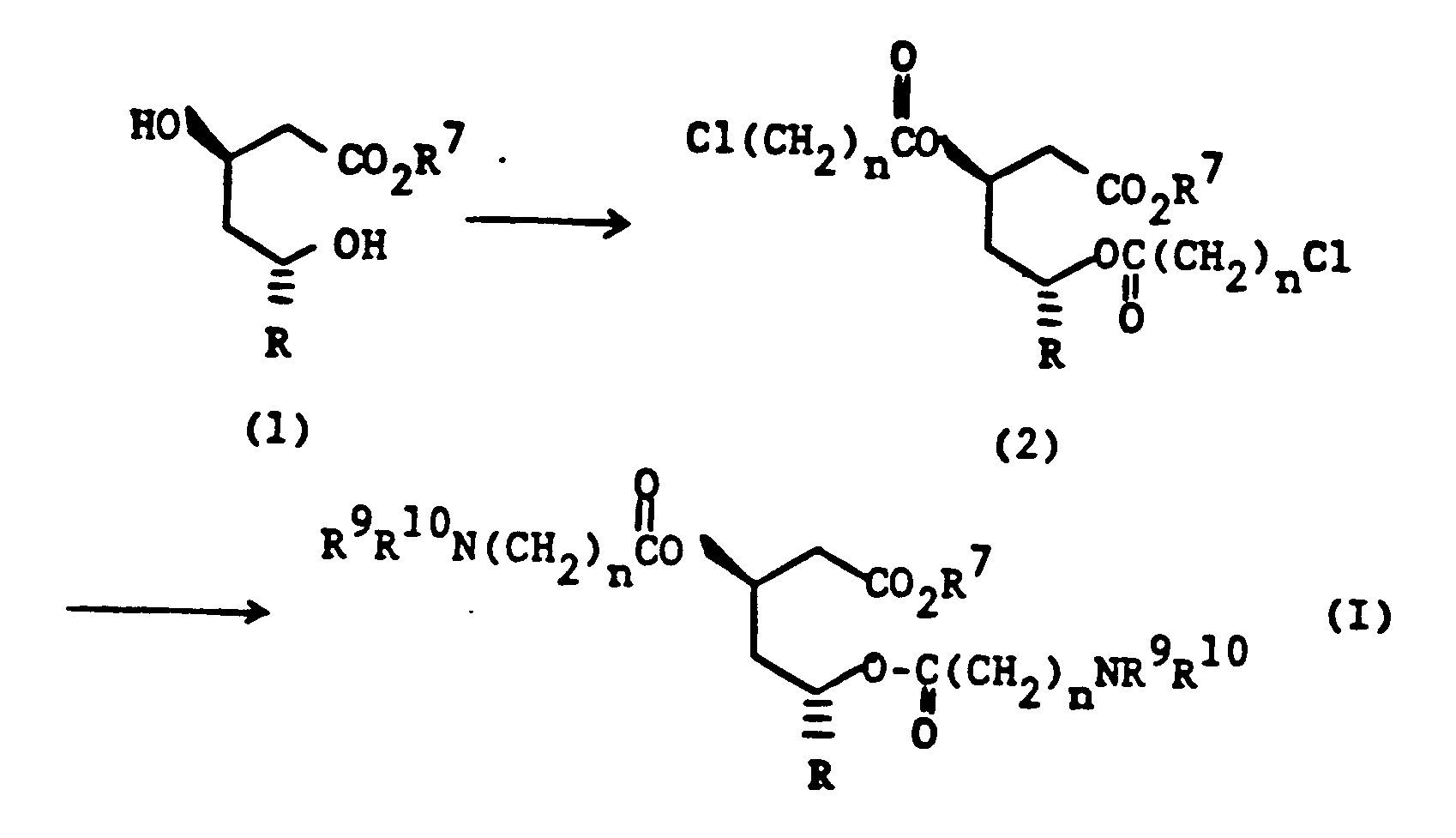
- The compounds of the formula (1) are known in the art. When R is the group (a), the compounds of the formula (1) are the C1-8 alkyl esters of the free hydroxy acid form of compactin, mevinolin, CS514 and their dihydro and tetrahydro analogs which are readily available or may be prepared according to the fermentation procedures disclosed in U.S. Patents 3,983,140; 4,049,495; 4,231,938; 4,294,846 and 4,517,373 and the hydrogenation procedures disclosed in U.S. Patent 4,351,844. When R is the group (b), the compounds of the formula (1) are readily available by utilizing the procedures described in U.S. Patent 4,375,475.
- The compounds of the formula (1) are reacted with the appropriate haloalkylacylhalide, hal(CH₂)nCOhal, where n is described above and hal is chloro or bromo, such as chloroacetyl chloride, in the presence of a molecular equivalent of an acid acceptor, such as trialkylamine, specifically trimethylamine, triethylamine, pyridine, N,N-dimethylbenzylamine and the like to afford the compounds of the formula (2). The compounds of the formula (2) are then reacted with two molecular equivalents of a secondary amine of the formula HNR⁹R¹⁰, such as dimethylamine, diethylamine, piperidine and the like to form the compounds of the formula (I).
- For the compounds of the formula (I) which contain a primary or secondary alcohol functionality, the above described process is modified as follows. The hydroxyl groups in the 3- and 5- position of the dihydroxy ester moiety of compound (1) are selectively protected by the formation of an acetal, ketal and the like. For example a dimethyl ketal may be formed by utilizing acetone. The primary or secondary alcohol function is then converted to a silyl ether. For example, a trialkyl silyl ether may be formed by utilizing t-butyldimethylsilyl halide. Then the hydroxyl groups in the 3- and 5- position of the dihydroxy ester moiety are reformed by the selective removal of the acetal, ketal or the like protecting group. The resultant compounds of the formula (1) wherein the primary or secondary alcohol function is protected as a silyl ether is then treated according to the above synthetic pathway which after the selective removal of the silyl ether protecting group give the compounds of formula (I).
- The compounds of this invention are useful as prodrugs of antihypercholesterolemic agents for the treatment of arteriosclerosis, hyperlipidemia, familial hypercholesterolemia and the like diseases in humans. They may be administered orally in the form of a capsule, a tablet, or the like. Doses may be varied, depending on the age, severity, body weight and other conditions of human patients but daily dosage for adults is within a range of from about 20 mg to 2000 mg (preferably 20 to 100 mg) which may be given in two to four divided doses. Higher doses may be favorably employed as required.
- The compounds of this invention may also be coadministered with pharmaceutically acceptable non-toxic cationic polymers capable of binding bile acids in a non-reabsorbable form in the gastro-intestinal tract. Examples of such polymers include cholestyramine, colestipol and poly[methyl-(3-tri-methylaminopropyl)imino-trimethylene dihalide]. The relative amounts of the compounds of this invention and these polymers is between 1:100 and 1:15,000.
- The ability of the compounds of this invention to act as prodrugs of antihypercholesterolemic agents is demonstrated in a standard in vivo pharmacological assay in dogs.
- Eight male beagle dogs weighing from 7.2-12.9 kilograms approximately 4-5 years old were fed a low cholesterol, semi-synthetic diet once a day in the morning in sufficient quantity to maintain a constant body weight. The animals were trained to consume their entire ration each day. Cholestyramine, 12 g, was administered daily in the diet. This amount routinely resulted in an average reduction in plasma total cholesterol of approximately 35%. Dogs were bled twice a week from the jugular vein and plasma cholesterol was determined after extraction and saponification by a colorimetric procedure (Liebermann Burchard). After the establishment of pretreatment plasma cholesterol levels, one or more dogs were treated with a daily dose of test compound mixed directly into the diet for 14 days.
- Representative of the pharmacological activity of the compounds of this invention, ethyl (E)-7-(4ʹ-fluoro-3,3ʹ,5-trimethyl-[1,1ʹ-biphenyl]-2-yl)-3(R),5(S)-bis(N,N-dimethylaminoacetoxy)-hept-6-enoate as the dioxalate salt at a dosage of 8 mg/kg/day over 14 days reduced plasma cholesterol by 28 percent.
- Included within the scope of this invention is the method of treating arteriosclerosis, familial hypercholesterolemia or hyperlipidemia which comprises administering to a subject in need of such of the compounds of formula (I) or pharmaceutical compositions thereof.
- The following examples illustrate the preparation of the compounds of the formula (I) and their incorporation into pharmaceutical compositions and as such are not to be considered as limiting the invention set forth in the claims appended hereto.
- To a solution of 0.25 g (0.62 mmol) ethyl (E)-7-(4ʹ-fluoro-3,3ʹ,5-trimethyl-[1,1ʹ-biphenyl]-2-yl)-3(R),5(S)-dihydroxyhept-6-enoate and 0.15 g (1.86 mmol) pyridine in 15 ml CH₂Cl₂ under nitrogen at room temperature was added dropwise a solution of 0.2 g (1.86 mmol) chloroacetylchloride with stirring. After 1.0 hours at room temperature, the reaction mixture was diluted with 25 ml CH₂Cl₂ and then was washed successively with H₂O, dilute aqueous hydrochloric acid, H₂O, brine. This solution was dried and the solvent removed in vacuo to give the crude product as an oil. This was purified by flash chromatography on silica gel eluting with 3% isopropanol/hexane to provide pure (1a) as a clear oil.
- To 6.8 g (12.3 mmol) the compound (1a) in 30 ml CH₂Cl₂ cooled to 0-5°C under nitrogen was added dropwise a solution of 2.25 g (50 mmol) dimethylamine in 30 ml CH₂Cl₂ over 0.5 hours and the resulting solution allowed to gradually come to room temperature over 6 hours. The reaction mixture was then diluted with 40 ml CH₂Cl₂ and this was washed with 3 × 25 ml H₂O, dried and the solvent removed in vacuo to provide crude product. This was purified by flash chromatography on silica gel eluting with 7% methanol/chloroform to give pure (1b) as an oil.
- To the compound (1b) dissolved in acetone (15 ml) at ambient temperature was added oxalic acid (2 molar equivalents) to give a white solid. The white solid was filtered off, triturated with acetone and dried to yield the desired compound. m.p. 152-154°C.
Anal. Calc'd for C₃₆H₄₇FN₂O₁₄:C, 57.59; H, 6.31; N, 3.73. Found: C, 57.61; H, 6.52; N, 3.94. - In a similar fashion the dimaleate salt was prepared. m.p. 116-8°C
Anal. Calc'd for C₄₀H₅₁FN₂O₁₄:C, 59.84; H, 6.40; N, 3.49. Found: C, 60.22; H, 6.50; N, 3.52 - Utilizing the general procedures in Example 1 the above titled compound was prepared. m.p. 120-122°C
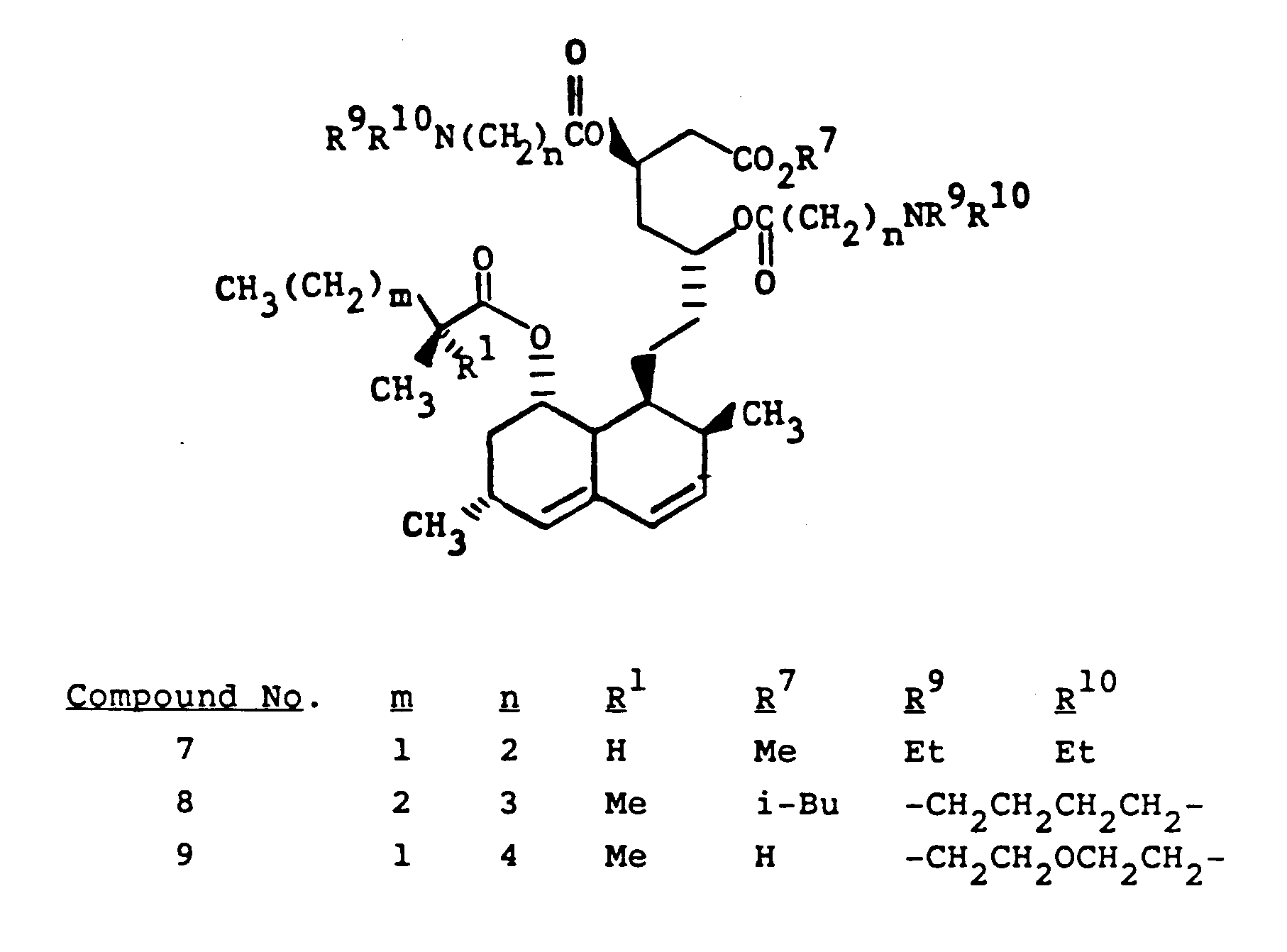
Anal. Calc'd for C₄₁H₅₃FN₂O₁₄:C, 60.28; H, 6.54; N, 3.43. Found: C, 60.27; H, 6.78; N, 3.23 - Utilizing the general procedures in Example 1 the following compounds are prepared:

- Utilizing the general procedures in Example 1 the following compounds are prepared:
- As a specific embodiment of a composition of this invention, 40 mg of the compound of Example 1 is formulated with sufficient finely divided lactose to provide a total amount of 580 to 590 mg to fill a size 0 hard gelatin capsule.

wherein


Claims (10)
- A compound represented by the general structural formula (I):
 n is 1 to 6;R is selected from a group consisting of:
 m is 1 to 5;R¹ is hydrogen or methyl;A is
 B is
B is a, b, c and d represent single bonds, one of a, b, c and d represents a double bond or both a and c or both b and d represent double bonds, provided that when a is a double bond, A iswherein:

 E is -CH₂-, -CH₂CH₂- or -CH=CH-;R⁴ and R⁵ are independently C1-3alkyl, fluoro, bromo or chloro; andR⁶ is phenyl, benzyloxy, substituted phenyl or substituted benzyloxy in which the phenyl group in each case is substituted with one or more substituents selected from C1-3alkyl, hydroxy-C1-3alkyl fluoro, bromo or chloro;R⁷ is hydrogen or C1-8alkyl;R⁹ and R¹⁰ independently are hydrogen or C1-8alkyl or when taken together with the nitrogen atom to which they are attached form a heterocycle selected from the group consisting of piperidinyl, pyrrolidinyl, or morpholinyl;or a pharmaceutically acceptable salt thereof.
 - A compound of Claim 1 wherein R is the group (b).
- A compound of Claim 2 wherein E is -CH=CH-.
- A compound of Claim 3 wherein:
R⁴ and R⁵ independently are C1-3alkyl;
R⁶ is a substituted phenyl; and
n is 1 to 3. - A compound of Claim 4 wherein R is:

- A compound of Claim 5 wherein:
R⁹ and R¹⁰ are independently hydrogen or
C1-8alkyl. - A compound of Claim 6 which is ethyl (E)-7-(4ʹ-fluoro-3,3ʹ,5-trimethyl-[1,1ʹ-biphenyl]-2-yl)-3(R),5(S)-bis(N,N-dimethylaminoacetoxy)-hept- 6-enoate or a pharmaceutically acceptable salt thereof.
- A compound of Claim 7 which is the dioxalate salt.
- A hypocholesterolemic, hypolipidemic pharmaceutical composition comprising a nontoxic therapeutically effective amount of a compound of Claim 1 and a pharmaceutically acceptable carrier.
- The use of a compound of Claim 1 for the manufacture of a medicament for the treatment of hypercholesterolemia.
Applications Claiming Priority (2)
| Application Number | Priority Date | Filing Date | Title |
|---|---|---|---|
| US912867 | 1986-09-29 | ||
| US06/912,867 US4736064A (en) | 1986-09-29 | 1986-09-29 | Prodrugs of antihypercholesterolemic compounds |
Publications (3)
| Publication Number | Publication Date |
|---|---|
| EP0262852A2 EP0262852A2 (en) | 1988-04-06 |
| EP0262852A3 EP0262852A3 (en) | 1989-05-03 |
| EP0262852B1 true EP0262852B1 (en) | 1992-05-06 |
Family
ID=25432583
Family Applications (1)
| Application Number | Title | Priority Date | Filing Date |
|---|---|---|---|
| EP87308367A Expired - Lifetime EP0262852B1 (en) | 1986-09-29 | 1987-09-22 | Prodrugs of antihypercholoesterolemic compounds |
Country Status (5)
| Country | Link |
|---|---|
| US (1) | US4736064A (en) |
| EP (1) | EP0262852B1 (en) |
| JP (1) | JPS6396158A (en) |
| CA (1) | CA1310317C (en) |
| DE (1) | DE3778812D1 (en) |
Families Citing this family (2)
| Publication number | Priority date | Publication date | Assignee | Title |
|---|---|---|---|---|
| US5286895A (en) * | 1992-02-19 | 1994-02-15 | Merck & Co., Inc. | Cholesterol lowering compounds |
| US5393780A (en) * | 1993-03-26 | 1995-02-28 | Fujirebio Inc. | 4-fluorobiphenyl derivatives |
Family Cites Families (6)
| Publication number | Priority date | Publication date | Assignee | Title |
|---|---|---|---|---|
| US4459422A (en) * | 1979-08-17 | 1984-07-10 | Merck & Co., Inc. | Substituted pyranone inhibitors of cholesterol synthesis |
| US4375475A (en) * | 1979-08-17 | 1983-03-01 | Merck & Co., Inc. | Substituted pyranone inhibitors of cholesterol synthesis |
| JPS56150037A (en) * | 1980-04-22 | 1981-11-20 | Sankyo Co Ltd | Hydronaphthalene compound |
| US4440927A (en) * | 1981-06-19 | 1984-04-03 | Merck & Co., Inc. | Process for preparing inhibitors of 3-hydroxy-3-methylglutaryl coenzyme A reductase via a chiral synthon |
| JPS5835144A (en) * | 1981-08-27 | 1983-03-01 | Sankyo Co Ltd | Mb-530b derivative and its preparation |
| US4582914A (en) * | 1985-01-31 | 1986-04-15 | Merck & Co., Inc. | Process for the preparation of HMG-CoA reductase inhibitors |
-
1986
- 1986-09-29 US US06/912,867 patent/US4736064A/en not_active Expired - Fee Related
-
1987
- 1987-09-21 CA CA000547438A patent/CA1310317C/en not_active Expired - Lifetime
- 1987-09-22 EP EP87308367A patent/EP0262852B1/en not_active Expired - Lifetime
- 1987-09-22 DE DE8787308367T patent/DE3778812D1/en not_active Expired - Lifetime
- 1987-09-29 JP JP62242867A patent/JPS6396158A/en active Pending
Also Published As
| Publication number | Publication date |
|---|---|
| EP0262852A2 (en) | 1988-04-06 |
| JPS6396158A (en) | 1988-04-27 |
| EP0262852A3 (en) | 1989-05-03 |
| CA1310317C (en) | 1992-11-17 |
| DE3778812D1 (en) | 1992-06-11 |
| US4736064A (en) | 1988-04-05 |
Similar Documents
| Publication | Publication Date | Title |
|---|---|---|
| US4757139A (en) | 5-fluoro-2'-deoxyuridine derivative, processes for preparing same and antitumor composition containing the same | |
| EP0327166B1 (en) | Novel hmg-coa reductase inhibitors | |
| EP0043807A2 (en) | 1-(Dihydroxyphenyl)-2-amino-ethanol derivatives; preparation, compositions and intermediates | |
| EP0984934B1 (en) | Novel orally active iron (iii) chelators | |
| EP0369874B1 (en) | Cardioprotective tocopherol analogs | |
| EP0325817B1 (en) | Novel hmg-coa reductase inhibitors | |
| US4661483A (en) | Antihypercholesterolemic lactone compounds, compositions and use | |
| EP0293132B1 (en) | Antihypercholesterolemic beta-lactones | |
| EP0259087B1 (en) | Prodrugs of antihypercholesterolemic compounds | |
| EP0272478B1 (en) | Glycyrrhetic acid derivatives and use thereof | |
| JPH02745A (en) | New hmg-coa reductase inhibitor | |
| US4766145A (en) | Antihypercholesterolemic compounds | |
| EP0350878A2 (en) | Conjugated gamma-oxybutenolide compounds for treating ulcer | |
| EP0259086B1 (en) | Prodrugs of antihypercholesterolemic compounds | |
| US4736064A (en) | Prodrugs of antihypercholesterolemic compounds | |
| EP0429464B1 (en) | Bivalent ligands effective for blocking acat enzyme | |
| EP0214740A2 (en) | Dopamine-beta-hydroxylase inhibitors | |
| US4771071A (en) | Antihypercholesterolemic compounds | |
| EP0283217B1 (en) | Novel antihypercholesterolemic compounds | |
| AU716992B2 (en) | Hydroquinone derivative and pharmaceutical use thereof | |
| US4916162A (en) | Antihypercholesterolemic compounds | |
| US4738982A (en) | HMG-CoA reductase inhibitors | |
| AU665223B2 (en) | 4-amino-3-acyl quinoline derivatives | |
| US4943588A (en) | Prodrugs of antihypercholesterolemic compounds | |
| US4263281A (en) | Oxaalkanoate anti-ulcer composition |
Legal Events
| Date | Code | Title | Description |
|---|---|---|---|
| PUAI | Public reference made under article 153(3) epc to a published international application that has entered the european phase |
Free format text: ORIGINAL CODE: 0009012 |
|
| AK | Designated contracting states |
Kind code of ref document: A2 Designated state(s): CH DE FR GB IT LI NL |
|
| ITCL | It: translation for ep claims filed |
Representative=s name: SOCIETA' ITALIANA BREVETTI S.P.A. |
|
| PUAL | Search report despatched |
Free format text: ORIGINAL CODE: 0009013 |
|
| AK | Designated contracting states |
Kind code of ref document: A3 Designated state(s): CH DE FR GB IT LI NL |
|
| 17P | Request for examination filed |
Effective date: 19891004 |
|
| 17Q | First examination report despatched |
Effective date: 19910423 |
|
| GRAA | (expected) grant |
Free format text: ORIGINAL CODE: 0009210 |
|
| AK | Designated contracting states |
Kind code of ref document: B1 Designated state(s): CH DE FR GB IT LI NL |
|
| REF | Corresponds to: |
Ref document number: 3778812 Country of ref document: DE Date of ref document: 19920611 |
|
| PGFP | Annual fee paid to national office [announced via postgrant information from national office to epo] |
Ref country code: GB Payment date: 19920713 Year of fee payment: 6 |
|
| ET | Fr: translation filed | ||
| PGFP | Annual fee paid to national office [announced via postgrant information from national office to epo] |
Ref country code: CH Payment date: 19920727 Year of fee payment: 6 |
|
| PGFP | Annual fee paid to national office [announced via postgrant information from national office to epo] |
Ref country code: FR Payment date: 19920730 Year of fee payment: 6 |
|
| ITF | It: translation for a ep patent filed | ||
| PGFP | Annual fee paid to national office [announced via postgrant information from national office to epo] |
Ref country code: DE Payment date: 19920928 Year of fee payment: 6 |
|
| PGFP | Annual fee paid to national office [announced via postgrant information from national office to epo] |
Ref country code: NL Payment date: 19920930 Year of fee payment: 6 |
|
| PLBE | No opposition filed within time limit |
Free format text: ORIGINAL CODE: 0009261 |
|
| STAA | Information on the status of an ep patent application or granted ep patent |
Free format text: STATUS: NO OPPOSITION FILED WITHIN TIME LIMIT |
|
| 26N | No opposition filed | ||
| PG25 | Lapsed in a contracting state [announced via postgrant information from national office to epo] |
Ref country code: GB Effective date: 19930922 |
|
| PG25 | Lapsed in a contracting state [announced via postgrant information from national office to epo] |
Ref country code: LI Effective date: 19930930 Ref country code: CH Effective date: 19930930 |
|
| PG25 | Lapsed in a contracting state [announced via postgrant information from national office to epo] |
Ref country code: NL Effective date: 19940401 |
|
| NLV4 | Nl: lapsed or anulled due to non-payment of the annual fee | ||
| GBPC | Gb: european patent ceased through non-payment of renewal fee |
Effective date: 19930922 |
|
| PG25 | Lapsed in a contracting state [announced via postgrant information from national office to epo] |
Ref country code: FR Free format text: LAPSE BECAUSE OF NON-PAYMENT OF DUE FEES Effective date: 19940531 |
|
| REG | Reference to a national code |
Ref country code: CH Ref legal event code: PL |
|
| PG25 | Lapsed in a contracting state [announced via postgrant information from national office to epo] |
Ref country code: DE Effective date: 19940601 |
|
| REG | Reference to a national code |
Ref country code: FR Ref legal event code: ST |
|
| PG25 | Lapsed in a contracting state [announced via postgrant information from national office to epo] |
Ref country code: IT Free format text: LAPSE BECAUSE OF NON-PAYMENT OF DUE FEES;WARNING: LAPSES OF ITALIAN PATENTS WITH EFFECTIVE DATE BEFORE 2007 MAY HAVE OCCURRED AT ANY TIME BEFORE 2007. THE CORRECT EFFECTIVE DATE MAY BE DIFFERENT FROM THE ONE RECORDED. Effective date: 20050922 |