EP0261503B1 - Heterocyclic amido derivatives of substituted benzoic acids and therapeutic compositions which contain them as active principle - Google Patents
Heterocyclic amido derivatives of substituted benzoic acids and therapeutic compositions which contain them as active principle Download PDFInfo
- Publication number
- EP0261503B1 EP0261503B1 EP87113169A EP87113169A EP0261503B1 EP 0261503 B1 EP0261503 B1 EP 0261503B1 EP 87113169 A EP87113169 A EP 87113169A EP 87113169 A EP87113169 A EP 87113169A EP 0261503 B1 EP0261503 B1 EP 0261503B1
- Authority
- EP
- European Patent Office
- Prior art keywords
- amino
- methyl
- benzoyl
- carboxylic acid
- ethyl ester
- Prior art date
- Legal status (The legal status is an assumption and is not a legal conclusion. Google has not performed a legal analysis and makes no representation as to the accuracy of the status listed.)
- Expired - Lifetime
Links
- 235000010233 benzoic acid Nutrition 0.000 title claims abstract description 8
- 150000001559 benzoic acids Chemical class 0.000 title claims abstract description 7
- 239000000203 mixture Substances 0.000 title description 38
- 230000001225 therapeutic effect Effects 0.000 title 1
- 125000002496 methyl group Chemical group [H]C([H])([H])* 0.000 claims abstract description 25
- 125000004432 carbon atom Chemical group C* 0.000 claims abstract description 10
- 125000000449 nitro group Chemical group [O-][N+](*)=O 0.000 claims abstract description 8
- 125000003178 carboxy group Chemical group [H]OC(*)=O 0.000 claims abstract description 7
- 229910052784 alkaline earth metal Inorganic materials 0.000 claims abstract description 5
- 150000001342 alkaline earth metals Chemical class 0.000 claims abstract description 5
- 125000000956 methoxy group Chemical group [H]C([H])([H])O* 0.000 claims abstract description 5
- 150000003839 salts Chemical class 0.000 claims abstract description 4
- LFQSCWFLJHTTHZ-UHFFFAOYSA-N Ethanol Chemical compound CCO LFQSCWFLJHTTHZ-UHFFFAOYSA-N 0.000 claims description 53
- YMWUJEATGCHHMB-UHFFFAOYSA-N Dichloromethane Chemical compound ClCCl YMWUJEATGCHHMB-UHFFFAOYSA-N 0.000 claims description 42
- WYURNTSHIVDZCO-UHFFFAOYSA-N Tetrahydrofuran Chemical compound C1CCOC1 WYURNTSHIVDZCO-UHFFFAOYSA-N 0.000 claims description 40
- 150000001875 compounds Chemical class 0.000 claims description 38
- 238000000034 method Methods 0.000 claims description 36
- ZMANZCXQSJIPKH-UHFFFAOYSA-N Triethylamine Chemical compound CCN(CC)CC ZMANZCXQSJIPKH-UHFFFAOYSA-N 0.000 claims description 30
- HEDRZPFGACZZDS-UHFFFAOYSA-N Chloroform Chemical compound ClC(Cl)Cl HEDRZPFGACZZDS-UHFFFAOYSA-N 0.000 claims description 26
- YXFVVABEGXRONW-UHFFFAOYSA-N Toluene Chemical compound CC1=CC=CC=C1 YXFVVABEGXRONW-UHFFFAOYSA-N 0.000 claims description 21
- BWHMMNNQKKPAPP-UHFFFAOYSA-L potassium carbonate Chemical compound [K+].[K+].[O-]C([O-])=O BWHMMNNQKKPAPP-UHFFFAOYSA-L 0.000 claims description 18
- 238000010992 reflux Methods 0.000 claims description 18
- UHOVQNZJYSORNB-UHFFFAOYSA-N Benzene Chemical compound C1=CC=CC=C1 UHOVQNZJYSORNB-UHFFFAOYSA-N 0.000 claims description 12
- ZMXDDKWLCZADIW-UHFFFAOYSA-N N,N-Dimethylformamide Chemical compound CN(C)C=O ZMXDDKWLCZADIW-UHFFFAOYSA-N 0.000 claims description 10
- 229910000027 potassium carbonate Inorganic materials 0.000 claims description 9
- GLQWRXYOTXRDNH-UHFFFAOYSA-N thiophen-2-amine Chemical class NC1=CC=CS1 GLQWRXYOTXRDNH-UHFFFAOYSA-N 0.000 claims description 8
- 235000011181 potassium carbonates Nutrition 0.000 claims description 7
- 239000000126 substance Substances 0.000 claims description 7
- 238000011282 treatment Methods 0.000 claims description 7
- SLAMLWHELXOEJZ-UHFFFAOYSA-N 2-nitrobenzoic acid Chemical class OC(=O)C1=CC=CC=C1[N+]([O-])=O SLAMLWHELXOEJZ-UHFFFAOYSA-N 0.000 claims description 6
- YGYAWVDWMABLBF-UHFFFAOYSA-N Phosgene Chemical compound ClC(Cl)=O YGYAWVDWMABLBF-UHFFFAOYSA-N 0.000 claims description 6
- RAXXELZNTBOGNW-UHFFFAOYSA-N imidazole Natural products C1=CNC=N1 RAXXELZNTBOGNW-UHFFFAOYSA-N 0.000 claims description 6
- 239000003960 organic solvent Substances 0.000 claims description 6
- QOSSAOTZNIDXMA-UHFFFAOYSA-N Dicylcohexylcarbodiimide Chemical compound C1CCCCC1N=C=NC1CCCCC1 QOSSAOTZNIDXMA-UHFFFAOYSA-N 0.000 claims description 5
- 239000003795 chemical substances by application Substances 0.000 claims description 5
- RAIPHJJURHTUIC-UHFFFAOYSA-N 1,3-thiazol-2-amine Chemical class NC1=NC=CS1 RAIPHJJURHTUIC-UHFFFAOYSA-N 0.000 claims description 4
- RYHBNJHYFVUHQT-UHFFFAOYSA-N 1,4-Dioxane Chemical compound C1COCCO1 RYHBNJHYFVUHQT-UHFFFAOYSA-N 0.000 claims description 4
- JUJWROOIHBZHMG-UHFFFAOYSA-N Pyridine Chemical compound C1=CC=NC=C1 JUJWROOIHBZHMG-UHFFFAOYSA-N 0.000 claims description 4
- CDBYLPFSWZWCQE-UHFFFAOYSA-L Sodium Carbonate Chemical compound [Na+].[Na+].[O-]C([O-])=O CDBYLPFSWZWCQE-UHFFFAOYSA-L 0.000 claims description 4
- 125000003277 amino group Chemical group 0.000 claims description 4
- 239000012429 reaction media Substances 0.000 claims description 4
- HVLLSGMXQDNUAL-UHFFFAOYSA-N triphenyl phosphite Chemical compound C=1C=CC=CC=1OP(OC=1C=CC=CC=1)OC1=CC=CC=C1 HVLLSGMXQDNUAL-UHFFFAOYSA-N 0.000 claims description 4
- 230000000172 allergic effect Effects 0.000 claims description 3
- 208000010668 atopic eczema Diseases 0.000 claims description 3
- OTLNPYWUJOZPPA-UHFFFAOYSA-N 4-nitrobenzoic acid Chemical class OC(=O)C1=CC=C([N+]([O-])=O)C=C1 OTLNPYWUJOZPPA-UHFFFAOYSA-N 0.000 claims description 2
- VEXZGXHMUGYJMC-UHFFFAOYSA-M Chloride anion Chemical compound [Cl-] VEXZGXHMUGYJMC-UHFFFAOYSA-M 0.000 claims description 2
- 125000003118 aryl group Chemical group 0.000 claims description 2
- 238000009835 boiling Methods 0.000 claims description 2
- 238000006482 condensation reaction Methods 0.000 claims description 2
- ZZTSQZQUWBFTAT-UHFFFAOYSA-N diethylcyanamide Chemical compound CCN(CC)C#N ZZTSQZQUWBFTAT-UHFFFAOYSA-N 0.000 claims description 2
- WMYNMYVRWWCRPS-UHFFFAOYSA-N ethynoxyethane Chemical group CCOC#C WMYNMYVRWWCRPS-UHFFFAOYSA-N 0.000 claims description 2
- 235000015320 potassium carbonate Nutrition 0.000 claims description 2
- UMJSCPRVCHMLSP-UHFFFAOYSA-N pyridine Natural products COC1=CC=CN=C1 UMJSCPRVCHMLSP-UHFFFAOYSA-N 0.000 claims description 2
- 229910000029 sodium carbonate Inorganic materials 0.000 claims description 2
- 235000017550 sodium carbonate Nutrition 0.000 claims description 2
- 238000009833 condensation Methods 0.000 claims 2
- 230000005494 condensation Effects 0.000 claims 2
- 238000004519 manufacturing process Methods 0.000 claims 2
- 125000001160 methoxycarbonyl group Chemical group [H]C([H])([H])OC(*)=O 0.000 claims 2
- 239000005711 Benzoic acid Substances 0.000 claims 1
- WPYMKLBDIGXBTP-UHFFFAOYSA-N Benzoic acid Natural products OC(=O)C1=CC=CC=C1 WPYMKLBDIGXBTP-UHFFFAOYSA-N 0.000 claims 1
- 150000001558 benzoic acid derivatives Chemical class 0.000 claims 1
- FDSGHYHRLSWSLQ-UHFFFAOYSA-N dichloromethane;propan-2-one Chemical compound ClCCl.CC(C)=O FDSGHYHRLSWSLQ-UHFFFAOYSA-N 0.000 claims 1
- 125000000623 heterocyclic group Chemical group 0.000 claims 1
- 239000008194 pharmaceutical composition Substances 0.000 claims 1
- 125000003368 amide group Chemical group 0.000 abstract description 2
- 239000000043 antiallergic agent Substances 0.000 abstract description 2
- 230000003389 potentiating effect Effects 0.000 abstract 1
- -1 alkyl radical Chemical class 0.000 description 147
- NRQHBNNTBIDSRK-YRNVUSSQSA-N (4e)-4-[(4-methoxyphenyl)methylidene]-2-methyl-1,3-oxazol-5-one Chemical compound C1=CC(OC)=CC=C1\C=C\1C(=O)OC(C)=N/1 NRQHBNNTBIDSRK-YRNVUSSQSA-N 0.000 description 85
- XEKOWRVHYACXOJ-UHFFFAOYSA-N Ethyl acetate Chemical class CCOC(C)=O XEKOWRVHYACXOJ-UHFFFAOYSA-N 0.000 description 71
- QMNUDYFKZYBWQX-UHFFFAOYSA-N 1H-quinazolin-4-one Chemical compound C1=CC=C2C(=O)N=CNC2=C1 QMNUDYFKZYBWQX-UHFFFAOYSA-N 0.000 description 50
- 125000002924 primary amino group Chemical group [H]N([H])* 0.000 description 46
- 239000007787 solid Substances 0.000 description 36
- HHLFWLYXYJOTON-UHFFFAOYSA-N glyoxylic acid Chemical compound OC(=O)C=O HHLFWLYXYJOTON-UHFFFAOYSA-N 0.000 description 34
- IJGRMHOSHXDMSA-UHFFFAOYSA-N Atomic nitrogen Chemical compound N#N IJGRMHOSHXDMSA-UHFFFAOYSA-N 0.000 description 24
- 125000004494 ethyl ester group Chemical group 0.000 description 24
- YNVOMSDITJMNET-UHFFFAOYSA-N thiophene-3-carboxylic acid Chemical compound OC(=O)C=1C=CSC=1 YNVOMSDITJMNET-UHFFFAOYSA-N 0.000 description 23
- YTQQIHUQLOZOJI-UHFFFAOYSA-N 2,3-dihydro-1,2-thiazole Chemical compound C1NSC=C1 YTQQIHUQLOZOJI-UHFFFAOYSA-N 0.000 description 18
- CSCPPACGZOOCGX-UHFFFAOYSA-N Acetone Chemical compound CC(C)=O CSCPPACGZOOCGX-UHFFFAOYSA-N 0.000 description 18
- 238000006243 chemical reaction Methods 0.000 description 18
- 239000002904 solvent Substances 0.000 description 18
- XLYOFNOQVPJJNP-UHFFFAOYSA-N water Substances O XLYOFNOQVPJJNP-UHFFFAOYSA-N 0.000 description 17
- PISMJKGQNDOCGA-UHFFFAOYSA-N 2-(1,3-thiazol-4-yl)acetic acid Chemical compound OC(=O)CC1=CSC=N1 PISMJKGQNDOCGA-UHFFFAOYSA-N 0.000 description 16
- 229940093499 ethyl acetate Drugs 0.000 description 16
- 235000019439 ethyl acetate Nutrition 0.000 description 16
- 235000019441 ethanol Nutrition 0.000 description 15
- KDLHZDBZIXYQEI-UHFFFAOYSA-N palladium Substances [Pd] KDLHZDBZIXYQEI-UHFFFAOYSA-N 0.000 description 15
- 239000000047 product Substances 0.000 description 15
- YZVFSQQHQPPKNX-UHFFFAOYSA-N 1,3-thiazole-5-carboxylic acid Chemical compound OC(=O)C1=CN=CS1 YZVFSQQHQPPKNX-UHFFFAOYSA-N 0.000 description 14
- YLQBMQCUIZJEEH-UHFFFAOYSA-N tetrahydrofuran Natural products C=1C=COC=1 YLQBMQCUIZJEEH-UHFFFAOYSA-N 0.000 description 14
- FYSNRJHAOHDILO-UHFFFAOYSA-N thionyl chloride Chemical compound ClS(Cl)=O FYSNRJHAOHDILO-UHFFFAOYSA-N 0.000 description 14
- GOJUJUVQIVIZAV-UHFFFAOYSA-N 2-amino-4,6-dichloropyrimidine-5-carbaldehyde Chemical group NC1=NC(Cl)=C(C=O)C(Cl)=N1 GOJUJUVQIVIZAV-UHFFFAOYSA-N 0.000 description 13
- OMPJBNCRMGITSC-UHFFFAOYSA-N Benzoylperoxide Chemical compound C=1C=CC=CC=1C(=O)OOC(=O)C1=CC=CC=C1 OMPJBNCRMGITSC-UHFFFAOYSA-N 0.000 description 13
- VYPSYNLAJGMNEJ-UHFFFAOYSA-N Silicium dioxide Chemical compound O=[Si]=O VYPSYNLAJGMNEJ-UHFFFAOYSA-N 0.000 description 13
- QTBSBXVTEAMEQO-UHFFFAOYSA-N Acetic acid Chemical compound CC(O)=O QTBSBXVTEAMEQO-UHFFFAOYSA-N 0.000 description 12
- WFDIJRYMOXRFFG-UHFFFAOYSA-N Acetic anhydride Chemical compound CC(=O)OC(C)=O WFDIJRYMOXRFFG-UHFFFAOYSA-N 0.000 description 12
- RTZKZFJDLAIYFH-UHFFFAOYSA-N Diethyl ether Chemical compound CCOCC RTZKZFJDLAIYFH-UHFFFAOYSA-N 0.000 description 12
- OKKJLVBELUTLKV-UHFFFAOYSA-N Methanol Chemical compound OC OKKJLVBELUTLKV-UHFFFAOYSA-N 0.000 description 12
- 238000013019 agitation Methods 0.000 description 12
- 150000002148 esters Chemical class 0.000 description 12
- 238000005984 hydrogenation reaction Methods 0.000 description 12
- 229910052757 nitrogen Inorganic materials 0.000 description 12
- 239000002244 precipitate Substances 0.000 description 12
- 239000000243 solution Substances 0.000 description 11
- PMZURENOXWZQFD-UHFFFAOYSA-L Sodium Sulfate Chemical compound [Na+].[Na+].[O-]S([O-])(=O)=O PMZURENOXWZQFD-UHFFFAOYSA-L 0.000 description 10
- 239000003054 catalyst Substances 0.000 description 10
- DCKVNWZUADLDEH-UHFFFAOYSA-N sec-butyl acetate Chemical compound CCC(C)OC(C)=O DCKVNWZUADLDEH-UHFFFAOYSA-N 0.000 description 10
- QOSMNYMQXIVWKY-UHFFFAOYSA-N Propyl levulinate Chemical compound CCCOC(=O)CCC(C)=O QOSMNYMQXIVWKY-UHFFFAOYSA-N 0.000 description 9
- HEMHJVSKTPXQMS-UHFFFAOYSA-M Sodium hydroxide Chemical compound [OH-].[Na+] HEMHJVSKTPXQMS-UHFFFAOYSA-M 0.000 description 9
- 229910052799 carbon Inorganic materials 0.000 description 8
- VLKZOEOYAKHREP-UHFFFAOYSA-N n-Hexane Chemical compound CCCCCC VLKZOEOYAKHREP-UHFFFAOYSA-N 0.000 description 8
- URDXWTRRYHFFQK-UHFFFAOYSA-N 3-methoxy-2-nitrobenzoyl chloride Chemical compound COC1=CC=CC(C(Cl)=O)=C1[N+]([O-])=O URDXWTRRYHFFQK-UHFFFAOYSA-N 0.000 description 7
- UFHFLCQGNIYNRP-UHFFFAOYSA-N Hydrogen Chemical compound [H][H] UFHFLCQGNIYNRP-UHFFFAOYSA-N 0.000 description 7
- 238000001035 drying Methods 0.000 description 7
- 229910052739 hydrogen Inorganic materials 0.000 description 7
- 239000001257 hydrogen Substances 0.000 description 7
- 239000003480 eluent Substances 0.000 description 6
- 239000012074 organic phase Substances 0.000 description 6
- CTSLXHKWHWQRSH-UHFFFAOYSA-N oxalyl chloride Chemical compound ClC(=O)C(Cl)=O CTSLXHKWHWQRSH-UHFFFAOYSA-N 0.000 description 6
- 239000011541 reaction mixture Substances 0.000 description 6
- 239000000741 silica gel Substances 0.000 description 6
- 229910002027 silica gel Inorganic materials 0.000 description 6
- 239000000725 suspension Substances 0.000 description 6
- 0 CC(*)=C(*)NC(*[N+](/C1=C(\C)/C=C(\C)/C(/C)=C/CC1)[O-])=C Chemical compound CC(*)=C(*)NC(*[N+](/C1=C(\C)/C=C(\C)/C(/C)=C/CC1)[O-])=C 0.000 description 5
- 241000700159 Rattus Species 0.000 description 5
- 230000003266 anti-allergic effect Effects 0.000 description 5
- 239000012071 phase Substances 0.000 description 5
- 229910052938 sodium sulfate Inorganic materials 0.000 description 5
- 235000011152 sodium sulphate Nutrition 0.000 description 5
- HZJCAUPKLDBZPN-UHFFFAOYSA-M sodium;thiophene-3-carboxylate Chemical compound [Na+].[O-]C(=O)C=1C=CSC=1 HZJCAUPKLDBZPN-UHFFFAOYSA-M 0.000 description 5
- OCBFFGCSTGGPSQ-UHFFFAOYSA-N [CH2]CC Chemical compound [CH2]CC OCBFFGCSTGGPSQ-UHFFFAOYSA-N 0.000 description 4
- RWZYAGGXGHYGMB-UHFFFAOYSA-N anthranilic acid Chemical compound NC1=CC=CC=C1C(O)=O RWZYAGGXGHYGMB-UHFFFAOYSA-N 0.000 description 4
- 239000000427 antigen Substances 0.000 description 4
- 102000036639 antigens Human genes 0.000 description 4
- 108091007433 antigens Proteins 0.000 description 4
- 238000010438 heat treatment Methods 0.000 description 4
- 238000012360 testing method Methods 0.000 description 4
- NZHGWWWHIYHZNX-CSKARUKUSA-N tranilast Chemical compound C1=C(OC)C(OC)=CC=C1\C=C\C(=O)NC1=CC=CC=C1C(O)=O NZHGWWWHIYHZNX-CSKARUKUSA-N 0.000 description 4
- 229960005342 tranilast Drugs 0.000 description 4
- LDPIEZRDBMUOTJ-UHFFFAOYSA-N 2-nitro-3-phenylmethoxybenzoic acid Chemical compound OC(=O)C1=CC=CC(OCC=2C=CC=CC=2)=C1[N+]([O-])=O LDPIEZRDBMUOTJ-UHFFFAOYSA-N 0.000 description 3
- VSWAUMFTUUQOFM-UHFFFAOYSA-N 2-nitro-3-phenylmethoxybenzoyl chloride Chemical compound C1=CC=C(C(Cl)=O)C([N+](=O)[O-])=C1OCC1=CC=CC=C1 VSWAUMFTUUQOFM-UHFFFAOYSA-N 0.000 description 3
- ZYUYCUXFKGUOSP-UHFFFAOYSA-N 5-chloro-2-nitrobenzoyl chloride Chemical compound [O-][N+](=O)C1=CC=C(Cl)C=C1C(Cl)=O ZYUYCUXFKGUOSP-UHFFFAOYSA-N 0.000 description 3
- WAYVZRALCRKXTF-UHFFFAOYSA-N 5-methyl-2-nitrobenzoyl chloride Chemical compound CC1=CC=C([N+]([O-])=O)C(C(Cl)=O)=C1 WAYVZRALCRKXTF-UHFFFAOYSA-N 0.000 description 3
- 206010002198 Anaphylactic reaction Diseases 0.000 description 3
- IAZDPXIOMUYVGZ-UHFFFAOYSA-N Dimethylsulphoxide Chemical compound CS(C)=O IAZDPXIOMUYVGZ-UHFFFAOYSA-N 0.000 description 3
- 230000036783 anaphylactic response Effects 0.000 description 3
- 208000003455 anaphylaxis Diseases 0.000 description 3
- 230000015572 biosynthetic process Effects 0.000 description 3
- 230000000694 effects Effects 0.000 description 3
- 238000011156 evaluation Methods 0.000 description 3
- 238000001914 filtration Methods 0.000 description 3
- 238000007912 intraperitoneal administration Methods 0.000 description 3
- NOJNFULGOQGBKB-UHFFFAOYSA-M sodium;3-[3-tert-butylsulfanyl-1-[[4-(6-ethoxypyridin-3-yl)phenyl]methyl]-5-[(5-methylpyridin-2-yl)methoxy]indol-2-yl]-2,2-dimethylpropanoate Chemical compound [Na+].C1=NC(OCC)=CC=C1C(C=C1)=CC=C1CN1C2=CC=C(OCC=3N=CC(C)=CC=3)C=C2C(SC(C)(C)C)=C1CC(C)(C)C([O-])=O NOJNFULGOQGBKB-UHFFFAOYSA-M 0.000 description 3
- YMOMYSDAOXOCID-UHFFFAOYSA-N 3-methoxy-2-nitrobenzoic acid Chemical compound COC1=CC=CC(C(O)=O)=C1[N+]([O-])=O YMOMYSDAOXOCID-UHFFFAOYSA-N 0.000 description 2
- QRRSIFNWHCKMSW-UHFFFAOYSA-N 5-methyl-2-nitrobenzoic acid Chemical compound CC1=CC=C([N+]([O-])=O)C(C(O)=O)=C1 QRRSIFNWHCKMSW-UHFFFAOYSA-N 0.000 description 2
- VEXZGXHMUGYJMC-UHFFFAOYSA-N Hydrochloric acid Chemical compound Cl VEXZGXHMUGYJMC-UHFFFAOYSA-N 0.000 description 2
- 108010058846 Ovalbumin Proteins 0.000 description 2
- NBBJYMSMWIIQGU-UHFFFAOYSA-N Propionic aldehyde Chemical compound CCC=O NBBJYMSMWIIQGU-UHFFFAOYSA-N 0.000 description 2
- UIIMBOGNXHQVGW-UHFFFAOYSA-M Sodium bicarbonate Chemical compound [Na+].OC([O-])=O UIIMBOGNXHQVGW-UHFFFAOYSA-M 0.000 description 2
- NINIDFKCEFEMDL-UHFFFAOYSA-N Sulfur Chemical compound [S] NINIDFKCEFEMDL-UHFFFAOYSA-N 0.000 description 2
- 239000005864 Sulphur Substances 0.000 description 2
- 150000001732 carboxylic acid derivatives Chemical class 0.000 description 2
- 239000003814 drug Substances 0.000 description 2
- ZIUSEGSNTOUIPT-UHFFFAOYSA-N ethyl 2-cyanoacetate Chemical compound CCOC(=O)CC#N ZIUSEGSNTOUIPT-UHFFFAOYSA-N 0.000 description 2
- JARKCYVAAOWBJS-UHFFFAOYSA-N hexanal Chemical compound CCCCCC=O JARKCYVAAOWBJS-UHFFFAOYSA-N 0.000 description 2
- 238000012986 modification Methods 0.000 description 2
- 230000004048 modification Effects 0.000 description 2
- 229940092253 ovalbumin Drugs 0.000 description 2
- 230000000144 pharmacologic effect Effects 0.000 description 2
- XHXFXVLFKHQFAL-UHFFFAOYSA-N phosphoryl trichloride Chemical compound ClP(Cl)(Cl)=O XHXFXVLFKHQFAL-UHFFFAOYSA-N 0.000 description 2
- HMVYYTRDXNKRBQ-UHFFFAOYSA-N 1,3-thiazole-4-carboxylic acid Chemical compound OC(=O)C1=CSC=N1 HMVYYTRDXNKRBQ-UHFFFAOYSA-N 0.000 description 1
- WUPPOLDDVHCHKK-UHFFFAOYSA-N 1,5-Dihydroxy-2,3-dimethoxy-10-methyl-9-acridone Chemical compound CN1C2=C(O)C=CC=C2C(=O)C2=C1C=C(OC)C(OC)=C2O WUPPOLDDVHCHKK-UHFFFAOYSA-N 0.000 description 1
- GOJOVHOIHKHJGH-UHFFFAOYSA-N 2-[(2-amino-3-chlorobenzoyl)amino]ethyl acetate Chemical compound NC1=C(C(=O)NCCOC(C)=O)C=CC=C1Cl GOJOVHOIHKHJGH-UHFFFAOYSA-N 0.000 description 1
- IGVVLYUSHNAQDP-UHFFFAOYSA-N 2-[(2-amino-3-methoxybenzoyl)amino]-5-ethylthiophene-3-carboxylic acid Chemical compound NC1=C(C(=O)NC=2SC(=CC2C(=O)O)CC)C=CC=C1OC IGVVLYUSHNAQDP-UHFFFAOYSA-N 0.000 description 1
- UMKIQAZEKWELTI-UHFFFAOYSA-N 2-[(2-amino-3-methoxybenzoyl)amino]-5-methylthiophene-3-carboxylic acid Chemical compound COC1=CC=CC(C(=O)NC2=C(C=C(C)S2)C(O)=O)=C1N UMKIQAZEKWELTI-UHFFFAOYSA-N 0.000 description 1
- SPNQDOSANIGBPG-UHFFFAOYSA-N 2-[(2-amino-3-methylbenzoyl)amino]-5-methylthiophene-3-carboxylic acid Chemical compound NC1=C(C(=O)NC=2SC(=CC2C(=O)O)C)C=CC=C1C SPNQDOSANIGBPG-UHFFFAOYSA-N 0.000 description 1
- OSYZOHLEQWHHLS-UHFFFAOYSA-N 2-[(2-amino-3-methylbenzoyl)amino]ethyl acetate Chemical compound NC1=C(C(=O)NCCOC(C)=O)C=CC=C1C OSYZOHLEQWHHLS-UHFFFAOYSA-N 0.000 description 1
- FKVFDHRCLREBEJ-UHFFFAOYSA-N 2-[(2-amino-4-chlorobenzoyl)amino]ethyl acetate Chemical compound NC1=C(C(=O)NCCOC(C)=O)C=CC(=C1)Cl FKVFDHRCLREBEJ-UHFFFAOYSA-N 0.000 description 1
- AXKUDPGXSVXJQD-UHFFFAOYSA-N 2-[(2-amino-5-chlorobenzoyl)amino]ethyl acetate Chemical compound NC1=C(C(=O)NCCOC(C)=O)C=C(C=C1)Cl AXKUDPGXSVXJQD-UHFFFAOYSA-N 0.000 description 1
- CPDFWBVWGWBNPN-UHFFFAOYSA-N 2-[(2-amino-5-methylbenzoyl)amino]ethyl acetate Chemical compound NC1=C(C(=O)NCCOC(C)=O)C=C(C=C1)C CPDFWBVWGWBNPN-UHFFFAOYSA-N 0.000 description 1
- NGNBDVOYPDDBFK-UHFFFAOYSA-N 2-[2,4-di(pentan-2-yl)phenoxy]acetyl chloride Chemical compound CCCC(C)C1=CC=C(OCC(Cl)=O)C(C(C)CCC)=C1 NGNBDVOYPDDBFK-UHFFFAOYSA-N 0.000 description 1
- GUGQQGROXHPINL-UHFFFAOYSA-N 2-oxobutanoyl chloride Chemical compound CCC(=O)C(Cl)=O GUGQQGROXHPINL-UHFFFAOYSA-N 0.000 description 1
- ZKUYSJHXBFFGPU-UHFFFAOYSA-N 2516-95-2 Chemical compound OC(=O)C1=CC(Cl)=CC=C1[N+]([O-])=O ZKUYSJHXBFFGPU-UHFFFAOYSA-N 0.000 description 1
- LMRZHTIITVUGEI-UHFFFAOYSA-N 6-hydroxy-6-nitrocyclohexa-2,4-diene-1-carboxylic acid Chemical compound OC(=O)C1C=CC=CC1(O)[N+]([O-])=O LMRZHTIITVUGEI-UHFFFAOYSA-N 0.000 description 1
- COXVTLYNGOIATD-HVMBLDELSA-N CC1=C(C=CC(=C1)C1=CC(C)=C(C=C1)\N=N\C1=C(O)C2=C(N)C(=CC(=C2C=C1)S(O)(=O)=O)S(O)(=O)=O)\N=N\C1=CC=C2C(=CC(=C(N)C2=C1O)S(O)(=O)=O)S(O)(=O)=O Chemical compound CC1=C(C=CC(=C1)C1=CC(C)=C(C=C1)\N=N\C1=C(O)C2=C(N)C(=CC(=C2C=C1)S(O)(=O)=O)S(O)(=O)=O)\N=N\C1=CC=C2C(=CC(=C(N)C2=C1O)S(O)(=O)=O)S(O)(=O)=O COXVTLYNGOIATD-HVMBLDELSA-N 0.000 description 1
- 229920002134 Carboxymethyl cellulose Polymers 0.000 description 1
- 229920000084 Gum arabic Polymers 0.000 description 1
- 241001465754 Metazoa Species 0.000 description 1
- 125000003047 N-acetyl group Chemical group 0.000 description 1
- 206010067482 No adverse event Diseases 0.000 description 1
- HBVZRPAKZOLBPL-UHFFFAOYSA-N O-Acetylethanolamine Chemical compound CC(=O)OCCN HBVZRPAKZOLBPL-UHFFFAOYSA-N 0.000 description 1
- 229910019213 POCl3 Inorganic materials 0.000 description 1
- 229910006124 SOCl2 Inorganic materials 0.000 description 1
- 241000978776 Senegalia senegal Species 0.000 description 1
- KEAYESYHFKHZAL-UHFFFAOYSA-N Sodium Chemical compound [Na] KEAYESYHFKHZAL-UHFFFAOYSA-N 0.000 description 1
- QAOWNCQODCNURD-UHFFFAOYSA-N Sulfuric acid Chemical compound OS(O)(=O)=O QAOWNCQODCNURD-UHFFFAOYSA-N 0.000 description 1
- 239000000205 acacia gum Substances 0.000 description 1
- 235000010489 acacia gum Nutrition 0.000 description 1
- 230000007059 acute toxicity Effects 0.000 description 1
- 231100000403 acute toxicity Toxicity 0.000 description 1
- 125000002252 acyl group Chemical group 0.000 description 1
- 150000001408 amides Chemical class 0.000 description 1
- 239000008346 aqueous phase Substances 0.000 description 1
- 208000006673 asthma Diseases 0.000 description 1
- KCXMKQUNVWSEMD-UHFFFAOYSA-N benzyl chloride Chemical compound ClCC1=CC=CC=C1 KCXMKQUNVWSEMD-UHFFFAOYSA-N 0.000 description 1
- 229940073608 benzyl chloride Drugs 0.000 description 1
- 125000000484 butyl group Chemical group [H]C([*])([H])C([H])([H])C([H])([H])C([H])([H])[H] 0.000 description 1
- ZTQSAGDEMFDKMZ-UHFFFAOYSA-N butyric aldehyde Natural products CCCC=O ZTQSAGDEMFDKMZ-UHFFFAOYSA-N 0.000 description 1
- 239000001768 carboxy methyl cellulose Substances 0.000 description 1
- 235000010948 carboxy methyl cellulose Nutrition 0.000 description 1
- 239000008112 carboxymethyl-cellulose Substances 0.000 description 1
- 239000012320 chlorinating reagent Substances 0.000 description 1
- 229960000265 cromoglicic acid Drugs 0.000 description 1
- 230000001079 digestive effect Effects 0.000 description 1
- VLARUOGDXDTHEH-UHFFFAOYSA-L disodium cromoglycate Chemical compound [Na+].[Na+].O1C(C([O-])=O)=CC(=O)C2=C1C=CC=C2OCC(O)COC1=CC=CC2=C1C(=O)C=C(C([O-])=O)O2 VLARUOGDXDTHEH-UHFFFAOYSA-L 0.000 description 1
- 238000004821 distillation Methods 0.000 description 1
- WZHUPCREDVWLKC-UHFFFAOYSA-N ethyl 2-amino-4-methyl-1,3-thiazole-5-carboxylate Chemical compound CCOC(=O)C=1SC(N)=NC=1C WZHUPCREDVWLKC-UHFFFAOYSA-N 0.000 description 1
- 229960003699 evans blue Drugs 0.000 description 1
- 239000000706 filtrate Substances 0.000 description 1
- 230000002496 gastric effect Effects 0.000 description 1
- 125000001475 halogen functional group Chemical group 0.000 description 1
- 208000030603 inherited susceptibility to asthma Diseases 0.000 description 1
- 230000005764 inhibitory process Effects 0.000 description 1
- 238000002347 injection Methods 0.000 description 1
- 239000007924 injection Substances 0.000 description 1
- 229910017053 inorganic salt Inorganic materials 0.000 description 1
- 239000012280 lithium aluminium hydride Substances 0.000 description 1
- 239000004570 mortar (masonry) Substances 0.000 description 1
- PSHKMPUSSFXUIA-UHFFFAOYSA-N n,n-dimethylpyridin-2-amine Chemical compound CN(C)C1=CC=CC=N1 PSHKMPUSSFXUIA-UHFFFAOYSA-N 0.000 description 1
- 230000007935 neutral effect Effects 0.000 description 1
- 239000012299 nitrogen atmosphere Substances 0.000 description 1
- 231100000252 nontoxic Toxicity 0.000 description 1
- 150000007530 organic bases Chemical group 0.000 description 1
- 229910052763 palladium Inorganic materials 0.000 description 1
- 229910003445 palladium oxide Inorganic materials 0.000 description 1
- JQPTYAILLJKUCY-UHFFFAOYSA-N palladium(ii) oxide Chemical compound [O-2].[Pd+2] JQPTYAILLJKUCY-UHFFFAOYSA-N 0.000 description 1
- 238000009519 pharmacological trial Methods 0.000 description 1
- UHZYTMXLRWXGPK-UHFFFAOYSA-N phosphorus pentachloride Chemical compound ClP(Cl)(Cl)(Cl)Cl UHZYTMXLRWXGPK-UHFFFAOYSA-N 0.000 description 1
- 239000000843 powder Substances 0.000 description 1
- 238000002360 preparation method Methods 0.000 description 1
- 238000011321 prophylaxis Methods 0.000 description 1
- 238000012216 screening Methods 0.000 description 1
- 210000002966 serum Anatomy 0.000 description 1
- 239000011734 sodium Chemical class 0.000 description 1
- 229910052708 sodium Inorganic materials 0.000 description 1
- 235000017557 sodium bicarbonate Nutrition 0.000 description 1
- 229910000030 sodium bicarbonate Inorganic materials 0.000 description 1
- QDRKDTQENPPHOJ-UHFFFAOYSA-N sodium ethoxide Chemical compound [Na+].CC[O-] QDRKDTQENPPHOJ-UHFFFAOYSA-N 0.000 description 1
- 159000000000 sodium salts Chemical class 0.000 description 1
- 238000013222 sprague-dawley male rat Methods 0.000 description 1
- 239000001117 sulphuric acid Substances 0.000 description 1
- 235000011149 sulphuric acid Nutrition 0.000 description 1
- 238000003786 synthesis reaction Methods 0.000 description 1
- PJYFEMRXRXRMSS-UHFFFAOYSA-N tert-butyl n-(thiophen-2-ylmethyl)carbamate Chemical compound CC(C)(C)OC(=O)NCC1=CC=CS1 PJYFEMRXRXRMSS-UHFFFAOYSA-N 0.000 description 1
Classifications
-
- C—CHEMISTRY; METALLURGY
- C07—ORGANIC CHEMISTRY
- C07D—HETEROCYCLIC COMPOUNDS
- C07D277/00—Heterocyclic compounds containing 1,3-thiazole or hydrogenated 1,3-thiazole rings
- C07D277/02—Heterocyclic compounds containing 1,3-thiazole or hydrogenated 1,3-thiazole rings not condensed with other rings
- C07D277/20—Heterocyclic compounds containing 1,3-thiazole or hydrogenated 1,3-thiazole rings not condensed with other rings having two or three double bonds between ring members or between ring members and non-ring members
- C07D277/587—Heterocyclic compounds containing 1,3-thiazole or hydrogenated 1,3-thiazole rings not condensed with other rings having two or three double bonds between ring members or between ring members and non-ring members with aliphatic hydrocarbon radicals substituted by carbon atoms having three bonds to hetero atoms with at the most one bond to halogen, e.g. ester or nitrile radicals, directly attached to ring carbon atoms, said aliphatic radicals being substituted in the alpha-position to the ring by a hetero atom, e.g. with m >= 0, Z being a singly or a doubly bound hetero atom
-
- C—CHEMISTRY; METALLURGY
- C07—ORGANIC CHEMISTRY
- C07D—HETEROCYCLIC COMPOUNDS
- C07D277/00—Heterocyclic compounds containing 1,3-thiazole or hydrogenated 1,3-thiazole rings
- C07D277/02—Heterocyclic compounds containing 1,3-thiazole or hydrogenated 1,3-thiazole rings not condensed with other rings
- C07D277/20—Heterocyclic compounds containing 1,3-thiazole or hydrogenated 1,3-thiazole rings not condensed with other rings having two or three double bonds between ring members or between ring members and non-ring members
- C07D277/32—Heterocyclic compounds containing 1,3-thiazole or hydrogenated 1,3-thiazole rings not condensed with other rings having two or three double bonds between ring members or between ring members and non-ring members with hetero atoms or with carbon atoms having three bonds to hetero atoms with at the most one bond to halogen, e.g. ester or nitrile radicals, directly attached to ring carbon atoms
- C07D277/38—Nitrogen atoms
- C07D277/44—Acylated amino or imino radicals
- C07D277/46—Acylated amino or imino radicals by carboxylic acids, or sulfur or nitrogen analogues thereof
-
- C—CHEMISTRY; METALLURGY
- C07—ORGANIC CHEMISTRY
- C07D—HETEROCYCLIC COMPOUNDS
- C07D277/00—Heterocyclic compounds containing 1,3-thiazole or hydrogenated 1,3-thiazole rings
- C07D277/02—Heterocyclic compounds containing 1,3-thiazole or hydrogenated 1,3-thiazole rings not condensed with other rings
- C07D277/20—Heterocyclic compounds containing 1,3-thiazole or hydrogenated 1,3-thiazole rings not condensed with other rings having two or three double bonds between ring members or between ring members and non-ring members
- C07D277/32—Heterocyclic compounds containing 1,3-thiazole or hydrogenated 1,3-thiazole rings not condensed with other rings having two or three double bonds between ring members or between ring members and non-ring members with hetero atoms or with carbon atoms having three bonds to hetero atoms with at the most one bond to halogen, e.g. ester or nitrile radicals, directly attached to ring carbon atoms
- C07D277/56—Carbon atoms having three bonds to hetero atoms with at the most one bond to halogen
-
- C—CHEMISTRY; METALLURGY
- C07—ORGANIC CHEMISTRY
- C07D—HETEROCYCLIC COMPOUNDS
- C07D333/00—Heterocyclic compounds containing five-membered rings having one sulfur atom as the only ring hetero atom
- C07D333/02—Heterocyclic compounds containing five-membered rings having one sulfur atom as the only ring hetero atom not condensed with other rings
- C07D333/04—Heterocyclic compounds containing five-membered rings having one sulfur atom as the only ring hetero atom not condensed with other rings not substituted on the ring sulphur atom
- C07D333/26—Heterocyclic compounds containing five-membered rings having one sulfur atom as the only ring hetero atom not condensed with other rings not substituted on the ring sulphur atom with hetero atoms or with carbon atoms having three bonds to hetero atoms with at the most one bond to halogen, e.g. ester or nitrile radicals, directly attached to ring carbon atoms
- C07D333/38—Carbon atoms having three bonds to hetero atoms with at the most one bond to halogen, e.g. ester or nitrile radicals
-
- C—CHEMISTRY; METALLURGY
- C07—ORGANIC CHEMISTRY
- C07D—HETEROCYCLIC COMPOUNDS
- C07D409/00—Heterocyclic compounds containing two or more hetero rings, at least one ring having sulfur atoms as the only ring hetero atoms
- C07D409/02—Heterocyclic compounds containing two or more hetero rings, at least one ring having sulfur atoms as the only ring hetero atoms containing two hetero rings
- C07D409/04—Heterocyclic compounds containing two or more hetero rings, at least one ring having sulfur atoms as the only ring hetero atoms containing two hetero rings directly linked by a ring-member-to-ring-member bond
-
- C—CHEMISTRY; METALLURGY
- C07—ORGANIC CHEMISTRY
- C07D—HETEROCYCLIC COMPOUNDS
- C07D417/00—Heterocyclic compounds containing two or more hetero rings, at least one ring having nitrogen and sulfur atoms as the only ring hetero atoms, not provided for by group C07D415/00
- C07D417/02—Heterocyclic compounds containing two or more hetero rings, at least one ring having nitrogen and sulfur atoms as the only ring hetero atoms, not provided for by group C07D415/00 containing two hetero rings
- C07D417/04—Heterocyclic compounds containing two or more hetero rings, at least one ring having nitrogen and sulfur atoms as the only ring hetero atoms, not provided for by group C07D415/00 containing two hetero rings directly linked by a ring-member-to-ring-member bond
Definitions
- This invention relates to heterocyclic amido derivatives of substituted benzoic acids of general formula (I): in which
- Said amido derivatives demonstrate surprisingly high activity as antiallergic agents, particularly when administered orally.
- the object of the present invention is to provide products which, when administered orally, are easily absorbed at the digestive tube level and exert a powerful antiallergic action.
- the starting substances used are o-nitrobenzoic or p-nitrobenzoic acids, for example an o-nitrobenzoic acid of formula (II) in which R, has the aforesaid meaning, and 2-aminothiophene derivatives of general formula (III) or 2-aminothiazole derivatives of general formula (IV) in which R2, R3 and R4 have the aforesaid meanings.
- the o-nitrobenzoic acid (II) is firstly converted into the corresponding chloride (V) by treatment with conventional chlorinating agents such as SOCl2, POCl3, PCl5 or oxalyl chloride under suitable conditions.
- the next step is to condense the acid chloride (V) with the 2-aminothiophene derivative (III) or with the 2-aminothiazole derivative (IV), according to the type of product to be obtained
- reaction of this step is conducted in a reaction medium consisting of an aprotic organic solvent in the presence of a basic substance.
- solvents which can be used are CHCl3, CH2Cl2, acetone, benzene, toluene, THF, dioxane and DMF, the preferred solvent being CH2Cl2 or CHCl3.
- tertiary organic bases such as Me3N, Et3N, pyridine and alkaline bases such as K2CO3 or Na2CO3, the preferred base being triethylamine or potassium carbonate.
- the molar ratio of (V) to (III) or of (V) to (IV) used in the reaction lies between 1 and 2.5, and preferably between 1 and 1.2.
- the reaction is conducted at a temperature of between 40 and 160°C, and preferably between 40 and 70°C, under agitation for a time of between 1 and 7 hours.
- a modification to the aforesaid condensation reaction consists of directly treating the o-nitrobenzoic acid of formula (II) with the 2-aminothiophene derivative (III) or with the 2-aminothiazole derivative (IV).
- This reaction is conducted in a reaction medium consisting of an organic solvent in the presence of a condensing agent.
- Solvents such as THF, benzene, dioxane or EtOH can be used as the reaction medium, the preference being for THF.
- Dicyclohexylcarbodiimide, ethoxyacetylene, diethylcyanamide or triphenylphosphite + imidazole can be used as condensing agents, the preferred agent being dicyclohexylcarbodiimide.
- the reaction is conducted at a temperature of between 0 and 60°C and preferably between 0 and 5°C.
- the molar ratio of compound (II) to compound (III) or of compound (II) to compound (IV) is between 0.5 and 1 and preferably between 0.5 and 0.67.
- the reduction can be conveniently conducted by treatment with hydrogen under pressure in the presence of a suitable catalyst, such as 10% Pd on C.
- the reduction is generally carried out under pressure. If R3 is CO-CO2-C2H5, the reduction is carried out at atmospheric pressure.
- the amino group of the compounds of general formula (VII) can be functionalised with acyl groups to provide for example N-acetyl derivatives by reaction with acetic anhydride in acetic acid, or with N-oxamic esters by reaction with alkyl oxalyl chlorides. These are prepared by the method of John B. Wright, Charles M. Hall and Herbert G. Johnson (J. Med. Chem. 1978, vol 21, 930-935).
- the compounds of general formula (VII) can be converted into tricyclic compounds of general formula (VIII) in which R1, R3, R4 and Y have the aforesaid meanings.
- the reaction is conducted at a temperature between ambient and the reflux temperature.
- Table 1 lists the chemical characteristics of 38 compounds according to the invention, and the yields obtained in their preparation.
- reaction mixture is filtered through a Buchner funnel, and the inorganic salt is washed with methylene chloride.
- the phases are separated, the organic phase being dried with sodium sulphate and then evaporated to dryness.
- a solid is obtained which is crystallised from 75 mi of ethyl acetate.
- the mixture temperature is reduced to 0°C and 10.68 g of dicyclohexylcarbodiimide (0.0518 moles) are dripped in.
- the mixture temperature is allowed to reach ambient, and this is maintained for 2 hours.
- the precipitate formed is filtered off and the inorganic phase evaporated to dryness.
- the solid obtained is crystallised from 200 ml of ethyl acetate.
- the catalyst On termination of hydrogen consumption, the catalyst is removed by filtration and the mixture evaporated to dryness.
- the solid obtained is crystallised from 750 ml of ethyl acetate.
- the mixture temperature is allowed to rise to ambient, after which it is boiled for 2 hours.
- reaction mixture is filtered through a Buchner funnel to eliminate the insoluble solid, and the organic phase is washed with water. This latter is then dried with sodium sulphate and evaporated to dryness.
- the solid obtained is crystallised from 75 ml of ethyl acetate, the precipitate being filtered off through a Buchner funnel and dried.
- the catalyst On termination of the hydrogenation, the catalyst is filtered off through celite and the organic phase evaporated.
- the solid residue is chromatographed in a silica gel column using N-hexane/acetone 7:3 as eluent.
- the mixture temperature is lowered to 0°C and a solution of 4.464 g of 5-thiazole carboxylic acid, 2-amino-4-methyl, ethyl ester (0.024 moles) in 120 ml of anhydrous acetone is dripped in, during which the temperature is maintained at 0°C.
- the solid residue is taken up in 80 ml of ethyl ether, left under agitation for one hour, filtered through a Buchner funnel and dried.
- the catalyst On termination of the reaction, the catalyst is filtered off through celite and the solvent evaporated. The solid residue is crystallised from 50 ml of ethanol, filtered off through a Buchner funnel and dried.
- the mixture temperature is reduced to 0°C and a solution of 8.627 g of 4-thiazole acetic acid-2-amino, ethyl ester (0.046 moles) in 150 ml of anhydrous methylene chloride is dripped in. During the addition the temperature is kept around 0°C.
- the solid residue is chromatographed in a silica gel column using chloroform/acetone 6:4 as eluent.
- the solid obtained is crystallised from 150 ml of ethanol.
- the catalyst On termination of the reaction, the catalyst is filtered off through celite and the solvent evaporated.
- the oily residue is dissolved at 50-60°C in 25 ml of ethanol. It is cooled and at ambient temperature a solid precipitates which is filtered off and dried.
- the mixture temperature is reduced to 0°C, and a solution of 4.78 g of 4-thiazole glyoxylic acid, 2-amino, ethyl ester (0.0239 moles) in 120 ml of anhydrous tetrahydrofuran is dripped in. During this addition the temperature is maintained at 0°C.
- the catalyst On termination of the reaction, the catalyst is filtered off through celite and the solvent evaporated. The solid residue is crystallised from 70 ml of ethanol, filtered off through a Buchner funnel and dried.
- the mixture is heated under reflux for 2 days.
- the solvent is evaporated and the residue dissolved in 45 ml of water and treated with 45 ml of chloroform.
- the mixture is heated to 80°C for 10 minutes with complete final dissolving.
- the solution is cooled, a precipitate forming at ambient temperature.
- the mixture is diluted with 150 ml of water and filtered through a Buchner funnel.
- the mixture temperature is reduced to -15°C and 2.73 g of ethyl oxalylchloride (0.02 moles) are dripped in.
- the hot reaction mixture is dripped into 300 ml of water-ice.
- the solid which precipitates is filtered off through a Buchner funnel and crystallized from 81 ml of ethyl acetate.
- PROPYL ESTER 3-THIOPHENE CARBOXYLIC ACID 2-[(2-ACETYL AMINO-5-CHLORO BENZOYL)AMINO]-5-n.BUTYL-METHYL ESTER 3-THIOPHENE CARBOXYLIC ACID, 2-[(2-ACETYL AMINO-5-CHLORO BENZOYL)AMINO]-5-ETHYL-ETHYL ESTER 3-THIOPHENE CARBOXYLIC ACID, 2-[(2-ACETYL AMINO-4-CHLORO BENZOYL)AMINO]-5-n.PROPYL-ISOPROPYL ESTER 3-THIOPHENE CARBOXYLIC ACID, 2-[(2-ACETYL AMINO-4-CHLORO BENZOYL)AMINO]-5-n.BUTYL-PENTYL ESTER 3-THIOPHENE CARBOXYLIC ACID, 2-[(2-ACETYL AMINO-4-CHLORO BENZOYL
- a suspension composed of 5.03 g of 4-thiazole acetic acid, 2-[(2-amino-3-methoxy benzoyl)amino], ethyl ester (0.015 moles) (prepared in accordance with Example 7), 60.36 ml of acetic acid and 4.59 g of acetic anhydride (0.045 moles) is heated to 80°C for one hour.
- the hot reaction mixture is dripped into 600 ml of water and ice.
- the solid which precipitates is filtered off through a Buchner funnel and crystallized from 102 ml of ethanol.
- a solid is obtained which is crystallised from 50 ml of ethanol.
- the crystallised product is filtered off through a Buchner funnel and dried.
- the solid residue is chromatographed through a silica gel column using chloroform/methanol 9.5:0.5 as eluent.
- the catalyst On completion of hydrogen consumption, the catalyst is removed by filtration and the mixture is evaporated to dryness. The solid obtained is crystallized from 950 ml of ethyl acetate. The crystallised product is filtered off through a Buchner funnel and dried.
- Serum obtained from rats actively sensitized with ovalbumin and suitably diluted, was injected intradermally into the shave back of male Sprague Dawley rats, and after 24 hours these were treated intravenously with a solution of ovalbumin and Evans blue.
- tranilast N-3 ⁇ , 4 ⁇ -dimethoxycinnamoyl anthranilic acid
- suitable solvents carboxymethylcellulose, gum arabic, DMSO etc.
- Some of the compounds according to the invention were subjected to a further passive cutaneous anaphylaxis test evaluation to determine their efficiency after intraperitoneal administration at a dose of 100 mg/kg, fifteen minutes before the challenge.
- Table 3 shows the percentage variations calculated for each treatment group (6 in number) with respect to the control group (6 in number). TABLE 3 Results of antiallergic activity evaluation in the PCA test on the rat after intraperitoneal administration 15 minutes before antigen challenge Compound No. Molecular weight Inhibition % 1 364 59.4 7 334 31.9 32 360 52.7 25 335 43.1 37 319 88.4 36 377 40.7
- the compounds according to the invention are able to inhibit passive cutaneous anaphylaxis in the rat when administered both orally and intraperitoneally.
- the results are superior to tranilast by up to three orders of magnitude.
- the acute toxicity (LD50) of the products according to the invention is considerably greater than 500 mg/kg both for oral administration and for intraperitoneal administration, in that at this dose (the maximum dose tested) no toxic effects were ever manifested.
Landscapes
- Chemical & Material Sciences (AREA)
- Organic Chemistry (AREA)
- Pharmaceuticals Containing Other Organic And Inorganic Compounds (AREA)
- Organic Low-Molecular-Weight Compounds And Preparation Thereof (AREA)
- Acyclic And Carbocyclic Compounds In Medicinal Compositions (AREA)
- Plural Heterocyclic Compounds (AREA)
Abstract
Description
- This invention relates to heterocyclic amido derivatives of substituted benzoic acids of general formula (I):
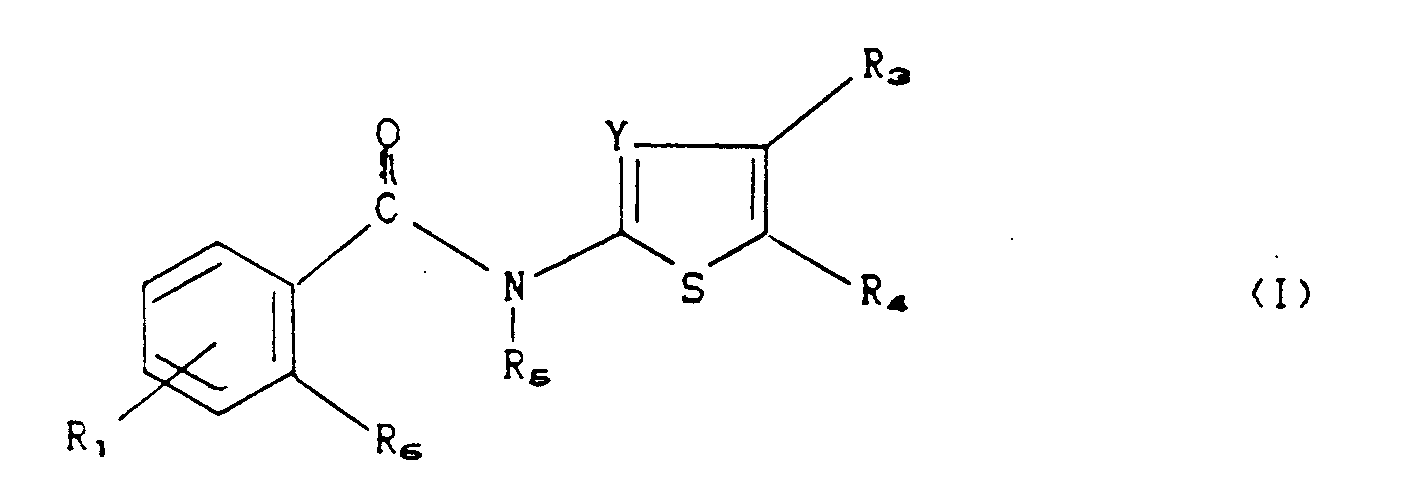
in which - R₁
- is H; 3-OCH₃; 3-Cl; 4-Cl; 5-Cl; 3-CH₃; 5-CH₃; or 3-OH;
- R₃
- is H; -CH₃; -CO-COOH; -CO-CO₂-C₂H₅;

- R₄
- is H; a linear alkyl radical of 1-4 carbon atoms; -COOH; or -CO₂C₂H₆;
- R₅
- is H; or R₅ and R₆ together form (-CO-NH);
- R₆
- is H; -NO₂; -NH₂; -NH-CON; -NH-COCH₃; -NH-CO-CO(CH₂)n-CH₃ where n is O, 1, 2 or 3; or R₆ and R₅ together form (NH-CO);
- Y
- is N; or C-R in which R is CO₂R₂ and R₂ is H or an alkaline or alkaline-earth metal equivalent or a linear or branched alkyl radical containing 1-8 carbon atoms;
- Said amido derivatives demonstrate surprisingly high activity as antiallergic agents, particularly when administered orally.
- In the prophylactic treatment of allergic affections, and in particular in allergic bronchial asthma, the chosen medicament currently used in disodium cromoglycate. However this substance has the drawback of losing its pharmacological effectiveness when administered orally, as it is poorly absorbed at the gastrointestinal level and this widely limits its field of application. Antiallergic medicament for oral use are also known, such as tranilast [N-(3ʹ,4ʹ-dimethoxycinnamoyl) anthranilic acid], however these are products without satisfactory antiallergic activity.
- The object of the present invention is to provide products which, when administered orally, are easily absorbed at the digestive tube level and exert a powerful antiallergic action.
- This object is attained by the heterocyclic amido derivatives of substituted benzoic acids of general formula (I) according to the present invention.
- To prepare the compounds of formula (I), the starting substances used are o-nitrobenzoic or p-nitrobenzoic acids, for example an o-nitrobenzoic acid of formula (II)

in which R, has the aforesaid meaning, and 2-aminothiophene derivatives of general formula (III)
or 2-aminothiazole derivatives of general formula (IV)
in which R₂, R₃ and R₄ have the aforesaid meanings. - In a preferred method, the o-nitrobenzoic acid (II) is firstly converted into the corresponding chloride (V)

by treatment with conventional chlorinating agents such as SOCl₂, POCl₃, PCl₅ or oxalyl chloride under suitable conditions. - The next step is to condense the acid chloride (V) with the 2-aminothiophene derivative (III) or with the 2-aminothiazole derivative (IV), according to the type of product to be obtained
- The reaction of this step is conducted in a reaction medium consisting of an aprotic organic solvent in the presence of a basic substance.
- Examples of solvents which can be used are CHCl₃, CH₂Cl₂, acetone, benzene, toluene, THF, dioxane and DMF, the preferred solvent being CH₂Cl₂ or CHCl₃.
- Examples of basic substances which can be used are tertiary organic bases such as Me₃N, Et₃N, pyridine and alkaline bases such as K₂CO₃ or Na₂CO₃, the preferred base being triethylamine or potassium carbonate.
- The molar ratio of (V) to (III) or of (V) to (IV) used in the reaction lies between 1 and 2.5, and preferably between 1 and 1.2.
- The reaction is conducted at a temperature of between 40 and 160°C, and preferably between 40 and 70°C, under agitation for a time of between 1 and 7 hours.
- A modification to the aforesaid condensation reaction consists of directly treating the o-nitrobenzoic acid of formula (II) with the 2-aminothiophene derivative (III) or with the 2-aminothiazole derivative (IV).
- This reaction is conducted in a reaction medium consisting of an organic solvent in the presence of a condensing agent.
- Solvents such as THF, benzene, dioxane or EtOH can be used as the reaction medium, the preference being for THF.
- Dicyclohexylcarbodiimide, ethoxyacetylene, diethylcyanamide or triphenylphosphite + imidazole can be used as condensing agents, the preferred agent being dicyclohexylcarbodiimide.
- The reaction is conducted at a temperature of between 0 and 60°C and preferably between 0 and 5°C.
- The molar ratio of compound (II) to compound (III) or of compound (II) to compound (IV) is between 0.5 and 1 and preferably between 0.5 and 0.67.
- The aforesaid synthesis processes lead to the formation of amides characterised by the presence of the nitro group in the aromatic ring, they being of general formula (VI)

in which R₁, R₃, R₄, R₅ and Y have the aforesaid meanings. - The nitro group can then be reduced to an amino group to give products of general formula (VII)

- The reduction can be conveniently conducted by treatment with hydrogen under pressure in the presence of a suitable catalyst, such as 10% Pd on C.
- The reduction is generally carried out under pressure. If R₃ is CO-CO₂-C₂H₅, the reduction is carried out at atmospheric pressure.
- The amino group of the compounds of general formula (VII) can be functionalised with acyl groups to provide for example N-acetyl derivatives by reaction with acetic anhydride in acetic acid, or with N-oxamic esters by reaction with alkyl oxalyl chlorides. These are prepared by the method of John B. Wright, Charles M. Hall and Herbert G. Johnson (J. Med. Chem. 1978, vol 21, 930-935).
- By treatment with COCl₂ in toluene, the compounds of general formula (VII) can be converted into tricyclic compounds of general formula (VIII)

in which R₁, R₃, R₄ and Y have the aforesaid meanings. The reaction is conducted at a temperature between ambient and the reflux temperature. - On the basis of the aforegoing description, all possible modifications, which also lie within the scope of the invention, are immediately apparent to experts of the art.
- In order to ilustrate some preferred embodiments of the process according to the present invention, examples are given hereinafter of the method for preparing the new compounds.
- The invention is illustrated but not limited by sold examples.
- Table 1 lists the chemical characteristics of 38 compounds according to the invention, and the yields obtained in their preparation.
- 46.96 g of triethylamine (0.465 moles) are added under energetic agitation to a mixture of 97.4 g of ethylcyanoacetate (0.862 moles), 27.58 g of sulphur (0.862 moles) and 107 ml of dimethylformamide.
- 50 g of propionaldehyde (0.862 moles) are dripped into this suspension, while maintaining the temperature at 50°C, and when the addition is complete it is allowed to reach ambient temperature and then kept under agitation for 2 hours. An oil forms which is treated with ether and water. The ether phase is separated, dried with sodium sulphate and evaporated to dryness to obtain an oil which is distilled under vacuum (boiling point 161-162°C at 13 mmHg).
- 88 g of 3-thiophene carboxylic acid (2-amino-5-methyl) ethyl ester are obtained. (Yield 55%. U.V. purity 99.8%).
Analysis for C₈H₁₁NO₂S % calculated % found C 51.86 52.08 H 5.98 5.91 N 7.56 7.64 - Using a procedure analogous to the aforesaid example, the following compounds are prepared:
3-THIOPHENE CARBOXYLIC ACID, (2-AMINO-5-METHYL) n.PROPYL ESTER
3-THIOPHENE CARBOXYLIC ACID, (2-AMINO-5-ETHYL) ETHYL ESTER
3-THIOPHEHE CARBOXYLIC ACID, (2-AMIHO-5-n.PROPYL) ISOPROPYL ESTER
3-THIOPHENE CARBOXYLIC ACID, (2-AMINO-5-n.BUTYL) n.PENTYL ESTER
3-THIOPHENE CARBOXYLIC ACID, (2-AMINO-5-METHYL) tert.BUTYL ESTER
3-THIOPHENE CARBOXYLIC ACID, (2-AMINO-5-ETHYL) n.OCTYL ESTER. - 100 g of 3-methoxy-2-nitrobenzoic acid (0.507 moles) are mixed in a dry apparatus under a stream of nitrogen with 602.8 g of freshly distilled thionylchloride (5.07 moles). The mixture is heated under reflux for 7 hours. It is cooled, the excess thionylchloride distilled off with a water pump, the solid residue taken up in anhydrous n-hexane, filtered off through a Buchner funnel and then dried to obtain 103 g of 3-methoxy-2-nitro benzoylchloride. (Yield 94.2%, M.P. 84-86°C, Cl⁻ purity 98.8%).
Analysis for C₈H₆NO₄Cl % calculated % found C 44.56 44.44 H 2.80 2.88 N 6.49 6.38 - 20.7 g of 3-thiophene carboxylic acid-2-amino-5-methyl ethyl ester (0.112 moles) dissolved in 250 ml of anhydrous methylene chloride and 29.2 g of triethylamine (0.289 moles) are introduced into a dry apparatus. 29 g of 3-methoxy-2-nitro benzoyl chloride (O. 134 moles ) dissolved in 343 ml of anhydrous methylene chloride are dripped into this solution.
- The mixture is heated under reflux for 7 hours, after which the solvent is evaporated and the solid obtained is left in 690 ml of ethanol under agitation for 1 hour.
- The solid residue is filtered off through a Buchner funnel and dried. 32.4 g of 3-thiophene carboxylic acid-2-[(2-nitro-3-methoxy benzoyl)amino]-5-methyl ethyl ester are obtained. (Yield 79.5%, M.P. 168-170°C, U.V. purity 100%).
Analysis for C₁₆H₁₆N₂O₆S % calculated % found C 52.73 52.68 H 4.42 4.51 N 7.68 7.73 - 3.178 g of potassium carbonate (0.023 moles) and 4.959 g of 3-methoxy-2-nitro benzoyl chloride (0.023 moles) dissolved in 50 ml of anhydrous methylene chloride are introduced into the dry apparatus. The temperature is reduced to 0°C, after which 4.255 g of 3-thiophene carboxylic acid-2-amino-5-methyl ethyl ester (0.023 moles) dissolved in 70 ml of anhydrous methylene chloride are dripped in.
- When this addition is terminated, the temperature is allowed to rise to 25°C after which the mixture is heated under reflux for 2 hours.
- The reaction mixture is filtered through a Buchner funnel, and the inorganic salt is washed with methylene chloride. The phases are separated, the organic phase being dried with sodium sulphate and then evaporated to dryness.
- A solid is obtained which is crystallised from 75 mi of ethyl acetate.
- 5.693 g of 3-thiophene carboxylic acid-2-[(2-nitro-3-methoxy benzoyl)amino]-5-methyl ethyl ester are obtained. (Yield 68%, M.P. 171-172°C, U.V. purity 99.8%).
Analysis for C₁₆H₁₆N₂O₆S % calculated % found C 52.73 52.80 H 4.42 4.43 N 7.68 7.83 - 10 g of 3-methoxy-2-nitro benzoic acid (0.05 moles) dissolved in 60 ml of tetrahydrofuran, 9.25 g of 3-thiophene carboxylic acid-2-amino-5-methyl ethyl ester (0.05 moles) dissolved in 90 ml of tetrahydrofuran and 0.5 g of N,N-dimethylaminopyridine (0.004 moles) as catalyst are introduced into a flask maintained under a nitrogen atmosphere. The tetrahydrofuran had previously been dried by distillation over lithium aluminium hydride.
- The mixture temperature is reduced to 0°C and 10.68 g of dicyclohexylcarbodiimide (0.0518 moles) are dripped in.
- The mixture temperature is allowed to reach ambient, and this is maintained for 2 hours.
- The precipitate formed is filtered off and the inorganic phase evaporated to dryness.
- The solid obtained is crystallised from 200 ml of ethyl acetate.
- After filtration and drying, 8.19 g of 3-thiophene carboxylic acid-2-[(2-nitro-3-methoxy benzoyl)amino]-5-methyl ethyl ester are obtained. (Yield 45%, M.P. 170-171°C, U.V. purity 98 9%).
Analysis for C₁₆H₁₆N₂O₆S % calculated % found C 52.73 52.60 H 4.42 4.38 N 7.68 7.59 - 51 g of 3-thiophene carboxylic acid-2-[(2-nitro-3-methoxy benzoyl)amino]-5-methyl ethyl ester (0.140 moles) dissolved in 670 ml of tetrahydrofuran, and containing 14.84 g of 10% palladium on carbon, are introduced into a Parr apparatus for hydrogenation under pressure (51 psi = 3.47 atm).
- On termination of hydrogen consumption, the catalyst is removed by filtration and the mixture evaporated to dryness.
- The solid obtained is crystallised from 750 ml of ethyl acetate.
- The crystallized product is filtered through a Buchner funnel and dried. 34.382 g of 3-thiophene carboxylic acid-2-[(2-amino-3-methoxy benzoyl)amino]-5-methyl ethyl ester are obtained. (Yield 73.5%, M.P. 188-189°C, U.V. purity 99.8%).
Analysis for C₁₆H₁₈N₂O₄S % calculated % found C 57.46 57.29 H 5.42 5.43 N 8.37 8.38 - Using a procedure analogous to the aforesaid example, the following compounds are prepared:
3-THIOPHENE CARBOXYLIC ACID, 2[(2-AMINO-3-METHOXY-BENZOYL)AMINO]-5-METHYL-n.PROPYL ESTER
3-THIOPHENE CARBOXYLIC ACID, 2[(2-AMINO-3-METHOXY-BENZOYL)AMINO]-5-METHYL-tert.BUTYL ESTER
3-THIOPHENE CARBOXYLIC ACID, 2[(2-AMINO-3-METHOXY-BENZOYL)AMINO]-5-ETHYL-ETHYL ESTER
3-THIOPHENE CARBOXYLIC ACID, 2[(2-AMINO-3-METHOXY-BENZOYL)AMINO]-5-n.PROPYL-ISOPROPYL ESTER
3-THIOPHENE CARBOXYLIC ACID, 2[(2-AMINO-3-METHOXY-BENZOYL)AMINO]-5-n.BUTYL-n.PENTYL ESTER
3-THIOPHENE CARBOXYLIC ACID, 2[(2-AMINO-3-METHOXY-BENZOYL)AMINO]-5-ETHYL-n.OCTYL ESTER. -
- 55g of 5-chloro-2-nitro benzoic acid (0.273 moles) and 324.79 g of thionyl chloride (2.73 moles) are reacted under reflux for 4 hours in the dry apparatus. On termination of the reaction, the excess thionyl chloride is distilled off and the residue is distilled with a high vacuum pump (M.P. 113-114°C at 0.3 mmHg). 51.128 g of 5-chloro-2-nitro benzoyl chloride are obtained. (Yield 85%, U.V. purity 98.4%).
Analysis for C₇H₃NO₃Cl₂ % calculated % found C 38.21 38.30 H 1.37 1.32 N 6.36 6.29 - 12.57 g of potassium carbonate (0.091 moles) and 20 g of 5-chloro-2-nitro benzoyl chloride (0.091 moles) dissolved in 52 ml of anhydrous methylene chloride are introduced into a previously dried flask in a stream of nitrogen.
- 16.835 g of 3-thiophene carboxylic acid-2-amino-5-methyl ethyl ester (0.091 moles) dissolved in 130 ml of anhydrous methylene chloride are dripped in at 0°C.
- On termination of the addition, the mixture temperature is allowed to rise to ambient, after which it is boiled for 2 hours.
- The reaction mixture is filtered through a Buchner funnel to eliminate the insoluble solid, and the organic phase is washed with water. This latter is then dried with sodium sulphate and evaporated to dryness.
- The solid obtained is crystallised from 75 ml of ethyl acetate, the precipitate being filtered off through a Buchner funnel and dried.
- 22.8 g of 3-thiophene carboxylic acid-2-[(2-nitro-5-chloro benzoyl)amino]-5-methyl ethyl ester are obtained. (Yield 68%, M.P. 150-152°C).
Analysis for C₁₅H₁₃N₂O₆ClS % calculated % found C 48.84 49.02 H 3.55 3.58 N 7.59 7.62 - 10.720 g of 3-thiophene carboxylic acid, 2-[(2-nitro-5-chloro benzoyl)amino]-5-methyl ethyl ester (0.029 moles) dissolved in 90 ml of anhydrous tetrahydrofuran are introduced into a Parr hydrogenator, 2.5 g of 5% palladium oxide are added, and the mixture treated with hydrogen at a pressure of 27 psi (1.84 atm).
- On termination of the hydrogenation, the catalyst is filtered off through celite and the organic phase evaporated.
- The solid residue is chromatographed in a silica gel column using N-hexane/acetone 7:3 as eluent.
- The fractions containing the pure product are pooled and evaporated to dryness.
- 5.5 g of 3-thiophene carboxylic acid, 2-[(2-amino-5-chloro benzoyl)amino]-5-methyl ethyl ester are obtained. (Yield 56%, M.P. 148-150°C).
Analysis for C₁₅H₁₅N₂O₂ClS % calculated % found C 53.17 53.06 H 4.46 4.48 N 8.27 8.32 - Using a procedure analogous to the aforesaid example, the following compounds are prepared:
3-THIOPHENE CARBOXYLIC ACID, 2-[(2-AMINO-5-CHLOROBENZOYL)AMINO]-5-METHYL-n.PROPYL ESTER
3-THIOPHENE CARBOXYLIC ACID, 2-[(2-AMINO-5-CHLOROBENZOYL)AMINO]-5-METHYL-tert.BUTYL ESTER
3-THIOPHENE CARBOXYLIC ACID, 2-[(2-AMINO-5-CHLOROBENZOYL)AMINO]-5-ETHYL-ETHYL ESTER
3-THIOPHENE CARBOXYLIC ACID, 2-[(2-AMINO-4-CHLOROBENZOYL)AMINO]-5-n.BUTYL-n.PENTYL ESTER
3-THIOPHENE CARBOXYLIC ACID, 2-[(2-AMINO-3-CHLOROBENZOYL)AMINO]-5-ETHYL-ETHYL ESTER
3-THIOPHENE CARBOXYLIC ACID, 2-[(2-AMINO-4-CHLOROBENZOYL)AMINO]-5-ETHYL-n.OCTYL ESTER
3-THIOPHENE CARBOXYLIC ACID, 2-[(2-AMINO-3-CHLOROBENZOYL)AMINO]-5-n.PROPYL-ISOPROPYL ESTER. - 27.29 g of triethylamine (0.27 moles) are added to a mixture of 49.5 g of ethyl cyanoacetate (0.5 moles), 16 g of sulphur (0.5 moles) and 62.5 ml of dimethylformamide under energetic agitation.
- 50 g of hexanal (0.5 moles) are dripped into this suspension while maintaining the temperature at 50°C, after which the temperature is allowed to fall to ambient at which the mixture is maintained under agitation for 2 hours.
- An oil separates and is treated with ether and water. The ether phase is separated, dried over sodium sulphate and evaporated to dryness to obtain an oil which is distilled under vacuum. M.P. 222-223°C at 25 mmHg.
- 54.32 g of 3-thiophene carboxylic acid-(2-amino-5-methyl)-ethyl ester are obtained. (Yield 51%, M.P. 64-66°C).
Analysis for C₁₀H₁₅NO₂S % calculated % found C 56.30 56.09 H 7.08 7.15 N 6.56 6.62 - 5 g of 5-methyl-2-nitro benzoic acid (0.027 moles) are finely ground in a mortar with 2.4 g of sodium bicarbonate (0.028 moles). The resultant powder is dissolved in water under agitation and slight heating. The water is evaporated under vacuum to obtain 4.76 g of 5-methyl-2-nitro benzoic acid, sodium salt. This quantity (0.0234 moles), suspended in 110 ml of anhydrous tetrahydrofuran, is reacted in an anhydrous environment at 0°C with 7.4 g of oxalyl chloride (0.054 moles). On termination of the reaction, both the excess oxalyl chloride and solvent are removed. The solid is taken up in anhydrous n-hexane, filtered off through a Buchner funnel and dried.
- 4.25 g of 5-methyl-2-nitro benzoyl chloride are obtained. (Yield 78.8%, M.P. 32-33°C).
Analysis for C₈H₆NO₃Cl % calculated % found C 48.13 48.21 H 3.03 2.91 N 7.02 6.98 - 20 g of 3-thiophene carboxylic acid-(2-amino-5-n.butyl)-methyl ester (0.094 moles) dissolved in 230 ml of anhydrous methylene chloride and 24.4 g of triethylamine (0.241 moles) are introduced into a dry apparatus maintained under a stream of nitrogen. 22.5 g of 5-methyl-2-nitro benzoyl chloride (0.112 moles) are rapidly dripped into this solution, and the mixture then heated under reflux for 7 hours. On termination of the reaction, the solvent is evaporated and the solid residue agitated with 700 ml of ethanol for one hour. It is filtered off through a Buchner funnel and dried to obtain 24.44 g of 3-thiophene carboxylic acid, 2-[(2-nitro-5-methyl benzoyl)amino]-5-n.butyl-ethyl ester. (Yield 69%, M.P. 120-122°C).
Analysis for C₁₈H₂₀N₂O₅S % calculated % found C 57.43 57.39 H 5.35 5.34 N 7.44 7.50 - 10 g of 3-thiophene carboxylic acid, 2-[(2-nitro-5-methyl benzoyl)amino]-5-n.butyl-methyl ester (0.0266 moles) are dissolved in 400 ml of anhydrous tetrahydrofuran, 2.8 g of 10% palladium on carbon are added and the mixture introduced into a Parr apparatus for hydrogenation under pressure (51 psi = 3.47 atm). On termination of the reaction, the catalyst is filtered off through celite and the solvent evaporated. The solid residue is crystallized from 100 ml of ethyl acetate. The precipitate is filtered off through a Buchner funnel and then dried to obtain 5.06 g of 3-thiophene carboxylic acid, 2-[(2-amino-5-methyl benzoyl)amino]-5-n.butyl-methyl ester. (Yield 55%, M.P. 152-154°C).
Analysis for C₁₈H₂₂N₂O₃S % calculated % found C 62.40 61.90 H 6.40 6.28 N 8.08 8.10 - Using a procedure analogous to the aforesaid example, the following compounds are prepared:
3-THIOPHENE CARBOXYLIC ACID, 2-[(2-AMINO-5-METHYL BENZOYL)AMINO]-5-METHYL-n.PROPYL ESTER
3-THIOPHENE CARBOXYLIC ACID, 2-[(2-AMINO-5-METHYL BENZOYL)AMINO]-5-METHYL-tert.BUTYL ESTER
3-THIOPHENE CARBOXYLIC ACID, 2-[2-AMINO-5-METHYL BENZOYL)AMINO]-5-n.BUTYL-n.PENTYL ESTER
3-THIOPHENE CARBOXYLIC ACID, 2[(AMINO-3-METHYL BENZOYL)AMINO]-5-ETHYL-ETHYL ESTER
3-THIOPHENE CARBOXYLIC ACID, 2-[(2-AMINO-3-METHYL BENZOYL)AMINO]-5-n.PROPYL-ISOPROPYL ESTER
3-THIOPHENE CARBOXYLIC ACID, 2-[(2-AMINO-3-METHYL BENZOYL)AMINO]-5-ETHYL-n.OCTYL ESTER. - 5.174 g of 3-methoxy-2-nitro benzoyl chloride (prepared in accordance with Example 2) (0,024 moles) dissolved in 55 ml of anhydrous acetone and 3.317 g of anhydrous potassium carbonate (0.024 moles) are introduced into a dry apparatus and maintained under a stream of nitrogen.
- The mixture temperature is lowered to 0°C and a solution of 4.464 g of 5-thiazole carboxylic acid, 2-amino-4-methyl, ethyl ester (0.024 moles) in 120 ml of anhydrous acetone is dripped in, during which the temperature is maintained at 0°C.
- On termination of this addition, the mixture temperature is allowed to rise to ambient after which it is heated under reflux for 3 hours.
- On termination of the heating, the solvent is evaporated and the solide residue is chromatographed in a silica gel column using chloroform/methanol 9.5:0.5 as eluent.
- The fractions containing the product are pooled and evaporated to dryness.
- The solid residue is taken up in 80 ml of ethyl ether, left under agitation for one hour, filtered through a Buchner funnel and dried.
- 5.7 g of 5-thiazole carboxylic acid, 2-[(2-nitro-3-methoxy benzoyl)amino]-4-methyl, ethyl ester are obtained. (Yield 65%, M.P. 260-261°C).
Analysis for C₁₅H₁₅N₃O₆S % calculated % found C 49.31 49.21 H 4.14 4.08 N 11.50 11.36 - 2 g of 5-thiazole carboxylic acid, 2-[(2-nitro-3-methoxy benzoyl)amino]-4-methyl, ethyl ester (0.0054 moles) dissolved in 200 ml of tetrahydrofuran are introduced into a Parr apparatus for hydrogenation under pressure, 1 g of 10% palladium on carbon is added to the mixture and hydrogenation is carried out while maintaining the hydrogen pressure around 51 psi = 3.47 atm.
- On termination of the reaction, the catalyst is filtered off through celite and the solvent evaporated. The solid residue is crystallised from 50 ml of ethanol, filtered off through a Buchner funnel and dried.
- 1.190 g of 5-thiazole carboxylic acid, 2-[(2-amino-3-methoxy benzoyl)amino]-4-methyl, ethyl ester are obtained. (Yield 64. 9%, M.P. 176-177°C).
Analysis for C₁₅H₁₇N₃O₄S % calculated % found C 53.71 53.57 H 5.11 4.99 N 12.53 12.61 - Using a procedure analogous to the aforesaid example, the following compounds are prepared:
5-THIAZOLE CARBOXYLIC ACID, 2-[(2-AMINO-3-CHLORO BENZOYL)AMINO]-4-METHYL, ETHYL ESTER
5-THIAZOLE CARBOXYLIC ACID, 2-[(2-AMINO-5-CHLORO BENZOYL)AMINO]-4-METHYL, ETHYL ESTER
5-THIAZOLE CARBOXYLIC ACID, 2-[(2-AMINO-4-CHLORO BENZOYL)AMINO]-4-METHYL, ETHYL ESTER
5-THIAZOLE CARBOXYLIC ACID, 2-[(2-AMINO-3-METHYL BENZOYL)AMINO]-4-METHYL, ETHYL ESTER
5-THIAZOLE CARBOXYLIC ACID, 2-[(2-AMINO-5-METHYL BENZOYL)AMINO]-4-METHYL, ETHYL ESTER. - 10 g of 3-methoxy-2-nitro benzoyl chloride (prepared in accordance with Example 2) (0.046 moles) dissolved in 160 ml of anhydrous methylene chloride and 6.41 g of anhydrous potassium carbonate (0.046 moles) are introduced into a dry apparatus and maintained under a nitrogen stream.
- The mixture temperature is reduced to 0°C and a solution of 8.627 g of 4-thiazole acetic acid-2-amino, ethyl ester (0.046 moles) in 150 ml of anhydrous methylene chloride is dripped in. During the addition the temperature is kept around 0°C.
- On termination of the addition the temperature of the reaction mixture is allowed to rise to ambient, after which it is heated under reflux for 3 hours.
- On termination of heating, it is cooled and 300 ml of water added. The organic phase is separated, dried with sodium sulphate and evaporated to dryness.
- The solid residue is chromatographed in a silica gel column using chloroform/acetone 6:4 as eluent.
- The fractions containing the pure product are pooled and evaporated to dryness.
- The solid obtained is crystallised from 150 ml of ethanol.
- 10.336 g of 4-thiazole acetic acid, 2-[(2-nitro-3-methoxy benzoyl)amino], ethyl ester are obtained. (Yield 61%, M.P. 165-166°C).
Analysis for C₁₅H₁₅N₃O₆5 % calculated % found C 49.31 49.51 H 4.14 4.08 N 11.50 11.38 - 3 g of 4-thiazole acetic acid, 2-[(2-nitro-3-methoxy benzoyl)-2-amino], ethyl ester (0.0082 moles) dissolved in 300 ml of methanol are introduced into a Parr apparatus for hydrogenation under pressure, 1 g of 10% palladium on carbon is added and the hydrogenation carried out maintaining the hydrogen pressure around 51 psi = 3.47 atm.
- On termination of the reaction, the catalyst is filtered off through celite and the solvent evaporated.
- The oily residue is dissolved at 50-60°C in 25 ml of ethanol. It is cooled and at ambient temperature a solid precipitates which is filtered off and dried.
- 1.676 g of 4-thiazole acetic acid, 2-[(2-amino-3-methoxy benzoyl)2-amino], ethyl ester are obtained. (Yield 61%, M.P. 133-135°C).
Analysis for C₁₅H₁₇N₃O₄S % calculated % found C 53.71 53.42 H 5.11 5.21 N 12.53 12.40 - Using a procedure analogous to the aforesaid example, the following compounds are prepared:
4-THIAZOLE ACETIC ACID, 2-[(2-AMINO-3-CHLORO BENZOYL)AMINO], ETHYL ESTER
4-THIAZOLE ACETIC ACID, 2-[(2-AMINO-5-CHLORO BENZOYL)AMINO], ETHYL ESTER
4-THIAZOLE ACETIC ACID, 2-[(2-AMINO-4-CHLORO BENZOYL)AMINO], ETHYL ESTER
4-THIAZOLE ACETIC ACID, 2-[(2-AMINO-3-METHYL BENZOYL)AMINO], ETHYL ESTER
4-THIAZOLE ACETIC ACID, 2-[(2-AMINO-5-METHYL BENZOYL)AMINO], ETHYL ESTER. - 5.13 g of 3-methoxy-2-nitro benzoyl chloride (prepared in accordance with Example 2) (0.0238 moles) dissolved in 110 ml of tetrahydrofuran and 3.3 g of anhydrous potassium carbonate (0.0239 moles) are introduced into a dry apparatus and maintained under a nitrogen stream.
- The mixture temperature is reduced to 0°C, and a solution of 4.78 g of 4-thiazole glyoxylic acid, 2-amino, ethyl ester (0.0239 moles) in 120 ml of anhydrous tetrahydrofuran is dripped in. During this addition the temperature is maintained at 0°C.
- On termination of the addition, the mixture temperature is increased to ambient after which it is heated under reflux for 9 hours.
- On termination of heating, the mixture is cooled and 300 ml of water added. The mixture is extracted with 300 ml of chloroform and the phases separated, the organic phase being dried and evaporated. A solid is obtained which is crystallised from 130 ml of acetone. The precipitate is filtered off through a Buchner funnel and dried. 5.68 g of 4-thiazole glyoxylic acid, 2-[(2-nitro-3-methoxy benzoyl)amino]-ethyl ester are obtained. (Yield 63%, M.P. 240-242°C).
Analysis for C₁₅H₁₃N₃O₇S % calculated % found C 47.49 47.26 H 3.45 3.35 N 11.07 11.01 - 5 g of 4-thiazole glyoxylic acid, 2-[(2-nitro-3-methoxy benzoyl) amino]-ethyl ester (0.0132 moles) dissolved in 100 ml of tetrahydrofuran are introduced into an apparatus for hydrogenation at atmospheric pressure, 1.4 g of 10% palladium on carbon is added to the mixture and hydrogenation is carried out.
- On termination of the reaction, the catalyst is filtered off through celite and the solvent evaporated. The solid residue is crystallised from 70 ml of ethanol, filtered off through a Buchner funnel and dried.
- 2.63 g of 4-thiazole glyoxylic acid, 2-[(2-amino-3-methoxy benzoyl)amino]-ethyl ester are obtained. (Yield 57%, M.P. 165-166°C).
Analysis for C₁₅H₁₅N₃O₅S % calculated % found C 51.56 51.49 H 4.32 4.33 N 12.02 11.98 - Using a procedure analogous to the aforesaid example, the following compounds are prepared:
4-THIAZOLE GLYOXYLIC ACID, 2-[(2-AMINO-3-CHLORO BENZOYL)AMINO]-ETHYL ESTER
4-THIAZOLE GLYOXYLIC ACID, 2-[(2-AMINO-4-CHLORO BENZOYL)AMINO]-ETHYL ESTER
4-THIAZOLE GLYOXYLIC ACID, 2-[(2-AMINO-5-CHLORO BENZOYL)AMINO]-ETHYL ESTER
4-THIAZOLE GLYOXYLIC ACID, 2-[(2-AMINO-3-METHYL BENZOYL)AMINO]-ETHYL ESTER
4-THIAZOLE GLYOXYLIC ACID, 2-[(2-AMINO-5-METHYL BENZOYL)AMINO]-ETHYL ESTER
4-THIAZOLE GLYOXYLIC ACID, 2-[(2-AMINO-3-METHOXY BENZOYL)AMINO]-5-ETHYL ESTER. - A suspension composed of 17.8 g of 3-thiophene carboxylic acid 2-[(2-amino-3-methoxy benzoyl)amino]-5-methyl, ethyl ester (0.053 moles) (prepared in accordance with Example 2), 85 ml of acetic acid and 16.3 g of acetic anhydride (0.16 moles) is heated to 80°C for half hour. The hot reaction mixture is dripped into 1200 ml of water and ice. The solid which precipitates is filtered off through a Buchner funnel and crystallised from 290 ml of ethyl acetate. After drying the solid, 12.086 g of 3-thiophene carboxylic acid, 2-[(2-acetyl amino-3-methoxy benzoyl)amino]-5-methyl, ethyl ester are obtained. (Yield 60.6%, M.P. 194-196°C, U.V. purity 100%).
Analysis for C₁₈H₂₀N₂O₅S % calculated % found C 57.43 57.19 H 5.35 5.41 N 7.44 7.28 - Using a procedure analogous to the aforesaid example, the following compounds are prepared:
3-THIOPHENE CARBOXYLIC ACID, 2-[(2-ACETYL AMINO-3-METHOXY BENZOYL)AMINO}-5-METHYL-n.PROPYL ESTER
3-THIOPHENE CARBOXYLIC ACID, 2-[(2-ACETYL AMINO-3-METHOXY BENZOYL)AMINO]-5-METHYL-tert.BUTYL ESTER
3-THIOPHENE CARBOXYLIC ACID, 2-[(2-ACETYL AMINO-3-METHOXY BENZOYL)AMINO]-5-ETHYL-ETHYL ESTER
3-THIOPHENE CARBOXYLIC ACID, 2-[(2-ACETYL AMINO-3-METHOXY BENZOYL)AMINO]-5-n.BUTYL-METHYL ESTER
3-THIOPHENE CARBOXYLIC AC ID, 2-[(2-ACETYL AMINO-3-METHYL BENZOYL)AMINO]-5-METHYL-n.PROPYL ESTER
3-THIOPHENE CARBOXYLIC ACID, 2-[(2-ACETYL AMINO-3-METHYL BENZOYL)AMINO]-5-METHYL-tert.BUTYL ESTER
3-THIOPHENE CARBOXYLIC ACID, 2-[(2-ACETYL AMINO-3-METHYL BENZOYL)AMINO]-5-n.BUTYL-METHYL ESTER
3-THIOPHENE CARBOXYLIC ACID, 2-[(2-ACETYL AMINO-5-METHYL BENZOYL)AMINO]-5-ETHYL-ETHYL ESTER
3-THIOPHENE CARBOXYLIC ACID, 2-[(2-ACETYL AMINO-3-METHYL BENZOYL)AMINO]-5-n.PROPYL-ISOPROPYL ESTER
3-THIOPHENE CARBOXYLIC ACID, 2-[(2-ACETYL AMINO-3-METHYL BENZOYL)AMINO]-5-ETHYL-n.OCYTL ESTER - 0.329 g of sodium hydroxide (0.0082 moles) dissolved in 12 ml of 95% ethanol are added to 0.500 g of 3-thiophene carboxylic acid, 2-[(2-acetyl amino-3-methoxy benzoyl)amino]-5-methyl, ethyl ester (0.00133 moles) (prepared in accordance with Example 9) dissolved in 20 ml of 95% ethanol.
- The mixture is heated under reflux for 2 days. The solvent is evaporated and the residue dissolved in 45 ml of water and treated with 45 ml of chloroform.
- The aqueous phase is separated, to which 37% hydrochloric acid is then added to pH 1. The precipitate is filtered off through a Buchner funnel. After drying , 0.267 g of 3-thiophene carboxylic acid, 2-[(2-amino-3-methoxy benzoyl)amino]-5-methyl are obtained (Yield 65.6%, M.P. 241-243°C).
Analysis for C₁₄H₁₄N₂O₄S % calculated % found C 54.88 55.08 H 4.60 4.68 N 9.14 9.21 - Using a procedure analogous to the aforesaid example, the following compounds are prepared:
3-THIOPHENE CARBOXYLIC ACID, 2-[(2-AMINO-3-METHOXY BENZOYL) AMINO]-5-METHYL
3-THIOPHENE CARBOXYLIC ACID, 2-[(2-AMINO-3-METHOXY BENZOYL) AMINO]-5-ETHYL
3-THIOPHENE CARBOXYLIC ACID, 2-[(2-AMINO-3-METHOXY BENZOYL) AMINO]-5-n.BUTYL
3-THIOPHENE CARBOXYLIC ACID, 2-[(2-AMINO-3-METHYL BENZOYL) AMINO]-5-METHYL
3-THIOPHENE CARBOXYLIC ACID, 2-[(2-AMINO-3-METHYL BENZOYL) AMINO]-5-n.BUTYL
3-THIOPHENE CARBOXYLIC ACID, 2-[(2-AMINO-5-METHYL BENZOYL) AMINO)-5-ETHYL
3-THIOPHENE CARBOXYLIC ACID, 2-[(2-AMINO-5-METHYL BENZOYL) AMINO]-5-n.PROPYL. - 40 ml of an 8% sodium hydroxide solution (0.08 are added to a suspension of 4.5 g of 3-thiophene carboxylic acid, 2-[(2-amino-3-methoxy benzoyl)amino]-5-methyl (0.0147 moles) (prepared in accordance with Example 10) in 80 ml of water.
- The mixture is heated to 80°C for 10 minutes with complete final dissolving.
- The solution is cooled, a precipitate forming at ambient temperature. The mixture is diluted with 150 ml of water and filtered through a Buchner funnel.
- After drying, 3.063 g of 3-thiophene carboxylic acid, 2-[(2-amino-3-methoxy benzoyl)amino]-5-methyl, sodium salt are obtained. (Yield 63.5%, M.P. 240°C dec.).
Analysis for C₁₄H₁₃N₂O₄SNa % calculated % found C 51.21 51.190 H 3.99 3.96 N 8.53 8.49 - Using a procedure analogous to the aforesaid example, the following compounds are prepared:
3-THIOPHENE CARBOXYLIC ACID, 2-[(2-AMINO-3-METHOXY BENZOYL) AMINO]-5-METHYL, SODIUM SALT
3-THIOPHENE CARBOXYLIC ACID, 2-[(2-AMINO-3-METHOXY BENZOYL) AMINO)-5-ETHYL, SODIUM SALT
3-THIOPHENE CARBOXYLIC ACID, 2-[(2-AMINO-3-METHOXY BENZOYL) AMINO]-5-n.BUTYL, SODIUM SALT
3-THIOPHENE CARBOXYLIC ACID, 2-[(2-AMINO-3-METHYL BENZOYL) AMINO]-5-METHYL, SODIUM SALT
3-THIOPHENE CARBOXYLIC ACID, 2-[(2-AMINO-3-METHYL BENZOYL) AMINO]-5-n.BUTYL, SODIUM SALT
3-THIOPHENE CARBOXYLIC ACID, 2-[(2-AMINO-5-METHYL BENZOYL) AMINO]-5-ETHYL, SODIUM SALT
3-THIOPHENE CARBOXYLIC ACID, 2-[(2-AMINO-5-METHYL BENZOYL) AMINO]-5-n.PROPYL, SODIUM SALT. - 3 g of 3-thiophene carboxylic acid, 2-[(2-amino-3-methoxy benzoyl)amino]-5-methyl, ethyl ester (prepared in accordance with Example 2) (0.00898 moles) dissolved in 65 ml of anhydrous chloroform and 2.02 g of triethylamine (0.02 moles) are introduced into a dry apparatus and maintained in a stream of nitrogen.
- The mixture temperature is reduced to -15°C and 2.73 g of ethyl oxalylchloride (0.02 moles) are dripped in.
- On termination of the addition, the mixture temperature is allowed to rise to ambient, and water is added. The organic phase is separated, dried and evaporated to dryness. A solid is obtained which is chromatographed in a silica gel column using ethyl ether/ethyl acetate/N-hexane 8:2:1 as eluent.
- The fractions containing the pure product are pooled and evaporated to dryness.
- 1.87 g of 3-thiophene carboxylic acid, 2-[[2-amino(oxoacetic acid ethyl ester)-3-methoxy benzoyl] amino]-5-methyl, ethyl ester are obtained. (Yield 48%, M.P. 140-142°C).
Analysis for C₂₀H₂₂N₂O₇S % calculated % found C 55.28 55.49 H 5.10 5.22 N 6.45 6.36 - Using a procedure analogous to the aforesaid example, the following compounds are prepared:
3-THIOPHENE CARBOXYLIC ACID, 2-[[2-AMINO(OXOACETIC ACID ETHYL ESTER)-3-METHOXY BENZOYL] AMINO]-5-METHYL, n.PROPYL ESTER
3-THIOPHENE CARBOXYLIC ACID, 2-[[2-AMINO(OXOACETIC ACID ETHYL ESTER)-3-METHOXY BENZOYL] AMINO]-5-METHYL, tert.BUTYL ESTER
3-THIOPHENE CARBOXYLIC ACID, 2-[[2-AMINO(OXOACETIC ACID ETHYL ESTER)-3-METHOXY BENZOYL] AMINO]-5-ETHYL, ETHYL ESTER
3-THIOPHENE CARBOXYLIC ACID, 2-[[2-AMINO(OXOACETIC ACID ETHYL ESTER)-3-METHOXY BENZOYL] AMINO]-5-n.BUTYL, ETHYL ESTER
3-THIOPHENE CARBOXYLIC ACID, 2-[[2-AMINO(OXOACETIC ACID ETHYL ESTER)-3-METHYL BENZOYL] AMINO]-5-METHYL, n.PROPYL ESTER
3-THIOPHENE CARBOXYLIC ACID, 2-[[2-AMINO(OXOACETIC ACID ETHYL ESTER)-3-METHYL BENZOYL] AMINO]-5-METHYL, tert.BUTYL ESTER
3-THIOPHENE CARBOXYLIC ACID, 2-[[2-AMINO(OXOACETIC ACID ETHYL ESTER)-3-METHYL BENZOYL] AMINO]-5-n.BUTYL, ETHYL ESTER
3-THIOPHENE CARBOXYLIC ACID, 2-[[2-AMINO(OXOACETIC ACID ETHYL ESTER)-5-METHYL BENZOYL] AMINO]-5-ETHYL, ETHYL ESTER
3-THIOPHENE CARBOXYLIC ACID, 2-[[2-AMINO(OXOACETIC ACID ETHYL ESTER)-5-METHYL BENZOYL] AMINO]-5-n.PROPYL, ISOPROPYL ESTER
3-THIOPHENE CARBOXYLIC ACID, 2-[[2-AMINO(OXOACETIC ACID ETHYL ESTER)-5-METHYL BENZOYL] AMINO]-5-ETHYL, n.OCTYL ESTER. - A suspension composed of 5 g of 3-thiophene carboxylic acid, 2-[(2-amino-5-chloro benzoyl)amino]-5-methyl, ethyl ester (prepared in accordance with Example 3) (0.0147 moles), 24 ml of acetic acid and 4.56 g of acetic anhydride (0.0447 moles) is heated to 80°C for half hour.
- The hot reaction mixture is dripped into 300 ml of water-ice. The solid which precipitates is filtered off through a Buchner funnel and crystallized from 81 ml of ethyl acetate.
- After drying, 3.265 g of 3-thiophene carboxylic acid, 2-[(2-acetyl amino-5-chloro benzoyl)amino]-5-methyl, ethyl ester are obtained (Yield 58%, M.P. 162-163°C).
Analysis for C₁₇H₁₇N₂O₄ClS % calculated % found C 53.61 53.51 H 4.50 4.48 N 7.38 7.30 - Using a procedure analogous to the aforesaid example, the following compounds are prepared:
3-THIOPHENE CARBOXYLIC ACID, 2-[(2-ACETYL,AMINO-5-CHLORO BENZOYL)AMINO]-5-METHYL-n. PROPYL ESTER
3-THIOPHENE CARBOXYLIC ACID, 2-[(2-ACETYL AMINO-5-CHLORO BENZOYL)AMINO]-5-n.BUTYL-METHYL ESTER
3-THIOPHENE CARBOXYLIC ACID, 2-[(2-ACETYL AMINO-5-CHLORO BENZOYL)AMINO]-5-ETHYL-ETHYL ESTER
3-THIOPHENE CARBOXYLIC ACID, 2-[(2-ACETYL AMINO-4-CHLORO BENZOYL)AMINO]-5-n.PROPYL-ISOPROPYL ESTER
3-THIOPHENE CARBOXYLIC ACID, 2-[(2-ACETYL AMINO-4-CHLORO BENZOYL)AMINO]-5-n.BUTYL-PENTYL ESTER
3-THIOPHENE CARBOXYLIC ACID, 2-[(2-ACETYL AMINO-4-CHLORO BENZOYL)AMINO]-5-METHYL-tert.BUTYL ESTER
3-THIOPHENE CARBOXYLIC ACID, 2-[(2-ACETYL AMINO-3-CHLORO BENZOYL)AMINO]-5-ETHYL-n.OCTYL ESTER
3-THIOPHENE CARBOXYLIC ACID, 2-[(2-ACETYL AMINO-3-CHLORO BENZOYL)AMINO]-5-n.BUTYL-ETHYL ESTER
3-THIOPHENE CARBOXYLIC ACID, 2-[(2-ACETYL AMINO-3-CHLORO BENZOYL)AMINO]-5-METHYL-tert.BUTYL ESTER. - A suspension composed of 5.03 g of 4-thiazole acetic acid, 2-[(2-amino-3-methoxy benzoyl)amino], ethyl ester (0.015 moles) (prepared in accordance with Example 7), 60.36 ml of acetic acid and 4.59 g of acetic anhydride (0.045 moles) is heated to 80°C for one hour. The hot reaction mixture is dripped into 600 ml of water and ice. The solid which precipitates is filtered off through a Buchner funnel and crystallized from 102 ml of ethanol. After drying the solid, 3.5 g of 4-thiazole acetic acid, 2-[(2-acetyl amino-3-methoxy benzoyl)amino], ethyl ester are obtained. (Yield 61.8%, M.P. 145-146°C).
Analysis for C₁₇H₁₉N₃O₅S % calculated % found C 54.1 53.93 H 5.07 5.03 N 11.13 11.31 - Using a procedure analogous to the aforesaid example, the following compounds are prepared:
4-THIAZOLE ACETIC ACID, 2-[(2-ACETYL AMINO-3-CHLORO BENZOYL)AMINO], ETHYL ESTER
4-THIAZOLE ACETIC ACID, 2-[(2-ACETYL AMINO-5-METHYL BENZOYL)AMINO], ETHYL ESTER
4-THIAZOLE CARBOXYLIC ACID, 2-[(2-ACETYL AMINO-4-CHLORO BENZOYL)AMINO]-4-METHYL, ETHYL ESTER
5-THIAZOLE CARBOXYLIC ACID, 2-[(2-ACETYL AMINO-3-METHYL BENZOYL)AMINO]-4-METHYL, ETHYL ESTER
5-THIAZOLE CARBOXYLIC ACID, 2-[(2-ACETYL AMINO-3-METHOXY BENZOYL)AMINO]-4-METHYL, ETHYL ESTER
4-THIAZOLE GLYOXYLIC ACID, 2-[(2-ACETYL AMINO-5-CHLORO BENZOYL)AMINO], ETHYL ESTER
4-THIAZOLE GLYOXYLIC ACID, 2-[(2-ACETYL AMINO-3-METHOXY BENZOYL)AMINO], ETHYL ESTER
4-THIAZOLE GLYOXYLIC ACID, 2-[(2-ACETYL AMINO-5-METHYL BENZOYL)AMINO], ETHYL ESTER. - 1,580 g of 3-thiophene carboxylic acid, 2-[(2-amino-3-methoxy benzoyl)amino]-5-methyl, ethyl ester (prepared in accordance with Example 2) (0.0047 moles) dissolved in 45 ml of anhydrous chloroform are introduced into a dry apparatus and maintained in a stream of nitrogen.
- 9 ml of 20% phosgene in toluene (0.018 moles) are dripped into this solution at ambient temperature.
- The solution is heated under reflux for 2 hours. It is cooled, and the solvent evaporated.
- A solid is obtained which is crystallised from 50 ml of ethanol. The crystallised product is filtered off through a Buchner funnel and dried.
- 1.282 g of 8-methoxy-3-[(3-ethoxycarbonyl-5-methyl)-thienyl]-2,4 quinazolone are obtained. (Yield 75.7%, M.P. 214-215°C).
Analysis for C₁₇H₁₆N₂O₅S % calculated % found C 56.65 56.57 H 4.47 4.46 N 7.77 7.67 - Using a procedure analogous to the aforesaid example, the following compounds are prepared:
8-CHLORO-3-[(3-ETHOXY CARBONYL-5-METHYL)-THIENYL]-2,4 QUINAZOLONE
8-METHYL-3-[(3-ETHOXY CARBONYL-5-METHYL)-THIENYL]-2,4 QUINAZOLONE
8-CHLORO-3-[(3-METHOXY CARBONYL-5-n.BUTYL)-THIENYL]-2,4 QUINAZOLONE
9-CHLORO-3-[(3-ETHOXY CARBONYL-5-METHYL)-THIENYL]-2,4 QUINAZOLONE
9-CHLORO-3-[(3-METHOXY CARBONYL-5-n.BUTYL)-THIENYL]-2,4 QUINAZOLONE
10-CHLORO-3-[(3-ETHOXY CARBONYL-5-METHYL)-THIENYL]-2,4 QUINAZOLONE
10-METHYL-3-[(3-ETHOXY CARBONYL-5-METHYL)-THIENYL]-2,4 QUINAZOLONE
10-METHYL-3-[(3-METHOXY CARBONYL-5-n.BUTYL)-THIENYL]-2,4 QUINAZOLONE - 7 g of 5-thiazole carboxylic acid, 2-[(2-amino-3-methoxy benzoyl)amino]-4-methyl, ethyl ester (0.0209 moles) (prepared in accordance with Example 6) dissolved in 130 ml of anhydrous chloroform are introduced into a dry apparatus and maintained in a stream of nitrogen. 39.75 ml of 20% phosgene in toluene (0.08 moles) are then dripped in at ambient temperature and the mixture left under agitation for one hour. On termination, the solvent is evaporated and the solid obtained is crystallised from 190 ml of absolute ethanol. The precipitate is filtered off through a Buchner funnel and dried.
- 4.725 g of 8-methoxy-3-[(5-ethoxycarbonyl-4-methyl)-thiazenyl]-2,4 quinazolone are obtained. (Yield 62.9%, M.P. 204-206°C).
Analysis for C₁₆H₁₅N₃O₅S % calculated % found C 53.17 53.38 H 4.18 4.22 N 11.62 11.81 - Using a procedure analogous to the aforesaid example, the following compounds are prepared:
8-CHLORO-3-[(5-ETHOXY CARBONYL-4-METHYL)-THIAZENYL]-2,4 QUINAZOLONE
8-METHYL-3-[(5-ETHOXY CARBONYL-4-METHYL)-THIAZENYL]-2,4 QUINAZOLONE
9-CHLORO-3-[(4-ACETIC ACID ETHYL ESTER)-THIAZENYL]-2,4 QUINAZOLONE
10-METHYL-3-[(4-ACETIC ACID ETHYL ESTER)-THIAZENYL]-2,4 QUINAZOLONE
9-CHLORO-3-[(4-GLYOXYLIC ACID ETHYL ESTER)-THIAZENYL]-2,4 QUINAZOLONE
10-CHLORO-3-[(4-GLYOXYLIC ACID ETHYL ESTER)-THIAZENYL]-2,4 QUINAZOLONE - 15 g of 4-thiazole glyoxylic acid, 2-[(2-nitro-3-methoxy benzoyl)amino], ethyl ester (prepared in accordance with Example 8) (0.0395 moles) dissolved in 500 ml of tetrahydrofuran are introduced into a Parr apparatus for hydrogenation under pressure, 5 g of 10% palladium on carbon are added to the mixture and hydrogenation is carried out while maintaining the hydrogen pressure around 51 psi = 3.47 atm. On termination of the reaction, the catalyst is filtered off through celite and the solvent evaporated.
- The solid residue is chromatographed through a silica gel column using chloroform/methanol 9.5:0.5 as eluent.
- The fractions containing the pure product are pooled and evaporated to dryness.
- 7.8 g of 4-thiazole-α-hydroxyacetic acid, 2-[(2-amino-3-methoxy benzoyl)amino]-ethyl ester are obtained. (Yield 56%, M.P. 180-182°C).
Analysis for C₁₅H₁₇N₃O₅S % calculated % found C 51.27 50.98 H 4.87 4.76 N 11.92 11.79 - Using a procedure analogous to the aforesaid example, the following compounds are prepared:
4-THIAZOLE-α-HYDROXY ACETIC ACID-2-[(2-AMINO-3-CHLORO BENZOYL) AMINO]-ETHYL ESTER
4-THIAZOLE-α-HYDROXY ACETIC ACID-2-[(2-AMINO-4-CHLORO BENZOYL) AMINO]-ETHYL ESTER
4-THIAZOLE-α-HYDROXY ACETIC ACID-2-[(2-AMINO-5-CHLORO BENZOYL) AMINO]-ETHYL ESTER
4-THIAZOLE-α-HYDROXY ACETIC ACID-2-[(2-AMINO-3-METHYL BENZOYL) AMINO]-ETHYL ESTER
4-THIAZOLE-α-HYDROXY ACETIC ACID-2-[(2-AMINO-5-METHYL BENZOYL) AMINO]-ETHYL ESTER. - 1.052 g of 4-thiazole-α-hydroxy acetic acid, 2-[(2-amino-3-methoxy benzoyl)amino], ethyl ester (0.003 moles) (prepared in accordance with Example 17) dissolved in 35 ml of anhydrous tetrahydrofuran are introduced into a dry apparatus and maintained in a stream of nitrogen. 2.95 ml of 20% phosgene in toluene (0.006 moles) are then dripped in and the mixture left under agitation for one hour. On termination, the solvent is evaporated and the solid obtained is chromatographed in a silica gel column using chloroform/methanol 9.5:0.5 as eluent.
- The fractions containing the pure product are pooled and evaporated to dryness.
- 0.680 g of 8-methoxy-3-[[5-(α-hydroxy ethylacetate)]-thiazenyl]-2,4 quinazolone are obtained. (Yield 60%, M.P. 177-178°C).
Analysis for C₁₆H₁₅N₃O₆S % calculated % found C 50.92 50.74 H 4.00 3.97 N 11.13 10.98 - Using a procedure analogous to the aforesaid example, the following compounds are prepared:
8-CHLORO-3-[[5-(α-HYDROXY ETHYL ACETATE)]-THIAZENYL]-2,4 QUINAZOLONE
9-CHLORO-3-[[5-(α-HYDROXY ETHYL ACETATE)]-THIAZENYL]-2,4 QUINAZOLONE
10-CHLORO-3-[[5-(α-HYDROXY ETHYL ACETATE)]-THIAZENYL]-2,4 QUINAZOLONE
8-METHYL-3-[[5-(α-HYDROXY ETHYL ACETATE)]-THIAZENYL]-2,4 QUINAZOLONE
10-METHYL-3-[[5-(α-HYDROXY ETHYL ACETATE)]-THIAZENYL]-2,4 QUINAZOLONE - 100 ml of absolute ethyl alcohol are introduced into a reaction flask, after which 5 ml of concentrated sulphuric acid are added.
- 10 g of 2-hydroxy-2-nitro-benzoic acid (0.054 moles) are added to this mixture, and the mixture heated under reflux for 5 hours.
- It is then left at ambient temperature under agitation overnight, and the solid is then filtered off through a Buchner funnel and washed with water until neutral.
- After drying, 9.5 g of 3-hydroxy-2-nitro-ethyl benzoate are obtained. (Yield 83. 3%, M.P. 160-162°C).
Analysis for C₉H₉NO₅ % calculated % found C 51.18 50.98 H 4.29 4.41 N 6.63 6.38 - 32 ml of anhydrous ethanol are introduced into a two-neck 500 ml flask fitted with a reflux condenser and maintained in a stream of nitrogen, 1.1 g of sodium metal (0.047 moles) then being added under agitation.
- After complete formation of the sodium ethylate, 10 g of 3-hydroxy-2-nitro-ethyl benzoate (0.047 moles) dissolved in 200 ml of anhydrous ethanol are added. After some minutes, 6.7 g of benzyl chloride (0.053 moles) are added and the mixture, heated under reflux for 4 hours.
- It is filtered through celite and the filtrate evaporated. The solid residue is crystallized from ethanol.
- 10 g of 3-benzyloxy-2-nitro-ethyl benzoate are obtained (Yield 70.6%, M.P. 172-173°C).
Analysis for C₁₆H₁₅NO₅ % calculated % found C 63.78 63.65 H 5.01 4.99 N 4.65 4.50 - 20 g of 3-benzyloxy-2-nitro-ethyl benzoate, (0.066 moles) are dissolved in 300 ml of ethanol and introduced into the reaction vessel. 2.64 g of sodium hydroxide (0.066 moles) dissolved in 50 ml of ethanol are then added, and the mixture heated under reflux for 3 hours.
- The ethanol is evaporated, and the solid obtained is dissolved in water and acidified to pH 2. The precipitate is filtered off through a Buchner funnel and dried. 12 g of 3-benzyloxy-2-nitro-benzoic acid are obtained. (Yield 66%, M.P. 193-195°C).
Analysis for C₁₄H₁₁NO₅ % calculated % found C 61.54 61.48 H 4.06 4.15 N 5.12 5.23 - 100 g of 3-benzyloxy-2-nitro-benzoic acid (0.366 moles) are mixed in a dry apparatus under a stream of nitrogen with 435.5 g of freshly distilled thionyl chloride (3.66 moles). The mixture is heated under reflux for 5 hours. It is cooled, and the excess thionyl chloride distilled off with a water pump. The solid residue is taken up in anhydrous n-hexane and then filtered off through a Buchner funnel and dried to obtain 96 g of 3-benzyloxy-2-nitro-benzoyl chloride. (Yield 90%, Cl⁻ purity 98.8%).
Analysis for C₁₄H₁₀ClNO₄ % calculated % found C 57.64 57.72 H 3.45 3.61 N 4.80 4.93 - 20.7,g of 3-thiophene carboxylic acid-2-amino-5-methyl, ethyl ester (0.112 moles) dissolved in 250 ml of anhydrous methylene chloride and 29.2 g of triethylamine (0.289 moles) are introduced into a dry apparatus. 39 g of 3-benzyloxy-2-nitro-benzoyl chloride (0.134 moles) dissolved in 400 ml of anhydrous methylene chloride are dripped into this solution. The mixture is heated under reflux for 7 hours, after which the solvent is evaporated and the solid obtained is stirred in 700 ml of ethanol for 2 hours.
- The solid residue is filtered off through a Buchner funnel and dried. 22.4 g of 3-thiophene carboxylic acid-2-[(2-nitro-3-benzyloxy benzoyl)amino]-5-methyl ethyl ester are obtained. (Yield 65. 7%, M.P. 208-210°C, U.V. purity 100%).
Analysis for C₂₂H₂₀N₂O₆S % calculated % found C 59.98 59.80 H 4.57 4.71 N 6.36 6.26 - 51 g of 3-thiophene carboxylic acid-2-[(2-nitro-3-benzyloxy benzoyl)amino]-5-methyl ethyl ester (0.116 moles) dissolved in 750 ml of tetrahydrofuran and to which 13.8 g of 10% palladium on carbon has been added are introduced into a Parr apparatus for hydrogenation under pressure (51 psi = 3.47 atm).
- On completion of hydrogen consumption, the catalyst is removed by filtration and the mixture is evaporated to dryness. The solid obtained is crystallized from 950 ml of ethyl acetate. The crystallised product is filtered off through a Buchner funnel and dried.
- 34.382 g of 3-thiophene carboxylic acid-2-[(2-amino-3-hydroxy benzoyl)amino]-5-methyl ethyl ester are obtained. (Yield 92.6%, M.P. 220-221°C, U.V. purity 99.8%).
Analysis for C₁₅H₁₆N₂O₄S % calculated % found C 56.23 56.64 H 5.03 4.88 N 8.74 8.72 


- The products of general formula (I) listed in Table 1 were subjected to a first pharmacological screening to evaluate their activity after oral administration in the passive cutaneous anaphylaxis test (PCA) in the rat in accordance with Goose J. and Blair A.M.J.N. (Immunology, 16, 749-760, 1969).
- Serum, obtained from rats actively sensitized with ovalbumin and suitably diluted, was injected intradermally into the shave back of male Sprague Dawley rats, and after 24 hours these were treated intravenously with a solution of ovalbumin and Evans blue.
- Thirty minutes after the antigen challenge, the animals were sacrificed and the diameter and intensity of the blue halo which has formed in the intradermal injection site was measured.
- The compounds according to the invention, and also tranilast (N-3ʹ, 4ʹ-dimethoxycinnamoyl) anthranilic acid) used as reference standard, were dissolved-suspended in suitable solvents (carboxymethylcellulose, gum arabic, DMSO etc.) and administered orally thirty minutes before the antigen challenge.
- Table 2 lists the ED₅₀ values and the relative confidence limits at p = 0.05.
TABLE 2 Results of antiallergic activity evaluation in the PCA test on the rat after oral administration 30 minutes before antigen challenge Compound No. Molecular weight ED₅₀ mmoles/kg/os Confidence limits mmoles/kg/os Activity Tranilast 327 0.32 0.09-1.17 1 1 364 0.21 0.08-0.51 1.5 7 334 0.71 x 10⁻³ 0.18-2.6 x 10⁻³ 450.7 16 306 7.8 x 10⁻³ 3.0-19.0 x 10⁻³ 41.0 15 376 0.013 0.004-0.048 24.6 18 434 2.8 x 10⁻³ 0.81-10.0 x 10⁻³ 114.3 32 360 0.08 0.02-0.029 4.0 25 335 5.0 x 10⁻³ 1.4-18.0 x 10⁻³ 64.0 37 319 1.5 x 10⁻³ 0.4-5.4 x 10⁻³ 213.3 38 361 6.6 x 10⁻³ 2.5-16.0 x 10⁻³ 48.4 36 377 0.054 0.017-0.019 5.9 - Some of the compounds according to the invention were subjected to a further passive cutaneous anaphylaxis test evaluation to determine their efficiency after intraperitoneal administration at a dose of 100 mg/kg, fifteen minutes before the challenge.
- Table 3 shows the percentage variations calculated for each treatment group (6 in number) with respect to the control group (6 in number).
TABLE 3 Results of antiallergic activity evaluation in the PCA test on the rat after intraperitoneal administration 15 minutes before antigen challenge Compound No. Molecular weight Inhibition % 1 364 59.4 7 334 31.9 32 360 52.7 25 335 43.1 37 319 88.4 36 377 40.7 - As can be observed from the results given in Tables 2 and 3, the compounds according to the invention are able to inhibit passive cutaneous anaphylaxis in the rat when administered both orally and intraperitoneally.
- In particular, when administered orally the results are superior to tranilast by up to three orders of magnitude.
- The acute toxicity (LD₅₀) of the products according to the invention is considerably greater than 500 mg/kg both for oral administration and for intraperitoneal administration, in that at this dose (the maximum dose tested) no toxic effects were ever manifested.
Claims (14)
- Heterocyclic amido derivatives of substituted benzoic acids and therapeutically acceptable salts thereof, of general formula (I):
 R₁ is H; 3-OCH₃; 3-Cl; 4-Cl; 5-Cl; 3-CH₃; 5-CH₃; or 3-OH;R₃ is H; -CH₃; -CO-COOH; -CO-CO₂-C₂H₅;
 R₄ is H; a linear alkyl radical of 1-4 carbon atoms; -COOH; or -CO₂C₂H₅;R₅ is H, or R₅ and R₆ together form (-CO-NH);R₆ is H; -NO₂; -NH₂ -NH-COH; -NH-COCH₃; -NH-CO-CO(CH₂)n-CH₃ where n is 0, 1, 2 or 3; or R₆ ad R₅ together form (NH-CO-);Y is N; or C-R in which R is CO₂R₂ and R₂ is H or an alkaline or alkaline-earth metal equivalent or a linear or branched alkyl radical containing 1-8 carbon atoms;with the following provisos:(a) when R₁=R₅=R₆=R₃=R₄=H Y is ≠ N(b) when R₁=R₃=R₄=H, R₅ and R₆ together form -CO-NH-, Y is ≠ N(c) when R₁=R₅=R₆=H, R₃=CH₃ and R₄=H or CH₃, Y is ≠ -C-COOET(d) when R₁=R₅=R₆=H and R₃=R₄=CH₃ Y is ≠ -C-COOH(e) when R₁=R₅=R₆=H
R₃=H, and R₄=H,Me,Et,Bu Y ≠ -C-COOET(f) when R₁=R₅=R₆=R₃=H
and R₄=H,Me,Bu Y ≠ -C-COOMe - A process for preparing heterocyclic amido derivatives of substituted benzoic acids of general formula (I):
 R₁ is H; 3-OCH₃; 3-Cl; 4-Cl; 5-Cl; 3-CH₃; 5-CH₃; or 3-OH;R₃ is H; -CH₃; -CO-COOH; -CO-CO₂-C₂H₅;
 R₄ is H; a linear alkyl radical of 1-4 carbon atoms; -COOH; or -CO₂C₂H₅;R₅ is H, or R₅ and R₆ together form (-CO-NH);R₆ is H; -NO₂; -NH₂; -NH-COH; -NH-COCH₃; -NH-CO-CO-(CH₂)n-CH₃ where n is 0, 1, 2 or 3; or R₆ ad R₅ together form (NH-CO-);Y is N; or C-R in which R is CO₂R₂ and R₂ is H or an alkaline or alkaline-earth metal equivalent or a linear or branched alkyl radical containing 1-8 carbon atoms;with the following provisos:(a) when R₁=R₅=R₆=R₃=R₄=H Y is ≠ N(b) when R₁=R₃=R₄=H, R₅ and R₆ together form -CO-NH-, Y is ≠ N(c) when R₁=R₅=R₆=H, R₃=CH₃ and R₄=H or CH₃, Y is ≠ -C-COOET(d) when R₁=R₅=R₆=H and R₃=R₄=CH₃ Y is ≠ -C-COOH(e) when R₁=R₅=R₆=H
R₃=H, and R₄=H,Me,Et,Bu Y ≠ -C-COOET(f) when R₁=R₅=R₆=R₃=Hcomprising
and R₄=H,Me,Bu Y ≠ -C-COOMe
a) condensing substituted o-nitrobenzoic or p-nitrobenzoic acid (II)


- A process as claimed in claim 2, characterised in that the condensation of (V) with (III) or with (IV) is conducted in aprotic organic solvents in the presence of basic substances at a temperature of between 40 and 160°C, and preferably between 40 and 70°C.
- A process as claimed in claim 3, characterised in that said aprotic organic solvents are CHCl₃, CH₂Cl₂ acetone, benzene, toluene, THF, dioxane and DMF, and are preferably CH₂Cl₂ and CHCl₃.
- A process as claimed in claim 3, characterised in that said basic substances are Me₃N, Et₃N, pyridine, K₂CO₃ and Na₂CO₃, and are preferably triethylamine and potassium carbonate.
- A process as claimed in claim 2, characterised in that said condensation reaction is conducted with a molar ratio of (V) to (III), or of (V) to (IV), of between 1 and 2.5, and preferably between 1 and 1.2.
- A process as claimed in claim 2, characterised in that the condensation of (II) with (III) or with (IV) is conducted in a reaction medium consisting of organic solvents in the presence of condensing agents, at a temperature of between 0 and 60°C.
- A process as claimed in claim 7, characterised in that the organic solvents used are EtOH, THF, benzene and dioxane, and preferably THF.
- A process as claimed in claim 7, characterised in that the condensing agents used are dicyclohexylcarbodiimide, ethoxyacetylene, diethylcyanamide, and triphenyl phosphite + imidazole, and preferably dicyclohexylcarbodiimide.
- A process as claimed in claim 7, characterised in that the molar ratio of compound (II) to compound (III), or of compound (II) to compound (IV) is between 0.5 and 1, and preferably between 0.5 and 0.67.
- A process for preparing heterocyclic amido derivatives of substituted benzoic acids of general formula (I) in which R₅ and R₆ form NH-CO to give tricyclic compounds, characterised by treating with phosgene a compound of general formula (I) in which R₅ is H and R₆ is NH₂.
- A process as claimed in claim 11, characterised in that said treatment is conducted with phosgene dissolved in toluene.
- A process as claimed in claim 11, characterised in that said treatment is conducted at a temperature of between ambient and the reflux boiling temperature.
- The use of heterocyclic amidoderivatives of substituted benzoic acid of general formula (I)

in which:R₁ is H; 3-OCH₃; 3-Cl; 4-Cl; 5-Cl; 3-CH₃; 5-CH₃; or 3-OH;R₃ is H; -CH₃; -CO-COOH; -CO-CO₂-C₂H₅;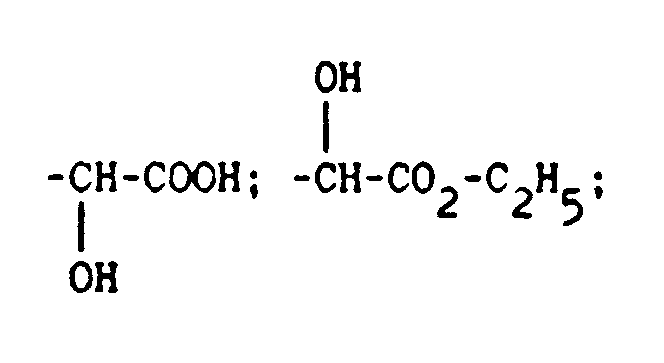 R₄ is H; a linear alkyl radical of 1-4 carbon atoms; -COOH; or -CO₂C₂H₅;R₅ is H, or R₅ and R₆ together form (-CO-NH);R₆ is H; -NO₂; -NH₂; -NH-COH; -NH-COCH₃; -NH-CO-CO-(CH₂)n-CH₃ where n is 0, 1, 2 or 3; or R₆ ad R₅ together form (NH-CO-);Y is N; or C-R in which R is CO₂R₂ and R₂ is H or an alkaline or alkaline-earth metal equivalent or a linear or branched alkyl radical containing 1-8 carbon atoms;for preparing pharmaceutical composition for the treatment of allergic affections.
Priority Applications (1)
| Application Number | Priority Date | Filing Date | Title |
|---|---|---|---|
| AT87113169T ATE74915T1 (en) | 1986-09-23 | 1987-09-09 | HETEROCYCLIC AMIDORIVATIVES OF SUBSTITUTED BENZOACIDS AND THERAPEUTIC COMPOSITIONS CONTAINING THEM AS AN ACTIVE SUBSTANCE. |
Applications Claiming Priority (2)
| Application Number | Priority Date | Filing Date | Title |
|---|---|---|---|
| IT2178486 | 1986-09-23 | ||
| IT21784/86A IT1197259B (en) | 1986-09-23 | 1986-09-23 | HETEROCYCLIC AMID DERIVATIVES OF BENZOIC ACIDS SUBSTITUTED AND THERAPEUTIC COMPOSITION THAT CONTAIN THEM AS ACTIVE INGREDIENTS |
Publications (2)
| Publication Number | Publication Date |
|---|---|
| EP0261503A1 EP0261503A1 (en) | 1988-03-30 |
| EP0261503B1 true EP0261503B1 (en) | 1992-04-15 |
Family
ID=11186793
Family Applications (1)
| Application Number | Title | Priority Date | Filing Date |
|---|---|---|---|
| EP87113169A Expired - Lifetime EP0261503B1 (en) | 1986-09-23 | 1987-09-09 | Heterocyclic amido derivatives of substituted benzoic acids and therapeutic compositions which contain them as active principle |
Country Status (4)
| Country | Link |
|---|---|
| EP (1) | EP0261503B1 (en) |
| AT (1) | ATE74915T1 (en) |
| DE (1) | DE3778268D1 (en) |
| IT (1) | IT1197259B (en) |
Families Citing this family (6)
| Publication number | Priority date | Publication date | Assignee | Title |
|---|---|---|---|---|
| US4874864A (en) * | 1988-05-24 | 1989-10-17 | Pfizer Inc. | Benzamide protease inhibitors |
| US5478945A (en) * | 1992-07-15 | 1995-12-26 | Taisho Pharmaceutical Co., Ltd. | Thiazoline derivatives |
| EP0649843B1 (en) * | 1992-07-15 | 2000-09-06 | Taisho Pharmaceutical Co. Ltd | Thiazoline derivative |
| GB9823871D0 (en) * | 1998-10-30 | 1998-12-23 | Pharmacia & Upjohn Spa | 2-Amino-thiazole derivatives, process for their preparation, and their use as antitumour agents |
| WO2001062718A1 (en) * | 2000-02-25 | 2001-08-30 | Japan Tobacco, Inc. | Benzamide derivative and use thereof |
| EP1724270A3 (en) | 2001-07-19 | 2007-01-03 | Pfizer Italia S.r.l. | Phenylacetamido-thiazole derivatives, process for their preparation and their use as antitumor agents |
Family Cites Families (2)
| Publication number | Priority date | Publication date | Assignee | Title |
|---|---|---|---|---|
| US2401522A (en) * | 1942-04-17 | 1946-06-04 | Firm Sandoz Ltd | Aromatic carboxylic acid amides and a process for their manufacture |
| US4187232A (en) * | 1975-06-05 | 1980-02-05 | Lilly Industries Limited | Acylamino derivatives |
-
1986
- 1986-09-23 IT IT21784/86A patent/IT1197259B/en active
-
1987
- 1987-09-09 AT AT87113169T patent/ATE74915T1/en not_active IP Right Cessation
- 1987-09-09 EP EP87113169A patent/EP0261503B1/en not_active Expired - Lifetime
- 1987-09-09 DE DE8787113169T patent/DE3778268D1/en not_active Expired - Lifetime
Non-Patent Citations (1)
| Title |
|---|
| CHEMICAL ABSTRACTS, vol. 79, no. 15, 15th October 1973, page 447, abstract no. 92269b, Columbus, Ohio, US; Patronato de Investigacion Cientifica y Tecnica "Juan de la Cerva" and Laboratorios Made S.A.: "Substituted 4-oxo-3-amino-3,4-dihydrothieno[3,2-d]-pyrimidine derivatives" * |
Also Published As
| Publication number | Publication date |
|---|---|
| ATE74915T1 (en) | 1992-05-15 |
| DE3778268D1 (en) | 1992-05-21 |
| IT1197259B (en) | 1988-11-30 |
| EP0261503A1 (en) | 1988-03-30 |
| IT8621784A0 (en) | 1986-09-23 |
Similar Documents
| Publication | Publication Date | Title |
|---|---|---|
| CN116354901B (en) | A thiazolidinedione compound and its preparation method and application | |
| JP2009544623A (en) | Morpholinyl and pyrrolidinyl analogues | |
| FI77030C (en) | PROCEDURE FOR FRAMSTATION OF 2-HYDROXY-3-CARBOXYLSYRAKINOLINER 2-STATIONARY SUBSTITUTES. | |
| CA2873570C (en) | Amides of 2-amino-4-arylthiazole compounds and their salts as trpa1 modulators | |
| JPS6330914B2 (en) | ||
| FI63573C (en) | FREEZING FOR OXIBENSOTIAZINE DIOXIDERS CABOXAMIDERS | |
| FI57594B (en) | PROCEDURE FOR THE FRAMSTATION OF ANTI-ALLERGIC VERKSAMMA N- (BENTSTIAZOL-2-YL) -OXAMIDSYRA DERIVATIVES | |
| FR2465712A1 (en) | N-PROPIONYLSARCOSINANILIDES, PROCESS FOR PREPARING THEM AND MEDICAMENTS CONTAINING THEM | |
| JPH0615527B2 (en) | Alkyldiamine derivative, production method thereof and antiarrhythmic agent | |
| CN108623537B (en) | Synthesis and application of aromatic amine acetylcholinesterase inhibitor containing amine side chain | |
| EP0261503A1 (en) | Heterocyclic amido derivatives of substituted benzoic acids and therapeutic compositions which contain them as active principle | |
| PT1502590E (en) | Heterocyclic oxime derivatives, process for their preparation and use thereof in the treatment of type ii diabetes | |
| FI78084B (en) | FOERFARANDE FOER FRAMSTAELLNING AV NYA, TERAPEUTISKT VERKSAMMA BENSOPYRANDERIVAT. | |
| US4046778A (en) | Processes for the preparation of 4-hydroxy-2H-1-benzothiopyran-3-carboxamide 1,1-dioxides | |
| FI64145B (en) | FREQUENCY REFRIGERATION FOR 2-ARYLAMINO-2-IMIDAZOLINE DERIVATIVES | |
| SE466656B (en) | NEW INTERMEDIATES USEFUL FOR THE PREPARATION OF 4-HYDROXY-3-QUINOLINE CARBOXYLIC ACID DERIVATIVES | |
| Buscemi et al. | A generalized synthesis of 3-amino-5-aryl-, 3-amino-5-polyfluorophenyl-, and 3-amino-5-alkyl-1, 2, 4-oxadiazoles through ring-degenerate rearrangements | |
| JP4658512B2 (en) | Coumarin derivative and Maillard reaction inhibitor containing the derivative | |
| US4083979A (en) | Thiazolidine derivatives and their use as salidiuretics | |
| FI75822C (en) | PROCEDURE FOR THE FRAMSTATION OF 4-HYDROXY-3- (HETEROCYCLOCARBAMOYL) -2H-1,2-BENZOTIAZINE-1,1-DIOXIDER. | |
| KR920001673B1 (en) | Method for preparing pyrimidoisoquinoline derivative | |
| US4634777A (en) | [(1,3-dioxo-1,3-propanediyl)diimino)]bisbenzoic acid derivatives | |
| KR20000069544A (en) | New 4-(1-piperazinyl)benzoic acid derivatives, process for preparing them and their therapeutic applications | |
| Nemazany et al. | A new and efficient route to amino derivatives of [1, 6]‐and [2, 7] naphthyridones | |
| EP0663903B1 (en) | 1,2-dihydro-2-oxo-3-amino quinoxaline derivatives, preparation thereof and application in therapy |
Legal Events
| Date | Code | Title | Description |
|---|---|---|---|
| PUAI | Public reference made under article 153(3) epc to a published international application that has entered the european phase |
Free format text: ORIGINAL CODE: 0009012 |
|
| AK | Designated contracting states |
Kind code of ref document: A1 Designated state(s): AT BE CH DE ES FR GB GR IT LI LU NL SE |
|
| 17P | Request for examination filed |
Effective date: 19880713 |
|
| 17Q | First examination report despatched |
Effective date: 19900521 |
|
| GRAA | (expected) grant |
Free format text: ORIGINAL CODE: 0009210 |
|
| AK | Designated contracting states |
Kind code of ref document: B1 Designated state(s): AT BE CH DE ES FR GB GR IT LI LU NL SE |
|
| PG25 | Lapsed in a contracting state [announced via postgrant information from national office to epo] |
Ref country code: IT Free format text: LAPSE BECAUSE OF FAILURE TO SUBMIT A TRANSLATION OF THE DESCRIPTION OR TO PAY THE FEE WITHIN THE PRESCRIBED TIME-LIMIT;WARNING: LAPSES OF ITALIAN PATENTS WITH EFFECTIVE DATE BEFORE 2007 MAY HAVE OCCURRED AT ANY TIME BEFORE 2007. THE CORRECT EFFECTIVE DATE MAY BE DIFFERENT FROM THE ONE RECORDED. Effective date: 19920415 Ref country code: LI Effective date: 19920415 Ref country code: GR Free format text: LAPSE BECAUSE OF FAILURE TO SUBMIT A TRANSLATION OF THE DESCRIPTION OR TO PAY THE FEE WITHIN THE PRESCRIBED TIME-LIMIT Effective date: 19920415 Ref country code: SE Effective date: 19920415 Ref country code: NL Effective date: 19920415 Ref country code: BE Effective date: 19920415 Ref country code: CH Effective date: 19920415 Ref country code: FR Effective date: 19920415 Ref country code: AT Effective date: 19920415 |
|
| REF | Corresponds to: |
Ref document number: 74915 Country of ref document: AT Date of ref document: 19920515 Kind code of ref document: T |
|
| REF | Corresponds to: |
Ref document number: 3778268 Country of ref document: DE Date of ref document: 19920521 |
|
| PG25 | Lapsed in a contracting state [announced via postgrant information from national office to epo] |
Ref country code: ES Free format text: LAPSE BECAUSE OF FAILURE TO SUBMIT A TRANSLATION OF THE DESCRIPTION OR TO PAY THE FEE WITHIN THE PRESCRIBED TIME-LIMIT Effective date: 19920726 |
|
| REG | Reference to a national code |
Ref country code: CH Ref legal event code: PL |
|
| EN | Fr: translation not filed | ||
| PG25 | Lapsed in a contracting state [announced via postgrant information from national office to epo] |
Ref country code: GB Effective date: 19920909 |
|
| NLV1 | Nl: lapsed or annulled due to failure to fulfill the requirements of art. 29p and 29m of the patents act | ||
| PG25 | Lapsed in a contracting state [announced via postgrant information from national office to epo] |
Ref country code: LU Free format text: LAPSE BECAUSE OF NON-PAYMENT OF DUE FEES Effective date: 19920930 |
|
| PLBE | No opposition filed within time limit |
Free format text: ORIGINAL CODE: 0009261 |
|
| STAA | Information on the status of an ep patent application or granted ep patent |
Free format text: STATUS: NO OPPOSITION FILED WITHIN TIME LIMIT |
|
| 26N | No opposition filed | ||
| GBPC | Gb: european patent ceased through non-payment of renewal fee |
Effective date: 19920909 |
|
| PG25 | Lapsed in a contracting state [announced via postgrant information from national office to epo] |
Ref country code: DE Effective date: 19930602 |