EP0258578B1 - Liquid crystal compounds having ether tail moiety - Google Patents
Liquid crystal compounds having ether tail moiety Download PDFInfo
- Publication number
- EP0258578B1 EP0258578B1 EP19870110034 EP87110034A EP0258578B1 EP 0258578 B1 EP0258578 B1 EP 0258578B1 EP 19870110034 EP19870110034 EP 19870110034 EP 87110034 A EP87110034 A EP 87110034A EP 0258578 B1 EP0258578 B1 EP 0258578B1
- Authority
- EP
- European Patent Office
- Prior art keywords
- liquid crystal
- smectic liquid
- crystal compound
- formula
- zero
- Prior art date
- Legal status (The legal status is an assumption and is not a legal conclusion. Google has not performed a legal analysis and makes no representation as to the accuracy of the status listed.)
- Expired - Lifetime
Links
- 150000001875 compounds Chemical class 0.000 title claims description 82
- RTZKZFJDLAIYFH-UHFFFAOYSA-N Diethyl ether Chemical compound CCOCC RTZKZFJDLAIYFH-UHFFFAOYSA-N 0.000 title description 27
- 239000004973 liquid crystal related substance Substances 0.000 title description 21
- 239000004990 Smectic liquid crystal Substances 0.000 claims description 52
- -1 chloro, bromo, iodo Chemical group 0.000 claims description 25
- 125000000217 alkyl group Chemical group 0.000 claims description 10
- 125000001495 ethyl group Chemical group [H]C([H])([H])C([H])([H])* 0.000 claims description 7
- 125000003545 alkoxy group Chemical group 0.000 claims description 4
- 125000004432 carbon atom Chemical group C* 0.000 claims description 4
- 125000001153 fluoro group Chemical group F* 0.000 claims description 4
- 125000002496 methyl group Chemical group [H]C([H])([H])* 0.000 claims description 4
- 125000005515 organic divalent group Chemical group 0.000 claims description 4
- 125000001424 substituent group Chemical group 0.000 claims description 4
- 125000002947 alkylene group Chemical group 0.000 claims description 3
- 125000003118 aryl group Chemical group 0.000 claims description 3
- 125000005843 halogen group Chemical group 0.000 claims description 3
- 125000004435 hydrogen atom Chemical group [H]* 0.000 claims description 3
- 125000000449 nitro group Chemical group [O-][N+](*)=O 0.000 claims description 3
- 125000001140 1,4-phenylene group Chemical group [H]C1=C([H])C([*:2])=C([H])C([H])=C1[*:1] 0.000 claims description 2
- 125000004183 alkoxy alkyl group Chemical group 0.000 claims description 2
- 229910052736 halogen Inorganic materials 0.000 claims description 2
- 150000002367 halogens Chemical group 0.000 claims description 2
- 125000000325 methylidene group Chemical group [H]C([H])=* 0.000 claims description 2
- 125000004108 n-butyl group Chemical group [H]C([H])([H])C([H])([H])C([H])([H])C([H])([H])* 0.000 claims description 2
- YMWUJEATGCHHMB-UHFFFAOYSA-N Dichloromethane Chemical compound ClCCl YMWUJEATGCHHMB-UHFFFAOYSA-N 0.000 description 73
- WEVYAHXRMPXWCK-UHFFFAOYSA-N Acetonitrile Chemical compound CC#N WEVYAHXRMPXWCK-UHFFFAOYSA-N 0.000 description 36
- 239000000047 product Substances 0.000 description 32
- 239000011541 reaction mixture Substances 0.000 description 30
- 239000012071 phase Substances 0.000 description 25
- 238000002360 preparation method Methods 0.000 description 23
- OKKJLVBELUTLKV-UHFFFAOYSA-N Methanol Chemical compound OC OKKJLVBELUTLKV-UHFFFAOYSA-N 0.000 description 18
- 239000000203 mixture Substances 0.000 description 18
- 238000004458 analytical method Methods 0.000 description 17
- 239000011162 core material Substances 0.000 description 17
- 239000007787 solid Substances 0.000 description 17
- VYPSYNLAJGMNEJ-UHFFFAOYSA-N Silicium dioxide Chemical compound O=[Si]=O VYPSYNLAJGMNEJ-UHFFFAOYSA-N 0.000 description 16
- 238000005481 NMR spectroscopy Methods 0.000 description 15
- VLKZOEOYAKHREP-UHFFFAOYSA-N n-Hexane Chemical compound CCCCCC VLKZOEOYAKHREP-UHFFFAOYSA-N 0.000 description 14
- BWHMMNNQKKPAPP-UHFFFAOYSA-L potassium carbonate Chemical compound [K+].[K+].[O-]C([O-])=O BWHMMNNQKKPAPP-UHFFFAOYSA-L 0.000 description 14
- 230000003595 spectral effect Effects 0.000 description 14
- 230000007704 transition Effects 0.000 description 14
- LFQSCWFLJHTTHZ-UHFFFAOYSA-N Ethanol Chemical compound CCO LFQSCWFLJHTTHZ-UHFFFAOYSA-N 0.000 description 13
- 238000010992 reflux Methods 0.000 description 13
- JUJWROOIHBZHMG-UHFFFAOYSA-N Pyridine Chemical compound C1=CC=NC=C1 JUJWROOIHBZHMG-UHFFFAOYSA-N 0.000 description 12
- HEMHJVSKTPXQMS-UHFFFAOYSA-M Sodium hydroxide Chemical compound [OH-].[Na+] HEMHJVSKTPXQMS-UHFFFAOYSA-M 0.000 description 12
- XLYOFNOQVPJJNP-UHFFFAOYSA-N water Substances O XLYOFNOQVPJJNP-UHFFFAOYSA-N 0.000 description 11
- VHYFNPMBLIVWCW-UHFFFAOYSA-N 4-Dimethylaminopyridine Chemical compound CN(C)C1=CC=NC=C1 VHYFNPMBLIVWCW-UHFFFAOYSA-N 0.000 description 10
- UHOVQNZJYSORNB-UHFFFAOYSA-N Benzene Chemical compound C1=CC=CC=C1 UHOVQNZJYSORNB-UHFFFAOYSA-N 0.000 description 9
- 238000006243 chemical reaction Methods 0.000 description 9
- 239000005262 ferroelectric liquid crystals (FLCs) Substances 0.000 description 9
- OFBQJSOFQDEBGM-UHFFFAOYSA-N Pentane Chemical compound CCCCC OFBQJSOFQDEBGM-UHFFFAOYSA-N 0.000 description 8
- 239000000463 material Substances 0.000 description 8
- 239000000741 silica gel Substances 0.000 description 8
- 229910002027 silica gel Inorganic materials 0.000 description 8
- 238000003756 stirring Methods 0.000 description 8
- QTBSBXVTEAMEQO-UHFFFAOYSA-N Acetic acid Chemical compound CC(O)=O QTBSBXVTEAMEQO-UHFFFAOYSA-N 0.000 description 7
- 229910000027 potassium carbonate Inorganic materials 0.000 description 7
- XEKOWRVHYACXOJ-UHFFFAOYSA-N Ethyl acetate Chemical compound CCOC(C)=O XEKOWRVHYACXOJ-UHFFFAOYSA-N 0.000 description 6
- VEXZGXHMUGYJMC-UHFFFAOYSA-N Hydrochloric acid Chemical compound Cl VEXZGXHMUGYJMC-UHFFFAOYSA-N 0.000 description 6
- ZMXDDKWLCZADIW-UHFFFAOYSA-N N,N-Dimethylformamide Chemical compound CN(C)C=O ZMXDDKWLCZADIW-UHFFFAOYSA-N 0.000 description 6
- ISWSIDIOOBJBQZ-UHFFFAOYSA-N Phenol Chemical compound OC1=CC=CC=C1 ISWSIDIOOBJBQZ-UHFFFAOYSA-N 0.000 description 6
- 238000010438 heat treatment Methods 0.000 description 6
- 238000002844 melting Methods 0.000 description 6
- 230000008018 melting Effects 0.000 description 6
- 238000000034 method Methods 0.000 description 6
- 239000003921 oil Substances 0.000 description 6
- UMJSCPRVCHMLSP-UHFFFAOYSA-N pyridine Natural products COC1=CC=CN=C1 UMJSCPRVCHMLSP-UHFFFAOYSA-N 0.000 description 6
- 239000013078 crystal Substances 0.000 description 5
- 230000032050 esterification Effects 0.000 description 5
- 238000005886 esterification reaction Methods 0.000 description 5
- 238000001704 evaporation Methods 0.000 description 5
- 230000008020 evaporation Effects 0.000 description 5
- 238000003818 flash chromatography Methods 0.000 description 5
- 125000006608 n-octyloxy group Chemical group 0.000 description 5
- 239000002244 precipitate Substances 0.000 description 5
- 239000000376 reactant Substances 0.000 description 5
- 239000002904 solvent Substances 0.000 description 5
- NGNBDVOYPDDBFK-UHFFFAOYSA-N 2-[2,4-di(pentan-2-yl)phenoxy]acetyl chloride Chemical compound CCCC(C)C1=CC=C(OCC(Cl)=O)C(C(C)CCC)=C1 NGNBDVOYPDDBFK-UHFFFAOYSA-N 0.000 description 4
- QGZKDVFQNNGYKY-UHFFFAOYSA-N Ammonia Chemical compound N QGZKDVFQNNGYKY-UHFFFAOYSA-N 0.000 description 4
- KFZMGEQAYNKOFK-UHFFFAOYSA-N Isopropanol Chemical compound CC(C)O KFZMGEQAYNKOFK-UHFFFAOYSA-N 0.000 description 4
- KDLHZDBZIXYQEI-UHFFFAOYSA-N Palladium Chemical compound [Pd] KDLHZDBZIXYQEI-UHFFFAOYSA-N 0.000 description 4
- 239000002585 base Substances 0.000 description 4
- 239000007795 chemical reaction product Substances 0.000 description 4
- 238000004587 chromatography analysis Methods 0.000 description 4
- 239000000706 filtrate Substances 0.000 description 4
- 239000005457 ice water Substances 0.000 description 4
- CTSLXHKWHWQRSH-UHFFFAOYSA-N oxalyl chloride Chemical compound ClC(=O)C(Cl)=O CTSLXHKWHWQRSH-UHFFFAOYSA-N 0.000 description 4
- 230000010287 polarization Effects 0.000 description 4
- 238000011084 recovery Methods 0.000 description 4
- 230000002269 spontaneous effect Effects 0.000 description 4
- 239000007858 starting material Substances 0.000 description 4
- FYSNRJHAOHDILO-UHFFFAOYSA-N thionyl chloride Chemical compound ClS(Cl)=O FYSNRJHAOHDILO-UHFFFAOYSA-N 0.000 description 4
- QPRQEDXDYOZYLA-YFKPBYRVSA-N (S)-2-methylbutan-1-ol Chemical compound CC[C@H](C)CO QPRQEDXDYOZYLA-YFKPBYRVSA-N 0.000 description 3
- UEDIWIFQWRXXJG-UHFFFAOYSA-N 1-(2-bromoethoxy)-2-ethoxyethane Chemical compound CCOCCOCCBr UEDIWIFQWRXXJG-UHFFFAOYSA-N 0.000 description 3
- ZRMIETZFPZGBEB-UHFFFAOYSA-N 4-(4-hydroxyphenyl)benzonitrile Chemical group C1=CC(O)=CC=C1C1=CC=C(C#N)C=C1 ZRMIETZFPZGBEB-UHFFFAOYSA-N 0.000 description 3
- KUDDIVFYPCPVPX-UHFFFAOYSA-N 4-(4-phenylmethoxyphenyl)benzoic acid Chemical compound C1=CC(C(=O)O)=CC=C1C(C=C1)=CC=C1OCC1=CC=CC=C1 KUDDIVFYPCPVPX-UHFFFAOYSA-N 0.000 description 3
- RGHHSNMVTDWUBI-UHFFFAOYSA-N 4-hydroxybenzaldehyde Chemical compound OC1=CC=C(C=O)C=C1 RGHHSNMVTDWUBI-UHFFFAOYSA-N 0.000 description 3
- YXFVVABEGXRONW-UHFFFAOYSA-N Toluene Chemical compound CC1=CC=CC=C1 YXFVVABEGXRONW-UHFFFAOYSA-N 0.000 description 3
- 239000002253 acid Substances 0.000 description 3
- 230000015572 biosynthetic process Effects 0.000 description 3
- 239000003054 catalyst Substances 0.000 description 3
- 238000001816 cooling Methods 0.000 description 3
- 230000001419 dependent effect Effects 0.000 description 3
- 150000002148 esters Chemical class 0.000 description 3
- 230000001747 exhibiting effect Effects 0.000 description 3
- 230000005621 ferroelectricity Effects 0.000 description 3
- 238000007689 inspection Methods 0.000 description 3
- 239000007788 liquid Substances 0.000 description 3
- NLKNQRATVPKPDG-UHFFFAOYSA-M potassium iodide Chemical compound [K+].[I-] NLKNQRATVPKPDG-UHFFFAOYSA-M 0.000 description 3
- 238000001953 recrystallisation Methods 0.000 description 3
- QPRQEDXDYOZYLA-UHFFFAOYSA-N sec-pentyl alcohol Natural products CCC(C)CO QPRQEDXDYOZYLA-UHFFFAOYSA-N 0.000 description 3
- WBYWAXJHAXSJNI-VOTSOKGWSA-M trans-cinnamate Chemical class [O-]C(=O)\C=C\C1=CC=CC=C1 WBYWAXJHAXSJNI-VOTSOKGWSA-M 0.000 description 3
- IWTBVKIGCDZRPL-UHFFFAOYSA-N (+/-)-3-Methyl-1-pentanol Natural products CCC(C)CCO IWTBVKIGCDZRPL-UHFFFAOYSA-N 0.000 description 2
- XNWFRZJHXBZDAG-UHFFFAOYSA-N 2-METHOXYETHANOL Chemical compound COCCO XNWFRZJHXBZDAG-UHFFFAOYSA-N 0.000 description 2
- 125000004493 2-methylbut-1-yl group Chemical group CC(C*)CC 0.000 description 2
- FPQQSJJWHUJYPU-UHFFFAOYSA-N 3-(dimethylamino)propyliminomethylidene-ethylazanium;chloride Chemical compound Cl.CCN=C=NCCCN(C)C FPQQSJJWHUJYPU-UHFFFAOYSA-N 0.000 description 2
- GFKDFMBBVRNDIQ-UHFFFAOYSA-N 4-(4-phenylmethoxyphenyl)benzonitrile Chemical compound C1=CC(C#N)=CC=C1C(C=C1)=CC=C1OCC1=CC=CC=C1 GFKDFMBBVRNDIQ-UHFFFAOYSA-N 0.000 description 2
- RCZFWHNUXHJNPS-UHFFFAOYSA-N 4-(4-phenylmethoxyphenyl)benzoyl chloride Chemical compound C1=CC(C(=O)Cl)=CC=C1C(C=C1)=CC=C1OCC1=CC=CC=C1 RCZFWHNUXHJNPS-UHFFFAOYSA-N 0.000 description 2
- GCQBIYCSSJYFJX-VIFPVBQESA-N 4-[(2s)-2-methylbutoxy]phenol Chemical compound CC[C@H](C)COC1=CC=C(O)C=C1 GCQBIYCSSJYFJX-VIFPVBQESA-N 0.000 description 2
- IKQZFESSCXOBLG-UHFFFAOYSA-N 4-[2-(2-ethoxyethoxy)ethoxy]-3-fluorobenzoic acid Chemical compound CCOCCOCCOC1=CC=C(C(O)=O)C=C1F IKQZFESSCXOBLG-UHFFFAOYSA-N 0.000 description 2
- PYESTIMHMNMEFD-UHFFFAOYSA-N 4-[4-[2-(2-butoxyethoxy)ethoxy]phenyl]benzoic acid Chemical compound C1=CC(OCCOCCOCCCC)=CC=C1C1=CC=C(C(O)=O)C=C1 PYESTIMHMNMEFD-UHFFFAOYSA-N 0.000 description 2
- RXAZEVUWUQOBEA-UHFFFAOYSA-N 4-[4-[2-(2-ethoxyethoxy)ethoxy]phenyl]benzoic acid Chemical compound C1=CC(OCCOCCOCC)=CC=C1C1=CC=C(C(O)=O)C=C1 RXAZEVUWUQOBEA-UHFFFAOYSA-N 0.000 description 2
- HFQQZMATIFOWDM-UHFFFAOYSA-N 4-[4-[2-(2-ethoxyethoxy)ethoxy]phenyl]benzoyl chloride Chemical compound C1=CC(OCCOCCOCC)=CC=C1C1=CC=C(C(Cl)=O)C=C1 HFQQZMATIFOWDM-UHFFFAOYSA-N 0.000 description 2
- FJKROLUGYXJWQN-UHFFFAOYSA-N 4-hydroxybenzoic acid Chemical compound OC(=O)C1=CC=C(O)C=C1 FJKROLUGYXJWQN-UHFFFAOYSA-N 0.000 description 2
- XKRFYHLGVUSROY-UHFFFAOYSA-N Argon Chemical compound [Ar] XKRFYHLGVUSROY-UHFFFAOYSA-N 0.000 description 2
- IJGRMHOSHXDMSA-UHFFFAOYSA-N Atomic nitrogen Chemical compound N#N IJGRMHOSHXDMSA-UHFFFAOYSA-N 0.000 description 2
- 0 COC(C=Cc(cc1)ccc1N=Cc(cc1)ccc1O*)=O Chemical compound COC(C=Cc(cc1)ccc1N=Cc(cc1)ccc1O*)=O 0.000 description 2
- UFHFLCQGNIYNRP-UHFFFAOYSA-N Hydrogen Chemical compound [H][H] UFHFLCQGNIYNRP-UHFFFAOYSA-N 0.000 description 2
- QIGBRXMKCJKVMJ-UHFFFAOYSA-N Hydroquinone Chemical compound OC1=CC=C(O)C=C1 QIGBRXMKCJKVMJ-UHFFFAOYSA-N 0.000 description 2
- PMZURENOXWZQFD-UHFFFAOYSA-L Sodium Sulfate Chemical compound [Na+].[Na+].[O-]S([O-])(=O)=O PMZURENOXWZQFD-UHFFFAOYSA-L 0.000 description 2
- UIIMBOGNXHQVGW-UHFFFAOYSA-M Sodium bicarbonate Chemical compound [Na+].OC([O-])=O UIIMBOGNXHQVGW-UHFFFAOYSA-M 0.000 description 2
- QAOWNCQODCNURD-UHFFFAOYSA-N Sulfuric acid Chemical compound OS(O)(=O)=O QAOWNCQODCNURD-UHFFFAOYSA-N 0.000 description 2
- WYUVZDIOIFXZSJ-ZDUSSCGKSA-N [(2s)-2-methylbutyl] 4-(4-hydroxyphenyl)benzoate Chemical compound C1=CC(C(=O)OC[C@@H](C)CC)=CC=C1C1=CC=C(O)C=C1 WYUVZDIOIFXZSJ-ZDUSSCGKSA-N 0.000 description 2
- SREOTSVNYIYBSQ-IBGZPJMESA-N [(2s)-2-methylbutyl] 4-(4-phenylmethoxyphenyl)benzoate Chemical compound C1=CC(C(=O)OC[C@@H](C)CC)=CC=C1C(C=C1)=CC=C1OCC1=CC=CC=C1 SREOTSVNYIYBSQ-IBGZPJMESA-N 0.000 description 2
- YRLBBSWFKPMLRW-DEOSSOPVSA-N [(2s)-2-methylbutyl] 4-[4-[4-[2-(2-butoxyethoxy)ethoxy]phenyl]benzoyl]oxy-3-fluorobenzoate Chemical compound C1=CC(OCCOCCOCCCC)=CC=C1C1=CC=C(C(=O)OC=2C(=CC(=CC=2)C(=O)OC[C@@H](C)CC)F)C=C1 YRLBBSWFKPMLRW-DEOSSOPVSA-N 0.000 description 2
- JHFNQGACZCIXGO-VWLOTQADSA-N [4-[(2s)-2-methylbutoxy]carbonylphenyl] 4-[4-[2-(2-butoxyethoxy)ethoxy]phenyl]benzoate Chemical compound C1=CC(OCCOCCOCCCC)=CC=C1C1=CC=C(C(=O)OC=2C=CC(=CC=2)C(=O)OC[C@@H](C)CC)C=C1 JHFNQGACZCIXGO-VWLOTQADSA-N 0.000 description 2
- 230000029936 alkylation Effects 0.000 description 2
- 238000005804 alkylation reaction Methods 0.000 description 2
- 229910021529 ammonia Inorganic materials 0.000 description 2
- 239000004305 biphenyl Substances 0.000 description 2
- ZCILODAAHLISPY-UHFFFAOYSA-N biphenyl ether Natural products C1=C(CC=C)C(O)=CC(OC=2C(=CC(CC=C)=CC=2)O)=C1 ZCILODAAHLISPY-UHFFFAOYSA-N 0.000 description 2
- 238000009835 boiling Methods 0.000 description 2
- 125000000484 butyl group Chemical group [H]C([*])([H])C([H])([H])C([H])([H])C([H])([H])[H] 0.000 description 2
- 229910052799 carbon Inorganic materials 0.000 description 2
- 238000004440 column chromatography Methods 0.000 description 2
- 239000012043 crude product Substances 0.000 description 2
- 239000003480 eluent Substances 0.000 description 2
- 239000004210 ether based solvent Substances 0.000 description 2
- 238000001914 filtration Methods 0.000 description 2
- 239000012456 homogeneous solution Substances 0.000 description 2
- 239000001257 hydrogen Substances 0.000 description 2
- 229910052739 hydrogen Inorganic materials 0.000 description 2
- 239000000543 intermediate Substances 0.000 description 2
- 238000004519 manufacturing process Methods 0.000 description 2
- 125000006610 n-decyloxy group Chemical group 0.000 description 2
- 239000012074 organic phase Substances 0.000 description 2
- KJIFKLIQANRMOU-UHFFFAOYSA-N oxidanium;4-methylbenzenesulfonate Chemical compound O.CC1=CC=C(S(O)(=O)=O)C=C1 KJIFKLIQANRMOU-UHFFFAOYSA-N 0.000 description 2
- 150000002989 phenols Chemical class 0.000 description 2
- 238000000746 purification Methods 0.000 description 2
- 239000000377 silicon dioxide Substances 0.000 description 2
- 229910052938 sodium sulfate Inorganic materials 0.000 description 2
- 235000011152 sodium sulphate Nutrition 0.000 description 2
- 239000011343 solid material Substances 0.000 description 2
- 239000012265 solid product Substances 0.000 description 2
- JOXIMZWYDAKGHI-UHFFFAOYSA-N toluene-4-sulfonic acid Chemical compound CC1=CC=C(S(O)(=O)=O)C=C1 JOXIMZWYDAKGHI-UHFFFAOYSA-N 0.000 description 2
- XKVLZBNEPALHIO-YFKPBYRVSA-N (2s)-1-bromo-2-methylbutane Chemical compound CC[C@H](C)CBr XKVLZBNEPALHIO-YFKPBYRVSA-N 0.000 description 1
- ZQXKXVHMOHXGMR-UHFFFAOYSA-N 1-[2-(2-bromoethoxy)ethoxy]butane Chemical compound CCCCOCCOCCBr ZQXKXVHMOHXGMR-UHFFFAOYSA-N 0.000 description 1
- SJDWOWKPRLMZPS-UHFFFAOYSA-N 1-bromo-1-(2-ethoxyethoxy)ethane Chemical compound CCOCCOC(C)Br SJDWOWKPRLMZPS-UHFFFAOYSA-N 0.000 description 1
- MFYSUUPKMDJYPF-UHFFFAOYSA-N 2-[(4-methyl-2-nitrophenyl)diazenyl]-3-oxo-n-phenylbutanamide Chemical compound C=1C=CC=CC=1NC(=O)C(C(=O)C)N=NC1=CC=C(C)C=C1[N+]([O-])=O MFYSUUPKMDJYPF-UHFFFAOYSA-N 0.000 description 1
- OUZTVIGSXSIPAZ-UHFFFAOYSA-N 2-methylbutyl 3-(4-aminophenyl)prop-2-enoate Chemical compound CCC(C)COC(=O)C=CC1=CC=C(N)C=C1 OUZTVIGSXSIPAZ-UHFFFAOYSA-N 0.000 description 1
- IUSDEKNMCOUBEE-UHFFFAOYSA-N 3-fluoro-4-hydroxybenzoic acid Chemical compound OC(=O)C1=CC=C(O)C(F)=C1 IUSDEKNMCOUBEE-UHFFFAOYSA-N 0.000 description 1
- JTFWIFQALWOEGT-UHFFFAOYSA-N 4-(2-methylbutyl)benzoyl chloride Chemical compound CCC(C)CC1=CC=C(C(Cl)=O)C=C1 JTFWIFQALWOEGT-UHFFFAOYSA-N 0.000 description 1
- JTFWIFQALWOEGT-VIFPVBQESA-N 4-[(2s)-2-methylbutyl]benzoyl chloride Chemical compound CC[C@H](C)CC1=CC=C(C(Cl)=O)C=C1 JTFWIFQALWOEGT-VIFPVBQESA-N 0.000 description 1
- SGSFZKDLCPVZSD-UHFFFAOYSA-N 4-[2-(2-ethoxyethoxy)ethoxy]benzaldehyde Chemical compound CCOCCOCCOC1=CC=C(C=O)C=C1 SGSFZKDLCPVZSD-UHFFFAOYSA-N 0.000 description 1
- BESHWTJJRQBESE-UHFFFAOYSA-N 4-[4-[2-(2-ethoxyethoxy)ethoxy]phenyl]benzonitrile Chemical group C1=CC(OCCOCCOCC)=CC=C1C1=CC=C(C#N)C=C1 BESHWTJJRQBESE-UHFFFAOYSA-N 0.000 description 1
- 229940090248 4-hydroxybenzoic acid Drugs 0.000 description 1
- 239000005711 Benzoic acid Substances 0.000 description 1
- UFCYAUXAICACLS-UHFFFAOYSA-N CCOCCOCCOC1=CC=C(C(O)=O)C(F)=C1 Chemical compound CCOCCOCCOC1=CC=C(C(O)=O)C(F)=C1 UFCYAUXAICACLS-UHFFFAOYSA-N 0.000 description 1
- 239000004215 Carbon black (E152) Substances 0.000 description 1
- CURLTUGMZLYLDI-UHFFFAOYSA-N Carbon dioxide Chemical compound O=C=O CURLTUGMZLYLDI-UHFFFAOYSA-N 0.000 description 1
- LFEBVISWLYIMNB-UHFFFAOYSA-N Cc(cc1)ccc1-c(cc1)ccc1O[NH+](c1ccc(C)cc1)[O-] Chemical compound Cc(cc1)ccc1-c(cc1)ccc1O[NH+](c1ccc(C)cc1)[O-] LFEBVISWLYIMNB-UHFFFAOYSA-N 0.000 description 1
- 229920000742 Cotton Polymers 0.000 description 1
- VGGSQFUCUMXWEO-UHFFFAOYSA-N Ethene Chemical compound C=C VGGSQFUCUMXWEO-UHFFFAOYSA-N 0.000 description 1
- 239000005977 Ethylene Substances 0.000 description 1
- IAYPIBMASNFSPL-UHFFFAOYSA-N Ethylene oxide Chemical compound C1CO1 IAYPIBMASNFSPL-UHFFFAOYSA-N 0.000 description 1
- 229910004373 HOAc Inorganic materials 0.000 description 1
- XDVUJRBVWZBSAZ-QMMMGPOBSA-N [(2s)-2-methylbutyl] 3-fluoro-4-hydroxybenzoate Chemical compound CC[C@H](C)COC(=O)C1=CC=C(O)C(F)=C1 XDVUJRBVWZBSAZ-QMMMGPOBSA-N 0.000 description 1
- YCVMFKRVGOAHAA-VIFPVBQESA-N [(2s)-2-methylbutyl] 4-hydroxybenzoate Chemical compound CC[C@H](C)COC(=O)C1=CC=C(O)C=C1 YCVMFKRVGOAHAA-VIFPVBQESA-N 0.000 description 1
- 238000007259 addition reaction Methods 0.000 description 1
- 230000002411 adverse Effects 0.000 description 1
- 229910000288 alkali metal carbonate Inorganic materials 0.000 description 1
- 150000008041 alkali metal carbonates Chemical class 0.000 description 1
- 229910052786 argon Inorganic materials 0.000 description 1
- AGEZXYOZHKGVCM-UHFFFAOYSA-N benzyl bromide Chemical compound BrCC1=CC=CC=C1 AGEZXYOZHKGVCM-UHFFFAOYSA-N 0.000 description 1
- VCCBEIPGXKNHFW-UHFFFAOYSA-N biphenyl-4,4'-diol Chemical group C1=CC(O)=CC=C1C1=CC=C(O)C=C1 VCCBEIPGXKNHFW-UHFFFAOYSA-N 0.000 description 1
- 238000009529 body temperature measurement Methods 0.000 description 1
- 125000001246 bromo group Chemical group Br* 0.000 description 1
- 235000011089 carbon dioxide Nutrition 0.000 description 1
- 229950005499 carbon tetrachloride Drugs 0.000 description 1
- 150000001732 carboxylic acid derivatives Chemical class 0.000 description 1
- 230000003197 catalytic effect Effects 0.000 description 1
- 238000006555 catalytic reaction Methods 0.000 description 1
- 239000003610 charcoal Substances 0.000 description 1
- 239000007806 chemical reaction intermediate Substances 0.000 description 1
- 125000001309 chloro group Chemical group Cl* 0.000 description 1
- 230000003098 cholesteric effect Effects 0.000 description 1
- 239000012230 colorless oil Substances 0.000 description 1
- 239000002178 crystalline material Substances 0.000 description 1
- 238000000113 differential scanning calorimetry Methods 0.000 description 1
- 238000004090 dissolution Methods 0.000 description 1
- 238000001035 drying Methods 0.000 description 1
- 230000000694 effects Effects 0.000 description 1
- 230000005684 electric field Effects 0.000 description 1
- 238000006266 etherification reaction Methods 0.000 description 1
- 239000012530 fluid Substances 0.000 description 1
- 239000002030 fractions by solvent Substances 0.000 description 1
- 238000004817 gas chromatography Methods 0.000 description 1
- 229930195733 hydrocarbon Natural products 0.000 description 1
- 150000002430 hydrocarbons Chemical class 0.000 description 1
- 230000007062 hydrolysis Effects 0.000 description 1
- 238000006460 hydrolysis reaction Methods 0.000 description 1
- IYUSGKSCDUJSKS-UHFFFAOYSA-N methyl 3-fluoro-4-hydroxybenzoate Chemical compound COC(=O)C1=CC=C(O)C(F)=C1 IYUSGKSCDUJSKS-UHFFFAOYSA-N 0.000 description 1
- PHBQSOODLMGROT-UHFFFAOYSA-N methyl 4-(4-hydroxyphenyl)benzoate Chemical compound C1=CC(C(=O)OC)=CC=C1C1=CC=C(O)C=C1 PHBQSOODLMGROT-UHFFFAOYSA-N 0.000 description 1
- JRMUOOBIIFCHRB-UHFFFAOYSA-N methyl 4-[2-(2-ethoxyethoxy)ethoxy]-3-fluorobenzoate Chemical compound CCOCCOCCOC1=CC=C(C(=O)OC)C=C1F JRMUOOBIIFCHRB-UHFFFAOYSA-N 0.000 description 1
- FLFNNLYPKPKSRU-UHFFFAOYSA-N methyl 4-[4-[2-(2-butoxyethoxy)ethoxy]phenyl]benzoate Chemical compound C1=CC(OCCOCCOCCCC)=CC=C1C1=CC=C(C(=O)OC)C=C1 FLFNNLYPKPKSRU-UHFFFAOYSA-N 0.000 description 1
- 238000007431 microscopic evaluation Methods 0.000 description 1
- 239000002808 molecular sieve Substances 0.000 description 1
- 230000007935 neutral effect Effects 0.000 description 1
- 229910052757 nitrogen Inorganic materials 0.000 description 1
- 125000005447 octyloxy group Chemical group [H]C([H])([H])C([H])([H])C([H])([H])C([H])([H])C([H])([H])C([H])([H])C([H])([H])C([H])([H])O* 0.000 description 1
- 230000003287 optical effect Effects 0.000 description 1
- 239000003960 organic solvent Substances 0.000 description 1
- 230000020477 pH reduction Effects 0.000 description 1
- 239000008188 pellet Substances 0.000 description 1
- 125000001436 propyl group Chemical group [H]C([*])([H])C([H])([H])C([H])([H])[H] 0.000 description 1
- 230000009467 reduction Effects 0.000 description 1
- 229920006395 saturated elastomer Polymers 0.000 description 1
- URGAHOPLAPQHLN-UHFFFAOYSA-N sodium aluminosilicate Chemical compound [Na+].[Al+3].[O-][Si]([O-])=O.[O-][Si]([O-])=O URGAHOPLAPQHLN-UHFFFAOYSA-N 0.000 description 1
- 229910000030 sodium bicarbonate Inorganic materials 0.000 description 1
- 235000017557 sodium bicarbonate Nutrition 0.000 description 1
- 238000000935 solvent evaporation Methods 0.000 description 1
- 238000010183 spectrum analysis Methods 0.000 description 1
- 239000000126 substance Substances 0.000 description 1
- 239000000725 suspension Substances 0.000 description 1
- 238000003786 synthesis reaction Methods 0.000 description 1
- VZGDMQKNWNREIO-UHFFFAOYSA-N tetrachloromethane Chemical compound ClC(Cl)(Cl)Cl VZGDMQKNWNREIO-UHFFFAOYSA-N 0.000 description 1
- 238000005292 vacuum distillation Methods 0.000 description 1
- 238000005406 washing Methods 0.000 description 1
- 238000005303 weighing Methods 0.000 description 1
Classifications
-
- C—CHEMISTRY; METALLURGY
- C09—DYES; PAINTS; POLISHES; NATURAL RESINS; ADHESIVES; COMPOSITIONS NOT OTHERWISE PROVIDED FOR; APPLICATIONS OF MATERIALS NOT OTHERWISE PROVIDED FOR
- C09K—MATERIALS FOR MISCELLANEOUS APPLICATIONS, NOT PROVIDED FOR ELSEWHERE
- C09K19/00—Liquid crystal materials
- C09K19/04—Liquid crystal materials characterised by the chemical structure of the liquid crystal components, e.g. by a specific unit
- C09K19/06—Non-steroidal liquid crystal compounds
- C09K19/08—Non-steroidal liquid crystal compounds containing at least two non-condensed rings
- C09K19/10—Non-steroidal liquid crystal compounds containing at least two non-condensed rings containing at least two benzene rings
- C09K19/24—Non-steroidal liquid crystal compounds containing at least two non-condensed rings containing at least two benzene rings linked by a chain containing nitrogen-to-nitrogen bonds
- C09K19/26—Azoxy compounds
-
- C—CHEMISTRY; METALLURGY
- C09—DYES; PAINTS; POLISHES; NATURAL RESINS; ADHESIVES; COMPOSITIONS NOT OTHERWISE PROVIDED FOR; APPLICATIONS OF MATERIALS NOT OTHERWISE PROVIDED FOR
- C09K—MATERIALS FOR MISCELLANEOUS APPLICATIONS, NOT PROVIDED FOR ELSEWHERE
- C09K19/00—Liquid crystal materials
- C09K19/04—Liquid crystal materials characterised by the chemical structure of the liquid crystal components, e.g. by a specific unit
- C09K19/06—Non-steroidal liquid crystal compounds
- C09K19/08—Non-steroidal liquid crystal compounds containing at least two non-condensed rings
- C09K19/10—Non-steroidal liquid crystal compounds containing at least two non-condensed rings containing at least two benzene rings
- C09K19/20—Non-steroidal liquid crystal compounds containing at least two non-condensed rings containing at least two benzene rings linked by a chain containing carbon and oxygen atoms as chain links, e.g. esters or ethers
- C09K19/2007—Non-steroidal liquid crystal compounds containing at least two non-condensed rings containing at least two benzene rings linked by a chain containing carbon and oxygen atoms as chain links, e.g. esters or ethers the chain containing -COO- or -OCO- groups
- C09K19/2021—Compounds containing at least one asymmetric carbon atom
-
- C—CHEMISTRY; METALLURGY
- C09—DYES; PAINTS; POLISHES; NATURAL RESINS; ADHESIVES; COMPOSITIONS NOT OTHERWISE PROVIDED FOR; APPLICATIONS OF MATERIALS NOT OTHERWISE PROVIDED FOR
- C09K—MATERIALS FOR MISCELLANEOUS APPLICATIONS, NOT PROVIDED FOR ELSEWHERE
- C09K19/00—Liquid crystal materials
- C09K19/04—Liquid crystal materials characterised by the chemical structure of the liquid crystal components, e.g. by a specific unit
- C09K19/06—Non-steroidal liquid crystal compounds
- C09K19/08—Non-steroidal liquid crystal compounds containing at least two non-condensed rings
- C09K19/10—Non-steroidal liquid crystal compounds containing at least two non-condensed rings containing at least two benzene rings
- C09K19/22—Non-steroidal liquid crystal compounds containing at least two non-condensed rings containing at least two benzene rings linked by a chain containing carbon and nitrogen atoms as chain links, e.g. Schiff bases
-
- C—CHEMISTRY; METALLURGY
- C09—DYES; PAINTS; POLISHES; NATURAL RESINS; ADHESIVES; COMPOSITIONS NOT OTHERWISE PROVIDED FOR; APPLICATIONS OF MATERIALS NOT OTHERWISE PROVIDED FOR
- C09K—MATERIALS FOR MISCELLANEOUS APPLICATIONS, NOT PROVIDED FOR ELSEWHERE
- C09K19/00—Liquid crystal materials
- C09K19/04—Liquid crystal materials characterised by the chemical structure of the liquid crystal components, e.g. by a specific unit
- C09K19/06—Non-steroidal liquid crystal compounds
- C09K19/08—Non-steroidal liquid crystal compounds containing at least two non-condensed rings
- C09K19/10—Non-steroidal liquid crystal compounds containing at least two non-condensed rings containing at least two benzene rings
- C09K19/24—Non-steroidal liquid crystal compounds containing at least two non-condensed rings containing at least two benzene rings linked by a chain containing nitrogen-to-nitrogen bonds
Definitions
- This invention relates to certain liquid crystal compounds of the smectic type. More particularly, it relates to smectic liquid crystals which exhibit a ferroelectric, chiral smectic C phase and which find application in electrooptic display devices.
- ferroelectric liquid crystal compounds of the smectic type are described, for example, by G. Decobert and J.C. Dubois in Mol. Cryst. Liq. Cryst., 1984, 114 , 237-247; by J.W. Goodby and T.M. Leslie in Liquid Crystals and Ordered Fluids, Edited My A.C. Griffin and J.F. Johnson, Plenum Press, Vol. 4, pp. 1-32; and in European Patent Application 0110299 A2, published June 13, 1984.
- ferroelectric liquid crystal compounds of the smectic type for application in ferroelectric devices, it will be advantageous if the ferroelectric liquid crystal material shows a smectic phase over a wide range of temperatures including room temperature. Accordingly, there is an interest in ferroelectric, smectic liquid crystal compounds and compositions which can over a range of temperatures be employed in an electrooptic device for high-speed optical switching, particularly at room temperature.
- EP-A-0 219 958 discloses chiral smectic liquid crystal compounds including those having diether groups.
- the compounds of the document are disclosed as exhibiting a smectic C phase suitable to display modes utilizing ferroelectric properties and are described as having large spontaneous polarization values and superior compatibility with other compounds.
- the cited document does not, however, disclose smectic liquid crystal compounds having a triether tail.
- the present invention provides a class of smectic liquid crystal compounds which exhibit their ferroelectric character over a range of temperatures and is based upon the discovery that the phase transitions observed in a ferroelectric liquid crystal compound can be lowered by including at the terminal end of the compound an ether-interrupted hydrocarbon tail moiety.
- the liquid crystal, compounds of the present invention will typically show a ferroelectric phase which, as used herein, refers to a smectic phase such as a chiral smectic I phase, a chiral smectic H phase or a chiral smectic C phase (which phases are referred to respectively, by the abbreviations S I *, S H * and S C *).
- the smectic liquid crystal compounds of the invention can be used as ferroelectric liquid crystal compounds in a ferroelectric device or can be employed in admixture with other liquid crystal compounds to provide mixtures exhibiting ferroelectric behavior.
- Preferred liquid crystal compounds of the invention will be those which exhibit the chiral smectic C (S C *) phase especially suited to the provision of compositions useful in ferroelectric display devices.
- the smectic liquid crystal compounds of the invention may be considered to comprise a pairs of "tail” moieties, of formulas (Ia) and (Ib), respectively, and -R* (Ib) attached to a divalent "core segment" represented as -Z-in formula (I).
- the nature of each of the respective tail and core moieties contributes importantly to the properties observed in a smectic liquid crystal compound of the invention and is described in greater detail hereinafter.
- Suitable examples of core radicals of the type represented by formula (II) include the following
- the terminal bonds thereof can be coaxially extending, i.e., the terminal bonds can extend along the same axis as the main axis of the core.
- the bonds can extend in a parallel fashion, i.e., they can be displaced from the main axis, as is the case in the core radicals of formulas (II-f), (II-h), (II-i), (II-j) and (II-l).
- the illustrated radicals are of types previously employed in smectic liquid crystal compounds and other cores can be employed, if desired.
- the smectic liquid crystal compounds of the invention contain a chiral tail moiety -R* (Ib) attached to a terminal bond of the core radical.
- This tail moiety contains an essential asymmetric center.
- the optically active group will be an alkyl or alkoxy group having an asymmetric carbon atom such as is represented by the formula (III) wherein j is zero or one, p is zero or an integer from 1 to 8 and wherein each of R4 and R5 is alkyl (e.g., methyl or ethyl), halogen (e.g., chloro or bromo), alkoxy (e.g., methoxy, ethoxy) or alkoxyalkyl (e.g., 2-ethoxyethyl or 2-butoxyethyl), provided that R4 and R5 are different from each other.
- p will be zero or one and each of R4 and R5 will be dissimilar normal-alkyl groups.
- Suitable examples of formula (Ib) optically active groups include i.e., 2-methylbutyl; i.e., the 2-octyl group; and 2-methyl butoxy.
- Other groups having an asymmetric carbon atom can be employed, although the 2-octyl, 2-methylbutyl and 2-methylbutoxy groups will be preferred from the standpoints of ready availability of starting materials and ease of preparative routes.
- the ether tail represented by the formula provides an essential function in lowering the phase transition temperatures observed in smectic liquid crystal compounds.
- R1 represents e.g., methyl, ethyl, propyl or butyl.
- R2 in the formula (Ia) ether, tail is a divalent alkylene radical, such as methylene or ethylene.
- R2 will be 1,2-ethylene and can be conveniently incorporated into the ether tail by known synthetic oxyalkylation methods based upon ethylene oxide.
- Other alkylene,radicals can be employed.
- Preferred ether tails include the triether tails wherein R2 is 1,2-ethylene and R1 is ethyl or n-butyl, represented, respectively, by the following formulas: C2H5-O-C2H4-O-C2H4-O- (IV) C4H9-O-C2H4-O-C2H4-O- (V)
- the preferred tails can be readily appended to core radicals generally used in the synthesis of smectic liquid crystal compounds and provide significant phase transition temperature reductions, relative to corresponding smectic liquid crystal compounds having an alkoxy group in place thereof.
- a preferred class of smectic liquid crystal compounds represented by formula (I) includes the smectic liquid crystal cinnamate compounds of the formula (VI) wherein R1, R2 and R* have the meanings previously defined.
- R1 will be ethyl or butyl
- R2 will be 1,2-ethylene
- R* will be wherein j is zero or one
- p is zero or an integer from 1 to 8, especially one
- R4 and R5 are each dissimilar alkyl groups (e.g., methyl and ethyl, respectively).
- the preferred cinnamate compounds can be conveniently prepared by a Schiff's base addition reaction route according to the following representative scheme:
- the Schiff's base reaction can be accomplished according to known methodology using a solvent such as ethanol (EtOH) and acetic acid (HOAc) catalysis.
- the formulae (VIc) intermediate can be prepared via an etherification reaction (from hydroxybenzaldehyde, bromoalkane ether and alkali metal carbonate in acetonitrile), according to the following scheme:
- Another preferred class of smectic liquid crystal ester compounds of the invention is represented by the formula wherein R1, R2 and R* are defined as in the case of the cinnamate compounds of formula (VI).
- the ester compounds can be prepared by the following reaction scheme: The esterification can be accomplished in an organic solvent such as dichloromethane (CH2Cl2) using an acid acceptor such as pyridine (Py) as illustrated above.
- the acid chloride intermediate of formula (VIId) can be prepared from 4-hydroxy-4'-cyano-biphenyl by resort to the following illustrative alkylation and hydrolysis steps (Steps 1 and 2) and conversion to the acid chloride (Step 3):
- Another preferred class of smectic liquid crystal ester compounds of the invention is represented by the following formula (VIII) wherein each of R1, R2 and R* has the meanings provided hereinbefore in connection with the compounds of formulas (VI) and (VII).
- ester compounds can be provided by the following esterification scheme:
- the reaction intermediate of formula (VIIIc) can be provided via the following representative alkylation scheme:
- the ferroelectric liquid crystal compounds of the invention can contain substituent atoms provided that the substituents do not adversely affect the capacity of the liquid crystal material to show ferroelectricity or otherwise negate use of the material in a ferroelectric device.
- substituent group such as alkyl, halo (e.g., chloro, bromo, iodo, fluoro) or nitro, subject to the aforementioned limitations.
- Fluorine-substituted core materials can be employed, if desired, for enhancement of spontaneous polarization values.
- Smectic liquid crystal ester compounds having a fluorine-atom substituent on the core segment are disclosed and claimed in the copending patent application of W.J. Cumming, et al., (Attorney Docket No. 7331), filed of even date.
- the smectic liquid crystal compounds of the invention can be employed in the production of a ferroelectric liquid crystal display according to known methodology.
- a single liquid crystal compound can be employed, although a mixture of liquid crystal compounds will typically be employed.
- a mixture of liquid crystal compounds represented by the structure of formula (I), or a mixture of such compounds with liquid crystal compounds of types known in the art can be employed.
- the smectic liquid crystal compounds of the invention show bistability and exhibit rapid switching in a display device comprising the liquid crystal material confined, as is known in the art, between a pair of plates having electrodes thereon, and means for applying a voltage across the electrodes.
- liquid crystal compounds of the invention having ether and chiral tails attached to an essentially flat and ribbon-like core segment are the following exemplary liquid crystal compounds.
- This example illustrates the preparation of the 4-[(S)-2-methyl-1-butoxy]phenyl ester of 4-[2-(2-ethoxyethoxy)ethoxy]-4'-biphenylcarboxylic acid.
- PART B Preparation of 4-[2-(2-ethoxyethoxy)ethoxy]-4'-biphenylcarboxylic acid .
- One g (3.2 millimoles) of the product obtained in the manner described in PART A of this example (the reactant) was placed into a reaction flask to which were added 25 ml. of 10% aqueous sodium hydroxide solution. The mixture was brought to reflux with stirring. The reactant was observed to rest on top of the aqueous base. Ethanol was added until the reaction mixture became homogeneous (approximately 1:1).
- the compound p-[2-(2-ethoxyethoxy)ethoxy]benzaldehyde having the structure was prepared as fOllows: 0.05 mole of 1-bromo-2-(ethoxyethoxy)ethane and 6.1 g (0.05 mole) of 4-hydroxybenzaldehyde were dissolved in 75 ml . of acetonitrile. Into the mixture were added 13.8 g (0.1 mole) of finely ground potassium carbonate and the resulting reaction mixture was stirred under reflux for ten hours. The reaction mixture was allowed to cool, was filtered, washed with acetonitrile and evaporated to an amber oily product.
- PART B Esterification of 4-(2-methylbutyl) benzoyl chloride .
- a reaction mixture was prepared from 0.91 millimole of the biphenyl ether compound prepared in PART A of this example and 0.25 g (1.2 millimoles) of (+)-4-(2-methylbutyl) benzoyl chloride in five ml of pyridine. The reaction mixture was stirred overnight at room temperature, poured into ice water and allowed to stand for ten to twenty minutes.
- the reaction product was filtered, providing a white solid that was washed with water and dried in vacuo for removal of trace amounts of pyridine.
- the product was passed through a silica gel chromatographic column using dichloromethane eluant to provide the ester compound having the above structure.
- the example illustrates the preparation of 4-[(S)-2-methyl-1-butoxycarbonyl]-4'-biphenyl 3-fluoro-4-[2-(2-ethoxyethoxy)ethoxy]-benzoate.
- PART B Preparation of 3-fluoro-4-[2-(2-ethoxyethoxy)-ethoxy-benzoic acid .
- This example illustrates the preparation of 4-[(S)-2-methyl-1-butoxycarbonyl]-phenyl 4'-[2-(2-butoxyethoxy)ethoxy]-4-biphenyl-carboxylate.
- the resulting precipitate was collected by filtration, washed with water and dried in a vacuum oven at 40°C overnight, yielding 5.3 g of crude product.
- the crude product (2.9 g) was extracted three times with 100 ml of boiling hexane and the combined hexane solution was evaporated to a total volume of about 80 ml.
- a colorless solid (melting point, 90-92°C), weighing 2.1 g (72% yield) after standing for five hours at room temperature, was obtained.
- the mother liquid was concentrated to a volume of about 30 mls to provide an additional quantity of product in the amount of 0.26 g (9% yield). This portion, also a colorless solid, had a melting point of 91-93°C.
- PART B Preparation of 4'-[2-(2-butoxyethoxy)ethoxy]-4-biphenyl-carboxylic acid .
- the reaction mixture was stirred overnight and filtered through a silica column. Additional fractions were obtained using methylene chloride and ether solvents through the column. Residues were obtained by evaporation of solvent in each instance and the residues were combined and recrystallized using a benzene/pentane mixture.
- the product was the ester having the following structure, confirmed by NMR and mass spectral analyses.
- This example illustrates the preparation of 2-fluoro-4-[(S)-2-methyl-1-butoxycarbonyl]-phenyl 4'-[2-(2-butoxyethoxy)ethoxy]-4-biphenyl-carboxylate.
- phase transition temperatures of the liquid crystal compounds of EXAMPLES 1 to 6 were measured. For purposes of comparison, phase transition changes were recorded for the following control compounds which were synthesized using the methodology described in EXAMPLES 1, 3, 4 and 5:
- the control compound of formula (C-1) contains the n-octyloxy group in place of the triether group in the compound of EXAMPLE 1.
- the liquid crystal control compound of formula (C-2) contains the n-octyloxy group in place of the triether group of the compounds of EXAMPLE 2 of the invention.
- the control compound of formula (C-3/6) contains the n-octyloxy in place of the triether group of the compound of EXAMPLE 3.
- control compounds of formulas (C-7) and (C-8) contain the n-decyloxy and n-octyloxy groups, respectively, in place of the triether groups of the compounds of EXAMPLES 4 and 5.
- Each of the compounds of EXAMPLES 1 to 6 (and the control compounds where applicable) was subjected to phase transition temperature measurement and observation, using differential scanning calorimetry and microscopic evaluation. Each sample was heated to assure that the compound was in an isotropic state and each phase transition and-corresponding temperature was recorded as the sample was gradually cooled.
- the temperature at which the onset of the smectic C phase was observed was recorded for each of the compounds of EXAMPLES 1 to 6 and the control compounds, where applicable, and is included in the transition temperature data reported in TABLE 1.
- TABLE 2 is reported the amount by which the onset temperature was lowered by the presence of the triether tail moiety in the compounds of EXAMPLES 1 to 5, relative to the corresponding control compound having the n-octyloxy or n-decyloxy tails.
Landscapes
- Chemical & Material Sciences (AREA)
- Crystallography & Structural Chemistry (AREA)
- Engineering & Computer Science (AREA)
- Materials Engineering (AREA)
- Organic Chemistry (AREA)
- Organic Low-Molecular-Weight Compounds And Preparation Thereof (AREA)
- Liquid Crystal Substances (AREA)
Description
- This invention relates to certain liquid crystal compounds of the smectic type. More particularly, it relates to smectic liquid crystals which exhibit a ferroelectric, chiral smectic C phase and which find application in electrooptic display devices.
- The utilization of the properties of a ferroelectric smectic phase to effect a switching phenomenon in an electrooptic display device has been known and is described by N.A. Clark and S.T. Lagerwall in App. Phys. Lett. 36, 899 (1980). Such devices operate with low electric power consumption while providing a more rapid switching than is realized in electrooptic display devices dependent upon the properties of liquid crystals of the nematic type. Display devices of the ferroelectric type rely upon two tilted configurations of smectic liquid crystal molecules to provide two states of equal energy. Switching from one state to the other is accomplished by moving a boundary between tie two domains by applying an electric field across a pair of electrodes sandwiching a layer of the ferroelectric liquid crystal material.
- Examples of ferroelectric liquid crystal compounds of the smectic type are described, for example, by G. Decobert and J.C. Dubois in Mol. Cryst. Liq. Cryst., 1984, 114, 237-247; by J.W. Goodby and T.M. Leslie in Liquid Crystals and Ordered Fluids, Edited My A.C. Griffin and J.F. Johnson, Plenum Press, Vol. 4, pp. 1-32; and in European Patent Application 0110299 A2, published June 13, 1984. In the aforementioned European Patent Application 0110299 A2, it is indicated that the appearance of ferroelectricity in a molecular structure is dependent upon two conditions - the presence of an optically active group and the presence of an electric dipole in a direction approximately perpendicular to the major axis of the liquid crystal molecule, to induce spontaneous polarization. In general, it is well recognized that the suitability and operating efficiency of an electrooptic device will be dependent upon the chemical structure of a liquid crystal compound employed therein and that such properties will be influenced by such molecular factors as rigidity or stiffness, morphology, crystallinity and intermolecular forces.
- In the production of ferroelectric liquid crystal compounds of the smectic type for application in ferroelectric devices, it will be advantageous if the ferroelectric liquid crystal material shows a smectic phase over a wide range of temperatures including room temperature. Accordingly, there is an interest in ferroelectric, smectic liquid crystal compounds and compositions which can over a range of temperatures be employed in an electrooptic device for high-speed optical switching, particularly at room temperature.
- EP-A-0 219 958 discloses chiral smectic liquid crystal compounds including those having diether groups. The compounds of the document are disclosed as exhibiting a smectic C phase suitable to display modes utilizing ferroelectric properties and are described as having large spontaneous polarization values and superior compatibility with other compounds. The cited document does not, however, disclose smectic liquid crystal compounds having a triether tail.
- The present invention provides a class of smectic liquid crystal compounds which exhibit their ferroelectric character over a range of temperatures and is based upon the discovery that the phase transitions observed in a ferroelectric liquid crystal compound can be lowered by including at the terminal end of the compound an ether-interrupted hydrocarbon tail moiety. There is, thus, provided a smectic liquid crystal compound characterized by reduced phase-transition temperatures and having the formula (I)

wherein R¹ is alkyl of from 1 to 4 carbon atoms; R² is alkylene; R* is an optically active group containing an asymmetric center; and -Z- is an organic divalent core radical having parallel or coaxially extending bonds at the terminal ends thereof, the core radical having an axial ratio of at least two and being an essentially rigid and flat molecular structure having the formula
wherein each of X and Y is a divalent radical selected from
-CH=N-, -N=N-,
-HC=CH-, -C≡C-,
-CH=N-Ar-, -N=N-Ar-,

where in each case Ar is p-phenylene or p,p'-biphenylene, wherein each of u and t is zero or one, the sum of u and t is one or two, each of m and n is zero or an integer one or two, the sum of n and m is from one to three,
one or more hydrogen atoms in an aromatic nucleus being optionally replaced with a substituent group selected from alkyl, halo, e.g. chloro, bromo, iodo, fluoro, and nitro, W is a divalent radical selected from
-HC=CH-,
and
and r is zero or one. - The liquid crystal, compounds of the present invention will typically show a ferroelectric phase which, as used herein, refers to a smectic phase such as a chiral smectic I phase, a chiral smectic H phase or a chiral smectic C phase (which phases are referred to respectively, by the abbreviations SI*, SH* and SC*). The smectic liquid crystal compounds of the invention can be used as ferroelectric liquid crystal compounds in a ferroelectric device or can be employed in admixture with other liquid crystal compounds to provide mixtures exhibiting ferroelectric behavior. Preferred liquid crystal compounds of the invention will be those which exhibit the chiral smectic C (SC*) phase especially suited to the provision of compositions useful in ferroelectric display devices.
- From inspection of formula (I), it can be seen that the smectic liquid crystal compounds of the invention may be considered to comprise a pairs of "tail" moieties, of formulas (Ia) and (Ib), respectively,

and
-R* (Ib)
attached to a divalent "core segment" represented as -Z-in formula (I). The nature of each of the respective tail and core moieties contributes importantly to the properties observed in a smectic liquid crystal compound of the invention and is described in greater detail hereinafter. - Suitable examples of core radicals of the type represented by formula (II) include the following

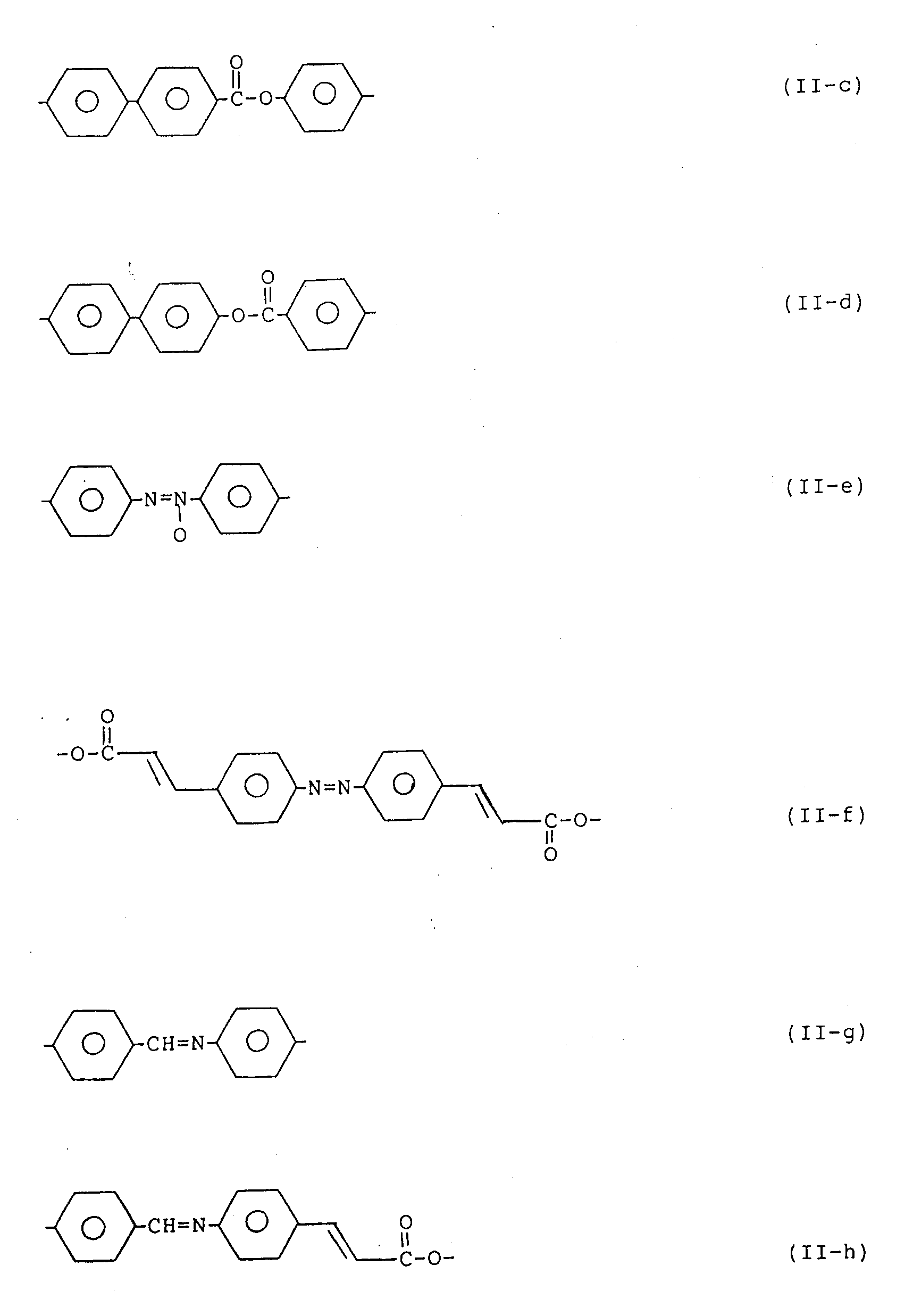

- It will be appreciated from the illustrated core radicals that the terminal bonds thereof can be coaxially extending, i.e., the terminal bonds can extend along the same axis as the main axis of the core. Alternatively, the bonds can extend in a parallel fashion, i.e., they can be displaced from the main axis, as is the case in the core radicals of formulas (II-f), (II-h), (II-i), (II-j) and (II-l). The illustrated radicals are of types previously employed in smectic liquid crystal compounds and other cores can be employed, if desired.
- The smectic liquid crystal compounds of the invention contain a chiral tail moiety
-R* (Ib)
attached to a terminal bond of the core radical. This tail moiety contains an essential asymmetric center. Typically, the optically active group will be an alkyl or alkoxy group having an asymmetric carbon atom such as is represented by the formula (III)
wherein j is zero or one, p is zero or an integer from 1 to 8 and wherein each of R⁴ and R⁵ is alkyl (e.g., methyl or ethyl), halogen (e.g., chloro or bromo), alkoxy (e.g., methoxy, ethoxy) or alkoxyalkyl (e.g., 2-ethoxyethyl or 2-butoxyethyl), provided that R⁴ and R⁵ are different from each other. Preferably p will be zero or one and each of R⁴ and R⁵ will be dissimilar normal-alkyl groups. Suitable examples of formula (Ib) optically active groups include
i.e., 2-methylbutyl;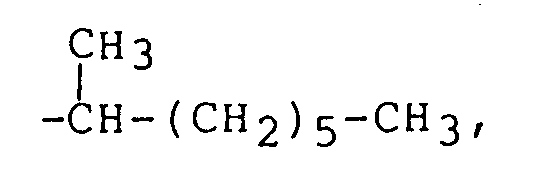
i.e., the 2-octyl group; and 2-methyl butoxy. Other groups having an asymmetric carbon atom can be employed, although the 2-octyl, 2-methylbutyl and 2-methylbutoxy groups will be preferred from the standpoints of ready availability of starting materials and ease of preparative routes. - The ether tail represented by the formula

provides an essential function in lowering the phase transition temperatures observed in smectic liquid crystal compounds. In the ether tail of formula (Ia), R¹ represents e.g., methyl, ethyl, propyl or butyl. - R² in the formula (Ia) ether, tail is a divalent alkylene radical, such as methylene or ethylene. Preferably, R² will be 1,2-ethylene and can be conveniently incorporated into the ether tail by known synthetic oxyalkylation methods based upon ethylene oxide. Other alkylene,radicals can be employed.
- Preferred ether tails include the triether tails wherein R² is 1,2-ethylene and R¹ is ethyl or n-butyl, represented, respectively, by the following formulas:
C₂H₅-O-C₂H₄-O-C₂H₄-O- (IV)
C₄H₉-O-C₂H₄-O-C₂H₄-O- (V)
The preferred tails can be readily appended to core radicals generally used in the synthesis of smectic liquid crystal compounds and provide significant phase transition temperature reductions, relative to corresponding smectic liquid crystal compounds having an alkoxy group in place thereof. - A preferred class of smectic liquid crystal compounds represented by formula (I) includes the smectic liquid crystal cinnamate compounds of the formula (VI)

wherein R¹, R² and R* have the meanings previously defined. Preferably, however, R¹ will be ethyl or butyl; R² will be 1,2-ethylene; and R* will be
wherein j is zero or one, p is zero or an integer from 1 to 8, especially one, and R⁴ and R⁵ are each dissimilar alkyl groups (e.g., methyl and ethyl, respectively). - The preferred cinnamate compounds can be conveniently prepared by a Schiff's base addition reaction route according to the following representative scheme:

The Schiff's base reaction can be accomplished according to known methodology using a solvent such as ethanol (EtOH) and acetic acid (HOAc) catalysis. The formulae (VIc) intermediate can be prepared via an etherification reaction (from hydroxybenzaldehyde, bromoalkane ether and alkali metal carbonate in acetonitrile), according to the following scheme:
Another preferred class of smectic liquid crystal ester compounds of the invention is represented by the formula
wherein R¹, R² and R* are defined as in the case of the cinnamate compounds of formula (VI). The ester compounds can be prepared by the following reaction scheme:
The esterification can be accomplished in an organic solvent such as dichloromethane (CH₂Cl₂) using an acid acceptor such as pyridine (Py) as illustrated above. The acid chloride intermediate of formula (VIId) can be prepared from 4-hydroxy-4'-cyano-biphenyl by resort to the following illustrative alkylation and hydrolysis steps (Steps 1 and 2) and conversion to the acid chloride (Step 3):
Another preferred class of smectic liquid crystal ester compounds of the invention is represented by the following formula (VIII)
wherein each of R¹, R² and R* has the meanings provided hereinbefore in connection with the compounds of formulas (VI) and (VII). These ester compounds can be provided by the following esterification scheme:
The reaction intermediate of formula (VIIIc) can be provided via the following representative alkylation scheme:
The ferroelectric liquid crystal compounds of the invention can contain substituent atoms provided that the substituents do not adversely affect the capacity of the liquid crystal material to show ferroelectricity or otherwise negate use of the material in a ferroelectric device. For example, one or more hydrogen atoms in an aromatic nucleus can, if desired, be replaced with a substituent group such as alkyl, halo (e.g., chloro, bromo, iodo, fluoro) or nitro, subject to the aforementioned limitations. - Fluorine-substituted core materials can be employed, if desired, for enhancement of spontaneous polarization values. Smectic liquid crystal ester compounds having a fluorine-atom substituent on the core segment are disclosed and claimed in the copending patent application of W.J. Cumming, et al., (Attorney Docket No. 7331), filed of even date.
- It will be appreciated that structural variations within the class of liquid crystal compounds represented by formula (I) will produce corresponding variations in observed phase transitions, spontaneous polarization and other properties, and such differences will be observed among classes of liquid crystal compounds having core segments of different type and structure. Substantial improvement (lowering) of phase transition temperatures can be observed in smectic liquid crystal compounds having different types of core segments, as a result of the presence of the ether tail moiety. Depending upon the particular nature of the core segment and the chiral and ether tails, the observed lowering of phase transitions may result in the observation of ferroelectricity in the range of room temperature. In the case, for example, of the known ferroelectric liquid crystal compound of the formula

replacement of the octyloxy tail group thereof by an ether tail moiety of the formula (V) in the manner of the present invention, results in a lowering of the smectic C range of temperatures from the range of 75 - 93° in the case of the reported compound to the range of 10.6 - 24.1°C in the case of the compound of the present invention. - The smectic liquid crystal compounds of the invention can be employed in the production of a ferroelectric liquid crystal display according to known methodology. A single liquid crystal compound can be employed, although a mixture of liquid crystal compounds will typically be employed. Thus, a mixture of liquid crystal compounds represented by the structure of formula (I), or a mixture of such compounds with liquid crystal compounds of types known in the art, can be employed. The smectic liquid crystal compounds of the invention show bistability and exhibit rapid switching in a display device comprising the liquid crystal material confined, as is known in the art, between a pair of plates having electrodes thereon, and means for applying a voltage across the electrodes.
- Among liquid crystal compounds of the invention having ether and chiral tails attached to an essentially flat and ribbon-like core segment are the following exemplary liquid crystal compounds.



- The following non-limiting examples are illustrative of the practice of the present invention.
- This example illustrates the preparation of the 4-[(S)-2-methyl-1-butoxy]phenyl ester of 4-[2-(2-ethoxyethoxy)ethoxy]-4'-biphenylcarboxylic acid.
- PART A -- Preparation of 4-[2-(2-ethoxyethoxy)ethoxy]-4'-cyanobiphenyl. To 0.975 g (five millimoles) of 4-hydroxy-4'-cyanobiphenyl dissolved with 1.08 g (5.5 millimoles) of 1-bromo 2-(2-ethoxyethoxy)ethane in 25 ml. of acetonitrile, 1.4 g (ten millimoles) of finely ground potassium carbonate were added. The reaction mixture was refluxed overnight. Thin layer chromatographic analysis indicated total conversion. The reaction mixture was cooled and filtered and the product was washed with acetonitrile and evaporated to a white solid. The product was recrystallized from isopropanol and dried in vacuo to two grams (93% yield) of a compound having the following formula structure:

PART B -- Preparation of 4-[2-(2-ethoxyethoxy)ethoxy]-4'-biphenylcarboxylic acid. One g (3.2 millimoles) of the product obtained in the manner described in PART A of this example (the reactant) was placed into a reaction flask to which were added 25 ml. of 10% aqueous sodium hydroxide solution. The mixture was brought to reflux with stirring. The reactant was observed to rest on top of the aqueous base. Ethanol was added until the reaction mixture became homogeneous (approximately 1:1). Within one hour of refluxing, a solid was observed to come out of solution and ammonia evolution was noted. The reaction mixture was allowed to reflux for 12 hours or until cessation of ammonia evolution. White solid material was observed at all times after its initial appearance. The reaction product was acidified with sulfuric acid and was filtered. The product was washed with water until the washings were neutral, for recovery of 1.15 g (98% yield of a compound having the following formula:
PART C -- Preparation of 4-[2-(2-ethoxyethoxy)ethoxy]-4'-biphenylcarboxylic acid chloride. Into a flask was placed one g (three millimoles) of the product obtained in the manner described in PART B of this example. Ten ml. of oxalyl chloride were added and the reaction mixture was brought to reflux. After two hours, the excess oxalyl chloride was distilled off and the residual product was placed in a vacuum chamber to remove last traces of reaction products. The resulting product (acid chloride) was a grayish solid recovered in the amount of one g (98% yield) and was used without further treatment in the esterification procedure described in PART E of this example. - PART D -- Preparation of 4-[(S)-2-methyl-1-butoxy]phenol. A reaction mixture of hydroquinone (18.2 g); (S)-(+)-1-bromo-2-methylbutane (4.55 g) anhydrous potassium carbonate (23 g); and acetonitrile (250 ml.) was allowed to reflux for 40 hours. Flash chromatography using dichloromethane eluant yielded 2.6 g (48%) of white crystals exhibiting a Fisher-Johns melting point of 44-45°C and having the structure

confirmed by TLC, NMR, IR and mass spectral analyses. - PART E -- Esterification of 4- [2-(2-ethoxyethoxy)ethoxy]-4'-biphenylcarboxylic acid chloride and 4-[(S)-2-methyl-1-butoxy]phenol. A reaction mixture was prepared from one g (three millimoles) of the acid chloride compound prepared in PART C of this example, 0.54 g (three millimoles) of the phenol product prepared in PART D of this example, one g (12 millimoles) pyridine and ten ml. dichloromethane. The reaction mixture was stirred at room temperature overnight and was poured into ice water. After evaporation of the dichloromethane, a solid product was obtained which was triturated several times with water and placed in vacuo to remove last traces of pyridine. Column chromatography on silica gel using a 20/80 mixture of hexane/dichloromethane yielded one gram (66% yield) of an ester having the following structure, as confirmed by TLC, NMR, IR and mass spectral analyses:

- The compound p-[2-(2-ethoxyethoxy)ethoxy]benzaldehyde having the structure

was prepared as fOllows: 0.05 mole of 1-bromo-2-(ethoxyethoxy)ethane and 6.1 g (0.05 mole) of 4-hydroxybenzaldehyde were dissolved in 75 ml . of acetonitrile. Into the mixture were added 13.8 g (0.1 mole) of finely ground potassium carbonate and the resulting reaction mixture was stirred under reflux for ten hours. The reaction mixture was allowed to cool, was filtered, washed with acetonitrile and evaporated to an amber oily product. The product was passed through a silica gel chromatographic column for recovery of a colorless oil
The structure was confirmed by TLC, NMR, IR and mass spectral analyses. 0.55g (2.3 millimoles) of this compound and 0.54 g (2.3 millimoles) of (+)-2-methylbutyl 4-aminocinnamate were dissolved in 3 ml of absolute ethanol. One drop of acetic acid was added to the reaction mixture which was stirred at room temperature for one to two hours. Precipitate formation was observed early in the reaction. When the reaction was complete (as judged by no further apparent precipitate formation), the reaction mixture was filtered. The solid product was washed with cold absolute ethanol and was recrystallized several times from isopropanol to yield the corresponding Schiff's Base. The following structure was confirmed by elemental, nuclear magnetic resonance (NMR), infrared (IR) and mass spectral analyses:
- The ester compound having the following structure confirmed by TLC, NMR, IR and mass spectral analyses:

was prepared as follows:
PART A -- 5.5 Millimoles of 1-bromo-(2-ethoxyethoxy) ethane was combined with 5.5 g (30 millimoles) of 4,4'-dihydroxybiphenyl in 75 ml of acetonitrile. To the reaction mixture were added 8.3 g (60 millimoles) of finely ground potassium carbonate. Stirring was begun and the reaction mixture was brought to reflux and maintained for 48 hours. The reaction product was filtered, washed with acetonitrile and evaporated for removal of solvent. The product was passed through a silica gel chromatographic column using dichloromethane eluent, for recovery of a biphenyl ether compound having the following formula confirmed by TLC, IR and mass spectral analyses:
PART B -- Esterification of 4-(2-methylbutyl) benzoyl chloride. A reaction mixture was prepared from 0.91 millimole of the biphenyl ether compound prepared in PART A of this example and 0.25 g (1.2 millimoles) of (+)-4-(2-methylbutyl) benzoyl chloride in five ml of pyridine. The reaction mixture was stirred overnight at room temperature, poured into ice water and allowed to stand for ten to twenty minutes. The reaction product was filtered, providing a white solid that was washed with water and dried in vacuo for removal of trace amounts of pyridine. The product was passed through a silica gel chromatographic column using dichloromethane eluant to provide the ester compound having the above structure. - The example illustrates the preparation of 4-[(S)-2-methyl-1-butoxycarbonyl]-4'-biphenyl 3-fluoro-4-[2-(2-ethoxyethoxy)ethoxy]-benzoate.
- PART A -- Preparation of methyl 3-fluoro-4-[2-(2-ethoxyethoxy)-ethoxy]-benzoate. Into a 500-ml, round-bottom flask equipped with a magnetic stirrer, heating mantle and condenser were placed 5.7 g (33.5 mmol) methyl 3-fluoro-4-hydroxybenzoate, 8.5 g (43.2 mmol) 1-bromo-2-(2-ethoxyethoxy)-ethane, 23.2 g of powdered anhydrous potassium carbonate and 350 ml acetonitrile. After stirring the reaction mixture under reflux for four hours, TLC analysis showed that none of the phenolic starting material remained. Three hundred ml of the acetonitrile was then distilled off and 300 ml dichloromethane was added. The reaction mixture was filtered through Celite and the solids were washed thoroughly with dichloromethane. Evaporation of the filtrate yielded product in the form of a yellow oil. Purification by flash chromatography on silica gel with 4% ethyl ether in dichloromethane, followed by low temperature recrystallization from pentane, yielded 0.55 g of white crystals, 89%, m.p. 33-36.5°C. The structure was confirmed by infrared, nuclear magnetic resonance and mass spectral analyses.

PART B -- Preparation of 3-fluoro-4-[2-(2-ethoxyethoxy)-ethoxy-benzoic acid. Into a 500-ml round-bottom flask equipped with magnetic stirrer, heating mantle and condenser were placed 3.15 g of the benzoate ester product prepared as described in PART A of this example, 6 ml of 50% aqueous sodium hydroxide solution and 150 ml of methanol. The reaction mixture was stirred under reflux for three hours. Methanol was distilled off (100 ml) and water (600 ml) was added. The reaction mixture was acidified with hydrochloric acid. After cooling to 0°C, a white solid precipitate was obtained. The white solid was filtered and set aside. The filtrate was extracted with methylene chloride and the extracted material was evaporated to a white solid which was combined with the set-aside material. The combined material was dried under vacuum to yield 2.82 g of product (94% yield) having a melting point of 67-68°C. The following structure was confirmed by TLC, NMR, IR and mass spectral analyses.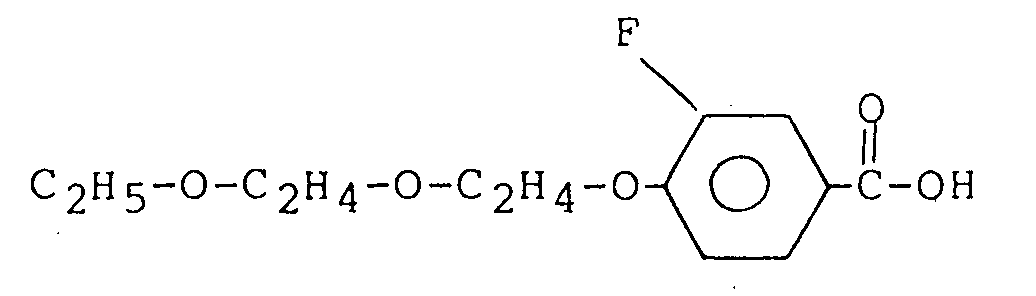
PART C -- Preparation of 4-benzyloxy-4'-biphenylcarbonitrile. In a 250-ml, three-necked, round-bottom flask equipped with a magnetic stirrer, heating mantle, thermometer, and condenser were placed 1.76 g. (9.0 mmol) 4-hydroxy-4'-biphenylcarbonitrile, 3.94 g (28.5 mmol) powdered anhydrous potassium carbonate, 1.18 ml (9.92 mmol) α-bromotoluene, and 150 ml acetonitrile. After stirring the mixture under reflux for two hours, TLC analysis showed that none of the phenolic starting material remained. Two-thirds of the acetonitrile was then distilled off, and 200 ml dichloromethane was added. The mixture was filtered through Celite and the solids were washed thoroughly with dichloromethane. Evaporation of the filtrate yielded white crystals which were purified by recrystallization from methanol. 2.17 g (84.4%) of product was obtained; mp 150-151.5°C. The following structure was confirmed by infrared, nuclear magnetic resonance, and mass spectral analyses.
PART D -- Preparation of 4-benzyloxy-4'-biphenylcarboxylic acid. In a 250-ml, three-necked, round-bottom flask equipped with a magnetic stirrer, heating mantle, thermometer, and condenser were placed 1.59 g (5.57 mmol) 4-benzyloxy-4'-biphenylcarbonitrile, 15 g sodium hydroxide pellets, and 150 ml 2-methoxyethanol. The mixture was stirred under reflux overnight, then two-thirds of the 2-methoxyethanol was distilled off and 400 ml water was added. After acidification, the product was filtered, washed with water, and dried under vacuum to yield 1.69 g (100%) of 4-benzyloxy-4'-biphenylcarboxylic acid mp > 305°C, whose structure was confirmed by mass spectral analysis, as follows.
PART E -- Preparation of 4-benzyloxy-4'-biphenylcarbonyl chloride. In a 100-ml, three-necked, round-bottomed flask equipped with a magnetic stirrer, an oil bath, and a condenser topped with a drying tube were placed 1.69 g of 4-benzyloxy-4'-biphenylcarboxylic acid, 34 ml of thionyl chloride, and one drop of dimethylformamide. After stirring the solution for three hours under reflux, the thionyl chloride was distilled off, then 75 ml tetrachloromethane was added and distilled. The brown solid was dissolved in 500 ml hot dichloromethane, and the solution was treated with charcoal and filtered through Celite. The solids were washed with hot dichloromethane, and the filtrate was evaporated, to yield the following compound.
PART F -- Preparation of (S)-2-methyl-1-butyl 4-benzyloxy-4'-biphenylcarboxylate. In a 100-ml, three-necked, round-bottom flask equipped with a magnetic stirrer and thermometer were placed 3.2 g (36.3 mmol) (S)-(-)-2-methyl-1-butanol, 14 ml distilled pyridine, and a catalytic amount of 4-dimethylaminopyridine (DMAP). After cooling the flask to 0°C under nitrogen, 1.2 g (3.72 mmol) 4-benzyloxy-4'-biphenylcarbonyl chloride was added and the mixture was stirred for three days at room temperature. It was then poured into 50 ml ice water and extracted with dichloromethane. The organic phase was extracted with 10% aqueous hydrochloric acid, dried over sodium sulfate, filtered, and evaporated to a light brown solid. Purification by flash chromatography on silica gel with dichloromethane followed by low-temperature recrystallization from pentane yielded white crystals (0.99 g, 71.2%, mp 95.5 - 97.5°C) whose structure was confirmed by infrared, nuclear magnetic resonance, and mass spectral analyses, as follows.
PART G -- Preparation of (S)-2-methyl-1-butyl 4-hydroxy-4'-biphenylcarboxylate. In a 125 ml Parr bomb equipped with a magnetic stirrer were placed 960 mg (S)-2-methyl-1-butyl 4-benzyloxy-4'-biphenylcarboxylate, 200 mg 5% palladium on carbon, and 50 ml ethyl acetate. The bomb was purged with argon and pressurized with 500 psi hydrogen. After stirring at room temperature for one day, thin-layer-chromatographic analysis showed that considerable starting material remained. An additional 200 mg 5% palladium on carbon was carefully added, and the bomb was re-pressurized with 500 psi hydrogen. After stirring for one more day, TLC analysis showed that the reaction was complete. The reaction mixture was filtered through Celite and the solids were washed thoroughly with ethyl acetate. Evaporation of the solvent yielded white crystals which were recrystallized from hexanes at low temperature to yield 0.62 g (85%) of product, mp 111.5-113°C, whose structure was confirmed by infrared, nuclear magnetic resonance, and mass spectral anaylses, as follows.
PART H -- Preparation of 4-[(S)-2-methyl-1-butoxycarbonyl]-4'-biphenyl 3 fluoro-4-[2-(2-ethoxy ethoxy)-ethoxy]-benzoate. Into a 250-ml, round-bottom flask equipped with a magnetic stirrer, were placed 2.82 g (10.36 mmol) of 3-fluoro-4-[2-(ethoxyethoxy)-ethoxy]benzoic acid and 2.8 g (9.8 mmol) of the phenolic reactant, (S)-2-methyl-1-butyl 4-hydroxy-4'-biphenylcarboxylate, obtained respectively in the manners described in PARTS B and G of this example, 0.63 g (5.16 mmol) of catalyst 4-dimethylaminopyridine, and 2.8 g (14.61 mmol) of 1-(3-dimethylaminopropyl)-3-ethylcarbodiimide hydrochloride. The solids were washed in 90 ml of methylene chloride (dried over 5A molecular sieves) The reaction mixture was stirred at room temperature for 65 hours. Thin layer chromatographic analysis of the reaction mixture showed no phenolic reactant present. Flash chromatography was performed and fractions of desired product were combined and evaporated to provide a yellow oil containing crystalline material. The product was recrystallized from pentane with cooling in dry ice to yield 3.73 g (71% yield) of product having a melting point of 75.5-77°C and the following structure confirmed by NMR and mass spectral analyses.
- This example illustrates the preparation of 4-[(S)-2-methyl-1-butoxycarbonyl]-phenyl 4'-[2-(2-butoxyethoxy)ethoxy]-4-biphenyl-carboxylate.
- PART A -- Preparation of methyl 4'-[2-(2-butoxyethoxy)ethoxy]-4-biphenyl-carboxylate. A mixture of 3.4 g (15 mmol) of methyl 4'hydroxy-4-biphenylcarboxylate, 3.6 g (160 mmol) of 1-bromo-2-(2-butoxyethoxy)-ethane, 4.2 g of powdered potassium carbonate and 300 mg of potassium iodide were heated in 35 ml of dimethylformamide for four hours at a temperature of from 125 to 130°C. The reaction mixture was poured slowly into 250 ml. of ice water and left stirring for one-half hour. The resulting precipitate was collected by filtration, washed with water and dried in a vacuum oven at 40°C overnight, yielding 5.3 g of crude product. The crude product (2.9 g) was extracted three times with 100 ml of boiling hexane and the combined hexane solution was evaporated to a total volume of about 80 ml. A colorless solid (melting point, 90-92°C), weighing 2.1 g (72% yield) after standing for five hours at room temperature, was obtained. The mother liquid was concentrated to a volume of about 30 mls to provide an additional quantity of product in the amount of 0.26 g (9% yield). This portion, also a colorless solid, had a melting point of 91-93°C. The following structure of the desired product was confirmed by TLC, IR, NMR and mass spectral analyses.

PART B -- Preparation of 4'-[2-(2-butoxyethoxy)ethoxy]-4-biphenyl-carboxylic acid. A mixture of two grams (5.4 mmol) of the ester product prepared as described in PART A of this example, two ml of 50% aqueous sodium hydroxide, 30 ml of methanol and ten ml of water was heated on a steam bath. A homogeneous solution was obtained. A colorless solid was observed to precipitate from the solution as methanol was removed by heating. Fifty ml of water were added and the suspension was left on a steam bath for two hours. The reaction mixture was diluted with water to a total volume of 300 ml, acidified with concentrated hydrochloric acid, heated to boil, and cooled in an ice-water-salt bath. The colorless precipitate was collected by filtration, washed with water and dried in a vacuum oven at 60°C overnight, to provide 1.87 g (97% yield) of product having a melting point of 174-176°C and the following structure.
PART C -- Preparation of (S)-2-methyl-1-butyl 4-hydroxybenzoate. A mixture of 20.7 g of 4-hydroxybenzoic acid (150 mmol), 40 g of (S)-2-methyl-1-butanol (454.5 mmol) and 0.5 g of p-toluene sulfonic acid in 150 ml of toluene was refluxed overnight with a Dean Stark trap. A homogeneous solution was obtained. The solvent and excess alcohol were removed by vacuum distillation and the residue was purified by column chromatography through 200 g of silica gel (0.25-0,074 mm) (600-200 mesh) using 2% methanol in methylene chloride as eluent. A total of 27.0 g (86% yield) of a light-yellow viscous liquid was collected. This liquid was vacuum distilled to provide 21.5 g (69% yield) of the desired product, having a boiling point of 140-150°C (0.2 mm) and the following structure.
PART D -- Preparation of 4-[(S)-2-methyl-1-butoxycarbonyl]-phenyl 4'-[2-(2-butoxyethoxy)ethoxy]-4-biphenyl-carboxylate. To a 50-ml, round-bottom flask were added 1.284 g (3.58 mmol) of the acid product prepared as described in PART B of this example, 0.728 g (3.50 mmol) of the phenolic compound prepared as described in PART C of this example, 0.542 g (4.44 mmol) of catalyst 4-dimethylaminopyridine and 20 ml of methylene chloride. To this solution was added 0.833 g (4.35 mmol) of 1-(3)-dimethylaminopropyl)-3-ethylcarbodiimide hydrochloride. Thin layer chromatographic analysis of the reaction mixture after one hour showed substantial (approximately 50%) conversion. The reaction mixture was stirred overnight and filtered through a silica column. Additional fractions were obtained using methylene chloride and ether solvents through the column. Residues were obtained by evaporation of solvent in each instance and the residues were combined and recrystallized using a benzene/pentane mixture. The product was the ester having the following structure, confirmed by NMR and mass spectral analyses.
- This example illustrates the preparation of 2-fluoro-4-[(S)-2-methyl-1-butoxycarbonyl]-phenyl 4'-[2-(2-butoxyethoxy)ethoxy]-4-biphenyl-carboxylate.
- PART A -- Preparation of (S)-2-methyl-1-butyl 3-fluoro-4-hydroxybenzoate. In a 250-ml, round-bottomed flask equipped with a heating mantle, magnetic stirrer, condenser and Dean Stark trap, were placed 2.5 g (16.0 mmol) of 3-fluoro-4-hydroxybenzoic acid, ten g (113.4 mmol) of (S)-2-methyl-1-butanol, 0.347 g of p-toluenesulfonic acid monohydrate and 100 ml of benzene. The reaction mixture was stirred overnight under reflux. The reaction mixture was extracted using saturated aqueous sodium bicarbonate. The organic phase was dried over sodium sulfate, filtered through cotton and evaporated to an oil. The product was purified by flash chromatography on silica gel with 3% diethyl ether in dichloromethane. Fractions containing the desired product were combined and evaporated to a pale-yellow oil. Analysis by NMR showed that considerable starting alcohol remained. The oil was placed under vacuum (at 70°C) for two days. No alcohol was shown by gas chromatography to be present. The desired product was obtained in the amount of 2.39 g (66% yield) and had the following structure.

PART B -- Preparation of 4'-[2-(2-butoxyethoxy)ethoxy]-4-biphenyl-carboxylic acid. Using the procedure set forth in PARTS A and B of EXAMPLE 5, the captioned carboxylic acid product was obtained. - PART C -- Preparation of 2-fluoro-4-[(S)-2-methyl-1-butoxycarbonyl]-phenyl 4'-[2-(2-butoxyethoxy)ethoxy]-4-biphenyl-carboxylate. To a 50-ml, round-bottom flask were added 1.037 g (4.58 mmol) of the phenolic compound obtained from the conduct of PART A of this example, 1.697 g (4.73 mmol) of the acid compound described in PART B of this example, 0.784 g (6.42 mmol) of catalyst 4-dimethylaminopyridine, and 15 ml of methylene chloride. After dissolution of the reactants, 1.039 g (5.42 mmol) of 1-(3-dimethylaminopropyl)-3-ethylcarbodiimide hydrochloride was added. The reaction mixture was stirred overnight and filtered through 20 g of silica. Using methylene chloride and ether solvents, additional fractions were obtained. Recovery of the fractions by solvent evaporation in each instance and combination of the fractions yielded a solid material which was recrystallized from a benzene/hexane mixture and which had the following structure.

- The phase transition temperatures of the liquid crystal compounds of EXAMPLES 1 to 6 were measured. For purposes of comparison, phase transition changes were recorded for the following control compounds which were synthesized using the methodology described in EXAMPLES 1, 3, 4 and 5:
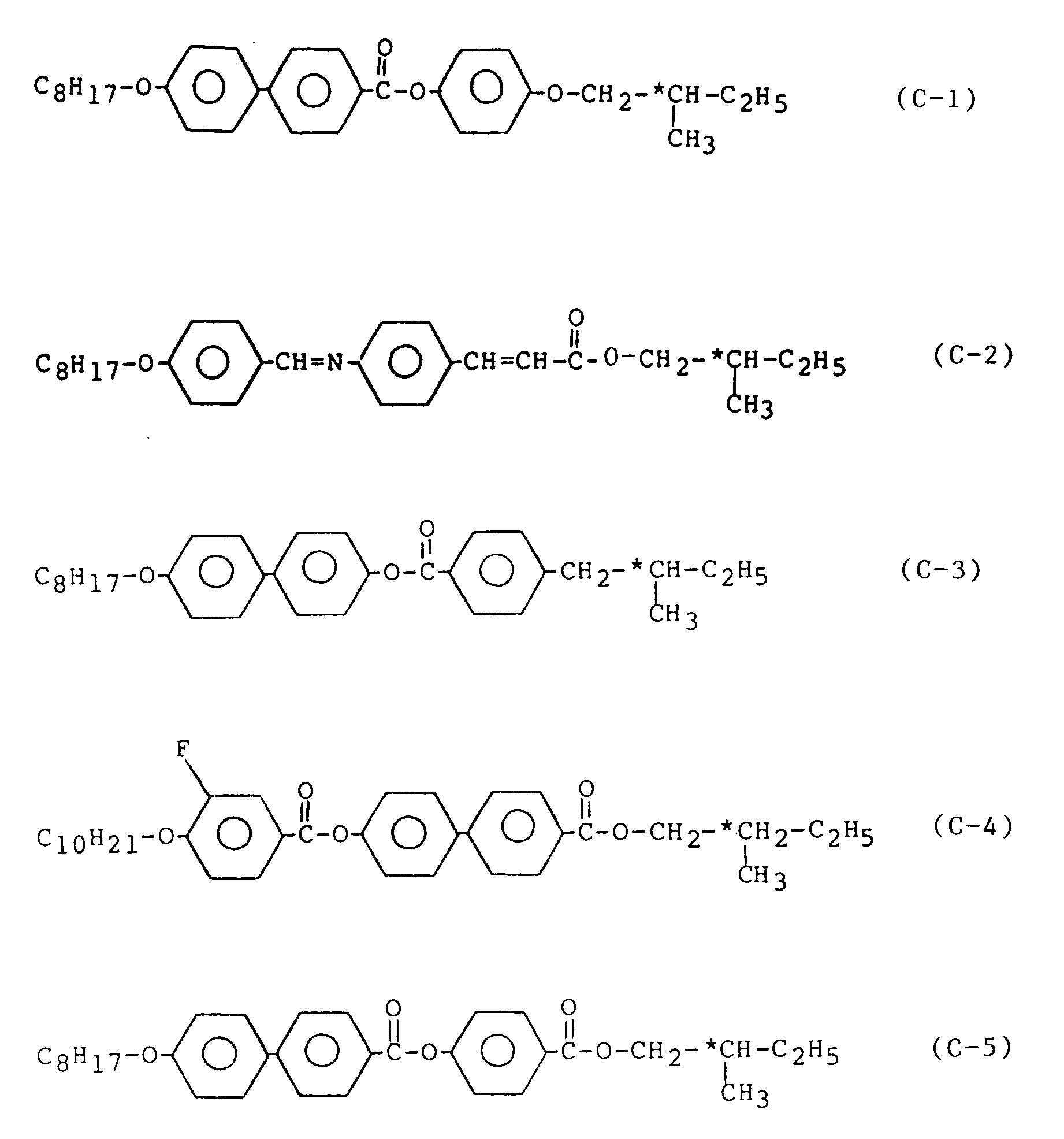
By inspection, it will be seen that the control compound of formula (C-1) contains the n-octyloxy group in place of the triether group in the compound of EXAMPLE 1. The liquid crystal control compound of formula (C-2) contains the n-octyloxy group in place of the triether group of the compounds of EXAMPLE 2 of the invention. Similarly, the control compound of formula (C-3/6) contains the n-octyloxy in place of the triether group of the compound of EXAMPLE 3. The control compounds of formulas (C-7) and (C-8) contain the n-decyloxy and n-octyloxy groups, respectively, in place of the triether groups of the compounds of EXAMPLES 4 and 5. Each of the compounds of EXAMPLES 1 to 6 (and the control compounds where applicable) was subjected to phase transition temperature measurement and observation, using differential scanning calorimetry and microscopic evaluation. Each sample was heated to assure that the compound was in an isotropic state and each phase transition and-corresponding temperature was recorded as the sample was gradually cooled. - In TABLE 1, the observed phase transitions (in °C) are reported, wherein K represents crystalline, SA represents smectic A, SC represents smectic C, SX represents an unidentified smectic phase, Ch represents cholesteric, and K represents crystalline.
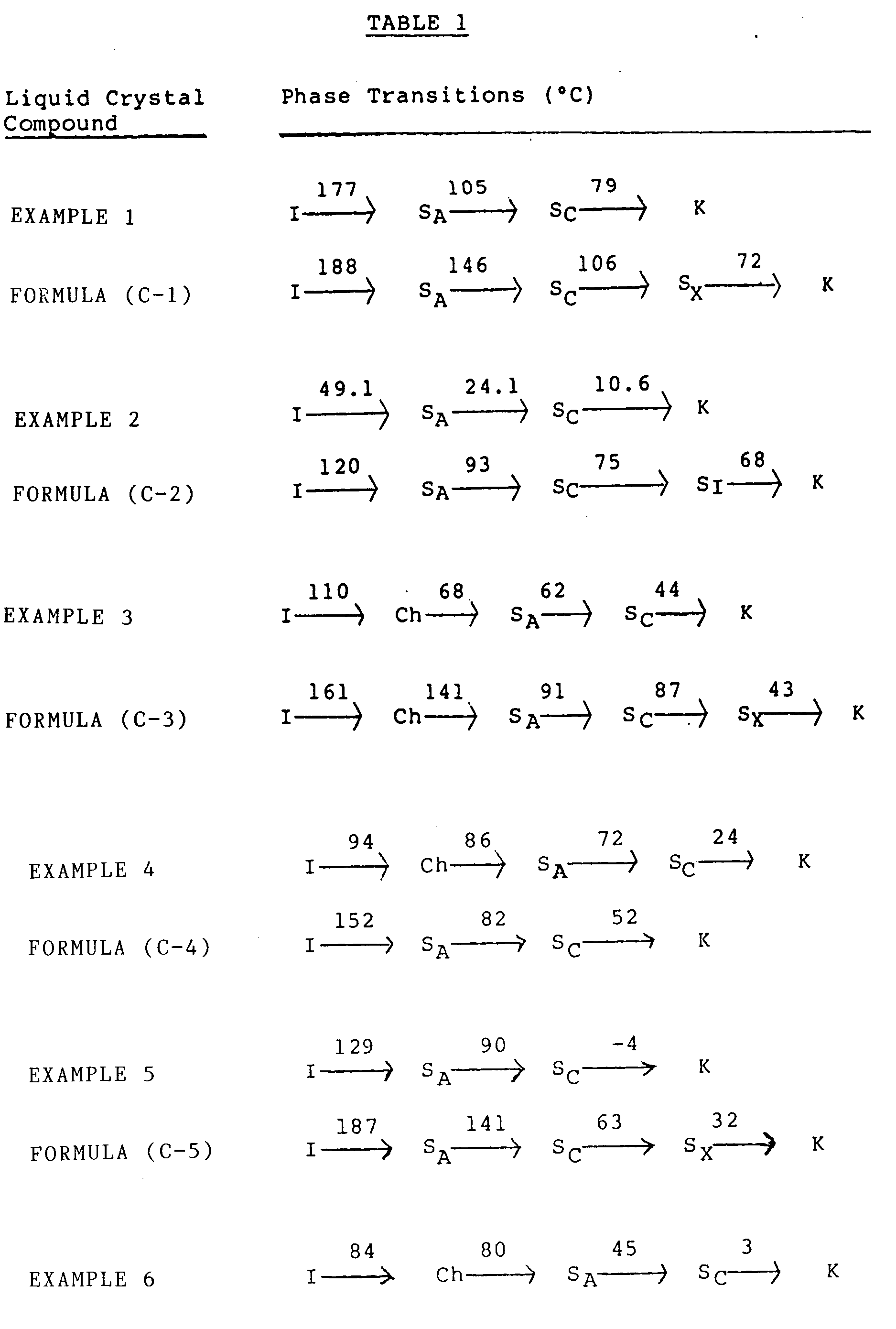
- From inspection of the transition temperatures reported in TABLE 1, it will be seen that the presence of a triether tail moiety produced a general lowering in the observed temperatures of phase transition, relative (where applicable) to the corresponding control compound.
- The temperature at which the onset of the smectic C phase was observed was recorded for each of the compounds of EXAMPLES 1 to 6 and the control compounds, where applicable, and is included in the transition temperature data reported in TABLE 1. In TABLE 2, is reported the amount by which the onset temperature was lowered by the presence of the triether tail moiety in the compounds of EXAMPLES 1 to 5, relative to the corresponding control compound having the n-octyloxy or n-decyloxy tails.

Claims (12)
- A smectic liquid crystal compound having the formula


- The smectic liquid crystal compound of claim 1 wherein R² is methylene or 1,2-ethylene.
- The smectic liquid crystal compound of claims 1 or 2 wherein R² is 1,2-ethylene.
- The smectic liquid crystal compound of any one of claims 1 to 3 wherein said optically active group has the formula

- The smectic liquid crystal compound of claim 4 wherein p is zero or one and each of R⁴ and R⁵ are dissimilar normal alkyl groups.
- The smectic liquid crystal compound of claim 5 wherein p is one and R⁴ and R⁵ are methyl and ethyl, respectively.
- The smectic liquid crystal compound of any one of claims 1 to 6 wherein R¹ is ethyl or n-butyl.
- The smectic liquid crystal compound of any one of claims 1 to 7 said organic divalent core radical has the formula

- The smectic liquid crystal compound of anyone of claims 1 to 7 wherein said organic divalent core radical has the formula

- The smectic liquid crystal compound of anyone of claims 1 to 7 wherein said organic divalent core radical has the formula
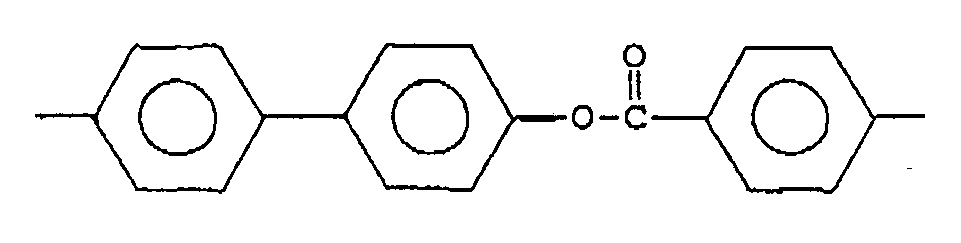
- The smectic liquid crystal compound of anyone of claims 1 to 7 having the formula

- The smectic liquid crystal compound of anyone of claims 1 to 7 having the formula

Applications Claiming Priority (4)
| Application Number | Priority Date | Filing Date | Title |
|---|---|---|---|
| US88762086A | 1986-07-21 | 1986-07-21 | |
| US887620 | 1986-07-21 | ||
| US61072 | 1987-06-23 | ||
| US07/061,072 US5132041A (en) | 1986-07-21 | 1987-06-23 | Liquid crystal compounds having ether tail moiety |
Publications (3)
| Publication Number | Publication Date |
|---|---|
| EP0258578A2 EP0258578A2 (en) | 1988-03-09 |
| EP0258578A3 EP0258578A3 (en) | 1989-05-10 |
| EP0258578B1 true EP0258578B1 (en) | 1993-01-07 |
Family
ID=26740700
Family Applications (1)
| Application Number | Title | Priority Date | Filing Date |
|---|---|---|---|
| EP19870110034 Expired - Lifetime EP0258578B1 (en) | 1986-07-21 | 1987-07-11 | Liquid crystal compounds having ether tail moiety |
Country Status (3)
| Country | Link |
|---|---|
| EP (1) | EP0258578B1 (en) |
| CA (1) | CA1325640C (en) |
| DE (1) | DE3783411T2 (en) |
Families Citing this family (1)
| Publication number | Priority date | Publication date | Assignee | Title |
|---|---|---|---|---|
| US5849048A (en) * | 1997-09-30 | 1998-12-15 | Chevron Chemical Company Llc | Substituted biphenyl poly (oxyalkylene) ethers and fuel compositions containing the same |
Family Cites Families (3)
| Publication number | Priority date | Publication date | Assignee | Title |
|---|---|---|---|---|
| US3751467A (en) * | 1971-05-19 | 1973-08-07 | Owens Illinois Inc | Preparation of liquid-crystal compounds |
| JPS6090290A (en) * | 1983-10-05 | 1985-05-21 | Chisso Corp | Chiral smectic liquid crystal composition |
| JPS6289645A (en) * | 1985-09-18 | 1987-04-24 | Chisso Corp | Ferroelectric liquid crystal ester compound and liquid crystal composition |
-
1987
- 1987-07-10 CA CA 541794 patent/CA1325640C/en not_active Expired - Fee Related
- 1987-07-11 DE DE19873783411 patent/DE3783411T2/en not_active Expired - Fee Related
- 1987-07-11 EP EP19870110034 patent/EP0258578B1/en not_active Expired - Lifetime
Also Published As
| Publication number | Publication date |
|---|---|
| CA1325640C (en) | 1993-12-28 |
| EP0258578A2 (en) | 1988-03-09 |
| DE3783411D1 (en) | 1993-02-18 |
| EP0258578A3 (en) | 1989-05-10 |
| DE3783411T2 (en) | 1993-07-01 |
Similar Documents
| Publication | Publication Date | Title |
|---|---|---|
| CA1341010C (en) | Compounds useful in preparing fluorine-containing chiral smectic liquid crystals | |
| US4886619A (en) | Fluorine-containing chiral smectic liquid crystals | |
| EP0110299B2 (en) | Smectic liquid crystal compounds and liquid crystal compositions | |
| US4876027A (en) | Optically active composition, mesomorphic compound and liquid crystal device | |
| KR960000076B1 (en) | Method for preparing chiral ester | |
| US4212762A (en) | Liquid crystal materials having a formula containing a diphenylethane nucleus | |
| US5399701A (en) | Fluorine-containing chiral smectic liquid crystals | |
| US4623477A (en) | Ester compounds having a pyrimidine ring | |
| JPH09504788A (en) | Liquid crystal compound | |
| US4895986A (en) | 2,2'-difluoro-4-alkoxy-4'-hydroxydiphenyls and their derivatives, their production process and their use in liquid crystal display devices | |
| US4857227A (en) | Liquid crystal mixtures having widened smectic temperature range | |
| US5141669A (en) | Liquid crystal compounds having chiral ester head groups | |
| JPS632953A (en) | Antipodic ester comprising alpha-substituted phenylalkanoic acid and mesogenic-hydroxyl compound and use as dopant in liquid crystal phase | |
| US5132041A (en) | Liquid crystal compounds having ether tail moiety | |
| EP0256303A2 (en) | Liquid crystal compounds having fluorine-containing core | |
| Yang et al. | Synthesis and mesomorphic properties of semi-perfluorinated chain liquid crystals | |
| Chen et al. | Synthesis and mesophase behaviour of mesogens bearing omega, alpha, alpha-trihydroperfluoroalkoxy end tails | |
| US4943385A (en) | Thioether compound and liquid crystal composition | |
| Manickam et al. | New mixed tail triphenylene discotic liquid crystals | |
| CA1325640C (en) | Liquid crystal compounds having ether tail moiety | |
| Wen et al. | Novel fluorinated liquid crystals. Part 9.—Synthesis and mesomorphic properties of 4-(n-alkoxycarbonyl) phenyl 4-[(4-n-alkoxy-2, 3, 5, 6-tetrafluorophenyl) ethynyl] benzoates | |
| Xu et al. | Synthesis and transition temperatures of novel fluorinated chiral liquid crystals containing 1, 4-tetrafluorophenylene units | |
| Sun et al. | Synthesis and physical properties of novel liquid crystals containing 2, 3-difluorophenyl and 1, 3-dioxane units | |
| Dave et al. | Synthesis and mesomorphic characterization of azoesters with a coumarin ring | |
| Wen et al. | Novel fluorinated liquid crystals. Part VI. The synthesis and phase transition of novel cholesteric liquid crystals containing 1, 4-tetrafluorophenylene units |
Legal Events
| Date | Code | Title | Description |
|---|---|---|---|
| PUAI | Public reference made under article 153(3) epc to a published international application that has entered the european phase |
Free format text: ORIGINAL CODE: 0009012 |
|
| AK | Designated contracting states |
Kind code of ref document: A2 Designated state(s): BE DE FR GB IT NL SE |
|
| PUAL | Search report despatched |
Free format text: ORIGINAL CODE: 0009013 |
|
| AK | Designated contracting states |
Kind code of ref document: A3 Designated state(s): BE DE FR GB IT NL SE |
|
| 17P | Request for examination filed |
Effective date: 19891028 |
|
| 17Q | First examination report despatched |
Effective date: 19910506 |
|
| GRAA | (expected) grant |
Free format text: ORIGINAL CODE: 0009210 |
|
| AK | Designated contracting states |
Kind code of ref document: B1 Designated state(s): BE DE FR GB IT NL SE |
|
| PG25 | Lapsed in a contracting state [announced via postgrant information from national office to epo] |
Ref country code: IT Free format text: LAPSE BECAUSE OF FAILURE TO SUBMIT A TRANSLATION OF THE DESCRIPTION OR TO PAY THE FEE WITHIN THE PRE;WARNING: LAPSES OF ITALIAN PATENTS WITH EFFECTIVE DATE BEFORE 2007 MAY HAVE OCCURRED AT ANY TIME BEFORE 2007. THE CORRECT EFFECTIVE DATE MAY BE DIFFERENT FROM THE ONE RECORDED.SCRIBED TIME-LIMIT Effective date: 19930107 Ref country code: SE Effective date: 19930107 Ref country code: NL Effective date: 19930107 Ref country code: BE Effective date: 19930107 Ref country code: FR Effective date: 19930107 |
|
| REF | Corresponds to: |
Ref document number: 3783411 Country of ref document: DE Date of ref document: 19930218 |
|
| EN | Fr: translation not filed | ||
| NLV1 | Nl: lapsed or annulled due to failure to fulfill the requirements of art. 29p and 29m of the patents act | ||
| PLBE | No opposition filed within time limit |
Free format text: ORIGINAL CODE: 0009261 |
|
| STAA | Information on the status of an ep patent application or granted ep patent |
Free format text: STATUS: NO OPPOSITION FILED WITHIN TIME LIMIT |
|
| 26N | No opposition filed | ||
| PGFP | Annual fee paid to national office [announced via postgrant information from national office to epo] |
Ref country code: GB Payment date: 19940620 Year of fee payment: 8 |
|
| PGFP | Annual fee paid to national office [announced via postgrant information from national office to epo] |
Ref country code: DE Payment date: 19940627 Year of fee payment: 8 |
|
| PG25 | Lapsed in a contracting state [announced via postgrant information from national office to epo] |
Ref country code: GB Effective date: 19950711 |
|
| GBPC | Gb: european patent ceased through non-payment of renewal fee |
Effective date: 19950711 |
|
| PG25 | Lapsed in a contracting state [announced via postgrant information from national office to epo] |
Ref country code: DE Effective date: 19960402 |