EP0256831A2 - Preparation of antiperspirants - Google Patents
Preparation of antiperspirants Download PDFInfo
- Publication number
- EP0256831A2 EP0256831A2 EP19870307074 EP87307074A EP0256831A2 EP 0256831 A2 EP0256831 A2 EP 0256831A2 EP 19870307074 EP19870307074 EP 19870307074 EP 87307074 A EP87307074 A EP 87307074A EP 0256831 A2 EP0256831 A2 EP 0256831A2
- Authority
- EP
- European Patent Office
- Prior art keywords
- aluminium
- zirconium
- halohydrate
- solution
- metal
- Prior art date
- Legal status (The legal status is an assumption and is not a legal conclusion. Google has not performed a legal analysis and makes no representation as to the accuracy of the status listed.)
- Granted
Links
Classifications
-
- A—HUMAN NECESSITIES
- A61—MEDICAL OR VETERINARY SCIENCE; HYGIENE
- A61Q—SPECIFIC USE OF COSMETICS OR SIMILAR TOILETRY PREPARATIONS
- A61Q15/00—Anti-perspirants or body deodorants
-
- A—HUMAN NECESSITIES
- A61—MEDICAL OR VETERINARY SCIENCE; HYGIENE
- A61K—PREPARATIONS FOR MEDICAL, DENTAL OR TOILETRY PURPOSES
- A61K8/00—Cosmetics or similar toiletry preparations
- A61K8/18—Cosmetics or similar toiletry preparations characterised by the composition
- A61K8/19—Cosmetics or similar toiletry preparations characterised by the composition containing inorganic ingredients
- A61K8/28—Zirconium; Compounds thereof
-
- C—CHEMISTRY; METALLURGY
- C01—INORGANIC CHEMISTRY
- C01G—COMPOUNDS CONTAINING METALS NOT COVERED BY SUBCLASSES C01D OR C01F
- C01G25/00—Compounds of zirconium
- C01G25/006—Compounds containing zirconium, with or without oxygen or hydrogen, and containing two or more other elements
-
- C—CHEMISTRY; METALLURGY
- C01—INORGANIC CHEMISTRY
- C01P—INDEXING SCHEME RELATING TO STRUCTURAL AND PHYSICAL ASPECTS OF SOLID INORGANIC COMPOUNDS
- C01P2002/00—Crystal-structural characteristics
- C01P2002/80—Crystal-structural characteristics defined by measured data other than those specified in group C01P2002/70
- C01P2002/87—Crystal-structural characteristics defined by measured data other than those specified in group C01P2002/70 by chromatography data, e.g. HPLC, gas chromatography
Definitions
- This invention relates to the preparation of antiperspirants, more particularly to processes for preparing aluminium zirconium halohydrates, especially aluminium zirconium chlorhydrates.
- US-A-2 906 668 (Beekman) describes a process in which aluminium, a zirconyl compound and a basic aluminium chloride are interacted to form a gel which is heated until the gel liquefies and remains a liquid on cooling.
- US-A-3 792 068 (Luedders et al) describes a process wherein aluminium chlorhydroxide, zirconyl hydroxychloride and glycine are co-dried to form a powder.
- GB-A-1 353 916 (Procter & Gamble) describes a process which involves heating a mixture of an aluminium chlorhydrate and zirconyl hydroxychloride at from about 88°C to about 107°C for from about 0.5 hour to 5 hours.
- aluminium zirconium chlorhydrates are commercially available, some of which also comprise a content of glycine. These have an aluminium:zirconium molar ratio within the range 2:1 to 7:1 and have a metal:chlorine ratio in the range 0.9:1 to 2.1:1.
- Examples of commercially available aluminium zirconium chlorhydrate are the materials sold by the Reheis Chemical Co. under the REZAL trade name comprising REZALs 36G, 36 and 67, and the materials sold by Wickhen Products Inc. under the WICKENOL trade name comprising WICKENOLs 368, 369, 370, 372, 373 and 379.
- aluminium zirconium chlorhydrates of enhanced antiperspirant efficacy can be made by a process which involves heating an aqueous solution of a mixture of an aluminium chlorhydrate and zirconyl hydroxychloride comprising 2 to 20% solids at a temperature of at least 50°C to bring about certain changes in the distribution of the complexes present in the solution as indicated by a gel permeation chromatographic procedure described in the patent application.
- the present invention concerns a process for the direct preparation of aluminium zirconium halohydrates of enhanced efficacy.
- an aluminium zirconium halohydrate having an aluminium:zirconium molar ratio of from 2:1 to 7:1, preferably from 3:1 to 5:1, and having a metal:chlorine molar ratio of from 0.9:1 to 2.1:1, preferably 1.3:1 to 1.9:1, which process comprises dissolving metallic aluminium in an aqueous starting solution of:
- a Band III proportion refers to the area of a particular band, referred to as Band III, of a chromatogram as a proportion of the sum of the areas of the bands as fully described hereinafter.
- the process of the invention comprises the further step of drying the solution of the final aluminium zirconium halohydrate so as to give the aluminium zirconium halohydrate in the form of a hydrated powder having a Band III proportion of at least 20%.
- An aluminium zirconium halohydrate glycine complex may be obtained by including glycine in the reaction medium, or by including it in the solution of the final aluminium zirconium halohydrate product prior to the optional drying.
- the concentration of metal in the final aluminium zirconium halohydrate is from 0.5 to 2.0, more preferably from 1.0 to 1.5, moles/kg.
- the Band III proportion is at least 25%, more desirably at least 30%.
- aluminium zirconium halohydrate is a chlorhydrate or bromhydrate.
- the analytical procedure is performed on a stainless steel column of dimensions 25-30 cm high and of about 7 mm internal diameter packed with porous silica of nominal particle size 5 microns and pore size of 60 Angstroms, which silica has been deactivated by silylation to eliminate adsorption and unwanted ionic effects in size exclusion separations.
- a suitable silica is that available commercially as LiChrosorb RP-2.
- the silica employed by the Applicants in deriving analytical data given herein had a cumulative undersize particle size distribution by weight of 10% less than 5 microns, 50% less than 6 microns and 90% less than 7 microns.
- the column is fitted at the bottom with a zero dead volume fitting containing a 2 micron mesh stainless steel bed support.
- the silica is packed into the column by the high pressure slurry method (see Practical High Performance Liquid Chromatography, Edited by C F Simpson, 1976, Appendix II), using dichloromethane as the packing medium.
- the column After packing, the column is capped with another zero dead volume fitting containing a 2 micron stainless steel mesh.
- the packed column is then eluted with 200 ml of methanol at a flow rate of about 10 ml/min, using a high pressure pump, to consolidate the bed and wash out the packing medium.
- a differential refractive index monitor (eg Waters R401) is used to detect sample fractions as they are eluted. It is linked to a pen recorder to provide a chromatogram and to an integrator which measures the elution times of the fractions and the relative chromatographic band areas. The integrator is required to measure areas of bands not resolved to the baseline by dropping perpendiculars from the lowest point of the valleys separating the bands to the baseline.
- the column packing should be tested according to the procedure of Bristow & Knox (Chromatographia, Volume 10, No 6, June 1977, pp 279-89) for reverse phase materials and should generate at least 20,000 plates/metre for the test component phenetole.
- test solutions of the materials for analysis those already in solution are used undiluted unless the aluminium concentration exceeds 2.5% by weight in which case they are diluted with deionized water to give a solution containing 2.5% by weight aluminium.
- Solid materials eg spray dried powders
- deionized water e.g., distilled water
- solutions or solutions which do not disperse readily on shaking are dispersed by treatment in an ultrasonic bath (eg Sonicor Model No. SC-150-22TH) for 5 minutes.
- the solutions prepared in this way are filtered through a 25 mm diameter membrane having a pore size of 0.025 micrometres to give the test solutions.
- the preparation of a test solution is carried out immediately prior to application of a sample to the column.
- a sample of the test solution containing about 2 to 4 micromoles of aluminium is applied to the top of the column by means of a precision micro-litre syringe and a sample injection port.
- the sample is eluted with a 1 ⁇ 10 ⁇ 2 M aqueous nitric acid solution at a flow rate of 1.0ml/min using a high pressure pump.
- Eluted fractions of a test sample are characterised by means of the ratio of their retention times to the retention time of the totally included species.
- the totally included species arises from hydrochloric acid (which is present in acidified solutions of these chlorhydrates) as can be shown by comparison of its retention time with that of a sample of hydrochloric acid.
- the standard aluminium chlorhydrate solution is prepared as a solution containing 12.5% by weight aluminium from 19.1 g of aluminium chloride hexahydrate, 10.5 g of 99.9% pure aluminium wire (0.76 mm diameter, cut in approximately 1 cm lengths and degreased by washing in acetone) and 70.4 g of deionised water.
- the mixture is stirred and heated at 80-90°C under a reflux condenser until all of the aluminium is dissolved. Any traces of insoluble solids are removed by filtration to give a clear solution.
- Aluminium zirconium halohydrates are characterised in this application by the proportion of the area of Band III of their size exclusion chromatogram expressed as a percentage of the sum of the areas of all the Bands except that corresponding to the included species.
- An essential feature of the process of the invention for making an aluminium zirconium halohydrate, particularly an aluminium zirconium chlorhydrate, in solution or powder form with high antiperspirant activity is the use of proportions of reactants such that when the desired product is formed, usually at the point when substantially all the aluminium has dissolved, the concentration of metal ions in the solution is relatively low and in the range of 0.5 - 2.3, preferably 0.5 - 2.0, moles/kg.
- the reaction is most conveniently carried out at atmospheric pressure although elevated pressure for example, can be used.
- elevated pressure for example, can be used.
- the formation of products having a relatively high Band III proportion is favoured by the choice of lower metal concentrations within the stated range eg 1.3 moles of metal per kg of solution and below.
- the lower limit is largely determined by practical considerations as solutions having a metal concentration below about 0.5 moles per kg of solution become inconveniently dilute for antiperspirant use or for subsequent spray-drying.
- the reaction may be carried out in the presence of glycine or other neutral amino-acid, or these may be added at the end of the reaction.
- glycine or other neutral amino-acid may be added at the end of the reaction.
- concentration 2 - 10% w/w glycine is beneficial in helping to control gel formation in some reactions and appears to have only a minor effect on the Band III proportion.
- the reaction proceeds more smoothly in the presence of glycine but may be somewhat extended.
- the form of the aluminium metal used in the reaction also influences the rate of reaction. Generally it is preferred that extremely prolonged reactions should be avoided, as these may result in products containing insoluble material and some reduction in Band III proportion.
- powdered aluminium zirconium halohydrates produced in accordance with this invention as described above are particularly suitable for use in antiperspirant compositions, especially non-aerosol compositions, in which they are suspended in a carrier medium.
- suitable carrier media for suspension-type antiperspirant compositions are disclosed in US-A-4 359 456 (Gosling et al).
- Aluminium chloride hexahydrate (7.2 g) and zirconyl chloride octahydrate, (22.4 g) were dissolved in water (214.5 g). This solution was placed in a conical flask fitted with a thermometer and an air condenser. A magnetic stirrer bar was added and the temperature raised to 90°C with stirring on a magnetic stirrer-hotplate. Aluminium foil, BDH laboratory reagent grade 0.051 mm thick (5.9 g) was chopped up and added in portions. The first portion (1.0 g) was added during the warm-up stage and the remainder was added as quickly as was consistent with a controlled reaction, and maintenance of the temperature at 90 ⁇ 5°C. The reaction was completed in 3 days. The reaction product was filtered to give a clear solution.
- Aluminium chloride hexahydrate (14.4 g), zirconyl chloride octahydrate (44.8 g) and glycine (10 g) were dissolved in water (179.0 g). This solution was placed in a conical flask fitted with a thermometer and air condenser. A magnetic stirrer bar was added and the temperature raised to 90°C with stirring on a magnetic stirrer-hotplate. Atomised aluminium powder (Alpoco 200/Dust) 99.7% pure, (11.9 g) was added in portions. The first portion (1 g) was added during the warm-up stage and the remainder was added as quickly as was consistent with a controlled reaction, and the maintenance of the temperature at 90° ⁇ 5°C. The flask was cooled with water if necessary. The reaction was completed in 6 hours. The reaction mixture was filtered to give a clear solution.
- This solution was placed in a conical flask fitted with a thermometer and an air condenser.
- a magnetic stirrer bar was added and the temperature raised to 90°C with stirring on a magnetic stirrer-hotplate.
- Chopped aluminium foil (3.9 g) was added in portions. The first portion (0.4 g) was added during the warm-up stage and the remainder was added as quickly as was consistent with a controlled reaction, and maintenance of the temperature at 90 ⁇ 5°C.
- the reaction was completed in 3 days.
- the reaction mixture was filtered to give a clear solution.
- Aluminium chlorhydrate in approximately 50% solution containing 12.25% w/w aluminium (39.4 g) was dissolved in water (136.3 g). The solution was placed in a conical flask fitted with a thermometer and air condenser. A magnetic stirrer bar was added. Zirconyl chloride octahydrate (22.4 g) was dissolved in water (50 g) and this solution was placed in a separating funnel set to run into the top of the condenser. The temperature of the conical flask was raised with stirring to 90°C on a magnetic stirrer-hotplate. Chopped aluminium foil (1.9 g) was added in portions.
- the first portion (0.4 g) of the aluminium and the first 10 ml of the zirconyl chloride solution was added during the warm-up stage and the remainder of these was added as quickly as was consistent with a controlled reaction, and maintenance of the temperature at 90° ⁇ 5°C.
- the flask was cooled with water if necessary.
- the reaction was completed in 2 days.
- the reaction mixture was filtered to give a clear solution.
- Aluminium chlorhydrate in approximately 50% solution containing 12.25% w/w aluminium (39.4 g) and zirconyl chloride octahydrate (22.4 g) were dissolved in water (186.3 g). The solution was placed in a conical flask fitted with a thermometer and air condenser. A magnetic stirrer bar was added, and the temperature raised to 90°C with stirring on a magnetic stirrer-hotplate. Atomised aluminium powder (Alpoco 200/Dust) 99.7% pure (1.9 g) was added in portions. The first portion (0.2 g) was added during the warm-up stage and the remainder was added as quickly as was consistent with a controlled reaction, and maintenance of the temperature at 90°C ⁇ 5°C. The reaction was complete in 4 hours 20 minutes.
Landscapes
- Health & Medical Sciences (AREA)
- Chemical & Material Sciences (AREA)
- Life Sciences & Earth Sciences (AREA)
- General Health & Medical Sciences (AREA)
- Organic Chemistry (AREA)
- Animal Behavior & Ethology (AREA)
- Inorganic Chemistry (AREA)
- Public Health (AREA)
- Veterinary Medicine (AREA)
- Birds (AREA)
- Epidemiology (AREA)
- Cosmetics (AREA)
- Organic Low-Molecular-Weight Compounds And Preparation Thereof (AREA)
- Fats And Perfumes (AREA)
- Saccharide Compounds (AREA)
Abstract
Description
- This invention relates to the preparation of antiperspirants, more particularly to processes for preparing aluminium zirconium halohydrates, especially aluminium zirconium chlorhydrates.
- Processes for the preparation of aluminium zirconium chlorhydrates have been known for many years. US-A-2 906 668 (Beekman) describes a process in which aluminium, a zirconyl compound and a basic aluminium chloride are interacted to form a gel which is heated until the gel liquefies and remains a liquid on cooling.
- US-A-3 792 068 (Luedders et al) describes a process wherein aluminium chlorhydroxide, zirconyl hydroxychloride and glycine are co-dried to form a powder.
- GB-A-1 353 916 (Procter & Gamble) describes a process which involves heating a mixture of an aluminium chlorhydrate and zirconyl hydroxychloride at from about 88°C to about 107°C for from about 0.5 hour to 5 hours.
- A number of aluminium zirconium chlorhydrates are commercially available, some of which also comprise a content of glycine. These have an aluminium:zirconium molar ratio within the range 2:1 to 7:1 and have a metal:chlorine ratio in the range 0.9:1 to 2.1:1. Examples of commercially available aluminium zirconium chlorhydrate, are the materials sold by the Reheis Chemical Co. under the REZAL trade name comprising REZALs 36G, 36 and 67, and the materials sold by Wickhen Products Inc. under the WICKENOL trade name comprising WICKENOLs 368, 369, 370, 372, 373 and 379.
- Recently it has been suggested in GB-A-2 144 992 (Gillette) that aluminium zirconium chlorhydrates of enhanced antiperspirant efficacy can be made by a process which involves heating an aqueous solution of a mixture of an aluminium chlorhydrate and zirconyl hydroxychloride comprising 2 to 20% solids at a temperature of at least 50°C to bring about certain changes in the distribution of the complexes present in the solution as indicated by a gel permeation chromatographic procedure described in the patent application.
- At least so far as the process of the Gillette patent involves the heating of a relatively dilute solution of aluminium chlorhydrate it is similar to the process described in US-A-4 359 456 (Gosling et al). The Gosling et al process is directed to the enhancement of the antiperspirant efficacy of, inter alia, aluminium chlorhydrate and involves the heat-treatment of relatively dilute solutions thereof. The heat treatment results in a modification of the distribution of the polymeric species and the modification is expressed as a function of the area of a band, called Band III, of a chromatogram obtained by a chromatographic analytical procedure described in the patent.
- The present invention concerns a process for the direct preparation of aluminium zirconium halohydrates of enhanced efficacy.
- According to the invention there is provided a process of making an aluminium zirconium halohydrate having an aluminium:zirconium molar ratio of from 2:1 to 7:1, preferably from 3:1 to 5:1, and having a metal:chlorine molar ratio of from 0.9:1 to 2.1:1, preferably 1.3:1 to 1.9:1, which process comprises dissolving metallic aluminium in an aqueous starting solution of:
- (i) zirconium oxyhalide, zirconium hydroxyhalide, zirconium carbonate or a mixture thereof; and
- (ii) aluminium halide or a basic aluminium halide ie an aluminium halide of formula Al₂ Halx (OH)6-x where Hal is halogen (chlorine, bromine or iodine) and x is from 1 to 6
- A Band III proportion refers to the area of a particular band, referred to as Band III, of a chromatogram as a proportion of the sum of the areas of the bands as fully described hereinafter.
- Optionally the process of the invention comprises the further step of drying the solution of the final aluminium zirconium halohydrate so as to give the aluminium zirconium halohydrate in the form of a hydrated powder having a Band III proportion of at least 20%.
- An aluminium zirconium halohydrate glycine complex may be obtained by including glycine in the reaction medium, or by including it in the solution of the final aluminium zirconium halohydrate product prior to the optional drying.
- Preferably the concentration of metal in the final aluminium zirconium halohydrate is from 0.5 to 2.0, more preferably from 1.0 to 1.5, moles/kg.
- Preferably the Band III proportion is at least 25%, more desirably at least 30%.
- Preferably the aluminium zirconium halohydrate is a chlorhydrate or bromhydrate.
- Characterisation of materials containing species differing in size by means of size exclusion chromatography is generally known. The size exclusion chromatographic procedures for characterising the aluminium zirconium chlorhydrates of this invention will now be described.
- The analytical procedure is performed on a stainless steel column of dimensions 25-30 cm high and of about 7 mm internal diameter packed with porous silica of nominal particle size 5 microns and pore size of 60 Angstroms, which silica has been deactivated by silylation to eliminate adsorption and unwanted ionic effects in size exclusion separations. A suitable silica is that available commercially as LiChrosorb RP-2. The silica employed by the Applicants in deriving analytical data given herein had a cumulative undersize particle size distribution by weight of 10% less than 5 microns, 50% less than 6 microns and 90% less than 7 microns.
- The column is fitted at the bottom with a zero dead volume fitting containing a 2 micron mesh stainless steel bed support. The silica is packed into the column by the high pressure slurry method (see Practical High Performance Liquid Chromatography, Edited by C F Simpson, 1976, Appendix II), using dichloromethane as the packing medium.
- After packing, the column is capped with another zero dead volume fitting containing a 2 micron stainless steel mesh. The packed column is then eluted with 200 ml of methanol at a flow rate of about 10 ml/min, using a high pressure pump, to consolidate the bed and wash out the packing medium.
- A differential refractive index monitor (eg Waters R401) is used to detect sample fractions as they are eluted. It is linked to a pen recorder to provide a chromatogram and to an integrator which measures the elution times of the fractions and the relative chromatographic band areas. The integrator is required to measure areas of bands not resolved to the baseline by dropping perpendiculars from the lowest point of the valleys separating the bands to the baseline.
- The column packing should be tested according to the procedure of Bristow & Knox (Chromatographia, Volume 10, No 6, June 1977, pp 279-89) for reverse phase materials and should generate at least 20,000 plates/metre for the test component phenetole.
- To prepare test solutions of the materials for analysis those already in solution are used undiluted unless the aluminium concentration exceeds 2.5% by weight in which case they are diluted with deionized water to give a solution containing 2.5% by weight aluminium. Solid materials (eg spray dried powders) are dissolved in deionized water to give a solution containing 2.5% by weight aluminium. Solids or solutions which do not disperse readily on shaking are dispersed by treatment in an ultrasonic bath ( eg Sonicor Model No. SC-150-22TH) for 5 minutes. The solutions prepared in this way are filtered through a 25 mm diameter membrane having a pore size of 0.025 micrometres to give the test solutions. The preparation of a test solution is carried out immediately prior to application of a sample to the column.
- A sample of the test solution containing about 2 to 4 micromoles of aluminium is applied to the top of the column by means of a precision micro-litre syringe and a sample injection port. The sample is eluted with a 1 × 10⁻² M aqueous nitric acid solution at a flow rate of 1.0ml/min using a high pressure pump.
- Eluted fractions of a test sample are characterised by means of the ratio of their retention times to the retention time of the totally included species. In the case of aluminium chlorhydrates and aluminium zirconium chlorhydrates the totally included species arises from hydrochloric acid (which is present in acidified solutions of these chlorhydrates) as can be shown by comparison of its retention time with that of a sample of hydrochloric acid. Using columns satisfying the above description and employing a standard solution of an aluminium chlorhydrate prepared as described below, the Applicants have obtained separation into four aluminium-containing fractions having relative retention times within the ranges indicated.

- The standard aluminium chlorhydrate solution is prepared as a solution containing 12.5% by weight aluminium from 19.1 g of aluminium chloride hexahydrate, 10.5 g of 99.9% pure aluminium wire (0.76 mm diameter, cut in approximately 1 cm lengths and degreased by washing in acetone) and 70.4 g of deionised water. The mixture is stirred and heated at 80-90°C under a reflux condenser until all of the aluminium is dissolved. Any traces of insoluble solids are removed by filtration to give a clear solution.
- When this material is analysed by the size exclusion chromatographic procedure described herein, there are obtained the following four fractions having typical relative retention times and chromatographic band areas expressed as percentages of the total chromatographic band area representing aluminium-containing material.

- It will be appreciated by those skilled in the art that mechanisms of separation other than the principal mechanism of size exclusion may play a part in this type of chromatography. Examples of the processes would be adsorption effects and hydrodynamic effects. Thus although it is possible for a given column and constant operating conditions to lead to invariable relative retention times, minor variations in particle size range and pore size distribution of the column packing material may lead to slight differences in relative retention times.
- It has been observed that the filtrate from the filtration through the 25 mm diameter membrane of a solution of an aluminium zirconium chlorhydrate contains most if not all of the aluminium of the original solution but may contain little of the zirconium. It has also been found that filtration causes only minor changes in the chromatogram even when most of the zirconium is removed on filtration. It is therefore deduced that much of the zirconium that is applied to the column is retained on the column. In cases where zirconium is eluted from the column it appears either in the first peak, which is generally very small, or with the chloride. For these reasons the chromatographic method described is best considered as SEC (size exclusion chromatography) of the aluminium-containing component of the aluminium zirconium chlorhydrate.
- Consistent with this is the Applicant's finding that the relative retention times of the peaks arising from the chromatography of a series of aluminium zirconium chlorhydrates are virtually identical to the ranges reported above for the standard solution of aluminium chlorhydrate.
- Aluminium zirconium halohydrates are characterised in this application by the proportion of the area of Band III of their size exclusion chromatogram expressed as a percentage of the sum of the areas of all the Bands except that corresponding to the included species. Thus the

- An essential feature of the process of the invention for making an aluminium zirconium halohydrate, particularly an aluminium zirconium chlorhydrate, in solution or powder form with high antiperspirant activity is the use of proportions of reactants such that when the desired product is formed, usually at the point when substantially all the aluminium has dissolved, the concentration of metal ions in the solution is relatively low and in the range of 0.5 - 2.3, preferably 0.5 - 2.0, moles/kg.
- The reaction is most conveniently carried out at atmospheric pressure although elevated pressure for example, can be used. Within the ranges of operating conditions referred to above the formation of products having a relatively high Band III proportion is favoured by the choice of lower metal concentrations within the stated range eg 1.3 moles of metal per kg of solution and below. The lower limit is largely determined by practical considerations as solutions having a metal concentration below about 0.5 moles per kg of solution become inconveniently dilute for antiperspirant use or for subsequent spray-drying.
- For a given final metal ion concentration, within the ranges specified, relatively minor influences are the temperature at which the reaction is conducted and the final aluminium:zirconium and metal ion:halide ratios.
- The reaction may be carried out in the presence of glycine or other neutral amino-acid, or these may be added at the end of the reaction. At the appropriate concentration 2 - 10% w/w glycine is beneficial in helping to control gel formation in some reactions and appears to have only a minor effect on the Band III proportion. The reaction proceeds more smoothly in the presence of glycine but may be somewhat extended.
- The form of the aluminium metal used in the reaction, particularly its fineness of division, also influences the rate of reaction. Generally it is preferred that extremely prolonged reactions should be avoided, as these may result in products containing insoluble material and some reduction in Band III proportion.
- The powdered aluminium zirconium halohydrates produced in accordance with this invention as described above are particularly suitable for use in antiperspirant compositions, especially non-aerosol compositions, in which they are suspended in a carrier medium. A number of suitable carrier media for suspension-type antiperspirant compositions are disclosed in US-A-4 359 456 (Gosling et al).
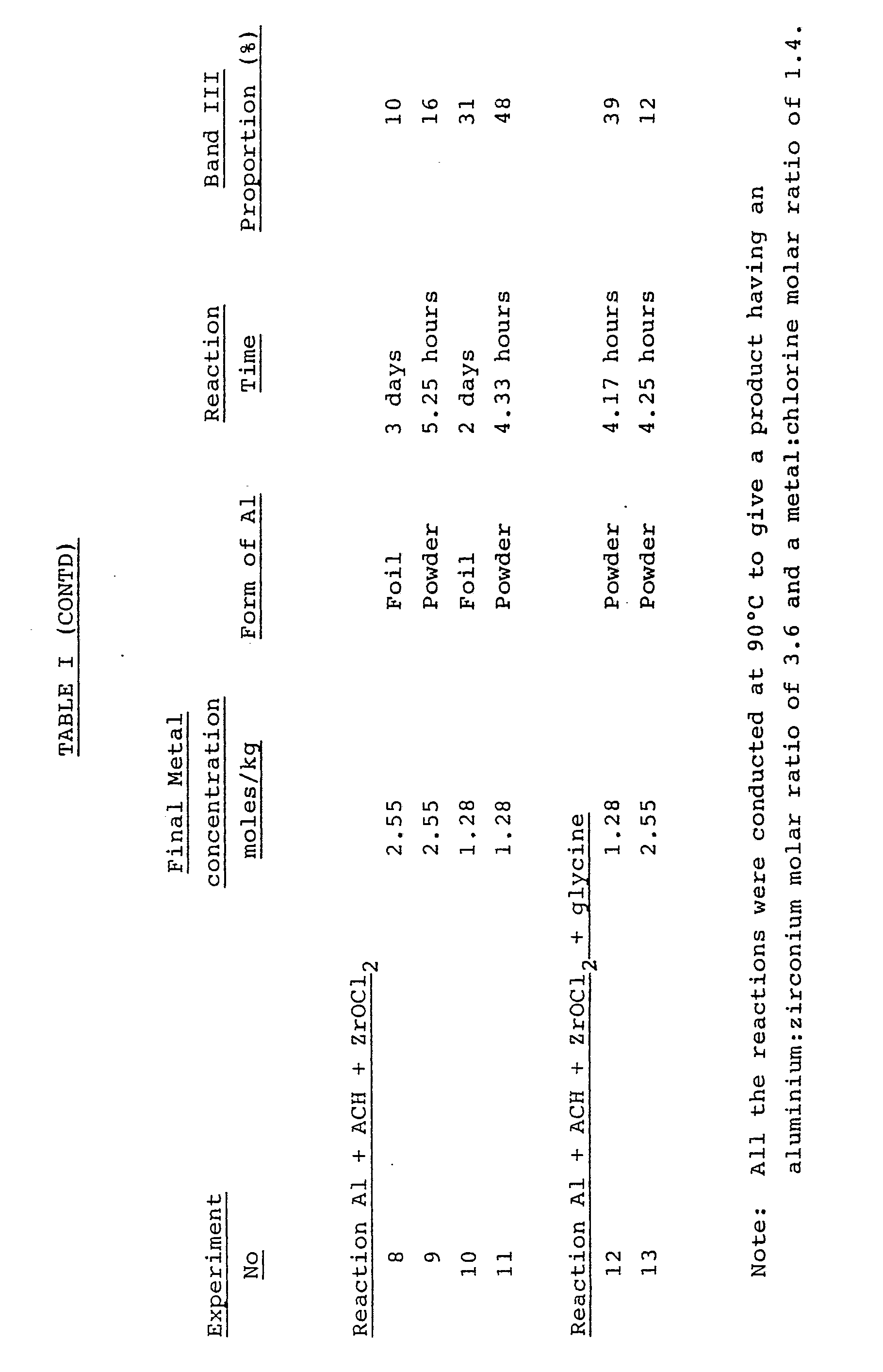
- The following experiments illustrate the effect of various factors, eg final concentration and reaction time, on the Band III proportion of the reaction product.
- Aluminium chloride hexahydrate (7.2 g) and zirconyl chloride octahydrate, (22.4 g) were dissolved in water (214.5 g). This solution was placed in a conical flask fitted with a thermometer and an air condenser. A magnetic stirrer bar was added and the temperature raised to 90°C with stirring on a magnetic stirrer-hotplate. Aluminium foil, BDH laboratory reagent grade 0.051 mm thick (5.9 g) was chopped up and added in portions. The first portion (1.0 g) was added during the warm-up stage and the remainder was added as quickly as was consistent with a controlled reaction, and maintenance of the temperature at 90±5°C. The reaction was completed in 3 days. The reaction product was filtered to give a clear solution.
- Experiment 1 was repeated, using aluminium chloride hexahydrate (3.6 g), zirconyl chloride (11.2 g), water (232.3 g) and aluminium foil (3.0 g). The reaction was completed in 3 days.
- Experiment 1 was repeated using aluminium in the form of Alpoco 200/Dust, 99.7% pure. The reaction was completed in 3 hours.
- Aluminium chloride hexahydrate (14.4 g), zirconyl chloride octahydrate (44.8 g) and glycine (10 g) were dissolved in water (179.0 g). This solution was placed in a conical flask fitted with a thermometer and air condenser. A magnetic stirrer bar was added and the temperature raised to 90°C with stirring on a magnetic stirrer-hotplate. Atomised aluminium powder (Alpoco 200/Dust) 99.7% pure, (11.9 g) was added in portions. The first portion (1 g) was added during the warm-up stage and the remainder was added as quickly as was consistent with a controlled reaction, and the maintenance of the temperature at 90°±5°C. The flask was cooled with water if necessary. The reaction was completed in 6 hours. The reaction mixture was filtered to give a clear solution.
- Experiment 4 was repeated using aluminium foil, save that the glycine was added during initial gel formation, 85 minutes after the warm-up had started. The reaction was completed in 5 days.
- Experiment 4 was repeated using 169 g of water. The reaction was completed in 4 hours 10 minutes.
- Experiment 4 was repeated using aluminium chloride hexahydrate (7.2 g), zirconyl chloride octahydrate (22.4 g), glycine (5.0 g), water (209.5 g) and aluminium powder (5.9 g). The reaction was completed in 4 hours.
- Aluminium chlorhydrate (ACH) in approximately 50% solution containing 12.25% w/w aluminium (78.7 g) was mixed with water (122.7 g) and zirconyl chloride octahydrate (44.8 g) was dissolved in this mixture. This solution was placed in a conical flask fitted with a thermometer and an air condenser. A magnetic stirrer bar was added and the temperature raised to 90°C with stirring on a magnetic stirrer-hotplate. Chopped aluminium foil (3.9 g) was added in portions. The first portion (0.4 g) was added during the warm-up stage and the remainder was added as quickly as was consistent with a controlled reaction, and maintenance of the temperature at 90±5°C. The reaction was completed in 3 days. The reaction mixture was filtered to give a clear solution.
- Experiment 8 was repeated using Alpoco 200/Dust, 99.7% pure. The reaction was completed in 5 hours 15 minutes.
- Aluminium chlorhydrate in approximately 50% solution containing 12.25% w/w aluminium (39.4 g) was dissolved in water (136.3 g). The solution was placed in a conical flask fitted with a thermometer and air condenser. A magnetic stirrer bar was added. Zirconyl chloride octahydrate (22.4 g) was dissolved in water (50 g) and this solution was placed in a separating funnel set to run into the top of the condenser. The temperature of the conical flask was raised with stirring to 90°C on a magnetic stirrer-hotplate. Chopped aluminium foil (1.9 g) was added in portions. The first portion (0.4 g) of the aluminium and the first 10 ml of the zirconyl chloride solution was added during the warm-up stage and the remainder of these was added as quickly as was consistent with a controlled reaction, and maintenance of the temperature at 90°±5°C. The flask was cooled with water if necessary. The reaction was completed in 2 days. The reaction mixture was filtered to give a clear solution.
- Aluminium chlorhydrate in approximately 50% solution containing 12.25% w/w aluminium (39.4 g) and zirconyl chloride octahydrate (22.4 g) were dissolved in water (186.3 g). The solution was placed in a conical flask fitted with a thermometer and air condenser. A magnetic stirrer bar was added, and the temperature raised to 90°C with stirring on a magnetic stirrer-hotplate. Atomised aluminium powder (Alpoco 200/Dust) 99.7% pure (1.9 g) was added in portions. The first portion (0.2 g) was added during the warm-up stage and the remainder was added as quickly as was consistent with a controlled reaction, and maintenance of the temperature at 90°C±5°C. The reaction was complete in 4 hours 20 minutes.
- Experiment 11 was repeated but adding 5.0 g glycine to the initial solution in place of 5.0 g of the water. The reaction was completed in 4 hours 10 minutes. The reaction mixture was filtered to give a clear solution.
- Experiment 8 was repeated but replacing 10 g of the water by glycine (10.0 g) and using Alpoco 200/Dust, 99.7% pure. The reaction was completed in 4 hours 15 minutes.
- The above experiments are summarised in the following Table which also gives the Band III proportions for the respective products.

Claims (12)
Priority Applications (1)
| Application Number | Priority Date | Filing Date | Title |
|---|---|---|---|
| AT87307074T ATE81585T1 (en) | 1986-08-11 | 1987-08-10 | PREPARATION OF ANTIPERSPIRANTS. |
Applications Claiming Priority (2)
| Application Number | Priority Date | Filing Date | Title |
|---|---|---|---|
| GB8619553 | 1986-08-11 | ||
| GB868619553A GB8619553D0 (en) | 1986-08-11 | 1986-08-11 | Antiperspirants |
Publications (3)
| Publication Number | Publication Date |
|---|---|
| EP0256831A2 true EP0256831A2 (en) | 1988-02-24 |
| EP0256831A3 EP0256831A3 (en) | 1990-06-13 |
| EP0256831B1 EP0256831B1 (en) | 1992-10-21 |
Family
ID=10602557
Family Applications (1)
| Application Number | Title | Priority Date | Filing Date |
|---|---|---|---|
| EP19870307074 Expired - Lifetime EP0256831B1 (en) | 1986-08-11 | 1987-08-10 | Preparation of antiperspirants |
Country Status (10)
| Country | Link |
|---|---|
| US (1) | US4900534A (en) |
| EP (1) | EP0256831B1 (en) |
| AT (1) | ATE81585T1 (en) |
| AU (1) | AU591319B2 (en) |
| CA (1) | CA1297657C (en) |
| DE (1) | DE3782297T2 (en) |
| ES (1) | ES2052570T3 (en) |
| GB (1) | GB8619553D0 (en) |
| IE (1) | IE60129B1 (en) |
| ZA (1) | ZA875924B (en) |
Cited By (5)
| Publication number | Priority date | Publication date | Assignee | Title |
|---|---|---|---|---|
| EP0444564A3 (en) * | 1990-02-26 | 1992-08-26 | Dow Corning Corporation | Direct process for the preparation of activated antiperspirant salts |
| US5225187A (en) * | 1991-02-15 | 1993-07-06 | Somerville Technology Group, Inc. | Process for preparing concentrated aluminum-zirconium solutions |
| US5254230A (en) * | 1992-07-17 | 1993-10-19 | Reheis, Inc. | Methods for preparing basic aluminum compounds with ultrasound |
| EP0547085A4 (en) * | 1990-09-07 | 1993-12-08 | Reheis, Inc. | Basic aluminum and aluminum/zirconium antiperspirants and method of making the same |
| WO2010078917A2 (en) | 2008-12-15 | 2010-07-15 | Beiersdorf Ag | Inorganic gel and composition and process for the production thereof |
Families Citing this family (24)
| Publication number | Priority date | Publication date | Assignee | Title |
|---|---|---|---|---|
| US5601809A (en) * | 1986-09-26 | 1997-02-11 | The Gillette Company | Axillary malodor neutralization |
| US5202115A (en) * | 1988-08-17 | 1993-04-13 | The Mennen Company | Basic aluminum antiperspirant active material having enhanced activity, antiperspirant active composition containing such material, and methods for preparation of such material and composition |
| US5348720A (en) * | 1988-08-17 | 1994-09-20 | The Mennen Company | Basic aluminum antiperspirant active material having enhanced activity, antiperspirant active composition containing such material, and methods for preparation of such material and composition |
| CA2046170A1 (en) * | 1990-07-10 | 1992-01-11 | Morton Lawrence Barr | Basic aluminum antiperspirant active materials having enhanced activity, antiperspirant active compositions containing such materials, and methods for preparation of such materials and compositions |
| NZ241567A (en) * | 1991-02-13 | 1994-08-26 | Bristol Myers Squibb Co | Zirconium-aluminium-amino acid salts, and antiperspirant compositions thereof |
| US6010688A (en) * | 1997-06-25 | 2000-01-04 | The Gillette Company | Polyhydric alcohol stabilized antiperspirant salt solutions |
| US6268519B1 (en) | 1998-06-12 | 2001-07-31 | General Electric Company | Silicone solvents for antiperspirant salts |
| US5969172C1 (en) * | 1998-06-12 | 2002-06-18 | Gen Electric | Silicone solvents for antiperspirant salts |
| US6436381B1 (en) * | 2000-10-25 | 2002-08-20 | The Gillette Company | Aluminum-zirconium antiperspirant salts with high peak 5 al content |
| US6726901B2 (en) | 2002-05-09 | 2004-04-27 | The Gillette Company | Stabilized antiperspirant compositions containing aluminum-zirconium salts with low M:Cl ratio |
| US6663854B1 (en) | 2002-06-19 | 2003-12-16 | Yan-Fei Shen | Aluminum-zirconium antiperspirant salts made with zirconium salts having low Zr:Cl ratio |
| US6902724B1 (en) | 2004-03-24 | 2005-06-07 | Reheis, Inc. | Enhanced efficacy basic aluminum halides, antiperspirant active compositions and methods for making |
| US7153495B2 (en) * | 2004-06-10 | 2006-12-26 | Reheis, Inc. | Fragrance friendly and cost effective antiperspirant actives and method of making the same |
| US20070020211A1 (en) * | 2005-07-22 | 2007-01-25 | Reheis, Inc. | Betaine with Calcium and/or Strontium Antiperspirants |
| US20070196303A1 (en) * | 2006-02-17 | 2007-08-23 | Reheis, Inc. | Stable buffered aluminum compositions having high hplc bands iii and iv containing calcium/strontium |
| US20070286830A1 (en) * | 2006-06-13 | 2007-12-13 | Reheis, Inc. | Aluminum compositions of enhanced efficacy having high HPLC Bands III and IV |
| US8257689B2 (en) | 2007-12-12 | 2012-09-04 | Colgate-Palmolive Company | Antiperspirant active compositions having SEC chromatogram exhibiting high SEC peak 4 intensity |
| WO2009075678A1 (en) | 2007-12-12 | 2009-06-18 | Colgate-Palmolive Company | Antiperspirant active compositions having sec chromatogram exhibiting high sec peak 4 intensity |
| RU2495657C1 (en) | 2009-08-06 | 2013-10-20 | Колгейт-Палмолив Компани | Method for preparing antiperspirant active compound having sec chromatogram showing high sec peak 4 intensity |
| EP2635352B1 (en) | 2010-11-02 | 2018-01-10 | Colgate-Palmolive Company | Antiperspirant active compositions and manufacture thereof |
| US9463985B2 (en) | 2010-11-02 | 2016-10-11 | Colgate-Palmolive Company | Aluminum salt containing high percentage of Al30 |
| WO2012148481A1 (en) | 2011-04-26 | 2012-11-01 | Colgate-Palmolive Company | Compositions containing polyhydroxyoxoaluminum cations and manufacture thereof |
| BR112013027593A2 (en) | 2011-04-26 | 2017-06-20 | Colgate Palmolive Co | antiperspirant active compositions and their manufacture |
| US20250073140A1 (en) * | 2023-08-28 | 2025-03-06 | Ernest Bloom | Antiperspirant compositions containing a synergistic combination of copper, aluminum, tin, zinc, zirconium, and silver salts, and, methods of using |
Family Cites Families (10)
| Publication number | Priority date | Publication date | Assignee | Title |
|---|---|---|---|---|
| US2906668A (en) * | 1955-06-13 | 1959-09-29 | Reheis Company Inc | Zirconyl and aluminum halohydroxy complex |
| US3405153A (en) * | 1965-09-15 | 1968-10-08 | Armour Pharma | Metal-aluminum inorganic-organic complexes and methods of preparing same |
| CA972922A (en) * | 1970-07-30 | 1975-08-19 | Raymond E. Bolich (Jr.) | Aluminum-zirconium aerosol antiperspirant composition and process |
| US3792068A (en) * | 1971-04-02 | 1974-02-12 | Procter & Gamble | Dry powder aerosol antiperspirant composition incorporating dry powder antiperspirant active complex and process for its preparation |
| US3947556A (en) * | 1971-07-20 | 1976-03-30 | Armour Pharmaceutical Company | Zinc complexes of basic aluminum chlorides and methods of making same |
| GB1429993A (en) * | 1973-04-26 | 1976-03-31 | Armour Pharma | Aluminium halide complexes |
| US4359456A (en) * | 1976-01-14 | 1982-11-16 | Lever Brothers Company | Antiperspirant activity of basic aluminum compounds |
| US4435382A (en) * | 1980-07-14 | 1984-03-06 | Bristol-Myers Company | Anhydrous alcoholic antiperspirant suspension composition containing certain aluminum or aluminum/zirconium salt glycine complexes |
| US4605554A (en) * | 1981-06-19 | 1986-08-12 | Ae Development Corporation | Roll-on application of aqueous microencapsulated products |
| GB2144992A (en) * | 1983-08-16 | 1985-03-20 | Gillette Co | Antiperspirants |
-
1986
- 1986-08-11 GB GB868619553A patent/GB8619553D0/en active Pending
-
1987
- 1987-08-05 US US07/082,024 patent/US4900534A/en not_active Expired - Lifetime
- 1987-08-06 AU AU76631/87A patent/AU591319B2/en not_active Ceased
- 1987-08-06 CA CA000543864A patent/CA1297657C/en not_active Expired - Lifetime
- 1987-08-10 IE IE213187A patent/IE60129B1/en not_active IP Right Cessation
- 1987-08-10 ES ES87307074T patent/ES2052570T3/en not_active Expired - Lifetime
- 1987-08-10 DE DE8787307074T patent/DE3782297T2/en not_active Expired - Fee Related
- 1987-08-10 EP EP19870307074 patent/EP0256831B1/en not_active Expired - Lifetime
- 1987-08-10 AT AT87307074T patent/ATE81585T1/en active
- 1987-08-11 ZA ZA875924A patent/ZA875924B/en unknown
Cited By (7)
| Publication number | Priority date | Publication date | Assignee | Title |
|---|---|---|---|---|
| EP0444564A3 (en) * | 1990-02-26 | 1992-08-26 | Dow Corning Corporation | Direct process for the preparation of activated antiperspirant salts |
| EP0547085A4 (en) * | 1990-09-07 | 1993-12-08 | Reheis, Inc. | Basic aluminum and aluminum/zirconium antiperspirants and method of making the same |
| US5718876A (en) * | 1990-09-07 | 1998-02-17 | Reheis Inc. | Basic aluminum and aluminum/zirconium antiperspirants and method of making the same |
| US5908616A (en) * | 1990-09-07 | 1999-06-01 | Reheis Inc. | Method of inhibiting perspiration with basic aluminum and aluminum/zirconium antiperspirants |
| US5225187A (en) * | 1991-02-15 | 1993-07-06 | Somerville Technology Group, Inc. | Process for preparing concentrated aluminum-zirconium solutions |
| US5254230A (en) * | 1992-07-17 | 1993-10-19 | Reheis, Inc. | Methods for preparing basic aluminum compounds with ultrasound |
| WO2010078917A2 (en) | 2008-12-15 | 2010-07-15 | Beiersdorf Ag | Inorganic gel and composition and process for the production thereof |
Also Published As
| Publication number | Publication date |
|---|---|
| US4900534A (en) | 1990-02-13 |
| ES2052570T3 (en) | 1994-07-16 |
| AU591319B2 (en) | 1989-11-30 |
| IE60129B1 (en) | 1994-06-01 |
| DE3782297T2 (en) | 1993-04-29 |
| CA1297657C (en) | 1992-03-24 |
| AU7663187A (en) | 1988-02-18 |
| EP0256831A3 (en) | 1990-06-13 |
| ZA875924B (en) | 1989-04-26 |
| GB8619553D0 (en) | 1986-09-24 |
| EP0256831B1 (en) | 1992-10-21 |
| IE872131L (en) | 1988-02-11 |
| DE3782297D1 (en) | 1992-11-26 |
| ATE81585T1 (en) | 1992-11-15 |
Similar Documents
| Publication | Publication Date | Title |
|---|---|---|
| EP0256831B1 (en) | Preparation of antiperspirants | |
| CA1323746C (en) | Preparation of basic aluminium halides | |
| US4871525A (en) | Antiperspirant composition and method of preparation | |
| EP0451395B1 (en) | Preparation of basic aluminium chlorides | |
| US5330751A (en) | Antiperspirant and method of making same | |
| US4359456A (en) | Antiperspirant activity of basic aluminum compounds | |
| CA2090861C (en) | Basic aluminum and aluminum/zirconium antiperspirants and method of making the same | |
| NZ190824A (en) | Antiperspirant composition containing a basic aluminium halide | |
| US5358694A (en) | Method for preparing basic aluminum halides and product produced therefrom | |
| US5626827A (en) | Basic aluminum antiperspirant active materials having enhanced activity, antiperspirant active compositions containing such materials, and methods for preparation of such materials and compositions | |
| EP0256832B1 (en) | Preparation of basic aluminium halides | |
| EP1024781A1 (en) | Enhanced efficacy stable antiperspirant active solution and method of making same | |
| US5202115A (en) | Basic aluminum antiperspirant active material having enhanced activity, antiperspirant active composition containing such material, and methods for preparation of such material and composition | |
| EP0337464A2 (en) | Antiperspirant and method of making same | |
| US5348720A (en) | Basic aluminum antiperspirant active material having enhanced activity, antiperspirant active composition containing such material, and methods for preparation of such material and composition | |
| EP0393275B1 (en) | Method for preparing basic aluminum halides | |
| EP1057473B1 (en) | Finely particulated aluminium and zirconium containing antiperspirant suspensions with improved activity and process for their preparation | |
| US5356612A (en) | Antiperspirant and method of making same | |
| US6432392B1 (en) | Antiperspirant salts, and methods of their preparation | |
| AU624408B2 (en) | Basic aluminum antiperspirant active material having enhanced activity, antiperspirant active composition containing such material, and methods for preparation of such material and composition | |
| AU2001267385A1 (en) | Method of preparation of an antiperspirant salt |
Legal Events
| Date | Code | Title | Description |
|---|---|---|---|
| PUAI | Public reference made under article 153(3) epc to a published international application that has entered the european phase |
Free format text: ORIGINAL CODE: 0009012 |
|
| AK | Designated contracting states |
Kind code of ref document: A2 Designated state(s): AT BE CH DE ES FR GB GR IT LI NL SE |
|
| PUAL | Search report despatched |
Free format text: ORIGINAL CODE: 0009013 |
|
| RHK1 | Main classification (correction) |
Ipc: A61K 7/38 |
|
| AK | Designated contracting states |
Kind code of ref document: A3 Designated state(s): AT BE CH DE ES FR GB GR IT LI NL SE |
|
| 17P | Request for examination filed |
Effective date: 19900607 |
|
| 17Q | First examination report despatched |
Effective date: 19910524 |
|
| ITTA | It: last paid annual fee | ||
| GRAA | (expected) grant |
Free format text: ORIGINAL CODE: 0009210 |
|
| AK | Designated contracting states |
Kind code of ref document: B1 Designated state(s): AT BE CH DE ES FR GB GR IT LI NL SE |
|
| PG25 | Lapsed in a contracting state [announced via postgrant information from national office to epo] |
Ref country code: GR Free format text: LAPSE BECAUSE OF FAILURE TO SUBMIT A TRANSLATION OF THE DESCRIPTION OR TO PAY THE FEE WITHIN THE PRESCRIBED TIME-LIMIT Effective date: 19921021 Ref country code: BE Effective date: 19921021 Ref country code: AT Effective date: 19921021 |
|
| REF | Corresponds to: |
Ref document number: 81585 Country of ref document: AT Date of ref document: 19921115 Kind code of ref document: T |
|
| RIN1 | Information on inventor provided before grant (corrected) |
Inventor name: INWARD, PETER WILLIAM |
|
| REF | Corresponds to: |
Ref document number: 3782297 Country of ref document: DE Date of ref document: 19921126 |
|
| RAP4 | Party data changed (patent owner data changed or rights of a patent transferred) |
Owner name: UNILEVER N.V. Owner name: UNILEVER PLC |
|
| ITF | It: translation for a ep patent filed | ||
| ET | Fr: translation filed | ||
| PGFP | Annual fee paid to national office [announced via postgrant information from national office to epo] |
Ref country code: FR Payment date: 19930713 Year of fee payment: 7 |
|
| PGFP | Annual fee paid to national office [announced via postgrant information from national office to epo] |
Ref country code: ES Payment date: 19930714 Year of fee payment: 7 Ref country code: CH Payment date: 19930714 Year of fee payment: 7 |
|
| PGFP | Annual fee paid to national office [announced via postgrant information from national office to epo] |
Ref country code: SE Payment date: 19930719 Year of fee payment: 7 |
|
| PGFP | Annual fee paid to national office [announced via postgrant information from national office to epo] |
Ref country code: DE Payment date: 19930721 Year of fee payment: 7 |
|
| PGFP | Annual fee paid to national office [announced via postgrant information from national office to epo] |
Ref country code: GB Payment date: 19930729 Year of fee payment: 7 |
|
| PLBE | No opposition filed within time limit |
Free format text: ORIGINAL CODE: 0009261 |
|
| STAA | Information on the status of an ep patent application or granted ep patent |
Free format text: STATUS: NO OPPOSITION FILED WITHIN TIME LIMIT |
|
| PGFP | Annual fee paid to national office [announced via postgrant information from national office to epo] |
Ref country code: NL Payment date: 19930831 Year of fee payment: 7 |
|
| 26N | No opposition filed | ||
| REG | Reference to a national code |
Ref country code: ES Ref legal event code: FG2A Ref document number: 2052570 Country of ref document: ES Kind code of ref document: T3 |
|
| PG25 | Lapsed in a contracting state [announced via postgrant information from national office to epo] |
Ref country code: GB Effective date: 19940810 |
|
| PG25 | Lapsed in a contracting state [announced via postgrant information from national office to epo] |
Ref country code: SE Effective date: 19940811 Ref country code: ES Free format text: LAPSE BECAUSE OF THE APPLICANT RENOUNCES Effective date: 19940811 |
|
| PG25 | Lapsed in a contracting state [announced via postgrant information from national office to epo] |
Ref country code: LI Effective date: 19940831 Ref country code: CH Effective date: 19940831 |
|
| EAL | Se: european patent in force in sweden |
Ref document number: 87307074.2 |
|
| PG25 | Lapsed in a contracting state [announced via postgrant information from national office to epo] |
Ref country code: NL Effective date: 19950301 |
|
| GBPC | Gb: european patent ceased through non-payment of renewal fee |
Effective date: 19940810 |
|
| NLV4 | Nl: lapsed or anulled due to non-payment of the annual fee | ||
| PG25 | Lapsed in a contracting state [announced via postgrant information from national office to epo] |
Ref country code: FR Effective date: 19950428 |
|
| REG | Reference to a national code |
Ref country code: CH Ref legal event code: PL |
|
| PG25 | Lapsed in a contracting state [announced via postgrant information from national office to epo] |
Ref country code: DE Effective date: 19950503 |
|
| EUG | Se: european patent has lapsed |
Ref document number: 87307074.2 |
|
| REG | Reference to a national code |
Ref country code: FR Ref legal event code: ST |
|
| REG | Reference to a national code |
Ref country code: ES Ref legal event code: FD2A Effective date: 19991007 |
|
| PG25 | Lapsed in a contracting state [announced via postgrant information from national office to epo] |
Ref country code: IT Free format text: LAPSE BECAUSE OF NON-PAYMENT OF DUE FEES;WARNING: LAPSES OF ITALIAN PATENTS WITH EFFECTIVE DATE BEFORE 2007 MAY HAVE OCCURRED AT ANY TIME BEFORE 2007. THE CORRECT EFFECTIVE DATE MAY BE DIFFERENT FROM THE ONE RECORDED. Effective date: 20050810 |