EP0256486B1 - A method of producing alkali metal benzenesulfinates - Google Patents
A method of producing alkali metal benzenesulfinates Download PDFInfo
- Publication number
- EP0256486B1 EP0256486B1 EP19870111587 EP87111587A EP0256486B1 EP 0256486 B1 EP0256486 B1 EP 0256486B1 EP 19870111587 EP19870111587 EP 19870111587 EP 87111587 A EP87111587 A EP 87111587A EP 0256486 B1 EP0256486 B1 EP 0256486B1
- Authority
- EP
- European Patent Office
- Prior art keywords
- nitrophenylphenyl
- reaction
- water
- alkali metal
- phase transfer
- Prior art date
- Legal status (The legal status is an assumption and is not a legal conclusion. Google has not performed a legal analysis and makes no representation as to the accuracy of the status listed.)
- Expired
Links
- 238000000034 method Methods 0.000 title claims description 45
- -1 alkali metal benzenesulfinates Chemical class 0.000 title claims description 36
- 229910052783 alkali metal Inorganic materials 0.000 title claims description 33
- YXFVVABEGXRONW-UHFFFAOYSA-N Toluene Chemical compound CC1=CC=CC=C1 YXFVVABEGXRONW-UHFFFAOYSA-N 0.000 claims description 153
- 238000006243 chemical reaction Methods 0.000 claims description 94
- OKKJLVBELUTLKV-UHFFFAOYSA-N Methanol Chemical compound OC OKKJLVBELUTLKV-UHFFFAOYSA-N 0.000 claims description 66
- XEKOWRVHYACXOJ-UHFFFAOYSA-N Ethyl acetate Chemical compound CCOC(C)=O XEKOWRVHYACXOJ-UHFFFAOYSA-N 0.000 claims description 33
- MHAJPDPJQMAIIY-UHFFFAOYSA-N Hydrogen peroxide Chemical compound OO MHAJPDPJQMAIIY-UHFFFAOYSA-N 0.000 claims description 30
- 239000003444 phase transfer catalyst Substances 0.000 claims description 29
- XLYOFNOQVPJJNP-UHFFFAOYSA-N water Substances O XLYOFNOQVPJJNP-UHFFFAOYSA-N 0.000 claims description 29
- 239000002904 solvent Substances 0.000 claims description 27
- STSROHDKVQUVJC-UHFFFAOYSA-N 1-nitro-3-(3-nitro-2-phenylphenyl)sulfonyl-2-phenylbenzene Chemical class [O-][N+](=O)C1=CC=CC(S(=O)(=O)C=2C(=C(C=CC=2)[N+]([O-])=O)C=2C=CC=CC=2)=C1C1=CC=CC=C1 STSROHDKVQUVJC-UHFFFAOYSA-N 0.000 claims description 24
- LQNUZADURLCDLV-UHFFFAOYSA-N nitrobenzene Chemical compound [O-][N+](=O)C1=CC=CC=C1 LQNUZADURLCDLV-UHFFFAOYSA-N 0.000 claims description 24
- 239000003960 organic solvent Substances 0.000 claims description 24
- JTPFUFCTAXHKEB-UHFFFAOYSA-N 1-nitro-3-(3-nitro-2-phenylphenyl)sulfanyl-2-phenylbenzene Chemical class C=1C=CC=CC=1C=1C([N+](=O)[O-])=CC=CC=1SC1=CC=CC([N+]([O-])=O)=C1C1=CC=CC=C1 JTPFUFCTAXHKEB-UHFFFAOYSA-N 0.000 claims description 19
- LFQSCWFLJHTTHZ-UHFFFAOYSA-N Ethanol Chemical compound CCO LFQSCWFLJHTTHZ-UHFFFAOYSA-N 0.000 claims description 15
- 239000003054 catalyst Substances 0.000 claims description 13
- 230000001590 oxidative effect Effects 0.000 claims description 13
- 150000001340 alkali metals Chemical class 0.000 claims description 11
- 239000000203 mixture Substances 0.000 claims description 11
- 239000006227 byproduct Substances 0.000 claims description 10
- 229910052708 sodium Inorganic materials 0.000 claims description 9
- 239000011734 sodium Substances 0.000 claims description 9
- 150000004945 aromatic hydrocarbons Chemical class 0.000 claims description 8
- 230000002378 acidificating effect Effects 0.000 claims description 6
- 229910052700 potassium Inorganic materials 0.000 claims description 6
- 150000001338 aliphatic hydrocarbons Chemical class 0.000 claims description 4
- 230000007935 neutral effect Effects 0.000 claims description 4
- 125000005207 tetraalkylammonium group Chemical group 0.000 claims description 4
- 239000011609 ammonium molybdate Substances 0.000 claims description 3
- APUPEJJSWDHEBO-UHFFFAOYSA-P ammonium molybdate Chemical compound [NH4+].[NH4+].[O-][Mo]([O-])(=O)=O APUPEJJSWDHEBO-UHFFFAOYSA-P 0.000 claims description 3
- 235000018660 ammonium molybdate Nutrition 0.000 claims description 3
- 229940010552 ammonium molybdate Drugs 0.000 claims description 3
- XMVONEAAOPAGAO-UHFFFAOYSA-N sodium tungstate Chemical compound [Na+].[Na+].[O-][W]([O-])(=O)=O XMVONEAAOPAGAO-UHFFFAOYSA-N 0.000 claims description 3
- ZLMJMSJWJFRBEC-UHFFFAOYSA-N Potassium Chemical compound [K] ZLMJMSJWJFRBEC-UHFFFAOYSA-N 0.000 claims description 2
- AAQNGTNRWPXMPB-UHFFFAOYSA-N dipotassium;dioxido(dioxo)tungsten Chemical compound [K+].[K+].[O-][W]([O-])(=O)=O AAQNGTNRWPXMPB-UHFFFAOYSA-N 0.000 claims description 2
- MEFBJEMVZONFCJ-UHFFFAOYSA-N molybdate Chemical compound [O-][Mo]([O-])(=O)=O MEFBJEMVZONFCJ-UHFFFAOYSA-N 0.000 claims description 2
- 239000011591 potassium Substances 0.000 claims description 2
- 239000011684 sodium molybdate Substances 0.000 claims description 2
- 235000015393 sodium molybdate Nutrition 0.000 claims description 2
- TVXXNOYZHKPKGW-UHFFFAOYSA-N sodium molybdate (anhydrous) Chemical compound [Na+].[Na+].[O-][Mo]([O-])(=O)=O TVXXNOYZHKPKGW-UHFFFAOYSA-N 0.000 claims description 2
- WFKWXMTUELFFGS-UHFFFAOYSA-N tungsten Chemical compound [W] WFKWXMTUELFFGS-UHFFFAOYSA-N 0.000 claims description 2
- 150000004820 halides Chemical class 0.000 claims 4
- 150000001733 carboxylic acid esters Chemical class 0.000 claims 2
- 239000000243 solution Substances 0.000 description 58
- 239000007864 aqueous solution Substances 0.000 description 38
- 238000004811 liquid chromatography Methods 0.000 description 29
- 239000011541 reaction mixture Substances 0.000 description 27
- 239000013078 crystal Substances 0.000 description 26
- ZPWNCSAEXUDWTN-UHFFFAOYSA-N 1-nitro-2-phenylsulfanylbenzene Chemical compound [O-][N+](=O)C1=CC=CC=C1SC1=CC=CC=C1 ZPWNCSAEXUDWTN-UHFFFAOYSA-N 0.000 description 22
- SHFJWMWCIHQNCP-UHFFFAOYSA-M hydron;tetrabutylazanium;sulfate Chemical compound OS([O-])(=O)=O.CCCC[N+](CCCC)(CCCC)CCCC SHFJWMWCIHQNCP-UHFFFAOYSA-M 0.000 description 22
- GKNMUCPEXSCGKC-UHFFFAOYSA-N 1-(benzenesulfonyl)-2-nitrobenzene Chemical compound [O-][N+](=O)C1=CC=CC=C1S(=O)(=O)C1=CC=CC=C1 GKNMUCPEXSCGKC-UHFFFAOYSA-N 0.000 description 18
- CHLCPTJLUJHDBO-UHFFFAOYSA-M sodium;benzenesulfinate Chemical compound [Na+].[O-]S(=O)C1=CC=CC=C1 CHLCPTJLUJHDBO-UHFFFAOYSA-M 0.000 description 15
- UHOVQNZJYSORNB-UHFFFAOYSA-N Benzene Chemical compound C1=CC=CC=C1 UHOVQNZJYSORNB-UHFFFAOYSA-N 0.000 description 12
- 238000007254 oxidation reaction Methods 0.000 description 12
- RMVRSNDYEFQCLF-UHFFFAOYSA-N thiophenol Chemical compound SC1=CC=CC=C1 RMVRSNDYEFQCLF-UHFFFAOYSA-N 0.000 description 12
- HEMHJVSKTPXQMS-UHFFFAOYSA-M sodium hydroxide Inorganic materials [OH-].[Na+] HEMHJVSKTPXQMS-UHFFFAOYSA-M 0.000 description 11
- RJCBYBQJVXVVKB-UHFFFAOYSA-N 1-nitro-4-phenylsulfanylbenzene Chemical compound C1=CC([N+](=O)[O-])=CC=C1SC1=CC=CC=C1 RJCBYBQJVXVVKB-UHFFFAOYSA-N 0.000 description 10
- QAOWNCQODCNURD-UHFFFAOYSA-N Sulfuric acid Chemical compound OS(O)(=O)=O QAOWNCQODCNURD-UHFFFAOYSA-N 0.000 description 10
- 239000002253 acid Substances 0.000 description 10
- RWRHPXNCZGMQOH-UHFFFAOYSA-N 1-(4-nitrophenyl)-2-[2-(4-nitrophenyl)phenyl]sulfonylbenzene Chemical compound C1=CC([N+](=O)[O-])=CC=C1C1=CC=CC=C1S(=O)(=O)C1=CC=CC=C1C1=CC=C([N+]([O-])=O)C=C1 RWRHPXNCZGMQOH-UHFFFAOYSA-N 0.000 description 9
- KWYUFKZDYYNOTN-UHFFFAOYSA-M Potassium hydroxide Chemical compound [OH-].[K+] KWYUFKZDYYNOTN-UHFFFAOYSA-M 0.000 description 9
- 239000012071 phase Substances 0.000 description 9
- 239000012141 concentrate Substances 0.000 description 8
- 230000003647 oxidation Effects 0.000 description 8
- 238000004519 manufacturing process Methods 0.000 description 7
- QTBSBXVTEAMEQO-UHFFFAOYSA-N Acetic acid Chemical compound CC(O)=O QTBSBXVTEAMEQO-UHFFFAOYSA-N 0.000 description 6
- DGAQECJNVWCQMB-PUAWFVPOSA-M Ilexoside XXIX Chemical compound C[C@@H]1CC[C@@]2(CC[C@@]3(C(=CC[C@H]4[C@]3(CC[C@@H]5[C@@]4(CC[C@@H](C5(C)C)OS(=O)(=O)[O-])C)C)[C@@H]2[C@]1(C)O)C)C(=O)O[C@H]6[C@@H]([C@H]([C@@H]([C@H](O6)CO)O)O)O.[Na+] DGAQECJNVWCQMB-PUAWFVPOSA-M 0.000 description 6
- VLKZOEOYAKHREP-UHFFFAOYSA-N n-Hexane Chemical compound CCCCCC VLKZOEOYAKHREP-UHFFFAOYSA-N 0.000 description 6
- XGDSNKQDAAZGFA-UHFFFAOYSA-N 1-(benzenesulfonyl)-2,4-dinitrobenzene Chemical compound [O-][N+](=O)C1=CC([N+](=O)[O-])=CC=C1S(=O)(=O)C1=CC=CC=C1 XGDSNKQDAAZGFA-UHFFFAOYSA-N 0.000 description 5
- UCKMPCXJQFINFW-UHFFFAOYSA-N Sulphide Chemical compound [S-2] UCKMPCXJQFINFW-UHFFFAOYSA-N 0.000 description 5
- KXHPPCXNWTUNSB-UHFFFAOYSA-M benzyl(trimethyl)azanium;chloride Chemical compound [Cl-].C[N+](C)(C)CC1=CC=CC=C1 KXHPPCXNWTUNSB-UHFFFAOYSA-M 0.000 description 5
- 239000007800 oxidant agent Substances 0.000 description 5
- 238000003756 stirring Methods 0.000 description 5
- 150000003457 sulfones Chemical class 0.000 description 5
- YNQLUTRBYVCPMQ-UHFFFAOYSA-N Ethylbenzene Chemical compound CCC1=CC=CC=C1 YNQLUTRBYVCPMQ-UHFFFAOYSA-N 0.000 description 4
- IMNFDUFMRHMDMM-UHFFFAOYSA-N N-Heptane Chemical compound CCCCCCC IMNFDUFMRHMDMM-UHFFFAOYSA-N 0.000 description 4
- RWGFKTVRMDUZSP-UHFFFAOYSA-N cumene Chemical compound CC(C)C1=CC=CC=C1 RWGFKTVRMDUZSP-UHFFFAOYSA-N 0.000 description 4
- RZWQDAUIUBVCDD-UHFFFAOYSA-M sodium;benzenethiolate Chemical compound [Na+].[S-]C1=CC=CC=C1 RZWQDAUIUBVCDD-UHFFFAOYSA-M 0.000 description 4
- 239000003513 alkali Substances 0.000 description 3
- JBIROUFYLSSYDX-UHFFFAOYSA-M benzododecinium chloride Chemical compound [Cl-].CCCCCCCCCCCC[N+](C)(C)CC1=CC=CC=C1 JBIROUFYLSSYDX-UHFFFAOYSA-M 0.000 description 3
- OCBHHZMJRVXXQK-UHFFFAOYSA-M benzyl-dimethyl-tetradecylazanium;chloride Chemical compound [Cl-].CCCCCCCCCCCCCC[N+](C)(C)CC1=CC=CC=C1 OCBHHZMJRVXXQK-UHFFFAOYSA-M 0.000 description 3
- 150000001875 compounds Chemical class 0.000 description 3
- 238000004821 distillation Methods 0.000 description 3
- XKBGEWXEAPTVCK-UHFFFAOYSA-M methyltrioctylammonium chloride Chemical compound [Cl-].CCCCCCCC[N+](C)(CCCCCCCC)CCCCCCCC XKBGEWXEAPTVCK-UHFFFAOYSA-M 0.000 description 3
- VLZLOWPYUQHHCG-UHFFFAOYSA-N nitromethylbenzene Chemical compound [O-][N+](=O)CC1=CC=CC=C1 VLZLOWPYUQHHCG-UHFFFAOYSA-N 0.000 description 3
- 239000012074 organic phase Substances 0.000 description 3
- LZSBNSVOXWMXLL-UHFFFAOYSA-M potassium;benzenesulfinate Chemical compound [K+].[O-]S(=O)C1=CC=CC=C1 LZSBNSVOXWMXLL-UHFFFAOYSA-M 0.000 description 3
- 239000002244 precipitate Substances 0.000 description 3
- 238000011084 recovery Methods 0.000 description 3
- 238000010992 reflux Methods 0.000 description 3
- 239000011369 resultant mixture Substances 0.000 description 3
- UQDQXWRDAPUTAL-UHFFFAOYSA-N 1-(benzenesulfinyl)-2-nitrobenzene Chemical compound [O-][N+](=O)C1=CC=CC=C1S(=O)C1=CC=CC=C1 UQDQXWRDAPUTAL-UHFFFAOYSA-N 0.000 description 2
- AEJUUUJRUDHVBS-UHFFFAOYSA-N 2,4-dinitro-1-phenylsulfanylbenzene Chemical compound [O-][N+](=O)C1=CC([N+](=O)[O-])=CC=C1SC1=CC=CC=C1 AEJUUUJRUDHVBS-UHFFFAOYSA-N 0.000 description 2
- QWMFKVNJIYNWII-UHFFFAOYSA-N 5-bromo-2-(2,5-dimethylpyrrol-1-yl)pyridine Chemical compound CC1=CC=C(C)N1C1=CC=C(Br)C=N1 QWMFKVNJIYNWII-UHFFFAOYSA-N 0.000 description 2
- VEXZGXHMUGYJMC-UHFFFAOYSA-M Chloride anion Chemical compound [Cl-] VEXZGXHMUGYJMC-UHFFFAOYSA-M 0.000 description 2
- VEXZGXHMUGYJMC-UHFFFAOYSA-N Hydrochloric acid Chemical compound Cl VEXZGXHMUGYJMC-UHFFFAOYSA-N 0.000 description 2
- KFZMGEQAYNKOFK-UHFFFAOYSA-N Isopropanol Chemical compound CC(C)O KFZMGEQAYNKOFK-UHFFFAOYSA-N 0.000 description 2
- WHXSMMKQMYFTQS-UHFFFAOYSA-N Lithium Chemical compound [Li] WHXSMMKQMYFTQS-UHFFFAOYSA-N 0.000 description 2
- OKIZCWYLBDKLSU-UHFFFAOYSA-M N,N,N-Trimethylmethanaminium chloride Chemical compound [Cl-].C[N+](C)(C)C OKIZCWYLBDKLSU-UHFFFAOYSA-M 0.000 description 2
- CTQNGGLPUBDAKN-UHFFFAOYSA-N O-Xylene Chemical compound CC1=CC=CC=C1C CTQNGGLPUBDAKN-UHFFFAOYSA-N 0.000 description 2
- KFSLWBXXFJQRDL-UHFFFAOYSA-N Peracetic acid Chemical compound CC(=O)OO KFSLWBXXFJQRDL-UHFFFAOYSA-N 0.000 description 2
- FAPWRFPIFSIZLT-UHFFFAOYSA-M Sodium chloride Chemical compound [Na+].[Cl-] FAPWRFPIFSIZLT-UHFFFAOYSA-M 0.000 description 2
- RAHZWNYVWXNFOC-UHFFFAOYSA-N Sulphur dioxide Chemical compound O=S=O RAHZWNYVWXNFOC-UHFFFAOYSA-N 0.000 description 2
- 150000007513 acids Chemical class 0.000 description 2
- 150000001298 alcohols Chemical class 0.000 description 2
- 150000008044 alkali metal hydroxides Chemical class 0.000 description 2
- 125000005907 alkyl ester group Chemical group 0.000 description 2
- VSCWAEJMTAWNJL-UHFFFAOYSA-K aluminium trichloride Chemical compound Cl[Al](Cl)Cl VSCWAEJMTAWNJL-UHFFFAOYSA-K 0.000 description 2
- BIGPRXCJEDHCLP-UHFFFAOYSA-N ammonium bisulfate Chemical class [NH4+].OS([O-])(=O)=O BIGPRXCJEDHCLP-UHFFFAOYSA-N 0.000 description 2
- HTZCNXWZYVXIMZ-UHFFFAOYSA-M benzyl(triethyl)azanium;chloride Chemical compound [Cl-].CC[N+](CC)(CC)CC1=CC=CC=C1 HTZCNXWZYVXIMZ-UHFFFAOYSA-M 0.000 description 2
- VSCYLSLFZOEXPK-UHFFFAOYSA-M dibenzyl(diethyl)azanium;chloride Chemical compound [Cl-].C=1C=CC=CC=1C[N+](CC)(CC)CC1=CC=CC=C1 VSCYLSLFZOEXPK-UHFFFAOYSA-M 0.000 description 2
- LCXAARCEIWRIMU-UHFFFAOYSA-M dibenzyl(dimethyl)azanium;chloride Chemical compound [Cl-].C=1C=CC=CC=1C[N+](C)(C)CC1=CC=CC=C1 LCXAARCEIWRIMU-UHFFFAOYSA-M 0.000 description 2
- WFPZPJSADLPSON-UHFFFAOYSA-N dinitrogen tetraoxide Chemical compound [O-][N+](=O)[N+]([O-])=O WFPZPJSADLPSON-UHFFFAOYSA-N 0.000 description 2
- FKRCODPIKNYEAC-UHFFFAOYSA-N ethyl propionate Chemical compound CCOC(=O)CC FKRCODPIKNYEAC-UHFFFAOYSA-N 0.000 description 2
- IIEWJVIFRVWJOD-UHFFFAOYSA-N ethylcyclohexane Chemical compound CCC1CCCCC1 IIEWJVIFRVWJOD-UHFFFAOYSA-N 0.000 description 2
- 238000001914 filtration Methods 0.000 description 2
- 238000010438 heat treatment Methods 0.000 description 2
- 229910052744 lithium Inorganic materials 0.000 description 2
- SYQBFIAQOQZEGI-UHFFFAOYSA-N osmium atom Chemical compound [Os] SYQBFIAQOQZEGI-UHFFFAOYSA-N 0.000 description 2
- KMUONIBRACKNSN-UHFFFAOYSA-N potassium dichromate Chemical compound [K+].[K+].[O-][Cr](=O)(=O)O[Cr]([O-])(=O)=O KMUONIBRACKNSN-UHFFFAOYSA-N 0.000 description 2
- 159000000001 potassium salts Chemical class 0.000 description 2
- 239000002994 raw material Substances 0.000 description 2
- 150000003839 salts Chemical class 0.000 description 2
- JQWHASGSAFIOCM-UHFFFAOYSA-M sodium periodate Chemical compound [Na+].[O-]I(=O)(=O)=O JQWHASGSAFIOCM-UHFFFAOYSA-M 0.000 description 2
- GEHJYWRUCIMESM-UHFFFAOYSA-L sodium sulfite Chemical compound [Na+].[Na+].[O-]S([O-])=O GEHJYWRUCIMESM-UHFFFAOYSA-L 0.000 description 2
- 239000007858 starting material Substances 0.000 description 2
- JRMUNVKIHCOMHV-UHFFFAOYSA-M tetrabutylammonium bromide Chemical compound [Br-].CCCC[N+](CCCC)(CCCC)CCCC JRMUNVKIHCOMHV-UHFFFAOYSA-M 0.000 description 2
- YMBCJWGVCUEGHA-UHFFFAOYSA-M tetraethylammonium chloride Chemical compound [Cl-].CC[N+](CC)(CC)CC YMBCJWGVCUEGHA-UHFFFAOYSA-M 0.000 description 2
- 150000003568 thioethers Chemical class 0.000 description 2
- 239000008096 xylene Substances 0.000 description 2
- IHZVFZOUXUNSPQ-UHFFFAOYSA-N 1-nitro-2-(2-nitrophenyl)sulfonylbenzene Chemical class [O-][N+](=O)C1=CC=CC=C1S(=O)(=O)C1=CC=CC=C1[N+]([O-])=O IHZVFZOUXUNSPQ-UHFFFAOYSA-N 0.000 description 1
- WKBOTKDWSSQWDR-UHFFFAOYSA-N Bromine atom Chemical compound [Br] WKBOTKDWSSQWDR-UHFFFAOYSA-N 0.000 description 1
- DKPFZGUDAPQIHT-UHFFFAOYSA-N Butyl acetate Natural products CCCCOC(C)=O DKPFZGUDAPQIHT-UHFFFAOYSA-N 0.000 description 1
- ZAMOUSCENKQFHK-UHFFFAOYSA-N Chlorine atom Chemical compound [Cl] ZAMOUSCENKQFHK-UHFFFAOYSA-N 0.000 description 1
- XDTMQSROBMDMFD-UHFFFAOYSA-N Cyclohexane Chemical compound C1CCCCC1 XDTMQSROBMDMFD-UHFFFAOYSA-N 0.000 description 1
- RJUFJBKOKNCXHH-UHFFFAOYSA-N Methyl propionate Chemical compound CCC(=O)OC RJUFJBKOKNCXHH-UHFFFAOYSA-N 0.000 description 1
- PAYRUJLWNCNPSJ-UHFFFAOYSA-N Nc1ccccc1 Chemical compound Nc1ccccc1 PAYRUJLWNCNPSJ-UHFFFAOYSA-N 0.000 description 1
- GRYLNZFGIOXLOG-UHFFFAOYSA-N Nitric acid Chemical compound O[N+]([O-])=O GRYLNZFGIOXLOG-UHFFFAOYSA-N 0.000 description 1
- NLRKCXQQSUWLCH-UHFFFAOYSA-N O=Nc1ccccc1 Chemical compound O=Nc1ccccc1 NLRKCXQQSUWLCH-UHFFFAOYSA-N 0.000 description 1
- CBENFWSGALASAD-UHFFFAOYSA-N Ozone Chemical compound [O-][O+]=O CBENFWSGALASAD-UHFFFAOYSA-N 0.000 description 1
- XBDQKXXYIPTUBI-UHFFFAOYSA-M Propionate Chemical compound CCC([O-])=O XBDQKXXYIPTUBI-UHFFFAOYSA-M 0.000 description 1
- PMZURENOXWZQFD-UHFFFAOYSA-L Sodium Sulfate Chemical compound [Na+].[Na+].[O-]S([O-])(=O)=O PMZURENOXWZQFD-UHFFFAOYSA-L 0.000 description 1
- KXKVLQRXCPHEJC-UHFFFAOYSA-N acetic acid trimethyl ester Natural products COC(C)=O KXKVLQRXCPHEJC-UHFFFAOYSA-N 0.000 description 1
- 150000007933 aliphatic carboxylic acids Chemical class 0.000 description 1
- 229910052784 alkaline earth metal Inorganic materials 0.000 description 1
- 125000000217 alkyl group Chemical group 0.000 description 1
- QGZKDVFQNNGYKY-UHFFFAOYSA-O ammonium group Chemical group [NH4+] QGZKDVFQNNGYKY-UHFFFAOYSA-O 0.000 description 1
- 229940072049 amyl acetate Drugs 0.000 description 1
- PGMYKACGEOXYJE-UHFFFAOYSA-N anhydrous amyl acetate Natural products CCCCCOC(C)=O PGMYKACGEOXYJE-UHFFFAOYSA-N 0.000 description 1
- 125000003118 aryl group Chemical group 0.000 description 1
- QVGXLLKOCUKJST-UHFFFAOYSA-N atomic oxygen Chemical compound [O] QVGXLLKOCUKJST-UHFFFAOYSA-N 0.000 description 1
- JEHKKBHWRAXMCH-UHFFFAOYSA-N benzenesulfinic acid Chemical class O[S@@](=O)C1=CC=CC=C1 JEHKKBHWRAXMCH-UHFFFAOYSA-N 0.000 description 1
- CSKNSYBAZOQPLR-UHFFFAOYSA-N benzenesulfonyl chloride Chemical compound ClS(=O)(=O)C1=CC=CC=C1 CSKNSYBAZOQPLR-UHFFFAOYSA-N 0.000 description 1
- GDTBXPJZTBHREO-UHFFFAOYSA-N bromine Substances BrBr GDTBXPJZTBHREO-UHFFFAOYSA-N 0.000 description 1
- 229910052794 bromium Inorganic materials 0.000 description 1
- 229940043232 butyl acetate Drugs 0.000 description 1
- 150000001735 carboxylic acids Chemical class 0.000 description 1
- 239000000460 chlorine Substances 0.000 description 1
- 229910052801 chlorine Inorganic materials 0.000 description 1
- 238000002425 crystallisation Methods 0.000 description 1
- 230000008025 crystallization Effects 0.000 description 1
- JZBWUTVDIDNCMW-UHFFFAOYSA-L dipotassium;oxido sulfate Chemical compound [K+].[K+].[O-]OS([O-])(=O)=O JZBWUTVDIDNCMW-UHFFFAOYSA-L 0.000 description 1
- 229940093499 ethyl acetate Drugs 0.000 description 1
- 229910052736 halogen Inorganic materials 0.000 description 1
- 150000002367 halogens Chemical class 0.000 description 1
- MNWFXJYAOYHMED-UHFFFAOYSA-M heptanoate Chemical compound CCCCCCC([O-])=O MNWFXJYAOYHMED-UHFFFAOYSA-M 0.000 description 1
- FUZZWVXGSFPDMH-UHFFFAOYSA-N hexanoic acid Chemical compound CCCCCC(O)=O FUZZWVXGSFPDMH-UHFFFAOYSA-N 0.000 description 1
- 229930195733 hydrocarbon Natural products 0.000 description 1
- 150000002432 hydroperoxides Chemical class 0.000 description 1
- DOUHZFSGSXMPIE-UHFFFAOYSA-N hydroxidooxidosulfur(.) Chemical compound [O]SO DOUHZFSGSXMPIE-UHFFFAOYSA-N 0.000 description 1
- 238000011065 in-situ storage Methods 0.000 description 1
- 238000009776 industrial production Methods 0.000 description 1
- 229910052500 inorganic mineral Inorganic materials 0.000 description 1
- 238000011835 investigation Methods 0.000 description 1
- 159000000003 magnesium salts Chemical class 0.000 description 1
- DJZHPOJZOWHJPP-UHFFFAOYSA-N magnesium;dioxido(dioxo)tungsten Chemical compound [Mg+2].[O-][W]([O-])(=O)=O DJZHPOJZOWHJPP-UHFFFAOYSA-N 0.000 description 1
- 229940017219 methyl propionate Drugs 0.000 description 1
- 235000010755 mineral Nutrition 0.000 description 1
- 239000011707 mineral Substances 0.000 description 1
- VLAPMBHFAWRUQP-UHFFFAOYSA-L molybdic acid Chemical compound O[Mo](O)(=O)=O VLAPMBHFAWRUQP-UHFFFAOYSA-L 0.000 description 1
- YKYONYBAUNKHLG-UHFFFAOYSA-N n-Propyl acetate Natural products CCCOC(C)=O YKYONYBAUNKHLG-UHFFFAOYSA-N 0.000 description 1
- 229910017604 nitric acid Inorganic materials 0.000 description 1
- 125000000449 nitro group Chemical group [O-][N+](*)=O 0.000 description 1
- TVMXDCGIABBOFY-UHFFFAOYSA-N octane Chemical compound CCCCCCCC TVMXDCGIABBOFY-UHFFFAOYSA-N 0.000 description 1
- 229910052762 osmium Inorganic materials 0.000 description 1
- 229910052760 oxygen Inorganic materials 0.000 description 1
- 239000001301 oxygen Substances 0.000 description 1
- 150000004965 peroxy acids Chemical class 0.000 description 1
- 239000012286 potassium permanganate Substances 0.000 description 1
- PMGJUTFULDEPFS-UHFFFAOYSA-M potassium;2,4-dinitrophenolate Chemical compound [K+].[O-]C1=CC=C([N+]([O-])=O)C=C1[N+]([O-])=O PMGJUTFULDEPFS-UHFFFAOYSA-M 0.000 description 1
- 229940090181 propyl acetate Drugs 0.000 description 1
- 238000001953 recrystallisation Methods 0.000 description 1
- 229910001927 ruthenium tetroxide Inorganic materials 0.000 description 1
- 238000000926 separation method Methods 0.000 description 1
- 238000007086 side reaction Methods 0.000 description 1
- 229940077386 sodium benzenesulfonate Drugs 0.000 description 1
- 239000011780 sodium chloride Substances 0.000 description 1
- 229910052938 sodium sulfate Inorganic materials 0.000 description 1
- 235000011152 sodium sulphate Nutrition 0.000 description 1
- 235000010265 sodium sulphite Nutrition 0.000 description 1
- MZSDGDXXBZSFTG-UHFFFAOYSA-M sodium;benzenesulfonate Chemical compound [Na+].[O-]S(=O)(=O)C1=CC=CC=C1 MZSDGDXXBZSFTG-UHFFFAOYSA-M 0.000 description 1
- 239000007787 solid Substances 0.000 description 1
- 229910052723 transition metal Inorganic materials 0.000 description 1
- 150000003624 transition metals Chemical class 0.000 description 1
- CMPGARWFYBADJI-UHFFFAOYSA-L tungstic acid Chemical compound O[W](O)(=O)=O CMPGARWFYBADJI-UHFFFAOYSA-L 0.000 description 1
- NQPDZGIKBAWPEJ-UHFFFAOYSA-N valeric acid Chemical compound CCCCC(O)=O NQPDZGIKBAWPEJ-UHFFFAOYSA-N 0.000 description 1
Classifications
-
- C—CHEMISTRY; METALLURGY
- C07—ORGANIC CHEMISTRY
- C07C—ACYCLIC OR CARBOCYCLIC COMPOUNDS
- C07C313/00—Sulfinic acids; Sulfenic acids; Halides, esters or anhydrides thereof; Amides of sulfinic or sulfenic acids, i.e. compounds having singly-bound oxygen atoms of sulfinic or sulfenic groups replaced by nitrogen atoms, not being part of nitro or nitroso groups
- C07C313/02—Sulfinic acids; Derivatives thereof
- C07C313/04—Sulfinic acids; Esters thereof
-
- C—CHEMISTRY; METALLURGY
- C07—ORGANIC CHEMISTRY
- C07C—ACYCLIC OR CARBOCYCLIC COMPOUNDS
- C07C317/00—Sulfones; Sulfoxides
Definitions
- This invention relates to a method of producing alkali metal benzenesulfinates, and also to a method of producing nitrophenylphenyl sulfones usable as starting materials in the production of alkali metal benzenesulfinates.
- Alkali metal benzenesulfinates are useful intermediate raw materials for the production of organic sulfones and sofoxides important in organic synthetic industry.
- alkali metal benzenesulfinates Up to date a variety of methods are already known to produce alkali metal benzenesulfinates. These prior methods include, for example, a method in which benzenesulfonyl chloride is reduced with sodium sulfite as described in A. D. Barnard et al., J. Chem. Soc., 1957, 4673.
- sodium sulfinate is produced in solutions together with water-soluble compounds such as sodium sulfate, sodium chloride or sodium benzenesulfonate, so that it is very difficult to separate sodium benzenesulfinate from the by-products by crystallization on account of closeness of the solubilities in water of all these compounds.
- the resultant solution is then acidified with a mineral acid to convert the alkali metal benzenesulfinates into the free acid, and then the free acid is separated by filtration or is extracted with organic solvents.
- This method is, however, at disadvantage from the industrial standpoint in that it handles the free acid which is chemically rather unstable as well as it needs the aforesaid additional steps that incur higher production cost.
- a further method is also known in which benzene is sulfinated with sulfur dioxide in the presence of aluminum chloride as a catalyst, as described in Nippon Kagaku Zasshi, 1968, 89(8), 810. This method needs the catalyst in amounts equivalent to benzene used, and the catalyst cannot be recovered after the reaction, which makes the method uneconomical.
- a still further method is known in which 2,4-dinitrophenylphenyl sulfone is reacted with potassium hydroxide to provide potassium benzenesulfinate, as described in C. N. Kharash et al., J. Org. Chem., 19, 1704 (1954).
- this method has disadvantages in that the separation of potassium benzenesulfinate from by-products, potassium 2,4-dinitrophenolate is difficult.
- the present inventors have made extensive investigations to establish an improved method of producing alkali metal benzenesulfinates more efficiently and less expensively than the prior methods, and found out that alkali metal benzenesulfinates are readily obtained in high yields by the reaction of nitrophenyl sulfones with alkali metal thiophenolates in solvents.
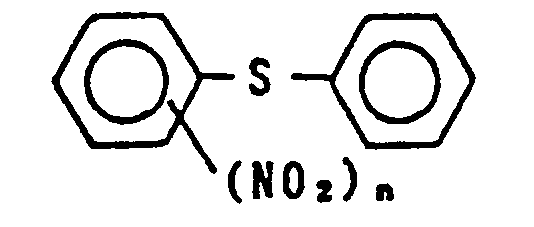
- a method of producing alkali metal benzenesulfinate having the general formula of wherein M represents Na or K which comprises: reacting nitrophenylphenyl sulfones having the general formula nf wherein n is an integer of 1 or 2, with alkali metal thiophenolates having the general formula of in solvents.
- the nitrophenylphenyl sulfones used in the invention include 2- and 4-nitrophenylphenyl sulfone and 2,4-dinitrophenylphenyl sulfone.
- the alkali metal thiophenolates used in the invention include sodium and potassium salts, which provide sodium and potassium benzenesulfinate, respectively, in almost quantitatively by the reaction with the aforesaid nitrophenylphenyl sulfones. In the reaction, the alkali metal thiophenolates are usually used in amounts of about 0.8-1.2 moles per, preferably in amounts equivalent to, the nitrophenylphenyl sulfones used.
- the reaction is carried out in solvents usually composed of a mixture of water and organic solvents that dissolve therein nitrophenylphenyl sulfones used and are inert to the reaction.
- the organic solvents usable may be either water-soluble or water-insoluble, and include, for example, lower aliphatic alcohols of 1-5 carbons such as methanol, ethanol or isopropanol, aliphatic hydrocarbons such as hexane or heptane, aromatic hydrocarbons that may carry one or more of lower alkyls of each 1-3 carbons such as benzene, toluene, xylene, ethylbenzene or isopropylbenzene, lower alkyl esters of lower aliphatic carboxylic acids having in total 3-8 carbons such as methyl acetate, ethyl acetate or methyl propionate, nitrated aromatic hydrocarbons such as nitrobenzene or nitrotoluene.
- the reaction may be carried out either in homogeneous solvents or in two-phase heterogeneous solvents depending upon the organic solvents used.
- a mixture of water and water-soluble organic solvents such as methanol or ethanol is a homogeneous solvent
- a mixture of water and water-insoluble or slightly water-insoluble organic solvents such as ethyl acetate, toluene, nitrobenzene or nitrotoluene is a two-phase heterogeneous solvent.
- Water-soluble or water-miscible aliphatic alcohols such as methanol or ethanol may be used alone as a solvent in the reaction since such alcohols are capable of dissolving not only thiophenol and alkali metal hydroxides but also nitrophenylphenyl sulfones therein.
- thiophenol and alkali metal hydroxides are reacted with each other therein to produce in situ alkali thiophenolates, and the reaction produces also water, so that if the alcohols alone are used as a solvent, they inevitably include water therein.
- the reaction may be carried out in manners that are not specifically limited, but it is generally preferred that the reaction is carried out by adding a solution of alkali thiophenolates in water, methanol or hydrous methanol, to a solution of nitrophenylphenyl sulfones in organic solvents as hereinbefore mentioned under stirring, and then the resultant mixture is stirred, if desired, at elevated temperatures, for about 1-10 hours.
- the reaction temperature is usually in the range of about 30-100°C.
- the alkali metal thiophenolates may be prepared by, for example, reacting thiophenol with sodium or potassium hydroxide in equimolar amounts in water, methanol or a mixture of these.
- phase transfer catalysts include, for example, tetraalkylammoniums such as tetramethylammonium chloride, tetraethylammonium chloride, tetrabutylammonium bromide or trioctylmethylammonium chloride, tetraalkylammonium hydrogen sulfates such as tetrabutylammonium hydrogen sulfate, benzyltrialkylammoniums such as benzyltrimetylammonium chloride, benzyltritetylammonium chloride, benzyldimethyllaurylammonium chloride or benzyldimethyltetradecylammonium chloride, and dibenzyldialkylammoniums such as dibenzyldimethylammonium chloride
- phase transfer catalysts are used in amounts of about 0.1-5%, preferably 0.2-1 % by weight, based on the weight of the alkali metal thiophenolates used.
- the use of too small amounts is ineffective to accelerate the reaction, while the use of too large amounts is uneconomical.
- the solvent is concentrated after the reaction, water and organic solvents such as toluene are added to the resultant concentrate, and the aqueous solution is separated and concentrated to dryness, to provide alkali metal benzenesulfinates as white crystals.
- nitrophenylphenyl sulfides are recovered from the organic solution.
- the reaction mixture is separated into an aqueous solution and an organic solution after the reaction, the aqueous solution is washed with organic solvents, for example, toluene, and is then concentrated to dryness, to provide alkali metal benzenesulfinates as white crystals.
- organic solvents for example, toluene
- the nitrophenylphenyl sulfides are recovered from the organic solution.
- the reaction produces, in addition to the alkali metal benzenesulfinates, nitrophenylphenyl sulfides, as by-products, which can be oxidized with oxidizing agents to the corresponding nitrophenylphenyl sulfones initially used.
- nitrophenylphenyl sulfones that have one or two nitro groups on one of the aromatic nuclei provide both alkali metal benzenesulfinates and nitrophenylphenyl sulfides in high yields, in almost equimolar amounts.
- oxidizing agents are usable for oxidizing nitrophenylphenyl sulfides into the corresponding nitrophenylphenyl sulfones.
- the oxidizing agents usable in the invention include, for example, hydrogen peroxide, peracids such as peracetic acid, hydroperoxides, halogens such as chlorine or bromine, ozone, oxygen with transition metal catalysts, potassium peroxysulfate, potassium permanganate, dinitrogen tetroxide, sodium metaperiodate, osmium (VIII) oxide, ruthenium (VIII) oxide, sodium or potassium dichromate and nitric acid.
- hydrogen peroxide is most preferred as oxidizing agents since the oxidation of the nitrophenylphenyl sulfides therewith provides the corresponding nitrophenylphenyl sulfones almost quantitatively.
- the recovered nitrophenylphenyl sulfides produced as by-products can be reused in the reaction after the oxidation. More specifically, the recovered nitrophenylphenyl sulfides are oxidized to the nitrophenylphenyl sulfones, and the sulfones are anew reacted with the alkali metal thiophenolates, to provide the alkali metal benzenesulfinates and again the nitrophenylphenyl sulfides.
- the nitrophenylphenyl sulfones as raw materials are needed to initially carry out the reaction, however, if needed, only supplementary amounts of nitrophenylphenyl sulfones are needed in the succeeding reactions, and hence according to the invention, the alkali benzenesulfinates can be produced much less expensively than the prior methods ever known.
- the oxidation reaction is carried out in a two-phase heterogeneous solvent, which is composed of water and water-insoluble or slightly water-insoluble organic solvents.
- a two-phase heterogeneous solvent which is composed of water and water-insoluble or slightly water-insoluble organic solvents. Any water-insoluble or slightly water-soluble organic solvents are usable when they are capable of dissolving therein nitrophenylphenyl sulfides and are inert to the reaction.
- the organic solvents usable include, for example, aliphatic hydrocarbons such as hexane, heptane or octane, aromatic hydrocarbons such as benzene, toluene, xylene, ethylbenzene or isopropylbenzene, alicyclic hydrocarbons such as cyclohexane or ethylcyclohexane, and nitrated aromatic hydrocarbons such as nitrobenzene or nitrotoluene.
- aliphatic hydrocarbons such as hexane, heptane or octane
- aromatic hydrocarbons such as benzene, toluene, xylene, ethylbenzene or isopropylbenzene
- alicyclic hydrocarbons such as cyclohexane or ethylcyclohexane
- nitrated aromatic hydrocarbons such as nitrobenzene or nitroto
- Alkyl esters of acetic acid or higher carboxylic acids are also usable as organic solvents, such as ethyl acetate, propyl acetate, butyl acetate, amyl acetate or ethyl propionate.
- hydrogen peroxide is used as oxidizing agents in amounts of not less than about 2 moles, preferably in the range of about 2-2.5 moles, per mole of nitrophenylphenyl sulfides used. There is no need to use hydrogen peroxide in large excess amounts.
- the tungstates and molybdates used as oxidizing catalysts in the reaction are water-soluble, and include alkali metal salts such as lithium, sodium or potassium salts, alkaline earth metal salts such as magnesium salts, and ammoniums.
- alkali metal salts such as lithium, sodium or potassium salts
- alkaline earth metal salts such as magnesium salts
- ammoniums Preferred catalysts are therefore lithium tungstate, sodium tungstate, potassium tungstate, magnesium tungstate, ammonium tungstate, sodium molybdate, potassium molybdate and ammonium molybdate.
- the oxidizing catalyst is used in amounts of about 0.5-5% by weight, preferably of about 1-2% by weight, based on the weight of the nitrophenylphenyl sulfides used.
- the use of too small amounts is ineffective to accelerate the reaction, whereas the use of too large amounts is uneconomical.
- phase transfer catalysts are used together with the oxidizing catalysts.
- the phase transfer catalysts hereinbefore described are also usable in the reaction.
- Preferred phase transfer catalysts used include, for example, tetraalkylammonium such as tetramethylammonium chloride, tetraethylammonium chloride, tetrabutylammonium bromide or trioctylmethylammonium chloride, tetraalkylammonium hydrogen sulfates such as tetrabutylammonium hydrogen sulfate, benzyltrialkylammoniums such as benzyltrimetylammonium chloride, benzyltrietylammonium chloride, benzyldimethyllaurylammonium chloride or benzyldimethyltetradecylammonium chloride, and dibenzyldialkylammoniums such as dibenzyldimethylammonium chloride
- phase transfer catalysts are used usually in amounts of about 0.1-3% by weight, preferably of about 0.2-1 % by weight, based on the weight of nitrophenylphenyl sulfides used.
- the use of too small amounts is ineffecive to accelerate the reaction, whereas the use of too large amounts is uneconomical.
- the oxidation reaction is preferably carried out in acidic or neutral conditions by adding a small amount of inorganic strong acids such as sulfuric acid or hydrochloric acid to the reaction mixture: Namely, the reaction is carried out preferably at a pH of not more than about 7, and most preferably at a pH of about 1-7.
- inorganic strong acids such as sulfuric acid or hydrochloric acid
- the oxidizing catalysts are converted into acid forms, i.e., tungstic acid or molybdic acid in acidic or neutral conditions, and the acids react with the phase transfer catalysts and transfer from the water phase to the organic phase in the reaction mixture, thereby to effectively catalyze the oxidation of the nitrophenylphenyl sulfides into the corresponding nitro phenyl phenyl sulfones.
- the tungstates or molybdates are oxidized into peroxotungstic acid or peroxomolybdic acid, respectively, in acidic or neutral conditions, and the peroxoacids react with the phase transfer catalysts to transfer to the organic phase, whereby to effectively catalyze the oxidation of the sulfides to the sulfones.
- the oxidizing catalysts remain in the water phase in the form of the salts in the reaction mixture, and it is likely that the salts do not react with the phase transfer catalysts, thereby being prevented from transferring from the water phase to the organic phase where the substantial oxidation reaction is carried out.
- the oxidizing reaction is carried out usually at temperatures of about 50-90°C, preferably at about 60-80°C. When the reaction temperature is too low, the reaction proceeds too slowly, and when the reaction temperature is too high, the selectivity of the reaction and the yields of the sulfones are low.
- reaction manners are not specifically limited, however, it is preferred that the reaction is carried out by dissolving nitrophenyiphenyl sulfides in the organic solvents and adding to the resultant solution the oxidizing catalysts, the phase transfer catalysts, and then, if necessary, an inorganic strong acid, and then by adding dropwise thereto aqueous solution of hydrogen peroxide under stirring at temperatures of about 60-90°C.
- the reaction mixture is separated into an organic solution and aqueous solution, and the organic solution is concentrated to dryness, to provide nitrophenylphenyl sulfones in high yields.
- the resultant sulfones may be purified by recrystallization.
- nitrobenzene solution was concentrated by distillation to dryness, to provide 22.6 g (96.5% yield) of 4-nitrophenylphenyl sulfide, which was found 98.7% in purity by liquid chromatography.
- reaction mixture was separated into a toluene solution and an aqueous solution, and the toluene solution was concentrated to dryness, to provide 51.8 g (97.8% yield) of 2-nitrophenylphenyl sulfone as pale yellow crystals.
- the purity was found 99.5% by liquid chromatography.
- reaction mixture was separated into a toluene solution and an aqueous solution, and the toluene solution was concentrated to dryness, to provide 51.6 g (97.6% yield) of 2-nitrophenylphenyl sulfone as pale yellow crystals.
- the purity was found 99.5% by liquid chromatography.
- Trioctylmethylammonium chloride was used in amounts of 2 g as phase transfer catalysts in place of tetrabutylammonium hydrogen sulfate, and 1.5 g of sulfuric acid were added to a toluene solution of the sulfide together with hydrogen peroxide, and the reaction was carried out otherwise in the same manner as in Example 9.
- reaction mixture was separated into a toluene solution and an aqueous solution, and the toluene solution was concentrated to dryness, to provide 51.8 g (97.4% yield) of 2-nitro phenyl phenyl sulfone as pale yellow crystals.
- the purity was found 99.0% by liquid chromatography.
- Benzyldimethyllaurylammonium chloride was used in amounts of 2 g as phase transfer catalysts in place of tetrabutylammonium hydrogen sulfate, and 1.5 g of sulfuric acid were added to a toluene solution of the sulfide together with hydrogen peroxide, and the reaction was carried out otherwise in the same manner as in Example 9.
- reaction mixture was separated into a toluene solution and an aqueous solution, and the toluene solution was concentrated to dryness, to provide 51.7 g (97.4% yield) of 2-nitrophenylphenyl sulfone as pale yellow crystals. The purity was found 99.2% by liquid chromatography.
- reaction mixture was separated into a toluene solution and an aqueous solution, and the toluene solution was concentrated to dryness, to provide 51.9 g (97.7% yield) of 4-nitrophenylphenyl sulfone as pale yellow crystals.
- the purity was found 99.1 % by liquid chromatography.
- the reaction mixture was separated into a nitrobenzene solution and an aqueous solution, and the nitrobenzene solution was heated and concentrated, and then cooled.
- the resultant solids were separated by filtration, washed with methanol, and then dried, to provide 50.3 g (95.2% yield) of 4-nitrophenylphenyl sulfone as pale yellow crystals. The purity was found 99.7% by liquid chromatography.
- reaction mixture was separated into a toluene solution and an aqueous solution, and the toluene solution was concentrated to dryness, to provide 51.5 g (97.5% yield) of 4-nitro phenyl phenyl sulfone as pale yellow crystals. The purity was found 99.7% by liquid chromatography.
- reaction mixture was separated into a toluene solution and an aqueous solution, and the toluene solution was concentrated to dryness, to provide 60.4 g (97.3% yield) of 2,4-dinitrophenylphenyl sulfone as yellow crystals. The purity was found 99.3% by liquid chromatography.
- reaction mixture was separated into a toluene solution and an aqueous solution, and the toluene solution was concentrated to dryness, to provide 60.5 g (97.2% yield) of 2,4-dinitrophenylphenyl sulfone as yellow crystals.
- the purity was found 99.1 % by liquid chromatography.
- Benzyltrimethylammonium chloride was used in amounts of 2 g as phase transfer catalysts in place of tetrabutylammonium hydrogen sulfate, and the reaction was carried out otherwise in the same manner as in Example 9. Since there was added no sulfuric acid to the reaction mixture, the pH of the reaction mixture was found about 7.
- the reaction mixture was separated into a toluene solution and an aqueous solution, and the toluene solution was analyzed by liquid chromatography.
- the toluene solution was found to contain 2-nitrophenylphenyl sulfone in amounts of 85.6% and 2-nitrophenylphenyl sulfoxide (by-products) in amounts of 14.4%.
- Benzyltrimethylammonium chloride was used in amounts of 2 g as phase transfer catalysts in place of tetrabutylammonium hydrogen sulfate, and 1.5 g of sodium hydroxide were added to a toluene solution of the sulfide together with hydrogen peroxide, and the reaction was carried out in an alkaline condition at a pH of about 14 otherwise in the same manner as in Example 9.
- the reaction mixture was separated into a toluene solution and an aqueous solution, and the toluene solution was analyzed by liquid chromatography.
- the toluene solution was found to contain 2-nitrophenylphenyl sulfide (unreacted) in amounts of 73.2%, 2-nitrophenylphenyl sulfoxide (by-products) in amounts of 15.5%, and 2-nitrophenylphenyl sulfone in amounts of 11.3%.
Landscapes
- Chemical & Material Sciences (AREA)
- Organic Chemistry (AREA)
- Organic Low-Molecular-Weight Compounds And Preparation Thereof (AREA)
Description
- This invention relates to a method of producing alkali metal benzenesulfinates, and also to a method of producing nitrophenylphenyl sulfones usable as starting materials in the production of alkali metal benzenesulfinates.
- Alkali metal benzenesulfinates are useful intermediate raw materials for the production of organic sulfones and sofoxides important in organic synthetic industry.
- Up to date a variety of methods are already known to produce alkali metal benzenesulfinates. These prior methods include, for example, a method in which benzenesulfonyl chloride is reduced with sodium sulfite as described in A. D. Barnard et al., J. Chem. Soc., 1957, 4673. However, according to this method, sodium sulfinate is produced in solutions together with water-soluble compounds such as sodium sulfate, sodium chloride or sodium benzenesulfonate, so that it is very difficult to separate sodium benzenesulfinate from the by-products by crystallization on account of closeness of the solubilities in water of all these compounds. Therefore, it is generally preferred that the resultant solution is then acidified with a mineral acid to convert the alkali metal benzenesulfinates into the free acid, and then the free acid is separated by filtration or is extracted with organic solvents. This method is, however, at disadvantage from the industrial standpoint in that it handles the free acid which is chemically rather unstable as well as it needs the aforesaid additional steps that incur higher production cost.
- A further method is also known in which benzene is sulfinated with sulfur dioxide in the presence of aluminum chloride as a catalyst, as described in Nippon Kagaku Zasshi, 1968, 89(8), 810. This method needs the catalyst in amounts equivalent to benzene used, and the catalyst cannot be recovered after the reaction, which makes the method uneconomical. A still further method is known in which 2,4-dinitrophenylphenyl sulfone is reacted with potassium hydroxide to provide potassium benzenesulfinate, as described in C. N. Kharash et al., J. Org. Chem., 19, 1704 (1954). However, this method has disadvantages in that the separation of potassium benzenesulfinate from by-products, potassium 2,4-dinitrophenolate is difficult.
- As described above, the methods hitherto known have disadvantages in many respects, and there is known no method that is advantageously applicable to the industrial production of alkali metal benzenesulfinates.
- The present inventors have made extensive investigations to establish an improved method of producing alkali metal benzenesulfinates more efficiently and less expensively than the prior methods, and found out that alkali metal benzenesulfinates are readily obtained in high yields by the reaction of nitrophenyl sulfones with alkali metal thiophenolates in solvents.
- It is, therefore, an object of the invention to provide a novel method of producing alkali metal benzenesulfinates.
- It is also an object of the invention to provide a novel method of producing nitrophenylphenyl sulfones which are usable as starting materials in the production of alkali metal benzenesulfinates.
- According to the invention, there is provided a method of producing alkali metal benzenesulfinate having the general formula of


- The nitrophenylphenyl sulfones used in the invention include 2- and 4-nitrophenylphenyl sulfone and 2,4-dinitrophenylphenyl sulfone. The alkali metal thiophenolates used in the invention include sodium and potassium salts, which provide sodium and potassium benzenesulfinate, respectively, in almost quantitatively by the reaction with the aforesaid nitrophenylphenyl sulfones. In the reaction, the alkali metal thiophenolates are usually used in amounts of about 0.8-1.2 moles per, preferably in amounts equivalent to, the nitrophenylphenyl sulfones used.
- The reaction is carried out in solvents usually composed of a mixture of water and organic solvents that dissolve therein nitrophenylphenyl sulfones used and are inert to the reaction. The organic solvents usable may be either water-soluble or water-insoluble, and include, for example, lower aliphatic alcohols of 1-5 carbons such as methanol, ethanol or isopropanol, aliphatic hydrocarbons such as hexane or heptane, aromatic hydrocarbons that may carry one or more of lower alkyls of each 1-3 carbons such as benzene, toluene, xylene, ethylbenzene or isopropylbenzene, lower alkyl esters of lower aliphatic carboxylic acids having in total 3-8 carbons such as methyl acetate, ethyl acetate or methyl propionate, nitrated aromatic hydrocarbons such as nitrobenzene or nitrotoluene.
- The reaction may be carried out either in homogeneous solvents or in two-phase heterogeneous solvents depending upon the organic solvents used. By way of example, a mixture of water and water-soluble organic solvents such as methanol or ethanol is a homogeneous solvent, whereas a mixture of water and water-insoluble or slightly water-insoluble organic solvents such as ethyl acetate, toluene, nitrobenzene or nitrotoluene is a two-phase heterogeneous solvent.
- Water-soluble or water-miscible aliphatic alcohols such as methanol or ethanol may be used alone as a solvent in the reaction since such alcohols are capable of dissolving not only thiophenol and alkali metal hydroxides but also nitrophenylphenyl sulfones therein. However, thiophenol and alkali metal hydroxides are reacted with each other therein to produce in situ alkali thiophenolates, and the reaction produces also water, so that if the alcohols alone are used as a solvent, they inevitably include water therein.
- The reaction may be carried out in manners that are not specifically limited, but it is generally preferred that the reaction is carried out by adding a solution of alkali thiophenolates in water, methanol or hydrous methanol, to a solution of nitrophenylphenyl sulfones in organic solvents as hereinbefore mentioned under stirring, and then the resultant mixture is stirred, if desired, at elevated temperatures, for about 1-10 hours. The reaction temperature is usually in the range of about 30-100°C. When the reaction temperature is too low, the reaction proceeds too slowly to be industrially workable, whereas when the reaction temperature is too high, undesired side reactions take place to decrease the yields of the objective compounds and the selectivity of the reaction. The alkali metal thiophenolates may be prepared by, for example, reacting thiophenol with sodium or potassium hydroxide in equimolar amounts in water, methanol or a mixture of these.
- When a two-phase heterogeneous solvent is used, the reaction is preferably carried out in the presence of phase transfer catalysts, which are already known per se. The phase transfer catalysts usable in the invention include, for example, tetraalkylammoniums such as tetramethylammonium chloride, tetraethylammonium chloride, tetrabutylammonium bromide or trioctylmethylammonium chloride, tetraalkylammonium hydrogen sulfates such as tetrabutylammonium hydrogen sulfate, benzyltrialkylammoniums such as benzyltrimetylammonium chloride, benzyltritetylammonium chloride, benzyldimethyllaurylammonium chloride or benzyldimethyltetradecylammonium chloride, and dibenzyldialkylammoniums such as dibenzyldimethylammonium chloride or dibenzyldiethylammonium chloride. The use of the phase transfer catalysts accelerates the reaction and increases the yields of the alkali metal benzenesulfinates.
- The phase transfer catalysts are used in amounts of about 0.1-5%, preferably 0.2-1 % by weight, based on the weight of the alkali metal thiophenolates used. The use of too small amounts is ineffective to accelerate the reaction, while the use of too large amounts is uneconomical.
- When the reaction is carried out in a homogeneous solvent, the solvent is concentrated after the reaction, water and organic solvents such as toluene are added to the resultant concentrate, and the aqueous solution is separated and concentrated to dryness, to provide alkali metal benzenesulfinates as white crystals. As by-products, nitrophenylphenyl sulfides are recovered from the organic solution.
- When the reaction is carried out in a heterogeneous solvent, the reaction mixture is separated into an aqueous solution and an organic solution after the reaction, the aqueous solution is washed with organic solvents, for example, toluene, and is then concentrated to dryness, to provide alkali metal benzenesulfinates as white crystals. The nitrophenylphenyl sulfides are recovered from the organic solution.
- The reaction of nitrophenylphenyl sulfones with alkali metal thiophenolates according to the invention is shown below.

- As shown above, the reaction produces, in addition to the alkali metal benzenesulfinates, nitrophenylphenyl sulfides, as by-products, which can be oxidized with oxidizing agents to the corresponding nitrophenylphenyl sulfones initially used. In this regard, nitrophenylphenyl sulfones that have one or two nitro groups on one of the aromatic nuclei provide both alkali metal benzenesulfinates and nitrophenylphenyl sulfides in high yields, in almost equimolar amounts.
- A variety of oxidizing agents are usable for oxidizing nitrophenylphenyl sulfides into the corresponding nitrophenylphenyl sulfones. The oxidizing agents usable in the invention include, for example, hydrogen peroxide, peracids such as peracetic acid, hydroperoxides, halogens such as chlorine or bromine, ozone, oxygen with transition metal catalysts, potassium peroxysulfate, potassium permanganate, dinitrogen tetroxide, sodium metaperiodate, osmium (VIII) oxide, ruthenium (VIII) oxide, sodium or potassium dichromate and nitric acid.
- However, hydrogen peroxide is most preferred as oxidizing agents since the oxidation of the nitrophenylphenyl sulfides therewith provides the corresponding nitrophenylphenyl sulfones almost quantitatively.
- Therefore, as an important aspect of the invention, the recovered nitrophenylphenyl sulfides produced as by-products can be reused in the reaction after the oxidation. More specifically, the recovered nitrophenylphenyl sulfides are oxidized to the nitrophenylphenyl sulfones, and the sulfones are anew reacted with the alkali metal thiophenolates, to provide the alkali metal benzenesulfinates and again the nitrophenylphenyl sulfides. Therefore, the nitrophenylphenyl sulfones as raw materials are needed to initially carry out the reaction, however, if needed, only supplementary amounts of nitrophenylphenyl sulfones are needed in the succeeding reactions, and hence according to the invention, the alkali benzenesulfinates can be produced much less expensively than the prior methods ever known.
- According to the invention, there is further provided a novel method of producing nitrophenylphenyl sulfones by the oxidation of nitrophenylphenyl sulfides.
- According to the invention, there is further provided a method of producing nitrophenylphenyl sulfones having the general formula of


- The oxidation reaction is carried out in a two-phase heterogeneous solvent, which is composed of water and water-insoluble or slightly water-insoluble organic solvents. Any water-insoluble or slightly water-soluble organic solvents are usable when they are capable of dissolving therein nitrophenylphenyl sulfides and are inert to the reaction. The organic solvents usable include, for example, aliphatic hydrocarbons such as hexane, heptane or octane, aromatic hydrocarbons such as benzene, toluene, xylene, ethylbenzene or isopropylbenzene, alicyclic hydrocarbons such as cyclohexane or ethylcyclohexane, and nitrated aromatic hydrocarbons such as nitrobenzene or nitrotoluene. Alkyl esters of acetic acid or higher carboxylic acids are also usable as organic solvents, such as ethyl acetate, propyl acetate, butyl acetate, amyl acetate or ethyl propionate.
- In the oxidation reaction, hydrogen peroxide is used as oxidizing agents in amounts of not less than about 2 moles, preferably in the range of about 2-2.5 moles, per mole of nitrophenylphenyl sulfides used. There is no need to use hydrogen peroxide in large excess amounts.
- The tungstates and molybdates used as oxidizing catalysts in the reaction are water-soluble, and include alkali metal salts such as lithium, sodium or potassium salts, alkaline earth metal salts such as magnesium salts, and ammoniums. Preferred catalysts are therefore lithium tungstate, sodium tungstate, potassium tungstate, magnesium tungstate, ammonium tungstate, sodium molybdate, potassium molybdate and ammonium molybdate.
- The oxidizing catalyst is used in amounts of about 0.5-5% by weight, preferably of about 1-2% by weight, based on the weight of the nitrophenylphenyl sulfides used. The use of too small amounts is ineffective to accelerate the reaction, whereas the use of too large amounts is uneconomical.
- In the oxidizing reaction of the invention, phase transfer catalysts are used together with the oxidizing catalysts. The phase transfer catalysts hereinbefore described are also usable in the reaction. Preferred phase transfer catalysts used include, for example, tetraalkylammonium such as tetramethylammonium chloride, tetraethylammonium chloride, tetrabutylammonium bromide or trioctylmethylammonium chloride, tetraalkylammonium hydrogen sulfates such as tetrabutylammonium hydrogen sulfate, benzyltrialkylammoniums such as benzyltrimetylammonium chloride, benzyltrietylammonium chloride, benzyldimethyllaurylammonium chloride or benzyldimethyltetradecylammonium chloride, and dibenzyldialkylammoniums such as dibenzyldimethylammonium chloride or dibenzyldiethylammonium chloride.
- The phase transfer catalysts are used usually in amounts of about 0.1-3% by weight, preferably of about 0.2-1 % by weight, based on the weight of nitrophenylphenyl sulfides used. The use of too small amounts is ineffecive to accelerate the reaction, whereas the use of too large amounts is uneconomical.
- The oxidation reaction is preferably carried out in acidic or neutral conditions by adding a small amount of inorganic strong acids such as sulfuric acid or hydrochloric acid to the reaction mixture: Namely, the reaction is carried out preferably at a pH of not more than about 7, and most preferably at a pH of about 1-7. However, when ammonium hydrogen sulfates such as tetrabutylammonium hydrogen sulfate are used as a phase transfer catalyst, there is no need to add an inorganic strong aid to the reaction mixture to adjust the pH thereof at acidic regions since the ammonium hydrogen sulfates themselves are strongly acidic.
- Although the invention is not limited in theory or mechanism of the reaction, the oxidizing catalysts are converted into acid forms, i.e., tungstic acid or molybdic acid in acidic or neutral conditions, and the acids react with the phase transfer catalysts and transfer from the water phase to the organic phase in the reaction mixture, thereby to effectively catalyze the oxidation of the nitrophenylphenyl sulfides into the corresponding nitro phenyl phenyl sulfones. More specifically, it is likely that the tungstates or molybdates are oxidized into peroxotungstic acid or peroxomolybdic acid, respectively, in acidic or neutral conditions, and the peroxoacids react with the phase transfer catalysts to transfer to the organic phase, whereby to effectively catalyze the oxidation of the sulfides to the sulfones.
- On the other hand, when the reaction is carried out in alkaline conditions, the oxidizing catalysts remain in the water phase in the form of the salts in the reaction mixture, and it is likely that the salts do not react with the phase transfer catalysts, thereby being prevented from transferring from the water phase to the organic phase where the substantial oxidation reaction is carried out.
- The oxidizing reaction is carried out usually at temperatures of about 50-90°C, preferably at about 60-80°C. When the reaction temperature is too low, the reaction proceeds too slowly, and when the reaction temperature is too high, the selectivity of the reaction and the yields of the sulfones are low.
- The reaction manners are not specifically limited, however, it is preferred that the reaction is carried out by dissolving nitrophenyiphenyl sulfides in the organic solvents and adding to the resultant solution the oxidizing catalysts, the phase transfer catalysts, and then, if necessary, an inorganic strong acid, and then by adding dropwise thereto aqueous solution of hydrogen peroxide under stirring at temperatures of about 60-90°C. After the completion of the reaction, the reaction mixture is separated into an organic solution and aqueous solution, and the organic solution is concentrated to dryness, to provide nitrophenylphenyl sulfones in high yields. The resultant sulfones may be purified by recrystallization.
- The invention will be understood more readily with reference to the following examples; however these examples are intended to illustrate the invention only and are not to be construed as limitation to the invention.
- An amount of 26.3 g (0.1 mole) of 2-nitrophenylphenyl sulfone was dissolved in 100 g of methanol in a 300 ml capacity four-necked flask provided with a stirrer, a thermometer, a dropping funnel and a reflux condensor. An amount of 11.0 g (0.1 mole) of thiophenol and 4.0 g (0.1 mole) of sodium hydroxide were dissolved in 30 g of methanol. The resultant methanol solution of sodium thiophenolate was added to the aforesaid solution of 2-nitrophenylphenyl sulfone, and the reaction was carried out at 60°C for 4 hours.
- After the reaction, methanol was concentrated, toluene and water were added to the concentrate, and the aqueous solution was separated from the organic solvent. The aqueous solution was concentrated to dryness, to provide 16.1 g (97.1 % yield) of sodium benzenesulfinate as white crystals. The purity was found 99.0% by liquid chromatography.
- The removal of toluene from the organic solution by distillation provided 22.6 g (96.7% yield) of 2-nitrophenylphenyl sulfide as yellow crystals. The purity was found 98.8% by liquid chromatography.
- An amount of 21.1 g (0.09 mole) of the recovered 2-nitrophenylphenyl sulfide was placed in a 200 ml capacity flask together with 83.3 g of acetic acid and heated to 50°C to provide a uniform solution. The solution was further heated to 85°C, and 26.2 g of a 35% aqueous solution of hydrogen peroxide (0.27 mole) were dropwise added to the solution of the sulfide over 30 minutes while the solution was maintained at 85°C.
- After stirring for 5 hours at 85°C, the resultant reaction mixture was left standing to room temperatures, the resultant precipitates were filtered and dried, to provide 23.0 g (95.4% yield) of 2-nitrophenylphenyl sulfone, mp. 146.9-148.6°C, which was found 98.2% in purity by liquid chromatography.
- An amount of 21.4 g (0.08 mole) of the thus obtained 2-nitrophenylphenyl sulfone was dissolved in 80 g of methanol, and was reacted with sodium thiophenolate in the same manner as above-mentioned.
- After the reaction, methanol was concentrated, toluene and water were added to the concentrate, and the aqueous solution was separated from the organic solution. The aqueous solution was then concentrated to dryness, to provide 12.7 g (95.8% yield ) of sodium benzenesulfinate as white crystals. The purity was found 99.1 % by liquid chromatography.
- 2-Nitrophenylphenyl sulfide was recovered from the toluene solution.
- A mixture of 100 g of ethyl acetate and 100 g of water was used as a solvent, and the reaction was carried out in the same manner as in Example 1 in the presence of 0.1 g of benzyltriethylammonium chloride as a phase transfer catalyst.
- After the reaction, the reaction mixture was left standing to room temperatures, the resulting aqueous solution was separated from the ethyl acetate solution containing 2-nitrophenylphenyl sulfide, and concentrated to dryness, to provide 13.7 g (82.7% yield) of sodium benzenesulfinate as white crystals, which was found 99.1% in purity by liquid chromatography.
- The removal of ethyl acetate by distillation from the ethyl acetate solution provided 22.4 g (95.8% yield) of 2-nitrophenylphenyl sulfide as yellow crystals. The sulfide was found 98.9% in purity by liquid chromatography.
- An amount of 21.0 g (0.09 mole) of the recovered 2-nitrophenylphenyl sulfide was oxidized with 26.2 g (0.27 mole) of a 35% aqueous solution of hydrogen peroxide in the same manner as in Example 1. After the reaction, the reaction mixture was cooled, and resulting precipitates were filtered and dried, to provide 23.1 g (95.9% yield) of 2-nitrophenylphenyl sulfone as white crystals, mp. 147.0-148.7°C. The purity was found 98.4% by liquid chromatography.
- An amount of 21.4 g (0.08 mole) of the thus obtained 2-nitrophenylphenyl sulfone was dissolved in a mixture of 80 g of ethyl acetate and 80 g of water, and was reacted with sodium thiophenolate in the same manner as in Example 1.
- After the reaction, ethyl acetate was concentrated, toluene and water were added to the concentrate, and the aqueous solution was separated from the organic solution. The aqueous solution was concentrated to dryness, to provide 12.5 g (94.2% yield) of sodium benzenesulfinates as white crystals. The purity was found 99.0% by liquid chromatography.
- 2-Nitrophenylphenyl sulfide was recovered from the toluene solution.
- 4-Nitrophenylphenyl sulfone was used in place of 2-nitrophenylphenyl sulfone and otherwise the reaction was carried out in the same manner as in Example 1.
- After the reaction, methanol was concentrated, toluene and water were added to the concentrate, and the aqueous solution was separated from the organic solution containing 4-nitrophenylphenyl sulfide as by-products. The aqueous solution was concentrated to dryness, to provide 14.8 g (88.5% yield) of sodium benzenesulfinate as white crystals. The purity was found 98.2% by liquid chromatography.
- 4-Nitrophenylphenyl sulfone and a solvent as a mixture of 100 g of toluene and 100 g of water were used in place of 2-nitrophenylphenyl sulfone and methanol, respectively, and the reaction was carried out in the presence of 0.1 g of tetrabutylammonium hydrogen sulfate as a phase transfer catalyst otherwise in the same manner as in Example 1.
- After the reaction, the reaction mixture was left standing to room temperatures, the aqueous solution was separated from the toluene solution containing 4-nitrophenylphenyl sulfide as by-products. The aqueous layer was concentrated to dryness, to provide 14.6 g (88.4% yield) of sodium benzenesulfinate as white crystals. The purity was found 99.4% by liquid chromatography.
- 4-Nitrophenylphenyl sulfone and a solvent composed of a mixture of 100 g of nitrobenzene and 100 g of water were used in place of 2-nitrophenylphenyl sulfone and methanol, respectively, and the reaction was carried out in the presence of 0.1 g of tetrabutylammonium hydrogen sulfate as a phase transfer catalyst otherwise in the same manner as in Example 1.
- After the reaction, the reaction mixture was left standing to room temperatures, the aqueous solution was separated from the nitrobenzene solution containing 4-nitrophenylphenyl sulfide. The aqueous layer was concentrated to dryness, to provide 15.3 g (92.5% yield) of sodium benzenesulfinate as white crystals. The purity was found 99.3% by liquid chromatography.
- The nitrobenzene solution was concentrated by distillation to dryness, to provide 22.6 g (96.5% yield) of 4-nitrophenylphenyl sulfide, which was found 98.7% in purity by liquid chromatography.
- An amount of 21.1 g (0.09 mole) of the recovered 4-nitrophenylphenyl sulfide was oxidized with hydrogen peroxide in the same manner as in Example 1. After the reaction, the reaction mixture was cooled, and resulting precipitates were filtered and dried, to provide 23.1 g (96.0% yield) of 4-nitrophenylphenyl sulfone as white crystals, mp. 141.4-142.9°C. The purity was found 98.5% by liquid chromatography.
- An amount of 21.4 g (0.08 mole) of the thus obtained 4-nitrophenylphenyl sulfone was dissolved in a two phase solvent composed of a mixture of 80 g of nitrobenzene and 80 g of water, and was reacted with sodium thiophenolate in the same manner as in Example 1.
- After the reaction, the resultant aqueous solution was separated from the organic solvent. The aqueous solution was concentrated to dryness, to provide 12.6 g (95.2% yield) of sodium benzenesulfinate as white crystals. The purity was found 99.2% by liquid chromatography.
- An amount of 5.6 g (0.1 mole) of potassium hydroxide was used in place of sodium hydroxide, and the reaction was carried out otherwise in the same manner as in Example 1.
- After the reaction, methanol was concentrated, toluene and water were added to the concentrate, and the aqueous solution was separated from the organic solution containing 2-nitrophenylphenyl sulfide. The aqueous solution was concentrated to dryness, to provide 15.0 g (82.4% yield) of sodium benzenesulfinate as white crystals. The purity was found 99.0% by liquid chromatography.
- An amount of 30.8 g (0.1 mole) of 2,4-dinitrophenylphenyl sulfone was used in place of 2-nitrophenylphenyl sulfone, and the reaction was carried out otherwise in the same manner as in Example 1.
- After the reaction, methanol was concentrated, toluene and water were added to the concentrate, and the aqueous solution was separated from the toluene solution containing 2,4-nitrophenylphenyl sulfide. The aqueous solution was then concentrated to dryness, to provide 13.8 g (83.4% yield) of sodium benzenesulfinate as white crystals. The purity was found 99.2% by liquid chromatography.
- Ethanol was used as a solvent in place of methanol and the reaction was carried out otherwise in the same manner as in Example 1.
- After the reaction, ethanol and methanol were concentrated, toluene and water were added to the concentrate, and the aqueous solution was separated from the toluene solution. The aqueous solution was then concentrated to dryness, to provide 16.0 g (96.7% yield) of sodium benzenesulfinate as white crystals. The purity was found 99.2% by liquid chromatography.
- The removal of toluene from the toluene solution provided 22.5 g (96.1 % yield) of 2-nitrophenylphenyl sulfide. The purity was found 99.2% by liquid chromatography.
- An amount of 46.2 g (0.2 mole) of 2-nitrophenylphenyl sulfide was dissolved under heating in 200 g of toluene in a 500 ml capacity four-necked flask provided with a stirrer, a thermometer, a dropping funnel and a reflux condensor, and there were added thereto 1 g of sodium tungstate dihydrate and 2 g of tetrabutylammonium hydrogen sulfate. To the resultant mixture were then dropwise added 40.9 g (0.42 mole) of 30% by weight aqueous solution of hydrogen peroxide at temperatures of about 80°C under stirring, and the reaction was carried at the temperature for 3 hours. The pH of the reaction mixture was found about 1.
- After the completion of the reaction, the reaction mixture was separated into a toluene solution and an aqueous solution, and the toluene solution was concentrated to dryness, to provide 51.8 g (97.8% yield) of 2-nitrophenylphenyl sulfone as pale yellow crystals. The purity was found 99.5% by liquid chromatography.
- An amount of 46.2 g (0.2 mole) of 2-nitrophenylphenyl sulfide was dissolved under heating in 200 g of toluene in a 500 ml capacity four-necked flask provided with a stirrer, a thermometer, a dropping funnel and a reflux condensor, and there were added thereto 1 g of sodium tungstate dihydrate, 2 g of benzyltrimethylammonium chloride, and 1.5 g of sulfuric acid in this order. To the resultant mixture were then dropwise added 40.9 g (0.42 mole) of aqueous hydrogen peroxide at temperatures of about 80°C under stirring, and the reaction was carried at the temperature for 3 hours. The pH of the reaction mixture was found about 1.
- After the completion of the reaction, the reaction mixture was separated into a toluene solution and an aqueous solution, and the toluene solution was concentrated to dryness, to provide 51.6 g (97.6% yield) of 2-nitrophenylphenyl sulfone as pale yellow crystals. The purity was found 99.5% by liquid chromatography.
- Trioctylmethylammonium chloride was used in amounts of 2 g as phase transfer catalysts in place of tetrabutylammonium hydrogen sulfate, and 1.5 g of sulfuric acid were added to a toluene solution of the sulfide together with hydrogen peroxide, and the reaction was carried out otherwise in the same manner as in Example 9.
- After the reaction, the reaction mixture was separated into a toluene solution and an aqueous solution, and the toluene solution was concentrated to dryness, to provide 51.8 g (97.4% yield) of 2-nitro phenyl phenyl sulfone as pale yellow crystals. The purity was found 99.0% by liquid chromatography.
- Benzyldimethyllaurylammonium chloride was used in amounts of 2 g as phase transfer catalysts in place of tetrabutylammonium hydrogen sulfate, and 1.5 g of sulfuric acid were added to a toluene solution of the sulfide together with hydrogen peroxide, and the reaction was carried out otherwise in the same manner as in Example 9.
- After the reaction, the reaction mixture was separated into a toluene solution and an aqueous solution, and the toluene solution was concentrated to dryness, to provide 51.7 g (97.4% yield) of 2-nitrophenylphenyl sulfone as pale yellow crystals. The purity was found 99.2% by liquid chromatography.
- An amount of 46.2 g (0.2 mole) of 4-nitrophenylphenyl sulfide was used in place of 2-nitrophenylphenyl sulfide, and the reaction was carried out otherwise in the same manner as in Example 9.
- After the reaction, the reaction mixture was separated into a toluene solution and an aqueous solution, and the toluene solution was concentrated to dryness, to provide 51.9 g (97.7% yield) of 4-nitrophenylphenyl sulfone as pale yellow crystals. The purity was found 99.1 % by liquid chromatography.
- An amount of 46.2 g (0.2 mole) of 4-nitrophenylphenyl sulfide was used in place of 2-nitrophenylphenyl sulfide, and nitrobenzene was used as organic solvents in place of toluene, and the reaction was carried out otherwise in the same manner as in Example 9.
- After the reaction, the reaction mixture was separated into a nitrobenzene solution and an aqueous solution, and the nitrobenzene solution was heated and concentrated, and then cooled. The resultant solids were separated by filtration, washed with methanol, and then dried, to provide 50.3 g (95.2% yield) of 4-nitrophenylphenyl sulfone as pale yellow crystals. The purity was found 99.7% by liquid chromatography.
- An amount of 46.2 g (0.2 mole) of 4-nitrophenylphenyl sulfide was used in place of 2-nitrophenylphenyl sulfide, and 1 g of ammonium molybdate was used in place of sodium tungstate, and the reaction was carried out otherwise in the same manner as in Example 9.
- After the reaction, the reaction mixture was separated into a toluene solution and an aqueous solution, and the toluene solution was concentrated to dryness, to provide 51.5 g (97.5% yield) of 4-nitro phenyl phenyl sulfone as pale yellow crystals. The purity was found 99.7% by liquid chromatography.
- An amount of 55.2 g (0.2 mole) of 2,4-dinitrophenylphenyl sulfide was used in place of 2-nitrophenylphenyl sulfide, and the reaction was carried out otherwise in the same manner as in Example 9.
- After the reaction, the reaction mixture was separated into a toluene solution and an aqueous solution, and the toluene solution was concentrated to dryness, to provide 60.4 g (97.3% yield) of 2,4-dinitrophenylphenyl sulfone as yellow crystals. The purity was found 99.3% by liquid chromatography.
- An amount of 55.2 g (0.2 mole) of 2,4-dinitrophenylphenyl sulfide was used in place of 2-nitrophenylphenyl sulfide, and 2 g of benzyldimethyltetradecylammonium chloride in place of tetrabutylammonium hydrogen sulfate, and the reaction was carried out otherwise in the same manner as in Example 9.
- After the reaction, the reaction mixture was separated into a toluene solution and an aqueous solution, and the toluene solution was concentrated to dryness, to provide 60.5 g (97.2% yield) of 2,4-dinitrophenylphenyl sulfone as yellow crystals. The purity was found 99.1 % by liquid chromatography.
- Benzyltrimethylammonium chloride was used in amounts of 2 g as phase transfer catalysts in place of tetrabutylammonium hydrogen sulfate, and the reaction was carried out otherwise in the same manner as in Example 9. Since there was added no sulfuric acid to the reaction mixture, the pH of the reaction mixture was found about 7.
- After the reaction, the reaction mixture was separated into a toluene solution and an aqueous solution, and the toluene solution was analyzed by liquid chromatography. The toluene solution was found to contain 2-nitrophenylphenyl sulfone in amounts of 85.6% and 2-nitrophenylphenyl sulfoxide (by-products) in amounts of 14.4%.
- Benzyltrimethylammonium chloride was used in amounts of 2 g as phase transfer catalysts in place of tetrabutylammonium hydrogen sulfate, and 1.5 g of sodium hydroxide were added to a toluene solution of the sulfide together with hydrogen peroxide, and the reaction was carried out in an alkaline condition at a pH of about 14 otherwise in the same manner as in Example 9.
- After the reaction, the reaction mixture was separated into a toluene solution and an aqueous solution, and the toluene solution was analyzed by liquid chromatography. The toluene solution was found to contain 2-nitrophenylphenyl sulfide (unreacted) in amounts of 73.2%, 2-nitrophenylphenyl sulfoxide (by-products) in amounts of 15.5%, and 2-nitrophenylphenyl sulfone in amounts of 11.3%.
Claims (22)




Applications Claiming Priority (4)
| Application Number | Priority Date | Filing Date | Title |
|---|---|---|---|
| JP61190790A JPH0735364B2 (en) | 1986-08-13 | 1986-08-13 | Manufacturing method of alkali metal benzenesulfinate |
| JP190790/86 | 1986-08-13 | ||
| JP19545987A JPS6440457A (en) | 1987-08-05 | 1987-08-05 | Production of nitrophenylphenylsulfones |
| JP195459/87 | 1987-08-05 |
Publications (2)
| Publication Number | Publication Date |
|---|---|
| EP0256486A1 EP0256486A1 (en) | 1988-02-24 |
| EP0256486B1 true EP0256486B1 (en) | 1990-12-05 |
Family
ID=26506312
Family Applications (1)
| Application Number | Title | Priority Date | Filing Date |
|---|---|---|---|
| EP19870111587 Expired EP0256486B1 (en) | 1986-08-13 | 1987-08-11 | A method of producing alkali metal benzenesulfinates |
Country Status (2)
| Country | Link |
|---|---|
| EP (1) | EP0256486B1 (en) |
| DE (1) | DE3766567D1 (en) |
Families Citing this family (3)
| Publication number | Priority date | Publication date | Assignee | Title |
|---|---|---|---|---|
| IE913697A1 (en) * | 1990-10-22 | 1992-04-22 | Res Corp Technologies Inc | Aryl and heteroaryl, compounds having anti-retrovirus¹activity |
| BRPI0411766A (en) | 2003-06-24 | 2006-08-08 | Isis Innovation | methods for forming a disulfide bond and for chemically modifying a protein, peptide or amino acid, compound, method for preparing the compound, use of the compound, and, protein, peptide or amino acid |
| WO2010055744A1 (en) | 2008-11-17 | 2010-05-20 | 住友精化株式会社 | Sulfone compound |
-
1987
- 1987-08-11 EP EP19870111587 patent/EP0256486B1/en not_active Expired
- 1987-08-11 DE DE8787111587T patent/DE3766567D1/en not_active Expired - Fee Related
Also Published As
| Publication number | Publication date |
|---|---|
| DE3766567D1 (en) | 1991-01-17 |
| EP0256486A1 (en) | 1988-02-24 |
Similar Documents
| Publication | Publication Date | Title |
|---|---|---|
| KR100445930B1 (en) | Process for the preparation of aromatic or heteroaromatic sulfonyl halides | |
| EP0092909A2 (en) | Process for producing aminophenyl-beta-hydroxyethylsulfone | |
| US4849138A (en) | Method of producing alkali metal benzenesulfinates | |
| JP3337728B2 (en) | Method for producing 2-acetylbenzo [b] thiophene | |
| AU2020326508B2 (en) | Process for the preparation of fluensulfone | |
| EP0256486A1 (en) | A method of producing alkali metal benzenesulfinates | |
| US5055605A (en) | Preparation of trisubstituted benzoic acid precursors | |
| RU2183621C1 (en) | Method of producing acid fluoride of sulfonic acids | |
| EP0798294B1 (en) | Process for preparing alpha-haloacetophenone derivative | |
| US12630518B2 (en) | Process for preparing 1,2-benzisothiazoline-3-one | |
| US4792610A (en) | Process for the preparation of 5-phenylsulfinyl-1H-2-(methoxycarbonylamino)-benzimidazole | |
| JPH08143534A (en) | Production of alkyl phenyl sulfone | |
| JP2003064051A (en) | Method for producing sulfonyl compound | |
| US4461918A (en) | Process for producing pentachloronitrobenzene from hexachlorobenzene | |
| US5329027A (en) | Oxidative dehalogenation process for the production of perchlorinated quinones | |
| JP3061492B2 (en) | Process for producing glycidyl aryl sulfonates | |
| JP2011079766A (en) | Method for preparing 4-halophenyl alkyl sulfone | |
| KR20230098155A (en) | Method for producing 1,2-benzisothiazolin-3-one | |
| JP2730991B2 (en) | Method for producing 1-amino-2-chloro-4-hydroxy-anthraquinone | |
| JPH0310617B2 (en) | ||
| JP4000816B2 (en) | Method for producing 3-methyladipic acid | |
| JPH01106858A (en) | Production of halogen-substituted diphenylsulfones | |
| KR100989147B1 (en) | Method for preparing N, N'-disubstituted-3,3'-dithiopropionamide | |
| CN120623080A (en) | A method for synthesizing an allyl sulfone compound | |
| BR112022001817B1 (en) | METHODS FOR PREPARING FLUENSULPHONE |
Legal Events
| Date | Code | Title | Description |
|---|---|---|---|
| PUAI | Public reference made under article 153(3) epc to a published international application that has entered the european phase |
Free format text: ORIGINAL CODE: 0009012 |
|
| AK | Designated contracting states |
Kind code of ref document: A1 Designated state(s): DE FR GB |
|
| 17P | Request for examination filed |
Effective date: 19880422 |
|
| 17Q | First examination report despatched |
Effective date: 19890919 |
|
| GRAA | (expected) grant |
Free format text: ORIGINAL CODE: 0009210 |
|
| AK | Designated contracting states |
Kind code of ref document: B1 Designated state(s): DE FR GB |
|
| ET | Fr: translation filed | ||
| REF | Corresponds to: |
Ref document number: 3766567 Country of ref document: DE Date of ref document: 19910117 |
|
| PLBE | No opposition filed within time limit |
Free format text: ORIGINAL CODE: 0009261 |
|
| STAA | Information on the status of an ep patent application or granted ep patent |
Free format text: STATUS: NO OPPOSITION FILED WITHIN TIME LIMIT |
|
| 26N | No opposition filed | ||
| PGFP | Annual fee paid to national office [announced via postgrant information from national office to epo] |
Ref country code: FR Payment date: 19930709 Year of fee payment: 7 |
|
| PGFP | Annual fee paid to national office [announced via postgrant information from national office to epo] |
Ref country code: GB Payment date: 19930730 Year of fee payment: 7 |
|
| PGFP | Annual fee paid to national office [announced via postgrant information from national office to epo] |
Ref country code: DE Payment date: 19930914 Year of fee payment: 7 |
|
| PG25 | Lapsed in a contracting state [announced via postgrant information from national office to epo] |
Ref country code: GB Effective date: 19940811 |
|
| GBPC | Gb: european patent ceased through non-payment of renewal fee |
Effective date: 19940811 |
|
| PG25 | Lapsed in a contracting state [announced via postgrant information from national office to epo] |
Ref country code: FR Effective date: 19950428 |
|
| PG25 | Lapsed in a contracting state [announced via postgrant information from national office to epo] |
Ref country code: DE Effective date: 19950503 |
|
| REG | Reference to a national code |
Ref country code: FR Ref legal event code: ST |