EP0256180B1 - Chromogenic compounds for pressure- or heat-sensitive recording papers - Google Patents
Chromogenic compounds for pressure- or heat-sensitive recording papers Download PDFInfo
- Publication number
- EP0256180B1 EP0256180B1 EP19860306201 EP86306201A EP0256180B1 EP 0256180 B1 EP0256180 B1 EP 0256180B1 EP 19860306201 EP19860306201 EP 19860306201 EP 86306201 A EP86306201 A EP 86306201A EP 0256180 B1 EP0256180 B1 EP 0256180B1
- Authority
- EP
- European Patent Office
- Prior art keywords
- formula
- quinolyl
- ethylene
- chromogenic compound
- chromogenic
- Prior art date
- Legal status (The legal status is an assumption and is not a legal conclusion. Google has not performed a legal analysis and makes no representation as to the accuracy of the status listed.)
- Expired
Links
- 0 C*1cc(*)ccc1*=* Chemical compound C*1cc(*)ccc1*=* 0.000 description 2
- DJLTUGXRPFJESF-BENRWUELSA-N C(CC1)CCC1/C=C\C1Nc2ccccc2CC1 Chemical compound C(CC1)CCC1/C=C\C1Nc2ccccc2CC1 DJLTUGXRPFJESF-BENRWUELSA-N 0.000 description 1
- XDTMQSROBMDMFD-UHFFFAOYSA-N C1CCCCC1 Chemical compound C1CCCCC1 XDTMQSROBMDMFD-UHFFFAOYSA-N 0.000 description 1
- JBQCCEDTIYAVCE-VEDVMXKPSA-N C[C@H]1N=C2C=CC=CC2CC1 Chemical compound C[C@H]1N=C2C=CC=CC2CC1 JBQCCEDTIYAVCE-VEDVMXKPSA-N 0.000 description 1
Images


Classifications
-
- C—CHEMISTRY; METALLURGY
- C07—ORGANIC CHEMISTRY
- C07D—HETEROCYCLIC COMPOUNDS
- C07D215/00—Heterocyclic compounds containing quinoline or hydrogenated quinoline ring systems
- C07D215/02—Heterocyclic compounds containing quinoline or hydrogenated quinoline ring systems having no bond between the ring nitrogen atom and a non-ring member or having only hydrogen atoms or carbon atoms directly attached to the ring nitrogen atom
- C07D215/16—Heterocyclic compounds containing quinoline or hydrogenated quinoline ring systems having no bond between the ring nitrogen atom and a non-ring member or having only hydrogen atoms or carbon atoms directly attached to the ring nitrogen atom with hetero atoms or with carbon atoms having three bonds to hetero atoms with at the most one bond to halogen, e.g. ester or nitrile radicals, directly attached to ring carbon atoms
- C07D215/20—Oxygen atoms
-
- B—PERFORMING OPERATIONS; TRANSPORTING
- B41—PRINTING; LINING MACHINES; TYPEWRITERS; STAMPS
- B41M—PRINTING, DUPLICATING, MARKING, OR COPYING PROCESSES; COLOUR PRINTING
- B41M5/00—Duplicating or marking methods; Sheet materials for use therein
- B41M5/124—Duplicating or marking methods; Sheet materials for use therein using pressure to make a masked colour visible, e.g. to make a coloured support visible, to create an opaque or transparent pattern, or to form colour by uniting colour-forming components
- B41M5/132—Chemical colour-forming components; Additives or binders therefor
- B41M5/136—Organic colour formers, e.g. leuco dyes
-
- B—PERFORMING OPERATIONS; TRANSPORTING
- B41—PRINTING; LINING MACHINES; TYPEWRITERS; STAMPS
- B41M—PRINTING, DUPLICATING, MARKING, OR COPYING PROCESSES; COLOUR PRINTING
- B41M5/00—Duplicating or marking methods; Sheet materials for use therein
- B41M5/26—Thermography ; Marking by high energetic means, e.g. laser otherwise than by burning, and characterised by the material used
- B41M5/30—Thermography ; Marking by high energetic means, e.g. laser otherwise than by burning, and characterised by the material used using chemical colour formers
- B41M5/323—Organic colour formers, e.g. leuco dyes
-
- C—CHEMISTRY; METALLURGY
- C07—ORGANIC CHEMISTRY
- C07D—HETEROCYCLIC COMPOUNDS
- C07D215/00—Heterocyclic compounds containing quinoline or hydrogenated quinoline ring systems
- C07D215/02—Heterocyclic compounds containing quinoline or hydrogenated quinoline ring systems having no bond between the ring nitrogen atom and a non-ring member or having only hydrogen atoms or carbon atoms directly attached to the ring nitrogen atom
- C07D215/12—Heterocyclic compounds containing quinoline or hydrogenated quinoline ring systems having no bond between the ring nitrogen atom and a non-ring member or having only hydrogen atoms or carbon atoms directly attached to the ring nitrogen atom with substituted hydrocarbon radicals attached to ring carbon atoms
- C07D215/14—Radicals substituted by oxygen atoms
-
- C—CHEMISTRY; METALLURGY
- C07—ORGANIC CHEMISTRY
- C07D—HETEROCYCLIC COMPOUNDS
- C07D215/00—Heterocyclic compounds containing quinoline or hydrogenated quinoline ring systems
- C07D215/02—Heterocyclic compounds containing quinoline or hydrogenated quinoline ring systems having no bond between the ring nitrogen atom and a non-ring member or having only hydrogen atoms or carbon atoms directly attached to the ring nitrogen atom
- C07D215/16—Heterocyclic compounds containing quinoline or hydrogenated quinoline ring systems having no bond between the ring nitrogen atom and a non-ring member or having only hydrogen atoms or carbon atoms directly attached to the ring nitrogen atom with hetero atoms or with carbon atoms having three bonds to hetero atoms with at the most one bond to halogen, e.g. ester or nitrile radicals, directly attached to ring carbon atoms
- C07D215/18—Halogen atoms or nitro radicals
Definitions
- the present invention relates to a novel chromogenic compound, color developing composition containing the same suitable for recording paper, and pressure- or heat-sensitive recording paper coated with microcapsules containing the color developing composition.
- Group I Those having a lactone ring in the molecule.
- Group II Those having no lactone ring in the molecule.
- the compounds belonging to Group I which have a lactone ring in the molecule have an advantage of being less liable to spontaneous color formation in case of coating the solution thereof with a paper and being readily soluble in solvents. However, they also have a disadvantage of giving rise to a color image which is poor in color density and light-fastness.
- the compounds belonging to Group II which have no lactone ring in the molecule have an advantage of producing a color image which is good in color density and light-fastness.
- they also have a disadvantage of being poor in solubility, being liable to spontaneous color formation in case of contact with paper, and being readily lost by sublimation.
- the present inventors carried out studies for obtaining a new chromogenic compound which is easier to synthesize and more soluble than the ones disclosed in the previous publications mentioned above, and as a result, found compounds that are easy to synthesize, readily soluble, stable to light, and in addition, develop a color image of deep hue.
- microcapsules suitable for use in the preparation of a pressure- or heat-sensitive recording paper in which microcapsules there is encapsulated a solution of at least one chromogenic compound of formula (I) in an organic solvent therefor.
- a pressure- or heat-sensitive recording paper incorporating at least one chromogenic compound of formula (I) as color former.
- R represents an alkyl group of 8 to 12 carbon atoms and/or one of the OR substituents is in the ortho-position with respect to the ethylenic bond and/or the substituent on the quinoline ring is a methyl or ethoxy group or a chlorine atom.
- Figs 1 to 4 show the infrared absorption spectra of the chromogenic compounds respectively produced in Examples 1, 2, 3 and 6.
- Chromogenic compounds of the present invention have the following features. They have a lower melting point than that of the compound disclosed in GB-A 2 136 823 and are readily soluble in a cheap solvent among solvents used for pressure- or heat sensitive recording paper, if the hydrocarbon residue (R) in the formula (I) has 6 or more carbon atoms. In addition, they are more stable to light when in the form of solution. They produce a color image of deep hue, if one of the two -OR groups on the styryl group is at the ortho position with respect to the ethylenic bond.
- a styryl quinoline compound in the form of solution gradually loses its color forming ability in proportion to the amount of light to which it is exposed, because the double bond of the styryl group contained therein undergoes chemical reactions (presumably dimerization) upon exposure to light).
- the chromogenic compound of the present invention this disadvantage is eliminated if one -OR group occupies the ortho position with respect to the ethylenic bond.
- the chromogenic compounds of the present invention are readily desensitized by a desensitizing ink.
- the present invention also provides a process for the preparation of a chromogenic compound of formula (I), which process comprises condensing a quinaldine derivative of formula (II) wherein the quinoline ring is unsubstituted or substituted in the 6-position by a C i -C 4 alkoxy or a C 1 -C 4 alkyl group or a halogen atom, with a substituted benzaldehyde of formula (III) wherein R is as defined above.
- the condensation is promoted by the presence of a dehydrating agent.
- the present invention provides a further process for the preparation of a chromogenic compound of formula (I), which process comprises condensing a quinaldine derivative of formula (II) with a dihydroxybenzaldehyde of formula (IV) and alkylating the dihydroxystyrylquinoline of formula (V) thus obtained, for example with an alkyl halide, so as to convert the two hydroxy groups into groups OR wherein R is as defined above.
- the second one is faster in condensation reaction and higher in yields.
- a chromogenic compound of the present invention is almost colorless but it rapidly changes into yellow upon contact with an electron acceptor. Therefore, it is useful as a color developing agent for pressure- or heat-sensitive recording paper (copying paper).
- a chromogenic compound of the present invention is superior to conventional yellow color developing agents in the following points.
- a chromogenic compound of the present invention is superior in color density of the image, light-fastness of the image, and desensitization to the comparative compounds disclosed in GB-A 2136823.
- a sheet of base paper is coated by doctor knife with a 3% solution of sample compound in KMC (alkylnaphthalene solvent for pressure-sensitive recording paper, made by Kureha Chemical Industry Co., Ltd., Japan) at a coating weight of 5 g/m 2.
- KMC alkylnaphthalene solvent for pressure-sensitive recording paper, made by Kureha Chemical Industry Co., Ltd., Japan
- pressure is applied by rolling to effect color formation.
- the color density is determined according to the amount of light absorbed by the color which is measured by using an integrating type spectrophotometer (Model UV-200, made by Shimadzu Sei- sakusho Ltd., Japan).
- coated-front sheet (clay-coated paper) is coated with a desensitizing ink composed mainly of polypropylene glycol having an average molecular weight of about 3000 at a coating weight of 2 to 3 g/m2.
- coated-back sheet is prepared by coating with microcapsules containing 3 parts by weight of the chromogenic compound and 97 parts by weight of KMC (alkylnaphthalene solvent for pressure-sensitive recording paper, made by Kureha Chemical Industry Co., Ltd.) according to the method described in Example 9.
- KMC alkylnaphthalene solvent for pressure-sensitive recording paper, made by Kureha Chemical Industry Co., Ltd.
- a chromogenic compound of the present invention can be encapsulated into microcapsules for pressure-sensitive recording paper by any known process.
- microencapsulation by coacerva- tion as disclosed in US-A 2 806 457 and US-A 2 800 458 may be adopted.
- the other suitable process is disclosed in JP-B 4 514 039 (1970).
- microcapsules containing a chromogenic compound of the present invention may be coated onto either a supporting paper or a paper coated with electron acceptor.
- a supporting paper In the former case two pieces of paper, one coated with microcapsules and the other coated with an electron acceptor, are required for color formation, and in the latter case the color formation is accomplished on a single piece of paper.
- the microcapsules Upon application of pressure in use of the pressure-sensitive recording paper, the microcapsules are broken and the chromogenic compound contained therein comes into contact with the adjacent electron acceptor to effect color formation.
- the electron acceptor may be on the same paper as for the microcapsules or on the paper separate from the one coated with the microcapsules.
- organic acids As an electron acceptor, organic acids, acid clay, activated clay, phenol-formaldehyde resin, metal salts of aromatic carboxylic acids, and aromatic hydroxy compounds such as bisphenol A may be exemplified.
- polyvinyl alcohol polyacrylic acid, hydroxyethyl cellulose, methyl cellulose, carboxymethyl cellulose, polyacrylamide, polyvinyl pyrrolidone, gelatin, and starch may be exemplified.
- Preferable chromogenic compounds of the present invention are 1-(2,4-diocty)oxyphenyt)-2-(2'-quinolyl)ethylene,
- the chromogenic compound of the present invention is highly soluble, stable to light, capable of forming color images of deep hue, and readily desensitized.
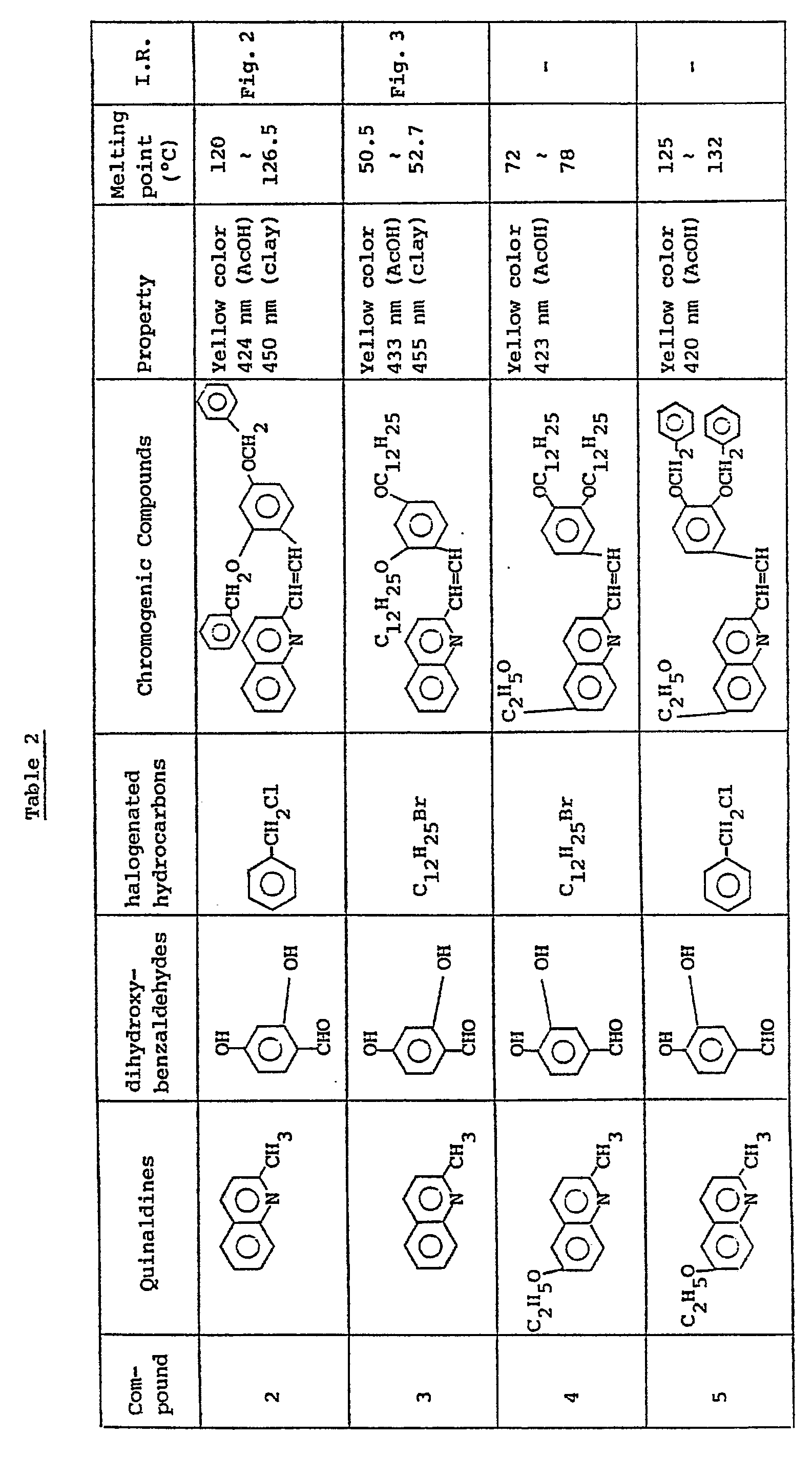
- Example II The same procedure as in Example I was repeated except that quinaldines, dihydroxybenzaldehydes, and halogenated hydrocarbons as shown in Table 2 were used, and chromogenic compounds as shown in Table 2 were obtained.
- microencapsulation of the chromogenic compound was performed as follows:
- Each of the upper paper samples was placed on clay coating paper (pressure-sensitive lower paper), with the microcapsules and the coated clay in contact with each other. Pressure was applied to the pressure-sensitive paper by rolling to effect color formation. The color density on the lower paper was measured with a reflection densitometer. The results are shown in Table 3. To evaluate the stability to light of the chromogenic compounds, the same procedure as above was repeated after the upper paper had been exposed to sunlight for 20 minutes or 40 minutes. The results are also shown in Table 3. The data are compared in percentage in parentheses. Also, the desensitization of the chromogenic compounds were measured by the aforementioned method. The results are also shown in Table 3.
- the chromogenic compounds of the present invention are comparable with that disclosed in GB-A 2 136 823 and are superior in desensitization to that disclosed in GB-A 2 136 823.
- the stability to light is greatly improved in the case of chromogenic compounds in which one of the substituent groups on the styryl group is at the ortho position, as in Examples 1, 2, 3, 7 and 8.
- Example 2 30 parts by weight of 1-(2,4-benzyloxyphenyl)-2-(2'-quinolyl)ethylene (obtained in Example 2) was crushed in 150 parts by weight of 10 % aqueous solution of polyvinyl alcohol and 65 parts by weight of water for I hour using a ball mill until the particle size was I to 3 ⁇ m. (The product was designated as component A.) Separately, 35 parts by weight of bisphenol A was crushed in 150 parts by weight of 10 % aqueous solution of polyvinyl alcohol and 65 parts by weight of water using a ball mill until the particle size was I to 3 ⁇ m.
- component B (The product was designated as component B.) 3 parts by weight of component A and 67 parts by weight of component B were mixed and the resulting mixture was applied to base paper at a coating weight of about 5 g/m 2 .
- the resulting heat-sensitive paper rapidly formed a yellow color upon heating with a thermal pen. The color image was stable to light and resistant to moisture.
Landscapes
- Chemical & Material Sciences (AREA)
- Organic Chemistry (AREA)
- Chemical Kinetics & Catalysis (AREA)
- General Chemical & Material Sciences (AREA)
- Physics & Mathematics (AREA)
- Optics & Photonics (AREA)
- Color Printing (AREA)
- Heat Sensitive Colour Forming Recording (AREA)
Description
- The present invention relates to a novel chromogenic compound, color developing composition containing the same suitable for recording paper, and pressure- or heat-sensitive recording paper coated with microcapsules containing the color developing composition.
- Heretofore, a variety of yellow color forming agents have been proposed and they are broadly classified into the following two groups.
- Group I: Those having a lactone ring in the molecule.
- (i) Fluoran derivatives such as 3,6-dialkoxyfluoran (refer to JP-B 454 698 [1970] and 4 616 053 [1971]) and 3-N-alkylaminofluoran (refer to JP-B 4 622 650 [1971] and 484 051 [1973]).
- (ii) Chromenopyrazole compounds (refer to JP-B 4 623 513 [1971]).
- (iii) Aminophthalide compounds (refer to JP-A 54 111 528 [1979]).
- (iv) Acyloxytetrachlorophthalide compounds (refer to JP-B 4 525 654 [19710]).
- Group II: Those having no lactone ring in the molecule.
- (i) Spiropyran derivatives (refer to JP-B 4 610 075 [1971] and 4 611 113 [1971]).
- (ii) Styryl compounds (refer to JP-B 4 121 033 [1966] and 5 127 169 [1976]).
- (iii) Pyridine derivatives (refer to JP-B 539 127 [1978]).
- (iv) Monomethine compounds (refer to JP-B 5 223 406 [1977] and JP-B 495 929 [1974]).
- (v) Benzopyran compounds (referto JP-B 5 619 274 [1981]).
- The compounds belonging to Group I which have a lactone ring in the molecule have an advantage of being less liable to spontaneous color formation in case of coating the solution thereof with a paper and being readily soluble in solvents. However, they also have a disadvantage of giving rise to a color image which is poor in color density and light-fastness.
- On the other hand, the compounds belonging to Group II which have no lactone ring in the molecule have an advantage of producing a color image which is good in color density and light-fastness. However, they also have a disadvantage of being poor in solubility, being liable to spontaneous color formation in case of contact with paper, and being readily lost by sublimation.
- Previously to the present invention, two of the present inventors as a part of inventors completed an invention relating to:
- (I) a chromogenic compound of the formula

- (2) a color forming composition for a recording material, comprising at least one chromogenic compound as defined above which is capable of developing a color upon contact with an electron acceptor; and
- (3) pressure- or heat-sensitive recording paper comprising microcapsules containing at least one chromogenic compound as defined above, said chromogenic compound functioning as a color former and being dissolved in an organic solvent in said microcapsules (refer to GB-A 2 136 823).
- the present inventors carried out studies for obtaining a new chromogenic compound which is easier to synthesize and more soluble than the ones disclosed in the previous publications mentioned above, and as a result, found compounds that are easy to synthesize, readily soluble, stable to light, and in addition, develop a color image of deep hue.
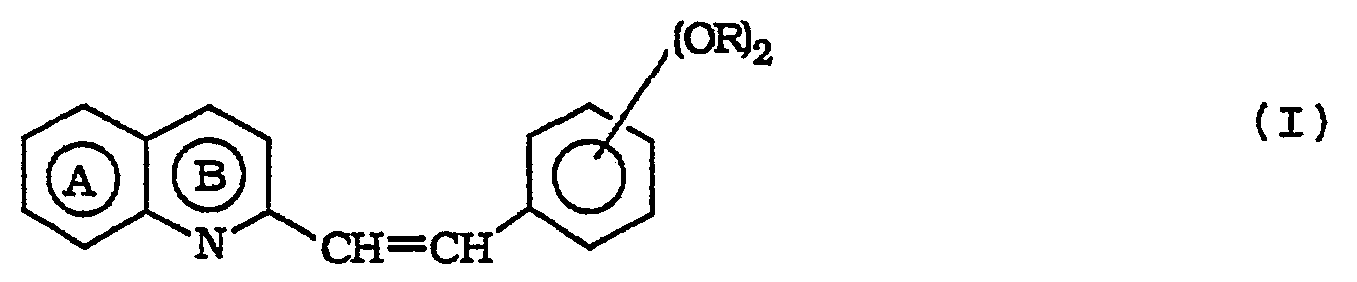
- in a first aspect of the present invention, there is provided a chromogenic compound represented by the formula (I):

- In a second aspect of the present invention, there are provided microcapsules suitable for use in the preparation of a pressure- or heat-sensitive recording paper, in which microcapsules there is encapsulated a solution of at least one chromogenic compound of formula (I) in an organic solvent therefor.
- In a third aspect of the present invention, there is provided a pressure- or heat-sensitive recording paper incorporating at least one chromogenic compound of formula (I) as color former.
- In a fourth aspect of the present invention there is provided the use as a color former for pressure-or heat-sensitive recording papers of at least one chromogenic compound of formula (I).
- Preferably R represents an alkyl group of 8 to 12 carbon atoms and/or one of the OR substituents is in the ortho-position with respect to the ethylenic bond and/or the substituent on the quinoline ring is a methyl or ethoxy group or a chlorine atom.
- Of the attached drawings, Figs 1 to 4 show the infrared absorption spectra of the chromogenic compounds respectively produced in Examples 1, 2, 3 and 6.
- Chromogenic compounds of the present invention have the following features. They have a lower melting point than that of the compound disclosed in GB-A 2 136 823 and are readily soluble in a cheap solvent among solvents used for pressure- or heat sensitive recording paper, if the hydrocarbon residue (R) in the formula (I) has 6 or more carbon atoms. In addition, they are more stable to light when in the form of solution. They produce a color image of deep hue, if one of the two -OR groups on the styryl group is at the ortho position with respect to the ethylenic bond.
- (Incidentally, a styryl quinoline compound in the form of solution gradually loses its color forming ability in proportion to the amount of light to which it is exposed, because the double bond of the styryl group contained therein undergoes chemical reactions (presumably dimerization) upon exposure to light). With the chromogenic compound of the present invention, this disadvantage is eliminated if one -OR group occupies the ortho position with respect to the ethylenic bond. Further, the chromogenic compounds of the present invention are readily desensitized by a desensitizing ink.
- The present invention also provides a process for the preparation of a chromogenic compound of formula (I), which process comprises condensing a quinaldine derivative of formula (II) wherein the quinoline ring is unsubstituted or substituted in the 6-position by a Ci-C4 alkoxy or a C1-C4 alkyl group or a halogen atom, with a substituted benzaldehyde of formula (III) wherein R is as defined above. The condensation is promoted by the presence of a dehydrating agent.

- Alternatively, the present invention provides a further process for the preparation of a chromogenic compound of formula (I), which process comprises condensing a quinaldine derivative of formula (II) with a dihydroxybenzaldehyde of formula (IV) and alkylating the dihydroxystyrylquinoline of formula (V) thus obtained, for example with an alkyl halide, so as to convert the two hydroxy groups into groups OR wherein R is as defined above.


- As compared with the first process, the second one is faster in condensation reaction and higher in yields.
- A chromogenic compound of the present invention is almost colorless but it rapidly changes into yellow upon contact with an electron acceptor. Therefore, it is useful as a color developing agent for pressure- or heat-sensitive recording paper (copying paper).
- A chromogenic compound of the present invention is superior to conventional yellow color developing agents in the following points.
- 1) It produces an image of higher color density, and it is stabler to light.
- 2) It is more soluble in organic solvents.
- 3) It is less liable to spontaneous color formation in case of coating the solution thereof with a paper.
- 4) It is less liable to loss by sublimation.
- 5) It is more easily desensitized with an antisensitive ink.
- s Table 1 shows, a chromogenic compound of the present invention is superior in color density of the image, light-fastness of the image, and desensitization to the comparative compounds disclosed in GB-A 2136823.

- A sheet of base paper is coated by doctor knife with a 3% solution of sample compound in KMC (alkylnaphthalene solvent for pressure-sensitive recording paper, made by Kureha Chemical Industry Co., Ltd., Japan) at a coating weight of 5 g/m2. With the coated paper placed on a color-developer sheet (clay-coated paper), pressure is applied by rolling to effect color formation. Thirty seconds after color formation, the color density is determined according to the amount of light absorbed by the color which is measured by using an integrating type spectrophotometer (Model UV-200, made by Shimadzu Sei- sakusho Ltd., Japan). (2) Desensitization
- At first, coated-front sheet (clay-coated paper) is coated with a desensitizing ink composed mainly of polypropylene glycol having an average molecular weight of about 3000 at a coating weight of 2 to 3 g/m2. On the other hand, coated-back sheet is prepared by coating with microcapsules containing 3 parts by weight of the chromogenic compound and 97 parts by weight of KMC (alkylnaphthalene solvent for pressure-sensitive recording paper, made by Kureha Chemical Industry Co., Ltd.) according to the method described in Example 9. With the coated-back sheet placed on the coated-front sheet, the microcapsules are broken by pressure rolling. Three days later, the color density on the coated-front sheet is determined in terms of Macbeth reflection density. For reference, the same procedure as above is repeated except that no desensitizing ink is used. Desensitization is expressed in relative value and the recording paper having the relative value of not more than 0.25 is used in practical.
- A chromogenic compound of the present invention can be encapsulated into microcapsules for pressure-sensitive recording paper by any known process. For example, microencapsulation by coacerva- tion as disclosed in US-A 2 806 457 and US-A 2 800 458 may be adopted. The other suitable process is disclosed in JP-B 4 514 039 (1970).
- The microcapsules containing a chromogenic compound of the present invention may be coated onto either a supporting paper or a paper coated with electron acceptor. In the former case two pieces of paper, one coated with microcapsules and the other coated with an electron acceptor, are required for color formation, and in the latter case the color formation is accomplished on a single piece of paper.
- Upon application of pressure in use of the pressure-sensitive recording paper, the microcapsules are broken and the chromogenic compound contained therein comes into contact with the adjacent electron acceptor to effect color formation. The electron acceptor may be on the same paper as for the microcapsules or on the paper separate from the one coated with the microcapsules.
- As an electron acceptor, organic acids, acid clay, activated clay, phenol-formaldehyde resin, metal salts of aromatic carboxylic acids, and aromatic hydroxy compounds such as bisphenol A may be exemplified.
- As a wall material of microcapsules, polyvinyl alcohol, polyacrylic acid, hydroxyethyl cellulose, methyl cellulose, carboxymethyl cellulose, polyacrylamide, polyvinyl pyrrolidone, gelatin, and starch may be exemplified.
- Preferable chromogenic compounds of the present invention are 1-(2,4-diocty)oxyphenyt)-2-(2'-quinolyl)ethylene,
- 1-(2,4-dibenzyloxyphenyl)-2-(2'-quinolyl)ethylene,
- 1-(2,4-didodecyloxyphenyl)-2-(2'-quinolyl)ethylene,
- 1-(4,5-didodecyloxyphenyl)-2-(6'-ethoxy-2'-quinolyl)ethylene,
- 1-(4,5-dibenzyloxyphenyl)-2-(6'-ethoxy-2'-quinolyl)ethylene,
- 1-(5,6-dioctyloxyphenyl)-2-(2'-quinolyl)ethylene
- 1-(2,4-dioctyloxyphenyl)-2-(6'-chloro-2'-quinolyl)ethylene, and
- 1-(2,4-dioctyloxyphenyl)-2-(6'-methyl-2'-quinolyl)ethylene.
- Most suitable among them is 1-(2,4-dioctyloxyphenyl)-2-(2'-quinolyl)ethylene.
- The chromogenic compound of the present invention is highly soluble, stable to light, capable of forming color images of deep hue, and readily desensitized.
- The present invention will be explained in more detail with reference to the following non-limitative examples.
- 14.3 g of quinaldine, 13.8 g of 2,4-dihydroxybenzaldehyde, and 30 ml of acetic anhydride were reacted under reflux for 2 hours. The reaction product was added to 200 ml of water. After stirring for a while, the resulting precipitates were filtered out, washed, and dried, and then 24 g of slightly yellowish crystals having a melting point of 126 to 133.5°C was obtained. This compound was identified as 1-(2,4-diace- toxyphenyl)-2-(2' -quinolyl)ethylene of the following structural formula.
-


- When dissolved in 95 % acetic acid, this compound gave the λmaxat 433 nm. A toluene solution of this compound was colorless, but it formed a color giving the λmax at 455 nm on the clay-coating paper of pressure-sensitive recording paper. This color was nearly orange.
- The results of elemental analysis were as follows:

- The infrared spectrum of Compound No. is shown in Fig. I.
- The same procedure as in Example I was repeated except that quinaldines, dihydroxybenzaldehydes, and halogenated hydrocarbons as shown in Table 2 were used, and chromogenic compounds as shown in Table 2 were obtained.
- All of them were colorless in toluene solution but formed a yellow color upon reaction with an eletron acceptor. The chromogenic compounds obtained in Examples 2 and 3 remarkably formed a color image of deep hue on the clay coating paper.


- Preparation of pressure-sensitive recording paper.
- The chromogenic compounds obtained in Examples 1 to 8 were used. For comparison, 2-(4-octyloxysty- ryl)quinoline (disclosed in GB-A 2 136 823) and 2-(3-methoxy-4-dodecyloxystyryl)quinoline were used.
- At first, the microencapsulation of the chromogenic compound was performed as follows:
- Six parts by weight of the chromogenic compound was dissolved in 94 parts by weight of isopropylbi- phenyl. Separately, 24 parts of gelatin and 24 parts of gum arabic were dissolved in 400 parts of water, and the resulting solution was adjusted to pH 7. The first solution was added to the second solution, and the mixture was emulsified with homogenizer. To this emulsion was added 1000 parts of hot water, followed by stirring at 50°C for 30 minutes. One part of 10% aqueous solution of sodium hydroxide was added, followed by stirring at 50°C for 30 minutes. Dilute acetic acid was slowly added to adjust the pH thereof to 4.5. Stirring was continued at 50°C for about 1 hour. The emulsion was cooled to 0 to 5°C and stirred for 30 minutes. 35 parts of 4% aqueous solution of glutaraldehyde was slowly added thereto thereby forming microcapsules. A dilute aqueous solution of sodium hydroxide was added to adjust the pH to 6. Stirring was continued at room temperature for several hours to complete microencapsulation. The microcapsule dispersion thus prepared was applied to paper, followed by drying, to obtain microcapsules coating paper (pressure-sensitive upper paper).
- Each of the upper paper samples was placed on clay coating paper (pressure-sensitive lower paper), with the microcapsules and the coated clay in contact with each other. Pressure was applied to the pressure-sensitive paper by rolling to effect color formation. The color density on the lower paper was measured with a reflection densitometer. The results are shown in Table 3. To evaluate the stability to light of the chromogenic compounds, the same procedure as above was repeated after the upper paper had been exposed to sunlight for 20 minutes or 40 minutes. The results are also shown in Table 3. The data are compared in percentage in parentheses. Also, the desensitization of the chromogenic compounds were measured by the aforementioned method. The results are also shown in Table 3.
- As seen from Table 3, the chromogenic compounds of the present invention are comparable with that disclosed in GB-A 2 136 823 and are superior in desensitization to that disclosed in GB-A 2 136 823. The stability to light is greatly improved in the case of chromogenic compounds in which one of the substituent groups on the styryl group is at the ortho position, as in Examples 1, 2, 3, 7 and 8.


- 30 parts by weight of 1-(2,4-benzyloxyphenyl)-2-(2'-quinolyl)ethylene (obtained in Example 2) was crushed in 150 parts by weight of 10 % aqueous solution of polyvinyl alcohol and 65 parts by weight of water for I hour using a ball mill until the particle size was I to 3 µm. (The product was designated as component A.) Separately, 35 parts by weight of bisphenol A was crushed in 150 parts by weight of 10 % aqueous solution of polyvinyl alcohol and 65 parts by weight of water using a ball mill until the particle size was I to 3 µm. (The product was designated as component B.) 3 parts by weight of component A and 67 parts by weight of component B were mixed and the resulting mixture was applied to base paper at a coating weight of about 5 g/m2. The resulting heat-sensitive paper rapidly formed a yellow color upon heating with a thermal pen. The color image was stable to light and resistant to moisture.
Claims (13)


Priority Applications (3)
| Application Number | Priority Date | Filing Date | Title |
|---|---|---|---|
| JP60031216A JPS61189988A (en) | 1986-08-11 | 1985-02-18 | Color developable recording material |
| DE8686306201T DE3667787D1 (en) | 1986-08-11 | 1986-08-11 | CHROMOGENIC COMPOUNDS FOR PRINT OR HEAT SENSITIVE RECORDS. |
| EP19860306201 EP0256180B1 (en) | 1986-08-11 | 1986-08-11 | Chromogenic compounds for pressure- or heat-sensitive recording papers |
Applications Claiming Priority (1)
| Application Number | Priority Date | Filing Date | Title |
|---|---|---|---|
| EP19860306201 EP0256180B1 (en) | 1986-08-11 | 1986-08-11 | Chromogenic compounds for pressure- or heat-sensitive recording papers |
Publications (2)
| Publication Number | Publication Date |
|---|---|
| EP0256180A1 EP0256180A1 (en) | 1988-02-24 |
| EP0256180B1 true EP0256180B1 (en) | 1989-12-27 |
Family
ID=8196092
Family Applications (1)
| Application Number | Title | Priority Date | Filing Date |
|---|---|---|---|
| EP19860306201 Expired EP0256180B1 (en) | 1986-08-11 | 1986-08-11 | Chromogenic compounds for pressure- or heat-sensitive recording papers |
Country Status (3)
| Country | Link |
|---|---|
| EP (1) | EP0256180B1 (en) |
| JP (1) | JPS61189988A (en) |
| DE (1) | DE3667787D1 (en) |
Families Citing this family (5)
| Publication number | Priority date | Publication date | Assignee | Title |
|---|---|---|---|---|
| DE3905339A1 (en) * | 1989-02-22 | 1990-09-06 | Basf Ag | CHINOLINE-4-CARBONATEURED DERIVATIVES AND THEIR USE |
| US5281541A (en) * | 1990-09-07 | 1994-01-25 | Canon Kabushiki Kaisha | Method for repairing an electrically short-circuited semiconductor device, and process for producing a semiconductor device utilizing said method |
| DE4039298A1 (en) * | 1990-12-10 | 1992-06-11 | Basf Ag | DERIVATIVES OF CHINOLINE CARBONIC ACIDS |
| GB9524185D0 (en) * | 1995-11-27 | 1996-01-31 | Leo Pharm Prod Ltd | Substituted diols |
| FR2761687B1 (en) * | 1997-04-08 | 2000-09-15 | Centre Nat Rech Scient | QUINOLEIN DERIVATIVES, ESPECIALLY HAVING ANTIVIRAL PROPERTIES, THEIR PREPARATIONS AND THEIR BIOLOGICAL APPLICATIONS |
Family Cites Families (3)
| Publication number | Priority date | Publication date | Assignee | Title |
|---|---|---|---|---|
| JPS584712B2 (en) * | 1979-07-04 | 1983-01-27 | 工業技術院長 | Nitrogen-containing heterocyclic compound having an acetal group and method for producing the same |
| DE3219239A1 (en) * | 1981-05-22 | 1982-12-09 | CIBA-GEIGY AG, 4002 Basel | Pressure- or heat-sensitive recording material |
| JPS59152891A (en) * | 1983-02-18 | 1984-08-31 | Yamada Kagaku Kogyo Kk | Color forming recording material |
-
1985
- 1985-02-18 JP JP60031216A patent/JPS61189988A/en active Granted
-
1986
- 1986-08-11 DE DE8686306201T patent/DE3667787D1/en not_active Expired - Lifetime
- 1986-08-11 EP EP19860306201 patent/EP0256180B1/en not_active Expired
Also Published As
| Publication number | Publication date |
|---|---|
| DE3667787D1 (en) | 1990-02-01 |
| JPH0428234B2 (en) | 1992-05-13 |
| JPS61189988A (en) | 1986-08-23 |
| EP0256180A1 (en) | 1988-02-24 |
Similar Documents
| Publication | Publication Date | Title |
|---|---|---|
| US4390616A (en) | Image recording members | |
| US4820841A (en) | Chromogenic quinoline compounds | |
| US4536220A (en) | Fluoran derivatives as new compounds and recording system utilizing the same as colorless chromogenic material | |
| JPS6016358B2 (en) | Pressure-sensitive or heat-sensitive recording material | |
| EP0256180A1 (en) | Chromogenic compounds for pressure- or heat-sensitive recording papers | |
| EP0356532B1 (en) | Pentadiene compound and recording material using the compound | |
| JPS6112952B2 (en) | ||
| JPS62243653A (en) | Divinyl compound and coloring record material using same | |
| CA1180332A (en) | 4-aryl or heteroaryl-2,6-bis[(substituted-amino)- phenyl]pyridines as color formers in pressure- sensitive and thermal imaging systems | |
| US4737587A (en) | Colorless carbazole dyes for recording materials | |
| JPH0156103B2 (en) | ||
| EP0115821B1 (en) | Fluoran compounds | |
| US4283077A (en) | Indole color former | |
| JPS625191B2 (en) | ||
| US4721702A (en) | Pressure-sensitive recording material | |
| JPH086045B2 (en) | Novel leuco dye and recording material using the same | |
| JP2938504B2 (en) | Coloring bis- (indolyl) ethylene compounds and recording materials using them | |
| US5143891A (en) | Divinyl carbinol or carbinol derivative chromogenic compounds and their use in record material | |
| JPS62243652A (en) | Divinyl compound and coloring record material using same | |
| JP2605073B2 (en) | Novel leuco dye and recording material using the same | |
| EP0561562B1 (en) | Heat-sensitive or pressure-sensitive recording material | |
| JPS6270081A (en) | Color forming recording material | |
| JP2844364B2 (en) | Novel fluoran compound, method for producing the same, and recording material using the compound | |
| US5206380A (en) | Divinyl carbinol or carbinol derivative chromogenic compounds | |
| JP2585675B2 (en) | Novel leuco dye and recording material using the same |
Legal Events
| Date | Code | Title | Description |
|---|---|---|---|
| PUAI | Public reference made under article 153(3) epc to a published international application that has entered the european phase |
Free format text: ORIGINAL CODE: 0009012 |
|
| AK | Designated contracting states |
Kind code of ref document: A1 Designated state(s): BE CH DE FR GB IT LI SE |
|
| 17P | Request for examination filed |
Effective date: 19880203 |
|
| 17Q | First examination report despatched |
Effective date: 19880506 |
|
| GRAA | (expected) grant |
Free format text: ORIGINAL CODE: 0009210 |
|
| AK | Designated contracting states |
Kind code of ref document: B1 Designated state(s): BE CH DE FR GB IT LI SE |
|
| PG25 | Lapsed in a contracting state [announced via postgrant information from national office to epo] |
Ref country code: SE Effective date: 19891227 |
|
| ITF | It: translation for a ep patent filed | ||
| REF | Corresponds to: |
Ref document number: 3667787 Country of ref document: DE Date of ref document: 19900201 |
|
| ET | Fr: translation filed | ||
| PLBE | No opposition filed within time limit |
Free format text: ORIGINAL CODE: 0009261 |
|
| STAA | Information on the status of an ep patent application or granted ep patent |
Free format text: STATUS: NO OPPOSITION FILED WITHIN TIME LIMIT |
|
| 26N | No opposition filed | ||
| ITTA | It: last paid annual fee | ||
| PGFP | Annual fee paid to national office [announced via postgrant information from national office to epo] |
Ref country code: FR Payment date: 19920807 Year of fee payment: 7 |
|
| PGFP | Annual fee paid to national office [announced via postgrant information from national office to epo] |
Ref country code: CH Payment date: 19920814 Year of fee payment: 7 |
|
| PGFP | Annual fee paid to national office [announced via postgrant information from national office to epo] |
Ref country code: DE Payment date: 19920824 Year of fee payment: 7 |
|
| PGFP | Annual fee paid to national office [announced via postgrant information from national office to epo] |
Ref country code: BE Payment date: 19920918 Year of fee payment: 7 |
|
| PG25 | Lapsed in a contracting state [announced via postgrant information from national office to epo] |
Ref country code: LI Effective date: 19930831 Ref country code: CH Effective date: 19930831 Ref country code: BE Effective date: 19930831 |
|
| BERE | Be: lapsed |
Owner name: YAMADA CHEMICAL CO. LTD Effective date: 19930831 |
|
| PG25 | Lapsed in a contracting state [announced via postgrant information from national office to epo] |
Ref country code: FR Effective date: 19940429 |
|
| REG | Reference to a national code |
Ref country code: CH Ref legal event code: PL |
|
| PG25 | Lapsed in a contracting state [announced via postgrant information from national office to epo] |
Ref country code: DE Effective date: 19940503 |
|
| REG | Reference to a national code |
Ref country code: FR Ref legal event code: ST |
|
| PGFP | Annual fee paid to national office [announced via postgrant information from national office to epo] |
Ref country code: GB Payment date: 20000809 Year of fee payment: 15 |
|
| PG25 | Lapsed in a contracting state [announced via postgrant information from national office to epo] |
Ref country code: GB Free format text: LAPSE BECAUSE OF NON-PAYMENT OF DUE FEES Effective date: 20010811 |
|
| GBPC | Gb: european patent ceased through non-payment of renewal fee |
Effective date: 20010811 |
|
| PG25 | Lapsed in a contracting state [announced via postgrant information from national office to epo] |
Ref country code: IT Free format text: LAPSE BECAUSE OF NON-PAYMENT OF DUE FEES;WARNING: LAPSES OF ITALIAN PATENTS WITH EFFECTIVE DATE BEFORE 2007 MAY HAVE OCCURRED AT ANY TIME BEFORE 2007. THE CORRECT EFFECTIVE DATE MAY BE DIFFERENT FROM THE ONE RECORDED. Effective date: 20050811 |