EP0255379B1 - Optically active alcohols, process for producing the same, and process for resolving the same - Google Patents
Optically active alcohols, process for producing the same, and process for resolving the same Download PDFInfo
- Publication number
- EP0255379B1 EP0255379B1 EP87306740A EP87306740A EP0255379B1 EP 0255379 B1 EP0255379 B1 EP 0255379B1 EP 87306740 A EP87306740 A EP 87306740A EP 87306740 A EP87306740 A EP 87306740A EP 0255379 B1 EP0255379 B1 EP 0255379B1
- Authority
- EP
- European Patent Office
- Prior art keywords
- compound
- optically active
- halogenated
- group
- general formula
- Prior art date
- Legal status (The legal status is an assumption and is not a legal conclusion. Google has not performed a legal analysis and makes no representation as to the accuracy of the status listed.)
- Expired - Lifetime
Links
- 238000000034 method Methods 0.000 title claims description 55
- 230000008569 process Effects 0.000 title claims description 46
- 150000001298 alcohols Chemical class 0.000 title description 15
- 150000001875 compounds Chemical class 0.000 claims description 187
- -1 cyclohexamethyl Chemical group 0.000 claims description 167
- XXROGKLTLUQVRX-UHFFFAOYSA-N allyl alcohol Chemical compound OCC=C XXROGKLTLUQVRX-UHFFFAOYSA-N 0.000 claims description 104
- 125000005843 halogen group Chemical group 0.000 claims description 35
- 230000003287 optical effect Effects 0.000 claims description 35
- 125000003808 silyl group Chemical group [H][Si]([H])([H])[*] 0.000 claims description 32
- 125000003638 stannyl group Chemical group [H][Sn]([H])([H])* 0.000 claims description 31
- 239000002904 solvent Substances 0.000 claims description 29
- 125000002496 methyl group Chemical group [H]C([H])([H])* 0.000 claims description 26
- CIHOLLKRGTVIJN-UHFFFAOYSA-N tert‐butyl hydroperoxide Chemical compound CC(C)(C)OO CIHOLLKRGTVIJN-UHFFFAOYSA-N 0.000 claims description 23
- VXUYXOFXAQZZMF-UHFFFAOYSA-N titanium(IV) isopropoxide Chemical compound CC(C)O[Ti](OC(C)C)(OC(C)C)OC(C)C VXUYXOFXAQZZMF-UHFFFAOYSA-N 0.000 claims description 21
- 150000005690 diesters Chemical class 0.000 claims description 20
- 125000001997 phenyl group Chemical group [H]C1=C([H])C([H])=C(*)C([H])=C1[H] 0.000 claims description 20
- LFQSCWFLJHTTHZ-UHFFFAOYSA-N Ethanol Chemical compound CCO LFQSCWFLJHTTHZ-UHFFFAOYSA-N 0.000 claims description 11
- 125000000740 n-pentyl group Chemical group [H]C([H])([H])C([H])([H])C([H])([H])C([H])([H])C([H])([H])* 0.000 claims description 11
- 239000010936 titanium Substances 0.000 claims description 11
- 229910052719 titanium Inorganic materials 0.000 claims description 11
- RTAQQCXQSZGOHL-UHFFFAOYSA-N Titanium Chemical compound [Ti] RTAQQCXQSZGOHL-UHFFFAOYSA-N 0.000 claims description 10
- XEBCWEDRGPSHQH-HTQZYQBOSA-N dipropan-2-yl (2r,3r)-2,3-dihydroxybutanedioate Chemical compound CC(C)OC(=O)[C@H](O)[C@@H](O)C(=O)OC(C)C XEBCWEDRGPSHQH-HTQZYQBOSA-N 0.000 claims description 10
- 125000001400 nonyl group Chemical group [H]C([*])([H])C([H])([H])C([H])([H])C([H])([H])C([H])([H])C([H])([H])C([H])([H])C([H])([H])C([H])([H])[H] 0.000 claims description 10
- 229920002554 vinyl polymer Polymers 0.000 claims description 10
- 125000000008 (C1-C10) alkyl group Chemical group 0.000 claims description 9
- MHAJPDPJQMAIIY-UHFFFAOYSA-N Hydrogen peroxide Chemical compound OO MHAJPDPJQMAIIY-UHFFFAOYSA-N 0.000 claims description 9
- 125000000391 vinyl group Chemical group [H]C([*])=C([H])[H] 0.000 claims description 9
- 125000002704 decyl group Chemical group [H]C([H])([H])C([H])([H])C([H])([H])C([H])([H])C([H])([H])C([H])([H])C([H])([H])C([H])([H])C([H])([H])C([H])([H])* 0.000 claims description 8
- 125000004108 n-butyl group Chemical group [H]C([H])([H])C([H])([H])C([H])([H])C([H])([H])* 0.000 claims description 8
- 125000004179 3-chlorophenyl group Chemical group [H]C1=C([H])C(*)=C([H])C(Cl)=C1[H] 0.000 claims description 6
- 125000004172 4-methoxyphenyl group Chemical group [H]C1=C([H])C(OC([H])([H])[H])=C([H])C([H])=C1* 0.000 claims description 6
- 125000000113 cyclohexyl group Chemical group [H]C1([H])C([H])([H])C([H])([H])C([H])(*)C([H])([H])C1([H])[H] 0.000 claims description 6
- 125000001511 cyclopentyl group Chemical group [H]C1([H])C([H])([H])C([H])([H])C([H])(*)C1([H])[H] 0.000 claims description 6
- 125000003700 epoxy group Chemical group 0.000 claims description 6
- HRDXJKGNWSUIBT-UHFFFAOYSA-N methoxybenzene Chemical group [CH2]OC1=CC=CC=C1 HRDXJKGNWSUIBT-UHFFFAOYSA-N 0.000 claims description 6
- 125000001037 p-tolyl group Chemical group [H]C1=C([H])C(=C([H])C([H])=C1*)C([H])([H])[H] 0.000 claims description 6
- 125000000094 2-phenylethyl group Chemical group [H]C1=C([H])C([H])=C(C([H])=C1[H])C([H])([H])C([H])([H])* 0.000 claims description 5
- 125000003187 heptyl group Chemical group [H]C([*])([H])C([H])([H])C([H])([H])C([H])([H])C([H])([H])C([H])([H])C([H])([H])[H] 0.000 claims description 4
- 125000004051 hexyl group Chemical group [H]C([H])([H])C([H])([H])C([H])([H])C([H])([H])C([H])([H])C([H])([H])* 0.000 claims description 4
- 125000002347 octyl group Chemical group [H]C([*])([H])C([H])([H])C([H])([H])C([H])([H])C([H])([H])C([H])([H])C([H])([H])C([H])([H])[H] 0.000 claims description 4
- 125000003229 2-methylhexyl group Chemical group [H]C([H])([H])C([H])([H])C([H])([H])C([H])([H])C([H])(C([H])([H])[H])C([H])([H])* 0.000 claims description 3
- UUUYXCLERBDLEO-UHFFFAOYSA-N 1-hydroperoxy-1-methylcyclohexane Chemical compound OOC1(C)CCCCC1 UUUYXCLERBDLEO-UHFFFAOYSA-N 0.000 claims description 2
- GRWPYGBKJYICOO-UHFFFAOYSA-N 2-methylpropan-2-olate;titanium(4+) Chemical compound [Ti+4].CC(C)(C)[O-].CC(C)(C)[O-].CC(C)(C)[O-].CC(C)(C)[O-] GRWPYGBKJYICOO-UHFFFAOYSA-N 0.000 claims description 2
- FRIBMENBGGCKPD-UHFFFAOYSA-N 3-(2,3-dimethoxyphenyl)prop-2-enal Chemical compound COC1=CC=CC(C=CC=O)=C1OC FRIBMENBGGCKPD-UHFFFAOYSA-N 0.000 claims description 2
- YHWCPXVTRSHPNY-UHFFFAOYSA-N butan-1-olate;titanium(4+) Chemical compound [Ti+4].CCCC[O-].CCCC[O-].CCCC[O-].CCCC[O-] YHWCPXVTRSHPNY-UHFFFAOYSA-N 0.000 claims description 2
- YSAVZVORKRDODB-PHDIDXHHSA-N diethyl (2r,3r)-2,3-dihydroxybutanedioate Chemical compound CCOC(=O)[C@H](O)[C@@H](O)C(=O)OCC YSAVZVORKRDODB-PHDIDXHHSA-N 0.000 claims description 2
- PVRATXCXJDHJJN-QWWZWVQMSA-N dimethyl (2r,3r)-2,3-dihydroxybutanedioate Chemical compound COC(=O)[C@H](O)[C@@H](O)C(=O)OC PVRATXCXJDHJJN-QWWZWVQMSA-N 0.000 claims description 2
- RYGCHSSZXHQCEJ-XPSQVAKYSA-N dioctadecyl (2r,3r)-2,3-dihydroxybutanedioate Chemical compound CCCCCCCCCCCCCCCCCCOC(=O)[C@H](O)[C@@H](O)C(=O)OCCCCCCCCCCCCCCCCCC RYGCHSSZXHQCEJ-XPSQVAKYSA-N 0.000 claims description 2
- BSXLMILMINXRSK-ZIAGYGMSSA-N diphenyl (2r,3r)-2,3-dihydroxybutanedioate Chemical compound O=C([C@H](O)[C@@H](O)C(=O)OC=1C=CC=CC=1)OC1=CC=CC=C1 BSXLMILMINXRSK-ZIAGYGMSSA-N 0.000 claims description 2
- 150000008282 halocarbons Chemical group 0.000 claims description 2
- FGGJBCRKSVGDPO-UHFFFAOYSA-N hydroperoxycyclohexane Chemical compound OOC1CCCCC1 FGGJBCRKSVGDPO-UHFFFAOYSA-N 0.000 claims description 2
- HKJYVRJHDIPMQB-UHFFFAOYSA-N propan-1-olate;titanium(4+) Chemical compound CCCO[Ti](OCCC)(OCCC)OCCC HKJYVRJHDIPMQB-UHFFFAOYSA-N 0.000 claims description 2
- DFBVSGINCDTAIX-UHFFFAOYSA-N [O-]CC.[O-]CC.[O-]CC.[O-]CC.[Ti+4].C[O-].C[O-].C[O-].C[O-].[Ti+4] Chemical compound [O-]CC.[O-]CC.[O-]CC.[O-]CC.[Ti+4].C[O-].C[O-].C[O-].C[O-].[Ti+4] DFBVSGINCDTAIX-UHFFFAOYSA-N 0.000 claims 1
- 230000001590 oxidative effect Effects 0.000 claims 1
- YMWUJEATGCHHMB-UHFFFAOYSA-N Dichloromethane Chemical compound ClCCl YMWUJEATGCHHMB-UHFFFAOYSA-N 0.000 description 81
- VLKZOEOYAKHREP-UHFFFAOYSA-N n-Hexane Chemical compound CCCCCC VLKZOEOYAKHREP-UHFFFAOYSA-N 0.000 description 81
- 239000000243 solution Substances 0.000 description 81
- RTZKZFJDLAIYFH-UHFFFAOYSA-N Diethyl ether Chemical compound CCOCC RTZKZFJDLAIYFH-UHFFFAOYSA-N 0.000 description 70
- VZGDMQKNWNREIO-UHFFFAOYSA-N tetrachloromethane Chemical compound ClC(Cl)(Cl)Cl VZGDMQKNWNREIO-UHFFFAOYSA-N 0.000 description 70
- 238000006243 chemical reaction Methods 0.000 description 66
- HEDRZPFGACZZDS-UHFFFAOYSA-N Chloroform Chemical compound ClC(Cl)Cl HEDRZPFGACZZDS-UHFFFAOYSA-N 0.000 description 56
- HEDRZPFGACZZDS-MICDWDOJSA-N Trichloro(2H)methane Chemical compound [2H]C(Cl)(Cl)Cl HEDRZPFGACZZDS-MICDWDOJSA-N 0.000 description 56
- 238000005160 1H NMR spectroscopy Methods 0.000 description 53
- 238000003756 stirring Methods 0.000 description 48
- OKKJLVBELUTLKV-UHFFFAOYSA-N Methanol Chemical compound OC OKKJLVBELUTLKV-UHFFFAOYSA-N 0.000 description 42
- 239000012043 crude product Substances 0.000 description 38
- CSNNHWWHGAXBCP-UHFFFAOYSA-L Magnesium sulfate Chemical compound [Mg+2].[O-][S+2]([O-])([O-])[O-] CSNNHWWHGAXBCP-UHFFFAOYSA-L 0.000 description 30
- 238000004458 analytical method Methods 0.000 description 29
- 239000007864 aqueous solution Substances 0.000 description 27
- WYURNTSHIVDZCO-UHFFFAOYSA-N Tetrahydrofuran Chemical compound C1CCOC1 WYURNTSHIVDZCO-UHFFFAOYSA-N 0.000 description 24
- JSPLKZUTYZBBKA-UHFFFAOYSA-N trioxidane Chemical compound OOO JSPLKZUTYZBBKA-UHFFFAOYSA-N 0.000 description 24
- 125000002485 formyl group Chemical group [H]C(*)=O 0.000 description 23
- 238000001644 13C nuclear magnetic resonance spectroscopy Methods 0.000 description 21
- 239000000706 filtrate Substances 0.000 description 21
- 239000012044 organic layer Substances 0.000 description 21
- 238000010898 silica gel chromatography Methods 0.000 description 21
- 238000003786 synthesis reaction Methods 0.000 description 20
- CZDYPVPMEAXLPK-UHFFFAOYSA-N tetramethylsilane Chemical compound C[Si](C)(C)C CZDYPVPMEAXLPK-UHFFFAOYSA-N 0.000 description 20
- 230000015572 biosynthetic process Effects 0.000 description 18
- 150000004808 allyl alcohols Chemical class 0.000 description 17
- QMMFVYPAHWMCMS-UHFFFAOYSA-N Dimethyl sulfide Chemical compound CSC QMMFVYPAHWMCMS-UHFFFAOYSA-N 0.000 description 15
- XLYOFNOQVPJJNP-ZSJDYOACSA-N Heavy water Chemical compound [2H]O[2H] XLYOFNOQVPJJNP-ZSJDYOACSA-N 0.000 description 15
- 229910052943 magnesium sulfate Inorganic materials 0.000 description 15
- 235000019341 magnesium sulphate Nutrition 0.000 description 15
- 239000000203 mixture Substances 0.000 description 14
- 229920006395 saturated elastomer Polymers 0.000 description 14
- 0 *C(*)[C@]1O[C@@]1N Chemical compound *C(*)[C@]1O[C@@]1N 0.000 description 12
- UIIMBOGNXHQVGW-UHFFFAOYSA-M Sodium bicarbonate Chemical compound [Na+].OC([O-])=O UIIMBOGNXHQVGW-UHFFFAOYSA-M 0.000 description 12
- YLQBMQCUIZJEEH-UHFFFAOYSA-N tetrahydrofuran Natural products C=1C=COC=1 YLQBMQCUIZJEEH-UHFFFAOYSA-N 0.000 description 12
- 239000007795 chemical reaction product Substances 0.000 description 10
- 239000012230 colorless oil Substances 0.000 description 10
- 239000002994 raw material Substances 0.000 description 10
- 230000035484 reaction time Effects 0.000 description 10
- PUZPDOWCWNUUKD-UHFFFAOYSA-M sodium fluoride Chemical compound [F-].[Na+] PUZPDOWCWNUUKD-UHFFFAOYSA-M 0.000 description 10
- VYPSYNLAJGMNEJ-UHFFFAOYSA-N Silicium dioxide Chemical compound O=[Si]=O VYPSYNLAJGMNEJ-UHFFFAOYSA-N 0.000 description 9
- 239000012295 chemical reaction liquid Substances 0.000 description 9
- 239000004593 Epoxy Substances 0.000 description 7
- 239000000758 substrate Substances 0.000 description 7
- DCERHCFNWRGHLK-UHFFFAOYSA-N C[Si](C)C Chemical compound C[Si](C)C DCERHCFNWRGHLK-UHFFFAOYSA-N 0.000 description 6
- WSFSSNUMVMOOMR-UHFFFAOYSA-N Formaldehyde Chemical compound O=C WSFSSNUMVMOOMR-UHFFFAOYSA-N 0.000 description 6
- FEWJPZIEWOKRBE-UHFFFAOYSA-N Tartaric acid Natural products [H+].[H+].[O-]C(=O)C(O)C(O)C([O-])=O FEWJPZIEWOKRBE-UHFFFAOYSA-N 0.000 description 6
- FJKIXWOMBXYWOQ-UHFFFAOYSA-N ethenoxyethane Chemical compound CCOC=C FJKIXWOMBXYWOQ-UHFFFAOYSA-N 0.000 description 6
- 125000002887 hydroxy group Chemical group [H]O* 0.000 description 6
- 235000017557 sodium bicarbonate Nutrition 0.000 description 6
- 229910000030 sodium bicarbonate Inorganic materials 0.000 description 6
- 235000002906 tartaric acid Nutrition 0.000 description 6
- 239000011975 tartaric acid Substances 0.000 description 6
- NLXLAEXVIDQMFP-UHFFFAOYSA-N Ammonia chloride Chemical compound [NH4+].[Cl-] NLXLAEXVIDQMFP-UHFFFAOYSA-N 0.000 description 5
- 238000004566 IR spectroscopy Methods 0.000 description 5
- 239000007832 Na2SO4 Substances 0.000 description 5
- PMZURENOXWZQFD-UHFFFAOYSA-L Sodium Sulfate Chemical compound [Na+].[Na+].[O-]S([O-])(=O)=O PMZURENOXWZQFD-UHFFFAOYSA-L 0.000 description 5
- 235000019270 ammonium chloride Nutrition 0.000 description 5
- 150000002148 esters Chemical class 0.000 description 5
- 125000001495 ethyl group Chemical group [H]C([H])([H])C([H])([H])* 0.000 description 5
- 230000009467 reduction Effects 0.000 description 5
- 235000013024 sodium fluoride Nutrition 0.000 description 5
- 239000011775 sodium fluoride Substances 0.000 description 5
- 229910052938 sodium sulfate Inorganic materials 0.000 description 5
- 235000011152 sodium sulphate Nutrition 0.000 description 5
- XLYOFNOQVPJJNP-UHFFFAOYSA-N water Substances O XLYOFNOQVPJJNP-UHFFFAOYSA-N 0.000 description 5
- 150000000185 1,3-diols Chemical class 0.000 description 4
- VHUUQVKOLVNVRT-UHFFFAOYSA-N Ammonium hydroxide Chemical compound [NH4+].[OH-] VHUUQVKOLVNVRT-UHFFFAOYSA-N 0.000 description 4
- 238000005481 NMR spectroscopy Methods 0.000 description 4
- 235000011114 ammonium hydroxide Nutrition 0.000 description 4
- 125000003118 aryl group Chemical group 0.000 description 4
- 230000003197 catalytic effect Effects 0.000 description 4
- 239000003153 chemical reaction reagent Substances 0.000 description 4
- 238000003379 elimination reaction Methods 0.000 description 4
- 235000019256 formaldehyde Nutrition 0.000 description 4
- 125000001449 isopropyl group Chemical group [H]C([H])([H])C([H])(*)C([H])([H])[H] 0.000 description 4
- XBEREOHJDYAKDA-UHFFFAOYSA-N lithium;propane Chemical compound [Li+].CC[CH2-] XBEREOHJDYAKDA-UHFFFAOYSA-N 0.000 description 4
- 239000002244 precipitate Substances 0.000 description 4
- FPGGTKZVZWFYPV-UHFFFAOYSA-M tetrabutylammonium fluoride Chemical compound [F-].CCCC[N+](CCCC)(CCCC)CCCC FPGGTKZVZWFYPV-UHFFFAOYSA-M 0.000 description 4
- NKUJXLLJYFGACA-UHFFFAOYSA-N 2,3-dihydroxy-2,3-di(propan-2-yl)butanedioic acid Chemical compound CC(C)C(O)(C(O)=O)C(O)(C(C)C)C(O)=O NKUJXLLJYFGACA-UHFFFAOYSA-N 0.000 description 3
- WFDIJRYMOXRFFG-UHFFFAOYSA-N Acetic anhydride Chemical compound CC(=O)OC(C)=O WFDIJRYMOXRFFG-UHFFFAOYSA-N 0.000 description 3
- FAPWRFPIFSIZLT-UHFFFAOYSA-M Sodium chloride Chemical compound [Na+].[Cl-] FAPWRFPIFSIZLT-UHFFFAOYSA-M 0.000 description 3
- ATJFFYVFTNAWJD-UHFFFAOYSA-N Tin Chemical group [Sn] ATJFFYVFTNAWJD-UHFFFAOYSA-N 0.000 description 3
- ZMANZCXQSJIPKH-UHFFFAOYSA-N Triethylamine Chemical compound CCN(CC)CC ZMANZCXQSJIPKH-UHFFFAOYSA-N 0.000 description 3
- 239000012300 argon atmosphere Substances 0.000 description 3
- 125000004429 atom Chemical group 0.000 description 3
- LSXDOTMGLUJQCM-UHFFFAOYSA-M copper(i) iodide Chemical compound I[Cu] LSXDOTMGLUJQCM-UHFFFAOYSA-M 0.000 description 3
- 238000006735 epoxidation reaction Methods 0.000 description 3
- 239000000284 extract Substances 0.000 description 3
- 238000001914 filtration Methods 0.000 description 3
- 229910052736 halogen Inorganic materials 0.000 description 3
- 125000000959 isobutyl group Chemical group [H]C([H])([H])C([H])(C([H])([H])[H])C([H])([H])* 0.000 description 3
- 239000010410 layer Substances 0.000 description 3
- 238000004519 manufacturing process Methods 0.000 description 3
- 238000007254 oxidation reaction Methods 0.000 description 3
- 125000001501 propionyl group Chemical group O=C([*])C([H])([H])C([H])([H])[H] 0.000 description 3
- 239000000741 silica gel Substances 0.000 description 3
- 229910002027 silica gel Inorganic materials 0.000 description 3
- 229910052710 silicon Inorganic materials 0.000 description 3
- 239000010703 silicon Substances 0.000 description 3
- DPKBAXPHAYBPRL-UHFFFAOYSA-M tetrabutylazanium;iodide Chemical compound [I-].CCCC[N+](CCCC)(CCCC)CCCC DPKBAXPHAYBPRL-UHFFFAOYSA-M 0.000 description 3
- 229910052718 tin Inorganic materials 0.000 description 3
- JOXIMZWYDAKGHI-UHFFFAOYSA-N toluene-4-sulfonic acid Chemical compound CC1=CC=C(S(O)(=O)=O)C=C1 JOXIMZWYDAKGHI-UHFFFAOYSA-N 0.000 description 3
- 238000005406 washing Methods 0.000 description 3
- 150000000180 1,2-diols Chemical class 0.000 description 2
- ZCYVEMRRCGMTRW-UHFFFAOYSA-N 7553-56-2 Chemical group [I] ZCYVEMRRCGMTRW-UHFFFAOYSA-N 0.000 description 2
- WKBOTKDWSSQWDR-UHFFFAOYSA-N Bromine atom Chemical group [Br] WKBOTKDWSSQWDR-UHFFFAOYSA-N 0.000 description 2
- OFBQJSOFQDEBGM-UHFFFAOYSA-N Pentane Chemical compound CCCCC OFBQJSOFQDEBGM-UHFFFAOYSA-N 0.000 description 2
- JUJWROOIHBZHMG-UHFFFAOYSA-N Pyridine Chemical compound C1=CC=NC=C1 JUJWROOIHBZHMG-UHFFFAOYSA-N 0.000 description 2
- 229910007161 Si(CH3)3 Inorganic materials 0.000 description 2
- QAOWNCQODCNURD-UHFFFAOYSA-N Sulfuric acid Chemical compound OS(O)(=O)=O QAOWNCQODCNURD-UHFFFAOYSA-N 0.000 description 2
- ZVQOOHYFBIDMTQ-UHFFFAOYSA-N [methyl(oxido){1-[6-(trifluoromethyl)pyridin-3-yl]ethyl}-lambda(6)-sulfanylidene]cyanamide Chemical compound N#CN=S(C)(=O)C(C)C1=CC=C(C(F)(F)F)N=C1 ZVQOOHYFBIDMTQ-UHFFFAOYSA-N 0.000 description 2
- 239000013543 active substance Substances 0.000 description 2
- 125000002015 acyclic group Chemical group 0.000 description 2
- 125000000217 alkyl group Chemical group 0.000 description 2
- 125000001797 benzyl group Chemical group [H]C1=C([H])C([H])=C(C([H])=C1[H])C([H])([H])* 0.000 description 2
- 238000001816 cooling Methods 0.000 description 2
- 239000013078 crystal Substances 0.000 description 2
- 238000009795 derivation Methods 0.000 description 2
- XEBCWEDRGPSHQH-YUMQZZPRSA-N dipropan-2-yl (2s,3s)-2,3-dihydroxybutanedioate Chemical compound CC(C)OC(=O)[C@@H](O)[C@H](O)C(=O)OC(C)C XEBCWEDRGPSHQH-YUMQZZPRSA-N 0.000 description 2
- DLLJVQNYBYOKGS-UHFFFAOYSA-N ethoxyethane;pentane Chemical compound CCCCC.CCOCC DLLJVQNYBYOKGS-UHFFFAOYSA-N 0.000 description 2
- 150000002367 halogens Chemical class 0.000 description 2
- JARKCYVAAOWBJS-UHFFFAOYSA-N hexanal Chemical compound CCCCCC=O JARKCYVAAOWBJS-UHFFFAOYSA-N 0.000 description 2
- 238000005984 hydrogenation reaction Methods 0.000 description 2
- 229910052740 iodine Inorganic materials 0.000 description 2
- 229910001623 magnesium bromide Inorganic materials 0.000 description 2
- UGVPKMAWLOMPRS-UHFFFAOYSA-M magnesium;propane;bromide Chemical compound [Mg+2].[Br-].CC[CH2-] UGVPKMAWLOMPRS-UHFFFAOYSA-M 0.000 description 2
- DVSDBMFJEQPWNO-UHFFFAOYSA-N methyllithium Chemical compound C[Li] DVSDBMFJEQPWNO-UHFFFAOYSA-N 0.000 description 2
- 230000004048 modification Effects 0.000 description 2
- 238000012986 modification Methods 0.000 description 2
- 239000002808 molecular sieve Substances 0.000 description 2
- JJYKJUXBWFATTE-UHFFFAOYSA-N mosher's acid Chemical compound COC(C(O)=O)(C(F)(F)F)C1=CC=CC=C1 JJYKJUXBWFATTE-UHFFFAOYSA-N 0.000 description 2
- 125000004123 n-propyl group Chemical group [H]C([H])([H])C([H])([H])C([H])([H])* 0.000 description 2
- 239000007800 oxidant agent Substances 0.000 description 2
- 150000002978 peroxides Chemical class 0.000 description 2
- NTTOTNSKUYCDAV-UHFFFAOYSA-N potassium hydride Chemical compound [KH] NTTOTNSKUYCDAV-UHFFFAOYSA-N 0.000 description 2
- 229910000105 potassium hydride Inorganic materials 0.000 description 2
- 239000000047 product Substances 0.000 description 2
- 150000003180 prostaglandins Chemical class 0.000 description 2
- 239000011541 reaction mixture Substances 0.000 description 2
- 230000004044 response Effects 0.000 description 2
- URGAHOPLAPQHLN-UHFFFAOYSA-N sodium aluminosilicate Chemical compound [Na+].[Al+3].[O-][Si]([O-])=O.[O-][Si]([O-])=O URGAHOPLAPQHLN-UHFFFAOYSA-N 0.000 description 2
- AKHNMLFCWUSKQB-UHFFFAOYSA-L sodium thiosulfate Chemical compound [Na+].[Na+].[O-]S([O-])(=O)=S AKHNMLFCWUSKQB-UHFFFAOYSA-L 0.000 description 2
- 235000019345 sodium thiosulphate Nutrition 0.000 description 2
- 239000000126 substance Substances 0.000 description 2
- 229910052717 sulfur Inorganic materials 0.000 description 2
- 125000004434 sulfur atom Chemical group 0.000 description 2
- 235000011149 sulphuric acid Nutrition 0.000 description 2
- 239000000725 suspension Substances 0.000 description 2
- 230000002194 synthesizing effect Effects 0.000 description 2
- 125000000999 tert-butyl group Chemical group [H]C([H])([H])C(*)(C([H])([H])[H])C([H])([H])[H] 0.000 description 2
- 238000004809 thin layer chromatography Methods 0.000 description 2
- 125000005287 vanadyl group Chemical group 0.000 description 2
- YONXEBYXWVCXIV-HLTSFMKQSA-N (1r,5s,7r)-7-ethyl-5-methyl-6,8-dioxabicyclo[3.2.1]octane Chemical compound C1CC[C@@H]2[C@@H](CC)O[C@@]1(C)O2 YONXEBYXWVCXIV-HLTSFMKQSA-N 0.000 description 1
- FSJSYDFBTIVUFD-SUKNRPLKSA-N (z)-4-hydroxypent-3-en-2-one;oxovanadium Chemical compound [V]=O.C\C(O)=C\C(C)=O.C\C(O)=C\C(C)=O FSJSYDFBTIVUFD-SUKNRPLKSA-N 0.000 description 1
- SCYULBFZEHDVBN-UHFFFAOYSA-N 1,1-Dichloroethane Chemical compound CC(Cl)Cl SCYULBFZEHDVBN-UHFFFAOYSA-N 0.000 description 1
- DVWQNBIUTWDZMW-UHFFFAOYSA-N 1-naphthalen-1-ylnaphthalen-2-ol Chemical compound C1=CC=C2C(C3=C4C=CC=CC4=CC=C3O)=CC=CC2=C1 DVWQNBIUTWDZMW-UHFFFAOYSA-N 0.000 description 1
- 125000003903 2-propenyl group Chemical group [H]C([*])([H])C([H])=C([H])[H] 0.000 description 1
- CSDQQAQKBAQLLE-UHFFFAOYSA-N 4-(4-chlorophenyl)-4,5,6,7-tetrahydrothieno[3,2-c]pyridine Chemical compound C1=CC(Cl)=CC=C1C1C(C=CS2)=C2CCN1 CSDQQAQKBAQLLE-UHFFFAOYSA-N 0.000 description 1
- ZVBUOEJURSBICL-IUYQGCFVSA-N C=[O]C[C@@H]1O[C@H]1N Chemical compound C=[O]C[C@@H]1O[C@H]1N ZVBUOEJURSBICL-IUYQGCFVSA-N 0.000 description 1
- LWEDGJFVECXNTO-LMVFSUKVSA-N C[C@@H]([C@H]([C@@H]1P)[O]1#C)N Chemical compound C[C@@H]([C@H]([C@@H]1P)[O]1#C)N LWEDGJFVECXNTO-LMVFSUKVSA-N 0.000 description 1
- 102000004190 Enzymes Human genes 0.000 description 1
- 108090000790 Enzymes Proteins 0.000 description 1
- 241000238631 Hexapoda Species 0.000 description 1
- WHXSMMKQMYFTQS-UHFFFAOYSA-N Lithium Chemical compound [Li] WHXSMMKQMYFTQS-UHFFFAOYSA-N 0.000 description 1
- 238000005598 Sharpless reaction Methods 0.000 description 1
- 229910020175 SiOH Inorganic materials 0.000 description 1
- XUIMIQQOPSSXEZ-UHFFFAOYSA-N Silicon Chemical compound [Si] XUIMIQQOPSSXEZ-UHFFFAOYSA-N 0.000 description 1
- GSEJCLTVZPLZKY-UHFFFAOYSA-N Triethanolamine Chemical compound OCCN(CCO)CCO GSEJCLTVZPLZKY-UHFFFAOYSA-N 0.000 description 1
- 125000002777 acetyl group Chemical group [H]C([H])([H])C(*)=O 0.000 description 1
- 239000002253 acid Substances 0.000 description 1
- 230000002378 acidificating effect Effects 0.000 description 1
- 150000001299 aldehydes Chemical class 0.000 description 1
- 150000001336 alkenes Chemical class 0.000 description 1
- HSFWRNGVRCDJHI-UHFFFAOYSA-N alpha-acetylene Natural products C#C HSFWRNGVRCDJHI-UHFFFAOYSA-N 0.000 description 1
- 239000012298 atmosphere Substances 0.000 description 1
- 230000008901 benefit Effects 0.000 description 1
- 125000000484 butyl group Chemical group [H]C([*])([H])C([H])([H])C([H])([H])C([H])([H])[H] 0.000 description 1
- 125000004432 carbon atom Chemical group C* 0.000 description 1
- 230000008859 change Effects 0.000 description 1
- 239000007810 chemical reaction solvent Substances 0.000 description 1
- 229910052801 chlorine Inorganic materials 0.000 description 1
- 125000001309 chloro group Chemical group Cl* 0.000 description 1
- AENCLWKVWIIOQH-UHFFFAOYSA-K cyclopentane;trichlorotitanium Chemical compound Cl[Ti](Cl)Cl.[CH]1C=CC=C1 AENCLWKVWIIOQH-UHFFFAOYSA-K 0.000 description 1
- ITWOKJQQGHCDBL-HTQZYQBOSA-N ditert-butyl (2r,3r)-2,3-dihydroxybutanedioate Chemical compound CC(C)(C)OC(=O)[C@H](O)[C@@H](O)C(=O)OC(C)(C)C ITWOKJQQGHCDBL-HTQZYQBOSA-N 0.000 description 1
- 229940079593 drug Drugs 0.000 description 1
- 239000003814 drug Substances 0.000 description 1
- 238000000921 elemental analysis Methods 0.000 description 1
- ZKQFHRVKCYFVCN-UHFFFAOYSA-N ethoxyethane;hexane Chemical compound CCOCC.CCCCCC ZKQFHRVKCYFVCN-UHFFFAOYSA-N 0.000 description 1
- 238000000605 extraction Methods 0.000 description 1
- 230000026030 halogenation Effects 0.000 description 1
- 238000005658 halogenation reaction Methods 0.000 description 1
- 125000005842 heteroatom Chemical group 0.000 description 1
- 239000002035 hexane extract Substances 0.000 description 1
- 239000012442 inert solvent Substances 0.000 description 1
- PNDPGZBMCMUPRI-UHFFFAOYSA-N iodine Chemical compound II PNDPGZBMCMUPRI-UHFFFAOYSA-N 0.000 description 1
- 150000002576 ketones Chemical class 0.000 description 1
- 229910052744 lithium Inorganic materials 0.000 description 1
- OTCKOJUMXQWKQG-UHFFFAOYSA-L magnesium bromide Chemical compound [Mg+2].[Br-].[Br-] OTCKOJUMXQWKQG-UHFFFAOYSA-L 0.000 description 1
- XDKQUSKHRIUJEO-UHFFFAOYSA-N magnesium;ethanolate Chemical compound [Mg+2].CC[O-].CC[O-] XDKQUSKHRIUJEO-UHFFFAOYSA-N 0.000 description 1
- 230000001404 mediated effect Effects 0.000 description 1
- 229910052751 metal Inorganic materials 0.000 description 1
- 239000002184 metal Substances 0.000 description 1
- ITNVWQNWHXEMNS-UHFFFAOYSA-N methanolate;titanium(4+) Chemical compound [Ti+4].[O-]C.[O-]C.[O-]C.[O-]C ITNVWQNWHXEMNS-UHFFFAOYSA-N 0.000 description 1
- 238000012544 monitoring process Methods 0.000 description 1
- 150000002772 monosaccharides Chemical class 0.000 description 1
- 239000012434 nucleophilic reagent Substances 0.000 description 1
- 230000003647 oxidation Effects 0.000 description 1
- 229940094443 oxytocics prostaglandins Drugs 0.000 description 1
- 239000003016 pheromone Substances 0.000 description 1
- 230000002035 prolonged effect Effects 0.000 description 1
- DNAJDTIOMGISDS-UHFFFAOYSA-N prop-2-enylsilane Chemical compound [SiH3]CC=C DNAJDTIOMGISDS-UHFFFAOYSA-N 0.000 description 1
- 238000000746 purification Methods 0.000 description 1
- UMJSCPRVCHMLSP-UHFFFAOYSA-N pyridine Natural products COC1=CC=CN=C1 UMJSCPRVCHMLSP-UHFFFAOYSA-N 0.000 description 1
- ZDYVRSLAEXCVBX-UHFFFAOYSA-N pyridinium p-toluenesulfonate Chemical compound C1=CC=[NH+]C=C1.CC1=CC=C(S([O-])(=O)=O)C=C1 ZDYVRSLAEXCVBX-UHFFFAOYSA-N 0.000 description 1
- 239000000376 reactant Substances 0.000 description 1
- 230000001105 regulatory effect Effects 0.000 description 1
- 150000003333 secondary alcohols Chemical class 0.000 description 1
- 238000000926 separation method Methods 0.000 description 1
- 239000011780 sodium chloride Substances 0.000 description 1
- 239000007858 starting material Substances 0.000 description 1
- 230000000707 stereoselective effect Effects 0.000 description 1
- YBBRCQOCSYXUOC-UHFFFAOYSA-N sulfuryl dichloride Chemical compound ClS(Cl)(=O)=O YBBRCQOCSYXUOC-UHFFFAOYSA-N 0.000 description 1
- JMXKSZRRTHPKDL-UHFFFAOYSA-N titanium ethoxide Chemical compound [Ti+4].CC[O-].CC[O-].CC[O-].CC[O-] JMXKSZRRTHPKDL-UHFFFAOYSA-N 0.000 description 1
- DBGVGMSCBYYSLD-UHFFFAOYSA-N tributylstannane Chemical compound CCCC[SnH](CCCC)CCCC DBGVGMSCBYYSLD-UHFFFAOYSA-N 0.000 description 1
- CWMFRHBXRUITQE-UHFFFAOYSA-N trimethylsilylacetylene Chemical group C[Si](C)(C)C#C CWMFRHBXRUITQE-UHFFFAOYSA-N 0.000 description 1
Classifications
-
- C—CHEMISTRY; METALLURGY
- C07—ORGANIC CHEMISTRY
- C07C—ACYCLIC OR CARBOCYCLIC COMPOUNDS
- C07C33/00—Unsaturated compounds having hydroxy or O-metal groups bound to acyclic carbon atoms
- C07C33/40—Halogenated unsaturated alcohols
- C07C33/46—Halogenated unsaturated alcohols containing only six-membered aromatic rings as cyclic parts
- C07C33/48—Halogenated unsaturated alcohols containing only six-membered aromatic rings as cyclic parts with unsaturation outside the aromatic rings
- C07C33/483—Monocyclic
-
- C—CHEMISTRY; METALLURGY
- C07—ORGANIC CHEMISTRY
- C07C—ACYCLIC OR CARBOCYCLIC COMPOUNDS
- C07C33/00—Unsaturated compounds having hydroxy or O-metal groups bound to acyclic carbon atoms
- C07C33/40—Halogenated unsaturated alcohols
- C07C33/42—Halogenated unsaturated alcohols acyclic
- C07C33/423—Halogenated unsaturated alcohols acyclic containing only double bonds as unsaturation
-
- C—CHEMISTRY; METALLURGY
- C07—ORGANIC CHEMISTRY
- C07C—ACYCLIC OR CARBOCYCLIC COMPOUNDS
- C07C33/00—Unsaturated compounds having hydroxy or O-metal groups bound to acyclic carbon atoms
- C07C33/40—Halogenated unsaturated alcohols
- C07C33/44—Halogenated unsaturated alcohols containing rings other than six-membered aromatic rings
-
- C—CHEMISTRY; METALLURGY
- C07—ORGANIC CHEMISTRY
- C07D—HETEROCYCLIC COMPOUNDS
- C07D303/00—Compounds containing three-membered rings having one oxygen atom as the only ring hetero atom
- C07D303/02—Compounds containing oxirane rings
- C07D303/48—Compounds containing oxirane rings with hetero atoms or with carbon atoms having three bonds to hetero atoms with at the most one bond to halogen, directly attached to ring carbon atoms, e.g. ester or nitrile radicals
-
- C—CHEMISTRY; METALLURGY
- C07—ORGANIC CHEMISTRY
- C07F—ACYCLIC, CARBOCYCLIC OR HETEROCYCLIC COMPOUNDS CONTAINING ELEMENTS OTHER THAN CARBON, HYDROGEN, HALOGEN, OXYGEN, NITROGEN, SULFUR, SELENIUM OR TELLURIUM
- C07F7/00—Compounds containing elements of Groups 4 or 14 of the Periodic Table
- C07F7/02—Silicon compounds
- C07F7/08—Compounds having one or more C—Si linkages
- C07F7/0803—Compounds with Si-C or Si-Si linkages
- C07F7/081—Compounds with Si-C or Si-Si linkages comprising at least one atom selected from the elements N, O, halogen, S, Se or Te
-
- C—CHEMISTRY; METALLURGY
- C07—ORGANIC CHEMISTRY
- C07F—ACYCLIC, CARBOCYCLIC OR HETEROCYCLIC COMPOUNDS CONTAINING ELEMENTS OTHER THAN CARBON, HYDROGEN, HALOGEN, OXYGEN, NITROGEN, SULFUR, SELENIUM OR TELLURIUM
- C07F7/00—Compounds containing elements of Groups 4 or 14 of the Periodic Table
- C07F7/02—Silicon compounds
- C07F7/08—Compounds having one or more C—Si linkages
- C07F7/0803—Compounds with Si-C or Si-Si linkages
- C07F7/081—Compounds with Si-C or Si-Si linkages comprising at least one atom selected from the elements N, O, halogen, S, Se or Te
- C07F7/0812—Compounds with Si-C or Si-Si linkages comprising at least one atom selected from the elements N, O, halogen, S, Se or Te comprising a heterocyclic ring
- C07F7/0814—Compounds with Si-C or Si-Si linkages comprising at least one atom selected from the elements N, O, halogen, S, Se or Te comprising a heterocyclic ring said ring is substituted at a C ring atom by Si
-
- C—CHEMISTRY; METALLURGY
- C07—ORGANIC CHEMISTRY
- C07F—ACYCLIC, CARBOCYCLIC OR HETEROCYCLIC COMPOUNDS CONTAINING ELEMENTS OTHER THAN CARBON, HYDROGEN, HALOGEN, OXYGEN, NITROGEN, SULFUR, SELENIUM OR TELLURIUM
- C07F7/00—Compounds containing elements of Groups 4 or 14 of the Periodic Table
- C07F7/22—Tin compounds
- C07F7/2208—Compounds having tin linked only to carbon, hydrogen and/or halogen
Definitions
- the present invention relates to certain optically active alcohols having one group or atom selected from silyl group, stannyl group, and halogen atoms at the ⁇ -position and having an epoxy group in the molecule; to optically active allyl alcohols having a silyl group at the ⁇ -position; to a process for producing optically active alcohols; and to a process for resolving optically active alcohols having an epoxy group and optically active allyl alcohols into their respective isomers of high optical purity.
- the secondary allyl alcohol is a useful compound per se, and it has been generally regarded as a useful intermediate for synthesis. Recently, a variety of physiologically active compounds containing a skeleton of secondary allyl alcohol in the molecular structure have become well known. These compounds are mostly optically active isomers and the synthesis of optically active isomer of secondary allyl alcohol is a subject of industrial importance.
- the desired compound to be synthesized is a mixture of complex stereoisomers containing the skeleton of optically active allyl alcohol in the molecular structure
- optically active allyl alcohol as an advantageous intermediate that permits various reactions very easily.
- an optically active allyl alcohol [IIc] having a halogen atom at the ⁇ -position is converted into an optically active allyl alcohol [IVc] having a halogen atom at the ⁇ -position (where Hal represents a halogen atom; and R represents a saturated or unsaturated, substituted or unsubstituted alkyl group having 1-10 carbon atoms, or a substituted or unsubstituted phenyl group).
- the said optically active allyl alcohol [IVc] is used as such as a raw material of the ⁇ -side chain. (See J. Org. Chem., 39 2506 (1974), by J.W. Patterson, Jr. et al.)
- An optically active allyl alcohol [IVb] having a stannyl group at the ⁇ -position can also be used as a raw material of the ⁇ -side chain. (See Tetrahedron Letter, 27 , 2199 (1986), by E.J. Coreys, etc.)
- Sharpless process still has some problems.
- the kinetic optical resolution of secondary allyl alcohol as disclosed by Sharpless et al. has a disadvantage that there is no satisfactory difference between the epoxidation rate of one specific optically active allyl alcohol and the rate of the other corresponding opposite optically active allyl alcohol.
- optically active allyl alcohol of extremely high purity cannot be obtained unless racemic allyl alcohol, a raw material for the epoxidization reaction, is epoxidized more than 60%.
- reaction substrate such as a compound having an electron-withdrawing halogen atom (e.g., a compound [IX] having a bromine atom) and a compound having an easily oxidizable atom (e.g., a compound having a sulfur atom [X] and a compound having a tin atom [Vb]).
- a compound having an electron-withdrawing halogen atom e.g., a compound [IX] having a bromine atom
- a compound having an easily oxidizable atom e.g., a compound having a sulfur atom [X] and a compound having a tin atom [Vb]
- the epoxy alcohol is a useful compound per se, and it is also useful as an intermediate for synthesis, because physiologically active compounds containing an optically active epoxy group in the molecular structure have recently been increasing and a compound such as optically active secondary allyl alcohol and optically active 1,2-diol and 1,3-diol which is obtained by the stereospecific reaction at the optically active epoxy group.
- Epoxidation of racemic acyclic silyl-substituted allylic alcohols has previously been reported by A S Narula in Tet. Lett. (1982) 23, No. 52, 5579-5582 and Tet. Lett. (1983), 24, No. 48, 5421-5424.
- optically active epoxy alcohols [I] and [II] having an easily convertible atom such as silicon, tin, and halogen at the ⁇ -position have not been known, and this has been a great hindrance for industrial use.
- the present invention is intended to eliminate the above-mentioned three disadvantages of Sharpless process. Accordingly, it is an object of the present invention to provide new useful optically active alcohols, a process for producing the same, and a process for resolving the same.
- the present invention is based on the finding that if the trans-allyl alcohol having a silyl group, stannyl group, or halogen atom at the ⁇ -position [V] is oxidized in the presence of titanium tetraalkoxide and an optically active tartaric diester, the following reactions proceed at a high rate of optical resolution which has never been achieved before and optically active epoxy alcohol [I] and optically active allyl alcohol [III] of anti-form, or optically active epoxy alcohol [II] and optically active allyl alcohol [IV] of anti-form are obtained.
- the present invention provides an optically active alcohol having a silyl group, stannyl group, or halogen atom at the ⁇ -position, selected from compounds represented by the general formula [I], the general formula [II], the general formula [III], and the general formula [IV], where R denotes C1and C10 alkyl, phenyl, cyclopentyl, cyclohexyl, cyclohexamethyl, hex-4-yn-2-yl, hept-4-yn-2-yl, 2,6 dimethylhept-5-en-1-yl, pent-1-en-1yl, pent-2-en-1-yl, hex-1-en-2-yl, 3-ethoxy-2-methyl-propan-2-yl, methoxyethyl, 5-methoxy-hexyl, 6-methoxy-2-hexyl, halogenated methyl, halogenated n-butyl, halogenated n-pentyl,
- the present invention also provides a process for producing an optically active alcohol having a silyl group, stannyl group, or halogen atom at the g-position, selected from compounds represented by the general formula [I], the general formula [II], the general formula [III], and the general formula [IV], where, R denotes C1 and C10 alkyl, phenyl, cyclopentyl, cyclohexyl, cyclohexamethyl, hex-4-yn-2-yl, hept-4-yn-2-yl, 2,6-dimethylhept-5-en-1-yl, pent-1-en-1-yl, pent-2-en-1-yl, hex-1-en-2-yl, 3-ethoxy-2-methyl-propan-2-yl, methoxyethyl, 5-methoxyhexyl, 6-methoxy-2-hexyl, halogenated methyl, halogenated n-butyl, halogenated
- the present invention also provides a process for resolving the thus obtained optically active alcohols.
- the alcohols represented by the general formulas [I], [II], [III], and [IV] are effective for the synthesis of complex physiologically active substances containing in their skeleton highly stereocontrolled secondary alcohol, epoxy alcohol, or 1,2- or 1,3-diol which have not been easily obtained by the conventional Sharpless process and other processes.
- One of the features of the present invention is the high efficiency of optical resolution.
- the (racemic) secondary allyl alcohol having a silyl group, stannyl group, or halogen atom at the ⁇ -position [V] is oxidized with hydroperoxide in the presence of titanium tetraalkoxide and optically active tartaric diester, one of the optical isomers undergoes the epoxidizing reaction rapidly and the other undergoes the epoxidizing reaction very slowly in response to the optical structure of the tartaric diester used.
- the resulting epoxy compound has an optical purity higher than 99% and the allyl alcohol remaining unreacted has also an optical purity higher than 99%.
- This high optical purity of the reaction product does not change any more even though the reaction time is extended to 10 hours.
- Table 1 may be interpreted as follows from a practical point of view.
- the reaction in question can be controlled very easily because the optical isomers in the racemic compound undergo epoxidizing reaction at quite different rates whose ratio is almost infinitely large.
- the conversion of epoxidization has reached 60% (based on the racemic reaction substrate).
- Monitoring to judge when to stop the reaction at a high yield of chiral allyl alcohol requires a lot of labor and causes a loss of reaction product.
- the reaction can be controlled simply by regulating the reaction time with a great latitude, because the ratio of reaction rate is extremely great, almost infinite.
- the reaction ratio is 49% (optical purity >98 %ee) and 51% (optical purity >99 %ee) after a reaction time of 14 hours and 38 hours, respectively.
- the control of reaction temperature becomes easier.
- the reaction temperature of +20°C is now possible.
- the reaction temperature was -25°C to -20°C.
- the mild reaction conditions are of great industrial advantage.
- the process of this invention permits the production of epoxy alcohol of high optical purity.
- These new optically active epoxy alcohols [I] and [II] obtained according to the following equations have an optical purity higher than 98% on account of the silyl group, stannyl group, and halogen atom at the ⁇ -position.
- [I] and [II] may be used as such or converted into optically active allyl alcohol or 1,2- or 1,3-diol. They may also be converted into optically active allyl alcohol as mentioned later.
- the resulting epoxy alcohol can also be readily converted into optically active allyl alcohol.
- the raw material compound [V] having a silyl group, stannyl group, or halogen atom at the ⁇ -position is entirely used effectively, i.e., a half is used for optically active allyl alcohol and remaining half is used for optically active epoxy alcohol. This is the second feature of the invention.
- a feature of the invention is that the optically active alcohols [I], [II], [III], and [IV] obtained in the process of the invention have a silyl group, stannyl group, or halogen atom at the ⁇ -position. These hetero atoms permit the compounds to be derived into various useful compounds such as the ⁇ -side chain for prostaglandins and leukotrien B4 (LTB4).
- the additional feature of the present invention is that the epoxidation of the compound [V] proceed more rapidly than in the case of conventional Sharpless process. And moreover, the reaction time of the invention process can be more shortened to such 10-20 hours by the increase of amount of peroxide and by the raise-up of the reaction temperature which can be able because of the first feature, where the reaction time are 5-15 days in the case of conventional Sharpless reaction. This is very important as an industrial process.
- [I] and [II] can be also synthesized from [III] or [IV] as shown below.
- groups R in the compounds of formulae [I], [II], [III], and [IV] obtained in the process of the present invention include methyl, ethyl, n-propyl, i-propyl, n-butyl, i-butyl, t-butyl, amyl, hexyl, heptyl, octyl, nonyl, decyl, 2-methylhexyl, 2-methyl-2-hexyl, 2-hexyl, cyclopentyl, cyclohexyl, cyclohexamethyl, hex-4-yn-2-yl, hept-4-yn-2-yl, hept-4-yn-2-yl, 2,6-dimethylhept-5-en-1-yl, pent-1-en-1-yl, pent-2-en-1-yl, pent
- a at the ⁇ -position denotes a silyl group represented by a stannyl group represented by or a halogen atom. If A is a silyl group, the optically active allyl alcohols represented by the general formulae [III] and [IV] are new substances, but if A is a stannyl group or halogen atom, the optically active allyl alcohols represented by the general formulae [III] and [IV] are partly known compounds.
- R1, R2 and R3, which may be the same or different, are C1-C10 alkyl groups such as methyl, ethyl, n-propyl, i-propyl, n-butyl, i-butyl, t-butyl, amyl, hexyl, heptyl, octyl, nonyl or decyl or phenyl, p-tolyl, m-chlorophenyl, or p-methoxyphenyl.
- the halogen atom includes, for example, iodine atom, bromine atom, and chlorine atom.
- the titanium tetraalkoxide used in the invention includes, for example, titanium tetramethoxide, titanium tetraethoxide, titanium tetrapropoxide, titanium tetraisopropoxide, titanium tetrabutoxide, and titanium tetra-t-butoxide. They may be used individually or in combination with one another. They should preferably be used in an amount of 0.05-1.0 mol for 1 mol of the allyl alcohol represented by the general formula [V].
- the optically active alcohols represented by the general formulas [I], [II], [III], and [IV] are obtained by using an optically active tartaric diester which controls the optical activity of the reaction products. If an L-(+)-tartaric diester is used, the following reaction takes place. If a D-(-)-tartaric diester is used, the following reaction takes place. The reaction gives very little syn-epoxy alcohol which is an diastereoisomer of [I] and [II].
- the optically active tartaric diester used in this reaction includes, for example, dimethyl L-(+)-tartrate, diethyl L-(+)-tartrate, diisopropyl L-(+)-tartrate, di-t-butyl L-(+)-tartrate, distearyl L-(+)-tartrate, and diphenyl L-(+)-tartrate, and D-(-)-isomers thereof.
- the tartaric diester may be used in an amount of 0.9-2.0 mol, preferably 1.0-1.2 mol, for 1 mol of the above-mentioned titanium alkoxide.
- the oxidizing agent used in this reaction is usually hydroperoxide such as t-butyl hydroperoxide, ⁇ , ⁇ -dimethylheptyl hydroperoxide, bis-isobutyl-2,5-dihydroperoxide, 1-methylcyclohexyl hydroperoxide, cumene hydroperoxide, and cyclohexyl hydroperoxide. It may be used in an amount of 0.5-3 mol, preferably 0.5-1.5 mol, for 1 mol of the allyl alcohol [V].
- hydroperoxide such as t-butyl hydroperoxide, ⁇ , ⁇ -dimethylheptyl hydroperoxide, bis-isobutyl-2,5-dihydroperoxide, 1-methylcyclohexyl hydroperoxide, cumene hydroperoxide, and cyclohexyl hydroperoxide. It may be used in an amount of 0.5-3 mol, preferably 0.5-1.5 mol, for 1 mol of the ally
- the process of the invention is suitably carried out in a solvent, preferably an inert solvent, particularly a halogenated hydrocarbon solvent. It includes, for example, dichloromethane and dichloroethane.
- the reaction temperature is generally in the range of -80°C to 80°C, preferably -30°C to 30°C.
- the reaction time is usually 10 minutes to 100 hours, depending on the reaction substrate and reaction temperature used.
- reaction system Since the reaction system is apt to be easily damaged by moisture, it is necessary to dehydrate the reaction solvent, reaction substrate, and reactants as far as possible.
- the reaction may be carried out in the presence of pulverized molecular sieve, calcium hydride, and silica gel.
- the trans-allyl alcohol [V] used in the invention may be racemic or a mixture of optically active isomers.
- optically active epoxy alcohol [I] or [II] is synthesized, it is possible to use the corresponding optically active allyl alcohol [IV] or [III], respectively.
- [V] can be synthesized in the usual way by (1) ketone reduction of enone, (2) reaction of vinyl metal reagent and aldehyde, or (3) trans-hydrogenation of acetylene alcohol.
- a halogen-bearing compound [VI] (which is used as the ⁇ -side chain of prostaglandin) can be easily obtained.
- the usefulness of the compounds [Ia], [IIa], [IIIa], and [IVa] having a vinylsilyl group or epoxysilyl group are illustrated by the following reactions.
- Nu represents a nucleophilic reagent such as alkyl anion, halogen anion, and mercapto anion.
- All of the compounds (a), (b), (c), and (d) are four optically active allyl alcohols which are theoretically possible.
- the new compounds [I], [II], [III], and [IV] of the present invention permit the synthesis of all the optically active isomers of various kinds of secondary allyl alcohols as shown in the following.
- 1,2-Diols represented by the general formula [XI] can be also obtained by reacting an epoxy alcohol of anti-form (with the hydroxyl group protected) represented by the general formula [Ia] with a Grignard's reagent.
- R is as defined above: and R4 denotes a C1-C10 substituted or unsubstituted alkyl group or allyl group, or a derivative thereof.
- the compound of the general formula [XI] provides compounds represented by the general formulas [A] and [B] upon basic Peterson elimination reaction and acidic Peterson elimination reaction, respectively.
- a similar reaction is also noticed in the reaction of anti-epoxy alcohol having a stannyl group at the ⁇ -position (represented by the general formula [Ib]) with an organotin lithium reagent. It is possible to obtain optically active allyl alcohol [IVb] according to this reaction.
- the silyl group-bearing [Ia] can be converted into an unsubstituted epoxy alcohol [XII] by protecting the hydroxy group, treating with tetrabutyl ammonium fluoride, with the hydroxyl group protected, and then removing the protection, or the iodine atom (halogen atom)-bearing [Ic] can be converted into an unsubstituted epoxy alcohol [XII] by treating with tri-n-butyltin hydride.
- the unsubstituted epoxy alcohol [XII] is a useful compound for the synthesis of brevicomin (an insect pheromone) (S. Takano et al., J. C. S., Chem. Commun., 1985 , 1759) and monosaccharide (D. Seebach et al., Helv. Chim. Acta, 64 ., 687, (1981)).
- an optically active 1,3-diol can be obtained by the Red-Al reduction of an optically active epoxy alcohol similar to [I] or [II]. (I.O. Sutherland et al., Tetrahedron Let., 27 , 3535 (1986)) This reaction can also be utilized.
- the thus obtained compound represented by the general formula [C] (regardless of whether syn-form or anti-form) provides compounds of the general formulas [D] and [E] upon reaction with R4MgX, with the hydroxyl group protected or ethoxymethylated, followed by basic Peterson elimination reaction or acid Peterson elimination reaction.
- the compound of the invention is used as a starting material, it is possible to synthesize as desired the compounds represented by the general formulas [A] and [B] and the compounds represented by the general formulas [D] and [E] can be synthesized (all the stereo isomers of optically active ally] alcohol).
- the highly stereocontrolled alcohols represented by the general formulae [I], [II], [III], and [IV] as described above are useful as intermediate s for the synthesis of physiologically active substances. They are physiologically active per se.
- the process for producing the alcohols of the present invention represented by the general formulas [I], [II], [III], and [IV] makes it possible to produce allyl alcohol and epoxy alcohol having a silyl group, stannyl group, or halogen atom at the ⁇ -position, at a high optical purity and high yield in a stable manner with a high selectivity.
- Me shows methyl group
- Ph shows phenyl group
- Bu shows butyl group
- Am shows amyl group
- Ac shows acetyl group.
- the crude product was purified by silica gel chromatography to give 387 mg (40% yield) of the compound 1-(2) and 358 mg (40% yield) of the compound 1-(3).
- the compounds 1-(2) and 1-(3) had the optical purity as shown in Table 1. The following are the values of analysis of the compounds 1-(2) and 1-(3).
- Example 1 The same procedure as in Example 1 was repeated except that the reaction time was changed to 10 hours. Thus there were obtained the compounds 1-(2) and 1-(3). The results are shown in Table 1.
- Example 1 The same procedure as in Example 1 was repeated except that the reaction time was changed to 18 hours. Thus there were obtained the compounds 1-(2) and 1-(3). The results are shown in Table 1.
- the compound 4-(3) was epoxidized for 6 hours under the above-mentioned conditions and further for 1 hour at 0°C: but no reaction product appeared on TLC.
- Example 2 The same procedure as Example 1 was repeated. The results are shown in Table 2 below.
- Example 11 The same procedure as in Example 11 was repeated except that diisopropyl L-(+)-tartrate was replaced by diisopropyl-(-)-tatrate. The results are shown in Table 4 below.
- Example 14 The same procedure as in Example 14 was repeated except that the amount of t-butyl hydroperoxide was changed to 0.6-1.0 equivalent based on the substrate and the reaction temperature was changed to 0-25°C.
- the results are shown in Table 7. It is noted that the reaction can be performed at room temperature if the substrate of the invention is used, although the ordinary reaction temperature is -25°C to -20°C.
- an optically active allyl alcohol was epoxidized by using a catalytic amount of tartaric diester.
- diisopropyl-(D)-(-)-tartrate cooled to -20°C
- 1.4 ml (4.7 mmol) of titanium tetraisopropoxide in an Ar atmosphere, followed by stirring for 10 minutes.
- 8 ml of CH2Cl2 solution containing 3.65 g (15.2 mmol) of 8-(3) was added.
- the reaction was carried out by using a catalytic amount of tartaric diester.
- the reaction was performed for 0.19 equivalent of titanium tetraisopropoxide, 0.23 equivalent of diisopropyl-(-)-tartrate, 1.0 equivalent of 40-(1), and 1.5 equivalent of t-butyl hydroperoxide at -25°C for 35 hours.
- the post-treatment was carried out in the same manner as in Example 14. There was obtained compound 40-(2) (optical purity >99 %ee) at a yield of 48%, and there was obtained compound 40-(3) at a yield of 48%.
- an optically active allyl alcohol was epoxidized.
- the reaction was performed for 2 equivalent of titanium tetraisopropoxide, 2.2 equivalent of diisopropyl-(-)-tartrate, 1.0 equivalent of 40-(3), and 3 equivalent of TBHP at -25°C for 93 hours.
- the yield of 41-(2) was less than 2% and almost all the raw material was recovered.
- THF tetrahydrofuran
- CuI copper iodide
- Me2S dimethyl sulfide
- Ethyl ether solution (3 ml) of n-propyl magnesium bromide (n-PrMgBr) 3.96 m mole was slowly added at -78°C, followed by stirring for 30 minutes.
- 5 ml of THF solution containing 745 mg (2.59 mmol) of the compound 1-(2)a was added at that temperature, followed by stirring at -30°C for 2 hours. The solution was slowly warmed to room temperature.
- TBHP denotes t-butyl hydroperoxide
- VO(acac)2 denotes vanadyl bisacetylacetonate.
- the compound (iv) was synthesized in the same manner as in Referential Example 9. That is, a crude product of the compound (iv) was prepared from 60 ml of ethyl ether solution containing 2.25 g (11.8 mmol) of copper iodide (CuI), 33 ml of ethyl ether solution containing 21.2 mg of n-propyl lithium (n-PrLi), and 1.56 g (5.4 mmol) of the compound (iii)a. 7 ml of methanol solution of the crude product of the compound (iv) was slowly added dropwise at -60°C to 35 ml of MeOH solution containing 0.58 ml of conc. H2SO4.
- CuI copper iodide
- n-PrLi n-propyl lithium
- the reaction liquid was added to 20 ml of saturated sodium chloride aqueous solution.
- the solution was extracted with hexane.
- the organic layer was dried with MgSO4 and filtered.
- the solvent in the filtrate was distilled away under reduced pressure to obtain a crude product of the compound (b ⁇ )b.
- the crude compounds was purified by silica gel chromatography to obtain 134 mg (79% yield calculated from the used curde compound (v)).
Landscapes
- Chemical & Material Sciences (AREA)
- Organic Chemistry (AREA)
- Organic Low-Molecular-Weight Compounds And Preparation Thereof (AREA)
Description
- The present invention relates to certain optically active alcohols having one group or atom selected from silyl group, stannyl group, and halogen atoms at the γ-position and having an epoxy group in the molecule; to optically active allyl alcohols having a silyl group at the γ-position; to a process for producing optically active alcohols; and to a process for resolving optically active alcohols having an epoxy group and optically active allyl alcohols into their respective isomers of high optical purity.
- The secondary allyl alcohol is a useful compound per se, and it has been generally regarded as a useful intermediate for synthesis. Recently, a variety of physiologically active compounds containing a skeleton of secondary allyl alcohol in the molecular structure have become well known. These compounds are mostly optically active isomers and the synthesis of optically active isomer of secondary allyl alcohol is a subject of industrial importance.
- Where the desired compound to be synthesized is a mixture of complex stereoisomers containing the skeleton of optically active allyl alcohol in the molecular structure, there is a demand for optically active allyl alcohol as an advantageous intermediate that permits various reactions very easily.
- For example, in the synthesis of prostaglandin compound, a drug of new type, it is known that an optically active allyl alcohol [IIc] having a halogen atom at the γ-position

is converted into an optically active allyl alcohol [IVc] having a halogen atom at the γ-position
(where Hal represents a halogen atom; and R represents a saturated or unsaturated, substituted or unsubstituted alkyl group having 1-10 carbon atoms, or a substituted or unsubstituted phenyl group). - The said optically active allyl alcohol [IVc] is used as such as a raw material of the ω-side chain. (See J. Org. Chem., 39 2506 (1974), by J.W. Patterson, Jr. et al.)
- An optically active allyl alcohol [IVb] having a stannyl group at the γ-position

can also be used as a raw material of the ω-side chain. (See Tetrahedron Letter, 27, 2199 (1986), by E.J. Coreys, etc.) - A compound of the general formula [VI] below is also reported as a raw material for the ω-side chain.

(See J. Am. Chem. Soc., 96, 6774 (1974), by J.G. Miller, W. Kurz.) - There are some known processes for the synthesis of optically active secondary allyl alcohol. For example,
- (1) synthesis by the asymmetric reduction of a conjugated enone [VII]. (See, for example, J. Am. Chem. Soc., 101, 5843 (1979), by Noyori et al.)

- (2) synthesis by the asymmetric reduction of a conjugated inone [VIII], followed by hydroamylation and halogenation. (See J. Am. Chem. Soc., 97, 857 (1975), by C.J. Sih et al.)
- (3) synthesis by the asymmetric reduction of a conjugated inone, followed by hydrogenation. (See J. Am. Chem. Soc., 106, 6717 (1984), by Noyori et al.)

- On the other hand, Katsuki, Sharpless, et al. showed that a very useful process for synthesizing optically active allyl alcohols is the kinetic optical resolution process. According to this process, titanium tetraalkoxide alcohol and optically active tartaric diester are subjected to the epoxidizing reaction with a peroxide such as t-butyl hydroperoxide. (U.S. Patent Nos. 4,471,130 and 4,594,439)
- The so-called "Sharpless oxidation reaction" is superior to others in that it employs inexpensive tartaric diester as the asymmetric source. In addition, it is now more important than before because of the recent finding that the asymmetric source can be reduced to a catalytic amount. (J. Org. Chem., 51, 1922 (1986), by K.B. Sharpless et al.)
- Sharpless process, however, still has some problems. First, the kinetic optical resolution of secondary allyl alcohol as disclosed by Sharpless et al. has a disadvantage that there is no satisfactory difference between the epoxidation rate of one specific optically active allyl alcohol and the rate of the other corresponding opposite optically active allyl alcohol. In other words, optically active allyl alcohol of extremely high purity cannot be obtained unless racemic allyl alcohol, a raw material for the epoxidization reaction, is epoxidized more than 60%. (See J. Am. Chem. Soc., 103, 6237 (1981), by K.B. Sharpless et al.)
- This means that more than 60% of racemic allyl alcohol, a raw material, is wasted when optically active secondary allyl alcohol of use is to be obtained. This step lowers the yield to less than 40% in the commercial production. After subsequent many complex steps, the final yield of the desired product would be very low.
- Secondly, the allyl alcohol disclosed by Sharpless et al. is of less practical use because the cis-isomer is extremely poor in optical resolution.
- Thirdly, in the case of allyl alcohol as disclosed by Sharpless et al., there is no example of reaction substrate such as a compound having an electron-withdrawing halogen atom (e.g., a compound [IX] having a bromine atom) and a compound having an easily oxidizable atom (e.g., a compound having a sulfur atom [X] and a compound having a tin atom [Vb]). There is a possibility that the epoxidizing reaction itself does not proceed. Therefore, it could not be an effective kinetic optical resolution process.

The conceivable reason why the epoxidizing reaction itself does not proceed is that halo-olefins are generally slow in oxidization because the double bond has a low electron density, and that there is a possibility that the oxidation of a tin atom, halogen atom, or sulfur atom is faster than that of olefins.
The other possible reason is that the epoxy alcohol [I] or [II] considered as a reaction product is extremely unstable.
The epoxy alcohol is a useful compound per se, and it is also useful as an intermediate for synthesis, because physiologically active compounds containing an optically active epoxy group in the molecular structure have recently been increasing and a compound such as optically active secondary allyl alcohol and optically active 1,2-diol and 1,3-diol which is obtained by the stereospecific reaction at the optically active epoxy group. - Epoxidation of racemic acyclic silyl-substituted allylic alcohols has previously been reported by A S Narula in Tet. Lett. (1982) 23, No. 52, 5579-5582 and Tet. Lett. (1983), 24, No. 48, 5421-5424.
- Mikami et al. Tet Lett. (1984) 25, No. 45, 5151-5154 describes a specific asymmetric allylsilane-mediated carbocyclisation reaction which employs an acyclic silyl allylic alcohol intermediate.
- However, the optically active epoxy alcohols [I] and [II] having an easily convertible atom such as silicon, tin, and halogen at the γ-position have not been known, and this has been a great hindrance for industrial use.
- The present invention is intended to eliminate the above-mentioned three disadvantages of Sharpless process. Accordingly, it is an object of the present invention to provide new useful optically active alcohols, a process for producing the same, and a process for resolving the same.
- The present invention is based on the finding that if the trans-allyl alcohol having a silyl group, stannyl group, or halogen atom at the γ-position [V]

is oxidized in the presence of titanium tetraalkoxide and an optically active tartaric diester, the following reactions proceed at a high rate of optical resolution which has never been achieved before and optically active epoxy alcohol [I] and optically active allyl alcohol [III] of anti-form, or optically active epoxy alcohol [II] and optically active allyl alcohol [IV] of anti-form are obtained.
Accordingly, the present invention provides an optically active alcohol having a silyl group, stannyl group, or halogen atom at the γ-position, selected from compounds represented by the general formula [I],
the general formula [II],
the general formula [III],
and the general formula [IV],
where R denotes C₁and C₁₀ alkyl, phenyl, cyclopentyl, cyclohexyl, cyclohexamethyl, hex-4-yn-2-yl, hept-4-yn-2-yl, 2,6 dimethylhept-5-en-1-yl, pent-1-en-1yl, pent-2-en-1-yl, hex-1-en-2-yl, 3-ethoxy-2-methyl-propan-2-yl, methoxyethyl, 5-methoxy-hexyl, 6-methoxy-2-hexyl, halogenated methyl, halogenated n-butyl, halogenated n-pentyl, halogenated nonyl, halogenated phenyl, n-pentyloxymethyl, 1-ethoxy-2-methyl-propan-2-yl, phenoxymethyl, benzyloxymethyl, p-chloro-phenoxymethyl, 2-phenylethyl, benzyloxyethyl, p-fluoro-phenoxymethyl, phenylacetylenyl, m-chloro-phenoxymethyl, m-trifluoromethyl-phenoxymethyl, 1-butlcyclopropl, 3-ethyl-cyclopentyl, benzothiophen-5-yl, 2-octenyl, 3-methoxycarbonylpropyl, and vinyl; and A denotes a silyl group represented by
a stannyl group represented by
or a halogen atom; where R¹ R², and R³, which may be the same or different, are C₁-C₁₀ alkyl group, phenyl, p-tolyl, m-chlorophenyl or p-methoxyphenyl; provided that in formulae [III] and [IV], when R is a C₁-C₁₀ alkyl, it is selected from amyl, hexyl, heptyl, octyl, nonyl, decyl, 2-methylhexyl, 2-methyl-2-hexyl, and 2-hexyl; and further provided that in formula [III] and [IV], A is not a stannyl group or halogen atom. - The present invention also provides a process for producing an optically active alcohol having a silyl group, stannyl group, or halogen atom at the g-position, selected from compounds represented by the general formula [I],

the general formula [II],
the general formula [III],
and the general formula [IV],
where, R denotes C₁ and C₁₀ alkyl, phenyl, cyclopentyl, cyclohexyl, cyclohexamethyl, hex-4-yn-2-yl, hept-4-yn-2-yl, 2,6-dimethylhept-5-en-1-yl, pent-1-en-1-yl, pent-2-en-1-yl, hex-1-en-2-yl, 3-ethoxy-2-methyl-propan-2-yl, methoxyethyl, 5-methoxyhexyl, 6-methoxy-2-hexyl, halogenated methyl, halogenated n-butyl, halogenated n-pentyl, halogenated nonyl, halogenated phenyl, n-pentyloxymethyl, 1-ethoxy-2-methylpropan-2-yl, phenoxymethyl, benzyloxymethyl, p-chlorophenoxymethyl, 2-phenylethyl, benzyloxyethyl, p-fluorophenoxymethyl, phenylacetylenyl, m-chloro-phenoxymethyl, m-trifluoromethyl-phenoxymethyl, 1-butyl-cyclopropyl, 3-ethyl-cyclopentyl, benzothiophen-5-yl, 2-octenyl, 3-methoxycarbonylpropyl, and vinyl; A denotes a silyl group represented by
a stannyl group represented by
or a halogen atom; R¹, R², and R³, which may be the same or different are C₁-C₁₀ alkyl, phenyl, p-tolyl, m-chlorophenyl or p-methoxy phenyl; said process comprising oxidising transallyl alcohol having a silyl group, stannyl group, or halogen atom at the Y-position, selected from the compounds represented by the general formula [V].
where R and A are as defined above, with hydroperoxide in the presence of titanium tetraalkoxide and optically active tartaric diester. - The present invention also provides a process for resolving the thus obtained optically active alcohols.
- The alcohols represented by the general formulas [I], [II], [III], and [IV] are effective for the synthesis of complex physiologically active substances containing in their skeleton highly stereocontrolled secondary alcohol, epoxy alcohol, or 1,2- or 1,3-diol which have not been easily obtained by the conventional Sharpless process and other processes.
- One of the features of the present invention is the high efficiency of optical resolution. When the (racemic) secondary allyl alcohol having a silyl group, stannyl group, or halogen atom at the γ-position [V] is oxidized with hydroperoxide in the presence of titanium tetraalkoxide and optically active tartaric diester, one of the optical isomers undergoes the epoxidizing reaction rapidly and the other undergoes the epoxidizing reaction very slowly in response to the optical structure of the tartaric diester used. After the completion of epoxidizing reaction for a practical period of time, say 7 hours, the resulting epoxy compound has an optical purity higher than 99% and the allyl alcohol remaining unreacted has also an optical purity higher than 99%. This high optical purity of the reaction product does not change any more even though the reaction time is extended to 10 hours.
- This means that one of the optical isomers of the racemic compound [V] susceptible to epoxidizing undergoes the epoxidizing reaction almost completely in response to the optical structure of the tartaric diester used and subsequently the other optical isomer of the racemic compound [V] susceptible to epoxidizing begins to undergo the epoxidizing reaction very slowly. The ratio of the two reaction rates is almost infinitely large. Table 1 below shows the relationship between the reaction time and the optical purity in the following reaction.

(where Me denotes a methyl group and nAm denotes an n-amyl group.)
- Table 1 may be interpreted as follows from a practical point of view. The reaction in question can be controlled very easily because the optical isomers in the racemic compound undergo epoxidizing reaction at quite different rates whose ratio is almost infinitely large. In the case of prior art when the reaction is suspended, the conversion of epoxidization has reached 60% (based on the racemic reaction substrate). Monitoring to judge when to stop the reaction at a high yield of chiral allyl alcohol requires a lot of labor and causes a loss of reaction product. According to the process of this invention, the reaction can be controlled simply by regulating the reaction time with a great latitude, because the ratio of reaction rate is extremely great, almost infinite. For example, in the case of optically active allyl alcohol obtained in Examples 28 and 29, the reaction ratio is 49% (optical purity >98 %ee) and 51% (optical purity >99 %ee) after a reaction time of 14 hours and 38 hours, respectively. This suggests that it is possible to reduce the amount of oxidizing agent to a minimum or conversely to increase to a large excess. The control of reaction temperature becomes easier. For example, the reaction temperature of +20°C is now possible. (According to the conventional process, the reaction temperature was -25°C to -20°C.) (See Table 7.) The mild reaction conditions are of great industrial advantage.
- Secondly, the process of this invention permits the production of epoxy alcohol of high optical purity. These new optically active epoxy alcohols [I] and [II] obtained according to the following equations


have an optical purity higher than 98% on account of the silyl group, stannyl group, and halogen atom at the γ-position. [I] and [II] may be used as such or converted into optically active allyl alcohol or 1,2- or 1,3-diol. They may also be converted into optically active allyl alcohol as mentioned later. In other words, in the case of conventional Sharpless process, about one half (usually more than 60%) of racemic allyl alcohol as a raw material becomes an epoxy compound, but the resulting epoxy alcohol has a low optical purity, say 90 %ee at the highest. It is too crude to be a raw material for chiral synthesis. In order to obtain epoxy alcohol of high optical purity, it was necessary to further epoxidize the optically active allyl alcohol (to make a mixture of syn-form and anti-form). By contrast, the epoxy alcohol obtained in the present invention has an optical purity higher than 98 %ee, and it is composed mainly of anti-form alone. - Moreover, as mentioned later, the resulting epoxy alcohol can also be readily converted into optically active allyl alcohol. In other words, the raw material compound [V] having a silyl group, stannyl group, or halogen atom at the γ-position is entirely used effectively, i.e., a half is used for optically active allyl alcohol and remaining half is used for optically active epoxy alcohol. This is the second feature of the invention.
- A feature of the invention is that the optically active alcohols [I], [II], [III], and [IV] obtained in the process of the invention have a silyl group, stannyl group, or halogen atom at the γ-position. These hetero atoms permit the compounds to be derived into various useful compounds such as the ω-side chain for prostaglandins and leukotrien B4 (LTB4).
- The additional feature of the present invention is that the epoxidation of the compound [V] proceed more rapidly than in the case of conventional Sharpless process. And moreover, the reaction time of the invention process can be more shortened to such 10-20 hours by the increase of amount of peroxide and by the raise-up of the reaction temperature which can be able because of the first feature, where the reaction time are 5-15 days in the case of conventional Sharpless reaction. This is very important as an industrial process.
- What is important to obtain the new useful optically active alcohols [I], [II], [III], and [IV] of high optical purity is to use a compound represented by the formula [V] below.

(where A is a silyl group, stannyl group, or halogen atom.) and R are defined as above.) In other words, the feature of the present invention resides in using a trans-secondary allyl alcohol having a silyl group, stannyl group, or halogen atom at the γ-position. - As will be understood from the foregoing, [I] and [II] can be also synthesized from [III] or [IV] as shown below.

Examples of groups R in the compounds of formulae [I], [II], [III], and [IV] obtained in the process of the present invention include methyl, ethyl, n-propyl, i-propyl, n-butyl, i-butyl, t-butyl, amyl, hexyl, heptyl, octyl, nonyl, decyl, 2-methylhexyl, 2-methyl-2-hexyl, 2-hexyl, cyclopentyl, cyclohexyl, cyclohexamethyl, hex-4-yn-2-yl, hept-4-yn-2-yl, hept-4-yn-2-yl, 2,6-dimethylhept-5-en-1-yl, pent-1-en-1-yl, pent-2-en-1-yl, hex-1-en-2-yl, 3-ethoxy-2-methyl-propan-2-yl, methoxyethyl, 5-methoxyhexyl, 6-methoxy-2-hexyl, halogenated methyl, halogenated n-butyl, halogenated n-pentyl, halogenated nonyl, phenyl, halogenated phenyl, n-pentyloxymethyl, 1-ethoxy-2-methylpropan-2-yl, phenoxymethyl, benzyloxymethyl, p-chlorophenoxymethyl, 2-phenylethyl, benzyloxyethyl, p-fluorophenoxymethyl, phenylacetylenyl, m-chloro-phenoxymethyl, m-trifluoromethyl-phenoxymethyl, 1-butyl-cyclopropyl, 3-ethyl-cyclopentyl, benzothiophen-5-yl, 2-octenyl, 3-methoxycarbonylpropyl, and vinyl. - A at the γ-position denotes a silyl group represented by

a stannyl group represented by
or a halogen atom. If A is a silyl group, the optically active allyl alcohols represented by the general formulae [III] and [IV] are new substances, but if A is a stannyl group or halogen atom, the optically active allyl alcohols represented by the general formulae [III] and [IV] are partly known compounds. R¹, R² and R³, which may be the same or different, are C₁-C₁₀ alkyl groups such as methyl, ethyl, n-propyl, i-propyl, n-butyl, i-butyl, t-butyl, amyl, hexyl, heptyl, octyl, nonyl or decyl or phenyl, p-tolyl, m-chlorophenyl, or p-methoxyphenyl. The halogen atom includes, for example, iodine atom, bromine atom, and chlorine atom. - The titanium tetraalkoxide used in the invention includes, for example, titanium tetramethoxide, titanium tetraethoxide, titanium tetrapropoxide, titanium tetraisopropoxide, titanium tetrabutoxide, and titanium tetra-t-butoxide. They may be used individually or in combination with one another. They should preferably be used in an amount of 0.05-1.0 mol for 1 mol of the allyl alcohol represented by the general formula [V].
- According to the process of the invention, the optically active alcohols represented by the general formulas [I], [II], [III], and [IV] are obtained by using an optically active tartaric diester which controls the optical activity of the reaction products. If an L-(+)-tartaric diester is used, the following reaction takes place.

If a D-(-)-tartaric diester is used, the following reaction takes place.
The reaction gives very little syn-epoxy alcohol which is an diastereoisomer of [I] and [II]. The optically active tartaric diester used in this reaction includes, for example, dimethyl L-(+)-tartrate, diethyl L-(+)-tartrate, diisopropyl L-(+)-tartrate, di-t-butyl L-(+)-tartrate, distearyl L-(+)-tartrate, and diphenyl L-(+)-tartrate, and D-(-)-isomers thereof. - The tartaric diester may be used in an amount of 0.9-2.0 mol, preferably 1.0-1.2 mol, for 1 mol of the above-mentioned titanium alkoxide.
- The oxidizing agent used in this reaction is usually hydroperoxide such as t-butyl hydroperoxide, α,α-dimethylheptyl hydroperoxide, bis-isobutyl-2,5-dihydroperoxide, 1-methylcyclohexyl hydroperoxide, cumene hydroperoxide, and cyclohexyl hydroperoxide. It may be used in an amount of 0.5-3 mol, preferably 0.5-1.5 mol, for 1 mol of the allyl alcohol [V].
- The process of the invention is suitably carried out in a solvent, preferably an inert solvent, particularly a halogenated hydrocarbon solvent. It includes, for example, dichloromethane and dichloroethane.
- The reaction temperature is generally in the range of -80°C to 80°C, preferably -30°C to 30°C. The reaction time is usually 10 minutes to 100 hours, depending on the reaction substrate and reaction temperature used.
- Since the reaction system is apt to be easily damaged by moisture, it is necessary to dehydrate the reaction solvent, reaction substrate, and reactants as far as possible. In the case where a catalytic amount of tartaric diester is used, the reaction may be carried out in the presence of pulverized molecular sieve, calcium hydride, and silica gel.
- The trans-allyl alcohol [V] used in the invention may

be racemic or a mixture of optically active isomers. In the case where optically active epoxy alcohol [I] or [II] is synthesized, it is possible to use the corresponding optically active allyl alcohol [IV] or [III], respectively. - In the meantime, [V] can be synthesized in the usual way by (1) ketone reduction of enone, (2) reaction of vinyl metal reagent and aldehyde, or (3) trans-hydrogenation of acetylene alcohol.
- In what follows, a description will be made of the usefulness of the compounds [I], [II], [III], and [IV] of the present invention. Their usefulness derives from their being a chiral compound and their having a vinyl silyl group (or vinyl stannyl group or vinyl halogeno group) or an epoxy silyl group, epoxy stannyl group, or epoxy halogeno group. According to the process of the invention, the optically active allyl alcohol of cis-form, which cannot be efficiently obtained by the conventional Sharpless process or other process, can be easily obtained from the silyl group-containing compound [I], [II], [III], and [IV] of the invention by utilizing the known reaction of vinylsilyl group or epoxysilyl group. (E.W. Colvin, "Silicon in Organic Synthesis", Butterworths, London (1981): W.P. Webber, "Silicon Reagents for Organic Synthesis", Springer-Verlag, New York (1983))
For example, a halogen-bearing compound [VI] (which is used as the ω-side chain of prostaglandin) can be easily obtained.
The usefulness of the compounds [Ia], [IIa], [IIIa], and [IVa] having a vinylsilyl group or epoxysilyl group are illustrated by the following reactions.
In the above formulas, Nu represents a nucleophilic reagent such as alkyl anion, halogen anion, and mercapto anion. All of the compounds (a), (b), (c), and (d) are four optically active allyl alcohols which are theoretically possible. In other words, the new compounds [I], [II], [III], and [IV] of the present invention permit the synthesis of all the optically active isomers of various kinds of secondary allyl alcohols as shown in the following. - 1,2-Diols represented by the general formula [XI] can be also obtained by reacting an epoxy alcohol of anti-form (with the hydroxyl group protected) represented by the general formula [Ia] with a Grignard's reagent.

(where, R is as defined above: and R⁴ denotes a C₁-C₁₀ substituted or unsubstituted alkyl group or allyl group, or a derivative thereof.) - The compound of the general formula [XI] provides compounds represented by the general formulas [A] and [B] upon basic Peterson elimination reaction and acidic Peterson elimination reaction, respectively.

A similar reaction is also noticed in the reaction of anti-epoxy alcohol having a stannyl group at the γ-position (represented by the general formula [Ib]) with an organotin lithium reagent. It is possible to obtain optically active allyl alcohol [IVb] according to this reaction.
The silyl group-bearing [Ia] can be converted into an unsubstituted epoxy alcohol [XII] by protecting the hydroxy group, treating with tetrabutyl ammonium fluoride, with the hydroxyl group protected, and then removing the protection, or the iodine atom (halogen atom)-bearing [Ic] can be converted into an unsubstituted epoxy alcohol [XII] by treating with tri-n-butyltin hydride.
The unsubstituted epoxy alcohol [XII] is a useful compound for the synthesis of brevicomin (an insect pheromone) (S. Takano et al., J. C. S., Chem. Commun., 1985, 1759) and monosaccharide (D. Seebach et al., Helv. Chim. Acta, 64., 687, (1981)). - In addition, it is also known that an optically active 1,3-diol can be obtained by the Red-Al reduction of an optically active epoxy alcohol similar to [I] or [II]. (I.O. Sutherland et al., Tetrahedron Let., 27, 3535 (1986)) This reaction can also be utilized.
- Furthermore, when the allyl alcohol of trans-form represented by the general formula [III] which has a hydroxyl group of restricted configuration and also has a silyl group, stannyl group, or halogen atom at the γ-position undergoes the ordinary epoxidizing reaction, both epoxy alcohol of syn-form and epoxy alcohol of anti-form represented by the general formula [C] are obtained. If the one of anti-form alone is desired, the epoxidizing reaction of the invention should be performed which uses a corresponding optically active tartaric diester.

If A is a silyl group, the thus obtained compound represented by the general formula [C] (regardless of whether syn-form or anti-form) provides compounds of the general formulas [D] and [E] upon reaction with R⁴MgX, with the hydroxyl group protected or ethoxymethylated, followed by basic Peterson elimination reaction or acid Peterson elimination reaction.
In other words, if the compound of the invention is used as a starting material, it is possible to synthesize as desired the compounds represented by the general formulas [A] and [B] and the compounds represented by the general formulas [D] and [E] can be synthesized (all the stereo isomers of optically active ally] alcohol). - The above-mentioned reaction can be applied to epoxy alcohol of anti-form as well as allyl alcohol of trans-form having a silyl group, stannyl group, or halogen atom at the γ-position and also having a hydroxyl group with restricted configuration as in [II] for [I] and [IV] for [III]. Thus it is possible to obtain highly stereocontrolled compounds.
- The highly stereocontrolled alcohols represented by the general formulae [I], [II], [III], and [IV] as described above are useful as intermediate s for the synthesis of physiologically active substances. They are physiologically active per se.
- According to the process for producing the alcohols of the present invention represented by the general formulas [I], [II], [III], and [IV] makes it possible to produce allyl alcohol and epoxy alcohol having a silyl group, stannyl group, or halogen atom at the γ-position, at a high optical purity and high yield in a stable manner with a high selectivity.
- To further illustrate the invention, and not by way of limitation, the following examples are given.
- It should be noted in the following examples that Me shows methyl group, Ph shows phenyl group, Bu shows butyl group, Am shows amyl group, and Ac shows acetyl group.
-

In 40 ml of dichloromethane were dissolved 4.48 mmol of titanium tetraisopropoxide and 5.38 mmol of diisopropyl L-(+)-tartrate. To the solution (cooled to -20°C) was added 3 ml of dichloromethane solution containing 0.895 g (4.48 mmol) of the compound 1-(1) under an argon atmosphere, followed by stirring for 10 minutes. - Then, 2.6 ml of dichloromethane solution containing 6.72 mmol of t-butyl hydroperoxide (TBHP) was added, followed by stirring for 6-7 hours at -20°C. With the addition of 1 ml of dimethyl sulfide, stirring was continued for 30 minutes. To the resulting solution were added 3 ml of 10% aqueous solution of tartaric acid, 40 ml of diethyl ether, 3 g of sodium fluoride, and 2 g of Celite, followed by stirring at room temperature. The reaction mixture was filtered and the residue was washed with 10 ml of diethyl ether. The washings were combined with the filtrate. The filtrate was distilled under reduced pressure to remove the solvent. Thus there was obtained a crude product. The crude product was purified by silica gel chromatography to give 387 mg (40% yield) of the compound 1-(2) and 358 mg (40% yield) of the compound 1-(3). The compounds 1-(2) and 1-(3) had the optical purity as shown in Table 1. The following are the values of analysis of the compounds 1-(2) and 1-(3).
- ¹H NMR (CCl₄ (solvent), PhH (internal standard), D₂O (added)) :
δ 0.03 (s, 9H, 3(CH₃)Si), 0.93 (t, J=4.8 Hz, 3H, CH₃), 1.07-1.72 (m, 8H, 4CH₂), 2.26 (d, J=4.0 Hz, 1H, SiCHO), 2.71 (t, J=4.0 Hz, 1H,
3.30-3.70 (m, 1H, CHO)
IR : 3410, 2930, 1247 cm⁻¹
[α]
- ¹H NMR (CCl₄, PhH, D₂O) :
δ 0.07 (s, 9H, 3(CH₃)Si), 0.94 (t, J=6.0 Hz, 3H, CH₃), 1.10-1.75 (m, 8H, 4CH₂), 3.93 (q, J=4.8 Hz, 1H, CHO), 5.67 (d, J=18.0 Hz, 1H, SiCH), 6.00 (dd, J=4.8, 18.0 Hz, 1H, CH=CHSi)
¹³C NMR (CDCl₃) : -1.3, 13.9, 22.5, 25.0, 31.8, 36.9, 74.6, 128.8, 148.9
IR : 3330, 2930, 1645, 1285 cm⁻¹
b.p. : 90°C/3 mmHg
[α]
- The same procedure as in Example 1 was repeated except that the reaction time was changed to 10 hours. Thus there were obtained the compounds 1-(2) and 1-(3). The results are shown in Table 1.
- The same procedure as in Example 1 was repeated except that the reaction time was changed to 18 hours. Thus there were obtained the compounds 1-(2) and 1-(3). The results are shown in Table 1.

- It is noted from Table 1 that the prolonged asymmetric epoxidizing reaction affects very little the optical purity of the compounds 1-(2) and 1-(3).
-

To 170 ml of dichloromethane (CH₂Cl₂) solution (cooled to -23°C) containing 5.8 ml (19.4 mmol) of titanium tetraisopropoxide (Ti(OiPr)₄) was slowly added dropwise 4.7 ml (23.3 mmol) of diisopropyl L-(+)-tartrate, followed by stirring for 10 minutes. To the resulting solution was added dropwise 10 ml of dichloromethane solution containing 4 g (19.4 mmol) of the compound 4-(1), followed by stirring for 10 minutes. Then 11.9 ml (29.1 mmol) of t-butyl hydroperoxide (TBHP) (at a concentration of 2.44 in CH₂Cl₂) was added, followed by stirring for 4 hours. 2.8 ml (38.8 mmol) of Me₂S was added at -23°C, followed by stirring for 20 minutes at the same temperature. The solution was warmed to room temperature, and 5 ml of 10 wt% aqueous solution of tartaric acid and 20 ml of ethyl ether were added, and finally 8 g was NaF was added, followed by stirring for 30 minutes. The precipitates were removed by filtration through Celite and the solvent was distilled away under reduced pressure. The crude reaction product was purified by silica gel chromatog-raphy to give 1.87 g of the compound 4-(2) and 1.72 g of the compound 4-(3). The data of ¹H NMR indicated that the reaction proceeded 50% almost quantitatively. - The compound 4-(3) was epoxidized for 6 hours under the above-mentioned conditions and further for 1 hour at 0°C: but no reaction product appeared on TLC.
- The values of analysis of the compounds 4-(2) and 4-(3) are shown below.
-
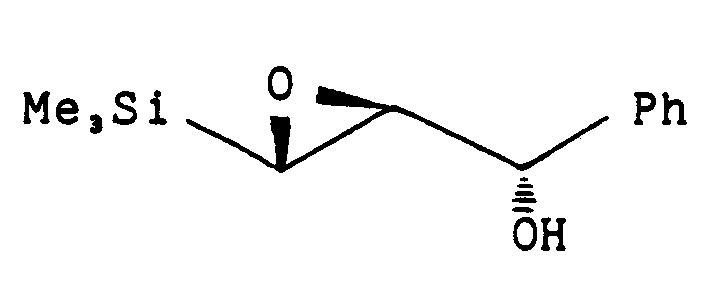
¹H NMR (CCl₄, CH₂Cl₂, D₂O) :
δ -0.05 (s, 9H, (CH₃)₃Si), 2.44 (d, J=4.0 Hz, 1H,
2.95 (t, J=4.0 Hz, 1H,
4.63-4.83 (m, 1H, CHOH), 7.16-7.46 (m, 5H, Ar)
IR (neat):3400, 2975, 1940, 1605, 1250, 838, 695 (cm⁻¹)
¹³C NMR (CDCl₃) : 140.2, 128.3, 127.9, 126.4, 72.1, 58.9, 47.8, -3.8
[α]
-

¹H NMR (CCl₄, CH₂Cl₂, D₂O) :
δ 0.17 (s, 9H, (CH₃)₃Si), 5.05 (d, J=4.6 Hz, 1H, CHO) 5.93 (d, J=19.8 Hz, 1H, SiH=CH) 6.23 (dd, J=4.6, 19.8 Hz, 1H, SiCH=CH), 7.10-7.54 (m, 5H, Ar)
IR (neat) : 3320, 2960, 1605, 1250, 839, 695 (cm⁻¹)
¹³C NMR (CDCl₃) : 147.3, 142.7, 129.7, 128.4, 127.4, 126.4, 76.6, -1.4
[α]
bp. 108-111°C/0.32 mmHg
Elemental analysis for C₁₂H₁₈OS : Calcd. C, 69.85; H, 8.79 Found. C, 69.71: H, 8.90 - The same procedure as Example 1 was repeated. The results are shown in Table 2 below.


- The following are values of analysis of each compound.
-
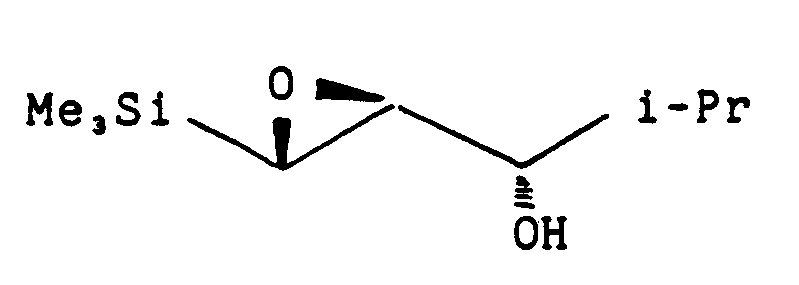
Colorless oil
¹H NMR (CDCl₃)
δ 0.04 (s, 9H, (CH₃)₃Si, 0.94 and 0.95 (2d, J=6.6 Hz and 6.8 Hz, 6H, (CH₃)₂C), 1.48-2.05 (m, 1H, CH(CH₃)₂), 1.98 (brs, 1H, OH), 2.35 (d, J=3.7 Hz, 1H,
2.87 (dd, J=3.1, 3.73 Hz, 1H,
3.48-3.68 (m, 1H, CHOH).
IR (neat) 3425, 2950, 1250, 840 (cm⁻¹).
[α]
-

Colorless oil
¹H NMR (CCl₄, CH₂Cl₂)
δ 0.07 (s, 9H, (CH₃)₃Si), 0.90 (d, J=7.0 Hz, 6H, (CH₃)₂CH), 1.33-1.96 (m, 1H, CH(CH₃)₂), 2.58 (brs, 1H, OH), 3.74 (t, 5.0 Hz. 1H. CHO), 5.80 (d, J=19.0 Hz, 1H, SiCH=CH), 5.95 (dd, J=5.0, 19.0 Hz, 1H, SiCH=CH).
IR (neat) 3340, 2870, 1615, 1240, 985, 840 (cm⁻¹).
[α]
bp. 42-48°C / 0.1 mmHg -

Colorless crystal
¹H NMR (CCl₄, CH₂Cl₂)
δ 0.19 (s, 9H, (CH₃)₃Si), 2.36 (d, J=3.7 Hz, 1H, SiCH(O)), 2.80 (brs, 1H, OH), 2.95-3.12 (m, 1H, SiCHCH(O)), 3.73-4.37 (m, 3H, CHO and CH₂OPh), 6.74-7.45 (m, 5H, Ph).
¹³C NMR (CDCl₃) δ 158.6, 129.5, 121.3, 114.7, 69.8, 69.5, 55.7, 48.8, -3.7.
mp. 61.5-62.5°C (recrystallized from pentane-ether)
IR (nujol) 3400, 1598, 1585, (cm⁻¹).
[α]
-

Colorless crystal
¹H NMR (CCl₄, CH₂Cl₂)
δ 0.25 (s, 9H, (CH₃)₃Si), 2.83 (brs, 1H, OH), 3.93 and 4.04 (2dd, J=7.8, 10.2 Hz and 4.0, 10.2 Hz, 2H, CH₂OPh), 4.48-4.82 (m, 1H, CHOH), 6.21 (s, 2H, HC=CH), 6.85-7.48 (m, 5H, Ph).
¹³C NMR (CDCl₃) δ 158.5, 143.4, 131.9, 129.3, 121.0, 114.6, 72.3, 71.7, -1.4.
IR (nujol) 3430, 1598, 1585, (cm⁻¹).
mp.49.0-50.0°C (recrystallized from pentane-ether)
[α]
-

Colorless oil
bp. 150-160°C (0.15 mmHg)
Data of NMR are the same to the compound 6-(3). Compound 7-(2)
Colorless oil
¹H NMR (CCl₄, CH₂Cl₂, D₂O)
δ 0.05 (s, 9H, 3CH₃), 2.17 (d, J=3.6 Hz, 1H,
2.78 (dd, J=3.6 Hz, 4.2 Hz, 1H,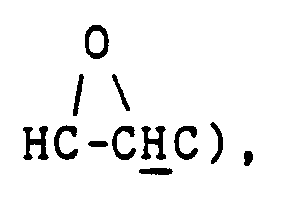
3.43-3.73 (m, 3H, CH(O)CH₂O), 4.46 (s, 2H, CH₂Ph), 7.13-7.34 (m, 5H, aromatic).
IR (neat) 3400, 1240, 1100, 730, 690 (cm⁻¹).
[α]
Rf 0.28 (hexane/ether 1/1). -

Colorless oil
¹H NMR (CCl₄, CH₂Cl₂, D₂O)
δ 0.15 (s, 9H, 3CH₃), 3.32 (dd, J=7.8 Hz, 10.3 Hz, 1H, HCHO), 3.42 (dd, J=4.1 Hz, 10.3 Hz, 1H, HCHO), 4.15-4.36 (m, 1H, CHO), 4.50 (s, 2H, CH₂Ph), 5.95-6.10 (m, 2H, HC=CH), 7.23-7.40 (m, 5H, Aromatic).
IR (neat) 3400, 1245, 630, 730, 690 (cm⁻¹).
[α]
Rf 0.38 (hexane/ether = 1/1). -

Colorless oil
¹H NMR (CCl₄, PhH)
δ 0.09 (s, 9H, Si(CH₃)₃), 0.90 (t, 3H, CH₂CH₃), 2.03 (m, 2H, CH₂-CH=CH), 2.10-2.33 (m, 3H,
2.64 (brs, 1H, OH), 2.72 (t, 1H, J=3.5 Hz,
3.67 (m, 1H, CHOH), 5.40 (m, 2H).
IR (neat) 3420, 2850, 1243, 840 (cm⁻¹).
[α]
-

Colorless oil
¹H NMR (CCl₄, PhH)
δ 0.10 (s, 9H, Si(CH₃)₃), 0.90 (t, 3H, CH₂CH₃), 1.32 (m,6H, (CH₂)₃-CH₃), 2.03 (m,2H, CH=CH-CH₂-CH₂), 2.22 (t, 2H, J=6 Hz, CH(OH)CH₂), 2,40 (brs, 1H, OH), 3.98 (dt, Jd=4 Hz, Jt=6 Hz), 5.38 (m, 2H, C-CH=CH-C), 5.74 (d, 1H, J=19 Hz, Si-CH=C), 6.02 (d=19 Hz, 4Hz, Me₃SiC=CH-).
¹³C NMR (CDCl₃) δ 148.0, 133.3, 129.2, 124.5, 73.8, 35.1, 31.5, 29.3, 29.0, 27.4, 22,4, 13.9, 1.3.
IR (neat) 3340, 2850, 1610, 1240, 830 (cm⁻¹).
[α]
-

¹H NMR (CCl₄, CH₂Cl₂, D₂O)
δ 0.03 (s, 9H, 3CH₃), 1.58-1.90 (m, 2H, CH₂CH₂O), 2.13 (d, J=3.6 Hz, 1H,
2.68 (t, J=3.6 Hz, 1 Hz,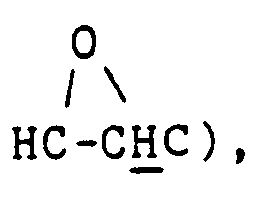
3.43-3.82 (m, 3H, CH₂O and CHO), 4.42 (s, 2H, CH₂OBn), 7.10-7.33 (m, 5H, Aromatic).
IR (neat) 3400, 1240, 1080, 835, 730, 690 (cm⁻¹).
[α]
Rf 0.23 (hexane/ether= 1/1). -

Colorless oil
¹H NMR (CCl₄, CH₂Cl₂, D₂O)
δ 0.08 (s, 9H, 3CH₃), 1.60-1.90 (m, 2H, CH₂CH₂O), 3.53 (dt, J=2.5 Hz, 6.1 Hz, 2H, CH₂O), 4.04-4.26 (m, 1H, CHO), 4.42 (s, 2H, CH₂OBn), 5.80 (d, J=19.9 Hz, 1H, HC=CHC), 5.91 (dd, J=4.0 Hz, 19.9 Hz, 1H, HC=CHC), 7.08-7.30 (m, 5H, Aromatic).
IR (neat) 3380, 1090, 835, 730, 690 (cm⁻¹).
[α]
Rf 0.32 (hexane/ether= 1/1). - The same procedure as in Example 1 was repeated except that diisopropyl L-(+)-tartrate was replaced by diisopropyl D-(-)-tartrate. The results are shown in Table 3 below.

The values of analysis are as follows: -

¹H NMR (CCl₄, PhH)
δ 5.97 (dd, J=18.3, 3.6 Hz, 1H), 5.77 (d, J=18.3 Hz, 1H), 4.08-3.86 (m, 1H), 3.58 (s, 3H), 3.02 (brs, 1H), 2.26 (t, J=7 Hz, 2H), 2.05-1.25 (m, 4H), 0.07 (s, 9H).
¹³C NMR (CDCl₃) δ 174.0, 148.3, 129.4, 74.0, 51.4, 36.2, 33.8, 20.8, -1.4.
IR (neat) 3400, 1727, 842 (cm⁻¹).
[α]
-

¹H NMR (CDCl₃, CH₂Cl₂)
δ -0.08 (s, 9H), 1.2-1.8 (m, 4H), 2.08-2.29 (m, 3H), 2.62 (t, J=5.1 Hz, 1H), 2.82 (br d, J=2.4 Hz, 1H), 3.46 (s, 3H), 3.40-3.62 (m, 1H).
¹³C NMR (CDCl₃) δ 173.4, 69.5, 58.1, 50.9, 47.5, 33.6, 33.0, 20.5, -4.1.
IR (neat) 3410, 1726, 1248, 843 (cm⁻¹).
[α]
-

To 17 ml of CH₂Cl₂ solution (cooled to -20°C) containing 0.72 ml of titanium tetraisopropoxide was slowly added dropwise 0.61 ml of diisopropyl L-(+)-tartrate, followed by stirring for 10 minutes. To the resulting solution was added dropwise 31 ml of CH₂Cl₂ solution containing 1.01 g of the compound 11-(1), followed by stirring for 10 minutes. Then 10.7 ml of CH₂Cl₂ solution containing 3.40 M of t-butyl hydroperoxide (TBHP) was added, followed by stirring for 4 hours. After confirming by thin-layer chromatography that the ratio of 11-(2) to 11-(3) is approximately 1:1, 0.71 ml of methyl sulfide was added at -20°C, followed by stirring for 40 minutes at the same temperature. 25 ml of ethyl ether, 1 ml of 10 wt% aqueous solution of tartaric acid, 3 g of NaF, and 10 g of Celite were added at room temperature, followed by stirring for 1 hour. The resulting mixture was filtered with suction to remove precipitates, and the solvent was distilled away under reduced pressure. The resulting crude reaction product was purified by silica gel chromatography to give 433 mg of the compound 11-(3) and 450 mg of the compound 11-(2) in the oily form. - The values of analysis of the compounds 11-(2) and 11-(3) are as follows.
-

¹H NMR (Cl₄, TMS)
δ 0.74-1.07 (m, 12H, 4CH₃), 1.07-1.96(m,26H, 13CH₂) 2.18 (br s, 1H, OH), 2.63-2.81 (m, 2H,
3.59-3.81 (m, 1H, CHO).
¹³C NMR (CDCl₃) 69.6, 58.4, 48.2, 33.8, 32.0 , 29.0, 27.3, 25.1, 22.5, 13.9, 13.6, 8.8.
[α]
IR (eaat) 3425, 2920, 2850, 1460, 1380, 1250, 1070, 1020, 862. - ¹H NMR (CCl₄, TMS) : δ 0.76-1.71 (m, 39H, 4CH₃, 13CH₂, OH), 3.79-4.10 (m, 1H, CHOH), 5.54-6.40 (m, 2H, CH=CH).
[α]
- The same procedure as in Example 11 was repeated except that diisopropyl L-(+)-tartrate was replaced by diisopropyl-(-)-tatrate. The results are shown in Table 4 below.

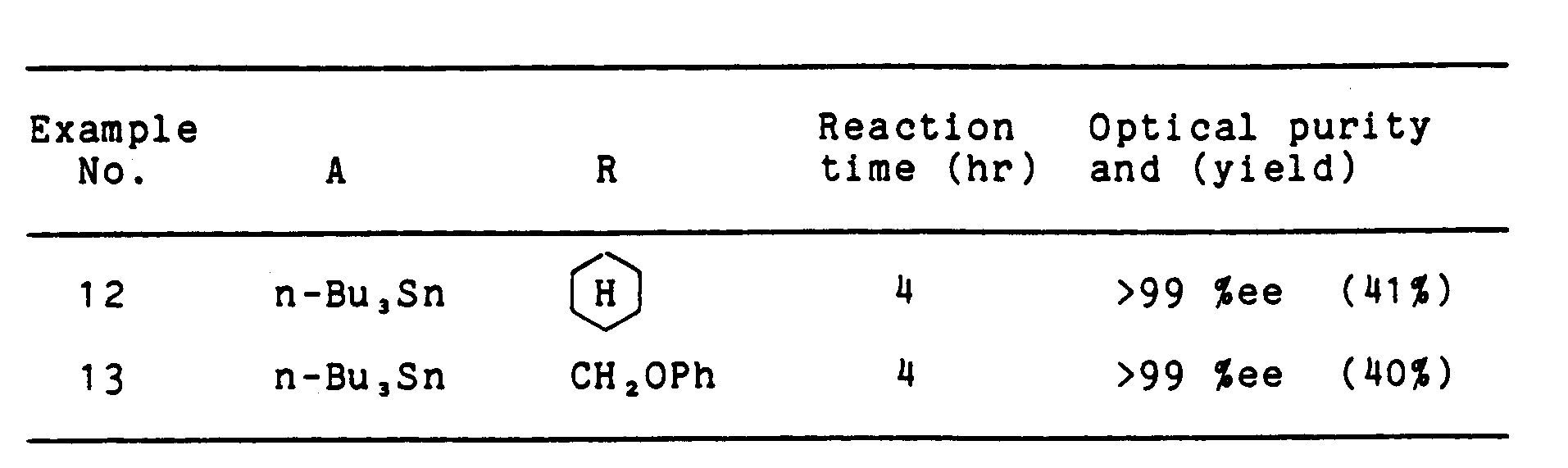
- The values of analysis of the compounds 12-(2) and 13-(2) are as follows.
-

¹H NMR (CCl₄, TMS)
δ 0.72-2.00 (m, 38H, 3CH₃, 14CH₂, and CH), 2.36 (brs, 1H, OH), 3.69 (t, J=4.8 Hz, 1H, CHO), 5.95 (m, 2H, HC=CH).
IR (neat): 3330, 2920, 2865, 1455, 997 (cm⁻¹) -

¹H NMR (CCl₄, TMS)
δ 0.73-1.06 (m, 9H, 3CH₃), 1.08-1.99 (m, 18H, 9CH₂), 2.48-2.61 (m, 1H, OH), 3.72 and 3.89 (2dd, J=7.2, 9.6 Hz and 4,4, 9.6 Hz, 2H, OCH₂), 4.25-4.52 (m, 1H, CHO), 5.94 (dd, J=4.4, 20.4 Hz, 1H, SnCH=CH), 6.30 (d, J=20.4 Hz, 1H, SnCH), 6.71-7.27 (m, 5H, Ph).
Rf 0.45 (hexane/ether=2/1) -
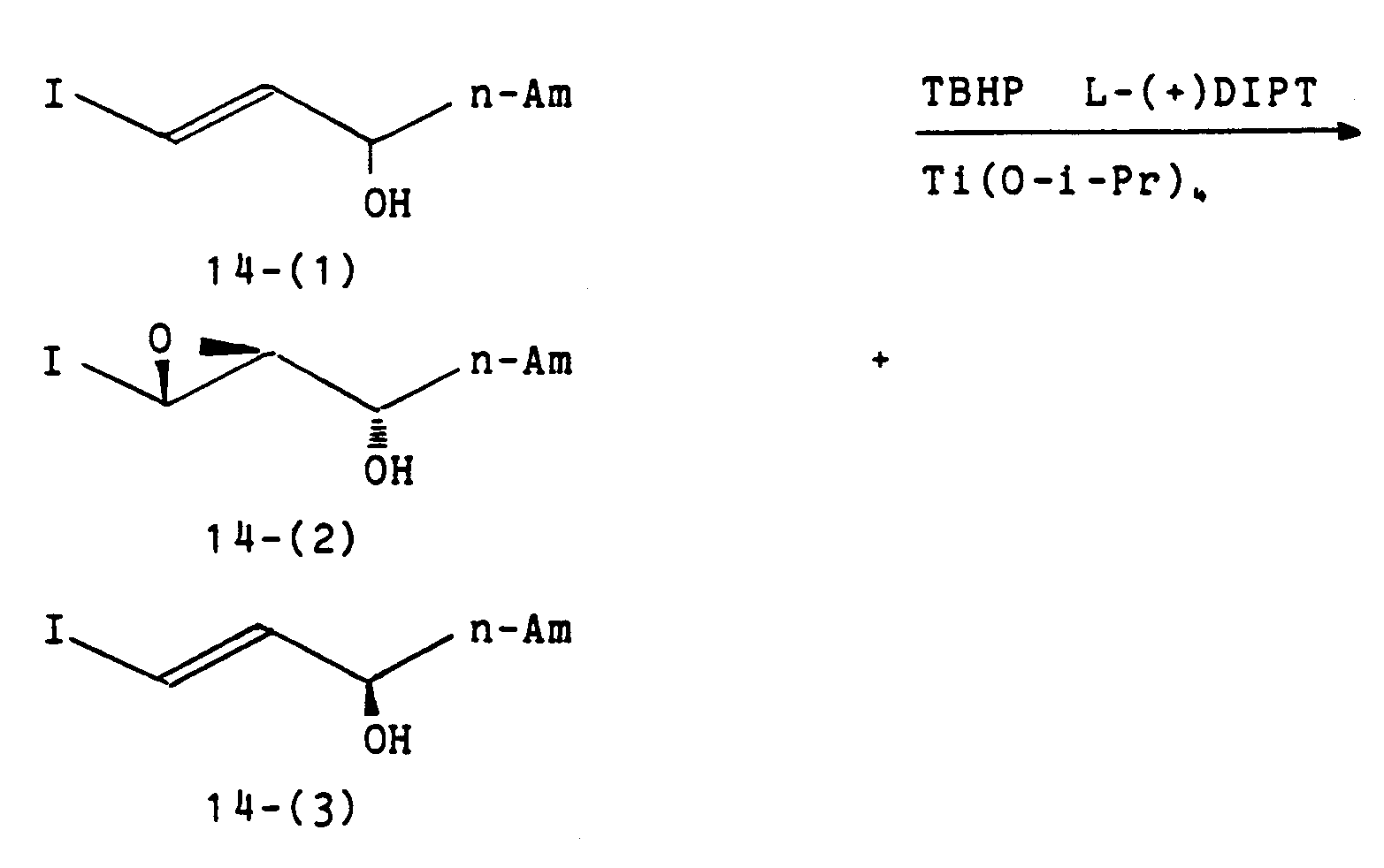
To 20 ml of CH₂Cl₂ solution (cooled to -20°C) containing 2.33 ml of titanium tetraisopropoxide was added dropwise 1.98 ml of diisopropyl L-(+)-tartrate (DIPT) under an argon atmosphere. After stirring for 10 minutes, 7 ml of CH₂Cl₂ solution containing 1.99 g of racemic modification (dl) of 14-(1) was added dropwise, followed by stirring for 10 minutes. Subsequently, 4.5 ml of CH₂Cl₂ solution containing 3.49 M of t-butyl hydroperoxide (TBHP) was slowly added, followed by stirring at -20°C for 3 days. - Then, 3.0 ml of methyl sulfide was added at -20°C, followed by stirring at that temperature for 40 minutes. Subsequently, 40 ml of ethyl ether 5 ml of 10 wt% aqueous solution of tartaric acid, 4 g of NaF, and 3 g of Celite were added at room temperature, followed by stirring for 30 minutes. The resulting mixture was filtered with suction to remove precipitates. After washing with 20 ml of Et₂O, the solvent was distilled away under reduced pressure. The values of ¹H NMR, IR, and Rf of the resulting crude product were measured for 14-(2) : 14-(3) = 1 : 1. After that the crude product was purified by silica gel chromatography to obtain 758 mg of 14-(3) in the oily form. (Yield: 38%)
- The values of analysis of compounds 14-(2) and 14-(3) are shown below.
- ¹H NMR (CCl₄, TMS)
δ 0.70-1.06 (brt, 3H, CH₃), 1.06-1.85 (m, 8H, 4CH₂), 2.78 (brs, 1H, OH), 3.12 (dd, J=1.8, 3.0 Hz, 1H,
3.55-3.77 (m, 1H, CHOH), 4.73 (d, J=1.8 Hz, 1H,
Rf : 0.25 (hexane:ether = 3:1, silica gel MERCK 5554)
IR (neat, 1:1 mixture with 14-(3)) 3340, 2930, 2860, 1605, 1400, 1260, 1170, 1020, 945 (cm⁻¹) - ¹H NMR (CDCl₃)
δ 0.87 (t, J=6.0 Hz, 3H), 1.06-1.76 (m, 8H), 2.45 (brs, 1H), 4.03 (q, J=6.0 Hz, 1H), 6.26 (d, J=15.6 Hz, 1H), 6.55 (dd, J=6.0, 15.6 Hz, 1H).
¹³C NMR (CDCl₃) 13.9, 22.4, 24.7, 31.6, 36.5, 74.4, 76.8, 148.7
IR (CCl₄) : 3330, 1605, 940(cm⁻¹).
[α]
The value of enantiomer reported in the literature (R. Noyori et al., J. Am. Chem. Soc., 106, 6717 (1984)) is as follows:
[α]
The optical purity of 14-(3) was higher than 99.5 %ee when measured by NMR after derivation to optically active ester of α-methoxy-α-trifluoromethylphenylacetic acid (Mosher ester). -

To 20 ml of CH₂Cl₂ solution (cooled to -20°C) containing 2.33 ml of titanium tetraisopropoxide and 1.98 ml of diisopropyl D-(-)-tartrate was added dropwise 7 ml of CH₂Cl₂ solution containing 1.99 g of racemic modification (dl) of 15-(1) under an argon atmosphere. After stirring for 10 minutes, 4.5 ml of CH₂Cl₂ solution containing 3.49 M of t-butyl hydroperoxide (TBHP) was slowly added, followed by stirring at -20°C for 3 days. - Then, 3.0 ml of methyl sulfide was added at -20°C, followed by stirring at that temperature for 30 minutes. Subsequently, 5 ml of 10 wt% aqueous solution of tartaric acid, 40 ml of ethyl ether, 4 g of NaF, and 3 g of Celite were added at room temperature, followed by stirring for 30 minutes. The resulting reaction mixture was filtered with suction to remove precipitates. After washing with 20 ml of ethyl ether, the solvent was distilled away under reduced pressure. The resulting crude product was purified by silica gel chromatography to obtain 695 mg of 15-(3).
(Yield: 35%)
The values of analysis of the compound 15-(3) are shown below. - [α]

The NMR data, IR data, and Rf values of compounds 15-(2) and 15-(3) were identical with those of compounds 14-(2) and 14-(3). - The same procedure as in Example 14 was repeated. The results are shown in Table 5.


- The values of analysis of the compounds 16-(2) to 20(2) are shown below.
-

¹H-NMR (CDCl₃, TMS)
δ 0.95 (t, J=7 Hz, 3H), 1.58 (dq, J=6 Hz, 7 Hz, 2H), 4.04 (brq, J=6 Hz, 1H), 6.32 (d, J=15 Hz, 1H), 6.60 (dd, J=15 Hz, 6 Hz, 1H).
MS
M⁺ = 212 (0.5%), [M-H₂O]⁺ = 194 (5%),
[CHI=CHCH₂OH]⁺ = 183 (14%), [C₃H₅O]⁺ = 57 (base peak)
[α]
-

¹H-NMR (CDCl₃, TMS)
δ 0.90 (t, J=5 Hz, 3H), 1.05-1.70 (m, 14H), 4.10 (q, J=6 Hz, 1H), 6.32 (d, J=15 Hz, 1H), 6.61 (dd, J=15 Hz, 6 Hz, 1H).
MS
[M-H₂O]⁺ = 278 (1.0%), [CHI=CHCH₂OH]⁺ = 183 (base peak), [C₃H₅O]⁺ = 57 (10%)
[α]
-

¹H-NMR (CDCl₃, TMS)
δ 0.7-2.0 (m, 13H), 4.20 (q, J=6Hz, 1H), 6.32 (d, J=15 Hz, 1H), 6.60 (dd, J=15 Hz, 6 Hz, 1H).
MS
[M-H₂O]⁺ = 262 (1%), [CHI=CHCH₂OH]⁺ = 183 (12%), = 55 (base peak).
[α]
-

¹H-NMR (CDCl₃, TMS)
δ 1.0-2.2 (m, 9H), 3.90 (t, J=6Hz, 1H), 6.33 (d, J=16 Hz, 1H), 6.63 (dd, J=16 Hz, 6 Hz, 1H).
MS
[M-H₂O]⁺ = 234 (1%), [CHI=CHCH₂OH]⁺ = 183 (14%),
[C₃H₅O]⁺ = 57 (base peak).
[α]
-

¹H-NMR (CDCl₃, TMS)
δ 2.34 (brs, 1H) 5.12 (d, J=6 Hz, 1H), 6.37 (d, J=15 Hz, 1H), 6.70 (dd, J=15 Hz, 6 Hz, 1H), 6.1-6.5 (m, 5H).
[α]
-

¹H-NMR (CDCl₃, TMS)
δ 2.67 (d, J=4 Hz, 1H), 3.7-4.0 (m, 2H), 4.48 (dt, J=6 Hz, 4 Hz, 1H), 6.4-7.5 (m, 7H).
IR (neat) 3400, 3080, 3050, 1600, 1590, 1500, 1080, 1050, 950, 760, 700 (cm⁻¹).
¹³C NMR (CDCl₃) 158.2, 143,7, 129.5, 121.3, 114.7, 79.8, 72.5, 70.6.
[α]
Furthermore, the properties of the compound 22-(2) are the same as those of the compound 14-(2). Compound 23-(2)

¹H-NMR 0.93 (d, J=7 Hz, 6H), 1.1-2.0 (m, 5H), 4.17 (brq, J=6 Hz, 1H), 6.32 (d, J=15 Hz, 1H), 6.62 (dd, J=15 Hz, 6 Hz, 1H).
[α]
- The same procedure as in Examples 16, 17, 18, 20, and 22 was repeated. The reaction time was extended as shown in Table 6 below, and the reaction ratio was traced by using 90 MHz H-NMR. The results are shown in Table 6. It is noted that the epoxidizing reaction stops mostly at 50-52% although 1.0 equivalent of t-butyl hydroperoxide (TBHP) still remains. This indicates that the reaction rate greatly differs from one enantiomer to the other.


- The same procedure as in Example 14 was repeated except that the amount of t-butyl hydroperoxide was changed to 0.6-1.0 equivalent based on the substrate and the reaction temperature was changed to 0-25°C. The results are shown in Table 7.

It is noted that the reaction can be performed at room temperature if the substrate of the invention is used, although the ordinary reaction temperature is -25°C to -20°C. - In this example, an optically active allyl alcohol was epoxidized by using a catalytic amount of tartaric diester.

To 1.2 ml (5.7 mmol) of diisopropyl-(D)-(-)-tartrate cooled to -20°C were added 1 g of powdered 3Å molecular sieve, 15 ml of CH₂Cl₂, and 1.4 ml (4.7 mmol) of titanium tetraisopropoxide in an Ar atmosphere, followed by stirring for 10 minutes. 8 ml of CH₂Cl₂ solution containing 3.65 g (15.2 mmol) of 8-(3) was added. The resulting mixture was cooled to -40°C, and 7.5 ml (30.6 mmol) of of t-butyl hydroperoxide (TBH) (4.09 M/CH₂Cl₂) was added dropwise. The resulting mixture was stirred at -21°C for 4 hours. 4 ml of methyl sulfide and 4 ml of 10% tartaric acid aqueous solution were added, followed by Celite filtration. The solvent was distilled away under reduced pressure, and the resulting crude product was purified by silica gel chromatography (hexane/ethyle ether = 10/1 → 3/1, 0.5% triethylamine). There was obtained 3.3 g of desired product 8-(2). (Yield: 85%)
[α]
The ¹H NMR data and IR data were identical with those of compound 8-(2). - In this example, the reaction was carried out by using a catalytic amount of tartaric diester.

As in Example 39, the reaction was performed for 0.19 equivalent of titanium tetraisopropoxide, 0.23 equivalent of diisopropyl-(-)-tartrate, 1.0 equivalent of 40-(1), and 1.5 equivalent of t-butyl hydroperoxide at -25°C for 35 hours. The post-treatment was carried out in the same manner as in Example 14. There was obtained compound 40-(2) (optical purity >99 %ee) at a yield of 48%, and there was obtained compound 40-(3) at a yield of 48%. - The values of analysis are shown below.
-

¹H NMR (CCl₄, TMS)
δ 0.90 (t, J=6.0 Hz, 3H, CH₃), 1.05-1.80 (m, 8H, 4CH₂), 2.42 (brs, 1H, OH), 3.01 (dd, J=1.2, 3.0 Hz, 1H,
3.60-3.84 (m, 1H, CHO), 4.96 (d, J=1.2 Hz, 1H, ClCH(O)).
Rf : 0.42 (hexane/ether = 3/1, silica gel (MERCK 5554)) -

¹H NMR (CCl₄, TMS)
δ 0.90 (t, J=6.0 Hz, 3H, CH₃), 1.07-1.90 (m, 8H, 4CH₂), 2.08 (brs, 1H, OH), 3.98 (q, J=6.6 Hz, 1 Hz, CHO), 5.79 (dd, J=14.4, 6.6 Hz, 1H, ClCH=CH), 6.11 (d, J=14.4 Hz, 1H, ClCH=C).
¹³C NMR (CDCl₃) 136.3, 119.4, 71.1, 37.1, 31.6, 24.9, 22.5, 13.9.
[α]
IR (neat) : 3320, 2930, 2860, 1620, 1455, 1280, 1018, 933, 803 (cm⁻¹) - In this example, an optically active allyl alcohol was epoxidized.

As in Example 39, the reaction was performed for 2 equivalent of titanium tetraisopropoxide, 2.2 equivalent of diisopropyl-(-)-tartrate, 1.0 equivalent of 40-(3), and 3 equivalent of TBHP at -25°C for 93 hours. The yield of 41-(2) was less than 2% and almost all the raw material was recovered. -
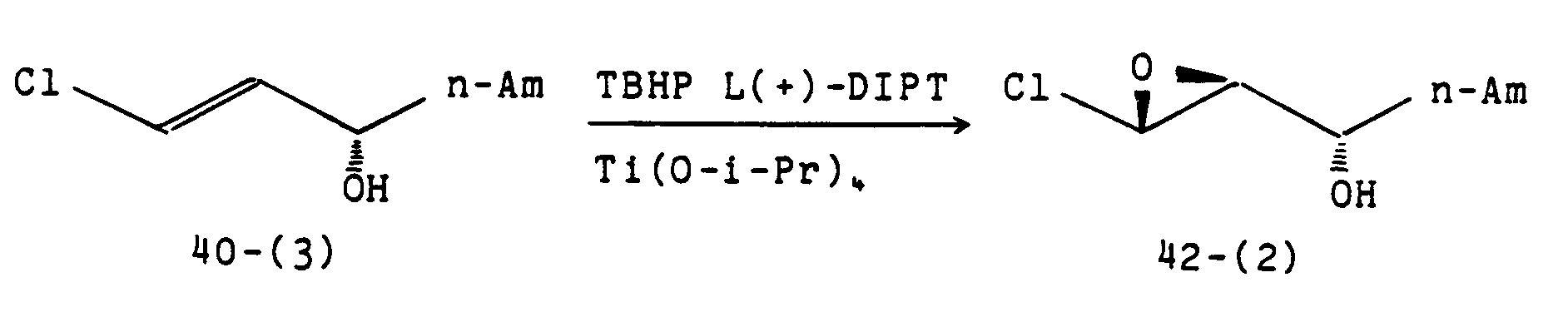
The reaction was carried out for 45 hours under the same conditions as in Example 41. The yield of 42-(2) was 100%. - It is noted from Examples 41 and 42 that as compared with the synthesis of the matched 42-(2) using diisopropyl-(+)-tartrate, the synthesis of the mismatched 41-(2) using diisopropyl-(-)-tartrate, is so slow that the latter proceeds very little even after twice the time for the former. This suggests that the process of the invention is selective.
- The values of analysis are as follows:
- IR (neat): 3220, 2960, 2870, 1675, 1265, 915, 770 cm⁻¹. Other values of analysis are identical with those of compound 40-(2).
- The following Referential Examples show the process for producing the raw material compound used in Examples and the process for synthesizing various compounds from the optically active alcohols obtained in Examples.
-

To 220 ml of ethyl ether solution (cooled to 0°C) containing 167 mmol of methyl lithium (MeLi) was slowly added 24 g (218 mmol) of trimethyl silyl acetylene, followed by stirring at room temperature for 1 hour. The solution was cooled to -30°C and 20.1 ml (167 mmol) of hexanal (AmCHO) was added. The solution was slowly warmed to room temperature and poured into a saturated aqueous solution of NH₄Cl cooled to 5°C. After separation of the organic layer, the aqueous layer was extracted twice with 100 ml portion or hexane. The extract was added to the organic layer. The organic layer was dried with MgSO₄ and filtered, and the solvent in the filtrate was distilled away under reduced pressure. Thus there was obtained 31.7 g (96% yield) of the compound (i). - The values of analysis of the compound (i) are as follows:
¹H NMR (CCl₄, PhH) :
δ 0.16 (s, 9H, 3(CH₃)Si), 0.92 (t, J=6.0 Hz, 3H, CH₃), 1.11-1.90 (m, 8H, 4CH₂), 2.96 (brs, 1H, OH), 4.22 (q, J=5.8 Hz, 1H, CHO).
IR (neat) : 3330, 2850, 2180, 1255(cm⁻¹) -

To 460 ml of ethyl ether solution (cooled to 0°C) containing 607 mmol of i-butyl magnesium bromide (i-BuMgBr) was added 2.0 g (8 mmol) of cyclopentadienyl titanium chloride (Cp₂TiCl₂). After stirring at 0°C for 30 minutes, 30.9 g, 156 mmol) of the compound (i) was slowly added. The solution was heated to 27°C and stirring was continued for 7 hours at that temperature. The solution was poured into 400 ml of diluted HCl cooled to 5°C. The reaction product was extracted several times with hexane-ethyl ether mixture (1/1). The organio layer was dried with MgSO₄ and filtered, and the solvent in the filtrate was distilled away under reduced pressure. The crude product was purified by silica gel chromatography. Thus there was obtained 29.96 g (96% yield) of the compound 1-(1). - The values of analysis of the compound 1-(1) are as follows:
¹H NMR (CCl₄, PhH, D₂O) : δ 0.07 (s, 9H, 3(CH₃)Si), 0.94 (t, J=6.0 Hz, 3H, CH₃), 1.10-1.75 (m, 8H, 4CH₂), 3.93 (q, J=4.8 Hz, 1H, CHO), 5.67 (d, J=18.0 Hz, 1H, SiOH), 6.00 (dd, J=4.8. 18.0 Hz, 1H, CH=CHSi).
¹³C NMR (CDCl₃) :
-1.3, 13.9, 22.5, 25.0, 31.8, 36.9, 74.6, 128.8, 148.9.
IR (neat) : 3330, 2930, 1645, 1285 cm⁻¹
b.p.: 90°C/3 mmHg -


In 20 ml of dichloromethane were mixed 0.90 g (4.16 mmol) of the compound 1-(2), 1.2 ml (12.5 mmol) of ethyl vinyl ether (CH₂=CHOC₂H₅), and 26.8 mg of p-toluenesulfonic acid at 0°C for 5 minutes. The reaction liquid was poured into 50 ml of saturated aqueous solution of NaHCO₃, and the aqueous layer was extracted several times with hexane. The organic layer was combined with the hexane extract. The solution was dried with MgSO₄ and then filtered. The solvent in the filtrate was distilled away under reduced pressure, and there was obtained a crude product. The crude product was purified by silica gel chromatography to obtain 1.13 g (95% yield) of the compound 1-(2)a. The values of analysis of the compound 1-(2)a are as follows:
¹H NMR (CCl₄, PhP) :
δ 0.03 (s, 9H, 3(CH₃)Si), 0.92 (t, J=5.0 Hz, 3H, CH₂CH₃), 1.00-1.84 (m, 14H, 2CH₃, 4CH₂), 2.05, 2.09 (2d, J=3.0 Hz, 1H, SiCH), 2.53, 2.58 (2dd, J=3.0, 5.0 Hz, 1H,
3.03-3.75 (m, 3H, CH₂O, CHO), 4.49-4.85 (m, 1H, OCHO). -

(where OEE is as defined above.) -
- To 25 ml of tetrahydrofuran (THF) suspension containing 98 mg of copper iodide (CuI) was added 0.7 ml of dimethyl sulfide (Me₂S) to make a uniform system. Ethyl ether solution (3 ml) of n-propyl magnesium bromide (n-PrMgBr) 3.96 m mole was slowly added at -78°C, followed by stirring for 30 minutes. Subsequently, 5 ml of THF solution containing 745 mg (2.59 mmol) of the compound 1-(2)a was added at that temperature, followed by stirring at -30°C for 2 hours. The solution was slowly warmed to room temperature. To the solution were added 10 ml of saturated aqueous solution of NH₄Cl and 50 ml of 15% aqueous solution of NH₄OH to separate the organic layer. The organic layer was washed with 15% aqueous solution of NH₄OH and dried with MgSO₄, followed by filtration. The solvent in the filtrate was distilled away under reduced pressure to give a crude product. The crude product was purified by silica gel chromatography to obtain 756 mg (88% yield) of the compound (ii).
- The values of analysis of the compound (ii) are as follows:
¹H NMR (CCl₄, PhP, D₂O) :
δ 0.00 (s, 9H, 3(CH₃)Si), 0.48-1.69 (m, 25H, 4CH₃, 6CH₂, CHSi), 3.19-3.86 (m, 4H, OCH₂, 2CHO), 4.40-4.80 (m, 1H, OCHO). -
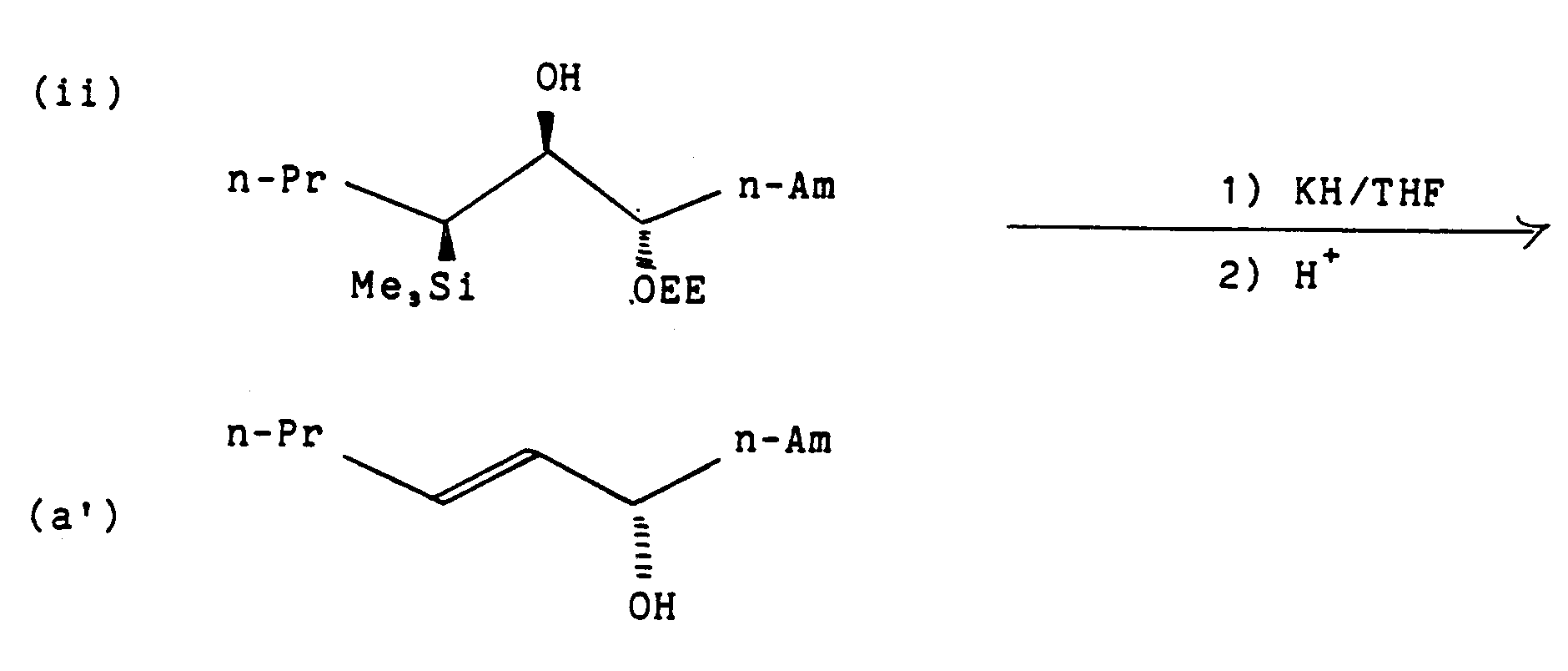
(where OEE is as defined above.) -
- To 10 ml of THF solution containing 120 mg of potassium hydride was slowly added dropwise 5 ml of THF solution containing 430 mg (1.30 mmol) of the compound (ii) at -72°C. The solution was slowly warmed to 5°C, and stirring was continued for 1.5 hours. To the solution were added 3 ml of saturated aqueous solution of NH₄Cl and 3 ml of dilute HCl (3N), followed by stirring at room temperature for 1 hour. The solution was extracted three times with 15 ml portion of ethyl ether. The organic layer was dried with MgSO₄ and filtered. The solvent in the filtrate was distilled away under reduced pressure to give a crude produot. The crude product was purified by silica gel chromatography to obtain 205 mg (93% yield) of the compound (aʹ). The values of analysis of the compound (aʹ) are as follows:
¹H NMR (CCl₄, (CH₃)₄Si) :
δ 0.84-1.08 (m, 6H, 2CH₃), 1.10-1.74 (m, 10H, 5CH₂), 1.82-2.14 (m, 2H, CH₂CH=C), 2.40 (brs, 1H, OH), 3.72-4.05 (m, 1H, CHO), 5.17-5.69 (m, 2H, CH=CH)
¹³C NMR (CDCl₃) : 13.5, 13.9, 22.3, 22.5, 25.1, 31.8, 34.2, 37.3, 73.0, 131.4, 133.4.
IR (neat) : 3340, 2930, 2865, 965(cm⁻¹)
[α]
-

(where OEE is as defined above.) - To 5 ml of methanol solution containing 290 mg (0.87 mmol) of the compound (ii) was added 130 µl of conc. H₂SO₄ at -50°C, followed by stirring at room temperature for 2 hours. The reaction liquid was poured into 50 ml of saturated aqueous solution of NaHCO₃, and the solution was extracted three times with 15 ml portion of ethyl ether/hexane mixture (1/1). The organic layer was dried with MgSO₄ and then filtered. The solvent in the filtrate was distilled away under reduced pressure to give a crude product. The crude product was purified by silica gel chromatography to obtain 215 mg (63% yield) of the compound (bʹ). The values of analysis of the compound (bʹ) are as follows:
¹H NMR (CCl₄, TMS, D₂O) :
δ 0.72-0.12 (m, 6H, 2CH₃), 1.12-1.70 (m, 10H, 5CH₂), 1.82-2.23 (m, 2H, CH₂CH=C), 4.10-4.46 (m, 1H, CHO), 5.12-5.53 (m, 2H, CH=CH)
¹³C NMR (CDCl₃) : 13.6, 13.9, 22.5, 22.8, 25.0, 29.6, 31.8, 37.5, 67.5, 131.5, 133.0.
IR (neat) : 3320, 2930, 727(cm⁻¹)
[α]
-

(where TBHP denotes t-butyl hydroperoxide and VO(acac)₂ denotes vanadyl bisacetylacetonate.) - To 30 ml of dichloromethane solution (cooled to 0°C) containing 1.69 g (8.45 mmol) of the compound 1-(3) was added 110 mg of vanadyl bisacetylacetonate and 8.2 ml of dichloromethane solution containing 21.1 mmol of t-butyl hydroperoxide, followed by stirring overnight. 2 ml of dimethyl sulfide was added, followed by stirring for 30 minutes. The solution was poured into 30 ml of saturated aqueous solution of NaHCO₃, followed by stirring at room temperature for 1 hour. The solution was extracted twice with 60 ml portion of hexane/ethyl ether mixture (1/1). The organic layer was dried with Na₂SO₄ and then filtered. The solvent in the filtrate was distilled away under reduced pressure to give a crude product. The crude product was purified by silica gel chromatography to obtain 1.53 g (85% yield, anti/syn = 3/1) of the compound (iii). The values of analysis of the compound (iii) are as follows:
¹H NMR (CCl₄, PhH) :
δ 0.03 (s, 9H, 3(CH₃)Si), 0.85 (t, J=6 Hz, 3H, CH₃), 1.10-1.71 (m, 8H, 4CH₂), 2.05, 2.23 (2d, J=4 Hz, 1H, SiCHO), 2.69 (t, J=4 Hz, 1H,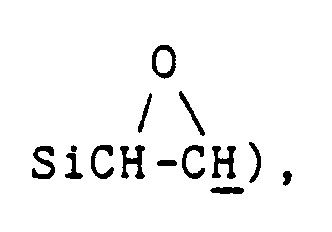
2.02-3.95 (m, 2H, CHOH) -

(where OEE is as defined above.) - In 15 ml of dichloromethane were mixed 1.53 g (8.4 mmol) of the compound (iii), 2.4 ml of ethyl vinyl ether (CH₂=CHOC₂H₅), and 250 mg of pyridinium-p-toluenesulfonic acid (p-TsOH). The solution was stirred overnight. The reaction liquid was poured into 30 ml of saturated aqueous solution of NaHCO₃. The solution was extracted several times with hexane. The organic layer was dried with Na₂SO₄ and then filtered. The solvent in the filtrate was distilled away under reduced pressure to give 2.32 g (96% yield) of the compound (iii)a. The values of analysis of the compound (iii)a are as follows:
¹H NMR (CCl₄, PhH) :
δ 0.05 (m, 9H, 3(CH₃)Si), 0.53-1.85 (m, 17H, 3CH₃ and 4CH₂), 1.86-1.94, 2.03-2.18 (2m, 1H, SiCHO), 2.48-2.78 (m, 1H
2.88-4.77 (m, 3H, OCH₂, CHO), 4.50-5.00 (m, 1H, OCHO) -

(where OEE is as defined above.) - To 40 ml of ethyl ether solution containing 800 mg (4.2 mmol) of copper iodide (CuI) was slowly added dropwise at -40°C 10.7 ml of pentane solution containing 6.96 mmol of n-propyl lithium (n-PrLi). The solution was stirred at -20°C for 1 hour. The solution was cooled to -50°C, and 10 ml of ethyl ether solution containing 500 mg (1.7 mmol) of the compound (iii)a was added. The solution was slowly warmed to -15°C overnight. To the reaction liquid were added 10 ml of saturated aqueous solution of NH₄Cl and 70 ml of 10% aqueous solution of NH₄OH, and the organic layer was separated. The organic layer was washed several times with 10% aqueous solution of NH₄OH and dried with Na₂SO₄. The solution was filtered and the solvent in the filtrate was distilled away under reduced pressure to give a crude product of the compound (iv). The crude product was subjected to the following reaction without purification.
- To 10 ml of THF suspension containing 200 mg of potassium hydride was slowly added at -78°C 5 ml of THF solution containing the compound (iv). The resulting solution was heated to 10°C and stirred at 10°C for 1 hour. To the solution were added 0.5 ml of saturated aqueous solution of NH₄Cl and 20 ml of dilute HCl (3N), followed by stirring at room temperature for 1 hour.
- The reaction liquid was extracted three times with 15 ml portion of ethyl ether. The organic layer was dried with MgSO₄ and then filtered. The solvent in the filtrate was distilled away under reduced pressure to give a crude product. The crude product was purified by silica gel chromatography to obtain 213 mg (74% yield) of the compound (cʹ). The values of analysis of the compound (cʹ) are as follows:
[α]
The ¹H NMR, ¹³C NMR, and IR data of compound (cʹ) are identical with those of compound (aʹ). -


(where OEE is as defined above.) - The compound (iv) was synthesized in the same manner as in Referential Example 9. That is, a crude product of the compound (iv) was prepared from 60 ml of ethyl ether solution containing 2.25 g (11.8 mmol) of copper iodide (CuI), 33 ml of ethyl ether solution containing 21.2 mg of n-propyl lithium (n-PrLi), and 1.56 g (5.4 mmol) of the compound (iii)a. 7 ml of methanol solution of the crude product of the compound (iv) was slowly added dropwise at -60°C to 35 ml of MeOH solution containing 0.58 ml of conc. H₂SO₄. The solution was warmed to room temperature, and stirring was continued for 2.5 hours. The reaction liquid was poured into 150 ml of saturated aqueous solution of NaHCO₃. The resulting solution was extracted several times with hexane. The organic layer was dried with MgSO₄. The solvent in the filtrate was distilled away under reduced pressure to give a crude product. The crude product was purified by silica gel chromatography to obtain 390 mg (43% yield) of the compound (dʹ). The values of analysis of the compound (dʹ) are as follows:
[α]
The ¹H NMR, ¹³C NMR, and IR data of compound (dʹ) are identical with those of compound (bʹ). -

To 20 ml of pyridine solution containing 3.20 g (14.8 mmol) of the compound 1-(2) was added 4 ml (42.5 mmol) of acetic anhydride, followed by stirring at room temperature for 4 hours. The resulting solution was cooled to 0°C, and 30 ml of hexane was added. 30 ml of saturated aqueous solution of NaHCO₃ was added slowly and stirring was continued for 15 minutes. Further, 30 ml of hexane was added for extraction. The organic layer was washed with 30 ml of water and dried with MgSO₄. The solution was filtered and the solvent in the filtrate was distilled away under reduced pressure to obtain a crude product. The crude product was purified by silica gel chromatography to give 3.30 g (12.8 mmol, 86% yield) of the compound 1-(2)b. The values of analysis of the compound 1-(2)b are as follows:
¹H NMR (CCl₄, PhH) :
δ -0.04 (s, 9H, H₃CSi), 0.83 (t, J=6.0 Hz, 3H, CH₃), 1.03-1.74 (m, 8H, CH₂), 1.89 (s, 3H, H₃CC(=O)O), 2.02 (d, J=3.6 Hz, 1H,
2.53 (dd, J=3.6, 6.4 Hz, 1H,
4,41 (dt, J=6.4, 6.5 Hz, 1H, OCH).
IR (neat) : 1755, 1245, 860 cm⁻¹ -

To 15 ml of diethyl ether was added 827 mg (3.20 mmol) of bromated magnesium ethylate (MgBr₂·O(C₂H₅)₂), followed by stirring at room temperature until a uniform solution was obtained. The solution was cooled to -10°C and 5 ml of ether solution containing 413 mg (1.60 mmol) of the compound 1-(2)b was added, followed by stirring at -10°C to -5°C for 30 minutes. The reaction liquid was slowly added to a mixture (cooled to -1°C) composed of 10 ml of dilute HCl (3N) and 10 ml of hexane. The organic layer was dried with MgSO₄ and filtered. The solvent in the filtrate was distilled away under reduced pressure to obtain 514 mg of a crude product of the compound (v). The crude product as such was used for the synthesis of the compound (bʹ)b. - To 5 ml of hexane solution containing 231 mg of the crude product of the compound (v) was dded 0.285 ml (2.04 mmol) of triethanolamine and 0.1 ml (1.36 mmol) of sulfonyl chloride at 0°C. The solution was stirred for for 1 hour at 0°C. The reaction liquid was added to 15 ml of saturated aqueous solution of sodium chloride. The solution was extracted with hexane, and the extract was dried with MgSO₄ and filtered. The solvent in the filtrate was distilled away under reduced pressure to give a crude product of methasulfonyl ester of the compound (v).
- 5 ml of the THF solution of a crude compound was cooled to 0°C and 1.55 ml of THF solution containing 1.02 ml (0.66 n in THF) of (n-Bu)₄NF was ddded, followed by stirring at 0°C for 15 minutes.
- The reaction liquid was added to 20 ml of saturated sodium chloride aqueous solution. The solution was extracted with hexane. The organic layer was dried with MgSO₄ and filtered. The solvent in the filtrate was distilled away under reduced pressure to obtain a crude product of the compound (bʹ)b. The crude compounds was purified by silica gel chromatography to obtain 134 mg (79% yield calculated from the used curde compound (v)).
- The values of analysis of the compound (bʹ)b are as follows:
¹H NMR (CCl₄, TMS) :
δ 0.80 (t, J=6.0 Hz, 3H, CH₃), 1.11-1.90 (m, 8H, CH₂), 1.98 (s, 3H, H₃CC(=O)O), 5.53 (dt, J=8.4, 6.6 Hz, 1H, OCH), 5.92-6.35 (m, 2H, CH=CH).
IR (neat) : 1735, 1613, 1230 cm⁻¹ -

To 25 ml of hexane solution containing 2.11 g (8.48 mmol) of the compound (bʹ)b were added at room temperature 20 ml of 50% aqueous solution of KOH and 155 mg (0.42 mmol) of n-tetrabutyl ammonium iodide ((n-Bu)₄NI), followed by stirring at 50°C for 10 hours. After cooling to room temperature, 30 ml of water was added and the solution was extracted with 20 ml of hexane/ether mixture (1:1). The organic layer was dried with Na₂SO₄ and filtered. The solvent in the filtrate was distilled away under reduced pressure to obtain a crude product. The crude product was purified by silica gel chromatography to give 1.05 g (8.33 mmol, 98% yield) of the compound (vi). The values of analysis of the compound (vi) are as follows:
¹H NMR (CCl₄, (CH₃)₄Si, D₂O) :
δ 0.90 (t, J=6.3 Hz, 3H, CH₃), 1.10-1.95 (m, 8H, CH₂), 2.32 (d, J=2.3 Hz, 1H, HC C), 4.28 (dt, J=2.3, 7.0 Hz, OCH).
¹³C NMR (CDCl₃) :
δ 85.2, 72.7, 62.3, 37.7, 31.4, 24.7, 22.5, 13.9.
IR (neat) : 3350(s), 3300, 2120(ω), 1020 cm⁻¹
b.p. : 120-130°C/20 mmHg -

To 15 ml of dichloromethane solution (cooled to -15°C) containing 1.77 g (8.85 mmol) of the compound 1-(3) was slowly added dropwise 0.454 ml (8.85 mmol) of Br₂. Stirring was continued for 5 minutes, and 40 ml of hexane was added. The solution was washed with 15 ml of saturated aqueous solution of Na₂S₂O₃ and then with 40 ml of water. The resulting organic layer was dried with MgSO₄ and filtered. The solvent in the filtrate was distilled away under reduced pressure to give a crude product. The crude product was purified by silica gel chromatography to obtain 2.98 g (8.28 mmol, 94% yield) in total of the compounds (vii) and (viii). -
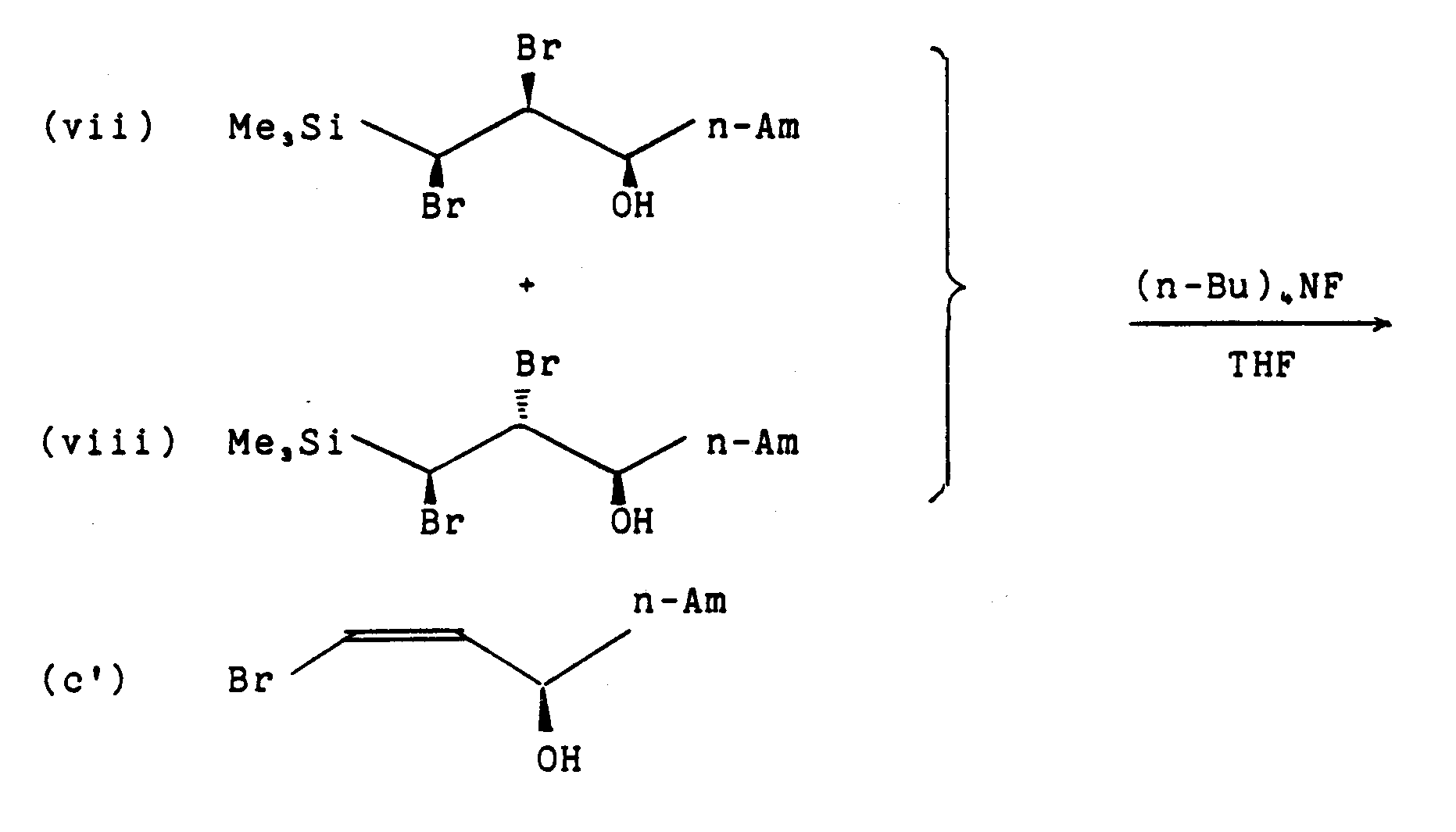
To 15 ml of THF solution (cooled to 0°C) containing 2.97 g (8.25 mmol) in total of the compounds (vii) and (viii) was added dropwise with stirring 14.8 ml of THF solution (9.9 mmol, n 0.67) of n-tetrabutylammonium fluoride. After stirring for 5 minutes, 30 ml of water was added. The solution was extracted with 30 ml of hexane. The organic layer was dried with MgSO₄ and filtered. The solvent in the filtrate was distilled away under reduced pressure to obtained a crude product of the compound (cʹ). The crude compound was purified by silica gel chromatography to obtain 1.55 g (7.49 mmol, 91% yield) of the compound (cʹ). The values of analysis of the compound (cʹ) are as follows:
¹H NMR (CCl₄, (CH₃)₄Si, D₂O) :
δ 0.90 (t, J=6.0 Hz, 3H, CH₃), 1.05-1.90 (m, 8H, CH₂), 4.29-4.71 (m, 1H, OCH), 6.08 (dd, J=6.6, 7.8 Hz, 1H, BrCH=CH), 6.21 (d, J=6.6 Hz, 1H, BrCH=C).
IR (neat) : 3350, 1620(ω) cm⁻¹
[α]
-

To 20 ml of hexane solution containing 1.20 g (5.80 mmol) of the compound (cʹ) were added at room temperature 20 ml of 50% aqueous solution of KOH and 107 mg (0.29 mmol) of n-tetrabutyl ammonium iodide, followed by stirring at 50°C for 10 hours. After cooling to room temperature, 20 ml of water was added and the solution was extracted with 15 ml of hexane/ether mixture (1:1). The organic layer was dried with Na₂SO₄ and filtered. The solvent in the filtrate was distilled away under reduced pressure to obtain a crude product of the compound (ix). The crude product was purified by silica gel chromatography to give 727 mg (5.77 mmol, 99.5% yield) of the compound (ix). The values of analysis of the compound (ix) are as follows:
[α]
The ¹H NMR, ¹³C NMR, and IR data of compound (ix) are identical with those of compound (vi). - The following chart shows the flow of the synthesis in Examples and Referential Examples.

-

To 7 ml of ether solution (cooled to 0°C) containing 543 mg of 11-(3) was added 363 m of iodine, followed by stirring at 0°C for 1 hour. An aqueous solution of Na₂S₂O₃ was added. The reaction product was extracted with hexane. The extract was dried with MgSO₄ and condensed. The resulting oily substance was purified by silica gel chromatography to obtain 304 mg of 14-(3) in the oily form.
(Yield: 92%)
¹H NMR (CDCl₃) : δ 0.87 (t, J=6.0 Hz, 3H, CH₃), 1.06-1.76 (m, 8H, CH₂), 2.45 (brs, 1H, OH), 4.03 (q, J=6.0 Hz, 1H, CHO), 5.26 (d, J=15.6 Hz, 1H, HCI), 5.55 (dd, J=15.6 Hz, 6.0 Hz, 1H, IC=CH).
[α]
This value agrees almost completely with the following value of enantiomer of 12-(3) reported in the literature. (R. Noyori et al., J. Am. Chem. Soc., 106 (1979))
[α]
The optical purity of 14-(3) was higher than 99.5%ee when measured by NMR after derivation to optically active ester (Mosher ester) of α-methoxy-α-trifluoromethylphenylacetic acid. - The same procedure as in Referential Example 17 was repeated. The results are shown in Table 8.

The following are the value of analysis of each compound. - The values of analysis of the compounds 18-(2) and 19-(2) are shown below.
-

¹H NMR (CCl₄, Me₄Si)
δ 0.70-2.04 (m, 11H, 5 CH₂ and CH), 2.86 (brs, 1H, OH), 3.72 (t, J=6.4 Hz, 1H, CHO), 6.16 (d, J=15.6 Hz, 1H, ICH=CH), 6.46 (dd, J=15.6 Hz, 6.4 Hz, CH=CHI).
¹³C NMR (CDCl₃)
δ 147.6, 79.0, 77.0, 43.6, 28.8, 28.3, 26.5, 26.1
[α]
IR (neat) 3320, 2910, 2850, 1605 (cm⁻¹) -

¹H NMR (CCl₄, Me₄Si)
δ 3.03 (brs, 1H, OH), 3.56-3.98 (m, 2H, CH₂), 4.30 (dt, J=7.0, 4.0 Hz, 1H, CHO), 6.38 (d, J=16.0 Hz, 1H, ICH), 6.46-6.67 (m, 1H, IC=CH), 6.57-7.28 (m, 5H, OPh).
[α]
IR* (neat) 3400, 3080, 3050, 1600, 1590, 1500, 1080, 1050, 950, 760, 700 (cm⁻¹)
¹³C NMR* (CDCl₃)
δ 158.2, 143.7, 129.5, 121.3, 114.7, 79.8, 72.5, 70.6.
Claims (10)
- An optically active alcohol having a silyl group, stannyl group, or halogen atom at the γ-position, selected from compounds represented by the general formula [I],


- A process for producing an optically active alcohol having a silyl group, stannyl group, or halogen atom at the γ-position, selected from compounds represented by the general formula [I],


- The process as claimed in Claim 2, wherein the titanium tetraalkoxide is one or more members selected from titanium tetramethoxide titanium tetraethoxide, titanium tetrapropoxide, titanium tetraisopropoxide, titanium tetrabutoxide, and titanium tetra-t-butoxide.
- The process as claimed in Claim 2, wherein the titanium tetraalkoxide is used in an amount of 0.05 to 1.5 mol for 1 mol of trans-allyl alcohol represented by the general formula [V].
- The process as claimed in Claim 2, wherein the optically active tartaric diester is one or more members selected from dimethyl L-(+)-tartrate, diethyl L-(+)-tartrate, diisopropyl L-(+)-tartrate, di-t-butyl L-(+)-tertrate, distearyl L-(+)-tartrate, diphenyl L-(+)-tartrate and D-(-)-isomers thereof.
- The process as claimed in Claim 2, wherein the optically active diester is used in an amount of 0.9-2 mol for 1 mol of the titanium tetraalkoxide.
- The process as claimed in Claim 2, wherein the hydroperoxide is one or more members selected from t-butyl hydroperoxide, α,α-dimethylheptyl hydroperoxide, bis-isobutyl-2,5-dihydroperoxide, 1-methylcyclohexyl hydroperoxide, cumene hydroperoxide, and cyclohexyl hydroperoxide.
- The process as claimed in Claim 2, wherein the hydroperoxide is used in an amount of 0.5-3 mol for 1 mol of the trans-allyl alcohol represented by the general formula [V].
- The process as claimed in Claim 2, wherein the solvent is a halogenated hydrocarbon.
- A process for resolving dynamically a stereoregular alcohol which comprises oxidizing trans-allyl alcohol having a silyl group, stannyl group, or halogen atom at the γ-position, selected from the compounds represented by the general formula [V]


Applications Claiming Priority (6)
| Application Number | Priority Date | Filing Date | Title |
|---|---|---|---|
| JP180969/86 | 1986-07-31 | ||
| JP18096986 | 1986-07-31 | ||
| JP260419/86 | 1986-10-31 | ||
| JP26041986 | 1986-10-31 | ||
| JP33615/87 | 1987-02-17 | ||
| JP3361587 | 1987-02-17 |
Publications (3)
| Publication Number | Publication Date |
|---|---|
| EP0255379A2 EP0255379A2 (en) | 1988-02-03 |
| EP0255379A3 EP0255379A3 (en) | 1990-04-25 |
| EP0255379B1 true EP0255379B1 (en) | 1995-11-15 |
Family
ID=27288144
Family Applications (1)
| Application Number | Title | Priority Date | Filing Date |
|---|---|---|---|
| EP87306740A Expired - Lifetime EP0255379B1 (en) | 1986-07-31 | 1987-07-30 | Optically active alcohols, process for producing the same, and process for resolving the same |
Country Status (4)
| Country | Link |
|---|---|
| US (4) | US4902812A (en) |
| EP (1) | EP0255379B1 (en) |
| DE (1) | DE3751595T2 (en) |
| HU (1) | HU203307B (en) |
Families Citing this family (7)
| Publication number | Priority date | Publication date | Assignee | Title |
|---|---|---|---|---|
| US4902812A (en) * | 1986-07-31 | 1990-02-20 | Nissan Chemical Industries, Ltd. | Optically active alcohols, process for producing the same, and process for resolving the same |
| CA1329809C (en) * | 1987-07-08 | 1994-05-24 | Nissan Chemical Industries, Ltd. | Optically active allyl alcohol and process for producing leucotriene b_ using thereof |
| CA2039857A1 (en) * | 1990-04-26 | 1991-10-27 | Wilfred Po-Sum Shum | Process for producing epoxyalcohols of high optical purity |
| US5447865A (en) * | 1992-06-10 | 1995-09-05 | Amprost Pharmaceutical, Inc. | Method of resolution of hydroxy substituted cyclopentanone enantiomers using lipase and lithium salt complexation |
| US5288882A (en) * | 1992-12-21 | 1994-02-22 | Arco Chemical Technology, L.P. | Process for recovering an optically active epoxy alcohol |
| US5426206A (en) * | 1993-11-24 | 1995-06-20 | The Regents Of The University Of California | Stereospecific synthesis of aldols |
| TW351834B (en) * | 1996-10-16 | 1999-02-01 | Matsushita Electric Industrial Co Ltd | Method of round formation and surface treatment agent |
Family Cites Families (10)
| Publication number | Priority date | Publication date | Assignee | Title |
|---|---|---|---|---|
| US3943157A (en) * | 1971-07-26 | 1976-03-09 | Zoecon Corporation | Synthesis of codling moth attractant |
| US4191842A (en) * | 1975-01-27 | 1980-03-04 | Hoffmann-La Roche Inc. | Protected alcohols |
| US4180682A (en) * | 1975-01-27 | 1979-12-25 | Hoffmann-La Roche Inc. | Unsaturated alcohols having an ether protected group |
| US4310465A (en) * | 1977-05-17 | 1982-01-12 | Hoffmann-La Roche Inc. | Synthesis of vitamin E and quinone intermediates |
| US4471130A (en) * | 1980-08-06 | 1984-09-11 | The Board Of Trustees Of The Leland Stanford Junior University | Method for asymmetric epoxidation |
| IL63433A (en) * | 1980-08-06 | 1986-04-29 | Univ Leland Stanford Junior | Method of asymmetrical epoxidation |
| US4594439A (en) * | 1980-08-06 | 1986-06-10 | The Board Of Trustees Of The Leland Stanford Jr. University | Method for asymmetric epoxidation |
| JPS61180969A (en) * | 1985-02-06 | 1986-08-13 | Hitachi Ltd | Magnetic disk device |
| US4902812A (en) * | 1986-07-31 | 1990-02-20 | Nissan Chemical Industries, Ltd. | Optically active alcohols, process for producing the same, and process for resolving the same |
| JP2869650B2 (en) * | 1987-05-15 | 1999-03-10 | チッソ株式会社 | Optically active compound and method for producing the same |
-
1987
- 1987-07-30 US US07/079,464 patent/US4902812A/en not_active Expired - Lifetime
- 1987-07-30 EP EP87306740A patent/EP0255379B1/en not_active Expired - Lifetime
- 1987-07-30 DE DE3751595T patent/DE3751595T2/en not_active Expired - Fee Related
- 1987-07-31 HU HU873533A patent/HU203307B/en not_active IP Right Cessation
-
1989
- 1989-11-17 US US07/437,887 patent/US5041559A/en not_active Expired - Lifetime
- 1989-11-17 US US07/437,885 patent/US4987236A/en not_active Expired - Lifetime
- 1989-11-17 US US07/437,886 patent/US5037855A/en not_active Expired - Lifetime
Also Published As
| Publication number | Publication date |
|---|---|
| HU203307B (en) | 1991-07-29 |
| HUT44993A (en) | 1988-05-30 |
| US4987236A (en) | 1991-01-22 |
| DE3751595D1 (en) | 1995-12-21 |
| US4902812A (en) | 1990-02-20 |
| US5037855A (en) | 1991-08-06 |
| EP0255379A2 (en) | 1988-02-03 |
| US5041559A (en) | 1991-08-20 |
| DE3751595T2 (en) | 1996-06-13 |
| EP0255379A3 (en) | 1990-04-25 |
Similar Documents
| Publication | Publication Date | Title |
|---|---|---|
| US4474971A (en) | (Tetrahydropyran-2-yl)-aldehydes | |
| US4902812A (en) | Optically active alcohols, process for producing the same, and process for resolving the same | |
| Rawal et al. | Scope of alkoxymethyl radical cyclizations | |
| JP2567430B2 (en) | Carbinol derivative and method for producing the same | |
| EP0295880B1 (en) | Substituted cyclic ketones, substituted cyclic enones, and process for producing the same | |
| EP0298756B1 (en) | Optically active allyl alcohol and process for producing leucotriene B4 using thereof | |
| US4625039A (en) | 4-trisubstituted silyl protected hydroxy-6-oxo-tetrahydropyran-2-yl-aldehyde intermediates | |
| EP0338796B1 (en) | 2-substituted-2-cyclopentenones | |
| JP2518102B2 (en) | Method for producing optically active alcohol and method for dividing optically active alcohol | |
| US5283349A (en) | 2,6,7-trisubstituted-3-methylenebicyclo(3.3.0)-octanes, and process for production thereof | |
| US4107181A (en) | Useful prostaglandin intermediates | |
| JP2518101B2 (en) | Optically active alcohol | |
| US5180844A (en) | Optically active 2-methylenecyclopentanone derivative and process for preparing same | |
| Akiyama et al. | Reactions of cyclic sulfur ylides with some carbonyl compounds | |
| JPH0631266B2 (en) | Optically active alcohol | |
| JP3243980B2 (en) | Method for producing 3-oxy-5-oxo-6-heptenoic acid derivative | |
| WO1998021179A1 (en) | Process for the preparation of prostaglandins | |
| Guevel et al. | An enzyme-based synthesis of (S)-(−)-3-methyl-2-[(phenylsiilfonyl)-methyl] butyl phenyl sulfide and the stereochemical course of its alkylation | |
| US4927963A (en) | Novel processes for the synthesis of certain bicyclo(4.2.0)octane derivatives with valuable therapeutic properties | |
| KR800001263B1 (en) | Process for the preparation of prostaglandin | |
| JP2512451B2 (en) | Hydroxycyclopentanone derivative and its manufacturing method | |
| US5216187A (en) | Optically active 2-methylenepentane derivative and process for preparing same | |
| JP2896584B2 (en) | Optically active keto alcohol having silyl group at γ-position and method for producing the same | |
| US5250715A (en) | Optically active 2-methylenepentane derivative and process for preparing same | |
| US5200538A (en) | Optically active 2-methylenecyclopentanone derivative and process for preparing same |
Legal Events
| Date | Code | Title | Description |
|---|---|---|---|
| PUAI | Public reference made under article 153(3) epc to a published international application that has entered the european phase |
Free format text: ORIGINAL CODE: 0009012 |
|
| AK | Designated contracting states |
Kind code of ref document: A2 Designated state(s): AT BE CH DE ES FR GB GR IT LI LU NL SE |
|
| PUAL | Search report despatched |
Free format text: ORIGINAL CODE: 0009013 |
|
| AK | Designated contracting states |
Kind code of ref document: A3 Designated state(s): AT BE CH DE ES FR GB GR IT LI LU NL SE |
|
| 17P | Request for examination filed |
Effective date: 19900430 |
|
| 17Q | First examination report despatched |
Effective date: 19931020 |
|
| GRAA | (expected) grant |
Free format text: ORIGINAL CODE: 0009210 |
|
| RBV | Designated contracting states (corrected) |
Designated state(s): CH DE FR GB IT LI SE |
|
| AK | Designated contracting states |
Kind code of ref document: B1 Designated state(s): CH DE FR GB IT LI SE |
|
| REF | Corresponds to: |
Ref document number: 3751595 Country of ref document: DE Date of ref document: 19951221 |
|
| ITF | It: translation for a ep patent filed | ||
| ET | Fr: translation filed | ||
| PLBE | No opposition filed within time limit |
Free format text: ORIGINAL CODE: 0009261 |
|
| STAA | Information on the status of an ep patent application or granted ep patent |
Free format text: STATUS: NO OPPOSITION FILED WITHIN TIME LIMIT |
|
| 26N | No opposition filed | ||
| REG | Reference to a national code |
Ref country code: GB Ref legal event code: IF02 |
|
| PGFP | Annual fee paid to national office [announced via postgrant information from national office to epo] |
Ref country code: SE Payment date: 20030707 Year of fee payment: 17 |
|
| PGFP | Annual fee paid to national office [announced via postgrant information from national office to epo] |
Ref country code: CH Payment date: 20030730 Year of fee payment: 17 |
|
| PG25 | Lapsed in a contracting state [announced via postgrant information from national office to epo] |
Ref country code: CH Free format text: LAPSE BECAUSE OF NON-PAYMENT OF DUE FEES Effective date: 20040731 Ref country code: LI Free format text: LAPSE BECAUSE OF NON-PAYMENT OF DUE FEES Effective date: 20040731 Ref country code: SE Free format text: LAPSE BECAUSE OF NON-PAYMENT OF DUE FEES Effective date: 20040731 |
|
| EUG | Se: european patent has lapsed | ||
| REG | Reference to a national code |
Ref country code: CH Ref legal event code: PL |
|
| PGFP | Annual fee paid to national office [announced via postgrant information from national office to epo] |
Ref country code: FR Payment date: 20050708 Year of fee payment: 19 |
|
| PGFP | Annual fee paid to national office [announced via postgrant information from national office to epo] |
Ref country code: GB Payment date: 20050727 Year of fee payment: 19 |
|
| PGFP | Annual fee paid to national office [announced via postgrant information from national office to epo] |
Ref country code: DE Payment date: 20050728 Year of fee payment: 19 |
|
| PG25 | Lapsed in a contracting state [announced via postgrant information from national office to epo] |
Ref country code: GB Free format text: LAPSE BECAUSE OF NON-PAYMENT OF DUE FEES Effective date: 20060730 |
|
| PGFP | Annual fee paid to national office [announced via postgrant information from national office to epo] |
Ref country code: IT Payment date: 20060731 Year of fee payment: 20 |
|
| PG25 | Lapsed in a contracting state [announced via postgrant information from national office to epo] |
Ref country code: DE Free format text: LAPSE BECAUSE OF NON-PAYMENT OF DUE FEES Effective date: 20070201 |
|
| GBPC | Gb: european patent ceased through non-payment of renewal fee |
Effective date: 20060730 |
|
| REG | Reference to a national code |
Ref country code: FR Ref legal event code: ST Effective date: 20070330 |
|
| PG25 | Lapsed in a contracting state [announced via postgrant information from national office to epo] |
Ref country code: FR Free format text: LAPSE BECAUSE OF NON-PAYMENT OF DUE FEES Effective date: 20060731 |