EP0254516A2 - Novel Peptides - Google Patents
Novel Peptides Download PDFInfo
- Publication number
- EP0254516A2 EP0254516A2 EP87306405A EP87306405A EP0254516A2 EP 0254516 A2 EP0254516 A2 EP 0254516A2 EP 87306405 A EP87306405 A EP 87306405A EP 87306405 A EP87306405 A EP 87306405A EP 0254516 A2 EP0254516 A2 EP 0254516A2
- Authority
- EP
- European Patent Office
- Prior art keywords
- human insulin
- gln
- arg
- thr
- lys
- Prior art date
- Legal status (The legal status is an assumption and is not a legal conclusion. Google has not performed a legal analysis and makes no representation as to the accuracy of the status listed.)
- Granted
Links
- 108090000765 processed proteins & peptides Proteins 0.000 title claims description 4
- 102000004196 processed proteins & peptides Human genes 0.000 title description 2
- 101000976075 Homo sapiens Insulin Proteins 0.000 claims abstract description 196
- PBGKTOXHQIOBKM-FHFVDXKLSA-N insulin (human) Chemical compound C([C@@H](C(=O)N[C@@H](CC(C)C)C(=O)N[C@H]1CSSC[C@H]2C(=O)N[C@H](C(=O)N[C@@H](CO)C(=O)N[C@H](C(=O)N[C@H](C(N[C@@H](CO)C(=O)N[C@@H](CC(C)C)C(=O)N[C@@H](CC=3C=CC(O)=CC=3)C(=O)N[C@@H](CCC(N)=O)C(=O)N[C@@H](CC(C)C)C(=O)N[C@@H](CCC(O)=O)C(=O)N[C@@H](CC(N)=O)C(=O)N[C@@H](CC=3C=CC(O)=CC=3)C(=O)N[C@@H](CSSC[C@H](NC(=O)[C@H](C(C)C)NC(=O)[C@H](CC(C)C)NC(=O)[C@H](CC=3C=CC(O)=CC=3)NC(=O)[C@H](CC(C)C)NC(=O)[C@H](C)NC(=O)[C@H](CCC(O)=O)NC(=O)[C@H](C(C)C)NC(=O)[C@H](CC(C)C)NC(=O)[C@H](CC=3NC=NC=3)NC(=O)[C@H](CO)NC(=O)CNC1=O)C(=O)NCC(=O)N[C@@H](CCC(O)=O)C(=O)N[C@@H](CCCNC(N)=N)C(=O)NCC(=O)N[C@@H](CC=1C=CC=CC=1)C(=O)N[C@@H](CC=1C=CC=CC=1)C(=O)N[C@@H](CC=1C=CC(O)=CC=1)C(=O)N[C@@H]([C@@H](C)O)C(=O)N1[C@@H](CCC1)C(=O)N[C@@H](CCCCN)C(=O)N[C@@H]([C@@H](C)O)C(O)=O)C(=O)N[C@@H](CC(N)=O)C(O)=O)=O)CSSC[C@@H](C(N2)=O)NC(=O)[C@H](CCC(N)=O)NC(=O)[C@H](CCC(O)=O)NC(=O)[C@H](C(C)C)NC(=O)[C@@H](NC(=O)CN)[C@@H](C)CC)[C@@H](C)CC)[C@@H](C)O)NC(=O)[C@H](CCC(N)=O)NC(=O)[C@H](CC(N)=O)NC(=O)[C@@H](NC(=O)[C@@H](N)CC=1C=CC=CC=1)C(C)C)C1=CN=CN1 PBGKTOXHQIOBKM-FHFVDXKLSA-N 0.000 claims abstract description 196
- NOESYZHRGYRDHS-UHFFFAOYSA-N insulin Chemical class N1C(=O)C(NC(=O)C(CCC(N)=O)NC(=O)C(CCC(O)=O)NC(=O)C(C(C)C)NC(=O)C(NC(=O)CN)C(C)CC)CSSCC(C(NC(CO)C(=O)NC(CC(C)C)C(=O)NC(CC=2C=CC(O)=CC=2)C(=O)NC(CCC(N)=O)C(=O)NC(CC(C)C)C(=O)NC(CCC(O)=O)C(=O)NC(CC(N)=O)C(=O)NC(CC=2C=CC(O)=CC=2)C(=O)NC(CSSCC(NC(=O)C(C(C)C)NC(=O)C(CC(C)C)NC(=O)C(CC=2C=CC(O)=CC=2)NC(=O)C(CC(C)C)NC(=O)C(C)NC(=O)C(CCC(O)=O)NC(=O)C(C(C)C)NC(=O)C(CC(C)C)NC(=O)C(CC=2NC=NC=2)NC(=O)C(CO)NC(=O)CNC2=O)C(=O)NCC(=O)NC(CCC(O)=O)C(=O)NC(CCCNC(N)=N)C(=O)NCC(=O)NC(CC=3C=CC=CC=3)C(=O)NC(CC=3C=CC=CC=3)C(=O)NC(CC=3C=CC(O)=CC=3)C(=O)NC(C(C)O)C(=O)N3C(CCC3)C(=O)NC(CCCCN)C(=O)NC(C)C(O)=O)C(=O)NC(CC(N)=O)C(O)=O)=O)NC(=O)C(C(C)CC)NC(=O)C(CO)NC(=O)C(C(C)O)NC(=O)C1CSSCC2NC(=O)C(CC(C)C)NC(=O)C(NC(=O)C(CCC(N)=O)NC(=O)C(CC(N)=O)NC(=O)C(NC(=O)C(N)CC=1C=CC=CC=1)C(C)C)CC1=CN=CN1 NOESYZHRGYRDHS-UHFFFAOYSA-N 0.000 claims abstract description 135
- 102000004877 Insulin Human genes 0.000 claims abstract description 67
- 108090001061 Insulin Proteins 0.000 claims abstract description 67
- 229940125396 insulin Drugs 0.000 claims abstract description 60
- 150000001413 amino acids Chemical class 0.000 claims abstract description 25
- 230000009471 action Effects 0.000 claims abstract description 21
- 230000002035 prolonged effect Effects 0.000 claims abstract description 20
- 230000007935 neutral effect Effects 0.000 claims abstract description 14
- 210000004899 c-terminal region Anatomy 0.000 claims abstract description 10
- 125000003178 carboxy group Chemical group [H]OC(*)=O 0.000 claims abstract description 8
- 125000003368 amide group Chemical group 0.000 claims abstract description 7
- 125000004185 ester group Chemical group 0.000 claims abstract description 5
- 150000001875 compounds Chemical class 0.000 claims description 73
- 125000000539 amino acid group Chemical group 0.000 claims description 39
- AYFVYJQAPQTCCC-GBXIJSLDSA-N L-threonine Chemical compound C[C@@H](O)[C@H](N)C(O)=O AYFVYJQAPQTCCC-GBXIJSLDSA-N 0.000 claims description 26
- HCHKCACWOHOZIP-UHFFFAOYSA-N Zinc Chemical compound [Zn] HCHKCACWOHOZIP-UHFFFAOYSA-N 0.000 claims description 26
- 239000011701 zinc Substances 0.000 claims description 26
- 229910052725 zinc Inorganic materials 0.000 claims description 26
- 229940024606 amino acid Drugs 0.000 claims description 25
- 235000001014 amino acid Nutrition 0.000 claims description 22
- ODKSFYDXXFIFQN-BYPYZUCNSA-N L-arginine Chemical compound OC(=O)[C@@H](N)CCCN=C(N)N ODKSFYDXXFIFQN-BYPYZUCNSA-N 0.000 claims description 21
- 238000002360 preparation method Methods 0.000 claims description 19
- 125000002887 hydroxy group Chemical group [H]O* 0.000 claims description 18
- KDXKERNSBIXSRK-UHFFFAOYSA-N Lysine Natural products NCCCCC(N)C(O)=O KDXKERNSBIXSRK-UHFFFAOYSA-N 0.000 claims description 12
- PTFCDOFLOPIGGS-UHFFFAOYSA-N Zinc dication Chemical compound [Zn+2] PTFCDOFLOPIGGS-UHFFFAOYSA-N 0.000 claims description 11
- 125000003277 amino group Chemical group 0.000 claims description 11
- 125000000613 asparagine group Chemical group N[C@@H](CC(N)=O)C(=O)* 0.000 claims description 10
- 125000001176 L-lysyl group Chemical group [H]N([H])[C@]([H])(C(=O)[*])C([H])([H])C([H])([H])C([H])([H])C(N([H])[H])([H])[H] 0.000 claims description 8
- 239000004473 Threonine Substances 0.000 claims description 8
- 125000000404 glutamine group Chemical group N[C@@H](CCC(N)=O)C(=O)* 0.000 claims description 8
- 239000000203 mixture Substances 0.000 claims description 8
- 229960002898 threonine Drugs 0.000 claims description 8
- 229960001230 asparagine Drugs 0.000 claims description 7
- 125000000291 glutamic acid group Chemical group N[C@@H](CCC(O)=O)C(=O)* 0.000 claims description 7
- DCXYFEDJOCDNAF-UHFFFAOYSA-N Asparagine Natural products OC(=O)C(N)CC(N)=O DCXYFEDJOCDNAF-UHFFFAOYSA-N 0.000 claims description 6
- DCXYFEDJOCDNAF-REOHCLBHSA-N L-asparagine Chemical compound OC(=O)[C@@H](N)CC(N)=O DCXYFEDJOCDNAF-REOHCLBHSA-N 0.000 claims description 6
- 108091028043 Nucleic acid sequence Proteins 0.000 claims description 6
- 235000009582 asparagine Nutrition 0.000 claims description 6
- 238000000034 method Methods 0.000 claims description 6
- 125000006239 protecting group Chemical group 0.000 claims description 6
- 125000000341 threoninyl group Chemical group [H]OC([H])(C([H])([H])[H])C([H])(N([H])[H])C(*)=O 0.000 claims description 6
- 229930064664 L-arginine Natural products 0.000 claims description 5
- 235000014852 L-arginine Nutrition 0.000 claims description 5
- 102000007079 Peptide Fragments Human genes 0.000 claims description 5
- 108010033276 Peptide Fragments Proteins 0.000 claims description 5
- 108090000631 Trypsin Proteins 0.000 claims description 5
- 102000004142 Trypsin Human genes 0.000 claims description 5
- 150000003951 lactams Chemical class 0.000 claims description 5
- 125000002924 primary amino group Chemical group [H]N([H])* 0.000 claims description 5
- 239000012588 trypsin Substances 0.000 claims description 5
- 108090000790 Enzymes Proteins 0.000 claims description 4
- 102000004190 Enzymes Human genes 0.000 claims description 4
- 230000001810 trypsinlike Effects 0.000 claims description 4
- WHUUTDBJXJRKMK-UHFFFAOYSA-N Glutamic acid Natural products OC(=O)C(N)CCC(O)=O WHUUTDBJXJRKMK-UHFFFAOYSA-N 0.000 claims description 3
- 241000282414 Homo sapiens Species 0.000 claims description 3
- 239000004472 Lysine Substances 0.000 claims description 3
- 125000004106 butoxy group Chemical group [*]OC([H])([H])C([H])([H])C(C([H])([H])[H])([H])[H] 0.000 claims description 3
- 235000013922 glutamic acid Nutrition 0.000 claims description 3
- 239000004220 glutamic acid Substances 0.000 claims description 3
- 235000018977 lysine Nutrition 0.000 claims description 3
- 125000003588 lysine group Chemical group [H]N([H])C([H])([H])C([H])([H])C([H])([H])C([H])([H])C([H])(N([H])[H])C(*)=O 0.000 claims description 3
- UFHFLCQGNIYNRP-UHFFFAOYSA-N Hydrogen Chemical compound [H][H] UFHFLCQGNIYNRP-UHFFFAOYSA-N 0.000 claims description 2
- 125000003545 alkoxy group Chemical group 0.000 claims description 2
- 125000000217 alkyl group Chemical group 0.000 claims description 2
- 125000000637 arginyl group Chemical group N[C@@H](CCCNC(N)=N)C(=O)* 0.000 claims description 2
- 239000003054 catalyst Substances 0.000 claims description 2
- 229910052739 hydrogen Inorganic materials 0.000 claims description 2
- 239000001257 hydrogen Substances 0.000 claims description 2
- 238000002156 mixing Methods 0.000 claims description 2
- 239000012634 fragment Substances 0.000 claims 1
- 238000004519 manufacturing process Methods 0.000 claims 1
- 238000009877 rendering Methods 0.000 claims 1
- 239000000243 solution Substances 0.000 abstract description 33
- 230000002378 acidificating effect Effects 0.000 abstract description 3
- 125000002843 carboxylic acid group Chemical group 0.000 abstract 1
- 239000003186 pharmaceutical solution Substances 0.000 abstract 1
- LFQSCWFLJHTTHZ-UHFFFAOYSA-N Ethanol Chemical compound CCO LFQSCWFLJHTTHZ-UHFFFAOYSA-N 0.000 description 12
- XLYOFNOQVPJJNP-UHFFFAOYSA-N water Substances O XLYOFNOQVPJJNP-UHFFFAOYSA-N 0.000 description 10
- -1 LenteTM Chemical compound 0.000 description 9
- 239000013078 crystal Substances 0.000 description 9
- 239000004026 insulin derivative Substances 0.000 description 9
- 239000002243 precursor Substances 0.000 description 9
- 239000000725 suspension Substances 0.000 description 9
- MTCFGRXMJLQNBG-REOHCLBHSA-N (2S)-2-Amino-3-hydroxypropansäure Chemical compound OC[C@H](N)C(O)=O MTCFGRXMJLQNBG-REOHCLBHSA-N 0.000 description 8
- ZDXPYRJPNDTMRX-VKHMYHEASA-N L-glutamine Chemical compound OC(=O)[C@@H](N)CCC(N)=O ZDXPYRJPNDTMRX-VKHMYHEASA-N 0.000 description 8
- DTQVDTLACAAQTR-UHFFFAOYSA-N Trifluoroacetic acid Chemical compound OC(=O)C(F)(F)F DTQVDTLACAAQTR-UHFFFAOYSA-N 0.000 description 7
- 230000015572 biosynthetic process Effects 0.000 description 7
- CSCPPACGZOOCGX-UHFFFAOYSA-N Acetone Chemical compound CC(C)=O CSCPPACGZOOCGX-UHFFFAOYSA-N 0.000 description 6
- PEDCQBHIVMGVHV-UHFFFAOYSA-N Glycerine Chemical compound OCC(O)CO PEDCQBHIVMGVHV-UHFFFAOYSA-N 0.000 description 6
- DHMQDGOQFOQNFH-UHFFFAOYSA-N Glycine Chemical compound NCC(O)=O DHMQDGOQFOQNFH-UHFFFAOYSA-N 0.000 description 6
- CKLJMWTZIZZHCS-REOHCLBHSA-N L-aspartic acid Chemical compound OC(=O)[C@@H](N)CC(O)=O CKLJMWTZIZZHCS-REOHCLBHSA-N 0.000 description 6
- 238000007792 addition Methods 0.000 description 6
- 238000006243 chemical reaction Methods 0.000 description 6
- 150000002148 esters Chemical class 0.000 description 6
- RLSSMJSEOOYNOY-UHFFFAOYSA-N m-cresol Chemical compound CC1=CC=CC(O)=C1 RLSSMJSEOOYNOY-UHFFFAOYSA-N 0.000 description 6
- 108090000623 proteins and genes Proteins 0.000 description 6
- 238000003786 synthesis reaction Methods 0.000 description 6
- 239000004475 Arginine Substances 0.000 description 5
- VEXZGXHMUGYJMC-UHFFFAOYSA-N Hydrochloric acid Chemical compound Cl VEXZGXHMUGYJMC-UHFFFAOYSA-N 0.000 description 5
- 239000007864 aqueous solution Substances 0.000 description 5
- ODKSFYDXXFIFQN-UHFFFAOYSA-N arginine Natural products OC(=O)C(N)CCCNC(N)=N ODKSFYDXXFIFQN-UHFFFAOYSA-N 0.000 description 5
- 235000009697 arginine Nutrition 0.000 description 5
- 125000004432 carbon atom Chemical group C* 0.000 description 5
- 230000036515 potency Effects 0.000 description 5
- 238000012360 testing method Methods 0.000 description 5
- WCUXLLCKKVVCTQ-UHFFFAOYSA-M Potassium chloride Chemical compound [Cl-].[K+] WCUXLLCKKVVCTQ-UHFFFAOYSA-M 0.000 description 4
- 240000004808 Saccharomyces cerevisiae Species 0.000 description 4
- FAPWRFPIFSIZLT-UHFFFAOYSA-M Sodium chloride Chemical compound [Na+].[Cl-] FAPWRFPIFSIZLT-UHFFFAOYSA-M 0.000 description 4
- 150000001408 amides Chemical class 0.000 description 4
- 238000002425 crystallisation Methods 0.000 description 4
- 230000000694 effects Effects 0.000 description 4
- 238000001962 electrophoresis Methods 0.000 description 4
- 238000002347 injection Methods 0.000 description 4
- 239000007924 injection Substances 0.000 description 4
- 239000007787 solid Substances 0.000 description 4
- 238000003756 stirring Methods 0.000 description 4
- 239000011550 stock solution Substances 0.000 description 4
- 239000000126 substance Substances 0.000 description 4
- JIAARYAFYJHUJI-UHFFFAOYSA-L zinc dichloride Chemical compound [Cl-].[Cl-].[Zn+2] JIAARYAFYJHUJI-UHFFFAOYSA-L 0.000 description 4
- 108010005991 Pork Regular Insulin Proteins 0.000 description 3
- AYFVYJQAPQTCCC-UHFFFAOYSA-N Threonine Natural products CC(O)C(N)C(O)=O AYFVYJQAPQTCCC-UHFFFAOYSA-N 0.000 description 3
- 239000012736 aqueous medium Substances 0.000 description 3
- 230000008859 change Effects 0.000 description 3
- 230000007423 decrease Effects 0.000 description 3
- 230000005012 migration Effects 0.000 description 3
- 238000013508 migration Methods 0.000 description 3
- 239000003755 preservative agent Substances 0.000 description 3
- 239000000047 product Substances 0.000 description 3
- 235000018102 proteins Nutrition 0.000 description 3
- 102000004169 proteins and genes Human genes 0.000 description 3
- 239000001509 sodium citrate Substances 0.000 description 3
- 241000894007 species Species 0.000 description 3
- 235000008521 threonine Nutrition 0.000 description 3
- HRXKRNGNAMMEHJ-UHFFFAOYSA-K trisodium citrate Chemical compound [Na+].[Na+].[Na+].[O-]C(=O)CC(O)(CC([O-])=O)C([O-])=O HRXKRNGNAMMEHJ-UHFFFAOYSA-K 0.000 description 3
- 229940038773 trisodium citrate Drugs 0.000 description 3
- VOUAQYXWVJDEQY-QENPJCQMSA-N 33017-11-7 Chemical compound OC(=O)CC[C@H](N)C(=O)N[C@@H](C)C(=O)N[C@@H](CCC(O)=O)C(=O)N[C@@H](CC(O)=O)C(=O)N[C@@H](CC(C)C)C(=O)N[C@@H](CCC(N)=O)C(=O)N[C@@H](C(C)C)C(=O)NCC(=O)N[C@@H](CCC(N)=O)C(=O)N[C@@H](C(C)C)C(=O)N[C@@H](CCC(O)=O)C(=O)N[C@@H](CC(C)C)C(=O)NCC(=O)NCC(=O)NCC(=O)N1CCC[C@H]1C(=O)NCC(=O)N[C@@H](C)C(=O)NCC(=O)N[C@@H](CO)C(=O)N[C@@H](CC(C)C)C(=O)N[C@@H](CCC(N)=O)C(=O)N1[C@H](C(=O)N[C@@H](CC(C)C)C(=O)N[C@@H](C)C(=O)N[C@@H](CC(C)C)C(=O)N[C@@H](CCC(O)=O)C(=O)NCC(=O)N[C@@H](CO)C(=O)N[C@@H](CC(C)C)C(=O)N[C@@H](CCC(N)=O)C(O)=O)CCC1 VOUAQYXWVJDEQY-QENPJCQMSA-N 0.000 description 2
- IJGRMHOSHXDMSA-UHFFFAOYSA-N Atomic nitrogen Chemical compound N#N IJGRMHOSHXDMSA-UHFFFAOYSA-N 0.000 description 2
- 108010075254 C-Peptide Proteins 0.000 description 2
- KRKNYBCHXYNGOX-UHFFFAOYSA-K Citrate Chemical compound [O-]C(=O)CC(O)(CC([O-])=O)C([O-])=O KRKNYBCHXYNGOX-UHFFFAOYSA-K 0.000 description 2
- 108010016626 Dipeptides Proteins 0.000 description 2
- 239000004471 Glycine Substances 0.000 description 2
- QNAYBMKLOCPYGJ-REOHCLBHSA-N L-alanine Chemical compound C[C@H](N)C(O)=O QNAYBMKLOCPYGJ-REOHCLBHSA-N 0.000 description 2
- 150000008575 L-amino acids Chemical class 0.000 description 2
- AGPKZVBTJJNPAG-WHFBIAKZSA-N L-isoleucine Chemical compound CC[C@H](C)[C@H](N)C(O)=O AGPKZVBTJJNPAG-WHFBIAKZSA-N 0.000 description 2
- ROHFNLRQFUQHCH-YFKPBYRVSA-N L-leucine Chemical compound CC(C)C[C@H](N)C(O)=O ROHFNLRQFUQHCH-YFKPBYRVSA-N 0.000 description 2
- FFEARJCKVFRZRR-BYPYZUCNSA-N L-methionine Chemical compound CSCC[C@H](N)C(O)=O FFEARJCKVFRZRR-BYPYZUCNSA-N 0.000 description 2
- COLNVLDHVKWLRT-QMMMGPOBSA-N L-phenylalanine Chemical compound OC(=O)[C@@H](N)CC1=CC=CC=C1 COLNVLDHVKWLRT-QMMMGPOBSA-N 0.000 description 2
- OUYCCCASQSFEME-QMMMGPOBSA-N L-tyrosine Chemical compound OC(=O)[C@@H](N)CC1=CC=C(O)C=C1 OUYCCCASQSFEME-QMMMGPOBSA-N 0.000 description 2
- KZSNJWFQEVHDMF-BYPYZUCNSA-N L-valine Chemical compound CC(C)[C@H](N)C(O)=O KZSNJWFQEVHDMF-BYPYZUCNSA-N 0.000 description 2
- ROHFNLRQFUQHCH-UHFFFAOYSA-N Leucine Natural products CC(C)CC(N)C(O)=O ROHFNLRQFUQHCH-UHFFFAOYSA-N 0.000 description 2
- 241000283973 Oryctolagus cuniculus Species 0.000 description 2
- ISWSIDIOOBJBQZ-UHFFFAOYSA-N Phenol Chemical compound OC1=CC=CC=C1 ISWSIDIOOBJBQZ-UHFFFAOYSA-N 0.000 description 2
- 108010076181 Proinsulin Proteins 0.000 description 2
- 102000007327 Protamines Human genes 0.000 description 2
- 108010007568 Protamines Proteins 0.000 description 2
- MTCFGRXMJLQNBG-UHFFFAOYSA-N Serine Natural products OCC(N)C(O)=O MTCFGRXMJLQNBG-UHFFFAOYSA-N 0.000 description 2
- PMZURENOXWZQFD-UHFFFAOYSA-L Sodium Sulfate Chemical compound [Na+].[Na+].[O-]S([O-])(=O)=O PMZURENOXWZQFD-UHFFFAOYSA-L 0.000 description 2
- VMHLLURERBWHNL-UHFFFAOYSA-M Sodium acetate Chemical compound [Na+].CC([O-])=O VMHLLURERBWHNL-UHFFFAOYSA-M 0.000 description 2
- KZSNJWFQEVHDMF-UHFFFAOYSA-N Valine Natural products CC(C)C(N)C(O)=O KZSNJWFQEVHDMF-UHFFFAOYSA-N 0.000 description 2
- 238000002835 absorbance Methods 0.000 description 2
- 239000002253 acid Substances 0.000 description 2
- 235000004279 alanine Nutrition 0.000 description 2
- 229960003767 alanine Drugs 0.000 description 2
- 230000000903 blocking effect Effects 0.000 description 2
- 235000010633 broth Nutrition 0.000 description 2
- 239000000872 buffer Substances 0.000 description 2
- LEMUFSYUPGXXCM-JNEQYSBXSA-N caninsulin Chemical compound [Zn].C([C@@H](C(=O)N[C@@H](CC(C)C)C(=O)N[C@H]1CSSC[C@H]2C(=O)N[C@H](C(=O)N[C@@H](CO)C(=O)N[C@H](C(=O)N[C@H](C(N[C@@H](CO)C(=O)N[C@@H](CC(C)C)C(=O)N[C@@H](CC=3C=CC(O)=CC=3)C(=O)N[C@@H](CCC(N)=O)C(=O)N[C@@H](CC(C)C)C(=O)N[C@@H](CCC(O)=O)C(=O)N[C@@H](CC(N)=O)C(=O)N[C@@H](CC=3C=CC(O)=CC=3)C(=O)N[C@@H](CSSC[C@H](NC(=O)[C@H](C(C)C)NC(=O)[C@H](CC(C)C)NC(=O)[C@H](CC=3C=CC(O)=CC=3)NC(=O)[C@H](CC(C)C)NC(=O)[C@H](C)NC(=O)[C@H](CCC(O)=O)NC(=O)[C@H](C(C)C)NC(=O)[C@H](CC(C)C)NC(=O)[C@H](CC3N=CN=C3)NC(=O)[C@H](CO)NC(=O)CNC1=O)C(=O)NCC(=O)N[C@@H](CCC(O)=O)C(=O)N[C@@H](CCCNC(N)=N)C(=O)NCC(=O)N[C@@H](CC=1C=CC=CC=1)C(=O)N[C@@H](CC=1C=CC=CC=1)C(=O)N[C@@H](CC=1C=CC(O)=CC=1)C(=O)N[C@@H]([C@@H](C)O)C(=O)N1[C@@H](CCC1)C(=O)N[C@@H](CCCCN)C(=O)N[C@@H](C(C)O)C(O)=O)C(=O)N[C@@H](CC(N)=O)C(O)=O)=O)CSSC[C@@H](C(N2)=O)NC(=O)[C@H](CCC(N)=O)NC(=O)[C@H](CCC(O)=O)NC(=O)[C@H](C(C)C)NC(=O)[C@@H](NC(=O)CN)[C@@H](C)CC)[C@@H](C)CC)[C@@H](C)O)NC(=O)[C@H](CCC(N)=O)NC(=O)[C@H](CC(N)=O)NC(=O)[C@@H](NC(=O)[C@@H](N)CC=1C=CC=CC=1)C(C)C)C1C=NC=N1 LEMUFSYUPGXXCM-JNEQYSBXSA-N 0.000 description 2
- 210000004027 cell Anatomy 0.000 description 2
- 238000005119 centrifugation Methods 0.000 description 2
- 230000008025 crystallization Effects 0.000 description 2
- 206010012601 diabetes mellitus Diseases 0.000 description 2
- 235000014113 dietary fatty acids Nutrition 0.000 description 2
- POULHZVOKOAJMA-UHFFFAOYSA-N dodecanoic acid Chemical compound CCCCCCCCCCCC(O)=O POULHZVOKOAJMA-UHFFFAOYSA-N 0.000 description 2
- 229930195729 fatty acid Natural products 0.000 description 2
- 239000000194 fatty acid Substances 0.000 description 2
- 150000004665 fatty acids Chemical class 0.000 description 2
- ZDXPYRJPNDTMRX-UHFFFAOYSA-N glutamine Natural products OC(=O)C(N)CCC(N)=O ZDXPYRJPNDTMRX-UHFFFAOYSA-N 0.000 description 2
- 235000004554 glutamine Nutrition 0.000 description 2
- 238000004128 high performance liquid chromatography Methods 0.000 description 2
- HNDVDQJCIGZPNO-UHFFFAOYSA-N histidine Natural products OC(=O)C(N)CC1=CN=CN1 HNDVDQJCIGZPNO-UHFFFAOYSA-N 0.000 description 2
- 230000002218 hypoglycaemic effect Effects 0.000 description 2
- 229960000310 isoleucine Drugs 0.000 description 2
- AGPKZVBTJJNPAG-UHFFFAOYSA-N isoleucine Natural products CCC(C)C(N)C(O)=O AGPKZVBTJJNPAG-UHFFFAOYSA-N 0.000 description 2
- 229930182817 methionine Natural products 0.000 description 2
- 239000002773 nucleotide Substances 0.000 description 2
- 125000003729 nucleotide group Chemical group 0.000 description 2
- DGTNSSLYPYDJGL-UHFFFAOYSA-N phenyl isocyanate Chemical compound O=C=NC1=CC=CC=C1 DGTNSSLYPYDJGL-UHFFFAOYSA-N 0.000 description 2
- COLNVLDHVKWLRT-UHFFFAOYSA-N phenylalanine Natural products OC(=O)C(N)CC1=CC=CC=C1 COLNVLDHVKWLRT-UHFFFAOYSA-N 0.000 description 2
- 239000001103 potassium chloride Substances 0.000 description 2
- 235000011164 potassium chloride Nutrition 0.000 description 2
- 239000002244 precipitate Substances 0.000 description 2
- 238000001556 precipitation Methods 0.000 description 2
- 230000002335 preservative effect Effects 0.000 description 2
- 230000008569 process Effects 0.000 description 2
- 229940048914 protamine Drugs 0.000 description 2
- 230000002441 reversible effect Effects 0.000 description 2
- 235000004400 serine Nutrition 0.000 description 2
- 229960001153 serine Drugs 0.000 description 2
- 239000001632 sodium acetate Substances 0.000 description 2
- 235000017281 sodium acetate Nutrition 0.000 description 2
- 239000011780 sodium chloride Substances 0.000 description 2
- 239000013589 supplement Substances 0.000 description 2
- OUYCCCASQSFEME-UHFFFAOYSA-N tyrosine Natural products OC(=O)C(N)CC1=CC=C(O)C=C1 OUYCCCASQSFEME-UHFFFAOYSA-N 0.000 description 2
- 239000004474 valine Substances 0.000 description 2
- 239000011592 zinc chloride Substances 0.000 description 2
- 235000005074 zinc chloride Nutrition 0.000 description 2
- VVQIIIAZJXTLRE-QMMMGPOBSA-N (2s)-2-amino-6-[(2-methylpropan-2-yl)oxycarbonylamino]hexanoic acid Chemical compound CC(C)(C)OC(=O)NCCCC[C@H](N)C(O)=O VVQIIIAZJXTLRE-QMMMGPOBSA-N 0.000 description 1
- UKAUYVFTDYCKQA-UHFFFAOYSA-N -2-Amino-4-hydroxybutanoic acid Natural products OC(=O)C(N)CCO UKAUYVFTDYCKQA-UHFFFAOYSA-N 0.000 description 1
- QTBSBXVTEAMEQO-UHFFFAOYSA-M Acetate Chemical compound CC([O-])=O QTBSBXVTEAMEQO-UHFFFAOYSA-M 0.000 description 1
- 241000590035 Achromobacter lyticus Species 0.000 description 1
- FJVAQLJNTSUQPY-CIUDSAMLSA-N Ala-Ala-Lys Chemical compound C[C@H](N)C(=O)N[C@@H](C)C(=O)N[C@H](C(O)=O)CCCCN FJVAQLJNTSUQPY-CIUDSAMLSA-N 0.000 description 1
- 108010065691 Biphasic Insulins Proteins 0.000 description 1
- 101001011741 Bos taurus Insulin Proteins 0.000 description 1
- 125000001433 C-terminal amino-acid group Chemical group 0.000 description 1
- 108020004705 Codon Proteins 0.000 description 1
- XIPZDANNDPMZGQ-WHFBIAKZSA-N Gln-Cys Chemical compound NC(=O)CC[C@H](N)C(=O)N[C@@H](CS)C(O)=O XIPZDANNDPMZGQ-WHFBIAKZSA-N 0.000 description 1
- COVXELOAORHTND-LSJOCFKGSA-N Gly-Ile-Val Chemical compound NCC(=O)N[C@@H]([C@@H](C)CC)C(=O)N[C@@H](C(C)C)C(O)=O COVXELOAORHTND-LSJOCFKGSA-N 0.000 description 1
- 208000013016 Hypoglycemia Diseases 0.000 description 1
- 102000005237 Isophane Insulin Human genes 0.000 description 1
- 108010081368 Isophane Insulin Proteins 0.000 description 1
- HQMLIDZJXVVKCW-REOHCLBHSA-N L-alaninamide Chemical compound C[C@H](N)C(N)=O HQMLIDZJXVVKCW-REOHCLBHSA-N 0.000 description 1
- ODKSFYDXXFIFQN-BYPYZUCNSA-P L-argininium(2+) Chemical compound NC(=[NH2+])NCCC[C@H]([NH3+])C(O)=O ODKSFYDXXFIFQN-BYPYZUCNSA-P 0.000 description 1
- HNDVDQJCIGZPNO-YFKPBYRVSA-N L-histidine Chemical compound OC(=O)[C@@H](N)CC1=CN=CN1 HNDVDQJCIGZPNO-YFKPBYRVSA-N 0.000 description 1
- UKAUYVFTDYCKQA-VKHMYHEASA-N L-homoserine Chemical compound OC(=O)[C@@H](N)CCO UKAUYVFTDYCKQA-VKHMYHEASA-N 0.000 description 1
- 239000005639 Lauric acid Substances 0.000 description 1
- 108010053229 Lysyl endopeptidase Proteins 0.000 description 1
- 241001465754 Metazoa Species 0.000 description 1
- VYPSYNLAJGMNEJ-UHFFFAOYSA-N Silicium dioxide Chemical group O=[Si]=O VYPSYNLAJGMNEJ-UHFFFAOYSA-N 0.000 description 1
- 241000201776 Steno Species 0.000 description 1
- ZOIORXHNWRGPMV-UHFFFAOYSA-N acetic acid;zinc Chemical compound [Zn].CC(O)=O.CC(O)=O ZOIORXHNWRGPMV-UHFFFAOYSA-N 0.000 description 1
- 150000007513 acids Chemical class 0.000 description 1
- 239000004480 active ingredient Substances 0.000 description 1
- 230000010933 acylation Effects 0.000 description 1
- 238000005917 acylation reaction Methods 0.000 description 1
- 238000013019 agitation Methods 0.000 description 1
- 230000029936 alkylation Effects 0.000 description 1
- 238000005804 alkylation reaction Methods 0.000 description 1
- 230000004075 alteration Effects 0.000 description 1
- IVHKZGYFKJRXBD-UHFFFAOYSA-N amino carbamate Chemical compound NOC(N)=O IVHKZGYFKJRXBD-UHFFFAOYSA-N 0.000 description 1
- 108010068380 arginylarginine Proteins 0.000 description 1
- 235000003704 aspartic acid Nutrition 0.000 description 1
- 125000004429 atom Chemical group 0.000 description 1
- 230000008901 benefit Effects 0.000 description 1
- OQFSQFPPLPISGP-UHFFFAOYSA-N beta-carboxyaspartic acid Natural products OC(=O)C(N)C(C(O)=O)C(O)=O OQFSQFPPLPISGP-UHFFFAOYSA-N 0.000 description 1
- 230000008033 biological extinction Effects 0.000 description 1
- 230000001851 biosynthetic effect Effects 0.000 description 1
- 239000000189 biphasic insulin Substances 0.000 description 1
- 239000008280 blood Substances 0.000 description 1
- 210000004369 blood Anatomy 0.000 description 1
- IXIBAKNTJSCKJM-BUBXBXGNSA-N bovine insulin Chemical compound C([C@@H](C(=O)N[C@@H](CC(C)C)C(=O)N[C@H]1CSSC[C@H]2C(=O)N[C@@H](C)C(=O)N[C@@H](CO)C(=O)N[C@H](C(=O)N[C@H](C(N[C@@H](CO)C(=O)N[C@@H](CC(C)C)C(=O)N[C@@H](CC=3C=CC(O)=CC=3)C(=O)N[C@@H](CCC(N)=O)C(=O)N[C@@H](CC(C)C)C(=O)N[C@@H](CCC(O)=O)C(=O)N[C@@H](CC(N)=O)C(=O)N[C@@H](CC=3C=CC(O)=CC=3)C(=O)N[C@@H](CSSC[C@H](NC(=O)[C@H](C(C)C)NC(=O)[C@H](CC(C)C)NC(=O)[C@H](CC=3C=CC(O)=CC=3)NC(=O)[C@H](CC(C)C)NC(=O)[C@H](C)NC(=O)[C@H](CCC(O)=O)NC(=O)[C@H](C(C)C)NC(=O)[C@H](CC(C)C)NC(=O)[C@H](CC=3NC=NC=3)NC(=O)[C@H](CO)NC(=O)CNC1=O)C(=O)NCC(=O)N[C@@H](CCC(O)=O)C(=O)N[C@@H](CCCNC(N)=N)C(=O)NCC(=O)N[C@@H](CC=1C=CC=CC=1)C(=O)N[C@@H](CC=1C=CC=CC=1)C(=O)N[C@@H](CC=1C=CC(O)=CC=1)C(=O)N[C@@H]([C@@H](C)O)C(=O)N1[C@@H](CCC1)C(=O)N[C@@H](CCCCN)C(=O)N[C@@H](C)C(O)=O)C(=O)N[C@@H](CC(N)=O)C(O)=O)=O)CSSC[C@@H](C(N2)=O)NC(=O)[C@H](CCC(N)=O)NC(=O)[C@H](CCC(O)=O)NC(=O)[C@H](C(C)C)NC(=O)[C@@H](NC(=O)CN)[C@@H](C)CC)C(C)C)NC(=O)[C@H](CCC(N)=O)NC(=O)[C@H](CC(N)=O)NC(=O)[C@@H](NC(=O)[C@@H](N)CC=1C=CC=CC=1)C(C)C)C1=CN=CN1 IXIBAKNTJSCKJM-BUBXBXGNSA-N 0.000 description 1
- 125000000484 butyl group Chemical group [H]C([*])([H])C([H])([H])C([H])([H])C([H])([H])[H] 0.000 description 1
- 125000004744 butyloxycarbonyl group Chemical group 0.000 description 1
- VSGNNIFQASZAOI-UHFFFAOYSA-L calcium acetate Chemical compound [Ca+2].CC([O-])=O.CC([O-])=O VSGNNIFQASZAOI-UHFFFAOYSA-L 0.000 description 1
- 239000001639 calcium acetate Substances 0.000 description 1
- 229960005147 calcium acetate Drugs 0.000 description 1
- 235000011092 calcium acetate Nutrition 0.000 description 1
- 239000000470 constituent Substances 0.000 description 1
- 150000004683 dihydrates Chemical class 0.000 description 1
- 238000004090 dissolution Methods 0.000 description 1
- 239000003814 drug Substances 0.000 description 1
- 230000002255 enzymatic effect Effects 0.000 description 1
- 239000013604 expression vector Substances 0.000 description 1
- 238000000855 fermentation Methods 0.000 description 1
- 230000004151 fermentation Effects 0.000 description 1
- 238000004108 freeze drying Methods 0.000 description 1
- 238000010353 genetic engineering Methods 0.000 description 1
- 229960002743 glutamine Drugs 0.000 description 1
- 230000005847 immunogenicity Effects 0.000 description 1
- 238000010348 incorporation Methods 0.000 description 1
- 229940102223 injectable solution Drugs 0.000 description 1
- 239000000463 material Substances 0.000 description 1
- 238000005259 measurement Methods 0.000 description 1
- LXCFILQKKLGQFO-UHFFFAOYSA-N methylparaben Chemical compound COC(=O)C1=CC=C(O)C=C1 LXCFILQKKLGQFO-UHFFFAOYSA-N 0.000 description 1
- 229910052757 nitrogen Inorganic materials 0.000 description 1
- 125000000962 organic group Chemical group 0.000 description 1
- 239000003960 organic solvent Substances 0.000 description 1
- 239000002245 particle Substances 0.000 description 1
- 239000013612 plasmid Substances 0.000 description 1
- 239000011148 porous material Substances 0.000 description 1
- 230000000135 prohibitive effect Effects 0.000 description 1
- 238000000746 purification Methods 0.000 description 1
- 150000003839 salts Chemical class 0.000 description 1
- DCKVNWZUADLDEH-UHFFFAOYSA-N sec-butyl acetate Chemical compound CCC(C)OC(C)=O DCKVNWZUADLDEH-UHFFFAOYSA-N 0.000 description 1
- 238000001179 sorption measurement Methods 0.000 description 1
- 238000010561 standard procedure Methods 0.000 description 1
- 239000007858 starting material Substances 0.000 description 1
- 238000011146 sterile filtration Methods 0.000 description 1
- 238000007920 subcutaneous administration Methods 0.000 description 1
- 238000006467 substitution reaction Methods 0.000 description 1
- LMBFAGIMSUYTBN-MPZNNTNKSA-N teixobactin Chemical compound C([C@H](C(=O)N[C@@H]([C@@H](C)CC)C(=O)N[C@@H](CO)C(=O)N[C@H](CCC(N)=O)C(=O)N[C@H]([C@@H](C)CC)C(=O)N[C@@H]([C@@H](C)CC)C(=O)N[C@@H](CO)C(=O)N[C@H]1C(N[C@@H](C)C(=O)N[C@@H](C[C@@H]2NC(=N)NC2)C(=O)N[C@H](C(=O)O[C@H]1C)[C@@H](C)CC)=O)NC)C1=CC=CC=C1 LMBFAGIMSUYTBN-MPZNNTNKSA-N 0.000 description 1
- RUPAXCPQAAOIPB-UHFFFAOYSA-N tert-butyl formate Chemical group CC(C)(C)OC=O RUPAXCPQAAOIPB-UHFFFAOYSA-N 0.000 description 1
- 239000012085 test solution Substances 0.000 description 1
- 238000002560 therapeutic procedure Methods 0.000 description 1
- 238000005303 weighing Methods 0.000 description 1
- 150000003751 zinc Chemical class 0.000 description 1
- 239000004246 zinc acetate Substances 0.000 description 1
Classifications
-
- C—CHEMISTRY; METALLURGY
- C07—ORGANIC CHEMISTRY
- C07K—PEPTIDES
- C07K14/00—Peptides having more than 20 amino acids; Gastrins; Somatostatins; Melanotropins; Derivatives thereof
-
- C—CHEMISTRY; METALLURGY
- C07—ORGANIC CHEMISTRY
- C07K—PEPTIDES
- C07K14/00—Peptides having more than 20 amino acids; Gastrins; Somatostatins; Melanotropins; Derivatives thereof
- C07K14/435—Peptides having more than 20 amino acids; Gastrins; Somatostatins; Melanotropins; Derivatives thereof from animals; from humans
- C07K14/575—Hormones
- C07K14/62—Insulins
-
- A—HUMAN NECESSITIES
- A61—MEDICAL OR VETERINARY SCIENCE; HYGIENE
- A61P—SPECIFIC THERAPEUTIC ACTIVITY OF CHEMICAL COMPOUNDS OR MEDICINAL PREPARATIONS
- A61P3/00—Drugs for disorders of the metabolism
- A61P3/08—Drugs for disorders of the metabolism for glucose homeostasis
-
- A—HUMAN NECESSITIES
- A61—MEDICAL OR VETERINARY SCIENCE; HYGIENE
- A61P—SPECIFIC THERAPEUTIC ACTIVITY OF CHEMICAL COMPOUNDS OR MEDICINAL PREPARATIONS
- A61P3/00—Drugs for disorders of the metabolism
- A61P3/08—Drugs for disorders of the metabolism for glucose homeostasis
- A61P3/10—Drugs for disorders of the metabolism for glucose homeostasis for hyperglycaemia, e.g. antidiabetics
-
- A—HUMAN NECESSITIES
- A61—MEDICAL OR VETERINARY SCIENCE; HYGIENE
- A61K—PREPARATIONS FOR MEDICAL, DENTAL OR TOILETRY PURPOSES
- A61K38/00—Medicinal preparations containing peptides
Definitions
- the present invention relates to novel insulin compounds and to novel injectable solutions having prolonged insulin action.
- the crystalline preparations can be obtained by crystallization of insulin in the presence of zinc (such as LenteTM, see Schlichtkrull: Insulin Crystals, Chemical and Biological Studies on Insulin Crystals and Insulin Zinc Suspensions, Munksgaard, 1958) or by crystallization of insulin in the presence of zinc and protamine (such as NPH-insulin, see Rep.Steno Mem.Hosp. 1 (1946), 60).
- zinc such as LenteTM, see Schlichtkrull: Insulin Crystals, Chemical and Biological Studies on Insulin Crystals and Insulin Zinc Suspensions, Munksgaard, 1958
- zinc and protamine such as NPH-insulin, see Rep.Steno Mem.Hosp. 1 (1946), 60).
- Al,B29-di-Boc substituted insulin (Boc designates tertiary butyloxycarbonyl) was reported to show a prolonged insulin action after subcutaneous administration (see Geiger & Enzmann in: Proinsulin, Insulin, C-peptide; Proceedings of the Symposium on Proinsulin, Insulin and C-Peptide, Tokushima 1978; AmsterdamOxford 1979, 306 - 310).
- the Al,B29-di-Boc substituted insulin was found to exhibit a too slightly prolonged action to be clinically useful.
- the isoelectric point of insulin is about 5.5 and attempts have been made to decrease the solubility of insulin derivatives at neutral pH by shifting the isoelectric point upwards, for example, through additions, in the N-terminus of the B-chain, of basic amino acids like lysine or arginine (see, for example, German Offenlegungsschrift No. 2,042,299) or with the basic dipeptide arginyl-arginine (see Geiger & Enzmann cited above).
- the solubility of Arg B(-1) -Arg B0 insulin was much higher than that of the parent insulin.
- Japanese patent application No. 55-144032 relates to analogues to human insulin wherein the B30-amino acid has been replaced by an amino acid having at least five carbon atoms, and amides and esters thereof. These insulin analogues were to be used in patients who had developed antibodies against mammalian insulins. In the Japanese patent application, six specific compounds are described, none of which were stated to have prolonged action. No specific injectable preparations are described in the Japanese patent application.
- European patent application No. 84108442.9 relates to insulin analogues wherein a basic, organic group is attached to the B30-amino acid thereby introducing a positive charge at neutral pH.
- the B30-amino acid is neutral and, preferably, threonine as in human insulin.
- German patent application No. 3,327,709.5 relates to a suspension of crystals of the derivatives described in the above-noted European patent application as well as an aromatic hydroxy compound.
- German patent application No. 3,326,473.2 relates to a medicament containing a mixture of insulin compounds, of which at least one is described in the above-noted European patent application.
- European patent application publication No. 194.864 claiming priority from 12 March 1985 relates to insulin derivatives in which the C-terminal B30 residue always is blocked by an amido or ester group, and in which the A21 amino acid always is asparagine like in human insulin.
- the present invention comprises novel analogs of human insulin that differ from human insulin by:
- the change in charge is achieved by substituting one or more of the amino acid residues compared with human insulin and, if desired, by the blocking of the carboxylic group in the B30 amino acid.
- the compounds of interest to practice of this invention are characterizable as follows: One or more of the four glutamic acid residues at A4, A17, B13, B21 are replaced by another naturally occurring neutral amino acid residue, preferably a glutamine residue; and/or the threonine residue at B27 is instead a naturally occurring basic amino acid residue, preferably an L-arginine or L-lysine residue; and/or the threonine residue at B30 is replaced by one or two basic amino acid residues, one being preferred; the C terminal carboxylic group in the B chain may be protected, and the asparagine residue at A21 may be substituted by an L amino acid residue.
- the invention also comprises solutions of the below compounds of formula I, optionally containing a controlled level of zinc ions therein.
- the degree of prolongation of insulin action is enhanced and controlled thereby.
- injectable solutions with a combined short and prolonged insulin action can be made using, as the active ingredient, a single insulin derivative having the general formula I wherein the letters A and B followed by figures in parentheses designate the peptide fragments of the A- and B-chains, respectively, indicated by the figures in parentheses, E1, E2, E3 and E4 are the same or different each representing a glutamic acid residue or a neutral amino acid residue which can be coded for by nucleotide sequences, X represents an L-threonine, L-arginine or L-lysine residue, Y and Z are the same or different and each represent an amino acid residue wherein any side chain amino group may be acylated and wherein any side chain hydroxy group may be alkylated, m and n are the same or different and each represent zero or one, R represents hydroxy or an amido or ester residue which blocks the C-terminal carboxyl group of the B-chain, and W represents an amino acid residue, with the proviso
- a subgroup of compounds of formula I is novel compounds having the general formula I wherein the letters A and B followed by figures in parentheses designate the peptide fragments of the A- and B-chains, respectively, indicated by the figures in parentheses, E1, E2, E3 and E4 are the same or different each representing a glutamic acid residue or a neutral amino acid residue which can be coded for by nucleotide sequences, X represents an L-threonine, L-arginine or L-lysine residue, Y and Z are the same or different and each represent an amino acid residue wherein any side chain amino group may be acylated and wherein any side chain hydroxy group may be alkylated, m and n are the same or different and each represent zero or one, R represents an amido or ester residue which blocks the C-terminal carboxyl group of the B-chain, and W is different from an asparagine residue.
- the change in charge is obtained by substituting the threonine residue in the B27-position with an arginine or lysine residue and/or by substituting any of the four glutamic acid residues in the A4-, A17-, B13-, and B21-position with a neutral amino acid residue, preferably with a glutamine residue.
- the C-terminal carboxyl group of the B-chain may be blocked by an ester group or amide group, thereby eliminating the negative charge of the carboxyl group.
- a positive charge may be introduced by a basic amino acid residue in the B30- and/or B31-position.
- the degree of prolongation can be enhanced and controlled by the addition of zinc ions.
- Major parameters that control the degree of prolongation of the insulin effect are the concentration of zinc and the choice of the compound of formula I.
- the range for preferred zinc content extends from 0 to about 2 mg/ml, preferably from 0 to 200 ⁇ g/ml zinc with substitution in the B13 and/or B27 position and preferably from about 20 to 200 ⁇ g/ml with other analogs in a preparation containing 240 nmole of a compound of formula I per ml.
- concentration of zinc is to be adjusted correspondingly.
- the pH of the injectable solution of this invention should preferably be below the physiological pH, the upper limit being the pH where precipitation occurs. At the physiological pH value, compounds of formula I of this invention have a low solubility. Stable solutions containing about 240 nmole/ml of compounds of formula I per ml have been obtained at pH about 5.5. The upper limit depends upon the constituents of the solution, i.e. isotonikum, preservative and zinc concentration, and upon the choice of compound of formula I. There is no lower pH limit of the solutions and the chemical stability of the compounds of formula I where W is different from asparagine, is high, even at pH 3.
- the preferred pH range for the injectable solutions of this invention is from about 2.5 to 8.5, more preferred from about 4.5 to 8. Especially preferred are pH ranges about 2.5 to 5.5, most preferred about 3 to 4.5.
- a further aspect of this invention is that it provides improved flexibility for the patients.
- the patient With two aqueous solutions, one containing a compound of formula I and the other containing a zinc salt, the patient can obtain a desired degree of prolonged action and a desired profile by mixing the two solutions appropriately.
- the patient has, using two stock solutions, the possibility of choosing one action and profile for the morning injection and another action and profile for the evening injection.
- the zinc solution of this invention contains between about 2 ⁇ g and 20 mg zinc per ml.
- both of the stock solutions may contain zinc, either in the same or different concentrations, and/or both the stock solutions may contain a compound of formula I, either the same or different compounds.
- the injectable solutions of this invention have a strength of between about 60 and 6000 nmole of the compound of formula I per ml.
- W When W is not L-asparagine it may be a neutral L-amino acid, for example valine, glutamine, isoleucine, leucine, phenylalanine, tyrosine, methionine or preferably glycine, serine, threonine, alanine or homoserine.
- W may be an acidic amino acid, viz. glutamic acid or preferably aspartic acid, or a basic amino acid, viz. lysine, arginine or preferably histidine.
- the neutral amino acid (E1 through E4) is, for example, glycine, valine, isoleucine, leucine, phenylalanine, tyrosine, methionine or preferably asparagine, glutamine, alanine, serine or threonine.
- R are ester moieties, for example, lower alkoxy, preferably methoxy, ethoxy and most preferred tertiary butoxy.
- R can be a group of the general formula -NR1R2 wherein R1 and R2 are the same or different and each represents hydrogen or lower alkyl.
- R1 and R2 are the same or different and each represents hydrogen or lower alkyl.
- the term "lower” designates that the group in question contains less than 7 carbon atoms, preferably less than 5 carbon atoms.
- R is -NH2.
- R may be a lactam residue which preferably contains less than 8 atoms in the lactam ring, for example a lactam of a diaminocarboxylic acid.
- R is uncharged.
- the amino acid residues designated Y and Z are residues from L-amino acids which are coded for by nucleotide sequences.
- Any side chain amino group in the amino acid residues designated Y and Z may be acylated by an acid containing from 2 to 18 carbon atoms, preferably a fatty acid containing from 6 to 18 carbon atoms, for example, lauric acid.
- -Y m -Z n -R may be -Lys(Lau)-NH2.
- Examples of preferred alkylated hydroxy groups are methoxy, ethoxy and tertiary butoxy.
- Another preferred embodiment of this invention is preparations containing a compound of formula I wherein E1, E2, E3 and/or E4 is a glutamine residue, and/or X is Lys or Arg, and W is Gly, Ser, Thr, Ala, His, Asp or hSer, and within this subclass of compounds of formula I, a further preferred embodiment is preparations containing a compound of formula I wherein the group -Y m -Z n -R is -Thr-NH2 or -Lys-NH2.
- Specific preferred compounds of formula I are each of the following: Gly A21 ,Lys B27 ,Thr B30 -NH2 human insulin, Ser A21 ,Lys B27 ,Thr B30 -NH2 human insulin, Thr A21 ,Lys B27 ,Thr B30 -NH2 human insulin, Ala A21 ,Lys B27 ,Thr B30 -NH2 human insulin, His A21 ,Lys B27 ,Thr B30 -NH2 human insulin, Asp A21 ,Lys B27 ,Thr B30 -NH2 human insulin, Gly A21 ,Arg B27 ,Thr B30 -NH2 human insulin, Ser A21 ,Arg B27 ,Thr B30 -NH2 human insulin, Thr A21 ,Arg B27 ,Thr B30 -NH2 human insulin, Ala A21 ,Arg B27 ,Thr B30 -NH2 human insulin, His A21 ,Arg B27 ,Thr B30 -NH2 human insulin, Asp A
- Another preferred embodiment of this invention is preparations containing a compound of formula I in which m is one, n is zero, Y is Thr, Ala or Ser, R is hydroxy, and W is Gly, Ser, Thr, Ala, His or Asp, and examples of such compounds are as follows: Asn A21 ,Lys B27 human insulin, Ser A21 ,Lys B27 human insulin, Thr A21 ,Lys B27 human insulin, Ala A21 ,Lys B27 human insulin, His A21 ,Lys B27 human insulin, Asp A21 ,Lys B27 human insulin, Gly A21 ,Lys B27 human insulin, Asn A21 ,Arg B27 human insulin, Ser A21 ,Arg B27 human insulin, Thr A21 ,Arg B27 human insulin, Ala A21 ,Arg B27 human insulin, His A21 ,Arg B27 human insulin, Asp A21 ,Arg B27 human insulin, Gly A21 ,Arg B27 human insulin, Gln
- E2 and E3 is a glutamine residue.
- X is an arginine or lysine residue.
- W is Gly, Ser, Thr, Ala, His, Asp or hSer.
- porcine insulin and bovine insulin which differs from human insulin in amino acid residues have been employed to treat diabetics.
- many amino acid residues in the human insulin molecule may be changed without undue diminution in insulin activity, including some residues influencing the isoelectric point of the molecule.
- Compounds of formula I may be prepared by a transpeptidation reaction in which a biosynthetic precursor compound having the correct insulin disulfide bridges and having the general formula II: wherein A and B followed by figures in parentheses designate the appropriate peptide fragments of the A- and B-chains, respectively, as indicated by the figures in parentheses, Q is a peptide chain with q amino acids, q is an integer from 0 to 33, T is Lys or Arg, r is zero or one, and E1, E2, E3, E4, W and X each are as defined above, is reacted with an amino compound of the general formula III: H-Y m -Z n -R (III) wherein Y, Z, R, m and n each are as defined above, and wherein side chain amino groups and hydroxy groups in Y and Z optionally are blocked with amino and hydroxy protecting groups, using trypsin or a trypsin like enzyme as a catalyst in a mixture of water and organic solvents analogously
- Patent No. 4,343,898 When W is hSer, nucleotides coding for Met are introduced at the A21 site in the gene. In the protein expressed conversion of Met into hSer is accomplished by cyanogenebromide. Preferred compounds of formula III for use in this process are Thr-NH2, Lys(Boc)-NH2, Thr(Bu t )-OBu t , Thr-OBu t , Ala-NH2 and Arg(Boc)-NH2. Amino groups may be derivatized by acylation with a fatty acid. Hydroxy groups may be protected by alkylation.
- Y and Z contain groups which are reversibly blocked by amino protecting groups, these groups may be removed at a later stage, after the amino protected intermediate has been separated from the trypsin or trypsin like enzyme.
- trypsin like enzymes lysyl endopeptidase from Achromobacter lyticus is useful.
- the compound of formula II may be expressed in a host organism such as yeast similar to the description in European patent application publication No. 163,529 using a gene having the correct codons for the amino acids in question.
- the gene encoding the novel insulin derivative is then inserted into a suitable expression vector which when transferred to yeast is capable of expressing the desired compound.
- the product expressed is then isolated from the cells or the culture broth depending on whether it is secreted from the cells or not.
- a reversible amino protecting group is tertiary butoxycarbonyl and a reversible hydroxy protecting group is tertiary butyl.
- Such groups are removed under conditions which do not cause undesired alteration in the compound of formula I, for example, by trifluoroacetic acid.
- Changes in the A4, A17, A21, B13, B21 or B27 position may conveniently be introduced by genetic engineering, leaving for trypsin catalyzed semisynthesis to introduce the desired C-terminal residue of the B-chain.
- the advantage in introducing the additional positive charges within the frame of the 51 amino acids of the insulin molecule to form the novel compounds of formula I rather than by prolongation of the B-chain beyond the 30 residues of the mammalian insulins relates to ease in preparation.
- a large molar excess of the amino acid amide or amino acid ester is employed. If a dipeptide amide or ester were to be used in the transpeptidation reaction, either price or solubility or both are prohibitive for use in large excess, and consequently the yield of the product becomes lower.
- Insulin preparations of this invention are prepared by dissolving a compound of formula I in an aqueous medium at slightly acidic conditions, for example, in a concentration of 240 or 600 nmole/ml.
- the aqueous medium is made isotonic, for example, with sodium chloride, sodium acetate or glycerol.
- the aqueous medium may contain zinc ions in a concentrations of up to about 30 ⁇ g of Zn++ per nmol of compound of formula I, buffers such as acetate, citrate and histidine and preservatives such as m-cresol, nipagin or phenol.
- the pH value of the final insulin preparation depends upon the number of charges that have been changed in the compound of formula I, the concentration of zinc ions, the concentration of the compound of formula I and the compound of formula I selected.
- the pH value is adjusted to a value convenient for administration such as about 2.5 - 4.5, preventing precipitation.
- the insulin preparation is made sterile by sterile filtration.
- the insulin preparations of this invention are used similarly to the use of the known insulin preparations.
- amino acids are those stated in J.Biol.Chem. 243 (1968), 3558.
- the amino acids stated herein are in L configuration.
- A(1-3) is Gly-Ile-Val
- A(5-6) is Gln-Cys etc.
- cf. the amino acid sequence of human insulin. Unless otherwise indicated, the species of insulins stated herein is human.
- the source of insulin was an insulin precursor expressed in yeast as described in European patent application publication No. 163.529.
- the insulin precursors were recovered from the fermentation broths by adsorption to LiChroprepTM RP-18 as described in Example 7 of the same European patent application.
- the precursors were eluted from the column with 0.2 M KCl, 0.001 M HCl in 33% (v/v) ethanol.
- the insulin precursors were crystallized from the pool by successive additions of water (1 volume per volume of pool), solid trisodium citrate to obtain a molarity of 0.05 M and finally zinc acetate to obtain a molarity of 0.006 M.
- the pH value was adjusted to 6.8 and the mixture was left overnight at 4°C.
- the crystals were isolated by centrifugaton, washed with water and dried in vacuo .
- (Q q -T) r of formula II was chosen to Ala-Ala-Lys and constructed as described for yeast plasmid pMT610 in Example 10 in European patent application publication No. 163.529. Nucleotides coding for Gln B13 , Gln A17 , Arg B27 , Lys B27 , Asp A21 , Gly A21 , His A21 , Ser A21 and Thr A21 were substituted in pMT610 by site specific mutagenisis using the procedure in Nucl.Acids.Res. 11 (1983), 5103 - 5112.
- the proteins were precipitated by pouring the mixture into 600 ml of acetone.
- the precipitate was isolated by centrifugaton, washed once with 200 ml of acetone, isolated by centrifugation and dried in a stream of nitrogen.
- the precipitate was dissolved in 100 ml of 0.04 N hydrochloric acid, the pH value was adjusted to 2.5 and the solution was applied to a 5 ⁇ 30 cm preparative high pressure liquid chromatography (hereinafter designated HPLC) column packed with silica particles substituted with octadecyldimethylsilyl (mean particle size 15 micron, pore size 100 ⁇ ngstr ⁇ m).
- HPLC preparative high pressure liquid chromatography
- the column was equilibrated with ethanol/0.3 M aqueous solution of potassium chloride, 0.001 N hydrochloric acid, in a ratio of 35.5/64.5 (parts per volume).
- the proteins were eluted from the column with the same buffer at a rate of 2 litre/h.
- Gln B13 ,Arg B27 ,Thr B30 -OBu t human insulin was found in a peak emerging from the column between 55 and 100 min.
- the Gln B13 ,Arg B27 ,Thr B30 -OBu t human insulin was isolated from the pool by successive additions of water to make ethanol concentration 15% (v/v), solid trisodium citrate to obtain a molarity of 0.05 M with respect to citrate and solid zinc chloride to obtain a molarity of 0.006 M with respect to zinc.
- the pH value was adjusted to 6.8 and after 1 hour at room temperature, the crystallisation was continued at 4°C for 24 hours with stirring. The crystals were spun down, washed twice with 20 ml of ice-cold water, spun down and dried in vacuo . Yield: 2.51 g of Gln B13 ,Arg B27 ,Thr B30 -OBu t human insulin.
- Gln B13 ,Arg B27 ,Thr B30 -OBu t human insulin was dissolved in 100 ml of trifluoroacetic acid and left for 2 hours at room temperature.
- the trifluoroacetic acid was removed by lyophilization.
- the lyophilisate was dissolved in 100 ml of water, the pH value adjusted to 2.5 and 20 g of sodium chloride was added.
- the salt cake consisting of Gln B13 ,Arg B27 human insulin was isolated by centrifugation.
- the salt cake was dissolved in 850 ml of water and Gln B13 ,Arg B27 human insulin was crystallized by successive additions of 150 ml of ethanol, 14.7 g of trisodium citrate,dihydrate and 0.82 g of zinc chloride followed by adjustment of the pH value to 6.8. After 1 hour at room temperature, the crystallisation was continued at 4°C for 24 hours with gentle stirring. The crystals were spun down, washed twice with 20 ml of ice-cold water, spun down and dried in vacuo . Yield: 1.71 g of Gln B13 ,Arg B27 human insulin, corresponding to 36%.
- the amino acid composition was in agreement with the theory, arginine being 2 residues/molecule.
- the product was pure in DISC PAGE electrophoresis, the rate of migration being 55% of that of human insulin corresponding to a difference in charges of about 2.
- the content of zinc in the crystals was 0.42% (weight/weight).
- the 5 title compounds were synthesized from the corresponding single chain insulin precursors, viz. Gln B13 ,Gln A17 ,B(1-29)-Ala-Ala-Lys-A(1-21), Gln A17 ,Arg B27 ,B(1-29)-Ala-Ala-Lys-A(1-21), Arg B27 ,B(1-29)-Ala-Ala-Lys-A(1-21), Lys B27 ,B(1-29)-Ala-Ala-Lys-A(1-21) and His A21 ,Arg B27 ,B(1-29)-Ala-Ala-Lys-A(1-21), using the methods described in Example 1. Yields, charges relative to human insulin, rates of migration relative to insulin in DISC PAGE electrophoresis at pH 8.9 and deviations in amino acid compositions from human insulin appear from Table I, below.
- the 7 title compounds were synthesized from the corresponding single chain insulin precursors, viz. Asp A21 ,Arg B27 ,B(1-29)-Ala-Ala-Lys-A(1-21), Gly A21 ,Arg B27 ,B(1-29)-Ala-Ala-Lys-A(1-21), His A21 ,Arg B27 ,B(1-29)-Ala-Ala-Lys-A(1-21), Gly A21 ,Arg B27 ,Gln B13 ,B(1-29)-Ala-Ala-Lys-A(1-21), Ser A21 ,Arg B27 ,Gln B13 ,B(1-29)-Ala-Ala-Lys-A(1-21), Thr A21 ,Arg B27 ,Gln B13 ,B(1-29)-Ala-Ala-Lys-A(1-21) and Ser A21 ,Arg B27 ,B(1-29)-Ala-Ala-Lys-A(1-2
- the title compound was synthesized from the corresponding single chain insulin precursor, viz. Asp A21 ,Arg B27 ,B(1-29)-Ala-Ala-Lys-A(1-21) by tryptic transpeptidation in organic aqueous solution in the presence of Lys(Boc)-NH2, purification of the intermediate, Lys(Boc) B30 -NH2 human insulin, followed by removal of the Boc protecting group by TFA as described in European patent application publication No. 194.864, Examples 5 and 7. Yield and analytical data are shown in Table I.
- Sterile injectable solutions of the compounds of formula I for testing of the degree of prolonged action were made using 1.6% (w/v) glycerol as the isotonicum, using 0.3% (w/v) m-cresol as the preservative, and being buffered with 0.01 M sodium acetate.
- the concentration of zinc ions was 8 or 80 ⁇ g/ml.
- the pH values of the solutions were adjusted sufficiently off the isoelectric point of the compounds of formula I to keep the solutions clear upon storage at 4°C.
- the solutions contained 240 nmole/ml of the compounds of formula I.
- the concentration of 240 nmole/ml was established by measurement of the absorbance at 276 nm of a more concentrated stock solution devoid of m-cresol, using the molar extinction coefficient for porcine insulin of 6100 for these derivatives (see Handbuch der Inneren Medizin, Vol. 7/Part 2A, Editor: Oberdisse, 1975, 113).
- the established potency is 28.5 U/mg dry substance (see Diabetes Care, Vol. 6/Supplement 1 (1983), 4), viz. 1 U corresponds to 5.95 nmole.
- the potencies of insulin compounds were assessed in the mouse blood sugar depletion test (British Pharmacopoeia 1980, A 141 - A 142). In order to minimize the problem of estimating potency of insulins having a timing different from the standard, insulin solutions for potency determinations were made up without additions of zinc. Solutions were made up to contain 240 nmole/ml based on the absorbance at 276 nm. The zinc content of solutions were 8 - 10 ⁇ g/ml, arizing from the crystalline derivatives. The estimated potencies of some insulin compounds are shown in Table III, below.
Landscapes
- Health & Medical Sciences (AREA)
- Chemical & Material Sciences (AREA)
- Diabetes (AREA)
- Organic Chemistry (AREA)
- Life Sciences & Earth Sciences (AREA)
- General Health & Medical Sciences (AREA)
- Medicinal Chemistry (AREA)
- Endocrinology (AREA)
- Animal Behavior & Ethology (AREA)
- Veterinary Medicine (AREA)
- General Chemical & Material Sciences (AREA)
- Obesity (AREA)
- Nuclear Medicine, Radiotherapy & Molecular Imaging (AREA)
- Hematology (AREA)
- Pharmacology & Pharmacy (AREA)
- Bioinformatics & Cheminformatics (AREA)
- Engineering & Computer Science (AREA)
- Emergency Medicine (AREA)
- Public Health (AREA)
- Chemical Kinetics & Catalysis (AREA)
- Proteomics, Peptides & Aminoacids (AREA)
- Molecular Biology (AREA)
- Gastroenterology & Hepatology (AREA)
- Biochemistry (AREA)
- Biophysics (AREA)
- Genetics & Genomics (AREA)
- Zoology (AREA)
- Toxicology (AREA)
- Peptides Or Proteins (AREA)
- Medicines That Contain Protein Lipid Enzymes And Other Medicines (AREA)
- Preparation Of Compounds By Using Micro-Organisms (AREA)
- Organic Low-Molecular-Weight Compounds And Preparation Thereof (AREA)
Abstract
Description
- The present invention relates to novel insulin compounds and to novel injectable solutions having prolonged insulin action.
- In the treatment of diabetes mellitus, many varieties of insulin preparations have been suggested and used. Some of the preparations are fast acting and other preparations have more or less prolonged actions. Such a prolonged action may be obtained by administering the insulin as a suspension of insulin crystals. The crystalline preparations can be obtained by crystallization of insulin in the presence of zinc (such as Lente™, see Schlichtkrull: Insulin Crystals, Chemical and Biological Studies on Insulin Crystals and Insulin Zinc Suspensions, Munksgaard, 1958) or by crystallization of insulin in the presence of zinc and protamine (such as NPH-insulin, see Rep.Steno Mem.Hosp. 1 (1946), 60).
- One disadvantage in the use of the known suspensions of zinc insulin crystals or of zinc protamine insulin is the necessity of shaking the vial in order to ensure that the correct amount of insulin is being injected and to ensure that the concentration of insulin in the vial remains constant throughout its use. In Penfill™ cartridges where air must be absent, prolonged acting insulin suspensions require the incorporation of a solid body in the cartridge to enable agitation. The shaking of insulin suspensions and insulin solutions with air is in itself an undesirable process, as insulin has a tendency to denature under formation of fibrills at water-air interfaces. Consequently, solutions of insulins with prolonged action are desirable.
- Solutions of insulin derivatives having a prolonged action were obtained from insulin that had been modified in its amino groups by reaction with phenylisocyanate (so-called Iso-insulin, see Hallas-Moeller: Chemical and Biological Insulin Studies based upon the Reaction between Insulin and Phenylisocyanate, Copenhagen 1945). Similarly, Al,B29-di-Boc substituted insulin (Boc designates tertiary butyloxycarbonyl) was reported to show a prolonged insulin action after subcutaneous administration (see Geiger & Enzmann in: Proinsulin, Insulin, C-peptide; Proceedings of the Symposium on Proinsulin, Insulin and C-Peptide, Tokushima 1978; AmsterdamOxford 1979, 306 - 310). The Al,B29-di-Boc substituted insulin was found to exhibit a too slightly prolonged action to be clinically useful.
- Solutions of unmodified insulins require large amounts of zinc ions (for example, 0.4 - 1 mg/U insulin) in order to exhibit a prolonged action (see J.Pharmacol. 55 (1935), 206). Injection of such large doses of zinc ions will probably cause pain and such solutions have, therefore, never been used in therapy.
- The isoelectric point of insulin is about 5.5 and attempts have been made to decrease the solubility of insulin derivatives at neutral pH by shifting the isoelectric point upwards, for example, through additions, in the N-terminus of the B-chain, of basic amino acids like lysine or arginine (see, for example, German Offenlegungsschrift No. 2,042,299) or with the basic dipeptide arginyl-arginine (see Geiger & Enzmann cited above). However, near its isoelectric point the solubility of ArgB(-1)-ArgB0 insulin was much higher than that of the parent insulin.
- Japanese patent application No. 55-144032 relates to analogues to human insulin wherein the B30-amino acid has been replaced by an amino acid having at least five carbon atoms, and amides and esters thereof. These insulin analogues were to be used in patients who had developed antibodies against mammalian insulins. In the Japanese patent application, six specific compounds are described, none of which were stated to have prolonged action. No specific injectable preparations are described in the Japanese patent application.
- European patent application No. 84108442.9 relates to insulin analogues wherein a basic, organic group is attached to the B30-amino acid thereby introducing a positive charge at neutral pH. In these analogues, the B30-amino acid is neutral and, preferably, threonine as in human insulin. German patent application No. 3,327,709.5 relates to a suspension of crystals of the derivatives described in the above-noted European patent application as well as an aromatic hydroxy compound. German patent application No. 3,326,473.2 relates to a medicament containing a mixture of insulin compounds, of which at least one is described in the above-noted European patent application.
- European patent application publication No. 194.864 claiming priority from 12 March 1985 relates to insulin derivatives in which the C-terminal B30 residue always is blocked by an amido or ester group, and in which the A21 amino acid always is asparagine like in human insulin.
- The present invention comprises novel analogs of human insulin that differ from human insulin by:
- a) optional presence of an amide or ester residue on the C-terminal carboxyl group of the B-chain,
- b) having at least one charge more than human insulin at pH 7, preferably not more than 4 charges more than human insulin at pH 7,
- c) that the C-terminal asparagine residue of the A-chain, AsnA21, may be substituted with any other naturally occurring amino acid, which can be coded for by nucleotide sequences,
- d) if a change in charge is achieved by blocking of the carboxylic group in the B30 amino acid, the A21 amino acid residue is different from an asparagine residue.
- The change in charge is achieved by substituting one or more of the amino acid residues compared with human insulin and, if desired, by the blocking of the carboxylic group in the B30 amino acid.
- In specific, the compounds of interest to practice of this invention are characterizable as follows: One or more of the four glutamic acid residues at A4, A17, B13, B21 are replaced by another naturally occurring neutral amino acid residue, preferably a glutamine residue; and/or the threonine residue at B27 is instead a naturally occurring basic amino acid residue, preferably an L-arginine or L-lysine residue; and/or the threonine residue at B30 is replaced by one or two basic amino acid residues, one being preferred; the C terminal carboxylic group in the B chain may be protected, and the asparagine residue at A21 may be substituted by an L amino acid residue.
- The invention also comprises solutions of the below compounds of formula I, optionally containing a controlled level of zinc ions therein. The degree of prolongation of insulin action is enhanced and controlled thereby.
- It has surprisingly been found that injectable solutions with a combined short and prolonged insulin action can be made using, as the active ingredient, a single insulin derivative having the general formula I

- A subgroup of compounds of formula I is novel compounds having the general formula I wherein the letters A and B followed by figures in parentheses designate the peptide fragments of the A- and B-chains, respectively, indicated by the figures in parentheses, E¹, E², E³ and E⁴ are the same or different each representing a glutamic acid residue or a neutral amino acid residue which can be coded for by nucleotide sequences, X represents an L-threonine, L-arginine or L-lysine residue, Y and Z are the same or different and each represent an amino acid residue wherein any side chain amino group may be acylated and wherein any side chain hydroxy group may be alkylated, m and n are the same or different and each represent zero or one, R represents an amido or ester residue which blocks the C-terminal carboxyl group of the B-chain, and W is different from an asparagine residue.
- Compared with human insulin, the change in charge is obtained by substituting the threonine residue in the B27-position with an arginine or lysine residue and/or by substituting any of the four glutamic acid residues in the A4-, A17-, B13-, and B21-position with a neutral amino acid residue, preferably with a glutamine residue. In addition, the C-terminal carboxyl group of the B-chain may be blocked by an ester group or amide group, thereby eliminating the negative charge of the carboxyl group. Furthermore, a positive charge may be introduced by a basic amino acid residue in the B30- and/or B31-position.
- Since compounds of formula I can be applied in the clinic as solutions having a prolonged action, a decline in immunogenicity as compared to the commonly used suspensions of porcine or human insulins may occur.
- The degree of prolongation can be enhanced and controlled by the addition of zinc ions.
- Major parameters that control the degree of prolongation of the insulin effect are the concentration of zinc and the choice of the compound of formula I. The range for preferred zinc content extends from 0 to about 2 mg/ml, preferably from 0 to 200 µg/ml zinc with substitution in the B13 and/or B27 position and preferably from about 20 to 200 µg/ml with other analogs in a preparation containing 240 nmole of a compound of formula I per ml. Using other concentrations of the compound of formula I, the content of zinc is to be adjusted correspondingly.
- The prolonged action of solutions of compounds of formula I in the presence of zinc ions is ascribed to the low solubility of such compounds at neutral pH.
- The pH of the injectable solution of this invention should preferably be below the physiological pH, the upper limit being the pH where precipitation occurs. At the physiological pH value, compounds of formula I of this invention have a low solubility. Stable solutions containing about 240 nmole/ml of compounds of formula I per ml have been obtained at pH about 5.5. The upper limit depends upon the constituents of the solution, i.e. isotonikum, preservative and zinc concentration, and upon the choice of compound of formula I. There is no lower pH limit of the solutions and the chemical stability of the compounds of formula I where W is different from asparagine, is high, even at pH 3. The preferred pH range for the injectable solutions of this invention is from about 2.5 to 8.5, more preferred from about 4.5 to 8. Especially preferred are pH ranges about 2.5 to 5.5, most preferred about 3 to 4.5.
- A further aspect of this invention is that it provides improved flexibility for the patients. With two aqueous solutions, one containing a compound of formula I and the other containing a zinc salt, the patient can obtain a desired degree of prolonged action and a desired profile by mixing the two solutions appropriately. Thus, the patient has, using two stock solutions, the possibility of choosing one action and profile for the morning injection and another action and profile for the evening injection. Preferably, the zinc solution of this invention contains between about 2 µg and 20 mg zinc per ml. Alternatively, both of the stock solutions may contain zinc, either in the same or different concentrations, and/or both the stock solutions may contain a compound of formula I, either the same or different compounds.
- Preferably, the injectable solutions of this invention have a strength of between about 60 and 6000 nmole of the compound of formula I per ml.
- When W is not L-asparagine it may be a neutral L-amino acid, for example valine, glutamine, isoleucine, leucine, phenylalanine, tyrosine, methionine or preferably glycine, serine, threonine, alanine or homoserine. W may be an acidic amino acid, viz. glutamic acid or preferably aspartic acid, or a basic amino acid, viz. lysine, arginine or preferably histidine.
- The neutral amino acid (E¹ through E⁴) is, for example, glycine, valine, isoleucine, leucine, phenylalanine, tyrosine, methionine or preferably asparagine, glutamine, alanine, serine or threonine.
- Examples of R are ester moieties, for example, lower alkoxy, preferably methoxy, ethoxy and most preferred tertiary butoxy.
- Furthermore, R can be a group of the general formula -NR¹R² wherein R¹ and R² are the same or different and each represents hydrogen or lower alkyl. Hereinafter the term "lower" designates that the group in question contains less than 7 carbon atoms, preferably less than 5 carbon atoms. In a preferred embodiment of this invention, R is -NH₂. Furthermore, R may be a lactam residue which preferably contains less than 8 atoms in the lactam ring, for example a lactam of a diaminocarboxylic acid.
- In a preferred embodiment of this invention, R is uncharged.
- According to one preferred embodiment of this invention, the amino acid residues designated Y and Z are residues from L-amino acids which are coded for by nucleotide sequences.
- Any side chain amino group in the amino acid residues designated Y and Z may be acylated by an acid containing from 2 to 18 carbon atoms, preferably a fatty acid containing from 6 to 18 carbon atoms, for example, lauric acid. Thus, -Ym-Zn-R may be -Lys(Lau)-NH₂.
- Examples of preferred alkylated hydroxy groups are methoxy, ethoxy and tertiary butoxy.
- In one group of preferred compounds of formula I Y and/or Z is a basic amino acid residue wherein the side chain amino group optionally is acylated (m = 1).
- In another group of preferred compounds of formula I n is zero and Y is a basic amino acid residue (m = 1).
- In a further group of preferred compounds of formula I Y and Z are both basic amino acid residues (m = 1, n = 1).
- Another preferred embodiment of this invention is preparations containing a compound of formula I wherein E¹, E², E³ and/or E⁴ is a glutamine residue, and/or X is Lys or Arg, and W is Gly, Ser, Thr, Ala, His, Asp or hSer, and within this subclass of compounds of formula I, a further preferred embodiment is preparations containing a compound of formula I wherein the group -Ym-Zn-R is -Thr-NH₂ or -Lys-NH₂.
- Specific preferred compounds of formula I are each of the following:
GlyA21,LysB27,ThrB30-NH₂ human insulin,
SerA21,LysB27,ThrB30-NH₂ human insulin,
ThrA21,LysB27,ThrB30-NH₂ human insulin,
AlaA21,LysB27,ThrB30-NH₂ human insulin,
HisA21,LysB27,ThrB30-NH₂ human insulin,
AspA21,LysB27,ThrB30-NH₂ human insulin,
GlyA21,ArgB27,ThrB30-NH₂ human insulin,
SerA21,ArgB27,ThrB30-NH₂ human insulin,
ThrA21,ArgB27,ThrB30-NH₂ human insulin,
AlaA21,ArgB27,ThrB30-NH₂ human insulin,
HisA21,ArgB27,ThrB30-NH₂ human insulin,
AspA21,ArgB27,ThrB30-NH₂ human insulin,
GlnB13,GlyA21,ArgB27,ThrB30-NH₂ human insulin,
GlnB13,SerA21,ArgB27,ThrB30-NH₂ human insulin,
GlnB13,ThrA21,ArgB27,ThrB30-NH₂ human insulin,
GlnB13,AlaA21,ArgB27,ThrB30-NH₂ human insulin,
GlnB13,HisA21,ArgB27,ThrB30-NH₂ human insulin,
GlnB13,AspA21,ArgB27,ThrB30-NH₂ human insulin,
GlnB13,GlyA21,LysB27,ThrB30-NH₂ human insulin,
GlnB13,SerA21,LysB27,ThrB30-NH₂ human insulin,
GlnB13,ThrA21,LysB27,ThrB30-NH₂ human insulin,
GlnB13,AlaA21,LysB27,ThrB30-NH₂ human insulin,
GlnB13,HisA21,LysB27,ThrB30-NH₂ human insulin,
GlnB13,AspA21,LysB27,ThrB30-NH₂ human insulin. - Another preferred embodiment of this invention is preparations containing a compound of formula I in which m is one, n is zero, Y is Thr, Ala or Ser, R is hydroxy, and W is Gly, Ser, Thr, Ala, His or Asp, and examples of such compounds are as follows:
AsnA21,LysB27 human insulin,
SerA21,LysB27 human insulin,
ThrA21,LysB27 human insulin,
AlaA21,LysB27 human insulin,
HisA21,LysB27 human insulin,
AspA21,LysB27 human insulin,
GlyA21,LysB27 human insulin,
AsnA21,ArgB27 human insulin,
SerA21,ArgB27 human insulin,
ThrA21,ArgB27 human insulin,
AlaA21,ArgB27 human insulin,
HisA21,ArgB27 human insulin,
AspA21,ArgB27 human insulin,
GlyA21,ArgB27 human insulin,
GlnA17,AsnA21,ArgB27 human insulin,
GlnA17,SerA21,ArgB27 human insulin,
GlnA17,ThrA21,ArgB27 human insulin,
GlnA17,AlaA21,ArgB27 human insulin,
GlnA17,HisA21,ArgB27 human insulin,
GlnA17,AspA21,ArgB27 human insulin,
GlnA17,GlyA21,ArgB27 human insulin,
GlnA17,AsnA21,GlnB13 human insulin,
GlnA17,SerA21,GlnB13 human insulin,
GlnA17,ThrA21,GlnB13 human insulin,
GlnA17,AlaA21,GlnB13 human insulin,
GlnA17,HisA21,GlnB13 human insulin,
GlnA17,AspA21,GlnB13 human insulin,
GlnA17,GlyA21,GlnB13 human insulin,
ArgB27,AsnA21,GlnB13 human insulin,
ArgB27,SerA21,GlnB13 human insulin,
ArgB27,ThrA21,GlnB13 human insulin,
ArgB27,AlaA21,GlnB13 human insulin,
ArgB27,HisA21,GlnB13 human insulin,
ArgB27,AspA21,GlnB13 human insulin,
ArgB27,GlyA21,GlnB13 human insulin,
GlnA17,AsnA21,LysB27 human insulin,
GlnA17,SerA21,LysB27 human insulin,
GlnA17,ThrA21,LysB27 human insulin,
GlnA17,AlaA21,LysB27 human insulin,
GlnA17,HisA21,LysB27 human insulin,
GlnA17,AspA21,LysB27 human insulin,
GlnA17,GlyA21,LysB27 human insulin,
GlnB13,AsnA21,LysB27 human insulin,
GlnB13,SerA21,LysB27 human insulin,
GlnB13,ThrA21,LysB27 human insulin,
GlnB13,AlaA21,LysB27 human insulin,
GlnB13,HisA21,LysB27 human insulin,
GlnB13,AspA21,LysB27 human insulin,
GlnB13,GlyA21,LysB27 human insulin. - In one group of preferred compounds of formula I, E² and E³ is a glutamine residue.
- In another group of preferred compounds of formula I, X is an arginine or lysine residue.
- In a further group of preferred compounds of formula I, W is Gly, Ser, Thr, Ala, His, Asp or hSer.
- As is well known in the art, not all of the amino acid residues in human insulin are essential for the insulin action.
- Indeed, porcine insulin and bovine insulin which differs from human insulin in amino acid residues have been employed to treat diabetics. Considerable species to species variations exist in the insulin molecule. Thus, many amino acid residues in the human insulin molecule may be changed without undue diminution in insulin activity, including some residues influencing the isoelectric point of the molecule.
- It is obvious that the groups designated E¹, E², E³, E⁴, R, W, X, Y and Z are to be selected so that the resulting compound of formula I is pharmaceutically acceptable.
- In the known biphasic insulin preparations, it is common to combine fast acting, soluble insulin with prolonged acting, crystalline insulin in the same injection. Using compounds of formula I of this invention, a similar combined short and prolonged action can be obtained with a solution of a single compound of formula I. The ratio between short and long acting effect decreases as the concentration of zinc ions in the solution is increased.
- Compounds of formula I may be prepared by a transpeptidation reaction in which a biosynthetic precursor compound having the correct insulin disulfide bridges and having the general formula II:

H-Ym-Zn-R (III)
wherein Y, Z, R, m and n each are as defined above, and wherein side chain amino groups and hydroxy groups in Y and Z optionally are blocked with amino and hydroxy protecting groups, using trypsin or a trypsin like enzyme as a catalyst in a mixture of water and organic solvents analogously as described in U.S. Patent No. 4,343,898. When W is hSer, nucleotides coding for Met are introduced at the A21 site in the gene. In the protein expressed conversion of Met into hSer is accomplished by cyanogenebromide. Preferred compounds of formula III for use in this process are Thr-NH₂, Lys(Boc)-NH₂, Thr(But)-OBut, Thr-OBut, Ala-NH₂ and Arg(Boc)-NH₂. Amino groups may be derivatized by acylation with a fatty acid. Hydroxy groups may be protected by alkylation. If Y and Z contain groups which are reversibly blocked by amino protecting groups, these groups may be removed at a later stage, after the amino protected intermediate has been separated from the trypsin or trypsin like enzyme. Of the trypsin like enzymes, lysyl endopeptidase from Achromobacter lyticus is useful. - The compound of formula II may be expressed in a host organism such as yeast similar to the description in European patent application publication No. 163,529 using a gene having the correct codons for the amino acids in question. The gene encoding the novel insulin derivative is then inserted into a suitable expression vector which when transferred to yeast is capable of expressing the desired compound. The product expressed is then isolated from the cells or the culture broth depending on whether it is secreted from the cells or not.
- An example of a reversible amino protecting group is tertiary butoxycarbonyl and a reversible hydroxy protecting group is tertiary butyl. Such groups are removed under conditions which do not cause undesired alteration in the compound of formula I, for example, by trifluoroacetic acid.
- Changes in the A4, A17, A21, B13, B21 or B27 position may conveniently be introduced by genetic engineering, leaving for trypsin catalyzed semisynthesis to introduce the desired C-terminal residue of the B-chain.
- The advantage in introducing the additional positive charges within the frame of the 51 amino acids of the insulin molecule to form the novel compounds of formula I rather than by prolongation of the B-chain beyond the 30 residues of the mammalian insulins relates to ease in preparation. In the semisynthetic transpeptidation, a large molar excess of the amino acid amide or amino acid ester is employed. If a dipeptide amide or ester were to be used in the transpeptidation reaction, either price or solubility or both are prohibitive for use in large excess, and consequently the yield of the product becomes lower. Even when the same equimolar excess of, for example, Lys(Boc)-NH₂ or Lys(Boc)-Lys(Boc)-NH₂ is used in the transpeptidation reaction under similar conditions, the yield with the amino acid amide becomes substantially higher than with the dipeptide amide.
- Insulin preparations of this invention are prepared by dissolving a compound of formula I in an aqueous medium at slightly acidic conditions, for example, in a concentration of 240 or 600 nmole/ml. The aqueous medium is made isotonic, for example, with sodium chloride, sodium acetate or glycerol. Furthermore, the aqueous medium may contain zinc ions in a concentrations of up to about 30 µg of Zn⁺⁺ per nmol of compound of formula I, buffers such as acetate, citrate and histidine and preservatives such as m-cresol, nipagin or phenol. The pH value of the final insulin preparation depends upon the number of charges that have been changed in the compound of formula I, the concentration of zinc ions, the concentration of the compound of formula I and the compound of formula I selected. The pH value is adjusted to a value convenient for administration such as about 2.5 - 4.5, preventing precipitation. The insulin preparation is made sterile by sterile filtration.
- The insulin preparations of this invention are used similarly to the use of the known insulin preparations.
- Any novel feature or combination of features described herein is considered essential to this invention.
- Herein the abbreviations used for the amino acids are those stated in J.Biol.Chem. 243 (1968), 3558. The amino acids stated herein are in L configuration. In formula I and elsewhere herein, A(1-3) is Gly-Ile-Val, A(5-6) is Gln-Cys etc., cf. the amino acid sequence of human insulin. Unless otherwise indicated, the species of insulins stated herein is human.
- The source of insulin was an insulin precursor expressed in yeast as described in European patent application publication No. 163.529.
- The insulin precursors were recovered from the fermentation broths by adsorption to LiChroprep™ RP-18 as described in Example 7 of the same European patent application. The precursors were eluted from the column with 0.2 M KCl, 0.001 M HCl in 33% (v/v) ethanol. The insulin precursors were crystallized from the pool by successive additions of water (1 volume per volume of pool), solid trisodium citrate to obtain a molarity of 0.05 M and finally zinc acetate to obtain a molarity of 0.006 M. The pH value was adjusted to 6.8 and the mixture was left overnight at 4°C. The crystals were isolated by centrifugaton, washed with water and dried in vacuo.
- Protected amino acids and protected peptides for enzymatic semisynthesis were either prepared by standard methods or purchased (custom synthesis) from either Nova Biochem or Bachem, both Switzerland.
- The letters ™ after a name indicates that it is a trade mark.
- In the starting material in Examples 1 through 14, (Qq-T)r of formula II was chosen to Ala-Ala-Lys and constructed as described for yeast plasmid pMT610 in Example 10 in European patent application publication No. 163.529. Nucleotides coding for GlnB13, GlnA17, ArgB27, LysB27, AspA21, GlyA21, HisA21, SerA21 and ThrA21 were substituted in pMT610 by site specific mutagenisis using the procedure in Nucl.Acids.Res. 11 (1983), 5103 - 5112.
- To a suspension of 5 g of GlnB13,ArgB27,B(1-29)-Ala-Ala-Lys-A(1-21) insulin precursor in 50 ml of 2 M Thr-OBut,CH₃ COOH (L-threonine tert.butyl ester, hydroacetate salt) in DMF, 25 ml of 25.5% (v/v) water in DMF (25.5 ml water, DMF to make 100 ml) was added. The suspension was cooled to 12°C under stirring. A solution of 0.5 g of porcine trypsin in 12.5 ml of a 0.05 M aqueous solution of calcium acetate was added. Stirring was continued until dissolution. After 48 hours at 12°C, the proteins were precipitated by pouring the mixture into 600 ml of acetone. The precipitate was isolated by centrifugaton, washed once with 200 ml of acetone, isolated by centrifugation and dried in a stream of nitrogen. The precipitate was dissolved in 100 ml of 0.04 N hydrochloric acid, the pH value was adjusted to 2.5 and the solution was applied to a 5 × 30 cm preparative high pressure liquid chromatography (hereinafter designated HPLC) column packed with silica particles substituted with octadecyldimethylsilyl (mean particle size 15 micron, pore size 100 Ångstrøm). The column was equilibrated with ethanol/0.3 M aqueous solution of potassium chloride, 0.001 N hydrochloric acid, in a ratio of 35.5/64.5 (parts per volume). The proteins were eluted from the column with the same buffer at a rate of 2 litre/h.
GlnB13,ArgB27,ThrB30-OBut human insulin was found in a peak emerging from the column between 55 and 100 min. The GlnB13,ArgB27,ThrB30-OBut human insulin was isolated from the pool by successive additions of water to make ethanol concentration 15% (v/v), solid trisodium citrate to obtain a molarity of 0.05 M with respect to citrate and solid zinc chloride to obtain a molarity of 0.006 M with respect to zinc. The pH value was adjusted to 6.8 and after 1 hour at room temperature, the crystallisation was continued at 4°C for 24 hours with stirring. The crystals were spun down, washed twice with 20 ml of ice-cold water, spun down and dried in vacuo. Yield: 2.51 g of GlnB13,ArgB27,ThrB30-OBut human insulin. - GlnB13,ArgB27,ThrB30-OBut human insulin was dissolved in 100 ml of trifluoroacetic acid and left for 2 hours at room temperature. The trifluoroacetic acid was removed by lyophilization. The lyophilisate was dissolved in 100 ml of water, the pH value adjusted to 2.5 and 20 g of sodium chloride was added. The salt cake consisting of GlnB13,ArgB27 human insulin was isolated by centrifugation. The salt cake was dissolved in 850 ml of water and GlnB13,ArgB27 human insulin was crystallized by successive additions of 150 ml of ethanol, 14.7 g of trisodium citrate,dihydrate and 0.82 g of zinc chloride followed by adjustment of the pH value to 6.8. After 1 hour at room temperature, the crystallisation was continued at 4°C for 24 hours with gentle stirring. The crystals were spun down, washed twice with 20 ml of ice-cold water, spun down and dried in vacuo. Yield: 1.71 g of GlnB13,ArgB27 human insulin, corresponding to 36%.
- The amino acid composition was in agreement with the theory, arginine being 2 residues/molecule. The product was pure in DISC PAGE electrophoresis, the rate of migration being 55% of that of human insulin corresponding to a difference in charges of about 2. For details of the DISC PAGE electrophoresis see Horm.Metab.Res. Supplement Series No. 5 (1974), 134. The content of zinc in the crystals was 0.42% (weight/weight).
- The 5 title compounds were synthesized from the corresponding single chain insulin precursors, viz.
GlnB13,GlnA17,B(1-29)-Ala-Ala-Lys-A(1-21),
GlnA17,ArgB27,B(1-29)-Ala-Ala-Lys-A(1-21),
ArgB27,B(1-29)-Ala-Ala-Lys-A(1-21),
LysB27,B(1-29)-Ala-Ala-Lys-A(1-21) and
HisA21,ArgB27,B(1-29)-Ala-Ala-Lys-A(1-21), using the methods described in Example 1. Yields, charges relative to human insulin, rates of migration relative to insulin in DISC PAGE electrophoresis at pH 8.9 and deviations in amino acid compositions from human insulin appear from Table I, below. - The 7 title compounds were synthesized from the corresponding single chain insulin precursors, viz.
AspA21,ArgB27,B(1-29)-Ala-Ala-Lys-A(1-21),
GlyA21,ArgB27,B(1-29)-Ala-Ala-Lys-A(1-21),
HisA21,ArgB27,B(1-29)-Ala-Ala-Lys-A(1-21),
GlyA21,ArgB27,GlnB13,B(1-29)-Ala-Ala-Lys-A(1-21),
SerA21,ArgB27,GlnB13,B(1-29)-Ala-Ala-Lys-A(1-21),
ThrA21,ArgB27,GlnB13,B(1-29)-Ala-Ala-Lys-A(1-21) and
SerA21,ArgB27,B(1-29)-Ala-Ala-Lys-A(1-21) by tryptic transpeptidation in organic aqueous solution in the presence of Thr-NH₂ as described in European patent application publication No. 194.864, Examples 4 and 6. Yields, charges relative to human insulin, rates of migration relative to insulin in DISC PAGE electrophoresis at pH 8.9 and deviations in amino acid compositions from human insulin appear from Table I. - The title compound was synthesized from the corresponding single chain insulin precursor, viz. AspA21,ArgB27,B(1-29)-Ala-Ala-Lys-A(1-21) by tryptic transpeptidation in organic aqueous solution in the presence of Lys(Boc)-NH₂, purification of the intermediate, Lys(Boc)B30-NH₂ human insulin, followed by removal of the Boc protecting group by TFA as described in European patent application publication No. 194.864, Examples 5 and 7. Yield and analytical data are shown in Table I.
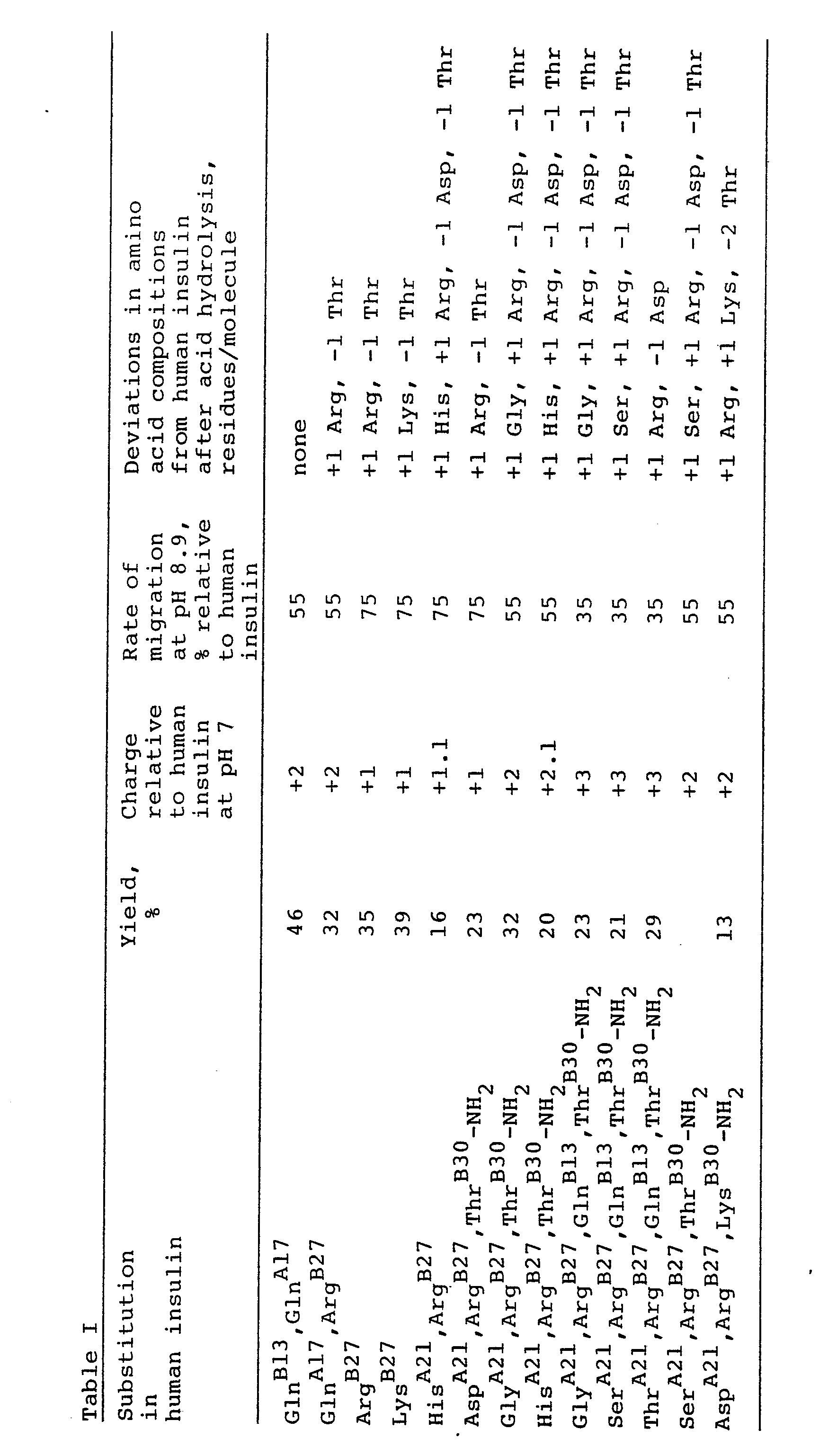
- Sterile injectable solutions of the compounds of formula I for testing of the degree of prolonged action were made using 1.6% (w/v) glycerol as the isotonicum, using 0.3% (w/v) m-cresol as the preservative, and being buffered with 0.01 M sodium acetate. The concentration of zinc ions was 8 or 80 µg/ml. The pH values of the solutions were adjusted sufficiently off the isoelectric point of the compounds of formula I to keep the solutions clear upon storage at 4°C. The solutions contained 240 nmole/ml of the compounds of formula I. The concentration of 240 nmole/ml was established by measurement of the absorbance at 276 nm of a more concentrated stock solution devoid of m-cresol, using the molar extinction coefficient for porcine insulin of 6100 for these derivatives (see Handbuch der Inneren Medizin, Vol. 7/Part 2A, Editor: Oberdisse, 1975, 113). For monocomponent procine insulin, the established potency is 28.5 U/mg dry substance (see Diabetes Care, Vol. 6/Supplement 1 (1983), 4), viz. 1 U corresponds to 5.95 nmole.
- Injectable solutions containing 240 nmole/ml of the compounds of formula I stated in Table II and having the pH values and content of zinc stated therein were made.
- The prolongation of the hypoglycemic effect produced by the injectable solutions of insulin was tested according to British Pharmacopoeia 1980, A 142, in fasted rabbits. Each test solution was administered subcutaneously in a dosis of 14.3 nmole per rabbit in 12 animals weighing 3 - 4 kg, and the course of the hypoglycemia was followed for 6 hours. For comparison the fast acting preparation, Actrapid™ porcine insulin and the intermediate acting Monotard™ human insulin, were included in the tests. The results of the tests are shown in Table II.

- The potencies of insulin compounds were assessed in the mouse blood sugar depletion test (British Pharmacopoeia 1980, A 141 - A 142). In order to minimize the problem of estimating potency of insulins having a timing different from the standard, insulin solutions for potency determinations were made up without additions of zinc. Solutions were made up to contain 240 nmole/ml based on the absorbance at 276 nm. The zinc content of solutions were 8 - 10 µg/ml, arizing from the crystalline derivatives. The estimated potencies of some insulin compounds are shown in Table III, below.

- The features disclosed in the foregoing description and in the following claims may, both separately and in any combination thereof, be material for realising the invention in diverse forms thereof.
Claims (17)

GlyA21,LysB27,ThrB30-NH₂ human insulin,
SerA21,LysB27,ThrB30-NH₂ human insulin,
ThrA21,LysB27,ThrB30-NH₂ human insulin,
AlaA21,LysB27,ThrB30-NH₂ human insulin,
HisA21,LysB27,ThrB30-NH₂ human insulin,
AspA21,LysB27,ThrB30-NH₂ human insulin,
GlyA21,ArgB27,ThrB30-NH₂ human insulin,
SerA21,ArgB27,ThrB30-NH₂ human insulin,
ThrA21,ArgB27,ThrB30-NH₂ human insulin,
AlaA21,ArgB27,ThrB30-NH human insulin,
HisA21,ArgB27,ThrB30-NH human insulin,
AspA21,ArgB27,ThrB30-NH₂ human insulin,
GlnB13,GlyA21,ArgB27,ThrB30-NH₂ human insulin,
GlnB13,SerA21,ArgB27,ThrB30-NH₂ human insulin,
GlnB13,ThrA21,ArgB27,ThrB30-NH₂ human insulin,
GlnB13,AlaA21,ArgB27,ThrB30-NH₂ human insulin,
GlnB13,HisA21,ArgB27,ThrB30-NH₂ human insulin,
GlnB13,AspA21,ArgB27,ThrB30-NH₂ human insulin,
GlnB13,GlyA21,LysB27,ThrB30-NH₂ human insulin,
GlnB13,SerA21,LysB27,ThrB30-NH₂ human insulin,
GlnB13,ThrA21,LysB27,ThrB30-NH₂ human insulin,
GlnB13,AlaA21,LysB27,ThrB30-NH₂ human insulin,
GlnB13,HisA21,LysB27,ThrB30-NH₂ human insulin,
GlnB13,AspA21,LysB27,ThrB30-NH₂ human insulin,
AsnA21,LysB27 human insulin,
SerA21,LysB27 human insulin,
ThrA21,LysB27 human insulin,
AlaA21,LysB27 human insulin,
HisA21,LysB27 human insulin,
AspA21,LysB27 human insulin,
GlyA21,LysB27 human insulin,
AsnA21,ArgB27 human insulin,
SerA21,ArgB27 human insulin,
ThrA21,ArgB27 human insulin,
AlaA21,ArgB27 human insulin,
HisA21,ArgB27 human insulin,
AspA21,ArgB27,LysB30-NH₂ human insulin
AspA21,ArgB27 human insulin,
GlyA21,ArgB27 human insulin,
GlnA17,AsnA21,ArgB27 human insulin,
GlnA17,SerA21,ArgB27 human insulin,
GlnA17,ThrA21,ArgB27 human insulin,
GlnA17,AlaA21,ArgB27 human insulin,
GlnA17,HisA21,ArgB27 human insulin,
GlnA17,AspA21,ArgB27 human insulin,
GlnA17,GlyA21,ArgB27 human insulin,
GlnA17,AsnA21,GlnB13 human insulin,
GlnA17,SerA21,GlnB13 human insulin,
GlnA17,ThrA21,GlnB13 human insulin,
GlnA17,AlaA21,GlnB13 human insulin,
GlnA17,HisA21,GlnB13 human insulin,
GlnA17,AspA21,GlnB13 human insulin,
GlnA17,GlyA21,GlnB13 human insulin,
ArgB27,AsnA21,GlnB13 human insulin,
ArgB27,SerA21,GlnB13 human insulin,
ArgB27,ThrA21,GlnB13 human insulin,
ArgB27,AlaA21,GlnB13 human insulin,
ArgB27,HisA21,GlnB13 human insulin,
ArgB27,AspA21,GlnB13 human insulin,
ArgB27,GlyA21,GlnB13 human insulin,
GlnA17,AsnA21,LysB27 human insulin,
GlnA17,SerA21,LysB27 human insulin,
GlnA17,ThrA21,LysB27 human insulin,
GlnA17,AlaA21,LysB27 human insulin,
GlnA17,HisA21,LysB27 human insulin,
GlnA17,AspA21,LysB27 human insulin,
GlnA17,GlyA21,LysB27 human insulin,
GlnB13,AsnA21,LysB27 human insulin,
GlnB13,SerA21,LysB27 human insulin,
GlnB13,ThrA21,LysB27 human insulin,
GlnB13,AlaA21,LysB27 human insulin,
GlnB13,HisA21,LysB27 human insulin,
GlnB13,AspA21,LysB27 human insulin,
GlnB13,GlyA21,LysB27 human insulin or
hSerA21, ArgB27, ThrB30-NH₂ human insulin.


H-Ym-Zn-R (III)
where Y, Z, R, m and n each are as defined above, and wherein side chain amino groups and hydroxy groups in Y and Z optionally are blocked with amino and hydroxy protecting groups, using trypsin or a trypsin like enzyme as a catalyst.
Priority Applications (1)
| Application Number | Priority Date | Filing Date | Title |
|---|---|---|---|
| AT87306405T ATE99699T1 (en) | 1986-07-21 | 1987-07-20 | PEPTIDES. |
Applications Claiming Priority (2)
| Application Number | Priority Date | Filing Date | Title |
|---|---|---|---|
| DK3470/86 | 1986-07-21 | ||
| DK347086A DK347086D0 (en) | 1986-07-21 | 1986-07-21 | NOVEL PEPTIDES |
Publications (3)
| Publication Number | Publication Date |
|---|---|
| EP0254516A2 true EP0254516A2 (en) | 1988-01-27 |
| EP0254516A3 EP0254516A3 (en) | 1990-06-27 |
| EP0254516B1 EP0254516B1 (en) | 1994-01-05 |
Family
ID=8123250
Family Applications (1)
| Application Number | Title | Priority Date | Filing Date |
|---|---|---|---|
| EP87306405A Expired - Lifetime EP0254516B1 (en) | 1986-07-21 | 1987-07-20 | Novel Peptides |
Country Status (20)
| Country | Link |
|---|---|
| EP (1) | EP0254516B1 (en) |
| JP (1) | JPS6399096A (en) |
| KR (1) | KR880001701A (en) |
| CN (1) | CN87104988A (en) |
| AT (1) | ATE99699T1 (en) |
| AU (1) | AU612324B2 (en) |
| DD (1) | DD273839A5 (en) |
| DE (2) | DE3788684T2 (en) |
| DK (1) | DK347086D0 (en) |
| ES (1) | ES2061504T3 (en) |
| FI (1) | FI873185A7 (en) |
| HU (1) | HU203371B (en) |
| IL (1) | IL83243A (en) |
| MY (1) | MY102873A (en) |
| NL (1) | NL300018I1 (en) |
| NO (1) | NO170978C (en) |
| NZ (1) | NZ221130A (en) |
| PT (1) | PT85355B (en) |
| YU (1) | YU135387A (en) |
| ZA (1) | ZA875295B (en) |
Cited By (41)
| Publication number | Priority date | Publication date | Assignee | Title |
|---|---|---|---|---|
| WO1988006599A1 (en) * | 1987-02-25 | 1988-09-07 | Novo Industri A/S | Novel insulin derivatives |
| WO1990001038A1 (en) * | 1988-07-20 | 1990-02-08 | Nordisk Gentofte A/S | Human insulin analogs and preparations containing them |
| WO1990007522A1 (en) * | 1988-12-23 | 1990-07-12 | Novo Nordisk A/S | Human insulin analogues |
| WO1990011299A1 (en) * | 1989-03-20 | 1990-10-04 | Novo Nordisk A/S | Novel insulin compounds |
| EP0347845A3 (en) * | 1988-06-20 | 1991-07-03 | Novo Nordisk A/S | Insulin precursors, their preparation, and dna sequences, expression vehicles and primers and a process for producing human insulin and analogues |
| EP0368187A3 (en) * | 1988-11-08 | 1991-07-03 | Hoechst Aktiengesellschaft | Insulin derivatives, their use and a pharmaceutical composition containing same |
| AU621648B2 (en) * | 1988-08-13 | 1992-03-19 | Hoechst Aktiengesellschaft | Pharmaceutical formulation for the treatment of diabetes mellitus |
| US5149716A (en) * | 1989-11-06 | 1992-09-22 | Hoechst Aktiengesellschaft | Insulin derivatives, process for their preparation, their use and a pharmaceutical preparation containing them |
| US5514646A (en) * | 1989-02-09 | 1996-05-07 | Chance; Ronald E. | Insulin analogs modified at position 29 of the B chain |
| US5716927A (en) * | 1988-12-23 | 1998-02-10 | Novo Nordisk A/S | Insulin analogs having a modified B-chain |
| EP0712861A3 (en) * | 1994-11-17 | 1998-03-11 | Eli Lilly And Company | Acylated insulin analogs |
| CN1105576C (en) * | 1994-06-16 | 2003-04-16 | 伊莱利利公司 | insulin analog formulations |
| WO2003044210A2 (en) | 2001-11-19 | 2003-05-30 | Novo Nordisk A/S | Process for preparing insulin compounds |
| WO2003080157A1 (en) | 2002-03-22 | 2003-10-02 | K. U. Leuven Research And Development | Automatic infusion system based on an adaptive patient model |
| WO2005000580A1 (en) | 2003-06-27 | 2005-01-06 | Novo Nordisk A/S | High moisture barrier container for medical liquid compositions |
| WO2005061222A1 (en) | 2003-12-22 | 2005-07-07 | Novo Nordisk A/S | Transparent, flexible, impermeable plastic container for storage of pharmaceutical liquids |
| US7316999B2 (en) | 2000-06-02 | 2008-01-08 | Novo Nordisk A/S | Glucose dependent release of insulin from glucose sensing insulin derivatives |
| WO2008006497A1 (en) * | 2006-07-11 | 2008-01-17 | Sanofi-Aventis Deutschland Gmbh | Method for producing insulin analogs having a dibasic b chain terminus |
| WO2008006496A1 (en) * | 2006-07-11 | 2008-01-17 | Sanofi-Aventis Deutschland Gmbh | Amidated glargine insulin |
| US7452860B2 (en) | 2001-03-23 | 2008-11-18 | Sanofi-Aventis Deutschland Gmbh | Zinc-free and low-zinc insulin preparations having improved stability |
| US7476652B2 (en) | 2002-06-18 | 2009-01-13 | Sanofi-Aventis Deutschland Gmbh | Acidic insulin preparations having improved stability |
| EP2033662A1 (en) | 2004-01-21 | 2009-03-11 | Novo Nordisk Health Care AG | Transglutaminase mediated conjugation of peptides |
| WO2010016069A1 (en) | 2008-08-07 | 2010-02-11 | Biocon Limited | A process for preparation of insulin compounds |
| WO2011089203A1 (en) | 2010-01-21 | 2011-07-28 | Sanofi-Aventis | Pharmaceutical composition for treating a metabolic syndrome |
| WO2011128374A1 (en) | 2010-04-14 | 2011-10-20 | Sanofi | Insulin-sirna conjugates |
| EP2476430A1 (en) | 2008-06-13 | 2012-07-18 | Eli Lilly and Company | Pegylated insulin lispro compounds |
| EP2548570A1 (en) | 2011-07-19 | 2013-01-23 | Sanofi | Pharmaceutical composition for treating a metabolic syndrome |
| US9045560B2 (en) | 2008-03-18 | 2015-06-02 | Novo Nordisk A/S | Protease stabilized, acylated insulin analogues |
| US9260501B2 (en) | 2006-10-27 | 2016-02-16 | Novo Nordisk A/S | Peptide extended insulins |
| US9481721B2 (en) | 2012-04-11 | 2016-11-01 | Novo Nordisk A/S | Insulin formulations |
| US9526764B2 (en) | 2008-10-17 | 2016-12-27 | Sanofi-Aventis Deutschland Gmbh | Combination of an insulin and a GLP-1-agonist |
| US9707176B2 (en) | 2009-11-13 | 2017-07-18 | Sanofi-Aventis Deutschland Gmbh | Pharmaceutical composition comprising a GLP-1 agonist and methionine |
| US9821032B2 (en) | 2011-05-13 | 2017-11-21 | Sanofi-Aventis Deutschland Gmbh | Pharmaceutical combination for improving glycemic control as add-on therapy to basal insulin |
| US9950039B2 (en) | 2014-12-12 | 2018-04-24 | Sanofi-Aventis Deutschland Gmbh | Insulin glargine/lixisenatide fixed ratio formulation |
| US9981013B2 (en) | 2010-08-30 | 2018-05-29 | Sanofi-Aventis Deutschland Gmbh | Use of AVE0010 for the treatment of diabetes mellitus type 2 |
| US9987332B2 (en) | 2011-09-01 | 2018-06-05 | Sanofi-Aventis Deutschland Gmbh | Pharmaceutical composition for use in the treatment of a neurodegenerative disease |
| US10029011B2 (en) | 2009-11-13 | 2018-07-24 | Sanofi-Aventis Deutschland Gmbh | Pharmaceutical composition comprising a GLP-1 agonist, an insulin and methionine |
| US10159713B2 (en) | 2015-03-18 | 2018-12-25 | Sanofi-Aventis Deutschland Gmbh | Treatment of type 2 diabetes mellitus patients |
| US10265385B2 (en) | 2016-12-16 | 2019-04-23 | Novo Nordisk A/S | Insulin containing pharmaceutical compositions |
| US10434147B2 (en) | 2015-03-13 | 2019-10-08 | Sanofi-Aventis Deutschland Gmbh | Treatment type 2 diabetes mellitus patients |
| US12558307B2 (en) | 2009-07-06 | 2026-02-24 | Sanofi-Aventis | Insulin preparations containing methionine |
Families Citing this family (5)
| Publication number | Priority date | Publication date | Assignee | Title |
|---|---|---|---|---|
| RU2524423C2 (en) | 2008-01-09 | 2014-07-27 | Санофи-Авентис Дойчланд Гмбх | Novel insulin derivatives with extremely delayed time/action profile |
| KR20100111683A (en) * | 2008-01-09 | 2010-10-15 | 사노피-아벤티스 도이칠란트 게엠베하 | Novel insulin derivatives having an extremely delayed time-action profile |
| WO2011003820A1 (en) * | 2009-07-06 | 2011-01-13 | Sanofi-Aventis Deutschland Gmbh | Heat- and vibration-stable insulin preparations |
| JP6367115B2 (en) | 2011-08-29 | 2018-08-01 | サノフィ−アベンティス・ドイチュラント・ゲゼルシャフト・ミット・ベシュレンクテル・ハフツング | Combination medicine used for blood glucose control in patients with type 2 diabetes |
| WO2015196174A1 (en) | 2014-06-20 | 2015-12-23 | Greene Howard E | Infusion delivery devices and methods |
Family Cites Families (5)
| Publication number | Priority date | Publication date | Assignee | Title |
|---|---|---|---|---|
| DE3033127A1 (en) * | 1980-09-03 | 1982-04-08 | Hoechst Ag, 6000 Frankfurt | NEW INSULIN ANALOG |
| DE3327709A1 (en) * | 1983-07-29 | 1985-02-07 | Hoechst Ag, 6230 Frankfurt | INSULIN DERIVATIVE CRYSTAL SUSPENSIONS, METHOD FOR THE PRODUCTION AND USE THEREOF |
| DE3333640A1 (en) * | 1983-09-17 | 1985-04-25 | Hoechst Ag, 6230 Frankfurt | METHOD FOR THE PRODUCTION OF INSULIN DERIVATIVES, THE B-CHAIN C-TERMINAL EXTENDED, NEW BASICALLY MODIFIED INSULIN DERIVATIVES, THE MEANS CONTAINING THEM AND THEIR USE |
| DK113585D0 (en) * | 1985-03-12 | 1985-03-12 | Novo Industri As | NEW PEPTIDES |
| DK119785D0 (en) * | 1985-03-15 | 1985-03-15 | Nordisk Gentofte | INSULIN PREPARATION |
-
1986
- 1986-07-21 DK DK347086A patent/DK347086D0/en not_active Application Discontinuation
-
1987
- 1987-07-20 PT PT85355A patent/PT85355B/en not_active IP Right Cessation
- 1987-07-20 AU AU75916/87A patent/AU612324B2/en not_active Ceased
- 1987-07-20 NO NO873018A patent/NO170978C/en unknown
- 1987-07-20 HU HU873343A patent/HU203371B/en not_active IP Right Cessation
- 1987-07-20 DD DD87305161A patent/DD273839A5/en not_active IP Right Cessation
- 1987-07-20 CN CN198787104988A patent/CN87104988A/en active Pending
- 1987-07-20 FI FI873185A patent/FI873185A7/en not_active Application Discontinuation
- 1987-07-20 YU YU01353/87A patent/YU135387A/en unknown
- 1987-07-20 ES ES87306405T patent/ES2061504T3/en not_active Expired - Lifetime
- 1987-07-20 KR KR1019870007832A patent/KR880001701A/en not_active Ceased
- 1987-07-20 NZ NZ221130A patent/NZ221130A/en unknown
- 1987-07-20 ZA ZA875295A patent/ZA875295B/en unknown
- 1987-07-20 IL IL83243A patent/IL83243A/en not_active IP Right Cessation
- 1987-07-20 AT AT87306405T patent/ATE99699T1/en not_active IP Right Cessation
- 1987-07-20 DE DE3788684T patent/DE3788684T2/en not_active Expired - Lifetime
- 1987-07-20 DE DE2000175024 patent/DE10075024I1/en active Pending
- 1987-07-20 EP EP87306405A patent/EP0254516B1/en not_active Expired - Lifetime
- 1987-07-20 MY MYPI87001062A patent/MY102873A/en unknown
- 1987-07-21 JP JP62180168A patent/JPS6399096A/en active Pending
-
2000
- 2000-09-15 NL NL300018C patent/NL300018I1/en unknown
Cited By (71)
| Publication number | Priority date | Publication date | Assignee | Title |
|---|---|---|---|---|
| WO1988006599A1 (en) * | 1987-02-25 | 1988-09-07 | Novo Industri A/S | Novel insulin derivatives |
| EP0347845A3 (en) * | 1988-06-20 | 1991-07-03 | Novo Nordisk A/S | Insulin precursors, their preparation, and dna sequences, expression vehicles and primers and a process for producing human insulin and analogues |
| US5149777A (en) * | 1988-07-20 | 1992-09-22 | Novo Nordisk A/S | Human insulin analogs and preparations containing them |
| WO1990001038A1 (en) * | 1988-07-20 | 1990-02-08 | Nordisk Gentofte A/S | Human insulin analogs and preparations containing them |
| AU621648B2 (en) * | 1988-08-13 | 1992-03-19 | Hoechst Aktiengesellschaft | Pharmaceutical formulation for the treatment of diabetes mellitus |
| US5177058A (en) * | 1988-08-13 | 1993-01-05 | Hoechst Aktiengesellschaft | Pharmaceutical formulation for the treatment of diabetes mellitus |
| US6100376A (en) * | 1988-11-08 | 2000-08-08 | Hoechst Aktiengesellschaft | A21, B30, modified insulin derivatives having an altered action profile |
| EP0368187A3 (en) * | 1988-11-08 | 1991-07-03 | Hoechst Aktiengesellschaft | Insulin derivatives, their use and a pharmaceutical composition containing same |
| US5656722A (en) * | 1988-11-08 | 1997-08-12 | Hoechst Aktiengesellschaft | A21 -, B30 - modified insulin derivatives having an altered action profile |
| EP0861851A1 (en) * | 1988-12-23 | 1998-09-02 | Novo Nordisk A/S | Lys (B28) insulins. Human insulin analogues |
| WO1990007522A1 (en) * | 1988-12-23 | 1990-07-12 | Novo Nordisk A/S | Human insulin analogues |
| EP0375437A3 (en) * | 1988-12-23 | 1991-09-11 | Novo Nordisk A/S | Human insulin analogues |
| US5716927A (en) * | 1988-12-23 | 1998-02-10 | Novo Nordisk A/S | Insulin analogs having a modified B-chain |
| EP0837072A3 (en) * | 1988-12-23 | 1998-08-19 | Novo Nordisk A/S | Lys (B28) insulins. Human insulin analogues |
| US5164366A (en) * | 1988-12-23 | 1992-11-17 | Novo Nordisk A/S | Human insulin analogues |
| US5514646A (en) * | 1989-02-09 | 1996-05-07 | Chance; Ronald E. | Insulin analogs modified at position 29 of the B chain |
| US5700662A (en) * | 1989-02-09 | 1997-12-23 | Eli Lilly And Company | Process for preparing insulin analogs |
| WO1990011299A1 (en) * | 1989-03-20 | 1990-10-04 | Novo Nordisk A/S | Novel insulin compounds |
| US5149716A (en) * | 1989-11-06 | 1992-09-22 | Hoechst Aktiengesellschaft | Insulin derivatives, process for their preparation, their use and a pharmaceutical preparation containing them |
| CN1105576C (en) * | 1994-06-16 | 2003-04-16 | 伊莱利利公司 | insulin analog formulations |
| EP0712861A3 (en) * | 1994-11-17 | 1998-03-11 | Eli Lilly And Company | Acylated insulin analogs |
| US7316999B2 (en) | 2000-06-02 | 2008-01-08 | Novo Nordisk A/S | Glucose dependent release of insulin from glucose sensing insulin derivatives |
| US7452860B2 (en) | 2001-03-23 | 2008-11-18 | Sanofi-Aventis Deutschland Gmbh | Zinc-free and low-zinc insulin preparations having improved stability |
| US7696162B2 (en) | 2001-03-23 | 2010-04-13 | Sanofi-Aventis Deutschland Gmbh | Zinc-free and low-zinc insulin preparations having improved stability |
| WO2003044210A2 (en) | 2001-11-19 | 2003-05-30 | Novo Nordisk A/S | Process for preparing insulin compounds |
| EP2193814A1 (en) | 2002-03-22 | 2010-06-09 | K.U.Leuven Research & Development | Automatic infusion system based on an adaptive patient model |
| WO2003080157A1 (en) | 2002-03-22 | 2003-10-02 | K. U. Leuven Research And Development | Automatic infusion system based on an adaptive patient model |
| US7713930B2 (en) | 2002-06-18 | 2010-05-11 | Sanofi-Aventis Deutschland Gmbh | Acidic insulin preparations having improved stability |
| US7476652B2 (en) | 2002-06-18 | 2009-01-13 | Sanofi-Aventis Deutschland Gmbh | Acidic insulin preparations having improved stability |
| WO2005000580A1 (en) | 2003-06-27 | 2005-01-06 | Novo Nordisk A/S | High moisture barrier container for medical liquid compositions |
| EP2301749A1 (en) | 2003-06-27 | 2011-03-30 | Novo Nordisk A/S | High moisture barrier container for medical liquid compositions |
| WO2005061222A1 (en) | 2003-12-22 | 2005-07-07 | Novo Nordisk A/S | Transparent, flexible, impermeable plastic container for storage of pharmaceutical liquids |
| EP2368579A1 (en) | 2004-01-21 | 2011-09-28 | Novo Nordisk Health Care AG | Transglutaminase mediated conjugation of peptides |
| EP2033662A1 (en) | 2004-01-21 | 2009-03-11 | Novo Nordisk Health Care AG | Transglutaminase mediated conjugation of peptides |
| WO2008006496A1 (en) * | 2006-07-11 | 2008-01-17 | Sanofi-Aventis Deutschland Gmbh | Amidated glargine insulin |
| WO2008006497A1 (en) * | 2006-07-11 | 2008-01-17 | Sanofi-Aventis Deutschland Gmbh | Method for producing insulin analogs having a dibasic b chain terminus |
| US8410048B2 (en) | 2006-07-11 | 2013-04-02 | Sanofi-Aventis Deutschland Gmbh | Method for producing insulin analogs having a dibasic B chain terminus |
| US8048854B2 (en) | 2006-07-11 | 2011-11-01 | Sanofi-Aventis Deutschland Gmbh | Amidated insulin glargine |
| US9260501B2 (en) | 2006-10-27 | 2016-02-16 | Novo Nordisk A/S | Peptide extended insulins |
| US10259856B2 (en) | 2008-03-18 | 2019-04-16 | Novo Nordisk A/S | Protease stabilized acylated insulin analogues |
| US9045560B2 (en) | 2008-03-18 | 2015-06-02 | Novo Nordisk A/S | Protease stabilized, acylated insulin analogues |
| US9688737B2 (en) | 2008-03-18 | 2017-06-27 | Novo Nordisk A/S | Protease stabilized acylated insulin analogues |
| EP2476430A1 (en) | 2008-06-13 | 2012-07-18 | Eli Lilly and Company | Pegylated insulin lispro compounds |
| WO2010016069A1 (en) | 2008-08-07 | 2010-02-11 | Biocon Limited | A process for preparation of insulin compounds |
| US10117909B2 (en) | 2008-10-17 | 2018-11-06 | Sanofi-Aventis Deutschland Gmbh | Combination of an insulin and a GLP-1 agonist |
| US9526764B2 (en) | 2008-10-17 | 2016-12-27 | Sanofi-Aventis Deutschland Gmbh | Combination of an insulin and a GLP-1-agonist |
| US12558307B2 (en) | 2009-07-06 | 2026-02-24 | Sanofi-Aventis | Insulin preparations containing methionine |
| US12303598B2 (en) | 2009-11-13 | 2025-05-20 | Sanofi-Aventis Deutschland Gmbh | Pharmaceutical composition comprising a GLP-1-agonist and methionine |
| US9707176B2 (en) | 2009-11-13 | 2017-07-18 | Sanofi-Aventis Deutschland Gmbh | Pharmaceutical composition comprising a GLP-1 agonist and methionine |
| US10029011B2 (en) | 2009-11-13 | 2018-07-24 | Sanofi-Aventis Deutschland Gmbh | Pharmaceutical composition comprising a GLP-1 agonist, an insulin and methionine |
| US10028910B2 (en) | 2009-11-13 | 2018-07-24 | Sanofi-Aventis Deutschland Gmbh | Pharmaceutical composition comprising a GLP-1-agonist and methionine |
| EP3607964A1 (en) | 2010-01-21 | 2020-02-12 | Sanofi | Pharmaceutical composition for treating a metabolic syndrome |
| EP2754449A1 (en) | 2010-01-21 | 2014-07-16 | Sanofi | Pharmaceutical composition for treating a metabolic syndrome |
| WO2011089203A1 (en) | 2010-01-21 | 2011-07-28 | Sanofi-Aventis | Pharmaceutical composition for treating a metabolic syndrome |
| EP2359843A1 (en) | 2010-01-21 | 2011-08-24 | Sanofi | Pharmaceutical composition for treating a metabolic syndrome |
| EP3216459A1 (en) | 2010-01-21 | 2017-09-13 | Sanofi | Pharmaceutical composition for treating a metabolic syndrome |
| EP2460527A1 (en) | 2010-01-21 | 2012-06-06 | Sanofi | Pharmaceutical composition for treating a metabolic syndrome |
| EP3357503A1 (en) | 2010-01-21 | 2018-08-08 | Sanofi | Pharmaceutical composition for treating a metabolic syndrome |
| WO2011128374A1 (en) | 2010-04-14 | 2011-10-20 | Sanofi | Insulin-sirna conjugates |
| US9981013B2 (en) | 2010-08-30 | 2018-05-29 | Sanofi-Aventis Deutschland Gmbh | Use of AVE0010 for the treatment of diabetes mellitus type 2 |
| US9821032B2 (en) | 2011-05-13 | 2017-11-21 | Sanofi-Aventis Deutschland Gmbh | Pharmaceutical combination for improving glycemic control as add-on therapy to basal insulin |
| WO2013010780A1 (en) | 2011-07-19 | 2013-01-24 | Sanofi | Pharmaceutical composition for treating a metabolic syndrome |
| EP2548570A1 (en) | 2011-07-19 | 2013-01-23 | Sanofi | Pharmaceutical composition for treating a metabolic syndrome |
| US9987332B2 (en) | 2011-09-01 | 2018-06-05 | Sanofi-Aventis Deutschland Gmbh | Pharmaceutical composition for use in the treatment of a neurodegenerative disease |
| US9481721B2 (en) | 2012-04-11 | 2016-11-01 | Novo Nordisk A/S | Insulin formulations |
| US9950039B2 (en) | 2014-12-12 | 2018-04-24 | Sanofi-Aventis Deutschland Gmbh | Insulin glargine/lixisenatide fixed ratio formulation |
| US12186374B2 (en) | 2014-12-12 | 2025-01-07 | Sanofi-Aventis Deutschland Gmbh | Insulin glargine/lixisenatide fixed ratio formulation |
| US10434147B2 (en) | 2015-03-13 | 2019-10-08 | Sanofi-Aventis Deutschland Gmbh | Treatment type 2 diabetes mellitus patients |
| US10159713B2 (en) | 2015-03-18 | 2018-12-25 | Sanofi-Aventis Deutschland Gmbh | Treatment of type 2 diabetes mellitus patients |
| US10265385B2 (en) | 2016-12-16 | 2019-04-23 | Novo Nordisk A/S | Insulin containing pharmaceutical compositions |
| US10596231B2 (en) | 2016-12-16 | 2020-03-24 | Novo Nordisk A/S | Insulin containing pharmaceutical compositions |
Also Published As
| Publication number | Publication date |
|---|---|
| JPS6399096A (en) | 1988-04-30 |
| FI873185L (en) | 1988-01-22 |
| ZA875295B (en) | 1988-01-21 |
| AU7591687A (en) | 1988-01-28 |
| NL300018I1 (en) | 2000-11-01 |
| ATE99699T1 (en) | 1994-01-15 |
| FI873185A7 (en) | 1988-01-22 |
| NZ221130A (en) | 1990-08-28 |
| PT85355A (en) | 1987-08-01 |
| DE3788684D1 (en) | 1994-02-17 |
| PT85355B (en) | 1990-04-30 |
| DE10075024I1 (en) | 2000-11-09 |
| IL83243A0 (en) | 1987-12-31 |
| EP0254516A3 (en) | 1990-06-27 |
| DK347086D0 (en) | 1986-07-21 |
| NO873018L (en) | 1988-01-22 |
| FI873185A0 (en) | 1987-07-20 |
| EP0254516B1 (en) | 1994-01-05 |
| NO170978B (en) | 1992-09-28 |
| DE3788684T2 (en) | 1994-05-19 |
| AU612324B2 (en) | 1991-07-11 |
| HUT45271A (en) | 1988-06-28 |
| MY102873A (en) | 1993-03-31 |
| NO170978C (en) | 1993-01-06 |
| ES2061504T3 (en) | 1994-12-16 |
| CN87104988A (en) | 1988-03-02 |
| KR880001701A (en) | 1988-04-26 |
| IL83243A (en) | 1993-01-14 |
| YU135387A (en) | 1988-10-31 |
| HU203371B (en) | 1991-07-29 |
| DD273839A5 (en) | 1989-11-29 |
| NO873018D0 (en) | 1987-07-20 |
Similar Documents
| Publication | Publication Date | Title |
|---|---|---|
| EP0254516B1 (en) | Novel Peptides | |
| EP0194864B1 (en) | Novel peptides | |
| US5008241A (en) | Novel insulin peptides | |
| US4946828A (en) | Novel insulin peptides | |
| AU612141B2 (en) | Novel insulin derivatives | |
| EP0536245A1 (en) | Novel, protracted insulin analogues | |
| US6451970B1 (en) | Peptide derivatives | |
| US5631347A (en) | Reducing gelation of a fatty acid-acylated protein | |
| FI79786C (en) | FOERFARANDE FOER FRAMSTAELLNING ETT FARMACEUTISKT MEDEL FOER BEHANDLING AV DIABETES. | |
| US4701440A (en) | Insulin derivatives, processes for their preparation and their use, and pharmaceutical agents for the treatment of diabetes mellitus | |
| JP3844504B2 (en) | Production of acylated protein powder | |
| JP3131215B2 (en) | New insulin derivative | |
| US20040242460A1 (en) | Stabilized acylated insulin formulations | |
| KR920005659B1 (en) | Process for preparing insulin derivatives | |
| DK160880B (en) | INSULIN DERIVATIVES AND INJECTABLE SOLUTIONS CONTAINING THESE | |
| HK1014010A (en) | Reducing gelation of a fatty acid acylated protein using a citrate buffer |
Legal Events
| Date | Code | Title | Description |
|---|---|---|---|
| PUAI | Public reference made under article 153(3) epc to a published international application that has entered the european phase |
Free format text: ORIGINAL CODE: 0009012 |
|
| AK | Designated contracting states |
Kind code of ref document: A2 Designated state(s): AT BE CH DE ES FR GB GR IT LI LU NL SE |
|
| RAP1 | Party data changed (applicant data changed or rights of an application transferred) |
Owner name: NOVO-NORDISK A/S |
|
| PUAL | Search report despatched |
Free format text: ORIGINAL CODE: 0009013 |
|
| AK | Designated contracting states |
Kind code of ref document: A3 Designated state(s): AT BE CH DE ES FR GB GR IT LI LU NL SE |
|
| 17P | Request for examination filed |
Effective date: 19901206 |
|
| RAP1 | Party data changed (applicant data changed or rights of an application transferred) |
Owner name: NOVO NORDISK A/S |
|
| 17Q | First examination report despatched |
Effective date: 19920211 |
|
| GRAA | (expected) grant |
Free format text: ORIGINAL CODE: 0009210 |
|
| AK | Designated contracting states |
Kind code of ref document: B1 Designated state(s): AT BE CH DE ES FR GB GR IT LI LU NL SE |
|
| REF | Corresponds to: |
Ref document number: 99699 Country of ref document: AT Date of ref document: 19940115 Kind code of ref document: T |
|
| REF | Corresponds to: |
Ref document number: 3788684 Country of ref document: DE Date of ref document: 19940217 |
|
| ITF | It: translation for a ep patent filed | ||
| ET | Fr: translation filed | ||
| REG | Reference to a national code |
Ref country code: GR Ref legal event code: FG4A Free format text: 3011318 |
|
| EPTA | Lu: last paid annual fee | ||
| PLBE | No opposition filed within time limit |
Free format text: ORIGINAL CODE: 0009261 |
|
| STAA | Information on the status of an ep patent application or granted ep patent |
Free format text: STATUS: NO OPPOSITION FILED WITHIN TIME LIMIT |
|
| REG | Reference to a national code |
Ref country code: ES Ref legal event code: FG2A Ref document number: 2061504 Country of ref document: ES Kind code of ref document: T3 |
|
| 26N | No opposition filed | ||
| EAL | Se: european patent in force in sweden |
Ref document number: 87306405.9 |
|
| REG | Reference to a national code |
Ref country code: DE Ref legal event code: 8364 Ref document number: 3788684 Country of ref document: DE Kind code of ref document: T |
|
| REG | Reference to a national code |
Ref country code: DE Ref legal event code: V448 Ref document number: 3788684 Country of ref document: DE Kind code of ref document: T Free format text: PRODUCT NAME: INSULIN GLARGINE; REGISTRATION NO/DATE: EU/1/00/134/001 - EU/1/00/134/007; 20000609 Spc suppl protection certif: 100 75 024 Filing date: 20000828 |
|
| REG | Reference to a national code |
Ref country code: GB Ref legal event code: CTFF Free format text: GBCTFFSPC/GB2000/020, 20000816 |
|
| REG | Reference to a national code |
Ref country code: FR Ref legal event code: CP Free format text: PRODUCT NAME: INSULIN GLARGINE; REGISTRATION NO/DATE: EU/1/00/134/001 20000609 Spc suppl protection certif: 00C0029 Filing date: 20001005 |
|
| MED | It: supplementary protection certificate for pharmaceutical products: no action taken |
Free format text: CCP 707, 20001020; NOVO NORDISK A/S |
|
| REG | Reference to a national code |
Ref country code: NL Ref legal event code: AC1 Free format text: NLAC1 300018, 20000915 |
|
| REG | Reference to a national code |
Ref country code: GB Ref legal event code: CTFW Free format text: GBCTFWSPC/GB2000/020: 20010803 |
|
| REG | Reference to a national code |
Ref country code: GB Ref legal event code: IF02 |
|
| PGFP | Annual fee paid to national office [announced via postgrant information from national office to epo] |
Ref country code: ES Payment date: 20050818 Year of fee payment: 19 |
|
| REG | Reference to a national code |
Ref country code: FR Ref legal event code: CR Free format text: 00C0029, 20001005 Spc suppl protection certif: 00C0029 Filing date: 20001005 |
|
| REG | Reference to a national code |
Ref country code: FR Ref legal event code: CP |
|
| PGFP | Annual fee paid to national office [announced via postgrant information from national office to epo] |
Ref country code: GR Payment date: 20060616 Year of fee payment: 20 |
|
| PGFP | Annual fee paid to national office [announced via postgrant information from national office to epo] |
Ref country code: NL Payment date: 20060703 Year of fee payment: 20 |
|
| PGFP | Annual fee paid to national office [announced via postgrant information from national office to epo] |
Ref country code: AT Payment date: 20060712 Year of fee payment: 20 |
|
| PGFP | Annual fee paid to national office [announced via postgrant information from national office to epo] |
Ref country code: DE Payment date: 20060713 Year of fee payment: 20 Ref country code: CH Payment date: 20060713 Year of fee payment: 20 |
|
| PGFP | Annual fee paid to national office [announced via postgrant information from national office to epo] |
Ref country code: GB Payment date: 20060719 Year of fee payment: 20 Ref country code: FR Payment date: 20060719 Year of fee payment: 20 |
|
| PGFP | Annual fee paid to national office [announced via postgrant information from national office to epo] |
Ref country code: LU Payment date: 20060728 Year of fee payment: 20 |
|
| PGFP | Annual fee paid to national office [announced via postgrant information from national office to epo] |
Ref country code: IT Payment date: 20060731 Year of fee payment: 20 |
|
| PGFP | Annual fee paid to national office [announced via postgrant information from national office to epo] |
Ref country code: BE Payment date: 20060912 Year of fee payment: 20 |
|
| REG | Reference to a national code |
Ref country code: DE Ref legal event code: 8313 Ref document number: 3788684 Country of ref document: DE Kind code of ref document: T Ref country code: DE Ref legal event code: 8310 Ref document number: 3788684 Country of ref document: DE Kind code of ref document: T |
|
| REG | Reference to a national code |
Ref country code: DE Ref legal event code: V472 Ref document number: 3788684 Country of ref document: DE Kind code of ref document: T Free format text: PRODUCT NAME: INSULIN GLARGINE; REGISTRATION NO/DATE: EU/1/00/134/001 - EU/1/00/134/007; 20000609 Spc suppl protection certif: 100 75 024 Filing date: 20000828 |
|
| PG25 | Lapsed in a contracting state [announced via postgrant information from national office to epo] |
Ref country code: NL Free format text: LAPSE BECAUSE OF EXPIRATION OF PROTECTION Effective date: 20070720 |
|
| REG | Reference to a national code |
Ref country code: GB Ref legal event code: PE20 |
|
| REG | Reference to a national code |
Ref country code: CH Ref legal event code: PL |
|
| NLV7 | Nl: ceased due to reaching the maximum lifetime of a patent |
Effective date: 20070720 |
|
| EUG | Se: european patent has lapsed | ||
| REG | Reference to a national code |
Ref country code: ES Ref legal event code: FD2A Effective date: 20070721 |
|
| PG25 | Lapsed in a contracting state [announced via postgrant information from national office to epo] |
Ref country code: GB Free format text: LAPSE BECAUSE OF EXPIRATION OF PROTECTION Effective date: 20070719 |
|
| BE20 | Be: patent expired |
Owner name: *NOVO NORDISK A/S Effective date: 20070720 |
|
| PG25 | Lapsed in a contracting state [announced via postgrant information from national office to epo] |
Ref country code: ES Free format text: LAPSE BECAUSE OF EXPIRATION OF PROTECTION Effective date: 20070721 |
|
| PGFP | Annual fee paid to national office [announced via postgrant information from national office to epo] |
Ref country code: SE Payment date: 20060705 Year of fee payment: 20 |
|
| REG | Reference to a national code |
Ref country code: FR Ref legal event code: AV Spc suppl protection certif: 2000C0029 Ref country code: FR Ref legal event code: CY Free format text: PRODUCT NAME: INSULIN GLARGINE; REGISTRATION NO/DATE IN FRANCE: EU/1/00/134/001 DU 20000609; REGISTRATION NO/DATE AT EEC: EU/1/00/134/001 DU 20000609 Spc suppl protection certif: 00C0029 Filing date: 20001117 Extension date: 20120719 Ref country code: FR Ref legal event code: AV |
|
| REG | Reference to a national code |
Ref country code: DE Free format text: PRODUCT NAME: INSULIN GLARGINE; REGISTRATION NO/DATE: EU/1/00/134/001-007 20000609 Spc suppl protection certif: 10075024 Expiry date: 20070721 Extension date: 20120720 Ref country code: DE Ref legal event code: R019 Ref document number: 3788684 Country of ref document: DE Kind code of ref document: T Free format text: PRODUCT NAME: INSULIN GLARGINE; REGISTRATION NO/DATE: EU/1/00/134/001-007 20000609 Spc suppl protection certif: 10075024 Filing date: 20000828 Expiry date: 20070721 Extension date: 20120720 |
|
| REG | Reference to a national code |
Ref country code: DE Ref legal event code: R069 Ref document number: 3788684 Country of ref document: DE Free format text: PRODUCT NAME: INSULIN GLARGINE; REGISTRATION NO/DATE: EU/1/00/134/001-007 20000609 Spc suppl protection certif: 10075024 Filing date: 20000828 Expiry date: 20070721 Extension date: 20120720 Ref country code: DE Ref legal event code: R069 Ref document number: 3788684 Country of ref document: DE Kind code of ref document: T Free format text: PRODUCT NAME: INSULIN GLARGINE; REGISTRATION NO/DATE: EU/1/00/134/001-007 20000609 Spc suppl protection certif: 10075024 Filing date: 20000828 Expiry date: 20070721 Extension date: 20120720 |
|
| REG | Reference to a national code |
Ref country code: DE Ref legal event code: R409 Ref document number: 3788684 Country of ref document: DE Free format text: PRODUCT NAME: INSULIN GLARGINE; REGISTRATION NO/DATE: EU/1/00/134/001-007 20000609 Spc suppl protection certif: 10075024 Filing date: 20000828 Expiry date: 20070721 Extension date: 20120720 Ref country code: DE Ref legal event code: R409 Ref document number: 3788684 Country of ref document: DE Kind code of ref document: T Free format text: PRODUCT NAME: INSULIN GLARGINE; REGISTRATION NO/DATE: EU/1/00/134/001-007 20000609 Spc suppl protection certif: 10075024 Filing date: 20000828 Expiry date: 20070721 Extension date: 20120720 |
|
| REG | Reference to a national code |
Ref country code: DE Ref legal event code: R071 Ref document number: 3788684 Country of ref document: DE Kind code of ref document: T Free format text: PRODUCT NAME: INSULIN GLARGINE; REGISTRATION NO/DATE: EU/1/00/134/001-007 20000609 Spc suppl protection certif: 10075024 Filing date: 20000828 Expiry date: 20070721 Extension date: 20120720 |
|
| REG | Reference to a national code |
Ref country code: DE Ref legal event code: R071 Ref document number: 3788684 Country of ref document: DE Free format text: PRODUCT NAME: INSULIN GLARGINE; REGISTRATION NO/DATE: EU/1/00/134/001-007 20000609 Spc suppl protection certif: 10075024 Filing date: 20000828 Expiry date: 20070721 Extension date: 20120720 Effective date: 20120721 |