EP0252647B1 - Aircraft cabin noise control apparatus - Google Patents
Aircraft cabin noise control apparatus Download PDFInfo
- Publication number
- EP0252647B1 EP0252647B1 EP87305600A EP87305600A EP0252647B1 EP 0252647 B1 EP0252647 B1 EP 0252647B1 EP 87305600 A EP87305600 A EP 87305600A EP 87305600 A EP87305600 A EP 87305600A EP 0252647 B1 EP0252647 B1 EP 0252647B1
- Authority
- EP
- European Patent Office
- Prior art keywords
- propeller
- cabin
- noise control
- microphones
- fan
- Prior art date
- Legal status (The legal status is an assumption and is not a legal conclusion. Google has not performed a legal analysis and makes no representation as to the accuracy of the status listed.)
- Expired - Lifetime
Links
- 238000004458 analytical method Methods 0.000 claims description 2
- 230000004044 response Effects 0.000 claims description 2
- 230000001419 dependent effect Effects 0.000 claims 1
- 238000004088 simulation Methods 0.000 description 5
- 230000006870 function Effects 0.000 description 4
- 230000006978 adaptation Effects 0.000 description 3
- 238000005094 computer simulation Methods 0.000 description 3
- 238000010586 diagram Methods 0.000 description 3
- 230000009471 action Effects 0.000 description 2
- 230000008859 change Effects 0.000 description 2
- 230000001934 delay Effects 0.000 description 2
- 238000000034 method Methods 0.000 description 2
- 108010066057 cabin-1 Proteins 0.000 description 1
- 230000004048 modification Effects 0.000 description 1
- 238000012986 modification Methods 0.000 description 1
Images


Classifications
-
- B—PERFORMING OPERATIONS; TRANSPORTING
- B64—AIRCRAFT; AVIATION; COSMONAUTICS
- B64C—AEROPLANES; HELICOPTERS
- B64C1/00—Fuselages; Constructional features common to fuselages, wings, stabilising surfaces or the like
- B64C1/40—Sound or heat insulation, e.g. using insulation blankets
-
- B—PERFORMING OPERATIONS; TRANSPORTING
- B64—AIRCRAFT; AVIATION; COSMONAUTICS
- B64C—AEROPLANES; HELICOPTERS
- B64C11/00—Propellers, e.g. of ducted type; Features common to propellers and rotors for rotorcraft
- B64C11/46—Arrangements of, or constructional features peculiar to, multiple propellers
- B64C11/50—Phase synchronisation between multiple propellers
-
- G—PHYSICS
- G10—MUSICAL INSTRUMENTS; ACOUSTICS
- G10K—SOUND-PRODUCING DEVICES; METHODS OR DEVICES FOR PROTECTING AGAINST, OR FOR DAMPING, NOISE OR OTHER ACOUSTIC WAVES IN GENERAL; ACOUSTICS NOT OTHERWISE PROVIDED FOR
- G10K11/00—Methods or devices for transmitting, conducting or directing sound in general; Methods or devices for protecting against, or for damping, noise or other acoustic waves in general
- G10K11/16—Methods or devices for protecting against, or for damping, noise or other acoustic waves in general
- G10K11/175—Methods or devices for protecting against, or for damping, noise or other acoustic waves in general using interference effects; Masking sound
- G10K11/178—Methods or devices for protecting against, or for damping, noise or other acoustic waves in general using interference effects; Masking sound by electro-acoustically regenerating the original acoustic waves in anti-phase
- G10K11/1785—Methods, e.g. algorithms; Devices
- G10K11/17853—Methods, e.g. algorithms; Devices of the filter
- G10K11/17854—Methods, e.g. algorithms; Devices of the filter the filter being an adaptive filter
-
- G—PHYSICS
- G10—MUSICAL INSTRUMENTS; ACOUSTICS
- G10K—SOUND-PRODUCING DEVICES; METHODS OR DEVICES FOR PROTECTING AGAINST, OR FOR DAMPING, NOISE OR OTHER ACOUSTIC WAVES IN GENERAL; ACOUSTICS NOT OTHERWISE PROVIDED FOR
- G10K11/00—Methods or devices for transmitting, conducting or directing sound in general; Methods or devices for protecting against, or for damping, noise or other acoustic waves in general
- G10K11/16—Methods or devices for protecting against, or for damping, noise or other acoustic waves in general
- G10K11/175—Methods or devices for protecting against, or for damping, noise or other acoustic waves in general using interference effects; Masking sound
- G10K11/178—Methods or devices for protecting against, or for damping, noise or other acoustic waves in general using interference effects; Masking sound by electro-acoustically regenerating the original acoustic waves in anti-phase
- G10K11/1785—Methods, e.g. algorithms; Devices
- G10K11/17857—Geometric disposition, e.g. placement of microphones
-
- G—PHYSICS
- G10—MUSICAL INSTRUMENTS; ACOUSTICS
- G10K—SOUND-PRODUCING DEVICES; METHODS OR DEVICES FOR PROTECTING AGAINST, OR FOR DAMPING, NOISE OR OTHER ACOUSTIC WAVES IN GENERAL; ACOUSTICS NOT OTHERWISE PROVIDED FOR
- G10K11/00—Methods or devices for transmitting, conducting or directing sound in general; Methods or devices for protecting against, or for damping, noise or other acoustic waves in general
- G10K11/16—Methods or devices for protecting against, or for damping, noise or other acoustic waves in general
- G10K11/175—Methods or devices for protecting against, or for damping, noise or other acoustic waves in general using interference effects; Masking sound
- G10K11/178—Methods or devices for protecting against, or for damping, noise or other acoustic waves in general using interference effects; Masking sound by electro-acoustically regenerating the original acoustic waves in anti-phase
- G10K11/1787—General system configurations
- G10K11/17879—General system configurations using both a reference signal and an error signal
- G10K11/17883—General system configurations using both a reference signal and an error signal the reference signal being derived from a machine operating condition, e.g. engine RPM or vehicle speed
-
- G—PHYSICS
- G10—MUSICAL INSTRUMENTS; ACOUSTICS
- G10K—SOUND-PRODUCING DEVICES; METHODS OR DEVICES FOR PROTECTING AGAINST, OR FOR DAMPING, NOISE OR OTHER ACOUSTIC WAVES IN GENERAL; ACOUSTICS NOT OTHERWISE PROVIDED FOR
- G10K2210/00—Details of active noise control [ANC] covered by G10K11/178 but not provided for in any of its subgroups
- G10K2210/10—Applications
- G10K2210/123—Synchrophasors or other applications where multiple noise sources are driven with a particular phase relationship
-
- G—PHYSICS
- G10—MUSICAL INSTRUMENTS; ACOUSTICS
- G10K—SOUND-PRODUCING DEVICES; METHODS OR DEVICES FOR PROTECTING AGAINST, OR FOR DAMPING, NOISE OR OTHER ACOUSTIC WAVES IN GENERAL; ACOUSTICS NOT OTHERWISE PROVIDED FOR
- G10K2210/00—Details of active noise control [ANC] covered by G10K11/178 but not provided for in any of its subgroups
- G10K2210/10—Applications
- G10K2210/128—Vehicles
- G10K2210/1281—Aircraft, e.g. spacecraft, airplane or helicopter
-
- G—PHYSICS
- G10—MUSICAL INSTRUMENTS; ACOUSTICS
- G10K—SOUND-PRODUCING DEVICES; METHODS OR DEVICES FOR PROTECTING AGAINST, OR FOR DAMPING, NOISE OR OTHER ACOUSTIC WAVES IN GENERAL; ACOUSTICS NOT OTHERWISE PROVIDED FOR
- G10K2210/00—Details of active noise control [ANC] covered by G10K11/178 but not provided for in any of its subgroups
- G10K2210/30—Means
- G10K2210/301—Computational
- G10K2210/3046—Multiple acoustic inputs, multiple acoustic outputs
Definitions
- the present invention relates to apparatus for controlling cabin noise in propeller or fan driven aircraft.
- Synchrophasing is the automatic control of one or more propellers to provide a fixed phase relationship between the circumferential blade locations of the propellers in relation to a reference propeller. By maintaining an accurate phase relationship between the propellers the annoying beat characteristic of unsynchronsied propellers is avoided. Cabin noise levels may be reduced by careful adjustment of this phase relationship.
- the present invention provides an improved form of aircraft cabin noise control using synchrophasing and active noise control techniques.
- cabin noise control apparatus for a propeller or fan driven aircraft includes a synchrophaser for varying the phase relationship between a reference propeller or fan of the aircraft and at least one of the other propellers or fans of the aircraft characterised by a plurality of microphones and/or accelerometers located inside the cabin and in that the synchrophaser is constructed to vary the phase relationship dynamically during flight in response to the output from a signal processor connected to receive and analyse signals from said plurality of microphones and/or accelerometers and indicative of a range of flying conditions, said output minimising propeller noise in the cabin over said range of flying conditions.
- the signal processor may form part of an active noise control system which generates sound waves in anti-phase with ambient noise waves.
- an active noise control system which generates sound waves in anti-phase with ambient noise waves.
- Such a system may, for example, be as claimed in UK Patent No 2149614.
- This system provides apparatus for reducing noise in an enclosed space where the noise, generated by an external source, has a fundamental frequency f0 and a series of harmonics thereof.
- the value of f0 is monitored and communicated to a signal processor and the sound pressure level in the enclosure is monitored by a plurality of microphones and also communicated to the processor.
- the processor outputs signals to a plurality of loudspeakers, these signals being in antiphase with the input signals so as to minimise the sound pressure level in the enclosure.
- the transducers may be mounted, for example, on a vibrating part of the aircraft which radiates sound into the cabin.
- the signal processor linked to such accelerometers may also form part of an active noise control system similar to that just described.
- Microphones and accelerometers may also be used in this way in combination with one another.
- the phase varying means may be arranged to vary the phase relationship between the reference propeller or fan on one shaft and a propeller or fan on the other shaft of the same engine.
- an aircraft cabin 1 (only part of which is shown) contains four microphones 2, 3, 4, 5 and two loudspeakers 6, 7 which form the active elements of a cabin noise control system.
- Outputs from the microphones 2, 3, 4, 5 are fed via amplifiers 12, 13, 14, 15 respectively to the input of a digital signal processor, 11.
- a reference signal 18 at the fundamental frequency f0 is fed into the processor 11 via a tachometer (not shown).
- the processor 11 has an adaptation algorithm in a memory store (not shown). The adaptation algorithm is described in UK Patent No 2149614 and operates to minimise the sum of the squares of the microphone outputs.
- the same error function as is used in the processor of the above patent is used to adjust the synchrophase angle between a reference propeller 10 and a synchrophased propeller 9 controlled by a synchrophaser 8 having a control input from the signal processor 11.
- the synchrophase angle is varied dynamically during flight to minimise propeller noise in the cabin over a range of flying conditions.
- the following algorithm may be used to adjust the synchrophase angle to minimise cabin noise:-
- the sampled output from the lth error sensor, e l (n), is a linear combination of the output due to a reference propeller d l (n) and outputs from a further M slave propellers whose synchrophase angle, ⁇ m , is controlled.
- the total error, E is defined as: So that the rate of change of E with respect to one synchrophase angle is: Now which is computed from a knowledge of S m (n) and the previously measured filter coefficients.
- FIG. 2 A block diagram of a computer simulation of the apparatus is shown in Figure 2.
- the simulation assumes four microphones and two loudspeakers together with inputs from a reference propeller and a synchrophased propeller.
- a reference signal x(n) of the form cos is filtered by filters 40 and 41 which are adaptively adjusted by the digital signal processor 11 to generate secondary source contributions y1(n) and y2(n), from the two loudspeakers.
- Filters 32-39 are employed as delays and integrators which model the cabin acoustics.
- the reference and synchrophased propeller contributions are similarly filtered by filters 20-27.
- the filter 42 represents the action of the synchrophaser and introduces a phase change in the input from one propeller which is determined adaptively by the action of the digital signal processor 11.
- the afore-mentioned simulation uses an error function comprising the sum of the squares of the microphone outputs at the fundamental blade passage frequency.
- an error function comprising the sum of the squares of the microphone outputs at a harmonic of this frequency, or combinations of harmonics, may be used alternatively.
- a teat can be performed by determining its value under a first synchrophase angle condition and then under a second synchrophase angle, ⁇ radians removed from the first.
- the synchrophase angle condition which gives the lowest total error can be used as a starting point for a new convergence procedure.
Landscapes
- Engineering & Computer Science (AREA)
- Physics & Mathematics (AREA)
- Acoustics & Sound (AREA)
- Multimedia (AREA)
- Aviation & Aerospace Engineering (AREA)
- Mechanical Engineering (AREA)
- Soundproofing, Sound Blocking, And Sound Damping (AREA)
- Exhaust Silencers (AREA)
- Circuit For Audible Band Transducer (AREA)
- Measurement Of Mechanical Vibrations Or Ultrasonic Waves (AREA)
- Feedback Control In General (AREA)
Description
- The present invention relates to apparatus for controlling cabin noise in propeller or fan driven aircraft.
- Several proposals for reducing noise are reviewed in an article entitled 'Strategies for reducing propeller aircraft cabin noise' by F B Metzger in Automotive Engineering, 1981,
Vol 2,No 1,Page 5. In particular, the use of synchrophasing to reduce noise levels in multi-engine transport aircraft is reviewed. Synchrophasing is the automatic control of one or more propellers to provide a fixed phase relationship between the circumferential blade locations of the propellers in relation to a reference propeller. By maintaining an accurate phase relationship between the propellers the annoying beat characteristic of unsynchronsied propellers is avoided. Cabin noise levels may be reduced by careful adjustment of this phase relationship. - There have been a number of proposals for large unducted fan aircraft engines for operation at cruising speeds of between 0.6M and 0.8M. Such engines are mounted at the rear of an aircraft fuselage and a number of proposed designs include contra-rotating forward and rearward fans. The rearward fan reduces residual swirl from the forward fan and improves the overall efficiency of the engine. Cabin noise arising from the use of such engines is likely to be a major problem.
- The present invention provides an improved form of aircraft cabin noise control using synchrophasing and active noise control techniques.
- According to the present invention, cabin noise control apparatus for a propeller or fan driven aircraft includes a synchrophaser for varying the phase relationship between a reference propeller or fan of the aircraft and at least one of the other propellers or fans of the aircraft characterised by a plurality of microphones and/or accelerometers located inside the cabin and in that the synchrophaser is constructed to vary the phase relationship dynamically during flight in response to the output from a signal processor connected to receive and analyse signals from said plurality of microphones and/or accelerometers and indicative of a range of flying conditions, said output minimising propeller noise in the cabin over said range of flying conditions.
- The signal processor may form part of an active noise control system which generates sound waves in anti-phase with ambient noise waves. Such a system may, for example, be as claimed in UK Patent No 2149614. This system provides apparatus for reducing noise in an enclosed space where the noise, generated by an external source, has a fundamental frequency f₀ and a series of harmonics thereof. The value of f₀ is monitored and communicated to a signal processor and the sound pressure level in the enclosure is monitored by a plurality of microphones and also communicated to the processor. The processor outputs signals to a plurality of loudspeakers, these signals being in antiphase with the input signals so as to minimise the sound pressure level in the enclosure.
- Alternatively, the transducers may be mounted, for example, on a vibrating part of the aircraft which radiates sound into the cabin. The signal processor linked to such accelerometers may also form part of an active noise control system similar to that just described. Microphones and accelerometers may also be used in this way in combination with one another.
- In an aircraft having multishaft engines, the phase varying means may be arranged to vary the phase relationship between the reference propeller or fan on one shaft and a propeller or fan on the other shaft of the same engine.
- An embodiment of the invention will now be described with reference to the drawings of which:-
- Figure 1 is a schematic diagram of aircraft cabin noise control apparatus in accordance with the invention,
- Figure 2 is a block diagram of a computer simulation of the apparatus of Figure 1,
- Figure 3, 4 and 5 are graphs showing the results of the simulation of Figure 2,
Figure 6 is a graph showing error functions for systems with and without active noise control. - In Figure 1, an aircraft cabin 1 (only part of which is shown) contains four
microphones loudspeakers 6, 7 which form the active elements of a cabin noise control system. Outputs from themicrophones amplifiers reference signal 18 at the fundamental frequency f₀ is fed into theprocessor 11 via a tachometer (not shown). Theprocessor 11 has an adaptation algorithm in a memory store (not shown). The adaptation algorithm is described in UK Patent No 2149614 and operates to minimise the sum of the squares of the microphone outputs. The same error function as is used in the processor of the above patent is used to adjust the synchrophase angle between areference propeller 10 and a synchrophased propeller 9 controlled by a synchrophaser 8 having a control input from thesignal processor 11. Thus the synchrophase angle is varied dynamically during flight to minimise propeller noise in the cabin over a range of flying conditions. The following algorithm may be used to adjust the synchrophase angle to minimise cabin noise:- - The sampled output from the ℓth error sensor, eℓ(n), is a linear combination of the output due to a reference propeller dℓ(n) and outputs from a further M slave propellers whose synchrophase angle, ϑm, is controlled. The sampled outputs due to the M slave propellers are considered as a convolution of an effective source strength Sm(n) where

where
A = an arbitrary reference amplitude
wo = 2π × blade passage frequency × sample time
and
n = the sample number
with an effective filter having coefficients Cℓmj so that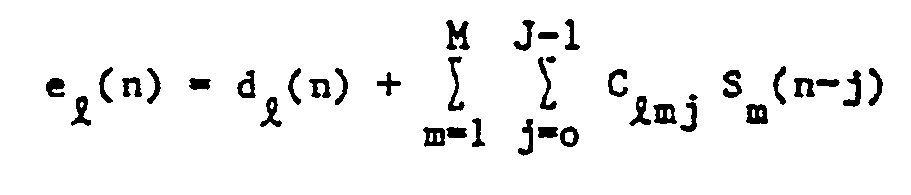
The total error, E, is defined as:
So that the rate of change of E with respect to one synchrophase angle is:
Now


which is computed from a knowledge of Sm(n) and the previously measured filter coefficients. - Thus

and adjusting the synchrophase angle(s) with an instantaneous estimate of this gradient every sample gives
where α is a convergence coefficient. - A block diagram of a computer simulation of the apparatus is shown in Figure 2. The simulation assumes four microphones and two loudspeakers together with inputs from a reference propeller and a synchrophased propeller. A reference signal x(n) of the form cos

filters digital signal processor 11 to generate secondary source contributions y₁(n) and y₂(n), from the two loudspeakers. Filters 32-39 are employed as delays and integrators which model the cabin acoustics. The reference and synchrophased propeller contributions are similarly filtered by filters 20-27. Thefilter 42 represents the action of the synchrophaser and introduces a phase change in the input from one propeller which is determined adaptively by the action of thedigital signal processor 11. Error terms are subsequently computed by means of summers 28-31. The actual convergence behaviour of the computer simulation may not be exactly the same as that in a real aircraft because of the uncertainties in estimating the time delays in changing synchrophase angles. The results of the simulation (see Figures 3, 4 and 5) show that an active noise control system coupled with synchrophased propellers can be stable. As can be seen from Figure 3, the total error, which is the sum of the squares of the outpouts from the four microphones, converges to a minimum whilst a steady synchrophase angle of between
- The afore-mentioned simulation uses an error function comprising the sum of the squares of the microphone outputs at the fundamental blade passage frequency. However, an error function comprising the sum of the squares of the microphone outputs at a harmonic of this frequency, or combinations of harmonics, may be used alternatively. Those skilled in the art will realise that the above algorithm can be readily modified accordingly. To ensure that the total error converges to the lowest minimum value possible, a teat can be performed by determining its value under a first synchrophase angle condition and then under a second synchrophase angle, π radians removed from the first. The synchrophase angle condition which gives the lowest total error can be used as a starting point for a new convergence procedure.
- For active noise control apparatus comprising a large number of microphones and secondary sound sources, the computational load may be great. This load may be reduced by using the following modified algorithm:


where α¹ is a convergence coefficient, k is an integer and ϑm is updated once every N samples. A similar modification can be applied to the adaptation algorithm as described in UK Patent No 2149614 for updating the filter coefficients. - It will be appreciated that the
processor 11 will still give a valid output to the synchrophaser 8 even when the secondary source contributions are reduced to zero. The variation of total error, E, with synchrophase angle for such a system, A, is shown in Figure 6, together with the corresponding variation of E for a system B, wherein the synchrophaser and loudspeakers are allowed to operate simultaneously. It can be seen that the minimum value of E for system B occurs at a different synchrophase angle to that of system A. Furthermore, system B produces a lower value of E for all synchrophase angles from 0 to 2π radians.
Claims (3)
Applications Claiming Priority (2)
| Application Number | Priority Date | Filing Date | Title |
|---|---|---|---|
| GB868615315A GB8615315D0 (en) | 1986-06-23 | 1986-06-23 | Aircraft cabin noise control apparatus |
| GB8615315 | 1986-06-23 |
Publications (2)
| Publication Number | Publication Date |
|---|---|
| EP0252647A1 EP0252647A1 (en) | 1988-01-13 |
| EP0252647B1 true EP0252647B1 (en) | 1991-08-28 |
Family
ID=10599961
Family Applications (2)
| Application Number | Title | Priority Date | Filing Date |
|---|---|---|---|
| EP87305600A Expired - Lifetime EP0252647B1 (en) | 1986-06-23 | 1987-06-23 | Aircraft cabin noise control apparatus |
| EP87904078A Pending EP0310621A1 (en) | 1986-06-23 | 1987-06-23 | Aircraft cabin noise control apparatus |
Family Applications After (1)
| Application Number | Title | Priority Date | Filing Date |
|---|---|---|---|
| EP87904078A Pending EP0310621A1 (en) | 1986-06-23 | 1987-06-23 | Aircraft cabin noise control apparatus |
Country Status (9)
| Country | Link |
|---|---|
| US (1) | US4947356A (en) |
| EP (2) | EP0252647B1 (en) |
| JP (1) | JP2620274B2 (en) |
| BR (1) | BR8707730A (en) |
| CA (1) | CA1328004C (en) |
| DE (1) | DE3772474D1 (en) |
| ES (1) | ES2025662T3 (en) |
| GB (1) | GB8615315D0 (en) |
| WO (1) | WO1987007974A1 (en) |
Cited By (1)
| Publication number | Priority date | Publication date | Assignee | Title |
|---|---|---|---|---|
| DE10212036A1 (en) * | 2002-03-19 | 2003-10-16 | Dornier Gmbh | Noise reduction method for multi-engine propeller aircraft |
Families Citing this family (52)
| Publication number | Priority date | Publication date | Assignee | Title |
|---|---|---|---|---|
| US5170433A (en) * | 1986-10-07 | 1992-12-08 | Adaptive Control Limited | Active vibration control |
| GB2222053B (en) * | 1988-08-17 | 1993-03-31 | Topexpress Ltd | Signal processing means for sensing a periodic signal in the presence of another interfering periodic noise |
| DE4026070C2 (en) * | 1989-08-22 | 2000-05-11 | Volkswagen Ag | Device for actively reducing a noise level at the location of people |
| GB2237415A (en) * | 1989-10-20 | 1991-05-01 | Fokker Bv | Propeller blade synchrophasing |
| DE3941635A1 (en) * | 1989-12-16 | 1991-06-20 | Man Nutzfahrzeuge Ag | METHOD FOR REGENERATING A SOOT FILTER OF A DIESEL INTERNAL COMBUSTION ENGINE, AND DEVICE FOR CARRYING OUT THIS METHOD |
| US5133017A (en) * | 1990-04-09 | 1992-07-21 | Active Noise And Vibration Technologies, Inc. | Noise suppression system |
| US5233540A (en) * | 1990-08-30 | 1993-08-03 | The Boeing Company | Method and apparatus for actively reducing repetitive vibrations |
| US5245552A (en) * | 1990-10-31 | 1993-09-14 | The Boeing Company | Method and apparatus for actively reducing multiple-source repetitive vibrations |
| US5148402A (en) * | 1990-12-21 | 1992-09-15 | United Technologies Corporation | Method for reducing aircraft cabin noise and vibration |
| US5221185A (en) * | 1991-08-05 | 1993-06-22 | General Electric Company | Method and apparatus for synchronizing rotating machinery to reduce noise |
| US5370340A (en) * | 1991-11-04 | 1994-12-06 | General Electric Company | Active control of aircraft engine noise using vibrational inputs |
| US5313399A (en) * | 1992-01-21 | 1994-05-17 | The Charles Stark Draper Laboratories, Inc. | Adaptive synchronous vibration suppression apparatus |
| US5251263A (en) * | 1992-05-22 | 1993-10-05 | Andrea Electronics Corporation | Adaptive noise cancellation and speech enhancement system and apparatus therefor |
| JP3276214B2 (en) * | 1992-08-31 | 2002-04-22 | マツダ株式会社 | Vehicle vibration reduction device |
| US5311453A (en) * | 1992-09-11 | 1994-05-10 | Noise Cancellation Technologies, Inc. | Variable point sampling |
| WO1994009483A1 (en) * | 1992-10-08 | 1994-04-28 | Noise Cancellation Technologies, Inc. | Multiple source self noise cancellation |
| US5692054A (en) * | 1992-10-08 | 1997-11-25 | Noise Cancellation Technologies, Inc. | Multiple source self noise cancellation |
| US5715162A (en) * | 1992-10-13 | 1998-02-03 | United Technologies Corporation | Correlative filter for a synchrophaser |
| US5732143A (en) * | 1992-10-29 | 1998-03-24 | Andrea Electronics Corp. | Noise cancellation apparatus |
| FR2704969B1 (en) * | 1993-05-06 | 1995-07-28 | Centre Scient Tech Batiment | Acoustic attenuation device with active double wall. |
| US5423658A (en) * | 1993-11-01 | 1995-06-13 | General Electric Company | Active noise control using noise source having adaptive resonant frequency tuning through variable ring loading |
| US5391053A (en) * | 1993-11-01 | 1995-02-21 | General Electric Company | Active noise control using noise source having adaptive resonant frequency tuning through variable panel loading |
| US5382134A (en) * | 1993-11-01 | 1995-01-17 | General Electric Company | Active noise control using noise source having adaptive resonant frequency tuning through stiffness variation |
| US5415522A (en) * | 1993-11-01 | 1995-05-16 | General Electric Company | Active noise control using noise source having adaptive resonant frequency tuning through stress variation |
| US5453943A (en) * | 1994-02-18 | 1995-09-26 | United Technologies Corporation | Adaptive synchrophaser for reducing aircraft cabin noise and vibration |
| GB2287851A (en) * | 1994-03-25 | 1995-09-27 | Lotus Car | Time domain adaptive control system for active noise cancellation |
| US5586065A (en) * | 1994-05-31 | 1996-12-17 | The Boeing Company | Method and apparatus for minimizing aircraft cabin noise |
| US5551650A (en) * | 1994-06-16 | 1996-09-03 | Lord Corporation | Active mounts for aircraft engines |
| US5479823A (en) * | 1994-11-03 | 1996-01-02 | Chrysler Corporation | Method and apparatus for inducing audio vibrations |
| US5478199A (en) * | 1994-11-28 | 1995-12-26 | General Electric Company | Active low noise fan assembly |
| JP3654980B2 (en) * | 1995-11-30 | 2005-06-02 | 富士通株式会社 | Active noise control device and waveform conversion device |
| US5802184A (en) * | 1996-08-15 | 1998-09-01 | Lord Corporation | Active noise and vibration control system |
| US5789678A (en) * | 1996-10-22 | 1998-08-04 | General Electric Company | Method for reducing noise and/or vibration from multiple rotating machines |
| US6138947A (en) * | 1997-08-22 | 2000-10-31 | Sikorsky Aircraft Corporation | Active noise control system for a defined volume |
| US6078673A (en) * | 1997-10-03 | 2000-06-20 | Hood Technology Corporation | Apparatus and method for active control of sound transmission through aircraft fuselage walls |
| US6105900A (en) * | 1997-12-23 | 2000-08-22 | Sikorsky Aircraft Corporation | Active noise control system for a helicopter gearbox mount |
| US6363345B1 (en) | 1999-02-18 | 2002-03-26 | Andrea Electronics Corporation | System, method and apparatus for cancelling noise |
| US6594367B1 (en) | 1999-10-25 | 2003-07-15 | Andrea Electronics Corporation | Super directional beamforming design and implementation |
| US6644590B2 (en) | 2000-09-15 | 2003-11-11 | General Dynamics Advanced Information Systems, Inc. | Active system and method for vibration and noise reduction |
| DE08742846T1 (en) | 2007-04-11 | 2010-04-29 | Bell Helicopter Textron, Inc., Fort Worth | VIBRATION DAMPING METHOD FOR A TIPPING AIRCRAFT |
| FR2934245B1 (en) * | 2008-07-24 | 2010-10-01 | Airbus France | AIRCRAFT COMPRISING A SYNCHROPHASED CONTROL ENGINE |
| US8135140B2 (en) | 2008-11-20 | 2012-03-13 | Harman International Industries, Incorporated | System for active noise control with audio signal compensation |
| US9020158B2 (en) * | 2008-11-20 | 2015-04-28 | Harman International Industries, Incorporated | Quiet zone control system |
| US8718289B2 (en) * | 2009-01-12 | 2014-05-06 | Harman International Industries, Incorporated | System for active noise control with parallel adaptive filter configuration |
| US8189799B2 (en) * | 2009-04-09 | 2012-05-29 | Harman International Industries, Incorporated | System for active noise control based on audio system output |
| US8199924B2 (en) * | 2009-04-17 | 2012-06-12 | Harman International Industries, Incorporated | System for active noise control with an infinite impulse response filter |
| US8077873B2 (en) * | 2009-05-14 | 2011-12-13 | Harman International Industries, Incorporated | System for active noise control with adaptive speaker selection |
| US10013900B2 (en) | 2014-09-23 | 2018-07-03 | Amazon Technologies, Inc. | Vehicle noise control and communication |
| US9745050B2 (en) | 2015-12-18 | 2017-08-29 | Amazon Technologies, Inc. | Selecting propellers for performance and noise shaping |
| US10232931B2 (en) | 2015-12-18 | 2019-03-19 | Amazon Technologies, Inc. | Selecting propellers for performance and noise shaping |
| US11312478B2 (en) * | 2017-11-27 | 2022-04-26 | United States Of America As Represented By The Administrator Of Nasa | Adaptive phase control architecture for reduction of community noise from distributed propulsion vehicles |
| US12518729B2 (en) | 2022-05-18 | 2026-01-06 | Innovative Solutions & Support, Inc. | Electronic noise cancellation techniques for aircraft enclosures and/or other enclosures |
Family Cites Families (10)
| Publication number | Priority date | Publication date | Assignee | Title |
|---|---|---|---|---|
| US3689175A (en) * | 1970-08-11 | 1972-09-05 | Piqua Aircraft Co Inc | Apparatus for controlling the speed and phase of engines |
| US4025724A (en) * | 1975-08-12 | 1977-05-24 | Westinghouse Electric Corporation | Noise cancellation apparatus |
| US4245955A (en) * | 1978-12-14 | 1981-01-20 | The Cessna Aircraft Company | Phase and speed control system |
| ZA828700B (en) * | 1981-11-26 | 1983-09-28 | Sound Attenuators Ltd | Method of and apparatus for cancelling vibrations from a source of repetitive vibrations |
| GB2126837B (en) * | 1982-08-19 | 1986-07-23 | British Aerospace | Noise suppression |
| GB8317086D0 (en) * | 1983-06-23 | 1983-07-27 | Swinbanks M A | Attenuation of sound waves |
| GB8328997D0 (en) | 1983-10-31 | 1983-11-30 | Secr Defence | Active noise reduction |
| US4689821A (en) * | 1985-09-23 | 1987-08-25 | Lockheed Corporation | Active noise control system |
| US4659283A (en) * | 1985-09-30 | 1987-04-21 | United Technologies Corporation | Propeller Synchrophaser® device and mode logic |
| US4715559A (en) * | 1986-05-15 | 1987-12-29 | Fuller Christopher R | Apparatus and method for global noise reduction |
-
1986
- 1986-06-23 GB GB868615315A patent/GB8615315D0/en active Pending
-
1987
- 1987-06-22 CA CA000540224A patent/CA1328004C/en not_active Expired - Fee Related
- 1987-06-23 JP JP62503739A patent/JP2620274B2/en not_active Expired - Fee Related
- 1987-06-23 EP EP87305600A patent/EP0252647B1/en not_active Expired - Lifetime
- 1987-06-23 BR BR8707730A patent/BR8707730A/en not_active IP Right Cessation
- 1987-06-23 ES ES198787305600T patent/ES2025662T3/en not_active Expired - Lifetime
- 1987-06-23 WO PCT/GB1987/000442 patent/WO1987007974A1/en not_active Ceased
- 1987-06-23 EP EP87904078A patent/EP0310621A1/en active Pending
- 1987-06-23 DE DE8787305600T patent/DE3772474D1/en not_active Expired - Lifetime
-
1989
- 1989-02-10 US US07/312,709 patent/US4947356A/en not_active Expired - Lifetime
Cited By (2)
| Publication number | Priority date | Publication date | Assignee | Title |
|---|---|---|---|---|
| DE10212036A1 (en) * | 2002-03-19 | 2003-10-16 | Dornier Gmbh | Noise reduction method for multi-engine propeller aircraft |
| DE10212036B4 (en) * | 2002-03-19 | 2009-01-02 | Eads Deutschland Gmbh | Noise reduction method for multi-engine propeller aircraft |
Also Published As
| Publication number | Publication date |
|---|---|
| GB8615315D0 (en) | 1986-07-30 |
| WO1987007974A1 (en) | 1987-12-30 |
| US4947356A (en) | 1990-08-07 |
| JPH01502973A (en) | 1989-10-12 |
| DE3772474D1 (en) | 1991-10-02 |
| EP0252647A1 (en) | 1988-01-13 |
| BR8707730A (en) | 1989-08-15 |
| JP2620274B2 (en) | 1997-06-11 |
| CA1328004C (en) | 1994-03-22 |
| EP0310621A1 (en) | 1989-04-12 |
| ES2025662T3 (en) | 1992-04-01 |
Similar Documents
| Publication | Publication Date | Title |
|---|---|---|
| US4947356A (en) | Aircraft cabin noise control apparatus | |
| US4715559A (en) | Apparatus and method for global noise reduction | |
| EP0285632B1 (en) | Active vibration control | |
| US5170433A (en) | Active vibration control | |
| EP0479367B1 (en) | Method and apparatus for attenuating engine generated noise | |
| CA1334284C (en) | Signal processing means for sensing a periodic signal in the presence of another interfering periodic noise | |
| EP0568129A2 (en) | Noise attenuation system | |
| US5809152A (en) | Apparatus for reducing noise in a closed space having divergence detector | |
| RU2401219C2 (en) | Minimising dynamic loads on aircraft structure | |
| GB2149614A (en) | Active noise reduction apparatus | |
| EP0455479A2 (en) | Active acoustic attenuation system with overall modeling | |
| GB2271909A (en) | Adaptive vibration control system | |
| EP1141578A1 (en) | Active vibration control system identification with enhanced noise reduction | |
| Simpson et al. | Full-scale demonstration tests of cabin noise reduction using activevibration control | |
| CA1337178C (en) | Noise reduction in vehicle cabins | |
| Strawn et al. | Unstructured adaptive mesh computations of rotorcraft high-speed impulsive noise | |
| US5745580A (en) | Reduction of computational burden of adaptively updating control filter(s) in active systems | |
| Elliott | Active control of structure-borne noise | |
| Tokhi et al. | Design and implementation of self-tuning active noise control systems | |
| Jayachandran et al. | On the numerical modelling of interior sound fields by the modal function expansion approach | |
| EP0492680B1 (en) | Method and apparatus for attenuating noise | |
| EP1308926B1 (en) | Active noise cancellation using frequency response control | |
| EP0507829B1 (en) | Active vibration reducing system | |
| Boucher et al. | Active control of helicopter rotor tones | |
| Zalas et al. | Active attenuation of propeller blade passage noise |
Legal Events
| Date | Code | Title | Description |
|---|---|---|---|
| PUAI | Public reference made under article 153(3) epc to a published international application that has entered the european phase |
Free format text: ORIGINAL CODE: 0009012 |
|
| 17P | Request for examination filed |
Effective date: 19870627 |
|
| AK | Designated contracting states |
Kind code of ref document: A1 Designated state(s): ES |
|
| RAP1 | Party data changed (applicant data changed or rights of an application transferred) |
Owner name: THE SECRETARY OF STATE FOR TRADE AND INDUSTRY IN H |
|
| 17Q | First examination report despatched |
Effective date: 19900216 |
|
| RBV | Designated contracting states (corrected) |
Designated state(s): DE ES FR GB IT NL SE |
|
| XX | Miscellaneous (additional remarks) |
Free format text: VERBUNDEN MIT 87904078.0/0310621 (EUROPAEISCHE ANMELDENUMMER/VEROEFFENTLICHUNGSNUMMER) DURCH ENTSCHEIDUNG VOM 07.12.90. |
|
| ITF | It: translation for a ep patent filed | ||
| GRAA | (expected) grant |
Free format text: ORIGINAL CODE: 0009210 |
|
| AK | Designated contracting states |
Kind code of ref document: B1 Designated state(s): DE ES FR GB IT NL SE |
|
| XX | Miscellaneous (additional remarks) |
Free format text: VERBUNDEN MIT 87904078.0/0310621 (EUROPAEISCHE ANMELDENUMMER/VEROEFFENTLICHUNGSNUMMER) DURCH ENTSCHEIDUNG VOM 07.12.90. |
|
| ET | Fr: translation filed | ||
| REF | Corresponds to: |
Ref document number: 3772474 Country of ref document: DE Date of ref document: 19911002 |
|
| REG | Reference to a national code |
Ref country code: ES Ref legal event code: FG2A Ref document number: 2025662 Country of ref document: ES Kind code of ref document: T3 |
|
| PLBE | No opposition filed within time limit |
Free format text: ORIGINAL CODE: 0009261 |
|
| STAA | Information on the status of an ep patent application or granted ep patent |
Free format text: STATUS: NO OPPOSITION FILED WITHIN TIME LIMIT |
|
| 26N | No opposition filed | ||
| EAL | Se: european patent in force in sweden |
Ref document number: 87305600.6 |
|
| REG | Reference to a national code |
Ref country code: GB Ref legal event code: IF02 |
|
| PGFP | Annual fee paid to national office [announced via postgrant information from national office to epo] |
Ref country code: FR Payment date: 20030512 Year of fee payment: 17 |
|
| PGFP | Annual fee paid to national office [announced via postgrant information from national office to epo] |
Ref country code: GB Payment date: 20030516 Year of fee payment: 17 |
|
| PGFP | Annual fee paid to national office [announced via postgrant information from national office to epo] |
Ref country code: NL Payment date: 20030522 Year of fee payment: 17 |
|
| PGFP | Annual fee paid to national office [announced via postgrant information from national office to epo] |
Ref country code: SE Payment date: 20030527 Year of fee payment: 17 Ref country code: DE Payment date: 20030527 Year of fee payment: 17 |
|
| PGFP | Annual fee paid to national office [announced via postgrant information from national office to epo] |
Ref country code: ES Payment date: 20030609 Year of fee payment: 17 |
|
| PG25 | Lapsed in a contracting state [announced via postgrant information from national office to epo] |
Ref country code: GB Free format text: LAPSE BECAUSE OF NON-PAYMENT OF DUE FEES Effective date: 20040623 |
|
| PG25 | Lapsed in a contracting state [announced via postgrant information from national office to epo] |
Ref country code: SE Free format text: LAPSE BECAUSE OF NON-PAYMENT OF DUE FEES Effective date: 20040624 Ref country code: ES Free format text: LAPSE BECAUSE OF NON-PAYMENT OF DUE FEES Effective date: 20040624 |
|
| PG25 | Lapsed in a contracting state [announced via postgrant information from national office to epo] |
Ref country code: NL Free format text: LAPSE BECAUSE OF NON-PAYMENT OF DUE FEES Effective date: 20050101 Ref country code: DE Free format text: LAPSE BECAUSE OF NON-PAYMENT OF DUE FEES Effective date: 20050101 |
|
| EUG | Se: european patent has lapsed | ||
| EUG | Se: european patent has lapsed | ||
| GBPC | Gb: european patent ceased through non-payment of renewal fee |
Effective date: 20040623 |
|
| PG25 | Lapsed in a contracting state [announced via postgrant information from national office to epo] |
Ref country code: FR Free format text: LAPSE BECAUSE OF NON-PAYMENT OF DUE FEES Effective date: 20050228 |
|
| NLV4 | Nl: lapsed or anulled due to non-payment of the annual fee |
Effective date: 20050101 |
|
| REG | Reference to a national code |
Ref country code: FR Ref legal event code: ST |
|
| PG25 | Lapsed in a contracting state [announced via postgrant information from national office to epo] |
Ref country code: IT Free format text: LAPSE BECAUSE OF NON-PAYMENT OF DUE FEES;WARNING: LAPSES OF ITALIAN PATENTS WITH EFFECTIVE DATE BEFORE 2007 MAY HAVE OCCURRED AT ANY TIME BEFORE 2007. THE CORRECT EFFECTIVE DATE MAY BE DIFFERENT FROM THE ONE RECORDED. Effective date: 20050623 |
|
| REG | Reference to a national code |
Ref country code: ES Ref legal event code: FD2A Effective date: 20040624 |