EP0251188B1 - Liquid detergent composition for clothing articles - Google Patents
Liquid detergent composition for clothing articles Download PDFInfo
- Publication number
- EP0251188B1 EP0251188B1 EP87109093A EP87109093A EP0251188B1 EP 0251188 B1 EP0251188 B1 EP 0251188B1 EP 87109093 A EP87109093 A EP 87109093A EP 87109093 A EP87109093 A EP 87109093A EP 0251188 B1 EP0251188 B1 EP 0251188B1
- Authority
- EP
- European Patent Office
- Prior art keywords
- surface active
- liquid detergent
- active agent
- detergent composition
- group
- Prior art date
- Legal status (The legal status is an assumption and is not a legal conclusion. Google has not performed a legal analysis and makes no representation as to the accuracy of the status listed.)
- Expired - Lifetime
Links
- 239000000203 mixture Substances 0.000 title claims description 64
- 239000003599 detergent Substances 0.000 title claims description 59
- 239000007788 liquid Substances 0.000 title claims description 38
- 229920000126 latex Polymers 0.000 claims description 62
- 239000000178 monomer Substances 0.000 claims description 62
- 229920000642 polymer Polymers 0.000 claims description 50
- 239000004094 surface-active agent Substances 0.000 claims description 48
- 239000004816 latex Substances 0.000 claims description 41
- XLYOFNOQVPJJNP-UHFFFAOYSA-N water Substances O XLYOFNOQVPJJNP-UHFFFAOYSA-N 0.000 claims description 37
- 125000000217 alkyl group Chemical group 0.000 claims description 27
- 125000004432 carbon atom Chemical group C* 0.000 claims description 25
- 239000002245 particle Substances 0.000 claims description 22
- 239000004615 ingredient Substances 0.000 claims description 20
- 125000002091 cationic group Chemical group 0.000 claims description 13
- 125000001302 tertiary amino group Chemical group 0.000 claims description 12
- 229920000620 organic polymer Polymers 0.000 claims description 11
- 125000000129 anionic group Chemical group 0.000 claims description 7
- 125000003342 alkenyl group Chemical group 0.000 claims description 6
- 230000009477 glass transition Effects 0.000 claims description 6
- BVKZGUZCCUSVTD-UHFFFAOYSA-N carbonic acid Chemical compound OC(O)=O BVKZGUZCCUSVTD-UHFFFAOYSA-N 0.000 claims description 5
- 239000002904 solvent Substances 0.000 claims description 4
- 125000005037 alkyl phenyl group Chemical group 0.000 claims description 2
- -1 ethylene, propylene, isobutene Chemical class 0.000 description 39
- 238000005406 washing Methods 0.000 description 25
- 238000009472 formulation Methods 0.000 description 18
- 229920003171 Poly (ethylene oxide) Polymers 0.000 description 14
- 238000000034 method Methods 0.000 description 14
- 239000000194 fatty acid Substances 0.000 description 12
- 239000004744 fabric Substances 0.000 description 11
- 150000003839 salts Chemical class 0.000 description 11
- 239000003795 chemical substances by application Substances 0.000 description 10
- 238000006116 polymerization reaction Methods 0.000 description 10
- 238000012360 testing method Methods 0.000 description 10
- 239000002253 acid Chemical group 0.000 description 9
- 239000007864 aqueous solution Substances 0.000 description 9
- PPBRXRYQALVLMV-UHFFFAOYSA-N Styrene Chemical compound C=CC1=CC=CC=C1 PPBRXRYQALVLMV-UHFFFAOYSA-N 0.000 description 8
- 230000000694 effects Effects 0.000 description 8
- 238000003860 storage Methods 0.000 description 8
- 210000002268 wool Anatomy 0.000 description 8
- IJGRMHOSHXDMSA-UHFFFAOYSA-N Atomic nitrogen Chemical compound N#N IJGRMHOSHXDMSA-UHFFFAOYSA-N 0.000 description 7
- CQEYYJKEWSMYFG-UHFFFAOYSA-N butyl acrylate Chemical compound CCCCOC(=O)C=C CQEYYJKEWSMYFG-UHFFFAOYSA-N 0.000 description 7
- ROOXNKNUYICQNP-UHFFFAOYSA-N ammonium persulfate Chemical compound [NH4+].[NH4+].[O-]S(=O)(=O)OOS([O-])(=O)=O ROOXNKNUYICQNP-UHFFFAOYSA-N 0.000 description 6
- 229920001577 copolymer Polymers 0.000 description 6
- 235000014113 dietary fatty acids Nutrition 0.000 description 6
- 238000011156 evaluation Methods 0.000 description 6
- 229930195729 fatty acid Natural products 0.000 description 6
- 239000000835 fiber Substances 0.000 description 6
- 239000006260 foam Substances 0.000 description 6
- FQPSGWSUVKBHSU-UHFFFAOYSA-N methacrylamide Chemical compound CC(=C)C(N)=O FQPSGWSUVKBHSU-UHFFFAOYSA-N 0.000 description 6
- QJGQUHMNIGDVPM-UHFFFAOYSA-N nitrogen group Chemical group [N] QJGQUHMNIGDVPM-UHFFFAOYSA-N 0.000 description 6
- HRPVXLWXLXDGHG-UHFFFAOYSA-N Acrylamide Chemical compound NC(=O)C=C HRPVXLWXLXDGHG-UHFFFAOYSA-N 0.000 description 5
- 239000004793 Polystyrene Substances 0.000 description 5
- 229940117913 acrylamide Drugs 0.000 description 5
- 238000013019 agitation Methods 0.000 description 5
- 239000002585 base Substances 0.000 description 5
- 229920002223 polystyrene Polymers 0.000 description 5
- NIXOWILDQLNWCW-UHFFFAOYSA-N 2-Propenoic acid Natural products OC(=O)C=C NIXOWILDQLNWCW-UHFFFAOYSA-N 0.000 description 4
- LFQSCWFLJHTTHZ-UHFFFAOYSA-N Ethanol Chemical compound CCO LFQSCWFLJHTTHZ-UHFFFAOYSA-N 0.000 description 4
- IAYPIBMASNFSPL-UHFFFAOYSA-N Ethylene oxide Chemical compound C1CO1 IAYPIBMASNFSPL-UHFFFAOYSA-N 0.000 description 4
- 125000004663 dialkyl amino group Chemical group 0.000 description 4
- 150000002148 esters Chemical class 0.000 description 4
- RTZKZFJDLAIYFH-UHFFFAOYSA-N ether Substances CCOCC RTZKZFJDLAIYFH-UHFFFAOYSA-N 0.000 description 4
- 239000004530 micro-emulsion Substances 0.000 description 4
- 230000000379 polymerizing effect Effects 0.000 description 4
- 238000002360 preparation method Methods 0.000 description 4
- 239000007870 radical polymerization initiator Substances 0.000 description 4
- 239000000243 solution Substances 0.000 description 4
- DPBJAVGHACCNRL-UHFFFAOYSA-N 2-(dimethylamino)ethyl prop-2-enoate Chemical compound CN(C)CCOC(=O)C=C DPBJAVGHACCNRL-UHFFFAOYSA-N 0.000 description 3
- WDQMWEYDKDCEHT-UHFFFAOYSA-N 2-ethylhexyl 2-methylprop-2-enoate Chemical compound CCCCC(CC)COC(=O)C(C)=C WDQMWEYDKDCEHT-UHFFFAOYSA-N 0.000 description 3
- QTBSBXVTEAMEQO-UHFFFAOYSA-N Acetic acid Chemical compound CC(O)=O QTBSBXVTEAMEQO-UHFFFAOYSA-N 0.000 description 3
- 229920002972 Acrylic fiber Polymers 0.000 description 3
- MUBZPKHOEPUJKR-UHFFFAOYSA-N Oxalic acid Chemical compound OC(=O)C(O)=O MUBZPKHOEPUJKR-UHFFFAOYSA-N 0.000 description 3
- DNIAPMSPPWPWGF-UHFFFAOYSA-N Propylene glycol Chemical compound CC(O)CO DNIAPMSPPWPWGF-UHFFFAOYSA-N 0.000 description 3
- ZMANZCXQSJIPKH-UHFFFAOYSA-N Triethylamine Chemical compound CCN(CC)CC ZMANZCXQSJIPKH-UHFFFAOYSA-N 0.000 description 3
- 150000007513 acids Chemical class 0.000 description 3
- 150000005215 alkyl ethers Chemical class 0.000 description 3
- 229910001870 ammonium persulfate Inorganic materials 0.000 description 3
- 238000007664 blowing Methods 0.000 description 3
- 238000006243 chemical reaction Methods 0.000 description 3
- KRKNYBCHXYNGOX-UHFFFAOYSA-N citric acid Chemical class OC(=O)CC(O)(C(O)=O)CC(O)=O KRKNYBCHXYNGOX-UHFFFAOYSA-N 0.000 description 3
- 150000001875 compounds Chemical class 0.000 description 3
- 230000008021 deposition Effects 0.000 description 3
- 229910001873 dinitrogen Inorganic materials 0.000 description 3
- 229910052751 metal Inorganic materials 0.000 description 3
- 239000002184 metal Substances 0.000 description 3
- 229910052757 nitrogen Inorganic materials 0.000 description 3
- GSGDTSDELPUTKU-UHFFFAOYSA-N nonoxybenzene Chemical compound CCCCCCCCCOC1=CC=CC=C1 GSGDTSDELPUTKU-UHFFFAOYSA-N 0.000 description 3
- 230000003449 preventive effect Effects 0.000 description 3
- 238000001256 steam distillation Methods 0.000 description 3
- 229920002554 vinyl polymer Polymers 0.000 description 3
- MYRTYDVEIRVNKP-UHFFFAOYSA-N 1,2-Divinylbenzene Chemical compound C=CC1=CC=CC=C1C=C MYRTYDVEIRVNKP-UHFFFAOYSA-N 0.000 description 2
- VXNZUUAINFGPBY-UHFFFAOYSA-N 1-Butene Chemical compound CCC=C VXNZUUAINFGPBY-UHFFFAOYSA-N 0.000 description 2
- UZKWTJUDCOPSNM-UHFFFAOYSA-N 1-ethenoxybutane Chemical compound CCCCOC=C UZKWTJUDCOPSNM-UHFFFAOYSA-N 0.000 description 2
- JLIDVCMBCGBIEY-UHFFFAOYSA-N 1-penten-3-one Chemical compound CCC(=O)C=C JLIDVCMBCGBIEY-UHFFFAOYSA-N 0.000 description 2
- CCTFAOUOYLVUFG-UHFFFAOYSA-N 2-(1-amino-1-imino-2-methylpropan-2-yl)azo-2-methylpropanimidamide Chemical compound NC(=N)C(C)(C)N=NC(C)(C)C(N)=N CCTFAOUOYLVUFG-UHFFFAOYSA-N 0.000 description 2
- SMZOUWXMTYCWNB-UHFFFAOYSA-N 2-(2-methoxy-5-methylphenyl)ethanamine Chemical compound COC1=CC=C(C)C=C1CCN SMZOUWXMTYCWNB-UHFFFAOYSA-N 0.000 description 2
- SJIXRGNQPBQWMK-UHFFFAOYSA-N 2-(diethylamino)ethyl 2-methylprop-2-enoate Chemical compound CCN(CC)CCOC(=O)C(C)=C SJIXRGNQPBQWMK-UHFFFAOYSA-N 0.000 description 2
- AGBXYHCHUYARJY-UHFFFAOYSA-N 2-phenylethenesulfonic acid Chemical compound OS(=O)(=O)C=CC1=CC=CC=C1 AGBXYHCHUYARJY-UHFFFAOYSA-N 0.000 description 2
- KAKZBPTYRLMSJV-UHFFFAOYSA-N Butadiene Chemical compound C=CC=C KAKZBPTYRLMSJV-UHFFFAOYSA-N 0.000 description 2
- SOGAXMICEFXMKE-UHFFFAOYSA-N Butylmethacrylate Chemical compound CCCCOC(=O)C(C)=C SOGAXMICEFXMKE-UHFFFAOYSA-N 0.000 description 2
- FERIUCNNQQJTOY-UHFFFAOYSA-N Butyric acid Chemical compound CCCC(O)=O FERIUCNNQQJTOY-UHFFFAOYSA-N 0.000 description 2
- 102000004190 Enzymes Human genes 0.000 description 2
- 108090000790 Enzymes Proteins 0.000 description 2
- DGAQECJNVWCQMB-PUAWFVPOSA-M Ilexoside XXIX Chemical compound C[C@@H]1CC[C@@]2(CC[C@@]3(C(=CC[C@H]4[C@]3(CC[C@@H]5[C@@]4(CC[C@@H](C5(C)C)OS(=O)(=O)[O-])C)C)[C@@H]2[C@]1(C)O)C)C(=O)O[C@H]6[C@@H]([C@H]([C@@H]([C@H](O6)CO)O)O)O.[Na+] DGAQECJNVWCQMB-PUAWFVPOSA-M 0.000 description 2
- RRHGJUQNOFWUDK-UHFFFAOYSA-N Isoprene Chemical compound CC(=C)C=C RRHGJUQNOFWUDK-UHFFFAOYSA-N 0.000 description 2
- AFVFQIVMOAPDHO-UHFFFAOYSA-N Methanesulfonic acid Chemical compound CS(O)(=O)=O AFVFQIVMOAPDHO-UHFFFAOYSA-N 0.000 description 2
- 239000004698 Polyethylene Substances 0.000 description 2
- XSQUKJJJFZCRTK-UHFFFAOYSA-N Urea Chemical compound NC(N)=O XSQUKJJJFZCRTK-UHFFFAOYSA-N 0.000 description 2
- QYKIQEUNHZKYBP-UHFFFAOYSA-N Vinyl ether Chemical class C=COC=C QYKIQEUNHZKYBP-UHFFFAOYSA-N 0.000 description 2
- 150000001252 acrylic acid derivatives Chemical class 0.000 description 2
- 125000001931 aliphatic group Chemical group 0.000 description 2
- 150000004982 aromatic amines Chemical class 0.000 description 2
- SRSXLGNVWSONIS-UHFFFAOYSA-N benzenesulfonic acid Chemical compound OS(=O)(=O)C1=CC=CC=C1 SRSXLGNVWSONIS-UHFFFAOYSA-N 0.000 description 2
- FUSUHKVFWTUUBE-UHFFFAOYSA-N buten-2-one Chemical compound CC(=O)C=C FUSUHKVFWTUUBE-UHFFFAOYSA-N 0.000 description 2
- 239000006229 carbon black Substances 0.000 description 2
- 239000004359 castor oil Substances 0.000 description 2
- 235000019438 castor oil Nutrition 0.000 description 2
- 230000003750 conditioning effect Effects 0.000 description 2
- 238000011109 contamination Methods 0.000 description 2
- 239000006185 dispersion Substances 0.000 description 2
- 238000004821 distillation Methods 0.000 description 2
- 238000001035 drying Methods 0.000 description 2
- 239000003792 electrolyte Substances 0.000 description 2
- 238000007720 emulsion polymerization reaction Methods 0.000 description 2
- 229940088598 enzyme Drugs 0.000 description 2
- 125000003700 epoxy group Chemical group 0.000 description 2
- FJKIXWOMBXYWOQ-UHFFFAOYSA-N ethenoxyethane Chemical compound CCOC=C FJKIXWOMBXYWOQ-UHFFFAOYSA-N 0.000 description 2
- 229910052731 fluorine Inorganic materials 0.000 description 2
- 238000005187 foaming Methods 0.000 description 2
- ZEMPKEQAKRGZGQ-XOQCFJPHSA-N glycerol triricinoleate Natural products CCCCCC[C@@H](O)CC=CCCCCCCCC(=O)OC[C@@H](COC(=O)CCCCCCCC=CC[C@@H](O)CCCCCC)OC(=O)CCCCCCCC=CC[C@H](O)CCCCCC ZEMPKEQAKRGZGQ-XOQCFJPHSA-N 0.000 description 2
- 238000010438 heat treatment Methods 0.000 description 2
- 229910052739 hydrogen Inorganic materials 0.000 description 2
- 125000002887 hydroxy group Chemical group [H]O* 0.000 description 2
- 229910052500 inorganic mineral Inorganic materials 0.000 description 2
- 150000002500 ions Chemical class 0.000 description 2
- JVTAAEKCZFNVCJ-UHFFFAOYSA-N lactic acid Chemical class CC(O)C(O)=O JVTAAEKCZFNVCJ-UHFFFAOYSA-N 0.000 description 2
- 125000005395 methacrylic acid group Chemical group 0.000 description 2
- 239000000693 micelle Substances 0.000 description 2
- 239000011707 mineral Substances 0.000 description 2
- JRKICGRDRMAZLK-UHFFFAOYSA-L persulfate group Chemical group S(=O)(=O)([O-])OOS(=O)(=O)[O-] JRKICGRDRMAZLK-UHFFFAOYSA-L 0.000 description 2
- 229920000573 polyethylene Polymers 0.000 description 2
- 238000000926 separation method Methods 0.000 description 2
- 229910052708 sodium Inorganic materials 0.000 description 2
- 239000011734 sodium Substances 0.000 description 2
- 239000003381 stabilizer Substances 0.000 description 2
- 150000003440 styrenes Chemical class 0.000 description 2
- 239000000725 suspension Substances 0.000 description 2
- GETQZCLCWQTVFV-UHFFFAOYSA-N trimethylamine Chemical compound CN(C)C GETQZCLCWQTVFV-UHFFFAOYSA-N 0.000 description 2
- 125000000391 vinyl group Chemical group [H]C([*])=C([H])[H] 0.000 description 2
- XIUCEANTZSXBQQ-UHFFFAOYSA-N (3-chloro-2-hydroxypropyl)-trimethylazanium Chemical class C[N+](C)(C)CC(O)CCl XIUCEANTZSXBQQ-UHFFFAOYSA-N 0.000 description 1
- BJEPYKJPYRNKOW-REOHCLBHSA-N (S)-malic acid Chemical class OC(=O)[C@@H](O)CC(O)=O BJEPYKJPYRNKOW-REOHCLBHSA-N 0.000 description 1
- SXZSFWHOSHAKMN-UHFFFAOYSA-N 2,3,4,4',5-Pentachlorobiphenyl Chemical compound C1=CC(Cl)=CC=C1C1=CC(Cl)=C(Cl)C(Cl)=C1Cl SXZSFWHOSHAKMN-UHFFFAOYSA-N 0.000 description 1
- LRRBNLHPFPHVCW-UHFFFAOYSA-N 2,3-dihydroxybutanedioic acid;hydrogen peroxide Chemical compound OO.OC(=O)C(O)C(O)C(O)=O LRRBNLHPFPHVCW-UHFFFAOYSA-N 0.000 description 1
- LCPVQAHEFVXVKT-UHFFFAOYSA-N 2-(2,4-difluorophenoxy)pyridin-3-amine Chemical compound NC1=CC=CN=C1OC1=CC=C(F)C=C1F LCPVQAHEFVXVKT-UHFFFAOYSA-N 0.000 description 1
- STMDPCBYJCIZOD-UHFFFAOYSA-N 2-(2,4-dinitroanilino)-4-methylpentanoic acid Chemical compound CC(C)CC(C(O)=O)NC1=CC=C([N+]([O-])=O)C=C1[N+]([O-])=O STMDPCBYJCIZOD-UHFFFAOYSA-N 0.000 description 1
- OEPOKWHJYJXUGD-UHFFFAOYSA-N 2-(3-phenylmethoxyphenyl)-1,3-thiazole-4-carbaldehyde Chemical compound O=CC1=CSC(C=2C=C(OCC=3C=CC=CC=3)C=CC=2)=N1 OEPOKWHJYJXUGD-UHFFFAOYSA-N 0.000 description 1
- JKNCOURZONDCGV-UHFFFAOYSA-N 2-(dimethylamino)ethyl 2-methylprop-2-enoate Chemical compound CN(C)CCOC(=O)C(C)=C JKNCOURZONDCGV-UHFFFAOYSA-N 0.000 description 1
- GOXQRTZXKQZDDN-UHFFFAOYSA-N 2-Ethylhexyl acrylate Chemical compound CCCCC(CC)COC(=O)C=C GOXQRTZXKQZDDN-UHFFFAOYSA-N 0.000 description 1
- LBLYYCQCTBFVLH-UHFFFAOYSA-N 2-Methylbenzenesulfonic acid Chemical compound CC1=CC=CC=C1S(O)(=O)=O LBLYYCQCTBFVLH-UHFFFAOYSA-N 0.000 description 1
- PDWXXFANUNXZMH-UHFFFAOYSA-N 2-[ethenoxy(phenyl)methyl]oxirane Chemical compound C=1C=CC=CC=1C(OC=C)C1CO1 PDWXXFANUNXZMH-UHFFFAOYSA-N 0.000 description 1
- AOUSBQVEVZBMNI-UHFFFAOYSA-N 2-bromoethyl 2-methylprop-2-enoate Chemical compound CC(=C)C(=O)OCCBr AOUSBQVEVZBMNI-UHFFFAOYSA-N 0.000 description 1
- CDZAAIHWZYWBSS-UHFFFAOYSA-N 2-bromoethyl prop-2-enoate Chemical compound BrCCOC(=O)C=C CDZAAIHWZYWBSS-UHFFFAOYSA-N 0.000 description 1
- GPOGMJLHWQHEGF-UHFFFAOYSA-N 2-chloroethyl 2-methylprop-2-enoate Chemical compound CC(=C)C(=O)OCCCl GPOGMJLHWQHEGF-UHFFFAOYSA-N 0.000 description 1
- WHBAYNMEIXUTJV-UHFFFAOYSA-N 2-chloroethyl prop-2-enoate Chemical compound ClCCOC(=O)C=C WHBAYNMEIXUTJV-UHFFFAOYSA-N 0.000 description 1
- JWCDUUFOAZFFMX-UHFFFAOYSA-N 2-ethenoxy-n,n-dimethylethanamine Chemical compound CN(C)CCOC=C JWCDUUFOAZFFMX-UHFFFAOYSA-N 0.000 description 1
- RAMTWFWSBOIROB-UHFFFAOYSA-N 2-ethenyl-2-phenyloxirane Chemical compound C=1C=CC=CC=1C1(C=C)CO1 RAMTWFWSBOIROB-UHFFFAOYSA-N 0.000 description 1
- ONUXAGYOFJLIQM-UHFFFAOYSA-N 2-ethenylnaphthalene-1-sulfonic acid Chemical compound C1=CC=C2C(S(=O)(=O)O)=C(C=C)C=CC2=C1 ONUXAGYOFJLIQM-UHFFFAOYSA-N 0.000 description 1
- OMIGHNLMNHATMP-UHFFFAOYSA-N 2-hydroxyethyl prop-2-enoate Chemical compound OCCOC(=O)C=C OMIGHNLMNHATMP-UHFFFAOYSA-N 0.000 description 1
- VHSHLMUCYSAUQU-UHFFFAOYSA-N 2-hydroxypropyl methacrylate Chemical compound CC(O)COC(=O)C(C)=C VHSHLMUCYSAUQU-UHFFFAOYSA-N 0.000 description 1
- GWZMWHWAWHPNHN-UHFFFAOYSA-N 2-hydroxypropyl prop-2-enoate Chemical compound CC(O)COC(=O)C=C GWZMWHWAWHPNHN-UHFFFAOYSA-N 0.000 description 1
- IXPWKHNDQICVPZ-UHFFFAOYSA-N 2-methylhex-1-en-3-yne Chemical compound CCC#CC(C)=C IXPWKHNDQICVPZ-UHFFFAOYSA-N 0.000 description 1
- KGIGUEBEKRSTEW-UHFFFAOYSA-N 2-vinylpyridine Chemical compound C=CC1=CC=CC=N1 KGIGUEBEKRSTEW-UHFFFAOYSA-N 0.000 description 1
- PCUPXNDEQDWEMM-UHFFFAOYSA-N 3-(diethylamino)propyl 2-methylprop-2-enoate Chemical compound CCN(CC)CCCOC(=O)C(C)=C PCUPXNDEQDWEMM-UHFFFAOYSA-N 0.000 description 1
- XUYDVDHTTIQNMB-UHFFFAOYSA-N 3-(diethylamino)propyl prop-2-enoate Chemical compound CCN(CC)CCCOC(=O)C=C XUYDVDHTTIQNMB-UHFFFAOYSA-N 0.000 description 1
- WWJCRUKUIQRCGP-UHFFFAOYSA-N 3-(dimethylamino)propyl 2-methylprop-2-enoate Chemical compound CN(C)CCCOC(=O)C(C)=C WWJCRUKUIQRCGP-UHFFFAOYSA-N 0.000 description 1
- UFQHFMGRRVQFNA-UHFFFAOYSA-N 3-(dimethylamino)propyl prop-2-enoate Chemical compound CN(C)CCCOC(=O)C=C UFQHFMGRRVQFNA-UHFFFAOYSA-N 0.000 description 1
- REEBWSYYNPPSKV-UHFFFAOYSA-N 3-[(4-formylphenoxy)methyl]thiophene-2-carbonitrile Chemical compound C1=CC(C=O)=CC=C1OCC1=C(C#N)SC=C1 REEBWSYYNPPSKV-UHFFFAOYSA-N 0.000 description 1
- QAEFQMLTVALDSP-UHFFFAOYSA-N 3-bromopropyl 2-methylprop-2-enoate Chemical compound CC(=C)C(=O)OCCCBr QAEFQMLTVALDSP-UHFFFAOYSA-N 0.000 description 1
- OXSSBGISRIDMME-UHFFFAOYSA-N 3-bromopropyl prop-2-enoate Chemical compound BrCCCOC(=O)C=C OXSSBGISRIDMME-UHFFFAOYSA-N 0.000 description 1
- IWTYTFSSTWXZFU-UHFFFAOYSA-N 3-chloroprop-1-enylbenzene Chemical compound ClCC=CC1=CC=CC=C1 IWTYTFSSTWXZFU-UHFFFAOYSA-N 0.000 description 1
- XNRXPKPCWXCKRX-UHFFFAOYSA-N 3-chloropropyl 2-methylprop-2-enoate Chemical compound CC(=C)C(=O)OCCCCl XNRXPKPCWXCKRX-UHFFFAOYSA-N 0.000 description 1
- KWCPPCKBBRBYEE-UHFFFAOYSA-N 3-chloropropyl prop-2-enoate Chemical compound ClCCCOC(=O)C=C KWCPPCKBBRBYEE-UHFFFAOYSA-N 0.000 description 1
- KFDVPJUYSDEJTH-UHFFFAOYSA-N 4-ethenylpyridine Chemical class C=CC1=CC=NC=C1 KFDVPJUYSDEJTH-UHFFFAOYSA-N 0.000 description 1
- YOQXWFAPUCIKIH-UHFFFAOYSA-N 5-ethenyl-2-ethylpyridine Chemical compound CCC1=CC=C(C=C)C=N1 YOQXWFAPUCIKIH-UHFFFAOYSA-N 0.000 description 1
- VJOWMORERYNYON-UHFFFAOYSA-N 5-ethenyl-2-methylpyridine Chemical compound CC1=CC=C(C=C)C=N1 VJOWMORERYNYON-UHFFFAOYSA-N 0.000 description 1
- NIXOWILDQLNWCW-UHFFFAOYSA-M Acrylate Chemical compound [O-]C(=O)C=C NIXOWILDQLNWCW-UHFFFAOYSA-M 0.000 description 1
- NLHHRLWOUZZQLW-UHFFFAOYSA-N Acrylonitrile Chemical compound C=CC#N NLHHRLWOUZZQLW-UHFFFAOYSA-N 0.000 description 1
- OSDWBNJEKMUWAV-UHFFFAOYSA-N Allyl chloride Chemical compound ClCC=C OSDWBNJEKMUWAV-UHFFFAOYSA-N 0.000 description 1
- 239000004382 Amylase Substances 0.000 description 1
- 102000013142 Amylases Human genes 0.000 description 1
- 108010065511 Amylases Proteins 0.000 description 1
- WKBOTKDWSSQWDR-UHFFFAOYSA-N Bromine atom Chemical compound [Br] WKBOTKDWSSQWDR-UHFFFAOYSA-N 0.000 description 1
- NLZUEZXRPGMBCV-UHFFFAOYSA-N Butylhydroxytoluene Chemical group CC1=CC(C(C)(C)C)=C(O)C(C(C)(C)C)=C1 NLZUEZXRPGMBCV-UHFFFAOYSA-N 0.000 description 1
- UXVMQQNJUSDDNG-UHFFFAOYSA-L Calcium chloride Chemical compound [Cl-].[Cl-].[Ca+2] UXVMQQNJUSDDNG-UHFFFAOYSA-L 0.000 description 1
- 229920002134 Carboxymethyl cellulose Polymers 0.000 description 1
- 108010059892 Cellulase Proteins 0.000 description 1
- VEXZGXHMUGYJMC-UHFFFAOYSA-M Chloride anion Chemical compound [Cl-] VEXZGXHMUGYJMC-UHFFFAOYSA-M 0.000 description 1
- ZAMOUSCENKQFHK-UHFFFAOYSA-N Chlorine atom Chemical compound [Cl] ZAMOUSCENKQFHK-UHFFFAOYSA-N 0.000 description 1
- FEWJPZIEWOKRBE-JCYAYHJZSA-N Dextrotartaric acid Chemical class OC(=O)[C@H](O)[C@@H](O)C(O)=O FEWJPZIEWOKRBE-JCYAYHJZSA-N 0.000 description 1
- IMROMDMJAWUWLK-UHFFFAOYSA-N Ethenol Chemical compound OC=C IMROMDMJAWUWLK-UHFFFAOYSA-N 0.000 description 1
- JIGUQPWFLRLWPJ-UHFFFAOYSA-N Ethyl acrylate Chemical compound CCOC(=O)C=C JIGUQPWFLRLWPJ-UHFFFAOYSA-N 0.000 description 1
- AEMRFAOFKBGASW-UHFFFAOYSA-N Glycolic acid Chemical class OCC(O)=O AEMRFAOFKBGASW-UHFFFAOYSA-N 0.000 description 1
- WOBHKFSMXKNTIM-UHFFFAOYSA-N Hydroxyethyl methacrylate Chemical compound CC(=C)C(=O)OCCO WOBHKFSMXKNTIM-UHFFFAOYSA-N 0.000 description 1
- JVTAAEKCZFNVCJ-UHFFFAOYSA-M Lactate Chemical compound CC(O)C([O-])=O JVTAAEKCZFNVCJ-UHFFFAOYSA-M 0.000 description 1
- 102000004882 Lipase Human genes 0.000 description 1
- 108090001060 Lipase Proteins 0.000 description 1
- 239000004367 Lipase Substances 0.000 description 1
- CERQOIWHTDAKMF-UHFFFAOYSA-M Methacrylate Chemical compound CC(=C)C([O-])=O CERQOIWHTDAKMF-UHFFFAOYSA-M 0.000 description 1
- CERQOIWHTDAKMF-UHFFFAOYSA-N Methacrylic acid Chemical compound CC(=C)C(O)=O CERQOIWHTDAKMF-UHFFFAOYSA-N 0.000 description 1
- VVQNEPGJFQJSBK-UHFFFAOYSA-N Methyl methacrylate Chemical compound COC(=O)C(C)=C VVQNEPGJFQJSBK-UHFFFAOYSA-N 0.000 description 1
- GYCMBHHDWRMZGG-UHFFFAOYSA-N Methylacrylonitrile Chemical compound CC(=C)C#N GYCMBHHDWRMZGG-UHFFFAOYSA-N 0.000 description 1
- JLTDJTHDQAWBAV-UHFFFAOYSA-N N,N-dimethylaniline Chemical compound CN(C)C1=CC=CC=C1 JLTDJTHDQAWBAV-UHFFFAOYSA-N 0.000 description 1
- 229910019142 PO4 Inorganic materials 0.000 description 1
- 108091005804 Peptidases Proteins 0.000 description 1
- 239000002202 Polyethylene glycol Substances 0.000 description 1
- 239000004372 Polyvinyl alcohol Substances 0.000 description 1
- ZLMJMSJWJFRBEC-UHFFFAOYSA-N Potassium Chemical compound [K] ZLMJMSJWJFRBEC-UHFFFAOYSA-N 0.000 description 1
- 239000004365 Protease Substances 0.000 description 1
- 102100037486 Reverse transcriptase/ribonuclease H Human genes 0.000 description 1
- 229920002125 Sokalan® Polymers 0.000 description 1
- KDYFGRWQOYBRFD-UHFFFAOYSA-N Succinic acid Natural products OC(=O)CCC(O)=O KDYFGRWQOYBRFD-UHFFFAOYSA-N 0.000 description 1
- FEWJPZIEWOKRBE-UHFFFAOYSA-N Tartaric acid Chemical class [H+].[H+].[O-]C(=O)C(O)C(O)C([O-])=O FEWJPZIEWOKRBE-UHFFFAOYSA-N 0.000 description 1
- XTXRWKRVRITETP-UHFFFAOYSA-N Vinyl acetate Chemical compound CC(=O)OC=C XTXRWKRVRITETP-UHFFFAOYSA-N 0.000 description 1
- BZHJMEDXRYGGRV-UHFFFAOYSA-N Vinyl chloride Chemical compound ClC=C BZHJMEDXRYGGRV-UHFFFAOYSA-N 0.000 description 1
- 150000003869 acetamides Chemical class 0.000 description 1
- 239000003929 acidic solution Substances 0.000 description 1
- 150000003926 acrylamides Chemical class 0.000 description 1
- 239000000654 additive Substances 0.000 description 1
- 239000003463 adsorbent Substances 0.000 description 1
- 150000001298 alcohols Chemical class 0.000 description 1
- 239000003513 alkali Substances 0.000 description 1
- 229910052783 alkali metal Inorganic materials 0.000 description 1
- 125000005907 alkyl ester group Chemical group 0.000 description 1
- 150000001350 alkyl halides Chemical class 0.000 description 1
- 125000002947 alkylene group Chemical group 0.000 description 1
- BHELZAPQIKSEDF-UHFFFAOYSA-N allyl bromide Chemical compound BrCC=C BHELZAPQIKSEDF-UHFFFAOYSA-N 0.000 description 1
- XYLMUPLGERFSHI-UHFFFAOYSA-N alpha-Methylstyrene Chemical compound CC(=C)C1=CC=CC=C1 XYLMUPLGERFSHI-UHFFFAOYSA-N 0.000 description 1
- BJEPYKJPYRNKOW-UHFFFAOYSA-N alpha-hydroxysuccinic acid Chemical class OC(=O)C(O)CC(O)=O BJEPYKJPYRNKOW-UHFFFAOYSA-N 0.000 description 1
- 150000003863 ammonium salts Chemical class 0.000 description 1
- 235000019418 amylase Nutrition 0.000 description 1
- 239000003963 antioxidant agent Substances 0.000 description 1
- 230000000712 assembly Effects 0.000 description 1
- 238000000429 assembly Methods 0.000 description 1
- SRSXLGNVWSONIS-UHFFFAOYSA-M benzenesulfonate Chemical compound [O-]S(=O)(=O)C1=CC=CC=C1 SRSXLGNVWSONIS-UHFFFAOYSA-M 0.000 description 1
- 229940077388 benzenesulfonate Drugs 0.000 description 1
- 229940092714 benzenesulfonic acid Drugs 0.000 description 1
- BNZXJGMVVSASQT-UHFFFAOYSA-N benzenesulfonyl acetate Chemical class CC(=O)OS(=O)(=O)C1=CC=CC=C1 BNZXJGMVVSASQT-UHFFFAOYSA-N 0.000 description 1
- 150000001558 benzoic acid derivatives Chemical class 0.000 description 1
- AGEZXYOZHKGVCM-UHFFFAOYSA-N benzyl bromide Chemical compound BrCC1=CC=CC=C1 AGEZXYOZHKGVCM-UHFFFAOYSA-N 0.000 description 1
- KCXMKQUNVWSEMD-UHFFFAOYSA-N benzyl chloride Chemical compound ClCC1=CC=CC=C1 KCXMKQUNVWSEMD-UHFFFAOYSA-N 0.000 description 1
- 229940073608 benzyl chloride Drugs 0.000 description 1
- GDTBXPJZTBHREO-UHFFFAOYSA-N bromine Substances BrBr GDTBXPJZTBHREO-UHFFFAOYSA-N 0.000 description 1
- 229910052794 bromium Inorganic materials 0.000 description 1
- INLLPKCGLOXCIV-UHFFFAOYSA-N bromoethene Chemical compound BrC=C INLLPKCGLOXCIV-UHFFFAOYSA-N 0.000 description 1
- 230000005587 bubbling Effects 0.000 description 1
- KDYFGRWQOYBRFD-NUQCWPJISA-N butanedioic acid Chemical compound O[14C](=O)CC[14C](O)=O KDYFGRWQOYBRFD-NUQCWPJISA-N 0.000 description 1
- 239000001110 calcium chloride Substances 0.000 description 1
- 229910001628 calcium chloride Inorganic materials 0.000 description 1
- 239000004202 carbamide Substances 0.000 description 1
- 125000003178 carboxy group Chemical group [H]OC(*)=O 0.000 description 1
- 239000001768 carboxy methyl cellulose Substances 0.000 description 1
- 235000010948 carboxy methyl cellulose Nutrition 0.000 description 1
- 239000008112 carboxymethyl-cellulose Substances 0.000 description 1
- 229940106157 cellulase Drugs 0.000 description 1
- 239000000460 chlorine Substances 0.000 description 1
- 229910052801 chlorine Inorganic materials 0.000 description 1
- 125000004218 chloromethyl group Chemical group [H]C([H])(Cl)* 0.000 description 1
- 235000015165 citric acid Nutrition 0.000 description 1
- 238000004140 cleaning Methods 0.000 description 1
- 238000005345 coagulation Methods 0.000 description 1
- 230000015271 coagulation Effects 0.000 description 1
- 239000012141 concentrate Substances 0.000 description 1
- 230000001143 conditioned effect Effects 0.000 description 1
- 150000001896 cresols Chemical group 0.000 description 1
- 125000000753 cycloalkyl group Chemical group 0.000 description 1
- 150000008050 dialkyl sulfates Chemical class 0.000 description 1
- 150000001991 dicarboxylic acids Chemical class 0.000 description 1
- 150000001993 dienes Chemical class 0.000 description 1
- GGSUCNLOZRCGPQ-UHFFFAOYSA-N diethylaniline Chemical compound CCN(CC)C1=CC=CC=C1 GGSUCNLOZRCGPQ-UHFFFAOYSA-N 0.000 description 1
- 238000009826 distribution Methods 0.000 description 1
- GMSCBRSQMRDRCD-UHFFFAOYSA-N dodecyl 2-methylprop-2-enoate Chemical compound CCCCCCCCCCCCOC(=O)C(C)=C GMSCBRSQMRDRCD-UHFFFAOYSA-N 0.000 description 1
- WYEZUYHCBDYMLS-UHFFFAOYSA-N ethenyl naphthalene-1-sulfonate Chemical class C1=CC=C2C(S(=O)(=O)OC=C)=CC=CC2=C1 WYEZUYHCBDYMLS-UHFFFAOYSA-N 0.000 description 1
- UIWXSTHGICQLQT-UHFFFAOYSA-N ethenyl propanoate Chemical compound CCC(=O)OC=C UIWXSTHGICQLQT-UHFFFAOYSA-N 0.000 description 1
- 150000004665 fatty acids Chemical class 0.000 description 1
- 230000002349 favourable effect Effects 0.000 description 1
- 239000000796 flavoring agent Substances 0.000 description 1
- 235000019634 flavors Nutrition 0.000 description 1
- 239000007850 fluorescent dye Substances 0.000 description 1
- 239000011521 glass Substances 0.000 description 1
- 125000003055 glycidyl group Chemical group C(C1CO1)* 0.000 description 1
- 150000002334 glycols Chemical class 0.000 description 1
- 229910052736 halogen Inorganic materials 0.000 description 1
- 125000005843 halogen group Chemical group 0.000 description 1
- 150000002367 halogens Chemical class 0.000 description 1
- 125000000623 heterocyclic group Chemical group 0.000 description 1
- 125000000592 heterocycloalkyl group Chemical group 0.000 description 1
- 125000004435 hydrogen atom Chemical group [H]* 0.000 description 1
- 239000004310 lactic acid Chemical class 0.000 description 1
- 235000014655 lactic acid Nutrition 0.000 description 1
- 235000019421 lipase Nutrition 0.000 description 1
- 229940040461 lipase Drugs 0.000 description 1
- 230000007774 longterm Effects 0.000 description 1
- FPYJFEHAWHCUMM-UHFFFAOYSA-N maleic anhydride Chemical compound O=C1OC(=O)C=C1 FPYJFEHAWHCUMM-UHFFFAOYSA-N 0.000 description 1
- 239000001630 malic acid Chemical class 0.000 description 1
- 235000011090 malic acid Nutrition 0.000 description 1
- 238000005259 measurement Methods 0.000 description 1
- 150000002734 metacrylic acid derivatives Chemical class 0.000 description 1
- 229940098779 methanesulfonic acid Drugs 0.000 description 1
- 125000002496 methyl group Chemical group [H]C([H])([H])* 0.000 description 1
- 239000011259 mixed solution Substances 0.000 description 1
- MXHTZQSKTCCMFG-UHFFFAOYSA-N n,n-dibenzyl-1-phenylmethanamine Chemical compound C=1C=CC=CC=1CN(CC=1C=CC=CC=1)CC1=CC=CC=C1 MXHTZQSKTCCMFG-UHFFFAOYSA-N 0.000 description 1
- SDYRIBONPHEWCT-UHFFFAOYSA-N n,n-dimethyl-2-phenylethenamine Chemical compound CN(C)C=CC1=CC=CC=C1 SDYRIBONPHEWCT-UHFFFAOYSA-N 0.000 description 1
- SYUYXOYNRMMOGW-UHFFFAOYSA-N n,n-dimethyl-3-phenylprop-2-en-1-amine Chemical compound CN(C)CC=CC1=CC=CC=C1 SYUYXOYNRMMOGW-UHFFFAOYSA-N 0.000 description 1
- YWFWDNVOPHGWMX-UHFFFAOYSA-N n,n-dimethyldodecan-1-amine Chemical compound CCCCCCCCCCCCN(C)C YWFWDNVOPHGWMX-UHFFFAOYSA-N 0.000 description 1
- UQKAOOAFEFCDGT-UHFFFAOYSA-N n,n-dimethyloctan-1-amine Chemical compound CCCCCCCCN(C)C UQKAOOAFEFCDGT-UHFFFAOYSA-N 0.000 description 1
- SFBHPFQSSDCYSL-UHFFFAOYSA-N n,n-dimethyltetradecan-1-amine Chemical compound CCCCCCCCCCCCCCN(C)C SFBHPFQSSDCYSL-UHFFFAOYSA-N 0.000 description 1
- OOHAUGDGCWURIT-UHFFFAOYSA-N n,n-dipentylpentan-1-amine Chemical compound CCCCCN(CCCCC)CCCCC OOHAUGDGCWURIT-UHFFFAOYSA-N 0.000 description 1
- UUORTJUPDJJXST-UHFFFAOYSA-N n-(2-hydroxyethyl)prop-2-enamide Chemical compound OCCNC(=O)C=C UUORTJUPDJJXST-UHFFFAOYSA-N 0.000 description 1
- 230000007935 neutral effect Effects 0.000 description 1
- 125000004433 nitrogen atom Chemical group N* 0.000 description 1
- 238000005580 one pot reaction Methods 0.000 description 1
- 239000003605 opacifier Substances 0.000 description 1
- 150000007524 organic acids Chemical class 0.000 description 1
- 235000005985 organic acids Nutrition 0.000 description 1
- 235000006408 oxalic acid Nutrition 0.000 description 1
- 238000001139 pH measurement Methods 0.000 description 1
- UCUUFSAXZMGPGH-UHFFFAOYSA-N penta-1,4-dien-3-one Chemical class C=CC(=O)C=C UCUUFSAXZMGPGH-UHFFFAOYSA-N 0.000 description 1
- PNJWIWWMYCMZRO-UHFFFAOYSA-N pent‐4‐en‐2‐one Natural products CC(=O)CC=C PNJWIWWMYCMZRO-UHFFFAOYSA-N 0.000 description 1
- 235000021317 phosphate Nutrition 0.000 description 1
- 150000003013 phosphoric acid derivatives Chemical class 0.000 description 1
- 230000000704 physical effect Effects 0.000 description 1
- IBBMAWULFFBRKK-UHFFFAOYSA-N picolinamide Chemical class NC(=O)C1=CC=CC=N1 IBBMAWULFFBRKK-UHFFFAOYSA-N 0.000 description 1
- 229920003023 plastic Polymers 0.000 description 1
- 239000004033 plastic Substances 0.000 description 1
- 229920001485 poly(butyl acrylate) polymer Polymers 0.000 description 1
- 229920000196 poly(lauryl methacrylate) Polymers 0.000 description 1
- 239000004584 polyacrylic acid Substances 0.000 description 1
- 229920000120 polyethyl acrylate Polymers 0.000 description 1
- 229920001223 polyethylene glycol Polymers 0.000 description 1
- 229920002503 polyoxyethylene-polyoxypropylene Polymers 0.000 description 1
- 229920002451 polyvinyl alcohol Polymers 0.000 description 1
- 229920001289 polyvinyl ether Polymers 0.000 description 1
- 229920000036 polyvinylpyrrolidone Polymers 0.000 description 1
- 239000001267 polyvinylpyrrolidone Substances 0.000 description 1
- 235000013855 polyvinylpyrrolidone Nutrition 0.000 description 1
- 229910052700 potassium Inorganic materials 0.000 description 1
- 239000011591 potassium Substances 0.000 description 1
- USHAGKDGDHPEEY-UHFFFAOYSA-L potassium persulfate Chemical compound [K+].[K+].[O-]S(=O)(=O)OOS([O-])(=O)=O USHAGKDGDHPEEY-UHFFFAOYSA-L 0.000 description 1
- 238000001556 precipitation Methods 0.000 description 1
- 238000003825 pressing Methods 0.000 description 1
- 125000002924 primary amino group Chemical group [H]N([H])* 0.000 description 1
- HJWLCRVIBGQPNF-UHFFFAOYSA-N prop-2-enylbenzene Chemical compound C=CCC1=CC=CC=C1 HJWLCRVIBGQPNF-UHFFFAOYSA-N 0.000 description 1
- 235000019419 proteases Nutrition 0.000 description 1
- 238000010926 purge Methods 0.000 description 1
- 125000004076 pyridyl group Chemical group 0.000 description 1
- 150000003242 quaternary ammonium salts Chemical class 0.000 description 1
- 239000012966 redox initiator Substances 0.000 description 1
- 229920006395 saturated elastomer Polymers 0.000 description 1
- 150000004671 saturated fatty acids Chemical class 0.000 description 1
- 150000003335 secondary amines Chemical class 0.000 description 1
- 238000009958 sewing Methods 0.000 description 1
- CHQMHPLRPQMAMX-UHFFFAOYSA-L sodium persulfate Substances [Na+].[Na+].[O-]S(=O)(=O)OOS([O-])(=O)=O CHQMHPLRPQMAMX-UHFFFAOYSA-L 0.000 description 1
- 239000002689 soil Substances 0.000 description 1
- 239000007787 solid Substances 0.000 description 1
- 230000003381 solubilizing effect Effects 0.000 description 1
- 238000001179 sorption measurement Methods 0.000 description 1
- 125000000547 substituted alkyl group Chemical group 0.000 description 1
- 125000000020 sulfo group Chemical group O=S(=O)([*])O[H] 0.000 description 1
- 150000003467 sulfuric acid derivatives Chemical class 0.000 description 1
- 239000011975 tartaric acid Chemical class 0.000 description 1
- 235000002906 tartaric acid Nutrition 0.000 description 1
- 238000010998 test method Methods 0.000 description 1
- 239000010409 thin film Substances 0.000 description 1
- JOXIMZWYDAKGHI-UHFFFAOYSA-N toluene-4-sulfonic acid Chemical class CC1=CC=C(S(O)(=O)=O)C=C1 JOXIMZWYDAKGHI-UHFFFAOYSA-N 0.000 description 1
- 230000007704 transition Effects 0.000 description 1
- IMFACGCPASFAPR-UHFFFAOYSA-N tributylamine Chemical compound CCCCN(CCCC)CCCC IMFACGCPASFAPR-UHFFFAOYSA-N 0.000 description 1
- PUVAFTRIIUSGLK-UHFFFAOYSA-N trimethyl(oxiran-2-ylmethyl)azanium;hydrochloride Chemical compound Cl.C[N+](C)(C)CC1CO1 PUVAFTRIIUSGLK-UHFFFAOYSA-N 0.000 description 1
- YFTHZRPMJXBUME-UHFFFAOYSA-N tripropylamine Chemical compound CCCN(CCC)CCC YFTHZRPMJXBUME-UHFFFAOYSA-N 0.000 description 1
- 235000021122 unsaturated fatty acids Nutrition 0.000 description 1
- 229920001567 vinyl ester resin Polymers 0.000 description 1
- 150000007934 α,β-unsaturated carboxylic acids Chemical class 0.000 description 1
Classifications
-
- C—CHEMISTRY; METALLURGY
- C11—ANIMAL OR VEGETABLE OILS, FATS, FATTY SUBSTANCES OR WAXES; FATTY ACIDS THEREFROM; DETERGENTS; CANDLES
- C11D—DETERGENT COMPOSITIONS; USE OF SINGLE SUBSTANCES AS DETERGENTS; SOAP OR SOAP-MAKING; RESIN SOAPS; RECOVERY OF GLYCEROL
- C11D3/00—Other compounding ingredients of detergent compositions covered in group C11D1/00
- C11D3/16—Organic compounds
- C11D3/37—Polymers
- C11D3/3703—Macromolecular compounds obtained otherwise than by reactions only involving carbon-to-carbon unsaturated bonds
-
- C—CHEMISTRY; METALLURGY
- C11—ANIMAL OR VEGETABLE OILS, FATS, FATTY SUBSTANCES OR WAXES; FATTY ACIDS THEREFROM; DETERGENTS; CANDLES
- C11D—DETERGENT COMPOSITIONS; USE OF SINGLE SUBSTANCES AS DETERGENTS; SOAP OR SOAP-MAKING; RESIN SOAPS; RECOVERY OF GLYCEROL
- C11D3/00—Other compounding ingredients of detergent compositions covered in group C11D1/00
- C11D3/16—Organic compounds
- C11D3/37—Polymers
- C11D3/3746—Macromolecular compounds obtained by reactions only involving carbon-to-carbon unsaturated bonds
- C11D3/3769—(Co)polymerised monomers containing nitrogen, e.g. carbonamides, nitriles or amines
- C11D3/3773—(Co)polymerised monomers containing nitrogen, e.g. carbonamides, nitriles or amines in liquid compositions
Definitions
- This invention relates to detergent compositions and more particularly, to liquid detergent compositions for clothing articles which exhibit a good shrink resistance for felts.
- FR-A-1519154 and FR-A-1416414 describe detergent compositions comprising a detergent component, a foam stabilizer and a polymer latex, which is a dispersion of a non-crosslinked polystyrene.
- the solid portion (non-crosslinked polystyrene) is preferably contained in an amount of 1 to 30 %.
- the composition is used for cleaning and antisoiling fibers and fibers assemblies such as carpets.
- GB-A-985503 relates to liquid detergent compositions which contain an opacifying agent and which are of particular value as detergent toilet preparations.
- the compositions may comprise an aqueous dispersion of a water and alkali insoluble copolymer of styrene obtained by copolymerizing a major portion of styrene with a minor portion of one or more ethylenically unsaturated monomers which contain a hydrophilic group, such as acryl amide, methacryl amide, acrylic acid and methacrylic acid.
- the present inventors made intensive studies to prevent the felt shrinkage and, as a result, found that the felt shrinkage could be prevented when a polymer latex having a specific particle size was added to a liquid detergent composition.
- the present invention was accomplished on the basis of the above finding.
- liquid detergent composition for clothing articles comprising:
- the particle size of the polymer of the polymer latex (A) used in the present invention is as defined above. If the particle size is larger, the adherence to fibers lowers, so that the resistance to shrinkage of felts is not recognized. In this sense, latices which have been hitherto formulated in detergents as a opacifier have an average particle size not smaller than 0.2 micrometers and a wide size distribution. Accordingly, these known latices do not show the effects of the invention.
- the polymer latex (A) comprising an organic polymer with the above-defined particle size cannot be prepared by known emulsion polymerization processes in which droplets of a polymerizable monomer are polymerized in coexistence with a polymerization system.
- the polymer latex of the invention is prepared by polymerizing a water-insoluble, polymerizable monomer in a state of a microemulsion or in a solubilized state.
- the microemulsion state or condition is realized by using a nonionic surface active agent while selecting an appropriate temperature near a phase inversion temperature, or using an anionic surface active agent in combination with an auxiliary surface active agent such as a higher alcohol, or a nonionic surface active agent.
- the solubilized state can be achieved by adding a large amount of surface active agents relative to a polymerizable monomer.
- a nonionic surface active agent is used and a monomer is polymerized at a temperature in the vicinity of a phase inversion temperature under such a microemulsion state that the interfacial tension between the monomer and water is not larger than 1 dyne/cm, preferably not larger than 0.5 dyne/cm.
- Addition polymer latices are obtained by polymerizing a polymerizable monomer in a condition where a microemulsion state is kept in such a way that the polymerizable monomer is solubilized in micelles formed by a surface active agent and an aqueous solution of the surface active agent used has an interfacial tension between the monomer and water of less than 1 dyne/cm.
- polymerizable monomers may be any known monomers used for emulsion polymerization and include ethylenically unsaturated monomers such as ethylene, propylene, isobutene and butene-1; aromatic vinyl monomers such as styrene, alpha-methylstyrene, vinyltoluene, halogenated styrene and divinylbenzene; acrylic esters whose alkyl group has from 1 to 20 carbon atoms, such as ethyl acrylate, butyl acrylate and 2-ethylhexyl acrylate; methacrylic esters having from 1 to 20 carbon atoms, such as methyl methacrylate, butyl methacrylate and lauryl methacrylate; vinyl esters such as vinyl acetate and vinyl propionate; vinyl ethers having from 1 to 20 carbon atoms, such as ethyl vinyl ether and butyl vinyl ether; vinyl ketones having from 1 to 20 carbon atoms,
- nitrogen-containing monomers are also used as the polymerizable monomer.
- examples of such monomers are ethylenically unsaturated nitrogen-containig monomers having a cationic group or a tertiary amino group and represented by the following general formulae (I) and (II) in which R2, R3 and R4 represent an alkyl or substituted alkyl group having from 1 to 18 carbon atoms or a hydrogen atom and may be the same or different, or two of the three groups may join to complete, along with an adjacent nitrogen atom, a heterocyclic ring such as a pyridyl group or an imidazoyl group, a cycloalkyl group or a heterocycloalkyl group, and Z represents a halogen atom or an acid residue.
- ethylenically unsaturated nitrogen-containing monomers include: monovinylpyridines such as vinylpyridine, 2-methyl-5-vinylpyridine and 2-ethyl-5-vinylpyridine; dialkylamino group-containing styrenes such as N,N-dimethylaminostyrene and N,N-dimethylaminomethylstyrene; acrylic or methacrylic esters having a dialkylamino group such as N,N-dimethylaminoethyl methacrylate, N,N-dimethylaminoethyl acrylate, N,N-diethylaminoethyl methacrylate, N,N-diethylaminoethyl acrylate, N,N-dimethylaminopropyl methacrylate, N,N-dimethylaminopropyl acrylate, N,N-diethylaminopropyl methacrylate and N,N-diethyl
- the monomers mentioned above may be used singly or in combination.
- these monomers may be copolymerized with maleic anhydride, a water-soluble monomer, styrenesulfonic acid or styrenesulfonates, vinylnaphthalenesulfonic acid or vinylnaphthalenesulfonates, or acrylic acid or acrylates.
- the most preferable method of preparing the addition polymer latex is a method in which a surface active agent is added to a reactor into which water has been charged, to prepare an aqueous solution, and agitated under heating conditions in the vicinity of a temperature at which the micelles of the surface active agent are subjected to phase transition so that the interfacial tension between a monomer and water is kept within a range not larger than 1 dyne/cm, preferably from 1 to 0.5 dyne/cm.
- a polymerizable monomer and, if necessary, an aqueous solution of a radical polymerization initiator are added in order to start the polymerization. Thereafter, the polymerizable monomer is gradually added in such a way that the interfacial tension between the aqueous solution of the surface active agent and the monomer phase is kept outside of the above range, thereby carrying out the polymerization.
- the radical polymerization initiators include, for example, persulfates such as potassium persulfate, sodium persulfate and ammonium persulfate; azo compounds such as 2,2'-azobis(2-amidinopropane) mineral acid salts, azobiscyanovaleric acid and its alkali metal salts and an ammonium salts, and Redox initiators such as tartaric acid-hydrogen peroxide, Rongalite-peroxides and ascorbic acid-peroxides.
- cationic surface active agents are used in the polymerization system, 2,2'-azobis(2-amidinopropane) mineral acid salts are preferably used.
- persulfates are preferably used.
- the amount of the radical polymerization initiator is generally in the range of from 0.1 to 5 parts by weight, preferably from 0.1 to 3 parts by weight, per 100 parts by weight of a monomer.
- the reaction temperature should be a maximum temperature within a solubilizing region in the vicinity of the phase inversion temperature and is preferably in the range of from 50 to 90°C.
- the time required for the polymerization may depend on the types composition and concentration of monomers, the concentration of the radical polymerization initiator and the polymerization temperature, and is preferably from 5 to 50 hours.
- the polymers in the latices should preferably have a glass transition temperature (Tg) not higher than 300°K.
- Polymers whose glass transition temperature is not higher than 300°K are, for example, polyaddition polymer latices including polyacrylic esters such as polyethyl acrylate and polybutyl acrylate, polymethacrylic esters such as poly-2-ethylhexyl methacrylate and polylauryl methacrylate, and polyvinyl ethers such as polybutoxyethylene and polymethoxyethylene.
- polyacrylic esters such as polyethyl acrylate and polybutyl acrylate
- polymethacrylic esters such as poly-2-ethylhexyl methacrylate and polylauryl methacrylate
- polyvinyl ethers such as polybutoxyethylene and polymethoxyethylene.
- addition polymer latices among which polymers or copolymers of ⁇ , ⁇ -unsaturated carboxylic acid ester monomers such as acrylates and methacrylates, which have a glass transition temperature (Tg) of not higher than 300°K, are most preferred.
- the latices used by the invention are polymer latices having a cationic group or a tertiary amino group (which may be hereinafter referred to simply as "nitrogen-containing latices"). These are obtained by polymerizing ethylenically unsaturated nitrogen-containing monomers alone or along with water-insoluble polymerizable monomers. However, other processes described below may also be used for the preparation of such latices.
- tertiary salts of the general formula (II) may be used.
- the tertiary amino group exhibits a weakly cationic property in an aqueous solution (neutral to acidic solution).
- the liquid detergent for clothing articles according to the invention may be obtained by directly adding the thus obtained polymer latex to a base for the liquid detergent for clothing articles, or by adding a suspension of the latex concentrated to a desired level to the base.
- the polymer latex is added to the liquid detergent in an amount of from 0.01 to 10 wt% (hereinafter referred to simply as %), preferably from 0.05 to 5%, when calculated as a residue left after removal of the water.
- the nitrogen-containing polymer latex usually contains a remaining monomer in an amount of from 200 to 300 ppm, it is preferred to remove the monomer prior to formulation in the liquid detergent composition of the invention.
- the removal of the remaining monomer may be effected by ordinary distillation under reduced pressure, steam distillation under reduced pressure, thin film separation under reduced pressure, bubbling by blowing air or adsorption using an adsorbent.
- the amount of the remaining monomer should preferably be below 100 ppm, more preferably below 40 ppm and most preferably below 10 ppm.
- the liquid detergent composition of the invention comprises, aside from the polymer latex, one or more of the following surface active agents.
- Anionic surface active agents are used as the surface active agent, including linear or branched alkylbenzenesulfonates, alkyl or alkenyl ether sulfates, alkyl or alkenyl sulfates, olefinsulfonates, alkanesulfonates, alpha-sulfo fatty acid salts or esters, saturated or unsaturated fatty acid salts, alkyl or alkenyl ether carbonates, amino acid-type surface active agents, N-acylaminoacid-type surface active agents, alkyl or alkenyl phosphoric acid esters or salts thereof.
- amphoteric surface active agents include carboxy or sulfo betaine-type surface active agents.
- nonionic surface active agents include polyoxyalkylene alkyl or alkenyl ethers, polyoxyethylene alkylphenyl ethers, higher fatty acid alkanolamides or alkylene oxide adducts thereof, sucrose-fatty acid esters, fatty acid esters, fatty acid-glycerine monoesters and alkylamido oxides.
- cationic surface active agents examples include quaternary ammonium salts.
- These surface active agents are generally used in an amount of 10 to 50% of the liquid detergent composition.
- liquid detergent composition for clothing articles of the invention are described below.
- Liquid detergent composition comprising the following ingredients (A)', (B-1) and (B-2):
- the nonionic surface active agent, ingredient (B-1), is preferably used in an amount of from 10 to 50 wt% (hereinafter referred to simply as %) of the composition.
- Preferable anionic surface active agents used as ingredient (B-2) are those indicated in (1) to (7) below.
- the (B-2) ingredient is added to the composition of the invention in an amount of from 0.01 to 10%, preferably from 0.1 to 5%.
- the liquid detergent composition of this formulation is obtained by directly adding a compound having a cationic group or a tertiary amino group or (A) ⁇ ingredient as selected from the (A) ingredients, to a liquid detergent base containing the (B-1) and (B-2) ingredients, or adding a suspension of the compound concentrate to a desired level, to the base.
- the (A) ⁇ ingredient is added to the liquid detergent composition in an amount of from 0.001 to 5%, preferably from 0.1 to 3%, as a residue obtained after removal of the water by distillation.
- the detergent composition prepared in this formulation example can solve not only the felt shrinkage problem, but also a problem of recontamination in which soils coming off from clothes are again deposited on fiber surfaces.
- a liquid detergent composition for clothing articles comprising the following ingredients (A) ⁇ , (B-1) ⁇ and (B-1) ⁇ :
- HLB ⁇ (number of hydrophilic groups) - ⁇ (number of oleophilic groups) + 7
- the content of the (B-1) ⁇ ingredient in the above composition is generally in the range of from 0.01 to 5%, preferably from 0.1 to 3 wt% of the total composition. With the content less than 0.01%, the effect is too small whereas over 5%, foaming is unfavorably impeded.
- the nonionic surface active agent (B-1) ⁇ other than (B-1) ⁇ , used as the main detergent base may be any agents ordinarily used in detergents and has generally an HLB value of from 13 to 18.
- the agents of (1) and (2) in the foregoing formulation example are used.
- the nonionic surface active agent (B-1) ⁇ other than (B-1) ⁇ is used in an amount of from 10 to 50% of the composition.
- the liquid detergent composition in this formulation example can solve not only the felt shrinkage problem, but also the slippery problem on hands and the problem of poor breakage of foams
- a liquid detergent composition for clothing articles comprising the following ingredients (A), (B-1) ⁇ and (C):
- the (B-1) ⁇ ingredient is formulated in the composition in an amount of from 10 to 50%, preferably from 10 to 40%.
- the hydroxycarboxylates having from 2 to 6 carbon atoms which are used as the (C) ingredient in this formulation example, include, for example, sodium, potassium and alkanolamine salts of glycollic acid, lactic acid, malic acid, tartaric acid and citric acid, Of these, the lactate is the most preferable because it exhibits the best effect of preventing the lowering of pH and does not impede the stability of the system.
- the amount of the (C) ingredient is in the range of from 0.005 to 0.25%. If the amount is less than 0.005%, the effect of preventing the pH lowering is not satisfactory. On the other hand, over 0.25%, the effect of imparting the flexibility is undesirably impeded.
- Organic acid salts other than hydroxycarboxylic acid salts e.g. salts of lower fatty acid monocarboxylic acids such as acetic acid and butyric acid and salts of dicarboxylic acids such as oxalic acid and succinic acid, and inorganic salts such as phosphates cannot impede the lowering of pH.
- the detergents of this formulation example have the feature that any felt shrinkage does not occur and the detergents do not lower in pH when preserved over a long time even at high temperatures.
- composition of the invention may further comprise auxiliary additives including, for example, high molecular weight electrolytes such as polyacrylic acid and polyaconitic acid, non-dissociating polymers such as polyvinyl alcohol and polyvinylpyrrolidone, divalent metal ion-collecting agents, e.g.
- salts of organic acids such as diglycollic acid and oxycarboxylic acids, inorganic electrolytes such as sulfates, re-contamination preventing agents such as polyethylene glycol and carboxymethyl cellulose, enzymes such as protease, amylase, lipase and cellulase, enzyme stabilizers such as calcium chloride, antioxidants such as tertiary butylhydroxytoluene and distyrenated cresol; solubilizing agents such as lower alcohols such as ethanol, lower alkylbenzenesulfonates such as benzenesulfonates, p-toluenesulfonates, glycols such a propylene glycol, acetylbenzene-sulfonates, acetamides, pyridinecarboxylic acid amides, benzoates and urea, fluorescent dyes, bluing agents, and flavors.
- organic acids such as diglycollic acid and oxycarboxylic acids
- solubilizing agent is used in the detergent, it is preferred to use a polymer latex which has a content of a remaining monomer not higher than 100 ppm and in which the polymer used has a cationic group or a tertiary amino group.
- the amount of the solubilizing agent is preferably in the range of from 1 to 10%, more preferably from 3 to 7%, so as to ensure stable storage over a long term.
- the felt shrinkage may take place in water only by application of a mechanical force, this is promoted in an aqueous surface active agent solution or a detergent solution.
- the reason why the polymer latex of the invention shows the effect of preventing the felt shrinkage is not known. Presumably, this is because the polymer latex is deposited on fiber surfaces and serves as a kind of cushion for preventing entangling of fibers.
- washing of wool articles in a washing machine by the use of the liquid detergent of the invention does not present any problem of felt shrinkage and thus, a good washing effect can be obtained.
- a non-processed piece of wool cloth having a size of 10 x 10 cm in which three side edges were cross-stiched with a lock-sewing machine was immersed in city water at normal temperatures for 30 minutes and dehydrated in a dehydrating vessel for 30 seconds, and was mounted on a gauze for drying and subjected to moisture conditioning in a chamber of 20°C and 65% R.H. for 4 hours or longer.
- the cloth piece was marked and numbered at 4 portions with an oily felt pen. After conditioning at 20°C and 65% R.H., the lengths were measured (lengths a 0 1 , a 0 2 , widths b 0 1 , b 0 2 ) and were taken as original lengths (R.M).
- the lengths between the marks in (1) were again measured (lengths a1 w , a2 w , widths b1 w , b2 w ), and a felt shrinking ratio and an area-shrinking ratio were, respectively, calculated using the lengths.
- R.M. measured values (original lengths) prior to the washing and W.R.: measured values after the washing.
- W.S. shrinking ratio along the width
- L.S. shrinking ratio along the length
- the washing with the aqueous solution of the surface active agent facilitates the felt shrinkage to a greater extent than washing with city water alone.
- the addition of the latices A, B, C, D, E, F, and H can lower the shrinking level as city water. From the standpoint of the flexibility, it will be seen that latices of polystyrene having a high glass transition temperature are not favorable.
- Liquid detergent compositions for clothing articles having the formulations indicated in Table 5 were prepared and used to measure the felt area shrinking ratio similar to Example 1. The results are shown in Table 6.
- Table 5 Composition No. 10 (Comp.) 11 (Comp.) 12 13
- Water balance balance balance balance *LAS: sodium linear alkyl( C 12)benzenesulfonate
- Liquid detergents shown in Table 8 were prepared and used to check the felt shrinking property and flexibility in the same manner as in Example 1. Moreover, the change in pH was also checked when these liquid detergents were stored. The results are shown in Table 8.
- the pH immediately after formulation at 25°C, and the pH values after storage for one month at 5, 30 and 40°C were measured by a glass electrode pH meter.
- the washing with the surface active agent aqueous solution promotes the felt shrinkage over city water alone.
- the shrinkage lowers to a level for the city water.
- the latex of a polymer such as polystyrene having a high glass transition temperature is unfavorable.
- the presence of the hydroxycarboxylate can prevent the lowering of pH.
- the latex I and the purified latex I obtained in Reference 9 were used to prepare liquid detergent compositions in order to check the felt shrinking property and the storage stability.
- the results are shown in Table 9.
- the felt shrinking property (felt shrinking ratio) was determined in the same manner as in Example 1.
- the storage stability was determined in the following manner.
- a sample was placed in a screw tube (having a diameter of 4 cm and a height of 10 cm) and kept at 40°C, room temperature and -5°C. One month after the storage, coagulation, separation and precipitation were visually observed.
- Liquid detergent compositions of the formulations indicated in Table 10 were prepared and used to check the felt shrinking property in the same manner as in Example 1 and the storage stability in the same manner as in Example 4. The results are shown in Table 10.
- Liquid detergent of the formulations indicated in Table 11 were prepared and used to check the felt shrinking ratio in the same manner as in Example 1 and the effect of preventing re-contamination in the following manner. The results are shown in Table 11. Judgement of the deposition preventive effect:
- a detergent composition 2.5 g was dissolved in 1 liter of city water, to which 0.20 g of carbon black was added, followed by irradiation with ultrasonic waves for 10 minutes to uniformly disperse the carbon black.
- This testing bath was transferred to a washing bath of a Terg-O-Tometer, to which 6 pieces of clean non-processed wool cloth (10 cm x 10 cm) were added, followed by agitation at 20°C for 10 minutes in the Terg-O-Tometer.
- test bath was discharged and 1 liter of clean city water of 20°C was added, followed by agitation for further 3 minutes for rinsing. After the rinsing, the test cloth pieces were centrifugally dehydrated and dried in air.
- the brightness of the dried cloth was classified into the following two group to determined the deposition preventive effect.
- Liquid detergent of the formulations indicated in Table 12 were prepared and used to evaluate the felt shrinking property in the same manner as in Example 1 and a feel to the touch and a rinsing property at the time of washing by the following procedures. The results are shown in Table 12.
- Ten panelers conducted a feeling test with respect to sliminess on the hands at the time of washing in which 5 liters of city water of 30°C was placed in a 10 liter washtub, to which each 100 g of non-processed wool cloth pieces and acrylic fiber jerseies with a total of 200 g and 12.5 ml of a detergent.
Landscapes
- Chemical & Material Sciences (AREA)
- Life Sciences & Earth Sciences (AREA)
- Engineering & Computer Science (AREA)
- Chemical Kinetics & Catalysis (AREA)
- Oil, Petroleum & Natural Gas (AREA)
- Wood Science & Technology (AREA)
- Organic Chemistry (AREA)
- Detergent Compositions (AREA)
Description
- This invention relates to detergent compositions and more particularly, to liquid detergent compositions for clothing articles which exhibit a good shrink resistance for felts.
- For the wash of clothes and particularly, wool articles at home, it was usual to adopt a so-called wash-by-hand method in which water or tepid water was charged into a vessel such as a washbowl, a detergent was then dissolved in the water, and clothes were immersed in the detergent solution. However, this method requires much time and labor since the clothes are washed by rubbing or pressing directly with hands. Because hands are immersed over a long time in washing water having a relatively high concentration, the hands are disadvantageously apt to be chapped. Accordingly, attempts have been made to wash these clothes by the use of an electric washing machine. However, the washing of clothes, such as wool articles, with a washing machine presents the problem of felt shrinkage that the clothes are shrunken owing to the strong mechanical force.
- FR-A-1519154 and FR-A-1416414 describe detergent compositions comprising a detergent component, a foam stabilizer and a polymer latex, which is a dispersion of a non-crosslinked polystyrene. The solid portion (non-crosslinked polystyrene) is preferably contained in an amount of 1 to 30 %. The composition is used for cleaning and antisoiling fibers and fibers assemblies such as carpets.
- GB-A-985503 relates to liquid detergent compositions which contain an opacifying agent and which are of particular value as detergent toilet preparations. The compositions may comprise an aqueous dispersion of a water and alkali insoluble copolymer of styrene obtained by copolymerizing a major portion of styrene with a minor portion of one or more ethylenically unsaturated monomers which contain a hydrophilic group, such as acryl amide, methacryl amide, acrylic acid and methacrylic acid.
- The present inventors made intensive studies to prevent the felt shrinkage and, as a result, found that the felt shrinkage could be prevented when a polymer latex having a specific particle size was added to a liquid detergent composition. The present invention was accomplished on the basis of the above finding.
- According to the invention, there is provided a liquid detergent composition for clothing articles comprising:
- (A) an organic polymer in the form of polymer latex in an amount of 0.01 to 10 wt.-% on dry basis, when calculated as a residue left after removal of the water, with an average particle size (average in weight) of 0.005 to 0.2 µm, and
(B-1) at least one nonionic surface active agent in an amount of 10 to 50 wt.-%, or (B-1)' 0.01 to 5 wt.-% of a polyoxyalkylene nonionic surface active agent having an HLB value not less than 20; and
(B-1)'' 10 to 50 wt.-% of a nonionic surface active agent other than (B-1)'
characterized in that said organic polymer has a cationic group or a tertiary amino group and the content of the organic polymer whose size is in the range of 0.005 to 0.2 µm is not less than 95 wt.-% of the total of the polymer latex. - The particle size of the polymer of the polymer latex (A) used in the present invention is as defined above. If the particle size is larger, the adherence to fibers lowers, so that the resistance to shrinkage of felts is not recognized. In this sense, latices which have been hitherto formulated in detergents as a opacifier have an average particle size not smaller than 0.2 micrometers and a wide size distribution. Accordingly, these known latices do not show the effects of the invention.
- The polymer latex (A) comprising an organic polymer with the above-defined particle size cannot be prepared by known emulsion polymerization processes in which droplets of a polymerizable monomer are polymerized in coexistence with a polymerization system.
- The polymer latex of the invention is prepared by polymerizing a water-insoluble, polymerizable monomer in a state of a microemulsion or in a solubilized state. The microemulsion state or condition is realized by using a nonionic surface active agent while selecting an appropriate temperature near a phase inversion temperature, or using an anionic surface active agent in combination with an auxiliary surface active agent such as a higher alcohol, or a nonionic surface active agent. The solubilized state can be achieved by adding a large amount of surface active agents relative to a polymerizable monomer.
- Preferably, there is used a method in which a nonionic surface active agent is used and a monomer is polymerized at a temperature in the vicinity of a phase inversion temperature under such a microemulsion state that the interfacial tension between the monomer and water is not larger than 1 dyne/cm, preferably not larger than 0.5 dyne/cm.
- The preparation of polymer latices used as the ingredient (A) of the invention is described along with polymerizable monomers.
- Addition polymer latices are obtained by polymerizing a polymerizable monomer in a condition where a microemulsion state is kept in such a way that the polymerizable monomer is solubilized in micelles formed by a surface active agent and an aqueous solution of the surface active agent used has an interfacial tension between the monomer and water of less than 1 dyne/cm.
- Examples of the polymerizable monomers may be any known monomers used for emulsion polymerization and include ethylenically unsaturated monomers such as ethylene, propylene, isobutene and butene-1; aromatic vinyl monomers such as styrene, alpha-methylstyrene, vinyltoluene, halogenated styrene and divinylbenzene; acrylic esters whose alkyl group has from 1 to 20 carbon atoms, such as ethyl acrylate, butyl acrylate and 2-ethylhexyl acrylate; methacrylic esters having from 1 to 20 carbon atoms, such as methyl methacrylate, butyl methacrylate and lauryl methacrylate; vinyl esters such as vinyl acetate and vinyl propionate; vinyl ethers having from 1 to 20 carbon atoms, such as ethyl vinyl ether and butyl vinyl ether; vinyl ketones having from 1 to 20 carbon atoms, such as methyl vinyl ketone and ethyl vinyl ketone; vinyl cyan monomers such as acrylonitrile and methacrylonitrile; vinyl halides and vinylidene halides such as vinyl chloride, vinyl bromide, vinylidene chloride and vinylidene bromide; and aliphatic conjugated dienes such as 1,3-butadiene and 2-methyl-1,3-butadiene.
- Moreover, nitrogen-containing monomers are also used as the polymerizable monomer. Examples of such monomers are ethylenically unsaturated nitrogen-containig monomers having a cationic group or a tertiary amino group and represented by the following general formulae (I) and (II)

in which R₂, R₃ and R₄ represent an alkyl or substituted alkyl group having from 1 to 18 carbon atoms or a hydrogen atom and may be the same or different, or two of the three groups may join to complete, along with an adjacent nitrogen atom, a heterocyclic ring such as a pyridyl group or an imidazoyl group, a cycloalkyl group or a heterocycloalkyl group, and Z represents a halogen atom or an acid residue. Examples of the ethylenically unsaturated nitrogen-containing monomers include: monovinylpyridines such as vinylpyridine, 2-methyl-5-vinylpyridine and 2-ethyl-5-vinylpyridine; dialkylamino group-containing styrenes such as N,N-dimethylaminostyrene and N,N-dimethylaminomethylstyrene; acrylic or methacrylic esters having a dialkylamino group such as N,N-dimethylaminoethyl methacrylate, N,N-dimethylaminoethyl acrylate, N,N-diethylaminoethyl methacrylate, N,N-diethylaminoethyl acrylate, N,N-dimethylaminopropyl methacrylate, N,N-dimethylaminopropyl acrylate, N,N-diethylaminopropyl methacrylate and N,N-diethylaminopropyl acrylate; vinyl ethers having a dialkylamino group such as 2-dimethylaminoethyl vinyl ether; and acrylamides or methacrylamides having a dialkylamino group such as N-(N',N'-dimethylaminoethyl)methacrylamide, N-(N',N'-dimethylaminoethyl)acrylamide, N-(N',N'-diethylaminoethyl)methacrylamide, N-(N',N'-diethylaminoethyl)acrylamide, N-(N',N'-dimethylaminopropyl)methacrylamide, N-(N',N'-dimethylaminopropyl)acrylamide, N-(N',N'-diethylaminopropyl)methacrylamide and N-(N',N'-diethylaminopropyl)acrylamide. - The monomers mentioned above may be used singly or in combination. In addition, these monomers may be copolymerized with maleic anhydride, a water-soluble monomer, styrenesulfonic acid or styrenesulfonates, vinylnaphthalenesulfonic acid or vinylnaphthalenesulfonates, or acrylic acid or acrylates.
- The most preferable method of preparing the addition polymer latex is a method in which a surface active agent is added to a reactor into which water has been charged, to prepare an aqueous solution, and agitated under heating conditions in the vicinity of a temperature at which the micelles of the surface active agent are subjected to phase transition so that the interfacial tension between a monomer and water is kept within a range not larger than 1 dyne/cm, preferably from 1 to 0.5 dyne/cm. Under these conditions, a polymerizable monomer and, if necessary, an aqueous solution of a radical polymerization initiator are added in order to start the polymerization. Thereafter, the polymerizable monomer is gradually added in such a way that the interfacial tension between the aqueous solution of the surface active agent and the monomer phase is kept outside of the above range, thereby carrying out the polymerization.
- The radical polymerization initiators include, for example, persulfates such as potassium persulfate, sodium persulfate and ammonium persulfate; azo compounds such as 2,2'-azobis(2-amidinopropane) mineral acid salts, azobiscyanovaleric acid and its alkali metal salts and an ammonium salts, and Redox initiators such as tartaric acid-hydrogen peroxide, Rongalite-peroxides and ascorbic acid-peroxides. When cationic surface active agents are used in the polymerization system, 2,2'-azobis(2-amidinopropane) mineral acid salts are preferably used. In other polymerization systems, persulfates are preferably used. The amount of the radical polymerization initiator is generally in the range of from 0.1 to 5 parts by weight, preferably from 0.1 to 3 parts by weight, per 100 parts by weight of a monomer.
- The reaction temperature should be a maximum temperature within a solubilizing region in the vicinity of the phase inversion temperature and is preferably in the range of from 50 to 90°C. The time required for the polymerization may depend on the types composition and concentration of monomers, the concentration of the radical polymerization initiator and the polymerization temperature, and is preferably from 5 to 50 hours.
- In this manner, a polymer latex containing polymers having an average particle size of from 0.005 to 0.2 micrometers and containing not less than 95 wt% of particles having a size within in the above range, is obtained.
- In view of the flexibility, the polymers in the latices should preferably have a glass transition temperature (Tg) not higher than 300°K.
- Polymers whose glass transition temperature is not higher than 300°K are, for example, polyaddition polymer latices including polyacrylic esters such as polyethyl acrylate and polybutyl acrylate, polymethacrylic esters such as poly-2-ethylhexyl methacrylate and polylauryl methacrylate, and polyvinyl ethers such as polybutoxyethylene and polymethoxyethylene.
- Of these latices, preferable ones are addition polymer latices, among which polymers or copolymers of α,β-unsaturated carboxylic acid ester monomers such as acrylates and methacrylates, which have a glass transition temperature (Tg) of not higher than 300°K, are most preferred.
- The latices used by the invention are polymer latices having a cationic group or a tertiary amino group (which may be hereinafter referred to simply as "nitrogen-containing latices"). These are obtained by polymerizing ethylenically unsaturated nitrogen-containing monomers alone or along with water-insoluble polymerizable monomers. However, other processes described below may also be used for the preparation of such latices.
- (1) Polymers obtained by polymerizing water-insoluble ethylenically unsaturated monomers and ethylenically unsaturated nitrogen-containing monomers are quaternarized with known quaternarizing agents including, for example, alkyl halides in which the alkyl group has from 1 to 18 carbon atoms, and the halogen is chlorine, bromine or iodine, benzyl halides such as benzyl chloride and benzyl bromide; alkyl esters of alkyl or arylsulfonic acids in which the alkyl group has from 1 to 18 carbon atoms, e.g. methanesulfonic acid, benzenesulfonic acid, and toluenesulfonic acid, and dialkyl sulfates whose alkyl group has from 1 to 4 carbon atoms.
- (2) Either copolymers of ethylenically unsaturated monomers having a halogenated methyl group (-CH₂X), e.g. chloromethylstyrene, 3-chloro-1-propene, 3-bromo-1-propene, 2-chloroethyl acrylate, 2-chloroethyl methacrylate, 2-bromoethyl acrylate, 2-bromoethyl methacrylate, 3-chloropropyl acrylate, 3-chloropropyl methacrylate, 3-bromopropyl acrylate, 3-bromopropyl methacrylate, 4-chloropropyl acrylate, 4-chloropropyl methacrylate and 2-chloroethyl vinyl ether, and water-insoluble ethylenically unsaturated monomers, or chloromethylated polymers of polystyrene or copolymers of styrene and other water-insoluble ethylenically unsaturated monomers are reacted with aliphatic tertiary amines such as trimethylamine, triethylamine, tripropylamine, tributylamine, triamylamine, n-octyldimethylamine, n-dodecyldimethylamine and n-tetradecyldimethylamine, or aromatic amines such as dimethylaniline, diethylaniline and tribenzylamine.
- (3) Polymers obtained by copolymerizing ethylenically unsaturated monomers having an epoxy group such as glycidyl (meth)acrylate, vinyl phenylglycidyl ether, vinyl phenylethylene oxide and allyl glycidyl ether, with water-insoluble ethylenically unsaturated monomers are reacted with secondary amines to cause the epoxy group to be opened and, at the same time, are introduced with a tertiary amino group. Subsequently, the resultant polymers are quaternarized according to the method described in (1).
- (4) Polymers having a hydroxyl group such as saponified products of either copolymers of ethylenically unsaturated monomers having a hydroxyl group, e.g. 2-hydroxyethyl acrylate, 2-hydroxyethyl methacrylate, 2-hydroxypropyl acrylate, 2-hydroxypropyl methacrylate and N-2-hydroxyethyl acrylamide, and water-insoluble, ethylenically unsaturated monomers, or copolymers of water-insoluble, ethylenically unsaturated monomers and fatty acid esters of vinyl alcohol are reacted and cationized with glycidyltrimethylammonium hydrochloride or a 3-chloro-2-hydroxypropyltrimethylammonium salt.
- (5) Ethylenically unsaturated monomers having a cationic group, which are obtained by quaternarizing ethylenically unsaturated monomers having a tertiary amino group with quaternarizing agents described in (1) or by reacting ethylenically unsaturated monomers having a chloromethyl group as indicated in (2) with aliphatic or aromatic amines indicated in (2), are copolymerized with water-insoluble ethylenically unsaturated monomers.
- In (2) to (5), it is not necessarily required to form quaternarized products or salts, but tertiary salts of the general formula (II) may be used. The tertiary amino group exhibits a weakly cationic property in an aqueous solution (neutral to acidic solution).
- The liquid detergent for clothing articles according to the invention may be obtained by directly adding the thus obtained polymer latex to a base for the liquid detergent for clothing articles, or by adding a suspension of the latex concentrated to a desired level to the base. The polymer latex is added to the liquid detergent in an amount of from 0.01 to 10 wt% (hereinafter referred to simply as %), preferably from 0.05 to 5%, when calculated as a residue left after removal of the water.
- Because the above-described nitrogen-containing polymer latex usually contains a remaining monomer in an amount of from 200 to 300 ppm, it is preferred to remove the monomer prior to formulation in the liquid detergent composition of the invention. The removal of the remaining monomer may be effected by ordinary distillation under reduced pressure, steam distillation under reduced pressure, thin film separation under reduced pressure, bubbling by blowing air or adsorption using an adsorbent. The amount of the remaining monomer should preferably be below 100 ppm, more preferably below 40 ppm and most preferably below 10 ppm.
- The liquid detergent composition of the invention comprises, aside from the polymer latex, one or more of the following surface active agents.
- Anionic surface active agents are used as the surface active agent, including linear or branched alkylbenzenesulfonates, alkyl or alkenyl ether sulfates, alkyl or alkenyl sulfates, olefinsulfonates, alkanesulfonates, alpha-sulfo fatty acid salts or esters, saturated or unsaturated fatty acid salts, alkyl or alkenyl ether carbonates, amino acid-type surface active agents, N-acylaminoacid-type surface active agents, alkyl or alkenyl phosphoric acid esters or salts thereof.
- Examples of amphoteric surface active agents include carboxy or sulfo betaine-type surface active agents. Examples of nonionic surface active agents include polyoxyalkylene alkyl or alkenyl ethers, polyoxyethylene alkylphenyl ethers, higher fatty acid alkanolamides or alkylene oxide adducts thereof, sucrose-fatty acid esters, fatty acid esters, fatty acid-glycerine monoesters and alkylamido oxides.
- Examples of cationic surface active agents include quaternary ammonium salts.
- These surface active agents are generally used in an amount of 10 to 50% of the liquid detergent composition.
- Preferable formulation examples of the liquid detergent composition for clothing articles of the invention are described below.
- Liquid detergent composition comprising the following ingredients (A)', (B-1) and (B-2):
- (A)' Polymer latex containing polymers having a cationic group or a tertiary amino group and having an average particle size (on the weight basis) of from 0.005 to 0.2 micrometers with 95 wt% or more of the particles having a size of from 0.005 to 0.2 micrometers: 0.01 to 5 wt% as polymer
- (B-1) Nonionic surface active agent: 10 to 50 wt%
- (B-2) Anionic surface active agent: 0.01 to 10 wt%
- (1) Polyoxyethylene alkyl or alkenyl ethers whose alkyl or alkenyl group has from 10 to 20 carbon atoms on average and in which 1 to 20 moles of ethylene oxide are added.
- (2) Polyoxyethylene alkylphenyl ethers whose alkyl group has from 6 to 12 carbon atoms on average and in which 1 to 20 moles of ethylene oxide are added.
- The nonionic surface active agent, ingredient (B-1), is preferably used in an amount of from 10 to 50 wt% (hereinafter referred to simply as %) of the composition.
- Preferable anionic surface active agents used as ingredient (B-2) are those indicated in (1) to (7) below.
- (1) Linear or branched alkylbenzenesulfonates whose alkyl group has from 10 to 16 carbon atoms on average.
- (2) Alkyl or alkenylethoxysulfonates which has a linear or branched alkyl or alkenyl group having from 10 to 20 carbon atoms on average and in which 0.5 to 8 moles of ethylene oxide on average are added in the molecule.
- (3) Alkyl or alkenylsulfonates which have an alkyl or alkenyl group having from 10 to 20 carbon atoms on average.
- (4) Olefinsulfonates having from 10 to 20 carbon atoms on average in one molecule.
- (5) Alkanesulfonates having from 10 to 20 carbon atoms on average in one molecule.
- (6) Fatty acid salts having from 8 to 20 carbon atoms.
- (7) Salts or esters of alpha-sulfofatty acids of the following formula

- The (B-2) ingredient is added to the composition of the invention in an amount of from 0.01 to 10%, preferably from 0.1 to 5%.
- The liquid detergent composition of this formulation is obtained by directly adding a compound having a cationic group or a tertiary amino group or (A)ʹ ingredient as selected from the (A) ingredients, to a liquid detergent base containing the (B-1) and (B-2) ingredients, or adding a suspension of the compound concentrate to a desired level, to the base. The (A)ʹ ingredient is added to the liquid detergent composition in an amount of from 0.001 to 5%, preferably from 0.1 to 3%, as a residue obtained after removal of the water by distillation.
- The detergent composition prepared in this formulation example can solve not only the felt shrinkage problem, but also a problem of recontamination in which soils coming off from clothes are again deposited on fiber surfaces.
-
- A liquid detergent composition for clothing articles comprising the following ingredients (A)ʹ, (B-1)ʹ and (B-1)ʹʹ:
- (A)ʹ Polymer latex containing polymers having a cationic group or a tertiary amino group and having an average particle size (on the weight basis) of from 0.005 to 0.2 micrometers with 95 wt% or more of particles having a size of from 0.005 to 0.2 micrometers: 0.01 to 5 wt% as polymer
- (B-1)ʹ Polyoxyalkylene nonionic surface active agent having an HLB value not smaller than 20: 0.01 to 5 wt%
- (B-1)ʹʹ Nonionic surface active agent other than (B-1)ʹ: 10 to 50 wt%
- The term "HLB value" used herein means a value determined according to the following equation:

The numbers of typical HLB groups in the above equation are shown below.
- The content of the (B-1)ʹ ingredient in the above composition is generally in the range of from 0.01 to 5%, preferably from 0.1 to 3 wt% of the total composition. With the content less than 0.01%, the effect is too small whereas over 5%, foaming is unfavorably impeded.
- The nonionic surface active agent (B-1)ʹʹ other than (B-1)ʹ, used as the main detergent base, may be any agents ordinarily used in detergents and has generally an HLB value of from 13 to 18. Preferably, the agents of (1) and (2) in the foregoing formulation example are used.
- The nonionic surface active agent (B-1)ʹʹ other than (B-1)ʹ is used in an amount of from 10 to 50% of the composition.
- The liquid detergent composition in this formulation example can solve not only the felt shrinkage problem, but also the slippery problem on hands and the problem of poor breakage of foams
- A liquid detergent composition for clothing articles comprising the following ingredients (A), (B-1)ʹʹʹ and (C):
- (A) Polymer latex containing polymers having an average particle size (on the weight basis) of from 0.005 to 0.2 micrometers with 95 wt% or more of the particles having a size of 0.005 to 0.2 micrometers: 0.01 to 10 wt% as organic polymer
- (B-1)ʹʹʹ a nonionic surface active agent of the general formula
R-O-(CH₂CH₂O)n-H
in which R represents an alkyl or alkenyl group having from 10 to 20 carbon atoms, or an alkylphenyl group whose alkyl group has from 6 to 12 carbon atoms, and n is a value of from 1 to 20: 10 to 50 wt% - (C) a hydroxycarboxylate having from 2 to 6 carbon atoms: 0.005 to 0.25 wt%
- The (B-1)ʹʹʹ ingredient is formulated in the composition in an amount of from 10 to 50%, preferably from 10 to 40%.
- The hydroxycarboxylates having from 2 to 6 carbon atoms, which are used as the (C) ingredient in this formulation example, include, for example, sodium, potassium and alkanolamine salts of glycollic acid, lactic acid, malic acid, tartaric acid and citric acid, Of these, the lactate is the most preferable because it exhibits the best effect of preventing the lowering of pH and does not impede the stability of the system.
- The amount of the (C) ingredient is in the range of from 0.005 to 0.25%. If the amount is less than 0.005%, the effect of preventing the pH lowering is not satisfactory. On the other hand, over 0.25%, the effect of imparting the flexibility is undesirably impeded.
- Organic acid salts other than hydroxycarboxylic acid salts, e.g. salts of lower fatty acid monocarboxylic acids such as acetic acid and butyric acid and salts of dicarboxylic acids such as oxalic acid and succinic acid, and inorganic salts such as phosphates cannot impede the lowering of pH.
- The detergents of this formulation example have the feature that any felt shrinkage does not occur and the detergents do not lower in pH when preserved over a long time even at high temperatures.
- The composition of the invention may further comprise auxiliary additives including, for example, high molecular weight electrolytes such as polyacrylic acid and polyaconitic acid, non-dissociating polymers such as polyvinyl alcohol and polyvinylpyrrolidone, divalent metal ion-collecting agents, e.g. salts of organic acids such as diglycollic acid and oxycarboxylic acids, inorganic electrolytes such as sulfates, re-contamination preventing agents such as polyethylene glycol and carboxymethyl cellulose, enzymes such as protease, amylase, lipase and cellulase, enzyme stabilizers such as calcium chloride, antioxidants such as tertiary butylhydroxytoluene and distyrenated cresol; solubilizing agents such as lower alcohols such as ethanol, lower alkylbenzenesulfonates such as benzenesulfonates, p-toluenesulfonates, glycols such a propylene glycol, acetylbenzene-sulfonates, acetamides, pyridinecarboxylic acid amides, benzoates and urea, fluorescent dyes, bluing agents, and flavors.
- If the solubilizing agent is used in the detergent, it is preferred to use a polymer latex which has a content of a remaining monomer not higher than 100 ppm and in which the polymer used has a cationic group or a tertiary amino group. The amount of the solubilizing agent is preferably in the range of from 1 to 10%, more preferably from 3 to 7%, so as to ensure stable storage over a long term.
- Although the felt shrinkage may take place in water only by application of a mechanical force, this is promoted in an aqueous surface active agent solution or a detergent solution. The reason why the polymer latex of the invention shows the effect of preventing the felt shrinkage is not known. Presumably, this is because the polymer latex is deposited on fiber surfaces and serves as a kind of cushion for preventing entangling of fibers.
- Washing of wool articles in a washing machine by the use of the liquid detergent of the invention does not present any problem of felt shrinkage and thus, a good washing effect can be obtained.
- The present invention is described in more detail by way of references and examples.
- 200 g of water, 16 g of polyoxyethylene(35) nonylphenyl ether and 0.6 g of ammonium persulfate were charged into a separable flask having an agitator, which was sufficiently purged with nitrogen, followed by heating to 62°C under agitation. 90.5 g of n-butyl acrylate was dropped in about 2 hours, followed by polymerization for further 6 hours to obtain latex A.
- The general procedure of Reference 1 was repeated using monomers or monomer compositions indicated in Table 1 instead of n-butyl acrylate, thereby obtaining latices B to H. The physical properties of the latices obtained in references 1 to 8 are also shown in Table 1.

-
- (i) 343 g of water, 21 g of polyoxyethylene (35) nonylphenyl ether and a solution of 0.8 g of 2,2ʹ-azobis(2-amidinopropane) hydrochloride in 8 g of water were charged into a separable flask equipped with an agitator, which was sufficiently purged with a nitrogen gas. Subsequently, while blowing a nitrogen gas under agitation, the system was heated to 62°C, into which 97 g of n-butyl acrylate and 3 g of N,Nʹ-dimethylaminoethyl acrylate were dropped in about 2 hours, followed by polymerization for further 7 hours. After completion of the reaction, the system was cooled and filtered through a 200 mesh metal gauze to obtain latex I (n-butyl acrylate/dimethylaminoethyl acrylate = 97/3). The latex I had a residual monomer content of 300 ppm.
- (ii) The latex I obtained in (i) was subjected to steam distillation at 90°C for 2, 4 and 6 hours to obtain purified latices I having residual monomer contents of 150 ppm, 40 ppm and 4 ppm, respectively.
- The general procedure of Reference 9 was repeated using the monomer compositions and purifying conditions shown in Table 2 below, thereby obtaining purified latices J to N. The residual monomer contents of these purified latices are also shown in Table 2.

-
- (i) 200 g of water, 16 g of polyoxyethylene (35) nonylphenyl ether and 0.6 g of ammonium persulfate were charged into a separable flask equipped with an agitator, followed by purging sufficiently with nitrogen. Subsequently, while blowing a nitrogen gas under agitation, the system was heated to 62°C, into which a mixed solution of 95 g of 2-ethylhexyl methacrylate and 5 g of N,Nʹ-diethylaminoethyl methacrylate was dropped in about 2 hours, followed by polymerization for further 6 hours. After completion of the reaction, the system was cooled an filtered through a 200 mesh metal gauze, thereby obtaining latex O (2-ethylhexyl methacrylate/diethylaminoethyl methacrylate = 95/5 with a residual monomer content of 300 ppm).
- (ii) The latex O obtained in (i) was subjected to steam distillation at 90°C for 4 hours to obtain purified polymer latex O having a residual monomer content of 40 ppm (a weight average particle size of 0.07 micrometers, and 100% of the particles in a size range of from 0.005 to 0.2 micrometers).
- Similar to the procedures (i) and (ii) of Reference 15, there were obtained latex P (n-butyl acrylate/dimethylaminoethyl acrylate = 95/5, a residual monomer content of 35 ppm, a weight average particle size of 0.10 micrometer, and 96% of the particles having a size of from 0.005 to 0.2 micrometers) and latex Q (n-butyl acrylate/methacroyloxyethylenetrimethylammonium chloride = 99/1, a residual monomer content of 30 ppm, a weight average particle size of 0.09 micrometer, and 100% of the particles having a size of from 0.005 to 0.2 micrometers).
- The latices obtained in References 1 to 8 were used to prepare liquid detergent compositions for clothing articles having formulations indicated in Table 3. The liquid detergent compositions were checked with respect to a felt-shrinking ratio and flexibility. The results are shown in Table 4.
Table 3 Detergent Component Amount (%) Latex Amount (%) Water Composition 1 (Comp.) Polyoxyethylene( p =10) alkyl(C₁₂-C₁₃)ether20 A 3 balance 2 " " B 1 " 3 " " C 0.5 " 4 " " D 1 " 5 " " E 1 " 6 " " F 3 " 7 (Comp.) " " G 3 " 8 (Comp.) " " H 3 " 9 (Comp.) " " - - " - A non-processed piece of wool cloth having a size of 10 x 10 cm in which three side edges were cross-stiched with a lock-sewing machine was immersed in city water at normal temperatures for 30 minutes and dehydrated in a dehydrating vessel for 30 seconds, and was mounted on a gauze for drying and subjected to moisture conditioning in a chamber of 20°C and 65% R.H. for 4 hours or longer. The cloth piece was marked and numbered at 4 portions with an oily felt pen. After conditioning at 20°C and 65% R.H., the lengths were measured (lengths a


- 3 pieces of testing cloth obtained in (i) were placed in one pot of a Terg-O-Tometer and washed by rotation at 120 r.p.m. for 10 minutes. The concentration of the respective detergents was set at 0.25% and the water temperature was 20°C. Rinsing was effected as follows: a first washing was carried out in the pot using running water and a second washing was effected in a hand-washing plastic tub using running water. Thereafter, the cloth pieces were attached to the walls of a dehydrator tub of the washing machine and dehydrated for 30 seconds, dried on a flat gauze, and conditioned at 20°C and 65% R.H. for 4 hours or longer.
- The lengths between the marks in (1) were again measured (lengths a₁w, a₂w, widths b₁w, b₂w), and a felt shrinking ratio and an area-shrinking ratio were, respectively, calculated using the lengths.
-

in which R.M.: measured values (original lengths) prior to the washing and W.R.: measured values after the washing. -

in which W.S.: shrinking ratio along the width, and L.S.: shrinking ratio along the length. - 5 acrylic fiber jerseies having a size of 30 cm x 60 cm or a wool sweater for deposition preventive test were washed by hands in 5 liters of a 0.25% detergent aqueous solution at a water temperature of 30°C. After drying in air, the acrylic fiber jerseies or wool sweater was subjected to a feeling test by five persons and ranked as follows.
- o:
- More softly finished as compared with the case using a standard detergent.
- Δ:
- Finished similar to the case using the standard detergent.
- x:
- More rigidly finished than the case using the standard detergent.
-

- As is shown in Table 3, the washing with the aqueous solution of the surface active agent facilitates the felt shrinkage to a greater extent than washing with city water alone. However, the addition of the latices A, B, C, D, E, F, and H can lower the shrinking level as city water. From the standpoint of the flexibility, it will be seen that latices of polystyrene having a high glass transition temperature are not favorable.
- Liquid detergent compositions for clothing articles having the formulations indicated in Table 5 were prepared and used to measure the felt area shrinking ratio similar to Example 1. The results are shown in Table 6.
Table 5 Composition No. 10 (Comp.) 11 (Comp.) 12 13 Ingredients LAS* 20 20 - - Lauryl dimethylamine oxide - - 20 20 Latex B 3 - 3 - Water balance balance balance balance *LAS: sodium linear alkyl( C =12)benzenesulfonate -
Table 6 Composition No. Felt Area Shrinkage Ratio (%) 10 (Comp.) 9.5 11 (Comp.) 13.2 12 9.7 13 12.9 Reference (city water alone) 9.4 - As will be apparent from the results of Table 6, an aqueous solution of the surface active agent alone has a higher shrinkage ratio than city water alone. However, when the polymer latex B is formulated, the shrinkage ratio lowers to substantially the same level as that of city water alone.
- Liquid detergents shown in Table 8 were prepared and used to check the felt shrinking property and flexibility in the same manner as in Example 1. Moreover, the change in pH was also checked when these liquid detergents were stored. The results are shown in Table 8.
- According to the method prescribed in JIS Z 8802, the pH immediately after formulation at 25°C, and the pH values after storage for one month at 5, 30 and 40°C were measured by a glass electrode pH meter.

- As is shown in Table 8, the washing with the surface active agent aqueous solution promotes the felt shrinkage over city water alone. However, when latices A, B, C, D, E, F and H are added, the shrinkage lowers to a level for the city water. It will be apparent that from the standpoint of the flexibility, the latex of a polymer such as polystyrene having a high glass transition temperature is unfavorable. For the storage over a long time, the presence of the hydroxycarboxylate can prevent the lowering of pH.
- The latex I and the purified latex I obtained in Reference 9 were used to prepare liquid detergent compositions in order to check the felt shrinking property and the storage stability. The results are shown in Table 9. The felt shrinking property (felt shrinking ratio) was determined in the same manner as in Example 1. The storage stability was determined in the following manner.
- A sample was placed in a screw tube (having a diameter of 4 cm and a height of 10 cm) and kept at 40°C, room temperature and -5°C. One month after the storage, coagulation, separation and precipitation were visually observed.
- o:
- transparent liquid
- x:
- coagulated, separated or precipitated
- Liquid detergent compositions of the formulations indicated in Table 10 were prepared and used to check the felt shrinking property in the same manner as in Example 1 and the storage stability in the same manner as in Example 4. The results are shown in Table 10.

- Liquid detergent of the formulations indicated in Table 11 were prepared and used to check the felt shrinking ratio in the same manner as in Example 1 and the effect of preventing re-contamination in the following manner. The results are shown in Table 11. Judgement of the deposition preventive effect:
- 2.5 g of a detergent composition was dissolved in 1 liter of city water, to which 0.20 g of carbon black was added, followed by irradiation with ultrasonic waves for 10 minutes to uniformly disperse the carbon black. This testing bath was transferred to a washing bath of a Terg-O-Tometer, to which 6 pieces of clean non-processed wool cloth (10 cm x 10 cm) were added, followed by agitation at 20°C for 10 minutes in the Terg-O-Tometer.
- Thereafter, the test bath was discharged and 1 liter of clean city water of 20°C was added, followed by agitation for further 3 minutes for rinsing. After the rinsing, the test cloth pieces were centrifugally dehydrated and dried in air.
- The brightness of the dried cloth was classified into the following two group to determined the deposition preventive effect.
- o:
- as white as the original test cloth
- x:
- darker than the original test cloth
- Liquid detergent of the formulations indicated in Table 12 were prepared and used to evaluate the felt shrinking property in the same manner as in Example 1 and a feel to the touch and a rinsing property at the time of washing by the following procedures. The results are shown in Table 12.
- Ten panelers conducted a feeling test with respect to sliminess on the hands at the time of washing in which 5 liters of city water of 30°C was placed in a 10 liter washtub, to which each 100 g of non-processed wool cloth pieces and acrylic fiber jerseies with a total of 200 g and 12.5 ml of a detergent.
-
- 2:
- Very slimy
- 1:
- Fairly slimy
- 0:
- Rarely slimy
- Washing was carried out for 5 minutes in the same manner as in (1), the clothings were dehydrated in a dehydrator for 30 seconds, to which 5 liters of city water of 30°C was added, followed by washing by hand press and rinsing. One minute after the washing and rinsing, an amount of foams was visually judged and evaluated.
-
- 2:
- Foams spread over the whole surface of the liquid in the washtub
- 1:
- Foams spread over half the liquid surface in the washtub
- 0:
- Little foams found in the washtub


The evaluation was indicated as an average of all the points of the ten panelers.
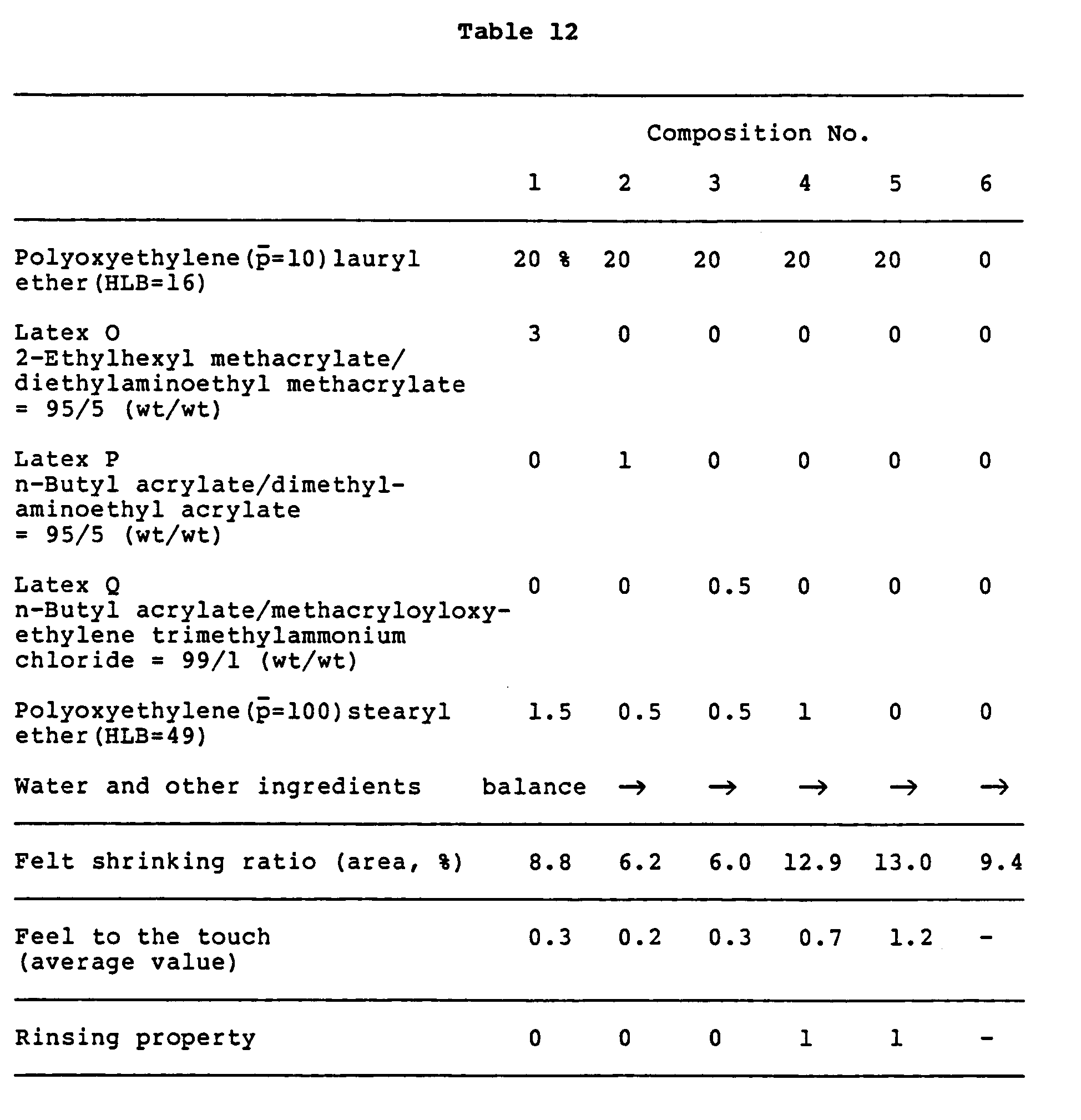
Claims (6)
- A liquid detergent composition for clothing articles comprising:(A) an organic polymer in the form of polymer latex in an amount of 0.01 to 10 wt.-% on dry basis, when calculated as a residue left after removal of the water, with an average particle size (average in weight) of 0.005 to 0.2 µm, and(B-1) at least one nonionic surface active agent in an amount of 10 to 50 wt.-%,characterized in that said organic polymer has a cationic group or a tertiary amino group and the content of the organic polymer whose size is in the range of 0.005 to 0.2 µm is not less than 95 wt.-% of the total of the polymer latex.
- The liquid detergent composition according to Claim 1, wherein said polymer latex has a glass transition temperature of not higher than 300°K.
- The liquid detergent composition according to Claim 1, which comprises said component (A) in an amount of 0.01 to 5 wt.-% and further comprising(B-2) 0.01 to 10 wt.-% of an anionic surface active agent.
- A liquid detergent composition for clothing articles comprising(A) an organic polymer in the form of a polymer latex in an amount of 0.01 to 5 wt.-% on dry basis, when calculated as a residue left after removal of the water, with an average particle size (average in weight) of 0.005 to 0.2 µm,(B-1)' 0.01 to 5 wt.-% of a polyoxyalkylene nonionic surface active agent having an HLB value not less than 20; and(B-1)'' 10 to 50 wt.-% of a nonionic surface active agent other than (B-1)', characterized in that said organic polymer has a cationic group or a tertiary amino group and the content of the organic polymer whose size is in the range of 0.005 to 0.2 µm is not less than 95 wt.-% of the total polymer latex.
- A liquid detergent composition according to Claim 1, which comprises 10 to 50 wt.-% of a nonionic surface active agent of the general formula
R-O-(CH₂CH₂O)n-H
in which R represents an alkyl or alkenyl group having from 10 to 20 carbon atoms, or an alkylphenyl group whose alkyl moiety has from 6 to 12 carbon atoms, and n is a value of from 1 to 20; and further comprising(C) from 0.005 to 0.2 wt% of a hydroxycarboxylate having from 2 to 6 carbon atoms. - A liquid detergent composition according to Claim 1, which comprises said ingredient (A) wherein a content of a remaining monomer is not larger than 100 ppm; and further comprising(D) 1 to 10 wt.-% of a solubilizing agent.
Applications Claiming Priority (10)
| Application Number | Priority Date | Filing Date | Title |
|---|---|---|---|
| JP151139/86 | 1986-06-27 | ||
| JP15113986A JPH0246640B2 (en) | 1986-06-27 | 1986-06-27 | IRYOYOEKITAISENZAISOSEIBUTSU |
| JP234176/86 | 1986-10-01 | ||
| JP23417686A JPS6389596A (en) | 1986-10-01 | 1986-10-01 | Liquid detergent composition |
| JP259922/86 | 1986-10-31 | ||
| JP25992286A JPS63113100A (en) | 1986-10-31 | 1986-10-31 | Neutral detergent composition for clothes |
| JP9404087A JPS63258997A (en) | 1987-04-16 | 1987-04-16 | Liquid detergent composition |
| JP94040/87 | 1987-04-16 | ||
| JP9496287A JPS63260993A (en) | 1987-04-17 | 1987-04-17 | Liquid detergent composition |
| JP94962/87 | 1987-04-17 |
Publications (3)
| Publication Number | Publication Date |
|---|---|
| EP0251188A2 EP0251188A2 (en) | 1988-01-07 |
| EP0251188A3 EP0251188A3 (en) | 1990-05-30 |
| EP0251188B1 true EP0251188B1 (en) | 1994-05-11 |
Family
ID=27525674
Family Applications (1)
| Application Number | Title | Priority Date | Filing Date |
|---|---|---|---|
| EP87109093A Expired - Lifetime EP0251188B1 (en) | 1986-06-27 | 1987-06-24 | Liquid detergent composition for clothing articles |
Country Status (6)
| Country | Link |
|---|---|
| US (1) | US4746455A (en) |
| EP (1) | EP0251188B1 (en) |
| CA (1) | CA1296593C (en) |
| DE (1) | DE3789786T2 (en) |
| ES (1) | ES2056052T3 (en) |
| HK (1) | HK47995A (en) |
Families Citing this family (21)
| Publication number | Priority date | Publication date | Assignee | Title |
|---|---|---|---|---|
| GB9108665D0 (en) * | 1991-04-23 | 1991-06-12 | Unilever Plc | Liquid cleaning products |
| WO1993024603A2 (en) * | 1992-06-02 | 1993-12-09 | Unilever N.V. | Liquid cleaning products |
| US5770548B1 (en) * | 1996-05-14 | 1999-06-29 | Johnson & Son Inc S C | Rinseable hard surface cleaner comprising silicate and hydrophobic acrylic polymer |
| US7185380B2 (en) * | 1998-10-24 | 2007-03-06 | The Procter & Gamble Company | Methods for laundering delicate garments in a washing machine comprising a woven acrylic coated polyester garment container |
| US6966696B1 (en) | 1998-10-24 | 2005-11-22 | The Procter & Gamble Company | Methods for laundering delicate garments in a washing machine |
| US6995124B1 (en) | 1998-10-24 | 2006-02-07 | The Procter & Gamble Company | Methods for laundering delicate garments in a washing machine |
| DE10027636A1 (en) * | 2000-06-06 | 2001-12-13 | Basf Ag | Use of hydrophobic polymers, cationically modified with multivalent metal ions and/or cationic surfactant, as additives in rinsing, care, washing and cleaning materials, e.g. for textiles, carpets and hard surfaces |
| DE10027638A1 (en) * | 2000-06-06 | 2001-12-13 | Basf Ag | Use of hydrophobic polymer particles, cationically modified by coating with cationic polymer, as additives in washing, cleaning and impregnating materials for hard surfaces, e.g. flooring, glass, ceramics or metal |
| DE10027634A1 (en) * | 2000-06-06 | 2001-12-13 | Basf Ag | Use of hydrophobic polymer particles, cationically modified by coating with cationic polymer, as additives in washing or care materials for textiles and as additives in detergents |
| FR2813312B1 (en) * | 2000-08-25 | 2006-07-14 | Rhodia Chimie Sa | COMPOSITION BASED ON POLYMER NANOLATEX FOR LAUNDRY CARE |
| US20070118998A1 (en) * | 2000-08-25 | 2007-05-31 | The Procter & Gamble Company | Methods for laundering delicate garments in a washing machine |
| FR2813313B1 (en) * | 2000-08-25 | 2007-06-15 | Rhodia Chimie Sa | COMPOSITION BASED ON NANOPARTICLES OR NANOLATEX POLYMERS FOR LAUNDRY CARE |
| DE10060373A1 (en) * | 2000-12-05 | 2002-06-06 | Basf Ag | Reactively modified, particulate polymers for treating the surfaces of textile and non-textile materials |
| DE60233496D1 (en) * | 2001-07-11 | 2009-10-08 | Procter & Gamble | PROCESS FOR SURFACE CLEANING USING A DISPERSED POLYMER |
| WO2003060046A1 (en) * | 2002-01-09 | 2003-07-24 | Croda, Inc. | Mixtures of quaternary compounds |
| US6897190B2 (en) | 2002-02-28 | 2005-05-24 | The Procter & Gamble Company | Detergent compositions including dispersible polyolefin wax and method for using same |
| TW200404820A (en) * | 2002-06-14 | 2004-04-01 | Rohm & Haas | Aqueous nanoparticle dispersions |
| US7138438B2 (en) * | 2002-09-30 | 2006-11-21 | Rohm And Haas Company | Polymeric nanoparticle formulations and their use for improving the dirt pick up resistance of a coating |
| US7244775B2 (en) * | 2002-09-30 | 2007-07-17 | Rohm And Haas Company | Damage resistant coatings, films and articles of manufacture containing crosslinked nanoparticles |
| US7585824B2 (en) * | 2002-10-10 | 2009-09-08 | International Flavors & Fragrances Inc. | Encapsulated fragrance chemicals |
| EP1967545A1 (en) * | 2007-03-09 | 2008-09-10 | Rohm and Haas France SAS | Cationic polymer latex |
Family Cites Families (11)
| Publication number | Priority date | Publication date | Assignee | Title |
|---|---|---|---|---|
| GB985503A (en) * | 1963-02-15 | 1965-03-10 | Ici Ltd | Detergent compositions |
| NL131012C (en) * | 1963-12-11 | |||
| GB1155552A (en) * | 1966-04-14 | 1969-06-18 | Geigy Uk Ltd | Cleaning and Anti-soiling Compositions |
| US3689421A (en) * | 1971-04-09 | 1972-09-05 | Purex Corp Ltd | Household hypochlorite bleach with stable latex opacifier |
| US3819525A (en) * | 1972-08-21 | 1974-06-25 | Avon Prod Inc | Cosmetic cleansing preparation |
| US3790488A (en) * | 1973-01-02 | 1974-02-05 | H Iino | Cleaning composition |
| US3956163A (en) * | 1973-08-20 | 1976-05-11 | The Dow Chemical Company | Pigmented detergents |
| US4670060A (en) * | 1981-04-20 | 1987-06-02 | Alcon Laboratories, Inc. | Cleaning agent for optical surfaces |
| US4545919A (en) * | 1982-08-31 | 1985-10-08 | Ciba-Geigy Corporation | Detergent composition for washing off dyeings obtained with fibre-reactive dyes and washing process comprising the use thereof |
| FR2564318B1 (en) * | 1984-05-15 | 1987-04-17 | Oreal | ANHYDROUS COMPOSITION FOR CLEANING THE SKIN |
| DE3528460A1 (en) * | 1985-08-08 | 1987-02-19 | Basf Ag | USE OF NEUTRALIZED AND AMIDATED CARBOXYL GROUPS OF POLYMERISATES AS ADDITION TO DETERGENTS AND CLEANING AGENTS |
-
1987
- 1987-06-22 US US07/064,706 patent/US4746455A/en not_active Expired - Fee Related
- 1987-06-24 DE DE3789786T patent/DE3789786T2/en not_active Expired - Fee Related
- 1987-06-24 EP EP87109093A patent/EP0251188B1/en not_active Expired - Lifetime
- 1987-06-24 ES ES87109093T patent/ES2056052T3/en not_active Expired - Lifetime
- 1987-06-25 CA CA000540543A patent/CA1296593C/en not_active Expired - Fee Related
-
1995
- 1995-03-30 HK HK47995A patent/HK47995A/en not_active IP Right Cessation
Also Published As
| Publication number | Publication date |
|---|---|
| US4746455A (en) | 1988-05-24 |
| HK47995A (en) | 1995-04-07 |
| EP0251188A3 (en) | 1990-05-30 |
| CA1296593C (en) | 1992-03-03 |
| DE3789786T2 (en) | 1995-01-05 |
| ES2056052T3 (en) | 1994-10-01 |
| EP0251188A2 (en) | 1988-01-07 |
| DE3789786D1 (en) | 1994-06-16 |
Similar Documents
| Publication | Publication Date | Title |
|---|---|---|
| HK47995A (en) | Liquid detergent composition for clothing articles | |
| EP0299787B1 (en) | Cloth-softening liquid composition | |
| EP1343934A2 (en) | Reagent-modified particulate polymers for treatment of the surface of textile and non-textile materials | |
| CA1205345A (en) | Copolymers which contain basic groups and are used as antiredeposition agents in washing and after- treating textile goods containing synthetic fibers | |
| DE69630577T2 (en) | Prewash stain remover composition with surfactant based on siloxane | |
| EP2493943A1 (en) | Method for reducing the adhesion forces between hard surfaces and subsequently occurring soil | |
| EP3347446B1 (en) | A stable laundry or cleaning composition, process for preparing the same, and method of use | |
| CA2146853A1 (en) | Use of vinylpyrrolidone and vinylimidazole copolymers as washing agent additives and process for producing the same | |
| JP3828007B2 (en) | Quick-drying imparting agent, quick-drying detergent, and quick-drying finish | |
| DE69627076T2 (en) | Detergent composition and method for preventing dye settling | |
| EP0937126B1 (en) | Use of quaternized polymerizates containing units of vinyl imidazol as a colour fixing and colour transfer inhibiting additive to detergent post-treatment agents and detergents | |
| DE10062355A1 (en) | Surface treatment composition, for use as aqueous dirt-repellent or detergent composition, contains copolymer of anionic vinyl monomer, cationic vinyl monomer and water-insoluble, non-ionic vinyl monomer | |
| JP4014712B2 (en) | Liquid detergent composition | |
| CA1105346A (en) | Soil-release compositions | |
| JP2863137B2 (en) | Liquid detergent composition | |
| JPS63122796A (en) | Liquid detergent composition | |
| DE602004005284T2 (en) | Use as builder and washing and cleaning agent and detergent and cleaner composition | |
| EP0543562A2 (en) | Fabric softening compositions | |
| EP1645681B1 (en) | Method of providing non-detergent washing function | |
| JPH06102796B2 (en) | Liquid detergent composition for clothing | |
| EP2093323B1 (en) | Liquid softener composition, or transparent or semi-transparent liquid softener composition | |
| JP2673579B2 (en) | Liquid detergent composition | |
| JPS6389596A (en) | Liquid detergent composition | |
| JP2922559B2 (en) | Water-absorbing processing method for polyester fabric | |
| JPH1135975A (en) | Liquid detergent composition |
Legal Events
| Date | Code | Title | Description |
|---|---|---|---|
| PUAI | Public reference made under article 153(3) epc to a published international application that has entered the european phase |
Free format text: ORIGINAL CODE: 0009012 |
|
| AK | Designated contracting states |
Kind code of ref document: A2 Designated state(s): DE ES FR GB |
|
| PUAL | Search report despatched |
Free format text: ORIGINAL CODE: 0009013 |
|
| AK | Designated contracting states |
Kind code of ref document: A3 Designated state(s): DE ES FR GB |
|
| 17P | Request for examination filed |
Effective date: 19900919 |
|
| 17Q | First examination report despatched |
Effective date: 19910805 |
|
| GRAA | (expected) grant |
Free format text: ORIGINAL CODE: 0009210 |
|
| AK | Designated contracting states |
Kind code of ref document: B1 Designated state(s): DE ES FR GB |
|
| REF | Corresponds to: |
Ref document number: 3789786 Country of ref document: DE Date of ref document: 19940616 |
|
| ET | Fr: translation filed | ||
| REG | Reference to a national code |
Ref country code: ES Ref legal event code: FG2A Ref document number: 2056052 Country of ref document: ES Kind code of ref document: T3 |
|
| PLBE | No opposition filed within time limit |
Free format text: ORIGINAL CODE: 0009261 |
|
| STAA | Information on the status of an ep patent application or granted ep patent |
Free format text: STATUS: NO OPPOSITION FILED WITHIN TIME LIMIT |
|
| 26N | No opposition filed | ||
| PGFP | Annual fee paid to national office [announced via postgrant information from national office to epo] |
Ref country code: DE Payment date: 19970630 Year of fee payment: 11 |
|
| PGFP | Annual fee paid to national office [announced via postgrant information from national office to epo] |
Ref country code: FR Payment date: 19980609 Year of fee payment: 12 |
|
| PGFP | Annual fee paid to national office [announced via postgrant information from national office to epo] |
Ref country code: GB Payment date: 19980615 Year of fee payment: 12 |
|
| PGFP | Annual fee paid to national office [announced via postgrant information from national office to epo] |
Ref country code: ES Payment date: 19980619 Year of fee payment: 12 |
|
| PG25 | Lapsed in a contracting state [announced via postgrant information from national office to epo] |
Ref country code: DE Free format text: LAPSE BECAUSE OF NON-PAYMENT OF DUE FEES Effective date: 19990401 |
|
| PG25 | Lapsed in a contracting state [announced via postgrant information from national office to epo] |
Ref country code: GB Free format text: LAPSE BECAUSE OF NON-PAYMENT OF DUE FEES Effective date: 19990624 |
|
| PG25 | Lapsed in a contracting state [announced via postgrant information from national office to epo] |
Ref country code: ES Free format text: LAPSE BECAUSE OF NON-PAYMENT OF DUE FEES Effective date: 19990625 |
|
| PG25 | Lapsed in a contracting state [announced via postgrant information from national office to epo] |
Ref country code: FR Free format text: THE PATENT HAS BEEN ANNULLED BY A DECISION OF A NATIONAL AUTHORITY Effective date: 19990630 |
|
| GBPC | Gb: european patent ceased through non-payment of renewal fee |
Effective date: 19990624 |
|
| REG | Reference to a national code |
Ref country code: FR Ref legal event code: ST |
|
| REG | Reference to a national code |
Ref country code: ES Ref legal event code: FD2A Effective date: 20010503 |