EP0251066B1 - Method of reheating preforms for forming blow molded hot fillable containers - Google Patents
Method of reheating preforms for forming blow molded hot fillable containers Download PDFInfo
- Publication number
- EP0251066B1 EP0251066B1 EP87108793A EP87108793A EP0251066B1 EP 0251066 B1 EP0251066 B1 EP 0251066B1 EP 87108793 A EP87108793 A EP 87108793A EP 87108793 A EP87108793 A EP 87108793A EP 0251066 B1 EP0251066 B1 EP 0251066B1
- Authority
- EP
- European Patent Office
- Prior art keywords
- preform
- temperature
- inside surface
- reheating
- heating
- Prior art date
- Legal status (The legal status is an assumption and is not a legal conclusion. Google has not performed a legal analysis and makes no representation as to the accuracy of the status listed.)
- Expired - Lifetime
Links
- 238000003303 reheating Methods 0.000 title claims abstract description 50
- 238000000034 method Methods 0.000 title claims description 35
- 239000010453 quartz Substances 0.000 claims abstract description 34
- VYPSYNLAJGMNEJ-UHFFFAOYSA-N silicon dioxide Inorganic materials O=[Si]=O VYPSYNLAJGMNEJ-UHFFFAOYSA-N 0.000 claims abstract description 34
- 238000011067 equilibration Methods 0.000 claims abstract description 21
- 238000002425 crystallisation Methods 0.000 claims abstract description 14
- 230000008025 crystallization Effects 0.000 claims abstract description 14
- 229920000728 polyester Polymers 0.000 claims abstract description 11
- 230000001965 increasing effect Effects 0.000 claims abstract description 7
- 238000010438 heat treatment Methods 0.000 claims description 34
- 238000000071 blow moulding Methods 0.000 claims description 14
- 238000013459 approach Methods 0.000 claims description 3
- 230000007423 decrease Effects 0.000 claims description 2
- 238000000465 moulding Methods 0.000 claims description 2
- 230000000977 initiatory effect Effects 0.000 abstract description 2
- 229920000139 polyethylene terephthalate Polymers 0.000 description 13
- 239000005020 polyethylene terephthalate Substances 0.000 description 13
- 238000007664 blowing Methods 0.000 description 3
- 230000015572 biosynthetic process Effects 0.000 description 2
- 239000012141 concentrate Substances 0.000 description 1
- 230000003750 conditioning effect Effects 0.000 description 1
- 230000001627 detrimental effect Effects 0.000 description 1
- 230000009477 glass transition Effects 0.000 description 1
- 230000001939 inductive effect Effects 0.000 description 1
- 238000004519 manufacturing process Methods 0.000 description 1
- 230000007246 mechanism Effects 0.000 description 1
- -1 polyethylene terephthalate Polymers 0.000 description 1
- 230000005855 radiation Effects 0.000 description 1
- 230000000153 supplemental effect Effects 0.000 description 1
- 230000002087 whitening effect Effects 0.000 description 1
Images


Classifications
-
- B—PERFORMING OPERATIONS; TRANSPORTING
- B29—WORKING OF PLASTICS; WORKING OF SUBSTANCES IN A PLASTIC STATE IN GENERAL
- B29C—SHAPING OR JOINING OF PLASTICS; SHAPING OF MATERIAL IN A PLASTIC STATE, NOT OTHERWISE PROVIDED FOR; AFTER-TREATMENT OF THE SHAPED PRODUCTS, e.g. REPAIRING
- B29C49/00—Blow-moulding, i.e. blowing a preform or parison to a desired shape within a mould; Apparatus therefor
- B29C49/42—Component parts, details or accessories; Auxiliary operations
- B29C49/64—Heating or cooling preforms, parisons or blown articles
- B29C49/6409—Thermal conditioning of preforms
-
- B—PERFORMING OPERATIONS; TRANSPORTING
- B29—WORKING OF PLASTICS; WORKING OF SUBSTANCES IN A PLASTIC STATE IN GENERAL
- B29C—SHAPING OR JOINING OF PLASTICS; SHAPING OF MATERIAL IN A PLASTIC STATE, NOT OTHERWISE PROVIDED FOR; AFTER-TREATMENT OF THE SHAPED PRODUCTS, e.g. REPAIRING
- B29C35/00—Heating, cooling or curing, e.g. crosslinking or vulcanising; Apparatus therefor
- B29C35/02—Heating or curing, e.g. crosslinking or vulcanizing during moulding, e.g. in a mould
- B29C35/08—Heating or curing, e.g. crosslinking or vulcanizing during moulding, e.g. in a mould by wave energy or particle radiation
-
- B—PERFORMING OPERATIONS; TRANSPORTING
- B29—WORKING OF PLASTICS; WORKING OF SUBSTANCES IN A PLASTIC STATE IN GENERAL
- B29C—SHAPING OR JOINING OF PLASTICS; SHAPING OF MATERIAL IN A PLASTIC STATE, NOT OTHERWISE PROVIDED FOR; AFTER-TREATMENT OF THE SHAPED PRODUCTS, e.g. REPAIRING
- B29C35/00—Heating, cooling or curing, e.g. crosslinking or vulcanising; Apparatus therefor
- B29C35/02—Heating or curing, e.g. crosslinking or vulcanizing during moulding, e.g. in a mould
- B29C35/12—Dielectric heating
-
- B—PERFORMING OPERATIONS; TRANSPORTING
- B29—WORKING OF PLASTICS; WORKING OF SUBSTANCES IN A PLASTIC STATE IN GENERAL
- B29C—SHAPING OR JOINING OF PLASTICS; SHAPING OF MATERIAL IN A PLASTIC STATE, NOT OTHERWISE PROVIDED FOR; AFTER-TREATMENT OF THE SHAPED PRODUCTS, e.g. REPAIRING
- B29C49/00—Blow-moulding, i.e. blowing a preform or parison to a desired shape within a mould; Apparatus therefor
- B29C49/42—Component parts, details or accessories; Auxiliary operations
- B29C49/64—Heating or cooling preforms, parisons or blown articles
- B29C49/6409—Thermal conditioning of preforms
- B29C49/6418—Heating of preforms
-
- B—PERFORMING OPERATIONS; TRANSPORTING
- B29—WORKING OF PLASTICS; WORKING OF SUBSTANCES IN A PLASTIC STATE IN GENERAL
- B29C—SHAPING OR JOINING OF PLASTICS; SHAPING OF MATERIAL IN A PLASTIC STATE, NOT OTHERWISE PROVIDED FOR; AFTER-TREATMENT OF THE SHAPED PRODUCTS, e.g. REPAIRING
- B29C49/00—Blow-moulding, i.e. blowing a preform or parison to a desired shape within a mould; Apparatus therefor
- B29C49/42—Component parts, details or accessories; Auxiliary operations
- B29C49/64—Heating or cooling preforms, parisons or blown articles
- B29C49/6472—Heating or cooling preforms, parisons or blown articles in several stages
- B29C49/648—Heating or cooling preforms, parisons or blown articles in several stages of preforms or parisons
-
- B—PERFORMING OPERATIONS; TRANSPORTING
- B29—WORKING OF PLASTICS; WORKING OF SUBSTANCES IN A PLASTIC STATE IN GENERAL
- B29K—INDEXING SCHEME ASSOCIATED WITH SUBCLASSES B29B, B29C OR B29D, RELATING TO MOULDING MATERIALS OR TO MATERIALS FOR MOULDS, REINFORCEMENTS, FILLERS OR PREFORMED PARTS, e.g. INSERTS
- B29K2067/00—Use of polyesters or derivatives thereof, as moulding material
-
- B—PERFORMING OPERATIONS; TRANSPORTING
- B29—WORKING OF PLASTICS; WORKING OF SUBSTANCES IN A PLASTIC STATE IN GENERAL
- B29K—INDEXING SCHEME ASSOCIATED WITH SUBCLASSES B29B, B29C OR B29D, RELATING TO MOULDING MATERIALS OR TO MATERIALS FOR MOULDS, REINFORCEMENTS, FILLERS OR PREFORMED PARTS, e.g. INSERTS
- B29K2667/00—Use of polyesters or derivatives thereof for preformed parts, e.g. for inserts
-
- B—PERFORMING OPERATIONS; TRANSPORTING
- B29—WORKING OF PLASTICS; WORKING OF SUBSTANCES IN A PLASTIC STATE IN GENERAL
- B29K—INDEXING SCHEME ASSOCIATED WITH SUBCLASSES B29B, B29C OR B29D, RELATING TO MOULDING MATERIALS OR TO MATERIALS FOR MOULDS, REINFORCEMENTS, FILLERS OR PREFORMED PARTS, e.g. INSERTS
- B29K2995/00—Properties of moulding materials, reinforcements, fillers, preformed parts or moulds
- B29K2995/0012—Properties of moulding materials, reinforcements, fillers, preformed parts or moulds having particular thermal properties
- B29K2995/0017—Heat stable
-
- Y—GENERAL TAGGING OF NEW TECHNOLOGICAL DEVELOPMENTS; GENERAL TAGGING OF CROSS-SECTIONAL TECHNOLOGIES SPANNING OVER SEVERAL SECTIONS OF THE IPC; TECHNICAL SUBJECTS COVERED BY FORMER USPC CROSS-REFERENCE ART COLLECTIONS [XRACs] AND DIGESTS
- Y10—TECHNICAL SUBJECTS COVERED BY FORMER USPC
- Y10S—TECHNICAL SUBJECTS COVERED BY FORMER USPC CROSS-REFERENCE ART COLLECTIONS [XRACs] AND DIGESTS
- Y10S264/00—Plastic and nonmetallic article shaping or treating: processes
- Y10S264/46—Molding using an electrical heat
Definitions
- This invention relates to a method of reheating a polyester preform for blow moulding and in particular to the production of biaxially oriented blow moulded polyethylene terephthalate (PET) containers which exhibit less than 2% volume shrinkage when filled at 88°C (190°F).
- PET polyethylene terephthalate
- Typical heat set techniques now being practiced concentrate on thermally inducing crystallinity in the container wall after formation by conditioning the container against a blow mold maintained at a temperature substantially above the Tg temperature. Such a technique is undesirable in that it greatly increases the resident time of the container within the blow mold and generally requires a capital intensive two-mold system.
- Hybrid reheating of PET preforms is known from US-A-4,407,651 granted October 4, 1983 which discloses the features of the pre-characterising portion of claim 1.
- radio frequency reheating was utilized in conjunction with quartz reheating for the purpose of obtaining a balanced temperature relationship across the wall of the preform with the inside surface of the preform being heated to a higher temperature than the exterior surface so that the cross sectional temperature of the preform was in accordance with the relative stretching in the hoop direction of the preform in the formation of a container.
- An aim of the present invention is to heat the preform to an average temperature which is above the previously achievable average temperature without there being undue surface crystallization.
- the present invention provides a method of reheating a polyester preform for blow molding, said method comprising the steps of heating said polyester preform in a quartz infrared heater oven to a generally customary temperature for blow molding, transferring the reheating preform to a radio frequency heater and further heating the preform, then transferring the thus heated preform to a blow mold for blow molding, characterized in that the preform is heated in the quartz infrared heater oven such that the temperature of an outside surface of the preform becomes materially higher than the temperature of an inside surface of a like portion of the preform, the preform is heated by the radio frequency heater such that the inside surface of the preform is heated at a greater rate than the outside surface of the preform until the temperature of the inside of the preform at least approaches the temperature of the outside, and the preform is transferred to the blow mold with the temperature of both the inside surface and the outside surface of the preform being above the temperature wherein crystallization would begin to occur if the preform were heated to such temperature utilizing either quartz infrared heating or
- strain induced crystallization can be optimised during the preform reheating and the stretch blow molding process while minimizing the development of molecular orientation in excess of that required to induce optimum strain crystallization.
- Maximum measured permissible temperatures of reheating PET preforms utilizing quartz infrared reheating range between 115.5°-121.1°C (240°-250°F) on the outside surface and 82.2°-87.8°C (180°-190°F) on the inside surface with an average temperature with 93.3°-98.8°C (200°-210°F).
- Radio frequency reheating of PET preforms operates on a molecular vibration basis (i.e., internal) as opposed to external radiation to and conduction through the preform as with quartz reheating.
- a temperature gradient after radio frequency reheating is that shown in Figure 3.
- radio frequency heating alone is limited by excessive internal preform temperatures which would result in inside surface crystallinity (whitening) at average preform temperatures in the 98.8°04-104°C (210°-220°F) range.
- Containers presently being formed by reheating PET preforms to an average temperature in the range of 93.3°-98.8°C (200°-210°F) have a shrinkage ranging from 6 to 8%.
- the PET preforms are heated by radio frequency alone, with the premissible slightly greater average temperature, there is a certain degree of reduction in the shrinkage.
- a typical reheating of a polyester preform in accordance with this invention is identified in Figures 1 and 7-12.
- the preform is reheated first utilizing a quartz oven or like quartz heater with this first reheating treatment being identified by the letter A.
- this quartz reheating the outside surface temperature rises to a temperature on the order of 115.5°C (240°F) while the inside surface is only slightly heated to a temperature on the order of 48.9°C (120°F). Further, the temperature of the center of the body wall is only slightly greater than the inside surface temperature and is on the order of 60°C (140°F).
- the initial reheating time is on the order of 14.5 seconds.
- the reheating is discontinued and the preform is permitted to equilibrate for a period of time on the order of 5 seconds.
- the temperature of the ouside surface of the preform body continues to increase to a temperature on the order of 121.1°C (250°F) and then begins to cool down to a temperature on the order of 110°C (230°F).
- the temperature of the center of the preform body wall remains generally constant while the temperature of the inside surface of the preform body increases gradually to a temperature on the order of 57.2°C (135°F), the temperature of the inside surface of the preform body approaching that of the center of the preformbody.
- a typical temperature cross section of the partially heated and equilibrated preform body is shown in Figure 9.
- further reheating of the preform be also by way of a quartz heater for a reheating period C.
- the time of this further quartz reheating is on the order of 12.5 seconds as it clearly shown in Figure 7.
- the temperature of the exterior surface of the preform body continues to rise above the temperatures of the center of the preform body and the inside surface of the preform body.
- the exterior surface temperature rises to on the order of 176.6°C (350°F) while the inside surface temperature slowly gradually rises to a temperature on the order of 82.2°C (180°F) and the temperature at the center of the preform wall slowly rises at a slightly greater rate to a temperature on the order of 104.9°C (220°F).
- the temperature of the exterior surface of the preform body is much greater than than of the interior surface and the temperature at the center of the preform body has also gradually increased above that of the interior surface of the preform body.
- the preform body is immediately thereafter further reheated by way of radio frequency heating.
- This heating stage is identified by the letter D.
- the temperature of the ouside surface of the preform body will rapidly decrease to a temperature on the order of, but below 137.8°C (280°F).
- the temperature of the inside surface of the preform body will continue to increase and then taper off at a temperature on the order of 176.6°C (350°F).
- the temperature of the preform at the center of the body cross section will rise and then taper off at a temperature on the order of 126.6°C (260°F).
- the temperature cross sectional profile of the preform at the time stretch blowing is initiated is clearly shown in Figure 12 where it will be seen that the temperature at the center of the cross section of the preform body is still the lowest, but that the temperature of the outside surface is only slightly greater.
- the desired high reheat temperature may be obtained in accordance with the reheating method of this application without the undesired surface crystallization.
- quartz heating to radio frequency heating to equilibration may vary from 10/1/1 at one extreme to 20/1/10 at the other extreme with a preferred ratio of 15/1/3.
- a center preform temperature of 107.2°C (225°F) utilizing the reheating method described above yields 2% shrinkage. It is possible to obtain a cross sectional center temperature as high as 126.6°C (260°F) without surface crystallization utilizing the reheating steps outlined above and a preform body central temperature on the order of 115.5°-121.1°C (240°-250°F) will permit the blow stretch molding of polyester containers which may be hot filled with a product at a temperature on the order of 87.8°C (190°F) without any detrimental shrinkage of the polyester from which the container is formed.
Landscapes
- Physics & Mathematics (AREA)
- Thermal Sciences (AREA)
- Engineering & Computer Science (AREA)
- Manufacturing & Machinery (AREA)
- Mechanical Engineering (AREA)
- Blow-Moulding Or Thermoforming Of Plastics Or The Like (AREA)
Abstract
Description
- This invention relates to a method of reheating a polyester preform for blow moulding and in particular to the production of biaxially oriented blow moulded polyethylene terephthalate (PET) containers which exhibit less than 2% volume shrinkage when filled at 88°C (190°F).
- To reduce oriented PET container shrinkage when the container is exposed to temperatures above the Tg (glass transition or softening temperature), it is necessary to optimize the percentage of strain and/or thermally induced crystallinity in the blown container sidewall (i.e., keeping the oriented, non-crystalline portion of the container to a minimum).
- Typical heat set techniques now being practiced concentrate on thermally inducing crystallinity in the container wall after formation by conditioning the container against a blow mold maintained at a temperature substantially above the Tg temperature. Such a technique is undesirable in that it greatly increases the resident time of the container within the blow mold and generally requires a capital intensive two-mold system.
- Hybrid reheating of PET preforms is known from US-A-4,407,651 granted October 4, 1983 which discloses the features of the pre-characterising portion of claim 1. In accordance with the teaching of that patent, radio frequency reheating was utilized in conjunction with quartz reheating for the purpose of obtaining a balanced temperature relationship across the wall of the preform with the inside surface of the preform being heated to a higher temperature than the exterior surface so that the cross sectional temperature of the preform was in accordance with the relative stretching in the hoop direction of the preform in the formation of a container.
- An aim of the present invention is to heat the preform to an average temperature which is above the previously achievable average temperature without there being undue surface crystallization.
- The present invention provides a method of reheating a polyester preform for blow molding, said method comprising the steps of heating said polyester preform in a quartz infrared heater oven to a generally customary temperature for blow molding, transferring the reheating preform to a radio frequency heater and further heating the preform, then transferring the thus heated preform to a blow mold for blow molding, characterized in that the preform is heated in the quartz infrared heater oven such that the temperature of an outside surface of the preform becomes materially higher than the temperature of an inside surface of a like portion of the preform, the preform is heated by the radio frequency heater such that the inside surface of the preform is heated at a greater rate than the outside surface of the preform until the temperature of the inside of the preform at least approaches the temperature of the outside, and the preform is transferred to the blow mold with the temperature of both the inside surface and the outside surface of the preform being above the temperature wherein crystallization would begin to occur if the preform were heated to such temperature utilizing either quartz infrared heating or radio frequency heating independently.
- In accordance with the present invention strain induced crystallization can be optimised during the preform reheating and the stretch blow molding process while minimizing the development of molecular orientation in excess of that required to induce optimum strain crystallization.
- Embodiments of the present invention will now be described by way of example only with reference to the accompanying drawings, in which:-
- Figure 1 is a schematic view showing the various steps in the reheating of a PET preform and the stretch blow molding thereof in accordance with the invention.
- Figure 2 is a schematic sectional view taken through a portion of the wall of a preform and shows the heat of temperature profile when the preform is heated by a conventional quartz infrared heating system.
- Figure 3 is a schematic view similar to Figure 2 and shows the temperature profile through the wall of a preform heated utilizing radio frequency heating means.
- Figure 4 is another schematic view similar to Figure 2 and shows the temperature profile through the wall of a preform heated utilizing a combination of the quartz heating of Figure 2 and the radio frequency heating of Figure 3.
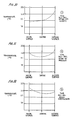
- Figure 5 is a graph showing the temperatures of a preform when being heated utilizing quartz infrared lamps.
- Figure 6 is a graph similar to Figure 5 and shows the temperatures of a preform when being reheated utilizing radio frequency energy.
- Figure 7 is another graph plotting preform temperatures against time when the preform is reheated in accordance with the invention.
- Figure 8 is a temperature cross section through the wall of a PET preform which is being reheated in accordance with Figure 7 at the end of a first quartz reheating.
- Figure 9 is another temperature profile through the PET preform at the end of a first equilibration step.
- Figure 10 is another temperature profile through the preform being heated at the end of a second quartz reheating.
- Figure 11 is another temperature profile through the preform being heated in accordance with Figure 7 at the end of a supplemental radio frequency heating.
- Figure 12 is a temperature cross section of the preform being heated after a second equilibration which occurs when the heated preform is being transferred to a blow mold and at the time stretch blow molding begins.
- It has been found that by maximizing the average preform temperature prior to stretch blow molding, one can reduce the tendency of such blown containers to shrink via two mechanisms. First, higher PET temperatures result in molecular chain slippage during the drawing process, yielding a lower orientation level (i.e., lower orientation levels result in a reduced driving force for shrinkage). Secondly, the increased chain mobility permits more effective strain induced crystallization during the drawings process. The heat shrinkage resistance properties of non-heat set, stretch blow molded PET containers are thus limited by preform temperature prior to stretch blowing. The limit to increased preform temperatures through existing external quartz reheating processes is preform surface crystallization caused by the temperature gradient established through the preform wall with a maximum occurring at the outside surface and minimum occurring at the interior surface as it shown in Figure 2. Maximum measured permissible temperatures of reheating PET preforms utilizing quartz infrared reheating range between 115.5°-121.1°C (240°-250°F) on the outside surface and 82.2°-87.8°C (180°-190°F) on the inside surface with an average temperature with 93.3°-98.8°C (200°-210°F).
- Radio frequency reheating of PET preforms operates on a molecular vibration basis (i.e., internal) as opposed to external radiation to and conduction through the preform as with quartz reheating. As such, a temperature gradient after radio frequency reheating is that shown in Figure 3.
- The use of radio frequency heating alone is limited by excessive internal preform temperatures which would result in inside surface crystallinity (whitening) at average preform temperatures in the 98.8°04-104°C (210°-220°F) range.
- Containers presently being formed by reheating PET preforms to an average temperature in the range of 93.3°-98.8°C (200°-210°F) have a shrinkage ranging from 6 to 8%. When the PET preforms are heated by radio frequency alone, with the premissible slightly greater average temperature, there is a certain degree of reduction in the shrinkage.
- It has been found that in accordance with this invention, if the average preform temperature is increased to 107.2°C (225°F), shrinkage is reduced to 2% and by increasing the average temperature of the reheated preform at the time of stretch blowing to as high as 126.6°C (260°F), the container shrinkage is reduced to on the order of less than 1%.
- While the hybrid reheating disclosed in US-A-4,407,651 does suggest in Figure 10 two separate quaratz oven heatings with the equilibration in between and a further equilibration followed by high frequency heating, the sole purpose of the hybrid reheating was to obtain a substantially uniform temperature throughout the wall of the preform with any temperature difference being in the form of a higher temperature on the inner surface of the preform body as opposed to being on the outer surface. Nothing in that patent in any way suggests that hybrid heating utilizing a combination of quartz oven and radio frequency could be utilized to reheat the preform to a temperature which would normally result in surface crystallization, but in view of the rapid final reheating of the preform, and the relatively quick transfer of the reheated preform to the blow mold and initiation of the blow molding operation, surface crystallization will not occur. This reheating of the preform to this high temperature and the blow molding thereof at the high temperature will result in the ability of the blown container to receive a hot fill with minimum shrinkage, i.e. shrinkage less than 2%.
- A typical reheating of a polyester preform in accordance with this invention is identified in Figures 1 and 7-12.
- As will be apparent from Figures 1 and 7, in accordance with the invention, the preform is reheated first utilizing a quartz oven or like quartz heater with this first reheating treatment being identified by the letter A. During this quartz reheating, the outside surface temperature rises to a temperature on the order of 115.5°C (240°F) while the inside surface is only slightly heated to a temperature on the order of 48.9°C (120°F). Further, the temperature of the center of the body wall is only slightly greater than the inside surface temperature and is on the order of 60°C (140°F).
- With respect to Figure 8, it will be seen that there is illustrated in graph form the temperature of the cross section of the preform body after the initial quartz reheating.
- It will also be seen that the initial reheating time is on the order of 14.5 seconds.
- After this first quartz reheating, the reheating is discontinued and the preform is permitted to equilibrate for a period of time on the order of 5 seconds. The temperature of the ouside surface of the preform body continues to increase to a temperature on the order of 121.1°C (250°F) and then begins to cool down to a temperature on the order of 110°C (230°F). At the same time, the temperature of the center of the preform body wall remains generally constant while the temperature of the inside surface of the preform body increases gradually to a temperature on the order of 57.2°C (135°F), the temperature of the inside surface of the preform body approaching that of the center of the preformbody. A typical temperature cross section of the partially heated and equilibrated preform body is shown in Figure 9.
- Thereafter, in accordance with this invention, it is preferred that further reheating of the preform be also by way of a quartz heater for a reheating period C. The time of this further quartz reheating is on the order of 12.5 seconds as it clearly shown in Figure 7. During this period of second quartz reheating, the temperature of the exterior surface of the preform body continues to rise above the temperatures of the center of the preform body and the inside surface of the preform body. The exterior surface temperature rises to on the order of 176.6°C (350°F) while the inside surface temperature slowly gradually rises to a temperature on the order of 82.2°C (180°F) and the temperature at the center of the preform wall slowly rises at a slightly greater rate to a temperature on the order of 104.9°C (220°F).
- Thus, after the second quartz reheating, once again the temperature of the exterior surface of the preform body is much greater than than of the interior surface and the temperature at the center of the preform body has also gradually increased above that of the interior surface of the preform body.
- When one compares the temperature cross sectional graph of Figure 10 with that of Figure 8, it will be seen that the temperature rise at the center of the preform body and at the exterior surface of the preform body as compared to a starting point temperature of the inside surface of the preform body is at an even greater rate than that of Figure 8.
- It is now time to equalize the temperatures of the cross section of the preform body. Accordingly, the preform body is immediately thereafter further reheated by way of radio frequency heating. This heating stage is identified by the letter D.
- As will be seen from Figures 7 and 11, while the temperature of the outside surface of the preform body rises only slightly during the heating step D, the heating of the inside surface of the preform body very rapidly increases from the temperature generally on the order of 71.1°C (160°F) to a temperature slightly greater than 148.9°C (300°F). It will be seen that the time for which the preform body was further reheated by way of radio frequency was only 2 seconds. During this time there was only a minor increase in the temperature of the preform body at the center of the cross section thereof to a temperature on the order of 115.5°C (240°F). The temperature cross sectional profile of the preform body at the end of the radio frequency reheating step D is clearly illustrated in Figure 11 where the temperature of the center of the preform body cross section is the lowest and the temperatures of the inside surface and outside surface are greater.
- At this point the application of external heat to the preform is stopped and the preform is directed into a blow mold and blow molding steps are initiated with there being a total lapse of time on the order of 6 seconds. During these 6 seconds there is a second equilibration of the preform with this time sequence step being identified by the letter E.
- During the second temperature equilibration, the temperature of the ouside surface of the preform body will rapidly decrease to a temperature on the order of, but below 137.8°C (280°F). At the same time, the temperature of the inside surface of the preform body will continue to increase and then taper off at a temperature on the order of 176.6°C (350°F). In a like manner, the temperature of the preform at the center of the body cross section will rise and then taper off at a temperature on the order of 126.6°C (260°F). The temperature cross sectional profile of the preform at the time stretch blowing is initiated is clearly shown in Figure 12 where it will be seen that the temperature at the center of the cross section of the preform body is still the lowest, but that the temperature of the outside surface is only slightly greater.
- Inasmuch as crystallization is a factor of temperature and time and since the time during which surface crystallization may occur after reheating of the preform to its maximum temperature is reduced, the desired high reheat temperature may be obtained in accordance with the reheating method of this application without the undesired surface crystallization.
- The relationship of quartz heating to radio frequency heating to equilibration may vary from 10/1/1 at one extreme to 20/1/10 at the other extreme with a preferred ratio of 15/1/3.
- In accordance with this invention, it has been found that a center preform temperature of 107.2°C (225°F) utilizing the reheating method described above
yields 2% shrinkage. It is possible to obtain a cross sectional center temperature as high as 126.6°C (260°F) without surface crystallization utilizing the reheating steps outlined above and a preform body central temperature on the order of 115.5°-121.1°C (240°-250°F) will permit the blow stretch molding of polyester containers which may be hot filled with a product at a temperature on the order of 87.8°C (190°F) without any detrimental shrinkage of the polyester from which the container is formed. - Although only a preferred method of reheating a polyester preform has been specifically set forth herein, it is to be understood that minor variations may be made in the reheating process without departing from the scope of the invention as defined in the appended claims.
Claims (20)
- A method of reheating a polyester preform for blow molding, said method comprising the steps of heating said polyester preform in a quartz infrared heater oven to a generally customary temperature for blow molding, transferring the reheated preform to a radio frequency heater and further heating the preform, then transferring the thus heated preform to a blow mold for blow molding, characterized in that the preform is heated in the quartz infrared heater oven such that the temperature of an outside surface of the preform becomes materially higher than the temperature of an inside surface of a like portion of the preform, the preform is heated by the radio frequency heater such that the inside surface of the preform is heated at a greater rate than the outside surface of the preform until the temperature of the inside of the preform at least approaches the temperature of the outside, and the preform is transferred to the blow mold with the temperature of both the inside surface and the outside surface of the preform being above the temperature wherein crystallization would begin to occur if the preform were heated to such temperature utilizing either quartz infrared heating or radio frequency heating independently.
- A method according to claim 1, characterized in that there is a partial equilibration of outside surface and inside surface temperatures during transfer of the preform to the blow mold.
- A method according to claim 1, characterized in that there is a partial equilibration of outside surface and inside surface temperatures during transfer of the preform to the blow mold with the temperature of the center of the preform increasing.
- A method according to claim 1, characterized in that there is a partial equilibration of outside surface and inside surface temperatures during transfer of the preform to the blow mold with the temperature of the inside surface continuing to increase.
- A method according to claim 1, characterized in that there is a partial equilibration of outside surface and inside surface temperatures during transfer of the preform to the blow mold with both the temperature of the center of the preform and the temperature of the inside of the preform continuing to increase.
- A method according to claim 1, characterized in that during said heating of the preform utilizing said quartz infrared heater the temperature of the preform inside surface remains below the temperature of the center of the preform, and during said radio frequency heating of the preform the temperature of the inside surface of the preform rises above the average temperature of the preform.
- A method according to claim 1, characterized in that during said heating of the preform utilizing said quartz infrared heater the temperature of the preform inside surface remains below the temperature of the center of the preform, and during said radio frequency heating of the preform the temperature of the inside surface of the preform rises above the average temperature of the preform but remains below the temperature of the outside surface of the preform.
- A method according to claim 2, characterized in that during said heating of the preform utilizing said quartz infrared heater the temperature of the preform inside surface remains below the temperature of the center of the preform, during said radio frequency heating of the preform the temperature of the inside surface of the preform rises above the average temperature of the preform but remains below the temperature of the outside surface of the preform, and during said partial equilibration the temperature of the inside surface of the preform exceeds the temperature of the outside surface of the preform.
- A method according to claim 8, characterized in that during said partial equilibration the temperature of the inside surface of the preform continues to increase.
- A method according to claim 8, characterized in that during said partial equilibration the temperature of the inside surface of the preform continues to increase while the temperature of the outside surface of the preform decreases.
- A method according to claim 8, characterized in that during said partial equilibration the temperature of the center of the preform continues to increase.
- A method according to claim 8, characterized in that during said partial equilibration the temperature of the center of the preform continues to increase and approaches the temperature of the outside surface of the preform.
- A method according to claim 2, characterized in that said quartz infrared heating is performed in two steps separated by an equilibration step.
- A method according to claim 2, characterized in that the ratio of quartz infrared heating time to radio frequency time to equilibration time ranges from 10:1:1 to 20:1:10.
- A method according to claim 2, characterized in that the ratio of quartz infrared heating time to radio frequency time to equilibration time is on the order of 15:1:3.
- A method according to claim 1, characterized in that the heated preform when presented to a blow mold has an inside surface temperature which is the greatest and a center temperature which is the least.
- A method according to claim 1, characterized in that the temperature of the heated preform at the cross sectional center is on the order of 107.2° to 126.6°C (about 225° to 260°F).
- A method according to claim 1, characterized in that the temperature of the heated preform at the cross sectional center is on the order of 107.20°to 126.6°C (about 225° to 260°F) as compared to a permissible central preform temperature of 93.3° to 98.8°C (about 200° to 210°F) for quartz heating and 98.8° to 104.4°C (about 210° to 220°F) for radio frequency heating.
- A method according to claim 2, characterized in that said equilibration occurs as the heated preform is being transferred to a molding position.
- A method according to claim 1, characterized in that said reheating method is particularly adapted for use in reheating a preform which is to be blow molded into a container which has acceptable hot fill performance.
Priority Applications (1)
| Application Number | Priority Date | Filing Date | Title |
|---|---|---|---|
| AT87108793T ATE65456T1 (en) | 1986-06-24 | 1987-06-19 | PROCESS FOR REHEATING PREFORMS FOR BLOW MOLDING OF CONTAINERS SUITABLE TO HOLD HOT SUBSTANCES. |
Applications Claiming Priority (2)
| Application Number | Priority Date | Filing Date | Title |
|---|---|---|---|
| US878044 | 1986-06-24 | ||
| US06/878,044 US4731513A (en) | 1986-06-24 | 1986-06-24 | Method of reheating preforms for forming blow molded hot fillable containers |
Publications (3)
| Publication Number | Publication Date |
|---|---|
| EP0251066A2 EP0251066A2 (en) | 1988-01-07 |
| EP0251066A3 EP0251066A3 (en) | 1988-07-27 |
| EP0251066B1 true EP0251066B1 (en) | 1991-07-24 |
Family
ID=25371258
Family Applications (1)
| Application Number | Title | Priority Date | Filing Date |
|---|---|---|---|
| EP87108793A Expired - Lifetime EP0251066B1 (en) | 1986-06-24 | 1987-06-19 | Method of reheating preforms for forming blow molded hot fillable containers |
Country Status (9)
| Country | Link |
|---|---|
| US (1) | US4731513A (en) |
| EP (1) | EP0251066B1 (en) |
| JP (1) | JPS6317026A (en) |
| AT (1) | ATE65456T1 (en) |
| AU (1) | AU590863B2 (en) |
| CA (1) | CA1268309A (en) |
| DE (1) | DE3771594D1 (en) |
| ES (1) | ES2025096B3 (en) |
| MX (1) | MX165815B (en) |
Families Citing this family (15)
| Publication number | Priority date | Publication date | Assignee | Title |
|---|---|---|---|---|
| US4981627A (en) * | 1989-08-04 | 1991-01-01 | Raytheon Company | Method for closure heating |
| US5251424A (en) * | 1991-01-11 | 1993-10-12 | American National Can Company | Method of packaging products in plastic containers |
| FR2678542B1 (en) * | 1991-07-01 | 1993-10-29 | Sidel | PROCESS AND INSTALLATION FOR THE HEATING, BY INFRARED RADIATION, OF PLASTIC PREFORMS, PARTICULARLY PET, FOR THE MANUFACTURE OF CONTAINERS. |
| DK0662037T3 (en) * | 1992-09-22 | 2000-10-02 | Pepsico Inc | Blanket, methods and device for blow molding |
| AR002773A1 (en) | 1995-07-07 | 1998-04-29 | Continental Pet Technologies | METHOD FOR INJECTION MOLDING OF A PLASTIC ARTICLE AND APPARATUS TO CARRY IT OUT. |
| US6217818B1 (en) | 1995-07-07 | 2001-04-17 | Continental Pet Technologies, Inc. | Method of making preform and container with crystallized neck finish |
| WO2001034369A1 (en) * | 1999-11-10 | 2001-05-17 | Tetra Laval Holdings & Finance S.A. | Machine for the production of receptacles of plastic material and process for actuating such a machine |
| JP2001179810A (en) * | 1999-12-27 | 2001-07-03 | Mitsui Chemicals Inc | Preform for multilayer hollow molded article, multilayer hollow molded article, and method for producing the same |
| US20030171889A1 (en) * | 2002-03-04 | 2003-09-11 | Shelby Marcus David | Method and device for predicting temperature profiles throughout the thickness of a polymer preform |
| RU2225790C1 (en) * | 2002-09-16 | 2004-03-20 | Юдин Эдуард Ильич | Method to manufacture the hollow items out of propylene |
| USD495602S1 (en) | 2003-04-04 | 2004-09-07 | Grafco Pet Technologies | Molded bottle |
| TWI304373B (en) * | 2004-05-14 | 2008-12-21 | Mitsui Chemicals Inc | Polyester resin bottle |
| DE102009009867A1 (en) * | 2009-02-20 | 2010-08-26 | Krones Ag | Preformheizung |
| US9221223B2 (en) | 2011-12-22 | 2015-12-29 | Discma Ag | Apparatus and method for controlling temperature gradient through wall thickness of container |
| CN107660177A (en) * | 2015-05-04 | 2018-02-02 | 埃维昂矿泉水有限公司 | Injection stretch blow molding (ISBM) manufacture method and its hot filling processing of hot-fill plastic container |
Family Cites Families (10)
| Publication number | Priority date | Publication date | Assignee | Title |
|---|---|---|---|---|
| DE2352926A1 (en) * | 1973-10-22 | 1975-04-24 | Heidenreich & Harbeck Gmbh | METHOD AND DEVICE FOR HEATING A WORKPIECE MADE OF PLASTIC |
| US4036927A (en) * | 1975-04-09 | 1977-07-19 | Monsanto Company | Preparation of molecularly oriented containers using reheat process |
| US4079104A (en) * | 1976-04-16 | 1978-03-14 | Owens-Illinois, Inc. | Method for heating plastic articles |
| US4342895A (en) * | 1979-11-27 | 1982-08-03 | The Continental Group, Inc. | Method of processing polyethylene terephthalate preforms and apparatus |
| US4396816A (en) * | 1979-11-27 | 1983-08-02 | The Continental Group, Inc. | Apparatus for processing polyethylene terephthalate preforms |
| US4476364A (en) * | 1981-10-06 | 1984-10-09 | The Continental Group, Inc. | Radio frequency heating system for heating thermoplastic material preforms |
| US4407651A (en) * | 1982-02-05 | 1983-10-04 | The Continental Group, Inc. | Hybrid reheating system and method for polymer preforms |
| US4409455A (en) * | 1982-03-05 | 1983-10-11 | Cincinnati Milacron Inc. | Dielectric heating section for blow molding machine |
| CA1235266A (en) * | 1982-03-11 | 1988-04-19 | Martin H. Beck | Reheating of preforms with radio frequency energy |
| US4571173A (en) * | 1982-05-14 | 1986-02-18 | Owens-Illinois, Inc. | Method for thermally conditioning a thermoplastic preform |
-
1986
- 1986-06-24 US US06/878,044 patent/US4731513A/en not_active Expired - Lifetime
-
1987
- 1987-06-17 CA CA000539887A patent/CA1268309A/en not_active Expired - Lifetime
- 1987-06-19 DE DE8787108793T patent/DE3771594D1/en not_active Expired - Fee Related
- 1987-06-19 AT AT87108793T patent/ATE65456T1/en not_active IP Right Cessation
- 1987-06-19 ES ES87108793T patent/ES2025096B3/en not_active Expired - Lifetime
- 1987-06-19 EP EP87108793A patent/EP0251066B1/en not_active Expired - Lifetime
- 1987-06-23 JP JP62156380A patent/JPS6317026A/en active Granted
- 1987-06-23 AU AU74621/87A patent/AU590863B2/en not_active Ceased
- 1987-06-24 MX MX007054A patent/MX165815B/en unknown
Also Published As
| Publication number | Publication date |
|---|---|
| EP0251066A3 (en) | 1988-07-27 |
| CA1268309A (en) | 1990-05-01 |
| EP0251066A2 (en) | 1988-01-07 |
| ATE65456T1 (en) | 1991-08-15 |
| MX165815B (en) | 1992-12-07 |
| US4731513A (en) | 1988-03-15 |
| JPH0547385B2 (en) | 1993-07-16 |
| AU7462187A (en) | 1988-01-07 |
| JPS6317026A (en) | 1988-01-25 |
| AU590863B2 (en) | 1989-11-16 |
| ES2025096B3 (en) | 1992-03-16 |
| DE3771594D1 (en) | 1991-08-29 |
Similar Documents
| Publication | Publication Date | Title |
|---|---|---|
| US4731513A (en) | Method of reheating preforms for forming blow molded hot fillable containers | |
| EP0322651B1 (en) | Preform for, and method of forming hot fill container | |
| DK168064B1 (en) | PROCEDURE FOR THE PREPARATION OF AN ORIENTED NON-COLLABLE POLYESTER CONTAINER INTENDED FOR HOT PRODUCTS | |
| US5411698A (en) | Process and apparatus for blow mold annealing and subsequently heat treating thermoplastic articles | |
| US4927680A (en) | Preform and method of forming container therefrom | |
| EP0662037B1 (en) | Blow molding preform, process and apparatus | |
| AU631897B2 (en) | Process for the manufacture of containers made of polyethyleneterephthalate intended to be filled with a hot liquid | |
| US4839127A (en) | Method of making partially crystalline biaxially oriented hollow plastic heat set containers | |
| US4144298A (en) | Method of forming strain crystallized thermoplastic articles | |
| US4407651A (en) | Hybrid reheating system and method for polymer preforms | |
| JPH0124056B2 (en) | ||
| EP0725722B1 (en) | Method of forming molecularly oriented preforms | |
| EP1035957A1 (en) | Improved multi-layer container and preform | |
| EP0038859B1 (en) | Process for producing a stretch-blow molded polypropylene bottle | |
| CA1235266A (en) | Reheating of preforms with radio frequency energy | |
| KR100480947B1 (en) | Method for biaxial stretch blowmolding of heat resistant pet bottle | |
| MXPA94008315A (en) | Method to form molecularly oriented plastic receptacles. | |
| KR100436217B1 (en) | Manufacturing method of polypropylene bottle for sterilize | |
| NZ272104A (en) | Preform and use in blow molding to produce a hot fill container, preferential thinning of neck portion of container |
Legal Events
| Date | Code | Title | Description |
|---|---|---|---|
| PUAI | Public reference made under article 153(3) epc to a published international application that has entered the european phase |
Free format text: ORIGINAL CODE: 0009012 |
|
| AK | Designated contracting states |
Kind code of ref document: A2 Designated state(s): AT BE CH DE ES FR GB IT LI LU NL SE |
|
| PUAL | Search report despatched |
Free format text: ORIGINAL CODE: 0009013 |
|
| AK | Designated contracting states |
Kind code of ref document: A3 Designated state(s): AT BE CH DE ES FR GB IT LI LU NL SE |
|
| 17P | Request for examination filed |
Effective date: 19890112 |
|
| 17Q | First examination report despatched |
Effective date: 19900328 |
|
| GRAA | (expected) grant |
Free format text: ORIGINAL CODE: 0009210 |
|
| AK | Designated contracting states |
Kind code of ref document: B1 Designated state(s): AT BE CH DE ES FR GB IT LI LU NL SE |
|
| REF | Corresponds to: |
Ref document number: 65456 Country of ref document: AT Date of ref document: 19910815 Kind code of ref document: T |
|
| REF | Corresponds to: |
Ref document number: 3771594 Country of ref document: DE Date of ref document: 19910829 |
|
| ITF | It: translation for a ep patent filed | ||
| ET | Fr: translation filed | ||
| REG | Reference to a national code |
Ref country code: ES Ref legal event code: FG2A Ref document number: 2025096 Country of ref document: ES Kind code of ref document: B3 |
|
| PGFP | Annual fee paid to national office [announced via postgrant information from national office to epo] |
Ref country code: GB Payment date: 19920421 Year of fee payment: 6 |
|
| PGFP | Annual fee paid to national office [announced via postgrant information from national office to epo] |
Ref country code: CH Payment date: 19920506 Year of fee payment: 6 |
|
| PGFP | Annual fee paid to national office [announced via postgrant information from national office to epo] |
Ref country code: AT Payment date: 19920508 Year of fee payment: 6 |
|
| PGFP | Annual fee paid to national office [announced via postgrant information from national office to epo] |
Ref country code: FR Payment date: 19920519 Year of fee payment: 6 |
|
| PGFP | Annual fee paid to national office [announced via postgrant information from national office to epo] |
Ref country code: SE Payment date: 19920521 Year of fee payment: 6 |
|
| PGFP | Annual fee paid to national office [announced via postgrant information from national office to epo] |
Ref country code: DE Payment date: 19920522 Year of fee payment: 6 |
|
| PLBE | No opposition filed within time limit |
Free format text: ORIGINAL CODE: 0009261 |
|
| STAA | Information on the status of an ep patent application or granted ep patent |
Free format text: STATUS: NO OPPOSITION FILED WITHIN TIME LIMIT |
|
| PGFP | Annual fee paid to national office [announced via postgrant information from national office to epo] |
Ref country code: LU Payment date: 19920601 Year of fee payment: 6 |
|
| PGFP | Annual fee paid to national office [announced via postgrant information from national office to epo] |
Ref country code: ES Payment date: 19920609 Year of fee payment: 6 |
|
| PGFP | Annual fee paid to national office [announced via postgrant information from national office to epo] |
Ref country code: BE Payment date: 19920616 Year of fee payment: 6 |
|
| PGFP | Annual fee paid to national office [announced via postgrant information from national office to epo] |
Ref country code: NL Payment date: 19920630 Year of fee payment: 6 |
|
| 26N | No opposition filed | ||
| EPTA | Lu: last paid annual fee | ||
| PG25 | Lapsed in a contracting state [announced via postgrant information from national office to epo] |
Ref country code: LU Free format text: LAPSE BECAUSE OF NON-PAYMENT OF DUE FEES Effective date: 19930619 Ref country code: GB Effective date: 19930619 Ref country code: AT Effective date: 19930619 |
|
| PG25 | Lapsed in a contracting state [announced via postgrant information from national office to epo] |
Ref country code: SE Effective date: 19930620 |
|
| PG25 | Lapsed in a contracting state [announced via postgrant information from national office to epo] |
Ref country code: ES Free format text: LAPSE BECAUSE OF THE APPLICANT RENOUNCES Effective date: 19930621 |
|
| PG25 | Lapsed in a contracting state [announced via postgrant information from national office to epo] |
Ref country code: LI Effective date: 19930630 Ref country code: CH Effective date: 19930630 Ref country code: BE Effective date: 19930630 |
|
| BERE | Be: lapsed |
Owner name: CONTINENTAL PET TECHNOLOGIES INC. Effective date: 19930630 |
|
| PG25 | Lapsed in a contracting state [announced via postgrant information from national office to epo] |
Ref country code: NL Effective date: 19940101 |
|
| GBPC | Gb: european patent ceased through non-payment of renewal fee |
Effective date: 19930619 |
|
| NLV4 | Nl: lapsed or anulled due to non-payment of the annual fee | ||
| PG25 | Lapsed in a contracting state [announced via postgrant information from national office to epo] |
Ref country code: FR Effective date: 19940228 |
|
| REG | Reference to a national code |
Ref country code: CH Ref legal event code: PL |
|
| PG25 | Lapsed in a contracting state [announced via postgrant information from national office to epo] |
Ref country code: DE Effective date: 19940301 |
|
| REG | Reference to a national code |
Ref country code: FR Ref legal event code: ST |
|
| EUG | Se: european patent has lapsed |
Ref document number: 87108793.8 Effective date: 19940110 |
|
| REG | Reference to a national code |
Ref country code: ES Ref legal event code: FD2A Effective date: 19991102 |
|
| PG25 | Lapsed in a contracting state [announced via postgrant information from national office to epo] |
Ref country code: IT Free format text: LAPSE BECAUSE OF NON-PAYMENT OF DUE FEES;WARNING: LAPSES OF ITALIAN PATENTS WITH EFFECTIVE DATE BEFORE 2007 MAY HAVE OCCURRED AT ANY TIME BEFORE 2007. THE CORRECT EFFECTIVE DATE MAY BE DIFFERENT FROM THE ONE RECORDED. Effective date: 20050619 |