EP0250073B1 - Method for producing nitride-base ceramics - Google Patents
Method for producing nitride-base ceramics Download PDFInfo
- Publication number
- EP0250073B1 EP0250073B1 EP19870303746 EP87303746A EP0250073B1 EP 0250073 B1 EP0250073 B1 EP 0250073B1 EP 19870303746 EP19870303746 EP 19870303746 EP 87303746 A EP87303746 A EP 87303746A EP 0250073 B1 EP0250073 B1 EP 0250073B1
- Authority
- EP
- European Patent Office
- Prior art keywords
- precursor
- temperature
- carbon content
- nitride
- atmosphere
- Prior art date
- Legal status (The legal status is an assumption and is not a legal conclusion. Google has not performed a legal analysis and makes no representation as to the accuracy of the status listed.)
- Expired
Links
Classifications
-
- C—CHEMISTRY; METALLURGY
- C04—CEMENTS; CONCRETE; ARTIFICIAL STONE; CERAMICS; REFRACTORIES
- C04B—LIME, MAGNESIA; SLAG; CEMENTS; COMPOSITIONS THEREOF, e.g. MORTARS, CONCRETE OR LIKE BUILDING MATERIALS; ARTIFICIAL STONE; CERAMICS; REFRACTORIES; TREATMENT OF NATURAL STONE
- C04B35/00—Shaped ceramic products characterised by their composition; Ceramics compositions; Processing powders of inorganic compounds preparatory to the manufacturing of ceramic products
- C04B35/515—Shaped ceramic products characterised by their composition; Ceramics compositions; Processing powders of inorganic compounds preparatory to the manufacturing of ceramic products based on non-oxide ceramics
- C04B35/58—Shaped ceramic products characterised by their composition; Ceramics compositions; Processing powders of inorganic compounds preparatory to the manufacturing of ceramic products based on non-oxide ceramics based on borides, nitrides, i.e. nitrides, oxynitrides, carbonitrides or oxycarbonitrides or silicides
- C04B35/584—Shaped ceramic products characterised by their composition; Ceramics compositions; Processing powders of inorganic compounds preparatory to the manufacturing of ceramic products based on non-oxide ceramics based on borides, nitrides, i.e. nitrides, oxynitrides, carbonitrides or oxycarbonitrides or silicides based on silicon nitride
- C04B35/589—Shaped ceramic products characterised by their composition; Ceramics compositions; Processing powders of inorganic compounds preparatory to the manufacturing of ceramic products based on non-oxide ceramics based on borides, nitrides, i.e. nitrides, oxynitrides, carbonitrides or oxycarbonitrides or silicides based on silicon nitride obtained from Si-containing polymer precursors or organosilicon monomers
Definitions
- the present invention relates to a method for producing a nitride-base ceramic, more specifically, a silicon nitride or oxynitride.
- the present invention particularly concerns heat treatment of a preceramic polymer mainly composed of polysilazane or polysiloxazane, a precursor of the silicon nitride or oxynitride, to reduce their carbon content.
- Silicon nitride and silicon oxynitride have been attracting attention in various industrial fields due to their excellent properties, including mechanical strength, thermal shock resistance and electrical insulation.
- compacted powders are sintered at near 2000°C generally, because of their poor shaping properties.
- attempts have been made to shape a preceramic polymer or a precursor for silicon nitride or oxynitride and then pyrolyze it to obtain a silicon nitride or oxynitride retaining the original shape. Examples of such attempts are disclosed in the following publications:
- a shape made of a uniform mixture of silicon carbide and silicon nitride is produced by thermally decomposing a silazane at a temperature of about 200 to 800°C to form a fusible carbosilazane resin.
- the carbosilazane resin is shaped into a required form, which is then heated at a temperature of about 800 to 2000°C in an inert atmosphere.
- a shape comprised of a uniform mixture of silicon carbide and silicon nitride is produced by reacting at least one of halogenosilanes and ammonia to form a silazane.
- a composition comprising the silazane is shaped and then heated at a temperature of about 800 to 2000°C in an inert atmosphere, thereby decomposing the silazane to silicon carbide and silicon nitride.
- a silicon carbide-silicon nitride (Si x N y C z ) fiber is produced by thermally polymerizing tris(N-methylamine)methylsilane to obtain a polycarbosilazane resin and melt spinning the resin in an inert atmosphere.
- the resultant polycarbosilazane fiber is treated at 100°C in a wet atmosphere to make the fiber infusible, and then subjected to a heat treatment at 1500°C in a nitrogen atmosphere.
- a ceramic comprising a mixture of silicon carbide and silicon nitride is produced by shaping a polysilazane having a repeating unit of and comprising a plurality of precursor residues bonded to each other by an Si2N2 bridge containing The shaped polysilazane is then heated at a temperature of up to 1420°C under a nitrogen flow, and the polysilazane is then decomposed into silicon carbide and silicon nitride.
- the ceramics produced by the above processes are the mixture of silicon carbine, silicon nitride and, in most cases, free carbon, thus resulting in reduced electrical and thermal insulation properties due to the silicon carbide and free carbon content. Further, the silicon carbide and free carbon have a higher reactivity with aluminum than silicon nitride and, therefore, a composite of aluminum with ceramics comprising silicon carbide and free carbon as a reinforcing member may be deteriorated.
- the present invention resides in a method for producing a nitride-base ceramic, comprising the steps of: heat treating a ceramic precursor mainly composed of one selected from polysilazane or polysiloxazane and a mixture thereof, in a reducing atmosphere to reduce the carbon content of the ceramic precursor; and then firing the ceramic precursor to produce one of silicon nitride and silicon oxynitride with a low carbon content.
- polymethylhydrosilazane has characteristic absorptions of CH3 , CH2 , and CH at 3000 to 2850 cm ⁇ 1 and a characteristic absorption of Si-CH3 at 1260 cm ⁇ 1. These characteristic absorptions of the CH3 group disappeared at 800°C when a polymethylhydrosilazane was heated in a nitrogen atmosphere, and at 650°C when heated in a hydrogen atmosphere. Further, the absorption intensities of the CH3 group and the carbon content of the product by heat treatment were reduced in accordance with the heating time.
- the heat treatment is conducted in an atmosphere of hydrogen, ammonia, hydrazine or a gas containing these components, the dehydrogen reaction and the radical recombination reaction are suppressed and the demethane reaction is accelerated, and thus carbon is effectively removed from the polymers. As a result, the carbon content of the nitride-base ceramics is remarkably reduced.
- the precursor is a polymer, mainly composed of polysilazane and/or polysiloxazane.
- the polysilazane has the Si-N bond in the main skeleton and the polysiloxazane the Si-N and Si-O bonds in the main skeleton, and these polymers are a linear or cyclic polymer or a complex polymer thereof.
- a typical polysilazane of the precursor has a main repeating unit of ( ⁇ SiR2 -x H x NR′ 1-y H y ) ⁇ where 0 ⁇ x ⁇ 2, 0 ⁇ y ⁇ 1, and R and R′ are a lower alkyl, alcoxy, vinyl or allyl group, having 1 to 6 carbon atoms.
- a typical polysiloxazane of the precursor has the main repeating units of ( ⁇ SiR2 -x H x NR′ 1-y H y ) ⁇ and ( ⁇ SiR2 -x H x O) ⁇ where x, y, R and R′ are the same as defined in the above formula.
- the precursor polymer used in the present invention may comprise two or more of the Si-N and Si-O bonds in the polymer and the precursor polymer may be a mixture of the polymers mentioned-above.
- Such precursor polymers generally have a carbon-containing group, such as alkyl, alkoxy, vinyl or allyl group having a relatively low number of carbon atoms, as a side chain. In the heat treatment under a reducing atmosphere, such carbon atoms in the side chain are removed.
- the polymer of a ceramic precursor may be formed into a shape desired as a final product, prior to the heat treatment in a reducing atmosphere. Also, it may be in the form of powder or the like.
- the heat treatment in a reducing atmosphere is intended to reduce the carbon content of the precursor.
- This reducing atmosphere may be hydrogen, ammonia, hydrazine, etc. or a mixture thereof, or a gas containing any of these components.
- the pressure is not limited, but atmospheric pressure is preferred from the viewpoint of simplifying the operation.
- the most adequate temperature of the heat treatment depends on the time for which the treatment is carried out, but generally the temperature in a range of 400 to 1600°C is preferable. If the temperature is lower than 400°C, there is little cleavage of the C-Si or C-N bond, and if the temperature is higher than 1600°C, silicon carbide is preferentially formed since the C-Si bond is more stable than the C-N bond at that temperature.
- the most adequate time for the heat treatment depends on the thickness of the shape and the heat treatment temperature, but generally more than six minutes is preferable.
- the precursor After the heat treatment in a reducing atmosphere, the precursor is formed (or reformed) or pressed, if necessary, and then fired in accordance with any conventional method to obtain a nitride-base ceramics of silicon nitride or silicon oxynitride.
- the final ceramic product may be, of course, in the form of powder or the like.
- the carbon content of a ceramic precursor for polysilazane or polysiloxazane can be reduced, by heat treating the precursor in a reducing atmosphere such as hydrogen or ammonia or a gas containing these components, to a level lower than is possible by firing in an inert atmosphere.
- a reducing atmosphere such as hydrogen or ammonia or a gas containing these components
- a film made of polymethylhydrosilazane was plated in a quartz container, which was inserted in a quartz firing tube.
- the firing tube was arranged in an infrared image furnace, produced by Shinku-rikoh K.K. While ammonia was injected at a flow rate of 0.5 l/min in the firing tube, the temperature was raised from room temperature to a predetermined temperature, listed in Table 1, at a temperature elevation rate of 3°C/min, and kept at the predetermined temperatures for about 3 hours, followed by allowing to cool to room temperature.
- a solid product was obtained from thermal decomposition of the polymethylhydrosilazane film, and an elemental analysis of the solid product was carried out. The results are shown in Table 1.
- the carbon content of the solid product was reduced only slightly when heat treated at a temperature tower than 400°C, but was remarkably reduced at a temperature higher than 400°C.
- Example 2 The procedures described in Example 1 were repeated, but nitrogen was used instead of ammonia. Thus, by thermal decomposition of the polymethylhydrosilazane film, a black solid film-like product was obtained. The product was analyzed and the results are shown in Table 2.
- Powders of polymethylhydrosiloxazane were placed in a silicon nitride container, which was then inserted in a tubular furnace made of alumina. While ammonia/nitrogen mixed gas (ammonia/nitrogen volume ratio of 1:1) was injected at a flow rate of 1.0 l/min in the alumina firing tube, the temperature therein was raised from room temperature to a predetermined temperature, listed in Table 3, at a temperature elevation rate of 10°C/min and kept at the predetermined temperature for about three hours, followed by allowing to cool to room temperature. Solid powder products were obtained and were subjected to elemental analysis. The results are shown in Table 3.
- ammonia/nitrogen mixed gas ammonia/nitrogen volume ratio of 1:1
- Polyperhydrosilazane fibers containing 1 wt% polyethyleneoxyde (8.4 x 10 ⁇ 3 mm in diameter x about 60 mm in length) were placed in a quartz container, which was inserted in a firing tube made of quartz. The firing tube was then placed in an infrared image furnace. Hydrogen/nitrogen mixed gas (hydrogen/nitrogen volume ratio of 1:1) was flowed in the firing tube at a flow rate of 0.5 l/min, the temperature in the furnace was raised from the room temperature to 1000°C at a temperature elevation rate of 3°C/min and kept at 1000°C for three hours. After allowing to cool to room temperature, the resultant fired fibers were analyzed for carbon content. The 1.2 wt% carbon content of the starting fibers was remarkably decreased to 0.1 wt% after firing.
- Example 4 The polyperhydrosilazane fibers described in Example 4 were fired in the same procedures as in Example 4, but in a nitrogen atmosphere.
- the carbon content of the resultant fibers after firing was 0.65 wt%.
- Example 4 The properties of the silicon nitride fibers produced in Example 4 had an improved electrical resistance while retaining the mechanical strength thereof, in comparison with the product in Example 2. The results are shown in Table 4.
Landscapes
- Engineering & Computer Science (AREA)
- Chemical & Material Sciences (AREA)
- Ceramic Engineering (AREA)
- Manufacturing & Machinery (AREA)
- Materials Engineering (AREA)
- Structural Engineering (AREA)
- Organic Chemistry (AREA)
- Ceramic Products (AREA)
- Inorganic Fibers (AREA)
Description
- The present invention relates to a method for producing a nitride-base ceramic, more specifically, a silicon nitride or oxynitride. The present invention particularly concerns heat treatment of a preceramic polymer mainly composed of polysilazane or polysiloxazane, a precursor of the silicon nitride or oxynitride, to reduce their carbon content.
- Silicon nitride and silicon oxynitride have been attracting attention in various industrial fields due to their excellent properties, including mechanical strength, thermal shock resistance and electrical insulation. For making a shaped body with a high mechanical strength, compacted powders are sintered at near 2000°C generally, because of their poor shaping properties. To avoid this shaping difficulty, attempts have been made to shape a preceramic polymer or a precursor for silicon nitride or oxynitride and then pyrolyze it to obtain a silicon nitride or oxynitride retaining the original shape. Examples of such attempts are disclosed in the following publications:
- A shape made of a uniform mixture of silicon carbide and silicon nitride is produced by thermally decomposing a silazane at a temperature of about 200 to 800°C to form a fusible carbosilazane resin. The carbosilazane resin is shaped into a required form, which is then heated at a temperature of about 800 to 2000°C in an inert atmosphere.
- A shape comprised of a uniform mixture of silicon carbide and silicon nitride is produced by reacting at least one of halogenosilanes and ammonia to form a silazane. A composition comprising the silazane is shaped and then heated at a temperature of about 800 to 2000°C in an inert atmosphere, thereby decomposing the silazane to silicon carbide and silicon nitride.
- A silicon carbide-silicon nitride (SixNyCz) fiber is produced by thermally polymerizing tris(N-methylamine)methylsilane to obtain a polycarbosilazane resin and melt spinning the resin in an inert atmosphere. The resultant polycarbosilazane fiber is treated at 100°C in a wet atmosphere to make the fiber infusible, and then subjected to a heat treatment at 1500°C in a nitrogen atmosphere.
- A ceramic comprising a mixture of silicon carbide and silicon nitride is produced by shaping a polysilazane having a repeating unit of

and comprising a plurality of precursor residues bonded to each other by an Si₂N₂ bridge containing
The shaped polysilazane is then heated at a temperature of up to 1420°C under a nitrogen flow, and the polysilazane is then decomposed into silicon carbide and silicon nitride. - The ceramics produced by the above processes are the mixture of silicon carbine, silicon nitride and, in most cases, free carbon, thus resulting in reduced electrical and thermal insulation properties due to the silicon carbide and free carbon content. Further, the silicon carbide and free carbon have a higher reactivity with aluminum than silicon nitride and, therefore, a composite of aluminum with ceramics comprising silicon carbide and free carbon as a reinforcing member may be deteriorated.
- During investigation into a novel method for producing a composition mainly composed of polysilazane or polysiloxazane as a precursor for nitride-base ceramics, the inventors found that, by heat treating the above polymers in an atmosphere of hydrogen, ammonia or a gas containing these components, the carbon content of the polymers can be remarkably reduced and a nitride-base ceramic product produced from the above heat treated polymers has an extremely low carbon content, and as a result, accomplished the present invention.
- Thus, the present invention resides in a method for producing a nitride-base ceramic, comprising the steps of: heat treating a ceramic precursor mainly composed of one selected from polysilazane or polysiloxazane and a mixture thereof, in a reducing atmosphere to reduce the carbon content of the ceramic precursor; and then firing the ceramic precursor to produce one of silicon nitride and silicon oxynitride with a low carbon content.
- When the above-mentioned precursor polymers containing carbon are heated, carbon radicals are produced by decomposition of the polymers. If the heat treatment is conducted in a reducing atmosphere, such as in hydrogen, ammonia or a gas containing these components, activated hydrogen is produced from the reducing gas and reacts with the carbon radicals to form volatile hydrocarbons, which are removed by volatilization, thus remarkably reducing the carbon content of the precursor polymer. The inventors traced the reaction involving removal of carbon-containing functionals by preparing potassium bromide pellet samples containing products obtained by heat treating the precursor polymer, and carrying out infrared absorption spectra analyses of the samples. For example, polymethylhydrosilazane has characteristic absorptions of CH₃ , CH₂ , and CH at 3000 to 2850 cm⁻¹ and a characteristic absorption of Si-CH₃ at 1260 cm⁻¹. These characteristic absorptions of the CH₃ group disappeared at 800°C when a polymethylhydrosilazane was heated in a nitrogen atmosphere, and at 650°C when heated in a hydrogen atmosphere. Further, the absorption intensities of the CH₃ group and the carbon content of the product by heat treatment were reduced in accordance with the heating time. From the above, the following is construed: If the carbon-containing precursor polymers are heated, -Si-CH₂- bonds are cleaved to radicals such as -Si·, ·CH₂-, and ·H, and radical recombination reactions occur while dehydrogen and demethane reactions also occur; and as a result, -Si-CH₂-Si- and -SiCH₂-CH₂Si- bonds are formed, and at a higher temperature, an inorganic structure comprising Si-C and C=C bonds is formed. If the heat treatment is conducted in an atmosphere of hydrogen, ammonia, hydrazine or a gas containing these components, the dehydrogen reaction and the radical recombination reaction are suppressed and the demethane reaction is accelerated, and thus carbon is effectively removed from the polymers. As a result, the carbon content of the nitride-base ceramics is remarkably reduced.
- The precursor is a polymer, mainly composed of polysilazane and/or polysiloxazane. The polysilazane has the Si-N bond in the main skeleton and the polysiloxazane the Si-N and Si-O bonds in the main skeleton, and these polymers are a linear or cyclic polymer or a complex polymer thereof. A typical polysilazane of the precursor has a main repeating unit of (̵SiR₂-xHxNR′1-yHy)̵ where 0 ≦ x ≦ 2, 0 ≦ y ≦ 1, and R and R′ are a lower alkyl, alcoxy, vinyl or allyl group, having 1 to 6 carbon atoms. A typical polysiloxazane of the precursor has the main repeating units of (̵SiR₂-xHxNR′1-yHy)̵ and (̵SiR₂-xHxO)̵ where x, y, R and R′ are the same as defined in the above formula.
- The precursor polymer used in the present invention may comprise two or more of the Si-N and Si-O bonds in the polymer and the precursor polymer may be a mixture of the polymers mentioned-above. Such precursor polymers generally have a carbon-containing group, such as alkyl, alkoxy, vinyl or allyl group having a relatively low number of carbon atoms, as a side chain. In the heat treatment under a reducing atmosphere, such carbon atoms in the side chain are removed.
- If necessary, the polymer of a ceramic precursor may be formed into a shape desired as a final product, prior to the heat treatment in a reducing atmosphere. Also, it may be in the form of powder or the like.
- The heat treatment in a reducing atmosphere is intended to reduce the carbon content of the precursor. This reducing atmosphere may be hydrogen, ammonia, hydrazine, etc. or a mixture thereof, or a gas containing any of these components. The pressure is not limited, but atmospheric pressure is preferred from the viewpoint of simplifying the operation.
- The most adequate temperature of the heat treatment depends on the time for which the treatment is carried out, but generally the temperature in a range of 400 to 1600°C is preferable. If the temperature is lower than 400°C, there is little cleavage of the C-Si or C-N bond, and if the temperature is higher than 1600°C, silicon carbide is preferentially formed since the C-Si bond is more stable than the C-N bond at that temperature. The most adequate time for the heat treatment depends on the thickness of the shape and the heat treatment temperature, but generally more than six minutes is preferable.
- After the heat treatment in a reducing atmosphere, the precursor is formed (or reformed) or pressed, if necessary, and then fired in accordance with any conventional method to obtain a nitride-base ceramics of silicon nitride or silicon oxynitride. The final ceramic product may be, of course, in the form of powder or the like.
- The carbon content of a ceramic precursor for polysilazane or polysiloxazane can be reduced, by heat treating the precursor in a reducing atmosphere such as hydrogen or ammonia or a gas containing these components, to a level lower than is possible by firing in an inert atmosphere. Nitride-base ceramic products produced from a precursor heat-treated as above have extremely low electric and thermal conductivities, and the chemical resistance and mechanical strength of the nitride-base ceramic products are not damaged by that heat treatment.
- The following examples are given for illustration of the present invention and the present invention is not limited by these examples.
- A film made of polymethylhydrosilazane was plated in a quartz container, which was inserted in a quartz firing tube. The firing tube was arranged in an infrared image furnace, produced by Shinku-rikoh K.K. While ammonia was injected at a flow rate of 0.5 l/min in the firing tube, the temperature was raised from room temperature to a predetermined temperature, listed in Table 1, at a temperature elevation rate of 3°C/min, and kept at the predetermined temperatures for about 3 hours, followed by allowing to cool to room temperature. A solid product was obtained from thermal decomposition of the polymethylhydrosilazane film, and an elemental analysis of the solid product was carried out. The results are shown in Table 1.

- As seen in Table 1, the carbon content of the solid product was reduced only slightly when heat treated at a temperature tower than 400°C, but was remarkably reduced at a temperature higher than 400°C.
- The procedures described in Example 1 were repeated, but nitrogen was used instead of ammonia. Thus, by thermal decomposition of the polymethylhydrosilazane film, a black solid film-like product was obtained. The product was analyzed and the results are shown in Table 2.
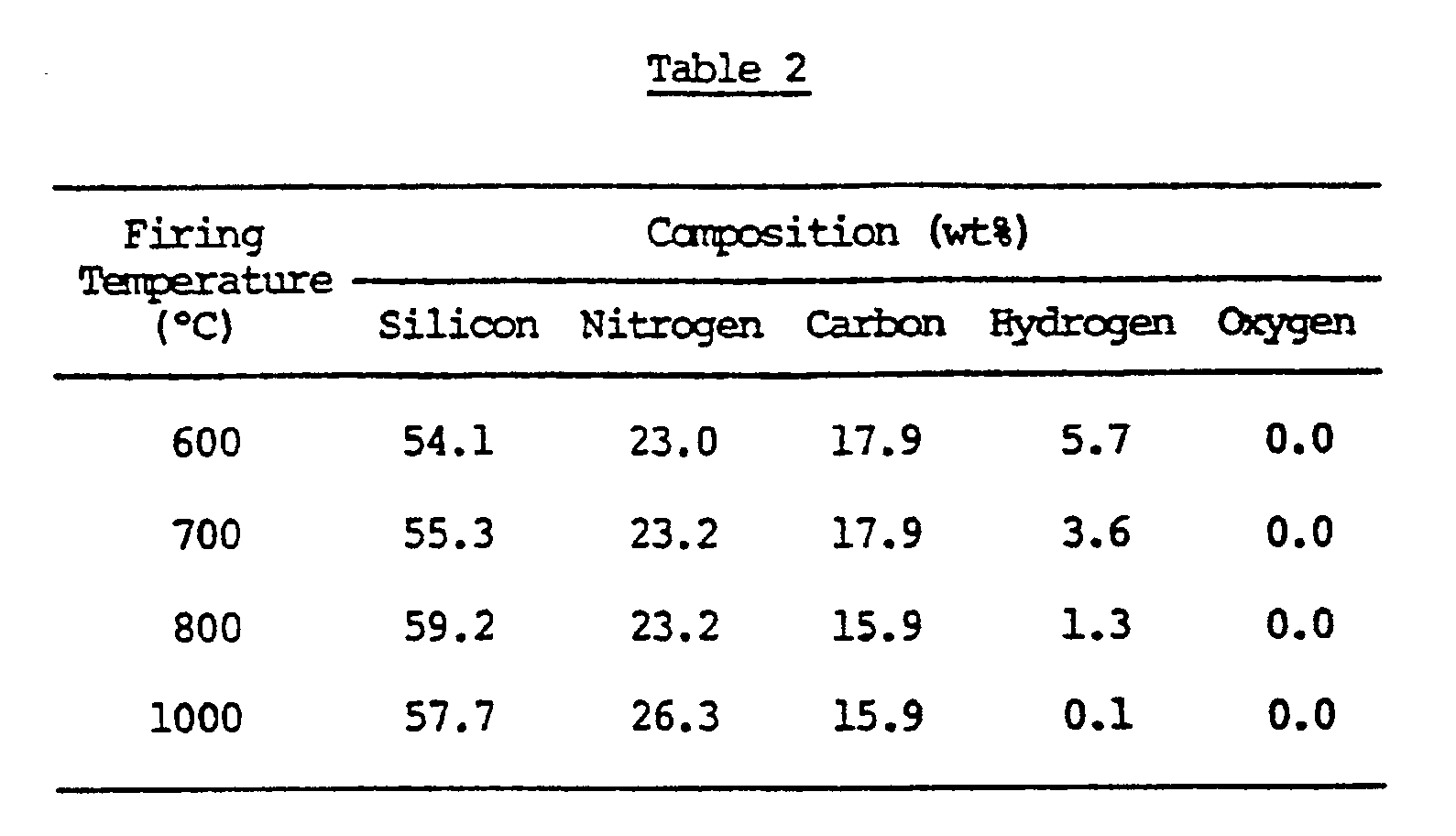
- As seen in Table 2, a large carbon content remained in the product even if heat treated at 1000°C.
- Powders of polymethylhydrosiloxazane were placed in a silicon nitride container, which was then inserted in a tubular furnace made of alumina. While ammonia/nitrogen mixed gas (ammonia/nitrogen volume ratio of 1:1) was injected at a flow rate of 1.0 l/min in the alumina firing tube, the temperature therein was raised from room temperature to a predetermined temperature, listed in Table 3, at a temperature elevation rate of 10°C/min and kept at the predetermined temperature for about three hours, followed by allowing to cool to room temperature. Solid powder products were obtained and were subjected to elemental analysis. The results are shown in Table 3.

- Polyperhydrosilazane fibers containing 1 wt% polyethyleneoxyde (8.4 x 10⁻³ mm in diameter x about 60 mm in length) were placed in a quartz container, which was inserted in a firing tube made of quartz. The firing tube was then placed in an infrared image furnace. Hydrogen/nitrogen mixed gas (hydrogen/nitrogen volume ratio of 1:1) was flowed in the firing tube at a flow rate of 0.5 l/min, the temperature in the furnace was raised from the room temperature to 1000°C at a temperature elevation rate of 3°C/min and kept at 1000°C for three hours. After allowing to cool to room temperature, the resultant fired fibers were analyzed for carbon content. The 1.2 wt% carbon content of the starting fibers was remarkably decreased to 0.1 wt% after firing.
- The polyperhydrosilazane fibers described in Example 4 were fired in the same procedures as in Example 4, but in a nitrogen atmosphere. The carbon content of the resultant fibers after firing was 0.65 wt%.
- The properties of the silicon nitride fibers produced in Example 4 had an improved electrical resistance while retaining the mechanical strength thereof, in comparison with the product in Example 2. The results are shown in Table 4.

- In place of the ammonia at the flow rate of 0.5 l/min used in Example 1, hydrogen was used at a flow rate of 0.75 l/min. The other procedures were the same as in Example 1.
- The results of the elemental analysis of the solid thermal decomposition product are shown in Table 5.

Claims (5)
Applications Claiming Priority (2)
| Application Number | Priority Date | Filing Date | Title |
|---|---|---|---|
| JP136242/86 | 1986-06-13 | ||
| JP61136242A JPH0764642B2 (en) | 1986-06-13 | 1986-06-13 | Manufacturing method of nitride ceramics |
Publications (3)
| Publication Number | Publication Date |
|---|---|
| EP0250073A2 EP0250073A2 (en) | 1987-12-23 |
| EP0250073A3 EP0250073A3 (en) | 1988-02-24 |
| EP0250073B1 true EP0250073B1 (en) | 1991-08-21 |
Family
ID=15170608
Family Applications (1)
| Application Number | Title | Priority Date | Filing Date |
|---|---|---|---|
| EP19870303746 Expired EP0250073B1 (en) | 1986-06-13 | 1987-04-28 | Method for producing nitride-base ceramics |
Country Status (4)
| Country | Link |
|---|---|
| US (1) | US4833107A (en) |
| EP (1) | EP0250073B1 (en) |
| JP (1) | JPH0764642B2 (en) |
| DE (1) | DE3772270D1 (en) |
Families Citing this family (17)
| Publication number | Priority date | Publication date | Assignee | Title |
|---|---|---|---|---|
| JPH0618885B2 (en) * | 1986-02-12 | 1994-03-16 | 東燃株式会社 | Polysiloxazane and its manufacturing method |
| JP2608061B2 (en) * | 1987-03-20 | 1997-05-07 | 日本原子力研究所 | High-purity high-strength silicon nitride continuous inorganic fiber and method for producing the same |
| DE68926260T2 (en) * | 1988-02-29 | 1996-08-22 | Toa Nenryo Kogyo Kk | Moldings made of ceramic based on silicon nitride and process for their production |
| DE3824614A1 (en) * | 1988-07-20 | 1990-01-25 | Hoechst Ag | METHOD FOR THE PRODUCTION OF CERAMIC MATERIAL CONTAINING SILICON NITRIDE FROM POLYMER HYDRIDOCHLORSILAZANES |
| DE3840773A1 (en) * | 1988-12-03 | 1990-06-07 | Hoechst Ag | SINTERABLE CERAMIC POWDER, METHOD FOR THE PRODUCTION THEREOF, SILICON NITRIDE CERAMIC PRODUCED THEREOF, METHOD FOR THE PRODUCTION AND THE USE THEREOF |
| JPH0365550A (en) * | 1989-07-31 | 1991-03-20 | Nkk Corp | Forming of polysilazane |
| JPH0468027A (en) * | 1990-07-09 | 1992-03-03 | Shin Etsu Chem Co Ltd | Method for producing organic silazane polymer and method for producing ceramics using the polymer |
| US5198519A (en) * | 1991-04-25 | 1993-03-30 | The Standard Oil Company | Silazane polymers and method of making same |
| US5563212A (en) | 1994-05-24 | 1996-10-08 | Exxon Research And Engineering Company | Synthesis of microporous ceramics |
| US5643987A (en) * | 1994-05-24 | 1997-07-01 | Exxon Research And Engineering Company | Synthesis of microporous ceramics |
| US5696217A (en) * | 1994-05-24 | 1997-12-09 | Exxon Research & Engineering Company | Synthesis of microporous ceramics by ammonia pyrolysis of ceramic precursors |
| US5952421A (en) * | 1995-12-27 | 1999-09-14 | Exxon Research And Engineering Co. | Synthesis of preceramic polymer-stabilized metal colloids and their conversion to microporous ceramics |
| US5852088A (en) * | 1995-12-27 | 1998-12-22 | Exxon Research And Engineering Company | Nanoporous ceramics with catalytic functionality |
| SG11201607910PA (en) * | 2014-04-24 | 2016-10-28 | Az Electronic Materials Luxembourg Sarl | Copolymerized polysilazane, manufacturing method therefor, composition comprising same, and method for forming siliceous film using same |
| CN107002236B (en) | 2014-09-23 | 2019-04-05 | 乔治洛德方法研究和开发液化空气有限公司 | Carbosilane-substituted amine precursors for deposition of Si-containing films and methods thereof |
| TWI724141B (en) | 2016-03-23 | 2021-04-11 | 法商液態空氣喬治斯克勞帝方法硏究開發股份有限公司 | Si-containing film forming compositions and methods of making and using the same |
| WO2018079744A1 (en) * | 2016-10-27 | 2018-05-03 | 東亞合成株式会社 | Silicon oxynitride material and method for producing same |
Family Cites Families (12)
| Publication number | Priority date | Publication date | Assignee | Title |
|---|---|---|---|---|
| DE2218960A1 (en) * | 1972-04-19 | 1973-11-08 | Bayer Ag | MOLDED BODIES FROM MOGENIC MIXTURES OF SILICON CARBIDE AND SILICON NITRIDE AND PROCESS FOR THEIR PRODUCTION |
| DE2243527A1 (en) * | 1972-09-05 | 1974-04-18 | Bayer Ag | MOLDED BODIES FROM HOMOGENOUS MIXTURES OF SILICON CARBIDE AND SILICON NITRIDE AND THE PROCESS FOR THEIR PRODUCTION |
| US4097294A (en) * | 1976-08-23 | 1978-06-27 | The United States Of America As Represented By The Secretary Of The Navy | Preparation of ceramics |
| JPS57200210A (en) * | 1981-06-01 | 1982-12-08 | Nippon Carbon Co Ltd | Fibrous silicon nitride and its production |
| US4540803A (en) * | 1983-11-28 | 1985-09-10 | Dow Corning Corporation | Hydrosilazane polymers from [R3 Si]2 NH and HSiCl3 |
| US4482669A (en) * | 1984-01-19 | 1984-11-13 | Massachusetts Institute Of Technology | Preceramic organosilazane polymers |
| JPS6112915A (en) * | 1984-06-25 | 1986-01-21 | Tokushu Muki Zairyo Kenkyusho | Continuous inorganic fiber consisting of si, n and o and its production |
| US4535007A (en) * | 1984-07-02 | 1985-08-13 | Dow Corning Corporation | Silicon nitride-containing ceramics |
| JPS61151005A (en) * | 1984-12-26 | 1986-07-09 | Nippon Soda Co Ltd | Production of alpha type crystalline silicon nitride |
| US4761389A (en) * | 1985-04-01 | 1988-08-02 | Dow Corning Corporation | Process for preparing ceramic materials with reduced carbon levels |
| FR2584080B1 (en) * | 1985-06-26 | 1987-12-31 | Rhone Poulenc Rech | METHOD OF THERMAL TREATMENT OF A POLYSILAZANE CONTAINING SIH GROUPS AND SI-N- GROUPS |
| US4743662A (en) * | 1986-11-03 | 1988-05-10 | Dow Corning Corporation | Infusible preceramic polymers via plasma treatment |
-
1986
- 1986-06-13 JP JP61136242A patent/JPH0764642B2/en not_active Expired - Lifetime
-
1987
- 1987-04-28 EP EP19870303746 patent/EP0250073B1/en not_active Expired
- 1987-04-28 DE DE8787303746T patent/DE3772270D1/en not_active Expired - Lifetime
-
1988
- 1988-10-04 US US07/253,916 patent/US4833107A/en not_active Expired - Fee Related
Also Published As
| Publication number | Publication date |
|---|---|
| EP0250073A3 (en) | 1988-02-24 |
| JPS62292675A (en) | 1987-12-19 |
| US4833107A (en) | 1989-05-23 |
| DE3772270D1 (en) | 1991-09-26 |
| JPH0764642B2 (en) | 1995-07-12 |
| EP0250073A2 (en) | 1987-12-23 |
Similar Documents
| Publication | Publication Date | Title |
|---|---|---|
| US4833107A (en) | Method for producing nitride-base ceramics | |
| CA1078879A (en) | Method for producing metal nitride sintered moldings | |
| US4720532A (en) | Organopolysilazane precursors to silicon nitride-rich mixed SiC/Si3 N4 | |
| EP0200326B1 (en) | Process for preparing ceramic materials with reduced carbon levels | |
| US7572881B2 (en) | Method for forming hafnium carbide and hafnium nitride ceramics and preceramic polymers | |
| CA1083790A (en) | Silicon carbide sintered moldings and a method for producing said moldings | |
| US5851942A (en) | Preparation of boron-doped silicon carbide fibers | |
| EP0295062B1 (en) | Polysilacyclobutasilazanes | |
| US5268496A (en) | Process for the preparation of polysilazanes | |
| US20030104131A1 (en) | Preparation of C/Si/O composite material | |
| KR100227558B1 (en) | Ceramic matrix composites and method for making same | |
| US5082872A (en) | Infusible preceramic polymers via ultraviolet treatment in the presence of a reactive gas | |
| EP0808862A2 (en) | Crosslinkers for silazane polymers | |
| US5064786A (en) | Silane modified polysilacyclobutasilazanes | |
| US6069102A (en) | Creep-resistant, high-strength silicon carbide fibers | |
| Yu et al. | Pyrolysis of titanium‐metal‐filled poly (siloxane) preceramic polymers: effect of atmosphere on pyrolysis product chemistry | |
| US4889899A (en) | Method of producing silicon carbide preceramic vinyl-containing polymers | |
| JPH0256310B2 (en) | ||
| JP2741046B2 (en) | Ceramic composition based on silicon nitride and / or silicon carbide, method for producing the same, and molding aid | |
| JPH10114828A (en) | Cross-linker for silazane polymer | |
| US4962175A (en) | Alkylpoly (polysilyl) azane preceramic polymers | |
| JPH05319959A (en) | Method for producing high-density ceramics | |
| EP0496574A1 (en) | A process for manufacturing silicon carbide based ceramic precursors | |
| EP0278001B1 (en) | Method for using organopolysilazane precursors to form new preceramic polymers and silicon nitride-rich ceramic materials | |
| Yu et al. | Si-ON ceramics from organosilicon polymers |
Legal Events
| Date | Code | Title | Description |
|---|---|---|---|
| PUAI | Public reference made under article 153(3) epc to a published international application that has entered the european phase |
Free format text: ORIGINAL CODE: 0009012 |
|
| AK | Designated contracting states |
Kind code of ref document: A2 Designated state(s): DE FR GB |
|
| PUAL | Search report despatched |
Free format text: ORIGINAL CODE: 0009013 |
|
| AK | Designated contracting states |
Kind code of ref document: A3 Designated state(s): DE FR GB |
|
| 17P | Request for examination filed |
Effective date: 19880812 |
|
| 17Q | First examination report despatched |
Effective date: 19891116 |
|
| GRAA | (expected) grant |
Free format text: ORIGINAL CODE: 0009210 |
|
| AK | Designated contracting states |
Kind code of ref document: B1 Designated state(s): DE FR GB |
|
| DX | Miscellaneous (deleted) | ||
| REF | Corresponds to: |
Ref document number: 3772270 Country of ref document: DE Date of ref document: 19910926 |
|
| RAP2 | Party data changed (patent owner data changed or rights of a patent transferred) |
Owner name: TONEN CORPORATION |
|
| RAP2 | Party data changed (patent owner data changed or rights of a patent transferred) |
Owner name: TOA NENRYO KOGYO KABUSHIKI KAISHA |
|
| RAP2 | Party data changed (patent owner data changed or rights of a patent transferred) |
Owner name: TONEN CORPORATION |
|
| ET | Fr: translation filed | ||
| REG | Reference to a national code |
Ref country code: FR Ref legal event code: CD |
|
| RIN2 | Information on inventor provided after grant (corrected) |
Free format text: KAYA,HIROSHI * TAMURA, KOZABURO * ISODA, TAKESHI |
|
| K2C1 | Correction of patent specification (title page) published |
Effective date: 19910821 |
|
| PLBE | No opposition filed within time limit |
Free format text: ORIGINAL CODE: 0009261 |
|
| STAA | Information on the status of an ep patent application or granted ep patent |
Free format text: STATUS: NO OPPOSITION FILED WITHIN TIME LIMIT |
|
| 26N | No opposition filed | ||
| PGFP | Annual fee paid to national office [announced via postgrant information from national office to epo] |
Ref country code: FR Payment date: 19970409 Year of fee payment: 11 |
|
| PGFP | Annual fee paid to national office [announced via postgrant information from national office to epo] |
Ref country code: GB Payment date: 19970421 Year of fee payment: 11 |
|
| PGFP | Annual fee paid to national office [announced via postgrant information from national office to epo] |
Ref country code: DE Payment date: 19970505 Year of fee payment: 11 |
|
| PG25 | Lapsed in a contracting state [announced via postgrant information from national office to epo] |
Ref country code: GB Free format text: LAPSE BECAUSE OF NON-PAYMENT OF DUE FEES Effective date: 19980428 |
|
| PG25 | Lapsed in a contracting state [announced via postgrant information from national office to epo] |
Ref country code: FR Free format text: THE PATENT HAS BEEN ANNULLED BY A DECISION OF A NATIONAL AUTHORITY Effective date: 19980430 |
|
| GBPC | Gb: european patent ceased through non-payment of renewal fee |
Effective date: 19980428 |
|
| PG25 | Lapsed in a contracting state [announced via postgrant information from national office to epo] |
Ref country code: DE Free format text: LAPSE BECAUSE OF NON-PAYMENT OF DUE FEES Effective date: 19990202 |
|
| REG | Reference to a national code |
Ref country code: FR Ref legal event code: ST |