EP0249174B1 - 1,4-dihydropyridine derivatives, processes for their preparation and pharmaceutical compositions containing same - Google Patents
1,4-dihydropyridine derivatives, processes for their preparation and pharmaceutical compositions containing same Download PDFInfo
- Publication number
- EP0249174B1 EP0249174B1 EP87108218A EP87108218A EP0249174B1 EP 0249174 B1 EP0249174 B1 EP 0249174B1 EP 87108218 A EP87108218 A EP 87108218A EP 87108218 A EP87108218 A EP 87108218A EP 0249174 B1 EP0249174 B1 EP 0249174B1
- Authority
- EP
- European Patent Office
- Prior art keywords
- compound
- ester
- formula
- dimethyl
- acid
- Prior art date
- Legal status (The legal status is an assumption and is not a legal conclusion. Google has not performed a legal analysis and makes no representation as to the accuracy of the status listed.)
- Expired - Lifetime
Links
- 238000002360 preparation method Methods 0.000 title claims description 12
- 239000008194 pharmaceutical composition Substances 0.000 title claims 2
- 238000000034 method Methods 0.000 title description 11
- YNGDWRXWKFWCJY-UHFFFAOYSA-N 1,4-Dihydropyridine Chemical class C1C=CNC=C1 YNGDWRXWKFWCJY-UHFFFAOYSA-N 0.000 title description 5
- 150000001875 compounds Chemical class 0.000 claims description 44
- 239000004480 active ingredient Substances 0.000 claims description 15
- 125000004076 pyridyl group Chemical group 0.000 claims description 15
- 150000003839 salts Chemical class 0.000 claims description 15
- -1 mesyloxy, benzenesulfonyloxy Chemical group 0.000 claims description 10
- 239000002253 acid Substances 0.000 claims description 9
- 229910052736 halogen Inorganic materials 0.000 claims description 6
- 125000000815 N-oxide group Chemical group 0.000 claims description 5
- 239000000654 additive Substances 0.000 claims description 5
- 125000004169 (C1-C6) alkyl group Chemical group 0.000 claims description 4
- 150000002367 halogens Chemical group 0.000 claims description 4
- 125000001624 naphthyl group Chemical group 0.000 claims description 4
- 239000000825 pharmaceutical preparation Substances 0.000 claims description 4
- 125000002887 hydroxy group Chemical group [H]O* 0.000 claims description 3
- 125000001997 phenyl group Chemical group [H]C1=C([H])C([H])=C(*)C([H])=C1[H] 0.000 claims description 3
- 125000002023 trifluoromethyl group Chemical group FC(F)(F)* 0.000 claims description 3
- 230000000304 vasodilatating effect Effects 0.000 claims description 3
- 125000004191 (C1-C6) alkoxy group Chemical group 0.000 claims description 2
- 229910052783 alkali metal Inorganic materials 0.000 claims description 2
- 150000001340 alkali metals Chemical class 0.000 claims description 2
- 229910052784 alkaline earth metal Inorganic materials 0.000 claims description 2
- 150000001342 alkaline earth metals Chemical class 0.000 claims description 2
- 239000003814 drug Substances 0.000 claims description 2
- 125000001188 haloalkyl group Chemical group 0.000 claims description 2
- 125000000449 nitro group Chemical group [O-][N+](*)=O 0.000 claims description 2
- 125000005424 tosyloxy group Chemical group S(=O)(=O)(C1=CC=C(C)C=C1)O* 0.000 claims description 2
- 125000005843 halogen group Chemical group 0.000 claims 2
- 230000003276 anti-hypertensive effect Effects 0.000 claims 1
- 238000004519 manufacturing process Methods 0.000 claims 1
- 125000001495 ethyl group Chemical group [H]C([H])([H])C([H])([H])* 0.000 description 22
- ZGDIGQLFOVNBBC-UHFFFAOYSA-N 2,6-dimethyl-4-[2-(trifluoromethyl)phenyl]-1,4-dihydropyridine-3,5-dicarboxylic acid Chemical compound OC(=O)C1=C(C)NC(C)=C(C(O)=O)C1C1=CC=CC=C1C(F)(F)F ZGDIGQLFOVNBBC-UHFFFAOYSA-N 0.000 description 11
- 239000000243 solution Substances 0.000 description 11
- 239000000203 mixture Substances 0.000 description 10
- 239000001828 Gelatine Substances 0.000 description 8
- 229920000159 gelatin Polymers 0.000 description 8
- 235000019322 gelatine Nutrition 0.000 description 8
- RMZQSAMHIQBMLW-UHFFFAOYSA-N 2,6-dimethyl-4-(2-nitrophenyl)-1,4-dihydropyridine-3,5-dicarboxylic acid Chemical compound OC(=O)C1=C(C)NC(C)=C(C(O)=O)C1C1=CC=CC=C1[N+]([O-])=O RMZQSAMHIQBMLW-UHFFFAOYSA-N 0.000 description 7
- PEDCQBHIVMGVHV-UHFFFAOYSA-N Glycerine Chemical compound OCC(O)CO PEDCQBHIVMGVHV-UHFFFAOYSA-N 0.000 description 7
- HYIMSNHJOBLJNT-UHFFFAOYSA-N nifedipine Chemical compound COC(=O)C1=C(C)NC(C)=C(C(=O)OC)C1C1=CC=CC=C1[N+]([O-])=O HYIMSNHJOBLJNT-UHFFFAOYSA-N 0.000 description 7
- UHOVQNZJYSORNB-UHFFFAOYSA-N Benzene Chemical compound C1=CC=CC=C1 UHOVQNZJYSORNB-UHFFFAOYSA-N 0.000 description 6
- XEKOWRVHYACXOJ-UHFFFAOYSA-N Ethyl acetate Chemical compound CCOC(C)=O XEKOWRVHYACXOJ-UHFFFAOYSA-N 0.000 description 6
- ZMXDDKWLCZADIW-UHFFFAOYSA-N N,N-Dimethylformamide Chemical compound CN(C)C=O ZMXDDKWLCZADIW-UHFFFAOYSA-N 0.000 description 6
- 238000001035 drying Methods 0.000 description 6
- 239000008187 granular material Substances 0.000 description 6
- 229960001597 nifedipine Drugs 0.000 description 6
- 239000002775 capsule Substances 0.000 description 5
- 229920001592 potato starch Polymers 0.000 description 5
- 125000001424 substituent group Chemical group 0.000 description 5
- GUBGYTABKSRVRQ-QKKXKWKRSA-N Lactose Natural products OC[C@H]1O[C@@H](O[C@H]2[C@H](O)[C@@H](O)C(O)O[C@@H]2CO)[C@H](O)[C@@H](O)[C@H]1O GUBGYTABKSRVRQ-QKKXKWKRSA-N 0.000 description 4
- 208000026106 cerebrovascular disease Diseases 0.000 description 4
- 230000000694 effects Effects 0.000 description 4
- 239000008101 lactose Substances 0.000 description 4
- HQKMJHAJHXVSDF-UHFFFAOYSA-L magnesium stearate Chemical compound [Mg+2].CCCCCCCCCCCCCCCCCC([O-])=O.CCCCCCCCCCCCCCCCCC([O-])=O HQKMJHAJHXVSDF-UHFFFAOYSA-L 0.000 description 4
- 239000007787 solid Substances 0.000 description 4
- 239000002904 solvent Substances 0.000 description 4
- 235000000346 sugar Nutrition 0.000 description 4
- QTBSBXVTEAMEQO-UHFFFAOYSA-N Acetic acid Chemical compound CC(O)=O QTBSBXVTEAMEQO-UHFFFAOYSA-N 0.000 description 3
- WEVYAHXRMPXWCK-UHFFFAOYSA-N Acetonitrile Chemical compound CC#N WEVYAHXRMPXWCK-UHFFFAOYSA-N 0.000 description 3
- FBPFZTCFMRRESA-JGWLITMVSA-N D-glucitol Chemical compound OC[C@H](O)[C@@H](O)[C@H](O)[C@H](O)CO FBPFZTCFMRRESA-JGWLITMVSA-N 0.000 description 3
- LFQSCWFLJHTTHZ-UHFFFAOYSA-N Ethanol Chemical compound CCO LFQSCWFLJHTTHZ-UHFFFAOYSA-N 0.000 description 3
- SJRJJKPEHAURKC-UHFFFAOYSA-N N-Methylmorpholine Chemical compound CN1CCOCC1 SJRJJKPEHAURKC-UHFFFAOYSA-N 0.000 description 3
- DNIAPMSPPWPWGF-UHFFFAOYSA-N Propylene glycol Chemical compound CC(O)CO DNIAPMSPPWPWGF-UHFFFAOYSA-N 0.000 description 3
- 229930006000 Sucrose Natural products 0.000 description 3
- CZMRCDWAGMRECN-UGDNZRGBSA-N Sucrose Chemical compound O[C@H]1[C@H](O)[C@@H](CO)O[C@@]1(CO)O[C@@H]1[C@H](O)[C@@H](O)[C@H](O)[C@@H](CO)O1 CZMRCDWAGMRECN-UGDNZRGBSA-N 0.000 description 3
- 125000002947 alkylene group Chemical group 0.000 description 3
- 229940030600 antihypertensive agent Drugs 0.000 description 3
- 239000002220 antihypertensive agent Substances 0.000 description 3
- 239000011230 binding agent Substances 0.000 description 3
- 125000003178 carboxy group Chemical group [H]OC(*)=O 0.000 description 3
- KRKNYBCHXYNGOX-UHFFFAOYSA-N citric acid Chemical compound OC(=O)CC(O)(C(O)=O)CC(O)=O KRKNYBCHXYNGOX-UHFFFAOYSA-N 0.000 description 3
- 238000000576 coating method Methods 0.000 description 3
- 235000013681 dietary sucrose Nutrition 0.000 description 3
- 235000011187 glycerol Nutrition 0.000 description 3
- 239000002245 particle Substances 0.000 description 3
- 230000000144 pharmacologic effect Effects 0.000 description 3
- 239000000126 substance Substances 0.000 description 3
- 229960004793 sucrose Drugs 0.000 description 3
- 239000000454 talc Substances 0.000 description 3
- 229910052623 talc Inorganic materials 0.000 description 3
- GUBGYTABKSRVRQ-XLOQQCSPSA-N Alpha-Lactose Chemical compound O[C@@H]1[C@@H](O)[C@@H](O)[C@@H](CO)O[C@H]1O[C@@H]1[C@@H](CO)O[C@H](O)[C@H](O)[C@H]1O GUBGYTABKSRVRQ-XLOQQCSPSA-N 0.000 description 2
- QGZKDVFQNNGYKY-UHFFFAOYSA-N Ammonia Chemical compound N QGZKDVFQNNGYKY-UHFFFAOYSA-N 0.000 description 2
- 229920000945 Amylopectin Polymers 0.000 description 2
- 206010002383 Angina Pectoris Diseases 0.000 description 2
- XKRFYHLGVUSROY-UHFFFAOYSA-N Argon Chemical compound [Ar] XKRFYHLGVUSROY-UHFFFAOYSA-N 0.000 description 2
- ZAMOUSCENKQFHK-UHFFFAOYSA-N Chlorine atom Chemical compound [Cl] ZAMOUSCENKQFHK-UHFFFAOYSA-N 0.000 description 2
- 229920002261 Corn starch Polymers 0.000 description 2
- FBPFZTCFMRRESA-FSIIMWSLSA-N D-Glucitol Natural products OC[C@H](O)[C@H](O)[C@@H](O)[C@H](O)CO FBPFZTCFMRRESA-FSIIMWSLSA-N 0.000 description 2
- FBPFZTCFMRRESA-KVTDHHQDSA-N D-Mannitol Chemical compound OC[C@@H](O)[C@@H](O)[C@H](O)[C@H](O)CO FBPFZTCFMRRESA-KVTDHHQDSA-N 0.000 description 2
- FEWJPZIEWOKRBE-JCYAYHJZSA-N Dextrotartaric acid Chemical compound OC(=O)[C@H](O)[C@@H](O)C(O)=O FEWJPZIEWOKRBE-JCYAYHJZSA-N 0.000 description 2
- XTHFKEDIFFGKHM-UHFFFAOYSA-N Dimethoxyethane Chemical compound COCCOC XTHFKEDIFFGKHM-UHFFFAOYSA-N 0.000 description 2
- IAZDPXIOMUYVGZ-UHFFFAOYSA-N Dimethylsulphoxide Chemical compound CS(C)=O IAZDPXIOMUYVGZ-UHFFFAOYSA-N 0.000 description 2
- VEXZGXHMUGYJMC-UHFFFAOYSA-N Hydrochloric acid Chemical compound Cl VEXZGXHMUGYJMC-UHFFFAOYSA-N 0.000 description 2
- 206010020772 Hypertension Diseases 0.000 description 2
- 229930195725 Mannitol Natural products 0.000 description 2
- NBIIXXVUZAFLBC-UHFFFAOYSA-N Phosphoric acid Chemical compound OP(O)(O)=O NBIIXXVUZAFLBC-UHFFFAOYSA-N 0.000 description 2
- 229920002472 Starch Polymers 0.000 description 2
- QAOWNCQODCNURD-UHFFFAOYSA-N Sulfuric acid Chemical compound OS(O)(=O)=O QAOWNCQODCNURD-UHFFFAOYSA-N 0.000 description 2
- FEWJPZIEWOKRBE-UHFFFAOYSA-N Tartaric acid Natural products [H+].[H+].[O-]C(=O)C(O)C(O)C([O-])=O FEWJPZIEWOKRBE-UHFFFAOYSA-N 0.000 description 2
- HEDRZPFGACZZDS-MICDWDOJSA-N Trichloro(2H)methane Chemical compound [2H]C(Cl)(Cl)Cl HEDRZPFGACZZDS-MICDWDOJSA-N 0.000 description 2
- 150000007513 acids Chemical class 0.000 description 2
- 230000001476 alcoholic effect Effects 0.000 description 2
- 150000001450 anions Chemical class 0.000 description 2
- 239000002585 base Substances 0.000 description 2
- 230000009460 calcium influx Effects 0.000 description 2
- 239000001913 cellulose Substances 0.000 description 2
- 229920002678 cellulose Polymers 0.000 description 2
- 206010008118 cerebral infarction Diseases 0.000 description 2
- 239000000460 chlorine Substances 0.000 description 2
- 229910052801 chlorine Inorganic materials 0.000 description 2
- 239000011248 coating agent Substances 0.000 description 2
- 239000008120 corn starch Substances 0.000 description 2
- 150000002148 esters Chemical group 0.000 description 2
- 229940093499 ethyl acetate Drugs 0.000 description 2
- 235000019439 ethyl acetate Nutrition 0.000 description 2
- 208000019622 heart disease Diseases 0.000 description 2
- 125000000623 heterocyclic group Chemical group 0.000 description 2
- 230000002401 inhibitory effect Effects 0.000 description 2
- JVTAAEKCZFNVCJ-UHFFFAOYSA-N lactic acid Chemical compound CC(O)C(O)=O JVTAAEKCZFNVCJ-UHFFFAOYSA-N 0.000 description 2
- 239000007788 liquid Substances 0.000 description 2
- 239000000314 lubricant Substances 0.000 description 2
- 235000019359 magnesium stearate Nutrition 0.000 description 2
- 239000000594 mannitol Substances 0.000 description 2
- 235000010355 mannitol Nutrition 0.000 description 2
- 125000002496 methyl group Chemical group [H]C([H])([H])* 0.000 description 2
- VLKZOEOYAKHREP-UHFFFAOYSA-N n-Hexane Chemical compound CCCCCC VLKZOEOYAKHREP-UHFFFAOYSA-N 0.000 description 2
- XNGIFLGASWRNHJ-UHFFFAOYSA-N phthalic acid Chemical compound OC(=O)C1=CC=CC=C1C(O)=O XNGIFLGASWRNHJ-UHFFFAOYSA-N 0.000 description 2
- 239000000843 powder Substances 0.000 description 2
- 239000000600 sorbitol Substances 0.000 description 2
- 235000010356 sorbitol Nutrition 0.000 description 2
- 239000008107 starch Substances 0.000 description 2
- 235000019698 starch Nutrition 0.000 description 2
- 239000007858 starting material Substances 0.000 description 2
- 235000020357 syrup Nutrition 0.000 description 2
- 239000011975 tartaric acid Substances 0.000 description 2
- 235000002906 tartaric acid Nutrition 0.000 description 2
- VZGDMQKNWNREIO-UHFFFAOYSA-N tetrachloromethane Chemical compound ClC(Cl)(Cl)Cl VZGDMQKNWNREIO-UHFFFAOYSA-N 0.000 description 2
- 239000003071 vasodilator agent Substances 0.000 description 2
- 235000015112 vegetable and seed oil Nutrition 0.000 description 2
- 239000008158 vegetable oil Substances 0.000 description 2
- XLYOFNOQVPJJNP-UHFFFAOYSA-N water Substances O XLYOFNOQVPJJNP-UHFFFAOYSA-N 0.000 description 2
- QBYIENPQHBMVBV-HFEGYEGKSA-N (2R)-2-hydroxy-2-phenylacetic acid Chemical compound O[C@@H](C(O)=O)c1ccccc1.O[C@@H](C(O)=O)c1ccccc1 QBYIENPQHBMVBV-HFEGYEGKSA-N 0.000 description 1
- AAWZDTNXLSGCEK-LNVDRNJUSA-N (3r,5r)-1,3,4,5-tetrahydroxycyclohexane-1-carboxylic acid Chemical compound O[C@@H]1CC(O)(C(O)=O)C[C@@H](O)C1O AAWZDTNXLSGCEK-LNVDRNJUSA-N 0.000 description 1
- MIOPJNTWMNEORI-GMSGAONNSA-N (S)-camphorsulfonic acid Chemical compound C1C[C@@]2(CS(O)(=O)=O)C(=O)C[C@@H]1C2(C)C MIOPJNTWMNEORI-GMSGAONNSA-N 0.000 description 1
- BJEPYKJPYRNKOW-REOHCLBHSA-N (S)-malic acid Chemical compound OC(=O)[C@@H](O)CC(O)=O BJEPYKJPYRNKOW-REOHCLBHSA-N 0.000 description 1
- RYHBNJHYFVUHQT-UHFFFAOYSA-N 1,4-Dioxane Chemical compound C1COCCO1 RYHBNJHYFVUHQT-UHFFFAOYSA-N 0.000 description 1
- UZGKAASZIMOAMU-UHFFFAOYSA-N 124177-85-1 Chemical compound NP(=O)=O UZGKAASZIMOAMU-UHFFFAOYSA-N 0.000 description 1
- 238000005160 1H NMR spectroscopy Methods 0.000 description 1
- LNSCNEJNLACZPA-UHFFFAOYSA-N 2,3-dihydroxy-2,3-bis(2-methylphenyl)butanedioic acid Chemical compound CC1=CC=CC=C1C(O)(C(O)=O)C(O)(C(O)=O)C1=CC=CC=C1C LNSCNEJNLACZPA-UHFFFAOYSA-N 0.000 description 1
- SGTNSNPWRIOYBX-UHFFFAOYSA-N 2-(3,4-dimethoxyphenyl)-5-{[2-(3,4-dimethoxyphenyl)ethyl](methyl)amino}-2-(propan-2-yl)pentanenitrile Chemical compound C1=C(OC)C(OC)=CC=C1CCN(C)CCCC(C#N)(C(C)C)C1=CC=C(OC)C(OC)=C1 SGTNSNPWRIOYBX-UHFFFAOYSA-N 0.000 description 1
- OJWYYSVOSNWCCE-UHFFFAOYSA-N 2-methoxyethyl hypofluorite Chemical compound COCCOF OJWYYSVOSNWCCE-UHFFFAOYSA-N 0.000 description 1
- 125000003349 3-pyridyl group Chemical group N1=C([H])C([*])=C([H])C([H])=C1[H] 0.000 description 1
- 125000000339 4-pyridyl group Chemical group N1=C([H])C([H])=C([*])C([H])=C1[H] 0.000 description 1
- XTJNTHRZFDWIQJ-UHFFFAOYSA-N 5-o-(2-chloroethyl) 3-o-methyl 2,6-dimethyl-4-[2-(trifluoromethyl)phenyl]-1,4-dihydropyridine-3,5-dicarboxylate Chemical compound COC(=O)C1=C(C)NC(C)=C(C(=O)OCCCl)C1C1=CC=CC=C1C(F)(F)F XTJNTHRZFDWIQJ-UHFFFAOYSA-N 0.000 description 1
- 206010007556 Cardiac failure acute Diseases 0.000 description 1
- AAWZDTNXLSGCEK-UHFFFAOYSA-N Cordycepinsaeure Natural products OC1CC(O)(C(O)=O)CC(O)C1O AAWZDTNXLSGCEK-UHFFFAOYSA-N 0.000 description 1
- PXGOKWXKJXAPGV-UHFFFAOYSA-N Fluorine Chemical compound FF PXGOKWXKJXAPGV-UHFFFAOYSA-N 0.000 description 1
- 206010022998 Irritability Diseases 0.000 description 1
- FXHOOIRPVKKKFG-UHFFFAOYSA-N N,N-Dimethylacetamide Chemical compound CN(C)C(C)=O FXHOOIRPVKKKFG-UHFFFAOYSA-N 0.000 description 1
- 238000005481 NMR spectroscopy Methods 0.000 description 1
- 239000005662 Paraffin oil Substances 0.000 description 1
- 239000002202 Polyethylene glycol Substances 0.000 description 1
- OFOBLEOULBTSOW-UHFFFAOYSA-N Propanedioic acid Natural products OC(=O)CC(O)=O OFOBLEOULBTSOW-UHFFFAOYSA-N 0.000 description 1
- 238000004617 QSAR study Methods 0.000 description 1
- AAWZDTNXLSGCEK-ZHQZDSKASA-N Quinic acid Natural products O[C@H]1CC(O)(C(O)=O)C[C@H](O)C1O AAWZDTNXLSGCEK-ZHQZDSKASA-N 0.000 description 1
- IWYDHOAUDWTVEP-UHFFFAOYSA-N R-2-phenyl-2-hydroxyacetic acid Natural products OC(=O)C(O)C1=CC=CC=C1 IWYDHOAUDWTVEP-UHFFFAOYSA-N 0.000 description 1
- 229920001800 Shellac Polymers 0.000 description 1
- KDYFGRWQOYBRFD-UHFFFAOYSA-N Succinic acid Natural products OC(=O)CCC(O)=O KDYFGRWQOYBRFD-UHFFFAOYSA-N 0.000 description 1
- 208000001871 Tachycardia Diseases 0.000 description 1
- 235000011054 acetic acid Nutrition 0.000 description 1
- 239000013543 active substance Substances 0.000 description 1
- 230000006978 adaptation Effects 0.000 description 1
- BJEPYKJPYRNKOW-UHFFFAOYSA-N alpha-hydroxysuccinic acid Natural products OC(=O)C(O)CC(O)=O BJEPYKJPYRNKOW-UHFFFAOYSA-N 0.000 description 1
- 229910000147 aluminium phosphate Inorganic materials 0.000 description 1
- 150000001412 amines Chemical class 0.000 description 1
- 229910021529 ammonia Inorganic materials 0.000 description 1
- 239000007864 aqueous solution Substances 0.000 description 1
- 229910052786 argon Inorganic materials 0.000 description 1
- 206010003119 arrhythmia Diseases 0.000 description 1
- 230000006793 arrhythmia Effects 0.000 description 1
- 239000012752 auxiliary agent Substances 0.000 description 1
- 230000009286 beneficial effect Effects 0.000 description 1
- 150000001555 benzenes Chemical group 0.000 description 1
- WZJYKHNJTSNBHV-UHFFFAOYSA-N benzoquinoline Natural products C1=CN=C2C3=CC=CC=C3C=CC2=C1 WZJYKHNJTSNBHV-UHFFFAOYSA-N 0.000 description 1
- 230000004531 blood pressure lowering effect Effects 0.000 description 1
- KDYFGRWQOYBRFD-NUQCWPJISA-N butanedioic acid Chemical compound O[14C](=O)CC[14C](O)=O KDYFGRWQOYBRFD-NUQCWPJISA-N 0.000 description 1
- 239000011575 calcium Substances 0.000 description 1
- CJZGTCYPCWQAJB-UHFFFAOYSA-L calcium stearate Chemical compound [Ca+2].CCCCCCCCCCCCCCCCCC([O-])=O.CCCCCCCCCCCCCCCCCC([O-])=O CJZGTCYPCWQAJB-UHFFFAOYSA-L 0.000 description 1
- 235000013539 calcium stearate Nutrition 0.000 description 1
- 239000008116 calcium stearate Substances 0.000 description 1
- 125000005708 carbonyloxy group Chemical group [*:2]OC([*:1])=O 0.000 description 1
- 239000004203 carnauba wax Substances 0.000 description 1
- 235000013869 carnauba wax Nutrition 0.000 description 1
- 150000001768 cations Chemical class 0.000 description 1
- 239000003795 chemical substances by application Substances 0.000 description 1
- 235000015165 citric acid Nutrition 0.000 description 1
- 230000008602 contraction Effects 0.000 description 1
- 238000001816 cooling Methods 0.000 description 1
- 230000001419 dependent effect Effects 0.000 description 1
- VQZSDRXKLXBRHJ-UHFFFAOYSA-N diethyl 2,6-dimethyl-4-phenyl-1,4-dihydropyridine-3,5-dicarboxylate Chemical compound CCOC(=O)C1=C(C)NC(C)=C(C(=O)OCC)C1C1=CC=CC=C1 VQZSDRXKLXBRHJ-UHFFFAOYSA-N 0.000 description 1
- 239000003085 diluting agent Substances 0.000 description 1
- 201000010099 disease Diseases 0.000 description 1
- 208000037265 diseases, disorders, signs and symptoms Diseases 0.000 description 1
- 229940079593 drug Drugs 0.000 description 1
- 239000000975 dye Substances 0.000 description 1
- BEFDCLMNVWHSGT-UHFFFAOYSA-N ethenylcyclopentane Chemical compound C=CC1CCCC1 BEFDCLMNVWHSGT-UHFFFAOYSA-N 0.000 description 1
- YPMPTULBFPFSEQ-PLNGDYQASA-N ethyl (z)-3-aminobut-2-enoate Chemical compound CCOC(=O)\C=C(\C)N YPMPTULBFPFSEQ-PLNGDYQASA-N 0.000 description 1
- AYZGINZXVVKWKV-UHFFFAOYSA-N ethyl 2-benzylidene-3-oxobutanoate Chemical compound CCOC(=O)C(C(C)=O)=CC1=CC=CC=C1 AYZGINZXVVKWKV-UHFFFAOYSA-N 0.000 description 1
- XYIBRDXRRQCHLP-UHFFFAOYSA-N ethyl acetoacetate Chemical compound CCOC(=O)CC(C)=O XYIBRDXRRQCHLP-UHFFFAOYSA-N 0.000 description 1
- 239000000706 filtrate Substances 0.000 description 1
- 239000000796 flavoring agent Substances 0.000 description 1
- 239000012530 fluid Substances 0.000 description 1
- 239000011737 fluorine Substances 0.000 description 1
- 229910052731 fluorine Inorganic materials 0.000 description 1
- 235000013355 food flavoring agent Nutrition 0.000 description 1
- 239000012458 free base Substances 0.000 description 1
- 230000014509 gene expression Effects 0.000 description 1
- 238000000227 grinding Methods 0.000 description 1
- 239000004615 ingredient Substances 0.000 description 1
- 238000002347 injection Methods 0.000 description 1
- 239000007924 injection Substances 0.000 description 1
- 125000000959 isobutyl group Chemical group [H]C([H])([H])C([H])(C([H])([H])[H])C([H])([H])* 0.000 description 1
- 125000001449 isopropyl group Chemical group [H]C([H])([H])C([H])(*)C([H])([H])[H] 0.000 description 1
- 239000004310 lactic acid Substances 0.000 description 1
- 235000014655 lactic acid Nutrition 0.000 description 1
- VZCYOOQTPOCHFL-UPHRSURJSA-N maleic acid Chemical compound OC(=O)\C=C/C(O)=O VZCYOOQTPOCHFL-UPHRSURJSA-N 0.000 description 1
- 239000011976 maleic acid Substances 0.000 description 1
- 239000001630 malic acid Substances 0.000 description 1
- 235000011090 malic acid Nutrition 0.000 description 1
- 229960002510 mandelic acid Drugs 0.000 description 1
- 244000005700 microbiome Species 0.000 description 1
- 150000007522 mineralic acids Chemical class 0.000 description 1
- 238000002156 mixing Methods 0.000 description 1
- 125000004108 n-butyl group Chemical group [H]C([H])([H])C([H])([H])C([H])([H])C([H])([H])* 0.000 description 1
- 125000004123 n-propyl group Chemical group [H]C([H])([H])C([H])([H])C([H])([H])* 0.000 description 1
- 230000007935 neutral effect Effects 0.000 description 1
- 230000003287 optical effect Effects 0.000 description 1
- 150000007524 organic acids Chemical class 0.000 description 1
- 235000005985 organic acids Nutrition 0.000 description 1
- 150000007530 organic bases Chemical class 0.000 description 1
- 239000003960 organic solvent Substances 0.000 description 1
- 239000000546 pharmaceutical excipient Substances 0.000 description 1
- 229920001223 polyethylene glycol Polymers 0.000 description 1
- 239000001267 polyvinylpyrrolidone Substances 0.000 description 1
- 229920000036 polyvinylpyrrolidone Polymers 0.000 description 1
- 235000013855 polyvinylpyrrolidone Nutrition 0.000 description 1
- 210000003240 portal vein Anatomy 0.000 description 1
- 230000037452 priming Effects 0.000 description 1
- 239000011541 reaction mixture Substances 0.000 description 1
- XMVJITFPVVRMHC-UHFFFAOYSA-N roxarsone Chemical group OC1=CC=C([As](O)(O)=O)C=C1[N+]([O-])=O XMVJITFPVVRMHC-UHFFFAOYSA-N 0.000 description 1
- YGSDEFSMJLZEOE-UHFFFAOYSA-N salicylic acid Chemical compound OC(=O)C1=CC=CC=C1O YGSDEFSMJLZEOE-UHFFFAOYSA-N 0.000 description 1
- 239000004208 shellac Substances 0.000 description 1
- 235000013874 shellac Nutrition 0.000 description 1
- ZLGIYFNHBLSMPS-ATJNOEHPSA-N shellac Chemical compound OCCCCCC(O)C(O)CCCCCCCC(O)=O.C1C23[C@H](C(O)=O)CCC2[C@](C)(CO)[C@@H]1C(C(O)=O)=C[C@@H]3O ZLGIYFNHBLSMPS-ATJNOEHPSA-N 0.000 description 1
- 229940113147 shellac Drugs 0.000 description 1
- 238000010898 silica gel chromatography Methods 0.000 description 1
- RMAQACBXLXPBSY-UHFFFAOYSA-N silicic acid Chemical compound O[Si](O)(O)O RMAQACBXLXPBSY-UHFFFAOYSA-N 0.000 description 1
- 235000012239 silicon dioxide Nutrition 0.000 description 1
- 235000020374 simple syrup Nutrition 0.000 description 1
- SEZXASCEJFXHIW-UHFFFAOYSA-M sodium;4-chloro-6-methylquinoline-3-carboxylate Chemical compound [Na+].N1=CC(C([O-])=O)=C(Cl)C2=CC(C)=CC=C21 SEZXASCEJFXHIW-UHFFFAOYSA-M 0.000 description 1
- 239000004334 sorbic acid Substances 0.000 description 1
- 235000010199 sorbic acid Nutrition 0.000 description 1
- 229940075582 sorbic acid Drugs 0.000 description 1
- 230000002269 spontaneous effect Effects 0.000 description 1
- 229910001220 stainless steel Inorganic materials 0.000 description 1
- 239000010935 stainless steel Substances 0.000 description 1
- 239000000829 suppository Substances 0.000 description 1
- 239000000725 suspension Substances 0.000 description 1
- 239000006188 syrup Substances 0.000 description 1
- 230000006794 tachycardia Effects 0.000 description 1
- 238000011287 therapeutic dose Methods 0.000 description 1
- 230000001225 therapeutic effect Effects 0.000 description 1
- VZCYOOQTPOCHFL-UHFFFAOYSA-N trans-butenedioic acid Natural products OC(=O)C=CC(O)=O VZCYOOQTPOCHFL-UHFFFAOYSA-N 0.000 description 1
- 125000003866 trichloromethyl group Chemical group ClC(Cl)(Cl)* 0.000 description 1
- 229940124549 vasodilator Drugs 0.000 description 1
- 229960001722 verapamil Drugs 0.000 description 1
- 239000001993 wax Substances 0.000 description 1
Classifications
-
- C—CHEMISTRY; METALLURGY
- C07—ORGANIC CHEMISTRY
- C07D—HETEROCYCLIC COMPOUNDS
- C07D401/00—Heterocyclic compounds containing two or more hetero rings, having nitrogen atoms as the only ring hetero atoms, at least one ring being a six-membered ring with only one nitrogen atom
- C07D401/02—Heterocyclic compounds containing two or more hetero rings, having nitrogen atoms as the only ring hetero atoms, at least one ring being a six-membered ring with only one nitrogen atom containing two hetero rings
- C07D401/12—Heterocyclic compounds containing two or more hetero rings, having nitrogen atoms as the only ring hetero atoms, at least one ring being a six-membered ring with only one nitrogen atom containing two hetero rings linked by a chain containing hetero atoms as chain links
-
- A—HUMAN NECESSITIES
- A61—MEDICAL OR VETERINARY SCIENCE; HYGIENE
- A61P—SPECIFIC THERAPEUTIC ACTIVITY OF CHEMICAL COMPOUNDS OR MEDICINAL PREPARATIONS
- A61P3/00—Drugs for disorders of the metabolism
-
- A—HUMAN NECESSITIES
- A61—MEDICAL OR VETERINARY SCIENCE; HYGIENE
- A61P—SPECIFIC THERAPEUTIC ACTIVITY OF CHEMICAL COMPOUNDS OR MEDICINAL PREPARATIONS
- A61P9/00—Drugs for disorders of the cardiovascular system
- A61P9/08—Vasodilators for multiple indications
-
- A—HUMAN NECESSITIES
- A61—MEDICAL OR VETERINARY SCIENCE; HYGIENE
- A61P—SPECIFIC THERAPEUTIC ACTIVITY OF CHEMICAL COMPOUNDS OR MEDICINAL PREPARATIONS
- A61P9/00—Drugs for disorders of the cardiovascular system
- A61P9/12—Antihypertensives
-
- C—CHEMISTRY; METALLURGY
- C07—ORGANIC CHEMISTRY
- C07D—HETEROCYCLIC COMPOUNDS
- C07D211/00—Heterocyclic compounds containing hydrogenated pyridine rings, not condensed with other rings
- C07D211/04—Heterocyclic compounds containing hydrogenated pyridine rings, not condensed with other rings with only hydrogen or carbon atoms directly attached to the ring nitrogen atom
- C07D211/80—Heterocyclic compounds containing hydrogenated pyridine rings, not condensed with other rings with only hydrogen or carbon atoms directly attached to the ring nitrogen atom having two double bonds between ring members or between ring members and non-ring members
- C07D211/84—Heterocyclic compounds containing hydrogenated pyridine rings, not condensed with other rings with only hydrogen or carbon atoms directly attached to the ring nitrogen atom having two double bonds between ring members or between ring members and non-ring members with hetero atoms or with carbon atoms having three bonds to hetero atoms, with at the most one bond to halogen directly attached to ring carbon atoms
- C07D211/90—Carbon atoms having three bonds to hetero atoms with at the most one bond to halogen
Definitions
- the present invention relates to new compounds having valuable vasodilating and blood pressure lowering effects, etc., to processes for their preparation and to their use as vasodilating and antihypertensive agents.
- 1,4-Dihydro-2,6-dimethyl-4-phenylpyridine-3,5-dicarboxylic acid diethyl ester is known to obtain by reacting 2-benzylideneacetoacetic acid ethyl ester, ⁇ -aminocrotonic acid ethyl ester or acetoacetic acid ethyl ester and ammonia, as reported in Ber. Deutsch Chem. Ges. 31 , 743(1971).
- DOS 2117517 and 2117573 disclose that similar compounds can be used as coronary arteriodilating and antihypertensive agents, and inter alia 1,4-dihydro-2,6-dimethyl-4-(2-nitrophenyl)pyridine-3,5-dicarboxylic acid dimethyl ester disclosed therein has been used extensively under the name of Nifedipine. Since commercial success of Nifedipine, a large number of compounds having similar chemical structure have been developed and these compounds are disclosed in US Patents 3,574,843; 4,264,611; 3,799,934; 4,239,893; 4,317,768; 4,044,141 and 4,258,042; EPO Appln. 0012180; and French Patent 2,182,983.
- EP-A-0 145 434 EP-A-0 184 841 and US-A-3,905,970.
- EP-A-0 145 956 are dihydropyridine compounds disclosed wherein at the 3-position an amid group is linked to the dihydropyridine at the 3-position.
- Known 1,4-dihydropyridine derivatives including Nifedipine inhibit calcium influx into the cells and they have been used as remedy for cardiac diseases of angina pectoris, etc., cerebrovascular diseases of cerebral infarction, etc., and hypertension.
- Progr.Pharmacol. 5,25 (1982) qualitative and quantitative structure-activity relationships of specific Ca antogonists, especially nifedipine derivates and Verapamil derivates are disclosed.
- the present invention results from efforts to develop new compounds with more improved pharmacological effects and lesser side effects than known 1,4-dihydropyridine derivatives.
- R1 is a nitro or trifluoromethyl group
- R2 is a C1-C6 alkyl group
- R3 is a pyridyl group which is fused with a benzene ring substituted with C1-C6 alkyl, C1-C6 alkoxy, halogen or haloalkyl, the pyridyl group being optionally substituted with halogen or hydroxyl
- a pyridyl group which is fused with a naphthalene ring
- pharmaceutically acceptable acid addition salt a salt, the anion of which is relatively innocuous to the animal organism when used in therapeutic doses, so that the beneficial properties of the cation are not vitiated by side-effects ascribable to the anion.
- the compounds of the present invention are those wherein R3 is linked to an alkylene group through an ester bond (carbonyloxy group), which are different from the compounds wherein the heterocyclic group is linked to an alkylene group through an amide bond in an ester moiety at 3-position of 1,4-dihydro-2,6-dimethyl-4-phenylpyridine-3,5-dicarboxylic acid diesters as disclosed in the above-cited prior art WO 84/02132.
- the compounds of the present invention are characterized by prominent pharmacological effects as compared with the prior art compounds.
- Examples of suitable group for R1 in the formula (I) include 2-trifluoromethyl, 3-trifluoromethyl, 2-nitro and 3-nitro.
- R2 examples include methyl, ethyl, n-propyl, i-propyl, n-butyl, i-butyl and tert.-butyl, and the like.
- R3 examples include pyridyl which is fused with a benzene ring or a napthene ring and pyridyl-N-oxide, e.g., 3-pyridyl and 4-pyridyl, each being fused with a benzene ring or a napthene ring, 3-pyridyl-N-oxide and 4-pyridyl-N-oxide, and the like.
- suitable substituents on the pyridyl and pyridyl N-oxide groups include fluorine, chlorine and hydroxyl, and the like. One or more of the substituents may be present on the pyridyl and pyridyl N-oxide groups.
- fused groups include 2-quinolyl, 3-quinolyl, 4-quinolyl and 3-(7,8-benzoquinolyl), and the like.
- suitable substituents include methyl, ethyl, methoxy, ethoxy, fluorine, chlorine, trifluoromethyl and trichloromethyl, and the like. The number of these substituents may be one or more.
- the compounds of the present invention can be prepared by reacting a compound of the formula (II) wherein R1 and R2 are as defined above, and X is halogen, mesyloxy, benzenesulfonyloxy, or tosyloxy with a compound of the formula (III) wherein R3 is as defined above and M is an alkali metal or an alkaline earth metal.
- the reaction is preferably carried out in the presence of an inert organic solvent.
- suitable solvents for the reaction include N,N-dimethylformamide, N,N-dimethylacetamide, dimethyl sulfoxide, hexamethyl phosphoamide, dioxane, acetonitrile, N-methylmorpholine, 1,2-dimethoxyethane, and the like.
- the reaction temperature is suitably from 80°C to 160°C. Under the above conditions, the reaction is usually completed in a few hours.
- compositions of the compounds of the formula I according to the present invention may be prepared by the application or adaptation of known methods for the preparation of salts of organic bases, for example, by reacting the compounds of the formula I with the appropriate acid in a suitable solvent.
- addition salts include salts derived from inorganic and organic acids such as, without limitation, hydrochloric acid, phosphoric acid, sulfuric acid, acetic acid, tartaric acid, lactic acid, succinic acid, citric acid, maleic acid, sorbic acid, salicyclic acid, phthalic acid, and the like.
- the new compounds may, depending on the choice of starting materials and process, be present as optical antipodes or racemate.
- racemates obtained can be separated according to known methods, e.g., by means of microorganisms, or by a reaction with optically active acids forming salts of the compound, and separating the salts thus obtained, e.g., by means of the different solubility of the diastereomeric salts, from which the antipodes may be set free by the action of a suitable agent.
- optically active acids are e.g., the L- and D-forms of tartaric acid, di-o-tolyltartaric acid, malic acid, mandelic acid, camphorsulfonic acid or quinic acid.
- the more active part of the two antipodes is isolated.
- the compounds of the present invention have prominent inhibiting activity of calcium influx into cells as will be evident from the below-mentioned pharmacological test results, with the result of the use as vasodilator and antihypertensive agents.
- the compounds of the present invention can be used for treatment of a variety of diseases including cardiac diseases such as angina pectoris, arrhythmia and acute heart failure, cerebrovascular diseases such as cerebral infarction and hypertension.
- the compounds of the invention are usually administered orally, or parenterally in the form of a pharmaceutical preparation, which contains the active ingredient as free base in combination with pharmaceutically acceptable additives.
- the additives may be a solid, semisolid or liquid diluent or a capsule.
- These pharmaceutical preparations are a further object of the invention.
- the amount of active ingredient is between 0.1 and 99% by weight of the preparation, suitably between 0.5 and 20% by weight in preparations for injection and between 2 and 50% by weight in preparations for oral administration.
- the compound may be mixed with a solid, pulverulent additives, e.g., with lactose, saccharose, sorbitol, mannitol, starch, such as potato starch, corn starch, amylopectin, cellulose derivatives or gelatine, as well as with an lubricant such as magnesium stearate, calcium stearate, polyethyleneglycol waxes or the like, and be pressed into tablets.
- a solid, pulverulent additives e.g., with lactose, saccharose, sorbitol, mannitol, starch, such as potato starch, corn starch, amylopectin, cellulose derivatives or gelatine, as well as with an lubricant such as magnesium stearate, calcium stearate, polyethyleneglycol waxes or the like, and be pressed into tablets.
- a solid, pulverulent additives e.g., with lactose, saccharose
- Hard gelatine capsules may contain granules of the active compound in combination with a solid, pulverulent additives as lactose, saccharose, sorbitol, mannitol, starch (as, e.g., potato starch, corn starch or amylopectin), cellulose derivatives or gelatine.
- a solid, pulverulent additives as lactose, saccharose, sorbitol, mannitol, starch (as, e.g., potato starch, corn starch or amylopectin), cellulose derivatives or gelatine.
- Dosage units for rectal administration may be prepared in the form of suppositories, which contain the active ingredient in a mixture with a neutral fat base, or they may be prepared in the form of gelatine-rectal capsules which contain the active substance in a mixture with a vegetable oil or paraffin oil.
- Liquid preparations for oral administration may be present in the form of sirups or suspensions, e.g., solutions containing from about 0.01% by weight to about 0.1% by weight of the active ingredient described, glycerol and propylene glycol.
- the solid substances included are ground or sieved to a certain particle size.
- the binding agent is homogenized and suspended in a certain amount of solvent.
- the therapeutic compound and necessary auxiliary agents are mixed with continuous and constant mixing with the binding agent solution and are moistened so that the solution is uniformly divided in the mass without overmoistening any parts.
- the amount of solvent is usually so adapted that the mass obtains a consistency reminding of wet snow.
- the moistening of the pulverulent mixture with the binding agent solution causes the particles to gather together slightly to aggregates and the real granulating process is carried out in such a way that the mass is pressed through a sieve in the form of a net of stainless steel having a mesh size of about 1 mm.
- the mass is then placed in thin layers on a tray to be dried in a drying cabinet. This drying takes place during 10 hours and has to be standardized carefully as the damp degree of the granulate is of outmost importance for the following process and for the feature of the tablets. Drying in a fluid bed may possibly be used. In this case the mass is not put on a tray but is poured into a container having a net bottom.
- the granules are sieved so that the particle size wanted is obtained. Under certain circumstances powder has to be removed.
- the daily dose of the active ingredient varies and is dependent on the type of administration, but as a general rule it is 1 to 100 mg/day of active ingredient at peroral administration.
- a syrup containing 0.5% (weight per volume) of active ingredient was prepared from the following ingredients: Sugar, d-sorbitol and the active ingredient were dissolved in 60 g of warm water. After cooling, glycerine and solution of flavouring agents dissolved in ethanol were added. To the mixture water was then added to 100 ml.
- active ingredient may be replaced by other therapeutically active ingredients of the invention.
- An active ingredient (50 mg) was mixed with lactose (50 mg), potato starch (20 mg) and colloidal silicic acid (9.5 mg). The mixture was moistened with a 10% solution of gelatine and was granulated through a 12-mesh sieve. After drying potato starch (10 mg), talc (0.75 mg) and magnesium stearate (0.75 mg) were admixed and the mixture thus obtained was pressed into tablets, each containing 50 mg of active ingredient. These tablets are coated with a 10% alcoholic solution of shellac and thereupon with an aqueous solution containing saccharose (45%), gum arabicum (5%), gelatine (4%) and dyestuff (0.2%). After the first five coatings talc and powdered sugar were used for powdering. The priming coat was then coated with a 66% sugar syrup and polished with a 10% carnauba wax solution in carbon tetrachloride.
- Granules were prepared from active ingredient (50 mg), lactose (250 mg), potato starch (150 mg) and an alcoholic solution of polyvinylpyrrolidone (50 mg). After the drying step the granules were sieved through a 12 x 60 mesh sieve to prepare granules, each containing 50 mg of active ingredient.
Landscapes
- Organic Chemistry (AREA)
- Chemical & Material Sciences (AREA)
- Health & Medical Sciences (AREA)
- Medicinal Chemistry (AREA)
- General Chemical & Material Sciences (AREA)
- Veterinary Medicine (AREA)
- Chemical Kinetics & Catalysis (AREA)
- Life Sciences & Earth Sciences (AREA)
- Pharmacology & Pharmacy (AREA)
- Nuclear Medicine, Radiotherapy & Molecular Imaging (AREA)
- Engineering & Computer Science (AREA)
- Bioinformatics & Cheminformatics (AREA)
- Public Health (AREA)
- Animal Behavior & Ethology (AREA)
- General Health & Medical Sciences (AREA)
- Heart & Thoracic Surgery (AREA)
- Cardiology (AREA)
- Diabetes (AREA)
- Hematology (AREA)
- Obesity (AREA)
- Pharmaceuticals Containing Other Organic And Inorganic Compounds (AREA)
- Plural Heterocyclic Compounds (AREA)
- Hydrogenated Pyridines (AREA)
Description
- The present invention relates to new compounds having valuable vasodilating and blood pressure lowering effects, etc., to processes for their preparation and to their use as vasodilating and antihypertensive agents.
- 1,4-Dihydro-2,6-dimethyl-4-phenylpyridine-3,5-dicarboxylic acid diethyl ester is known to obtain by reacting 2-benzylideneacetoacetic acid ethyl ester, β-aminocrotonic acid ethyl ester or acetoacetic acid ethyl ester and ammonia, as reported in Ber. Deutsch Chem. Ges. 31, 743(1971). DOS 2117517 and 2117573 disclose that similar compounds can be used as coronary arteriodilating and antihypertensive agents, and inter alia 1,4-dihydro-2,6-dimethyl-4-(2-nitrophenyl)pyridine-3,5-dicarboxylic acid dimethyl ester disclosed therein has been used extensively under the name of Nifedipine. Since commercial success of Nifedipine, a large number of compounds having similar chemical structure have been developed and these compounds are disclosed in US Patents 3,574,843; 4,264,611; 3,799,934; 4,239,893; 4,317,768; 4,044,141 and 4,258,042; EPO Appln. 0012180; and French Patent 2,182,983. Further, there are reported in WO 84/02132 the compounds wherein a heterocyclic group is linked to an alkylene group through an amide bond in an ester moiety at the 3-position of 1,4-dihydro-2,6-dimethyl-4-phenyl pyridine-3,5-dicarboxylic acid diesters.
- Other compounds having similar chemical structure are disclosed in EP-A-0 145 434, EP-A-0 184 841 and US-A-3,905,970. In EP-A-0 145 956 are dihydropyridine compounds disclosed wherein at the 3-position an amid group is linked to the dihydropyridine at the 3-position. Known 1,4-dihydropyridine derivatives including Nifedipine inhibit calcium influx into the cells and they have been used as remedy for cardiac diseases of angina pectoris, etc., cerebrovascular diseases of cerebral infarction, etc., and hypertension. For example in Progr.Pharmacol. 5,25 (1982) qualitative and quantitative structure-activity relationships of specific Ca antogonists, especially nifedipine derivates and Verapamil derivates are disclosed.
- However, it has been reported that these derivatives have the disadvantages such as short-lasting activity and tachycardia.
- The present invention results from efforts to develop new compounds with more improved pharmacological effects and lesser side effects than known 1,4-dihydropyridine derivatives.
- According to the present invention, there are provided compounds of the formula I

wherein R₁ is a nitro or trifluoromethyl group; R₂ is a C₁-C₆ alkyl group; R₃ is a pyridyl group which is fused with a benzene ring substituted with C₁-C₆ alkyl, C₁-C₆ alkoxy, halogen or haloalkyl, the pyridyl group being optionally substituted with halogen or hydroxyl; a pyridyl group which is fused with a naphthalene ring; or a pyridyl N-oxide group and a pharmaceutically acceptable acid addition salt thereof. - By the term "pharmaceutically acceptable acid addition salt" is meant a salt, the anion of which is relatively innocuous to the animal organism when used in therapeutic doses, so that the beneficial properties of the cation are not vitiated by side-effects ascribable to the anion.
- In the present specification, wherever reference is made to compounds of formula I, it is intended to refer also to the said acid addition salts, where the context so permits.
- As is evident from the above formula I, the compounds of the present invention are those wherein R₃ is linked to an alkylene group through an ester bond (carbonyloxy group), which are different from the compounds wherein the heterocyclic group is linked to an alkylene group through an amide bond in an ester moiety at 3-position of 1,4-dihydro-2,6-dimethyl-4-phenylpyridine-3,5-dicarboxylic acid diesters as disclosed in the above-cited prior art WO 84/02132. The compounds of the present invention are characterized by prominent pharmacological effects as compared with the prior art compounds.
- Examples of suitable group for R₁ in the formula (I) include 2-trifluoromethyl, 3-trifluoromethyl, 2-nitro and 3-nitro.
- Examples of suitable groups for R₂ include methyl, ethyl, n-propyl, i-propyl, n-butyl, i-butyl and tert.-butyl, and the like.
- Examples of suitable groups for R₃ include pyridyl which is fused with a benzene ring or a napthene ring and pyridyl-N-oxide, e.g., 3-pyridyl and 4-pyridyl, each being fused with a benzene ring or a napthene ring, 3-pyridyl-N-oxide and 4-pyridyl-N-oxide, and the like. Also, examples of suitable substituents on the pyridyl and pyridyl N-oxide groups include fluorine, chlorine and hydroxyl, and the like. One or more of the substituents may be present on the pyridyl and pyridyl N-oxide groups.
- When the pyridyl or pyridyl N-oxide group is fused with a benzene or naphthalene ring to form a fused group, examples of suitable fused groups include 2-quinolyl, 3-quinolyl, 4-quinolyl and 3-(7,8-benzoquinolyl), and the like. When the benzene and naphthalene rings have the substituents, examples of suitable substituents include methyl, ethyl, methoxy, ethoxy, fluorine, chlorine, trifluoromethyl and trichloromethyl, and the like. The number of these substituents may be one or more.
- Examples of preferred compounds according to the invention are listed below.
- 1. 2,6-dimethyl-4-(2-trifluoromethylphenyl)-1,4-dihydropyridine-3,5-dicarboxylic acid 3-[2-(4-chloro-6-methyl-3-quinolinecarboxy)ethyl]ester-5-methyl ester
- 2. 2,6-dimethyl-4-(2-nitrophenyl)-1,4-dihydropyridine-3,5-dicarboxylic acid 3-[2-(3-(pyridine-1-oxide)carboxy)ethyl]ester-5-methyl ester
- 3. 2,6-dimethyl-4-(2-trifuloromethylphenyl)-1,4-dihydropyridine-3,5-dicarboxylic acid 3-[2-(3-(pyridine-1-oxide)carboxy)ethyl]ester-5-methyl ester
- 4. 2,6-dimethyl-4-(2-nitrophenyl)-1,4-dihydropyridine-3,5-dicarboxylic acid 3-[2-(4-hydroxy-8-methyl-3-quinolinecarboxy)ethyl]ester-5-methyl ester
- 5. 2,6-dimethyl-4-(2-trifluoromethylphenyl)-1,4-dihydropyridine-3,5-dicarboxylic acid 3-[2-(4-chloro-8-methyl-3-quinolinecarboxy)ethyl]ester-5-methyl ester
- 6. 2,6-dimethyl-4-(2-nitrophenyl)-1,4-dihydropyridine-3,5-dicarboxylic acid 3-[2-(8-methoxy-3-quinolinecarboxy)ethyl]ester-5-methyl ester
- 7. 2,6-dimethyl-4-(2-trifluoromethylphenyl)-1,4-dihydropyridine-3,5-dicarboxylic acid 3-[2-(8-methoxy-3-quinolinecarboxy)ethyl]ester-5-methyl ester
- 8. 2,6-dimethyl-4-(2-nitrophenyl)-1,4-dihydropyridine-3,5-dicarboxylic acid 3-[2-(6-methyl-3-quinolinecarboxy)ethyl]ester-5-methyl ester
- 9. 2,6-dimethyl-4-(2-trifluoromethylphenyl)-1,4-dihydropyridine-3,5-dicarboxylic acid 3-[2-(6-methyl-3-quinolinecarboxy)ethyl]ester-5-methyl ester
- 10. 2,6-dimethyl-4-(2-nitrophenyl)-1,4-dihydropyridine-3,5-dicarboxylic acid 3-[2-(7-methoxy-3-quinolinecarboxy)ethyl]ester-5-methyl ester
- 11. 2,6-dimethyl-4-(2-trifluoromethylphenyl)-1,4-dihydropyridine-3,5-dicarboxylic acid 3-[2-(7-methoxy-3-quinolinecarboxy)ethyl]ester-5-methyl ester
- 12. 2,6-dimethyl-4-(2-nitrophenyl)-1,4-dihydropyridine-3,5-dicarboxylic acid 3-[2-(4-chloro-8-methoxy-3-quinolinecarboxy)ethyl]ester-5-methyl ester
- 13. 2,6-dimethyl-4-(2-trifluoromethylphenyl)-1,4-dihydropyridine-3,5-dicarboxylic acid 3-[2-(4-chloro-8-methoxy-3-quinolinecarboxy)ethyl]ester-5-methyl ester
- 14. 2,6-dimethyl-4-(2-nitrophenyl)-1,4-dihydropyridine-3,5-dicarboxylic acid 3-[2-(4-chloro-6-methyl-3-quinolinecarboxy)ethyl]ester-5-methyl ester
- 15. 2,6-dimethyl-4-(2-trifluoromethylphenyl)-1,4-dihydropyridine-3,5-dicarboxylic acid 3-[2-(5,8-dimethoxy-3-quinolinecarboxy)ethyl]ester-5-methyl ester
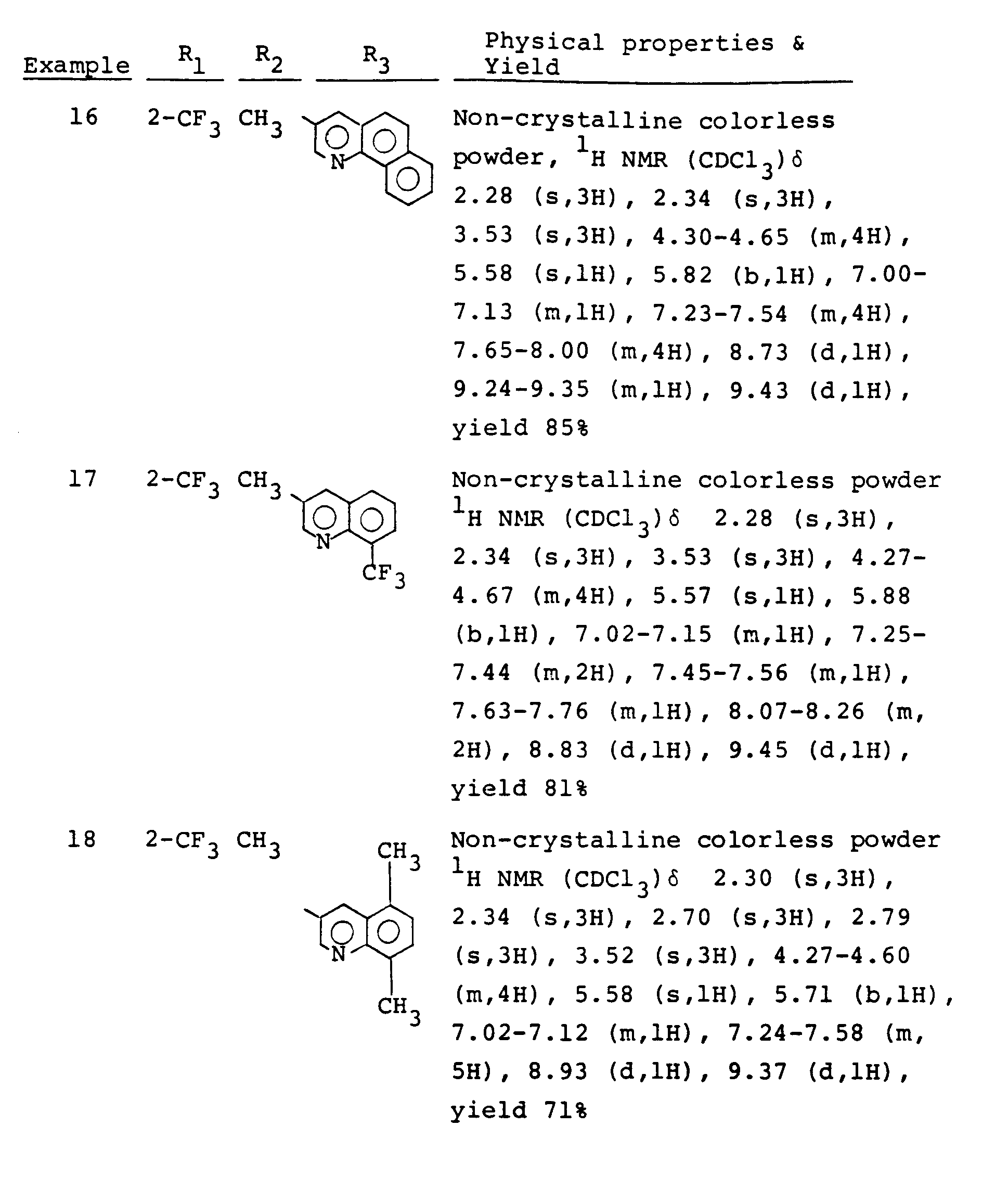
- 16. 2,6-dimethyl-4-(2-trifluoromethylphenyl)-1,4-dihydropyridine-3,5-dicarboxylic acid 3-[2-(3-(7,8-benzoquinoline)carboxy)ethyl]ester-5-methyl ester
- 17. 2,6-dimethyl-4-(2-trifluoronethylphenyl)-1,4-dihydropyridine-3,5-dicarboxylic acid 3-[2-(8-trifluoromethyl-3-quinolinecarboxy)ethyl]ester-5-methyl ester
- 18. 2,6-dimethyl-4-(2-trifluoromethylphenyl)-1,4-dihydropyridine-3,5-dicarboxylic acid 3-[2-(5,8-dimethyl-3-quinolinecarboxy)ethyl]ester-5-methyl ester
- 19. 2,6-dimethyl-4-(2-trifluoromethylphenyl)-1,4-dihydropyridine-3,5-dicarboxylic acid 3-[2-(8-fluoro-3-quinolinecarboxy)ethyl]ester-5-methyl ester
- The compounds of the present invention can be prepared by reacting a compound of the formula (II)

wherein R₁ and R₂ are as defined above, and X is halogen, mesyloxy, benzenesulfonyloxy, or tosyloxy with a compound of the formula (III)
wherein R₃ is as defined above and M is an alkali metal or an alkaline earth metal. - The reaction is preferably carried out in the presence of an inert organic solvent. Suitable solvents for the reaction include N,N-dimethylformamide, N,N-dimethylacetamide, dimethyl sulfoxide, hexamethyl phosphoamide, dioxane, acetonitrile, N-methylmorpholine, 1,2-dimethoxyethane, and the like. The reaction temperature is suitably from 80°C to 160°C. Under the above conditions, the reaction is usually completed in a few hours.
- Some of the compounds of the formula (II) are known as disclosed in, e.g., H. Meyer,E. Wehinger, F. Bossert and D. Scherling, Arzneim.-Forsch./Drug Res. 33(I), Nr. 1 (1983), and are commercially available. Also, some of the compounds of the formula (III) are commercially available.
- Pharmaceutically acceptable acid addition salts of the compounds of the formula I according to the present invention may be prepared by the application or adaptation of known methods for the preparation of salts of organic bases, for example, by reacting the compounds of the formula I with the appropriate acid in a suitable solvent. Examples of addition salts include salts derived from inorganic and organic acids such as, without limitation, hydrochloric acid, phosphoric acid, sulfuric acid, acetic acid, tartaric acid, lactic acid, succinic acid, citric acid, maleic acid, sorbic acid, salicyclic acid, phthalic acid, and the like.
- The new compounds may, depending on the choice of starting materials and process, be present as optical antipodes or racemate.
- The racemates obtained can be separated according to known methods, e.g., by means of microorganisms, or by a reaction with optically active acids forming salts of the compound, and separating the salts thus obtained, e.g., by means of the different solubility of the diastereomeric salts, from which the antipodes may be set free by the action of a suitable agent. Suitably usable optically active acids are e.g., the L- and D-forms of tartaric acid, di-o-tolyltartaric acid, malic acid, mandelic acid, camphorsulfonic acid or quinic acid. Preferably the more active part of the two antipodes is isolated.
- The compounds of the present invention have prominent inhibiting activity of calcium influx into cells as will be evident from the below-mentioned pharmacological test results, with the result of the use as vasodilator and antihypertensive agents. Thus, the compounds of the present invention can be used for treatment of a variety of diseases including cardiac diseases such as angina pectoris, arrhythmia and acute heart failure, cerebrovascular diseases such as cerebral infarction and hypertension.
- In clinical use the compounds of the invention are usually administered orally, or parenterally in the form of a pharmaceutical preparation, which contains the active ingredient as free base in combination with pharmaceutically acceptable additives.
- Thus the mentioning of the new compounds of the invention is here related to the free amine base even if the compounds are generally or specifically described, provided that the context in which such expressions are used, e.g., in Example 1, with this broad meaning should not correspond. The additives may be a solid, semisolid or liquid diluent or a capsule. These pharmaceutical preparations are a further object of the invention. Usually the amount of active ingredient is between 0.1 and 99% by weight of the preparation, suitably between 0.5 and 20% by weight in preparations for injection and between 2 and 50% by weight in preparations for oral administration.
- In the preparation of pharmaceutical preparations containing a compound of the present invention in the form of dosage units for oral administration the compound may be mixed with a solid, pulverulent additives, e.g., with lactose, saccharose, sorbitol, mannitol, starch, such as potato starch, corn starch, amylopectin, cellulose derivatives or gelatine, as well as with an lubricant such as magnesium stearate, calcium stearate, polyethyleneglycol waxes or the like, and be pressed into tablets. If coated tablets are wanted, the above prepared core may be coated with concentrated solution of sugar, which solution may contain, e.g., gum arabicum, gelatine, talc, titandioxide or the like.
- In the preparation of soft gelatine capsules which consist of gelatine and, e.g., glycerine, or in the preparation of similar closed capsules, the active compounds is mixed with a vegetable oil. Hard gelatine capsules may contain granules of the active compound in combination with a solid, pulverulent additives as lactose, saccharose, sorbitol, mannitol, starch (as, e.g., potato starch, corn starch or amylopectin), cellulose derivatives or gelatine.
- Dosage units for rectal administration may be prepared in the form of suppositories, which contain the active ingredient in a mixture with a neutral fat base, or they may be prepared in the form of gelatine-rectal capsules which contain the active substance in a mixture with a vegetable oil or paraffin oil.
- Liquid preparations for oral administration may be present in the form of sirups or suspensions, e.g., solutions containing from about 0.01% by weight to about 0.1% by weight of the active ingredient described, glycerol and propylene glycol.
- The preparation of pharmaceutical tablets for peroral use is carried out in accordance with the following method:
- The solid substances included are ground or sieved to a certain particle size. The binding agent is homogenized and suspended in a certain amount of solvent. The therapeutic compound and necessary auxiliary agents are mixed with continuous and constant mixing with the binding agent solution and are moistened so that the solution is uniformly divided in the mass without overmoistening any parts. The amount of solvent is usually so adapted that the mass obtains a consistency reminding of wet snow. The moistening of the pulverulent mixture with the binding agent solution causes the particles to gather together slightly to aggregates and the real granulating process is carried out in such a way that the mass is pressed through a sieve in the form of a net of stainless steel having a mesh size of about 1 mm. The mass is then placed in thin layers on a tray to be dried in a drying cabinet. This drying takes place during 10 hours and has to be standardized carefully as the damp degree of the granulate is of outmost importance for the following process and for the feature of the tablets. Drying in a fluid bed may possibly be used. In this case the mass is not put on a tray but is poured into a container having a net bottom.
- After the drying step the granules are sieved so that the particle size wanted is obtained. Under certain circumstances powder has to be removed.
- To the so called final mixture, disintegrating, lubricant and excipient are added. After this mixture the mass shall have its right composition for the tabletting step.
- Many tablets, especially those which are rough or bitter, are coated with a coating. This means that they are coated with a layer of sugar or some other suitable coating.
- The daily dose of the active ingredient varies and is dependent on the type of administration, but as a general rule it is 1 to 100 mg/day of active ingredient at peroral administration.
-

- A mixture of 2,6-dimethyl-4-(2-trifluoromethylphenyl)-1,4-dihydropyridine-3,5-dicarboxylic acid 3-(2-chloroethyl)ester-5-methyl ester (1.00 g) and sodium 4-chloro-6-methyl-3-quinoline carboxylate (0.64 g) was heated and stirred in N,N-dimethyl formamide (10 ml) under an argon stream at 120-130°C for 4 hours. After the reaction was complete, ethylacetate (20 ml) was added to the reaction mixture, filtered with suction and the filtrate was concentrated under reduced pressure. Silicagel column chromatography of the residue eluting with ethyl acetate/n-hexane (1:1 volume ratio) gave the title compound (1.14 g, 79% yield) as non-crystalline colorless powder. This compound was measured for NMR with the following results.
¹H NMR (CDCl₃)δ 2.28 (s, 3H), 2.33 (s, 3H), 2.61 (s, 3H), 3.55 (s, 3H), 4.26-4.65 (m, 4H), 5.58 (s, 1H), 5.99 (b, 1H), 7.01-7.15 (m, 1H), 7.25-7.75 (m, 4H), 8.04 (d, 1H), 8.10-8.21 (m, 1H), 9.04 (s, 1H) - Using the appropriate starting materials and the same procedure as described in Example 1, there were prepared the compounds as shown in Table 1.



- The novel compounds as prepared in the above-mentioned examples were individually measured for Ca-blocking potency thereof in accordance with the method of M. Fiol de Cureo et al. (Arch. int. Pharmacodyn., 263, 28-39, 1983). This method is to evaluate each compound to be ested with respect to Ca-blocking potency on the basis of 50% inhibiting concentration of a spontaneous contraction of an isolated rat portal vein. The results are shown in terms of a relative activity to Nifedipine (Nifedipine=1) in Table 2.


- A syrup containing 0.5% (weight per volume) of active ingredient was prepared from the following ingredients:

Sugar, d-sorbitol and the active ingredient were dissolved in 60 g of warm water. After cooling, glycerine and solution of flavouring agents dissolved in ethanol were added. To the mixture water was then added to 100 ml. - The above named active ingredient may be replaced by other therapeutically active ingredients of the invention.
- An active ingredient (50 mg) was mixed with lactose (50 mg), potato starch (20 mg) and colloidal silicic acid (9.5 mg). The mixture was moistened with a 10% solution of gelatine and was granulated through a 12-mesh sieve. After drying potato starch (10 mg), talc (0.75 mg) and magnesium stearate (0.75 mg) were admixed and the mixture thus obtained was pressed into tablets, each containing 50 mg of active ingredient. These tablets are coated with a 10% alcoholic solution of shellac and thereupon with an aqueous solution containing saccharose (45%), gum arabicum (5%), gelatine (4%) and dyestuff (0.2%). After the first five coatings talc and powdered sugar were used for powdering. The priming coat was then coated with a 66% sugar syrup and polished with a 10% carnauba wax solution in carbon tetrachloride.
- Granules were prepared from active ingredient (50 mg), lactose (250 mg), potato starch (150 mg) and an alcoholic solution of polyvinylpyrrolidone (50 mg). After the drying step the granules were sieved through a 12 x 60 mesh sieve to prepare granules, each containing 50 mg of active ingredient.
Claims (4)
- A compound of the formula I

- A process for preparing the compound of claim 1 and pharmaceutically acceptable addition salts thereof which comprises reacting a compound of the formula


- A pharmaceutical composition which comprises an effective amount of as an active ingredient the compound of claim 1 or pharmaceutically acceptable addition salts thereof, optionally in admixture with additives for pharmaceutical preparation.
- Use of the compound of claim 1 for the preparation of vasodilating and antihypertensive medicaments.
Applications Claiming Priority (2)
| Application Number | Priority Date | Filing Date | Title |
|---|---|---|---|
| JP61136152A JPH0676405B2 (en) | 1986-06-13 | 1986-06-13 | 1,4-Dihydropyridine derivative and pharmaceutical composition containing the same |
| JP136152/86 | 1986-06-13 |
Publications (2)
| Publication Number | Publication Date |
|---|---|
| EP0249174A1 EP0249174A1 (en) | 1987-12-16 |
| EP0249174B1 true EP0249174B1 (en) | 1993-09-08 |
Family
ID=15168527
Family Applications (1)
| Application Number | Title | Priority Date | Filing Date |
|---|---|---|---|
| EP87108218A Expired - Lifetime EP0249174B1 (en) | 1986-06-13 | 1987-06-06 | 1,4-dihydropyridine derivatives, processes for their preparation and pharmaceutical compositions containing same |
Country Status (6)
| Country | Link |
|---|---|
| US (1) | US4877797A (en) |
| EP (1) | EP0249174B1 (en) |
| JP (1) | JPH0676405B2 (en) |
| CA (1) | CA1334591C (en) |
| DE (1) | DE3787319T2 (en) |
| ES (1) | ES2006165A6 (en) |
Cited By (1)
| Publication number | Priority date | Publication date | Assignee | Title |
|---|---|---|---|---|
| US6455554B1 (en) | 1999-06-07 | 2002-09-24 | Targacept, Inc. | Oxopyridinyl pharmaceutical compositions and methods for use |
Families Citing this family (2)
| Publication number | Priority date | Publication date | Assignee | Title |
|---|---|---|---|---|
| JP2736269B2 (en) * | 1989-07-20 | 1998-04-02 | 日清製粉株式会社 | 1,4-dihydropyridine pharmaceutical composition |
| IL117560A0 (en) * | 1995-03-30 | 1996-07-23 | Res Dev Foundation | Anti-stroke effects of calcium antagonists |
Family Cites Families (9)
| Publication number | Priority date | Publication date | Assignee | Title |
|---|---|---|---|---|
| US3862161A (en) * | 1970-01-24 | 1975-01-21 | Bayer Ag | 4-pyridyl substituted 1,4-dihydropyridines |
| DE2218644C3 (en) * | 1972-04-18 | 1982-08-19 | Bayer Ag, 5090 Leverkusen | Basic esters of 1,4-dihydropyridines, processes for their preparation and their use as pharmaceuticals |
| NZ201395A (en) * | 1981-07-30 | 1987-02-20 | Bayer Ag | Pharmaceutical compositions containing 1,4-dihydropyridines and certain of these dihydropyridines |
| US4497808A (en) * | 1981-12-30 | 1985-02-05 | Ciba-Geigy Corporation | N-Oxide compounds useful in the treatment of cardiovascular ailments |
| US4656181A (en) * | 1982-11-24 | 1987-04-07 | Cermol S.A. | Esters of 1,4-dihydropyridines, processes for the preparation of the new esters, and medicaments containing the same |
| EP0145956A1 (en) * | 1983-11-16 | 1985-06-26 | Ciba-Geigy Ag | Composés amidés |
| JPS60120861A (en) * | 1983-12-02 | 1985-06-28 | Otsuka Pharmaceut Co Ltd | Dihydropyridine derivative |
| JPH0631223B2 (en) * | 1984-12-14 | 1994-04-27 | 日清製粉株式会社 | 1,4-dihydropyridine derivative and method for producing the same |
| US4757071A (en) * | 1984-12-14 | 1988-07-12 | Nisshin Flour Milling Co., Ltd. | 1,4-dihydropyridine derivatives, and pharmaceutical compositions containing same, useful for treating cardiovascular diseases |
-
1986
- 1986-06-13 JP JP61136152A patent/JPH0676405B2/en not_active Expired - Fee Related
-
1987
- 1987-06-05 CA CA000538977A patent/CA1334591C/en not_active Expired - Fee Related
- 1987-06-06 EP EP87108218A patent/EP0249174B1/en not_active Expired - Lifetime
- 1987-06-06 DE DE87108218T patent/DE3787319T2/en not_active Expired - Fee Related
- 1987-06-11 ES ES8701723A patent/ES2006165A6/en not_active Expired
- 1987-06-15 US US07/067,719 patent/US4877797A/en not_active Expired - Lifetime
Non-Patent Citations (1)
| Title |
|---|
| Progress in Pharmacology, Vol. 5/1, page 25, Stuttgart, 1982 * |
Cited By (1)
| Publication number | Priority date | Publication date | Assignee | Title |
|---|---|---|---|---|
| US6455554B1 (en) | 1999-06-07 | 2002-09-24 | Targacept, Inc. | Oxopyridinyl pharmaceutical compositions and methods for use |
Also Published As
| Publication number | Publication date |
|---|---|
| DE3787319T2 (en) | 1994-01-05 |
| DE3787319D1 (en) | 1993-10-14 |
| ES2006165A6 (en) | 1989-04-16 |
| US4877797A (en) | 1989-10-31 |
| CA1334591C (en) | 1995-02-28 |
| EP0249174A1 (en) | 1987-12-16 |
| JPH0676405B2 (en) | 1994-09-28 |
| JPS62292781A (en) | 1987-12-19 |
Similar Documents
| Publication | Publication Date | Title |
|---|---|---|
| US4264611A (en) | 2,6-Dimethyl-4-2,3-disubstituted phenyl-1,4-dihydro-pyridine-3,5-dicarboxylic acid-3,5-asymmetric diesters having hypotensive properties, as well as method for treating hypertensive conditions and pharmaceutical preparations containing same | |
| US6444675B2 (en) | 4-alkyl and 4-cycloalkyl derivatives of dihydropyridine NPY antagonists | |
| US20010047003A1 (en) | Thiourea derivatives of dihydropyridine NPY antagonists | |
| CS228506B2 (en) | Method for the production of optical active ester of 1,4-dihydropyridincarboxyl acid | |
| CS196290B2 (en) | Process for preparing new compounds | |
| EP0060674A1 (en) | Dihydropyridine anti-ischaemic and antihypertensive agents, processes for their production, and pharmaceutical compositions containing them | |
| WO2001085098A2 (en) | Squarate derivatives of dihydropyridine npy antagonists | |
| JPH0568475B2 (en) | ||
| CZ396591A3 (en) | Enantiomers of 1,4-dihydropyridine process of their preparation and pharmaceutical compositions prepared therefrom | |
| EP0031801A2 (en) | 6-Substituted 4-(2',3'-dichlorophenyl)-2-methyl-1,4-dihydropyridine-3,5-dicarboxylic acid diesters having hypotensive properties as well as process for their preparation and pharmaceutical preparations containing same | |
| EP0184841B1 (en) | 1,4-dihydropyridine derivatives, processes for their preparation and pharmaceutical compositions containing same | |
| WO2004024690A1 (en) | S-(-)-amlodipine nicotinate and process for the preparation thereof | |
| CA1334591C (en) | 1,4-dihydropyridine carboxylic acid ester derivatives, processes for their preparation and pharmaceutical compositions containing same | |
| WO2009092301A1 (en) | Dihydropyridine calcium antagonist compounds, preparation methods and medical uses thereof | |
| WO1984000033A1 (en) | 1,4-dihydro-pyridine derivatives, preparation thereof and pharmaceutical compositions containing them | |
| JPH01313464A (en) | Alkylpyperadinylpyridine being blood sugar level lowering agent | |
| EP0169009A2 (en) | Novel dihydropyridine derivatives and their production, formulation and use as pharmaceuticals | |
| GB2120668A (en) | Dihydropyridines | |
| RU2155751C2 (en) | Derivatives of 1,4-dihydropyridine, mixtures of their isomers or separate isomers, pharmaceutical composition based on thereof and 2-chloro-3-cyanobenzaldehyde | |
| SK166495A3 (en) | Pharmacologically effective enantiomers, preparation method threof, intermediate products of this method and use | |
| JPH0631223B2 (en) | 1,4-dihydropyridine derivative and method for producing the same | |
| CA1337865C (en) | 1,4-dihydropyridine derivatives, processes for their preparation and pharmaceutical compositions containing same | |
| NZ207716A (en) | 3-(2-furoyl)-5-alkoxy-2,6-dimethyl-4-(2-nitrophenyl)-1,4-dihydropyridine derivatives and pharmaceutical compositions | |
| JPS61140581A (en) | 1,4-dihydropyridine derivative | |
| JPH05230023A (en) | 1,4-dihydropyridine derivative, its production and use thereof |
Legal Events
| Date | Code | Title | Description |
|---|---|---|---|
| PUAI | Public reference made under article 153(3) epc to a published international application that has entered the european phase |
Free format text: ORIGINAL CODE: 0009012 |
|
| AK | Designated contracting states |
Kind code of ref document: A1 Designated state(s): BE CH DE FR GB IT LI NL SE |
|
| 17P | Request for examination filed |
Effective date: 19880607 |
|
| 17Q | First examination report despatched |
Effective date: 19891024 |
|
| RBV | Designated contracting states (corrected) |
Designated state(s): DE FR GB |
|
| GRAA | (expected) grant |
Free format text: ORIGINAL CODE: 0009210 |
|
| AK | Designated contracting states |
Kind code of ref document: B1 Designated state(s): DE FR GB |
|
| REF | Corresponds to: |
Ref document number: 3787319 Country of ref document: DE Date of ref document: 19931014 |
|
| ET | Fr: translation filed | ||
| PLBE | No opposition filed within time limit |
Free format text: ORIGINAL CODE: 0009261 |
|
| STAA | Information on the status of an ep patent application or granted ep patent |
Free format text: STATUS: NO OPPOSITION FILED WITHIN TIME LIMIT |
|
| 26N | No opposition filed | ||
| REG | Reference to a national code |
Ref country code: GB Ref legal event code: IF02 |
|
| REG | Reference to a national code |
Ref country code: FR Ref legal event code: CD |
|
| PGFP | Annual fee paid to national office [announced via postgrant information from national office to epo] |
Ref country code: GB Payment date: 20030604 Year of fee payment: 17 |
|
| PGFP | Annual fee paid to national office [announced via postgrant information from national office to epo] |
Ref country code: FR Payment date: 20030610 Year of fee payment: 17 |
|
| PGFP | Annual fee paid to national office [announced via postgrant information from national office to epo] |
Ref country code: DE Payment date: 20030618 Year of fee payment: 17 |
|
| PG25 | Lapsed in a contracting state [announced via postgrant information from national office to epo] |
Ref country code: GB Free format text: LAPSE BECAUSE OF NON-PAYMENT OF DUE FEES Effective date: 20040606 |
|
| PG25 | Lapsed in a contracting state [announced via postgrant information from national office to epo] |
Ref country code: DE Free format text: LAPSE BECAUSE OF NON-PAYMENT OF DUE FEES Effective date: 20050101 |
|
| GBPC | Gb: european patent ceased through non-payment of renewal fee |
Effective date: 20040606 |
|
| PG25 | Lapsed in a contracting state [announced via postgrant information from national office to epo] |
Ref country code: FR Free format text: LAPSE BECAUSE OF NON-PAYMENT OF DUE FEES Effective date: 20050228 |
|
| REG | Reference to a national code |
Ref country code: FR Ref legal event code: ST |