EP0247990B1 - Procédé pour la fabrication de cartouches explosives et cartouches explosives obtenues par ledit procédé - Google Patents
Procédé pour la fabrication de cartouches explosives et cartouches explosives obtenues par ledit procédé Download PDFInfo
- Publication number
- EP0247990B1 EP0247990B1 EP87870072A EP87870072A EP0247990B1 EP 0247990 B1 EP0247990 B1 EP 0247990B1 EP 87870072 A EP87870072 A EP 87870072A EP 87870072 A EP87870072 A EP 87870072A EP 0247990 B1 EP0247990 B1 EP 0247990B1
- Authority
- EP
- European Patent Office
- Prior art keywords
- process according
- hydrogen peroxide
- explosive
- gelling agent
- stage
- Prior art date
- Legal status (The legal status is an assumption and is not a legal conclusion. Google has not performed a legal analysis and makes no representation as to the accuracy of the status listed.)
- Expired - Lifetime
Links
- 238000000034 method Methods 0.000 title claims abstract description 51
- 239000002360 explosive Substances 0.000 title claims abstract description 38
- 238000004519 manufacturing process Methods 0.000 title claims abstract description 8
- MHAJPDPJQMAIIY-UHFFFAOYSA-N Hydrogen peroxide Chemical compound OO MHAJPDPJQMAIIY-UHFFFAOYSA-N 0.000 claims abstract description 72
- 239000003349 gelling agent Substances 0.000 claims abstract description 19
- 239000000178 monomer Substances 0.000 claims abstract description 19
- 239000011368 organic material Substances 0.000 claims abstract description 13
- 239000002243 precursor Substances 0.000 claims abstract description 11
- 229920002521 macromolecule Polymers 0.000 claims abstract description 8
- 238000011065 in-situ storage Methods 0.000 claims abstract description 3
- 239000000203 mixture Substances 0.000 claims description 41
- 239000000463 material Substances 0.000 claims description 20
- 229920003023 plastic Polymers 0.000 claims description 16
- 239000004033 plastic Substances 0.000 claims description 16
- QVGXLLKOCUKJST-UHFFFAOYSA-N atomic oxygen Chemical compound [O] QVGXLLKOCUKJST-UHFFFAOYSA-N 0.000 claims description 9
- 239000001301 oxygen Substances 0.000 claims description 9
- 229910052760 oxygen Inorganic materials 0.000 claims description 9
- 230000015572 biosynthetic process Effects 0.000 claims description 7
- 239000001257 hydrogen Substances 0.000 claims description 7
- 229910052739 hydrogen Inorganic materials 0.000 claims description 7
- 238000006116 polymerization reaction Methods 0.000 claims description 7
- 238000003786 synthesis reaction Methods 0.000 claims description 7
- NIXOWILDQLNWCW-UHFFFAOYSA-N 2-Propenoic acid Natural products OC(=O)C=C NIXOWILDQLNWCW-UHFFFAOYSA-N 0.000 claims description 6
- OKTJSMMVPCPJKN-UHFFFAOYSA-N Carbon Chemical compound [C] OKTJSMMVPCPJKN-UHFFFAOYSA-N 0.000 claims description 6
- UFHFLCQGNIYNRP-UHFFFAOYSA-N Hydrogen Chemical compound [H][H] UFHFLCQGNIYNRP-UHFFFAOYSA-N 0.000 claims description 6
- CZMRCDWAGMRECN-UGDNZRGBSA-N Sucrose Chemical compound O[C@H]1[C@H](O)[C@@H](CO)O[C@@]1(CO)O[C@@H]1[C@H](O)[C@@H](O)[C@H](O)[C@@H](CO)O1 CZMRCDWAGMRECN-UGDNZRGBSA-N 0.000 claims description 6
- 229930006000 Sucrose Natural products 0.000 claims description 6
- 229910052799 carbon Inorganic materials 0.000 claims description 6
- WJJMNDUMQPNECX-UHFFFAOYSA-N dipicolinic acid Chemical compound OC(=O)C1=CC=CC(C(O)=O)=N1 WJJMNDUMQPNECX-UHFFFAOYSA-N 0.000 claims description 6
- 239000005720 sucrose Substances 0.000 claims description 6
- SMZOUWXMTYCWNB-UHFFFAOYSA-N 2-(2-methoxy-5-methylphenyl)ethanamine Chemical compound COC1=CC=C(C)C=C1CCN SMZOUWXMTYCWNB-UHFFFAOYSA-N 0.000 claims description 5
- 239000007864 aqueous solution Substances 0.000 claims description 5
- 229920002125 Sokalan® Polymers 0.000 claims description 2
- 239000007791 liquid phase Substances 0.000 claims description 2
- 239000004584 polyacrylic acid Substances 0.000 claims description 2
- 229920001169 thermoplastic Polymers 0.000 claims description 2
- 150000001875 compounds Chemical class 0.000 claims 1
- 239000003381 stabilizer Substances 0.000 claims 1
- 238000002156 mixing Methods 0.000 abstract description 10
- 238000005474 detonation Methods 0.000 description 16
- 239000000243 solution Substances 0.000 description 12
- LYCAIKOWRPUZTN-UHFFFAOYSA-N Ethylene glycol Chemical compound OCCO LYCAIKOWRPUZTN-UHFFFAOYSA-N 0.000 description 9
- OKKJLVBELUTLKV-UHFFFAOYSA-N Methanol Chemical compound OC OKKJLVBELUTLKV-UHFFFAOYSA-N 0.000 description 9
- 239000000047 product Substances 0.000 description 9
- 229920005989 resin Polymers 0.000 description 9
- 239000011347 resin Substances 0.000 description 9
- 239000005416 organic matter Substances 0.000 description 7
- 239000002904 solvent Substances 0.000 description 7
- 239000000654 additive Substances 0.000 description 6
- 239000000470 constituent Substances 0.000 description 5
- 239000007788 liquid Substances 0.000 description 5
- DUYCTCQXNHFCSJ-UHFFFAOYSA-N dtpmp Chemical compound OP(=O)(O)CN(CP(O)(O)=O)CCN(CP(O)(=O)O)CCN(CP(O)(O)=O)CP(O)(O)=O DUYCTCQXNHFCSJ-UHFFFAOYSA-N 0.000 description 4
- -1 for example Polymers 0.000 description 4
- XLYOFNOQVPJJNP-UHFFFAOYSA-N water Substances O XLYOFNOQVPJJNP-UHFFFAOYSA-N 0.000 description 4
- ZDQNWDNMNKSMHI-UHFFFAOYSA-N 1-[2-(2-prop-2-enoyloxypropoxy)propoxy]propan-2-yl prop-2-enoate Chemical compound C=CC(=O)OC(C)COC(C)COCC(C)OC(=O)C=C ZDQNWDNMNKSMHI-UHFFFAOYSA-N 0.000 description 3
- WEVYAHXRMPXWCK-UHFFFAOYSA-N Acetonitrile Chemical compound CC#N WEVYAHXRMPXWCK-UHFFFAOYSA-N 0.000 description 3
- RYGMFSIKBFXOCR-UHFFFAOYSA-N Copper Chemical compound [Cu] RYGMFSIKBFXOCR-UHFFFAOYSA-N 0.000 description 3
- TZRXHJWUDPFEEY-UHFFFAOYSA-N Pentaerythritol Tetranitrate Chemical compound [O-][N+](=O)OCC(CO[N+]([O-])=O)(CO[N+]([O-])=O)CO[N+]([O-])=O TZRXHJWUDPFEEY-UHFFFAOYSA-N 0.000 description 3
- 239000002253 acid Substances 0.000 description 3
- 239000010949 copper Substances 0.000 description 3
- 210000000416 exudates and transudate Anatomy 0.000 description 3
- 230000000977 initiatory effect Effects 0.000 description 3
- 239000003960 organic solvent Substances 0.000 description 3
- 229920002401 polyacrylamide Polymers 0.000 description 3
- 230000005855 radiation Effects 0.000 description 3
- IJGRMHOSHXDMSA-UHFFFAOYSA-N Atomic nitrogen Chemical compound N#N IJGRMHOSHXDMSA-UHFFFAOYSA-N 0.000 description 2
- 229910001369 Brass Inorganic materials 0.000 description 2
- NLZUEZXRPGMBCV-UHFFFAOYSA-N Butylhydroxytoluene Chemical compound CC1=CC(C(C)(C)C)=C(O)C(C(C)(C)C)=C1 NLZUEZXRPGMBCV-UHFFFAOYSA-N 0.000 description 2
- HEDRZPFGACZZDS-UHFFFAOYSA-N Chloroform Chemical compound ClC(Cl)Cl HEDRZPFGACZZDS-UHFFFAOYSA-N 0.000 description 2
- LFQSCWFLJHTTHZ-UHFFFAOYSA-N Ethanol Chemical compound CCO LFQSCWFLJHTTHZ-UHFFFAOYSA-N 0.000 description 2
- LRHPLDYGYMQRHN-UHFFFAOYSA-N N-Butanol Chemical compound CCCCO LRHPLDYGYMQRHN-UHFFFAOYSA-N 0.000 description 2
- PPBRXRYQALVLMV-UHFFFAOYSA-N Styrene Chemical compound C=CC1=CC=CC=C1 PPBRXRYQALVLMV-UHFFFAOYSA-N 0.000 description 2
- 239000002250 absorbent Substances 0.000 description 2
- 230000002745 absorbent Effects 0.000 description 2
- 150000007513 acids Chemical class 0.000 description 2
- 239000010951 brass Substances 0.000 description 2
- 229920001577 copolymer Polymers 0.000 description 2
- 229910052802 copper Inorganic materials 0.000 description 2
- 239000000945 filler Substances 0.000 description 2
- 238000011049 filling Methods 0.000 description 2
- 238000009472 formulation Methods 0.000 description 2
- 238000001879 gelation Methods 0.000 description 2
- 229910052751 metal Inorganic materials 0.000 description 2
- 239000002184 metal Substances 0.000 description 2
- 230000003647 oxidation Effects 0.000 description 2
- 238000007254 oxidation reaction Methods 0.000 description 2
- 150000002978 peroxides Chemical class 0.000 description 2
- 229920000642 polymer Polymers 0.000 description 2
- 239000003352 sequestering agent Substances 0.000 description 2
- 230000035939 shock Effects 0.000 description 2
- 238000003756 stirring Methods 0.000 description 2
- 239000000126 substance Substances 0.000 description 2
- 229920001187 thermosetting polymer Polymers 0.000 description 2
- WLAMNBDJUVNPJU-UHFFFAOYSA-N 2-methylbutyric acid Chemical compound CCC(C)C(O)=O WLAMNBDJUVNPJU-UHFFFAOYSA-N 0.000 description 1
- 229910000906 Bronze Inorganic materials 0.000 description 1
- VGGSQFUCUMXWEO-UHFFFAOYSA-N Ethene Chemical compound C=C VGGSQFUCUMXWEO-UHFFFAOYSA-N 0.000 description 1
- 239000005977 Ethylene Substances 0.000 description 1
- 229940123457 Free radical scavenger Drugs 0.000 description 1
- WOBHKFSMXKNTIM-UHFFFAOYSA-N Hydroxyethyl methacrylate Chemical compound CC(=C)C(=O)OCCO WOBHKFSMXKNTIM-UHFFFAOYSA-N 0.000 description 1
- WHNWPMSKXPGLAX-UHFFFAOYSA-N N-Vinyl-2-pyrrolidone Chemical compound C=CN1CCCC1=O WHNWPMSKXPGLAX-UHFFFAOYSA-N 0.000 description 1
- 229910019142 PO4 Inorganic materials 0.000 description 1
- 239000000026 Pentaerythritol tetranitrate Substances 0.000 description 1
- 229920003171 Poly (ethylene oxide) Polymers 0.000 description 1
- 229920002873 Polyethylenimine Polymers 0.000 description 1
- 239000004372 Polyvinyl alcohol Substances 0.000 description 1
- 229910000831 Steel Inorganic materials 0.000 description 1
- 229920001807 Urea-formaldehyde Polymers 0.000 description 1
- HCHKCACWOHOZIP-UHFFFAOYSA-N Zinc Chemical compound [Zn] HCHKCACWOHOZIP-UHFFFAOYSA-N 0.000 description 1
- 239000004480 active ingredient Substances 0.000 description 1
- 230000000996 additive effect Effects 0.000 description 1
- 229910052783 alkali metal Inorganic materials 0.000 description 1
- 150000001340 alkali metals Chemical class 0.000 description 1
- 229910052782 aluminium Inorganic materials 0.000 description 1
- XAGFODPZIPBFFR-UHFFFAOYSA-N aluminium Chemical compound [Al] XAGFODPZIPBFFR-UHFFFAOYSA-N 0.000 description 1
- 150000001412 amines Chemical class 0.000 description 1
- 150000003863 ammonium salts Chemical class 0.000 description 1
- XFOZBWSTIQRFQW-UHFFFAOYSA-M benzyl-dimethyl-prop-2-enylazanium;chloride Chemical class [Cl-].C=CC[N+](C)(C)CC1=CC=CC=C1 XFOZBWSTIQRFQW-UHFFFAOYSA-M 0.000 description 1
- 239000010974 bronze Substances 0.000 description 1
- 125000004432 carbon atom Chemical group C* 0.000 description 1
- 239000011111 cardboard Substances 0.000 description 1
- 125000002091 cationic group Chemical group 0.000 description 1
- 238000006243 chemical reaction Methods 0.000 description 1
- 150000001805 chlorine compounds Chemical class 0.000 description 1
- 239000002131 composite material Substances 0.000 description 1
- 238000009833 condensation Methods 0.000 description 1
- 230000005494 condensation Effects 0.000 description 1
- 239000013256 coordination polymer Substances 0.000 description 1
- 239000003984 copper intrauterine device Substances 0.000 description 1
- KUNSUQLRTQLHQQ-UHFFFAOYSA-N copper tin Chemical compound [Cu].[Sn] KUNSUQLRTQLHQQ-UHFFFAOYSA-N 0.000 description 1
- 238000000354 decomposition reaction Methods 0.000 description 1
- 210000003298 dental enamel Anatomy 0.000 description 1
- 229940090960 diethylenetriamine pentamethylene phosphonic acid Drugs 0.000 description 1
- YIOJGTBNHQAVBO-UHFFFAOYSA-N dimethyl-bis(prop-2-enyl)azanium Chemical compound C=CC[N+](C)(C)CC=C YIOJGTBNHQAVBO-UHFFFAOYSA-N 0.000 description 1
- 229920001971 elastomer Polymers 0.000 description 1
- 239000000806 elastomer Substances 0.000 description 1
- 238000000921 elemental analysis Methods 0.000 description 1
- 239000003822 epoxy resin Substances 0.000 description 1
- 150000002148 esters Chemical class 0.000 description 1
- 150000002170 ethers Chemical class 0.000 description 1
- 230000007717 exclusion Effects 0.000 description 1
- 238000002474 experimental method Methods 0.000 description 1
- 238000004880 explosion Methods 0.000 description 1
- 238000010304 firing Methods 0.000 description 1
- SLGWESQGEUXWJQ-UHFFFAOYSA-N formaldehyde;phenol Chemical compound O=C.OC1=CC=CC=C1 SLGWESQGEUXWJQ-UHFFFAOYSA-N 0.000 description 1
- 238000010528 free radical solution polymerization reaction Methods 0.000 description 1
- 125000000524 functional group Chemical group 0.000 description 1
- 239000007789 gas Substances 0.000 description 1
- 239000000499 gel Substances 0.000 description 1
- 239000011521 glass Substances 0.000 description 1
- 239000010438 granite Substances 0.000 description 1
- LNEPOXFFQSENCJ-UHFFFAOYSA-N haloperidol Chemical compound C1CC(O)(C=2C=CC(Cl)=CC=2)CCN1CCCC(=O)C1=CC=C(F)C=C1 LNEPOXFFQSENCJ-UHFFFAOYSA-N 0.000 description 1
- 229910001385 heavy metal Inorganic materials 0.000 description 1
- 150000002402 hexoses Chemical class 0.000 description 1
- 239000008240 homogeneous mixture Substances 0.000 description 1
- 229920001519 homopolymer Polymers 0.000 description 1
- 150000002431 hydrogen Chemical class 0.000 description 1
- FPYJFEHAWHCUMM-UHFFFAOYSA-N maleic anhydride Chemical compound O=C1OC(=O)C=C1 FPYJFEHAWHCUMM-UHFFFAOYSA-N 0.000 description 1
- 238000005259 measurement Methods 0.000 description 1
- 238000000691 measurement method Methods 0.000 description 1
- 150000002739 metals Chemical class 0.000 description 1
- 229910052757 nitrogen Inorganic materials 0.000 description 1
- 230000001590 oxidative effect Effects 0.000 description 1
- 125000004430 oxygen atom Chemical group O* 0.000 description 1
- 239000000123 paper Substances 0.000 description 1
- 229960004321 pentaerithrityl tetranitrate Drugs 0.000 description 1
- 150000002972 pentoses Chemical class 0.000 description 1
- 229920001568 phenolic resin Polymers 0.000 description 1
- 235000021317 phosphate Nutrition 0.000 description 1
- 150000003013 phosphoric acid derivatives Chemical class 0.000 description 1
- 229920000885 poly(2-vinylpyridine) Polymers 0.000 description 1
- 229920000075 poly(4-vinylpyridine) Polymers 0.000 description 1
- 229920003229 poly(methyl methacrylate) Polymers 0.000 description 1
- 229920001281 polyalkylene Polymers 0.000 description 1
- 229920000768 polyamine Polymers 0.000 description 1
- 229920000647 polyepoxide Polymers 0.000 description 1
- 229920000570 polyether Polymers 0.000 description 1
- 239000004926 polymethyl methacrylate Substances 0.000 description 1
- 229920000098 polyolefin Polymers 0.000 description 1
- 229920002451 polyvinyl alcohol Polymers 0.000 description 1
- 229920001289 polyvinyl ether Polymers 0.000 description 1
- 125000001453 quaternary ammonium group Chemical group 0.000 description 1
- 239000002516 radical scavenger Substances 0.000 description 1
- 239000011435 rock Substances 0.000 description 1
- 150000003839 salts Chemical class 0.000 description 1
- 230000035945 sensitivity Effects 0.000 description 1
- ODBPOHVSVJZQRX-UHFFFAOYSA-M sodium;[2-[2-[bis(phosphonomethyl)amino]ethyl-(phosphonomethyl)amino]ethyl-(phosphonomethyl)amino]methyl-hydroxyphosphinate Chemical compound [Na+].OP(=O)(O)CN(CP(O)(O)=O)CCN(CP(O)(=O)O)CCN(CP(O)(O)=O)CP(O)([O-])=O ODBPOHVSVJZQRX-UHFFFAOYSA-M 0.000 description 1
- 239000007787 solid Substances 0.000 description 1
- 239000012265 solid product Substances 0.000 description 1
- 230000000087 stabilizing effect Effects 0.000 description 1
- 125000005402 stannate group Chemical group 0.000 description 1
- 230000003068 static effect Effects 0.000 description 1
- 239000010959 steel Substances 0.000 description 1
- 235000000346 sugar Nutrition 0.000 description 1
- 150000008163 sugars Chemical class 0.000 description 1
- 229920005992 thermoplastic resin Polymers 0.000 description 1
- 239000004416 thermosoftening plastic Substances 0.000 description 1
- 230000001960 triggered effect Effects 0.000 description 1
- PUVAFTRIIUSGLK-UHFFFAOYSA-M trimethyl(oxiran-2-ylmethyl)azanium;chloride Chemical class [Cl-].C[N+](C)(C)CC1CO1 PUVAFTRIIUSGLK-UHFFFAOYSA-M 0.000 description 1
- 125000000391 vinyl group Chemical group [H]C([*])=C([H])[H] 0.000 description 1
- 229920002554 vinyl polymer Polymers 0.000 description 1
- 229910052725 zinc Inorganic materials 0.000 description 1
- 239000011701 zinc Substances 0.000 description 1
Classifications
-
- C—CHEMISTRY; METALLURGY
- C06—EXPLOSIVES; MATCHES
- C06B—EXPLOSIVES OR THERMIC COMPOSITIONS; MANUFACTURE THEREOF; USE OF SINGLE SUBSTANCES AS EXPLOSIVES
- C06B21/00—Apparatus or methods for working-up explosives, e.g. forming, cutting, drying
- C06B21/0008—Compounding the ingredient
- C06B21/0025—Compounding the ingredient the ingredient being a polymer bonded explosive or thermic component
-
- C—CHEMISTRY; METALLURGY
- C06—EXPLOSIVES; MATCHES
- C06B—EXPLOSIVES OR THERMIC COMPOSITIONS; MANUFACTURE THEREOF; USE OF SINGLE SUBSTANCES AS EXPLOSIVES
- C06B43/00—Compositions characterised by explosive or thermic constituents not provided for in groups C06B25/00 - C06B41/00
Definitions
- the present invention relates to a method for manufacturing explosive cartridges containing, in a cartridge case, an explosive composition comprising hydrogen peroxide, an oxidizable organic material and a gelling agent. It relates more particularly to a process in which the gelling agent belongs to the class of macromolecular plastics.
- the invention also relates to the explosive cartridges obtained by said process.
- Explosive compositions have been known for a long time which contain an aqueous solution of concentrated hydrogen peroxide associated with a finely divided oxidizable combustible material and an absorbent filler (US Pat. No. 3,047,441 (AW BAKER et al) * column 2 , lines 1 to 10 and column 6, claim 1 * ).
- absorbent fillers mention is made of the products forming gels column 2, lines 60 to 72 * ), as well as synthetic thermosetting or thermoplastic resins, such as urea-formaldehyde resins, phenol- formaldehyde or polymethyl methacrylate ( * column 2, lines 54 to 58 * ).
- combustible materials capable of also playing the role of filling material can be used ( * column 2, lines 26 to 31 * ).
- the present invention aims to remedy this disadvantage of known explosives, by providing a process for the manufacture of explosive cartridges which have high detonation rates, of the order of 7000 m / s and more.
- the invention relates to a process for the manufacture of explosive cartridges containing, in a cartridge case, an explosive composition comprising hydrogen peroxide, at least one oxidizable organic material and at least one gelling agent belonging to the class of materials.
- macromolecular plastics according to the invention, in a first step, the hydrogen peroxide, the oxidizable organic material and at least one precursor monomer of the gelling agent are mixed and, in a second step, the macromolecules of the gelling agent are synthesized in located in the socket.
- the method according to the invention is suitable for the manufacture of cartridges, the sockets of which are produced with the materials usually used for making explosive cartridges.
- materials are waxed paper, cardboard, metal, in particular copper, brass, bronze, zinc, aluminum, steels of various qualities and rigid plastics such as, for example, vinyl resins, polyolefins, acrylonitrile-butadiene-sytrene resins and their copolymers.
- Composite sockets produced using several of these materials, such as sheathed metals (Cu and brass in particular), are also very suitable for the process according to the invention.
- Hydrogen peroxide is used in the process according to the invention, in the form of a concentrated solution of hydrogen peroxide in a solvent.
- concentrated solutions is meant solutions where the weight content of hydrogen peroxide is greater than 60%. Solutions containing at least 65% by weight and up to 99.9% by weight of hydrogen peroxide are well suited. Preferably, solutions are used which contain between 70 and 90% by weight of hydrogen peroxide.
- the hydrogen peroxide solvent can be water or an inert organic solvent. Examples of suitable organic solvents are n-butanol, acetonitrile and chloroform. Water is the preferred solvent because of its negligible cost and the lower risks associated with its use in the presence of concentrated solutions of hydrogen peroxide.
- the oxidizable organic material used consists of any organic product capable of rapidly oxidizing in the presence of hydrogen peroxide to a further mixture of two or more of these products. Products capable of releasing large volumes of gas after oxidation are very suitable. To limit pollution of the atmosphere after detonation, it is advantageous to select organic products containing only carbon, hydrogen and oxygen.
- An essential characteristic of the process according to the invention is to obtain, at the end of the first stage, the most homogeneous mixture possible before proceeding to the synthesis of the macromolecules of the gelling agent.
- organic materials are lower aliphatic alcohols such as methanol and ethanol, aliphatic diols with less than 5 carbon atoms such as ethylene glycol and sugars such as pentoses and hexoses, in particular sucrose .
- the gelling agent is a macromolecular plastic which is synthesized in situ in the socket, in the presence of hydrogen peroxide and organic matter which can be oxidized from one or more monomers. precursors.
- the monomer is incorporated into the mixture, at the first stage of the process.
- monomers which are miscible and / or soluble in the hydrogen peroxide solution, at the temperature at which the two stages of the process are carried out.
- the synthesis of the macromolecular plastic in the sockets can be carried out by any technique known per se.
- a first technique is the chain polymerization technique.
- a second technique consists in reacting by condensation functional groups carried by the monomer molecules in order to obtain a polycondensate within the mixture contained in the socket.
- the plastic thus obtained can either belong to the class of thermoplastics, to that of thermosets or to that of elastomers.
- the plastic is synthesized in the hydrogen peroxide solution.
- the other constituents of the exposure mixture can be dispersed in the solid or liquid state in the hydrogen peroxide solution. It is preferred that they are in the dissolved state in the hydrogen peroxide solution.
- Plastics obtainable by this technique are generally well known in themselves. They belong to the classes of resins usually produced by solution polymerization. A category of particularly suitable resins are those obtained by polymerization in aqueous solution, the hydrogen peroxide solution then being an aqueous solution. In this category, water-soluble resins are particularly interesting.
- Examples of such resins which can be synthesized in sockets according to the process according to the invention are polyvinyl alcohol; polyacrylamides; cationic resins including polymeric amines and quaternary ammonium polymers such as polyethyleneimines, polyalkylene polyamines, poly (vinylbenzyltrimethylammonium) chlorides, poly (diallyldimethylammonium) chlorides, poly (glycidyltrimethylammonium) chlorides (2-hydroxypropyl-1,1-N-di-methylammonium); polyacrylic, polymethacrylic, poly-alpha-hydroxyacrylic acids and their alkali metal or ammonium salts; esters of polyacrylic, polymethacrylic and poly-alpha-hydroxyacrylic acids such as 2-hydroxyethyl methacrylate; polyethylene oxides known under the name of polyethers; poly (N-vinyl-2-pyrrolidone); polyvinyl ethers homopolymers of alkylvinyl ethers;
- Epoxy resins constitute another class of resins which can be used in the context of the invention.
- the preferred resins are those which contain only carbon, hydrogen and oxygen.
- the gelling agent also constitutes an oxidizable material.
- the hydrogen peroxide is mixed in the first step with the precursor monomer of the gelling agent to the exclusion of any other oxidizable organic matter.
- the exposure obtained in the sockets at the end of the second stage has a sufficient density greater than 1.2 kg / dm 3 .
- the best results are obtained when the density of this exhibit is greater than 1.35 kg / d m 3 .
- a small proportion of additives are generally incorporated in the first step in the mixture, generally less than 5% by weight of this mixture.
- the main purpose of these additives is to stabilize hydrogen peroxide against slow decomposition in water and oxygen. For this reason, the products known for a long time are used to stabilize concentrated solutions of hydrogen peroxide such as phosphates, stannates and heavy metal sequestrants of organic or inorganic type.
- Other additives can be added to the mixture to give the explosive substance produced special properties such as reduced sensitivity to friction and impact, reduced tendency to exudate, improved mechanical properties such as plasticity, frost resistance and at low temperatures in general.
- the proportions of the various constituents to be used in the mixture depend both on the nature of the oxidizable organic matter, on that of the precursor monomer of the plastic material constituting the gelling agent and on the solvent or solvents present. They can be easily determined by laboratory formulation tests. In general, the formulation of the mixture must be adapted so that the respective amounts of hydrogen peroxide on the one hand, of the materials liable to be oxidized (which include the oxidizable material, the plastic material and the possible arganic solvent) on the other hand, are not too far from the stoichiometric quantities corresponding to the chemical reactions of oxidation by hydrogen peroxide.
- the explosives industry characterizes the deviation from this stoichiometry by the notion of oxygen balance expressed in% O2 and which is established as follows in the case of an explosive containing only carbon , hydrogen, oxygen and possibly also nitrogen: where c, h and o are the proportions of the carbon, hydrogen and oxygen atoms respectively in the raw chemical formula of the explosive as provided by elemental analysis.
- the mixture produced in the first step of the process generally contains a proportion by weight of 50 to 95% of concentrated solution of hydrogen peroxide in water or in an organic solvent, 2 to 40% of oxidizable organic matter, 2 to 40% of monomer precursor of the plastic material and 0 to 5% of additives.
- the weight proportions comprise 65 to 85% of concentrated solution of hydrogen peroxide, 5 to 30% (preferably, 5 to 20%) of oxidizable organic matter, 5 to 30% ( preferably 5 to 20%) of monomer precursor of the plastic material and at most 1% (preferably 0.2%) of additives as defined above.
- the oxidizable organic material, the solvent, the precursor monomer of the plastic material and the respective proportions of these constituents and of hydrogen peroxide are selected so that the mixture obtained in the first step has only one homogeneous liquid phase of low dynamic viscosity, for example less than 1,500 Pa.s, preferably less than 1,000 Pa.s.
- the first mixing step is carried out outside the sleeve, the synthesis of the macromolecules of the gelling agent is then initiated, then the mixture is introduced into the sleeve where the gelling of the explosive composition.
- the initiation of the synthesis of macromolecules is done by all usual techniques well known in the plastics industry, for example by addition of a polymerization initiating peroxide, or by irradiation of the mixture by means of visible or ultra radiation. -purple of appropriate frequency.
- the first mixing step can be carried out in any kind of mixing apparatus capable of homogenizing liquids and dissolving therein, if necessary, solid products, such as tanks with rotary agitators, mixers planetary, pneumatic mixing techniques or static mixers.
- the order of introduction of the various components into the mixer must be adapted to the nature of the components and to the type of mixer. Most often, we start by mixing the oxidizable organic matter with the optional stabilizing additive. Then the hydrogen peroxide is gradually introduced into the mixer followed by the precursor monomer of the plastic.
- the invention also relates to the explosive cartridges obtained by the method described above.
- the explosive cartridges according to the invention find interesting uses as industrial explosives in confined atmospheres, in particular in mines and quarries. When they contain only carbon, hydrogen and oxygen, their use allows the realization of underground fire which does not pollute the ambient atmosphere and therefore increases the safety of the operating personnel while authorizing rates high firing range and therefore improved operating profitability.
- the explosive cartridges according to the invention have a particularly low tendency to exudate.
- the mixing was then continued for 1 hour, then the mixture was transferred into the sockets of PVC cartridges with an internal diameter of 33 mm, a wall thickness of 2 mm and a length of 310 mm.
- the sockets contained two detectors intended to measure the detonation rate, spaced 150 mm apart, one of the detectors being 150 mm from one end of the cartridge close to the primer. These detectors were twisted copper wire sensors of 0.2 mm in diameter and covered with a thin layer of enamel, the entire sensor being placed in a PVC sheath with an external diameter of 1.5 mm having purpose of isolating it from the explosive mixture.
- the density of the explosive material obtained after complete gelation was included for all the cartridges tested between 1.27 and 1.28 kg / dm 3 .
- the detonation speed was measured by determining the time taken for the shock wave to travel the known distance of 150 mm separating the two detectors.
- the measurement was carried out by hanging the cartridge horizontally 1 m from the ground.
- the copper wires of the detectors suddenly short-circuit at the precise moment when the shock wave passes.
- the short circuit triggers a pulse generator which delivers a steep-edge electrical pulse of sufficient amplitude to trigger an electronic chronograph.
- the first pulse starts the chronograph, the second, coming from the second sensor, stops it.
- Example 1R After pouring 376.2 g of the liquid mixture of stabilized methanol and hydrogen peroxide into each socket, the contents of the sockets were carefully mixed, the cartridges were closed and stored for 24 hours at room temperature during which the gelation of the mixture was completed. The same test for measuring the detonation rate was then carried out as in Example 1R.
- the density of the explosive composition obtained was between 1.20 and 1.21 kg / dm 3 .
- the density of the explosive composition filling the cartridges was 1.41 kg / dm 3 . No detonation speed could be measured during two repeated shots: only the first sensor short-circuited on the first shot, none of the sensors triggered on the second shot.
- sucrose and 0.39 g of dipicolinic acid were introduced into a 1800 ml beaker. After stirring for a few minutes, 975 g of aqueous hydrogen peroxide solution containing 85% by weight of H 2 O 2 and 130 g of acid were then successively introduced into the beaker, in the form of a slow and continuous jet. acrylic monomer.
- the density of the explosive composition contained in the cartridges was 1.38 kg / dm 3 .
- the detonation rate was then measured.
- the two shots fired gave rise to a high and reproducible detonation speed: 7042 m / s for the first shot and 7009 m / s for the second.
- the cartridges prepared according to the process according to the invention are not characterized by a stable detonation ability, at high speed and endowed with a relatively high power.
- the explosives obtained in Examples 1R, 2R and 4 were tested from the point of view of exudation under pressure.
- the test consists in placing in a cylindrical cavity pierced with 20 holes of 0.5 mm in diameter a rod of 15 mm in diameter of the material to be tested previously wound in gauze. A pressure of 1.2 bar is then exerted on the tube by means of a piston. Note the minimum time of appearance of the first drop of exudate at the orifice of one of the holes. The test is repeated 3 times.
- Example 4 show the clear superiority of the material obtained in Example 4 according to the method according to the invention compared to the materials obtained according to the known methods of Examples 1R and 2R.
- the density of the explosive composition contained in the cartridges was 1.35 kg / dm 3 .
- the two shots fired gave rise to a high and reproducible detonation speed: 6760 m / s for the first shot and 6880 m / s for the second.
Landscapes
- Chemical & Material Sciences (AREA)
- Organic Chemistry (AREA)
- Addition Polymer Or Copolymer, Post-Treatments, Or Chemical Modifications (AREA)
- Powder Metallurgy (AREA)
- Compositions Of Macromolecular Compounds (AREA)
- Driving Mechanisms And Operating Circuits Of Arc-Extinguishing High-Tension Switches (AREA)
- Processes Of Treating Macromolecular Substances (AREA)
- Air Bags (AREA)
- Manufacturing Of Micro-Capsules (AREA)
- Catching Or Destruction (AREA)
- Manufacture Of Macromolecular Shaped Articles (AREA)
Description
- La présente invention concerne un procédé pour la fabrication de cartouches explosives contenant, dans une douille, une composition explosive comprenant de peroxyde d'hydrogène, une matière organique oxydable et un agent gélifiant. Elle concerne plus particulièrement un procédé où l'agent gélifiant appartient à la classe des matières plastiques macromoléculaires.
- L'invention concerne aussi les cartouches explosives obtenues par ledit procédé.
- On connaît depuis longtemps des compositions explosives qui contiennent une solution aqueuse de peroxyde d'hydrogène concentré associée à un matériau combustible oxydable finement divisé et une matière de charge absorbante (brevet US-A-3 047 441 (A. W. BAKER et al) * colonne 2, lignes 1 à 10 et colonne 6, revendiction 1 *). Parmi les matières de charge absorbantes utilisées, on cite l'emploi de produits formant des gels colnne 2, lignes 60 à 72 *), de même que de résines synthétiques thermo- durciussables ou thermoplastiques, telles que les résines urée-formaldéhyde, phénol-formaldéhyde ou le polyméthacrylate de méthyle (* colonne 2, lignes 54 à 58 *). En variante, des matériaux combustibles susceptibles de jouer également le rôle de matière de charge peuvent être employés (* colonne 2, lignes 26 à 31 *).
- Ces compositions explosives connues présentent généralement le desavantage de détoner difficilement ou de ne conduire qu'à de faibles vitesses de détonation, en général inférieurs à 6000 m/s, les rendant de ce fait impropres à leur utilisation en tant qu'explosifs industriels, en particulier, comme explosifs de mines et carrières et tout spécialement pour l'exploitation de roches dures telles que le basalte et le granit.
- La présente invention vise à remédier à ce désavantage des explosifs connus, en fournissant un procédé pour la fabrication de cartouches explosives qui présentent des vitesses de détonation élevées, de l'ordre de 7000 m/s et plus.
- A cette fin, l'invention concerne un procédé pour la fabrication de cartouches explosives contenant, dans une douille, une composition explosive comprenant du peroxyde d'hydrogène, au moins une matière organique oxydable et au moins un agent gélifiant appartenant à la classe des matières plastiques macromoléculaires; selon l'invention, dans une première étape, on mélange le peroxyde d'hydrogène, la matière organique oxydable et au moins un monomère précurseur de l'agent gélifiant et, dans une deuxième étape, on synthétise les macromolécules de l'agent gélifiant in situ dans la douille.
- La procédé selon l'invention est adapté à la fabrication de cartouches dont les douilles sont réalisées avec les matériaux habituellement employés pour la confection de cartouches explosives. Des exemples de tels matériaux sont le papier paraffiné, le carton, le métal, en particulier le cuivre, le laiton, le bronze, le zinc, l'aluminium, les aciers de qualités diverses et les matières plastiques rigides telles que, par example, les résines vinyliques, les polyoléfines, les résines acrylonitrile-butadiène-sytrène et leurs copolymères. Les douilles composites réalisées au moyen de plusieurs de ces matériaux, telles que les métaux gainés (Cu et laiton en particulier), conviennent également bien pour le procédé selon l'invention.
- Le peroxyde d'hydrogène est mis en oeuvre dans le procédé selon l'invention, à l'état d'une solution concentrée de peroxyde d'hydrogène dans un solvent. Par solutions conentrées, on entend des solutions où la teneur pondérale en peroxyde d'hydrogène est supérieure à 60%. Des solutions contenant au moins 65% en poids et jusqu'à 99,9% en poids de peroxyde d'hydrogène conviennent bien. De préférence, on emploie des solutions qui contiennent entre 70 et 90% en poids de peroxyde d'hydrogène. Le solvant du peroxyde d'hydrogène peut être l'eau ou un solvant organique inerte. Des exemples de solvants organiques adéquats sont le n-butanol, l'acétonitrile et le chloroforme. L'eau est le solvant préféré en raison de son coût négligeable et des moindres risques liés à son utilisation en présence de solutions concentrées de peroxyde d'hydrogène.
- Dans le procédé selon l'invention, la matière organique oxydable mise en oeuvre consiste en tout produit organique susceptible de s'oxyder rapidement en présence de peroxyde d'hydrogène en encore un mélange de deux ou plusieurs de ces produits. Les produits capables de dégager des volumes de gaz importants après oxydation conviennent bien. Il est avantageoux, pour limiter la pollution de l'atmosphère après la détonation, de sélectionner des produits organiques ne contenant que du carbone, de l'hydrogène et de l'oxygène.
- Une caractéristique essentielle du procédé selon l'invention est d'obtenir à la fin de la première étape un mélange le plus homogène possible avant de procéder à la synthèse des macromolécules de l'agent gélifiant. A cette fin, on préfère tout particulièrement sélectionner la matière organique oxydable parmi les produits organiques appartenant à la classe des produits qui sont normalement liquides à la température à laquelle on exécute la première étape et miscibles dans de larges proportions dans la solution de peroxyde d'hydrogène et à la classe des produits solubles en proportion importante dans cette solution. Des exemples de telles matières organiques sont les alcools aliphatiques inférieurs tels que le méthanol et l'éthanol, les diols aliphatiques à moins de 5 atomes de carbone tel que l'éthylèneglycol et les sucres tels que les pentoses et les hexoses, en particulier le saccharose.
- Dans le procédé selon l'invention, l'agent gélifiant est une matière plastique macromoléculaire que l'on synthétise in situ dans la douille, en présence du peroxyde d'hydrogène et de la matière organique oxydable à partir d'un ou de plusieurs monomères précurseurs.
- A cet effet, on incorpore le monomère au mélange, à la première étape du procédé. On sélectionne avantageusement des monomères miscibles et/ou solubles dans la solution de peroxyde d'hydrogène, à la température à laquelle on exécute les deux étapes du procédé.
- La synthèse de la matière plastique macromoléculaire dans les douilles peut être exécutée par toute technique connue en soi. Une première technique est la technique de polymérisation en chaîne. Une deuxième technique consiste à faire réagir par condensation des groupes fonctionnels portés par les molécules de monomère pour obtenir un polycondensat au sein du mélange contenu dans la douille.
- La matière plastique ainsi obtenue peut indifféremment appartenir à la classe des thermoplastiques, à celle des thermodurcissables ou encore à celle des élastomères.
- Selon l'invention, il est important que la synthèse des macromolécules se fasse dans la masse de l'ensemble du mélange introduit dans la douille. A cette fin, il est avantageux de choisir la technique de synthèse en solution. Le cas échéant, la synthèse de la matière plastique est opérée dans la solution de peroxyde d'hydrogène. Dans cette forme d'exécution du procédé selon l'invention, les autres constituants du mélange exposif peuvent être dispersés à l'état solide ou liquide dans la solution de peroxyde d'hydrogène. On préfère qu'ils soient à l'état dissous dans la solution de peroxyde d'hydrogène. Des matières plastiques pouvant être obtenues par cette technique sont en général bien connues en elles- mêmes. Elles appartiennent aux classes de résines habituellement produites par polymérisation en solution. Une catégorie de résines particulièrement adéquates sont celles que l'on obtient par polymérisation en solution aqueuse, la solution de peroxyde d'hydrogène étant alors une solution aqueuse. Dans cette catégorie, sont tout particulièrement intéressantes les résines hydrosolubles.
- Des exemples de telles résines qui peuvent être synthétisées dans les douilles conformément au procédé selon l'invention sont l'alcool polyvinylique; les polyacrylamides; les résines cationiques incluant les amines polymères et les polymères d'ammonium quaternaire telles que les polyéthylèneimines, les polyalkylènepolyamines, les chlorures de poly(vinylbenzyltriméthylammonium), les chlorures de poly(diallyldiméthylammonium), les chlorures de poly(glycidyltriméthylammonium) et les chlorures de poly(2-hydroxypropyl-1,1-N-di-méthylammonium); les acides polyacrylique, polyméthacrylique, poly-alpha-hydroxyacrylique et leurs sels de métaux alcalins ou d'ammonium; les esters des acides polyacrylique, polyméthacrylique et poly-alpha-hydroxyacrylique tels que le méthacrylate de 2-hydroxyéthyle; les polyoxydes d'éthylène connus sous l'appellation de polyéthers; la poly(N-vinyl-2-pyrrolidone); les polyvinyléthers homopolymères d'éthers alkylvinyliques; les copolymères de l'anhydride maléique avec le styrène ou avec l'éthylène et les polymères tensio-actifs connus sous le nom de "polysoaps" tels que la poly (2-vinylpyridine) et la poly(4-vinylpyridine) et leurs dérivés alkylés ainsi que les polyionèes.
- Les résines époxy constituent une autre classe de résines utilisables dans la cadre de l'invention.
- Les résines préférées sont celles qui ne contiennent que du carbone, de l'hydrogène et de l'oxygène.
- De par sa nature organique, l'agent gélifiant constitue lui aussi une matière oxydable. Dans une variante d'exécution du procédé selon l'invention, on mélange, à la première étape le peroxyde d'hydrogène avec le monomère précurseur de l'agent gélifiant à l'exclusion de toute autre matière organique oxydable.
- Selon l'invention, il est avantageux pour la puissance explosive des cartouches fabriquées que l'exposif obtenue dans les douilles à la fin de la deuxième étape ait une masse volumique suffisante supérieure à 1,2 kg/dm3. Les meilleurs résultats sont obtenus lorsque la masse volumique de cet exposif est supérieure à 1,35 kg/dm 3.
- Dans le procédé selon l'invention, on incorpore généralement à la première étape un proportion faible d'additifs au mélange, généralement inférieure à 5% en poids de ce mélange. Ces additifs ont principalement pour but de stabiliser les peroxyde d'hydrogène contre la décomposition lente en eau et en oxygène. A ce titre, on emploie les produits réputés depuis longtemps pour stabiliser les solutions concentrées de peroxyde d'hydrogène tels que les phosphates, les stannates et les séquestrants de métaux lourds de type organique ou inorganique. D'autres additifs peuvent être ajoutés au mélange pour conférer à la matière explosive fabriquée des propriétés particulières comme une moindre sensibilité au frottement et aux chocs, une tendance réduite à l'exsudation, des propriétés mécaniques améliorées telles que la plasticité, la résistance au gel et aux basses températures en général.
- Les proportions des différents constituants à mettre en oeuvre dans la mélange dépendent à la fois de la nature de la matière organique oxydable, de celle du monomère précurseur de la matière plastique constituant le gélifiant ainsi que du ou des solvants présents. Elles peuvent être déterminées de manière aisée par des essais de formulation en laboratoire. D'une manière générale la formulation du mélange doit être adaptée pour que les quantités respectives du peroxyde d'hydrogène d'une part, des matières susceptibles d'être oxydées (qui comprennent la matière oxydable, la matière plastique et le solvant arganique éventuel) d'autre part, ne soient pas trop éloignées des quantités stoechiométriques correspondant aux réactions chimiques d'oxydation par le peroxyde d'hydrogène.
- L'industrie des explosifs caractérise l'écart par rapport à cette stoechiométrie par la notion de bilan d'oxygène (oxygen balance) exprimé en % O2 et que l'on établit comme suit dans le cas d'un explosif ne contenant que du carbone, de l'hydrogène, de l'oxygène et éventuellement aussi de l'azote:

- De bons résultats ont été obtenus en réglant la proportion des constituants du mélange pour que le bilan d'oxygène soit situé dans la gamme de valeurs s'étendant de -80 à +100%. Les meilleurs résultats sont fournis par des cartouches où le bilan d'oxygène de l'explosif est compris entre -20 et +30%.
- A cette fin, le mélange réalisé à la première étape du procédé contient généralement une proportion pondérale de 50 à 95% de solution concentrée de peroxyde d'hydrogène dans l'eau ou dans un solvant organique, 2 à 40% de matière organique oxydable, 2 à 40% de monomère précurseur de la matière plastique et 0 à 5% d'additifs.
- Les meilleurs résultats ont été obtenus avec des mélanges dont les proportions pondérales comprennent 65 à 85% de solution concentrée de peroxyde d'hydrogène, 5 à 30% (de préférence, 5 à 20%) de matière organique oxydable, 5 à 30% (de préférence 5 à 20%) de monomère précurseur de la matière plastique et au maximum 1 % (de préférence, 0,2%) d'additifs tels que définis plus haut.
- Dans une forme de réalisation particulière du procédé selon l'invention, qui est préférée, on sélectionne la matière organique oxydable, le solvant, le monomère précurseur de la matière plastique et les proportions respectives en ces constituants et en peroxyde d'hydrogène pour que le mélange obtenu à la première étape ne comporte qu'une seule phase liquide homogène de viscosité dynamique faible, par exemple inférieure à 1.500 Pa.s, de préférence inférieure à 1.000 Pa.s.
- Dans une variante du procédé selon l'invention, on exécute la première étape de mélange hors de la douille, on initie ensuite la synthèse des macromolécules de l'agent gélifiant, puis on introduit le mélange dans la douille où on effectue la gélification de la composition explosive. L'initiation de la synthèse des macromolécules se fait par toutes techniques habituelles bien connues dans l'industrie des matières plastiques, par exemple par addition d'un peroxyde intitiateur de polymèrisation, ou par irradiation du mélange au moyen d'un rayonnement visible ou ultra-violet de fréquence appropriée.
- Dans cette variante de réalisation, la première étape de mélange peut être réalisée dans toute espèce d'appareilliage de mélange apte à homogénéiser des liquides et à y dissoudre, le cas échéant, des produits solides, tels que des cuves à agitateurs rotatifs, des mélangeurs planétaires, des techniques de mélange pneumatiques ou encore des mélangeurs statiques.
- L'ordre d'introduction des divers constituants dans le mélangeur doit être adapté à la nature des constituants et au type de mélangeur. Le plus souvent, on commence par mélanger la matière organique oxydable avec l'additif stabilisant éventuel. On introduit ensuite de manière progressive le peroxyde d'hydrogène dans le mélangeur suivi du monomère précurseur de la matière plastique.
- On peut aussi intervertir l'ordre d'introduction du peroxyde d'hydrogène et du monomère de façon à terminer la première étape du procédé selon l'invention par l'introduction de la solution de peroxyde d'hydrogène.
- L'invention concerne aussi les cartouches explosives obtenues au moyen du procédé décrit plus haut.
- Les cartouches explosives selon l'invention trouvent des utilisations intéressantes comme explosifs industriels dans les atmosphères confinées, en particulier dans les mines et carrières. Lorsqu'ils ne contiennent que du carbone, de l'hydrogène et de l'oxygène, leur usage permet la réalisation de tirs souterrains qui ne polluent pas l'atmosphère ambiante et augmente donc la sécurité du personnel d'exploitation tout en autorisant des cadences de tir élevées et partant, une rentabilité d'exploitation améliorée.
- Par ailleurs, les cartouches explosives selon l'invention présentent une tendance à l'exsudation particulièrement faible.
- Des particularités de l'invention ressortiront des exemples suivants qui décrivent de manière non limitative des procédés de fabrication de cartouches explosives conformes à l'invention ainsi que des essais de comparaison avec des procédés antérieurs à l'invention.
- Dans un mélangeur planétaire de marque déposée HOBART, modèle N-50 en acier inoxydable, on a introduit 293,8 g d'éthylèneglycol et 1,3 g d'acide diéthylènetriaminepenta(méthylènephosphonique) (BRIQUEST 543-45 AS, marque déposée de la forme ALBRIGHT & WILSON). Après avoir démarré le malaxage des constituants, on a ensuite introduit sous forme d'un jet lent et continu 993,2 g d'une solution aqueuse de peroxyde d'hydrogène contenant 85% en poids de H202 que l'on a fait suivre de 13 g d'acide polyacrylique (CARBOPOL 934, marque déposée de la firme BF GOODRICH Cy). L'introduction de tous les composants du mélange a duré 15 min. environ.
- On a ensuite poursuivi le malaxage pendant 1 heure, puis on a transvasé le mélange dans es douilles de cartouches en PVC de diamètre intérieur de 33 mm, d'épaisseur de paroi de 2 mm et de longueur de 310 mm. Les douilles contenaient deux détecteurs destinés à mesurer la vitesse de détonation, distants entre eux de 150 mm, un des détecteurs étant distant de 150 mm d'une extrémité de la cartouche voisine de l'amorce. Ces détecteurs étaient des capteurs de fils de cuivre torsadés de 0,2 mm de diamètre et recouverts d'une fine couche d'émail, l'ensemble du capteur étant placé dans une gaine de PVC de diamètre extérieur de 1,5 mm ayant pour but de l'isoler du mélange explosif.
- Un détonateur électrique à charge de 0,6 g de PETN (tétranitrate de pentaérythritol ou penthrite) en étui de cuivre de 7 mm de diamètre a ensuite été plongé, à titre d'amorce, dans la cartouche qui a été ensuite soigneusement refermée.
- La masse volumique de la matière explosive obtenue après gélification complète était comprise pour toutes les cartouches testées antre 1,27 et 1,28 kg/dm3.
- On a procédé à la mesure de la vitesse de détonation par détermination du temps mis par l'onde de choc pour parcourir la distance connue de 150 mm séparant les deux détecteurs.
- La mesure a été effectuée en suspendant la cartouche horizontalement à 1 m du sol. Dans cette méthode de mesure, en cas d'explosion, les fils de cuivre des détecteurs se mettent brutalement en court-circuit à l'instant précis du passage de l'onde de choc. Le court-circuit déclenche un générateur d'impulsion qui délivre une impulsion électrique à front raide d'amplitude suffisante pour déclencher un chronigraphe électronique. La première impulsion démarre le chronographe, la deuxième, provenant du second capteur, l'arrête.
- La mise à geu d'une cartouche préparée selon la méthode décrite ci-dessus n'a pas donné à détonation: il a en effet été impossible de mesurer une quelconque vitesse de détonation, seul le premier capteur s'étant mis en court-circuit.
- La répétition de l'expérience avec une autre cartouche a abouti à des résultats indentiques.
- Dans un bécher de 1800 ml équipé d'un mélangeur rotatif constitué d'une ailette de verre, on a introduit sous agitation 262,6 g de méthanol, 1,3 g d'acide diéthylènetriaminepenta(méthylène- phosphonique) (BRIQUEST 543-45 AS). Après quelques minutes, on a introduit 1024,4 g d'une solution aqueuse de peroxyde d'hydrogène contenant 85% en poids d'H202 en un jet lent et continu. On a ensuite placé dans le fond des douilles 3,80 g de polyacrylamide réticulé (AQUASORB PR 3005, marque déposé de SNF FLOERGER).
- Après avoir transvasé dans chaque douille 376,2 g du mélange liquide de méthanol et de peroxyde d'hydrogène stabilisé, on a soigneusement mélangé le contenu des douilles, on a fermé les cartouches et on les a stockées 24 heures à température ambiante durant lesquelles la gélification du mélange a été menée à son terme. On a ensuite procédé au même test de mesure de la vitesse de détonation qu'à l'exemple 1R.
- La masse volumique de la composition explosive obtenue a été comprise entre 1,20 et 1,21 kg/dm3.
- Sur les deux tirs réalisés, seul le premier a donné une faible vitesse de détonation mesurable de 2867 m/s, le deuxième s'étant comporté comme dans le cas de l'exemple 1 R, à savoir l'absence de mise en court-circuit du deuxième capteur.
- On a préparé selon le même procédé que celui de l'exemple 2R un mélange de 327,6 g de saccharose, de 0,86 g d'acide diéthylènetriaminepenta(méthylènephosphonique) (BRIQUEST 543-45 AS), de 959,4 g de solution aqueous de peroxyde d'hydrogène contenant 85% en poids de H202. On a ensuite introduit dans le fond des douilles 3,8 de polyacrylamide réticulé (AQUASORB PR 3005).
- Après avoir transvasé dans chaque douille 376,2 g du mélange liquide de saccharose en solution dans le peroxyde d'hydrogène stabilisé, on a mélangé soigneusement le contenu des douilles, on a fermé les cartouches et on les a stockées 24 heures à température ambiante. On a ensuite soumis les cartouches au même test de mesure de la vitesse de détonation qu'aux exemples 1 R et 2R.
- La masse volumique de la composition explosive remplissant les cartouches a été de 1,41 kg/dm3. Aucune vitesse de détonation n'a pu être mesurée au cours de deux tirs répétés: seul le premier capteur s'est mis en court-circuit lors du premier tir, aucun des capteurs n'a déclenché au deuxième tir.
- Dans un bécher de 1800 ml, on a introduit 195 g de saccharose et 0,39 g d'acide dipicolinique. Après agitation durant quelques minutes on a ensuite introduit successivement dans le bécher, sous forme d'un jet lent et continu, 975 g de solution aqueuse de peroxyde d'hydrogène contenant 85% en poids de H202 et 130 g d'acide acrylique monomère.
- Après malaxage pendant 15 minutes, on a initié la polymérisation de l'acide acrylique au moyen d'un rayonnement ultra-violet pendant 1 heure 40 min.
- On a ensuite transvasé le mélange dans des cartouches en PVC semblables à celles employées aux exemples 1R à 3R et on a stocké les cartouches pendant 24 heurs durant lesquelles la polymérisation de l'acide acrylique s'est effectuée et a été menée à saon terme.
- La masse volumique de la composition explosive contenue dans les cartouches était de 1,38 kg/dm3.
- On a ensuite procédé à la mesure de la vitesse de détonation.
- Les deux tirs effectués ont donné lieu à une vitesse de détonation élevée et reproductible: 7042 m/s pour le premier tir et 7009 m/s pour le deuxième.
- Les cartouches préparées suivant le procédé conforme à l'invention se caractérisent pas une aptitude à la détonation stable, à haut régime et douées d'une puissance relativement forte.
- Les matières explosives obtenues aux exemples, 1R, 2R et 4 ont été testées du point de vue de l'exsudation sous pression. L'essai consiste à placer dans une cavité cylindrique percée de 20 trous de 0,5 mm de diamètre un boudin de 15 mm de diamètre de la matière à tester préalablement enroulée dans de la gaze. On exerce ensuite une pression de 1,2 bar sur le boudin par l'intermédiaire d'un piston. On note le temps minimum d'apparition de la première goutelette d'exsudat à l'orifice d'un des trous. L'essai est répète 3 fois.
- Les résultats ont été portés au tableau qui suit:
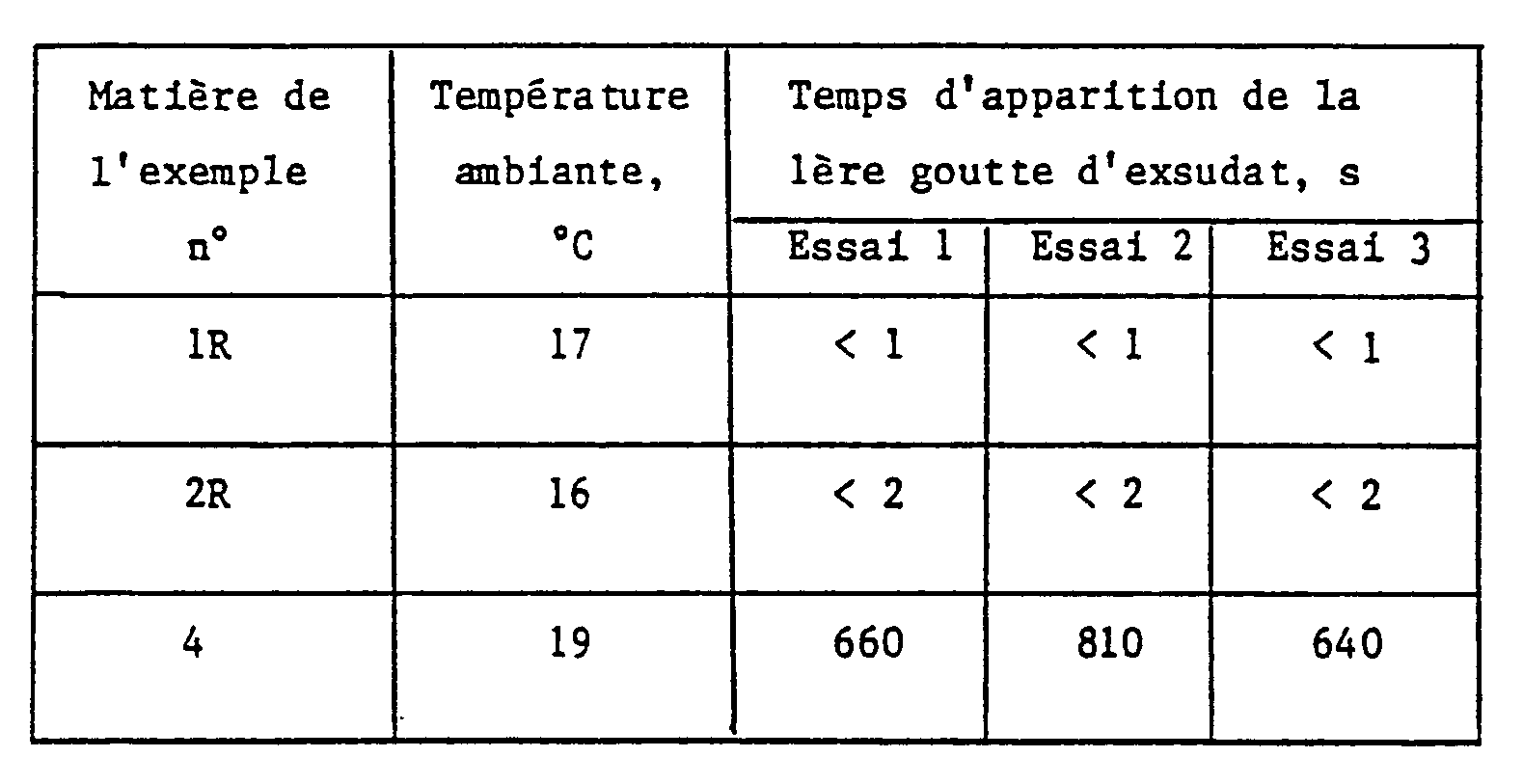
- Ils montrent la nette supériorité de la matière obtenue à l'exemple 4 suivant le procédé conforme à l'invention par rapport aux matières obtenues suivant les procédés connus des exemples 1R et 2R.
- Dans un bécher de 2000 ml, on a introduit 186 g d'éthylène glycol, 0,6 g d'acide dipicolinique, 0,6 g d'un capteur de radicaux libres (butylhydroxytoluène de marque déposée IONOL CP de la firme SHELL) et 0,24 g d'un séquestrant (sel heptasodique de l'acide diéthylènetriaminepentaméthylénephosphonique à 25% en poids de matières actives de marque déposée DEQUEST 2066 de la firme MONSANTO).
- Après agitation durant quelques minutes, on a introduit successivement dans la bécher, sous forme d'un jet lent et continu, 924 g de solution aqueuse de peroxyde d'hydrogène contenant 85% en poids de H202, puis 72 g d'acide acrylique monomère et 18 g de tripropylèneglycoldiacrylate (TPGDA).
- Après malaxage pendant 10 minutes, on a initié la polymérisation de l'acide acrylique et du TPGDA au moyen d'une rayonnement ultra-violet pendant 240 min.
- On a ensuite transvasé le mélange dans des cartouches en PVC semblables là celles employées aux exemples IR à 3R et 4 et on a stocké les cartouches pendant 20 heures.
- La masse volumique de la composition explosive contenue dans les cartouches était de 1,35 kg/dm3.
- On a ensuite procédé à la mesure de la vitesse de détonation comme aux exemples IR à 3R et 4.
- Les deux tirs effectués ont donné lieu à une vitesse de détonation élevée et reproductible: 6760 m/s pour le premier tir et 6880 m/s pour le deuxième.
Claims (12)
Priority Applications (1)
| Application Number | Priority Date | Filing Date | Title |
|---|---|---|---|
| AT87870072T ATE54660T1 (de) | 1986-05-30 | 1987-05-21 | Verfahren zur herstellung von explosivpatronen und danach hergestellte explosivpatronen. |
Applications Claiming Priority (2)
| Application Number | Priority Date | Filing Date | Title |
|---|---|---|---|
| FR8607931A FR2599487B1 (fr) | 1986-05-30 | 1986-05-30 | Procede pour la fabrication de cartouches explosives et cartouches explosives obtenues par ledit procede |
| FR8607931 | 1986-05-30 |
Publications (2)
| Publication Number | Publication Date |
|---|---|
| EP0247990A1 EP0247990A1 (fr) | 1987-12-02 |
| EP0247990B1 true EP0247990B1 (fr) | 1990-07-18 |
Family
ID=9335916
Family Applications (2)
| Application Number | Title | Priority Date | Filing Date |
|---|---|---|---|
| EP87903228A Pending EP0299979A1 (fr) | 1986-05-30 | 1987-05-21 | Procede pour la fabrication de cartouches explosives et cartouches explosives obtenues par ledit procede |
| EP87870072A Expired - Lifetime EP0247990B1 (fr) | 1986-05-30 | 1987-05-21 | Procédé pour la fabrication de cartouches explosives et cartouches explosives obtenues par ledit procédé |
Family Applications Before (1)
| Application Number | Title | Priority Date | Filing Date |
|---|---|---|---|
| EP87903228A Pending EP0299979A1 (fr) | 1986-05-30 | 1987-05-21 | Procede pour la fabrication de cartouches explosives et cartouches explosives obtenues par ledit procede |
Country Status (11)
| Country | Link |
|---|---|
| US (1) | US4942800A (fr) |
| EP (2) | EP0299979A1 (fr) |
| JP (1) | JPH01503057A (fr) |
| AT (1) | ATE54660T1 (fr) |
| BR (1) | BR8707709A (fr) |
| CA (1) | CA1288951C (fr) |
| DE (1) | DE3763752D1 (fr) |
| ES (1) | ES2017108B3 (fr) |
| FR (1) | FR2599487B1 (fr) |
| GR (1) | GR3000848T3 (fr) |
| WO (1) | WO1987007258A1 (fr) |
Families Citing this family (11)
| Publication number | Priority date | Publication date | Assignee | Title |
|---|---|---|---|---|
| US5465664A (en) * | 1993-05-03 | 1995-11-14 | Fey; Warren O. | Fuel and explosive composition with ferric or cupric ion and reducing sugars |
| US7146897B1 (en) | 1999-07-19 | 2006-12-12 | Henkel Corporation | UV/visible light and anaerobic curable composition |
| US6883413B2 (en) * | 1999-07-19 | 2005-04-26 | Henkel Corporation | Visible and UV/visible light anaerobic curable primer mix coating |
| US6984273B1 (en) * | 1999-07-29 | 2006-01-10 | Aerojet-General Corporation | Premixed liquid monopropellant solutions and mixtures |
| US7344610B2 (en) | 2003-01-28 | 2008-03-18 | Hodgdon Powder Company, Inc. | Sulfur-free propellant compositions |
| FR2915479B1 (fr) * | 2007-04-26 | 2009-08-21 | Snpe Materiaux Energetiques Sa | Gel pyrotechnique ; propergol solide ; chargement pyrotechnique ; procedes d'obtention |
| AU2020287072A1 (en) * | 2019-06-07 | 2021-12-23 | Cmte Development Limited | Explosives based on hydrogen peroxide with improved sleep time |
| EP4086238B1 (fr) | 2021-05-05 | 2024-01-03 | Hypex Bio Explosives Technology AB | Composition pour former un explosif comprenant une émulsion de peroxyde d'hydrogène et un combustible de type huileux |
| EP4086236A1 (fr) | 2021-05-05 | 2022-11-09 | Hypex Bio Explosives Technology AB | Composition sensibilisante pour émulsions énergétiques de peroxyde d'hydrogène |
| EP4086237B1 (fr) | 2021-05-05 | 2025-08-06 | Hypex Bio Explosives Technology AB | Composition de formation d'un explosif en émulsion à base de peroxyde d'hydrogène |
| EP4594274A1 (fr) | 2022-09-28 | 2025-08-06 | Solvay SA | Gels et émulsions stables de peroxyde d'hydrogène appropriés pour la fragmentation de roches |
Family Cites Families (10)
| Publication number | Priority date | Publication date | Assignee | Title |
|---|---|---|---|---|
| CH86201A (de) * | 1915-03-26 | 1920-08-02 | Chem Fab Weissenstein Ges M B | Sprengstoff und Verfahren zu dessen Herstellung. |
| DE376160C (de) * | 1915-03-26 | 1923-05-25 | Josef Nussbaum Dr | Verfahren zur Herstellung von Sprengstoffen |
| US3047441A (en) * | 1946-04-08 | 1962-07-31 | American Cyanamid Co | Hydrogen peroxide explosives |
| US2452074A (en) * | 1947-01-29 | 1948-10-26 | Buffalo Electro Chem Co | Peroxide-glycerol explosive |
| US3095334A (en) * | 1957-11-06 | 1963-06-25 | Atlantic Res Corp | Thixotropic monopropellants |
| US3687746A (en) * | 1959-06-16 | 1972-08-29 | Exxon Research Engineering Co | Rocket propellant system |
| US3574011A (en) * | 1968-12-16 | 1971-04-06 | Hercules Inc | Aqueous slurried explosive of improved pourability containing a polyacrylamide thickener and sodium perchlorate |
| US3808062A (en) * | 1972-12-08 | 1974-04-30 | Nippon Kayaku Kk | Liquid explosive compositions of hydrogen peroxide and an aromatic sulforic acid and process for the preparation thereof |
| US4033264A (en) * | 1973-10-05 | 1977-07-05 | Ici Australia Limited | Explosive cartridge |
| FR2577548B1 (fr) * | 1985-02-14 | 1987-03-06 | Poudres & Explosifs Ste Nale | Procede et installation de fabrication de blocs de propergol par la methode de moulage |
-
1986
- 1986-05-30 FR FR8607931A patent/FR2599487B1/fr not_active Expired
-
1987
- 1987-05-21 DE DE8787870072T patent/DE3763752D1/de not_active Expired - Fee Related
- 1987-05-21 BR BR8707709A patent/BR8707709A/pt not_active IP Right Cessation
- 1987-05-21 EP EP87903228A patent/EP0299979A1/fr active Pending
- 1987-05-21 AT AT87870072T patent/ATE54660T1/de not_active IP Right Cessation
- 1987-05-21 ES ES87870072T patent/ES2017108B3/es not_active Expired - Lifetime
- 1987-05-21 US US07/295,220 patent/US4942800A/en not_active Expired - Fee Related
- 1987-05-21 JP JP62503227A patent/JPH01503057A/ja active Pending
- 1987-05-21 WO PCT/BE1987/000008 patent/WO1987007258A1/fr not_active Ceased
- 1987-05-21 EP EP87870072A patent/EP0247990B1/fr not_active Expired - Lifetime
- 1987-05-25 CA CA000537851A patent/CA1288951C/fr not_active Expired - Lifetime
-
1990
- 1990-09-20 GR GR90400674T patent/GR3000848T3/el unknown
Also Published As
| Publication number | Publication date |
|---|---|
| EP0247990A1 (fr) | 1987-12-02 |
| GR3000848T3 (en) | 1991-11-15 |
| DE3763752D1 (de) | 1990-08-23 |
| EP0299979A1 (fr) | 1989-01-25 |
| ES2017108B3 (es) | 1991-01-01 |
| ATE54660T1 (de) | 1990-08-15 |
| US4942800A (en) | 1990-07-24 |
| FR2599487B1 (fr) | 1988-08-12 |
| WO1987007258A1 (fr) | 1987-12-03 |
| BR8707709A (pt) | 1989-08-15 |
| JPH01503057A (ja) | 1989-10-19 |
| CA1288951C (fr) | 1991-09-17 |
| FR2599487A1 (fr) | 1987-12-04 |
Similar Documents
| Publication | Publication Date | Title |
|---|---|---|
| EP0247990A1 (fr) | Procédé pour la fabrication de cartouches explosives et cartouches explosives obtenues par ledit procédé | |
| EP0210881B1 (fr) | Utilisation du 5-oxo 3-nitro 1,2,4-triazole comme explosif secondaire et compositions pyrotechniques contenant du 5-oxo 3-nitro 1,2,4-triazole | |
| EP2516356B1 (fr) | Explosif solide malleable et son obtention | |
| EP2804906B1 (fr) | Compositions thermoplastiques ignifugees a haute tenue mecanique, en particulier pour les cables electriques | |
| FR2693721A1 (fr) | Charge d'amorçage à percussion annulaire et son procédé de fabrication. | |
| EP2291228B1 (fr) | Materiau polyhipe a haute tenue mecanique, son procede de preparation, emulsion utile pour sa preparation et article constitue d'un tel materiau | |
| FR2854889A1 (fr) | Matiere energetique a liant thermoplastique | |
| US3441549A (en) | Acrylates of nf2-containing polyethers | |
| FR2915479A1 (fr) | Gel pyrotechnique ; propergol solide ; chargement pyrotechnique ; procedes d'obtention | |
| EP0090710A1 (fr) | Electrolytes formés de solutions solides de closoboranes dans un matériau macromoléculaire plastique et générateur électrochimique contenant de tels électrolytes | |
| FR2657868A1 (fr) | Composition explosive nitroparaffinique apte a la production de mousse. | |
| AP345A (en) | Cast primer and small diameter explosive composition. | |
| GB2285442A (en) | Non-detonable poly(glycidyl azide) product | |
| EP0072276B1 (fr) | Composition pyrotechnique coulable du type fumigène à flamme colorée ou non comprenant un liant chloré | |
| RU2105747C1 (ru) | Способ получения баллиститного пороха | |
| RU2541265C1 (ru) | Способ получения высокоэнергетического композита | |
| EP0034086B1 (fr) | Procédé de synthèse de polymères et de copolymères à base de chloroformiate de vinyle | |
| JPH0222037B2 (fr) | ||
| EP0084766B1 (fr) | Procédé continu de production de compositions explosives sirupeuses encartouchables sur machine à découpe et produits obtenus | |
| US2971949A (en) | Fluorinated polymeric peroxides | |
| OA11073A (en) | Emulsions explosives encartouchées énergétiques | |
| US3332812A (en) | Polybutadiene-n2f4 addition product | |
| CA2930486A1 (fr) | Produit pyrotechnique composite a liant non reticule et son procede de preparation | |
| Adak et al. | Thermal Hazards Studies for the Azidation Process in the Preparation of Tetra Functional Glycidylazide Polymer (t-GAP) Using a Thermal Screening Unit (TSU) | |
| Eissa et al. | NOVEL LONG-CHAIN AZIRIDINE-TYPE BONDING AGENT OF CSRP SYNTHESIS, CHARACTERIZATION, AND IMPACT ON MECHANICAL PROPERTIES |
Legal Events
| Date | Code | Title | Description |
|---|---|---|---|
| PUAI | Public reference made under article 153(3) epc to a published international application that has entered the european phase |
Free format text: ORIGINAL CODE: 0009012 |
|
| AK | Designated contracting states |
Kind code of ref document: A1 Designated state(s): ES GR |
|
| 17P | Request for examination filed |
Effective date: 19880118 |
|
| 17Q | First examination report despatched |
Effective date: 19890523 |
|
| RBV | Designated contracting states (corrected) |
Designated state(s): AT BE CH DE ES FR GB GR IT LI LU NL SE |
|
| XX | Miscellaneous (additional remarks) |
Free format text: VERBUNDEN MIT 87903228.2/0299979 (EUROPAEISCHE ANMELDENUMMER/VEROEFFENTLICHUNGSNUMMER) DURCH ENTSCHEIDUNG VOM 06.07.89. |
|
| GRAA | (expected) grant |
Free format text: ORIGINAL CODE: 0009210 |
|
| AK | Designated contracting states |
Kind code of ref document: B1 Designated state(s): AT BE CH DE ES FR GB GR IT LI LU NL SE |
|
| REF | Corresponds to: |
Ref document number: 54660 Country of ref document: AT Date of ref document: 19900815 Kind code of ref document: T |
|
| XX | Miscellaneous (additional remarks) |
Free format text: VERBUNDEN MIT 87903228.2/0299979 (EUROPAEISCHE ANMELDENUMMER/VEROEFFENTLICHUNGSNUMMER) DURCH ENTSCHEIDUNG VOM 06.07.89. |
|
| ITF | It: translation for a ep patent filed | ||
| REF | Corresponds to: |
Ref document number: 3763752 Country of ref document: DE Date of ref document: 19900823 |
|
| GBT | Gb: translation of ep patent filed (gb section 77(6)(a)/1977) | ||
| REG | Reference to a national code |
Ref country code: GR Ref legal event code: FG4A Free format text: 3000848 |
|
| PLBE | No opposition filed within time limit |
Free format text: ORIGINAL CODE: 0009261 |
|
| STAA | Information on the status of an ep patent application or granted ep patent |
Free format text: STATUS: NO OPPOSITION FILED WITHIN TIME LIMIT |
|
| ITTA | It: last paid annual fee | ||
| 26N | No opposition filed | ||
| PGFP | Annual fee paid to national office [announced via postgrant information from national office to epo] |
Ref country code: SE Payment date: 19930415 Year of fee payment: 7 Ref country code: LU Payment date: 19930415 Year of fee payment: 7 |
|
| PGFP | Annual fee paid to national office [announced via postgrant information from national office to epo] |
Ref country code: BE Payment date: 19930419 Year of fee payment: 7 |
|
| PGFP | Annual fee paid to national office [announced via postgrant information from national office to epo] |
Ref country code: FR Payment date: 19930421 Year of fee payment: 7 |
|
| PGFP | Annual fee paid to national office [announced via postgrant information from national office to epo] |
Ref country code: GB Payment date: 19930507 Year of fee payment: 7 |
|
| PGFP | Annual fee paid to national office [announced via postgrant information from national office to epo] |
Ref country code: AT Payment date: 19930511 Year of fee payment: 7 |
|
| PGFP | Annual fee paid to national office [announced via postgrant information from national office to epo] |
Ref country code: CH Payment date: 19930518 Year of fee payment: 7 |
|
| PGFP | Annual fee paid to national office [announced via postgrant information from national office to epo] |
Ref country code: DE Payment date: 19930527 Year of fee payment: 7 |
|
| PGFP | Annual fee paid to national office [announced via postgrant information from national office to epo] |
Ref country code: GR Payment date: 19930528 Year of fee payment: 7 |
|
| PGFP | Annual fee paid to national office [announced via postgrant information from national office to epo] |
Ref country code: NL Payment date: 19930531 Year of fee payment: 7 |
|
| EPTA | Lu: last paid annual fee | ||
| BECA | Be: change of holder's address |
Free format text: 930603 *SOLVAY INTEROX:RUE DU PRINCE ALBERT 33, B-1050 BRUXELLES |
|
| BECN | Be: change of holder's name |
Effective date: 19930603 |
|
| PGFP | Annual fee paid to national office [announced via postgrant information from national office to epo] |
Ref country code: ES Payment date: 19940509 Year of fee payment: 8 |
|
| PG25 | Lapsed in a contracting state [announced via postgrant information from national office to epo] |
Ref country code: LU Free format text: LAPSE BECAUSE OF NON-PAYMENT OF DUE FEES Effective date: 19940521 Ref country code: GB Effective date: 19940521 Ref country code: AT Effective date: 19940521 |
|
| PG25 | Lapsed in a contracting state [announced via postgrant information from national office to epo] |
Ref country code: SE Effective date: 19940522 |
|
| PG25 | Lapsed in a contracting state [announced via postgrant information from national office to epo] |
Ref country code: LI Effective date: 19940531 Ref country code: CH Effective date: 19940531 Ref country code: BE Effective date: 19940531 |
|
| BERE | Be: lapsed |
Owner name: SOLVAY INTEROX Effective date: 19940531 |
|
| PG25 | Lapsed in a contracting state [announced via postgrant information from national office to epo] |
Ref country code: GR Free format text: THE PATENT HAS BEEN ANNULLED BY A DECISION OF A NATIONAL AUTHORITY Effective date: 19941130 |
|
| PG25 | Lapsed in a contracting state [announced via postgrant information from national office to epo] |
Ref country code: NL Effective date: 19941201 |
|
| NLV4 | Nl: lapsed or anulled due to non-payment of the annual fee | ||
| GBPC | Gb: european patent ceased through non-payment of renewal fee |
Effective date: 19940521 |
|
| EUG | Se: european patent has lapsed |
Ref document number: 87870072.3 Effective date: 19941210 |
|
| PG25 | Lapsed in a contracting state [announced via postgrant information from national office to epo] |
Ref country code: FR Effective date: 19950131 |
|
| REG | Reference to a national code |
Ref country code: CH Ref legal event code: PL |
|
| PG25 | Lapsed in a contracting state [announced via postgrant information from national office to epo] |
Ref country code: DE Effective date: 19950201 |
|
| EUG | Se: european patent has lapsed |
Ref document number: 87870072.3 |
|
| REG | Reference to a national code |
Ref country code: FR Ref legal event code: ST |
|
| REG | Reference to a national code |
Ref country code: GR Ref legal event code: MM2A Free format text: 3000848 |
|
| PG25 | Lapsed in a contracting state [announced via postgrant information from national office to epo] |
Ref country code: ES Free format text: LAPSE BECAUSE OF NON-PAYMENT OF DUE FEES Effective date: 19950522 |
|
| REG | Reference to a national code |
Ref country code: ES Ref legal event code: FD2A Effective date: 19990301 |
|
| PG25 | Lapsed in a contracting state [announced via postgrant information from national office to epo] |
Ref country code: IT Free format text: LAPSE BECAUSE OF NON-PAYMENT OF DUE FEES;WARNING: LAPSES OF ITALIAN PATENTS WITH EFFECTIVE DATE BEFORE 2007 MAY HAVE OCCURRED AT ANY TIME BEFORE 2007. THE CORRECT EFFECTIVE DATE MAY BE DIFFERENT FROM THE ONE RECORDED. Effective date: 20050521 |