EP0245474B1 - Organoclay Composition - Google Patents
Organoclay Composition Download PDFInfo
- Publication number
- EP0245474B1 EP0245474B1 EP86907158A EP86907158A EP0245474B1 EP 0245474 B1 EP0245474 B1 EP 0245474B1 EP 86907158 A EP86907158 A EP 86907158A EP 86907158 A EP86907158 A EP 86907158A EP 0245474 B1 EP0245474 B1 EP 0245474B1
- Authority
- EP
- European Patent Office
- Prior art keywords
- clay
- meq
- organoclay
- quaternary ammonium
- ammonium compound
- Prior art date
- Legal status (The legal status is an assumption and is not a legal conclusion. Google has not performed a legal analysis and makes no representation as to the accuracy of the status listed.)
- Revoked
Links
- 239000000203 mixture Substances 0.000 title claims description 38
- 239000004927 clay Substances 0.000 claims abstract description 32
- 150000003856 quaternary ammonium compounds Chemical class 0.000 claims abstract description 16
- 125000000217 alkyl group Chemical group 0.000 claims abstract description 9
- -1 polyoxyethylene chain Polymers 0.000 claims abstract description 9
- 229910021647 smectite Inorganic materials 0.000 claims abstract description 7
- 125000002496 methyl group Chemical group [H]C([H])([H])* 0.000 claims abstract description 4
- 125000004432 carbon atom Chemical group C* 0.000 claims description 8
- 229910019142 PO4 Inorganic materials 0.000 claims description 6
- QAOWNCQODCNURD-UHFFFAOYSA-L Sulfate Chemical compound [O-]S([O-])(=O)=O QAOWNCQODCNURD-UHFFFAOYSA-L 0.000 claims description 6
- NBIIXXVUZAFLBC-UHFFFAOYSA-K phosphate Chemical compound [O-]P([O-])([O-])=O NBIIXXVUZAFLBC-UHFFFAOYSA-K 0.000 claims description 6
- 239000010452 phosphate Substances 0.000 claims description 6
- 239000002002 slurry Substances 0.000 claims description 6
- NLYAJNPCOHFWQQ-UHFFFAOYSA-N kaolin Chemical compound O.O.O=[Al]O[Si](=O)O[Si](=O)O[Al]=O NLYAJNPCOHFWQQ-UHFFFAOYSA-N 0.000 claims description 5
- 150000007942 carboxylates Chemical class 0.000 claims description 4
- 239000007795 chemical reaction product Substances 0.000 claims description 4
- 238000005342 ion exchange Methods 0.000 claims description 4
- QTBSBXVTEAMEQO-UHFFFAOYSA-M Acetate Chemical compound CC([O-])=O QTBSBXVTEAMEQO-UHFFFAOYSA-M 0.000 claims description 2
- BTBUEUYNUDRHOZ-UHFFFAOYSA-N Borate Chemical compound [O-]B([O-])[O-] BTBUEUYNUDRHOZ-UHFFFAOYSA-N 0.000 claims description 2
- CPELXLSAUQHCOX-UHFFFAOYSA-M Bromide Chemical compound [Br-] CPELXLSAUQHCOX-UHFFFAOYSA-M 0.000 claims description 2
- VEXZGXHMUGYJMC-UHFFFAOYSA-M Chloride anion Chemical compound [Cl-] VEXZGXHMUGYJMC-UHFFFAOYSA-M 0.000 claims description 2
- GOOHAUXETOMSMM-UHFFFAOYSA-N Propylene oxide Chemical compound CC1CO1 GOOHAUXETOMSMM-UHFFFAOYSA-N 0.000 claims description 2
- 150000001450 anions Chemical class 0.000 claims description 2
- 125000001797 benzyl group Chemical group [H]C1=C([H])C([H])=C(C([H])=C1[H])C([H])([H])* 0.000 claims description 2
- ONCZQWJXONKSMM-UHFFFAOYSA-N dialuminum;disodium;oxygen(2-);silicon(4+);hydrate Chemical compound O.[O-2].[O-2].[O-2].[O-2].[O-2].[O-2].[O-2].[O-2].[O-2].[O-2].[O-2].[O-2].[Na+].[Na+].[Al+3].[Al+3].[Si+4].[Si+4].[Si+4].[Si+4] ONCZQWJXONKSMM-UHFFFAOYSA-N 0.000 claims description 2
- 238000010438 heat treatment Methods 0.000 claims description 2
- KWLMIXQRALPRBC-UHFFFAOYSA-L hectorite Chemical group [Li+].[OH-].[OH-].[Na+].[Mg+2].O1[Si]2([O-])O[Si]1([O-])O[Si]([O-])(O1)O[Si]1([O-])O2 KWLMIXQRALPRBC-UHFFFAOYSA-L 0.000 claims description 2
- 229910000271 hectorite Inorganic materials 0.000 claims description 2
- XMBWDFGMSWQBCA-UHFFFAOYSA-N hydrogen iodide Chemical compound I XMBWDFGMSWQBCA-UHFFFAOYSA-N 0.000 claims description 2
- 229940080314 sodium bentonite Drugs 0.000 claims description 2
- 229910000280 sodium bentonite Inorganic materials 0.000 claims description 2
- 238000004519 manufacturing process Methods 0.000 claims 1
- 239000002562 thickening agent Substances 0.000 abstract description 25
- 239000003973 paint Substances 0.000 abstract description 20
- 238000000034 method Methods 0.000 abstract description 14
- 239000004816 latex Substances 0.000 abstract description 11
- 229920000126 latex Polymers 0.000 abstract description 9
- OKTJSMMVPCPJKN-UHFFFAOYSA-N Carbon Chemical group [C] OKTJSMMVPCPJKN-UHFFFAOYSA-N 0.000 abstract description 2
- 125000002091 cationic group Chemical group 0.000 abstract 2
- IAYPIBMASNFSPL-UHFFFAOYSA-N Ethylene oxide Chemical group C1CO1 IAYPIBMASNFSPL-UHFFFAOYSA-N 0.000 abstract 1
- 239000007900 aqueous suspension Substances 0.000 abstract 1
- 229910052757 nitrogen Inorganic materials 0.000 abstract 1
- 125000004433 nitrogen atom Chemical group N* 0.000 abstract 1
- 238000009472 formulation Methods 0.000 description 15
- 229920000663 Hydroxyethyl cellulose Polymers 0.000 description 8
- 229920002678 cellulose Polymers 0.000 description 4
- 239000001913 cellulose Substances 0.000 description 4
- 239000011248 coating agent Substances 0.000 description 4
- 238000000576 coating method Methods 0.000 description 4
- 229920000058 polyacrylate Polymers 0.000 description 4
- 230000008719 thickening Effects 0.000 description 4
- XLYOFNOQVPJJNP-UHFFFAOYSA-N water Substances O XLYOFNOQVPJJNP-UHFFFAOYSA-N 0.000 description 4
- 239000004354 Hydroxyethyl cellulose Substances 0.000 description 3
- 239000003795 chemical substances by application Substances 0.000 description 3
- 238000002474 experimental method Methods 0.000 description 3
- 235000019447 hydroxyethyl cellulose Nutrition 0.000 description 3
- 239000000047 product Substances 0.000 description 3
- KFZMGEQAYNKOFK-UHFFFAOYSA-N Isopropanol Chemical compound CC(C)O KFZMGEQAYNKOFK-UHFFFAOYSA-N 0.000 description 2
- 229920002125 Sokalan® Polymers 0.000 description 2
- 239000002253 acid Substances 0.000 description 2
- 238000013019 agitation Methods 0.000 description 2
- 125000003710 aryl alkyl group Chemical group 0.000 description 2
- 230000015556 catabolic process Effects 0.000 description 2
- 238000006731 degradation reaction Methods 0.000 description 2
- 239000006185 dispersion Substances 0.000 description 2
- 230000000694 effects Effects 0.000 description 2
- 239000012530 fluid Substances 0.000 description 2
- 239000012535 impurity Substances 0.000 description 2
- 230000000813 microbial effect Effects 0.000 description 2
- 239000000049 pigment Substances 0.000 description 2
- 229920000642 polymer Polymers 0.000 description 2
- 238000002360 preparation method Methods 0.000 description 2
- 239000003755 preservative agent Substances 0.000 description 2
- 239000006254 rheological additive Substances 0.000 description 2
- 230000009974 thixotropic effect Effects 0.000 description 2
- 229920002554 vinyl polymer Polymers 0.000 description 2
- NLXLAEXVIDQMFP-UHFFFAOYSA-N Ammonia chloride Chemical compound [NH4+].[Cl-] NLXLAEXVIDQMFP-UHFFFAOYSA-N 0.000 description 1
- 229920002134 Carboxymethyl cellulose Polymers 0.000 description 1
- 239000004594 Masterbatch (MB) Substances 0.000 description 1
- 229920003171 Poly (ethylene oxide) Polymers 0.000 description 1
- 239000004721 Polyphenylene oxide Substances 0.000 description 1
- XTXRWKRVRITETP-UHFFFAOYSA-N Vinyl acetate Chemical compound CC(=O)OC=C XTXRWKRVRITETP-UHFFFAOYSA-N 0.000 description 1
- 239000000440 bentonite Substances 0.000 description 1
- 229940092782 bentonite Drugs 0.000 description 1
- 229910000278 bentonite Inorganic materials 0.000 description 1
- SVPXDRXYRYOSEX-UHFFFAOYSA-N bentoquatam Chemical compound O.O=[Si]=O.O=[Al]O[Al]=O SVPXDRXYRYOSEX-UHFFFAOYSA-N 0.000 description 1
- 239000001768 carboxy methyl cellulose Substances 0.000 description 1
- 235000010948 carboxy methyl cellulose Nutrition 0.000 description 1
- 239000008112 carboxymethyl-cellulose Substances 0.000 description 1
- 150000001767 cationic compounds Chemical class 0.000 description 1
- 238000005119 centrifugation Methods 0.000 description 1
- 238000006243 chemical reaction Methods 0.000 description 1
- 239000008199 coating composition Substances 0.000 description 1
- 238000001816 cooling Methods 0.000 description 1
- 230000007547 defect Effects 0.000 description 1
- 230000001419 dependent effect Effects 0.000 description 1
- 238000005189 flocculation Methods 0.000 description 1
- 230000016615 flocculation Effects 0.000 description 1
- 239000003349 gelling agent Substances 0.000 description 1
- 230000036571 hydration Effects 0.000 description 1
- 238000006703 hydration reaction Methods 0.000 description 1
- 230000002209 hydrophobic effect Effects 0.000 description 1
- 239000000463 material Substances 0.000 description 1
- 229920000620 organic polymer Polymers 0.000 description 1
- 238000010979 pH adjustment Methods 0.000 description 1
- 238000012856 packing Methods 0.000 description 1
- 239000000123 paper Substances 0.000 description 1
- XYFCBTPGUUZFHI-UHFFFAOYSA-O phosphonium Chemical compound [PH4+] XYFCBTPGUUZFHI-UHFFFAOYSA-O 0.000 description 1
- 229920000570 polyether Polymers 0.000 description 1
- 229920002635 polyurethane Polymers 0.000 description 1
- 239000004814 polyurethane Substances 0.000 description 1
- 229920002689 polyvinyl acetate Polymers 0.000 description 1
- 239000011118 polyvinyl acetate Substances 0.000 description 1
- 229920000036 polyvinylpyrrolidone Polymers 0.000 description 1
- 239000001267 polyvinylpyrrolidone Substances 0.000 description 1
- 235000013855 polyvinylpyrrolidone Nutrition 0.000 description 1
- 125000001453 quaternary ammonium group Chemical group 0.000 description 1
- 150000003242 quaternary ammonium salts Chemical class 0.000 description 1
- 238000011084 recovery Methods 0.000 description 1
- 238000007665 sagging Methods 0.000 description 1
- 150000003839 salts Chemical class 0.000 description 1
- 239000007787 solid Substances 0.000 description 1
- 239000011343 solid material Substances 0.000 description 1
- 239000007921 spray Substances 0.000 description 1
- 230000002195 synergetic effect Effects 0.000 description 1
- 238000010998 test method Methods 0.000 description 1
- ORGHESHFQPYLAO-UHFFFAOYSA-N vinyl radical Chemical class C=[CH] ORGHESHFQPYLAO-UHFFFAOYSA-N 0.000 description 1
- 229920003170 water-soluble synthetic polymer Polymers 0.000 description 1
Classifications
-
- C—CHEMISTRY; METALLURGY
- C01—INORGANIC CHEMISTRY
- C01B—NON-METALLIC ELEMENTS; COMPOUNDS THEREOF; METALLOIDS OR COMPOUNDS THEREOF NOT COVERED BY SUBCLASS C01C
- C01B33/00—Silicon; Compounds thereof
- C01B33/20—Silicates
- C01B33/36—Silicates having base-exchange properties but not having molecular sieve properties
- C01B33/38—Layered base-exchange silicates, e.g. clays, micas or alkali metal silicates of kenyaite or magadiite type
- C01B33/44—Products obtained from layered base-exchange silicates by ion-exchange with organic compounds such as ammonium, phosphonium or sulfonium compounds or by intercalation of organic compounds, e.g. organoclay material
-
- C—CHEMISTRY; METALLURGY
- C09—DYES; PAINTS; POLISHES; NATURAL RESINS; ADHESIVES; COMPOSITIONS NOT OTHERWISE PROVIDED FOR; APPLICATIONS OF MATERIALS NOT OTHERWISE PROVIDED FOR
- C09D—COATING COMPOSITIONS, e.g. PAINTS, VARNISHES OR LACQUERS; FILLING PASTES; CHEMICAL PAINT OR INK REMOVERS; INKS; CORRECTING FLUIDS; WOODSTAINS; PASTES OR SOLIDS FOR COLOURING OR PRINTING; USE OF MATERIALS THEREFOR
- C09D7/00—Features of coating compositions, not provided for in group C09D5/00; Processes for incorporating ingredients in coating compositions
- C09D7/40—Additives
- C09D7/43—Thickening agents
-
- C—CHEMISTRY; METALLURGY
- C08—ORGANIC MACROMOLECULAR COMPOUNDS; THEIR PREPARATION OR CHEMICAL WORKING-UP; COMPOSITIONS BASED THEREON
- C08K—Use of inorganic or non-macromolecular organic substances as compounding ingredients
- C08K3/00—Use of inorganic substances as compounding ingredients
- C08K3/34—Silicon-containing compounds
- C08K3/346—Clay
-
- C—CHEMISTRY; METALLURGY
- C08—ORGANIC MACROMOLECULAR COMPOUNDS; THEIR PREPARATION OR CHEMICAL WORKING-UP; COMPOSITIONS BASED THEREON
- C08K—Use of inorganic or non-macromolecular organic substances as compounding ingredients
- C08K5/00—Use of organic ingredients
- C08K5/16—Nitrogen-containing compounds
- C08K5/17—Amines; Quaternary ammonium compounds
- C08K5/19—Quaternary ammonium compounds
Definitions
- the invention relates to the field of organophilic clays which are capable of suspending materials and imparting thixotropic properties to aqueous coating systems such as latex paints and caulks.
- Previous thickening agents included many organic polymers such as hydroxyethyl cellulose, carboxymethyl cellulose, quar gum or acid-containing polyacrylates, partially hydrolyzed polyvinyl acetate, polyvinyl pyrrolidone etc.
- Water soluble synthetic polymers known as associative thickeners have been introduced to coating compositions for controlling application properties. These thickeners are generally polymers with water soluble backbones containing long chain hydrophobic pendants. US-A-4,077,028 and 4,426,485 describe thickeners of such composition.
- a second prior process teaches the use of acid-containing polyacrylates as aqueous thickener.
- This type of thickener is pH dependent; before the agent will become sufficiently thickened to suspend the mixture, the pH must be carefully adjusted to the basic range.
- US-A-4,208,218 teaches an organophilic clay gellant reacted with a quaternary ammonium, phosphonium or sulfonium compound consisting of alkyl chains and aralkyl chains or mixtures thereof; with each carbon chain consisting of 1 to 22 carbon atoms attached to the specific central element chosen for the cationic compound.
- a quaternary ammonium, phosphonium or sulfonium compound consisting of alkyl chains and aralkyl chains or mixtures thereof; with each carbon chain consisting of 1 to 22 carbon atoms attached to the specific central element chosen for the cationic compound.
- the use of the aforementioned process is limited to non-aqueous systems, contrary to the present invention.
- US-A-4,391,637 teaches an organophilic clay reacted with a quaternary ammonium compound containing a first chain consisting of a beta, gamma-unsaturated alkyl group or a hydroxalkyl group having 2 to 6 carbon atoms; a second member containing a long chain alkyl consisting of 12 to 60 carbon atoms; and a third and fourth member, each consisting of aralkyl and alkyl or combination thereof containing 1 to 22 carbon atoms for use in non-aqueous systems.
- US-A-3,298,849 describes the use of alkanolamine salt modified clay in the formulation of aqueous base paint to increase hydration rate and control rheological properties.
- the quaternary ammonium compound has been found to be particularly effective when added to the clay at 30 to 130 meq.wt./100g clay.
- the smectite clay is selected from hectorite and sodium bentonite.
- the polyoxyethylene chain may be capped by propylene oxide or may be terminated by a group selected from sulfate, carboxylate and phosphate.
- the clay is dispersed in water at a concentration from about 5 % to 12 % by weight, and the slurry is centrifuged to remove non-clay impurities. The slurry is then agitated and heated to a temperature in the range of 60°C. to 90° C.; and the quaternary ammonium salt added in the desired milliequivalent ratio, preferably as a solution in isopropanol or dispersion in water. The agitation is continued to effect the reaction.
Landscapes
- Chemical & Material Sciences (AREA)
- Organic Chemistry (AREA)
- Life Sciences & Earth Sciences (AREA)
- Engineering & Computer Science (AREA)
- Materials Engineering (AREA)
- Wood Science & Technology (AREA)
- Health & Medical Sciences (AREA)
- General Health & Medical Sciences (AREA)
- Inorganic Chemistry (AREA)
- Paints Or Removers (AREA)
Abstract
Description
- The invention relates to the field of organophilic clays which are capable of suspending materials and imparting thixotropic properties to aqueous coating systems such as latex paints and caulks.
- Rheological agents are typically added to thicken aqueous systems and to produce thixotropic flow characteristics for proper brush, roller or spray applications. Prior art thickening agents for aqueous systems possessed various defects which have been found to be overcome by compositions and processes within the scope of the present invention.
- Previous thickening agents included many organic polymers such as hydroxyethyl cellulose, carboxymethyl cellulose, quar gum or acid-containing polyacrylates, partially hydrolyzed polyvinyl acetate, polyvinyl pyrrolidone etc. Water soluble synthetic polymers known as associative thickeners have been introduced to coating compositions for controlling application properties. These thickeners are generally polymers with water soluble backbones containing long chain hydrophobic pendants. US-A-4,077,028 and 4,426,485 describe thickeners of such composition.
- However, there are various problems associated with the use of these thickeners. In one form the prior art teaches a high molecular weight hydroxyethyl cellulose used as the thickening agent for latex paints. Hydroxyethyl cellulose is a solid material which must be dissolved before addition to the coating system which adds additional cost. Cellulose derivatives are known to have high "low shear viscosity" and low "high shear viscosity"; the fast viscosity recovery causes poor flow and leveling in paint application. In addition, the elastic property of cellulose derivatives gives severe roller spatter. Moreover, cellulose derivatives are subject to microbial degradation and thus require the addition of preservatives Preservatives are not only expensive, they are also a cause of enviromental concern.
- A second prior process teaches the use of acid-containing polyacrylates as aqueous thickener. This type of thickener is pH dependent; before the agent will become sufficiently thickened to suspend the mixture, the pH must be carefully adjusted to the basic range.
- The third prior process teaches hydrophobicly modified polyurethane or acrylic polymers used as thickening agents. Both the polyacrylates and hydrophobicly modified polymers give improved flow, leveling and roller spatter; however they have poor sag control and poor brush pickup. They are also very expensive.
- US-A-4,208,218 teaches an organophilic clay gellant reacted with a quaternary ammonium, phosphonium or sulfonium compound consisting of alkyl chains and aralkyl chains or mixtures thereof; with each carbon chain consisting of 1 to 22 carbon atoms attached to the specific central element chosen for the cationic compound. However, the use of the aforementioned process is limited to non-aqueous systems, contrary to the present invention.
- US-A-4,391,637 teaches an organophilic clay reacted with a quaternary ammonium compound containing a first chain consisting of a beta, gamma-unsaturated alkyl group or a hydroxalkyl group having 2 to 6 carbon atoms; a second member containing a long chain alkyl consisting of 12 to 60 carbon atoms; and a third and fourth member, each consisting of aralkyl and alkyl or combination thereof containing 1 to 22 carbon atoms for use in non-aqueous systems.
- US-A-3,298,849 describes the use of alkanolamine salt modified clay in the formulation of aqueous base paint to increase hydration rate and control rheological properties.
- No prior art method or composition is known utilizing organoclay made by a polyether substituted quaternary ammonium compound as a rheological additive in aqueous paint systems.
- The processes and compositions within the scope of the present invention have been unexpectedly found to produce agents which can be used to thicken aqueous coating systems, for example, latex paints and caulks.
- Further, the new processes and products have many advantages over other prior art methods and compositions in that they are not subject to microbial degradation that has been found to occur in the previously described cellulose systems.
- Further, components within the scope of the present invention give products in slurry form which can be easily dispersed at low shear, for example, during the "let down" stage of latex paint preparation. Processes within the scope of the present invention are not pH sensitive as are many of the other prior art thickeners, thus, eliminating the pH adjustment needed in the prior art procedures.
- In general, in accordance with the present invention, it has been found that certain organoclay compositions can be utilized to modify the rheological characteristics of aqueous coating systems where the organoclay composition comprises the reaction product of a smectite clay having an ion exchange capacity of at least 50 meq. wt. per 100g clay (active basis), and a quaternary ammonium compound having the following formula:

wherein A is H,
sulfate, carboxylate or phosphate, R₁ is methyl or an alkyl group with 10 to 22 carbon atoms, R₂ is an alkyl group with 10 to 22 carbon atoms or a benzyl or polyoxyethylene chain, (CH₂-CH₂O)zA, with z repeating units where
- The quaternary ammonium compound has been found to be particularly effective when added to the clay at 30 to 130 meq.wt./100g clay. Preferably, the smectite clay is selected from hectorite and sodium bentonite. As indicated in the general formula above, the polyoxyethylene chain may be capped by propylene oxide or may be terminated by a group selected from sulfate, carboxylate and phosphate.
- Furthermore, the present invention provides a process of preparing the organoclay composition as defined above which process comprises:
- a) preparing an aqueous slurry of 1 to 20%, by weight, of a smectite type clay having an ion exchange capacity of at least 50 meq.wt. per 100g clay (active basis);
- b) heating the clay slurry between 40°C and 95°C, preferably from 60°C to 90°C
- c) adding to the clay slurry 5 to 150 meq.wt. per 100g clay of a quaternary ammonium compound as defined above.
- d) reacting the mixture for a sufficient time to form an organoclay reaction product of the composition as defined above.
- Preferably, the clay is dispersed in water at a concentration from about 5 % to 12 % by weight, and the slurry is centrifuged to remove non-clay impurities. The slurry is then agitated and heated to a temperature in the range of 60°C. to 90° C.; and the quaternary ammonium salt added in the desired milliequivalent ratio, preferably as a solution in isopropanol or dispersion in water. The agitation is continued to effect the reaction.
- The amount of the quaternary ammonium compound added to the clay for purposes of this invention must be sufficient to impart to the clay the enhanced dispersion characteristics desired. The milliequivalent ratio is defined as the number of milliequivalents of the quaternary ammonium compound per 100 grams of clay, 100% active basis. The organophilic clays of this invention have a milliequivalent ratios of from 5 to 150. At lower milliequivalent ratios the organophilic clays will cause pigment flocculation. At higher milliequivalent ratios, the organophilic clays are poor thickeners. However, the preferred milliequivalent ratio within the range of 5 to 150 will vary depending on the characteristics of the quaternary ammonium compound and the aqueous system to be used. The organophilic clay thickener is employed in amounts sufficient to obtain the desired rheological properties for application as to control sagging of fluid films and prevent settling and hard packing of pigments present in the fluid compositions. Amounts of the organophilic clay thickener employed in a typical latex paint are from 4.8 to 18 g/ℓ (4lb. to 15lb./100gal.) depending on the particular formulation.
- The resulting organophilic clay is then added to the paint system to provide thickening as described hereinafter.
- The following examples are given to illustrate the invention, but are not deemed to be limiting thereof.
- One thousand g of a 6.3% slurry of Wyoming bentonite in water which had been previously treated by centrifugation to remove all non-clay impurities was heated to about 75°C. To the clay slurry, 56.6 g of methyl, coco-di(polyoxyethylene) quaternary ammonium chloride with an activity of 1.001 meq. wt./g. was added under mild agitation. The mixture was stirred for 60 min while maintaining the temperature at 80° C. After cooling the viscosity, solids content and pH are determined. The organophilic clay product contains 90 meq. wt. of quaternary ammonium compound/100 g clay.
- Examples 2 to 5 were prepared according to the procedures of Example 1, but with different quaternary ammonium compounds at different milliequivalents added as shown in Table 1. The organophilic clays prepared above were then tested as thickeners in latex paint formulations.
- To illustrate the effectiveness of one type of composition within the scope of this invention, various paint formulations (Formulations I to IV) were made and the thickening efficiency and application properties compared with commercially available thickeners. The results are given in Tables 2 to 5.
- In the preparation of latex paints, a master batch was made according to the formulation excluding the thickener solution, then divided into small portions. To each portion, the calculated amount of thickener solution was added at low shear. The resulted paints were equilibrated and the properties determined.
-
- A.) Sag and leveling were done on Leneta antisag bar and Leneta leveling bar on Leneta form 7B.
- b) Spatter resistance was measured by roller application of 70g paint on 1.2 x 1.2 m (4ft./4ft.) pressed board, 20 strokes over an area of 25 x 30 cm (10in./12in.). The spatter pattern is collected on a black cardboard paper. The results are rated numerically, the higher the number the better the spatter resistance.
- c.) Contrast ratio is determined by ACS computer system on a film of 0.076 mm (3.0 wet mil.) thickness. The higher the contrast ratio, the better the hiding power.

-
TABLE II PROPERTIES OF VINYL ACETATE LATEX PAINT OF FORMULATION I USE LEVEL g/ℓ (LB/100 GAL) STORMER KU RVT BROOKFIELD mPa·s (cps) 0.5 rpm LENETA SAG HEC (ER - 4400) 3.6 (3.0) 87 38,000 13 HEC (ER - 4400) 6.0 (5.0) 107 48,000 20 RM-5 19.2 (16.0) 87 2,800 8 QR-708 9.6 (8.0) 96 14,960 10 Organoclay Exp II 8.4 (7.0) 74 42,200 20 Organoclay Exp I 14.4 (12.0) 85 90,000 30 - Paint Formulation I was used as an example, where Table II gives the application properties. This example demonstrates that organoclays of this invention can be made to equal the thickening efficiency of associative thickener.

TABLE III PROPERTIES OF VINYL ACRYLIC INTERIOR LATEX FLAT OF FORMULATION II No. Description Use Level g/ℓ (lb./100gal) Stormer Ku RVT Brookfield mPa·s (cps) 0.5 rpm Leneta SAG Leneta Level A HEC-(ER-4400) 5.3 (4.4) 91 58,000 20 7 B RM-5 14.4 (12.0) 85 47,000 16 8 C QR-708 8.2 (6.8) 101 12,480 10 10 D Organoclay Exp I 14.4 (12) 95 72,000 18 5 E Organoclay Exp II 7.2 (6) 92 79,000 11 8 F Organoclay Exp I 7.2 (6) 89 32,000 13 10 QR-708 3.6 (3) - In paint Formulation II, the thickening efficiency of organoclay from Experiment I is equivalent to Acrysol RM-5 whereas organoclay from Experiment II is equivalent to QR-708 but somewhat less effective than HEC (ER-4400). It is generally accepted that associative thickness offer excellent flow out properties but are relatively poor in sag control. It is shown here that the combined use of associative thickener QR-708 and organoclay can improve paint flow out and at the same time, maintain proper sag control.
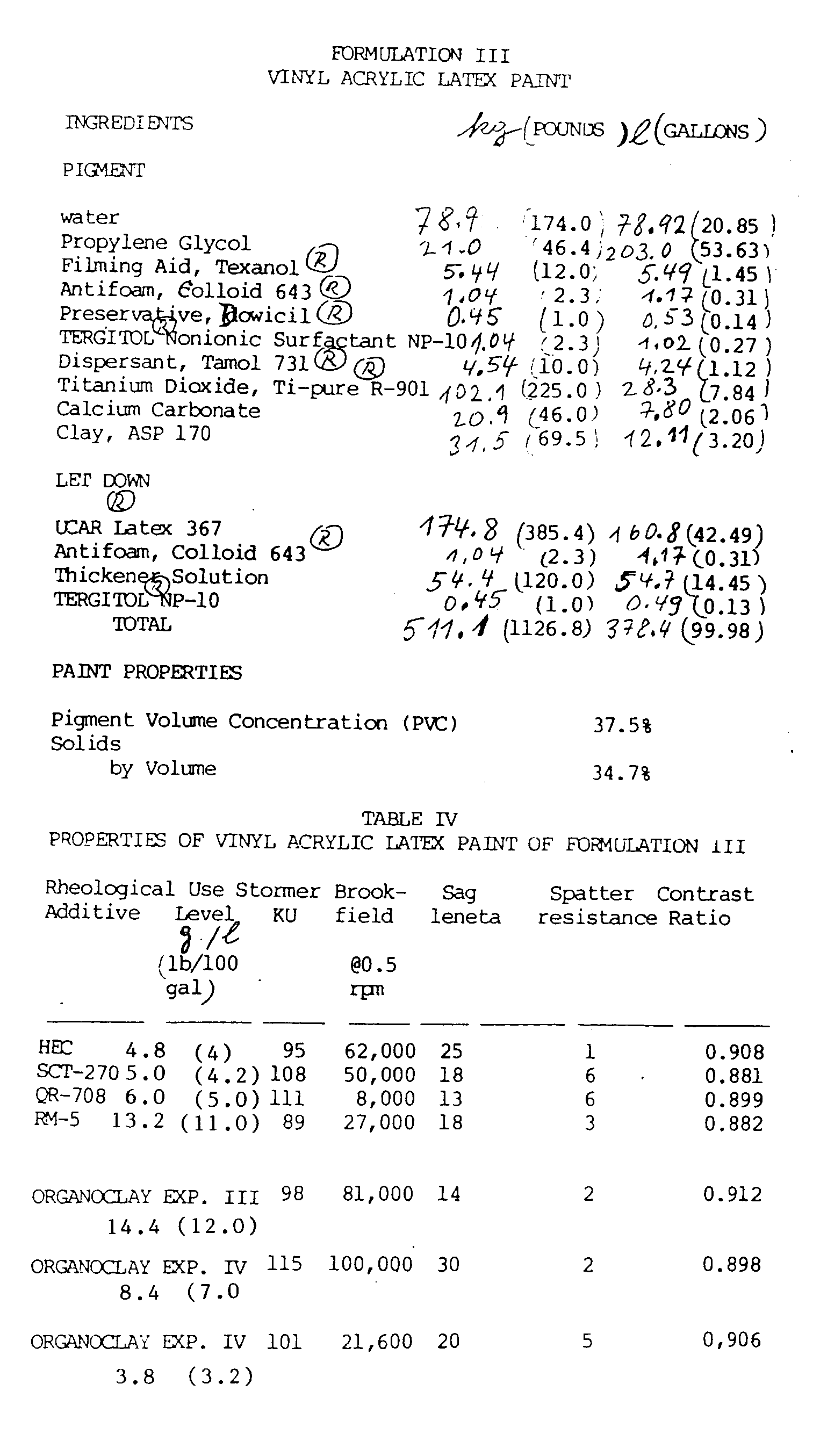

- Formulation III is a vinyl acrylic latex flat paint. In this formulation, organoclay from Experiment IV is much more efficient than Acrysol RM-5® but somewhat less efficient than other associative thickeners and HEC as shown in Table IV. When used alone, organoclay gives excellent sag control. Compared to HEC, organoclay improves spatter resistance and gives good hiding. However, it should be mentioned that the hiding power of organoclay is superior to that of associative thickeners. The advantages of the combined use of organoclay and associative thickeners are further illustrated in this formulation- excellent sag control, improved spatter resistance and leveling while maintaining higher hiding power.


- Formulation IV and Table V give additional data to demonstrate the usefulness of organoclay as a rheological additive. The formulation is different from formulation II, yet similar application properties were obtained and the synergistic effects of organoclay with associative thickeners were again observed.

Claims (5)
- Organoclay composition comprising the reaction product of a smectite clay having an ion exchange capacity of at least 50 meq.wt. per 100g clay (active basis), and a quaternary ammonium compound having the following formula:


- An organoclay composition of claim 1, wherein the smectite type clay is selected from hectorite and sodium bentonite.
- An organoclay composition of claim 1, wherein the polyoxyethylene chain is capped by propylene oxide.
- An organoclay composition of claim 1, wherein the polyethylene chain is terminated by a group selected from sulfate, carboxylate and phosphate.
- Process for preparing the organoclay composition of claim 1 comprising:a) preparing an aqueous slurry of 1 to 20%, by weight, of a smectite type clay having an ion exchange capacity of at least 50 meq.wt. per 100g clay (active basis);b) heating the clay slurry between 40°C and 95°C;c) adding to the clay slurry, 5 to 150 meq.wt. per 100g clay of a quaternary ammonium compound of claim 1;d) reacting the mixture for a sufficient time to form an organoclay reaction product of the composition of claim 1.
Priority Applications (1)
| Application Number | Priority Date | Filing Date | Title |
|---|---|---|---|
| AT86907158T ATE99721T1 (en) | 1985-11-12 | 1986-11-12 | ORGANOTON COMPOSITION. |
Applications Claiming Priority (2)
| Application Number | Priority Date | Filing Date | Title |
|---|---|---|---|
| US06/796,844 US4677158A (en) | 1985-11-12 | 1985-11-12 | Paint thickener |
| US796844 | 1985-11-12 |
Publications (3)
| Publication Number | Publication Date |
|---|---|
| EP0245474A1 EP0245474A1 (en) | 1987-11-19 |
| EP0245474A4 EP0245474A4 (en) | 1988-12-15 |
| EP0245474B1 true EP0245474B1 (en) | 1994-01-05 |
Family
ID=25169210
Family Applications (1)
| Application Number | Title | Priority Date | Filing Date |
|---|---|---|---|
| EP86907158A Revoked EP0245474B1 (en) | 1985-11-12 | 1986-11-12 | Organoclay Composition |
Country Status (4)
| Country | Link |
|---|---|
| US (1) | US4677158A (en) |
| EP (1) | EP0245474B1 (en) |
| DE (1) | DE3689518T2 (en) |
| WO (1) | WO1987003000A1 (en) |
Families Citing this family (43)
| Publication number | Priority date | Publication date | Assignee | Title |
|---|---|---|---|---|
| JPH0778089B2 (en) * | 1987-03-26 | 1995-08-23 | 株式会社豊田中央研究所 | Method of manufacturing composite material |
| JP2657504B2 (en) * | 1988-01-12 | 1997-09-24 | 株式会社資生堂 | Water-in-oil emulsion composition |
| US5190693A (en) * | 1988-07-29 | 1993-03-02 | Ausidet S.P.A. | Stable aqueous suspensions of inorganic silica-based materials insoluble in water |
| US5112603A (en) * | 1988-12-30 | 1992-05-12 | Miranol Inc. | Thickening agents for aqueous systems |
| US5130028A (en) * | 1990-09-17 | 1992-07-14 | Rheox, Inc. | Method of treating waste water for organic contaminants with water dispersible organically modified smectite clay compositions |
| US5376604A (en) * | 1991-07-11 | 1994-12-27 | Co-Op Chemical Co., Ltd. | Organophilic clay |
| US5429999A (en) * | 1991-11-14 | 1995-07-04 | Rheox, Inc. | Organoclay compositions containing two or more cations and one or more organic anions, their preparation and use in non-aqueous systems |
| US5336647A (en) * | 1991-11-14 | 1994-08-09 | Rheox, Inc. | Organoclay compositions prepared with a mixture of two organic cations and their use in non-aqueous systems |
| DK0683809T3 (en) * | 1993-02-12 | 1997-12-15 | Cabot Corp | Surface modified silica |
| JPH0971623A (en) * | 1995-09-07 | 1997-03-18 | Nisshinbo Ind Inc | Undiluted composition for producing rigid polyurethane foam |
| US5663111A (en) * | 1995-09-07 | 1997-09-02 | Southern Clay Products, Inc. | Organoclay compositions |
| US5728764A (en) * | 1995-09-07 | 1998-03-17 | Southern Clay Products, Inc. | Formulations including improved organoclay compositions |
| JP3683636B2 (en) * | 1996-02-22 | 2005-08-17 | 日本ペイント株式会社 | Water-dispersible organoclay composite, thickener and water-based coating composition containing the same |
| US5780376A (en) * | 1996-02-23 | 1998-07-14 | Southern Clay Products, Inc. | Organoclay compositions |
| US6071988A (en) * | 1996-12-31 | 2000-06-06 | Eastman Chemical Company | Polyester composite material and method for its manufacturing |
| US6162857A (en) | 1997-07-21 | 2000-12-19 | Eastman Chemical Company | Process for making polyester/platelet particle compositions displaying improved dispersion |
| US6034163A (en) * | 1997-12-22 | 2000-03-07 | Eastman Chemical Company | Polyester nanocomposites for high barrier applications |
| US6486252B1 (en) | 1997-12-22 | 2002-11-26 | Eastman Chemical Company | Nanocomposites for high barrier applications |
| US6395386B2 (en) | 1998-03-02 | 2002-05-28 | Eastman Chemical Company | Clear, high-barrier polymer-platelet composite multilayer structures |
| US6552114B2 (en) | 1998-12-07 | 2003-04-22 | University Of South Carolina Research Foundation | Process for preparing a high barrier amorphous polyamide-clay nanocomposite |
| US6384121B1 (en) * | 1998-12-07 | 2002-05-07 | Eastman Chemical Company | Polymeter/clay nanocomposite comprising a functionalized polymer or oligomer and a process for preparing same |
| WO2000034375A1 (en) * | 1998-12-07 | 2000-06-15 | Eastman Chemical Company | A polymer/clay nanocomposite comprising a clay mixture and a process for making same |
| DE69910623T2 (en) * | 1998-12-07 | 2004-06-17 | University Of South Carolina Research Foundation | POLYMER / CLAY NANOCOMPOSITE AND METHOD FOR THE PRODUCTION THEREOF |
| MXPA01005690A (en) * | 1998-12-07 | 2002-04-24 | Eastman Chem Co | Process for preparing an exfoliated, high i.v. polymer nanocomposite with an oligomer resin precursor and an article produced therefrom. |
| AU758538B2 (en) | 1998-12-07 | 2003-03-27 | University Of South Carolina Research Foundation | A colorant composition, a polymer nanocomposite comprising the colorant composition and articles produced therefrom |
| US6172121B1 (en) | 1999-05-21 | 2001-01-09 | The University Of Chicago | Process for preparing organoclays for aqueous and polar-organic systems |
| US6777479B1 (en) | 1999-08-10 | 2004-08-17 | Eastman Chemical Company | Polyamide nanocomposites with oxygen scavenging capability |
| US6610772B1 (en) | 1999-08-10 | 2003-08-26 | Eastman Chemical Company | Platelet particle polymer composite with oxygen scavenging organic cations |
| US6486253B1 (en) | 1999-12-01 | 2002-11-26 | University Of South Carolina Research Foundation | Polymer/clay nanocomposite having improved gas barrier comprising a clay material with a mixture of two or more organic cations and a process for preparing same |
| WO2001040369A1 (en) | 1999-12-01 | 2001-06-07 | Eastman Chemical Company | A polymer-clay nanocomposite comprising an amorphous oligomer |
| GB9930177D0 (en) * | 1999-12-22 | 2000-02-09 | Clariant Int Ltd | Improvements in or relating to organic compounds |
| US6414070B1 (en) | 2000-03-08 | 2002-07-02 | Omnova Solutions Inc. | Flame resistant polyolefin compositions containing organically modified clay |
| US6737464B1 (en) | 2000-05-30 | 2004-05-18 | University Of South Carolina Research Foundation | Polymer nanocomposite comprising a matrix polymer and a layered clay material having a low quartz content |
| US6828370B2 (en) | 2000-05-30 | 2004-12-07 | Amcol International Corporation | Intercalates and exfoliates thereof having an improved level of extractable material |
| EP1484357A1 (en) * | 2003-06-06 | 2004-12-08 | Université de Liège | Process to prepare biodegradable polyester foams, polyester foams obtained thereby, their use, and process to modify nanofillers |
| US20050159526A1 (en) * | 2004-01-15 | 2005-07-21 | Bernard Linda G. | Polymamide nanocomposites with oxygen scavenging capability |
| US7607483B2 (en) * | 2004-04-19 | 2009-10-27 | Halliburton Energy Services, Inc. | Sealant compositions comprising colloidally stabilized latex and methods of using the same |
| US7488705B2 (en) | 2004-12-08 | 2009-02-10 | Halliburton Energy Services, Inc. | Oilwell sealant compositions comprising alkali swellable latex |
| US20070111900A1 (en) * | 2005-11-11 | 2007-05-17 | Reddy B R | Sealant compositions comprising solid latex |
| US20070111901A1 (en) * | 2005-11-11 | 2007-05-17 | Reddy B R | Method of servicing a wellbore with a sealant composition comprising solid latex |
| US7153356B1 (en) | 2005-10-17 | 2006-12-26 | Milliken & Company | Children's washable paint |
| US9131683B2 (en) | 2011-09-30 | 2015-09-15 | The Sherwin-Williams Company | High quality antimicrobial paint composition |
| AU2014211319B2 (en) * | 2013-02-01 | 2017-05-18 | Croda International Plc | Self-disinfecting surfaces |
Family Cites Families (7)
| Publication number | Priority date | Publication date | Assignee | Title |
|---|---|---|---|---|
| US3298849A (en) * | 1963-07-05 | 1967-01-17 | American Tansul Company | Amine modified clay and method |
| US4208218A (en) * | 1978-03-27 | 1980-06-17 | Nl Industries, Inc. | Viscosity increasing additive for non-aqueous fluid systems |
| US4569923A (en) * | 1980-10-03 | 1986-02-11 | Southern Clay Products, Inc. | Process for manufacturing organoclays having enhanced gelling properties |
| US4412018A (en) * | 1980-11-17 | 1983-10-25 | Nl Industries, Inc. | Organophilic clay complexes, their preparation and compositions comprising said complexes |
| US4391637A (en) * | 1981-10-19 | 1983-07-05 | Nl Industries, Inc. | Rheological additive for non-aqueous fluid systems |
| TR22515A (en) * | 1984-04-27 | 1987-09-17 | English Clays Lovering Pochin | PREPARING AN ORGANO-HAIR EASILY TO DISPERSION IN AN ORGANIC VASAT |
| US4631091A (en) * | 1985-08-13 | 1986-12-23 | English China Clays Lovering Pochin & Co. Ltd. | Method for improving the dispersibility of organoclays |
-
1985
- 1985-11-12 US US06/796,844 patent/US4677158A/en not_active Expired - Lifetime
-
1986
- 1986-11-12 DE DE86907158T patent/DE3689518T2/en not_active Revoked
- 1986-11-12 WO PCT/US1986/002429 patent/WO1987003000A1/en not_active Ceased
- 1986-11-12 EP EP86907158A patent/EP0245474B1/en not_active Revoked
Also Published As
| Publication number | Publication date |
|---|---|
| WO1987003000A1 (en) | 1987-05-21 |
| DE3689518T2 (en) | 1994-04-28 |
| EP0245474A4 (en) | 1988-12-15 |
| DE3689518D1 (en) | 1994-02-17 |
| US4677158A (en) | 1987-06-30 |
| EP0245474A1 (en) | 1987-11-19 |
Similar Documents
| Publication | Publication Date | Title |
|---|---|---|
| US4677158A (en) | Paint thickener | |
| US4081496A (en) | Thixotropic polyester compositions containing an organophilic clay gellant | |
| EP0826750B1 (en) | Pumpable organophilic clay/polyamide compositions useful as rheological additives | |
| CA1105798A (en) | Organophilic clays and thixotropic polyester compositions containing the same | |
| CA1128954A (en) | Viscosity increasing additive for non-aqueous fluid systems | |
| EP0542266B1 (en) | Organoclay compositions prepared with a mixture of two organic cations and their use in non-aqueous systems | |
| EP0509202B1 (en) | Rheological agents and thickeners | |
| EP0267341B1 (en) | Process for the preparation of resin composition comprising organoclays of improved dispersibility | |
| US5112603A (en) | Thickening agents for aqueous systems | |
| US5728764A (en) | Formulations including improved organoclay compositions | |
| US4874728A (en) | Organophilic clay modified with silane compounds | |
| EP0524503B1 (en) | Organophilic clay | |
| EP0848692B1 (en) | Improved organoclay compositions | |
| CA2148396A1 (en) | Organoclay Compositions Containing Two or More Cations and One or More Organic Anions, Their Preparation and Use in Non-Aqueous Systems | |
| CN101384673A (en) | Organoclays suitable for use in halogenated resins and their composite systems | |
| US4861491A (en) | Method of detackifying paint overspray | |
| EP0627480A1 (en) | Organoclay thickener compatible with system to be thickened | |
| US4473675A (en) | Thixotropic cross-linkable unsaturated polyester compositions and method of production | |
| JPH06299104A (en) | Viscosity modifier for aqueous coating and aqueous coating composition |
Legal Events
| Date | Code | Title | Description |
|---|---|---|---|
| PUAI | Public reference made under article 153(3) epc to a published international application that has entered the european phase |
Free format text: ORIGINAL CODE: 0009012 |
|
| 17P | Request for examination filed |
Effective date: 19870711 |
|
| AK | Designated contracting states |
Kind code of ref document: A1 Designated state(s): AT BE DE FR GB IT NL |
|
| A4 | Supplementary search report drawn up and despatched |
Effective date: 19881215 |
|
| 17Q | First examination report despatched |
Effective date: 19920710 |
|
| GRAA | (expected) grant |
Free format text: ORIGINAL CODE: 0009210 |
|
| AK | Designated contracting states |
Kind code of ref document: B1 Designated state(s): AT BE DE FR GB IT NL |
|
| REF | Corresponds to: |
Ref document number: 99721 Country of ref document: AT Date of ref document: 19940115 Kind code of ref document: T |
|
| REF | Corresponds to: |
Ref document number: 3689518 Country of ref document: DE Date of ref document: 19940217 |
|
| ET | Fr: translation filed | ||
| ITF | It: translation for a ep patent filed | ||
| PLBI | Opposition filed |
Free format text: ORIGINAL CODE: 0009260 |
|
| 26 | Opposition filed |
Opponent name: AKZO NOBEL N.V. Effective date: 19941005 Opponent name: SOUTHERN CLAY INCORPORATED Effective date: 19941005 |
|
| ITTA | It: last paid annual fee | ||
| NLR1 | Nl: opposition has been filed with the epo |
Opponent name: AKZO NOBEL N.V. Opponent name: SOUTHERN CLAY INCORPORATED |
|
| PLAB | Opposition data, opponent's data or that of the opponent's representative modified |
Free format text: ORIGINAL CODE: 0009299OPPO |
|
| PLBQ | Unpublished change to opponent data |
Free format text: ORIGINAL CODE: EPIDOS OPPO |
|
| R26 | Opposition filed (corrected) |
Opponent name: SOUTHERN CLAY INCORPORATED * 941005 AKZO NOBEL N.V Effective date: 19941005 |
|
| NLR1 | Nl: opposition has been filed with the epo |
Opponent name: AKZO NOBEL N.V. Opponent name: SOUTHERN CLAY INCORPORATED |
|
| PLBO | Opposition rejected |
Free format text: ORIGINAL CODE: EPIDOS REJO |
|
| APAC | Appeal dossier modified |
Free format text: ORIGINAL CODE: EPIDOS NOAPO |
|
| APAE | Appeal reference modified |
Free format text: ORIGINAL CODE: EPIDOS REFNO |
|
| APAC | Appeal dossier modified |
Free format text: ORIGINAL CODE: EPIDOS NOAPO |
|
| APAE | Appeal reference modified |
Free format text: ORIGINAL CODE: EPIDOS REFNO |
|
| PGFP | Annual fee paid to national office [announced via postgrant information from national office to epo] |
Ref country code: FR Payment date: 20000829 Year of fee payment: 15 |
|
| PGFP | Annual fee paid to national office [announced via postgrant information from national office to epo] |
Ref country code: DE Payment date: 20000905 Year of fee payment: 15 |
|
| PGFP | Annual fee paid to national office [announced via postgrant information from national office to epo] |
Ref country code: AT Payment date: 20000922 Year of fee payment: 15 |
|
| PGFP | Annual fee paid to national office [announced via postgrant information from national office to epo] |
Ref country code: GB Payment date: 20001110 Year of fee payment: 15 |
|
| PGFP | Annual fee paid to national office [announced via postgrant information from national office to epo] |
Ref country code: BE Payment date: 20001122 Year of fee payment: 15 |
|
| PGFP | Annual fee paid to national office [announced via postgrant information from national office to epo] |
Ref country code: NL Payment date: 20001130 Year of fee payment: 15 |
|
| RAP2 | Party data changed (patent owner data changed or rights of a patent transferred) |
Owner name: SUED-CHEMIE INC |
|
| APAC | Appeal dossier modified |
Free format text: ORIGINAL CODE: EPIDOS NOAPO |
|
| RDAH | Patent revoked |
Free format text: ORIGINAL CODE: EPIDOS REVO |
|
| RDAG | Patent revoked |
Free format text: ORIGINAL CODE: 0009271 |
|
| STAA | Information on the status of an ep patent application or granted ep patent |
Free format text: STATUS: PATENT REVOKED |
|
| NLT2 | Nl: modifications (of names), taken from the european patent patent bulletin |
Owner name: SUED-CHEMIE INC |
|
| 27W | Patent revoked |
Effective date: 20001117 |
|
| GBPR | Gb: patent revoked under art. 102 of the ep convention designating the uk as contracting state |
Free format text: 20001117 |
|
| NLR2 | Nl: decision of opposition | ||
| APAH | Appeal reference modified |
Free format text: ORIGINAL CODE: EPIDOSCREFNO |
|
| PLAB | Opposition data, opponent's data or that of the opponent's representative modified |
Free format text: ORIGINAL CODE: 0009299OPPO |
|
| PLAB | Opposition data, opponent's data or that of the opponent's representative modified |
Free format text: ORIGINAL CODE: 0009299OPPO |