EP0243698A2 - Surface modification of inorganic fillers by treatment with bicyclic amide acetals - Google Patents
Surface modification of inorganic fillers by treatment with bicyclic amide acetals Download PDFInfo
- Publication number
- EP0243698A2 EP0243698A2 EP87104707A EP87104707A EP0243698A2 EP 0243698 A2 EP0243698 A2 EP 0243698A2 EP 87104707 A EP87104707 A EP 87104707A EP 87104707 A EP87104707 A EP 87104707A EP 0243698 A2 EP0243698 A2 EP 0243698A2
- Authority
- EP
- European Patent Office
- Prior art keywords
- bicyclic amide
- carbon atoms
- amide acetal
- filler
- treatment
- Prior art date
- Legal status (The legal status is an assumption and is not a legal conclusion. Google has not performed a legal analysis and makes no representation as to the accuracy of the status listed.)
- Withdrawn
Links
Classifications
-
- C—CHEMISTRY; METALLURGY
- C07—ORGANIC CHEMISTRY
- C07D—HETEROCYCLIC COMPOUNDS
- C07D498/00—Heterocyclic compounds containing in the condensed system at least one hetero ring having nitrogen and oxygen atoms as the only ring hetero atoms
- C07D498/02—Heterocyclic compounds containing in the condensed system at least one hetero ring having nitrogen and oxygen atoms as the only ring hetero atoms in which the condensed system contains two hetero rings
- C07D498/04—Ortho-condensed systems
-
- C—CHEMISTRY; METALLURGY
- C03—GLASS; MINERAL OR SLAG WOOL
- C03C—CHEMICAL COMPOSITION OF GLASSES, GLAZES OR VITREOUS ENAMELS; SURFACE TREATMENT OF GLASS; SURFACE TREATMENT OF FIBRES OR FILAMENTS MADE FROM GLASS, MINERALS OR SLAGS; JOINING GLASS TO GLASS OR OTHER MATERIALS
- C03C17/00—Surface treatment of glass, not in the form of fibres or filaments, by coating
- C03C17/28—Surface treatment of glass, not in the form of fibres or filaments, by coating with organic material
-
- C—CHEMISTRY; METALLURGY
- C03—GLASS; MINERAL OR SLAG WOOL
- C03C—CHEMICAL COMPOSITION OF GLASSES, GLAZES OR VITREOUS ENAMELS; SURFACE TREATMENT OF GLASS; SURFACE TREATMENT OF FIBRES OR FILAMENTS MADE FROM GLASS, MINERALS OR SLAGS; JOINING GLASS TO GLASS OR OTHER MATERIALS
- C03C25/00—Surface treatment of fibres or filaments made from glass, minerals or slags
- C03C25/10—Coating
- C03C25/24—Coatings containing organic materials
- C03C25/25—Non-macromolecular compounds
-
- Y—GENERAL TAGGING OF NEW TECHNOLOGICAL DEVELOPMENTS; GENERAL TAGGING OF CROSS-SECTIONAL TECHNOLOGIES SPANNING OVER SEVERAL SECTIONS OF THE IPC; TECHNICAL SUBJECTS COVERED BY FORMER USPC CROSS-REFERENCE ART COLLECTIONS [XRACs] AND DIGESTS
- Y10—TECHNICAL SUBJECTS COVERED BY FORMER USPC
- Y10T—TECHNICAL SUBJECTS COVERED BY FORMER US CLASSIFICATION
- Y10T428/00—Stock material or miscellaneous articles
- Y10T428/29—Coated or structually defined flake, particle, cell, strand, strand portion, rod, filament, macroscopic fiber or mass thereof
- Y10T428/2982—Particulate matter [e.g., sphere, flake, etc.]
- Y10T428/2991—Coated
-
- Y—GENERAL TAGGING OF NEW TECHNOLOGICAL DEVELOPMENTS; GENERAL TAGGING OF CROSS-SECTIONAL TECHNOLOGIES SPANNING OVER SEVERAL SECTIONS OF THE IPC; TECHNICAL SUBJECTS COVERED BY FORMER USPC CROSS-REFERENCE ART COLLECTIONS [XRACs] AND DIGESTS
- Y10—TECHNICAL SUBJECTS COVERED BY FORMER USPC
- Y10T—TECHNICAL SUBJECTS COVERED BY FORMER US CLASSIFICATION
- Y10T428/00—Stock material or miscellaneous articles
- Y10T428/29—Coated or structually defined flake, particle, cell, strand, strand portion, rod, filament, macroscopic fiber or mass thereof
- Y10T428/2982—Particulate matter [e.g., sphere, flake, etc.]
- Y10T428/2991—Coated
- Y10T428/2993—Silicic or refractory material containing [e.g., tungsten oxide, glass, cement, etc.]
-
- Y—GENERAL TAGGING OF NEW TECHNOLOGICAL DEVELOPMENTS; GENERAL TAGGING OF CROSS-SECTIONAL TECHNOLOGIES SPANNING OVER SEVERAL SECTIONS OF THE IPC; TECHNICAL SUBJECTS COVERED BY FORMER USPC CROSS-REFERENCE ART COLLECTIONS [XRACs] AND DIGESTS
- Y10—TECHNICAL SUBJECTS COVERED BY FORMER USPC
- Y10T—TECHNICAL SUBJECTS COVERED BY FORMER US CLASSIFICATION
- Y10T428/00—Stock material or miscellaneous articles
- Y10T428/29—Coated or structually defined flake, particle, cell, strand, strand portion, rod, filament, macroscopic fiber or mass thereof
- Y10T428/2982—Particulate matter [e.g., sphere, flake, etc.]
- Y10T428/2991—Coated
- Y10T428/2993—Silicic or refractory material containing [e.g., tungsten oxide, glass, cement, etc.]
- Y10T428/2996—Glass particles or spheres
-
- Y—GENERAL TAGGING OF NEW TECHNOLOGICAL DEVELOPMENTS; GENERAL TAGGING OF CROSS-SECTIONAL TECHNOLOGIES SPANNING OVER SEVERAL SECTIONS OF THE IPC; TECHNICAL SUBJECTS COVERED BY FORMER USPC CROSS-REFERENCE ART COLLECTIONS [XRACs] AND DIGESTS
- Y10—TECHNICAL SUBJECTS COVERED BY FORMER USPC
- Y10T—TECHNICAL SUBJECTS COVERED BY FORMER US CLASSIFICATION
- Y10T428/00—Stock material or miscellaneous articles
- Y10T428/29—Coated or structually defined flake, particle, cell, strand, strand portion, rod, filament, macroscopic fiber or mass thereof
- Y10T428/2982—Particulate matter [e.g., sphere, flake, etc.]
- Y10T428/2991—Coated
- Y10T428/2998—Coated including synthetic resin or polymer
Definitions
- This invention relates to the modification of the surface of fillers and reinforcing materials by treatment with bicyclic amide acetals and to the products of such treatment which have improved properties of compatibility with organic resins.
- Certain fillers and reinforcement fibers are often treated with certain organic and organometallic reagents in order to improve the compatibility of these materials with organic monomers and polymeric resin compositions which result in improvement of the adhesion of the polymeric resins with these fillers and reinforcement materials.
- the prior art surface modifiers which are sometimes called sizing agents usually serve the purpose of a bridge between the inorganic and the organic materials. For instance, for glass beads and fibers, organosilicon compounds are common sizing agents. These sizing agents may also contain functionalities such as amine, hydroxy, etc. which provide the reactive sites for certain reactive molecules.
- the untreated fillers and reinforcement materials are often incompatible with organic resins giving poor adhesion and other undesirable properties when incorporated into such resins.
- bicyclic amide acetals may be used as effective surface modification reagents for a variety of fillers and reinforcement materials including glass, kaolin, carbon, and the like.
- the bicyclic amide acetals useful in this invention include those of Formula I wherein R and R ⁇ independently represent hydrogen, an alkyl group having from 1 to 20 carbon atoms, an aryl group having from 6 to 12 carbon atoms, an alkaryl group having from 7 to 20 carbon atoms, an alkyl ether group having from 1 to 20 carbon atoms or an aryl ether group having from 6 to 20 carbon atoms.
- bicyclic amide acetals as modifiers for the surface of fillers and reinforcing materials such as glass, kaolin, carbon, and the like in order to improve the properties of such fillers such as adhesion (or wettability to organic resins has not previously been described in the prior art.
- the surface modified fillers and reinforcement materials obtained by the process of the invention have improved compatibility with polymeric resin compositions and that they give reinforced (filled) polymers and composite materials which have improved properties including improved adhesive and cohesive strength. These modified fillers and reinforcement materials may be used in applications such as adhesives, composites, molding compositions, and the like.
- the surface treatment process of this invention may be carried out either in liquid or vapor phase of the bicyclic amide acetal at temperatures ranging from about 60°C to about 350°C.
- the fillers may be treated with the vapors of bicyclic amide acetal at high temperatures or with liquid bicyclic amide acetal or its solution in an organic solvent. Because bicyclic amide acetals are highly moisture sensitive, the treatment must be carried out in dry and inert atmosphere. In the course of surface modification of inorganic fillers, it is believed that the bicyclic amide acetal is either chemically bound by interacting with the reactive functionalities of the material or simply adsorbed in or on the material.
- the bicyclic amide acetal Because of the highly reactive and polar nature of the bicyclic amide acetal, it serves as a compatibilizer with organic molecules. In addition to this, in some cases, the bicyclic amide acetal removes the undesired moisture adsorbed in the fillers simply by reacting with it, thus improving the processing conditions for systems which are very sensitive to moisture; for instance, urethane polymer formation in the polyisocyanate reactions.
- the bicyclic amide acetal modified fillers and reinforcement material when used in polymeric compositions in applications such as structural adhesives, molding compositions, composites, etc. show much improved properties such as adhesive and cohesive strengths.
- the fillers and reinforcing agents which can be modified by the process of this invention include glass, carbon, talc, kaolin, graphite, Kevlar and other reinforcement organic polymers such as polyamides including nylons, and polyesters including polyethylene terephthalate.
- Glass microspheres (average size 57 ⁇ m) (20g) were treated with the vapors of 2.23g of a bicyclic amide acetal of Formula I wherein R is methyl and R ⁇ is hydrogen.
- the bicyclic amide acetal vapors were diluted with nitrogen and passed over the glass microspheres maintained at 200-210°C during a three hour treatment period.
- the treated microspheres (Sample A) were dried under reduced pressure to remove any unreacted (or unadsorbed) bicyclic amide acetal. A portion of this was washed with three successive 20 ml portions of isopropyl alcohol followed by three 20 ml portions of acetone and then was dried under reduced pressure (Sample B).
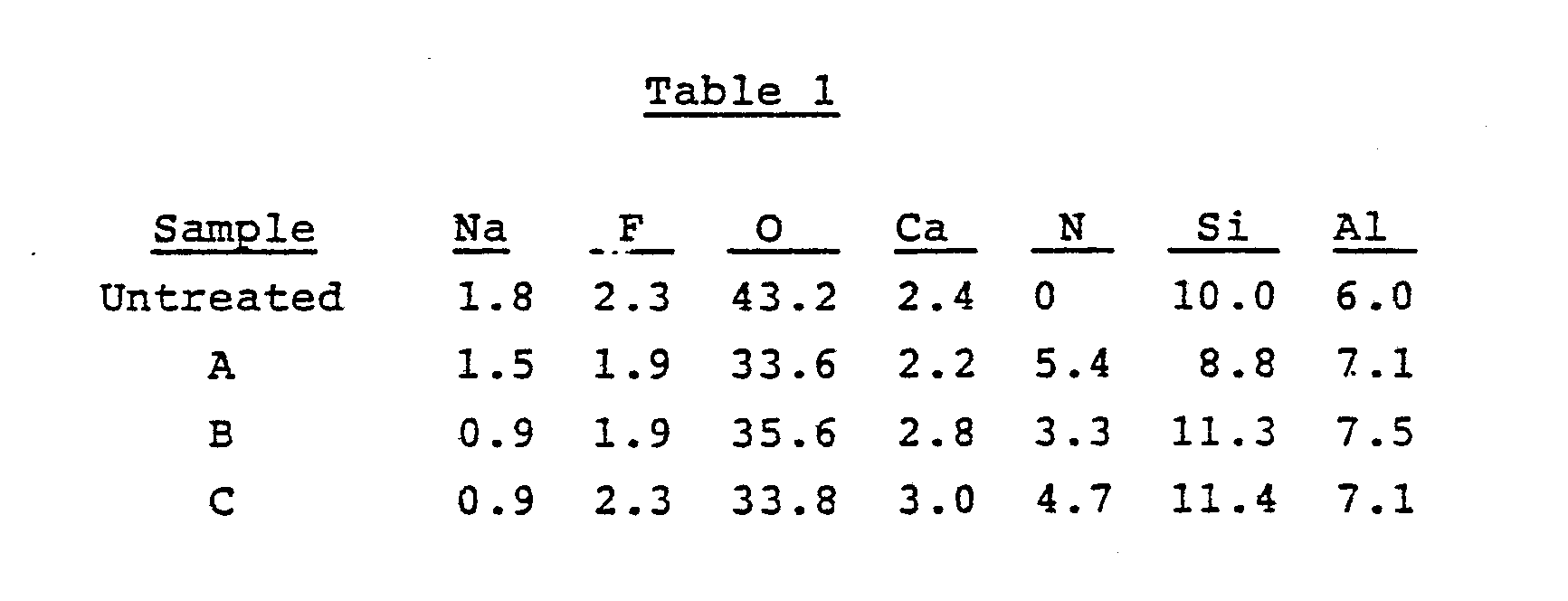
- Example C Another portion of the treated glass microsphere sample was washed with isopropyl alcohol using a Soxhlet extraction technique (Sample C). All three samples (A, B, and C) were analyzed by ESCA for elemental analysis of the surface. The results are summarized in Table 1 which clearly indicates the presence of nitrogen, an element which was not present in the untreated glass and resulted from the addition of bicyclic amide acetal.
- the polyol component was prepared by mixing 179.2g of ethylene oxide capped poly(propylene oxide) diol (hydroxy No. 37), 0.66g of ferric acetyl acetonate, 0.24g of dibutyltin dilaurate and 2.52g of piperazine. A part (40g) of this was filled with 30.8g of bicyclic amide acetal treated glass microspheres from Example 1 to give component A.
- the isocyanate prepolymer component B was prepared by heating a mixture of 157.8g of ethylene oxide capped poly(propylene oxide) diol (hydroxy No.
- the elastomeric polymer was prepared by mixing 33.2g of polyol component A filled with treated glass microspheres and 15g of isocyanate prepolymer component B and curing into an approximately 1.5 mm (60 mils) thick sheet at room temperature.
- the physical properties such as elongation, tensile strength, and Shore A hardness were determined and compared with that of the system using untreated glass microspheres. The results are given in Table 2.
- Kaolin (132g) was treated with 4g of the bicyclic amide acetal of Example 1 at 60-80°C for 2 hours.
- This treated kaolin filler was then mixed with a polyol compositon prepared by mixing 249g of ethylene oxide capped poly(propylene oxide) triol (molecular weight of 3500), 9.3g of toluene diisocyanate, 113.4g of poly(alkylene oxide) tetraol (molecular weight of 450), 0.5g of ferric acetyl acetonate, 0.2g of stannous octoate, and 4.8g of piperazine.
- the viscosity of the filled component A was determined to be about 4700 cps compared to that of the system prepared by using exactly the same ingredients as above except that untreated kaolin which had a viscosity of about 9000 cps was used.
- a 30g portion of the component A prepared by using the treated kaolin was mixed with 30g of an isocyanate prepolymer obtained by mixing 302.7g of ethylene oxide capped poly(propylene oxide) diol, 150g of liquid diglycidyl ether of bisphenol-A (epoxy equivalent weight of 180-190), 704.6g of liquid methylene bis(phenylisocyanate) (NCO equivalent weight of about 144) and 343g of dried kaolin filler.
- the mixed adhesive composition was applied between two 33cm (13 inch) long and 10 cm (4 inch) wide glass sheets of a fibreglass reinforced sheet molding compound having a 2.54 cm (1 inch) wide overlap and forming an approximately 0.75 mm (30 mils) thick glue line.
- the adhesive bond was cured at 93°C (200°F for 4 minutes, followed by postcuring at 140°C (285°F) for 30 minutes.
- This adhesive test panel was cut to give twelve 2.54 cm (1 inch) wide lap shear test specimens which were pulled on an Instron apparatus. All of the samples showed 100% fiber tear in the range of 2.8-5.0 MPa (400-700 psi).
Landscapes
- Chemical & Material Sciences (AREA)
- Organic Chemistry (AREA)
- Life Sciences & Earth Sciences (AREA)
- Engineering & Computer Science (AREA)
- Chemical Kinetics & Catalysis (AREA)
- General Chemical & Material Sciences (AREA)
- Geochemistry & Mineralogy (AREA)
- Materials Engineering (AREA)
- General Life Sciences & Earth Sciences (AREA)
- Compositions Of Macromolecular Compounds (AREA)
- Reinforced Plastic Materials (AREA)
- Surface Treatment Of Glass (AREA)
- Treatments For Attaching Organic Compounds To Fibrous Goods (AREA)
- Treatments Of Macromolecular Shaped Articles (AREA)
- Pigments, Carbon Blacks, Or Wood Stains (AREA)
- Adhesives Or Adhesive Processes (AREA)
Abstract
Description
- This invention relates to the modification of the surface of fillers and reinforcing materials by treatment with bicyclic amide acetals and to the products of such treatment which have improved properties of compatibility with organic resins.
- Certain fillers and reinforcement fibers are often treated with certain organic and organometallic reagents in order to improve the compatibility of these materials with organic monomers and polymeric resin compositions which result in improvement of the adhesion of the polymeric resins with these fillers and reinforcement materials. The prior art surface modifiers which are sometimes called sizing agents usually serve the purpose of a bridge between the inorganic and the organic materials. For instance, for glass beads and fibers, organosilicon compounds are common sizing agents. These sizing agents may also contain functionalities such as amine, hydroxy, etc. which provide the reactive sites for certain reactive molecules. The untreated fillers and reinforcement materials are often incompatible with organic resins giving poor adhesion and other undesirable properties when incorporated into such resins.
- It has now been found that bicyclic amide acetals may be used as effective surface modification reagents for a variety of fillers and reinforcement materials including glass, kaolin, carbon, and the like. The bicyclic amide acetals useful in this invention include those of Formula I

- The use of bicyclic amide acetals as modifiers for the surface of fillers and reinforcing materials such as glass, kaolin, carbon, and the like in order to improve the properties of such fillers such as adhesion (or wettability to organic resins has not previously been described in the prior art.
- The surface modified fillers and reinforcement materials obtained by the process of the invention have improved compatibility with polymeric resin compositions and that they give reinforced (filled) polymers and composite materials which have improved properties including improved adhesive and cohesive strength. These modified fillers and reinforcement materials may be used in applications such as adhesives, composites, molding compositions, and the like.
- The surface treatment process of this invention may be carried out either in liquid or vapor phase of the bicyclic amide acetal at temperatures ranging from about 60°C to about 350°C. The fillers may be treated with the vapors of bicyclic amide acetal at high temperatures or with liquid bicyclic amide acetal or its solution in an organic solvent. Because bicyclic amide acetals are highly moisture sensitive, the treatment must be carried out in dry and inert atmosphere. In the course of surface modification of inorganic fillers, it is believed that the bicyclic amide acetal is either chemically bound by interacting with the reactive functionalities of the material or simply adsorbed in or on the material. Because of the highly reactive and polar nature of the bicyclic amide acetal, it serves as a compatibilizer with organic molecules. In addition to this, in some cases, the bicyclic amide acetal removes the undesired moisture adsorbed in the fillers simply by reacting with it, thus improving the processing conditions for systems which are very sensitive to moisture; for instance, urethane polymer formation in the polyisocyanate reactions. The bicyclic amide acetal modified fillers and reinforcement material, when used in polymeric compositions in applications such as structural adhesives, molding compositions, composites, etc. show much improved properties such as adhesive and cohesive strengths.
- The fillers and reinforcing agents which can be modified by the process of this invention include glass, carbon, talc, kaolin, graphite, Kevlar and other reinforcement organic polymers such as polyamides including nylons, and polyesters including polyethylene terephthalate.
- The invention is further illustrated in the following representative examples.
- Glass microspheres (average size 57 µm) (20g) were treated with the vapors of 2.23g of a bicyclic amide acetal of Formula I wherein R is methyl and Rʹ is hydrogen. The bicyclic amide acetal vapors were diluted with nitrogen and passed over the glass microspheres maintained at 200-210°C during a three hour treatment period. The treated microspheres (Sample A) were dried under reduced pressure to remove any unreacted (or unadsorbed) bicyclic amide acetal. A portion of this was washed with three successive 20 ml portions of isopropyl alcohol followed by three 20 ml portions of acetone and then was dried under reduced pressure (Sample B). Another portion of the treated glass microsphere sample was washed with isopropyl alcohol using a Soxhlet extraction technique (Sample C). All three samples (A, B, and C) were analyzed by ESCA for elemental analysis of the surface. The results are summarized in Table 1 which clearly indicates the presence of nitrogen, an element which was not present in the untreated glass and resulted from the addition of bicyclic amide acetal.
- In a reactor equipped with a mechanical stirrer, a thermometer with a temperature controller, a reflux condenser and a nitrogen inlet, 300g of mesitylene, 100g of the bicyclic amide acetal described in Example 1 and 100g of untreated glass microspheres were added. The resulting mixture was heated at 162-165°C for five hours. The glass microspheres were filtered under nitrogen at room temperature and were washed with three 30 ml portions of isopropyl alcohol followed by three 30 ml portions of acetone. The microspheres were dried under reduced pressure and were used as filler in the two-component polyurethane elastomer formulation described below. The polyol component was prepared by mixing 179.2g of ethylene oxide capped poly(propylene oxide) diol (hydroxy No. 37), 0.66g of ferric acetyl acetonate, 0.24g of dibutyltin dilaurate and 2.52g of piperazine. A part (40g) of this was filled with 30.8g of bicyclic amide acetal treated glass microspheres from Example 1 to give component A. The isocyanate prepolymer component B was prepared by heating a mixture of 157.8g of ethylene oxide capped poly(propylene oxide) diol (hydroxy No. 56) and 74.9g of liquid methylene bis(phenyl isocyanate) (NCO equivalent weight of 144) at 60-70°C for 3 hours. The elastomeric polymer was prepared by mixing 33.2g of polyol component A filled with treated glass microspheres and 15g of isocyanate prepolymer component B and curing into an approximately 1.5 mm (60 mils) thick sheet at room temperature. The physical properties such as elongation, tensile strength, and Shore A hardness were determined and compared with that of the system using untreated glass microspheres. The results are given in Table 2.

- Kaolin (132g) was treated with 4g of the bicyclic amide acetal of Example 1 at 60-80°C for 2 hours. This treated kaolin filler was then mixed with a polyol compositon prepared by mixing 249g of ethylene oxide capped poly(propylene oxide) triol (molecular weight of 3500), 9.3g of toluene diisocyanate, 113.4g of poly(alkylene oxide) tetraol (molecular weight of 450), 0.5g of ferric acetyl acetonate, 0.2g of stannous octoate, and 4.8g of piperazine. The viscosity of the filled component A was determined to be about 4700 cps compared to that of the system prepared by using exactly the same ingredients as above except that untreated kaolin which had a viscosity of about 9000 cps was used. A 30g portion of the component A prepared by using the treated kaolin was mixed with 30g of an isocyanate prepolymer obtained by mixing 302.7g of ethylene oxide capped poly(propylene oxide) diol, 150g of liquid diglycidyl ether of bisphenol-A (epoxy equivalent weight of 180-190), 704.6g of liquid methylene bis(phenylisocyanate) (NCO equivalent weight of about 144) and 343g of dried kaolin filler. The mixed adhesive composition was applied between two 33cm (13 inch) long and 10 cm (4 inch) wide glass sheets of a fibreglass reinforced sheet molding compound having a 2.54 cm (1 inch) wide overlap and forming an approximately 0.75 mm (30 mils) thick glue line. The adhesive bond was cured at 93°C (200°F for 4 minutes, followed by postcuring at 140°C (285°F) for 30 minutes. This adhesive test panel was cut to give twelve 2.54 cm (1 inch) wide lap shear test specimens which were pulled on an Instron apparatus. All of the samples showed 100% fiber tear in the range of 2.8-5.0 MPa (400-700 psi).
Claims (6)

Applications Claiming Priority (2)
| Application Number | Priority Date | Filing Date | Title |
|---|---|---|---|
| US06/858,780 US4657815A (en) | 1986-05-02 | 1986-05-02 | Surface modification of inorganic fillers by treatment with bicyclic amide acetals |
| US858780 | 1986-05-02 |
Publications (2)
| Publication Number | Publication Date |
|---|---|
| EP0243698A2 true EP0243698A2 (en) | 1987-11-04 |
| EP0243698A3 EP0243698A3 (en) | 1989-03-08 |
Family
ID=25329158
Family Applications (1)
| Application Number | Title | Priority Date | Filing Date |
|---|---|---|---|
| EP87104707A Withdrawn EP0243698A3 (en) | 1986-05-02 | 1987-03-31 | Surface modification of inorganic fillers by treatment with bicyclic amide acetals |
Country Status (4)
| Country | Link |
|---|---|
| US (1) | US4657815A (en) |
| EP (1) | EP0243698A3 (en) |
| JP (1) | JPS6339928A (en) |
| CA (1) | CA1297354C (en) |
Families Citing this family (4)
| Publication number | Priority date | Publication date | Assignee | Title |
|---|---|---|---|---|
| EP0605677B1 (en) * | 1992-07-23 | 1998-06-17 | Owens Corning | Silicon or silica substrate with a modified surface and process for producing the same |
| WO1997009280A1 (en) * | 1995-09-01 | 1997-03-13 | Gurit-Essex Ag | Method of producing substrates with modified surfaces containing silicon dioxide and blocked by an alcohol |
| JP2008031248A (en) | 2006-07-27 | 2008-02-14 | Daicel Chem Ind Ltd | Curable resin composition and method for forming cured coating film |
| JP5367324B2 (en) | 2008-07-25 | 2013-12-11 | 株式会社ダイセル | Curable copolymer and curable resin composition |
Family Cites Families (4)
| Publication number | Priority date | Publication date | Assignee | Title |
|---|---|---|---|---|
| GB2127009B (en) * | 1982-09-14 | 1986-11-19 | Glaverbel | Modifying glass bead surfaces |
| US4605746A (en) * | 1984-08-16 | 1986-08-12 | Ashland Oil, Inc. | Novel tetrasubstituted bicyclic amide acetals and process for their manufacture |
| US4539376A (en) * | 1984-10-09 | 1985-09-03 | Ashland Oil, Inc. | Cross-linking of maleic anhydride polymers with bicyclic amide acetals |
| US4558114A (en) * | 1985-01-23 | 1985-12-10 | Ashland Oil, Inc. | Polymers derived from polyisocyanates, bicyclic amide acetals and oxazolines |
-
1986
- 1986-05-02 US US06/858,780 patent/US4657815A/en not_active Expired - Fee Related
-
1987
- 1987-03-31 EP EP87104707A patent/EP0243698A3/en not_active Withdrawn
- 1987-05-01 CA CA000536209A patent/CA1297354C/en not_active Expired - Lifetime
- 1987-05-01 JP JP62106545A patent/JPS6339928A/en active Granted
Also Published As
| Publication number | Publication date |
|---|---|
| JPH0355495B2 (en) | 1991-08-23 |
| JPS6339928A (en) | 1988-02-20 |
| EP0243698A3 (en) | 1989-03-08 |
| US4657815A (en) | 1987-04-14 |
| CA1297354C (en) | 1992-03-17 |
Similar Documents
| Publication | Publication Date | Title |
|---|---|---|
| KR101519459B1 (en) | Cross-linkable materials based on organyl oxysilane-terminated polymers | |
| KR102858553B1 (en) | Thermosetting epoxy resin composition having low curing temperature and good storage stability | |
| CA1163039A (en) | Polyurethane sealant system | |
| US7153924B2 (en) | Organopolysiloxane/polyurea/polyurethane block copolymers | |
| JP5727369B2 (en) | Thermosetting epoxy resin composition containing an accelerator having a hetero atom | |
| EP0256162B1 (en) | Polyol/polyepoxide/polyisocyanate adhesive composition and its use | |
| CA1325165C (en) | Process for the production of composite structures and the composite structures obtainable by this process | |
| EP0269119A2 (en) | Sag resistant urethane adhesives with improved antifoaming property | |
| US4495020A (en) | Primer for bonding polyester plastics | |
| EP1088021A1 (en) | Hybrid nonisocyanate polyurethane network polymers and composites formed therefrom | |
| JPS6157616A (en) | Manufacture of storage-stable synthetic resin material underno water content condition | |
| JPH10504350A (en) | Polyurethane composition with low monomeric diisocyanate content | |
| US4963636A (en) | Adhesion promoters | |
| EP2183300B1 (en) | Silicone-containing foams | |
| US4632970A (en) | Epoxy resin composition | |
| PL145929B1 (en) | Method of obtaining a polymeric melt on the basis of a polyamide polymer | |
| US4657815A (en) | Surface modification of inorganic fillers by treatment with bicyclic amide acetals | |
| DE69127673T2 (en) | Crosslinkable hot melt composition | |
| US4707532A (en) | Copolymerization of blocked polyisocyanates with bicyclic amide acetals | |
| JP3309373B2 (en) | Polyurethane elastomer-forming composition and hollow fiber binder using the same | |
| US4885331A (en) | Polyester melt-adhesive compositions and methods of making and using them | |
| EP0197543A2 (en) | Polyisocyanates and resin compositions thereof | |
| JPH02233667A (en) | Polyoxazolidine and preparation thereof | |
| DE3886523T2 (en) | Polyethers end-blocked with hydrolyzable silyl groups, production process and room temperature curable composition using the polyether. | |
| EP4480982A1 (en) | Heat-curing epoxy resin composition having high storage stability |
Legal Events
| Date | Code | Title | Description |
|---|---|---|---|
| PUAI | Public reference made under article 153(3) epc to a published international application that has entered the european phase |
Free format text: ORIGINAL CODE: 0009012 |
|
| 17P | Request for examination filed |
Effective date: 19870331 |
|
| AK | Designated contracting states |
Kind code of ref document: A2 Designated state(s): AT BE CH DE FR GB IT LI LU NL SE |
|
| PUAL | Search report despatched |
Free format text: ORIGINAL CODE: 0009013 |
|
| AK | Designated contracting states |
Kind code of ref document: A3 Designated state(s): AT BE CH DE FR GB IT LI LU NL SE |
|
| 17Q | First examination report despatched |
Effective date: 19910916 |
|
| STAA | Information on the status of an ep patent application or granted ep patent |
Free format text: STATUS: THE APPLICATION IS DEEMED TO BE WITHDRAWN |
|
| 18D | Application deemed to be withdrawn |
Effective date: 19920521 |
|
| RIN1 | Information on inventor provided before grant (corrected) |
Inventor name: BLACKBURN, PEGGY A. Inventor name: RICHARDS, HARVEY J. Inventor name: GRIMM, ROBERT A. Inventor name: GOEL, ANIL B. |