EP0240233B1 - Derivatives of benzoquinonyl-phenyl alkanoic acid amide - Google Patents
Derivatives of benzoquinonyl-phenyl alkanoic acid amide Download PDFInfo
- Publication number
- EP0240233B1 EP0240233B1 EP87302575A EP87302575A EP0240233B1 EP 0240233 B1 EP0240233 B1 EP 0240233B1 EP 87302575 A EP87302575 A EP 87302575A EP 87302575 A EP87302575 A EP 87302575A EP 0240233 B1 EP0240233 B1 EP 0240233B1
- Authority
- EP
- European Patent Office
- Prior art keywords
- benzoquinonyl
- methyl
- dimethoxy
- phenyl
- compound
- Prior art date
- Legal status (The legal status is an assumption and is not a legal conclusion. Google has not performed a legal analysis and makes no representation as to the accuracy of the status listed.)
- Expired
Links
- -1 benzoquinonyl-phenyl Chemical class 0.000 title claims abstract description 9
- 150000001408 amides Chemical class 0.000 title claims abstract description 8
- 125000002496 methyl group Chemical group [H]C([H])([H])* 0.000 claims abstract description 3
- 125000004433 nitrogen atom Chemical group N* 0.000 claims abstract description 3
- 125000004430 oxygen atom Chemical group O* 0.000 claims abstract description 3
- 229910052717 sulfur Inorganic materials 0.000 claims abstract description 3
- 125000004434 sulfur atom Chemical group 0.000 claims abstract description 3
- 150000001875 compounds Chemical class 0.000 claims description 45
- 238000002360 preparation method Methods 0.000 claims description 12
- 208000037265 diseases, disorders, signs and symptoms Diseases 0.000 claims description 11
- YNAVUWVOSKDBBP-UHFFFAOYSA-N Morpholine Chemical compound C1COCCN1 YNAVUWVOSKDBBP-UHFFFAOYSA-N 0.000 claims description 10
- BRNULMACUQOKMR-UHFFFAOYSA-N thiomorpholine Chemical compound C1CSCCN1 BRNULMACUQOKMR-UHFFFAOYSA-N 0.000 claims description 7
- 238000000034 method Methods 0.000 claims description 6
- 150000003839 salts Chemical class 0.000 claims description 6
- PVOAHINGSUIXLS-UHFFFAOYSA-N 1-Methylpiperazine Chemical compound CN1CCNCC1 PVOAHINGSUIXLS-UHFFFAOYSA-N 0.000 claims description 5
- 210000004556 brain Anatomy 0.000 claims description 4
- 239000003814 drug Substances 0.000 claims description 4
- MFZDMPWCCPUFBC-UHFFFAOYSA-N 2,3-dimethoxy-5-methyl-6-[5-(1-methylpiperazin-2-yl)-5-oxo-1-phenylpentyl]cyclohexa-2,5-diene-1,4-dione Chemical compound O=C1C(OC)=C(OC)C(=O)C(C(CCCC(=O)C2N(CCNC2)C)C=2C=CC=CC=2)=C1C MFZDMPWCCPUFBC-UHFFFAOYSA-N 0.000 claims description 3
- 239000000546 pharmaceutical excipient Substances 0.000 claims description 3
- NWMLJNSIXAUEKN-UHFFFAOYSA-N 2,3-dimethoxy-5-methyl-6-(4-morpholin-4-yl-4-oxo-1-phenylbutyl)cyclohexa-2,5-diene-1,4-dione Chemical compound O=C1C(OC)=C(OC)C(=O)C(C(CCC(=O)N2CCOCC2)C=2C=CC=CC=2)=C1C NWMLJNSIXAUEKN-UHFFFAOYSA-N 0.000 claims description 2
- IZTSBBOZJVITSZ-UHFFFAOYSA-N 2,3-dimethoxy-5-methyl-6-(4-oxo-1-phenyl-4-thiomorpholin-4-ylbutyl)cyclohexa-2,5-diene-1,4-dione Chemical compound O=C1C(OC)=C(OC)C(=O)C(C(CCC(=O)N2CCSCC2)C=2C=CC=CC=2)=C1C IZTSBBOZJVITSZ-UHFFFAOYSA-N 0.000 claims description 2
- JZNNZUSJYKWKEA-UHFFFAOYSA-N 2,3-dimethoxy-5-methyl-6-(5-morpholin-4-yl-5-oxo-1-phenylpentyl)cyclohexa-2,5-diene-1,4-dione Chemical compound O=C1C(OC)=C(OC)C(=O)C(C(CCCC(=O)N2CCOCC2)C=2C=CC=CC=2)=C1C JZNNZUSJYKWKEA-UHFFFAOYSA-N 0.000 claims description 2
- LUJIJMONNJXCCC-UHFFFAOYSA-N 2,3-dimethoxy-5-methyl-6-[4-(1-methylpiperazin-2-yl)-4-oxo-1-phenylbutyl]cyclohexa-2,5-diene-1,4-dione Chemical compound O=C1C(OC)=C(OC)C(=O)C(C(CCC(=O)C2N(CCNC2)C)C=2C=CC=CC=2)=C1C LUJIJMONNJXCCC-UHFFFAOYSA-N 0.000 claims description 2
- 238000009833 condensation Methods 0.000 claims description 2
- 230000005494 condensation Effects 0.000 claims description 2
- 208000011580 syndromic disease Diseases 0.000 claims description 2
- 230000002490 cerebral effect Effects 0.000 abstract description 26
- 241000699670 Mus sp. Species 0.000 description 10
- YMWUJEATGCHHMB-UHFFFAOYSA-N Dichloromethane Chemical compound ClCCl YMWUJEATGCHHMB-UHFFFAOYSA-N 0.000 description 9
- 230000000694 effects Effects 0.000 description 9
- 208000035475 disorder Diseases 0.000 description 8
- 230000000704 physical effect Effects 0.000 description 7
- 208000024891 symptom Diseases 0.000 description 7
- XEKOWRVHYACXOJ-UHFFFAOYSA-N Ethyl acetate Chemical compound CCOC(C)=O XEKOWRVHYACXOJ-UHFFFAOYSA-N 0.000 description 6
- OKKJLVBELUTLKV-UHFFFAOYSA-N Methanol Chemical compound OC OKKJLVBELUTLKV-UHFFFAOYSA-N 0.000 description 6
- 210000004027 cell Anatomy 0.000 description 6
- 0 C1*CC*C1 Chemical compound C1*CC*C1 0.000 description 5
- 239000000203 mixture Substances 0.000 description 5
- 239000011541 reaction mixture Substances 0.000 description 5
- 239000000243 solution Substances 0.000 description 5
- XLYOFNOQVPJJNP-UHFFFAOYSA-N water Substances O XLYOFNOQVPJJNP-UHFFFAOYSA-N 0.000 description 5
- AHWAGLZCTFNKBG-UHFFFAOYSA-N 3h-1-benzoxepin-2-one Chemical class O1C(=O)CC=CC2=CC=CC=C21 AHWAGLZCTFNKBG-UHFFFAOYSA-N 0.000 description 4
- XMPZTFVPEKAKFH-UHFFFAOYSA-P ceric ammonium nitrate Chemical compound [NH4+].[NH4+].[Ce+4].[O-][N+]([O-])=O.[O-][N+]([O-])=O.[O-][N+]([O-])=O.[O-][N+]([O-])=O.[O-][N+]([O-])=O.[O-][N+]([O-])=O XMPZTFVPEKAKFH-UHFFFAOYSA-P 0.000 description 4
- 239000002904 solvent Substances 0.000 description 4
- QOSSAOTZNIDXMA-UHFFFAOYSA-N Dicylcohexylcarbodiimide Chemical compound C1CCCCC1N=C=NC1CCCCC1 QOSSAOTZNIDXMA-UHFFFAOYSA-N 0.000 description 3
- LFQSCWFLJHTTHZ-UHFFFAOYSA-N Ethanol Chemical compound CCO LFQSCWFLJHTTHZ-UHFFFAOYSA-N 0.000 description 3
- 206010021143 Hypoxia Diseases 0.000 description 3
- KFZMGEQAYNKOFK-UHFFFAOYSA-N Isopropanol Chemical compound CC(C)O KFZMGEQAYNKOFK-UHFFFAOYSA-N 0.000 description 3
- 241001465754 Metazoa Species 0.000 description 3
- DNIAPMSPPWPWGF-UHFFFAOYSA-N Propylene glycol Chemical compound CC(O)CO DNIAPMSPPWPWGF-UHFFFAOYSA-N 0.000 description 3
- YXFVVABEGXRONW-UHFFFAOYSA-N Toluene Chemical compound CC1=CC=CC=C1 YXFVVABEGXRONW-UHFFFAOYSA-N 0.000 description 3
- 239000002253 acid Substances 0.000 description 3
- 230000037396 body weight Effects 0.000 description 3
- 238000011156 evaluation Methods 0.000 description 3
- 238000009472 formulation Methods 0.000 description 3
- 230000007954 hypoxia Effects 0.000 description 3
- 239000007924 injection Substances 0.000 description 3
- 238000002347 injection Methods 0.000 description 3
- VLKZOEOYAKHREP-UHFFFAOYSA-N n-Hexane Chemical compound CCCCCC VLKZOEOYAKHREP-UHFFFAOYSA-N 0.000 description 3
- 238000003756 stirring Methods 0.000 description 3
- 208000002381 Brain Hypoxia Diseases 0.000 description 2
- VTYYLEPIZMXCLO-UHFFFAOYSA-L Calcium carbonate Chemical compound [Ca+2].[O-]C([O-])=O VTYYLEPIZMXCLO-UHFFFAOYSA-L 0.000 description 2
- RTZKZFJDLAIYFH-UHFFFAOYSA-N Diethyl ether Chemical compound CCOCC RTZKZFJDLAIYFH-UHFFFAOYSA-N 0.000 description 2
- WQZGKKKJIJFFOK-GASJEMHNSA-N Glucose Natural products OC[C@H]1OC(O)[C@H](O)[C@@H](O)[C@@H]1O WQZGKKKJIJFFOK-GASJEMHNSA-N 0.000 description 2
- PEDCQBHIVMGVHV-UHFFFAOYSA-N Glycerine Chemical compound OCC(O)CO PEDCQBHIVMGVHV-UHFFFAOYSA-N 0.000 description 2
- 229910021578 Iron(III) chloride Inorganic materials 0.000 description 2
- CSNNHWWHGAXBCP-UHFFFAOYSA-L Magnesium sulfate Chemical compound [Mg+2].[O-][S+2]([O-])([O-])[O-] CSNNHWWHGAXBCP-UHFFFAOYSA-L 0.000 description 2
- QVGXLLKOCUKJST-UHFFFAOYSA-N atomic oxygen Chemical compound [O] QVGXLLKOCUKJST-UHFFFAOYSA-N 0.000 description 2
- WQZGKKKJIJFFOK-VFUOTHLCSA-N beta-D-glucose Chemical compound OC[C@H]1O[C@@H](O)[C@H](O)[C@@H](O)[C@@H]1O WQZGKKKJIJFFOK-VFUOTHLCSA-N 0.000 description 2
- 210000004204 blood vessel Anatomy 0.000 description 2
- 239000002775 capsule Substances 0.000 description 2
- 230000000052 comparative effect Effects 0.000 description 2
- 201000010099 disease Diseases 0.000 description 2
- 239000002552 dosage form Substances 0.000 description 2
- 229940079593 drug Drugs 0.000 description 2
- 239000008103 glucose Substances 0.000 description 2
- BXWNKGSJHAJOGX-UHFFFAOYSA-N hexadecan-1-ol Chemical compound CCCCCCCCCCCCCCCCO BXWNKGSJHAJOGX-UHFFFAOYSA-N 0.000 description 2
- 239000004615 ingredient Substances 0.000 description 2
- RBTARNINKXHZNM-UHFFFAOYSA-K iron trichloride Chemical compound Cl[Fe](Cl)Cl RBTARNINKXHZNM-UHFFFAOYSA-K 0.000 description 2
- 230000000302 ischemic effect Effects 0.000 description 2
- 239000007788 liquid Substances 0.000 description 2
- 231100000053 low toxicity Toxicity 0.000 description 2
- HQKMJHAJHXVSDF-UHFFFAOYSA-L magnesium stearate Chemical compound [Mg+2].CCCCCCCCCCCCCCCCCC([O-])=O.CCCCCCCCCCCCCCCCCC([O-])=O HQKMJHAJHXVSDF-UHFFFAOYSA-L 0.000 description 2
- 210000002569 neuron Anatomy 0.000 description 2
- 229910052760 oxygen Inorganic materials 0.000 description 2
- 239000001301 oxygen Substances 0.000 description 2
- 239000002504 physiological saline solution Substances 0.000 description 2
- 229920000137 polyphosphoric acid Polymers 0.000 description 2
- 238000010992 reflux Methods 0.000 description 2
- 201000000980 schizophrenia Diseases 0.000 description 2
- NDVLTYZPCACLMA-UHFFFAOYSA-N silver oxide Chemical compound [O-2].[Ag+].[Ag+] NDVLTYZPCACLMA-UHFFFAOYSA-N 0.000 description 2
- 239000000829 suppository Substances 0.000 description 2
- 230000004083 survival effect Effects 0.000 description 2
- DSBZYDDWLLIJJS-UHFFFAOYSA-N ubiquinol-0 Chemical compound COC1=C(O)C=C(C)C(O)=C1OC DSBZYDDWLLIJJS-UHFFFAOYSA-N 0.000 description 2
- LMDZBCPBFSXMTL-UHFFFAOYSA-N 1-Ethyl-3-(3-dimethylaminopropyl)carbodiimide Substances CCN=C=NCCCN(C)C LMDZBCPBFSXMTL-UHFFFAOYSA-N 0.000 description 1
- FPQQSJJWHUJYPU-UHFFFAOYSA-N 3-(dimethylamino)propyliminomethylidene-ethylazanium;chloride Chemical compound Cl.CCN=C=NCCCN(C)C FPQQSJJWHUJYPU-UHFFFAOYSA-N 0.000 description 1
- KSKFDASBPHYPAW-UHFFFAOYSA-N 5-(4,5-dimethoxy-2-methyl-3,6-dioxocyclohexa-1,4-dien-1-yl)-5-phenylpentanoic acid Chemical compound O=C1C(OC)=C(OC)C(=O)C(C(CCCC(O)=O)C=2C=CC=CC=2)=C1C KSKFDASBPHYPAW-UHFFFAOYSA-N 0.000 description 1
- GDCVTHJYEIPTDX-UHFFFAOYSA-N 7-hydroxy-8,9-dimethoxy-6-methyl-5-phenyl-4,5-dihydro-3h-1-benzoxepin-2-one Chemical compound C1CC(=O)OC2=C(OC)C(OC)=C(O)C(C)=C2C1C1=CC=CC=C1 GDCVTHJYEIPTDX-UHFFFAOYSA-N 0.000 description 1
- 229920001817 Agar Polymers 0.000 description 1
- GUBGYTABKSRVRQ-XLOQQCSPSA-N Alpha-Lactose Chemical compound O[C@@H]1[C@@H](O)[C@@H](O)[C@@H](CO)O[C@H]1O[C@@H]1[C@@H](CO)O[C@H](O)[C@H](O)[C@H]1O GUBGYTABKSRVRQ-XLOQQCSPSA-N 0.000 description 1
- 239000005995 Aluminium silicate Substances 0.000 description 1
- 208000024827 Alzheimer disease Diseases 0.000 description 1
- 208000000044 Amnesia Diseases 0.000 description 1
- 208000031091 Amnestic disease Diseases 0.000 description 1
- 229920002134 Carboxymethyl cellulose Polymers 0.000 description 1
- 206010065559 Cerebral arteriosclerosis Diseases 0.000 description 1
- 208000018152 Cerebral disease Diseases 0.000 description 1
- 206010008111 Cerebral haemorrhage Diseases 0.000 description 1
- 206010008748 Chorea Diseases 0.000 description 1
- 206010012289 Dementia Diseases 0.000 description 1
- 208000020401 Depressive disease Diseases 0.000 description 1
- 239000004375 Dextrin Substances 0.000 description 1
- 229920001353 Dextrin Polymers 0.000 description 1
- 206010013975 Dyspnoeas Diseases 0.000 description 1
- 208000023105 Huntington disease Diseases 0.000 description 1
- GUBGYTABKSRVRQ-QKKXKWKRSA-N Lactose Natural products OC[C@H]1O[C@@H](O[C@H]2[C@H](O)[C@@H](O)C(O)O[C@@H]2CO)[C@H](O)[C@@H](O)[C@H]1O GUBGYTABKSRVRQ-QKKXKWKRSA-N 0.000 description 1
- 206010026749 Mania Diseases 0.000 description 1
- 241000699666 Mus <mouse, genus> Species 0.000 description 1
- 206010029333 Neurosis Diseases 0.000 description 1
- 208000018737 Parkinson disease Diseases 0.000 description 1
- 239000002202 Polyethylene glycol Substances 0.000 description 1
- 206010039966 Senile dementia Diseases 0.000 description 1
- VYPSYNLAJGMNEJ-UHFFFAOYSA-N Silicium dioxide Chemical compound O=[Si]=O VYPSYNLAJGMNEJ-UHFFFAOYSA-N 0.000 description 1
- UIIMBOGNXHQVGW-DEQYMQKBSA-M Sodium bicarbonate-14C Chemical compound [Na+].O[14C]([O-])=O UIIMBOGNXHQVGW-DEQYMQKBSA-M 0.000 description 1
- 229920002472 Starch Polymers 0.000 description 1
- CZMRCDWAGMRECN-UGDNZRGBSA-N Sucrose Chemical compound O[C@H]1[C@H](O)[C@@H](CO)O[C@@]1(CO)O[C@@H]1[C@H](O)[C@@H](O)[C@H](O)[C@@H](CO)O1 CZMRCDWAGMRECN-UGDNZRGBSA-N 0.000 description 1
- 229930006000 Sucrose Natural products 0.000 description 1
- 206010070863 Toxicity to various agents Diseases 0.000 description 1
- 235000010489 acacia gum Nutrition 0.000 description 1
- 239000001785 acacia senegal l. willd gum Substances 0.000 description 1
- 150000007513 acids Chemical class 0.000 description 1
- 230000007059 acute toxicity Effects 0.000 description 1
- 231100000403 acute toxicity Toxicity 0.000 description 1
- 239000008272 agar Substances 0.000 description 1
- 235000010419 agar Nutrition 0.000 description 1
- 235000013334 alcoholic beverage Nutrition 0.000 description 1
- 235000012211 aluminium silicate Nutrition 0.000 description 1
- 230000006986 amnesia Effects 0.000 description 1
- 239000003708 ampul Substances 0.000 description 1
- 239000000043 antiallergic agent Substances 0.000 description 1
- 239000000924 antiasthmatic agent Substances 0.000 description 1
- 239000000440 bentonite Substances 0.000 description 1
- 229910000278 bentonite Inorganic materials 0.000 description 1
- 235000012216 bentonite Nutrition 0.000 description 1
- SVPXDRXYRYOSEX-UHFFFAOYSA-N bentoquatam Chemical compound O.O=[Si]=O.O=[Al]O[Al]=O SVPXDRXYRYOSEX-UHFFFAOYSA-N 0.000 description 1
- 125000004152 benzoquinonyl group Chemical group C1(C(=CC(C=C1)=O)*)=O 0.000 description 1
- 230000015572 biosynthetic process Effects 0.000 description 1
- 239000008280 blood Substances 0.000 description 1
- 210000004369 blood Anatomy 0.000 description 1
- 229910000019 calcium carbonate Inorganic materials 0.000 description 1
- 235000010216 calcium carbonate Nutrition 0.000 description 1
- CJZGTCYPCWQAJB-UHFFFAOYSA-L calcium stearate Chemical compound [Ca+2].CCCCCCCCCCCCCCCCCC([O-])=O.CCCCCCCCCCCCCCCCCC([O-])=O CJZGTCYPCWQAJB-UHFFFAOYSA-L 0.000 description 1
- 239000008116 calcium stearate Substances 0.000 description 1
- 235000013539 calcium stearate Nutrition 0.000 description 1
- 239000001768 carboxy methyl cellulose Substances 0.000 description 1
- 235000010948 carboxy methyl cellulose Nutrition 0.000 description 1
- 150000001732 carboxylic acid derivatives Chemical class 0.000 description 1
- 239000008112 carboxymethyl-cellulose Substances 0.000 description 1
- 239000001913 cellulose Substances 0.000 description 1
- 229920002678 cellulose Polymers 0.000 description 1
- 206010008118 cerebral infarction Diseases 0.000 description 1
- 229960000541 cetyl alcohol Drugs 0.000 description 1
- 239000007795 chemical reaction product Substances 0.000 description 1
- 208000012601 choreatic disease Diseases 0.000 description 1
- 239000012050 conventional carrier Substances 0.000 description 1
- 235000019425 dextrin Nutrition 0.000 description 1
- 230000037149 energy metabolism Effects 0.000 description 1
- OAYLNYINCPYISS-UHFFFAOYSA-N ethyl acetate;hexane Chemical compound CCCCCC.CCOC(C)=O OAYLNYINCPYISS-UHFFFAOYSA-N 0.000 description 1
- 210000003722 extracellular fluid Anatomy 0.000 description 1
- 239000000945 filler Substances 0.000 description 1
- 239000007903 gelatin capsule Substances 0.000 description 1
- 235000011187 glycerol Nutrition 0.000 description 1
- 239000008187 granular material Substances 0.000 description 1
- 239000005457 ice water Substances 0.000 description 1
- 239000012442 inert solvent Substances 0.000 description 1
- 238000002329 infrared spectrum Methods 0.000 description 1
- 230000003834 intracellular effect Effects 0.000 description 1
- 201000005851 intracranial arteriosclerosis Diseases 0.000 description 1
- 208000028867 ischemia Diseases 0.000 description 1
- 208000023589 ischemic disease Diseases 0.000 description 1
- NLYAJNPCOHFWQQ-UHFFFAOYSA-N kaolin Chemical compound O.O.O=[Al]O[Si](=O)O[Si](=O)O[Al]=O NLYAJNPCOHFWQQ-UHFFFAOYSA-N 0.000 description 1
- 239000008101 lactose Substances 0.000 description 1
- 235000019359 magnesium stearate Nutrition 0.000 description 1
- 208000024714 major depressive disease Diseases 0.000 description 1
- 230000007246 mechanism Effects 0.000 description 1
- 201000003995 melancholia Diseases 0.000 description 1
- 230000003340 mental effect Effects 0.000 description 1
- 208000015238 neurotic disease Diseases 0.000 description 1
- 230000007935 neutral effect Effects 0.000 description 1
- 238000000655 nuclear magnetic resonance spectrum Methods 0.000 description 1
- QIQXTHQIDYTFRH-UHFFFAOYSA-N octadecanoic acid Chemical class CCCCCCCCCCCCCCCCCC(O)=O QIQXTHQIDYTFRH-UHFFFAOYSA-N 0.000 description 1
- 239000007800 oxidant agent Substances 0.000 description 1
- 239000012188 paraffin wax Substances 0.000 description 1
- 239000006187 pill Substances 0.000 description 1
- 229920001223 polyethylene glycol Polymers 0.000 description 1
- 239000001267 polyvinylpyrrolidone Substances 0.000 description 1
- 229920000036 polyvinylpyrrolidone Polymers 0.000 description 1
- 235000013855 polyvinylpyrrolidone Nutrition 0.000 description 1
- 239000000843 powder Substances 0.000 description 1
- 229960004063 propylene glycol Drugs 0.000 description 1
- 235000013772 propylene glycol Nutrition 0.000 description 1
- 230000002633 protecting effect Effects 0.000 description 1
- 230000029058 respiratory gaseous exchange Effects 0.000 description 1
- 230000004044 response Effects 0.000 description 1
- 239000011369 resultant mixture Substances 0.000 description 1
- 239000000741 silica gel Substances 0.000 description 1
- 229910002027 silica gel Inorganic materials 0.000 description 1
- 238000010898 silica gel chromatography Methods 0.000 description 1
- 229910001923 silver oxide Inorganic materials 0.000 description 1
- 239000008107 starch Substances 0.000 description 1
- 235000019698 starch Nutrition 0.000 description 1
- 239000000126 substance Substances 0.000 description 1
- 239000005720 sucrose Substances 0.000 description 1
- 238000003786 synthesis reaction Methods 0.000 description 1
- 239000000454 talc Substances 0.000 description 1
- 229910052623 talc Inorganic materials 0.000 description 1
- 235000012222 talc Nutrition 0.000 description 1
- 210000001519 tissue Anatomy 0.000 description 1
- 231100000820 toxicity test Toxicity 0.000 description 1
- 230000000472 traumatic effect Effects 0.000 description 1
- 229940124549 vasodilator Drugs 0.000 description 1
- 239000003071 vasodilator agent Substances 0.000 description 1
Classifications
-
- C—CHEMISTRY; METALLURGY
- C07—ORGANIC CHEMISTRY
- C07D—HETEROCYCLIC COMPOUNDS
- C07D295/00—Heterocyclic compounds containing polymethylene-imine rings with at least five ring members, 3-azabicyclo [3.2.2] nonane, piperazine, morpholine or thiomorpholine rings, having only hydrogen atoms directly attached to the ring carbon atoms
- C07D295/16—Heterocyclic compounds containing polymethylene-imine rings with at least five ring members, 3-azabicyclo [3.2.2] nonane, piperazine, morpholine or thiomorpholine rings, having only hydrogen atoms directly attached to the ring carbon atoms acylated on ring nitrogen atoms
- C07D295/18—Heterocyclic compounds containing polymethylene-imine rings with at least five ring members, 3-azabicyclo [3.2.2] nonane, piperazine, morpholine or thiomorpholine rings, having only hydrogen atoms directly attached to the ring carbon atoms acylated on ring nitrogen atoms by radicals derived from carboxylic acids, or sulfur or nitrogen analogues thereof
- C07D295/182—Radicals derived from carboxylic acids
- C07D295/185—Radicals derived from carboxylic acids from aliphatic carboxylic acids
Definitions
- the present invention relates to novel derivatives of benzoquinonylphenyl alkanoic acid amides and pharmaceutically acceptable salts thereof, and a cerebral insufficiency improver containing the same. These compounds can be widely utilized because they are effective for ameliorating and curing (ortreating) various symptoms based on "cerebral organic disorders” and "pathergasia"
- Cerebral organic disorders used herein means various symptoms derived from cerebral ischemic diseases such as cerebral infarct sequela, cerebral hemorrhage sequela, and cerebral arteriosclerosis sequela and various organic disorders derived from senile dementia, dementia presenilis, amnesia, cephalic traumatic sequela, and cerebral operation sequela.
- pathergasia used herein means psychogender organic diseases derived from mania, melancholia, neurosis, Parkinson's disease, schizophrenia, schizophrenia-like disorders, and chorea (Huntington's chorea) as well as medicines and alcoholic beverages.
- Cerebral cells retain their own intracellular environments which are completely different from the surrounding environments, i.e., extracellular fluids, and while this difference is maintained, the cerebral cells are alive. Accordingly, energy must be always generated and supplied to cerebral cells. Most of the energy required by cerebral nerve cells is supplied by oxygen and glucose. These energy sources are not substantially stored in the brain and, therefore, are always supplied from the blood.
- cerebral circulating improvers cerebral vasodilators, and cerebral excitometabolites have been heretofore used for the medical treatment of cerebral blood vessel disorders. But, although these medicines are effective for ameliorating subjective symptoms, no substantial amelioration of neutral symptoms and mental symptoms has been observed.
- Japanese Unexamined Patent Publication (Kokai) No. 61-44840 and EP-A-171251 disclose various derivatives of benzoquinonyl alkanoic acids, which are described as effective as an antiasthmatic agent, an antiallergic agent or a cerebral circulating improver.
- An object of the present invention is to provide a novel compound having effective activities for ameliorating and curing (or treating) various symptoms caused by the above-mentioned various cerebral disorders or brain syndromes.
- a derivative of benzoquinonylphenyl alkanoic acid amide having the formula: wherein X represents oxygen atom, sulfur atom, or methylated nitrogen atom, Me represents methyl, and n is 2 or 3, or the pharmaceutically acceptable salt thereof.
- the present inventors have found that various derivatives of benzoquinonylphenyl alkanoic acid amides, especially those which are not specifically taught in the above-mentioned Japanese Patent Kokai Publication, have an excellent anticerebral ischemic activity and antihypoxia activity. That is, the derivatives of the benzoquinonylphenyl alkanoic acid amides having the general formula (I) according to the present invention are extremely effective against cerebral anoxia of test animals, at a low dose, and therefore, are an effective improver of or remedy for cerebral organic disorders.
- the compounds having the formula (la): wherein X is as defined above can be prepared by reacting (known compounds, y-phenyl-y-butyrolactone and 2,3-dimethoxy-5-methyl-1,4-hydroquinone, in the presence of an acid, e.g., polyphosphoric acid, to obtain benzoxepin-2-one derivatives having the general formula (II):
- the compounds (III) obtained above can be readily oxidized with an appropriate oxidizing agent such as ferric chloride, silver oxide, or ceric ammonium nitrate to obtain the compounds having the above-mentioned general formula (la).
- an appropriate oxidizing agent such as ferric chloride, silver oxide, or ceric ammonium nitrate to obtain the compounds having the above-mentioned general formula (la).
- the compounds having the general formula (lb) according to the present invention wherein X is defined above can be prepared by condensation reacting the compound having the formula (IV), which is disclosed in the above-mentioned Japanese Kokai No. 61-44840, with morpholine, thiomorpholine, or N-methylpiperazine in an inert solvent such as methylene chloride, in the prescence of 1,3-dicyclohexyl carbodiimide or 1-ethyl-3-(3-dimethylaminopropyl)carbodiimide hydrochloride (i.e., "DCC").
- DCC 1-ethyl-3-(3-dimethylaminopropyl)carbodiimide hydrochloride
- the derivatives of benzoquinonylphenyl alkanoic acid amides having the formula (I) according to the present invention are effective for ameliorating and curing various symptoms based on cerebral organic disorders and pathergasia. This is clear from the below-mentioned Evaluation Examples, because the present compounds (I) are effective for test animals having various cerebral anoxia and have an excellent antihypoxia activity against such test animals.
- the compounds having the general formula (I) according to the present invention can be administered alone or in combination with pharmaceutically acceptable conventional carrier's, excipients, and fillers in a (variety of dosage forms such as tablets, troches, pills, granules, powders, capsules, ampules, suppositories and the like.
- the excipients include, for example, starch, dextrin, sucrose, lactose, silic acid, carboxymethylcellulose, cellulose, geratin, polyvinylpyrrolidone, glycerin, agar, calcium carbonate, sodium bicarbonate, paraffin, cetyl alcohol, stearic acid esters, kaolin, bentonite, talc, calcium stearate, magnesium stearate, polyethyleneglycol, water, ethanol, isopropyl alcohol, propyleneglycol and the like.
- the present compounds also may be, for example, parenterally administered, in the form of, for example, injections or suppositories.
- the optimum dose range of the compound (I) of the present invention is 0.1-1000 mg, preferably 10 to 500 mg, per day. This dose range can be suitably changed depending upon, for example, the characteristics of the subjects including age, response, weight, severity of disease and the like, the administration methods, the dosage forms, and the dosing frequency.
- the desired compound was prepared in the same manner as in Synthetic Example 4, except that morpholine was used instead of the thiomorpholine.
- the yield was 61.3%.
- the desired compound was prepared in the same manner as in Synthetic Example 4, except that N-methylpiperazine was used instead of the thiomorpholine.
- the yield was 74.9%.
- the present compounds have low toxicities and excellent cerebral protecting activities (e.g., an excellent anti-cerebral ischemic activity and antihypoxia activity) as shown below.
- mice having a body weight of 22 to 30 g Male ddY mice having a body weight of 22 to 30 g were used (i.e., 7 to 10 mice in one group). The mice were placed in a desiccator having a volume of about 1 liter and the desiccator was evacuated and adjusted by a vacuum pump to a pressure of 180 mmHg. Then, the sample compound was intraperitoneally injected into the mice. The desiccator was evacuated 30 minutes after the injection and the time from the start of the evacuation to the termination of breathing by the mice was determined to be the survival time. If a mouse was still alive 15 minutes after exposure to the hypoxia, the survival time was assumed to be 15 minutes. The results were compared with a control group, to which only a liquid medium (e.g., physiological saline) was injected.
- a liquid medium e.g., physiological saline
- mice having a body weight of 22 to 30 g Male ddY mice having a body weight of 22 to 30 g were used (i.e., 6 mice in one group). The sample compound was intraperitoneally injected into the mice and the mice were decapitated 30 minutes after the injection. After decapitation, the gasping times were determined. The results were compared with a control group to which only the liquid medium (i.e., physiological saline) was injected.
- liquid medium i.e., physiological saline
- mice Male ddY-STF mice having an age of 4 to 5 weeks and a body weight of 22 to 30 g were used for evaluating the acute toxicity of the present compounds.
- the sample compound was suspended in 1% arabic gum and was intraperitoneally injected.
- the compounds according to the present invention all had a low toxicity and no substantial toxic symptom was observed even at a dose of 1000 mg/kg,ip.
- the present compounds exhibited effective activities in the hypobaric hypoxia test when compared to the comparative carboxylic acid derivatives.
- the present compounds are effective as a cerebral insufficiency improver.
Landscapes
- Chemical & Material Sciences (AREA)
- Organic Chemistry (AREA)
- Pharmaceuticals Containing Other Organic And Inorganic Compounds (AREA)
- Organic Low-Molecular-Weight Compounds And Preparation Thereof (AREA)
- Acyclic And Carbocyclic Compounds In Medicinal Compositions (AREA)
- Transition And Organic Metals Composition Catalysts For Addition Polymerization (AREA)
Abstract
Description
- The present invention relates to novel derivatives of benzoquinonylphenyl alkanoic acid amides and pharmaceutically acceptable salts thereof, and a cerebral insufficiency improver containing the same. These compounds can be widely utilized because they are effective for ameliorating and curing (ortreating) various symptoms based on "cerebral organic disorders" and "pathergasia"
- The term "cerebral organic disorders" used herein means various symptoms derived from cerebral ischemic diseases such as cerebral infarct sequela, cerebral hemorrhage sequela, and cerebral arteriosclerosis sequela and various organic disorders derived from senile dementia, dementia presenilis, amnesia, cephalic traumatic sequela, and cerebral operation sequela. Furthermore, the term "pathergasia" used herein means psychogender organic diseases derived from mania, melancholia, neurosis, Parkinson's disease, schizophrenia, schizophrenia-like disorders, and chorea (Huntington's chorea) as well as medicines and alcoholic beverages.
- Cerebral cells retain their own intracellular environments which are completely different from the surrounding environments, i.e., extracellular fluids, and while this difference is maintained, the cerebral cells are alive. Accordingly, energy must be always generated and supplied to cerebral cells. Most of the energy required by cerebral nerve cells is supplied by oxygen and glucose. These energy sources are not substantially stored in the brain and, therefore, are always supplied from the blood.
- If certain cerebral disturbances or disorders occur, and if the supply of oxygen and glucose to the brain is stopped, generally there is a gradual or stepwise degression in energy metabolism. As a result, the cells lose their functions with the elapse of time, and the cells are soon organically broken. Thus, the cerebral cells cannot effect their normal functions. Therefore, a mechanism to adjust cerebral bloodstreams in the cerebral blood vessels themselves has been fully developed to stably supply the energy sources to the cerebral tissues and to maintain the outer environments of cerebral nerve cells.
- Various cerebral circulating improvers, cerebral vasodilators, and cerebral excitometabolites have been heretofore used for the medical treatment of cerebral blood vessel disorders. But, although these medicines are effective for ameliorating subjective symptoms, no substantial amelioration of neutral symptoms and mental symptoms has been observed.
- On the other hand, Japanese Unexamined Patent Publication (Kokai) No. 61-44840 and EP-A-171251 disclose various derivatives of benzoquinonyl alkanoic acids, which are described as effective as an antiasthmatic agent, an antiallergic agent or a cerebral circulating improver.
- An object of the present invention is to provide a novel compound having effective activities for ameliorating and curing (or treating) various symptoms caused by the above-mentioned various cerebral disorders or brain syndromes.
- Other objects and advantages of the present invention will be apparent from the following description.
- In accordance with the present invention, there is provided a derivative of benzoquinonylphenyl alkanoic acid amide having the formula:

- The present inventors have found that various derivatives of benzoquinonylphenyl alkanoic acid amides, especially those which are not specifically taught in the above-mentioned Japanese Patent Kokai Publication, have an excellent anticerebral ischemic activity and antihypoxia activity. That is, the derivatives of the benzoquinonylphenyl alkanoic acid amides having the general formula (I) according to the present invention are extremely effective against cerebral anoxia of test animals, at a low dose, and therefore, are an effective improver of or remedy for cerebral organic disorders.
- The typical compounds represented by the general formula (I) are as follows:
- 4-(3,4-Dimethoxy-6-methyl-2,5-benzoquinonyl)-4-phenyl-1-thiomorpholino-1-oxobutane,
- 4-(3,4-Dimethoxy-6-methyl-2,5-benzoquinonyl)-4-phenyl-1-morpholino-1-oxobutane,
- 4-(3,4-Dimethoxy-6-methyl-2,5-benzoquinonyl)-4-phenyl-1-(N-methylpiperazinyl)-1-oxobutane,
- 5-(3,4-Dimethoxy-6-methy!-2,5-benzoquinony))-5-phenyi-1-thimorpho)ino-1-oxopentane,
- 5-(3,4-Dimethoxy-6-methyt-2,5-benzoquinony!)-5-phenyt-1-morphotino-1-oxopentane, and
- 5-(3,4-Dimethoxy-6-methyl-2,5-benzoquinonyl)-5-phenyl-1-(N-methylpiperazinyl)-1-oxopentane.
- The compounds having the general formula (I) can be prepared as follows:
- That is, the compounds having the formula (la):


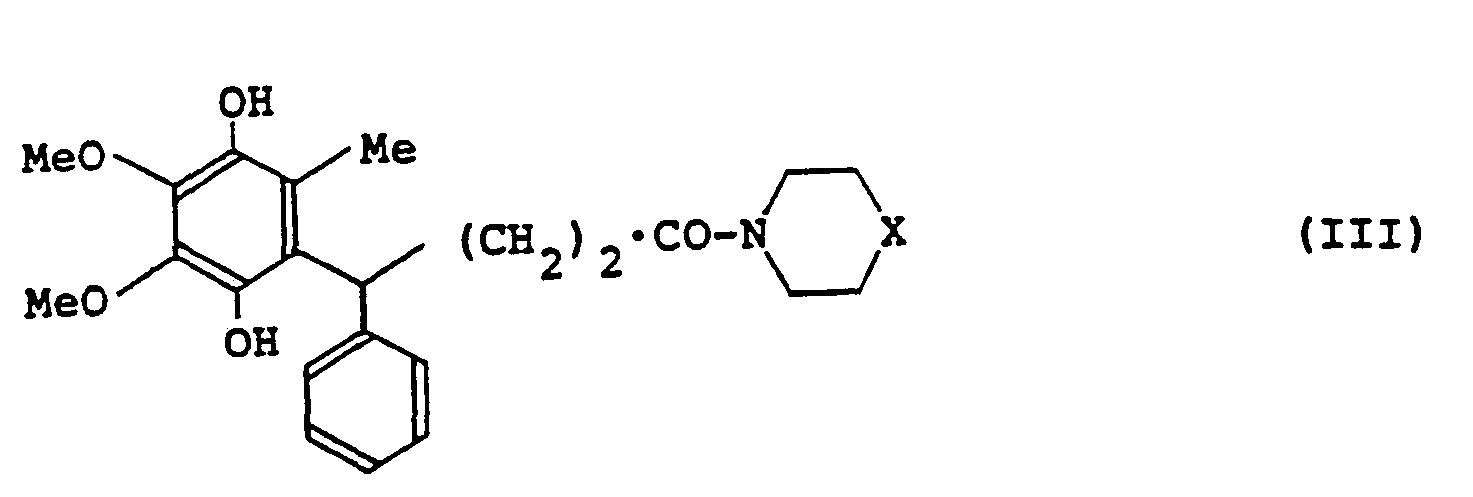
- The compound (II) is reacted with thiomorpholine, morpholine, or N-methylpiperazine to obtain the compounds having the general formula (III):

- The compounds (III) obtained above can be readily oxidized with an appropriate oxidizing agent such as ferric chloride, silver oxide, or ceric ammonium nitrate to obtain the compounds having the above-mentioned general formula (la).
- On the other hand, the compounds having the general formula (lb) according to the present invention


- As mentioned above, the derivatives of benzoquinonylphenyl alkanoic acid amides having the formula (I) according to the present invention are effective for ameliorating and curing various symptoms based on cerebral organic disorders and pathergasia. This is clear from the below-mentioned Evaluation Examples, because the present compounds (I) are effective for test animals having various cerebral anoxia and have an excellent antihypoxia activity against such test animals.
- When the present derivatives are used as a medicine, there are no critical limitations to the administration methods. The compounds having the general formula (I) according to the present invention can be administered alone or in combination with pharmaceutically acceptable conventional carrier's, excipients, and fillers in a (variety of dosage forms such as tablets, troches, pills, granules, powders, capsules, ampules, suppositories and the like. The excipients include, for example, starch, dextrin, sucrose, lactose, silic acid, carboxymethylcellulose, cellulose, geratin, polyvinylpyrrolidone, glycerin, agar, calcium carbonate, sodium bicarbonate, paraffin, cetyl alcohol, stearic acid esters, kaolin, bentonite, talc, calcium stearate, magnesium stearate, polyethyleneglycol, water, ethanol, isopropyl alcohol, propyleneglycol and the like. The present compounds also may be, for example, parenterally administered, in the form of, for example, injections or suppositories.
- Although there are no critical limitations to the dose range of the present cerebral insufficiency improver, the optimum dose range of the compound (I) of the present invention is 0.1-1000 mg, preferably 10 to 500 mg, per day. This dose range can be suitably changed depending upon, for example, the characteristics of the subjects including age, response, weight, severity of disease and the like, the administration methods, the dosage forms, and the dosing frequency.
- The present invention now will be further illustrated by, but is by no means limited to, the following Synthesis Examples, Formulation Examples, and Evaluation Examples.
-

- A 752 mg amount of 2,3-Dimethoxy-5-methyl-1,4-hydroquinone and 795 mg of y-phenyl-y-butyrolactone were added to 80 ml of polyphosphoric acid and the mixture was stirred at room temperature for 5 hours. The reaction mixture was poured into ice water, followed by extracting with ethyl ether. The extracted solution was washed with water and dried over anhydrous magnesium sulfate, and the solvent was then distilled off. The residue was subjected to a silica gel column by using hexane/ethyl acetate (3:1) as a solvent. Thus, 249 mg of the desired purified compound was obtained (yield = 18.6%).
- The physical properties of the resultant compound are as follows:
- State: oily substance
- IR spectrum (CHCI3, vmaxcm-1): 3500, 1752
- NMR spectrum (5 ppm): 2.21(3H, s), 2.302.70 (3H, m), 2.803.00 (1H, m), 3.83 (3H, s), 3.99 (3H, s), 4.55―4.70 (1H, m), 5.86 (1H, s), 7.10―7.35 (5H, m)
- A 380 mg amount of the benzoxepin-2-one derivative prepared in Reference Example and 597 mg of thiomorpholine were heated under reflux for 5 hours in toluene. The reaction mixture was concentrated under a reduced pressure and the residue was dissolved in 85% aqueous methanol. To the resultant solution, 22 g of ferric chloride was added, followed by stirring at room temperature for 15 minutes, and the reaction mixture was then poured into water. The mixture was extracted with ethyl acetate, and the extract was washed with water and dried over anhydrous magnesium sulfate. The solvent was then distilled off and the residue was purified by silica gel column chromatography using a hexane-ethyl acetate (1:1) solvent. Thus, 231 mg (yield = 46.5%) of the desired compound was obtained.
- The physical properties of the desired compound are shown in Table 1.
- A 280 mg amount of the benzoxepin-2-one derivative prepared in Reference Example and 111 mg of morpholine were heated under reflux for 10 hours. The reaction mixture was concentrated under a reduced pressure and the residue was dissolved in 75% aqueous methanol. To the resultant solution, 1.40 g of ceric ammonium nitrate was added, followed by stirring at room temperature for 20 minutes. The reaction product was purified in the same manner as in Synthetic Example 1, and thus 240 mg (yield = 68.1%) of the desired compound was obtained.
- The physical properties of the resultant compound are shown in Table 1.
- A 678 mg amount of the benzoxepin-2-one derivative and 310 mg of N-methylpiperazine were reacted and treated in the same manner as in Synthetic Example 1. Thus, 510 mg (yield = 57.9%) of the desired compound was obtained.
- The physical properties of the resultant compound are shown in Table 1.
- A 530 mg amount of 5-(3,4-dimethoxy-6-methyl-2,5-benzoquinonyl)-5-phenylpentanoic acid and 229 mg of thiomorpholine were dissolved in 60 ml of methylene chloride. To the resultant solution, 426 mg of DCC was added, followed by stirring at room temperature for 2 hours. The reaction mixture was poured into water, followed by extracting with methylene chloride, and the extracted solution was purified in the same manner as in Synthetic Example 1. Thus, 398 mg (yield = 60.7%) of the desired compound was obtained.
- The physical properties of the resultant compound are shown in Table 1.
- The desired compound was prepared in the same manner as in Synthetic Example 4, except that morpholine was used instead of the thiomorpholine. The yield was 61.3%.
- The physical properties of the resultant compound are shown in Table 1.
- The desired compound was prepared in the same manner as in Synthetic Example 4, except that N-methylpiperazine was used instead of the thiomorpholine. The yield was 74.9%.
- The physical properties of the resultant compound are shown in Table 1.


-
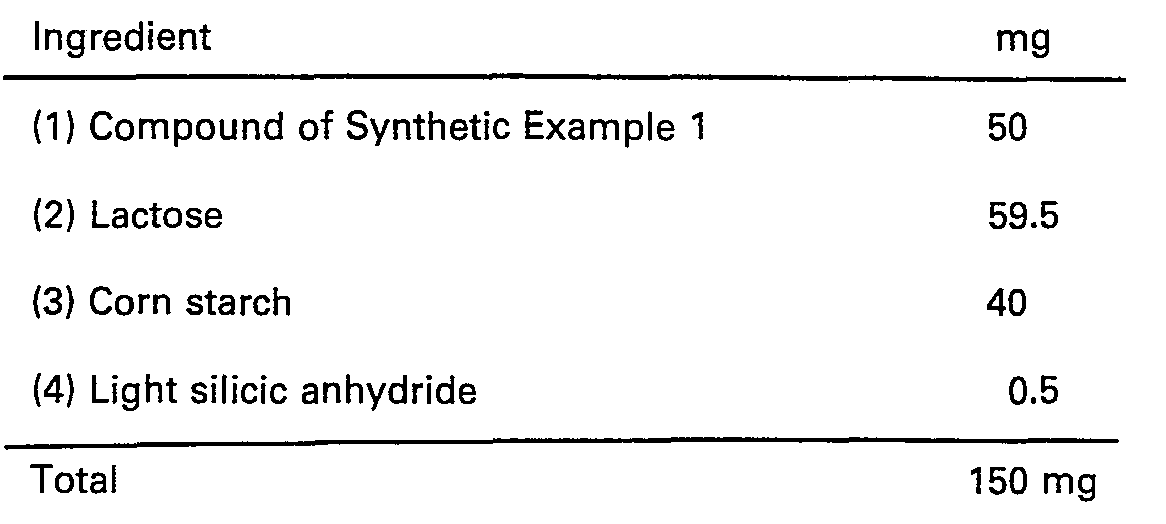
- The above-mentioned ingredients were thoroughly mixed in a conventional manner, and the resultant mixture filled into gelatin capsules.
-

- The above-mentioned ingredients were mixed and tableted in a conventional manner, to obtain, the desired tablets.
- The present compounds have low toxicities and excellent cerebral protecting activities (e.g., an excellent anti-cerebral ischemic activity and antihypoxia activity) as shown below.
- The activities of some compounds prepared in the above-mentioned Synthetic Examples and the Comparative Examples were evaluated as follows. The results are shown in Table 2.
- Male ddY mice having a body weight of 22 to 30 g were used (i.e., 7 to 10 mice in one group). The mice were placed in a desiccator having a volume of about 1 liter and the desiccator was evacuated and adjusted by a vacuum pump to a pressure of 180 mmHg. Then, the sample compound was intraperitoneally injected into the mice. The desiccator was evacuated 30 minutes after the injection and the time from the start of the evacuation to the termination of breathing by the mice was determined to be the survival time. If a mouse was still alive 15 minutes after exposure to the hypoxia, the survival time was assumed to be 15 minutes. The results were compared with a control group, to which only a liquid medium (e.g., physiological saline) was injected.
- Male ddY mice having a body weight of 22 to 30 g were used (i.e., 6 mice in one group). The sample compound was intraperitoneally injected into the mice and the mice were decapitated 30 minutes after the injection. After decapitation, the gasping times were determined. The results were compared with a control group to which only the liquid medium (i.e., physiological saline) was injected.
- Male ddY-STF mice having an age of 4 to 5 weeks and a body weight of 22 to 30 g were used for evaluating the acute toxicity of the present compounds. The sample compound was suspended in 1% arabic gum and was intraperitoneally injected. The compounds according to the present invention all had a low toxicity and no substantial toxic symptom was observed even at a dose of 1000 mg/kg,ip.

- As is clear from the results shown in Table 2, the present compounds exhibited effective activities in the hypobaric hypoxia test when compared to the comparative carboxylic acid derivatives. Thus, the present compounds are effective as a cerebral insufficiency improver.
Claims (8)


Priority Applications (1)
| Application Number | Priority Date | Filing Date | Title |
|---|---|---|---|
| AT87302575T ATE60328T1 (en) | 1986-03-29 | 1987-03-25 | DERIVATIVES OF BENZOQUINONYLPHENYLAKANOACID AMIDE. |
Applications Claiming Priority (4)
| Application Number | Priority Date | Filing Date | Title |
|---|---|---|---|
| JP61069771A JPH064582B2 (en) | 1986-03-29 | 1986-03-29 | Benzoquinonylphenyl butyric acid amide derivative |
| JP69771/86 | 1986-03-29 | ||
| JP61171703A JPH0717590B2 (en) | 1986-07-23 | 1986-07-23 | Benzoquinonylamide derivative |
| JP171703/86 | 1986-07-23 |
Publications (2)
| Publication Number | Publication Date |
|---|---|
| EP0240233A1 EP0240233A1 (en) | 1987-10-07 |
| EP0240233B1 true EP0240233B1 (en) | 1991-01-23 |
Family
ID=26410932
Family Applications (1)
| Application Number | Title | Priority Date | Filing Date |
|---|---|---|---|
| EP87302575A Expired EP0240233B1 (en) | 1986-03-29 | 1987-03-25 | Derivatives of benzoquinonyl-phenyl alkanoic acid amide |
Country Status (6)
| Country | Link |
|---|---|
| US (1) | US4774241A (en) |
| EP (1) | EP0240233B1 (en) |
| AT (1) | ATE60328T1 (en) |
| CA (1) | CA1283914C (en) |
| DE (1) | DE3767527D1 (en) |
| GR (1) | GR3001551T3 (en) |
Families Citing this family (7)
| Publication number | Priority date | Publication date | Assignee | Title |
|---|---|---|---|---|
| US5057514A (en) * | 1987-02-03 | 1991-10-15 | Suntory Limited | Compounds effective as cerebral schemia treating agents |
| US5179092A (en) * | 1987-12-22 | 1993-01-12 | Suntory Limited | Compound effective as cerebral insufficiency improver |
| US5292768A (en) * | 1987-12-22 | 1994-03-08 | Suntory Limited | Compound effective as cerebral insufficiency improver |
| US5512567A (en) * | 1988-08-24 | 1996-04-30 | Sankyo Company, Limited | Analgesic compounds, their preparation, and pharmaceutical compositions containing them |
| US5270327A (en) * | 1988-08-24 | 1993-12-14 | Sankyo Company, Limited | Analgesic compounds, their preparation, and pharmaceutical compositions containing them |
| US5021413B1 (en) * | 1988-08-24 | 1994-12-13 | Sankyo Co | Analgesic thiomorpholins, their preparation, and pharmaceutical compositions containing them |
| US5280032A (en) * | 1989-02-14 | 1994-01-18 | Toyama Chemical Co., Ltd. | 1,2-ethanediol derivative and salt thereof, process for producing the same, and cerebral function-improving agent comprising the same |
Family Cites Families (5)
| Publication number | Priority date | Publication date | Assignee | Title |
|---|---|---|---|---|
| JPS5640651A (en) * | 1979-09-12 | 1981-04-16 | Takeda Chem Ind Ltd | Quinone compound and its preparation |
| JPS5888370A (en) * | 1981-11-19 | 1983-05-26 | Hokuriku Seiyaku Co Ltd | 1-(3,4,5-trimethoxycinnamoyl)-4-aminocarbonylethyl- substituted piperazine and homopiperazine derivative and its preparation |
| FR2522325B1 (en) * | 1982-02-26 | 1985-08-09 | Delalande Sa | NOVEL ARYLIC DERIVATIVES OF PIPERAZINE, HOMOPIPERAZINE AND N, N'-DIALKYL DIAMINO-1,2 ETHANE, THEIR PREPARATION PROCESS AND THEIR THERAPEUTIC APPLICATION |
| MX9203040A (en) * | 1984-08-01 | 1992-07-31 | Takeda Chemical Industries Ltd | DERIVATIVES OF QUINONA AND PHARMACEUTICAL COMPOSITION THAT CONTAINS THEM. |
| WO1986000887A1 (en) * | 1984-08-01 | 1986-02-13 | Takeda Chemical Industries, Ltd. | Quinone derivatives, process for their preparation, and medicinal composition containing the same |
-
1987
- 1987-03-25 EP EP87302575A patent/EP0240233B1/en not_active Expired
- 1987-03-25 AT AT87302575T patent/ATE60328T1/en not_active IP Right Cessation
- 1987-03-25 DE DE8787302575T patent/DE3767527D1/en not_active Expired - Lifetime
- 1987-03-27 CA CA000533165A patent/CA1283914C/en not_active Expired - Lifetime
- 1987-03-27 US US07/030,557 patent/US4774241A/en not_active Expired - Lifetime
-
1991
- 1991-03-05 GR GR91400268T patent/GR3001551T3/en unknown
Also Published As
| Publication number | Publication date |
|---|---|
| GR3001551T3 (en) | 1992-11-23 |
| DE3767527D1 (en) | 1991-02-28 |
| EP0240233A1 (en) | 1987-10-07 |
| CA1283914C (en) | 1991-05-07 |
| ATE60328T1 (en) | 1991-02-15 |
| US4774241A (en) | 1988-09-27 |
Similar Documents
| Publication | Publication Date | Title |
|---|---|---|
| EP0202589B1 (en) | Pharmaceutical compositions containing ascorbic acid derivatives | |
| DE3783988T2 (en) | CYCLIC ENOL DERIVATIVES, PRODUCTION AND APPLICATION. | |
| KR930011300B1 (en) | Oxindole derivative | |
| EP0054951A1 (en) | Dibenz(b,f)(1,4)oxazepine derivatives, process for preparing the same, and pharmaceutical compositions comprising the same | |
| CN109776510A (en) | A kind of N- substituted imidazole formate ester derivative and application thereof | |
| US4774241A (en) | Derivative of benzoquinonylphenyl alkanoic acid amide | |
| EP0236227B1 (en) | Nitrate derivatives and their use as vasodilators | |
| EP1813270A1 (en) | Hsp90 family protein inhibitors | |
| JP3093419B2 (en) | 1,4-benzothiazepine derivatives | |
| JPS5827796B2 (en) | Theophyrinylmethyldioxolane derivative and its production method | |
| CN110003188B (en) | Substituted pyrrole formate derivative and application thereof | |
| JP2506337B2 (en) | Phenylmethylbenzoquinone derivative | |
| JPH0723367B2 (en) | Oxabicycloheptane derivative | |
| EP0298758B1 (en) | Hydroquinonylphenyl butyric acid amide derivative | |
| JPS6330459A (en) | Benzoquinolylamide derivative | |
| US2985653A (en) | New piperazinyl-alkyl-phenthiazines and their preparation | |
| US4792553A (en) | Diene derivatives and vasodilators containing the same | |
| US4360530A (en) | 5-[p-(Substituted)phenyl]-2,2-dialkyl-4-phenyl-3-oxazoline | |
| EP0204172B1 (en) | Phenylpyrazine derivatives, processes for preparing them, pharmaceutical composition and use | |
| US3047571A (en) | Derivatives of oxopiperidinyl phenthiazines | |
| JP2790335B2 (en) | Conjugated γ-oxybutenolide compound and anti-ulcer agent containing the same as active ingredient | |
| AU769948B2 (en) | Polyhydroalkylpyrazine derivatives and their preparation and medicines containing them | |
| EP0461343B1 (en) | Cyclopropachromen derivatives | |
| EP0175331B1 (en) | Piperazine derivatives | |
| JPH0363258A (en) | Hepatic disease preventive and therapeutic agent with bis(aminothiocarbonyl)disulfide compound as active ingredient |
Legal Events
| Date | Code | Title | Description |
|---|---|---|---|
| PUAI | Public reference made under article 153(3) epc to a published international application that has entered the european phase |
Free format text: ORIGINAL CODE: 0009012 |
|
| AK | Designated contracting states |
Kind code of ref document: A1 Designated state(s): AT BE CH DE FR GB GR IT LI LU NL SE |
|
| 17P | Request for examination filed |
Effective date: 19880224 |
|
| 17Q | First examination report despatched |
Effective date: 19900307 |
|
| GRAA | (expected) grant |
Free format text: ORIGINAL CODE: 0009210 |
|
| AK | Designated contracting states |
Kind code of ref document: B1 Designated state(s): AT BE CH DE FR GB GR IT LI LU NL SE |
|
| REF | Corresponds to: |
Ref document number: 60328 Country of ref document: AT Date of ref document: 19910215 Kind code of ref document: T |
|
| ITF | It: translation for a ep patent filed | ||
| ET | Fr: translation filed | ||
| REF | Corresponds to: |
Ref document number: 3767527 Country of ref document: DE Date of ref document: 19910228 |
|
| PLBE | No opposition filed within time limit |
Free format text: ORIGINAL CODE: 0009261 |
|
| STAA | Information on the status of an ep patent application or granted ep patent |
Free format text: STATUS: NO OPPOSITION FILED WITHIN TIME LIMIT |
|
| 26N | No opposition filed | ||
| REG | Reference to a national code |
Ref country code: GR Ref legal event code: FG4A Free format text: 3001551 |
|
| PGFP | Annual fee paid to national office [announced via postgrant information from national office to epo] |
Ref country code: AT Payment date: 19930210 Year of fee payment: 7 |
|
| PGFP | Annual fee paid to national office [announced via postgrant information from national office to epo] |
Ref country code: GR Payment date: 19930211 Year of fee payment: 7 |
|
| PGFP | Annual fee paid to national office [announced via postgrant information from national office to epo] |
Ref country code: BE Payment date: 19930218 Year of fee payment: 7 |
|
| PGFP | Annual fee paid to national office [announced via postgrant information from national office to epo] |
Ref country code: SE Payment date: 19930326 Year of fee payment: 7 |
|
| PGFP | Annual fee paid to national office [announced via postgrant information from national office to epo] |
Ref country code: NL Payment date: 19930331 Year of fee payment: 7 |
|
| PGFP | Annual fee paid to national office [announced via postgrant information from national office to epo] |
Ref country code: LU Payment date: 19940228 Year of fee payment: 8 |
|
| PG25 | Lapsed in a contracting state [announced via postgrant information from national office to epo] |
Ref country code: AT Effective date: 19940325 |
|
| PG25 | Lapsed in a contracting state [announced via postgrant information from national office to epo] |
Ref country code: SE Free format text: LAPSE BECAUSE OF NON-PAYMENT OF DUE FEES Effective date: 19940326 |
|
| EPTA | Lu: last paid annual fee | ||
| PG25 | Lapsed in a contracting state [announced via postgrant information from national office to epo] |
Ref country code: BE Effective date: 19940331 |
|
| BERE | Be: lapsed |
Owner name: SUNTORY LTD Effective date: 19940331 |
|
| PG25 | Lapsed in a contracting state [announced via postgrant information from national office to epo] |
Ref country code: GR Free format text: THE PATENT HAS BEEN ANNULLED BY A DECISION OF A NATIONAL AUTHORITY Effective date: 19940930 |
|
| PG25 | Lapsed in a contracting state [announced via postgrant information from national office to epo] |
Ref country code: NL Effective date: 19941001 |
|
| NLV4 | Nl: lapsed or anulled due to non-payment of the annual fee | ||
| EUG | Se: european patent has lapsed |
Ref document number: 87302575.3 Effective date: 19941010 |
|
| REG | Reference to a national code |
Ref country code: GR Ref legal event code: MM2A Free format text: 3001551 |
|
| PG25 | Lapsed in a contracting state [announced via postgrant information from national office to epo] |
Ref country code: LU Free format text: LAPSE BECAUSE OF NON-PAYMENT OF DUE FEES Effective date: 19950325 |
|
| PGFP | Annual fee paid to national office [announced via postgrant information from national office to epo] |
Ref country code: FR Payment date: 20000310 Year of fee payment: 14 |
|
| PGFP | Annual fee paid to national office [announced via postgrant information from national office to epo] |
Ref country code: DE Payment date: 20000318 Year of fee payment: 14 |
|
| PGFP | Annual fee paid to national office [announced via postgrant information from national office to epo] |
Ref country code: GB Payment date: 20000322 Year of fee payment: 14 |
|
| PGFP | Annual fee paid to national office [announced via postgrant information from national office to epo] |
Ref country code: CH Payment date: 20000328 Year of fee payment: 14 |
|
| PG25 | Lapsed in a contracting state [announced via postgrant information from national office to epo] |
Ref country code: GB Free format text: LAPSE BECAUSE OF NON-PAYMENT OF DUE FEES Effective date: 20010325 |
|
| PG25 | Lapsed in a contracting state [announced via postgrant information from national office to epo] |
Ref country code: LI Free format text: LAPSE BECAUSE OF NON-PAYMENT OF DUE FEES Effective date: 20010331 Ref country code: CH Free format text: LAPSE BECAUSE OF NON-PAYMENT OF DUE FEES Effective date: 20010331 |
|
| GBPC | Gb: european patent ceased through non-payment of renewal fee |
Effective date: 20010325 |
|
| REG | Reference to a national code |
Ref country code: CH Ref legal event code: PL |
|
| PG25 | Lapsed in a contracting state [announced via postgrant information from national office to epo] |
Ref country code: FR Free format text: LAPSE BECAUSE OF NON-PAYMENT OF DUE FEES Effective date: 20011130 |
|
| REG | Reference to a national code |
Ref country code: FR Ref legal event code: ST |
|
| PG25 | Lapsed in a contracting state [announced via postgrant information from national office to epo] |
Ref country code: DE Free format text: LAPSE BECAUSE OF NON-PAYMENT OF DUE FEES Effective date: 20020101 |
|
| PG25 | Lapsed in a contracting state [announced via postgrant information from national office to epo] |
Ref country code: IT Free format text: LAPSE BECAUSE OF NON-PAYMENT OF DUE FEES;WARNING: LAPSES OF ITALIAN PATENTS WITH EFFECTIVE DATE BEFORE 2007 MAY HAVE OCCURRED AT ANY TIME BEFORE 2007. THE CORRECT EFFECTIVE DATE MAY BE DIFFERENT FROM THE ONE RECORDED. Effective date: 20050325 |