EP0239414A1 - N-Benzyl-2-(4-fluoro-3-trifluoromethylphenoxy) butanoic amide and herbicidal composition containing the same - Google Patents
N-Benzyl-2-(4-fluoro-3-trifluoromethylphenoxy) butanoic amide and herbicidal composition containing the same Download PDFInfo
- Publication number
- EP0239414A1 EP0239414A1 EP87302664A EP87302664A EP0239414A1 EP 0239414 A1 EP0239414 A1 EP 0239414A1 EP 87302664 A EP87302664 A EP 87302664A EP 87302664 A EP87302664 A EP 87302664A EP 0239414 A1 EP0239414 A1 EP 0239414A1
- Authority
- EP
- European Patent Office
- Prior art keywords
- fluoro
- benzyl
- compound
- trifluoromethylphenoxy
- butanoic
- Prior art date
- Legal status (The legal status is an assumption and is not a legal conclusion. Google has not performed a legal analysis and makes no representation as to the accuracy of the status listed.)
- Granted
Links
- 0 *c(cc1)cc(C(F)(F)F)c1F Chemical compound *c(cc1)cc(C(F)(F)F)c1F 0.000 description 6
Classifications
-
- A—HUMAN NECESSITIES
- A01—AGRICULTURE; FORESTRY; ANIMAL HUSBANDRY; HUNTING; TRAPPING; FISHING
- A01N—PRESERVATION OF BODIES OF HUMANS OR ANIMALS OR PLANTS OR PARTS THEREOF; BIOCIDES, e.g. AS DISINFECTANTS, AS PESTICIDES OR AS HERBICIDES; PEST REPELLANTS OR ATTRACTANTS; PLANT GROWTH REGULATORS
- A01N39/00—Biocides, pest repellants or attractants, or plant growth regulators containing aryloxy- or arylthio-aliphatic or cycloaliphatic compounds, containing the group or, e.g. phenoxyethylamine, phenylthio-acetonitrile, phenoxyacetone
- A01N39/02—Aryloxy-carboxylic acids; Derivatives thereof
Definitions
- This invention relates to an N-benzyl-2-(4-fluoro-3-trifluoromethylphenoxy)butanoic amide which is a novel compound and a herbicidal composition containing the same.
- X and Y each represent a hydrogen atom, a lower alkyl group, a lower alkoxy group, a propionyl group, a nitro group, a cyano group or a halogen atom;
- R1 represents a lower alkyl group;
- R2 represents a hydrogen atom, a lower alkyl group or a lower alkenyl group;
- R3 represents a hydrogen atom or a lower alkyl group;
- Z represents a phenyl group, a furyl group, a thienyl group, a pyridyl group or a naphthyl group and hydrogen atoms of the phenyl group may be substituted by a lower alkyl group,
- 2-phenoxyalkanoic amide deriatives represented by the following general formula: wherein X′ represents a hydrogen atom or a halogen atom; R′1 represents a lower alkyl group; R′2 represents a hydrogen atom, a lower alkyl group, a lower alkenyl group, a lower alkynyl group or a lower alkoxy group; R′3 represents a hydrogen atom or a lower alkyl group; and Y′ represents a phenyl group, a thienyl group, a pyridyl group or a furyl group and hydrogen atoms of the phenyl group may be replaced by a lower alkyl group, a lower alkoxy group or a halogen atom, has a herbicidal function.
- An object of the present invention is to provide a novel compound and a herbicidal composition containing the same in which broadleaf weeds which is difficult to control and causes serious problem for growing a principal grain, particularly barley, wheat, etc. are effectively prevented to grow and removed.
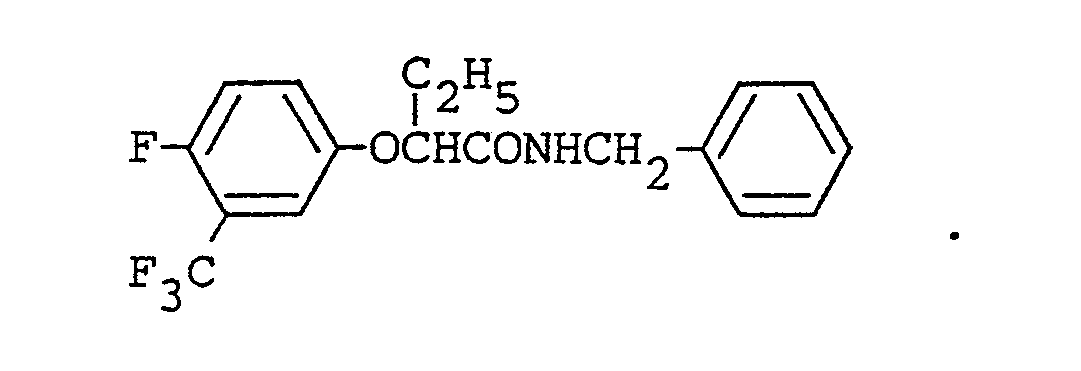
- An N-benzyl-2-(4-fluoro-3-trifluoromethylphenoxy)butanoic amide of the present invention comprises having the formula (I) shown below: and a herbicidal composition of the present invention comprises containing the N-benzyl-2-(4-fluoro-3-trifluoromethylphenoxy)butanoic amide as an effective ingredient.
- the N-benzyl-2-(4-fluoro-3-trifluoromethylphenoxy) butanoic amide of the present invention has extremely low in toxicity to a homoiothermic animal and LD50 thereof is 5000 mg/Kg or more in both cases of an oral administration and a subcutaneous administration to rats. Further, no stimulation to eyes or skin is observed and no toxicity to fishes and shellfishes as well as no offensive odor are present so that it has various excellent characteristic features.
- the compound represented by the formula (I) may be an optically active isomer and (-)-N-benzyl-2-(4-fluoro-3-trifluoromethylphenoxy)butanoic amide is particularly preferred in view of strong herbicidal activity when prepared a herbicidal composition.
- N-benzyl-2-(4-fluoro-3-trifluoromethylphenoxy)butanoic amide represented by the formula (I) of the present invention can be prepared, for example, by the following reaction formula (l) or (2): wherein, in the above formulae, X represents a halogen atom, and R represents a lower alkyl group.
- the reaction in the formula (l) may preferably be carried out in the presence of a suitable solvent by adding, as the de-hydrogen halide agent, a tertiary amine such as triethylamine, dimethylaniline and pyridine, or a carbonate such as sodium carbonate and potassium carbonate.
- a suitable solvent for adding, as the de-hydrogen halide agent, a tertiary amine such as triethylamine, dimethylaniline and pyridine, or a carbonate such as sodium carbonate and potassium carbonate.
- a suitable solvent by adding, as the de-hydrogen halide agent, a tertiary amine such as triethylamine, dimethylaniline and pyridine, or a carbonate such as sodium carbonate and potassium carbonate.
- an aromatic hydrocarbon such as benzene, toluene and xylene
- an ether such as diethylether, tetrahydrofuran and diox
- the reaction temperature varies depending upon the kinds of reagents and solvents to be used and is not particularly limited, but it is preferably be carried out at - l0 to l00 °C.
- the reaction time may be about l to l0 hours.
- the reaction of the formula (2) may preferably be carried out by adding a metal lower alcoholate such as sodium methoxide and sodium ethoxide in an amount of 0.03 to 0.3 mole per mole of a reaction substrate.
- a metal lower alcoholate such as sodium methoxide and sodium ethoxide in an amount of 0.03 to 0.3 mole per mole of a reaction substrate.
- the reaction solvent there may be used a lower alcohol such as methanol, ethanol and propanol, and an aromatic hydrocarbon such as benzene, toluene and xylene.
- the reaction temperature and time varies depending upon a kind and amount of the alkali to be added and the solvent to be added and are not particularly limited, but, for example, it can be carried out at a temperature of 0 to 50 °C for l to l5 hours whereby the compound can be obtained with good yield.
- optically active isomer of the compound represented by the formula (I) can be prepared, for example, by the following reaction formula (3):
- herbicidal composition of the present invention contains N-benzyl-2-(4-fluoro-3-trifluoromethylphenoxy)butanoic amide represented by the formula (I) as an active ingredient, other compounds which have herbicidal effect, than the compound represented by the formula (I) may be contained as active ingredients.
- R′ represents -OCH3 or -CH3, more specifically, N-3-chloro-4-methylphenyl-N′,N′-dimethylurea (compound A-l), N-4-isopropylphenyl-N′,N′-dimethylurea (compound A-2) and N-3,4-dichlorophenyl-N′-methyl-N′-methoxyurea (compound A-3), etc.; 4-amino-6-(l,l-dimethylethyl)-3-(methylthio)-l,2,4-triazin-5(4H)-one (compound B); ⁇ , ⁇ , ⁇ -trifluoro-2,6-dinitro-N,N-dipropyl-p-toluidine (compound C); S-(p-chlorobenzyl)-N,N-dieth
- the herbicidal composition containing the N-benzyl-2-(4-fluoro-3-trifluoromethylphenoxy)butanoic amide as an active ingredient may be formulated for use to the preparations of any form commonly employed as the agricultural formulation, by using an inert solid carrier, liquid carrier, emulsifying dispersant and the like, for example, granules, dusts, emulsions, wettable powders, tablets, lubricants, aerosols, fumigants and so on.
- inert carriers there may be mentioned, for example, talc, clay, kaoline, diatomaceous earth, calcium carbonate, potassium chlorate, saltpeter, wood powder, nitrocellulose, starch, benzene, xylene, n-hexane, gum arabic, vinyl chloride, carbon dioxide, fleon, propane, butane and the like. Further, it may be optionally blended with any auxiliary agents for preparation, for example, spreaders, diluents, surface active agents, solvents and the like. Moreover, it may be optionally admixed with fungicides, insecticides and other herbicides; urea, ammonium sulfate, ammonium phosphate, potassium salts and other fertilizers; soil conditioners and the like.
- An amount of the N-benzyl-2-(4-fluoro-3-trifluoromethylphenoxy)butanoic amide to be contained in the herbicidal composition of the present invention is within the range of about l to about 90 % by weight.
- the herbicidal composition containing the compound represented by the formula (I) of the present invention as an active ingredient When applied to weeds, it acts to make lacking chlorophyll in the weeds whereby inhibit photosynthesis thereof and kills away or controls the weeds.
- the compound of the present invention was prepared. First, after 4.2 g (0.039 mole) of benzylamine and 3.l g (0.039 mole) of pyridine were dissolved in 50 ml of toluene, ll.0 g (0.039 mole) of 2-(4-fluoro-3-trifluoromethylphenoxy)butanoic chloride was graduarlly added dropwise to the solution under stirring at room temperature. After dropwise addition, the mixture was further stirred for 3 hours at room temperature, and the reaction mixture was then washed with a diluted hydrochloric acid, diluted sodium hydroxide and water with the order.
- the compound of the present invention was prepared. First, after l47 g (0.50 mole) of 2-(4-fluoro-3-trifluoromethylphenoxy)butanic acid ethyl ester and 53.5 g (0.50 mole) of benzylamine were dissolved in 3l4 ml of toluene, 20.0 g (0.l0 mole) of sodium methoxide (28 % methanol solution) was added to the solution and the mixture was stirred at room temperature for 7 hours.
- the compound of the present invention was prepared. First, after l40 g (0.50 mole) of 2-(4-fluoro-3-trifluoromethylphenoxy)butanic acid methyl ester and 53.5 g (0.50 mole) of benzylamine were dissolved in 300 ml of methanol, l0.0 g (0.052 mole) of sodium methoxide (28 % methanol solution) was added to the solution and the mixture was stirred at room temperature for l0 hours.
- a pot having an area of l/5000 are was packed with an upland soil (sandy loam soil) and then seeds of the following plants were sowed therein.
- Wheat Triticum aestivum Barley Hordeum vulgare Oats Avena sativa Cleavers Galium aparine Speedwell Veronica persica White dead nettle Lamium purpureum Red poppy Papaver rhoeas Matoricaria Matoricaria inodora
- a pot having an area of l/5000 are was packed with an upland soil (sandy loam soil) and then seeds of the following plants were sowed therein.
- Wheat Triticum aestivum Barley Hordeum vulgare Oats Avena sativa Cleavers Galium aparine Speedwell Veronica persica White dead nettle Lamium purpureum Red poppy Papaver rhoeas Matoricaria Matoricaria inodora
- each wettable powder of sample compounds which had been prepared in the same manner as in Experiment l above, was sprayed uniformly with a dosage shown in Tables 3 and 4 by using a pressure sprayer. Three weeks after the spreading treatment, the herbicidal effects of each test compound were assested. The results are shown in Tables 3 and 4. Standard of assessment of the crop injury and the herbicidal effects in the Tables are the same with Experiment l.
- the herbicidal composition of the present invention is harmless against wheats and has great herbicidal effects to weeds by soil and foliar cereal crops.
- each l0 kinds of solutions having different concentration as shown in Table 5 of the compound obtained in Example l (racemic modification) and the compound obtained in Example 6 (optical active isomer) were prepared.
- l0 ml of aforesaid each aqueous solution was added and 20 seeds of large crub-grass ( Digitalia sanguinalis ) were sowed in each of the petri dishes.
- the seeds were grown up in a thermostat controlled at 25 °C under 5000 luxes illumination.
- l0 sheets of first leaf of large crub-grass were collected per each culture dish and extracted with l0 ml of hot ethanol.
- Evaluations concerning obstruction to accumulation of the chlorophyll were indicated as the value (%) relative to the total amount of chlorophyll extracted from the l0 sheets of first leaf of non-treated large crub-grass.
- the herbicidal composition of the present invention containing N-benzyl-2-(4-fluoro-3-trifluoromethylphenoxy)butanoic amide of the present invention as an active ingredient is completely safty to cereals such as barley, wheat and oats and shows extremely excellent herbicidal activity against, needless to say, weeds to grasses such as foxtail and annual poa which exert a harmful influence upon a wheat crop, and against various broad-leaved weeds as well such as cleavers, speedwell, white dead nettle, red poppy and matoricaria which are weeds particularly difficult to control by the conventional herbicidal compositions.
Landscapes
- Life Sciences & Earth Sciences (AREA)
- Agronomy & Crop Science (AREA)
- Pest Control & Pesticides (AREA)
- Plant Pathology (AREA)
- Health & Medical Sciences (AREA)
- Engineering & Computer Science (AREA)
- Dentistry (AREA)
- General Health & Medical Sciences (AREA)
- Wood Science & Technology (AREA)
- Zoology (AREA)
- Environmental Sciences (AREA)
- Organic Low-Molecular-Weight Compounds And Preparation Thereof (AREA)
- Agricultural Chemicals And Associated Chemicals (AREA)
Abstract
Description
- This invention relates to an N-benzyl-2-(4-fluoro-3-trifluoromethylphenoxy)butanoic amide which is a novel compound and a herbicidal composition containing the same.
- Heretofore, as compounds which show herbicidal effects, there have been known various compounds. For example, as function of killing weeds of a 2-phenoxybutanoic amide type compounds, there have been disclosed in U.S. Patents No. 3,840,596, No. 3,852,345, No. 4,05l,l84, No. 4,087,277, No. 4,ll6,677 and No. 4,ll9,433; Japanese Provisional Patent Publications No. 67653/l983, No. ll3l55/l983 and No. 29645/l984; and the like.
- The above six U.S. Patents each discloses amide derivatives of aliphatic amines such as lower alkylamines, lower alkynylamines, cyanoalkylamines and lower alkoxyamines with 2-phenoxybutanoic acid, and there is neither disclosed in the specification of the above prior art references concerning amide derivatives of benzylamine to be used in the present invention and 2-phenoxybutanoic acid, i.e., N-benzyl-2-phenoxybutanoic amide series compounds at all.
- Further, in the above Japanese Provisional Patent Publications No. 67653/l983, No. ll3l55/l983 and No. 29645/l984, there are disclosed summarily that the phenoxyalkanoic amide derivative represented by the following general formula:

has a herbicidal function. However, the compound of the present invention is that X in the above general formula is a fluorine atom and Y is a trifluoromethyl group and there is not disclosed concerning the compound in the above three Japanese Provisional Patent Publications at all. - Further, in the above Japanese Provisional Patent Publication No. 29645/l984, there is disclosed that 2-phenoxyalkanoic amide deriatives represented by the following general formula:
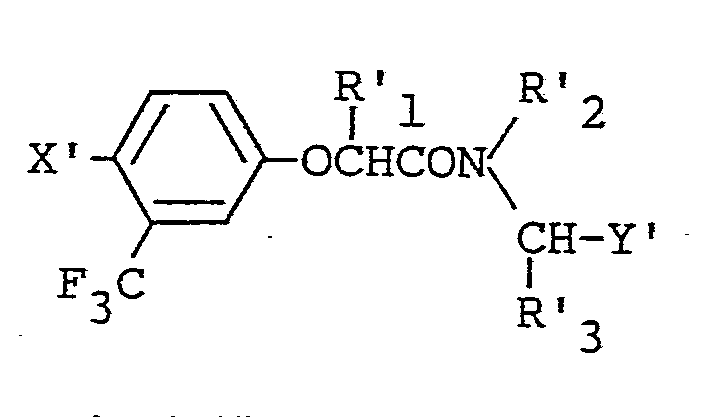
has a herbicidal function. However, in the above publication, while the substituent X′ in the compound represented by the above formula is defined as a halogen atom, only the case where the halogen atom is a chlorine atom is disclosed in the examples thereof and the herbicidal effect of the case is insufficient. - An object of the present invention is to provide a novel compound and a herbicidal composition containing the same in which broadleaf weeds which is difficult to control and causes serious problem for growing a principal grain, particularly barley, wheat, etc. are effectively prevented to grow and removed.
- An N-benzyl-2-(4-fluoro-3-trifluoromethylphenoxy)butanoic amide of the present invention comprises having the formula (I) shown below:

- The N-benzyl-2-(4-fluoro-3-trifluoromethylphenoxy) butanoic amide of the present invention has extremely low in toxicity to a homoiothermic animal and LD₅₀ thereof is 5000 mg/Kg or more in both cases of an oral administration and a subcutaneous administration to rats. Further, no stimulation to eyes or skin is observed and no toxicity to fishes and shellfishes as well as no offensive odor are present so that it has various excellent characteristic features. Also, the compound represented by the formula (I) may be an optically active isomer and (-)-N-benzyl-2-(4-fluoro-3-trifluoromethylphenoxy)butanoic amide is particularly preferred in view of strong herbicidal activity when prepared a herbicidal composition.
- The N-benzyl-2-(4-fluoro-3-trifluoromethylphenoxy)butanoic amide represented by the formula (I) of the present invention can be prepared, for example, by the following reaction formula (l) or (2):

- The reaction in the formula (l) may preferably be carried out in the presence of a suitable solvent by adding, as the de-hydrogen halide agent, a tertiary amine such as triethylamine, dimethylaniline and pyridine, or a carbonate such as sodium carbonate and potassium carbonate. As the solvent to be used in the reaction, there may be mentioned an aromatic hydrocarbon such as benzene, toluene and xylene; an ether such as diethylether, tetrahydrofuran and dioxane; and a ketone such as dimethyl ketone and methyl ethyl ketone. The reaction temperature varies depending upon the kinds of reagents and solvents to be used and is not particularly limited, but it is preferably be carried out at - l0 to l00 °C. The reaction time may be about l to l0 hours. Also, the reaction of the formula (2) may preferably be carried out by adding a metal lower alcoholate such as sodium methoxide and sodium ethoxide in an amount of 0.03 to 0.3 mole per mole of a reaction substrate. As the reaction solvent, there may be used a lower alcohol such as methanol, ethanol and propanol, and an aromatic hydrocarbon such as benzene, toluene and xylene. The reaction temperature and time varies depending upon a kind and amount of the alkali to be added and the solvent to be added and are not particularly limited, but, for example, it can be carried out at a temperature of 0 to 50 °C for l to l5 hours whereby the compound can be obtained with good yield.
- Further, the optically active isomer of the compound represented by the formula (I) can be prepared, for example, by the following reaction formula (3):

- While the herbicidal composition of the present invention contains N-benzyl-2-(4-fluoro-3-trifluoromethylphenoxy)butanoic amide represented by the formula (I) as an active ingredient, other compounds which have herbicidal effect, than the compound represented by the formula (I) may be contained as active ingredients.
- As the compounds having herbicidal effects, there may be mentioned, for example, the compound represented by the following formula (compound A):

- The herbicidal composition containing the N-benzyl-2-(4-fluoro-3-trifluoromethylphenoxy)butanoic amide as an active ingredient may be formulated for use to the preparations of any form commonly employed as the agricultural formulation, by using an inert solid carrier, liquid carrier, emulsifying dispersant and the like, for example, granules, dusts, emulsions, wettable powders, tablets, lubricants, aerosols, fumigants and so on. As the inert carriers, there may be mentioned, for example, talc, clay, kaoline, diatomaceous earth, calcium carbonate, potassium chlorate, saltpeter, wood powder, nitrocellulose, starch, benzene, xylene, n-hexane, gum arabic, vinyl chloride, carbon dioxide, fleon, propane, butane and the like. Further, it may be optionally blended with any auxiliary agents for preparation, for example, spreaders, diluents, surface active agents, solvents and the like. Moreover, it may be optionally admixed with fungicides, insecticides and other herbicides; urea, ammonium sulfate, ammonium phosphate, potassium salts and other fertilizers; soil conditioners and the like.
- An amount of the N-benzyl-2-(4-fluoro-3-trifluoromethylphenoxy)butanoic amide to be contained in the herbicidal composition of the present invention is within the range of about l to about 90 % by weight.
- When the herbicidal composition containing the compound represented by the formula (I) of the present invention as an active ingredient is applied to weeds, it acts to make lacking chlorophyll in the weeds whereby inhibit photosynthesis thereof and kills away or controls the weeds.
- In the following, the present invention will be explained in more detail by referring to Examples and Experiments. All parts in each Examples are given by parts by weight hereinafter unless otherwise stated.
- In accordance with the above reaction formula (l), the compound of the present invention was prepared. First, after 4.2 g (0.039 mole) of benzylamine and 3.l g (0.039 mole) of pyridine were dissolved in 50 ml of toluene, ll.0 g (0.039 mole) of 2-(4-fluoro-3-trifluoromethylphenoxy)butanoic chloride was graduarlly added dropwise to the solution under stirring at room temperature. After dropwise addition, the mixture was further stirred for 3 hours at room temperature, and the reaction mixture was then washed with a diluted hydrochloric acid, diluted sodium hydroxide and water with the order. After the toluene layer was dehydrated with anhydrous sodium sulfate, toluene was distilled out under reduced pressure. Resulting crude crystal was recrystallized from toluene to give l2.8 g (Yield: 92 %) of N-benzyl-2-(4-fluoro-3-trifluoromethylphenoxy)butanoic amide having a melting point of 75 to 76 °C as colorless needle crystals.
-

- In accordance with the above reaction formula (2), the compound of the present invention was prepared. First, after l47 g (0.50 mole) of 2-(4-fluoro-3-trifluoromethylphenoxy)butanic acid ethyl ester and 53.5 g (0.50 mole) of benzylamine were dissolved in 3l4 ml of toluene, 20.0 g (0.l0 mole) of sodium methoxide (28 % methanol solution) was added to the solution and the mixture was stirred at room temperature for 7 hours.
- Then, after the reaction mixture was washed with a lN aqueous hydrochloric acid and water with the order, and dehydrated with anhydrous magnesium sulfate, toluene was distilled out under reduced pressure. To the resulting yellowish oily product was added 200 ml of n-hexane, and the mixture was stirred to give crude crystal. Resulting crude crystal was recrystallized from ethanol to give l53 g (Yield: 86 %) of N-benzyl-2-(4-fluoro-3-trifluoromethylphenoxy)butanoic amide having a melting point of 75 to 76 °C as colorless needle crystals.
- In accordance with the above reaction formula (2), the compound of the present invention was prepared. First, after l40 g (0.50 mole) of 2-(4-fluoro-3-trifluoromethylphenoxy)butanic acid methyl ester and 53.5 g (0.50 mole) of benzylamine were dissolved in 300 ml of methanol, l0.0 g (0.052 mole) of sodium methoxide (28 % methanol solution) was added to the solution and the mixture was stirred at room temperature for l0 hours.
- Then, methanol was distilled out under reduced pressure, and the product was dissolved with addition of 360 ml of toluene. Thereafter, the reaction mixture was washed with a lN aqueous hydrochloric acid and water with the order, and dehydrated with anhydrous magnesium sulfate, toluene was distilled out under reduced pressure. To the resulting yellowish oily product was added 200 ml of n-hexane, and the mixture was stirred to give crude crystal. Resulting crude crystal was recrystallized from ethanol to give l48 g (Yield: 83 %) of N-benzyl-2-(4-fluoro-3-trifluoromethylphenoxy)butanoic amide having a melting point of 75 to 76 °C as colorless needle crystals.
- l0 parts of N-benzyl-2-(4-fluoro-3-trifluoromethylphenoxy)butanoic amide, 80 parts of xylene and l0 parts of Solvol 800 (surface active agent, trade name) were mixed and dissoled to give an emulsion type herbicidal composition.
- 50 parts of N-benzyl-2-(4-fluoro-3-trifluoromethylphenoxy)butanoic amide, 30 parts of kaolin, l5 parts of bentonite and 5 parts of sodium lignosulfonate were blended and kneaded to give a wettable powder type herbicidal composition.
- A pot having an area of l/5000 are was packed with an upland soil (sandy loam soil) and then seeds of the following plants were sowed therein. Wheat Triticum aestivum
Barley Hordeum vulgare
Oats Avena sativa
Cleavers Galium aparine
Speedwell Veronica persica
White dead nettle Lamium purpureum
Red poppy Papaver rhoeas
Matoricaria Matoricaria inodora
- Then, after covering seeds with soil, diluted solution of a wettable powder prepared according to Example 5 of the present compound and diluted solutions of wettable powders in which each compound shown in Tables l and 2 prepared in the same manner as in Example 5 were uniformly sprayed on the surface layer thereof with a dosage shown in the tables by using a pressure sprayer. Three weeks after the spreading treatment, the herbicidal effects of each test compound were assessed. The results are shown in Tables l and 2. In Table l, compounds No. l to No. 4 are compounds disclosed in Japanese Provisional Patent Publication No. 67653/l983, compounds No. 5 and 6 are those disclosed in Japanese Provisional Patent Publication No. ll3l55/l983, compounds No. 7 to No. 9 are compounds disclosed in Japanese Provisional Patent Publication No. ll3l56/l983 and compounds No. l0 to l2 are those disclosed in Japanese Provisional Patent Publication No. 29645/l984. In Table 2, compounds No. 20 to No. 2l are compounds disclosed in U.S. Patent No. 4,05l,l84 and compound No. 22 is a compound disclosed in U.S. Patent No. 4,087,277. Further, in Tables l and 2, the crop injury and herbicidal effects are evaluated according to the following standards:
5: All killed, 4: Severely damaged,
3: Moderately damaged, 2: Slightly damaged,
l: Minor damaged, and 0: None (normal development).


- A pot having an area of l/5000 are was packed with an upland soil (sandy loam soil) and then seeds of the following plants were sowed therein. Wheat Triticum aestivum
Barley Hordeum vulgare
Oats Avena sativa
Cleavers Galium aparine
Speedwell Veronica persica
White dead nettle Lamium purpureum
Red poppy Papaver rhoeas
Matoricaria Matoricaria inodora
- When wheat, barley and orats grew up to 2 to 3 leaf stage, cleavers grew up to 4 to 5 leaf stage and other weeds grew up to 2 leaf stage, each wettable powder of sample compounds, which had been prepared in the same manner as in Experiment l above, was sprayed uniformly with a dosage shown in Tables 3 and 4 by using a pressure sprayer. Three weeks after the spreading treatment, the herbicidal effects of each test compound were assested. The results are shown in Tables 3 and 4. Standard of assessment of the crop injury and the herbicidal effects in the Tables are the same with Experiment l.


- As clearly seen from the Tables, the herbicidal composition of the present invention is harmless against wheats and has great herbicidal effects to weeds by soil and foliar cereal crops.
- Optical active isomer of the compound represented by the formula (I) was prepared in accordance with the above formula (3).
-

- After l0 g (37.6 mmole) of 2-(4-fluoro-3-trifluoromethylphenoxy)butanoic acid was dissolved in 50 ml of toluene, 4.55 g (37.6 mmole) of L-(-)-α-phenylethylamine was added to the solution and the mixture was stirred at 25 °C for l hour. Then, toluene was removed under reduced pressure to isolate the salt of L-(-)-α-phenylethylamine and 2-(4-fluoro-3-trifluoromethylphenoxy)butanoic acid. l4.5 g (37.5 mmole) of the resulting salt was added to 220 ml of carbon tetrachloride, and the mixture was dissolved by heating and stirring, gradually cooled to room temperature, and then allowed to stand at room temperature for l6 hours. After the precipitates were collected by filtration, recrystallization was repeated until the optical rotation of the precipitates become constant by the same manner as mentioned above. The resulting precipitates were suspended in a diluted hydrochloric acid and extracted with toluene. The separated toluene solution was dried over anhydrous sodium sulfate and toluene was removed under reduced pressure to obtain l.5 g of the title compound. The compound had a specific rotatory activity [α]= - 5l.4 ° (C: 0.50 acetone), [α]
 = - 53.8 ° and n
 = l.4546.
-

- To l.2 g (4.5 mmole) of (-)-2-(4-fluoro-3-trifluoromethylphenoxy)butanoic acid dissolved in l5 ml methylene chloride was added one drop of pyridine and further added dropwise 0.6 g of thionyl chloride. The reaction mixture was further stirred at room temperature for 4 hours and then thionyl chloride and methylene chloride were removed under reduced pressure to obtain l.2 g of (-)-2-(4-fluoro-3-trifluoromethylphenoxy)butanoic acid chloride. The resulting mixture was applied for the next reaction without purification.
-

- To l.2 g (ll.2 mmole) of benzylamine dissolved in l2 ml of methylene chloride was added dropwise l.2 g of the above acid chloride dissolved in 8 ml of methylene chloride. The mixture was stirred at room temperature for 2 hours, washed with an aqueous acid solution and an aqueous alkali solution and then washed with water, and the methylene chloride solution was dried over anhydrous sodium sulfate. Methylene chloride was removed under reduced pressure and the residue was washed with hexane to give 0.45 g of the title compound (Yield: 37 %). The compound had a melting point of 8l to 82 °C and a specific rotatory activity [α]= - 4l ° (C: 0.48 acetone), [α]
 = - 39.2 ° (C: 0.5 acetone) and melting point of 82 to 83 °C.
- According to obstruction to accumulation of chlorophyll, the herbicidal activity was assessed. First of all, each l0 kinds of solutions having different concentration as shown in Table 5 of the compound obtained in Example l (racemic modification) and the compound obtained in Example 6 (optical active isomer) were prepared. Next, onto the petri dish having a diameter of l0 cm and putting down a filter paper therein, l0 ml of aforesaid each aqueous solution was added and 20 seeds of large crub-grass (Digitalia sanguinalis) were sowed in each of the petri dishes.
- The seeds were grown up in a thermostat controlled at 25 °C under 5000 luxes illumination. One week after the sowing, l0 sheets of first leaf of large crub-grass were collected per each culture dish and extracted with l0 ml of hot ethanol. Then, absorbances of the extract at 663 nm and 645 nm were measured and total amounts of chlorophyll were calculated in accordance with the Arnon's calculation formula: total amount of chlorophyll (g/l) = 0.0202 D₆₄₅ + 0.00802 D₆₆₃ [see Plant Physiol., Vol. 24, l, (l949)]. Evaluations concerning obstruction to accumulation of the chlorophyll were indicated as the value (%) relative to the total amount of chlorophyll extracted from the l0 sheets of first leaf of non-treated large crub-grass.
- The results are shown in Table 5.

- As clearly seen from Table 5, the point at which accumulation of chlorophyll was obstructed to 90 % was 0.9 ppm when the racemic modification had been employed while it was 0.5 ppm when the optical active isomer had been employed. As the results, it can be found that the optical active isomer has higher herbicidal activities.
- A pot having an area of l/5000 are was packed with upland soil (sandy loam soil) and then seeds of the following plants were sowed therein. Wheat (Kobushi Komugi)
Blackgrass Alopecurus myosuroides
Meadow grass Poa onnua
- After covering seeds with soil, grown up was carried out in a glasshouse. When each plants were grown to 3 to 4-leaf stage, the compound of the present invention and the compound as shown in Table 6 were sprayed to the foliar with the amount as shown in Table 6. Thereafter, grown up of the plants was continued in the glasshouse and 30 days after the treatment, the crop injury and herbicidal effects (measured value and expected value) were assessed in accordance with the following formula:
Herbicidal effect:
wherein X is a depression persentage when treated with a herbicidal composition A with an amount of a g/are; and Y is a depression persentage when treated with a herbicidal composition B with an amount of b g/are.
(see H.R. Corby, Calculation of synergistic and competition reaction of the combination of herbicidal compositions, "Weeds", Vol. l5, pp. 20 to 22, (l967))
- The results are shown in Table 6.


- A pot having an area of l/5000 are was packed with upland soil (sandy loam soil) and then seeds of the following plants were sowed therein. Wheat (Kobushi Komugi)
Blackgrass Alopecurus myosuroides
Meadow grass Poa onnua
- After covering seeds with soil, grown up was carried out. Then, the compound of the present invention and the compound as shown in Table 7 were sprayed to the soil with the amount as shown in Table 7. Thereafter, grown up of the plants was continued in the glasshouse and 30 days after the treatment, the crop injury and herbicidal effects (measured value and expected value) were assessed in the same manner as in Experiment 6.
- The results are shown in Table 7.

- As seen from Tables 6 and 7, when the compound of the present invention is combinedly used with other compounds shown in Table 6, the synergistic herbicidal effect can clearly been observed.
- As explained above, the herbicidal composition of the present invention containing N-benzyl-2-(4-fluoro-3-trifluoromethylphenoxy)butanoic amide of the present invention as an active ingredient is completely safty to cereals such as barley, wheat and oats and shows extremely excellent herbicidal activity against, needless to say, weeds to grasses such as foxtail and annual poa which exert a harmful influence upon a wheat crop, and against various broad-leaved weeds as well such as cleavers, speedwell, white dead nettle, red poppy and matoricaria which are weeds particularly difficult to control by the conventional herbicidal compositions.
- Further, when the compound of the present invention is combinedly used with other herbicidal composition, excellent synergistic herbicidal effect is exhibited against the aforesaid weeds so that the amount of the compound to be sprayed can be diminished and reduction in producing cost of the crops can be accomplished.
Claims (5)


4-amino-6-(l,l-dimethylethyl)-3-(methylthio)-l,2,4-triazin-5(4H)-one, α,α,α-trifluoro-2,6-dinitro-N,N-dipropyl-p-toluidine; and S-(p-chlorobenzyl)-N,N-diethylthiolcarbamate.
Applications Claiming Priority (2)
| Application Number | Priority Date | Filing Date | Title |
|---|---|---|---|
| JP68805/86 | 1986-03-28 | ||
| JP6880586 | 1986-03-28 |
Publications (2)
| Publication Number | Publication Date |
|---|---|
| EP0239414A1 true EP0239414A1 (en) | 1987-09-30 |
| EP0239414B1 EP0239414B1 (en) | 1989-11-02 |
Family
ID=13384298
Family Applications (1)
| Application Number | Title | Priority Date | Filing Date |
|---|---|---|---|
| EP87302664A Expired EP0239414B1 (en) | 1986-03-28 | 1987-03-27 | N-benzyl-2-(4-fluoro-3-trifluoromethylphenoxy) butanoic amide and herbicidal composition containing the same |
Country Status (4)
| Country | Link |
|---|---|
| US (1) | US4929273A (en) |
| EP (1) | EP0239414B1 (en) |
| JP (1) | JPH0657684B2 (en) |
| DE (1) | DE3760909D1 (en) |
Cited By (19)
| Publication number | Priority date | Publication date | Assignee | Title |
|---|---|---|---|---|
| US4994616A (en) * | 1987-05-01 | 1991-02-19 | Ube Industries, Ltd. | Anilide herbicides |
| EP0352992A3 (en) * | 1988-07-28 | 1991-11-27 | Ube Industries, Ltd. | Herbicidal composition |
| EP2052606A1 (en) | 2007-10-24 | 2009-04-29 | Bayer CropScience AG | Herbicide combination |
| DE102008037620A1 (en) | 2008-08-14 | 2010-02-18 | Bayer Crop Science Ag | Herbicide combination with dimethoxytriazinyl-substituted difluoromethanesulfonylanilides |
| CN102258028A (en) * | 2011-07-06 | 2011-11-30 | 陕西美邦农药有限公司 | Weeding composition containing beflubutamid and pyraflufen-ethyl |
| CN102283234A (en) * | 2011-07-01 | 2011-12-21 | 陕西美邦农药有限公司 | A herbicidal composition containing fluorinated butyramide and sulfonylureas |
| CN102326550A (en) * | 2011-07-11 | 2012-01-25 | 陕西美邦农药有限公司 | Weeding composition containing beflubutamid and clopyralid |
| WO2012049266A1 (en) | 2010-10-15 | 2012-04-19 | Bayer Cropscience Ag | Use of als inhibitor herbicides for control of unwanted vegetation in als inhibitor herbicide tolerant beta vulgaris plants |
| WO2012150333A1 (en) | 2011-05-04 | 2012-11-08 | Bayer Intellectual Property Gmbh | Use of als inhibitor herbicides for control of unwanted vegetation in als inhibitor herbicide tolerant brassica, such as b. napus, plants |
| WO2014090760A1 (en) | 2012-12-13 | 2014-06-19 | Bayer Cropscience Ag | Use of als inhibitor herbicides for control of unwanted vegetation in als inhibitor herbicide tolerant beta vulgaris plants |
| WO2018119338A1 (en) | 2016-12-22 | 2018-06-28 | Fmc Corporation | Mixtures of beflubutamid or optically enriched forms thereof with a second herbicide |
| WO2019030101A1 (en) * | 2017-08-09 | 2019-02-14 | Basf Se | Herbicidal mixtures comprising l-glufosinate or its salt and at least one bleacher herbicide |
| WO2021161101A1 (en) * | 2020-02-11 | 2021-08-19 | Cheminova A/S | Preparation of s-beflubutamid by resolving 2-(4-fluoro-3-(trifluoromethyl)phenoxy)butanoic acid |
| WO2021161099A1 (en) * | 2020-02-11 | 2021-08-19 | Cheminova A/S | Process for the synthesis of s-beflubutamid from (r)-2-aminobutanoic acid |
| WO2021160649A1 (en) * | 2020-02-11 | 2021-08-19 | Cheminova A/S | Process for the synthesis of s-beflubutamid using asymmetric hydrogenation |
| WO2021161100A1 (en) * | 2020-02-11 | 2021-08-19 | Cheminova A/S | Process for preparing s-beflubutamid by resolving 2-bromobutanoic acid |
| WO2023062184A1 (en) | 2021-10-15 | 2023-04-20 | KWS SAAT SE & Co. KGaA | Als inhibitor herbicide tolerant beta vulgaris mutants |
| WO2023222834A1 (en) | 2022-05-20 | 2023-11-23 | Syngenta Crop Protection Ag | Herbicidal compositions |
| WO2024023035A1 (en) | 2022-07-25 | 2024-02-01 | Syngenta Crop Protection Ag | Herbicidal compositions |
Families Citing this family (7)
| Publication number | Priority date | Publication date | Assignee | Title |
|---|---|---|---|---|
| US5258551A (en) * | 1991-12-18 | 1993-11-02 | Shionogi & Co., Ltd. | Process for producing α-ketoamide derivative |
| JPH075642U (en) * | 1993-06-28 | 1995-01-27 | 正 塩沢 | A palm attached to a writing instrument and a finger pot stimulator |
| DE69728873T2 (en) * | 1996-02-09 | 2005-03-31 | Ube Industries, Ltd., Ube | HERBICIDAL COMPOSITION |
| US5916845A (en) * | 1997-08-22 | 1999-06-29 | Kerrigan; Kurt J. | Fertilizer composition with pesticide |
| US6001775A (en) * | 1997-08-22 | 1999-12-14 | Kerrigan; Kurt J. | Fertilizer composition with herbicide |
| DE10027151A1 (en) * | 2000-05-31 | 2001-12-06 | Bayer Ag | Herbicides based on substituted carboxamides |
| ITMI20010851A1 (en) * | 2001-04-23 | 2002-10-23 | Piero Perucci | ANTI-PARASITARY COMPOSITION AND ANTI-PARASITARY TREATMENT METHOD USING THE COMPOSITION |
Citations (1)
| Publication number | Priority date | Publication date | Assignee | Title |
|---|---|---|---|---|
| DE3237998A1 (en) * | 1981-10-20 | 1983-05-05 | Ube Industries, Ltd., Ube, Yamaguchi | PHENOXYALKYLAMIDE DERIVATIVES, METHOD FOR THE PRODUCTION THEREOF, HERBICIDAL COMPOSITIONS THAT CONTAIN AND THE USE THEREOF FOR CONTROLLING WEED |
Family Cites Families (3)
| Publication number | Priority date | Publication date | Assignee | Title |
|---|---|---|---|---|
| CS185694B2 (en) * | 1974-07-17 | 1978-10-31 | Ishihara Sangyo Kaisha | Herbicidal agent |
| US4753674A (en) * | 1981-10-20 | 1988-06-28 | Ube Industries, Ltd. | Herbicidal composition containing a phenoxyalkylamide derivative and method for controlling weeds by the use of the same |
| JPS5929645A (en) * | 1982-08-10 | 1984-02-16 | Ube Ind Ltd | Amide derivatives of phenoxyalkanoic acids and herbicides |
-
1987
- 1987-03-26 JP JP62070291A patent/JPH0657684B2/en not_active Expired - Lifetime
- 1987-03-27 EP EP87302664A patent/EP0239414B1/en not_active Expired
- 1987-03-27 DE DE8787302664T patent/DE3760909D1/en not_active Expired
-
1989
- 1989-09-22 US US07/412,635 patent/US4929273A/en not_active Expired - Fee Related
Patent Citations (1)
| Publication number | Priority date | Publication date | Assignee | Title |
|---|---|---|---|---|
| DE3237998A1 (en) * | 1981-10-20 | 1983-05-05 | Ube Industries, Ltd., Ube, Yamaguchi | PHENOXYALKYLAMIDE DERIVATIVES, METHOD FOR THE PRODUCTION THEREOF, HERBICIDAL COMPOSITIONS THAT CONTAIN AND THE USE THEREOF FOR CONTROLLING WEED |
Cited By (34)
| Publication number | Priority date | Publication date | Assignee | Title |
|---|---|---|---|---|
| US4994616A (en) * | 1987-05-01 | 1991-02-19 | Ube Industries, Ltd. | Anilide herbicides |
| EP0352992A3 (en) * | 1988-07-28 | 1991-11-27 | Ube Industries, Ltd. | Herbicidal composition |
| EP2052606A1 (en) | 2007-10-24 | 2009-04-29 | Bayer CropScience AG | Herbicide combination |
| DE102008037620A1 (en) | 2008-08-14 | 2010-02-18 | Bayer Crop Science Ag | Herbicide combination with dimethoxytriazinyl-substituted difluoromethanesulfonylanilides |
| US11371057B2 (en) | 2010-10-15 | 2022-06-28 | Bayer Intellectual Property Gmbh | Methods of using ALS inhibitor herbicides for control of unwanted vegetation in ALS inhibitor herbicide tolerant beta vulgaris plants |
| US10544426B2 (en) | 2010-10-15 | 2020-01-28 | Bayer Intellectual Property Gmbh | Methods of using ALS inhibitor herbicides for control of unwanted vegetation in ALS inhibitor herbicide tolerant beta vulgaris plants |
| WO2012049266A1 (en) | 2010-10-15 | 2012-04-19 | Bayer Cropscience Ag | Use of als inhibitor herbicides for control of unwanted vegetation in als inhibitor herbicide tolerant beta vulgaris plants |
| EP3284346A1 (en) | 2010-10-15 | 2018-02-21 | Bayer Intellectual Property GmbH | Use of als inhibitor herbicides for control of unwanted vegetation in als inhibitor herbicide tolerant beta vulgaris plants |
| US9370183B2 (en) | 2011-05-04 | 2016-06-21 | Bayer Intellectual Property Gmbh | Use of ALS inhibitor herbicides for control of unwanted vegetation in ALS inhibitor herbicide tolerant Brassica, such as B. napus, plants |
| WO2012150333A1 (en) | 2011-05-04 | 2012-11-08 | Bayer Intellectual Property Gmbh | Use of als inhibitor herbicides for control of unwanted vegetation in als inhibitor herbicide tolerant brassica, such as b. napus, plants |
| CN102283234A (en) * | 2011-07-01 | 2011-12-21 | 陕西美邦农药有限公司 | A herbicidal composition containing fluorinated butyramide and sulfonylureas |
| CN102283234B (en) * | 2011-07-01 | 2014-03-05 | 陕西美邦农药有限公司 | A herbicidal composition containing fluorinated butyramide and sulfonylureas |
| CN102258028A (en) * | 2011-07-06 | 2011-11-30 | 陕西美邦农药有限公司 | Weeding composition containing beflubutamid and pyraflufen-ethyl |
| CN102258028B (en) * | 2011-07-06 | 2014-08-13 | 陕西美邦农药有限公司 | Weeding composition containing beflubutamid and pyraflufen-ethyl |
| CN102326550B (en) * | 2011-07-11 | 2014-08-13 | 陕西美邦农药有限公司 | Weeding composition containing beflubutamid and clopyralid |
| CN102326550A (en) * | 2011-07-11 | 2012-01-25 | 陕西美邦农药有限公司 | Weeding composition containing beflubutamid and clopyralid |
| WO2014090760A1 (en) | 2012-12-13 | 2014-06-19 | Bayer Cropscience Ag | Use of als inhibitor herbicides for control of unwanted vegetation in als inhibitor herbicide tolerant beta vulgaris plants |
| WO2018119338A1 (en) | 2016-12-22 | 2018-06-28 | Fmc Corporation | Mixtures of beflubutamid or optically enriched forms thereof with a second herbicide |
| US11412737B2 (en) | 2016-12-22 | 2022-08-16 | Fmc Corporation | Mixtures of beflubutamid or optically enriched forms thereof with a second herbicide |
| WO2019030101A1 (en) * | 2017-08-09 | 2019-02-14 | Basf Se | Herbicidal mixtures comprising l-glufosinate or its salt and at least one bleacher herbicide |
| US11666052B2 (en) | 2017-08-09 | 2023-06-06 | Basf Se | Herbicidal mixtures comprising L-glufosinate or its salt and at least one bleacher herbicide |
| US12133531B2 (en) | 2017-08-09 | 2024-11-05 | Basf Se | Herbicidal mixtures comprising L-glufosinate or its salt and at least one bleacher herbicide |
| US12108763B2 (en) | 2017-08-09 | 2024-10-08 | Basf Se | Herbicidal mixtures comprising L-glufosinate or its salt and at least one bleacher herbicide |
| US12082585B2 (en) | 2017-08-09 | 2024-09-10 | Basf Se | Herbicidal mixtures comprising L-glufosinate or its salt and at least one bleacher herbicide |
| CN115151525A (en) * | 2020-02-11 | 2022-10-04 | 凯米诺瓦有限公司 | Method for synthesizing S-fluorobutyricamide using asymmetric hydrogenation |
| CN115087632A (en) * | 2020-02-11 | 2022-09-20 | 凯米诺瓦有限公司 | Preparation of S-fluorobutachlor by resolution of 2- (4-fluoro-3- (trifluoromethyl) phenoxy) butanoic acid |
| WO2021160649A1 (en) * | 2020-02-11 | 2021-08-19 | Cheminova A/S | Process for the synthesis of s-beflubutamid using asymmetric hydrogenation |
| CN115087633A (en) * | 2020-02-11 | 2022-09-20 | 凯米诺瓦有限公司 | Method for synthesizing S-fluorobutachlor from (R) -2-aminobutyric acid |
| WO2021161101A1 (en) * | 2020-02-11 | 2021-08-19 | Cheminova A/S | Preparation of s-beflubutamid by resolving 2-(4-fluoro-3-(trifluoromethyl)phenoxy)butanoic acid |
| WO2021161099A1 (en) * | 2020-02-11 | 2021-08-19 | Cheminova A/S | Process for the synthesis of s-beflubutamid from (r)-2-aminobutanoic acid |
| WO2021161100A1 (en) * | 2020-02-11 | 2021-08-19 | Cheminova A/S | Process for preparing s-beflubutamid by resolving 2-bromobutanoic acid |
| WO2023062184A1 (en) | 2021-10-15 | 2023-04-20 | KWS SAAT SE & Co. KGaA | Als inhibitor herbicide tolerant beta vulgaris mutants |
| WO2023222834A1 (en) | 2022-05-20 | 2023-11-23 | Syngenta Crop Protection Ag | Herbicidal compositions |
| WO2024023035A1 (en) | 2022-07-25 | 2024-02-01 | Syngenta Crop Protection Ag | Herbicidal compositions |
Also Published As
| Publication number | Publication date |
|---|---|
| DE3760909D1 (en) | 1989-12-07 |
| JPH0657684B2 (en) | 1994-08-03 |
| JPS6310749A (en) | 1988-01-18 |
| EP0239414B1 (en) | 1989-11-02 |
| US4929273A (en) | 1990-05-29 |
Similar Documents
| Publication | Publication Date | Title |
|---|---|---|
| EP0239414B1 (en) | N-benzyl-2-(4-fluoro-3-trifluoromethylphenoxy) butanoic amide and herbicidal composition containing the same | |
| US4314069A (en) | Herbicidal compound, herbicidal composition containing the same, and method of use thereof | |
| SK280186B6 (en) | 1-[(o-(cyclopropylcarbonyl)phenyl)sulfamoyl]-3-(4,6-dimethoxy- -2-pyrimidinyl)urea, method and intermediate for the preparation thereof, herbicidal agent, and method for selectively controlling undesirable plant species | |
| US4233061A (en) | Novel benzenesulfonamide derivatives | |
| KR920010518B1 (en) | 2-|1-(3-chloroallyloxamino) alkylidene¨-5-alkyl thio alkyl-cychohexane-1,3-dione herbicides | |
| US4695312A (en) | 4,5,6,7-tetrahydro-2H-indazole derivatives and herbicides containing them | |
| US3989504A (en) | Herbicidal composition of 3,4-dihydro-2H-pyrane-2,4-diones and methods | |
| HU198008B (en) | Process for producing n-/3-chloro-4-isopropyl-phenyl/-carboxamide derivatives and herbicide compositions containing them as active components | |
| US3999974A (en) | Barbituric acid derivatives | |
| US4729781A (en) | 3,6-dichloro-2-methoxybenzohydroxamic acid derivatives and use as herbicidal agents | |
| US4069036A (en) | N-haloacyl 4-spirocycloaliphatic oxazolidines | |
| EP0061583B1 (en) | Herbicidal compositions containing alpha-alpha-dimethyl phenylacetanilides | |
| JPS60116649A (en) | Fluorophenoxy compound, herbicidal composition and manufacture | |
| US4551478A (en) | 3-Nitrobenzene sulfonanilide derivatives and fungicidal compositions for the control of plant diseases containing same | |
| JPH0655705B2 (en) | Acylaminovaleronitrile derivatives, a method for producing the same, herbicides and agricultural / horticultural fungicides containing them | |
| US4685962A (en) | Phenylacetanilide derivatives | |
| JPS6054954B2 (en) | Diphenyl ether derivatives and herbicides containing diphenyl ether derivatives | |
| US4456471A (en) | Herbicidal N-haloacetyl-2-methyl-6-substituted methoxymethylanilines | |
| US4859233A (en) | 2,3,6-trichlorobenzohydroxamic acid derivatives | |
| US4465502A (en) | Herbicidal N-haloacetyl-2-substituted-6-acylanilines | |
| KR820000866B1 (en) | Process for preparing 2,3 dicyanopyrazines derivatives | |
| CA1059133A (en) | N-haloacyl (4 and 5-spirocycloaliphatic) oxazolidines | |
| US4222765A (en) | Thiolcarbamic acid esters | |
| WO1987007270A1 (en) | 1-carboalkoxyalkyl-3-alkoxy-4-(2'-carboxyphenyl)-azet-2-ones as plant growth regulators and selective herbicides | |
| KR820000879B1 (en) | Process for preparation of phenoxy (or benzyl)-phenoxy propionic acid derivatives |
Legal Events
| Date | Code | Title | Description |
|---|---|---|---|
| PUAI | Public reference made under article 153(3) epc to a published international application that has entered the european phase |
Free format text: ORIGINAL CODE: 0009012 |
|
| AK | Designated contracting states |
Kind code of ref document: A1 Designated state(s): DE FR GB |
|
| RIN1 | Information on inventor provided before grant (corrected) |
Inventor name: TAKEMATSU, TETSUO Inventor name: TAKEUCHI, YASUTOMO Inventor name: TAKAMURA, SEIJI UBE RESEARCH LABORATORY Inventor name: MATSUSHITA, AKIO UBE RESEARCH LABORATORY Inventor name: TAKENAKA, MITSUAKI UBE RESEARCH LABORATORY |
|
| 17P | Request for examination filed |
Effective date: 19880318 |
|
| 17Q | First examination report despatched |
Effective date: 19890220 |
|
| GRAA | (expected) grant |
Free format text: ORIGINAL CODE: 0009210 |
|
| AK | Designated contracting states |
Kind code of ref document: B1 Designated state(s): DE FR GB |
|
| REF | Corresponds to: |
Ref document number: 3760909 Country of ref document: DE Date of ref document: 19891207 |
|
| ET | Fr: translation filed | ||
| PLBE | No opposition filed within time limit |
Free format text: ORIGINAL CODE: 0009261 |
|
| STAA | Information on the status of an ep patent application or granted ep patent |
Free format text: STATUS: NO OPPOSITION FILED WITHIN TIME LIMIT |
|
| 26N | No opposition filed | ||
| REG | Reference to a national code |
Ref country code: GB Ref legal event code: IF02 |
|
| REG | Reference to a national code |
Ref country code: FR Ref legal event code: CA |
|
| PGFP | Annual fee paid to national office [announced via postgrant information from national office to epo] |
Ref country code: FR Payment date: 20060308 Year of fee payment: 20 |
|
| PGFP | Annual fee paid to national office [announced via postgrant information from national office to epo] |
Ref country code: GB Payment date: 20060322 Year of fee payment: 20 |
|
| PGFP | Annual fee paid to national office [announced via postgrant information from national office to epo] |
Ref country code: DE Payment date: 20060323 Year of fee payment: 20 |
|
| PG25 | Lapsed in a contracting state [announced via postgrant information from national office to epo] |
Ref country code: GB Free format text: LAPSE BECAUSE OF EXPIRATION OF PROTECTION Effective date: 20070326 |