EP0238883B1 - Oxabicycloheptane derivatives, pharmaceutical composition and use - Google Patents
Oxabicycloheptane derivatives, pharmaceutical composition and use Download PDFInfo
- Publication number
- EP0238883B1 EP0238883B1 EP87102795A EP87102795A EP0238883B1 EP 0238883 B1 EP0238883 B1 EP 0238883B1 EP 87102795 A EP87102795 A EP 87102795A EP 87102795 A EP87102795 A EP 87102795A EP 0238883 B1 EP0238883 B1 EP 0238883B1
- Authority
- EP
- European Patent Office
- Prior art keywords
- group
- carbon atoms
- sup
- compound
- defined above
- Prior art date
- Legal status (The legal status is an assumption and is not a legal conclusion. Google has not performed a legal analysis and makes no representation as to the accuracy of the status listed.)
- Expired - Lifetime
Links
- DYWAPFDKPAHSED-UHFFFAOYSA-N 2-cycloheptyloxepane Chemical class C1CCCCCC1C1OCCCCC1 DYWAPFDKPAHSED-UHFFFAOYSA-N 0.000 title claims abstract description 13
- 239000008194 pharmaceutical composition Substances 0.000 title claims abstract description 4
- 150000001875 compounds Chemical class 0.000 claims abstract description 118
- -1 pyrrolizidinyl group Chemical group 0.000 claims abstract description 61
- 125000000217 alkyl group Chemical group 0.000 claims abstract description 21
- 210000004556 brain Anatomy 0.000 claims abstract description 18
- 125000004435 hydrogen atom Chemical group [H]* 0.000 claims abstract description 9
- 125000002887 hydroxy group Chemical group [H]O* 0.000 claims abstract description 9
- 150000003839 salts Chemical class 0.000 claims abstract description 8
- 239000003814 drug Substances 0.000 claims abstract description 5
- 125000002252 acyl group Chemical group 0.000 claims abstract description 4
- 125000004453 alkoxycarbonyl group Chemical group 0.000 claims abstract description 4
- 125000003282 alkyl amino group Chemical group 0.000 claims abstract description 4
- 125000001691 aryl alkyl amino group Chemical group 0.000 claims abstract description 4
- 125000004663 dialkyl amino group Chemical group 0.000 claims abstract description 4
- 125000002541 furyl group Chemical group 0.000 claims abstract description 4
- 125000004573 morpholin-4-yl group Chemical group N1(CCOCC1)* 0.000 claims abstract description 4
- 125000001997 phenyl group Chemical group [H]C1=C([H])C([H])=C(*)C([H])=C1[H] 0.000 claims abstract description 4
- 125000000587 piperidin-1-yl group Chemical group [H]C1([H])N(*)C([H])([H])C([H])([H])C([H])([H])C1([H])[H] 0.000 claims abstract description 4
- 125000001544 thienyl group Chemical group 0.000 claims abstract description 4
- 125000005505 thiomorpholino group Chemical group 0.000 claims abstract description 4
- 239000004480 active ingredient Substances 0.000 claims abstract 2
- 239000003937 drug carrier Substances 0.000 claims abstract 2
- 125000004432 carbon atom Chemical group C* 0.000 claims description 26
- 125000000051 benzyloxy group Chemical group [H]C1=C([H])C([H])=C(C([H])=C1[H])C([H])([H])O* 0.000 claims description 4
- 125000004214 1-pyrrolidinyl group Chemical group [H]C1([H])N(*)C([H])([H])C([H])([H])C1([H])[H] 0.000 claims description 3
- WKBOTKDWSSQWDR-UHFFFAOYSA-N Bromine atom Chemical group [Br] WKBOTKDWSSQWDR-UHFFFAOYSA-N 0.000 claims description 3
- 125000004106 butoxy group Chemical group [*]OC([H])([H])C([H])([H])C(C([H])([H])[H])([H])[H] 0.000 claims description 3
- 229910052801 chlorine Inorganic materials 0.000 claims description 3
- 125000001309 chloro group Chemical group Cl* 0.000 claims description 3
- 229910052731 fluorine Inorganic materials 0.000 claims description 3
- 125000001153 fluoro group Chemical group F* 0.000 claims description 3
- 229910052740 iodine Inorganic materials 0.000 claims description 3
- 125000000956 methoxy group Chemical group [H]C([H])([H])O* 0.000 claims description 3
- 125000002572 propoxy group Chemical group [*]OC([H])([H])C(C([H])([H])[H])([H])[H] 0.000 claims description 3
- 125000003668 acetyloxy group Chemical group [H]C([H])([H])C(=O)O[*] 0.000 claims description 2
- 125000004448 alkyl carbonyl group Chemical group 0.000 claims description 2
- 125000001301 ethoxy group Chemical group [H]C([H])([H])C([H])([H])O* 0.000 claims description 2
- 125000006501 nitrophenyl group Chemical group 0.000 claims description 2
- 125000000719 pyrrolidinyl group Chemical group 0.000 claims description 2
- 125000003710 aryl alkyl group Chemical group 0.000 claims 1
- 208000037265 diseases, disorders, signs and symptoms Diseases 0.000 abstract description 10
- 208000024891 symptom Diseases 0.000 abstract description 6
- 125000005843 halogen group Chemical group 0.000 abstract description 5
- 125000004423 acyloxy group Chemical group 0.000 abstract description 3
- 125000003545 alkoxy group Chemical group 0.000 abstract description 2
- 230000001430 anti-depressive effect Effects 0.000 abstract description 2
- 125000002102 aryl alkyloxo group Chemical group 0.000 abstract description 2
- YMWUJEATGCHHMB-UHFFFAOYSA-N Dichloromethane Chemical compound ClCCl YMWUJEATGCHHMB-UHFFFAOYSA-N 0.000 description 54
- RTZKZFJDLAIYFH-UHFFFAOYSA-N Diethyl ether Chemical compound CCOCC RTZKZFJDLAIYFH-UHFFFAOYSA-N 0.000 description 41
- OKKJLVBELUTLKV-UHFFFAOYSA-N Methanol Chemical compound OC OKKJLVBELUTLKV-UHFFFAOYSA-N 0.000 description 36
- 239000000203 mixture Substances 0.000 description 36
- 239000000047 product Substances 0.000 description 35
- WYURNTSHIVDZCO-UHFFFAOYSA-N Tetrahydrofuran Chemical compound C1CCOC1 WYURNTSHIVDZCO-UHFFFAOYSA-N 0.000 description 32
- XLYOFNOQVPJJNP-UHFFFAOYSA-N water Substances O XLYOFNOQVPJJNP-UHFFFAOYSA-N 0.000 description 24
- XEKOWRVHYACXOJ-UHFFFAOYSA-N Ethyl acetate Chemical compound CCOC(C)=O XEKOWRVHYACXOJ-UHFFFAOYSA-N 0.000 description 18
- 230000000694 effects Effects 0.000 description 17
- VYPSYNLAJGMNEJ-UHFFFAOYSA-N Silicium dioxide Chemical compound O=[Si]=O VYPSYNLAJGMNEJ-UHFFFAOYSA-N 0.000 description 16
- 239000000741 silica gel Substances 0.000 description 16
- 229910002027 silica gel Inorganic materials 0.000 description 16
- 238000012360 testing method Methods 0.000 description 16
- YLQBMQCUIZJEEH-UHFFFAOYSA-N tetrahydrofuran Natural products C=1C=COC=1 YLQBMQCUIZJEEH-UHFFFAOYSA-N 0.000 description 16
- 239000002585 base Substances 0.000 description 15
- VLKZOEOYAKHREP-UHFFFAOYSA-N n-Hexane Chemical compound CCCCCC VLKZOEOYAKHREP-UHFFFAOYSA-N 0.000 description 15
- 239000002904 solvent Substances 0.000 description 15
- CSNNHWWHGAXBCP-UHFFFAOYSA-L Magnesium sulfate Chemical compound [Mg+2].[O-][S+2]([O-])([O-])[O-] CSNNHWWHGAXBCP-UHFFFAOYSA-L 0.000 description 14
- 0 BC(C1)(C1C1(C)C)OC2=C1C=CC(C)(*)C=C2 Chemical compound BC(C1)(C1C1(C)C)OC2=C1C=CC(C)(*)C=C2 0.000 description 13
- IKERNWBGVPWFEY-UHFFFAOYSA-N 3-cycloheptyloxepan-2-one Chemical class O=C1OCCCCC1C1CCCCCC1 IKERNWBGVPWFEY-UHFFFAOYSA-N 0.000 description 12
- 241000699666 Mus <mouse, genus> Species 0.000 description 12
- JUJWROOIHBZHMG-UHFFFAOYSA-N Pyridine Chemical compound C1=CC=NC=C1 JUJWROOIHBZHMG-UHFFFAOYSA-N 0.000 description 12
- KEAYESYHFKHZAL-UHFFFAOYSA-N Sodium Chemical compound [Na] KEAYESYHFKHZAL-UHFFFAOYSA-N 0.000 description 11
- 238000004440 column chromatography Methods 0.000 description 11
- 239000012312 sodium hydride Substances 0.000 description 11
- 229910000104 sodium hydride Inorganic materials 0.000 description 11
- IMNFDUFMRHMDMM-UHFFFAOYSA-N N-Heptane Chemical compound CCCCCCC IMNFDUFMRHMDMM-UHFFFAOYSA-N 0.000 description 10
- 238000000034 method Methods 0.000 description 10
- 239000003921 oil Substances 0.000 description 10
- 239000000243 solution Substances 0.000 description 10
- LFQSCWFLJHTTHZ-UHFFFAOYSA-N Ethanol Chemical compound CCO LFQSCWFLJHTTHZ-UHFFFAOYSA-N 0.000 description 9
- ZMANZCXQSJIPKH-UHFFFAOYSA-N Triethylamine Chemical compound CCN(CC)CC ZMANZCXQSJIPKH-UHFFFAOYSA-N 0.000 description 9
- 238000010992 reflux Methods 0.000 description 9
- RYHBNJHYFVUHQT-UHFFFAOYSA-N 1,4-Dioxane Chemical compound C1COCCO1 RYHBNJHYFVUHQT-UHFFFAOYSA-N 0.000 description 8
- IAZDPXIOMUYVGZ-UHFFFAOYSA-N Dimethylsulphoxide Chemical compound CS(C)=O IAZDPXIOMUYVGZ-UHFFFAOYSA-N 0.000 description 8
- 241000699670 Mus sp. Species 0.000 description 8
- YPHMISFOHDHNIV-FSZOTQKASA-N cycloheximide Chemical compound C1[C@@H](C)C[C@H](C)C(=O)[C@@H]1[C@H](O)CC1CC(=O)NC(=O)C1 YPHMISFOHDHNIV-FSZOTQKASA-N 0.000 description 8
- 208000035475 disorder Diseases 0.000 description 8
- 239000000706 filtrate Substances 0.000 description 8
- 150000004820 halides Chemical class 0.000 description 8
- 241001465754 Metazoa Species 0.000 description 7
- 238000007796 conventional method Methods 0.000 description 7
- 239000005457 ice water Substances 0.000 description 7
- 238000005303 weighing Methods 0.000 description 7
- 208000000044 Amnesia Diseases 0.000 description 6
- 208000031091 Amnestic disease Diseases 0.000 description 6
- UHOVQNZJYSORNB-UHFFFAOYSA-N Benzene Chemical compound C1=CC=CC=C1 UHOVQNZJYSORNB-UHFFFAOYSA-N 0.000 description 6
- HEMHJVSKTPXQMS-UHFFFAOYSA-M Sodium hydroxide Chemical compound [OH-].[Na+] HEMHJVSKTPXQMS-UHFFFAOYSA-M 0.000 description 6
- YXFVVABEGXRONW-UHFFFAOYSA-N Toluene Chemical compound CC1=CC=CC=C1 YXFVVABEGXRONW-UHFFFAOYSA-N 0.000 description 6
- 238000004587 chromatography analysis Methods 0.000 description 6
- 238000001914 filtration Methods 0.000 description 6
- UMJSCPRVCHMLSP-UHFFFAOYSA-N pyridine Natural products COC1=CC=CN=C1 UMJSCPRVCHMLSP-UHFFFAOYSA-N 0.000 description 6
- 239000000523 sample Substances 0.000 description 6
- 210000004369 blood Anatomy 0.000 description 5
- 239000008280 blood Substances 0.000 description 5
- 230000002490 cerebral effect Effects 0.000 description 5
- 238000001816 cooling Methods 0.000 description 5
- 230000035939 shock Effects 0.000 description 5
- HEDRZPFGACZZDS-UHFFFAOYSA-N Chloroform Chemical compound ClC(Cl)Cl HEDRZPFGACZZDS-UHFFFAOYSA-N 0.000 description 4
- 206010013975 Dyspnoeas Diseases 0.000 description 4
- WTDHULULXKLSOZ-UHFFFAOYSA-N Hydroxylamine hydrochloride Chemical compound Cl.ON WTDHULULXKLSOZ-UHFFFAOYSA-N 0.000 description 4
- UIIMBOGNXHQVGW-UHFFFAOYSA-M Sodium bicarbonate Chemical compound [Na+].OC([O-])=O UIIMBOGNXHQVGW-UHFFFAOYSA-M 0.000 description 4
- 230000006986 amnesia Effects 0.000 description 4
- 239000007864 aqueous solution Substances 0.000 description 4
- 230000007423 decrease Effects 0.000 description 4
- 239000000284 extract Substances 0.000 description 4
- 239000012280 lithium aluminium hydride Substances 0.000 description 4
- 230000014759 maintenance of location Effects 0.000 description 4
- 229910052760 oxygen Inorganic materials 0.000 description 4
- 239000001301 oxygen Substances 0.000 description 4
- VLTRZXGMWDSKGL-UHFFFAOYSA-N perchloric acid Chemical compound OCl(=O)(=O)=O VLTRZXGMWDSKGL-UHFFFAOYSA-N 0.000 description 4
- HNJBEVLQSNELDL-UHFFFAOYSA-N pyrrolidin-2-one Chemical compound O=C1CCCN1 HNJBEVLQSNELDL-UHFFFAOYSA-N 0.000 description 4
- 208000010110 spontaneous platelet aggregation Diseases 0.000 description 4
- 230000004083 survival effect Effects 0.000 description 4
- 238000012549 training Methods 0.000 description 4
- 229930000680 A04AD01 - Scopolamine Natural products 0.000 description 3
- QTBSBXVTEAMEQO-UHFFFAOYSA-N Acetic acid Chemical compound CC(O)=O QTBSBXVTEAMEQO-UHFFFAOYSA-N 0.000 description 3
- WFDIJRYMOXRFFG-UHFFFAOYSA-N Acetic anhydride Chemical compound CC(=O)OC(C)=O WFDIJRYMOXRFFG-UHFFFAOYSA-N 0.000 description 3
- STECJAGHUSJQJN-GAUPFVANSA-N Hyoscine Natural products C1([C@H](CO)C(=O)OC2C[C@@H]3N([C@H](C2)[C@@H]2[C@H]3O2)C)=CC=CC=C1 STECJAGHUSJQJN-GAUPFVANSA-N 0.000 description 3
- WSMYVTOQOOLQHP-UHFFFAOYSA-N Malondialdehyde Chemical compound O=CCC=O WSMYVTOQOOLQHP-UHFFFAOYSA-N 0.000 description 3
- OFOBLEOULBTSOW-UHFFFAOYSA-N Malonic acid Chemical compound OC(=O)CC(O)=O OFOBLEOULBTSOW-UHFFFAOYSA-N 0.000 description 3
- STECJAGHUSJQJN-UHFFFAOYSA-N N-Methyl-scopolamin Natural products C1C(C2C3O2)N(C)C3CC1OC(=O)C(CO)C1=CC=CC=C1 STECJAGHUSJQJN-UHFFFAOYSA-N 0.000 description 3
- MUBZPKHOEPUJKR-UHFFFAOYSA-N Oxalic acid Chemical compound OC(=O)C(O)=O MUBZPKHOEPUJKR-UHFFFAOYSA-N 0.000 description 3
- KDLHZDBZIXYQEI-UHFFFAOYSA-N Palladium Chemical compound [Pd] KDLHZDBZIXYQEI-UHFFFAOYSA-N 0.000 description 3
- KWYUFKZDYYNOTN-UHFFFAOYSA-M Potassium hydroxide Chemical compound [OH-].[K+] KWYUFKZDYYNOTN-UHFFFAOYSA-M 0.000 description 3
- 150000008065 acid anhydrides Chemical class 0.000 description 3
- 150000001412 amines Chemical class 0.000 description 3
- QVGXLLKOCUKJST-UHFFFAOYSA-N atomic oxygen Chemical compound [O] QVGXLLKOCUKJST-UHFFFAOYSA-N 0.000 description 3
- 230000036772 blood pressure Effects 0.000 description 3
- 210000004958 brain cell Anatomy 0.000 description 3
- 239000003638 chemical reducing agent Substances 0.000 description 3
- 229940079593 drug Drugs 0.000 description 3
- 230000006870 function Effects 0.000 description 3
- 229940118019 malondialdehyde Drugs 0.000 description 3
- STECJAGHUSJQJN-FWXGHANASA-N scopolamine Chemical compound C1([C@@H](CO)C(=O)O[C@H]2C[C@@H]3N([C@H](C2)[C@@H]2[C@H]3O2)C)=CC=CC=C1 STECJAGHUSJQJN-FWXGHANASA-N 0.000 description 3
- 229960002646 scopolamine Drugs 0.000 description 3
- 239000006228 supernatant Substances 0.000 description 3
- 230000009182 swimming Effects 0.000 description 3
- 229940086542 triethylamine Drugs 0.000 description 3
- 230000002792 vascular Effects 0.000 description 3
- WQMAANNAZKNUDL-UHFFFAOYSA-N 2-dimethylaminoethyl chloride Chemical compound CN(C)CCCl WQMAANNAZKNUDL-UHFFFAOYSA-N 0.000 description 2
- QGZKDVFQNNGYKY-UHFFFAOYSA-N Ammonia Chemical compound N QGZKDVFQNNGYKY-UHFFFAOYSA-N 0.000 description 2
- FERIUCNNQQJTOY-UHFFFAOYSA-N Butyric acid Chemical compound CCCC(O)=O FERIUCNNQQJTOY-UHFFFAOYSA-N 0.000 description 2
- 241000282472 Canis lupus familiaris Species 0.000 description 2
- ROSDSFDQCJNGOL-UHFFFAOYSA-N Dimethylamine Chemical compound CNC ROSDSFDQCJNGOL-UHFFFAOYSA-N 0.000 description 2
- VZCYOOQTPOCHFL-OWOJBTEDSA-N Fumaric acid Chemical compound OC(=O)\C=C\C(O)=O VZCYOOQTPOCHFL-OWOJBTEDSA-N 0.000 description 2
- WQZGKKKJIJFFOK-GASJEMHNSA-N Glucose Natural products OC[C@H]1OC(O)[C@H](O)[C@@H](O)[C@@H]1O WQZGKKKJIJFFOK-GASJEMHNSA-N 0.000 description 2
- 239000007818 Grignard reagent Substances 0.000 description 2
- VEXZGXHMUGYJMC-UHFFFAOYSA-N Hydrochloric acid Chemical compound Cl VEXZGXHMUGYJMC-UHFFFAOYSA-N 0.000 description 2
- UFHFLCQGNIYNRP-UHFFFAOYSA-N Hydrogen Chemical compound [H][H] UFHFLCQGNIYNRP-UHFFFAOYSA-N 0.000 description 2
- WHXSMMKQMYFTQS-UHFFFAOYSA-N Lithium Chemical compound [Li] WHXSMMKQMYFTQS-UHFFFAOYSA-N 0.000 description 2
- FYYHWMGAXLPEAU-UHFFFAOYSA-N Magnesium Chemical compound [Mg] FYYHWMGAXLPEAU-UHFFFAOYSA-N 0.000 description 2
- NBIIXXVUZAFLBC-UHFFFAOYSA-N Phosphoric acid Chemical compound OP(O)(O)=O NBIIXXVUZAFLBC-UHFFFAOYSA-N 0.000 description 2
- CDBYLPFSWZWCQE-UHFFFAOYSA-L Sodium Carbonate Chemical compound [Na+].[Na+].[O-]C([O-])=O CDBYLPFSWZWCQE-UHFFFAOYSA-L 0.000 description 2
- 208000006011 Stroke Diseases 0.000 description 2
- 150000001266 acyl halides Chemical class 0.000 description 2
- 229910001854 alkali hydroxide Inorganic materials 0.000 description 2
- 150000008044 alkali metal hydroxides Chemical class 0.000 description 2
- 238000010171 animal model Methods 0.000 description 2
- 239000003146 anticoagulant agent Substances 0.000 description 2
- 210000001367 artery Anatomy 0.000 description 2
- WPYMKLBDIGXBTP-UHFFFAOYSA-N benzoic acid Chemical compound OC(=O)C1=CC=CC=C1 WPYMKLBDIGXBTP-UHFFFAOYSA-N 0.000 description 2
- WQZGKKKJIJFFOK-VFUOTHLCSA-N beta-D-glucose Chemical compound OC[C@H]1O[C@@H](O)[C@H](O)[C@@H](O)[C@@H]1O WQZGKKKJIJFFOK-VFUOTHLCSA-N 0.000 description 2
- 230000015572 biosynthetic process Effects 0.000 description 2
- 230000017531 blood circulation Effects 0.000 description 2
- 239000006227 byproduct Substances 0.000 description 2
- 239000003054 catalyst Substances 0.000 description 2
- 210000004027 cell Anatomy 0.000 description 2
- 208000026106 cerebrovascular disease Diseases 0.000 description 2
- 230000004087 circulation Effects 0.000 description 2
- 210000003792 cranial nerve Anatomy 0.000 description 2
- 230000006735 deficit Effects 0.000 description 2
- XBDQKXXYIPTUBI-UHFFFAOYSA-N dimethylselenoniopropionate Natural products CCC(O)=O XBDQKXXYIPTUBI-UHFFFAOYSA-N 0.000 description 2
- 238000001704 evaporation Methods 0.000 description 2
- 239000008103 glucose Substances 0.000 description 2
- 150000004795 grignard reagents Chemical class 0.000 description 2
- 229910052739 hydrogen Inorganic materials 0.000 description 2
- 239000001257 hydrogen Substances 0.000 description 2
- 238000000338 in vitro Methods 0.000 description 2
- 230000002401 inhibitory effect Effects 0.000 description 2
- 238000007912 intraperitoneal administration Methods 0.000 description 2
- 239000011777 magnesium Substances 0.000 description 2
- 229910052749 magnesium Inorganic materials 0.000 description 2
- BDAGIHXWWSANSR-UHFFFAOYSA-N methanoic acid Natural products OC=O BDAGIHXWWSANSR-UHFFFAOYSA-N 0.000 description 2
- 150000007522 mineralic acids Chemical class 0.000 description 2
- 230000007935 neutral effect Effects 0.000 description 2
- 150000007524 organic acids Chemical class 0.000 description 2
- 150000002989 phenols Chemical class 0.000 description 2
- 210000004623 platelet-rich plasma Anatomy 0.000 description 2
- BWHMMNNQKKPAPP-UHFFFAOYSA-L potassium carbonate Chemical compound [K+].[K+].[O-]C([O-])=O BWHMMNNQKKPAPP-UHFFFAOYSA-L 0.000 description 2
- 230000008569 process Effects 0.000 description 2
- 230000003236 psychic effect Effects 0.000 description 2
- 201000000980 schizophrenia Diseases 0.000 description 2
- 229910000030 sodium bicarbonate Inorganic materials 0.000 description 2
- 235000017557 sodium bicarbonate Nutrition 0.000 description 2
- 239000012279 sodium borohydride Substances 0.000 description 2
- 229910000033 sodium borohydride Inorganic materials 0.000 description 2
- 238000003756 stirring Methods 0.000 description 2
- VZCYOOQTPOCHFL-UHFFFAOYSA-N trans-butenedioic acid Natural products OC(=O)C=CC(O)=O VZCYOOQTPOCHFL-UHFFFAOYSA-N 0.000 description 2
- 125000005270 trialkylamine group Chemical group 0.000 description 2
- NQPDZGIKBAWPEJ-UHFFFAOYSA-N valeric acid Chemical compound CCCCC(O)=O NQPDZGIKBAWPEJ-UHFFFAOYSA-N 0.000 description 2
- 210000002385 vertebral artery Anatomy 0.000 description 2
- PAAZPARNPHGIKF-UHFFFAOYSA-N 1,2-dibromoethane Chemical compound BrCCBr PAAZPARNPHGIKF-UHFFFAOYSA-N 0.000 description 1
- ULTHEAFYOOPTTB-UHFFFAOYSA-N 1,4-dibromobutane Chemical compound BrCCCCBr ULTHEAFYOOPTTB-UHFFFAOYSA-N 0.000 description 1
- HVAUUPRFYPCOCA-AREMUKBSSA-N 2-O-acetyl-1-O-hexadecyl-sn-glycero-3-phosphocholine Chemical compound CCCCCCCCCCCCCCCCOC[C@@H](OC(C)=O)COP([O-])(=O)OCC[N+](C)(C)C HVAUUPRFYPCOCA-AREMUKBSSA-N 0.000 description 1
- GVXAGXJYFXGVRG-UHFFFAOYSA-N 2-cycloheptyloxepan-2-ol Chemical class C1CCCCCC1C1(O)CCCCCO1 GVXAGXJYFXGVRG-UHFFFAOYSA-N 0.000 description 1
- NYYRRBOMNHUCLB-UHFFFAOYSA-N 3-chloro-n,n-dimethylpropan-1-amine Chemical compound CN(C)CCCCl NYYRRBOMNHUCLB-UHFFFAOYSA-N 0.000 description 1
- OSWFIVFLDKOXQC-UHFFFAOYSA-N 4-(3-methoxyphenyl)aniline Chemical compound COC1=CC=CC(C=2C=CC(N)=CC=2)=C1 OSWFIVFLDKOXQC-UHFFFAOYSA-N 0.000 description 1
- ZNBNBTIDJSKEAM-UHFFFAOYSA-N 4-[7-hydroxy-2-[5-[5-[6-hydroxy-6-(hydroxymethyl)-3,5-dimethyloxan-2-yl]-3-methyloxolan-2-yl]-5-methyloxolan-2-yl]-2,8-dimethyl-1,10-dioxaspiro[4.5]decan-9-yl]-2-methyl-3-propanoyloxypentanoic acid Chemical compound C1C(O)C(C)C(C(C)C(OC(=O)CC)C(C)C(O)=O)OC11OC(C)(C2OC(C)(CC2)C2C(CC(O2)C2C(CC(C)C(O)(CO)O2)C)C)CC1 ZNBNBTIDJSKEAM-UHFFFAOYSA-N 0.000 description 1
- HIYAVKIYRIFSCZ-CYEMHPAKSA-N 5-(methylamino)-2-[[(2S,3R,5R,6S,8R,9R)-3,5,9-trimethyl-2-[(2S)-1-oxo-1-(1H-pyrrol-2-yl)propan-2-yl]-1,7-dioxaspiro[5.5]undecan-8-yl]methyl]-1,3-benzoxazole-4-carboxylic acid Chemical compound O=C([C@@H](C)[C@H]1O[C@@]2([C@@H](C[C@H]1C)C)O[C@@H]([C@@H](CC2)C)CC=1OC2=CC=C(C(=C2N=1)C(O)=O)NC)C1=CC=CN1 HIYAVKIYRIFSCZ-CYEMHPAKSA-N 0.000 description 1
- ZCYVEMRRCGMTRW-UHFFFAOYSA-N 7553-56-2 Chemical compound [I] ZCYVEMRRCGMTRW-UHFFFAOYSA-N 0.000 description 1
- 208000024827 Alzheimer disease Diseases 0.000 description 1
- 239000005711 Benzoic acid Substances 0.000 description 1
- 206010005746 Blood pressure fluctuation Diseases 0.000 description 1
- BTBUEUYNUDRHOZ-UHFFFAOYSA-N Borate Chemical compound [O-]B([O-])[O-] BTBUEUYNUDRHOZ-UHFFFAOYSA-N 0.000 description 1
- 208000002381 Brain Hypoxia Diseases 0.000 description 1
- KWIZTVKSQMSAME-BENRWUELSA-N CC1(C2C1)Oc1ccccc1/C2=N/O Chemical compound CC1(C2C1)Oc1ccccc1/C2=N/O KWIZTVKSQMSAME-BENRWUELSA-N 0.000 description 1
- NNJPDGYABAIJGG-UHFFFAOYSA-N CN(C)CCCCOC(C1C2)C(CCC=C3)=C3OC12C1C=CC=CC1 Chemical compound CN(C)CCCCOC(C1C2)C(CCC=C3)=C3OC12C1C=CC=CC1 NNJPDGYABAIJGG-UHFFFAOYSA-N 0.000 description 1
- RJCISXUEPVMOCS-UHFFFAOYSA-N CN(C)CCCOC(C1C2)c(ccc(OCc3ccccc3)c3)c3OC12c1ccccc1 Chemical compound CN(C)CCCOC(C1C2)c(ccc(OCc3ccccc3)c3)c3OC12c1ccccc1 RJCISXUEPVMOCS-UHFFFAOYSA-N 0.000 description 1
- IHWAOTPADBVWGU-UHFFFAOYSA-N CN(CC1)CCN1C(COC(C1C2)c(cccc3)c3OC12c1ccccc1)=O Chemical compound CN(CC1)CCN1C(COC(C1C2)c(cccc3)c3OC12c1ccccc1)=O IHWAOTPADBVWGU-UHFFFAOYSA-N 0.000 description 1
- WAQQANACMBPHTG-SGEDCAFJSA-N CN(CCCO/N=C(\C1C2)/c(cccc3)c3OC12c1ccccc1)Cc1ccccc1 Chemical compound CN(CCCO/N=C(\C1C2)/c(cccc3)c3OC12c1ccccc1)Cc1ccccc1 WAQQANACMBPHTG-SGEDCAFJSA-N 0.000 description 1
- 102000000584 Calmodulin Human genes 0.000 description 1
- 108010041952 Calmodulin Proteins 0.000 description 1
- OJYGBLRPYBAHRT-OPKHMCHVSA-N Chloralose Chemical compound O1[C@H](C(Cl)(Cl)Cl)O[C@@H]2[C@@H](O)[C@@H](C(O)CO)OC21 OJYGBLRPYBAHRT-OPKHMCHVSA-N 0.000 description 1
- VGCXGMAHQTYDJK-UHFFFAOYSA-N Chloroacetyl chloride Chemical compound ClCC(Cl)=O VGCXGMAHQTYDJK-UHFFFAOYSA-N 0.000 description 1
- 206010008748 Chorea Diseases 0.000 description 1
- 102000008186 Collagen Human genes 0.000 description 1
- 108010035532 Collagen Proteins 0.000 description 1
- 206010012289 Dementia Diseases 0.000 description 1
- FEWJPZIEWOKRBE-JCYAYHJZSA-N Dextrotartaric acid Chemical compound OC(=O)[C@H](O)[C@@H](O)C(O)=O FEWJPZIEWOKRBE-JCYAYHJZSA-N 0.000 description 1
- XTHFKEDIFFGKHM-UHFFFAOYSA-N Dimethoxyethane Chemical compound COCCOC XTHFKEDIFFGKHM-UHFFFAOYSA-N 0.000 description 1
- YIIMEMSDCNDGTB-UHFFFAOYSA-N Dimethylcarbamoyl chloride Chemical compound CN(C)C(Cl)=O YIIMEMSDCNDGTB-UHFFFAOYSA-N 0.000 description 1
- JOYRKODLDBILNP-UHFFFAOYSA-N Ethyl urethane Chemical compound CCOC(N)=O JOYRKODLDBILNP-UHFFFAOYSA-N 0.000 description 1
- AVXURJPOCDRRFD-UHFFFAOYSA-N Hydroxylamine Chemical compound ON AVXURJPOCDRRFD-UHFFFAOYSA-N 0.000 description 1
- 206010021143 Hypoxia Diseases 0.000 description 1
- 206010026749 Mania Diseases 0.000 description 1
- 206010029333 Neurosis Diseases 0.000 description 1
- CTQNGGLPUBDAKN-UHFFFAOYSA-N O-Xylene Chemical compound CC1=CC=CC=C1C CTQNGGLPUBDAKN-UHFFFAOYSA-N 0.000 description 1
- 241000283977 Oryctolagus Species 0.000 description 1
- 208000018737 Parkinson disease Diseases 0.000 description 1
- 108010003541 Platelet Activating Factor Proteins 0.000 description 1
- 241000700159 Rattus Species 0.000 description 1
- 241000700157 Rattus norvegicus Species 0.000 description 1
- 206010039966 Senile dementia Diseases 0.000 description 1
- KDYFGRWQOYBRFD-UHFFFAOYSA-N Succinic acid Natural products OC(=O)CCC(O)=O KDYFGRWQOYBRFD-UHFFFAOYSA-N 0.000 description 1
- FEWJPZIEWOKRBE-UHFFFAOYSA-N Tartaric acid Natural products [H+].[H+].[O-]C(=O)C(O)C(O)C([O-])=O FEWJPZIEWOKRBE-UHFFFAOYSA-N 0.000 description 1
- 235000011054 acetic acid Nutrition 0.000 description 1
- 230000004931 aggregating effect Effects 0.000 description 1
- 229910052783 alkali metal Inorganic materials 0.000 description 1
- 150000001340 alkali metals Chemical class 0.000 description 1
- 150000001350 alkyl halides Chemical class 0.000 description 1
- 229910000147 aluminium phosphate Inorganic materials 0.000 description 1
- 125000003277 amino group Chemical group 0.000 description 1
- 229910021529 ammonia Inorganic materials 0.000 description 1
- 239000005557 antagonist Substances 0.000 description 1
- 230000000702 anti-platelet effect Effects 0.000 description 1
- 229940127219 anticoagulant drug Drugs 0.000 description 1
- 150000004945 aromatic hydrocarbons Chemical class 0.000 description 1
- 238000003556 assay Methods 0.000 description 1
- 235000010233 benzoic acid Nutrition 0.000 description 1
- 210000004204 blood vessel Anatomy 0.000 description 1
- 230000003925 brain function Effects 0.000 description 1
- 210000005013 brain tissue Anatomy 0.000 description 1
- KDYFGRWQOYBRFD-NUQCWPJISA-N butanedioic acid Chemical compound O[14C](=O)CC[14C](O)=O KDYFGRWQOYBRFD-NUQCWPJISA-N 0.000 description 1
- 125000004063 butyryl group Chemical group O=C([*])C([H])([H])C([H])([H])C([H])([H])[H] 0.000 description 1
- HIYAVKIYRIFSCZ-UHFFFAOYSA-N calcium ionophore A23187 Natural products N=1C2=C(C(O)=O)C(NC)=CC=C2OC=1CC(C(CC1)C)OC1(C(CC1C)C)OC1C(C)C(=O)C1=CC=CN1 HIYAVKIYRIFSCZ-UHFFFAOYSA-N 0.000 description 1
- 230000003197 catalytic effect Effects 0.000 description 1
- 238000005119 centrifugation Methods 0.000 description 1
- 206010008118 cerebral infarction Diseases 0.000 description 1
- 239000007795 chemical reaction product Substances 0.000 description 1
- 239000003153 chemical reaction reagent Substances 0.000 description 1
- 239000007810 chemical reaction solvent Substances 0.000 description 1
- 239000003795 chemical substances by application Substances 0.000 description 1
- VXIVSQZSERGHQP-UHFFFAOYSA-N chloroacetamide Chemical compound NC(=O)CCl VXIVSQZSERGHQP-UHFFFAOYSA-N 0.000 description 1
- ZPEIMTDSQAKGNT-UHFFFAOYSA-N chlorpromazine Chemical compound C1=C(Cl)C=C2N(CCCN(C)C)C3=CC=CC=C3SC2=C1 ZPEIMTDSQAKGNT-UHFFFAOYSA-N 0.000 description 1
- 229960001076 chlorpromazine Drugs 0.000 description 1
- 208000012601 choreatic disease Diseases 0.000 description 1
- 229920001436 collagen Polymers 0.000 description 1
- 239000013068 control sample Substances 0.000 description 1
- 239000013078 crystal Substances 0.000 description 1
- 230000007812 deficiency Effects 0.000 description 1
- 125000005117 dialkylcarbamoyl group Chemical group 0.000 description 1
- 230000000916 dilatatory effect Effects 0.000 description 1
- 201000010099 disease Diseases 0.000 description 1
- 231100000673 dose–response relationship Toxicity 0.000 description 1
- 239000012259 ether extract Substances 0.000 description 1
- 125000001033 ether group Chemical group 0.000 description 1
- RIFGWPKJUGCATF-UHFFFAOYSA-N ethyl chloroformate Chemical compound CCOC(Cl)=O RIFGWPKJUGCATF-UHFFFAOYSA-N 0.000 description 1
- 230000001747 exhibiting effect Effects 0.000 description 1
- 238000002474 experimental method Methods 0.000 description 1
- 210000003722 extracellular fluid Anatomy 0.000 description 1
- 210000003191 femoral vein Anatomy 0.000 description 1
- 235000019253 formic acid Nutrition 0.000 description 1
- 239000001530 fumaric acid Substances 0.000 description 1
- 125000001188 haloalkyl group Chemical group 0.000 description 1
- 150000004678 hydrides Chemical class 0.000 description 1
- 229910000378 hydroxylammonium sulfate Inorganic materials 0.000 description 1
- 230000007954 hypoxia Effects 0.000 description 1
- 238000011534 incubation Methods 0.000 description 1
- 230000005764 inhibitory process Effects 0.000 description 1
- 208000014674 injury Diseases 0.000 description 1
- 230000003834 intracellular effect Effects 0.000 description 1
- 239000007928 intraperitoneal injection Substances 0.000 description 1
- 238000010253 intravenous injection Methods 0.000 description 1
- 239000011630 iodine Substances 0.000 description 1
- INQOMBQAUSQDDS-UHFFFAOYSA-N iodomethane Chemical compound IC INQOMBQAUSQDDS-UHFFFAOYSA-N 0.000 description 1
- 208000028867 ischemia Diseases 0.000 description 1
- 230000000302 ischemic effect Effects 0.000 description 1
- 150000002576 ketones Chemical class 0.000 description 1
- 239000007788 liquid Substances 0.000 description 1
- 229910052744 lithium Inorganic materials 0.000 description 1
- 229910000103 lithium hydride Inorganic materials 0.000 description 1
- 229910052943 magnesium sulfate Inorganic materials 0.000 description 1
- 235000019341 magnesium sulphate Nutrition 0.000 description 1
- VZCYOOQTPOCHFL-UPHRSURJSA-N maleic acid Chemical compound OC(=O)\C=C/C(O)=O VZCYOOQTPOCHFL-UPHRSURJSA-N 0.000 description 1
- 239000011976 maleic acid Substances 0.000 description 1
- 238000004519 manufacturing process Methods 0.000 description 1
- 230000007246 mechanism Effects 0.000 description 1
- 238000002844 melting Methods 0.000 description 1
- 230000008018 melting Effects 0.000 description 1
- 230000004060 metabolic process Effects 0.000 description 1
- GSJRUEBQWPLHSN-UHFFFAOYSA-N n-methylmethanamine;oxolane Chemical compound CNC.C1CCOC1 GSJRUEBQWPLHSN-UHFFFAOYSA-N 0.000 description 1
- 210000002569 neuron Anatomy 0.000 description 1
- 208000015238 neurotic disease Diseases 0.000 description 1
- 238000000655 nuclear magnetic resonance spectrum Methods 0.000 description 1
- 235000005985 organic acids Nutrition 0.000 description 1
- 239000003960 organic solvent Substances 0.000 description 1
- 235000006408 oxalic acid Nutrition 0.000 description 1
- 150000002923 oximes Chemical class 0.000 description 1
- 238000005192 partition Methods 0.000 description 1
- KHIWWQKSHDUIBK-UHFFFAOYSA-N periodic acid Chemical compound OI(=O)(=O)=O KHIWWQKSHDUIBK-UHFFFAOYSA-N 0.000 description 1
- 239000008055 phosphate buffer solution Substances 0.000 description 1
- 239000002504 physiological saline solution Substances 0.000 description 1
- 229910052700 potassium Inorganic materials 0.000 description 1
- 239000011591 potassium Substances 0.000 description 1
- 229910000027 potassium carbonate Inorganic materials 0.000 description 1
- NTTOTNSKUYCDAV-UHFFFAOYSA-N potassium hydride Chemical compound [KH] NTTOTNSKUYCDAV-UHFFFAOYSA-N 0.000 description 1
- 229910000105 potassium hydride Inorganic materials 0.000 description 1
- 230000002035 prolonged effect Effects 0.000 description 1
- 235000019260 propionic acid Nutrition 0.000 description 1
- IUVKMZGDUIUOCP-BTNSXGMBSA-N quinbolone Chemical compound O([C@H]1CC[C@H]2[C@H]3[C@@H]([C@]4(C=CC(=O)C=C4CC3)C)CC[C@@]21C)C1=CCCC1 IUVKMZGDUIUOCP-BTNSXGMBSA-N 0.000 description 1
- 230000029058 respiratory gaseous exchange Effects 0.000 description 1
- 201000009570 retrograde amnesia Diseases 0.000 description 1
- 229920006395 saturated elastomer Polymers 0.000 description 1
- 238000004904 shortening Methods 0.000 description 1
- 229910052708 sodium Inorganic materials 0.000 description 1
- 239000011734 sodium Substances 0.000 description 1
- ODZPKZBBUMBTMG-UHFFFAOYSA-N sodium amide Chemical compound [NH2-].[Na+] ODZPKZBBUMBTMG-UHFFFAOYSA-N 0.000 description 1
- 229910000029 sodium carbonate Inorganic materials 0.000 description 1
- 239000001509 sodium citrate Substances 0.000 description 1
- NLJMYIDDQXHKNR-UHFFFAOYSA-K sodium citrate Chemical compound O.O.[Na+].[Na+].[Na+].[O-]C(=O)CC(O)(CC([O-])=O)C([O-])=O NLJMYIDDQXHKNR-UHFFFAOYSA-K 0.000 description 1
- 239000011877 solvent mixture Substances 0.000 description 1
- 238000010254 subcutaneous injection Methods 0.000 description 1
- 239000007929 subcutaneous injection Substances 0.000 description 1
- 230000002194 synthesizing effect Effects 0.000 description 1
- 239000011975 tartaric acid Substances 0.000 description 1
- 235000002906 tartaric acid Nutrition 0.000 description 1
- 238000010998 test method Methods 0.000 description 1
- 238000002560 therapeutic procedure Methods 0.000 description 1
- AWLILQARPMWUHA-UHFFFAOYSA-M thiopental sodium Chemical compound [Na+].CCCC(C)C1(CC)C(=O)NC([S-])=NC1=O AWLILQARPMWUHA-UHFFFAOYSA-M 0.000 description 1
- 230000008733 trauma Effects 0.000 description 1
- 230000001960 triggered effect Effects 0.000 description 1
- 229940005605 valeric acid Drugs 0.000 description 1
- 238000009423 ventilation Methods 0.000 description 1
- 238000005406 washing Methods 0.000 description 1
- 239000008096 xylene Substances 0.000 description 1
Classifications
-
- C—CHEMISTRY; METALLURGY
- C07—ORGANIC CHEMISTRY
- C07D—HETEROCYCLIC COMPOUNDS
- C07D405/00—Heterocyclic compounds containing both one or more hetero rings having oxygen atoms as the only ring hetero atoms, and one or more rings having nitrogen as the only ring hetero atom
- C07D405/02—Heterocyclic compounds containing both one or more hetero rings having oxygen atoms as the only ring hetero atoms, and one or more rings having nitrogen as the only ring hetero atom containing two hetero rings
- C07D405/04—Heterocyclic compounds containing both one or more hetero rings having oxygen atoms as the only ring hetero atoms, and one or more rings having nitrogen as the only ring hetero atom containing two hetero rings directly linked by a ring-member-to-ring-member bond
-
- A—HUMAN NECESSITIES
- A61—MEDICAL OR VETERINARY SCIENCE; HYGIENE
- A61P—SPECIFIC THERAPEUTIC ACTIVITY OF CHEMICAL COMPOUNDS OR MEDICINAL PREPARATIONS
- A61P25/00—Drugs for disorders of the nervous system
- A61P25/18—Antipsychotics, i.e. neuroleptics; Drugs for mania or schizophrenia
-
- A—HUMAN NECESSITIES
- A61—MEDICAL OR VETERINARY SCIENCE; HYGIENE
- A61P—SPECIFIC THERAPEUTIC ACTIVITY OF CHEMICAL COMPOUNDS OR MEDICINAL PREPARATIONS
- A61P25/00—Drugs for disorders of the nervous system
- A61P25/28—Drugs for disorders of the nervous system for treating neurodegenerative disorders of the central nervous system, e.g. nootropic agents, cognition enhancers, drugs for treating Alzheimer's disease or other forms of dementia
-
- A—HUMAN NECESSITIES
- A61—MEDICAL OR VETERINARY SCIENCE; HYGIENE
- A61P—SPECIFIC THERAPEUTIC ACTIVITY OF CHEMICAL COMPOUNDS OR MEDICINAL PREPARATIONS
- A61P9/00—Drugs for disorders of the cardiovascular system
-
- C—CHEMISTRY; METALLURGY
- C07—ORGANIC CHEMISTRY
- C07D—HETEROCYCLIC COMPOUNDS
- C07D311/00—Heterocyclic compounds containing six-membered rings having one oxygen atom as the only hetero atom, condensed with other rings
- C07D311/02—Heterocyclic compounds containing six-membered rings having one oxygen atom as the only hetero atom, condensed with other rings ortho- or peri-condensed with carbocyclic rings or ring systems
- C07D311/94—Heterocyclic compounds containing six-membered rings having one oxygen atom as the only hetero atom, condensed with other rings ortho- or peri-condensed with carbocyclic rings or ring systems condensed with rings other than six-membered or with ring systems containing such rings
-
- C—CHEMISTRY; METALLURGY
- C07—ORGANIC CHEMISTRY
- C07D—HETEROCYCLIC COMPOUNDS
- C07D405/00—Heterocyclic compounds containing both one or more hetero rings having oxygen atoms as the only ring hetero atoms, and one or more rings having nitrogen as the only ring hetero atom
- C07D405/02—Heterocyclic compounds containing both one or more hetero rings having oxygen atoms as the only ring hetero atoms, and one or more rings having nitrogen as the only ring hetero atom containing two hetero rings
- C07D405/12—Heterocyclic compounds containing both one or more hetero rings having oxygen atoms as the only ring hetero atoms, and one or more rings having nitrogen as the only ring hetero atom containing two hetero rings linked by a chain containing hetero atoms as chain links
-
- C—CHEMISTRY; METALLURGY
- C07—ORGANIC CHEMISTRY
- C07D—HETEROCYCLIC COMPOUNDS
- C07D409/00—Heterocyclic compounds containing two or more hetero rings, at least one ring having sulfur atoms as the only ring hetero atoms
- C07D409/02—Heterocyclic compounds containing two or more hetero rings, at least one ring having sulfur atoms as the only ring hetero atoms containing two hetero rings
- C07D409/04—Heterocyclic compounds containing two or more hetero rings, at least one ring having sulfur atoms as the only ring hetero atoms containing two hetero rings directly linked by a ring-member-to-ring-member bond
-
- C—CHEMISTRY; METALLURGY
- C07—ORGANIC CHEMISTRY
- C07D—HETEROCYCLIC COMPOUNDS
- C07D487/00—Heterocyclic compounds containing nitrogen atoms as the only ring hetero atoms in the condensed system, not provided for by groups C07D451/00 - C07D477/00
- C07D487/02—Heterocyclic compounds containing nitrogen atoms as the only ring hetero atoms in the condensed system, not provided for by groups C07D451/00 - C07D477/00 in which the condensed system contains two hetero rings
- C07D487/04—Ortho-condensed systems
Definitions
- the present invention relates to novel oxabicycloheptane derivatives, pharmaceutical compositions and the use thereof: where D is a hydrogen atom, a halogen atom, a hydroxyl group, an alkoxy group, an arylalkoxy group, an acyloxy group, a dialkylcarbamoyloxy group or an amidoalkyloxy group; B is a substituted or unsubstituted phenyl, thienyl or furyl group; -A- is the group (where is 0 or 1; m and n are each 1 or more, provided that m + n is an integer of 2 - 8; R 1 is an alkylamino group, a dialkylamino group, an arylalkylamino group, a morpholino group, a thiomorpholino group, a 1-pyrrolidinyl group, a piperidino group; an N-alkylpiperazinyl group, an N-hydroxyalky
- oxabicycloheptane derivative having the formula defined above and pharmaceutically acceptable salts thereof are effective in ameliorating or eliminating the symptoms that appear either as a result of organic disorders in the brain or on account of pathergasia. These compounds also have antidepressant effects and are useful as psychopharmaceuticals.
- organic disorders in the brain means symptoms resulting from cerebral ischemic disorders such as the sequelae of cerebral infarction, cerebral haemorrage and cere- broarteriosclerosis, as well as various organic disorders resulting from senile dementia, dementia presenilis, amnesia, and the sequelae of traumas or operations on the brain.
- pathergasia means diseases on psychic functions resulting from mania, depression, neurosis, Parkinson's disease, schizophrenia and schizophrenic disorders, chorea, as well as those resulting from use of drugs and alcohol.
- Brain cells maintain an intracellular environment that entirely differs from their ambient environment (extracellular fluids) and continue to live by retaining the difference between these two environments. To this end, energy must be constantly produced and supplied to the brain cells. Most of the energy that is required by nerve cells in the brain is supplied by oxygen and glucose but the brain has a very limited reserve of these energy sources and must be constantly fed with additional supplies from the blood stream.
- the human cerebral vessels are equipped with a well developed mechanism for adjusting the blood stream in the brain.
- the present inventors conducted extensive studies for many years in order to find compounds that would be effective in ameliorating and eliminating symptoms that result either from the aforementioned organic disorders in the brain or on account of pathergasia.
- the inventors have found that the novel oxabicycloheptane derivatives of the present invention and pharmaceutically acceptable salts thereof are very effective against the formation of peroxylipids and the deficiency of oxygen in a variety of cranial nerve cells (brain anoxia), two factors that are believed to be closely associated with organic disorders in the brain and pathergasia as described above.
- these derivatives and pharmaceutically acceptable salts thereof were found to have surprisingly high activities against depression and to be very useful as psychopharmaceuticals.
- the present invention has been accomplished on the basis of these findings.
- the novel oxabicycloheptane derivative of the present invention shows the ability to improve the brain functions of a laboratory animal model under various anoxic conditions even when it is used in a low dose.
- the derivative also has an anti-lipidperoxidation activity and exhibits a strong anti-depression effect for a laboratory animal model subjected to forced swimming. Because of these capabilities, the compound of the present invention is useful not only in improving and treating organic disorders in the brain and pathergasis but also as a psychotherapeutic.
- the present invention relates to an oxabicycloheptane derivative of the following general formula (I) or a pharmaceutically acceptable salt thereof: where D is a hydrogen atom, a chlorine atom, a bromine atom, a fluorine atom, a hydroxy group, a methoxy group, an ethoxy group, a propyloxy group, a butyloxy group, a benzyloxy group, an acetyloxy group, a propionyloxy group, a butyryloxy group, a dimethylcarbamoyloxy group, a diethylcarbamoyloxy group, a diisopropylcarbamoyloxy group, an amidomethyloxy group, an amidoethyloxy group, or an amidoethylpropyloxy group; B is a phenyl group, a halogenophenyl group, a nitrophenyl group, a thienyl group, a
- novel oxabicycloheptane derivative of formula (I) may be produced by a variety of methods.
- One method starts with a known compound, 3,4-benzo-5-oxo-1-phenyl-2-oxabicyclo[4.1.0]heptane (see P. Bennett et al., J. Chem. Soc., Perkin Trans.
- the base is preferably selected from among pyridine, sodium hydroxide, potassium hydroxide, sodium carbonate and potassium carbonate. If a solvent is used, it is preferably selected from among pyridine, water, alcohol, and a mixture of water and alcohol.
- the oxime compound (Illa or IIIb) is then reacted with a halide of the general formula (IV): (where m, l, n, R 1 and R 2 are each the same as defined above; and Y is a halogen atom) in the presence of a base, to thereby obtain an oxabicycloheptane derivative of the general formula (la or Ib): where B, D 1 , m, l, n, R 1 and R 2 are each the same as defined above.
- the base used as a catalyst is preferably an alkali metal base such as lithium hydride, sodium hydride, potassium hydride, sodium amide, sodium alkoxide or potassium alkoxide, with sodium hydride being particularly suitable.
- a reaction solvent is used, it is preferably selected from ether, tetrahydrofuran, dioxane, and aromatic hydrocarbons such as benzene, toluene and xylene.
- the oxabicycloheptane derivative (la or Ib) may also be prepared by the following process.
- the oxime compound of the general formula (IIIa or IIIb) is reacted with a dihalide of the general formula (V): (where Y, m, l, n and R 2 are each the same as defined above; and Z is a halogen atom) in the presence of a base to obtain a halide of the general formula (Vla or Vlb): (where B, D 1 , m, l, n, R2 and Z are each the same as defined above).
- the resulting halide is heated together with an amine of the general formula (VII):
- an amino compound of the general formula (Ic) is obtained: where B and D 1 are each the same as defined above.
- any reagent that is capable of reducing the oxime may be used as a reducing agent and lithium aluminium hydride is particularly advantageous.
- Any solvent that is inert to the reaction may be used and a preferable solvent is ether, tetrahydrofuran or dioxane.
- the base is preferably selected from pyridine, trialkylamines and alkali hydroxides. Any solvent that is inert to the reaction may be employed.
- An amide compound of the formula (Id) wherein R 5 is a halogenoalkyl group may be reacted with 2-pyrrolidone by a conventional method so as to synthesize 2-pyrrolidonyl compounds of general formula (Id): (where B and Di are each the same as defined above and R 5 is 2-pyrrolidon-1-yl alkyl group).
- the amide compound (ld) wherein R 5 is an alkyl group with 1-3 carbon atoms may be reduced by a conventional method to obtain an amino compound of the general formula (le): (where B and D 1 are each the same as defined above and R 6 is an alkyl group with 1-3 carbon atoms).
- Lithium aluminum hydride is optimal for use as a reducing agent. If a solvent is used, it is preferably selected from ether or tetrahydrofuran.
- the amino compound (le) thus obtained may be reacted with an acyl halide or acid anhydride of the general formula (VIII): in the presence of a base, to thereby obtain an amide compound of the general formula (If): where B, D i , R5 and R6 are each the same as defined above.
- the base used in this reaction is preferably selected from among pyridine, trialkylamines and alkali hydroxides. Any solvent may be used so long as it is inert to the reaction.
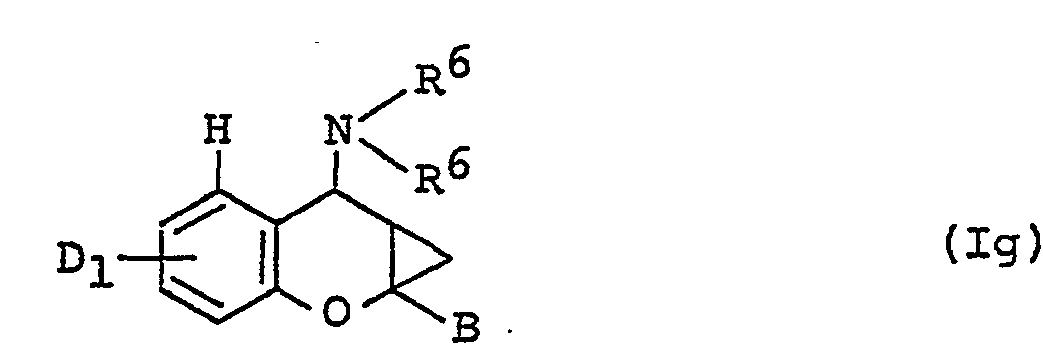
- the amide compound (If) thus obtained may be reduced by the same method as used to reduce the compound (Id), and this provides an amine derivative of the general formula (lg): where B, D 1 , and R6 are each the same as defined above.
- a dialkyl compound of formula (Ig) may also be produced by reacting the amino compound (Ic) with two molecules of an alkyl halide in the presence of a base by a conventional method.
- the amino compound (Ic) is also reacted with alkylchlorocarbonate by a conventional method to obtain the general formula (Ih): (where B and D 1 are the same as defined above and R 7 is an alkyl group with 1-3 carbon atoms).
- an alcohol of the general formula (IX) is produced: where B and D 1 are each the same as defined above.
- Any compound that is capable of reducing ketone without acting upon the fused rings in formula (II) may be used as a reducing agent and sodium borohydride is most preferably used.
- Any solvent that is inert to the reaction may be employed.
- an ether compound of the general formula (li) may be obtained: where B, D 1 , m, l, n, R 1 and R 2 are each the same as defined above.
- the base and solvent that are used in this reaction are the same as those employed in synthesizing the oxabicycloheptane derivative of formula (la) or (Ib).
- the ether compound (li) may also be produced by the following method.
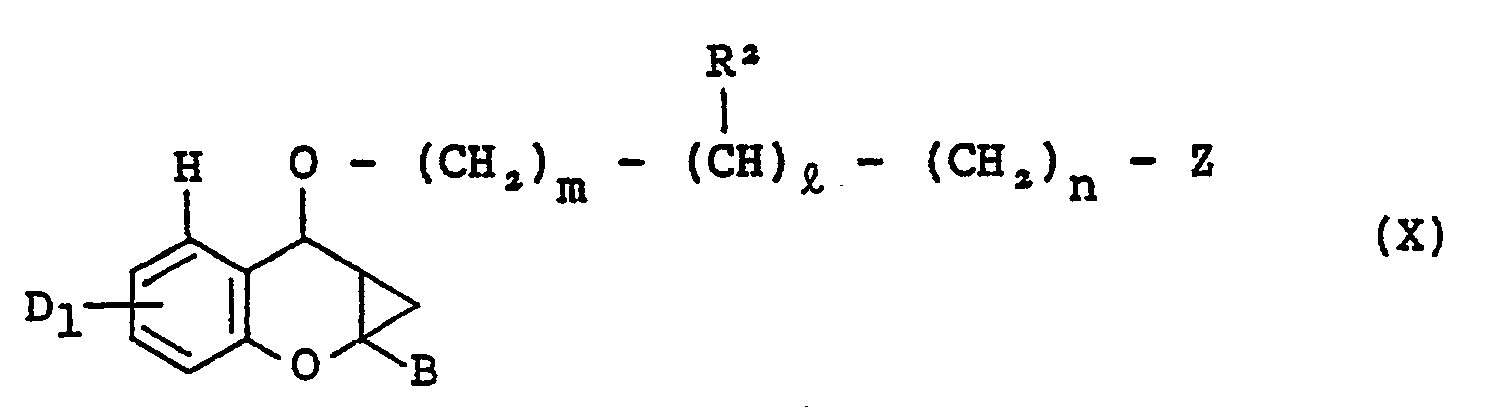
- An alcohol of formula (IX) is reacted with a dihalide of formula (V) to prepare a halide of the general formula (X): where B, D 1 , m, l, n, R 2 and Z are each the same as defined above.
- the halide is reacted with an amine of formula (VII) to obtain a compound of the present invention that is represented by formula (li). Reaction by this route may be carried out using the same base and solvent as are employed in preparing the compound of formula (la) or (Ib) from the compound of (IIIa or IIIb) via the compound (Vla or Vlb).
- the oxabicycloheptanone derivative (II) may be reacted with an excess of a Grignard reagent of the general formula (XI): (where Y, m, 1, R 1 and R 2 are each the same as defined above) to obtain an oxabicycloheptanol derivative of the general formula (Ij): where B, D 1 , m, e, n, R I and R 2 are each the same as defined above.
- the solvent used in this reaction is ether, tetrahydrofuran or dimethoxyethane.
- the amount of Grignard reagent used may be one equivalent but is preferably within the range of 1.2 - 1.5 equivalents.
- a compound of the following general formula wherein D 1 is a benzyloxy group: (where A and B are each the same as defined above) may be reduced by a conventional method to obtain a phenol derivative of the general formula (Ik): where A and B are each the same as defined above.
- Any conventional catalyst may be used in this reaction and palladium-on-carbon is most preferably used.
- Any solvent may be employed so long as it is inert to the reaction.
- the phenol derivative of formula (Ik) may be reacted with a halide or an acid anhydride to obtain a compound of the following general formula (II) having an acytyloxy group, a propionyloxy group, a butyryloxy group, a dimethylcarbamoyloxy group, a diethylcarbamoyloxy group, a diisopropylcarbamoyloxy group, an amidomethyloxy group, amidoethyloxy group, or an amidoethylpropyloxy group.
- a and B are each the same as defined above, and D 2 is an acyloxy, dialkylcarbamoyl or amidoalkyloxy group.
- Compounds of the present invention which have an amino group in a side chain may be dissolved in an appropriate organic solvent such as ether, tetrahydrofuran, methylene chloride, chloroform, benzene or toluene and treated with an inorganic or organic acid to obtain a corresponding salt.
- organic acids that can be used include formic acid, acetic acid, oxalic acid, malonic acid, propionic acid, butyric acid, valeric acid, succinic acid, fumaric acid, maleic acid, tartaric acid and benzoic acid; illustrative inorganic acids are hydrochloric acid, phosphoric acid and periodic acid.
- the compounds of the present invention have not only brain-protection but also anti-lipidperoxidation, anti-amnesia, brain circulation-improving, anti-platelet aggregation and anti-depression effects.
- the activities of these effects were evaluated by the following methods.
- mice Male ddY mice weighing 22-30 g were used in groups each consisting of 6 animals. Test compounds were administered intraperitoneally to the mice which were decapitated 30 minutes after the administration. The gasping time, or the duration of time between the onset of panting after decapitation and its cessation, was measured, and this was compared with the gasping time for a control group which were given only a liquid vehicle.
- mice Male ddY mice weighing 22-30 g were used in groups each consisting of 7-10 animals. The mice were placed in a desiccator (capacity: ca. 1000 ml) which was evacuated with a vacuum pump to an internal pressure of 180 mmHg after intraperitoneal administration of test compounds. The survival time, or the duration of time between the start of evacuation and the cessation of breathing, was measured, and this was compared with the value for a vehicle group. Any survival time longer than a period of 15 minutes after application of a hypoxia load was counted as 15 minutes.
- a desiccator capacity: ca. 1000 ml
- the survival time or the duration of time between the start of evacuation and the cessation of breathing, was measured, and this was compared with the value for a vehicle group. Any survival time longer than a period of 15 minutes after application of a hypoxia load was counted as 15 minutes.
- mice Male Wistar rats weighing 200-250 g were used. The brain of each rat was extracted after decapitation, homogenized with 50 mM of a phosphate buffer solution (PBS, pH 7.4) and centrifuged at 1000 g for 15 minutes. The supernatant was stored frozen at -30 ° C. Before use, it was thawed under flowing water and diluted with PBS three-fold to prepare a live sample.
- PBS phosphate buffer solution
- Two samples were prepared by adding 10 ⁇ l (10- 4 M) of a test compound in solution to 990 ⁇ l of the live sample.
- test results are shown in Table I from which one can see that strong anti-lipidperoxidation effects were exhibited by the compounds prepared in Examples 5, 8, 9, 12, 15 and 16.
- the animals were anesthetized with an intravenous injection, at first, of 30 mg/kg of sodium thiopental and thereafter, of a combination of urethane 400 mg/kg and a-chloralose 60 mg/kg.
- Under artificial ventilation (20 ml/kg/stroke, 20 strokes/min) blood flow in the vertebral artery and blood pressure were measured with the aid of an ex- tracorporeal electromagnetic flow probe placed on the artery and a pressure transducer, respectively.
- Vertebral vascular resistance was recorded with an electronic divider and heart rate was measured with a heart rate counter triggered by blood pressure pulses. All of these parameters were recorded on a polygraph continuously. When these parameters became stable, test compounds were injected into the femoral vein.
- compound No. 2 produced dose-dependent decreases in vertebral vascular resistance but almost no change in blood pressure and heart rate.
- compound No. 2 produced a further decrease in vertebral vascular resistance concomitant with a small decrease in blood pressure, and an increase in heart rate.
- Platelet rich plasma was prepared by centrifugation of 9 ml of blood mixed with I ml of 3.8% sodium citrate as anticoagulant Platelet aggregation was measured optically according to Born's method.
- ADP (10 ⁇ M), collagen (37.5 ⁇ g/ml), platelet activating factor (PAF, 0.11 nM) and calcium ionophore A 23187 (I ⁇ g/ml) were used as platelet aggregators. Test compounds were added I minute prior to the addition of aggregating agents.
- the experimental method was as follows. A scopolamine amnesia mouse that had been given subcutaneous injection of 0.5 mg/kg of an aqueous solution of scopolamine borate 20 minutes before was placed in the light compartment and when its forefeet touched the grid floor of the dark compartment, a current of 0.6 mA was applied to give a foot shock to the mouse (acquired conation). Immediately thereafter, a selected test compound or a control (physiological saline solution) was administered intraperitoneally. Twenty-four hours later, the mouse was replaced in the light compartment and the step-through latency, or the time required for the mouse to move to the dark compartment, was measured for a period of up to 300 seconds (test conation). The minimum effective amount of the test compound that provided a significant prolongation of the step-through latency over the control was determined.
- Test compounds were administered intraperitoneally 30 minutes before a retention test.
- cycloheximide 40 mg/kg was administered subcutaneously 30 minutes before the training and the compounds in question were administered intraperitoneally immediately after the training.
- a retention test was given 24 hours later.
- the test procedures proceeded in a manner similar to the training one, and time to entry into the dark compartment was measured for 300 seconds.
- Intraperitoneal administrations of compound No. 2 significantly prevented the ECS-induced shortening of step-through latency at doses of 6.25 and 12.5 mg/kg.
- this compound also significantly prolonged the step-through latency to be shortened by cycloheximide treatment, when given intraperitoneally at doses of 6.25 and 50 mg/kg.
- mice weighing 25 - 30 g were used in groups each consisting of 6 or 7 animals.
- the anti-depression effect was evaluated in terms of the number of revolutions of a water wheel in a water container in which a mouse was placed and forced to swim for 15 minutes.
- the mouse was subjected to forced swimming for two days on a 15-minutes-a-day basis; starting on the third day, the mouse that had received intraperitoneal injection of a test compound one hour before was subjected to forced swimming for 3 days on a 15-minutes-a-day basis.
- the compound prepared in Example 2 was found to have an anti-depression effect because the mouse injected with 50 mg/kg of this compound rotated the water wheel 1.8 times as fast as the control group.
- Reference Examples 12 14 were prepared in a manner similar to Reference Example II.
- Reference Example 16 The compound obtained in Reference Example 16 was used in a manner similar to Working Example 30 to prepare the titled compound in a yield of 63.2.%.
- Reference Example 17 The compound obtained in Reference Example 17 was used in a manner similar to Working Example 30 to produce the titled compound in a yield of 86%.
- the product was separated in the same manner as described above to obtain the main product and by-product in a ratio of 88:12.
Landscapes
- Chemical & Material Sciences (AREA)
- Organic Chemistry (AREA)
- Health & Medical Sciences (AREA)
- Engineering & Computer Science (AREA)
- Bioinformatics & Cheminformatics (AREA)
- General Health & Medical Sciences (AREA)
- Veterinary Medicine (AREA)
- General Chemical & Material Sciences (AREA)
- Medicinal Chemistry (AREA)
- Nuclear Medicine, Radiotherapy & Molecular Imaging (AREA)
- Neurosurgery (AREA)
- Pharmacology & Pharmacy (AREA)
- Life Sciences & Earth Sciences (AREA)
- Animal Behavior & Ethology (AREA)
- Neurology (AREA)
- Public Health (AREA)
- Chemical Kinetics & Catalysis (AREA)
- Biomedical Technology (AREA)
- Psychiatry (AREA)
- Cardiology (AREA)
- Heart & Thoracic Surgery (AREA)
- Hospice & Palliative Care (AREA)
- Pharmaceuticals Containing Other Organic And Inorganic Compounds (AREA)
- Heterocyclic Carbon Compounds Containing A Hetero Ring Having Oxygen Or Sulfur (AREA)
- Acyclic And Carbocyclic Compounds In Medicinal Compositions (AREA)
- Nitrogen Condensed Heterocyclic Rings (AREA)
- Pyrane Compounds (AREA)
- Plural Heterocyclic Compounds (AREA)
Abstract
Description
- The present invention relates to novel oxabicycloheptane derivatives, pharmaceutical compositions and the use thereof:


- The oxabicycloheptane derivative having the formula defined above and pharmaceutically acceptable salts thereof are effective in ameliorating or eliminating the symptoms that appear either as a result of organic disorders in the brain or on account of pathergasia. These compounds also have antidepressant effects and are useful as psychopharmaceuticals.
- The term "organic disorders in the brain" as used hereinabove means symptoms resulting from cerebral ischemic disorders such as the sequelae of cerebral infarction, cerebral haemorrage and cere- broarteriosclerosis, as well as various organic disorders resulting from senile dementia, dementia presenilis, amnesia, and the sequelae of traumas or operations on the brain. The term "pathergasia " means diseases on psychic functions resulting from mania, depression, neurosis, Parkinson's disease, schizophrenia and schizophrenic disorders, chorea, as well as those resulting from use of drugs and alcohol.
- Brain cells maintain an intracellular environment that entirely differs from their ambient environment (extracellular fluids) and continue to live by retaining the difference between these two environments. To this end, energy must be constantly produced and supplied to the brain cells. Most of the energy that is required by nerve cells in the brain is supplied by oxygen and glucose but the brain has a very limited reserve of these energy sources and must be constantly fed with additional supplies from the blood stream.
- If a certain disorder occurs in the brain and the supply of oxygen and glucose is discontinued, energy failure generally occurs progressively and the brain cells will lose their functions with the elapse of time and will eventually collapse organically to become no longer capable of fulfilling their functions. Therefore, in order to ensure a stable supply of the necessary energy sources to the brain tissues and provide a controlled external environment for cranial nerve cells, the human cerebral vessels are equipped with a well developed mechanism for adjusting the blood stream in the brain.
- Conventional non-surgical therapy for cerebrovascular disorders has involved the use of a variety of drugs for improving the cerebral circulation, dilating the blood vessels or for improving the brain metabolism. These drugs are effective in ameliorating the subjective symptoms of patients but are little effective in lessening their neurotic or psychic symptoms. In addition, no compound has previously been known that can be used as a psychopharmaceutical exhibiting capabilities of brain protection and improving the cerebral circulation as does the compound of the present invention.
- The present inventors conducted extensive studies for many years in order to find compounds that would be effective in ameliorating and eliminating symptoms that result either from the aforementioned organic disorders in the brain or on account of pathergasia. As a result, the inventors have found that the novel oxabicycloheptane derivatives of the present invention and pharmaceutically acceptable salts thereof are very effective against the formation of peroxylipids and the deficiency of oxygen in a variety of cranial nerve cells (brain anoxia), two factors that are believed to be closely associated with organic disorders in the brain and pathergasia as described above. In addition, these derivatives and pharmaceutically acceptable salts thereof were found to have surprisingly high activities against depression and to be very useful as psychopharmaceuticals. The present invention has been accomplished on the basis of these findings.
- The novel oxabicycloheptane derivative of the present invention shows the ability to improve the brain functions of a laboratory animal model under various anoxic conditions even when it is used in a low dose. The derivative also has an anti-lipidperoxidation activity and exhibits a strong anti-depression effect for a laboratory animal model subjected to forced swimming. Because of these capabilities, the compound of the present invention is useful not only in improving and treating organic disorders in the brain and pathergasis but also as a psychotherapeutic.
- The present invention relates to an oxabicycloheptane derivative of the following general formula (I) or a pharmaceutically acceptable salt thereof:


- The novel oxabicycloheptane derivative of formula (I) may be produced by a variety of methods. One method starts with a known compound, 3,4-benzo-5-oxo-1-phenyl-2-oxabicyclo[4.1.0]heptane (see P. Bennett et al., J. Chem. Soc., Perkin Trans. 1, (12), 2990 (1979)) or an oxabicycloheptanone derivative of formula (II) that may be synthesized by the same process as is employed in preparing said known compound:


- In the reaction described above, the base is preferably selected from among pyridine, sodium hydroxide, potassium hydroxide, sodium carbonate and potassium carbonate. If a solvent is used, it is preferably selected from among pyridine, water, alcohol, and a mixture of water and alcohol.
- The oxime compound (Illa or IIIb) is then reacted with a halide of the general formula (IV):


- In the reaction between the oxime compound and the halide, the base used as a catalyst is preferably an alkali metal base such as lithium hydride, sodium hydride, potassium hydride, sodium amide, sodium alkoxide or potassium alkoxide, with sodium hydride being particularly suitable. If a reaction solvent is used, it is preferably selected from ether, tetrahydrofuran, dioxane, and aromatic hydrocarbons such as benzene, toluene and xylene.
- The oxabicycloheptane derivative (la or Ib) may also be prepared by the following process. The oxime compound of the general formula (IIIa or IIIb) is reacted with a dihalide of the general formula (V):


- R1- H (VII)
- When the oxime compound (Illa or IIIb) is reduced by a conventional method, an amino compound of the general formula (Ic) is obtained:

- The amino compound (Ic) is then reacted with an acyl halide or acid anhydride of the general formula (VIII):
- R5COY or (R5CO)2 O (VIII)
- In this reaction for obtaining the amide compound (Id), the base is preferably selected from pyridine, trialkylamines and alkali hydroxides. Any solvent that is inert to the reaction may be employed.
- An amide compound of the formula (Id) wherein R5 is a halogenoalkyl group may be reacted with 2-pyrrolidone by a conventional method so as to synthesize 2-pyrrolidonyl compounds of general formula (Id): (where B and Di are each the same as defined above and R5 is 2-pyrrolidon-1-yl alkyl group).
- The amide compound (ld) wherein R5 is an alkyl group with 1-3 carbon atoms may be reduced by a conventional method to obtain an amino compound of the general formula (le):

- The amino compound (le) thus obtained may be reacted with an acyl halide or acid anhydride of the general formula (VIII): in the presence of a base, to thereby obtain an amide compound of the general formula (If):

- The base used in this reaction is preferably selected from among pyridine, trialkylamines and alkali hydroxides. Any solvent may be used so long as it is inert to the reaction.
- The amide compound (If) thus obtained may be reduced by the same method as used to reduce the compound (Id), and this provides an amine derivative of the general formula (lg):
- The amino compound (Ic) is also reacted with alkylchlorocarbonate by a conventional method to obtain the general formula (Ih):

- When the oxabicycloheptanone derivative of formula (II) is reduced by a conventional method, an alcohol of the general formula (IX) is produced:

- By reacting the alcohol (IX) with the compound (IV) in the presence of a base, an ether compound of the general formula (li) may be obtained:

- The ether compound (li) may also be produced by the following method. An alcohol of formula (IX) is reacted with a dihalide of formula (V) to prepare a halide of the general formula (X):
- The oxabicycloheptanone derivative (II) may be reacted with an excess of a Grignard reagent of the general formula (XI):


- Among the compounds of formulas (la) to (Ij) that are synthesized by the methods described above, a compound of the following general formula wherein D1 is a benzyloxy group:


- The phenol derivative of formula (Ik) may be reacted with a halide or an acid anhydride to obtain a compound of the following general formula (II) having an acytyloxy group, a propionyloxy group, a butyryloxy group, a dimethylcarbamoyloxy group, a diethylcarbamoyloxy group, a diisopropylcarbamoyloxy group, an amidomethyloxy group, amidoethyloxy group, or an amidoethylpropyloxy group.

- Compounds of the present invention which have an amino group in a side chain may be dissolved in an appropriate organic solvent such as ether, tetrahydrofuran, methylene chloride, chloroform, benzene or toluene and treated with an inorganic or organic acid to obtain a corresponding salt. Illustrative organic acids that can be used include formic acid, acetic acid, oxalic acid, malonic acid, propionic acid, butyric acid, valeric acid, succinic acid, fumaric acid, maleic acid, tartaric acid and benzoic acid; illustrative inorganic acids are hydrochloric acid, phosphoric acid and periodic acid.
- The compounds of the present invention have not only brain-protection but also anti-lipidperoxidation, anti-amnesia, brain circulation-improving, anti-platelet aggregation and anti-depression effects. The activities of these effects were evaluated by the following methods.
- . Male ddY mice weighing 22-30 g were used in groups each consisting of 6 animals. Test compounds were administered intraperitoneally to the mice which were decapitated 30 minutes after the administration. The gasping time, or the duration of time between the onset of panting after decapitation and its cessation, was measured, and this was compared with the gasping time for a control group which were given only a liquid vehicle.
- Only the compounds prepared in Examples 1, 2, 7, 8, 9, 20, 21, 23, 24, 26, 27, 28 and 30 were capable of significantly prolonging the gasping time in an amount of 25 mg/kg. Among these compounds, those prepared in Examples 2, 21, 23, 24, 27 and 28 achieved significant prolongation of the gasping time in an amount of 12.5 mg/kg.
- Male ddY mice weighing 22-30 g were used in groups each consisting of 7-10 animals. The mice were placed in a desiccator (capacity: ca. 1000 ml) which was evacuated with a vacuum pump to an internal pressure of 180 mmHg after intraperitoneal administration of test compounds. The survival time, or the duration of time between the start of evacuation and the cessation of breathing, was measured, and this was compared with the value for a vehicle group. Any survival time longer than a period of 15 minutes after application of a hypoxia load was counted as 15 minutes.
- Only the compounds prepared in Examples 2, 4, 5, 11, 15, 21, 30 and 31 were capable of significantly prolonging the survival time in an amount of 12.5 mg/kg. Among these compounds, those prepared in Examples 2, 30 and 31 achieved significant prolongation of the survival time in amounts of 6.25 mg/kg or smaller.
- Male Wistar rats weighing 200-250 g were used. The brain of each rat was extracted after decapitation, homogenized with 50 mM of a phosphate buffer solution (PBS, pH 7.4) and centrifuged at 1000 g for 15 minutes. The supernatant was stored frozen at -30°C. Before use, it was thawed under flowing water and diluted with PBS three-fold to prepare a live sample.
- Two samples were prepared by adding 10 µl (10-4 M) of a test compound in solution to 990 µl of the live sample.
- One sample was incubated at 37°C for 30 minutes and reaction was quenched by addition of 0.2 ml of 35% aqueous perchloric acid. The other sample was immediately mixed with 35% perchloric acid without incubation. Each of the mixtures was centrifuged at 3,000 rpm for 15 minutes and 0.5 ml of the supernatant was subjected to TBA assay (Yagi et al., Anal. Biochem., 95, 351 (1979)) for determining the malondi- aldehyde (MDA) content (x 10-4 M) by subtracting the peroxylipid level for the unincubated mixture from that for the incubated mixture. The percent inhibition of peroxylipid formation was calculated by the following:

- The test results are shown in Table I from which one can see that strong anti-lipidperoxidation effects were exhibited by the compounds prepared in Examples 5, 8, 9, 12, 15 and 16.

- Mongrel dogs of either sex, weighing 6.8 - 9.4 kg, were used. The animals were anesthetized with an intravenous injection, at first, of 30 mg/kg of sodium thiopental and thereafter, of a combination of urethane 400 mg/kg and a-chloralose 60 mg/kg. Under artificial ventilation (20 ml/kg/stroke, 20 strokes/min), blood flow in the vertebral artery and blood pressure were measured with the aid of an ex- tracorporeal electromagnetic flow probe placed on the artery and a pressure transducer, respectively. Vertebral vascular resistance was recorded with an electronic divider and heart rate was measured with a heart rate counter triggered by blood pressure pulses. All of these parameters were recorded on a polygraph continuously. When these parameters became stable, test compounds were injected into the femoral vein.
- At doses of 0.3 and 1.0 mg/kg, compound No. 2 produced dose-dependent decreases in vertebral vascular resistance but almost no change in blood pressure and heart rate. At a dose of 3.0 mg/kg, compound No. 2 produced a further decrease in vertebral vascular resistance concomitant with a small decrease in blood pressure, and an increase in heart rate.
- Arterial blood was drawn from the ear artery of male Japanese white rabbits. Platelet rich plasma (PRP) was prepared by centrifugation of 9 ml of blood mixed with I ml of 3.8% sodium citrate as anticoagulant Platelet aggregation was measured optically according to Born's method. ADP (10 µM), collagen (37.5 µg/ml), platelet activating factor (PAF, 0.11 nM) and calcium ionophore A 23187 (I µg/ml) were used as platelet aggregators. Test compounds were added I minute prior to the addition of aggregating agents.
- Compound No. 2 caused decreases in platelet aggregation induced by all the aggregators used. lC50 (50% inhibitory concentration) obtained were shown in Table 2.
- These results suggest that, like calmodulin antagonists (W-7 and chlorpromazine), compound No. 2 has non-specific inhibitory actions on in vitro platelet aggregation.

- Five-week old male ddY mice weighing 25 - 30 g were used in groups each consisting of 10 animals. Memory retention deficit induced by scopolamine was evaluated by two-compartment step-through passive avoidance task. The apparatus used consisted of a light and a dark compartment separated by a partition that had a hole providing a free passage for a mouse. The floor of the dark compartment was provided with a current-conducting grid.
- The experimental method was as follows. A scopolamine amnesia mouse that had been given subcutaneous injection of 0.5 mg/kg of an aqueous solution of scopolamine borate 20 minutes before was placed in the light compartment and when its forefeet touched the grid floor of the dark compartment, a current of 0.6 mA was applied to give a foot shock to the mouse (acquired conation). Immediately thereafter, a selected test compound or a control (physiological saline solution) was administered intraperitoneally. Twenty-four hours later, the mouse was replaced in the light compartment and the step-through latency, or the time required for the mouse to move to the dark compartment, was measured for a period of up to 300 seconds (test conation). The minimum effective amount of the test compound that provided a significant prolongation of the step-through latency over the control was determined.
- The test results are shown in Table 3.

- Male, ddY strain mice, weighing 25 to 35 g, were used. Memory retention deficit induced by ECS and cycloheximide was evaluated by two-compartment step-through passive avoidance task using a light- dark apparatus. Passive avoidance training test began by placing the mouse into the light compartment. When the mouse moved completely into the dark compartment, a shock of 0.6 mA was applied from the grid floor. Amnesia was induced in the following two ways. In the first one, a single ECS (current 50 mA, frequency 50 Hz, pulse width I msec, shock duration I msec) was applied via a pair of electrodes attached to the head immediately after receiving the foot shock, and the mouse was returned to its home cage. Test compounds were administered intraperitoneally 30 minutes before a retention test. In the second one, cycloheximide (40 mg/kg) was administered subcutaneously 30 minutes before the training and the compounds in question were administered intraperitoneally immediately after the training. A retention test was given 24 hours later. The test procedures proceeded in a manner similar to the training one, and time to entry into the dark compartment was measured for 300 seconds.
- Intraperitoneal administrations of compound No. 2 significantly prevented the ECS-induced shortening of step-through latency at doses of 6.25 and 12.5 mg/kg.
- Furthermore, this compound also significantly prolonged the step-through latency to be shortened by cycloheximide treatment, when given intraperitoneally at doses of 6.25 and 50 mg/kg.
- Male ICR mice weighing 25 - 30 g were used in groups each consisting of 6 or 7 animals. In accordance with the method of Nomura et al. (s. Nomura et al., Europ. J. Pharmacol., 83, 171 (l982)), the anti-depression effect was evaluated in terms of the number of revolutions of a water wheel in a water container in which a mouse was placed and forced to swim for 15 minutes. First, the mouse was subjected to forced swimming for two days on a 15-minutes-a-day basis; starting on the third day, the mouse that had received intraperitoneal injection of a test compound one hour before was subjected to forced swimming for 3 days on a 15-minutes-a-day basis. The compound prepared in Example 2 was found to have an anti-depression effect because the mouse injected with 50 mg/kg of this compound rotated the water wheel 1.8 times as fast as the control group.
- This invention is particularly illustrated by the following examples but the technical scope of this invention is not to be limited by them.
-

- The residue was purified by chromatography on silica gel (hexane : ethyl acetate 9:1) to produce the titled compounds (Illc, 2.35 g, 92.1%) and (IIId, 0.159 g, 6.23%).
- In a manner similar to Reference Example I, the following compounds were obtained in Reference Examples 2 - 6.
-

- Yield: 90%
-

- Yield: 95.3%
- m.p.: 157.5-159°C
-

- Yield: 92.4%
-

- Yield: 86%
-

- Yield: 74.4%
- m.p.: 176-177°C
-

- 700 mg of the product (IIIc) obtained in Reference Example I was dissolved in 60 ml of tetrahydrofuran and 223 mg (2 equivalents) of sodium hydride as a 60% oil was added. The mixture was refluxed for one hour and 3.14 g (6 equivalents) of ethylenedibromide was added. The mixture was refluxed for 5 hours. After evaporating the solvent, ice-water was added. The reaction was extracted with ether and the ether layer was washed with water, dried over anhydrous magnesium suflate, filtered and concentrated and the residue was subjected to chromatography on silica gel (hexane : ethyl acetate 95:5) to produce 911 mg (yield 91.3%) of the titled compound.
- The products in Reference Examples 8 - 10 were synthesized in a manner similar to Reference Example 7.
-

- Yield: 88.3%
-

- Yield: 100%
-

- Yield: 81.0%
-

- The products in Reference Examples 12 14 were prepared in a manner similar to Reference Example II.
-

- Yield: 95.3%
-

- Yield: 93.3%
-

- Yield: 96.7%
-

- 3.14 g of the product obtained in Reference Example II was reacted with 6.49 ml of 1,4-dibromobutane in the presence of 1.07 g of sodium hydride in a manner similar to Reference Example 7 and the product was purified to obtain 3.07 g of the titled compound (72.7 g).
- The products obtained in Reference Examples 16 and 17 were prepared in a manner similar to Reference Example 15.
-

- Yield: 72.4%
-

- The product obtained in Reference Example 14 was used to produce the titled compound in a yield of 54%.
-

- 600 mg (2.39 mmol) of compound IIIc obtained in Reference Example I was dissolved in 20 ml of tetrahydrofuran. 382 mg (9.56 mmol, 4 equivalents) of sodium hydride (as a 60% oil) and 1.54 g (7.17 mmol, 6 equivalents) of 2-dimethylaminoethyl chloride were added and the mixture was heated to reflux overnight. The reaction was concentrated and ice-water was added to the residue. The mixture was extracted with ether and the ether phase was washed with water and dried over anhydrous magnesium sulfate. After filtration, the filtrate was concentrated and the residue was subjected to chromatography on silica gel (methylene chloride : methanol 95:5) to produce 220 mg (yield 30.2%) of the titled compound as an oil.
- The product obtained in Working Examples 2 - 12 were prepared in a manner similar to Working Example I.
-
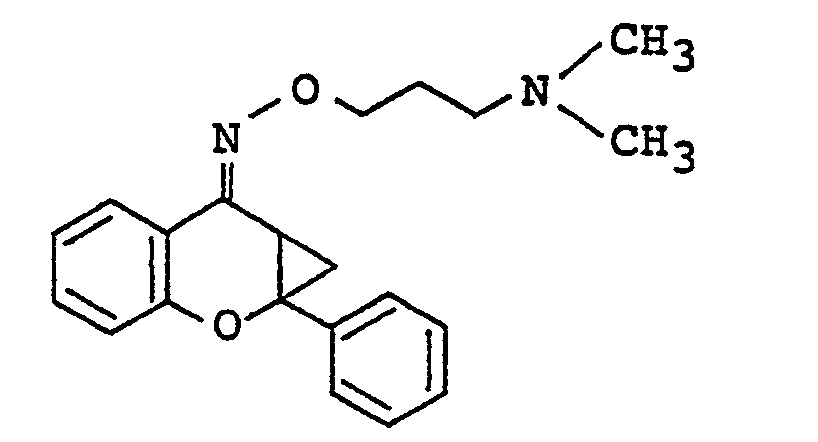
- Yield: 90.7%
- m.p.: 52.0-53.o°C
-

- The compound (IIId) obtained in Reference Example I was used to produce the titled compound in a yield of 47%.
-

- Yield: 98%
-

- Yield: 77.5%
-

- Yield: 42.3%
-

- The product obtained in Reference Example 2 was used to obtain the titled compound in a yield of 71%.
-

- The product obtained in Reference Example 3 was used to produce the titled compound in a yield of 65.8%.
-

- The product obtained in Reference Example 3 was used to produce the titled compound in a yield of 73.1%.
-

- The product obtained in Reference Example 4 was used to produce the titled compound in a yield of 90.3%.
-

- The product obtained in Reference Example 5 was used to produce the titled compound in a yield of 99.0%
-

- The product obtained in Reference Example 6 was used to produce the titled compound in a yield of 38.7%.
-

- 7.2 ml of 3.7 M dimethylamine-tetrahydrofuran solution (20 equivalents) was added to a solution (30 ml) of 470 mg of the compound obtained in Reference Example 7 in tetrahydrofuran and the resulting mixture was heated to reflux for 10 hours. The separated crystals were filtered and the filtrate was concentrated. After adding water to the residue, the mixture was made alkaline by using ammonia and was extracted with methylene chloride. After washing the extract with water, it was dried over anhydrous magnesium sulfate. The extract was filtered and subjected to chromatography on neutral silica gel (methylene chloride : methanol 97:3) to produce 325 mg (yield 76.9%) of the same titled compound as that of Working Example I.
- The products in Working Examples 14 - 21 were prepared in a manner similar to Working Example 13.
-

- Yield: 100%
-
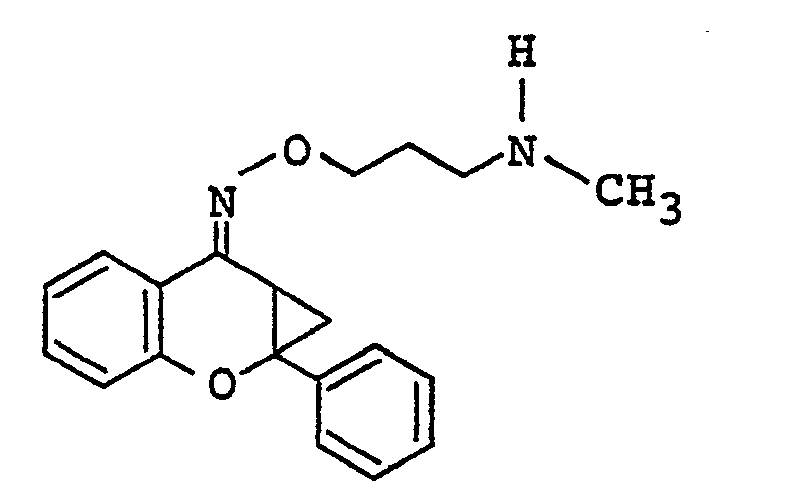
- A reaction with the compound obtained in Reference Example 8 was conducted at 105°C in a sealed tube to produce the titled compound (yield 52.3%).
-

- A reaction with the compound obtained in Reference Example 8 was conducted at 105°C in a sealed tube to produce the titled compound (yield 54.8%).
-

- The product obtained in Reference Example 8 was used to produce the titled compound in a yield of 73.2%.
-

- The product obtained in Reference Example 8 was used to produce the titled compound in a yield of 83.0%.
-

- The compound obtained in Reference Example 9 was used to produce the titled compound in a yield of 87.5%.
-

- The compound obtained in Reference Example 9 was used to prepare the titled compound in a yield of 54%.
-

- The compound obtained in Reference Example 10 was used to produce the titled compound in a quantita- five yield.
-

- 182 mg (2.4 equivalents) of sodium hydride (as a 60% oil) was added to a mixture of 194 mg of dioxane of a-pyrrolidone (10 ml) and dimethylsulfoxide (10 ml) and the mixture was heated at 110°C for 30 minutes. A solution of 622 mg of the compound obtained in Reference Example 8 in 20 ml of dioxane was added and the mixture was heated at 110°C for 3 hours with stirring. The reaction was concentrated and water was added. The reaction was extracted with ether. The ether layer was washed with water, dried over magnesium sulfate, filtered and concentrated. The residue was purified by chromatography on neutral silica gel (methylene chloride : methanol 98:2) to produce 326 mg (yield 46%) of the titled compound.
-

- 594 mg of the compound obtained in Reference Example II was dissolved in 50 ml of tetrahydrofuran and 200 mg (2 equivalents) of sodium hydride (as a 60% oil) was added. The mixture was heated to reflux for 30 minutes and 1.07 g (4 equivalents) of N,N-dimethylaminoethyl chloride was added. The reaction was heated to reflux for 5 hours and concentrated. Ice-water was added and the mixture was extracted with methylene chloride and the extract was washed with water, dried over anhydrous magnesium sulfate, filtrated and concentrated. The residue was purified by column chromatography on silica gel (methylene chloride : methanol 95:5) to produce 593 mg (yield 77%) of the titled compound.
- The products obtained in Working Examples 24 - 29 were prepared in a manner similar to Working Example 23.
-

- Yield: 93%
-

- Yield: 66%
-
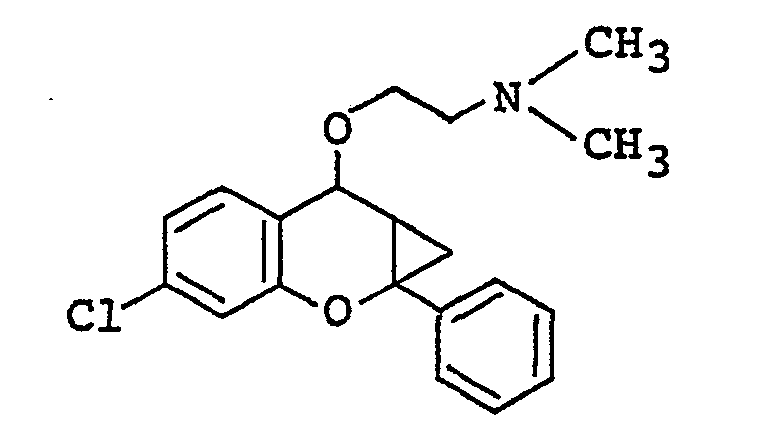
- The compound obtained in Reference Example 12 was used to prepare the titled compound in a yield of 42%.
-

- The compound obtained in Reference Example 12 was used to prepare the titled compound in a yield of 47.4%.
-

- The compound obtained in Reference Example 13 was used to prepare the titled compound in a yield of 62%.
-

- The compound obtained in Reference Example 14 was used to prepare the titled compound in a yield of 88%
-

- 3.2 g of the compound obtained in Reference Example 15 and a large excess of dimethylamine were heated to reflux in tetrahydrofuran and treated in a manner similar to Working Example 13 to obtain 2.25 g (yield 78%) of the titled compound
-

- The compound obtained in Reference Example 16 was used in a manner similar to Working Example 30 to prepare the titled compound in a yield of 63.2.%.
-
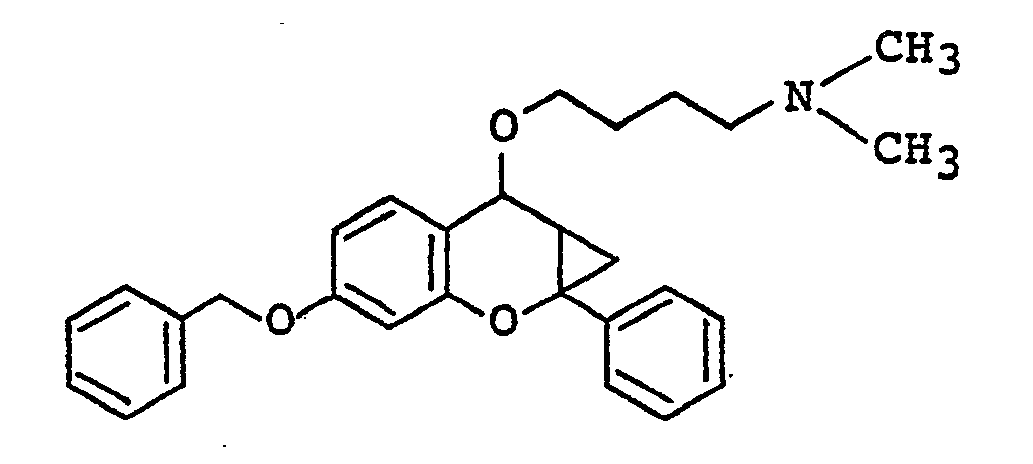
- The compound obtained in Reference Example 17 was used in a manner similar to Working Example 30 to produce the titled compound in a yield of 86%.
-

- 312 mg of the compound obtained in Reference Example 15, 80 mg of sodium hydride (as a 60% oil ) and 85 mg of a-pyrrolidone were reacted in mixture of 4 ml of dimethylsulfoxide and 12 ml of dioxane in a manner similar to Working Example 21 and the reaction was post-treated to obtain 1.36 mg (yield 43.3%) of the titled compound.
-
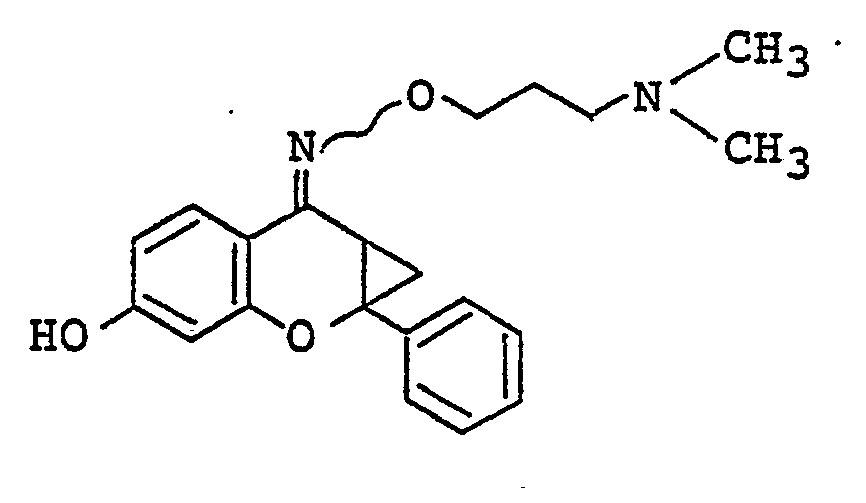
- 93 mg of 10% Pd-C was suspended in 6 ml of ethyl acetate and replacement with hydrogen was conducted by suction. The compound obtained in Working Example 10 was added and the mixture was stirred in an atmosphere of hydrogen (normal pressure) at room temperature for 24 hours. The reaction was filtered. The filtrate was concentrated and the residue was purified by column chromatography on silica gel (methylene chloride : methanol 90:10) to obtain the titled compound (195 mg, yield 78.7%).
-

- The product obtained in Working Example 29 was treated in ethanol in a manner similar to Working Example 34 to produce the titled compound in a yield of 66%.
-

- The compound obtained in Working Example 32 was treated in a manner similar to Working Example 34 to produce the titled compound in a yield of 46%.
-

- 300 mg of the product obtained in Working Example 34 was dissolved in 5 ml of acetic anhydride and 10 ml of pyridine and the mixture was stirred at room temperature for one hour. The reaction was concentrated and the residue was diluted with methylene chloride and washed with a saturated aqueous solution of sodium hydrogen carbonate and then with water and dried over anhydrous magnesium sulfate. The reaction was filtered and the filtrate was concentrated. The residue was purified by column chromatography on silica gel (methylene chloride : methanol 90:10) to obtain 329 mg (yield 98%) of the titled compound.
-

- The product in Working Example 35 was treated in a manner similar to Working Example 37 to produce the titled compound in a yield of 83%.
-

- 139 mg of the product obtained in Working Example 34 was dissolved in 20 ml of methylene chloride and 0.11 ml (3 equivalents) of N,N-dimethylcarbamoyl chloride and 0.55 ml (10 equivalents) of triethylamine were added to the solution. The mixture was heated to relflux for 7 hours. After cooling, the reaction was washed with an aqueous solution of sodium bicarbonate and then with water and dried over anhydrous magnesium sulfate. After filtration, the filtrate was concentrated and the residue was purified by column chromatography on silica gel (methylene chloride : methanol 95:5) to obtain 144 mg (yield 86.2%) of the titled compound.
-

- 129 mg of the product obtained in Working Example 34 was dissolved in 20 ml of dioxane and 22 mg (1.5 equivalents) of sodium hydride (as a 60% oil) was added. The mixture was heated at 100°C for 30 minutes and 72.2 mg (2 equivalents) of 2-chloroacetamide and 0.5 ml of dimethylsulfoxide were added. The mixture was stirred at 100°C for 3 hours and the reaction was concentrated. Ice-water was added and the mixture was extracted with ether and the ether layer was washed with water and dried over anhydrous magnesium sulfate. The residue was purified by column chromatography on silica gel (methylene chloride : methanol 90:10) to obtain 94.3 mg (yield 63%) of the titled compound.
-

- 2.04 g of the product obtained in Reference Example I was dissolved in 100 ml of ether and 1.23 g (16 equivalents) of lithium aliminum hydride was added. The mixture was heated to reflux for 17 hours. 3. N sodium hydroxide aqueous solution was added to the reaction under cooling in an ice bath to decompose excess lithium aluminum hydride.
- The supernatant was separated, washed with water and dried over anhydrous magnesium sulfate. After filtration, the filtrate was concentrated and the residue was purified by column chromatography on silica gel (methylene chloride : methanol 95:5) to obtain 1.1 g (yield 57%) of the titled compound.
-

- 500 mg of the product obtained in Working Example 41 was dissolved in 30 ml of methylene chloride and 0.59 ml (2 equivalents) of triethyl amine and 0.3 ml (1.5 equivalents) of ethyl chlorocarbonate were added. The mixture was stirred under chilling in ice water for 30 minutes. The reaction was washed with water and dried over anhydrous magnesium sulfate. After filtration and concentration, the residue was purified by column chromatography on silica gel (hexane : ethyl acetate 85:15) to obtain 500 mg (yield 76.7%) of the titled compound.
-

- 550 mg of the product obtained in Working Example 42 was dissolved in 50 ml of tetrahydrofuran and 100 mg (1.4 equivalents) of sodium hydride (as a 60% oil) was added and the mixture was heated to reflux for 30 minutes. After cooling the reaction to room temperature, 0.136 ml (1.2 equivalents) of methyl iodide was added and the mixture was stirred at room temperature for 6 hours. The reaction was concentrated and ice-water was added. The mixture was extracted with ether and the ether layer was washed with water and dried over anhydrous magnesium sulfate. After filtration, the filtrate was concentrated and the residue was purified by column chromatography on silica gel (hexane : ethyl acetate 90:10) to obtain 500 mg of a N-methylated compound. This was dissolved in 50 ml of ether and 177 mg (12 equivalents) of lithium aluminum hydride was added. The mixture was heated to reflux for 2 hours and treated in a manner similar to Working Example 41 to obtain diastereomers of the titled compound: main product 277 mg (yield 58.7%) and by-product 70.2 mg (yield 14.9%).
-

- 750 mg of the product obtained in Working Example 41 was dissolved in 50 ml of methylene chloride and 1.01 ml (4 equivalents) of chloroacetyl chloride and 2.66 ml of triethylamine were added to the solution. The mixture was heated with stirring for one hour and concentrated and the residue was purified by column chromatography on silica gel (methylene chloride : methanol 99.1) to obtain 854 mg of a chloroacetyl compound. This was heated with 260 mg (2.4 equivalents) of sodium hydride (as a 60% oil) and 0.248 ml (1.2 equivalents) of a-pyrrolidone in a solvent mixture of 30 ml of dioxane and 5 ml of dimethylsulfoxide at 110°C for 3 hours. The reaction was treated in a manner similar to Working Example 22 to obtain 886 mg (yield 77.6%) of the titled compound.
-

- The product obtained in Working Example 41 was reacted with y-chlorobutyryl chloride and the reaction was treated in a manner similar to Working Example 44 to obtain the titled compound (yield 54.7%).
-

- 972 mg of magnesium and a catalytic amount of iodine were added to 30 ml of tetrahydrofuran and 2.31 g of dimethylaminopropyl chloride was added dropwise. The mixture was heated to reflux for one hour. After cooling, 2.36 g of a solution of 3,4-benzo-5-oxo-I-phenyl-2-oxabicyclo[4.1.0]heptane in tetrahydrofuran was added dropwise to the mixture and stirred at room temperature for one hour. The reaction product was decomposed by adding a small amount of water and the tetrahydrofuran layer was separated. The aqueous layer was diluted with water and extracted with ether. The tetrahydrofuran solution and the ether extract were combined and washed with aqueous NaCI and dried over anhydrous magnesium sulfate. After filtration, the filtrate was concentrated and the residue was purified by column chromatography on silica gel (methylene chloride : methanol 90:10) to obtain 2.2 g (yield 69.6%) of the titled compound as a mixture of steric isomers.
- The product was separated in the same manner as described above to obtain the main product and by-product in a ratio of 88:12.
- Among the products obtained in the above examples, those whose melting points are not indicated are all oils. In Table 4, the physicochemical properties of the products obtained in the above Working Examples are given and the physicochemical properties of the products obtained in the above Reference Examples are given in Table 5.
- The abbreviations given in the column for NMR spectrum in the Tables signify the following: s : singlet
- d : doublet
- t : triplet
- dd: doublet of doublet
- q : quartlet
- m : multiplet
(where R1 is the same as defined above) in a solvent such as dioxane or tetrahydrofuran to obtain the compound of formula (la) or (Ib). The base and solvent used in the reaction between the oxime compound (IIIa or IIIb) and the dihalide (V) are preferably the same as those employed in direct production of the compound (la or Ib) by reacting the compound (IIIa or IIIb) with the halide (IV).
(R5 is an alkyl group with 1-3 carbon atoms or a halogenoalkly group; and Y is a halogen atom) in the presence of a base to obtain an amide compound of the general formula (Id):


Claims (12)


Priority Applications (1)
| Application Number | Priority Date | Filing Date | Title |
|---|---|---|---|
| AT87102795T ATE52506T1 (en) | 1986-02-27 | 1987-02-27 | OXABICYCLOHEPTAN DERIVATIVES, PHARMACEUTICAL COMPOSITION AND USE. |
Applications Claiming Priority (2)
| Application Number | Priority Date | Filing Date | Title |
|---|---|---|---|
| JP42732/86 | 1986-02-27 | ||
| JP61042732A JPH0723367B2 (en) | 1986-02-27 | 1986-02-27 | Oxabicycloheptane derivative |
Publications (2)
| Publication Number | Publication Date |
|---|---|
| EP0238883A1 EP0238883A1 (en) | 1987-09-30 |
| EP0238883B1 true EP0238883B1 (en) | 1990-05-09 |
Family
ID=12644212
Family Applications (1)
| Application Number | Title | Priority Date | Filing Date |
|---|---|---|---|
| EP87102795A Expired - Lifetime EP0238883B1 (en) | 1986-02-27 | 1987-02-27 | Oxabicycloheptane derivatives, pharmaceutical composition and use |
Country Status (8)
| Country | Link |
|---|---|
| US (1) | US4713453A (en) |
| EP (1) | EP0238883B1 (en) |
| JP (1) | JPH0723367B2 (en) |
| AT (1) | ATE52506T1 (en) |
| CA (1) | CA1300138C (en) |
| DE (1) | DE3762621D1 (en) |
| ES (1) | ES2036183T3 (en) |
| GR (2) | GR3000693T3 (en) |
Families Citing this family (7)
| Publication number | Priority date | Publication date | Assignee | Title |
|---|---|---|---|---|
| JP3054207B2 (en) * | 1990-06-06 | 2000-06-19 | サントリー株式会社 | Cyclopropachromene derivative |
| US5401850A (en) * | 1990-06-06 | 1995-03-28 | Suntory Limited | Cyclopropachromen derivatives |
| CA2037188A1 (en) * | 1990-06-06 | 1991-12-07 | Toshio Tatsuoka | Agent for treating disorders from cerebral neuro-degeneration |
| JP3993651B2 (en) * | 1994-10-21 | 2007-10-17 | アスビオファーマ株式会社 | Cyclopropachromene carboxylic acid derivative |
| KR20070092309A (en) * | 2004-12-28 | 2007-09-12 | 아스비오파마 가부시키가이샤 | Process for preparing carbon-reduced aldose compound |
| IT1400964B1 (en) * | 2010-06-15 | 2013-07-05 | Dipharma Francis Srl | PROCEDURE FOR THE PREPARATION OF PTERIDINE DERIVATIVES |
| WO2016134257A1 (en) | 2015-02-19 | 2016-08-25 | Lixter Biotechnology, Inc. | Oxabicycloheptanes and oxabicycloheptenes for the treatment of depressive and stress disorders |
Family Cites Families (2)
| Publication number | Priority date | Publication date | Assignee | Title |
|---|---|---|---|---|
| US3468897A (en) * | 1966-10-05 | 1969-09-23 | Pierre Fournari | Certain 6-amino-2-(aryl or heteroaryl)-4-chromanone-hydrazones and derivatives |
| JPS5829782A (en) * | 1981-08-12 | 1983-02-22 | Nippon Zoki Pharmaceut Co Ltd | Novel heterocyclic compound, its preparation and medicinal composition containing said compound |
-
1986
- 1986-02-27 JP JP61042732A patent/JPH0723367B2/en not_active Expired - Lifetime
-
1987
- 1987-02-27 CA CA000530795A patent/CA1300138C/en not_active Expired - Lifetime
- 1987-02-27 EP EP87102795A patent/EP0238883B1/en not_active Expired - Lifetime
- 1987-02-27 AT AT87102795T patent/ATE52506T1/en not_active IP Right Cessation
- 1987-02-27 US US07/019,973 patent/US4713453A/en not_active Expired - Fee Related
- 1987-02-27 ES ES198787102795T patent/ES2036183T3/en not_active Expired - Lifetime
- 1987-02-27 DE DE8787102795T patent/DE3762621D1/en not_active Expired - Lifetime
-
1990
- 1990-08-03 GR GR90400555T patent/GR3000693T3/en unknown
-
1991
- 1991-07-31 GR GR90300046T patent/GR900300046T1/en unknown
Also Published As
| Publication number | Publication date |
|---|---|
| ATE52506T1 (en) | 1990-05-15 |
| EP0238883A1 (en) | 1987-09-30 |
| DE3762621D1 (en) | 1990-06-13 |
| US4713453A (en) | 1987-12-15 |
| JPS62198676A (en) | 1987-09-02 |
| ES2036183T3 (en) | 1993-05-16 |
| GR900300046T1 (en) | 1991-07-31 |
| CA1300138C (en) | 1992-05-05 |
| GR3000693T3 (en) | 1991-09-27 |
| JPH0723367B2 (en) | 1995-03-15 |
Similar Documents
| Publication | Publication Date | Title |
|---|---|---|
| JP4094950B2 (en) | Indole derivatives and their use as 5-HT2B and 5-HT2C receptor ligands | |
| NL1028598C2 (en) | Imidazole compounds for the treatment of neurodegenerative diseases. | |
| KR940010034B1 (en) | Method for preparing heterocyclic quinoxaline compound | |
| JP2703408B2 (en) | 1,4-benzothiazepine derivatives | |
| MXPA04011956A (en) | Inhibitors of jak and cdk2 protein kinases. | |
| FR2711993A1 (en) | Medicaments containing 7H-imidazol [1,2-a] pyrazine-8-one derivatives, the novel compounds and their preparation. | |
| JP5769726B2 (en) | SHIP1 modulator and related methods | |
| JPH03170482A (en) | Tricyclic pteridinones and its preparation | |
| EP0464604A2 (en) | 1-Indolylalkyl-4-(alkoxy-pyrimidinyl)piperazines | |
| FR2665441A1 (en) | DERIVATIVES OF N-SULFONYL INDOLINE, THEIR PREPARATION, PHARMACEUTICAL COMPOSITIONS CONTAINING THE SAME | |
| FR2707643A1 (en) | Derivatives of imidazo [1,2-a] pyrazine-4-one, their preparation and the medicaments containing them. | |
| EP0527081B1 (en) | Substituted 3-piperazinylalkyl-2,3-dihydro-4H-1,3-benzoxazine-4-ones, their preparation and their therapeutical use | |
| FR2960876A1 (en) | 3,4-DIHYDROPYRROLO [1,2-A] PYRAZINE-2,8 (1H) -DICARBOXAMIDE DERIVATIVES FOR THEIR PREPARATION AND THEIR THERAPEUTIC USE. | |
| MC1315A1 (en) | IMIDAZOLE DERIVATIVES AND THEIR SYNTHESIS AND PREPARATION OF MEDICINAL PRODUCTS CONTAINING THESE SUBSTANCES | |
| US4713453A (en) | Oxabicycloheptane derivatives | |
| JP3990477B2 (en) | Neural differentiation inducer | |
| EP0562440B1 (en) | Imidazopyridazines as antiasthmatics | |
| WO2022237782A1 (en) | Amide derivative and application thereof | |
| RU2156252C2 (en) | Triazolopyridazines, method of their synthesis, pharmaceutical compositions based on thereof and method of treatment | |
| MC1221A1 (en) | IMIDAZOLE DERIVATIVES AND THEIR SALTS, THEIR SYNTHESIS AND THE INTERMEDIATE PRODUCTS, AND THE PREPARATION OF PHARMACEUTICAL COMPOSITIONS CONTAINING THESE SUBSTANCES | |
| EP1828125B1 (en) | Arylpiperazine derivatives and their use as ligangs selective of the dopamine d3 receptor | |
| LU87129A1 (en) | NOVEL PIPERAZINECARBOXYLIC ACID, ITS PREPARATION AND ITS USE AS A MEDICINE | |
| EP0032856B1 (en) | 2,3-dihydroimidazo (1,2-b) pyridazine derivatives, process for their preparation and their therapeutical use | |
| JPH08151366A (en) | 1-hydroxyindole derivative | |
| JPH0573754B2 (en) |
Legal Events
| Date | Code | Title | Description |
|---|---|---|---|
| PUAI | Public reference made under article 153(3) epc to a published international application that has entered the european phase |
Free format text: ORIGINAL CODE: 0009012 |
|
| AK | Designated contracting states |
Kind code of ref document: A1 Designated state(s): AT BE CH DE ES FR GB GR IT LI LU NL SE |
|
| 17P | Request for examination filed |
Effective date: 19880222 |
|
| 17Q | First examination report despatched |
Effective date: 19881003 |
|
| ITF | It: translation for a ep patent filed | ||
| GRAA | (expected) grant |
Free format text: ORIGINAL CODE: 0009210 |
|
| AK | Designated contracting states |
Kind code of ref document: B1 Designated state(s): AT BE CH DE ES FR GB GR IT LI LU NL SE |
|
| REF | Corresponds to: |
Ref document number: 52506 Country of ref document: AT Date of ref document: 19900515 Kind code of ref document: T |
|
| REF | Corresponds to: |
Ref document number: 3762621 Country of ref document: DE Date of ref document: 19900613 |
|
| ET | Fr: translation filed | ||
| REG | Reference to a national code |
Ref country code: GR Ref legal event code: FG4A Free format text: 3000693 |
|
| PLBE | No opposition filed within time limit |
Free format text: ORIGINAL CODE: 0009261 |
|
| STAA | Information on the status of an ep patent application or granted ep patent |
Free format text: STATUS: NO OPPOSITION FILED WITHIN TIME LIMIT |
|
| 26N | No opposition filed | ||
| ITTA | It: last paid annual fee | ||
| REG | Reference to a national code |
Ref country code: ES Ref legal event code: FG2A Ref document number: 2036183 Country of ref document: ES Kind code of ref document: T3 |
|
| EPTA | Lu: last paid annual fee | ||
| EAL | Se: european patent in force in sweden |
Ref document number: 87102795.9 |
|
| PGFP | Annual fee paid to national office [announced via postgrant information from national office to epo] |
Ref country code: SE Payment date: 19981221 Year of fee payment: 13 |
|
| PGFP | Annual fee paid to national office [announced via postgrant information from national office to epo] |
Ref country code: GR Payment date: 19990126 Year of fee payment: 13 |
|
| PGFP | Annual fee paid to national office [announced via postgrant information from national office to epo] |
Ref country code: LU Payment date: 19990211 Year of fee payment: 13 |
|
| PGFP | Annual fee paid to national office [announced via postgrant information from national office to epo] |
Ref country code: CH Payment date: 19990212 Year of fee payment: 13 |
|
| PGFP | Annual fee paid to national office [announced via postgrant information from national office to epo] |
Ref country code: GB Payment date: 19990216 Year of fee payment: 13 |
|
| PGFP | Annual fee paid to national office [announced via postgrant information from national office to epo] |
Ref country code: AT Payment date: 19990218 Year of fee payment: 13 |
|
| PGFP | Annual fee paid to national office [announced via postgrant information from national office to epo] |
Ref country code: FR Payment date: 19990222 Year of fee payment: 13 |
|
| PGFP | Annual fee paid to national office [announced via postgrant information from national office to epo] |
Ref country code: ES Payment date: 19990226 Year of fee payment: 13 |
|
| PGFP | Annual fee paid to national office [announced via postgrant information from national office to epo] |
Ref country code: NL Payment date: 19990228 Year of fee payment: 13 |
|
| PGFP | Annual fee paid to national office [announced via postgrant information from national office to epo] |
Ref country code: DE Payment date: 19990315 Year of fee payment: 13 |
|
| PGFP | Annual fee paid to national office [announced via postgrant information from national office to epo] |
Ref country code: BE Payment date: 19990316 Year of fee payment: 13 |
|
| PG25 | Lapsed in a contracting state [announced via postgrant information from national office to epo] |
Ref country code: LU Free format text: LAPSE BECAUSE OF NON-PAYMENT OF DUE FEES Effective date: 20000227 Ref country code: GB Free format text: LAPSE BECAUSE OF NON-PAYMENT OF DUE FEES Effective date: 20000227 Ref country code: AT Free format text: LAPSE BECAUSE OF NON-PAYMENT OF DUE FEES Effective date: 20000227 |
|
| PG25 | Lapsed in a contracting state [announced via postgrant information from national office to epo] |
Ref country code: SE Free format text: LAPSE BECAUSE OF NON-PAYMENT OF DUE FEES Effective date: 20000228 Ref country code: ES Free format text: LAPSE BECAUSE OF NON-PAYMENT OF DUE FEES Effective date: 20000228 Ref country code: BE Free format text: LAPSE BECAUSE OF NON-PAYMENT OF DUE FEES Effective date: 20000228 |
|
| PG25 | Lapsed in a contracting state [announced via postgrant information from national office to epo] |
Ref country code: LI Free format text: LAPSE BECAUSE OF NON-PAYMENT OF DUE FEES Effective date: 20000229 Ref country code: GR Free format text: THE PATENT HAS BEEN ANNULLED BY A DECISION OF A NATIONAL AUTHORITY Effective date: 20000229 Ref country code: CH Free format text: LAPSE BECAUSE OF NON-PAYMENT OF DUE FEES Effective date: 20000229 |
|
| BERE | Be: lapsed |
Owner name: SUNTORY LTD Effective date: 20000228 |
|
| PG25 | Lapsed in a contracting state [announced via postgrant information from national office to epo] |
Ref country code: NL Free format text: LAPSE BECAUSE OF NON-PAYMENT OF DUE FEES Effective date: 20000901 |
|
| EUG | Se: european patent has lapsed |
Ref document number: 87102795.9 |
|
| REG | Reference to a national code |
Ref country code: CH Ref legal event code: PL |
|
| GBPC | Gb: european patent ceased through non-payment of renewal fee |
Effective date: 20000227 |
|
| PG25 | Lapsed in a contracting state [announced via postgrant information from national office to epo] |
Ref country code: FR Free format text: LAPSE BECAUSE OF NON-PAYMENT OF DUE FEES Effective date: 20001031 |
|
| NLV4 | Nl: lapsed or anulled due to non-payment of the annual fee |
Effective date: 20000901 |
|
| PG25 | Lapsed in a contracting state [announced via postgrant information from national office to epo] |
Ref country code: DE Free format text: LAPSE BECAUSE OF NON-PAYMENT OF DUE FEES Effective date: 20001201 |
|
| REG | Reference to a national code |
Ref country code: FR Ref legal event code: ST |
|
| REG | Reference to a national code |
Ref country code: ES Ref legal event code: FD2A Effective date: 20010910 |
|
| PG25 | Lapsed in a contracting state [announced via postgrant information from national office to epo] |
Ref country code: IT Free format text: LAPSE BECAUSE OF NON-PAYMENT OF DUE FEES;WARNING: LAPSES OF ITALIAN PATENTS WITH EFFECTIVE DATE BEFORE 2007 MAY HAVE OCCURRED AT ANY TIME BEFORE 2007. THE CORRECT EFFECTIVE DATE MAY BE DIFFERENT FROM THE ONE RECORDED. Effective date: 20050227 |