EP0238258B1 - Macrolide compounds - Google Patents
Macrolide compounds Download PDFInfo
- Publication number
- EP0238258B1 EP0238258B1 EP87302107A EP87302107A EP0238258B1 EP 0238258 B1 EP0238258 B1 EP 0238258B1 EP 87302107 A EP87302107 A EP 87302107A EP 87302107 A EP87302107 A EP 87302107A EP 0238258 B1 EP0238258 B1 EP 0238258B1
- Authority
- EP
- European Patent Office
- Prior art keywords
- group
- compound
- atom
- compounds
- hydrogen atom
- Prior art date
- Legal status (The legal status is an assumption and is not a legal conclusion. Google has not performed a legal analysis and makes no representation as to the accuracy of the status listed.)
- Expired - Lifetime
Links
- 150000001875 compounds Chemical class 0.000 title claims abstract description 112
- 239000003120 macrolide antibiotic agent Substances 0.000 title 1
- 125000004432 carbon atom Chemical group C* 0.000 claims abstract description 26
- 125000004435 hydrogen atom Chemical group [H]* 0.000 claims abstract description 26
- 229910052799 carbon Inorganic materials 0.000 claims abstract description 25
- 125000002887 hydroxy group Chemical group [H]O* 0.000 claims abstract description 25
- 125000001449 isopropyl group Chemical group [H]C([H])([H])C([H])(*)C([H])([H])[H] 0.000 claims abstract description 22
- 125000004430 oxygen atom Chemical group O* 0.000 claims abstract description 16
- 241000607479 Yersinia pestis Species 0.000 claims abstract description 15
- 125000002496 methyl group Chemical group [H]C([H])([H])* 0.000 claims abstract description 14
- 125000001495 ethyl group Chemical group [H]C([H])([H])C([H])([H])* 0.000 claims abstract description 12
- 125000002915 carbonyl group Chemical group [*:2]C([*:1])=O 0.000 claims abstract description 11
- 125000000325 methylidene group Chemical group [H]C([H])=* 0.000 claims abstract description 9
- 241000244206 Nematoda Species 0.000 claims abstract description 8
- WKBOTKDWSSQWDR-UHFFFAOYSA-N Bromine atom Chemical group [Br] WKBOTKDWSSQWDR-UHFFFAOYSA-N 0.000 claims abstract description 7
- 241000238631 Hexapoda Species 0.000 claims abstract description 6
- 125000004209 (C1-C8) alkyl group Chemical group 0.000 claims abstract description 5
- 239000000203 mixture Substances 0.000 claims description 37
- -1 hydroxy, acetoxy Chemical group 0.000 claims description 27
- 238000000034 method Methods 0.000 claims description 23
- 238000002360 preparation method Methods 0.000 claims description 12
- 239000003814 drug Substances 0.000 claims description 11
- 230000008569 process Effects 0.000 claims description 10
- 239000003153 chemical reaction reagent Substances 0.000 claims description 9
- 239000000969 carrier Substances 0.000 claims description 7
- 125000004423 acyloxy group Chemical group 0.000 claims description 5
- 125000003545 alkoxy group Chemical group 0.000 claims description 5
- 239000000546 pharmaceutical excipient Substances 0.000 claims description 4
- 238000003898 horticulture Methods 0.000 claims description 3
- 229910052727 yttrium Inorganic materials 0.000 claims description 3
- 125000001301 ethoxy group Chemical group [H]C([H])([H])C([H])([H])O* 0.000 claims description 2
- 229910052760 oxygen Inorganic materials 0.000 claims description 2
- 239000000825 pharmaceutical preparation Substances 0.000 claims 2
- 229940127557 pharmaceutical product Drugs 0.000 claims 2
- 230000002152 alkylating effect Effects 0.000 claims 1
- 150000003839 salts Chemical class 0.000 abstract description 4
- 125000003342 alkenyl group Chemical group 0.000 abstract 1
- XEKOWRVHYACXOJ-UHFFFAOYSA-N Ethyl acetate Chemical compound CCOC(C)=O XEKOWRVHYACXOJ-UHFFFAOYSA-N 0.000 description 57
- RTZKZFJDLAIYFH-UHFFFAOYSA-N Diethyl ether Chemical compound CCOCC RTZKZFJDLAIYFH-UHFFFAOYSA-N 0.000 description 49
- YMWUJEATGCHHMB-UHFFFAOYSA-N Dichloromethane Chemical compound ClCCl YMWUJEATGCHHMB-UHFFFAOYSA-N 0.000 description 42
- HEDRZPFGACZZDS-MICDWDOJSA-N Trichloro(2H)methane Chemical compound [2H]C(Cl)(Cl)Cl HEDRZPFGACZZDS-MICDWDOJSA-N 0.000 description 36
- HEDRZPFGACZZDS-UHFFFAOYSA-N Chloroform Chemical compound ClC(Cl)Cl HEDRZPFGACZZDS-UHFFFAOYSA-N 0.000 description 32
- DIKBFYAXUHHXCS-UHFFFAOYSA-N bromoform Chemical compound BrC(Br)Br DIKBFYAXUHHXCS-UHFFFAOYSA-N 0.000 description 32
- VYPSYNLAJGMNEJ-UHFFFAOYSA-N Silicium dioxide Chemical compound O=[Si]=O VYPSYNLAJGMNEJ-UHFFFAOYSA-N 0.000 description 31
- LFQSCWFLJHTTHZ-UHFFFAOYSA-N Ethanol Chemical compound CCO LFQSCWFLJHTTHZ-UHFFFAOYSA-N 0.000 description 27
- 239000000243 solution Substances 0.000 description 24
- 238000006243 chemical reaction Methods 0.000 description 19
- 239000002904 solvent Substances 0.000 description 19
- 150000002148 esters Chemical class 0.000 description 18
- VLKZOEOYAKHREP-UHFFFAOYSA-N n-Hexane Chemical compound CCCCCC VLKZOEOYAKHREP-UHFFFAOYSA-N 0.000 description 18
- VEXZGXHMUGYJMC-UHFFFAOYSA-N Hydrochloric acid Chemical compound Cl VEXZGXHMUGYJMC-UHFFFAOYSA-N 0.000 description 16
- 239000004480 active ingredient Substances 0.000 description 16
- 239000006260 foam Substances 0.000 description 16
- XLYOFNOQVPJJNP-UHFFFAOYSA-N water Substances O XLYOFNOQVPJJNP-UHFFFAOYSA-N 0.000 description 16
- 239000007787 solid Substances 0.000 description 15
- WEVYAHXRMPXWCK-UHFFFAOYSA-N Acetonitrile Chemical compound CC#N WEVYAHXRMPXWCK-UHFFFAOYSA-N 0.000 description 12
- 241001465754 Metazoa Species 0.000 description 12
- ZMXDDKWLCZADIW-UHFFFAOYSA-N N,N-Dimethylformamide Chemical compound CN(C)C=O ZMXDDKWLCZADIW-UHFFFAOYSA-N 0.000 description 12
- WYURNTSHIVDZCO-UHFFFAOYSA-N Tetrahydrofuran Chemical compound C1CCOC1 WYURNTSHIVDZCO-UHFFFAOYSA-N 0.000 description 12
- 239000002253 acid Substances 0.000 description 12
- 239000003795 chemical substances by application Substances 0.000 description 12
- 239000008187 granular material Substances 0.000 description 12
- QTBSBXVTEAMEQO-UHFFFAOYSA-N Acetic acid Chemical compound CC(O)=O QTBSBXVTEAMEQO-UHFFFAOYSA-N 0.000 description 10
- IJGRMHOSHXDMSA-UHFFFAOYSA-N Atomic nitrogen Chemical compound N#N IJGRMHOSHXDMSA-UHFFFAOYSA-N 0.000 description 10
- 239000002585 base Substances 0.000 description 10
- CSCPPACGZOOCGX-UHFFFAOYSA-N Acetone Chemical compound CC(C)=O CSCPPACGZOOCGX-UHFFFAOYSA-N 0.000 description 9
- 241000282414 Homo sapiens Species 0.000 description 9
- DNIAPMSPPWPWGF-UHFFFAOYSA-N Propylene glycol Chemical compound CC(O)CO DNIAPMSPPWPWGF-UHFFFAOYSA-N 0.000 description 9
- 238000004587 chromatography analysis Methods 0.000 description 9
- 150000002576 ketones Chemical class 0.000 description 9
- 239000000843 powder Substances 0.000 description 9
- 239000003826 tablet Substances 0.000 description 9
- 238000009472 formulation Methods 0.000 description 8
- 239000000543 intermediate Substances 0.000 description 8
- NUJOXMJBOLGQSY-UHFFFAOYSA-N manganese dioxide Chemical compound O=[Mn]=O NUJOXMJBOLGQSY-UHFFFAOYSA-N 0.000 description 8
- 239000012074 organic phase Substances 0.000 description 8
- 239000000377 silicon dioxide Substances 0.000 description 8
- 239000000725 suspension Substances 0.000 description 8
- 238000010828 elution Methods 0.000 description 7
- 239000007788 liquid Substances 0.000 description 7
- 239000007800 oxidant agent Substances 0.000 description 7
- 239000000047 product Substances 0.000 description 7
- 238000003756 stirring Methods 0.000 description 7
- 239000003981 vehicle Substances 0.000 description 7
- WVDDGKGOMKODPV-UHFFFAOYSA-N Benzyl alcohol Chemical compound OCC1=CC=CC=C1 WVDDGKGOMKODPV-UHFFFAOYSA-N 0.000 description 6
- 241000282412 Homo Species 0.000 description 6
- OKKJLVBELUTLKV-UHFFFAOYSA-N Methanol Chemical compound OC OKKJLVBELUTLKV-UHFFFAOYSA-N 0.000 description 6
- JUJWROOIHBZHMG-UHFFFAOYSA-N Pyridine Chemical compound C1=CC=NC=C1 JUJWROOIHBZHMG-UHFFFAOYSA-N 0.000 description 6
- VMHLLURERBWHNL-UHFFFAOYSA-M Sodium acetate Chemical compound [Na+].CC([O-])=O VMHLLURERBWHNL-UHFFFAOYSA-M 0.000 description 6
- 238000005917 acylation reaction Methods 0.000 description 6
- 229960004132 diethyl ether Drugs 0.000 description 6
- 239000007924 injection Substances 0.000 description 6
- 238000002347 injection Methods 0.000 description 6
- 239000003921 oil Substances 0.000 description 6
- 235000019198 oils Nutrition 0.000 description 6
- YLQBMQCUIZJEEH-UHFFFAOYSA-N tetrahydrofuran Natural products C=1C=COC=1 YLQBMQCUIZJEEH-UHFFFAOYSA-N 0.000 description 6
- RYHBNJHYFVUHQT-UHFFFAOYSA-N 1,4-Dioxane Chemical compound C1COCCO1 RYHBNJHYFVUHQT-UHFFFAOYSA-N 0.000 description 5
- UIIMBOGNXHQVGW-UHFFFAOYSA-M Sodium bicarbonate Chemical compound [Na+].OC([O-])=O UIIMBOGNXHQVGW-UHFFFAOYSA-M 0.000 description 5
- HEMHJVSKTPXQMS-UHFFFAOYSA-M Sodium hydroxide Chemical compound [OH-].[Na+] HEMHJVSKTPXQMS-UHFFFAOYSA-M 0.000 description 5
- 230000003115 biocidal effect Effects 0.000 description 5
- 239000012267 brine Substances 0.000 description 5
- 244000078703 ectoparasite Species 0.000 description 5
- 235000019441 ethanol Nutrition 0.000 description 5
- 229910052757 nitrogen Inorganic materials 0.000 description 5
- 239000003208 petroleum Substances 0.000 description 5
- HPALAKNZSZLMCH-UHFFFAOYSA-M sodium;chloride;hydrate Chemical compound O.[Na+].[Cl-] HPALAKNZSZLMCH-UHFFFAOYSA-M 0.000 description 5
- 239000000375 suspending agent Substances 0.000 description 5
- 229960000583 acetic acid Drugs 0.000 description 4
- 150000007513 acids Chemical class 0.000 description 4
- 230000010933 acylation Effects 0.000 description 4
- 239000000443 aerosol Substances 0.000 description 4
- 239000003242 anti bacterial agent Substances 0.000 description 4
- 229940088710 antibiotic agent Drugs 0.000 description 4
- 239000011230 binding agent Substances 0.000 description 4
- 239000002270 dispersing agent Substances 0.000 description 4
- 238000006266 etherification reaction Methods 0.000 description 4
- 150000002170 ethers Chemical class 0.000 description 4
- 229940052303 ethers for general anesthesia Drugs 0.000 description 4
- HQKMJHAJHXVSDF-UHFFFAOYSA-L magnesium stearate Chemical compound [Mg+2].CCCCCCCCCCCCCCCCCC([O-])=O.CCCCCCCCCCCCCCCCCC([O-])=O HQKMJHAJHXVSDF-UHFFFAOYSA-L 0.000 description 4
- 239000006072 paste Substances 0.000 description 4
- 239000007921 spray Substances 0.000 description 4
- 230000003019 stabilising effect Effects 0.000 description 4
- ZXSQEZNORDWBGZ-UHFFFAOYSA-N 1,3-dihydropyrrolo[2,3-b]pyridin-2-one Chemical compound C1=CN=C2NC(=O)CC2=C1 ZXSQEZNORDWBGZ-UHFFFAOYSA-N 0.000 description 3
- RBWNDBNSJFCLBZ-UHFFFAOYSA-N 7-methyl-5,6,7,8-tetrahydro-3h-[1]benzothiolo[2,3-d]pyrimidine-4-thione Chemical compound N1=CNC(=S)C2=C1SC1=C2CCC(C)C1 RBWNDBNSJFCLBZ-UHFFFAOYSA-N 0.000 description 3
- 241000238876 Acari Species 0.000 description 3
- 235000003911 Arachis Nutrition 0.000 description 3
- 244000105624 Arachis hypogaea Species 0.000 description 3
- 241000196324 Embryophyta Species 0.000 description 3
- ZMANZCXQSJIPKH-UHFFFAOYSA-N Triethylamine Chemical compound CCN(CC)CC ZMANZCXQSJIPKH-UHFFFAOYSA-N 0.000 description 3
- 150000001298 alcohols Chemical class 0.000 description 3
- 125000000217 alkyl group Chemical group 0.000 description 3
- 150000001408 amides Chemical class 0.000 description 3
- 229940040526 anhydrous sodium acetate Drugs 0.000 description 3
- GDTBXPJZTBHREO-UHFFFAOYSA-N bromine Chemical compound BrBr GDTBXPJZTBHREO-UHFFFAOYSA-N 0.000 description 3
- 239000003085 diluting agent Substances 0.000 description 3
- 239000000839 emulsion Substances 0.000 description 3
- 244000079386 endoparasite Species 0.000 description 3
- 238000001704 evaporation Methods 0.000 description 3
- 230000008020 evaporation Effects 0.000 description 3
- 239000000706 filtrate Substances 0.000 description 3
- 150000008282 halocarbons Chemical class 0.000 description 3
- 229930195733 hydrocarbon Natural products 0.000 description 3
- 150000002430 hydrocarbons Chemical class 0.000 description 3
- 239000001257 hydrogen Substances 0.000 description 3
- 229910052739 hydrogen Inorganic materials 0.000 description 3
- XNXVOSBNFZWHBV-UHFFFAOYSA-N hydron;o-methylhydroxylamine;chloride Chemical compound Cl.CON XNXVOSBNFZWHBV-UHFFFAOYSA-N 0.000 description 3
- 239000004615 ingredient Substances 0.000 description 3
- 238000004519 manufacturing process Methods 0.000 description 3
- 239000002674 ointment Substances 0.000 description 3
- 239000003755 preservative agent Substances 0.000 description 3
- 238000000746 purification Methods 0.000 description 3
- UMJSCPRVCHMLSP-UHFFFAOYSA-N pyridine Natural products COC1=CC=CN=C1 UMJSCPRVCHMLSP-UHFFFAOYSA-N 0.000 description 3
- 229910001958 silver carbonate Inorganic materials 0.000 description 3
- LKZMBDSASOBTPN-UHFFFAOYSA-L silver carbonate Substances [Ag].[O-]C([O-])=O LKZMBDSASOBTPN-UHFFFAOYSA-L 0.000 description 3
- 239000001632 sodium acetate Substances 0.000 description 3
- 235000017281 sodium acetate Nutrition 0.000 description 3
- 239000003381 stabilizer Substances 0.000 description 3
- 239000004094 surface-active agent Substances 0.000 description 3
- 239000002562 thickening agent Substances 0.000 description 3
- VBICKXHEKHSIBG-UHFFFAOYSA-N 1-monostearoylglycerol Chemical compound CCCCCCCCCCCCCCCCCC(=O)OCC(O)CO VBICKXHEKHSIBG-UHFFFAOYSA-N 0.000 description 2
- HZNVUJQVZSTENZ-UHFFFAOYSA-N 2,3-dichloro-5,6-dicyano-1,4-benzoquinone Chemical compound ClC1=C(Cl)C(=O)C(C#N)=C(C#N)C1=O HZNVUJQVZSTENZ-UHFFFAOYSA-N 0.000 description 2
- 101150041968 CDC13 gene Proteins 0.000 description 2
- VTYYLEPIZMXCLO-UHFFFAOYSA-L Calcium carbonate Chemical compound [Ca+2].[O-]C([O-])=O VTYYLEPIZMXCLO-UHFFFAOYSA-L 0.000 description 2
- 239000004215 Carbon black (E152) Substances 0.000 description 2
- QOSSAOTZNIDXMA-UHFFFAOYSA-N Dicylcohexylcarbodiimide Chemical compound C1CCCCC1N=C=NC1CCCCC1 QOSSAOTZNIDXMA-UHFFFAOYSA-N 0.000 description 2
- IAZDPXIOMUYVGZ-UHFFFAOYSA-N Dimethylsulphoxide Chemical compound CS(C)=O IAZDPXIOMUYVGZ-UHFFFAOYSA-N 0.000 description 2
- 241000255925 Diptera Species 0.000 description 2
- 239000004150 EU approved colour Substances 0.000 description 2
- 241000237858 Gastropoda Species 0.000 description 2
- WTDHULULXKLSOZ-UHFFFAOYSA-N Hydroxylamine hydrochloride Chemical compound Cl.ON WTDHULULXKLSOZ-UHFFFAOYSA-N 0.000 description 2
- CSNNHWWHGAXBCP-UHFFFAOYSA-L Magnesium sulfate Chemical compound [Mg+2].[O-][S+2]([O-])([O-])[O-] CSNNHWWHGAXBCP-UHFFFAOYSA-L 0.000 description 2
- HSHXDCVZWHOWCS-UHFFFAOYSA-N N'-hexadecylthiophene-2-carbohydrazide Chemical compound CCCCCCCCCCCCCCCCNNC(=O)c1cccs1 HSHXDCVZWHOWCS-UHFFFAOYSA-N 0.000 description 2
- PCLIMKBDDGJMGD-UHFFFAOYSA-N N-bromosuccinimide Chemical compound BrN1C(=O)CCC1=O PCLIMKBDDGJMGD-UHFFFAOYSA-N 0.000 description 2
- JRNVZBWKYDBUCA-UHFFFAOYSA-N N-chlorosuccinimide Chemical compound ClN1C(=O)CCC1=O JRNVZBWKYDBUCA-UHFFFAOYSA-N 0.000 description 2
- 241001126260 Nippostrongylus Species 0.000 description 2
- OFBQJSOFQDEBGM-UHFFFAOYSA-N Pentane Chemical compound CCCCC OFBQJSOFQDEBGM-UHFFFAOYSA-N 0.000 description 2
- 229920002651 Polysorbate 85 Polymers 0.000 description 2
- 241001481703 Rhipicephalus <genus> Species 0.000 description 2
- 241000254179 Sitophilus granarius Species 0.000 description 2
- PMZURENOXWZQFD-UHFFFAOYSA-L Sodium Sulfate Chemical compound [Na+].[Na+].[O-]S([O-])(=O)=O PMZURENOXWZQFD-UHFFFAOYSA-L 0.000 description 2
- 239000000654 additive Substances 0.000 description 2
- 229910052783 alkali metal Inorganic materials 0.000 description 2
- 150000008064 anhydrides Chemical class 0.000 description 2
- 125000000129 anionic group Chemical group 0.000 description 2
- 235000019445 benzyl alcohol Nutrition 0.000 description 2
- 229910052794 bromium Inorganic materials 0.000 description 2
- 239000000872 buffer Substances 0.000 description 2
- OSGAYBCDTDRGGQ-UHFFFAOYSA-L calcium sulfate Chemical compound [Ca+2].[O-]S([O-])(=O)=O OSGAYBCDTDRGGQ-UHFFFAOYSA-L 0.000 description 2
- 239000004359 castor oil Substances 0.000 description 2
- 235000019438 castor oil Nutrition 0.000 description 2
- 125000002091 cationic group Chemical group 0.000 description 2
- 235000008504 concentrate Nutrition 0.000 description 2
- 239000012141 concentrate Substances 0.000 description 2
- 239000006071 cream Substances 0.000 description 2
- 229960001760 dimethyl sulfoxide Drugs 0.000 description 2
- 239000003937 drug carrier Substances 0.000 description 2
- 235000013399 edible fruits Nutrition 0.000 description 2
- 239000004495 emulsifiable concentrate Substances 0.000 description 2
- 239000003995 emulsifying agent Substances 0.000 description 2
- DLLJVQNYBYOKGS-UHFFFAOYSA-N ethoxyethane;pentane Chemical compound CCCCC.CCOCC DLLJVQNYBYOKGS-UHFFFAOYSA-N 0.000 description 2
- 239000003349 gelling agent Substances 0.000 description 2
- 239000012362 glacial acetic acid Substances 0.000 description 2
- ZEMPKEQAKRGZGQ-XOQCFJPHSA-N glycerol triricinoleate Natural products CCCCCC[C@@H](O)CC=CCCCCCCCC(=O)OC[C@@H](COC(=O)CCCCCCCC=CC[C@@H](O)CCCCCC)OC(=O)CCCCCCCC=CC[C@H](O)CCCCCC ZEMPKEQAKRGZGQ-XOQCFJPHSA-N 0.000 description 2
- 239000010440 gypsum Substances 0.000 description 2
- 229910052602 gypsum Inorganic materials 0.000 description 2
- 150000004820 halides Chemical class 0.000 description 2
- 238000010438 heat treatment Methods 0.000 description 2
- RCBVKBFIWMOMHF-UHFFFAOYSA-L hydroxy-(hydroxy(dioxo)chromio)oxy-dioxochromium;pyridine Chemical compound C1=CC=NC=C1.C1=CC=NC=C1.O[Cr](=O)(=O)O[Cr](O)(=O)=O RCBVKBFIWMOMHF-UHFFFAOYSA-L 0.000 description 2
- 239000001866 hydroxypropyl methyl cellulose Substances 0.000 description 2
- 235000010979 hydroxypropyl methyl cellulose Nutrition 0.000 description 2
- 229920003088 hydroxypropyl methyl cellulose Polymers 0.000 description 2
- 229910052740 iodine Inorganic materials 0.000 description 2
- 125000000959 isobutyl group Chemical group [H]C([H])([H])C([H])(C([H])([H])[H])C([H])([H])* 0.000 description 2
- 239000006210 lotion Substances 0.000 description 2
- 235000019359 magnesium stearate Nutrition 0.000 description 2
- 239000000463 material Substances 0.000 description 2
- 239000008108 microcrystalline cellulose Substances 0.000 description 2
- 229940016286 microcrystalline cellulose Drugs 0.000 description 2
- 235000019813 microcrystalline cellulose Nutrition 0.000 description 2
- 125000004108 n-butyl group Chemical group [H]C([H])([H])C([H])([H])C([H])([H])C([H])([H])* 0.000 description 2
- 125000004123 n-propyl group Chemical group [H]C([H])([H])C([H])([H])C([H])([H])* 0.000 description 2
- 150000002825 nitriles Chemical class 0.000 description 2
- 239000002687 nonaqueous vehicle Substances 0.000 description 2
- 229940006093 opthalmologic coloring agent diagnostic Drugs 0.000 description 2
- 125000002524 organometallic group Chemical group 0.000 description 2
- 238000006146 oximation reaction Methods 0.000 description 2
- 125000004043 oxo group Chemical group O=* 0.000 description 2
- 239000008188 pellet Substances 0.000 description 2
- 239000000575 pesticide Substances 0.000 description 2
- 229920003023 plastic Polymers 0.000 description 2
- 239000004033 plastic Substances 0.000 description 2
- BASFCYQUMIYNBI-UHFFFAOYSA-N platinum Chemical compound [Pt] BASFCYQUMIYNBI-UHFFFAOYSA-N 0.000 description 2
- 229940113171 polysorbate 85 Drugs 0.000 description 2
- 230000002335 preservative effect Effects 0.000 description 2
- 239000003380 propellant Substances 0.000 description 2
- 125000006239 protecting group Chemical group 0.000 description 2
- NDVLTYZPCACLMA-UHFFFAOYSA-N silver oxide Chemical compound [O-2].[Ag+].[Ag+] NDVLTYZPCACLMA-UHFFFAOYSA-N 0.000 description 2
- 229910000030 sodium bicarbonate Inorganic materials 0.000 description 2
- 235000017557 sodium bicarbonate Nutrition 0.000 description 2
- 239000007858 starting material Substances 0.000 description 2
- 239000000454 talc Substances 0.000 description 2
- 229910052623 talc Inorganic materials 0.000 description 2
- 125000000999 tert-butyl group Chemical group [H]C([H])([H])C(*)(C([H])([H])[H])C([H])([H])[H] 0.000 description 2
- 230000008719 thickening Effects 0.000 description 2
- 238000011200 topical administration Methods 0.000 description 2
- URAYPUMNDPQOKB-UHFFFAOYSA-N triacetin Chemical compound CC(=O)OCC(OC(C)=O)COC(C)=O URAYPUMNDPQOKB-UHFFFAOYSA-N 0.000 description 2
- RIOQSEWOXXDEQQ-UHFFFAOYSA-N triphenylphosphine Chemical compound C1=CC=CC=C1P(C=1C=CC=CC=1)C1=CC=CC=C1 RIOQSEWOXXDEQQ-UHFFFAOYSA-N 0.000 description 2
- 238000001665 trituration Methods 0.000 description 2
- 235000015112 vegetable and seed oil Nutrition 0.000 description 2
- 239000008158 vegetable oil Substances 0.000 description 2
- 238000005406 washing Methods 0.000 description 2
- 238000005550 wet granulation Methods 0.000 description 2
- 125000004169 (C1-C6) alkyl group Chemical group 0.000 description 1
- UOCLXMDMGBRAIB-UHFFFAOYSA-N 1,1,1-trichloroethane Chemical compound CC(Cl)(Cl)Cl UOCLXMDMGBRAIB-UHFFFAOYSA-N 0.000 description 1
- ASOKPJOREAFHNY-UHFFFAOYSA-N 1-Hydroxybenzotriazole Chemical compound C1=CC=C2N(O)N=NC2=C1 ASOKPJOREAFHNY-UHFFFAOYSA-N 0.000 description 1
- IIZPXYDJLKNOIY-JXPKJXOSSA-N 1-palmitoyl-2-arachidonoyl-sn-glycero-3-phosphocholine Chemical compound CCCCCCCCCCCCCCCC(=O)OC[C@H](COP([O-])(=O)OCC[N+](C)(C)C)OC(=O)CCC\C=C/C\C=C/C\C=C/C\C=C/CCCCC IIZPXYDJLKNOIY-JXPKJXOSSA-N 0.000 description 1
- NGNBDVOYPDDBFK-UHFFFAOYSA-N 2-[2,4-di(pentan-2-yl)phenoxy]acetyl chloride Chemical compound CCCC(C)C1=CC=C(OCC(Cl)=O)C(C(C)CCC)=C1 NGNBDVOYPDDBFK-UHFFFAOYSA-N 0.000 description 1
- PKYBZMHFUXKMRC-UHFFFAOYSA-M 2-ethyl-5-phenyl-1,2-oxazol-2-ium;perchlorate Chemical compound [O-]Cl(=O)(=O)=O.O1[N+](CC)=CC=C1C1=CC=CC=C1 PKYBZMHFUXKMRC-UHFFFAOYSA-M 0.000 description 1
- ZCYVEMRRCGMTRW-UHFFFAOYSA-N 7553-56-2 Chemical group [I] ZCYVEMRRCGMTRW-UHFFFAOYSA-N 0.000 description 1
- QTBSBXVTEAMEQO-UHFFFAOYSA-M Acetate Chemical compound CC([O-])=O QTBSBXVTEAMEQO-UHFFFAOYSA-M 0.000 description 1
- 241000256118 Aedes aegypti Species 0.000 description 1
- 235000019489 Almond oil Nutrition 0.000 description 1
- GUBGYTABKSRVRQ-XLOQQCSPSA-N Alpha-Lactose Chemical compound O[C@@H]1[C@@H](O)[C@@H](O)[C@@H](CO)O[C@H]1O[C@@H]1[C@@H](CO)O[C@H](O)[C@H](O)[C@H]1O GUBGYTABKSRVRQ-XLOQQCSPSA-N 0.000 description 1
- 241001147657 Ancylostoma Species 0.000 description 1
- 241000254175 Anthonomus grandis Species 0.000 description 1
- 241001124076 Aphididae Species 0.000 description 1
- 241001425390 Aphis fabae Species 0.000 description 1
- 241000238421 Arthropoda Species 0.000 description 1
- 241000204727 Ascaridia Species 0.000 description 1
- 241000244186 Ascaris Species 0.000 description 1
- 241000271566 Aves Species 0.000 description 1
- 241000219310 Beta vulgaris subsp. vulgaris Species 0.000 description 1
- BVKZGUZCCUSVTD-UHFFFAOYSA-M Bicarbonate Chemical class OC([O-])=O BVKZGUZCCUSVTD-UHFFFAOYSA-M 0.000 description 1
- 241000238657 Blattella germanica Species 0.000 description 1
- 241001674044 Blattodea Species 0.000 description 1
- 241000283690 Bos taurus Species 0.000 description 1
- 241000244036 Brugia Species 0.000 description 1
- 241000931178 Bunostomum Species 0.000 description 1
- 241000294063 Cacopsylla bidens Species 0.000 description 1
- 229910021532 Calcite Inorganic materials 0.000 description 1
- ODINCKMPIJJUCX-UHFFFAOYSA-N Calcium oxide Chemical compound [Ca]=O ODINCKMPIJJUCX-UHFFFAOYSA-N 0.000 description 1
- 241000222120 Candida <Saccharomycetales> Species 0.000 description 1
- 241000222122 Candida albicans Species 0.000 description 1
- 241000282472 Canis lupus familiaris Species 0.000 description 1
- 241000253350 Capillaria Species 0.000 description 1
- 241000283707 Capra Species 0.000 description 1
- 241000700198 Cavia Species 0.000 description 1
- 241000893172 Chabertia Species 0.000 description 1
- KZBUYRJDOAKODT-UHFFFAOYSA-N Chlorine Chemical compound ClCl KZBUYRJDOAKODT-UHFFFAOYSA-N 0.000 description 1
- 241000359266 Chorioptes Species 0.000 description 1
- 241000207199 Citrus Species 0.000 description 1
- 241000254173 Coleoptera Species 0.000 description 1
- 241001126268 Cooperia Species 0.000 description 1
- 229920002261 Corn starch Polymers 0.000 description 1
- 229920000742 Cotton Polymers 0.000 description 1
- 241000699800 Cricetinae Species 0.000 description 1
- 241000268912 Damalinia Species 0.000 description 1
- 241001128004 Demodex Species 0.000 description 1
- 241000202813 Dermatobia Species 0.000 description 1
- 241001147667 Dictyocaulus Species 0.000 description 1
- ZAFNJMIOTHYJRJ-UHFFFAOYSA-N Diisopropyl ether Chemical compound CC(C)OC(C)C ZAFNJMIOTHYJRJ-UHFFFAOYSA-N 0.000 description 1
- XTHFKEDIFFGKHM-UHFFFAOYSA-N Dimethoxyethane Chemical compound COCCOC XTHFKEDIFFGKHM-UHFFFAOYSA-N 0.000 description 1
- 241000243990 Dirofilaria Species 0.000 description 1
- 241001517923 Douglasiidae Species 0.000 description 1
- 235000003550 Dracunculus Nutrition 0.000 description 1
- 241000316827 Dracunculus <angiosperm> Species 0.000 description 1
- 239000001692 EU approved anti-caking agent Substances 0.000 description 1
- LVGKNOAMLMIIKO-UHFFFAOYSA-N Elaidinsaeure-aethylester Natural products CCCCCCCCC=CCCCCCCCC(=O)OCC LVGKNOAMLMIIKO-UHFFFAOYSA-N 0.000 description 1
- 241000498256 Enterobius Species 0.000 description 1
- IAYPIBMASNFSPL-UHFFFAOYSA-N Ethylene oxide Chemical compound C1CO1 IAYPIBMASNFSPL-UHFFFAOYSA-N 0.000 description 1
- 241000282326 Felis catus Species 0.000 description 1
- 206010017533 Fungal infection Diseases 0.000 description 1
- 241000287828 Gallus gallus Species 0.000 description 1
- 241001660203 Gasterophilus Species 0.000 description 1
- 241000699694 Gerbillinae Species 0.000 description 1
- 241001442498 Globodera Species 0.000 description 1
- DCXXMTOCNZCJGO-UHFFFAOYSA-N Glycerol trioctadecanoate Natural products CCCCCCCCCCCCCCCCCC(=O)OCC(OC(=O)CCCCCCCCCCCCCCCCC)COC(=O)CCCCCCCCCCCCCCCCC DCXXMTOCNZCJGO-UHFFFAOYSA-N 0.000 description 1
- 244000068988 Glycine max Species 0.000 description 1
- 235000010469 Glycine max Nutrition 0.000 description 1
- 241000257224 Haematobia Species 0.000 description 1
- 241000790933 Haematopinus Species 0.000 description 1
- 241000243976 Haemonchus Species 0.000 description 1
- 241000243780 Heligmosomoides polygyrus Species 0.000 description 1
- 241000256257 Heliothis Species 0.000 description 1
- 241000920462 Heterakis Species 0.000 description 1
- 241001480224 Heterodera Species 0.000 description 1
- 240000005979 Hordeum vulgare Species 0.000 description 1
- 235000007340 Hordeum vulgare Nutrition 0.000 description 1
- UFHFLCQGNIYNRP-UHFFFAOYSA-N Hydrogen Chemical compound [H][H] UFHFLCQGNIYNRP-UHFFFAOYSA-N 0.000 description 1
- 241000257303 Hymenoptera Species 0.000 description 1
- 241000257176 Hypoderma <fly> Species 0.000 description 1
- 241000238681 Ixodes Species 0.000 description 1
- GUBGYTABKSRVRQ-QKKXKWKRSA-N Lactose Natural products OC[C@H]1O[C@@H](O[C@H]2[C@H](O)[C@@H](O)C(O)O[C@@H]2CO)[C@H](O)[C@@H](O)[C@H]1O GUBGYTABKSRVRQ-QKKXKWKRSA-N 0.000 description 1
- 241000255777 Lepidoptera Species 0.000 description 1
- 240000007472 Leucaena leucocephala Species 0.000 description 1
- 235000010643 Leucaena leucocephala Nutrition 0.000 description 1
- 241001113970 Linognathus Species 0.000 description 1
- 241000257162 Lucilia <blowfly> Species 0.000 description 1
- 241000920471 Lucilia caesar Species 0.000 description 1
- 235000019759 Maize starch Nutrition 0.000 description 1
- 208000002720 Malnutrition Diseases 0.000 description 1
- PWHULOQIROXLJO-UHFFFAOYSA-N Manganese Chemical compound [Mn] PWHULOQIROXLJO-UHFFFAOYSA-N 0.000 description 1
- 241001143352 Meloidogyne Species 0.000 description 1
- 241000771995 Melophagus Species 0.000 description 1
- 229920000168 Microcrystalline cellulose Polymers 0.000 description 1
- 241000257159 Musca domestica Species 0.000 description 1
- 208000031888 Mycoses Diseases 0.000 description 1
- 241000721621 Myzus persicae Species 0.000 description 1
- FXHOOIRPVKKKFG-UHFFFAOYSA-N N,N-Dimethylacetamide Chemical compound CN(C)C(C)=O FXHOOIRPVKKKFG-UHFFFAOYSA-N 0.000 description 1
- JLTDJTHDQAWBAV-UHFFFAOYSA-N N,N-dimethylaniline Chemical compound CN(C)C1=CC=CC=C1 JLTDJTHDQAWBAV-UHFFFAOYSA-N 0.000 description 1
- 241000498271 Necator Species 0.000 description 1
- 241001137882 Nematodirus Species 0.000 description 1
- 241000514832 Neomyzus circumflexus Species 0.000 description 1
- 241000358422 Nephotettix cincticeps Species 0.000 description 1
- 244000061176 Nicotiana tabacum Species 0.000 description 1
- 235000002637 Nicotiana tabacum Nutrition 0.000 description 1
- 241000510960 Oesophagostomum Species 0.000 description 1
- 241000243981 Onchocerca Species 0.000 description 1
- 241000283973 Oryctolagus cuniculus Species 0.000 description 1
- 240000007594 Oryza sativa Species 0.000 description 1
- 235000007164 Oryza sativa Nutrition 0.000 description 1
- 241000243795 Ostertagia Species 0.000 description 1
- 241001480755 Otobius Species 0.000 description 1
- 241000790250 Otodectes Species 0.000 description 1
- 241000904715 Oxyuris Species 0.000 description 1
- 241000244205 Panagrellus Species 0.000 description 1
- 241000488583 Panonychus ulmi Species 0.000 description 1
- 241000244187 Parascaris Species 0.000 description 1
- 208000030852 Parasitic disease Diseases 0.000 description 1
- 241001494479 Pecora Species 0.000 description 1
- 241000238675 Periplaneta americana Species 0.000 description 1
- 241000286209 Phasianidae Species 0.000 description 1
- 241001401861 Phorodon humuli Species 0.000 description 1
- XYFCBTPGUUZFHI-UHFFFAOYSA-N Phosphine Chemical compound P XYFCBTPGUUZFHI-UHFFFAOYSA-N 0.000 description 1
- 241001674048 Phthiraptera Species 0.000 description 1
- 241000497192 Phyllocoptruta oleivora Species 0.000 description 1
- 240000006711 Pistacia vera Species 0.000 description 1
- 241000500439 Plutella Species 0.000 description 1
- 229920001214 Polysorbate 60 Polymers 0.000 description 1
- GOOHAUXETOMSMM-UHFFFAOYSA-N Propylene oxide Chemical compound CC1CO1 GOOHAUXETOMSMM-UHFFFAOYSA-N 0.000 description 1
- 241001016411 Psorergates Species 0.000 description 1
- 241001649229 Psoroptes Species 0.000 description 1
- 235000003534 Saccharomyces carlsbergensis Nutrition 0.000 description 1
- 240000004808 Saccharomyces cerevisiae Species 0.000 description 1
- 241001123227 Saccharomyces pastorianus Species 0.000 description 1
- 241000509416 Sarcoptes Species 0.000 description 1
- 239000004113 Sepiolite Substances 0.000 description 1
- 241000258242 Siphonaptera Species 0.000 description 1
- DBMJMQXJHONAFJ-UHFFFAOYSA-M Sodium laurylsulphate Chemical compound [Na+].CCCCCCCCCCCCOS([O-])(=O)=O DBMJMQXJHONAFJ-UHFFFAOYSA-M 0.000 description 1
- 239000004141 Sodium laurylsulphate Substances 0.000 description 1
- 244000061456 Solanum tuberosum Species 0.000 description 1
- 235000002595 Solanum tuberosum Nutrition 0.000 description 1
- 241000256248 Spodoptera Species 0.000 description 1
- 244000107946 Spondias cytherea Species 0.000 description 1
- 229920002472 Starch Polymers 0.000 description 1
- 241001494139 Stomoxys Species 0.000 description 1
- 241000187180 Streptomyces sp. Species 0.000 description 1
- 241000244174 Strongyloides Species 0.000 description 1
- 241000122932 Strongylus Species 0.000 description 1
- 235000021536 Sugar beet Nutrition 0.000 description 1
- 241000282887 Suidae Species 0.000 description 1
- ULUAUXLGCMPNKK-UHFFFAOYSA-N Sulfobutanedioic acid Chemical class OC(=O)CC(C(O)=O)S(O)(=O)=O ULUAUXLGCMPNKK-UHFFFAOYSA-N 0.000 description 1
- QAOWNCQODCNURD-UHFFFAOYSA-N Sulfuric acid Chemical compound OS(O)(=O)=O QAOWNCQODCNURD-UHFFFAOYSA-N 0.000 description 1
- 241000975704 Syphacia Species 0.000 description 1
- 241000255626 Tabanus <genus> Species 0.000 description 1
- 241001454293 Tetranychus urticae Species 0.000 description 1
- 241000339374 Thrips tabaci Species 0.000 description 1
- 229910003074 TiCl4 Inorganic materials 0.000 description 1
- 241000607216 Toxascaris Species 0.000 description 1
- 241000244031 Toxocara Species 0.000 description 1
- 241000254113 Tribolium castaneum Species 0.000 description 1
- 241000243774 Trichinella Species 0.000 description 1
- 241000243797 Trichostrongylus Species 0.000 description 1
- 241001489151 Trichuris Species 0.000 description 1
- 241000530048 Triodontophorus Species 0.000 description 1
- 240000000359 Triticum dicoccon Species 0.000 description 1
- 241000571986 Uncinaria Species 0.000 description 1
- 241000244002 Wuchereria Species 0.000 description 1
- 240000008042 Zea mays Species 0.000 description 1
- 235000016383 Zea mays subsp huehuetenangensis Nutrition 0.000 description 1
- 235000002017 Zea mays subsp mays Nutrition 0.000 description 1
- HCHKCACWOHOZIP-UHFFFAOYSA-N Zinc Chemical compound [Zn] HCHKCACWOHOZIP-UHFFFAOYSA-N 0.000 description 1
- 241000222126 [Candida] glabrata Species 0.000 description 1
- GOPYZMJAIPBUGX-UHFFFAOYSA-N [O-2].[O-2].[Mn+4] Chemical class [O-2].[O-2].[Mn+4] GOPYZMJAIPBUGX-UHFFFAOYSA-N 0.000 description 1
- 239000002250 absorbent Substances 0.000 description 1
- 230000002745 absorbent Effects 0.000 description 1
- 230000000895 acaricidal effect Effects 0.000 description 1
- 239000000642 acaricide Substances 0.000 description 1
- 125000003668 acetyloxy group Chemical group [H]C([H])([H])C(=O)O[*] 0.000 description 1
- 230000009471 action Effects 0.000 description 1
- 230000003213 activating effect Effects 0.000 description 1
- 239000011149 active material Substances 0.000 description 1
- 239000013543 active substance Substances 0.000 description 1
- 150000001266 acyl halides Chemical class 0.000 description 1
- 239000000853 adhesive Substances 0.000 description 1
- 230000001070 adhesive effect Effects 0.000 description 1
- 230000000274 adsorptive effect Effects 0.000 description 1
- 150000001338 aliphatic hydrocarbons Chemical class 0.000 description 1
- 229910000288 alkali metal carbonate Inorganic materials 0.000 description 1
- 150000008041 alkali metal carbonates Chemical class 0.000 description 1
- 150000001340 alkali metals Chemical class 0.000 description 1
- 229910052784 alkaline earth metal Inorganic materials 0.000 description 1
- 150000004996 alkyl benzenes Chemical class 0.000 description 1
- 150000001350 alkyl halides Chemical class 0.000 description 1
- 125000000746 allylic group Chemical group 0.000 description 1
- 239000008168 almond oil Substances 0.000 description 1
- CEGOLXSVJUTHNZ-UHFFFAOYSA-K aluminium tristearate Chemical class [Al+3].CCCCCCCCCCCCCCCCCC([O-])=O.CCCCCCCCCCCCCCCCCC([O-])=O.CCCCCCCCCCCCCCCCCC([O-])=O CEGOLXSVJUTHNZ-UHFFFAOYSA-K 0.000 description 1
- 208000007502 anemia Diseases 0.000 description 1
- 239000012874 anionic emulsifier Substances 0.000 description 1
- 230000000507 anthelmentic effect Effects 0.000 description 1
- 230000001178 anti-ectoparasitic effect Effects 0.000 description 1
- 230000000843 anti-fungal effect Effects 0.000 description 1
- 239000002518 antifoaming agent Substances 0.000 description 1
- 229940121375 antifungal agent Drugs 0.000 description 1
- 239000000010 aprotic solvent Substances 0.000 description 1
- 239000012431 aqueous reaction media Substances 0.000 description 1
- 239000003125 aqueous solvent Substances 0.000 description 1
- 239000008135 aqueous vehicle Substances 0.000 description 1
- 150000004945 aromatic hydrocarbons Chemical class 0.000 description 1
- 239000003849 aromatic solvent Substances 0.000 description 1
- 125000003118 aryl group Chemical group 0.000 description 1
- QVGXLLKOCUKJST-UHFFFAOYSA-N atomic oxygen Chemical compound [O] QVGXLLKOCUKJST-UHFFFAOYSA-N 0.000 description 1
- 229960000892 attapulgite Drugs 0.000 description 1
- 235000013871 bee wax Nutrition 0.000 description 1
- 239000012166 beeswax Substances 0.000 description 1
- 239000000440 bentonite Substances 0.000 description 1
- 229910000278 bentonite Inorganic materials 0.000 description 1
- SVPXDRXYRYOSEX-UHFFFAOYSA-N bentoquatam Chemical compound O.O=[Si]=O.O=[Al]O[Al]=O SVPXDRXYRYOSEX-UHFFFAOYSA-N 0.000 description 1
- SRSXLGNVWSONIS-UHFFFAOYSA-N benzenesulfonic acid Chemical compound OS(=O)(=O)C1=CC=CC=C1 SRSXLGNVWSONIS-UHFFFAOYSA-N 0.000 description 1
- 230000037396 body weight Effects 0.000 description 1
- 239000011449 brick Substances 0.000 description 1
- 229940045348 brown mixture Drugs 0.000 description 1
- 229910000019 calcium carbonate Inorganic materials 0.000 description 1
- 239000001506 calcium phosphate Substances 0.000 description 1
- 229910000389 calcium phosphate Inorganic materials 0.000 description 1
- 235000011010 calcium phosphates Nutrition 0.000 description 1
- 239000001175 calcium sulphate Substances 0.000 description 1
- 235000011132 calcium sulphate Nutrition 0.000 description 1
- 229940095731 candida albicans Drugs 0.000 description 1
- 208000032343 candida glabrata infection Diseases 0.000 description 1
- 239000002775 capsule Substances 0.000 description 1
- 150000001718 carbodiimides Chemical class 0.000 description 1
- BVKZGUZCCUSVTD-UHFFFAOYSA-N carbonic acid Chemical compound OC(O)=O BVKZGUZCCUSVTD-UHFFFAOYSA-N 0.000 description 1
- HDFRDWFLWVCOGP-UHFFFAOYSA-N carbonothioic O,S-acid Chemical compound OC(S)=O HDFRDWFLWVCOGP-UHFFFAOYSA-N 0.000 description 1
- 150000001728 carbonyl compounds Chemical class 0.000 description 1
- PFKFTWBEEFSNDU-UHFFFAOYSA-N carbonyldiimidazole Chemical compound C1=CN=CN1C(=O)N1C=CN=C1 PFKFTWBEEFSNDU-UHFFFAOYSA-N 0.000 description 1
- 150000001732 carboxylic acid derivatives Chemical class 0.000 description 1
- 239000003054 catalyst Substances 0.000 description 1
- 239000001913 cellulose Substances 0.000 description 1
- 235000010980 cellulose Nutrition 0.000 description 1
- 229920002678 cellulose Polymers 0.000 description 1
- 239000007765 cera alba Substances 0.000 description 1
- 235000013339 cereals Nutrition 0.000 description 1
- 238000007385 chemical modification Methods 0.000 description 1
- 239000007810 chemical reaction solvent Substances 0.000 description 1
- 235000013330 chicken meat Nutrition 0.000 description 1
- 239000000460 chlorine Substances 0.000 description 1
- 229910052801 chlorine Inorganic materials 0.000 description 1
- 229940117975 chromium trioxide Drugs 0.000 description 1
- WGLPBDUCMAPZCE-UHFFFAOYSA-N chromium trioxide Inorganic materials O=[Cr](=O)=O WGLPBDUCMAPZCE-UHFFFAOYSA-N 0.000 description 1
- JOPOVCBBYLSVDA-UHFFFAOYSA-N chromium(6+) Chemical compound [Cr+6] JOPOVCBBYLSVDA-UHFFFAOYSA-N 0.000 description 1
- GAMDZJFZMJECOS-UHFFFAOYSA-N chromium(6+);oxygen(2-) Chemical compound [O-2].[O-2].[O-2].[Cr+6] GAMDZJFZMJECOS-UHFFFAOYSA-N 0.000 description 1
- 235000020971 citrus fruits Nutrition 0.000 description 1
- 239000003240 coconut oil Substances 0.000 description 1
- 235000019864 coconut oil Nutrition 0.000 description 1
- 239000000084 colloidal system Substances 0.000 description 1
- 238000004440 column chromatography Methods 0.000 description 1
- 238000007796 conventional method Methods 0.000 description 1
- 239000006184 cosolvent Substances 0.000 description 1
- 235000012343 cottonseed oil Nutrition 0.000 description 1
- 239000002385 cottonseed oil Substances 0.000 description 1
- 239000013078 crystal Substances 0.000 description 1
- 238000010511 deprotection reaction Methods 0.000 description 1
- GUJOJGAPFQRJSV-UHFFFAOYSA-N dialuminum;dioxosilane;oxygen(2-);hydrate Chemical compound O.[O-2].[O-2].[O-2].[Al+3].[Al+3].O=[Si]=O.O=[Si]=O.O=[Si]=O.O=[Si]=O GUJOJGAPFQRJSV-UHFFFAOYSA-N 0.000 description 1
- OCXGTPDKNBIOTF-UHFFFAOYSA-N dibromo(triphenyl)-$l^{5}-phosphane Chemical compound C=1C=CC=CC=1P(Br)(C=1C=CC=CC=1)(Br)C1=CC=CC=C1 OCXGTPDKNBIOTF-UHFFFAOYSA-N 0.000 description 1
- NPOMSUOUAZCMBL-UHFFFAOYSA-N dichloromethane;ethoxyethane Chemical compound ClCCl.CCOCC NPOMSUOUAZCMBL-UHFFFAOYSA-N 0.000 description 1
- 235000014113 dietary fatty acids Nutrition 0.000 description 1
- 235000018823 dietary intake Nutrition 0.000 description 1
- NZZFYRREKKOMAT-UHFFFAOYSA-N diiodomethane Chemical compound ICI NZZFYRREKKOMAT-UHFFFAOYSA-N 0.000 description 1
- 239000007884 disintegrant Substances 0.000 description 1
- 239000006185 dispersion Substances 0.000 description 1
- 238000006073 displacement reaction Methods 0.000 description 1
- 239000010459 dolomite Substances 0.000 description 1
- 229910000514 dolomite Inorganic materials 0.000 description 1
- 239000003651 drinking water Substances 0.000 description 1
- 235000020188 drinking water Nutrition 0.000 description 1
- 238000007908 dry granulation Methods 0.000 description 1
- 238000001035 drying Methods 0.000 description 1
- 239000000428 dust Substances 0.000 description 1
- 230000000694 effects Effects 0.000 description 1
- 239000003480 eluent Substances 0.000 description 1
- 230000001804 emulsifying effect Effects 0.000 description 1
- 230000012173 estrus Effects 0.000 description 1
- BEFDCLMNVWHSGT-UHFFFAOYSA-N ethenylcyclopentane Chemical compound C=CC1CCCC1 BEFDCLMNVWHSGT-UHFFFAOYSA-N 0.000 description 1
- LVGKNOAMLMIIKO-QXMHVHEDSA-N ethyl oleate Chemical compound CCCCCCCC\C=C/CCCCCCCC(=O)OCC LVGKNOAMLMIIKO-QXMHVHEDSA-N 0.000 description 1
- 229940093471 ethyl oleate Drugs 0.000 description 1
- 229940012356 eye drops Drugs 0.000 description 1
- 239000003925 fat Substances 0.000 description 1
- 235000019197 fats Nutrition 0.000 description 1
- 239000000194 fatty acid Substances 0.000 description 1
- 229930195729 fatty acid Natural products 0.000 description 1
- 150000004665 fatty acids Chemical class 0.000 description 1
- 238000000855 fermentation Methods 0.000 description 1
- 230000004151 fermentation Effects 0.000 description 1
- 239000003337 fertilizer Substances 0.000 description 1
- 239000000945 filler Substances 0.000 description 1
- 239000007888 film coating Substances 0.000 description 1
- 238000009501 film coating Methods 0.000 description 1
- 239000012065 filter cake Substances 0.000 description 1
- 239000000796 flavoring agent Substances 0.000 description 1
- 235000013312 flour Nutrition 0.000 description 1
- 230000009969 flowable effect Effects 0.000 description 1
- 239000011521 glass Substances 0.000 description 1
- 150000002314 glycerols Chemical class 0.000 description 1
- 229940075507 glyceryl monostearate Drugs 0.000 description 1
- 239000001087 glyceryl triacetate Substances 0.000 description 1
- 235000013773 glyceryl triacetate Nutrition 0.000 description 1
- 150000002334 glycols Chemical class 0.000 description 1
- 238000005469 granulation Methods 0.000 description 1
- 230000003179 granulation Effects 0.000 description 1
- 238000000227 grinding Methods 0.000 description 1
- 150000002431 hydrogen Chemical group 0.000 description 1
- 239000012433 hydrogen halide Substances 0.000 description 1
- 229910000039 hydrogen halide Inorganic materials 0.000 description 1
- 125000004356 hydroxy functional group Chemical group O* 0.000 description 1
- PZTHSQFNTCSMBK-UHFFFAOYSA-N hydroxylamine;hydrate;hydrochloride Chemical compound O.Cl.ON PZTHSQFNTCSMBK-UHFFFAOYSA-N 0.000 description 1
- 239000007943 implant Substances 0.000 description 1
- 238000000338 in vitro Methods 0.000 description 1
- 238000001727 in vivo Methods 0.000 description 1
- 238000011065 in-situ storage Methods 0.000 description 1
- 238000010348 incorporation Methods 0.000 description 1
- 208000015181 infectious disease Diseases 0.000 description 1
- 150000007529 inorganic bases Chemical class 0.000 description 1
- 229910052500 inorganic mineral Inorganic materials 0.000 description 1
- 239000002917 insecticide Substances 0.000 description 1
- PNDPGZBMCMUPRI-UHFFFAOYSA-N iodine Chemical compound II PNDPGZBMCMUPRI-UHFFFAOYSA-N 0.000 description 1
- 239000011630 iodine Substances 0.000 description 1
- HVTICUPFWKNHNG-UHFFFAOYSA-N iodoethane Chemical compound CCI HVTICUPFWKNHNG-UHFFFAOYSA-N 0.000 description 1
- INQOMBQAUSQDDS-UHFFFAOYSA-N iodomethane Chemical compound IC INQOMBQAUSQDDS-UHFFFAOYSA-N 0.000 description 1
- CTAPFRYPJLPFDF-UHFFFAOYSA-N isoxazole Chemical class C=1C=NOC=1 CTAPFRYPJLPFDF-UHFFFAOYSA-N 0.000 description 1
- NLYAJNPCOHFWQQ-UHFFFAOYSA-N kaolin Chemical compound O.O.O=[Al]O[Si](=O)O[Si](=O)O[Al]=O NLYAJNPCOHFWQQ-UHFFFAOYSA-N 0.000 description 1
- 229910052622 kaolinite Inorganic materials 0.000 description 1
- 239000008101 lactose Substances 0.000 description 1
- 239000000787 lecithin Substances 0.000 description 1
- 235000010445 lecithin Nutrition 0.000 description 1
- 229940067606 lecithin Drugs 0.000 description 1
- 239000008297 liquid dosage form Substances 0.000 description 1
- 229940057995 liquid paraffin Drugs 0.000 description 1
- 244000144972 livestock Species 0.000 description 1
- 239000007937 lozenge Substances 0.000 description 1
- 239000000314 lubricant Substances 0.000 description 1
- 229910052943 magnesium sulfate Inorganic materials 0.000 description 1
- 235000019341 magnesium sulphate Nutrition 0.000 description 1
- 235000009973 maize Nutrition 0.000 description 1
- 230000001071 malnutrition Effects 0.000 description 1
- 235000000824 malnutrition Nutrition 0.000 description 1
- 125000005905 mesyloxy group Chemical group 0.000 description 1
- 229910052751 metal Inorganic materials 0.000 description 1
- 239000002184 metal Substances 0.000 description 1
- 229920000609 methyl cellulose Polymers 0.000 description 1
- 235000010270 methyl p-hydroxybenzoate Nutrition 0.000 description 1
- 239000001923 methylcellulose Substances 0.000 description 1
- 235000010981 methylcellulose Nutrition 0.000 description 1
- 239000013081 microcrystal Substances 0.000 description 1
- FXWHFKOXMBTCMP-WMEDONTMSA-N milbemycin Natural products COC1C2OCC3=C/C=C/C(C)CC(=CCC4CC(CC5(O4)OC(C)C(C)C(OC(=O)C(C)CC(C)C)C5O)OC(=O)C(C=C1C)C23O)C FXWHFKOXMBTCMP-WMEDONTMSA-N 0.000 description 1
- 239000011707 mineral Substances 0.000 description 1
- 235000010755 mineral Nutrition 0.000 description 1
- 239000012764 mineral filler Substances 0.000 description 1
- 239000002480 mineral oil Substances 0.000 description 1
- 238000002156 mixing Methods 0.000 description 1
- 239000001788 mono and diglycerides of fatty acids Substances 0.000 description 1
- 229910052901 montmorillonite Inorganic materials 0.000 description 1
- MXBFSAYTTZBUBY-UHFFFAOYSA-N n-chlorohydroxylamine Chemical compound ONCl MXBFSAYTTZBUBY-UHFFFAOYSA-N 0.000 description 1
- 125000003136 n-heptyl group Chemical group [H]C([H])([H])C([H])([H])C([H])([H])C([H])([H])C([H])([H])C([H])([H])C([H])([H])* 0.000 description 1
- PVWOIHVRPOBWPI-UHFFFAOYSA-N n-propyl iodide Chemical compound CCCI PVWOIHVRPOBWPI-UHFFFAOYSA-N 0.000 description 1
- 229940100662 nasal drops Drugs 0.000 description 1
- 239000005645 nematicide Substances 0.000 description 1
- 239000012875 nonionic emulsifier Substances 0.000 description 1
- 208000015380 nutritional deficiency disease Diseases 0.000 description 1
- 229940041667 oral paste Drugs 0.000 description 1
- 239000003960 organic solvent Substances 0.000 description 1
- CTSLXHKWHWQRSH-UHFFFAOYSA-N oxalyl chloride Chemical compound ClC(=O)C(Cl)=O CTSLXHKWHWQRSH-UHFFFAOYSA-N 0.000 description 1
- 230000003647 oxidation Effects 0.000 description 1
- 238000007254 oxidation reaction Methods 0.000 description 1
- 150000002924 oxiranes Chemical class 0.000 description 1
- 239000001301 oxygen Substances 0.000 description 1
- 229910052625 palygorskite Inorganic materials 0.000 description 1
- 230000003071 parasitic effect Effects 0.000 description 1
- 239000008194 pharmaceutical composition Substances 0.000 description 1
- 150000002989 phenols Chemical class 0.000 description 1
- 125000001997 phenyl group Chemical group [H]C1=C([H])C([H])=C(*)C([H])=C1[H] 0.000 description 1
- 239000008363 phosphate buffer Substances 0.000 description 1
- 239000006187 pill Substances 0.000 description 1
- 239000004014 plasticizer Substances 0.000 description 1
- 229910052697 platinum Inorganic materials 0.000 description 1
- 239000002798 polar solvent Substances 0.000 description 1
- 229920000642 polymer Polymers 0.000 description 1
- 239000001818 polyoxyethylene sorbitan monostearate Substances 0.000 description 1
- 235000010989 polyoxyethylene sorbitan monostearate Nutrition 0.000 description 1
- 229920000136 polysorbate Polymers 0.000 description 1
- 229940113124 polysorbate 60 Drugs 0.000 description 1
- 229940068965 polysorbates Drugs 0.000 description 1
- 239000001267 polyvinylpyrrolidone Substances 0.000 description 1
- 235000013855 polyvinylpyrrolidone Nutrition 0.000 description 1
- 229920000036 polyvinylpyrrolidone Polymers 0.000 description 1
- 229920001592 potato starch Polymers 0.000 description 1
- 235000012015 potatoes Nutrition 0.000 description 1
- 244000144977 poultry Species 0.000 description 1
- 235000013594 poultry meat Nutrition 0.000 description 1
- 235000010232 propyl p-hydroxybenzoate Nutrition 0.000 description 1
- QELSKZZBTMNZEB-UHFFFAOYSA-N propylparaben Chemical class CCCOC(=O)C1=CC=C(O)C=C1 QELSKZZBTMNZEB-UHFFFAOYSA-N 0.000 description 1
- 230000005180 public health Effects 0.000 description 1
- 239000008262 pumice Substances 0.000 description 1
- 238000010926 purge Methods 0.000 description 1
- 150000004053 quinones Chemical class 0.000 description 1
- 239000011541 reaction mixture Substances 0.000 description 1
- 239000011347 resin Substances 0.000 description 1
- 229920005989 resin Polymers 0.000 description 1
- 238000004007 reversed phase HPLC Methods 0.000 description 1
- 235000009566 rice Nutrition 0.000 description 1
- CVHZOJJKTDOEJC-UHFFFAOYSA-N saccharin Chemical compound C1=CC=C2C(=O)NS(=O)(=O)C2=C1 CVHZOJJKTDOEJC-UHFFFAOYSA-N 0.000 description 1
- 229940081974 saccharin Drugs 0.000 description 1
- 235000019204 saccharin Nutrition 0.000 description 1
- 239000000901 saccharin and its Na,K and Ca salt Substances 0.000 description 1
- 239000004576 sand Substances 0.000 description 1
- 229920006395 saturated elastomer Polymers 0.000 description 1
- 238000006748 scratching Methods 0.000 description 1
- 230000002393 scratching effect Effects 0.000 description 1
- 229910052624 sepiolite Inorganic materials 0.000 description 1
- 235000019355 sepiolite Nutrition 0.000 description 1
- 239000002453 shampoo Substances 0.000 description 1
- 239000000741 silica gel Substances 0.000 description 1
- 229910002027 silica gel Inorganic materials 0.000 description 1
- RMAQACBXLXPBSY-UHFFFAOYSA-N silicic acid Chemical compound O[Si](O)(O)O RMAQACBXLXPBSY-UHFFFAOYSA-N 0.000 description 1
- 235000012239 silicon dioxide Nutrition 0.000 description 1
- 125000004469 siloxy group Chemical group [SiH3]O* 0.000 description 1
- NBYLLBXLDOPANK-UHFFFAOYSA-M silver 2-carboxyphenolate hydrate Chemical compound C1=CC=C(C(=C1)C(=O)O)[O-].O.[Ag+] NBYLLBXLDOPANK-UHFFFAOYSA-M 0.000 description 1
- 229910001923 silver oxide Inorganic materials 0.000 description 1
- HRZFUMHJMZEROT-UHFFFAOYSA-L sodium disulfite Chemical compound [Na+].[Na+].[O-]S(=O)S([O-])(=O)=O HRZFUMHJMZEROT-UHFFFAOYSA-L 0.000 description 1
- 235000019333 sodium laurylsulphate Nutrition 0.000 description 1
- 239000004296 sodium metabisulphite Substances 0.000 description 1
- 235000010262 sodium metabisulphite Nutrition 0.000 description 1
- 229940080313 sodium starch Drugs 0.000 description 1
- 229910052938 sodium sulfate Inorganic materials 0.000 description 1
- 235000011152 sodium sulphate Nutrition 0.000 description 1
- GGCZERPQGJTIQP-UHFFFAOYSA-N sodium;9,10-dioxoanthracene-2-sulfonic acid Chemical compound [Na+].C1=CC=C2C(=O)C3=CC(S(=O)(=O)O)=CC=C3C(=O)C2=C1 GGCZERPQGJTIQP-UHFFFAOYSA-N 0.000 description 1
- 239000002689 soil Substances 0.000 description 1
- 239000007909 solid dosage form Substances 0.000 description 1
- 239000008247 solid mixture Substances 0.000 description 1
- 235000010199 sorbic acid Nutrition 0.000 description 1
- 239000004334 sorbic acid Substances 0.000 description 1
- 229940075582 sorbic acid Drugs 0.000 description 1
- 239000000600 sorbitol Substances 0.000 description 1
- 235000010356 sorbitol Nutrition 0.000 description 1
- 239000008107 starch Substances 0.000 description 1
- 229940032147 starch Drugs 0.000 description 1
- 235000019698 starch Nutrition 0.000 description 1
- 238000011146 sterile filtration Methods 0.000 description 1
- 239000008174 sterile solution Substances 0.000 description 1
- 239000000021 stimulant Substances 0.000 description 1
- 239000012258 stirred mixture Substances 0.000 description 1
- 150000005846 sugar alcohols Polymers 0.000 description 1
- HXJUTPCZVOIRIF-UHFFFAOYSA-N sulfolane Chemical compound O=S1(=O)CCCC1 HXJUTPCZVOIRIF-UHFFFAOYSA-N 0.000 description 1
- 125000001273 sulfonato group Chemical group [O-]S(*)(=O)=O 0.000 description 1
- 125000001174 sulfone group Chemical group 0.000 description 1
- UDYFLDICVHJSOY-UHFFFAOYSA-N sulfur trioxide pyridine complex Chemical compound O=S(=O)=O.C1=CC=NC=C1 UDYFLDICVHJSOY-UHFFFAOYSA-N 0.000 description 1
- 239000001117 sulphuric acid Substances 0.000 description 1
- 235000011149 sulphuric acid Nutrition 0.000 description 1
- 239000000829 suppository Substances 0.000 description 1
- 239000002511 suppository base Substances 0.000 description 1
- 238000003786 synthesis reaction Methods 0.000 description 1
- 239000006188 syrup Substances 0.000 description 1
- 235000020357 syrup Nutrition 0.000 description 1
- 150000003512 tertiary amines Chemical class 0.000 description 1
- UGNWTBMOAKPKBL-UHFFFAOYSA-N tetrachloro-1,4-benzoquinone Chemical compound ClC1=C(Cl)C(=O)C(Cl)=C(Cl)C1=O UGNWTBMOAKPKBL-UHFFFAOYSA-N 0.000 description 1
- XJDNKRIXUMDJCW-UHFFFAOYSA-J titanium tetrachloride Chemical compound Cl[Ti](Cl)(Cl)Cl XJDNKRIXUMDJCW-UHFFFAOYSA-J 0.000 description 1
- 230000000699 topical effect Effects 0.000 description 1
- 125000005424 tosyloxy group Chemical group S(=O)(=O)(C1=CC=C(C)C=C1)O* 0.000 description 1
- 229910000314 transition metal oxide Inorganic materials 0.000 description 1
- 229960002622 triacetin Drugs 0.000 description 1
- QORWJWZARLRLPR-UHFFFAOYSA-H tricalcium bis(phosphate) Chemical compound [Ca+2].[Ca+2].[Ca+2].[O-]P([O-])([O-])=O.[O-]P([O-])([O-])=O QORWJWZARLRLPR-UHFFFAOYSA-H 0.000 description 1
- 235000013311 vegetables Nutrition 0.000 description 1
- 208000016261 weight loss Diseases 0.000 description 1
- 230000004580 weight loss Effects 0.000 description 1
- 238000009736 wetting Methods 0.000 description 1
- 239000000080 wetting agent Substances 0.000 description 1
- 239000002023 wood Substances 0.000 description 1
Classifications
-
- A—HUMAN NECESSITIES
- A01—AGRICULTURE; FORESTRY; ANIMAL HUSBANDRY; HUNTING; TRAPPING; FISHING
- A01N—PRESERVATION OF BODIES OF HUMANS OR ANIMALS OR PLANTS OR PARTS THEREOF; BIOCIDES, e.g. AS DISINFECTANTS, AS PESTICIDES OR AS HERBICIDES; PEST REPELLANTS OR ATTRACTANTS; PLANT GROWTH REGULATORS
- A01N43/00—Biocides, pest repellants or attractants, or plant growth regulators containing heterocyclic compounds
- A01N43/90—Biocides, pest repellants or attractants, or plant growth regulators containing heterocyclic compounds having two or more relevant hetero rings, condensed among themselves or with a common carbocyclic ring system
-
- A—HUMAN NECESSITIES
- A61—MEDICAL OR VETERINARY SCIENCE; HYGIENE
- A61P—SPECIFIC THERAPEUTIC ACTIVITY OF CHEMICAL COMPOUNDS OR MEDICINAL PREPARATIONS
- A61P31/00—Antiinfectives, i.e. antibiotics, antiseptics, chemotherapeutics
- A61P31/04—Antibacterial agents
-
- A—HUMAN NECESSITIES
- A61—MEDICAL OR VETERINARY SCIENCE; HYGIENE
- A61P—SPECIFIC THERAPEUTIC ACTIVITY OF CHEMICAL COMPOUNDS OR MEDICINAL PREPARATIONS
- A61P33/00—Antiparasitic agents
-
- A—HUMAN NECESSITIES
- A61—MEDICAL OR VETERINARY SCIENCE; HYGIENE
- A61P—SPECIFIC THERAPEUTIC ACTIVITY OF CHEMICAL COMPOUNDS OR MEDICINAL PREPARATIONS
- A61P33/00—Antiparasitic agents
- A61P33/10—Anthelmintics
-
- C—CHEMISTRY; METALLURGY
- C07—ORGANIC CHEMISTRY
- C07H—SUGARS; DERIVATIVES THEREOF; NUCLEOSIDES; NUCLEOTIDES; NUCLEIC ACIDS
- C07H19/00—Compounds containing a hetero ring sharing one ring hetero atom with a saccharide radical; Nucleosides; Mononucleotides; Anhydro-derivatives thereof
- C07H19/01—Compounds containing a hetero ring sharing one ring hetero atom with a saccharide radical; Nucleosides; Mononucleotides; Anhydro-derivatives thereof sharing oxygen
Definitions
- This invention relates to new antibiotic compounds and to processes for their preparation.
- JP-A 59-33288 and EP-A 110667 respectively describe 5-oxo and 5-oxime milbemycin derivatives.
- novel compounds of the invention have antibiotic activity and/or are of use as intermediates in the preparation of other active compounds.
- the alkyl groups in R2 may be for example C1 ⁇ 8 alkyl groups e.g. methyl, ethyl, n-propyl, i-propyl, n-butyl, i-butyl, t-butyl or n-heptyl.
- R5 represents a C1 ⁇ 8 alkyl group, it may be for example a methyl, ethyl, n-propyl, n-butyl, i-butyl or t-butyl, group, and is preferably a methyl group.
- R1 represents a methyl, ethyl or isopropyl group
- R2 represents a a hydroxy, alkoxy or alkanoyloxy group
- R3 represents a hydrogen atom.
- Such compounds in which R2 represents a hydroxy, acetoxy or ethoxy group are particularly preferred.
- a further important group of compounds of formula (I) is that in which R1 represents a methyl, ethyl or isopropyl group and R2 and R3 is each a hydrogen atom.
- the group R1 is preferably an isopropyl group.
- the compounds according to the invention may be of use as antibiotics and/or as intermediates for the preparation of other active compounds.
- the R2 group may be a protected hydroxyl group. It will be appreciated that such a group should have the minimum of additional functionality to avoid further sites of reaction and should be such that it is possible to selectively regenerate a hydroxyl group from it. Examples of protected hydroxyl groups are well known and are described, for example, in “Protective Groups in Organic Synthesis” by Theodora W. Greene. (Wiley-Interscience, New York 1981) and “Protective Groups in Organic Chemistry” by J F W McOmie (Plenum Press, London, 1973).
- R2 protected hydroxy groups examples include phenoxyacetoxy, silyloxyacetoxy, (e.g. trimethylsilyloxyacetoxy and t-butyldimethylsilyloxyacetoxy), and silyloxy such as trimethylsilyloxy and t-butyldimethylsilyloxy.
- phenoxyacetoxy e.g. trimethylsilyloxyacetoxy and t-butyldimethylsilyloxyacetoxy
- silyloxy such as trimethylsilyloxy and t-butyldimethylsilyloxy.
- Compounds of the invention containing such groups will primarily be of use as intermediates.
- Other groups, such as acetoxy may serve as protected hydroxyl groups, but may also be present in final active compounds.
- Compound of the invention have antibiotic activity e.g. antihelminthic activity, for example against nematodes, and in particular, anti-endoparasitic and anti-ectoparasitic activity.
- antibiotic activity e.g. antihelminthic activity, for example against nematodes, and in particular, anti-endoparasitic and anti-ectoparasitic activity.
- the compounds of the invention are therefore of use in treating animals and humans with endoparasitic and/or ectoparasitic infections.
- Ectoparasites and endoparasites infect humans and a variety of animals and are particularly prevalent in farm animals such as pigs, sheep, cattle, goats and poultry (e.g. chickens and turkeys), horses, rabbits, game-birds, caged birds, and domestic animals such as dogs, cats, guinea pigs, gerbils and hamsters. Parasitic infection of livestock, leading to anaemia, malnutrition and weight loss is a major cause of economic loss throughout the world.
- Examples of genera of endoparasites infecting such animals and/or humans are Ancylostoma , Ascaridia , Ascaris , Aspicularis , Brugia , Bunostomum , Capillaria , Chabertia , Cooperia , Dictyocaulus , Dirofilaria , Dracunculus , Enterobius , Haemonchus , Heterakis , Loa , Necator , Nematodirus , Nematospiroides ( Heligomoroides ), Nippostrongylus , Oesophagostomum , Onchocerca , Ostertagia , Oxyuris , Parascaris , Strongylus , Strongyloides , Syphacia , Toxascaris , Toxocara , Trichonema , Trichostrongylus , Trichinella , Trichuris , Triodontophorus , Uncinaria and
- ectoparasites infecting animals and/or humans are arthropod ectoparasites such as biting insects, blowfly, fleas, lice, mites, sucking insects, ticks and other dipterous pests.
- Examples of genera of such ectoparasites infecting animals and/or humans are Ambylomma , Boophilus , Chorioptes , Culliphore , Demodex , Damalinia , Dermatobia , Gastrophilus , Haematobia , Haematopinus , Haemophysalis , Hyaloma , Hypoderma , Ixodes , Linognathus , Lucilia , Melophagus , Oestrus , Otobius , Otodectes , Psorergates , Psoroptes , Rhipicephalus , Sarcoptes , Stomoxys and Tabanus .
- the compounds according to the invention have been found to be effective both in vitro and in vivo against a range of endoparasites and ectoparasites.
- the antibiotic activity of compounds of the invention may, for example, be demonstrated by their activity against free living nematodes e.g. Caenorhabiditis elegans .
- compounds of the invention are active against parasitic nematodes such as Nematospiroides dubius and Nippostrongylus braziliensis .
- Compounds of the invention are also of use as anti-fungals, for example, against strains of Candida sp. such as Candida albicans and Candida glabrata and against yeast such as Saccharomyces carlsbergensis .
- Pests of soil and plant crops including cereals (e.g. wheat, barley, maize and rice), cotton, tobacco, vegetables (e.g. soya), fruit (e.g. apples, vines and citrus) as well as root crops (e.g. sugarbeet, potatoes) may usefully be treated.
- cereals e.g. wheat, barley, maize and rice
- cotton e.g. cotton
- tobacco e.g. soya
- fruit e.g. apples, vines and citrus
- root crops e.g. sugarbeet, potatoes
- pests are fruit mites and aphids such as Aphis fabae , Aulacorthum circumflexum , Myzus persicae , Nephotettix cincticeps , Nilparvata lugens , Panonychus ulmi , Phorodon humuli , Phyllocoptruta oleivora , Tetranychus urticae and members of the genera Trialeuroides ; nematodes such as members of the genera Aphelencoides , Globodera , Heterodera , Meloidogyne and Panagrellus ; lepidoptera such as Heliothis , Plutella and Spodoptera ; grain weevils such as Anthonomus grandis and Sitophilus granarius ; flour beetles such as Tribolium castaneum ; flies such as Musca domestica ; fire ants; leaf miners;
- compounds of formula (I) as defined above may be used as antibiotics.
- they may be used in the treatment of animals and humans with endoparasitic, ectoparasitic and/or fungal infections and in agriculture, horticulture, or forestry as pesticides to combat insect, acarine and nematode pests. They may also be used generally as pesticides to combat or control pests in other circumstances, e.g. in stores, buildings or other public places or location of the pests.
- the compounds may be applied either to the host (animal or human or plants or vegetation) or a locus thereof or to the pests themselves.
- compositions of the invention may be formulated for administration in any convenient way for use in veterinary or human medicine and the invention therefore includes within its scope pharmaceutical compositions comprising a compound in accordance with the invention adapted for use in veterinary or human medicine. Such compositions may be presented for use in conventional manner with the aide of one or more suitable carriers or excipients.
- the compositions of the invention include those in a form especially formulated for parenteral (including intramammary administration), oral, rectal, topical, implant, ophthalmic, nasal or genito-urinary use.
- the compounds according to the invention may be formulated for use in veterinary or human medicine by injection and may be presented in unit dose form, in ampoules, or other unit-dose containers, or in multi-dose containers, if necessary with an added preservative.
- the compositions for injection may be in the form of suspensions, solutions, or emulsions, in oily or aqueous vehicles, and may contain formulatory agents such as suspending, stabilising, solubilising and/or dispersing agents.
- the active ingredient may be in sterile powder form for reconstruction with a suitable vehicle, e.g. sterile, pyrogen-free water, before use.
- Oily vehicles include polyhydric alcohols and their esters such as glycerol esters, fatty acids, vegetable oils such as arachis oil or cottonseed oil, mineral oils such as liquid paraffin, and ethyl oleate and other similar compounds. Other vehicles such as propylene glycol may also be used.
- compositions for veterinary medicine may also be formulated as intramammary preparations in either long action or quick-release bases and may be sterile solutions or suspensions in aqueous or oily vehicles optionally containing a thickening or suspending agent such as soft or hard paraffins, beeswax, 12-hydroxy stearin, hydrogenated castor oil, aluminium stearates, or glyceryl monostearate.
- a thickening or suspending agent such as soft or hard paraffins, beeswax, 12-hydroxy stearin, hydrogenated castor oil, aluminium stearates, or glyceryl monostearate.
- Conventional non-ionic, cationic or anionic surface active agents may be used alone or in combination in the composition.
- the compounds of the invention may also be presented for veterinary or human use in a form suitable for oral administration, for example in the form of solutions, syrups or suspensions, or a dry powder for constitution with water or other suitable vehicle before use, optionally with flavouring and colouring agents.
- Solid compositions such as tablets, capsules, lozenges, pills, boluses, powder, pastes, granules, bullets or premix preparations may also be used.
- Solid and liquid compositions for oral use may be prepared according to methods well known in the art. Such compositions may also contain one or more pharmaceutically acceptable carriers and excipients which may be in solid or liquid form. Examples of suitable pharmaceutically acceptable carriers for use in solid dosage forms include binding agents (e.g.
- pregelatinised maize starch polyvinylpyrrolidone or hydroxypropyl methylcellulose
- fillers e.g. lactose, micro-crystalline cellulose or calcium phosphate
- lubricants e.g. magnesium stearate, talc or silica
- disintegrants e.g. potato starch or sodium starch glycollate
- wetting agents e.g. sodium lauryl sulphate
- suitable pharmaceutically acceptable additives for use in liquid dosage forms include suspending agents (e.g. sorbitol syrup, methyl cellulose or hydrogenated edible fats); emulsifying agents (e.g. lecithin or acacia); non-aqueous vehicles (e.g. almond oil, oily esters or ethyl alcohol); and preservatives (e.g. methyl or propyl p-hydroxybenzoates or sorbic acid); stabilising and solubilising agents may also be includeed.
- suspending agents e.g. sorbitol syrup, methyl cellulose or hydrogenated edible fats
- emulsifying agents e.g. lecithin or acacia
- non-aqueous vehicles e.g. almond oil, oily esters or ethyl alcohol
- preservatives e.g. methyl or propyl p-hydroxybenzoates or sorbic acid
- stabilising and solubilising agents may also be includeed.
- Pastes for oral administration may be formulated according to methods well known in the art.
- suitable pharmaceutically acceptable additives for use in paste formulations include suspending or gelling agents e.g. aluminium distearate or hydrogenated castor oil; dispersing agents e.g. polysorbates, non-aqueous vehicles e.g. arachis oil or oily esters; stabilising and solubilising agents.
- the compounds of the invention may also be administered in veterinary medicine by incorporation thereof into animals daily solid or liquid dietary intake, e.g. as part of the daily animal feed or drinking water.
- the compounds of the invention may also be administered orally in veterinary medicine in the form of a liquid drench such as a solution, suspension or dispersion of the active ingredient together with a pharmaceutically aceptable carrier or excipient.
- a liquid drench such as a solution, suspension or dispersion of the active ingredient together with a pharmaceutically aceptable carrier or excipient.
- the compounds of the invention may also, for example, be formulated as suppositories e.g. containing conventional suppository bases for use in veterinary or human medicine or as pessaries e.g. containing conventional pessary bases.
- Compounds according to the invention may be formulated for topical administration, for use in veterinary and human medicine, as ointments, creams, lotions, shampoos, powders, pessaries, sprays, dips, aerosols, drops (e.g. eye or nose drops) or pour-ons.
- Ointments and creams may, for example, be formulated with an aqueous or oily base with the addition of suitable thickening and/or gelling agents.
- Ointments for administration to the eye may be manufactured in a sterile manner using sterilised components.
- Pour-ons may, for example, be formulated for veterinary use in oils containing organic solvents, optionally with formulatory agents e.g. stabilising and solubilising agents.
- Lotions may be formulated with an aqueous or oily base and will in general also contain one or more emulsifying agents, stabilising agents, dispersing agents, suspending agents, thickening agents, or colouring agents.
- Powders may be formed with the aid of any suitable powder base. Drops may be formulated with an aqueous or non aqueous base also comprising one or more dispersing agents, stabilising agents, solubilising agents or suspending agents. They may also contain a preservative.
- the compounds according to the invention may be delivered for use in veterinary or human medicine in the form of an aerosol spray presentation or an insufflator.
- the compounds of the invention may be administered in combination with other pharmaceutically active ingredients.
- the total daily dosages of compounds of the invention employed in both veterinary and human medicine will suitably be in the range 1-2000 ⁇ g/kg bodyweight, preferably from 50-1000 ⁇ g/kg and these may be given in divided doses, e.g. 1-4 times per day.
- compositions comprising a compound according to the invention adapted for horticultural or agricultural use.
- formulations include dry or liquid types, for example dusts, including dust bases or concentrates, powders, including soluble or wettable powders, granulates, including microgranules and dispersible granules, pellets, flowables, emulsions such as dilute emulsions or emulsifiable concentrates, dips such as root dips and seed dips, seed dressings, seed pellets, oil concentrates, oil solutions, injections e.g. stem injections, sprays, smokes and mists.
- Such formulations will include the compound in association with a suitable carrier or diluent.
- a suitable carrier or diluent may be liquid or solid and designed to aid the application of the compound either by way of dispersing it where it is to be applied or to provide a formulation which can be made by the user into a dispersible preparation.
- Such formulations are well known in the art and may be prepared by conventional methods such as, for example by blending and/or grinding of the active ingredient(s) together with the carrier or diluent, e.g. solid carrier, solvent or surface active agent.
- Suitable solid carriers for use in the formulations such as dusts, granulates and powders may be selected from for example natural mineral fillers, such as diatomite, talc, kaolinite, montmorillonite prophyllite or attapulgite. Highly dispersed silicic acid or highly dispersed absorbent polymers may, if desired, be included in the composition.
- Granulated adsorptive carriers which may be used may be porous (such as pumice, ground brick, sepiolite or bentonite) or non-porous (such as calcite or sand).
- Suitable pregranulated materials which may be used and which may be organic or inorganic include dolomite and ground plant residues.
- Suitable solvents for use as carriers or diluents include aromatic hydrocarbons, aliphatic hydrocarbons, alcohols and glycols or ethers thereof, esters, ketones, acid amides, strongly polar solvents, optionally epoxidized vegetable oils and water.
- non-ionic, cationic or anionic surface-active agents e.g. ethoxylated alkyl phenols and alcohols, alkali metal or alkaline earth metal salts of alkyl benzene sulphonic acids, lignosulphonic acids or sulphosuccinic acids or sulphonates of polymeric phenols which have good emulsifying, dispersing and/or wetting properties may also be used either alone or in combination in the compositions.
- Stabilizers anti-caking agents, anti-foaming agents, viscosity regulators, binders and adhesives, photostabilisers as well as fertilizers, feeding stimulants or other active substances may, if desired, be included in the compositions.
- the compound of the invention may also be formulated in admixture with other insecticides, acaricides and nematicides.
- the concentration of active material is generally from 0.01 to 99% and more preferably between 0.01% and 40% by weight.
- compositions to be diluted to an appropriate concentration, for example from 0.001 to 0.0001% by weight, for use.
- the compounds of the invention may be prepared by the processes discussed below. In some of these processes it may be necessary to protect a hydroxyl group at the 23-position in the starting material prior to effecting the reaction described. In such cases it may then be necessary to deprotect the same hydroxyl group once the reaction has occurred to obtain the desired compound of the invention. Conventional protection and deprotection methods may be used, for example as desired in the aforementioned books by Greene and McOmie.
- the compounds of the invention in which Y represents an oxygen atom may be produced by oxidation of the corresponding 5-hydroxy compounds.
- the starting materials are thus compounds of formula (II): (where R1, R2 and R3 are as previously defined in formula (I)).
- the reaction may be effected with an oxidising agent serving to convert an allylic secondary hydroxyl group to an oxo group, whereby a compound of formula (I) is produced.
- Suitable oxidising agents include, for example, transition metal oxides, such as manganese dioxide, and atmospheric oxygen in the presence of a suitable catalyst such as a finely divided metal e.g. platinum.
- the oxidising agent will generally be used in excess over the stoichiometric quantity.
- the reaction may conveniently be effected in a suitable solvent which may be selected from a ketone, e.g. acetone; an ether, e.g. diethyl ether, dioxan or tetrahydrofuran; a hydrocarbon, e.g. hexane; a halogenated hydrocarbon e.g. chloroform or methylene chloride; or an ester, e.g. ethyl acetate. Combinations of such solvents either alone or with water may also be used.
- a suitable solvent which may be selected from a ketone, e.g. acetone; an ether, e.g. diethyl ether, dioxan or tetrahydrofuran; a hydrocarbon, e.g. hexane; a halogenated hydrocarbon e.g. chloroform or methylene chloride; or an ester, e.g. ethyl acetate.
- the reaction may be carried out at a temperature of from -50°C to +50°C, preferably from 0° to 30°C.
- the compounds of formula (I) in which R2 is an alkoxy or alkanoyloxy group may also be prepared by reacting the corresponding compound of formula (I) in which R2 is a hydroxyl group with etherification or acylation reagents.
- acylation may be effected using an acylating agent such as an acid of formula R6COOH or a reactive derivative thereof, such as an acid halide (e.g. acid chloride), anhydride or activated ester, or a reactive derivative of a carbonic acid R6OCOOH or thiocarbonic acid R6OCSOH (where R6 is alkyl).
- an acylating agent such as an acid of formula R6COOH or a reactive derivative thereof, such as an acid halide (e.g. acid chloride), anhydride or activated ester, or a reactive derivative of a carbonic acid R6OCOOH or thiocarbonic acid R6OCSOH (where R6 is alkyl).
- Acylations employing acid halides and anhydrides may if desired be effected in the presence of an acid binding agent such as a tertiary amine (e.g. triethylamine, dimethylaniline or pyridine), inorganic bases (e.g. calcium carbonate or sodium bicarbonate), and oxiranes such as lower 1,2-alkylene oxides (e.g. ethylene oxide or propylene oxide) which bind hydrogen halide liberated in the acylation reaction.
- an acid binding agent such as a tertiary amine (e.g. triethylamine, dimethylaniline or pyridine), inorganic bases (e.g. calcium carbonate or sodium bicarbonate), and oxiranes such as lower 1,2-alkylene oxides (e.g. ethylene oxide or propylene oxide) which bind hydrogen halide liberated in the acylation reaction.
- a tertiary amine e.g. triethylamine, dimethylani
- Acylations employing acids are desirably conducted in the presence of a condensing agent, for example a carbodiimide such as N,N'-dicyclohexylcarbodiimide or N-ethyl-N' ⁇ -dimethylaminopropylcarbodiimide; a carbonyl compound such as carbonyldiimidazole; or an isoxazolium salt such as N-ethyl-5-phenylisoxazolium perchlorate.
- a condensing agent for example a carbodiimide such as N,N'-dicyclohexylcarbodiimide or N-ethyl-N' ⁇ -dimethylaminopropylcarbodiimide; a carbonyl compound such as carbonyldiimidazole; or an isoxazolium salt such as N-ethyl-5-phenylisoxazolium perchlorate.
- An activated ester may conveniently be formed in situ using, for example, 1-hydroxybenzotriazole in the presence of a condensing agent as set out above. Alternatively, the activated ester may be preformed.
- the acylation reaction may be effected in aqueous or non-aqueous reaction media, conveniently at a temperature in the range -20° to +100°C, e.g. -10° to +50°C.
- Etherification may be effected using a reagent of formula R7Y (where R7 is alkyl and Y represents a leaving group such as chlorine, bromine or iodine atom or a hydrocarbylsulphonyloxy group, such as mesyloxy or tosyloxy, or a haloalkanoyloxy group such as dichloroacetoxy).
- R7Y represents a leaving group such as chlorine, bromine or iodine atom or a hydrocarbylsulphonyloxy group, such as mesyloxy or tosyloxy, or a haloalkanoyloxy group such as dichloroacetoxy.
- the reaction may be effected in the presence of a silver salt such as silver oxide, silver perchlorate, silver carbonate or silver salicylate or mixtures thereof, and this system may be particularly appropriate when etherification is carried out using an alkyl halide (e.g. methyl iodide).
- Etherification may conveniently be effected in a solvent such as an ether e.g. diethyl ether.
- a compound of formula (I) in which R2 represents a hydrogen atom and R3 represents a bromine atom may be prepared from the corresponding compound of formula (I) in which R2 represents a hydroxyl group and R3 represents a hydrogen atom.
- the reaction is effected using a brominating agent able to perform the displacement with inversion of configuration.
- Suitable brominating agents include triarylphosphine dibromides such as triphenylphosphine dibromide.
- the reaction is conveniently carried out in a solvent e.g. a nitrile such as acetonitrile at a temperature in the range of 0° to 50°C, conveniently at room temperature.
- a solvent e.g. a nitrile such as acetonitrile at a temperature in the range of 0° to 50°C, conveniently at room temperature.
- a compound of formula (I) in which R2 and R3 together with the carbon atom to which they are attached represent >C NOR5
- Y represents an oxygen atom and R1 is as defined in formula (I)
- R2 represents a hydrogen atom or a group as defined above
- Y represents a group NOR5 and R1 is as defined in formula (I)
- a compound of formula (I) in which Y represents NOR5 may be prepared from a corresponding compound of formula (I) in which Y represents an oxygen atom.
- the oximation reaction may conveniently be effected at a temperature in the range -20 to +100°C, e.g. -10 to +50°C. It is convenient to use the reagent H2NOR5 in the form of a salt, for example an acid addition salt such as the hydrochloride. When such a salt is employed the reaction may be carried out in the presence of an acid binding agent.
- a salt for example an acid addition salt such as the hydrochloride.
- Solvents which may be employed include alcohols (e.g. methanol or ethanol), amides (e.g., N,N-dimethylformamide, N,N-dimethylacetamide or hexamethylphoshphoramide), ethers (e.g. cyclic cyclic ethers such as tetrahydrofuran or dioxan, and acylic ethers such as dimethoxyethane or diethylether), nitriles (e.g. acetonitrile), sulphones (e.g. sulpholane) and hydrocarbons such as halogenated hydrocarbons (e.g. methylene chloride), as well as mixtures of two or more such solvents. Water may also be employed as a cosolvent.
- alcohols e.g. methanol or ethanol
- amides e.g., N,N-dimethylformamide, N,N-dimethylacetamide or hexamethylpho
- reaction When aqueous conditions are employed the reaction may conveniently be buffered with an appropriate acid, base or buffer.
- Suitable acids include mineral acids, such as hydrochloric or sulphuric acid, and carboxylic acid such as acetic acid.
- Suitable bases include alkali metal carbonates and bicarbonates such as sodium bicarbonate, hydroxides such as sodium hydroxide, and alkali metal carboxylates such as sodium acetate.
- a suitable buffer is sodium acetate/acetic acid.
- the reaction may be effected with an oxidising agent serving to convert a secondary hydroxyl group to an oxo group, whereby a compound of formula (I) is produced.
- Suitable oxidising agents include quinones in the presence of water, e.g. 2,3-dichloro-5,6-dicyano-1,4-benzoquinone or 2,3,5,6-tetrachloro-1,4-benzoquinone; a chromium (VI) oxidising agent, e.g. pyridinium dichromate or chromium trioxide in pyridine; a manganese (IV) oxidising agent, e.g. manganese dioxide in dichloromethane; an N-halosuccinimide, e.g. N-chlorosuccinimide or N-bromosuccinimide; a dialkylsulphoxide e.g.
- a chromium (VI) oxidising agent e.g. pyridinium dichromate or chromium trioxide in pyridine
- a manganese (IV) oxidising agent e.g. manganese dioxide in dichloromethane
- dimethylsulphoxide in the presence of an activating agent such as N,N ⁇ -dicyclohexylcarbodiimide or an acyl halide, e.g. oxalyl choride; or a pyridine-sulphur trioxide complex.
- an activating agent such as N,N ⁇ -dicyclohexylcarbodiimide or an acyl halide, e.g. oxalyl choride; or a pyridine-sulphur trioxide complex.
- the reaction may conveniently be effected in a suitable solvent which may be selected from ketone, e.g. acetone; an ether, e.g. diethyl ether, dioxan or tetrahydrofurn; a hydrocarbon, e.g. hexane; a halogenated hydrocarbon e.g. chloroform or methylene chloride; or an ester, e.g. ethyl acetate or a substituted amide e.g. dimethylformamide. Combinations of such solvents either alone or with water may also be used.
- ketone e.g. acetone
- an ether e.g. diethyl ether, dioxan or tetrahydrofurn
- a hydrocarbon e.g. hexane
- a halogenated hydrocarbon e.g. chloroform or methylene chloride
- an ester e.g. ethyl acetate or
- the reaction may be carried out at a temperature of from -80°C to +50°C.
- Suitable reaction solvents include ethers such as tetrahydrofuran or diethyl ether or a dipolar aprotic solvent such as dimethylsulphoxide.
- the reaction may be carried out at any suitable temperature eg at 0°.
- the 23-keto compound may be reacted with an organometallic reagent generated from CH2(Hal)2-Zn-TiCl4 (where Hal is an iodine or bromine atom).
- the reaction may be performed in a solvent such as tetrahydrofuran at, for example, room temperature.
- the organometallic reagent for use in this reaction may be prepared according to the methods of Hibino et al. , Tet. Lett., 1985, 5579, Takai et al. , Tet. Lett., 1978, 2417 and Lombardo, Tet. Lett., 1982, 4293.
- R1 is a methyl, ethyl or isopropyl group
- R2 is a hydrogen atom or a group as defined above
- R3 is a hydrogen atom
- R1 is a methyl, ethyl or isopropyl group
- R2 is a hydrogen atom or a group as defined above
- R3 is a hydrogen atom
- Factor A is a compound of formula (II) in which R1 is isopropyl, R2 is hydroxy and R3 is hydrogen
- Factor C is a compound of formula (II) in which R1 is methyl, R2 is hydroxy and R3 is hydrogen
- Factor D is a compound of formula (II) in which R1 is ethyl, R2 is hydroxy and R3 is hydrogen.
- Diiodomethane (0.4ml) was added, with stirring, to a suspension of zinc powder (0.6g) in dry tetrahydrofuran (10ml). The mixture was stirred at 22° for 30min and then cooled to 0° during the addition of a dichloromethane solution of titanium tetrachloride (1.0ml, 1.0M solution). The resulting brown mixture was stirred at 22° for 30min. A solution of 23-keto Factor A (Example 21 in UK-2176182A) (204mg) in dry tetrahydrofuran (3ml) was added and stirring was contained for a further 30min.
- 23-keto Factor A (Example 21 in UK-2176182A) (204mg) in dry tetrahydrofuran (3ml) was added and stirring was contained for a further 30min.
- microcrystals ⁇ max (EtOH) 240.5 nm (E 1 1 495); ⁇ (CDC13) values 6.58 (s; 1H), 2.60 (m; 1H) 1.89 (s; 3H), 1.62 (s; 3H), 1.53 (s; 3H), 1.05 (d 6; 3H), 1.00 (d 6; 3H), 0.96 (d 6; 3H) and 0.80 (d 6; 3H); m/z include 610, 592, 574, 441 265, 247, 237, 219 and 151.
- the mixture was partitioned between ethyl acetate and 2N hydrochloric acid and the organic phase was separated.
- the organic phase was washed with 2N hydrochloric acid, then with saturated sodium bicarbonate solution, then was dried over sodium sulphate, and the solvent was evaporated.
- the residue was chromatographed over a column of silica (Merck Art 9385; 75ml) made up in hexane (60-80°)/ethyl acetate and eluted with the same solvent.
- Dissolve the active ingredient in the benzyl alcohol and glyceryl triacetate Dissolve the active ingredient in the benzyl alcohol and glyceryl triacetate. Add propylene glycol and make up to volume. Sterilise the product by conventional pharmaceutical methods, for example sterile filtration or by heating in an autoclave and package aseptically.
- Microcrystalline cellulose to tablet core weight of 450mg Add sufficient quantity of a 10% starch paste to the active ingredient to produce a suitable wet mass for granulation. Prepare the granules and dry using a tray of fluid-bed drier. Sift through a seive, add the remaining ingredients and compress into tablets.
- a plasticizer and suitable colour may be included in the film-coating solution.
- Blend the active ingredient with the magnesium stearate and microcrystallise cellulose Compact the blend into slugs. Break down the slugs by passing through a rotary granulator to product free-flowing granules. Compress into tablets.
- the tablet cores can then be film-coated, if desired, as described above.
- Blend the Active Ingredient with the calcium sulphate Prepare the granules using a wet granulation process. Dry using a tray or fluid-bed drier. Fill into the appropriate container.
- Anionic emulsifier e.g. Phenyl sulphonate CALX
- Non-ionic emulsifier e.g. Syperonic NP13
- Aromatic solvent e.g. Solvesso 100
- Active ingredient 50g Wood resin 40g Gypsum granules (20-60 mesh) to 1kg e.g. Agsorb 100A
- Active ingredient 50g Syperonic NP13 40g Gypsum granules (20-60 mesh) to 1kg Dissolve all ingredients in a volatile solvent e.g. methylene chloride, add to granules tumbling in mixer. Dry to remove solvent.
- a volatile solvent e.g. methylene chloride
Landscapes
- Health & Medical Sciences (AREA)
- Life Sciences & Earth Sciences (AREA)
- Chemical & Material Sciences (AREA)
- Organic Chemistry (AREA)
- Veterinary Medicine (AREA)
- General Health & Medical Sciences (AREA)
- Medicinal Chemistry (AREA)
- Nuclear Medicine, Radiotherapy & Molecular Imaging (AREA)
- Public Health (AREA)
- Pharmacology & Pharmacy (AREA)
- General Chemical & Material Sciences (AREA)
- Animal Behavior & Ethology (AREA)
- Chemical Kinetics & Catalysis (AREA)
- Engineering & Computer Science (AREA)
- Tropical Medicine & Parasitology (AREA)
- Dentistry (AREA)
- Oncology (AREA)
- Biochemistry (AREA)
- Biotechnology (AREA)
- Genetics & Genomics (AREA)
- Molecular Biology (AREA)
- Agronomy & Crop Science (AREA)
- Pest Control & Pesticides (AREA)
- Communicable Diseases (AREA)
- Plant Pathology (AREA)
- Environmental Sciences (AREA)
- Zoology (AREA)
- Wood Science & Technology (AREA)
- Pharmaceuticals Containing Other Organic And Inorganic Compounds (AREA)
- Agricultural Chemicals And Associated Chemicals (AREA)
- Heterocyclic Carbon Compounds Containing A Hetero Ring Having Oxygen Or Sulfur (AREA)
- Saccharide Compounds (AREA)
- Cephalosporin Compounds (AREA)
- Organic Low-Molecular-Weight Compounds And Preparation Thereof (AREA)
- Pyrane Compounds (AREA)
Abstract
Description
- This invention relates to new antibiotic compounds and to processes for their preparation.
- JP-A 59-33288 and EP-A 110667 respectively describe 5-oxo and 5-oxime milbemycin derivatives.
- In our United Kingdom Patent Specification No. 2166436A we describe the production of Antibiotics S541 which may be isolated from the fermentation products of a novel Streptomyces sp.
- We have now found a furtner group of compounds with antibiotic activity which may be prepared by chemical modification of Antibiotics S541. The novel compounds of the invention have antibiotic activity and/or are of use as intermediates in the preparation of other active compounds.
- Thus, in one aspect, the invention provides the compounds of formula (I):

wherein
R¹ is a methyl, ethyl or isopropyl group;
R² represents a hydrogen atom or a hydroxyl, C₁₋₈ alkoxy or C₂₋₈ alkanoyloxy group and R³ represents a hydrogen atom, or R² and R³ together with the carbon atom to which they are attached represent >C=CH₂, >C=O or >C=NOR⁵ (where R⁵ represents a hydrogen atom, a C₁₋₈ alkyl group and the group >C=NOR⁵ is in the E configuration) or when R² represents a hydrogen atom then R³ may also represent a bromine atom; and
Y represents an oxygen atom or a group NOR⁵ (where R⁵ is as defined above); with the proviso that when Y represents an oxygen atom and R¹ represents an isopropyl group then R² cannot represent a hydroxyl group. - The alkyl groups in R² may be for example C₁₋₈ alkyl groups e.g. methyl, ethyl, n-propyl, i-propyl, n-butyl, i-butyl, t-butyl or n-heptyl.
- When R⁵ represents a C₁₋₈ alkyl group, it may be for example a methyl, ethyl, n-propyl, n-butyl, i-butyl or t-butyl, group, and is preferably a methyl group.
- An important group of compounds of formula (I) is that in which R¹ represents a methyl, ethyl or isopropyl group, R² represents a a hydroxy, alkoxy or alkanoyloxy group and R³ represents a hydrogen atom. Such compounds in which R² represents a hydroxy, acetoxy or ethoxy group are particularly preferred.
- Another important group of compounds of formula (I) is that in which R¹ represents a methyl, ethyl or isopropyl group and R² and R³ together with the carbon atom to which they are attached form a group >C=CH₂.
- A further important group of compounds of formula (I) is that in which R¹ represents a methyl, ethyl or isopropyl group and R² and R³ is each a hydrogen atom.
- Another important group of compounds of formula (I) is that in which R¹ is a methyl, ethyl or isopropyl group and R² and R³ together with the carbon atom to which they are attached form a group >C=NOCH₃.
- Yet another important group of compounds of formula (I) is that in which R¹ is a methyl, ethyl or isopropyl group and R² and R³ together with the carbon atom to which they are attached form a group >C=O.
- In the compounds of formula (I), the group R¹ is preferably an isopropyl group.
- Particularly important compounds of formula (I) are those in which:
R¹ represents an isopropyl group, R² and R³ together with the carbon atom to which they are attached represent >C=NOCH₃ and Y represents an oxygen atom.
R¹ represents an isopropyl group, R² and R³ together with the carbon atom to which they are attached represent >C=O and Y represents an oxygen atom; and
R¹ represents an isopropyl group, R² and R³ together with the carbon atom to which they are attached represent >C=NOCH₃ and Y represents a group NOCH₃. - As indicated previously, the compounds according to the invention may be of use as antibiotics and/or as intermediates for the preparation of other active compounds. When the compounds of the invention are to be used as intermediates, the R² group may be a protected hydroxyl group. It will be appreciated that such a group should have the minimum of additional functionality to avoid further sites of reaction and should be such that it is possible to selectively regenerate a hydroxyl group from it. Examples of protected hydroxyl groups are well known and are described, for example, in "Protective Groups in Organic Synthesis" by Theodora W. Greene. (Wiley-Interscience, New York 1981) and "Protective Groups in Organic Chemistry" by J F W McOmie (Plenum Press, London, 1973). Examples of R² protected hydroxy groups include phenoxyacetoxy, silyloxyacetoxy, (e.g. trimethylsilyloxyacetoxy and t-butyldimethylsilyloxyacetoxy), and silyloxy such as trimethylsilyloxy and t-butyldimethylsilyloxy. Compounds of the invention containing such groups will primarily be of use as intermediates. Other groups, such as acetoxy, may serve as protected hydroxyl groups, but may also be present in final active compounds.
- Compound of the invention have antibiotic activity e.g. antihelminthic activity, for example against nematodes, and in particular, anti-endoparasitic and anti-ectoparasitic activity.
- The compounds of the invention are therefore of use in treating animals and humans with endoparasitic and/or ectoparasitic infections.
- Ectoparasites and endoparasites infect humans and a variety of animals and are particularly prevalent in farm animals such as pigs, sheep, cattle, goats and poultry (e.g. chickens and turkeys), horses, rabbits, game-birds, caged birds, and domestic animals such as dogs, cats, guinea pigs, gerbils and hamsters. Parasitic infection of livestock, leading to anaemia, malnutrition and weight loss is a major cause of economic loss throughout the world.
- Examples of genera of endoparasites infecting such animals and/or humans are Ancylostoma, Ascaridia, Ascaris, Aspicularis, Brugia, Bunostomum, Capillaria, Chabertia, Cooperia, Dictyocaulus, Dirofilaria, Dracunculus, Enterobius, Haemonchus, Heterakis, Loa, Necator, Nematodirus, Nematospiroides (Heligomoroides), Nippostrongylus, Oesophagostomum, Onchocerca, Ostertagia, Oxyuris, Parascaris, Strongylus, Strongyloides, Syphacia, Toxascaris, Toxocara, Trichonema, Trichostrongylus, Trichinella, Trichuris, Triodontophorus, Uncinaria and Wuchereria.
- Examples of ectoparasites infecting animals and/or humans are arthropod ectoparasites such as biting insects, blowfly, fleas, lice, mites, sucking insects, ticks and other dipterous pests.
- Examples of genera of such ectoparasites infecting animals and/or humans are Ambylomma, Boophilus, Chorioptes, Culliphore, Demodex, Damalinia, Dermatobia, Gastrophilus, Haematobia, Haematopinus, Haemophysalis, Hyaloma, Hypoderma, Ixodes, Linognathus, Lucilia, Melophagus, Oestrus, Otobius, Otodectes, Psorergates, Psoroptes, Rhipicephalus, Sarcoptes, Stomoxys and Tabanus.
- The compounds according to the invention have been found to be effective both in vitro and in vivo against a range of endoparasites and ectoparasites. The antibiotic activity of compounds of the invention may, for example, be demonstrated by their activity against free living nematodes e.g. Caenorhabiditis elegans. In particular, we have found that compounds of the invention are active against parasitic nematodes such as Nematospiroides dubius and Nippostrongylus braziliensis.
- Compounds of the invention are also of use as anti-fungals, for example, against strains of Candida sp. such as Candida albicans and Candida glabrata and against yeast such as Saccharomyces carlsbergensis.
- Compounds of the invention are also of use in combating insect, acarine and nematode pests in agriculture, horticulture, forestry, public health and stored products. Pests of soil and plant crops, including cereals (e.g. wheat, barley, maize and rice), cotton, tobacco, vegetables (e.g. soya), fruit (e.g. apples, vines and citrus) as well as root crops (e.g. sugarbeet, potatoes) may usefully be treated. Particular examples of such pests are fruit mites and aphids such as Aphis fabae, Aulacorthum circumflexum, Myzus persicae, Nephotettix cincticeps, Nilparvata lugens, Panonychus ulmi, Phorodon humuli, Phyllocoptruta oleivora, Tetranychus urticae and members of the genera Trialeuroides; nematodes such as members of the genera Aphelencoides, Globodera, Heterodera, Meloidogyne and Panagrellus; lepidoptera such as Heliothis, Plutella and Spodoptera; grain weevils such as Anthonomus grandis and Sitophilus granarius; flour beetles such as Tribolium castaneum; flies such as Musca domestica; fire ants; leaf miners; Pear psylla; Thrips tabaci; cockroaches such as Blatella germanica and Periplaneta americana and mosquitoes such as Aedes aegypti.
- According to the invention we therefore provide compounds of formula (I) as defined above, which may be used as antibiotics. In particular, they may be used in the treatment of animals and humans with endoparasitic, ectoparasitic and/or fungal infections and in agriculture, horticulture, or forestry as pesticides to combat insect, acarine and nematode pests. They may also be used generally as pesticides to combat or control pests in other circumstances, e.g. in stores, buildings or other public places or location of the pests. In general the compounds may be applied either to the host (animal or human or plants or vegetation) or a locus thereof or to the pests themselves.
- Compounds of the invention may be formulated for administration in any convenient way for use in veterinary or human medicine and the invention therefore includes within its scope pharmaceutical compositions comprising a compound in accordance with the invention adapted for use in veterinary or human medicine. Such compositions may be presented for use in conventional manner with the aide of one or more suitable carriers or excipients. The compositions of the invention include those in a form especially formulated for parenteral (including intramammary administration), oral, rectal, topical, implant, ophthalmic, nasal or genito-urinary use.
- The compounds according to the invention may be formulated for use in veterinary or human medicine by injection and may be presented in unit dose form, in ampoules, or other unit-dose containers, or in multi-dose containers, if necessary with an added preservative. The compositions for injection may be in the form of suspensions, solutions, or emulsions, in oily or aqueous vehicles, and may contain formulatory agents such as suspending, stabilising, solubilising and/or dispersing agents. Alternatively the active ingredient may be in sterile powder form for reconstruction with a suitable vehicle, e.g. sterile, pyrogen-free water, before use. Oily vehicles include polyhydric alcohols and their esters such as glycerol esters, fatty acids, vegetable oils such as arachis oil or cottonseed oil, mineral oils such as liquid paraffin, and ethyl oleate and other similar compounds. Other vehicles such as propylene glycol may also be used.
- Compositions for veterinary medicine may also be formulated as intramammary preparations in either long action or quick-release bases and may be sterile solutions or suspensions in aqueous or oily vehicles optionally containing a thickening or suspending agent such as soft or hard paraffins, beeswax, 12-hydroxy stearin, hydrogenated castor oil, aluminium stearates, or glyceryl monostearate. Conventional non-ionic, cationic or anionic surface active agents may be used alone or in combination in the composition.
- The compounds of the invention may also be presented for veterinary or human use in a form suitable for oral administration, for example in the form of solutions, syrups or suspensions, or a dry powder for constitution with water or other suitable vehicle before use, optionally with flavouring and colouring agents. Solid compositions such as tablets, capsules, lozenges, pills, boluses, powder, pastes, granules, bullets or premix preparations may also be used. Solid and liquid compositions for oral use may be prepared according to methods well known in the art. Such compositions may also contain one or more pharmaceutically acceptable carriers and excipients which may be in solid or liquid form. Examples of suitable pharmaceutically acceptable carriers for use in solid dosage forms include binding agents (e.g. pregelatinised maize starch, polyvinylpyrrolidone or hydroxypropyl methylcellulose); fillers (e.g. lactose, micro-crystalline cellulose or calcium phosphate); lubricants (e.g. magnesium stearate, talc or silica); disintegrants (e.g. potato starch or sodium starch glycollate); or wetting agents (e.g. sodium lauryl sulphate). Tablets may be coated by method well known in the art.
- Examples of suitable pharmaceutically acceptable additives for use in liquid dosage forms include suspending agents (e.g. sorbitol syrup, methyl cellulose or hydrogenated edible fats); emulsifying agents (e.g. lecithin or acacia); non-aqueous vehicles (e.g. almond oil, oily esters or ethyl alcohol); and preservatives (e.g. methyl or propyl p-hydroxybenzoates or sorbic acid); stabilising and solubilising agents may also be includeed.
- Pastes for oral administration may be formulated according to methods well known in the art. Examples of suitable pharmaceutically acceptable additives for use in paste formulations include suspending or gelling agents e.g. aluminium distearate or hydrogenated castor oil; dispersing agents e.g. polysorbates, non-aqueous vehicles e.g. arachis oil or oily esters; stabilising and solubilising agents. The compounds of the invention may also be administered in veterinary medicine by incorporation thereof into animals daily solid or liquid dietary intake, e.g. as part of the daily animal feed or drinking water.
- The compounds of the invention may also be administered orally in veterinary medicine in the form of a liquid drench such as a solution, suspension or dispersion of the active ingredient together with a pharmaceutically aceptable carrier or excipient.
- The compounds of the invention may also, for example, be formulated as suppositories e.g. containing conventional suppository bases for use in veterinary or human medicine or as pessaries e.g. containing conventional pessary bases.
- Compounds according to the invention may be formulated for topical administration, for use in veterinary and human medicine, as ointments, creams, lotions, shampoos, powders, pessaries, sprays, dips, aerosols, drops (e.g. eye or nose drops) or pour-ons. Ointments and creams may, for example, be formulated with an aqueous or oily base with the addition of suitable thickening and/or gelling agents. Ointments for administration to the eye may be manufactured in a sterile manner using sterilised components. Pour-ons may, for example, be formulated for veterinary use in oils containing organic solvents, optionally with formulatory agents e.g. stabilising and solubilising agents.
- Lotions may be formulated with an aqueous or oily base and will in general also contain one or more emulsifying agents, stabilising agents, dispersing agents, suspending agents, thickening agents, or colouring agents.
- Powders may be formed with the aid of any suitable powder base. Drops may be formulated with an aqueous or non aqueous base also comprising one or more dispersing agents, stabilising agents, solubilising agents or suspending agents. They may also contain a preservative.
- For topical administration by inhalation the compounds according to the invention may be delivered for use in veterinary or human medicine in the form of an aerosol spray presentation or an insufflator.
- The compounds of the invention may be administered in combination with other pharmaceutically active ingredients.
- The total daily dosages of compounds of the invention employed in both veterinary and human medicine will suitably be in the range 1-2000µg/kg bodyweight, preferably from 50-1000µg/kg and these may be given in divided doses, e.g. 1-4 times per day.
- The compounds according to the invention may be formulated in any convenient way for horticultural or agricultural use and the invention therefore includes within its scope compositions comprising a compound according to the invention adapted for horticultural or agricultural use. Such formulations include dry or liquid types, for example dusts, including dust bases or concentrates, powders, including soluble or wettable powders, granulates, including microgranules and dispersible granules, pellets, flowables, emulsions such as dilute emulsions or emulsifiable concentrates, dips such as root dips and seed dips, seed dressings, seed pellets, oil concentrates, oil solutions, injections e.g. stem injections, sprays, smokes and mists.
- Generally such formulations will include the compound in association with a suitable carrier or diluent. Such carriers may be liquid or solid and designed to aid the application of the compound either by way of dispersing it where it is to be applied or to provide a formulation which can be made by the user into a dispersible preparation. Such formulations are well known in the art and may be prepared by conventional methods such as, for example by blending and/or grinding of the active ingredient(s) together with the carrier or diluent, e.g. solid carrier, solvent or surface active agent.
- Suitable solid carriers, for use in the formulations such as dusts, granulates and powders may be selected from for example natural mineral fillers, such as diatomite, talc, kaolinite, montmorillonite prophyllite or attapulgite. Highly dispersed silicic acid or highly dispersed absorbent polymers may, if desired, be included in the composition. Granulated adsorptive carriers which may be used may be porous (such as pumice, ground brick, sepiolite or bentonite) or non-porous (such as calcite or sand). Suitable pregranulated materials which may be used and which may be organic or inorganic include dolomite and ground plant residues.
- Suitable solvents for use as carriers or diluents include aromatic hydrocarbons, aliphatic hydrocarbons, alcohols and glycols or ethers thereof, esters, ketones, acid amides, strongly polar solvents, optionally epoxidized vegetable oils and water.
- Conventional non-ionic, cationic or anionic surface-active agents, e.g. ethoxylated alkyl phenols and alcohols, alkali metal or alkaline earth metal salts of alkyl benzene sulphonic acids, lignosulphonic acids or sulphosuccinic acids or sulphonates of polymeric phenols which have good emulsifying, dispersing and/or wetting properties may also be used either alone or in combination in the compositions.
- Stabilizers, anti-caking agents, anti-foaming agents, viscosity regulators, binders and adhesives, photostabilisers as well as fertilizers, feeding stimulants or other active substances may, if desired, be included in the compositions. The compound of the invention may also be formulated in admixture with other insecticides, acaricides and nematicides.
- In the formulations, the concentration of active material is generally from 0.01 to 99% and more preferably between 0.01% and 40% by weight.
- Commercial products are generally provided as concentrated compositions to be diluted to an appropriate concentration, for example from 0.001 to 0.0001% by weight, for use.
- The compounds of the invention may be prepared by the processes discussed below. In some of these processes it may be necessary to protect a hydroxyl group at the 23-position in the starting material prior to effecting the reaction described. In such cases it may then be necessary to deprotect the same hydroxyl group once the reaction has occurred to obtain the desired compound of the invention. Conventional protection and deprotection methods may be used, for example as desired in the aforementioned books by Greene and McOmie.
- The compounds of the invention in which Y represents an oxygen atom may be produced by oxidation of the corresponding 5-hydroxy compounds. The starting materials are thus compounds of formula (II):
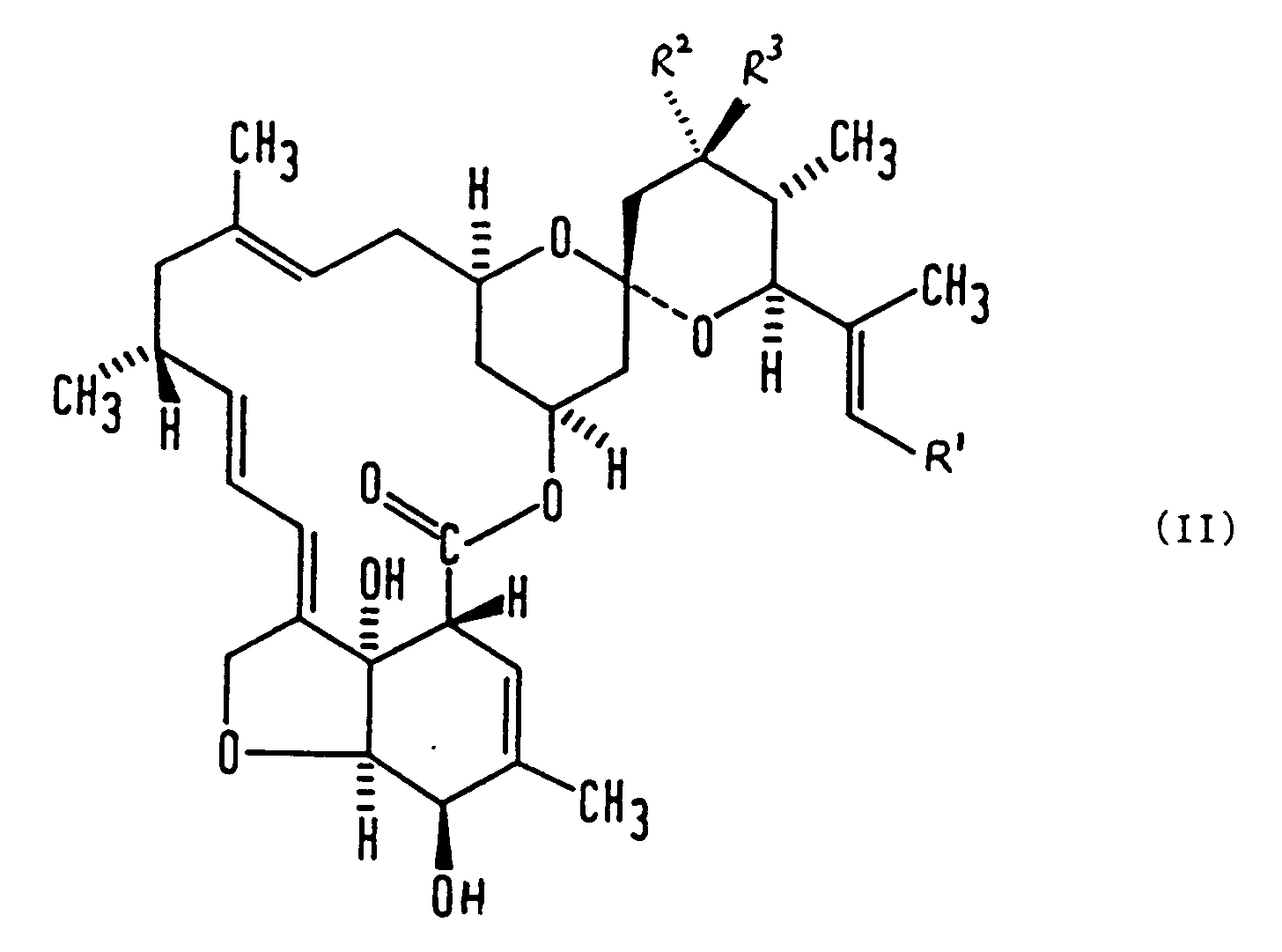
(where R¹, R² and R³ are as previously defined in formula (I)). The reaction may be effected with an oxidising agent serving to convert an allylic secondary hydroxyl group to an oxo group, whereby a compound of formula (I) is produced. - Suitable oxidising agents include, for example, transition metal oxides, such as manganese dioxide, and atmospheric oxygen in the presence of a suitable catalyst such as a finely divided metal e.g. platinum.
- The oxidising agent will generally be used in excess over the stoichiometric quantity.
- The reaction may conveniently be effected in a suitable solvent which may be selected from a ketone, e.g. acetone; an ether, e.g. diethyl ether, dioxan or tetrahydrofuran; a hydrocarbon, e.g. hexane; a halogenated hydrocarbon e.g. chloroform or methylene chloride; or an ester, e.g. ethyl acetate. Combinations of such solvents either alone or with water may also be used.
- The reaction may be carried out at a temperature of from -50°C to +50°C, preferably from 0° to 30°C.
- The compounds of formula (I) in which R² is an alkoxy or alkanoyloxy group may also be prepared by reacting the corresponding compound of formula (I) in which R² is a hydroxyl group with etherification or acylation reagents.
- Thus, for example, acylation may be effected using an acylating agent such as an acid of formula R⁶COOH or a reactive derivative thereof, such as an acid halide (e.g. acid chloride), anhydride or activated ester, or a reactive derivative of a carbonic acid R⁶OCOOH or thiocarbonic acid R⁶OCSOH (where R⁶ is alkyl).
- Acylations employing acid halides and anhydrides may if desired be effected in the presence of an acid binding agent such as a tertiary amine (e.g. triethylamine, dimethylaniline or pyridine), inorganic bases (e.g. calcium carbonate or sodium bicarbonate), and oxiranes such as lower 1,2-alkylene oxides (e.g. ethylene oxide or propylene oxide) which bind hydrogen halide liberated in the acylation reaction.
- Acylations employing acids are desirably conducted in the presence of a condensing agent, for example a carbodiimide such as N,N'-dicyclohexylcarbodiimide or N-ethyl-N'γ-dimethylaminopropylcarbodiimide; a carbonyl compound such as carbonyldiimidazole; or an isoxazolium salt such as N-ethyl-5-phenylisoxazolium perchlorate.
- An activated ester may conveniently be formed in situ using, for example, 1-hydroxybenzotriazole in the presence of a condensing agent as set out above. Alternatively, the activated ester may be preformed.
- The acylation reaction may be effected in aqueous or non-aqueous reaction media, conveniently at a temperature in the range -20° to +100°C, e.g. -10° to +50°C.
- Etherification may be effected using a reagent of formula R⁷Y (where R⁷ is alkyl and Y represents a leaving group such as chlorine, bromine or iodine atom or a hydrocarbylsulphonyloxy group, such as mesyloxy or tosyloxy, or a haloalkanoyloxy group such as dichloroacetoxy). The reaction may be effected in the presence of a silver salt such as silver oxide, silver perchlorate, silver carbonate or silver salicylate or mixtures thereof, and this system may be particularly appropriate when etherification is carried out using an alkyl halide (e.g. methyl iodide).
- Etherification may conveniently be effected in a solvent such as an ether e.g. diethyl ether.
- In a further process according to the invention a compound of formula (I) in which R² represents a hydrogen atom and R³ represents a bromine atom may be prepared from the corresponding compound of formula (I) in which R² represents a hydroxyl group and R³ represents a hydrogen atom.
- The reaction is effected using a brominating agent able to perform the displacement with inversion of configuration. Suitable brominating agents include triarylphosphine dibromides such as triphenylphosphine dibromide.
- The reaction is conveniently carried out in a solvent e.g. a nitrile such as acetonitrile at a temperature in the range of 0° to 50°C, conveniently at room temperature.
- In another process according to the invention a compound of formula (I) in which R² and R³ together with the carbon atom to which they are attached represent >C=NOR⁵, Y represents an oxygen atom and R¹ is as defined in formula (I), or R² represents a hydrogen atom or a group as defined above and R³ represents a hydrogen atom or R² and R³ together with the carbon atom to which they are attached represent >C=CH₂ or >C=NOR⁵, Y represents a group NOR⁵ and R¹ is as defined in formula (I) may be prepared from the corresponding 5 and/or 23-keto compound of formula (I) by reaction with a reagent H₂NOR⁵ (where R⁵ is as previously defined).
- In one embodiment of the process, a compound of formula (I) in which R² and R³ together with the carbon atom to which they are represent >C=NOR⁵ may be prepared from a corresponding compound of formula (I) in which R² and R³ together with the carbon atom to which they are attached represent >C=O.
- In a further embodiment of the process, a compound of formula (I) in which Y represents NOR⁵ may be prepared from a corresponding compound of formula (I) in which Y represents an oxygen atom.
- Compounds of formula (I) in which R² and R³ together with the carbon atom to which they are attached represent >C=NOR⁵ and Y represents NOR⁵ may conveniently be prepared from the correspond 5,23-diketo compound of formula (I) (in which R¹ and R² together with the carbon atom to which they are attached represent >C=O and Y is an oxygen atom) using two equivalents of the reagent H₂NOR⁵.
- The oximation reaction may conveniently be effected at a temperature in the range -20 to +100°C, e.g. -10 to +50°C. It is convenient to use the reagent H₂NOR⁵ in the form of a salt, for example an acid addition salt such as the hydrochloride. When such a salt is employed the reaction may be carried out in the presence of an acid binding agent.
- Solvents which may be employed include alcohols (e.g. methanol or ethanol), amides (e.g., N,N-dimethylformamide, N,N-dimethylacetamide or hexamethylphoshphoramide), ethers (e.g. cyclic cyclic ethers such as tetrahydrofuran or dioxan, and acylic ethers such as dimethoxyethane or diethylether), nitriles (e.g. acetonitrile), sulphones (e.g. sulpholane) and hydrocarbons such as halogenated hydrocarbons (e.g. methylene chloride), as well as mixtures of two or more such solvents. Water may also be employed as a cosolvent.
- When aqueous conditions are employed the reaction may conveniently be buffered with an appropriate acid, base or buffer.
- Suitable acids include mineral acids, such as hydrochloric or sulphuric acid, and carboxylic acid such as acetic acid. Suitable bases include alkali metal carbonates and bicarbonates such as sodium bicarbonate, hydroxides such as sodium hydroxide, and alkali metal carboxylates such as sodium acetate. A suitable buffer is sodium acetate/acetic acid.
- In a further process according to the invention a compound of formula (I) in which R² and R³ together with the carbon atom to which they are attached represent >C=O may be prepared by oxidising a compound of formula (I) wherein R² is a hydroxyl group. The reaction may be effected with an oxidising agent serving to convert a secondary hydroxyl group to an oxo group, whereby a compound of formula (I) is produced.
- Suitable oxidising agents include quinones in the presence of water, e.g. 2,3-dichloro-5,6-dicyano-1,4-benzoquinone or 2,3,5,6-tetrachloro-1,4-benzoquinone; a chromium (VI) oxidising agent, e.g. pyridinium dichromate or chromium trioxide in pyridine; a manganese (IV) oxidising agent, e.g. manganese dioxide in dichloromethane; an N-halosuccinimide, e.g. N-chlorosuccinimide or N-bromosuccinimide; a dialkylsulphoxide e.g. dimethylsulphoxide, in the presence of an activating agent such as N,Nʹ-dicyclohexylcarbodiimide or an acyl halide, e.g. oxalyl choride; or a pyridine-sulphur trioxide complex.
- The reaction may conveniently be effected in a suitable solvent which may be selected from ketone, e.g. acetone; an ether, e.g. diethyl ether, dioxan or tetrahydrofurn; a hydrocarbon, e.g. hexane; a halogenated hydrocarbon e.g. chloroform or methylene chloride; or an ester, e.g. ethyl acetate or a substituted amide e.g. dimethylformamide. Combinations of such solvents either alone or with water may also be used.
- The reaction may be carried out at a temperature of from -80°C to +50°C.
- Intermediates of formula (II) in which R² and R³ together with the carbon atom to which they are attached represent >C=CH₂ may be prepared by reacting the corresponding 23-keto compounds (i.e. compounds of formula (II) in which R² and R³ together with the carbon atom to which they are attached represent >C=O) or a 5-hydroxy protected derivative thereof with an appropriate Wittig reagent eg a phosphorane of formula (Ra)₃ P=CH₂ (where Ra is C1-6 alkyl or aryl eg monocyclic aryl such as phenyl). Suitable reaction solvents include ethers such as tetrahydrofuran or diethyl ether or a dipolar aprotic solvent such as dimethylsulphoxide. The reaction may be carried out at any suitable temperature eg at 0°. Alternatively, the 23-keto compound may be reacted with an organometallic reagent generated from CH₂(Hal)₂-Zn-TiCl₄ (where Hal is an iodine or bromine atom). The reaction may be performed in a solvent such as tetrahydrofuran at, for example, room temperature.
- The organometallic reagent for use in this reaction may be prepared according to the methods of Hibino et al., Tet. Lett., 1985, 5579, Takai et al., Tet. Lett., 1978, 2417 and Lombardo, Tet. Lett., 1982, 4293.
- Intermediates of formula (II) in which R² and R³ together with the carbon atom to which they are attached represent >C=NOR⁵ may be prepared from the corresponding 23-keto compounds of formula (II) according to the oximation process previously described.
- The compounds of formula (II) in which R¹ is a methyl, ethyl or isopropyl group, R² is a hydrogen atom or a group as defined above and R³ is a hydrogen atom, or R² and R³ together with the carbon atom to which they are attached represent >C=O are either known compounds described in UK Patent Specification No 2176182A or may be prepared from the known compounds using methods analogues to those described therein.
- The invention is further illustrated by the following Examples. All temperatures are in °C. The compounds are hereinafter named by reference to the known parent "Factors", Factors A, C and D described in UK Patent Specification No2166436A. Factor A is a compound of formula (II) in which R¹ is isopropyl, R² is hydroxy and R³ is hydrogen, Factor C is a compound of formula (II) in which R¹ is methyl, R² is hydroxy and R³ is hydrogen and Factor D is a compound of formula (II) in which R¹ is ethyl, R² is hydroxy and R³ is hydrogen.
- Diiodomethane (0.4ml) was added, with stirring, to a suspension of zinc powder (0.6g) in dry tetrahydrofuran (10ml). The mixture was stirred at 22° for 30min and then cooled to 0° during the addition of a dichloromethane solution of titanium tetrachloride (1.0ml, 1.0M solution). The resulting brown mixture was stirred at 22° for 30min. A solution of 23-keto Factor A (Example 21 in UK-2176182A) (204mg) in dry tetrahydrofuran (3ml) was added and stirring was contained for a further 30min. Diethyl ether (10ml) was added and the organic solution was washed successively with 20ml portions of 1M-hydrochloric acid and brine. The dried solution was concentrated to give a brown glass which was purified by medium pressure chromatography using silica (Merck Kieselgel 60, 230-400 mesh, 125g). Elution with dichloromethane:ethyl acetate (17:3) gave an impure sample of the title compound (65mg) which was purified further by chromatography on a silica preparative plate (Merck Kieselgel 60 20cm x 20cm x 2mm). Elution with 10:1 dichloromethane:ethyl acetate gave the title compound (47mg) as a white foam. δ(CDCl₃ ) includes 4.76 (s, 1H), 4.81(s, 1H).
- Factor A (250 mg) in ether (30 ml) was stirred with active manganese dioxide (1.0 g) for 2.75 hr. The mixture was filtered through a Kieselguhr pad, and the filtrate evaporated to give the title compound as a foam (240 mg). A portion was crystallised from petroleum-ether to give microcrystals, λmax (EtOH) 240.5 nm (E

- An ether solution of 23-keto Factor A (130mg) was stirred with precipitated manganese dioxide (400mg) at 21° for 3½ h. The mixture was filtered through kieselguhr and the filter-cake washed well with ether. Evaporation of filtrate and washings provided a gum which crystallized on scratching. The crystals were washed with di-isopropylether prior to collection to afford the title compound (80mg) m.p. ca 190° (decomp.); [α]


241 nm (εmax31,600); νmax (CHBr₃) 3550 and 2450 (OH), 1715 (ester and C₂₃-ketone); 1678 cm⁻¹ (α,β-unsaturated ketone); δ (CDCl₃) includes 6.57 (m, 1H); 2.50 (s, 2H); and 1.89 (m, 3H); m/z = 608 (M⁺).
Similarly prepared were Examples 2, 3, 4 and 5. - From Factor C (258 mg) and obtained as needles (152mg), m.p. 215 (dec.), [α]

- From 23-acetoxy Factor A (Example 11 in UK-2176182A) and obtained as microcrystalline needles. m.p. 150-152°, [α]


241 nm (εmax 30,200); νmax (CHBr₃) 3540 and 3490 (OH), 1718 (acetate and ester) and 1678 cm⁻¹ (α,β-unsaturated ketone); δ (CDCl₃) include 6.55 (m, 1H), 4.90 (q, 3Hz, 1H), 2.03 (s, 3H) and 1.87 (m, 3H); m/z = 652 (M⁺). - From 23-desoxy Factor A (Example 27 in UK-2176182A) and obtained as a foam upon chromatography over Merck Kieselgel 60, 230-400 mesh silica gel.
[α]
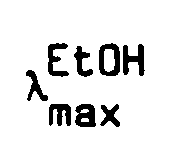
241 nm (εmax 31,400); νmax (CHBr₃) 3480 (OH), 1710(ester) and 1678 cm⁻¹ (α,β-unsaturated ketone); δ (CDCl₃) include 6.56 (m, 1H), 1.88 (m, 3H) and 0.69 (broad d, ca 5Hz, 3H); m/z = 594 (M⁺). - From Factor D (240mg) and obtained as a white solid (63mg) after chromatography on Merck Kieselgel 60, 70-230 mesh silica (2.5 g) eluting with dichloromethane:ethyl acetate (10:1) and trituration with ether. M.p. 242-244°, [α]


241 nm (εmax 31500); νmax (CHBr₃)3490(OH), 1708 (ester) and 1675 cm⁻¹ (conjugated ketone); δ(CDCl₃) 0.80 (d, 7 Hz; 3H), 0.99 (d, 6 Hz; 3H), 1.01 (t, 7 Hz; 3H), 1.51 (s; 3H), 1.60 (s; 3H), 1.87 (s; 3H), 3.54 (m; 1H), 3.65 (m; 1H), 3.77 (d, 10 Hz; 1H), 3.77 (s; 1H), 3.81(s; 1H) and 6.55 (m; 1H). m/z=596 (M+). - Bromine (0.15 ml) was added dropwise to a stirred solution of triphenylphosphine (0.74g) in dimethylformamide (2.6ml) under nitrogen. The suspension was allowed to cool to room temperature and was diluted with ether. The solvent was decanted off and the solid was washed with ether. The dried solid was redissolved in acetonitrile (20ml) and an aliquot (5ml) was cooled in an ice bath and a solution of 5-keto Factor A (100mg) in acetonitrile (2ml) was added under nitrogen. After 1h the solution was allowed to warm to room temperature and the reaction was left for 20h. The mixture was partitioned between ethyl acetate and 2N hydrochloric acid and the organic phase was separated. The organic phase was washed with 2N hydrochloric acid, then with saturated sodium bicarbonate solution, then was dried over sodium sulphate, and the solvent was evaporated. The residue was chromatographed over a column of silica (Merck Art 9385; 75ml) made up in hexane (60-80°)/ethyl acetate and eluted with the same solvent. Appropriate fractions of the major component were combined and the solvent was evaporated to leave the title compound as a foam (20mg) [α]


240nm (ε 26,000); νmax (CHBr₃) 3500 (OH), 1710 (ester), 1678 (ketone), 997 (C-O); δ (CDCl₃) include 0.95 (d;3H), 0.97 (d;3H), 1.00 (d;3H), 3.58 (m,1H), 4.19 (t;d;1H), 3.83 (s;1H), 3.85 (s;1H), and 6.58 (m;1H). - A solution of 5-keto Factor A (350 mg) in dry ether (15 ml) was treated at 20°, under nitrogen, with silver carbonate (785 mg), iodoethane (0.27 ml) and silver perchlorate (590 mg). The resulting suspension was stirred for 64 h under nitrogen, diluted with ethyl acetate, washed with 2N-hydrochloric acid, water, and brine and dried. The residue was chromatographed over Kieselgel 60 eluting with light petroleum:ethyl acetate (4:1) to give a foam (202 mg).
- A sample of the foam (20 mg) was crystallised from light petroleum (0.2 ml) to give the title compound as a colourless solid, m.p. 128-130°, [α]

- A solution of 5-keto Factor A (611 mg) in dry ether (25 ml) was stirred at 20° under nitrogen, and silver carbonate (1.38 g), 1-iodopropane (0.6 ml) and silver perchlorate (1.036 g) were added. The resulting suspension was stirred for 3.5 h, and then kept at 20° for a further 18 h. The mixture was diluted with ethyl acetate (25 ml), then filtered through kieselguhr, and the filter bed was washed with ethyl acetate (25 ml). The filtrate and washing were combined, and washed with aqueous sodium metabisulphite, 2N-sodium hydroxide, 2N-hydrochloric acid, and brine (25 ml of each), and dried (magnesium sulphate), and concentrated to ca. 5 ml. The resulting solution was diluted with light petroleum (ca. 5 ml), and then purified by chromatography over Kieselgel 60 (60 g). Elution of the column with light petroleum : ethyl acetate (4 : 1) gave a foam (385 mg), which was crystallised from light petroleum (ca. 10 ml) to provide the title compound (280 mg) as a colorless solid, m.p. 115 to 127° (decomp.), [α]

- 23-Desoxy-23-methylene Factor A (0.014 g) was dissolved in ethyl acetate (1 ml) and stirred with activated manganese dioxide (0.02 g) for 20 minutes. The reaction mixture was filtered through a Kieselguhr pad, and washed through with further quantities of ethyl acetate. The solution was evaporated under vacuum to give the title compound (0.011 g), δ(CDC1₃) includes 3.52 (m; 1H), 4.6 - 4.8(m; 4H) and 6.51(s; 1H).
- A methanolic solution containing 5,23-diketo Factor A (150 mg), methoxyamine hydrochloride (280 mg) and sodium acetate (250 mg) was kept at about 20° for 20 h, and was then diluted with ether (40 ml) and ethyl acetate (20 ml) and washed succesively with 2N hydrochloric acid and water. The dried organic phase was evaporated and the resultant gum was purified by chromatography over Merck Kieselgel 60 230-400 mesh (100 ml). Elution of the column with hexane : ethyl acetate (3:1) afforded the title compound as a white foam (58 mg). [α]

Examples 11 to 13 were prepared in a similar manner from methoxyamine hydrochloride and the appropriate 5-keto Factor A derivative. - 5-Keto Factor A gave the title compound as a light yellow foam. [α]

- 5-Keto Factor A 23-ethyl ether gave the title compound as a light yellow foam. [α]

- 23-Desoxy 5-keto Factor A gave the title compound as a white foam. [α]

- Hydroxylamino hydrochloride (135 mg) and anhydrous sodium acetate (148mg) were stirred together in dioxan (5 ml) containing a few drops of water and one drop of glacial acetic acid. After 5 min 5-keto Factor C (170 mg) was added and the mixture stirred at 21° for 3.5 h. The mixture was next diluted with ether and the organic phase washed well with water. Evaporation of the dried organic phase gave a gum which was purified by chromatography over Sorbsil silica. Gradient elution with dichloromethane:ether (100:0 to 98:2) gave the title compound which precipitated as an amorphous solid from ether-pentane λmax (EtOH) 245 nm (εmax 27,500); νmax (CHBr₃) 3130-3600 (OH), and 1708 cm⁻¹ (ester); δ (CDCl₃) include 8.61 (broad s, 1H), 5.80 (s, 1H), 4.64 (s, 1H), 1.90 (s, 3H), 1.63 (d 6Hz, 3H), 1.57 (s, 3H), 1.49 (s, 3H), 0.96 (d 6Hz, 3H), and 0.76 (d 6Hz, 3H)
m/z=598 (MH⁺). - To a stirred mixture of hydroxylamine hydrochloride (120 mg) and anhydrous sodium acetate (131 mg) in dioxan (6 ml) containing a few drops of water and a single drop of glacial acetic acid was added 5-keto Factor A (151 mg). After stirring this mixture at room temperature for 4h it was diluted with ether and the organic phase extracted with saturated aqueous sodium bicarbonate solution. Removal of solvent from the dried organic phase afforded a gum which in dichloromethane was introduced on to a short Sorbsil silica column made up in the same solvent.
Elution with dichloromethane and then with dichloromethane-ether (98.5:1.5) provided the title compound (46 mg) obtained as an amorphous solid from ether-pentane λmax (EtOH) 245 nm (εmax 30,700); νmax (CHBr₃) 3140-3600 (OH) and 1705 cm⁻¹ (ester); δ (CDCl₃) include 8.25 (broad s; 1H), 5.81 (s; 1H) 5.21 (d; 8Hz, 1H), 4.66 (s; 1H), 2.59 (m; 1H), 1.93 (s; 3H), 1.62 (s, 3H), 1.54 (s, 3H), 1.05 (d; 6Hz, 3H), 1.01 (d; 6Hz; 3H), 0.96 (d; 6Hz; 3H) and 0.81 (d; 7Hz; 3H) m/z=625 (M⁺). - 5,23 Diketo Factor A (475mg), methoxylamine hydrochloride (69mg) and anhydrous sodium acetate (135mg) were dissolved in methanol. After 1.5h at room temperature, the solution was kept at -18° for 16h, diluted with ethyl acetate and washed successively with 1N hydrochloric acid, water, and brine. The dried organic phase was evaporated and the yellow foam was purified by chromatography over Merck Keiselgel 60, 230 to 400 mesh (120ml). Elution of the column with hexane:ethyl acetate (4:1) afforded the title compound as a yellow foam (255mg) [α]

- A solution of 5-keto-Factor D (278 mg) in dry pyridine (2.5 ml) was treated with hydroxylamine hydrochloride monohydrate (45 mg) added in one portion. After stirring for 5 hr at 21° the yellow solution was poured into dichloromethane (20 ml) and was then washed successively with 2N hydrochloric acid, water and brine. Drying and evaporation yielded a yellow foam (298 mg). Purification of the foam by column chromatography using Merck Kieselgel 60, 70-230 mesh silica (35 g) and dichloromethane : acetone (35:1) as eluent afforded one major component (138 mg). Further purification of this solid by preparative reverse-phase HPLC gave the title compound as a solid (79 mg) after trituration with pentane, m.p. 162-164°, [α]

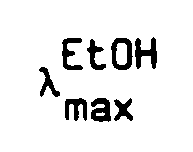
245 nm (εmax 30,500); νmax (CHBr₃) 3530 and 3490 (OH) and 1710 cm⁻¹ (C=O); δ(CDCl₃) 0.81 (d, 7 Hz; 3H), 1.00 (d, 6 Hz; 3H), 1.01 (d, 7 Hz; 3H), 1.53 (s; 3H), 1.60 (s; 3H), 1.93 (s; 3H), 3.39 (m; 1H) and 4.66 (s; 1H). m/z = 611 (M⁺). - 5-Methoxyimino Factor A was oxidised by pyridinium dichromate in dry N,N-dimethylformamide at ambient temperature by the method described in GB 2176182A. Purification by chromatography over Merck Keiselgel 60, 230-400 mesh, eluting with hexane:ethyl acetate (3:1) afforded the title compound as a tan foam (47mg), λmax (EtOH) 246nm (ε 29,100) νmax (CHBr₃) (cm⁻¹) 1710 (C=O) 1050, 1025 (C-O), δ(CDCl₃) include 5.7-5.9 (m; 3H), 4.55 (s; 3H), 4.01 (s; 3H), 2.51 (s; 2H), 1.96 (s; 3H), 1.70 (s; 3H), 1.51 (s; 3H), 1.07 (d6; 3H), 1.00 (d6; 3H), 0.97 (d6; 3H) and 0.87 (d6; 3H).
- The following are examples of formulations according to the invention. The term 'Active Ingredient' as used hereinafter means a compound of the invention.
-

Dissolve the active ingredient in the benzyl alcohol and glyceryl triacetate. Add propylene glycol and make up to volume. Sterilise the product by conventional pharmaceutical methods, for example sterile filtration or by heating in an autoclave and package aseptically. -

Mix the Active Ingredient with trichloroethane and fill into the aerosol container. Purge the headspace with the gaseous propellant and crimp the valve into position. Fill the required weight of liquid propellant under pressure through the valve. Fit the actuators and dust-caps. -

Microcrystalline cellulose to tablet core weight of 450mg Add sufficient quantity of a 10% starch paste to the active ingredient to produce a suitable wet mass for granulation. Prepare the granules and dry using a tray of fluid-bed drier. Sift through a seive, add the remaining ingredients and compress into tablets. - If required, film coat the tablet cores using hydroxypropylmethyl cellulose or other similar film-forming material using either an aqueous or non-aqueous solvent system. A plasticizer and suitable colour may be included in the film-coating solution.
-
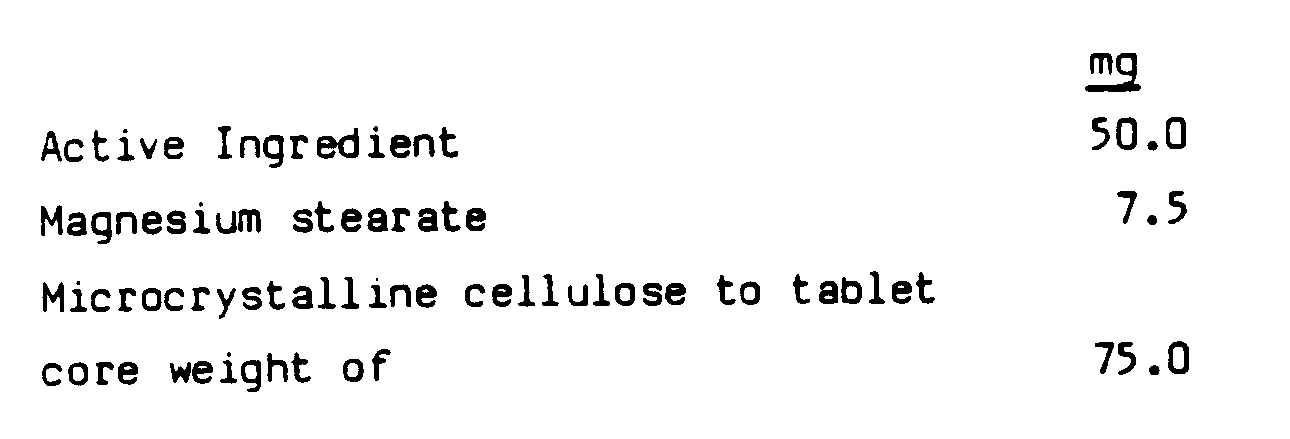
Blend the active ingredient with the magnesium stearate and microcrystallise cellulose. Compact the blend into slugs. Break down the slugs by passing through a rotary granulator to product free-flowing granules. Compress into tablets. - The tablet cores can then be film-coated, if desired, as described above.
-

Heat the arachis oil, white beeswax and polysorbate 60 to 160°C with stirring. Maintain at 160°C for two hours and then cool to room temperature with stirring. Aseptically add the active ingredient to the vehicle and disperse using a high speed mixer. Refine by passing through a colloid mill. Aseptically fill the product into sterile plastic syringes. -

Dissolve the active ingredient in the Polysorbate 85, benzyl alcohol and the propylene glycol. Add a proportion of the water and adjust the pH to 6.0 - 6.5 with phosphate buffer, if necessary. Make up to final volume with the water. Fill the product into the drench container. -

Disperse the aluminium distearate in the fractionated coconut oil and polysorbate 85 by heating. Cool to room temperature and disperse the saccharin in the oily vehicle. Dispense the active ingredient in the base. Fill the plastic syringes. -

Blend the Active Ingredient with the calcium sulphate. Prepare the granules using a wet granulation process. Dry using a tray or fluid-bed drier. Fill into the appropriate container. -
Active ingredient 50g Anionic emulsifier (e.g. Phenyl sulphonate CALX) 40g Non-ionic emulsifier (e.g. Syperonic NP13) 60g Aromatic solvent (e.g. Solvesso 100) to 1 litre.
Mix all ingredients, stir until dissolved. -
(a) Active ingredient 50g Wood resin 40g Gypsum granules (20-60 mesh) to 1kg (e.g. Agsorb 100A) (b) Active ingredient 50g Syperonic NP13 40g Gypsum granules (20-60 mesh) to 1kg.
Dissolve all ingredients in a volatile solvent e.g. methylene chloride, add to granules tumbling in mixer. Dry to remove solvent.
Claims (12)
- Compounds of formula (I), other than as pharmaceutical products as such:

R¹ is a methyl, ethyl or isopropyl group;
R² is a hydrogen atom or a hydroxyl, C₁₋₈ alkoxy or C₂₋₈ alkanoyloxy group and R³ is a hydrogen atom, or (when R² is a hydrogen atom) a bromine atom; or R² and R³ together with the carbon atom to which they are attached represent >C=CH₂, >C=O or >C-NOR⁵ (where R⁵ is a hydrogen atom, a C₁₋₈ alkyl group and the group >C-NOR⁵ is in the E configuration); and
Y represents an oxygen atom or a group NOR⁵ (where R⁵ is as defined above); with the proviso that when Y is an oxygen atom and R¹ is an isopropyl group, then R² is other than a hydroxyl group. - Compounds according to claim 1 in which R¹ is an isopropyl group.
- Compounds according to claim 1 or claim 2 in which Y is an oxygen atom.
- Compounds according to claim 1 or claim 2 in which Y is NOCH₃.
- Compounds according to any preceding claim in which R² is a hydrogen atom or a hydroxy, acetoxy or ethoxy group and R³ is a hydrogen atom, or R² and R³ together represent =CH₂, =O or =NOCH₃.
- Compounds according to claim 1 in which:
R¹ is an isopropyl group, R² and R³ together with the carbon atom to which they are attached represent C=NOCH₃ and Y is an oxygen atom;
R¹ is an isopropyl group, R² and R³ together with the carbon atom to which they are attached represent C=O and Y is an oxygen atom or NOCH₃; or
R¹ is an isopropyl group, R² and R³ together with the carbon atom to which they are attached represent C=NOCH₃ and Y is NOCH₃. - A pest control composition, other than as a pharmaceutical product as such, containing an effective amount of at least one compound according to claim 1 together with one or more carriers and/or excipients.
- A method for combatting pests in agriculture, horticulture or forestry, or in stores, buildings or other public places or locations of the pests, which comprises applying to plants or other vegetation or to the pests themselves or a location thereof an effective amount of one or more compounds according to claim 1.
- A method as claimed in claim 8 in which said pests are insect, acarine or nematode pests.
- A process for the preparation of a compound according to claim 1 which comprises:(a) in the preparation of a compound in which Y is an oxygen atom, oxidising the corresponding 5β-hydroxy compound;(b) in the preparation of a compound in which R² is an alkoxy or alkanoyloxy group, reacting the corresponding compound in which compound in which R² is a hydroxyl group with an alkylating or acylating reagent;(c) in the preparation of a compound in which R² and R³ together with the carbon atom to which they are attached represent >C=NOR⁵ and/or Y is NOR⁵, treating the corresponding 5-oxo, 23-oxo or 5, 23-dioxo compound with H₂NOR⁵;(d) in the preparation of a compound in which R² is a hydrogen atom and R³ is a bromine atom, brominating the corresponding compound in which R² is a hydroxyl group and R³ is a hydrogen atom; or(e) in the preparation of a compound in which R² and R³ together with the carbon atom to which they are attached represent >C=O, oxidising the corresponding compound in which R² is a hydroxyl group.
- A method of preparing a composition for use in medicine which comprises formulating a compound according to claim 1 together with one or more carriers.
Priority Applications (1)
| Application Number | Priority Date | Filing Date | Title |
|---|---|---|---|
| AT87302107T ATE100810T1 (en) | 1986-03-12 | 1987-03-11 | MACROLIDE COMPOUNDS. |
Applications Claiming Priority (8)
| Application Number | Priority Date | Filing Date | Title |
|---|---|---|---|
| GB8606109 | 1986-03-12 | ||
| GB868606106A GB8606106D0 (en) | 1986-03-12 | 1986-03-12 | Chemical compounds |
| GB8606106 | 1986-03-12 | ||
| GB868606109A GB8606109D0 (en) | 1986-03-12 | 1986-03-12 | Chemical compounds |
| GB868625856A GB8625856D0 (en) | 1986-10-29 | 1986-10-29 | Chemical compounds |
| GB8625856 | 1986-10-29 | ||
| GB868625862A GB8625862D0 (en) | 1986-10-29 | 1986-10-29 | Chemical compounds |
| GB8625862 | 1986-10-29 |
Publications (2)
| Publication Number | Publication Date |
|---|---|
| EP0238258A1 EP0238258A1 (en) | 1987-09-23 |
| EP0238258B1 true EP0238258B1 (en) | 1994-01-26 |
Family
ID=27449743
Family Applications (1)
| Application Number | Title | Priority Date | Filing Date |
|---|---|---|---|
| EP87302107A Expired - Lifetime EP0238258B1 (en) | 1986-03-12 | 1987-03-11 | Macrolide compounds |
Country Status (11)
| Country | Link |
|---|---|
| EP (1) | EP0238258B1 (en) |
| JP (1) | JP2577734B2 (en) |
| AT (1) | ATE100810T1 (en) |
| AU (1) | AU609032B2 (en) |
| BR (1) | BR8701119A (en) |
| CA (1) | CA1296328C (en) |
| DE (1) | DE3788886T2 (en) |
| ES (1) | ES2061487T3 (en) |
| IE (1) | IE62773B1 (en) |
| NZ (1) | NZ219576A (en) |
| PH (1) | PH24355A (en) |
Families Citing this family (13)
| Publication number | Priority date | Publication date | Assignee | Title |
|---|---|---|---|---|
| NZ221077A (en) * | 1986-07-18 | 1990-06-26 | Ciba Geigy Ag | 13b-alkyl milbemycins and use as parasiticides |
| US4849446A (en) * | 1986-09-12 | 1989-07-18 | American Cyanamid Company | 23-imino derivatives of 23-keto compounds |
| US4886830A (en) * | 1987-03-06 | 1989-12-12 | American Cyanamid Company | Mono- and diepoxide derivatives of 23-deoxyl-LL-F28249 compounds |
| US4956479A (en) * | 1987-03-06 | 1990-09-11 | American Cyanamid Company | 23-deoxy-27-chloro derivatives of LL-F28249 compounds |
| US4806527A (en) * | 1987-03-16 | 1989-02-21 | Merck & Co., Inc. | Avermectin derivatives |
| GB8721375D0 (en) * | 1987-09-11 | 1987-10-21 | Glaxo Group Ltd | Chemical process |
| GB8801908D0 (en) * | 1988-01-28 | 1988-02-24 | Glaxo Group Ltd | Chemical compounds |
| GB8804440D0 (en) * | 1988-02-25 | 1988-03-23 | Pfizer Ltd | Antiparasitic agents |
| GB8811037D0 (en) * | 1988-05-10 | 1988-06-15 | Glaxo Group Ltd | Chemical compounds |
| HU9203978D0 (en) * | 1988-05-10 | 1993-04-28 | American Cyanamid Co | Method for producing macrolidic compounds and preparatives containing them qs active substance by means of fermentation |
| US5015630A (en) * | 1989-01-19 | 1991-05-14 | Merck & Co., Inc. | 5-oxime avermectin derivatives |
| NZ233680A (en) * | 1989-05-17 | 1995-02-24 | Beecham Group Plc | Avermectins and milbemycins and compositions thereof |
| GB9201505D0 (en) * | 1992-01-24 | 1992-03-11 | Pfizer Ltd | Antiparasitic agents |
Family Cites Families (9)
| Publication number | Priority date | Publication date | Assignee | Title |
|---|---|---|---|---|
| US4289760A (en) * | 1980-05-02 | 1981-09-15 | Merck & Co., Inc. | 23-Keto derivatives of C-076 compounds |
| JPS5933288A (en) * | 1982-08-19 | 1984-02-23 | Sankyo Co Ltd | 5-oxo derivative of milbemycin d |
| JPS59108785A (en) * | 1982-11-25 | 1984-06-23 | Sankyo Co Ltd | 5-oxime derivatives of milbemycins |
| JPS60142991A (en) * | 1983-12-28 | 1985-07-29 | Sankyo Co Ltd | 5-didehydromilbemycin 5-oxime derivative |
| DK165119C (en) * | 1984-06-05 | 1993-03-01 | American Cyanamid Co | ANTIBIOTIC COMPOUNDS DESIGNED LL-F28249ALFA, BETA, GAMMA, DELTA, EPSILON, ZETA, ETA, THETA, IOTA, KAPPA, MY AND NEW AND PHARMACEUTICAL OR PHARMACOLOGICALLY ACCEPTABLE SALTS THEREOF, |
| US4579864A (en) * | 1984-06-11 | 1986-04-01 | Merck & Co., Inc. | Avermectin and milbemycin 13-keto, 13-imino and 13-amino derivatives |
| US4547491A (en) * | 1984-07-18 | 1985-10-15 | Merck & Co., Inc. | C-8A-Oxo-avermectin and milbemycin derivatives, pharmaceutical compositions and method of use |
| IL78621A (en) * | 1985-04-30 | 1991-06-30 | American Cyanamid Co | Mylbemycin analogs,their preparation and pesticidal compositions containing them |
| JPS6289685A (en) * | 1985-05-31 | 1987-04-24 | Sankyo Co Ltd | 13-halogenomilbemycin derivative |
-
1987
- 1987-03-11 JP JP62054266A patent/JP2577734B2/en not_active Expired - Fee Related
- 1987-03-11 BR BR8701119A patent/BR8701119A/en not_active IP Right Cessation
- 1987-03-11 PH PH35007A patent/PH24355A/en unknown
- 1987-03-11 IE IE62887A patent/IE62773B1/en not_active IP Right Cessation
- 1987-03-11 CA CA000531751A patent/CA1296328C/en not_active Expired - Fee Related
- 1987-03-11 ES ES87302107T patent/ES2061487T3/en not_active Expired - Lifetime
- 1987-03-11 AT AT87302107T patent/ATE100810T1/en not_active IP Right Cessation
- 1987-03-11 AU AU69909/87A patent/AU609032B2/en not_active Ceased
- 1987-03-11 NZ NZ219576A patent/NZ219576A/en unknown
- 1987-03-11 EP EP87302107A patent/EP0238258B1/en not_active Expired - Lifetime
- 1987-03-11 DE DE3788886T patent/DE3788886T2/en not_active Expired - Fee Related
Also Published As
| Publication number | Publication date |
|---|---|
| PH24355A (en) | 1990-06-13 |
| ATE100810T1 (en) | 1994-02-15 |
| DE3788886D1 (en) | 1994-03-10 |
| IE62773B1 (en) | 1995-02-22 |
| BR8701119A (en) | 1988-01-05 |
| JPS62265289A (en) | 1987-11-18 |
| IE870628L (en) | 1987-09-12 |
| AU6990987A (en) | 1987-09-17 |
| ES2061487T3 (en) | 1994-12-16 |
| NZ219576A (en) | 1989-01-06 |
| EP0238258A1 (en) | 1987-09-23 |
| AU609032B2 (en) | 1991-04-26 |
| DE3788886T2 (en) | 1994-06-16 |
| JP2577734B2 (en) | 1997-02-05 |
| CA1296328C (en) | 1992-02-25 |
Similar Documents
| Publication | Publication Date | Title |
|---|---|---|
| US4950683A (en) | Macrolide antibiotics | |
| US4918098A (en) | Macrolide compounds | |
| AU609032B2 (en) | Macrolide compounds | |
| EP0237339B1 (en) | Macrolide compounds | |
| EP0241146B1 (en) | Macrolide compounds | |
| EP0237341B1 (en) | Macrolide compounds | |
| EP0231104B1 (en) | Macrolide antibiotics and their preparation | |
| EP0327270B1 (en) | Macrolide compounds | |
| EP0241145B1 (en) | Macrolide compounds | |
| US5336789A (en) | Macrolide compounds | |
| EP0307225B1 (en) | Macrolide compounds | |
| US5104871A (en) | Macrolide compounds | |
| EP0341972B1 (en) | Macrolide compounds | |
| US5185456A (en) | Macrolide compounds | |
| US5192777A (en) | Macrolide compounds | |
| EP0307220A2 (en) | Macrolide compounds |
Legal Events
| Date | Code | Title | Description |
|---|---|---|---|
| PUAI | Public reference made under article 153(3) epc to a published international application that has entered the european phase |
Free format text: ORIGINAL CODE: 0009012 |
|
| AK | Designated contracting states |
Kind code of ref document: A1 Designated state(s): AT BE CH DE ES FR GB GR IT LI LU NL SE |
|
| 17P | Request for examination filed |
Effective date: 19880322 |
|
| 17Q | First examination report despatched |
Effective date: 19891219 |
|
| RAP1 | Party data changed (applicant data changed or rights of an application transferred) |
Owner name: AMERICAN CYANAMID COMPANY |
|
| GRAA | (expected) grant |
Free format text: ORIGINAL CODE: 0009210 |
|
| AK | Designated contracting states |
Kind code of ref document: B1 Designated state(s): AT BE CH DE ES FR GB GR IT LI LU NL SE |
|
| REF | Corresponds to: |
Ref document number: 100810 Country of ref document: AT Date of ref document: 19940215 Kind code of ref document: T |
|
| REF | Corresponds to: |
Ref document number: 3788886 Country of ref document: DE Date of ref document: 19940310 |
|
| ITTA | It: last paid annual fee | ||
| ET | Fr: translation filed | ||
| ITF | It: translation for a ep patent filed | ||
| EPTA | Lu: last paid annual fee | ||
| REG | Reference to a national code |
Ref country code: GR Ref legal event code: FG4A Free format text: 3011154 |
|
| PLBE | No opposition filed within time limit |
Free format text: ORIGINAL CODE: 0009261 |
|
| STAA | Information on the status of an ep patent application or granted ep patent |
Free format text: STATUS: NO OPPOSITION FILED WITHIN TIME LIMIT |
|
| REG | Reference to a national code |
Ref country code: ES Ref legal event code: FG2A Ref document number: 2061487 Country of ref document: ES Kind code of ref document: T3 |
|
| 26N | No opposition filed | ||
| EAL | Se: european patent in force in sweden |
Ref document number: 87302107.5 |
|
| REG | Reference to a national code |
Ref country code: GB Ref legal event code: IF02 |
|
| PGFP | Annual fee paid to national office [announced via postgrant information from national office to epo] |
Ref country code: GR Payment date: 20021220 Year of fee payment: 17 |
|
| PGFP | Annual fee paid to national office [announced via postgrant information from national office to epo] |
Ref country code: LU Payment date: 20021230 Year of fee payment: 17 |
|
| PGFP | Annual fee paid to national office [announced via postgrant information from national office to epo] |
Ref country code: GB Payment date: 20030204 Year of fee payment: 17 Ref country code: AT Payment date: 20030204 Year of fee payment: 17 |
|
| PGFP | Annual fee paid to national office [announced via postgrant information from national office to epo] |
Ref country code: NL Payment date: 20030206 Year of fee payment: 17 |
|
| PGFP | Annual fee paid to national office [announced via postgrant information from national office to epo] |
Ref country code: FR Payment date: 20030303 Year of fee payment: 17 |
|
| PGFP | Annual fee paid to national office [announced via postgrant information from national office to epo] |
Ref country code: SE Payment date: 20030304 Year of fee payment: 17 |
|
| PGFP | Annual fee paid to national office [announced via postgrant information from national office to epo] |
Ref country code: ES Payment date: 20030318 Year of fee payment: 17 |
|
| PGFP | Annual fee paid to national office [announced via postgrant information from national office to epo] |
Ref country code: CH Payment date: 20030319 Year of fee payment: 17 |
|
| PGFP | Annual fee paid to national office [announced via postgrant information from national office to epo] |
Ref country code: DE Payment date: 20030331 Year of fee payment: 17 |
|
| PGFP | Annual fee paid to national office [announced via postgrant information from national office to epo] |
Ref country code: BE Payment date: 20030409 Year of fee payment: 17 |
|
| PG25 | Lapsed in a contracting state [announced via postgrant information from national office to epo] |
Ref country code: LU Free format text: LAPSE BECAUSE OF NON-PAYMENT OF DUE FEES Effective date: 20040311 Ref country code: GB Free format text: LAPSE BECAUSE OF NON-PAYMENT OF DUE FEES Effective date: 20040311 Ref country code: AT Free format text: LAPSE BECAUSE OF NON-PAYMENT OF DUE FEES Effective date: 20040311 |
|
| PG25 | Lapsed in a contracting state [announced via postgrant information from national office to epo] |
Ref country code: SE Free format text: LAPSE BECAUSE OF NON-PAYMENT OF DUE FEES Effective date: 20040312 Ref country code: ES Free format text: LAPSE BECAUSE OF NON-PAYMENT OF DUE FEES Effective date: 20040312 |
|
| PG25 | Lapsed in a contracting state [announced via postgrant information from national office to epo] |
Ref country code: LI Free format text: LAPSE BECAUSE OF NON-PAYMENT OF DUE FEES Effective date: 20040331 Ref country code: CH Free format text: LAPSE BECAUSE OF NON-PAYMENT OF DUE FEES Effective date: 20040331 Ref country code: BE Free format text: LAPSE BECAUSE OF NON-PAYMENT OF DUE FEES Effective date: 20040331 |
|
| BERE | Be: lapsed |
Owner name: AMERICAN *CYANAMID CY Effective date: 20040331 |
|
| PG25 | Lapsed in a contracting state [announced via postgrant information from national office to epo] |
Ref country code: NL Free format text: LAPSE BECAUSE OF NON-PAYMENT OF DUE FEES Effective date: 20041001 Ref country code: DE Free format text: LAPSE BECAUSE OF NON-PAYMENT OF DUE FEES Effective date: 20041001 |
|
| PG25 | Lapsed in a contracting state [announced via postgrant information from national office to epo] |
Ref country code: GR Free format text: LAPSE BECAUSE OF NON-PAYMENT OF DUE FEES Effective date: 20041006 |
|
| EUG | Se: european patent has lapsed | ||
| GBPC | Gb: european patent ceased through non-payment of renewal fee |
Effective date: 20040311 |
|
| REG | Reference to a national code |
Ref country code: CH Ref legal event code: PL |
|
| PG25 | Lapsed in a contracting state [announced via postgrant information from national office to epo] |
Ref country code: FR Free format text: LAPSE BECAUSE OF NON-PAYMENT OF DUE FEES Effective date: 20041130 |
|
| NLV4 | Nl: lapsed or anulled due to non-payment of the annual fee |
Effective date: 20041001 |
|
| REG | Reference to a national code |
Ref country code: FR Ref legal event code: ST |
|
| PG25 | Lapsed in a contracting state [announced via postgrant information from national office to epo] |
Ref country code: IT Free format text: LAPSE BECAUSE OF NON-PAYMENT OF DUE FEES;WARNING: LAPSES OF ITALIAN PATENTS WITH EFFECTIVE DATE BEFORE 2007 MAY HAVE OCCURRED AT ANY TIME BEFORE 2007. THE CORRECT EFFECTIVE DATE MAY BE DIFFERENT FROM THE ONE RECORDED. Effective date: 20050311 |
|
| REG | Reference to a national code |
Ref country code: ES Ref legal event code: FD2A Effective date: 20040312 |