EP0237132A2 - Process for the preparation of water-soluble saccharide polymers - Google Patents
Process for the preparation of water-soluble saccharide polymers Download PDFInfo
- Publication number
- EP0237132A2 EP0237132A2 EP87200451A EP87200451A EP0237132A2 EP 0237132 A2 EP0237132 A2 EP 0237132A2 EP 87200451 A EP87200451 A EP 87200451A EP 87200451 A EP87200451 A EP 87200451A EP 0237132 A2 EP0237132 A2 EP 0237132A2
- Authority
- EP
- European Patent Office
- Prior art keywords
- water
- soluble
- monomer
- saccharide
- saccharide monomer
- Prior art date
- Legal status (The legal status is an assumption and is not a legal conclusion. Google has not performed a legal analysis and makes no representation as to the accuracy of the status listed.)
- Granted
Links
Classifications
-
- C—CHEMISTRY; METALLURGY
- C08—ORGANIC MACROMOLECULAR COMPOUNDS; THEIR PREPARATION OR CHEMICAL WORKING-UP; COMPOSITIONS BASED THEREON
- C08F—MACROMOLECULAR COMPOUNDS OBTAINED BY REACTIONS ONLY INVOLVING CARBON-TO-CARBON UNSATURATED BONDS
- C08F20/00—Homopolymers and copolymers of compounds having one or more unsaturated aliphatic radicals, each having only one carbon-to-carbon double bond, and only one being terminated by only one carboxyl radical or a salt, anhydride, ester, amide, imide or nitrile thereof
- C08F20/02—Monocarboxylic acids having less than ten carbon atoms, Derivatives thereof
- C08F20/10—Esters
- C08F20/26—Esters containing oxygen in addition to the carboxy oxygen
- C08F20/30—Esters containing oxygen in addition to the carboxy oxygen containing aromatic rings in the alcohol moiety
Definitions
- the invention provides a process for the preparation of water-soluble vinyl saccharide polymers by polymerization in water of at least one water soluble monovinyl saccharide monomer at a temperature in the range of from 10°C to 90°C, wherein the polymerization is carried out in the presence of a non-azo type free-radical initiator having a solubility in water at 20°C of not more than 2500 ⁇ mol/kg and the concentration of water-soluble monovinyl saccharide monomer in water is not higher than 150 kg/m3 water.
- non-azo type free-radical initiators are those having a solubility in water at 20°C of not more than 1500 ⁇ mol/kg.
- Non-azo type free-radical initiators which may be employed in the process of the present invention include diacyl peroxides, peroxydicarbonates and peroxyesters.
- Preferred diacyl peroxide free-radical initiators are dibenzoyl peroxide, bis(2-methylbenzoyl) peroxide, di(p-chlorobenzoyl) peroxide, di(2,4-dichlorobenzoyl) peroxide and dodecanoyl peroxide.
- Preferred peroxydicarbonate free-radical initiators are dicyclohexyl peroxydicarbonate, bis(tert-butylcyclohexyl) peroxydicarbonate and dimyristyl peroxydicarbonate and preferred peroxyester free-radical initiators are tert-butyl peroxypivalate, tert-butyl peroxybenzoate and tert-butyl peroxy(2-ethyl)hexanoate.
- solubility in water at 20°C of the free-radical initiators as herein before defined has been determined by means of an iodometric titration method as described hereinafter.
- monomers which may conveniently be used in the preparation of water-soluble vinyl saccharide polymers are water-soluble mono- or di-saccharide compounds containing one polymerizable vinyl group
- This polymerizable vinyl group may be a vinyloxy or a vinylcarbonyloxy group.
- Suitable such vinyloxy group-containing monosaccharide compounds include: 3-0-vinyl-D-glucose, 6-vinyl-D-galactose and 1-0-vinyl-L-sorbose.
- the group of polymerizable monosaccharide compounds bearing a vinylcarbonyloxy group include compounds such as 3-0-acryloyl-D-glucose, 3-0-methacryoyl-D-glucose, 6-0-acryloyl-D-galactose, 6-0-methacryloyl-D-galactose, 1-0-acryloyl-L-sorbose, 1-0-methacryloyl-L-sorbose, 1-0-acryloyl-mannose and 1-0-methacryloyl-mannose.
- the preferred monovinyl saccharide monomer is a vinylcarbonyloxy group-containing saccharide monomer, because it is known that it is more difficult to prepare high molecular weight polymers employing a vinyloxy group-containing saccharide monomer.
- a monomethacryloyl group-containing saccharide monomer as it is thought that they will result in water-soluble polymers which generally are hydrolytically more stable than the corresponding acrylic acid based products.
- Particularly preferred is 3-0-methacryloyl-D-glucose.
- ionic water-soluble monomers include acrylic acid, methacrylic acid, maleic acid, itaconic acid (also referred to as "methylene succinic acid”) and 3-0-methacryloyl-D-gluconic acid.
- Methacrylic acid is an especially preferred ⁇ , ⁇ -olefinically unsaturated monocarboxylic acid.
- at least one water-soluble ⁇ , ⁇ -olefinically unsaturated mono- or di-carboxylic acid is copolymerized.
- the amount of water-soluble monomer of the ionic type which may be copolymerized is not critical and may vary over a wide range and will to a large extent be governed by the performance requirements of the ultimate polymer.
- the preparation of the water-soluble vinyl saccharide polymers can be effected by any of the known polymerization processes such as batchwise polymerization, via a steady state process, via a programmed addition etc.
- a batchwise polymerization was considered to be very suitable but should not be interpreted to be a limitation of the process according to the present invention.
- the aqueous monomer solution and the initiator are introduced into the reactor before commencing the reaction, which reaction is preferably carried out in a nitrogen atmosphere.
- the viscosity in the reactor towards the end of the reaction will be extremely high, hence the starting concentration of monovinyl saccharide monomer in water, as mentioned hereinbefore, should not exceed 150 kg/m3 and more preferably not exceed 100 kg/m3. Moreover, too high a monomer concentration may result in gel formation.
- non-azo free-radical initiators which may conveniently be used in the process of the present invention, have a limited solubility in water, it has been found beneficial to introduce these compounds into the reactor; as a solution in a water-miscible organic solvent e.g. acetone.
- the amount of free-radical initiator to be used for the process of the invention may vary over wide ranges, but with a process wherein high molecular weight polymers are to be made there should be a maximum to the amount which may be used.
- the molar ratio of water-soluble monovinyl saccharide monomer to non-azo type of free-radical initiator is preferably at least 100:1, and more preferably at least 500:1.
- aqueous solutions based on the ionic type of vinyl saccharide polymers may be very much higher compared to that of similar solutions based on comparable non-ionic type of vinyl saccharide polymers - i.e. those prepared under the same polymerization conditions - this can only be realised with salinity free or low salinity solutions.
- An increase in the salinity of the solution may well result in a considerable decrease in the viscosity of the solution.
- these ionic type of polymers may advantageously be employed in applications where salinity free or low salinity water is present e.g. for EOR in low salinity reservoirs or for water treatment.
- the polymers obtained have been characterised by the viscosity at 25°C of the aqueous solutions containing 1.0 %w of polymer unless otherwise mentioned.
- the viscosity measurements were conducted using a Brookfield viscometer equipped with an UL-adapter and the resulting values expressed as mPa.s.
- Aqueous solutions were prepared containing 0.1, 0.25 and 1.0 %w of the neutralized MG/MA copolymer respectively and the viscosity of the obtained solutions was determined together with that of the 0.25 %w solution to which so much NaCl had been added to arrive at a 3%w NaCl solution.
- the resulting viscosity data have been collected in Table 4.
Landscapes
- Chemical & Material Sciences (AREA)
- Health & Medical Sciences (AREA)
- Chemical Kinetics & Catalysis (AREA)
- Medicinal Chemistry (AREA)
- Polymers & Plastics (AREA)
- Organic Chemistry (AREA)
- Addition Polymer Or Copolymer, Post-Treatments, Or Chemical Modifications (AREA)
- Polymerization Catalysts (AREA)
Abstract
Description
- The invention relates to a process for the preparation of water-soluble saccharide polymers via a free-radical initiated polymerization of a vinyl group-containing saccharide monomer. These polymers, which will be referred to hereinafter as water-soluble vinyl saccharide polymers, are useful as polymeric thickeners for use in Enhanced Oil Recovery (EOR) or as water treating agents.
- In "Entwicklung neuer Polymertypen zur Tertiärförderung von Erdöl", - Forschungsbericht 165-2 (1982) of the Deutsche Gesellschaft für Mineralölwissenschaft und Kohlenchemie - a survey is given on the preparation and performance of water-soluble vinyl saccharide polymers, including those which would result in aqueous solutions having higher viscosities than obtained sofar with such polymers. For both options which are available for the preparation of such polymers, i.e. firstly polymerization of a vinyl ester of a monosaccharide, of which the pending hydroxyl groups have been protected, in an organic solvent medium and in the presence of a free-radical initiator, followed by treatment with acid to liberate the hydroxyl groups to render the polymer water-soluble and secondly, polymerization in water of a water-soluble vinyl ester of a monosaccharide in the presence of hydrogen peroxide, potassium persulphate or ammonium persulphate as free-radical initiator, it is concluded that it was not possible to produce water-soluble polymers which as a 1 %w solution in water had a viscosity higher than 2.0 mPa.s at 25°C.
- Surprisingly, it has now been found possible to prepare water-soluble vinyl saccharide polymers, of which the aqueous solutions have considerably higher viscosities than aqueous solutions based on the water-soluble vinyl saccharide polymers prepared hitherto , if certain initiators are used at certain monovinyl saccharide monomer concentrations. The term monovinyl saccharide monomer refers to mono- or di-saccharide compounds containing one polymerizable vinyl group.
- Accordingly, the invention provides a process for the preparation of water-soluble vinyl saccharide polymers by polymerization in water of at least one water soluble monovinyl saccharide monomer at a temperature in the range of from 10°C to 90°C, wherein the polymerization is carried out in the presence of a non-azo type free-radical initiator having a solubility in water at 20°C of not more than 2500 µ mol/kg and the concentration of water-soluble monovinyl saccharide monomer in water is not higher than 150 kg/m³ water.
- Particularly preferred non-azo type free-radical initiators are those having a solubility in water at 20°C of not more than 1500 µ mol/kg.
- Non-azo type free-radical initiators, which may be employed in the process of the present invention include diacyl peroxides, peroxydicarbonates and peroxyesters. Preferred diacyl peroxide free-radical initiators are dibenzoyl peroxide, bis(2-methylbenzoyl) peroxide, di(p-chlorobenzoyl) peroxide, di(2,4-dichlorobenzoyl) peroxide and dodecanoyl peroxide. Preferred peroxydicarbonate free-radical initiators are dicyclohexyl peroxydicarbonate, bis(tert-butylcyclohexyl) peroxydicarbonate and dimyristyl peroxydicarbonate and preferred peroxyester free-radical initiators are tert-butyl peroxypivalate, tert-butyl peroxybenzoate and tert-butyl peroxy(2-ethyl)hexanoate.
- The solubility in water at 20°C of the free-radical initiators as herein before defined has been determined by means of an iodometric titration method as described hereinafter.
- As mentioned hereinbefore monomers which may conveniently be used in the preparation of water-soluble vinyl saccharide polymers are water-soluble mono- or di-saccharide compounds containing one polymerizable vinyl group This polymerizable vinyl group may be a vinyloxy or a vinylcarbonyloxy group. Suitable such vinyloxy group-containing monosaccharide compounds include: 3-0-vinyl-D-glucose, 6-vinyl-D-galactose and 1-0-vinyl-L-sorbose.
- The group of polymerizable monosaccharide compounds bearing a vinylcarbonyloxy group include compounds such as 3-0-acryloyl-D-glucose, 3-0-methacryoyl-D-glucose, 6-0-acryloyl-D-galactose, 6-0-methacryloyl-D-galactose, 1-0-acryloyl-L-sorbose, 1-0-methacryloyl-L-sorbose, 1-0-acryloyl-mannose and 1-0-methacryloyl-mannose.
- Methods for the preparation of the polymerizable water-soluble vinyloxy group-containing monosaccharides have been disclosed by e.g. Reppe et al in Annalen, 1956, 601, 81 and Watanabe and Colon in J. Amer. Chem. Soc. 1957, 79, 2828. A method for the preparation of the polymerizable water soluble vinylcarbonyloxy group containing monosaccharides has been disclosed by Black et al, Makromol. Chem. 117 (1968), 210.
- Although the preparation of these water-soluble vinyl saccharide polymers can be carried out with both the vinyloxy group and vinylcarbonyloxy group-containing saccharide monomers, the preferred monovinyl saccharide monomer is a vinylcarbonyloxy group-containing saccharide monomer, because it is known that it is more difficult to prepare high molecular weight polymers employing a vinyloxy group-containing saccharide monomer. Within the group of water-soluble vinylcarbonyloxy group-containing saccharide monomers there is a preference for using a monomethacryloyl group-containing saccharide monomer as it is thought that they will result in water-soluble polymers which generally are hydrolytically more stable than the corresponding acrylic acid based products. Particularly preferred is 3-0-methacryloyl-D-glucose.
- The above monomers all have in common that their polymerization will result in a water-soluble vinyl saccharide polymer having a non-ionic character. However, the present invention is not restricted to the preparation of the non-ionic water-soluble saccharide polymers, but can also be affected to provide water-soluble polyvinyl saccharide polymers having an ionic character. This may be effected by carrying out the polymerization of water-soluble e.g. monosaccharide monomer in the presence of at least one water-soluble polymerizable compound bearing an ionic group e.g. a carboxy or sulfo (HO.SO₂-) group. Suitably such ionic water-soluble monomers include acrylic acid, methacrylic acid, maleic acid, itaconic acid (also referred to as "methylene succinic acid") and 3-0-methacryloyl-D-gluconic acid. Methacrylic acid is an especially preferred α, β-olefinically unsaturated monocarboxylic acid. Preferably in the process of the present invention at least one water-soluble α, β-olefinically unsaturated mono- or di-carboxylic acid is copolymerized. The amount of water-soluble monomer of the ionic type which may be copolymerized is not critical and may vary over a wide range and will to a large extent be governed by the performance requirements of the ultimate polymer.
- The preparation of the water-soluble vinyl saccharide polymers can be effected by any of the known polymerization processes such as batchwise polymerization, via a steady state process, via a programmed addition etc. In view of the relatively small scale on which the experiments for the present invention have been carried out, a batchwise polymerization was considered to be very suitable but should not be interpreted to be a limitation of the process according to the present invention. With the batchwise mode of polymerization the aqueous monomer solution and the initiator are introduced into the reactor before commencing the reaction, which reaction is preferably carried out in a nitrogen atmosphere. As it is the intention to produce high molecular weight polymers it can be expected that the viscosity in the reactor towards the end of the reaction will be extremely high, hence the starting concentration of monovinyl saccharide monomer in water, as mentioned hereinbefore, should not exceed 150 kg/m³ and more preferably not exceed 100 kg/m³. Moreover, too high a monomer concentration may result in gel formation.
- As the non-azo free-radical initiators, which may conveniently be used in the process of the present invention, have a limited solubility in water, it has been found beneficial to introduce these compounds into the reactor; as a solution in a water-miscible organic solvent e.g. acetone. The amount of free-radical initiator to be used for the process of the invention may vary over wide ranges, but with a process wherein high molecular weight polymers are to be made there should be a maximum to the amount which may be used. Hence, the molar ratio of water-soluble monovinyl saccharide monomer to non-azo type of free-radical initiator is preferably at least 100:1, and more preferably at least 500:1. As the objective of the present invention is to prepare water-soluble vinyl saccharide polymers which will result in aqueous solutions having a high solution viscosity, it is necessary for the molecular weight of said polymer to be as high as possible. Polymers having a high molecular weight are generally prepared by conducting the polymerization at a relatively low temperature. As described hereinbefore the process of the present invention is carried out at a temperature in the range of from 10°C - 90°C. Preferably the process is carried out at a temperature in the range of from 25°C - 75°C.
- At the end of the polymerization reaction the ultimate polymer may be isolated from any unreacted monomer etc. by pouring the reactor contents in an excess of e.g. ethanol, whereupon the polymer is precipitated. Upon drying the precipitate, a white water-soluble cake is obtained. In the event of the polymer being a copolymer of at least one water-soluble saccharide monomer and at least one water-soluble carboxy group-bearing monomer, the dried polymer is dissolved in a large excess of water and subsequently the carboxy groups neutralized with an aqueous solution of an alkali metal hydroxide or ammonium hydroxide, which neutralization reaction results, depending on the carboxylic acid content of the water-soluble polymer, in a considerable increase in the viscosity of the solution.
- The non-ionic type of water-soluble vinyl saccharide polymers prepared by the process of this invention may conveniently be used as thickeners and aqueous solutions can be obtained therefrom having a high viscosity at low polymer concentration, which viscosity appears to be hardly affected by the salinity of said solution. Hence these polymers are eminently suitable for use as water thickeners in flooding water which is applied in the EOR even under circumstances of relatively high salinity of formation water. Other outlets for these polysaccharide polymers may be found in e.g. the ink and paper industry, while their use in the exploration and production of oil and gas such as in drilling fluids and completion fluids is also envisaged. Although the viscosity of aqueous solutions based on the ionic type of vinyl saccharide polymers may be very much higher compared to that of similar solutions based on comparable non-ionic type of vinyl saccharide polymers - i.e. those prepared under the same polymerization conditions - this can only be realised with salinity free or low salinity solutions. An increase in the salinity of the solution may well result in a considerable decrease in the viscosity of the solution. Hence these ionic type of polymers may advantageously be employed in applications where salinity free or low salinity water is present e.g. for EOR in low salinity reservoirs or for water treatment.
- The invention will be further described with reference to the following Examples. In connection with the Examples the following information is given.

- The polymers obtained have been characterised by the viscosity at 25°C of the aqueous solutions containing 1.0 %w of polymer unless otherwise mentioned. The viscosity measurements were conducted using a Brookfield viscometer equipped with an UL-adapter and the resulting values expressed as mPa.s.
- 4 g of 1.2:5.6-di-0-isopropylidene-3-0-methacryloyl-D-glucose (DIMG), 25 mg of p-methoxyphenol and 30 ml 0.5 N HCl were introduced into a 100 ml glass reactor equipped with a glass stirrer, a thermometer and a reflux condensor, and subsequently the reactor was placed in an thermostated oil-bath. The reactor contents were heated to 70°C with continuous stirring, and maintained at this temperature until the contents had become homogeneous (1-2 h). After cooling to room temperature the reactor contents were transferred to a separatory funnel. To remove the p-methoxyphenol, the 3-0-methacryloyl-D-glucose solution was treated with 50 ml diethyl ether and after phase separation had occurred the organic phase was removed. This extraction procedure was repeated four times. Subsequently the aqueous solution was transferred to the above-mentioned 100 ml glass reactor and a pressure slightly below atmospheric was applied to remove the last traces of diethyl ether. Finally the solution was neutralized to a pH of 7 with 1.0 N NaOH, which procedure was carefully monitored by pH measurement. A solids determination indicated that the MG content of the aqueous solution was 8 %w (= 0.32 mol/l).
- Approximately 100 mg of peroxide was weighed into a 200 ml brown flask, which had been evacuated with nitrogen for 5 minutes, whereupon 100 ml oxygen-free demineralized water was added. The peroxide was allowed to dissolve by placing the flask under a blanket of nitrogen in an ultrasonic bath. Subsequently the flask was stored in a thermostated bath at 20°C for 3 hours. After filtration over a 0.45 µm micropore filter in an inert atmosphere, a 40-60 ml sample of the filtrate was introduced into a 100 ml brown flask, which had been evacuated with nitrogen. After purging the solution with a nitrogen stream for about 10 minutes, 1 g powdered potassium iodide (p.a. grade) and 1 ml 37 %w hydrochloric acid were added. The contents of the flask were mixed intimately at 60°C in an inert atmosphere for 1 hour, and after cooling to room temperature, purged with a nitrogen stream for 5 minutes. Finally the solution was titrated potentiometrically with a 0.1N sodium thiosulfate solution, employing a combination of a platinum and a calomet electrode. Taking into account the results of the corresponding blank determinations which on average required 0.022 ml 0.1N sodium thiosulfate solution, the following solubility data were obtained:

- 50 Ml of an 8 %w MG solution, prepared following the method as described hereinbefore, was introduced into a 100 ml glass reactor as described hereinbefore and flushed with N₂ to remove any oxygen. Subsequently 250 µl acetone containing so much initiator was introduced into the reactor so as to arrive at a MG/initiator molar ratio of 1000:1. The reactor contents were heated with the aid of a thermostated oilbath to 35 or 40°C, and with moderate stirring and a slight N₂ purge maintained at that temperature for 40 hours. Upon termination of the polymerization reaction the reactor contents were cooled to room temperature and poured out under continuous stirring in approximately 150 ml ethyl alcohol whereupon the poly-MG was precipitated. After removing the liquid phase the residue was dried under sub-atmospheric pressure at 50°C to a constant weight. The ultimate products were white, water-soluble powders. The viscosities of the different aqueous solutions prepared from these poly-MG polymers are given in Table I.

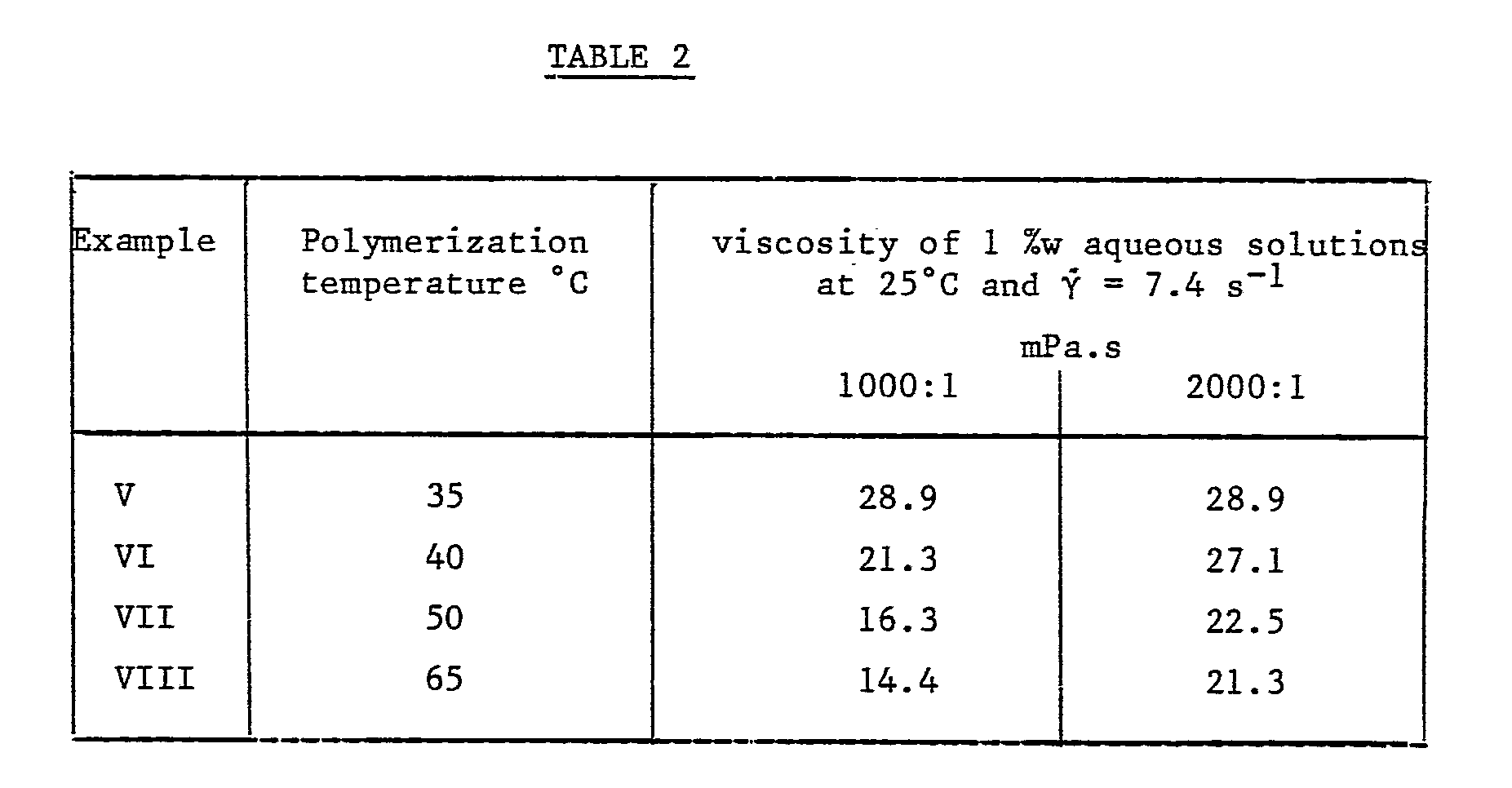
- 50 Ml of an 8 %w MG solution, prepared following the method as described hereinbefore, was introduced into a 100 ml glass reactor as described hereinbefore and flushed with N₂ to remove any oxygen. Subsequently 250 µl of a solution of E in acetone, containing so much free-radical initiator to arrive at a MG/initiator molar of 1000:1 or 2000:1 respectively. With the aid of a thermostated oilbath the reactor contents were heated to the temperature indicated in Table 2 and with moderate stirring and a slight N₂ purge maintained at this temperature for 40 hours. From hereon the procedure was identical to the one described in Examples I-IV. The viscosities of the aqueous solutions prepared from these MG polymers are given in Table 2.
- These experiments were carried out according to the procedure described in Examples V-VIII and wherein the APS and H₂O₂ were added to the reactor contents as aqueous solutions containing 1 g initiator/l. The viscosities of the aqueous solutions prepared from these MG-polymers are given in Table 3.

- To an aqueous solution of MG prepared as described hereinbefore MA and water were added in such amounts so as to arrive at a solution having a MG/MA molar ratio of 77:23 and a monomer content of 8 %w. 50 Ml of the thus obtained solution was introduced into a 100 ml glass reactor as described hereinbefore and flushed with N₂ to remove any oxygen. Subsequently 250 µl of an acetone solution of dimyristyl peroxydicarbonate containing so much dimyristyl peroxydicarbonate to arrive at a monomer/dimyristyl peroxydicarbonate molar ratio of 1000:1 was introduced into the solution. With the aid of a thermostated oilbath the reactor contents were heated to 40°C with moderate stirring and a slight N₂ purge and maintained at this temperature for 42 hours. Upon termination of the polymerization the reactor contents were cooled to room temperature and poured out under continuous stirring in approximately 150 ml ethyl alcohol, whereupon the MG/MA copolymer was precipitated. After drying the MG/MA copolymer was dissolved in 250 ml water and the carboxylic acid groups where carefully neutralized employing an aqueous 1 N NaOH solution. Subsequently the resulting solutions were poured out in 200 ml ethyl alcohol and the obtained precipitate was dried under sub-atmospheric pressure at 50°C to constant weight. Aqueous solutions were prepared containing 0.1, 0.25 and 1.0 %w of the neutralized MG/MA copolymer respectively and the viscosity of the obtained solutions was determined together with that of the 0.25 %w solution to which so much NaCl had been added to arrive at a 3%w NaCl solution. The resulting viscosity data have been collected in Table 4.

Claims (12)
Applications Claiming Priority (2)
| Application Number | Priority Date | Filing Date | Title |
|---|---|---|---|
| GB8606249 | 1986-03-13 | ||
| GB868606249A GB8606249D0 (en) | 1986-03-13 | 1986-03-13 | Water-soluble saccharide polymers |
Publications (3)
| Publication Number | Publication Date |
|---|---|
| EP0237132A2 true EP0237132A2 (en) | 1987-09-16 |
| EP0237132A3 EP0237132A3 (en) | 1987-12-02 |
| EP0237132B1 EP0237132B1 (en) | 1990-06-06 |
Family
ID=10594551
Family Applications (1)
| Application Number | Title | Priority Date | Filing Date |
|---|---|---|---|
| EP87200451A Expired EP0237132B1 (en) | 1986-03-13 | 1987-03-10 | Process for the preparation of water-soluble saccharide polymers |
Country Status (7)
| Country | Link |
|---|---|
| EP (1) | EP0237132B1 (en) |
| JP (1) | JPS62220506A (en) |
| BR (1) | BR8701111A (en) |
| CA (1) | CA1284246C (en) |
| DE (1) | DE3763082D1 (en) |
| FI (1) | FI89501C (en) |
| GB (1) | GB8606249D0 (en) |
Cited By (3)
| Publication number | Priority date | Publication date | Assignee | Title |
|---|---|---|---|---|
| KR20000036986A (en) * | 2000-04-03 | 2000-07-05 | 박한욱 | Hydrogel Composite which given more water-resisting qualities |
| DE19945236A1 (en) * | 1999-09-21 | 2001-03-29 | Wella Ag | Carbohydrate latices, process for their preparation and their use |
| EP2072531A1 (en) | 2007-12-21 | 2009-06-24 | Sika Technology AG | Polymers with saccharide side chains und their use as a dispersing agent |
Family Cites Families (2)
| Publication number | Priority date | Publication date | Assignee | Title |
|---|---|---|---|---|
| GB1099372A (en) * | 1965-03-03 | 1968-01-17 | Milk Marketing Board | Improvements relating to carbohydrate-derived polymers |
| JPS60252664A (en) * | 1984-05-28 | 1985-12-13 | Nippon Paint Co Ltd | Coating composition |
-
1986
- 1986-03-13 GB GB868606249A patent/GB8606249D0/en active Pending
-
1987
- 1987-02-18 CA CA000529981A patent/CA1284246C/en not_active Expired - Fee Related
- 1987-03-10 DE DE8787200451T patent/DE3763082D1/en not_active Expired - Lifetime
- 1987-03-10 EP EP87200451A patent/EP0237132B1/en not_active Expired
- 1987-03-11 JP JP62054332A patent/JPS62220506A/en active Pending
- 1987-03-11 FI FI871064A patent/FI89501C/en not_active IP Right Cessation
- 1987-03-11 BR BR8701111A patent/BR8701111A/en unknown
Cited By (3)
| Publication number | Priority date | Publication date | Assignee | Title |
|---|---|---|---|---|
| DE19945236A1 (en) * | 1999-09-21 | 2001-03-29 | Wella Ag | Carbohydrate latices, process for their preparation and their use |
| KR20000036986A (en) * | 2000-04-03 | 2000-07-05 | 박한욱 | Hydrogel Composite which given more water-resisting qualities |
| EP2072531A1 (en) | 2007-12-21 | 2009-06-24 | Sika Technology AG | Polymers with saccharide side chains und their use as a dispersing agent |
Also Published As
| Publication number | Publication date |
|---|---|
| FI871064A0 (en) | 1987-03-11 |
| FI871064L (en) | 1987-09-14 |
| GB8606249D0 (en) | 1986-04-16 |
| EP0237132B1 (en) | 1990-06-06 |
| CA1284246C (en) | 1991-05-14 |
| FI89501C (en) | 1993-10-11 |
| FI89501B (en) | 1993-06-30 |
| JPS62220506A (en) | 1987-09-28 |
| BR8701111A (en) | 1987-12-29 |
| EP0237132A3 (en) | 1987-12-02 |
| DE3763082D1 (en) | 1990-07-12 |
Similar Documents
| Publication | Publication Date | Title |
|---|---|---|
| EP0123108B1 (en) | Maleic acid copolymer, production thereof and scale-preventing agent containing the same | |
| EP0419654A1 (en) | Water-soluble cationic polymer | |
| US6486281B1 (en) | Process for preparing high-purity vinylpyrrolidone polymer | |
| EP0255137B1 (en) | Process for producing a polyvinyl ester and polyvinyl alcohol having a high degree of polymerization | |
| JPS61247712A (en) | Emulsion polymerization method and polymer formed by said method | |
| JPH0571606B2 (en) | ||
| EP0237132B1 (en) | Process for the preparation of water-soluble saccharide polymers | |
| US3956244A (en) | Crosslinked vinyl acetate-maleic anhydride heteropolymers and derivatives prepared from them | |
| JPH04504869A (en) | High solid content copolymerization method of maleic anhydride and alkyl vinyl ether | |
| JPS6214567B2 (en) | ||
| EP0237131B1 (en) | Process for the preparation of water-soluble saccharide polymers | |
| US4721760A (en) | Water-soluble saccharide polymers | |
| US5559198A (en) | Process for preparing poly(vinyl trifluoroacetate) and poly(vinyltrifluoroacetate/vinyl ester) copolymers in supercritical Co.sub. | |
| CN114044839A (en) | Preparation method of controllable/active polymerization chain transfer agent and polyacrylamide with molecular weight of 100-500 ten thousand | |
| CA1263798A (en) | Process for the preparation of water soluble vinyl saccharide polymers | |
| US5663253A (en) | Policarboxylic acids | |
| GB1568688A (en) | Preparation of graft copolymers of starch | |
| US4182806A (en) | Process for the manufacture of salts of poly-alpha-hydroxyacrylic acids | |
| US5312997A (en) | Surface-active pereoxides and their use | |
| HU210265B (en) | Process for producing of vinil chloride polymers modified with lactone polymers | |
| JP3314396B2 (en) | Diacyl-type polymeric peroxide and its use | |
| JP3313652B2 (en) | Production method of water-soluble polymer | |
| JPS64410B2 (en) | ||
| JPS6355528B2 (en) | ||
| JP2534293B2 (en) | Method for producing high degree of polymerization polyvinyl ester-based polymer and method for producing high degree of polymerization polyvinyl alcohol-based polymer |
Legal Events
| Date | Code | Title | Description |
|---|---|---|---|
| PUAI | Public reference made under article 153(3) epc to a published international application that has entered the european phase |
Free format text: ORIGINAL CODE: 0009012 |
|
| AK | Designated contracting states |
Kind code of ref document: A2 Designated state(s): BE CH DE FR GB IT LI NL SE |
|
| PUAL | Search report despatched |
Free format text: ORIGINAL CODE: 0009013 |
|
| AK | Designated contracting states |
Kind code of ref document: A3 Designated state(s): BE CH DE FR GB IT LI NL SE |
|
| 17P | Request for examination filed |
Effective date: 19880503 |
|
| 17Q | First examination report despatched |
Effective date: 19891018 |
|
| GRAA | (expected) grant |
Free format text: ORIGINAL CODE: 0009210 |
|
| AK | Designated contracting states |
Kind code of ref document: B1 Designated state(s): BE CH DE FR GB IT LI NL SE |
|
| ITF | It: translation for a ep patent filed | ||
| REF | Corresponds to: |
Ref document number: 3763082 Country of ref document: DE Date of ref document: 19900712 |
|
| ET | Fr: translation filed | ||
| PLBE | No opposition filed within time limit |
Free format text: ORIGINAL CODE: 0009261 |
|
| STAA | Information on the status of an ep patent application or granted ep patent |
Free format text: STATUS: NO OPPOSITION FILED WITHIN TIME LIMIT |
|
| 26N | No opposition filed | ||
| ITTA | It: last paid annual fee | ||
| PGFP | Annual fee paid to national office [announced via postgrant information from national office to epo] |
Ref country code: GB Payment date: 19930202 Year of fee payment: 7 |
|
| PGFP | Annual fee paid to national office [announced via postgrant information from national office to epo] |
Ref country code: FR Payment date: 19930205 Year of fee payment: 7 |
|
| PGFP | Annual fee paid to national office [announced via postgrant information from national office to epo] |
Ref country code: SE Payment date: 19930212 Year of fee payment: 7 |
|
| PGFP | Annual fee paid to national office [announced via postgrant information from national office to epo] |
Ref country code: BE Payment date: 19930330 Year of fee payment: 7 |
|
| PGFP | Annual fee paid to national office [announced via postgrant information from national office to epo] |
Ref country code: NL Payment date: 19930331 Year of fee payment: 7 |
|
| PGFP | Annual fee paid to national office [announced via postgrant information from national office to epo] |
Ref country code: DE Payment date: 19930413 Year of fee payment: 7 |
|
| PGFP | Annual fee paid to national office [announced via postgrant information from national office to epo] |
Ref country code: CH Payment date: 19930527 Year of fee payment: 7 |
|
| PG25 | Lapsed in a contracting state [announced via postgrant information from national office to epo] |
Ref country code: GB Effective date: 19940310 |
|
| PG25 | Lapsed in a contracting state [announced via postgrant information from national office to epo] |
Ref country code: SE Free format text: LAPSE BECAUSE OF NON-PAYMENT OF DUE FEES Effective date: 19940311 |
|
| PG25 | Lapsed in a contracting state [announced via postgrant information from national office to epo] |
Ref country code: LI Effective date: 19940331 Ref country code: CH Effective date: 19940331 Ref country code: BE Effective date: 19940331 |
|
| BERE | Be: lapsed |
Owner name: SHELL INTERNATIONALE RESEARCH MAATSCHAPPIJ B.V. Effective date: 19940331 |
|
| PG25 | Lapsed in a contracting state [announced via postgrant information from national office to epo] |
Ref country code: NL Effective date: 19941001 |
|
| GBPC | Gb: european patent ceased through non-payment of renewal fee |
Effective date: 19940310 |
|
| NLV4 | Nl: lapsed or anulled due to non-payment of the annual fee | ||
| PG25 | Lapsed in a contracting state [announced via postgrant information from national office to epo] |
Ref country code: FR Effective date: 19941130 |
|
| REG | Reference to a national code |
Ref country code: CH Ref legal event code: PL |
|
| PG25 | Lapsed in a contracting state [announced via postgrant information from national office to epo] |
Ref country code: DE Effective date: 19941201 |
|
| REG | Reference to a national code |
Ref country code: FR Ref legal event code: ST |
|
| EUG | Se: european patent has lapsed |
Ref document number: 87200451.0 Effective date: 19941010 |
|
| PG25 | Lapsed in a contracting state [announced via postgrant information from national office to epo] |
Ref country code: IT Free format text: LAPSE BECAUSE OF NON-PAYMENT OF DUE FEES;WARNING: LAPSES OF ITALIAN PATENTS WITH EFFECTIVE DATE BEFORE 2007 MAY HAVE OCCURRED AT ANY TIME BEFORE 2007. THE CORRECT EFFECTIVE DATE MAY BE DIFFERENT FROM THE ONE RECORDED. Effective date: 20050310 |