EP0235416B1 - Process for improving the octane number of cracked gasolines - Google Patents
Process for improving the octane number of cracked gasolines Download PDFInfo
- Publication number
- EP0235416B1 EP0235416B1 EP86301401A EP86301401A EP0235416B1 EP 0235416 B1 EP0235416 B1 EP 0235416B1 EP 86301401 A EP86301401 A EP 86301401A EP 86301401 A EP86301401 A EP 86301401A EP 0235416 B1 EP0235416 B1 EP 0235416B1
- Authority
- EP
- European Patent Office
- Prior art keywords
- zsm
- gasoline
- octane number
- zeolite
- octane
- Prior art date
- Legal status (The legal status is an assumption and is not a legal conclusion. Google has not performed a legal analysis and makes no representation as to the accuracy of the status listed.)
- Expired - Lifetime
Links
Images




Classifications
-
- C—CHEMISTRY; METALLURGY
- C10—PETROLEUM, GAS OR COKE INDUSTRIES; TECHNICAL GASES CONTAINING CARBON MONOXIDE; FUELS; LUBRICANTS; PEAT
- C10G—CRACKING HYDROCARBON OILS; PRODUCTION OF LIQUID HYDROCARBON MIXTURES, e.g. BY DESTRUCTIVE HYDROGENATION, OLIGOMERISATION, POLYMERISATION; RECOVERY OF HYDROCARBON OILS FROM OIL-SHALE, OIL-SAND, OR GASES; REFINING MIXTURES MAINLY CONSISTING OF HYDROCARBONS; REFORMING OF NAPHTHA; MINERAL WAXES
- C10G63/00—Treatment of naphtha by at least one reforming process and at least one other conversion process
- C10G63/02—Treatment of naphtha by at least one reforming process and at least one other conversion process plural serial stages only
- C10G63/04—Treatment of naphtha by at least one reforming process and at least one other conversion process plural serial stages only including at least one cracking step
-
- C—CHEMISTRY; METALLURGY
- C10—PETROLEUM, GAS OR COKE INDUSTRIES; TECHNICAL GASES CONTAINING CARBON MONOXIDE; FUELS; LUBRICANTS; PEAT
- C10G—CRACKING HYDROCARBON OILS; PRODUCTION OF LIQUID HYDROCARBON MIXTURES, e.g. BY DESTRUCTIVE HYDROGENATION, OLIGOMERISATION, POLYMERISATION; RECOVERY OF HYDROCARBON OILS FROM OIL-SHALE, OIL-SAND, OR GASES; REFINING MIXTURES MAINLY CONSISTING OF HYDROCARBONS; REFORMING OF NAPHTHA; MINERAL WAXES
- C10G35/00—Reforming naphtha
- C10G35/04—Catalytic reforming
- C10G35/06—Catalytic reforming characterised by the catalyst used
- C10G35/095—Catalytic reforming characterised by the catalyst used containing crystalline alumino-silicates, e.g. molecular sieves
Definitions
- This invention relates to a process for upgrading the octane number of a gasoline-boiling fraction.
- Reforming naphthas which are paraffinic and/or naphthenic to increase the octane number is well known. Such reforming is traditionally carried out with platinum reforming catalysts and is a widely used commercial refinery process.
- Naphtha fractions which are not particularly naphthenic or which may contain substantially no naphthenes at all, can be aromatized in good, commercially acceptable yields by contacting such feeds, under relatively severe conditions, with ZSM-5 and related crystalline aluminosilicate zeolite catalysts. Highly aromatic liquid yields of upwards of 30 percent have been achieved.
- This process converts a predominantly aliphatic feed and operates at 343 to 816°C (650° to 1500°F) at a space velocity of about 1 to 15 WHSV.
- aromatic containing feeds such as reformates
- ZSM-5 and related intermediate pore zeolites This process selectively cracks aliphatics in the feed to produce active fragments at least some of which alkylate existing aromatics and increase the aromatic content while decreasing the low octane paraffin content.
- This process converts feed rich in aromatics and operates at 260 to 538°C (500° to 1000°F).
- the processes are improved when the ZSM-5 catalyst is modified to include up to 10 weight percent zinc or cadmium, or other similar promoting metal.
- Such metal is suitably incorporated with the zeolite by cation exchange, impregnation and/or vapor deposition. Further inclusion of copper into such a catalyst reduces loss during regeneration of zinc and/or cadmium.
- EP 0 093 477 A2 describes a low severity process for preparing a benzene-toluene-xylene enriched stream from a feed stream containing a by-product effluent of a process for the pyrolytic cracking of hydrocarbons.
- the process comprises contacting the feed stream with a ZSM-5-type catalyst under low severity conditions.
- U.S. Patent 3,756,942 discloses increasing the aromatic content of a light gasoline formed by fluid catalytic cracking (FCC) by conversion of the gasoline over ZSM-5 zeolite.
- FCC fluid catalytic cracking
- U.S. Patent 3,760,024 discloses a process for producing aromatic compounds by contacting C2-C4 paraffins, olefins or mixtures with ZSM-5.
- U.S. Patent 3,775,501 discloses improving the yield of aromatics from a hydrocarbon feed selected from the group consisting of aliphatic olefins and paraffins by contacting the hydrocarbon feed in air or oxygen with a zeolite such as ZSM-5.
- U.S. Patent 3,827,968 discloses contacting C2-C5 olefins with ZSM-5 under such conditions as to oligomerize the olefins and subsequently passing the oligomerized olefins over ZSM-5 at aromatizing conditions to form a product having an enhanced aromatic content.
- U.S. Patent 3,890,218 discloses upgrading the octane number of hydrocarbon fractions boiling in the naphtha range and having a low octane number by contacting the naphtha fraction over an intermediate pore zeolite such as ZSM-5 in which the activity of the zeolite has been modified such as by steaming so as to increase the high octane liquid yield by shape selective cracking-alkylation mechanism and an aliphatic hydrocarbon aromatization process.
- the process is preferably operated at conditions which are intermediate between the optimum conditions for the respective conversion mechanisms.
- the feeds which are useful in the aforementioned patent are cracked gasolines.
- the preferred feeds are hydrocarbon compositions containing 0 to 20 wt.% aromatics, predominantly C5-C8 aromatics, and 60 to 100 wt.% straight and branched chain paraffins and olefins with minimal amounts of naphthenes.
- U.S. Patent 3,953,366 discloses aromatization and alkylation of aromatic rings by contacting a hydrocarbon feed such as a cracked gasoline fraction with ZSM-5 and related zeolites which has rhenium deposited thereon.
- U.S. Patent 3,960,978 discloses converting gaseous C2-C5 olefins to an olefinic gasoline by passing the olefin feed over ZSM-5.
- the zeolite can be steamed to a low alpha activity value.
- U.S. Patent 4,021,502 discloses producing a gasoline by passing a feed stock of C2-C5 olefins or mixtures with C1-C5 paraffins over ZSM-4, ZSM-12, ZSM-18, chabazite or zeolite beta.
- U.S. Patent 4,227,992 discloses separating ethylene from light olefins by contact with ZSM-5 under conditions such that the C3+ olefins are converted to both gasoline and fuel oil.
- U.S. Patent 4,396,497 describes the treatment of gasoline boiling range hydrocarbons to increase the octane number thereof by contact with a gamma alumina catalyst.
- the present invention provides a process for improving the octane number of gasoline characterized by contacting a gasoline containing at least 20 wt percent olefins with an acidic crystalline zeolite catalyst at 343 to 510°C (650 to 950°F), in the absence of hydrogen, at a pressure from atmospheric to 450 kPa wherein the amount and acidity of the catalyst increase the octane number of the gasoline by 1.0 octane number, and a yield loss of less than 5.0 wt percent gasoline.
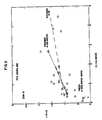
- Figure 1 is a plot illustrating increased octane versus make of C1-C4 after treating an FCC gasoline with five types of acid zeolite catalysts in fixed-bed operation.
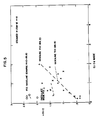
- Figure 2 is a plot illustrating the same relationship as in Figure 1 with a ZSM-12 catalyst having widely different alpha values.
- Figure 3 is a plot similar to Figure 2 for a ZSM-5 catalyst.
- Figure 4 is a graph illustrating the same relationship as in Figures 1-3 with steamed and unsteamed ZSM-12 and steamed ZSM-5 catalysts.
- Figure 5 is a plot illustrating the variations in the changes in octane number as a function of C1-C4 make for various FCC and TCC gasolines with steamed ZSM-12 catalysts.
- Figure 6 is a graph illustrating the effect of process variables on the change in octane versus C1-C4 make upon fixed bed treatment of several FCC and TCC gasolines with several zeolite catalysts.
- the process of the present invention increases the octane number of gasoline boiling fractions with only minimal, i.e., less than 5 wt.%, yield loss, typically less than 1 wt.% yield loss.
- the yield loss is in the form of C1-C4 gas make.
- the gasoline feed is passed through a fixed bed of acidic crystalline aluminosilicate zeolite catalysts for conversion of the gasoline feed to a gasoline product of improved octane number.
- Suitable temperatures include 343 to 510°C (650 to 950°F). Better results are achieved at 357 to 496°C (675 to 925°F).
- the preferred operating temperatures are 371 to 482°C (700° to 900°F), preferred space velocities are at least about 10 WHSV and the pressure is atmospheric to 450 kPa (50 psig).
- the process is run in the absence of hydrogen.
- Suitable feeds include any FCC or TCC gasoline.
- any 24 to 121°C (75 to 250°F) low end point FCC gasoline; 24 to 154°C (75 to 310°F) distillate range FCC gasoline or full range 24 to 218°C (75 to 425°F) TCC or FCC gasolines or fractions thereof are applicable in this invention.
- Such gasolines generally have olefin contents of at least 20 wt.%. Depending on where such gasoline is cut, olefin contents of at least 30 wt.% and 40 wt.% are typical.
- gasolines obtained from conversion of methanol to aromatic gasoline over zeolite catalysts include gasolines obtained from conversion of methanol to aromatic gasoline over zeolite catalysts, oligomerization of olefins over intermediate pore zeolites to olefinic gasolines, pyrolysis gasoline, etc.
- the octane increase obtained via the present invention is more readily seen in the low end point gasolines, i.e., 24 to 121°C (75 to 250°F) and 24 to 154°C (75 to 310°F) cracked gasolines.
- This result is consistent with an olefin isomerization reaction mechanism inasmuch as the lighter weight gasolines contain a greater olefin concentration (typically comprising about 50 wt.%) than full range gasolines.
- the octane increase of the product relative to feed is about:
- Gasoline yield losses are primarily due to C1-C4 gas make. However, over 90% of these light gases comprise C3-C4 olefins which, after alkylation with isobutane, can be added to the gasoline pool to increase gasoline yields and further improve octane number.
- Catalysts useful in the present invention can be chosen from any acid catalyst, although, intermediate pore size aluminosilicate zeolites are preferred. Such preferred catalysts have relatively low aging rates.
- Zeolites useful for the crystalline aluminosilicate component of this invention include the acidic forms of: zeolite X, described in U.S. Patent 2,882,244; zeolite Y, described in U.S. Patent 3,130,007; mordenite; zeolite L, described in U.S. Patent 3,216,789; zeolite T, described in U.S. Patent 2,950,952; and zeolite beta, described in U.S. Patent 3,308,069.
- the preferred catalysts are crystalline aluminosilicate zeolites which are intermediate pore size zeolites. Such zeolites have a constraint index of 1 to 12 and have a silica to alumina framework ratio of at least 12 and preferably at least about 30.
- the intermediate pore zeolites include ZSM-5, ZSM-11, ZSM-12, ZSM-23, ZSM-35, ZSM-38, ZSM-48 and other similar materials.
- ZSM-5 is described in U.S. Patent No. 3,702,886.
- ZSM-35 is described in U.S. Patent No. 4,016,245.
- ZSM-48 is described in U.S. Patent No. 4,375 573.
- the intermediate pore zeolites are preferred.
- ZSM-12 and zeolite beta although useful, are not necessarily preferred.
- the activity of the catalyst must be within a critical range. Accordingly, the acid activity of the catalyst should be from 5 to 100, preferably the alpha is 5 to 75, most preferably 10 to 50. Any conventional method may be used to attain desired acid activity of the zeolite catalysts, e.g., extensive base exchange with alkali metal cations, synthesis with high silica to alumina framework ratios, zeolite dilution in matrix and steaming. Steaming of acid in zeolites is the preferred method.
- the alpha value of a crystalline aluminosilicate zeolite is related to the activity of the catalyst for cracking normal hexane.
- the alpha value from a hexane-cracking test can be determined in accordance with the method set forth by P.B. Weisz and J.N. Mialey in Journal of Catalysis, Vol. 4, No. 4, August 1969, pages 527-529.
- the catalysts were 0.25 to 0.85 mm (sized to pass through 20 ⁇ 60 mesh sieves) and pretreated in flowing hydrogen at 482°C (900°F) for 1 hour prior to use.
- the catalyst was heated to operating temperature, and charge run over the hot catalyst at atmospheric pressure plus the pressure drop across the catalyst bed. There was no added gas.
- zeolites e.g., ZSM-5, -11, -12, -23, and zeolite beta were used to upgrade a full range FCC gasoline 24 to 218°C (75 to 425°F) having the composition by weight shown in Table 1.
- Each catalyst was tested at 371 to 482°C (700°to 900°F).
- Tables 2-4 illustrate the gasoline product composition at two of such tested temperatures for each zeolite.
- the improvement in octane number relative to yield loss is shown in Fig. 1 for each zeolite.
- the optimum improvement in octane numbers lies around 1% C1-C4 make.
- Table 5 illustrates the octane improvement for each of the tested zeolites at 1% gas make.
- the light gases formed are olefinic.
- ZSM-5 is the best, yielding about 95% olefins vs about 90% for ZSM-12.
- ZSM-5, -11, and -23 are 41.7 to 55.6°C (75 to 100°F) more active than ZSM-12 at similar alphas.
- ZSM-5 and ZSM-12 contacted a full range FCC gasoline.
- Various alpha values for each catalyst were tested. The results are summarized in Figs. 2 (ZSM-12) and 3 (ZSM-5). Different space velocities were used for the ZSM-12 runs, but space velocity is not important nor does it effect conclusions on alpha variations.
- ZSM-12 with an alpha of 1 does not have sufficient activity to achieve all of the desired reactions.
- the yield/octane relationship is similar in the range of 10-30 with perhaps a slight advantage for an alpha of about 30 in octane improvement and activity.
- ZSM-5 and ZSM-12 were used to improve the octane number of a full range TCC gasoline having the composition shown in Table 6.
- Tables 7-8 show the improved gasoline product composition.
- TCC gasoline responds like FCC gasoline, as indicated by Fig. 4.
- the yield/octane ratio is 1 R+O/1% C1-C4 make.
- ZSM-12 may be more effective than ZSM-5.
- the yield/octane was equivalent to that of the steamed catalysts, suggesting that lower activity via either steaming or use of a high SiO2/Al2O3 is acceptable.
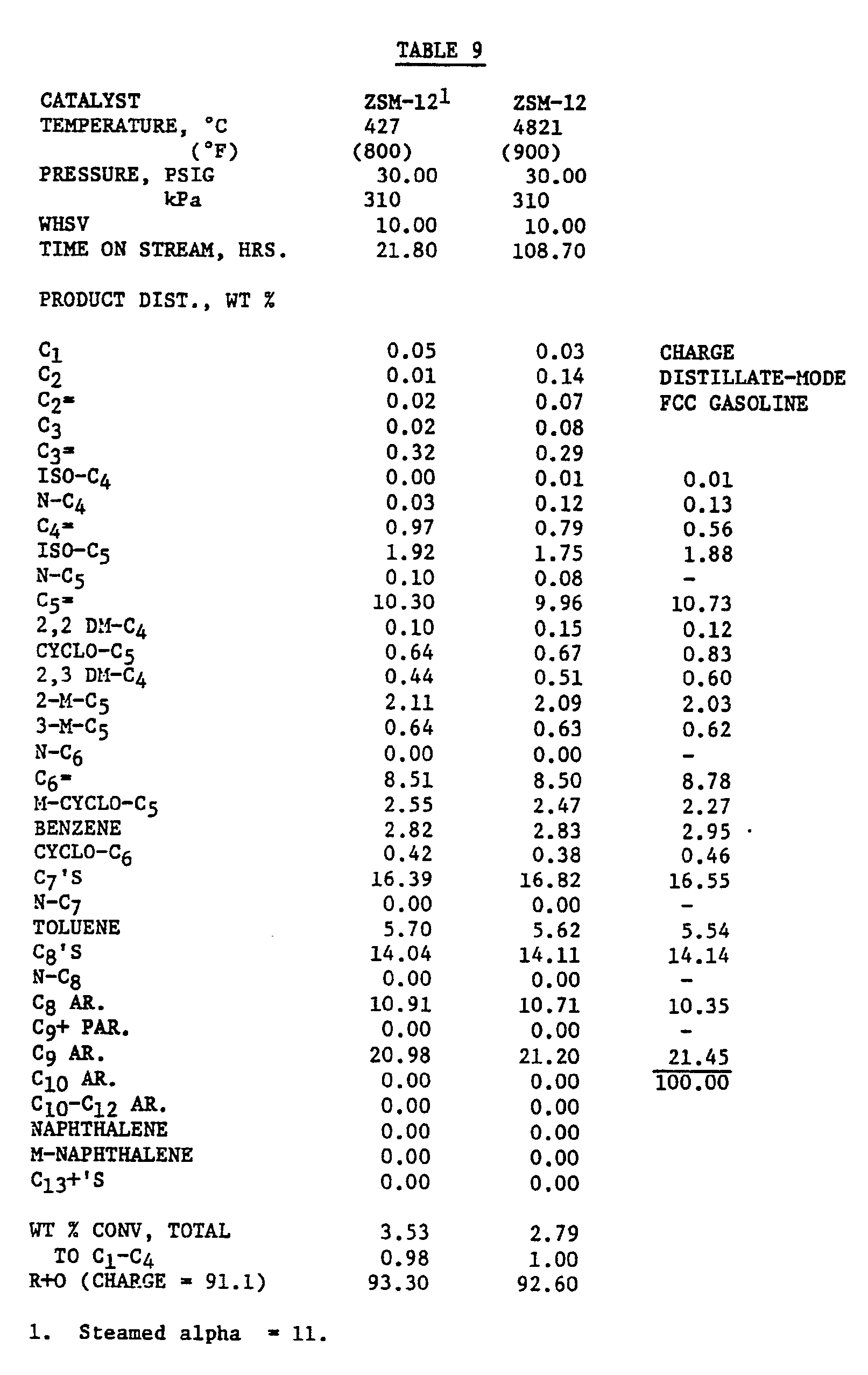
- Tables 9-11 show the data for distillate-mode FCC gasoline 24 to 154°C (75 to 310°F) (with and without ZSM-5 in the cracking catalyst) and a 24 to 121°C (75 to 250°F) cut of FCC gasoline. These results along with the previous ZSM-12 data on full range FCC and TCC gasolines are plotted in Figure 5.
- Table 12 illustrates the effect of boiling range on octane improvement at 0.7% light gas make.
- the amount of octane number improvement with the lighter charges is 1.5 to 2.5 R+O per 1% C1-C4 make. This is very efficient octane production and suggests that the economics would be most favorable in a situation where the end boiling point of the TCC gasoline is under 177°C (350°F) to maximize distillate.
- the pressure should be below 1500 kPa (200 psig), and preferably the reaction is conducted at atmospheric to 310 kPa (30 psig). Operation under a vacuum or with a diluent will help.
- the C5+ yield is 98.1 vol.% with 1.5 wt.% C1-C4 make.
- the volume of isobutane required for alkylation is 2.8%, giving a gasoline plus alkylate yield of 102.2+ vol.%.
Landscapes
- Chemical & Material Sciences (AREA)
- Oil, Petroleum & Natural Gas (AREA)
- Engineering & Computer Science (AREA)
- Chemical Kinetics & Catalysis (AREA)
- General Chemical & Material Sciences (AREA)
- Organic Chemistry (AREA)
- Crystallography & Structural Chemistry (AREA)
- Production Of Liquid Hydrocarbon Mixture For Refining Petroleum (AREA)
- Catalysts (AREA)
Description
- This invention relates to a process for upgrading the octane number of a gasoline-boiling fraction.
- Reforming naphthas which are paraffinic and/or naphthenic to increase the octane number is well known. Such reforming is traditionally carried out with platinum reforming catalysts and is a widely used commercial refinery process.
- Naphtha fractions, which are not particularly naphthenic or which may contain substantially no naphthenes at all, can be aromatized in good, commercially acceptable yields by contacting such feeds, under relatively severe conditions, with ZSM-5 and related crystalline aluminosilicate zeolite catalysts. Highly aromatic liquid yields of upwards of 30 percent have been achieved.
- This process converts a predominantly aliphatic feed and operates at 343 to 816°C (650° to 1500°F) at a space velocity of about 1 to 15 WHSV.
- In a similar process, aromatic containing feeds, such as reformates, have had their aromatic contents increased by contact with ZSM-5 and related intermediate pore zeolites. This process selectively cracks aliphatics in the feed to produce active fragments at least some of which alkylate existing aromatics and increase the aromatic content while decreasing the low octane paraffin content. This process converts feed rich in aromatics and operates at 260 to 538°C (500° to 1000°F).
- The operating conditions in both processes overlap some, as do the feeds. It is probable that some cracking-alkylation and some aromatization take place in both processes. The distinction between the processes is perhaps better expressed as one of conversion predominance with the more severe conditions favoring new aromatic ring formation and the less severe conditions favoring alkylation of preformed or newly created aromatic rings.
- In either case, the processes are improved when the ZSM-5 catalyst is modified to include up to 10 weight percent zinc or cadmium, or other similar promoting metal. Such metal is suitably incorporated with the zeolite by cation exchange, impregnation and/or vapor deposition. Further inclusion of copper into such a catalyst reduces loss during regeneration of zinc and/or cadmium.
- The following patents comprise a partial list of those patents directed to processes described above.
-
EP 0 093 477 A2 describes a low severity process for preparing a benzene-toluene-xylene enriched stream from a feed stream containing a by-product effluent of a process for the pyrolytic cracking of hydrocarbons. The process comprises contacting the feed stream with a ZSM-5-type catalyst under low severity conditions. - U.S. Patent 3,756,942 discloses increasing the aromatic content of a light gasoline formed by fluid catalytic cracking (FCC) by conversion of the gasoline over ZSM-5 zeolite.
- U.S. Patent 3,760,024 discloses a process for producing aromatic compounds by contacting C₂-C₄ paraffins, olefins or mixtures with ZSM-5.
- U.S. Patent 3,775,501 discloses improving the yield of aromatics from a hydrocarbon feed selected from the group consisting of aliphatic olefins and paraffins by contacting the hydrocarbon feed in air or oxygen with a zeolite such as ZSM-5.
- U.S. Patent 3,827,968 discloses contacting C₂-C₅ olefins with ZSM-5 under such conditions as to oligomerize the olefins and subsequently passing the oligomerized olefins over ZSM-5 at aromatizing conditions to form a product having an enhanced aromatic content.
- U.S. Patent 3,890,218 discloses upgrading the octane number of hydrocarbon fractions boiling in the naphtha range and having a low octane number by contacting the naphtha fraction over an intermediate pore zeolite such as ZSM-5 in which the activity of the zeolite has been modified such as by steaming so as to increase the high octane liquid yield by shape selective cracking-alkylation mechanism and an aliphatic hydrocarbon aromatization process. The process is preferably operated at conditions which are intermediate between the optimum conditions for the respective conversion mechanisms. Among the feeds which are useful in the aforementioned patent are cracked gasolines. The preferred feeds are hydrocarbon compositions containing 0 to 20 wt.% aromatics, predominantly C₅-C₈ aromatics, and 60 to 100 wt.% straight and branched chain paraffins and olefins with minimal amounts of naphthenes.
- U.S. Patent 3,953,366 discloses aromatization and alkylation of aromatic rings by contacting a hydrocarbon feed such as a cracked gasoline fraction with ZSM-5 and related zeolites which has rhenium deposited thereon.
- U.S. Patent 3,960,978 discloses converting gaseous C₂-C₅ olefins to an olefinic gasoline by passing the olefin feed over ZSM-5. The zeolite can be steamed to a low alpha activity value.
- U.S. Patent 4,021,502 discloses producing a gasoline by passing a feed stock of C₂-C₅ olefins or mixtures with C₁-C₅ paraffins over ZSM-4, ZSM-12, ZSM-18, chabazite or zeolite beta.
- U.S. Patent 4,227,992 discloses separating ethylene from light olefins by contact with ZSM-5 under conditions such that the C₃+ olefins are converted to both gasoline and fuel oil.
- U.S. Patent 4,396,497 describes the treatment of gasoline boiling range hydrocarbons to increase the octane number thereof by contact with a gamma alumina catalyst.
- Another process recently used to increase the octane of gasoline boiling fractions involves the addition of ZSM-5 and related intermediate pore zeolites to the conventional cracking catalyst such as zeolites of the X or Y faujasite variety during the cracking of gas oils to gasoline products. Examples of patents which describe such a process include U.S. Patent Nos. 3,894,931; 3,894,903; and 3,894,934.
- One important consideration involved in the upgrading of gasoline fractions in addition to boosting the octane number thereof is obtaining the highest possible liquid yield. Thus, although the technology referred to above is excellent in upgrading the quality of gasoline boiling range fragments, hydrocarbon conversion over ZSM-5 under cracking, alkylation or aromatizing conditions has resulted in substantial loss of gasoline yield in the form of light gases, i.e., C₁-C₄.
- It would be beneficial if a process were available which could improve the octane number of a gasoline boiling fraction without excessive yield loss.
- A way has now been discovered to increase the octane number of cracked gasoline without substantial yield loss.
- Accordingly, the present invention provides a process for improving the octane number of gasoline characterized by contacting a gasoline containing at least 20 wt percent olefins with an acidic crystalline zeolite catalyst at 343 to 510°C (650 to 950°F), in the absence of hydrogen, at a pressure from atmospheric to 450 kPa wherein the amount and acidity of the catalyst increase the octane number of the gasoline by 1.0 octane number, and a yield loss of less than 5.0 wt percent gasoline.
- Figure 1 is a plot illustrating increased octane versus make of C₁-C₄ after treating an FCC gasoline with five types of acid zeolite catalysts in fixed-bed operation.
- Figure 2 is a plot illustrating the same relationship as in Figure 1 with a ZSM-12 catalyst having widely different alpha values.
- Figure 3 is a plot similar to Figure 2 for a ZSM-5 catalyst.
- Figure 4 is a graph illustrating the same relationship as in Figures 1-3 with steamed and unsteamed ZSM-12 and steamed ZSM-5 catalysts.
- Figure 5 is a plot illustrating the variations in the changes in octane number as a function of C₁-C₄ make for various FCC and TCC gasolines with steamed ZSM-12 catalysts.
- Figure 6 is a graph illustrating the effect of process variables on the change in octane versus C₁-C₄ make upon fixed bed treatment of several FCC and TCC gasolines with several zeolite catalysts.
- The process of the present invention increases the octane number of gasoline boiling fractions with only minimal, i.e., less than 5 wt.%, yield loss, typically less than 1 wt.% yield loss. The yield loss is in the form of C₁-C₄ gas make.
- The gasoline feed is passed through a fixed bed of acidic crystalline aluminosilicate zeolite catalysts for conversion of the gasoline feed to a gasoline product of improved octane number. Suitable temperatures include 343 to 510°C (650 to 950°F). Better results are achieved at 357 to 496°C (675 to 925°F). The preferred operating temperatures are 371 to 482°C (700° to 900°F), preferred space velocities are at least about 10 WHSV and the pressure is atmospheric to 450 kPa (50 psig). The process is run in the absence of hydrogen.
- Suitable feeds include any FCC or TCC gasoline. Thus, any 24 to 121°C (75 to 250°F) low end point FCC gasoline; 24 to 154°C (75 to 310°F) distillate range FCC gasoline or full range 24 to 218°C (75 to 425°F) TCC or FCC gasolines or fractions thereof are applicable in this invention. Such gasolines generally have olefin contents of at least 20 wt.%. Depending on where such gasoline is cut, olefin contents of at least 30 wt.% and 40 wt.% are typical. Other useful gasolines which can be upgraded include gasolines obtained from conversion of methanol to aromatic gasoline over zeolite catalysts, oligomerization of olefins over intermediate pore zeolites to olefinic gasolines, pyrolysis gasoline, etc.
- The octane increase obtained via the present invention is more readily seen in the low end point gasolines, i.e., 24 to 121°C (75 to 250°F) and 24 to 154°C (75 to 310°F) cracked gasolines. This result is consistent with an olefin isomerization reaction mechanism inasmuch as the lighter weight gasolines contain a greater olefin concentration (typically comprising about 50 wt.%) than full range gasolines. Thus, it has been found that at about 1 wt.% gasoline yield loss, i.e., C₁-C₄, upon conversion over the zeolite catalyst useful in this invention, the octane increase of the product relative to feed is about:
- 2-2.5 R+O for 24 to 121°C (75 to 250°F) FCC gasoline
- 1.5-2 R+O for 24 to 154°C (75 to 310°F) Distillate mode FCC gasoline
- 1-1.5 R+O for full range 24 to 218°C (75 to 425°F) TCC or FCC gasolines
- Gasoline yield losses are primarily due to C₁-C₄ gas make. However, over 90% of these light gases comprise C₃-C₄ olefins which, after alkylation with isobutane, can be added to the gasoline pool to increase gasoline yields and further improve octane number.
- Catalysts useful in the present invention can be chosen from any acid catalyst, although, intermediate pore size aluminosilicate zeolites are preferred. Such preferred catalysts have relatively low aging rates.
- Zeolites useful for the crystalline aluminosilicate component of this invention include the acidic forms of: zeolite X, described in U.S. Patent 2,882,244; zeolite Y, described in U.S. Patent 3,130,007; mordenite; zeolite L, described in U.S. Patent 3,216,789; zeolite T, described in U.S. Patent 2,950,952; and zeolite beta, described in U.S. Patent 3,308,069.
- The preferred catalysts are crystalline aluminosilicate zeolites which are intermediate pore size zeolites. Such zeolites have a constraint index of 1 to 12 and have a silica to alumina framework ratio of at least 12 and preferably at least about 30.
- The intermediate pore zeolites include ZSM-5, ZSM-11, ZSM-12, ZSM-23, ZSM-35, ZSM-38, ZSM-48 and other similar materials.
- ZSM-5 is described in U.S. Patent No. 3,702,886.
- ZSM-11 is described in U.S. Patent No. 3,709,979.
- ZSM-12 is described in U.S. Patent No. 3,832,449.
- ZSM-23 is described in U.S. Patent No. 4,076,842.
- ZSM-35 is described in U.S. Patent No. 4,016,245.
- ZSM-38 is described in U.S. Patent No. 4,046,859.
- ZSM-48 is described in U.S. Patent No. 4,375 573.
- The intermediate pore zeolites are preferred. Thus, ZSM-12 and zeolite beta although useful, are not necessarily preferred.
- To avoid substantial cracking of the paraffin and olefin contents of the gasoline and subsequent aromatization, the activity of the catalyst must be within a critical range. Accordingly, the acid activity of the catalyst should be from 5 to 100, preferably the alpha is 5 to 75, most preferably 10 to 50. Any conventional method may be used to attain desired acid activity of the zeolite catalysts, e.g., extensive base exchange with alkali metal cations, synthesis with high silica to alumina framework ratios, zeolite dilution in matrix and steaming. Steaming of acid in zeolites is the preferred method.
- The alpha value of a crystalline aluminosilicate zeolite is related to the activity of the catalyst for cracking normal hexane. The alpha value from a hexane-cracking test can be determined in accordance with the method set forth by P.B. Weisz and J.N. Mialey in Journal of Catalysis, Vol. 4, No. 4, August 1969, pages 527-529.
- In all examples, the catalysts were 0.25 to 0.85 mm (sized to pass through 20×60 mesh sieves) and pretreated in flowing hydrogen at 482°C (900°F) for 1 hour prior to use. The catalyst was heated to operating temperature, and charge run over the hot catalyst at atmospheric pressure plus the pressure drop across the catalyst bed. There was no added gas.
- Material balances were made by collecting product in a liquid nitrogen-cooled trap and subsequent expansion of the gases into a precalibrated, constant volume system. Liquid and gas analysis was by gas chromatography. The liquid product for octane determination was collected in ice followed by a dry ice-acetone trap system. No distillation was done since most of the runs involved less than 1% C₁-C₄ make. However, where the gas make was greater than 1%, a correction was made in the reported octane value in order to discount light gas dissolved in the liquid. This correction is about 0.1 R+O for each 1% C₁-C₄ make and has been made in the Figures.
- Various zeolites, e.g., ZSM-5, -11, -12, -23, and zeolite beta were used to upgrade a full range FCC gasoline 24 to 218°C (75 to 425°F) having the composition by weight shown in Table 1. Each catalyst was tested at 371 to 482°C (700°to 900°F). Tables 2-4 illustrate the gasoline product composition at two of such tested temperatures for each zeolite. The improvement in octane number relative to yield loss is shown in Fig. 1 for each zeolite. The optimum improvement in octane numbers lies around 1% C₁-C₄ make.


- Table 5 illustrates the octane improvement for each of the tested zeolites at 1% gas make.

- At this level, all of the catalysts improve octane, suggesting that acidity alone will accomplish this chemistry.
- In general, the light gases formed are olefinic. ZSM-5 is the best, yielding about 95% olefins vs about 90% for ZSM-12. In terms of activity, ZSM-5, -11, and -23, are 41.7 to 55.6°C (75 to 100°F) more active than ZSM-12 at similar alphas.
- In this example, ZSM-5 and ZSM-12 contacted a full range FCC gasoline. Various alpha values for each catalyst were tested. The results are summarized in Figs. 2 (ZSM-12) and 3 (ZSM-5). Different space velocities were used for the ZSM-12 runs, but space velocity is not important nor does it effect conclusions on alpha variations.
- The fresh ZSM-5 and ZSM-12 both aged rapidly, at more than 55.6°C (100°F)/100 hrs. Time On Stream (TOS). Aging may be due to nitrogen poisons, coking, or both. The relatively high temperatures should minimize nitrogen sorption, so coking is the more likely cause. At the other extreme, ZSM-12 with an alpha of 1 does not have sufficient activity to achieve all of the desired reactions. At moderate alphas, the yield/octane relationship is similar in the range of 10-30 with perhaps a slight advantage for an alpha of about 30 in octane improvement and activity.
- ZSM-5 and ZSM-12 were used to improve the octane number of a full range TCC gasoline having the composition shown in Table 6. Tables 7-8 show the improved gasoline product composition.
- TCC gasoline responds like FCC gasoline, as indicated by Fig. 4. The yield/octane ratio is 1 R+O/1% C₁-C₄ make. At higher octane, ZSM-12 may be more effective than ZSM-5. One of the ZSM-12ʹs used was a high SiO/₂Al₂O₃=250, alpha=39 catalyst. The yield/octane was equivalent to that of the steamed catalysts, suggesting that lower activity via either steaming or use of a high SiO₂/Al₂O₃ is acceptable.


- If the mechanism of octane number improvement involves olefin reactions, then as the charge boiling point decreases, the amount of octane improvement should increase due to greater olefin concentration in the front end. Tables 9-11 show the data for distillate-mode FCC gasoline 24 to 154°C (75 to 310°F) (with and without ZSM-5 in the cracking catalyst) and a 24 to 121°C (75 to 250°F) cut of FCC gasoline. These results along with the previous ZSM-12 data on full range FCC and TCC gasolines are plotted in Figure 5.
- Table 12 illustrates the effect of boiling range on octane improvement at 0.7% light gas make.

- The results are in line with expectation. Yield octane number improves in the order 24 to 121°C (75 to 250°F), 24 to 154°C (75 to 310°F), 24 to 218°C (75 to 425°F). The 24 to 154°C (75 to 310°F) distillate-mode FCC gasoline made with ZSM-5 as a cracking additive is improved about 0.5 R+O. However, some other reactions apparently occur in the cracking step and the amount of octane number improvement in subsequent processing is thus limited.
- The amount of octane number improvement with the lighter charges is 1.5 to 2.5 R+O per 1% C₁-C₄ make. This is very efficient octane production and suggests that the economics would be most favorable in a situation where the end boiling point of the TCC gasoline is under 177°C (350°F) to maximize distillate.
- A full range FCC gasoline was converted over ZSM-5 and ZSM-12 at varying process conditions. Results are shown in Tables 13-15 and Fig. 6.
- It would be convenient if the reaction would occur at the temperature that gasoline is taken off the distillation tower. However, the results show that no octane number improvement is obtained until approximately 0.5% conversion to C₁-C₄ takes place, and this does not occur until approximately 343°C (650°F). Thus low temperature operation is not possible unless nitrogen poisons are removed by preadsorption in a guard chamber, solvent extraction or other conventional means. In this mode of operation, use of more acidic zeolites (alpha of 100-500), or more catalyst (space velocities of 1 to 5 WHSV) may be used to achieve the desired conversion at lower temperatures. Temperatures as low as 260°C (500°F) will work, but preferably reaction temperatures are at least 316°C (600°F) to 343°C (650°F), most preferably above 371°C (700°F).
- Increasing pressure is detrimental to octane improvement. Coking is severe at higher pressure and probably some oligomerization occurs since there is an increase in heavy ends. No octane improvement results and in fact a decrease occurs. For most gasolines, the pressure should be below 1500 kPa (200 psig), and preferably the reaction is conducted at atmospheric to 310 kPa (30 psig). Operation under a vacuum or with a diluent will help.
- Adding hydrogen to the system does not influence the reaction or the yield octane. Without metal, no hydrogenation occurs in the olefinic light gases. This also suggests that hydrogen will not affect aging.


- In order to determine the olefin content of the cracked gases, a full range FCC gasoline was converted over a steamed ZSM-5 catalyst. Composition of the product is shown in Table 16.
- While the amount of light gas produced is small, it is primarily C₃-C₄ olefins which can be used to increase alkylate yield.
- The C₅+ yield is 98.1 vol.% with 1.5 wt.% C₁-C₄ make. The volume of isobutane required for alkylation is 2.8%, giving a gasoline plus alkylate yield of 102.2+ vol.%.

Claims (8)
Priority Applications (7)
| Application Number | Priority Date | Filing Date | Title |
|---|---|---|---|
| ZA861382A ZA861382B (en) | 1986-02-24 | 1986-02-24 | Process for improving the octane number of cracked gasolines |
| DE8686301401T DE3677497D1 (en) | 1986-02-24 | 1986-02-27 | METHOD FOR INCREASING THE OCTANE NUMBER OF CRACKED GASOLINES. |
| EP86301401A EP0235416B1 (en) | 1986-02-24 | 1986-02-27 | Process for improving the octane number of cracked gasolines |
| AU54136/86A AU589402B2 (en) | 1986-02-24 | 1986-02-27 | Process for improving the octane number of cracked gasolines |
| BR8600990A BR8600990A (en) | 1986-02-24 | 1986-03-07 | PROCESS FOR IMPROVING GASOLINE OCTANAGE |
| JP61061064A JPH0660312B2 (en) | 1986-02-24 | 1986-03-20 | Octane number improvement method for cracked gasoline |
| US07/040,707 US4753720A (en) | 1986-02-24 | 1987-04-16 | Process for improving the octane number of cracked gasolines |
Applications Claiming Priority (4)
| Application Number | Priority Date | Filing Date | Title |
|---|---|---|---|
| ZA861382A ZA861382B (en) | 1986-02-24 | 1986-02-24 | Process for improving the octane number of cracked gasolines |
| EP86301401A EP0235416B1 (en) | 1986-02-24 | 1986-02-27 | Process for improving the octane number of cracked gasolines |
| BR8600990A BR8600990A (en) | 1986-02-24 | 1986-03-07 | PROCESS FOR IMPROVING GASOLINE OCTANAGE |
| US07/040,707 US4753720A (en) | 1986-02-24 | 1987-04-16 | Process for improving the octane number of cracked gasolines |
Publications (2)
| Publication Number | Publication Date |
|---|---|
| EP0235416A1 EP0235416A1 (en) | 1987-09-09 |
| EP0235416B1 true EP0235416B1 (en) | 1991-02-06 |
Family
ID=48048960
Family Applications (1)
| Application Number | Title | Priority Date | Filing Date |
|---|---|---|---|
| EP86301401A Expired - Lifetime EP0235416B1 (en) | 1986-02-24 | 1986-02-27 | Process for improving the octane number of cracked gasolines |
Country Status (7)
| Country | Link |
|---|---|
| US (1) | US4753720A (en) |
| EP (1) | EP0235416B1 (en) |
| JP (1) | JPH0660312B2 (en) |
| AU (1) | AU589402B2 (en) |
| BR (1) | BR8600990A (en) |
| DE (1) | DE3677497D1 (en) |
| ZA (1) | ZA861382B (en) |
Cited By (1)
| Publication number | Priority date | Publication date | Assignee | Title |
|---|---|---|---|---|
| US6803494B1 (en) | 1998-05-05 | 2004-10-12 | Exxonmobil Chemical Patents Inc. | Process for selectively producing propylene in a fluid catalytic cracking process |
Families Citing this family (51)
| Publication number | Priority date | Publication date | Assignee | Title |
|---|---|---|---|---|
| GB8612815D0 (en) * | 1986-05-27 | 1986-07-02 | British Petroleum Co Plc | Restructuring of olefins |
| US4918256A (en) * | 1988-01-04 | 1990-04-17 | Mobil Oil Corporation | Co-production of aromatics and olefins from paraffinic feedstocks |
| US4922048A (en) * | 1988-10-14 | 1990-05-01 | Mobil Oil Corp. | Medium-pore zeolite olefinic naphtha by-product upgrading |
| US4950387A (en) * | 1988-10-21 | 1990-08-21 | Mobil Oil Corp. | Upgrading of cracking gasoline |
| US5254789A (en) * | 1990-02-08 | 1993-10-19 | Uop | Process for isomerizing olefins in gasoline streams |
| US5057635A (en) * | 1990-02-08 | 1991-10-15 | Uop | Process for isomerizing olefins in gasoline streams |
| US5430221A (en) * | 1990-02-08 | 1995-07-04 | Uop | Process for isomerizing olefins in gasoline streams |
| CN1032059C (en) * | 1991-06-05 | 1996-06-19 | 莱昂德尔石油化学公司 | Process for isomerizing linear olefins to isoolfins |
| US5234575A (en) * | 1991-07-31 | 1993-08-10 | Mobil Oil Corporation | Catalytic cracking process utilizing an iso-olefin enhancer catalyst additive |
| US5234576A (en) * | 1991-07-31 | 1993-08-10 | Mobil Oil Corporation | Iso-olefin production |
| US5346609A (en) * | 1991-08-15 | 1994-09-13 | Mobil Oil Corporation | Hydrocarbon upgrading process |
| US5500108A (en) * | 1991-08-15 | 1996-03-19 | Mobil Oil Corporation | Gasoline upgrading process |
| US5503734A (en) * | 1991-08-15 | 1996-04-02 | Mobil Oil Corporation | Hydrocarbon upgrading process |
| US5308471A (en) * | 1991-08-15 | 1994-05-03 | Mobil Oil Corporation | Hydrocarbon upgrading process |
| US5318690A (en) * | 1991-08-15 | 1994-06-07 | Mobil Oil Corporation | Gasoline upgrading process |
| US5399258A (en) * | 1991-08-15 | 1995-03-21 | Mobil Oil Corporation | Hydrocarbon upgrading process |
| US5326463A (en) * | 1991-08-15 | 1994-07-05 | Mobil Oil Corporation | Gasoline upgrading process |
| US5409596A (en) * | 1991-08-15 | 1995-04-25 | Mobil Oil Corporation | Hydrocarbon upgrading process |
| AU661863B2 (en) * | 1991-08-15 | 1995-08-10 | Mobil Oil Corporation | Hydrocarbon upgrading process |
| US5401389A (en) * | 1991-08-15 | 1995-03-28 | Mobil Oil Corporation | Gasoline-cycle oil upgrading process |
| US5360532A (en) * | 1991-08-15 | 1994-11-01 | Mobil Oil Corporation | Gasoline upgrading process |
| US5510016A (en) * | 1991-08-15 | 1996-04-23 | Mobil Oil Corporation | Gasoline upgrading process |
| US5362376A (en) * | 1991-08-15 | 1994-11-08 | Mobil Oil Corporation | Gasoline upgrading process using large crystal intermediate pore size zeolites |
| US5348641A (en) * | 1991-08-15 | 1994-09-20 | Mobil Oil Corporation | Gasoline upgrading process |
| US5326462A (en) * | 1991-08-15 | 1994-07-05 | Mobil Oil Corporation | Gasoline upgrading process |
| US5391288A (en) * | 1991-08-15 | 1995-02-21 | Mobil Oil Corporation | Gasoline upgrading process |
| US5407559A (en) * | 1991-08-15 | 1995-04-18 | Mobil Oil Corporation | Gasoline upgrading process |
| US5413698A (en) * | 1991-08-15 | 1995-05-09 | Mobil Oil Corporation | Hydrocarbon upgrading process |
| US5352354A (en) * | 1991-08-15 | 1994-10-04 | Mobil Oil Corporation | Gasoline upgrading process |
| US5320742A (en) * | 1991-08-15 | 1994-06-14 | Mobil Oil Corporation | Gasoline upgrading process |
| US5298150A (en) * | 1991-08-15 | 1994-03-29 | Mobil Oil Corporation | Gasoline upgrading process |
| US5411658A (en) * | 1991-08-15 | 1995-05-02 | Mobil Oil Corporation | Gasoline upgrading process |
| US5414172A (en) * | 1993-03-08 | 1995-05-09 | Mobil Oil Corporation | Naphtha upgrading |
| US5401391A (en) * | 1993-03-08 | 1995-03-28 | Mobil Oil Corporation | Desulfurization of hydrocarbon streams |
| CA2157013C (en) * | 1993-03-08 | 2004-01-27 | Arthur Achhing Chin | Benzene reduction in gasoline by alkylation with higher olefins |
| US5482617A (en) * | 1993-03-08 | 1996-01-09 | Mobil Oil Corporation | Desulfurization of hydrocarbon streams |
| US5599439A (en) * | 1993-03-13 | 1997-02-04 | Mobil Oil Corporation | Gasoline and reformate upgrading process |
| US5397455A (en) * | 1993-08-11 | 1995-03-14 | Mobil Oil Corporation | Gasoline upgrading process |
| TW504501B (en) * | 1995-02-10 | 2002-10-01 | Mobil Oil Corp | Process for converting feedstock comprising C9+ aromatic hydrocarbons to lighter aromatic products |
| US5827422A (en) * | 1996-06-26 | 1998-10-27 | Phillips Petroleum Company | Process for the conversion of a gasoline to a C6 to C8 aromatic compound and an olefin |
| US5942651A (en) * | 1997-06-13 | 1999-08-24 | Mobile Oil Corporation | Process for converting C9 + aromatic hydrocarbons to lighter aromatic products by transalkylation in the prescence of two zeolite-containing catalysts |
| US6315890B1 (en) | 1998-05-05 | 2001-11-13 | Exxonmobil Chemical Patents Inc. | Naphtha cracking and hydroprocessing process for low emissions, high octane fuels |
| US6602403B1 (en) | 1998-05-05 | 2003-08-05 | Exxonmobil Chemical Patents Inc. | Process for selectively producing high octane naphtha |
| US6455750B1 (en) | 1998-05-05 | 2002-09-24 | Exxonmobil Chemical Patents Inc. | Process for selectively producing light olefins |
| RU2141993C1 (en) * | 1998-06-29 | 1999-11-27 | Каратун Ольга Николаевна | Method of preparing high-octane gasolines and aromatic hydrocarbons |
| RU2144940C1 (en) * | 1999-07-29 | 2000-01-27 | Колесников Сергей Иванович | Method of treating low-octane gasoline fractions |
| RU2144941C1 (en) * | 1999-07-29 | 2000-01-27 | Колесников Сергей Иванович | Method of treating low-octane gasoline fractions |
| BR112020011769A2 (en) * | 2017-12-15 | 2020-11-17 | Invista Textiles (U.K.) Limited | processes for the preparation of hydrocarbon compositions |
| CA3087983A1 (en) | 2018-01-08 | 2019-07-11 | Swift Fuels, Llc | Processes for an improvement to gasoline octane for long-chain paraffin feed streams |
| US10941357B2 (en) | 2018-04-16 | 2021-03-09 | Swift Fuels, Llc | Process for converting C2—C5 hydrocarbons to gasoline and diesel fuel blendstocks |
| WO2021202814A1 (en) | 2020-03-31 | 2021-10-07 | Dacosta Chris | Process for converting c2-c5 hydrocarbons to gasoline and diesel fuel blendstocks |
Family Cites Families (24)
| Publication number | Priority date | Publication date | Assignee | Title |
|---|---|---|---|---|
| US4001106A (en) * | 1962-07-16 | 1977-01-04 | Mobil Oil Corporation | Catalytic conversion of hydrocarbons |
| US3236909A (en) * | 1963-01-17 | 1966-02-22 | Halcon International Inc | Isomerization of olefins |
| BE758475A (en) * | 1969-11-10 | 1971-04-16 | Goodyear Tire & Rubber | PERFECTED PROCESS FOR ISOMERIZING BRANCHIFIED ALPHA-OLEFINS IN BRANCHIFIED BETA-OLEFINS |
| US3758403A (en) * | 1970-10-06 | 1973-09-11 | Mobil Oil | Olites catalytic cracking of hydrocarbons with mixture of zsm-5 and other ze |
| US3760024A (en) * | 1971-06-16 | 1973-09-18 | Mobil Oil Corp | Preparation of aromatics |
| US3756942A (en) * | 1972-05-17 | 1973-09-04 | Mobil Oil Corp | Process for the production of aromatic compounds |
| US3894934A (en) * | 1972-12-19 | 1975-07-15 | Mobil Oil Corp | Conversion of hydrocarbons with mixture of small and large pore crystalline zeolite catalyst compositions to accomplish cracking cyclization, and alkylation reactions |
| US3843741A (en) * | 1973-07-31 | 1974-10-22 | Mobil Oil Corp | Aromatization process and catalyst therefor |
| US3907663A (en) * | 1973-10-01 | 1975-09-23 | Mobil Oil Corp | Conversion of hydrocarbons |
| US3894931A (en) * | 1974-04-02 | 1975-07-15 | Mobil Oil Corp | Method for improving olefinic gasoline product of low conversion fluid catalytic cracking |
| US3950242A (en) * | 1974-04-02 | 1976-04-13 | Mobil Oil Corporation | Fluid catalytic cracking plus selective upgrading of cracked gasoline |
| US3960978A (en) * | 1974-09-05 | 1976-06-01 | Mobil Oil Corporation | Converting low molecular weight olefins over zeolites |
| US4021502A (en) * | 1975-02-24 | 1977-05-03 | Mobil Oil Corporation | Converting low molecular weight olefins over zeolites |
| FR2362208A1 (en) * | 1976-08-17 | 1978-03-17 | Inst Francais Du Petrole | PROCESS FOR VALUING EFFLUENTS OBTAINED IN FISCHER-TROPSCH TYPE SYNTHESES |
| US4227992A (en) * | 1979-05-24 | 1980-10-14 | Mobil Oil Corporation | Process for separating ethylene from light olefin mixtures while producing both gasoline and fuel oil |
| US4356338A (en) * | 1979-07-27 | 1982-10-26 | Mobil Oil Corporation | Extending catalyst life by treating with phosphorus and/or steam |
| AU540104B2 (en) * | 1980-01-10 | 1984-11-01 | Mobil Oil Corp. | Calytic reforming |
| US4418235A (en) * | 1980-02-14 | 1983-11-29 | Mobil Oil Corporation | Hydrocarbon conversion with zeolite having enhanced catalytic activity |
| US4324940A (en) * | 1980-04-09 | 1982-04-13 | Mobil Oil Corporation | Shape selective acid catalyzed reactions of olefins over crystalline zeolites |
| US4458097A (en) * | 1982-04-30 | 1984-07-03 | Union Carbide Corporation | Conversion of certain hydrocarbons using divalent-copper-containing ZSM-5 type catalyst |
| US4465884A (en) * | 1982-08-17 | 1984-08-14 | Mobil Oil Corporation | Olefin processing |
| JPS59117585A (en) * | 1982-11-19 | 1984-07-06 | Nippon Petrochem Co Ltd | Treatment of thermally cracked oil |
| AU559301B2 (en) * | 1983-03-24 | 1987-03-05 | Liquid Air Australia Ltd. | Refrigeration apparatus and control device |
| US4490241A (en) * | 1983-04-26 | 1984-12-25 | Mobil Oil Corporation | Secondary injection of ZSM-5 type zeolite in catalytic cracking |
-
1986
- 1986-02-24 ZA ZA861382A patent/ZA861382B/en unknown
- 1986-02-27 EP EP86301401A patent/EP0235416B1/en not_active Expired - Lifetime
- 1986-02-27 DE DE8686301401T patent/DE3677497D1/en not_active Expired - Lifetime
- 1986-02-27 AU AU54136/86A patent/AU589402B2/en not_active Ceased
- 1986-03-07 BR BR8600990A patent/BR8600990A/en unknown
- 1986-03-20 JP JP61061064A patent/JPH0660312B2/en not_active Expired - Lifetime
-
1987
- 1987-04-16 US US07/040,707 patent/US4753720A/en not_active Expired - Fee Related
Cited By (1)
| Publication number | Priority date | Publication date | Assignee | Title |
|---|---|---|---|---|
| US6803494B1 (en) | 1998-05-05 | 2004-10-12 | Exxonmobil Chemical Patents Inc. | Process for selectively producing propylene in a fluid catalytic cracking process |
Also Published As
| Publication number | Publication date |
|---|---|
| EP0235416A1 (en) | 1987-09-09 |
| DE3677497D1 (en) | 1991-03-14 |
| US4753720A (en) | 1988-06-28 |
| ZA861382B (en) | 1987-10-28 |
| AU5413686A (en) | 1987-09-03 |
| AU589402B2 (en) | 1989-10-12 |
| JPS62220587A (en) | 1987-09-28 |
| BR8600990A (en) | 1987-10-27 |
| JPH0660312B2 (en) | 1994-08-10 |
Similar Documents
| Publication | Publication Date | Title |
|---|---|---|
| EP0235416A1 (en) | Process for improving the octane number of cracked gasolines | |
| US4822477A (en) | Integrated process for gasoline production | |
| US6652737B2 (en) | Production of naphtha and light olefins | |
| US3928174A (en) | Combination process for producing LPG and aromatic rich material from naphtha | |
| US5865986A (en) | Hydrocarbon conversion | |
| CA1153395A (en) | Conversion of olefins to mtbe and tame | |
| JP3585924B2 (en) | Benzene reduction in gasoline by alkylation with higher olefins | |
| US5000837A (en) | Multistage integrated process for upgrading olefins | |
| EP0819157B1 (en) | Naphtha upgrading process | |
| AU2001276996A1 (en) | Production of naphtha and light olefins | |
| CA2290960C (en) | Enhanced olefin yield and catalytic process with diolefins | |
| US4067798A (en) | Catalytic cracking process | |
| JPS6245278B2 (en) | ||
| RU2417249C1 (en) | Procedure for production of high-octane benzine or aromatic hydrocarbons | |
| EP3237581B1 (en) | Process for producing c2 and c3 hydrocarbons | |
| USRE49154E1 (en) | Process for producing LPG and BTX | |
| AU595706B2 (en) | Integrated process for gasoline production | |
| US5171912A (en) | Production of C5 + gasoline from butane and propane | |
| US11591527B2 (en) | Processes for producing high octane reformate having high C5+ yield | |
| CA1268440A (en) | Process for improving the octane number of cracked gasolines | |
| EP3863993B1 (en) | Process to prepare propylene | |
| US20030038058A1 (en) | Multi-stage reforming process using rhenium-containing catalyst in the final stage | |
| KR20220160107A (en) | Method for producing propylene | |
| GB1582820A (en) | Conversion of low molcular weight olefins to high octane gasoline boiling components |
Legal Events
| Date | Code | Title | Description |
|---|---|---|---|
| PUAI | Public reference made under article 153(3) epc to a published international application that has entered the european phase |
Free format text: ORIGINAL CODE: 0009012 |
|
| AK | Designated contracting states |
Kind code of ref document: A1 Designated state(s): BE DE FR GB IT NL |
|
| 17P | Request for examination filed |
Effective date: 19880211 |
|
| 17Q | First examination report despatched |
Effective date: 19890210 |
|
| GRAA | (expected) grant |
Free format text: ORIGINAL CODE: 0009210 |
|
| AK | Designated contracting states |
Kind code of ref document: B1 Designated state(s): BE DE FR GB IT NL |
|
| REF | Corresponds to: |
Ref document number: 3677497 Country of ref document: DE Date of ref document: 19910314 |
|
| ET | Fr: translation filed | ||
| ITF | It: translation for a ep patent filed | ||
| PLBE | No opposition filed within time limit |
Free format text: ORIGINAL CODE: 0009261 |
|
| STAA | Information on the status of an ep patent application or granted ep patent |
Free format text: STATUS: NO OPPOSITION FILED WITHIN TIME LIMIT |
|
| 26N | No opposition filed | ||
| PGFP | Annual fee paid to national office [announced via postgrant information from national office to epo] |
Ref country code: FR Payment date: 19971204 Year of fee payment: 13 |
|
| PGFP | Annual fee paid to national office [announced via postgrant information from national office to epo] |
Ref country code: GB Payment date: 19971208 Year of fee payment: 13 |
|
| PGFP | Annual fee paid to national office [announced via postgrant information from national office to epo] |
Ref country code: DE Payment date: 19971217 Year of fee payment: 13 |
|
| PGFP | Annual fee paid to national office [announced via postgrant information from national office to epo] |
Ref country code: NL Payment date: 19971222 Year of fee payment: 13 |
|
| PGFP | Annual fee paid to national office [announced via postgrant information from national office to epo] |
Ref country code: BE Payment date: 19980130 Year of fee payment: 13 |
|
| PG25 | Lapsed in a contracting state [announced via postgrant information from national office to epo] |
Ref country code: GB Free format text: LAPSE BECAUSE OF NON-PAYMENT OF DUE FEES Effective date: 19990227 |
|
| PG25 | Lapsed in a contracting state [announced via postgrant information from national office to epo] |
Ref country code: BE Free format text: LAPSE BECAUSE OF NON-PAYMENT OF DUE FEES Effective date: 19990228 |
|
| BERE | Be: lapsed |
Owner name: MOBIL OIL CORP. Effective date: 19990228 |
|
| PG25 | Lapsed in a contracting state [announced via postgrant information from national office to epo] |
Ref country code: NL Free format text: LAPSE BECAUSE OF NON-PAYMENT OF DUE FEES Effective date: 19990901 |
|
| GBPC | Gb: european patent ceased through non-payment of renewal fee |
Effective date: 19990227 |
|
| PG25 | Lapsed in a contracting state [announced via postgrant information from national office to epo] |
Ref country code: FR Free format text: LAPSE BECAUSE OF NON-PAYMENT OF DUE FEES Effective date: 19991029 |
|
| PG25 | Lapsed in a contracting state [announced via postgrant information from national office to epo] |
Ref country code: DE Free format text: LAPSE BECAUSE OF NON-PAYMENT OF DUE FEES Effective date: 19991201 |
|
| REG | Reference to a national code |
Ref country code: FR Ref legal event code: ST |
|
| PG25 | Lapsed in a contracting state [announced via postgrant information from national office to epo] |
Ref country code: IT Free format text: LAPSE BECAUSE OF NON-PAYMENT OF DUE FEES;WARNING: LAPSES OF ITALIAN PATENTS WITH EFFECTIVE DATE BEFORE 2007 MAY HAVE OCCURRED AT ANY TIME BEFORE 2007. THE CORRECT EFFECTIVE DATE MAY BE DIFFERENT FROM THE ONE RECORDED. Effective date: 20050227 |