EP0235098B1 - A process for preparing a lithium aluminate powder in gamma phase - Google Patents
A process for preparing a lithium aluminate powder in gamma phase Download PDFInfo
- Publication number
- EP0235098B1 EP0235098B1 EP87830065A EP87830065A EP0235098B1 EP 0235098 B1 EP0235098 B1 EP 0235098B1 EP 87830065 A EP87830065 A EP 87830065A EP 87830065 A EP87830065 A EP 87830065A EP 0235098 B1 EP0235098 B1 EP 0235098B1
- Authority
- EP
- European Patent Office
- Prior art keywords
- powder
- lithium
- drying
- cyclone separator
- mixture
- Prior art date
- Legal status (The legal status is an assumption and is not a legal conclusion. Google has not performed a legal analysis and makes no representation as to the accuracy of the status listed.)
- Expired - Lifetime
Links
- 239000000843 powder Substances 0.000 title claims description 26
- YQNQTEBHHUSESQ-UHFFFAOYSA-N lithium aluminate Chemical compound [Li+].[O-][Al]=O YQNQTEBHHUSESQ-UHFFFAOYSA-N 0.000 title claims description 9
- 238000004519 manufacturing process Methods 0.000 title claims description 3
- 238000000034 method Methods 0.000 claims description 27
- 238000001035 drying Methods 0.000 claims description 16
- IIPYXGDZVMZOAP-UHFFFAOYSA-N lithium nitrate Chemical compound [Li+].[O-][N+]([O-])=O IIPYXGDZVMZOAP-UHFFFAOYSA-N 0.000 claims description 14
- PNEYBMLMFCGWSK-UHFFFAOYSA-N aluminium oxide Inorganic materials [O-2].[O-2].[O-2].[Al+3].[Al+3] PNEYBMLMFCGWSK-UHFFFAOYSA-N 0.000 claims description 12
- 238000007669 thermal treatment Methods 0.000 claims description 10
- WHXSMMKQMYFTQS-UHFFFAOYSA-N Lithium Chemical compound [Li] WHXSMMKQMYFTQS-UHFFFAOYSA-N 0.000 claims description 8
- XAGFODPZIPBFFR-UHFFFAOYSA-N aluminium Chemical compound [Al] XAGFODPZIPBFFR-UHFFFAOYSA-N 0.000 claims description 8
- 238000000889 atomisation Methods 0.000 claims description 8
- 229910052744 lithium Inorganic materials 0.000 claims description 8
- 229910010092 LiAlO2 Inorganic materials 0.000 claims description 7
- 239000012530 fluid Substances 0.000 claims description 7
- 239000000203 mixture Substances 0.000 claims description 7
- 229910052782 aluminium Inorganic materials 0.000 claims description 5
- 230000002572 peristaltic effect Effects 0.000 claims description 3
- 238000013019 agitation Methods 0.000 claims description 2
- 238000000926 separation method Methods 0.000 claims description 2
- 238000000265 homogenisation Methods 0.000 claims 1
- 239000000047 product Substances 0.000 description 13
- 239000002245 particle Substances 0.000 description 5
- 239000011261 inert gas Substances 0.000 description 4
- 238000001694 spray drying Methods 0.000 description 4
- WMFOQBRAJBCJND-UHFFFAOYSA-M Lithium hydroxide Chemical compound [Li+].[OH-] WMFOQBRAJBCJND-UHFFFAOYSA-M 0.000 description 3
- 238000001354 calcination Methods 0.000 description 3
- 238000009826 distribution Methods 0.000 description 3
- 239000000463 material Substances 0.000 description 3
- 238000003980 solgel method Methods 0.000 description 3
- 239000000725 suspension Substances 0.000 description 3
- 230000015572 biosynthetic process Effects 0.000 description 2
- 238000007580 dry-mixing Methods 0.000 description 2
- 230000004927 fusion Effects 0.000 description 2
- 238000001879 gelation Methods 0.000 description 2
- 229910003002 lithium salt Inorganic materials 0.000 description 2
- 159000000002 lithium salts Chemical class 0.000 description 2
- 238000002156 mixing Methods 0.000 description 2
- 239000007858 starting material Substances 0.000 description 2
- 239000000126 substance Substances 0.000 description 2
- 238000003786 synthesis reaction Methods 0.000 description 2
- BVKZGUZCCUSVTD-UHFFFAOYSA-L Carbonate Chemical compound [O-]C([O-])=O BVKZGUZCCUSVTD-UHFFFAOYSA-L 0.000 description 1
- UFHFLCQGNIYNRP-UHFFFAOYSA-N Hydrogen Chemical compound [H][H] UFHFLCQGNIYNRP-UHFFFAOYSA-N 0.000 description 1
- YZCKVEUIGOORGS-NJFSPNSNSA-N Tritium Chemical compound [3H] YZCKVEUIGOORGS-NJFSPNSNSA-N 0.000 description 1
- GFRMDONOCHESDE-UHFFFAOYSA-N [Th].[U] Chemical compound [Th].[U] GFRMDONOCHESDE-UHFFFAOYSA-N 0.000 description 1
- 150000004645 aluminates Chemical class 0.000 description 1
- 238000010009 beating Methods 0.000 description 1
- 239000000919 ceramic Substances 0.000 description 1
- 238000006243 chemical reaction Methods 0.000 description 1
- 238000002485 combustion reaction Methods 0.000 description 1
- 150000001875 compounds Chemical class 0.000 description 1
- 230000001143 conditioned effect Effects 0.000 description 1
- 229910052593 corundum Inorganic materials 0.000 description 1
- 239000003792 electrolyte Substances 0.000 description 1
- 238000000605 extraction Methods 0.000 description 1
- 239000012467 final product Substances 0.000 description 1
- 239000012634 fragment Substances 0.000 description 1
- 239000000446 fuel Substances 0.000 description 1
- 238000005469 granulation Methods 0.000 description 1
- 230000003179 granulation Effects 0.000 description 1
- 238000007602 hot air drying Methods 0.000 description 1
- 229910052739 hydrogen Inorganic materials 0.000 description 1
- 239000001257 hydrogen Substances 0.000 description 1
- 239000007788 liquid Substances 0.000 description 1
- WJWSFWHDKPKKES-UHFFFAOYSA-N plutonium uranium Chemical compound [U].[Pu] WJWSFWHDKPKKES-UHFFFAOYSA-N 0.000 description 1
- 239000002243 precursor Substances 0.000 description 1
- 238000002360 preparation method Methods 0.000 description 1
- 230000000717 retained effect Effects 0.000 description 1
- 239000000523 sample Substances 0.000 description 1
- 238000005245 sintering Methods 0.000 description 1
- 239000007787 solid Substances 0.000 description 1
- 229910052722 tritium Inorganic materials 0.000 description 1
- 229910001845 yogo sapphire Inorganic materials 0.000 description 1
Images



Classifications
-
- H—ELECTRICITY
- H01—ELECTRIC ELEMENTS
- H01M—PROCESSES OR MEANS, e.g. BATTERIES, FOR THE DIRECT CONVERSION OF CHEMICAL ENERGY INTO ELECTRICAL ENERGY
- H01M8/00—Fuel cells; Manufacture thereof
- H01M8/02—Details
- H01M8/0289—Means for holding the electrolyte
- H01M8/0295—Matrices for immobilising electrolyte melts
-
- C—CHEMISTRY; METALLURGY
- C01—INORGANIC CHEMISTRY
- C01F—COMPOUNDS OF THE METALS BERYLLIUM, MAGNESIUM, ALUMINIUM, CALCIUM, STRONTIUM, BARIUM, RADIUM, THORIUM, OR OF THE RARE-EARTH METALS
- C01F7/00—Compounds of aluminium
- C01F7/02—Aluminium oxide; Aluminium hydroxide; Aluminates
- C01F7/04—Preparation of alkali metal aluminates; Aluminium oxide or hydroxide therefrom
- C01F7/043—Lithium aluminates
-
- C—CHEMISTRY; METALLURGY
- C01—INORGANIC CHEMISTRY
- C01P—INDEXING SCHEME RELATING TO STRUCTURAL AND PHYSICAL ASPECTS OF SOLID INORGANIC COMPOUNDS
- C01P2006/00—Physical properties of inorganic compounds
- C01P2006/12—Surface area
-
- Y—GENERAL TAGGING OF NEW TECHNOLOGICAL DEVELOPMENTS; GENERAL TAGGING OF CROSS-SECTIONAL TECHNOLOGIES SPANNING OVER SEVERAL SECTIONS OF THE IPC; TECHNICAL SUBJECTS COVERED BY FORMER USPC CROSS-REFERENCE ART COLLECTIONS [XRACs] AND DIGESTS
- Y02—TECHNOLOGIES OR APPLICATIONS FOR MITIGATION OR ADAPTATION AGAINST CLIMATE CHANGE
- Y02E—REDUCTION OF GREENHOUSE GAS [GHG] EMISSIONS, RELATED TO ENERGY GENERATION, TRANSMISSION OR DISTRIBUTION
- Y02E60/00—Enabling technologies; Technologies with a potential or indirect contribution to GHG emissions mitigation
- Y02E60/30—Hydrogen technology
- Y02E60/50—Fuel cells
-
- Y—GENERAL TAGGING OF NEW TECHNOLOGICAL DEVELOPMENTS; GENERAL TAGGING OF CROSS-SECTIONAL TECHNOLOGIES SPANNING OVER SEVERAL SECTIONS OF THE IPC; TECHNICAL SUBJECTS COVERED BY FORMER USPC CROSS-REFERENCE ART COLLECTIONS [XRACs] AND DIGESTS
- Y02—TECHNOLOGIES OR APPLICATIONS FOR MITIGATION OR ADAPTATION AGAINST CLIMATE CHANGE
- Y02P—CLIMATE CHANGE MITIGATION TECHNOLOGIES IN THE PRODUCTION OR PROCESSING OF GOODS
- Y02P20/00—Technologies relating to chemical industry
- Y02P20/10—Process efficiency
- Y02P20/129—Energy recovery, e.g. by cogeneration, H2recovery or pressure recovery turbines
Definitions
- the process which is the object of the present invention concerns the preparation of lithium aluminate spheroidal powders, through atomization and drying of aluminum and lithium colloidal solution and subsequent thermal treatment.
- the oxides based on LiAlO2 so obtained comprise the basic material for the use as tritium generator in the thermonuclear fusion reactor.
- a further use of this class of compounds is provided for manufacturing inert ceramic supports for the fused carbonate electrolyte in fuel cells of advanced type.
- Lithium aluminate gamma phase is employed both in nuclear fusion reactors and in combustion cells, due to its stability at high temperatures.
- the synthesis procedures are usually carried out by reacting alumina powder with lithium salts.
- the dry mixing of the reaction powders is carried out either in mills adapted for homogenizing the starting products or by a wet method whereby the alumina powders are suspended in lithium solutions and the obtained suspensions are subjected to "spray drying".
- the conventional sol-gel method is also used for obtaining such oxides.
- the aluminate particles so obtained are subsequently subjected to suitable thermal treatments for obtaining the gamma phase.
- the spray-drying suspension method can show similar drawbacks.
- the French Patent 2,563,512A describes a process for making gamma lithium aluminate which comprises dissolving aluminum metal in lithium hydroxide solution, atomising the suspension thus formed and drying the particles so produced by contact with hot air (200 °C to 450°C) and thereafter calcining the product at 850°C to 1100°C to form the gamma allotrope of lithium aluminate.
- the process which is the object of the present invention uses instead an alumina sol as a starting product.
- a conditioned sol is obtained which,after being directly subjected to atomization in a drying parallel stream (spray-drying), provides a fine grain powder which has a controllable medium cut and which, after undergoing proper thermal treatments, is comprised of stoichiometric LiAlO2 with the desired allotropic phase.
- the process of the present invention comprises the following steps: preparing a mixture of an alumina sol and a lithium nitrate solution with a lithium/aluminum molar ratio of 1:1; homogenising said mixture by agitation; subjecting the homogenised mixture to atomization in a gaseous drying stream to obtain a very fine grain powder; separating the powder from the gaseous drying stream by means of a cyclone separator; subjecting the separated powder to thermal treatment to obtain gamma-phase lithium aluminate powder.
- LiAlO2 is obtained with high specific surface which can attain 30 m2/g subsequent to a thermal treatment of the product at 600 °C for 22 hours.
- the required operations for realizing the process are as follows: (see block scheme 3): Sol mixing; Atomization by air at the pressure of 5-6 bar; Drying by preheated air at 150-200 °C; Separation of the product from the drying fluid in a cyclone separator; Suction of the preheated air and collection of the powder in a vessel for sending it to the analysis and to the thermal treatments.
- the feeding solution as prepared in a mixing vessel is sent by means of a pump to an atomizer nozzle having a diameter of 0,4-0,7 mm and which has a fitting for pressurized air or inert gas.
- the very homogeneous powder particles are beaten down in a cyclone separator provided with collecting vessel.
- the preheated air is expelled to the outside of the exhauster together with the starting H2O solution in the form of vapour, passing through a filter by which small powder traces present in the drying fluid are retained.
- the apparatus as used in the present invention comprises a vessel 10 whereinto an alumina sol is introduced together with a lithium nitrate solution.
- a flexible pipe 12 draws off the solution, the pipe 12 being connected to the suction side of a peristaltic pump 14 with a flow rate of 150-200 cc/h.Pump 14 pushes the homogeneous aluminum and lithium nitrate through pipe 12 and atomizer 16.
- the atomizer comprises a vertical elongated hollow cylindrical body 18 which becomes filled with said solution 10′ by means of 12 and valve, not shown.
- an air or inert gas flow is added through an inlet 20 at the pressure of 5 bar with a flow rate of 200-600 normal l/h.
- an atomizer nozzle 22 is provided of which the diameter specifically is 0,4 mm and produces a parallel jet which is dried within chamber 3 underlying said atomizer.
- the hollow cylinder 18 is surrounded by a space 24 into which a fluid is fed and circulated with an inlet and an outlet 30 at the temperature as required for obtaining the required atomization of said solution
- Cylindrical body 18 together with space 24 is held by a cylinder 26 the periphery of which is flushed by a flow of heated air or inert gas which is heated to about 150-200 °C by a resistor 2 which is located in said flow.
- the air or inert gas flow enters the apparatus through inlet 1.
- the alumina and lithium sol is atomized and dried by said air flow,whereby it becomes pulverized.
- a solution is prepared in a vessel 10 by adding to an Al2O3 (Al 3.1 M) sol, a solution of LiNO3 of the same concentration in a volume ratio 1.1 and leaving the same to homogenize for 15 minutes at 40 °C while agitating within vessel 10 .(See fig.2).
- a peristaltic pump 14 By means of a peristaltic pump 14 the solution is sent to nozzle 22 which has a diameter of 0.4 mm and there atomized by an air flow which can be adjusted from 200 to 600 Nl/h at a pressure of 5 bar.
- the atomized solution is dried within the drying chamber 3 by preheated air at the entrance temperature of 190 °C.
- the temperature at the out of chamber 3 and the temperature at the entrance into the cyclone separator 4 is 130 °C.
- the vacuum formed by vacuum pump 5 is in the range from 20 to 30 mbar which is sufficient for the total beating down of the solid particles.
- the product so obtained shows a good uniformity of granulation around a micrometre and a very good flow characteristics.
- the powder is sent to analysis and to the thermal treatments for calcinings and sintering.
Landscapes
- Chemical & Material Sciences (AREA)
- Engineering & Computer Science (AREA)
- Organic Chemistry (AREA)
- Life Sciences & Earth Sciences (AREA)
- Chemical Kinetics & Catalysis (AREA)
- Sustainable Energy (AREA)
- Sustainable Development (AREA)
- Electrochemistry (AREA)
- General Chemical & Material Sciences (AREA)
- Materials Engineering (AREA)
- Geology (AREA)
- Inorganic Chemistry (AREA)
- Manufacturing & Machinery (AREA)
- Compounds Of Alkaline-Earth Elements, Aluminum Or Rare-Earth Metals (AREA)
- Battery Electrode And Active Subsutance (AREA)
Description
- The process which is the object of the present invention concerns the preparation of lithium aluminate spheroidal powders, through atomization and drying of aluminum and lithium colloidal solution and subsequent thermal treatment.
- The oxides based on LiAlO₂ so obtained comprise the basic material for the use as tritium generator in the thermonuclear fusion reactor.
- A further use of this class of compounds is provided for manufacturing inert ceramic supports for the fused carbonate electrolyte in fuel cells of advanced type.
- Lithium aluminate gamma phase is employed both in nuclear fusion reactors and in combustion cells, due to its stability at high temperatures.
- Presently γ-LiAlO₂ "nuclear grade" is put on the market by CERAC InC. (USA).
- The synthesis procedures are usually carried out by reacting alumina powder with lithium salts.
- The dry mixing of the reaction powders is carried out either in mills adapted for homogenizing the starting products or by a wet method whereby the alumina powders are suspended in lithium solutions and the obtained suspensions are subjected to "spray drying".
- The conventional sol-gel method is also used for obtaining such oxides.
- The aluminate particles so obtained are subsequently subjected to suitable thermal treatments for obtaining the gamma phase.
- The method of dry mixing alumina powders and lithium salts shows the following drawbacks:
- a) the grain size distribution is difficult to control;
- b) the homogeneity is low;
- c) there is a loss of product in the working steps;
- d) intermediate allotropic phases in the final product are present which are unwanted;
- e) low specific surface of the product;
- f) the stoichiometric ratio of the product is difficult to control.
- The spray-drying suspension method can show similar drawbacks.
- The conventional sol-gel method (scheme 1) which has been developed in the sixties by many world research laboratories for preparing uranium-thorium and uranium-plutonium mixed oxides lends itself to preparing lithium aluminate.
- However it shows the following drawbacks:
- g) it requires a series of intermediate steps;
- h) it is expensive and involves safety problems;
- i) the obtainable grain size distribution range in the final powder is limited;
- l) the process parameters for the stoichiometric control (lithium solubility in the gelation liquids ) are critical.
- The French Patent 2,563,512A describes a process for making gamma lithium aluminate which comprises dissolving aluminum metal in lithium hydroxide solution, atomising the suspension thus formed and drying the particles so produced by contact with hot air (200 °C to 450°C) and thereafter calcining the product at 850°C to 1100°C to form the gamma allotrope of lithium aluminate.
- This process however has the great disadvantage to use aluminum metal as starting material which is a precious and expensive material and which has the further disadvantage of developing gaseous hydrogen in the first step of the cited process, involving many safety problems.
- Furthermore, the use of aluminum metal does not allow an industrial exploitation of said process.
- The process which is the object of the present invention uses instead an alumina sol as a starting product.
- By adding to the alumina sol a lithium nitrate solution, until a unitary molar Li/Al ratio is achieved, a conditioned sol is obtained which,after being directly subjected to atomization in a drying parallel stream (spray-drying), provides a fine grain powder which has a controllable medium cut and which, after undergoing proper thermal treatments, is comprised of stoichiometric LiAlO₂ with the desired allotropic phase.
- The process of the present invention comprises the following steps:
preparing a mixture of an alumina sol and a lithium nitrate solution with a lithium/aluminum molar ratio of 1:1;
homogenising said mixture by agitation;
subjecting the homogenised mixture to atomization in a gaseous drying stream to obtain a very fine grain powder;
separating the powder from the gaseous drying stream by means of a cyclone separator;
subjecting the separated powder to thermal treatment to obtain gamma-phase lithium aluminate powder. - According to the method of the present invention, the following advantages are obtained:
- m) The starting material characteristics (alumina sol) are assured by an absolute homogeneousness of the product;
- n) In the effective balance of the material the product losses are negligible;
- o) High specific surface;
- p) Well defined stoichiometric ratio of the product due to the fact that the gelation is caused through hot air drying and not through extraction by substances which could solubilize any lithium whereby the stoichiometric ratios are altered as at point l.
- q) Wide and controllable grain size distribution
- r) Lower number of process steps and lack of additional substances with a remarkable advantage for the product quality.
- For instance LiAlO₂ is obtained with high specific surface which can attain 30 m²/g subsequent to a thermal treatment of the product at 600 °C for 22 hours.
- It is obvious that as a consequence of the calcination times the specific surface can be varied.
- This invention will become clearer from the following description and from the attached drawings which illustrate a preferred embodiment as a non limitative example thereof.
- In the drawings:
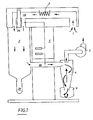
- Fig.1 is a schematic illustration of the apparatus;
- Fig.2 shows some particulars of the apparatus of fig.1;
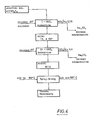
- Fig.3 is a block scheme (scheme 1) of the conventional sol-gel method;
- Fig.4 is a block scheme (scheme 2) for preparing LiAlO₂ by the conventional spray-drying method;
- Fig.5 is a flow sheet (scheme 3) for obtaining precursors for LiAlO₂ synthesis according to the present invention.
- With reference to the figures, the required operations for realizing the process are as follows: (see block scheme 3):
Sol mixing;
Atomization by air at the pressure of 5-6 bar;
Drying by preheated air at 150-200 °C;
Separation of the product from the drying fluid in a cyclone separator;
Suction of the preheated air and collection of the powder in a vessel for sending it to the analysis and to the thermal treatments. - The feeding solution as prepared in a mixing vessel is sent by means of a pump to an atomizer nozzle having a diameter of 0,4-0,7 mm and which has a fitting for pressurized air or inert gas.
- The atomization of the solution at contact with pressurized air and the subsequent drying of the produced particles occurs in a very short time inside the drying chamber.
- The very homogeneous powder particles are beaten down in a cyclone separator provided with collecting vessel.
- The preheated air is expelled to the outside of the exhauster together with the starting H₂O solution in the form of vapour, passing through a filter by which small powder traces present in the drying fluid are retained.
- With reference to the figures 1 and 2, the apparatus as used in the present invention comprises a
vessel 10 whereinto an alumina sol is introduced together with a lithium nitrate solution.From the bottom of said vessel aflexible pipe 12 draws off the solution, thepipe 12 being connected to the suction side of aperistaltic pump 14 with a flow rate of 150-200 cc/h.Pump 14 pushes the homogeneous aluminum and lithium nitrate throughpipe 12 and atomizer 16.The atomizer comprises a vertical elongated hollowcylindrical body 18 which becomes filled with saidsolution 10′ by means of 12 and valve, not shown. At the inside of saidcylinder 18,and,specifically at the top thereof an air or inert gas flow is added through aninlet 20 at the pressure of 5 bar with a flow rate of 200-600 normal l/h. At the bottom of thecylinder 18 anatomizer nozzle 22 is provided of which the diameter specifically is 0,4 mm and produces a parallel jet which is dried withinchamber 3 underlying said atomizer.Thehollow cylinder 18 is surrounded by aspace 24 into which a fluid is fed and circulated with an inlet and anoutlet 30 at the temperature as required for obtaining the required atomization of said solution -
Cylindrical body 18 together withspace 24 is held by acylinder 26 the periphery of which is flushed by a flow of heated air or inert gas which is heated to about 150-200 °C by a resistor 2 which is located in said flow. The air or inert gas flow enters the apparatus throughinlet 1. - At the outlet from
nozzle 22 the alumina and lithium sol is atomized and dried by said air flow,whereby it becomes pulverized. - From
chamber 3,at the bottom of which a collector 28 for humidity and fragments of excessive weight is located, said powder mixed with air enters thecyclone separator 4 through channel 30.At the bottom of cyclone 4 apowder collecting vessel 8 is provided which powder is sent to analysis and to the thermal treatments.At the top ofcyclone 4 the preheated air is drawn by means of exhauster 5.In order to continuously detect the entrance and outlet temperatures of the air or of other preheating fluid two thermal probes 6 and 7 are provided which are located at the entrance and at the outlet of said air into and out ofchamber 3. - As an example a process as above is described.
- A solution is prepared in a
vessel 10 by adding to an Al₂O₃ (Al 3.1 M) sol, a solution of LiNO₃ of the same concentration in a volume ratio 1.1 and leaving the same to homogenize for 15 minutes at 40 °C while agitating withinvessel 10 .(See fig.2). - By means of a
peristaltic pump 14 the solution is sent tonozzle 22 which has a diameter of 0.4 mm and there atomized by an air flow which can be adjusted from 200 to 600 Nl/h at a pressure of 5 bar. - The atomized solution is dried within the drying
chamber 3 by preheated air at the entrance temperature of 190 °C.The temperature at the out ofchamber 3 and the temperature at the entrance into thecyclone separator 4 is 130 °C. - The vacuum formed by
vacuum pump 5 is in the range from 20 to 30 mbar which is sufficient for the total beating down of the solid particles. - The product so obtained shows a good uniformity of granulation around a micrometre and a very good flow characteristics.
- The powder is sent to analysis and to the thermal treatments for calcinings and sintering.
- This process,by the use of a simply operable apparatus available in the trade appears to be advantageous as stated at point p) above.It is consequently unexpensive and yields good purity and quality results.
Claims (10)
preparing a mixture of an alumina sol and a lithium nitrate solution with a lithium /aluminum molar ratio of 1:1;
homogenising said mixture by agitation;
subjecting the homogenised mixture to atomization in a gaseous drying stream to obtain a very fine grain powder;
separating the powder from the gaseous drying stream by means of a cyclone separator;
subjecting the separated powder to thermal treatment to obtain gamma-phase lithium aluminate powder.
Applications Claiming Priority (2)
| Application Number | Priority Date | Filing Date | Title |
|---|---|---|---|
| IT47693/86A IT1190202B (en) | 1986-02-26 | 1986-02-26 | PROCEDURE FOR THE PREPARATION OF LITHIUM ALUMINATE POWDER IN THE RANGE PHASE |
| IT4769386 | 1986-02-26 |
Publications (2)
| Publication Number | Publication Date |
|---|---|
| EP0235098A1 EP0235098A1 (en) | 1987-09-02 |
| EP0235098B1 true EP0235098B1 (en) | 1991-09-11 |
Family
ID=11261936
Family Applications (1)
| Application Number | Title | Priority Date | Filing Date |
|---|---|---|---|
| EP87830065A Expired - Lifetime EP0235098B1 (en) | 1986-02-26 | 1987-02-25 | A process for preparing a lithium aluminate powder in gamma phase |
Country Status (3)
| Country | Link |
|---|---|
| EP (1) | EP0235098B1 (en) |
| DE (1) | DE3772793D1 (en) |
| IT (1) | IT1190202B (en) |
Families Citing this family (3)
| Publication number | Priority date | Publication date | Assignee | Title |
|---|---|---|---|---|
| US5217702A (en) * | 1991-11-19 | 1993-06-08 | Fmc Corporation | Preparation of a high surface area gamma lithium aluminate |
| CN101973566A (en) * | 2010-07-16 | 2011-02-16 | 西安热工研究院有限公司 | Method for preparing submicron γ-LiAlO2 powder from hydrated nano-alumina |
| CN105148796B (en) * | 2015-09-07 | 2017-07-28 | 中国兵器科学研究院宁波分院 | A kind of Spray granulation method of active nano aluminium powder |
Family Cites Families (1)
| Publication number | Priority date | Publication date | Assignee | Title |
|---|---|---|---|---|
| DE3415324C2 (en) * | 1984-04-25 | 1986-11-06 | Kernforschungszentrum Karlsruhe Gmbh, 7500 Karlsruhe | Process for the preparation of sinterable powder from γ-LiAl0? 2? and its use |
-
1986
- 1986-02-26 IT IT47693/86A patent/IT1190202B/en active
-
1987
- 1987-02-25 DE DE8787830065T patent/DE3772793D1/en not_active Expired - Fee Related
- 1987-02-25 EP EP87830065A patent/EP0235098B1/en not_active Expired - Lifetime
Also Published As
| Publication number | Publication date |
|---|---|
| DE3772793D1 (en) | 1991-10-17 |
| IT1190202B (en) | 1988-02-16 |
| EP0235098A1 (en) | 1987-09-02 |
| IT8647693A0 (en) | 1986-02-26 |
Similar Documents
| Publication | Publication Date | Title |
|---|---|---|
| US4839339A (en) | Superconductor precursor mixtures made by precipitation method | |
| US3872217A (en) | Process for the manufacture of substantially spherical, silica-containing hydrogels | |
| CA1207630A (en) | Continuous process for neutralization of aluminate solution to form gels and apparatus therefor | |
| KR920000782B1 (en) | Cerium oxide with new morphological properties and preparation method thereof | |
| Tai et al. | Modified resin–intermediate processing of perovskite powders: Part II. Processing for fine, nonagglomerated Sr-doped lanthanum chromite powders | |
| Deptuła et al. | Preparation of spherical powders of hydroxyapatite by sol-gel process | |
| EP0117755B1 (en) | Process and apparatus for preparing metal oxide particles | |
| RU2189359C2 (en) | Compounds of tantalum pentoxide and niobium pentoxide | |
| US4898843A (en) | Titanate powder and process for producing the same | |
| US20080247931A1 (en) | Method for Producing Multi-Constituent, Metal Oxide Compounds Containing Alkali Metals,and thus Produced Metal Oxide Compounds | |
| CA2141162A1 (en) | Treatment of a chemical | |
| RU2224720C2 (en) | Spray drying-assisted treatment of uranium dioxide cast powder prepared with the aid of uf6 dry transformation process | |
| RU2663738C1 (en) | Method for producing hollow microspheres of bismuth ferrite | |
| US4382885A (en) | Method for producing nuclear fuel | |
| Suryanarayana et al. | Fabrication of UO2 pellets by gel pelletization technique without addition of carbon as pore former | |
| GB2178418A (en) | Process for the conversion of uf6 to uo2 | |
| US3321560A (en) | Production of fuel for nuclear reactors | |
| EP0235098A1 (en) | A process for preparing a lithium aluminate powder in gamma phase | |
| CN214553426U (en) | Gas-liquid reaction device for continuous production | |
| KR0139086B1 (en) | A continuouns process for making aluminum nitride by the carbonitriding of alumina in a moving-bed reactor | |
| JPH09501906A (en) | Method for obtaining uranium trioxide by direct thermal denitration of uranyl nitrate | |
| JP2757324B2 (en) | Continuous production method of aluminum nitride by carbonitriding alumina | |
| US5139709A (en) | Process for converting uranyl compounds to UO2 via ADU | |
| Haas et al. | ENGINEERING DEVELOPMENT OF SOL--GEL PROCESSES AT THE OAK RIDGE NATIONAL LABORATORY. | |
| EP0881194A1 (en) | Reactive compound for removing acid compounds from fumes or gases at high temperature, and the process for its preparation |
Legal Events
| Date | Code | Title | Description |
|---|---|---|---|
| PUAI | Public reference made under article 153(3) epc to a published international application that has entered the european phase |
Free format text: ORIGINAL CODE: 0009012 |
|
| AK | Designated contracting states |
Kind code of ref document: A1 Designated state(s): BE DE FR GB NL |
|
| 17P | Request for examination filed |
Effective date: 19880222 |
|
| 17Q | First examination report despatched |
Effective date: 19890407 |
|
| GRAA | (expected) grant |
Free format text: ORIGINAL CODE: 0009210 |
|
| AK | Designated contracting states |
Kind code of ref document: B1 Designated state(s): BE DE FR GB NL |
|
| REF | Corresponds to: |
Ref document number: 3772793 Country of ref document: DE Date of ref document: 19911017 |
|
| ET | Fr: translation filed | ||
| PLBE | No opposition filed within time limit |
Free format text: ORIGINAL CODE: 0009261 |
|
| STAA | Information on the status of an ep patent application or granted ep patent |
Free format text: STATUS: NO OPPOSITION FILED WITHIN TIME LIMIT |
|
| 26N | No opposition filed | ||
| PGFP | Annual fee paid to national office [announced via postgrant information from national office to epo] |
Ref country code: NL Payment date: 19940228 Year of fee payment: 8 |
|
| PGFP | Annual fee paid to national office [announced via postgrant information from national office to epo] |
Ref country code: GB Payment date: 19940425 Year of fee payment: 8 |
|
| PGFP | Annual fee paid to national office [announced via postgrant information from national office to epo] |
Ref country code: FR Payment date: 19940428 Year of fee payment: 8 |
|
| PGFP | Annual fee paid to national office [announced via postgrant information from national office to epo] |
Ref country code: DE Payment date: 19940429 Year of fee payment: 8 Ref country code: BE Payment date: 19940429 Year of fee payment: 8 |
|
| PG25 | Lapsed in a contracting state [announced via postgrant information from national office to epo] |
Ref country code: GB Effective date: 19950225 |
|
| PG25 | Lapsed in a contracting state [announced via postgrant information from national office to epo] |
Ref country code: BE Effective date: 19950228 |
|
| BERE | Be: lapsed |
Owner name: ENEA COMITATO NAZIONALE PER LA RICERCA E PER LO S Effective date: 19950228 |
|
| PG25 | Lapsed in a contracting state [announced via postgrant information from national office to epo] |
Ref country code: NL Effective date: 19950901 |
|
| GBPC | Gb: european patent ceased through non-payment of renewal fee |
Effective date: 19950225 |
|
| PG25 | Lapsed in a contracting state [announced via postgrant information from national office to epo] |
Ref country code: FR Effective date: 19951031 |
|
| NLV4 | Nl: lapsed or anulled due to non-payment of the annual fee |
Effective date: 19950901 |
|
| PG25 | Lapsed in a contracting state [announced via postgrant information from national office to epo] |
Ref country code: DE Effective date: 19951101 |
|
| REG | Reference to a national code |
Ref country code: FR Ref legal event code: ST |