EP0232326B1 - Inhibin and method of purifying same - Google Patents
Inhibin and method of purifying same Download PDFInfo
- Publication number
- EP0232326B1 EP0232326B1 EP86904699A EP86904699A EP0232326B1 EP 0232326 B1 EP0232326 B1 EP 0232326B1 EP 86904699 A EP86904699 A EP 86904699A EP 86904699 A EP86904699 A EP 86904699A EP 0232326 B1 EP0232326 B1 EP 0232326B1
- Authority
- EP
- European Patent Office
- Prior art keywords
- protein
- inhibin
- chain
- leu
- gly
- Prior art date
- Legal status (The legal status is an assumption and is not a legal conclusion. Google has not performed a legal analysis and makes no representation as to the accuracy of the status listed.)
- Expired - Lifetime
Links
- ZPNFWUPYTFPOJU-LPYSRVMUSA-N iniprol Chemical compound C([C@H]1C(=O)NCC(=O)NCC(=O)N[C@H]2CSSC[C@H]3C(=O)N[C@@H](CCCCN)C(=O)N[C@@H](C)C(=O)N[C@@H](CCCNC(N)=N)C(=O)N[C@H](C(N[C@H](C(=O)N[C@@H](CCCNC(N)=N)C(=O)N[C@@H](CC=4C=CC(O)=CC=4)C(=O)N[C@@H](CC=4C=CC=CC=4)C(=O)N[C@@H](CC=4C=CC(O)=CC=4)C(=O)N[C@@H](CC(N)=O)C(=O)N[C@@H](C)C(=O)N[C@@H](CCCCN)C(=O)N[C@@H](C)C(=O)NCC(=O)N[C@@H](CC(C)C)C(=O)N[C@@H](CSSC[C@H](NC(=O)[C@H](CC(O)=O)NC(=O)[C@H](CCC(O)=O)NC(=O)[C@H](C)NC(=O)[C@H](CO)NC(=O)[C@H](CCCCN)NC(=O)[C@H](CC=4C=CC=CC=4)NC(=O)[C@H](CC(N)=O)NC(=O)[C@H](CC(N)=O)NC(=O)[C@H](CCCNC(N)=N)NC(=O)[C@H](CCCCN)NC(=O)[C@H](C)NC(=O)[C@H](CCCNC(N)=N)NC2=O)C(=O)N[C@@H](CCSC)C(=O)N[C@@H](CCCNC(N)=N)C(=O)N[C@@H]([C@@H](C)O)C(=O)N[C@@H](CSSC[C@H](NC(=O)[C@H](CC=2C=CC=CC=2)NC(=O)[C@H](CC(O)=O)NC(=O)[C@H]2N(CCC2)C(=O)[C@@H](N)CCCNC(N)=N)C(=O)N[C@@H](CC(C)C)C(=O)N[C@@H](CCC(O)=O)C(=O)N2[C@@H](CCC2)C(=O)N2[C@@H](CCC2)C(=O)N[C@@H](CC=2C=CC(O)=CC=2)C(=O)N[C@@H]([C@@H](C)O)C(=O)NCC(=O)N2[C@@H](CCC2)C(=O)N3)C(=O)NCC(=O)NCC(=O)N[C@@H](C)C(O)=O)C(=O)N[C@@H](CCC(N)=O)C(=O)N[C@H](C(=O)N[C@@H](CC=2C=CC=CC=2)C(=O)N[C@H](C(=O)N1)C(C)C)[C@@H](C)O)[C@@H](C)CC)=O)[C@@H](C)CC)C1=CC=C(O)C=C1 ZPNFWUPYTFPOJU-LPYSRVMUSA-N 0.000 title claims abstract description 64
- 239000000893 inhibin Substances 0.000 title claims abstract description 62
- 238000000034 method Methods 0.000 title claims description 32
- 102000002746 Inhibins Human genes 0.000 claims abstract description 94
- 108010004250 Inhibins Proteins 0.000 claims abstract description 94
- 108090000623 proteins and genes Proteins 0.000 claims abstract description 81
- 102000004169 proteins and genes Human genes 0.000 claims abstract description 78
- 230000000694 effects Effects 0.000 claims abstract description 30
- 230000028327 secretion Effects 0.000 claims abstract description 14
- 238000002523 gelfiltration Methods 0.000 claims abstract description 13
- 238000004007 reversed phase HPLC Methods 0.000 claims abstract description 7
- 230000006334 disulfide bridging Effects 0.000 claims abstract description 6
- 239000000463 material Substances 0.000 claims description 26
- 108090000765 processed proteins & peptides Proteins 0.000 claims description 23
- 102000004196 processed proteins & peptides Human genes 0.000 claims description 21
- 238000000746 purification Methods 0.000 claims description 19
- 229920001184 polypeptide Polymers 0.000 claims description 18
- 102000012673 Follicle Stimulating Hormone Human genes 0.000 claims description 11
- 108010079345 Follicle Stimulating Hormone Proteins 0.000 claims description 11
- 229940028334 follicle stimulating hormone Drugs 0.000 claims description 11
- HTTJABKRGRZYRN-UHFFFAOYSA-N Heparin Chemical group OC1C(NC(=O)C)C(O)OC(COS(O)(=O)=O)C1OC1C(OS(O)(=O)=O)C(O)C(OC2C(C(OS(O)(=O)=O)C(OC3C(C(O)C(O)C(O3)C(O)=O)OS(O)(=O)=O)C(CO)O2)NS(O)(=O)=O)C(C(O)=O)O1 HTTJABKRGRZYRN-UHFFFAOYSA-N 0.000 claims description 10
- 229960002897 heparin Drugs 0.000 claims description 10
- 229920000669 heparin Polymers 0.000 claims description 10
- 102000009151 Luteinizing Hormone Human genes 0.000 claims description 7
- 108010073521 Luteinizing Hormone Proteins 0.000 claims description 7
- 229940040129 luteinizing hormone Drugs 0.000 claims description 7
- 150000001413 amino acids Chemical class 0.000 claims description 6
- 239000013598 vector Substances 0.000 claims description 6
- 239000000203 mixture Substances 0.000 claims description 3
- 239000000539 dimer Substances 0.000 claims description 2
- 238000005194 fractionation Methods 0.000 claims description 2
- 238000004519 manufacturing process Methods 0.000 claims description 2
- 230000021595 spermatogenesis Effects 0.000 claims description 2
- 239000003433 contraceptive agent Substances 0.000 claims 2
- 230000002401 inhibitory effect Effects 0.000 claims 2
- 230000016087 ovulation Effects 0.000 claims 1
- 125000002924 primary amino group Chemical group [H]N([H])* 0.000 claims 1
- 230000001131 transforming effect Effects 0.000 claims 1
- 229920002684 Sepharose Polymers 0.000 abstract description 12
- 210000001733 follicular fluid Anatomy 0.000 abstract description 10
- 230000001817 pituitary effect Effects 0.000 abstract description 8
- 238000001042 affinity chromatography Methods 0.000 abstract description 7
- 239000012506 Sephacryl® Substances 0.000 abstract description 5
- 238000004264 monolayer culture Methods 0.000 abstract description 3
- 235000018102 proteins Nutrition 0.000 description 58
- WEVYAHXRMPXWCK-UHFFFAOYSA-N Acetonitrile Chemical compound CC#N WEVYAHXRMPXWCK-UHFFFAOYSA-N 0.000 description 33
- 108010042653 IgA receptor Proteins 0.000 description 20
- 102100034014 Prolyl 3-hydroxylase 3 Human genes 0.000 description 20
- DTQVDTLACAAQTR-UHFFFAOYSA-N Trifluoroacetic acid Chemical compound OC(=O)C(F)(F)F DTQVDTLACAAQTR-UHFFFAOYSA-N 0.000 description 19
- QTBSBXVTEAMEQO-UHFFFAOYSA-N Acetic acid Chemical compound CC(O)=O QTBSBXVTEAMEQO-UHFFFAOYSA-N 0.000 description 18
- FAPWRFPIFSIZLT-UHFFFAOYSA-M Sodium chloride Chemical compound [Na+].[Cl-] FAPWRFPIFSIZLT-UHFFFAOYSA-M 0.000 description 15
- 239000007853 buffer solution Substances 0.000 description 13
- 239000000872 buffer Substances 0.000 description 11
- 238000004458 analytical method Methods 0.000 description 10
- 239000000499 gel Substances 0.000 description 10
- 239000002299 complementary DNA Substances 0.000 description 8
- 238000004166 bioassay Methods 0.000 description 7
- 239000011780 sodium chloride Substances 0.000 description 7
- 239000007787 solid Substances 0.000 description 7
- QKNYBSVHEMOAJP-UHFFFAOYSA-N 2-amino-2-(hydroxymethyl)propane-1,3-diol;hydron;chloride Chemical compound Cl.OCC(N)(CO)CO QKNYBSVHEMOAJP-UHFFFAOYSA-N 0.000 description 6
- 241001465754 Metazoa Species 0.000 description 6
- 239000000287 crude extract Substances 0.000 description 6
- 239000000523 sample Substances 0.000 description 6
- XLYOFNOQVPJJNP-UHFFFAOYSA-N water Substances O XLYOFNOQVPJJNP-UHFFFAOYSA-N 0.000 description 6
- 125000000539 amino acid group Chemical group 0.000 description 5
- 210000004027 cell Anatomy 0.000 description 5
- 238000010828 elution Methods 0.000 description 5
- 125000001997 phenyl group Chemical group [H]C1=C([H])C([H])=C(*)C([H])=C1[H] 0.000 description 5
- 150000003839 salts Chemical class 0.000 description 5
- 241000283690 Bos taurus Species 0.000 description 4
- 108091003079 Bovine Serum Albumin Proteins 0.000 description 4
- 241000124008 Mammalia Species 0.000 description 4
- 239000002253 acid Substances 0.000 description 4
- 239000011149 active material Substances 0.000 description 4
- 235000001014 amino acid Nutrition 0.000 description 4
- 238000003556 assay Methods 0.000 description 4
- 238000001962 electrophoresis Methods 0.000 description 4
- 239000000284 extract Substances 0.000 description 4
- 230000035558 fertility Effects 0.000 description 4
- 239000002609 medium Substances 0.000 description 4
- 238000002415 sodium dodecyl sulfate polyacrylamide gel electrophoresis Methods 0.000 description 4
- WROMPOXWARCANT-UHFFFAOYSA-N tfa trifluoroacetic acid Chemical compound OC(=O)C(F)(F)F.OC(=O)C(F)(F)F WROMPOXWARCANT-UHFFFAOYSA-N 0.000 description 4
- PEDCQBHIVMGVHV-UHFFFAOYSA-N Glycerine Chemical compound OCC(O)CO PEDCQBHIVMGVHV-UHFFFAOYSA-N 0.000 description 3
- 238000010521 absorption reaction Methods 0.000 description 3
- 238000004113 cell culture Methods 0.000 description 3
- 239000012091 fetal bovine serum Substances 0.000 description 3
- 239000012530 fluid Substances 0.000 description 3
- 239000012634 fragment Substances 0.000 description 3
- 238000000338 in vitro Methods 0.000 description 3
- 238000011534 incubation Methods 0.000 description 3
- 108020004999 messenger RNA Proteins 0.000 description 3
- UBLQIESZTDNNAO-UHFFFAOYSA-N n,n-diethylethanamine;phosphoric acid Chemical compound [O-]P([O-])([O-])=O.CC[NH+](CC)CC.CC[NH+](CC)CC.CC[NH+](CC)CC UBLQIESZTDNNAO-UHFFFAOYSA-N 0.000 description 3
- 239000000126 substance Substances 0.000 description 3
- HRPVXLWXLXDGHG-UHFFFAOYSA-N Acrylamide Chemical compound NC(=O)C=C HRPVXLWXLXDGHG-UHFFFAOYSA-N 0.000 description 2
- CIWBSHSKHKDKBQ-JLAZNSOCSA-N Ascorbic acid Chemical compound OC[C@H](O)[C@H]1OC(=O)C(O)=C1O CIWBSHSKHKDKBQ-JLAZNSOCSA-N 0.000 description 2
- 230000005526 G1 to G0 transition Effects 0.000 description 2
- 102000012407 Inhibin-beta Subunits Human genes 0.000 description 2
- 108010061971 Inhibin-beta Subunits Proteins 0.000 description 2
- XEEYBQQBJWHFJM-UHFFFAOYSA-N Iron Chemical compound [Fe] XEEYBQQBJWHFJM-UHFFFAOYSA-N 0.000 description 2
- 108020004511 Recombinant DNA Proteins 0.000 description 2
- VYPSYNLAJGMNEJ-UHFFFAOYSA-N Silicium dioxide Chemical compound O=[Si]=O VYPSYNLAJGMNEJ-UHFFFAOYSA-N 0.000 description 2
- 230000000975 bioactive effect Effects 0.000 description 2
- 230000001413 cellular effect Effects 0.000 description 2
- 238000012512 characterization method Methods 0.000 description 2
- XVOYSCVBGLVSOL-UHFFFAOYSA-N cysteic acid Chemical compound OC(=O)C(N)CS(O)(=O)=O XVOYSCVBGLVSOL-UHFFFAOYSA-N 0.000 description 2
- VHJLVAABSRFDPM-QWWZWVQMSA-N dithiothreitol Chemical compound SC[C@@H](O)[C@H](O)CS VHJLVAABSRFDPM-QWWZWVQMSA-N 0.000 description 2
- 239000003937 drug carrier Substances 0.000 description 2
- 230000001747 exhibiting effect Effects 0.000 description 2
- 239000000706 filtrate Substances 0.000 description 2
- 239000012847 fine chemical Substances 0.000 description 2
- 238000009396 hybridization Methods 0.000 description 2
- 230000001900 immune effect Effects 0.000 description 2
- 239000000543 intermediate Substances 0.000 description 2
- HQKMJHAJHXVSDF-UHFFFAOYSA-L magnesium stearate Chemical compound [Mg+2].CCCCCCCCCCCCCCCCCC([O-])=O.CCCCCCCCCCCCCCCCCC([O-])=O HQKMJHAJHXVSDF-UHFFFAOYSA-L 0.000 description 2
- 231100000252 nontoxic Toxicity 0.000 description 2
- 230000003000 nontoxic effect Effects 0.000 description 2
- 230000002611 ovarian Effects 0.000 description 2
- 239000008194 pharmaceutical composition Substances 0.000 description 2
- 229920003023 plastic Polymers 0.000 description 2
- 239000004033 plastic Substances 0.000 description 2
- 239000002244 precipitate Substances 0.000 description 2
- 239000000047 product Substances 0.000 description 2
- 238000003127 radioimmunoassay Methods 0.000 description 2
- 239000012723 sample buffer Substances 0.000 description 2
- 210000000582 semen Anatomy 0.000 description 2
- 238000000926 separation method Methods 0.000 description 2
- 238000012163 sequencing technique Methods 0.000 description 2
- 239000006228 supernatant Substances 0.000 description 2
- 238000005406 washing Methods 0.000 description 2
- LJGHYPLBDBRCRZ-UHFFFAOYSA-N 3-(3-aminophenyl)sulfonylaniline Chemical compound NC1=CC=CC(S(=O)(=O)C=2C=C(N)C=CC=2)=C1 LJGHYPLBDBRCRZ-UHFFFAOYSA-N 0.000 description 1
- QTBSBXVTEAMEQO-UHFFFAOYSA-M Acetate Chemical compound CC([O-])=O QTBSBXVTEAMEQO-UHFFFAOYSA-M 0.000 description 1
- 102000005606 Activins Human genes 0.000 description 1
- 108010059616 Activins Proteins 0.000 description 1
- 208000002109 Argyria Diseases 0.000 description 1
- 241000416162 Astragalus gummifer Species 0.000 description 1
- 241000894006 Bacteria Species 0.000 description 1
- 108010038061 Chymotrypsinogen Proteins 0.000 description 1
- KRKNYBCHXYNGOX-UHFFFAOYSA-K Citrate Chemical compound [O-]C(=O)CC(O)(CC([O-])=O)C([O-])=O KRKNYBCHXYNGOX-UHFFFAOYSA-K 0.000 description 1
- 108010062580 Concanavalin A Proteins 0.000 description 1
- 238000011537 Coomassie blue staining Methods 0.000 description 1
- 229920002261 Corn starch Polymers 0.000 description 1
- FEWJPZIEWOKRBE-JCYAYHJZSA-N Dextrotartaric acid Chemical compound OC(=O)[C@H](O)[C@@H](O)C(O)=O FEWJPZIEWOKRBE-JCYAYHJZSA-N 0.000 description 1
- 241000588724 Escherichia coli Species 0.000 description 1
- 241000206602 Eukaryota Species 0.000 description 1
- 241000583195 Ganodes Species 0.000 description 1
- 108010010803 Gelatin Proteins 0.000 description 1
- 102000006771 Gonadotropins Human genes 0.000 description 1
- 108010086677 Gonadotropins Proteins 0.000 description 1
- 241001622557 Hesperia Species 0.000 description 1
- 241000282412 Homo Species 0.000 description 1
- 108091006905 Human Serum Albumin Proteins 0.000 description 1
- 102000008100 Human Serum Albumin Human genes 0.000 description 1
- VEXZGXHMUGYJMC-UHFFFAOYSA-N Hydrochloric acid Chemical compound Cl VEXZGXHMUGYJMC-UHFFFAOYSA-N 0.000 description 1
- CPELXLSAUQHCOX-UHFFFAOYSA-N Hydrogen bromide Chemical compound Br CPELXLSAUQHCOX-UHFFFAOYSA-N 0.000 description 1
- 206010062767 Hypophysitis Diseases 0.000 description 1
- 102000016943 Muramidase Human genes 0.000 description 1
- 108010014251 Muramidase Proteins 0.000 description 1
- 108010062010 N-Acetylmuramoyl-L-alanine Amidase Proteins 0.000 description 1
- 125000000729 N-terminal amino-acid group Chemical group 0.000 description 1
- 108091034117 Oligonucleotide Proteins 0.000 description 1
- 241000283973 Oryctolagus cuniculus Species 0.000 description 1
- 108010058846 Ovalbumin Proteins 0.000 description 1
- 229910019142 PO4 Inorganic materials 0.000 description 1
- 101800000133 Protein B* Proteins 0.000 description 1
- 108091006629 SLC13A2 Proteins 0.000 description 1
- 240000004808 Saccharomyces cerevisiae Species 0.000 description 1
- DBMJMQXJHONAFJ-UHFFFAOYSA-M Sodium laurylsulphate Chemical compound [Na+].CCCCCCCCCCCCOS([O-])(=O)=O DBMJMQXJHONAFJ-UHFFFAOYSA-M 0.000 description 1
- QAOWNCQODCNURD-UHFFFAOYSA-L Sulfate Chemical compound [O-]S([O-])(=O)=O QAOWNCQODCNURD-UHFFFAOYSA-L 0.000 description 1
- 229920001615 Tragacanth Polymers 0.000 description 1
- HCHKCACWOHOZIP-UHFFFAOYSA-N Zinc Chemical compound [Zn] HCHKCACWOHOZIP-UHFFFAOYSA-N 0.000 description 1
- JLCPHMBAVCMARE-UHFFFAOYSA-N [3-[[3-[[3-[[3-[[3-[[3-[[3-[[3-[[3-[[3-[[3-[[5-(2-amino-6-oxo-1H-purin-9-yl)-3-[[3-[[3-[[3-[[3-[[3-[[5-(2-amino-6-oxo-1H-purin-9-yl)-3-[[5-(2-amino-6-oxo-1H-purin-9-yl)-3-hydroxyoxolan-2-yl]methoxy-hydroxyphosphoryl]oxyoxolan-2-yl]methoxy-hydroxyphosphoryl]oxy-5-(5-methyl-2,4-dioxopyrimidin-1-yl)oxolan-2-yl]methoxy-hydroxyphosphoryl]oxy-5-(6-aminopurin-9-yl)oxolan-2-yl]methoxy-hydroxyphosphoryl]oxy-5-(6-aminopurin-9-yl)oxolan-2-yl]methoxy-hydroxyphosphoryl]oxy-5-(6-aminopurin-9-yl)oxolan-2-yl]methoxy-hydroxyphosphoryl]oxy-5-(6-aminopurin-9-yl)oxolan-2-yl]methoxy-hydroxyphosphoryl]oxyoxolan-2-yl]methoxy-hydroxyphosphoryl]oxy-5-(5-methyl-2,4-dioxopyrimidin-1-yl)oxolan-2-yl]methoxy-hydroxyphosphoryl]oxy-5-(4-amino-2-oxopyrimidin-1-yl)oxolan-2-yl]methoxy-hydroxyphosphoryl]oxy-5-(5-methyl-2,4-dioxopyrimidin-1-yl)oxolan-2-yl]methoxy-hydroxyphosphoryl]oxy-5-(5-methyl-2,4-dioxopyrimidin-1-yl)oxolan-2-yl]methoxy-hydroxyphosphoryl]oxy-5-(6-aminopurin-9-yl)oxolan-2-yl]methoxy-hydroxyphosphoryl]oxy-5-(6-aminopurin-9-yl)oxolan-2-yl]methoxy-hydroxyphosphoryl]oxy-5-(4-amino-2-oxopyrimidin-1-yl)oxolan-2-yl]methoxy-hydroxyphosphoryl]oxy-5-(4-amino-2-oxopyrimidin-1-yl)oxolan-2-yl]methoxy-hydroxyphosphoryl]oxy-5-(4-amino-2-oxopyrimidin-1-yl)oxolan-2-yl]methoxy-hydroxyphosphoryl]oxy-5-(6-aminopurin-9-yl)oxolan-2-yl]methoxy-hydroxyphosphoryl]oxy-5-(4-amino-2-oxopyrimidin-1-yl)oxolan-2-yl]methyl [5-(6-aminopurin-9-yl)-2-(hydroxymethyl)oxolan-3-yl] hydrogen phosphate Polymers Cc1cn(C2CC(OP(O)(=O)OCC3OC(CC3OP(O)(=O)OCC3OC(CC3O)n3cnc4c3nc(N)[nH]c4=O)n3cnc4c3nc(N)[nH]c4=O)C(COP(O)(=O)OC3CC(OC3COP(O)(=O)OC3CC(OC3COP(O)(=O)OC3CC(OC3COP(O)(=O)OC3CC(OC3COP(O)(=O)OC3CC(OC3COP(O)(=O)OC3CC(OC3COP(O)(=O)OC3CC(OC3COP(O)(=O)OC3CC(OC3COP(O)(=O)OC3CC(OC3COP(O)(=O)OC3CC(OC3COP(O)(=O)OC3CC(OC3COP(O)(=O)OC3CC(OC3COP(O)(=O)OC3CC(OC3COP(O)(=O)OC3CC(OC3COP(O)(=O)OC3CC(OC3COP(O)(=O)OC3CC(OC3COP(O)(=O)OC3CC(OC3CO)n3cnc4c(N)ncnc34)n3ccc(N)nc3=O)n3cnc4c(N)ncnc34)n3ccc(N)nc3=O)n3ccc(N)nc3=O)n3ccc(N)nc3=O)n3cnc4c(N)ncnc34)n3cnc4c(N)ncnc34)n3cc(C)c(=O)[nH]c3=O)n3cc(C)c(=O)[nH]c3=O)n3ccc(N)nc3=O)n3cc(C)c(=O)[nH]c3=O)n3cnc4c3nc(N)[nH]c4=O)n3cnc4c(N)ncnc34)n3cnc4c(N)ncnc34)n3cnc4c(N)ncnc34)n3cnc4c(N)ncnc34)O2)c(=O)[nH]c1=O JLCPHMBAVCMARE-UHFFFAOYSA-N 0.000 description 1
- 229940022663 acetate Drugs 0.000 description 1
- 230000002378 acidificating effect Effects 0.000 description 1
- 239000004480 active ingredient Substances 0.000 description 1
- 235000010443 alginic acid Nutrition 0.000 description 1
- 239000000783 alginic acid Substances 0.000 description 1
- 229920000615 alginic acid Polymers 0.000 description 1
- 229960001126 alginic acid Drugs 0.000 description 1
- 150000004781 alginic acids Chemical class 0.000 description 1
- BFNBIHQBYMNNAN-UHFFFAOYSA-N ammonium sulfate Chemical class N.N.OS(O)(=O)=O BFNBIHQBYMNNAN-UHFFFAOYSA-N 0.000 description 1
- 239000012062 aqueous buffer Substances 0.000 description 1
- 239000012736 aqueous medium Substances 0.000 description 1
- 229940072107 ascorbate Drugs 0.000 description 1
- 235000010323 ascorbic acid Nutrition 0.000 description 1
- 239000011668 ascorbic acid Substances 0.000 description 1
- 229940050390 benzoate Drugs 0.000 description 1
- WPYMKLBDIGXBTP-UHFFFAOYSA-N benzoic acid Chemical compound OC(=O)C1=CC=CC=C1 WPYMKLBDIGXBTP-UHFFFAOYSA-N 0.000 description 1
- 239000011230 binding agent Substances 0.000 description 1
- 230000004071 biological effect Effects 0.000 description 1
- 238000010170 biological method Methods 0.000 description 1
- 230000033228 biological regulation Effects 0.000 description 1
- 230000037396 body weight Effects 0.000 description 1
- 229940098773 bovine serum albumin Drugs 0.000 description 1
- UDSAIICHUKSCKT-UHFFFAOYSA-N bromophenol blue Chemical compound C1=C(Br)C(O)=C(Br)C=C1C1(C=2C=C(Br)C(O)=C(Br)C=2)C2=CC=CC=C2S(=O)(=O)O1 UDSAIICHUKSCKT-UHFFFAOYSA-N 0.000 description 1
- 150000001720 carbohydrates Chemical group 0.000 description 1
- 239000006143 cell culture medium Substances 0.000 description 1
- 239000003795 chemical substances by application Substances 0.000 description 1
- 238000004587 chromatography analysis Methods 0.000 description 1
- 238000011097 chromatography purification Methods 0.000 description 1
- 229940001468 citrate Drugs 0.000 description 1
- 239000013599 cloning vector Substances 0.000 description 1
- 238000004590 computer program Methods 0.000 description 1
- 239000008120 corn starch Substances 0.000 description 1
- 239000013058 crude material Substances 0.000 description 1
- 235000018417 cysteine Nutrition 0.000 description 1
- XUJNEKJLAYXESH-UHFFFAOYSA-N cysteine Natural products SCC(N)C(O)=O XUJNEKJLAYXESH-UHFFFAOYSA-N 0.000 description 1
- 230000007423 decrease Effects 0.000 description 1
- 230000003247 decreasing effect Effects 0.000 description 1
- 238000001514 detection method Methods 0.000 description 1
- 231100000673 dose–response relationship Toxicity 0.000 description 1
- 238000001502 gel electrophoresis Methods 0.000 description 1
- 239000008273 gelatin Substances 0.000 description 1
- 229920000159 gelatin Polymers 0.000 description 1
- 235000019322 gelatine Nutrition 0.000 description 1
- 235000011852 gelatine desserts Nutrition 0.000 description 1
- 230000002068 genetic effect Effects 0.000 description 1
- 230000013595 glycosylation Effects 0.000 description 1
- 238000006206 glycosylation reaction Methods 0.000 description 1
- 239000002622 gonadotropin Substances 0.000 description 1
- 238000004128 high performance liquid chromatography Methods 0.000 description 1
- 239000012535 impurity Substances 0.000 description 1
- 231100000535 infertility Toxicity 0.000 description 1
- 230000036512 infertility Effects 0.000 description 1
- 208000000509 infertility Diseases 0.000 description 1
- 231100000503 infertility induction Toxicity 0.000 description 1
- 230000005764 inhibitory process Effects 0.000 description 1
- 238000001990 intravenous administration Methods 0.000 description 1
- 229910052742 iron Inorganic materials 0.000 description 1
- 238000002955 isolation Methods 0.000 description 1
- 239000007788 liquid Substances 0.000 description 1
- 238000004811 liquid chromatography Methods 0.000 description 1
- 238000011068 loading method Methods 0.000 description 1
- 239000000314 lubricant Substances 0.000 description 1
- 235000010335 lysozyme Nutrition 0.000 description 1
- 239000004325 lysozyme Substances 0.000 description 1
- 229960000274 lysozyme Drugs 0.000 description 1
- 235000019359 magnesium stearate Nutrition 0.000 description 1
- 229940049920 malate Drugs 0.000 description 1
- 239000002583 male contraceptive agent Substances 0.000 description 1
- VZCYOOQTPOCHFL-UPHRSURJSA-N maleic acid Chemical compound OC(=O)\C=C/C(O)=O VZCYOOQTPOCHFL-UPHRSURJSA-N 0.000 description 1
- BJEPYKJPYRNKOW-UHFFFAOYSA-N malic acid Chemical compound OC(=O)C(O)CC(O)=O BJEPYKJPYRNKOW-UHFFFAOYSA-N 0.000 description 1
- 239000012528 membrane Substances 0.000 description 1
- 229910052751 metal Chemical class 0.000 description 1
- 239000002184 metal Chemical class 0.000 description 1
- 244000005700 microbiome Species 0.000 description 1
- 230000004048 modification Effects 0.000 description 1
- 238000012986 modification Methods 0.000 description 1
- 238000001823 molecular biology technique Methods 0.000 description 1
- 229940092253 ovalbumin Drugs 0.000 description 1
- 230000003647 oxidation Effects 0.000 description 1
- 238000007254 oxidation reaction Methods 0.000 description 1
- 230000001590 oxidative effect Effects 0.000 description 1
- 230000036961 partial effect Effects 0.000 description 1
- 230000002572 peristaltic effect Effects 0.000 description 1
- NBIIXXVUZAFLBC-UHFFFAOYSA-K phosphate Chemical compound [O-]P([O-])([O-])=O NBIIXXVUZAFLBC-UHFFFAOYSA-K 0.000 description 1
- 239000010452 phosphate Substances 0.000 description 1
- 239000008363 phosphate buffer Substances 0.000 description 1
- 238000002360 preparation method Methods 0.000 description 1
- 230000002829 reductive effect Effects 0.000 description 1
- 230000001105 regulatory effect Effects 0.000 description 1
- 230000003578 releasing effect Effects 0.000 description 1
- 238000011160 research Methods 0.000 description 1
- 230000000717 retained effect Effects 0.000 description 1
- 210000002830 rete testis Anatomy 0.000 description 1
- 238000010839 reverse transcription Methods 0.000 description 1
- 238000012216 screening Methods 0.000 description 1
- 229920000260 silastic Polymers 0.000 description 1
- 239000000377 silicon dioxide Substances 0.000 description 1
- 229940083575 sodium dodecyl sulfate Drugs 0.000 description 1
- 235000019333 sodium laurylsulphate Nutrition 0.000 description 1
- 239000000243 solution Substances 0.000 description 1
- 239000002904 solvent Substances 0.000 description 1
- 238000001228 spectrum Methods 0.000 description 1
- 239000012128 staining reagent Substances 0.000 description 1
- 239000007858 starting material Substances 0.000 description 1
- 229940086735 succinate Drugs 0.000 description 1
- KDYFGRWQOYBRFD-UHFFFAOYSA-L succinate(2-) Chemical compound [O-]C(=O)CCC([O-])=O KDYFGRWQOYBRFD-UHFFFAOYSA-L 0.000 description 1
- 229910021653 sulphate ion Inorganic materials 0.000 description 1
- 229940095064 tartrate Drugs 0.000 description 1
- 238000012360 testing method Methods 0.000 description 1
- 210000001550 testis Anatomy 0.000 description 1
- 210000001519 tissue Anatomy 0.000 description 1
- 235000010487 tragacanth Nutrition 0.000 description 1
- 239000000196 tragacanth Substances 0.000 description 1
- 229940116362 tragacanth Drugs 0.000 description 1
- VZCYOOQTPOCHFL-UHFFFAOYSA-N trans-butenedioic acid Natural products OC(=O)C=CC(O)=O VZCYOOQTPOCHFL-UHFFFAOYSA-N 0.000 description 1
- 238000012546 transfer Methods 0.000 description 1
- 229910052725 zinc Inorganic materials 0.000 description 1
- 239000011701 zinc Substances 0.000 description 1
Images


Classifications
-
- C—CHEMISTRY; METALLURGY
- C07—ORGANIC CHEMISTRY
- C07K—PEPTIDES
- C07K14/00—Peptides having more than 20 amino acids; Gastrins; Somatostatins; Melanotropins; Derivatives thereof
- C07K14/435—Peptides having more than 20 amino acids; Gastrins; Somatostatins; Melanotropins; Derivatives thereof from animals; from humans
- C07K14/575—Hormones
-
- A—HUMAN NECESSITIES
- A61—MEDICAL OR VETERINARY SCIENCE; HYGIENE
- A61K—PREPARATIONS FOR MEDICAL, DENTAL OR TOILETRY PURPOSES
- A61K38/00—Medicinal preparations containing peptides
-
- Y—GENERAL TAGGING OF NEW TECHNOLOGICAL DEVELOPMENTS; GENERAL TAGGING OF CROSS-SECTIONAL TECHNOLOGIES SPANNING OVER SEVERAL SECTIONS OF THE IPC; TECHNICAL SUBJECTS COVERED BY FORMER USPC CROSS-REFERENCE ART COLLECTIONS [XRACs] AND DIGESTS
- Y10—TECHNICAL SUBJECTS COVERED BY FORMER USPC
- Y10S—TECHNICAL SUBJECTS COVERED BY FORMER USPC CROSS-REFERENCE ART COLLECTIONS [XRACs] AND DIGESTS
- Y10S930/00—Peptide or protein sequence
- Y10S930/01—Peptide or protein sequence
- Y10S930/26—Containing cys-cys disulfide bridge between nonadjacent cysteine residues
Definitions
- the present invention relates to a protein having inhibin activity isolated substantially to homogeneity from bodily material obtained from porcine animals.
- the invention also relates generally to a novel method of obtaining substantially homogeneous inhibin protein from mammalian crude material.
- inhibin as a water-soluble substance produced in the ganod but acting specifically at the pituitary level to inhibit the secretion of follicle-stimulating hormone (FSH) was postulated by McCullagh in 1932 ( Science, 76, 19-20).
- FSH follicle-stimulating hormone
- inhibin activity may be used to regulate fertility in mammalian animals, particularly male animals.
- two proteins are provided both having a molecular weight of about 32,000 daltons and having inhibin activity and having been successfully isolated from the porcine follicular fluid. These two proteins have been completely characterized using microsequencing and molecular biological methods.
- Protein A and Protein B The proteins were isolated to substantial homogeneity from material obtained from the bodies of porcine animals and are hereinafter referred to as Protein A and Protein B.
- Each protein has a molecular weight of about 32,000 daltons (32K) and is composed of two polypeptide chains having molecular weights of 18,000 and 14,000 daltons respectively, the chains being linked together in the biologically active protein by disulfide bonding.
- Microsequencing showed that the amino-terminal amino acid residue sequence of the 18,000 dalton (18K) chain of both proteins was and that the first six residues of both amino-terminals of the 14,000 dalton (14K) chains were the same, namely Gly-Leu-Glu-Cys-Asp-Gly.
- Proteins A and B have now been completely characterized as a result of further microsequencing and the use of molecular biological techniques.
- Each 32K protein exhibits inhibin activity in that it specifically inhibits basal secretion of FSH but does not inhibit basal secretion of luteinizing hormone (LH).
- LH luteinizing hormone
- the individual chains are not biologically active.
- the two proteins have the sub-unit polypeptide chains I and IIa combined or I and IIb combined, chains I, IIa and IIb being set out below:-
- the invention provides the three polypeptides whose individual formulae are set forth as Formulae I, IIa and IIb above.
- a method of obtaining substantially homogenous proteins having inhibin activity from crude mammalian material comprising procuring crude mammalian material having inhibin activity, exposing said material to a support medium to which heparin moieties are attached under such conditions that inhibin proteins adsorb to said heparin moieties, subsequently eluting said inhibin proteins from said heparin moieties, gel filtrating said eluted inhibin proteins, selecting fractions from said gel filtration having inhibin activity, and fractionating said gel filtrated fractions on at least one reverse-phase high performance liquid chromatography column.
- porcine inhibin Purification of porcine inhibin to substantial homogeneity, ie about 90% by weight of total protein in the faction, was achieved through a combination of protein separation procedures including heparin-Sepharose affinity chromatography, gel filtration and reverse-phase, high-performance liquid chromatography (RP-HPLC).
- Figure 1 shows chromatograms representing initial steps of purifications of inhibin proteins from porcine follicular fluid (PFF) under conditions described as follows:
- FIGURE 2 shows chromatograms of RP-HPLC purification of inhibin Protein B as follows:
- FIGURE 3 shows actual electrophoretic results of sodium dodecylsulfate-polyacrylamide gel electrophoresis (SDS-PAGE) analysis of the purified inhibin Protein B as follows:
- FIGURE 4 shows dose-response curves of the purified inhibin Protein B (O), as well as the crude PFF standard ( ⁇ ) on the basal secretion of FSH and LH from rat anterior pituitary cell cultures.
- the crude PFF standard was a charcoal-stripped and 40% saturated ammonium sulfate precipitate of PFF, Schwartz, N. et al. Proc. Natl. Acad. Sci. USA 74 5721-5724 (1977).
- FIGURE 5 shows chromatograms of RP-HPLC purification of inhibin Protein A as follows:
- each protein (Protein A and Protein B) is composed of two chains of 18K and 14K, respectively, and the chains of the intact molecule are held together by disulfide bonding, the linkage between the chains being necessary for biological activity.
- An amino acid analysis of the total protein has been performed for each, and the amino acid residue sequence of the amino-terminus of each chain has been determined by microsequencing.
- the amino-terminal sequence of the 18K chain of each protein was found to be: As a result of further work, it is believed that both 18K chains have exactly the same sequence of 134 amino acid residues and have a free acid C-terminus.
- Microsequencing initially showed that the amino-terminal sequences of the 14K chains of the first six residues of both chains were the same and that the first ten residues of the 14K chain of Protein B were Gly-Leu-Glu-Cys-Asp-Gly-Arg-Thr-Asn-Leu. Further sequencing showed that the next 15 residues were X11-X12-Arg-Gln-Gln-Phe-Phe-Ile-Asp-Phe-Arg-Leu-X23-Gly-Trp, with X11 possibly being Ser, with X12 likely being Cys and with X23 being Ile or Leu. Later it was determined that both X11 and X12 were Cys and that X23 was Ile. The ability to sequence the chains demonstrates that the protein has been purified to at least about 90% by weight of total protein as do the sharp elution peaks of the protein in the final chromatographic purification step.
- N-terminus of the 14K chain of Protein A has the following sequence:
- Protein A has now been completely characterized and found to include a 134-residue chain (the 18K chain) that is linked by one or more disulfide bridges to a 116-residue chain (the 14K chain) which appears to include at least one internal disulfide bridge.
- Protein B has the same 18K chain linked to a homologous 14K chain.
- Each 32K protein is acidic, having a pKa of 4.8, and is generally soluble in aqueous media. Each is glycosylated to a limited extent, as determined by limited affinity to concanavalin A. Each 32K protein exhibits inhibin activity in that it specifically inhibits basal secretion of FSH in a rat anterior pituitary monolayer culture system. Protein B exhibits a half-maximal effective dose of 450 pg/ml, as calculated by the computer program BIOPROG, and Protein A exhibits an ED50 of 900 pg/ml. Each 32K protein is useful for regulating fertility of mammalian animals, particularly males.
- Each 32K protein has apparent similarities to a 56,000 dalton (56K) protein isolated from bovine follicular fluid, a protein composed of two chains of molecular weights 44,000 and 14,000 daltons (44K and 14K) bound together by disulfide bonds.
- the first three amino-terminal residues of the 44K bovine chain reported by Robertson et al., Bio. Chem. Biophys. Res. Commun. 176 220-226 (1985) are different from either of the two chains of either of the 32K porcine proteins that were isolated, but the second and third residues of the 14K chain of the 56K bovine peptide are identical to those of the 14K chain of both of the 32K porcine peptides.
- the full relationship, if any, between the 32K porcine proteins and the 56K bovine protein is not known at this time.
- This fragment has been synthesized, but it is found to be inactive, up to a concentration of 5 ⁇ g/ml, to inhibit the basal secretion of FSH in the rat anterior pituitary cell culture assay.
- the bioassay methods for "inhibin activity" used in these two laboratories, Ramasharma et al. supra. and Li et al. supra ., are substantially different from those described herein.
- porcine inhibin is isolated from crude extract material obtained from a porcine animal body, specifically porcine follicular fluid (PFF) although other appropriate bodily extracts might be used, by successive purification procedures that include heparin-Sepharose affinity chromatography, gel filtration and at least one and preferably several RP-HPLCs of different conditions of stationary phase and/or mobile phase.
- PFF porcine follicular fluid
- the same procedure is useful in obtaining a desired mammalian inhibin protein from a crude extract resulting from recombinant DNA processes.
- porcine inhibin was first isolated to substantial purity, PFF was first purified by heparin-Sepharose affinity chromatography, next by gel filtration on Sephacryl S-200 gel and then with four successive RP-HPLCs using different mobile phase gradients and/or derivatized silica supports.
- Preferably stationary phases having relatively low hydrophobicity are used, with C3-C8 columns being preferred and C3-C5 and phenyl columns being particularly preferred.
- Solute specificity of the mobile phase is preferably adjusted by varying the concentration of an organic component, particularly acetonitrile.
- RP-HPLC fractionation significantly increases the purity relative to the gel-filtrated material
- two or more, and preferably four, RP-HPLC purifications are generally performed subsequent to sucessive treatment by heparin-Sepharose chromatography and gel filtration.
- the starting material for the procedure was frozen PFF that was procured from J.R. Scientific, Woodland, CA. Approximately 18 liters of such frozen PFF were processed in 250 ml batches to isolate the inhibin product.
- the first step of the purification was heparin-Sepharose affinity chromatography, in which the protein is adsorbed to the Sepharose-bound heparin moieties under application conditions, and the adsorbed inhibin material is recovered by 1M NaCl elution. This step greatly expedites the purification procedure for crude extracts because it allows a relatively large volume of a crude extract, such as PFF, to be processed fairly rapidly while recovering an amount of protein exhibiting total inhibin activity equal to at least 90% of that of the curde extract.
- the medium is then harvested, and the LH and FSH contents are determined by radio-immunoassay (RIA) using materials provided by The Pituitary Hormone Program of NIADDKD.
- RIA radio-immunoassay
- the inhibin proteins inhibit the basal release of FSH only but not that of LH, as compared to control cells that receive the incubation medium only.
- heparin-Sepharose affinity chromatography To perform the heparin-Sepharose affinity chromatography, a 500 ml bottle of frozen PFF was defrosted, and the cell debris were spun down in a Beckman J2-21 centrifuge (Beckman Instruments, Inc., Palo Alto, CA.) using a JA-20 rotor at 10,000 rpm for 30 minutes.
- One half of the supernatant (250 ml) was diluted to 10 times its volume by the addition of 2,250 ml of 0.01 M Tris-HCl containing 0.1 M NaCl, pH 7, in a 4 liter Erlenmeyer flask and pumped simultaneously via eight silastic tubes (0.76mm ID) into eight heparin-Sepharose (Pharmacia Fine Chemicals, Piscataway, N. J.) columns (3.5 x 9 cm) by two Rabbit 4-channel peristaltic pumps (Rainin Instrument Co., Inc., Emeryville, CA.) at 40 ml/hr per column.
- the columns were regenerated by further washing with 1.6 liters 2M NaCl in 0.01 M Tris-HCl, pH 7, and re-equilibrated with 3.5 liters 0.01 M Tris-HCl containing 0.1 M NaCl for purification of the remaining 250 ml of PFF.
- the material was fractionated by gel filtration to separate proteins generally according to their molecular weights.
- the fractions having inhibin activity extracted by the eight heparin-Sepharose columns were pooled (400 ml) and dialyzed overnight to remove NaCl in a 28.6 mm cylinder diameter Spectrapor No. 3 membrane tubing with M r cutoff at 3,500 (Spectrum Medical Industries, Inc., Los Angeles, CA.) against 16 liters of 30% acetic acid.
- the retained fluid was centrifuged, as above, to remove a white precipitate, and the supernatant was divided into eight equal portions for applying to eight 5 x 100 cm Sephacryl S-200 superfine columns (Pharmacia Fine Chemicals, Piscataway, N. J.). Each column was eluted with 30% acetic acid at 20 ml for 22 min., and the column fractions were monitored by UV absorption at 280 nm and by bioassay.
- Fig. 1b shows the elution profile of the inhibin material purified in a Sephacryl S-200 column. Two elution zones of approximately equal amounts of activity were detected, one eluting at M r about 30,000 and the other at M r about 12,000. However, based upon the protein concentration as determined by UV absorption, the low-molecular-weight zone contains much higher specific activity. As a result, this region was selected for further purification by RP-HPLC.
- the low-molecular-weight inhibin protein from the eight S-200 columns was pooled and lyophilized.
- the lyophilized material (40 mg) was dissolved in 40 ml 0.2N acetic acid and filtered through a Millex-HA 0.45 ⁇ m filter (Millipore Corp., Bedford, MA.).
- the filtrate was applied directly onto a 1 x 25 cm Vydac 5- ⁇ m particle-size C4 column (The Separations Group, Hesperia, CA.) and developed with a gradient of TEAP buffer as shown in Figure 1c.
- buffer A consists of 0.25 N. triethylammonium phosphate, pH 3, and buffer B is 80% acetonitrile in buffer A.
- Inhibin Protein B from the various columns were pooled and further purified by two more RP-HPLC steps.
- the first step uses a 1 x 25 cm Vydac 5- ⁇ m-particle-size C4 column and a trifluoroacetic acid (TFA) buffer system (Figs. 2a) and the second step employs a 1 x 25 cm Vydac 5- ⁇ m-particle-size Phenyl column and the TEAP buffer system, as shown in Fig. 2b.
- buffer A contains 1 ml trifluoracetic acid in 999 ml water and buffer B is 1 ml trifluoroacetic acid in 199 ml water and 800 ml acetonitrile.
- inhibin Protein B accumulated from a few batches was concentrated by RP-HPLC using a 0.46 x 25 cm Aquapore RP-300 10 um-particle-size column (Brownlee Labs., Santa Clara, CA.) and the TFA buffer system as shown in Fig. 2c. Altogether, a total of approximately 60 ⁇ g of inhibin Protein B was purified from the 18 liters of PFF.
- Inhibin Protein A from the various columns was pooled and further purified by two more RP-HPLC steps.
- the first step uses a 1 x 25 cm Vydac 5- ⁇ m-particle-size C4 column and a trifluoroacetic acid (TFA) buffer system (Figs. 5a) and the second step employs a 1 x 25 cm Vydac 5- ⁇ m-particle-size Phenyl column and the TEAP buffer system, as shown in Fig. 5b.
- buffer A contains 1 ml trifluoracetic acid in 999 ml water and buffer B is 1 ml trifluoroacetic acid in 199 ml water and 800 ml acetonitrile.
- inhibin Protein A accumulated from a few batches were concentrated by RP-HPLC using a 0.46 x 25 cm Aquapore RP-300 10 ⁇ m-particle-size column (Brownlee Labs., Santa Clara, CA.) and the TFA buffer system as shown in Fig. 5c. Altogether, a total of approximately 600 ⁇ g of inhibin Protein A was purified from the 18 liters of PFF.
- the inhibin Protein B from the final RP-HPLC purification was analyzed under reducing and non-reducing conditions in 1-mm-thick 15% acrylamide gel according to the method of Laemmli, V., Nature 227 680-685 (1970).
- the protein was revealed by silver staining reagent (BIO-RAD, Richmond CA.).
- inhibin protein in 20 ⁇ l water was incubated with 20 ⁇ l sample buffer (0.152 M Tris-HCl, pH 6.8, containing 20% glycerol (V/V), 4% sodium dodecylsulfate and 0.04% bromphenol blue) for 1 hour at 37°C prior to loading onto the gel.
- sample buffer (0.152 M Tris-HCl, pH 6.8, containing 20% glycerol (V/V), 4% sodium dodecylsulfate and 0.04% bromphenol blue
- the electrophoresis was performed at a constant 200 volts for 6 hours at room temperature.
- 2 ug of protein was incubated, first with 20 ⁇ l of 0.02 M dithiothreitol for 15 min at 37°C and then 20 ⁇ l of sample buffer was added and the incubation continued for one more hour before the sample was applied to the gel.
- Electrophoresis was carried out as above, except that 0.005 M dithiothreitol was included in the electrophoretic buffer.
- inhibin Protein B On SDS-PAGE under non-reducing condition, inhibin Protein B showed a single band migrating at M r 32,000 (See Figure 3a). Under reducing condition, inhibin Protein B separated into two bands, one migrating at M r 18,000 and the other M r 14,000 (See Figure 3b). Similar electrophoresis of Protein A showed two such bands plus one at M r 8,000 which was felt to possibly indicate the presence of impurity.
- the gel was then placed between 2 sheets of trifluoracetic acid-activated GF/C paper (Whatman, Clifton, N.J.) which had been wet briefly with the blotting buffer (2% acetic acid containing 0.5% NP-40).
- the blotting buffer 2% acetic acid containing 0.5% NP-40.
- One more activated GF/C paper was placed on the cathode side in case the protein was not completely absorbed by the first paper.
- the outer surface of the GF/C paper was protected by Whatman No. 3 filter paper, and the whole assembly inserted between two Scotch-Brite pads held together by a plastic grid (BIO-RAD, Richmond, CA). This was electrophoresed in the blotting buffer at a constant voltage of 60 V for 16 hours at 4°C to transfer the positively charged proteins onto the GF/C paper.
- the electrolytically transferred protein chains were revealed with Coomassie blue staining. 1.2 cm diameter circles were punched out of the stained protein bands and subjected directly to
- the mRNA encoding the chains can be isolated, and the cDNA's can be synthesized by recombinant DNA techniques.
- Messenger RNA mRNA
- cDNA is synthesized from the mRNA by reverse transcription.
- the cDNA is inserted into a cloning vector which is used to transform a suitable host to create a cDNA library.
- labelled oligonucleotides are synthesized for detecting cDNA corresponding to each chain. Because of the degeneracy of the genetic code, mixed hybridization probes are prepared and used as probes. These probes are then used to select, from the library, cDNA clones that contain gene sequences encoding the chains. cDNA libraries may also be screened by immunological expression assay with antibody raised against inhibin or one of the inhibin chains. Immunological expression assay may also be used to confirm screening with hybridization probes.
- cDNA is excised and inserted into appropriate vectors under the control of promotor sequences, and the vectors are transformed into cell lines for expression of the recombinant inhibin chains.
- vectors containing the genes for an appropriate pair of chains could conceivably be transformed into the same cell line, for simplicity, vectors for expression of each chain are preferably transformed separately into cell lines.
- the individual inhibin chains can then be isolated from the cellular material and/or the cell culture medium and are useful as intermediates for the preparation of the bioactive inhibin. Appropriate quantities of the 18K and the 14K chains are then subjected to oxidizing conditions which promote disulfide bonding between the chains to produce inhibin.
- Protein A has now been completely characterized and found to include a 134-residue chain (the 18K chain) that is linked by one or more disulfide bridges to a 116-residue chain (the 14K chain).
- the 134-residue chain has the following formula:
- the 116-residue chain has the following formula: This characterization is in agreement with the earlier analyses of the purified protein material obtained from PFF; the disparity between the number of residues in the first chain and the measured value of 18K is accounted for by the presence of the aforementioned glycosylation. It is believed that a carbohydrate moiety having a molecular weight of about 3000 daltons is attached to the side chain of the Asn residue in the 36-position of the first chain.
- Protein B has also been characterized and the 18K chain is believed to have the same sequence as Protein A.
- the 14K chain has been found to have the following 115-residue formula: This characterization is in agreement with the earlier analyses of the purified protein material obtained from PFF.
- the invention thus provides polypetides or relatively short proteins between about 115 residues and about 134 residues in length which are useful as intermediates to create disulfide-bonded dimers that are biologically active. More specifically, the invention provides the three polypeptides set forth as follows: For example, the 134-residue polypeptides may be combined with one of the other shorter polypeptides to form biologically active disulphide-bonded heterodimers.
- Substantially pure 32K inhibin or the nontoxic salts thereof, combined with a pharmaceutically acceptable carrier to form a pharmaceutical composition may be administered to mammals, including humans, either intravenously, subcutaneously, percutaneously, intramuscularly or orally for control of fertility.
- Administration of inhibin induces decreased fertility in female mammals and decreases spermatogenesis in male mammals.
- Administration of a sufficient amount of inhibin induces infertility in mammals. Inhibin is also useful for tests to diagnose infertility.
- Such peptides are often administered in the form of pharmaceutically acceptable nontoxic salts, such as acid addition salts or metal complexes, e.g., with zinc, iron or the like (which are considered as salts for purposes of this application).
- acid addition salts are hydrochloride, hydrobromide, sulphate, phosphate, maleate, acetate, citrate, benzoate, succinate, malate, ascorbate, tartrate and the like.
- the active ingredient is to be administered in tablet form, the tablet may contain a binder, such as tragacanth, corn starch or gelatin; a disintegrating agent, such as alginic acid; and a lubricant, such as magnesium stearate.
- sweetening and/or flavoring may be used, and intravenous administration in isotonic saline, phosphate buffer solutions or the like may be effected.
- Inhibin should be administered under the guidance of a physician, and pharmaceutical compositions will usually contain an effective amount of the peptide in conjunction with a conventional, pharmaceutically-acceptable carrier.
- the dosage will vary depending upon the specific purpose for which the protein is being administered, and dosage levels in the range of about 0.1 to about 1 milligrams per Kg. of body weight may be used when the protein is administered on a regular basis as a male contraceptive.
- inhibin can be similarly purified from other crude extracts.
- crude extracts refers to other mammalian body material in addition to follicular fluid, as well as to extracts from organisms including laboratory microorganisms, such as prokaryotes (e.g. E . Coli ) and eukaryotes (e.g. S. cerevisiae yeast), which have been transformed by means of state of the art methodology to manufacture mammalian inhibin protein.
Landscapes
- Health & Medical Sciences (AREA)
- Chemical & Material Sciences (AREA)
- Organic Chemistry (AREA)
- Life Sciences & Earth Sciences (AREA)
- Biophysics (AREA)
- Medicinal Chemistry (AREA)
- Zoology (AREA)
- Biochemistry (AREA)
- Toxicology (AREA)
- General Health & Medical Sciences (AREA)
- Genetics & Genomics (AREA)
- Gastroenterology & Hepatology (AREA)
- Molecular Biology (AREA)
- Proteomics, Peptides & Aminoacids (AREA)
- Endocrinology (AREA)
- Peptides Or Proteins (AREA)
- Detergent Compositions (AREA)
- Organic Low-Molecular-Weight Compounds And Preparation Thereof (AREA)
Abstract
Description
- The present invention relates to a protein having inhibin activity isolated substantially to homogeneity from bodily material obtained from porcine animals. The invention also relates generally to a novel method of obtaining substantially homogeneous inhibin protein from mammalian crude material.
- The concept of inhibin as a water-soluble substance produced in the ganod but acting specifically at the pituitary level to inhibit the secretion of follicle-stimulating hormone (FSH) was postulated by McCullagh in 1932 (Science, 76, 19-20). Such preferential regulation of the gonadotropin secretion has generated a great deal of interest and has prompted many laboratories in the past fifty years to attempt to isolate and characterize this substance from extracts of testis, spermatozoa, rete testis fluid, seminal plasma and ovarian follicular fluid, using various bioassays. Although many reports have appeared in the literature claiming the purification of inhibin-like material with molecular weights ranging from 5,000 to 100,000 daltons, subsequent studies have shown that these substances were either not homogenous or did not have the high specific activity expected of true inhibin (de Jong, Molecular & Cellular Endocrin., 13, 1-10 (1979)). Materials having inhibin activity may be used to regulate fertility in mammalian animals, particularly male animals.
- Miyamoto et al, Biochemical and Biophysical Research Communications, June 14, 1985, Vol 129
No 2, 396-403 disclose purification of ovarian inhibin from porcine follicular fluid achieving from SDS-gel electrophoresis a 32K protein composed of 20K and 13K polypeptide sub-units linked by disulfide bonds and effective to suppress FSH secretion but not LH. - In accordance with a first aspect of the invention, two proteins are provided both having a molecular weight of about 32,000 daltons and having inhibin activity and having been successfully isolated from the porcine follicular fluid. These two proteins have been completely characterized using microsequencing and molecular biological methods.
- The proteins were isolated to substantial homogeneity from material obtained from the bodies of porcine animals and are hereinafter referred to as Protein A and Protein B. Each protein has a molecular weight of about 32,000 daltons (32K) and is composed of two polypeptide chains having molecular weights of 18,000 and 14,000 daltons respectively, the chains being linked together in the biologically active protein by disulfide bonding. Microsequencing showed that the amino-terminal amino acid residue sequence of the 18,000 dalton (18K) chain of both proteins was

and that the first six residues of both amino-terminals of the 14,000 dalton (14K) chains were the same, namely Gly-Leu-Glu-Cys-Asp-Gly. It was also ascertained that the first ten residues of the 14K chain on Protein B were Gly-Leu-Glu-Cys-Asp-Gly-Arg-Thr-Asn-Leu. Proteins A and B have now been completely characterized as a result of further microsequencing and the use of molecular biological techniques. Each 32K protein exhibits inhibin activity in that it specifically inhibits basal secretion of FSH but does not inhibit basal secretion of luteinizing hormone (LH). The individual chains are not biologically active. The two proteins have the sub-unit polypeptide chains I and IIa combined or I and IIb combined, chains I, IIa and IIb being set out below:-

- In a second aspect, the invention provides the three polypeptides whose individual formulae are set forth as Formulae I, IIa and IIb above.
- In a further aspect of the invention, there is provided a method of obtaining substantially homogenous proteins having inhibin activity from crude mammalian material, the method comprising procuring crude mammalian material having inhibin activity, exposing said material to a support medium to which heparin moieties are attached under such conditions that inhibin proteins adsorb to said heparin moieties, subsequently eluting said inhibin proteins from said heparin moieties, gel filtrating said eluted inhibin proteins, selecting fractions from said gel filtration having inhibin activity, and fractionating said gel filtrated fractions on at least one reverse-phase high performance liquid chromatography column.
- Purification of porcine inhibin to substantial homogeneity, ie about 90% by weight of total protein in the faction, was achieved through a combination of protein separation procedures including heparin-Sepharose affinity chromatography, gel filtration and reverse-phase, high-performance liquid chromatography (RP-HPLC).
- Figure 1 shows chromatograms representing initial steps of purifications of inhibin proteins from porcine follicular fluid (PFF) under conditions described as follows:
- (a) Heparin-Sepharose affinity chromatography of PFF. The inhibin protein was eluted with 1 M NaC1 in 0.01 M Tris-HC1, pH7.
- (b) Sephacryl S-200 gel filtration of the PFF inhibin proteins. The effluent fractions indicated by the solid bar near the bottom of Figure 1a were pooled, dialyzed and then divided into eight equal portions for this gel filtration. The profile from one of the columns is indicative of each column and is shown.
- (c) RP-HPLC purification of the inhibin proteins recovered from gel filtration. The components of the active region from the gel filtration, as determined by in vitro bioassay and designated by the solid bar in Figure 1b, were pooled, lyophilized and, after dissolving in 0.2 N acetic acid, applied directly onto a Vydac C4 column and eluted with the indicated gradient of acetonitrile in the TEAP buffer system at 9 ml/3 min. Two inhibin proteins, Proteins A and B, indicated by the solid bars in Figure 1c, were recovered.
- FIGURE 2 shows chromatograms of RP-HPLC purification of inhibin Protein B as follows:
- (a) The active fractions designated by the solid bar under B in Fig. 1c were pooled and, after being diluted to 3 times their original volume, applied directly onto a Vydac C4 column and eluted with the indicated gradient of acetonitrile in trifluoroacetic acid (TFA) buffer system at 9 ml/3 min.
- (b) The active material denoted by the solid bar in Figure 2a was pooled, diluted to 3 times its original volume and likewise purified on a Vydac Phenyl column with the indicated gradient of acetonitrile in triethylammonium phosphate (TEAP) buffer system at 2 ml/2 min.
- (c) The active material accumulated from a number of columns identical to that represented by the chromatogram of Figure 2b was pooled and concentrated on an Aquapore RP-300 column with the indicated gradient of acetonitrile in the TFA buffer system at 0.5 ml/min.
- FIGURE 3 shows actual electrophoretic results of sodium dodecylsulfate-polyacrylamide gel electrophoresis (SDS-PAGE) analysis of the purified inhibin Protein B as follows:
- (a) Analysis of Protein B under non-reducing condition.
- (b) Analysis of Protein B under reducing condition. The molecular weight standards are indicated on the left.
- FIGURE 4 shows dose-response curves of the purified inhibin Protein B (O), as well as the crude PFF standard (Δ) on the basal secretion of FSH and LH from rat anterior pituitary cell cultures. The crude PFF standard was a charcoal-stripped and 40% saturated ammonium sulfate precipitate of PFF, Schwartz, N. et al. Proc. Natl. Acad. Sci. USA 74 5721-5724 (1977).
- FIGURE 5 shows chromatograms of RP-HPLC purification of inhibin Protein A as follows:
- (a) The active fractions designated by the solid bar under A in Fig. 1c were pooled and, after being diluted to 3 times their original volume, applied directly onto a Vydac C4 column and eluted with the indicated gradient of acetonitrile in trifluoroacetic acid (TFA) buffer system at 9 ml/3 min.
- (b) The active material denoted by the solid bar in Figure 5a was pooled, diluted to 3 times its original volume and likewise purified on a Vydac Phenyl column with the indicated gradient of acetonitrile in triethylammonium phosphate (TEAP) buffer system at 2 ml/2 min.
- (c) The active material accumulated from a number of columns identical to that represented by the chromatogram of Figure 5b was pooled and concentrated on an Aquapore RP-300 column with the indicated gradient of acetonitrile in the TFA buffer system at 0.5 ml/min.
- Using a multi-step procedure, two 32,000 dalton peptides were isolated to substantial homogeneity from porcine follicular fluid (PFF). Each protein (Protein A and Protein B) is composed of two chains of 18K and 14K, respectively, and the chains of the intact molecule are held together by disulfide bonding, the linkage between the chains being necessary for biological activity. An amino acid analysis of the total protein has been performed for each, and the amino acid residue sequence of the amino-terminus of each chain has been determined by microsequencing. The amino-terminal sequence of the 18K chain of each protein was found to be:

As a result of further work, it is believed that both 18K chains have exactly the same sequence of 134 amino acid residues and have a free acid C-terminus. - Microsequencing initially showed that the amino-terminal sequences of the 14K chains of the first six residues of both chains were the same and that the first ten residues of the 14K chain of Protein B were Gly-Leu-Glu-Cys-Asp-Gly-Arg-Thr-Asn-Leu. Further sequencing showed that the next 15 residues were X₁₁-X₁₂-Arg-Gln-Gln-Phe-Phe-Ile-Asp-Phe-Arg-Leu-X₂₃-Gly-Trp, with X₁₁ possibly being Ser, with X₁₂ likely being Cys and with X₂₃ being Ile or Leu. Later it was determined that both X₁₁ and X₁₂ were Cys and that X₂₃ was Ile. The ability to sequence the chains demonstrates that the protein has been purified to at least about 90% by weight of total protein as do the sharp elution peaks of the protein in the final chromatographic purification step.
- The C-termini of all three chains are free acid. Further microsequencing showed that the N-terminus of the 14K chain of Protein A has the following sequence:

- Protein A has now been completely characterized and found to include a 134-residue chain (the 18K chain) that is linked by one or more disulfide bridges to a 116-residue chain (the 14K chain) which appears to include at least one internal disulfide bridge. Protein B has the same 18K chain linked to a homologous 14K chain.
- Each 32K protein is acidic, having a pKa of 4.8, and is generally soluble in aqueous media. Each is glycosylated to a limited extent, as determined by limited affinity to concanavalin A. Each 32K protein exhibits inhibin activity in that it specifically inhibits basal secretion of FSH in a rat anterior pituitary monolayer culture system. Protein B exhibits a half-maximal effective dose of 450 pg/ml, as calculated by the computer program BIOPROG, and Protein A exhibits an ED₅₀ of 900 pg/ml. Each 32K protein is useful for regulating fertility of mammalian animals, particularly males.
- Each 32K protein has apparent similarities to a 56,000 dalton (56K) protein isolated from bovine follicular fluid, a protein composed of two chains of molecular weights 44,000 and 14,000 daltons (44K and 14K) bound together by disulfide bonds. The first three amino-terminal residues of the 44K bovine chain reported by Robertson et al., Bio. Chem. Biophys. Res. Commun. 176 220-226 (1985) are different from either of the two chains of either of the 32K porcine proteins that were isolated, but the second and third residues of the 14K chain of the 56K bovine peptide are identical to those of the 14K chain of both of the 32K porcine peptides. The full relationship, if any, between the 32K porcine proteins and the 56K bovine protein is not known at this time.
- Each 32K protein is definitely different from the "alpha-inhibins" Ramasharma, K. et al. Science 223, 1199-1201 (1984); Li, C. H. et al., Proc. Natl. Acad. Sci. USA 82 4041-4044 (1985) and "beta-inhibin" Seidah, N. FEBS Letter 175 349-354 (1985) recently isolated and characterized from human seminal plasma. "Alpha-inhibins" are reported to be single-chain polypeptides all derived from a 92-amino-acid-residue parent molecule. However, neither a synthetic replicate of the 31-amino-acid NH₂-terminal fragment of alpha-inhibin-52 nor the native product inhibited the basal FSH-releasing activity in the rat anterior pituitary cell culture, Yamashiro, D. et al., Proc. Natl. Acad. Sci. USA 81 5349-5402 (1984). "Beta-Inhibin" is described as a single-chain polypeptide with 94 amino acid residues, with the bioactive core allegedly residing at the COOH-terminal 67-94 fragment, Arbatti,N. et al. FEBS Letters, 181, 57-63 (1985). This fragment has been synthesized, but it is found to be inactive, up to a concentration of 5 µg/ml, to inhibit the basal secretion of FSH in the rat anterior pituitary cell culture assay. The bioassay methods (for "inhibin activity") used in these two laboratories, Ramasharma et al. supra. and Li et al. supra., are substantially different from those described herein.
- In an inhibin purification procedure according to the invention, porcine inhibin is isolated from crude extract material obtained from a porcine animal body, specifically porcine follicular fluid (PFF) although other appropriate bodily extracts might be used, by successive purification procedures that include heparin-Sepharose affinity chromatography, gel filtration and at least one and preferably several RP-HPLCs of different conditions of stationary phase and/or mobile phase. The same procedure is useful in obtaining a desired mammalian inhibin protein from a crude extract resulting from recombinant DNA processes.
- In the preferred procedure by which porcine inhibin was first isolated to substantial purity, PFF was first purified by heparin-Sepharose affinity chromatography, next by gel filtration on Sephacryl S-200 gel and then with four successive RP-HPLCs using different mobile phase gradients and/or derivatized silica supports. Preferably stationary phases having relatively low hydrophobicity are used, with C3-C8 columns being preferred and C3-C5 and phenyl columns being particularly preferred. Solute specificity of the mobile phase is preferably adjusted by varying the concentration of an organic component, particularly acetonitrile. Although a single RP-HPLC fractionation significantly increases the purity relative to the gel-filtrated material, two or more, and preferably four, RP-HPLC purifications are generally performed subsequent to sucessive treatment by heparin-Sepharose chromatography and gel filtration.
- The starting material for the procedure was frozen PFF that was procured from J.R. Scientific, Woodland, CA. Approximately 18 liters of such frozen PFF were processed in 250 ml batches to isolate the inhibin product. The first step of the purification was heparin-Sepharose affinity chromatography, in which the protein is adsorbed to the Sepharose-bound heparin moieties under application conditions, and the adsorbed inhibin material is recovered by 1M NaCl elution. This step greatly expedites the purification procedure for crude extracts because it allows a relatively large volume of a crude extract, such as PFF, to be processed fairly rapidly while recovering an amount of protein exhibiting total inhibin activity equal to at least 90% of that of the curde extract.
- Throughout the purification procedure, the inhibin bioactivity was monitored by an in vitro bioassay using rat anterior pituitary monolayer culture, Vale, W. et al. Endocrinology, 91, 562-572 (1972). In brief, 21-day-old female rat anterior pituitaries are collected, enzymatically dispersed and plated in 10% fetal bovine serum in HDMEM (GIBCO Laboratories, Santa Clara, CA.) into 24-well tissue culture plates (Falcon Plastic, Oxnard, CA.) on
day 1. Onday 2, the medium is changed to 1% fetal bovine serum in HDMEM, and the sample is added. Incubation is continued for another 48 hours. The medium is then harvested, and the LH and FSH contents are determined by radio-immunoassay (RIA) using materials provided by The Pituitary Hormone Program of NIADDKD. In this assay, the inhibin proteins inhibit the basal release of FSH only but not that of LH, as compared to control cells that receive the incubation medium only. - For the detection of inhibin activity in the various column fractions, aliquots ranging from 0.01% to 0.1% by volume were removed, and after adding 100 µg human serum albumin in 100 µl water, the solvents were evaporated in a Speed-Vac concentrator (Savant, Hicksville, N.Y.). The residue was redissolved in 3
ml 1% fetal bovine serum in HDMEM, filtered through a Millex-GS 0.22 um filter (Millipore Corp., Bedford, MA) and assayed in duplicate. To speed up the bioassays during the purification process, only basal inhibition of FSH secretion exerted by the inhibin activity was determined and plotted in the region where the inhibin proteins were expected to migrate in the chromatograms. - To perform the heparin-Sepharose affinity chromatography, a 500 ml bottle of frozen PFF was defrosted, and the cell debris were spun down in a Beckman J2-21 centrifuge (Beckman Instruments, Inc., Palo Alto, CA.) using a JA-20 rotor at 10,000 rpm for 30 minutes. One half of the supernatant (250 ml) was diluted to 10 times its volume by the addition of 2,250 ml of 0.01 M Tris-HCl containing 0.1 M NaCl,
pH 7, in a 4 liter Erlenmeyer flask and pumped simultaneously via eight silastic tubes (0.76mm ID) into eight heparin-Sepharose (Pharmacia Fine Chemicals, Piscataway, N. J.) columns (3.5 x 9 cm) by two Rabbit 4-channel peristaltic pumps (Rainin Instrument Co., Inc., Emeryville, CA.) at 40 ml/hr per column. After all the fluid had been pumped through the heparin-Sepharose, the eight columns were washed simultaneously with 3.5 liters of 0.01 M Tris-HCl,pH 7, containing 0.1 M NaCl in the same manner. The adsorbed proteins with inhibin activity were removed by washing the eight columns simultaneously with 1.3 liters of 0.01 M Tris-HCl containing 1 M NaCl,pH 7, as above, and the wash was collected into fractions of 16 ml. Figure 1a shows a typical elution profile of the inhibin activity material from PFF. The inhibin activity was monitored by the in vitro bioassay described above. The columns were regenerated by further washing with 1.6 liters 2M NaCl in 0.01 M Tris-HCl,pH 7, and re-equilibrated with 3.5 liters 0.01 M Tris-HCl containing 0.1 M NaCl for purification of the remaining 250 ml of PFF. - Next, the material was fractionated by gel filtration to separate proteins generally according to their molecular weights. The fractions having inhibin activity extracted by the eight heparin-Sepharose columns were pooled (400 ml) and dialyzed overnight to remove NaCl in a 28.6 mm cylinder diameter Spectrapor No. 3 membrane tubing with Mr cutoff at 3,500 (Spectrum Medical Industries, Inc., Los Angeles, CA.) against 16 liters of 30% acetic acid. The retained fluid was centrifuged, as above, to remove a white precipitate, and the supernatant was divided into eight equal portions for applying to eight 5 x 100 cm Sephacryl S-200 superfine columns (Pharmacia Fine Chemicals, Piscataway, N. J.). Each column was eluted with 30% acetic acid at 20 ml for 22 min., and the column fractions were monitored by UV absorption at 280 nm and by bioassay.
- Fig. 1b shows the elution profile of the inhibin material purified in a Sephacryl S-200 column. Two elution zones of approximately equal amounts of activity were detected, one eluting at Mr about 30,000 and the other at Mr about 12,000. However, based upon the protein concentration as determined by UV absorption, the low-molecular-weight zone contains much higher specific activity. As a result, this region was selected for further purification by RP-HPLC.
- The low-molecular-weight inhibin protein from the eight S-200 columns was pooled and lyophilized. The lyophilized material (40 mg) was dissolved in 40 ml 0.2N acetic acid and filtered through a Millex-HA 0.45 µm filter (Millipore Corp., Bedford, MA.). The filtrate was applied directly onto a 1 x 25 cm Vydac 5-µm particle-size C4 column (The Separations Group, Hesperia, CA.) and developed with a gradient of TEAP buffer as shown in Figure 1c. In the TEAP system, buffer A consists of 0.25 N. triethylammonium phosphate, pH 3, and buffer B is 80% acetonitrile in buffer A. After all the filtrate had been loaded, the column was washed with the aqueous buffer A until the UV absorption reached baseline. The fractions exhibiting inhibin activity were separated in a Beckman 332 gradient liquid chromatography system (Beckman Instruments, Inc., Berkely, CA.) equipped with a Spectroflow 757 UV detector (Kratos Analytical Instruments, Ramsey, N. J.), a
Soltec 220 recorder (Soltec Corp., Sun Valley, CA.) and a Redirac 2112 fraction collector (LKB Instruments, Inc., Gathersburg, MD.). Two zones of substantial inhibin activity were detected, with more activity exhibited by the earlier eluting zone (inhibin Protein A) than the later eluting zone (inhibin Protein B), see Figure 1c. - Inhibin Protein B from the various columns were pooled and further purified by two more RP-HPLC steps. The first step uses a 1 x 25 cm Vydac 5-µm-particle-size C4 column and a trifluoroacetic acid (TFA) buffer system (Figs. 2a) and the second step employs a 1 x 25 cm Vydac 5-µm-particle-size Phenyl column and the TEAP buffer system, as shown in Fig. 2b. In the TFA system, buffer A contains 1 ml trifluoracetic acid in 999 ml water and buffer B is 1 ml trifluoroacetic acid in 199 ml water and 800 ml acetonitrile. Finally, inhibin Protein B accumulated from a few batches was concentrated by RP-HPLC using a 0.46 x 25 cm Aquapore RP-300 10 um-particle-size column (Brownlee Labs., Santa Clara, CA.) and the TFA buffer system as shown in Fig. 2c. Altogether, a total of approximately 60 µg of inhibin Protein B was purified from the 18 liters of PFF.
- Inhibin Protein A from the various columns was pooled and further purified by two more RP-HPLC steps. The first step uses a 1 x 25 cm Vydac 5-µm-particle-size C4 column and a trifluoroacetic acid (TFA) buffer system (Figs. 5a) and the second step employs a 1 x 25 cm Vydac 5-µm-particle-size Phenyl column and the TEAP buffer system, as shown in Fig. 5b. In the TFA system, buffer A contains 1 ml trifluoracetic acid in 999 ml water and buffer B is 1 ml trifluoroacetic acid in 199 ml water and 800 ml acetonitrile. Finally, inhibin Protein A accumulated from a few batches were concentrated by RP-HPLC using a 0.46 x 25 cm Aquapore RP-300 10 µm-particle-size column (Brownlee Labs., Santa Clara, CA.) and the TFA buffer system as shown in Fig. 5c. Altogether, a total of approximately 600 µg of inhibin Protein A was purified from the 18 liters of PFF.
- Amino acid analyses of the substantially homogeneous inhibin Proteins A and B were performed as described in Bohlen P., et al. Anal. Biochem. 126 144-156 (1982), and the results are shown in Table 1 below.
TABLE 1 AMINO ACID COMPOSITION OF PURIFIED INHIBIN PROTEIN FROM PORCINE FOLLICULAR FLUID Amino Acid Protein A* Protein B* Asx 18.5 ± 1.6 21.0 ± 1.1 Thr 11.5 ± 0.5 13.5 ± 0.6 Ser 16.3 ± 1.4 18.1 ± 0.7 Glx 21.3 ± 1.4 22.5 ± 0.5 Gly 19.9 ± 1.9 22.4 ± 0.7 Ala 19.7 ± 1.4 22.0 ± 0.6 Val 14.1 ± 1.8 14.4 ± 0.4 Met 6.1 ± 0.4 5.8 ± 0.3 Ile 14.6 ± 1.7 10.3 ± 0.2 Leu 27.3 ± 2.1 27.8 ± 0.8 Tyr 10.7 ± 1.3 11.4 ± 0.4 Phe 11.6 ± 1.4 10.0 ± 0.2 His 14.1 ± 1.2 7.9 ± 0.6 Trp 4.4 ± 0.3 3.9 ± 0.4 Lys 11.9 ± 0.9 5.4 ± 0.2 Arg 13.9 ± 0.6 15.8 ± 0.4 Cys** 14.4 ± 0.2 14.2 ± 0.9 Pro 29.2 ± 0.9 29.6 ± 1.1 * Data corresponds to the mean ± SD of four analyses and normalized to a protein of 32,000 daltons. ** Cysteine was determined as cysteic acid after performic acid oxidation. - The inhibin Protein B from the final RP-HPLC purification was analyzed under reducing and non-reducing conditions in 1-mm-thick 15% acrylamide gel according to the method of Laemmli, V., Nature 227 680-685 (1970). The protein was revealed by silver staining reagent (BIO-RAD, Richmond CA.). The following molecular weight standards were used to calibrate the gel: bovine serum albumin (Mr =67,000), ovalbumin (Mr=43,000), alpha-chymotrypsinogen (Mr= 25,700) and lysozyme (Mr= 14,500). In non-reducing condition, 2 µg of inhibin protein in 20 µl water was incubated with 20 µl sample buffer (0.152 M Tris-HCl, pH 6.8, containing 20% glycerol (V/V), 4% sodium dodecylsulfate and 0.04% bromphenol blue) for 1 hour at 37°C prior to loading onto the gel. The electrophoresis was performed at a constant 200 volts for 6 hours at room temperature. In reducing condition, 2 ug of protein was incubated, first with 20 µl of 0.02 M dithiothreitol for 15 min at 37°C and then 20 µl of sample buffer was added and the incubation continued for one more hour before the sample was applied to the gel. Electrophoresis was carried out as above, except that 0.005 M dithiothreitol was included in the electrophoretic buffer. On SDS-PAGE under non-reducing condition, inhibin Protein B showed a single band migrating at Mr 32,000 (See Figure 3a). Under reducing condition, inhibin Protein B separated into two bands, one migrating at Mr 18,000 and the other Mr 14,000 (See Figure 3b). Similar electrophoresis of Protein A showed two such bands plus one at Mr 8,000 which was felt to possibly indicate the presence of impurity.
- NH₂-terminal sequence analyses of the 18K and 14K chains of 32K inhibin Proteins A and B were accomplished by first separating the two chains by SDS-PAGE under reducing conditions, followed by electro-blotting of the separated protein chains onto GF/C paper which was subsequently punched out for direct microsequencing. Briefly, each inhibin protein (12-15 µg) was electrophoresed on 0.5-mm-thick 15% acrylamide gel (8 x 10 cm) under reducing condition, as described above. After electrophoresis, the gel was immediately washed 3 times with 0.5% NP-40 (Sigma Chemical Co., St. Louis, MO.) in 0.5% acetic acid at room temperature. The gel was then placed between 2 sheets of trifluoracetic acid-activated GF/C paper (Whatman, Clifton, N.J.) which had been wet briefly with the blotting buffer (2% acetic acid containing 0.5% NP-40). One more activated GF/C paper was placed on the cathode side in case the protein was not completely absorbed by the first paper. The outer surface of the GF/C paper was protected by Whatman No. 3 filter paper, and the whole assembly inserted between two Scotch-Brite pads held together by a plastic grid (BIO-RAD, Richmond, CA). This was electrophoresed in the blotting buffer at a constant voltage of 60 V for 16 hours at 4°C to transfer the positively charged proteins onto the GF/C paper. The electrolytically transferred protein chains were revealed with Coomassie blue staining. 1.2 cm diameter circles were punched out of the stained protein bands and subjected directly to microsequencing as described above.
- Microsequencing, as described in Esch, F. Anal. Biochem. 136, 39-47, 1984, of intact inhibin protein beginning at the NH₂-terminus had consistently revealed two residues of approximately equal concentration at every cycle, indicating each protein is composed of two chains. Based upon the results from multiple sequencing analyses of both intact and reduced inhibin proteins, the NH₂-terminal residues of the 18K chain of each inhibin protein are

The NH₂-terminal residues of the 14K chain of inhibin Protein B are
and the NH₂-terminal residues of the 14K chain of inhibin Protein A are
- Once a substantial portion of the sequence of the three chains of inhibin protein are known, the mRNA encoding the chains can be isolated, and the cDNA's can be synthesized by recombinant DNA techniques. Messenger RNA (mRNA) is obtained from ovarian follicules which produce inhibin, and then cDNA is synthesized from the mRNA by reverse transcription. The cDNA is inserted into a cloning vector which is used to transform a suitable host to create a cDNA library.
- Based upon the known partial amino acid residue sequences of the three inhibin chains, labelled oligonucleotides are synthesized for detecting cDNA corresponding to each chain. Because of the degeneracy of the genetic code, mixed hybridization probes are prepared and used as probes. These probes are then used to select, from the library, cDNA clones that contain gene sequences encoding the chains. cDNA libraries may also be screened by immunological expression assay with antibody raised against inhibin or one of the inhibin chains. Immunological expression assay may also be used to confirm screening with hybridization probes.
- From selected clones, cDNA is excised and inserted into appropriate vectors under the control of promotor sequences, and the vectors are transformed into cell lines for expression of the recombinant inhibin chains. Although vectors containing the genes for an appropriate pair of chains could conceivably be transformed into the same cell line, for simplicity, vectors for expression of each chain are preferably transformed separately into cell lines. The individual inhibin chains can then be isolated from the cellular material and/or the cell culture medium and are useful as intermediates for the preparation of the bioactive inhibin. Appropriate quantities of the 18K and the 14K chains are then subjected to oxidizing conditions which promote disulfide bonding between the chains to produce inhibin.
- The foregoing molecular biology techniques may also be used to read the gene sequences encoding the separate inhibin chains, and thereby completely characterize the protein chains. Protein A has now been completely characterized and found to include a 134-residue chain (the 18K chain) that is linked by one or more disulfide bridges to a 116-residue chain (the 14K chain). The 134-residue chain has the following formula:
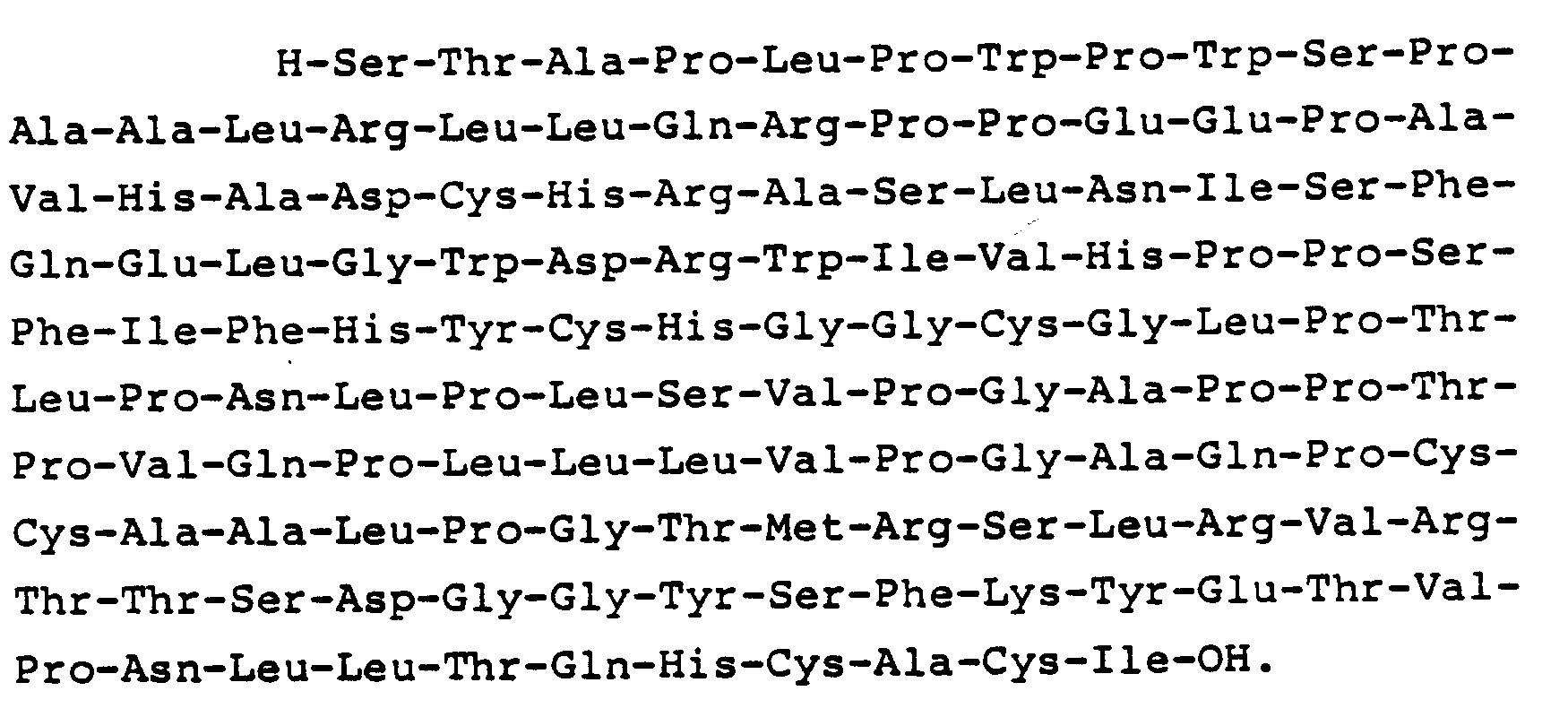
The 116-residue chain has the following formula: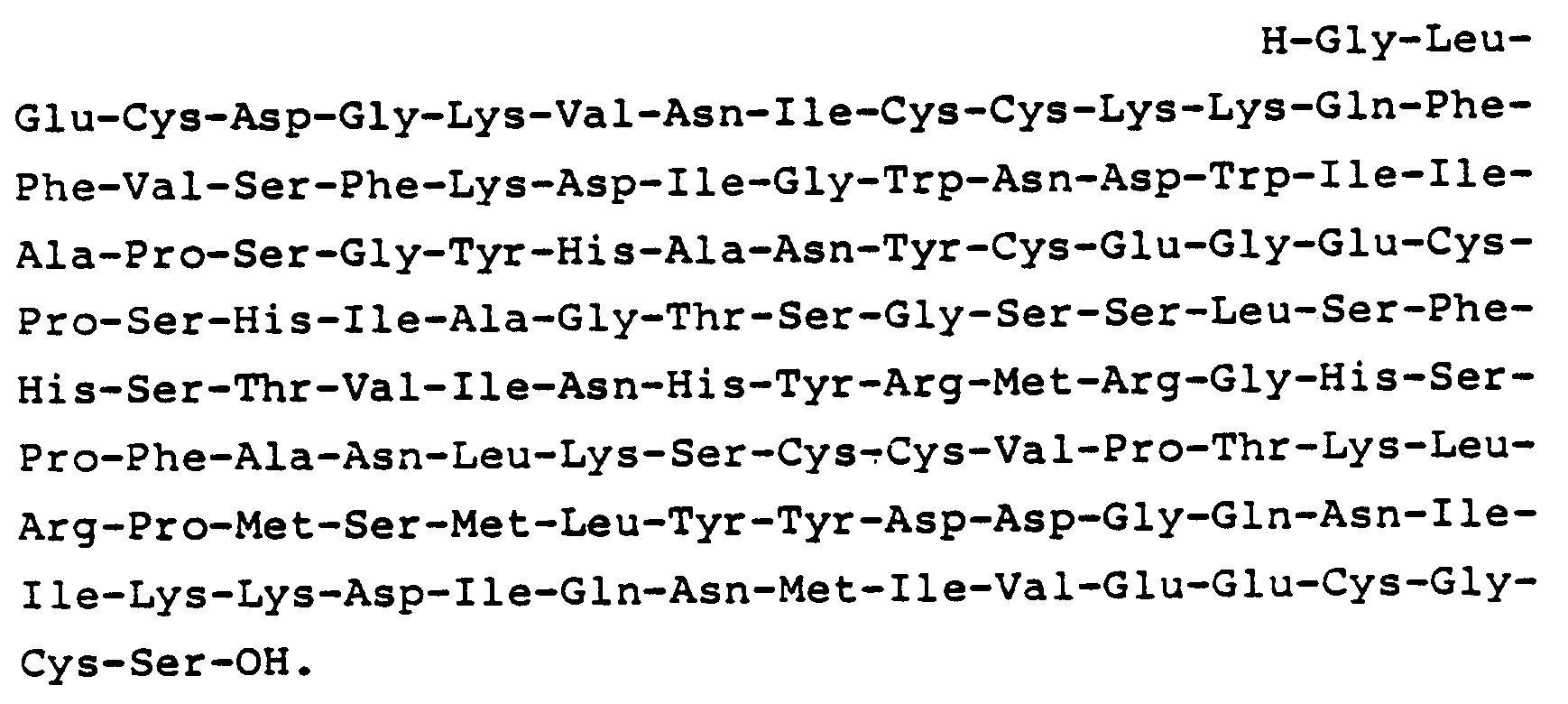
This characterization is in agreement with the earlier analyses of the purified protein material obtained from PFF; the disparity between the number of residues in the first chain and the measured value of 18K is accounted for by the presence of the aforementioned glycosylation. It is believed that a carbohydrate moiety having a molecular weight of about 3000 daltons is attached to the side chain of the Asn residue in the 36-position of the first chain. - Protein B has also been characterized and the 18K chain is believed to have the same sequence as Protein A. The 14K chain has been found to have the following 115-residue formula:


This characterization is in agreement with the earlier analyses of the purified protein material obtained from PFF. - The invention thus provides polypetides or relatively short proteins between about 115 residues and about 134 residues in length which are useful as intermediates to create disulfide-bonded dimers that are biologically active. More specifically, the invention provides the three polypeptides set forth as follows:


For example, the 134-residue polypeptides may be combined with one of the other shorter polypeptides to form biologically active disulphide-bonded heterodimers. - Substantially pure 32K inhibin or the nontoxic salts thereof, combined with a pharmaceutically acceptable carrier to form a pharmaceutical composition, may be administered to mammals, including humans, either intravenously, subcutaneously, percutaneously, intramuscularly or orally for control of fertility. Administration of inhibin induces decreased fertility in female mammals and decreases spermatogenesis in male mammals. Administration of a sufficient amount of inhibin induces infertility in mammals. Inhibin is also useful for tests to diagnose infertility.
- Such peptides are often administered in the form of pharmaceutically acceptable nontoxic salts, such as acid addition salts or metal complexes, e.g., with zinc, iron or the like (which are considered as salts for purposes of this application). Illustrative of such acid addition salts are hydrochloride, hydrobromide, sulphate, phosphate, maleate, acetate, citrate, benzoate, succinate, malate, ascorbate, tartrate and the like. If the active ingredient is to be administered in tablet form, the tablet may contain a binder, such as tragacanth, corn starch or gelatin; a disintegrating agent, such as alginic acid; and a lubricant, such as magnesium stearate. If administration in liquid form is desired, sweetening and/or flavoring may be used, and intravenous administration in isotonic saline, phosphate buffer solutions or the like may be effected.
- Inhibin should be administered under the guidance of a physician, and pharmaceutical compositions will usually contain an effective amount of the peptide in conjunction with a conventional, pharmaceutically-acceptable carrier. The dosage will vary depending upon the specific purpose for which the protein is being administered, and dosage levels in the range of about 0.1 to about 1 milligrams per Kg. of body weight may be used when the protein is administered on a regular basis as a male contraceptive.
- Although the method of purification of inhibin has been described primarily in terms of isolation from PFF, inhibin can be similarly purified from other crude extracts. The term "crude extracts" as used herein refers to other mammalian body material in addition to follicular fluid, as well as to extracts from organisms including laboratory microorganisms, such as prokaryotes (e.g. E. Coli) and eukaryotes (e.g. S. cerevisiae yeast), which have been transformed by means of state of the art methodology to manufacture mammalian inhibin protein.
- Although the invention has been described with regard to its preferred embodiments, which constitute the best mode presently known to the inventors, it should be understood that various changes and modifications as would be obvious to one having the ordinary skill in this art may be made without departing from the scope of the invention.
Claims (11)
- A method of obtaining a substantially homogeneous protein having inhibin activity from crude mammalian material, the method comprising procuring crude mammalian material having inhibin activity, exposing said material to a support medium to which heparin moieties are attached under such conditions that inhibin proteins adsorb to said heparin moieties, subsequently eluting said inhibin proteins from said heparin moieties, gel filtrating said eluted inhibin proteins, selecting fractions from said gel filtration having inhibin activity, and fractionating said gel filtrated fractions on at least one reverse-phase high performance liquid chromatography column.
- A method as claimed in Claim 1 wherein the protein is a 32,000-dalton protein having a purity of at least about 90% by weight of total proteins said protein having a pKa of about 4.8, said protein being composed of a first polypeptide chain having a molecular weight of about 18,000 and a second polypeptide chain having a molecular weight of about 14,000 daltons, said first chain and said second chain being linked to each other through disulfide bonding in the active protein, said first chain having an amino-terminal sequence beginning with
 and said second chain having an amino-terminal sequence beginning with Gly-Leu-Glu-Cys-Asp-Gly, said protein specifically inhibiting basal secretion of follicle-stimulating hormone while not inhibiting basal secretion of luteinizing hormone.
- A method according to claim 2 wherein said second chain has an amino terminal sequence beginning with:

- A method according to Claim 2 wherein said protein has an amino acid composition of about Asx 21.0, Thr 13.5. Ser 18.1, Glx 22.5, Gly 22.4, Ala 22.0, Val 14.4, Met 5.8, Ile 10.3, Leu 27.8, Tyr 11.4, Phe 10.0, His 7.9, Trp 3.9, Lys 5.4, Arg 15.8, Cys 14.2, and Pro 29.6.
- A method according to Claim 2 wherein said protein has an amino acid composition of about Asx 18.5, Thr 11.5. Ser 16.3, Glx 21.3, Gly 19.9, Ala 19.7, Val 14.1, Met 6.1, Ile 14.6, Leu 27.3, Tyr 10.7, Phe 11.6, His 14.1, Trp 4.4, Lys 11.9, Arg 13.9, Cys 14.4, and Pro 29.2.
- A method according to Claim 2 wherein said first chain has the formula:
 and may optionally be glycosylated, and wherein said second chain has the formula:
 or has the formula:

- A method of contraceptive treatment of female non-human mammalians which method comprises administering to such a mammalian an amount effective to suppress ovulation of a protein having inhibin activity, characterized in that the protein is as defined in Claim 6.
- A method of contraceptive treatment of male non-human mammalians which method comprises administering to such a mammalian an amount effective to suppress spermatogenesis of a protein having inhibin activity, characterized in that the protein is as defined in Claim 6.
- A process for producing a polypeptide useful for the production of a dimer which is biologically active to affect the secretion of FSH but not the secretion of LH, said polypeptide having one or the following formulae (a) - (c), namely:-
 which process comprises producing a DNA template for said polypeptide, inserting the template into a vector, transforming a host cell or cell line with said vector so that said cell or cell line expresses said polypeptide and obtaining said polypeptide as a product of said cell or cell line.
- A process for producing an inhibin protein which process comprises subjecting a polypeptide of the formula (a) as set forth in Claim 9 to oxidising conditions in admixture with a polypeptide of the formula (b) or (c) as set forth in Claim 9 such as to promote disulphide bonding between the chains.
- A method of obtaining substantially homogenous proteins having inhibin activity from crude mammalian material, the method comprising procuring crude mammalian material having inhibin activity and subjecting said material to a series of purification steps including gel filtration and fractionation by reverse-phase high performance liquid chromatography performed using at least one reverse-phase high performance liquid chromatography column, characterized in that said series of steps includes the steps of (a) exposing said material to a support medium to which heparin moieties are attached under such conditions that inhibin proteins adsorb to said heparin moieties and (b) subsequently eluting said inhibin proteins from said heparin moieties.
Applications Claiming Priority (5)
| Application Number | Priority Date | Filing Date | Title |
|---|---|---|---|
| US75686685A | 1985-07-18 | 1985-07-18 | |
| US756866 | 1985-07-18 | ||
| US06/784,436 US4740587A (en) | 1985-07-18 | 1985-10-03 | Inhibin and method of purifying same |
| US784436 | 1985-10-03 | ||
| PCT/US1986/001505 WO1987000528A1 (en) | 1985-07-18 | 1986-07-17 | Inhibin and method of purifying same |
Publications (3)
| Publication Number | Publication Date |
|---|---|
| EP0232326A1 EP0232326A1 (en) | 1987-08-19 |
| EP0232326A4 EP0232326A4 (en) | 1988-06-14 |
| EP0232326B1 true EP0232326B1 (en) | 1994-10-05 |
Family
ID=27116303
Family Applications (1)
| Application Number | Title | Priority Date | Filing Date |
|---|---|---|---|
| EP86904699A Expired - Lifetime EP0232326B1 (en) | 1985-07-18 | 1986-07-17 | Inhibin and method of purifying same |
Country Status (7)
| Country | Link |
|---|---|
| US (1) | US4740587A (en) |
| EP (1) | EP0232326B1 (en) |
| JP (1) | JPH07108916B2 (en) |
| AT (1) | ATE112573T1 (en) |
| AU (1) | AU605105B2 (en) |
| DE (1) | DE3650088T2 (en) |
| WO (1) | WO1987000528A1 (en) |
Families Citing this family (27)
| Publication number | Priority date | Publication date | Assignee | Title |
|---|---|---|---|---|
| CA1341617C (en) * | 1984-06-08 | 2011-06-28 | Henry George Burger | Inhibin isolated from ovarian follicular fluid |
| DE3650689T2 (en) | 1985-04-18 | 1999-04-08 | Biotechnology Australia Pty. Ltd., East Roseville, Neussuedwales | RECOMBINANT INHIBIN |
| AU610821B2 (en) * | 1985-04-18 | 1991-05-30 | Inhibin Pty Limited | Recombinant inhibin |
| JPH0637520B2 (en) * | 1985-07-03 | 1994-05-18 | 味の素株式会社 | Polypeptide |
| US5089396A (en) * | 1985-10-03 | 1992-02-18 | Genentech, Inc. | Nucleic acid encoding β chain prodomains of inhibin and method for synthesizing polypeptides using such nucleic acid |
| ZA867569B (en) * | 1985-10-03 | 1988-06-29 | Genentech Inc | Nucleic acid encoding the alpha or beta chains of inhibin and method for synthesizing polypeptides using such nucleic acid |
| US5047336A (en) * | 1985-10-30 | 1991-09-10 | Biogen, Inc. | DNA sequences, recombinant DNA molecules and processes for producing mullerian inhibiting substance-like polypeptides |
| US5427780A (en) * | 1985-10-30 | 1995-06-27 | Biogen, Inc. | Composition comprising Mullerian inhibiting substance-like polypeptides |
| US4864019A (en) * | 1985-11-08 | 1989-09-05 | The Salk Institute For Biological Studies | Antibodies to inhibin and conjugates produced therefrom |
| ZA871844B (en) * | 1986-03-13 | 1988-05-25 | Biotechnology Pty Ltd | Method of assay of inhibin |
| US5015729A (en) * | 1986-06-24 | 1991-05-14 | The Salk Institute For Biological Studies | Ovine inhibin |
| US6150328A (en) | 1986-07-01 | 2000-11-21 | Genetics Institute, Inc. | BMP products |
| JP2653125B2 (en) * | 1988-09-22 | 1997-09-10 | 味の素株式会社 | Hypoglycemic agent |
| US5200395A (en) * | 1988-10-18 | 1993-04-06 | Ajinomoto Company, Inc. | Pharmaceutical composition of BUF-5 for treating anemia |
| US4997815A (en) * | 1988-11-01 | 1991-03-05 | Children's Hospital Medical Center Of Northern California | Method for augmenting fetal hemoglobin by treatment with activin and/or inhibin |
| US5942220A (en) * | 1990-03-16 | 1999-08-24 | Chiron Corporation | Inhibitor of cytokine activity and applications thereof |
| DK0698094T3 (en) * | 1993-05-12 | 2004-05-03 | Inst Genetics Llc | BMP-11 compositions |
| US6291206B1 (en) | 1993-09-17 | 2001-09-18 | Genetics Institute, Inc. | BMP receptor proteins |
| DE69434651T2 (en) | 1993-12-07 | 2007-03-08 | Genetics Institute, Inc., Cambridge | BMP-12, BMP-13 AND THESE INCLUDING SEWNE-INDUCTIVE COMPOSITIONS |
| US5658876A (en) * | 1994-04-28 | 1997-08-19 | The General Hospital Corporation | Activin antagonists as novel contraceptives |
| JPH07238097A (en) * | 1994-09-07 | 1995-09-12 | Masao Igarashi | Igg antibody comprising inhibin as antigen |
| US6727224B1 (en) | 1999-02-01 | 2004-04-27 | Genetics Institute, Llc. | Methods and compositions for healing and repair of articular cartilage |
| ATE271886T1 (en) | 1999-10-15 | 2004-08-15 | Inst Genetics Llc | COMPOSITIONS CONTAINING HYALURONIC ACID FOR THE RELEASE OF OSTEOGENIC PROTEINS |
| TWI329129B (en) | 2001-02-08 | 2010-08-21 | Wyeth Corp | Modified and stabilized gdf propeptides and uses thereof |
| WO2002099037A2 (en) | 2001-06-01 | 2002-12-12 | Wyeth | Compositions and methods for systemic administration of sequences encoding bone morphogenetic proteins |
| TWI267378B (en) | 2001-06-08 | 2006-12-01 | Wyeth Corp | Calcium phosphate delivery vehicles for osteoinductive proteins |
| CA2490409A1 (en) | 2002-06-28 | 2004-01-08 | Centocor, Inc. | Mammalian ch1 deleted mimetibodies, compositions, methods and uses |
Family Cites Families (4)
| Publication number | Priority date | Publication date | Assignee | Title |
|---|---|---|---|---|
| JPH0730114B2 (en) * | 1985-04-03 | 1995-04-05 | 正雄 五十嵐 | Inhibin |
| AU610821B2 (en) * | 1985-04-18 | 1991-05-30 | Inhibin Pty Limited | Recombinant inhibin |
| AU5903986A (en) * | 1985-04-18 | 1986-11-05 | Biotechnology Australia Proprietary Limited | Recombinant inhibin |
| NZ231899A (en) * | 1985-10-03 | 1991-07-26 | Genentech Inc | Human or porcine inhibin peptide compositions and dna encoding them |
-
1985
- 1985-10-03 US US06/784,436 patent/US4740587A/en not_active Expired - Lifetime
-
1986
- 1986-07-17 AT AT86904699T patent/ATE112573T1/en not_active IP Right Cessation
- 1986-07-17 JP JP61504032A patent/JPH07108916B2/en not_active Expired - Lifetime
- 1986-07-17 AU AU61498/86A patent/AU605105B2/en not_active Expired
- 1986-07-17 EP EP86904699A patent/EP0232326B1/en not_active Expired - Lifetime
- 1986-07-17 DE DE3650088T patent/DE3650088T2/en not_active Expired - Lifetime
- 1986-07-17 WO PCT/US1986/001505 patent/WO1987000528A1/en not_active Ceased
Non-Patent Citations (5)
| Title |
|---|
| Biochemical & Biophysical Research Communication, 14 June 1985, vol. 129, no. 2, Miyamoto et al., pp. 396-403 * |
| Chemical Abstracts, 103: 6507s, 2 Sept. 1985, vol. 103, no. 9; Rivier et al. * |
| Chemical Abstracts, vol. 104, 1986, p. 84, abstract no. 15266f, Columbus, Ohio, US; J. Rivier et al. * |
| J. of Chromatography, 1984, vol. 288, Rivier et al., pp. 302-328 * |
| Proc. Natl. Acad. Sci. USA, vol. 82, Nov. 1985, pp. 7217-7221, Biochemistry, US; N. Ling et al. * |
Also Published As
| Publication number | Publication date |
|---|---|
| US4740587A (en) | 1988-04-26 |
| AU6149886A (en) | 1987-02-10 |
| EP0232326A4 (en) | 1988-06-14 |
| EP0232326A1 (en) | 1987-08-19 |
| JPH07108916B2 (en) | 1995-11-22 |
| JPS63500309A (en) | 1988-02-04 |
| DE3650088T2 (en) | 1995-01-26 |
| DE3650088D1 (en) | 1994-11-10 |
| WO1987000528A1 (en) | 1987-01-29 |
| AU605105B2 (en) | 1991-01-10 |
| ATE112573T1 (en) | 1994-10-15 |
Similar Documents
| Publication | Publication Date | Title |
|---|---|---|
| US4740587A (en) | Inhibin and method of purifying same | |
| EP0377659B1 (en) | Follistatin and method of purifying same | |
| Ling et al. | Isolation and partial characterization of a Mr 32,000 protein with inhibin activity from porcine follicular fluid. | |
| Schulz-Knappe et al. | Isolation and structural analysis of “urodilatin”, a new peptide of the cardiodilatin-(ANP)-family, extracted from human urine | |
| US4973577A (en) | FSH-releasing peptides | |
| RU2059412C1 (en) | Method of preparing gonadotropin showing follicle-stimulating hormone activity from the postmenopause urine (urine concentrate) | |
| Kitamura et al. | Adrenomedullin: a novel hypotensive peptide isolated from human pheochromocytoma | |
| US5716810A (en) | Nucleic acid encoding the mature βB chain of inhibin and method for synthesizing polypeptides using such nucleic acid | |
| EP0222491B2 (en) | Nucleic acid encoding the alpha or beta chains of inhibin and method for synthesizing polypeptides using such nucleic acid | |
| US5548061A (en) | Human endothelin-3 precursor protein | |
| US4765903A (en) | Purification of monomeric interferon | |
| US5182375A (en) | DNA encoding follistatin | |
| US5290920A (en) | Method of purifying human epidermal growth factor | |
| CA1305829C (en) | Ovine inhibin | |
| SCHWARTZ et al. | [12‐ASPARAGINE‐B] HUMAN INSULIN: An Analogue with Modification in the Hydrophobic Core of Insulin | |
| LeRoith et al. | Evidence for multiple molecular weight froms of somatostatin-like material in Escherichia coli | |
| CA1329307C (en) | Purification of monomeric interferon | |
| JP2651488B2 (en) | FSH releasing peptide | |
| Markussen et al. | Preparation of human C-peptide |
Legal Events
| Date | Code | Title | Description |
|---|---|---|---|
| PUAI | Public reference made under article 153(3) epc to a published international application that has entered the european phase |
Free format text: ORIGINAL CODE: 0009012 |
|
| 17P | Request for examination filed |
Effective date: 19870310 |
|
| AK | Designated contracting states |
Kind code of ref document: A1 Designated state(s): AT BE CH DE FR GB IT LI LU NL SE |
|
| A4 | Supplementary search report drawn up and despatched |
Effective date: 19880614 |
|
| 17Q | First examination report despatched |
Effective date: 19900329 |
|
| GRAA | (expected) grant |
Free format text: ORIGINAL CODE: 0009210 |
|
| AK | Designated contracting states |
Kind code of ref document: B1 Designated state(s): AT BE CH DE FR GB IT LI LU NL SE |
|
| REF | Corresponds to: |
Ref document number: 112573 Country of ref document: AT Date of ref document: 19941015 Kind code of ref document: T |
|
| ITF | It: translation for a ep patent filed | ||
| REF | Corresponds to: |
Ref document number: 3650088 Country of ref document: DE Date of ref document: 19941110 |
|
| ET | Fr: translation filed | ||
| EAL | Se: european patent in force in sweden |
Ref document number: 86904699.5 |
|
| PLBE | No opposition filed within time limit |
Free format text: ORIGINAL CODE: 0009261 |
|
| STAA | Information on the status of an ep patent application or granted ep patent |
Free format text: STATUS: NO OPPOSITION FILED WITHIN TIME LIMIT |
|
| 26N | No opposition filed | ||
| REG | Reference to a national code |
Ref country code: GB Ref legal event code: IF02 |
|
| PGFP | Annual fee paid to national office [announced via postgrant information from national office to epo] |
Ref country code: GB Payment date: 20050718 Year of fee payment: 20 |
|
| PGFP | Annual fee paid to national office [announced via postgrant information from national office to epo] |
Ref country code: SE Payment date: 20050719 Year of fee payment: 20 |
|
| PGFP | Annual fee paid to national office [announced via postgrant information from national office to epo] |
Ref country code: LU Payment date: 20050722 Year of fee payment: 20 Ref country code: FR Payment date: 20050722 Year of fee payment: 20 |
|
| PGFP | Annual fee paid to national office [announced via postgrant information from national office to epo] |
Ref country code: IT Payment date: 20050728 Year of fee payment: 20 |
|
| PGFP | Annual fee paid to national office [announced via postgrant information from national office to epo] |
Ref country code: DE Payment date: 20050729 Year of fee payment: 20 Ref country code: CH Payment date: 20050729 Year of fee payment: 20 Ref country code: AT Payment date: 20050729 Year of fee payment: 20 |
|
| PGFP | Annual fee paid to national office [announced via postgrant information from national office to epo] |
Ref country code: NL Payment date: 20050730 Year of fee payment: 20 |
|
| PGFP | Annual fee paid to national office [announced via postgrant information from national office to epo] |
Ref country code: BE Payment date: 20050810 Year of fee payment: 20 |
|
| PG25 | Lapsed in a contracting state [announced via postgrant information from national office to epo] |
Ref country code: GB Free format text: LAPSE BECAUSE OF EXPIRATION OF PROTECTION Effective date: 20060716 |
|
| PG25 | Lapsed in a contracting state [announced via postgrant information from national office to epo] |
Ref country code: NL Free format text: LAPSE BECAUSE OF EXPIRATION OF PROTECTION Effective date: 20060717 |
|
| REG | Reference to a national code |
Ref country code: GB Ref legal event code: PE20 |
|
| REG | Reference to a national code |
Ref country code: CH Ref legal event code: PL |
|
| NLV7 | Nl: ceased due to reaching the maximum lifetime of a patent |
Effective date: 20060717 |
|
| EUG | Se: european patent has lapsed | ||
| BE20 | Be: patent expired |
Owner name: THE *SALK INSTITUTE FOR BIOLOGICAL STUDIES Effective date: 20060717 |