EP0231394B1 - Novel polymers of3,4-substituted pyrrole compound and processfor their preparation - Google Patents
Novel polymers of3,4-substituted pyrrole compound and processfor their preparation Download PDFInfo
- Publication number
- EP0231394B1 EP0231394B1 EP86904919A EP86904919A EP0231394B1 EP 0231394 B1 EP0231394 B1 EP 0231394B1 EP 86904919 A EP86904919 A EP 86904919A EP 86904919 A EP86904919 A EP 86904919A EP 0231394 B1 EP0231394 B1 EP 0231394B1
- Authority
- EP
- European Patent Office
- Prior art keywords
- compounds
- polymers
- substituted
- preparation
- radical
- Prior art date
- Legal status (The legal status is an assumption and is not a legal conclusion. Google has not performed a legal analysis and makes no representation as to the accuracy of the status listed.)
- Expired - Lifetime
Links
- 229920000642 polymer Polymers 0.000 title claims abstract description 90
- -1 pyrrole compound Chemical class 0.000 title claims abstract description 49
- KAESVJOAVNADME-UHFFFAOYSA-N 1H-pyrrole Natural products C=1C=CNC=1 KAESVJOAVNADME-UHFFFAOYSA-N 0.000 title claims abstract description 37
- 238000002360 preparation method Methods 0.000 title claims description 21
- 239000003125 aqueous solvent Substances 0.000 claims abstract description 11
- 229920006254 polymer film Polymers 0.000 claims description 32
- 150000001875 compounds Chemical class 0.000 claims description 31
- 238000000034 method Methods 0.000 claims description 25
- 150000003233 pyrroles Chemical class 0.000 claims description 23
- 125000001424 substituent group Chemical group 0.000 claims description 21
- 238000007254 oxidation reaction Methods 0.000 claims description 15
- 230000003647 oxidation Effects 0.000 claims description 13
- 239000002253 acid Substances 0.000 claims description 12
- 150000003839 salts Chemical class 0.000 claims description 12
- 229910052739 hydrogen Inorganic materials 0.000 claims description 11
- 239000000126 substance Substances 0.000 claims description 11
- 238000006116 polymerization reaction Methods 0.000 claims description 10
- 239000001257 hydrogen Substances 0.000 claims description 9
- 125000004435 hydrogen atom Chemical group [H]* 0.000 claims description 9
- CIUQDSCDWFSTQR-UHFFFAOYSA-N [C]1=CC=CC=C1 Chemical class [C]1=CC=CC=C1 CIUQDSCDWFSTQR-UHFFFAOYSA-N 0.000 claims description 8
- 239000007800 oxidant agent Substances 0.000 claims description 8
- 150000002500 ions Chemical class 0.000 claims description 7
- 125000000896 monocarboxylic acid group Chemical group 0.000 claims description 7
- 150000001450 anions Chemical class 0.000 claims description 5
- 125000004432 carbon atom Chemical group C* 0.000 claims description 5
- SLRMQYXOBQWXCR-UHFFFAOYSA-N 2154-56-5 Chemical compound [CH2]C1=CC=CC=C1 SLRMQYXOBQWXCR-UHFFFAOYSA-N 0.000 claims description 4
- 125000003917 carbamoyl group Chemical group [H]N([H])C(*)=O 0.000 claims description 3
- 229910000510 noble metal Inorganic materials 0.000 claims description 3
- UFHFLCQGNIYNRP-UHFFFAOYSA-N Hydrogen Chemical compound [H][H] UFHFLCQGNIYNRP-UHFFFAOYSA-N 0.000 claims description 2
- 150000005840 aryl radicals Chemical class 0.000 claims description 2
- 150000001768 cations Chemical class 0.000 claims description 2
- 230000000379 polymerizing effect Effects 0.000 claims 2
- 239000000523 sample Substances 0.000 description 44
- WEVYAHXRMPXWCK-UHFFFAOYSA-N Acetonitrile Chemical compound CC#N WEVYAHXRMPXWCK-UHFFFAOYSA-N 0.000 description 30
- 239000000463 material Substances 0.000 description 24
- 239000000243 solution Substances 0.000 description 18
- 239000011521 glass Substances 0.000 description 14
- HEMHJVSKTPXQMS-UHFFFAOYSA-M sodium hydroxide Inorganic materials [OH-].[Na+] HEMHJVSKTPXQMS-UHFFFAOYSA-M 0.000 description 12
- 239000002904 solvent Substances 0.000 description 12
- HEDRZPFGACZZDS-UHFFFAOYSA-N Chloroform Chemical compound ClC(Cl)Cl HEDRZPFGACZZDS-UHFFFAOYSA-N 0.000 description 10
- 239000003792 electrolyte Substances 0.000 description 8
- BASFCYQUMIYNBI-UHFFFAOYSA-N platinum Chemical compound [Pt] BASFCYQUMIYNBI-UHFFFAOYSA-N 0.000 description 8
- 239000007864 aqueous solution Substances 0.000 description 6
- 238000005227 gel permeation chromatography Methods 0.000 description 6
- 238000002835 absorbance Methods 0.000 description 5
- 238000000862 absorption spectrum Methods 0.000 description 5
- 239000000203 mixture Substances 0.000 description 5
- 230000033116 oxidation-reduction process Effects 0.000 description 5
- XLYOFNOQVPJJNP-UHFFFAOYSA-N water Substances O XLYOFNOQVPJJNP-UHFFFAOYSA-N 0.000 description 5
- FXPOCCDGHHTZAO-UHFFFAOYSA-N 4-methyl-1h-pyrrole-3-carboxylic acid Chemical compound CC1=CNC=C1C(O)=O FXPOCCDGHHTZAO-UHFFFAOYSA-N 0.000 description 4
- ZCYVEMRRCGMTRW-UHFFFAOYSA-N 7553-56-2 Chemical compound [I] ZCYVEMRRCGMTRW-UHFFFAOYSA-N 0.000 description 4
- CSCPPACGZOOCGX-UHFFFAOYSA-N Acetone Chemical compound CC(C)=O CSCPPACGZOOCGX-UHFFFAOYSA-N 0.000 description 4
- LFQSCWFLJHTTHZ-UHFFFAOYSA-N Ethanol Chemical compound CCO LFQSCWFLJHTTHZ-UHFFFAOYSA-N 0.000 description 4
- QVGXLLKOCUKJST-UHFFFAOYSA-N atomic oxygen Chemical compound [O] QVGXLLKOCUKJST-UHFFFAOYSA-N 0.000 description 4
- 238000006243 chemical reaction Methods 0.000 description 4
- 238000005259 measurement Methods 0.000 description 4
- 125000004108 n-butyl group Chemical group [H]C([H])([H])C([H])([H])C([H])([H])C([H])([H])* 0.000 description 4
- 230000001590 oxidative effect Effects 0.000 description 4
- 239000001301 oxygen Substances 0.000 description 4
- 229910052760 oxygen Inorganic materials 0.000 description 4
- ZMXDDKWLCZADIW-UHFFFAOYSA-N N,N-Dimethylformamide Chemical compound CN(C)C=O ZMXDDKWLCZADIW-UHFFFAOYSA-N 0.000 description 3
- JFDZBHWFFUWGJE-UHFFFAOYSA-N benzonitrile Chemical compound N#CC1=CC=CC=C1 JFDZBHWFFUWGJE-UHFFFAOYSA-N 0.000 description 3
- 239000003153 chemical reaction reagent Substances 0.000 description 3
- 229910052740 iodine Inorganic materials 0.000 description 3
- 239000011630 iodine Substances 0.000 description 3
- 239000000178 monomer Substances 0.000 description 3
- 230000003287 optical effect Effects 0.000 description 3
- 239000000758 substrate Substances 0.000 description 3
- IZAUZUSKFWENMY-UHFFFAOYSA-N 4-phenyl-1h-pyrrole-3-carboxylic acid Chemical compound OC(=O)C1=CNC=C1C1=CC=CC=C1 IZAUZUSKFWENMY-UHFFFAOYSA-N 0.000 description 2
- QGZKDVFQNNGYKY-UHFFFAOYSA-N Ammonia Chemical compound N QGZKDVFQNNGYKY-UHFFFAOYSA-N 0.000 description 2
- IJGRMHOSHXDMSA-UHFFFAOYSA-N Atomic nitrogen Chemical compound N#N IJGRMHOSHXDMSA-UHFFFAOYSA-N 0.000 description 2
- YMWUJEATGCHHMB-UHFFFAOYSA-N Dichloromethane Chemical compound ClCCl YMWUJEATGCHHMB-UHFFFAOYSA-N 0.000 description 2
- 229910021607 Silver chloride Inorganic materials 0.000 description 2
- WYURNTSHIVDZCO-UHFFFAOYSA-N Tetrahydrofuran Chemical compound C1CCOC1 WYURNTSHIVDZCO-UHFFFAOYSA-N 0.000 description 2
- 238000009835 boiling Methods 0.000 description 2
- 239000003795 chemical substances by application Substances 0.000 description 2
- 238000002484 cyclic voltammetry Methods 0.000 description 2
- 229910001873 dinitrogen Inorganic materials 0.000 description 2
- 230000009977 dual effect Effects 0.000 description 2
- 230000002349 favourable effect Effects 0.000 description 2
- 230000006870 function Effects 0.000 description 2
- 239000007789 gas Substances 0.000 description 2
- 229910052751 metal Inorganic materials 0.000 description 2
- 239000002184 metal Substances 0.000 description 2
- 239000004570 mortar (masonry) Substances 0.000 description 2
- 238000006386 neutralization reaction Methods 0.000 description 2
- LQNUZADURLCDLV-UHFFFAOYSA-N nitrobenzene Chemical compound [O-][N+](=O)C1=CC=CC=C1 LQNUZADURLCDLV-UHFFFAOYSA-N 0.000 description 2
- 229910052697 platinum Inorganic materials 0.000 description 2
- 239000000843 powder Substances 0.000 description 2
- 239000004065 semiconductor Substances 0.000 description 2
- HKZLPVFGJNLROG-UHFFFAOYSA-M silver monochloride Chemical compound [Cl-].[Ag+] HKZLPVFGJNLROG-UHFFFAOYSA-M 0.000 description 2
- 229910052708 sodium Inorganic materials 0.000 description 2
- 239000011734 sodium Substances 0.000 description 2
- 239000007787 solid Substances 0.000 description 2
- VOLGAXAGEUPBDM-UHFFFAOYSA-N $l^{1}-oxidanylethane Chemical compound CC[O] VOLGAXAGEUPBDM-UHFFFAOYSA-N 0.000 description 1
- WSLDOOZREJYCGB-UHFFFAOYSA-N 1,2-Dichloroethane Chemical compound ClCCCl WSLDOOZREJYCGB-UHFFFAOYSA-N 0.000 description 1
- ZNGSXVFENCHCKJ-UHFFFAOYSA-K 2-pyridin-2-ylpyridine-3-sulfonate ruthenium(3+) Chemical compound [Ru+3].[O-]S(=O)(=O)C1=CC=CN=C1C1=CC=CC=N1.[O-]S(=O)(=O)C1=CC=CN=C1C1=CC=CC=N1.[O-]S(=O)(=O)C1=CC=CN=C1C1=CC=CC=N1 ZNGSXVFENCHCKJ-UHFFFAOYSA-K 0.000 description 1
- FEKWWZCCJDUWLY-UHFFFAOYSA-N 3-methyl-1h-pyrrole Chemical compound CC=1C=CNC=1 FEKWWZCCJDUWLY-UHFFFAOYSA-N 0.000 description 1
- DHDHJYNTEFLIHY-UHFFFAOYSA-N 4,7-diphenyl-1,10-phenanthroline Chemical compound C1=CC=CC=C1C1=CC=NC2=C1C=CC1=C(C=3C=CC=CC=3)C=CN=C21 DHDHJYNTEFLIHY-UHFFFAOYSA-N 0.000 description 1
- CMSGUKVDXXTJDQ-UHFFFAOYSA-N 4-(2-naphthalen-1-ylethylamino)-4-oxobutanoic acid Chemical compound C1=CC=C2C(CCNC(=O)CCC(=O)O)=CC=CC2=C1 CMSGUKVDXXTJDQ-UHFFFAOYSA-N 0.000 description 1
- QKFFSWPNFCXGIQ-UHFFFAOYSA-M 4-methylbenzenesulfonate;tetraethylazanium Chemical compound CC[N+](CC)(CC)CC.CC1=CC=C(S([O-])(=O)=O)C=C1 QKFFSWPNFCXGIQ-UHFFFAOYSA-M 0.000 description 1
- LTORPMXDZRVTCB-UHFFFAOYSA-N 4-propyl-1h-pyrrole-3-carboxylic acid Chemical compound CCCC1=CNC=C1C(O)=O LTORPMXDZRVTCB-UHFFFAOYSA-N 0.000 description 1
- 150000000565 5-membered heterocyclic compounds Chemical class 0.000 description 1
- 150000000644 6-membered heterocyclic compounds Chemical class 0.000 description 1
- LSNNMFCWUKXFEE-UHFFFAOYSA-M Bisulfite Chemical compound OS([O-])=O LSNNMFCWUKXFEE-UHFFFAOYSA-M 0.000 description 1
- 238000005033 Fourier transform infrared spectroscopy Methods 0.000 description 1
- VEXZGXHMUGYJMC-UHFFFAOYSA-N Hydrochloric acid Chemical compound Cl VEXZGXHMUGYJMC-UHFFFAOYSA-N 0.000 description 1
- DGAQECJNVWCQMB-PUAWFVPOSA-M Ilexoside XXIX Chemical compound C[C@@H]1CC[C@@]2(CC[C@@]3(C(=CC[C@H]4[C@]3(CC[C@@H]5[C@@]4(CC[C@@H](C5(C)C)OS(=O)(=O)[O-])C)C)[C@@H]2[C@]1(C)O)C)C(=O)O[C@H]6[C@@H]([C@H]([C@@H]([C@H](O6)CO)O)O)O.[Na+] DGAQECJNVWCQMB-PUAWFVPOSA-M 0.000 description 1
- 229910021578 Iron(III) chloride Inorganic materials 0.000 description 1
- 239000004793 Polystyrene Substances 0.000 description 1
- 229910006074 SO2NH2 Inorganic materials 0.000 description 1
- ATJFFYVFTNAWJD-UHFFFAOYSA-N Tin Chemical compound [Sn] ATJFFYVFTNAWJD-UHFFFAOYSA-N 0.000 description 1
- 229910021627 Tin(IV) chloride Inorganic materials 0.000 description 1
- 239000007983 Tris buffer Substances 0.000 description 1
- 238000010521 absorption reaction Methods 0.000 description 1
- 230000001476 alcoholic effect Effects 0.000 description 1
- 150000001298 alcohols Chemical class 0.000 description 1
- 239000012670 alkaline solution Substances 0.000 description 1
- 229910021529 ammonia Inorganic materials 0.000 description 1
- 229910052787 antimony Inorganic materials 0.000 description 1
- WATWJIUSRGPENY-UHFFFAOYSA-N antimony atom Chemical compound [Sb] WATWJIUSRGPENY-UHFFFAOYSA-N 0.000 description 1
- 239000012298 atmosphere Substances 0.000 description 1
- 239000000872 buffer Substances 0.000 description 1
- 229910052792 caesium Inorganic materials 0.000 description 1
- 239000000919 ceramic Substances 0.000 description 1
- 239000002738 chelating agent Substances 0.000 description 1
- 239000007810 chemical reaction solvent Substances 0.000 description 1
- 238000004891 communication Methods 0.000 description 1
- 230000006835 compression Effects 0.000 description 1
- 238000007906 compression Methods 0.000 description 1
- 239000004020 conductor Substances 0.000 description 1
- 238000001816 cooling Methods 0.000 description 1
- 229920001577 copolymer Polymers 0.000 description 1
- 238000001514 detection method Methods 0.000 description 1
- 239000002019 doping agent Substances 0.000 description 1
- 230000000694 effects Effects 0.000 description 1
- 238000005868 electrolysis reaction Methods 0.000 description 1
- 238000005516 engineering process Methods 0.000 description 1
- 125000001495 ethyl group Chemical group [H]C([H])([H])C([H])([H])* 0.000 description 1
- 238000002474 experimental method Methods 0.000 description 1
- 239000010419 fine particle Substances 0.000 description 1
- 229910052736 halogen Inorganic materials 0.000 description 1
- 150000002367 halogens Chemical class 0.000 description 1
- IXCSERBJSXMMFS-UHFFFAOYSA-N hydrogen chloride Substances Cl.Cl IXCSERBJSXMMFS-UHFFFAOYSA-N 0.000 description 1
- 229910000041 hydrogen chloride Inorganic materials 0.000 description 1
- 229910003437 indium oxide Inorganic materials 0.000 description 1
- PJXISJQVUVHSOJ-UHFFFAOYSA-N indium(iii) oxide Chemical compound [O-2].[O-2].[O-2].[In+3].[In+3] PJXISJQVUVHSOJ-UHFFFAOYSA-N 0.000 description 1
- 238000002329 infrared spectrum Methods 0.000 description 1
- RBTARNINKXHZNM-UHFFFAOYSA-K iron trichloride Chemical compound Cl[Fe](Cl)Cl RBTARNINKXHZNM-UHFFFAOYSA-K 0.000 description 1
- 238000010030 laminating Methods 0.000 description 1
- 230000031700 light absorption Effects 0.000 description 1
- 238000004502 linear sweep voltammetry Methods 0.000 description 1
- 238000004811 liquid chromatography Methods 0.000 description 1
- 229910052744 lithium Inorganic materials 0.000 description 1
- 229910000000 metal hydroxide Inorganic materials 0.000 description 1
- 150000004692 metal hydroxides Chemical class 0.000 description 1
- WCYWZMWISLQXQU-UHFFFAOYSA-N methyl Chemical compound [CH3] WCYWZMWISLQXQU-UHFFFAOYSA-N 0.000 description 1
- 125000002496 methyl group Chemical group [H]C([H])([H])* 0.000 description 1
- 238000002156 mixing Methods 0.000 description 1
- 125000002347 octyl group Chemical group [H]C([*])([H])C([H])([H])C([H])([H])C([H])([H])C([H])([H])C([H])([H])C([H])([H])C([H])([H])[H] 0.000 description 1
- 239000003960 organic solvent Substances 0.000 description 1
- 230000020477 pH reduction Effects 0.000 description 1
- 125000006340 pentafluoro ethyl group Chemical group FC(F)(F)C(F)(F)* 0.000 description 1
- 239000004033 plastic Substances 0.000 description 1
- 229920003023 plastic Polymers 0.000 description 1
- 239000005518 polymer electrolyte Substances 0.000 description 1
- 229920002223 polystyrene Polymers 0.000 description 1
- 229910052700 potassium Inorganic materials 0.000 description 1
- RUOJZAUFBMNUDX-UHFFFAOYSA-N propylene carbonate Chemical compound CC1COC(=O)O1 RUOJZAUFBMNUDX-UHFFFAOYSA-N 0.000 description 1
- 150000003254 radicals Chemical class 0.000 description 1
- 238000010992 reflux Methods 0.000 description 1
- 230000002441 reversible effect Effects 0.000 description 1
- 229910052701 rubidium Inorganic materials 0.000 description 1
- BPEVHDGLPIIAGH-UHFFFAOYSA-N ruthenium(3+) Chemical compound [Ru+3] BPEVHDGLPIIAGH-UHFFFAOYSA-N 0.000 description 1
- 239000012047 saturated solution Substances 0.000 description 1
- 239000001488 sodium phosphate Substances 0.000 description 1
- 229910000162 sodium phosphate Inorganic materials 0.000 description 1
- 238000001228 spectrum Methods 0.000 description 1
- 125000000565 sulfonamide group Chemical group 0.000 description 1
- BDHFUVZGWQCTTF-UHFFFAOYSA-M sulfonate Chemical compound [O-]S(=O)=O BDHFUVZGWQCTTF-UHFFFAOYSA-M 0.000 description 1
- 239000003115 supporting electrolyte Substances 0.000 description 1
- 150000005622 tetraalkylammonium hydroxides Chemical class 0.000 description 1
- KBLZDCFTQSIIOH-UHFFFAOYSA-M tetrabutylazanium;perchlorate Chemical compound [O-]Cl(=O)(=O)=O.CCCC[N+](CCCC)(CCCC)CCCC KBLZDCFTQSIIOH-UHFFFAOYSA-M 0.000 description 1
- YLQBMQCUIZJEEH-UHFFFAOYSA-N tetrahydrofuran Natural products C=1C=COC=1 YLQBMQCUIZJEEH-UHFFFAOYSA-N 0.000 description 1
- XOLBLPGZBRYERU-UHFFFAOYSA-N tin dioxide Chemical compound O=[Sn]=O XOLBLPGZBRYERU-UHFFFAOYSA-N 0.000 description 1
- 229910001887 tin oxide Inorganic materials 0.000 description 1
- HPGGPRDJHPYFRM-UHFFFAOYSA-J tin(iv) chloride Chemical compound Cl[Sn](Cl)(Cl)Cl HPGGPRDJHPYFRM-UHFFFAOYSA-J 0.000 description 1
- 125000000876 trifluoromethoxy group Chemical group FC(F)(F)O* 0.000 description 1
- RYFMWSXOAZQYPI-UHFFFAOYSA-K trisodium phosphate Chemical compound [Na+].[Na+].[Na+].[O-]P([O-])([O-])=O RYFMWSXOAZQYPI-UHFFFAOYSA-K 0.000 description 1
- 238000005406 washing Methods 0.000 description 1
Images


Classifications
-
- H—ELECTRICITY
- H01—ELECTRIC ELEMENTS
- H01M—PROCESSES OR MEANS, e.g. BATTERIES, FOR THE DIRECT CONVERSION OF CHEMICAL ENERGY INTO ELECTRICAL ENERGY
- H01M4/00—Electrodes
- H01M4/02—Electrodes composed of, or comprising, active material
- H01M4/36—Selection of substances as active materials, active masses, active liquids
- H01M4/60—Selection of substances as active materials, active masses, active liquids of organic compounds
-
- C—CHEMISTRY; METALLURGY
- C08—ORGANIC MACROMOLECULAR COMPOUNDS; THEIR PREPARATION OR CHEMICAL WORKING-UP; COMPOSITIONS BASED THEREON
- C08G—MACROMOLECULAR COMPOUNDS OBTAINED OTHERWISE THAN BY REACTIONS ONLY INVOLVING UNSATURATED CARBON-TO-CARBON BONDS
- C08G61/00—Macromolecular compounds obtained by reactions forming a carbon-to-carbon link in the main chain of the macromolecule
- C08G61/12—Macromolecular compounds containing atoms other than carbon in the main chain of the macromolecule
- C08G61/122—Macromolecular compounds containing atoms other than carbon in the main chain of the macromolecule derived from five- or six-membered heterocyclic compounds, other than imides
- C08G61/123—Macromolecular compounds containing atoms other than carbon in the main chain of the macromolecule derived from five- or six-membered heterocyclic compounds, other than imides derived from five-membered heterocyclic compounds
-
- C—CHEMISTRY; METALLURGY
- C09—DYES; PAINTS; POLISHES; NATURAL RESINS; ADHESIVES; COMPOSITIONS NOT OTHERWISE PROVIDED FOR; APPLICATIONS OF MATERIALS NOT OTHERWISE PROVIDED FOR
- C09K—MATERIALS FOR MISCELLANEOUS APPLICATIONS, NOT PROVIDED FOR ELSEWHERE
- C09K9/00—Tenebrescent materials, i.e. materials for which the range of wavelengths for energy absorption is changed as a result of excitation by some form of energy
- C09K9/02—Organic tenebrescent materials
-
- G—PHYSICS
- G02—OPTICS
- G02F—OPTICAL DEVICES OR ARRANGEMENTS FOR THE CONTROL OF LIGHT BY MODIFICATION OF THE OPTICAL PROPERTIES OF THE MEDIA OF THE ELEMENTS INVOLVED THEREIN; NON-LINEAR OPTICS; FREQUENCY-CHANGING OF LIGHT; OPTICAL LOGIC ELEMENTS; OPTICAL ANALOGUE/DIGITAL CONVERTERS
- G02F1/00—Devices or arrangements for the control of the intensity, colour, phase, polarisation or direction of light arriving from an independent light source, e.g. switching, gating or modulating; Non-linear optics
- G02F1/01—Devices or arrangements for the control of the intensity, colour, phase, polarisation or direction of light arriving from an independent light source, e.g. switching, gating or modulating; Non-linear optics for the control of the intensity, phase, polarisation or colour
- G02F1/15—Devices or arrangements for the control of the intensity, colour, phase, polarisation or direction of light arriving from an independent light source, e.g. switching, gating or modulating; Non-linear optics for the control of the intensity, phase, polarisation or colour based on an electrochromic effect
- G02F1/1514—Devices or arrangements for the control of the intensity, colour, phase, polarisation or direction of light arriving from an independent light source, e.g. switching, gating or modulating; Non-linear optics for the control of the intensity, phase, polarisation or colour based on an electrochromic effect characterised by the electrochromic material, e.g. by the electrodeposited material
- G02F1/1516—Devices or arrangements for the control of the intensity, colour, phase, polarisation or direction of light arriving from an independent light source, e.g. switching, gating or modulating; Non-linear optics for the control of the intensity, phase, polarisation or colour based on an electrochromic effect characterised by the electrochromic material, e.g. by the electrodeposited material comprising organic material
- G02F1/15165—Polymers
-
- Y—GENERAL TAGGING OF NEW TECHNOLOGICAL DEVELOPMENTS; GENERAL TAGGING OF CROSS-SECTIONAL TECHNOLOGIES SPANNING OVER SEVERAL SECTIONS OF THE IPC; TECHNICAL SUBJECTS COVERED BY FORMER USPC CROSS-REFERENCE ART COLLECTIONS [XRACs] AND DIGESTS
- Y02—TECHNOLOGIES OR APPLICATIONS FOR MITIGATION OR ADAPTATION AGAINST CLIMATE CHANGE
- Y02E—REDUCTION OF GREENHOUSE GAS [GHG] EMISSIONS, RELATED TO ENERGY GENERATION, TRANSMISSION OR DISTRIBUTION
- Y02E60/00—Enabling technologies; Technologies with a potential or indirect contribution to GHG emissions mitigation
- Y02E60/10—Energy storage using batteries
Definitions
- This invention relates to new polymers of pyrrole compounds and more particularly to the polymers of 3,4-substituted pyrrole compounds, their preparation method and the laminates of the polymer on an electrode plate.
- polymer film containing the anion of the conductive salt and formed on the anode is said to be doped in the P type (oxydation state) and the state in which the anion, a dopant, is removed from the molecule is said to be an undoped state (reduction state).
- the polymer film is known to have high conductivity in the doped state and extremely low conductivity in the undoped state, and to display electrochromism when changing between the two states.
- the polymers of 3,4-substituted pyrrole, especially of 3,4-asymmetrically substituted pyrrole compounds have general descriptions but few of them have been synthesized. No documents describing particularly polymers of pyrrole compounds having an electron attractive substituent at C3 or C4 are yet known.
- the aforementioned polymer film of pyrrole compounds display electronchronism, but have however no clear beautiful color changes.
- the film When allowed to stand alone in the air in the undoped state, the film is oxidized to change the color to black and thus does not exist stable in the undoped state.
- the polymers are usually insoluble and do not melt.
- the present invention aims at offering the new polymers of 3,4-substituted pyrrole compounds, which have clear color changes and exist stable in the air even in the undoped state, and their preparation methods.
- This invention has particular purposes of offering the polymers of 3,4-asymmetrically substituted pyrrole compounds and the polymers soluble in alkaline aqueous solvents, among the above polymers.
- This invention relates to that a pyrrole compound represented by the following general formula (1) (where at least one of X and Y is an electron attractive substituent with 0.30-0.80 of the Hammett's substituent constant ( ⁇ p), and if only one of X and Y is the above electron attractive substituent, the other is hydrogen, an alkyl radical, a benzyl radical, or a non-substituted or substituted phenyl radical, and Z is hydrogen or an lower alkyl radical) is polymerized by electrolytic oxidation in the presence of a conductive salt, or by chemical oxidation in the presence of an oxidizing agent, resulting in giving the polymers of 3,4-substituted pyrrole compounds, which are represented by the following general formula (2) (where X, Y and Z have the same meaning as the above and n is an integer of 2 or larger).
- general formula (1) where at least one of X and Y is an electron attractive substituent with 0.30-0.80 of the Hammett's
- the pyrrole compound used as a material and its polymer have, as depicted in general formulae (1) and (2), at least an electron attractive substituent with the Hammett's substituent constant ( ⁇ p) within the range of 0.3-0.80 at C3 or C4.
- the substituent includes _NO2, _SO2NH2, _CF3, _OCF3, _SCF3, _CN, _NCS, _SCN, _CHO, _COOH, _CH2COOH, _CONH2, _CONHOH, _SOR, _S O2 R, _OSO2R, _CF2CF3, _COR, _SCOR, _OCOR, _COOR, _CONHR, _CHNOR, _CHNNHC(S)NH2, _P(R)2, _P(O)(OR)2, _C(OH)(CF3)2, _N2C6H5, _SO2C6H5,_OSO2C6H5, _COC6H5, _CO2C6H5, _CHNC6H5 or _P(O)(C6H5)2 (where R stands for a straight chain or branched alkyl radical having from 1 to 10 carbon atoms).
- Particularly preferred one includes _COOH, _COOR, _NO2, _CN, _COR, _CONH2 or _CONHOH (where R is a straight chain or branched alkyl radical having from 1 to 10 carbon atoms).
- C3 or C4 are said to be 3,4-asymmetrically substituted pyrrole compounds and their polymers.
- the other position of C3 or C4 has hydrogen, a straight-chain or branched alkyl radical having from 1 to 10 carbons, a benzyl radical, a phenyl radical or a phenyl radical substituted by a halogen, nitro, cyano, methoxy or ethoxy radical.
- polymers of the 3,4-substituted pyrrole compounds of this invention can form film on an electrode plate to be laminated
- the conductive salt used is a salt made by
- a solution of which 0.001-1 Mol/l of the above conductive salt is dissolved is used as an electrolyte, to which 0.001-1 Mol/l of the 3,4-substituted pyrrole compound represented by the aforementioned general formula (1) is added, d.c. current is applied to deposit the polymer represented by the aforementioned general formula (2) on the surface of the anode, and the polymer grows to be film.
- a solvent for the electrolyte can be any which can dissolve the 3,4-substituted pyrrole compound represented by the aforementioned general formula (1), and applicable solvents include organic solvents such as acetonitrile, benzonitrile, propylene carbonate, dimethylformamide, tetrahydrofuran, nitrobenzene, methylene dichloride, chloroform or ethylene dichloride, water, or their mixtures.
- Such employed conditions as the type of conductive salt and solvent, applied current or voltage may differ depending on the type of 3,4-substituted pyrrole compound of material used.
- the oxydizing agent used has no particular limitations, provided it has as oxydation potential higher than that of the material 3,4-substituted pyrrole compound, and includes a strong oxidizing agent such as Fe3+ compounds, H2O 2 , S2O8 2_ compounds, Cl 2 or Br2, highly oxidized oxy acid ion donating compounds such as RuO4 _ compounds, OSO4 _ compounds or MnO4 _ compounds, or noble metal acid ion donating compounds such as IrCl6 2_ compounds, PtCl6 2_ compounds, PdCl4 2_ compounds or AuCl4 2_ compounds.
- ruthenium (III) tris bathho phenanthroline sulfonic acid
- ruthenium (III) tris bipyridine sulfonic acid
- the reaction can be carried out either in a solvent system or in a non-solvant system.
- the polymer is directly obtained in the form of powder or solid film.
- reaction solvents which do not react with the oxidizing agent, can be used as reaction solvents with no particular limitations.
- the preferred are water, lower alcohols, acetonitrile, chloroform, or their mixtures.
- the material pyrrole compound and oxidizing agent have no particular limitations on concentration, and can be reacted within a range of 0.001 mol/l to saturated solution, respectively.
- the anion species of the conductive salt or oxidizing agent, which is used in the reaction are doped.
- the polymers of this invention particularly the polymers of pyrrole compounds, which are asymmetrically substituted at C3 and C4 and have an electron attractive radical at one of the positions, have oxidation-reduction potential fairly greatly shifted to the positive side, compared with other pyrrole compounds.
- the potential is relatively different from the oxidation-reduction potential of oxygen or water.
- the polymers are stable in the air and display clear electrochromism.
- the Hammett's substituent constant ( ⁇ p) of the electron attractive group is less than 0.30, the oxidation-reduction potential of the polymer becomes close to that of oxygen or water and the polymer is not stable in the air in the undoping state. If the constant exceeds 0.80, the polymerization becomes hard to carry out, and thus usable polymers cannot be produced with good reproducibility.
- the polymers of this invention have a characteristic of being soluble in alkaline aqueous solvent. This is considered to be attributable to the acid group in the polymer.
- a preferred alkaline reagent used to dissolve the polymers soluble in an alkaline aqueous solvent includes an alkaline metal hydroxide such as Li, Na, K, Cs or Rb, an ammonia or tetra alkyl ammonium hydroxide aqueous solution, or an alcoholic aqueous alkaline solution.
- the amount of the reagent used should be larger than the neutralization equivalent of the acid group of the polymer.
- the concentration of the polymer in the solvent can be arbitrarily adjusted depending on the application purposes.
- the neutralization or acidification of the solution results in reproducing the polymer of the undoped state in the form of powder or solid film.
- the polymer can be changed to the doped state electrochemically or chemically by a known method.
- the molocular weight distribution of the dissolved polymer can be measured by gel-permeation chromatography (GPC),
- the molecular weight distribution of the polymer obtained by the oxidative polymerization can be changed by such conditions as electrolysis temperature, anodic current density or monomer concentration.
- polymer whose weight average molecular weight is 1,000 to 1,000,000, particularly 1,000 to 100,000 is preferred.
- Polymers of less than 1,000 of the weight average molecular weight are not favorable because of inferior properties. If the weight average molecular weight exceeds 1,000,000, the polymers are not also favorable because of difficult handling due to high viscosity.
- the molecular weight is impossible to be indicated for the pyrrole polymers insoluble in alkaline aqueous solvent because of difficult molecular weight measurement.
- This invention relates to the laminates made by forming the aforementioned polymer film on electrode plates.
- various types of metal or glass plates on which conductive film such as ITO (indium oxide with doped tin) film or NESA (tin oxide in which such element as antimony is doped) film is formed, can be used as electrodes.
- conductive film such as ITO (indium oxide with doped tin) film or NESA (tin oxide in which such element as antimony is doped) film is formed
- the laminate can be produced in such a method that the stated polymer is pressure molded to film to pressingly adhere on an electrode plate via conductive paste or the polymer is compression molded directly on an electrode plate on which conductive paste is applied.
- a polymer substance with ability to form film and an oxidizing agent are solved in a common solvent and cast on an electrode in order to form film.
- the vapor of a pyrrole compound used as a material is made contact with the obtained cast film to react to produce the laminate.
- polymer soluble in alkaline aqueous solvent can be applied or printed on the conductive surface of e.g. a metal plate or transparent conductive glass.
- the applied surface is dried and then kept in an acid gas atmosphere, resulting in forming semiconductor film insoluble in solvent.
- the film can be doped by a known method for converting to the laminate.
- the obtained laminate is stable in the air, and displays clear electrochromism when changed between the doping state (oxidation state) and the undoping state (reduction state).
- the polymer soluble in alkaline aqueous solvent can be applied or printed on or penetrated into an insulating substrate of plastic or ceramic.
- the semiconductor film insoluble in solvent which is obtained in a similar manner to the above, is difficult to be doped electrochemically, and is thus doped chemically with e.g. iodine (I2) vapor for converting to the laminate.
- the employment of polymers soluble in alkyline aqueous solution allows to form conductive film on desired substrate surface with desired pattern.
- This invention has the effect as this.
- the conductive film produced from the polymer thanks to the possession of an acid group capable of using as a reaction active site in every repeated unit, can be chemically reacted with other function generating reagents.
- Purified methyl, 4-methylpyrrole-3-carboxylate of 348 g (2.5 ⁇ 10 _3 mole) and tetrabutyl ammonium perchlorate of 0.855 g (2.5 ⁇ 10 _3 mole) were dissolved in 50 ml of acetonitrile to use as an electrolyte, which was placed in the cell.
- Example 1-1 Nitrogen gas was introduced into the electrolytic cell for eliminating air, and a constant current of 1.0 mA was applied for 40 seconds to obtain a laminate (Sample 1-1) of which red polymer film was formed on the surface of the ITO coated glass of the anode.
- the pyrrole compound used as a material and the obtained polymer film were measured for the following characteristics.
- FIG. 2 (a) shows the relationship between the wavelength and absorbance when the state is changed from reduction to oxidation
- Fig. 2 (b) is from oxidation to reduction.
- the pyrrole compounds and their polymers of Sample 1-6 and 1-7 were measured for the IR absorption spectra by using FT-IR 20D (Nicolet Japan Co.) and by KBr tablet method.
- the measured IR absorption spectra are shown in Fig. 3 (a) and (b).
- An absorption based on the 2,5-H out-of-plane vibration is observed at 700-800 cm _1 in the IR spectra of the monomers but disappear after polymerized. Thus it is confirmed that polymer of which C2 and C5 are bonded to form a chain is obtained.
- Example 3 Polymer soluble in alkaline aqueous solvent.
- Both electrodes were dipped in the electrolyte so as to be immersed 20 mm depth from the lower side of the electrode. Nitrogen gas was introduced to remove dissolved oxygen and the air is shut down from mixing, then current of 2 mA was applied for 10 minutes.
- Reddish purple polymer was electrodeposited on the ITO coated glass of the anode.
- This platinum wire was employed as an anode, and a platinum wire was used as a cathode and an Ag/AgCl electrode as a reference electrode, and cyclic voltammetry was performed from _ 0.4 V to + 1.9 V (vs Ag/AgCl) to give curves almost equal to the cyclic voltammograms directly obtained by the electrochemical polymerization using (n-Bu)4NClO4 as a supporting electrolyte and acetonitrile as a solvent.
- the molecular weight of the obtained polymer was measured by GPC to give weight average molecular weight of approximately 2,800.
- the molecular weight was measured under the conditions: high-speed liquid chromatography LC-6A (Shimadzu), column; Asahi pack GS-520 (Asahi Chemical Industry, vinyl alcohol copolymer) of 7.6 mm ⁇ ⁇ 500 mm, developing solution; sodium phosphate system, a buffer of pH 11.4, and at room temperature. The detection was carried out at the wavelength of 250 nm and the molecular weight was calculated by using polystyrene sodium sulfonate as a standard polymer substance.
- the molecular weight of the obtained polymer was measured by GPC to give weight average molecular weight of approximately 5,000.
- the molecular weight of the obtained polymer was measured by GPC to give average molecular weight of approximately 3,500.
- Example 2-1 2 mg of the polymer of Example 2 (Sample 2-1) obtained by the chemical oxidative polymerization were dissolved in 5 ml of 2N-NaOH aqueous solution and turned blackish green. The resulting solution was filtrated with 0.4 ⁇ micron filter and the molecular weight was measured by GPC to give weight average molecular weight of approximately 2,800.
- Example 2 2 mg of the polymer of Example 2 (Sample 2-2) dissolved in a mixture solution of 5 ml of 2N NaOH and 10 ml of ethanol and turned blackish green.
- the polymers of pyrrole compounds of which at least one of C3 and C4 is substituted by an electron attractive group particularly pyrrole compounds of which only one of C3 and C4 is substituted, have oxidation reduction potential different from that of oxygen and water, compared with the polymers described in the aforementioned comparison examples, and exist stable in the air in the undoping state.
- the polymers of this invention as shown in Fig. 2, have a continuous clear visible light absorption spectrum against the voltage change, and the spectra show almost completely reversible behavior between the oxidation and reduction states. This means, the polymers of this invention have clear electrochromism characteristics.
- the polymers soluble in alkaline aqueous solvent have the advantage that conductor film with a desired pattern can be formed on the surface of a desired substrate.
- these polymers used as laminates of which polymer film is formed on an electrode plate have expectation of the applications to optical functional components such as electrochromic displays, optical switches and optical memory components, and for the use as materials for a variety of electronic devices such as sensor materials and battery materials.
- agents such as polymer electrolytes or polymer chelating agents are also expected.
Landscapes
- Chemical & Material Sciences (AREA)
- Physics & Mathematics (AREA)
- Chemical Kinetics & Catalysis (AREA)
- Nonlinear Science (AREA)
- Organic Chemistry (AREA)
- Medicinal Chemistry (AREA)
- Health & Medical Sciences (AREA)
- Polymers & Plastics (AREA)
- Electrochemistry (AREA)
- General Chemical & Material Sciences (AREA)
- Materials Engineering (AREA)
- Engineering & Computer Science (AREA)
- General Physics & Mathematics (AREA)
- Optics & Photonics (AREA)
- Polyoxymethylene Polymers And Polymers With Carbon-To-Carbon Bonds (AREA)
Abstract
Description
- This invention relates to new polymers of pyrrole compounds and more particularly to the polymers of 3,4-substituted pyrrole compounds, their preparation method and the laminates of the polymer on an electrode plate.
- The electrochemical polymerization of 5-membered and 6-membered heterocyclic compounds, particularly of pyrrole, is laid open in the specification of U.S. Patent No. 3574072.
- That the anodic oxidative polymerization of pyrrole in the presence of a conductive salt results in forming film with the conductivity of less than 10²S cm _1 on the anode is described in A.F. Diaz, et. al: J.C.S. Chemical Communication (J.C.S. Chem. Comm. P635 (1979)).
- It is defined in this technical field that polymer film containing the anion of the conductive salt and formed on the anode is said to be doped in the P type (oxydation state) and the state in which the anion, a dopant, is removed from the molecule is said to be an undoped state (reduction state). The polymer film is known to have high conductivity in the doped state and extremely low conductivity in the undoped state, and to display electrochromism when changing between the two states.
- The polymers of 3,4-substituted pyrrole, especially of 3,4-asymmetrically substituted pyrrole compounds have general descriptions but few of them have been synthesized. No documents describing particularly polymers of pyrrole compounds having an electron attractive substituent at C₃ or C₄ are yet known.
- The aforementioned polymer film of pyrrole compounds display electronchronism, but have however no clear beautiful color changes. When allowed to stand alone in the air in the undoped state, the film is oxidized to change the color to black and thus does not exist stable in the undoped state. The polymers are usually insoluble and do not melt.
- Therefore, industrially useful materials or electronic devices employing the film have not been obtained yet.
- The present invention aims at offering the new polymers of 3,4-substituted pyrrole compounds, which have clear color changes and exist stable in the air even in the undoped state, and their preparation methods.
- This invention has particular purposes of offering the polymers of 3,4-asymmetrically substituted pyrrole compounds and the polymers soluble in alkaline aqueous solvents, among the above polymers.
- In addition, an offer of laminates made by laminating the film of the said polymer on an electrode plate and applicable as electrochromic components is also one of the purposes of the invention.
- This invention relates to that a pyrrole compound represented by the following general formula (1)


- In this invention, the pyrrole compound used as a material and its polymer have, as depicted in general formulae (1) and (2), at least an electron attractive substituent with the Hammett's substituent constant (σp) within the range of 0.3-0.80 at C₃ or C₄. The substituent includes _NO₂, _SO₂NH₂, _CF₃, _OCF₃, _SCF₃, _CN, _NCS, _SCN, _CHO, _COOH, _CH₂COOH, _CONH₂, _CONHOH, _SOR, _SO2R, _OSO₂R, _CF₂CF₃, _COR, _SCOR, _OCOR, _COOR, _CONHR, _CHNOR, _CHNNHC(S)NH₂, _P(R)₂, _P(O)(OR)₂, _C(OH)(CF₃)₂, _N₂C₆H₅, _SO₂C₆H₅,_OSO₂C₆H₅, _COC₆H₅, _CO₂C₆H₅, _CHNC₆H₅ or _P(O)(C₆H₅)₂ (where R stands for a straight chain or branched alkyl radical having from 1 to 10 carbon atoms). Particularly preferred one includes _COOH, _COOR, _NO₂, _CN, _COR, _CONH₂ or _CONHOH (where R is a straight chain or branched alkyl radical having from 1 to 10 carbon atoms).
- These various compounds can be used singly or as a mixture, as the material pyrrole compound.
- Of the above pyrrole compounds and their polymers, those of which only either C₃ or C₄ is substituted by one of the above electron attractive group are said to be 3,4-asymmetrically substituted pyrrole compounds and their polymers. In this case, the other position of C₃ or C₄ has hydrogen, a straight-chain or branched alkyl radical having from 1 to 10 carbons, a benzyl radical, a phenyl radical or a phenyl radical substituted by a halogen, nitro, cyano, methoxy or ethoxy radical. Of the above polymers, those of which at least one of X and Y is an acid substituent such as _COOH or _CH₂COOH (if only one of them is the stated acid substituent, the other is hydrogen, an alkyl radical having from 1 to 3 carbons or a phenyl radical) are soluble in alkaline aqueous solvents.
- In addition, the polymers of the 3,4-substituted pyrrole compounds of this invention can form film on an electrode plate to be laminated
-
- Fig. 1 shows the instruments used for the measurement of electrochromic properties.
- (Symbols used)
- 1: Main body of cell
- 2: VIS-UV spectroscope
- 3: ITO glass plate
- 4: Polymer film
- 5: Dual potentio galvanostat
- 6: Function generator
- Fig. 2 (a) and (b) depict the wavelength-absorbance curves representing the electrochromic properties of the polymer film of the 3,4-asymmetrically substituted pyrrole compounds, which is obtained in Example 1. The numerals affixed to each curve stand for voltage (× 10_1 V).
- Fig. 3 (a) and (b) show the IR absorption spectra of the monomers of Samples 1-6 and 1-7 used in Example 1 and formed polymers, respectively.
- In the method for the preparation of the polymer represented by the aforementioned general formula (2) by the electrochemical polymerization of this invention, the conductive salt used is a salt made by
- (a) at least a cation selected from the group consisting of H⁺, Li⁺, Na⁺, K⁺, R′₄N⁺ and R′₄P+ (where R′ is a hydrogen atom, an alkyl radical, a cycloalkyl radical or an aryl radical and
- (b) at least an anion selected from the group consisting of BF₄_ , AsF₄_ , AsF₆_ , SbF₆_ , SbCl₆_ , PF₆_ , ClO₄_ , HSO₄_ and SO₄2_ .
- In the said method, a solution of which 0.001-1 Mol/l of the above conductive salt is dissolved is used as an electrolyte, to which 0.001-1 Mol/l of the 3,4-substituted pyrrole compound represented by the aforementioned general formula (1) is added, d.c. current is applied to deposit the polymer represented by the aforementioned general formula (2) on the surface of the anode, and the polymer grows to be film.
- A solvent for the electrolyte can be any which can dissolve the 3,4-substituted pyrrole compound represented by the aforementioned general formula (1), and applicable solvents include organic solvents such as acetonitrile, benzonitrile, propylene carbonate, dimethylformamide, tetrahydrofuran, nitrobenzene, methylene dichloride, chloroform or ethylene dichloride, water, or their mixtures.
- Such employed conditions as the type of conductive salt and solvent, applied current or voltage may differ depending on the type of 3,4-substituted pyrrole compound of material used.
- In the method for the preparation of the polymer represented by the aforementioned general formula (2) by the chemical oxidation method, the oxydizing agent used has no particular limitations, provided it has as oxydation potential higher than that of the
material 3,4-substituted pyrrole compound, and includes a strong oxidizing agent such as Fe³⁺ compounds, H₂O2 , S₂O₈2_ compounds, Cl2 or Br₂, highly oxidized oxy acid ion donating compounds such as RuO₄_ compounds, OSO₄_ compounds or MnO₄_ compounds, or noble metal acid ion donating compounds such as IrCl₆2_ compounds, PtCl₆2_ compounds, PdCl₄2_ compounds or AuCl₄2_ compounds. Such compounds as ruthenium (III) tris (batho phenanthroline sulfonic acid) and ruthenium (III) tris (bipyridine sulfonic acid) are preferred examples in particular. - In the chemical oxidation method, the reaction can be carried out either in a solvent system or in a non-solvant system. The polymer is directly obtained in the form of powder or solid film.
- Any solvents, which do not react with the oxidizing agent, can be used as reaction solvents with no particular limitations. The preferred are water, lower alcohols, acetonitrile, chloroform, or their mixtures.
- In the solvent system reaction, the material pyrrole compound and oxidizing agent have no particular limitations on concentration, and can be reacted within a range of 0.001 mol/l to saturated solution, respectively.
- In the polymers obtained in the methods mentioned above, the anion species of the conductive salt or oxidizing agent, which is used in the reaction, are doped.
- Of the polymers of this invention, particularly the polymers of pyrrole compounds, which are asymmetrically substituted at C₃ and C₄ and have an electron attractive radical at one of the positions, have oxidation-reduction potential fairly greatly shifted to the positive side, compared with other pyrrole compounds. The potential is relatively different from the oxidation-reduction potential of oxygen or water. As a result, the polymers are stable in the air and display clear electrochromism.
- If the Hammett's substituent constant (σp) of the electron attractive group is less than 0.30, the oxidation-reduction potential of the polymer becomes close to that of oxygen or water and the polymer is not stable in the air in the undoping state. If the constant exceeds 0.80, the polymerization becomes hard to carry out, and thus usable polymers cannot be produced with good reproducibility.
- Of the polymers of this invention, the polymers of pyrrole compounds, at least one of whose substituents at C₃ and C₄ is an acid group such as _COOH or _CH₂COOH (if only one of them is the stated substituent, the other is hydrogen, an alkyl radical having from 1 to 3 carbon atoms, or a phenyl radical), have a characteristic of being soluble in alkaline aqueous solvent. This is considered to be attributable to the acid group in the polymer.
- A preferred alkaline reagent used to dissolve the polymers soluble in an alkaline aqueous solvent includes an alkaline metal hydroxide such as Li, Na, K, Cs or Rb, an ammonia or tetra alkyl ammonium hydroxide aqueous solution, or an alcoholic aqueous alkaline solution. The amount of the reagent used should be larger than the neutralization equivalent of the acid group of the polymer.
- The concentration of the polymer in the solvent can be arbitrarily adjusted depending on the application purposes. The neutralization or acidification of the solution results in reproducing the polymer of the undoped state in the form of powder or solid film. Thus, the polymer can be changed to the doped state electrochemically or chemically by a known method.
- The molocular weight distribution of the dissolved polymer can be measured by gel-permeation chromatography (GPC),
- The molecular weight distribution of the polymer obtained by the oxidative polymerization can be changed by such conditions as electrolysis temperature, anodic current density or monomer concentration. In the present invention, polymer whose weight average molecular weight is 1,000 to 1,000,000, particularly 1,000 to 100,000, is preferred. Polymers of less than 1,000 of the weight average molecular weight are not favorable because of inferior properties. If the weight average molecular weight exceeds 1,000,000, the polymers are not also favorable because of difficult handling due to high viscosity. The molecular weight is impossible to be indicated for the pyrrole polymers insoluble in alkaline aqueous solvent because of difficult molecular weight measurement.
- This invention relates to the laminates made by forming the aforementioned polymer film on electrode plates.
- For the said laminates, various types of metal or glass plates, on which conductive film such as ITO (indium oxide with doped tin) film or NESA (tin oxide in which such element as antimony is doped) film is formed, can be used as electrodes.
- In the method for the preparation of polymer by the aforementioned electrolytic oxidation method, the employment of an electrode on which the polymer film is to be formed as an anode allows to form the polymer film on the said anode for easily obtaining the laminate.
- Of the polymers obtained by the chemical oxidation method, if polymer insoluble in solvent is used, the laminate can be produced in such a method that the stated polymer is pressure molded to film to pressingly adhere on an electrode plate via conductive paste or the polymer is compression molded directly on an electrode plate on which conductive paste is applied.
- A polymer substance with ability to form film and an oxidizing agent are solved in a common solvent and cast on an electrode in order to form film. The vapor of a pyrrole compound used as a material is made contact with the obtained cast film to react to produce the laminate.
- Compared with this, polymer soluble in alkaline aqueous solvent can be applied or printed on the conductive surface of e.g. a metal plate or transparent conductive glass. The applied surface is dried and then kept in an acid gas atmosphere, resulting in forming semiconductor film insoluble in solvent. The film can be doped by a known method for converting to the laminate.
- The obtained laminate is stable in the air, and displays clear electrochromism when changed between the doping state (oxidation state) and the undoping state (reduction state).
- The polymer soluble in alkaline aqueous solvent can be applied or printed on or penetrated into an insulating substrate of plastic or ceramic. The semiconductor film insoluble in solvent, which is obtained in a similar manner to the above, is difficult to be doped electrochemically, and is thus doped chemically with e.g. iodine (I₂) vapor for converting to the laminate.
- As mentionned above, the employment of polymers soluble in alkyline aqueous solution allows to form conductive film on desired substrate surface with desired pattern. This invention has the effect as this. In addition, the conductive film produced from the polymer, thanks to the possession of an acid group capable of using as a reaction active site in every repeated unit, can be chemically reacted with other function generating reagents.
- The invention is further illustrated by reference to the following examples. The range of the invention is not limited by the following examples.
- An ITO coated glass (4 cm²) used as an anode, and a platinum and a KCl saturated calomel electrodes employed as a cathode and a reference electrode, respectively, were set in an electrolytic cell of 100 ml in capacity. Purified methyl, 4-methylpyrrole-3-carboxylate of 348 g (2.5 × 10_3 mole) and tetrabutyl ammonium perchlorate of 0.855 g (2.5 × 10_3 mole) were dissolved in 50 ml of acetonitrile to use as an electrolyte, which was placed in the cell.
- Nitrogen gas was introduced into the electrolytic cell for eliminating air, and a constant current of 1.0 mA was applied for 40 seconds to obtain a laminate (Sample 1-1) of which red polymer film was formed on the surface of the ITO coated glass of the anode.
- The pyrrole compound used as a material and the obtained polymer film were measured for the following characteristics.
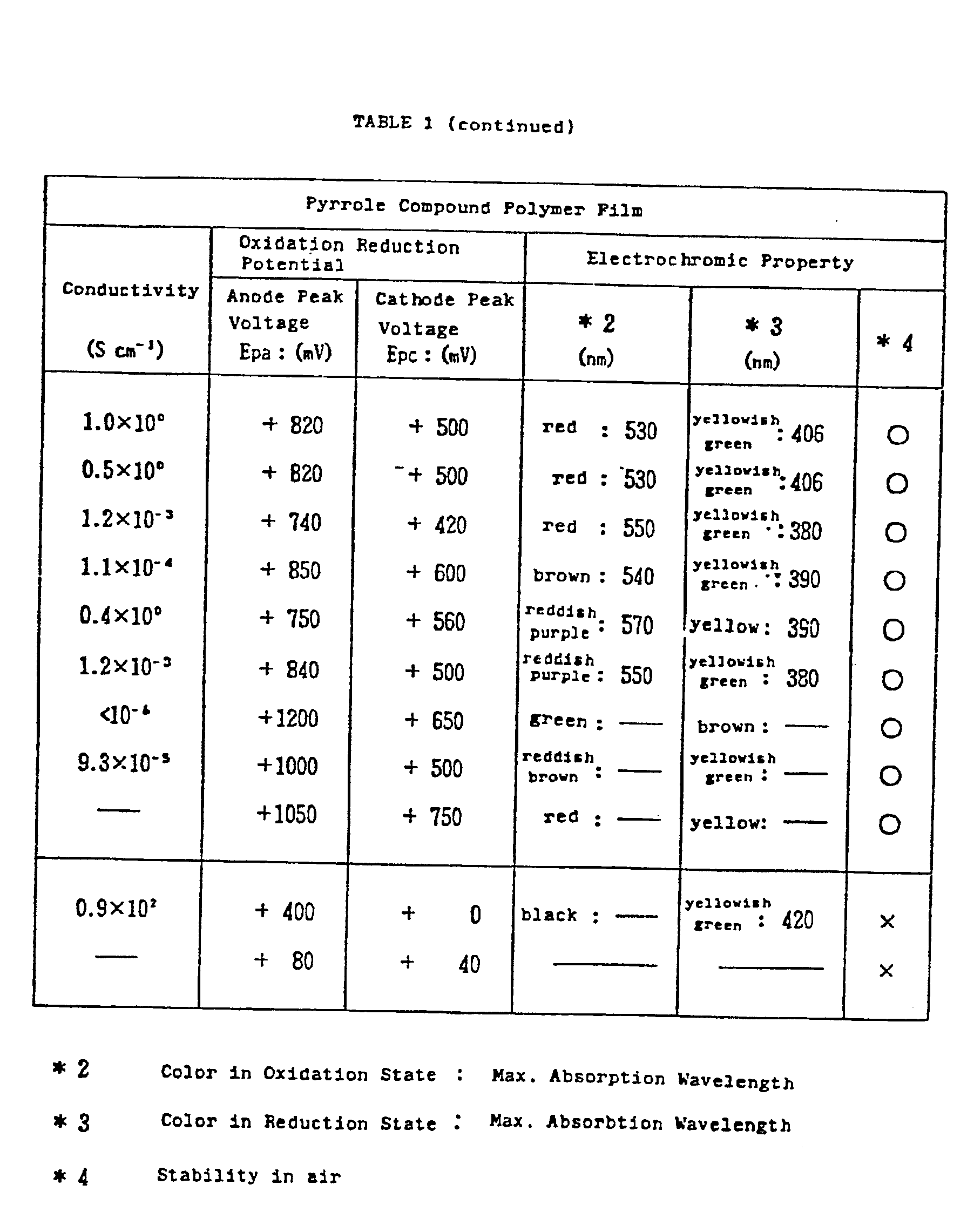
- The measured results are shown in Table 1.
- Measured by using a dual potentio-galvanostat (OPGS-1)-function generator (Nikko Keisoku Co.) and an XY recorder.
- Carried out by 4 probe method according to Van der Pauw.
- Measured by using the same measuring instruments used for the above oxidation potential measurement of the material pyrrole compound.
- A device shown in attached Fig. 1 was used. The voltage was manually changed by 100 mV, and, when the current valve of the potentiostat became nearly constant, a UV chart was drawn for the absorbance (between 350-750 nm), in order to indicate the relationship between the wavelength and absorbance. The relationships between the wavelength and absorbance are shown in Fig. 2 (a) and (b). Fig. 2 (a) shows the relationship between the wavelength and absorbance when the state is changed from reduction to oxidation, and Fig. 2 (b) is from oxidation to reduction.
- The same procedure as for the preparation of Sample 1-1 was repeated except that tetrabutyl ammonium tetrafluoroborate was employed as a conductive salt, resulting in obtaining a laminate (Sample 1-2) of which red polymer film was formed on the surface of the ITO coated glass. The various properties of formed polymer film were measured similarly to Sample 1-1. The measured results are shown in Table 1, together with the properties of the material compound.
- The same procedure as for the preparation of Sample 1-1 was repeated except that ethyl, 4-methyl pyrrole-3-carboxylate of 0.385 g (2.5 × 10_3 mole) was employed as a 3,4-substituted pyrrole compound, resulting in obtaining a laminate (Sample 1-3) of which red polymer film was formed on the surface of the ITO coated glass. The various properties of the polymer film were measured similarly to Sample 1-1. The measured results are shown in Table 1, together with the properties of the material compound.
- The same procedure as for the preparation of Sample 1-1 was repeated except that octyl, 4-methyl pyrrole-3-carboxylate of 0.593 g (2.5 × 10_3 mole) was employed as a 3,4-substituted pyrrole compound, resulting in obtaining a laminate (Sample 1-4) of which brown polymer film was formed on the surface of the ITO coated glass. The various properties of the polymer film were measured similarly to Sample 1-1. The measured results are shown in Table 1, together with the properties of the material compound.
- The same procedure as for the preparation of Sample 1-1 was repeated except that 4-methyl pyrrole-3-carboxylic acid of 0.313 (2.5 × 10_3 mole) was employed as a 3,4-substituted pyrrole compound, resulting in obtaining a laminate (Sample 1-5) of which reddish purple polymer film was formed on the surface of the ITO coated glass. The various properties of the polymer film were measured similarly to Sample 1-1. The measured results are shown in Table 1, together with the properties of the material compound.
- The same procedures as for the preparation of Sample 1-1 were repeated except that a 3,4-asymetrically substituted pyrrole compound whose combination of the substituents at C₃ and C4 was different, was employed as a material, resulting in obtaining laminates (Samples 1-6 to 1-9) of which various types of polymer film were formed on the surface of the ITO coated glass.
- The various properties of the polymer films were measured similarly to Sample 1-1. The measured results are show in Table 1, together with the properties of the material compounds.
- The pyrrole compounds and their polymers of Sample 1-6 and 1-7 were measured for the IR absorption spectra by using FT-IR 20D (Nicolet Japan Co.) and by KBr tablet method. The measured IR absorption spectra are shown in Fig. 3 (a) and (b). An absorption based on the 2,5-H out-of-plane vibration is observed at 700-800 cm_1 in the IR spectra of the monomers but disappear after polymerized. Thus it is confirmed that polymer of which C₂ and C₅ are bonded to form a chain is obtained.
- The same procedure as for the preparation of Sample 1-1 was repeated except that pyrrole (symmetrical and not substituted at C₃ and C₄) was employed as a pyrrole compound of a material, resulting in obtaining a laminate (Comparison sample 1-1) of which black polymer film was formed on the surface of the ITO coated glass.
- The various proporties of both pyrrole of the material and the obtained polymer film were measured smilarly to Sample 1-1.
- The measured various properties of the polymer film are shown in Table 1, together with the properties of the material compound.
- The same procedure as for the preparation of Sample 1-1 was repeated except that 3-methyl pyrrole whose substituent at C₃ is a methyl radical (σp = _0.17), an electron donative substituent, was employed as a pyrrole compound of a material, resulting in obtaining a laminate (Comparison sample 1-2) of which polymer film was formed on the surface of the ITO coated glass.
- The various properties of the polymer film and the pyrrole compound were measured smilarly to Sample 1-1.
- The measured various properties of the polymer film are shown in Table 1, together with the properties of the material compound.

- To 46 ml of acetonitrile solution containing 0.50 g of 4-methyl pyrrole-3-carboxylic acid and 1.38 g of tetraethyl ammonium-para toluene sulfonate was added 4.46 g of anhydrous ferric chloride, and the resulting solution was heated at the boiling point of acetonitrile (81.6°C) for 13 hours.
- After cooled, the solution was filtrated with No. 2 qualitative filter paper, washed with acetonitrile, and then heated to dry by an incandescent lamp to give 0.86 g of black product. Of it, 222 mg was pulverized in mortar, made contact with iodine vapor for 3 days, and then formed to be a disc of 10 mmφ in diameter and 1.87 mm thick by using a tablet forming machine for IR absorption spectrum sample. The disc was further made contact with iodine vapor for 3 days and its volume resistibility was measured by the 4 probe method according to Van der Pauw. The conductivity (S cm _1 ) was 2.9 × 10 _4 .
- 0.19 g of 4-phenyl pyrrole-3-carboxylic acid and 2.76 g of stannic chloride were dissolved in 30 ml of chloroform to heat to reflux at the boiling point of chloroform, 61.2°C, for 6 hours. After cooling, the resulting solution was filtrated. The residue on the surface of the filter paper was washed with chloroform and heated to dry by an incandescent lamp to give 220 mg of black product.
- Of it, 186 mg was pulverized in a mortar and the conductivity (S cm_1) was measured in a similar way to Sample 1-1. The result was 1.3 × 10_4 . (However the size of the formed disc was 10 mmφ in diameter × 1.32 mm thick.)
- An ITO coated glass (4 cm²) used as an anode, and platinum and KCl saturated calomel electrodes employed as a cathode and a reference electrode, respectively, were set in an electrolytic cell of 100 ml in capacity. Purified 4-methyl pyrrole-3-carboxylic acid of 6.25 × 10 _2 g and 1.71 g of (n-Bu)₄NClO₄ were dissolved in 50 ml of acetonitrile to use as an electrolyte, which was placed in the cell.
- Both electrodes were dipped in the electrolyte so as to be immersed 20 mm depth from the lower side of the electrode. Nitrogen gas was introduced to remove dissolved oxygen and the air is shut down from mixing, then current of 2 mA was applied for 10 minutes.
- Reddish purple polymer was electrodeposited on the ITO coated glass of the anode. The anode was pulled up from the electrolyte, washed with acetone and wind dried to give 1.34 mg of weight increase. This value is larger than the theoretical value:

- Because it is considered that the washing with acetone cannot remove the doped ClO₄_ ions. The polymer, when immersed in 0.5 ml of 2N-NaOH aqueous solution, slowly dissolves to give a transparent greenish yellow solution. This solution was applied to a platinum wire of 1 mmφ × 7 mm and made contact with hydrogen chloride gas, resulting in the recognition of black polymer formed on the surface of the platinum wire. This platinum wire was employed as an anode, and a platinum wire was used as a cathode and an Ag/AgCl electrode as a reference electrode, and cyclic voltammetry was performed from _ 0.4 V to + 1.9 V (vs Ag/AgCl) to give curves almost equal to the cyclic voltammograms directly obtained by the electrochemical polymerization using (n-Bu)₄NClO₄ as a supporting electrolyte and acetonitrile as a solvent.
- The molecular weight of the obtained polymer was measured by GPC to give weight average molecular weight of approximately 2,800.
- The molecular weight was measured under the conditions: high-speed liquid chromatography LC-6A (Shimadzu), column; Asahi pack GS-520 (Asahi Chemical Industry, vinyl alcohol copolymer) of 7.6 mmφ × 500 mm, developing solution; sodium phosphate system, a buffer of pH 11.4, and at room temperature. The detection was carried out at the wavelength of 250 nm and the molecular weight was calculated by using polystyrene sodium sulfonate as a standard polymer substance.
- Equipment similar to that used for Sample 3-1 was used, an acetonitrile solution containing 0.01 mole/l of 4-propyl pyrrole-3-carboxylic acid and 0.1 mole/l of (n-Bu)₄NBF₄ was employed as an electrolyte, and a current was applied intermittently at 6 mA × 60 sec × 11 times to form 1.38 g of polymer on the anode plate. When the electrode coated with this polymer was immersed in a 1/20 N NaOH aqueous solution, the polymer was immediately peeled off from the electrode plate and slowly dissolved to give a transparent dark greenish yellow solution.
- The molecular weight of the obtained polymer was measured by GPC to give weight average molecular weight of approximately 5,000.
- The same experiment as for the preparation of sample 3-1 were repeated except that an acetonitrile solution containing 0.1 mole/l of 4-phenyl pyrrole-3-carboxylic acid and 0.1 mole/l of (n-Bu)₄NClO₄ was employed as an electrolyte. A current of 6 mA was continuously applied for 600 seconds to give 2.2 mg of polymer on the anode plate. When this anode plate was dipped in a mixture solution of 10 ml of 2N-NaOH aqueous solution and 5 ml of ethanol, a green solution, in which most of the polymer were dissolved but black fine particles were partly suspended, was obtained. The solution was filtrated with filter papar to give a transparent solution.
- The molecular weight of the obtained polymer was measured by GPC to give average molecular weight of approximately 3,500.
- 2 mg of the polymer of Example 2 (Sample 2-1) obtained by the chemical oxidative polymerization were dissolved in 5 ml of 2N-NaOH aqueous solution and turned blackish green. The resulting solution was filtrated with 0.4 µ micron filter and the molecular weight was measured by GPC to give weight average molecular weight of approximately 2,800.
- Similarly, 2 mg of the polymer of Example 2 (Sample 2-2) dissolved in a mixture solution of 5 ml of 2N NaOH and 10 ml of ethanol and turned blackish green.
- The polymers of pyrrole compounds of which at least one of C₃ and C₄ is substituted by an electron attractive group, particularly pyrrole compounds of which only one of C₃ and C₄ is substituted, have oxidation reduction potential different from that of oxygen and water, compared with the polymers described in the aforementioned comparison examples, and exist stable in the air in the undoping state.
- The polymers of this invention, as shown in Fig. 2, have a continuous clear visible light absorption spectrum against the voltage change, and the spectra show almost completely reversible behavior between the oxidation and reduction states. This means, the polymers of this invention have clear electrochromism characteristics.
- In addition, the polymers soluble in alkaline aqueous solvent have the advantage that conductor film with a desired pattern can be formed on the surface of a desired substrate.
- Thanks to the above facts, these polymers used as laminates of which polymer film is formed on an electrode plate, have expectation of the applications to optical functional components such as electrochromic displays, optical switches and optical memory components, and for the use as materials for a variety of electronic devices such as sensor materials and battery materials.
- The applications as agents such as polymer electrolytes or polymer chelating agents are also expected.
Claims (12)


Applications Claiming Priority (6)
| Application Number | Priority Date | Filing Date | Title |
|---|---|---|---|
| JP17183785 | 1985-08-06 | ||
| JP171837/85 | 1985-08-06 | ||
| JP38281/86 | 1986-02-25 | ||
| JP3828186 | 1986-02-25 | ||
| JP102133/86 | 1986-05-06 | ||
| JP10213386 | 1986-05-06 |
Publications (3)
| Publication Number | Publication Date |
|---|---|
| EP0231394A1 EP0231394A1 (en) | 1987-08-12 |
| EP0231394A4 EP0231394A4 (en) | 1988-01-07 |
| EP0231394B1 true EP0231394B1 (en) | 1991-03-13 |
Family
ID=27289770
Family Applications (1)
| Application Number | Title | Priority Date | Filing Date |
|---|---|---|---|
| EP86904919A Expired - Lifetime EP0231394B1 (en) | 1985-08-06 | 1986-08-04 | Novel polymers of3,4-substituted pyrrole compound and processfor their preparation |
Country Status (3)
| Country | Link |
|---|---|
| US (1) | US4816536A (en) |
| EP (1) | EP0231394B1 (en) |
| WO (1) | WO1987000843A1 (en) |
Families Citing this family (5)
| Publication number | Priority date | Publication date | Assignee | Title |
|---|---|---|---|---|
| GB2240984B (en) * | 1989-11-07 | 1993-12-08 | British Aerospace | Conductive compositions |
| JPH03205422A (en) * | 1990-01-08 | 1991-09-06 | Nippon Oil Co Ltd | Poly((3-pyrrolyl)acetic acid) |
| EP2402955B1 (en) * | 2006-01-26 | 2013-07-03 | University of Florida Research Foundation, Incorporated | Chemical defunctionalization of polymeric alkylenedioxyheterocyclics - the monomers |
| JP5800699B2 (en) * | 2011-03-28 | 2015-10-28 | 株式会社イオックス | Anti-corrosion coating composition |
| CN103116239A (en) * | 2013-02-22 | 2013-05-22 | 京东方科技集团股份有限公司 | Electrochromic display device and manufacturing method thereof |
Citations (1)
| Publication number | Priority date | Publication date | Assignee | Title |
|---|---|---|---|---|
| JPS612728A (en) * | 1984-06-14 | 1986-01-08 | Showa Denko Kk | Pyrrole polymer powder |
Family Cites Families (4)
| Publication number | Priority date | Publication date | Assignee | Title |
|---|---|---|---|---|
| FR2527843B1 (en) * | 1982-06-01 | 1986-01-24 | Thomson Csf | ELECTRODE COMPRISING AN ELECTROCHROMIC POLYMER FILM WHICH CAN BE USED IN AN ENERGY STORAGE OR DISPLAY DEVICE |
| FR2532476A1 (en) * | 1982-09-01 | 1984-03-02 | Commissariat Energie Atomique | IMPROVEMENT TO ELECTROCHEMICAL GENERATORS COMPRISING AN ORGANIC POLYMER AS AN ACTIVE ELECTRODE MATERIAL |
| JPS5941324A (en) * | 1982-09-01 | 1984-03-07 | Matsushita Electric Ind Co Ltd | Method for producing charge transfer polymer complex |
| US4548696A (en) * | 1984-11-15 | 1985-10-22 | Olin Corporation | 3,4-Disubstituted polypyrroles and articles of manufacture coated therewith |
-
1986
- 1986-08-04 EP EP86904919A patent/EP0231394B1/en not_active Expired - Lifetime
- 1986-08-04 WO PCT/JP1986/000399 patent/WO1987000843A1/en not_active Ceased
- 1986-08-04 US US07/036,670 patent/US4816536A/en not_active Expired - Lifetime
Patent Citations (1)
| Publication number | Priority date | Publication date | Assignee | Title |
|---|---|---|---|---|
| JPS612728A (en) * | 1984-06-14 | 1986-01-08 | Showa Denko Kk | Pyrrole polymer powder |
Also Published As
| Publication number | Publication date |
|---|---|
| EP0231394A4 (en) | 1988-01-07 |
| US4816536A (en) | 1989-03-28 |
| WO1987000843A1 (en) | 1987-02-12 |
| EP0231394A1 (en) | 1987-08-12 |
Similar Documents
| Publication | Publication Date | Title |
|---|---|---|
| EP0222906B1 (en) | Electrically conducting polymers | |
| US5059694A (en) | 3-substituted polypyrrole | |
| US4640748A (en) | Polyisothianaphtene, a new conducting polymer | |
| KR880701254A (en) | Magnetic Doping Polymers | |
| Rodrigues et al. | Electrochromic properties of chemically prepared polyaniline | |
| US6359149B1 (en) | Bithienylnaphthalene- and bis(3,4-ethylenedioxythienyl)naphthalene-based monomers and polymers | |
| US4772940A (en) | Polymer having isothianaphthene structure and electrochromic display | |
| US4769430A (en) | Polypyrrole thiophene | |
| Eaves et al. | Electroactive thin films from the anodic electropolymerisation of iron (II) and ruthenium (II) tris (N-bipyridylpyrrole) complexes | |
| EP0231394B1 (en) | Novel polymers of3,4-substituted pyrrole compound and processfor their preparation | |
| Xu et al. | Anion-trapping and polyanion electrolytes based on acid-in-chain borate polymers | |
| Walczak et al. | 3, 4-alkylenedioxypyrrole-based conjugated polymers with finely tuned electronic and optical properties via a flexible and efficient N-functionalization method | |
| WO1987003607A1 (en) | Polymers having isoindole structure and process for their preparation | |
| EP0231309B1 (en) | Process for manufacturing electrically conductive polythiophene | |
| EP0164974B1 (en) | Polymer having isothianaphthene structure and electrochromic display | |
| US5500474A (en) | Stable conducting polymer and processes for the preparation thereof | |
| Sacan et al. | Conducting polymers of succinic acid bis-(2-thiophen-3-yl-ethyl) ester and their electrochromic properties | |
| Çakal et al. | Electrochemical and optical properties of dicyclohexylmethyl substituted poly (3, 4‐propylenedioxythiophene) analogue | |
| JPH0264129A (en) | Poly-o-methoxyaniline, its manufacture, and conductive polymer containing it | |
| Diab et al. | Preparation of a novel conducting polymer by electropolymerization of thiophenylidine 8-naphthylamine Schiff-base | |
| EP0303360A1 (en) | Electroconductive polymers | |
| JPS6117581A (en) | Polymer containing isothianaphthene structure | |
| JPH0764919B2 (en) | Novel polymer of 3,4-substituted pyrrole compound and method for producing same | |
| JPH0971643A (en) | High-purity soluble aniline-based conductive polymer and method for producing the same | |
| JPH04216821A (en) | Electrochemical polymerizaton of five-membered heterocyclic monomer |
Legal Events
| Date | Code | Title | Description |
|---|---|---|---|
| PUAI | Public reference made under article 153(3) epc to a published international application that has entered the european phase |
Free format text: ORIGINAL CODE: 0009012 |
|
| 17P | Request for examination filed |
Effective date: 19870401 |
|
| AK | Designated contracting states |
Kind code of ref document: A1 Designated state(s): DE FR GB IT |
|
| A4 | Supplementary search report drawn up and despatched |
Effective date: 19880107 |
|
| 17Q | First examination report despatched |
Effective date: 19900221 |
|
| GRAA | (expected) grant |
Free format text: ORIGINAL CODE: 0009210 |
|
| AK | Designated contracting states |
Kind code of ref document: B1 Designated state(s): DE FR GB IT |
|
| ITF | It: translation for a ep patent filed | ||
| REF | Corresponds to: |
Ref document number: 3678148 Country of ref document: DE Date of ref document: 19910418 |
|
| ET | Fr: translation filed | ||
| PLBE | No opposition filed within time limit |
Free format text: ORIGINAL CODE: 0009261 |
|
| STAA | Information on the status of an ep patent application or granted ep patent |
Free format text: STATUS: NO OPPOSITION FILED WITHIN TIME LIMIT |
|
| 26N | No opposition filed | ||
| REG | Reference to a national code |
Ref country code: GB Ref legal event code: IF02 |
|
| PGFP | Annual fee paid to national office [announced via postgrant information from national office to epo] |
Ref country code: GB Payment date: 20050725 Year of fee payment: 20 |
|
| PGFP | Annual fee paid to national office [announced via postgrant information from national office to epo] |
Ref country code: FR Payment date: 20050812 Year of fee payment: 20 Ref country code: DE Payment date: 20050812 Year of fee payment: 20 |
|
| PGFP | Annual fee paid to national office [announced via postgrant information from national office to epo] |
Ref country code: IT Payment date: 20050819 Year of fee payment: 20 |
|
| PG25 | Lapsed in a contracting state [announced via postgrant information from national office to epo] |
Ref country code: GB Free format text: LAPSE BECAUSE OF EXPIRATION OF PROTECTION Effective date: 20060803 |
|
| REG | Reference to a national code |
Ref country code: GB Ref legal event code: PE20 |