EP0230961A2 - Phenol compound and heat-sensitive recording material - Google Patents
Phenol compound and heat-sensitive recording material Download PDFInfo
- Publication number
- EP0230961A2 EP0230961A2 EP87100705A EP87100705A EP0230961A2 EP 0230961 A2 EP0230961 A2 EP 0230961A2 EP 87100705 A EP87100705 A EP 87100705A EP 87100705 A EP87100705 A EP 87100705A EP 0230961 A2 EP0230961 A2 EP 0230961A2
- Authority
- EP
- European Patent Office
- Prior art keywords
- phenol compound
- group
- heat
- sensitive recording
- carbon atoms
- Prior art date
- Legal status (The legal status is an assumption and is not a legal conclusion. Google has not performed a legal analysis and makes no representation as to the accuracy of the status listed.)
- Granted
Links
Classifications
-
- C—CHEMISTRY; METALLURGY
- C07—ORGANIC CHEMISTRY
- C07C—ACYCLIC OR CARBOCYCLIC COMPOUNDS
- C07C39/00—Compounds having at least one hydroxy or O-metal group bound to a carbon atom of a six-membered aromatic ring
- C07C39/12—Compounds having at least one hydroxy or O-metal group bound to a carbon atom of a six-membered aromatic ring polycyclic with no unsaturation outside the aromatic rings
- C07C39/17—Compounds having at least one hydroxy or O-metal group bound to a carbon atom of a six-membered aromatic ring polycyclic with no unsaturation outside the aromatic rings containing other rings in addition to the six-membered aromatic rings, e.g. cyclohexylphenol
-
- B—PERFORMING OPERATIONS; TRANSPORTING
- B41—PRINTING; LINING MACHINES; TYPEWRITERS; STAMPS
- B41M—PRINTING, DUPLICATING, MARKING, OR COPYING PROCESSES; COLOUR PRINTING
- B41M5/00—Duplicating or marking methods; Sheet materials for use therein
- B41M5/26—Thermography ; Marking by high energetic means, e.g. laser otherwise than by burning, and characterised by the material used
- B41M5/30—Thermography ; Marking by high energetic means, e.g. laser otherwise than by burning, and characterised by the material used using chemical colour formers
- B41M5/333—Colour developing components therefor, e.g. acidic compounds
- B41M5/3333—Non-macromolecular compounds
- B41M5/3335—Compounds containing phenolic or carboxylic acid groups or metal salts thereof
-
- C—CHEMISTRY; METALLURGY
- C07—ORGANIC CHEMISTRY
- C07C—ACYCLIC OR CARBOCYCLIC COMPOUNDS
- C07C39/00—Compounds having at least one hydroxy or O-metal group bound to a carbon atom of a six-membered aromatic ring
- C07C39/12—Compounds having at least one hydroxy or O-metal group bound to a carbon atom of a six-membered aromatic ring polycyclic with no unsaturation outside the aromatic rings
- C07C39/15—Compounds having at least one hydroxy or O-metal group bound to a carbon atom of a six-membered aromatic ring polycyclic with no unsaturation outside the aromatic rings with all hydroxy groups on non-condensed rings, e.g. phenylphenol
-
- C—CHEMISTRY; METALLURGY
- C07—ORGANIC CHEMISTRY
- C07C—ACYCLIC OR CARBOCYCLIC COMPOUNDS
- C07C39/00—Compounds having at least one hydroxy or O-metal group bound to a carbon atom of a six-membered aromatic ring
- C07C39/12—Compounds having at least one hydroxy or O-metal group bound to a carbon atom of a six-membered aromatic ring polycyclic with no unsaturation outside the aromatic rings
- C07C39/15—Compounds having at least one hydroxy or O-metal group bound to a carbon atom of a six-membered aromatic ring polycyclic with no unsaturation outside the aromatic rings with all hydroxy groups on non-condensed rings, e.g. phenylphenol
- C07C39/16—Bis-(hydroxyphenyl) alkanes; Tris-(hydroxyphenyl)alkanes
Definitions
- This invention relates to a novel phenol compound and a heat-sensitive recording material containing the same.
- a conventional process for the preparation of a heat-sensitive recording material comprises separately applying a dye. which is usually colorless or in a pale color, and a developer on the surface of a paper base together with a binder and other additives.
- a thermal device such as a thermal head or a thermopen in a recording apparatus
- the dye would react with the developer. which results in coloration in. for example. black to thereby form images.
- Phenol compounds which have been employed as s developers include. for example. bisphenol A. 4.4'-cyclohexylidenediphenol. 1,1,3-tris(3'-tert-butyl-4'-hydroxy-6'-methylphenyl)butane and p-hydroxybenzoate.
- bisphenol A 4.4'-cyclohexylidenediphenol. 1,1,3-tris(3'-tert-butyl-4'-hydroxy-6'-methylphenyl)butane and p-hydroxybenzoate.
- these phenols have disadvantages in that discoloration might be observed or that a color change might occur upon storage.
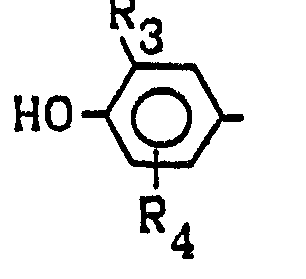
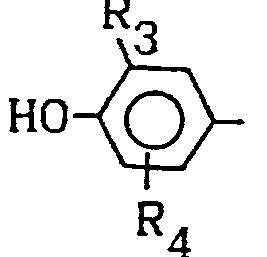
- the present invention provides a phenol compound represented by the following general formula (I): Wherein R represents a -group. wherein R 3 represents a cyclohexyl or phenyl group and R 4 represents a hydrogen atom. an alkyl group having one to eight carbon atoms or those as defined in regard to R 3 :
- the present invention further provides a heat-sensitive recording material which comprises a dye. which is usually colorless or in a pale color, and the phenol compound of the above general formula (I).
- the compounds represented by the above general formula (I) include, for examples, 1.1.2.2 - tetra (3 ' - cyclohexyl - 4'- hydroxy - 6'- methylphenyl) ethane. 1.1.2.2 - tetra (3'-phenyl - 4'- hydroxyphenyl) ethane. 1.1,3 - tris(3'- cyclohexyl - 4'- hydroxyphenyl)butane. 1.1.3 - tris(3'- cyclohexyl - 4'- hydroxy - 6'- methylphenyl)butane.
- the compounds of this invention can be employed as the sole color developer for heat sensitive recording paper. They can also be used in combination with other conventional color developers.
- the conventional color developers which can be employed together with the com pound of this invention include phenols and organic acids such as p-octylphenol. p-t-butylphenol, p-phenylphenol. bisphenol A. 1.1 - bis(p-hydroxyphenyl)butane, 2.2 - bis(4'- hydroxy - 3',5'- dichlorophenyl) - propane. p-hydroxybenzoic acid.
- the compounds represented by the general formula (1) can be readily prepared by reacting glyoxal. glutaraldehyde, crotonaldehyde etc, with corresponding phenols.
- the color former which is normaly colorless or pale color used in this invention is not ristricted. Any dyes can be used provided it can be used for conventional pressure-sensitive recording paper or heat-sensitive recording paper.
- dyes examples include. (1)triarylmethane compounds. for examples. 3,3-bis(p-dimethylaminophenyl) -6-dimethylaminophthalide (Crystal Violet Lactone). 3-(p-dimethylaminophenyl) - 3 - (1,2-dimethylindol-3-yl) phthalide. 3-(p-dimethylaminophenyl) - 3 - (2-phenyl- indol-3-yl)phthalide.
- Rhodamine ⁇ - anilinolactam 3 -diethylamino-7-dibenzylaminofluorane, 3-diethylamino-7-octylaminofluoran, 3-diethylamino-7(2-chloroanilino) fluoran.
- 3-diethylamino-6-methyl-7-aniiinofluoran 3-diethylamino-6-chloro-7-( ⁇ -ethoxyethyl)aminofluoran, 3 -piperidino-6-methyl-7-anilinofluoran.
- the developer and the colorless dye as described above are atomized with an attritor such as a ball mill, an atomizer or a sand grinder or an appropriate emulsifier and various additives are added thereto depending on the purpose to thereby form a coating solution.
- an attritor such as a ball mill, an atomizer or a sand grinder or an appropriate emulsifier and various additives are added thereto depending on the purpose to thereby form a coating solution.
- This coating solution may usually contain binder(s) such as polyvinyl alcohol. hydroxyethylcellulose, methylcellulose. starch materials, styrene/ maleic anhydride copolymer. vinyl acetate/maleic anhydride copolymer or styrene/butadiene copolymer; and filler(s) such as kaolin. kieselguhr. talc. titanium dioxide, calcium carbonate. magnesium carbonate or aluminum hydroxide. It may further contain other additives such as metal soaps, waxes, photostabilizers. water-resisting agents, dispersant and antifoaming agents.
- binder(s) such as polyvinyl alcohol. hydroxyethylcellulose, methylcellulose. starch materials, styrene/ maleic anhydride copolymer. vinyl acetate/maleic anhydride copolymer or styrene/butadiene copolymer; and filler(s) such as kaolin.
- the amount of the particular phenol compound to be used in the present invention is not strictly limited and determined depending on the required properties and suitability. Generally one to ten parts of the phenol compound is employed per part of the dye.
- the phenol compound of the present invention is useful not only as a developer as described above but also as an antioxidant for. e.g.. synthetic resins and as an intermediate in the production of medicines or agricultural chemicals.
- 2-cyclohexyl-5-methylphenol 57.0 g were dissoloved in 40 ml of methanol and 7.0 g of crotonaldehyde were added dropwise at 60 - 70 °C.
- the product were recrystallized from methanol and the pure product melted at 190 °C were obtained.
- the dispersions (A) and (B) were mixed together in a ratio of 3 : 10. To 200g of the mixture thus obtained, 50g of calcium carbonate was added and dispersed therein to give-a coating solution.
- This coating solution was applied on a base paper weighing 50g/m 2 to give a coating amount of 6g/m 2 on a solid basis and dried.
- the developed material was stored at 50°C. at a relative humidity of 90% and 70°C and under a dry condition each for 48 hours. Then the density of the ground and that of the developed color were measured and the residual ratio of the developed color after the storage was determined thereby.
- This coating solution was applied on a base paper weighing 50g/m 2 to give a coating amount of 6g/m 2 on a solic basis and dried.
- the obtained heat-sensitive paper was subjected to the same test as the one described in Example 1.
- Table 1 and 2 suggest that the heat-sensitive recording materials of the present invention are highly excellent, since the developed colors thereof show little discoloration and the grounds thereof show little color development even at a high temperature and high humidity.
Landscapes
- Chemical & Material Sciences (AREA)
- Organic Chemistry (AREA)
- Chemical Kinetics & Catalysis (AREA)
- General Chemical & Material Sciences (AREA)
- Physics & Mathematics (AREA)
- Optics & Photonics (AREA)
- Heat Sensitive Colour Forming Recording (AREA)
- Color Printing (AREA)
- Organic Low-Molecular-Weight Compounds And Preparation Thereof (AREA)
Abstract
Description
- This invention relates to a novel phenol compound and a heat-sensitive recording material containing the same.
- A conventional process for the preparation of a heat-sensitive recording material comprises separately applying a dye. which is usually colorless or in a pale color, and a developer on the surface of a paper base together with a binder and other additives. When this recording material comes into contact with a thermal device such as a thermal head or a thermopen in a recording apparatus, the dye would react with the developer. which results in coloration in. for example. black to thereby form images.
- Phenol compounds which have been employed as s developers include. for example. bisphenol A. 4.4'-cyclohexylidenediphenol. 1,1,3-tris(3'-tert-butyl-4'-hydroxy-6'-methylphenyl)butane and p-hydroxybenzoate. However these phenols have disadvantages in that discoloration might be observed or that a color change might occur upon storage.
- We have attempted to overcome these disadvantages and consequently found that a particular phenol compound shows an excellent effect as a developer. thus completing the present invention.
- The present invention provides a phenol compound represented by the following general formula (I):


- RI represents a direct bond or an alkylene group having one to three carbon atoms: and
- R2 represents a hydrogen atom. an alkyl group having one to eight carbon atoms or those as defined in regard to R.
- The present invention further provides a heat-sensitive recording material which comprises a dye. which is usually colorless or in a pale color, and the phenol compound of the above general formula (I).
- The compounds represented by the above general formula (I) include, for examples, 1.1.2.2 - tetra (3' - cyclohexyl - 4'- hydroxy - 6'- methylphenyl) ethane. 1.1.2.2 - tetra (3'-phenyl - 4'- hydroxyphenyl) ethane. 1.1,3 - tris(3'- cyclohexyl - 4'- hydroxyphenyl)butane. 1.1.3 - tris(3'- cyclohexyl - 4'- hydroxy - 6'- methylphenyl)butane. 1,1,3-tris(3'- cyclohexyl - 4'- hydroxy - 5'- methylphenyl)butane, 1,1.3 - tris(3'- phenyl - 4'- hydroxyphenyl)butane, 1.1.3.3 - tetra(3'- phenyl - 4'- hydroxyphenyl)propane, 1.1.5.5 - tetra(3'- cyclohexyl - 4'- hydroxy - 6'- methylphenyl)pentane, 1.1.5.5 - tetra(3'-cyclohexyl - 4'- hydroxyphenyl)pentane and 1.1.5.5 - tetra(3'- phenyl - 4'- hydroxyphenyl)pentane.
- The compounds of this invention can be employed as the sole color developer for heat sensitive recording paper. They can also be used in combination with other conventional color developers. The conventional color developers which can be employed together with the com pound of this invention include phenols and organic acids such as p-octylphenol. p-t-butylphenol, p-phenylphenol. bisphenol A. 1.1 - bis(p-hydroxyphenyl)butane, 2.2 - bis(4'- hydroxy - 3',5'- dichlorophenyl) - propane. p-hydroxybenzoic acid. butyl-p-hydroxybenzoate, benzyl-p-hydroxybenzoate, 3.5 -di-t-butylsalicylate, 4.4'- cyclohexylidenediphenol. p-hydroxydiphenoxide, α-naphtole. p-hydroxyacetophenone. p-t-octylcatecol. 2.2'- dihydroxybiphenyl, 2.2-bis(3'- methyl - 4'- hydroxyphenyl)propane and 2,2-bis(3',5'- dimethyl - 4'- hydroxyphenyl)propane.
- The compounds represented by the general formula (1) can be readily prepared by reacting glyoxal. glutaraldehyde, crotonaldehyde etc, with corresponding phenols.
- The color former which is normaly colorless or pale color used in this invention is not ristricted. Any dyes can be used provided it can be used for conventional pressure-sensitive recording paper or heat-sensitive recording paper.
- Examples of such dyes includes. (1)triarylmethane compounds. for examples. 3,3-bis(p-dimethylaminophenyl) -6-dimethylaminophthalide (Crystal Violet Lactone). 3-(p-dimethylaminophenyl) - 3 - (1,2-dimethylindol-3-yl) phthalide. 3-(p-dimethylaminophenyl) - 3 - (2-phenyl- indol-3-yl)phthalide. 3,3-bis(9-ethylcarbazol-3-yl) - 5 - dimethylaminophthalide and 3,3-bis(2-phenylindol-3-yl) - 5 - dimethylaminophthalide: (2) diphenyl methane compounds. for example. 4.4'-bis-dimethylaminobenzhy- drin benzyl ether. N-halophenyl leuco Auramine and N-2,4,5-trichlorophenyl leuco Auramine: (3) xanthene compounds, for example. Rhodamine β - anilinolactam, 3 -diethylamino-7-dibenzylaminofluorane, 3-diethylamino-7-octylaminofluoran, 3-diethylamino-7(2-chloroanilino) fluoran. 3-diethylamino-6-methyl-7-aniiinofluoran. 3-diethylamino-6-chloro-7-(β-ethoxyethyl)aminofluoran, 3 -piperidino-6-methyl-7-anilinofluoran. 3-ethyltolyl- amino-6-methyl-7-anilinofluoran, 3-cyclohexylmethyl- anilino-6-methyl-7-anilinofluoran, 3-diethylamino -6- chlora-7-β-ethoxyethyl-aminofluoran and 3-diethylamino-6-chloro-7-γ-chloropropylamino-fluoran; (4) thiazine compounds, for example, benzoyl leuco Methylene Blue and p-nitrobenzoyl leuco Methylene Blue: (5) spiro compounds, for example. 3-methyl-spiro-dinaphthopyran. 3-ethyl-spiro-dinaphthopyran, 3-benzyl- spiro-dinaphthopyran and 3-methylnaphtho(3-methoxy- benzo)spiro-pyran: and mixtures thereof.
- The developer and the colorless dye as described above are atomized with an attritor such as a ball mill, an atomizer or a sand grinder or an appropriate emulsifier and various additives are added thereto depending on the purpose to thereby form a coating solution.
- This coating solution may usually contain binder(s) such as polyvinyl alcohol. hydroxyethylcellulose, methylcellulose. starch materials, styrene/ maleic anhydride copolymer. vinyl acetate/maleic anhydride copolymer or styrene/butadiene copolymer; and filler(s) such as kaolin. kieselguhr. talc. titanium dioxide, calcium carbonate. magnesium carbonate or aluminum hydroxide. It may further contain other additives such as metal soaps, waxes, photostabilizers. water-resisting agents, dispersant and antifoaming agents. This coating solution is applied on the surface of papers or various films to thereby obtain the aimed heat-sensitive recording materials.
- The amount of the particular phenol compound to be used in the present invention is not strictly limited and determined depending on the required properties and suitability. Generally one to ten parts of the phenol compound is employed per part of the dye.
- The phenol compound of the present invention is useful not only as a developer as described above but also as an antioxidant for. e.g.. synthetic resins and as an intermediate in the production of medicines or agricultural chemicals.
- In the following Examples. the synthesis of the phenol compound of the present invention and heat-sensitive recording materials prepared with the use of the same will be described.
- Preparation of 1.1.3-tris(3'-cyclohexyl-4'-hydroxy-6'-methylphenyl)butane
- 2-cyclohexyl-5-methylphenol 57.0 g were dissoloved in 40 ml of methanol and 7.0 g of crotonaldehyde were added dropwise at 60 - 70 °C.
- After addition was completed, the solution was stirred for 5 hours, while blowing hydrochloric acid gas. Then, methanol was distilled off and xylene was added and the solution was washed with water. The solution was cooled to precipitate the product. The product were filtered and white powder melted at 212 °C were obtained.
- The product were recrystallized from methanol and the pure product melted at 190 °C were obtained.
- I. R. analysys
- 3450 cm-1: based on hydroxyl
- 1580 and 1615 cm-1: based on aromatic ring
- 1200 cm-1: based on C-0 (aromatic)
- 20g of 3-diehylamino-6-chloro-7-anilinofluoran was atomized together with 100g of a 10% aqueous solution of polyvinyl alcohol in a ball mill to give a dye dispersion (A).
- Similarly 20g of the sample as shown in Table 1 was atomized together with 1009 of a 10X aqueous solution of polyvinyl alcohol in a ball mill to give a dispersion (B).
- The dispersions (A) and (B) were mixed together in a ratio of 3 : 10. To 200g of the mixture thus obtained, 50g of calcium carbonate was added and dispersed therein to give-a coating solution.
- This coating solution was applied on a base paper weighing 50g/m2 to give a coating amount of 6g/m2 on a solid basis and dried.
- With the use of the heat-sensitive paper thus obtained, recording was carried out with a commercially available heat-sensitive facsimile (NEFAX-3000: mfd. by Nippon Electric Co.. Ltd.) and the density of the ground and that of the developed color were measured thereafter.
- The developed material was stored at 50°C. at a relative humidity of 90% and 70°C and under a dry condition each for 48 hours. Then the density of the ground and that of the developed color were measured and the residual ratio of the developed color after the storage was determined thereby.

- Each density was measured with a Macbeth RD-514 reflective densitometer.
- Table 1 shows the result.
- 20g of 3-diethylamino-6-chloro-7-β-ethoxyethyl)-aminofluoran was atomized together with 100g of a 10X aqueous solution of polyvinyl alcohol in a ball mill to give a dye dispersion (A).
- Similarly. lOg of 2,2-bis(4-hydroxyphenyl)propane and lOg of stearamide were atomized together with 100g of a 10X aqueous solution of polyvinyl alcohol in a ball mill to give a dispersion (B).
- Similarly 20g of the sample compound was atomized together with 100g of a 10% aqueous solution of polyvinyl alcohol in a ball mill to give a dispersion (C).
- These dispersions (A), (B) and (C) were mixed together in a weight ratio of 3 : 20 : 5. To 200g of the mixture thus obtained. 50g of calcium carbonate was added and dispersed therein to give a coating solution.
- This coating solution was applied on a base paper weighing 50g/m2 to give a coating amount of 6g/m2 on a solic basis and dried.
- The obtained heat-sensitive paper was subjected to the same test as the one described in Example 1.
- Table 2 shows the result.


- Table 1 and 2 suggest that the heat-sensitive recording materials of the present invention are highly excellent, since the developed colors thereof show little discoloration and the grounds thereof show little color development even at a high temperature and high humidity.
Claims (4)



Priority Applications (1)
| Application Number | Priority Date | Filing Date | Title |
|---|---|---|---|
| AT87100705T ATE54130T1 (en) | 1986-01-21 | 1987-01-20 | PHENOLIC COMPOUND AND HEAT-SENSITIVE RECORDING SUBSTANCE. |
Applications Claiming Priority (2)
| Application Number | Priority Date | Filing Date | Title |
|---|---|---|---|
| JP61010855A JPS62169683A (en) | 1986-01-21 | 1986-01-21 | Thermal recording material |
| JP10855/86 | 1986-01-21 |
Publications (3)
| Publication Number | Publication Date |
|---|---|
| EP0230961A2 true EP0230961A2 (en) | 1987-08-05 |
| EP0230961A3 EP0230961A3 (en) | 1988-06-08 |
| EP0230961B1 EP0230961B1 (en) | 1990-06-27 |
Family
ID=11761966
Family Applications (1)
| Application Number | Title | Priority Date | Filing Date |
|---|---|---|---|
| EP87100705A Expired - Lifetime EP0230961B1 (en) | 1986-01-21 | 1987-01-20 | Phenol compound and heat-sensitive recording material |
Country Status (5)
| Country | Link |
|---|---|
| US (1) | US4774367A (en) |
| EP (1) | EP0230961B1 (en) |
| JP (1) | JPS62169683A (en) |
| AT (1) | ATE54130T1 (en) |
| DE (1) | DE3763405D1 (en) |
Cited By (3)
| Publication number | Priority date | Publication date | Assignee | Title |
|---|---|---|---|---|
| EP0304125A3 (en) * | 1987-08-19 | 1989-05-31 | Shell Internationale Research Maatschappij B.V. | Heat-hardenable compositions based on polyglycidyl ethers and polyhydric phenols, halogenated tetraphenols, polyglycidyl ethers and process for preparing tetraphenols |
| WO1993001940A1 (en) * | 1991-07-22 | 1993-02-04 | Nashua Corporation | Heat sensitive recording paper with image stability |
| WO2019166608A1 (en) | 2018-03-02 | 2019-09-06 | Basf Se | Heat sensitive recording material and color developer |
Families Citing this family (1)
| Publication number | Priority date | Publication date | Assignee | Title |
|---|---|---|---|---|
| JP2657217B2 (en) * | 1987-08-21 | 1997-09-24 | 株式会社リコー | Thermal recording material |
Family Cites Families (6)
| Publication number | Priority date | Publication date | Assignee | Title |
|---|---|---|---|---|
| BE584738A (en) * | 1958-11-20 | |||
| US3000856A (en) * | 1959-06-15 | 1961-09-19 | Eastman Kodak Co | Poly-alpha-olefin composition stabilized against ultraviolet light deterioration |
| BE593476A (en) * | 1960-04-14 | |||
| DE2508710A1 (en) * | 1975-02-28 | 1976-09-09 | Bayer Ag | 1,1,2-TRIS-(P-HYDROXYPHENYL)-1-PHENYL-AETHANE AND A PROCESS FOR THEIR PRODUCTION |
| US4415723A (en) * | 1982-03-19 | 1983-11-15 | General Electric Company | Randomly branched aromatic polycarbonate from triphenol |
| JPS59175444A (en) * | 1983-03-25 | 1984-10-04 | Sanko Kaihatsu Kagaku Kenkyusho:Kk | Phenolic compound and thermally sensitive recorder containing the same |
-
1986
- 1986-01-21 JP JP61010855A patent/JPS62169683A/en active Granted
-
1987
- 1987-01-16 US US07/003,751 patent/US4774367A/en not_active Expired - Lifetime
- 1987-01-20 DE DE8787100705T patent/DE3763405D1/en not_active Expired - Lifetime
- 1987-01-20 AT AT87100705T patent/ATE54130T1/en not_active IP Right Cessation
- 1987-01-20 EP EP87100705A patent/EP0230961B1/en not_active Expired - Lifetime
Cited By (4)
| Publication number | Priority date | Publication date | Assignee | Title |
|---|---|---|---|---|
| EP0304125A3 (en) * | 1987-08-19 | 1989-05-31 | Shell Internationale Research Maatschappij B.V. | Heat-hardenable compositions based on polyglycidyl ethers and polyhydric phenols, halogenated tetraphenols, polyglycidyl ethers and process for preparing tetraphenols |
| WO1993001940A1 (en) * | 1991-07-22 | 1993-02-04 | Nashua Corporation | Heat sensitive recording paper with image stability |
| WO2019166608A1 (en) | 2018-03-02 | 2019-09-06 | Basf Se | Heat sensitive recording material and color developer |
| US11512048B2 (en) | 2018-03-02 | 2022-11-29 | Solenis Technologies, L.P. | Heat sensitive recording material, and color developer |
Also Published As
| Publication number | Publication date |
|---|---|
| DE3763405D1 (en) | 1990-08-02 |
| JPH0469555B2 (en) | 1992-11-06 |
| US4774367A (en) | 1988-09-27 |
| JPS62169683A (en) | 1987-07-25 |
| ATE54130T1 (en) | 1990-07-15 |
| EP0230961B1 (en) | 1990-06-27 |
| EP0230961A3 (en) | 1988-06-08 |
Similar Documents
| Publication | Publication Date | Title |
|---|---|---|
| GB2171531A (en) | Thermosensitive recording materials | |
| US4585483A (en) | Recording materials | |
| EP0230961B1 (en) | Phenol compound and heat-sensitive recording material | |
| US4283458A (en) | Heat-sensitive recording paper containing a novel electron accepting compound | |
| US4920091A (en) | Recording material | |
| KR950010647B1 (en) | Heat-sensitive recording material | |
| US5081099A (en) | Heat-sensitive recording material | |
| US4808566A (en) | Recording material | |
| US5242884A (en) | Heat-sensitive recording material | |
| US4983568A (en) | Thermosensitive recording materials | |
| JPH0648038A (en) | Thermosensitive recording medium | |
| JP2577417B2 (en) | Thermal recording medium | |
| US5187143A (en) | Heat sensitive recording material | |
| JPS61270189A (en) | Thermal recording material | |
| JPH0564960A (en) | Thermal recording body | |
| JPH0414078B2 (en) | ||
| US4918046A (en) | Heat-sensitive recording material | |
| JPS6116888A (en) | Heat sensitive recording body | |
| JP2999843B2 (en) | Thermal recording material | |
| JPH02220885A (en) | Thermal color material | |
| JPH01225587A (en) | Thermal recording material | |
| JPS6317084A (en) | Thermal recording medium | |
| JPH01128872A (en) | Thermal recording material | |
| JPH0414637B2 (en) | ||
| JPH01180382A (en) | Thermal recording material |
Legal Events
| Date | Code | Title | Description |
|---|---|---|---|
| PUAI | Public reference made under article 153(3) epc to a published international application that has entered the european phase |
Free format text: ORIGINAL CODE: 0009012 |
|
| AK | Designated contracting states |
Kind code of ref document: A2 Designated state(s): AT DE FR GB |
|
| PUAL | Search report despatched |
Free format text: ORIGINAL CODE: 0009013 |
|
| AK | Designated contracting states |
Kind code of ref document: A3 Designated state(s): AT DE FR GB |
|
| 17P | Request for examination filed |
Effective date: 19881129 |
|
| 17Q | First examination report despatched |
Effective date: 19890905 |
|
| GRAA | (expected) grant |
Free format text: ORIGINAL CODE: 0009210 |
|
| AK | Designated contracting states |
Kind code of ref document: B1 Designated state(s): AT DE FR GB |
|
| REF | Corresponds to: |
Ref document number: 54130 Country of ref document: AT Date of ref document: 19900715 Kind code of ref document: T |
|
| REF | Corresponds to: |
Ref document number: 3763405 Country of ref document: DE Date of ref document: 19900802 |
|
| ET | Fr: translation filed | ||
| PLBE | No opposition filed within time limit |
Free format text: ORIGINAL CODE: 0009261 |
|
| STAA | Information on the status of an ep patent application or granted ep patent |
Free format text: STATUS: NO OPPOSITION FILED WITHIN TIME LIMIT |
|
| 26N | No opposition filed | ||
| REG | Reference to a national code |
Ref country code: GB Ref legal event code: IF02 |
|
| PGFP | Annual fee paid to national office [announced via postgrant information from national office to epo] |
Ref country code: GB Payment date: 20051229 Year of fee payment: 20 |
|
| PGFP | Annual fee paid to national office [announced via postgrant information from national office to epo] |
Ref country code: FR Payment date: 20060120 Year of fee payment: 20 Ref country code: AT Payment date: 20060120 Year of fee payment: 20 |
|
| PGFP | Annual fee paid to national office [announced via postgrant information from national office to epo] |
Ref country code: DE Payment date: 20060223 Year of fee payment: 20 |
|
| PG25 | Lapsed in a contracting state [announced via postgrant information from national office to epo] |
Ref country code: GB Free format text: LAPSE BECAUSE OF EXPIRATION OF PROTECTION Effective date: 20070119 |
|
| REG | Reference to a national code |
Ref country code: GB Ref legal event code: PE20 |