EP0230334B1 - A indenothiazole derivative and process for preparing the same - Google Patents
A indenothiazole derivative and process for preparing the same Download PDFInfo
- Publication number
- EP0230334B1 EP0230334B1 EP87200041A EP87200041A EP0230334B1 EP 0230334 B1 EP0230334 B1 EP 0230334B1 EP 87200041 A EP87200041 A EP 87200041A EP 87200041 A EP87200041 A EP 87200041A EP 0230334 B1 EP0230334 B1 EP 0230334B1
- Authority
- EP
- European Patent Office
- Prior art keywords
- group
- alkyl
- substituted
- hydrogen atom
- piperidino
- Prior art date
- Legal status (The legal status is an assumption and is not a legal conclusion. Google has not performed a legal analysis and makes no representation as to the accuracy of the status listed.)
- Expired - Lifetime
Links
- IDUZNWHHEUJEBT-UHFFFAOYSA-N 2H-indeno[1,2-d][1,3]thiazole Chemical class C1=CC=C2C3=NCSC3=CC2=C1 IDUZNWHHEUJEBT-UHFFFAOYSA-N 0.000 title claims abstract description 21
- 238000004519 manufacturing process Methods 0.000 title claims abstract description 11
- 150000001875 compounds Chemical class 0.000 claims abstract description 31
- 125000004435 hydrogen atom Chemical group [H]* 0.000 claims abstract description 17
- 125000001997 phenyl group Chemical group [H]C1=C([H])C([H])=C(*)C([H])=C1[H] 0.000 claims abstract description 15
- 125000003545 alkoxy group Chemical group 0.000 claims abstract description 14
- 125000005843 halogen group Chemical group 0.000 claims abstract description 13
- 125000003342 alkenyl group Chemical group 0.000 claims abstract description 7
- 125000000623 heterocyclic group Chemical group 0.000 claims abstract description 6
- -1 2-thiazolyl group Chemical group 0.000 claims description 17
- 125000000587 piperidin-1-yl group Chemical group [H]C1([H])N(*)C([H])([H])C([H])([H])C([H])([H])C1([H])[H] 0.000 claims description 14
- 239000002253 acid Substances 0.000 claims description 11
- 125000004076 pyridyl group Chemical group 0.000 claims description 9
- 150000003839 salts Chemical class 0.000 claims description 8
- 125000004573 morpholin-4-yl group Chemical group N1(CCOCC1)* 0.000 claims description 7
- 125000002112 pyrrolidino group Chemical group [*]N1C([H])([H])C([H])([H])C([H])([H])C1([H])[H] 0.000 claims description 7
- 125000000113 cyclohexyl group Chemical group [H]C1([H])C([H])([H])C([H])([H])C([H])(*)C([H])([H])C1([H])[H] 0.000 claims description 5
- 125000002887 hydroxy group Chemical group [H]O* 0.000 claims description 5
- 125000002023 trifluoromethyl group Chemical group FC(F)(F)* 0.000 claims description 5
- 125000002777 acetyl group Chemical group [H]C([H])([H])C(*)=O 0.000 claims description 4
- GDTBXPJZTBHREO-UHFFFAOYSA-N bromine Substances BrBr GDTBXPJZTBHREO-UHFFFAOYSA-N 0.000 claims description 3
- ZCYVEMRRCGMTRW-UHFFFAOYSA-N 7553-56-2 Chemical compound [I] ZCYVEMRRCGMTRW-UHFFFAOYSA-N 0.000 claims description 2
- 229910052794 bromium Inorganic materials 0.000 claims description 2
- 229910052801 chlorine Inorganic materials 0.000 claims description 2
- 239000000460 chlorine Substances 0.000 claims description 2
- 229910052731 fluorine Inorganic materials 0.000 claims description 2
- 239000011737 fluorine Substances 0.000 claims description 2
- 229910052740 iodine Inorganic materials 0.000 claims description 2
- 125000004169 (C1-C6) alkyl group Chemical group 0.000 claims 25
- WKBOTKDWSSQWDR-UHFFFAOYSA-N Bromine atom Chemical compound [Br] WKBOTKDWSSQWDR-UHFFFAOYSA-N 0.000 claims 1
- ZAMOUSCENKQFHK-UHFFFAOYSA-N Chlorine atom Chemical compound [Cl] ZAMOUSCENKQFHK-UHFFFAOYSA-N 0.000 claims 1
- 125000001153 fluoro group Chemical group F* 0.000 claims 1
- 239000011630 iodine Substances 0.000 claims 1
- 125000000217 alkyl group Chemical group 0.000 abstract description 16
- 238000000034 method Methods 0.000 abstract description 6
- 125000002252 acyl group Chemical group 0.000 abstract description 3
- 125000000753 cycloalkyl group Chemical group 0.000 abstract description 3
- 125000000951 phenoxy group Chemical group [H]C1=C([H])C([H])=C(O*)C([H])=C1[H] 0.000 abstract description 2
- LFQSCWFLJHTTHZ-UHFFFAOYSA-N Ethanol Chemical compound CCO LFQSCWFLJHTTHZ-UHFFFAOYSA-N 0.000 description 18
- 239000003814 drug Substances 0.000 description 14
- 241000700159 Rattus Species 0.000 description 10
- OKKJLVBELUTLKV-UHFFFAOYSA-N Methanol Chemical compound OC OKKJLVBELUTLKV-UHFFFAOYSA-N 0.000 description 9
- 208000025865 Ulcer Diseases 0.000 description 7
- 231100000397 ulcer Toxicity 0.000 description 7
- ZMXDDKWLCZADIW-UHFFFAOYSA-N N,N-Dimethylformamide Chemical compound CN(C)C=O ZMXDDKWLCZADIW-UHFFFAOYSA-N 0.000 description 6
- 239000000126 substance Substances 0.000 description 6
- 125000004432 carbon atom Chemical group C* 0.000 description 5
- HEDRZPFGACZZDS-UHFFFAOYSA-N Chloroform Chemical compound ClC(Cl)Cl HEDRZPFGACZZDS-UHFFFAOYSA-N 0.000 description 4
- 230000000767 anti-ulcer Effects 0.000 description 4
- 230000000052 comparative effect Effects 0.000 description 4
- 125000001424 substituent group Chemical group 0.000 description 4
- XLYOFNOQVPJJNP-UHFFFAOYSA-N water Substances O XLYOFNOQVPJJNP-UHFFFAOYSA-N 0.000 description 4
- UHOVQNZJYSORNB-UHFFFAOYSA-N Benzene Chemical compound C1=CC=CC=C1 UHOVQNZJYSORNB-UHFFFAOYSA-N 0.000 description 3
- XEKOWRVHYACXOJ-UHFFFAOYSA-N Ethyl acetate Chemical compound CCOC(C)=O XEKOWRVHYACXOJ-UHFFFAOYSA-N 0.000 description 3
- OFOBLEOULBTSOW-UHFFFAOYSA-N Propanedioic acid Natural products OC(=O)CC(O)=O OFOBLEOULBTSOW-UHFFFAOYSA-N 0.000 description 3
- HEMHJVSKTPXQMS-UHFFFAOYSA-M Sodium hydroxide Chemical compound [OH-].[Na+] HEMHJVSKTPXQMS-UHFFFAOYSA-M 0.000 description 3
- YXFVVABEGXRONW-UHFFFAOYSA-N Toluene Chemical compound CC1=CC=CC=C1 YXFVVABEGXRONW-UHFFFAOYSA-N 0.000 description 3
- 239000007864 aqueous solution Substances 0.000 description 3
- 229910052799 carbon Inorganic materials 0.000 description 3
- KRKNYBCHXYNGOX-UHFFFAOYSA-N citric acid Chemical compound OC(=O)CC(O)(C(O)=O)CC(O)=O KRKNYBCHXYNGOX-UHFFFAOYSA-N 0.000 description 3
- 229940079593 drug Drugs 0.000 description 3
- 230000000694 effects Effects 0.000 description 3
- 231100000636 lethal dose Toxicity 0.000 description 3
- BTLJTESPWXJICD-UHFFFAOYSA-N 6-fluoro-n-(3-morpholin-4-ylpropyl)-4h-indeno[1,2-d][1,3]thiazol-2-amine Chemical compound C=1C(F)=CC=C(C=2N=3)C=1CC=2SC=3NCCCN1CCOCC1 BTLJTESPWXJICD-UHFFFAOYSA-N 0.000 description 2
- 208000007882 Gastritis Diseases 0.000 description 2
- VEXZGXHMUGYJMC-UHFFFAOYSA-N Hydrochloric acid Chemical compound Cl VEXZGXHMUGYJMC-UHFFFAOYSA-N 0.000 description 2
- JVTAAEKCZFNVCJ-UHFFFAOYSA-N Lactic Acid Natural products CC(O)C(O)=O JVTAAEKCZFNVCJ-UHFFFAOYSA-N 0.000 description 2
- MUBZPKHOEPUJKR-UHFFFAOYSA-N Oxalic acid Natural products OC(=O)C(O)=O MUBZPKHOEPUJKR-UHFFFAOYSA-N 0.000 description 2
- NBIIXXVUZAFLBC-UHFFFAOYSA-N Phosphoric acid Chemical compound OP(O)(O)=O NBIIXXVUZAFLBC-UHFFFAOYSA-N 0.000 description 2
- 229920001615 Tragacanth Polymers 0.000 description 2
- 230000007059 acute toxicity Effects 0.000 description 2
- 231100000403 acute toxicity Toxicity 0.000 description 2
- 238000004458 analytical method Methods 0.000 description 2
- FFBHFFJDDLITSX-UHFFFAOYSA-N benzyl N-[2-hydroxy-4-(3-oxomorpholin-4-yl)phenyl]carbamate Chemical compound OC1=C(NC(=O)OCC2=CC=CC=C2)C=CC(=C1)N1CCOCC1=O FFBHFFJDDLITSX-UHFFFAOYSA-N 0.000 description 2
- 239000013078 crystal Substances 0.000 description 2
- 230000007123 defense Effects 0.000 description 2
- 230000005764 inhibitory process Effects 0.000 description 2
- 238000002844 melting Methods 0.000 description 2
- 230000008018 melting Effects 0.000 description 2
- 239000003960 organic solvent Substances 0.000 description 2
- 230000000144 pharmacologic effect Effects 0.000 description 2
- XHXFXVLFKHQFAL-UHFFFAOYSA-N phosphoryl trichloride Chemical compound ClP(Cl)(Cl)=O XHXFXVLFKHQFAL-UHFFFAOYSA-N 0.000 description 2
- 230000001737 promoting effect Effects 0.000 description 2
- 239000000243 solution Substances 0.000 description 2
- 239000002904 solvent Substances 0.000 description 2
- FYSNRJHAOHDILO-UHFFFAOYSA-N thionyl chloride Chemical compound ClS(Cl)=O FYSNRJHAOHDILO-UHFFFAOYSA-N 0.000 description 2
- VZCYOOQTPOCHFL-UHFFFAOYSA-N trans-butenedioic acid Natural products OC(=O)C=CC(O)=O VZCYOOQTPOCHFL-UHFFFAOYSA-N 0.000 description 2
- 238000011282 treatment Methods 0.000 description 2
- 238000005303 weighing Methods 0.000 description 2
- HFVMEOPYDLEHBR-UHFFFAOYSA-N (2-fluorophenyl)-phenylmethanol Chemical compound C=1C=CC=C(F)C=1C(O)C1=CC=CC=C1 HFVMEOPYDLEHBR-UHFFFAOYSA-N 0.000 description 1
- 0 **(CC1C(C2S)N)CC=CC1C2=N Chemical compound **(CC1C(C2S)N)CC=CC1C2=N 0.000 description 1
- ZMHPIXWPOUTWTA-UHFFFAOYSA-N 2-bromo-5-fluoro-2,3-dihydroinden-1-one Chemical compound FC1=CC=C2C(=O)C(Br)CC2=C1 ZMHPIXWPOUTWTA-UHFFFAOYSA-N 0.000 description 1
- QQXJWYKPPHWQMC-UHFFFAOYSA-N 2h-indeno[1,2-d][1,3]thiazol-2-amine Chemical class C1=CC=C2C3=NC(N)SC3=CC2=C1 QQXJWYKPPHWQMC-UHFFFAOYSA-N 0.000 description 1
- ZAANQRSELTXKBG-UHFFFAOYSA-N 3-morpholin-4-ylpropylthiourea Chemical compound NC(=S)NCCCN1CCOCC1 ZAANQRSELTXKBG-UHFFFAOYSA-N 0.000 description 1
- QISOBCMNUJQOJU-UHFFFAOYSA-N 4-bromo-1h-pyrazole-5-carboxylic acid Chemical compound OC(=O)C=1NN=CC=1Br QISOBCMNUJQOJU-UHFFFAOYSA-N 0.000 description 1
- SUBDBMMJDZJVOS-UHFFFAOYSA-N 5-methoxy-2-{[(4-methoxy-3,5-dimethylpyridin-2-yl)methyl]sulfinyl}-1H-benzimidazole Chemical compound N=1C2=CC(OC)=CC=C2NC=1S(=O)CC1=NC=C(C)C(OC)=C1C SUBDBMMJDZJVOS-UHFFFAOYSA-N 0.000 description 1
- 229940121819 ATPase inhibitor Drugs 0.000 description 1
- CSCPPACGZOOCGX-UHFFFAOYSA-N Acetone Chemical compound CC(C)=O CSCPPACGZOOCGX-UHFFFAOYSA-N 0.000 description 1
- VHUUQVKOLVNVRT-UHFFFAOYSA-N Ammonium hydroxide Chemical compound [NH4+].[OH-] VHUUQVKOLVNVRT-UHFFFAOYSA-N 0.000 description 1
- 241000416162 Astragalus gummifer Species 0.000 description 1
- KZBUYRJDOAKODT-UHFFFAOYSA-N Chlorine Chemical compound ClCl KZBUYRJDOAKODT-UHFFFAOYSA-N 0.000 description 1
- 206010015719 Exsanguination Diseases 0.000 description 1
- PXGOKWXKJXAPGV-UHFFFAOYSA-N Fluorine Chemical compound FF PXGOKWXKJXAPGV-UHFFFAOYSA-N 0.000 description 1
- VZCYOOQTPOCHFL-OWOJBTEDSA-N Fumaric acid Natural products OC(=O)\C=C\C(O)=O VZCYOOQTPOCHFL-OWOJBTEDSA-N 0.000 description 1
- GRYLNZFGIOXLOG-UHFFFAOYSA-N Nitric acid Chemical compound O[N+]([O-])=O GRYLNZFGIOXLOG-UHFFFAOYSA-N 0.000 description 1
- FAPWRFPIFSIZLT-UHFFFAOYSA-M Sodium chloride Chemical compound [Na+].[Cl-] FAPWRFPIFSIZLT-UHFFFAOYSA-M 0.000 description 1
- 208000007107 Stomach Ulcer Diseases 0.000 description 1
- KDYFGRWQOYBRFD-UHFFFAOYSA-N Succinic acid Natural products OC(=O)CCC(O)=O KDYFGRWQOYBRFD-UHFFFAOYSA-N 0.000 description 1
- QAOWNCQODCNURD-UHFFFAOYSA-N Sulfuric acid Chemical compound OS(O)(=O)=O QAOWNCQODCNURD-UHFFFAOYSA-N 0.000 description 1
- 238000000862 absorption spectrum Methods 0.000 description 1
- 230000009858 acid secretion Effects 0.000 description 1
- 230000001154 acute effect Effects 0.000 description 1
- 239000000362 adenosine triphosphatase inhibitor Substances 0.000 description 1
- 208000026935 allergic disease Diseases 0.000 description 1
- 229910000147 aluminium phosphate Inorganic materials 0.000 description 1
- 150000001412 amines Chemical class 0.000 description 1
- 235000011114 ammonium hydroxide Nutrition 0.000 description 1
- 239000000010 aprotic solvent Substances 0.000 description 1
- 239000000305 astragalus gummifer gum Substances 0.000 description 1
- 125000003236 benzoyl group Chemical group [H]C1=C([H])C([H])=C(C([H])=C1[H])C(*)=O 0.000 description 1
- 230000015572 biosynthetic process Effects 0.000 description 1
- 125000004369 butenyl group Chemical group C(=CCC)* 0.000 description 1
- 239000002775 capsule Substances 0.000 description 1
- 239000003795 chemical substances by application Substances 0.000 description 1
- 208000023652 chronic gastritis Diseases 0.000 description 1
- 229960001380 cimetidine Drugs 0.000 description 1
- CCGSUNCLSOWKJO-UHFFFAOYSA-N cimetidine Chemical compound N#CNC(=N/C)\NCCSCC1=NC=N[C]1C CCGSUNCLSOWKJO-UHFFFAOYSA-N 0.000 description 1
- 230000004087 circulation Effects 0.000 description 1
- 125000000582 cycloheptyl group Chemical group [H]C1([H])C([H])([H])C([H])([H])C([H])([H])C([H])(*)C([H])([H])C1([H])[H] 0.000 description 1
- 125000001511 cyclopentyl group Chemical group [H]C1([H])C([H])([H])C([H])([H])C([H])(*)C1([H])[H] 0.000 description 1
- 125000001559 cyclopropyl group Chemical group [H]C1([H])C([H])([H])C1([H])* 0.000 description 1
- 230000001079 digestive effect Effects 0.000 description 1
- 208000000718 duodenal ulcer Diseases 0.000 description 1
- WDCDAAMJNUHOIY-UHFFFAOYSA-N ethyl acetate;2-propan-2-yloxypropane Chemical compound CCOC(C)=O.CC(C)OC(C)C WDCDAAMJNUHOIY-UHFFFAOYSA-N 0.000 description 1
- 125000001495 ethyl group Chemical group [H]C([H])([H])C([H])([H])* 0.000 description 1
- XUFQPHANEAPEMJ-UHFFFAOYSA-N famotidine Chemical compound NC(N)=NC1=NC(CSCCC(N)=NS(N)(=O)=O)=CS1 XUFQPHANEAPEMJ-UHFFFAOYSA-N 0.000 description 1
- 229960001596 famotidine Drugs 0.000 description 1
- 238000001914 filtration Methods 0.000 description 1
- 201000005917 gastric ulcer Diseases 0.000 description 1
- 230000002140 halogenating effect Effects 0.000 description 1
- 239000003485 histamine H2 receptor antagonist Substances 0.000 description 1
- 239000007924 injection Substances 0.000 description 1
- 238000002347 injection Methods 0.000 description 1
- 125000000959 isobutyl group Chemical group [H]C([H])([H])C([H])(C([H])([H])[H])C([H])([H])* 0.000 description 1
- 125000001972 isopentyl group Chemical group [H]C([H])([H])C([H])(C([H])([H])[H])C([H])([H])C([H])([H])* 0.000 description 1
- 125000001449 isopropyl group Chemical group [H]C([H])([H])C([H])(*)C([H])([H])[H] 0.000 description 1
- 239000004310 lactic acid Substances 0.000 description 1
- 235000014655 lactic acid Nutrition 0.000 description 1
- VZCYOOQTPOCHFL-UPHRSURJSA-N maleic acid Chemical compound OC(=O)\C=C/C(O)=O VZCYOOQTPOCHFL-UPHRSURJSA-N 0.000 description 1
- 125000002496 methyl group Chemical group [H]C([H])([H])* 0.000 description 1
- 150000007522 mineralic acids Chemical class 0.000 description 1
- 239000000203 mixture Substances 0.000 description 1
- 210000004400 mucous membrane Anatomy 0.000 description 1
- 210000003097 mucus Anatomy 0.000 description 1
- 125000004108 n-butyl group Chemical group [H]C([H])([H])C([H])([H])C([H])([H])C([H])([H])* 0.000 description 1
- 125000001280 n-hexyl group Chemical group C(CCCCC)* 0.000 description 1
- 125000000740 n-pentyl group Chemical group [H]C([H])([H])C([H])([H])C([H])([H])C([H])([H])C([H])([H])* 0.000 description 1
- 125000004123 n-propyl group Chemical group [H]C([H])([H])C([H])([H])C([H])([H])* 0.000 description 1
- 229910017604 nitric acid Inorganic materials 0.000 description 1
- 231100000957 no side effect Toxicity 0.000 description 1
- 238000000655 nuclear magnetic resonance spectrum Methods 0.000 description 1
- 229960000381 omeprazole Drugs 0.000 description 1
- 150000007524 organic acids Chemical class 0.000 description 1
- 239000002504 physiological saline solution Substances 0.000 description 1
- 239000000843 powder Substances 0.000 description 1
- 230000002265 prevention Effects 0.000 description 1
- 125000004368 propenyl group Chemical group C(=CC)* 0.000 description 1
- 238000011321 prophylaxis Methods 0.000 description 1
- 125000001501 propionyl group Chemical group O=C([*])C([H])([H])C([H])([H])[H] 0.000 description 1
- 229940126409 proton pump inhibitor Drugs 0.000 description 1
- 239000000612 proton pump inhibitor Substances 0.000 description 1
- VMXUWOKSQNHOCA-LCYFTJDESA-N ranitidine Chemical compound [O-][N+](=O)/C=C(/NC)NCCSCC1=CC=C(CN(C)C)O1 VMXUWOKSQNHOCA-LCYFTJDESA-N 0.000 description 1
- 229960000620 ranitidine Drugs 0.000 description 1
- 239000002994 raw material Substances 0.000 description 1
- 239000012744 reinforcing agent Substances 0.000 description 1
- 230000000246 remedial effect Effects 0.000 description 1
- 238000012552 review Methods 0.000 description 1
- 230000028327 secretion Effects 0.000 description 1
- 238000010898 silica gel chromatography Methods 0.000 description 1
- 239000007858 starting material Substances 0.000 description 1
- 210000002784 stomach Anatomy 0.000 description 1
- 238000005728 strengthening Methods 0.000 description 1
- 239000000829 suppository Substances 0.000 description 1
- 239000000725 suspension Substances 0.000 description 1
- 208000024891 symptom Diseases 0.000 description 1
- 238000003786 synthesis reaction Methods 0.000 description 1
- 239000003826 tablet Substances 0.000 description 1
- 239000000196 tragacanth Substances 0.000 description 1
- 229940116362 tragacanth Drugs 0.000 description 1
- 235000010487 tragacanth Nutrition 0.000 description 1
- 210000001835 viscera Anatomy 0.000 description 1
Classifications
-
- C—CHEMISTRY; METALLURGY
- C07—ORGANIC CHEMISTRY
- C07D—HETEROCYCLIC COMPOUNDS
- C07D277/00—Heterocyclic compounds containing 1,3-thiazole or hydrogenated 1,3-thiazole rings
- C07D277/60—Heterocyclic compounds containing 1,3-thiazole or hydrogenated 1,3-thiazole rings condensed with carbocyclic rings or ring systems
-
- A—HUMAN NECESSITIES
- A61—MEDICAL OR VETERINARY SCIENCE; HYGIENE
- A61P—SPECIFIC THERAPEUTIC ACTIVITY OF CHEMICAL COMPOUNDS OR MEDICINAL PREPARATIONS
- A61P1/00—Drugs for disorders of the alimentary tract or the digestive system
- A61P1/04—Drugs for disorders of the alimentary tract or the digestive system for ulcers, gastritis or reflux esophagitis, e.g. antacids, inhibitors of acid secretion, mucosal protectants
-
- C—CHEMISTRY; METALLURGY
- C07—ORGANIC CHEMISTRY
- C07D—HETEROCYCLIC COMPOUNDS
- C07D417/00—Heterocyclic compounds containing two or more hetero rings, at least one ring having nitrogen and sulfur atoms as the only ring hetero atoms, not provided for by group C07D415/00
- C07D417/02—Heterocyclic compounds containing two or more hetero rings, at least one ring having nitrogen and sulfur atoms as the only ring hetero atoms, not provided for by group C07D415/00 containing two hetero rings
- C07D417/12—Heterocyclic compounds containing two or more hetero rings, at least one ring having nitrogen and sulfur atoms as the only ring hetero atoms, not provided for by group C07D415/00 containing two hetero rings linked by a chain containing hetero atoms as chain links
Definitions
- This invention relates to a novel indenothiazole derivative useful as a medicine having an excellent antiulcerative effect, and a process for preparing the same.
- indenothiazole derivative a process for manufacturing a 2-amino indenothiazole derivative is disclosed in Journal of the American Chemical Society, 72 , 3722 (1950) and Journal of the Chemical Society 2740 (1958). Further, a process for manufacturing a 2-aminoacyl indenothiazole derivative and its potential as a medicine for curing allergic diseases are disclosed in Japanese Patent Appln. Laid-Open Gazette No. 58-55474. However, the indenothiazole derivative of this invention is neither disclosed nor suggested in any one of the aforesaid publications. Further, whether its tautomer exists is not known at all. Still further, it is of course unknown whether the indenothiazole derivative has an antiulcerative effect.
- a histamine H2-antagonist such as cimetidine, ranitidine or famotidine plays the main role as a remedial medicine for ulcer. Nevertheless, the problem of relapse of ulcer remains unsolved.
- omeprazole serving as an ATPase inhibitor (or a proton pump inhibitor) restrains acid secretion and has a high selectivity of internal organs. It has a stable effect over a long period but has a problem as to its side effects.
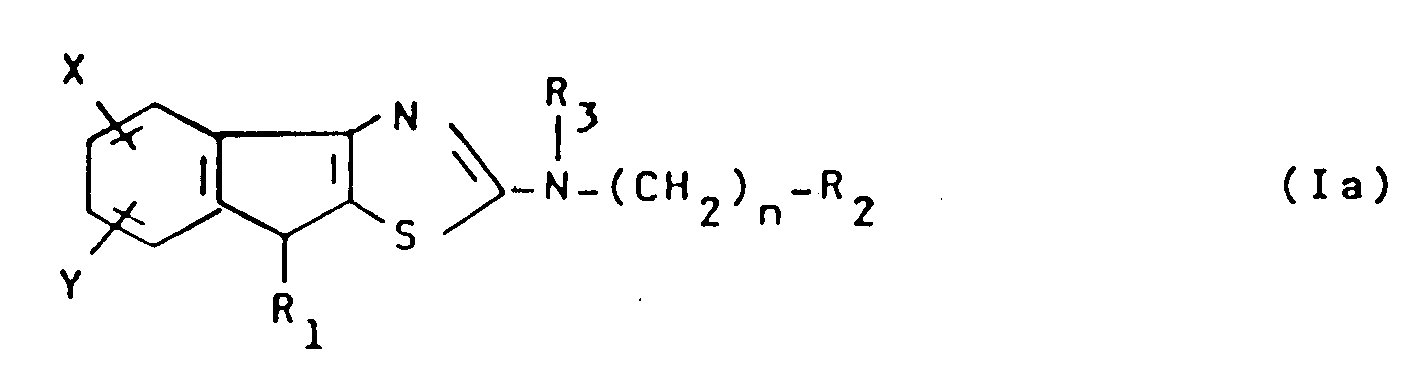
- the novel indenothiazole derivative is represented by the following formula: wherein X and Y are identical with, or different from, each other and are each a hydrogen atom, halogen atom, low alkyl group or low alkoxyl group; n is an integer of from 0 to 4; R1 is a hydrogen atom, low alkyl group or phenyl group; R2 is a low alkyl group, cyclohexyl group, low alkoxyl group, alkenyl group, phenyl group, phenyl group substituted by a halogen atom, hydroxyl group, low alkyl group, low alkoxyl group or trifluoromethyl group, heterocyclic group selected from the group consisting of a pyridyl group, pyridyl group mono-or di-substituted by one or two low alkyl groups and 2-thiazolyl group, or cycloamino group selected from the group consisting of a morpholino group, piperid
- tautomer is represented by the following formula: wherein X, Y, n, R1 and R2 are as defined above.
- the halogen atom means a fluorine, chlorine, bromine or iodine atom.
- the low alkyl group includes an alkyl group of 1 to 6 carbon atoms such as methyl, ethyl, n-propyl, iso-propyl, n-butyl, isobutyl, tert.-butyl, n-pentyl, iso-pentyl or n-hexyl group.
- the cycloalkyl group includes a cycloalkyl group having 3 to 7 carbon atoms such as cyclopropyl, cyclopentyl, cyclohexyl or cycloheptyl group.
- the low alcoxy group includes an alcoxy group having 1 to 6 carbon atoms such as methoxy, ethoxy, n-propoxy, iso-propoxy, n-butoxy, iso-butoxy or tert.-butoxy group.
- the substituent in the substituted phenyl or substituted phenoxy group includes a halogen atom, low alkyl group (this group may further contain mono- or di-C1 ⁇ 6 alkylamino group as a substituent), hydroxyl group, low alcoxy group or trifluoromethyl group.
- the alkenyl group includes an alkenyl group having 3 to 6 carbon atoms such as propenyl, butenyl or butadienyl group.
- a pyridyl group can be an ⁇ -pyridyl, ⁇ -pyridyl or ⁇ -pyridyl group.
- the acyl group includes an alkanoyl group of 2 to 6 carbon atoms such as acetyl, propionyl, n-butylyl or iso-butylyl group, benzoyl group or trifluoromethylcarbonyl group.
- the acid addition salt which is permissible as a medicine, comprises an acid of equivalent 1 or 2.
- the suitable acid may for example be an inorganic acid such as hydrochloric, sulfuric, nitric or phosphoric acid as well as an organic acid such as maleic, fumaric, oxalic, succinic, malonic, lactic or citric acid.
- the compounds represented by the aforesaid formulas (Ia) and (Ib) or their acid addition salts are used as a medicine, they may stably be orally or non-orally administered as they are or in the form of tablets, powders, capsules or suppositories prepared using a known vehicle as well as in the form of injections.
- the suitable dosage may be decided in view of a patient's symptoms, age, sex or the like.
- the starting or raw materials represented by the following formulas may be easily synthesized by the known processes disclosed in Journal of the American Chemical Society, 71, 1092 (1949), Journal of the American Chemical Society, 75, 640 (1953), Journal Fur Praktician Chemie, 315 , 144 (1973), Russian Chemical Reviews, 42 (7), 587 (1973), Journal of the Chemical Society, 2740 (1958) and so forth.
- a compound represented by the above formula (II) and a compound represented by the above formula (III) are reacted, for 1 to 24 hours at a temperature of 20 to 120°C, in any one of the organic solvents such as methanol, ethanol, aceton or dimethylformamide, so as to obtain a compound represented by the formula (Ia).
- the compound represented by the formula (Ia) in which R3 is hydrogen atom is treated in an aqueous solution of an acid, so as to obtain its tautomer, i.e. the compound represented by the formula (Ib).
- a compound represented by the formula (IV) is halogenated by reacting with a halogenating agent such as thionyl chloride or phosphorus oxychloride, for 1 to 5 hours at a temperature of 0 to 120°C, in the absence or presence of an aprotic solvent such as benzene or toluene. Thereafter, the thus obtained halogenated compound is reacted with an amine represented by the formula (VI) for 1 to 5 hours at a temperature of 20 to 100°C, in the absence or presence of an organic solvent such as methanol, ethanol or dimethylformamide, thereby to obtain the compound represented by the formula (Ia). Further, it is possible to obtain the tautomer (Ib) of the compound (Ia) in which R3 is a hydrogen atom by means of the aforesaid manufacturing process 1.
- a halogenating agent such as thionyl chloride or phosphorus oxychloride
- the compound so obtained also exhibited the following characteristics.
- test compounds each consisting of 9 to 10 Wistar-strained male rats, each weighing about 200 g, were used in the test after their abstinence from food and water for 24 hours.
- Each test compound of this invention was administered in an amount of 50 mg/kg and a comparative medicine, "Neuer” (tradename: produced by Daiichi Pharmaceutical Co., Ltd.; effective component: centraxate) in an amount of 300 mg/kg.
- a comparative medicine "Neuer” (tradename: produced by Daiichi Pharmaceutical Co., Ltd.; effective component: centraxate) in an amount of 300 mg/kg.
- Each of the test compounds was administered orally to each rat of a first group and the comparative medicine to each rat of a second group one hour before oral administration of 1 ml of pure ethanol per rat.
- each rat was sacrificed by exsanguination and its stomach was enucleated and fixed with 10 ml of 70% ethanol for about 30 minutes.
- a 0.5% tragacanth solution was administered to each rat of a third group.
- the ulcer was measured for length with naked eyes, and the test groups of rats were measured for their respective ulcer inhibition ratios in comparison with that for the third group.
- test compounds and the comparative medicine were each suspended or dissolved in a 0.5% tragacanth gum saline solution for use in the test.
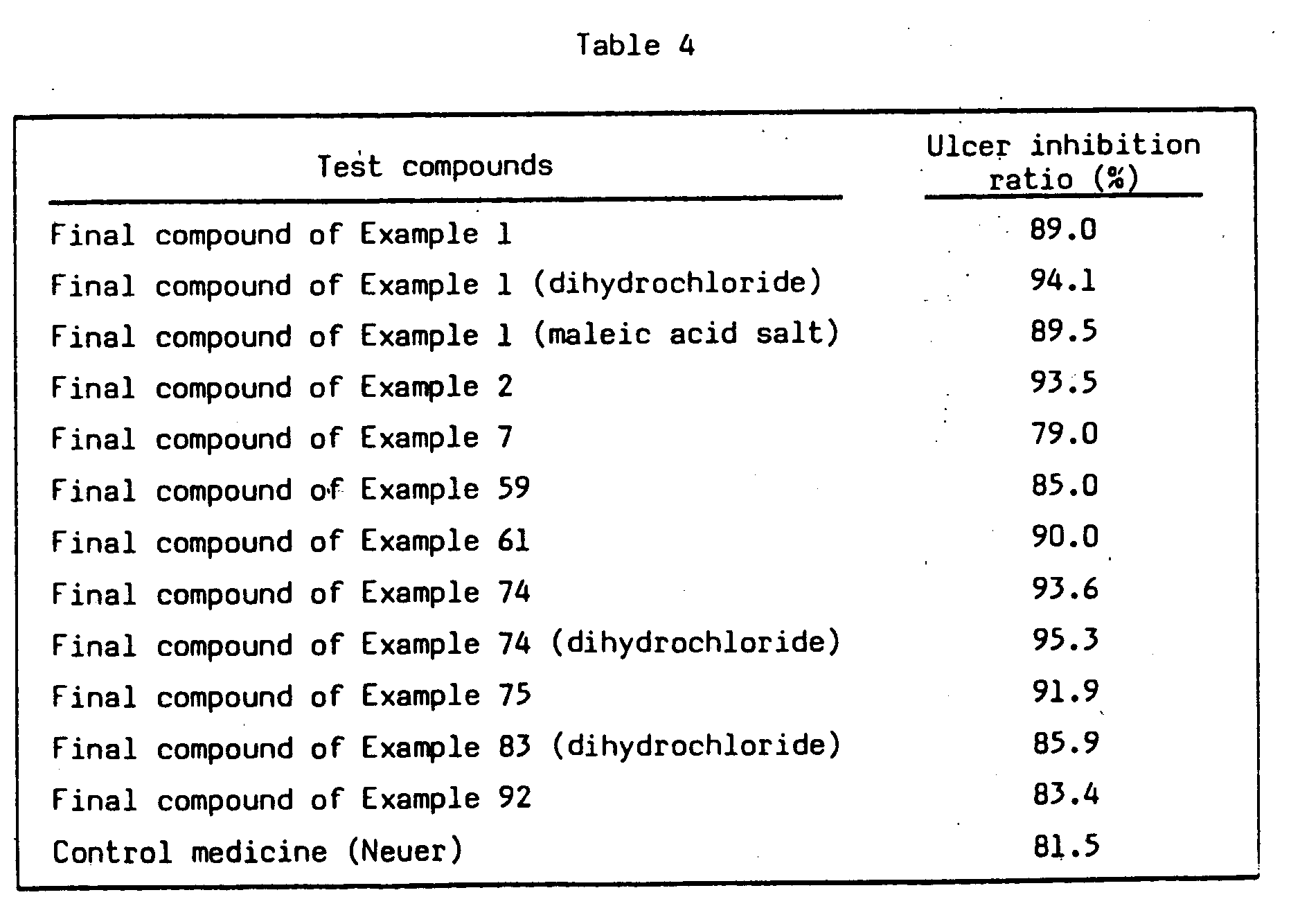
- Table 4 shows the ulcer inhibition ratios obtained by the use of each of the test compounds and the comparative medicine in comparison with that obtained by the use of the control solution.
- mice each consisting of five Wistar-strained male rats, each weighing about 150 g, were used in the test. After each of said test compounds was suspended in a physiological saline water, the suspension was orally or abdominally administered to each of the test rats. The rats so administered had been observed for 8 days to find a lethal dose (LD50) with the result that the LD50 of each test compound was at least 1000 mg/kg when orally administered and at least 300 mg/kg when abdominally administered.
- LD50 lethal dose
Landscapes
- Chemical & Material Sciences (AREA)
- Organic Chemistry (AREA)
- Health & Medical Sciences (AREA)
- Chemical Kinetics & Catalysis (AREA)
- Life Sciences & Earth Sciences (AREA)
- General Chemical & Material Sciences (AREA)
- Medicinal Chemistry (AREA)
- Nuclear Medicine, Radiotherapy & Molecular Imaging (AREA)
- Bioinformatics & Cheminformatics (AREA)
- Pharmacology & Pharmacy (AREA)
- Engineering & Computer Science (AREA)
- Animal Behavior & Ethology (AREA)
- General Health & Medical Sciences (AREA)
- Public Health (AREA)
- Veterinary Medicine (AREA)
- Pharmaceuticals Containing Other Organic And Inorganic Compounds (AREA)
- Plural Heterocyclic Compounds (AREA)
- Thiazole And Isothizaole Compounds (AREA)
- Nitrogen And Oxygen Or Sulfur-Condensed Heterocyclic Ring Systems (AREA)
Abstract
Description
- This invention relates to a novel indenothiazole derivative useful as a medicine having an excellent antiulcerative effect, and a process for preparing the same.
- With regard to indenothiazole derivative, a process for manufacturing a 2-amino indenothiazole derivative is disclosed in Journal of the American Chemical Society, 72, 3722 (1950) and Journal of the Chemical Society 2740 (1958). Further, a process for manufacturing a 2-aminoacyl indenothiazole derivative and its potential as a medicine for curing allergic diseases are disclosed in Japanese Patent Appln. Laid-Open Gazette No. 58-55474. However, the indenothiazole derivative of this invention is neither disclosed nor suggested in any one of the aforesaid publications. Further, whether its tautomer exists is not known at all. Still further, it is of course unknown whether the indenothiazole derivative has an antiulcerative effect.
- The medical treatment of digestive ulcer seeks to restrain the attack factor and strengthen the defense factor. In recent years, in order to restrain the attack factor, a histamine H₂-antagonist such as cimetidine, ranitidine or famotidine plays the main role as a remedial medicine for ulcer. Nevertheless, the problem of relapse of ulcer remains unsolved. Further, omeprazole serving as an ATPase inhibitor (or a proton pump inhibitor) restrains acid secretion and has a high selectivity of internal organs. It has a stable effect over a long period but has a problem as to its side effects.
- As for reinforcing agents for the defense factor, there are plenty of medicines which have the actions of strengthening of mucous membrane resistance, promoting mucus secretion, improving minute circulations and promoting prostagrandine synthesis. Although these medicines have so minor side effects that they are safely used, they are still not appreciated to be enough efficacious.
- It is an object of this invention to provide a novel indenothiazole derivative, a tautomer thereof or their acid addition salt, which is a useful medicine having an excellent antiulcerative effect with no side actions.
- It is another object to provide a process for preparing the novel indenothiazole derivative, the tautomer thereof or their acid addition salt.
- The novel indenothiazole derivative is represented by the following formula:
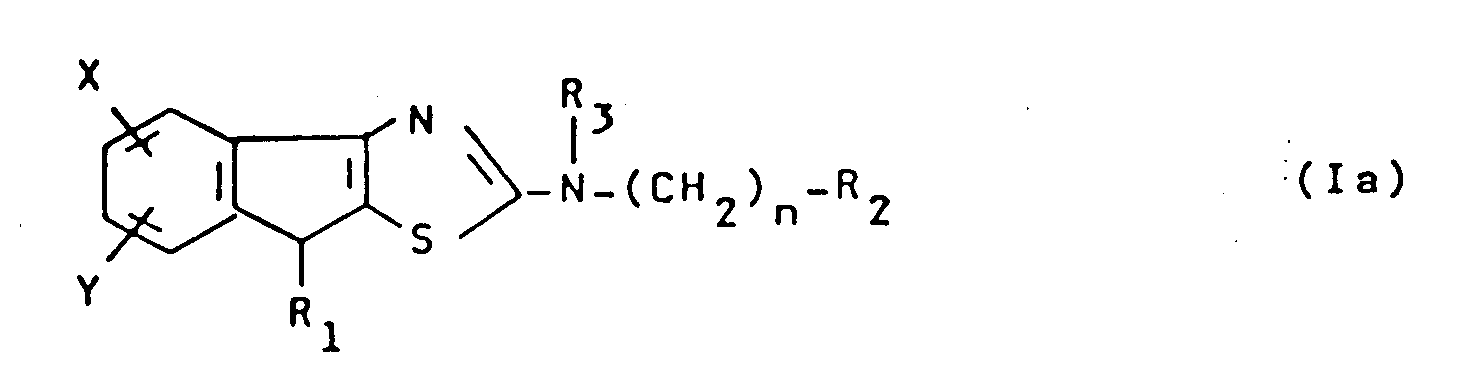
wherein X and Y are identical with, or different from, each other and are each a hydrogen atom, halogen atom, low alkyl group or low alkoxyl group; n is an integer of from 0 to 4; R₁ is a hydrogen atom, low alkyl group or phenyl group; R₂ is a low alkyl group, cyclohexyl group, low alkoxyl group, alkenyl group, phenyl group, phenyl group substituted by a halogen atom, hydroxyl group, low alkyl group, low alkoxyl group or trifluoromethyl group, heterocyclic group selected from the group consisting of a pyridyl group, pyridyl group mono-or di-substituted by one or two low alkyl groups and 2-thiazolyl group, or cycloamino group selected from the group consisting of a morpholino group, piperidino group, pyrrolidino group, piperazino group N-substituted by a low alkyl group and piperidino group substituted by a low alkyl group; R₃ is a hydrogen atom, low alkyl group, acetyl group or trifluoromethylcarbonyl group; and R₂ and R₃ may be combined to form a cycloamino group selected from the group consisting of a pyrrolidino group, piperidino group, morpholino group and piperidino group di-substituted by two low alkyl groups. - Further, the tautomer is represented by the following formula:

wherein X, Y, n, R₁ and R₂ are as defined above. - The compounds of the aforesaid formulas (Ia) and (Ib) are described hereinafter in more detail.
- The halogen atom means a fluorine, chlorine, bromine or iodine atom. The low alkyl group includes an alkyl group of 1 to 6 carbon atoms such as methyl, ethyl, n-propyl, iso-propyl, n-butyl, isobutyl, tert.-butyl, n-pentyl, iso-pentyl or n-hexyl group.
- The cycloalkyl group includes a cycloalkyl group having 3 to 7 carbon atoms such as cyclopropyl, cyclopentyl, cyclohexyl or cycloheptyl group.
- The low alcoxy group includes an alcoxy group having 1 to 6 carbon atoms such as methoxy, ethoxy, n-propoxy, iso-propoxy, n-butoxy, iso-butoxy or tert.-butoxy group.
- The substituent in the substituted phenyl or substituted phenoxy group includes a halogen atom, low alkyl group (this group may further contain mono- or di-C₁₋₆ alkylamino group as a substituent), hydroxyl group, low alcoxy group or trifluoromethyl group.
- The alkenyl group includes an alkenyl group having 3 to 6 carbon atoms such as propenyl, butenyl or butadienyl group.
- A pyridyl group can be an α-pyridyl, β-pyridyl or γ-pyridyl group.
- The acyl group includes an alkanoyl group of 2 to 6 carbon atoms such as acetyl, propionyl, n-butylyl or iso-butylyl group, benzoyl group or trifluoromethylcarbonyl group.
- The acid addition salt, which is permissible as a medicine, comprises an acid of equivalent 1 or 2. The suitable acid may for example be an inorganic acid such as hydrochloric, sulfuric, nitric or phosphoric acid as well as an organic acid such as maleic, fumaric, oxalic, succinic, malonic, lactic or citric acid.
- In cases where the compounds represented by the aforesaid formulas (Ia) and (Ib) or their acid addition salts are used as a medicine, they may stably be orally or non-orally administered as they are or in the form of tablets, powders, capsules or suppositories prepared using a known vehicle as well as in the form of injections. The suitable dosage may be decided in view of a patient's symptoms, age, sex or the like. In cases where they are orally dosed as a medicine to cure gastric ulcer, duodenal ulcer or acute or chronic gastritis, it is desirable to dose the compound represented by the aforesaid formulas (Ia) or (Ib) or its acid addition salt in an amount of about 1 to 200 mg/kg at a time, about once or three times per day.
- The process of manufacturing the compounds of this invention will be described hereinafter. The present compounds may be obtained in a good yield as indicated by the following embodiments, but this invention is not limited to them.
- The starting or raw materials represented by the following formulas may be easily synthesized by the known processes disclosed in Journal of the American Chemical Society, 71, 1092 (1949), Journal of the American Chemical Society, 75, 640 (1953), Journal Fur Praktische Chemie, 315, 144 (1973), Russian Chemical Reviews, 42 (7), 587 (1973), Journal of the Chemical Society, 2740 (1958) and so forth.
-

(Wherein X, Y, n, R₁, R₂ and R₃ respectively have the same meaning as previously defined.) - As indicated above, a compound represented by the above formula (II) and a compound represented by the above formula (III) are reacted, for 1 to 24 hours at a temperature of 20 to 120°C, in any one of the organic solvents such as methanol, ethanol, aceton or dimethylformamide, so as to obtain a compound represented by the formula (Ia). Further, the compound represented by the formula (Ia) in which R₃ is hydrogen atom is treated in an aqueous solution of an acid, so as to obtain its tautomer, i.e. the compound represented by the formula (Ib).
-
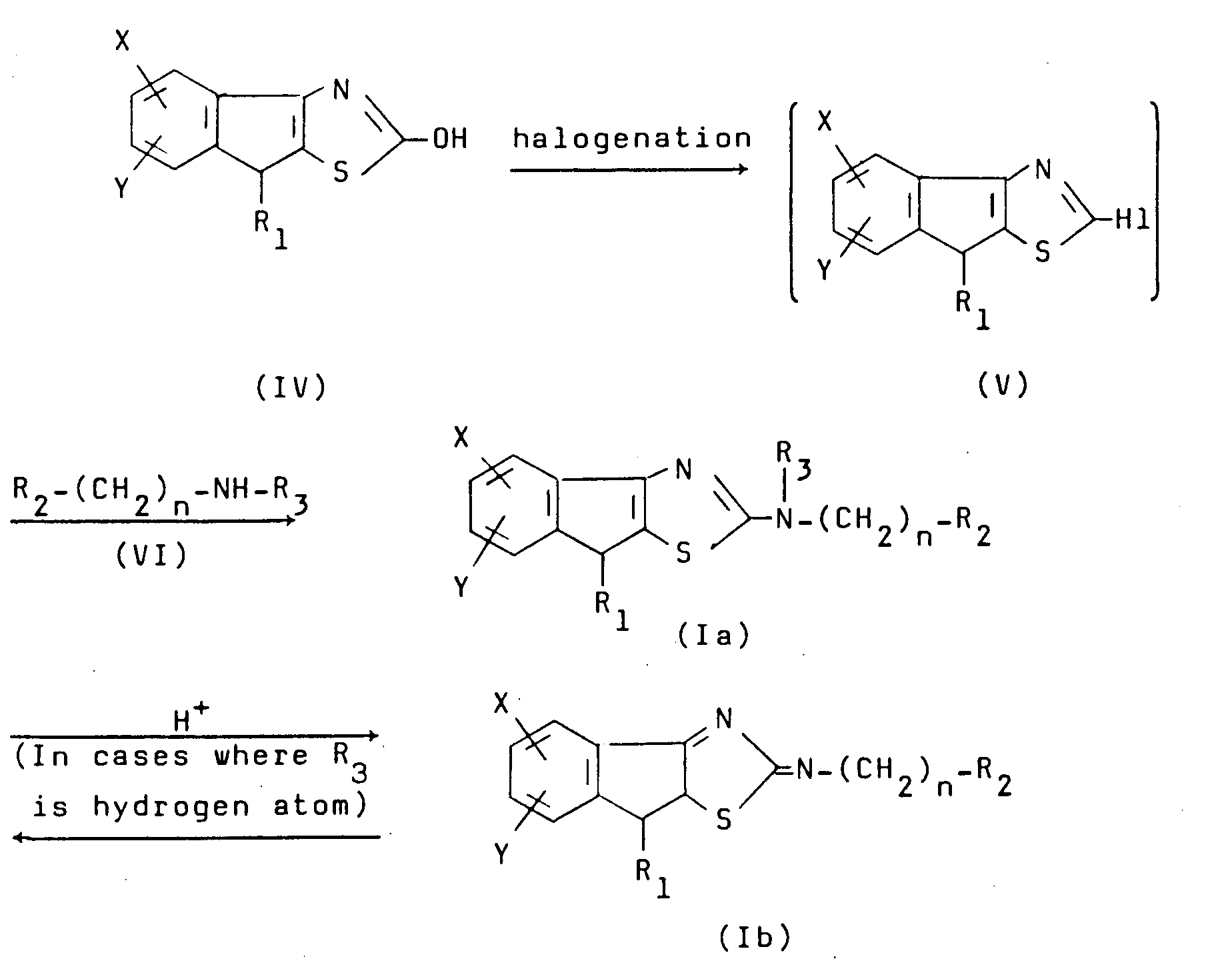
(Wherein X, Y, n, R₁, R₂ and R₃ respectively have the same meaning as described above; and Hl is a halogen atom.) - First, a compound represented by the formula (IV) is halogenated by reacting with a halogenating agent such as thionyl chloride or phosphorus oxychloride, for 1 to 5 hours at a temperature of 0 to 120°C, in the absence or presence of an aprotic solvent such as benzene or toluene. Thereafter, the thus obtained halogenated compound is reacted with an amine represented by the formula (VI) for 1 to 5 hours at a temperature of 20 to 100°C, in the absence or presence of an organic solvent such as methanol, ethanol or dimethylformamide, thereby to obtain the compound represented by the formula (Ia). Further, it is possible to obtain the tautomer (Ib) of the compound (Ia) in which R₃ is a hydrogen atom by means of the aforesaid manufacturing process 1.
- Examples of this invention are described hereinafter, but this invention is not limited to them.
- 3.5 g of 2-bromo-5-fluoro-1-indanone and 3.1 g of N-(3-morpholinopropyl) thiourea were added to 40 ml of ethanol. The resulting mixture was refluxed for 10 minutes, agitated for 24 hours at room temperature to precipitate crystals which were collected by filtration. The thus collected crystals were washed with ethanol, dried, incorporated with 40 ml of a 5% aqueous solution of NaOH, extracted with ethyl acetate, washed with water, dried, distilled at a reduced pressure and then recrystallized from ethyl acetate-isopropyl ether thereby to obtain 3.9 g of 2-(3-morpholinopropyl) amino-6-fluoro-8H-indeno[1.2-d] thiazole. The thus obtained compound had a melting point of 113 to 115 °C and the following analysis.
- Analysis: C₁₇H₂₀N₃OFS
Calculated: C: 61.24 H: 6.04 N:12.60
Found: C: 61.00 H: 6.04 N: 12.47 - 3.0 g of 2-(3-morpholinopropyl) amino-6-fluoro-8H-indeno[1.2-d] thiazole were dissolved in 50 ml of 0.1N HCl, allowed to stand for three days at room temperature, made weakly alkaline with a 5% KOH aqueous solution, extracted with chloroform, water washed, dried, distilled at a reduced pressure to remove the solvent, and then isolated and purified by silica gel column chromatography in which a developing solvent consisting of chloroform, methanol and ammonia water in a ratio of 10:1:0.1 was used, thereby to obtain 1.0 g of a tautomer having the following formula:
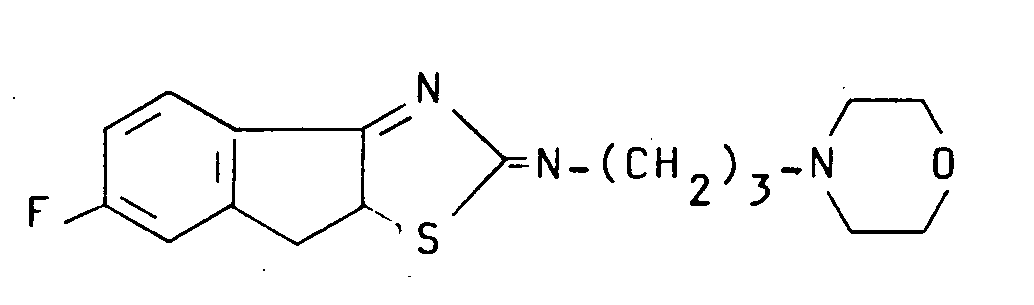
- The compound so obtained also exhibited the following characteristics.
- Infrared rays absorption spectra [KBr method, cm⁻¹]
3270, 1600, 1485, 1250, 1115, 1065, 860, 755 - Nuclear magnetic resonance spectra (DMSOd6, δ value, ppm)
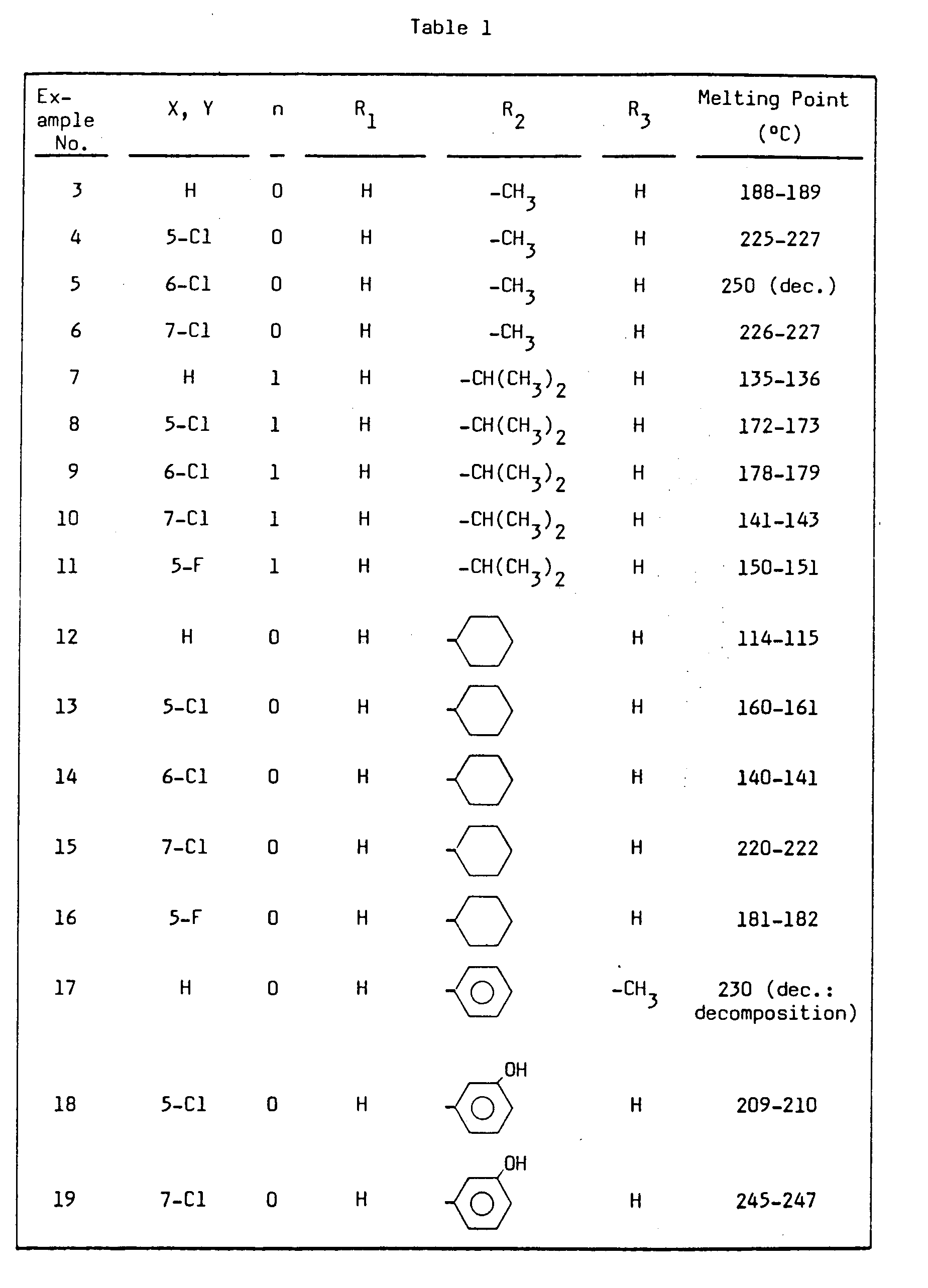
1.59 (q, 2H), 2.24 (t, 4H), 2.28 (t, 2H), 2.83 and 3.50 (dd, 2H), 3.13 (t, 2H), 3.54 (t, 4H), 4.15 (dd, 1H), 6.98 (dd, 1H), 7.03 (td, 1H), 7.35 (dd, 1H) - The compounds represented by the formula (Ia) were prepared in the same manner as in Example 1 (Examples 3 to 122). The substituents in the compounds and the melting points of the compounds are shown in Tables 1 and 2.
- The compounds represented by the formula (Ib) were prepared in the same manner as in Example 2 (Examples 123 to 129). The substituents in the compounds and the results of infrared spectrography are shown in Table 3.
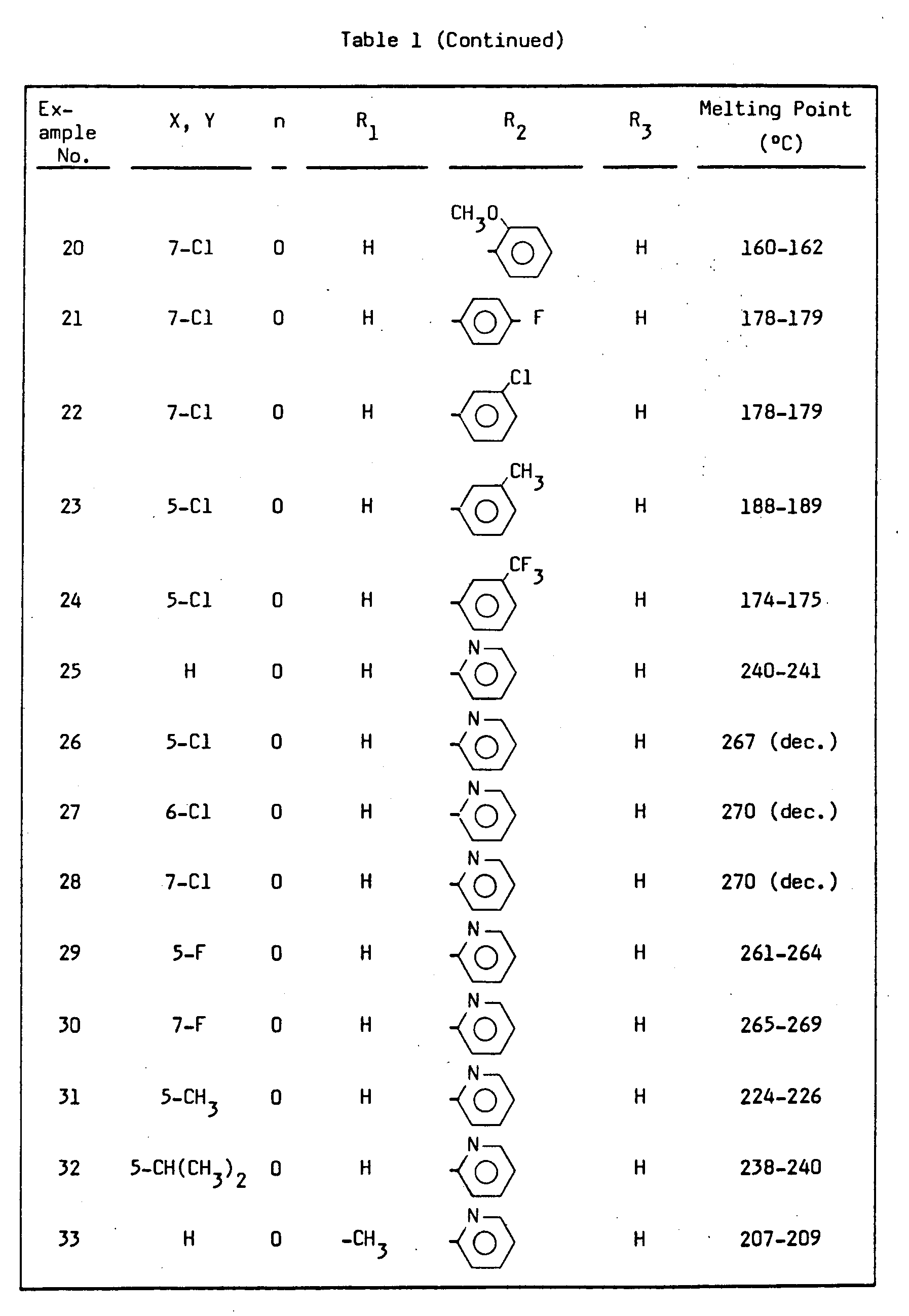


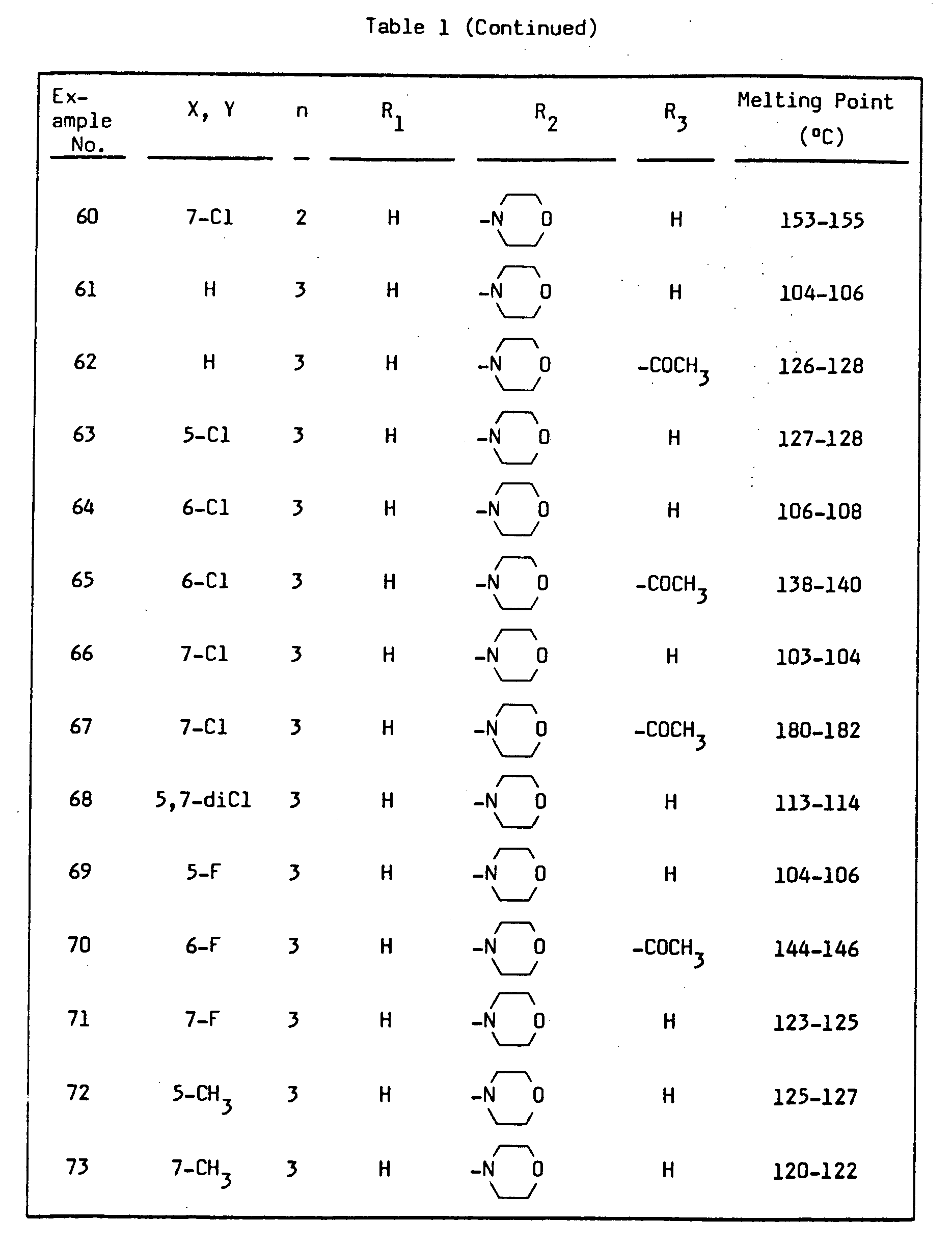

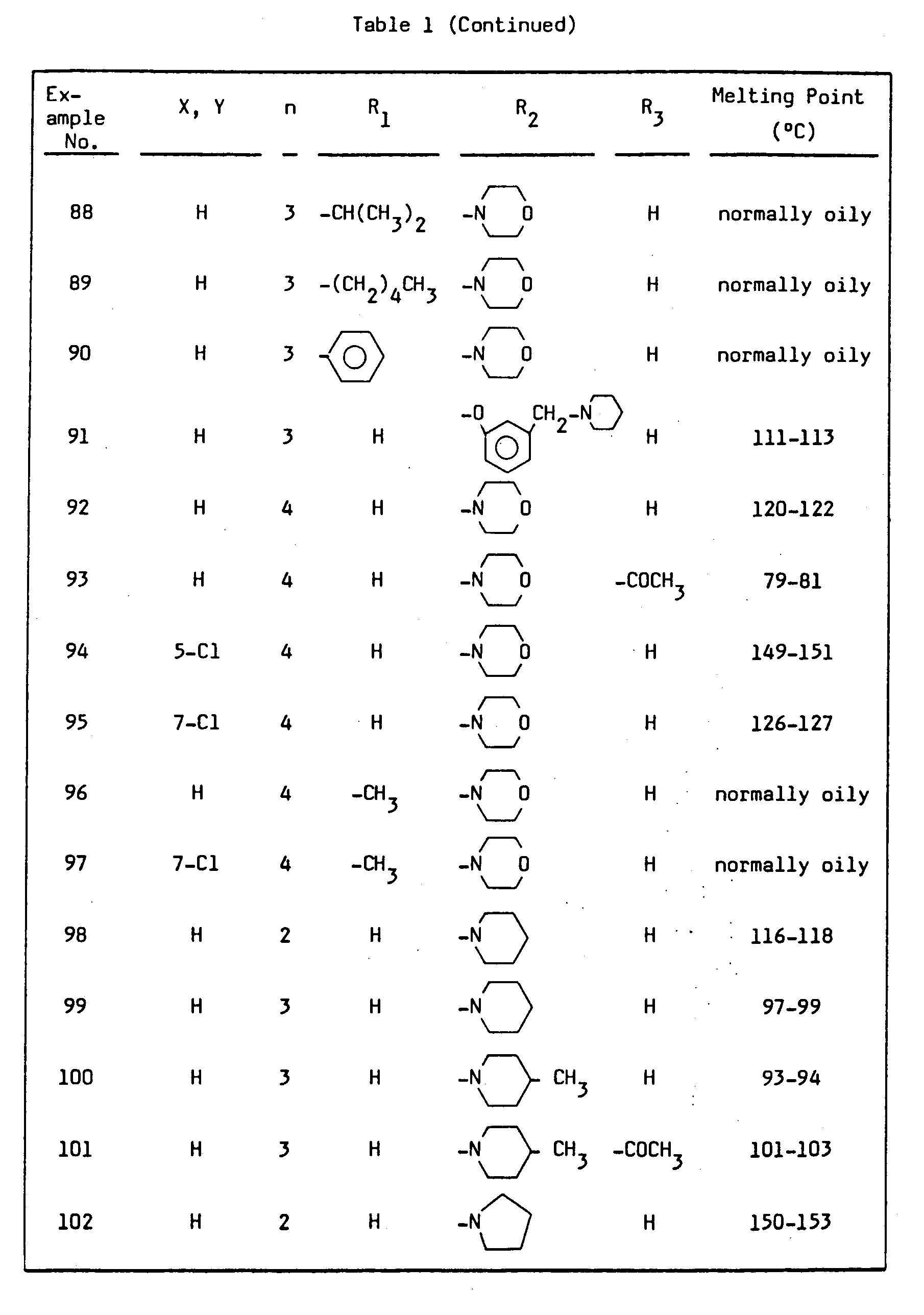


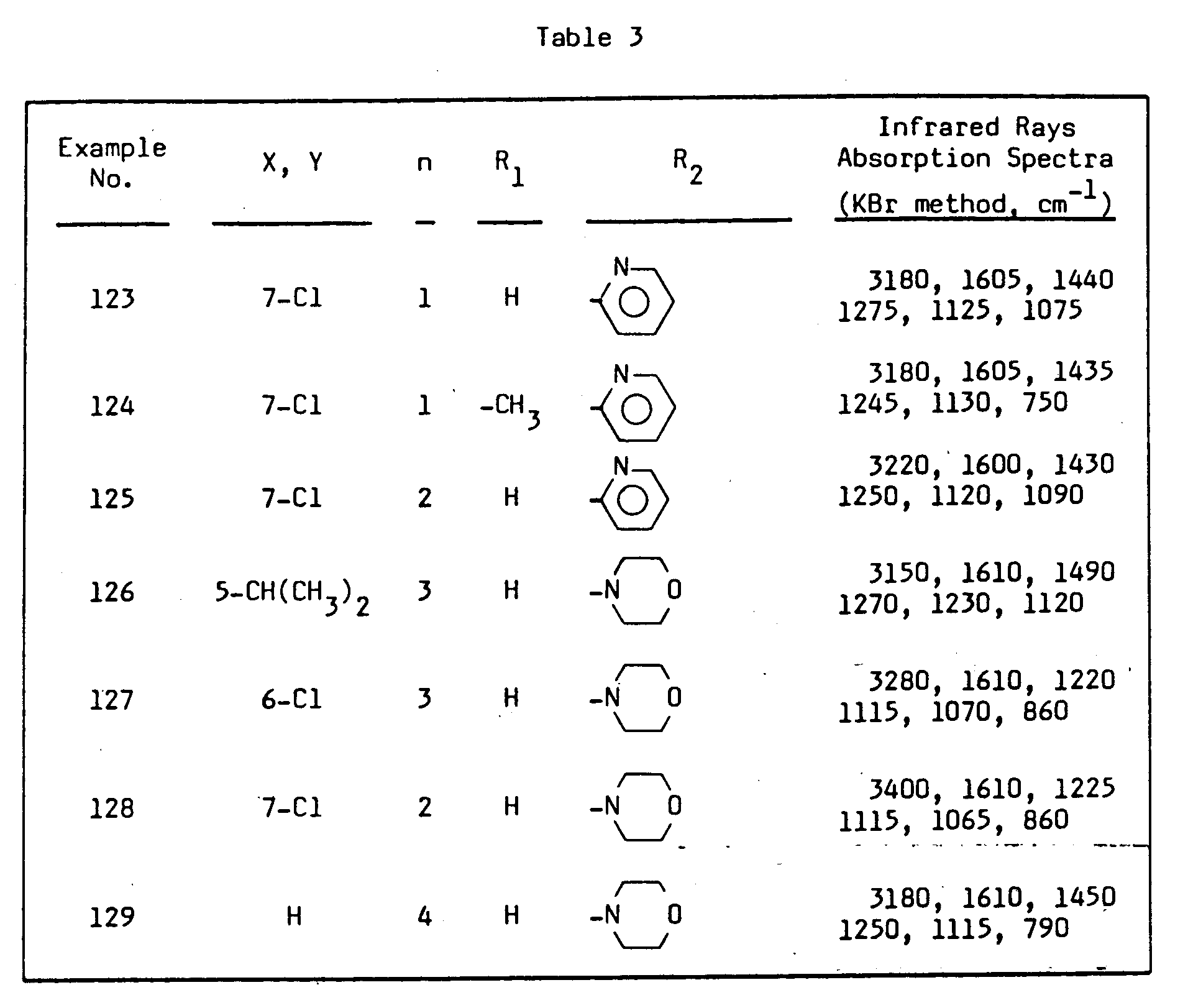
- Groups each consisting of 9 to 10 Wistar-strained male rats, each weighing about 200 g, were used in the test after their abstinence from food and water for 24 hours. Each test compound of this invention was administered in an amount of 50 mg/kg and a comparative medicine, "Neuer" (tradename: produced by Daiichi Pharmaceutical Co., Ltd.; effective component: centraxate) in an amount of 300 mg/kg. Each of the test compounds was administered orally to each rat of a first group and the comparative medicine to each rat of a second group one hour before oral administration of 1 ml of pure ethanol per rat. One hour later, each rat was sacrificed by exsanguination and its stomach was enucleated and fixed with 10 ml of 70% ethanol for about 30 minutes. A 0.5% tragacanth solution was administered to each rat of a third group. The ulcer was measured for length with naked eyes, and the test groups of rats were measured for their respective ulcer inhibition ratios in comparison with that for the third group.
- Both the test compounds and the comparative medicine were each suspended or dissolved in a 0.5% tragacanth gum saline solution for use in the test. Table 4 shows the ulcer inhibition ratios obtained by the use of each of the test compounds and the comparative medicine in comparison with that obtained by the use of the control solution.

- Groups each consisting of five Wistar-strained male rats, each weighing about 150 g, were used in the test. After each of said test compounds was suspended in a physiological saline water, the suspension was orally or abdominally administered to each of the test rats. The rats so administered had been observed for 8 days to find a lethal dose (LD₅₀) with the result that the LD₅₀ of each test compound was at least 1000 mg/kg when orally administered and at least 300 mg/kg when abdominally administered.
- From the results of the aforesaid pharmacological tests for acute toxicity, it has been found that the compounds (Ia) and (Ib) of this invention and their acid addition salts have safe and remarkable antiulcerative effects with no side effects. Accordingly, when they are used for the medical treatment, prophylaxis and relapse prevention of ulcer, they will be appreciated to be enough efficacious as medicines.
Claims (8)
- An indenothiazole derivative represented by the following formula:
- An indenothiazole derivative represented by the following formula:

- An indenothiazole derivative according to claim 1, in which said indenothiazole derivative of the formula (Ia) is in the form of an acid addition salt.
- An indenothiazole derivative according to claim 2 in which said indenothiazole derivative of the formula (Ib) is in the form of an acid addition salt.
- An indenothiazole derivative according to claim 1, in which said halogen atom is fluorine, chlorine, bromine or iodine.
- An indenothiazole derivative according to claim 1, in which said heterocyclic group is β-pyridyl group, γ-pyridyl group or 2-thiazolyl group.
- An indenothiazole derivative according to claim 1 represented by the formula:

- A process for preparing an indenothiazole derivative of the formula (Ia), comprising reacting a compound of the following formula (II) with a compound of the following formula (III) for 1 to 24 hours at a temperature of 20 to 120°C, to prepare the indenothiazole derivative:

Priority Applications (1)
| Application Number | Priority Date | Filing Date | Title |
|---|---|---|---|
| AT87200041T ATE75737T1 (en) | 1986-01-16 | 1987-01-14 | INDENOTHIAZOLE DERIVATIVES AND PROCESS FOR THEIR PRODUCTION. |
Applications Claiming Priority (2)
| Application Number | Priority Date | Filing Date | Title |
|---|---|---|---|
| JP764086 | 1986-01-16 | ||
| JP7640/86 | 1986-01-16 |
Publications (2)
| Publication Number | Publication Date |
|---|---|
| EP0230334A1 EP0230334A1 (en) | 1987-07-29 |
| EP0230334B1 true EP0230334B1 (en) | 1992-05-06 |
Family
ID=11671425
Family Applications (1)
| Application Number | Title | Priority Date | Filing Date |
|---|---|---|---|
| EP87200041A Expired - Lifetime EP0230334B1 (en) | 1986-01-16 | 1987-01-14 | A indenothiazole derivative and process for preparing the same |
Country Status (12)
| Country | Link |
|---|---|
| US (1) | US4877876A (en) |
| EP (1) | EP0230334B1 (en) |
| JP (1) | JPH0667919B2 (en) |
| KR (1) | KR900003368B1 (en) |
| CN (1) | CN87100171A (en) |
| AT (1) | ATE75737T1 (en) |
| AU (1) | AU598229B2 (en) |
| CA (1) | CA1292226C (en) |
| DE (1) | DE3778714D1 (en) |
| ES (1) | ES2038166T3 (en) |
| SU (1) | SU1609449A3 (en) |
| WO (1) | WO1987004434A1 (en) |
Families Citing this family (15)
| Publication number | Priority date | Publication date | Assignee | Title |
|---|---|---|---|---|
| CA2074933C (en) * | 1990-11-30 | 2002-12-03 | Masatoshi Chihiro | Thiazole derivatives as active superoxide radical inhibitors |
| MX9603998A (en) * | 1994-03-11 | 1997-12-31 | Yamanouchi Pharma Co Ltd | 5-ht3 receptor agonist, novel thiazole derivative, and intermediate therefor. |
| TW416953B (en) | 1996-09-25 | 2001-01-01 | Takeda Chemical Industries Ltd | Tricyclic compounds for eliciting a prostaglandin I2 receptor agonistic effect, their production and use |
| DE19844547C2 (en) * | 1998-09-29 | 2002-11-07 | Aventis Pharma Gmbh | Polycyclic dihydrothiazoles, process for their preparation and their use as medicines |
| DE19908538A1 (en) * | 1999-02-26 | 2000-08-31 | Aventis Pharma Gmbh | Polycyclic 2-amino-thiazole systems, processes for their preparation and medicaments containing these compounds |
| DE19908537A1 (en) * | 1999-02-26 | 2000-08-31 | Aventis Pharma Gmbh | Use of polycyclic 2-amino-thiazole systems for the preparation of medicaments for the prophylaxis or treatment of obesity |
| ATE255559T1 (en) | 1999-05-10 | 2003-12-15 | Warner Lambert Co | AROMATIC AMIDES |
| RU2252219C2 (en) * | 1999-11-05 | 2005-05-20 | Авентис Фарма Дойчланд Гмбх | Indeno-, naphtho-, and benzocycloheptadihydrothiazole derivatives, production thereof and uses as anorexia pharmaceuticals |
| DE10008274A1 (en) * | 2000-02-23 | 2001-08-30 | Aventis Pharma Gmbh | Substituted 8,8a-dihydro-3aH-indeno [1,2-d] thiazoles, process for their preparation and their use as medicaments |
| HRP20020688A2 (en) * | 2000-02-23 | 2004-12-31 | Aventis Pharma Gmbh | 8,8a-dihydro-indeno[1,2-d]thiazole derivatives, substituted in position 8a, a method for their production and their use as medicaments, e.g. anorectic agents |
| DE50100558D1 (en) * | 2000-02-26 | 2003-10-02 | Aventis Pharma Gmbh | 8,8A-DIHYDRO-INDENO 1,2-D] THIAZOLE DERIVATIVES CARRYING IN THE 2-POSITION OF A SUBSTITUENT WITH A SULFONAMIDE STRUCTURE OR SULPHONE STRUCTURE; PROCESS FOR THEIR PRODUCTION AND THEIR USE AS MEDICINAL PRODUCTS |
| US7732484B2 (en) * | 2000-08-01 | 2010-06-08 | University Of Virginia Patent Foundation | Use of selective adenosine A1 receptor allosteric enhancers to manipulate angiogenesis |
| EP1583530A4 (en) * | 2002-01-16 | 2008-07-23 | Univ Virginia | ALLOSTERIC ACTIVATORS 2-AMINOTHIAZOLES FROM ADENOSINE A1 RECEPTORS |
| NZ552650A (en) * | 2004-08-05 | 2010-09-30 | Hoffmann La Roche | Substituted N-acyl-2-aminothiazoles |
| TWI402261B (en) * | 2006-06-19 | 2013-07-21 | Takeda Pharmaceutical | Tricyclic compound and pharmaceutical use thereof |
Family Cites Families (4)
| Publication number | Priority date | Publication date | Assignee | Title |
|---|---|---|---|---|
| US4082773A (en) * | 1972-07-03 | 1978-04-04 | E. R. Squibb & Sons, Inc. | Tricyclic tetrahydro naphthaleneols and related compounds |
| US4321372A (en) * | 1980-06-16 | 1982-03-23 | Pfizer Inc. | Antiulcer thiazol-2-ylcarbamoyl-carboxylic acids, esters and amides |
| DE3027528A1 (en) * | 1980-07-19 | 1982-02-18 | Basf Ag, 6700 Ludwigshafen | BRIDGED THIAZOLYLOXAMID ACID DERIVATIVES, METHOD FOR THE PRODUCTION THEREOF AND THERAPEUTIC AGENTS CONTAINING THEM |
| DE3135250A1 (en) * | 1981-09-05 | 1983-03-17 | Basf Ag, 6700 Ludwigshafen | TRICYCLIC THIAZOLYLOXAMATES, METHOD FOR THE PRODUCTION THEREOF AND THERAPEUTIC AGENTS CONTAINING THEM |
-
1987
- 1987-01-13 CA CA000527229A patent/CA1292226C/en not_active Expired - Fee Related
- 1987-01-14 KR KR1019870700826A patent/KR900003368B1/en not_active Expired
- 1987-01-14 WO PCT/JP1987/000021 patent/WO1987004434A1/en not_active Ceased
- 1987-01-14 AT AT87200041T patent/ATE75737T1/en not_active IP Right Cessation
- 1987-01-14 ES ES198787200041T patent/ES2038166T3/en not_active Expired - Lifetime
- 1987-01-14 JP JP62006820A patent/JPH0667919B2/en not_active Expired - Lifetime
- 1987-01-14 EP EP87200041A patent/EP0230334B1/en not_active Expired - Lifetime
- 1987-01-14 AU AU68420/87A patent/AU598229B2/en not_active Ceased
- 1987-01-14 US US07/107,600 patent/US4877876A/en not_active Expired - Fee Related
- 1987-01-14 DE DE8787200041T patent/DE3778714D1/en not_active Expired - Fee Related
- 1987-01-15 CN CN198787100171A patent/CN87100171A/en active Pending
- 1987-09-15 SU SU874203319A patent/SU1609449A3/en active
Also Published As
| Publication number | Publication date |
|---|---|
| US4877876A (en) | 1989-10-31 |
| JPS62252780A (en) | 1987-11-04 |
| SU1609449A3 (en) | 1990-11-23 |
| JPH0667919B2 (en) | 1994-08-31 |
| DE3778714D1 (en) | 1992-06-11 |
| KR900003368B1 (en) | 1990-05-16 |
| AU598229B2 (en) | 1990-06-21 |
| CA1292226C (en) | 1991-11-19 |
| ATE75737T1 (en) | 1992-05-15 |
| AU6842087A (en) | 1987-08-14 |
| ES2038166T3 (en) | 1993-07-16 |
| EP0230334A1 (en) | 1987-07-29 |
| WO1987004434A1 (en) | 1987-07-30 |
| KR880700798A (en) | 1988-04-12 |
| CN87100171A (en) | 1988-01-20 |
Similar Documents
| Publication | Publication Date | Title |
|---|---|---|
| US3763156A (en) | 2-heterocyclic amino-4-morpholinothieno(3,2-d)pyrimidines | |
| US4714762A (en) | Antiarteriosclerotic substituted benzimidazol-2-yl-and 3H-imidazo[4,5-b]pyridin-2-yl-phenoxy-alkanoic acids and salts and esters thereof | |
| EP0230334A1 (en) | A indenothiazole derivative and process for preparing the same | |
| US3282938A (en) | 3-tertiary aminoloweralkyl-4-lower alkyl or phenyl-7-lower carbalkoxy lower alkyl or carboxy lower alkyl coumarins | |
| CY1446A (en) | Chemical compounds derived from cyclobutene | |
| CH678427A5 (en) | ||
| US4284768A (en) | 1,2-Dihydro-4-amino-2-oxo-3-quinoline-carboxylic acid derivatives | |
| US3169966A (en) | Aminopyrazoles | |
| EP0261478B1 (en) | 4,5-dihydro-oxazole derivatives, process for their preparation and their use | |
| EP0077534B1 (en) | Benzamide derivatives, a process for preparing the same, and pharmaceutical compositions containing the same | |
| US4260610A (en) | Disubstituted piperazines | |
| SU858570A3 (en) | Method of preparing derivatives of 3-(tetrazol-5-yl)-1-azaxanthone or their salts | |
| JPS6094972A (en) | Quinazoline derivative, manufacture and medicine | |
| IE912261A1 (en) | New oxazolopyridine compounds, process for preparing these¹and pharmaceutical compositons containing them | |
| US4929616A (en) | Novel basic-substituted 5-halo-thienoisothiazol-3(2H)-one 1,1-dioxides, a process for the preparation thereof, and pharmaceutical preparations containing these compounds | |
| US4728655A (en) | Sulfonamidines, process for the production thereof and pharmaceutical compositions containing the same | |
| US4112092A (en) | 1-Naphthylmethyl-4-(thiazolyl-2)-piperazines | |
| US4164579A (en) | Hydroxythiazolidine-2-thiones | |
| DE69223422T2 (en) | BENZOTHIADIAZINE DERIVATIVES | |
| EP0039919A1 (en) | Benzoxazole and benzothiazole derivatives with anti-allergic activity | |
| EP0027957A1 (en) | 2-Amino-4-(4-benzyloxyphenyl)thiazoles, their production and pharmaceutical compositions containing them | |
| US4772704A (en) | 2,5-disubstituted-4(3H)-pyrimidones having histamine H2 -receptor antagonist activity | |
| KR850001040B1 (en) | Process for preparing allophanoylpiperazine compounds | |
| US5190960A (en) | Medicinal oxazolopyridine compounds | |
| JPS60208971A (en) | Novel oxazole derivative |
Legal Events
| Date | Code | Title | Description |
|---|---|---|---|
| PUAI | Public reference made under article 153(3) epc to a published international application that has entered the european phase |
Free format text: ORIGINAL CODE: 0009012 |
|
| 17P | Request for examination filed |
Effective date: 19870114 |
|
| AK | Designated contracting states |
Kind code of ref document: A1 Designated state(s): AT BE CH DE ES FR GB GR IT LI LU NL SE |
|
| 17Q | First examination report despatched |
Effective date: 19890202 |
|
| GRAA | (expected) grant |
Free format text: ORIGINAL CODE: 0009210 |
|
| AK | Designated contracting states |
Kind code of ref document: B1 Designated state(s): AT BE CH DE ES FR GB GR IT LI LU NL SE |
|
| PG25 | Lapsed in a contracting state [announced via postgrant information from national office to epo] |
Ref country code: SE Effective date: 19920506 Ref country code: NL Effective date: 19920506 Ref country code: GR Free format text: LAPSE BECAUSE OF FAILURE TO SUBMIT A TRANSLATION OF THE DESCRIPTION OR TO PAY THE FEE WITHIN THE PRESCRIBED TIME-LIMIT Effective date: 19920506 Ref country code: BE Effective date: 19920506 Ref country code: AT Effective date: 19920506 |
|
| REF | Corresponds to: |
Ref document number: 75737 Country of ref document: AT Date of ref document: 19920515 Kind code of ref document: T |
|
| ITF | It: translation for a ep patent filed | ||
| REF | Corresponds to: |
Ref document number: 3778714 Country of ref document: DE Date of ref document: 19920611 |
|
| ET | Fr: translation filed | ||
| NLV1 | Nl: lapsed or annulled due to failure to fulfill the requirements of art. 29p and 29m of the patents act | ||
| PG25 | Lapsed in a contracting state [announced via postgrant information from national office to epo] |
Ref country code: GB Effective date: 19930114 |
|
| PG25 | Lapsed in a contracting state [announced via postgrant information from national office to epo] |
Ref country code: ES Free format text: LAPSE BECAUSE OF NON-PAYMENT OF DUE FEES Effective date: 19930115 |
|
| PG25 | Lapsed in a contracting state [announced via postgrant information from national office to epo] |
Ref country code: LU Free format text: LAPSE BECAUSE OF NON-PAYMENT OF DUE FEES Effective date: 19930131 Ref country code: LI Effective date: 19930131 Ref country code: CH Effective date: 19930131 |
|
| PLBE | No opposition filed within time limit |
Free format text: ORIGINAL CODE: 0009261 |
|
| STAA | Information on the status of an ep patent application or granted ep patent |
Free format text: STATUS: NO OPPOSITION FILED WITHIN TIME LIMIT |
|
| 26N | No opposition filed | ||
| REG | Reference to a national code |
Ref country code: ES Ref legal event code: FG2A Ref document number: 2038166 Country of ref document: ES Kind code of ref document: T3 |
|
| GBPC | Gb: european patent ceased through non-payment of renewal fee |
Effective date: 19930114 |
|
| PG25 | Lapsed in a contracting state [announced via postgrant information from national office to epo] |
Ref country code: FR Effective date: 19930930 |
|
| REG | Reference to a national code |
Ref country code: CH Ref legal event code: PL |
|
| PG25 | Lapsed in a contracting state [announced via postgrant information from national office to epo] |
Ref country code: DE Effective date: 19931001 |
|
| REG | Reference to a national code |
Ref country code: FR Ref legal event code: ST |
|
| REG | Reference to a national code |
Ref country code: ES Ref legal event code: FD2A Effective date: 19990301 |
|
| PG25 | Lapsed in a contracting state [announced via postgrant information from national office to epo] |
Ref country code: IT Free format text: LAPSE BECAUSE OF NON-PAYMENT OF DUE FEES Effective date: 20050114 |