EP0229007B1 - Anticonvulsant gamma-thiobutyrolactone derivatives - Google Patents
Anticonvulsant gamma-thiobutyrolactone derivatives Download PDFInfo
- Publication number
- EP0229007B1 EP0229007B1 EP86870188A EP86870188A EP0229007B1 EP 0229007 B1 EP0229007 B1 EP 0229007B1 EP 86870188 A EP86870188 A EP 86870188A EP 86870188 A EP86870188 A EP 86870188A EP 0229007 B1 EP0229007 B1 EP 0229007B1
- Authority
- EP
- European Patent Office
- Prior art keywords
- thiobutyrolactone
- anticonvulsant
- methyl
- isopropyl
- seizures
- Prior art date
- Legal status (The legal status is an assumption and is not a legal conclusion. Google has not performed a legal analysis and makes no representation as to the accuracy of the status listed.)
- Expired - Lifetime
Links
- 230000001773 anti-convulsant effect Effects 0.000 title claims abstract description 20
- 239000001961 anticonvulsive agent Substances 0.000 title claims description 20
- 229960003965 antiepileptics Drugs 0.000 title claims description 18
- KMSNYNIWEORQDJ-UHFFFAOYSA-N Dihydro-2(3H)-thiophenone Chemical class O=C1CCCS1 KMSNYNIWEORQDJ-UHFFFAOYSA-N 0.000 title description 6
- 150000001875 compounds Chemical class 0.000 claims description 31
- 230000000694 effects Effects 0.000 claims description 11
- 125000000217 alkyl group Chemical group 0.000 claims description 10
- 125000003342 alkenyl group Chemical group 0.000 claims description 9
- 125000004432 carbon atom Chemical group C* 0.000 claims description 8
- -1 R2 = H Chemical group 0.000 claims description 7
- UAROBDOSJPAZMR-UHFFFAOYSA-N 3-ethyl-3-methyloxolane-2-thione Chemical compound CCC1(C)CCOC1=S UAROBDOSJPAZMR-UHFFFAOYSA-N 0.000 claims description 4
- MRSHTUMHVBQERM-UHFFFAOYSA-N 3-propan-2-yloxolane-2-thione Chemical compound CC(C)C1CCOC1=S MRSHTUMHVBQERM-UHFFFAOYSA-N 0.000 claims description 3
- 238000004519 manufacturing process Methods 0.000 claims 1
- 239000000825 pharmaceutical preparation Substances 0.000 claims 1
- VLKZOEOYAKHREP-UHFFFAOYSA-N n-Hexane Chemical class CCCCCC VLKZOEOYAKHREP-UHFFFAOYSA-N 0.000 description 30
- 206010010904 Convulsion Diseases 0.000 description 28
- 238000012360 testing method Methods 0.000 description 21
- CWRVKFFCRWGWCS-UHFFFAOYSA-N Pentrazole Chemical compound C1CCCCC2=NN=NN21 CWRVKFFCRWGWCS-UHFFFAOYSA-N 0.000 description 15
- UHOVQNZJYSORNB-UHFFFAOYSA-N Benzene Chemical compound C1=CC=CC=C1 UHOVQNZJYSORNB-UHFFFAOYSA-N 0.000 description 12
- 241000699670 Mus sp. Species 0.000 description 12
- NIJJYAXOARWZEE-UHFFFAOYSA-N Valproic acid Chemical compound CCCC(C(O)=O)CCC NIJJYAXOARWZEE-UHFFFAOYSA-N 0.000 description 10
- 239000002904 solvent Substances 0.000 description 9
- XEKOWRVHYACXOJ-UHFFFAOYSA-N Ethyl acetate Chemical compound CCOC(C)=O XEKOWRVHYACXOJ-UHFFFAOYSA-N 0.000 description 8
- FAPWRFPIFSIZLT-UHFFFAOYSA-M Sodium chloride Chemical compound [Na+].[Cl-] FAPWRFPIFSIZLT-UHFFFAOYSA-M 0.000 description 8
- 239000007788 liquid Substances 0.000 description 8
- WOQPIIAJLDWJCH-UHFFFAOYSA-N oxolane-2-thione Chemical class S=C1CCCO1 WOQPIIAJLDWJCH-UHFFFAOYSA-N 0.000 description 8
- FXHOOIRPVKKKFG-UHFFFAOYSA-N N,N-Dimethylacetamide Chemical compound CN(C)C(C)=O FXHOOIRPVKKKFG-UHFFFAOYSA-N 0.000 description 7
- XLYOFNOQVPJJNP-UHFFFAOYSA-N water Substances O XLYOFNOQVPJJNP-UHFFFAOYSA-N 0.000 description 7
- LFQSCWFLJHTTHZ-UHFFFAOYSA-N Ethanol Chemical compound CCO LFQSCWFLJHTTHZ-UHFFFAOYSA-N 0.000 description 6
- VYPSYNLAJGMNEJ-UHFFFAOYSA-N Silicium dioxide Chemical compound O=[Si]=O VYPSYNLAJGMNEJ-UHFFFAOYSA-N 0.000 description 6
- WYURNTSHIVDZCO-UHFFFAOYSA-N Tetrahydrofuran Chemical compound C1CCOC1 WYURNTSHIVDZCO-UHFFFAOYSA-N 0.000 description 6
- HAPOVYFOVVWLRS-UHFFFAOYSA-N ethosuximide Chemical compound CCC1(C)CC(=O)NC1=O HAPOVYFOVVWLRS-UHFFFAOYSA-N 0.000 description 6
- 229960002767 ethosuximide Drugs 0.000 description 6
- ZMXDDKWLCZADIW-UHFFFAOYSA-N N,N-Dimethylformamide Chemical compound CN(C)C=O ZMXDDKWLCZADIW-UHFFFAOYSA-N 0.000 description 5
- 125000001449 isopropyl group Chemical group [H]C([H])([H])C([H])(*)C([H])([H])[H] 0.000 description 5
- 239000000203 mixture Substances 0.000 description 5
- 239000000741 silica gel Substances 0.000 description 5
- 229910002027 silica gel Inorganic materials 0.000 description 5
- 239000011734 sodium Substances 0.000 description 5
- 229960000604 valproic acid Drugs 0.000 description 5
- DIJBVDNZHHSFOY-UHFFFAOYSA-N 3-propan-2-yloxolan-2-one Chemical compound CC(C)C1CCOC1=O DIJBVDNZHHSFOY-UHFFFAOYSA-N 0.000 description 4
- CSCPPACGZOOCGX-UHFFFAOYSA-N Acetone Chemical compound CC(C)=O CSCPPACGZOOCGX-UHFFFAOYSA-N 0.000 description 4
- 206010053398 Clonic convulsion Diseases 0.000 description 4
- 241001465754 Metazoa Species 0.000 description 4
- 239000008346 aqueous phase Substances 0.000 description 4
- 238000006243 chemical reaction Methods 0.000 description 4
- 239000003153 chemical reaction reagent Substances 0.000 description 4
- 238000004821 distillation Methods 0.000 description 4
- 229940079593 drug Drugs 0.000 description 4
- 239000003814 drug Substances 0.000 description 4
- 235000019439 ethyl acetate Nutrition 0.000 description 4
- 239000000284 extract Substances 0.000 description 4
- 238000000034 method Methods 0.000 description 4
- VYQLXFDWYFQLHL-UHFFFAOYSA-M potassium;2-thiophen-2-ylacetate Chemical compound [K+].[O-]C(=O)CC1=CC=CS1 VYQLXFDWYFQLHL-UHFFFAOYSA-M 0.000 description 4
- 230000003389 potentiating effect Effects 0.000 description 4
- 239000011780 sodium chloride Substances 0.000 description 4
- 239000000126 substance Substances 0.000 description 4
- CZDYPVPMEAXLPK-UHFFFAOYSA-N tetramethylsilane Chemical compound C[Si](C)(C)C CZDYPVPMEAXLPK-UHFFFAOYSA-N 0.000 description 4
- 230000001256 tonic effect Effects 0.000 description 4
- JYWKEVKEKOTYEX-UHFFFAOYSA-N 2,6-dibromo-4-chloroiminocyclohexa-2,5-dien-1-one Chemical compound ClN=C1C=C(Br)C(=O)C(Br)=C1 JYWKEVKEKOTYEX-UHFFFAOYSA-N 0.000 description 3
- 238000009835 boiling Methods 0.000 description 3
- 239000003179 convulsant agent Substances 0.000 description 3
- 125000001495 ethyl group Chemical group [H]C([H])([H])C([H])([H])* 0.000 description 3
- 238000007429 general method Methods 0.000 description 3
- 238000004128 high performance liquid chromatography Methods 0.000 description 3
- 210000003141 lower extremity Anatomy 0.000 description 3
- 239000000463 material Substances 0.000 description 3
- 231100000252 nontoxic Toxicity 0.000 description 3
- 230000003000 nontoxic effect Effects 0.000 description 3
- 238000003756 stirring Methods 0.000 description 3
- YLQBMQCUIZJEEH-UHFFFAOYSA-N tetrahydrofuran Natural products C=1C=COC=1 YLQBMQCUIZJEEH-UHFFFAOYSA-N 0.000 description 3
- 150000007970 thio esters Chemical class 0.000 description 3
- QHFBMVVMZMWZNC-UHFFFAOYSA-N 3-propan-2-ylideneoxolan-2-one Chemical compound CC(C)=C1CCOC1=O QHFBMVVMZMWZNC-UHFFFAOYSA-N 0.000 description 2
- YEJRWHAVMIAJKC-UHFFFAOYSA-N 4-Butyrolactone Chemical compound O=C1CCCO1 YEJRWHAVMIAJKC-UHFFFAOYSA-N 0.000 description 2
- NXRUJTFWVBKVAF-UHFFFAOYSA-N 5-methyloxolane-2-thione Chemical compound CC1CCC(=S)O1 NXRUJTFWVBKVAF-UHFFFAOYSA-N 0.000 description 2
- FERIUCNNQQJTOY-UHFFFAOYSA-N Butyric acid Chemical compound CCCC(O)=O FERIUCNNQQJTOY-UHFFFAOYSA-N 0.000 description 2
- UAHDWUGAEOMBAR-UHFFFAOYSA-N C(C)C1C(=S)OCC1 Chemical compound C(C)C1C(=S)OCC1 UAHDWUGAEOMBAR-UHFFFAOYSA-N 0.000 description 2
- MZRVEZGGRBJDDB-UHFFFAOYSA-N N-Butyllithium Chemical compound [Li]CCCC MZRVEZGGRBJDDB-UHFFFAOYSA-N 0.000 description 2
- 206010029350 Neurotoxicity Diseases 0.000 description 2
- 206010043994 Tonic convulsion Diseases 0.000 description 2
- 206010044221 Toxic encephalopathy Diseases 0.000 description 2
- 230000007059 acute toxicity Effects 0.000 description 2
- 231100000403 acute toxicity Toxicity 0.000 description 2
- 230000002152 alkylating effect Effects 0.000 description 2
- 238000005804 alkylation reaction Methods 0.000 description 2
- DRTXQTMTWPIHLI-UHFFFAOYSA-N alpha-EMGBL Chemical compound CCC1(C)CCOC1=O DRTXQTMTWPIHLI-UHFFFAOYSA-N 0.000 description 2
- 210000003169 central nervous system Anatomy 0.000 description 2
- 238000004587 chromatography analysis Methods 0.000 description 2
- 230000036461 convulsion Effects 0.000 description 2
- GNOIPBMMFNIUFM-UHFFFAOYSA-N hexamethylphosphoric triamide Chemical compound CN(C)P(=O)(N(C)C)N(C)C GNOIPBMMFNIUFM-UHFFFAOYSA-N 0.000 description 2
- 125000002496 methyl group Chemical group [H]C([H])([H])* 0.000 description 2
- UYYCVBASZNFFRX-UHFFFAOYSA-N n-propan-2-ylcyclohexanamine Chemical compound CC(C)NC1CCCCC1 UYYCVBASZNFFRX-UHFFFAOYSA-N 0.000 description 2
- 230000007135 neurotoxicity Effects 0.000 description 2
- 231100000228 neurotoxicity Toxicity 0.000 description 2
- 239000003921 oil Substances 0.000 description 2
- 235000019198 oils Nutrition 0.000 description 2
- 238000001228 spectrum Methods 0.000 description 2
- 125000001424 substituent group Chemical group 0.000 description 2
- 229910052717 sulfur Inorganic materials 0.000 description 2
- 125000004434 sulfur atom Chemical group 0.000 description 2
- 231100000419 toxicity Toxicity 0.000 description 2
- 230000001988 toxicity Effects 0.000 description 2
- 125000003903 2-propenyl group Chemical group [H]C([*])([H])C([H])=C([H])[H] 0.000 description 1
- UPVAIJPDWVTFKT-UHFFFAOYSA-N 3,3-dimethyloxolan-2-one Chemical compound CC1(C)CCOC1=O UPVAIJPDWVTFKT-UHFFFAOYSA-N 0.000 description 1
- SLKFSYLHEDIGDD-UHFFFAOYSA-N 3-methyloxolane-2-thione Chemical compound CC1CCOC1=S SLKFSYLHEDIGDD-UHFFFAOYSA-N 0.000 description 1
- OQKHGFDIMUAUHV-UHFFFAOYSA-N 3-propyloxolane-2-thione Chemical compound C(CC)C1C(=S)OCC1 OQKHGFDIMUAUHV-UHFFFAOYSA-N 0.000 description 1
- WXGBMVAPOXRLDB-UHFFFAOYSA-N 6-(2-phenylethenyl)cyclohexa-2,4-dien-1-imine Chemical class N=C1C=CC=CC1C=CC1=CC=CC=C1 WXGBMVAPOXRLDB-UHFFFAOYSA-N 0.000 description 1
- 102100026423 Adhesion G protein-coupled receptor E5 Human genes 0.000 description 1
- SMAQAPKSCWEIDM-UHFFFAOYSA-N C(=C)(C)C1C(=S)OCC1 Chemical compound C(=C)(C)C1C(=S)OCC1 SMAQAPKSCWEIDM-UHFFFAOYSA-N 0.000 description 1
- HDRVHHBFADWLDP-UHFFFAOYSA-N C(C)(C)(C)C1(C(=S)OCC1)C Chemical compound C(C)(C)(C)C1(C(=S)OCC1)C HDRVHHBFADWLDP-UHFFFAOYSA-N 0.000 description 1
- HPVMPVAMVVLCLG-UHFFFAOYSA-N C(C)(C)(C)C1C(=S)OCC1 Chemical compound C(C)(C)(C)C1C(=S)OCC1 HPVMPVAMVVLCLG-UHFFFAOYSA-N 0.000 description 1
- RMGQPQVMFBTNGD-UHFFFAOYSA-N C(C)(C)C1(CCC(=S)O1)C Chemical compound C(C)(C)C1(CCC(=S)O1)C RMGQPQVMFBTNGD-UHFFFAOYSA-N 0.000 description 1
- QZTQMIDLKZOUOP-UHFFFAOYSA-N C(C)(C)C1CCC(=S)O1 Chemical compound C(C)(C)C1CCC(=S)O1 QZTQMIDLKZOUOP-UHFFFAOYSA-N 0.000 description 1
- QCYABXJWXKPEJK-UHFFFAOYSA-N C(C)C1(C(=S)OCC1)CCC Chemical compound C(C)C1(C(=S)OCC1)CCC QCYABXJWXKPEJK-UHFFFAOYSA-N 0.000 description 1
- JJPVFSCEVTYYIL-UHFFFAOYSA-N C(C)C1(CCC(=S)O1)C Chemical compound C(C)C1(CCC(=S)O1)C JJPVFSCEVTYYIL-UHFFFAOYSA-N 0.000 description 1
- YAMFVOUDSSBDRN-UHFFFAOYSA-N C(CCC)C1C(=S)OCC1 Chemical compound C(CCC)C1C(=S)OCC1 YAMFVOUDSSBDRN-UHFFFAOYSA-N 0.000 description 1
- LCDBBKBRLBQNDT-UHFFFAOYSA-N CC1(C(=S)OCC1)CCC Chemical compound CC1(C(=S)OCC1)CCC LCDBBKBRLBQNDT-UHFFFAOYSA-N 0.000 description 1
- 206010009346 Clonus Diseases 0.000 description 1
- 101000718243 Homo sapiens Adhesion G protein-coupled receptor E5 Proteins 0.000 description 1
- 235000019502 Orange oil Nutrition 0.000 description 1
- KDLHZDBZIXYQEI-UHFFFAOYSA-N Palladium on carbon Substances [Pd] KDLHZDBZIXYQEI-UHFFFAOYSA-N 0.000 description 1
- 241000906446 Theraps Species 0.000 description 1
- 208000006633 Tonic-Clonic Epilepsy Diseases 0.000 description 1
- 230000002159 abnormal effect Effects 0.000 description 1
- 239000002253 acid Substances 0.000 description 1
- 125000002015 acyclic group Chemical group 0.000 description 1
- 239000000538 analytical sample Substances 0.000 description 1
- 150000008064 anhydrides Chemical class 0.000 description 1
- 150000001450 anions Chemical class 0.000 description 1
- 229940125681 anticonvulsant agent Drugs 0.000 description 1
- 239000012298 atmosphere Substances 0.000 description 1
- 230000003542 behavioural effect Effects 0.000 description 1
- 230000009286 beneficial effect Effects 0.000 description 1
- 229940049706 benzodiazepine Drugs 0.000 description 1
- 150000001557 benzodiazepines Chemical class 0.000 description 1
- 125000001797 benzyl group Chemical group [H]C1=C([H])C([H])=C(C([H])=C1[H])C([H])([H])* 0.000 description 1
- 230000037396 body weight Effects 0.000 description 1
- 210000004556 brain Anatomy 0.000 description 1
- 210000005013 brain tissue Anatomy 0.000 description 1
- 229940045348 brown mixture Drugs 0.000 description 1
- 239000002775 capsule Substances 0.000 description 1
- 239000000969 carrier Substances 0.000 description 1
- 239000003054 catalyst Substances 0.000 description 1
- 230000001684 chronic effect Effects 0.000 description 1
- 230000002920 convulsive effect Effects 0.000 description 1
- 230000002596 correlated effect Effects 0.000 description 1
- 230000000875 corresponding effect Effects 0.000 description 1
- 230000001419 dependent effect Effects 0.000 description 1
- 238000011161 development Methods 0.000 description 1
- 239000003085 diluting agent Substances 0.000 description 1
- 208000037265 diseases, disorders, signs and symptoms Diseases 0.000 description 1
- 208000035475 disorder Diseases 0.000 description 1
- 239000002552 dosage form Substances 0.000 description 1
- 206010015037 epilepsy Diseases 0.000 description 1
- 230000002964 excitative effect Effects 0.000 description 1
- 238000001914 filtration Methods 0.000 description 1
- 238000009472 formulation Methods 0.000 description 1
- 150000001469 hydantoins Chemical class 0.000 description 1
- 238000000338 in vitro Methods 0.000 description 1
- 238000001727 in vivo Methods 0.000 description 1
- 230000002401 inhibitory effect Effects 0.000 description 1
- 230000005764 inhibitory process Effects 0.000 description 1
- 238000003780 insertion Methods 0.000 description 1
- 230000037431 insertion Effects 0.000 description 1
- 238000002955 isolation Methods 0.000 description 1
- 125000000555 isopropenyl group Chemical group [H]\C([H])=C(\*)C([H])([H])[H] 0.000 description 1
- FMKOJHQHASLBPH-UHFFFAOYSA-N isopropyl iodide Chemical compound CC(C)I FMKOJHQHASLBPH-UHFFFAOYSA-N 0.000 description 1
- 238000009533 lab test Methods 0.000 description 1
- 150000002596 lactones Chemical class 0.000 description 1
- 238000012423 maintenance Methods 0.000 description 1
- 238000005259 measurement Methods 0.000 description 1
- 230000007971 neurological deficit Effects 0.000 description 1
- 239000010502 orange oil Substances 0.000 description 1
- 150000002894 organic compounds Chemical class 0.000 description 1
- 239000003960 organic solvent Substances 0.000 description 1
- 150000001475 oxazolidinediones Chemical class 0.000 description 1
- 125000004430 oxygen atom Chemical group O* 0.000 description 1
- 238000007911 parenteral administration Methods 0.000 description 1
- 239000012071 phase Substances 0.000 description 1
- 229960002695 phenobarbital Drugs 0.000 description 1
- DDBREPKUVSBGFI-UHFFFAOYSA-N phenobarbital Chemical compound C=1C=CC=CC=1C1(CC)C(=O)NC(=O)NC1=O DDBREPKUVSBGFI-UHFFFAOYSA-N 0.000 description 1
- 239000002243 precursor Substances 0.000 description 1
- 125000001436 propyl group Chemical group [H]C([*])([H])C([H])([H])C([H])([H])[H] 0.000 description 1
- 238000000746 purification Methods 0.000 description 1
- 239000011541 reaction mixture Substances 0.000 description 1
- 238000006798 ring closing metathesis reaction Methods 0.000 description 1
- 125000002914 sec-butyl group Chemical group [H]C([H])([H])C([H])([H])C([H])(*)C([H])([H])[H] 0.000 description 1
- 238000010561 standard procedure Methods 0.000 description 1
- 239000007858 starting material Substances 0.000 description 1
- 230000000638 stimulation Effects 0.000 description 1
- 238000005556 structure-activity relationship Methods 0.000 description 1
- 238000006467 substitution reaction Methods 0.000 description 1
- KZNICNPSHKQLFF-UHFFFAOYSA-N succinimide Chemical class O=C1CCC(=O)N1 KZNICNPSHKQLFF-UHFFFAOYSA-N 0.000 description 1
- 125000000446 sulfanediyl group Chemical group *S* 0.000 description 1
- 235000020357 syrup Nutrition 0.000 description 1
- 239000006188 syrup Substances 0.000 description 1
- 239000003826 tablet Substances 0.000 description 1
- 125000000999 tert-butyl group Chemical group [H]C([H])([H])C(*)(C([H])([H])[H])C([H])([H])[H] 0.000 description 1
- 230000001225 therapeutic effect Effects 0.000 description 1
- 231100001274 therapeutic index Toxicity 0.000 description 1
- 231100000331 toxic Toxicity 0.000 description 1
- 230000002588 toxic effect Effects 0.000 description 1
- 238000005292 vacuum distillation Methods 0.000 description 1
Classifications
-
- A—HUMAN NECESSITIES
- A61—MEDICAL OR VETERINARY SCIENCE; HYGIENE
- A61K—PREPARATIONS FOR MEDICAL, DENTAL OR TOILETRY PURPOSES
- A61K31/00—Medicinal preparations containing organic active ingredients
- A61K31/33—Heterocyclic compounds
- A61K31/38—Heterocyclic compounds having sulfur as a ring hetero atom
-
- A—HUMAN NECESSITIES
- A61—MEDICAL OR VETERINARY SCIENCE; HYGIENE
- A61P—SPECIFIC THERAPEUTIC ACTIVITY OF CHEMICAL COMPOUNDS OR MEDICINAL PREPARATIONS
- A61P25/00—Drugs for disorders of the nervous system
- A61P25/08—Antiepileptics; Anticonvulsants
-
- C—CHEMISTRY; METALLURGY
- C07—ORGANIC CHEMISTRY
- C07D—HETEROCYCLIC COMPOUNDS
- C07D333/00—Heterocyclic compounds containing five-membered rings having one sulfur atom as the only ring hetero atom
- C07D333/02—Heterocyclic compounds containing five-membered rings having one sulfur atom as the only ring hetero atom not condensed with other rings
- C07D333/04—Heterocyclic compounds containing five-membered rings having one sulfur atom as the only ring hetero atom not condensed with other rings not substituted on the ring sulphur atom
- C07D333/26—Heterocyclic compounds containing five-membered rings having one sulfur atom as the only ring hetero atom not condensed with other rings not substituted on the ring sulphur atom with hetero atoms or with carbon atoms having three bonds to hetero atoms with at the most one bond to halogen, e.g. ester or nitrile radicals, directly attached to ring carbon atoms
- C07D333/30—Hetero atoms other than halogen
- C07D333/32—Oxygen atoms
Definitions
- This invention relates to ⁇ -thiobutyrolactone derivatives having useful anticonvulsant activity and, more particularly, to a- and/or ⁇ -substituted ⁇ -thiobutyrolactones.
- Convulsant seizures are manifested in various chronic central nervous system (CNS) disorders, particularly epilepsies. These seizures are generally correlated with abnormal and excessive EEG discharges.
- CNS chronic central nervous system
- drugs have been used for treatment of these seizures. Many of the older drugs are structurally related to phenobarbital, for example, the hydantoins, the deoxybarbiturates, the oxa- zolidinediones and the succinimides.
- More recently developed anticonvulsant compounds include the benzodiazepines, iminostilbenes and valproic acid.
- alkyl substituents in the above structural formula are illustrated by methyl, ethyl, propyl, isopropyl, sec-butyl and tert-butyl groups.
- the alkenyl substituents are illustrated by allyl and isopropenyl. Representative compounds with these substituents thus are, for example,
- Preferred compounds in the foregoing class of compounds are ⁇ -ethyl- ⁇ -methyl- ⁇ -thiobutyrolactone (a-EMTBL) and ⁇ -isopropyl- ⁇ -thiobutyrolactone.
- the ⁇ -thiobutyrolactone derivatives of this invention can be prepared by various means. They are readily prepared by converting the a- and/or ⁇ -substituted- ⁇ -butyrolactones to the corresponding a-and/or ⁇ -substituted- ⁇ -thiobutyrolactones. Thus, the a- and/or ⁇ - substituted- ⁇ -butyrolactones can be reacted with a reagent for inserting a sulfur atom into the ring in place of the oxygen atom.
- a suitable such thio introducing reagent is, for example, potassium thiolacetate (potassium thioacetate).
- the a- and/or ⁇ -substituted- ⁇ -butyrolactone is reacted with the potassium thioacetate in organic solvent medium at elevated temperature.
- the reaction thus proceeds well in high boiling solvents such as, for example, N,N-dimethylacetamide (DMA), which has a bp 760 163-165°, or N,N-dimethylformamide (DMF), which has a bp 760 153 ° .
- DMA N,N-dimethylacetamide
- DMF N,N-dimethylformamide
- the preferred reaction temperature is from about 150 ° C to about 160 ° C, which is slightly below the solvent boiling point.
- a general procedure for converting lactones to thiolactones using potassium thioacetate in high boiling solvents is described by Gerecke et al., Helv. Chim. Acta 53, 991-999 (1970).
- Another method for preparing the compounds of this invention comprises the a-alkylation or ⁇ -alkylation of ⁇ -thiobutyrolactone (4-butyrothiolactone).
- the latter compound is a commercially available reagent having the structure:
- the alkylating reagent should be selected such as to provide the alkyl or alkenyl groups described hereinbefore on the alpha and/or gamma position in the ⁇ -thiobutyrolactone. See Gorski et al., surpa, for a general procedure for alkylating ⁇ -thiobutyrolactone.
- the compounds of this invention also can be prepared by ring closure following insertion of a sulfur atom into the acyclic precursor of the ring compound.
- Lumma et al., J. Or g . Chem. 35(10), 3442 (1970) describe a general method in which the r-butyrolactone is treated with benzyl mercaptide anion to yield the 4-(benzythio)butyric acid which, on treatment with trifluoric anhydride, cyclizes to give the ⁇ -thiobutyrolactone.
- This general method can be adapted to analogously produce the a- and/or y-substituted ⁇ -thiobutyrolactones.
- the anticonvulsant activity of the ⁇ -thiobutyrolactone derivatives of this invention can be demonstrated by various laboratory tests commonly used for candidate anticonvulsant drugs.
- One recognized test which is frequently used for this purpose is to determine the capacity of the drug to modify the effects of maximal electric shock (MES) by inhibition of tonic hindlimb extension. See, for example, the test described by Swinyard and co-workers at J. Pharmacol. Exoer. Therap. 106, 319-330 (1952).
- MES maximal electric shock
- Another acceptable test for demonstrating anticonvulsant activity involves measurement of the candidate drug's capacity to elevate the dose of pentylenetetrazol required to precipitate tonic-clonic convulsions. See, for example, Krall et al., Epilepsia 19, 409-428 (1978).
- a-EMTBL a-ethyl-a-methyl-y-thiobutyrolactone
- MES maximal electroshock seizures
- Tests for acute toxicity using the rotorod test show that the compound has a TD50 in mice of about 350 mg/kg. Thus, the compound can protect against both PTZ and MES seizures at non-toxic doses.
- the rotorod test is a standard method used in mice to access neurotoxicity and is described, for example, by Krall et al., Epilepsia 19, 409-428 (1978).
- a-EMTBL a-ethyl-a-methyl-y-thiobutyrolactone
- a-EMTBL a-ethyl-a-methyl-y-thiobutyrolactone
- valproic acid and a-EMTBL have anti-MES activity, but ethosuximide and a-EMBL do not.
- the therapeutic index TD50/ED50 of all four compounds is substantially similar.
- a-EMTBL is a more potent anticonvulsant compound than ethosuximide, valproic acid or a-EMBL, and, similar to valproic acid, has a broader spectrum of action than ethosuximide or a-EMBL.
- the advantage of a-EMTBL over the structural analogs, a-EMBL or ethosuximide, and over the important antiepileptic drug - vaproic acid - is evident from the above.
- the solution was decanted and the vessel rinsed with two 100-mL portions of 2% aqueous HCI followed by 50 mL of benzene. All the liquids were combined and the phases were separated. The aqueous phase was further extracted with two 50-mL portions of benzene and the combined organic extracts were washed with 50 mL of 2% HCI, 50 mL of H 2 0, 50 mL of 5% NaH-CO 3 , and 25 mL of satd. NaCl, then dried over Na 2 S0 4 .
- ⁇ -Isopropyl- ⁇ -thiolobutyrolactone was prepared by treating 958 mg (7.47 mmol) of ⁇ -isopropyl- ⁇ -butyrolactone with 1.296 g (8.99 mmol) of potassium thiolacetate in 5 mL DMA for 2h at 150-160 ° C. The mixture was partitioned between hexanes (50 mL) and water (50 mL), the aqueous phase further extracted with two 25 mL portions of hexanes, and the combined organic extract was washed with 50 mL of water followed by 25 mL of satd. NaCI. The solution was dried over Na 2 S0 4 and the solvent removed.
- a solution of isopropylcyclohexylamide was prepared by treating 8.01 g (56.7mmol) of isopropylcyclohexylamine in 50 mL of dry tetrahydrofuran (THF) with 24 mL (57.6 mmol) of 2.4 M n-butyllithium in hexane at 0 ° C in an inert atmosphere. The solution was cooled to -78 ° C and a solution of 6.04 g (47.2 mmol) of ⁇ -isopropyl- ⁇ -butyrolactone in 200 mL of dry THF was added dropwise.
- THF dry tetrahydrofuran
- the mixture was stirred at -78 ° C for 45 min, then 8.83 g (51.9 mmol) of 2-iodopropane and 5.1 mL of hexamethylphosphoramide (HMPA) was added all at once.
- the reaction mixture was stirred at -40 ° C for 4h, then at -20 ° C for 15h.
- the reaction was quenched by addition of 100 mL of 1 N HCI followed by 100 mL of hexanes.
- the layers were separated and the aqueous phase was further extracted with two 100 mL portions of hexanes.
- the combined organic extract was washed with water, 5% NaHCOs, 5% Na 2 S 2 0 3 , water, and satd.
- ⁇ , ⁇ -Di-isopropyl- ⁇ -thiolobutyrolactone was prepared by treating 459 mg (2.70 mmol) of ⁇ , ⁇ -di-isopropyl-y-butyrolactone with 756 mg (6.62 mmol) of potassium thiolacetate in 5 mL of DMA for 24h at 150-160 ° C with stirring. After working up with hexanes and water as described above, the product was purified first by chromatography on silica gel (hexane/EtOAc; 19/1), then by HPLC (silica gel; 50% benzene in hexanes). The major fraction was collected, the solvent removed, and the material was distilled bulb-to-bulb (pot temp.
- Pentvlenetetrazol Seizure Threshold Test Pentvlenetetrazol Seizure Threshold Test - Pentylenetetrazol (85 mg/kg; CD97 or 100 mg/kg; CD100) is injected IP into mice in a volume of 0.01 ml/g body weight. The animals are placed in isolation cages and observed for the next 30 min. for the presence or absence of a seizure. A threshold convulsion is defined as one episode of clonic spasms that persists for at least a 5-sec period. Absence of a threshold convulsion during the 30 min. period of observation is taken as the endpoint and indicates that the substance has the ability to elevate the threshold of the pentylenetetrazol seizure.
- Rotorod Test for Toxicitv - This test is used in mice to assess neurotoxicity. Mice are placed on the rotorod, which rotates at 6 rpm, and tested for maintenance of their equilibrium for 10 min. All mice are pre- tested before test substance is given. At the time of peak effect of the test substance, mice are put back on the rotorod for 10 min. Neurological deficit (toxicity) is indicated by the inability of the animal to maintain its equilibrium for 10 min. on this rotating rod.
- a-EMTBL ⁇ -ethyl- ⁇ -methyl- ⁇ -thiobutyrolactone
- ⁇ -ethyl- ⁇ -methyl/rbutyrolactone protected against clonic seizures produced by 85 mg/kg pentylenetetrazol with an ED50 of 226 mg/kg; against clonic seizures produced by 100 mg/kg pentylenetetrazol with an ED50 of 304; and against tonic seizures produced by 100 mg/kg pentylenetetrazol with an ED50 of 250 mg/kg.
- No protection against maximal electroshock seizures by a-EMBL was observed at doses up to 350 mg/kg.
- the TD50 for a-EMBL (rotorod test) was approximately 350 mg/kg.
- a-EMBL protects only against pentylenetetrazol seizures at non-toxic doses.
- a-EMTBL is both a more potent anticonvulsant and has a broader spectrum of action than a-EMBL.
- the amount of the anticonvulsant compound which would normally be administered is primarily dependent upon the physical characteristics of the recipient and the severity of the convulsant seizures.
- the amount to be administered must be an effective amount, that is, an amount which is medically beneficial but does not present toxic effects which overweigh the advantages which accompany its use. It would be expected that the adult human dosage would normally range upwardly from about 10 milligrams of the active compound.
- the preferable route of administration is orally in the form of capsules, tablets, syrups, elixers and the like, although parenteral administration also can be used.
- Suitable formulations of the active compound in pharmaceutically acceptable diluents and carriers in therapeutic dosage form can be prepared by reference to general texts in the pharmaceutical field such as, for example, Reminaton's Pharmaceutical Sciences, Ed. Arthur Osol, 16th ed., 1980, Mack Publishing Co., Easton, Pennsylvania.
Landscapes
- Health & Medical Sciences (AREA)
- Chemical & Material Sciences (AREA)
- Organic Chemistry (AREA)
- Medicinal Chemistry (AREA)
- Pharmacology & Pharmacy (AREA)
- Life Sciences & Earth Sciences (AREA)
- Animal Behavior & Ethology (AREA)
- General Health & Medical Sciences (AREA)
- Public Health (AREA)
- Veterinary Medicine (AREA)
- Epidemiology (AREA)
- Biomedical Technology (AREA)
- Engineering & Computer Science (AREA)
- Bioinformatics & Cheminformatics (AREA)
- Pain & Pain Management (AREA)
- Neurology (AREA)
- Neurosurgery (AREA)
- Chemical Kinetics & Catalysis (AREA)
- General Chemical & Material Sciences (AREA)
- Nuclear Medicine, Radiotherapy & Molecular Imaging (AREA)
- Pharmaceuticals Containing Other Organic And Inorganic Compounds (AREA)
- Heterocyclic Compounds Containing Sulfur Atoms (AREA)
- Heterocyclic Carbon Compounds Containing A Hetero Ring Having Oxygen Or Sulfur (AREA)
- Polyesters Or Polycarbonates (AREA)
- Organic Low-Molecular-Weight Compounds And Preparation Thereof (AREA)
- Acyclic And Carbocyclic Compounds In Medicinal Compositions (AREA)
- Medicines That Contain Protein Lipid Enzymes And Other Medicines (AREA)
- Nitrogen And Oxygen Or Sulfur-Condensed Heterocyclic Ring Systems (AREA)
Abstract
Description
- This invention relates to γ-thiobutyrolactone derivatives having useful anticonvulsant activity and, more particularly, to a- and/or γ-substituted γ-thiobutyrolactones.
- Convulsant seizures are manifested in various chronic central nervous system (CNS) disorders, particularly epilepsies. These seizures are generally correlated with abnormal and excessive EEG discharges. A variety of drugs have been used for treatment of these seizures. Many of the older drugs are structurally related to phenobarbital, for example, the hydantoins, the deoxybarbiturates, the oxa- zolidinediones and the succinimides. More recently developed anticonvulsant compounds include the benzodiazepines, iminostilbenes and valproic acid.
- Recently, several analogs of γ-butyrolactone were synthesized and tested for their behavioral and electrophysiologic actions. It was found that those analogs substituted in the alpha position or in both the alpha and gamma positions and devoid of beta substituents were anticonvulsant and were inhibitory in
- In accordance with the present invention it has been found that certain γ-thiobutyrolactone derivatives have useful anti-convulsant activity. These compounds can be represented by the following structural formula:

- R2 = H, alkyl or alkenyl having from 1 to 4 carbon atoms,
- R3 = H, alkyl or alkenyl having from 1 to 4 carbon atoms,
- R4 = H, alkyl or alkenyl having from 1 to 4 carbon atoms,
- and in which at least one of R1, R2, R3 or R4 is not H.
- Those compounds of the above structural formula having two dissimilar a-alkyl or a-alkenyl substituents (Ri and R2) are novel compounds.
- The alkyl substituents in the above structural formula are illustrated by methyl, ethyl, propyl, isopropyl, sec-butyl and tert-butyl groups. The alkenyl substituents are illustrated by allyl and isopropenyl. Representative compounds with these substituents thus are, for example,
- a-methyl-y-thiobutyrolactone;
- α-ethyl-γ-thiobutyrolactone;
- α-propyl-γ-thiobutyrolactone;
- α-isopropyl-γ-thiobutyrolactone;
- α-t-butyl-γ-thiobutyrolactone;
- α-α-dimethyl-γ-thiobutyrolactone;
- a-ethyl-a-methyl-y-thiobutyrolactone;
- α-ethyl-α-propyl-γ-thiobutyrolactone;
- α-methyl-α-propyl-γ-thiobutyrolactone;
- a-isopropyl-a-methyl-y-thiobutyrolactone;
- α-t-butyl-α-methyl-γ-thiobutyrolactone;
- α-allyl-γ-thiobutyrolactone;
- α-isopropenyl-γ-thiobutyrolactone;
- α-γ-diethyl-α-γ-dimethyl-γ-thiobutyrolactone; and
- γ-ethyl-γ-methyl-γ-thiobutyrolactone.
- Preferred compounds in the foregoing class of compounds are α-ethyl-α-methyl-γ-thiobutyrolactone (a-EMTBL) and α-isopropyl-γ-thiobutyrolactone.
- The γ-thiobutyrolactone derivatives of this invention can be prepared by various means. They are readily prepared by converting the a- and/or γ-substituted-γ-butyrolactones to the corresponding a-and/or γ-substituted-γ-thiobutyrolactones. Thus, the a- and/or γ- substituted-γ-butyrolactones can be reacted with a reagent for inserting a sulfur atom into the ring in place of the oxygen atom. A suitable such thio introducing reagent is, for example, potassium thiolacetate (potassium thioacetate). Preferably, the a- and/or γ-substituted-γ-butyrolactone is reacted with the potassium thioacetate in organic solvent medium at elevated temperature. The reaction thus proceeds well in high boiling solvents such as, for example, N,N-dimethylacetamide (DMA), which has a bp760 163-165°, or N,N-dimethylformamide (DMF), which has a bp760 153°. In DMA, the preferred reaction temperature is from about 150°C to about 160°C, which is slightly below the solvent boiling point. A general procedure for converting lactones to thiolactones using potassium thioacetate in high boiling solvents is described by Gerecke et al., Helv. Chim. Acta 53, 991-999 (1970).
- Starting materials for use in the above reaction are known. For example, α-isopropyl-γ-butyrolactone is described by Kendall and Wells, Aust. J. Chem. 27 (10), 2293-2295 (1974). Klunk et al., Mol. Pharmacol. 22(2), 438-443 (1982), describe α-ethyl-α-methyl-γ-butyrolactone, α,α-dimethyl-γ-butyrolactone and a-isopropylidene-y-butyrolactone.
- Several of the γ-thiobutyrolactone derivatives used in the present invention are known organic compounds. Thus, Gorski et. al., Tetrahedron Lett. No. 30, 2577-2580 (1976), describe α-methyl-γ-thiobutyrolactone and α-n-butyl-γ-thiobutyrolactone; Aboul-Enein, Pharm. Acta Helv. 55(9), 228-30 (1980), disclose α-ethyl-γ-thiobutyrolactone; Baas et al., Tetrahedron 22(1), 285-291 (1966), teach a,a-dimethyl-γ-thiobutyrolactone; Stevens and Tarbell, J. Ora. Chem. 19, 1996-2003 (1954), describe γ-methyl-γ-thiobutyrolactone and γ,γ-dimethyl-γ-thiobutyrolactone; Korte and Christoph, Chem. Ber. 94, 1966-1976 (1961), disclose γ-methyl-γ-thiobutyrolactone, γ-isopropyl-γ-thiobutyrolactone and γ-isopropyl-γ-methyl-y-thiobutyrolactone; Overberger and Ferraro, J. Org. Chem. 27, 3539-3545 (1962), teach α,α,γ-trimethyl-γ-thiobutyrolactone; and Tamaru et al., J. Am. Chem. Soc. 106(4), 1079-1085 (1984), describe α-γ-dimethyl-γ-thiobutyrolactone. However, none of these γ-thiobutyrolactone derivatives were previously known as or suggested to be active anticonvulsant agents. The a-alkyl substituents in these previously known compounds are the same in any given compound.
- Another method for preparing the compounds of this invention comprises the a-alkylation or γ-alkylation of γ-thiobutyrolactone (4-butyrothiolactone). The latter compound is a commercially available reagent having the structure:

- The compounds of this invention also can be prepared by ring closure following insertion of a sulfur atom into the acyclic precursor of the ring compound. Thus, Lumma et al., J. Org. Chem. 35(10), 3442 (1970), describe a general method in which the r-butyrolactone is treated with benzyl mercaptide anion to yield the 4-(benzythio)butyric acid which, on treatment with trifluoric anhydride, cyclizes to give the γ-thiobutyrolactone. This general method can be adapted to analogously produce the a- and/or y-substituted γ-thiobutyrolactones.
- The anticonvulsant activity of the γ-thiobutyrolactone derivatives of this invention can be demonstrated by various laboratory tests commonly used for candidate anticonvulsant drugs. One recognized test which is frequently used for this purpose is to determine the capacity of the drug to modify the effects of maximal electric shock (MES) by inhibition of tonic hindlimb extension. See, for example, the test described by Swinyard and co-workers at J. Pharmacol. Exoer. Therap. 106, 319-330 (1952).
- Another acceptable test for demonstrating anticonvulsant activity involves measurement of the candidate drug's capacity to elevate the dose of pentylenetetrazol required to precipitate tonic-clonic convulsions. See, for example, Krall et al., Epilepsia 19, 409-428 (1978).
- The surprising and unexpected advantages of the y-thiobutyrolactone derivatives of this invention are illustrated by the above conventional anticonvulsant tests of a preferred compound of this invention, namely a-ethyl-a-methyl-y-thiobutyrolactone:

-
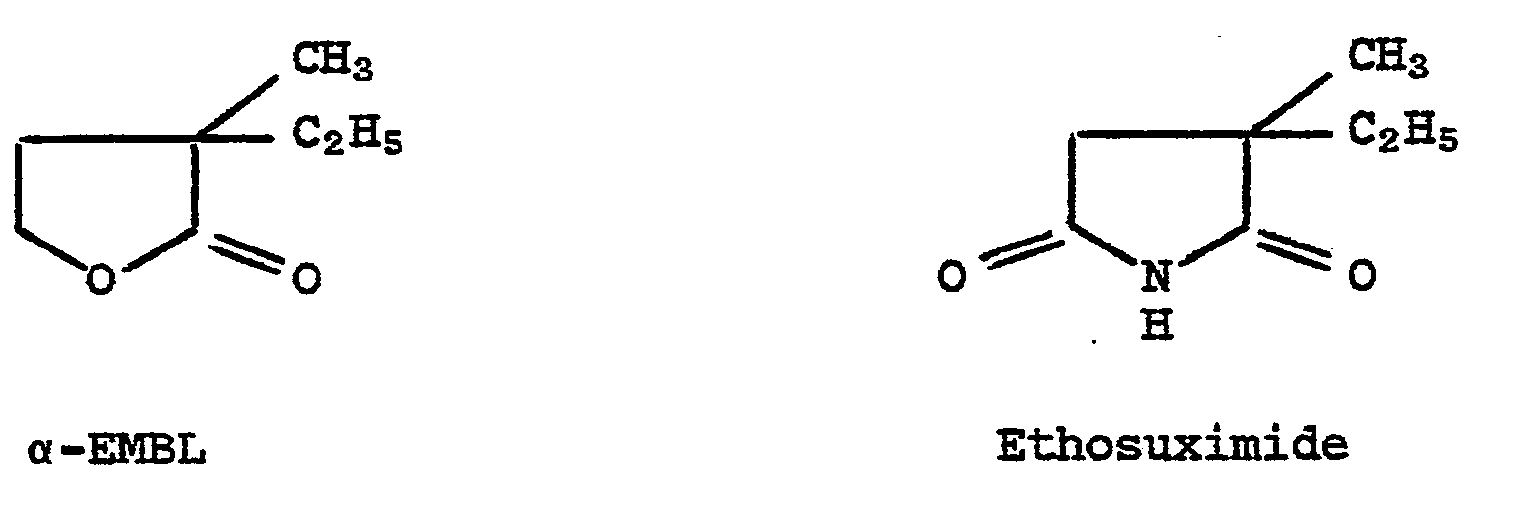
- In mice, the preferred a-ethyl-a-methyl-y-thiobutyrolactone (a-EMTBL) protects against pentylenetetrazol (PTZ) seizures and has an ED50 of about 80 mg/kg. In addition, it is able to protect mice against maximal electroshock seizures (MES) and has an ED50 of about 230 mg/kg. Tests for acute toxicity using the rotorod test show that the compound has a TD50 in mice of about 350 mg/kg. Thus, the compound can protect against both PTZ and MES seizures at non-toxic doses. The rotorod test is a standard method used in mice to access neurotoxicity and is described, for example, by Krall et al., Epilepsia 19, 409-428 (1978).
- Comparison of the anticonvulsant profile of a-ethyl-a-methyl-y-thiobutyrolactone (a-EMTBL) with a-EMBL, ethosuximide and valproic acid shows a-EMBTL to be more potent than the other compounds against PTZ seizures. Both valproic acid and a-EMTBL have anti-MES activity, but ethosuximide and a-EMBL do not. The therapeutic index TD50/ED50 of all four compounds is substantially similar. Thus, a-EMTBL is a more potent anticonvulsant compound than ethosuximide, valproic acid or a-EMBL, and, similar to valproic acid, has a broader spectrum of action than ethosuximide or a-EMBL. The advantage of a-EMTBL over the structural analogs, a-EMBL or ethosuximide, and over the important antiepileptic drug - vaproic acid - is evident from the above.
- The following Examples will further illustrate the invention in greater detail.
- Utilizing a general method described by Gerecke et al., Helv. Chim. Acta 53, 991 (1970), a mixture of 8.90 g (69.4 mmol) of a-ethyl-a-methyl-y-butyrolactone and 12.4 g (109 mmol) of potassium thiolacetate in 50 mL of N,N-dimethylacetamide (DMA) was heated at 150-160°C with stirring for 4 hours. The dark brown mixture was partitioned between hexanes (200 mL) and water (200 mL). The aqueous phase was further extracted with two 100 mL portions of hexanes. The combined organic extract was washed with 100 mL of water followed by 50 mL of satd. NaCl, then dried over Na2S04. The solvent was removed to leave a red oil. Vacuum distillation yielded 7.80 g (78%) of α-ethyl-α-methyl-γ-thiolobutyrolactone as a colorless liquid: bp 59-61/.5 torr; 1H-nmr (CDCI3, Me4Si)δ 3.31 (t,2, J=6 Hz, γCH2), 2.4-1.8 (m, 2, p-CH2), 1.8-1.3 (m, 2, CH2CH3), 1.11 (S, 3, CHs), 0.88 ppm (t, 3, J=6 Hz, CH2CH3); IR (neat) 1700 cm-1 (C=0, thiolester); UV (95% EtOH) λmax 249 nm (s = 470). A second distillation yielded an analytical sample.
- Anal. Calcd. for C7H12OS: C, 58.29; H, 8.39; S, 22.23. Found: C, 58.48; H, 8.55; S, 22.28.
- α-Isopropylidene-γ-butyrolactone. According to the method of Minami et al., J. Org. Chem. 39. 3236-3238 (1975), the carbanion of 60.0 g (27.0 mmol) of a-(O,Odiethyl-phosphono)-y-butyrolactone was prepared by treatment with 6.5 g (27 mmol) of NaH in 50 mL of dry benzene at 50-60°C. Addition of 3.0 mL {2.4g; 41 mmol) of dry acetone, followed by stirring at 50-60°C for 16 h, yielded a clear yellow solution, with a viscous oil at the bottom of the vessel. The solution was decanted and the vessel rinsed with two 100-mL portions of 2% aqueous HCI followed by 50 mL of benzene. All the liquids were combined and the phases were separated. The aqueous phase was further extracted with two 50-mL portions of benzene and the combined organic extracts were washed with 50 mL of 2% HCI, 50 mL of H20, 50 mL of 5% NaH-CO3, and 25 mL of satd. NaCl, then dried over Na2S04. The solvent was removed to leave an orange oil which, on distillation, yielded 27.1 g (80%) of a-isopropylidene-y-butyrolactone which was identical with material prepared by Klunk et al., Mol. Pharm. 22 438-443 (1982).
- α-Isopropyl-γ-thiobulyrolactone. A mixture of 8.3 g (66 mmol) of α-isopropylidene-γ-butyrolactone and 0.5 g of 10% Pd-C in 200 mL of EtOAc was hydrogenated at 40 p.s.i. in a Parr shaker until H2 uptake ceased (ca. 1h). The catalyst was removed by filtration through Celite, the solvent removed, and the product distilled to yield 7.8 (93%) of α-isopropyl-γ-butyrolactone as a colorless liquid: bp 53-54°C/.2- .3 torr. The 1H-nmr and IR were identical to those reported by Kendall and Wells, Aust. J. Chem.27(10), 2293-2295 (1974).
- α-Isopropyl-γ-thiolobutyrolactone was prepared by treating 958 mg (7.47 mmol) of α-isopropyl-γ-butyrolactone with 1.296 g (8.99 mmol) of potassium thiolacetate in 5 mL DMA for 2h at 150-160°C. The mixture was partitioned between hexanes (50 mL) and water (50 mL), the aqueous phase further extracted with two 25 mL portions of hexanes, and the combined organic extract was washed with 50 mL of water followed by 25 mL of satd. NaCI. The solution was dried over Na2S04 and the solvent removed. Bulb-to-bulb distillation (pot temp. 70°C/.2-.3 torr) gave a pale yellow liquid. Chromatography on silica gel (hexane/EtOAc; 19/1 followed by bulb-to-bulb distillation (pot temp. 55°C/.2-.3 torr) yielded 616 mg (57%) of α-isopropyl-γ-thiolobutyrolactone as a colorless liquid: 1H-nmr (CDCI3, Me4Si)δ 3.4-3.2 (m, 2, γ-CH2), 2.7-1.9 (m, 4, a-CH, p-CH2, and CH(CH3)2), 1.03 (d, 3, j=7 Hz, CHs), 0.91 ppm (d, 3, J=7 Hz, CH3); IR (neat) 1700 cm-1 (C=O, thiolester); UV (95% EtOH)λmax251 nm (ε=570).
- Anal. Calcd. for C7HI20S: C, 58.29; H, 8.39; S, 22.23. Found: C, 58.47; H, 8.74, S, 21.95.
- α,α-Di-isopropyl-γ-butyrolactone. A solution of isopropylcyclohexylamide was prepared by treating 8.01 g (56.7mmol) of isopropylcyclohexylamine in 50 mL of dry tetrahydrofuran (THF) with 24 mL (57.6 mmol) of 2.4 M n-butyllithium in hexane at 0°C in an inert atmosphere. The solution was cooled to -78°C and a solution of 6.04 g (47.2 mmol) of α-isopropyl-γ-butyrolactone in 200 mL of dry THF was added dropwise. The mixture was stirred at -78°C for 45 min, then 8.83 g (51.9 mmol) of 2-iodopropane and 5.1 mL of hexamethylphosphoramide (HMPA) was added all at once. The reaction mixture was stirred at -40°C for 4h, then at -20°C for 15h. The reaction was quenched by addition of 100 mL of 1 N HCI followed by 100 mL of hexanes. The layers were separated and the aqueous phase was further extracted with two 100 mL portions of hexanes. The combined organic extract was washed with water, 5% NaHCOs, 5% Na2S203, water, and satd. NaCl, then dried over Na2S04. The solvent was removed and the residue distilled (55°C/.1 torr) to give impure a-a-di-isopropyl-y-butyrolactone as a colorless liquid which was then purified by HPLC (silica gel; 5% acetone in hexane) to yield 1.08 g (13.4%) of pure material: 1H-nmr (CDCIs, Me4Si)S 4.22 (t, 2, J=8 Hz, y-CH2), 2.4-1.8 (m, 4, p-CH2 and CH(CH3)2), 0.99 (d, 6, J=7 Hz, CHs), 0.94 ppm (d, 6, J=7 Hz, CHs); IR (neat) 1760 cm-1 (C=0, y-lactone).
- Anal. Calcd. for C10H18O2: C, 70.55; H, 10.66. Found: C, 70.74; H, 10.37.
- α,α-Di-isopropyl-γ-thiolobutyrolactone was prepared by treating 459 mg (2.70 mmol) of α,α-di-isopropyl-y-butyrolactone with 756 mg (6.62 mmol) of potassium thiolacetate in 5 mL of DMA for 24h at 150-160°C with stirring. After working up with hexanes and water as described above, the product was purified first by chromatography on silica gel (hexane/EtOAc; 19/1), then by HPLC (silica gel; 50% benzene in hexanes). The major fraction was collected, the solvent removed, and the material was distilled bulb-to-bulb (pot temp. 55-60°C/.2-.3 torr) to give a colorless liquid. Purification by HPLC (silica gel; 2.5% EtOAc in hexanes) yielded 40 mg (8.0%) of α,α-di-isopropyl-γ-thiobutyrolactone as a colorless liquid: iH-nmr (CDCI3, Me4Si)8 3.32 (t, 2, J=7 Hz, γ-CH2), 2.25 (t, 2, J=7 Hz, β-CH2), 2.4-1.9 (m, 2, CH(CH3)2), 0.99 ppm (d, 12, J=7 Hz, CHs); IR (neat) 1700 cm-1 (C=0, thiolester); UV (95% EtOH) λmax251 nm (ε=550).
- Anal. Calcd. for C10H18OS: C, 64.47; H, 9.74; S, 17.21. Found: C, 64.79; H, 9.71; S, 17.20.
- Compounds were tested for anticonvulsant activity and toxicity in mice by the following tests.
- Pentvlenetetrazol Seizure Threshold Test - Pentylenetetrazol (85 mg/kg; CD97 or 100 mg/kg; CD100) is injected IP into mice in a volume of 0.01 ml/g body weight. The animals are placed in isolation cages and observed for the next 30 min. for the presence or absence of a seizure. A threshold convulsion is defined as one episode of clonic spasms that persists for at least a 5-sec period. Absence of a threshold convulsion during the 30 min. period of observation is taken as the endpoint and indicates that the substance has the ability to elevate the threshold of the pentylenetetrazol seizure.
- Maximal Electroshock Seizure Test - At the time of peak effect of the test substance, a drop of 0.9% sodium chloride is applied to the eyes of each animal. Corneal electrodes are applied to the eyes, and an electrical stimulus of 50 mA is delivered for 0.2 sec. The animals are held by hand and released at the time of stimulation for observation of the seizure. Abolition of the hindleg tonic extension component is taken as the endpoint for this test. The tonic component is considered abolished if the hindleg tonic extension does not exceed 90° with the plane of the body.
- Rotorod Test for Toxicitv - This test is used in mice to assess neurotoxicity. Mice are placed on the rotorod, which rotates at 6 rpm, and tested for maintenance of their equilibrium for 10 min. All mice are pre- tested before test substance is given. At the time of peak effect of the test substance, mice are put back on the rotorod for 10 min. Neurological deficit (toxicity) is indicated by the inability of the animal to maintain its equilibrium for 10 min. on this rotating rod.
- The anticonvulsant properties of α-ethyl-α-methyl-γ-thiobutyrolactone (a-EMTBL) were determined in mice by the foregoing tests. This compound protected against clonic seizures produced by 85 mg/kg pentylenetetrazol (ED50 = 131 mg/kg). When tested against 100 mg/kg pentylenetetrazol it prevented clonic seizures (ED50 = 143 mg/kg) and tonic seizures (ED50 = 85 mg/kg). In addition, it was able to protect mice against maximal electroshock seizures and had an ED50 of approximately 230 mg/kg. Tests for acute toxicity revealed a-EMTBL had a TD50 of approximately 350 mg/kg. Thus, a-EMTBL protects against both pentylenetetrazol seizures and maximal electroshock seizures at non-toxic doses.
- In comparison, α-ethyl-α-methyl/rbutyrolactone (a-EMBL) protected against clonic seizures produced by 85 mg/kg pentylenetetrazol with an ED50 of 226 mg/kg; against clonic seizures produced by 100 mg/kg pentylenetetrazol with an ED50 of 304; and against tonic seizures produced by 100 mg/kg pentylenetetrazol with an ED50 of 250 mg/kg. No protection against maximal electroshock seizures by a-EMBL was observed at doses up to 350 mg/kg. The TD50 for a-EMBL (rotorod test) was approximately 350 mg/kg. Thus, a-EMBL protects only against pentylenetetrazol seizures at non-toxic doses.
- In summary, a-EMTBL is both a more potent anticonvulsant and has a broader spectrum of action than a-EMBL.
- a-isopropyl-y-thiobutyrolactone was also tested against 85 mg/kg pentylenetetrazol and maximal electroshock. It blocked pentylenetetrazol seizures (ED50 - 137 mg/kg) and maximal electroshock seizures (ED50 - 240 mg/kg). This compound had a TD50 in the rotorod test of 278 mg/kg. Thus, the isopropyl derivative also is a highly potent anticonvulsant with a broad spectrum of action like a-EMTBL.
- The amount of the anticonvulsant compound which would normally be administered is primarily dependent upon the physical characteristics of the recipient and the severity of the convulsant seizures. The amount to be administered must be an effective amount, that is, an amount which is medically beneficial but does not present toxic effects which overweigh the advantages which accompany its use. It would be expected that the adult human dosage would normally range upwardly from about 10 milligrams of the active compound. The preferable route of administration is orally in the form of capsules, tablets, syrups, elixers and the like, although parenteral administration also can be used. Suitable formulations of the active compound in pharmaceutically acceptable diluents and carriers in therapeutic dosage form can be prepared by reference to general texts in the pharmaceutical field such as, for example, Reminaton's Pharmaceutical Sciences, Ed. Arthur Osol, 16th ed., 1980, Mack Publishing Co., Easton, Pennsylvania.
Claims (8)

Priority Applications (1)
| Application Number | Priority Date | Filing Date | Title |
|---|---|---|---|
| AT86870188T ATE58636T1 (en) | 1985-12-20 | 1986-12-19 | GAMMA THIOBUTYROLACTONE DERIVATIVES ANTI-SPRAM. |
Applications Claiming Priority (2)
| Application Number | Priority Date | Filing Date | Title |
|---|---|---|---|
| US06/811,919 US4707491A (en) | 1985-12-20 | 1985-12-20 | Anticonvulsant γ-thiobutyrolactone derivatives |
| US811919 | 1985-12-20 |
Publications (2)
| Publication Number | Publication Date |
|---|---|
| EP0229007A1 EP0229007A1 (en) | 1987-07-15 |
| EP0229007B1 true EP0229007B1 (en) | 1990-11-28 |
Family
ID=25207947
Family Applications (1)
| Application Number | Title | Priority Date | Filing Date |
|---|---|---|---|
| EP86870188A Expired - Lifetime EP0229007B1 (en) | 1985-12-20 | 1986-12-19 | Anticonvulsant gamma-thiobutyrolactone derivatives |
Country Status (13)
| Country | Link |
|---|---|
| US (1) | US4707491A (en) |
| EP (1) | EP0229007B1 (en) |
| JP (2) | JPH0764727B2 (en) |
| AT (1) | ATE58636T1 (en) |
| AU (1) | AU588953B2 (en) |
| CA (1) | CA1273946A (en) |
| DE (1) | DE3675911D1 (en) |
| DK (1) | DK167761B1 (en) |
| FI (1) | FI85471C (en) |
| IE (1) | IE59831B1 (en) |
| IL (1) | IL81019A (en) |
| NO (1) | NO865181L (en) |
| ZA (1) | ZA869585B (en) |
Families Citing this family (7)
| Publication number | Priority date | Publication date | Assignee | Title |
|---|---|---|---|---|
| IT1145362B (en) * | 1980-03-06 | 1986-11-05 | Sigma Tau Ind Farmaceuti | ACYL-DERIVATIVES CLASS OF CARNITINE PROCEDURE FOR THEIR PREPARATION AND THERAPEUTIC USE |
| US4851085A (en) * | 1988-07-11 | 1989-07-25 | Gaf Corporation | Purification of butyrolactone |
| CA2130723C (en) * | 1993-09-03 | 2006-01-31 | Wilhelm Quittmann | Process for preparing y-mercaptocarboxylic acid derivatives |
| US5776959A (en) * | 1995-06-05 | 1998-07-07 | Washington University | Anticonvulsant and anxiolytic lactam and thiolactam derivatives |
| FR2800069A1 (en) | 1999-10-22 | 2001-04-27 | Centre Nat Rech Scient | Gamma-aminobutyric acid activity stimulants comprising new or known 3-amino-1,4-butyrolactone or thiolactone derivatives, useful for treating nervous disorders, e.g. epilepsy, anxiety, depression or pain |
| US20030037354A1 (en) * | 2001-08-02 | 2003-02-20 | Ornitz David M. | Animal model with disrupted Fgf14 gene |
| CN114891221B (en) * | 2019-10-14 | 2023-09-15 | 中国科学院上海有机化学研究所 | Poly (gamma-thiobutyrolactone) |
Family Cites Families (4)
| Publication number | Priority date | Publication date | Assignee | Title |
|---|---|---|---|---|
| US2402639A (en) * | 1940-09-19 | 1946-06-25 | Du Pont | Lactones of mercapto carboxylic acids and process of preparing them |
| US2978460A (en) * | 1955-09-20 | 1961-04-04 | Goodrich Co B F | Thiolactones and method of preparation |
| GB1049283A (en) | 1962-04-14 | 1966-11-23 | Distillers Co Yeast Ltd | Substituted butyro-lactones and -thiolactones |
| US3488732A (en) * | 1967-02-21 | 1970-01-06 | Mobil Oil Corp | Heterocyclic ring compounds and preparation of same |
-
1985
- 1985-12-20 US US06/811,919 patent/US4707491A/en not_active Expired - Lifetime
-
1986
- 1986-12-18 IL IL81019A patent/IL81019A/en not_active IP Right Cessation
- 1986-12-19 JP JP61303583A patent/JPH0764727B2/en not_active Expired - Lifetime
- 1986-12-19 FI FI865230A patent/FI85471C/en not_active IP Right Cessation
- 1986-12-19 DE DE8686870188T patent/DE3675911D1/en not_active Expired - Lifetime
- 1986-12-19 IE IE333386A patent/IE59831B1/en not_active IP Right Cessation
- 1986-12-19 AU AU66777/86A patent/AU588953B2/en not_active Ceased
- 1986-12-19 AT AT86870188T patent/ATE58636T1/en not_active IP Right Cessation
- 1986-12-19 DK DK615886A patent/DK167761B1/en not_active IP Right Cessation
- 1986-12-19 NO NO865181A patent/NO865181L/en unknown
- 1986-12-19 EP EP86870188A patent/EP0229007B1/en not_active Expired - Lifetime
- 1986-12-19 ZA ZA869585A patent/ZA869585B/en unknown
- 1986-12-19 CA CA000525937A patent/CA1273946A/en not_active Expired - Lifetime
-
1993
- 1993-12-20 JP JP5320374A patent/JPH0759576B2/en not_active Expired - Lifetime
Also Published As
| Publication number | Publication date |
|---|---|
| AU588953B2 (en) | 1989-09-28 |
| JPS62158272A (en) | 1987-07-14 |
| FI85471B (en) | 1992-01-15 |
| US4707491A (en) | 1987-11-17 |
| FI865230L (en) | 1987-06-21 |
| DK615886D0 (en) | 1986-12-19 |
| AU6677786A (en) | 1987-06-25 |
| DK167761B1 (en) | 1993-12-13 |
| ZA869585B (en) | 1988-05-25 |
| IE59831B1 (en) | 1994-04-06 |
| EP0229007A1 (en) | 1987-07-15 |
| FI865230A0 (en) | 1986-12-19 |
| FI85471C (en) | 1992-04-27 |
| IE863333L (en) | 1987-06-20 |
| DE3675911D1 (en) | 1991-01-10 |
| JPH0759576B2 (en) | 1995-06-28 |
| IL81019A0 (en) | 1987-03-31 |
| CA1273946C (en) | 1990-09-11 |
| IL81019A (en) | 1991-08-16 |
| JPH0764727B2 (en) | 1995-07-12 |
| ATE58636T1 (en) | 1990-12-15 |
| NO865181L (en) | 1987-06-22 |
| JPH06316570A (en) | 1994-11-15 |
| NO865181D0 (en) | 1986-12-19 |
| CA1273946A (en) | 1990-09-11 |
| DK615886A (en) | 1987-06-21 |
Similar Documents
| Publication | Publication Date | Title |
|---|---|---|
| GB2197320A (en) | Benzoic acid derivatives useful as intermediates | |
| CA1270818A (en) | Various n-substituted 3-piperidine carboxylic acids or n-substituted 3-pyridinecarboxylic acids and derivatives thereof | |
| US4707491A (en) | Anticonvulsant γ-thiobutyrolactone derivatives | |
| DK169383B1 (en) | Drugs containing 2-aminobenzothiazole compounds, 2-amino-benzothiazole compounds, methods for their preparation and use of 2-aminobenzothiazole compounds for the manufacture of drugs. | |
| EP0209770A1 (en) | Eicosatriynoic esters and amides and their use in pharmacy and cosmetics | |
| IL98454A (en) | Dericatives of 2-aminoalkyl-5-arylalkyl-1,3-dioxanes their preparation and pharmaceutical compositions containing them | |
| FR2361346A1 (en) | DIPEPTIDES USEFUL AS MEDICINAL PRODUCTS | |
| AU628995B2 (en) | Novel thienopyran derivatives, a process for their preparation and their use | |
| SU1468424A3 (en) | Method of producing derivatives of hydantoin | |
| US3754000A (en) | Derivatives of 3-aminocarbonyl-2-oxazolidinone and their process of preparation | |
| WO1999034790A1 (en) | Glycine transport inhibitors | |
| FR2520741A1 (en) | NOVEL BENZOTHIOPHENE DERIVATIVES, THEIR PREPARATION AND THEIR USE AS MEDICAMENTS | |
| EP0323416A2 (en) | Phenylbenzylidene derivatives of 3-aminopropanesulfonic acid having anticonvulsant activity and pharmaceutical compositions containing same for the therapeutical treatment of epilepsy | |
| NL193192C (en) | Oxicam derivative, pharmaceutical preparation containing the derivative and method for preparing oxicam derivatives. | |
| JP4378616B2 (en) | Carbamate of 2-heterocyclic-1,2-ethanediol | |
| US4094988A (en) | Method of treating gastric ulcers using 5,6-dihydro-1,4-dithiinoxides | |
| IE902836A1 (en) | Substituted dibenzofurans and methods of using same | |
| IL34170A (en) | 10-(3-dimethylamino-2-methyl-propyl)-2-valeryl (or isovaleryl)phenothiazine derivatives,process for the preparation thereof and pharmaceutical compositions containing the same | |
| KR920008823B1 (en) | Diazabicycloalkane derivatives | |
| EP0171912B1 (en) | Pyrrolizidine compounds, methods for their production, and their uses | |
| US3940421A (en) | Intermediates for the preparation of thienobenzopyrans and thiopyranobenzopyrans | |
| Undheim et al. | Adduct formation between pyridine-2-thiones and acetylenic carbonyl derivatives | |
| SE453187B (en) | BENZYLIDE DERIVATIVES AND MEDICINAL PRODUCTS CONTAINING THEM | |
| US5217968A (en) | N-alkylbenzo(b)thieno [3,2-b]oxazin-2,4-diones | |
| KR910006634B1 (en) | Method for producing benzoylpropionic acid derivatives |
Legal Events
| Date | Code | Title | Description |
|---|---|---|---|
| PUAI | Public reference made under article 153(3) epc to a published international application that has entered the european phase |
Free format text: ORIGINAL CODE: 0009012 |
|
| AK | Designated contracting states |
Kind code of ref document: A1 Designated state(s): AT BE CH DE FR GB IT LI LU NL SE |
|
| 17P | Request for examination filed |
Effective date: 19871109 |
|
| 17Q | First examination report despatched |
Effective date: 19890626 |
|
| GRAA | (expected) grant |
Free format text: ORIGINAL CODE: 0009210 |
|
| AK | Designated contracting states |
Kind code of ref document: B1 Designated state(s): AT BE CH DE FR GB IT LI LU NL SE |
|
| REF | Corresponds to: |
Ref document number: 58636 Country of ref document: AT Date of ref document: 19901215 Kind code of ref document: T |
|
| ET | Fr: translation filed | ||
| REF | Corresponds to: |
Ref document number: 3675911 Country of ref document: DE Date of ref document: 19910110 |
|
| ITF | It: translation for a ep patent filed | ||
| PLBE | No opposition filed within time limit |
Free format text: ORIGINAL CODE: 0009261 |
|
| STAA | Information on the status of an ep patent application or granted ep patent |
Free format text: STATUS: NO OPPOSITION FILED WITHIN TIME LIMIT |
|
| 26N | No opposition filed | ||
| ITTA | It: last paid annual fee | ||
| EPTA | Lu: last paid annual fee | ||
| EAL | Se: european patent in force in sweden |
Ref document number: 86870188.9 |
|
| PGFP | Annual fee paid to national office [announced via postgrant information from national office to epo] |
Ref country code: SE Payment date: 19991202 Year of fee payment: 14 Ref country code: DE Payment date: 19991202 Year of fee payment: 14 Ref country code: AT Payment date: 19991202 Year of fee payment: 14 |
|
| PGFP | Annual fee paid to national office [announced via postgrant information from national office to epo] |
Ref country code: GB Payment date: 19991203 Year of fee payment: 14 Ref country code: FR Payment date: 19991203 Year of fee payment: 14 |
|
| PGFP | Annual fee paid to national office [announced via postgrant information from national office to epo] |
Ref country code: CH Payment date: 19991206 Year of fee payment: 14 |
|
| PGFP | Annual fee paid to national office [announced via postgrant information from national office to epo] |
Ref country code: NL Payment date: 19991213 Year of fee payment: 14 Ref country code: LU Payment date: 19991213 Year of fee payment: 14 |
|
| PGFP | Annual fee paid to national office [announced via postgrant information from national office to epo] |
Ref country code: BE Payment date: 19991224 Year of fee payment: 14 |
|
| PG25 | Lapsed in a contracting state [announced via postgrant information from national office to epo] |
Ref country code: LU Free format text: LAPSE BECAUSE OF NON-PAYMENT OF DUE FEES Effective date: 20001219 Ref country code: GB Free format text: LAPSE BECAUSE OF NON-PAYMENT OF DUE FEES Effective date: 20001219 Ref country code: AT Free format text: LAPSE BECAUSE OF NON-PAYMENT OF DUE FEES Effective date: 20001219 |
|
| PG25 | Lapsed in a contracting state [announced via postgrant information from national office to epo] |
Ref country code: SE Free format text: LAPSE BECAUSE OF NON-PAYMENT OF DUE FEES Effective date: 20001220 |
|
| PG25 | Lapsed in a contracting state [announced via postgrant information from national office to epo] |
Ref country code: LI Free format text: LAPSE BECAUSE OF NON-PAYMENT OF DUE FEES Effective date: 20001231 Ref country code: CH Free format text: LAPSE BECAUSE OF NON-PAYMENT OF DUE FEES Effective date: 20001231 Ref country code: BE Free format text: LAPSE BECAUSE OF NON-PAYMENT OF DUE FEES Effective date: 20001231 |
|
| BERE | Be: lapsed |
Owner name: WASHINGTON UNIVERSITY Effective date: 20001231 |
|
| PG25 | Lapsed in a contracting state [announced via postgrant information from national office to epo] |
Ref country code: NL Free format text: LAPSE BECAUSE OF NON-PAYMENT OF DUE FEES Effective date: 20010701 |
|
| GBPC | Gb: european patent ceased through non-payment of renewal fee |
Effective date: 20001219 |
|
| EUG | Se: european patent has lapsed |
Ref document number: 86870188.9 |
|
| REG | Reference to a national code |
Ref country code: CH Ref legal event code: PL |
|
| PG25 | Lapsed in a contracting state [announced via postgrant information from national office to epo] |
Ref country code: FR Free format text: LAPSE BECAUSE OF NON-PAYMENT OF DUE FEES Effective date: 20010831 |
|
| NLV4 | Nl: lapsed or anulled due to non-payment of the annual fee |
Effective date: 20010701 |
|
| REG | Reference to a national code |
Ref country code: FR Ref legal event code: ST |
|
| PG25 | Lapsed in a contracting state [announced via postgrant information from national office to epo] |
Ref country code: DE Free format text: LAPSE BECAUSE OF NON-PAYMENT OF DUE FEES Effective date: 20011002 |
|
| PG25 | Lapsed in a contracting state [announced via postgrant information from national office to epo] |
Ref country code: IT Free format text: LAPSE BECAUSE OF NON-PAYMENT OF DUE FEES;WARNING: LAPSES OF ITALIAN PATENTS WITH EFFECTIVE DATE BEFORE 2007 MAY HAVE OCCURRED AT ANY TIME BEFORE 2007. THE CORRECT EFFECTIVE DATE MAY BE DIFFERENT FROM THE ONE RECORDED. Effective date: 20051219 |