EP0227431A1 - Heterocyclic amides - Google Patents
Heterocyclic amides Download PDFInfo
- Publication number
- EP0227431A1 EP0227431A1 EP86309873A EP86309873A EP0227431A1 EP 0227431 A1 EP0227431 A1 EP 0227431A1 EP 86309873 A EP86309873 A EP 86309873A EP 86309873 A EP86309873 A EP 86309873A EP 0227431 A1 EP0227431 A1 EP 0227431A1
- Authority
- EP
- European Patent Office
- Prior art keywords
- compound
- group
- formula
- substituted
- pharmaceutically acceptable
- Prior art date
- Legal status (The legal status is an assumption and is not a legal conclusion. Google has not performed a legal analysis and makes no representation as to the accuracy of the status listed.)
- Withdrawn
Links
- -1 Heterocyclic amides Chemical class 0.000 title description 16
- 150000001875 compounds Chemical class 0.000 claims abstract description 99
- 150000002148 esters Chemical class 0.000 claims abstract description 35
- 150000003839 salts Chemical class 0.000 claims abstract description 30
- 239000001257 hydrogen Substances 0.000 claims abstract description 29
- 229910052739 hydrogen Inorganic materials 0.000 claims abstract description 29
- 150000001408 amides Chemical class 0.000 claims abstract description 23
- 239000012453 solvate Substances 0.000 claims abstract description 22
- 125000000217 alkyl group Chemical group 0.000 claims abstract description 20
- 125000003118 aryl group Chemical group 0.000 claims abstract description 19
- 125000002252 acyl group Chemical group 0.000 claims abstract description 12
- UFHFLCQGNIYNRP-UHFFFAOYSA-N Hydrogen Chemical compound [H][H] UFHFLCQGNIYNRP-UHFFFAOYSA-N 0.000 claims abstract description 11
- 125000002837 carbocyclic group Chemical group 0.000 claims abstract description 11
- 125000004432 carbon atom Chemical group C* 0.000 claims abstract description 11
- 125000000623 heterocyclic group Chemical group 0.000 claims abstract description 11
- 239000003814 drug Substances 0.000 claims abstract description 7
- 239000008194 pharmaceutical composition Substances 0.000 claims abstract description 6
- 238000004519 manufacturing process Methods 0.000 claims abstract description 5
- 125000004450 alkenylene group Chemical group 0.000 claims abstract description 4
- 125000002947 alkylene group Chemical group 0.000 claims abstract description 4
- 125000003710 aryl alkyl group Chemical group 0.000 claims abstract description 4
- 238000000034 method Methods 0.000 claims description 18
- 238000011282 treatment Methods 0.000 claims description 16
- IJGRMHOSHXDMSA-UHFFFAOYSA-N Atomic nitrogen Chemical compound N#N IJGRMHOSHXDMSA-UHFFFAOYSA-N 0.000 claims description 11
- 125000004435 hydrogen atom Chemical group [H]* 0.000 claims description 11
- 125000004429 atom Chemical group 0.000 claims description 10
- 229910052757 nitrogen Inorganic materials 0.000 claims description 8
- YTPLMLYBLZKORZ-UHFFFAOYSA-N Thiophene Chemical compound C=1C=CSC=1 YTPLMLYBLZKORZ-UHFFFAOYSA-N 0.000 claims description 6
- 208000006673 asthma Diseases 0.000 claims description 6
- 238000011321 prophylaxis Methods 0.000 claims description 6
- 208000035285 Allergic Seasonal Rhinitis Diseases 0.000 claims description 5
- 206010012434 Dermatitis allergic Diseases 0.000 claims description 5
- 201000004681 Psoriasis Diseases 0.000 claims description 5
- NINIDFKCEFEMDL-UHFFFAOYSA-N Sulfur Chemical compound [S] NINIDFKCEFEMDL-UHFFFAOYSA-N 0.000 claims description 5
- 239000005864 Sulphur Substances 0.000 claims description 5
- 125000005842 heteroatom Chemical group 0.000 claims description 5
- 206010039083 rhinitis Diseases 0.000 claims description 5
- 229920006395 saturated elastomer Polymers 0.000 claims description 5
- 239000000126 substance Substances 0.000 claims description 5
- 208000026935 allergic disease Diseases 0.000 claims description 4
- 206010003246 arthritis Diseases 0.000 claims description 4
- QVGXLLKOCUKJST-UHFFFAOYSA-N atomic oxygen Chemical compound [O] QVGXLLKOCUKJST-UHFFFAOYSA-N 0.000 claims description 4
- 230000004968 inflammatory condition Effects 0.000 claims description 4
- 229910052760 oxygen Inorganic materials 0.000 claims description 4
- 239000001301 oxygen Substances 0.000 claims description 4
- 229930192474 thiophene Natural products 0.000 claims description 3
- 125000005605 benzo group Chemical group 0.000 claims description 2
- 125000001511 cyclopentyl group Chemical group [H]C1([H])C([H])([H])C([H])([H])C([H])(*)C1([H])[H] 0.000 claims description 2
- HSUGRBWQSSZJOP-RTWAWAEBSA-N diltiazem Chemical group C1=CC(OC)=CC=C1[C@H]1[C@@H](OC(C)=O)C(=O)N(CCN(C)C)C2=CC=CC=C2S1 HSUGRBWQSSZJOP-RTWAWAEBSA-N 0.000 claims description 2
- 239000003937 drug carrier Substances 0.000 claims description 2
- 230000008569 process Effects 0.000 claims description 2
- 230000001225 therapeutic effect Effects 0.000 claims description 2
- AEHWMRMAKAPDMD-UHFFFAOYSA-N ethyl 2-[3-(3,4-dihydroxyphenyl)prop-2-enoylamino]-4,5,6,7-tetrahydro-1-benzothiophene-3-carboxylate Chemical compound C(C)OC(=O)C=1C2=C(SC1NC(C=CC1=CC(=C(C=C1)O)O)=O)CCCC2 AEHWMRMAKAPDMD-UHFFFAOYSA-N 0.000 claims 1
- JBFXVIAXDYTLDH-UHFFFAOYSA-N methyl 3-[3-(3,4-dihydroxyphenyl)prop-2-enoylamino]thiophene-2-carboxylate Chemical compound S1C=CC(NC(=O)C=CC=2C=C(O)C(O)=CC=2)=C1C(=O)OC JBFXVIAXDYTLDH-UHFFFAOYSA-N 0.000 claims 1
- 239000000203 mixture Substances 0.000 abstract description 22
- 150000002431 hydrogen Chemical class 0.000 abstract description 10
- 238000002360 preparation method Methods 0.000 description 22
- NTYJJOPFIAHURM-UHFFFAOYSA-N Histamine Chemical compound NCCC1=CN=CN1 NTYJJOPFIAHURM-UHFFFAOYSA-N 0.000 description 20
- YZXBAPSDXZZRGB-DOFZRALJSA-N arachidonic acid Chemical compound CCCCC\C=C/C\C=C/C\C=C/C\C=C/CCCC(O)=O YZXBAPSDXZZRGB-DOFZRALJSA-N 0.000 description 18
- 210000000845 cartilage Anatomy 0.000 description 13
- XLYOFNOQVPJJNP-UHFFFAOYSA-N water Substances O XLYOFNOQVPJJNP-UHFFFAOYSA-N 0.000 description 13
- LFQSCWFLJHTTHZ-UHFFFAOYSA-N Ethanol Chemical compound CCO LFQSCWFLJHTTHZ-UHFFFAOYSA-N 0.000 description 12
- JUJWROOIHBZHMG-UHFFFAOYSA-N Pyridine Chemical compound C1=CC=NC=C1 JUJWROOIHBZHMG-UHFFFAOYSA-N 0.000 description 12
- 241000700159 Rattus Species 0.000 description 12
- HEDRZPFGACZZDS-UHFFFAOYSA-N Chloroform Chemical compound ClC(Cl)Cl HEDRZPFGACZZDS-UHFFFAOYSA-N 0.000 description 10
- 102000003777 Interleukin-1 beta Human genes 0.000 description 10
- 108090000193 Interleukin-1 beta Proteins 0.000 description 10
- 238000003556 assay Methods 0.000 description 10
- 229960001340 histamine Drugs 0.000 description 10
- 239000000243 solution Substances 0.000 description 10
- RTZKZFJDLAIYFH-UHFFFAOYSA-N Diethyl ether Chemical compound CCOCC RTZKZFJDLAIYFH-UHFFFAOYSA-N 0.000 description 9
- ZMXDDKWLCZADIW-UHFFFAOYSA-N N,N-Dimethylformamide Chemical compound CN(C)C=O ZMXDDKWLCZADIW-UHFFFAOYSA-N 0.000 description 9
- 125000003178 carboxy group Chemical class [H]OC(*)=O 0.000 description 9
- 230000015556 catabolic process Effects 0.000 description 9
- 238000006243 chemical reaction Methods 0.000 description 9
- 125000002887 hydroxy group Chemical group [H]O* 0.000 description 9
- 230000005764 inhibitory process Effects 0.000 description 9
- 239000000047 product Substances 0.000 description 9
- 239000007787 solid Substances 0.000 description 9
- 239000002253 acid Substances 0.000 description 8
- 208000003455 anaphylaxis Diseases 0.000 description 8
- 229940114079 arachidonic acid Drugs 0.000 description 8
- 235000021342 arachidonic acid Nutrition 0.000 description 8
- 206010002198 Anaphylactic reaction Diseases 0.000 description 7
- FAPWRFPIFSIZLT-UHFFFAOYSA-M Sodium chloride Chemical compound [Na+].[Cl-] FAPWRFPIFSIZLT-UHFFFAOYSA-M 0.000 description 7
- 230000036783 anaphylactic response Effects 0.000 description 7
- 210000003630 histaminocyte Anatomy 0.000 description 7
- 239000006228 supernatant Substances 0.000 description 7
- WFDIJRYMOXRFFG-UHFFFAOYSA-N Acetic anhydride Chemical compound CC(=O)OC(C)=O WFDIJRYMOXRFFG-UHFFFAOYSA-N 0.000 description 6
- YMWUJEATGCHHMB-UHFFFAOYSA-N Dichloromethane Chemical compound ClCCl YMWUJEATGCHHMB-UHFFFAOYSA-N 0.000 description 6
- 208000037265 diseases, disorders, signs and symptoms Diseases 0.000 description 6
- 239000007788 liquid Substances 0.000 description 6
- 125000002496 methyl group Chemical group [H]C([H])([H])* 0.000 description 6
- CTSLXHKWHWQRSH-UHFFFAOYSA-N oxalyl chloride Chemical compound ClC(=O)C(Cl)=O CTSLXHKWHWQRSH-UHFFFAOYSA-N 0.000 description 6
- UMJSCPRVCHMLSP-UHFFFAOYSA-N pyridine Natural products COC1=CC=CN=C1 UMJSCPRVCHMLSP-UHFFFAOYSA-N 0.000 description 6
- 239000002904 solvent Substances 0.000 description 6
- 238000003756 stirring Methods 0.000 description 6
- 229910001868 water Inorganic materials 0.000 description 6
- 102000004190 Enzymes Human genes 0.000 description 5
- 108090000790 Enzymes Proteins 0.000 description 5
- XEKOWRVHYACXOJ-UHFFFAOYSA-N Ethyl acetate Chemical compound CCOC(C)=O XEKOWRVHYACXOJ-UHFFFAOYSA-N 0.000 description 5
- 102000016611 Proteoglycans Human genes 0.000 description 5
- 108010067787 Proteoglycans Proteins 0.000 description 5
- 125000003545 alkoxy group Chemical group 0.000 description 5
- 238000004587 chromatography analysis Methods 0.000 description 5
- 230000000694 effects Effects 0.000 description 5
- 229940088598 enzyme Drugs 0.000 description 5
- 235000019441 ethanol Nutrition 0.000 description 5
- 238000001727 in vivo Methods 0.000 description 5
- 238000011534 incubation Methods 0.000 description 5
- 125000001997 phenyl group Chemical group [H]C1=C([H])C([H])=C(*)C([H])=C1[H] 0.000 description 5
- 239000000843 powder Substances 0.000 description 5
- 102000001381 Arachidonate 5-Lipoxygenase Human genes 0.000 description 4
- 108010093579 Arachidonate 5-lipoxygenase Proteins 0.000 description 4
- IAZDPXIOMUYVGZ-UHFFFAOYSA-N Dimethylsulphoxide Chemical compound CS(C)=O IAZDPXIOMUYVGZ-UHFFFAOYSA-N 0.000 description 4
- PEDCQBHIVMGVHV-UHFFFAOYSA-N Glycerine Chemical compound OCC(O)CO PEDCQBHIVMGVHV-UHFFFAOYSA-N 0.000 description 4
- 125000003342 alkenyl group Chemical group 0.000 description 4
- 210000003567 ascitic fluid Anatomy 0.000 description 4
- 210000004369 blood Anatomy 0.000 description 4
- 239000008280 blood Substances 0.000 description 4
- 239000000872 buffer Substances 0.000 description 4
- 239000003795 chemical substances by application Substances 0.000 description 4
- JHIVVAPYMSGYDF-UHFFFAOYSA-N cyclohexanone Chemical compound O=C1CCCCC1 JHIVVAPYMSGYDF-UHFFFAOYSA-N 0.000 description 4
- 229960001760 dimethyl sulfoxide Drugs 0.000 description 4
- 201000010099 disease Diseases 0.000 description 4
- 239000001963 growth medium Substances 0.000 description 4
- 239000007928 intraperitoneal injection Substances 0.000 description 4
- HQKMJHAJHXVSDF-UHFFFAOYSA-L magnesium stearate Chemical compound [Mg+2].CCCCCCCCCCCCCCCCCC([O-])=O.CCCCCCCCCCCCCCCCCC([O-])=O HQKMJHAJHXVSDF-UHFFFAOYSA-L 0.000 description 4
- 239000002609 medium Substances 0.000 description 4
- BWHMMNNQKKPAPP-UHFFFAOYSA-L potassium carbonate Chemical compound [K+].[K+].[O-]C([O-])=O BWHMMNNQKKPAPP-UHFFFAOYSA-L 0.000 description 4
- 239000003826 tablet Substances 0.000 description 4
- ZIIUUSVHCHPIQD-UHFFFAOYSA-N 2,4,6-trimethyl-N-[3-(trifluoromethyl)phenyl]benzenesulfonamide Chemical compound CC1=CC(C)=CC(C)=C1S(=O)(=O)NC1=CC=CC(C(F)(F)F)=C1 ZIIUUSVHCHPIQD-UHFFFAOYSA-N 0.000 description 3
- QTBSBXVTEAMEQO-UHFFFAOYSA-N Acetic acid Chemical compound CC(O)=O QTBSBXVTEAMEQO-UHFFFAOYSA-N 0.000 description 3
- CSCPPACGZOOCGX-UHFFFAOYSA-N Acetone Chemical compound CC(C)=O CSCPPACGZOOCGX-UHFFFAOYSA-N 0.000 description 3
- UHOVQNZJYSORNB-UHFFFAOYSA-N Benzene Chemical group C1=CC=CC=C1 UHOVQNZJYSORNB-UHFFFAOYSA-N 0.000 description 3
- FBPFZTCFMRRESA-FSIIMWSLSA-N D-Glucitol Natural products OC[C@H](O)[C@H](O)[C@@H](O)[C@H](O)CO FBPFZTCFMRRESA-FSIIMWSLSA-N 0.000 description 3
- 108010010803 Gelatin Proteins 0.000 description 3
- VEXZGXHMUGYJMC-UHFFFAOYSA-N Hydrochloric acid Chemical compound Cl VEXZGXHMUGYJMC-UHFFFAOYSA-N 0.000 description 3
- 102000000589 Interleukin-1 Human genes 0.000 description 3
- 108010002352 Interleukin-1 Proteins 0.000 description 3
- GUBGYTABKSRVRQ-QKKXKWKRSA-N Lactose Natural products OC[C@H]1O[C@@H](O[C@H]2[C@H](O)[C@@H](O)C(O)O[C@@H]2CO)[C@H](O)[C@@H](O)[C@H]1O GUBGYTABKSRVRQ-QKKXKWKRSA-N 0.000 description 3
- OKKJLVBELUTLKV-UHFFFAOYSA-N Methanol Chemical compound OC OKKJLVBELUTLKV-UHFFFAOYSA-N 0.000 description 3
- 102000015439 Phospholipases Human genes 0.000 description 3
- 108010064785 Phospholipases Proteins 0.000 description 3
- DNIAPMSPPWPWGF-UHFFFAOYSA-N Propylene glycol Chemical compound CC(O)CO DNIAPMSPPWPWGF-UHFFFAOYSA-N 0.000 description 3
- VYPSYNLAJGMNEJ-UHFFFAOYSA-N Silicium dioxide Chemical compound O=[Si]=O VYPSYNLAJGMNEJ-UHFFFAOYSA-N 0.000 description 3
- HEMHJVSKTPXQMS-UHFFFAOYSA-M Sodium hydroxide Chemical compound [OH-].[Na+] HEMHJVSKTPXQMS-UHFFFAOYSA-M 0.000 description 3
- QAOWNCQODCNURD-UHFFFAOYSA-N Sulfuric acid Chemical compound OS(O)(=O)=O QAOWNCQODCNURD-UHFFFAOYSA-N 0.000 description 3
- YXFVVABEGXRONW-UHFFFAOYSA-N Toluene Chemical compound CC1=CC=CC=C1 YXFVVABEGXRONW-UHFFFAOYSA-N 0.000 description 3
- 239000004480 active ingredient Substances 0.000 description 3
- 125000000304 alkynyl group Chemical group 0.000 description 3
- 239000000427 antigen Substances 0.000 description 3
- 102000036639 antigens Human genes 0.000 description 3
- 108091007433 antigens Proteins 0.000 description 3
- 210000001188 articular cartilage Anatomy 0.000 description 3
- 230000015572 biosynthetic process Effects 0.000 description 3
- 239000002775 capsule Substances 0.000 description 3
- 210000004027 cell Anatomy 0.000 description 3
- 238000006731 degradation reaction Methods 0.000 description 3
- 238000010790 dilution Methods 0.000 description 3
- 239000012895 dilution Substances 0.000 description 3
- 239000000839 emulsion Substances 0.000 description 3
- 239000012530 fluid Substances 0.000 description 3
- 239000008273 gelatin Substances 0.000 description 3
- 229920000159 gelatin Polymers 0.000 description 3
- 235000019322 gelatine Nutrition 0.000 description 3
- 235000011852 gelatine desserts Nutrition 0.000 description 3
- 229910052736 halogen Inorganic materials 0.000 description 3
- 150000002367 halogens Chemical class 0.000 description 3
- 239000008101 lactose Substances 0.000 description 3
- 238000002156 mixing Methods 0.000 description 3
- VLKZOEOYAKHREP-UHFFFAOYSA-N n-Hexane Chemical compound CCCCCC VLKZOEOYAKHREP-UHFFFAOYSA-N 0.000 description 3
- 230000004783 oxidative metabolism Effects 0.000 description 3
- 239000000546 pharmaceutical excipient Substances 0.000 description 3
- 210000002345 respiratory system Anatomy 0.000 description 3
- 210000002966 serum Anatomy 0.000 description 3
- 239000011780 sodium chloride Substances 0.000 description 3
- 239000000600 sorbitol Substances 0.000 description 3
- 235000010356 sorbitol Nutrition 0.000 description 3
- 125000001424 substituent group Chemical group 0.000 description 3
- 239000001117 sulphuric acid Substances 0.000 description 3
- 235000011149 sulphuric acid Nutrition 0.000 description 3
- 235000020357 syrup Nutrition 0.000 description 3
- 239000006188 syrup Substances 0.000 description 3
- 238000011200 topical administration Methods 0.000 description 3
- KWGRBVOPPLSCSI-WPRPVWTQSA-N (-)-ephedrine Chemical compound CN[C@@H](C)[C@H](O)C1=CC=CC=C1 KWGRBVOPPLSCSI-WPRPVWTQSA-N 0.000 description 2
- 125000004169 (C1-C6) alkyl group Chemical group 0.000 description 2
- NGNBDVOYPDDBFK-UHFFFAOYSA-N 2-[2,4-di(pentan-2-yl)phenoxy]acetyl chloride Chemical compound CCCC(C)C1=CC=C(OCC(Cl)=O)C(C(C)CCC)=C1 NGNBDVOYPDDBFK-UHFFFAOYSA-N 0.000 description 2
- VGVHNLRUAMRIEW-UHFFFAOYSA-N 4-methylcyclohexan-1-one Chemical compound CC1CCC(=O)CC1 VGVHNLRUAMRIEW-UHFFFAOYSA-N 0.000 description 2
- QGZKDVFQNNGYKY-UHFFFAOYSA-N Ammonia Chemical compound N QGZKDVFQNNGYKY-UHFFFAOYSA-N 0.000 description 2
- 241000588832 Bordetella pertussis Species 0.000 description 2
- 0 C*1C=CC(C(*)(*)C(*)(*)C(NC2=CCS(*)=CC=C2)=O)=CC=C1 Chemical compound C*1C=CC(C(*)(*)C(*)(*)C(NC2=CCS(*)=CC=C2)=O)=CC=C1 0.000 description 2
- UXVMQQNJUSDDNG-UHFFFAOYSA-L Calcium chloride Chemical compound [Cl-].[Cl-].[Ca+2] UXVMQQNJUSDDNG-UHFFFAOYSA-L 0.000 description 2
- VEXZGXHMUGYJMC-UHFFFAOYSA-M Chloride anion Chemical compound [Cl-] VEXZGXHMUGYJMC-UHFFFAOYSA-M 0.000 description 2
- ZAMOUSCENKQFHK-UHFFFAOYSA-N Chlorine atom Chemical compound [Cl] ZAMOUSCENKQFHK-UHFFFAOYSA-N 0.000 description 2
- YLQBMQCUIZJEEH-UHFFFAOYSA-N Furan Chemical compound C=1C=COC=1 YLQBMQCUIZJEEH-UHFFFAOYSA-N 0.000 description 2
- 206010020751 Hypersensitivity Diseases 0.000 description 2
- DGAQECJNVWCQMB-PUAWFVPOSA-M Ilexoside XXIX Chemical compound C[C@@H]1CC[C@@]2(CC[C@@]3(C(=CC[C@H]4[C@]3(CC[C@@H]5[C@@]4(CC[C@@H](C5(C)C)OS(=O)(=O)[O-])C)C)[C@@H]2[C@]1(C)O)C)C(=O)O[C@H]6[C@@H]([C@H]([C@@H]([C@H](O6)CO)O)O)O.[Na+] DGAQECJNVWCQMB-PUAWFVPOSA-M 0.000 description 2
- 235000010643 Leucaena leucocephala Nutrition 0.000 description 2
- 240000007472 Leucaena leucocephala Species 0.000 description 2
- CSNNHWWHGAXBCP-UHFFFAOYSA-L Magnesium sulfate Chemical compound [Mg+2].[O-][S+2]([O-])([O-])[O-] CSNNHWWHGAXBCP-UHFFFAOYSA-L 0.000 description 2
- 108010058846 Ovalbumin Proteins 0.000 description 2
- KYQCOXFCLRTKLS-UHFFFAOYSA-N Pyrazine Chemical compound C1=CN=CC=N1 KYQCOXFCLRTKLS-UHFFFAOYSA-N 0.000 description 2
- KAESVJOAVNADME-UHFFFAOYSA-N Pyrrole Chemical compound C=1C=CNC=1 KAESVJOAVNADME-UHFFFAOYSA-N 0.000 description 2
- WQDUMFSSJAZKTM-UHFFFAOYSA-N Sodium methoxide Chemical compound [Na+].[O-]C WQDUMFSSJAZKTM-UHFFFAOYSA-N 0.000 description 2
- 229920002472 Starch Polymers 0.000 description 2
- DTQVDTLACAAQTR-UHFFFAOYSA-N Trifluoroacetic acid Chemical compound OC(=O)C(F)(F)F DTQVDTLACAAQTR-UHFFFAOYSA-N 0.000 description 2
- 239000000654 additive Substances 0.000 description 2
- 239000000443 aerosol Substances 0.000 description 2
- 125000002723 alicyclic group Chemical group 0.000 description 2
- 229910052783 alkali metal Inorganic materials 0.000 description 2
- 125000003302 alkenyloxy group Chemical group 0.000 description 2
- 125000004453 alkoxycarbonyl group Chemical group 0.000 description 2
- 238000004458 analytical method Methods 0.000 description 2
- 239000001110 calcium chloride Substances 0.000 description 2
- 229910001628 calcium chloride Inorganic materials 0.000 description 2
- 229910052799 carbon Inorganic materials 0.000 description 2
- 230000003197 catalytic effect Effects 0.000 description 2
- 239000000460 chlorine Substances 0.000 description 2
- 229910052801 chlorine Inorganic materials 0.000 description 2
- 125000001309 chloro group Chemical group Cl* 0.000 description 2
- 239000003636 conditioned culture medium Substances 0.000 description 2
- 238000007796 conventional method Methods 0.000 description 2
- 238000001816 cooling Methods 0.000 description 2
- 208000035475 disorder Diseases 0.000 description 2
- 239000002552 dosage form Substances 0.000 description 2
- 229940079593 drug Drugs 0.000 description 2
- 235000019439 ethyl acetate Nutrition 0.000 description 2
- OAYLNYINCPYISS-UHFFFAOYSA-N ethyl acetate;hexane Chemical compound CCCCCC.CCOC(C)=O OAYLNYINCPYISS-UHFFFAOYSA-N 0.000 description 2
- 125000001495 ethyl group Chemical group [H]C([H])([H])C([H])([H])* 0.000 description 2
- 239000000284 extract Substances 0.000 description 2
- KSEBMYQBYZTDHS-HWKANZROSA-N ferulic acid Chemical compound COC1=CC(\C=C\C(O)=O)=CC=C1O KSEBMYQBYZTDHS-HWKANZROSA-N 0.000 description 2
- KSEBMYQBYZTDHS-UHFFFAOYSA-N ferulic acid Natural products COC1=CC(C=CC(O)=O)=CC=C1O KSEBMYQBYZTDHS-UHFFFAOYSA-N 0.000 description 2
- 239000000945 filler Substances 0.000 description 2
- 239000000499 gel Substances 0.000 description 2
- 235000011187 glycerol Nutrition 0.000 description 2
- 125000001188 haloalkyl group Chemical group 0.000 description 2
- 125000005843 halogen group Chemical group 0.000 description 2
- 230000002140 halogenating effect Effects 0.000 description 2
- 238000000338 in vitro Methods 0.000 description 2
- 208000027866 inflammatory disease Diseases 0.000 description 2
- 238000005567 liquid scintillation counting Methods 0.000 description 2
- 239000007937 lozenge Substances 0.000 description 2
- 235000019359 magnesium stearate Nutrition 0.000 description 2
- 239000000463 material Substances 0.000 description 2
- BDAGIHXWWSANSR-UHFFFAOYSA-N methanoic acid Natural products OC=O BDAGIHXWWSANSR-UHFFFAOYSA-N 0.000 description 2
- TWEQNZZOOFKOER-UHFFFAOYSA-N methyl 3-aminothiophene-2-carboxylate Chemical compound COC(=O)C=1SC=CC=1N TWEQNZZOOFKOER-UHFFFAOYSA-N 0.000 description 2
- 125000004433 nitrogen atom Chemical group N* 0.000 description 2
- 239000003921 oil Substances 0.000 description 2
- 235000019198 oils Nutrition 0.000 description 2
- 229940092253 ovalbumin Drugs 0.000 description 2
- 229940066827 pertussis vaccine Drugs 0.000 description 2
- 150000003904 phospholipids Chemical class 0.000 description 2
- 235000013855 polyvinylpyrrolidone Nutrition 0.000 description 2
- 239000001267 polyvinylpyrrolidone Substances 0.000 description 2
- 229920000036 polyvinylpyrrolidone Polymers 0.000 description 2
- 229910000027 potassium carbonate Inorganic materials 0.000 description 2
- 239000003755 preservative agent Substances 0.000 description 2
- 238000001953 recrystallisation Methods 0.000 description 2
- 229910052701 rubidium Inorganic materials 0.000 description 2
- 239000000741 silica gel Substances 0.000 description 2
- 229910002027 silica gel Inorganic materials 0.000 description 2
- 239000011734 sodium Substances 0.000 description 2
- 229910052708 sodium Inorganic materials 0.000 description 2
- 238000013222 sprague-dawley male rat Methods 0.000 description 2
- 239000008107 starch Substances 0.000 description 2
- 235000019698 starch Nutrition 0.000 description 2
- 229940032147 starch Drugs 0.000 description 2
- 239000000758 substrate Substances 0.000 description 2
- 239000000829 suppository Substances 0.000 description 2
- 239000000375 suspending agent Substances 0.000 description 2
- 125000000999 tert-butyl group Chemical group [H]C([H])([H])C(*)(C([H])([H])[H])C([H])([H])[H] 0.000 description 2
- ZFXYFBGIUFBOJW-UHFFFAOYSA-N theophylline Chemical compound O=C1N(C)C(=O)N(C)C2=C1NC=N2 ZFXYFBGIUFBOJW-UHFFFAOYSA-N 0.000 description 2
- FYSNRJHAOHDILO-UHFFFAOYSA-N thionyl chloride Chemical compound ClS(Cl)=O FYSNRJHAOHDILO-UHFFFAOYSA-N 0.000 description 2
- QAEDZJGFFMLHHQ-UHFFFAOYSA-N trifluoroacetic anhydride Chemical compound FC(F)(F)C(=O)OC(=O)C(F)(F)F QAEDZJGFFMLHHQ-UHFFFAOYSA-N 0.000 description 2
- JWZZKOKVBUJMES-UHFFFAOYSA-N (+-)-Isoprenaline Chemical compound CC(C)NCC(O)C1=CC=C(O)C(O)=C1 JWZZKOKVBUJMES-UHFFFAOYSA-N 0.000 description 1
- 125000004400 (C1-C12) alkyl group Chemical group 0.000 description 1
- KSEBMYQBYZTDHS-HWKANZROSA-M (E)-Ferulic acid Natural products COC1=CC(\C=C\C([O-])=O)=CC=C1O KSEBMYQBYZTDHS-HWKANZROSA-M 0.000 description 1
- ZDIYGBWFISUTHI-GQCTYLIASA-N (e)-3-(3,4-diacetyloxyphenyl)prop-2-enoic acid Chemical compound CC(=O)OC1=CC=C(\C=C\C(O)=O)C=C1OC(C)=O ZDIYGBWFISUTHI-GQCTYLIASA-N 0.000 description 1
- JXYWFNAQESKDNC-BTJKTKAUSA-N (z)-4-hydroxy-4-oxobut-2-enoate;2-[(4-methoxyphenyl)methyl-pyridin-2-ylamino]ethyl-dimethylazanium Chemical compound OC(=O)\C=C/C(O)=O.C1=CC(OC)=CC=C1CN(CCN(C)C)C1=CC=CC=N1 JXYWFNAQESKDNC-BTJKTKAUSA-N 0.000 description 1
- ZORQXIQZAOLNGE-UHFFFAOYSA-N 1,1-difluorocyclohexane Chemical compound FC1(F)CCCCC1 ZORQXIQZAOLNGE-UHFFFAOYSA-N 0.000 description 1
- IIZPXYDJLKNOIY-JXPKJXOSSA-N 1-palmitoyl-2-arachidonoyl-sn-glycero-3-phosphocholine Chemical compound CCCCCCCCCCCCCCCC(=O)OC[C@H](COP([O-])(=O)OCC[N+](C)(C)C)OC(=O)CCC\C=C/C\C=C/C\C=C/C\C=C/CCCCC IIZPXYDJLKNOIY-JXPKJXOSSA-N 0.000 description 1
- YKIOPDIXYAUOFN-UHFFFAOYSA-N 2,3-di(icosanoyloxy)propyl 2-(trimethylazaniumyl)ethyl phosphate Chemical compound CCCCCCCCCCCCCCCCCCCC(=O)OCC(COP([O-])(=O)OCC[N+](C)(C)C)OC(=O)CCCCCCCCCCCCCCCCCCC YKIOPDIXYAUOFN-UHFFFAOYSA-N 0.000 description 1
- QKNYBSVHEMOAJP-UHFFFAOYSA-N 2-amino-2-(hydroxymethyl)propane-1,3-diol;hydron;chloride Chemical compound Cl.OCC(N)(CO)CO QKNYBSVHEMOAJP-UHFFFAOYSA-N 0.000 description 1
- OJUASXOYZBSFLV-UHFFFAOYSA-N 3-[3,4-di(propanoyloxy)phenyl]prop-2-enoic acid Chemical compound CCC(=O)OC1=CC=C(C=CC(O)=O)C=C1OC(=O)CC OJUASXOYZBSFLV-UHFFFAOYSA-N 0.000 description 1
- LLKLTQJOEPWBOE-UHFFFAOYSA-N 3-acetamidothiophene-2-carboxylic acid Chemical compound CC(=O)NC=1C=CSC=1C(O)=O LLKLTQJOEPWBOE-UHFFFAOYSA-N 0.000 description 1
- MCGBIXXDQFWVDW-UHFFFAOYSA-N 4,5-dihydro-1h-pyrazole Chemical compound C1CC=NN1 MCGBIXXDQFWVDW-UHFFFAOYSA-N 0.000 description 1
- OSWFIVFLDKOXQC-UHFFFAOYSA-N 4-(3-methoxyphenyl)aniline Chemical compound COC1=CC=CC(C=2C=CC(N)=CC=2)=C1 OSWFIVFLDKOXQC-UHFFFAOYSA-N 0.000 description 1
- KGIJOOYOSFUGPC-CABOLEKPSA-N 5-HETE Natural products CCCCC\C=C/C\C=C/C\C=C/C=C/[C@H](O)CCCC(O)=O KGIJOOYOSFUGPC-CABOLEKPSA-N 0.000 description 1
- RDEYORKJEDLLDB-DQVHGTJVSA-N 5-Hydroperoxyeicosatetraenoic acid Chemical compound CCCCCCCCCCC\C=C\C=C\C(\OO)=C\C=C\C(O)=O RDEYORKJEDLLDB-DQVHGTJVSA-N 0.000 description 1
- KGIJOOYOSFUGPC-MSFIICATSA-N 5-Hydroxyeicosatetraenoic acid Chemical compound CCCCCC=CCC=CCC=C\C=C\[C@@H](O)CCCC(O)=O KGIJOOYOSFUGPC-MSFIICATSA-N 0.000 description 1
- 125000004070 6 membered heterocyclic group Chemical group 0.000 description 1
- ZCYVEMRRCGMTRW-UHFFFAOYSA-N 7553-56-2 Chemical compound [I] ZCYVEMRRCGMTRW-UHFFFAOYSA-N 0.000 description 1
- LRFVTYWOQMYALW-UHFFFAOYSA-N 9H-xanthine Chemical class O=C1NC(=O)NC2=C1NC=N2 LRFVTYWOQMYALW-UHFFFAOYSA-N 0.000 description 1
- 235000019489 Almond oil Nutrition 0.000 description 1
- GUBGYTABKSRVRQ-XLOQQCSPSA-N Alpha-Lactose Chemical compound O[C@@H]1[C@@H](O)[C@@H](O)[C@@H](CO)O[C@H]1O[C@@H]1[C@@H](CO)O[C@H](O)[C@H](O)[C@H]1O GUBGYTABKSRVRQ-XLOQQCSPSA-N 0.000 description 1
- 206010002199 Anaphylactic shock Diseases 0.000 description 1
- 241000416162 Astragalus gummifer Species 0.000 description 1
- 229930003347 Atropine Natural products 0.000 description 1
- WKBOTKDWSSQWDR-UHFFFAOYSA-N Bromine atom Chemical compound [Br] WKBOTKDWSSQWDR-UHFFFAOYSA-N 0.000 description 1
- 125000000882 C2-C6 alkenyl group Chemical group 0.000 description 1
- 125000003601 C2-C6 alkynyl group Chemical group 0.000 description 1
- OKTJSMMVPCPJKN-UHFFFAOYSA-N Carbon Chemical compound [C] OKTJSMMVPCPJKN-UHFFFAOYSA-N 0.000 description 1
- 229920002134 Carboxymethyl cellulose Polymers 0.000 description 1
- 241000700198 Cavia Species 0.000 description 1
- 241000700199 Cavia porcellus Species 0.000 description 1
- 229920002261 Corn starch Polymers 0.000 description 1
- 239000000055 Corticotropin-Releasing Hormone Substances 0.000 description 1
- FBPFZTCFMRRESA-JGWLITMVSA-N D-glucitol Chemical compound OC[C@H](O)[C@@H](O)[C@H](O)[C@H](O)CO FBPFZTCFMRRESA-JGWLITMVSA-N 0.000 description 1
- 239000004150 EU approved colour Substances 0.000 description 1
- 235000004694 Eucalyptus leucoxylon Nutrition 0.000 description 1
- 244000166102 Eucalyptus leucoxylon Species 0.000 description 1
- PXGOKWXKJXAPGV-UHFFFAOYSA-N Fluorine Chemical compound FF PXGOKWXKJXAPGV-UHFFFAOYSA-N 0.000 description 1
- 101000609762 Gallus gallus Ovalbumin Proteins 0.000 description 1
- WQZGKKKJIJFFOK-GASJEMHNSA-N Glucose Natural products OC[C@H]1OC(O)[C@H](O)[C@@H](O)[C@@H]1O WQZGKKKJIJFFOK-GASJEMHNSA-N 0.000 description 1
- DHMQDGOQFOQNFH-UHFFFAOYSA-N Glycine Chemical compound NCC(O)=O DHMQDGOQFOQNFH-UHFFFAOYSA-N 0.000 description 1
- HTTJABKRGRZYRN-UHFFFAOYSA-N Heparin Chemical compound OC1C(NC(=O)C)C(O)OC(COS(O)(=O)=O)C1OC1C(OS(O)(=O)=O)C(O)C(OC2C(C(OS(O)(=O)=O)C(OC3C(C(O)C(O)C(O3)C(O)=O)OS(O)(=O)=O)C(CO)O2)NS(O)(=O)=O)C(C(O)=O)O1 HTTJABKRGRZYRN-UHFFFAOYSA-N 0.000 description 1
- 239000004354 Hydroxyethyl cellulose Substances 0.000 description 1
- 229920000663 Hydroxyethyl cellulose Polymers 0.000 description 1
- RKUNBYITZUJHSG-UHFFFAOYSA-N Hyosciamin-hydrochlorid Natural products CN1C(C2)CCC1CC2OC(=O)C(CO)C1=CC=CC=C1 RKUNBYITZUJHSG-UHFFFAOYSA-N 0.000 description 1
- HUYWAWARQUIQLE-UHFFFAOYSA-N Isoetharine Chemical compound CC(C)NC(CC)C(O)C1=CC=C(O)C(O)=C1 HUYWAWARQUIQLE-UHFFFAOYSA-N 0.000 description 1
- 235000019759 Maize starch Nutrition 0.000 description 1
- 241001465754 Metazoa Species 0.000 description 1
- AFVFQIVMOAPDHO-UHFFFAOYSA-N Methanesulfonic acid Chemical class CS(O)(=O)=O AFVFQIVMOAPDHO-UHFFFAOYSA-N 0.000 description 1
- 229920000168 Microcrystalline cellulose Polymers 0.000 description 1
- 239000007832 Na2SO4 Substances 0.000 description 1
- IHKNVZISLLDMOR-UHFFFAOYSA-N O-Acetylferulic acid Natural products COC1=CC(C=CC(O)=O)=CC=C1OC(C)=O IHKNVZISLLDMOR-UHFFFAOYSA-N 0.000 description 1
- IHKNVZISLLDMOR-GQCTYLIASA-N O-acetylferulic acid Chemical compound COC1=CC(\C=C\C(O)=O)=CC=C1OC(C)=O IHKNVZISLLDMOR-GQCTYLIASA-N 0.000 description 1
- 240000007594 Oryza sativa Species 0.000 description 1
- 235000007164 Oryza sativa Nutrition 0.000 description 1
- ZCQWOFVYLHDMMC-UHFFFAOYSA-N Oxazole Chemical compound C1=COC=N1 ZCQWOFVYLHDMMC-UHFFFAOYSA-N 0.000 description 1
- 108090000526 Papain Proteins 0.000 description 1
- PCNDJXKNXGMECE-UHFFFAOYSA-N Phenazine Natural products C1=CC=CC2=NC3=CC=CC=C3N=C21 PCNDJXKNXGMECE-UHFFFAOYSA-N 0.000 description 1
- ZLMJMSJWJFRBEC-UHFFFAOYSA-N Potassium Chemical compound [K] ZLMJMSJWJFRBEC-UHFFFAOYSA-N 0.000 description 1
- 239000004365 Protease Substances 0.000 description 1
- WTKZEGDFNFYCGP-UHFFFAOYSA-N Pyrazole Chemical compound C=1C=NNC=1 WTKZEGDFNFYCGP-UHFFFAOYSA-N 0.000 description 1
- CZPWVGJYEJSRLH-UHFFFAOYSA-N Pyrimidine Chemical compound C1=CN=CN=C1 CZPWVGJYEJSRLH-UHFFFAOYSA-N 0.000 description 1
- PMZURENOXWZQFD-UHFFFAOYSA-L Sodium Sulfate Chemical compound [Na+].[Na+].[O-]S([O-])(=O)=O PMZURENOXWZQFD-UHFFFAOYSA-L 0.000 description 1
- DBMJMQXJHONAFJ-UHFFFAOYSA-M Sodium laurylsulphate Chemical compound [Na+].CCCCCCCCCCCCOS([O-])(=O)=O DBMJMQXJHONAFJ-UHFFFAOYSA-M 0.000 description 1
- 239000004141 Sodium laurylsulphate Substances 0.000 description 1
- 229930006000 Sucrose Natural products 0.000 description 1
- CZMRCDWAGMRECN-UGDNZRGBSA-N Sucrose Chemical compound O[C@H]1[C@H](O)[C@@H](CO)O[C@@]1(CO)O[C@@H]1[C@H](O)[C@@H](O)[C@H](O)[C@@H](CO)O1 CZMRCDWAGMRECN-UGDNZRGBSA-N 0.000 description 1
- 241000282887 Suidae Species 0.000 description 1
- 239000000150 Sympathomimetic Substances 0.000 description 1
- FZWLAAWBMGSTSO-UHFFFAOYSA-N Thiazole Chemical compound C1=CSC=N1 FZWLAAWBMGSTSO-UHFFFAOYSA-N 0.000 description 1
- 229920001615 Tragacanth Polymers 0.000 description 1
- 239000007983 Tris buffer Substances 0.000 description 1
- XGIHZUUVIHMRFM-UHFFFAOYSA-N [4-(3-chloro-3-oxoprop-1-enyl)-2-methoxyphenyl] acetate Chemical compound COC1=CC(C=CC(Cl)=O)=CC=C1OC(C)=O XGIHZUUVIHMRFM-UHFFFAOYSA-N 0.000 description 1
- ZRQGKPNWSAYFFX-UHFFFAOYSA-N [4-(3-chloro-3-oxoprop-1-enyl)-2-propanoyloxyphenyl] propanoate Chemical compound CCC(=O)OC1=CC=C(C=CC(Cl)=O)C=C1OC(=O)CC ZRQGKPNWSAYFFX-UHFFFAOYSA-N 0.000 description 1
- 125000002777 acetyl group Chemical group [H]C([H])([H])C(*)=O 0.000 description 1
- 150000007513 acids Chemical class 0.000 description 1
- 239000013543 active substance Substances 0.000 description 1
- 230000010933 acylation Effects 0.000 description 1
- 238000005917 acylation reaction Methods 0.000 description 1
- 239000002671 adjuvant Substances 0.000 description 1
- 230000001919 adrenal effect Effects 0.000 description 1
- NDAUXUAQIAJITI-UHFFFAOYSA-N albuterol Chemical compound CC(C)(C)NCC(O)C1=CC=C(O)C(CO)=C1 NDAUXUAQIAJITI-UHFFFAOYSA-N 0.000 description 1
- 239000003513 alkali Substances 0.000 description 1
- 150000001340 alkali metals Chemical class 0.000 description 1
- 229910052784 alkaline earth metal Inorganic materials 0.000 description 1
- 125000005078 alkoxycarbonylalkyl group Chemical group 0.000 description 1
- 125000005079 alkoxycarbonylmethyl group Chemical group 0.000 description 1
- 150000004996 alkyl benzenes Chemical class 0.000 description 1
- 125000004448 alkyl carbonyl group Chemical group 0.000 description 1
- 125000005196 alkyl carbonyloxy group Chemical group 0.000 description 1
- 125000005907 alkyl ester group Chemical group 0.000 description 1
- 230000029936 alkylation Effects 0.000 description 1
- 238000005804 alkylation reaction Methods 0.000 description 1
- 230000007815 allergy Effects 0.000 description 1
- 239000008168 almond oil Substances 0.000 description 1
- WNROFYMDJYEPJX-UHFFFAOYSA-K aluminium hydroxide Chemical compound [OH-].[OH-].[OH-].[Al+3] WNROFYMDJYEPJX-UHFFFAOYSA-K 0.000 description 1
- 229910021502 aluminium hydroxide Inorganic materials 0.000 description 1
- CEGOLXSVJUTHNZ-UHFFFAOYSA-K aluminium tristearate Chemical compound [Al+3].CCCCCCCCCCCCCCCCCC([O-])=O.CCCCCCCCCCCCCCCCCC([O-])=O.CCCCCCCCCCCCCCCCCC([O-])=O CEGOLXSVJUTHNZ-UHFFFAOYSA-K 0.000 description 1
- 125000003368 amide group Chemical group 0.000 description 1
- FQPFAHBPWDRTLU-UHFFFAOYSA-N aminophylline Chemical compound NCCN.O=C1N(C)C(=O)N(C)C2=C1NC=N2.O=C1N(C)C(=O)N(C)C2=C1NC=N2 FQPFAHBPWDRTLU-UHFFFAOYSA-N 0.000 description 1
- 229960003556 aminophylline Drugs 0.000 description 1
- 229910021529 ammonia Inorganic materials 0.000 description 1
- 150000008064 anhydrides Chemical class 0.000 description 1
- 239000003242 anti bacterial agent Substances 0.000 description 1
- 230000001088 anti-asthma Effects 0.000 description 1
- 239000000924 antiasthmatic agent Substances 0.000 description 1
- 229940088710 antibiotic agent Drugs 0.000 description 1
- 239000003963 antioxidant agent Substances 0.000 description 1
- 235000006708 antioxidants Nutrition 0.000 description 1
- 239000007864 aqueous solution Substances 0.000 description 1
- 239000007900 aqueous suspension Substances 0.000 description 1
- 239000008135 aqueous vehicle Substances 0.000 description 1
- 239000012298 atmosphere Substances 0.000 description 1
- RKUNBYITZUJHSG-SPUOUPEWSA-N atropine Chemical compound O([C@H]1C[C@H]2CC[C@@H](C1)N2C)C(=O)C(CO)C1=CC=CC=C1 RKUNBYITZUJHSG-SPUOUPEWSA-N 0.000 description 1
- 229960000396 atropine Drugs 0.000 description 1
- 239000000022 bacteriostatic agent Substances 0.000 description 1
- 150000001555 benzenes Chemical group 0.000 description 1
- WPYMKLBDIGXBTP-UHFFFAOYSA-N benzoic acid group Chemical group C(C1=CC=CC=C1)(=O)O WPYMKLBDIGXBTP-UHFFFAOYSA-N 0.000 description 1
- AGEZXYOZHKGVCM-UHFFFAOYSA-N benzyl bromide Chemical compound BrCC1=CC=CC=C1 AGEZXYOZHKGVCM-UHFFFAOYSA-N 0.000 description 1
- WQZGKKKJIJFFOK-VFUOTHLCSA-N beta-D-glucose Chemical compound OC[C@H]1O[C@@H](O)[C@H](O)[C@@H](O)[C@@H]1O WQZGKKKJIJFFOK-VFUOTHLCSA-N 0.000 description 1
- 239000011230 binding agent Substances 0.000 description 1
- 238000004166 bioassay Methods 0.000 description 1
- 239000013060 biological fluid Substances 0.000 description 1
- 230000037396 body weight Effects 0.000 description 1
- 238000009835 boiling Methods 0.000 description 1
- GDTBXPJZTBHREO-UHFFFAOYSA-N bromine Substances BrBr GDTBXPJZTBHREO-UHFFFAOYSA-N 0.000 description 1
- 229910052794 bromium Inorganic materials 0.000 description 1
- 125000001246 bromo group Chemical group Br* 0.000 description 1
- 239000004044 bronchoconstricting agent Substances 0.000 description 1
- 230000003435 bronchoconstrictive effect Effects 0.000 description 1
- 229940124630 bronchodilator Drugs 0.000 description 1
- 239000000168 bronchodilator agent Substances 0.000 description 1
- 239000001506 calcium phosphate Substances 0.000 description 1
- 229910000389 calcium phosphate Inorganic materials 0.000 description 1
- 235000011010 calcium phosphates Nutrition 0.000 description 1
- 238000004364 calculation method Methods 0.000 description 1
- 244000309466 calf Species 0.000 description 1
- 239000001768 carboxy methyl cellulose Substances 0.000 description 1
- 235000010948 carboxy methyl cellulose Nutrition 0.000 description 1
- 239000008112 carboxymethyl-cellulose Substances 0.000 description 1
- 238000012754 cardiac puncture Methods 0.000 description 1
- 239000000969 carrier Substances 0.000 description 1
- 230000003846 cartilage breakdown Effects 0.000 description 1
- 230000008355 cartilage degradation Effects 0.000 description 1
- 230000001413 cellular effect Effects 0.000 description 1
- BPHHNXJPFPEJOF-UHFFFAOYSA-J chembl296966 Chemical compound [Na+].[Na+].[Na+].[Na+].[O-]S(=O)(=O)C1=CC(S([O-])(=O)=O)=C(N)C2=C(O)C(N=NC3=CC=C(C=C3OC)C=3C=C(C(=CC=3)N=NC=3C(=C4C(N)=C(C=C(C4=CC=3)S([O-])(=O)=O)S([O-])(=O)=O)O)OC)=CC=C21 BPHHNXJPFPEJOF-UHFFFAOYSA-J 0.000 description 1
- 239000007795 chemical reaction product Substances 0.000 description 1
- QAIPRVGONGVQAS-UHFFFAOYSA-N cis-caffeic acid Natural products OC(=O)C=CC1=CC=C(O)C(O)=C1 QAIPRVGONGVQAS-UHFFFAOYSA-N 0.000 description 1
- 239000003240 coconut oil Substances 0.000 description 1
- 235000019864 coconut oil Nutrition 0.000 description 1
- 235000008504 concentrate Nutrition 0.000 description 1
- 239000012141 concentrate Substances 0.000 description 1
- 238000012937 correction Methods 0.000 description 1
- 239000003246 corticosteroid Substances 0.000 description 1
- 229960001334 corticosteroids Drugs 0.000 description 1
- IDLFZVILOHSSID-OVLDLUHVSA-N corticotropin Chemical compound C([C@@H](C(=O)N[C@@H](CO)C(=O)N[C@@H](CCSC)C(=O)N[C@@H](CCC(O)=O)C(=O)N[C@@H](CC=1NC=NC=1)C(=O)N[C@@H](CC=1C=CC=CC=1)C(=O)N[C@@H](CCCNC(N)=N)C(=O)N[C@@H](CC=1C2=CC=CC=C2NC=1)C(=O)NCC(=O)N[C@@H](CCCCN)C(=O)N1[C@@H](CCC1)C(=O)N[C@@H](C(C)C)C(=O)NCC(=O)N[C@@H](CCCCN)C(=O)N[C@@H](CCCCN)C(=O)N[C@@H](CCCNC(N)=N)C(=O)N[C@@H](CCCNC(N)=N)C(=O)N1[C@@H](CCC1)C(=O)N[C@@H](C(C)C)C(=O)N[C@@H](CCCCN)C(=O)N[C@@H](C(C)C)C(=O)N[C@@H](CC=1C=CC(O)=CC=1)C(=O)N1[C@@H](CCC1)C(=O)N[C@@H](CC(N)=O)C(=O)NCC(=O)N[C@@H](C)C(=O)N[C@@H](CCC(O)=O)C(=O)N[C@@H](CC(O)=O)C(=O)N[C@@H](CCC(O)=O)C(=O)N[C@@H](CO)C(=O)N[C@@H](C)C(=O)N[C@@H](CCC(O)=O)C(=O)N[C@@H](C)C(=O)N[C@@H](CC=1C=CC=CC=1)C(=O)N1[C@@H](CCC1)C(=O)N[C@@H](CC(C)C)C(=O)N[C@@H](CCC(O)=O)C(=O)N[C@@H](CC=1C=CC=CC=1)C(O)=O)NC(=O)[C@@H](N)CO)C1=CC=C(O)C=C1 IDLFZVILOHSSID-OVLDLUHVSA-N 0.000 description 1
- 229960000258 corticotropin Drugs 0.000 description 1
- 239000006071 cream Substances 0.000 description 1
- 229960000265 cromoglicic acid Drugs 0.000 description 1
- IMZMKUWMOSJXDT-UHFFFAOYSA-N cromoglycic acid Chemical compound O1C(C(O)=O)=CC(=O)C2=C1C=CC=C2OCC(O)COC1=CC=CC2=C1C(=O)C=C(C(O)=O)O2 IMZMKUWMOSJXDT-UHFFFAOYSA-N 0.000 description 1
- WZHCOOQXZCIUNC-UHFFFAOYSA-N cyclandelate Chemical compound C1C(C)(C)CC(C)CC1OC(=O)C(O)C1=CC=CC=C1 WZHCOOQXZCIUNC-UHFFFAOYSA-N 0.000 description 1
- KWGRBVOPPLSCSI-UHFFFAOYSA-N d-ephedrine Natural products CNC(C)C(O)C1=CC=CC=C1 KWGRBVOPPLSCSI-UHFFFAOYSA-N 0.000 description 1
- 230000003247 decreasing effect Effects 0.000 description 1
- 238000010511 deprotection reaction Methods 0.000 description 1
- SPWVRYZQLGQKGK-UHFFFAOYSA-N dichloromethane;hexane Chemical compound ClCCl.CCCCCC SPWVRYZQLGQKGK-UHFFFAOYSA-N 0.000 description 1
- 239000003085 diluting agent Substances 0.000 description 1
- 235000021186 dishes Nutrition 0.000 description 1
- 239000007884 disintegrant Substances 0.000 description 1
- 239000008157 edible vegetable oil Substances 0.000 description 1
- 239000003995 emulsifying agent Substances 0.000 description 1
- 239000002702 enteric coating Substances 0.000 description 1
- 238000009505 enteric coating Methods 0.000 description 1
- 210000003979 eosinophil Anatomy 0.000 description 1
- 229960002179 ephedrine Drugs 0.000 description 1
- 230000032050 esterification Effects 0.000 description 1
- 238000005886 esterification reaction Methods 0.000 description 1
- BEFDCLMNVWHSGT-UHFFFAOYSA-N ethenylcyclopentane Chemical compound C=CC1CCCC1 BEFDCLMNVWHSGT-UHFFFAOYSA-N 0.000 description 1
- 229940093499 ethyl acetate Drugs 0.000 description 1
- 238000002474 experimental method Methods 0.000 description 1
- 239000003925 fat Substances 0.000 description 1
- 235000019197 fats Nutrition 0.000 description 1
- 230000002349 favourable effect Effects 0.000 description 1
- 229940114124 ferulic acid Drugs 0.000 description 1
- 235000001785 ferulic acid Nutrition 0.000 description 1
- 238000011049 filling Methods 0.000 description 1
- 239000000796 flavoring agent Substances 0.000 description 1
- 235000013312 flour Nutrition 0.000 description 1
- 239000011737 fluorine Substances 0.000 description 1
- 229910052731 fluorine Inorganic materials 0.000 description 1
- 235000019253 formic acid Nutrition 0.000 description 1
- 238000009472 formulation Methods 0.000 description 1
- 239000008103 glucose Substances 0.000 description 1
- 235000001727 glucose Nutrition 0.000 description 1
- ZDXPYRJPNDTMRX-UHFFFAOYSA-N glutamine Natural products OC(=O)C(N)CCC(N)=O ZDXPYRJPNDTMRX-UHFFFAOYSA-N 0.000 description 1
- 239000008187 granular material Substances 0.000 description 1
- 150000004820 halides Chemical class 0.000 description 1
- 238000010438 heat treatment Methods 0.000 description 1
- 229960002897 heparin Drugs 0.000 description 1
- 229920000669 heparin Polymers 0.000 description 1
- 239000011539 homogenization buffer Substances 0.000 description 1
- 150000004677 hydrates Chemical class 0.000 description 1
- 150000002430 hydrocarbons Chemical group 0.000 description 1
- 238000005984 hydrogenation reaction Methods 0.000 description 1
- 230000007062 hydrolysis Effects 0.000 description 1
- 238000006460 hydrolysis reaction Methods 0.000 description 1
- 235000019447 hydroxyethyl cellulose Nutrition 0.000 description 1
- 210000003405 ileum Anatomy 0.000 description 1
- 238000010348 incorporation Methods 0.000 description 1
- 239000012442 inert solvent Substances 0.000 description 1
- 230000002757 inflammatory effect Effects 0.000 description 1
- 230000002401 inhibitory effect Effects 0.000 description 1
- 239000007972 injectable composition Substances 0.000 description 1
- 239000007924 injection Substances 0.000 description 1
- 238000002347 injection Methods 0.000 description 1
- 239000000543 intermediate Substances 0.000 description 1
- 238000007918 intramuscular administration Methods 0.000 description 1
- 238000007912 intraperitoneal administration Methods 0.000 description 1
- 238000001990 intravenous administration Methods 0.000 description 1
- 239000011630 iodine Substances 0.000 description 1
- 229910052740 iodine Inorganic materials 0.000 description 1
- 125000000959 isobutyl group Chemical group [H]C([H])([H])C([H])(C([H])([H])[H])C([H])([H])* 0.000 description 1
- 229960001268 isoetarine Drugs 0.000 description 1
- 229960001317 isoprenaline Drugs 0.000 description 1
- 125000001449 isopropyl group Chemical group [H]C([H])([H])C([H])(*)C([H])([H])[H] 0.000 description 1
- ZLTPDFXIESTBQG-UHFFFAOYSA-N isothiazole Chemical compound C=1C=NSC=1 ZLTPDFXIESTBQG-UHFFFAOYSA-N 0.000 description 1
- CTAPFRYPJLPFDF-UHFFFAOYSA-N isoxazole Chemical compound C=1C=NOC=1 CTAPFRYPJLPFDF-UHFFFAOYSA-N 0.000 description 1
- 235000010445 lecithin Nutrition 0.000 description 1
- 239000000787 lecithin Substances 0.000 description 1
- 229940067606 lecithin Drugs 0.000 description 1
- VNYSSYRCGWBHLG-AMOLWHMGSA-N leukotriene B4 Chemical compound CCCCC\C=C/C[C@@H](O)\C=C\C=C\C=C/[C@@H](O)CCCC(O)=O VNYSSYRCGWBHLG-AMOLWHMGSA-N 0.000 description 1
- 239000003199 leukotriene receptor blocking agent Substances 0.000 description 1
- 150000002617 leukotrienes Chemical class 0.000 description 1
- 239000006210 lotion Substances 0.000 description 1
- 229940083747 low-ceiling diuretics xanthine derivative Drugs 0.000 description 1
- 159000000003 magnesium salts Chemical class 0.000 description 1
- 229910052943 magnesium sulfate Inorganic materials 0.000 description 1
- 238000005259 measurement Methods 0.000 description 1
- 210000000811 metacarpophalangeal joint Anatomy 0.000 description 1
- 229910052751 metal Inorganic materials 0.000 description 1
- 239000002184 metal Substances 0.000 description 1
- GBMDVOWEEQVZKZ-UHFFFAOYSA-N methanol;hydrate Chemical compound O.OC GBMDVOWEEQVZKZ-UHFFFAOYSA-N 0.000 description 1
- QGKIQYIWOVGRER-UHFFFAOYSA-N methyl 3-(benzylamino)thiophene-2-carboxylate Chemical compound S1C=CC(NCC=2C=CC=CC=2)=C1C(=O)OC QGKIQYIWOVGRER-UHFFFAOYSA-N 0.000 description 1
- MELGGDOYSMRBGA-UHFFFAOYSA-N methyl 3-amino-5-(4-chlorophenyl)thiophene-2-carboxylate Chemical compound NC1=C(C(=O)OC)SC(C=2C=CC(Cl)=CC=2)=C1 MELGGDOYSMRBGA-UHFFFAOYSA-N 0.000 description 1
- PLXIUQXGANXRBZ-UHFFFAOYSA-N methyl 5-(4-chlorophenyl)-3-[3-(3,4-diacetyloxyphenyl)prop-2-enoylamino]thiophene-2-carboxylate Chemical compound COC(=O)C=1SC(C=2C=CC(Cl)=CC=2)=CC=1NC(=O)C=CC1=CC=C(OC(C)=O)C(OC(C)=O)=C1 PLXIUQXGANXRBZ-UHFFFAOYSA-N 0.000 description 1
- 229920000609 methyl cellulose Polymers 0.000 description 1
- MQWCXKGKQLNYQG-UHFFFAOYSA-N methyl cyclohexan-4-ol Natural products CC1CCC(O)CC1 MQWCXKGKQLNYQG-UHFFFAOYSA-N 0.000 description 1
- 239000004292 methyl p-hydroxybenzoate Substances 0.000 description 1
- 235000010270 methyl p-hydroxybenzoate Nutrition 0.000 description 1
- 239000001923 methylcellulose Substances 0.000 description 1
- 235000010981 methylcellulose Nutrition 0.000 description 1
- 229940016286 microcrystalline cellulose Drugs 0.000 description 1
- 235000019813 microcrystalline cellulose Nutrition 0.000 description 1
- 239000008108 microcrystalline cellulose Substances 0.000 description 1
- 230000004048 modification Effects 0.000 description 1
- 238000012986 modification Methods 0.000 description 1
- 210000002433 mononuclear leukocyte Anatomy 0.000 description 1
- 125000004108 n-butyl group Chemical group [H]C([H])([H])C([H])([H])C([H])([H])C([H])([H])* 0.000 description 1
- 125000004123 n-propyl group Chemical group [H]C([H])([H])C([H])([H])C([H])([H])* 0.000 description 1
- 229940057303 naja naja venom Drugs 0.000 description 1
- 125000001624 naphthyl group Chemical group 0.000 description 1
- QJGQUHMNIGDVPM-UHFFFAOYSA-N nitrogen group Chemical group [N] QJGQUHMNIGDVPM-UHFFFAOYSA-N 0.000 description 1
- 239000002687 nonaqueous vehicle Substances 0.000 description 1
- 231100000252 nontoxic Toxicity 0.000 description 1
- 230000003000 nontoxic effect Effects 0.000 description 1
- 239000002674 ointment Substances 0.000 description 1
- 229940006093 opthalmologic coloring agent diagnostic Drugs 0.000 description 1
- 230000003287 optical effect Effects 0.000 description 1
- 150000004027 organic amino compounds Chemical class 0.000 description 1
- 150000007530 organic bases Chemical class 0.000 description 1
- 239000012074 organic phase Substances 0.000 description 1
- 239000003973 paint Substances 0.000 description 1
- 229940055729 papain Drugs 0.000 description 1
- 235000019834 papain Nutrition 0.000 description 1
- 238000007911 parenteral administration Methods 0.000 description 1
- 239000002245 particle Substances 0.000 description 1
- 210000003200 peritoneal cavity Anatomy 0.000 description 1
- 238000005502 peroxidation Methods 0.000 description 1
- 239000003208 petroleum Substances 0.000 description 1
- 229960001802 phenylephrine Drugs 0.000 description 1
- SONNWYBIRXJNDC-VIFPVBQESA-N phenylephrine Chemical compound CNC[C@H](O)C1=CC=CC(O)=C1 SONNWYBIRXJNDC-VIFPVBQESA-N 0.000 description 1
- 239000008363 phosphate buffer Substances 0.000 description 1
- 239000003428 phospholipase inhibitor Substances 0.000 description 1
- 229920000515 polycarbonate Polymers 0.000 description 1
- 239000004417 polycarbonate Substances 0.000 description 1
- 229910052700 potassium Inorganic materials 0.000 description 1
- 239000011591 potassium Substances 0.000 description 1
- 159000000001 potassium salts Chemical class 0.000 description 1
- 239000002244 precipitate Substances 0.000 description 1
- 239000002243 precursor Substances 0.000 description 1
- 229960005205 prednisolone Drugs 0.000 description 1
- OIGNJSKKLXVSLS-VWUMJDOOSA-N prednisolone Chemical compound O=C1C=C[C@]2(C)[C@H]3[C@@H](O)C[C@](C)([C@@](CC4)(O)C(=O)CO)[C@@H]4[C@@H]3CCC2=C1 OIGNJSKKLXVSLS-VWUMJDOOSA-N 0.000 description 1
- 125000002924 primary amino group Chemical group [H]N([H])* 0.000 description 1
- WYVAMUWZEOHJOQ-UHFFFAOYSA-N propionic anhydride Chemical compound CCC(=O)OC(=O)CC WYVAMUWZEOHJOQ-UHFFFAOYSA-N 0.000 description 1
- 125000001501 propionyl group Chemical group O=C([*])C([H])([H])C([H])([H])[H] 0.000 description 1
- 239000004405 propyl p-hydroxybenzoate Substances 0.000 description 1
- 235000010232 propyl p-hydroxybenzoate Nutrition 0.000 description 1
- 235000013772 propylene glycol Nutrition 0.000 description 1
- QELSKZZBTMNZEB-UHFFFAOYSA-N propylparaben Chemical compound CCCOC(=O)C1=CC=C(O)C=C1 QELSKZZBTMNZEB-UHFFFAOYSA-N 0.000 description 1
- 238000000746 purification Methods 0.000 description 1
- PBMFSQRYOILNGV-UHFFFAOYSA-N pyridazine Chemical compound C1=CC=NN=C1 PBMFSQRYOILNGV-UHFFFAOYSA-N 0.000 description 1
- 239000011541 reaction mixture Substances 0.000 description 1
- 208000023504 respiratory system disease Diseases 0.000 description 1
- 230000004044 response Effects 0.000 description 1
- 206010039073 rheumatoid arthritis Diseases 0.000 description 1
- 235000009566 rice Nutrition 0.000 description 1
- 229960002052 salbutamol Drugs 0.000 description 1
- 210000003491 skin Anatomy 0.000 description 1
- 239000003998 snake venom Substances 0.000 description 1
- 235000019333 sodium laurylsulphate Nutrition 0.000 description 1
- 229940080313 sodium starch Drugs 0.000 description 1
- 229910052938 sodium sulfate Inorganic materials 0.000 description 1
- 239000008247 solid mixture Substances 0.000 description 1
- 238000000638 solvent extraction Methods 0.000 description 1
- 239000004334 sorbic acid Substances 0.000 description 1
- 235000010199 sorbic acid Nutrition 0.000 description 1
- 229940075582 sorbic acid Drugs 0.000 description 1
- 239000001593 sorbitan monooleate Substances 0.000 description 1
- 235000011069 sorbitan monooleate Nutrition 0.000 description 1
- 229940035049 sorbitan monooleate Drugs 0.000 description 1
- 241000894007 species Species 0.000 description 1
- 230000002269 spontaneous effect Effects 0.000 description 1
- 239000000021 stimulant Substances 0.000 description 1
- 239000007929 subcutaneous injection Substances 0.000 description 1
- 238000010254 subcutaneous injection Methods 0.000 description 1
- 239000005720 sucrose Substances 0.000 description 1
- 235000000346 sugar Nutrition 0.000 description 1
- 239000000725 suspension Substances 0.000 description 1
- 208000024891 symptom Diseases 0.000 description 1
- 210000005222 synovial tissue Anatomy 0.000 description 1
- 239000002278 tabletting lubricant Substances 0.000 description 1
- LBJBSHGWJTXGDG-UHFFFAOYSA-N tert-butyl 2-amino-4,5,6,7-tetrahydro-1-benzothiophene-3-carboxylate Chemical compound C1CCCC2=C1SC(N)=C2C(=O)OC(C)(C)C LBJBSHGWJTXGDG-UHFFFAOYSA-N 0.000 description 1
- XAIAIZFZYTTXCW-UHFFFAOYSA-N tert-butyl 2-amino-5-methyl-4,5,6,7-tetrahydro-1-benzothiophene-3-carboxylate Chemical compound C1C(C)CCC2=C1C(C(=O)OC(C)(C)C)=C(N)S2 XAIAIZFZYTTXCW-UHFFFAOYSA-N 0.000 description 1
- BFNYNEMRWHFIMR-UHFFFAOYSA-N tert-butyl 2-cyanoacetate Chemical compound CC(C)(C)OC(=O)CC#N BFNYNEMRWHFIMR-UHFFFAOYSA-N 0.000 description 1
- 238000012360 testing method Methods 0.000 description 1
- 229960000278 theophylline Drugs 0.000 description 1
- 229940124597 therapeutic agent Drugs 0.000 description 1
- 239000002562 thickening agent Substances 0.000 description 1
- QERYCTSHXKAMIS-UHFFFAOYSA-M thiophene-2-carboxylate Chemical compound [O-]C(=O)C1=CC=CS1 QERYCTSHXKAMIS-UHFFFAOYSA-M 0.000 description 1
- 230000000699 topical effect Effects 0.000 description 1
- 231100000331 toxic Toxicity 0.000 description 1
- 230000002588 toxic effect Effects 0.000 description 1
- 231100000419 toxicity Toxicity 0.000 description 1
- 230000001988 toxicity Effects 0.000 description 1
- 239000000196 tragacanth Substances 0.000 description 1
- 235000010487 tragacanth Nutrition 0.000 description 1
- 229940116362 tragacanth Drugs 0.000 description 1
- QURCVMIEKCOAJU-UHFFFAOYSA-N trans-isoferulic acid Natural products COC1=CC=C(C=CC(O)=O)C=C1O QURCVMIEKCOAJU-UHFFFAOYSA-N 0.000 description 1
- 150000003918 triazines Chemical class 0.000 description 1
- 150000003852 triazoles Chemical class 0.000 description 1
- QORWJWZARLRLPR-UHFFFAOYSA-H tricalcium bis(phosphate) Chemical compound [Ca+2].[Ca+2].[Ca+2].[O-]P([O-])([O-])=O.[O-]P([O-])([O-])=O QORWJWZARLRLPR-UHFFFAOYSA-H 0.000 description 1
- YNJBWRMUSHSURL-UHFFFAOYSA-N trichloroacetic acid Chemical compound OC(=O)C(Cl)(Cl)Cl YNJBWRMUSHSURL-UHFFFAOYSA-N 0.000 description 1
- 229960004319 trichloroacetic acid Drugs 0.000 description 1
- LENZDBCJOHFCAS-UHFFFAOYSA-N tris Chemical compound OCC(N)(CO)CO LENZDBCJOHFCAS-UHFFFAOYSA-N 0.000 description 1
- 230000008728 vascular permeability Effects 0.000 description 1
- 239000003981 vehicle Substances 0.000 description 1
Classifications
-
- C—CHEMISTRY; METALLURGY
- C07—ORGANIC CHEMISTRY
- C07D—HETEROCYCLIC COMPOUNDS
- C07D213/00—Heterocyclic compounds containing six-membered rings, not condensed with other rings, with one nitrogen atom as the only ring hetero atom and three or more double bonds between ring members or between ring members and non-ring members
- C07D213/02—Heterocyclic compounds containing six-membered rings, not condensed with other rings, with one nitrogen atom as the only ring hetero atom and three or more double bonds between ring members or between ring members and non-ring members having three double bonds between ring members or between ring members and non-ring members
- C07D213/04—Heterocyclic compounds containing six-membered rings, not condensed with other rings, with one nitrogen atom as the only ring hetero atom and three or more double bonds between ring members or between ring members and non-ring members having three double bonds between ring members or between ring members and non-ring members having no bond between the ring nitrogen atom and a non-ring member or having only hydrogen or carbon atoms directly attached to the ring nitrogen atom
- C07D213/60—Heterocyclic compounds containing six-membered rings, not condensed with other rings, with one nitrogen atom as the only ring hetero atom and three or more double bonds between ring members or between ring members and non-ring members having three double bonds between ring members or between ring members and non-ring members having no bond between the ring nitrogen atom and a non-ring member or having only hydrogen or carbon atoms directly attached to the ring nitrogen atom with hetero atoms or with carbon atoms having three bonds to hetero atoms with at the most one bond to halogen, e.g. ester or nitrile radicals, directly attached to ring carbon atoms
- C07D213/78—Carbon atoms having three bonds to hetero atoms, with at the most one bond to halogen, e.g. ester or nitrile radicals
- C07D213/79—Acids; Esters
-
- A—HUMAN NECESSITIES
- A61—MEDICAL OR VETERINARY SCIENCE; HYGIENE
- A61P—SPECIFIC THERAPEUTIC ACTIVITY OF CHEMICAL COMPOUNDS OR MEDICINAL PREPARATIONS
- A61P11/00—Drugs for disorders of the respiratory system
-
- A—HUMAN NECESSITIES
- A61—MEDICAL OR VETERINARY SCIENCE; HYGIENE
- A61P—SPECIFIC THERAPEUTIC ACTIVITY OF CHEMICAL COMPOUNDS OR MEDICINAL PREPARATIONS
- A61P27/00—Drugs for disorders of the senses
- A61P27/16—Otologicals
-
- A—HUMAN NECESSITIES
- A61—MEDICAL OR VETERINARY SCIENCE; HYGIENE
- A61P—SPECIFIC THERAPEUTIC ACTIVITY OF CHEMICAL COMPOUNDS OR MEDICINAL PREPARATIONS
- A61P37/00—Drugs for immunological or allergic disorders
- A61P37/08—Antiallergic agents
-
- A—HUMAN NECESSITIES
- A61—MEDICAL OR VETERINARY SCIENCE; HYGIENE
- A61P—SPECIFIC THERAPEUTIC ACTIVITY OF CHEMICAL COMPOUNDS OR MEDICINAL PREPARATIONS
- A61P43/00—Drugs for specific purposes, not provided for in groups A61P1/00-A61P41/00
-
- C—CHEMISTRY; METALLURGY
- C07—ORGANIC CHEMISTRY
- C07D—HETEROCYCLIC COMPOUNDS
- C07D213/00—Heterocyclic compounds containing six-membered rings, not condensed with other rings, with one nitrogen atom as the only ring hetero atom and three or more double bonds between ring members or between ring members and non-ring members
- C07D213/02—Heterocyclic compounds containing six-membered rings, not condensed with other rings, with one nitrogen atom as the only ring hetero atom and three or more double bonds between ring members or between ring members and non-ring members having three double bonds between ring members or between ring members and non-ring members
- C07D213/04—Heterocyclic compounds containing six-membered rings, not condensed with other rings, with one nitrogen atom as the only ring hetero atom and three or more double bonds between ring members or between ring members and non-ring members having three double bonds between ring members or between ring members and non-ring members having no bond between the ring nitrogen atom and a non-ring member or having only hydrogen or carbon atoms directly attached to the ring nitrogen atom
- C07D213/60—Heterocyclic compounds containing six-membered rings, not condensed with other rings, with one nitrogen atom as the only ring hetero atom and three or more double bonds between ring members or between ring members and non-ring members having three double bonds between ring members or between ring members and non-ring members having no bond between the ring nitrogen atom and a non-ring member or having only hydrogen or carbon atoms directly attached to the ring nitrogen atom with hetero atoms or with carbon atoms having three bonds to hetero atoms with at the most one bond to halogen, e.g. ester or nitrile radicals, directly attached to ring carbon atoms
- C07D213/78—Carbon atoms having three bonds to hetero atoms, with at the most one bond to halogen, e.g. ester or nitrile radicals
- C07D213/79—Acids; Esters
- C07D213/80—Acids; Esters in position 3
-
- C—CHEMISTRY; METALLURGY
- C07—ORGANIC CHEMISTRY
- C07D—HETEROCYCLIC COMPOUNDS
- C07D231/00—Heterocyclic compounds containing 1,2-diazole or hydrogenated 1,2-diazole rings
- C07D231/02—Heterocyclic compounds containing 1,2-diazole or hydrogenated 1,2-diazole rings not condensed with other rings
- C07D231/10—Heterocyclic compounds containing 1,2-diazole or hydrogenated 1,2-diazole rings not condensed with other rings having two or three double bonds between ring members or between ring members and non-ring members
- C07D231/14—Heterocyclic compounds containing 1,2-diazole or hydrogenated 1,2-diazole rings not condensed with other rings having two or three double bonds between ring members or between ring members and non-ring members with hetero atoms or with carbon atoms having three bonds to hetero atoms with at the most one bond to halogen, e.g. ester or nitrile radicals, directly attached to ring carbon atoms
- C07D231/38—Nitrogen atoms
- C07D231/40—Acylated on said nitrogen atom
-
- C—CHEMISTRY; METALLURGY
- C07—ORGANIC CHEMISTRY
- C07D—HETEROCYCLIC COMPOUNDS
- C07D333/00—Heterocyclic compounds containing five-membered rings having one sulfur atom as the only ring hetero atom
- C07D333/02—Heterocyclic compounds containing five-membered rings having one sulfur atom as the only ring hetero atom not condensed with other rings
- C07D333/04—Heterocyclic compounds containing five-membered rings having one sulfur atom as the only ring hetero atom not condensed with other rings not substituted on the ring sulphur atom
- C07D333/26—Heterocyclic compounds containing five-membered rings having one sulfur atom as the only ring hetero atom not condensed with other rings not substituted on the ring sulphur atom with hetero atoms or with carbon atoms having three bonds to hetero atoms with at the most one bond to halogen, e.g. ester or nitrile radicals, directly attached to ring carbon atoms
- C07D333/38—Carbon atoms having three bonds to hetero atoms with at the most one bond to halogen, e.g. ester or nitrile radicals
-
- C—CHEMISTRY; METALLURGY
- C07—ORGANIC CHEMISTRY
- C07D—HETEROCYCLIC COMPOUNDS
- C07D333/00—Heterocyclic compounds containing five-membered rings having one sulfur atom as the only ring hetero atom
- C07D333/50—Heterocyclic compounds containing five-membered rings having one sulfur atom as the only ring hetero atom condensed with carbocyclic rings or ring systems
- C07D333/52—Benzo[b]thiophenes; Hydrogenated benzo[b]thiophenes
- C07D333/62—Benzo[b]thiophenes; Hydrogenated benzo[b]thiophenes with hetero atoms or with carbon atoms having three bonds to hetero atoms with at the most one bond to halogen, e.g. ester or nitrile radicals, directly attached to carbon atoms of the hetero ring
- C07D333/68—Carbon atoms having three bonds to hetero atoms with at the most one bond to halogen
Definitions
- This invention relates to novel heterocyclic amides, to processes for preparing them, to pharmaceutical compositions containing them and their use in medicine.
- British Patent No 1446141 discloses compounds of formula (A): in which R 1 and R 2 are each individually a hydrogen atom or an alkyl group having from 1-4 carbon atoms, R 3 and R 4 are each a hydrogen atom or may be combined together to form another carbon to carbon bond, each X atom is individually a hydroxyl group, a halogen atom, an alkyl group having from 1 to 4 carbon atoms or an alkoxy group having 1 to 4 carbon atoms, and n is an integer from 1 to 3; or the group (X) n is either the group -O-CH 2 -O- or the group -( O ) a -( CH2 ) b -(O) c - wherein a and c are each either 0 or 1 and b is an integer of from 2 to 10 wherein the said group is attached to adjacent carbon atoms of the benzene ring to form a ring.
- the compounds of formula (A) are said to inhibit disruption of mast cells and subsequent release of chemical mediators which cause allergic reactions.
- SRS-A slow reacting substance of anaphylaxis
- a compound that is able to stabilise sensitised mast cells to antigen challenge and inhibit the enzymes involved in the release and subsequent oxidative metabolism of arachidonic acid to 5-hydroperoxyeicosatetraenoic acid, and thus to SRS-A, should therefore be a potentially valuable drug for the treatment of asthma and other diseases in which SRS-A and other mast cell products are involved.
- Typical diseases include asthma, rhinitis, hayfever, allergic eczema and psoriasis.
- Compounds produced via the oxidative metabolism of arachidonic acid are also involved in inflammatory diseases such as rheumatoid arthritis and compounds of the type described here should also be of value in the diseases of this type.
- the present invention provides a compound of formula (I): or a salt, ester, amide or solvate thereof, in which, R a represents hydrogen, substituted or unsubstituted alkyl or an acyl group;
- Suitable heterocyclic groups Het include substituted or unsubstituted single or fused ring heterocyclic groups having 4 to 7, preferably 5- or 6-, atoms in each ring, there being up to four hetero atoms selected from oxygen, nitrogen or sulphur in each ring, and at least one hetero atom in at least one of the rings.
- Suitable optional substituents for any heterocyclic group include up to three substituents selected from the list consisting of: halo, alkyl, alkoxy, haloalkyl, hydroxy, amino, carboxy or substituted or unsubstituted aryl.
- 'aryl' includes phenyl and naphthyl optionally substituted with up to five, preferably up to three, groups selected from halogen, alkyl, phenyl, alkoxy, haloalkyl, hydroxy, amino, nitro, carboxy, alkoxycarbonyl, alkoxycarbonylalkyl, alkylcarbonyloxy, or alkylcarbonyl groups.
- Suitable optional substitutents for any alkyl group or alicyclic group include those indicated above in relation to the aryl group.
- Het include groups of formula wherein Het' represents a 5- or 6- membered single ring having up to 4 hetero atoms in the ring selected from oxygen, nitrogen or sulphur; and A3 and A4 are independently hydrogen, alkyl, substituted or unsubstituted aryl or A3 and A4 together with the atoms to which they are attached form a saturated or unsaturated carbocyclic group.
- Het or Het' contain up to two heteroatoms selected from oxygen, nitrogen or sulphur in each ring.
- Suitable carbocyclic groups include single or fused alicyclic or aryl rings, each ring consisting of 5- or 6- carbon atoms.
- R b , R c , R d or R e represents a group -OR a ⁇
- Suitable acyl groups represented by R a are those of formula -CO-R wherein R represents substituted or unsubstituted alkyl or substituted or unsubstituted aryl or aralkyl substituted or unsubstituted in the aryl ring.
- R represents alkyl or a substituted or unsubstituted benzene ring.
- Preferred acyl groups are those wherein R is C 1-6 alkyl or benzene or C l - 6 alkyl-substituted benzene.
- R c represents hydrogen
- R d represents hydrogen
- R c and R d both represent hydrogen and one of R b or R e represents hydrogen and the remaining variable of R b and R e represents a group -OR a
- the present invention provides a group of compounds, falling within the scope of formula (I), of general formula (II): or a salt, ester, amide or solvate thereof, in which
- Suitable 5-membered hetorocyclic rings are thiophene, furan, oxazole, isoxazole, thiazole, isothiazole, pyrrole, pyrazole and the isomeric triazoles.
- Suitable 6-membered heterocyclic rings are pyridine, pyridazine, pyrimidine, pyrazine and the isomeric triazines.
- a preferred heterocyclic group is thiophene.
- R l and R 2 are suitably hydrogen or a methyl, acetyl, propionyl, trimethylacetyl or a (4-methyl)benzoyl group.
- R 3 and R 4 are suitably hydrogen; or R 3 and R 4 , together with the atoms to which they are attached, from a fused benzo, tetrahydrobenzo or cyclopentyl ring.
- the group -C0 2 H is preferably attached to the heterocyclic ring in a position ortho to the extranuclear nitrogen atom of the amido group.
- the compounds of formula (I) or their salts, esters, amides or solvates are preferably in pharmaceutically acceptable form.
- pharmaceutically acceptable form is meant, inter alia, of a pharmaceutically acceptable level of purity excluding normal pharmaceutical additives such as diluents and carriers, and including no material considered toxic at normal dosage levels.
- a pharmaceutically acceptable level of purity will generally be at least 90% and more preferably 95%.
- One preferred pharmaceutically acceptable form is the crystalline form.
- salts, ester, amides and solvates the additional ionic esteryfing, amide-forming and solvent moieties must also be non-toxic.
- Suitable pharmaceutically acceptable salts of the compounds of formula (I) are pharmaceutically acceptable salts of carboxy groups or hydroxy groups.
- Examples of a pharmaceutically acceptable salt of a carboxy group of a compound of formula (I) include alkali metal and alkaline earth metal salts, such as sodium, potassium and magnesium salts; and salts with ammonia, organic bases and amino compounds.
- the compounds of the formula (I) can form acid addition salts with the conventional pharmaceutical acids, for example, maleic, hydrochloric, hydrobromic, phosphoric, acetic, fumaric, salicylic, citric, lactic, mandelic, tartaric, succinic, benzoic, ascorbic and methanesulphonic acids.
- Suitable pharmaceutically acceptable salts of hydroxyl groups include metal salts, especially alkali metal salts such as sodium and potassium salts.
- Suitable pharmaceutically acceptable esters of compounds of formula (I) include esters of carboxy groups and hydroxy groups.
- Suitable pharmaceutically acceptable esters are in-vivo hydrolysable esters of carboxy groups and hydroxy groups.
- Suitable in-vivo hydrolysable esters are those used conventionally in the art.
- Suitable esters of carboxyl groups are the,C l - 6 alkyl esters, especially methyl, ethyl, or t-butyl esters.
- Suitable esters of hydroxyl groups include those provided by C l - 6 alkyl carboxylic acids.
- Suitable pharmaceutically acceptable amides include amides of formula -CO.
- NR s R t wherein R s and R t each independently represent hydrogen or C 1-6 alkyl; or R S and R t together with the nitrogen to which they are attached represent a saturated 5- or 6- membered ring.
- Suitable pharmaceutically acceptable solvates of a compound of formula (I) includes hydrates.
- Salts, esters, amides or solvates of compounds of formula (I) wnich are not pharmaceutically acceptable also form an aspect of the invention since they may be used as intermediates to prepare pharmaceutically acceptable compounds.
- halogen refers to fluorine, chlorine, bromine and iodine; preferably chlorine.
- alkyl When used herein the term "alkyl”, “alkenyl”, “alkynyl” or “alkoxy” relates to groups having straight or branched chains containing up to 12 carbon atoms.
- Suitable alkyl groups are C 1-12 alkyl groups especially C l - 6 alkyl groups e.g. methyl, ethyl, n-propyl, iso-propyl, n-butyl, isobutyl or tert-butyl groups.
- Suitable alkenyl groups are C 2-12 groups especially C 2-6 alkenyl groups.
- Suitable alkynyl groups are C 2-12 alkynyl groups especially C 2-6 alkynyl groups.
- in-vivo hydrolysaole ester relates to a pharmaceutically acceptable ester which readily breaks down in the human or non-human animal body to leave for example in relation to an in-vivo hydrolysable ester of a carboxy group the free carboxy group or a salt thereof or for example in relation to an in-vivo hydrolysable ester of an hydroxy group, the free hydroxy group, or a salt thereof.
- the present invention also provides a process for preparing a compound of formula (I) which comprises reacting a compound of formula (III) in which R' a , R' b , R' c , R' d and R' e are either R a , R b , R c , R d or R e as defined in respect of formula (I) or a group or atom convertible to R a , R b , R c , R d , or R e ;
- A' is as defined in relation to formula (I) and Q is a leaving group;
- a compound of formula (IV) in which Het and A 2 are as defined in respect of formula (I) to form a compound of formula (Ia) and thereafter where appropriate converting R'a, R' b , R' c , R'd or R' e to R a , R b , R c , R d or R e respectively, and optionally forming a salt, ester
- the leaving group Q is typically a halogen such as chloro or bromo, preferably chloro.
- reaction of compounds (III) and (IV) may be effected by stirring together in a solvent such as pyridine at ambient temperatures.
- a compound of formula (Ia) may be converted to a compound of formula (I), or one compound of formula (I) converted to another, by interconversion of suitable substituents using appropriate conventional methods.
- an acyl group represented by R'a may be converted to an R a hydrogen atom by treating with sodium methoxide in alcohol.
- a group -OR' a wherein R'a is hydrogen may be converted to a group -OR a wherein R a is alkyl or acyl by treatment with an appropriate halide (or anhydrides) under conventional alkylation or acylation conditions.
- a compound in which A 1 is an alkenylene group may be converted to one in which A 1 is an alkylene group by conventional hydrogenation.
- an ester of a compound of formula (Ia), prepared by conventional esterification methods, may be hydrolysed to a free carboxyl group with aqueous alkali, and the carboxyl group then converted to a further salt, ester, amide or solvate of a compound of formula (I) by the appropriate conventional procedure.
- Compounds of formula (III) may be prepared from a compound of formula (V) wherein R' a , R' b , R' c , R' d , R' e and A l are as defined in relation to formula (II); by reaction with a halogenating agent.
- Suitable halogenating agents are thionyl chloride or, more preferably, oxalyl chloride.
- the reaction suitably takes place at ambient temperatures in a solvent such as chloroform or dichloromethane, in the presence of an catalytic amount of N,N-dimethylformamide.
- the desired end product is a compound in which for example R a is hydrogen
- the hydroxy group OR a is preferably protected by forming an acyl group, for example by treating with an acyl anhydride, such as acetic anhydride, in the presence of a catalytic amount of sulphuric acid in an inert solvent such as ether. Deprotection is carried out as described earlier for converting an R'a acyl to an R a hydrogen.
- Compounds of formula (IV) and (V) are known compounds or may be prepared from known compounds by conventional procedures. For example they may be prepared by using the procedures or analogous procedures to those disclosed in Eur. J. Med. Chem. 1980, 15(5), 413 for compounds of formula (IV) and Chem. Ber. 1878, 11,656 for compounds of formula (V).
- the compounds of formula (I) are indicated as active therapeutic agents by their inhibition of phospholipase A 2 and 5-lipoxygenase, and by their inhibition of histamine and SRS-A release in the rat passive peritoneal anaphylaxis model.
- the present invention provides a pharmaceutically acceptable compound of formula (I) or pharmaceutically acceptable salt, ester, amide or solvate thereof, as an active therapeutic substance.
- the present invention further provides a pharmaceutically acceptable compound of the formula (I), or a pharmaceutically acceptable salt, ester, amide or solvate thereof, for use in the treatment or prophylaxis of allergic diseases, such as asthma, hayfever, rhinitis or allergic eczema, or for treatment of inflammatory conditions such as arthritis and psoriasis.
- allergic diseases such as asthma, hayfever, rhinitis or allergic eczema
- inflammatory conditions such as arthritis and psoriasis.
- the present invention also provides a pharmaceutical composition
- a pharmaceutical composition comprising a pharmaceutically acceptable compound of the formula (I), or a pharmaceutically acceptable salt, ester, amide or solvate thereof, in admixture or conjunction with a pharmaceutically acceptable carrier.
- the present invention provides the use of a pharmaceutically acceptable compound of formula (I), or a pharmaceutically acceptable salt, ester, amide or solvate thereof, for the manufacture of a medicament for the treatment or prophylaxis of respiratory diseases, such as asthma, hayfever, rhinitis, or allergic eczema, or for the treatment of inflammatory conditions such as arthritis and psoriasis.
- respiratory diseases such as asthma, hayfever, rhinitis, or allergic eczema
- inflammatory conditions such as arthritis and psoriasis.
- a pharmaceutical composition of the invention is in unit dosage form and in a form adapted for use in the medical or veterinarial fields.
- preparations may be in a pack form accompanied by written or printed instructions for use as an agent in the treatment or prophylaxis of any of the disorders mentioned above.
- the suitable dosage range for the compounds of the invention may vary from compound to compound and may depend on the condition to be treated. It will also depend, inter alia, upon the relation of potency to absorbability and the mode of administration chosen.
- the compound or composition of the invention may be formulated for administration by any route, the preferred route depending upon the disorder for which treatment is required, and is preferably in unit dosage form or in a form that a human patient may administer to himself in a single dosage.
- the composition is suitable for oral, rectal, topical, parenteral, intravenous or intramuscular administration or through the respiratory tract. Preparations may be designed to give slow release of the active ingredient.
- compositions may, for example, be in the form of tablets, capsules, sachets, vials, powders, granules, lozenges, reconstitutable powders, or liquid preparations, for example solutions or suspensions, or suppositories.
- Compositions which are especially suitable for administration to the respiratory tract and for topical administration are discussed in more detail below.
- compositions may contain conventional excipients such as binding agents, for example syrup, acacia, gelatin, sorbitol, tragacanth, or polyvinylpyrrolidone; fillers, for example lactose, sugar, maize-starch, calcium phosphate, sorbitol or glycine; tabletting lubricants, for example magnesium stearate; disintegrants, for example starch, polyvinylpyrrolidone, sodium starch glycollate or microcrystalline cellulose; or pharmaceutically acceptable setting agents such as sodium lauryl sulphate.
- binding agents for example syrup, acacia, gelatin, sorbitol, tragacanth, or polyvinylpyrrolidone
- fillers for example lactose, sugar, maize-starch, calcium phosphate, sorbitol or glycine
- tabletting lubricants for example magnesium stearate
- disintegrants for example starch, polyvinylpyrrolidone, sodium
- Solid compositions may be obtained by conventional methods of blending, filling tabletting or the like. Repeated blending operations may be used to distribute the active agent throughout those compositions employing large quantities of fillers.
- any carrier suitable for formulating solid pharmaceutical compositions may be used, examples being magnesium stearate, starch, glucose, lactose, sucrose, rice flour and chalk. Tablets may be coated according to methods well known in normal pharmaceutical practice, in particular with an enteric coating.
- the composition may also be in the form of an ingestible capsule, for example of gelatin containing the compound, if desired with a carrier or other excipients.
- compositions for oral administration as liquids may be in the form of, for example, emulsions, syrups, or elixirs, or may be presented as a dry product for reconstitution with water or other suitable vehicle before use.
- Such liquid compositions may contain conventional additives such as suspending agents, for example sorbitol, syrup, methyl cellulose, gelatin, hydroxyethylcellulose, carboxymethylcellulose, aluminium stearate gel, hydrogenated edible fats; emulsifying agents, for example lecithin, sorbitan monooleate, or acacia; aqueous or non-aqueous vehicles, which include edible oils, for example almond oil, fractionated coconut oil, oily esters, for example esters of glycerine, or propylene glycol, or ethyl alcohol, glycerine, water or normal saline; preservatives, for example methyl or propyl p-hydroxybenzoate or sorbic acid; and if desired conventional flavouring or colour
- compositions may be formulated, for example for rectal administration as a suppository or for presentation in an injectable form in an aqueous or non-aqueous solution, suspension or emulsion in a pharmaceutically acceptable liquid, e.g. sterile pyrogen-free water or a parenterally acceptable oil or a mixture of liquids, which may contain bacteriostatic agents, anti-oxidants or other preservatives, buffers or solutes to render the solution isotonic with the blood, thickening agents, suspending agents or other pharmaceutically acceptable additives.
- a pharmaceutically acceptable liquid e.g. sterile pyrogen-free water or a parenterally acceptable oil or a mixture of liquids, which may contain bacteriostatic agents, anti-oxidants or other preservatives, buffers or solutes to render the solution isotonic with the blood, thickening agents, suspending agents or other pharmaceutically acceptable additives.
- Such forms will be presented in unit dose form such as ampoules or disposable injection devices or in
- compositions of this invention may also suitably be presented for administration to the respiratory tract as a snuff or an aerosol or solution for a neoulizer, or as a microfine powder for insufflation, alone or in combination with an inert carrier such as lactose.
- the particles of active compound suitably have diameters of less than 50 microns, preferably less than 10 microns.
- small amounts of other anti-asthmatics and bronchodilators for example sympathomimetic amines such as isoprenaline, isoetharine, salbutamol, phenylephrine and ephedrine; xanthine derivatives such as theophylline and aminophylline and corticosteroids such as prednisolone and adrenal stimulants such as ACTH may be included.
- sympathomimetic amines such as isoprenaline, isoetharine, salbutamol, phenylephrine and ephedrine
- xanthine derivatives such as theophylline and aminophylline and corticosteroids such as prednisolone and adrenal stimulants such as ACTH
- ACTH adrenal stimulants
- compositions may be presented as an ointment, cream, lotion, gel, aerosol, or skin paint.
- a suitable dosage unit might contain 0.01 to 500mgs of active ingredient, more suitably 1 to 500mgs via the oral route, 0.01 to 10mgs via inhalation.
- the effective dose of compound depends on the particular compound employed, the condition of the patient and on the frequency and route of administration, but in general is in the range of from 0.001 mg/kg/day to 100 mg/kg/day inclusive of the patient's body weight.
- a composition of the invention will preferably be in a form suitable for oral administration, for example a tablet or capsule or a sachet containing reconstitutable powder.
- a unit dose will generally contain from 20 to 1000 mg and preferably will contain from 30 to 500 mg, in particular 50, 100, 150, 200, 250, 300, 350, 400, 450, or 500 mg.
- the composition may be administered once or more times a day for example 2, 3 or 4 times daily, and the total daily dose for a 70 kg adult will normally be in the range 100 to 3000 mg.
- the unit dose will contain from 2 to 20 mg of active ingredient and be administered in multiples, if desired, to give the preceding daily dose.
- Ferulic acid (4-hydroxy-3-methoxycinnamic acid) (8.10g) was treated with acetic anhydride (15ml) and conc. sulphuric acid (10 drops) with stirring at room temperature. After 5 min dry ether was added and the stirring was continued for a further 3 hr. The mixture was poured onto ice, the product was extracted with ethyl acetate. The solvent extract was washed, dried and evaporated to yield the title compund 9.75g (98%) m.p. 194°.
- the title compound was prepared from t-Butylcyanoacetate, sulphur, and cyclohexanone using the method decribed by Perrisin et al. (Eur. J. Med. Chem 1980, 15(5), 413). The title compound was obtained as a thick yellow oil (bp 185%/0.06nm) in 75% yield.
- the title compound was prepared by the same method as Preparation 6, using 4-methyl-cyclohexanone in place of cyclohexanone.
- the product was isolated by chromatography on silica gel (dichloromethane-hexane 1:1) as a thick yellow gum. Yield (63%).
- Methyl-3-aminothiophene-2-carboxylate (2.50g) was dissolved in trifluoroacetic acid (16ml) and treated with trifluoroacetic anhydride (1.5ml). The mixture was stirred at room temperature for 3 hr. The reaction mixture was poured onto ice, and the solid which precipitated was collected, washed with water and dried mp 74 0 2.81g (70%). A sample which was recrystallized from hexane mp 76° was analytically pure.
- Methyl-3-aminothiophene-2-carboxylate (2.00g) and 4-acetoxy-3-methoxycinnamoyl chloride (3.50g) were reacted as described in Example 1.
- Example 3 The diacetyl derivative described in Example 3 (1.50g) was treated with sodium and ethanol as described in Example 7. The crude product was crystallized fran ethanol to yield the title compound 0.66g (55%) m.p. 179°
- Example 4 The diacetoxy compound described in Example 4 (1.92g) was reacted with methanol and sodium as described in Example 7. The crude product was crystallized from ethanol to yield pure title compound (0.85g) (56%) m.p. 178 0 .
- Example 8 The ester from Example 8 (0.95g) was hydrolysed as described in Example 12. The crude product was crystallized from ethanol (0.51g) (76%) m.p. 197°.
- Methyl-3-amino-5-(4-chlorophenyl)thiophene-2-carboxylate was dissolved in dry pyridine (50ml).
- a solution of the acid chloride prepared from 3,4-diacetoxycinnamic acid (5.28g, 0.02mol) and oxalyl chloride, (as described in Preparation 2), in toluene (100ml) was added dropwise with ice cooling and stirring. After stirring for a further 5hr at room temperature, the product was isolated as described in Example 1.
- the title compound was a white solid mp 203 0 4.79g (76%).
- Ethyl-3-amino pyridine-4-carboxylate (2.40g, 145mmol) was dissolved in pyridine (25ml) and reacted with the acid chloride derived from 3,4-diacetoxycinnamic acid (3.82g, 145mmol) dissolved in dichloromethane as described in Example 1. Chromatography of the crude product on silica gel (EtOAc-Hexane 7:3) gave unreacted 3,4-diacetoxycinnamic acid (0.55g) and the title compound 3.16g (54%) mp 152°. A sample was recrystallized (EtOAc) and had mp 154 0.
- Methyl-3-amino-N-benzylthiophene-2-carboxylate (described in Preparation 9) (3.31g), was dissolved in pyridine (40ml) and treated with the acid chloride derived from 3,4-diacetoxycinnamic acid (3.53g) dissolved in dichloromethane as described in Example 1.
- the crude product was a red gum 6.52g.
- Chromatography on silica gel (CHC1 3 ) gave recovered amine (1.50g) and title compound 3.21g (89%) mp 156 0 . Recrystallization (EtOAc-Hexane) gave pure title compound mp 158 0 .
- Methyl-2-aminothiophene-3-carboxylate (2.60g) was dissolved in pyridine (25ml) and reacted with the acid chloride derived from 3,4-diacetoxycinnamic acid (4.00g) dissolved in dichloromethane (20ml). The reaction was carried out as described in Example 1. The crude product (5.54g) mp 155-60° was chromatographed on silica gel (EtOAc-Hexane 1:1) to yield pure title compound 3.22g (50%) mp 170 0 .
- Example 16 The diacetoxy compound described in Example 16 (4.10g) was suspended in methanol (150ml) and treated with sodium metal (50mg) as described in Example 7. The crude product was recrystallized from methanol to yield the pure title compound 3.02g (88%) mp 256 0 .
- Example 17 The diacetoxy compound described in Example 17 (1.95g) was suspended in methanol (25ml) and treated with sodium metal as described in Example 7. The crude title compound (1.44g) mp 214-5° was recrystallized from ethylacetate (1.32g) (81%).
- Example 18 The diacetoxy compound (0.78g) described in Example 18, was treated with methanol and sodium metal as described in Example 7.
- the crude product was purified by chromatography on silica gel (CHC1 3 ) to yield the pure title compound 0.32g (44%) mp 223 0 .
- Example 21 The diacetoxy compound described in Example 21 (2.0g) was treated with methanol and sodium metal, as described in Example 7. The crude product was recrystallized from EtOAc-Hexane to yield the pure title compound 1.27g (80%) mp 229°.
- Example 25 The dihydroxy ester from Example 25 (0.5g) was reacted with propionic anhydride as described in Example 28.
- the crude product was crystallized from ethlacetate-hexane, to yield the pure title compound mp 180 0 0.24g (38%).
- Example 7 The dihydroxy ester described in Example 7 (0.50g) was reacted with p-toluoylchloride (2.1 equiv) in the manner described in Example 30.
- Example 17 The diacetoxy ester described in Example 17 (3.20g) was treated with formic acid (100%, 50ml) and stirred at 45° for lhr. On cooling and dilution with water, the product crystallized. Chromatography on silica gel (toluene-EtOAc 1:1) gave the pure title compound 2.35g (83%) mp 2120.
- Example 18 The diacetoxy ester described in Example 18 (2.00g) was treated with formic acid (100%, 30ml) at 50° for 2hr. Dilution with water gave the crude product, which was crystallized from ethyl acetate-ethanol to yield the pure title compound 0.98g (55%) mp 227°.
- the radioactivity of the arachidonic acid is expressed as a percentage of the total dpm cut from the plate.
- the percentage inhibition of arachidonic acid release compared to that of the control was calculated after correction for the level of spontaneous release
- 5-Lipoxygenase enzyme was prepared as a 10,000 g supernatant from RBL-1 cells by the method of Jakschik [Jakschik, B.A., F.F. Sun, L.M. Lee, and M.M.Steinhoff, 1980, Biochem. Biophys. Res. Comm. 95, 103].
- the 10,000 g supernatant was diluted with homogenization buffer to the equivalent of 1.5 - 2.5 x 10 7 cells. ml- 1 and made 2mM with respect to CaCl 2 . Aliquots of 0.5 ml were then dispensed into tubes, and incubated at 29 0 C with 5 ⁇ l ethanol or compound in ethanol at the desired concentration for 2 min.
- the rats were bled by cardiac puncture on day 18, the blood was pooled and the serum separated, stored at -20 0 C and thawed only once before use.
- the serum produced 72 hour passive cutaneous anaphylaxis activity in recipient rats to a dilution of 1:64 to 1:32 which was decreased to a dilution of less than 1:2 by heating at 56 0 C for 4 hours.
- Rats were given intraperitoneal injections of 2 ml of a 1:5 dilution of the rat anti-serum in isotonic saline. Two hours later 0.3ml of 5% solution of Pontamine Sky Blue (Raymond A. Lamb, London) in isotonic saline was injected intraveneously, followed by an intraperitoneal injection of the test compound in 1 ml of saline; (control rats received 1 ml of saline); followed 2.5 minutes later by an intraperitoneal injection of 5 ml of a Tyrode solution containing 50ug/ml heparin and 0.4 mg/ml of ovalbumin.
- the concentrations of the compounds were quoted as that in the 6 ml of fluid injected intraperitoneally. Exactly 5 minutes after challenge the rats were stunned and bled and their peritoneal fluids were collected by opening their peritoneal cavities over funnels into polycarbonate tubes in ice. The supernatants were separated from the cellular residue by centrifuging at 15U g for 5 minutes and any samples obviously contaminated with blood were discarded for estimation of dye, histamine and SRS-A. Groups of at least 5 rats were used for each dose of compound and the treatments were randomized.
- Collected peritoneal fluids were centrifuged and the supernatant fluids assayed for dye immediately. 0.5 ml samples of the supernatants were added to 1 ml of 12% trichloracetic acid and stored at -20°C and used to assay for histamine. The remainders of the supernatant fluids were placed in a boiling water bath for 5 minutes and stored frozen at -20°C until assayed for SRS-A.
- optical densities (OD) of the supernatants which were not contaminated with blood were determined immediately at 625nm.
- Histamine was assayed using an automated spectrofluorimetric system (technicon Autoanalyser) by a method similar to that of Evans, D.P., Lewis, J.A. and Thomson, D.S.: (An automated fluorimetric assay for the rapid determination of histamine in biological fluids. Life Sci. 12, 327, 1973). At the concentrations used the compounds tested did not interfere with the assay.
- SRS-A was assayed on the isolated guinea pig ileum preparation in the presence of atropine (5 x 10- 7 M) and mepyramine maleate (10 -6 M), the latter to abolish the histamine response.
- atropine 5 x 10- 7 M
- mepyramine maleate 10 -6 M
- Bulked peritoneal fluids from passively sensitised and challenged rats were centrifuged, heated, stored at -20°C in 0.5 ml aliquots, and used as a reference SRS-A standard, and arbitrarily designated as containing 10 Units per ml. Concentrations of the unknown were bracketed by reference SRS-A samples. At the concentrations used, the compounds tested did not interfere with the assay.
- Catabolin pig interleukin-1, IL-1
- Catabolin is identified by its ability to induce the breakdown of cartilage proteoglycans in living but not in killed cartilage.
- CPC cetlpyridinium chloride
- the cartilage is obtained from the metacarpophalangeal joints of freshly killed young pigs; it is trimmed, washed and, after an overnight incubation, labelled with 10 pCi/ml/4 cartilage slices Na 2 35 S0 4 for 24 hours.
- the culture medium used is Dulbecco's modification of Eagle's medium (DMEM) containing 10% foetal calf serum (to inhibit direct enzymic degradation of the cartilage), glutamine and antibiotics.
- DMEM Dulbecco's modification of Eagle's medium
- the labelled cartilage is washed (DMEM+1 mg/ml unlabelled Na 2 SO 4 ) and cultured in multiwell dishes, containing 0.5 ml of either control culture medium or medium containing catabolin (derived from either porcine synovial tissue or from porcine mononuclear leukocytes), at 36.5 0 C in a humidified atmosphere of 5% C0 2 in air.
- DMSO dimethyl sulphoxide
- the culture medium is changed every 2 days for 6 days and the culture medium from the 3 collection periods is pooled.
- the residual cartilage slices are digested overnight in papain (5 mg/ml in 50 mM phosphate buffer, pH 6.5) and samples of the cartilage-conditioned medium are treated with CPC (5% in 0.3 M KC1) which precipitates the radiolabelled glycosoaminoglycan products of catabolin-induced degradation.
- the release of 35 S0 4 proteoglycan from the cartilage is determined from the CPC-precipitable label released into the medium as a percentage of the total label initially incorporated into the cartilage, i.e.
- Compound activity is quoted as % inhibition of this catabolin-induced cartilage breakdown.
- Compound toxicity is assessed by measurement of the incorporation of 35 SO 4 into proteoglycan by cartilage cultured in the presence of compound, after a second 4-day period of culture in the absence of compound.
Landscapes
- Organic Chemistry (AREA)
- Chemical & Material Sciences (AREA)
- Health & Medical Sciences (AREA)
- Pharmacology & Pharmacy (AREA)
- Engineering & Computer Science (AREA)
- Bioinformatics & Cheminformatics (AREA)
- Chemical Kinetics & Catalysis (AREA)
- General Chemical & Material Sciences (AREA)
- Medicinal Chemistry (AREA)
- Nuclear Medicine, Radiotherapy & Molecular Imaging (AREA)
- Veterinary Medicine (AREA)
- Life Sciences & Earth Sciences (AREA)
- Public Health (AREA)
- Animal Behavior & Ethology (AREA)
- General Health & Medical Sciences (AREA)
- Pulmonology (AREA)
- Immunology (AREA)
- Pharmaceuticals Containing Other Organic And Inorganic Compounds (AREA)
- Heterocyclic Compounds Containing Sulfur Atoms (AREA)
- Thiazole And Isothizaole Compounds (AREA)
- Pyridine Compounds (AREA)
Abstract
A compound of formula (I):

or a salt, ester, amide or solvate thereof, in which,
- R. represents hydrogen, substituted or unsubstituted alkyl or an acyl group;
- Rb and Rc are independently hydrogen or a substituted or unsubstituted aryl group or a group -ORa; or Rb and Rc together with the carbon atoms to which they are attached form a substituted or unsubstituted carbocyclic group;
- Rd and Re are independently hydrogen, substituted or unsubstituted aryl or a group -ORa; or Rd and Re together with the carbon atoms to which they are attached form a substituted or unsubstituted carbocyclic group;
- A' represents an alkylene or an alkenylene group;
- A2 represents hydrogen, substituted or unsubstituted alkyl or an aralkyl group substituted or unsubstituted in the aryl moiety;
and Het represents a substituted or unsubstituted heterocyclic group; a process for preparing such a compound, a pharmaceutical composition containing such a compound and the use of such compounds and compositions in medicine.
Description
- This invention relates to novel heterocyclic amides, to processes for preparing them, to pharmaceutical compositions containing them and their use in medicine.
- British Patent No 1446141 discloses compounds of formula (A):

- The compounds of formula (A) are said to inhibit disruption of mast cells and subsequent release of chemical mediators which cause allergic reactions.
- Japanese Published Patent Application No. 97946/85
- discloses compounds of formula (B).

- R l = 5-15C linear or branched alkyl or alkoxy; 5-15C linear or branched alkenyl or alkenyloxy in the 2- or 3-position of the benzene ring; or 13-15C linear or branched alkenyl or 5-15C linear or branched alkenyloxy in the 4-position of the benzene ring;
- R2 = H or methyl;
- R 3 = OH, carboxy, carboxymethyl, carboxymethoxy, 2-6C linear or branched alkoxycarbonyl, or 3-7C linear or branched alkoxycarbonylmethyl or alkoxycarbonylmethoxy;
- X = - CH = or nitrogen;
- n = 0,1 or 2; and
- -- means optional double bond (E or Z).
- These compounds are disclosed as leukotriene-antagonists and 5a-reductase and phospholipase-inhibitors.
- It is generally recognised that the slow reacting substance of anaphylaxis (SRS-A, now known to be a mixture of the leukotrienes C4, D4 and E4) can be released from cells other than the mast cell, and in particular from the eosinophil, and that mast cell stablising drugs such as disodium cromoglycate are unable to inhibit this release. A compound that is able to stabilise sensitised mast cells to antigen challenge and inhibit the enzymes involved in the release and subsequent oxidative metabolism of arachidonic acid to 5-hydroperoxyeicosatetraenoic acid, and thus to SRS-A, should therefore be a potentially valuable drug for the treatment of asthma and other diseases in which SRS-A and other mast cell products are involved. Typical diseases include asthma, rhinitis, hayfever, allergic eczema and psoriasis. Compounds produced via the oxidative metabolism of arachidonic acid are also involved in inflammatory diseases such as rheumatoid arthritis and compounds of the type described here should also be of value in the diseases of this type.
- We have now discovered a new class of heterocyclic amides which inhibit the antigen-induced release of histamine from peritoneal mast cells in addition to inhibiting phospholipase A2, one of the enzymes responsible for the release of arachidonic acid from its phospholipid store. These compounds also inhibit 5-lipoxygenase, the enzyme involved in the oxidative metabolism of arachidonic acid to 5-hydroperoxy- eicosatretraenoic acid, the primary precursor to SRS-A. These compounds are thus of value in the prophylaxis and treatment of diseases whose symptoms are controlled by mast cell derived mediators such as histamine and by those metabolites of arachidonic acid derived via initial peroxidation at C-5, by preventing the formation of bronchoconstrictor and inflammatory mediators.
- Accordingly the present invention provides a compound of formula (I):
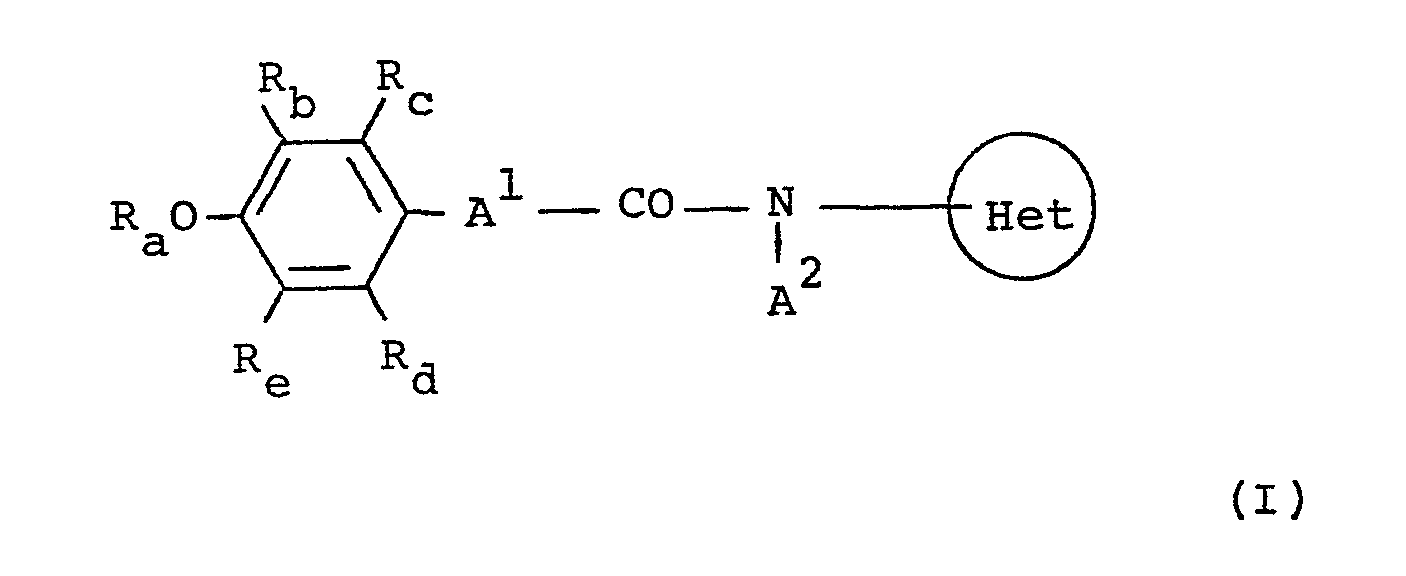
- Rb and Rc are independently hydrogen or a substituted or unsubstituted aryl group or a group -ORa; or Rb and Rc together with the carbon atoms to which they are attached form a substituted or unsubstituted carbocyclic group;
- Rd and Re are independently hydrogen, substituted or- unsubstituted aryl or a group -ORa; or Rd and Re together with the carbon atoms to which they are attached form a substituted or unsubstituted carbocyclic group;
- A l represents an alkylene or an alkenylene group;
- A2 represents hydrogen, substituted or unsubstituted alkyl or an aralkyl group substituted or unsubstituted in the aryl moiety;
- and Het represents a substituted or unsubstituted heterocyclic group.
- Suitable heterocyclic groups Het, include substituted or unsubstituted single or fused ring heterocyclic groups having 4 to 7, preferably 5- or 6-, atoms in each ring, there being up to four hetero atoms selected from oxygen, nitrogen or sulphur in each ring, and at least one hetero atom in at least one of the rings.
- Suitable optional substituents for any heterocyclic group include up to three substituents selected from the list consisting of: halo, alkyl, alkoxy, haloalkyl, hydroxy, amino, carboxy or substituted or unsubstituted aryl.
- When used herein the term 'aryl' includes phenyl and naphthyl optionally substituted with up to five, preferably up to three, groups selected from halogen, alkyl, phenyl, alkoxy, haloalkyl, hydroxy, amino, nitro, carboxy, alkoxycarbonyl, alkoxycarbonylalkyl, alkylcarbonyloxy, or alkylcarbonyl groups.
- Suitable optional substitutents for any alkyl group or alicyclic group include those indicated above in relation to the aryl group.
- Favourable heterocyclic groups Het, include groups of formula

A3 and A4 are independently hydrogen, alkyl, substituted or unsubstituted aryl or A3 and A4 together with the atoms to which they are attached form a saturated or unsaturated carbocyclic group. - Preferred heterocyclic groups Het or Het' contain up to two heteroatoms selected from oxygen, nitrogen or sulphur in each ring.
- Suitable carbocyclic groups include single or fused alicyclic or aryl rings, each ring consisting of 5- or 6- carbon atoms.
- Suitably, only one of Rb, Rc, Rd or Re represents a group -ORa·
- Suitable acyl groups represented by Ra are those of formula -CO-R wherein R represents substituted or unsubstituted alkyl or substituted or unsubstituted aryl or aralkyl substituted or unsubstituted in the aryl ring.
- Preferably, R represents alkyl or a substituted or unsubstituted benzene ring.
- Preferred acyl groups are those wherein R is C1-6 alkyl or benzene or Cl-6 alkyl-substituted benzene.
- Preferably, Rc represents hydrogen.
- Preferably, Rd represents hydrogen.
- Most preferably Rc and Rd both represent hydrogen and one of Rb or Re represents hydrogen and the remaining variable of Rb and Re represents a group -ORa
- In a preferred aspect the present invention provides a group of compounds, falling within the scope of formula (I), of general formula (II):

in which - Het is as defined above in relation to formula (I),
either n is 1 and X is a double bond,
or n is 2 and X is a single bond, - R1 and R2 are indendently hydrogen, Cl-C6 alkyl or acyl, R3 and R4 are independently hydrogen, Cl-C6 alkyl, substituted or unsubstituted aryl, or R3 and R4, together with the atoms to which they are attached, form a saturated or unsaturated carbocyclic ring.
- X is preferably a double bond (and n is 1). When X is a double bond, the hydrocarbon chain containing X may have the (E) or (Z) absolute configuration, but the (E) configuration is preferred.
- Examples of suitable 5-membered hetorocyclic rings are thiophene, furan, oxazole, isoxazole, thiazole, isothiazole, pyrrole, pyrazole and the isomeric triazoles.
- Suitable 6-membered heterocyclic rings are pyridine, pyridazine, pyrimidine, pyrazine and the isomeric triazines.
- A preferred heterocyclic group is thiophene.
- Rl and R2 are suitably hydrogen or a methyl, acetyl, propionyl, trimethylacetyl or a (4-methyl)benzoyl group.
- R3 and R4 are suitably hydrogen; or R3 and R4, together with the atoms to which they are attached, from a fused benzo, tetrahydrobenzo or cyclopentyl ring.
- The group -C02H is preferably attached to the heterocyclic ring in a position ortho to the extranuclear nitrogen atom of the amido group.
- The compounds of formula (I) or their salts, esters, amides or solvates are preferably in pharmaceutically acceptable form. By pharmaceutically acceptable form is meant, inter alia, of a pharmaceutically acceptable level of purity excluding normal pharmaceutical additives such as diluents and carriers, and including no material considered toxic at normal dosage levels. A pharmaceutically acceptable level of purity will generally be at least 90% and more preferably 95%. One preferred pharmaceutically acceptable form is the crystalline form. In the case of salts, ester, amides and solvates the additional ionic esteryfing, amide-forming and solvent moieties must also be non-toxic.
- Suitable pharmaceutically acceptable salts of the compounds of formula (I) are pharmaceutically acceptable salts of carboxy groups or hydroxy groups. Examples of a pharmaceutically acceptable salt of a carboxy group of a compound of formula (I) include alkali metal and alkaline earth metal salts, such as sodium, potassium and magnesium salts; and salts with ammonia, organic bases and amino compounds. Also when a basic nitrogen atom is present the compounds of the formula (I) can form acid addition salts with the conventional pharmaceutical acids, for example, maleic, hydrochloric, hydrobromic, phosphoric, acetic, fumaric, salicylic, citric, lactic, mandelic, tartaric, succinic, benzoic, ascorbic and methanesulphonic acids.
- Suitable pharmaceutically acceptable salts of hydroxyl groups include metal salts, especially alkali metal salts such as sodium and potassium salts.
- Suitable pharmaceutically acceptable esters of compounds of formula (I) include esters of carboxy groups and hydroxy groups.
- Suitable pharmaceutically acceptable esters are in-vivo hydrolysable esters of carboxy groups and hydroxy groups.
- Suitable in-vivo hydrolysable esters are those used conventionally in the art.
- Suitable esters of carboxyl groups are the,Cl-6 alkyl esters, especially methyl, ethyl, or t-butyl esters.
- Suitable esters of hydroxyl groups include those provided by Cl-6 alkyl carboxylic acids.
- Suitable pharmaceutically acceptable amides include amides of formula -CO. NRs Rt wherein Rs and Rt each independently represent hydrogen or C1-6 alkyl; or RS and Rt together with the nitrogen to which they are attached represent a saturated 5- or 6- membered ring.
- Suitable pharmaceutically acceptable solvates of a compound of formula (I) includes hydrates.
- Salts, esters, amides or solvates of compounds of formula (I) wnich are not pharmaceutically acceptable also form an aspect of the invention since they may be used as intermediates to prepare pharmaceutically acceptable compounds.
- When used herein the term "halogen" refers to fluorine, chlorine, bromine and iodine; preferably chlorine.
- When used herein the term "alkyl", "alkenyl", "alkynyl" or "alkoxy" relates to groups having straight or branched chains containing up to 12 carbon atoms.
- Suitable alkyl groups are C1-12 alkyl groups especially Cl-6 alkyl groups e.g. methyl, ethyl, n-propyl, iso-propyl, n-butyl, isobutyl or tert-butyl groups.
- Suitable alkenyl groups are C2-12 groups especially C2-6 alkenyl groups.
- Suitable alkynyl groups are C2-12 alkynyl groups especially C2-6 alkynyl groups.
- When used herein the term "in-vivo" hydrolysaole ester" relates to a pharmaceutically acceptable ester which readily breaks down in the human or non-human animal body to leave for example in relation to an in-vivo hydrolysable ester of a carboxy group the free carboxy group or a salt thereof or for example in relation to an in-vivo hydrolysable ester of an hydroxy group, the free hydroxy group, or a salt thereof.
- The present invention also provides a process for preparing a compound of formula (I) which comprises reacting a compound of formula (III)


- The leaving group Q is typically a halogen such as chloro or bromo, preferably chloro.
- The reaction of compounds (III) and (IV) may be effected by stirring together in a solvent such as pyridine at ambient temperatures.
- A compound of formula (Ia) may be converted to a compound of formula (I), or one compound of formula (I) converted to another, by interconversion of suitable substituents using appropriate conventional methods.
- For example an acyl group represented by R'a (an R'a acyl group) may be converted to an Ra hydrogen atom by treating with sodium methoxide in alcohol. A group -OR'a wherein R'a is hydrogen may be converted to a group -ORa wherein Ra is alkyl or acyl by treatment with an appropriate halide (or anhydrides) under conventional alkylation or acylation conditions. In addition a compound in which A1 is an alkenylene group may be converted to one in which A1 is an alkylene group by conventional hydrogenation. Also an ester of a compound of formula (Ia), prepared by conventional esterification methods, may be hydrolysed to a free carboxyl group with aqueous alkali, and the carboxyl group then converted to a further salt, ester, amide or solvate of a compound of formula (I) by the appropriate conventional procedure.
- It will be appreciated that similar conventional procedures may be used to convert a compound of formula (I) to a further compound of formula (I).
- Compounds of formula (III) may be prepared from a compound of formula (V)

- Suitable halogenating agents are thionyl chloride or, more preferably, oxalyl chloride. The reaction suitably takes place at ambient temperatures in a solvent such as chloroform or dichloromethane, in the presence of an catalytic amount of N,N-dimethylformamide.
- If the desired end product is a compound in which for example Ra is hydrogen, then in the compound of formula (V) the hydroxy group ORa is preferably protected by forming an acyl group, for example by treating with an acyl anhydride, such as acetic anhydride, in the presence of a catalytic amount of sulphuric acid in an inert solvent such as ether. Deprotection is carried out as described earlier for converting an R'a acyl to an Ra hydrogen.
- Compounds of formula (IV) and (V) are known compounds or may be prepared from known compounds by conventional procedures. For example they may be prepared by using the procedures or analogous procedures to those disclosed in Eur. J. Med. Chem. 1980, 15(5), 413 for compounds of formula (IV) and Chem. Ber. 1878, 11,656 for compounds of formula (V).
- The compounds of formula (I) are indicated as active therapeutic agents by their inhibition of phospholipase A2 and 5-lipoxygenase, and by their inhibition of histamine and SRS-A release in the rat passive peritoneal anaphylaxis model.
- Accordingly, the present invention provides a pharmaceutically acceptable compound of formula (I) or pharmaceutically acceptable salt, ester, amide or solvate thereof, as an active therapeutic substance.
- The present invention further provides a pharmaceutically acceptable compound of the formula (I), or a pharmaceutically acceptable salt, ester, amide or solvate thereof, for use in the treatment or prophylaxis of allergic diseases, such as asthma, hayfever, rhinitis or allergic eczema, or for treatment of inflammatory conditions such as arthritis and psoriasis.
- The present invention also provides a pharmaceutical composition comprising a pharmaceutically acceptable compound of the formula (I), or a pharmaceutically acceptable salt, ester, amide or solvate thereof, in admixture or conjunction with a pharmaceutically acceptable carrier.
- In a further aspect the present invention provides the use of a pharmaceutically acceptable compound of formula (I), or a pharmaceutically acceptable salt, ester, amide or solvate thereof, for the manufacture of a medicament for the treatment or prophylaxis of respiratory diseases, such as asthma, hayfever, rhinitis, or allergic eczema, or for the treatment of inflammatory conditions such as arthritis and psoriasis.
- Preferably, a pharmaceutical composition of the invention is in unit dosage form and in a form adapted for use in the medical or veterinarial fields. For example, such preparations may be in a pack form accompanied by written or printed instructions for use as an agent in the treatment or prophylaxis of any of the disorders mentioned above.
- The suitable dosage range for the compounds of the invention may vary from compound to compound and may depend on the condition to be treated. It will also depend, inter alia, upon the relation of potency to absorbability and the mode of administration chosen. The compound or composition of the invention may be formulated for administration by any route, the preferred route depending upon the disorder for which treatment is required, and is preferably in unit dosage form or in a form that a human patient may administer to himself in a single dosage. Advantageously, the composition is suitable for oral, rectal, topical, parenteral, intravenous or intramuscular administration or through the respiratory tract. Preparations may be designed to give slow release of the active ingredient. Compositions may, for example, be in the form of tablets, capsules, sachets, vials, powders, granules, lozenges, reconstitutable powders, or liquid preparations, for example solutions or suspensions, or suppositories. Compositions which are especially suitable for administration to the respiratory tract and for topical administration are discussed in more detail below.
- The compositions, for example those suitable for oral administration, may contain conventional excipients such as binding agents, for example syrup, acacia, gelatin, sorbitol, tragacanth, or polyvinylpyrrolidone; fillers, for example lactose, sugar, maize-starch, calcium phosphate, sorbitol or glycine; tabletting lubricants, for example magnesium stearate; disintegrants, for example starch, polyvinylpyrrolidone, sodium starch glycollate or microcrystalline cellulose; or pharmaceutically acceptable setting agents such as sodium lauryl sulphate.
- Solid compositions may be obtained by conventional methods of blending, filling tabletting or the like. Repeated blending operations may be used to distribute the active agent throughout those compositions employing large quantities of fillers. When the composition is in the form of a tablet, powder, or lozenge, any carrier suitable for formulating solid pharmaceutical compositions may be used, examples being magnesium stearate, starch, glucose, lactose, sucrose, rice flour and chalk. Tablets may be coated according to methods well known in normal pharmaceutical practice, in particular with an enteric coating. The composition may also be in the form of an ingestible capsule, for example of gelatin containing the compound, if desired with a carrier or other excipients.
- Compositions for oral administration as liquids may be in the form of, for example, emulsions, syrups, or elixirs, or may be presented as a dry product for reconstitution with water or other suitable vehicle before use. Such liquid compositions may contain conventional additives such as suspending agents, for example sorbitol, syrup, methyl cellulose, gelatin, hydroxyethylcellulose, carboxymethylcellulose, aluminium stearate gel, hydrogenated edible fats; emulsifying agents, for example lecithin, sorbitan monooleate, or acacia; aqueous or non-aqueous vehicles, which include edible oils, for example almond oil, fractionated coconut oil, oily esters, for example esters of glycerine, or propylene glycol, or ethyl alcohol, glycerine, water or normal saline; preservatives, for example methyl or propyl p-hydroxybenzoate or sorbic acid; and if desired conventional flavouring or colouring agents.
- The compounds of this invention may also be administered by a non-oral route. In accordance with routine pharmaceutical procedure, the compositions may be formulated, for example for rectal administration as a suppository or for presentation in an injectable form in an aqueous or non-aqueous solution, suspension or emulsion in a pharmaceutically acceptable liquid, e.g. sterile pyrogen-free water or a parenterally acceptable oil or a mixture of liquids, which may contain bacteriostatic agents, anti-oxidants or other preservatives, buffers or solutes to render the solution isotonic with the blood, thickening agents, suspending agents or other pharmaceutically acceptable additives. Such forms will be presented in unit dose form such as ampoules or disposable injection devices or in multi- dose forms such as a bottle from which the appropriate dose may be withdrawn or a solid form or concentrate which can be used to prepare an injectable formulation.
- Compositions of this invention may also suitably be presented for administration to the respiratory tract as a snuff or an aerosol or solution for a neoulizer, or as a microfine powder for insufflation, alone or in combination with an inert carrier such as lactose. In such a case the particles of active compound suitably have diameters of less than 50 microns, preferably less than 10 microns. Where appropriate, small amounts of other anti-asthmatics and bronchodilators, for example sympathomimetic amines such as isoprenaline, isoetharine, salbutamol, phenylephrine and ephedrine; xanthine derivatives such as theophylline and aminophylline and corticosteroids such as prednisolone and adrenal stimulants such as ACTH may be included.
- For topical administration, compositions may be presented as an ointment, cream, lotion, gel, aerosol, or skin paint.
- By way of example, in any of the preceding formulations a suitable dosage unit might contain 0.01 to 500mgs of active ingredient, more suitably 1 to 500mgs via the oral route, 0.01 to 10mgs via inhalation. The effective dose of compound depends on the particular compound employed, the condition of the patient and on the frequency and route of administration, but in general is in the range of from 0.001 mg/kg/day to 100 mg/kg/day inclusive of the patient's body weight.
- For use in treatment of inflammatory disorders a composition of the invention will preferably be in a form suitable for oral administration, for example a tablet or capsule or a sachet containing reconstitutable powder. A unit dose will generally contain from 20 to 1000 mg and preferably will contain from 30 to 500 mg, in particular 50, 100, 150, 200, 250, 300, 350, 400, 450, or 500 mg. The composition may be administered once or more times a day for example 2, 3 or 4 times daily, and the total daily dose for a 70 kg adult will normally be in the range 100 to 3000 mg. Alternatively the unit dose will contain from 2 to 20 mg of active ingredient and be administered in multiples, if desired, to give the preceding daily dose.
- Compounds of this invention and their preparation are illustrated in the following Examples. (Temperatures are in °C.)
- Ferulic acid (4-hydroxy-3-methoxycinnamic acid) (8.10g) was treated with acetic anhydride (15ml) and conc. sulphuric acid (10 drops) with stirring at room temperature. After 5 min dry ether was added and the stirring was continued for a further 3 hr. The mixture was poured onto ice, the product was extracted with ethyl acetate. The solvent extract was washed, dried and evaporated to yield the title compund 9.75g (98%) m.p. 194°.
- The acid from Preparation 1 (5.00g) was suspended in dichloromethane (50ml) and dimethylformamide (10 drops) and treated with oxalyl chloride (3.00g) at room temperature. After 0.5hr, the clear yellow solution was evaporated under reduced pressure to yield the crude title compound (5.15g) which was used without further purification.
- 3,4-Dihydroxycinnamic acid (5.00g) was treated with propionic anhydride (20ml) and conc. sulphuric acid (10 drops) as described in Preparation 1. The title compound 3.60g (45%) was isolated by chromatography m.p. 1660.
- The acid from Preparation 3 was converted to the acid chloride as described in Preparation 2. Treatment of the acid (2.93g) yielded the title compound 3.01g (96%).
- The title compound was prepared from t-Butylcyanoacetate, sulphur, and cyclohexanone using the method decribed by Perrisin et al. (Eur. J. Med. Chem 1980, 15(5), 413). The title compound was obtained as a thick yellow oil (bp 185%/0.06nm) in 75% yield.
- The title compound was prepared by the same method as Preparation 6, using 4-methyl-cyclohexanone in place of cyclohexanone. The product was isolated by chromatography on silica gel (dichloromethane-hexane 1:1) as a thick yellow gum. Yield (63%).
- Methyl-3-aminothiophene-2-carboxylate (2.50g) was dissolved in trifluoroacetic acid (16ml) and treated with trifluoroacetic anhydride (1.5ml). The mixture was stirred at room temperature for 3 hr. The reaction mixture was poured onto ice, and the solid which precipitated was collected, washed with water and dried mp 740 2.81g (70%). A sample which was recrystallized from hexane mp 76° was analytically pure.
- The product from Preparation 7 (1.44g) was stirred with potassium carbonate (0.95g) in dry dimethylformamide (15ml) at 700. Benzylbromide (1.07g) was added dropwise and the reaction stirred at 70° for 2hr. The title compound was isolated by solvent extraction and chromatography on silica gel (ethylacetate-hexane 1:4) as a white solid 1.28g mp 540 (66%) and was analytically pure.
- The product from Preparation 8 (1.20g) was treated with 7% potassium carbonate in 25ml methanol-water (7:2), and stirred at room temperature for 1 hr. The white solid which had precipitated was collected, washed, and dried to yield the title compound mp 800 0.82g (85%) which was analytically pure.
- Methyl 3-aminothiophene-2-carboxylate(1.00g, 0.006mol)was dissolved in dry pyridine (10ml) and a solution of 3,4-diacetoxycinnarmoyl chloride (1.75g=0.006mol) in pyridine (10ml) was added at room temperature with stirring.
- After 3hr. the pyridine was evaporated, and the residue was dissolved in chloroform. The chloroform solution was washed with dilute sodium hydroxide solution, 2M hydrochloric acid and water. The solvent layer was dried (MgSO4), and evaporated to yield a red semi-solid (1.70g).
- Chromatography on Kieselgel 60 (Ethylacetate-Hexane 1:1) gave the required product (0.97g) as a pale yellow solid. Recrystallization (EtOAc) gave pure material m.p. 164°C. Yield=39%.
- Found C.56.35, H. 4.28, N. 3.50, S. 7.83%
- Requires C. 56.57, H. 4.25, N. 3.47, S. 7.95% for C19H17NO7S
- In a repeat reaction the 3,4-diacetoxy cinnamyl chloride was prepared "in situ" from 3,4-diacetoxycinnamic acid (1.57g=.006ml). The yield of pure compound was 49%.
- Methyl-3-aminothiophene-2-carboxylate (2.00g) and 4-acetoxy-3-methoxycinnamoyl chloride (3.50g) were reacted as described in Example 1.
- Crystallization of the crude product from ethylacetate / hexane yielded the title compound 3.62g (76%).
- Found C. 57.46, H. 4.51, N. 3.46%
- Requires C. 57.59, H. 4.56, N. 3.73% for C18H17NO6S
- Ethyl 3-aminopyrazole-4-carboxylate (2.00g) and 3,4-diacetoxycinnamoyl chloride were reacted as described in Example 1.
- Chromatography on Kieselgel 60 (Ethylacetate-hexane, 4:6) gave pure title compound 1.65g (32%) m.p. 154°
- Found C. 56.59, H. 4.72, N. 10.24%
- Requires C. 56.85, H. 4.77, N. 10.47% for C19H19N3O7
- Ethyl-2-aminonicotinate (2.30g) and 3,4-diacetoxycinnamoyl chloride (4.01g) were reacted in pyridine (40ml) as described in Example 1. Chromatography of the crude product on Kieselgel 60 (Ethylacetate: HexanE, 7:3) gave pure title compound (3.79g) (66%) m.p. 1630.
- Found C.60.79, H. 4.83, N. 6.51%
- Requires C. 61.16, H. 4.89, N. 6.79% for C21H20N2O7
- A solution of freshly prepared 3,4-diacetoxycinnamoyl chloride (from 3,4- diacetoxycinnamic acid, 5.20g) in toluene (15ml) was added dropwise to a solution of ethyl-2-amino 4,5,6,7-tetrahydrobenzo [b]-thiophene-3-carboxylate (4,52g)in pyridine (25ml). The reaction mixture was stirred and cooled in ice. When the addition was complete the reaction was stirred at ambient temperature for 3hr. Treatment as described in Example 1 yielded a yellow solid (7.95g) m.p. 174° which was crystallized from ethyl acetate to give pure title compound (7.40g) (78%) m.p. 1970.
- Found C. 61.52, H. 5.54, N. 3.02, S. 6.81%
- Requires C. 61.13, H. 5.34, N. 2.97, S. 6.80% for C24H25NO7S
- A solution of freshly prepared 3,4-dimethoxycinnamoyl chloride (from 3,4-dimethoxycinnamic acid 2.08g) was dissolved in toluene (25ml) and added dropwise to a solution of methyl-3-aminothiophene-2-carboxylate (1.57g) in pyridine (20ml). The reaction was stirred and cooled ir. ice. When the addition was complete, the mixture was stirred at ambient temperature for 3hr. Treatment of the mixture as described in Example 1 gave the crude product, which was crystallized from ethyl acetate to yield pure title compound (2.51g) (12%) m.p. 150°.
- Found C. 58.75, H. 4.89, N. 4.03, S. 9.23%
- Requires C. 58.77, H. 4.93, N. 4.03, S. 9.23% for C17H17NO5S
- The ester obtained in Eample 1 (1.00g) was suspended in methanol (20ml) and stirred at room temperature. Sodium metal (10mg) was added and the reaction was stirred until a clear solution was obtained (1hr) The reaction mixture was diluted with water and acidified with dilute hydrochloric acid. A yellow solid precipitated which was collected, washed and dried (0.68g) m.p. 2020.
- Recrystallization from ethanol gave pure title compound m.p. 2100(86%)
- Found C. 56.08, H. 4.07, N. 4.32, S. 10.32%
- Requires C. 56.42, H. 4.10, N. 4.39, S. 10.04% for C15H13NO5S
- The product fr Example 2 (3.60g) was treated with methanol and sodium metal as described in Example 7. Chromatography on Kieselgel 60 (EtOAc: Hexane, 4:6) gave the title compound 2.00g (56%) m.p. 102° as a crystalline solid containing 0.5mole of ethyl acetate
- Found C. 57.48, H. 5.04, N. 3.54, S. 8.37%
- Requires C. 57.28, H. 5.07, N. 3.71, S. 8.50% for C16H15NO5S + 0.5.C4H8O2
- The 1H Nuclear Magnetic Resonance spectrum confirms the presence of 0.5 mole of ethyl acetate in the product.
- The diacetyl derivative described in Example 3 (1.50g) was treated with sodium and ethanol as described in Example 7. The crude product was crystallized fran ethanol to yield the title compound 0.66g (55%) m.p. 179°
- Found C. 56.65, H. 4.82, N.13.06%
- Requires C. 56.77, H. 4.76, N. 13.25 for C15N15N3O5
- The diacetoxy compound described in Example 4 (1.92g) was reacted with methanol and sodium as described in Example 7. The crude product was crystallized from ethanol to yield pure title compound (0.85g) (56%) m.p. 178 0.
- Found C. 62.04, H. 4.91, N. 8.62%
- Requires C. 62.19, H. 4.91, N. 8.53% for C17H16N2O5
- The diacetyl derivative described in Exanple 5 was suspended in methanol and treated with sodium metal as described in Exanple 7. Because of the low solubility of the diacetyl derivative in methanol the reaction proceeded very slowly. The mixture was warmed to 35°C when a clear solution was obtained after 0.5hr. Treatment as described in Example 7 gave the crude product (3.51g). Chromatography on Kieselgel 60 (ethyl acetate) gave title compound (2.70g) (44%) m.p. 2700.
- Found C. 61.63, H. 5.49, N. 3.48, S. 8.16%
- Requires C. 62.00, H. 5.46, N. 3.62, S. 8.27%.
- The ester from Example 7 (0.85g) was treated with 1M sodium hydroxide solution (10ml) and ethanol (5ml) and stirred at room temperature for 4hr. The mixture was diluted with water and acidified with dilute hydrochloric acid. The brown solid which separated was collected, washed and dried. Recrystallization from ethyl acetate (chrarcoal) gave pure title compound as the mono hydrate (0.75g) m.p. 212°. Yield=88%.
- Found C. 52.34, H. 4.09, N. 4.40, S. 9.73%
- Requires C. 52.00, H. 4.05, N. 4.33, S. 9.92% for C14H11NO5S.H2O
- The ester from Example 8 (0.95g) was hydrolysed as described in Example 12. The crude product was crystallized from ethanol (0.51g) (76%) m.p. 197°.
- Found C. 56.80, H. 4.37, N. 4.41, S. 9.93%
- Requires C. 56.42, H. 4.10, N. 4.38, S. 10.04%
- The ester in example 10 (0.50g) was treated with 1M Sodium Hydroxide solution and ethanol as described in Example 12. The reaction mixture was neutralized with dilute hydrochloric acid, and the precipitate which formed was collected, washed with water and dried. Treatment of this yellow-brown solid with dilute hydrochloric acid gave the title compound (0.28g) (63%) m.p. 274°. This material could be crystallized from dimethyl formamide - water with no increase in melting point.
- Found C. 56.55, H. 4.85, N. 8.65%
- Requires C. 56.59, H. 4.43, N. 8.80% for C15H12N2O5. H 2 0.
- The ester from Example 6 (1.50g) was treated with IM Sodium Hydroxide solution (30ml) and methanol (10ml). The reaction was stirred and warmed to 35°C. After 4hr. hydrolysis was complete and the reaction was acidified with dilute hydrochloric acid. The solid which precipitated was collected, washed and dried to yield the crude title compound (1.30g) mp 209°. Recrystallization (ethanol) gave the pure acid (1.18g)(82%) mp 214 0.
- Requires C. 57.65, H 4.54, N. 4.20, S. 9.62% for C16H15NO5S
- Methyl-3-amino-5-(4-chlorophenyl)thiophene-2-carboxylate (5.35g, 0.02 mol) was dissolved in dry pyridine (50ml). A solution of the acid chloride prepared from 3,4-diacetoxycinnamic acid (5.28g, 0.02mol) and oxalyl chloride, (as described in Preparation 2), in toluene (100ml) was added dropwise with ice cooling and stirring. After stirring for a further 5hr at room temperature, the product was isolated as described in Example 1.
- The title compound was a white solid mp 2030 4.79g (76%).
- Found C.58.79, H.3.95, N.2.62, S.6.29%
- Requires C.58.42, H.3.92, N.2.73, S.6.24% for C25H20ClNO7S
- t-Butyl-2-amino-4,5,6,7-tetrahydrobenzo[b]thiophene-3-carboxylate described in Preparation 5 (2.53g, O.Olmol) was dissolved in dry pyridine (25ml) and a freshly prepared solution of 3,4-diacetoxycinnamoyl chloride (2.83g, O.Olmol) in dichloromethane (20ml) was added dropwise with ice cooling and stirring. After 3hr the yellow solid which had precipitated was collected, washed and dried mp 2010 2.38g (48%).
- Recrystallization (EtOAc) gave pure material mp 2070.
- Found C.62.33, H.5.80, N.275, S.6.23%
- Requires C.62.51, H.5.85, N.2.80, S.6.42% for C26H29NO7S
- t-Butyl-2-amino-5-methyl-4,5,6,7-tetrahydrobenzo[b]-thiophene-3-carboxylate (8.00g, 0.03mol) as described in Preparation 6 was reacted with a freshly prepared solution of 3,4-diacetoxycinnamoyl chloride Lfrom 3,4-diacetoxycinnamic acid (7.92g, 0.03mol)] as described in Example 17. The yellow product was collected, washed, and dried. Recrystallization (EtOAc) gave the pure title compound 4.28g (54%), mp 2620, as a mono-hydrate.
- Found C.61.13, H.6.04, N.2.65, S.5.68%
- Requires C.60.99, H.6.26, N.2.64, S.6.03% for C27H31NO7S.H2O
- Ethyl-3-amino pyridine-4-carboxylate (2.40g, 145mmol) was dissolved in pyridine (25ml) and reacted with the acid chloride derived from 3,4-diacetoxycinnamic acid (3.82g, 145mmol) dissolved in dichloromethane as described in Example 1. Chromatography of the crude product on silica gel (EtOAc-Hexane 7:3) gave unreacted 3,4-diacetoxycinnamic acid (0.55g) and the title compound 3.16g (54%) mp 152°. A sample was recrystallized (EtOAc) and had mp 1540.
- Found C.61.05, H.4.95, N.6.80
- Requires C.61.16, H.4.89, N.6.75 for C21H20N2O7
- Methyl-3-amino-N-benzylthiophene-2-carboxylate (described in Preparation 9) (3.31g), was dissolved in pyridine (40ml) and treated with the acid chloride derived from 3,4-diacetoxycinnamic acid (3.53g) dissolved in dichloromethane as described in Example 1. The crude product was a red gum 6.52g. Chromatography on silica gel (CHC13) gave recovered amine (1.50g) and title compound 3.21g (89%) mp 1560. Recrystallization (EtOAc-Hexane) gave pure title compound mp 1580.
- Found C.63.29, H.4.81, N.2.77, S.6.46%
- Requires C.63.27, H.4.70, N.2.84, S.6.50% for C 26 H 23N07S,
- Methyl-2-aminothiophene-3-carboxylate (2.60g) was dissolved in pyridine (25ml) and reacted with the acid chloride derived from 3,4-diacetoxycinnamic acid (4.00g) dissolved in dichloromethane (20ml). The reaction was carried out as described in Example 1. The crude product (5.54g) mp 155-60° was chromatographed on silica gel (EtOAc-Hexane 1:1) to yield pure title compound 3.22g (50%) mp 1700.
- Found C.56.23, H.4.32, N.3.44, S.7.63% Requires C.56.57, H.4.25, N.3.47, S.7.95% for C19H17NO7S
- t-Butyl-2-amino-4,5,6,7-tetrahydrobenzo[b]thiophene-3-carboxylate as described in Preparation 5 (2.53g, O.Olmol) was dissolved in dry pyridine (20ml) and reacted with the acid chloride derived from 3,4-dipropionoyloxycinnamic acid (2.93g) as described in Preparation 4. After 3hr the reaction mixture was poured onto ice and the solid which precipitated was collected, washed, and dried. Chromatography on silica gel (CHC13) gave 3.14g (60%) of pure title compound mp 1890.
- Found C.63.59, H.6.36, N.2.81, S.6.27%
- Requires C.63.74, H.6.30, N.2.66, S.6.08% for C28H33NO7S
- The diacetoxy compound described in Example 16 (4.10g) was suspended in methanol (150ml) and treated with sodium metal (50mg) as described in Example 7. The crude product was recrystallized from methanol to yield the pure title compound 3.02g (88%) mp 2560.
- Found C.58.84, H.3.77, N.3.31, Cl.8.38, S.7.11% Requires C.58.67, H.3.75, N.3.26, Cl.8.25, S.7.46% for C21H16C1NO5S
- The diacetoxy compound described in Example 17 (1.95g) was suspended in methanol (25ml) and treated with sodium metal as described in Example 7. The crude title compound (1.44g) mp 214-5° was recrystallized from ethylacetate (1.32g) (81%).
- Found C.63.43, H.5.95, N.3.37, S.7.69%
- Requires C.63,59, H.6.07, N.3.37, S.7.72% for C22H25NO5S
- The diacetoxy compound (0.78g) described in Example 18, was treated with methanol and sodium metal as described in Example 7. The crude product was purified by chromatography on silica gel (CHC13) to yield the pure title compound 0.32g (44%) mp 2230.
- Found C.64.59, H.6.51, N.3.21
- Requires C.64.31, H.6.34, N.3.26 for C23H27NO5S
- The diacetoxy compound described in Example 21 (2.0g) was treated with methanol and sodium metal, as described in Example 7. The crude product was recrystallized from EtOAc-Hexane to yield the pure title compound 1.27g (80%) mp 229°.
- Found C.56.59, H.4.14, N.4.70, S.9.90
- Requires C.56.42, H.4.10, N.4.39, S.10.02 for C15H13NO3S
- 2-(3,4-Diacetoxycinnamoylamino)-4,5,6,7-tetrahydrobenzo[b]thiophene-3-carboxylic acid (l.OOg) as described in Example 32 was treated with methanol and sodium metal as described in Example 7. A yellow solid mp 220° was obtained. Recrystallization from ethanol gave the pure title compound mp 2240, 0.67g (84%).
- Found C.60.32, H.5.16, N.3.88, S.8.84%
- Requires C.60.15, H.4.77, N.3.90, S.8.92% for C18H17NO5S
- The dihydroxy ester from Example 7 (0.50g) was treated with propionic anhydride (10ml) and conc. sulphuric acid (5 drops) and stirred at room temperature for lhr. The mixture was poured onto ice, extracted with ethyl acetate, and the extracts were washed, dried and evaporated. The residue was crystallized for hexane when pure title compound was obtained mp 1260 0.33g (49%).
- Found C.58.45, H.4.94, N.3.42, S.7.36%
- Requires C.58.46, H.4.91, N.3.25, S.7.43% for C21H21NO7S
- The dihydroxy ester from Example 25 (0.5g) was reacted with propionic anhydride as described in Example 28. The crude product was crystallized from ethlacetate-hexane, to yield the pure title compound mp 1800 0.24g (38%).
- Found C.64.37, H.6.35, N.2.59, S.5.97%
- Rquires C.64.30, H.6.51, N.2.59, S.5.92% for C29H35N07S.
- From the reaction a second product was isolated. See Example 34.
- The dihydroxy ester described in Example 25 (0.43g) was dissolved in pyridine (10ml) and stirred at room temperature. p-Toluoylchloride (0.35g, 2.leq) was added, and the mixture was stirred for 2hr. The mixture was poured onto ice, and the yellow solid which precipitated was collected, washed, and dried to yield the crude product 0.73g mp 193°. Crystallization from Hexane-ethyl acetate gave the pure title compound 0.58g (87%) mp 203°.
- Found C.70.69, H.5.91, N.2.10, S.4.70%
- Requires C.70.35, H.5.99, N.2.10, S.4.82% for C39H39NO7S
- The dihydroxy ester described in Example 7 (0.50g) was reacted with p-toluoylchloride (2.1 equiv) in the manner described in Example 30. The crude product mp 1700, 0.77g, was purified by chromatography on silica gel (EtOAc-Hexane 3:7) to yield the title compound mp 185° 0.52g (60%).
- Found C.66.67, H.4.46, N.2.62, S.5.65%
- Requires C.67.02, H.4.54, N.2.52, S.5.77% for C31H25NO7S
- The diacetoxy ester described in Example 17 (3.20g) was treated with formic acid (100%, 50ml) and stirred at 45° for lhr. On cooling and dilution with water, the product crystallized. Chromatography on silica gel (toluene-EtOAc 1:1) gave the pure title compound 2.35g (83%) mp 2120.
- Found C.59.69, H.4.82, N.2.80, S.7.03%
- Requires C.59.58, H.4.77, N.3.16, S.7.23% for C22H21NO7S
- The diacetoxy ester described in Example 18 (2.00g) was treated with formic acid (100%, 30ml) at 50° for 2hr. Dilution with water gave the crude product, which was crystallized from ethyl acetate-ethanol to yield the pure title compound 0.98g (55%) mp 227°.
- Found C.59.97, H.5.02, N.3.06, S.6.92%
- Requires C.60.38, H.5.07, N.3.06, S.70.1% for C23H23NO7S
- The title compound was isolated as a by-product in Example 29. Chromatography on silica gel (CHC13) and crystallization from hexane gave the pure title compound 0.21g (37%) mp 2080.
- Found C.61.83, H.5.26, N.2.88, S.6.97%
- Requires C.61.84, H.5.61, N.2.89, S.6.60% for C25H27N07S.
- t-Butyl-2-amino-4,5,6,7-tetrahydrobenzo[b]thiophene-3-carboxylate (Preparation 5) 2.53g was dissolved in pyridine (25ml) stirred and cooled in ice. A solution of 3,4-dimethoxycinnamoyl chloride freshly prepared from 3,4-dimethoxycinnamic acid (2.08g) in dichloromethane (20ml) was added. The reaction was stirred at room temperature overnight and then processed as described in Example 1. The crude product was recrystallized from ethyl acetate to give the pure title compound 2.44g (55%) mp 177°.
- Found C.64.78, H.6.64, N.3.36, S.7.11%
- Requires C.64.99, H.6.59, N.3.16, S.7.23% for C24H29NO5S
- The t-butyl ester (1.90g) described in Example 35 was treated with formic acid (100%, 25ml) and stirred at 50° for lhr. The yellow solid which precipitated was collected, washed, and dried. Recrystallization from ethylacetate-ethanol gave the pure title compound 0.78g (48%) mp 2210.
- Found C.62.11, H.5.59, N.3.72, S.8.31%
- Requires C.62.00, H.5.46, N.3.62, S.8.28% for C20H21NO5S
- By way of example, the potential therapeutic activity of illustrative compounds of this invention from the preceding Examples was demonstrated in relevant in vivo and in vitro disease models as follows:
- Inhibition of Phospholipase A2 Activity
- Enzyme: Phospholipase A2 (Naja naja venom, Sigma)
- Substrate: Diarachidoyl phosphatidylcholine (10.6mg) and α-1-palmitoyl-2-[1-14C]-arachidonyl phosphatidylcholine (0.5uCi; 52.9mCi/mMol) in 28ml of TrisHCl buffer=100mM, pH 8.7) ultrasonicated.
- Assay: Incubations containing PLA2 (0.125ng) in Tris HC1 buffer (lOOmM, pH 8.7) and CaCl2 (4mM) were prepared on ice. Immediately prior to incubation at 37°C 5µl of DMSO or compound in DMSO were added. The final assay volume was 1.75ml. After 10 minutes at 370C 750µl of substrate was added, with mixing, and the incubation continued for a further 15 min. The reaction was terminated by placing on ice and adding 5ml CHCl3:MeOH (2:lv/v).
- The lower organic phase was removed and stored under N2 at-200C until analysed. Analysis was by 1-dimensional t.l.c. on polygram Sil G sheets in the solvent system petroleum ether: diethyl ether: acetic acid (60:40:1,v/v). In this system the phospholipid remains at the origin and the arachidonic acid has an approximate Rf. value of 0.36. The areas of interest were cut from the plates and radioactivity determined by liquid scintillation counting.
- All compounds were tested in triplicate.
- Calculation: The radioactivity of the arachidonic acid is expressed as a percentage of the total dpm cut from the plate. The percentage inhibition of arachidonic acid release compared to that of the control was calculated after correction for the level of spontaneous release where:
- x = % corrected mean arachidonic acid release in control
- y = % corrected arachidionic acid release after inhibition
- % inhibition

- The mean of the triplicate samples was calculated giving z + standard deviation%.
- 5-Lipoxygenase enzyme was prepared as a 10,000 g supernatant from RBL-1 cells by the method of Jakschik [Jakschik, B.A., F.F. Sun, L.M. Lee, and M.M.Steinhoff, 1980, Biochem. Biophys. Res. Comm. 95, 103]. The 10,000 g supernatant was diluted with homogenization buffer to the equivalent of 1.5 - 2.5 x 10⁷ cells. ml-1 and made 2mM with respect to CaCl2. Aliquots of 0.5 ml were then dispensed into tubes, and incubated at 290C with 5 µl ethanol or compound in ethanol at the desired concentration for 2 min. Then [1-14C] arachidonic acid was added in buffer to give a final concentration of 6.3 uM and 0.2 µCi per incubation, and the reaction continued at 290C for 2 min. The reaction was terminated by adding 1 ml of acetone and cooling on ice, 0.5 ml of ice-cold saline and 10 µl of 2N formic acid were added, and the mixture was extracted with 2 x 2 ml of chloroform. The extract was stored under N2at -20°C until analysis by chromatography. Activity was measured as the percentage of total radioactivity found in 5-HETE and 5,12-diHETE, and inhibition calculated as the decrease in formation of the sum of these two species in compound-treated incubates relative to control incubates.
- The method is essentially similar to that described previously by Ross et al (Ross, Janet W., Smith, H. and Spicer, Barbara A. Increased vascular permeability during passive peritoneal anaphylaxis in the rat. Int. Arch. Allergy appl. Immun. 51, 226, 1976.)
- Charles River Sprague Dawley male rats of 225-275 g and Dunkin Hartley male white guinea pigs of 250-300 g were used.
- Charles River Sprague Dawley male rats of 225 - 275 g were given intraperitoneal injections of 0.5 ml of either Bordetella pertussis vaccine (4 x 10¹⁰ organisms/ml; Burroughs Wellcome, London) or Pertussis vaccine absorbed (not less than 41.u. B. pertussis antigen with aluminium hydroxide; The Lister Institute Elstree, England), and subcutaneous injections of 0.5ml of an emulsion of 100 mg of ovalbumin (chicken egg albumin; crystallised and lyophilised, grade V, Sigma, London) in 2ml of isotonic saline and 3ml of incomplete Freund's adjuvant. The rats were bled by cardiac puncture on day 18, the blood was pooled and the serum separated, stored at -200C and thawed only once before use. The serum produced 72 hour passive cutaneous anaphylaxis activity in recipient rats to a dilution of 1:64 to 1:32 which was decreased to a dilution of less than 1:2 by heating at 560C for 4 hours.
- Rats were given intraperitoneal injections of 2 ml of a 1:5 dilution of the rat anti-serum in isotonic saline. Two hours later 0.3ml of 5% solution of Pontamine Sky Blue (Raymond A. Lamb, London) in isotonic saline was injected intraveneously, followed by an intraperitoneal injection of the test compound in 1 ml of saline; (control rats received 1 ml of saline); followed 2.5 minutes later by an intraperitoneal injection of 5 ml of a Tyrode solution containing 50ug/ml heparin and 0.4 mg/ml of ovalbumin. The concentrations of the compounds were quoted as that in the 6 ml of fluid injected intraperitoneally. Exactly 5 minutes after challenge the rats were stunned and bled and their peritoneal fluids were collected by opening their peritoneal cavities over funnels into polycarbonate tubes in ice. The supernatants were separated from the cellular residue by centrifuging at 15U g for 5 minutes and any samples obviously contaminated with blood were discarded for estimation of dye, histamine and SRS-A. Groups of at least 5 rats were used for each dose of compound and the treatments were randomized.
- Collected peritoneal fluids were centrifuged and the supernatant fluids assayed for dye immediately. 0.5 ml samples of the supernatants were added to 1 ml of 12% trichloracetic acid and stored at -20°C and used to assay for histamine. The remainders of the supernatant fluids were placed in a boiling water bath for 5 minutes and stored frozen at -20°C until assayed for SRS-A.
- The optical densities (OD) of the supernatants which were not contaminated with blood were determined immediately at 625nm.
- Histamine was assayed using an automated spectrofluorimetric system (technicon Autoanalyser) by a method similar to that of Evans, D.P., Lewis, J.A. and Thomson, D.S.: (An automated fluorimetric assay for the rapid determination of histamine in biological fluids. Life Sci. 12, 327, 1973). At the concentrations used the compounds tested did not interfere with the assay.
- SRS-A was assayed on the isolated guinea pig ileum preparation in the presence of atropine (5 x 10⁻⁷M) and mepyramine maleate (10-6M), the latter to abolish the histamine response. (Brocklehurst, W.E. The release of histamine and formation of a slow reacting substance (SRS-A) during anaphylactic shock. J. Physiol., Lond. 151, 416, 1960). Bulked peritoneal fluids from passively sensitised and challenged rats were centrifuged, heated, stored at -20°C in 0.5 ml aliquots, and used as a reference SRS-A standard, and arbitrarily designated as containing 10 Units per ml. Concentrations of the unknown were bracketed by reference SRS-A samples. At the concentrations used, the compounds tested did not interfere with the assay.
- This model of cartilage degradation is adapted from the biological assay for catabolin of J. Dingle, et al. (Biochem. J. 184, 177-180, 1979).
- Catabolin (pig interleukin-1, IL-1) is identified by its ability to induce the breakdown of cartilage proteoglycans in living but not in killed cartilage.
- The effect of catabolin on proteoglycan breakdown is measured by the release of 35SO4, precipitable by cetlpyridinium chloride (CPC), from pieces of pre-labelled porcine articular cartilage.
- The cartilage is obtained from the metacarpophalangeal joints of freshly killed young pigs; it is trimmed, washed and, after an overnight incubation, labelled with 10 pCi/ml/4 cartilage slices Na2 35S04 for 24 hours. The culture medium used is Dulbecco's modification of Eagle's medium (DMEM) containing 10% foetal calf serum (to inhibit direct enzymic degradation of the cartilage), glutamine and antibiotics. The labelled cartilage is washed (DMEM+1 mg/ml unlabelled Na2SO4) and cultured in multiwell dishes, containing 0.5 ml of either control culture medium or medium containing catabolin (derived from either porcine synovial tissue or from porcine mononuclear leukocytes), at 36.50C in a humidified atmosphere of 5% C02 in air. Compounds are generally dissolved in dimethyl sulphoxide (DMSO) and added to both control and catabolin groups (n=4). Killed cartilage slices (frozen and thawed three times in liquid N2) are also cultured to confirm the lack of any direct enzymic degradation of the cartilage.
- The culture medium is changed every 2 days for 6 days and the culture medium from the 3 collection periods is pooled. At the end of the experiment the residual cartilage slices are digested overnight in papain (5 mg/ml in 50 mM phosphate buffer, pH 6.5) and samples of the cartilage-conditioned medium are treated with CPC (5% in 0.3 M KC1) which precipitates the radiolabelled glycosoaminoglycan products of catabolin-induced degradation.
- Aliquots of the cartilage-conditioned medium, the CPC treated medium and the cartilage digests are assayed by liquid scintillation counting.
- The release of 35S04 proteoglycan from the cartilage is determined from the CPC-precipitable label released into the medium as a percentage of the total label initially incorporated into the cartilage, i.e.
- % proteoglycan breakdown =

- Subtraction of the release in control groups from that in catabolin-treated groups gives the breakdown actually induced by cataoolin.
- Compound activity is quoted as % inhibition of this catabolin-induced cartilage breakdown.
- Compound toxicity is assessed by measurement of the incorporation of 35SO4 into proteoglycan by cartilage cultured in the presence of compound, after a second 4-day period of culture in the absence of compound.
-

- All compounds were injected i.p. to give a final concentration of 2 x 10⁻⁴M with a contact time of 2½ minutes.

-

Claims (11)
1. A compound of formula (I):

or a salt, ester, amide or solvate thereof, characterised in that Ra represents hydrogen, substituted or unsubstituted alkyl or an acyl group;
Rb and Rc are independently hydrogen or a substituted or unsubstituted aryl group or a group -ORa; or Rb and
Rc together with the carbon atoms to which they are attached form a substituted or unsubstituted carbocyclic group;
Rd and Re are independently hydrogen, substituted or unsubstituted aryl or a group -ORa; or Rd and Re together with the carbon atoms to which they are attached form a substituted or unsubstituted carbocyclic group;
Al represents an alkylene or an alkenylene group;
A2 represents hydrogen, substituted or unsubstituted alkyl or an aralkyl group substituted or unsubstituted in the aryl moiety;
and Het represents a substituted or unsubstituted heterocyclic group.
2. A compound as claimed in claim 1, wherein the heterocyclic group Het represents a group of formula:

wherein Het' represents a 5- or 6- membered single ring having up to 4 hetero atoms in the ring selected from oxygen, nitrogen or sulphur; and
A3 and A4 are independently hydrogen, alkyl, substituted or unsubstituted aryl or A3 and A4 together with the atoms to which they are attached form a saturated or unsaturated carbocyclic group.
A3 and A4 are independently hydrogen, alkyl, substituted or unsubstituted aryl or A3 and A4 together with the atoms to which they are attached form a saturated or unsaturated carbocyclic group.
3. A compound as claimed in any one of claims 1 or 2, represented by the general formula (II):

or a salt, ester, amide or solvate thereof,
in which
in which
Het is as defined above in relation to formula (I),
either n is 1 and X is a double bond,
or n is 2 and X is a single bond,
either n is 1 and X is a double bond,
or n is 2 and X is a single bond,
Rl and R2 are indendently hydrogen, Cl-C6 alkyl or acyl, R3 and R4 are independently hydrogen, Cl-C6 alkyl, substituted or unsubstituted aryl, or R3 and R4, together with the atoms to which they are attached, form a saturated or unsaturated carbocyclic ring.
4. A compound as claimed in claim 3, wherein Het' is thiophene.
5. A compound as claimed in claim 3 or claim 4, wherein R3 and R4 are suitably hydrogen; or R3 and R4, together with the atoms to which they are attached, from a fused benzo, tetrahydrobenzo or cyclopentyl ring.
6. A compound as claimed in claim 1, selected from the list consisting of:
methyl 3-[N-(3,4-dihydroxycinnamoyl)-amino]thiophene-2-carboxylate; and
ethyl-2[N-(3,4-dihydroxycinnamoyl)amino]4,5,6,7-tetrahydrobenzo [b] thiophene-3-carboxylate; or a pharmaceutically acceptable salt, ester, amide or solvate thereof.
7. A process for preparing a compound of formula (I), as defined in claim 1, or a pharmaceutically acceptable salt, ester, amide or solvate thereof, which process comprises reacting a compound of formula (III):

in which R'a, R'b, R'c, R'd and R'e are either Ra, Rb, Rc, Rd or Re as defined in respect of formula (I) or a group or atom convertible to Ra, Rb, Rc, Rd, or Re; A1 is as defined in relation to formula (I) and Q is a leaving group; with a compound of formula (IV)

in which Het is as defined in respect of formula (I); to form a compound of formula (Ia)

and thereafter where appropriate converting R'a, R'b, R'c, R'd or R'e to Ra, Rb, Rc, Rd or Re respectively, and optionally forming a salt, ester, amide or solvate thereof.
8. A pharmaceutical composition comprising a pharmaceutically acceptable compound of the formula (I) as defined in claim 1, or a pharmaceutically acceptable salt, ester, amide or solvate thereof, in admixture or conjunction with a pharmaceutically acceptable carrier.
9. A pharmaceutically acceptable compound of formula (I), as defined in claim 1, or a pharmaceutically acceptable salt, ester, amide or solvate thereof for use as an active therapeutic substance.
10. A pharmaceutically acceptable compound of formula (I), or a pharmaceutically acceptable salt, ester, amide or solvate thereof, for use in the treatment or prophylaxis of allergic diseases, such as asthma, hayfever, rhinitis or allergic eczema, or for the treatment of inflammatory conditions such as arthritis and psoriasis.
11. The use of a pharmaceutically acceptable compound of formula (I) as defined in claim 1, or a pharmaceutically acceptable salt, ester, amide or solvate thereof, for the manufacture of a medicament for the treatment or prophylaxis of allergic diseases, such as asthma, hayfever, rhinitis or allergic eczema, or for treatment of inflammatory conditions such as arthritis and psoriasis.
Applications Claiming Priority (2)
| Application Number | Priority Date | Filing Date | Title |
|---|---|---|---|
| GB8531019 | 1985-12-17 | ||
| GB858531019A GB8531019D0 (en) | 1985-12-17 | 1985-12-17 | Compounds |
Publications (1)
| Publication Number | Publication Date |
|---|---|
| EP0227431A1 true EP0227431A1 (en) | 1987-07-01 |
Family
ID=10589872
Family Applications (1)
| Application Number | Title | Priority Date | Filing Date |
|---|---|---|---|
| EP86309873A Withdrawn EP0227431A1 (en) | 1985-12-17 | 1986-12-17 | Heterocyclic amides |
Country Status (3)
| Country | Link |
|---|---|
| EP (1) | EP0227431A1 (en) |
| JP (1) | JPS62175466A (en) |
| GB (1) | GB8531019D0 (en) |
Cited By (5)
| Publication number | Priority date | Publication date | Assignee | Title |
|---|---|---|---|---|
| US5281626A (en) * | 1990-02-08 | 1994-01-25 | Eisai Co., Ltd. | Benzenesulfonamide derivatives |
| EP0661260A1 (en) * | 1993-12-15 | 1995-07-05 | Centre International De Recherches Dermatologiques Galderma, ( Cird Galderma) | New bi-aromatic compounds derived from amides pharmaceutical compositions and cosmetic compositions containing them and their use |
| EP0728739A1 (en) * | 1995-02-23 | 1996-08-28 | Centre International De Recherches Dermatologiques Galderma (C.I.R.D. Galderma) | Biaromatic amide derivatives, pharmaceutical and cosmetic compositions containing them and their utilisations |
| WO2010071865A1 (en) | 2008-12-19 | 2010-06-24 | Nuon Therapeutics, Inc. | Pharmaceutical compositions and methods for treating hyperuricemia and related disorders |
| WO2011124844A1 (en) * | 2010-04-08 | 2011-10-13 | Produits Chimiques Auxiliaires Et De Synthese | Amide derivatives of cinnamic, ferulic and avenalumic series, process for preparing same and cosmetic compositions containing same |
Families Citing this family (3)
| Publication number | Priority date | Publication date | Assignee | Title |
|---|---|---|---|---|
| DE69719544T2 (en) * | 1996-12-12 | 2003-11-06 | Banyu Pharmaceutical Co., Ltd. | PYRAZOLE DERIVATIVES |
| DE69729315T2 (en) * | 1996-12-16 | 2005-06-23 | Banyu Pharmaceutical Co., Ltd. | aminopyrazole |
| AR069650A1 (en) * | 2007-12-14 | 2010-02-10 | Actelion Pharmaceuticals Ltd | DERIVATIVES OF AMINOPIRAZOL AS NON-PEPTIDIC AGONISTS OF THE HUMAN ALX RECEPTOR |
Citations (1)
| Publication number | Priority date | Publication date | Assignee | Title |
|---|---|---|---|---|
| DE2328391A1 (en) * | 1972-06-19 | 1974-01-10 | Degussa | TRIALKOXYCINNAMOYLAMINOCARBONIC ACIDS |
-
1985
- 1985-12-17 GB GB858531019A patent/GB8531019D0/en active Pending
-
1986
- 1986-12-17 EP EP86309873A patent/EP0227431A1/en not_active Withdrawn
- 1986-12-17 JP JP61301155A patent/JPS62175466A/en active Pending
Patent Citations (1)
| Publication number | Priority date | Publication date | Assignee | Title |
|---|---|---|---|---|
| DE2328391A1 (en) * | 1972-06-19 | 1974-01-10 | Degussa | TRIALKOXYCINNAMOYLAMINOCARBONIC ACIDS |
Non-Patent Citations (3)
| Title |
|---|
| CHEMICAL ABSTRACTS, vol. 88, no. 21, 22nd May 1978, page 597, abstract no. 152482p, Columbus, Ohio, US; B. DRAGOMIR et al.: "New semisynthetic penicillins obtained by coupling 6-aminopenicillanic acid with cinnamic acid derivatives", & REV. MED.-CHIR. 1977, 81(3), 489-94 * |
| CHEMICAL ABSTRACTS, vol. 88, no. 23, 5th June 1978, pages 597-598, abstract no. 170172s, Columbus, Ohio, US; & ES-A-444 346 (LABORATORIOS CUSI S.A.) 01-10-1977 * |
| CHEMICAL ABSTRACTS, vol. 90, no. 17, 23nd April 1979, page 501, abstract no. 137683c, Columbus, Ohio, US; & ES-A-457 478 (LABORATORIO FARMACEUTICO QUIMICO "LAFARQUIM" S.A.) 16-08-1978 * |
Cited By (11)
| Publication number | Priority date | Publication date | Assignee | Title |
|---|---|---|---|---|
| US5281626A (en) * | 1990-02-08 | 1994-01-25 | Eisai Co., Ltd. | Benzenesulfonamide derivatives |
| US5530118A (en) * | 1990-02-08 | 1996-06-25 | Eisai Co., Ltd. | Benzenesulfonamide derivatives |
| US5663414A (en) * | 1990-02-08 | 1997-09-02 | Eisai Co., Ltd. | Benzenesulfonamide derivatives |
| EP0661260A1 (en) * | 1993-12-15 | 1995-07-05 | Centre International De Recherches Dermatologiques Galderma, ( Cird Galderma) | New bi-aromatic compounds derived from amides pharmaceutical compositions and cosmetic compositions containing them and their use |
| EP0728739A1 (en) * | 1995-02-23 | 1996-08-28 | Centre International De Recherches Dermatologiques Galderma (C.I.R.D. Galderma) | Biaromatic amide derivatives, pharmaceutical and cosmetic compositions containing them and their utilisations |
| FR2730995A1 (en) * | 1995-02-23 | 1996-08-30 | Cird Galderma | AMIDE-DERIVED BI-AROMATIC COMPOUNDS, PHARMACEUTICAL AND COSMETIC COMPOSITIONS CONTAINING THEM AND USES THEREOF |
| US5935585A (en) * | 1995-02-23 | 1999-08-10 | Centre International De Recherches Dermatologiques Galderma | Biaromatic amido compounds and pharmaceutical/cosmetic compositions comprised thereof |
| US6171603B1 (en) | 1995-02-23 | 2001-01-09 | Centre International De Recherches Dermatologiques Galderma | Bioaromatic amido compounds and pharmaceutical/cosmetic compositions comprised thereof |
| WO2010071865A1 (en) | 2008-12-19 | 2010-06-24 | Nuon Therapeutics, Inc. | Pharmaceutical compositions and methods for treating hyperuricemia and related disorders |
| WO2011124844A1 (en) * | 2010-04-08 | 2011-10-13 | Produits Chimiques Auxiliaires Et De Synthese | Amide derivatives of cinnamic, ferulic and avenalumic series, process for preparing same and cosmetic compositions containing same |
| FR2958643A1 (en) * | 2010-04-08 | 2011-10-14 | Prod Chim Auxiliaires Et De Synthese | CINNAMIC, FERULIC AND AVENALUMIC SERIES AMIDE DERIVATIVES, PROCESS FOR THEIR PREPARATION AND COSMETIC COMPOSITIONS CONTAINING SAME. |
Also Published As
| Publication number | Publication date |
|---|---|
| JPS62175466A (en) | 1987-08-01 |
| GB8531019D0 (en) | 1986-01-29 |
Similar Documents
| Publication | Publication Date | Title |
|---|---|---|
| EP0048615B1 (en) | Improvements in or relating to 3-aryl-5-isothiazole derivatives | |
| KR860001876B1 (en) | Method for preparing heterocyclic carboxamide | |
| CA1326034C (en) | Thiazole derivative and leukotriene antagonist containing the same as the effective ingredients | |
| US4820828A (en) | Cinnamohydroxamic acids | |
| EP0269295B1 (en) | Therapeutic agents | |
| US3484445A (en) | Derivatives of chromone-2-carboxylic acid | |
| PL190441B1 (en) | Quinoline derivatives | |
| US3624103A (en) | 3-indoleacetohydroxamic acids | |
| KR890004127B1 (en) | Method for preparing pyrrole acetamide having anti-inflammatory action | |
| US4698344A (en) | 1-Heteroaryl-4-aryl-pyrazolin-5-ones for use as medicaments | |
| US4364956A (en) | 5-Substituted pyranone compounds and their use as pharmaceuticals to treat an immediate hypersensitivity condition | |
| EP0592664B1 (en) | Derivatives of diphenylthiazole with antiinflammatory activity | |
| EP0228959B1 (en) | Aminostyryl compound, leukotriene antagonistic composition containing the same as effective ingredients and method of antagonizing srs by employing the same | |
| US4826837A (en) | Cinnoline-carboxamides and process for their preparation | |
| SU664561A3 (en) | Method of obtaining 2-(4-acylamino-alkyl)-phenoxy/-alkylcarboxylic acid derivatives or salts thereof | |
| EP0287471B1 (en) | Carboxystyrene derivatives and drugs containing them as effective ingredients | |
| US4066766A (en) | 1-Oxo-6-substituted pyrimido [1,2-a]quinoline-2-carboxylic acids and derivatives thereof and their use as antiallergy agents | |
| EP0372470A2 (en) | Novel alpha-cyano-beta-oxopropionamides | |
| US4888357A (en) | Antiarthritic β-cycloalkyl-β-oxopropionitriles | |
| JPS62175466A (en) | Novel compound, manufacture and medicinal composition | |
| EP0088734B1 (en) | A novel ester of the 1-methyl-5-p-toluoylpyrrolyl-2-acetic acid having antiinflammatory, mucolytic and antitussive properties, process for its preparation and pharmaceutical compositions containing them | |
| NZ195688A (en) | 1-(8-quinolyl)-2-pyrrolidinone and pharmaceutical compositions | |
| US4555513A (en) | 1,2 Dihydro- and 1,2,3,4-tetrahydro quinolylacetic acids and analgesic use thereof | |
| SU1452481A3 (en) | Method of producing heterocyclic compounds | |
| US4337265A (en) | Cyclohepta[b]pyrrole derivatives |
Legal Events
| Date | Code | Title | Description |
|---|---|---|---|
| PUAI | Public reference made under article 153(3) epc to a published international application that has entered the european phase |
Free format text: ORIGINAL CODE: 0009012 |
|
| AK | Designated contracting states |
Kind code of ref document: A1 Designated state(s): BE CH DE FR GB IT LI NL |
|
| 17P | Request for examination filed |
Effective date: 19870928 |
|
| 17Q | First examination report despatched |
Effective date: 19880606 |
|
| STAA | Information on the status of an ep patent application or granted ep patent |
Free format text: STATUS: THE APPLICATION IS DEEMED TO BE WITHDRAWN |
|
| 18D | Application deemed to be withdrawn |
Effective date: 19900123 |
|
| RIN1 | Information on inventor provided before grant (corrected) |
Inventor name: OUTRED, DENNIS JAMESBEECHAM PHARMACEUTICALS |