EP0227159B1 - Improvements in and relating to the production of beer - Google Patents
Improvements in and relating to the production of beer Download PDFInfo
- Publication number
- EP0227159B1 EP0227159B1 EP86202154A EP86202154A EP0227159B1 EP 0227159 B1 EP0227159 B1 EP 0227159B1 EP 86202154 A EP86202154 A EP 86202154A EP 86202154 A EP86202154 A EP 86202154A EP 0227159 B1 EP0227159 B1 EP 0227159B1
- Authority
- EP
- European Patent Office
- Prior art keywords
- xylanase
- beer
- disporotrichum
- activity
- beta
- Prior art date
- Legal status (The legal status is an assumption and is not a legal conclusion. Google has not performed a legal analysis and makes no representation as to the accuracy of the status listed.)
- Expired
Links
- 235000013405 beer Nutrition 0.000 title claims description 39
- 238000004519 manufacturing process Methods 0.000 title description 6
- 230000006872 improvement Effects 0.000 title description 4
- 101710121765 Endo-1,4-beta-xylanase Proteins 0.000 claims description 74
- 238000000034 method Methods 0.000 claims description 26
- 235000007340 Hordeum vulgare Nutrition 0.000 claims description 14
- 239000004365 Protease Substances 0.000 claims description 13
- 230000008569 process Effects 0.000 claims description 11
- 108090000526 Papain Proteins 0.000 claims description 9
- 229940055729 papain Drugs 0.000 claims description 9
- 235000019834 papain Nutrition 0.000 claims description 9
- 241000209140 Triticum Species 0.000 claims description 5
- 235000021307 Triticum Nutrition 0.000 claims description 5
- 230000009471 action Effects 0.000 claims description 5
- 230000001976 improved effect Effects 0.000 claims description 5
- 240000005979 Hordeum vulgare Species 0.000 claims 1
- 230000000694 effects Effects 0.000 description 43
- 102000004190 Enzymes Human genes 0.000 description 21
- 108090000790 Enzymes Proteins 0.000 description 21
- 229940088598 enzyme Drugs 0.000 description 21
- 239000000758 substrate Substances 0.000 description 19
- 230000002255 enzymatic effect Effects 0.000 description 15
- GXCLVBGFBYZDAG-UHFFFAOYSA-N N-[2-(1H-indol-3-yl)ethyl]-N-methylprop-2-en-1-amine Chemical compound CN(CCC1=CNC2=C1C=CC=C2)CC=C GXCLVBGFBYZDAG-UHFFFAOYSA-N 0.000 description 14
- 241000209219 Hordeum Species 0.000 description 13
- 101710130006 Beta-glucanase Proteins 0.000 description 12
- 238000000855 fermentation Methods 0.000 description 12
- 230000004151 fermentation Effects 0.000 description 12
- 239000000243 solution Substances 0.000 description 11
- LFQSCWFLJHTTHZ-UHFFFAOYSA-N Ethanol Chemical compound CCO LFQSCWFLJHTTHZ-UHFFFAOYSA-N 0.000 description 10
- 241000223259 Trichoderma Species 0.000 description 10
- 229920001221 xylan Polymers 0.000 description 10
- 150000004823 xylans Chemical class 0.000 description 10
- 229920002498 Beta-glucan Polymers 0.000 description 9
- 241000959173 Rasamsonia emersonii Species 0.000 description 9
- 238000002360 preparation method Methods 0.000 description 9
- 235000000346 sugar Nutrition 0.000 description 9
- 150000008163 sugars Chemical class 0.000 description 9
- 108010001817 Endo-1,4-beta Xylanases Proteins 0.000 description 8
- 238000001914 filtration Methods 0.000 description 8
- 239000000047 product Substances 0.000 description 8
- 235000013312 flour Nutrition 0.000 description 7
- 239000000203 mixture Substances 0.000 description 7
- XLYOFNOQVPJJNP-UHFFFAOYSA-N water Substances O XLYOFNOQVPJJNP-UHFFFAOYSA-N 0.000 description 7
- 239000000284 extract Substances 0.000 description 6
- 239000007788 liquid Substances 0.000 description 6
- 238000012360 testing method Methods 0.000 description 6
- 240000004808 Saccharomyces cerevisiae Species 0.000 description 5
- 235000014680 Saccharomyces cerevisiae Nutrition 0.000 description 5
- 229920002472 Starch Polymers 0.000 description 5
- 238000004458 analytical method Methods 0.000 description 5
- 235000013339 cereals Nutrition 0.000 description 5
- 235000019698 starch Nutrition 0.000 description 5
- 239000008107 starch Substances 0.000 description 5
- 108010065511 Amylases Proteins 0.000 description 4
- 102000013142 Amylases Human genes 0.000 description 4
- SRBFZHDQGSBBOR-IOVATXLUSA-N D-xylopyranose Chemical group O[C@@H]1COC(O)[C@H](O)[C@H]1O SRBFZHDQGSBBOR-IOVATXLUSA-N 0.000 description 4
- 108091005804 Peptidases Proteins 0.000 description 4
- 108090000637 alpha-Amylases Proteins 0.000 description 4
- 235000019418 amylase Nutrition 0.000 description 4
- PYMYPHUHKUWMLA-UHFFFAOYSA-N arabinose Natural products OCC(O)C(O)C(O)C=O PYMYPHUHKUWMLA-UHFFFAOYSA-N 0.000 description 4
- SRBFZHDQGSBBOR-UHFFFAOYSA-N beta-D-Pyranose-Lyxose Natural products OC1COC(O)C(O)C1O SRBFZHDQGSBBOR-UHFFFAOYSA-N 0.000 description 4
- YERABYSOHUZTPQ-UHFFFAOYSA-P endo-1,4-beta-Xylanase Chemical compound C=1C=CC=CC=1C[N+](CC)(CC)CCCNC(C(C=1)=O)=CC(=O)C=1NCCC[N+](CC)(CC)CC1=CC=CC=C1 YERABYSOHUZTPQ-UHFFFAOYSA-P 0.000 description 4
- 230000002401 inhibitory effect Effects 0.000 description 4
- 238000011282 treatment Methods 0.000 description 4
- QTBSBXVTEAMEQO-UHFFFAOYSA-N Acetic acid Chemical compound CC(O)=O QTBSBXVTEAMEQO-UHFFFAOYSA-N 0.000 description 3
- WQZGKKKJIJFFOK-GASJEMHNSA-N Glucose Natural products OC[C@H]1OC(O)[C@H](O)[C@@H](O)[C@@H]1O WQZGKKKJIJFFOK-GASJEMHNSA-N 0.000 description 3
- HEMHJVSKTPXQMS-UHFFFAOYSA-M Sodium hydroxide Chemical compound [OH-].[Na+] HEMHJVSKTPXQMS-UHFFFAOYSA-M 0.000 description 3
- 102000004139 alpha-Amylases Human genes 0.000 description 3
- 229940024171 alpha-amylase Drugs 0.000 description 3
- WQZGKKKJIJFFOK-VFUOTHLCSA-N beta-D-glucose Chemical compound OC[C@H]1O[C@@H](O)[C@H](O)[C@@H](O)[C@@H]1O WQZGKKKJIJFFOK-VFUOTHLCSA-N 0.000 description 3
- 238000013124 brewing process Methods 0.000 description 3
- 238000004364 calculation method Methods 0.000 description 3
- 238000001816 cooling Methods 0.000 description 3
- 238000000605 extraction Methods 0.000 description 3
- 229960001031 glucose Drugs 0.000 description 3
- 239000008103 glucose Substances 0.000 description 3
- 238000005259 measurement Methods 0.000 description 3
- 238000001556 precipitation Methods 0.000 description 3
- 108090000623 proteins and genes Proteins 0.000 description 3
- 239000004382 Amylase Substances 0.000 description 2
- 241000228212 Aspergillus Species 0.000 description 2
- 241000228245 Aspergillus niger Species 0.000 description 2
- 244000063299 Bacillus subtilis Species 0.000 description 2
- 235000014469 Bacillus subtilis Nutrition 0.000 description 2
- 101900345069 Bacillus subtilis Beta-glucanase Proteins 0.000 description 2
- 108700038091 Beta-glucanases Proteins 0.000 description 2
- 241000228143 Penicillium Species 0.000 description 2
- 102000035195 Peptidases Human genes 0.000 description 2
- 102100037486 Reverse transcriptase/ribonuclease H Human genes 0.000 description 2
- 241000228341 Talaromyces Species 0.000 description 2
- 229940025131 amylases Drugs 0.000 description 2
- PYMYPHUHKUWMLA-WDCZJNDASA-N arabinose Chemical compound OC[C@@H](O)[C@@H](O)[C@H](O)C=O PYMYPHUHKUWMLA-WDCZJNDASA-N 0.000 description 2
- 229960002246 beta-d-glucopyranose Drugs 0.000 description 2
- 229920002678 cellulose Polymers 0.000 description 2
- 239000001913 cellulose Substances 0.000 description 2
- 238000005119 centrifugation Methods 0.000 description 2
- 239000003153 chemical reaction reagent Substances 0.000 description 2
- 239000003795 chemical substances by application Substances 0.000 description 2
- 239000012141 concentrate Substances 0.000 description 2
- 230000003247 decreasing effect Effects 0.000 description 2
- 239000006185 dispersion Substances 0.000 description 2
- 230000007071 enzymatic hydrolysis Effects 0.000 description 2
- 238000006047 enzymatic hydrolysis reaction Methods 0.000 description 2
- 238000002474 experimental method Methods 0.000 description 2
- 230000005484 gravity Effects 0.000 description 2
- 238000010438 heat treatment Methods 0.000 description 2
- 230000005499 meniscus Effects 0.000 description 2
- OIPPWFOQEKKFEE-UHFFFAOYSA-N orcinol Chemical compound CC1=CC(O)=CC(O)=C1 OIPPWFOQEKKFEE-UHFFFAOYSA-N 0.000 description 2
- 238000009928 pasteurization Methods 0.000 description 2
- 235000019419 proteases Nutrition 0.000 description 2
- 102000004169 proteins and genes Human genes 0.000 description 2
- 238000000746 purification Methods 0.000 description 2
- 239000002002 slurry Substances 0.000 description 2
- KSEBMYQBYZTDHS-HWKANZROSA-M (E)-Ferulic acid Natural products COC1=CC(\C=C\C([O-])=O)=CC=C1O KSEBMYQBYZTDHS-HWKANZROSA-M 0.000 description 1
- TUSDEZXZIZRFGC-UHFFFAOYSA-N 1-O-galloyl-3,6-(R)-HHDP-beta-D-glucose Natural products OC1C(O2)COC(=O)C3=CC(O)=C(O)C(O)=C3C3=C(O)C(O)=C(O)C=C3C(=O)OC1C(O)C2OC(=O)C1=CC(O)=C(O)C(O)=C1 TUSDEZXZIZRFGC-UHFFFAOYSA-N 0.000 description 1
- OWEGMIWEEQEYGQ-UHFFFAOYSA-N 100676-05-9 Natural products OC1C(O)C(O)C(CO)OC1OCC1C(O)C(O)C(O)C(OC2C(OC(O)C(O)C2O)CO)O1 OWEGMIWEEQEYGQ-UHFFFAOYSA-N 0.000 description 1
- SATHPVQTSSUFFW-UHFFFAOYSA-N 4-[6-[(3,5-dihydroxy-4-methoxyoxan-2-yl)oxymethyl]-3,5-dihydroxy-4-methoxyoxan-2-yl]oxy-2-(hydroxymethyl)-6-methyloxane-3,5-diol Chemical compound OC1C(OC)C(O)COC1OCC1C(O)C(OC)C(O)C(OC2C(C(CO)OC(C)C2O)O)O1 SATHPVQTSSUFFW-UHFFFAOYSA-N 0.000 description 1
- ZCYVEMRRCGMTRW-UHFFFAOYSA-N 7553-56-2 Chemical compound [I] ZCYVEMRRCGMTRW-UHFFFAOYSA-N 0.000 description 1
- 229920000189 Arabinogalactan Polymers 0.000 description 1
- 239000001904 Arabinogalactan Substances 0.000 description 1
- 241000894006 Bacteria Species 0.000 description 1
- 239000001263 FEMA 3042 Substances 0.000 description 1
- 241000233866 Fungi Species 0.000 description 1
- 108010073178 Glucan 1,4-alpha-Glucosidase Proteins 0.000 description 1
- 229920002488 Hemicellulose Polymers 0.000 description 1
- HMFHBZSHGGEWLO-HWQSCIPKSA-N L-arabinofuranose Chemical compound OC[C@@H]1OC(O)[C@H](O)[C@H]1O HMFHBZSHGGEWLO-HWQSCIPKSA-N 0.000 description 1
- GUBGYTABKSRVRQ-PICCSMPSSA-N Maltose Natural products O[C@@H]1[C@@H](O)[C@H](O)[C@@H](CO)O[C@@H]1O[C@@H]1[C@@H](CO)OC(O)[C@H](O)[C@H]1O GUBGYTABKSRVRQ-PICCSMPSSA-N 0.000 description 1
- 101000763602 Manilkara zapota Thaumatin-like protein 1 Proteins 0.000 description 1
- 101000763586 Manilkara zapota Thaumatin-like protein 1a Proteins 0.000 description 1
- 101000966653 Musa acuminata Glucan endo-1,3-beta-glucosidase Proteins 0.000 description 1
- LRBQNJMCXXYXIU-PPKXGCFTSA-N Penta-digallate-beta-D-glucose Natural products OC1=C(O)C(O)=CC(C(=O)OC=2C(=C(O)C=C(C=2)C(=O)OC[C@@H]2[C@H]([C@H](OC(=O)C=3C=C(OC(=O)C=4C=C(O)C(O)=C(O)C=4)C(O)=C(O)C=3)[C@@H](OC(=O)C=3C=C(OC(=O)C=4C=C(O)C(O)=C(O)C=4)C(O)=C(O)C=3)[C@H](OC(=O)C=3C=C(OC(=O)C=4C=C(O)C(O)=C(O)C=4)C(O)=C(O)C=3)O2)OC(=O)C=2C=C(OC(=O)C=3C=C(O)C(O)=C(O)C=3)C(O)=C(O)C=2)O)=C1 LRBQNJMCXXYXIU-PPKXGCFTSA-N 0.000 description 1
- 241001123227 Saccharomyces pastorianus Species 0.000 description 1
- 240000006394 Sorghum bicolor Species 0.000 description 1
- 240000008042 Zea mays Species 0.000 description 1
- 235000005824 Zea mays ssp. parviglumis Nutrition 0.000 description 1
- 235000002017 Zea mays subsp mays Nutrition 0.000 description 1
- 238000005903 acid hydrolysis reaction Methods 0.000 description 1
- 239000000654 additive Substances 0.000 description 1
- BFNBIHQBYMNNAN-UHFFFAOYSA-N ammonium sulfate Chemical compound N.N.OS(O)(=O)=O BFNBIHQBYMNNAN-UHFFFAOYSA-N 0.000 description 1
- 229910052921 ammonium sulfate Inorganic materials 0.000 description 1
- 235000011130 ammonium sulphate Nutrition 0.000 description 1
- 235000019312 arabinogalactan Nutrition 0.000 description 1
- 238000003556 assay Methods 0.000 description 1
- 108010019077 beta-Amylase Proteins 0.000 description 1
- GUBGYTABKSRVRQ-QUYVBRFLSA-N beta-maltose Chemical compound OC[C@H]1O[C@H](O[C@H]2[C@H](O)[C@@H](O)[C@H](O)O[C@@H]2CO)[C@H](O)[C@@H](O)[C@@H]1O GUBGYTABKSRVRQ-QUYVBRFLSA-N 0.000 description 1
- 230000015572 biosynthetic process Effects 0.000 description 1
- 235000019636 bitter flavor Nutrition 0.000 description 1
- 229940041514 candida albicans extract Drugs 0.000 description 1
- 229940077731 carbohydrate nutrients Drugs 0.000 description 1
- 150000001720 carbohydrates Chemical class 0.000 description 1
- 235000014633 carbohydrates Nutrition 0.000 description 1
- 230000015556 catabolic process Effects 0.000 description 1
- 235000010980 cellulose Nutrition 0.000 description 1
- 230000008859 change Effects 0.000 description 1
- 230000000295 complement effect Effects 0.000 description 1
- 150000001875 compounds Chemical class 0.000 description 1
- 239000000470 constituent Substances 0.000 description 1
- 235000005822 corn Nutrition 0.000 description 1
- 238000012258 culturing Methods 0.000 description 1
- 238000006731 degradation reaction Methods 0.000 description 1
- 230000000593 degrading effect Effects 0.000 description 1
- 230000001419 dependent effect Effects 0.000 description 1
- 238000010790 dilution Methods 0.000 description 1
- 239000012895 dilution Substances 0.000 description 1
- 239000012153 distilled water Substances 0.000 description 1
- 238000006911 enzymatic reaction Methods 0.000 description 1
- 238000001704 evaporation Methods 0.000 description 1
- 230000008020 evaporation Effects 0.000 description 1
- KSEBMYQBYZTDHS-HWKANZROSA-N ferulic acid Chemical compound COC1=CC(\C=C\C(O)=O)=CC=C1O KSEBMYQBYZTDHS-HWKANZROSA-N 0.000 description 1
- 229940114124 ferulic acid Drugs 0.000 description 1
- KSEBMYQBYZTDHS-UHFFFAOYSA-N ferulic acid Natural products COC1=CC(C=CC(O)=O)=CC=C1O KSEBMYQBYZTDHS-UHFFFAOYSA-N 0.000 description 1
- 235000001785 ferulic acid Nutrition 0.000 description 1
- 239000000706 filtrate Substances 0.000 description 1
- 239000000796 flavoring agent Substances 0.000 description 1
- 235000019634 flavors Nutrition 0.000 description 1
- -1 for example Substances 0.000 description 1
- 238000009472 formulation Methods 0.000 description 1
- 230000035784 germination Effects 0.000 description 1
- 239000001963 growth medium Substances 0.000 description 1
- 239000010903 husk Substances 0.000 description 1
- 230000007062 hydrolysis Effects 0.000 description 1
- 238000006460 hydrolysis reaction Methods 0.000 description 1
- 230000000977 initiatory effect Effects 0.000 description 1
- 229910052740 iodine Inorganic materials 0.000 description 1
- 239000011630 iodine Substances 0.000 description 1
- 238000004890 malting Methods 0.000 description 1
- 239000000463 material Substances 0.000 description 1
- 230000035800 maturation Effects 0.000 description 1
- 239000002609 medium Substances 0.000 description 1
- 244000005700 microbiome Species 0.000 description 1
- 230000004048 modification Effects 0.000 description 1
- 238000012986 modification Methods 0.000 description 1
- 150000002772 monosaccharides Chemical class 0.000 description 1
- 230000003647 oxidation Effects 0.000 description 1
- 238000007254 oxidation reaction Methods 0.000 description 1
- 229920001277 pectin Polymers 0.000 description 1
- 239000001814 pectin Substances 0.000 description 1
- 235000010987 pectin Nutrition 0.000 description 1
- 229920003023 plastic Polymers 0.000 description 1
- 229920001282 polysaccharide Polymers 0.000 description 1
- 239000005017 polysaccharide Substances 0.000 description 1
- 150000004804 polysaccharides Chemical class 0.000 description 1
- 239000001267 polyvinylpyrrolidone Substances 0.000 description 1
- 235000013855 polyvinylpyrrolidone Nutrition 0.000 description 1
- 229920000036 polyvinylpyrrolidone Polymers 0.000 description 1
- 239000000843 powder Substances 0.000 description 1
- 239000002244 precipitate Substances 0.000 description 1
- 239000003755 preservative agent Substances 0.000 description 1
- 230000002335 preservative effect Effects 0.000 description 1
- 230000002265 prevention Effects 0.000 description 1
- 102000004196 processed proteins & peptides Human genes 0.000 description 1
- 108090000765 processed proteins & peptides Proteins 0.000 description 1
- 230000007065 protein hydrolysis Effects 0.000 description 1
- 230000002829 reductive effect Effects 0.000 description 1
- 230000001105 regulatory effect Effects 0.000 description 1
- 150000003839 salts Chemical class 0.000 description 1
- 239000004458 spent grain Substances 0.000 description 1
- 239000007921 spray Substances 0.000 description 1
- 230000006641 stabilisation Effects 0.000 description 1
- 238000011105 stabilization Methods 0.000 description 1
- 238000003860 storage Methods 0.000 description 1
- 239000000126 substance Substances 0.000 description 1
- 239000000725 suspension Substances 0.000 description 1
- 229920002258 tannic acid Polymers 0.000 description 1
- LRBQNJMCXXYXIU-NRMVVENXSA-N tannic acid Chemical compound OC1=C(O)C(O)=CC(C(=O)OC=2C(=C(O)C=C(C=2)C(=O)OC[C@@H]2[C@H]([C@H](OC(=O)C=3C=C(OC(=O)C=4C=C(O)C(O)=C(O)C=4)C(O)=C(O)C=3)[C@@H](OC(=O)C=3C=C(OC(=O)C=4C=C(O)C(O)=C(O)C=4)C(O)=C(O)C=3)[C@@H](OC(=O)C=3C=C(OC(=O)C=4C=C(O)C(O)=C(O)C=4)C(O)=C(O)C=3)O2)OC(=O)C=2C=C(OC(=O)C=3C=C(O)C(O)=C(O)C=3)C(O)=C(O)C=2)O)=C1 LRBQNJMCXXYXIU-NRMVVENXSA-N 0.000 description 1
- 229940033123 tannic acid Drugs 0.000 description 1
- 235000015523 tannic acid Nutrition 0.000 description 1
- 239000008399 tap water Substances 0.000 description 1
- 235000020679 tap water Nutrition 0.000 description 1
- QURCVMIEKCOAJU-UHFFFAOYSA-N trans-isoferulic acid Natural products COC1=CC=C(C=CC(O)=O)C=C1O QURCVMIEKCOAJU-UHFFFAOYSA-N 0.000 description 1
- 238000012546 transfer Methods 0.000 description 1
- 238000000108 ultra-filtration Methods 0.000 description 1
- 235000013311 vegetables Nutrition 0.000 description 1
- 239000012138 yeast extract Substances 0.000 description 1
Images


Classifications
-
- C—CHEMISTRY; METALLURGY
- C12—BIOCHEMISTRY; BEER; SPIRITS; WINE; VINEGAR; MICROBIOLOGY; ENZYMOLOGY; MUTATION OR GENETIC ENGINEERING
- C12C—BEER; PREPARATION OF BEER BY FERMENTATION; PREPARATION OF MALT FOR MAKING BEER; PREPARATION OF HOPS FOR MAKING BEER
- C12C5/00—Other raw materials for the preparation of beer
- C12C5/004—Enzymes
-
- C—CHEMISTRY; METALLURGY
- C08—ORGANIC MACROMOLECULAR COMPOUNDS; THEIR PREPARATION OR CHEMICAL WORKING-UP; COMPOSITIONS BASED THEREON
- C08B—POLYSACCHARIDES; DERIVATIVES THEREOF
- C08B30/00—Preparation of starch, degraded or non-chemically modified starch, amylose, or amylopectin
- C08B30/04—Extraction or purification
- C08B30/042—Extraction or purification from cereals or grains
-
- C—CHEMISTRY; METALLURGY
- C12—BIOCHEMISTRY; BEER; SPIRITS; WINE; VINEGAR; MICROBIOLOGY; ENZYMOLOGY; MUTATION OR GENETIC ENGINEERING
- C12C—BEER; PREPARATION OF BEER BY FERMENTATION; PREPARATION OF MALT FOR MAKING BEER; PREPARATION OF HOPS FOR MAKING BEER
- C12C7/00—Preparation of wort
-
- C—CHEMISTRY; METALLURGY
- C12—BIOCHEMISTRY; BEER; SPIRITS; WINE; VINEGAR; MICROBIOLOGY; ENZYMOLOGY; MUTATION OR GENETIC ENGINEERING
- C12C—BEER; PREPARATION OF BEER BY FERMENTATION; PREPARATION OF MALT FOR MAKING BEER; PREPARATION OF HOPS FOR MAKING BEER
- C12C7/00—Preparation of wort
- C12C7/28—After-treatment, e.g. sterilisation
-
- C—CHEMISTRY; METALLURGY
- C12—BIOCHEMISTRY; BEER; SPIRITS; WINE; VINEGAR; MICROBIOLOGY; ENZYMOLOGY; MUTATION OR GENETIC ENGINEERING
- C12H—PASTEURISATION, STERILISATION, PRESERVATION, PURIFICATION, CLARIFICATION OR AGEING OF ALCOHOLIC BEVERAGES; METHODS FOR ALTERING THE ALCOHOL CONTENT OF FERMENTED SOLUTIONS OR ALCOHOLIC BEVERAGES
- C12H1/00—Pasteurisation, sterilisation, preservation, purification, clarification, or ageing of alcoholic beverages
- C12H1/003—Pasteurisation, sterilisation, preservation, purification, clarification, or ageing of alcoholic beverages by a biochemical process
-
- C—CHEMISTRY; METALLURGY
- C12—BIOCHEMISTRY; BEER; SPIRITS; WINE; VINEGAR; MICROBIOLOGY; ENZYMOLOGY; MUTATION OR GENETIC ENGINEERING
- C12N—MICROORGANISMS OR ENZYMES; COMPOSITIONS THEREOF; PROPAGATING, PRESERVING, OR MAINTAINING MICROORGANISMS; MUTATION OR GENETIC ENGINEERING; CULTURE MEDIA
- C12N9/00—Enzymes; Proenzymes; Compositions thereof; Processes for preparing, activating, inhibiting, separating or purifying enzymes
- C12N9/14—Hydrolases (3)
- C12N9/24—Hydrolases (3) acting on glycosyl compounds (3.2)
- C12N9/2402—Hydrolases (3) acting on glycosyl compounds (3.2) hydrolysing O- and S- glycosyl compounds (3.2.1)
- C12N9/2477—Hemicellulases not provided in a preceding group
- C12N9/248—Xylanases
- C12N9/2482—Endo-1,4-beta-xylanase (3.2.1.8)
-
- C—CHEMISTRY; METALLURGY
- C12—BIOCHEMISTRY; BEER; SPIRITS; WINE; VINEGAR; MICROBIOLOGY; ENZYMOLOGY; MUTATION OR GENETIC ENGINEERING
- C12N—MICROORGANISMS OR ENZYMES; COMPOSITIONS THEREOF; PROPAGATING, PRESERVING, OR MAINTAINING MICROORGANISMS; MUTATION OR GENETIC ENGINEERING; CULTURE MEDIA
- C12N9/00—Enzymes; Proenzymes; Compositions thereof; Processes for preparing, activating, inhibiting, separating or purifying enzymes
- C12N9/14—Hydrolases (3)
- C12N9/78—Hydrolases (3) acting on carbon to nitrogen bonds other than peptide bonds (3.5)
- C12N9/86—Hydrolases (3) acting on carbon to nitrogen bonds other than peptide bonds (3.5) acting on amide bonds in cyclic amides, e.g. penicillinase (3.5.2)
-
- C—CHEMISTRY; METALLURGY
- C12—BIOCHEMISTRY; BEER; SPIRITS; WINE; VINEGAR; MICROBIOLOGY; ENZYMOLOGY; MUTATION OR GENETIC ENGINEERING
- C12Y—ENZYMES
- C12Y302/00—Hydrolases acting on glycosyl compounds, i.e. glycosylases (3.2)
- C12Y302/01—Glycosidases, i.e. enzymes hydrolysing O- and S-glycosyl compounds (3.2.1)
- C12Y302/01008—Endo-1,4-beta-xylanase (3.2.1.8)
-
- C—CHEMISTRY; METALLURGY
- C12—BIOCHEMISTRY; BEER; SPIRITS; WINE; VINEGAR; MICROBIOLOGY; ENZYMOLOGY; MUTATION OR GENETIC ENGINEERING
- C12Y—ENZYMES
- C12Y302/00—Hydrolases acting on glycosyl compounds, i.e. glycosylases (3.2)
- C12Y302/01—Glycosidases, i.e. enzymes hydrolysing O- and S-glycosyl compounds (3.2.1)
- C12Y302/01032—Xylan endo-1,3-beta-xylosidase (3.2.1.32), i.e. endo-1-3-beta-xylanase
-
- C—CHEMISTRY; METALLURGY
- C12—BIOCHEMISTRY; BEER; SPIRITS; WINE; VINEGAR; MICROBIOLOGY; ENZYMOLOGY; MUTATION OR GENETIC ENGINEERING
- C12Y—ENZYMES
- C12Y305/00—Hydrolases acting on carbon-nitrogen bonds, other than peptide bonds (3.5)
- C12Y305/02—Hydrolases acting on carbon-nitrogen bonds, other than peptide bonds (3.5) in cyclic amides (3.5.2)
- C12Y305/02006—Beta-lactamase (3.5.2.6)
-
- C—CHEMISTRY; METALLURGY
- C13—SUGAR INDUSTRY
- C13K—SACCHARIDES OBTAINED FROM NATURAL SOURCES OR BY HYDROLYSIS OF NATURALLY OCCURRING DISACCHARIDES, OLIGOSACCHARIDES OR POLYSACCHARIDES
- C13K1/00—Glucose; Glucose-containing syrups
- C13K1/06—Glucose; Glucose-containing syrups obtained by saccharification of starch or raw materials containing starch
- C13K1/08—Purifying
-
- Y—GENERAL TAGGING OF NEW TECHNOLOGICAL DEVELOPMENTS; GENERAL TAGGING OF CROSS-SECTIONAL TECHNOLOGIES SPANNING OVER SEVERAL SECTIONS OF THE IPC; TECHNICAL SUBJECTS COVERED BY FORMER USPC CROSS-REFERENCE ART COLLECTIONS [XRACs] AND DIGESTS
- Y10—TECHNICAL SUBJECTS COVERED BY FORMER USPC
- Y10S—TECHNICAL SUBJECTS COVERED BY FORMER USPC CROSS-REFERENCE ART COLLECTIONS [XRACs] AND DIGESTS
- Y10S435/00—Chemistry: molecular biology and microbiology
- Y10S435/8215—Microorganisms
- Y10S435/911—Microorganisms using fungi
-
- Y—GENERAL TAGGING OF NEW TECHNOLOGICAL DEVELOPMENTS; GENERAL TAGGING OF CROSS-SECTIONAL TECHNOLOGIES SPANNING OVER SEVERAL SECTIONS OF THE IPC; TECHNICAL SUBJECTS COVERED BY FORMER USPC CROSS-REFERENCE ART COLLECTIONS [XRACs] AND DIGESTS
- Y10—TECHNICAL SUBJECTS COVERED BY FORMER USPC
- Y10S—TECHNICAL SUBJECTS COVERED BY FORMER USPC CROSS-REFERENCE ART COLLECTIONS [XRACs] AND DIGESTS
- Y10S435/00—Chemistry: molecular biology and microbiology
- Y10S435/8215—Microorganisms
- Y10S435/911—Microorganisms using fungi
- Y10S435/913—Aspergillus
- Y10S435/917—Aspergillus niger
Definitions
- the invention relates to improvements in and relating to the production of beer, especially, but not exclusively, bottom-fermented beer. More specifically, it relates to a process for increasing the filterability and thus the yield of the wort or beer and for improving the colloidal stability of beer during the maturation process.
- Beers are manufactured from grains which are naturally low in fermentable sugars.
- the starch of the grains must therefore be saccharified (i.e. hydrolysed to the fermentable sugars, maltose and glucose) before fermentation by yeasts.
- Barley contains little or no amylase, but upon germination large amounts of amylase are formed. Hence, barley is dampened, allowed to germinate, and then dried and stored for subsequent use. Such dried, germinated barley, is called malt. In Europe, barley malt is traditionally used for the production of beer.
- the starch-hydrolysing enzymes (amylases) of the barley malt itself are used.
- the first step in beer making is malting.
- the malt is then ground and suspended in water to allow further hydrolysis of the starch and extraction of fermentable sugars.
- starch-degrading enzymes for example alpha-amylase, beta-amylase, amyloglucosidase and debranching enzymes like pullulanase, can be added to the suspension to improve the fermentability of the extract.
- the mixture is boiled to stop further enzymatic changes and then filtered.
- Hop extract which imparts the characteristic bitter flavour of beer and which also acts as a preservative against the growth of bacteria, is added to the filtrate.
- the hopped filtered extract of fermentable sugars, which is called wort is then ready for fermentation.
- the wort In beer fermentations, the wort is always heavily inoculated with special strains of yeast derived from a previous fermentation. The fermentation proceeds at low temperatures for 5 to l0 days. Most of the yeast strains used in making beer belong to the species Saccharomyces carlsbergensis and Saccharomyces cerevisiae . During the fermentation the fermentable sugars are converted into ethanol and characteristic flavour compounds are produced.
- Beta-glucanase may also be added to beer during lagering or cold storage to improve filter throughput, beer brillance and colloidal stability with corresponding savings in filter aid requirements.
- Beta-glucans are made of very long chains of l,4-beta-D-glucopyranose (70 % of linkages) and l,3-beta-D-glucopyranose (30% of linkages). Their molecular weight is about 200,000.
- beta-glucanases derived from Bacillus subtilis , Aspergillus niger and Penicillium emersonii are commercially available to solve problems of filterability caused by beta-glucans on an industrial scale.
- Pentosans occur in barley and wheat gums. Pentosans are less well known than beta-glucans and their structure is more complicated with long chains of l,4-beta-D-xylopyranose and single l,2- or l,3-alpha-L-arabinofuranose side groups (in the ratio of l arabinose to 2 xylose units); see accompanying Figure l, proposed by H. Neukom, L. Providoli, H. Gremli and P.A. Jui, Cereal Chem., 44 , 238 (l967).
- pentosans vary with the presence or absence of peptides, ferulic acid and arabinogalactan. About 2/3 of total pentosans are insoluble because of their high molecular weight and some interlinkages with proteins and other constituents. They have a very high water retention power and give very bulky spent filtration cakes. When arabinofuranose side groups of soluble pentosans are hydrolysed, an association and precipitation of non-substituted xylans is observed.
- British Specification No. 1,421,127 describes a process for the preparation of an enzyme solution with beta-1,4/beta-1,3-glucanase activity from Penicillium emersonii, recommended for use in brewing to improve the filterability of the wort.
- Coote and Kirsop states that certain hazes appearing in high gravity beer contain 88% of pentosans.
- Disporotrichum and in particular Disporotrichum dimorphosporum, has been described by J.A. Stalpers, Studies in Mycology, 24 , l (l984).
- the present invention accordingly provides a process for producing wort or beer of improved filterability and/or lower viscosity which comprises subjecting the said wort or beer to the action of Disporotrichum xylanase.
- a xylanase preparation is used derived from Disporotrichum dimorphosporum .
- a xylanase preparation derived from Disporotrichum dimorphosporum strain ATCC 24562, available from the American Type Culture Collection, which is identical with strain CBS 484.76, available from the Centraal Bureau voor Schimmelcultures, Baarn, Netherlands. These strains are preferred for the purpose of this invention.
- xylanase preparations which may be used according to the present invention are those having substantially the same characteristics as the xylanase preparation which is obtainable from Disporotrichum dimorpho sporum strain ATCC 24562 (or CBS 484.76). This includes preparations obtained from a transformed host microorganism containing the gene coding for the xylanase produced by said Disporotrichum strain ATCC 24562 (or CBS 484.76).
- an endo-type enzyme is generally preferable because it hydrolyses high molecular weight polysaccharides very rapidly.
- An exo-type enzyme requires more time and more enzymatic concentration in order to reach the same technological result.
- activities of pentosanases or xylanases are measured on commercial substrates which are obtained from larchwood xylan or oat husks xylan and which have a structure completely different from that of cereal xylans substrate. After enzymatic action under precise pH and temperature conditions, enzymatic activities are evaluated by determination of reducing sugars. With this method, it is not possible to distinguish whether the enzyme is an endo or an exo type or a blend thereof. Moreover, the present commercial substrates are also more or less denaturated by purification treatments.
- a concentrate of Disporotrichum xylanase suitable for use in the present invention may be obtained in the following manner.
- the fermentation is carried out in a sterile tank and medium in known manner.
- the culture medium contains cellulose, pectin, yeast extract and appropriate salts. It is inoculated with a pure culture of Disporotrichum dimorpho sporum.
- the fermentation is effected at a constant temperature between 20°C and 37°C, preferably about 32°C, and the pH is maintained within the range of 3.0 to 6.0, preferably 4.0 to 4.5.
- the fermentation can be batchwise or continuous.
- the xylanase activity is followed during the process. It is not necessary to induce the production of the enzyme by addition of xylan-containing materials (e.g.
- corn cobs or flours corn cobs or flours
- the addition of such products mainly promotes the formation of an exoxylanase, which is less useful for the invention.
- the mash is harvested, filtered and concentrated by vacuum concentration or ultrafiltration.
- the concentrate can be sold as a liquid preparation or spray dried in a powder form.
- the endoxylanase hydrolyses the 1,4-beta-xylose linkages within the pentosan chains.
- the Disporotrichum xylanase can be used with other additives in the brewing process, e.g. the usual chillproofing agents, for example, papain, polyvinylpyrrolidone and tannic acid, and various other enzymes described inter alia in U.S. Patents Nos. 3,06l,439, 3,095,358, 3,749,582 and 3,770,454 and in Canadian Patent No. 743,524. It is surprising that the xylanase is effective in brewing because the beta-glucan-pentosan ratio in barley gum is 4:l, but this may be due to the higher water retention capacity of the pentosans.
- the usual chillproofing agents for example, papain, polyvinylpyrrolidone and tannic acid
- Papain a vegetable protease
- the addition of Disporotrichum xylanase to papain in the lagering tank produces a complementary effect on colloidal stability and improves the filterability of the beer.
- the addition of the xylanase is particularly preferred when wheat or barley are used in the mash or when the malt is of poor quality.
- Disporotrichum xylanase appears to be better suited for use in brewing than other xylanases. For example, when Trichoderma and Disporotrichum xylanases are compared, there is a large difference of their efficiency in viscosity tests in which Disporotrichum xylanase is superior.
- the xylanase (pentosanase) disclosed in British Specification No. 2,l50,933 is stated to have optimum activity against oat hull xylan at 87 ⁇ 2°C and to retain 50% of its initial activity after heating at 95°C for six minutes at pH 5.0. This is an undesirably high degree of thermal stability for an enzyme to be used in brewing at the fermentation step since it means that the enzyme will not be appreciably denatured during the normal beer pasteurization process.
- the Disporotrichum xylanase is however almost entirely denatured under these conditions.
- Disporotrichum xylanase may be added to beta-glucanase enzyme solutions to improve their properties.
- the addition of Disporotrichum xylanase provides an improved effect on wort and beer viscosity, extraction and filterability.
- Disporotrichum xylanase makes it possible to increase the brewhouse capacity by producing higher density brews.
- Disporotrichum xylanase can be used to solve problems relating to the filterability of wort and beer.
- the xylanase derived from Penicillium emersonii shows the same type of viscosity degrading activity as that demonstrated by Disporotrichum xylanase, but the level of activity of P . emersonii xylanase is much lower (usually from about l0 to about 40% of the activity of Disporotrichum xylanase). However, because of this lower activity, the addition of Disporotrichum xylanase to the P .
- emersonii xylanase is thermostable (optimum temperature 85-87°C) but beta-glucans and pentosans are freed in the wort at only about 65°C when starch gelatinizes. At this temperature, Disporotrichum xylanase has kept over 50% residual activity which is sufficient to hydrolyze the rest of pentosans freed at this temperature. Moreover, a temperature of 85°C is never used in the brewing process, which never passes above 76°C.
- Disporotrichum xylanase in the brewhouse has an effect on beer filterability, but when Disporotrichum xylanase has not been used in brewhouse, it is still possible to add it in the lagering tank with or without beta-glucanase to improve the filterability of beer and obtain the consequent savings (e.g. in labor, filtration plates, losses etc.).
- Disporotrichum xylanase can be used both in the brewhouse and in lagering tank. Beer so made needs less pressure during the filtration cycle, is more brilliant coming out of the filter, and has improved colloidal stability. It appears difficult to use Penicillium emersonii xylanase in the lagering tank because it is not inactivated in the normal pasteurization of the beer.
- Disporotrichum xylanase are also useful in the manufacture of ale type beer made by top fermentation.
- the analytical method is derived from the method exemplified in Example I.
- the method is based on the measurement of the viscosimetric activity of the enzyme on a natural rye pentosan substrate.
- This substrate is extracted from rye flour type l70 (according to French legislation, grey flour quality).
- This rye flour is selected on the basis of:
- a slurry of 300 g rye flour and l litre distilled water at 42°C is prepared and stirred for 30 minutes at this temperature.
- the pH is brought to l0.0 by addition of NaOH, and maintained at this value for 2 hours at this temperature.
- the aim of this pH treatment is to inhibit the natural pentosanase activity without modification of substrate properties.
- After 2 hours at pH l0.0 the pH is adjusted to 4.70 with acetic acid.
- the insoluble part is separated by centrifugation and/or filtration.
- the pH is corrected to 4.70 if necessary.
- This substrate is stored frozen in l00 ml portions in plastic bottles.
- the enzymatic product is diluted with water until the solution contains between 6 and l5 xylanase units per ml. Solutions containing insoluble matter are filtered before use.
- stop stop-watch n° 2 As soon as the meniscus of the liquid reaches the lower mark, stop stop-watch n° 2 and record the time ⁇ t in seconds taken by the liquid to flow through the capillary tube. Reset stop-watch n° 2 and repeat the determination of ⁇ t for the different times T, as indicated previously.
- Example I Comparison of endo-xylanase activity of xylanases derived from Disporotrichum dimorphosporum, Trichoderma and Aspergillus niger by Drews method .
- the endo-xylanase activity was determined by the method described by Drews and Weipert, Die Müllerei, l5 , 369 (l970). The activity determined in this way appeared to agree very well with the technological effects of xylanase in brewing.
- a dispersion of l50 g of grey rye flour (l70 type) in 350 ml of tap water at 42°C was prepared.
- the slurry was introduced in the bowl of a Brabender viscosigraph maintained at 42°C.
- l0 ml of an enzymatic solution containing 60 xylanase units measured by reducing sugars determination was introduced in the viscosigraph.
- l0, 20 and 30 minutes of enzymatic hydrolysis the percentage of viscosity decrease was measured.
- starch was gelatinized and alpha-amylase had no effect. It was also verified that amylases, proteases and beta-glucanases had no significant effect.
- Figures 4, 5 and 6 show the effect Aspergillus , Disporotrichum and Trichoderma xylanases at the same amount of activity units measured according to the reducing sugars determination method (usual method).
- Figure 4 shows that Aspergillus xylanase had no effect on the pentosan-attributable viscosity which remains stable in function of time. This product contains only an exo-xylanse.
- Figure 5 shows the effect of Disporotrichum xylanase with a typical continuous viscosity decrease in function of time. This curve is typical for endo-xylanase activity.
- Figure 6 shows the effect of Trichoderma xylanase: a rapid viscosity decrease within the first l-2 minutes, whereafter the viscosity remains stable during the rest of the time. This curve is characteristic for the inhibitory effect or steric hindrance concerning this enzyme.
- Talaromyces emersonii xylanase shows the same typical curve as Disporotrichum xylanase, but the level of xylanase activity is dramatically lower in Talaromyces commercial products (between 50 and l50 endo-xylanse units per ml into Glaxo commercial beta-glucanase).
- the first analysis was realized on corn cob xylans with monosaccharide determination by reductimetry. In this case both exo- endo-xylanase activities were measured. It is difficult to estimate the activity of Trichoderma xylanases using the viscosimetric method on a Brabender or Ostwald viscosimeter because the results were highly dependent on the enzymatic concentration used. This indicates an inhibitory effect.
- malt i.e. a malt giving low extract yield and low filterability in brewing industry due to high level of non-degraded beta-glucans and hemicelluloses.
- malt is hydrated with 3 parts of water at 50°C (note the start weight of each trial). This temperature is maintained during 20 minutes.
- Viscosity of wort is measured with a capillary viscosimeter at 20°C. High molecular weight beta-glucans are determined after precipitation with 30 % ammonium sulfate. The precipitate is washed with alcohol before acid hydrolysis and determination of glucose with orcinol reagent.
- the xylanase activity shown in the Tables hereinafter is measured by the viscosimetric method described on page 9 ff.
- the minimum haze value obtained with an excess dose of papain was further decreased when Disporotrichum xylanase was used in addition to papain.
Landscapes
- Chemical & Material Sciences (AREA)
- Organic Chemistry (AREA)
- Health & Medical Sciences (AREA)
- Engineering & Computer Science (AREA)
- Life Sciences & Earth Sciences (AREA)
- Biochemistry (AREA)
- Bioinformatics & Cheminformatics (AREA)
- Genetics & Genomics (AREA)
- Wood Science & Technology (AREA)
- Zoology (AREA)
- General Health & Medical Sciences (AREA)
- General Engineering & Computer Science (AREA)
- Food Science & Technology (AREA)
- Medicinal Chemistry (AREA)
- Biomedical Technology (AREA)
- Molecular Biology (AREA)
- Microbiology (AREA)
- Biotechnology (AREA)
- Emergency Medicine (AREA)
- Physiology (AREA)
- General Chemical & Material Sciences (AREA)
- Chemical Kinetics & Catalysis (AREA)
- Polymers & Plastics (AREA)
- Materials Engineering (AREA)
- Enzymes And Modification Thereof (AREA)
- Distillation Of Fermentation Liquor, Processing Of Alcohols, Vinegar And Beer (AREA)
- Measuring Or Testing Involving Enzymes Or Micro-Organisms (AREA)
- Preparation Of Compounds By Using Micro-Organisms (AREA)
Description
- The invention relates to improvements in and relating to the production of beer, especially, but not exclusively, bottom-fermented beer. More specifically, it relates to a process for increasing the filterability and thus the yield of the wort or beer and for improving the colloidal stability of beer during the maturation process.
- Beers are manufactured from grains which are naturally low in fermentable sugars. The starch of the grains must therefore be saccharified (i.e. hydrolysed to the fermentable sugars, maltose and glucose) before fermentation by yeasts. Barley contains little or no amylase, but upon germination large amounts of amylase are formed. Hence, barley is dampened, allowed to germinate, and then dried and stored for subsequent use. Such dried, germinated barley, is called malt. In Europe, barley malt is traditionally used for the production of beer. To saccharify the starch in barley, the starch-hydrolysing enzymes (amylases) of the barley malt itself are used.
- Hence, the first step in beer making is malting. The malt is then ground and suspended in water to allow further hydrolysis of the starch and extraction of fermentable sugars. Several starch-degrading enzymes, for example alpha-amylase, beta-amylase, amyloglucosidase and debranching enzymes like pullulanase, can be added to the suspension to improve the fermentability of the extract. After saccharification has reached the desired stage, the mixture is boiled to stop further enzymatic changes and then filtered. Hop extract, which imparts the characteristic bitter flavour of beer and which also acts as a preservative against the growth of bacteria, is added to the filtrate. The hopped filtered extract of fermentable sugars, which is called wort, is then ready for fermentation.
- In beer fermentations, the wort is always heavily inoculated with special strains of yeast derived from a previous fermentation. The fermentation proceeds at low temperatures for 5 to l0 days. Most of the yeast strains used in making beer belong to the species Saccharomyces carlsbergensis and Saccharomyces cerevisiae. During the fermentation the fermentable sugars are converted into ethanol and characteristic flavour compounds are produced.
- After the fermentation most of the yeast is removed and the green beer is stored in lager tanks for a variable period of time to mature.
- The use of low quality malt or the replacement of part of the malt by barley or wheat in the brewhouse makes it necessary to add beta-glucanase and sometimes alpha-amylase and protease to the wort to reduce its viscosity and to increase brewhouse yield. Beta-glucanase may also be added to beer during lagering or cold storage to improve filter throughput, beer brillance and colloidal stability with corresponding savings in filter aid requirements. Beta-glucans are made of very long chains of l,4-beta-D-glucopyranose (70 % of linkages) and l,3-beta-D-glucopyranose (30% of linkages). Their molecular weight is about 200,000. Solutions of beta-glucans are highly viscous, and beta-glucans often therefore give filtration problems in brewing. At present, beta-glucanases derived from Bacillus subtilis, Aspergillus niger and Penicillium emersonii are commercially available to solve problems of filterability caused by beta-glucans on an industrial scale.
- Besides beta-glucans, some pentosans occur in barley and wheat gums. Pentosans are less well known than beta-glucans and their structure is more complicated with long chains of l,4-beta-D-xylopyranose and single l,2- or l,3-alpha-L-arabinofuranose side groups (in the ratio of l arabinose to 2 xylose units); see accompanying Figure l, proposed by H. Neukom, L. Providoli, H. Gremli and P.A. Jui, Cereal Chem., 44, 238 (l967).
- The properties of pentosans vary with the presence or absence of peptides, ferulic acid and arabinogalactan. About 2/3 of total pentosans are insoluble because of their high molecular weight and some interlinkages with proteins and other constituents. They have a very high water retention power and give very bulky spent filtration cakes. When arabinofuranose side groups of soluble pentosans are hydrolysed, an association and precipitation of non-substituted xylans is observed.
- The average pentosan content of various cereals is as follows (see "Handbuch der Lebensmittelchemie", Vol. 5, p. 32, 1967, Springer Verlag):

- British Specification No. 1,421,127 describes a process for the preparation of an enzyme solution with beta-1,4/beta-1,3-glucanase activity from Penicillium emersonii,recommended for use in brewing to improve the filterability of the wort.
- Coote and Kirsop (J. Inst. Brew., 82, 34 (1976)) state that certain hazes appearing in high gravity beer contain 88% of pentosans.
- British Specificatio No. 2,150,933 describes a pentosanase obtained by culturing of Talaromyces (i.e. Penicillium) emersonii. This enzyme is stated to be capable of catalysing the degradation of xylan and to be useful for improving the production and extraction of fermentable sugars in brewing and for the prevention or treatment of certain types of haze.
- We have now surprisingly found that an endoxylanase produced by the fungus Disporotrichum has especially valuable properties as an agent for improving the yield and filterability of wort or beer.
- Disporotrichum, and in particular Disporotrichum dimorphosporum, has been described by J.A. Stalpers, Studies in Mycology, 24, l (l984).
- The present invention accordingly provides a process for producing wort or beer of improved filterability and/or lower viscosity which comprises subjecting the said wort or beer to the action of Disporotrichum xylanase.
- Preferably, a xylanase preparation is used derived from Disporotrichum dimorphosporum. Very satisfactory results are obtained when using a xylanase preparation derived from Disporotrichum dimorphosporum strain ATCC 24562, available from the American Type Culture Collection, which is identical with strain CBS 484.76, available from the Centraal Bureau voor Schimmelcultures, Baarn, Netherlands. These strains are preferred for the purpose of this invention.
- Other xylanase preparations which may be used according to the present invention are those having substantially the same characteristics as the xylanase preparation which is obtainable from Disporotrichum dimorpho sporumstrain ATCC 24562 (or CBS 484.76). This includes preparations obtained from a transformed host microorganism containing the gene coding for the xylanase produced by said Disporotrichum strain ATCC 24562 (or CBS 484.76).
- From a technical point of view, an endo-type enzyme is generally preferable because it hydrolyses high molecular weight polysaccharides very rapidly. An exo-type enzyme requires more time and more enzymatic concentration in order to reach the same technological result.
- Generally, activities of pentosanases or xylanases are measured on commercial substrates which are obtained from larchwood xylan or oat husks xylan and which have a structure completely different from that of cereal xylans substrate. After enzymatic action under precise pH and temperature conditions, enzymatic activities are evaluated by determination of reducing sugars. With this method, it is not possible to distinguish whether the enzyme is an endo or an exo type or a blend thereof. Moreover, the present commercial substrates are also more or less denaturated by purification treatments.
- A concentrate of Disporotrichum xylanase suitable for use in the present invention may be obtained in the following manner. The fermentation is carried out in a sterile tank and medium in known manner. The culture medium contains cellulose, pectin, yeast extract and appropriate salts. It is inoculated with a pure culture of Disporotrichum dimorpho sporum.The fermentation is effected at a constant temperature between 20°C and 37°C, preferably about 32°C, and the pH is maintained within the range of 3.0 to 6.0, preferably 4.0 to 4.5. The fermentation can be batchwise or continuous. The xylanase activity is followed during the process. It is not necessary to induce the production of the enzyme by addition of xylan-containing materials (e.g. corn cobs or flours), and the addition of such products mainly promotes the formation of an exoxylanase, which is less useful for the invention. When the required enzymatic activity has been reached the mash is harvested, filtered and concentrated by vacuum concentration or ultrafiltration. The concentrate can be sold as a liquid preparation or spray dried in a powder form. The endoxylanase hydrolyses the 1,4-beta-xylose linkages within the pentosan chains.
- The effect of the non-purified enzymatic product on a substrate containing + 1% xylans has been studied viscosimetrically (see Figures 2 and 3). The optimum pH is 4.7 but between pH 3.0 and 6.0 the relative activity is more than 50%. The optimum temperature is 55°C but more than 50% relative activity remains at 65°C. Purification of this Disporotrichum xylanase was studied by Comtat et al. (J. Comtat, K. Ruel, J.-P. Joseleau and F. Barnoud, Symposium on Enzymatic Hydrolysis of Cellulose, S.I.T.R.A., Helsinki, Finland, 35l (l975); J. Comtat and J.-P. Joseleau, Carbohydr. Res., 95, l0l (l98l)).
- The Disporotrichum xylanase can be used with other additives in the brewing process, e.g. the usual chillproofing agents, for example, papain, polyvinylpyrrolidone and tannic acid, and various other enzymes described inter alia in U.S. Patents Nos. 3,06l,439, 3,095,358, 3,749,582 and 3,770,454 and in Canadian Patent No. 743,524. It is surprising that the xylanase is effective in brewing because the beta-glucan-pentosan ratio in barley gum is 4:l, but this may be due to the higher water retention capacity of the pentosans.
- Papain, a vegetable protease, is widely used to improve the colloidal stability of beer by hydrolysis of proteins. The addition of Disporotrichum xylanase to papain in the lagering tank produces a complementary effect on colloidal stability and improves the filterability of the beer. The addition of the xylanase is particularly preferred when wheat or barley are used in the mash or when the malt is of poor quality.
- Disporotrichum xylanase appears to be better suited for use in brewing than other xylanases. For example, when Trichoderma and Disporotrichum xylanases are compared, there is a large difference of their efficiency in viscosity tests in which Disporotrichum xylanase is superior.
- The xylanase (pentosanase) disclosed in British Specification No. 2,l50,933 is stated to have optimum activity against oat hull xylan at 87 ± 2°C and to retain 50% of its initial activity after heating at 95°C for six minutes at pH 5.0. This is an undesirably high degree of thermal stability for an enzyme to be used in brewing at the fermentation step since it means that the enzyme will not be appreciably denatured during the normal beer pasteurization process. The Disporotrichum xylanase is however almost entirely denatured under these conditions.
- Disporotrichum xylanase may be added to beta-glucanase enzyme solutions to improve their properties. The addition of Disporotrichum xylanase provides an improved effect on wort and beer viscosity, extraction and filterability. By reducing the wort viscosity and the water retention capacity of spent grain, Disporotrichum xylanase makes it possible to increase the brewhouse capacity by producing higher density brews. Especially when wheat or barley (with a large pentosan content) is used in the brewhouse, Disporotrichum xylanase can be used to solve problems relating to the filterability of wort and beer.
- The xylanase derived from Penicillium emersonii(British Specification No. 2,l50,933) shows the same type of viscosity degrading activity as that demonstrated by Disporotrichum xylanase, but the level of activity of P. emersonii xylanase is much lower (usually from about l0 to about 40% of the activity of Disporotrichum xylanase). However, because of this lower activity, the addition of Disporotrichum xylanase to the P. emersonii xylanase is thermostable (optimum temperature 85-87°C) but beta-glucans and pentosans are freed in the wort at only about 65°C when starch gelatinizes. At this temperature, Disporotrichumxylanase has kept over 50% residual activity which is sufficient to hydrolyze the rest of pentosans freed at this temperature. Moreover, a temperature of 85°C is never used in the brewing process, which never passes above 76°C.
- The action of Disporotrichum xylanase in the brewhouse has an effect on beer filterability, but when Disporotrichum xylanase has not been used in brewhouse, it is still possible to add it in the lagering tank with or without beta-glucanase to improve the filterability of beer and obtain the consequent savings (e.g. in labor, filtration plates, losses etc.). Of course, Disporotrichum xylanase can be used both in the brewhouse and in lagering tank. Beer so made needs less pressure during the filtration cycle, is more brilliant coming out of the filter, and has improved colloidal stability. It appears difficult to use Penicillium emersoniixylanase in the lagering tank because it is not inactivated in the normal pasteurization of the beer.
- The colloidal stability of beer treated with Disporotrichum xylanase has been examined with the alcohol cooling test. The addition of beta-glucanase derived from Bacillus subtilis with an excess amount of papain (a dose which exceeds the amount which gives the maximum affect on stability) to the lagering tank does not change the colloidal stability of beer compared to the addition of papain itself. However, if Disporotrichum xylanase is added with the excess dose of papain the minimum haze value of the beer is still further decreased.
- The advantageous properties of Disporotrichumxylanase are also useful in the manufacture of ale type beer made by top fermentation.
- The following Examples are given by way of illustration. In the Examples the procedure for endo-xylanase activity determination, which was used unless otherwise stated, was conducted as follows.
- The analytical method is derived from the method exemplified in Example I.
- The method is based on the measurement of the viscosimetric activity of the enzyme on a natural rye pentosan substrate.
- The variation of the inverse of the specific viscosity (1/ηS) versus the time of the action of the enzyme makes it possible to determine an apparent kinetics constant which is proportional to the specific activity of the enzymatic preparation.
-
- A water-bath regulated at 42°C ± 0.l°C
- A capillary viscosimeter with a flow constant close to 0.03
- Ubbelohde viscosimeter n° IC or Prolabo viscosimeter type UF
- two stop-watches
- a filter
- a pH meter
- a centrifuge
- This substrate is extracted from rye flour type l70 (according to French legislation, grey flour quality). This rye flour is selected on the basis of:
- high viscous pentosans content (according to Drews method, see Example I)
- low natural pentosanase activity
- A slurry of 300 g rye flour and l litre distilled water at 42°C is prepared and stirred for 30 minutes at this temperature. The pH is brought to l0.0 by addition of NaOH, and maintained at this value for 2 hours at this temperature. The aim of this pH treatment is to inhibit the natural pentosanase activity without modification of substrate properties. After 2 hours at pH l0.0 the pH is adjusted to 4.70 with acetic acid. The insoluble part is separated by centrifugation and/or filtration. The pH is corrected to 4.70 if necessary. This substrate is stored frozen in l00 ml portions in plastic bottles.
- The enzymatic product is diluted with water until the solution contains between 6 and l5 xylanase units per ml. Solutions containing insoluble matter are filtered before use.
- Equilibrate the viscosimeter in the 42°C water-bath for at least 30 minutes before measuring. Place a tube containing exactly 20 ml of substrate in the bath and wait until the temperature is constant. Add 2 ml of the enzyme solution at Zero time recorded on the stop-watch n° l, mix and transfer the quantity needed to the viscosimeter. Measure the viscosity of the mixture after 3 minutes, then every 3 minutes for about l5 minutes.
- Draw the mixture into the upper reservoir and allow the liquid to flow down; as soon as the meniscus of the liquid reaches the upper mark, start stop-watch n° 2 and read at the same time the T recorded on the stop-watch n° l.
- As soon as the meniscus of the liquid reaches the lower mark, stop stop-watch n° 2 and record the time Δt in seconds taken by the liquid to flow through the capillary tube. Reset stop-watch n° 2 and repeat the determination of Δt for the different times T, as indicated previously.
- For each series of determinations determine the minimum viscosity corresponding to the end of the enzymatic reaction by allowing the substrate and an excess of enzyme to react on the substrate under the conditions of the test (Δtm).
- Moreover, determine Δt0 corresponding to the viscosity of 20 ml substrate and 2 ml water. Verify the stability of this value during all analyses.
- The same analysis is carried out with the standard enzyme preparation.
- For each assay and for the standard:
calculate the time t (seconds) of each measurement:
t = T +
for each t calculate the ratio I/ηs =
- For the xylanase standard we have:
- reference activity As (xylanase units/g)
- enzymatic concentrations of the solution assayed Cs (g/1)
- apparent kinetics constant Ks
For the unknown xylanase to be measured we have: - enzymatic concentration of the solution assayed Ce (g/1)
- apparent kinetics constant Ke
- The endo-xylanase activity was determined by the method described by Drews and Weipert, Die Müllerei, l5, 369 (l970). The activity determined in this way appeared to agree very well with the technological effects of xylanase in brewing.
- A dispersion of l50 g of grey rye flour (l70 type) in 350 ml of tap water at 42°C was prepared. The slurry was introduced in the bowl of a Brabender viscosigraph maintained at 42°C. After stabilization of the viscosity, l0 ml of an enzymatic solution containing 60 xylanase units measured by reducing sugars determination was introduced in the viscosigraph. After l0, 20 and 30 minutes of enzymatic hydrolysis the percentage of viscosity decrease was measured.
- At 42°C, starch was gelatinized and alpha-amylase had no effect. It was also verified that amylases, proteases and beta-glucanases had no significant effect.
- It is possible to use the liquid fraction obtained after centrifugation of the rye flour dispersion as viscous substrate. The Brabender viscosigraph can then be replaced by an Ostwald type viscosimeter. These two methods give similar results (cf. the procedure described on
page 9 ff.). - Figures 4, 5 and 6 show the effect Aspergillus, Disporotrichum and Trichoderma xylanases at the same amount of activity units measured according to the reducing sugars determination method (usual method).
- Figure 4 shows that Aspergillus xylanase had no effect on the pentosan-attributable viscosity which remains stable in function of time. This product contains only an exo-xylanse.
- Figure 5 shows the effect of Disporotrichum xylanase with a typical continuous viscosity decrease in function of time. This curve is typical for endo-xylanase activity.
- Figure 6 shows the effect of Trichoderma xylanase: a rapid viscosity decrease within the first l-2 minutes, whereafter the viscosity remains stable during the rest of the time. This curve is characteristic for the inhibitory effect or steric hindrance concerning this enzyme.
- Talaromyces emersonii xylanase shows the same typical curve as Disporotrichum xylanase, but the level of xylanase activity is dramatically lower in Talaromyces commercial products (between 50 and l50 endo-xylanse units per ml into Glaxo commercial beta-glucanase).
-
-
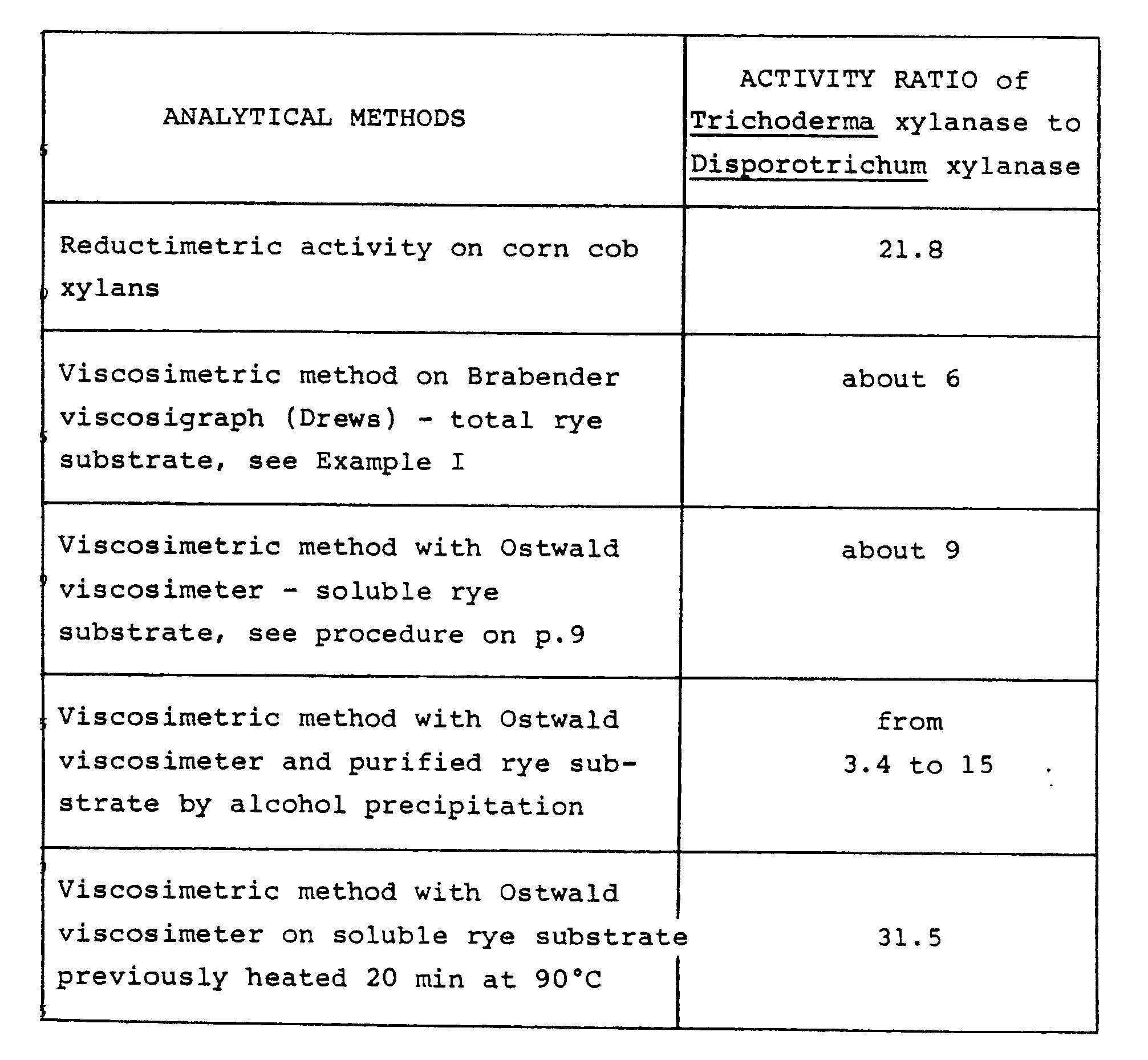
- The first analysis was realized on corn cob xylans with monosaccharide determination by reductimetry. In this case both exo- endo-xylanase activities were measured. It is difficult to estimate the activity of Trichoderma xylanases using the viscosimetric method on a Brabender or Ostwald viscosimeter because the results were highly dependent on the enzymatic concentration used. This indicates an inhibitory effect.
- Use of ethanol precipitated rye xylans as a purified substrate for viscosimetric analysis did not modify the results. Moreover it was also verified that the action of several proteases did not modify either the soluble substrate nor the inhibitory effect for Trichoderma xylanase. However, heating the soluble substrate promoted the precipitation of an insoluble substance containing 65% of proteins and 35% of carbohydrates mainly xylose, arabinose and glucose. With this heated soluble substrate an improvement of the activity of Disporotrichum xylanase by a factor of 5 and an improvement of the activity of Trichoderma xylanase by a factor of 20 were obtained. Thus the inhibitory effect is more important on this latter xylanase.
-
- Use of poor quality malt, i.e. a malt giving low extract yield and low filterability in brewing industry due to high level of non-degraded beta-glucans and hemicelluloses.
- Malt is ground with the EBC MIAG mill according to the standard specification for lauter tun filtration. Standard brewing process:
- One part of malt is hydrated with 3 parts of water at 50°C (note the start weight of each trial). This temperature is maintained during 20 minutes.
- Heat to 63°C per l°C/minute. This temperature is maintained during 30 minutes.
- Heat to 72°C per l°C/minute. This temperature is maintained during 20 minutes in order to obtain complete saccharification (yellow color with iodine test).
- Heat to 76°C. This temperature is maintained during 5 minutes.
- Control the weight of each trial and add some water to obtain the start weight (water evaporation). Pour the mash for filtration into a funnel containing Schleicher and Schuell paper filter (EBC). Measure the volume of filtered wort in function of time. Specific gravity is determined at the end of filtration. This value allows to calculate extract and yield.
- Viscosity of wort is measured with a capillary viscosimeter at 20°C. High molecular weight beta-glucans are determined after precipitation with 30 % ammonium sulfate. The precipitate is washed with alcohol before acid hydrolysis and determination of glucose with orcinol reagent.
- The xylanase activity shown in the Tables hereinafter is measured by the viscosimetric method described on
page 9 ff. - The results are shown in Table 1. These experiments clearly demonstrate the better efficiency ofDisporotrichumxylanase in comparison with Trichoderma xylanase. See also the explanation in Examples I and II.

- Three commercial products containing beta-glucanase from different sources were compared with respect to the filterability of wort with one of them, to which Disporo trichumxylanase was added. The results are shown in Table 2.
- These experiments confirm the better efficiency of Disporotrichum xylanase on wort viscosity, extract and filterability. The relative good results obtained with the beta-glucanase sample from Glaxo are due to some xylanase activity (l65 u/g).

-
- l) The wort is l00% Menuet 8l malt from Stella Artois Brewery. The results are shown in Table 3.
- 2) The wort is l00% malt from "Enfants de Gayant" Brewery. The results are shown in Table 4.
The combinations Penicillium emersonii betaglucanase +Disporotrichum xylanase and Bacillus subtilis beta-glucanase + Disporotrichum xylanase gave about similar results. - 3) The wort is 60% Menuet 8l malt (from Stella Artois Brewery) + 40% Menuet 82 barley. The results are shown in Table 5.
- If the results in this Table 5 are compared with those in the Tables 3 and 4 it will be clear that the higher viscosity caused by the use of barley in the mash is most efficiently reduced by the use of Disporotrichum xylanase.


-
- The colloidal stability of filtered untreated beer on laboratory scale was determined under the same conditions using the alcohol cooling test according to M. Moll, V. That, A. Schmitt and M. Parisot, J. Amer. Soc. Brew. Chem., 34, 187 (1976): a certain amount of enzyme, specified in Table 6, was introduced in short volume into the bottles. The enzymatic solution was solidified in order to avoid dilution by the introduction of beer. The bottles were closed immediately after introduction of beer in order to avoid oxidation. The bottles were stored for one week at room temperature and the efficiency of the enzymatic treatment with the alcohol cooling test was measured. The lower the EBC haze value, the more efficient the enzymatic product. The results are shown in the following Table 6.

- The minimum haze value obtained with an excess dose of papain was further decreased when Disporotrichum xylanase was used in addition to papain.
The calculation of the unknown activity compared to the standard is:
activity = As ×


Claims (5)
- Process for producing wort and beer of improved filterability and/or lower viscosity which comprises subjecting the said wort or beer to the action of Disporotrichum xylanase.
- Process according to claim l in which the said xylanase is derived from Disporotrichum dimorphosporum ATCC 24562.
- Process according to claim l in which the said xylanase has substantially the same characteristics as the xylanase which is obtainable from Disporotrichum dimorphosporum ATCC 24562.
- Process according to any one of claims l-3 in which papain is also added to the wort or beer.
- Process according to any one of claims l-4, in which unmalted wheat or barley is used in making the wort or beer.
Priority Applications (1)
| Application Number | Priority Date | Filing Date | Title |
|---|---|---|---|
| AT86202154T ATE61402T1 (en) | 1985-12-03 | 1986-12-03 | PRODUCTION OF BEER. |
Applications Claiming Priority (2)
| Application Number | Priority Date | Filing Date | Title |
|---|---|---|---|
| EP85202016 | 1985-12-03 | ||
| EP85202016 | 1985-12-03 |
Publications (3)
| Publication Number | Publication Date |
|---|---|
| EP0227159A2 EP0227159A2 (en) | 1987-07-01 |
| EP0227159A3 EP0227159A3 (en) | 1987-10-28 |
| EP0227159B1 true EP0227159B1 (en) | 1991-03-06 |
Family
ID=8194093
Family Applications (1)
| Application Number | Title | Priority Date | Filing Date |
|---|---|---|---|
| EP86202154A Expired EP0227159B1 (en) | 1985-12-03 | 1986-12-03 | Improvements in and relating to the production of beer |
Country Status (11)
| Country | Link |
|---|---|
| US (1) | US5023176A (en) |
| EP (1) | EP0227159B1 (en) |
| JP (1) | JPH0697984B2 (en) |
| CN (1) | CN1020751C (en) |
| CA (1) | CA1280704C (en) |
| DE (1) | DE3677920D1 (en) |
| DK (1) | DK578586A (en) |
| ES (1) | ES2020937B3 (en) |
| FI (1) | FI87577C (en) |
| IE (1) | IE59503B1 (en) |
| PT (1) | PT83862B (en) |
Families Citing this family (22)
| Publication number | Priority date | Publication date | Assignee | Title |
|---|---|---|---|---|
| US5200215A (en) * | 1988-04-20 | 1993-04-06 | Nabisco, Inc. | Enzyme treated low moisture content comestible products |
| AT394730B (en) * | 1990-05-08 | 1992-06-10 | Voest Alpine Ind Anlagen | METHOD FOR PRODUCING EXO- AND ENDOCELLULASE-FREE XYLANASE |
| NZ239085A (en) * | 1990-07-24 | 1993-08-26 | Gist Brocades Nv | Cloning and expression of xylanase genes from fungal origin |
| CH683843A5 (en) * | 1992-03-10 | 1994-05-31 | Brasserie Du Cardinal Fribourg | A method of manufacturing a non-alcoholic beer with the organoleptic properties of a blonde lager. |
| JPH10510721A (en) * | 1995-10-13 | 1998-10-20 | ギスト ブロカデス ベスローテン フェンノートシャップ | Fungal cellulase |
| CA2262436A1 (en) | 1996-08-05 | 1998-02-12 | Mogen International Nv | Improved process for the production of alcoholic beverages using maltseed |
| EP0941359A1 (en) * | 1996-11-21 | 1999-09-15 | Novo Nordisk A/S | Use of carbohydrate-binding domain in starch processing |
| US6031155A (en) * | 1997-06-05 | 2000-02-29 | Cameron-Mills; Verena | Arabinoxylan degradation |
| AU2002210409A1 (en) * | 2000-11-10 | 2002-05-21 | Novozymes A/S | Ethanol process |
| ES2251893T1 (en) * | 2003-04-04 | 2006-05-16 | Novozymes A/S | REDUCTION OF THE VISCOSITY OF A PASTA. |
| BRPI0412279A (en) | 2003-07-02 | 2006-09-19 | Diversa Corp | glucanases, nucleic acids encoding the same and methods for preparing and applying them |
| US20060251762A1 (en) * | 2005-05-03 | 2006-11-09 | Robert Jansen | Grain wet milling process for producing ethanol |
| DK2069389T3 (en) | 2006-08-04 | 2015-01-12 | Bp Corp North America Inc | Glucanases, nucleic acids encoding them, and processes for their preparation and use |
| GB0702844D0 (en) * | 2007-02-14 | 2007-03-28 | Leuven K U Res & Dev | Improving taste of beer |
| EP2181194A1 (en) * | 2007-08-03 | 2010-05-05 | Tate & Lyle Ingredients Americas, Inc. | Cereal refining process |
| EP2224822B1 (en) | 2007-12-06 | 2014-05-21 | Novozymes A/S | Polypeptides having acetylxylan esterase activity and polynucleotides encoding same |
| US20090238918A1 (en) * | 2008-01-24 | 2009-09-24 | Robert Jansen | Corn Wet Milling Process |
| US8211665B2 (en) | 2009-09-29 | 2012-07-03 | Novozymes, Inc. | Polypeptides having xylanase activity and polynucleotides encoding same |
| EP2496692B1 (en) | 2009-11-06 | 2016-03-16 | Novozymes, Inc. | Polypeptides having xylanase activity and polynucleotides encoding same |
| CN102781587A (en) * | 2010-03-01 | 2012-11-14 | 诺维信公司 | Viscosity pressure assay |
| JP5658489B2 (en) * | 2010-06-16 | 2015-01-28 | アサヒビール株式会社 | Method for producing fermented malt beverage |
| CN103300284A (en) * | 2013-05-22 | 2013-09-18 | 哈尔滨商业大学 | Production method of KbaC bread concentrate |
Family Cites Families (2)
| Publication number | Priority date | Publication date | Assignee | Title |
|---|---|---|---|---|
| FR2555602B1 (en) * | 1983-11-28 | 1990-05-11 | Glaxo Group Ltd | ENZYME AND COMPOSITION OF PENTOSAN DEGRADING ENZYMES, PROCESSES FOR OBTAINING AND APPLYING THE SAME |
| CA1272150C (en) * | 1985-12-03 | 1990-07-31 | PRODUCTION OF GLUCOSE AND PURIFIED STARCH SYRUPS FROM WHEAT STARCH AND OTHER CEREALS CONTAINING PENTOSANES |
-
1986
- 1986-12-01 FI FI864897A patent/FI87577C/en not_active IP Right Cessation
- 1986-12-01 CA CA000524202A patent/CA1280704C/en not_active Expired - Lifetime
- 1986-12-02 IE IE316086A patent/IE59503B1/en not_active IP Right Cessation
- 1986-12-02 US US06/936,802 patent/US5023176A/en not_active Expired - Fee Related
- 1986-12-02 DK DK578586A patent/DK578586A/en not_active Application Discontinuation
- 1986-12-03 JP JP61288609A patent/JPH0697984B2/en not_active Expired - Lifetime
- 1986-12-03 DE DE8686202154T patent/DE3677920D1/en not_active Expired - Fee Related
- 1986-12-03 CN CN86108167A patent/CN1020751C/en not_active Expired - Fee Related
- 1986-12-03 ES ES86202154T patent/ES2020937B3/en not_active Expired - Lifetime
- 1986-12-03 PT PT83862A patent/PT83862B/en not_active IP Right Cessation
- 1986-12-03 EP EP86202154A patent/EP0227159B1/en not_active Expired
Also Published As
| Publication number | Publication date |
|---|---|
| EP0227159A2 (en) | 1987-07-01 |
| DK578586D0 (en) | 1986-12-02 |
| CA1280704C (en) | 1991-02-26 |
| CN86108167A (en) | 1987-08-05 |
| CN1020751C (en) | 1993-05-19 |
| FI87577C (en) | 1993-01-25 |
| IE863160L (en) | 1987-06-03 |
| PT83862B (en) | 1989-01-17 |
| ES2020937B3 (en) | 1991-10-16 |
| JPS62215380A (en) | 1987-09-22 |
| DK578586A (en) | 1987-06-04 |
| FI864897A0 (en) | 1986-12-01 |
| JPH0697984B2 (en) | 1994-12-07 |
| IE59503B1 (en) | 1994-03-09 |
| US5023176A (en) | 1991-06-11 |
| FI864897L (en) | 1987-06-04 |
| PT83862A (en) | 1987-01-01 |
| FI87577B (en) | 1992-10-15 |
| DE3677920D1 (en) | 1991-04-11 |
| EP0227159A3 (en) | 1987-10-28 |
Similar Documents
| Publication | Publication Date | Title |
|---|---|---|
| US4746517A (en) | Production of beer | |
| EP0227159A2 (en) | Improvements in and relating to the production of beer | |
| RU2524413C2 (en) | Mashing method | |
| AU2012307299C1 (en) | Compositions comprising enzymes with endo - 1, 4 - beta - xylanase activity and enzymes with endo - 1, 3 (4) - beta glucanase activity | |
| US20150337247A1 (en) | Enzymes | |
| US4355047A (en) | Method of preparing a low calorie beer | |
| US20060057684A1 (en) | Mashing process | |
| Taylor | Mashing with malted grain sorghum | |
| US4666718A (en) | Preparation of low calorie beer | |
| CN111500556A (en) | Complex enzyme preparation for improving and stabilizing beer fermentation degree and application thereof | |
| US4251630A (en) | Preparation of malt high in alpha-1,6-hydrolase | |
| US4355110A (en) | Preparation of debranching enzyme from rice for producing a low calorie beer | |
| US4528198A (en) | Preparation of low calorie beer with malt extract free of yeast lethal factors | |
| US4285975A (en) | Production of brewer's wort | |
| WO2005118769A1 (en) | Mashing process and enzyme composition useful therein | |
| NL8403600A (en) | PROCESS FOR THE BIODEGRADATION OF PENTOSANES. | |
| US3713840A (en) | Process for making a brewers! wort | |
| US4837034A (en) | Preparation of low calorie beer | |
| Denault et al. | Enzymology of the mashing step during beer production | |
| CN120936700A (en) | Fermented beverage and method for producing the same | |
| KR940011530B1 (en) | Method of producing beer | |
| EP0169068A2 (en) | Utilization of spent grains | |
| Stewart et al. | Biochemistry and genetics of carbohydrate utilization by industrial yeast strains | |
| CA1142104A (en) | Preparation of a low calorie beer | |
| Stewart et al. | The selection and modification of brewer's yeast strains |
Legal Events
| Date | Code | Title | Description |
|---|---|---|---|
| PUAI | Public reference made under article 153(3) epc to a published international application that has entered the european phase |
Free format text: ORIGINAL CODE: 0009012 |
|
| AK | Designated contracting states |
Kind code of ref document: A2 Designated state(s): AT BE CH DE ES FR GB GR IT LI LU NL SE |
|
| PUAL | Search report despatched |
Free format text: ORIGINAL CODE: 0009013 |
|
| AK | Designated contracting states |
Kind code of ref document: A3 Designated state(s): AT BE CH DE ES FR GB GR IT LI LU NL SE |
|
| 17P | Request for examination filed |
Effective date: 19871117 |
|
| 17Q | First examination report despatched |
Effective date: 19891017 |
|
| GRAA | (expected) grant |
Free format text: ORIGINAL CODE: 0009210 |
|
| AK | Designated contracting states |
Kind code of ref document: B1 Designated state(s): AT BE CH DE ES FR GB GR IT LI LU NL SE |
|
| PG25 | Lapsed in a contracting state [announced via postgrant information from national office to epo] |
Ref country code: IT Free format text: LAPSE BECAUSE OF FAILURE TO SUBMIT A TRANSLATION OF THE DESCRIPTION OR TO PAY THE FEE WITHIN THE PRE;WARNING: LAPSES OF ITALIAN PATENTS WITH EFFECTIVE DATE BEFORE 2007 MAY HAVE OCCURRED AT ANY TIME BEFORE 2007. THE CORRECT EFFECTIVE DATE MAY BE DIFFERENT FROM THE ONE RECORDED.SCRIBED TIME-LIMIT Effective date: 19910306 Ref country code: SE Effective date: 19910306 Ref country code: GR Free format text: LAPSE BECAUSE OF FAILURE TO SUBMIT A TRANSLATION OF THE DESCRIPTION OR TO PAY THE FEE WITHIN THE PRESCRIBED TIME-LIMIT Effective date: 19910306 |
|
| REF | Corresponds to: |
Ref document number: 61402 Country of ref document: AT Date of ref document: 19910315 Kind code of ref document: T |
|
| REF | Corresponds to: |
Ref document number: 3677920 Country of ref document: DE Date of ref document: 19910411 |
|
| ET | Fr: translation filed | ||
| PGFP | Annual fee paid to national office [announced via postgrant information from national office to epo] |
Ref country code: SE Payment date: 19911120 Year of fee payment: 6 |
|
| PLBE | No opposition filed within time limit |
Free format text: ORIGINAL CODE: 0009261 |
|
| STAA | Information on the status of an ep patent application or granted ep patent |
Free format text: STATUS: NO OPPOSITION FILED WITHIN TIME LIMIT |
|
| 26N | No opposition filed | ||
| EPTA | Lu: last paid annual fee | ||
| REG | Reference to a national code |
Ref country code: CH Ref legal event code: PUE Owner name: GIST-BROCADES S.A. TRANSFER- DSM N.V. |
|
| PGFP | Annual fee paid to national office [announced via postgrant information from national office to epo] |
Ref country code: FR Payment date: 19991117 Year of fee payment: 14 |
|
| PGFP | Annual fee paid to national office [announced via postgrant information from national office to epo] |
Ref country code: AT Payment date: 19991118 Year of fee payment: 14 Ref country code: DE Payment date: 19991118 Year of fee payment: 14 Ref country code: GB Payment date: 19991118 Year of fee payment: 14 |
|
| PGFP | Annual fee paid to national office [announced via postgrant information from national office to epo] |
Ref country code: CH Payment date: 19991122 Year of fee payment: 14 Ref country code: NL Payment date: 19991122 Year of fee payment: 14 |
|
| PGFP | Annual fee paid to national office [announced via postgrant information from national office to epo] |
Ref country code: LU Payment date: 19991130 Year of fee payment: 14 |
|
| PGFP | Annual fee paid to national office [announced via postgrant information from national office to epo] |
Ref country code: ES Payment date: 19991213 Year of fee payment: 14 |
|
| PGFP | Annual fee paid to national office [announced via postgrant information from national office to epo] |
Ref country code: BE Payment date: 19991215 Year of fee payment: 14 |
|
| PG25 | Lapsed in a contracting state [announced via postgrant information from national office to epo] |
Ref country code: LU Free format text: LAPSE BECAUSE OF NON-PAYMENT OF DUE FEES Effective date: 20001203 Ref country code: GB Free format text: LAPSE BECAUSE OF NON-PAYMENT OF DUE FEES Effective date: 20001203 Ref country code: AT Free format text: LAPSE BECAUSE OF NON-PAYMENT OF DUE FEES Effective date: 20001203 |
|
| PG25 | Lapsed in a contracting state [announced via postgrant information from national office to epo] |
Ref country code: LI Free format text: LAPSE BECAUSE OF NON-PAYMENT OF DUE FEES Effective date: 20001231 Ref country code: CH Free format text: LAPSE BECAUSE OF NON-PAYMENT OF DUE FEES Effective date: 20001231 Ref country code: BE Free format text: LAPSE BECAUSE OF NON-PAYMENT OF DUE FEES Effective date: 20001231 |
|
| BERE | Be: lapsed |
Owner name: S.A. GIST-BROCADES Effective date: 20001231 |
|
| PG25 | Lapsed in a contracting state [announced via postgrant information from national office to epo] |
Ref country code: NL Free format text: LAPSE BECAUSE OF NON-PAYMENT OF DUE FEES Effective date: 20010701 |
|
| GBPC | Gb: european patent ceased through non-payment of renewal fee |
Effective date: 20001203 |
|
| REG | Reference to a national code |
Ref country code: CH Ref legal event code: PL |
|
| PG25 | Lapsed in a contracting state [announced via postgrant information from national office to epo] |
Ref country code: FR Free format text: LAPSE BECAUSE OF NON-PAYMENT OF DUE FEES Effective date: 20010831 |
|
| NLV4 | Nl: lapsed or anulled due to non-payment of the annual fee |
Effective date: 20010701 |
|
| REG | Reference to a national code |
Ref country code: FR Ref legal event code: ST |
|
| PG25 | Lapsed in a contracting state [announced via postgrant information from national office to epo] |
Ref country code: DE Free format text: LAPSE BECAUSE OF NON-PAYMENT OF DUE FEES Effective date: 20011002 |
|
| PG25 | Lapsed in a contracting state [announced via postgrant information from national office to epo] |
Ref country code: ES Free format text: LAPSE BECAUSE OF NON-PAYMENT OF DUE FEES Effective date: 20011204 |
|
| REG | Reference to a national code |
Ref country code: ES Ref legal event code: FD2A Effective date: 20020112 |