EP0225478A1 - Iodonium ylide antimicrobial compounds - Google Patents
Iodonium ylide antimicrobial compounds Download PDFInfo
- Publication number
- EP0225478A1 EP0225478A1 EP86115223A EP86115223A EP0225478A1 EP 0225478 A1 EP0225478 A1 EP 0225478A1 EP 86115223 A EP86115223 A EP 86115223A EP 86115223 A EP86115223 A EP 86115223A EP 0225478 A1 EP0225478 A1 EP 0225478A1
- Authority
- EP
- European Patent Office
- Prior art keywords
- compound
- compounds
- bacteria
- iodonium
- carbon atoms
- Prior art date
- Legal status (The legal status is an assumption and is not a legal conclusion. Google has not performed a legal analysis and makes no representation as to the accuracy of the status listed.)
- Granted
Links
- 150000001875 compounds Chemical class 0.000 title claims abstract description 62
- 230000000845 anti-microbial effect Effects 0.000 title claims description 9
- MGFYSGNNHQQTJW-UHFFFAOYSA-N iodonium Chemical compound [IH2+] MGFYSGNNHQQTJW-UHFFFAOYSA-N 0.000 title abstract description 3
- JXMZUNPWVXQADG-UHFFFAOYSA-N 1-iodo-2-nitrobenzene Chemical compound [O-][N+](=O)C1=CC=CC=C1I JXMZUNPWVXQADG-UHFFFAOYSA-N 0.000 claims abstract description 7
- 239000004599 antimicrobial Substances 0.000 claims abstract description 5
- 239000000203 mixture Substances 0.000 claims description 45
- 241000894006 Bacteria Species 0.000 claims description 17
- 125000004432 carbon atom Chemical group C* 0.000 claims description 10
- 238000000034 method Methods 0.000 claims description 9
- 241000233866 Fungi Species 0.000 claims description 6
- 239000002671 adjuvant Substances 0.000 claims description 4
- 125000000217 alkyl group Chemical group 0.000 claims description 4
- 230000002401 inhibitory effect Effects 0.000 claims description 4
- 125000006575 electron-withdrawing group Chemical group 0.000 claims description 2
- 125000002496 methyl group Chemical group [H]C([H])([H])* 0.000 claims description 2
- 125000000325 methylidene group Chemical group [H]C([H])=* 0.000 claims description 2
- 125000000449 nitro group Chemical group [O-][N+](*)=O 0.000 claims description 2
- 241000195493 Cryptophyta Species 0.000 claims 4
- YMWUJEATGCHHMB-UHFFFAOYSA-N Dichloromethane Chemical compound ClCCl YMWUJEATGCHHMB-UHFFFAOYSA-N 0.000 description 15
- 239000007787 solid Substances 0.000 description 14
- 239000007788 liquid Substances 0.000 description 12
- 239000000047 product Substances 0.000 description 11
- 239000002270 dispersing agent Substances 0.000 description 10
- -1 wallboard Substances 0.000 description 10
- 239000004753 textile Substances 0.000 description 8
- XLYOFNOQVPJJNP-UHFFFAOYSA-N water Substances O XLYOFNOQVPJJNP-UHFFFAOYSA-N 0.000 description 8
- 229920001817 Agar Polymers 0.000 description 7
- 239000008272 agar Substances 0.000 description 7
- 239000000243 solution Substances 0.000 description 7
- 239000002023 wood Substances 0.000 description 7
- OKKJLVBELUTLKV-UHFFFAOYSA-N Methanol Chemical compound OC OKKJLVBELUTLKV-UHFFFAOYSA-N 0.000 description 6
- 239000012141 concentrate Substances 0.000 description 6
- 239000000428 dust Substances 0.000 description 6
- 239000000463 material Substances 0.000 description 6
- 239000003973 paint Substances 0.000 description 6
- 239000007921 spray Substances 0.000 description 6
- 239000000725 suspension Substances 0.000 description 6
- 239000000853 adhesive Substances 0.000 description 5
- 230000001070 adhesive effect Effects 0.000 description 5
- 239000010730 cutting oil Substances 0.000 description 5
- 239000000976 ink Substances 0.000 description 5
- 239000003921 oil Substances 0.000 description 5
- 239000000123 paper Substances 0.000 description 5
- 239000000344 soap Substances 0.000 description 5
- 125000001424 substituent group Chemical group 0.000 description 5
- CSCPPACGZOOCGX-UHFFFAOYSA-N Acetone Chemical compound CC(C)=O CSCPPACGZOOCGX-UHFFFAOYSA-N 0.000 description 4
- IJGRMHOSHXDMSA-UHFFFAOYSA-N Atomic nitrogen Chemical compound N#N IJGRMHOSHXDMSA-UHFFFAOYSA-N 0.000 description 4
- 239000002537 cosmetic Substances 0.000 description 4
- 238000009472 formulation Methods 0.000 description 4
- 239000001963 growth medium Substances 0.000 description 4
- 239000006916 nutrient agar Substances 0.000 description 4
- WEVYAHXRMPXWCK-UHFFFAOYSA-N Acetonitrile Chemical compound CC#N WEVYAHXRMPXWCK-UHFFFAOYSA-N 0.000 description 3
- 238000005481 NMR spectroscopy Methods 0.000 description 3
- YXFVVABEGXRONW-UHFFFAOYSA-N Toluene Chemical compound CC1=CC=CC=C1 YXFVVABEGXRONW-UHFFFAOYSA-N 0.000 description 3
- 239000000969 carrier Substances 0.000 description 3
- 238000006243 chemical reaction Methods 0.000 description 3
- 239000003995 emulsifying agent Substances 0.000 description 3
- 230000000813 microbial effect Effects 0.000 description 3
- 244000005700 microbiome Species 0.000 description 3
- 239000003960 organic solvent Substances 0.000 description 3
- 238000004321 preservation Methods 0.000 description 3
- 239000002904 solvent Substances 0.000 description 3
- KMXZAMWFNLPPTF-UHFFFAOYSA-N 1-iodosyl-2-methylsulfonylbenzene Chemical compound CS(=O)(=O)C1=CC=CC=C1I=O KMXZAMWFNLPPTF-UHFFFAOYSA-N 0.000 description 2
- KTACAVVXDVDGLF-UHFFFAOYSA-N 1-iodosyl-2-nitrobenzene Chemical compound [O-][N+](=O)C1=CC=CC=C1I=O KTACAVVXDVDGLF-UHFFFAOYSA-N 0.000 description 2
- HEDRZPFGACZZDS-UHFFFAOYSA-N Chloroform Chemical compound ClC(Cl)Cl HEDRZPFGACZZDS-UHFFFAOYSA-N 0.000 description 2
- 241000607479 Yersinia pestis Species 0.000 description 2
- 239000004480 active ingredient Substances 0.000 description 2
- 238000007605 air drying Methods 0.000 description 2
- 230000000844 anti-bacterial effect Effects 0.000 description 2
- 239000003795 chemical substances by application Substances 0.000 description 2
- 239000013078 crystal Substances 0.000 description 2
- HJSLFCCWAKVHIW-UHFFFAOYSA-N cyclohexane-1,3-dione Chemical compound O=C1CCCC(=O)C1 HJSLFCCWAKVHIW-UHFFFAOYSA-N 0.000 description 2
- 230000000694 effects Effects 0.000 description 2
- 239000000839 emulsion Substances 0.000 description 2
- 239000010440 gypsum Substances 0.000 description 2
- 229910052602 gypsum Inorganic materials 0.000 description 2
- 239000004615 ingredient Substances 0.000 description 2
- 239000004816 latex Substances 0.000 description 2
- 229920000126 latex Polymers 0.000 description 2
- VLKZOEOYAKHREP-UHFFFAOYSA-N n-Hexane Chemical class CCCCCC VLKZOEOYAKHREP-UHFFFAOYSA-N 0.000 description 2
- 229910052757 nitrogen Inorganic materials 0.000 description 2
- 239000003208 petroleum Substances 0.000 description 2
- 239000011505 plaster Substances 0.000 description 2
- 239000000843 powder Substances 0.000 description 2
- 229910052903 pyrophyllite Inorganic materials 0.000 description 2
- 239000004094 surface-active agent Substances 0.000 description 2
- 239000000454 talc Substances 0.000 description 2
- 229910052623 talc Inorganic materials 0.000 description 2
- QAEDZJGFFMLHHQ-UHFFFAOYSA-N trifluoroacetic anhydride Chemical compound FC(F)(F)C(=O)OC(=O)C(F)(F)F QAEDZJGFFMLHHQ-UHFFFAOYSA-N 0.000 description 2
- JNYAEWCLZODPBN-JGWLITMVSA-N (2r,3r,4s)-2-[(1r)-1,2-dihydroxyethyl]oxolane-3,4-diol Chemical class OC[C@@H](O)[C@H]1OC[C@H](O)[C@H]1O JNYAEWCLZODPBN-JGWLITMVSA-N 0.000 description 1
- BYCXIFMOPJEEOC-UHFFFAOYSA-N 3-iodosylphthalic acid Chemical class OC(=O)C1=CC=CC(I=O)=C1C(O)=O BYCXIFMOPJEEOC-UHFFFAOYSA-N 0.000 description 1
- ZCYVEMRRCGMTRW-UHFFFAOYSA-N 7553-56-2 Chemical group [I] ZCYVEMRRCGMTRW-UHFFFAOYSA-N 0.000 description 1
- 241001465754 Metazoa Species 0.000 description 1
- GRYLNZFGIOXLOG-UHFFFAOYSA-N Nitric acid Chemical compound O[N+]([O-])=O GRYLNZFGIOXLOG-UHFFFAOYSA-N 0.000 description 1
- 229920003171 Poly (ethylene oxide) Chemical class 0.000 description 1
- XSQUKJJJFZCRTK-UHFFFAOYSA-N Urea Chemical compound NC(N)=O XSQUKJJJFZCRTK-UHFFFAOYSA-N 0.000 description 1
- 239000002253 acid Substances 0.000 description 1
- 239000003619 algicide Substances 0.000 description 1
- 125000002947 alkylene group Chemical group 0.000 description 1
- 238000004458 analytical method Methods 0.000 description 1
- 230000001098 anti-algal effect Effects 0.000 description 1
- 239000003429 antifungal agent Substances 0.000 description 1
- 229940121375 antifungal agent Drugs 0.000 description 1
- 125000004429 atom Chemical group 0.000 description 1
- 229960000892 attapulgite Drugs 0.000 description 1
- 230000003190 augmentative effect Effects 0.000 description 1
- 239000003899 bactericide agent Substances 0.000 description 1
- 239000000440 bentonite Substances 0.000 description 1
- 229910000278 bentonite Inorganic materials 0.000 description 1
- SVPXDRXYRYOSEX-UHFFFAOYSA-N bentoquatam Chemical compound O.O=[Si]=O.O=[Al]O[Al]=O SVPXDRXYRYOSEX-UHFFFAOYSA-N 0.000 description 1
- 238000007664 blowing Methods 0.000 description 1
- 239000004202 carbamide Substances 0.000 description 1
- 229910052799 carbon Inorganic materials 0.000 description 1
- BVKZGUZCCUSVTD-UHFFFAOYSA-N carbonic acid Chemical class OC(O)=O BVKZGUZCCUSVTD-UHFFFAOYSA-N 0.000 description 1
- 230000015556 catabolic process Effects 0.000 description 1
- 230000001332 colony forming effect Effects 0.000 description 1
- 239000007859 condensation product Substances 0.000 description 1
- 239000000470 constituent Substances 0.000 description 1
- LOGSONSNCYTHPS-UHFFFAOYSA-N cyclopentane-1,3-dione Chemical compound O=C1CCC(=O)C1 LOGSONSNCYTHPS-UHFFFAOYSA-N 0.000 description 1
- 230000006378 damage Effects 0.000 description 1
- 238000006731 degradation reaction Methods 0.000 description 1
- 239000008367 deionised water Substances 0.000 description 1
- 229910021641 deionized water Inorganic materials 0.000 description 1
- 230000001079 digestive effect Effects 0.000 description 1
- 239000003085 diluting agent Substances 0.000 description 1
- 239000012895 dilution Substances 0.000 description 1
- 238000010790 dilution Methods 0.000 description 1
- 239000006185 dispersion Substances 0.000 description 1
- 238000009826 distribution Methods 0.000 description 1
- 238000001035 drying Methods 0.000 description 1
- 239000004495 emulsifiable concentrate Substances 0.000 description 1
- RTZKZFJDLAIYFH-UHFFFAOYSA-N ether Substances CCOCC RTZKZFJDLAIYFH-UHFFFAOYSA-N 0.000 description 1
- 238000001704 evaporation Methods 0.000 description 1
- 230000008020 evaporation Effects 0.000 description 1
- 239000000706 filtrate Substances 0.000 description 1
- 239000012530 fluid Substances 0.000 description 1
- 230000000855 fungicidal effect Effects 0.000 description 1
- 239000000417 fungicide Substances 0.000 description 1
- 150000005826 halohydrocarbons Chemical class 0.000 description 1
- 150000004677 hydrates Chemical class 0.000 description 1
- 238000005470 impregnation Methods 0.000 description 1
- 238000011081 inoculation Methods 0.000 description 1
- 229910052740 iodine Inorganic materials 0.000 description 1
- JYJVVHFRSFVEJM-UHFFFAOYSA-N iodosobenzene Chemical class O=IC1=CC=CC=C1 JYJVVHFRSFVEJM-UHFFFAOYSA-N 0.000 description 1
- 239000002609 medium Substances 0.000 description 1
- 150000007522 mineralic acids Chemical class 0.000 description 1
- 229910017604 nitric acid Inorganic materials 0.000 description 1
- 235000015097 nutrients Nutrition 0.000 description 1
- 229910052625 palygorskite Inorganic materials 0.000 description 1
- 230000035515 penetration Effects 0.000 description 1
- 239000003209 petroleum derivative Substances 0.000 description 1
- 125000001997 phenyl group Chemical group [H]C1=C([H])C([H])=C(*)C([H])=C1[H] 0.000 description 1
- 238000002360 preparation method Methods 0.000 description 1
- OVARTBFNCCXQKS-UHFFFAOYSA-N propan-2-one;hydrate Chemical compound O.CC(C)=O OVARTBFNCCXQKS-UHFFFAOYSA-N 0.000 description 1
- 239000011541 reaction mixture Substances 0.000 description 1
- 239000002689 soil Substances 0.000 description 1
- 238000001228 spectrum Methods 0.000 description 1
- 239000000126 substance Substances 0.000 description 1
- 239000000271 synthetic detergent Substances 0.000 description 1
- 239000002562 thickening agent Substances 0.000 description 1
- 238000004448 titration Methods 0.000 description 1
- 238000009489 vacuum treatment Methods 0.000 description 1
Classifications
-
- C—CHEMISTRY; METALLURGY
- C07—ORGANIC CHEMISTRY
- C07C—ACYCLIC OR CARBOCYCLIC COMPOUNDS
- C07C205/00—Compounds containing nitro groups bound to a carbon skeleton
- C07C205/45—Compounds containing nitro groups bound to a carbon skeleton the carbon skeleton being further substituted by at least one doubly—bound oxygen atom, not being part of a —CHO group
-
- A—HUMAN NECESSITIES
- A01—AGRICULTURE; FORESTRY; ANIMAL HUSBANDRY; HUNTING; TRAPPING; FISHING
- A01N—PRESERVATION OF BODIES OF HUMANS OR ANIMALS OR PLANTS OR PARTS THEREOF; BIOCIDES, e.g. AS DISINFECTANTS, AS PESTICIDES OR AS HERBICIDES; PEST REPELLANTS OR ATTRACTANTS; PLANT GROWTH REGULATORS
- A01N35/00—Biocides, pest repellants or attractants, or plant growth regulators containing organic compounds containing a carbon atom having two bonds to hetero atoms with at the most one bond to halogen, e.g. aldehyde radical
- A01N35/06—Biocides, pest repellants or attractants, or plant growth regulators containing organic compounds containing a carbon atom having two bonds to hetero atoms with at the most one bond to halogen, e.g. aldehyde radical containing keto or thioketo groups as part of a ring, e.g. cyclohexanone, quinone; Derivatives thereof, e.g. ketals
-
- A—HUMAN NECESSITIES
- A01—AGRICULTURE; FORESTRY; ANIMAL HUSBANDRY; HUNTING; TRAPPING; FISHING
- A01N—PRESERVATION OF BODIES OF HUMANS OR ANIMALS OR PLANTS OR PARTS THEREOF; BIOCIDES, e.g. AS DISINFECTANTS, AS PESTICIDES OR AS HERBICIDES; PEST REPELLANTS OR ATTRACTANTS; PLANT GROWTH REGULATORS
- A01N41/00—Biocides, pest repellants or attractants, or plant growth regulators containing organic compounds containing a sulfur atom bound to a hetero atom
- A01N41/02—Biocides, pest repellants or attractants, or plant growth regulators containing organic compounds containing a sulfur atom bound to a hetero atom containing a sulfur-to-oxygen double bond
- A01N41/10—Sulfones; Sulfoxides
-
- A—HUMAN NECESSITIES
- A61—MEDICAL OR VETERINARY SCIENCE; HYGIENE
- A61P—SPECIFIC THERAPEUTIC ACTIVITY OF CHEMICAL COMPOUNDS OR MEDICINAL PREPARATIONS
- A61P31/00—Antiinfectives, i.e. antibiotics, antiseptics, chemotherapeutics
- A61P31/04—Antibacterial agents
-
- C—CHEMISTRY; METALLURGY
- C07—ORGANIC CHEMISTRY
- C07C—ACYCLIC OR CARBOCYCLIC COMPOUNDS
- C07C317/00—Sulfones; Sulfoxides
-
- C—CHEMISTRY; METALLURGY
- C07—ORGANIC CHEMISTRY
- C07C—ACYCLIC OR CARBOCYCLIC COMPOUNDS
- C07C45/00—Preparation of compounds having >C = O groups bound only to carbon or hydrogen atoms; Preparation of chelates of such compounds
- C07C45/61—Preparation of compounds having >C = O groups bound only to carbon or hydrogen atoms; Preparation of chelates of such compounds by reactions not involving the formation of >C = O groups
- C07C45/67—Preparation of compounds having >C = O groups bound only to carbon or hydrogen atoms; Preparation of chelates of such compounds by reactions not involving the formation of >C = O groups by isomerisation; by change of size of the carbon skeleton
- C07C45/68—Preparation of compounds having >C = O groups bound only to carbon or hydrogen atoms; Preparation of chelates of such compounds by reactions not involving the formation of >C = O groups by isomerisation; by change of size of the carbon skeleton by increase in the number of carbon atoms
Definitions
- the present invention is in the field of industrial antimicrobial compounds.
- the present invention is directed to novel iodonium ylide compounds that are useful as antimicrobial agents, e.g., as antibacterial, antialgal, and/or antifungal agents.
- the compounds of the present invention have the formula wherein each X is an electron withdrawing group, n represents an integer of 1 to 5, and R1 represents wherein R2 represents a methylene moiety of 2 or 3 carbon atoms.
- one or two of the X subtituents is at the ortho and/or ortho′ position, i.e., are substituted at the carbon atoms of the phenyl ring that are adjacent to the carbon atom bonded to the iodine atom.
- Preferred X substituents are nitro and wherein R3 represents a straight chain alkyl of 1 to 5 carbon atoms, a branched chain alkyl of 3 to 5 carbon atoms, or a cyclic alkyl of 3 to 5 carbon atoms.
- R3 is methyl
- substituent groups are sterically compatible with each other.
- sterically compatible is employed to designate substituent groups which are not affected by steric hindrance as this term is defined in "The Condensed Chemical Dictionary", 7th edition, Reinhold Publishing Co., N.Y., page 893 (1966) which definition is as follows: "steric hindrance. A characteristic of molecular structure in which the molecules have a spatial arrangement of their atoms such that a given reaction with another molecule is prevented or retarded in rate.”
- Sterically compatible may be further defined as reacting compounds having substituents whose physical bulk does not require confinement within volumes insufficient for the exercise of their normal behavior as discussed in "Organic Chemistry" of D. J. Cram and G. Hammond, 2nd edition, McGraw-Hill Book Company, N.Y., page 215 (1964).
- the compounds of the present invention are prepared by using procedures known to the art.
- the compounds of Formula I can be prepared by reacting the desired R2 substituted diketocyclo compound with the desired X-substituted iodosobenzene in an inert organic solvent such as chloroform (or with an X-substituted iodosobenzene dicarboxylate in basic methanol); this reaction is illustrated by the following reaction sequence:
- the compounds of Formula I can be used in valuable antimicrobial applications (i.e., as a bactericide, fungicide, algaecide and the like).
- the compounds of Formula I or compositions containing one or more of them as the active antimicrobial constituent can be incorporated into or upon plaster, ink, cosmetic formulations, wallboard, textiles, paper, adhesives, soaps, synthetic detergents, cutting oils, polymeric materials, embalming fluids, oil-base paints, latex paints and any other aqueous based system in order to prevent the attack of various microbial pests and thus avoid the resultant economic loss due to the degradation of such products by the microorganisms.
- the compounds can be distributed in textiles, cellulosic materials or in grain, or can be employed in the impregnation of wood and lumber to preserve and protect such products from the attack of the organisms of rot, mold and decay.
- antimicrobial agents may alter the digestive process when administered to animals. Therefore, it is contemplated that the compounds of the present invention may have growth promotion effects.
- Certain of the compounds of the present invention may exist as complexes, e.g., hydrates and alcoholates. Such complexes are included in the scope of the invention.
- the compounds of the present invention are active, to varying degrees, against a variety of bacteria and fungi.
- the level and spectrum of activity of a specific compound will vary from compound to compound. That is, not all compounds of the present invention will be active against the same organisms at the same concentrations.
- the amount of one or more of the compounds of the present invention applied to target microorganisms or habitat thereof varies from ⁇ 1 to 5,000 parts per million by weight, depending upon the particular compound employed and microorganism treated.
- the compounds of the present invention are preferably employed at concentrations of at least 0.001 percent by weight.
- an effective amount of the unmodified compounds are distributed or incorporated in adhesives, soaps, inks, cosmetic formulations, wallboard, cutting oils, textiles, paper, polymeric materials, paint, lumber, wood products or growth media.
- the compounds of the present invention can also be employed in liquid or dust compositions containing the compounds.
- the compounds are modified with one or a plurality of additaments or adjuvants including water, organic solvents, petroleum oils, petroleum distillates, or other liquid carriers, polymeric thickening agents, urea, surface active dispersing agents and finely divided inert solids.
- compositions are adapted to be distributed in inks, adhesives, soaps, cutting oils, polymeric materials, paints, textiles, wallboard, paper, lumber or soil or upon the above-ground surfaces of plants, or to be employed as concentrates and subsequently diluted with additional liquid or solid carriers to produce the ultimate treating compositions.
- the adjuvant is a finely divided solid, a surface active agent or the combination of a surface active agent and a liquid diluent
- the carrier cooperates with the active component so as to facilitate the invention and to obtain an improved result.
- concentration of one or more of the compounds of the present invention to be employed in the treating compositions is not critical and may vary considerably provided the required dosage of the effective agent is supplied in the ink, cosmetic formulation, adhesive, soap, cutting oil, polymeric material, paint, textile, paper, wood or growth medium.
- concentration of said compounds in liquid compositions generally is from about 0.0001 to about 3 percent by weight. Concentrations up to 10 percent by weight may be employed. In dusts, the concentrations of the compounds can be from about 0.0001 to about 95 percent by weight. In compositions to be employed as concentrates, the compounds of the present invention can be present in a concentration of from about 0.01 to about 98 percent by weight.
- the quantity of treating composition to be applied to textiles, lumber, growth media and the like may vary considerably provided that the required dosage of active ingredients is applied in sufficient amounts of the finished composition to adequately facilitate the penetration and distribution of said ingredients in and on, for example, textiles, lumber and growth media and the like.
- one or more of the compounds of the present invention can be admixed with any of the finely divided solids, such as pyrophyllite,talc, chalk and gypsum and the like.
- the finely divided carrier is ground or mixed with the said compounds or wet with a solution of the compounds in a volatile organic solvent.
- dust compositions containing the products can be prepared using various solid surface active dispersing agents such as fuller's earth, bentonite., attapulgite and other clays.
- these dust compositions can be employed for the control of pests or employed as concentrates and subsequently diluted with an additional solid surface active dispersing agent or with pyrophyllite, chalk, talc, gypsum and the like to obtain the desired amount of active ingredient in a composition adapted to be employed as described herein.
- dust compositions when employed as concentrates can be dispersed in water, with or without the aid of dispersing agents to form spray mixtures.
- spray compositions can be prepared by incorporating one or more of the compounds of the present invention, or their liquid or dust concentrate compositions, in mixtures with surface-active dispersing agents such as an ionic or non-ionic emulsifying agent.
- surface-active dispersing agents such as an ionic or non-ionic emulsifying agent.
- Such spray compositions are readily employed for the control of microbes or are dispersed in liquid carriers to form diluted sprays containing the compounds in any desired amount suitable for microbial control.
- the choice of dispersing agents and amounts thereof employed are determined by the ability of the agents to facilitate the dispersion of the concentrate in the liquid carrier to produce the desired spray compositions.
- the compounds of the present invention can be admixed with a suitable water-immiscible organic liquid and a surface-active dispersing agent to produce an emulsifiable concentrate which can be further diluted with water and oil to form spray mixtures in the form of oil-in-water emulsions.
- the carrier comprises an aqueous emulsion, i.e., a mixture of water-immiscible solvent, emulsifying agent and water.
- Preferred dispersing agents which can be employed in these compositions are oil-soluble and include the non-ionic emulsifiers such as the condensation products of alkylene oxides with the inorganic acids, polyoxyethylene derivatives or sorbitan esters, complex ether alcohols and the like.
- Suitable organic liquids which can be employed in the composition include petroleum oils and distillates, toluene, liquid halohydrocarbons and synthetic organic oils.
- the surface-active dispersing agents are usually employed in liquid compositions in the amount of from about 0.1 to about 10 to about 20 percent by weight of the combined weight of the dispersing agent and active compound.
- Iodophenyl-2-methyl sulfone prepared according to the method of H. Zincke and G. Siebert
- 1 g, 3.54 mmol was suspended in 5 ml of trifluoro acetic anhydride and cooled to -30°C.
- To this suspension was added 0.5 ml of concentrated (conc.) HNO3 and the mixture allowed to warm up and stirred at room temperature for about 4 hours. The solvent was then removed under reduced pressure and the resulting solid was dried under high vacuum overnight.
- the dried solid was suspended in 25 ml of saturated bicarbonate and stirred overnight.
- the resulting bright yellow solid was filtered and dried and determined to be the desired product.
- the yield was 780 mg of desired product having a purity of about 90-95 percent, as determined by iodometric titration.
- the tacky solid was then washed sequentially with water (2 ⁇ l00 ml) and hexanes (2 ⁇ 20 ml), followed by air drying. The dried solid was then washed with acetone (2 ⁇ 40 ml) followed by air drying which gave 0.740 g of the desired product as a clear medium yellow solid, m.p. 132°-134°C.
- Product identification was based on 13C Nuclear Magnetic Resonance (CMR) and Proton Nuclear Magnetic Resonance (PMR) analysis.
- the yellow filtrate was evaporated at 35° and concentrated to about 10 ml and filtered to give bright yellow crystals.
- the yellow crystals were dried in vacuo (0.4 mm hg, 25°C, 18 hours) to give 1.00 g 0.0029 mol (23.1 percent) (m.p. 135°-140°C) of the desired product which was identified by PMR and CMR (about 95 percent pure).
- 1,3-Cyclohexanedione (75 mg, 0.67 mmol) was added to a solution of 2-methylsulfonyliodosobenzene (0.67 mmol, 200 mg) in 10 ml of hot methanol. The solution was allowed to cool and was concentrated by blowing nitrogen. The resulting fluffy white solid was filtered and washed with cold methylene chloride dried under vacuum and was determined by NMR to be the desired product: yield 140 mg. More could be obtained by concentration of the filterate, m.p. 142°-143°C (dec).
- the minimum inhibitory concentration (MIC) for the compound of Example 2 i.e., (2-nitrophenyl)-iodonium 2,6-dioxocyclohexylide was determined for 9 bacteria (using nutrient agar).
- a one percent solution of this test compound i.e., the compound of Example 8 was prepared in a mixture of acetone-water.
- Nutrient agar was prepared at pH 6.8 using deionized water amlording to standard Difco procedures.
- the agar (nutrient agar) was dispensed in 30 ml aliquots into 25 ⁇ 200 millimeter (mm) test tubes, capped and autoclaved for 15 minutes at 115°C.
- test tubes containing the agar were cooled in a water bath until the temperature of the agar was 48°C and then an appropriate amount of the one percent solution of the test compound was added (except in the controls where no test compound was added) to the respective test tubes so that final concentrations of 500, 250, 100, 50, 25, 10, 5, 2.5, 1.0 and 0 parts per million (ppm) of the test compound in the agar were obtained.
- the agar solutions were each mixed and poured into individual petri plates so that each petri plate contained agar having a known concentration of test compound dispersed therein. After drying for 24 hours, the petri plates were inoculated with bacteria.
- the inoculation with bacteria was accomplished using the following procedure. Twenty-four hour cultures of each of the bacteria were prepared by incubating the respective bacteria in tubes containing nutrient broth for 24 hours at 30°C in a shaker. Dilutions of each of the 24 hour cultures were made so that 9 separate suspensions (one for each of the 9 test bacteria) were made, each containing 108 colony forming units (CFU) per ml of suspension of a particular bacteria. Aliquots of 0.3 ml of each of the above suspensions were used to fill individual wells of a Steer's Replicator.
- 0.3 ml was used to fill 3 wells (i.e., 3 wells of 0.3 ml each) so that for the 9 different bacteria 27 wells were filled.
- the Steer's Replicator was then used to inoculate the petri plates.
- the petri plates were incubated at 30°C for 48 hours and then read to determine if the test compound (i.e., the compound of Example 4) which was incorporated into the agar prevented growth of the respective bacteria.
- the minimum inhibitory concentration (MIC) for each bacteria was defined as the lowest concentration of the test compound which prevented growth of that bacteria.
- the MIC procedure described herein was also performed in nutrient agar at pH 8.2.
- Table 1 sets forth the MIC (in ppm) of (2-nitrophenyl)-iodonium 2,6-dioxocyclohexylide for the organisms shown therein at an acid pH (6.8) and at an alkaline pH (8.2).
Landscapes
- Chemical & Material Sciences (AREA)
- Organic Chemistry (AREA)
- Life Sciences & Earth Sciences (AREA)
- Health & Medical Sciences (AREA)
- General Health & Medical Sciences (AREA)
- Zoology (AREA)
- Environmental Sciences (AREA)
- Plant Pathology (AREA)
- Engineering & Computer Science (AREA)
- Dentistry (AREA)
- Agronomy & Crop Science (AREA)
- Wood Science & Technology (AREA)
- Chemical Kinetics & Catalysis (AREA)
- General Chemical & Material Sciences (AREA)
- Communicable Diseases (AREA)
- Oncology (AREA)
- Pest Control & Pesticides (AREA)
- Medicinal Chemistry (AREA)
- Nuclear Medicine, Radiotherapy & Molecular Imaging (AREA)
- Pharmacology & Pharmacy (AREA)
- Animal Behavior & Ethology (AREA)
- Public Health (AREA)
- Veterinary Medicine (AREA)
- Organic Low-Molecular-Weight Compounds And Preparation Thereof (AREA)
- Agricultural Chemicals And Associated Chemicals (AREA)
- Acyclic And Carbocyclic Compounds In Medicinal Compositions (AREA)
Abstract
Description
- The present invention is in the field of industrial antimicrobial compounds.
- The present invention is directed to novel iodonium ylide compounds that are useful as antimicrobial agents, e.g., as antibacterial, antialgal, and/or antifungal agents. The compounds of the present invention have the formula

each X is an electron withdrawing group, n represents an integer of 1 to 5, and R¹ represents
R² represents a methylene moiety of 2 or 3 carbon atoms. - In preferred compounds of Formula I, one or two of the X subtituents is at the ortho and/or ortho′ position, i.e., are substituted at the carbon atoms of the phenyl ring that are adjacent to the carbon atom bonded to the iodine atom.
- Preferred X substituents are nitro and

R³ represents
a straight chain alkyl of 1 to 5 carbon atoms,
a branched chain alkyl of 3 to 5 carbon atoms, or
a cyclic alkyl of 3 to 5 carbon atoms. - Of the R³ substituents, it is preferred that R³ is methyl.
- In the present invention, it is to be noted that all substituent groups are sterically compatible with each other. The term "sterically compatible" is employed to designate substituent groups which are not affected by steric hindrance as this term is defined in "The Condensed Chemical Dictionary", 7th edition, Reinhold Publishing Co., N.Y., page 893 (1966) which definition is as follows: "steric hindrance. A characteristic of molecular structure in which the molecules have a spatial arrangement of their atoms such that a given reaction with another molecule is prevented or retarded in rate."
- Sterically compatible may be further defined as reacting compounds having substituents whose physical bulk does not require confinement within volumes insufficient for the exercise of their normal behavior as discussed in "Organic Chemistry" of D. J. Cram and G. Hammond, 2nd edition, McGraw-Hill Book Company, N.Y., page 215 (1964).
- The compounds of the present invention are prepared by using procedures known to the art.
- The compounds of Formula I can be prepared by reacting the desired R² substituted diketocyclo compound with the desired X-substituted iodosobenzene in an inert organic solvent such as chloroform (or with an X-substituted iodosobenzene dicarboxylate in basic methanol); this reaction is illustrated by the following reaction sequence:

- It has heretofore been unknown that the compounds of Formula I can be used in valuable antimicrobial applications (i.e., as a bactericide, fungicide, algaecide and the like). For example, the compounds of Formula I or compositions containing one or more of them as the active antimicrobial constituent can be incorporated into or upon plaster, ink, cosmetic formulations, wallboard, textiles, paper, adhesives, soaps, synthetic detergents, cutting oils, polymeric materials, embalming fluids, oil-base paints, latex paints and any other aqueous based system in order to prevent the attack of various microbial pests and thus avoid the resultant economic loss due to the degradation of such products by the microorganisms. Also the compounds can be distributed in textiles, cellulosic materials or in grain, or can be employed in the impregnation of wood and lumber to preserve and protect such products from the attack of the organisms of rot, mold and decay.
- It is known that antimicrobial agents may alter the digestive process when administered to animals. Therefore, it is contemplated that the compounds of the present invention may have growth promotion effects.
- Certain of the compounds of the present invention may exist as complexes, e.g., hydrates and alcoholates. Such complexes are included in the scope of the invention.
- The compounds of the present invention are active, to varying degrees, against a variety of bacteria and fungi. As appreciated in the art, the level and spectrum of activity of a specific compound will vary from compound to compound. That is, not all compounds of the present invention will be active against the same organisms at the same concentrations.
- Typically, the amount of one or more of the compounds of the present invention applied to target microorganisms or habitat thereof varies from ≦ 1 to 5,000 parts per million by weight, depending upon the particular compound employed and microorganism treated.
- In the protection and preservation of inks, cosmetic formulations, adhesives, soaps, plaster, wallboard, cutting oils, textiles, polymeric materials and paper, good results are obtained when the compounds of the present invention are incorporated in such products in the amount of at least 0.001 percent by weight. In the preservation of wood, excellent results are obtained when the compounds are incorporated, by conventional treatment of the wood, in the amount of at least 0.01 pound per cubic foot (0.16 kg/cubic meter) of wood.
- In the preservation and protection of oil and latex paints and primers against destruction caused by the growth of bacteria or fungi, the compounds of the present invention are preferably employed at concentrations of at least 0.001 percent by weight.
- In such operations, an effective amount of the unmodified compounds are distributed or incorporated in adhesives, soaps, inks, cosmetic formulations, wallboard, cutting oils, textiles, paper, polymeric materials, paint, lumber, wood products or growth media. However, the compounds of the present invention can also be employed in liquid or dust compositions containing the compounds. In such usage, the compounds are modified with one or a plurality of additaments or adjuvants including water, organic solvents, petroleum oils, petroleum distillates, or other liquid carriers, polymeric thickening agents, urea, surface active dispersing agents and finely divided inert solids. Depending upon the concentration of the compounds used in the compositions, such augmented compositions are adapted to be distributed in inks, adhesives, soaps, cutting oils, polymeric materials, paints, textiles, wallboard, paper, lumber or soil or upon the above-ground surfaces of plants, or to be employed as concentrates and subsequently diluted with additional liquid or solid carriers to produce the ultimate treating compositions. In compositions wherein the adjuvant is a finely divided solid, a surface active agent or the combination of a surface active agent and a liquid diluent, the carrier cooperates with the active component so as to facilitate the invention and to obtain an improved result.
- The exact concentration of one or more of the compounds of the present invention to be employed in the treating compositions is not critical and may vary considerably provided the required dosage of the effective agent is supplied in the ink, cosmetic formulation, adhesive, soap, cutting oil, polymeric material, paint, textile, paper, wood or growth medium. The concentration of said compounds in liquid compositions generally is from about 0.0001 to about 3 percent by weight. Concentrations up to 10 percent by weight may be employed. In dusts, the concentrations of the compounds can be from about 0.0001 to about 95 percent by weight. In compositions to be employed as concentrates, the compounds of the present invention can be present in a concentration of from about 0.01 to about 98 percent by weight. The quantity of treating composition to be applied to textiles, lumber, growth media and the like may vary considerably provided that the required dosage of active ingredients is applied in sufficient amounts of the finished composition to adequately facilitate the penetration and distribution of said ingredients in and on, for example, textiles, lumber and growth media and the like.
- In the treatment of lumber, from about 1 to about 100 gallons of solvent composition containing one or more of the compounds of the present invention is usually applied per 1,000 square feet (1 to 100 liters/24.543 square meters) of surface to be treated. In the pressure or vacuum treatment of lumber, sufficient composition is employed adequately to impregnate the wood.
- In the preparation of dust compositions, one or more of the compounds of the present invention can be admixed with any of the finely divided solids, such as pyrophyllite,talc, chalk and gypsum and the like. In such operations, the finely divided carrier is ground or mixed with the said compounds or wet with a solution of the compounds in a volatile organic solvent. Similarly, dust compositions containing the products can be prepared using various solid surface active dispersing agents such as fuller's earth, bentonite., attapulgite and other clays. Depending upon the proportions of ingredients, these dust compositions can be employed for the control of pests or employed as concentrates and subsequently diluted with an additional solid surface active dispersing agent or with pyrophyllite, chalk, talc, gypsum and the like to obtain the desired amount of active ingredient in a composition adapted to be employed as described herein. Also, such dust compositions when employed as concentrates can be dispersed in water, with or without the aid of dispersing agents to form spray mixtures.
- Further, spray compositions can be prepared by incorporating one or more of the compounds of the present invention, or their liquid or dust concentrate compositions, in mixtures with surface-active dispersing agents such as an ionic or non-ionic emulsifying agent. Such spray compositions are readily employed for the control of microbes or are dispersed in liquid carriers to form diluted sprays containing the compounds in any desired amount suitable for microbial control. The choice of dispersing agents and amounts thereof employed are determined by the ability of the agents to facilitate the dispersion of the concentrate in the liquid carrier to produce the desired spray compositions.
- Similarly, the compounds of the present invention can be admixed with a suitable water-immiscible organic liquid and a surface-active dispersing agent to produce an emulsifiable concentrate which can be further diluted with water and oil to form spray mixtures in the form of oil-in-water emulsions. In such compositions, the carrier comprises an aqueous emulsion, i.e., a mixture of water-immiscible solvent, emulsifying agent and water. Preferred dispersing agents which can be employed in these compositions are oil-soluble and include the non-ionic emulsifiers such as the condensation products of alkylene oxides with the inorganic acids, polyoxyethylene derivatives or sorbitan esters, complex ether alcohols and the like. Suitable organic liquids which can be employed in the composition include petroleum oils and distillates, toluene, liquid halohydrocarbons and synthetic organic oils. The surface-active dispersing agents are usually employed in liquid compositions in the amount of from about 0.1 to about 10 to about 20 percent by weight of the combined weight of the dispersing agent and active compound.
- The following examples further illustrate the present invention and are not to be construed as a limitation thereon.
-

- Iodophenyl-2-methyl sulfone (prepared according to the method of H. Zincke and G. Siebert) (1 g, 3.54 mmol) was suspended in 5 ml of trifluoro acetic anhydride and cooled to -30°C. To this suspension was added 0.5 ml of concentrated (conc.) HNO₃ and the mixture allowed to warm up and stirred at room temperature for about 4 hours. The solvent was then removed under reduced pressure and the resulting solid was dried under high vacuum overnight.
- The dried solid was suspended in 25 ml of saturated bicarbonate and stirred overnight. The resulting bright yellow solid was filtered and dried and determined to be the desired product. The yield was 780 mg of desired product having a purity of about 90-95 percent, as determined by iodometric titration.
-

- 2-Nitroiodosobenzene (1.61 g) and dichloromethane (60 ml) were mixed and stirred at room temperature. To the orange colored mixture was added a solution of 1,3-cyclohexanedione (0.79 g) in 5 ml of dichloromethane. Immediately after the addition, the color changed to yellow and a temperature rise of about 2°C was observed. The yellow mixture was then stirred for about 2 hours. After such time the dichloromethane was removed from the yellow mixture by evaporation to give a yellow tacky solid which was subsequently dried under a nitrogen stream. The tacky solid was then washed sequentially with water (2×l00 ml) and hexanes (2×20 ml), followed by air drying. The dried solid was then washed with acetone (2×40 ml) followed by air drying which gave 0.740 g of the desired product as a clear medium yellow solid, m.p. 132°-134°C. Product identification was based on ¹³C Nuclear Magnetic Resonance (CMR) and Proton Nuclear Magnetic Resonance (PMR) analysis.

-

- 1.73 Grams (0.0176 mol) 1,3-cyclopentanedione and 70 ml acetonitrile were stirred at 22°C for 2 minutes to give a milky white suspension. Subsequent addition of orange iodosonitrobenzene (4.79 g 0.0181 mol) to the milky white mixture, resulted in an immediate color change, and a temperature rise of about 2°C. After 10 minutes, the reaction mixture was filtered to give a white yellow powder (2.8 g 0.0081 mol) (46.1 percent). Approximately 2 g of this powder was dissolved in 200 ml of a 50/50 acetone/methylene chloride mixture and filtered. The yellow filtrate was evaporated at 35° and concentrated to about 10 ml and filtered to give bright yellow crystals. The yellow crystals were dried in vacuo (0.4 mm hg, 25°C, 18 hours) to give 1.00 g 0.0029 mol (23.1 percent) (m.p. 135°-140°C) of the desired product which was identified by PMR and CMR (about 95 percent pure).

-
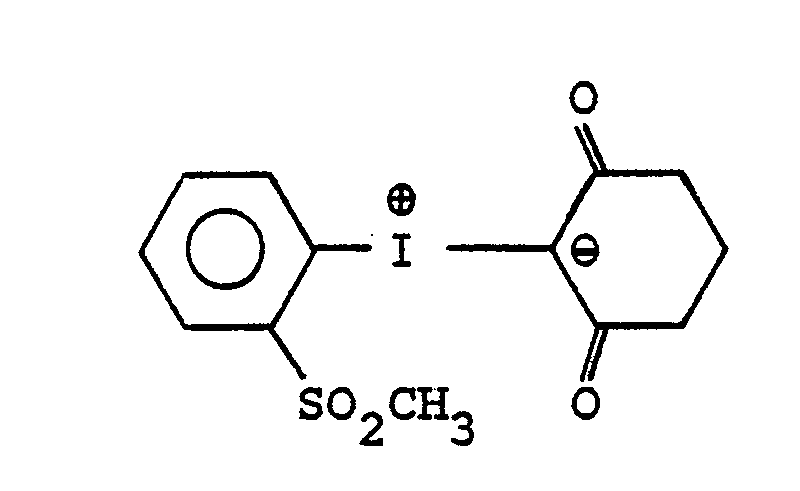
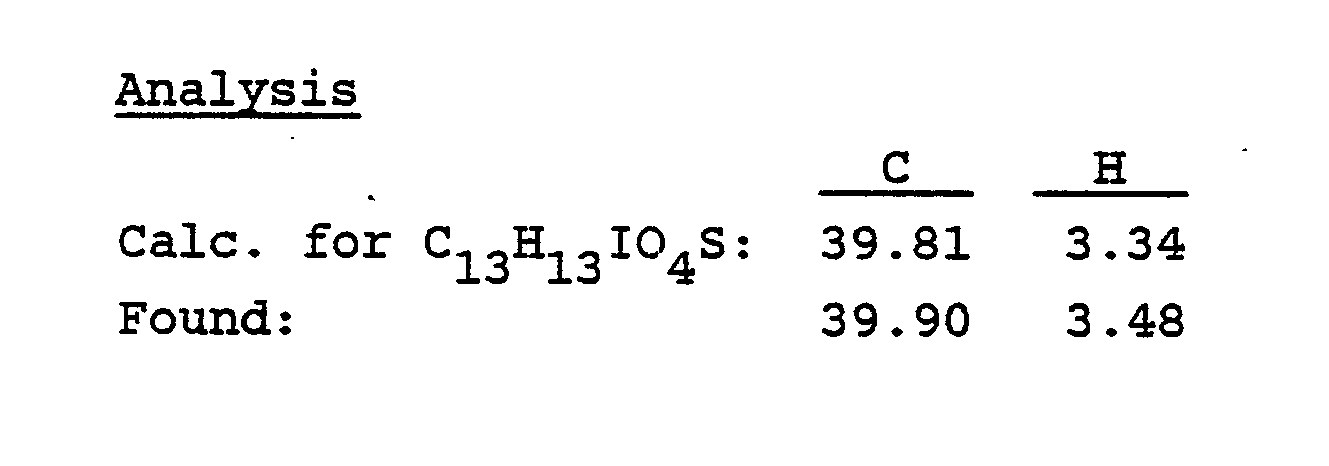
- 1,3-Cyclohexanedione, (75 mg, 0.67 mmol) was added to a solution of 2-methylsulfonyliodosobenzene (0.67 mmol, 200 mg) in 10 ml of hot methanol. The solution was allowed to cool and was concentrated by blowing nitrogen. The resulting fluffy white solid was filtered and washed with cold methylene chloride dried under vacuum and was determined by NMR to be the desired product: yield 140 mg. More could be obtained by concentration of the filterate, m.p. 142°-143°C (dec).
- The antimicrobial activity of the compounds of Formula I was demonstrated by the following techniques.
- The minimum inhibitory concentration (MIC) for the compound of Example 2 (i.e., (2-nitrophenyl)-iodonium 2,6-dioxocyclohexylide) was determined for 9 bacteria (using nutrient agar). A one percent solution of this test compound (i.e., the compound of Example 8) was prepared in a mixture of acetone-water. Nutrient agar was prepared at pH 6.8 using deionized water amlording to standard Difco procedures. The agar (nutrient agar) was dispensed in 30 ml aliquots into 25 × 200 millimeter (mm) test tubes, capped and autoclaved for 15 minutes at 115°C. The test tubes containing the agar were cooled in a water bath until the temperature of the agar was 48°C and then an appropriate amount of the one percent solution of the test compound was added (except in the controls where no test compound was added) to the respective test tubes so that final concentrations of 500, 250, 100, 50, 25, 10, 5, 2.5, 1.0 and 0 parts per million (ppm) of the test compound in the agar were obtained. The agar solutions were each mixed and poured into individual petri plates so that each petri plate contained agar having a known concentration of test compound dispersed therein. After drying for 24 hours, the petri plates were inoculated with bacteria.
- The inoculation with bacteria was accomplished using the following procedure. Twenty-four hour cultures of each of the bacteria were prepared by incubating the respective bacteria in tubes containing nutrient broth for 24 hours at 30°C in a shaker. Dilutions of each of the 24 hour cultures were made so that 9 separate suspensions (one for each of the 9 test bacteria) were made, each containing 10⁸ colony forming units (CFU) per ml of suspension of a particular bacteria. Aliquots of 0.3 ml of each of the above suspensions were used to fill individual wells of a Steer's Replicator. For each microbial suspension, 0.3 ml was used to fill 3 wells (i.e., 3 wells of 0.3 ml each) so that for the 9 different bacteria 27 wells were filled. The Steer's Replicator was then used to inoculate the petri plates.
- The petri plates were incubated at 30°C for 48 hours and then read to determine if the test compound (i.e., the compound of Example 4) which was incorporated into the agar prevented growth of the respective bacteria. The minimum inhibitory concentration (MIC) for each bacteria was defined as the lowest concentration of the test compound which prevented growth of that bacteria.
- The MIC procedure described herein was also performed in nutrient agar at pH 8.2.
- Table 1 sets forth the MIC (in ppm) of (2-nitrophenyl)-iodonium 2,6-dioxocyclohexylide for the organisms shown therein at an acid pH (6.8) and at an alkaline pH (8.2).

Claims (9)

each X is an electron withdrawing group, n represents an integer of 1 to 5, and R′ represents

R² represents a methylene moiety of 2 or 3 carbon atoms.

R³ represents
a straight chain alkyl of 1 to 5 carbon atoms,
a branched chain alkyl of 3 to 5 carbon atoms, or
a cyclic alkyl of 3 to 5 carbon atoms.
Applications Claiming Priority (2)
| Application Number | Priority Date | Filing Date | Title |
|---|---|---|---|
| US79495085A | 1985-11-04 | 1985-11-04 | |
| US794950 | 1985-11-04 |
Publications (2)
| Publication Number | Publication Date |
|---|---|
| EP0225478A1 true EP0225478A1 (en) | 1987-06-16 |
| EP0225478B1 EP0225478B1 (en) | 1990-05-16 |
Family
ID=25164179
Family Applications (1)
| Application Number | Title | Priority Date | Filing Date |
|---|---|---|---|
| EP86115223A Expired - Lifetime EP0225478B1 (en) | 1985-11-04 | 1986-11-03 | Iodonium ylide antimicrobial compounds |
Country Status (7)
| Country | Link |
|---|---|
| EP (1) | EP0225478B1 (en) |
| JP (1) | JPS62142142A (en) |
| AU (1) | AU588378B2 (en) |
| CA (1) | CA1304753C (en) |
| DE (1) | DE3671218D1 (en) |
| MY (1) | MY100007A (en) |
| NZ (1) | NZ218134A (en) |
Cited By (1)
| Publication number | Priority date | Publication date | Assignee | Title |
|---|---|---|---|---|
| WO2015157145A1 (en) * | 2014-04-07 | 2015-10-15 | The United States Of America, As Represented By The Secretary, Department Of Health And Human Services | Iodonium analogs as inhibitors of nadph oxidases and other flavin dehydrogenases; formulations thereof; and uses thereof |
Citations (1)
| Publication number | Priority date | Publication date | Assignee | Title |
|---|---|---|---|---|
| EP0160322A2 (en) * | 1984-05-04 | 1985-11-06 | The Dow Chemical Company | Iodonium ylide compositions and method for antimicrobial use |
Family Cites Families (1)
| Publication number | Priority date | Publication date | Assignee | Title |
|---|---|---|---|---|
| JPS61254504A (en) * | 1985-05-02 | 1986-11-12 | ザ ダウ ケミカル カンパニ− | Iodonium ylide composition for fungicide and method |
-
1986
- 1986-10-02 AU AU63431/86A patent/AU588378B2/en not_active Ceased
- 1986-10-31 NZ NZ218134A patent/NZ218134A/en unknown
- 1986-10-31 MY MY19868600053A patent/MY100007A/en unknown
- 1986-11-03 CA CA000522034A patent/CA1304753C/en not_active Expired - Fee Related
- 1986-11-03 EP EP86115223A patent/EP0225478B1/en not_active Expired - Lifetime
- 1986-11-03 DE DE8686115223T patent/DE3671218D1/en not_active Expired - Fee Related
- 1986-11-04 JP JP61262592A patent/JPS62142142A/en active Pending
Patent Citations (1)
| Publication number | Priority date | Publication date | Assignee | Title |
|---|---|---|---|---|
| EP0160322A2 (en) * | 1984-05-04 | 1985-11-06 | The Dow Chemical Company | Iodonium ylide compositions and method for antimicrobial use |
Non-Patent Citations (3)
| Title |
|---|
| CHEMICAL ABSTRACTS, vol. 69, 1968, page 247, abstract no. 2626g, Columbus, Ohio, US; B. KARELE et al.: "Iodonium derivatives of beta-dicarbonyl compounds. XI. Synthesis and properties of some nitrophenyliodonium betaines and dimedone and malonic acid esters", & ZH. ORG. KHIM. 1968, 4(4),643-8 * |
| JOURNAL OF THE AMERICAN CHEMICAL SOCIETY, vol. 107, no. 5, 1985, pages 1375-1378; R.M. MORIARTY et al.: "Capture of electron-deficient species with aryl halides. New syntheses of hypervalent iodonium ylides" * |
| SYNTHESIS, May 1983, pages 392-395; K. SCHANK et al.: "Ozonolytic fragmentation of phenyliodonium beta-diketonates; a convenient synthesis of unsolvated vic-triketones" * |
Cited By (3)
| Publication number | Priority date | Publication date | Assignee | Title |
|---|---|---|---|---|
| WO2015157145A1 (en) * | 2014-04-07 | 2015-10-15 | The United States Of America, As Represented By The Secretary, Department Of Health And Human Services | Iodonium analogs as inhibitors of nadph oxidases and other flavin dehydrogenases; formulations thereof; and uses thereof |
| US10131659B2 (en) | 2014-04-07 | 2018-11-20 | The United States Of America, As Represented By The Secretary, Department Of Health And Human Services | Iodonium analogs as inhibitors of NADPH oxidases and other flavin dehydrogenases; formulations thereof; and uses thereof |
| US10738047B2 (en) | 2014-04-07 | 2020-08-11 | The United States Of America, As Represented By The Secretary, Department Of Health | Iodonium analogs as inhibitors of NADPH oxidases and other flavin dehydrogenases; formulations thereof; and uses thereof |
Also Published As
| Publication number | Publication date |
|---|---|
| JPS62142142A (en) | 1987-06-25 |
| AU588378B2 (en) | 1989-09-14 |
| NZ218134A (en) | 1990-04-26 |
| EP0225478B1 (en) | 1990-05-16 |
| MY100007A (en) | 1989-03-16 |
| DE3671218D1 (en) | 1990-06-21 |
| CA1304753C (en) | 1992-07-07 |
| AU6343186A (en) | 1987-05-07 |
Similar Documents
| Publication | Publication Date | Title |
|---|---|---|
| US3833731A (en) | Dihalomethylglutaronitriles used as antibacterial and antifungal agents | |
| EP0249328B1 (en) | Heterocyclic thione compounds and their use as biocides | |
| US3584050A (en) | Nitrated aromatic alkamines | |
| US5106407A (en) | Iodones and methods for antimicrobial use | |
| US4442122A (en) | 1,2-Dibromo-2-cyanoalkane antimicrobial compounds | |
| US5250194A (en) | N-dodecyl heterocyclic compounds useful as industrial microbicides and preservatives | |
| EP0160322B1 (en) | Iodonium ylide compositions and method for antimicrobial use | |
| EP0225478B1 (en) | Iodonium ylide antimicrobial compounds | |
| US3980693A (en) | N-(Trihalomethylthio)-carbamic acid oxime esters | |
| US4062859A (en) | Halogenated 3-isothiazolidinone 1-oxide and 1,1-dioxides | |
| US3842179A (en) | Anti-microbial diaralkylaminoalkyl ethers and process for protecting plants | |
| KR960001204B1 (en) | N-alkylbenzenesulfonylcarbamoyl-5-chloroisothiazole derivatives | |
| US3873591A (en) | Halo-substituted cyanomethyl benzenesulfonates | |
| EP0244962B1 (en) | Substituted alkynic thiocyanates, biocidal compositions containing them and uses of such compositions | |
| CA1326919C (en) | Control of biofouling with certain alkylthioalkylamines | |
| US3711271A (en) | Method for controlling algae | |
| US4172133A (en) | (1,4)Dithiino(2,3-b)(1,3)thiazole-(4,5-e)pyrazine-6,7-dicarbonitriles | |
| US4031247A (en) | Fungicidal vinyl 2-substituted-thiovinyl sulfones | |
| US3897564A (en) | Dihydroxyanthraquinone fungicides | |
| US3984481A (en) | Bis-2-substituted-thiovinyl sulfones | |
| CA1223600A (en) | Trioganotin acetylsalicylates and biocides containing the same | |
| US3988376A (en) | Vinyl 2-substituted-thiovinyl sulfones | |
| EP0111413B1 (en) | Novel sulfone, process for its preparation, composition containing it and use thereof | |
| EP0573629B1 (en) | Composition and use of dimercapto-substituted dinitriles as an antimicrobial | |
| US4309440A (en) | Substituted benzylidene methylhydrazides of acetic acid, their bactericidal and fungicidal use, and method of preparation |
Legal Events
| Date | Code | Title | Description |
|---|---|---|---|
| PUAI | Public reference made under article 153(3) epc to a published international application that has entered the european phase |
Free format text: ORIGINAL CODE: 0009012 |
|
| AK | Designated contracting states |
Kind code of ref document: A1 Designated state(s): BE CH DE FR GB IT LI NL SE |
|
| 17P | Request for examination filed |
Effective date: 19871008 |
|
| 17Q | First examination report despatched |
Effective date: 19890227 |
|
| 17Q | First examination report despatched |
Effective date: 19890622 |
|
| GRAA | (expected) grant |
Free format text: ORIGINAL CODE: 0009210 |
|
| AK | Designated contracting states |
Kind code of ref document: B1 Designated state(s): BE CH DE FR GB IT LI NL SE |
|
| REF | Corresponds to: |
Ref document number: 3671218 Country of ref document: DE Date of ref document: 19900621 |
|
| ITF | It: translation for a ep patent filed | ||
| ET | Fr: translation filed | ||
| PLBE | No opposition filed within time limit |
Free format text: ORIGINAL CODE: 0009261 |
|
| STAA | Information on the status of an ep patent application or granted ep patent |
Free format text: STATUS: NO OPPOSITION FILED WITHIN TIME LIMIT |
|
| 26N | No opposition filed | ||
| ITTA | It: last paid annual fee | ||
| PGFP | Annual fee paid to national office [announced via postgrant information from national office to epo] |
Ref country code: SE Payment date: 19920831 Year of fee payment: 7 |
|
| PGFP | Annual fee paid to national office [announced via postgrant information from national office to epo] |
Ref country code: CH Payment date: 19920902 Year of fee payment: 7 |
|
| PGFP | Annual fee paid to national office [announced via postgrant information from national office to epo] |
Ref country code: BE Payment date: 19920916 Year of fee payment: 7 |
|
| PGFP | Annual fee paid to national office [announced via postgrant information from national office to epo] |
Ref country code: NL Payment date: 19921130 Year of fee payment: 7 |
|
| PGFP | Annual fee paid to national office [announced via postgrant information from national office to epo] |
Ref country code: FR Payment date: 19930831 Year of fee payment: 8 |
|
| PGFP | Annual fee paid to national office [announced via postgrant information from national office to epo] |
Ref country code: DE Payment date: 19930906 Year of fee payment: 8 |
|
| PGFP | Annual fee paid to national office [announced via postgrant information from national office to epo] |
Ref country code: GB Payment date: 19931001 Year of fee payment: 8 |
|
| PG25 | Lapsed in a contracting state [announced via postgrant information from national office to epo] |
Ref country code: SE Effective date: 19931104 |
|
| PG25 | Lapsed in a contracting state [announced via postgrant information from national office to epo] |
Ref country code: LI Effective date: 19931130 Ref country code: CH Effective date: 19931130 Ref country code: BE Effective date: 19931130 |
|
| BERE | Be: lapsed |
Owner name: THE DOW CHEMICAL CY Effective date: 19931130 |
|
| PG25 | Lapsed in a contracting state [announced via postgrant information from national office to epo] |
Ref country code: NL Effective date: 19940601 |
|
| NLV4 | Nl: lapsed or anulled due to non-payment of the annual fee | ||
| REG | Reference to a national code |
Ref country code: CH Ref legal event code: PL |
|
| PG25 | Lapsed in a contracting state [announced via postgrant information from national office to epo] |
Ref country code: GB Effective date: 19941103 |
|
| EUG | Se: european patent has lapsed |
Ref document number: 86115223.9 Effective date: 19940610 |
|
| GBPC | Gb: european patent ceased through non-payment of renewal fee |
Effective date: 19941103 |
|
| PG25 | Lapsed in a contracting state [announced via postgrant information from national office to epo] |
Ref country code: FR Effective date: 19950731 |
|
| PG25 | Lapsed in a contracting state [announced via postgrant information from national office to epo] |
Ref country code: DE Effective date: 19950801 |
|
| REG | Reference to a national code |
Ref country code: FR Ref legal event code: ST |
|
| PG25 | Lapsed in a contracting state [announced via postgrant information from national office to epo] |
Ref country code: IT Free format text: LAPSE BECAUSE OF NON-PAYMENT OF DUE FEES;WARNING: LAPSES OF ITALIAN PATENTS WITH EFFECTIVE DATE BEFORE 2007 MAY HAVE OCCURRED AT ANY TIME BEFORE 2007. THE CORRECT EFFECTIVE DATE MAY BE DIFFERENT FROM THE ONE RECORDED. Effective date: 20051103 |