EP0222576B1 - Heterocyclic oxophthalazinyl acetic acids - Google Patents
Heterocyclic oxophthalazinyl acetic acids Download PDFInfo
- Publication number
- EP0222576B1 EP0222576B1 EP86308545A EP86308545A EP0222576B1 EP 0222576 B1 EP0222576 B1 EP 0222576B1 EP 86308545 A EP86308545 A EP 86308545A EP 86308545 A EP86308545 A EP 86308545A EP 0222576 B1 EP0222576 B1 EP 0222576B1
- Authority
- EP
- European Patent Office
- Prior art keywords
- chloro
- substituted
- benzo
- bromo
- compound
- Prior art date
- Legal status (The legal status is an assumption and is not a legal conclusion. Google has not performed a legal analysis and makes no representation as to the accuracy of the status listed.)
- Expired - Lifetime
Links
- 0 CCCC(CC)*C(C)(CC)C(C1)C1C(C1C2C(C(C)CC)C2C(C)C)C1C([C@]1CC(C)(CC)C2)C12C([C@](C)C1)C1(C)C1*CC1 Chemical compound CCCC(CC)*C(C)(CC)C(C1)C1C(C1C2C(C(C)CC)C2C(C)C)C1C([C@]1CC(C)(CC)C2)C12C([C@](C)C1)C1(C)C1*CC1 0.000 description 5
- VCFSBNKLXDMCDM-UHFFFAOYSA-N C(CC1C(C2)C2CC2C1C2)C1CC1 Chemical compound C(CC1C(C2)C2CC2C1C2)C1CC1 VCFSBNKLXDMCDM-UHFFFAOYSA-N 0.000 description 1
Classifications
-
- C—CHEMISTRY; METALLURGY
- C07—ORGANIC CHEMISTRY
- C07D—HETEROCYCLIC COMPOUNDS
- C07D403/00—Heterocyclic compounds containing two or more hetero rings, having nitrogen atoms as the only ring hetero atoms, not provided for by group C07D401/00
- C07D403/02—Heterocyclic compounds containing two or more hetero rings, having nitrogen atoms as the only ring hetero atoms, not provided for by group C07D401/00 containing two hetero rings
- C07D403/06—Heterocyclic compounds containing two or more hetero rings, having nitrogen atoms as the only ring hetero atoms, not provided for by group C07D401/00 containing two hetero rings linked by a carbon chain containing only aliphatic carbon atoms
-
- A—HUMAN NECESSITIES
- A61—MEDICAL OR VETERINARY SCIENCE; HYGIENE
- A61P—SPECIFIC THERAPEUTIC ACTIVITY OF CHEMICAL COMPOUNDS OR MEDICINAL PREPARATIONS
- A61P3/00—Drugs for disorders of the metabolism
- A61P3/08—Drugs for disorders of the metabolism for glucose homeostasis
- A61P3/10—Drugs for disorders of the metabolism for glucose homeostasis for hyperglycaemia, e.g. antidiabetics
-
- C—CHEMISTRY; METALLURGY
- C07—ORGANIC CHEMISTRY
- C07D—HETEROCYCLIC COMPOUNDS
- C07D409/00—Heterocyclic compounds containing two or more hetero rings, at least one ring having sulfur atoms as the only ring hetero atoms
- C07D409/02—Heterocyclic compounds containing two or more hetero rings, at least one ring having sulfur atoms as the only ring hetero atoms containing two hetero rings
- C07D409/06—Heterocyclic compounds containing two or more hetero rings, at least one ring having sulfur atoms as the only ring hetero atoms containing two hetero rings linked by a carbon chain containing only aliphatic carbon atoms
-
- C—CHEMISTRY; METALLURGY
- C07—ORGANIC CHEMISTRY
- C07D—HETEROCYCLIC COMPOUNDS
- C07D413/00—Heterocyclic compounds containing two or more hetero rings, at least one ring having nitrogen and oxygen atoms as the only ring hetero atoms
- C07D413/02—Heterocyclic compounds containing two or more hetero rings, at least one ring having nitrogen and oxygen atoms as the only ring hetero atoms containing two hetero rings
- C07D413/06—Heterocyclic compounds containing two or more hetero rings, at least one ring having nitrogen and oxygen atoms as the only ring hetero atoms containing two hetero rings linked by a carbon chain containing only aliphatic carbon atoms
-
- C—CHEMISTRY; METALLURGY
- C07—ORGANIC CHEMISTRY
- C07D—HETEROCYCLIC COMPOUNDS
- C07D413/00—Heterocyclic compounds containing two or more hetero rings, at least one ring having nitrogen and oxygen atoms as the only ring hetero atoms
- C07D413/14—Heterocyclic compounds containing two or more hetero rings, at least one ring having nitrogen and oxygen atoms as the only ring hetero atoms containing three or more hetero rings
-
- C—CHEMISTRY; METALLURGY
- C07—ORGANIC CHEMISTRY
- C07D—HETEROCYCLIC COMPOUNDS
- C07D417/00—Heterocyclic compounds containing two or more hetero rings, at least one ring having nitrogen and sulfur atoms as the only ring hetero atoms, not provided for by group C07D415/00
- C07D417/02—Heterocyclic compounds containing two or more hetero rings, at least one ring having nitrogen and sulfur atoms as the only ring hetero atoms, not provided for by group C07D415/00 containing two hetero rings
- C07D417/06—Heterocyclic compounds containing two or more hetero rings, at least one ring having nitrogen and sulfur atoms as the only ring hetero atoms, not provided for by group C07D415/00 containing two hetero rings linked by a carbon chain containing only aliphatic carbon atoms
-
- C—CHEMISTRY; METALLURGY
- C07—ORGANIC CHEMISTRY
- C07D—HETEROCYCLIC COMPOUNDS
- C07D417/00—Heterocyclic compounds containing two or more hetero rings, at least one ring having nitrogen and sulfur atoms as the only ring hetero atoms, not provided for by group C07D415/00
- C07D417/02—Heterocyclic compounds containing two or more hetero rings, at least one ring having nitrogen and sulfur atoms as the only ring hetero atoms, not provided for by group C07D415/00 containing two hetero rings
- C07D417/12—Heterocyclic compounds containing two or more hetero rings, at least one ring having nitrogen and sulfur atoms as the only ring hetero atoms, not provided for by group C07D415/00 containing two hetero rings linked by a chain containing hetero atoms as chain links
-
- C—CHEMISTRY; METALLURGY
- C07—ORGANIC CHEMISTRY
- C07D—HETEROCYCLIC COMPOUNDS
- C07D513/00—Heterocyclic compounds containing in the condensed system at least one hetero ring having nitrogen and sulfur atoms as the only ring hetero atoms, not provided for in groups C07D463/00, C07D477/00 or C07D499/00 - C07D507/00
- C07D513/02—Heterocyclic compounds containing in the condensed system at least one hetero ring having nitrogen and sulfur atoms as the only ring hetero atoms, not provided for in groups C07D463/00, C07D477/00 or C07D499/00 - C07D507/00 in which the condensed system contains two hetero rings
- C07D513/04—Ortho-condensed systems
Definitions
- This invention relates to novel heterocyclic oxophthalazinyl acetic acids useful in the treatment of certain chronic complications arising from diabetes mellitus, such as diabetic cataracts, retinopathy and neuropathy, to pharmaceutical compositions containing such compounds and to a method of using these compounds.
- Patent 4,226,875 teaches the use of spiro-oxazolidinediones for treating complications of diabetes as aldose reductase inhibitors.
- aldose reductase inhibitors function by inhibiting the activity of the enzyme aldose reductase, which is primarily responsible for regulating the reduction of aldoses, such as glucose and galactose, to the corresponding polyols, such as sorbitol and galactitol, in humans and other animals. In this way unwanted accumulations of galactitol in the lens of galactosemic subjects and of sorbitol in the lens, peripheral nervous cord and kidneys of various diabetic subjects are prevented or reduced.
- such compounds are of therapeutic value as aldose reductase inhibitors for controlling certain chronic diabetic complications, including those of an ocular nature, since it is known in the art that the presence of polyols in the lens of the eye leads to cataract formation, with a concomitant loss of lens clarity.
- U.S. Patent 4,251,528 discloses aromatic carbocyclic oxophthalazinyl acetic acids having aldose reductase inhibiting properties.
- Heterocyclic oxophthalazinyl acetic acids and their ethyl esters having an effect on the blood clotting system are disclosed in Chemical Abstracts 73, 77173y (1970).
- X is oxygen or sulfur
- Z is a covalent bond, O, S, NH or CH2
- R1 is hydroxy, or a prodrug group (as hereinafter defined)
- R2 is a heterocyclic 5-membered ring having one nitrogen, oxygen or sulfur, two nitrogens one of which may be replaced by oxygen or sulfur, or three nitrogens one of which may be replaced by oxygen or sulfur, said ring substituted by one or two fluoro, chloro, (C1-C4)alkyl or phenyl, or condensed with benzo, or substituted by one of pyridyl, furyl or thienyl, said phenyl or benzo optionally substituted by one of iodo or trifluoromethylthio, or one or two of fluoro, chloro, bromo, (C1-C4)alkyl, (C1-C4)alkoxy, (C1-C4)alkylthio, (C1-C4)al
- Specific compounds of the invention are those wherein X is oxygen and those wherein R2 is optionally substituted benzothiazolyl, benzoxazolyl, isoquinolyl, benzothiophen-yl, benzofuran-yl or benzimidazolyl, or substituted oxadiazolyl or indolyl.
- Preferred compounds of the invention are those wherein X is oxygen, Z is a covalent bond or CH2, R1 is hydroxy, R2 is optionally substituted benzothiazol-2-yl, benzothiazol-5-yl, benzoisothiazol-3-yl, benzoxazol-2-yl, 2-quinolyl, 2-quinoxalyl, oxazolo[4,5-b]pyridine-2-yl, benzothiophen-2-yl, benzofuran-2-yl, or thiazolo[4,5-b]pyridine-2-yl, or substituted 1,2,4-oxadiazol-3-yl, 1,2,4-oxadiazol-5-yl, isothiazol -5-yl, isothiazol-4-yl, 1,3,4-oxadiazol-5-yl, 1,2,5-thiadiazol-3-yl, oxazol-2-yl, thiazol-2-yl, or thiazol-4-yl, and R3,
- R2 is benzoxazol-2-yl or 1,2,4-oxadiazol-3-yl mentioned above.
- R2 is 2-benzothiazolyl substituted in the benzo by one trifluoromethylthio, or one or two of chloro, bromo, methyl, methoxy, trifluoromethyl, or 6,7-benzo
- R3 is hydrogen, 5-fluoro, 5-chloro, 5-bromo or 5-methyl
- R4 is hydrogen; 6-or 7- substituted chloro, bromo, methyl, isopropyl, methoxy, nitro or trifluoromethyl; 4,5-difluoro, or 5,7-dichloro; and those wherein R2 is optionally substituted benzothiazol-2-yl or quinoxalyl and R3 and R4 are each chloro.
- Specific preferred compounds of formula I are 3-(5-bromo-2-benzothiazolylmethyl)-4-oxo-3H-phthalazin-1-yl-acetic acid, 3-(5-fluoro-2-benzothiazolylmethyl)-4-oxo-3H-phthalazin-1-ylacetic acid, 3-(5-trifluoromethyl-2-benzothiazolylmethyl)-4-oxo-3H-phthalazin-1-ylacetic acid, 3-(5-chloro-2-benzothiazolylmethyl)-4-oxo-3H-phthalazin-1-ylacetic acid, 3-(4,5-difluoro-2-benzothiazolylmethyl)-4-oxo-3H-phthalazin- 1-ylacetic acid, 3-(5,7-dichloro-2-benzothiazolylmethyl)-4-oxo-3H-phthalazin-1-ylacetic acid, and 3-(4,7-dichloro-2-benzothiazolylmethyl)-4-oxo-3H-phthal
- the present invention also relates to a composition for inhibition of aldose reductase activity comprising a compound of formula I in an amount effective in the inhibition of aldose reductase activity, in admixture with a pharmaceutically acceptable carrier.
- a composition for inhibition of aldose reductase activity comprising a compound of formula I in an amount effective in the inhibition of aldose reductase activity, in admixture with a pharmaceutically acceptable carrier.
- Specific and preferred compositions contain the specific and preferred compounds of formula I as described above.
- the invention includes a process for preparing a compound of the formula I defined above by reacting a compound of the formula with a compound of the formula in an inert atmosphere, wherein R1 is (C1-C4)alkoxy, X, Z, R2, R3, R4 and R5 are as defined in claim 1 and R6 is (C1-C4)alkyl, trifluoromethyl, or phenyl optionally substituted by methyl, chloro, bromo or nitro.
- (C1-C4)alkyl whenever used in the definitions of R1 to R4 denotes saturated monovalent straight or branched aliphatic hydrocarbon radicals having one to four carbon atoms, such as methyl, ethyl, propyl, butyl, t-butyl etc.
- prodrug means a group that is converted in vivo into the active compound of formula I wherein R1 is hydroxy.
- groups are generally known in the art and include ester forming groups, to form an ester prodrug, such as benzyloxy, di(C1-C4)alkylaminoethyloxy, acetoxymethyl, pivaloyloxymethyl, phthalidoyl, ethoxycarbonyloxyethyl, 5-methyl-2-oxo-1,3-dioxol-4-yl methyl, and (C1-C4)alkoxy optionally substituted by N-morpholino and amide-forming groups such as di(C1-C4)-alkylamino.
- the heterocyclic 5-membered ring having one to three heteroatoms, one of which may be replaced by oxygen or sulfur includes imidazolyl, oxazolyl, thiazolyl, pyrazolyl, oxadiazolyl, thiadiazolyl, and triazolyl.
- the heterocyclic 6-membered ring having one to three nitrogen atoms, or one or two nitrogen atoms and one oxygen or sulfur includes triazinyl, pyrimidyl, pyridazinyl, oxazinyl and triazinyl.
- the heterocyclic ring may be condensed with benzo so that said ring is attached at two neighboring carbon atoms to form a phenyl group.
- Such benzoheterocyclic ring may be attached to Z either through the heterocyclic group or through the benzo group of the benzoheterocyclic ring.
- the preparation of those compounds wherein Z is attached to the benzo group is illustrated in Reaction Scheme B below.
- Specific examples wherein said heterocyclic ring is condensed with a benzo include benzoxazolyl, quinazolin-2-yl, 2-benzimidazolyl, quinazolin-4-yl and benzothiazolyl.
- the oxazole or thiazole condensed with a 6-membered aromatic group containing one or two nitrogen atoms include positional isomers such as oxazolo[4,5-b]pyridine-2-yl, thiazolo[4,5-b]pyridine-2-yl, oxazolo[4,5-c]pyridine-2-yl, thiazolo[4,5-c]pyridine-2-yl, oxazolo[5,4-b]pyridine-2-yl, thiazolo-[5,4-b]pyridine-2-yl, oxazolo[5,4-c]pyridine-2-yl, and thiazolo[5,4-c]pyridine-2-yl.
- Phthalic anhydride and its derivatives of formula II are either commercially available or may be prepared according to standard procedures.
- the compounds of formula III wherein R' is ethyl or methyl may be prepared by reacting the compounds (II) with (carbethoxymethylene)triphenylphosphorane or (carbomethoxymethylene)triphenylphosphorane, respectively, in the Wittig reaction described in the prior art such as U.S. Patent 4,251,528 and Tetrahedron Letters, 1965, 2357.
- the compounds of formula IV wherein R' is methyl or ethyl may be formed by reacting compounds (III) with hydrazine as described in U.S. Patent 4,251,528.
- the reaction is carried out in an aqueous solvent such as aqueous ethanol, dioxane or dimethylformamide, and at 40° to 120°C, preferably, at reflux temperature.
- the compounds of formula V are formed on reacting compounds (IV) wherein R' is hydrogen, methyl or ethyl, with wherein L is a leaving group capable of forming compound LH on reaction of said two reagents.
- L is for example chloro, bromo, or OSO2R6, wherein R6 is (C1-C4)alkyl, trifluoromethyl, phenyl or phenyl substituted by methyl, chloro, bromo or nitro.
- a polar solvent such as an alkanol having 1 to 4 carbon atoms, e.g.
- Suitable bases are alkali metal hydride or alkoxide of 1 to 4 carbon atoms, such as sodium or potassium hydride, methoxide or ethoxide.
- a hydride When a hydride is used, a non-aqueous solvent such as dimethylformamide is required.
- reaction to form compounds (V) wherein R5 is alkyl is preferably performed with compounds of formula wherein L is OSO2R6 wherein R6 is as defined above.
- This reaction is generally conducted in an inert atmosphere such as nitrogen in an aprotic polar solvent such as dimethylformamide at temperatures of 20 to 50°C.
- the reaction to form compound (V) may be at room temperature, or at higher temperatures to accelerate the process.
- the compounds of formula V wherein R' is methyl or ethyl may be hydrolyzed to obtain compounds of formula I wherein R1 is hydrogen.
- the hydrolysis proceeds at conventional temperatures and in the presence of acid or base such as a mineral acid, for example hydrochloric acid, or an alkali metal hydroxide or carbonate such as sodium or potassium hydroxide or carbonate.
- acid or base such as a mineral acid, for example hydrochloric acid, or an alkali metal hydroxide or carbonate such as sodium or potassium hydroxide or carbonate.
- the reaction is carried out in the presence of water and a solvent, for example an alkanol of 1 to 4 carbon atoms such as methanol, or dioxane.
- the compounds of formula I wherein R1 is hydroxyl may be esterified by conventional methods such as reaction of the corresponding acid chloride, bromide or anhydride with R1H to obtain compounds (I) wherein R1 is an ester prodrug group.
- the compounds of formula I in which R1 is an ester prodrug group may be prepared by alkylating a solution of the sodium salt of a compound (I) wherein R1 is hydroxy.
- the alkylating agent may be a chloride. For instance, when R1 is benzyloxy, acetoxymethyl, or pivaloyloxymethyl, then the alkylating agent is benzylchloride, chloromethylacetate or chloromethylpivalate, respectively.
- the above sodium salt is generally prepared in situ by reacting a compound (I) wherein R1 is hydroxy with a sodium salt forming compound such as sodium bicarbonate, sodium hydride or sodium t-butylammonium sulfate in a non-aqueous solvent such as dimethylformamide or methylpyrrolidone.
- a sodium salt forming compound such as sodium bicarbonate, sodium hydride or sodium t-butylammonium sulfate
- a non-aqueous solvent such as dimethylformamide or methylpyrrolidone.
- R1 in compounds of formula (I) is an amide prodrug group such as di(C1-C4)alkylamino
- a compound (I) wherein R1 is (C1-C4)alkoxy is converted to the corresponding amide by reaction with an amine, e.g. di(C1-C4)alkylamine.
- the compounds of formula I wherein X is sulfur are prepared by thiating the corresponding compounds (I) wherein X is oxygen by known procedures, for example by reaction with phosphorus pentasulphide.
- R5 is hydrogen
- R2 is oxazole or thiazole condensed with Y wherein Y is a 6-membered aromatic group containing one or two nitrogen atoms, or with thiophene or with furane, each optionally substituted by one of fluoro, chloro, bromo, trifluoromethyl, methylthio or methylsulfinyl; or 1,2,4-oxadiazol-3-yl or 1,2,4-thiadiazol-3-yl optionally substituted by R7 wherein R7 is one of iodo or trifluoromethylthio, or one or two of fluoro, chloro, bromo, (C1-C4)alkyl, (C1-C4)alkoxy, (C1-C4)alkylthio, (C1-C4)alkylsulfinyl, (C1-C4)alkylsulfonyl or trifluoro
- reaction-inert solvent such as a (C1-C4) alcohol e.g. ethanol, halocarbons e.g. chloroform or methylene chloride, or ethereal solvents such as diglyme.
- the reaction temperature ranges from about room temperature to the reflux temperature of the solvent used.
- the reaction time may range from about 15 minutes to about 2 hours or more.
- the starting materials (VI) and (VII) are either commercially available or may be prepared according to standard procedures, e.g. as described in J. Am. Chem. Soc. 53, 309(1935) and J. Org. Chem. 29, 2652(1964).
- the tri((C1-C4)alkoxy)CH2Cl compounds are either known or may be prepared by reacting 1,1,1-trialkoxyethane with N-chlorosuccinimide, or with chlorine in pyridine and a chlorohydrocarbon solvent.
- the first chlorination reaction is generally carried out in a solvent, suitably a non-polar solvent such as carbontetrachloride or tetrachloroethylene.
- the reaction is conveniently carried out at temperatures ranging from about 40°C to about the reflux temperature of the solvent.
- the reaction with chlorine in pyridine must be in the presence of a chlorohydrocarbon solvent having one or more chloro atoms and one to six carbon atoms, e.g. methylene chloride, chloroform or trichloroethane.
- Reaction Scheme B exemplifies the preparation of 3-(benzothiazole-5-ylmethyl)-4-oxo-phthalazin-1-yl-acetic acid which is a compound wherein R2 is a benzo-heterocyclic ring with the benzo attached to the methylene bridge in the final compound.
- R2 is a benzo-heterocyclic ring with the benzo attached to the Z in the final compound.
- Other such compounds wherein R2 is a benzo-heterocyclic ring with the benzo attached to the Z in the final compound may be made by a similar method.
- the pharmaceutically acceptable base addition salts of compounds (I) wherein R1 is hydroxy may be formed with pharmaceutically acceptable cations by conventional methods.
- these salts may be readily prepared by treating the compound of formula I with an aqueous solution of the desired pharmaceutically acceptable cation and evaporating the resulting solution to dryness, preferably under reduced pressure.
- a lower alkyl alcohol solution of the compound of formula I may be mixed with an alkoxide of the desired metal and the solution subsequently evaporated to dryness.
- Suitable pharmaceutically acceptable cations for this purpose include, but are not limited to, alkali metal cations such as potassium and sodium, ammonium or water-soluble amine addition salts such as N-methylglucamine(meglumine), the lower alkanolammonium and other base salts with organic amines which are pharmaceutically acceptable, and alkaline earth metal cations such as calcium and magnesium.
- the pharmaceutically acceptable acid addition salts of the compounds of formula I are prepared in a conventional manner by treating a solution or suspension of the free base (I) with about one chemical equivalent of a pharmaceutically acceptable acid. Conventional concentration and recrystallization techniques are employed in isolating the salts.
- suitable acids are acetic, lactic, succinic, maleic, tartaric, citric, gluconic, ascorbic, benzoic, cinnamic, fumaric, sulfuric, phosphoric, hydroxhloric, hydrobromic, hydroiodic, sulfamic, sulfonic such as methanesulfonic, benzensulfonic, and related acids.
- the acid is phosphoric acid.
- novel compounds of formula I and the pharmaceutically acceptable salts thereof are useful as inhibitors of the enzyme aldose reductase in the treatment of chronic complications of diabetes, such as diabetic cataracts, retinopathy and neuropathy.
- treatment is meant to include both the prevention and alleviation of such conditions.
- the compound may be administered to a subject in need of treatment by a variety of conventional routes of administration, including orally, parenterally and topically. In general, these compounds will be administered orally or parenterally at dosages between about 0.5 and 25 mg./kg. body weight of the subject to be treated per day, preferably from about 1.0 to 10 mg./kg. However, some variation in dosage will necessarily occur depending on the condition of the subject being treated. The person responsible for administration will, in any event, determine the appropriate dose for the individual subject.
- novel compound of the invention may be administered alone or in combination with pharmaceutically acceptable carriers, in either single or multiple doses.
- suitable pharmaceutical carriers include inert solid diluents or fillers, sterile aqueous solution and various organic solvents.
- the pharmaceutical compositions formed by combining the novel compounds of formula I and the pharmaceutically acceptable carriers are then readily administered in a variety of dosage forms such as tablets, powders, lozenges, syrups and injectable solutions.
- These pharmaceutical compositions can, if desired, contain additional ingredients such as flavorings, binders and excipients.
- tablets containing various excipients such as sodium citrate, calcium carbonate and calcium phosphate may be employed along with various disintegrants such as starch, alginic acid and certain complex silicates, together with binding agents such as polyvinylpyrrolidone, sucrose, gelatin and acacia.
- binding agents such as polyvinylpyrrolidone, sucrose, gelatin and acacia.
- lubricating agents such as magnesium stearate, sodium lauryl sulfate and talc are often useful for tabletting purposes.
- Solid compositions of a similar type may also be employed as fillers in soft and hard filled gelatin capsules. Preferred materials for this include lactose or milk sugar and high molecular weight polyethylene glycols.
- the essential active ingredient therein may be combined with various sweetening or flavoring agents, coloring matter or dyes and, if desired, emulsifying or suspending agents, together with diluents such as water, ethanol, propylene glycol, glycerin and combinations thereof.
- solutions of the novel compound of formula I in sesame or peanut oil, aqueous propylene glycol, or in sterile aqueous solution may be employed.
- aqueous solutions should be suitably buffered if necessary and the liquid diluent first rendered isotonic with sufficient saline or glucose.
- aqueous solutions are especially suitable for intravenous, intramuscular, subcutaneous and intraperitioneal administration.
- the sterile aqueous media employed are all readily available by standard techniques known to those skilled in the art.
- Compounds of formula I may not only be advantageously employed for the preparation of aqueous pharmaceutical compositions for parenteral administration, as described above, but more particularly for the preparation of pharmaceutical compositions suitable for use as ophthalmic solutions.
- Such ophthalmic solutions are of principal interest for the treatment of diabetic cataracts by topical administration and the treatment of such conditions in this manner is a preferred embodiment of the present invention.
- the compounds of this invention are administered to the eye of an ophthalmic preparation prepared in accordance with conventional pharmaceutical practice, see for example "Remington's Pharmaceutical Sciences” 15th Edition, pages 1488 to 1501 (Mack Publishing Co., Easton, Pa).
- the ophthalmic preparation will contain a compound of formula I or a pharmaceutically acceptable salt thereof in a concentration from about 0.01 to about 1% by weight, preferably from about 0.05 to about 0.5% in a pharmaceutically acceptable solution, suspension or ointment. Some variation in concentration will necessarily occur, depending on the particular compound employed, the condition of the subject to be treated and the like, and the person responsible for treatment will determine the most suitable concentration for the individual subject.
- the ophthalmic preparation will preferably be in the form of a sterile aqueous solution containing, if desired, additional ingredients, for example preservatives, buffers, tonicity agents, antioxidants and stabilizers, nonionic wetting or clarifying agents and viscosity-increasing agents.
- Suitable preservatives include benzalkonium chloride, benzethonium chloride, chlorobutanol and thimerosal.
- Suitable buffers include boric acid, sodium and potassium bicarbonate, sodium and potassium borate, sodium and potassium carbonate, sodium acetate and sodium biphosphate, in amounts sufficient to maintain the pH at between about 6 to 8, preferably between about 7 and 7.5.
- Suitable tonicity agents are dextran 40, dextran 70, dextrose, glycerin, potassium chloride, propylene glycol and sodium chloride, such that the sodium chloride equivalent of the ophthalmic solution is in the range 0.9 plus or minus 0.2%.
- Suitable antioxidants and stabilizers include sodium bisulfite, sodium metabisulfite, sodium thiosulfite and thiourea.
- Suitable wetting and clarifying agents include polysorbate 80, polysorbate 20, poloxamer 282 and tyloxapol.
- Suitable viscosity-increasing agents include dextran 40, dextran 70, gelatin, glycerin, hydroxyethylcellulose, hydroxmethylpropylcellulose, lanolin, methylcellulose, petrolatum, polyethylene glycol, polyvinyl alcohol, polyvinylpyrrolidone and carboxymethylcellulose.
- the ophthalmic preparation will be administered topically to the eye of the subject in need of treatment by conventional methods, for example in the form of drops or by bathing the eye in the ophthalmic solution.
- the activity of the compounds of the present invention as agents for the control of chronic diabetic complications may be determined by a number of standard biological or pharmacological tests. Suitable tests include (1) measuring their ability to inhibit the enzyme activity of isolated aldose reductase; (2) measuring their ability to reduce or inhibit sorbitol accumulation in the sciatic nerve and lens of acutely streptozotocinized, i.e.
- diabetic, rats (3) measuring their ability to reverse already-elevated sorbitol levels in the sciatic nerve and lens of chronic streptozotocin-induced diabetic rats; (4) measuring their ability to prevent or inhibit galactitol formation in the lens of acutely galactosemic rats; (5) measuring their ability to delay cataract formation and reduce the severity of lens opacities in chronic galactosemic rats; (6) measuring their ability to prevent sorbitol accumulation and cataract formation in isolated rat lens inclubated with glucose; and (7) measuring their ability to reduce already elevated sorbitol levels in isolated rat lens incubated with glucose.
- This compound was prepared by adapting the procedure described in Synthesis, 1976 , 731. To a solution of 2,5-dibromothioacetanilide (9.27 g) in N-methyl-pyrrolidinone was cautiously added sodium hydride (1.93 g as 50% w/w dispersion in mineral oil). After the addition was complete, the mixture was heated at 150°C for 1.5 hours. The dark reaction mixture was poured on to ice-water (300 ml.) and the separated brown gum was extracted with ethyl acetate (2 ⁇ 100 ml). The organic extract was washed with water (2 ⁇ 100 ml), dried over anhydrous magnesium sulfate and then evaporated. The resulting crude solid was chromatographed over silica gel to obtain the title compound (4.7 g; m.p. 84-85°C.).
- 2-Trifluoromethylbenzimidioxime prepared similary to the procedure described in Ber, 1899 , 32, (1975) (2.9 g; m.p. 115-116°C) starting from 2-trifluoromethylbenzaldehyde, was dissolved in anhydrous acetone (70 ml) and then solid potassium carbonate (2.0 g) was added. To the resulting slurry cooled to 15-18°C in an ice-water bath was added a solution of chloroacetyl chloride (1.1 ml) dissolved in acetone (10 ml). After the addition, the ice-bath was removed and the reaction mixture brought to room temperature and stirred for 1.5 hours.
- Example 1D According to the method of Example 1D, the following compounds were prepared: Benzothiazolyl substituent Product H not isolated 5-Cl not isolated 5-Br not isolated 5-Cl,7-Cl Mass Spectrum, m/e base peak 431.06 (partly isolated) 5,6-benzo m.p. 167-170°C
- Example 6 According to the method of Example 6, the following compounds were prepared from the above compounds without isolation thereof. Benzothiazolyl substituent M.P.°C H 179-183 5-Cl 205-207 5-Br 190-192 5-Cl,7-Cl 199-201 5,6-benzo 167-170
- Example 3C the following compounds were prepared.
- R M.P.°C 2-Cl-phenyl 164-167 phenyl 202-205 4-Br phenyl 193-195 2-methylphenyl 182-184 2-OCH3-phenyl 174-175 2-F,6-Cl-phenyl 178-182 3-Cl,4-Cl-phenyl 220-221 2-pyridyl 196-200 2-Br phenyl 171-173 benzyl 56-60 2-F phenyl 210-211
- This substance was dissolved in a water/dioxane mixture (70 ml/70 ml). To the solution was added 5N potassium hydroxide (5 ml). The solution was allowed to stir at room temperature for 15 minutes, concentrated to remove excess dioxane, diluted with water (150 ml) and extracted with ethyl acetate (3 ⁇ 70 ml). The aqueous layer was adjusted to pH 2 with concentrated HCl. The precipitated solid was triturated with hot ethyl acetate and then filtered to obtain the title compound (0.54 g; m.p. 193-194°C).
- N-2-hydroxyethylmorpholine prepared by cautiously adding sodium hydride (0.45 g; 50% w/w dispersion in mineral oil) to a solution of N-2-hydroxyethylmorpholine(1.43 ml) in toluene (50 ml), was added a solution of ethyl 3-(benzothiazol-2-ylmethyl)-4-oxo-5,6-dichloro-phthalazin-1-ylacetate (1.23 g) in toluene (30 ml).
- 2-Chloromethyl-thiazolo[5,4-b]pyridine was prepared similarly by heating a mixture of 3-amino-2-mercaptopyridine (3.6 g), 2-chloro-1,1,1-triethoxyethane (6.5 g) and ethanol (60 ml) at 60°C for 4 hours. The crude solid resulting from evaporation of ethanol was chromatographed over silica gel to obtain 2.94 g of the product, m.p. 71-73°C.
- 2-chloromethyl-5-trifluoromethylbenzothiazole m.p. 52°C
- 2-amino-4-trifluoromethylthiophenol hydrochloride 2-amino-4-trifluoromethylthiophenol hydrochloride and 2-chloro-1,1,1-triethoxyethane in ethanol.
- Patent 1,137,529 5-chloromethyl-2-0-fluorophenylthiazole U.K. Patent 1,137,529 3-phenyl-4-chloromethylisothiazole 'HNMR(CDCl3,60MHz): 4.5(s,2H),7.4(m,3H), 7.7(m,2H) 2-phenyl-5-chloromethyl1,3,4-oxadiazole Chem. Ber. 96, 1049 (1963) 2-chloromethyl-5-chlorobenzothiophene J. Chem. Soc. (C), 731 (1967) 3-chloromethyl-5-(2-chlorophenyl)1,2,4-oxadiazole Prepared similarly to procedure in J. Heterocyclic Chem.
- 2-chloromethyl-5-chlorobenzoxazole m.p. 53-56°C.
- 2-chloromethyl-5-chlorobenzoxazole m.p. 53-56°C.
- 2-chloromethyl-5-methylthiobenzothiazole, m.p. 65-66°C and 2-chloromethyl-5-fluorobenzothiazole, m.p. 73°C were prepared from 2-amino-4-methylthiophenol hydrochloride and 2-amino-4-fluorothiophenol hydrochloride, respectively, in ethanol solvent.
Landscapes
- Chemical & Material Sciences (AREA)
- Organic Chemistry (AREA)
- Health & Medical Sciences (AREA)
- Diabetes (AREA)
- General Chemical & Material Sciences (AREA)
- Emergency Medicine (AREA)
- Hematology (AREA)
- Obesity (AREA)
- Engineering & Computer Science (AREA)
- Chemical Kinetics & Catalysis (AREA)
- Endocrinology (AREA)
- Medicinal Chemistry (AREA)
- Nuclear Medicine, Radiotherapy & Molecular Imaging (AREA)
- Bioinformatics & Cheminformatics (AREA)
- Pharmacology & Pharmacy (AREA)
- Life Sciences & Earth Sciences (AREA)
- Animal Behavior & Ethology (AREA)
- General Health & Medical Sciences (AREA)
- Public Health (AREA)
- Veterinary Medicine (AREA)
- Pharmaceuticals Containing Other Organic And Inorganic Compounds (AREA)
- Plural Heterocyclic Compounds (AREA)
- Heterocyclic Carbon Compounds Containing A Hetero Ring Having Nitrogen And Oxygen As The Only Ring Hetero Atoms (AREA)
Description
- This invention relates to novel heterocyclic oxophthalazinyl acetic acids useful in the treatment of certain chronic complications arising from diabetes mellitus, such as diabetic cataracts, retinopathy and neuropathy, to pharmaceutical compositions containing such compounds and to a method of using these compounds.
- In the past various attempts have been made to obtain more effective oral anti-diabetic agents. Generally these efforts have involved synthesis of new organic compounds, particularly sulfonyl ureas, and determination of their ability to substantially lower blood sugar levels when administered orally. However, little is known about the effect of organic compounds in preventing or alleviating chronic complications of diabetes, such as diabetic cataracts, neuropathy and retinopathy. U.S. Patent No. 3,821,383 discloses aldose reductase inhibitors like 1,3-dioxo-1H-benz-[d,e]-isoquinoline-2-(3H)-acetic acid and derivatives thereof to be useful for the treatment of these conditions. U.S. Patent 4,226,875 teaches the use of spiro-oxazolidinediones for treating complications of diabetes as aldose reductase inhibitors. Such aldose reductase inhibitors function by inhibiting the activity of the enzyme aldose reductase, which is primarily responsible for regulating the reduction of aldoses, such as glucose and galactose, to the corresponding polyols, such as sorbitol and galactitol, in humans and other animals. In this way unwanted accumulations of galactitol in the lens of galactosemic subjects and of sorbitol in the lens, peripheral nervous cord and kidneys of various diabetic subjects are prevented or reduced. Accordingly, such compounds are of therapeutic value as aldose reductase inhibitors for controlling certain chronic diabetic complications, including those of an ocular nature, since it is known in the art that the presence of polyols in the lens of the eye leads to cataract formation, with a concomitant loss of lens clarity.
- U.S. Patent 4,251,528 discloses aromatic carbocyclic oxophthalazinyl acetic acids having aldose reductase inhibiting properties. The patent mentions that 2-(2-pyrid-2-ylethyl)-3,4-dihydro-4-oxophthalazin-1-ylacetic acid does not inhibit aldose reductase. Heterocyclic oxophthalazinyl acetic acids and their ethyl esters having an effect on the blood clotting system are disclosed in Chemical Abstracts 73, 77173y (1970).
- According to the invention, compounds are provided having the formula

wherein
X is oxygen or sulfur;
Z is a covalent bond, O, S, NH or CH₂;
R₁ is hydroxy, or a prodrug group (as hereinafter defined); R₂ is a heterocyclic 5-membered ring having one nitrogen, oxygen or sulfur, two nitrogens one of which may be replaced by oxygen or sulfur, or three nitrogens one of which may be replaced by oxygen or sulfur, said ring substituted by one or two fluoro, chloro, (C₁-C₄)alkyl or phenyl, or condensed with benzo, or substituted by one of pyridyl, furyl or thienyl, said phenyl or benzo optionally substituted by one of iodo or trifluoromethylthio, or one or two of fluoro, chloro, bromo, (C₁-C₄)alkyl, (C₁-C₄)alkoxy, (C₁-C₄)alkylthio, (C₁-C₄)alkylsulfinyl, (C₁-C₄)alkylsulfonyl, or trifluoromethyl, and said pyridyl, furyl or thienyl optionally substituted in the 3-position by fluoro, chloro, bromo, (C₁-C₄)alkyl or (C₁-C₄)alkoxy; a heterocyclic 6-membered ring having one to three nitrogen atoms, or one or two nitrogen atoms and one oxygen or sulfur, and said ring substituted by one or two (C₁-C₄)alkyl or phenyl, or condensed with benzo, or substitued by one of pyridyl, furyl or thienyl, said phenyl or benzo optionally substituted by one of iodo or trifluoromethylthio, or one or two of fluoro, chloro, bromo, (C₁-C₄)alkyl, (C₁-C₄)alkoxy, (C₁-C₄)alkylthio, (C₁-C₄)alkylsulfinyl, (C₁-C₄)alkylsulfonyl, or trifluoromethyl, and said pyridyl, furyl or thienyl optionally substituted in the 3-position by fluoro, chloro, (C₁-C₄)alkyl or (C₁-C₄)alkoxy; oxazole or thiazole condensed with a 6-membered aromatic group containing one or two nitrogen atoms or with thiophene or furane, each optionally substituted by one of fluoro, chloro, bromo, trifluoromethyl, methylthio or methylsulfinyl; imidazolopyridine; naphthothiazole; or naphthoxazole; R₃ and R₄ are the same or different and are hydrogen, fluoro, chloro, bromo, trifluoromethyl, (C₁-C₄)alkyl, (C₁-C₄)alkoxy, (C₁-C₄)alkylthio, (C₁-C₄)alkylsulfinyl, (C₁-C₄)alkylsulfonyl, or nitro, or R₃ and R₄ taken together are (C₁-C₄)alkanedioxy; and R₅ is hydrogen or methyl; or a pharmaceutically acceptable base addition salt of a compound of formula I wherein R₁ is hydroxy, or an acid addition salt of a compound of formula I wherein prodrug group R₁ is di(C₁-C₄)alkylamino or (C₁-C₄)alkoxy substituted by N-morpholino or di(C₁-C₄)alkylamino;
with the proviso that when R₂ is either a heterocyclic 5-membered ring having one heteroatom which is sulphur or a heterocyclic 6-membered ring having on heteroatom which is nitrogen, then said ring is either condensed with benzo, or substituted by one of pyridyl, furyl or thienyl, said benzo and said pyridyl, furyl and thienyl being optionally substituted as defined above. - Specific compounds of the invention are those wherein X is oxygen and those wherein R₂ is optionally substituted benzothiazolyl, benzoxazolyl, isoquinolyl, benzothiophen-yl, benzofuran-yl or benzimidazolyl, or substituted oxadiazolyl or indolyl.
- Preferred compounds of the invention are those wherein X is oxygen, Z is a covalent bond or CH₂, R₁ is hydroxy, R₂ is optionally substituted benzothiazol-2-yl, benzothiazol-5-yl, benzoisothiazol-3-yl, benzoxazol-2-yl, 2-quinolyl, 2-quinoxalyl, oxazolo[4,5-b]pyridine-2-yl, benzothiophen-2-yl, benzofuran-2-yl, or thiazolo[4,5-b]pyridine-2-yl, or substituted 1,2,4-oxadiazol-3-yl, 1,2,4-oxadiazol-5-yl, isothiazol -5-yl, isothiazol-4-yl, 1,3,4-oxadiazol-5-yl, 1,2,5-thiadiazol-3-yl, oxazol-2-yl, thiazol-2-yl, or thiazol-4-yl, and R₃, R₄ and R₅ are hydrogen.
- Other preferred compound are those wherein the methylene bridge connecting the oxophthalazinyl group with R₂ is located alpha with respect to a nitrogen atom in R₂, e.g. wherein R₂ is benzoxazol-2-yl or 1,2,4-oxadiazol-3-yl mentioned above.
- Other specific compounds of the invention are those wherein R₂ is 2-benzothiazolyl substituted in the benzo by one trifluoromethylthio, or one or two of chloro, bromo, methyl, methoxy, trifluoromethyl, or 6,7-benzo, and those wherein R₃ is hydrogen, 5-fluoro, 5-chloro, 5-bromo or 5-methyl, and R₄ is hydrogen; 6-or 7- substituted chloro, bromo, methyl, isopropyl, methoxy, nitro or trifluoromethyl; 4,5-difluoro, or 5,7-dichloro; and those wherein R₂ is optionally substituted benzothiazol-2-yl or quinoxalyl and R₃ and R₄ are each chloro. Specific preferred compounds of formula I are 3-(5-bromo-2-benzothiazolylmethyl)-4-oxo-3H-phthalazin-1-yl-acetic acid, 3-(5-fluoro-2-benzothiazolylmethyl)-4-oxo-3H-phthalazin-1-ylacetic acid, 3-(5-trifluoromethyl-2-benzothiazolylmethyl)-4-oxo-3H-phthalazin-1-ylacetic acid, 3-(5-chloro-2-benzothiazolylmethyl)-4-oxo-3H-phthalazin-1-ylacetic acid, 3-(4,5-difluoro-2-benzothiazolylmethyl)-4-oxo-3H-phthalazin- 1-ylacetic acid, 3-(5,7-dichloro-2-benzothiazolylmethyl)-4-oxo-3H-phthalazin-1-ylacetic acid, and 3-(4,7-dichloro-2-benzothiazolylmethyl)-4-oxo-3H-phthalazin-1-ylacetic acid.
- The present invention also relates to a composition for inhibition of aldose reductase activity comprising a compound of formula I in an amount effective in the inhibition of aldose reductase activity, in admixture with a pharmaceutically acceptable carrier. Specific and preferred compositions contain the specific and preferred compounds of formula I as described above.
- The invention includes a process for preparing a compound of the formula I defined above by reacting a compound of the formula
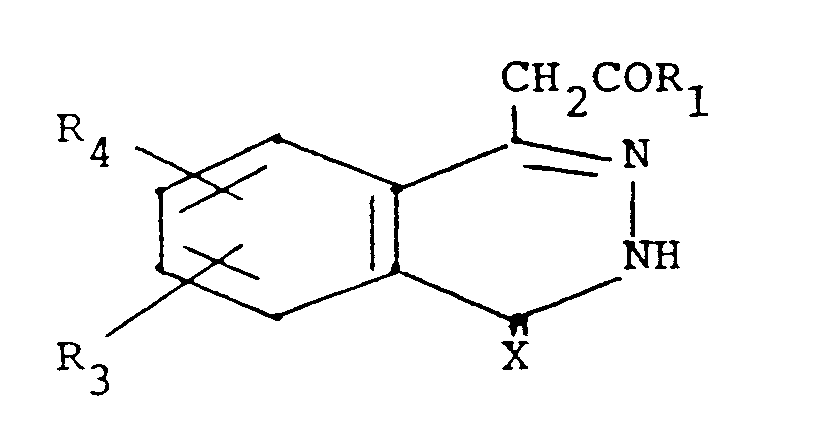
with a compound of the formula
in an inert atmosphere, wherein R₁ is (C₁-C₄)alkoxy, X, Z, R₂, R₃, R₄ and R₅ are as defined in claim 1 and R₆ is (C₁-C₄)alkyl, trifluoromethyl, or phenyl optionally substituted by methyl, chloro, bromo or nitro. - The numbering system of the compounds of formula I is as shown:
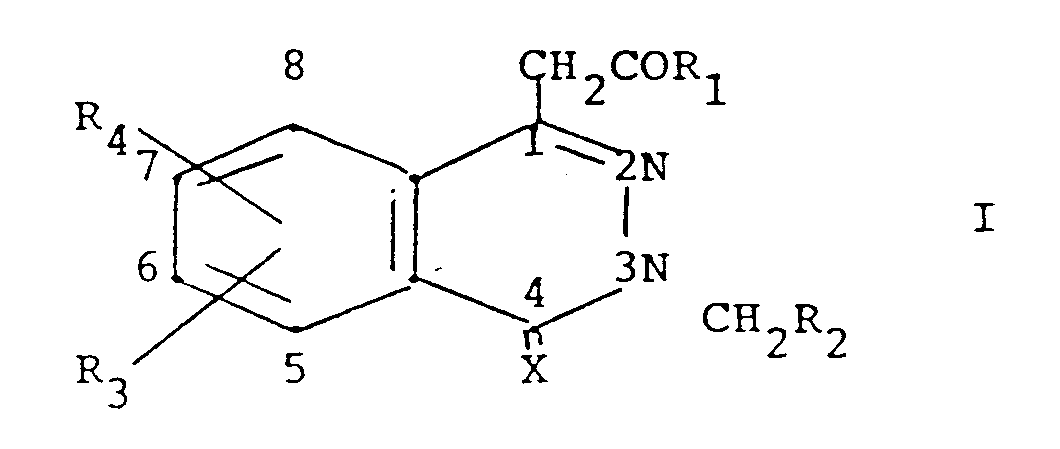
- The term "(C₁-C₄)alkyl" whenever used in the definitions of R₁ to R₄ denotes saturated monovalent straight or branched aliphatic hydrocarbon radicals having one to four carbon atoms, such as methyl, ethyl, propyl, butyl, t-butyl etc.
- The term "prodrug" means a group that is converted in vivo into the active compound of formula I wherein R₁ is hydroxy. Such groups are generally known in the art and include ester forming groups, to form an ester prodrug, such as benzyloxy, di(C₁-C₄)alkylaminoethyloxy, acetoxymethyl, pivaloyloxymethyl, phthalidoyl, ethoxycarbonyloxyethyl, 5-methyl-2-oxo-1,3-dioxol-4-yl methyl, and (C₁-C₄)alkoxy optionally substituted by N-morpholino and amide-forming groups such as di(C₁-C₄)-alkylamino.
- The heterocyclic 5-membered ring having one to three heteroatoms, one of which may be replaced by oxygen or sulfur includes imidazolyl, oxazolyl, thiazolyl, pyrazolyl, oxadiazolyl, thiadiazolyl, and triazolyl.
- The heterocyclic 6-membered ring having one to three nitrogen atoms, or one or two nitrogen atoms and one oxygen or sulfur includes triazinyl, pyrimidyl, pyridazinyl, oxazinyl and triazinyl.
- The heterocyclic ring may be condensed with benzo so that said ring is attached at two neighboring carbon atoms to form a phenyl group. Such benzoheterocyclic ring may be attached to Z either through the heterocyclic group or through the benzo group of the benzoheterocyclic ring. The preparation of those compounds wherein Z is attached to the benzo group is illustrated in Reaction Scheme B below. Specific examples wherein said heterocyclic ring is condensed with a benzo include benzoxazolyl, quinazolin-2-yl, 2-benzimidazolyl, quinazolin-4-yl and benzothiazolyl. The oxazole or thiazole condensed with a 6-membered aromatic group containing one or two nitrogen atoms include positional isomers such as oxazolo[4,5-b]pyridine-2-yl, thiazolo[4,5-b]pyridine-2-yl, oxazolo[4,5-c]pyridine-2-yl, thiazolo[4,5-c]pyridine-2-yl, oxazolo[5,4-b]pyridine-2-yl, thiazolo-[5,4-b]pyridine-2-yl, oxazolo[5,4-c]pyridine-2-yl, and thiazolo[5,4-c]pyridine-2-yl.
- The compounds of the invention are prepared as outlined in Reaction Scheme A.
- Phthalic anhydride and its derivatives of formula II are either commercially available or may be prepared according to standard procedures. The compounds of formula III wherein R' is ethyl or methyl may be prepared by reacting the compounds (II) with (carbethoxymethylene)triphenylphosphorane or (carbomethoxymethylene)triphenylphosphorane, respectively, in the Wittig reaction described in the prior art such as U.S. Patent 4,251,528 and Tetrahedron Letters, 1965, 2357.
- The compounds of formula IV wherein R' is methyl or ethyl may be formed by reacting compounds (III) with hydrazine as described in U.S. Patent 4,251,528. Preferably, the reaction is carried out in an aqueous solvent such as aqueous ethanol, dioxane or dimethylformamide, and at 40° to 120°C, preferably, at reflux temperature.
- The compounds of formula V are formed on reacting compounds (IV) wherein R' is hydrogen, methyl or ethyl, with

wherein L is a leaving group capable of forming compound LH on reaction of said two reagents. L is for example chloro, bromo, or OSO₂R₆, wherein R₆ is (C₁-C₄)alkyl, trifluoromethyl, phenyl or phenyl substituted by methyl, chloro, bromo or nitro.
When reacting compounds (IV) wherein R' is methyl or ethyl, the process is generally carried out in a polar solvent such as an alkanol having 1 to 4 carbon atoms, e.g. methanol or ethanol, dioxan, dimethylformamide, or dimethylsulfoxide, in the presence of a base. Suitable bases are alkali metal hydride or alkoxide of 1 to 4 carbon atoms, such as sodium or potassium hydride, methoxide or ethoxide. When a hydride is used, a non-aqueous solvent such as dimethylformamide is required. When reacting compounds (IV) wherein R' is hydrogen, obtained on hydrolysis of compounds (IV) wherein R' is methyl or ethyl, it is necessary for at least two molar equivalents of the base to be present, since the first molar equivalent reacts with the carboxylic acid radical of such a compound. In addition, when reacting such compounds, it is preferable to use a hydroxylic solvent to minimize production of a corresponding ester. - The reaction to form compounds (V) wherein R₅ is alkyl is preferably performed with compounds of formula

wherein L is OSO₂R₆ wherein R₆ is as defined above. This reaction is generally conducted in an inert atmosphere such as nitrogen in an aprotic polar solvent such as dimethylformamide at temperatures of 20 to 50°C. - The reaction to form compound (V) may be at room temperature, or at higher temperatures to accelerate the process.
- The compounds of formula V wherein R' is methyl or ethyl may be hydrolyzed to obtain compounds of formula I wherein R₁ is hydrogen. The hydrolysis proceeds at conventional temperatures and in the presence of acid or base such as a mineral acid, for example hydrochloric acid, or an alkali metal hydroxide or carbonate such as sodium or potassium hydroxide or carbonate. The reaction is carried out in the presence of water and a solvent, for example an alkanol of 1 to 4 carbon atoms such as methanol, or dioxane.
- The compounds of formula I wherein R₁ is hydroxyl may be esterified by conventional methods such as reaction of the corresponding acid chloride, bromide or anhydride with R₁H to obtain compounds (I) wherein R₁ is an ester prodrug group. Alternatively, the compounds of formula I in which R₁ is an ester prodrug group may be prepared by alkylating a solution of the sodium salt of a compound (I) wherein R₁ is hydroxy. The alkylating agent may be a chloride. For instance, when R₁ is benzyloxy, acetoxymethyl, or pivaloyloxymethyl, then the alkylating agent is benzylchloride, chloromethylacetate or chloromethylpivalate, respectively. The above sodium salt is generally prepared in situ by reacting a compound (I) wherein R₁ is hydroxy with a sodium salt forming compound such as sodium bicarbonate, sodium hydride or sodium t-butylammonium sulfate in a non-aqueous solvent such as dimethylformamide or methylpyrrolidone.
- When R₁ in compounds of formula (I) is an amide prodrug group such as di(C₁-C₄)alkylamino, a compound (I) wherein R₁ is (C₁-C₄)alkoxy is converted to the corresponding amide by reaction with an amine, e.g. di(C₁-C₄)alkylamine.
- The compounds of formula I wherein X is sulfur are prepared by thiating the corresponding compounds (I) wherein X is oxygen by known procedures, for example by reaction with phosphorus pentasulphide.
- The compounds of formula

when L is chloro, Z is a covalent bond, R₅ is hydrogen, and R₂ is oxazole or thiazole condensed with Y wherein Y is a 6-membered aromatic group containing one or two nitrogen atoms, or with thiophene or with furane, each optionally substituted by one of fluoro, chloro, bromo, trifluoromethyl, methylthio or methylsulfinyl; or 1,2,4-oxadiazol-3-yl or 1,2,4-thiadiazol-3-yl optionally substituted by R₇ wherein R₇ is one of iodo or trifluoromethylthio, or one or two of fluoro, chloro, bromo, (C₁-C₄)alkyl, (C₁-C₄)alkoxy, (C₁-C₄)alkylthio, (C₁-C₄)alkylsulfinyl, (C₁-C₄)alkylsulfonyl or trifluoromethyl, may be prepared by reacting compounds of the formula
wherein X is O or S, and Y and R₇ are as defined above, with tri((C₁-C₄)alkoxy)CH₂Cl. This reaction generally proceeds in a reaction-inert solvent such as a (C₁-C₄) alcohol e.g. ethanol, halocarbons e.g. chloroform or methylene chloride, or ethereal solvents such as diglyme. The reaction temperature ranges from about room temperature to the reflux temperature of the solvent used. The reaction time may range from about 15 minutes to about 2 hours or more. - The starting materials (VI) and (VII) are either commercially available or may be prepared according to standard procedures, e.g. as described in J. Am. Chem. Soc. 53, 309(1935) and J. Org. Chem. 29, 2652(1964).
- The tri((C₁-C₄)alkoxy)CH₂Cl compounds are either known or may be prepared by reacting 1,1,1-trialkoxyethane with N-chlorosuccinimide, or with chlorine in pyridine and a chlorohydrocarbon solvent. The first chlorination reaction is generally carried out in a solvent, suitably a non-polar solvent such as carbontetrachloride or tetrachloroethylene. The reaction is conveniently carried out at temperatures ranging from about 40°C to about the reflux temperature of the solvent. The reaction with chlorine in pyridine must be in the presence of a chlorohydrocarbon solvent having one or more chloro atoms and one to six carbon atoms, e.g. methylene chloride, chloroform or trichloroethane.
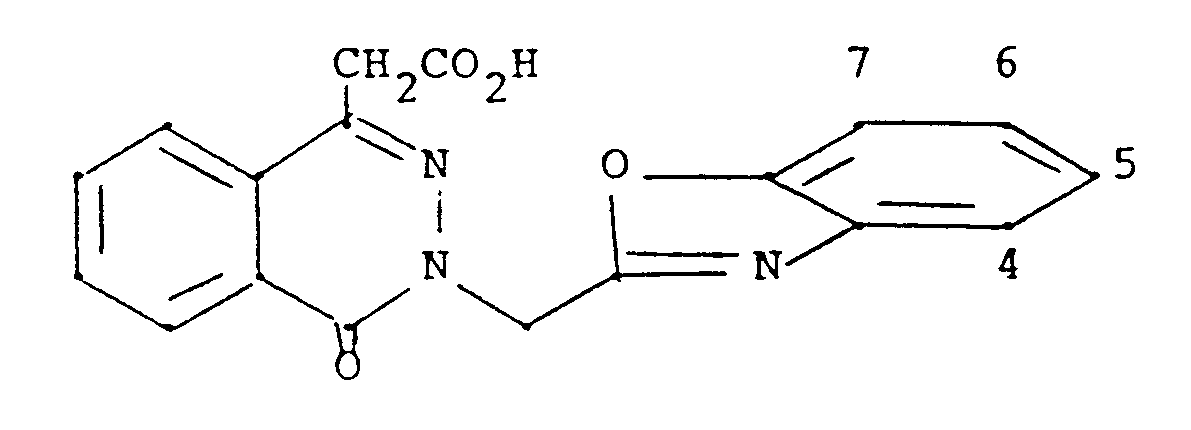
- Reaction Scheme B exemplifies the preparation of 3-(benzothiazole-5-ylmethyl)-4-oxo-phthalazin-1-yl-acetic acid which is a compound wherein R₂ is a benzo-heterocyclic ring with the benzo attached to the methylene bridge in the final compound. Other such compounds wherein R₂ is a benzo-heterocyclic ring with the benzo attached to the Z in the final compound may be made by a similar method. In Scheme B, 5-methylbenzothiazole is reacted with a brominating agent such as N-bromosuccinimide to form 5-bromomethylbenzothiazole which is then reacted with 4-oxo-3H-phthalazin-1-yl acetate to form ethyl 3-(5-methylbenzothiazolyl)-4-oxo-3H-phthalazin-1-yl acetate under conditions as outlined above with reference to Reaction Scheme A for the conversion of compounds (IV) to compounds (V).

- The pharmaceutically acceptable base addition salts of compounds (I) wherein R₁ is hydroxy may be formed with pharmaceutically acceptable cations by conventional methods. Thus, these salts may be readily prepared by treating the compound of formula I with an aqueous solution of the desired pharmaceutically acceptable cation and evaporating the resulting solution to dryness, preferably under reduced pressure. Alternatively, a lower alkyl alcohol solution of the compound of formula I may be mixed with an alkoxide of the desired metal and the solution subsequently evaporated to dryness. Suitable pharmaceutically acceptable cations for this purpose include, but are not limited to, alkali metal cations such as potassium and sodium, ammonium or water-soluble amine addition salts such as N-methylglucamine(meglumine), the lower alkanolammonium and other base salts with organic amines which are pharmaceutically acceptable, and alkaline earth metal cations such as calcium and magnesium.
- The pharmaceutically acceptable acid addition salts of the compounds of formula I are prepared in a conventional manner by treating a solution or suspension of the free base (I) with about one chemical equivalent of a pharmaceutically acceptable acid. Conventional concentration and recrystallization techniques are employed in isolating the salts. Illustrative of suitable acids are acetic, lactic, succinic, maleic, tartaric, citric, gluconic, ascorbic, benzoic, cinnamic, fumaric, sulfuric, phosphoric, hydroxhloric, hydrobromic, hydroiodic, sulfamic, sulfonic such as methanesulfonic, benzensulfonic, and related acids. Preferably, the acid is phosphoric acid.
- The novel compounds of formula I and the pharmaceutically acceptable salts thereof are useful as inhibitors of the enzyme aldose reductase in the treatment of chronic complications of diabetes, such as diabetic cataracts, retinopathy and neuropathy. As used in the claims and specification hereof, treatment is meant to include both the prevention and alleviation of such conditions. The compound may be administered to a subject in need of treatment by a variety of conventional routes of administration, including orally, parenterally and topically. In general, these compounds will be administered orally or parenterally at dosages between about 0.5 and 25 mg./kg. body weight of the subject to be treated per day, preferably from about 1.0 to 10 mg./kg. However, some variation in dosage will necessarily occur depending on the condition of the subject being treated. The person responsible for administration will, in any event, determine the appropriate dose for the individual subject.
- The novel compound of the invention may be administered alone or in combination with pharmaceutically acceptable carriers, in either single or multiple doses. Suitable pharmaceutical carriers include inert solid diluents or fillers, sterile aqueous solution and various organic solvents. The pharmaceutical compositions formed by combining the novel compounds of formula I and the pharmaceutically acceptable carriers are then readily administered in a variety of dosage forms such as tablets, powders, lozenges, syrups and injectable solutions. These pharmaceutical compositions can, if desired, contain additional ingredients such as flavorings, binders and excipients. Thus, for purposes of oral administration, tablets containing various excipients such as sodium citrate, calcium carbonate and calcium phosphate may be employed along with various disintegrants such as starch, alginic acid and certain complex silicates, together with binding agents such as polyvinylpyrrolidone, sucrose, gelatin and acacia. Additionally, lubricating agents such as magnesium stearate, sodium lauryl sulfate and talc are often useful for tabletting purposes. Solid compositions of a similar type may also be employed as fillers in soft and hard filled gelatin capsules. Preferred materials for this include lactose or milk sugar and high molecular weight polyethylene glycols. When aqueous suspensions or elixirs are desired for oral administration, the essential active ingredient therein may be combined with various sweetening or flavoring agents, coloring matter or dyes and, if desired, emulsifying or suspending agents, together with diluents such as water, ethanol, propylene glycol, glycerin and combinations thereof.
- For parenteral administration, solutions of the novel compound of formula I in sesame or peanut oil, aqueous propylene glycol, or in sterile aqueous solution may be employed. Such aqueous solutions should be suitably buffered if necessary and the liquid diluent first rendered isotonic with sufficient saline or glucose. These particular aqueous solutions are especially suitable for intravenous, intramuscular, subcutaneous and intraperitioneal administration. In this connection, the sterile aqueous media employed are all readily available by standard techniques known to those skilled in the art.
- Compounds of formula I may not only be advantageously employed for the preparation of aqueous pharmaceutical compositions for parenteral administration, as described above, but more particularly for the preparation of pharmaceutical compositions suitable for use as ophthalmic solutions. Such ophthalmic solutions are of principal interest for the treatment of diabetic cataracts by topical administration and the treatment of such conditions in this manner is a preferred embodiment of the present invention. Thus, for the treatment of diabetic cataracts the compounds of this invention are administered to the eye of an ophthalmic preparation prepared in accordance with conventional pharmaceutical practice, see for example "Remington's Pharmaceutical Sciences" 15th Edition, pages 1488 to 1501 (Mack Publishing Co., Easton, Pa). The ophthalmic preparation will contain a compound of formula I or a pharmaceutically acceptable salt thereof in a concentration from about 0.01 to about 1% by weight, preferably from about 0.05 to about 0.5% in a pharmaceutically acceptable solution, suspension or ointment. Some variation in concentration will necessarily occur, depending on the particular compound employed, the condition of the subject to be treated and the like, and the person responsible for treatment will determine the most suitable concentration for the individual subject. The ophthalmic preparation will preferably be in the form of a sterile aqueous solution containing, if desired, additional ingredients, for example preservatives, buffers, tonicity agents, antioxidants and stabilizers, nonionic wetting or clarifying agents and viscosity-increasing agents. Suitable preservatives include benzalkonium chloride, benzethonium chloride, chlorobutanol and thimerosal. Suitable buffers include boric acid, sodium and potassium bicarbonate, sodium and potassium borate, sodium and potassium carbonate, sodium acetate and sodium biphosphate, in amounts sufficient to maintain the pH at between about 6 to 8, preferably between about 7 and 7.5. Suitable tonicity agents are dextran 40, dextran 70, dextrose, glycerin, potassium chloride, propylene glycol and sodium chloride, such that the sodium chloride equivalent of the ophthalmic solution is in the range 0.9 plus or minus 0.2%. Suitable antioxidants and stabilizers include sodium bisulfite, sodium metabisulfite, sodium thiosulfite and thiourea. Suitable wetting and clarifying agents include polysorbate 80, polysorbate 20, poloxamer 282 and tyloxapol. Suitable viscosity-increasing agents include dextran 40, dextran 70, gelatin, glycerin, hydroxyethylcellulose, hydroxmethylpropylcellulose, lanolin, methylcellulose, petrolatum, polyethylene glycol, polyvinyl alcohol, polyvinylpyrrolidone and carboxymethylcellulose. The ophthalmic preparation will be administered topically to the eye of the subject in need of treatment by conventional methods, for example in the form of drops or by bathing the eye in the ophthalmic solution.
- The activity of the compounds of the present invention as agents for the control of chronic diabetic complications may be determined by a number of standard biological or pharmacological tests. Suitable tests include (1) measuring their ability to inhibit the enzyme activity of isolated aldose reductase; (2) measuring their ability to reduce or inhibit sorbitol accumulation in the sciatic nerve and lens of acutely streptozotocinized, i.e. diabetic, rats; (3) measuring their ability to reverse already-elevated sorbitol levels in the sciatic nerve and lens of chronic streptozotocin-induced diabetic rats; (4) measuring their ability to prevent or inhibit galactitol formation in the lens of acutely galactosemic rats; (5) measuring their ability to delay cataract formation and reduce the severity of lens opacities in chronic galactosemic rats; (6) measuring their ability to prevent sorbitol accumulation and cataract formation in isolated rat lens inclubated with glucose; and (7) measuring their ability to reduce already elevated sorbitol levels in isolated rat lens incubated with glucose.
- The present invention is illustrated by the following examples. Proton nuclear magnetic resonance spectra (′HNMR) were measured for solutions in deuterochoroform (CDCl₃) and peak positions are expressed in parts per million (ppm) downfield from tetramethylsilane (TMS). The peak shapes are denoted as follows: s, singlet; d, doublet; t, triplet; q, quartet; m, multiplet; br, broad.
- A mixture of 2,5-dibromoacetanilide (45.0 g), phophorous pentasulfide (24.4 g) and benzene (500 ml) was refluxed for 18 hours. After cooling the reaction mixture, the benzene layer was decanted off and then extracted with 10% potassium hydroxide solution (2 × 75 ml. The basic aqueous extract was washed with ether (2 × 50 ml), and acidified to pH 4.0 by the addition of diluted hydrochloric acid, and the precipitated 2,5-dibromothioacetanilide was collected and then air dried (Yield: 14.4 g; m.p. 119-124°C).
- This compound was prepared by adapting the procedure described in Synthesis, 1976, 731. To a solution of 2,5-dibromothioacetanilide (9.27 g) in N-methyl-pyrrolidinone was cautiously added sodium hydride (1.93 g as 50% w/w dispersion in mineral oil). After the addition was complete, the mixture was heated at 150°C for 1.5 hours. The dark reaction mixture was poured on to ice-water (300 ml.) and the separated brown gum was extracted with ethyl acetate (2 × 100 ml). The organic extract was washed with water (2 × 100 ml), dried over anhydrous magnesium sulfate and then evaporated. The resulting crude solid was chromatographed over silica gel to obtain the title compound (4.7 g; m.p. 84-85°C.).
- A mixture of 2-methyl-5-bromobenzothiazole (32.0 g), N-bromosuccinimide (25.1 g), carbon tetrachloride (700 ml) and a catalytic amount of benzoyl peroxide (0.2 g) was refluxed under irradiation by an UV lamp for 14 hours. The reaction mixture was cooled to room temperature, filtered to remove the precipitated succinimide and the filtrate was evaporated to dryness. The resulting solid was chromatographed over silica gel to obtain the product (7.8 g; m.p. 107°C).
- To a mixture of ethyl 4-oxo-3H-phthalazin-1-ylacetate (11.6 g.) and sodium hydride (288 g; 50% w/w dispersion in mineral oil) in dimethylformamide (150 ml) was added 5-bromo-2-bromomethylbenzothiazole (16.8 g) and the resulting mixture stirred at room temperature for 1 hour. This reaction mixture was poured over ice-water (500 ml.); sufficient 10% HCl was added to adjust the pH to about 4.0 and the precipitated crude solid was collected. This was chromatographed over silica gel to obtain the product (yield: 15.6 g; m.p. 160-161°C).
- A mixture of ethyl 3-(5-bromobenzothiazol-2ylmethyl)-4-oxo-3-H-phthalazin-1-ylacetate (15.0 g) and dioxane (150 ml) was brought to solution by warming on a steam bath and to this solution was added a solution of 10% potassium hydroxide (20 ml) in ethanol (50 ml.). The resulting dark purple solution was stirred at room temperature for 2 hours and concentrated to remove excess dioxane and ethanol. The concentrate was diluted with water (100 ml) and the resulting solution was washed with ether (2 × 100 ml). The aqueous layer was collected and acidified to pH 2.0 by addition of concentrated HCl. The precipitated solid was crystallized from methylene chloride/ethanol (400 ml/40 ml) to obtain the product (Yield 7.65 g; m.p. 214°C).
- A mixture of 2-cyanopyridine (15 g), hydroxylamine hydrochloride (10 g), sodium carbonate (15.3 g) and ethanol (100 ml) was refluxed for 24 hours. The reaction mixture was cooled, filtered and the filtrate evaporated to obtain a solid, which was extracted with ethyl acetate. The organic extract was dried, evaporated and the residue crystallized from benzene (3.0 g; m.p. 113-114°C).
- A mixture of pyridamidoxime (4.5 g), chloracetic anhydride (8.4 g) and toluene (350 ml) was refluxed for 12 hours. The hot solution was cooled, washed with water (2 × 100 ml), saturated bicarbonate solution (2 × 50 ml), again with water (2 × 100 ml) and the organic layer was evaporated to obtain a crude solid. This solid was crystallized from hexane to yield the product (3.4 g; m.p. 89-94°C).
- To a solution of ethyl 4-oxo-3H-phthalazin-1-ylacetate (1.6 g) and sodium hydride (0.5 g; 50% w/w dispersion in mineral oil) in dimethylformamide (15 ml) was added 3-(2-pyridyl)-5-chloromethyl-1,2,4-oxadiazole (1.5 g) dropwise over a period of 40 minutes. After stirring for another 10 minutes, the reaction mixture was poured onto water (50 ml) and extracted with ether. The ether layer was evaporated and the residue was chromatographed over silica gel to obtain the product (1.0 g; m.p. 118-128°C).
- To a solution of ethyl 3(2-pyridyl-1,2,4-oxadiazol-5-ylmethyl)-4-oxo-3H-phthalazin-1-ylacetate (1.0 g) in methanol (10 ml) was added 20% aqueous KOH (0.5 ml) and the mixture refluxed for 30 minutes. Evaporation of excess methanol gave an orange residue. The residue was dissolved in water, acidified with acetic acid (1 ml) and the precipitated solid was collected and crystallized from isopropanol to yield the product (0.53 g; m.p. 196-200°C).
- 2-Trifluoromethylbenzimidioxime prepared similary to the procedure described in Ber, 1899, 32, (1975) (2.9 g; m.p. 115-116°C) starting from 2-trifluoromethylbenzaldehyde, was dissolved in anhydrous acetone (70 ml) and then solid potassium carbonate (2.0 g) was added. To the resulting slurry cooled to 15-18°C in an ice-water bath was added a solution of chloroacetyl chloride (1.1 ml) dissolved in acetone (10 ml). After the addition, the ice-bath was removed and the reaction mixture brought to room temperature and stirred for 1.5 hours. Evaporation of acetone gave a white residue which upon trituration with water yielded 0-chloroacetyl-2-trifluoromethylbenzimidoxine (3.0 g; m.p. 108-110°C). This product was mixed with tolune (50 ml) and heated to reflux for 1.5 hours. The toluene solution was cooled, washed with saturated aqueous sodium bicarbonate (10 ml) and water, and the organic portion was dried and evaporated. The resulting brown oil was chromatographed over silica gel to obtain the title compound as a yellow oil. ′HNMR(CDCl₃, 60MHz): 4.0 (s, 2H), 4.4 (s, 2H), 7.3 (s, 5H).
- To a mixture of 4-oxo-3H-phthalazin-1-ylacetate (1.4 g) and sodium hydride (0.43 g; 50% w/w dispersion in mineral oil) in dimethylformamide (10 ml) was added 3-(2-trifluoromethylphenyl)-5-chloromethyl-1,2,4-oxadiazole (1.7 g) and stirred at room temperature for 30 minutes. The reaction mixture was poured onto water (20 ml), acidified to pH 2.0 with 10% HCl and the precipitated solid collected. The solid was triturated with isopropanol to obtain the product as a white crystalline solid (1.65 g; m.p. 111-115°C).
- A mixture of ethyl-3-[2-trifluoromethylphenyl)-1,2,4-oxadiazol-2-yl-methyl-4-oxo-phthalazin-1-ylacetate (1.6 g) and methanol (50 ml) containing 20 w/w aqueous KOH (0.5 ml) was heated on a steambath for 1 hour. Water (20 ml) was added to the residue obtained upon evaporation of methanol and the pH of the solution brought to 2 by addition of 10% HCl. The precipitated solid was crystallized from benzene (0.7 g; m.p. 132-134°C).
- A mixture of ethyl 4-oxo-3H-phthalazin-1-ylacetate (2.34 g) and sodium hydride (0.58 g; 50% w/w dispersion in mineral oil) in dimethylformamide (20 ml) was stirred at room temperature for 15 minutes. To this was added N-methyl-2-chlolomethylbenzimidazole (2.4 g; prepared according to JACS, 1943, 65 (1854) and stirred for another hour. It was poured onto water (150 ml) and extracted with ethyl acetate (2 × 100 ml). The organic extract was dried, evaporated and the residue was chromatographed over silica gel to obtain the product (2.04 g; m.p. 118°C).
- To a solution of 3-(N-methylbenzimidazol-2-yl)-4-oxo-3H-phthalazin-1-ylacetate (2.0 g) in warm methanol (100 ml) was added 10% KOH (10 ml), stirred at room temperature for 2.5 hours and then evaporated to obtain a solid. This solid was dissolved in water (50 ml), extracted with ether (50 ml) and the aqueous layer was adjusted to pH 6.0 by the addition of acetic acid. The resulting white solid was collected, dried and crystallized from a mixture of methanol/methylene chloride to obtain the title compound (0.68 g; m.p. 230°C. (d)).
- A solution obtained by adding ethyl 4-oxo-3H-phthalazin-1-ylacetate (1.25 g) to a suspension of sodium hydride (285 mg; 50% w/w dispersion in mineral oil) in dimethylformamide (10 ml) was added dropwise to a solution of 2-chloromethyl-oxazolo[4,5-b]pyridine (1.0 g) in dimethylformamide (5 ml). After 2 hours, the reaction mixture was poured onto cold water (20 ml) and extracted with ether. The ether extract was washed with water (2 × 50 ml), dried and evaporated. The resulting crude material was chromatographed over silica gel to obtain 3-(oxazolo[4,5-b] pyridine-2-ylmethyl)-4-oxo-3H-phthalazin-1-ylacetate (m.p. 105-107°C) which was used directly in the next step. The product was dissolved in methanol (5 ml) containing 20% aqueous potassium hydroxide (0.5 ml) and heated on a steambath for 15 minutes. The solution was evaporated to dryness, the residue dissolved in water and acidified with acetic acid (2 ml). The resulting yellow precipitate was collected, triturated with hot methanol and filtered to obtain the title compound as a white solid (0.32 g; m.p. 228-230°C).
- A solution of methyl 3-(2-benzothiazolyl)-4-oxo-3H-phthalazin-1-ylacetate (1.92 g) in methanol (50 ml) containing 10% aqueous potassium hydroxide (5 ml) was stirred at room temperature for 4 hours. The solution was concentrated to remove methanol and the concentrate was diluted with water (75 ml) and then extracted with ethyl acetate. The aqueous portion was separated and acidified with concentrated hydrochloric acid to pH 2.0. The precipitated solid was collected and crystallized from isopropyl alcohol to give 3-(2-benzothiazolyl)-4-oxo-3-H-phthalazin-1-ylacetic acid (876 mg; m.p. 205°C(d)).
- In accordance with Example 6, the following compounds are prepared:


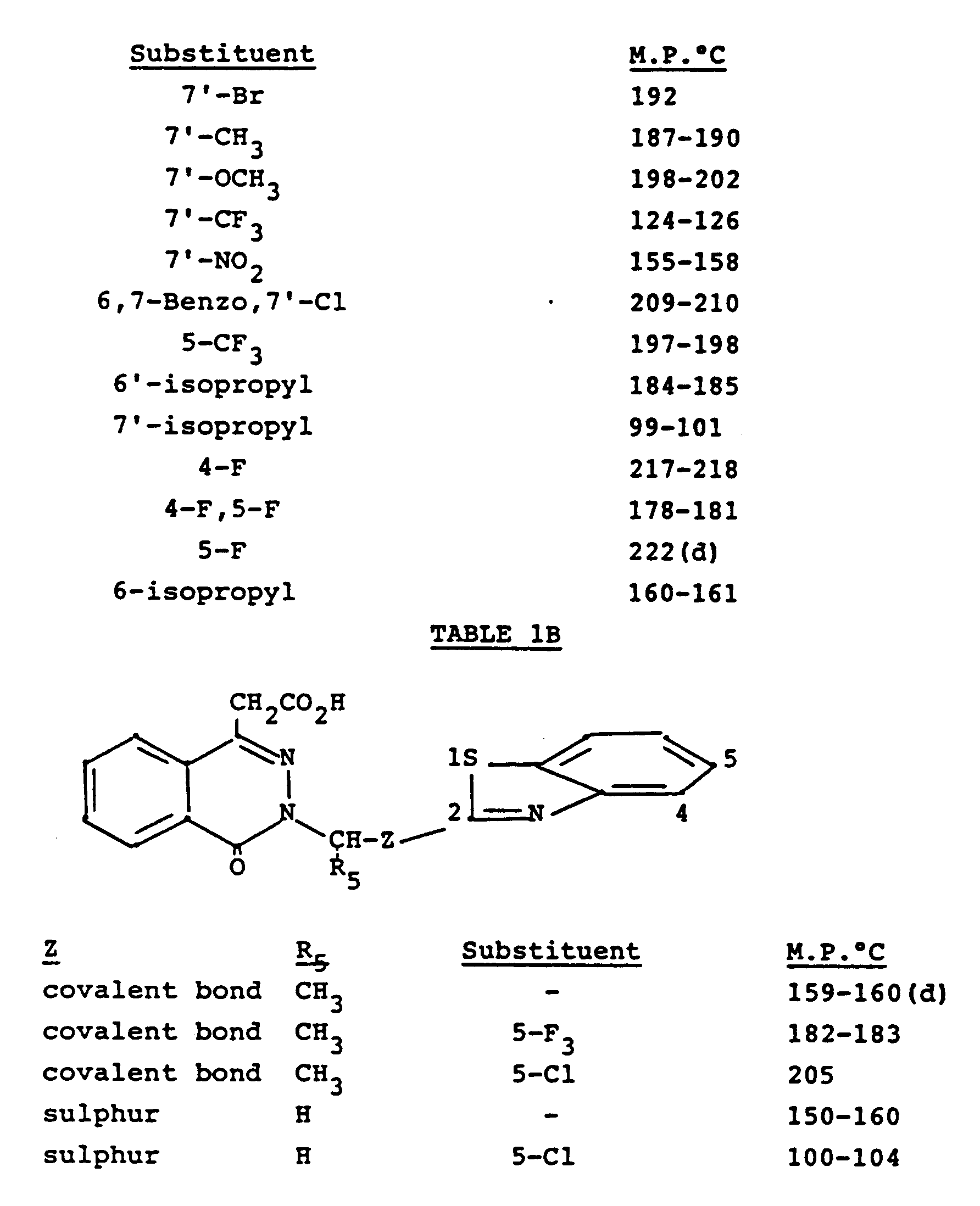
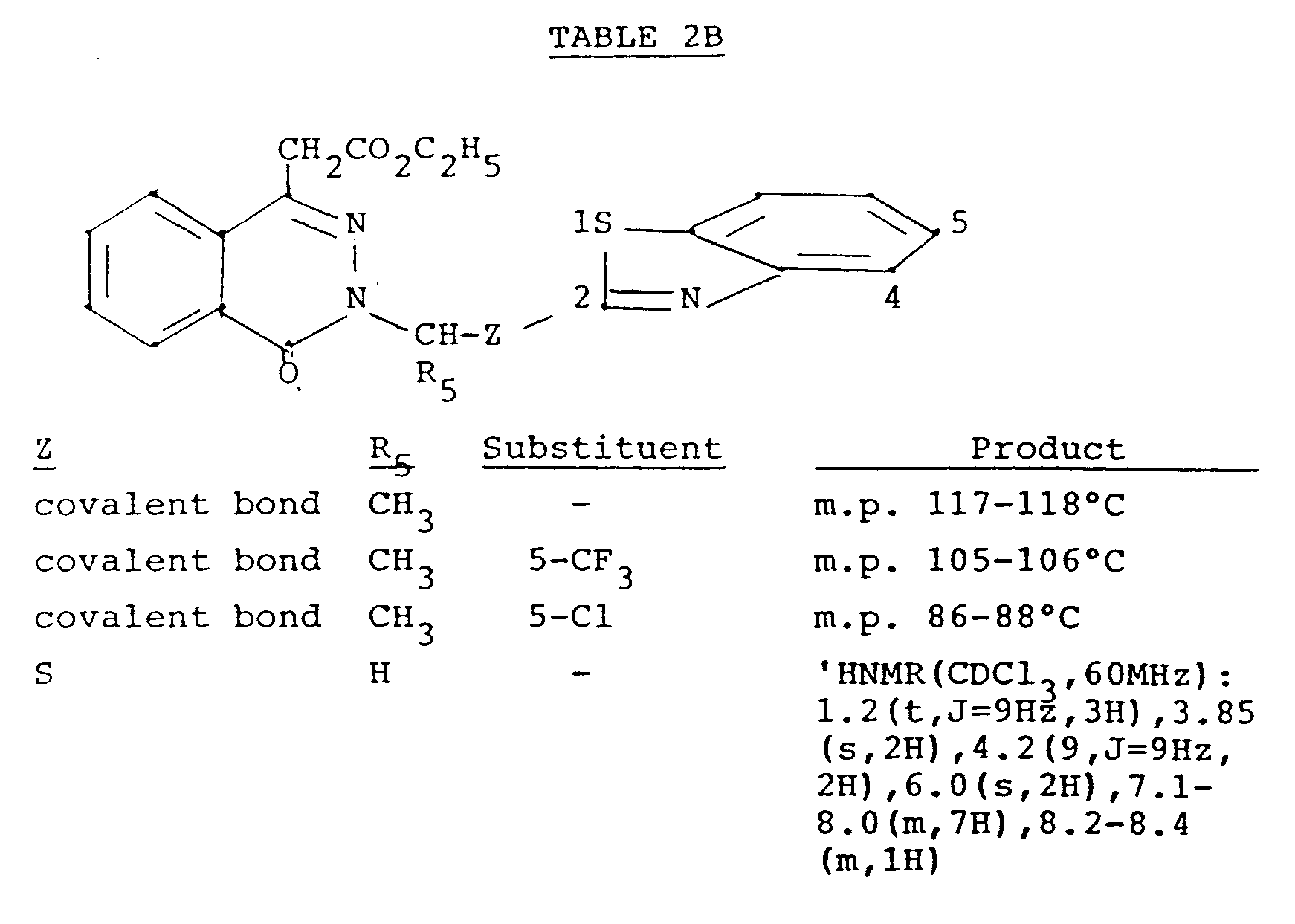
- A mixture of methyl 4-oxo-3H-phthazalin-1-ylacetate (1.09 g) and sodium hydride (0.269 g; 50% w/w dispersion in mineral oil) in dimethylformamide (25 ml) was stirred at room temperature for two hours under nitrogen. To the solution obtained was added 2-bromomethylbenzothiazole (1.14 g) dissolved in dimethylformamide (5 ml), the reaction mixture was stirred for an additional one hour and then poured into ice water (50 ml). The pH of the mixture was brought to 4.0 by addition of 10% hydrochloric acid (5 ml) and extracted with ethyl acetate (100 ml). The extract was washed with water (50 ml), dried (MgSO₄) and evaporated. The crude product (1.92 g), methyl (2-benzothiazolyl)-4-oxo-3H-phthalazin-1-ylacetate, was characterized by NMR spectrum (see Table 2). The other compounds of Table 2 were prepared in a similar manner using the appropriate 4-oxo-3H-phthalazin-1-ylacetate and 2-bromomethylbenzothiazoles. The melting points are in degrees Centigrade.

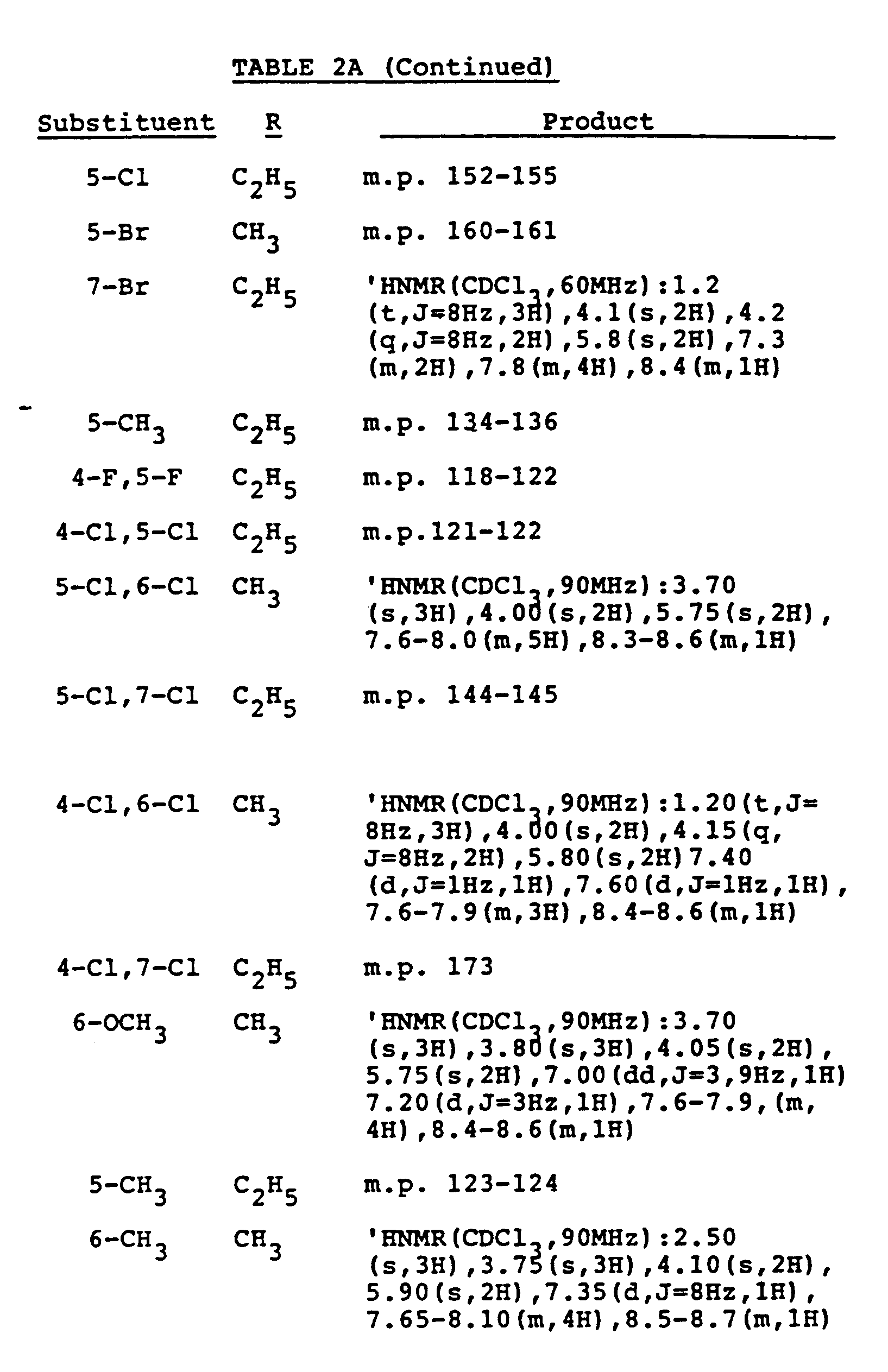


- To a mixture of ethyl-4-oxo-3H-phthalazin-1-ylacetate (23.4g) in dimethylformamide (175 ml) maintained at 10°C was added potassium t-butoxide (11.2g) portion-wise over 5 minutes. The resulting orange-colored solution was brought to room temperature and 5-trifluoromethyl-2-chloromethylbenzothiazole in dimethylformamide (25 ml) was gradually added over 15 minutes. After stirring for an additional 30 minutes, the mixture was poured onto ice water (1500 ml). The precipitated solid was collected and washed with a mixture of isopropyl ether/n-hexane (250 ml/500 ml). The resulting light yellow solid, ethyl-3-(5-trifluoromethyl-2-benzothiazolylmethyl)-4-oxo-phthalazin-lylacetate, was air dried (44.3g), m.p. 134-136°C.
- According to the method of Example 1D, the following compounds were prepared:

Benzothiazolyl substituent Product H not isolated 5-Cl not isolated 5-Br not isolated 5-Cl,7-Cl Mass Spectrum, m/e base peak 431.06 (partly isolated) 5,6-benzo m.p. 167-170°C - According to the method of Example 6, the following compounds were prepared from the above compounds without isolation thereof.
Benzothiazolyl substituent M.P.°C H 179-183 5-Cl 205-207 5-Br 190-192 5-Cl,7-Cl 199-201 5,6-benzo 167-170 - In accordance with Example 3B, the following compounds were prepared.

R Product 2-F,6-Cl-phenyl 'HNMR(CDCl₃,60MHz): 1.3(t,J=8Hz,3H),4.0 (s,2H),4.2(q,J=8Hz,2H) 5.8(s,2H),7.3(m,3H), 7.8(m,3H),8.4(m,1H) 2-pyridyl m.p. 118-123°C 2-Br-phenyl 'HNMR(CDCl₃,60MHz): 1.3(t,J=8Hz,3H),4.0 (s,2H),4.2(q,J=8Hz, 2H),5.7(s,2H),7.2 (m,2H),7.8(m,4H),8.4 (m,1H) benzyl m.p. 76-80°C 2-F-phenyl m.p. 100-105°C 3-Cl,4-Cl-phenyl m.p. 138-140°C - In accordance with Example 3C, the following compounds were prepared.

R M.P.°C 2-Cl-phenyl 164-167 phenyl 202-205 4-Br phenyl 193-195 2-methylphenyl 182-184 2-OCH₃-phenyl 174-175 2-F,6-Cl-phenyl 178-182 3-Cl,4-Cl-phenyl 220-221 2-pyridyl 196-200 2-Br phenyl 171-173 benzyl 56-60 2-F phenyl 210-211 - A mixture of commercially available 4,5-dichlorophthalic acid (50.4 g) and acetic anhydride (150 ml) was refluxed for 2 hours. Upon cooling the precipitate product was collected and dried in vacuum (37.0 g; m.p. 180-181°C).
- A solution of 4,5-dichlorophthalic anhydride (10.0 g) and (carbethoxymethylene)triphenylphosphorane (16.0 g) in chloroform (450 ml) was refluxed for 16 hours. Evaporation of chloroform and chromatography of the residue over silica gel gave the product (9.34 g).
- A mixture of 3-ethoxycarbonylmethylidene-5,6-dichlorophthalide (9.37 g), ethanol (300 ml) and hydrazine (1.1 ml) was refluxed for 3 hours. Upon cooling, the precipitated solid was collected (6.85 g.; mass spectrum, m/e 300 and 227).
- D. The title compound was prepared from ethyl 6,7-dichloro-4-oxo-3H-phthalazin-1-ylacetate and 2-chloromethylquinoline in accordance with the procedure in Example 6, m.p. 202-203°C.
- To a solution of ethyl-4-oxo-3H-phthalazin-1ylacetate (1.0 g) and sodium hydride (60% w/w dispersion in mineral oil) in dimethylformamide (30 ml) was added 2-bromomethylquinoline (1.05 g). The resulting solution was stirred at room temperature for 30 minutes, poured onto water (100 ml) containing 1N HCl (5 ml), and extracted with ethyl acetate. The organic extract was washed with water (3×50 ml), dried and evaporated to obtain ethyl 3-(quinolin-2ylmethyl)-4-oxo-phthalazin-1-ylacetate (1.54 g). This substance was dissolved in a water/dioxane mixture (70 ml/70 ml). To the solution was added 5N potassium hydroxide (5 ml). The solution was allowed to stir at room temperature for 15 minutes, concentrated to remove excess dioxane, diluted with water (150 ml) and extracted with ethyl acetate (3×70 ml). The aqueous layer was adjusted to pH 2 with concentrated HCl. The precipitated solid was triturated with hot ethyl acetate and then filtered to obtain the title compound (0.54 g; m.p. 193-194°C).
- In accordance with Example 6, the following compounds were prepared.

- According to Example 8, the following compounds were prepared:


- To the sodium salt of N-2-hydroxyethylmorpholine, prepared by cautiously adding sodium hydride (0.45 g; 50% w/w dispersion in mineral oil) to a solution of N-2-hydroxyethylmorpholine(1.43 ml) in toluene (50 ml), was added a solution of ethyl 3-(benzothiazol-2-ylmethyl)-4-oxo-5,6-dichloro-phthalazin-1-ylacetate (1.23 g) in toluene (30 ml). After stirring the reaction mixture at room temperature for 24 hours and then at 60°C for 6 hours, it was exposed to HCl gas and the precipitated solid was added to saturated aqueous sodium bicarbonate (100 ml) and extracted with ethyl acetate (3 × 100 ml). The organic layer was dried and evaporated and the resulting solid was dissolved in acetone (30 ml). Exposure of this solution to gaseous HCl gave the title compound (0.12 g), which was characterized by elemental analysis (C, 49.83%; H,3.83%; N,9.36%).
- Sodium methoxide (54 mg) was added to 3-(5-trifluoromethylbenzothiazol-2-ylmethyl)-4-oxo-phthalazin-1-ylacetic acid (0.4 g) in methanol (10 ml) at room temperature. After the addition was complete, a clear solution was obtained which was stirred for 15 minutes at room temperature. The excess methanol was evaporated. The residue was triturated with ether (20 ml) and filtered to obtain the pro t (0.43 g; m.p.> 300°C).
- To a mixture of 3-(5-trifluromethylbenzothiazol-2ylmethyl)-4-oxo-phthalazin-1-ylacetic acid (0.42 g) in methanol (10 ml) was added dicyclohexylamine (0.2 g) in methanol (5 ml). The resulting clear solution was stirred at room temperature for 15 minutes and then evaporated to dryness. Trituration of the residue with ether (30 ml) gave a white solid (0.38 g; m.p. 207°C).
- A solution of 3-(5-trifluoromethylbenzothiazol-2-ylmethyl)-4-oxo-phthalazin-1-ylacetic acid (419 mg) and meglumine (196 mg) in methanol (50 ml) was stirred at room temperature for an hour and then evaporated to dryness. The residue was triturated with ether (25 ml), filtered and the collected solid was air dried (610 mg; m.p. 157°C).
- A solution of 3-(5-bromobenzothiazol-2-ylmethyl)-4-oxo-phthalazin-1-ylacetic acid (430 mg) and meglumine (196 mg) in methanol (50. ml) was stirred at room temperature for an hour and evaporated to dryness. The residue was triturated with ether (25 ml) and the solid collected by filtration (620 mg; m.p. 138-140°C).
- To an ice-cold solution of ethyl-(5-thiomethylbenzothiazole-2-ylmethyl)-4-oxo-phthalazin-1-ylacetate (1.06g) in chloroform (10ml) was added meta-chloroperoxybenzoic acid (0.50g). The resulting solution was stirred at between 0-5°C for 1 hour. The chloroform solution was washed with 10% sodium bicarbonate solution (3×20ml) and the separated organic layer was dried over magnesium sulfate and evaporated to dryness. The residue was purified by chromatography over silica gel to obtain the title compound [0.81g; ′HNMR (CDCl₃, 60 MHz): 1.2 (t, J=8Hz, 3H), 2.65 (s, 3H), 3.95 (s, 2H), 4.1 (q, J=8Hz, 2H), 5.75 (s, 2H), 7.4-8.3 (m, 7H)].
- A solution of ethyl-(5-thiomethylbenzothiazole-2-ylmethyl)-4-oxo-3H-phthalazin-1-ylacetate (1.06g) and meta-chloroperoxybenzoic acid (1.3g) in chloroform (50ml) was stirred at room temperature for 1 hour. This solution was washed with 10% sodium bicarbonate solution (3×20ml) and the organic extract was dried and evaporated to obtain a light yellow solid (0.85g; ′HNMR (CDCl₃, 60MHz): 1.2 (t, J=Hz, 3H), 3.1 (s, 3H), 4.0 (s, 2H), 4.15 (q, J=8Hz, 2H), 5.85 (s, 2H), 7.4-8.3 (m, 7H).
- To a solution of 1-(2-benzothiazolyl)ethanol (2.5 g) prepared according to J. Indian Chem. Soc., 566 (1974) in methylene chloride (50 ml) was added thionyl chloride (3.32 g) and the resulting solution stirred at room temperature for 1 hour. The solution was poured onto ice-water (100 ml) and the organic extract separated. This extract was washed with aqueous bicarbonate (10 ml of a 5% solution) and then with water (50 ml). The methylene chloride layer was dried over anhydrous magnesium sulfate and evaporated to a light yellow oil (2.08 g).
- To an ice-cold sol on of 1-(5-trifluoromethyl-2-benzothiazolyl)ethanol (m.p. 93-94°C, 4.94 g) in dry pyridine was added methanesulfonyl chloride (4.58 g) and the resulting solution stirred at 0°C for 1 hour. It was poured onto water, extracted with ether and the ether layer washed with 10% hydrochloric acid (2×20 ml). The organic extract was dried, evaporated and the residue triturated with hexane to obtain the desired compound as solid, m.p. 89°C (5.89 g).
- A mixture of ethyl 4-oxo-3H-phthalazin-1-ylacetate (2.34 g) and sodium hydride (0.53 g; 50% w/w dispersion in mineral oil) in dimethylformamide (25 ml) was stirred at room temperature for 30 minutes under nitrogen. To the solution obtained was added 1-(5-trifluoromethyl-2-benzothiazolyl)ethanol mesylate (3.2 g) dissolved in dimethylformamide (5 ml), the reaction mixture stirred for an additional hour and poured onto ice-water (50 ml). The pH of the mixture was brought to 4.0 by addition of 10% hydrochloric acid (5 ml) and extracted with ethyl acetate (100 ml). The extract was washed with water (50 ml), dried over anhydrous magnesium sulfate and evaporated. The crude product was purified by chromatography over silica gel by eluting with ethylacetate-chloroform (5/95% mixture). The title compound (2.0 g) was obtained by evaporation of eluants, m.p. 105-106°C.
- A. 5-Bromomethylbenzothiazole was prepared according to Example 1C starting from 5-methylbenzothiazole made according to Grazz. Chim. Ital., 95, 499 (1965). The products showed the following NMR resonances - TMS (60 MHz, CDCl₃): 4.6 (s,2H), 7.4 (dd, 1H,J=10Hz, J=2Hz),7.85 (d, 1H,J=10Hz), 8.15(d,J=2Hz), 9.0(s,1H).
- B. Ethyl 3-(5-methylbenzothiazolyl)-4-oxo-3H-phthalazin-1-yl-acetate prepared according to Example 1D had the following NMR resonances - TMS, (60MHz, CDCl₃): 1.2(t,J=8Hz,3H),3.95(s,2H),4.2(q,J=8Hz,2H),5.6 (s,2H),7.2-8.2(m,7H),9.0(s,1H).
- C. The title compound was prepared according to Example 1E, m.p. 203-204°C.
- To a mixture of ethyl 4-oxo-3-H-phthalazin-1-ylacetate (2.34 g) in dimethylformamide (15 ml) was added sodium methoxide (0.51 g). To the clear yellow solution obtained upon stirring the mixture for 5 minutes was added a solution of 5-fluoro-2-chloromethylbenzothiazole made in accordance with Example 1C in dimethylformamide (5 ml). After stirring the resulting solution for 1 hour, it was poured onto ice-water (50 ml) and extracted with methylene chloride. Evaporation of the organic extract gave a light orange colored solid, which was crystallized from ethanol to obtain the title compound (3.84 g, m.p. 118-120°C).
- In Table 5, the first two intermediates were prepared by the method of U.S. Patent 4,251,528 and the remaining intermediates by the method of Example 13C.


- The following intermediates were prepared according to Example 1C unless otherwise indicated. All melting points are in degrees Centigrade.


- The following intermediates were prepared by the indicated methods of the prior art, or by the method of Example 1B.

- Chloracetamidoxime (5 g) was dissolved in warm benzene (20 ml) and 2-chlorobenzoyl chloride (6.4 ml) was cautiously added to it. The resulting mixture was heated at 40°C for 30 minutes and excess benzene was removed. After cooling to room temperature the solidifed mass was triturated with cold benzene and filtered to obtain the compound 1.6 g; m.p. 126-130°C).
- B. 0-2-chlorobenzoyl-chloroacetamidoxime (1.4 g) was added to refluxing diglyme (10 ml) and the refluxing continued for 10 minutes. After cooling, the reaction mixture was poured onto water (20 ml) containing ether (50 ml). The ether layer was washed with water (2 × 50 ml), saturated aqueous sodium bicarbonate (2 × 10 ml) and the organic layer dried and evaporated. The residue was chromatographed over silica gel to obtain the product, 0.8 g of a colorless oil, ′HNMR(CDCl₃,60MHz): 4.7 (s,2H), 7.45 (m, 3H), 8.1 (m, 1H).
- The commercially available 2-amino-3-hydroxypyridine (5.0 g) and diglyme (30 ml) were heated at 125°C to obtain a solution. To this solution was added 2-chloro-1,1,1-triethoxyethane (9.9g) and the resulting mixture held at 125° for 1 hour. The solution was cooled to room temperature and then decanted to remove a black byproduct residue. The filtrate was diluted with water (50 ml) and the resulting yellow precipitated 2-chloromethyl-oxazolo[4,5-b]pyridine was collected (1.5 g). A small sample was crystallized from isopropanol (m.p. 115-118°C).
- 2-Chloromethyl-thiazolo[5,4-b]pyridine was prepared similarly by heating a mixture of 3-amino-2-mercaptopyridine (3.6 g), 2-chloro-1,1,1-triethoxyethane (6.5 g) and ethanol (60 ml) at 60°C for 4 hours. The crude solid resulting from evaporation of ethanol was chromatographed over silica gel to obtain 2.94 g of the product, m.p. 71-73°C.
- Similarly, 2-chloromethyl-5-trifluoromethylbenzothiazole, m.p. 52°C, was formed from 2-amino-4-trifluoromethylthiophenol hydrochloride and 2-chloro-1,1,1-triethoxyethane in ethanol.
- Intermediates of the formula Hal-CH₂R₂ were prepared by the methods listed below or by the method of Example E.
TABLE 8 Structure Product 3-bromomethylbenzisothiazole R.A. Gillham, Jr., Ph.D. thesis, California Institute of Technology, 1969 3-phenyl-5-chloromethylisothiazole 'HNMR(CDCl₃,60MHz): 4.8(s,2H),7.4(m,3H), 7.9(m,2H) 2-chloromethyl-5-phenyloxazole m.p. 64-66°C 2-chloromethyl-4-phenyloxazole m.p. 50-52°C 5-chloromethyl-2-phenylthiazole U.K. Patent 1,137,529 5-chloromethyl-2-0-fluorophenylthiazole U.K. Patent 1,137,529 3-phenyl-4-chloromethylisothiazole 'HNMR(CDCl₃,60MHz): 4.5(s,2H),7.4(m,3H), 7.7(m,2H) 2-phenyl-5-chloromethyl1,3,4-oxadiazole Chem. Ber. 96, 1049 (1963) 2-chloromethyl-5-chlorobenzothiophene J. Chem. Soc. (C), 731 (1967) 3-chloromethyl-5-(2-chlorophenyl)1,2,4-oxadiazole Prepared similarly to procedure in J. Heterocyclic Chem. 16, 1469 (1979). 'HNMR (CDCl₃,60MHz):4.7 (s,2H),7.45(m,3H),8.1 (m,1H) N-methyl-2-chloromethylbenzimidazole JACS, 65, 1854, (1943), m.p. 95°C 3-methyl-4-bromomethyl-1,2,5-thiadiazole J. Heterocyclic Chem., 21, 1157 (1984), b.p. 30-35°C at 7 mm - The benzoate of 4-phenylthiazole-2-methanol (7.4 g), prepared according to J. Am. Chem. Soc., 53, 1470 (1931) was dissolved in anhydrous tetrahydrofuran (50 ml). To this solution was added lithium aluminum hydride (525 mg) and the mixture stirred for one hour at room temperature. After carefully quenching the excess lithium aluminium hydride with ethyl acetate, the mixture was poured onto ice-cold water (50 ml) and acidified to pH 3 using 10% HCl. The mixture was filtered and the filtrate was extracted with ether (3x50ml). The organic extract wad dried, evaporated and the crude product was purified by chromatography to obtain 4-phenylthiazole-2-methanol (1.8 g). This compound was converted to 4-phenylthiazole-2-methanol, methane sulfonate according to the procedure described in Example 24B. The melting point of the product was 80°C.
- The following intermediates were prepared by the method of Helvitica Chimica Acta 49, 412 (1966) except for the last two intermediates which were prepared by the method of J. Med. Chem. 4,351 (1961).

- A mixture of 5-chloro-2-hydroxyaniline (10 g), chloroacetamidic acid ethyl esterhydrochloride (8.5 g) in chloroform (100 ml) was refluxed for 5 hours. The dark brown solution was filtered, washed first with 10% aqueous potassium hydroxide solution (10 ml) and then water (20 ml). The organic layer was dried (magnesium sulfate) and then evaporated to dryness. The residue was purified by column chromatography (m.p. 53-56°C, yield, 8.6 g).
- The following intermediates were prepared by the above procedure.
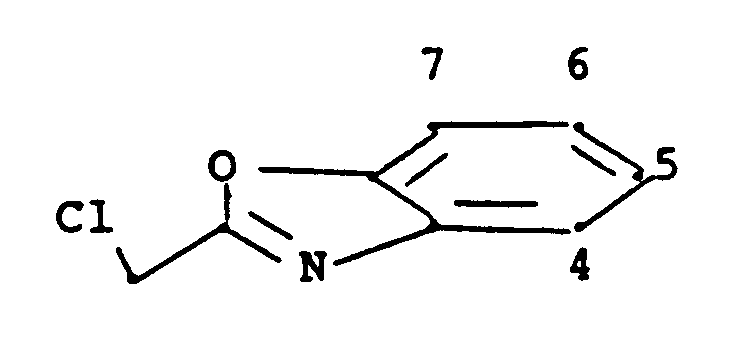
Substituent Product 5-bromo m.p. 63-65°C 5-Cl, 7-Cl m.p. 52-53°C 5,6-dibenzo m.p. 105°C(d) - A. A mixture of l,l,l-triethoxyethane (97.3 g) and N-chlorosuccinimide (88.l g) in carbon tetrachloride (600 ml) was warmed to 40°C and then irradiated with an ultraviolet lamp. The reaction became exothermic and then subsided upon completion of the reaction. The precipitated succinimide byproduct was filtered off and the filtrate was concentrated to remove carbon tetrachloride. The residual liquid was distilled to obtain pure 2-chloro-l,l,l-triethoxyethane (9l.0 g; b.p. 9l°C/25 mm).
- B. A solution of 2-chloro-l,l,l-triethoxyethane (5.9 g) and 2-aminothiophenol (2.5 g) was heated at 80°C for l5 minutes. After cooling to room temperature, it was dissovled in methylene chloride (30 ml) and the resulting solution was washed with 3N HCl (l0 ml) and then with water (20 ml). The organic portion was evaporated and the residue chromatographed over silica gel to obtain 2-chloromethylbenzothiazole (3.35 g; 90% yield), m.p. 34°C.
- A mixture of crude 2-amino-4-bromothiophenol tin hydrochloride complex (7l.6 g) prepared according to JACS 53, 209 (l93l), 2-chloro-l,l,l-triethoxyethane (58.7 g) and ethanol (400 ml) was heated to gentle reflux for 30 minutes to obtain a solution. To the warm solution was added 3N HCl (l0 ml) and the precipitated solid was collected, washed with water and then dried to obtain the title compound (35.5 g), m.p. l07°C.
- The commercially available 4-chloro-3-nitrobenzotrifluoride (l00 g) was dissolved in ethanol (400 ml). To this was added portionwise a solution prepared by first adding sodium sulfide hydrate (80 g) to hot ethanol (200 ml) and then sulfur (9.6 g). After the intial exothermic reaction had subsided, the reaction mixture was refluxed for an additional 30 minutes and then cooled to room temperature. The precipiated yellow solid was collected, washed with cold ethanol and then dried to yield 4,4′-ditrifluoromethyl-2,2′-dinitrodiphenyldisulfide (63.0 g; m.p. l52-l54°C). A mixture of this compound (62 g), tin metal (20 mesh, l32.0 g), ethanol (500 ml) and concentrated HCl (200 ml) was gently refluxed at 80°C till a near solution was obtained. Then the reaction was maintained at 70°C for 30 minutes. The warm solution was filtered and the filtrate concentrated under low pressure to a viscous liquid. To this was added 6N HCl and the precipitated white solid was filtered to obtain the title compound (49.0 g; m.p. 208-209°C.).
- To a solution of 2-amino-4-trifluoromethylthiophenol hydrochloride (30.0 g) in ethanol (l25 ml) was added 2-chloro-l,l,l-triethoxyethane (3l.0 g). The mixture was heated for l hour at 60°C. The solution was concentrated to remove excess ethanol and the resulting material was extracted with ether (500 ml). The organic extract was washed successively with l0% HCl (20 ml), water (l00 ml), l0% sodium bicarbonate solution and water (l00 ml), and then evaporated to obtain an amber colored oil, which crystallized upon standing at room temperature (28.9 g; m.p. 52°C).
- To a solution of 2,4-dichloro-6-nitrophenol (l0.0 g) in water (450 ml) containing sodium bicarbonate (4.8 g) was added sodium dithionate in a quantity sufficient to turn the original dark solution colorless. The hot reaction mixture was filtered and the filtrate was cooled to room temperature and the crystallized product, 2-amino-4,6-dichlorophenol was collected (l.6 g). The 2-amino-4,6-dichlorophenol (l.6 g) was dissolved in ethanol (5 ml) and 2-chloro-l,l,l-triethoxyethane (l.9 g) was added. The resulting solution was warmed on a steambath for 1.5 hour. After cooling to room temperature, cold water (5 ml) was added. The precipitated solid was collected and then air dried to obtain the title compound (1.12 g; m.p. 52-53°C).
- 2-Amino-4-bromophenol (l.6 g) prepared according to U.S. Patent 4,157,444 was dissolved in ethanol (5 ml) and 2-chloro-l,l,l-triethoxyethane (l.9 g) was added. The resulting solution was warmed on a steambath for l.5 hour. After cooling the reaction mixture to room temperature, cold water (5 ml) was added. The precipitated solid was collected and air-dried to obtain the product (l.l2 g; m.p. 63-65°C.
- By a method similar to that of Example K.B., 2, 2-chloromethyl-5-chlorobenzoxazole, m.p. 53-56°C., was prepared from commercially available 2-amino-4-chlorophenol using ethanol or chloroform as the solvent instead of methylene chloride. Similarly, 2-chloromethyl-5-methylthiobenzothiazole, m.p. 65-66°C and 2-chloromethyl-5-fluorobenzothiazole, m.p. 73°C, were prepared from 2-amino-4-methylthiophenol hydrochloride and 2-amino-4-fluorothiophenol hydrochloride, respectively, in ethanol solvent.
- A mixture of 2-chloro-l,l,l-triethoxyethane (4.8 g), benzoyl hydrazine (3.0 g) and ethanol (30 ml) was refluxed for 2 hours and the solution was allowed to cool to room temperature. To the precipitated white crystalline solid was added water (l0 ml) containing a few drops of l0% HCl. The mixture was stirred for l0 minutes, and then filtered and the solid collected. The mother liquor was evaporated to dryness, the residue triturated with water and filtered to obtain a second crop of white solid. The combined yield of the two crops amounted to 3.8 g (89%; ′HNMR identical to the product described in Chem. Ber. 96, l049 (l969).
Claims (11)
- A compound of the formula

X is oxygen or sulfur;
Z is a covalent bond, O, S, NH or CH₂;
R₁ is hydroxy, or a conventional ester-forming residue which is convertible in vivo to hydroxy;
R₂ is a heterocyclic 5-membered ring having one nitrogen, oxygen or sulfur, two nitrogens one of which may be replaced by oxygen or sulfur, or three nitrogens one of which may be replaced by oxygen or sulfur, said ring substituted by one or two fluoro, chloro, (C₁-C₄)alkyl or phenyl, or condensed with benzo, or substituted by one of pyridyl, furyl or thienyl, said phenyl or benzo optionally substituted by one of iodo or trifluoromethylthio, or one or two of fluoro, chloro, bromo, (C₁-C₄)alkyl, (C₁-C₄)alkoxy, (C₁-C₄)-alkylthio, (C₁-C₄)alkylsulfinyl, (C₁-C₄)alkylsulfonyl, or trifluoromethyl, and said pyridyl, furyl or thienyl optionally substituted in the 3-position by fluoro, chloro, bromo, (C₁-C₄)alkyl or (C₁-C₄)alkoxy;
a heterocyclic 6-membered ring having one to three nitrogen atoms, or one or two nitrogen atoms and one oxygen or sulfur, and said ring substituted by one or two (C₁-C₄)alkyl or phenyl, or condensed with benzo, or substituted by one of pyridyl, furyl or thienyl, said phenyl or benzo optionally substituted by one of iodo or trifluoromethylthio, or one or two of fluoro, chloro, bromo, (C₁-C₄)alkyl, (C₁-C₄)alkoxy, (C₁-C₄)alkylthio, (C₁-C₄)alkylsulfinyl, (C₁-C₄)alkylsulfonyl, or trifluoromethyl, and said pyridyl, furyl or thienyl optionally substituted in the 3-position by fluoro, chloro, (C₁-C₄)alkyl or (C₁-C₄)alkoxy;
oxazole or thiazole condensed with a 6-membered aromatic group containing one or two nitrogen atoms, with thiophene or with furane, each optionally substituted by one of fluoro, chloro, bromo, trifluoromethyl, methylthio or methylsulfinyl;
imidazolopyridine; naphthothiazole; or naphthoxazole;
R₃ and R₄ are the same or different and are hydrogen, fluoro, chloro, bromo, trifluoromethyl, (C₁-C₄)alkyl, (C₁-C₄)alkoxy, (C₁-C₄)alkylthio, (C₁-C₄)alkylsulfinyl, (C₁-C₄)alkylsulfonyl, or nitro, or R₃ and R₄ taken together are (C₁-C₄)alkanedioxy; and R₅ is hydrogen or methyl; or
a pharmaceutically acceptable base addition salt of a compound of formula I wherein R₁ is hydroxy or an acid addition salt of a compound of formula I wherein R₁ is di(C₁-C₄)alkylamino or (C₁-C₄)alkoxy substituted by N-morpholino or di(C₁-C₄)alkylamino;
with the proviso that when R₂ is either a heterocyclic 5-membered ring having one heteroatom which is sulphur or a heterocyclic 6-membered ring having one heteroatom which is nitrogen, then said ring is either condensed with benzo, or substituted by one of pyridyl, furyl or thienyl, said benzo and said pyridyl, furyl and thienyl being optionally substituted as defined above. - A compound according to claim 1 characterized in that X is oxygen.
- A compound according to claim 1 or 2 characterized in that R² is optionally substituted benzothiazolyl, benzoxazolyl, isoquinolyl, benzothiophen-yl, or benzofuran-yl, or substituted oxadiazolyl or indolyl.
- A compound according to claim 1 characterized in that X is oxygen, Z is a covalent bond or CH₂, R₁ is hydroxy, R₂ is optionally substituted benzothiazol-2-yl, benzothiazol-5-yl, benzoisothiazol-3-yl, benzoxazol-2-yl, 2- quinolyl, 2-quinoxalyl, oxazolo[4,5-b]pyridine-2-yl, benzothiophen-2-yl, benzofuran-2-yl, or thiazolo[4,5-b]pyridine-2-yl, or substituted 1,2,4-oxadiazol-3-yl, 1,2,4-oxadiazol-5-yl, isothiazol-5-yl, isothiazol-4-yl, 1,3,4-oxadiazol-5-yl, 1,2,5-thiadiazol-3-yl, oxazol-2-yl, thiazol-2-yl, or thiazol-4-yl, and R₃, R₄ and R₅ are hydrogen.
- A compound according to claim 1 or 2 characterized in that R₂ is 2-benzothiazolyl substituted in the benzo by one trifluoromethylthio, or one or two of chloro, bromo, methyl, methoxy, trifluoromethyl, or 6,7-benzo.
- A compound according to claim 1, 2 or 3, characterized in that R₃ is hydrogen, 5-fluoro, 5-chloro, 5-bromo or 5-methyl, and R₄ is hydrogen; 6- or 7- substituted chloro, bromo, methyl, isopropyl, methoxy, nitro or trifluoromethyl; 4,5-difluoro, or 5,7-dichloro.
- A compound according to claim 1 or 2, characterized in that R₂ is optionally substituted benzothiazol-2-yl or quinoxalyl, and R₃ and R₄ are each chloro.
- A compound according to claim 1, characterized by being in the form of the sodium salt or the N-methylglucamine salt.
- A pharmaceutical composition comprising a compound of any one of claims 1 to 8 in admixture with a pharmaceutically acceptable carrier.
- A compound according to any one of claims 1 to 8 for use as a medicament.
- The use of a compound of the formula (I) as claimed in any one of claims 1 to 8 for the manufacture of a medicament for use as an aldose reductase inhibitor.
Priority Applications (2)
| Application Number | Priority Date | Filing Date | Title |
|---|---|---|---|
| AT86308545T ATE73801T1 (en) | 1985-11-07 | 1986-11-03 | HETEROCYCLIC OXOPHTHALAZINYLACETIC ACID. |
| MYPI87001337A MY101815A (en) | 1985-11-07 | 1987-08-14 | Heterocyclic oxophthalazinyl acetic acids. |
Applications Claiming Priority (4)
| Application Number | Priority Date | Filing Date | Title |
|---|---|---|---|
| US79603985A | 1985-11-07 | 1985-11-07 | |
| US796359 | 1985-11-07 | ||
| US06/796,359 US4723010A (en) | 1985-11-07 | 1985-11-07 | Process for preparing chloromethyl thiazoles or oxazoles, and intermediates for use therein |
| US796039 | 1985-11-07 |
Publications (3)
| Publication Number | Publication Date |
|---|---|
| EP0222576A2 EP0222576A2 (en) | 1987-05-20 |
| EP0222576A3 EP0222576A3 (en) | 1988-03-23 |
| EP0222576B1 true EP0222576B1 (en) | 1992-03-18 |
Family
ID=27121684
Family Applications (1)
| Application Number | Title | Priority Date | Filing Date |
|---|---|---|---|
| EP86308545A Expired - Lifetime EP0222576B1 (en) | 1985-11-07 | 1986-11-03 | Heterocyclic oxophthalazinyl acetic acids |
Country Status (18)
| Country | Link |
|---|---|
| EP (1) | EP0222576B1 (en) |
| KR (1) | KR890002758B1 (en) |
| CN (1) | CN1009831B (en) |
| AU (1) | AU574589B2 (en) |
| DE (1) | DE3684410D1 (en) |
| DK (1) | DK172010B1 (en) |
| EG (1) | EG18144A (en) |
| ES (1) | ES2032749T3 (en) |
| FI (1) | FI87355C (en) |
| GR (1) | GR3004099T3 (en) |
| IE (1) | IE59315B1 (en) |
| IL (1) | IL80475A (en) |
| NO (1) | NO168303C (en) |
| NZ (1) | NZ218192A (en) |
| PL (1) | PL151024B1 (en) |
| PT (1) | PT83684B (en) |
| SU (1) | SU1551246A3 (en) |
| YU (1) | YU45027B (en) |
Cited By (2)
| Publication number | Priority date | Publication date | Assignee | Title |
|---|---|---|---|---|
| CN103052637A (en) * | 2010-07-16 | 2013-04-17 | 纽约市哥伦比亚大学理事会 | Aldose reductase inhibitors and uses thereof |
| US11590131B2 (en) | 2017-07-28 | 2023-02-28 | Applied Therapeutics, Inc. | Compositions and methods for treating galactosemia |
Families Citing this family (30)
| Publication number | Priority date | Publication date | Assignee | Title |
|---|---|---|---|---|
| US4939140A (en) * | 1985-11-07 | 1990-07-03 | Pfizer Inc. | Heterocyclic oxophthalazinyl acetic acids |
| US4868301A (en) * | 1987-06-09 | 1989-09-19 | Pfizer Inc. | Processes and intermediates for the preparation of oxophthalazinyl acetic acids having benzothiazole or other heterocyclic side chains |
| JPH0676391B2 (en) * | 1987-06-09 | 1994-09-28 | フアイザー・インコーポレイテツド | Process for producing oxophthalazinyl acetic acid having heterocyclic side chain such as benzothiazole |
| IL87709A (en) * | 1987-09-16 | 1992-11-15 | Pfizer | Process for preparing haloalkyl thiazoles and some such novel haloalkyl thiazoles |
| EP0322153A3 (en) * | 1987-12-21 | 1990-08-16 | Pfizer Inc. | Heterocyclic oxophtalazinyl acetic acids |
| WO1989006651A1 (en) * | 1988-01-19 | 1989-07-27 | Pfizer Inc. | 1h-indazole-3-acetic acids as aldose reductase inhibitors |
| US4904782A (en) * | 1988-02-29 | 1990-02-27 | Pfizer Inc. | Process for the production of phthalazineacetic acid ester derivatives and a novel intermediate |
| US4940791A (en) * | 1988-02-29 | 1990-07-10 | Pfizer Inc. | Process for the production of phthalazineacetic acid ester derivatives and a novel hydrazine containing intermediate |
| US4996204A (en) * | 1989-05-11 | 1991-02-26 | Pfizer Inc. | Pyrido[2,3-d]pyridazinones as aldose reductase inhibitors |
| US4954629A (en) * | 1989-05-11 | 1990-09-04 | Pfizer Inc. | Process and intermediates for the preparation of oxophthalazinyl acetic acids and analogs thereof |
| FR2647676A1 (en) * | 1989-06-05 | 1990-12-07 | Union Pharma Scient Appl | New pyridazinone derivatives, processes for preparing them and medicaments containing them which are useful, in particular, as aldose reductase inhibitors |
| US5304557A (en) * | 1989-12-15 | 1994-04-19 | Pfizer Inc. | Substituted oxoophthalazinyl acetic acids and analogs thereof |
| US5039672A (en) * | 1990-04-05 | 1991-08-13 | Pfizer Inc. | Heterocyclic compounds as aldose reductase inhibitors |
| US5037831A (en) * | 1990-05-21 | 1991-08-06 | American Home Products Corporation | Spiro-isoquinoline-pyrrolidines and analogs thereof useful as aldose reductase inhibitors |
| JPH04217684A (en) * | 1990-05-30 | 1992-08-07 | Shionogi & Co Ltd | Aldose reductase inhibitor |
| US5064830A (en) * | 1990-08-02 | 1991-11-12 | Pfizer Inc. | Lowering of blood uric acid levels |
| WO1992003432A1 (en) * | 1990-08-28 | 1992-03-05 | Pfizer Inc. | 3-(5-trifluoromethylbenzothiazol-2-ylmethyl)-4-oxo-3h-phythalazin-1-ylacetic acid monohydrate |
| WO1995000553A1 (en) | 1993-06-23 | 1995-01-05 | Diatech, Inc. | Radiolabeled somatostatin-derived peptides for imaging and therapeutic uses |
| US5700819A (en) * | 1994-11-29 | 1997-12-23 | Grelan Pharmaceutical Co., Ltd. | 2-substituted benzothiazole derivatives and prophylactic and therapeutic agents for the treatment of diabetic complications |
| IL124236A (en) * | 1997-05-05 | 2003-01-12 | Pfizer | Pharmaceutical composition for treating or reversing diabetic cardiomyopathy comprising aldose reductase inhibitor |
| SK7522001A3 (en) | 1998-03-31 | 2002-02-05 | Inst For Pharm Discovery Inc | Substituted indolealkanoic acids |
| TNSN99224A1 (en) | 1998-12-01 | 2005-11-10 | Inst For Pharm Discovery Inc | METHODS OF REDUCING GLUCOSE AND TRIGLYCERIDE LEVELS IN SERUM AND FOR ANTIGENESIS SUPPRESSION USING INDOLEALKANOIC ACIDS |
| US6570013B2 (en) | 2000-02-16 | 2003-05-27 | Pfizer Inc | Salts of zopolrestat |
| WO2002098429A1 (en) * | 2001-06-07 | 2002-12-12 | Pfizer Products Inc. | Ethanolamine, diethanolamine or triethanolamine salt of zopolrestat |
| DE10225750A1 (en) | 2002-06-10 | 2003-12-18 | Degussa | Process for the preparation of 2-chloro-1,1,1-trialkoxyethane |
| CN101058558B (en) * | 2007-05-28 | 2013-04-10 | 沈阳药科大学 | 4-Oxy-1(4H)-quinoline carboxylic acids compound and composition with aldose reductase inhibition activity and preparation method thereof |
| US8916563B2 (en) | 2010-07-16 | 2014-12-23 | The Trustees Of Columbia University In The City Of New York | Aldose reductase inhibitors and uses thereof |
| IL283809B2 (en) | 2016-06-21 | 2024-01-01 | Univ Columbia | Compounds for use in a method for treating neuropathy, retinopathy, nephropathy or cardiomyopathy |
| AU2020254610A1 (en) | 2019-04-01 | 2021-11-18 | Applied Therapeutics Inc. | Inhibitors of aldose reductase |
| CN113966396A (en) | 2019-05-07 | 2022-01-21 | 迈阿密大学 | Treatment and detection of hereditary neuropathy and related disorders |
Family Cites Families (1)
| Publication number | Priority date | Publication date | Assignee | Title |
|---|---|---|---|---|
| IE47592B1 (en) * | 1977-12-29 | 1984-05-02 | Ici Ltd | Enzyme inhibitory phthalazin-4-ylacetic acid derivatives, pharmaceutical compositions thereof,and process for their manufacture |
-
1986
- 1986-11-03 ES ES198686308545T patent/ES2032749T3/en not_active Expired - Lifetime
- 1986-11-03 DE DE8686308545T patent/DE3684410D1/en not_active Expired - Lifetime
- 1986-11-03 IL IL80475A patent/IL80475A/en unknown
- 1986-11-03 EP EP86308545A patent/EP0222576B1/en not_active Expired - Lifetime
- 1986-11-05 PT PT83684A patent/PT83684B/en not_active IP Right Cessation
- 1986-11-06 IE IE292386A patent/IE59315B1/en not_active IP Right Cessation
- 1986-11-06 EG EG690/86A patent/EG18144A/en active
- 1986-11-06 NZ NZ218192A patent/NZ218192A/en unknown
- 1986-11-06 NO NO86864425A patent/NO168303C/en unknown
- 1986-11-06 YU YU1890/86A patent/YU45027B/en unknown
- 1986-11-06 SU SU864028554A patent/SU1551246A3/en active
- 1986-11-06 AU AU64858/86A patent/AU574589B2/en not_active Ceased
- 1986-11-06 CN CN86108308A patent/CN1009831B/en not_active Expired
- 1986-11-06 KR KR1019860009353A patent/KR890002758B1/en not_active Expired
- 1986-11-06 DK DK529886A patent/DK172010B1/en not_active IP Right Cessation
- 1986-11-06 FI FI864512A patent/FI87355C/en not_active IP Right Cessation
- 1986-11-07 PL PL1986262266A patent/PL151024B1/en unknown
-
1992
- 1992-03-19 GR GR920400373T patent/GR3004099T3/el unknown
Cited By (3)
| Publication number | Priority date | Publication date | Assignee | Title |
|---|---|---|---|---|
| CN103052637A (en) * | 2010-07-16 | 2013-04-17 | 纽约市哥伦比亚大学理事会 | Aldose reductase inhibitors and uses thereof |
| CN103052637B (en) * | 2010-07-16 | 2016-03-23 | 纽约市哥伦比亚大学理事会 | Aldose reductase inhibitors and uses thereof |
| US11590131B2 (en) | 2017-07-28 | 2023-02-28 | Applied Therapeutics, Inc. | Compositions and methods for treating galactosemia |
Also Published As
| Publication number | Publication date |
|---|---|
| EG18144A (en) | 1992-08-30 |
| CN1009831B (en) | 1990-10-03 |
| NZ218192A (en) | 1989-08-29 |
| YU45027B (en) | 1991-06-30 |
| CN86108308A (en) | 1987-07-15 |
| NO168303B (en) | 1991-10-28 |
| NO864425L (en) | 1987-05-08 |
| EP0222576A2 (en) | 1987-05-20 |
| KR890002758B1 (en) | 1989-07-27 |
| EP0222576A3 (en) | 1988-03-23 |
| IE862923L (en) | 1987-05-07 |
| GR3004099T3 (en) | 1993-03-31 |
| IL80475A (en) | 1993-01-31 |
| FI87355C (en) | 1992-12-28 |
| ES2032749T3 (en) | 1993-03-01 |
| NO168303C (en) | 1992-02-05 |
| PL151024B1 (en) | 1990-07-31 |
| PT83684A (en) | 1986-12-01 |
| AU6485886A (en) | 1987-06-11 |
| YU189086A (en) | 1988-06-30 |
| DK172010B1 (en) | 1997-09-15 |
| NO864425D0 (en) | 1986-11-06 |
| DE3684410D1 (en) | 1992-04-23 |
| DK529886A (en) | 1987-05-08 |
| FI87355B (en) | 1992-09-15 |
| PT83684B (en) | 1989-06-30 |
| AU574589B2 (en) | 1988-07-07 |
| FI864512A7 (en) | 1987-05-08 |
| SU1551246A3 (en) | 1990-03-15 |
| KR870004981A (en) | 1987-06-02 |
| FI864512A0 (en) | 1986-11-06 |
| PL262266A1 (en) | 1987-11-30 |
| DK529886D0 (en) | 1986-11-06 |
| IE59315B1 (en) | 1994-02-09 |
Similar Documents
| Publication | Publication Date | Title |
|---|---|---|
| EP0222576A2 (en) | Heterocyclic oxophthalazinyl acetic acids | |
| US4939140A (en) | Heterocyclic oxophthalazinyl acetic acids | |
| JP5306373B2 (en) | Amyloid β modulator | |
| CA1281329C (en) | Lipoxygenase inhibitors | |
| US5308850A (en) | (Bicyclic-hetero-arylmethoxy)indoles as inhibitors of leukotriene biosynthesis | |
| EP0208510B1 (en) | 1-substituted oxindole-3-carboxamines as antiinflammatory and analgesic agents | |
| US4933336A (en) | Thiadiazinone, oxadiazinone and triazinone derivatives, and their use for treating acute or chronic heart disease | |
| US5504095A (en) | Aminobenzosultam derivatives as lipoxygenase inhibitors | |
| EP0691973A1 (en) | THIENO-INDOLE DERIVATIVES AS 5HT2c AND 5HT2b ANTAGONISTS | |
| EP0518426A1 (en) | Thiopyrano (2,3,4-c,d) indoles as inhibitors of leukotriene biosynthesis | |
| CA1299178C (en) | Heterocyclic oxophtalazinyl acetic acids | |
| EP0549666A1 (en) | NEW AMINOBENZOSULTAM DERIVATIVES AND THEIR USE AS A LIPOXYGENASE INHIBITOR. | |
| CA1299181C (en) | Heterocyclic oxophthalazinyl acetic acids | |
| EP0153818B1 (en) | 1,3-disubstituted 2-oxindoles as analgesic and anti-inflammatory agents | |
| IE61943B1 (en) | 1H-indazole-3-acetic acids as aldose reductase inhibitors | |
| DK151811B (en) | ANALOGY PROCEDURE FOR THE PREPARATION OF N- (5-TETRAZOLYL) -1-OXO-1H-THIAZOLOOE3,2-AAA-PYRIMIDIN-2-CARBOXAMIDES OR PHARMACEUTICALLY ACCEPTABLE COATAL SALTS THEREOF AND 1-OXO-2XO-OXO-2-OXO2 FOR USE AS THE INITIAL MATERIALS IN THE PROCEDURE | |
| US4730004A (en) | Analgesic and anti-inflammatory 1-acyl-2-oxindole-3-carboxamides | |
| US4791131A (en) | Analgesic and antiinflammatory 1-acyl-2-oxindole-3-carboxamides | |
| HU211314A9 (en) | Heterocyclic oxophthalazinyl acetic acids | |
| HU206338B (en) | Process for producing 3-/heterocyclic-methyl-or-heterocyclic-thio-methyl/-4-oxo- -phtalazinyl-1-acetic acid derivatives and pharmaceutical compositions containing them | |
| JPH0114223B2 (en) | ||
| NO885771L (en) | PROCEDURE FOR THE PREPARATION OF HETEROCYCLIC OXOFTALAZINYL ACETIC ACIDS. | |
| DD276686A5 (en) | MINENKOERPER | |
| IE913478A1 (en) | Novel aminobenzosultam derivatives as lipoxygenase inhibitors | |
| IE850288L (en) | Analgesic oxindoles. |
Legal Events
| Date | Code | Title | Description |
|---|---|---|---|
| PUAI | Public reference made under article 153(3) epc to a published international application that has entered the european phase |
Free format text: ORIGINAL CODE: 0009012 |
|
| 17P | Request for examination filed |
Effective date: 19861107 |
|
| AK | Designated contracting states |
Kind code of ref document: A2 Designated state(s): AT BE CH DE ES FR GB GR IT LI LU NL SE |
|
| PUAL | Search report despatched |
Free format text: ORIGINAL CODE: 0009013 |
|
| AK | Designated contracting states |
Kind code of ref document: A3 Designated state(s): AT BE CH DE ES FR GB GR IT LI LU NL SE |
|
| 17Q | First examination report despatched |
Effective date: 19891020 |
|
| GRAA | (expected) grant |
Free format text: ORIGINAL CODE: 0009210 |
|
| AK | Designated contracting states |
Kind code of ref document: B1 Designated state(s): AT BE CH DE ES FR GB GR IT LI LU NL SE |
|
| REF | Corresponds to: |
Ref document number: 73801 Country of ref document: AT Date of ref document: 19920415 Kind code of ref document: T |
|
| REF | Corresponds to: |
Ref document number: 3684410 Country of ref document: DE Date of ref document: 19920423 |
|
| ITF | It: translation for a ep patent filed | ||
| ET | Fr: translation filed | ||
| PG25 | Lapsed in a contracting state [announced via postgrant information from national office to epo] |
Ref country code: LU Free format text: LAPSE BECAUSE OF NON-PAYMENT OF DUE FEES Effective date: 19921130 |
|
| REG | Reference to a national code |
Ref country code: GR Ref legal event code: FG4A Free format text: 3004099 |
|
| PLBE | No opposition filed within time limit |
Free format text: ORIGINAL CODE: 0009261 |
|
| STAA | Information on the status of an ep patent application or granted ep patent |
Free format text: STATUS: NO OPPOSITION FILED WITHIN TIME LIMIT |
|
| REG | Reference to a national code |
Ref country code: ES Ref legal event code: FG2A Ref document number: 2032749 Country of ref document: ES Kind code of ref document: T3 |
|
| 26N | No opposition filed | ||
| EPTA | Lu: last paid annual fee | ||
| EAL | Se: european patent in force in sweden |
Ref document number: 86308545.2 |
|
| REG | Reference to a national code |
Ref country code: GB Ref legal event code: IF02 |
|
| PGFP | Annual fee paid to national office [announced via postgrant information from national office to epo] |
Ref country code: LU Payment date: 20041001 Year of fee payment: 19 |
|
| PGFP | Annual fee paid to national office [announced via postgrant information from national office to epo] |
Ref country code: GB Payment date: 20041004 Year of fee payment: 19 Ref country code: AT Payment date: 20041004 Year of fee payment: 19 |
|
| PGFP | Annual fee paid to national office [announced via postgrant information from national office to epo] |
Ref country code: NL Payment date: 20041006 Year of fee payment: 19 |
|
| PGFP | Annual fee paid to national office [announced via postgrant information from national office to epo] |
Ref country code: GR Payment date: 20041027 Year of fee payment: 19 |
|
| PGFP | Annual fee paid to national office [announced via postgrant information from national office to epo] |
Ref country code: FR Payment date: 20041105 Year of fee payment: 19 Ref country code: SE Payment date: 20041105 Year of fee payment: 19 |
|
| PGFP | Annual fee paid to national office [announced via postgrant information from national office to epo] |
Ref country code: ES Payment date: 20041123 Year of fee payment: 19 |
|
| PGFP | Annual fee paid to national office [announced via postgrant information from national office to epo] |
Ref country code: BE Payment date: 20041130 Year of fee payment: 19 Ref country code: DE Payment date: 20041130 Year of fee payment: 19 |
|
| PGFP | Annual fee paid to national office [announced via postgrant information from national office to epo] |
Ref country code: CH Payment date: 20050107 Year of fee payment: 19 |
|
| PG25 | Lapsed in a contracting state [announced via postgrant information from national office to epo] |
Ref country code: IT Free format text: LAPSE BECAUSE OF NON-PAYMENT OF DUE FEES Effective date: 20051103 Ref country code: AT Free format text: LAPSE BECAUSE OF NON-PAYMENT OF DUE FEES Effective date: 20051103 |
|
| PG25 | Lapsed in a contracting state [announced via postgrant information from national office to epo] |
Ref country code: ES Free format text: LAPSE BECAUSE OF NON-PAYMENT OF DUE FEES Effective date: 20051104 Ref country code: SE Free format text: LAPSE BECAUSE OF NON-PAYMENT OF DUE FEES Effective date: 20051104 |
|
| PG25 | Lapsed in a contracting state [announced via postgrant information from national office to epo] |
Ref country code: CH Free format text: LAPSE BECAUSE OF NON-PAYMENT OF DUE FEES Effective date: 20051130 Ref country code: LI Free format text: LAPSE BECAUSE OF NON-PAYMENT OF DUE FEES Effective date: 20051130 Ref country code: BE Free format text: LAPSE BECAUSE OF NON-PAYMENT OF DUE FEES Effective date: 20051130 |
|
| PG25 | Lapsed in a contracting state [announced via postgrant information from national office to epo] |
Ref country code: NL Free format text: LAPSE BECAUSE OF NON-PAYMENT OF DUE FEES Effective date: 20060601 Ref country code: DE Free format text: LAPSE BECAUSE OF NON-PAYMENT OF DUE FEES Effective date: 20060601 |
|
| REG | Reference to a national code |
Ref country code: CH Ref legal event code: PL |
|
| EUG | Se: european patent has lapsed | ||
| GBPC | Gb: european patent ceased through non-payment of renewal fee |
Effective date: 20051103 |
|
| PG25 | Lapsed in a contracting state [announced via postgrant information from national office to epo] |
Ref country code: FR Free format text: LAPSE BECAUSE OF NON-PAYMENT OF DUE FEES Effective date: 20060731 |
|
| NLV4 | Nl: lapsed or anulled due to non-payment of the annual fee |
Effective date: 20060601 |
|
| REG | Reference to a national code |
Ref country code: FR Ref legal event code: ST Effective date: 20060731 |
|
| REG | Reference to a national code |
Ref country code: ES Ref legal event code: FD2A Effective date: 20051104 |
|
| BERE | Be: lapsed |
Owner name: *PFIZER INC. Effective date: 20051130 |
|
| PG25 | Lapsed in a contracting state [announced via postgrant information from national office to epo] |
Ref country code: GR Free format text: LAPSE BECAUSE OF NON-PAYMENT OF DUE FEES Effective date: 19920318 |