EP0222413B1 - Novel forskolin derivatives - Google Patents
Novel forskolin derivatives Download PDFInfo
- Publication number
- EP0222413B1 EP0222413B1 EP86115846A EP86115846A EP0222413B1 EP 0222413 B1 EP0222413 B1 EP 0222413B1 EP 86115846 A EP86115846 A EP 86115846A EP 86115846 A EP86115846 A EP 86115846A EP 0222413 B1 EP0222413 B1 EP 0222413B1
- Authority
- EP
- European Patent Office
- Prior art keywords
- sup
- sub
- general formula
- acid
- compound
- Prior art date
- Legal status (The legal status is an assumption and is not a legal conclusion. Google has not performed a legal analysis and makes no representation as to the accuracy of the status listed.)
- Expired - Lifetime
Links
Classifications
-
- C—CHEMISTRY; METALLURGY
- C07—ORGANIC CHEMISTRY
- C07D—HETEROCYCLIC COMPOUNDS
- C07D311/00—Heterocyclic compounds containing six-membered rings having one oxygen atom as the only hetero atom, condensed with other rings
- C07D311/02—Heterocyclic compounds containing six-membered rings having one oxygen atom as the only hetero atom, condensed with other rings ortho- or peri-condensed with carbocyclic rings or ring systems
- C07D311/78—Ring systems having three or more relevant rings
- C07D311/92—Naphthopyrans; Hydrogenated naphthopyrans
-
- C—CHEMISTRY; METALLURGY
- C07—ORGANIC CHEMISTRY
- C07H—SUGARS; DERIVATIVES THEREOF; NUCLEOSIDES; NUCLEOTIDES; NUCLEIC ACIDS
- C07H1/00—Processes for the preparation of sugar derivatives
Definitions
- the present invention relates to novel forskolin derivatives represented by the general formula wherein R 1 , R 2 , R 3 and R 4 are as defined below having positive ionotropic, hypotensive, and adenylate cyclase-stimulating actions, processes for their preparation and pharmaceutical compositions containing them.
- EP-A-191 166 EP-A-193 132 and EP-A-217 372 specific forskolin derivatives are described which have the same basic structure.
- the object of the present invention is to develop novel water-soluble derivatives of forskolin which have improved physiological activities.
- the present inventors have made extensive studies and as a result thereof they had found that the following forskolin derivatives and their physiologically acceptable salts are better soluble than forskolin or the already known forskolin derivatives in acidic or neutral or basic solutions and have improved ionotropic, hypotensive, and adenylate cyclase-stimulating actions.
- the present invention relates to novel forskolin derivatives represented by the following general formula wherein:
- the present invention relates to a process for producing novel forskolin derivatives represented by the following general formula wherein, R 4 is vinyl, or ethyl, each of R 5 and R 6 is hydrogen or lower alkyl or R 5 and R 6 combine with each other to form a lower alkylene chain which optionally contain an oxygen or nitrogen atom, m and n are each an integer of 1 to 5, and X is hydrogen or a residue represented by wherein; each of R 7 and R 8 is hydrogen or lower alkyl or R 7 and R 8 combine with each other to form a lower alkylene chain which optionally contain an oxygen or nitrogen atom, or a physiologically acceptable salt of the compound, the process comprising reacting a 7-deacetylforskolin derivative which is represented by the following general formula wherein R 4 , R 5 , R 6 and m are defined as above, with a carboxylic acid or its acid halide or acid anhydride, optionally hydrogenating the resulting compound represented by the general formula (VII)
- compositions which contain at least one forskolin derivative as defined above.
- the lower alkyl group is, for example, an alkyl of 1 to 4 carbon atoms such as methyl, ethyl, propyl, or butyl.
- the lower alkylene chain which may or may not contain an oxygen or nitrogen atom is, for example, a C 3 -C 5 chain such as -(CH 2 ) 3 -, ( ⁇ CH 2 ) 4 , (CH 2 ) 5 ,
- the residue which either of R 2 and R 3 in formula (I) denotes is, for example, dimethylaminoacetyl, diethylaminoacetyl, diethylaminopropionyl, butylaminoacetyl, dimethylaminopropionyl, dimethylaminobutyryl, pyrrolidinobutyryl, pyrrolidinoacetyl, piperazinoacetyl, or morpholinoacetyl group.
- the residue -CO(CH 2 ) n Xwhich the other one of R 2 and R 3 denotes is, for example, acetyl, propionyl, butyryl, or any of the above-cited various aminoacyl groups.
- Preferred examples of the compound represented by formula (I) have a lower alkylcarbonyl group, e.g. acetyl as R 3 and as R 2 , wherein m is 1 to 4 and R 5 and R 6 are lower alkyl groups.
- the present inventive compound of formula (I) can also be obtained by using compound with carboxyl, hydroxyl, or amino group on R 1 , R 2 , or R 3 protected with an acyl group (e.g. acetyl), ester group (e.g. methyl ester, ethyl ester), ether group (e.g. methoxy, acetonide), or silyl ether group (e.g. t-butyldimethylsilylether) as intermediate, and the protecting group is removed in the last step.
- an acyl group e.g. acetyl
- ester group e.g. methyl ester, ethyl ester
- ether group e.g. methoxy, acetonide
- silyl ether group e.g. t-butyldimethylsilylether
- any of the above reactions is carried out desirably in an organic solvent such as dichloromethane, 1,2-dichloroethane and chloroform or a mixture thereof with water.
- the compound of the present invention is isolated and purified in usual ways, thereby being obtained in the form of free base, free acid, or salt depending upon reaction conditions and the way of after-treatment.
- the free base and the free acid can be transformed each into a salt in the normal may.
- the free base may be transformed into an inorganic acid addition salt such as hydrochloride, hydrobromide, sulfate, or phosphate or into an organic acid addition salt such as a salt of formic acid, acetic acid, fumaric acid, maleic acid, citric acid, tartaric acid, lactic acid, or methanesulfonic acid.
- the free acid may be transformed into a metal salt such as sodium salt, potassium salt, magnesium salt, or calcium salt or into a salt of organic base such as quaternary ammonium salt or pyridinium salt.
- a metal salt such as sodium salt, potassium salt, magnesium salt, or calcium salt
- a salt of organic base such as quaternary ammonium salt or pyridinium salt.
- optical isomers of the present inventive compounds which have an asymmetric carbon atom in R 2 or R 3. Therefore these optical isomers are included in the scope of the present invention.
- the optical isomers can be separated by a known method, e.g. chromatography or fractional crystallization.
- Table 1 shows examples of the present inventive compounds produced by the above described process.
- Physiological activities of the present inventive compound are determined in the following ways:
- a polyethylene tube is inserted into the left ventricle of each animal through its carotid artery under anesthesia with pentobarbital sodium for the purpose of measuring the internal pressure of the left ventricle. Also a polyethylene tube is inserted into a femoral artery of the animal for the purpose of measuring blood pressure. Each polyethylene tube is connected to a pressure transducer and the pressure is recorded continuously on a recorder through a pressure strain gage. Further the rise rate of the left ventricle internal pressure (dp/dt)is determined by using a differential meter and recorded continuously in a similar way to serve as an index of the inotropic activity.
- the activity of the test compounds is represented by the relative values to the maximum effects given by forskolin.
- the maximum increase in the rise rate (dp/dt) and the maximum decrease in the mean blood pressure (MBP), which are resulting from the intravenous administration of 30 ⁇ g/kg of forskolin, are assumed as 1, the activity of the test compounds is expressed as the relative values of those resulting from the intravenous administration of 300 ⁇ g/kg or 30 ⁇ g/kg of the test compounds.
- a membrane fraction obtained from a homogenate of guinea pig myocardia was used as an authentic sample of adenylate cyclase [see G.I. Drummond, D.L. Severson, and L. Kuncan, J. Biol. Chem., 246, 4166 (1971)].
- Labeled CAMP produced by adenylate cyclase from the labeled ATP as the substrate is determined according to the method of Salomon et al. [Y. Salomon, C. Londos, and M. Rodbell, Anal. Biochem., 58, 541 (1974)].
- the reaction is initiated by adding the authentic enzyme to a solution of 25 mM Tris • HCl (pH 7.5) containing 5 mM of MgC12, 20 mM of creatine phosphate, 100 V/ml of creatine phosphokinase, 1 mM of cAMP, 1 mM of [ 14 C (U)] ATP (ca.
- the authentic enzyme is used in an amount of 150 to 200 ⁇ g/100 ⁇ l as membrane protein.
- the reaction is stopped by adding 100 ⁇ l of a stop solution (pH 7.5) containing 2% of sodium dodecylsulfate (SDS), 40 mM of ATP, and 1.4 mM of cAMP, then 50 ⁇ l of [ 3 H] CAMP (ca. 20,000 cpm) is added for the purpose of measuring the percentage of CAMP recovered. Thereafter, CAMP is isolated by chromatography on a Dowex 50 resin column and on a neutral alumina column and the radioactivity of the CAMP is determined.
- Table 2 shows results of the assays 1 and 2 on typical compounds of the present invention.
- the compounds of the present invention have excellent positive inotropic, hypotensive, and adenylate cyclase stimulating actions and higher water-solubility than those of forskolin. Therefore the present inventive compounds are expected to be effective as a remedy for chronic cardiac failure, hypotensive agent, and cerebral vasodilator, and in addition as a remedy for diseases, such as glaucoma, asthma, immunity failure, tumor, and digestive system diseases, which are caused by abnormal regulation of cAMP. Suitable doses of the compound for treating these diseases are generally from 0.01 to 30 mg/kg day though dependent on the disease state and age of the patient to be treated and on the way of administration.
- Preferred compounds of the present invention are 6-dimethylaminoacetylforskolin (compound No. 10), 6-(3-dimethylaminopropionyl)forskolin (compound No. 17), 6-(4-dimethylaminobutyryl)forskolin (compound No. 20) 6-(4-aminobutyryl)forskolin (compound No. 38), 6-pyrrolidinoacetyl)forskolin (compound No. 39), and 6-(4-dimethylaminobutyryl)-14,15-dihydroforskolin (compound No. 41).
- compound Nos. 17, 20 and 38 are particularly superior in therapeutic efficacy and in other properties.
- the present inventive compounds may be mixed with any suitable, pharmaceutically acceptable carrier to form tablets, granules, finer granules, powders, capsules, injectable compositions, suppositories, eye drops, plasters, ointments, and other forms of pharmaceutical compositions, which are administered orally or parenterally.
- the present compounds are more water-soluble than forskolin, so they can be made up into drugs in the form of aqueous solution suitable for infusion or intravenous administration. Hence great therapeutic effects of the compounds are expected in the case of parenteral administration thereof.
- This oily product (21.62 g) is dissolved in methanol (250 ml), and 1 N aqueous NaOH (40 ml) is added dropwise to the solution under cooling with ice. This reaction mixture is stirred at room temperature overnight to complete the reaction, and then concentrated in vacuo. The concentrate, after addition of water, is extracted with ethyl acetate. The organic layer is washed with water, dried over magnesium sulfate, and filtered to remove the drying agent. The filtrate is concentrated in vacuo and the concentrate (20 g) is purified by chromatography on silica gel.
- 3-chloropropionyl chloride (513 mg) is added dropwise to a mixture of the oily product (1.5 g), pyridine (320 mg), and dichloromethane (10 ml). After 5 hr stirring at room temperature, pyridine (320 mg) and 3-chloropropyionyl chloride (513 mg) are added to the mixture. This reaction mixture is stirred at room temperature overnight to complete the reaction. The product solution, after addition of water, is extracted with ethyl acetate. The organic layer is washed with water, dried, and filtered to remove the used drying agent. The filtrate is concentrated to give crude 1-(t-butyldimethylsilyl)-7-(3-chloropropionyl)-7-deacetylforskolin (2.09 g) in oily form.
- compound No. 25 is obtained in the form of colorless oil.
- a solution (1 ml) of chloroacetyl chloride (250 mg) in dichloromethane is added to a mixture of 7- deacetylforskolin (500 mg), pyridine (250 mg), and dichloromethane (10 ml) under cooling with ice and stirred at room temperature for 1 hr. Further a solution (1 ml) of pyridine (75 mg) and acetyl chloride (75 mg) in dichloromethane is added under cooling with ice and the mixture is stirred at room temperature for 3 hr to complete the reaction.
- the product solution is evaporated in vacuo to remove the dichloromethane and unreacted reagents, giving 7-deacetyl-7-chloroacetylforskolin in oily form, which is subjected to the next reaction without purification. That is, the oily product is dissolved in dichloromethane (10 ml), dimethylamine (3 ml) is added under cooling with ice, and the mixture is stirred for 1 hr to complete the reaction. This product solution is concentrated in vacuo, and after addition of water, the mixture is extracted with ethylacetate. The organic layer (extract solution) is washed with water, dried over magnesium sulfate, and filtered to remove the drying agent.
- This crystalline product is dissolved in dioxane, and an equimolar amount of HCI dissolved in dioxane is added to give hydrochloride of the product.
- This crystalline product is dissolved in dioxane and an equimolar amount of HCI dissolved in dioxane is added to yield hydrochloride of the product.
- Compound Nos. 11 and 12 are produced according to the procedure of this example but using propionyl chloride and butyryl chloride, respectively, in place of acetyl chloride.
- compound Nos. 15, 17, 18 and 20 are produced according to the procedure of this example but using 6-diethylaminoacetyl-7-deacetylforskolin (compound No. 14), 6-(3-dimethylaminopropionyl)-7-deacetyl- forskolin (compound No. 23), 6-(3-diethylaminopropionyl)-7-deacetylforskolin (compound No. 24), and 6-(4-dimethylaminobutyryl)-7-deacetylforskolin (compound No. 19), respectively, in place of 6-dimethylaminoacetyl-7-deacetylforskolin.
- Chloroacetyl chloride (209 mg) is added dropwise to a mixture of 6-dimethylaminoacetyl-7-deacetylforskoline (compound No. 9, 700 mg), pyridine (146 mg), and dichloromethane (10 ml) under cooling with ice. This reaction mixture is stirred for 3 hr while cooling with ice to complete the reaction, and then concentrated. The concentrate, diluted with water, is made alkaline with a saturated aqueous NaHC0 3 solution, and extracted with ethyl acetate. The organic layer is washed with water, dried over magnesium sulfate, and filtered to remove the drying agent. The filtrate is concentrated to give 7-chloroacetyl-7- deacetyl-6-dimethylaminoacetylforskolin (749 mg) in the form of white solid.
- 6-acetyl-7-deacetylforskolin is converted into 6-acetyl-7-chloroacetyl-7-deacetylforskolin, which in turn is reacted with dimethylamine, thereby yielding 6-acetyl-7-deacetyl-7-dimethylaminoacetylforskolin (compound No. 21, 88% yield base on 6-acetyl-7-deacetylforskolin).
- 6-acetyl-7-deacetylforskolin is converted into 6-acetyl-7-(4-chlorobutyryl)-7- deacetylforskolin by using 4-chlorobutyryl chloride.
- This product compound is reacted with pyrrolidine to yield 6-acetyl-7-deacetyl-7-(4-pyrrodinobutyryl)-forskolin (compound No. 22, 14% yield based on 6-acetyl-7-deacetylforskolin).
- a mixture of dicyclohexylcarbodiimide (35.82 mg) and dichloromethane (120 ml) is added dropwise to a mixture of 7-deacetylforskoline (8.00 g), 4-dimethylaminobutyric acid hydrochloride (14.56 g), 4-dimethylaminopyridine (21.21 g), and dichloromethane (150 ml) under cooling with ice.
- This reaction mixture is stirred at room temperature for 4 hr to complete the reaction.
- the product solution is extracted with dil. aqueous HCI.
- the aqueous layer made alkaline with conc. aqueous ammonia, is extracted with diethyl ether.
- the starting material for producing compound No. 42 can be prepared according to the procedure of Example 9 but using N,N-dimethylglcine hydrochloride in place of 4-dimethylaminobutyric acid hydrochloride.
- the starting materials for producing compound Nos. 43, 44 and 45 can be prepared according to the procedure of Example 15 but using N,N-dimethylglycine hydrochloride, pyrrolidinoacetic acid, and 3-dimethylaminopropionic acid, respectively, in place of 4-(t-butoxycarbonylamino)butyric acid.
Landscapes
- Chemical & Material Sciences (AREA)
- Organic Chemistry (AREA)
- Biotechnology (AREA)
- Life Sciences & Earth Sciences (AREA)
- Engineering & Computer Science (AREA)
- Biochemistry (AREA)
- Health & Medical Sciences (AREA)
- General Health & Medical Sciences (AREA)
- Genetics & Genomics (AREA)
- Molecular Biology (AREA)
- Pharmaceuticals Containing Other Organic And Inorganic Compounds (AREA)
- Pyrane Compounds (AREA)
- Organic Low-Molecular-Weight Compounds And Preparation Thereof (AREA)
Abstract
Description
- The present invention relates to novel forskolin derivatives represented by the general formula

- Forskolin having the above formula wherein R1 and R2 each represent hydrogen, R3 represents COMe and R4 represents OH is already known to have ionotropic, hypotensive, and adenylate cyclase-stimulating actions (cf. JP-A-79 015/77 and Arzneimittelforschung, 31, 1248 (1981)). However, forskolin is hardly water-soluble (only in a concentration of 0,0026 % at room temperature) and therefore special pharmaceutical device is necessary in order to administer it. Thus it has been desired to develop a water-soluble derivative of forskolin.
- Furthermore, in EP-A-191 166, EP-A-193 132 and EP-A-217 372 specific forskolin derivatives are described which have the same basic structure.
- From WO 85/03 637, "J. Med. Chem.", 1983, 26, 486 - 492, and EP-A-116 713 forskolin derivatives and 14,15-dehydroforskolin derivatives are known which fall under the above formula (I) wherein R4 is cyclopropyl.
- However, the physiological activities of these known compounds are too low for today's requirements.
- Therefore, the object of the present invention is to develop novel water-soluble derivatives of forskolin which have improved physiological activities.
- The present inventors have made extensive studies and as a result thereof they had found that the following forskolin derivatives and their physiologically acceptable salts are better soluble than forskolin or the already known forskolin derivatives in acidic or neutral or basic solutions and have improved ionotropic, hypotensive, and adenylate cyclase-stimulating actions.
- According to a first aspect the present invention relates to novel forskolin derivatives represented by the following general formula

- I. when R1 is hydrogen and R4 is vinyl or ethyl, either of R2 and R3 denotes a residue represented by the formula


- 1. R1 and R2 are hydrogen, R4 is vinyl, and R3 is piperidinobutyryl or

- 2. R1 and R3 are hydrogen, R4 is vinyl, and R2 is

- 1. R1 and R2 are hydrogen, R4 is vinyl, and R3 is piperidinobutyryl or
- II. when R1 is a residue represented by a formula of

- Particularly preferred forskolin derivatives of the above formula (I) are those claimed in subclaims 2 to 7.
- According to a second aspect the present invention relates to a process for producing novel forskolin derivatives represented by the following general formula


- Preferred embodiments of the above process of the present invention are claimed in subclaims 9 to 16.
- According to a third aspect the present invention relates to pharmaceutical compositions which contain at least one forskolin derivative as defined above.
- In the above general formula (I), the lower alkyl group is, for example, an alkyl of 1 to 4 carbon atoms such as methyl, ethyl, propyl, or butyl. The lower alkylene chain which may or may not contain an oxygen or nitrogen atom is, for example, a C3-C5 chain such as -(CH2)3-, (̵CH2)4, (CH2)5,

- The residue


- Now, description is given on the process for producing compounds represented by formula (I).
- 1. Compounds represented by formula (I) in which both R1 and R2 are hydrogen atoms and R3 is


- (1) 7-Deacetylforskolin (R1 = R2 = R3 = H, R4 =-CH = CH2), or 7-deacetyl-14,15-dihydroforskolin (R1 = R2 = R3 = H, R4 = CH2CH3) is condensed with a compound represented by the general formula

- (2) 7-Deacetylforskolin or 7-deacetyl-14,15-dihydroforskolin is condensed with a compound represented by the formula


- (3) 7-Deacetylforskolin or 7-deacetyl-14,15-dihydroforskolin is condensed with a compound represented by the general formula

When carboxylic acids of general formulas (II), (III), and (V) are used as such in the above condensations (1), (2), and (3) respectively, desirable results are obtained by carrying out the condensation in a solvent such as benzene, chloroform, ether, or ethyl acetate in the presence of dicyclohexylcarbodiimide, dicyclohexylcarbodiimide + 4-dimethylaminopyridine, carbonyldiimidazole, or diphenyl- phosphorylazide for a period of 0.5 to 72 hours, preferably, 2 to 48 hours at a temperature of e.g. from -20 to + 200 ° C, usually from a temperature under cooling with ice to about the boiling point of the used solvent.
Herein, the compounds of general formula (II) include, for example, dimethylaminoacetic acid, butylaminoacetic acid, diethylaminoacetic acid, pyrrolidinoacetic acid, piperazinoacetic acid, mor- pholinoacetic acid, dimethylaminopropionic acid, and pyrrolidinobutyric acid.
The compounds of general formula (III) include, for example, haloacetic acids (e.g. chloroacetic acid and bromoacetic acid), chloropropionic acid, chlorobutyric acid, chlorovaleric acid, methanesulfonylox- yacetic acid, p-toluenesulfonyloxybutyric acid, and methanesulfonyloxyvaleric acid.
The compounds of general formula (V) include, for example, acrylic acid, methacrylic acid, vinylacetic acid, and allylacetic acid.
When compounds of general formulas (II), (III), and (V) are used in the form of reactive derivative in the above condensations (1), (2), and (3), respectively, desirable results are obtained by carrying out the reaction in a solvent such as benzene, chloroform, ether, or ethyl acetate in the presence of a base such as pyridine or triethylamine for a period of 0.5 to 72 hours, preferably, 2 to 48 hours under cooling with ice or at a higher temperature up to about the boiling point of the used solvent.
Reactive derivatives suitable for these condensations include, for example, acid halides, acid anhydrides, mixed acid anhydrides, and Leuchs anhydrides.
In the above processes (2) and (3), the reaction with the amine of general formula (IV) is accomplished in a solvent such as dichloromethane with stirring for a period of 0.5 to 5 hours under cooling with ice.
The amine of general formula (IV) is exemplified by dimethylamine, butylamine, diethylamine, pyrrolidine, piperazine, and morpholine. - (1) 7-Deacetylforskolin (R1 = R2 = R3 = H, R4 =-CH = CH2), or 7-deacetyl-14,15-dihydroforskolin (R1 = R2 = R3 = H, R4 = CH2CH3) is condensed with a compound represented by the general formula
- 2. The compound of formula (I) in which both R1 and R3 are hydrogen atoms and R2 is other than hydrogen, that is, the compound of the formula
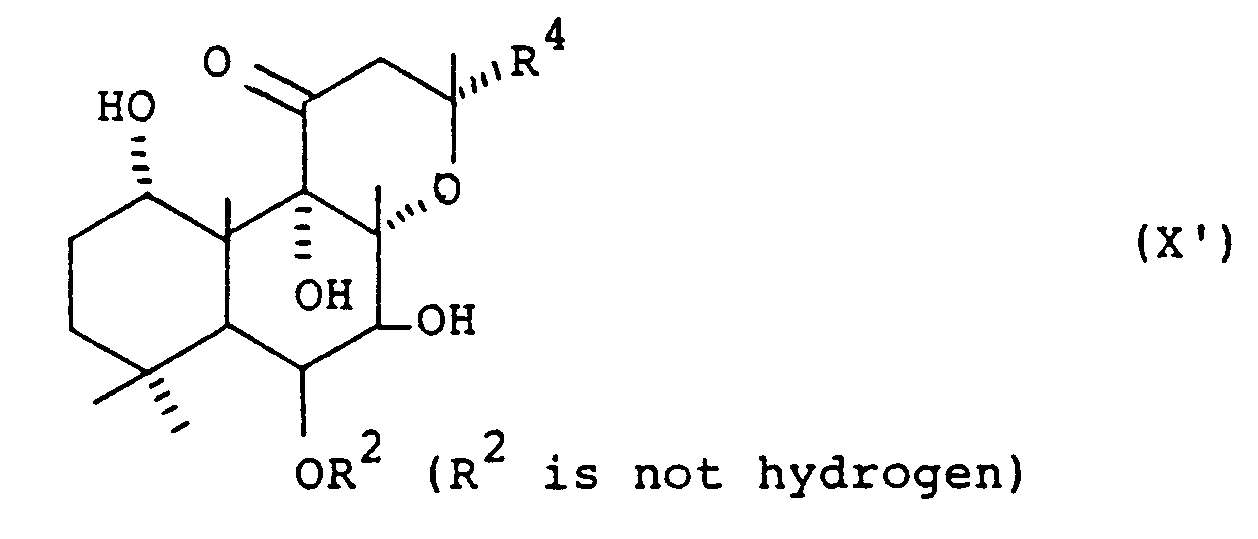
This rearrangement is accomplished by reacting said 7-substituted compound with 0.1 to 10 equivalents, preferably 1 to 3 equivalents, of an inorganic base used as an alkali metal hydride, hydroxide, or carbonate (e.g. NaOH, KOH, K2CO3, or NaH) or of an organic base such as a tri(lower alkyl)amine (e.g. triethylamine) or 1,8-diazabicyclo[5,4,0]-7-undecene in an organic solvent such as dimethylsulfoxide, N,N-dimethylformamide, methanol, acetone, acetonitrile, dioxane or tetrahydrofuran or a mixture of water with each of these solvents, preferably a mixture of water with N,N-dimethylformamide or acetonitrile. The reaction is conducted for a period of 1 minute to 48 hours at a temperature of ca. -20 to ca. + 200 C, normally from a temperature under cooling with ice to about the boiling point of the used solvent, preferably for a period of 30 minutes to 1 hour at room temperature.
The compound of formula (X') can also be produced by treating the intermediate resulting from the condensation step of 1-(2) or 1-(3) above, in the same manner as in process 2 above, followed by reaction with an amine of the above formula (IV). - 3. Compounds represented by formula (I) in which R1 is hydrogen and both R2 and R3 are other than hydrogen, that is, compounds of the formula

- (1) 6-Substituted 7-deacetylforskolin or 6-substituted 7-deacetyl-14,15-dihydroforskolin obtained according to the above process 2 or a 6-alkanoyl-7-acetylforskolin obtained in the same manner as described above is condensed with a compound represented by the general formula

The compound of general formula (VI) is exemplified by acetic acid, propionic acid, butyric acid, and acids cited above as compounds of general formula (II). - (2) When the compound to be produced has a nitrogen-containing substituent at the 7-position, this compound can be obtained by carrying out reactions similar to those of 1-(2) or 1-(3) above using any of 6-substituted 7-deacetylforskolin, 6-substituted 7-deacetyl-14,15-dihydroforskolin, and 6-alkanoyl-7- deacetylforskolin that are prepared according to the above process 2.
It may be noted that in the above processes 1 to 3 the 1-positioned hydroxyl group of the starting material 7-deacetylforskolin or its derivative is protected with an acyl group (e.g. acetyl), ether group (e.g. methoxy), or silylether (e.g. t-butyldimethylsilyl), the reaction is carried out by using the resulting protected compound, and the protecting group is removed in the last step, whereby the present inventive compound of formula (I) can also be obtained. - (1) 6-Substituted 7-deacetylforskolin or 6-substituted 7-deacetyl-14,15-dihydroforskolin obtained according to the above process 2 or a 6-alkanoyl-7-acetylforskolin obtained in the same manner as described above is condensed with a compound represented by the general formula
- 4. The compound of formula (I) wherein R4 is ethyl, that is, 6- and/or 7-di(or mono)-substituted 13-ethyl -14,15-dinorforskolin can be produced by either hydrogenating 6- and/or 7-di(or mono) substituted forskolin prepared according to the above process 1, 2, or 3 or reacting it with diazomethane in the presence of such a catalyst as palladium acetate.
- 5. The compound of formula (I) wherein R1 is


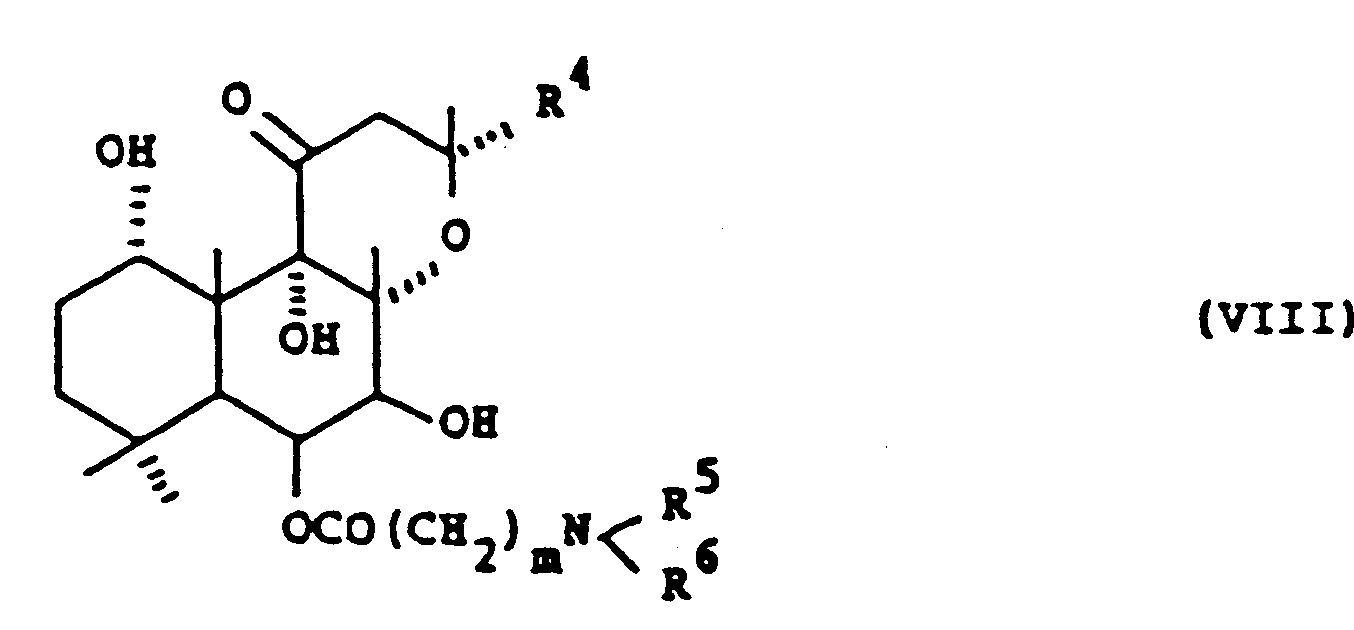
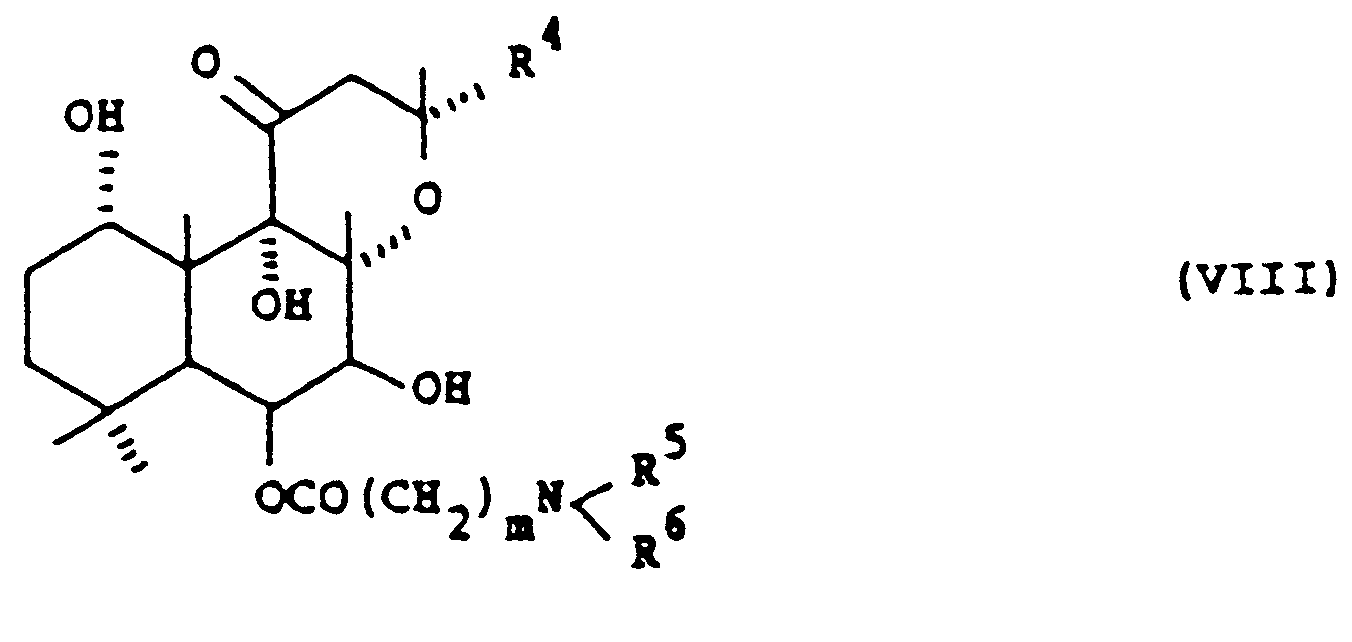
- 6. 6-Aminoalkylcarbonylforskolin or 6-aminoalkylcarbonyl-14,15-dihydroforskolin represented by the general formula


6-Aminoalkylcarbonyl-7-deacetylforskolin or 6-aminoalkylcarbonyl-7-deacetyl-14,15-dihydroforskolin that is, a starting material represented by general formula (VIII) can be prepared by reacting a base with 7-aminoalkylcarbonyl-7-deacetylforskolin which is represented by the general formula

- It may be noted that in the above processes 1 to 5, the present inventive compound of formula (I) can also be obtained by using compound with carboxyl, hydroxyl, or amino group on R1, R2, or R3 protected with an acyl group (e.g. acetyl), ester group (e.g. methyl ester, ethyl ester), ether group (e.g. methoxy, acetonide), or silyl ether group (e.g. t-butyldimethylsilylether) as intermediate, and the protecting group is removed in the last step.
- Unless otherwise noted, any of the above reactions is carried out desirably in an organic solvent such as dichloromethane, 1,2-dichloroethane and chloroform or a mixture thereof with water.
- From the reaction product solution, the compound of the present invention is isolated and purified in usual ways, thereby being obtained in the form of free base, free acid, or salt depending upon reaction conditions and the way of after-treatment.
- If desired, the free base and the free acid can be transformed each into a salt in the normal may. The free base may be transformed into an inorganic acid addition salt such as hydrochloride, hydrobromide, sulfate, or phosphate or into an organic acid addition salt such as a salt of formic acid, acetic acid, fumaric acid, maleic acid, citric acid, tartaric acid, lactic acid, or methanesulfonic acid.
- The free acid may be transformed into a metal salt such as sodium salt, potassium salt, magnesium salt, or calcium salt or into a salt of organic base such as quaternary ammonium salt or pyridinium salt.
- Theoretically, there exist optical isomers of the present inventive compounds which have an asymmetric carbon atom in R2 or R3. Therefore these optical isomers are included in the scope of the present invention. The optical isomers can be separated by a known method, e.g. chromatography or fractional crystallization.
- Table 1 shows examples of the present inventive compounds produced by the above described process.


- Physiological activities of the present inventive compound are determined in the following ways:
- Using adult dogs, either male or female, of the beagle or mixed breed as test animals, a polyethylene tube is inserted into the left ventricle of each animal through its carotid artery under anesthesia with pentobarbital sodium for the purpose of measuring the internal pressure of the left ventricle. Also a polyethylene tube is inserted into a femoral artery of the animal for the purpose of measuring blood pressure. Each polyethylene tube is connected to a pressure transducer and the pressure is recorded continuously on a recorder through a pressure strain gage. Further the rise rate of the left ventricle internal pressure (dp/dt)is determined by using a differential meter and recorded continuously in a similar way to serve as an index of the inotropic activity.
- The activity of the test compounds is represented by the relative values to the maximum effects given by forskolin. The maximum increase in the rise rate (dp/dt) and the maximum decrease in the mean blood pressure (MBP), which are resulting from the intravenous administration of 30 µg/kg of forskolin, are assumed as 1, the activity of the test compounds is expressed as the relative values of those resulting from the intravenous administration of 300 µg/kg or 30 µg/kg of the test compounds.
- A membrane fraction obtained from a homogenate of guinea pig myocardia was used as an authentic sample of adenylate cyclase [see G.I. Drummond, D.L. Severson, and L. Kuncan, J. Biol. Chem., 246, 4166 (1971)].
- Labeled CAMP produced by adenylate cyclase from the labeled ATP as the substrate is determined according to the method of Salomon et al. [Y. Salomon, C. Londos, and M. Rodbell, Anal. Biochem., 58, 541 (1974)]. The reaction is initiated by adding the authentic enzyme to a solution of 25 mM Tris • HCl (pH 7.5) containing 5 mM of MgC12, 20 mM of creatine phosphate, 100 V/ml of creatine phosphokinase, 1 mM of cAMP, 1 mM of [14C (U)] ATP (ca. 7 cpm/pmol), and either forskolin or the test compound (1 µM), so that the final volume of the reaction mixture will become 100 µl. The authentic enzyme is used in an amount of 150 to 200 µg/100 µl as membrane protein. After 10 minute at 37° C, the reaction is stopped by adding 100 µl of a stop solution (pH 7.5) containing 2% of sodium dodecylsulfate (SDS), 40 mM of ATP, and 1.4 mM of cAMP, then 50 µl of [3H] CAMP (ca. 20,000 cpm) is added for the purpose of measuring the percentage of CAMP recovered. Thereafter, CAMP is isolated by chromatography on a Dowex 50 resin column and on a neutral alumina column and the radioactivity of the CAMP is determined.
- The adenylate cyclase stimulating activity of the test compounds (1 µM) is expressed as the percentage of the activity based on that of forskolin (1 µM), [n = 4 (n = 6 for Nos. 10 and 17, n = 2 for Nos. 38, 39, 41, 42), mean value ± standard deviation].
- Table 2 shows results of the assays 1 and 2 on typical compounds of the present invention.


- As a result of measuring the solubility of the present inventive compound in water, all the compounds showed higher solubilities than forskolin.
- Thus, the compounds of the present invention have excellent positive inotropic, hypotensive, and adenylate cyclase stimulating actions and higher water-solubility than those of forskolin. Therefore the present inventive compounds are expected to be effective as a remedy for chronic cardiac failure, hypotensive agent, and cerebral vasodilator, and in addition as a remedy for diseases, such as glaucoma, asthma, immunity failure, tumor, and digestive system diseases, which are caused by abnormal regulation of cAMP. Suitable doses of the compound for treating these diseases are generally from 0.01 to 30 mg/kg day though dependent on the disease state and age of the patient to be treated and on the way of administration.
- Preferred compounds of the present invention are 6-dimethylaminoacetylforskolin (compound No. 10), 6-(3-dimethylaminopropionyl)forskolin (compound No. 17), 6-(4-dimethylaminobutyryl)forskolin (compound No. 20) 6-(4-aminobutyryl)forskolin (compound No. 38), 6-pyrrolidinoacetyl)forskolin (compound No. 39), and 6-(4-dimethylaminobutyryl)-14,15-dihydroforskolin (compound No. 41). Among these compounds, compound Nos. 17, 20 and 38 are particularly superior in therapeutic efficacy and in other properties.
- The present inventive compounds may be mixed with any suitable, pharmaceutically acceptable carrier to form tablets, granules, finer granules, powders, capsules, injectable compositions, suppositories, eye drops, plasters, ointments, and other forms of pharmaceutical compositions, which are administered orally or parenterally. The present compounds, are more water-soluble than forskolin, so they can be made up into drugs in the form of aqueous solution suitable for infusion or intravenous administration. Hence great therapeutic effects of the compounds are expected in the case of parenteral administration thereof.
- The present invention is illustrated in more detail with reference to the following examples.
- A mixture of forskolin (15 g), t-butyldimethylchlorosilane (11.25 g), imidazole (5.25 g), and N,N-dimethylformamide (45 ml) is stirred at 70 C for 21 hr to complete the reaction. Then, the product solution is poured into water and this mixture is extracted with ethyl acetate. The organic layer is washed with water, dried over magnesium sulfate, and filtered to remove the drying agent. The filtrate is concentrated in vacuo to give crude 1-(t-butyldimethylsilyl)forskolin (21.62 g).
- This oily product (21.62 g) is dissolved in methanol (250 ml), and 1 N aqueous NaOH (40 ml) is added dropwise to the solution under cooling with ice. This reaction mixture is stirred at room temperature overnight to complete the reaction, and then concentrated in vacuo. The concentrate, after addition of water, is extracted with ethyl acetate. The organic layer is washed with water, dried over magnesium sulfate, and filtered to remove the drying agent. The filtrate is concentrated in vacuo and the concentrate (20 g) is purified by chromatography on silica gel. The elusion with hexane-ethyl acetate (5:1) yields 1-(t-butyldimethylsilyl)-7-deacetylforskolin (17.42 g, 99% yield based on forskolin) in oily form.
- IR (neat) v : 3500, 3300, 1710 cm-1
- MS m/z (relative intensity) : 482 (M , 0.8), 466 (100), 407 (8), 311 (20), 191 (36), 75 (100)
- 3-chloropropionyl chloride (513 mg) is added dropwise to a mixture of the oily product (1.5 g), pyridine (320 mg), and dichloromethane (10 ml). After 5 hr stirring at room temperature, pyridine (320 mg) and 3-chloropropyionyl chloride (513 mg) are added to the mixture. This reaction mixture is stirred at room temperature overnight to complete the reaction. The product solution, after addition of water, is extracted with ethyl acetate. The organic layer is washed with water, dried, and filtered to remove the used drying agent. The filtrate is concentrated to give crude 1-(t-butyldimethylsilyl)-7-(3-chloropropionyl)-7-deacetylforskolin (2.09 g) in oily form.
- To a solution (10 ml) of this oily product (1 g) in dichloromethane is added an excess of dimethylamine under cooling with ice. This mixture is stirred at room temperature for 2 hr to complete the reaction. Then, the product solution is concentrated to give crude 1-(t-butyldimethylsilyl)-7-deacetyl-7-(3-dimethylaminopropionyl)forskolin (877 mg) in oily form.
- 'H-NMR (CDCI3) 8: 5.44 (1 H, d, J = 4.6Hz), 4.62 (1 H, br s), 4.60 (1 H, br s), 2.86 (6H, s), 1.70 (3H, s), 1.45 (3H, s), 1.33 (3H, s), 1.26 (3H, s), 1.05 (3H, s), 0.87 (9H, s), 0.14 (3H, s), 0.32 (3H, s).
- To a methanolic solution (10 ml) of this oily product (865 mg) is added trifluoroacetic acid (4 ml) under cooling with ice. The mixture is stirred at room temperature for 43 hr to complete the reaction, and then concentrated. This concentrate is diluted with dil. hydrochloric acid, and washed with ethyl acetate. The separated aqueous layer is made alkaline with 28% aqueous ammonia and extracted with ethyl acetate. The organic layer is washed with water, dried over magnesium sulfate, and filtered to remove the drying agent. The filtrate is concentrated and subjected to recrystallization from hexane-dichloromethane, yielding 7- deacetyl-7-(3-dimethylaminopropionyl)forskolin (283 mg) [yield: 41% based on 1-(t-butyldimethylsilyl)-7- deacetylforskolin]. mp 150-153 C
- MS m/z (relative intensity): 467 (M , 2), 202 (2), 159 (8), 118 (29), 92 (61), 91 (81), 58 (100).
- Using diethylamine in place of dimethylamine, compound No. 25 is obtained in the form of colorless oil.
- Yield: 69.1%
- MS m/Z: 495 (M+)
- A solution (10 ml) of 4-chlorobutyryl chloride (800 mg) in dichloromethane is added to a mixture of 7- deacetylforskolin (1.3 g), pyridine (700 mg), and dichloromethane (40 ml) under cooling with ice. This reaction mixture is stirred at toom temperature for 3 hr to complete the reaction. The product solution is concentrated in vacuo, and purified by chromatography on silica gel. The elution with hexane-ethyl acetate yields 7-(4-chlorobutyryl)-7-deacetylforskolin (1.27 g) in oily form.
- 1H-NMR (CDCl3) 8: 5.53 (1 H, d, J = 5Hz), 4.58 (1 H, br s), 4.48 (1 H, br s), 3.64 (2H, t, J = 6Hz), 2.62 (2H, m), 2.18 (4H, m), 1.73 (3H, s), 1.45 (3H, s), 1.35 (3H, s), 1.27 (3H, s), 1.04 (3H, s).
- A mixture of this oily product (1.27 g), pyrrolidine (20 ml), and dichloromethane (50 ml) is stirred at room temperature for 5 days to complete the reaction. The product solution is concentrated in vacuo, and after addition of water, is extracted with ethyl acetate. The organic layer is washed with water, dried over magnesium sulfate, and filtered to remove the drying agent. The filtrate is concentrated in vacuo and then purified by chromatography on silica gel. The elution with chloroform-methanol yields 7-deacetyl-7-(4-pyrrolidinobutyryl)forskolin (109 mg, 6% yield based on 7-deacetylforskolin).
- 1H-NMR (CDCl3) 8: 5.37 (1 H, d, J = 4Hz), 4.56 (1 H, m), 4.50 (1 H, m), 2.53 (8H, m), 1.93 (2H, m), 1.79 (4H, m), 1.73 (3H, s), 1.44 (3H, s), 1.35 (3H, s), 1.26 (3H, s), 1.03 (3H, s),
- MS m/z (relative intensity): 507 (M , 4), 199 (3), 156 (26), 140 (10), 92 (40), 91 (52), 84 (100).
- A solution (1 ml) of chloroacetyl chloride (250 mg) in dichloromethane is added to a mixture of 7- deacetylforskolin (500 mg), pyridine (250 mg), and dichloromethane (10 ml) under cooling with ice and stirred at room temperature for 1 hr. Further a solution (1 ml) of pyridine (75 mg) and acetyl chloride (75 mg) in dichloromethane is added under cooling with ice and the mixture is stirred at room temperature for 3 hr to complete the reaction. Then, the product solution is evaporated in vacuo to remove the dichloromethane and unreacted reagents, giving 7-deacetyl-7-chloroacetylforskolin in oily form, which is subjected to the next reaction without purification. That is, the oily product is dissolved in dichloromethane (10 ml), dimethylamine (3 ml) is added under cooling with ice, and the mixture is stirred for 1 hr to complete the reaction. This product solution is concentrated in vacuo, and after addition of water, the mixture is extracted with ethylacetate. The organic layer (extract solution) is washed with water, dried over magnesium sulfate, and filtered to remove the drying agent. The filtrate is concentrated in vacuo, and the concentrate (780 mg) is purified by chromatography on silica gel. The elusion with ethyl acetate yields 7-deacetyl-7-dimethylaminoacetylforskolin (compound No. 1) (468 mg, 76% yield based on 7-deacetyl-forskolin). mp 162-166 C (recrystallized from hexane-ethyl acetate)
- IR (nujol) ν: 3450, 3200, 1735, 1705 cm-1
- MS m/z (relative intensity): 453 (M , 5), 357 (6), 102 (71), 59 (52), 58 (100)
- This crystalline product is dissolved in dioxane, and an equimolar amount of HCI dissolved in dioxane is added to give hydrochloride of the product.
- mp 284-287 C (EtOH)
- IR (nujol) ν: 1740, 1710 cm-1
- 7-Deacetyl-7-dimethylaminoacetylforskolin (compound No. 3) is also obtained according to the above procedure but using amines shown in the following table in place of dimethylamine.

- 7-Deacetyl-7-dimethylaminoacetylforskolin (compound No. 1) (200 mg) is dissolved in an acetonitrile-water (45 : 55) mixture (20 ml), 1 N aqueous NaOH (0.8 ml) is added, and the solution is stirred at room temperature for 25 min to complete the reaction. The product solution is concentrated in vacuo, and after addition of water, is extracted with ethyl acetate. The organic layer is washed with water, dried over magnesium sulfate, and filtered to remove the drying agent. The filtrate is concentrated in vacuo and the concentrate (242 mg) is purified by chromatography on silica gel. The elution with acetonitrile yields 6-dimethylaminoacetyl-7-deacetylforskolin (compound No. 9, 176 mg, 88% yield).
- mp 116-117° C (hexane-ethylacetate)
- IR (nujol) ν: 3410, 3200, 1750, 1720 cm-1
- MS m/z: 453 (m+, 5), 350 (2), 237 (2), 219 (2), 104 (15), 58 (100).
- This crystalline product is dissolved in dioxane and an equimolar amount of HCI dissolved in dioxane is added to yield hydrochloride of the product.
- mp 263-265 °C (EtOH)
- IR (nujol) ν: 3490, 3230, 2680, 1745, 1710 cm-1
- The following compounds are obtained by the same rearrangement reaction using the corresponding 7- substituted 7-deacetyl forskolins.


- A mixture of pyridine (1 g) and acetyl chloride (750 mg) is added in 4 parts to a mixture of 6-dimethylaminoacetyl-7-deacetylforskolin (compound No. 9, 587 mg) and dichloromethane (20 ml) and stirred at room temperature for 7 hr to complete the reaction. The product solution, after addition of water, is made alkaline with a saturated aqueous sodium hydrogencarbonate (NaHCO3) solution, and extracted with dichloromethane. The organic layer is dried over magnesium sulfate, and filtered to remove the drying agent. The filtrate is concentrated, and the concentrate (811 mg) is purified by chromatography on silica gel. The elution with hexane-ether (1:3) yields 6-dimethylaminoacetylforskolin (444 mg, 69% yield). mp 190-193 °C (toluene)
- IR (nujol) ν: 3100, 1750, 1730, 1720 cm-1
- 1H-NMR (CDCl3) 8: 5.86 (1 H, q, J = 4Hz, J = 2.7Hz), 5.56 (1H, d, J = 4.9Hz), 4.61 (1H, br s), 3.18 (2H, s), 2.31 (6H, s), 2.04 (3H, s), 1.64 (3H, s), 1.42 (3H, s), 1.35 (3H, s), 1.04 (3H, s), 0.96 (3H, s).
- Hydrochloride of this product is obtained in the same manner as in above (2).
- mp 255-260 °C (EtOH)
- IR (nujol) ν: 3240, 3130, 2400, 1750, 1725 cm-1
- Compound Nos. 11 and 12 are produced according to the procedure of this example but using propionyl chloride and butyryl chloride, respectively, in place of acetyl chloride.
- Also, compound Nos. 15, 17, 18 and 20 are produced according to the procedure of this example but using 6-diethylaminoacetyl-7-deacetylforskolin (compound No. 14), 6-(3-dimethylaminopropionyl)-7-deacetyl- forskolin (compound No. 23), 6-(3-diethylaminopropionyl)-7-deacetylforskolin (compound No. 24), and 6-(4-dimethylaminobutyryl)-7-deacetylforskolin (compound No. 19), respectively, in place of 6-dimethylaminoacetyl-7-deacetylforskolin.


- Chloroacetyl chloride (209 mg) is added dropwise to a mixture of 6-dimethylaminoacetyl-7-deacetylforskoline (compound No. 9, 700 mg), pyridine (146 mg), and dichloromethane (10 ml) under cooling with ice. This reaction mixture is stirred for 3 hr while cooling with ice to complete the reaction, and then concentrated. The concentrate, diluted with water, is made alkaline with a saturated aqueous NaHC03 solution, and extracted with ethyl acetate. The organic layer is washed with water, dried over magnesium sulfate, and filtered to remove the drying agent. The filtrate is concentrated to give 7-chloroacetyl-7- deacetyl-6-dimethylaminoacetylforskolin (749 mg) in the form of white solid.
- A solution (20 ml) of this white solid (749 mg) in dichloromethane is added dropwise to a solution (20 ml) of excess dimethylamine in dichloromethane under cooling with ice and stirred at room temperature for 1 hr to complete the reaction. The product solution, after addition of water, is extracted with dichloromethane. The organic layer is dried over magnesium sulfate and then filtered to remove the drying agent. The filter is concentrated, and the concentrate (728 mg) is purified by chromatography on silica gel. The elution with dichloromethane-acetone (2:1) yields 6-dimethylaminoacetyl-7-deacetyl-7-dimethylaminoacetylforskolin (186 mg, 23% yield based on compound No. 9).
- mp 180-183 C (hexane-ethyl acetate)
- MS m/z (relative intensity): 538 (M , 58), 454 (8), 104 (100), 102 (100).
- According to the above procedure, 6-acetyl-7-deacetylforskolin is converted into 6-acetyl-7-chloroacetyl-7-deacetylforskolin, which in turn is reacted with dimethylamine, thereby yielding 6-acetyl-7-deacetyl-7-dimethylaminoacetylforskolin (compound No. 21, 88% yield base on 6-acetyl-7-deacetylforskolin).
- 1H-NMR (CDCl3) 8: 5.82 (1 H, q, J = 4.7Hz, J = 3.OHz), 5.62 (1 H, d, J = 4.4Hz), 4.61 (1 H, br s), 3.15 (2H, center of AB quartet, J = 17Hz), 2.37 (6H, s), 2.09 (3H, s), 1.66 (3H, s), 1.44 (3H, s), 1.33 (3H, s), 1.03 (3H, s), 0.98 (3H, s).
- In the same manner, 6-acetyl-7-deacetylforskolin is converted into 6-acetyl-7-(4-chlorobutyryl)-7- deacetylforskolin by using 4-chlorobutyryl chloride.
- 1H-NMR (CDCl3) 8: 5.83 (1 H, q, J = 4.3Hz, J = 3.1 Hz), 5.55 (1 H, d, J = 4.6Hz), 4.63 (1 H, br s), 3.52 (2H, m), 2.38-2.6 (4H, m), 2.10 (3H, s), 2.04-2.2 (3H, m), 1.67 (3H, s), 1.44 (3H, s), 1.36 (3H, s), 1.04 (3H, s), 0.98 (3H, s).
- This product compound is reacted with pyrrolidine to yield 6-acetyl-7-deacetyl-7-(4-pyrrodinobutyryl)-forskolin (compound No. 22, 14% yield based on 6-acetyl-7-deacetylforskolin).
- 1 H-NMR (CDCl3) 8: 5.81 (1 H, q, J = 4.3Hz, J = 2.9Hz), 5.54 (1 H, d, J = 4.6Hz), 4.60 (1 H, br s), 2.62 (6H, m), 2.28-2.44 (3H, m), 2.09 (3H, s), 1.75-1.95 (6H, m), 1.65 (35), 1.44 (3H, s), 1.35 (3H, s), 1.03 (3H, s), 0.98 (3H, s).
- A mixture of forskolin (0.20 g), N,N-dimethylaminobutyric acid hydrochloride (0.25 g), dicyclohexylcarbodiimide (0.40 g), 4-dimethylaminopyridine (0.30 g), and dichloromethane (5 ml) is subjected to reaction at room temperature for 2 hr. The precipitated crystals are filtered, and the filtrate is made alkaline with a 5% aqueous NaHCO3 solution and extracted with ethyl acetate. The organic layer is washed with water, dried over anhydrous sodium sulfate, and filtered to remove the drying agent. The filtrate is concentrated in vacuo and purified by chromatography on silica gel. The elution with ethyl acetate and then with ethyl acetatemethanol-triethylamine (95:5:1) yields forskolin-1-(4-dimethylaminobutyrate) (compound No. 36, 0.19 g) in the form of colorless oil.
- 1H-NMR (CDCl3) 8: 5.55 (1 H, s), 5.53 (1 H, d, J = 4.8Hz), 4.47 (1 H, br s), 2.5-2.1 (4H, m), 2.18 (6H, s), 2.17 (3H, s), 1.71 (3H, s), 1.85-1.65 (2H, m), 1.54 (3H, s), 1.35 (3H, s), 1.28 (3H, s), 1.06 (3H, s).
- MS (FAB) m/z (relative intensity): 524 (M + H, 100), 632 (MH 108, 78).
-
- (1) A mixture of forskolin (0.3 g), N-t-butoxycarbonylglycine (0.3 g), dicyclohexylcarbodiimide (0.4 g), 4-dimethylaminopyridine (0.3 g), and dichloromethane (5 ml) is stirred at room temperature for 2 hr. The precipitated crystals is separated from the product solution by filtration, and the filtrate is extracted with ethyl acetate. The organic layer is washed with water, dried over anhydrous sodium sulfate, and filtered to remove the drying agent. The filtrate is concentrated in vacuo and chromatographed on a silica gel column. The elution with ethyl acetate-benzene (5:95) and then with ethyl acetate-benzene (10:90) yields forskolin-1-N-BOC-glycinate (0.31 g) in the form of colorless oil.
- 1H-NMR (CDCl3) 8: 5.61 (1 H, br s), 5.42 (1 H, d, J = 4Hz), 4.45 (1 H, s), 3.80 (2H, d, J = 5.3Hz), 2.17 (3H, s), 1.74 (3H, s), 1.55 (3H, s), 1.45 (9H, s), 1.34 (3H, s), 1.29 (3H, s), 1.05 (3H, s).
- (2) Then, this forskolin-1-N-BOC-glycinate (0.31 g) is dissolved in acetic acid (0.5 ml), and a hydrobromic acid-acetic acid solution (0.5 ml) is added under cooling with ice. This reaction mixture is left standing at room temperature for 10 min. The excess hydrochloric acid in the product solution is neutralized with a 5% aqueous NaHCO3 solution. The resulting solution is chromatographed on an Amberlite XAD-2 resin column, the column is washed with water, and the adsorbate is eluted with methanol, yielding forskolin-1-glycinate (compound 34, 0.12 g) in the form of colorless oil.
- MS (FAB) m/z (relative intensity): 468 (MH), 576 (MH + 108).
- In the same way as above, forskolin-1-(6-aminocaproate) (compound No. 37) and forskolin-1-(4-aminobutyrate) (compound No. 35) can be produced.

-
- (1) A mixture of 4-(t-butoxycarbonylamino)butyric acid (8.20 g), 4-dimethylaminopyridine (6.40 g), and dicyclohexylcarbodiimide (12.60 g) is added in 4 parts to a mixture of 7-deacetylforskolin (3.00 g) and dichloromethane (100 ml) under cooling with ice. This reaction mixture is stirred overnight at room temperature to complete the reaction. The product solution, after addition of water (0.5 ml), is concentrated in vacuo. Dichloromethane is added to the concentrate and the insoluble matter is removed therefrom by filtration. The filtrate is concentrated and purified by chromatography on a silica gel column. The elution with dichloromethaneethyl acetate (10:1) yields 7-[4-(t-butoxycarbonylamino)-butyryl]-7- deacetylforskolin (compound No. 38a, 1.60 g, 36% yield) in the form of colorless oil.
- MS m/z (relative intensity): 535 ([M-H2O]+, 23), 479 (23), 104 (34), 86 (81), 57 (100).
- (2) To a mixture of this oily product (compound No. 38a, 1.50 g), acetonitrile (90 ml), and water (60 ml) is added 1-N aqueous NaOH (6 ml), and the mixture is stirred at room temperature for 40 min. Immediately after completion of the reaction, the product solution is concentrated, and after addition of water, is extracted with ethyl acetate. The extract solution is dried over magnesium sulfate, and filtered to remove the drying agent. The filtrate is concentrated and the concentrate (1.43 g) is purified by chromatography on a silica gel column. The elution with dichloromethane-ethyl acetate (4:1-2:1) yield 6-[4-(t-butoxycarbonylamino)butyryl]-7-deacetylforskolin (compound No. 38b, 1.12 g, 75% yield). mp 188-190 C (ethyl acetate)
- IR (nujor) ν: 3350, 1735, 1710 cm-1
- (3) This compound (No. 38b, 1.12 g) is dissolved in dichloromethane (80 ml), and a mixture of pyridine (1.52 g) and acetyl chloride (675 mg) is added in 3 parts to the solution. This reaction mixture is stirred at room temperature for 8 hr and then water is added to end the reaction. The product solution is extracted with dichloromethane, and the organic layer is dried over magnesium sulfate, and filtered to remove the drying agent. The filtrate is concentrated, and the concentrate (1.97 g) is purified by chromatography on a silica gel column. The elution with dichloromethane-ethyl acetate (10:1-5:1) yields 6-[4-(t-butoxycarbonylamino)butyryl]forskolin (compound No. 38c, 414 mg, 34% yield).
- mp 162-165 C (hexane-toluene)
- (4) This compound (No. 38c, 123 mg) is dissolved in 85% formic acid under cooling with ice to react therewith. This solution is stirred at room temperature for 2 hr to complete the reaction. The product solution is concentrated, diluted with water, and washed with ethyl acetate. The aqueous layer is made alkaline with 3 N aqueous Na2C03 and extracted with ethyl acetate. The organic layer is dried over magnesium sulfate and filtered to remove the drying agent. The filtrate is concentrated and subjected to recrystallization from ethyl acetatemethanol, yielding 6-(4-aminobutyryl)forskolin (compound No. 38, 31 mg, 30% yield).
- mp 191-192` C
- IR (nujol) P: 3360, 1725 cm-1
- 1H-NMR (CD30D) 8: 5.76 (1 H, q, J = 4.7 Hz, J = 3.3Hz), 5.39 (1 H, d, J = 4.3 Hz), 4.42 (1 H, br s), 2.59 (2H, t, J = 6.0Hz), 2.2-2.4 (2H, m), 1.88 (3H, s), 1.8-1.6 (3H, m), 1.56 (3H, s), 1.37 (3H, s), 1.23 (3H, s), 0.91 (6H, s).
- MS m/z (relative intensity): 495 (M , 14), 146 (32), 104 (100), 99 (13), 86 (74).
-
- (1) 7-Deacetyl-7-pyrrolidinoacetylforskolin (4.20 g), which is obtainable in the same way as in Example 15-(1) but using pyrrolidinoacetic acid in place of 4-(t-butoxycarbonylamino)butyric acid, is dissolved in an acetonitrile-water (4:1) mixture (150 ml), and 1-N aqueous NaOH (9.63 ml) is added dropwise to the solution under cooling with ice. This reaction mixture is stirred at room temperature for 6 hr and then water is added to end the reaction. The product solution is extracted with ethyl acetate, and the organic layer is concentrated and dissolved in ether. The ether solution is extracted with 1-N aqueous HCI. Aqueous ammonia is added dropwise to the aqueous layer of extract solution under cooling with ice to make the solution alkaline, and this solution is extracted with ether. The organic layer is dried over magnesium sulfate and then filtered to remove the drying agent. The filtrate is concentrated, and purified by chromatography on a silica gel column. The elution with dichloromethanemethanol (20:1) yields 7- deacetyl-6-pyrrolidinoacetylforskolin (compound No. 39a, 900 mg, 21% yield).
- IR (KBr) v: 3460, 3210, 1745, 1710 cm-1
- MS m/z (relative intensity): 479 (M , 1), 130 (8), 84 (100).
- (2) Pyridine (72 mg) and acetyl chloride (72 mg) are added each in 4 times over 6 hr to a mixture of the above obtained compound (No. 39a, 100 mg) and dichloromethane (10 ml) under cooling with ice. This reaction mixture is stirred overnight at room temperature and then extracted with dichloromethane. The organic layer is washed with a saturated aqueous NaCl solution, dried over magnesium sulfate, and filtered to remove the drying agent. The filtrate is concentrated and the concentrate (120 mg) is purified by chromatography on a silica gel column. The elution with chloroform-methanol (20:1) yields 6-pyrrolidinoacetylforskolin (compound No. 39, 53 mg, 50% yield).
- mp 166-168 C (dichloromethane-hexane)
- IR (KBr) v: 3450, 3230, 1750, 1715 cm-1
- A mixture of dicyclohexylcarbodiimide (35.82 mg) and dichloromethane (120 ml) is added dropwise to a mixture of 7-deacetylforskoline (8.00 g), 4-dimethylaminobutyric acid hydrochloride (14.56 g), 4-dimethylaminopyridine (21.21 g), and dichloromethane (150 ml) under cooling with ice. This reaction mixture is stirred at room temperature for 4 hr to complete the reaction. The product solution is extracted with dil. aqueous HCI. The aqueous layer, made alkaline with conc. aqueous ammonia, is extracted with diethyl ether. The organic layer is washed with water, dried over anhydrous magnesium sulfate, and filtered to remove the drying agent. The filtrate is concentrated in vacuo, yielding 7-deacetyl-7-(4-dimethylaminobutyryl)forskolin (5.41 g, 52% yield based on 7-deacetylforskolin) in oily form.
- MS m/z: 481 (M+)
- A mixture of 6-(4-dimethylaminobutyryl)-forskolin (30 mg), a 5% palladium-on-carbon catalyst (6 mg), and methanol (8 mg) is stirred under a hydrogen atmosphere at room temperature for 5 hr to complete the reaction. The product solution is filtered to remove the catalyst. The filtrate is concentrated to yield 6-(4-dimethylaminobutyryl)-14,15-dihydroforskolin (compound No. 41, 30 mg, 100% yield).
- mp 210-212 C (methanol)
- IR (nujol) v: 3160, 1730, 1740 cm-1
- Compound Nos. 42-45, as shown in Table 4, are produced in the same way as in this example.
- NMR and MS of compound Nos. 41, 43 and 45 are as shown in Table 5.


- The starting material for producing compound No. 42 can be prepared according to the procedure of Example 9 but using N,N-dimethylglcine hydrochloride in place of 4-dimethylaminobutyric acid hydrochloride.
- The starting materials for producing compound Nos. 43, 44 and 45 can be prepared according to the procedure of Example 15 but using N,N-dimethylglycine hydrochloride, pyrrolidinoacetic acid, and 3-dimethylaminopropionic acid, respectively, in place of 4-(t-butoxycarbonylamino)butyric acid.
- A mixture of 4-dimethylaminopyridine (3.00 g), 3-dimethylaminopropionic acid hydrochloride (3.80 g), and dicyclohexylcarbodiimide (7.00 g) is added in 3 parts over 47 hr to a solution (60 ml) of 7- deacetylforskoline (2.00 g) in dichloromethane. This reaction mixture is stirred at room temperature. After completion of the reaction, the solvent is evaporated in vacuo from the product solution. The resulting residue is dissolved in ethyl acetate, and the solution is filtered. The filtrate is concentrated, and the concentrate (6.05 g) is purified by chromatography on silica gel. The elution with dichloromethane-methanol (20:1-10:1) yields 7-deacetyl-7-(3-dimethylaminopropionyl)forskolin (compound No. 7, 1.72 g, 68% yield).
Claims (17)




Priority Applications (1)
| Application Number | Priority Date | Filing Date | Title |
|---|---|---|---|
| AT86115846T ATE72432T1 (en) | 1985-11-15 | 1986-11-14 | FORSKOLIN DERIVATIVES. |
Applications Claiming Priority (8)
| Application Number | Priority Date | Filing Date | Title |
|---|---|---|---|
| JP254693/85 | 1985-11-15 | ||
| JP25469385 | 1985-11-15 | ||
| JP1377186 | 1986-01-27 | ||
| JP13771/86 | 1986-01-27 | ||
| JP5370986 | 1986-03-13 | ||
| JP53709/86 | 1986-03-13 | ||
| JP65947/86 | 1986-03-26 | ||
| JP6594786 | 1986-03-26 |
Publications (3)
| Publication Number | Publication Date |
|---|---|
| EP0222413A2 EP0222413A2 (en) | 1987-05-20 |
| EP0222413A3 EP0222413A3 (en) | 1987-07-22 |
| EP0222413B1 true EP0222413B1 (en) | 1992-02-05 |
Family
ID=27456077
Family Applications (1)
| Application Number | Title | Priority Date | Filing Date |
|---|---|---|---|
| EP86115846A Expired - Lifetime EP0222413B1 (en) | 1985-11-15 | 1986-11-14 | Novel forskolin derivatives |
Country Status (10)
| Country | Link |
|---|---|
| US (1) | US4954642A (en) |
| EP (1) | EP0222413B1 (en) |
| KR (1) | KR930009795B1 (en) |
| CN (1) | CN1016507B (en) |
| AT (1) | ATE72432T1 (en) |
| AU (1) | AU591196B2 (en) |
| CA (1) | CA1337527C (en) |
| DE (1) | DE3683828D1 (en) |
| ES (1) | ES2037656T3 (en) |
| HU (1) | HU202515B (en) |
Families Citing this family (23)
| Publication number | Priority date | Publication date | Assignee | Title |
|---|---|---|---|---|
| IN163242B (en) * | 1985-05-03 | 1988-08-27 | Hoechst India | |
| DE3623300A1 (en) * | 1986-07-11 | 1988-01-21 | Hoechst Ag | 7-ACYLOXY-6-AMINOACYLOXYPOLYOXYLABDANE, METHOD FOR THE PRODUCTION THEREOF AND THEIR USE AS A MEDICINAL PRODUCT |
| IN166900B (en) * | 1987-06-03 | 1990-08-04 | Hoechst India | |
| US5302730A (en) * | 1987-06-29 | 1994-04-12 | Nippon Kayaku Kk | Process for the preparation of 6,7-diacyl-7-deacetylforskolin derivatives |
| HU201921B (en) * | 1987-06-29 | 1991-01-28 | Nippon Kayaku Kk | New process for producing 6-acylforscholine derivatives |
| DE3737353A1 (en) * | 1987-11-04 | 1989-05-18 | Hoechst Ag | NEW ACYLLABDANE DERIVATIVES, A METHOD FOR THE PRODUCTION THEREOF AND THEIR USE AS MEDICINAL PRODUCTS |
| IN168181B (en) * | 1987-12-01 | 1991-02-16 | Hoechst India | |
| US5051132A (en) * | 1989-06-15 | 1991-09-24 | Nippon Kayaku Kabushiki Kaisha | Lyophilized preparation of 6-(3-dimethylaminopropionyl)forskolin |
| EP0447962A1 (en) * | 1990-03-17 | 1991-09-25 | Hoechst Aktiengesellschaft | Labdanes and process for their preparation |
| EP0448029B1 (en) * | 1990-03-23 | 1995-12-20 | Nippon Kayaku Kabushiki Kaisha | Novel pharmaceutical uses of forskolin derivatives |
| JPH0482885A (en) * | 1990-07-23 | 1992-03-16 | Nippon Kayaku Co Ltd | New production of 6-acyl-7-deacetylforskolin derivative |
| US5250682A (en) * | 1990-07-24 | 1993-10-05 | Hoechst Aktiengesellschaft | Process for the preparation of 6-[3-substitutedaminopropionyl]-7-deacetylforskolin derivatives |
| PL170900B1 (en) * | 1990-11-01 | 1997-02-28 | Nippon Kayaku Kk | Method for producing 6- (3-dimethylaminopropionyl) -forskolin PL PL PL |
| ES2065842B1 (en) * | 1993-03-10 | 1996-02-16 | Univ Granada | APPLICATION OF ENT-3B, 6B, 12B-TRIHIDROXI-13-EPI-MANOYL OXIDE AS AN ADENYLATOCICLASE ACTIVATOR |
| ES2065843B1 (en) * | 1993-03-10 | 1996-02-16 | Univ Granada | APPLICATION OF ENT-11, 16-DIHIDROXI-18-NOR-4A -CARBOXYMETHYL-OXIDE OF MANOIL AS AN ADHENYLATOCYCLASE INHIBITOR. |
| ES2065844B1 (en) * | 1993-03-10 | 1996-02-16 | Univ Granada | APPLICATION OF ENT-16,18-DIHIDROXI-6-OXO-MANOIL OXIDE AS AN ADENYLATOCICLASE INHIBITOR. |
| ATE369868T1 (en) | 2000-06-27 | 2007-09-15 | Qualilife Pharmaceuticals Inc | COMPOSITIONS AND METHODS FOR TREATING FEMALE SEXUAL RESPONSE |
| KR20160042039A (en) | 2013-08-09 | 2016-04-18 | 알데릭스, 인코포레이티드 | Compounds and methods for inhibiting phosphate transport |
| CN105693684B (en) * | 2016-01-22 | 2018-10-09 | 昆明医科大学 | A kind of preparation method of isoforskolin |
| AU2019414693A1 (en) | 2018-12-29 | 2021-08-12 | Shanghai Archeus Biotech Co., Ltd. | Immunosuppressive pharmaceutical composition and application thereof |
| WO2020237096A1 (en) | 2019-05-21 | 2020-11-26 | Ardelyx, Inc. | Combination for lowering serum phosphate in a patient |
| CN117586217B (en) * | 2024-01-17 | 2024-03-19 | 云南省药物研究所 | Preparation method of forskolin based on domestic coleus forskohlii |
| CN121698841A (en) * | 2026-02-13 | 2026-03-20 | 云南省药物研究所 | Preparation method of 1-acetyl isoforskolin |
Citations (3)
| Publication number | Priority date | Publication date | Assignee | Title |
|---|---|---|---|---|
| EP0252482A2 (en) * | 1986-07-11 | 1988-01-13 | Hoechst Aktiengesellschaft | 7-Acyloxy-6-aminoacyloxypolyoxylabdanes, process for their preparation and their use as medicine |
| EP0268256A2 (en) * | 1986-11-20 | 1988-05-25 | Hoechst-Roussel Pharmaceuticals Incorporated | 12-Halogenated forskolin derivatives, intermediates and a process for the preparation thereof and their use as medicaments |
| WO1988005047A1 (en) * | 1986-12-29 | 1988-07-14 | Hoechst-Roussel Pharmaceuticals Inc. | Carbamoyloxylabdanes |
Family Cites Families (11)
| Publication number | Priority date | Publication date | Assignee | Title |
|---|---|---|---|---|
| DE2557784C2 (en) * | 1975-12-22 | 1986-04-17 | Hoechst Ag, 6230 Frankfurt | Forskolin, process for obtaining it and pharmaceutical preparations containing this compound |
| DE2654796A1 (en) * | 1976-12-03 | 1978-06-08 | Hoechst Ag | POLYOXYGENATED LABDAN DERIVATIVES |
| US4517200A (en) * | 1982-12-27 | 1985-05-14 | Schering-Plough Corporation | Method for treating allergic reactions with forskolin |
| AU2690684A (en) * | 1984-02-24 | 1985-09-10 | Kenji Adachi | Methods and pharmaceutical compositions for the treatment of hyperplastic diseases of the skin |
| US4639446A (en) * | 1984-12-14 | 1987-01-27 | Hoechst-Roussel Pharmaceuticals Inc. | Aminoacyllabdanes, pharmaceutical compositions and use |
| DE3581725D1 (en) * | 1984-12-14 | 1991-03-14 | Hoechst Roussel Pharma | AMINOACYLLABDANE, METHOD AND INTERMEDIATE PRODUCTS FOR THEIR PRODUCTION AND THEIR USE AS MEDICINAL PRODUCTS. |
| EP0193132B1 (en) * | 1985-03-01 | 1991-04-17 | Hoechst-Roussel Pharmaceuticals Incorporated | Labdan-derivatives, a process for their preparation and their use as medicaments |
| US4639443A (en) * | 1985-03-01 | 1987-01-27 | Hoechst-Roussel Pharmaceuticals Inc. | Labdane compounds, pharmaceutical compositions and use |
| IN163242B (en) * | 1985-05-03 | 1988-08-27 | Hoechst India | |
| US4785040A (en) * | 1985-10-04 | 1988-11-15 | Occidental Chemical Corporation | Phenolic molding materials and processes |
| JP3503980B2 (en) * | 1993-02-23 | 2004-03-08 | 株式会社東芝 | Semiconductor integrated circuit for data reading |
-
1986
- 1986-11-13 AU AU65107/86A patent/AU591196B2/en not_active Ceased
- 1986-11-14 KR KR1019860009622A patent/KR930009795B1/en not_active Expired - Lifetime
- 1986-11-14 HU HU864702A patent/HU202515B/en not_active IP Right Cessation
- 1986-11-14 CA CA000523008A patent/CA1337527C/en not_active Expired - Fee Related
- 1986-11-14 EP EP86115846A patent/EP0222413B1/en not_active Expired - Lifetime
- 1986-11-14 DE DE8686115846T patent/DE3683828D1/en not_active Expired - Lifetime
- 1986-11-14 AT AT86115846T patent/ATE72432T1/en not_active IP Right Cessation
- 1986-11-14 ES ES198686115846T patent/ES2037656T3/en not_active Expired - Lifetime
- 1986-11-15 CN CN86107826A patent/CN1016507B/en not_active Expired
-
1989
- 1989-05-30 US US07/361,763 patent/US4954642A/en not_active Expired - Fee Related
Patent Citations (3)
| Publication number | Priority date | Publication date | Assignee | Title |
|---|---|---|---|---|
| EP0252482A2 (en) * | 1986-07-11 | 1988-01-13 | Hoechst Aktiengesellschaft | 7-Acyloxy-6-aminoacyloxypolyoxylabdanes, process for their preparation and their use as medicine |
| EP0268256A2 (en) * | 1986-11-20 | 1988-05-25 | Hoechst-Roussel Pharmaceuticals Incorporated | 12-Halogenated forskolin derivatives, intermediates and a process for the preparation thereof and their use as medicaments |
| WO1988005047A1 (en) * | 1986-12-29 | 1988-07-14 | Hoechst-Roussel Pharmaceuticals Inc. | Carbamoyloxylabdanes |
Also Published As
| Publication number | Publication date |
|---|---|
| KR870005005A (en) | 1987-06-04 |
| CA1337527C (en) | 1995-11-07 |
| EP0222413A3 (en) | 1987-07-22 |
| EP0222413A2 (en) | 1987-05-20 |
| KR930009795B1 (en) | 1993-10-11 |
| US4954642A (en) | 1990-09-04 |
| ATE72432T1 (en) | 1992-02-15 |
| AU6510786A (en) | 1987-05-21 |
| AU591196B2 (en) | 1989-11-30 |
| DE3683828D1 (en) | 1992-03-19 |
| CN86107826A (en) | 1987-10-14 |
| HU202515B (en) | 1991-03-28 |
| ES2037656T3 (en) | 1993-07-01 |
| HUT46317A (en) | 1988-10-28 |
| CN1016507B (en) | 1992-05-06 |
Similar Documents
| Publication | Publication Date | Title |
|---|---|---|
| US4954642A (en) | Forskolin compounds | |
| EP0274821B1 (en) | Benzopyran compounds, processes for their preparation and their pharmaceutical use | |
| EP0747368B1 (en) | Derivatives of monocyclic polyamines, their preparation, and their use as antiviral agents | |
| US5104890A (en) | Benzopyran derivatives and processes for preparation thereof | |
| EP0312051B1 (en) | Tricyclic compounds | |
| WO2002008217A2 (en) | COUMARIN DERIVATIVES USEFUL AS TNFα INHIBITORS | |
| EP0264586A1 (en) | Hydantoin derivatives for treating complications of diabetes | |
| US5606080A (en) | Tocopherol derivatives | |
| US5130322A (en) | Chroman derivatives | |
| US5112839A (en) | Chroman derivatives | |
| EP0411912B1 (en) | Coumarin derivatives, their preparation and their use in the treatment of cerebrovascular disorders | |
| KR960014797B1 (en) | Benzopyran derivative, production thereof, and pharmaceutical composition containing the same | |
| US4327099A (en) | Pyrano derivatives, a process for their preparation and their use | |
| CA1266470A (en) | Xanthine derivatives, processes for their production and their use as pharmaceuticals | |
| EP0064165B1 (en) | Antihypertensive agents | |
| US4668805A (en) | Chromones | |
| EP0435235B1 (en) | Isoquinoline derivatives and salts thereof as protease inhibitors. | |
| US5116985A (en) | Isoquinoline derivatives and salts thereof | |
| EP0566288B1 (en) | Flavone derivatives | |
| EP0755928B1 (en) | 5-aminoflavone derivatives | |
| JPH0739409B2 (en) | Novel forskolin derivative | |
| US4448989A (en) | N-Nitroxyalkylene benzamide derivatives | |
| IE903975A1 (en) | 4-amidino chroman and 4-amidino pyrano (3,2-c) pyridine derivatives, a process for their preparation and pharmaceutical compositions containing them | |
| JP2886586B2 (en) | Novel guanidinobenzoic acid derivatives and their acid addition salts | |
| US5292751A (en) | 5,7-dihydroxy-2-methyl-8-(4-(3-hydroxy-1-(1-propyl))piperidinyl)-4H-1-benzopyran-4-one, its preparation and its use |
Legal Events
| Date | Code | Title | Description |
|---|---|---|---|
| PUAI | Public reference made under article 153(3) epc to a published international application that has entered the european phase |
Free format text: ORIGINAL CODE: 0009012 |
|
| AK | Designated contracting states |
Kind code of ref document: A2 Designated state(s): AT CH DE ES FR GB IT LI NL SE |
|
| PUAL | Search report despatched |
Free format text: ORIGINAL CODE: 0009013 |
|
| AK | Designated contracting states |
Kind code of ref document: A3 Designated state(s): AT CH DE ES FR GB IT LI NL SE |
|
| RIN1 | Information on inventor provided before grant (corrected) |
Inventor name: NARITA, KAZUHISA Inventor name: SHIOZAWA, AKIRA Inventor name: SAKURAI, MASAO Inventor name: YAMASHITA, KOUWA Inventor name: TAKAHIRA, TAKASHI Inventor name: TATEE, TOCHIRO |
|
| 17P | Request for examination filed |
Effective date: 19880115 |
|
| 17Q | First examination report despatched |
Effective date: 19881219 |
|
| GRAA | (expected) grant |
Free format text: ORIGINAL CODE: 0009210 |
|
| AK | Designated contracting states |
Kind code of ref document: B1 Designated state(s): AT CH DE ES FR GB IT LI NL SE |
|
| REF | Corresponds to: |
Ref document number: 72432 Country of ref document: AT Date of ref document: 19920215 Kind code of ref document: T |
|
| REF | Corresponds to: |
Ref document number: 3683828 Country of ref document: DE Date of ref document: 19920319 |
|
| ITF | It: translation for a ep patent filed | ||
| ET | Fr: translation filed | ||
| PLBE | No opposition filed within time limit |
Free format text: ORIGINAL CODE: 0009261 |
|
| STAA | Information on the status of an ep patent application or granted ep patent |
Free format text: STATUS: NO OPPOSITION FILED WITHIN TIME LIMIT |
|
| 26N | No opposition filed | ||
| REG | Reference to a national code |
Ref country code: ES Ref legal event code: FG2A Ref document number: 2037656 Country of ref document: ES Kind code of ref document: T3 |
|
| ITTA | It: last paid annual fee | ||
| EAL | Se: european patent in force in sweden |
Ref document number: 86115846.7 |
|
| PGFP | Annual fee paid to national office [announced via postgrant information from national office to epo] |
Ref country code: SE Payment date: 20000911 Year of fee payment: 15 |
|
| PGFP | Annual fee paid to national office [announced via postgrant information from national office to epo] |
Ref country code: AT Payment date: 20000922 Year of fee payment: 15 |
|
| PGFP | Annual fee paid to national office [announced via postgrant information from national office to epo] |
Ref country code: GB Payment date: 20001108 Year of fee payment: 15 Ref country code: ES Payment date: 20001108 Year of fee payment: 15 |
|
| PGFP | Annual fee paid to national office [announced via postgrant information from national office to epo] |
Ref country code: FR Payment date: 20001116 Year of fee payment: 15 |
|
| PGFP | Annual fee paid to national office [announced via postgrant information from national office to epo] |
Ref country code: NL Payment date: 20001130 Year of fee payment: 15 Ref country code: CH Payment date: 20001130 Year of fee payment: 15 |
|
| PGFP | Annual fee paid to national office [announced via postgrant information from national office to epo] |
Ref country code: DE Payment date: 20010116 Year of fee payment: 15 |
|
| PG25 | Lapsed in a contracting state [announced via postgrant information from national office to epo] |
Ref country code: GB Free format text: LAPSE BECAUSE OF NON-PAYMENT OF DUE FEES Effective date: 20011114 Ref country code: AT Free format text: LAPSE BECAUSE OF NON-PAYMENT OF DUE FEES Effective date: 20011114 |
|
| PG25 | Lapsed in a contracting state [announced via postgrant information from national office to epo] |
Ref country code: SE Free format text: LAPSE BECAUSE OF NON-PAYMENT OF DUE FEES Effective date: 20011115 Ref country code: ES Free format text: LAPSE BECAUSE OF NON-PAYMENT OF DUE FEES Effective date: 20011115 |
|
| PG25 | Lapsed in a contracting state [announced via postgrant information from national office to epo] |
Ref country code: LI Free format text: LAPSE BECAUSE OF NON-PAYMENT OF DUE FEES Effective date: 20011130 Ref country code: CH Free format text: LAPSE BECAUSE OF NON-PAYMENT OF DUE FEES Effective date: 20011130 |
|
| REG | Reference to a national code |
Ref country code: GB Ref legal event code: IF02 |
|
| PG25 | Lapsed in a contracting state [announced via postgrant information from national office to epo] |
Ref country code: NL Free format text: LAPSE BECAUSE OF NON-PAYMENT OF DUE FEES Effective date: 20020601 |
|
| EUG | Se: european patent has lapsed |
Ref document number: 86115846.7 |
|
| PG25 | Lapsed in a contracting state [announced via postgrant information from national office to epo] |
Ref country code: DE Free format text: LAPSE BECAUSE OF NON-PAYMENT OF DUE FEES Effective date: 20020702 |
|
| REG | Reference to a national code |
Ref country code: CH Ref legal event code: PL |
|
| PG25 | Lapsed in a contracting state [announced via postgrant information from national office to epo] |
Ref country code: FR Free format text: LAPSE BECAUSE OF NON-PAYMENT OF DUE FEES Effective date: 20020730 |
|
| NLV4 | Nl: lapsed or anulled due to non-payment of the annual fee |
Effective date: 20020601 |
|
| REG | Reference to a national code |
Ref country code: FR Ref legal event code: ST |
|
| REG | Reference to a national code |
Ref country code: FR Ref legal event code: ST |
|
| REG | Reference to a national code |
Ref country code: ES Ref legal event code: FD2A Effective date: 20021213 |
|
| PG25 | Lapsed in a contracting state [announced via postgrant information from national office to epo] |
Ref country code: IT Free format text: LAPSE BECAUSE OF NON-PAYMENT OF DUE FEES;WARNING: LAPSES OF ITALIAN PATENTS WITH EFFECTIVE DATE BEFORE 2007 MAY HAVE OCCURRED AT ANY TIME BEFORE 2007. THE CORRECT EFFECTIVE DATE MAY BE DIFFERENT FROM THE ONE RECORDED. Effective date: 20051114 |