EP0221499B1 - Method for inhibiting fungi - Google Patents
Method for inhibiting fungi Download PDFInfo
- Publication number
- EP0221499B1 EP0221499B1 EP86114979A EP86114979A EP0221499B1 EP 0221499 B1 EP0221499 B1 EP 0221499B1 EP 86114979 A EP86114979 A EP 86114979A EP 86114979 A EP86114979 A EP 86114979A EP 0221499 B1 EP0221499 B1 EP 0221499B1
- Authority
- EP
- European Patent Office
- Prior art keywords
- culture
- lactobacillus
- lactobacillus casei
- nrrl
- rhamnosus
- Prior art date
- Legal status (The legal status is an assumption and is not a legal conclusion. Google has not performed a legal analysis and makes no representation as to the accuracy of the status listed.)
- Expired - Lifetime
Links
Classifications
-
- A—HUMAN NECESSITIES
- A23—FOODS OR FOODSTUFFS; TREATMENT THEREOF, NOT COVERED BY OTHER CLASSES
- A23C—DAIRY PRODUCTS, e.g. MILK, BUTTER OR CHEESE; MILK OR CHEESE SUBSTITUTES; PREPARATION THEREOF
- A23C19/00—Cheese; Cheese preparations; Making thereof
- A23C19/06—Treating cheese curd after whey separation; Products obtained thereby
- A23C19/061—Addition of, or treatment with, microorganisms
- A23C19/062—Addition of, or treatment with, microorganisms using only lactic acid bacteria, e.g. pediococcus, leconostoc or bifidus sp., or propionic acid bacteria; Treatment with non-specified acidifying bacterial cultures
-
- A—HUMAN NECESSITIES
- A23—FOODS OR FOODSTUFFS; TREATMENT THEREOF, NOT COVERED BY OTHER CLASSES
- A23B—PRESERVATION OF FOODS, FOODSTUFFS OR NON-ALCOHOLIC BEVERAGES; CHEMICAL RIPENING OF FRUIT OR VEGETABLES
- A23B11/00—Preservation of milk or dairy products
- A23B11/60—Preservation of cheese or cheese preparations
- A23B11/65—Preservation of cheese or cheese preparations by addition of preservatives
-
- A—HUMAN NECESSITIES
- A23—FOODS OR FOODSTUFFS; TREATMENT THEREOF, NOT COVERED BY OTHER CLASSES
- A23B—PRESERVATION OF FOODS, FOODSTUFFS OR NON-ALCOHOLIC BEVERAGES; CHEMICAL RIPENING OF FRUIT OR VEGETABLES
- A23B2/00—Preservation of foods or foodstuffs, in general
- A23B2/70—Preservation of foods or foodstuffs, in general by treatment with chemicals
- A23B2/725—Preservation of foods or foodstuffs, in general by treatment with chemicals in the form of liquids or solids
- A23B2/729—Organic compounds; Microorganisms; Enzymes
- A23B2/733—Compounds of undetermined constitution obtained from animals or plants
-
- A—HUMAN NECESSITIES
- A23—FOODS OR FOODSTUFFS; TREATMENT THEREOF, NOT COVERED BY OTHER CLASSES
- A23B—PRESERVATION OF FOODS, FOODSTUFFS OR NON-ALCOHOLIC BEVERAGES; CHEMICAL RIPENING OF FRUIT OR VEGETABLES
- A23B2/00—Preservation of foods or foodstuffs, in general
- A23B2/70—Preservation of foods or foodstuffs, in general by treatment with chemicals
- A23B2/725—Preservation of foods or foodstuffs, in general by treatment with chemicals in the form of liquids or solids
- A23B2/729—Organic compounds; Microorganisms; Enzymes
- A23B2/783—Microorganisms; Enzymes
-
- A—HUMAN NECESSITIES
- A23—FOODS OR FOODSTUFFS; TREATMENT THEREOF, NOT COVERED BY OTHER CLASSES
- A23K—FODDER
- A23K30/00—Processes specially adapted for preservation of materials in order to produce animal feeding-stuffs
- A23K30/10—Processes specially adapted for preservation of materials in order to produce animal feeding-stuffs of green fodder
- A23K30/15—Processes specially adapted for preservation of materials in order to produce animal feeding-stuffs of green fodder using chemicals or microorganisms for ensilaging
- A23K30/18—Processes specially adapted for preservation of materials in order to produce animal feeding-stuffs of green fodder using chemicals or microorganisms for ensilaging using microorganisms or enzymes
-
- C—CHEMISTRY; METALLURGY
- C12—BIOCHEMISTRY; BEER; SPIRITS; WINE; VINEGAR; MICROBIOLOGY; ENZYMOLOGY; MUTATION OR GENETIC ENGINEERING
- C12N—MICROORGANISMS OR ENZYMES; COMPOSITIONS THEREOF; PROPAGATING, PRESERVING, OR MAINTAINING MICROORGANISMS; MUTATION OR GENETIC ENGINEERING; CULTURE MEDIA
- C12N1/00—Microorganisms; Compositions thereof; Processes of propagating, maintaining or preserving microorganisms or compositions thereof; Processes of preparing or isolating a composition containing a microorganism; Culture media therefor
- C12N1/04—Preserving or maintaining viable microorganisms
-
- C—CHEMISTRY; METALLURGY
- C12—BIOCHEMISTRY; BEER; SPIRITS; WINE; VINEGAR; MICROBIOLOGY; ENZYMOLOGY; MUTATION OR GENETIC ENGINEERING
- C12N—MICROORGANISMS OR ENZYMES; COMPOSITIONS THEREOF; PROPAGATING, PRESERVING, OR MAINTAINING MICROORGANISMS; MUTATION OR GENETIC ENGINEERING; CULTURE MEDIA
- C12N1/00—Microorganisms; Compositions thereof; Processes of propagating, maintaining or preserving microorganisms or compositions thereof; Processes of preparing or isolating a composition containing a microorganism; Culture media therefor
- C12N1/20—Bacteria; Culture media therefor
- C12N1/205—Bacterial isolates
-
- A—HUMAN NECESSITIES
- A23—FOODS OR FOODSTUFFS; TREATMENT THEREOF, NOT COVERED BY OTHER CLASSES
- A23V—INDEXING SCHEME RELATING TO FOODS, FOODSTUFFS OR NON-ALCOHOLIC BEVERAGES AND LACTIC OR PROPIONIC ACID BACTERIA USED IN FOODSTUFFS OR FOOD PREPARATION
- A23V2400/00—Lactic or propionic acid bacteria
- A23V2400/11—Lactobacillus
- A23V2400/175—Rhamnosus
-
- C—CHEMISTRY; METALLURGY
- C12—BIOCHEMISTRY; BEER; SPIRITS; WINE; VINEGAR; MICROBIOLOGY; ENZYMOLOGY; MUTATION OR GENETIC ENGINEERING
- C12R—INDEXING SCHEME ASSOCIATED WITH SUBCLASSES C12C - C12Q, RELATING TO MICROORGANISMS
- C12R2001/00—Microorganisms ; Processes using microorganisms
- C12R2001/01—Bacteria or Actinomycetales ; using bacteria or Actinomycetales
- C12R2001/225—Lactobacillus
- C12R2001/245—Lactobacillus casei
-
- Y—GENERAL TAGGING OF NEW TECHNOLOGICAL DEVELOPMENTS; GENERAL TAGGING OF CROSS-SECTIONAL TECHNOLOGIES SPANNING OVER SEVERAL SECTIONS OF THE IPC; TECHNICAL SUBJECTS COVERED BY FORMER USPC CROSS-REFERENCE ART COLLECTIONS [XRACs] AND DIGESTS
- Y10—TECHNICAL SUBJECTS COVERED BY FORMER USPC
- Y10S—TECHNICAL SUBJECTS COVERED BY FORMER USPC CROSS-REFERENCE ART COLLECTIONS [XRACs] AND DIGESTS
- Y10S435/00—Chemistry: molecular biology and microbiology
- Y10S435/8215—Microorganisms
- Y10S435/822—Microorganisms using bacteria or actinomycetales
- Y10S435/853—Lactobacillus
- Y10S435/856—Lactobacillus casei
Definitions
- the present invention relates to a method and composition using or containing a Lactobacillus having the identification characteristics of Lactobacillus casei var. rhamnosus NRRL-B-15972 and having antifungal properties.
- the present invention relates to the use of the Lactobacillus in foods.
- lactic acid producing bacteria in methods for producing fermented foods is well known to those skilled in the art.
- fermented meats e.g. sausages
- vegetables e.g. pickles
- Members of the genus Lactobacillus have been used extensively for this purpose.
- strains of Lactobacillus which produce fungal inhibiting substances are unknown to those skilled in the art.
- a strain which produces an antifungal substance would be very useful in foods and also in or on other materials, such as living plants, where fungi are a problem.
- compositions including a Lactobacillus which inhibits fungal growth Further it is an object of the present invention to provide a method which uses this Lactobacillus for the inhibition of fungal growth.
- the present invention relates to a method of treating a material which comprises incorporating in or on the material living cells of Lactobacilus casei var. rhamnosus
- the present invention relates to a storage stable biologically pure culture of Lactobacillus casei var. rhamnosus NRRL-B-15972 which inhibits the fungal growth.
- any material can be treated with the antifungal Lactobacillus casei var. rhamnosus NRRL-B-15972. It is preferred that the material be a food and that the food be fermented, since the antifungal Lactobacillus casei var. rhamnosus NRRL-B-15972 of the present invention generates lactic acid in situ from glucose and other sugars present or introduced into the foods.
- the present strain is particularly useful where the fermented food is prone to microbial spoilage such as is encountered with silage. Plants can be treated with this Lactobacillus to prevent fungal infection. Other materials such as plastics or rubber can be protected by combining the cells with these materials.
- the material or food should contain at least about 105 cells per gram. Preferably the range is between about 106 and 109 cells per gram.
- the antifungal substance is cell associated, so a sufficient population is needed to prevent fungal growth.
- the antifungal Lactobacillus casei var. rhamnosus can be stored in frozen or lyophilized form as is well known to those skilled in the art.
- the frozen form is preferred using freezing stabilizing agents such as glycerol or xanthan gum because lyophilization causes some die-off of the bacteria.
- the concentrates normally contain between about 1010 and 1012 cells per gram.
- Plasmids and genetic material in the antifungal Lactobacillus casei var. rhamnosus NRRL-B-15972 can be transferred to other species of Lactobacillus. Any Lactobacillus having the essential antifungal characteristics of the strain NRRL-B-15972 is included within the scope of the present invention.
- Lactobacillus casei var. rhamnosus NRRL-B-15972 has the following characteristics set forth in Table I:
- Lactobacillus casei var. rhamnosus NRRL-B-15972 could be frozen without problem and with virtually no die-off of cells.
- the frozen cells had a long shelf life (6 months) with little die-off.
- the lyophilization characteristics of Lactobacillus casei var. rhamnosus NRRL-B-15972 with different additives was also studied.
- Lactobacillus casei var. rhamnosus NRRL-B-15972 has on mold growth when grown on cucumber agar was determined.
- Lactobacillus casei var. rhamnosus NRRL-B-15972 does inhibit some molds in a cucumber medium. It did not inhibit P . oxalicum and only partially inhibited Aspergillus and Verticillium . Chaetomium olivacium was completely inhibited.
- Lactobacillus casei var. rhamnosus NRRL-B-15972 is a rapid grower and as a mold and yeast inhibitor is a useful organism for the pickle industry. Mold and yeast growth on the surface of fermenting cukes are particularly bothersome. This experiment evaluated the growth of LCR in cucumber juices at two temperatures. Its mold inhibiting properties were also evaluated. It was compared with a commercial lactic acid producing culture, Pediococcus pentosaceus , used for this purpose.
- the procedure was to puree 10 cucumbers in a blender. The puree was centrifuged and poured through cheese cloth under a vacuum. Chlorophyl was removed by centrifugation. NaCl was added to 5% concentration. The yield was 1660 mL of cucumber juice. The juice was filter sterilized through a 0.45 micron filter for immediate use. The remaining juice was frozen until ready for use.
- the juice had a pH of 5.60 and contained 0.28% L-malic acid.
- LCR was added to 10 ml of pure juice and 60% juice to give 1 x 10⁶ CPU/mL.
- the same procedure was used with Pediococcus pentosaceus NRRL-B-11,465.
- the unprocessed juice was incubated at 25°C and at 18°C.
- the cuke juice contained 6mL cuke juice; 0.5 mL of a 1:100 dil. Lactobacillus casei var. rhamnosus NRRL-B-15972 or Pediococcus pentosaceus NRRL-B-11,465; 0.34 ml 5M NaCl; and 3.16 mL dH2O (distilled water).
- Lactobacillus casei var. rhamnosus NRRL-B-15972 is a very rapid fermenter and achieved lower pH's than Pediococcus pentosaceus NRRL-B-11,465.
- LCR* LCR* Pediococcus pentosaceus Pediococcus pentosaceus NRRL-B-11,465 (100% juice) (60% juice) (100% juice) (60% juice) growth at 25°C ++ ++ + + growth at 18°C + + ⁇ ⁇ pH 65 hours 25°C 3.86 3.78 4.37 4.32 pH 65 hours 18°C 4.97 4.40 5.65 5.54 pH 90 hours 25°C 3.75 3.71 4.15 3.95 pH 90 hours 18°C 4.23 4.01 5.27 4.64 * Lactobacillus casei var. rhamnosus NRRL-B-15972 The + or - designations have the following meanings:
- Lactobacillus casei var. rhamnosus MRRL-B-15972 grew more rapidly and lowered the pH faster than Pediococcus pentosaceus NRRL-B-11,465 in 100% and 60% juice at 25° and 18°C. Also Lactobacillus casei var. rhamnosus NRRL-B-15972 appeared to be more effective in inhibiting this mold even though it was not effective in Example II against the same fungi.
Landscapes
- Life Sciences & Earth Sciences (AREA)
- Engineering & Computer Science (AREA)
- Chemical & Material Sciences (AREA)
- Zoology (AREA)
- Wood Science & Technology (AREA)
- Polymers & Plastics (AREA)
- Health & Medical Sciences (AREA)
- Food Science & Technology (AREA)
- Genetics & Genomics (AREA)
- Organic Chemistry (AREA)
- Microbiology (AREA)
- Biotechnology (AREA)
- Bioinformatics & Cheminformatics (AREA)
- Biomedical Technology (AREA)
- Virology (AREA)
- Tropical Medicine & Parasitology (AREA)
- Biochemistry (AREA)
- General Engineering & Computer Science (AREA)
- General Health & Medical Sciences (AREA)
- Medicinal Chemistry (AREA)
- General Chemical & Material Sciences (AREA)
- Chemical Kinetics & Catalysis (AREA)
- Animal Husbandry (AREA)
- Food Preservation Except Freezing, Refrigeration, And Drying (AREA)
- Micro-Organisms Or Cultivation Processes Thereof (AREA)
- Preparation Of Fruits And Vegetables (AREA)
- Medicines Containing Material From Animals Or Micro-Organisms (AREA)
- Agricultural Chemicals And Associated Chemicals (AREA)
- Organic Low-Molecular-Weight Compounds And Preparation Thereof (AREA)
- Coloring Foods And Improving Nutritive Qualities (AREA)
Abstract
Description
- The present invention relates to a method and composition using or containing a Lactobacillus having the identification characteristics of Lactobacillus casei var. rhamnosus NRRL-B-15972 and having antifungal properties. In particular the present invention relates to the use of the Lactobacillus in foods.
- The use of lactic acid producing bacteria in methods for producing fermented foods is well known to those skilled in the art. Thus for instance fermented meats (e.g. sausages) and vegetables (e.g. pickles) are all produced using these methods. Members of the genus Lactobacillus have been used extensively for this purpose.
- It is believed strains of Lactobacillus which produce fungal inhibiting substances are unknown to those skilled in the art. Thus a strain which produces an antifungal substance would be very useful in foods and also in or on other materials, such as living plants, where fungi are a problem.
- The Food Science Technology Abstracts 82-12-b0211, Vol. 57, No. 1, pp. 8-18 (1982) discloses that Lactobacillus casei var. rhamnosus can be used for preventing spoilage of certain foods. However, it is not known how the Lactobacillus exerts its spoilage preventing activity.
- It is therefore an object of the present invention to provide compositions including a Lactobacillus which inhibits fungal growth. Further it is an object of the present invention to provide a method which uses this Lactobacillus for the inhibition of fungal growth. These and other objects will become increasingly apparent by reference to the following description.
- The present invention relates to a method of treating a material which comprises incorporating in or on the material living cells of Lactobacilus casei var. rhamnosus
- NRRL-B-15972 which inhibits the fungal growth. Further the present invention relates to a storage stable biologically pure culture of Lactobacillus casei var. rhamnosus NRRL-B-15972 which inhibits the fungal growth.
- Essentially any material can be treated with the antifungal Lactobacillus casei var. rhamnosus NRRL-B-15972. It is preferred that the material be a food and that the food be fermented, since the antifungal Lactobacillus casei var. rhamnosus NRRL-B-15972 of the present invention generates lactic acid in situ from glucose and other sugars present or introduced into the foods. The present strain is particularly useful where the fermented food is prone to microbial spoilage such as is encountered with silage. Plants can be treated with this Lactobacillus to prevent fungal infection. Other materials such as plastics or rubber can be protected by combining the cells with these materials.
- The material or food should contain at least about 10⁵ cells per gram. Preferably the range is between about 10⁶ and 10⁹ cells per gram. The antifungal substance is cell associated, so a sufficient population is needed to prevent fungal growth.
- The antifungal Lactobacillus casei var. rhamnosus can be stored in frozen or lyophilized form as is well known to those skilled in the art. The frozen form is preferred using freezing stabilizing agents such as glycerol or xanthan gum because lyophilization causes some die-off of the bacteria. The concentrates normally contain between about 10¹⁰ and 10¹² cells per gram.
- Plasmids and genetic material in the antifungal Lactobacillus casei var. rhamnosus NRRL-B-15972 can be transferred to other species of Lactobacillus. Any Lactobacillus having the essential antifungal characteristics of the strain NRRL-B-15972 is included within the scope of the present invention.
- Lactobacillus casei var. rhamnosus NRRL-B-15972 has the following characteristics set forth in Table I:

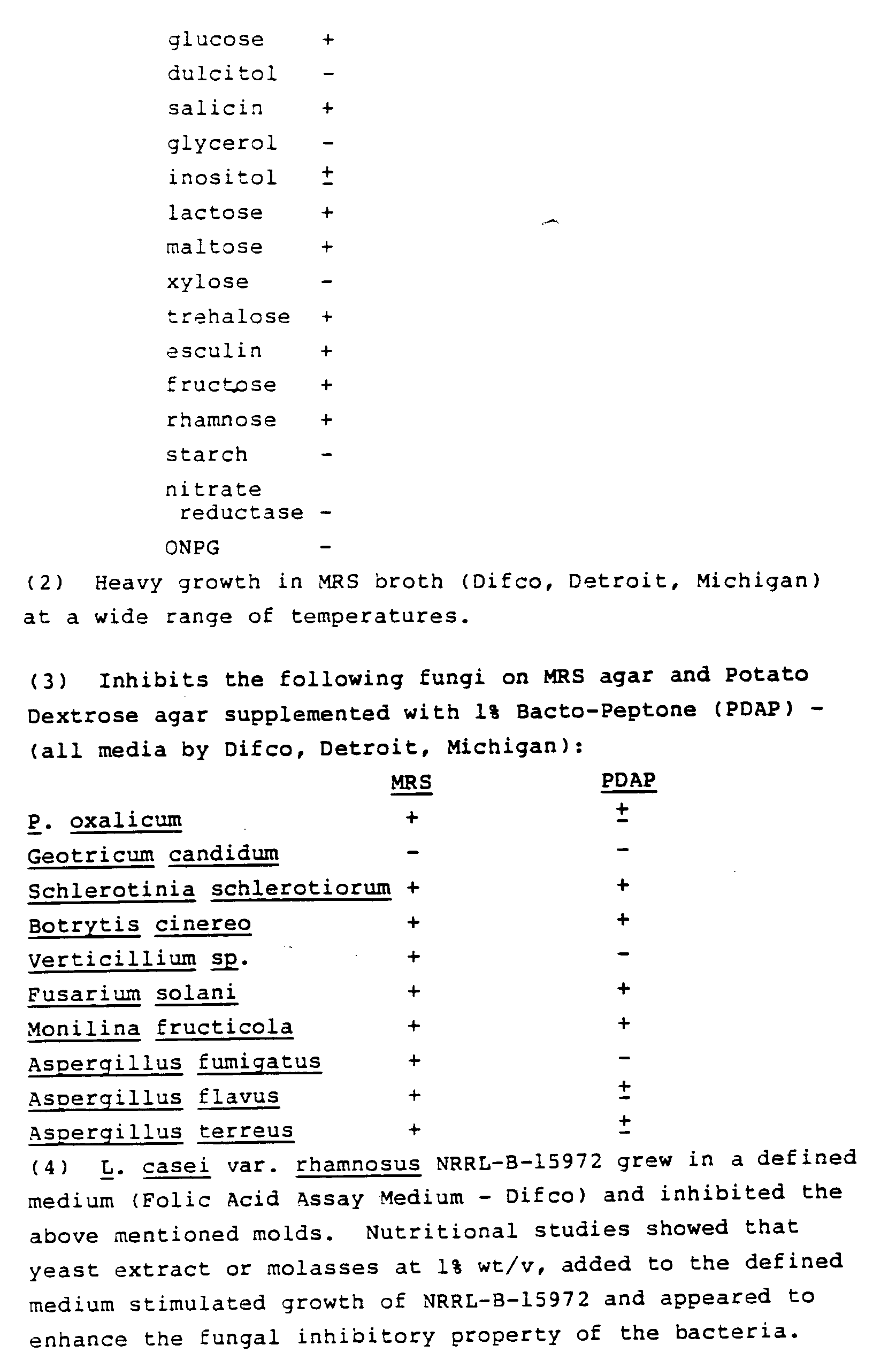
- It was found that Lactobacillus casei var. rhamnosus NRRL-B-15972 could be frozen without problem and with virtually no die-off of cells. The frozen cells had a long shelf life (6 months) with little die-off. The lyophilization characteristics of Lactobacillus casei var. rhamnosus NRRL-B-15972 with different additives was also studied.
- (1) Lactobacillus casei var. rhamnosus NRRL-B-15972 was grown overnight at 35°C in MRS (Difco, Detroit, Michigan) broth (1000 mL), centrifuged and resuspended in 90 mL of spent medium (10 times culture).
- (2) Eleven mL of 10X culture was introduced into lyophilization bottle and the pH adjusted to 5.8 with NaOH.
- (3) The following additives each were added to the bottles:The 10X culture was mixed with each additive and lyophilized 6 hours after freezing in a dry ice and methanol bath. Viable counts were taken on the cells before and after concentration and after lyophilization.

- The results were as follows:
Overnight culture = 3.1 x 10⁹ CFU (Colony Forming Units)
10X culture = 2.5 x 10¹⁰ CFU - Control = 1.37 x 10¹⁰% die off* = 43.2
2% MSG = 1.54 x 10¹⁰% die off = 38.4
1% MSG = 1.41 x 10¹⁰% die off = 43.6
2% NFDM = 1.31 x 10¹⁰% die off = 47.6
1% NFDM = 1.93 x 10¹⁰% die off = 30.8
2% MD = 1.34 x 10¹⁰% die off = 46.4
1% MD = 1.19 x 10¹⁰% die off = 52.4
*Based upon 10X culture - The best results here were obtained by using 2% MSG and 1% NFDM, respectively. Maltodextrin was no better than the control. Either 2% MSG or NFDM is suitable for lyophilization; however, other well known lyophilization agents can be used.
- The effect Lactobacillus casei var. rhamnosus NRRL-B-15972 has on mold growth when grown on cucumber agar was determined.
- The procedure was as follows:
- (1) Sterile tempered 10% (w/v) Noble agar was added to sterile filtered cuke juice 5% NaCl (w/v) to produce about 80% (v/v) cuke agar.
- (2) The plate was spread with approximately 100 colonies of LCR on plates and incubated at 35°C for 72 hours. The colonies were not visible until after 36 hours and had a good size at 72 hours.
- (3) The cuke agar was overlayed with 0.75% (w/v) cuke agar with the following mold: (1) Penicillium oxalicum, (2) Chaetomium olivacium, (3) Aspergillus terreus, (4) Verticillium sp. It was found that after 72 hours there was no inhibition of P. oxalicum. There was retardation of growth of Aspergillus terreus and Verticillium sp and where Lactobacillus casei var. rhamnosus NRRL-B-15972 colonies were concentrated in one region of plate, there was a total inhibition. There was total inhibition of Chaetomium olivacium. After 5 days, the results were the same. Conodial development was stopped in Aspergillus terreus.
- This experiment showed that Lactobacillus casei var. rhamnosus NRRL-B-15972 does inhibit some molds in a cucumber medium. It did not inhibit P. oxalicum and only partially inhibited Aspergillus and Verticillium. Chaetomium olivacium was completely inhibited.
- Lactobacillus casei var. rhamnosus NRRL-B-15972 is a rapid grower and as a mold and yeast inhibitor is a useful organism for the pickle industry. Mold and yeast growth on the surface of fermenting cukes are particularly bothersome. This experiment evaluated the growth of LCR in cucumber juices at two temperatures. Its mold inhibiting properties were also evaluated. It was compared with a commercial lactic acid producing culture, Pediococcus pentosaceus, used for this purpose.
- The procedure was to puree 10 cucumbers in a blender. The puree was centrifuged and poured through cheese cloth under a vacuum. Chlorophyl was removed by centrifugation. NaCl was added to 5% concentration. The yield was 1660 mL of cucumber juice. The juice was filter sterilized through a 0.45 micron filter for immediate use. The remaining juice was frozen until ready for use.
- The juice had a pH of 5.60 and contained 0.28% L-malic acid. LCR was added to 10 ml of pure juice and 60% juice to give 1 x 10⁶ CPU/mL. The same procedure was used with Pediococcus pentosaceus NRRL-B-11,465. The unprocessed juice was incubated at 25°C and at 18°C. The cuke juice contained 6mL cuke juice; 0.5 mL of a 1:100 dil. Lactobacillus casei var. rhamnosus NRRL-B-15972 or Pediococcus pentosaceus NRRL-B-11,465; 0.34 ml 5M NaCl; and 3.16 mL dH₂O (distilled water).
- Table II shows Lactobacillus casei var. rhamnosus NRRL-B-15972 is a very rapid fermenter and achieved lower pH's than Pediococcus pentosaceus NRRL-B-11,465.
TABLE II LCR* LCR* Pediococcus pentosaceus Pediococcus pentosaceus NRRL-B-11,465 (100% juice) (60% juice) (100% juice) (60% juice) growth at 25°C ++ ++ + + growth at 18°C + + ± ± pH 65 hours 25°C 3.86 3.78 4.37 4.32 pH 65 hours 18°C 4.97 4.40 5.65 5.54 pH 90 hours 25°C 3.75 3.71 4.15 3.95 pH 90 hours 18°C 4.23 4.01 5.27 4.64 *Lactobacillus casei var. rhamnosus NRRL-B-15972
The + or - designations have the following meanings: - ++
- fast growth
- +
- moderate growth
- ±
- marginal growth
- In order to evaluate mold inhibition after 90 hours growth, 1 drop of a P. oxalicum spore suspension was added to each tube. A control tube of 100% cuke juice was adjusted to pH 3.77 with 85% lactic acid before the spores were added. The tubes were at 10°C for 14 days. The results are shown in Table III
TABLE III Mold growth 60% PP* 25°C ++++ 8°C ++ Control +++ 60% LCR** 25°C + 18°C +± 100% PP 25°C + 18°C ++++ 100% LCR 25°C ± 18°C +± + = some growth
++++ = rapid growth* = Pediococcus pentosaceus ** = Lactobacillus casei var. rhamnosus NRRL-B-15972 - Lactobacillus casei var. rhamnosus MRRL-B-15972 grew more rapidly and lowered the pH faster than Pediococcus pentosaceus NRRL-B-11,465 in 100% and 60% juice at 25° and 18°C. Also Lactobacillus casei var. rhamnosus NRRL-B-15972 appeared to be more effective in inhibiting this mold even though it was not effective in Example II against the same fungi.
Claims (15)
- A method of treating a material to inhibit fungal growth which comprises incorporating in or on the material living cells of Lactobacillus casei var. rhamnosus NRRL-B-15972 which inhibits the fungal growth.
- The method of Claim 1 wherein the material is a food and wherein the cells are maintained as living cells in the food.
- The method Claim 2 wherein the food is fermented by the Lactobacillus.
- The method of Claim 2 wherein at least about 10⁵ cells per ml are introduced into the food.
- The method of Claim 2 wherein between about 10⁶ and 10⁸ cells per gram of material are incorporated.
- A storage stable biologically pure culture of Lactobacillus casei var. rhamnosus NRRL-B-15972 which inhibits the fungal growth.
- The culture of Claim 6 containing at least about 10¹⁰ cells per ml of the Lactobacillus.
- The culture of Claim 6 in a frozen form so that the culture is storage stable.
- The culture of Claim 6 in a lyophilized form so that the culture is storage stable.
- The culture of Claim 6 containing at least about 10⁶ to 10¹² cells per ml.
Priority Applications (1)
| Application Number | Priority Date | Filing Date | Title |
|---|---|---|---|
| AT86114979T ATE84195T1 (en) | 1985-11-04 | 1986-10-28 | METHOD OF REDUCING FUNGI. |
Applications Claiming Priority (2)
| Application Number | Priority Date | Filing Date | Title |
|---|---|---|---|
| US06/794,468 US4956177A (en) | 1985-11-04 | 1985-11-04 | Method for inhibiting fungi |
| US794468 | 1985-11-04 |
Publications (3)
| Publication Number | Publication Date |
|---|---|
| EP0221499A2 EP0221499A2 (en) | 1987-05-13 |
| EP0221499A3 EP0221499A3 (en) | 1987-09-30 |
| EP0221499B1 true EP0221499B1 (en) | 1993-01-07 |
Family
ID=25162705
Family Applications (1)
| Application Number | Title | Priority Date | Filing Date |
|---|---|---|---|
| EP86114979A Expired - Lifetime EP0221499B1 (en) | 1985-11-04 | 1986-10-28 | Method for inhibiting fungi |
Country Status (9)
| Country | Link |
|---|---|
| US (1) | US4956177A (en) |
| EP (1) | EP0221499B1 (en) |
| AT (1) | ATE84195T1 (en) |
| AU (1) | AU589992B2 (en) |
| CA (1) | CA1282320C (en) |
| DE (2) | DE221499T1 (en) |
| DK (1) | DK524086A (en) |
| ES (1) | ES2003907A6 (en) |
| NZ (1) | NZ217702A (en) |
Cited By (1)
| Publication number | Priority date | Publication date | Assignee | Title |
|---|---|---|---|---|
| US9277763B2 (en) | 2013-06-27 | 2016-03-08 | Starbucks Corporation | Biopreservation methods for beverages and other foods |
Families Citing this family (28)
| Publication number | Priority date | Publication date | Assignee | Title |
|---|---|---|---|---|
| US5965414A (en) * | 1985-11-04 | 1999-10-12 | Microlife Technics, Inc. | Process for producing yeast and mold inhibiting products with lactobacillus |
| US4883673A (en) * | 1987-02-09 | 1989-11-28 | Microlife Technics, Inc. | Method for inhibiting bacterial spoilage and resulting compositions |
| US4874704A (en) * | 1987-05-15 | 1989-10-17 | Microlife Technics, Inc. | Method for inhibiting food-borne human pathogens and preventing microbial spoilage in refrigerated foods using a Lactobacillus |
| CA1320165C (en) * | 1987-08-06 | 1993-07-13 | Microlife Technics, Inc. | Process for producing novel yeast and mold inhibiting products |
| US5348881A (en) * | 1990-03-13 | 1994-09-20 | Quest International Flavors & Good Ingredients Company, Division Of Indopco, Inc. | Multiple bacteriocin producing lactococcus and compositions |
| US5374433A (en) * | 1991-11-20 | 1994-12-20 | Monfort, Inc. | Method for preserving food products |
| US6287610B1 (en) | 1991-11-20 | 2001-09-11 | Monfort, Inc. | Method for increasing the tenderness of a meat product |
| FI92498C (en) * | 1992-06-10 | 1994-11-25 | Valio Meijerien | New microorganism strain, bacterial preparations containing it and their use for controlling yeast and mold |
| DE4221624C1 (en) * | 1992-07-01 | 1993-07-15 | Hubert 8941 Erkheim De Fritz | |
| JPH0757186B2 (en) * | 1992-12-18 | 1995-06-21 | 雪印乳業株式会社 | Lactic acid bacteria preparation for silage preparation |
| FI94875C (en) * | 1993-01-15 | 1995-11-03 | Panimolaboratorio Bryggerilabo | Process for processing industrial germinated seed material for food use |
| FI97148C (en) * | 1994-07-14 | 1996-10-25 | Lahden Polttimo Ab Oy | Process for the treatment of plants to improve the quality properties of seeds |
| FI102807B1 (en) * | 1994-08-25 | 1999-02-26 | Valio Oy | Use of Lactobacillus rhamnosus in the food industry to inhibit clostridia |
| GB2310124B (en) * | 1996-02-15 | 1998-01-28 | Biotal Ltd | Microorganisms and their use in treating animal feed and silage |
| AUPN907296A0 (en) * | 1996-04-02 | 1996-04-26 | Commonwealth Scientific And Industrial Research Organisation | Biocontrol agents for use in treatment of opportunistic infections |
| US6093394A (en) | 1997-04-11 | 2000-07-25 | Gynelogix, Inc. | Vaginal lactobacillus medicant |
| US7767203B2 (en) | 1998-08-07 | 2010-08-03 | Ganeden Biotech, Inc. | Methods for the dietary management of irritable bowel syndrome and carbohydrate malabsorption |
| US6461607B1 (en) * | 1998-08-24 | 2002-10-08 | Ganeden Biotech, Inc. | Probiotic, lactic acid-producing bacteria and uses thereof |
| SI2211626T1 (en) | 2007-08-29 | 2019-12-31 | Ganeden Biotech, Inc. | Baked goods |
| HUE054648T2 (en) * | 2007-10-16 | 2021-09-28 | Ganeden Biotech Inc | Beverage compositions |
| US7788209B2 (en) * | 2008-05-05 | 2010-08-31 | United Technologies Corporation | Hybrid fault reasoning and guided troubleshooting system that uses case-based reasoning and model-based reasoning |
| BRPI0919651A2 (en) | 2008-10-16 | 2015-08-18 | Ganeden Biotech Inc | Grain-based probiotic compositions |
| EP2424550B1 (en) | 2009-04-29 | 2017-06-07 | Ganeden Biotech, Inc. | Bacterial cell membrane formulation |
| US11235008B2 (en) | 2011-03-31 | 2022-02-01 | Ganeden Biotech, Inc. | Probiotic sports nutrition compositions |
| PT2693885T (en) | 2011-04-08 | 2018-06-04 | Chr Hansen As | Synergistic antimicrobial effect |
| UA115331C2 (en) | 2012-04-09 | 2017-10-25 | Кр. Хансен А/С | Bioprotection using lactobacillus paracasei strains |
| PT2836587T (en) | 2012-04-09 | 2017-05-26 | Chr Hansen As | BIOPROTECTION USING LACTOBACILLUS RHAMNOSUS STYLES |
| EP3344749A1 (en) | 2015-08-31 | 2018-07-11 | Chr. Hansen A/S | Lactobacillus fermentum bacteria with antifungal activity |
Family Cites Families (9)
| Publication number | Priority date | Publication date | Assignee | Title |
|---|---|---|---|---|
| US3403032A (en) * | 1967-10-04 | 1968-09-24 | Agriculture Usa | Pure culture fermentation process for pickled cucumbers |
| US3937814A (en) * | 1971-09-13 | 1976-02-10 | Dirigo Corporation | Compositions for safe extension of storage life of foods |
| GB1483339A (en) * | 1973-10-18 | 1977-08-17 | Mars Ltd | Solid proteinaceous food product |
| GB1579926A (en) * | 1976-06-17 | 1980-11-26 | Mars Ltd | Preserved food product and process |
| DE2736180A1 (en) * | 1977-08-11 | 1979-02-22 | Ewald Sorg | PROCESS FOR MANUFACTURING PROTEIN-RICH PRODUCTS FROM MATERIALS HIGH IN CELLULOSE |
| US4579740A (en) * | 1983-07-11 | 1986-04-01 | Microlife Technics, Inc. | Fermentation method using a selected lactobacillus |
| US4889810A (en) * | 1985-02-13 | 1989-12-26 | Research And Development Institute, Inc. At Montana State University | Method and compositions for improving the nutritive value of foods via Lactobacillus Ferementum |
| ATE131535T1 (en) * | 1986-02-28 | 1995-12-15 | Smithkline Beecham Corp | THE STREPTOMYCES GAL OPERON |
| CA1293701C (en) * | 1986-07-28 | 1991-12-31 | Peter J. Dart | Agricultural products and methods |
-
1985
- 1985-11-04 US US06/794,468 patent/US4956177A/en not_active Expired - Fee Related
-
1986
- 1986-08-21 CA CA000516512A patent/CA1282320C/en not_active Expired - Fee Related
- 1986-08-28 AU AU62045/86A patent/AU589992B2/en not_active Ceased
- 1986-09-26 NZ NZ217702A patent/NZ217702A/en unknown
- 1986-10-28 AT AT86114979T patent/ATE84195T1/en active
- 1986-10-28 EP EP86114979A patent/EP0221499B1/en not_active Expired - Lifetime
- 1986-10-28 DE DE198686114979T patent/DE221499T1/en active Pending
- 1986-10-28 DE DE8686114979T patent/DE3687443T2/en not_active Expired - Fee Related
- 1986-10-30 ES ES8602830A patent/ES2003907A6/en not_active Expired
- 1986-11-03 DK DK524086A patent/DK524086A/en not_active Application Discontinuation
Cited By (1)
| Publication number | Priority date | Publication date | Assignee | Title |
|---|---|---|---|---|
| US9277763B2 (en) | 2013-06-27 | 2016-03-08 | Starbucks Corporation | Biopreservation methods for beverages and other foods |
Also Published As
| Publication number | Publication date |
|---|---|
| DK524086A (en) | 1987-05-05 |
| AU6204586A (en) | 1987-05-07 |
| ATE84195T1 (en) | 1993-01-15 |
| AU589992B2 (en) | 1989-10-26 |
| DE3687443D1 (en) | 1993-02-18 |
| ES2003907A6 (en) | 1988-12-01 |
| DE221499T1 (en) | 1987-10-15 |
| EP0221499A2 (en) | 1987-05-13 |
| DE3687443T2 (en) | 1993-05-06 |
| NZ217702A (en) | 1988-10-28 |
| DK524086D0 (en) | 1986-11-03 |
| EP0221499A3 (en) | 1987-09-30 |
| CA1282320C (en) | 1991-04-02 |
| US4956177A (en) | 1990-09-11 |
Similar Documents
| Publication | Publication Date | Title |
|---|---|---|
| US4956177A (en) | Method for inhibiting fungi | |
| EP0477280B1 (en) | A method for killing cells without cell lysis | |
| Cabo et al. | Apparent antifungal activity of several lactic acid bacteria against Penicillium discolor is due to acetic acid in the medium | |
| Cai et al. | Effect of NaCl‐tolerant lactic acid bacteria and NaCl on the fermentation characteristics and aerobic stability of silage | |
| CN101974449B (en) | Lactobacillus plantarum and application thereof | |
| EP2592158A1 (en) | Lactobacillus plantarum species possessing broad spectrum anti-fungal activity and exhibiting high heat tolerance and osmotolerance | |
| Erkmen et al. | Effect of high hydrostatic pressure on Staphylococcus aureus in milk | |
| EP0333056A2 (en) | Method for inhibiting food-borne human pathogens and preventing microbial spoilage in refrigerated food using a lactobacillus | |
| CN116426441B (en) | Lactobacillus pentosus P307, application thereof and method for preparing bacteriocin by using same | |
| Batish et al. | Studies on environmental and nutritional factors on production of antifungal substance byLactobacillus acidophilus R. | |
| Keddie | The enumeration of lactobacilli on grass and in silage | |
| EP0137869B1 (en) | Derived nisin producing microorganisms, method of production and use and products obtained thereby | |
| CN118120868A (en) | Food preservative and preparation method and application thereof | |
| Brocklehurst et al. | Microbiological changes in mayonnaise-based salads during storage | |
| US3410755A (en) | Process and media for producing cells of lactic acid bacteria | |
| EP0329164B1 (en) | Lactic acid bacteria starter for preparation of silage and agent containing the bacteria in the viable state | |
| Raccach et al. | Effect of manganese ions on the fermentative activity of frozen‐thawed lactobacilli | |
| KR102150120B1 (en) | Composition for freeze-drying of microorganisms | |
| KR0123946B1 (en) | Lactococcus sp. which produces novel bacteriocin | |
| CN111909884B (en) | Lactobacillus plantarum and application thereof | |
| KR100396374B1 (en) | Method for manufacturing freeze-dried mycelium having excellent storageability and composition of freeze-drying protection agent therefor | |
| Lachica et al. | Two improved media for isolating and enumerating enterococci in certain frozen foods | |
| KR100536522B1 (en) | Novel bacteriocin isolated from human skin and the use as therapeutic agent of an acne | |
| Golden et al. | Interactive effects of solutes, potassium sorbate and incubation temperature on growth, heat resistance and tolerance to freezing of Zygosaccharomyces rouxii | |
| KR0155223B1 (en) | Culture medium for producing lactobacillus cells based on immersion water and molasses |
Legal Events
| Date | Code | Title | Description |
|---|---|---|---|
| PUAI | Public reference made under article 153(3) epc to a published international application that has entered the european phase |
Free format text: ORIGINAL CODE: 0009012 |
|
| AK | Designated contracting states |
Kind code of ref document: A2 Designated state(s): AT BE CH DE FR GB IT LI LU NL SE |
|
| ITCL | It: translation for ep claims filed |
Representative=s name: JACOBACCI CASETTA & PERANI S.P.A. |
|
| PUAL | Search report despatched |
Free format text: ORIGINAL CODE: 0009013 |
|
| TCAT | At: translation of patent claims filed | ||
| EL | Fr: translation of claims filed | ||
| AK | Designated contracting states |
Kind code of ref document: A3 Designated state(s): AT BE CH DE FR GB IT LI LU NL SE |
|
| DET | De: translation of patent claims | ||
| 17P | Request for examination filed |
Effective date: 19880329 |
|
| 17Q | First examination report despatched |
Effective date: 19900523 |
|
| GRAA | (expected) grant |
Free format text: ORIGINAL CODE: 0009210 |
|
| AK | Designated contracting states |
Kind code of ref document: B1 Designated state(s): AT BE CH DE FR GB IT LI LU NL SE |
|
| PG25 | Lapsed in a contracting state [announced via postgrant information from national office to epo] |
Ref country code: SE Effective date: 19930107 Ref country code: AT Effective date: 19930107 |
|
| REF | Corresponds to: |
Ref document number: 84195 Country of ref document: AT Date of ref document: 19930115 Kind code of ref document: T |
|
| ITF | It: translation for a ep patent filed | ||
| REF | Corresponds to: |
Ref document number: 3687443 Country of ref document: DE Date of ref document: 19930218 |
|
| ET | Fr: translation filed | ||
| PG25 | Lapsed in a contracting state [announced via postgrant information from national office to epo] |
Ref country code: LU Free format text: LAPSE BECAUSE OF NON-PAYMENT OF DUE FEES Effective date: 19931031 |
|
| PLBE | No opposition filed within time limit |
Free format text: ORIGINAL CODE: 0009261 |
|
| STAA | Information on the status of an ep patent application or granted ep patent |
Free format text: STATUS: NO OPPOSITION FILED WITHIN TIME LIMIT |
|
| 26N | No opposition filed | ||
| PGFP | Annual fee paid to national office [announced via postgrant information from national office to epo] |
Ref country code: FR Payment date: 19990914 Year of fee payment: 14 |
|
| PGFP | Annual fee paid to national office [announced via postgrant information from national office to epo] |
Ref country code: GB Payment date: 19990920 Year of fee payment: 14 Ref country code: CH Payment date: 19990920 Year of fee payment: 14 |
|
| PGFP | Annual fee paid to national office [announced via postgrant information from national office to epo] |
Ref country code: NL Payment date: 19990921 Year of fee payment: 14 |
|
| PGFP | Annual fee paid to national office [announced via postgrant information from national office to epo] |
Ref country code: DE Payment date: 19990930 Year of fee payment: 14 |
|
| PGFP | Annual fee paid to national office [announced via postgrant information from national office to epo] |
Ref country code: BE Payment date: 19991004 Year of fee payment: 14 |
|
| PG25 | Lapsed in a contracting state [announced via postgrant information from national office to epo] |
Ref country code: GB Free format text: LAPSE BECAUSE OF NON-PAYMENT OF DUE FEES Effective date: 20001028 |
|
| PG25 | Lapsed in a contracting state [announced via postgrant information from national office to epo] |
Ref country code: LI Free format text: LAPSE BECAUSE OF NON-PAYMENT OF DUE FEES Effective date: 20001031 Ref country code: CH Free format text: LAPSE BECAUSE OF NON-PAYMENT OF DUE FEES Effective date: 20001031 Ref country code: BE Free format text: LAPSE BECAUSE OF NON-PAYMENT OF DUE FEES Effective date: 20001031 |
|
| BERE | Be: lapsed |
Owner name: MICROLIFE TECHNICS INC. Effective date: 20001031 |
|
| PG25 | Lapsed in a contracting state [announced via postgrant information from national office to epo] |
Ref country code: NL Free format text: LAPSE BECAUSE OF NON-PAYMENT OF DUE FEES Effective date: 20010501 |
|
| REG | Reference to a national code |
Ref country code: CH Ref legal event code: PL |
|
| GBPC | Gb: european patent ceased through non-payment of renewal fee |
Effective date: 20001028 |
|
| PG25 | Lapsed in a contracting state [announced via postgrant information from national office to epo] |
Ref country code: FR Free format text: LAPSE BECAUSE OF NON-PAYMENT OF DUE FEES Effective date: 20010629 |
|
| NLV4 | Nl: lapsed or anulled due to non-payment of the annual fee |
Effective date: 20010501 |
|
| PG25 | Lapsed in a contracting state [announced via postgrant information from national office to epo] |
Ref country code: DE Free format text: LAPSE BECAUSE OF NON-PAYMENT OF DUE FEES Effective date: 20010703 |
|
| REG | Reference to a national code |
Ref country code: FR Ref legal event code: ST |
|
| PG25 | Lapsed in a contracting state [announced via postgrant information from national office to epo] |
Ref country code: IT Free format text: LAPSE BECAUSE OF NON-PAYMENT OF DUE FEES;WARNING: LAPSES OF ITALIAN PATENTS WITH EFFECTIVE DATE BEFORE 2007 MAY HAVE OCCURRED AT ANY TIME BEFORE 2007. THE CORRECT EFFECTIVE DATE MAY BE DIFFERENT FROM THE ONE RECORDED. Effective date: 20051028 |