EP0220873B1 - Fused bicyclic imides with psychotropic activity - Google Patents
Fused bicyclic imides with psychotropic activity Download PDFInfo
- Publication number
- EP0220873B1 EP0220873B1 EP19860307953 EP86307953A EP0220873B1 EP 0220873 B1 EP0220873 B1 EP 0220873B1 EP 19860307953 EP19860307953 EP 19860307953 EP 86307953 A EP86307953 A EP 86307953A EP 0220873 B1 EP0220873 B1 EP 0220873B1
- Authority
- EP
- European Patent Office
- Prior art keywords
- formula
- compound
- defined above
- isoindole
- dione
- Prior art date
- Legal status (The legal status is an assumption and is not a legal conclusion. Google has not performed a legal analysis and makes no representation as to the accuracy of the status listed.)
- Expired - Lifetime
Links
- -1 bicyclic imides Chemical class 0.000 title claims description 10
- 230000000506 psychotropic effect Effects 0.000 title 1
- 150000001875 compounds Chemical class 0.000 claims description 135
- 238000000034 method Methods 0.000 claims description 51
- 150000003839 salts Chemical class 0.000 claims description 30
- 125000000484 butyl group Chemical group [H]C([*])([H])C([H])([H])C([H])([H])C([H])([H])[H] 0.000 claims description 17
- 150000003949 imides Chemical class 0.000 claims description 17
- 239000002253 acid Substances 0.000 claims description 15
- 238000006243 chemical reaction Methods 0.000 claims description 14
- 150000001993 dienes Chemical class 0.000 claims description 10
- XKJCHHZQLQNZHY-UHFFFAOYSA-N phthalimide Chemical compound C1=CC=C2C(=O)NC(=O)C2=C1 XKJCHHZQLQNZHY-UHFFFAOYSA-N 0.000 claims description 9
- 239000002168 alkylating agent Substances 0.000 claims description 7
- 229940100198 alkylating agent Drugs 0.000 claims description 7
- 150000001412 amines Chemical class 0.000 claims description 7
- 125000001997 phenyl group Chemical group [H]C1=C([H])C([H])=C(*)C([H])=C1[H] 0.000 claims description 7
- UHOVQNZJYSORNB-UHFFFAOYSA-N Benzene Chemical compound C1=CC=CC=C1 UHOVQNZJYSORNB-UHFFFAOYSA-N 0.000 claims description 6
- 238000005698 Diels-Alder reaction Methods 0.000 claims description 6
- 125000000246 pyrimidin-2-yl group Chemical group [H]C1=NC(*)=NC([H])=C1[H] 0.000 claims description 6
- 230000002829 reductive effect Effects 0.000 claims description 6
- 238000002360 preparation method Methods 0.000 claims description 5
- 125000004307 pyrazin-2-yl group Chemical group [H]C1=C([H])N=C(*)C([H])=N1 0.000 claims description 5
- 125000002206 pyridazin-3-yl group Chemical group [H]C1=C([H])C([H])=C(*)N=N1 0.000 claims description 5
- 239000000164 antipsychotic agent Substances 0.000 claims description 4
- 125000005678 ethenylene group Chemical group [H]C([*:1])=C([H])[*:2] 0.000 claims description 4
- 239000008194 pharmaceutical composition Substances 0.000 claims description 4
- 229920006395 saturated elastomer Polymers 0.000 claims description 4
- 125000001424 substituent group Chemical group 0.000 claims description 4
- 125000000547 substituted alkyl group Chemical group 0.000 claims description 4
- 125000002947 alkylene group Chemical group 0.000 claims description 3
- GXGJIOMUZAGVEH-UHFFFAOYSA-N Chamazulene Chemical group CCC1=CC=C(C)C2=CC=C(C)C2=C1 GXGJIOMUZAGVEH-UHFFFAOYSA-N 0.000 claims description 2
- 150000001768 cations Chemical class 0.000 claims description 2
- 125000004093 cyano group Chemical group *C#N 0.000 claims description 2
- 239000003937 drug carrier Substances 0.000 claims description 2
- 125000000449 nitro group Chemical group [O-][N+](*)=O 0.000 claims description 2
- 238000005932 reductive alkylation reaction Methods 0.000 claims description 2
- 125000002023 trifluoromethyl group Chemical group FC(F)(F)* 0.000 claims description 2
- 125000004191 (C1-C6) alkoxy group Chemical group 0.000 claims 1
- 125000004169 (C1-C6) alkyl group Chemical group 0.000 claims 1
- 239000002552 dosage form Substances 0.000 claims 1
- 125000002485 formyl group Chemical class [H]C(*)=O 0.000 claims 1
- 125000001475 halogen functional group Chemical group 0.000 claims 1
- 125000000325 methylidene group Chemical group [H]C([H])=* 0.000 claims 1
- 238000004458 analytical method Methods 0.000 description 32
- 239000012458 free base Substances 0.000 description 31
- VEXZGXHMUGYJMC-UHFFFAOYSA-N Hydrochloric acid Chemical compound Cl VEXZGXHMUGYJMC-UHFFFAOYSA-N 0.000 description 27
- XLYOFNOQVPJJNP-UHFFFAOYSA-N water Substances O XLYOFNOQVPJJNP-UHFFFAOYSA-N 0.000 description 25
- 238000012360 testing method Methods 0.000 description 24
- 229910001868 water Inorganic materials 0.000 description 24
- QCQCHGYLTSGIGX-GHXANHINSA-N 4-[[(3ar,5ar,5br,7ar,9s,11ar,11br,13as)-5a,5b,8,8,11a-pentamethyl-3a-[(5-methylpyridine-3-carbonyl)amino]-2-oxo-1-propan-2-yl-4,5,6,7,7a,9,10,11,11b,12,13,13a-dodecahydro-3h-cyclopenta[a]chrysen-9-yl]oxy]-2,2-dimethyl-4-oxobutanoic acid Chemical compound N([C@@]12CC[C@@]3(C)[C@]4(C)CC[C@H]5C(C)(C)[C@@H](OC(=O)CC(C)(C)C(O)=O)CC[C@]5(C)[C@H]4CC[C@@H]3C1=C(C(C2)=O)C(C)C)C(=O)C1=CN=CC(C)=C1 QCQCHGYLTSGIGX-GHXANHINSA-N 0.000 description 22
- 230000000694 effects Effects 0.000 description 17
- PFIZGLUIYAZQFU-UHFFFAOYSA-N 2-chloro-6-piperazin-1-ylpyrazine;hydron;chloride Chemical compound Cl.ClC1=CN=CC(N2CCNCC2)=N1 PFIZGLUIYAZQFU-UHFFFAOYSA-N 0.000 description 16
- 239000000460 chlorine Substances 0.000 description 16
- ZMXDDKWLCZADIW-UHFFFAOYSA-N N,N-Dimethylformamide Chemical compound CN(C)C=O ZMXDDKWLCZADIW-UHFFFAOYSA-N 0.000 description 15
- 241000700159 Rattus Species 0.000 description 15
- IXCSERBJSXMMFS-UHFFFAOYSA-N hydrogen chloride Substances Cl.Cl IXCSERBJSXMMFS-UHFFFAOYSA-N 0.000 description 14
- 229910000041 hydrogen chloride Inorganic materials 0.000 description 14
- YMWUJEATGCHHMB-UHFFFAOYSA-N Dichloromethane Chemical compound ClCCl YMWUJEATGCHHMB-UHFFFAOYSA-N 0.000 description 12
- 239000000872 buffer Substances 0.000 description 12
- 239000003814 drug Substances 0.000 description 12
- MQUPWTBHHPUUMC-UHFFFAOYSA-N isoindole Chemical compound C1=CC=C[C]2C=NC=C21 MQUPWTBHHPUUMC-UHFFFAOYSA-N 0.000 description 12
- 230000027455 binding Effects 0.000 description 11
- 229940079593 drug Drugs 0.000 description 11
- 230000000561 anti-psychotic effect Effects 0.000 description 9
- 230000005764 inhibitory process Effects 0.000 description 8
- 238000003556 assay Methods 0.000 description 7
- YSEFEUMYRXRNND-UHFFFAOYSA-N 2-chloro-3-piperazin-1-ylpyrazine Chemical compound ClC1=NC=CN=C1N1CCNCC1 YSEFEUMYRXRNND-UHFFFAOYSA-N 0.000 description 6
- CJAWPFJGFFNXQI-UHFFFAOYSA-N 2-chloro-6-(1-piperazinyl)pyrazine Chemical compound ClC1=CN=CC(N2CCNCC2)=N1 CJAWPFJGFFNXQI-UHFFFAOYSA-N 0.000 description 6
- 0 C*N(C(*1)=O)C1=O Chemical compound C*N(C(*1)=O)C1=O 0.000 description 6
- VMWNQDUVQKEIOC-CYBMUJFWSA-N apomorphine Chemical compound C([C@H]1N(C)CC2)C3=CC=C(O)C(O)=C3C3=C1C2=CC=C3 VMWNQDUVQKEIOC-CYBMUJFWSA-N 0.000 description 6
- 125000001570 methylene group Chemical group [H]C([H])([*:1])[*:2] 0.000 description 6
- RUQZYIRKVNGHEL-UHFFFAOYSA-N ac1n0vx8 Chemical compound C1=CC2C3C(=O)NC(=O)C3C1C1CC12 RUQZYIRKVNGHEL-UHFFFAOYSA-N 0.000 description 5
- 230000000949 anxiolytic effect Effects 0.000 description 5
- 229960004046 apomorphine Drugs 0.000 description 5
- QWCRAEMEVRGPNT-UHFFFAOYSA-N buspirone Chemical compound C1C(=O)N(CCCCN2CCN(CC2)C=2N=CC=CN=2)C(=O)CC21CCCC2 QWCRAEMEVRGPNT-UHFFFAOYSA-N 0.000 description 5
- 125000005843 halogen group Chemical group 0.000 description 5
- 230000009870 specific binding Effects 0.000 description 5
- MRBFGEHILMYPTF-UHFFFAOYSA-N 1-(2-Pyrimidyl)piperazine Chemical compound C1CNCCN1C1=NC=CC=N1 MRBFGEHILMYPTF-UHFFFAOYSA-N 0.000 description 4
- ZNZGJSLHXOMREP-UHFFFAOYSA-N 2-piperazin-1-ylpyrimidine;dihydrochloride Chemical compound Cl.Cl.C1CNCCN1C1=NC=CC=N1 ZNZGJSLHXOMREP-UHFFFAOYSA-N 0.000 description 4
- CIWBSHSKHKDKBQ-JLAZNSOCSA-N Ascorbic acid Chemical compound OC[C@H](O)[C@H]1OC(=O)C(O)=C1O CIWBSHSKHKDKBQ-JLAZNSOCSA-N 0.000 description 4
- PEEHTFAAVSWFBL-UHFFFAOYSA-N Maleimide Chemical compound O=C1NC(=O)C=C1 PEEHTFAAVSWFBL-UHFFFAOYSA-N 0.000 description 4
- 241001465754 Metazoa Species 0.000 description 4
- 241000699670 Mus sp. Species 0.000 description 4
- 230000015572 biosynthetic process Effects 0.000 description 4
- 229960002495 buspirone Drugs 0.000 description 4
- 230000001143 conditioned effect Effects 0.000 description 4
- 238000007912 intraperitoneal administration Methods 0.000 description 4
- 239000008188 pellet Substances 0.000 description 4
- QZAYGJVTTNCVMB-UHFFFAOYSA-N serotonin Chemical compound C1=C(O)C=C2C(CCN)=CNC2=C1 QZAYGJVTTNCVMB-UHFFFAOYSA-N 0.000 description 4
- 239000000243 solution Substances 0.000 description 4
- 239000006228 supernatant Substances 0.000 description 4
- QKNYBSVHEMOAJP-UHFFFAOYSA-N 2-amino-2-(hydroxymethyl)propane-1,3-diol;hydron;chloride Chemical compound Cl.OCC(N)(CO)CO QKNYBSVHEMOAJP-UHFFFAOYSA-N 0.000 description 3
- OTDNHTMVWNAZKQ-UHFFFAOYSA-N 2-piperazin-1-ylpyrazine;hydrochloride Chemical compound Cl.C1CNCCN1C1=CN=CC=N1 OTDNHTMVWNAZKQ-UHFFFAOYSA-N 0.000 description 3
- WFDIJRYMOXRFFG-UHFFFAOYSA-N Acetic anhydride Chemical compound CC(=O)OC(C)=O WFDIJRYMOXRFFG-UHFFFAOYSA-N 0.000 description 3
- 208000019901 Anxiety disease Diseases 0.000 description 3
- WKBOTKDWSSQWDR-UHFFFAOYSA-N Bromine atom Chemical compound [Br] WKBOTKDWSSQWDR-UHFFFAOYSA-N 0.000 description 3
- ZAMOUSCENKQFHK-UHFFFAOYSA-N Chlorine atom Chemical compound [Cl] ZAMOUSCENKQFHK-UHFFFAOYSA-N 0.000 description 3
- OFOBLEOULBTSOW-UHFFFAOYSA-N Malonic acid Chemical compound OC(=O)CC(O)=O OFOBLEOULBTSOW-UHFFFAOYSA-N 0.000 description 3
- FAPWRFPIFSIZLT-UHFFFAOYSA-M Sodium chloride Chemical compound [Na+].[Cl-] FAPWRFPIFSIZLT-UHFFFAOYSA-M 0.000 description 3
- ZMANZCXQSJIPKH-UHFFFAOYSA-N Triethylamine Chemical compound CCN(CC)CC ZMANZCXQSJIPKH-UHFFFAOYSA-N 0.000 description 3
- 150000001335 aliphatic alkanes Chemical class 0.000 description 3
- 239000002249 anxiolytic agent Substances 0.000 description 3
- 229940049706 benzodiazepine Drugs 0.000 description 3
- 210000004556 brain Anatomy 0.000 description 3
- GDTBXPJZTBHREO-UHFFFAOYSA-N bromine Substances BrBr GDTBXPJZTBHREO-UHFFFAOYSA-N 0.000 description 3
- 229910052794 bromium Inorganic materials 0.000 description 3
- 125000004432 carbon atom Chemical group C* 0.000 description 3
- 239000007795 chemical reaction product Substances 0.000 description 3
- 229910052801 chlorine Inorganic materials 0.000 description 3
- 150000004683 dihydrates Chemical class 0.000 description 3
- 238000012417 linear regression Methods 0.000 description 3
- 239000000203 mixture Substances 0.000 description 3
- 230000000144 pharmacologic effect Effects 0.000 description 3
- 102000004169 proteins and genes Human genes 0.000 description 3
- 108090000623 proteins and genes Proteins 0.000 description 3
- 230000035939 shock Effects 0.000 description 3
- 239000002904 solvent Substances 0.000 description 3
- 239000000126 substance Substances 0.000 description 3
- VZCYOOQTPOCHFL-UHFFFAOYSA-N trans-butenedioic acid Natural products OC(=O)C=CC(O)=O VZCYOOQTPOCHFL-UHFFFAOYSA-N 0.000 description 3
- UBRKDAVQCKZSPO-UHFFFAOYSA-N 11-[2-[2-(diethylaminomethyl)-1-piperidinyl]-1-oxoethyl]-5H-pyrido[2,3-b][1,4]benzodiazepin-6-one Chemical compound CCN(CC)CC1CCCCN1CC(=O)N1C2=NC=CC=C2NC(=O)C2=CC=CC=C21 UBRKDAVQCKZSPO-UHFFFAOYSA-N 0.000 description 2
- SVUOLADPCWQTTE-UHFFFAOYSA-N 1h-1,2-benzodiazepine Chemical compound N1N=CC=CC2=CC=CC=C12 SVUOLADPCWQTTE-UHFFFAOYSA-N 0.000 description 2
- DXPPQFXYIZTQCV-UHFFFAOYSA-N 3-chloro-6-piperazin-1-ylpyridazine Chemical compound N1=NC(Cl)=CC=C1N1CCNCC1 DXPPQFXYIZTQCV-UHFFFAOYSA-N 0.000 description 2
- GPIUUMROPXDNRH-UHFFFAOYSA-N 3647-74-3 Chemical compound C1C2C3C(=O)NC(=O)C3C1C=C2 GPIUUMROPXDNRH-UHFFFAOYSA-N 0.000 description 2
- HDEIXOPVEIKRBE-UHFFFAOYSA-N 4-azatetracyclo[5.3.2.02,6.08,10]dodecane-3,5-dione Chemical compound C1CC2C3C(=O)NC(=O)C3C1C1CC12 HDEIXOPVEIKRBE-UHFFFAOYSA-N 0.000 description 2
- DEKLECNVDNJZLG-UHFFFAOYSA-N 4-azatetracyclo[5.4.2.02,6.08,11]trideca-9,12-diene-3,5-dione Chemical compound C1=CC2C3C(=O)NC(=O)C3C1C1C=CC12 DEKLECNVDNJZLG-UHFFFAOYSA-N 0.000 description 2
- NCTZQEWQACWPOR-UHFFFAOYSA-N 4-azatricyclo[5.3.2.02,6]dodec-11-ene-3,5-dione Chemical compound C1CCC2C3C(=O)NC(=O)C3C1C=C2 NCTZQEWQACWPOR-UHFFFAOYSA-N 0.000 description 2
- 102100022738 5-hydroxytryptamine receptor 1A Human genes 0.000 description 2
- 101710138638 5-hydroxytryptamine receptor 1A Proteins 0.000 description 2
- UXVMQQNJUSDDNG-UHFFFAOYSA-L Calcium chloride Chemical compound [Cl-].[Cl-].[Ca+2] UXVMQQNJUSDDNG-UHFFFAOYSA-L 0.000 description 2
- OKTJSMMVPCPJKN-UHFFFAOYSA-N Carbon Chemical group [C] OKTJSMMVPCPJKN-UHFFFAOYSA-N 0.000 description 2
- RTZKZFJDLAIYFH-UHFFFAOYSA-N Diethyl ether Chemical compound CCOCC RTZKZFJDLAIYFH-UHFFFAOYSA-N 0.000 description 2
- LFQSCWFLJHTTHZ-UHFFFAOYSA-N Ethanol Chemical compound CCO LFQSCWFLJHTTHZ-UHFFFAOYSA-N 0.000 description 2
- VZCYOOQTPOCHFL-OWOJBTEDSA-N Fumaric acid Chemical compound OC(=O)\C=C\C(O)=O VZCYOOQTPOCHFL-OWOJBTEDSA-N 0.000 description 2
- TWRXJAOTZQYOKJ-UHFFFAOYSA-L Magnesium chloride Chemical compound [Mg+2].[Cl-].[Cl-] TWRXJAOTZQYOKJ-UHFFFAOYSA-L 0.000 description 2
- VVQNEPGJFQJSBK-UHFFFAOYSA-N Methyl methacrylate Chemical compound COC(=O)C(C)=C VVQNEPGJFQJSBK-UHFFFAOYSA-N 0.000 description 2
- 238000007126 N-alkylation reaction Methods 0.000 description 2
- 239000007832 Na2SO4 Substances 0.000 description 2
- KDLHZDBZIXYQEI-UHFFFAOYSA-N Palladium Chemical compound [Pd] KDLHZDBZIXYQEI-UHFFFAOYSA-N 0.000 description 2
- DPWPWRLQFGFJFI-UHFFFAOYSA-N Pargyline Chemical compound C#CCN(C)CC1=CC=CC=C1 DPWPWRLQFGFJFI-UHFFFAOYSA-N 0.000 description 2
- 206010034010 Parkinsonism Diseases 0.000 description 2
- 229920005372 Plexiglas® Polymers 0.000 description 2
- KEAYESYHFKHZAL-UHFFFAOYSA-N Sodium Chemical compound [Na] KEAYESYHFKHZAL-UHFFFAOYSA-N 0.000 description 2
- PMZURENOXWZQFD-UHFFFAOYSA-L Sodium Sulfate Chemical compound [Na+].[Na+].[O-]S([O-])(=O)=O PMZURENOXWZQFD-UHFFFAOYSA-L 0.000 description 2
- 229910000831 Steel Inorganic materials 0.000 description 2
- 206010043118 Tardive Dyskinesia Diseases 0.000 description 2
- KDUIUFJBNGTBMD-DLMDZQPMSA-N [8]annulene Chemical compound C/1=C/C=C\C=C/C=C\1 KDUIUFJBNGTBMD-DLMDZQPMSA-N 0.000 description 2
- 125000003545 alkoxy group Chemical group 0.000 description 2
- 125000000217 alkyl group Chemical group 0.000 description 2
- 229940005530 anxiolytics Drugs 0.000 description 2
- 230000037396 body weight Effects 0.000 description 2
- 239000001110 calcium chloride Substances 0.000 description 2
- 229910001628 calcium chloride Inorganic materials 0.000 description 2
- 235000011148 calcium chloride Nutrition 0.000 description 2
- LTHUIJKIRBJVAY-UHFFFAOYSA-N chembl412258 Chemical compound ClC1=CN=CC(N2CCN(CCCCN3C(C4C(C5CCCCC4C=C5)C3=O)=O)CC2)=N1 LTHUIJKIRBJVAY-UHFFFAOYSA-N 0.000 description 2
- VYFYYTLLBUKUHU-UHFFFAOYSA-N dopamine Chemical compound NCCC1=CC=C(O)C(O)=C1 VYFYYTLLBUKUHU-UHFFFAOYSA-N 0.000 description 2
- 238000002474 experimental method Methods 0.000 description 2
- 239000000284 extract Substances 0.000 description 2
- LNEPOXFFQSENCJ-UHFFFAOYSA-N haloperidol Chemical compound C1CC(O)(C=2C=CC(Cl)=CC=2)CCN1CCCC(=O)C1=CC=C(F)C=C1 LNEPOXFFQSENCJ-UHFFFAOYSA-N 0.000 description 2
- XLYOFNOQVPJJNP-ZSJDYOACSA-N heavy water Substances [2H]O[2H] XLYOFNOQVPJJNP-ZSJDYOACSA-N 0.000 description 2
- 230000000971 hippocampal effect Effects 0.000 description 2
- UUBJKHVFGWGJKX-UHFFFAOYSA-N hydrate tetrahydrochloride Chemical compound O.Cl.Cl.Cl.Cl UUBJKHVFGWGJKX-UHFFFAOYSA-N 0.000 description 2
- 238000005984 hydrogenation reaction Methods 0.000 description 2
- 238000011534 incubation Methods 0.000 description 2
- 150000002513 isocyanates Chemical class 0.000 description 2
- 230000002197 limbic effect Effects 0.000 description 2
- HQKMJHAJHXVSDF-UHFFFAOYSA-L magnesium stearate Chemical compound [Mg+2].CCCCCCCCCCCCCCCCCC([O-])=O.CCCCCCCCCCCCCCCCCC([O-])=O HQKMJHAJHXVSDF-UHFFFAOYSA-L 0.000 description 2
- 229960001779 pargyline Drugs 0.000 description 2
- 238000002203 pretreatment Methods 0.000 description 2
- 239000000376 reactant Substances 0.000 description 2
- 239000011541 reaction mixture Substances 0.000 description 2
- 238000006722 reduction reaction Methods 0.000 description 2
- 229940076279 serotonin Drugs 0.000 description 2
- 239000011780 sodium chloride Substances 0.000 description 2
- 229910000104 sodium hydride Inorganic materials 0.000 description 2
- 239000012312 sodium hydride Substances 0.000 description 2
- 229910052938 sodium sulfate Inorganic materials 0.000 description 2
- 235000011152 sodium sulphate Nutrition 0.000 description 2
- 239000007787 solid Substances 0.000 description 2
- 239000007858 starting material Substances 0.000 description 2
- 239000010959 steel Substances 0.000 description 2
- CXWXQJXEFPUFDZ-UHFFFAOYSA-N tetralin Chemical compound C1=CC=C2CCCCC2=C1 CXWXQJXEFPUFDZ-UHFFFAOYSA-N 0.000 description 2
- 239000003981 vehicle Substances 0.000 description 2
- 230000000007 visual effect Effects 0.000 description 2
- 230000003442 weekly effect Effects 0.000 description 2
- ZZJYIKPMDIWRSN-TZBSWOFLSA-N (+)-butaclamol Chemical compound C12=CC=CC=C2CCC2=CC=CC3=C2[C@@H]1CN1CC[C@@](C(C)(C)C)(O)C[C@@H]13 ZZJYIKPMDIWRSN-TZBSWOFLSA-N 0.000 description 1
- RRKODOZNUZCUBN-CCAGOZQPSA-N (1z,3z)-cycloocta-1,3-diene Chemical compound C1CC\C=C/C=C\C1 RRKODOZNUZCUBN-CCAGOZQPSA-N 0.000 description 1
- ULTHEAFYOOPTTB-UHFFFAOYSA-N 1,4-dibromobutane Chemical compound BrCCCCBr ULTHEAFYOOPTTB-UHFFFAOYSA-N 0.000 description 1
- HKXKUXFZXBMZKK-UHFFFAOYSA-N 1-[5-(trifluoromethyl)pyridin-2-yl]piperazine;hydrochloride Chemical compound Cl.N1=CC(C(F)(F)F)=CC=C1N1CCNCC1 HKXKUXFZXBMZKK-UHFFFAOYSA-N 0.000 description 1
- 125000004105 2-pyridyl group Chemical group N1=C([*])C([H])=C([H])C([H])=C1[H] 0.000 description 1
- NMDKBLUVQLFFOA-UHFFFAOYSA-N 3-chloro-6-piperazin-1-ylpyridazine;hydrochloride Chemical compound Cl.N1=NC(Cl)=CC=C1N1CCNCC1 NMDKBLUVQLFFOA-UHFFFAOYSA-N 0.000 description 1
- ONMZIZBBFBDOHD-UHFFFAOYSA-N 4-(4-bromobutyl)-4-azatetracyclo[5.3.2.02,6.08,10]dodec-11-ene-3,5-dione Chemical compound C1=CC2C3C(=O)N(CCCCBr)C(=O)C3C1C1CC12 ONMZIZBBFBDOHD-UHFFFAOYSA-N 0.000 description 1
- BVDSSBIYQRHLRL-UHFFFAOYSA-N 4-[4-[4-(3-chloropyrazin-2-yl)piperazin-1-yl]butyl]-4-azatetracyclo[5.3.2.02,6.08,10]dodec-11-ene-3,5-dione Chemical compound ClC1=NC=CN=C1N1CCN(CCCCN2C(C3C(C4C=CC3C3CC34)C2=O)=O)CC1 BVDSSBIYQRHLRL-UHFFFAOYSA-N 0.000 description 1
- OISHVZMCWCZCFG-UHFFFAOYSA-N 4-[4-[4-(3-chloropyrazin-2-yl)piperazin-1-yl]butyl]-4-azatetracyclo[5.4.2.02,6.08,11]tridec-12-ene-3,5-dione Chemical compound ClC1=NC=CN=C1N1CCN(CCCCN2C(C3C(C4C=CC3C3CCC34)C2=O)=O)CC1 OISHVZMCWCZCFG-UHFFFAOYSA-N 0.000 description 1
- ILVNQXCNSCJFCF-UHFFFAOYSA-N 4-[4-[4-(3-chloropyrazin-2-yl)piperazin-1-yl]butyl]-4-azatricyclo[5.4.2.02,6]tridec-12-ene-3,5-dione Chemical compound ClC1=NC=CN=C1N1CCN(CCCCN2C(C3C(C4CCCCC3C=C4)C2=O)=O)CC1 ILVNQXCNSCJFCF-UHFFFAOYSA-N 0.000 description 1
- JVIQGKXHBUIMTN-UHFFFAOYSA-N 4-[4-[4-(6-chloropyridazin-3-yl)piperazin-1-yl]butyl]-4-azatetracyclo[5.4.2.02,6.08,11]trideca-9,12-diene-3,5-dione Chemical compound N1=NC(Cl)=CC=C1N1CCN(CCCCN2C(C3C(C4C=CC3C3C=CC34)C2=O)=O)CC1 JVIQGKXHBUIMTN-UHFFFAOYSA-N 0.000 description 1
- JMASAISQNFPKMG-UHFFFAOYSA-N 4-azatetracyclo[5.4.2.02,6.08,11]tridec-12-ene-3,5-dione Chemical compound C1=CC2C3C(=O)NC(=O)C3C1C1CCC12 JMASAISQNFPKMG-UHFFFAOYSA-N 0.000 description 1
- BEAYPSZVNUHAOU-UHFFFAOYSA-N 4-azatricyclo[5.3.2.02,6]dodecane-3,5-dione Chemical compound C1CC2C3C(=O)NC(=O)C3C1CCC2 BEAYPSZVNUHAOU-UHFFFAOYSA-N 0.000 description 1
- 241000416162 Astragalus gummifer Species 0.000 description 1
- 206010003591 Ataxia Diseases 0.000 description 1
- UDOGRNKZRLMLRO-UHFFFAOYSA-N C1=C(C2=C3C=C2)C2C(=O)NC(=O)C2C3=C1 Chemical compound C1=C(C2=C3C=C2)C2C(=O)NC(=O)C2C3=C1 UDOGRNKZRLMLRO-UHFFFAOYSA-N 0.000 description 1
- MFNWNZPYMRPJJN-UHFFFAOYSA-N C1=CC2=C3C=C3C1C1C2C(=O)NC1=O Chemical compound C1=CC2=C3C=C3C1C1C2C(=O)NC1=O MFNWNZPYMRPJJN-UHFFFAOYSA-N 0.000 description 1
- ABYAFVNURVFNGR-UHFFFAOYSA-N C1CC2=C3C=CC3=C1C1C(=O)NC(=O)C12 Chemical compound C1CC2=C3C=CC3=C1C1C(=O)NC(=O)C12 ABYAFVNURVFNGR-UHFFFAOYSA-N 0.000 description 1
- RFZRBTSYNAPMJS-UHFFFAOYSA-N CC(C(C(C)=O)=C)=N Chemical compound CC(C(C(C)=O)=C)=N RFZRBTSYNAPMJS-UHFFFAOYSA-N 0.000 description 1
- 101150049660 DRD2 gene Proteins 0.000 description 1
- 239000004375 Dextrin Substances 0.000 description 1
- 229920001353 Dextrin Polymers 0.000 description 1
- 108050004812 Dopamine receptor Proteins 0.000 description 1
- 102000015554 Dopamine receptor Human genes 0.000 description 1
- VGGSQFUCUMXWEO-UHFFFAOYSA-N Ethene Chemical compound C=C VGGSQFUCUMXWEO-UHFFFAOYSA-N 0.000 description 1
- 239000005977 Ethylene Substances 0.000 description 1
- 108010010803 Gelatin Proteins 0.000 description 1
- WQZGKKKJIJFFOK-GASJEMHNSA-N Glucose Natural products OC[C@H]1OC(O)[C@H](O)[C@@H](O)[C@@H]1O WQZGKKKJIJFFOK-GASJEMHNSA-N 0.000 description 1
- UFHFLCQGNIYNRP-UHFFFAOYSA-N Hydrogen Chemical compound [H][H] UFHFLCQGNIYNRP-UHFFFAOYSA-N 0.000 description 1
- 206010021118 Hypotonia Diseases 0.000 description 1
- 239000002211 L-ascorbic acid Substances 0.000 description 1
- 235000000069 L-ascorbic acid Nutrition 0.000 description 1
- GUBGYTABKSRVRQ-QKKXKWKRSA-N Lactose Natural products OC[C@H]1O[C@@H](O[C@H]2[C@H](O)[C@@H](O)C(O)O[C@@H]2CO)[C@H](O)[C@@H](O)[C@H]1O GUBGYTABKSRVRQ-QKKXKWKRSA-N 0.000 description 1
- 208000028017 Psychotic disease Diseases 0.000 description 1
- 206010039897 Sedation Diseases 0.000 description 1
- VMHLLURERBWHNL-UHFFFAOYSA-M Sodium acetate Chemical compound [Na+].CC([O-])=O VMHLLURERBWHNL-UHFFFAOYSA-M 0.000 description 1
- 229920002472 Starch Polymers 0.000 description 1
- 229920001615 Tragacanth Polymers 0.000 description 1
- DPXJVFZANSGRMM-UHFFFAOYSA-N acetic acid;2,3,4,5,6-pentahydroxyhexanal;sodium Chemical compound [Na].CC(O)=O.OCC(O)C(O)C(O)C(O)C=O DPXJVFZANSGRMM-UHFFFAOYSA-N 0.000 description 1
- 150000008065 acid anhydrides Chemical class 0.000 description 1
- 239000004480 active ingredient Substances 0.000 description 1
- 150000001299 aldehydes Chemical class 0.000 description 1
- 230000029936 alkylation Effects 0.000 description 1
- 238000005804 alkylation reaction Methods 0.000 description 1
- 150000008064 anhydrides Chemical class 0.000 description 1
- 229940053198 antiepileptics succinimide derivative Drugs 0.000 description 1
- 229940005529 antipsychotics Drugs 0.000 description 1
- 230000036506 anxiety Effects 0.000 description 1
- 229940072107 ascorbate Drugs 0.000 description 1
- 239000011668 ascorbic acid Substances 0.000 description 1
- 235000010323 ascorbic acid Nutrition 0.000 description 1
- 229960005070 ascorbic acid Drugs 0.000 description 1
- 239000002585 base Substances 0.000 description 1
- 150000001557 benzodiazepines Chemical class 0.000 description 1
- WPYMKLBDIGXBTP-UHFFFAOYSA-N benzoic acid group Chemical group C(C1=CC=CC=C1)(=O)O WPYMKLBDIGXBTP-UHFFFAOYSA-N 0.000 description 1
- WQZGKKKJIJFFOK-VFUOTHLCSA-N beta-D-glucose Chemical compound OC[C@H]1O[C@@H](O)[C@H](O)[C@@H](O)[C@@H]1O WQZGKKKJIJFFOK-VFUOTHLCSA-N 0.000 description 1
- 239000011230 binding agent Substances 0.000 description 1
- 230000000903 blocking effect Effects 0.000 description 1
- 230000008499 blood brain barrier function Effects 0.000 description 1
- 210000001218 blood-brain barrier Anatomy 0.000 description 1
- 210000005013 brain tissue Anatomy 0.000 description 1
- 125000001246 bromo group Chemical group Br* 0.000 description 1
- 238000004364 calculation method Methods 0.000 description 1
- 239000002775 capsule Substances 0.000 description 1
- 239000001768 carboxy methyl cellulose Substances 0.000 description 1
- 239000000969 carrier Substances 0.000 description 1
- 239000003054 catalyst Substances 0.000 description 1
- OLRJWQJNJDEKHM-UHFFFAOYSA-N chembl285106 Chemical compound ClC1=CN=CC(N2CCN(CCCCN3C(C4C(C5CCC4C4CC45)C3=O)=O)CC2)=N1 OLRJWQJNJDEKHM-UHFFFAOYSA-N 0.000 description 1
- KHOAMOKCCGVUEC-UHFFFAOYSA-N chembl286242 Chemical compound ClC1=NC=CN=C1N1CCN(CCCCN2C(C3C(C4CCC3C3CC34)C2=O)=O)CC1 KHOAMOKCCGVUEC-UHFFFAOYSA-N 0.000 description 1
- GFKNRMDURYMROR-UHFFFAOYSA-N chembl28826 Chemical compound O=C1C(C2C=CC3C4CCC42)C3C(=O)N1CCCCN(CC1)CCN1C1=CN=CC=N1 GFKNRMDURYMROR-UHFFFAOYSA-N 0.000 description 1
- GZFWSKASWOQXNN-UHFFFAOYSA-N chembl288559 Chemical compound O=C1C(C2CCC3CCC2)C3C(=O)N1CCCCN(CC1)CCN1C1=NC=CC=N1 GZFWSKASWOQXNN-UHFFFAOYSA-N 0.000 description 1
- UYKWDOHZJVLLMU-UHFFFAOYSA-N chembl29155 Chemical compound ClC1=CN=CC(N2CCN(CCCCN3C(C4C(C5C=CC4C4CC45)C3=O)=O)CC2)=N1 UYKWDOHZJVLLMU-UHFFFAOYSA-N 0.000 description 1
- XHCZDLXBOGRRTI-UHFFFAOYSA-N chembl29165 Chemical compound ClC1=CN=CC(N2CCN(CCCCN3C(C4C(C5C=CC4C4C=CC45)C3=O)=O)CC2)=N1 XHCZDLXBOGRRTI-UHFFFAOYSA-N 0.000 description 1
- NDNKRBKOMOBGDC-UHFFFAOYSA-N chembl29214 Chemical compound N1=CC(C(F)(F)F)=CC=C1N1CCN(CCCCN2C(C3C(C4C=CC3C3C=CC34)C2=O)=O)CC1 NDNKRBKOMOBGDC-UHFFFAOYSA-N 0.000 description 1
- JWYMJWDIWFHMKV-UHFFFAOYSA-N chembl29278 Chemical compound ClC1=CN=CC(N2CCN(CCCCN3C(C4C(C5CCCC4C=C5)C3=O)=O)CC2)=N1 JWYMJWDIWFHMKV-UHFFFAOYSA-N 0.000 description 1
- KJIWJSBTOGYVKH-UHFFFAOYSA-N chembl29307 Chemical compound O=C1C(C2CCCC3C=C2)C3C(=O)N1CCCCN(CC1)CCN1C1=NC=CC=N1 KJIWJSBTOGYVKH-UHFFFAOYSA-N 0.000 description 1
- 239000003795 chemical substances by application Substances 0.000 description 1
- 125000001309 chloro group Chemical group Cl* 0.000 description 1
- ZPEIMTDSQAKGNT-UHFFFAOYSA-N chlorpromazine Chemical compound C1=C(Cl)C=C2N(CCCN(C)C)C3=CC=CC=C3SC2=C1 ZPEIMTDSQAKGNT-UHFFFAOYSA-N 0.000 description 1
- QZUDBNBUXVUHMW-UHFFFAOYSA-N clozapine Chemical compound C1CN(C)CCN1C1=NC2=CC(Cl)=CC=C2NC2=CC=CC=C12 QZUDBNBUXVUHMW-UHFFFAOYSA-N 0.000 description 1
- 229960004170 clozapine Drugs 0.000 description 1
- 229940110456 cocoa butter Drugs 0.000 description 1
- 235000019868 cocoa butter Nutrition 0.000 description 1
- 239000012050 conventional carrier Substances 0.000 description 1
- WZHCOOQXZCIUNC-UHFFFAOYSA-N cyclandelate Chemical compound C1C(C)(C)CC(C)CC1OC(=O)C(O)C1=CC=CC=C1 WZHCOOQXZCIUNC-UHFFFAOYSA-N 0.000 description 1
- 125000004122 cyclic group Chemical group 0.000 description 1
- CHVJITGCYZJHLR-UHFFFAOYSA-N cyclohepta-1,3,5-triene Chemical compound C1C=CC=CC=C1 CHVJITGCYZJHLR-UHFFFAOYSA-N 0.000 description 1
- 230000002939 deleterious effect Effects 0.000 description 1
- 235000019425 dextrin Nutrition 0.000 description 1
- 229960003529 diazepam Drugs 0.000 description 1
- AAOVKJBEBIDNHE-UHFFFAOYSA-N diazepam Chemical compound N=1CC(=O)N(C)C2=CC=C(Cl)C=C2C=1C1=CC=CC=C1 AAOVKJBEBIDNHE-UHFFFAOYSA-N 0.000 description 1
- 150000005690 diesters Chemical class 0.000 description 1
- 239000003085 diluting agent Substances 0.000 description 1
- 229960003638 dopamine Drugs 0.000 description 1
- 239000003480 eluent Substances 0.000 description 1
- UREBWPXBXRYXRJ-UHFFFAOYSA-N ethyl acetate;methanol Chemical compound OC.CCOC(C)=O UREBWPXBXRYXRJ-UHFFFAOYSA-N 0.000 description 1
- 230000008020 evaporation Effects 0.000 description 1
- 238000001704 evaporation Methods 0.000 description 1
- 230000001747 exhibiting effect Effects 0.000 description 1
- 239000012467 final product Substances 0.000 description 1
- 239000000796 flavoring agent Substances 0.000 description 1
- 125000001153 fluoro group Chemical group F* 0.000 description 1
- 235000013355 food flavoring agent Nutrition 0.000 description 1
- 235000011087 fumaric acid Nutrition 0.000 description 1
- 229920000159 gelatin Polymers 0.000 description 1
- 239000008273 gelatin Substances 0.000 description 1
- 235000019322 gelatine Nutrition 0.000 description 1
- 235000011852 gelatine desserts Nutrition 0.000 description 1
- 239000011521 glass Substances 0.000 description 1
- 239000003365 glass fiber Substances 0.000 description 1
- 239000008103 glucose Substances 0.000 description 1
- 229960003878 haloperidol Drugs 0.000 description 1
- 230000009931 harmful effect Effects 0.000 description 1
- 238000010438 heat treatment Methods 0.000 description 1
- 238000004128 high performance liquid chromatography Methods 0.000 description 1
- 238000000265 homogenisation Methods 0.000 description 1
- DKAGJZJALZXOOV-UHFFFAOYSA-N hydrate;hydrochloride Chemical compound O.Cl DKAGJZJALZXOOV-UHFFFAOYSA-N 0.000 description 1
- 229910052739 hydrogen Inorganic materials 0.000 description 1
- 239000001257 hydrogen Substances 0.000 description 1
- 125000004435 hydrogen atom Chemical group [H]* 0.000 description 1
- 238000000099 in vitro assay Methods 0.000 description 1
- 238000001727 in vivo Methods 0.000 description 1
- 230000002401 inhibitory effect Effects 0.000 description 1
- 238000002347 injection Methods 0.000 description 1
- 239000007924 injection Substances 0.000 description 1
- 239000013067 intermediate product Substances 0.000 description 1
- 239000012948 isocyanate Substances 0.000 description 1
- 230000009191 jumping Effects 0.000 description 1
- AERLHOTUXIJQFV-UHFFFAOYSA-N l001161 Chemical compound O=C1C(C2C=CC3C4C=CC42)C3C(=O)N1CCCCN(CC1)CCN1C1=NC=CC=N1 AERLHOTUXIJQFV-UHFFFAOYSA-N 0.000 description 1
- 239000008101 lactose Substances 0.000 description 1
- 239000007788 liquid Substances 0.000 description 1
- 239000000314 lubricant Substances 0.000 description 1
- ZLNQQNXFFQJAID-UHFFFAOYSA-L magnesium carbonate Chemical compound [Mg+2].[O-]C([O-])=O ZLNQQNXFFQJAID-UHFFFAOYSA-L 0.000 description 1
- 239000001095 magnesium carbonate Substances 0.000 description 1
- 229910000021 magnesium carbonate Inorganic materials 0.000 description 1
- 229910001629 magnesium chloride Inorganic materials 0.000 description 1
- 235000019359 magnesium stearate Nutrition 0.000 description 1
- VZCYOOQTPOCHFL-UPHRSURJSA-N maleic acid Chemical compound OC(=O)\C=C/C(O)=O VZCYOOQTPOCHFL-UPHRSURJSA-N 0.000 description 1
- 239000011976 maleic acid Substances 0.000 description 1
- 239000000463 material Substances 0.000 description 1
- 230000008018 melting Effects 0.000 description 1
- 238000002844 melting Methods 0.000 description 1
- 239000012528 membrane Substances 0.000 description 1
- OJURWUUOVGOHJZ-UHFFFAOYSA-N methyl 2-[(2-acetyloxyphenyl)methyl-[2-[(2-acetyloxyphenyl)methyl-(2-methoxy-2-oxoethyl)amino]ethyl]amino]acetate Chemical compound C=1C=CC=C(OC(C)=O)C=1CN(CC(=O)OC)CCN(CC(=O)OC)CC1=CC=CC=C1OC(C)=O OJURWUUOVGOHJZ-UHFFFAOYSA-N 0.000 description 1
- 229920000609 methyl cellulose Polymers 0.000 description 1
- 239000001923 methylcellulose Substances 0.000 description 1
- 235000010981 methylcellulose Nutrition 0.000 description 1
- 150000007522 mineralic acids Chemical class 0.000 description 1
- 230000036640 muscle relaxation Effects 0.000 description 1
- 238000006386 neutralization reaction Methods 0.000 description 1
- 210000001009 nucleus accumben Anatomy 0.000 description 1
- 210000001010 olfactory tubercle Anatomy 0.000 description 1
- 239000006186 oral dosage form Substances 0.000 description 1
- 150000007524 organic acids Chemical class 0.000 description 1
- IPCSVZSSVZVIGE-UHFFFAOYSA-N palmitic acid group Chemical group C(CCCCCCCCCCCCCCC)(=O)O IPCSVZSSVZVIGE-UHFFFAOYSA-N 0.000 description 1
- 239000001814 pectin Substances 0.000 description 1
- 235000010987 pectin Nutrition 0.000 description 1
- 229920001277 pectin Polymers 0.000 description 1
- 235000010482 polyoxyethylene sorbitan monooleate Nutrition 0.000 description 1
- 229920000053 polysorbate 80 Polymers 0.000 description 1
- 239000002243 precursor Substances 0.000 description 1
- 238000001525 receptor binding assay Methods 0.000 description 1
- 108020003175 receptors Proteins 0.000 description 1
- 102000005962 receptors Human genes 0.000 description 1
- 150000003335 secondary amines Chemical class 0.000 description 1
- 230000036280 sedation Effects 0.000 description 1
- 210000002186 septum of brain Anatomy 0.000 description 1
- 239000011734 sodium Substances 0.000 description 1
- 229910052708 sodium Inorganic materials 0.000 description 1
- 239000001632 sodium acetate Substances 0.000 description 1
- 235000017281 sodium acetate Nutrition 0.000 description 1
- ODZPKZBBUMBTMG-UHFFFAOYSA-N sodium amide Chemical compound [NH2-].[Na+] ODZPKZBBUMBTMG-UHFFFAOYSA-N 0.000 description 1
- 235000019812 sodium carboxymethyl cellulose Nutrition 0.000 description 1
- 229920001027 sodium carboxymethylcellulose Polymers 0.000 description 1
- 229950001675 spiperone Drugs 0.000 description 1
- 239000008107 starch Substances 0.000 description 1
- 235000019698 starch Nutrition 0.000 description 1
- 239000008174 sterile solution Substances 0.000 description 1
- KZNICNPSHKQLFF-UHFFFAOYSA-N succinimide Chemical class O=C1CCC(=O)N1 KZNICNPSHKQLFF-UHFFFAOYSA-N 0.000 description 1
- 239000000375 suspending agent Substances 0.000 description 1
- 239000000725 suspension Substances 0.000 description 1
- 208000011580 syndromic disease Diseases 0.000 description 1
- 238000003786 synthesis reaction Methods 0.000 description 1
- 239000000454 talc Substances 0.000 description 1
- 229910052623 talc Inorganic materials 0.000 description 1
- 150000003512 tertiary amines Chemical class 0.000 description 1
- 238000010998 test method Methods 0.000 description 1
- 238000002560 therapeutic procedure Methods 0.000 description 1
- 210000001519 tissue Anatomy 0.000 description 1
- 125000005424 tosyloxy group Chemical group S(=O)(=O)(C1=CC=C(C)C=C1)O* 0.000 description 1
- 239000000196 tragacanth Substances 0.000 description 1
- 235000010487 tragacanth Nutrition 0.000 description 1
- 229940116362 tragacanth Drugs 0.000 description 1
Classifications
-
- C—CHEMISTRY; METALLURGY
- C07—ORGANIC CHEMISTRY
- C07D—HETEROCYCLIC COMPOUNDS
- C07D491/00—Heterocyclic compounds containing in the condensed ring system both one or more rings having oxygen atoms as the only ring hetero atoms and one or more rings having nitrogen atoms as the only ring hetero atoms, not provided for by groups C07D451/00 - C07D459/00, C07D463/00, C07D477/00 or C07D489/00
- C07D491/02—Heterocyclic compounds containing in the condensed ring system both one or more rings having oxygen atoms as the only ring hetero atoms and one or more rings having nitrogen atoms as the only ring hetero atoms, not provided for by groups C07D451/00 - C07D459/00, C07D463/00, C07D477/00 or C07D489/00 in which the condensed system contains two hetero rings
- C07D491/04—Ortho-condensed systems
- C07D491/044—Ortho-condensed systems with only one oxygen atom as ring hetero atom in the oxygen-containing ring
- C07D491/048—Ortho-condensed systems with only one oxygen atom as ring hetero atom in the oxygen-containing ring the oxygen-containing ring being five-membered
-
- C—CHEMISTRY; METALLURGY
- C07—ORGANIC CHEMISTRY
- C07D—HETEROCYCLIC COMPOUNDS
- C07D401/00—Heterocyclic compounds containing two or more hetero rings, having nitrogen atoms as the only ring hetero atoms, at least one ring being a six-membered ring with only one nitrogen atom
- C07D401/02—Heterocyclic compounds containing two or more hetero rings, having nitrogen atoms as the only ring hetero atoms, at least one ring being a six-membered ring with only one nitrogen atom containing two hetero rings
- C07D401/12—Heterocyclic compounds containing two or more hetero rings, having nitrogen atoms as the only ring hetero atoms, at least one ring being a six-membered ring with only one nitrogen atom containing two hetero rings linked by a chain containing hetero atoms as chain links
-
- C—CHEMISTRY; METALLURGY
- C07—ORGANIC CHEMISTRY
- C07D—HETEROCYCLIC COMPOUNDS
- C07D403/00—Heterocyclic compounds containing two or more hetero rings, having nitrogen atoms as the only ring hetero atoms, not provided for by group C07D401/00
- C07D403/02—Heterocyclic compounds containing two or more hetero rings, having nitrogen atoms as the only ring hetero atoms, not provided for by group C07D401/00 containing two hetero rings
- C07D403/12—Heterocyclic compounds containing two or more hetero rings, having nitrogen atoms as the only ring hetero atoms, not provided for by group C07D401/00 containing two hetero rings linked by a chain containing hetero atoms as chain links
Definitions
- This invention relates to new fused bicyclic imides that are useful as pharmaceuticals and in particular possess pyschotropic activity.
- the invention also provides pharmaceutical compositions containing the imides and a process for making the imides.
- This invention provides novel compounds having antipsychotic activity and being characterised by the general formula wherein
- lower alkyl refers to moieties having 1-6 carbon atoms in the carbon chain.
- lower alkylene refers to moieties having 1-4 carbon atoms in the carbon chain.
- alkoxy refers to moieties having 1-6 carbon atoms.
- halo refers to fluoro, chloro and bromo.
- the compounds of the invention can form pharmacologically acceptable salts from pharmacologically acceptable organic and inorganic acids such as hydrochloric; hydrobromic; sulphonic; sulphuric, phosphoric, nitric, maleic, fumaric, benzoic, ascorbic, pamoic, succinic, methanesulphonic, acetic, propionic, tartaric, citric, lactic, malic, mandelic, cinnamic, palmitic, itaconic and benzenesulphonic.
- pharmacologically acceptable organic and inorganic acids such as hydrochloric; hydrobromic; sulphonic; sulphuric, phosphoric, nitric, maleic, fumaric, benzoic, ascorbic, pamoic, succinic, methanesulphonic, acetic, propionic, tartaric, citric, lactic, malic, mandelic, cinnamic, palmitic, itaconic and
- the compounds of the invention include those of formula I (in which R3 is other than unsubstituted or substituted phenyl and R , m and n are as defined above save that p in formula III represents 1-4) and their pharmaceutically acceptable salts.
- R3 is preferably unsubstituted or substituted 2-pyrazinyl, 2-pyrimidinyl or 3-pyridazinyl advantageously unsubstituted or substituted 2-pyrazinyl or 3-pyridazinyl, where the substituents are as defined above.
- Process step (a) can be carried out in known manner for converting secondary amines into tertiary amines.
- an imide having formula A2H is N-alkylated with a compound having the formula Hal-(CH2) m -Hal where each Hal is a halogen atom such as chlorine or bromine to form an N-substituted imide of the formula A2-(CH2) m -Hal and this may then be used as alkylating agent for reaction with the compound having formula A1H to yield the final compound.
- Process step (b) may be carried out in known manner for N-alkylation of imides.
- the alkylation is preferably carried out under basic conditions, for instance in the presence of sodium alkoxide, sodium hydride or sodamide so that the imide is present in salt form.
- the step (b) is preferably carried out by N-alkylation of the amine A1H with Hal-(CH2) m -Hal to yield Hal-(CH2) m -A1 and use of this as alkylating agent for reaction with the imide having formula A2H which is preferably in salt form, to yield the final compound.
- the amine having the formula H2N-(CH2) m -A1 may be reacted with the dicarboxylic acid R(CO2H)2 or a reaction derivative such as the anhydride or a diester. For instance one may carry out the synthesis: where R1 and R2 together represent a group of formula III.
- R1 and R2 instead of using the amine H2N-(CH2) m -A1 it may be possible to use a reactive derivative thereof.
- the isocyanate (XXIV) may be reacted with the acid anhydride (XXIII) to yield the final compound (Ia).
- Imide formation may also be carried out by cyclisation of the appropriate amidic acid (VIII) or a reactive derivative thereof.
- the amidic acid may be prepared where the reaction of the amine H2N-(CH2) m -A1 with the dicarboxylic acid R(CO2H)2 or reactive derivative thereof does not proceed fully to imide formation.
- Cyclisation of the amidic acid may be carried out by heating a mixture of the imidic acid, acetic anhydride and sodium acetate on a steam bath.
- a number of starting materials for processes described above may be prepared from maleic acid or maleimide by means of a Diels-Alder addition.
- a suitable diene e.g. 1,3,5,7-cyclooctatetraene (XXVI)
- XXVI 1,3,5,7-cyclooctatetraene
- A2H for instance, a compound (XXVII) which can be N-alkylated with a dihalo lower alkane to yield an alkylating agent (XXVIII) for reaction with the cyclic amine A1H to yield final compound (XXIX).
- R1 and R2 taken together form a norbene ring can be prepared in a similar manner using norborn-5-ene-2,3-dicarboximide as the precursor which is reacted with the suitable dihalo lower alkane.
- R1 and R2 taken together represent groups of formulae II and IV can be similarly prepared via the Diels-Alder addition outlined above, using a diene of appropriate ring size and degree of unsaturation such as 1,3,5-cycloheptatriene, 1,3-cyclooctadiene, 1,3,5-cyclooctratriene and the like.
- maleimide in an alternative preparative sequence, maleimide, can be first reacted with the dihalo lower alkane followed by reaction with the compound A1H to yield the intermediate N-substituted imide (IX). This can then be reacted with a suitable diene in accordance with the Diels-Alder addition [step (e)].
- the reaction product of using a diene or formula X is a compound of formula I where R1 and R2 together represent a group of formula XVII.
- the reaction product of using a diene of formula XI is a compound where R1 and R2 is of formula XVIII.
- the reaction product of using a compound of formula XII is a compound in which R1 and R2 together form a group of formula XVIII in which p is zero.
- step (c) In order to prepare final compounds where R is of formula III one preferably uses the dimethyl ester of formula R(CO2CH3)2 .
- the saturated analogues of ethylenically unsaturated compounds prepared in all the above reaction schemes may be prepared by reduction of the appropriate unsaturated intermediate or final product.
- compound having formula XVI may be reduced [step (f)].
- the reduction is preferably a hydrogenation method.
- the hydrogenation may be carried out using hydrogen and Pd/C as catalyst.
- the compounds having formula XVI may be prepared by a Diels-Alder addition using a suitable diene and a suitable dienophile as reactants.
- the compounds useful as reactants are as explained under step (e) or, in the case where R5 and R6 represent formula XXI, may be a compound of formula IX and a compound of formula XXXIV.
- a salt form may be prepared by addition of an acid.
- the free base form may be prepared by subtraction of the acid, for instance, by neutralisation with a base.
- the invention also provides a pharmaceutical composition
- a pharmaceutical composition comprising a compound having formula I or a pharmaceutically acceptable salt therefrom in association or combination with a pharmaceutically acceptable carrier.
- the composition can be prepared by bringing the active compound into association or combination with the carrier.
- the compounds of the invention display a pharmacological profile like that of the compound buspirone(8-[4-[4-(2-pyrimidinyl)-1-piperazinyl]butyl]-8-azaspiro[4.5]decane-7,9-dione).
- the latter compound has demonstrated pre-clinical activity in antipsychotic paradigms and has also displayed a unique clinical anxioselective profile, whereby its efficacy in the treatment of anxiety neuroses is comparable to the benzodiazepine diazepam but without the benzodiazepine-related side effects.
- the clinically effective anxiolytic doses of the benzodiazepines produce such undesirable side effects as ataxia, muscle relaxation and sedation. Additionally.
- the compounds of the invention in a manner similar to buspirone, display preclinical antipsychotic activity without or with minimal side effects. Moreover, based on their buspirone-like profile, the compounds of the invention can be considered of clinical value in treating anxiety neuroses.
- the effective dosage of the substances active for such treatment will vary according to the particular compound being employed, the severity and nature of condition being treated. Therapy should be initiated at lower doses (in mg/kg/day), the dosage thereafter being increased, if necessary, to produce the desired effect.
- the compounds of the invention are most desirably administered at a concentration that will generally afford effective results without causing any harmful or deleterious effects.
- the compounds of the invention When the compounds of the invention are employed as anxiolytics/anti-psychotic agents, they can be formulated into oral dosage forms such as tablets, capsules and the like.
- the compounds can be administered alone or by combining them with conventional carriers, such as magnesium carbonate, magnesium stearate, talc, sugar, lactose, pectin, dextrin, starch, gelatin, tragacanth, methylcellulose, sodium carboxymethylcellulose, low melting wax, cocoa butter and the like.
- Diluents, flavoring agents, solubilizers, lubricants, suspending agents, binders, tablet-disintegrating agents and the like may be employed.
- the compounds may be encapsulated with or without other carriers.
- the proportion of active ingredients in said compositions both solid and liquid will be at least to impart the desired activity thereto on oral administration.
- the compounds may also be injected parenterally in which case they are used in the form of a sterile solution containing other solutes, for example, enough saline or glucose to make the solution isotonic.
- the title compound is prepared by dissolving 2.5 g (0.007 mole) of 2-(4-bromobutylhexahydro-4,6-ethenocycloprop[f]isoindole-1,3(2 H ,3a H )-dione in 50 mL of dimethylformamide, and to this solution is added 6 mL of triethylamine and 1.7 g (0.007 mL) of 1-(6-chloro-2-pyrazinyl)-piperazine hydrochloride. The reaction mixture is stirred at room temperature for 48 h. Dimethylformamide is removed under reduced pressure and the remaining solid is extracted with 2 x 100 mL of methylene chloride.
- the free base form of the title compound is prepared following the procedure of Example 1, using 4,5,6,7,8,8a-hexahydro-4,8-ethenocyclohepta[c]pyrrole-1,3(2H,3aH)-dione instead of hexahydro-4,7-ethenocycloprop[f]isoindole-1,3(2H,3aH)-dione and 1-(2-pyrimidinyl)piperazine instead of 1-(6-chloro-2-pyrazinyl)piperazine hydrochloride and is converted to the hydrochloride salt; m.p. 250-252°C.
- the free base form of the title compound is prepared following the procedure of Example 1, using hexahydro-4,6-ethanocycloprop[f]isoindole-1,3-(2H,3aH)-dione instead of hexahydro-4,7-ethenocycloprop[f]isoindole-1,3-(2H,3aH)-dione and 1-(3-chloro-2-pyrazinyl)piperazine instead of 1-(6-chloro-2-pyrazinyl)piperazine hydrochloride and is converted to the hydrochloride salt; m.p. 245-246°C.
- the compounds of the invention are tested in an assay to determine their ability to antagonise apomorphine-induced stereotyped behavior.
- the assay measures the in vivo dopamine reception blocking activity of the compounds and provides a means for gauging whether the compounds tested may potentially exhibit extrapyramidal side effects.
- the assay is carried out as follows: 20-25 gm male CF-1 mice (Charles River) are used. The mice are tested one week before the experiment for a positive stereotyped response to 10 mg/kg s.c. apomorphine. Test compounds, suspended or solubilized in 0.25% Tween 80® in water, are administered at several dose levels to male mice (6/dose level). A control group, run simultaneously with drug groups, receives equal volumes of solvent. Thirty minutes later (i.p. administration) or 60 minutes later (p.o. administration), drug-treated and control mice are challenged with 10 mg/kg apormorphine s.c.. Five minutes after the injection, the rearing-head-bobbing-licking syndrome induced by apomorphine is recorded as present or absent for each animal. Readings are repeated every 5 minutes during a 30 minute test session.
- ED50 values are calculated for inhibition of apomorphine-induced stereotyped behavior, by a simple linear regression analysis with inverse prediction. Standard Compounds: ED50and 95% confidence interval mg/kg intraperitoneal Haloperidol 1.37 ( 0.88- 2.34) Chloropromazine 8.48 ( 4.79-16.38) Clozapine 30.06 (19.42-48.21)
- the compounds of the invention when tested in this assay are inactive, evidencing a low potential for exhibiting extrapyramidal side effects, such as pseudo parkinsonism, tardive dyskinesia and the like.
- the compounds of the invention are further studied for their ability to inhibit limbic D-2 dopamine receptor binding.
- This in vitro assay measures the ability of the compounds tested to bind to the dopamine receptor sites. Those compounds which exhibit a weak binding effect have a low liability to display potential extrapyramidal side effects.
- the test is carried out as follows: Several rats are decapitated and the brains are rapidly removed. Limbic brain tissue (nucleus accumbens, septal area, olfactory tubercle) is dissected and homoganized on ice in 9 volumes of buffer (50 mM Tris-HCl, 120 mN NaCl, 5mM KCl, 1 mM CaCl2, 1 mM MgCl2, 0.1% L-ascorbic acid, 10 ⁇ M pargyline HCl, pH 7.1) using a Polytron homogenizer at setting 5 for three 15-sec bursts.
- buffer 50 mM Tris-HCl, 120 mN NaCl, 5mM KCl, 1 mM CaCl2, 1 mM MgCl2, 0.1% L-ascorbic acid, 10 ⁇ M pargyline HCl, pH 7.1
- the homogenate is then diluted 4-fold with buffer and centrifuged at 30,000 x g for 20 minutes, and the supernatant is discarded.
- the pellet is resuspended in the same volume of buffer and recentrifuged as before, again discarding the supernatant.
- This pellet is then resuspended in the same volume of buffer used in the homogenization, and the protein content of this preparation is assayed by the Lowry method.
- the homogenate is stored frozen at -70°C until use.
- the filters are then rapidly washed 3 times with 3 ml of the same buffer, placed in scintillation vials, and shaken for 15 minutes with 10 ml of Hydrofluor (National Diagnostics) scintillation cocktail.
- the vials are then counted in a Packard 460CD scintillation counter.
- Specific binding is defined as total binding less binding in the presence of 1 ⁇ M (+)butaclamol. Binding in the presence of various concentrations of test drug is expressed as a per cent of specific binding when no drug is present. These results are then plotted as logit % binding vs. log concentration of test drug. Linear regression analysis then yields a straight line with 95% confidence limits from which an IC50 can be inversely predicted. K i (inhibition constant) for the test drug is then calculated by the formula:
- the antipsychotic activity of the compounds of the invention is assessed via the conditioned avoidance (discrete trial) test. This test has excellent clinical correlation for antipsychotic activity.
- the test is carried out as follows: Male CD rats (Charles River) maintained at approximately 400-450 gm body weight are used. Rats trained previously are placed in plexiglass experimental chambers equipped with a response lever, house light, and sonalert. A steel grid floor is wired for presentation of electric shock. Each trial consists of a fifteen-second warning tone (conditioned stimulus), continuing for an additional fifteen seconds accompanied by electric shock, (unconditioned stimulus). The rat can terminate a trial at any point by depression of the response lever. As response during the initial fifteen-second warning tone ends the trial before shock delivery and is considered avoidance response, while a response occurring during shock delivery is an escape response. Trials are presented on a variable interval schedule of two minutes. The session consists of sixty trials.
- Animals are run two to three times weekly with control sessions always preceding a drug run, and with at least one day intervening, compounds are administered i.p. or p.o. at appropriate pre-treatment times to a minimum of five to six rats at each dose level over a range of doses.
- AB Avoidance Block
- Control performance is arbitrarily assigned a value of 100% for avoidance and the dose calculated to produce a 50% block in avoidance responding (AB50) is obtained from a dose-effect regression line fitted by the method of least squares.
- Potential antipsychotic compounds suppress avoidance responding and increase escape responding.
- Another test designed to determine the potential antipsychotic activity of the compounds of the invention is the conditioned avoidance (shelf-jump response) test.
- This test is carried out as follows: Male CD rats (Charles River) maintained at approximately 400-450 gm body weight are used. Previously trained rats are placed in plexiglass experimental chambers divided into two sections; a main chamber (10 1/2" x 6 3/4" x 11 7/8" high) and an elevated chamber or shelf (5 7/8" x 6 7/8" x 5 3/4"). A moveable wall, controlled by a motor, determines whether the rat has access to the shelf at any time during the experiment. The experimental chamber also contains a house light and sonalert. A steel grid floor in the main chamber is wired for presentation of electric shock. Each trial consists of a fifteen-second warning tone (conditioned stimulus), continuing for an additional fifteen seconds accompanied by electric shock, (unconditioned stimulus).
- a response (jumping onto the exposed shelf of the upper chamber) occurring during the initial fifteen-second warning tone is considered an avoidance response, while a response occurring during shock delivery is considered an escape response.
- Trials are presented on a fixed interval schedule of one minute. The session consists of thirty-six trials. Animals are run twice weekly with control sessions always preceding a drug run, and with at least one day intervening. Compounds are administered i.p. or p.o. at appropriate pre-treatment times to a minimum of five rats at each dose level over a range of doses.
- AB Avoidance Block
- Control performance is arbitrarily assigned a value of 100% for avoidance and the dose calculated to produce a 50% block in avoidance responding (AB50) is obtained from a dose-effect regression line fitted by the method of least squares.
- Potential antipsychotic compounds suppress avoidance responding and increase escape responding.
- the ex vivo inhibition of 5-HT-1A serotonin receptor binding assay is used to determine whether the test compounds can cross the blood-brain barrier and affect the receptor in question and to give an indication of buspirone-like anxiolytic activity.
- the assay is carried out as follows: Several groups of rats (4 - 6 rats/group) are injected with test compound or the appropriate vehicle. Thirty minutes later, unless otherwise noted, rats are decapitated and their brains removed. Various brain regions are dissected and rapidly frozen and maintained at -70°C until used.
- the homogenate is then centrifuged at 20,000 rpm (RC5-B; 50,000 g) and the supernatant discarded.
- the pellet is resuspended in 40 vols of the same buffer and incubated at 37°C for 10 minutes to aid in the removal of endogen
- the homogenate (50 ⁇ l; 0.4-0.6 mg protein/sample) is incubated with 100 ⁇ l (1.5-1.8 nM) 3H-8-hydroxy-2-(di-n-propylamino)tetraline in a final volume of 2 ml of buffer for 10 minutes at 37°C.
- 3 ml of cold buffer A are added to each tube, and the contents rapidly filtered through Whatman GF/B glass filters.
- the filters are then rapidly washed 2 times with 3 ml of the same buffer, placed in scintillation vials, and shaken for 15 minutes with 10 ml of Hydrofluor (National Diagnostics)scintillation cocktail.
- the vials are then counted in a Packard 460 CD scintillation counter.
- Specific binding is calculated for each of the treatment protocols and is defined as total binding less binding in the presence of excess unlabeled serotonin (1 ⁇ M). Specific binding obtained in vehicle-treated rats is compared to that obtained in animals receiving a single or various doses of test compound and expressed as percent of control. These results are then plotted as logit % binding vs. log concentration of test drug. Linear regression analysis then yields a straight line with 95% confidence limits from which an IC50 can be inversely predicted. K i (inhibition constant) for the test drug is then calculated by the formula: The use of several doses of test compound also permits the calculation of an ID50 value, i.e. an inhibitory dose that displaces 50% of the specific binding ex vivo.
- buspirone (30 mg/kg) displaced 46% of specific 3H-8-OH-DPAT binding from hippocampal membranes.
Landscapes
- Chemical & Material Sciences (AREA)
- Organic Chemistry (AREA)
- Nitrogen Condensed Heterocyclic Rings (AREA)
- Pharmaceuticals Containing Other Organic And Inorganic Compounds (AREA)
- Heterocyclic Carbon Compounds Containing A Hetero Ring Having Oxygen Or Sulfur (AREA)
- Plural Heterocyclic Compounds (AREA)
Description
- This invention relates to new fused bicyclic imides that are useful as pharmaceuticals and in particular possess pyschotropic activity. The invention also provides pharmaceutical compositions containing the imides and a process for making the imides.
- This invention provides novel compounds having antipsychotic activity and being characterised by the general formula

wherein - R
- represents formula III or -CHR¹-CHR²- in which
- R¹ and R²
- taken together represent formula II or IV

- R³
- is unsubstituted or substituted phenyl, 2-pyridinyl, 2-pyrimidinyl, 2-pyrazinyl or 3-pyridazinyl, where the substituents are selected from the group lower alkyl, lower alkoxy, halo, cyano, nitro and trifluoromethyl, with the proviso that when R¹ and R² taken together represent

- X
- is O, methylene or dimethylene
- R³
- is other than unsubstituted or substituted phenyl, 2-pyridinyl or 2-pyrimidinyl;
- Y
- is -(CH₂)o- or vinylene;
- X
- is lower alkylene, vinylene or O;
- m
- is 2 - 4;
- n
- is 1 - 3;
- o
- is 0 - 3;
- p
- is 0 - 4;
- ......
- represents a single or double bond; subject to the proviso that the sum of o and p in formula III and also in formula IV if Y is -(CH₂)o- is not zero;
- The term "lower alkyl" refers to moieties having 1-6 carbon atoms in the carbon chain. The term "lower alkylene" refers to moieties having 1-4 carbon atoms in the carbon chain. The term "alkoxy" refers to moieties having 1-6 carbon atoms. The term "halo" refers to fluoro, chloro and bromo.
- The compounds of the invention can form pharmacologically acceptable salts from pharmacologically acceptable organic and inorganic acids such as hydrochloric; hydrobromic; sulphonic; sulphuric, phosphoric, nitric, maleic, fumaric, benzoic, ascorbic, pamoic, succinic, methanesulphonic, acetic, propionic, tartaric, citric, lactic, malic, mandelic, cinnamic, palmitic, itaconic and benzenesulphonic.
- The compounds of the invention include those of formula I (in which R³ is other than unsubstituted or substituted phenyl and R , m and n are as defined above save that p in formula III represents 1-4) and their pharmaceutically acceptable salts.
- R³ is preferably unsubstituted or substituted 2-pyrazinyl, 2-pyrimidinyl or 3-pyridazinyl advantageously unsubstituted or substituted 2-pyrazinyl or 3-pyridazinyl, where the substituents are as defined above.
- In formulae herein a straight line interupted by (CH₂)p is equivalent to a direct bond if p is zero whereas a curved line interupted by (CH₂)o or (CH₂)p is equivalent to two hydrogen atoms if the number of methylene groups is zero.
- The preparation of compounds having formula I will now be described. In this description the symbols R,R¹, R², R³, X, Y, m, n , o, p and the dotted lines have the same meanings as given above unless otherwise stated. Moreover the symbol A¹ will be used to represent the group of general formula V and the symbol A² will be used to represent the group of general formula VI.

The compounds having formula I and their salts may be prepared by a process in which - (a) a compound having the formula A¹H or a salt thereof is N- alkylated to introduce the substituted alkyl group of formula A²-(CH₂)m- by reaction with a compound having the formula A¹-(CH₂)m-Z¹ (where Z¹ is a leaving group, for instance, a halogen atom such as chlorine or bromine or an organosulphonyloxy group, for example, methylsulphonyloxy or tosyloxy) as alkylating agent or by reductive alkylation with an aldehyde having the formula A²-(CH₂)m-1-CHO; or
- (b) an imide having the formula A²H or a salt thereof is N- alkylated to introduce the substituted alkyl group of formula A¹-(CH₂)m- by reaction with a compound having the formula A¹-(CH₂)m-Z² (where Z² is a leaving group, for example, a halogen atom such as chlorine or bromine) or a compound containing a cation having the formula VII

- (c) an amine having the formula H₂N-(CH₂)m-A¹ or a salt or reactive derivative thereof is reacted with an acid having the formula R(CO₂H)₂ or a reactive derivative thereof to form an imide; or
- (d) an amidic acid having the formula (VIII)
CO₂H-R-CO-NH-(CH₂)m-A¹ (VII)
or a reactive derivative thereof is cyclised to form an imide; or - (e) an N-substituted maleimide having the formula IX


- (f) a compound having the formula XVI


- (g) a compound having formula I is converted into a salt thereof by addition of an acid or a salt of a compound having formula I is converted into a compound having formula I by subtraction of an acid.
- Process step (a) can be carried out in known manner for converting secondary amines into tertiary amines. Preferably an imide having formula A²H is N-alkylated with a compound having the formula Hal-(CH₂)m-Hal where each Hal is a halogen atom such as chlorine or bromine to form an N-substituted imide of the formula A²-(CH₂)m-Hal and this may then be used as alkylating agent for reaction with the compound having formula A¹H to yield the final compound.
- Process step (b) may be carried out in known manner for N-alkylation of imides. The alkylation is preferably carried out under basic conditions, for instance in the presence of sodium alkoxide, sodium hydride or sodamide so that the imide is present in salt form. The step (b) is preferably carried out by N-alkylation of the amine A¹H with Hal-(CH₂)m-Hal to yield Hal-(CH₂)m-A¹ and use of this as alkylating agent for reaction with the imide having formula A²H which is preferably in salt form, to yield the final compound.
- A number of procedures are available for preparing the final compounds by imide formation as in steps (c) and (d). The amine having the formula H₂N-(CH₂)m-A¹ may be reacted with the dicarboxylic acid R(CO₂H)₂ or a reaction derivative such as the anhydride or a diester. For instance one may carry out the synthesis:
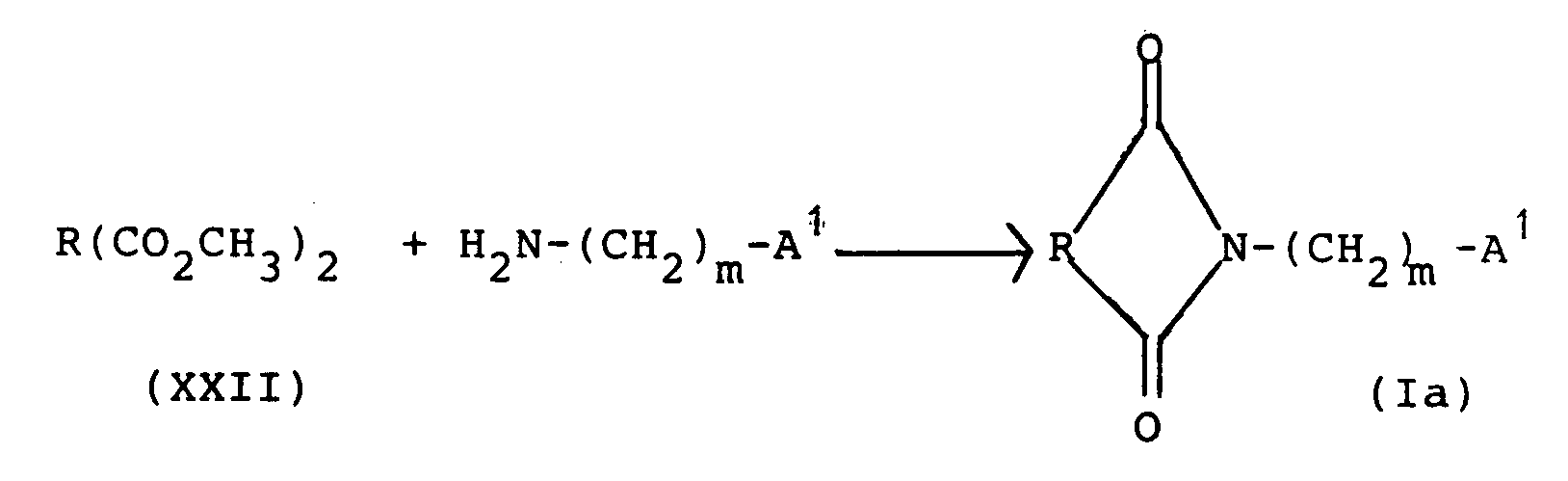
where R¹ and R² together represent a group of formula III. Instead of using the amine H₂N-(CH₂)m-A¹ it may be possible to use a reactive derivative thereof. For instance the isocyanate (XXIV) may be reacted with the acid anhydride
(XXIII) to yield the final compound (Ia). - Imide formation may also be carried out by cyclisation of the appropriate amidic acid (VIII) or a reactive derivative thereof. The amidic acid may be prepared where the reaction of the amine H₂N-(CH₂)m-A¹ with the dicarboxylic acid R(CO₂H)₂ or reactive derivative thereof does not proceed fully to imide formation. Cyclisation of the amidic acid may be carried out by heating a mixture of the imidic acid, acetic anhydride and sodium acetate on a steam bath.
- A number of starting materials for processes described above may be prepared from maleic acid or maleimide by means of a Diels-Alder addition. For instance reaction of maleimide (XXV) with a suitable diene, e.g. 1,3,5,7-cyclooctatetraene (XXVI)

yields compounds A²H, for instance, a compound (XXVII) which can be N-alkylated with a dihalo lower alkane to yield an alkylating agent (XXVIII) for reaction with the cyclic amine A¹H to yield final compound (XXIX).
Compounds in which R¹ and R² taken together form a norbene ring can be prepared in a similar manner using norborn-5-ene-2,3-dicarboximide as the precursor which is reacted with the suitable dihalo lower alkane. - Compounds of the invention in which R¹ and R² taken together represent groups of formulae II and IV can be similarly prepared via the Diels-Alder addition outlined above, using a diene of appropriate ring size and degree of unsaturation such as 1,3,5-cycloheptatriene, 1,3-cyclooctadiene, 1,3,5-cyclooctratriene and the like.
- In an alternative preparative sequence, maleimide, can be first reacted with the dihalo lower alkane followed by reaction with the compound A¹H to yield the intermediate N-substituted imide (IX). This can then be reacted with a suitable diene in accordance with the Diels-Alder addition [step (e)]. The reaction product of using a diene or formula X is a compound of formula I where R¹ and R² together represent a group of formula XVII. The reaction product of using a diene of formula XI is a compound where R¹ and R² is of formula XVIII. The reaction product of using a compound of formula XII is a compound in which R¹ and R² together form a group of formula XVIII in which p is zero.
- In order to prepare final compounds where R is of formula III one preferably uses step (c), for example, using the dimethyl ester of formula R(CO₂CH₃)₂ .
- The saturated analogues of ethylenically unsaturated compounds prepared in all the above reaction schemes may be prepared by reduction of the appropriate unsaturated intermediate or final product. In particular compound having formula XVI may be reduced [step (f)]. The reduction is preferably a hydrogenation method. The hydrogenation may be carried out using hydrogen and Pd/C as catalyst. The compounds having formula XVI may be prepared by a Diels-Alder addition using a suitable diene and a suitable dienophile as reactants. The compounds useful as reactants are as explained under step (e) or, in the case where R5 and R6 represent formula XXI, may be a compound of formula IX and a compound of formula XXXIV.

Where a compound having formula I has been prepared in free base form, a salt form may be prepared by addition of an acid. Where a compound having formula I has been prepared in the form of an acid addition salt, the free base form may be prepared by subtraction of the acid, for instance, by neutralisation with a base. - The starting materials used in the preparative routes described above are commercially available or can be made according to procedures taught in the chemical literature.
- The invention also provides a pharmaceutical composition comprising a compound having formula I or a pharmaceutically acceptable salt therefrom in association or combination with a pharmaceutically acceptable carrier. The composition can be prepared by bringing the active compound into association or combination with the carrier.
- The compounds of the invention display a pharmacological profile like that of the compound buspirone(8-[4-[4-(2-pyrimidinyl)-1-piperazinyl]butyl]-8-azaspiro[4.5]decane-7,9-dione). The latter compound has demonstrated pre-clinical activity in antipsychotic paradigms and has also displayed a unique clinical anxioselective profile, whereby its efficacy in the treatment of anxiety neuroses is comparable to the benzodiazepine diazepam but without the benzodiazepine-related side effects. The clinically effective anxiolytic doses of the benzodiazepines produce such undesirable side effects as ataxia, muscle relaxation and sedation. Additionally. most chronically used antipsychotic drugs, cause extrapyramidal side effects, such as pseudoparkinsonism, tardive dyskinesia and the like. Ideally, treatment of psychoses and anxiety should be free of any undesirable side effects. The compounds of the invention, in a manner similar to buspirone, display preclinical antipsychotic activity without or with minimal side effects. Moreover, based on their buspirone-like profile, the compounds of the invention can be considered of clinical value in treating anxiety neuroses.
- When employed as anxiolytics/antipsychotics, the effective dosage of the substances active for such treatment will vary according to the particular compound being employed, the severity and nature of condition being treated.
Therapy should be initiated at lower doses (in mg/kg/day), the dosage thereafter being increased, if necessary, to produce the desired effect. In general, the compounds of the invention are most desirably administered at a concentration that will generally afford effective results without causing any harmful or deleterious effects. - When the compounds of the invention are employed as anxiolytics/anti-psychotic agents, they can be formulated into oral dosage forms such as tablets, capsules and the like. The compounds can be administered alone or by combining them with conventional carriers, such as magnesium carbonate, magnesium stearate, talc, sugar, lactose, pectin, dextrin, starch, gelatin, tragacanth, methylcellulose, sodium carboxymethylcellulose, low melting wax, cocoa butter and the like. Diluents, flavoring agents, solubilizers, lubricants, suspending agents, binders, tablet-disintegrating agents and the like may be employed. The compounds may be encapsulated with or without other carriers. In all cases, the proportion of active ingredients in said compositions both solid and liquid will be at least to impart the desired activity thereto on oral administration. The compounds may also be injected parenterally in which case they are used in the form of a sterile solution containing other solutes, for example, enough saline or glucose to make the solution isotonic.
- The antipsychotic activity of the compounds of the invention and their substantial lack of extrapyramidal side effects may be demonstrated by standard pharmacological procedures, which are described more fully in the examples given hereafter.
- The following examples show the preparation and pharmacological testing of compounds within the invention.
- To a stirred solution of 6.8 g (0.035 mol) of 1,3-dioxo-2H-4,6-etheno-1,3,3a,6a-tetrahydrocycloprop[f]isoindole in 70 mL of dimethylformamide is added 0.9 g of sodium hydride. The suspension is stirred at 60°C for 3 hrs and is poured into a stirred solution of 1,4-dibromobutane (9 g, 0.04 mol) in 50 mL of dimethylformamide.
- The reaction mixture is stirred at room-temperature for 24 h, dimethylformamide is evaporated under reduced pressure and the residue is extracted with methylene chloride (3 x 200 mL). The methylene chloride extracts are collected, washed with water, dried over anhydrous Na₂SO₄ and evaporated under reduced pressure. The residue is solidified to a waxy like material affording 7.6 g (67% yield) of the corresponding 2-(4-bromobutyl)hexahydro-4,6-ethenocycloprop[f]isoindole-1,3(2H,3aH)-dione. The title compound is prepared by dissolving 2.5 g (0.007 mole) of 2-(4-bromobutylhexahydro-4,6-ethenocycloprop[f]isoindole-1,3(2H,3aH)-dione in 50 mL of dimethylformamide, and to this solution is added 6 mL of triethylamine and 1.7 g (0.007 mL) of 1-(6-chloro-2-pyrazinyl)-piperazine hydrochloride. The reaction mixture is stirred at room temperature for 48 h. Dimethylformamide is removed under reduced pressure and the remaining solid is extracted with 2 x 100 mL of methylene chloride.
- The methylene chloride extracts are dried over anhydrous Na₂SO₄, evaporated and the free base form of the title compound is separated by HPLC using 30% methanol-ethyl acetate as eluent. Evaporation of the solvent from the desired fractions(Rf 0.5) affords 0.95 g (31% yield) of the free base form of the title compound which is converted to the dihydrochloride salt by dissolving the free base in ethanol and adding ether saturated with hydrogen chloride; m.p. 258-261°C.
Analysis for: C₂₃H₂₈ClN₅O₂ · 2HCl · 1 1/2 H₂O Calculated: C, 50.96; H, 6.09; N, 12.92 Found: C, 50.90; H, 6.09; N, 13.09 - The free base form of the title compound is prepared following the procedure of Example 1 using 1-(2-pyrimidinyl)piperazine dihydrochloride instead of 1-(6-chloro-2-pyrazinyl)piperazine hydrochlorde and is converted to the dihydrochloride salt; m.p. 207-208°C.
Analysis for: C₂₃H₂₉N₅O₂ · 2HCl · H₂O Calculated: C, 55.42; H, 6.62; N, 14.0; C, 14.25 Found: C, 54.92; H, 6.42; N, 13.60; Cl, 14.38 - The free base form of the title compound is prepared following the procedure of Example 1, using 1,3-dioxo-4,7-etheno- Δ⁵-1,3,3a,7a-tetrahydrocyclobut[f]isoindole instead of 1,3-dioxo-2H-4,6-etheno-1,3,3a,6a-tetrahydrocycloprop[f]isoindole, and 1-(2-pyrimidinyl)piperazine instead of 1-(6-chloro-2-pyrazinyl)piperazine. The compound is converted to the dihydrochloride salt; m.p. 252-254°C.
Analysis for: C₂₄H₂₉N₅0₂ · 2HCl · 1 1/2 H₂0 Calculated: C, 55.44; H, 6.54; N, 13.48 Found: C,55.00; H, 6.28; N, 13.27 - The free base form of the title compound is prepared following the procedure of Example 1 using 1-(6-chloro-2-pyrazinyl)piperazine hydrochloride instead of 1-(2-pyrimidyl)piperazine dihydrochloride and 1,3-dioxo-4,7-etheno-⁵-1,3,3a,7a-tetrahydrocyclobut[f]isoindole instead of 1,3-dioxo-2H-4,6-etheno-1,3,3a,6a-tetrahydrocycloprop[f]isoindole. The compound is converted to the dihydrochloride salt; m.p. > 300°C.
Analysis for: C₂₄H₂₈ClN₅0₂ · 2HCl · 1 1/2 H₂O Calculated: C, 52.03; H, 6.0; N, 12.64 Found: C, 51.85; H, 5.74; N, 12.59 - The free base form of the title compound is prepared following the procedure of Example 1 using 1,3-dioxo-4,7-ethano-1,3,3a,7a-tetrahydrocyclobut[f]isoindole instead of 1,3-dioxo-4,6-etheno-1,3,3a,6a-tetrahydrocycloprop[f]isoindole and is converted to the hydrochloride salt; m.p. 273-275°C.
Analysis for: C₂₄H₃₂ClN₅0₂ · HCl · 1/2 H₂O Calculated: C, 57.25; H, 6.56; N, 13.91 Found: C, 56.91; H, 6.41; N, 13.80 - The free base form of the title compound is prepared following the procedure of Example 1 using 1-(2-pyrimidinyl)piperazine dihydrochloride instead of 1-(6-chloro-2-pyrazinyl)piperazine hydrochloride and 1,3-dioxo-4,7-etheno-1,3,3a,7a-tetrahydro-cyclobut[f]isoindole instead of 1,3-dioxo-2H-4,6-etheno-1,3,3a,6a-tetrahydro-cycloprop[f]isoindole. The compound is converted to the dihydrochloride salt; m.p. 237-240°C.
Analysis for: C₂₄H₃₅N₅0₂ · 2HCl · 1 1/2 H₂O Calculated: C, 55.06; H, 7.26; N, 13.38 Found: C, 55.15; H, 6.87; N, 13.34 - The free base form of the title compound is prepared following the procedure of Example 1 using 1,3-dioxo-2H-4,6-ethano-1,3,3a,5a,6-tetrahydrocycloprop[f]isoindole instead of 1,3-dioxo-2H-4,6-etheno-1,3,3a,6a-tetrahydrocycloprop[f]isoindole and 1-(2-pyrimidinyl)piperazine dihydrochloride instead of 1-(6-chloro-2-pyrazinyl)piperazine hydrochloride. The compound is converted to the dihydrochloride salt; m.p. 190-192°C.
Analysis for: C₂₃H₃₁N₅0₂ · 2HCl · 2H₂O Calculated: C, 53.24; H, 7.13; N, 13.50 Found: C, 53.41; H, 6.70; N, 13.43 - The free base form of the title compound is prepared following the procedure of Example 1 using octahydro-4,9-etheno-1H-cycloocta[c]pyrrole-1,3(2H)-dione instead of 1,3-dioxo-2H-4,6-etheno-1,3,3a,6a-tetrahydrocycloprop[f]isoindole and is converted to the hydrochloride salt; m.p. 248-250°C.
Analysis for: C₂₄H₃₂ClN₅O₂ · 2HCl · 1½H₂O Calculated: C, 51.65; H, 6.80; N, 12.55; Cl, 19.41 Found: C, 51.13; H, 5.70; N, 13.16; Cl, 20.63 - The free base form of the title compound is prepared following procedure of Example 1 using 1-(6-chloro-3-pyridazinyl)-piperazine instead of 1-(6-chloro-2-pyrazinyl)-piperazine and is converted to the hydrochloride salt; mp. 271-273°C.
Analysis for: C₂₃H₂₈ClN₅O₂ · HCl Calculated: C, 57.74; H, 6.06; N, 14.64 Found: C, 57.61; H, 6.01; N, 14.30 - The title compound is prepared following the procedure of Example 1 using octahydro-4,7-etheno-1H--cyclobut[f]isoindole-1,3-(2H)-dione instead of hexahyro-4,6-ethenocycloprop[f]isoindole-1,3-(2H,3aH)--dione and 1-(3-chloro-2-pyrazinyl)piperazine instead of 1-(6-chloro-2-pyrazinyl)piperazine; and is converted to the hydrochloride salt; m.p. 208-210°C.
Analysis for: C₂₄H₃₀ClN₅O₂.2HCl.H₂O Calculated: C,56.47; H,6.47; N,13.72 Found: C,55.94; H,6.19; N,13.43 - The title compound is prepared following the procedure of Example 1 using 1,3-dioxo-4,7-etheno-Δ 5-1,3,3a,7a,-tetrahydrocyclobut[f]isoindole instead of hexahydro-4,6-ethenocycloprop[f]isoindole-1,3-(2H,3aH)--dione and 1-(6-chloro-3-pyridazinyl)-piperazine instead of 1-(6-chloro-2-pyrazinyl)-piperazine;and is converted to the hydrochloride salt; m.p.282-283°C.
Analysis for: C₂₄H₂₈ClN₅O₂ . HCl . H₂O Calculated: C,56.72; H,6.10; N,13.78 Found: C,57.09; H,5.90; N,13.61 - The free base form of the title compound is prepared following the procedure of Example 1 using 1,3-dioxo-4,7-etheno- Δ 5-1,3,3a,7a,-tetrahydro-cyclobut[f]isoindole instead of hexahydro-4,6-ethenocycloprop[f]isoindole-1,3-(2H,3aH)-dione and 1-(3-chloro-2-pyrazinyl)piperazine instead of 1-(6-chloro-2-pyrazinyl)-piperazine; and is converted to the hydrochloride salt; m.p. 150-152°C.
Analysis for: C₂₄H₂₈ClN₅O₂ · H₂O.2HCl Calculated: C, 54.71; H, 6.77; N, 13.3 Found: C, 54.8; H, 6.35; N, 13.55 - The free base form of the title compound is prepared using the procedure of Example 1 using norborn-5-ene-2,3-dicarboximide instead of 1,3-dioxo-2H-4,6-etheno-1,3,3a,6a-tetra-hydrocycloprop[f]isoindole and is converted to the hydrochloride salt; mp 235-237°C.
Analysis for: C₂₁H₂₆ClN₅O₂ · HCl · H₂O Calculated: C, 53.61; H, 6.17; N, 14.89 Found: C, 53.04; H, 6.07; N, 15.47 - The free base form of the title compound is prepared following the procedure of Example 1, using octahydro-4,9-ethano-1H-cycloocta[c]pyrrole-1,3(2H)-dione instead of hexahydro-4,6-ethenocycloprop[f]isoindole-1,3(2H,3aH)-dione and is converted to the hydrochloride salt; ;m.p. 277-280°C.
Analysis for: C₂₄H₃₄ClN₅O₂ · HCl · 1/2 H₂O Calculated: C, 57.01; H, 6.93; N, 13.86 Found: C, 56.96; H, 6.30; N, 13.68 - The free base form of the title compound is prepared following the procedure of Example 1, using octahydro-4,7-ethano-1H-cyclobut[f]isoindole-1,3(2H)-dione instead of hexahydro-4,6-ethenocycloprop[f]isoindole-1,3(2H,3aH)-dione and is converted to the hydrochloride salt; m.p. 268-271°C.
Analysis for: C₂₄H₃₀ClN₅O₂ · HCl Calculated: C, 58.53; H, 6.30; N, 14.22; Cl, 14.43 Found: C, 59.03; H, 6.36; N, 14.12; Cl, 13.86 - The free base form of the title compound is prepared following the procedure of Example 1, using 1-(2-pyrimidinyl)piperazine instead of 1-(6-chloro-2-pyrazinyl)piperazine hydrochloride and octahydro-4,7-etheno-1H-cyclobut[f]isoindole-1,3(2H)-dione instead of hexahydro-4,6-ethenocycloprop[f]isoindole-1,3(2H,3aH)-dione and is converted to the hydrochloride salt; m.p. 250-252°C.
Analysis for: C₂₄H₃₁N₅O₂ · 2HCl · H₂O Calculated: C, 56.25; H, 6.83; N, 13.67 Found: C, 56.10; H, 6.66; N, 13.67 - The free base form of the title compound is prepared following the procedure of Example 1, using 1-(6-chloro-3-pyridazinyl)piperazine hydrochloride instead of 1-(6-chloro-2-pyrazinyl)piperazine hydrochloride and 3a,4,7,7a-tetrahydro-4,7-methano-1H-isoindole-1,3(2H)-dione instead of hexahydro-4,6-ethenocycloprop[f]isoindole-1,3(2H,3aH)-dione and is converted to the hydrochloride salt; m.p. 285°C.
Analysis for: C₂₁H₂₆N₅ClO₂ · HCl · 2 H₂O Calculated: C, 51.64; H, 6.39; N, 14.34 Found: C, 51.28; H, 5.74; N, 14.18 - The free base form of the title compound is prepared following the procedure of Example 1, using 1-(3-chloro-2-pyrazinyl)piperazine instead of 1-(6-chloro-2-pyrazinyl)piperazine hydrochloride and 3a,4,7,7a-tetrahydro-4,7-methano-1H-isoindole-1,3(2H)-dione instead of hexahydro-4,6-ethenocycloprop[f]isoindole-1,3-(2H,3aH)-dione and is converted to the hydrochloride salt; m.p. 185-187°C.
Analysis for: C₂₁H₂₆N₅O₂Cl · HCl · 2.5 H₂O Calculated: C, 50.60; H, 6.40; N, 14.07 Found: C, 49.78; H, 5.73; N, 13.97 - The free base form of the title compound is prepared following the procedure of Example 1, using 1-(3-chloro-2-pyrazinyl)piperazine instead of 1-(6-chloro-2-pyrazinyl)piperazine hydrochloride and is converted to the hydrochloride salt; m.p. 110-112°C.
Analysis for: C₂₃H₂₈N₅O₂Cl · HCl · H₂O Calculated: C, 55.64; H, 6.29; N, 14.11 Found: C, 55.56; H, 6.21; N, 14.16 - The free base form of the title compound is prepared following the procedure of Example 1, using octahydro-4,9-etheno-1H-cycloocta[c]pyrrole-1,3(2H)-dione instead of hexahydro-4,6-ethenocycloprop[f]isoindole-1,3(2H,3aH)-dione and 1-(3-chloro-2-pyrazinyl)piperazine instead of 1-(6-chloro-2-pyrazinyl)piperazine hydrochloride and is converted to the hydrochloride salt; m.p. 208-211°C.
Analysis for: C₂₄H₃₂ClN₅O₂ · HCl · H₂O Calculated: C, 56.25; H, 6.83; N, 13.67 Found: C, 55.83; H, 6.23; N, 13.43 - The free base form of the title compound is prepared following the procedure of Example 1, using 4,5,6,7,8,8a-hexahydro-4,8-ethenocyclohepta[c]pyrrole-1,3(2H,3aH)-dione instead of hexahydro-4,7-ethenocycloprop[f]isoindole-1,3(2H,3aH)-dione and 1-(2-pyrimidinyl)piperazine instead of 1-(6-chloro-2-pyrazinyl)piperazine hydrochloride and is converted to the hydrochloride salt; m.p. 250-252°C.
Analysis for: C₂₃H₃₁N₅O₂ · 2HCl · 1/2 H₂O Calculated: C, 56.21; H, 6.92; N, 14.25; Cl, 14.20 Found: C, 56.69; H, 6.79; N, 14.10; Cl, 14.17 - The free base form of the title compound is prepared following the procedure of Example 1, using 4,5,6,7,8,8a-hexahydro-4,8-ethenocyclohepta[c]pyrrole-1,3(2H,3aH)-dione instead of hexahydro-4,7-ethenocycloprop[f]isoindole-1,3-(2H,3aH)-dione and is converted to the hydrochloride salt; m.p. 254-256°C.
Analysis for: C₂₃H₃₀ClN₅O₂ · HCl · H₂O Calculated: C, 55.53; H, 6.63; N, 14.08 Found: C, 55.69; H, 6.77; N, 14.88 - The free base form of the title compound is prepared following the procedure of Example 1, using 3a,4,4a,6a,7,7a-hexahydro-4,7-etheno-1H-cyclobut[f]isoindole-1,3(2H)-dione instead of hexahydro-4,7-ethenocycloprop[f]isoindole-1,3(2H,3aH)-dione and 1-(2-pyrazinyl)piperazine hydrochloride instead of 1-(6-chloro-2-pyrazinyl)piperazine hydrochloride and is converted to the fumarate salt; m.p. 169-170°C.
Analysis for: C₂₄H₂₉N₅O₂ · C₄H₄O₄ Calculated: C, 62.80; H, 6.16; N, 13.08 Found: C, 63.00; H, 6.35; N, 13.00 - The free base form of the title compound is prepared following the procedure of Example 1, using 1-(2-pyrazinyl)piperazine hydrochloride instead of 1-(6-chloro-2-pyrazinyl)piperazine hydrochloride and is converted to the hydrochloride salt; m.p. 200-202°C.
Analysis for: C₂₃H₂₉N₅O₂ · 2HCl · H₂O Calculated: C, 55.42; H, 6.67; N, 14.05; Cl, 14.23 Found: C, 55.38; H, 6.67; N, 13.86; Cl, 14.30 - The free base form of the title compound is prepared following the procedure of Example 1 using hexahydro-4,6-ethanocycloprop[f]isoindole-1,3-(2H,3aH)-dione instead of hexahydro-4,7-ethenocycloprop[f]isoindole-1,3-(2H,3aH)-dione and is converted to the hydrochloride salt; m.p. 266-268°C.
Analysis for: C₂₃H₃₀ClN₅O₂ · HCl Calculated: C, 57.50; H, 6.45; N, 14.58; Cl, 14.79 Found: C, 57.33; H, 6.75; N, 14.08; Cl, 14.40 - The free base form of the title compound is prepared following the procedure of Example 1, using hexahydro-4,6-ethanocycloprop[f]isoindole-1,3-(2H,3aH)-dione instead of hexahydro-4,7-ethenocycloprop[f]isoindole-1,3-(2H,3aH)-dione and 1-(3-chloro-2-pyrazinyl)piperazine instead of 1-(6-chloro-2-pyrazinyl)piperazine hydrochloride and is converted to the hydrochloride salt; m.p. 245-246°C.
Analysis for: C₂₃H₃₀ClN₅O₂ · HCl Calculated: C, 57.50; H, 6.45; N, 14.58; Cl, 14.79 Found: C, 57.38; H, 6.12; N, 14.21; Cl, 15.50 - The free base form of the title compound is prepared following the procedure of Example 1, using 3a,4,4a,5,6,6a,7,7a-octahydro-4,7-etheno-1H-cyclobut[f]isoindole-1,3(2H)-dione instead of hexahydro-4,7-ethenocycloprop[f]isoindole-1,3(2H,3aH)-dione and 1-(2-pyrazinyl)piperazine hydrochloride instead of 1-(6-chloro-2-pyrazinyl)piperazine hydrochloride and is convrted to the hydrochloride salt; m.p. 208-210°C.
Analysis for: C₂₄H₃₁N₅O₂ · 2HCl · 1/2 H₂O Calculated: C, 57.25; H, 6.75; N, 13.91 Found: C, 57.12; H, 6.88; N, 13.86 - The free base form of the title compound is prepared following the procedure of Example 1, using 3a,4,4a,6a,7,7a-hexahydro-4,7-etheno-1H-cyclobut[f]isoindole-1,3(2H)-dione instead of hexahydro-4,7-ethenocycloprop[f]isoindole-1,3(2H,3aH)-dione and 1-(5-trifluoromethyl-2-pyridinyl)piperazine hydrochloride instead of 1-(6-chloro-2-pyrazinyl)piperazine hydrochloride and is converted to the hydrochloride salt; m.p. 233-235°C.
Analysis for: C₂₆H₂₉F₃N₄O₂ · 2HCl · H₂O Calculated: C, 54.03; H, 5.71; N, 9.69 Found: C, 54.17; H, 5.58; N, 9.86 - The free base form of the title compound is prepared following the procedure of Example 1, using 4,5,6,7,8,8a-hexahydro-4,8-ethanocyclohepta[c]pyrrole-1,3(2H,3aH)-dione instead of hexahydro-4,7-ethenocycloprop[f]isoindole-1,3(2H,3aH)-dione and 1-(2-pyrimidinyl)piperazine instead of 1-(6-chloro-2-pyrazinyl)piperazine hydrochloride and is converted to the hydrochloride salt; m.p. 209-211°C.
Analysis for: C₂₃H₃₃N₅O₂ · 2HCl Calculated: C, 57.02; H, 7.23; N, 14.46 Found: C, 57.74; H, 7.23; N, 14.50 - The compounds of the invention are tested in an assay to determine their ability to antagonise apomorphine-induced stereotyped behavior. The assay measures the in vivo dopamine reception blocking activity of the compounds and provides a means for gauging whether the compounds tested may potentially exhibit extrapyramidal side effects.
- The assay is carried out as follows:
20-25 gm male CF-1 mice (Charles River) are used. The mice are tested one week before the experiment for a positive stereotyped response to 10 mg/kg s.c. apomorphine. Test compounds, suspended or solubilized in 0.25% Tween 80® in water, are administered at several dose levels to male mice (6/dose level). A control group, run simultaneously with drug groups, receives equal volumes of solvent. Thirty minutes later (i.p. administration) or 60 minutes later (p.o. administration), drug-treated and control mice are challenged with 10 mg/kg apormorphine s.c.. Five minutes after the injection, the rearing-head-bobbing-licking syndrome induced by apomorphine is recorded as present or absent for each animal. Readings are repeated every 5 minutes during a 30 minute test session. - The number of positive or negative 5-minute intervals during which apomorphine-induced stereotyped behavior is present or absent is measured. ED₅₀ values (with 95% confidence intervals) are calculated for inhibition of apomorphine-induced stereotyped behavior, by a simple linear regression analysis with inverse prediction.
Standard Compounds: ED₅₀and 95% confidence interval mg/kg intraperitoneal Haloperidol 1.37 ( 0.88- 2.34) Chloropromazine 8.48 ( 4.79-16.38) Clozapine 30.06 (19.42-48.21) - The compounds of the invention, when tested in this assay are inactive, evidencing a low potential for exhibiting extrapyramidal side effects, such as pseudo parkinsonism, tardive dyskinesia and the like.
- The compounds of the invention are further studied for their ability to inhibit limbic D-2 dopamine receptor binding. This in vitro assay measures the ability of the compounds tested to bind to the dopamine receptor sites. Those compounds which exhibit a weak binding effect have a low liability to display potential extrapyramidal side effects.
- The test is carried out as follows:
Several rats are decapitated and the brains are rapidly removed. Limbic brain tissue (nucleus accumbens, septal area, olfactory tubercle) is dissected and homoganized on ice in 9 volumes of buffer (50 mM Tris-HCl, 120 mN NaCl, 5mM KCl, 1 mM CaCl₂, 1 mM MgCl₂, 0.1% L-ascorbic acid, 10 µM pargyline HCl, pH 7.1) using a Polytron homogenizer at setting 5 for three 15-sec bursts. The homogenate is then diluted 4-fold with buffer and centrifuged at 30,000 x g for 20 minutes, and the supernatant is discarded. The pellet is resuspended in the same volume of buffer and recentrifuged as before, again discarding the supernatant. This pellet is then resuspended in the same volume of buffer used in the homogenization, and the protein content of this preparation is assayed by the Lowry method. The homogenate is stored frozen at -70°C until use. - Thirty µL of the homogenate (0.2-0.3 mg protein/sample) are incubated with 0.3 nM ³H-spiroperidol (New England Nuclear) and various concentrations of test drug in a final volume of 1 ml of the above buffer for 10 minutes in a 37°C water bath. At the end of the incubation, 3 ml of cold 50 mM Tris-HC-l, pH 7.7, are added to each tube, and the contents are rapidly vacuum-filtered through Whatman GF/B glass-fiber filters. The filters are then rapidly washed 3 times with 3 ml of the same buffer, placed in scintillation vials, and shaken for 15 minutes with 10 ml of Hydrofluor (National Diagnostics) scintillation cocktail. The vials are then counted in a Packard 460CD scintillation counter.
- Specific binding is defined as total binding less binding in the presence of 1µM (+)butaclamol. Binding in the presence of various concentrations of test drug is expressed as a per cent of specific binding when no drug is present. These results are then plotted as logit % binding vs. log concentration of test drug. Linear regression analysis then yields a straight line with 95% confidence limits from which an IC₅₀ can be inversely predicted. Ki (inhibition constant) for the test drug is then calculated by the formula:

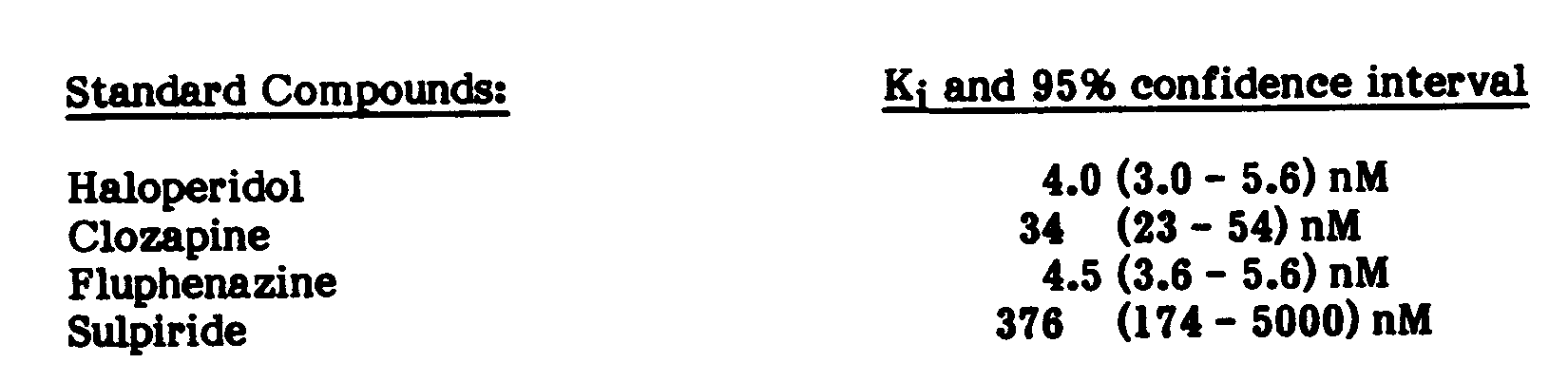
- The results of testing of some of the compounds of the invention, and the prior art compound buspirone (8-[4-[4-(2-pyrimidinyl)-1-piperazinyl]butyl]-8-azapiro[4.5]-decane-7,9-dione) in this assay are presented in Table 1.

- The results show that compounds of the invention display a very weak effect, evidencing a low potential for extrapyramidal side effects.
- The antipsychotic activity of the compounds of the invention is assessed via the conditioned avoidance (discrete trial) test. This test has excellent clinical correlation for antipsychotic activity.
- The test is carried out as follows:
Male CD rats (Charles River) maintained at approximately 400-450 gm body weight are used. Rats trained previously are placed in plexiglass experimental chambers equipped with a response lever, house light, and sonalert. A steel grid floor is wired for presentation of electric shock. Each trial consists of a fifteen-second warning tone (conditioned stimulus), continuing for an additional fifteen seconds accompanied by electric shock, (unconditioned stimulus). The rat can terminate a trial at any point by depression of the response lever. As response during the initial fifteen-second warning tone ends the trial before shock delivery and is considered avoidance response, while a response occurring during shock delivery is an escape response. Trials are presented on a variable interval schedule of two minutes. The session consists of sixty trials. Animals are run two to three times weekly with control sessions always preceding a drug run, and with at least one day intervening, compounds are administered i.p. or p.o. at appropriate pre-treatment times to a minimum of five to six rats at each dose level over a range of doses. - The following experimental parameters are recorded by computer: (1) the number of interval responses, (2) the number of avoidance responses, (3) the number of escape responses, and (4) the number of trials in which no response occurred. These data are used to calculate the percent difference from control values previously determined and are presented for visual comparison via a line graph.
- Response counts are summed over all subjects at a given dose. The number of trials in which rats fail to exhibit an avoidance response (Avoidance Block, AB) is determined at each dose. This number is expressed as a percentage of the total trials. Control performance is arbitrarily assigned a value of 100% for avoidance and the dose calculated to produce a 50% block in avoidance responding (AB₅₀) is obtained from a dose-effect regression line fitted by the method of least squares. Potential antipsychotic compounds suppress avoidance responding and increase escape responding.

- The results for compounds of this invention in this test are presented in Table 2.

- The results show that compounds of the invention have significant oral activity in the test procedure employed.
- Another test designed to determine the potential antipsychotic activity of the compounds of the invention is the conditioned avoidance (shelf-jump response) test.
- This test is carried out as follows:
Male CD rats (Charles River) maintained at approximately 400-450 gm body weight are used. Previously trained rats are placed in plexiglass experimental chambers divided into two sections; a main chamber (10 1/2" x 6 3/4" x 11 7/8" high) and an elevated chamber or shelf (5 7/8" x 6 7/8" x 5 3/4"). A moveable wall, controlled by a motor, determines whether the rat has access to the shelf at any time during the experiment. The experimental chamber also contains a house light and sonalert. A steel grid floor in the main chamber is wired for presentation of electric shock. Each trial consists of a fifteen-second warning tone (conditioned stimulus), continuing for an additional fifteen seconds accompanied by electric shock, (unconditioned stimulus). A response (jumping onto the exposed shelf of the upper chamber) occurring during the initial fifteen-second warning tone is considered an avoidance response, while a response occurring during shock delivery is considered an escape response. Trials are presented on a fixed interval schedule of one minute. The session consists of thirty-six trials. Animals are run twice weekly with control sessions always preceding a drug run, and with at least one day intervening. Compounds are administered i.p. or p.o. at appropriate pre-treatment times to a minimum of five rats at each dose level over a range of doses. - The following experimental parameters are recorded by computer: (1) the number of avoidance responses, (2) the number of escape responses, and (3) the number of trials in which no response occurred. These data are used to calculate the percent difference from control values previously determined and are presented for visual comparison via a line graph.
- Response counts are summed over all subjects at a given dose. The number of trials in which rats fail to exhibit an avoidance response (Avoidance Block, AB) is determined at each dose. This number is expressed as a percentage of the total trials. Control performance is arbitrarily assigned a value of 100% for avoidance and the dose calculated to produce a 50% block in avoidance responding (AB₅₀) is obtained from a dose-effect regression line fitted by the method of least squares. Potential antipsychotic compounds suppress avoidance responding and increase escape responding.

- The results for compounds of this invention in this test are presented in Table 3.


- The results show that compounds of the invention are active intraperitoneally in this test.
- The ex vivo inhibition of 5-HT-1A serotonin receptor binding assay is used to determine whether the test compounds can cross the blood-brain barrier and affect the receptor in question and to give an indication of buspirone-like anxiolytic activity.
- The assay is carried out as follows:
Several groups of rats (4 - 6 rats/group) are injected with test compound or the appropriate vehicle. Thirty minutes later, unless otherwise noted, rats are decapitated and their brains removed. Various brain regions are dissected and rapidly frozen and maintained at -70°C until used. - Hippocampal tissue is dissected and homogenized on ice in 40 vols of buffer (50 mM Tris HCl, pH = 7.7) using a Polytron homogenizer at setting 5 for 3 x 15 sec bursts. The homogenate is then centrifuged at 20,000 rpm (RC5-B; 50,000 g) and the supernatant discarded. The pellet is resuspended in 40 vols of the same buffer and incubated at 37°C for 10 minutes to aid in the removal of endogenous serotonin. The homogenate is then centrifuged (as above) and the supernatant discarded. The pellet is then resuspended in 100 vols of buffer B (50 mM Tris HCl, pH = 7.7 containing 0.1% ascorbate, 10 µM pargyline and 4 mM CaCl₂) and sonicated. An aliquot is taken for protein determination by the Lowry method and the remainder stored frozen at -70°C until used.
- The homogenate (50 µl; 0.4-0.6 mg protein/sample) is incubated with 100 µl (1.5-1.8 nM) ³H-8-hydroxy-2-(di-n-propylamino)tetraline in a final volume of 2 ml of buffer for 10 minutes at 37°C. At the end of the incubation, 3 ml of cold buffer A are added to each tube, and the contents rapidly filtered through Whatman GF/B glass filters. The filters are then rapidly washed 2 times with 3 ml of the same buffer, placed in scintillation vials, and shaken for 15 minutes with 10 ml of Hydrofluor (National Diagnostics)scintillation cocktail. The vials are then counted in a Packard 460 CD scintillation counter.
- Specific binding is calculated for each of the treatment protocols and is defined as total binding less binding in the presence of excess unlabeled serotonin (1 µM). Specific binding obtained in vehicle-treated rats is compared to that obtained in animals receiving a single or various doses of test compound and expressed as percent of control. These results are then plotted as logit % binding vs. log concentration of test drug. Linear regression analysis then yields a straight line with 95% confidence limits from which an IC₅₀ can be inversely predicted. Ki (inhibition constant) for the test drug is then calculated by the formula:

The use of several doses of test compound also permits the calculation of an ID₅₀ value, i.e. an inhibitory dose that displaces 50% of the specific binding ex vivo. - Under these conditions, buspirone (30 mg/kg) displaced 46% of specific ³H-8-OH-DPAT binding from hippocampal membranes.
- When tested in this assay, the compounds of the invention gave the following results.
Table 4 Compound of Example No. Inhibition Constant (Ki nm) 1 162 3 17 7 13.9 8 122 13 74% inhibition at 1 µm 16 1.1 21 12 22 107 23 46% inhibition at 1 µm 24 68% inhibition at 1 µm 27 41 - The results show that compounds of the invention have a moderate to extremely strong affinity for binding to the 5-HT-1A receptor site, evidencing a high potential for anxiolytic activity.
US 4,543, 355 discloses succinimide derivatives useful as antianxious substances. The compounds include those of formula I where R³ is phenyl or substituted phenyl, 2-pyridyl or 2-pyrimidinyl, n is 2, m is 3 or 4 and R is -CHR¹-CHR²- where R¹ and R² represent formula II in which X is O, methylene or ethylene.
Claims (11)
- A process for the preparation of a compound having the formula


Y is -(CH₂)o- or vinylene;
X is C₁-C₄ alkylene, vinylene or O;
m is 2 - 4;
n is 1 - 3;
o is 0 - 3;
p is 0 - 4;
..... represents a single or double bond; subject to the proviso that the sum of o and p in formula III and in formula IV where Y is -(CH₂)o- is not zero;
or a pharmaceutically acceptable salt thereof, in which(a) a compound having the formula A¹H or a salt thereof (in which A¹ is a group having the formula V
 (b) an imide having the formula A²H(where A² is as defined above) or a salt thereof is N-alkylated to introduce the substituted alkyl group of formula A¹-(CH₂)m- (where A¹ and m are as defined above) by reaction with a compound having the formula A¹-(CH₂)m-Z² (where Z² is a leaving group and A¹ and m are as defined above) or a compound containing the cation having the formula VII
 (c) an amine having the formula H₂N-(CH₂)m-A¹ or a salt or reactive derivative thereof (where A¹ and m are as defined above) is reacted with an acid having the formula R(CO₂H)₂ (where R is as defined above) or a reactive derivative thereof to form an imide; or(d) an amidic acid having the formula
CO₂H-R-COHN-(CH₂)m-A¹ (VIII)
or a reactive derivative thereof is cyclised to form an imide; or(e) an N-substituted maleimide having the formula IX
 (f) a compound having the formula XVI
 (g) a compound having formula I is converted into a salt thereof by addition of an acid or a salt of a compound having formula I is converted into a compound having formula I by subtraction of an acid.
 - A process as claimed in Claim 1, wherein R³ is unsubstituted or substituted 2-pyrazinyl or 3-pyridazinyl the substituents being as explained in Claim 1.
- A process as claimed in Claim 1, wherein R is -CHR¹-CHR²- where R¹ and R² together represent formula IV as defined and illustrated in CLaim 1 and o is other than zero.
- A process for the preparation of a pharmaceutical composition which comprises bringing a compound having the formula I as illustrated and defined in Claim 1 or a pharmaceutically acceptable salt thereof into association or combination with a pharmaceutically acceptable carrier.
- A process as claimed in Claim 4, wherein R³ is as defined in Claim 2.
- A process as claimed in Claim 4, wherein R is as defined in Claim 3.
- A process as claimed in any one of claims 4 to 6, wherein the pharmaceutical composition is prepared in unit dosage form as an antipsychotic agent.
- A process as claimed in Claim 1 or 4, wherein the compound having formula I is 2-[4-[4-(6-chloro-2-pyrazinyl)-1-piperazinyl]butyl]hexahydro-4,6-ethenocycloprop[f] isoindole-1,3-(2H,3aH)-dione.
- A process as claimed in Claim 1 or 4 wherein the the compound having formula I is 4,4a,5,5a,6,6a-hexahydro-2-[4-[4-(2-pyrimidinyl)-1-piperazinyl]butyl]-4-6-ethanocycloprop[f]isoindole-1,3-(2H,3aH)-dione.
- A process as claimed in Claim 1 or 4, wherein the compound having formula I is 3a,4,4a,6a,7,7a-hexahydro-2-[4-[4-(2-pyrimidinyl)-1-piperazinyl]butyl]-4,7-etheno-1H-cyclobut[f]isoindole-1,3-(2H)-dione.
Priority Applications (1)
| Application Number | Priority Date | Filing Date | Title |
|---|---|---|---|
| AT86307953T ATE97666T1 (en) | 1985-10-16 | 1986-10-14 | CONDENSED BICYCLIC IMIDES WITH PSYCHOTROPIC ACTIVITY. |
Applications Claiming Priority (4)
| Application Number | Priority Date | Filing Date | Title |
|---|---|---|---|
| US78788785A | 1985-10-16 | 1985-10-16 | |
| US89216086A | 1986-07-30 | 1986-07-30 | |
| US892160 | 1986-07-30 | ||
| US787887 | 1987-01-28 |
Publications (2)
| Publication Number | Publication Date |
|---|---|
| EP0220873A1 EP0220873A1 (en) | 1987-05-06 |
| EP0220873B1 true EP0220873B1 (en) | 1993-11-24 |
Family
ID=27120709
Family Applications (1)
| Application Number | Title | Priority Date | Filing Date |
|---|---|---|---|
| EP19860307953 Expired - Lifetime EP0220873B1 (en) | 1985-10-16 | 1986-10-14 | Fused bicyclic imides with psychotropic activity |
Country Status (9)
| Country | Link |
|---|---|
| EP (1) | EP0220873B1 (en) |
| KR (1) | KR900005034B1 (en) |
| AU (1) | AU582906B2 (en) |
| CA (1) | CA1286672C (en) |
| DE (1) | DE3689326D1 (en) |
| DK (1) | DK492386A (en) |
| GB (1) | GB2181731B (en) |
| HU (1) | HU198040B (en) |
| PT (1) | PT83532B (en) |
Families Citing this family (4)
| Publication number | Priority date | Publication date | Assignee | Title |
|---|---|---|---|---|
| US4797488A (en) * | 1987-04-03 | 1989-01-10 | American Home Products Corporation | Psychotropic polycyclic imides |
| EP0370560B1 (en) * | 1988-11-24 | 1994-01-12 | Akzo Nobel N.V. | Pharmaceutical composition containing 1-[mono- or bis (trifluoromethyl)-2-pyridinyl] piperazines |
| US4968792A (en) * | 1989-09-25 | 1990-11-06 | American Home Products Corporation | Psychotropic benzisothiazole derivatives |
| CA2146593A1 (en) * | 1994-05-05 | 1995-11-06 | Jack Melton | Large-scale process for azapirone synthesis |
Family Cites Families (2)
| Publication number | Priority date | Publication date | Assignee | Title |
|---|---|---|---|---|
| US4507303A (en) * | 1981-12-22 | 1985-03-26 | Sumitomo Chemical Company, Limited | Succinimide derivatives, compositions and method of use |
| US4562255A (en) * | 1984-03-30 | 1985-12-31 | American Home Products Corporation | Substituted bi-alicyclic imides |
-
1986
- 1986-10-08 CA CA000520108A patent/CA1286672C/en not_active Expired - Fee Related
- 1986-10-09 AU AU63645/86A patent/AU582906B2/en not_active Ceased
- 1986-10-14 EP EP19860307953 patent/EP0220873B1/en not_active Expired - Lifetime
- 1986-10-14 GB GB8624576A patent/GB2181731B/en not_active Expired - Fee Related
- 1986-10-14 DE DE86307953T patent/DE3689326D1/en not_active Expired - Lifetime
- 1986-10-14 PT PT83532A patent/PT83532B/en not_active IP Right Cessation
- 1986-10-15 KR KR1019860008641A patent/KR900005034B1/en not_active Expired
- 1986-10-15 DK DK492386A patent/DK492386A/en not_active Application Discontinuation
- 1986-10-15 HU HU864297A patent/HU198040B/en not_active IP Right Cessation
Non-Patent Citations (1)
| Title |
|---|
| Chemical Abstracts, vol. 69, no.25, December 16, 1968, Colombus, Ohio, USA Gavrilov, L.D.; Vereschchagin, L.I.; Alesina, T.N. "Quaternary ammonium salts of bis(3-azatricyclo-[5.3.0.1 1,5] undecane)" page 9978, column 2,abstract No 106 533r& Khim. Geterotsikl. Soedin. 1968, (3), 478-80 * |
Also Published As
| Publication number | Publication date |
|---|---|
| GB2181731B (en) | 1990-09-26 |
| PT83532B (en) | 1988-11-30 |
| GB8624576D0 (en) | 1986-11-19 |
| CA1286672C (en) | 1991-07-23 |
| KR870004036A (en) | 1987-05-07 |
| DK492386D0 (en) | 1986-10-15 |
| GB2181731A (en) | 1987-04-29 |
| PT83532A (en) | 1986-11-01 |
| AU6364586A (en) | 1987-04-30 |
| EP0220873A1 (en) | 1987-05-06 |
| HUT43845A (en) | 1987-12-28 |
| AU582906B2 (en) | 1989-04-13 |
| HU198040B (en) | 1989-07-28 |
| DK492386A (en) | 1987-04-17 |
| KR900005034B1 (en) | 1990-07-18 |
| DE3689326D1 (en) | 1994-01-05 |
Similar Documents
| Publication | Publication Date | Title |
|---|---|---|
| AU758084B2 (en) | Pyrroloindoles, pyridoindoles and azepinoindoles as 5-HT2C agonists | |
| US7592454B2 (en) | Substituted hexahydro-pyridoindole derivatives as serotonin receptor agonists and antagonists | |
| AU679053B2 (en) | Indoletetralins having dopaminergic activity | |
| EP0705832B1 (en) | Serotonergic modulators | |
| US5538980A (en) | Tetrahydro-pyrido-indole | |
| US5631265A (en) | 8-substituted tetrahydro-beta-carbolines | |
| EP0656003A1 (en) | Condensed indole derivatives as 5ht2c and 5ht2b antagonists | |
| JPS60215683A (en) | Novel condensated diazepinone | |
| US5563147A (en) | Serotonerbic tetrahydropyridoindoles | |
| US4892943A (en) | Fused bicyclic imides with psychotropic activity | |
| EP0220051B1 (en) | Isothiazolone derivatives | |
| JP2002114789A (en) | Azabicycloalkane derivative and its therapeutic use | |
| JPS60258162A (en) | 6-oxidated-1,3,4,5-tetrahydrobenz(cd)indole-4-amine | |
| KR100497782B1 (en) | 4-OXO-3,5-DIHYDRO-4H-PYRIDAZINO[4,5-b]-INDOLE-1-ACETAMIDE DERIVATIVES, THEIR PREPARATION AND THEIR APPLICATION IN THERAPY | |
| EP0557526B1 (en) | Pyrroloazepine compound | |
| JPH06239865A (en) | Pyrrolopyrazine derivative | |
| EP0222474B1 (en) | Gamma-carbolines | |
| US4855430A (en) | Polycyclicamine with psychotropic activity | |
| EP0220873A1 (en) | Fused bicyclic imides with psychotropic activity | |
| US4254134A (en) | Antidepressant 2-amino- and -2-(substituted amino)-cis-hexahydro-carbazoles | |
| US4927934A (en) | Polycyclicamine with psychotropic activity | |
| US4482714A (en) | Pyrazino[2',3'-3,4]pyrido[1,2-a]indole derivatives | |
| EP0743946A1 (en) | 5ht2b receptor antagonists condensed indoles | |
| US4859671A (en) | 2-substituted 1,2-benzisothiazol-3(2H)-one 1,1-dioxide useful as an anxiolytic agent | |
| KR100917041B1 (en) | Novel Compounds Antagonistic to 5-HT7 Receptors |
Legal Events
| Date | Code | Title | Description |
|---|---|---|---|
| PUAI | Public reference made under article 153(3) epc to a published international application that has entered the european phase |
Free format text: ORIGINAL CODE: 0009012 |
|
| AK | Designated contracting states |
Kind code of ref document: A1 Designated state(s): AT BE CH DE ES FR GR IT LI LU NL SE |
|
| 17P | Request for examination filed |
Effective date: 19870720 |
|
| 17Q | First examination report despatched |
Effective date: 19890518 |
|
| GRAA | (expected) grant |
Free format text: ORIGINAL CODE: 0009210 |
|
| AK | Designated contracting states |
Kind code of ref document: B1 Designated state(s): AT BE CH DE ES FR GR IT LI LU NL SE |
|
| PG25 | Lapsed in a contracting state [announced via postgrant information from national office to epo] |
Ref country code: IT Free format text: LAPSE BECAUSE OF FAILURE TO SUBMIT A TRANSLATION OF THE DESCRIPTION OR TO PAY THE FEE WITHIN THE PRE;WARNING: LAPSES OF ITALIAN PATENTS WITH EFFECTIVE DATE BEFORE 2007 MAY HAVE OCCURRED AT ANY TIME BEFORE 2007. THE CORRECT EFFECTIVE DATE MAY BE DIFFERENT FROM THE ONE RECORDED.SCRIBED TIME-LIMIT Effective date: 19931124 Ref country code: CH Effective date: 19931124 Ref country code: NL Effective date: 19931124 Ref country code: SE Effective date: 19931124 Ref country code: AT Effective date: 19931124 Ref country code: FR Effective date: 19931124 Ref country code: GR Free format text: LAPSE BECAUSE OF FAILURE TO SUBMIT A TRANSLATION OF THE DESCRIPTION OR TO PAY THE FEE WITHIN THE PRESCRIBED TIME-LIMIT Effective date: 19931124 Ref country code: LI Effective date: 19931124 Ref country code: BE Effective date: 19931124 Ref country code: DE Effective date: 19931124 |
|
| REF | Corresponds to: |
Ref document number: 97666 Country of ref document: AT Date of ref document: 19931215 Kind code of ref document: T |
|
| REF | Corresponds to: |
Ref document number: 3689326 Country of ref document: DE Date of ref document: 19940105 |
|
| REG | Reference to a national code |
Ref country code: CH Ref legal event code: PL |
|
| PG25 | Lapsed in a contracting state [announced via postgrant information from national office to epo] |
Ref country code: ES Free format text: LAPSE BECAUSE OF FAILURE TO SUBMIT A TRANSLATION OF THE DESCRIPTION OR TO PAY THE FEE WITHIN THE PRESCRIBED TIME-LIMIT Effective date: 19940307 |
|
| RAP4 | Party data changed (patent owner data changed or rights of a patent transferred) |
Owner name: AMERICAN HOME PRODUCTS CORPORATION |
|
| EN | Fr: translation not filed | ||
| NLV1 | Nl: lapsed or annulled due to failure to fulfill the requirements of art. 29p and 29m of the patents act | ||
| PLBE | No opposition filed within time limit |
Free format text: ORIGINAL CODE: 0009261 |
|
| STAA | Information on the status of an ep patent application or granted ep patent |
Free format text: STATUS: NO OPPOSITION FILED WITHIN TIME LIMIT |
|
| PG25 | Lapsed in a contracting state [announced via postgrant information from national office to epo] |
Ref country code: LU Free format text: LAPSE BECAUSE OF NON-PAYMENT OF DUE FEES Effective date: 19941031 |
|
| 26N | No opposition filed |