EP0220831B1 - Styryloxy resins and polymerization process - Google Patents
Styryloxy resins and polymerization process Download PDFInfo
- Publication number
- EP0220831B1 EP0220831B1 EP86307335A EP86307335A EP0220831B1 EP 0220831 B1 EP0220831 B1 EP 0220831B1 EP 86307335 A EP86307335 A EP 86307335A EP 86307335 A EP86307335 A EP 86307335A EP 0220831 B1 EP0220831 B1 EP 0220831B1
- Authority
- EP
- European Patent Office
- Prior art keywords
- groups
- compound
- formula
- radical
- valent
- Prior art date
- Legal status (The legal status is an assumption and is not a legal conclusion. Google has not performed a legal analysis and makes no representation as to the accuracy of the status listed.)
- Expired - Lifetime
Links
- 238000006116 polymerization reaction Methods 0.000 title description 9
- 229920005989 resin Polymers 0.000 title description 8
- 239000011347 resin Substances 0.000 title description 8
- 150000001875 compounds Chemical class 0.000 claims description 26
- 238000010538 cationic polymerization reaction Methods 0.000 claims description 15
- 229920000642 polymer Polymers 0.000 claims description 14
- 125000002496 methyl group Chemical group [H]C([H])([H])* 0.000 claims description 11
- 238000000034 method Methods 0.000 claims description 9
- 125000002924 primary amino group Chemical group [H]N([H])* 0.000 claims description 9
- 125000002091 cationic group Chemical group 0.000 claims description 8
- 229930195733 hydrocarbon Natural products 0.000 claims description 8
- 239000003999 initiator Substances 0.000 claims description 8
- 229920002554 vinyl polymer Polymers 0.000 claims description 8
- 239000004215 Carbon black (E152) Substances 0.000 claims description 7
- 229920000570 polyether Polymers 0.000 claims description 6
- 239000004721 Polyphenylene oxide Substances 0.000 claims description 5
- 125000003545 alkoxy group Chemical group 0.000 claims description 5
- 239000007787 solid Substances 0.000 claims description 5
- 125000004178 (C1-C4) alkyl group Chemical group 0.000 claims description 4
- 238000012644 addition polymerization Methods 0.000 claims description 4
- 229920002627 poly(phosphazenes) Polymers 0.000 claims description 4
- 150000002430 hydrocarbons Chemical class 0.000 claims description 3
- 125000000956 methoxy group Chemical group [H]C([H])([H])O* 0.000 claims description 3
- IYABWNGZIDDRAK-UHFFFAOYSA-N allene Chemical group C=C=C IYABWNGZIDDRAK-UHFFFAOYSA-N 0.000 claims description 2
- 150000004945 aromatic hydrocarbons Chemical class 0.000 claims description 2
- 125000005569 butenylene group Chemical group 0.000 claims description 2
- NRNFFDZCBYOZJY-UHFFFAOYSA-N p-quinodimethane Chemical group C=C1C=CC(=C)C=C1 NRNFFDZCBYOZJY-UHFFFAOYSA-N 0.000 claims description 2
- 125000006410 propenylene group Chemical group 0.000 claims description 2
- 239000000178 monomer Substances 0.000 description 18
- RGHHSNMVTDWUBI-UHFFFAOYSA-N 4-hydroxybenzaldehyde Chemical compound OC1=CC=C(C=O)C=C1 RGHHSNMVTDWUBI-UHFFFAOYSA-N 0.000 description 14
- 150000003254 radicals Chemical class 0.000 description 12
- -1 aliphatic thiol Chemical class 0.000 description 11
- 238000006243 chemical reaction Methods 0.000 description 10
- 0 CC=C(*)c(cc1*)cc(*)c1O* Chemical compound CC=C(*)c(cc1*)cc(*)c1O* 0.000 description 7
- 238000007239 Wittig reaction Methods 0.000 description 7
- 150000001299 aldehydes Chemical class 0.000 description 7
- WYURNTSHIVDZCO-UHFFFAOYSA-N Tetrahydrofuran Chemical compound C1CCOC1 WYURNTSHIVDZCO-UHFFFAOYSA-N 0.000 description 6
- FUGYGGDSWSUORM-UHFFFAOYSA-N 4-hydroxystyrene Chemical compound OC1=CC=C(C=C)C=C1 FUGYGGDSWSUORM-UHFFFAOYSA-N 0.000 description 5
- 239000000203 mixture Substances 0.000 description 5
- 239000000047 product Substances 0.000 description 5
- TXFPEBPIARQUIG-UHFFFAOYSA-N 4'-hydroxyacetophenone Chemical compound CC(=O)C1=CC=C(O)C=C1 TXFPEBPIARQUIG-UHFFFAOYSA-N 0.000 description 4
- KZMGYPLQYOPHEL-UHFFFAOYSA-N Boron trifluoride etherate Chemical compound FB(F)F.CCOCC KZMGYPLQYOPHEL-UHFFFAOYSA-N 0.000 description 4
- 125000000217 alkyl group Chemical group 0.000 description 4
- 125000004432 carbon atom Chemical group C* 0.000 description 4
- 239000003153 chemical reaction reagent Substances 0.000 description 4
- RTZKZFJDLAIYFH-UHFFFAOYSA-N ether Substances CCOCC RTZKZFJDLAIYFH-UHFFFAOYSA-N 0.000 description 4
- 238000006266 etherification reaction Methods 0.000 description 4
- 125000002887 hydroxy group Chemical group [H]O* 0.000 description 4
- 229920002521 macromolecule Polymers 0.000 description 4
- 239000000463 material Substances 0.000 description 4
- BWHMMNNQKKPAPP-UHFFFAOYSA-L potassium carbonate Chemical compound [K+].[K+].[O-]C([O-])=O BWHMMNNQKKPAPP-UHFFFAOYSA-L 0.000 description 4
- YMWUJEATGCHHMB-UHFFFAOYSA-N Dichloromethane Chemical compound ClCCl YMWUJEATGCHHMB-UHFFFAOYSA-N 0.000 description 3
- OKKJLVBELUTLKV-UHFFFAOYSA-N Methanol Chemical compound OC OKKJLVBELUTLKV-UHFFFAOYSA-N 0.000 description 3
- ZMANZCXQSJIPKH-UHFFFAOYSA-N Triethylamine Chemical compound CCN(CC)CC ZMANZCXQSJIPKH-UHFFFAOYSA-N 0.000 description 3
- 125000002947 alkylene group Chemical group 0.000 description 3
- 125000003118 aryl group Chemical group 0.000 description 3
- 238000000576 coating method Methods 0.000 description 3
- 229920001577 copolymer Polymers 0.000 description 3
- 238000011161 development Methods 0.000 description 3
- 230000018109 developmental process Effects 0.000 description 3
- 229910052739 hydrogen Inorganic materials 0.000 description 3
- 239000001257 hydrogen Substances 0.000 description 3
- 125000004435 hydrogen atom Chemical group [H]* 0.000 description 3
- 230000004048 modification Effects 0.000 description 3
- 238000012986 modification Methods 0.000 description 3
- VLKZOEOYAKHREP-UHFFFAOYSA-N n-Hexane Chemical compound CCCCCC VLKZOEOYAKHREP-UHFFFAOYSA-N 0.000 description 3
- GKTNLYAAZKKMTQ-UHFFFAOYSA-N n-[bis(dimethylamino)phosphinimyl]-n-methylmethanamine Chemical compound CN(C)P(=N)(N(C)C)N(C)C GKTNLYAAZKKMTQ-UHFFFAOYSA-N 0.000 description 3
- 239000005056 polyisocyanate Substances 0.000 description 3
- 150000003839 salts Chemical class 0.000 description 3
- YLQBMQCUIZJEEH-UHFFFAOYSA-N tetrahydrofuran Natural products C=1C=COC=1 YLQBMQCUIZJEEH-UHFFFAOYSA-N 0.000 description 3
- 150000003573 thiols Chemical class 0.000 description 3
- 125000000391 vinyl group Chemical group [H]C([*])=C([H])[H] 0.000 description 3
- VNDYJBBGRKZCSX-UHFFFAOYSA-L zinc bromide Chemical compound Br[Zn]Br VNDYJBBGRKZCSX-UHFFFAOYSA-L 0.000 description 3
- YZNLEHDNNBEODS-UHFFFAOYSA-N 1-(ethoxymethoxy)-4-prop-1-en-2-ylbenzene Chemical class CCOCOC1=CC=C(C(C)=C)C=C1 YZNLEHDNNBEODS-UHFFFAOYSA-N 0.000 description 2
- UAJRSHJHFRVGMG-UHFFFAOYSA-N 1-ethenyl-4-methoxybenzene Chemical compound COC1=CC=C(C=C)C=C1 UAJRSHJHFRVGMG-UHFFFAOYSA-N 0.000 description 2
- JESXATFQYMPTNL-UHFFFAOYSA-N 2-ethenylphenol Chemical compound OC1=CC=CC=C1C=C JESXATFQYMPTNL-UHFFFAOYSA-N 0.000 description 2
- JAGRUUPXPPLSRX-UHFFFAOYSA-N 4-prop-1-en-2-ylphenol Chemical class CC(=C)C1=CC=C(O)C=C1 JAGRUUPXPPLSRX-UHFFFAOYSA-N 0.000 description 2
- CSCPPACGZOOCGX-UHFFFAOYSA-N Acetone Chemical compound CC(C)=O CSCPPACGZOOCGX-UHFFFAOYSA-N 0.000 description 2
- NLXLAEXVIDQMFP-UHFFFAOYSA-N Ammonia chloride Chemical compound [NH4+].[Cl-] NLXLAEXVIDQMFP-UHFFFAOYSA-N 0.000 description 2
- UFHFLCQGNIYNRP-UHFFFAOYSA-N Hydrogen Chemical compound [H][H] UFHFLCQGNIYNRP-UHFFFAOYSA-N 0.000 description 2
- AFVFQIVMOAPDHO-UHFFFAOYSA-N Methanesulfonic acid Chemical compound CS(O)(=O)=O AFVFQIVMOAPDHO-UHFFFAOYSA-N 0.000 description 2
- PPBRXRYQALVLMV-UHFFFAOYSA-N Styrene Chemical compound C=CC1=CC=CC=C1 PPBRXRYQALVLMV-UHFFFAOYSA-N 0.000 description 2
- 239000002253 acid Substances 0.000 description 2
- 150000003935 benzaldehydes Chemical class 0.000 description 2
- 230000015572 biosynthetic process Effects 0.000 description 2
- 239000003054 catalyst Substances 0.000 description 2
- 239000003795 chemical substances by application Substances 0.000 description 2
- 239000011248 coating agent Substances 0.000 description 2
- GYZLOYUZLJXAJU-UHFFFAOYSA-N diglycidyl ether Chemical compound C1OC1COCC1CO1 GYZLOYUZLJXAJU-UHFFFAOYSA-N 0.000 description 2
- 125000005442 diisocyanate group Chemical group 0.000 description 2
- ZUOUZKKEUPVFJK-UHFFFAOYSA-N diphenyl Chemical compound C1=CC=CC=C1C1=CC=CC=C1 ZUOUZKKEUPVFJK-UHFFFAOYSA-N 0.000 description 2
- 230000000977 initiatory effect Effects 0.000 description 2
- 238000004519 manufacturing process Methods 0.000 description 2
- IXQGCWUGDFDQMF-UHFFFAOYSA-N o-Hydroxyethylbenzene Natural products CCC1=CC=CC=C1O IXQGCWUGDFDQMF-UHFFFAOYSA-N 0.000 description 2
- CTSLXHKWHWQRSH-UHFFFAOYSA-N oxalyl chloride Chemical compound ClC(=O)C(Cl)=O CTSLXHKWHWQRSH-UHFFFAOYSA-N 0.000 description 2
- 125000004430 oxygen atom Chemical group O* 0.000 description 2
- 150000002989 phenols Chemical class 0.000 description 2
- 229920000728 polyester Polymers 0.000 description 2
- 229920001228 polyisocyanate Polymers 0.000 description 2
- 229910000027 potassium carbonate Inorganic materials 0.000 description 2
- 238000003786 synthesis reaction Methods 0.000 description 2
- CWERGRDVMFNCDR-UHFFFAOYSA-N thioglycolic acid Chemical compound OC(=O)CS CWERGRDVMFNCDR-UHFFFAOYSA-N 0.000 description 2
- 238000009281 ultraviolet germicidal irradiation Methods 0.000 description 2
- KPZGRMZPZLOPBS-UHFFFAOYSA-N 1,3-dichloro-2,2-bis(chloromethyl)propane Chemical compound ClCC(CCl)(CCl)CCl KPZGRMZPZLOPBS-UHFFFAOYSA-N 0.000 description 1
- QROLAYWQXFECKY-UHFFFAOYSA-N 1-[4-(ethoxymethoxy)phenyl]ethanone Chemical compound CCOCOC1=CC=C(C(C)=O)C=C1 QROLAYWQXFECKY-UHFFFAOYSA-N 0.000 description 1
- LBLYYCQCTBFVLH-UHFFFAOYSA-N 2-Methylbenzenesulfonic acid Chemical compound CC1=CC=CC=C1S(O)(=O)=O LBLYYCQCTBFVLH-UHFFFAOYSA-N 0.000 description 1
- IZXIZTKNFFYFOF-UHFFFAOYSA-N 2-Oxazolidone Chemical compound O=C1NCCO1 IZXIZTKNFFYFOF-UHFFFAOYSA-N 0.000 description 1
- AAUXVPAKDMCMMN-UHFFFAOYSA-N 2-[(4-ethenylphenoxy)methyl]oxirane Chemical class C1=CC(C=C)=CC=C1OCC1OC1 AAUXVPAKDMCMMN-UHFFFAOYSA-N 0.000 description 1
- ZDTYPPLWITYVRR-UHFFFAOYSA-N 2-[(4-prop-1-en-2-ylphenoxy)methyl]oxirane Chemical compound C1=CC(C(=C)C)=CC=C1OCC1OC1 ZDTYPPLWITYVRR-UHFFFAOYSA-N 0.000 description 1
- 125000003903 2-propenyl group Chemical group [H]C([*])([H])C([H])=C([H])[H] 0.000 description 1
- UITKHKNFVCYWNG-UHFFFAOYSA-N 4-(3,4-dicarboxybenzoyl)phthalic acid Chemical compound C1=C(C(O)=O)C(C(=O)O)=CC=C1C(=O)C1=CC=C(C(O)=O)C(C(O)=O)=C1 UITKHKNFVCYWNG-UHFFFAOYSA-N 0.000 description 1
- UMFCIIBZHQXRCJ-UHFFFAOYSA-N 4-prop-1-enylphenol Chemical class CC=CC1=CC=C(O)C=C1 UMFCIIBZHQXRCJ-UHFFFAOYSA-N 0.000 description 1
- BNYOYMFTWZCYOV-UHFFFAOYSA-N COC1=C(C=CC(=C1)C=C)O.C(=C)C1=C(C(=CC=C1)OC)O Chemical compound COC1=C(C=CC(=C1)C=C)O.C(=C)C1=C(C(=CC=C1)OC)O BNYOYMFTWZCYOV-UHFFFAOYSA-N 0.000 description 1
- RWSOTUBLDIXVET-UHFFFAOYSA-N Dihydrogen sulfide Chemical class S RWSOTUBLDIXVET-UHFFFAOYSA-N 0.000 description 1
- BRLQWZUYTZBJKN-UHFFFAOYSA-N Epichlorohydrin Chemical compound ClCC1CO1 BRLQWZUYTZBJKN-UHFFFAOYSA-N 0.000 description 1
- 239000004593 Epoxy Substances 0.000 description 1
- VEXZGXHMUGYJMC-UHFFFAOYSA-N Hydrochloric acid Chemical group Cl VEXZGXHMUGYJMC-UHFFFAOYSA-N 0.000 description 1
- 239000002841 Lewis acid Substances 0.000 description 1
- 150000008065 acid anhydrides Chemical class 0.000 description 1
- 125000001931 aliphatic group Chemical group 0.000 description 1
- 125000005529 alkyleneoxy group Chemical group 0.000 description 1
- 125000000746 allylic group Chemical group 0.000 description 1
- 150000001412 amines Chemical class 0.000 description 1
- 235000019270 ammonium chloride Nutrition 0.000 description 1
- 229940035676 analgesics Drugs 0.000 description 1
- 239000000730 antalgic agent Substances 0.000 description 1
- 230000001754 anti-pyretic effect Effects 0.000 description 1
- 239000002221 antipyretic Substances 0.000 description 1
- 229940125716 antipyretic agent Drugs 0.000 description 1
- FYXKZNLBZKRYSS-UHFFFAOYSA-N benzene-1,2-dicarbonyl chloride Chemical compound ClC(=O)C1=CC=CC=C1C(Cl)=O FYXKZNLBZKRYSS-UHFFFAOYSA-N 0.000 description 1
- 239000004305 biphenyl Substances 0.000 description 1
- 235000010290 biphenyl Nutrition 0.000 description 1
- IISBACLAFKSPIT-UHFFFAOYSA-N bisphenol A Chemical compound C=1C=C(O)C=CC=1C(C)(C)C1=CC=C(O)C=C1 IISBACLAFKSPIT-UHFFFAOYSA-N 0.000 description 1
- 229910052799 carbon Inorganic materials 0.000 description 1
- 239000012952 cationic photoinitiator Substances 0.000 description 1
- 150000001768 cations Chemical class 0.000 description 1
- 239000007795 chemical reaction product Substances 0.000 description 1
- 238000003776 cleavage reaction Methods 0.000 description 1
- 230000021615 conjugation Effects 0.000 description 1
- 238000007334 copolymerization reaction Methods 0.000 description 1
- 125000004122 cyclic group Chemical group 0.000 description 1
- WMPOZLHMGVKUEJ-UHFFFAOYSA-N decanedioyl dichloride Chemical compound ClC(=O)CCCCCCCCC(Cl)=O WMPOZLHMGVKUEJ-UHFFFAOYSA-N 0.000 description 1
- 238000005661 deetherification reaction Methods 0.000 description 1
- 238000006356 dehydrogenation reaction Methods 0.000 description 1
- 239000012954 diazonium Substances 0.000 description 1
- 239000000975 dye Substances 0.000 description 1
- 125000006575 electron-withdrawing group Chemical group 0.000 description 1
- 125000003700 epoxy group Chemical group 0.000 description 1
- 150000002148 esters Chemical class 0.000 description 1
- 150000002170 ethers Chemical class 0.000 description 1
- 125000001301 ethoxy group Chemical group [H]C([H])([H])C([H])([H])O* 0.000 description 1
- 125000001495 ethyl group Chemical group [H]C([H])([H])C([H])([H])* 0.000 description 1
- 238000001704 evaporation Methods 0.000 description 1
- 230000008020 evaporation Effects 0.000 description 1
- 238000001914 filtration Methods 0.000 description 1
- 125000003709 fluoroalkyl group Chemical group 0.000 description 1
- 239000011953 free-radical catalyst Substances 0.000 description 1
- 229910052736 halogen Inorganic materials 0.000 description 1
- 229920006158 high molecular weight polymer Polymers 0.000 description 1
- 125000001183 hydrocarbyl group Chemical group 0.000 description 1
- 125000003392 indanyl group Chemical group C1(CCC2=CC=CC=C12)* 0.000 description 1
- MGFYSGNNHQQTJW-UHFFFAOYSA-N iodonium Chemical compound [IH2+] MGFYSGNNHQQTJW-UHFFFAOYSA-N 0.000 description 1
- 229920003303 ion-exchange polymer Polymers 0.000 description 1
- 239000011968 lewis acid catalyst Substances 0.000 description 1
- FPYJFEHAWHCUMM-UHFFFAOYSA-N maleic anhydride Chemical compound O=C1OC(=O)C=C1 FPYJFEHAWHCUMM-UHFFFAOYSA-N 0.000 description 1
- 239000008204 material by function Substances 0.000 description 1
- 229910052752 metalloid Inorganic materials 0.000 description 1
- 150000002738 metalloids Chemical class 0.000 description 1
- 229940098779 methanesulfonic acid Drugs 0.000 description 1
- LSEFCHWGJNHZNT-UHFFFAOYSA-M methyl(triphenyl)phosphanium;bromide Chemical compound [Br-].C=1C=CC=CC=1[P+](C=1C=CC=CC=1)(C)C1=CC=CC=C1 LSEFCHWGJNHZNT-UHFFFAOYSA-M 0.000 description 1
- 238000002156 mixing Methods 0.000 description 1
- 125000001624 naphthyl group Chemical group 0.000 description 1
- 125000000962 organic group Chemical group 0.000 description 1
- 125000005702 oxyalkylene group Chemical group 0.000 description 1
- 239000003208 petroleum Substances 0.000 description 1
- ISWSIDIOOBJBQZ-UHFFFAOYSA-N phenol group Chemical group C1(=CC=CC=C1)O ISWSIDIOOBJBQZ-UHFFFAOYSA-N 0.000 description 1
- 239000000049 pigment Substances 0.000 description 1
- 150000004885 piperazines Chemical class 0.000 description 1
- 229920000647 polyepoxide Polymers 0.000 description 1
- 229920005862 polyol Polymers 0.000 description 1
- 150000003077 polyols Chemical class 0.000 description 1
- 229920000915 polyvinyl chloride Polymers 0.000 description 1
- 239000004800 polyvinyl chloride Substances 0.000 description 1
- 235000015320 potassium carbonate Nutrition 0.000 description 1
- 235000011181 potassium carbonates Nutrition 0.000 description 1
- 125000004368 propenyl group Chemical group C(=CC)* 0.000 description 1
- 125000001436 propyl group Chemical group [H]C([*])([H])C([H])([H])C([H])([H])[H] 0.000 description 1
- WVIICGIFSIBFOG-UHFFFAOYSA-N pyrylium Chemical compound C1=CC=[O+]C=C1 WVIICGIFSIBFOG-UHFFFAOYSA-N 0.000 description 1
- 239000011541 reaction mixture Substances 0.000 description 1
- 230000009257 reactivity Effects 0.000 description 1
- 230000007017 scission Effects 0.000 description 1
- ODZPKZBBUMBTMG-UHFFFAOYSA-N sodium amide Chemical compound [NH2-].[Na+] ODZPKZBBUMBTMG-UHFFFAOYSA-N 0.000 description 1
- 239000002904 solvent Substances 0.000 description 1
- 239000000126 substance Substances 0.000 description 1
- 125000001424 substituent group Chemical group 0.000 description 1
- 239000000758 substrate Substances 0.000 description 1
- RWSOTUBLDIXVET-UHFFFAOYSA-O sulfonium Chemical compound [SH3+] RWSOTUBLDIXVET-UHFFFAOYSA-O 0.000 description 1
- 238000010189 synthetic method Methods 0.000 description 1
- 229940066771 systemic antihistamines piperazine derivative Drugs 0.000 description 1
- OKYDCMQQLGECPI-UHFFFAOYSA-N thiopyrylium Chemical compound C1=CC=[S+]C=C1 OKYDCMQQLGECPI-UHFFFAOYSA-N 0.000 description 1
- DVKJHBMWWAPEIU-UHFFFAOYSA-N toluene 2,4-diisocyanate Chemical compound CC1=CC=C(N=C=O)C=C1N=C=O DVKJHBMWWAPEIU-UHFFFAOYSA-N 0.000 description 1
- 150000003673 urethanes Chemical class 0.000 description 1
- 229920001567 vinyl ester resin Polymers 0.000 description 1
Classifications
-
- C—CHEMISTRY; METALLURGY
- C07—ORGANIC CHEMISTRY
- C07C—ACYCLIC OR CARBOCYCLIC COMPOUNDS
- C07C43/00—Ethers; Compounds having groups, groups or groups
- C07C43/02—Ethers
- C07C43/20—Ethers having an ether-oxygen atom bound to a carbon atom of a six-membered aromatic ring
- C07C43/215—Ethers having an ether-oxygen atom bound to a carbon atom of a six-membered aromatic ring having unsaturation outside the six-membered aromatic rings
-
- C—CHEMISTRY; METALLURGY
- C07—ORGANIC CHEMISTRY
- C07C—ACYCLIC OR CARBOCYCLIC COMPOUNDS
- C07C43/00—Ethers; Compounds having groups, groups or groups
- C07C43/02—Ethers
- C07C43/20—Ethers having an ether-oxygen atom bound to a carbon atom of a six-membered aromatic ring
- C07C43/23—Ethers having an ether-oxygen atom bound to a carbon atom of a six-membered aromatic ring containing hydroxy or O-metal groups
-
- C—CHEMISTRY; METALLURGY
- C07—ORGANIC CHEMISTRY
- C07C—ACYCLIC OR CARBOCYCLIC COMPOUNDS
- C07C45/00—Preparation of compounds having >C = O groups bound only to carbon or hydrogen atoms; Preparation of chelates of such compounds
- C07C45/61—Preparation of compounds having >C = O groups bound only to carbon or hydrogen atoms; Preparation of chelates of such compounds by reactions not involving the formation of >C = O groups
- C07C45/67—Preparation of compounds having >C = O groups bound only to carbon or hydrogen atoms; Preparation of chelates of such compounds by reactions not involving the formation of >C = O groups by isomerisation; by change of size of the carbon skeleton
- C07C45/68—Preparation of compounds having >C = O groups bound only to carbon or hydrogen atoms; Preparation of chelates of such compounds by reactions not involving the formation of >C = O groups by isomerisation; by change of size of the carbon skeleton by increase in the number of carbon atoms
- C07C45/70—Preparation of compounds having >C = O groups bound only to carbon or hydrogen atoms; Preparation of chelates of such compounds by reactions not involving the formation of >C = O groups by isomerisation; by change of size of the carbon skeleton by increase in the number of carbon atoms by reaction with functional groups containing oxygen only in singly bound form
- C07C45/71—Preparation of compounds having >C = O groups bound only to carbon or hydrogen atoms; Preparation of chelates of such compounds by reactions not involving the formation of >C = O groups by isomerisation; by change of size of the carbon skeleton by increase in the number of carbon atoms by reaction with functional groups containing oxygen only in singly bound form being hydroxy groups
-
- C—CHEMISTRY; METALLURGY
- C08—ORGANIC MACROMOLECULAR COMPOUNDS; THEIR PREPARATION OR CHEMICAL WORKING-UP; COMPOSITIONS BASED THEREON
- C08F—MACROMOLECULAR COMPOUNDS OBTAINED BY REACTIONS ONLY INVOLVING CARBON-TO-CARBON UNSATURATED BONDS
- C08F12/00—Homopolymers and copolymers of compounds having one or more unsaturated aliphatic radicals, each having only one carbon-to-carbon double bond, and at least one being terminated by an aromatic carbocyclic ring
- C08F12/34—Monomers containing two or more unsaturated aliphatic radicals
-
- C—CHEMISTRY; METALLURGY
- C08—ORGANIC MACROMOLECULAR COMPOUNDS; THEIR PREPARATION OR CHEMICAL WORKING-UP; COMPOSITIONS BASED THEREON
- C08F—MACROMOLECULAR COMPOUNDS OBTAINED BY REACTIONS ONLY INVOLVING CARBON-TO-CARBON UNSATURATED BONDS
- C08F299/00—Macromolecular compounds obtained by interreacting polymers involving only carbon-to-carbon unsaturated bond reactions, in the absence of non-macromolecular monomers
-
- C—CHEMISTRY; METALLURGY
- C08—ORGANIC MACROMOLECULAR COMPOUNDS; THEIR PREPARATION OR CHEMICAL WORKING-UP; COMPOSITIONS BASED THEREON
- C08G—MACROMOLECULAR COMPOUNDS OBTAINED OTHERWISE THAN BY REACTIONS ONLY INVOLVING UNSATURATED CARBON-TO-CARBON BONDS
- C08G65/00—Macromolecular compounds obtained by reactions forming an ether link in the main chain of the macromolecule
- C08G65/02—Macromolecular compounds obtained by reactions forming an ether link in the main chain of the macromolecule from cyclic ethers by opening of the heterocyclic ring
- C08G65/04—Macromolecular compounds obtained by reactions forming an ether link in the main chain of the macromolecule from cyclic ethers by opening of the heterocyclic ring from cyclic ethers only
- C08G65/22—Cyclic ethers having at least one atom other than carbon and hydrogen outside the ring
-
- C—CHEMISTRY; METALLURGY
- C08—ORGANIC MACROMOLECULAR COMPOUNDS; THEIR PREPARATION OR CHEMICAL WORKING-UP; COMPOSITIONS BASED THEREON
- C08G—MACROMOLECULAR COMPOUNDS OBTAINED OTHERWISE THAN BY REACTIONS ONLY INVOLVING UNSATURATED CARBON-TO-CARBON BONDS
- C08G77/00—Macromolecular compounds obtained by reactions forming a linkage containing silicon with or without sulfur, nitrogen, oxygen or carbon in the main chain of the macromolecule
- C08G77/04—Polysiloxanes
- C08G77/38—Polysiloxanes modified by chemical after-treatment
-
- C—CHEMISTRY; METALLURGY
- C08—ORGANIC MACROMOLECULAR COMPOUNDS; THEIR PREPARATION OR CHEMICAL WORKING-UP; COMPOSITIONS BASED THEREON
- C08G—MACROMOLECULAR COMPOUNDS OBTAINED OTHERWISE THAN BY REACTIONS ONLY INVOLVING UNSATURATED CARBON-TO-CARBON BONDS
- C08G79/00—Macromolecular compounds obtained by reactions forming a linkage containing atoms other than silicon, sulfur, nitrogen, oxygen, and carbon with or without the latter elements in the main chain of the macromolecule
- C08G79/02—Macromolecular compounds obtained by reactions forming a linkage containing atoms other than silicon, sulfur, nitrogen, oxygen, and carbon with or without the latter elements in the main chain of the macromolecule a linkage containing phosphorus
-
- C—CHEMISTRY; METALLURGY
- C08—ORGANIC MACROMOLECULAR COMPOUNDS; THEIR PREPARATION OR CHEMICAL WORKING-UP; COMPOSITIONS BASED THEREON
- C08G—MACROMOLECULAR COMPOUNDS OBTAINED OTHERWISE THAN BY REACTIONS ONLY INVOLVING UNSATURATED CARBON-TO-CARBON BONDS
- C08G79/00—Macromolecular compounds obtained by reactions forming a linkage containing atoms other than silicon, sulfur, nitrogen, oxygen, and carbon with or without the latter elements in the main chain of the macromolecule
- C08G79/02—Macromolecular compounds obtained by reactions forming a linkage containing atoms other than silicon, sulfur, nitrogen, oxygen, and carbon with or without the latter elements in the main chain of the macromolecule a linkage containing phosphorus
- C08G79/025—Polyphosphazenes
-
- H—ELECTRICITY
- H02—GENERATION; CONVERSION OR DISTRIBUTION OF ELECTRIC POWER
- H02H—EMERGENCY PROTECTIVE CIRCUIT ARRANGEMENTS
- H02H3/00—Emergency protective circuit arrangements for automatic disconnection directly responsive to an undesired change from normal electric working condition with or without subsequent reconnection ; integrated protection
- H02H3/02—Details
- H02H3/021—Details concerning the disconnection itself, e.g. at a particular instant, particularly at zero value of current, disconnection in a predetermined order
- H02H3/023—Details concerning the disconnection itself, e.g. at a particular instant, particularly at zero value of current, disconnection in a predetermined order by short-circuiting
Definitions
- United States Patent No. 3663625 discloses bis[1-alkyl (and aryl)vinyl] para- phenylene oxide monomers of the formula (II) where Ar is a homocyclic aromatic structure selected from: R is C1 ⁇ 5 straight chain alkyl, biphenyl, naphthyl or C1 ⁇ 5 fluoroalkyl; R1 is H or C1 ⁇ 5 straight chain alkyl; n is 1 to 6.
- United States Patent No. 4,486,582 (Hefner) relates to the production of an ethylenically unsaturated monomer by reacting
- the monomers are thus urethanes or thiourethanes and they are stated to be reactive monomers which improve the properties, e.g. elongation, ductility and impact strength, of polyester and vinyl ester resins.
- EP-A-0165769 (published 27th December, 1985) relates to cationically polymerizable styryloxy compounds of formula (V) as set out below in which G is a multi-valent organic or inorganic radical free of amino, aliphatic thiol, aliphatic hydroxyl, or other groups which interfere with cationic polymerization. There is no disclosure of the specific groups defined below for G.
- the present invention is directed to a new class of cationic polymerizable monomers.
- the inventive monomers contain styryloxy (p-vinylphenol ether) functionality.
- the present invention provides a method of forming a cross-linked solid polymer by addition polymerization of a polymerizable compound in the presence of a cationic initiator characterized in that the polymerizable compound is selected from:
- the present invention provides a polyfunctional cationically polymerizable styryloxy compound selected from
- the monomers defined above have been shown to develop an intense coloration when they are polymerized by UV irradiation in the presence of acid generating photoinitiators. Under some circumstances this coloration is sufficient to mask a substrate, providing a useful means of generating opacity in photocurable coatings. This coloration is also observed in chemically initiated cationic polymerization of these materials.
- An additional feature of solid polyfunctional styryloxy resins of the invention is an ability of these resins to cure by UV irradiation without added photoinitiator. This cure is believed to involve a radical mechanism.
- the monomers defined above may readily be prepared from p-vinyl phenols, p-propenyl phenols or p-isopropenyl phenols by a variety of methods such as etherification with an appropriate multi-functional etherifying agent, or reaction with multifunctional epoxies followed by reaction of the resulting aliphatic hydroxyl with a polyisocyanate or other suitable capping agent.
- a suitable p-vinyl phenol is the commercially available vinyl guaiacol (2-methoxy-4-vinyl phenol). Synthetic methods for obtaining other suitable phenols include those reported in U.S. Patent 3,327,019, column 3, line 38 - column 4, line 2; Japanese Kokai Tokyo Koho 79:55,529 (dehydrogenation of ethyl phenol to give vinyl phenol); J. Kahovec, et al., J. Collect. Czech. Chem.
- Still another synthetic procedure involves the modification of the procedure of Macromolecules, l6 , 510-517 (1983), in which p-(ethoxymethoxy)- ⁇ -methyl styrene is prepared from p-hydroxyacetophenone by etherifying the hydroxyl group and then using a Wittig reaction on the resulting p-(ethoxymethoxy) acetophenone.
- One modification required for the synthesis of the monomers defined above is the initial reaction of p-hydroxyacetophenone with an appropriate polyfunctional etherification reagent to form a molecule having multi-acetophenone functionalities. Subjecting such a molecule to a Wittig reaction as in the Macromolecules reference will yield a polyfunctional monomer of the invention.
- An alternative modification of the Wittig reaction procedure is to use a monofunctional etherification reagent which is capable of entering into subsequent chain extension reactions with polyfunctional moieties.
- R3 is H, methyl, or methoxy and R4 is H.
- R4 is H.
- other lower alkyl or alkoxy up to about C4 may be included as substituents R3 and/or R4.
- R5 groups are methylene, ethylene or cycloaliphatic or aromatic hydrocarbons such as 1,4-dimethylenebenzene or unsaturated linear hydrocarbons such as propenylene or butenylene.
- G must not interfere with cationic polymerization of the styryloxy groups. G must not include any strongly electron withdrawing group in conjugation with the styryloxy group oxygen atom as such groups will interfere with vinyl cationic polymerizations. Amines, aliphatic hydroxyls, and aliphatic thiols are known to prevent or slow vinyl cationic polymerizations. "Developments in Polymerization -1,” R.N. Howard ed., Applied Science Publishers, 1979, pg. 80. Inclusion of these groups in G should therefore also be avoided.
- Polymerization of the monomers defined above may be accomplished by conventional acid and Lewis acid cationic initiators such as methane sulfonic acid, toluene sulfonic acid and boron trifluoride etherate. UV cationic initiators may also be used.
- acid and Lewis acid cationic initiators such as methane sulfonic acid, toluene sulfonic acid and boron trifluoride etherate.
- UV cationic initiators may also be used.
- Such UV cationic photoinitiators include salts of a complex halogenide having the formula: where A is a cation selected from the group consisting of iodonium, sulfonium, pyrylium, thiopyrylium and diazonium cations, M is a metalloid, and X is a halogen radical, d equals e minus f, f equals the valance of M and is an integer equal to from 2 to 7 inclusive, e is greater than f and is an integer having a value up to 8.
- Examples include di-p-tolyl iodonium hexafluorophosphate, diphenyl iodonium hexafluorophosphate, diphenyl iodonium hexafluoroarsenate and UVE 1014 (trademark of General Electric), a commercially available sulfonium salt of a complex halogenide.
- the aldehyde containing polymer is then dissolved in tetrahydrofuran (THF) and a Wittig reagent soln, prepared by mixing equimolar amounts of methyltriphenylphosphonium bromide and sodium amide and filtering out the inorganic salts, is added dropwise until an approximately 10% excess of the Wittig reagent has been added.
- THF tetrahydrofuran
- the mixture is then refluxed for about 4 hours while N2 is bubbled into the mixture. After the solution has been allowed to return to room temperature, methanol is added to precipitate the product.
- the product is collected dried and identified as a vinyl chloride copolymer having plural groups within its backbone of the formula:
- the monoethoxylate of 4-hydroxybenzaldehyde is esterified with 2-mercapto acetic acid followed by Wittig reaction to give a thiol functional styryloxy ester of the formula:
- the thiol may then be reacted with a plural functional thiol reactive compound such as a di- or poly-isocyanate to give a multifunctional styryloxy resin within the invention.
- the monoethoxylate of 4-hydroxybenzaldehyde is reacted with a phosphazene polymer or cyclic oligomer having plural repeat units of the formula: at a ratio of 2 equivalents of aldehyde per repeat unit of the formula above.
- the reaction is run in THF in the presence of a 10% molar excess (based on aldehyde content) of triethylamine in a sealed tube at 100°C for 24 hours.
- Aldehyde compounds of this type may be represented by the formula: where A is alkylene, alkyleneoxy alkylene or (poly alkyleneoxy) alkylene.
Landscapes
- Chemical & Material Sciences (AREA)
- Organic Chemistry (AREA)
- Chemical Kinetics & Catalysis (AREA)
- Health & Medical Sciences (AREA)
- Medicinal Chemistry (AREA)
- Polymers & Plastics (AREA)
- General Chemical & Material Sciences (AREA)
- Addition Polymer Or Copolymer, Post-Treatments, Or Chemical Modifications (AREA)
- Macromonomer-Based Addition Polymer (AREA)
Description
- It is the object of the present invention to provide a new class of polymerizable monomers which are poly-functional, so as to be cured to crossed-linked high molecular weight polymer networks, and which are readily cationically polymerizable.
- In USSR Patents 443874 and 478026 where are described ion exchange polymers prepared by free radical copolymerization of styrene or maleic anhydride, respectively, with p-glycidoxy-α-methyl styrene (I)

In US 3,327,019 there are described diethers which are the reaction product of p-glycidoxy styrenes and polyols. These compounds include aliphatic hydroxyl groups. - In Macromolecules, 16, 510-517 (1983), there is described the cationic polymerization of p-methoxy and p-(ethoxymethoxy)-α-methyl styrenes with boron trifluoride etherate as initiator in dichloromethane. These polymers are then subjected to ether cleavage reactions to yield linear polymers containing pendant phenolic groups.
- It is known from kinetic studies of the cationic polymerization of p-methoxy styrene that this monomer has a very high rate of polymerization. See, e.g., Macromolecules, 9, 931-936 (1976); and Polymer, 16, 819-826 (1975).
- United States Patent No. 3663625 (Neville) discloses bis[1-alkyl (and aryl)vinyl] para- phenylene oxide monomers of the formula (II)

where Ar is a homocyclic aromatic structure selected from:
R is C₁₋₅ straight chain alkyl, biphenyl, naphthyl or C₁₋₅ fluoroalkyl;
R¹ is H or C₁₋₅ straight chain alkyl;
n is 1 to 6. - It is an essential feature of the monomers of US Patent 3663625 that they are substituted on the carbon atom adjacent to the group Ar (i.e. R cannot be hydrogen). It is stated that the monomers can be polymerized by means of free radical catalysts or Lewis acid catalysts. However, the object is to achieve linear polymers linked by indanyl structures. There is no suggestion of cationic addition polymerization.
- Chemical Abstracts 63 9968 c-d (1965) discloses piperazine derivatives stated to be useful as analgesics and antipyretics and having the following structure (III)

where R is methoxy or ethoxy and R' is methyl, ethyl, propyl, allyl or propenyl. There is no disclosure of any polymerization properties of the compounds and, in particular, no suggestion of cationic addition polymerization. - United States Patent No. 4,486,582 (Hefner) relates to the production of an ethylenically unsaturated monomer by reacting
- (A) an aromatic material of the formula (IV)

- (B) a material containing at least one oxyalkylene group and terminating in a group having at least one hydrogen atom which is reactive with -NCO and/or -NCS groups; and
- (C) a material having an average of more than one -NCO and/or -NCS groups per molecule.
- The monomers are thus urethanes or thiourethanes and they are stated to be reactive monomers which improve the properties, e.g. elongation, ductility and impact strength, of polyester and vinyl ester resins.
- EP-A-0165769 (published 27th December, 1985) relates to cationically polymerizable styryloxy compounds of formula (V) as set out below in which G is a multi-valent organic or inorganic radical free of amino, aliphatic thiol, aliphatic hydroxyl, or other groups which interfere with cationic polymerization. There is no disclosure of the specific groups defined below for G.
- The present invention is directed to a new class of cationic polymerizable monomers. In common with the monofunctional monomers discussed above, the inventive monomers contain styryloxy (p-vinylphenol ether) functionality.
- According to one aspect, the present invention provides a method of forming a cross-linked solid polymer by addition polymerization of a polymerizable compound in the presence of a cationic initiator characterized in that the polymerizable compound is selected from:
- (A) a vinyl polymer having a plurality of groups within the backbone of the formula (V)

- (B1) a compound of formula (VI)

- (i) a radical comprising an n-valent polyphosphazene; and
- (ii) a radical comprising an n-valent polyether;
- (B2) a compound of formula (VII) or (VIII)


- (C) a compound of formula (IX)

R¹ and R² are H, or one of R¹ and R² is H and the other is methyl;
R³ and R⁴ are H, C₁₋₄alkyl, or alkoxy if R² is not methyl; and
R⁵ is a divalent hydrocarbon radical. - According to another aspect, the present invention provides a polyfunctional cationically polymerizable styryloxy compound selected from
- (A) a vinyl polymer having a plurality of groups within the backbone of the formula (V)
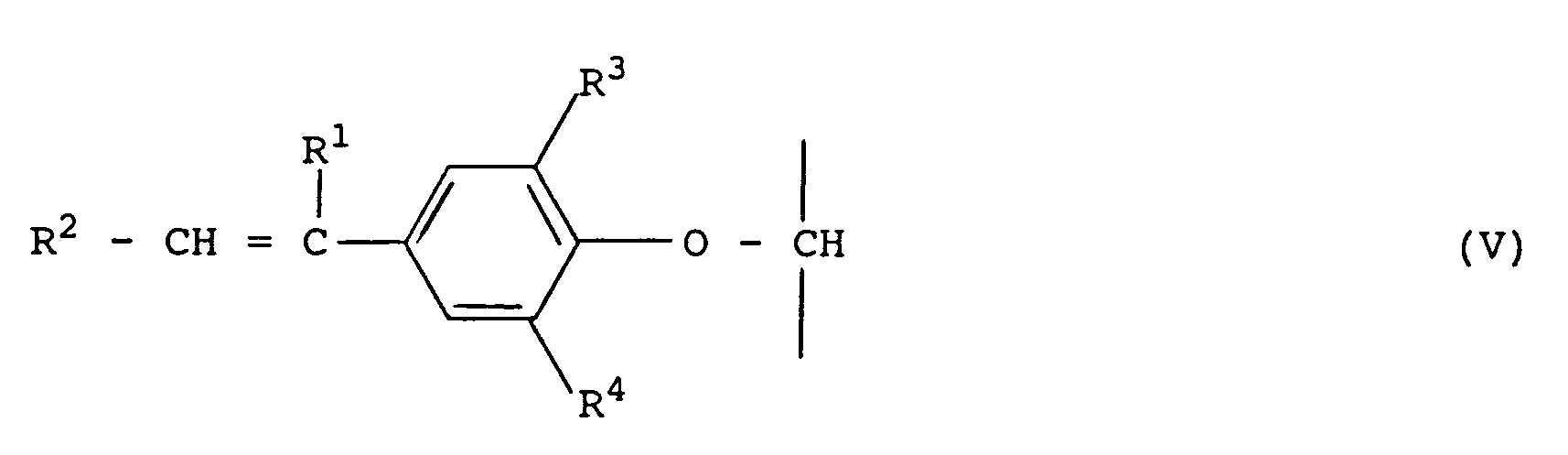

- (i) a radical comprising an n-valent polyphosphazene; and
- (ii) a radical comprising an n-valent polyether;
- (B2) a compound of formula (VII) or (VIII)

- (C) a compound of formula (IX)

R¹ and R² are H, or one of R¹ and R² is H and the other is methyl;
R³ and R⁴ are H, C₁₋₄alkyl, or alkoxy if R² is not methyl; and
R⁵ is a divalent hydrocarbon radical. - In addition to high reactivity to cationic polymerisations, the monomers defined above have been shown to develop an intense coloration when they are polymerized by UV irradiation in the presence of acid generating photoinitiators. Under some circumstances this coloration is sufficient to mask a substrate, providing a useful means of generating opacity in photocurable coatings. This coloration is also observed in chemically initiated cationic polymerization of these materials.
- An additional feature of solid polyfunctional styryloxy resins of the invention is an ability of these resins to cure by UV irradiation without added photoinitiator. This cure is believed to involve a radical mechanism.
- The monomers defined above may readily be prepared from p-vinyl phenols, p-propenyl phenols or p-isopropenyl phenols by a variety of methods such as etherification with an appropriate multi-functional etherifying agent, or reaction with multifunctional epoxies followed by reaction of the resulting aliphatic hydroxyl with a polyisocyanate or other suitable capping agent.
- A suitable p-vinyl phenol is the commercially available vinyl guaiacol (2-methoxy-4-vinyl phenol). Synthetic methods for obtaining other suitable phenols include those reported in U.S. Patent 3,327,019, column 3, line 38 - column 4, line 2; Japanese Kokai Tokyo Koho 79:55,529 (dehydrogenation of ethyl phenol to give vinyl phenol); J. Kahovec, et al., J. Collect. Czech. Chem. Commun., 36, 1986 (1971) (various α-methylvinyl phenols); and Macromecules, l6 510-517 (1983)(p-hydroxy-α-methyl styrene by cleavage of 2,2-bis(p-hydroxyphenyl)-propane).
- Yet another synthetic procedure involves the modification of the procedure of Macromolecules, l6, 510-517 (1983), in which p-(ethoxymethoxy)-α-methyl styrene is prepared from p-hydroxyacetophenone by etherifying the hydroxyl group and then using a Wittig reaction on the resulting p-(ethoxymethoxy) acetophenone. One modification required for the synthesis of the monomers defined above is the initial reaction of p-hydroxyacetophenone with an appropriate polyfunctional etherification reagent to form a molecule having multi-acetophenone functionalities. Subjecting such a molecule to a Wittig reaction as in the Macromolecules reference will yield a polyfunctional monomer of the invention.
- An alternative modification of the Wittig reaction procedure is to use a monofunctional etherification reagent which is capable of entering into subsequent chain extension reactions with polyfunctional moieties.
- In the formulas (V) and (VI) above, it is generally preferred that R³ is H, methyl, or methoxy and R⁴ is H. However, other lower alkyl or alkoxy (up to about C₄) may be included as substituents R³ and/or R⁴.
- Examples of R⁵ groups are methylene, ethylene or cycloaliphatic or aromatic hydrocarbons such as 1,4-dimethylenebenzene or unsaturated linear hydrocarbons such as propenylene or butenylene.
- A limitation on G is that it must not interfere with cationic polymerization of the styryloxy groups. G must not include any strongly electron withdrawing group in conjugation with the styryloxy group oxygen atom as such groups will interfere with vinyl cationic polymerizations. Amines, aliphatic hydroxyls, and aliphatic thiols are known to prevent or slow vinyl cationic polymerizations. "Developments in Polymerization -1," R.N. Howard ed., Applied Science Publishers, 1979, pg. 80. Inclusion of these groups in G should therefore also be avoided.
- Polymerization of the monomers defined above may be accomplished by conventional acid and Lewis acid cationic initiators such as methane sulfonic acid, toluene sulfonic acid and boron trifluoride etherate. UV cationic initiators may also be used. Such UV cationic photoinitiators include salts of a complex halogenide having the formula:

where A is a cation selected from the group consisting of iodonium, sulfonium, pyrylium, thiopyrylium and diazonium cations, M is a metalloid, and X is a halogen radical, d equals e minus f, f equals the valance of M and is an integer equal to from 2 to 7 inclusive, e is greater than f and is an integer having a value up to 8. Examples include di-p-tolyl iodonium hexafluorophosphate, diphenyl iodonium hexafluorophosphate, diphenyl iodonium hexafluoroarsenate and UVE 1014 (trademark of General Electric), a commercially available sulfonium salt of a complex halogenide. - Certain monomers, usually solids, will also undergo UV initiated polymerization in the solid state without initiator, yielding an essentially uncolored product. A radical mechanism is believed to be involved.
- The production of colored reaction mixtures by cationic initiators has been reported before for styryloxy monomers. Permanent coloration in the cured products of the invention is believed to result from particular termination reactions involving stable carbocations. The development of color can thus be controlled by selecting polymerization conditions designed to select for or against termination by stable carbocations. The development of permanent color as a result of polymerization termination reactions is especially advantageous at certain UV cured opaque coating applications where the use of pigments or dyes in the composition blocks UV, resulting in only surface cure of the coating. Since the inventive resins develop their intense coloration only after initiation of polymerization, initiation by UV is not interfered with. The invention may be illustrated by reference to the following nonlimiting examples:
- Vinyl polymer with Styryloxy Groups:
To a mixture of 1.5 equivalents K₂CO₃ dispersed in acetone is added 1.1 equivalent p-hydroxybenzaldehyde and sufficient polyvinyl chloride or vinyl chloride copolymer to provide approximately 1 equivalent of allylic chloride groups (i.e. - CH = CH - CHCl -). The mixture is refluxed for about 4 hours after which the inorganic salts are filtered and the polymer precipitated with hexane or petroleum ether and dried. The resulting polymer has multiple groups within its backbone of the structure:
The aldehyde equivalence of the polymer may be determined spectrophotometrically. - The aldehyde containing polymer is then dissolved in tetrahydrofuran (THF) and a Wittig reagent soln, prepared by mixing equimolar amounts of methyltriphenylphosphonium bromide and sodium amide and filtering out the inorganic salts, is added dropwise until an approximately 10% excess of the Wittig reagent has been added.
- The mixture is then refluxed for about 4 hours while N₂ is bubbled into the mixture. After the solution has been allowed to return to room temperature, methanol is added to precipitate the product. The product is collected dried and identified as a vinyl chloride copolymer having plural groups within its backbone of the formula:

- Two equivalents of the monoethoxylate of 4-hydroxybenzaldehyde is reacted with 1 mole oxalylchloride followed by Wittig reaction on the aldehyde functionalities to give

Other di or polyesters may be prepared by analogous procedures, using, for instance, sebacyl chloride, phthalyl chloride, the tetrachloride of benzophenone tetracarboxylic acid, etc., or the corresponding acid anhydrides. - The monoethoxylate of 4-hydroxybenzaldehyde is esterified with 2-mercapto acetic acid followed by Wittig reaction to give a thiol functional styryloxy ester of the formula:

The thiol may then be reacted with a plural functional thiol reactive compound such as a di- or poly-isocyanate to give a multifunctional styryloxy resin within the invention. - 4-hydroxy benzaldehyde is reacted with epichlorohydrin in the presence of potassium carbonate as etherification catalyst to give the glycidyl ether of 4-hydroxybenzaldehyde. This ether is polymerized cationically to give a polyether polymer, substantially free of hydroxyls, having repeat units of the formula:

Wittig reaction on this polymer gives the corresponding cationically cureable styryloxy functional polyether. - The glycidyl ether of 4-hydroxybenzaldehyde is reacted with toluene diisocyanate in the presence of ZnBr₂/(C₄H₉)₄PO catalyst at a ratio of 2 moles aldehyde to each mole diisocyanate under standard oxazolidone synthesis conditions to give a cationically polymerizable resin of the formula:
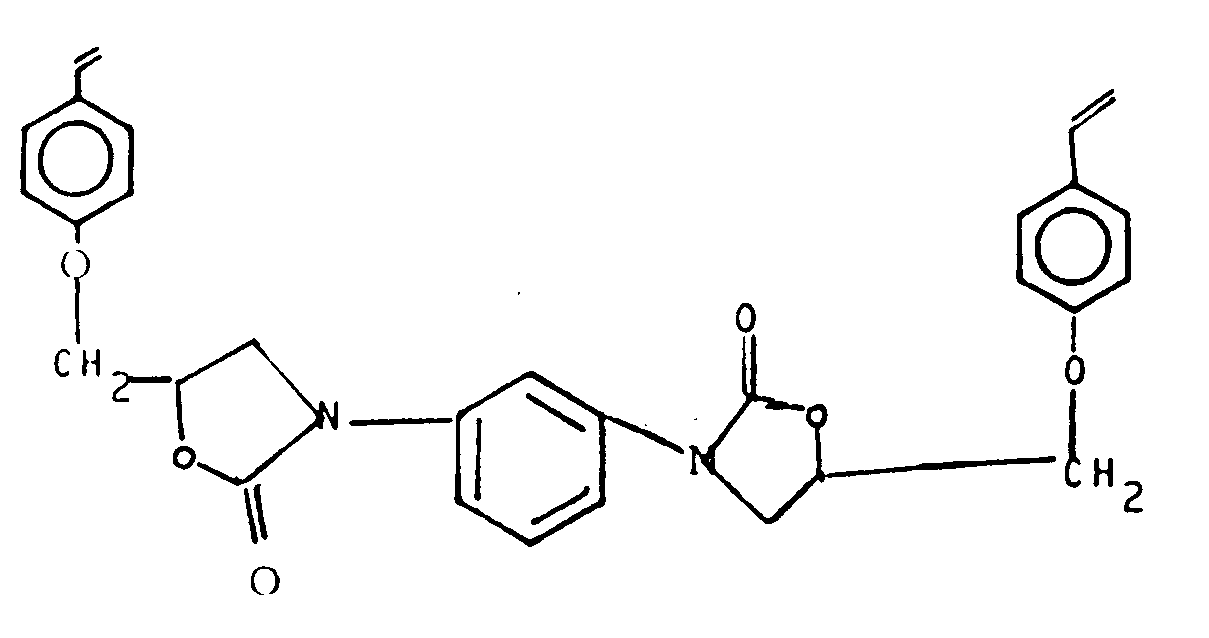
Similar resins can be prepared from other diisocyanate or polyisocyanate functional materials. - The monoethoxylate of 4-hydroxybenzaldehyde is reacted with a phosphazene polymer or cyclic oligomer having plural repeat units of the formula:

at a ratio of 2 equivalents of aldehyde per repeat unit of the formula above. The reaction is run in THF in the presence of a 10% molar excess (based on aldehyde content) of triethylamine in a sealed tube at 100°C for 24 hours. - The ammonium chloride produced by the reaction is filtered from the cooled solution and the polymer isolated by evaporation of the solvent. The aldehyde functionality is then subjected to Wittig reaction to give a phosphazene polymer with plural units of the formula:

Other products of the invention having phosphazene backbones may also be prepared by methods which will be apparent to those skilled in the art, including copolymers in which some of the P-Cl bonds are substituted with another organic group before reaction with the ethoxylated benzaldehyde. Other benzaldehydes may also be used, for instance, the monoethylenehydroxy group may be replaced by other alkylene hydroxy groups, the carbon atoms of which may be optionally interrupted with one or more oxygen atoms. - Aldehyde compounds of this type may be represented by the formula:

where A is alkylene, alkyleneoxy alkylene or (poly alkyleneoxy) alkylene.
Claims (6)
- A method of forming a cross-linked solid polymer by addition polymerization of a polymerizable compound in the presence of a cationic initiator characterized in that the polymerizable compound is selected from:(A) a vinyl polymer having a plurality of groups within the backbone of the formula (V)
 (B1) a compound of formula (VI)
 (i) a radical comprising an n-valent polyphosphazene; and(ii) a radical comprising an n-valent polyether;(B2) a compound of formula (VII) or (VIII)
 (C) a compound of formula (IX)
R¹ and R² are H, or one of R¹ and R² is H and the other is methyl;
R³ and R⁴ are H, C₁₋₄alkyl, or alkoxy if R² is not methyl; and
R⁵ is a divalent hydrocarbon radical. - A method as claimed in Claim 1 characterised in that the initiator is a photoinitiator and the polymerizable compound is exposed to ultra violet light.
- A polyfunctional cationically polymerizable styryloxy compound selected from(A) a vinyl polymer having a plurality of groups within the backbone of the formula (V)
 (B1) a compound of formula (VI)
 (i) a radical comprising an n-valent polyphosphazene; and(ii) a radical comprising an n-valent polyether;(B2) a compound of formula (VII) or (VIII)
 (C) a compound of formula (IX)
R¹ and R² are H, or one of R¹ and R² is H and the other is methyl;
R³ and R⁴ are H, C₁₋₄alkyl, or alkoxy if R² is not methyl; and
R⁵ is a divalent hydrocarbon radical. - A compound as claimed in Claim 3 characterised in that R³ is H, methyl or methoxy, and R⁴ is H.
- A compound as claimed in Claim 3 or 4, characterised in that R⁵ is a divalent hydrocarbon radical selected from methylene, ethylene, cycloaliphatic hydrocarbon, aromatic hydrocarbon and unsatuated linear hydrocarbon.
- A compound as claimed in Claim 5, characterised in that R⁵ is 1,4-dimethylenebenzene, propenylene or butenylene.
Applications Claiming Priority (2)
| Application Number | Priority Date | Filing Date | Title |
|---|---|---|---|
| US06/779,737 US4732956A (en) | 1984-06-18 | 1985-09-24 | Styryloxy resins and compositions thereof |
| US779737 | 1985-09-24 |
Publications (3)
| Publication Number | Publication Date |
|---|---|
| EP0220831A2 EP0220831A2 (en) | 1987-05-06 |
| EP0220831A3 EP0220831A3 (en) | 1988-10-19 |
| EP0220831B1 true EP0220831B1 (en) | 1994-04-20 |
Family
ID=25117379
Family Applications (1)
| Application Number | Title | Priority Date | Filing Date |
|---|---|---|---|
| EP86307335A Expired - Lifetime EP0220831B1 (en) | 1985-09-24 | 1986-09-24 | Styryloxy resins and polymerization process |
Country Status (3)
| Country | Link |
|---|---|
| US (1) | US4732956A (en) |
| EP (1) | EP0220831B1 (en) |
| DE (1) | DE3689801T2 (en) |
Families Citing this family (14)
| Publication number | Priority date | Publication date | Assignee | Title |
|---|---|---|---|---|
| IE60271B1 (en) * | 1986-01-07 | 1994-06-29 | Loctite Ireland Ltd | "Thiol/ene compositions" |
| AU4432789A (en) * | 1988-11-10 | 1990-05-17 | Loctite (Ireland) Limited | Polymerisable styryloxy resins and compositions thereof |
| US5084490A (en) * | 1990-12-10 | 1992-01-28 | Loctite (Ireland) Limited | Styryloxy compounds and polymers thereof |
| US5141970A (en) * | 1990-12-10 | 1992-08-25 | Loctite (Ireland) Limited | Method of forming high-temperature resistant polymers |
| US5633411A (en) * | 1995-06-07 | 1997-05-27 | Loctite Corporation | Method for production of allyloxystyrene compounds |
| US5917015A (en) * | 1996-06-18 | 1999-06-29 | Regents Of The University Of Minnesota | Support material for solid phase organic synthesis |
| US5902838A (en) * | 1996-10-01 | 1999-05-11 | Loctite Corporation | Process for the assembly of glass devices subjected to high temperatures, compositions therefor and novel polymers for rheological control of such compositions |
| US6231714B1 (en) | 1998-11-24 | 2001-05-15 | Loctite Corporation | Allylic phenyl ether (meth)acrylate compositions and novel allylic phenyl ether (meth)acrylate monomers |
| US6300456B1 (en) | 2000-05-18 | 2001-10-09 | National Starch And Chemical Investment Holding Corporation | Compounds with electron donor and electron acceptor functionality |
| US6307001B1 (en) | 2000-05-18 | 2001-10-23 | National Starch And Chemical Investment Holding Corporation | Curable hybrid electron donor compounds containing vinyl ether |
| CA2347872A1 (en) * | 2000-05-18 | 2001-11-18 | National Starch And Chemical Investment Holding Corporation | Die attach adhesives with vinyl ether and carbamate or urea functionality |
| MY123559A (en) * | 2000-05-18 | 2006-05-31 | Nat Starch & Chemical Investment Holding Corp | Curable electron donor compounds |
| US6441213B1 (en) | 2000-05-18 | 2002-08-27 | National Starch And Chemical Investment Holding Corporation | Adhesion promoters containing silane, carbamate or urea, and donor or acceptor functionality |
| CN113646292A (en) * | 2019-03-29 | 2021-11-12 | Tdk株式会社 | Compound, resin composition, and polymerization product |
Family Cites Families (7)
| Publication number | Priority date | Publication date | Assignee | Title |
|---|---|---|---|---|
| US2488501A (en) * | 1948-09-13 | 1949-11-15 | Dow Chemical Co | 1, 4-di(alkenylphenoxy)-2-butenes |
| US3663625A (en) * | 1970-04-23 | 1972-05-16 | Bechtel Int Corp | Bis(1-alkyl(or aryl)vinyl)p-phenylene oxide monomers |
| FR2315925A1 (en) * | 1975-07-04 | 1977-01-28 | Nippon Chemiphar Co | NEW 5-BENZYL-2-OXAZOLIDONE DERIVATIVES, THEIR PREPARATION PROCESS AND THEIR THERAPEUTIC APPLICATION |
| LU80081A1 (en) * | 1977-08-26 | 1979-05-15 | Delalande Sa | NEW HYDROXYMETHYL-5 OXAZOLIDINONES-2, THEIR PREPARATION PROCESS AND THEIR THERAPEUTIC APPLICATION |
| AU531226B2 (en) * | 1978-09-08 | 1983-08-18 | Firestone Tire And Rubber Co., The | Polyphosphazene |
| US4486582A (en) * | 1983-01-27 | 1984-12-04 | The Dow Chemical Company | Reactive monomers and thermosettable compositions containing same |
| US4543397A (en) * | 1984-06-18 | 1985-09-24 | Loctite (Ireland) Ltd. | Styryloxy resins and compositions thereof |
-
1985
- 1985-09-24 US US06/779,737 patent/US4732956A/en not_active Expired - Lifetime
-
1986
- 1986-09-24 EP EP86307335A patent/EP0220831B1/en not_active Expired - Lifetime
- 1986-09-24 DE DE3689801T patent/DE3689801T2/en not_active Expired - Fee Related
Non-Patent Citations (1)
| Title |
|---|
| CHEMICAL ABSTRACTS, vol. 63, no. 8, 11th October 1965, column 9968 c-d,Columbus, Ohio, US; & JP-A-8552('65)(KYORIN PHARMACEUTICAL LTD) 04-05-1965 * |
Also Published As
| Publication number | Publication date |
|---|---|
| HK1004272A1 (en) | 1998-11-20 |
| DE3689801D1 (en) | 1994-05-26 |
| EP0220831A2 (en) | 1987-05-06 |
| DE3689801T2 (en) | 1994-10-27 |
| EP0220831A3 (en) | 1988-10-19 |
| US4732956A (en) | 1988-03-22 |
Similar Documents
| Publication | Publication Date | Title |
|---|---|---|
| EP0165769B1 (en) | Polyfunctional styryloxy compounds and method of forming a cross-linked polymer | |
| US4640849A (en) | Meta-bridged styryloxy resins | |
| DE3689801T2 (en) | Styryloxy resins and polymerization processes. | |
| Kato et al. | Novel synthesis of photocrosslinkable polymers | |
| Yagci | Photoinitiated cationic polymerization of unconventional monomers | |
| US4468524A (en) | Alkenylphenyl substituted acrylates or methacrylates | |
| US3382212A (en) | Process for preparing polyphenylene ethers | |
| US4351924A (en) | ω-, and α,ω-Hydroxyhydrocarbyl-(alkyl methacrylate) polymers and process | |
| US5070117A (en) | Aromatic vinyl ether compounds and compositions, and method of making the same | |
| US5004842A (en) | Aromatic vinyl ether compounds and compositions, and method of making the same | |
| Yen | Synthesis of virtually monodisperse linear and tetrachain polymers with „idealized” ︁ structures by use of a novel initiator, α‐phenylethylpotassium | |
| EP0490588A1 (en) | A method of forming high-temperature resistant polymers | |
| US5106885A (en) | Radiation curable compositions containing multifunctional vinyl ether monomers and protective coatings formed therefrom | |
| CA2002541C (en) | Polymerisable styryloxy resins and compositions thereof | |
| HK1004272B (en) | Styryloxy resins and polymerization process | |
| US3418281A (en) | Thermally stable amino-substituted aromatic aldehyde resins and process of making same | |
| AU644108B2 (en) | Trivinyl ethers of polyols | |
| US3320213A (en) | Self-extinguishing phenol-aldehyde resins prepared by reacting phenol with halogen-substituted aromatic aldehydes | |
| US4980428A (en) | Epoxy vinyl ethers and synthesis of an epoxy vinyl ether from a hydroxylated vinyl ether and a polyepoxide | |
| US3477966A (en) | High strength epoxy resins prepared from epichlorohydrin and xylylene glycols | |
| Mirza et al. | Photocrosslinkable Vinyl Esters with α, β-Unsaturated Ketone Groups in the Backbone | |
| JP2805060B2 (en) | Multifunctional cationically polymerizable styryloxy compounds | |
| US4006068A (en) | Polymercaptoesters of polyglycidols | |
| US5082874A (en) | Aryloxy polyvinyl ethers | |
| AU662670B2 (en) | Vinyl ethers synthesized from hydroxylated vinyl ethers and polyepoxides |
Legal Events
| Date | Code | Title | Description |
|---|---|---|---|
| PUAI | Public reference made under article 153(3) epc to a published international application that has entered the european phase |
Free format text: ORIGINAL CODE: 0009012 |
|
| AK | Designated contracting states |
Kind code of ref document: A2 Designated state(s): DE FR GB |
|
| PUAL | Search report despatched |
Free format text: ORIGINAL CODE: 0009013 |
|
| AK | Designated contracting states |
Kind code of ref document: A3 Designated state(s): DE FR GB |
|
| 17P | Request for examination filed |
Effective date: 19890207 |
|
| 17Q | First examination report despatched |
Effective date: 19900208 |
|
| GRAA | (expected) grant |
Free format text: ORIGINAL CODE: 0009210 |
|
| AK | Designated contracting states |
Kind code of ref document: B1 Designated state(s): DE FR GB |
|
| REF | Corresponds to: |
Ref document number: 3689801 Country of ref document: DE Date of ref document: 19940526 |
|
| ET | Fr: translation filed | ||
| PLBE | No opposition filed within time limit |
Free format text: ORIGINAL CODE: 0009261 |
|
| STAA | Information on the status of an ep patent application or granted ep patent |
Free format text: STATUS: NO OPPOSITION FILED WITHIN TIME LIMIT |
|
| 26N | No opposition filed | ||
| PGFP | Annual fee paid to national office [announced via postgrant information from national office to epo] |
Ref country code: FR Payment date: 20000901 Year of fee payment: 15 |
|
| PGFP | Annual fee paid to national office [announced via postgrant information from national office to epo] |
Ref country code: GB Payment date: 20000905 Year of fee payment: 15 Ref country code: DE Payment date: 20000905 Year of fee payment: 15 |
|
| PG25 | Lapsed in a contracting state [announced via postgrant information from national office to epo] |
Ref country code: GB Free format text: LAPSE BECAUSE OF NON-PAYMENT OF DUE FEES Effective date: 20010924 |
|
| REG | Reference to a national code |
Ref country code: GB Ref legal event code: IF02 |
|
| PG25 | Lapsed in a contracting state [announced via postgrant information from national office to epo] |
Ref country code: DE Free format text: LAPSE BECAUSE OF NON-PAYMENT OF DUE FEES Effective date: 20020501 |
|
| GBPC | Gb: european patent ceased through non-payment of renewal fee |
Effective date: 20010924 |
|
| PG25 | Lapsed in a contracting state [announced via postgrant information from national office to epo] |
Ref country code: FR Free format text: LAPSE BECAUSE OF NON-PAYMENT OF DUE FEES Effective date: 20020531 |
|
| REG | Reference to a national code |
Ref country code: FR Ref legal event code: ST |