EP0218569B1 - Protective flap for the seam in needle-felts for industrial use - Google Patents
Protective flap for the seam in needle-felts for industrial use Download PDFInfo
- Publication number
- EP0218569B1 EP0218569B1 EP86850346A EP86850346A EP0218569B1 EP 0218569 B1 EP0218569 B1 EP 0218569B1 EP 86850346 A EP86850346 A EP 86850346A EP 86850346 A EP86850346 A EP 86850346A EP 0218569 B1 EP0218569 B1 EP 0218569B1
- Authority
- EP
- European Patent Office
- Prior art keywords
- felt
- flap
- seam
- wadding
- layer
- Prior art date
- Legal status (The legal status is an assumption and is not a legal conclusion. Google has not performed a legal analysis and makes no representation as to the accuracy of the status listed.)
- Expired - Lifetime
Links
Images
Classifications
-
- D—TEXTILES; PAPER
- D04—BRAIDING; LACE-MAKING; KNITTING; TRIMMINGS; NON-WOVEN FABRICS
- D04H—MAKING TEXTILE FABRICS, e.g. FROM FIBRES OR FILAMENTARY MATERIAL; FABRICS MADE BY SUCH PROCESSES OR APPARATUS, e.g. FELTS, NON-WOVEN FABRICS; COTTON-WOOL; WADDING ; NON-WOVEN FABRICS FROM STAPLE FIBRES, FILAMENTS OR YARNS, BONDED WITH AT LEAST ONE WEB-LIKE MATERIAL DURING THEIR CONSOLIDATION
- D04H1/00—Non-woven fabrics formed wholly or mainly of staple fibres or like relatively short fibres
- D04H1/40—Non-woven fabrics formed wholly or mainly of staple fibres or like relatively short fibres from fleeces or layers composed of fibres without existing or potential cohesive properties
- D04H1/44—Non-woven fabrics formed wholly or mainly of staple fibres or like relatively short fibres from fleeces or layers composed of fibres without existing or potential cohesive properties the fleeces or layers being consolidated by mechanical means, e.g. by rolling
- D04H1/46—Non-woven fabrics formed wholly or mainly of staple fibres or like relatively short fibres from fleeces or layers composed of fibres without existing or potential cohesive properties the fleeces or layers being consolidated by mechanical means, e.g. by rolling by needling or like operations to cause entanglement of fibres
- D04H1/498—Non-woven fabrics formed wholly or mainly of staple fibres or like relatively short fibres from fleeces or layers composed of fibres without existing or potential cohesive properties the fleeces or layers being consolidated by mechanical means, e.g. by rolling by needling or like operations to cause entanglement of fibres entanglement of layered webs
-
- D—TEXTILES; PAPER
- D21—PAPER-MAKING; PRODUCTION OF CELLULOSE
- D21F—PAPER-MAKING MACHINES; METHODS OF PRODUCING PAPER THEREON
- D21F7/00—Other details of machines for making continuous webs of paper
- D21F7/08—Felts
- D21F7/083—Multi-layer felts
-
- D—TEXTILES; PAPER
- D21—PAPER-MAKING; PRODUCTION OF CELLULOSE
- D21F—PAPER-MAKING MACHINES; METHODS OF PRODUCING PAPER THEREON
- D21F7/00—Other details of machines for making continuous webs of paper
- D21F7/08—Felts
- D21F7/10—Seams thereof
-
- Y—GENERAL TAGGING OF NEW TECHNOLOGICAL DEVELOPMENTS; GENERAL TAGGING OF CROSS-SECTIONAL TECHNOLOGIES SPANNING OVER SEVERAL SECTIONS OF THE IPC; TECHNICAL SUBJECTS COVERED BY FORMER USPC CROSS-REFERENCE ART COLLECTIONS [XRACs] AND DIGESTS
- Y10—TECHNICAL SUBJECTS COVERED BY FORMER USPC
- Y10T—TECHNICAL SUBJECTS COVERED BY FORMER US CLASSIFICATION
- Y10T428/00—Stock material or miscellaneous articles
- Y10T428/19—Sheets or webs edge spliced or joined
-
- Y—GENERAL TAGGING OF NEW TECHNOLOGICAL DEVELOPMENTS; GENERAL TAGGING OF CROSS-SECTIONAL TECHNOLOGIES SPANNING OVER SEVERAL SECTIONS OF THE IPC; TECHNICAL SUBJECTS COVERED BY FORMER USPC CROSS-REFERENCE ART COLLECTIONS [XRACs] AND DIGESTS
- Y10—TECHNICAL SUBJECTS COVERED BY FORMER USPC
- Y10T—TECHNICAL SUBJECTS COVERED BY FORMER US CLASSIFICATION
- Y10T428/00—Stock material or miscellaneous articles
- Y10T428/19—Sheets or webs edge spliced or joined
- Y10T428/192—Sheets or webs coplanar
- Y10T428/197—Sheets or webs coplanar with noncoplanar reinforcement
-
- Y—GENERAL TAGGING OF NEW TECHNOLOGICAL DEVELOPMENTS; GENERAL TAGGING OF CROSS-SECTIONAL TECHNOLOGIES SPANNING OVER SEVERAL SECTIONS OF THE IPC; TECHNICAL SUBJECTS COVERED BY FORMER USPC CROSS-REFERENCE ART COLLECTIONS [XRACs] AND DIGESTS
- Y10—TECHNICAL SUBJECTS COVERED BY FORMER USPC
- Y10T—TECHNICAL SUBJECTS COVERED BY FORMER US CLASSIFICATION
- Y10T428/00—Stock material or miscellaneous articles
- Y10T428/24—Structurally defined web or sheet [e.g., overall dimension, etc.]
- Y10T428/24058—Structurally defined web or sheet [e.g., overall dimension, etc.] including grain, strips, or filamentary elements in respective layers or components in angular relation
- Y10T428/24124—Fibers
Definitions
- This invention concerns a felt, press felt, drying felt, conveyor belt or -felt, which is made endless by a releasable seam, said seam being covered by a protective flap having one or several layers whereby the uppermost layer is of wadding.
- Endless felts are used in paper machines in order to convey and support the wet and weak web through the presses and the press section.
- Felts are also used in the drying section - specifically in marking sensitive positions - in order to convey the web through the drying section, whereby the web is pressed by the flet against heated cylinder.
- One of the most important requirements of the felts is that they may not give impressions on the wet web. Such felts have therefore earlier been furnished endless even if this has made it more difficult to mount them in the paper machine. Drying felts have since many years been provided with a seam in order to facilitate the mounting in the paper machine and during the last three years also the press felts have been provided with such a seam.
- the seam is covered by a wadding flap, which is a continuation of the wadding layer which is fastened to the felt, see EP-A-0 108 733.
- the wadding flap is worn in different ways when the felt is used in the paper machine and its firmness will therefore decide the limit for the effective lifetime of the felt and marking in the web will occur due to the wearing of the wadding flap.
- Felts which are provided with the above-mentioned seams are so called needle-felts which have a substrate on which a fibrous web, a layer of wadding is fastened.
- the layer of wadding is usually produced from carded fibrous web, which is placed transversely by an operating means with a breadth, which is in accordance with that of the substrate.
- the wadding layer is fastened to the substrate by several needless having downwardly directed hooks which penetrate the wadding layer and the substrate so that the fibers of the wadding layer are drawn downwardly between the yarns of the substrate and are fastened.
- a bad or weard out wadding flap in the press section will result in: a risk of marking, breakage of the web, disturbing of the operation of the press, disturbing of the vacuum system and the fiber passage.
- the elements in the press section which are wearing the wadding flap are: suction boxes, HT- strips, press cylinders and guiding rollers.
- a wadding flap which is bad or weared out in the drying section will result in: risk of marking, breakage of the web and air leakage at so called ejector blowing boxes.
- Matters which have influence on the strength of the wadding flap in the drying section are: wear of the cylinders and the guiding rollers, chemical degradation and hydrolys and air blowing for cleaning.
- the object of the invention is to provide a protective flap, which is so formed that the wear on it is decreased, so that a better felt is obtained and a safer production of paper.
- the invention is thereby characterized in that the protective flap includes at least one layer, the fibers, the yarns or filaments of which are oriented in the moving direction of the felt in the machine.
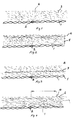
- Fig. 1 is a schematic longitudinal view of a known felt having layers of wadding and a protective flap.
- Fig. 2 is a similar view of a felt but according to the invention.
- Fig. 3 is a similar view as Fig. 2 but showing a second embodiment of the invention.
- Fig. 4 is a schematic view of the protective flap formed in order to be able to fasten by needling.
- the felt according to Fig. 1 includes a substrate 1, which has a transversal seam 2, which consists of usual locking loops and locking thread.
- the layer 3 of wadding having transversal fibers is needled to the upper side of the substrate.
- the so called protective flap 4 is placed in the area above the seam.
- Fig. 2 shows an embodiment of the invention, whereby the felt includes substrate 1 and the seam 2.
- a layer 5 of wadding having transversal fibers is placed upon the substrate.
- a layer 6 of wadding having longitudinal fibers is placed upon the layer 5.
- the layers themselves may include several layers. The layer having longitudinal fibers does not need to pass around the entire felt but it is necessary that the layer is placed within the area closest to the seam 2.
- a modified embodiment is shown in Fig. 3.
- the substrate 1 there is the layer 5 of wadding having transversal fibers.
- a loose woven fabric "scrim” or a non-woven fabric (e.g. "spunbond") is placed on this layer, the woven fabric or the nonwoven fabric has hereby the main part of the fiber material oriented in the longitudinal direction.
- a further layer 8 of wadding having its fibers in transversal direction or in longitudinal direction is then placed on the woven fabric 7.
- the fibers in the layer having the fibers in the longitudinal direction may partly or completely be exchanged to other fibers than those which are included in wadding.
- the exchanged fibers may be such which are stronger or have a better chemical or heat resistance. Fibers having greater length may also be used and also e.g. multifilament.
- the felt is normally produced by that the layer of wadding is needled to the substrate, the ends of which are joined with a locked seam.
- the flap is cut after being needled in the way as shown in Fig. 4.
- an oblique cut is made in the direction to the seam along the dashed line 9.
- the felt After that the felt has been mounted in the machine and the seam 2 has been locked the felt is placed in the right position over the seam and is fastened on the same place as it was disengaged by needling down into the felt with a portable needling machine having a certain amount of needles. There is a smaller risk for damages and wear on this needled flap than when the flap is free.
- the invention is not limited to needle felts in paper machines but can be adopted for needle felts, which have lockable seams and are used endless as e.g. conveyor belts and -felts.
Landscapes
- Engineering & Computer Science (AREA)
- Mechanical Engineering (AREA)
- Textile Engineering (AREA)
- Paper (AREA)
- Nonwoven Fabrics (AREA)
- Woven Fabrics (AREA)
- Secondary Cells (AREA)
- Furan Compounds (AREA)
Abstract
Description
- This invention concerns a felt, press felt, drying felt, conveyor belt or -felt, which is made endless by a releasable seam, said seam being covered by a protective flap having one or several layers whereby the uppermost layer is of wadding.
- Endless felts are used in paper machines in order to convey and support the wet and weak web through the presses and the press section. Felts are also used in the drying section - specifically in marking sensitive positions - in order to convey the web through the drying section, whereby the web is pressed by the flet against heated cylinder. One of the most important requirements of the felts is that they may not give impressions on the wet web. Such felts have therefore earlier been furnished endless even if this has made it more difficult to mount them in the paper machine. Drying felts have since many years been provided with a seam in order to facilitate the mounting in the paper machine and during the last three years also the press felts have been provided with such a seam. In order to prevent that the paper web is marked by the seam, the seam is covered by a wadding flap, which is a continuation of the wadding layer which is fastened to the felt, see EP-A-0 108 733. The wadding flap is worn in different ways when the felt is used in the paper machine and its firmness will therefore decide the limit for the effective lifetime of the felt and marking in the web will occur due to the wearing of the wadding flap.
- Felts which are provided with the above-mentioned seams are so called needle-felts which have a substrate on which a fibrous web, a layer of wadding is fastened. The layer of wadding is usually produced from carded fibrous web, which is placed transversely by an operating means with a breadth, which is in accordance with that of the substrate. The wadding layer is fastened to the substrate by several needless having downwardly directed hooks which penetrate the wadding layer and the substrate so that the fibers of the wadding layer are drawn downwardly between the yarns of the substrate and are fastened.
- By this way of covering the substrate by wadding the fibers of the wadding layer and of the so formed wadding flap over the seam are given a direction, which mainly is transverse to the longitudinal direction of the felts or the moving direction in the machines.
- In the wadding flap where fibers are not needled into the substrate but only penetrated so that the fibers are wound around and tied to each other, the strength in the operating direction will be very low. Fibers get very often loose by strains in the paper machine and the wadding flap can after a certain time not fulfil its function as a cover over the seam for preventing marking of the web.
- The connection between the wadding flap, the paper machine and the web will be discussed in the following.
- A bad or weard out wadding flap in the press section will result in: a risk of marking, breakage of the web, disturbing of the operation of the press, disturbing of the vacuum system and the fiber passage. The elements in the press section which are wearing the wadding flap are: suction boxes, HT- strips, press cylinders and guiding rollers. A wadding flap which is bad or weared out in the drying section will result in: risk of marking, breakage of the web and air leakage at so called ejector blowing boxes.
- Matters which have influence on the strength of the wadding flap in the drying section are: wear of the cylinders and the guiding rollers, chemical degradation and hydrolys and air blowing for cleaning.
- The object of the invention is to provide a protective flap, which is so formed that the wear on it is decreased, so that a better felt is obtained and a safer production of paper. The invention is thereby characterized in that the protective flap includes at least one layer, the fibers, the yarns or filaments of which are oriented in the moving direction of the felt in the machine.
- An embodiment of the invention will now be described with reference to the drawings.
- Fig. 1 is a schematic longitudinal view of a known felt having layers of wadding and a protective flap.
- Fig. 2 is a similar view of a felt but according to the invention.
- Fig. 3 is a similar view as Fig. 2 but showing a second embodiment of the invention.
- Fig. 4 is a schematic view of the protective flap formed in order to be able to fasten by needling.
- The felt according to Fig. 1 includes a substrate 1, which has a
transversal seam 2, which consists of usual locking loops and locking thread. Thelayer 3 of wadding having transversal fibers is needled to the upper side of the substrate. The so called protective flap 4 is placed in the area above the seam. - Fig. 2 shows an embodiment of the invention, whereby the felt includes substrate 1 and the
seam 2. Alayer 5 of wadding having transversal fibers is placed upon the substrate. Alayer 6 of wadding having longitudinal fibers is placed upon thelayer 5. The layers themselves may include several layers. The layer having longitudinal fibers does not need to pass around the entire felt but it is necessary that the layer is placed within the area closest to theseam 2. - A modified embodiment is shown in Fig. 3. On the substrate 1 there is the
layer 5 of wadding having transversal fibers. A loose woven fabric "scrim" or a non-woven fabric (e.g. "spunbond") is placed on this layer, the woven fabric or the nonwoven fabric has hereby the main part of the fiber material oriented in the longitudinal direction. Afurther layer 8 of wadding having its fibers in transversal direction or in longitudinal direction is then placed on thewoven fabric 7. - It should be noted that alternatively the fibers in the layer having the fibers in the longitudinal direction may partly or completely be exchanged to other fibers than those which are included in wadding. The exchanged fibers may be such which are stronger or have a better chemical or heat resistance. Fibers having greater length may also be used and also e.g. multifilament.
- By using longitudinal fibers in order to reinforce at least one of the layers of wadding above the seam,a further possibility is achieved to improve the seam with a flap of wadding. The felt is normally produced by that the layer of wadding is needled to the substrate, the ends of which are joined with a locked seam. The flap is cut after being needled in the way as shown in Fig. 4. Thus, an oblique cut is made in the direction to the seam along the dashed line 9. When there is a reinforced upper layer having longitudinal fibers it is possible to disengage this from the underlaying layers in a
point 10, which lies a certain distance after the seam when seen in the moving direction of the web. The disengaged flap of wadding has sufficient strength so that the structure is maintained when the felt is being mounted in the paper machine. After that the felt has been mounted in the machine and theseam 2 has been locked the felt is placed in the right position over the seam and is fastened on the same place as it was disengaged by needling down into the felt with a portable needling machine having a certain amount of needles. There is a smaller risk for damages and wear on this needled flap than when the flap is free. - The invention is not limited to needle felts in paper machines but can be adopted for needle felts, which have lockable seams and are used endless as e.g. conveyor belts and -felts.
Claims (6)
- Felt, press felt. drying felt, conveyor belt or -felt, which is made endless by a releasable seam, said seam being covered by a protective flap having one or several layers whereby the uppermost layer is of wadding, characterized in that the flap (4) includes at least one layer (6), the fibers, the yarns or the filament of which being oriented in the moving direction of the felt in the machine.
- Felt according to claim 1, characterized in that the layer (6) is a wadding.
- Felt according to claim 1, characterized in that the flap includes several layers, one of the lower layers (7) consisting of filaments oriented in the moving direction of the web.
- Felt according to claim 1, characterized in that the flap includes several layers, one of the lower layers (7) consisting of a woven fabric having longitudinal yarns orientated in the moving direction of the felt.
- Felt according to claim 1, characterized in that the flap includes several layers, one of the lower layers (7) consiting of a non-woven fabric with the fiber material orientated in the moving direction of the web.
- Felt according to any of the preceding claims, characterized in that the joining edge of the flap is oblique in the transverse direction, and that the length of the flap in the direction opposite to the moving direction of the felt is so long on the upper side that the flap after being placed gown above the seam can be fixed to the pulling strand by a needling procedure.
Priority Applications (1)
| Application Number | Priority Date | Filing Date | Title |
|---|---|---|---|
| AT86850346T ATE76914T1 (en) | 1985-10-11 | 1986-10-09 | PROTECTIVE COVER FOR SEWING TECHNICAL NEEDLE FELTS. |
Applications Claiming Priority (2)
| Application Number | Priority Date | Filing Date | Title |
|---|---|---|---|
| SE8504734A SE447140B (en) | 1985-10-11 | 1985-10-11 | SAFETY TABLES FOR THE SHARP OF NALADE FILTERS FOR INDUSTRIAL USE |
| SE8504734 | 1985-10-11 |
Publications (3)
| Publication Number | Publication Date |
|---|---|
| EP0218569A2 EP0218569A2 (en) | 1987-04-15 |
| EP0218569A3 EP0218569A3 (en) | 1989-10-25 |
| EP0218569B1 true EP0218569B1 (en) | 1992-06-03 |
Family
ID=20361710
Family Applications (1)
| Application Number | Title | Priority Date | Filing Date |
|---|---|---|---|
| EP86850346A Expired - Lifetime EP0218569B1 (en) | 1985-10-11 | 1986-10-09 | Protective flap for the seam in needle-felts for industrial use |
Country Status (8)
| Country | Link |
|---|---|
| US (1) | US4743482A (en) |
| EP (1) | EP0218569B1 (en) |
| AT (1) | ATE76914T1 (en) |
| CA (1) | CA1273838A (en) |
| DE (1) | DE3685539T2 (en) |
| ES (1) | ES2002518A6 (en) |
| FI (1) | FI85396C (en) |
| SE (1) | SE447140B (en) |
Families Citing this family (13)
| Publication number | Priority date | Publication date | Assignee | Title |
|---|---|---|---|---|
| GB8707473D0 (en) * | 1987-03-28 | 1987-04-29 | Scapa Porritt Ltd | Papermachine clothing |
| US4902383A (en) * | 1988-04-05 | 1990-02-20 | Asten Group, Inc. | Method of making a papermaker's felt with no flap seam |
| US4939025A (en) * | 1989-02-01 | 1990-07-03 | The Orr Felt Company | Papermaker's felt with flex joint seam for pin |
| US4913947A (en) * | 1989-02-01 | 1990-04-03 | The Orr Felt Company | Seam for papermaker's felt |
| US4938269A (en) * | 1989-02-01 | 1990-07-03 | The Orr Felt Company | Papermaker's felt seam with different loops |
| DE3914533A1 (en) * | 1989-05-02 | 1990-11-08 | Heimbach Gmbh Thomas Josef | TAPE FOR PAPER MACHINES |
| GB2289648B (en) * | 1994-05-26 | 1997-10-15 | Scapa Group Plc | Corrugator fabric |
| AT402516B (en) * | 1995-08-28 | 1997-06-25 | Huyck Austria | FABRIC TAPE SETUP |
| GB2357756B (en) * | 1999-12-24 | 2003-12-31 | Pilkington Plc | Forming belt |
| GB0025514D0 (en) * | 2000-10-18 | 2000-11-29 | Voith Fabrics Heidenheim Gmbh | Papermachine clothing |
| US7267745B2 (en) | 2004-09-03 | 2007-09-11 | Voith Fabrics, Inc. | Papermakers felt having a point-bonded web layer formed of coarse fibers |
| DE102006039102A1 (en) | 2006-08-19 | 2008-02-21 | Voith Patent Gmbh | Drying belt for a drying section of a machine for producing web material, in particular paper or cardboard |
| US20150308045A1 (en) * | 2014-04-25 | 2015-10-29 | Huyck Licensco, Inc. | Seamed papermaker's press felt with reinforced batt layer |
Family Cites Families (5)
| Publication number | Priority date | Publication date | Assignee | Title |
|---|---|---|---|---|
| US3392079A (en) * | 1964-05-22 | 1968-07-09 | Huyck Corp | Papermakers' felt |
| DE1958335A1 (en) * | 1969-11-20 | 1971-05-27 | Marx Gmbh J J | Paper web drying or dehydrating felt |
| US4427734A (en) * | 1982-04-19 | 1984-01-24 | Albany International Corp. | Wet press felt for papermaking machines |
| FI64960C (en) * | 1982-10-08 | 1984-02-10 | Tamfelt Oy Ab | TRANSPORTFILT FOER PAPPERSTILLVERKNING OCH FOERFARANDE FOER DES TILLVERKNING |
| SE429982C (en) * | 1982-11-02 | 1985-11-18 | Nordiskafilt Ab | FILLED WITH ALSO FOR THE PRESS PARTY IN A PAPER MACHINE AND THE PROCEDURE FOR ITS MANUFACTURING |
-
1985
- 1985-10-11 SE SE8504734A patent/SE447140B/en not_active IP Right Cessation
-
1986
- 1986-10-01 FI FI863967A patent/FI85396C/en not_active IP Right Cessation
- 1986-10-02 ES ES8602361A patent/ES2002518A6/en not_active Expired
- 1986-10-07 US US06/916,367 patent/US4743482A/en not_active Expired - Lifetime
- 1986-10-09 EP EP86850346A patent/EP0218569B1/en not_active Expired - Lifetime
- 1986-10-09 AT AT86850346T patent/ATE76914T1/en not_active IP Right Cessation
- 1986-10-09 DE DE8686850346T patent/DE3685539T2/en not_active Expired - Fee Related
- 1986-10-10 CA CA000520302A patent/CA1273838A/en not_active Expired - Fee Related
Also Published As
| Publication number | Publication date |
|---|---|
| FI85396C (en) | 1992-04-10 |
| CA1273838A (en) | 1990-09-11 |
| SE447140B (en) | 1986-10-27 |
| EP0218569A3 (en) | 1989-10-25 |
| SE8504734D0 (en) | 1985-10-11 |
| DE3685539D1 (en) | 1992-07-09 |
| FI863967A0 (en) | 1986-10-01 |
| DE3685539T2 (en) | 1993-04-29 |
| US4743482A (en) | 1988-05-10 |
| ATE76914T1 (en) | 1992-06-15 |
| FI863967L (en) | 1987-04-12 |
| EP0218569A2 (en) | 1987-04-15 |
| FI85396B (en) | 1991-12-31 |
| ES2002518A6 (en) | 1988-08-16 |
Similar Documents
| Publication | Publication Date | Title |
|---|---|---|
| FI89289B (en) | FOERFARANDE FOER FRAMSTAELLNING OCH MONTERING AV EN PINNSOEMFILT I EN PAPPERSMASKIN OCH EN PAPPERSMASKINFILT | |
| US8043477B2 (en) | Belt and method of making a belt for a paper making machine | |
| US4743482A (en) | Protective flap for the seam in needle-felts for industrial use | |
| FI92740C (en) | A method of making a felt for making paper | |
| US3392079A (en) | Papermakers' felt | |
| EP1035252B1 (en) | Pintle seamed papermaking fabric | |
| KR0185968B1 (en) | High speed cross wrapper | |
| FI83248C (en) | FOERFARANDE FOER HOPFOGNING AV TVAO SEKTIONER AV EN TORKFILT, SPECIELLT AV EN FILT VAOTPARTIET I EN PAPPERSMASKIN. | |
| JP3629276B2 (en) | Seam integrity of multi-layer / multi-seam press fabrics | |
| JPS59112091A (en) | Felt of press section of papermaking machine and production thereof | |
| JPH10510336A (en) | Fiber composite materials | |
| NO314413B1 (en) | Double-stitch paper machine wire with extra flow-reducing material | |
| US3260640A (en) | Stitched and needled non-woven fabric | |
| KR101051330B1 (en) | Layered Press Fabric | |
| EP0133478B1 (en) | Endless belts for battery pasting machines and method for manufacturing the same | |
| CN114867910A (en) | Paper machine clothing | |
| EP1270807A1 (en) | Pin seamed papermaker's press felt with laminated base fabric having low melt material machine directions yarns | |
| WO1995033095A1 (en) | Corrugator fabric | |
| JPH08209581A (en) | Pintle for combined seams | |
| CN101228313A (en) | Sewing felt for papermaking and manufacturing method thereof | |
| JPH0126800Y2 (en) | ||
| CZ20013742A3 (en) | Process and apparatus for strengthening strips of fabric | |
| CA1109383A (en) | Stabilized fabrics | |
| JPS629359Y2 (en) | ||
| CA2019854C (en) | Press felt |
Legal Events
| Date | Code | Title | Description |
|---|---|---|---|
| PUAI | Public reference made under article 153(3) epc to a published international application that has entered the european phase |
Free format text: ORIGINAL CODE: 0009012 |
|
| 17P | Request for examination filed |
Effective date: 19861028 |
|
| AK | Designated contracting states |
Kind code of ref document: A2 Designated state(s): AT DE FR GB IT NL |
|
| PUAL | Search report despatched |
Free format text: ORIGINAL CODE: 0009013 |
|
| AK | Designated contracting states |
Kind code of ref document: A3 Designated state(s): AT DE FR GB IT NL |
|
| RHK1 | Main classification (correction) |
Ipc: D21F 7/10 |
|
| 17Q | First examination report despatched |
Effective date: 19910301 |
|
| ITTA | It: last paid annual fee | ||
| GRAA | (expected) grant |
Free format text: ORIGINAL CODE: 0009210 |
|
| AK | Designated contracting states |
Kind code of ref document: B1 Designated state(s): AT DE FR GB IT NL |
|
| REF | Corresponds to: |
Ref document number: 76914 Country of ref document: AT Date of ref document: 19920615 Kind code of ref document: T |
|
| REF | Corresponds to: |
Ref document number: 3685539 Country of ref document: DE Date of ref document: 19920709 |
|
| ET | Fr: translation filed | ||
| ITF | It: translation for a ep patent filed | ||
| PLBE | No opposition filed within time limit |
Free format text: ORIGINAL CODE: 0009261 |
|
| STAA | Information on the status of an ep patent application or granted ep patent |
Free format text: STATUS: NO OPPOSITION FILED WITHIN TIME LIMIT |
|
| 26N | No opposition filed | ||
| REG | Reference to a national code |
Ref country code: GB Ref legal event code: IF02 |
|
| PGFP | Annual fee paid to national office [announced via postgrant information from national office to epo] |
Ref country code: FR Payment date: 20031217 Year of fee payment: 18 |
|
| PGFP | Annual fee paid to national office [announced via postgrant information from national office to epo] |
Ref country code: AT Payment date: 20031219 Year of fee payment: 18 |
|
| PGFP | Annual fee paid to national office [announced via postgrant information from national office to epo] |
Ref country code: GB Payment date: 20031222 Year of fee payment: 18 |
|
| PGFP | Annual fee paid to national office [announced via postgrant information from national office to epo] |
Ref country code: NL Payment date: 20031223 Year of fee payment: 18 |
|
| PG25 | Lapsed in a contracting state [announced via postgrant information from national office to epo] |
Ref country code: GB Free format text: LAPSE BECAUSE OF NON-PAYMENT OF DUE FEES Effective date: 20041009 Ref country code: AT Free format text: LAPSE BECAUSE OF NON-PAYMENT OF DUE FEES Effective date: 20041009 |
|
| PGFP | Annual fee paid to national office [announced via postgrant information from national office to epo] |
Ref country code: DE Payment date: 20041230 Year of fee payment: 19 |
|
| PG25 | Lapsed in a contracting state [announced via postgrant information from national office to epo] |
Ref country code: NL Free format text: LAPSE BECAUSE OF NON-PAYMENT OF DUE FEES Effective date: 20050501 |
|
| GBPC | Gb: european patent ceased through non-payment of renewal fee |
Effective date: 20041009 |
|
| PG25 | Lapsed in a contracting state [announced via postgrant information from national office to epo] |
Ref country code: FR Free format text: LAPSE BECAUSE OF NON-PAYMENT OF DUE FEES Effective date: 20050630 |
|
| NLV4 | Nl: lapsed or anulled due to non-payment of the annual fee |
Effective date: 20050501 |
|
| REG | Reference to a national code |
Ref country code: FR Ref legal event code: ST |
|
| PG25 | Lapsed in a contracting state [announced via postgrant information from national office to epo] |
Ref country code: IT Free format text: LAPSE BECAUSE OF NON-PAYMENT OF DUE FEES;WARNING: LAPSES OF ITALIAN PATENTS WITH EFFECTIVE DATE BEFORE 2007 MAY HAVE OCCURRED AT ANY TIME BEFORE 2007. THE CORRECT EFFECTIVE DATE MAY BE DIFFERENT FROM THE ONE RECORDED. Effective date: 20051009 |
|
| PG25 | Lapsed in a contracting state [announced via postgrant information from national office to epo] |
Ref country code: DE Free format text: LAPSE BECAUSE OF NON-PAYMENT OF DUE FEES Effective date: 20060503 |