EP0217823B1 - Uv-absorbing condensation polymeric compositions and products therefrom - Google Patents
Uv-absorbing condensation polymeric compositions and products therefrom Download PDFInfo
- Publication number
- EP0217823B1 EP0217823B1 EP86901614A EP86901614A EP0217823B1 EP 0217823 B1 EP0217823 B1 EP 0217823B1 EP 86901614 A EP86901614 A EP 86901614A EP 86901614 A EP86901614 A EP 86901614A EP 0217823 B1 EP0217823 B1 EP 0217823B1
- Authority
- EP
- European Patent Office
- Prior art keywords
- alkyl
- substituted
- polyester
- aryl
- alkoxy
- Prior art date
- Legal status (The legal status is an assumption and is not a legal conclusion. Google has not performed a legal analysis and makes no representation as to the accuracy of the status listed.)
- Expired - Lifetime
Links
- 238000009833 condensation Methods 0.000 title description 6
- 230000005494 condensation Effects 0.000 title description 6
- 239000000203 mixture Substances 0.000 title description 5
- 229920000642 polymer Polymers 0.000 description 27
- -1 methine compound Chemical class 0.000 description 20
- 125000000217 alkyl group Chemical group 0.000 description 18
- 229920000728 polyester Polymers 0.000 description 17
- IJGRMHOSHXDMSA-UHFFFAOYSA-N Atomic nitrogen Chemical compound N#N IJGRMHOSHXDMSA-UHFFFAOYSA-N 0.000 description 12
- LYCAIKOWRPUZTN-UHFFFAOYSA-N Ethylene glycol Chemical compound OCCO LYCAIKOWRPUZTN-UHFFFAOYSA-N 0.000 description 12
- 125000003545 alkoxy group Chemical group 0.000 description 11
- 150000001875 compounds Chemical class 0.000 description 11
- 239000002904 solvent Substances 0.000 description 11
- 125000003118 aryl group Chemical group 0.000 description 10
- 125000001434 methanylylidene group Chemical group [H]C#[*] 0.000 description 10
- 229910052736 halogen Inorganic materials 0.000 description 9
- 150000002367 halogens Chemical class 0.000 description 9
- 125000000753 cycloalkyl group Chemical group 0.000 description 8
- 125000004093 cyano group Chemical group *C#N 0.000 description 7
- 239000001257 hydrogen Substances 0.000 description 7
- 229910052739 hydrogen Inorganic materials 0.000 description 7
- 125000004435 hydrogen atom Chemical group [H]* 0.000 description 7
- 229910052751 metal Inorganic materials 0.000 description 7
- 239000002184 metal Substances 0.000 description 7
- OKKJLVBELUTLKV-UHFFFAOYSA-N Methanol Chemical compound OC OKKJLVBELUTLKV-UHFFFAOYSA-N 0.000 description 6
- 229910052757 nitrogen Inorganic materials 0.000 description 6
- 125000001997 phenyl group Chemical group [H]C1=C([H])C([H])=C(*)C([H])=C1[H] 0.000 description 6
- YIMQCDZDWXUDCA-UHFFFAOYSA-N [4-(hydroxymethyl)cyclohexyl]methanol Chemical compound OCC1CCC(CO)CC1 YIMQCDZDWXUDCA-UHFFFAOYSA-N 0.000 description 5
- 239000002253 acid Substances 0.000 description 5
- 238000006243 chemical reaction Methods 0.000 description 5
- RGHHSNMVTDWUBI-UHFFFAOYSA-N 4-hydroxybenzaldehyde Chemical compound OC1=CC=C(C=O)C=C1 RGHHSNMVTDWUBI-UHFFFAOYSA-N 0.000 description 4
- LRHPLDYGYMQRHN-UHFFFAOYSA-N N-Butanol Chemical compound CCCCO LRHPLDYGYMQRHN-UHFFFAOYSA-N 0.000 description 4
- 125000004390 alkyl sulfonyl group Chemical group 0.000 description 4
- WOZVHXUHUFLZGK-UHFFFAOYSA-N dimethyl terephthalate Chemical compound COC(=O)C1=CC=C(C(=O)OC)C=C1 WOZVHXUHUFLZGK-UHFFFAOYSA-N 0.000 description 4
- 150000002009 diols Chemical class 0.000 description 4
- 238000000605 extraction Methods 0.000 description 4
- 238000000034 method Methods 0.000 description 4
- 230000035699 permeability Effects 0.000 description 4
- 125000000951 phenoxy group Chemical group [H]C1=C([H])C([H])=C(O*)C([H])=C1[H] 0.000 description 4
- 229920000139 polyethylene terephthalate Polymers 0.000 description 4
- 239000005020 polyethylene terephthalate Substances 0.000 description 4
- 238000002360 preparation method Methods 0.000 description 4
- 239000000047 product Substances 0.000 description 4
- 0 *[C@](CC1)CC2[C@@]1(C1)[C@]1C2 Chemical compound *[C@](CC1)CC2[C@@]1(C1)[C@]1C2 0.000 description 3
- 229920001634 Copolyester Polymers 0.000 description 3
- RTAQQCXQSZGOHL-UHFFFAOYSA-N Titanium Chemical compound [Ti] RTAQQCXQSZGOHL-UHFFFAOYSA-N 0.000 description 3
- YXFVVABEGXRONW-UHFFFAOYSA-N Toluene Chemical compound CC1=CC=CC=C1 YXFVVABEGXRONW-UHFFFAOYSA-N 0.000 description 3
- 125000001931 aliphatic group Chemical group 0.000 description 3
- 125000003342 alkenyl group Chemical group 0.000 description 3
- 235000013361 beverage Nutrition 0.000 description 3
- 229910002092 carbon dioxide Inorganic materials 0.000 description 3
- MTHSVFCYNBDYFN-UHFFFAOYSA-N diethylene glycol Chemical compound OCCOCCO MTHSVFCYNBDYFN-UHFFFAOYSA-N 0.000 description 3
- 235000013305 food Nutrition 0.000 description 3
- 238000006068 polycondensation reaction Methods 0.000 description 3
- 239000011541 reaction mixture Substances 0.000 description 3
- 125000000547 substituted alkyl group Chemical group 0.000 description 3
- 238000003786 synthesis reaction Methods 0.000 description 3
- KKEYFWRCBNTPAC-UHFFFAOYSA-N terephthalic acid group Chemical group C(C1=CC=C(C(=O)O)C=C1)(=O)O KKEYFWRCBNTPAC-UHFFFAOYSA-N 0.000 description 3
- XLYOFNOQVPJJNP-UHFFFAOYSA-N water Substances O XLYOFNOQVPJJNP-UHFFFAOYSA-N 0.000 description 3
- QPFMBZIOSGYJDE-UHFFFAOYSA-N 1,1,2,2-tetrachloroethane Chemical compound ClC(Cl)C(Cl)Cl QPFMBZIOSGYJDE-UHFFFAOYSA-N 0.000 description 2
- CSCPPACGZOOCGX-UHFFFAOYSA-N Acetone Chemical compound CC(C)=O CSCPPACGZOOCGX-UHFFFAOYSA-N 0.000 description 2
- CURLTUGMZLYLDI-UHFFFAOYSA-N Carbon dioxide Chemical compound O=C=O CURLTUGMZLYLDI-UHFFFAOYSA-N 0.000 description 2
- IMNFDUFMRHMDMM-UHFFFAOYSA-N N-Heptane Chemical compound CCCCCCC IMNFDUFMRHMDMM-UHFFFAOYSA-N 0.000 description 2
- NQRYJNQNLNOLGT-UHFFFAOYSA-N Piperidine Chemical compound C1CCNCC1 NQRYJNQNLNOLGT-UHFFFAOYSA-N 0.000 description 2
- 238000010521 absorption reaction Methods 0.000 description 2
- 125000002777 acetyl group Chemical group [H]C([H])([H])C(*)=O 0.000 description 2
- WNLRTRBMVRJNCN-UHFFFAOYSA-N adipic acid Chemical compound OC(=O)CCCCC(O)=O WNLRTRBMVRJNCN-UHFFFAOYSA-N 0.000 description 2
- 125000005236 alkanoylamino group Chemical group 0.000 description 2
- 125000004414 alkyl thio group Chemical group 0.000 description 2
- 238000004458 analytical method Methods 0.000 description 2
- 125000004391 aryl sulfonyl group Chemical group 0.000 description 2
- 230000008033 biological extinction Effects 0.000 description 2
- 230000015572 biosynthetic process Effects 0.000 description 2
- 230000000740 bleeding effect Effects 0.000 description 2
- WERYXYBDKMZEQL-UHFFFAOYSA-N butane-1,4-diol Chemical compound OCCCCO WERYXYBDKMZEQL-UHFFFAOYSA-N 0.000 description 2
- 239000002537 cosmetic Substances 0.000 description 2
- PFURGBBHAOXLIO-UHFFFAOYSA-N cyclohexane-1,2-diol Chemical compound OC1CCCCC1O PFURGBBHAOXLIO-UHFFFAOYSA-N 0.000 description 2
- 239000000975 dye Substances 0.000 description 2
- 150000002148 esters Chemical class 0.000 description 2
- 239000000835 fiber Substances 0.000 description 2
- 239000007789 gas Substances 0.000 description 2
- 239000011521 glass Substances 0.000 description 2
- QQVIHTHCMHWDBS-UHFFFAOYSA-N isophthalic acid Chemical compound OC(=O)C1=CC=CC(C(O)=O)=C1 QQVIHTHCMHWDBS-UHFFFAOYSA-N 0.000 description 2
- 238000000465 moulding Methods 0.000 description 2
- 239000012299 nitrogen atmosphere Substances 0.000 description 2
- 238000012545 processing Methods 0.000 description 2
- 238000012216 screening Methods 0.000 description 2
- CXMXRPHRNRROMY-UHFFFAOYSA-N sebacic acid Chemical compound OC(=O)CCCCCCCCC(O)=O CXMXRPHRNRROMY-UHFFFAOYSA-N 0.000 description 2
- 238000010561 standard procedure Methods 0.000 description 2
- KKEYFWRCBNTPAC-UHFFFAOYSA-L terephthalate(2-) Chemical compound [O-]C(=O)C1=CC=C(C([O-])=O)C=C1 KKEYFWRCBNTPAC-UHFFFAOYSA-L 0.000 description 2
- 238000002371 ultraviolet--visible spectrum Methods 0.000 description 2
- DNIAPMSPPWPWGF-VKHMYHEASA-N (+)-propylene glycol Chemical compound C[C@H](O)CO DNIAPMSPPWPWGF-VKHMYHEASA-N 0.000 description 1
- DNIAPMSPPWPWGF-GSVOUGTGSA-N (R)-(-)-Propylene glycol Chemical compound C[C@@H](O)CO DNIAPMSPPWPWGF-GSVOUGTGSA-N 0.000 description 1
- DYLIWHYUXAJDOJ-OWOJBTEDSA-N (e)-4-(6-aminopurin-9-yl)but-2-en-1-ol Chemical compound NC1=NC=NC2=C1N=CN2C\C=C\CO DYLIWHYUXAJDOJ-OWOJBTEDSA-N 0.000 description 1
- 125000004509 1,3,4-oxadiazol-2-yl group Chemical group O1C(=NN=C1)* 0.000 description 1
- 125000004521 1,3,4-thiadiazol-2-yl group Chemical group S1C(=NN=C1)* 0.000 description 1
- YPFDHNVEDLHUCE-UHFFFAOYSA-N 1,3-propanediol Substances OCCCO YPFDHNVEDLHUCE-UHFFFAOYSA-N 0.000 description 1
- PXGZQGDTEZPERC-UHFFFAOYSA-N 1,4-cyclohexanedicarboxylic acid Chemical compound OC(=O)C1CCC(C(O)=O)CC1 PXGZQGDTEZPERC-UHFFFAOYSA-N 0.000 description 1
- RTBFRGCFXZNCOE-UHFFFAOYSA-N 1-methylsulfonylpiperidin-4-one Chemical compound CS(=O)(=O)N1CCC(=O)CC1 RTBFRGCFXZNCOE-UHFFFAOYSA-N 0.000 description 1
- LCZVSXRMYJUNFX-UHFFFAOYSA-N 2-[2-(2-hydroxypropoxy)propoxy]propan-1-ol Chemical compound CC(O)COC(C)COC(C)CO LCZVSXRMYJUNFX-UHFFFAOYSA-N 0.000 description 1
- 125000004174 2-benzimidazolyl group Chemical group [H]N1C(*)=NC2=C([H])C([H])=C([H])C([H])=C12 0.000 description 1
- 125000003903 2-propenyl group Chemical group [H]C([*])([H])C([H])=C([H])[H] 0.000 description 1
- WTKWFNIIIXNTDO-UHFFFAOYSA-N 3-isocyanato-5-methyl-2-(trifluoromethyl)furan Chemical compound CC1=CC(N=C=O)=C(C(F)(F)F)O1 WTKWFNIIIXNTDO-UHFFFAOYSA-N 0.000 description 1
- HCXJFMDOHDNDCC-UHFFFAOYSA-N 5-$l^{1}-oxidanyl-3,4-dihydropyrrol-2-one Chemical group O=C1CCC(=O)[N]1 HCXJFMDOHDNDCC-UHFFFAOYSA-N 0.000 description 1
- OFOBLEOULBTSOW-UHFFFAOYSA-N Malonic acid Chemical compound OC(=O)CC(O)=O OFOBLEOULBTSOW-UHFFFAOYSA-N 0.000 description 1
- ISWSIDIOOBJBQZ-UHFFFAOYSA-N Phenol Chemical compound OC1=CC=CC=C1 ISWSIDIOOBJBQZ-UHFFFAOYSA-N 0.000 description 1
- KDYFGRWQOYBRFD-UHFFFAOYSA-N Succinic acid Natural products OC(=O)CCC(O)=O KDYFGRWQOYBRFD-UHFFFAOYSA-N 0.000 description 1
- XDODWINGEHBYRT-UHFFFAOYSA-N [2-(hydroxymethyl)cyclohexyl]methanol Chemical compound OCC1CCCCC1CO XDODWINGEHBYRT-UHFFFAOYSA-N 0.000 description 1
- LUSFFPXRDZKBMF-UHFFFAOYSA-N [3-(hydroxymethyl)cyclohexyl]methanol Chemical compound OCC1CCCC(CO)C1 LUSFFPXRDZKBMF-UHFFFAOYSA-N 0.000 description 1
- 238000002835 absorbance Methods 0.000 description 1
- 150000007513 acids Chemical class 0.000 description 1
- 239000000654 additive Substances 0.000 description 1
- 239000001361 adipic acid Substances 0.000 description 1
- 235000011037 adipic acid Nutrition 0.000 description 1
- 125000002723 alicyclic group Chemical group 0.000 description 1
- 125000005091 alkenylcarbonylamino group Chemical group 0.000 description 1
- 125000004183 alkoxy alkyl group Chemical group 0.000 description 1
- 125000003282 alkyl amino group Chemical group 0.000 description 1
- 125000005153 alkyl sulfamoyl group Chemical group 0.000 description 1
- 125000005422 alkyl sulfonamido group Chemical group 0.000 description 1
- 125000004397 aminosulfonyl group Chemical group NS(=O)(=O)* 0.000 description 1
- 229920006125 amorphous polymer Polymers 0.000 description 1
- 150000008064 anhydrides Chemical class 0.000 description 1
- JFCQEDHGNNZCLN-UHFFFAOYSA-N anhydrous glutaric acid Natural products OC(=O)CCCC(O)=O JFCQEDHGNNZCLN-UHFFFAOYSA-N 0.000 description 1
- 125000003435 aroyl group Chemical group 0.000 description 1
- 125000003710 aryl alkyl group Chemical group 0.000 description 1
- 125000001769 aryl amino group Chemical group 0.000 description 1
- QVGXLLKOCUKJST-UHFFFAOYSA-N atomic oxygen Chemical compound [O] QVGXLLKOCUKJST-UHFFFAOYSA-N 0.000 description 1
- 230000004888 barrier function Effects 0.000 description 1
- 230000008901 benefit Effects 0.000 description 1
- 125000003785 benzimidazolyl group Chemical group N1=C(NC2=C1C=CC=C2)* 0.000 description 1
- 125000001164 benzothiazolyl group Chemical group S1C(=NC2=C1C=CC=C2)* 0.000 description 1
- 125000004541 benzoxazolyl group Chemical group O1C(=NC2=C1C=CC=C2)* 0.000 description 1
- 230000005540 biological transmission Effects 0.000 description 1
- KDYFGRWQOYBRFD-NUQCWPJISA-N butanedioic acid Chemical compound O[14C](=O)CC[14C](O)=O KDYFGRWQOYBRFD-NUQCWPJISA-N 0.000 description 1
- 125000003917 carbamoyl group Chemical group [H]N([H])C(*)=O 0.000 description 1
- 125000001589 carboacyl group Chemical group 0.000 description 1
- 125000004432 carbon atom Chemical group C* 0.000 description 1
- 239000001569 carbon dioxide Substances 0.000 description 1
- 230000015556 catabolic process Effects 0.000 description 1
- 230000008859 change Effects 0.000 description 1
- 238000004587 chromatography analysis Methods 0.000 description 1
- PMMYEEVYMWASQN-IMJSIDKUSA-N cis-4-Hydroxy-L-proline Chemical compound O[C@@H]1CN[C@H](C(O)=O)C1 PMMYEEVYMWASQN-IMJSIDKUSA-N 0.000 description 1
- 230000006835 compression Effects 0.000 description 1
- 238000007906 compression Methods 0.000 description 1
- IQFVPQOLBLOTPF-HKXUKFGYSA-L congo red Chemical compound [Na+].[Na+].C1=CC=CC2=C(N)C(/N=N/C3=CC=C(C=C3)C3=CC=C(C=C3)/N=N/C3=C(C4=CC=CC=C4C(=C3)S([O-])(=O)=O)N)=CC(S([O-])(=O)=O)=C21 IQFVPQOLBLOTPF-HKXUKFGYSA-L 0.000 description 1
- 239000000356 contaminant Substances 0.000 description 1
- 238000007796 conventional method Methods 0.000 description 1
- 238000001816 cooling Methods 0.000 description 1
- 229920001577 copolymer Polymers 0.000 description 1
- LBJNMUFDOHXDFG-UHFFFAOYSA-N copper;hydrate Chemical compound O.[Cu].[Cu] LBJNMUFDOHXDFG-UHFFFAOYSA-N 0.000 description 1
- 125000004966 cyanoalkyl group Chemical group 0.000 description 1
- XBZSBBLNHFMTEB-UHFFFAOYSA-N cyclohexane-1,3-dicarboxylic acid Chemical compound OC(=O)C1CCCC(C(O)=O)C1 XBZSBBLNHFMTEB-UHFFFAOYSA-N 0.000 description 1
- 125000000113 cyclohexyl group Chemical group [H]C1([H])C([H])([H])C([H])([H])C([H])(*)C([H])([H])C1([H])[H] 0.000 description 1
- 238000006731 degradation reaction Methods 0.000 description 1
- 125000004663 dialkyl amino group Chemical group 0.000 description 1
- 150000001991 dicarboxylic acids Chemical class 0.000 description 1
- 125000004177 diethyl group Chemical group [H]C([H])([H])C([H])([H])* 0.000 description 1
- 238000000113 differential scanning calorimetry Methods 0.000 description 1
- 125000000118 dimethyl group Chemical group [H]C([H])([H])* 0.000 description 1
- SZXQTJUDPRGNJN-UHFFFAOYSA-N dipropylene glycol Chemical compound OCCCOCCCO SZXQTJUDPRGNJN-UHFFFAOYSA-N 0.000 description 1
- 238000004090 dissolution Methods 0.000 description 1
- 125000004185 ester group Chemical group 0.000 description 1
- HRBVVSOFSLPAOY-UHFFFAOYSA-N ethyl 2-cyano-3-(4-hydroxyphenyl)prop-2-enoate Chemical compound CCOC(=O)C(C#N)=CC1=CC=C(O)C=C1 HRBVVSOFSLPAOY-UHFFFAOYSA-N 0.000 description 1
- ZIUSEGSNTOUIPT-UHFFFAOYSA-N ethyl 2-cyanoacetate Chemical compound CCOC(=O)CC#N ZIUSEGSNTOUIPT-UHFFFAOYSA-N 0.000 description 1
- 239000000945 filler Substances 0.000 description 1
- 238000011049 filling Methods 0.000 description 1
- 238000001914 filtration Methods 0.000 description 1
- 235000015203 fruit juice Nutrition 0.000 description 1
- 125000002541 furyl group Chemical group 0.000 description 1
- 125000003827 glycol group Chemical group 0.000 description 1
- 238000010438 heat treatment Methods 0.000 description 1
- 125000000623 heterocyclic group Chemical group 0.000 description 1
- XXMIOPMDWAUFGU-UHFFFAOYSA-N hexane-1,6-diol Chemical compound OCCCCCCO XXMIOPMDWAUFGU-UHFFFAOYSA-N 0.000 description 1
- 125000002768 hydroxyalkyl group Chemical group 0.000 description 1
- 230000031700 light absorption Effects 0.000 description 1
- 239000007788 liquid Substances 0.000 description 1
- SSJMWLROUBFBOB-UHFFFAOYSA-N methyl 2-cyano-3-(4-hydroxyphenyl)prop-2-enoate Chemical compound COC(=O)C(C#N)=CC1=CC=C(O)C=C1 SSJMWLROUBFBOB-UHFFFAOYSA-N 0.000 description 1
- ANGDWNBGPBMQHW-UHFFFAOYSA-N methyl cyanoacetate Chemical compound COC(=O)CC#N ANGDWNBGPBMQHW-UHFFFAOYSA-N 0.000 description 1
- 238000012986 modification Methods 0.000 description 1
- 230000004048 modification Effects 0.000 description 1
- DNIAPMSPPWPWGF-UHFFFAOYSA-N monopropylene glycol Natural products CC(O)CO DNIAPMSPPWPWGF-UHFFFAOYSA-N 0.000 description 1
- TVIDDXQYHWJXFK-UHFFFAOYSA-N n-Dodecanedioic acid Natural products OC(=O)CCCCCCCCCCC(O)=O TVIDDXQYHWJXFK-UHFFFAOYSA-N 0.000 description 1
- SLCVBVWXLSEKPL-UHFFFAOYSA-N neopentyl glycol Chemical compound OCC(C)(C)CO SLCVBVWXLSEKPL-UHFFFAOYSA-N 0.000 description 1
- 239000001301 oxygen Substances 0.000 description 1
- 229910052760 oxygen Inorganic materials 0.000 description 1
- 125000004430 oxygen atom Chemical group O* 0.000 description 1
- 125000005544 phthalimido group Chemical group 0.000 description 1
- 239000000049 pigment Substances 0.000 description 1
- 239000004033 plastic Substances 0.000 description 1
- 229920003023 plastic Polymers 0.000 description 1
- 238000010094 polymer processing Methods 0.000 description 1
- 229920000166 polytrimethylene carbonate Polymers 0.000 description 1
- 125000002924 primary amino group Chemical group [H]N([H])* 0.000 description 1
- 235000013772 propylene glycol Nutrition 0.000 description 1
- 239000012264 purified product Substances 0.000 description 1
- 125000000714 pyrimidinyl group Chemical group 0.000 description 1
- 239000000376 reactant Substances 0.000 description 1
- 238000010992 reflux Methods 0.000 description 1
- 238000009877 rendering Methods 0.000 description 1
- 239000002453 shampoo Substances 0.000 description 1
- 235000014214 soft drink Nutrition 0.000 description 1
- 230000006641 stabilisation Effects 0.000 description 1
- 238000011105 stabilization Methods 0.000 description 1
- 125000001424 substituent group Chemical group 0.000 description 1
- 125000005415 substituted alkoxy group Chemical group 0.000 description 1
- 125000003107 substituted aryl group Chemical group 0.000 description 1
- 125000005346 substituted cycloalkyl group Chemical group 0.000 description 1
- HQHCYKULIHKCEB-UHFFFAOYSA-N tetradecanedioic acid Natural products OC(=O)CCCCCCCCCCCCC(O)=O HQHCYKULIHKCEB-UHFFFAOYSA-N 0.000 description 1
- 229920001169 thermoplastic Polymers 0.000 description 1
- 239000004416 thermosoftening plastic Substances 0.000 description 1
- 239000010936 titanium Substances 0.000 description 1
- 229910052719 titanium Inorganic materials 0.000 description 1
- ZIBGPFATKBEMQZ-UHFFFAOYSA-N triethylene glycol Chemical compound OCCOCCOCCO ZIBGPFATKBEMQZ-UHFFFAOYSA-N 0.000 description 1
- 235000014101 wine Nutrition 0.000 description 1
Classifications
-
- C—CHEMISTRY; METALLURGY
- C08—ORGANIC MACROMOLECULAR COMPOUNDS; THEIR PREPARATION OR CHEMICAL WORKING-UP; COMPOSITIONS BASED THEREON
- C08G—MACROMOLECULAR COMPOUNDS OBTAINED OTHERWISE THAN BY REACTIONS ONLY INVOLVING UNSATURATED CARBON-TO-CARBON BONDS
- C08G63/00—Macromolecular compounds obtained by reactions forming a carboxylic ester link in the main chain of the macromolecule
- C08G63/68—Polyesters containing atoms other than carbon, hydrogen and oxygen
-
- C—CHEMISTRY; METALLURGY
- C08—ORGANIC MACROMOLECULAR COMPOUNDS; THEIR PREPARATION OR CHEMICAL WORKING-UP; COMPOSITIONS BASED THEREON
- C08G—MACROMOLECULAR COMPOUNDS OBTAINED OTHERWISE THAN BY REACTIONS ONLY INVOLVING UNSATURATED CARBON-TO-CARBON BONDS
- C08G63/00—Macromolecular compounds obtained by reactions forming a carboxylic ester link in the main chain of the macromolecule
- C08G63/02—Polyesters derived from hydroxycarboxylic acids or from polycarboxylic acids and polyhydroxy compounds
- C08G63/12—Polyesters derived from hydroxycarboxylic acids or from polycarboxylic acids and polyhydroxy compounds derived from polycarboxylic acids and polyhydroxy compounds
- C08G63/52—Polycarboxylic acids or polyhydroxy compounds in which at least one of the two components contains aliphatic unsaturation
-
- C—CHEMISTRY; METALLURGY
- C08—ORGANIC MACROMOLECULAR COMPOUNDS; THEIR PREPARATION OR CHEMICAL WORKING-UP; COMPOSITIONS BASED THEREON
- C08G—MACROMOLECULAR COMPOUNDS OBTAINED OTHERWISE THAN BY REACTIONS ONLY INVOLVING UNSATURATED CARBON-TO-CARBON BONDS
- C08G63/00—Macromolecular compounds obtained by reactions forming a carboxylic ester link in the main chain of the macromolecule
- C08G63/02—Polyesters derived from hydroxycarboxylic acids or from polycarboxylic acids and polyhydroxy compounds
- C08G63/12—Polyesters derived from hydroxycarboxylic acids or from polycarboxylic acids and polyhydroxy compounds derived from polycarboxylic acids and polyhydroxy compounds
- C08G63/16—Dicarboxylic acids and dihydroxy compounds
- C08G63/20—Polyesters having been prepared in the presence of compounds having one reactive group or more than two reactive groups
-
- C—CHEMISTRY; METALLURGY
- C08—ORGANIC MACROMOLECULAR COMPOUNDS; THEIR PREPARATION OR CHEMICAL WORKING-UP; COMPOSITIONS BASED THEREON
- C08G—MACROMOLECULAR COMPOUNDS OBTAINED OTHERWISE THAN BY REACTIONS ONLY INVOLVING UNSATURATED CARBON-TO-CARBON BONDS
- C08G63/00—Macromolecular compounds obtained by reactions forming a carboxylic ester link in the main chain of the macromolecule
- C08G63/68—Polyesters containing atoms other than carbon, hydrogen and oxygen
- C08G63/685—Polyesters containing atoms other than carbon, hydrogen and oxygen containing nitrogen
- C08G63/6854—Polyesters containing atoms other than carbon, hydrogen and oxygen containing nitrogen derived from polycarboxylic acids and polyhydroxy compounds
- C08G63/6858—Polycarboxylic acids and polyhydroxy compounds in which at least one of the two components contains aliphatic unsaturation
-
- C—CHEMISTRY; METALLURGY
- C08—ORGANIC MACROMOLECULAR COMPOUNDS; THEIR PREPARATION OR CHEMICAL WORKING-UP; COMPOSITIONS BASED THEREON
- C08G—MACROMOLECULAR COMPOUNDS OBTAINED OTHERWISE THAN BY REACTIONS ONLY INVOLVING UNSATURATED CARBON-TO-CARBON BONDS
- C08G63/00—Macromolecular compounds obtained by reactions forming a carboxylic ester link in the main chain of the macromolecule
- C08G63/68—Polyesters containing atoms other than carbon, hydrogen and oxygen
- C08G63/688—Polyesters containing atoms other than carbon, hydrogen and oxygen containing sulfur
- C08G63/6884—Polyesters containing atoms other than carbon, hydrogen and oxygen containing sulfur derived from polycarboxylic acids and polyhydroxy compounds
- C08G63/6888—Polycarboxylic acids and polyhydroxy compounds in which at least one of the two components contains aliphatic unsaturation
Definitions
- This invention concerns polyester condensation polymers, wherein certain UV (ultraviolet light) absorbing methine compounds have been reacted into the polymer e.g. as a chain terminator to impart UV screening properties thereto.
- UV (ultraviolet light) absorbing methine compounds have been reacted into the polymer e.g. as a chain terminator to impart UV screening properties thereto.
- Many products such as fruit juices, soft drinks, wines, food products, cosmetics and shampoos are deleteriously affected by UV light when packaged in clear plastic containers which pass significant portions of the available light at any wavelength from approximately 250 to 390 nm.
- polymeric containers can be manufactured which absorb these harmful wavelengths and therefore reduce or eliminate the UV light degradation of products packaged therein.
- a further advantage of the present polymeric compositions is that conventional polyester dyes and other additives such as pigments, fillers, brighteners and the like may be incorporated therein, and the UV screening properties of the methine compounds impart significant stabilization to both the polyester and the dyes.
- the present compounds are thermally stable and nonsublimable at the polymer preparation and processing temperatures, are fast to light and are nonextractable from the polymers, thus rendering the polymers particularly suitable for use as beverage bottles and food, pharmaceutical and cosmetic containers.
- the methine compounds are useful in total concentrations given herein in parts per million (ppm) ranging from about 1.0 to about 5,000, preferably 2.0 to about 1,500 (parts by weight of methine compound per million parts by weight of condensation polymer).
- the present polymers are linear, thermoplastic, molding or fiber grade having an I.V. of from about 0.4 to about 1.2, and preferably are polyesters wherein the acid moiety is comprised of at least about 50 mol% terephthalic acid residue, and the glycol moiety of at least about 50 mol % ethylene glycol or 1.4-cyclohexanedimethanol residue, and containing a total of from about 2 to 1,500 ppm of one or more of the reacted methine compounds.
- certain UV-absorbing methine compounds defined below are reacted with the condensation polymer and impart thereto the property of ultraviolet or visible light absorption generally with a maximum absorbance within the range of from about 320 nm to about 380 nm.
- These compounds preferably have molecular weights of from about 200 to about 600 although lower and higher molecular.weight compounds are also operable.
- These compounds contain an acid or ester group which condenses onto the polymer chain as a terminator.
- these compounds are thermally stable at polymer processing conditions, which includes polycondensation temperatures of up to about 300°C which are employed, for example, in the preparation of polyesters such as poly(ethylene terephthalate) and copolymers of poly(ethylene terephthalate) and poiy(1,4-cyctohexytenedimethytene terephthalate).
- the present invention is defined in its broad embodiment as a composition comprising molding or fiber grade condensation polymer having reacted therewith a total of from 1.0 to about 5,000 ppm, of at least one compound of the formula absorbing in the range of from about 320 nm to about 380 nm, and being nonextractable from said polymer and stable under the polymer preparation and processing conditions wherein in the above formula:
- R is selected from hydrogen; cycloalkyl; cycloalkyl substituted with one or two of alkyl, alkoxy or halogen; phenyl; phenyl subsituted with 1-3 of alkyl, alkoxy, halogen, alkanoylamino, or cyano; straight or branched lower alkenyl; straight or branched alkyl and such alkyl substituted with 1-3 of the following: halogen; cyano; succinimido; glutarimido; phthalimido; phthalimidino; 2-pyrrolidono; cyclohexyl; phenyl; phenyl substituted with alkyl, alkoxy, halogen, cyano, or alkylsulfamoyl; vinylsulfonyl; acrylamido; sulfamyl; benzoylsulfonicimido; alkylsulfonamido; phenylsulfonamid
- P is cyano, carbamyl, N-alkylcarbamyl, N-alkyl-N-arylcarbamyl, N,N-dialkylcarbamyl, N,N-alkyl- arylcarbamyl, N-arylcarbamyl, N-cyclohexylcarbamyl; aryl, 2-benzoxazolyl, 2-benzothiazolyl, 2-benzimidazolyl, 1,3,4-thiadiazol-2-yl, 1,3,4-oxadiazol-2-yl, alkylsulfonyl, arylsulfonyl or acyhl.
- alkyl or divalent aliphatic moieties or portions of the various groups contain from 1-10 carbons, preferably 1-6 carbons, straight or branched chain.
- a most preferred polyester composition contains the reaction residue of the compound in from about 10 to about 300 ppm.
- the nonextractabilities of the present methine compounds are determined as follows:
- Solvent blanks are run under the same extraction conditions without polymer. In most cases samples are extracted, spiked, and analyzed in duplicates.
- polyesters useful in this invention for reaction with the methine compounds are those produced by conventional techniques using one or more diols and one or more dicarboxylic acids. Typical of these polyesters are those disclosed, for example, in U.S. Patent 4,359,570.
- the diol components of the polyester are selected, for example, from ethylene glycol, 1,4-cyclohexanedimethanol, 1,2-propanediol, 1,3-propanediol, 1,4-butanediol, 2,2-dimethyl-1,3-propanediol, 1,6-hexanediol, 1,2-cyclohexanediol, 1,4-cyclohexanediol, 1,2-cyclohexanedimethanol, 1,3-cyclohexanedimethanol, X,8-bis(hydroxymethyl)tricyclo-[5.2.1.0]-decane wherein X represents 3, 4, or 5, and diols containing one or more oxygen atoms in the chain, e.g., diethylene glycol, triethylene glycol, dipropylene glycol, tripropylene glycol and the like containing from about 2 to about 18, preferably 2 to 12 carbon atoms in each aliphatic moiety.
- the acid components (aliphatic, alicyclic, or aromatic dicarboxylic acids) of the polyester are selected, for example, from terephthalic acid, isophthalic acid, 1,4-cyclohexanedicarboxylic acid, 1,3-cyclohexanedicarboxylic acid, succinic acid, glutaric acid, adipic acid, sebacic acid, 1,12-dodecanedioic acid, and the like.
- a functional acid derivative thereof such as the dimethyl, diethyl, or dipropyl ester of the dicarboxylic acid.
- the anhydrides of these acids also can be employed.
- the preferred copolyesters are especially useful for making blow molded bottles or containers for beverages, and for molded food packages and the like.
- certain of these copolyesters are color, I.V., and heat distortion or "hot fill" stable at temperatures of up to about 100°C when properly heat set, and molded articles therefrom exhibit good thin wall rigidity, excellent clarity and good barrier properties with respect to water and atmospheric gases, particularly carbon dioxide and oxygen.
- the most preferred polyesters therefor comprise poly(ethylene terephthalate) and this polymer modified with u to about 5 mole % of 1,4-cyclohexanedimethanol, wherein the polymers have been sufficiently heat set and oriented by methods well known in the art to give a desired degree of crystallinity.
- a polymer is "hot fill” stable at a prescribed temperature when less than 2% change in volume of a container manufactured therefrom occurs upon filling the same with a liquid at that temperature.
- these most preferred polyesters have an I.V.
- the Tg is determined by Differential Scanning Calorimetry at a scan rate of 20 Centigrade Degrees/min., the 0 2 Permeability by the standard operating procedure of a MOCON OXTRAN 100 instrument of Modern Controls, Inc., of Elk River, Minnesota, and the C0 2 Permeability by the standard operating procedure of a MOCON PERMATRAN C II, also of Modern Controls.
- Ethyl 2-cyano-3-(4-hydroxyphenyl)propenoate shown below is prepared by the reaction of 4-hydroxybenzaldehyde with ethyl cyanoacetate in the presence of a base cataylst in toluene. This pale yellow compound absorbs UV light at ⁇ max 350 nm with a molar extinction coefficient of 27,000.
- Methyl 2-Cyano-3(4-hydroxyphenyl)propenoate is prepared as follows:
- the inherent viscosities (I.V.) of each of the copolyesters herein are determined according to ASTM D2857-70 procedure in a Wagner Viscometer of Lab Glass Inc. of Vineland, N.J. having a 1/2 ml. capillary bulb, using a polymer concentration of 0.5% by weight in 60/40 by weight, phenol//tetrachloroethane solvent.
- the procedure comprises heating the polymer/solvent system at 120°C for 15 minutes to enhance dissolution of the polymer, cooling the solution to 25°C and measuring the time of flow at 25°C.
- the I.V. is calculated from the equation where:
- a typical synthesis of poly(ethylene terephthalate) reacted with a methine compound is as follows. A total of 97g (0.5 'mol) dimethyl terephthalate, 62 g (1.0 mol) ethylene glycol, 0.0192 g (200 ppm) of the compound and 0.29 ml of a n-butanol solution of acetyl triisopropyl titanate which contains 0.03 g titanium per ml are weighed into a 500-ml. single-necked, round-bottom flask equipped with a nitrogen inlet, stirrer, vacuum outlet, and condensing flask.
- the flask and contents are heated at 200°C in a Belmont metal bath for 60 minutes, at 210°C for 75 minutes, and at 230°C for 50 minutes with a nitrogen sweep over the reaction mixture while the ester interchange reaction takes place.
- the metal bath temperature is increased to 270°C and vacuum, with a stream of nitrogen bleeding into the system, is applied slowly over a 10-minute period until reduced to 100 mm Hg (133 kPa).
- the flask and contents are then heated at 270°C under this vacuum for 30 minutes, the metal bath temperature increased to 285°C, and the vacuum reduced slowly over a 10- minute period to 4to 5 mm Hg (5,3-6,6 kPa).
- the flask and contents are heated at 285°C under this vacuum for 25 minutes, the vacuum then reduced to 0.3 to 0.5 mm Hg (0,4-0,66 kPa) and polycondensation continued at 285°C for 16 minutes.
- the flask is removed from the metal bath and allowed to cool in nitrogen atmosphere while the polyester crystallizes.
- the resulting polymer is brilliant yellow and has an inherent viscosity of 0.58 measured as above.
- a UV visible spectrum on amorphous film of the polymer shows a strong absorption peak at about 350 nm.
- a typical synthesis of poylethylene terephthalate) copolymerized with 31 mol % 1,4-cyclohexanedimethanol and reacted with a methine compound is as follows. A total of 97 g (0.5 mol) dimethyl terephthalate, 23 g (0.16 mol).
- 1,4-cyclohexanedimethanol (70% trans isomer, 30% cis isomer), 52.1 g (0.84 m) ethylene glycol, 0.0217 g (200 ppm) of the compound and 0.33 ml of a n-butanol solution of acetyl triisopropyl titanate which contains 0.03 g titaniumn per ml are weighed into a 500-ml single-necked, round-bottom flask equipped with a nitrogen inlet, stirrer, vacuum outlet, and condensing flask. The flask and contents are heated at 200°C for 35 minutes and at 225°C for 70 minutes with a nitrogen sweep over the reaction mixture while the ester interchange reaction takes place.
- the metal bath temperature is increased to 270°C and vacuum, with a stream of nitrogen bleeding into the system, is applied slowly over a 10-minute period until reduced to 100 mm HG (133 kPa).
- the flask and contents are heated at 270°C under a vacuum of 100 mm Hg (133 kPa) for 30 minutes, the metal bath temperature is increased to 285°C and the vacuum reduced slowly over a 10-minute period to 4 to 5 mm Hg (5,3 ⁇ 6,6 kPa).
- the flask and contents are heated at 285°C under a vacuum of 4 to 5 mm Hg (5,3 ⁇ 6,6 kPa) for 25 minutes, the vacuum is then reduced to 0.3 to 0.5 mm Hg (0,4-0,66 kPa), and polycondensation continued at 285°C for 22 minutes.
- the flask is removed from the metal bath and allowed to cool in nitrogen atmosphere.
- the resulting amorphous polymer is light yellow when compression molded into a film of 15- mil thickness.
- a UV visible spectrum on amorphous film of the polymer shows a strong absorption at about 35 nm.
- the resulting polymer has an inherent viscosity of 0.80 measured as above.
- Gas chromatographic analyses on a hydrolyzed sample of the polyester show that the polyester contains 30 mol % 1,4-cyclohexanedimethanol.
Landscapes
- Chemical & Material Sciences (AREA)
- Health & Medical Sciences (AREA)
- Chemical Kinetics & Catalysis (AREA)
- Medicinal Chemistry (AREA)
- Polymers & Plastics (AREA)
- Organic Chemistry (AREA)
- Polyesters Or Polycarbonates (AREA)
- Compositions Of Macromolecular Compounds (AREA)
Abstract
Description
- This invention concerns polyester condensation polymers, wherein certain UV (ultraviolet light) absorbing methine compounds have been reacted into the polymer e.g. as a chain terminator to impart UV screening properties thereto. Many products such as fruit juices, soft drinks, wines, food products, cosmetics and shampoos are deleteriously affected by UV light when packaged in clear plastic containers which pass significant portions of the available light at any wavelength from approximately 250 to 390 nm. By use of the present compounds polymeric containers can be manufactured which absorb these harmful wavelengths and therefore reduce or eliminate the UV light degradation of products packaged therein.
- A further advantage of the present polymeric compositions is that conventional polyester dyes and other additives such as pigments, fillers, brighteners and the like may be incorporated therein, and the UV screening properties of the methine compounds impart significant stabilization to both the polyester and the dyes.
- The present compounds are thermally stable and nonsublimable at the polymer preparation and processing temperatures, are fast to light and are nonextractable from the polymers, thus rendering the polymers particularly suitable for use as beverage bottles and food, pharmaceutical and cosmetic containers. The methine compounds are useful in total concentrations given herein in parts per million (ppm) ranging from about 1.0 to about 5,000, preferably 2.0 to about 1,500 (parts by weight of methine compound per million parts by weight of condensation polymer).
- The present polymers are linear, thermoplastic, molding or fiber grade having an I.V. of from about 0.4 to about 1.2, and preferably are polyesters wherein the acid moiety is comprised of at least about 50 mol% terephthalic acid residue, and the glycol moiety of at least about 50 mol % ethylene glycol or 1.4-cyclohexanedimethanol residue, and containing a total of from about 2 to 1,500 ppm of one or more of the reacted methine compounds.
- In accordance with the present invention, certain UV-absorbing methine compounds defined below are reacted with the condensation polymer and impart thereto the property of ultraviolet or visible light absorption generally with a maximum absorbance within the range of from about 320 nm to about 380 nm. These compounds preferably have molecular weights of from about 200 to about 600 although lower and higher molecular.weight compounds are also operable. These compounds contain an acid or ester group which condenses onto the polymer chain as a terminator. As aforesaid, these compounds are thermally stable at polymer processing conditions, which includes polycondensation temperatures of up to about 300°C which are employed, for example, in the preparation of polyesters such as poly(ethylene terephthalate) and copolymers of poly(ethylene terephthalate) and poiy(1,4-cyctohexytenedimethytene terephthalate).
- The present invention is defined in its broad embodiment as a composition comprising molding or fiber grade condensation polymer having reacted therewith a total of from 1.0 to about 5,000 ppm, of at least one compound of the formula

- R is hydrogen, alkyl, substituted alkyl, aryl, substituted aryl, cycloalkyl, substituted cycloalkyl or alkenyl;
- R1 is hydrogen, or a group such as alkyl, aryl, or cycloalkyl, all of which groups may be substituted;
- R2 is any radical which does not interfere with condensation with the polyester, such as hydrogen, alkyl, substituted alkyl, allyl, cycloalkyl or aryl;
- R3 is hydrogen or 1-3 substituents selected from alkyl, substituted alkyl, alkoxy, substituted alkoxy and halogen; and
- P is cyano, or a group such as carbamyl, aryl, alkylsulfonyl, arylsulfonyl, heterocyclic, alkanoyl, or aroyl, all of which groups may be substituted.
- Preferred methine compounds are those of the above formula wherein: R2 is hydrogen, alkyl, aralkyl, cycloalkyl, cyanoalkyl, alkoxyalkyl, hydroxyalkyl or aryl;
- R is selected from hydrogen; cycloalkyl; cycloalkyl substituted with one or two of alkyl, alkoxy or halogen; phenyl; phenyl subsituted with 1-3 of alkyl, alkoxy, halogen, alkanoylamino, or cyano; straight or branched lower alkenyl; straight or branched alkyl and such alkyl substituted with 1-3 of the following: halogen; cyano; succinimido; glutarimido; phthalimido; phthalimidino; 2-pyrrolidono; cyclohexyl; phenyl; phenyl substituted with alkyl, alkoxy, halogen, cyano, or alkylsulfamoyl; vinylsulfonyl; acrylamido; sulfamyl; benzoylsulfonicimido; alkylsulfonamido; phenylsulfonamido; alkenylcarbonylamino; groups of the formula


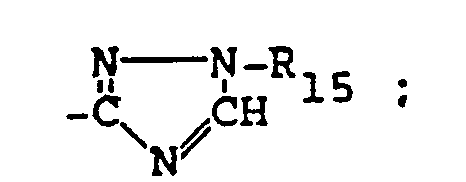
- P is cyano, carbamyl, N-alkylcarbamyl, N-alkyl-N-arylcarbamyl, N,N-dialkylcarbamyl, N,N-alkyl- arylcarbamyl, N-arylcarbamyl, N-cyclohexylcarbamyl; aryl, 2-benzoxazolyl, 2-benzothiazolyl, 2-benzimidazolyl, 1,3,4-thiadiazol-2-yl, 1,3,4-oxadiazol-2-yl, alkylsulfonyl, arylsulfonyl or acyhl.
- In all of the above definitions the alkyl or divalent aliphatic moieties or portions of the various groups contain from 1-10 carbons, preferably 1-6 carbons, straight or branched chain.
- A most preferred polyester composition contains the reaction residue of the compound

- The nonextractabilities of the present methine compounds are determined as follows:
- All extractions are done in glass containers with distilled solvents under the time and temperature conditions described below. The sample form is 1/2 inch x 2 1/2 inch (12.7 x 63.5 mm) segments cut from the cylindrical side wall portion of 2-liter bottles. All samples are washed with cold solvent to remove surface contaminants and are exposed using 200 ml. solvent/100 in.2 (200 ml/645 cm2) surface area (2 ml/ in.2; 2 m1/6.45 cm2).
- Solvent blanks are run under the same extraction conditions without polymer. In most cases samples are extracted, spiked, and analyzed in duplicates.
- Extraction Conditions
- 1. Water. The samples at room temperatures are added to solvent and heated at 250°F (121°C) for two hours. Half of the samples are then analyzed and the remainder are placed in a 120°F (43°C) oven for 30 days.
- 2. 50% EthanollWater. The samples at room temperature are added to the solvent at room temperature, placed in an oven at 120°F (43°C) and analyzed after 24 hours and 30 days.
- 3. Heptane. The samples at room temperature are added to solvent a room temperature and heated at 150°F (65.5°C) for 2 hours. Part of the samples are cooled to room temperature and analyzed spectrophotometrically and the remainder are allowed to age at 120°F (43°C) for 30 days before analysis.
- 4. Any suitable analytical technique and apparatus may be employed to determine the amount of methine compound extracted from the polymer. The extractability of the present compounds are found to be essentially nonexistent.
- The types of polyesters useful in this invention for reaction with the methine compounds are those produced by conventional techniques using one or more diols and one or more dicarboxylic acids. Typical of these polyesters are those disclosed, for example, in U.S. Patent 4,359,570.
- The diol components of the polyester are selected, for example, from ethylene glycol, 1,4-cyclohexanedimethanol, 1,2-propanediol, 1,3-propanediol, 1,4-butanediol, 2,2-dimethyl-1,3-propanediol, 1,6-hexanediol, 1,2-cyclohexanediol, 1,4-cyclohexanediol, 1,2-cyclohexanedimethanol, 1,3-cyclohexanedimethanol, X,8-bis(hydroxymethyl)tricyclo-[5.2.1.0]-decane wherein X represents 3, 4, or 5, and diols containing one or more oxygen atoms in the chain, e.g., diethylene glycol, triethylene glycol, dipropylene glycol, tripropylene glycol and the like containing from about 2 to about 18, preferably 2 to 12 carbon atoms in each aliphatic moiety. Cycloaliphatic diols can be employed in their cis or trans configuration or as mixtures of both forms.
- The acid components (aliphatic, alicyclic, or aromatic dicarboxylic acids) of the polyester are selected, for example, from terephthalic acid, isophthalic acid, 1,4-cyclohexanedicarboxylic acid, 1,3-cyclohexanedicarboxylic acid, succinic acid, glutaric acid, adipic acid, sebacic acid, 1,12-dodecanedioic acid, and the like. In the polymer preparation, it is often preferable to use a functional acid derivative thereof such as the dimethyl, diethyl, or dipropyl ester of the dicarboxylic acid. The anhydrides of these acids also can be employed.
- The preferred copolyesters are especially useful for making blow molded bottles or containers for beverages, and for molded food packages and the like. In this regard, certain of these copolyesters are color, I.V., and heat distortion or "hot fill" stable at temperatures of up to about 100°C when properly heat set, and molded articles therefrom exhibit good thin wall rigidity, excellent clarity and good barrier properties with respect to water and atmospheric gases, particularly carbon dioxide and oxygen.
- In regard to products having the "hot fill" stability, the most preferred polyesters therefor comprise poly(ethylene terephthalate) and this polymer modified with u to about 5 mole % of 1,4-cyclohexanedimethanol, wherein the polymers have been sufficiently heat set and oriented by methods well known in the art to give a desired degree of crystallinity. By definition, a polymer is "hot fill" stable at a prescribed temperature when less than 2% change in volume of a container manufactured therefrom occurs upon filling the same with a liquid at that temperature. For the particular application of blow-molded beverage bottles, these most preferred polyesters have an I.V. of 0.65 to 0.85, and a Tg of >70°C, and film sections cut from the bottle have a Water Vapor Transmission Rate of 1.5 to 2.5 g mils/100 in.2-24 hrs. (g.0,025 mm/645 cm2·24 h), a C02 Permeability of 20-30 cc. mils/100 in.2-24 hrs.-atm. (ml·0,025 mm/ 645 cm2·24 h-1,013 bar), and an 02 Permeability of 4-8 cc. mils/100 in.2-24 hrs.-atm. (ml·0.025 mm/645 cm2·24 h·1,013 bar). The Tg is determined by Differential Scanning Calorimetry at a scan rate of 20 Centigrade Degrees/min., the 02 Permeability by the standard operating procedure of a MOCON OXTRAN 100 instrument of Modern Controls, Inc., of Elk River, Minnesota, and the C02 Permeability by the standard operating procedure of a MOCON PERMATRAN C II, also of Modern Controls.
- The following examples will illustrate syntheses of the methine compounds.
- Ethyl 2-cyano-3-(4-hydroxyphenyl)propenoate shown below is prepared by the reaction of 4-hydroxybenzaldehyde with ethyl cyanoacetate in the presence of a base cataylst in toluene. This pale yellow compound absorbs UV light at λmax 350 nm with a molar extinction coefficient of 27,000.

- Methyl 2-Cyano-3(4-hydroxyphenyl)propenoate is prepared as follows:
- p-Hydroxybenzaldehyde (6.1 g., .05 m), methyl cyanoacetate (5.5 g., 0.55 m), methanol (40 ml), and piperidine (5 drops) are mixed and heated at reflux for 1 hour. After allowing to cool, the reaction mixture is acidified (to Congo Red paper) by addition of 10% HCI. The product is collected by filtration, washed with methanol and dried in air. This purified product absorbs UV light strongly at 345 nm in acetone, has a molar extinction coefficient of 28,459, and has the following structure:

- Other exemplary methine compounds useful herein as condensable reactants are given in the following table.


- Typical polyesters prepared in accordance with this invention are given in the examples below.
- The inherent viscosities (I.V.) of each of the copolyesters herein are determined according to ASTM D2857-70 procedure in a Wagner Viscometer of Lab Glass Inc. of Vineland, N.J. having a 1/2 ml. capillary bulb, using a polymer concentration of 0.5% by weight in 60/40 by weight, phenol//tetrachloroethane solvent. The procedure comprises heating the polymer/solvent system at 120°C for 15 minutes to enhance dissolution of the polymer, cooling the solution to 25°C and measuring the time of flow at 25°C. The I.V. is calculated from the equation

- (η) = Inherent viscosity at 25°C at a polymer concentration of 0.5 g/100 ml of solvent;
- In = Natural logarithm;
- ts = Sample flow time;
- to = Solvent-blank flow time; and
- C = Concentration of polymer in grams per 100 ml of solvent = 0.50.
- A typical synthesis of poly(ethylene terephthalate) reacted with a methine compound is as follows. A total of 97g (0.5 'mol) dimethyl terephthalate, 62 g (1.0 mol) ethylene glycol, 0.0192 g (200 ppm) of the compound

- A typical synthesis of poylethylene terephthalate) copolymerized with 31 mol % 1,4-cyclohexanedimethanol and reacted with a methine compound is as follows. A total of 97 g (0.5 mol) dimethyl terephthalate, 23 g (0.16 mol). 1,4-cyclohexanedimethanol (70% trans isomer, 30% cis isomer), 52.1 g (0.84 m) ethylene glycol, 0.0217 g (200 ppm) of the compound

- This invention has been described in detail with particular reference to preferred embodiments thereof, but it will be understood that variations and modifications can be effected within the spirit and scope of the invention.
Claims (10)


Applications Claiming Priority (4)
| Application Number | Priority Date | Filing Date | Title |
|---|---|---|---|
| US70210685A | 1985-02-15 | 1985-02-15 | |
| US702106 | 1985-02-15 | ||
| US823425 | 1986-01-28 | ||
| US06/823,425 US4617374A (en) | 1985-02-15 | 1986-01-28 | UV-absorbing condensation polymeric compositions and products therefrom |
Publications (2)
| Publication Number | Publication Date |
|---|---|
| EP0217823A1 EP0217823A1 (en) | 1987-04-15 |
| EP0217823B1 true EP0217823B1 (en) | 1990-05-02 |
Family
ID=27106908
Family Applications (1)
| Application Number | Title | Priority Date | Filing Date |
|---|---|---|---|
| EP86901614A Expired - Lifetime EP0217823B1 (en) | 1985-02-15 | 1986-02-13 | Uv-absorbing condensation polymeric compositions and products therefrom |
Country Status (10)
| Country | Link |
|---|---|
| US (1) | US4617374A (en) |
| EP (1) | EP0217823B1 (en) |
| JP (1) | JPH0733436B2 (en) |
| KR (1) | KR910004934B1 (en) |
| CN (1) | CN1007900B (en) |
| AU (1) | AU579233B2 (en) |
| CA (1) | CA1261532A (en) |
| DE (1) | DE3670852D1 (en) |
| TR (1) | TR22945A (en) |
| WO (1) | WO1986004903A1 (en) |
Families Citing this family (85)
| Publication number | Priority date | Publication date | Assignee | Title |
|---|---|---|---|---|
| US4617373A (en) * | 1985-02-15 | 1986-10-14 | Eastman Kodak Company | Condensation polymers and products therefrom |
| US4661566A (en) * | 1986-02-06 | 1987-04-28 | Eastman Kodak Company | UV-absorbing condensation polymeric composition |
| US4707537A (en) * | 1986-09-30 | 1987-11-17 | Eastman Kodak Company | UV-absorbing condensation polymeric compositions and products therefrom |
| US4749774A (en) * | 1986-12-29 | 1988-06-07 | Eastman Kodak Company | Condensation polymer containing the residue of a poly-methine compound and shaped articles produced therefrom |
| US4950732A (en) * | 1986-12-29 | 1990-08-21 | Eastman Kodak Company | Condensation copolymers containing bis-methine moieties and products therefrom |
| US4757130A (en) * | 1987-07-01 | 1988-07-12 | Hoechst Celanese Corporaton | Condensation polymers with pendant side chains exhibiting nonlinear optical response |
| US4791188A (en) * | 1987-12-21 | 1988-12-13 | Eastman Kodak Company | Condensation polymer containing the residue of a benzodioxylmethine compound and shaped articles produced therefrom |
| US4845187A (en) * | 1988-01-25 | 1989-07-04 | Eastman Kodak Company | Condensation polymers containing methine ultraviolet radiation-absorbing residues and shaped articles produced therefrom |
| US4804719A (en) * | 1988-02-05 | 1989-02-14 | Eastman Kodak Company | Water-dissipatable polyester and polyester-amides containing copolymerized colorants |
| US4826903A (en) * | 1988-02-22 | 1989-05-02 | Eastman Kodak Company | Condensation polymer containing the residue of an acyloxystyrl compound and shaped articles produced therefrom |
| US4892923A (en) * | 1988-02-22 | 1990-01-09 | Eastman Kodak Company | Polyester compositions containing the residue of a naphthopyran compound and shaped articles produced therefrom |
| US5086161A (en) * | 1988-04-18 | 1992-02-04 | Eastman Kodak Company | Novel methine compounds, polymers containing them and formed articles therefrom |
| US4958043A (en) * | 1988-04-18 | 1990-09-18 | Eastman Kodak Company | Novel methine compounds, polymers containing them and formed articles therefrom |
| US4845188A (en) * | 1988-08-19 | 1989-07-04 | Eastman Kodak Company | Condensation polymers containing methine ultraviolet radiation-absorbing residues and shaped articles produced therefrom |
| US5057594A (en) * | 1989-08-17 | 1991-10-15 | Eastman Kodak Company | Ultraviolet light-absorbing compounds and sunscreen formulations and polymeric materials containing such compounds or residues thereof |
| US5049646A (en) * | 1989-11-13 | 1991-09-17 | Eastman Kodak Company | Polyesters and toners made therewith which absorb ultraviolet light |
| US5030708A (en) * | 1990-12-17 | 1991-07-09 | Eastman Kodak Company | Colored polyester compositions |
| EP0588962B1 (en) * | 1991-06-10 | 1998-04-01 | Eastman Chemical Company | Light-absorbing polymers |
| US5215876A (en) * | 1991-08-29 | 1993-06-01 | Eastman Kodak Company | Radiographic element with uv absorbation compound in polyester support |
| US5459224A (en) * | 1994-07-18 | 1995-10-17 | Eastman Chemical Company | Copolyesters having improved weatherability |
| CN1245516A (en) * | 1996-11-27 | 2000-02-23 | 伊斯曼化学公司 | Process for preparing light-absorbing polymer compositions |
| US6001952A (en) * | 1997-06-18 | 1999-12-14 | Eastman Chemical Company | Polyester containing benzylidene having reduced fluorescence |
| US6150494A (en) * | 1998-04-30 | 2000-11-21 | Eastman Chemical Company | Polymers containing optical brightener compounds copolymerized therein and methods of making and using therefor |
| US6908608B1 (en) * | 1998-11-02 | 2005-06-21 | Ciba Specialty Chemical Corporation | Stabilization of body-care and household products |
| US6162869A (en) * | 1999-06-22 | 2000-12-19 | Eastman Chemical Company | Waterborne acrylic polymers containing polymeric fluorescent compounds |
| US20040030029A1 (en) * | 2000-12-08 | 2004-02-12 | Stephen Weinhold | Polyester compositions for hot-fill containers |
| US6716898B2 (en) | 2001-05-18 | 2004-04-06 | Eastman Chemical Company | Amber polyester compositions for packaging food and beverages |
| US6559216B1 (en) * | 2001-08-21 | 2003-05-06 | Milliken & Company | Low-color ultraviolet absorber compounds and compositions thereof |
| US7097789B2 (en) * | 2001-08-21 | 2006-08-29 | Milliken & Company | Thermoplastic containers exhibiting excellent protection to various ultraviolet susceptible compounds |
| US6602447B2 (en) | 2001-08-21 | 2003-08-05 | Milliken & Company | Low-color ultraviolet absorbers for high UV wavelength protection applications |
| US6596795B2 (en) | 2001-08-21 | 2003-07-22 | Milliken & Company | Low-color vanillin-based ultraviolet absorbers and methods of making thereof |
| US20030078328A1 (en) * | 2001-08-21 | 2003-04-24 | Mason Mary E. | Low-color resorcinol-based ultraviolet absorbers and methods of making thereof |
| US6566425B1 (en) * | 2001-09-18 | 2003-05-20 | Milliken & Company | Polymeric articles comprising novel bismethine benzodifuranone derivative colorants |
| US6835333B2 (en) * | 2002-05-07 | 2004-12-28 | Milliken & Company | Combinations for use as toners in polyesters |
| US6875811B2 (en) | 2002-05-07 | 2005-04-05 | Milliken & Company | Single compound toners for use in polyesters |
| US6787589B2 (en) * | 2002-10-31 | 2004-09-07 | Eastman Chemical Company | Amber polyester compositions and container articles produced therefrom |
| US7094918B2 (en) * | 2003-04-28 | 2006-08-22 | Milliken & Company | Low-color ultraviolet absorbers for thermoplastic and thermoset high UV wavelength protection applications |
| US7189777B2 (en) * | 2003-06-09 | 2007-03-13 | Eastman Chemical Company | Compositions and method for improving reheat rate of PET using activated carbon |
| US20050010017A1 (en) * | 2003-07-11 | 2005-01-13 | Blakely Dale Milton | Addition of UV inhibitors to pet process for maximum yield |
| WO2005007735A2 (en) * | 2003-07-11 | 2005-01-27 | Eastman Chemical Company | Addition of uv absorbers to pet process for maximum yield |
| WO2005066694A2 (en) * | 2003-12-29 | 2005-07-21 | Advanced Medical Optics, Inc. | Intraocular lenses having a visible light-selective-transmissive-region |
| US7358322B2 (en) | 2004-03-09 | 2008-04-15 | Eastman Chemical Company | High IV melt phase polyester polymer catalyzed with antimony containing compounds |
| US7368523B2 (en) | 2004-11-12 | 2008-05-06 | Eastman Chemical Company | Polyester polymer and copolymer compositions containing titanium nitride particles |
| US7278737B2 (en) | 2004-04-30 | 2007-10-09 | Advanced Medical Optics, Inc. | Ophthalmic devices having a highly selective violet light transmissive filter and related methods |
| US7541407B2 (en) * | 2004-05-27 | 2009-06-02 | Eastman Chemical Company | Process for adding methine UV light absorbers to PET prepared by direct esterification |
| US20050277759A1 (en) * | 2004-05-27 | 2005-12-15 | Pearson Jason C | Process for adding furyl-2-methylidene UV light absorbers to poly(ethylene terephthalate) |
| US7282555B2 (en) | 2004-05-27 | 2007-10-16 | Eastman Chemical Company | Method for incorporating nitrogen containing methine light absorbers in pet and compositions thereof |
| US20050277716A1 (en) * | 2004-05-27 | 2005-12-15 | Pearson Jason C | Furyl-2-methylidene UV absorbers and compositions incorporating the UV absorbers |
| US20050267283A1 (en) * | 2004-05-27 | 2005-12-01 | Weaver Max A | Process for adding nitrogen containing methine light absorbers to poly(ethylene terephthalate) |
| US20060047102A1 (en) | 2004-09-02 | 2006-03-02 | Stephen Weinhold | Spheroidal polyester polymer particles |
| US20060110557A1 (en) * | 2004-09-03 | 2006-05-25 | Zhiyong Xia | Polyester polymer and copolymer compositions containing metallic tungsten particles |
| US7662880B2 (en) | 2004-09-03 | 2010-02-16 | Eastman Chemical Company | Polyester polymer and copolymer compositions containing metallic nickel particles |
| US7300967B2 (en) * | 2004-11-12 | 2007-11-27 | Eastman Chemical Company | Polyester polymer and copolymer compositions containing metallic titanium particles |
| US20060105129A1 (en) * | 2004-11-12 | 2006-05-18 | Zhiyong Xia | Polyester polymer and copolymer compositions containing titanium carbide particles |
| JP4896036B2 (en) * | 2004-11-22 | 2012-03-14 | アボット・メディカル・オプティクス・インコーポレイテッド | Copolymerizable azo compound and article containing the same |
| AU2005309912B2 (en) | 2004-11-22 | 2011-10-06 | Johnson & Johnson Surgical Vision, Inc. | Copolymerizable methine and anthraquinone compounds and articles containing them |
| US8557950B2 (en) | 2005-06-16 | 2013-10-15 | Grupo Petrotemex, S.A. De C.V. | High intrinsic viscosity melt phase polyester polymers with acceptable acetaldehyde generation rates |
| US7932345B2 (en) | 2005-09-16 | 2011-04-26 | Grupo Petrotemex, S.A. De C.V. | Aluminum containing polyester polymers having low acetaldehyde generation rates |
| US9267007B2 (en) | 2005-09-16 | 2016-02-23 | Grupo Petrotemex, S.A. De C.V. | Method for addition of additives into a polymer melt |
| US7655746B2 (en) | 2005-09-16 | 2010-02-02 | Eastman Chemical Company | Phosphorus containing compounds for reducing acetaldehyde in polyesters polymers |
| US7776942B2 (en) * | 2005-09-16 | 2010-08-17 | Eastman Chemical Company | Polyester polymer and copolymer compositions containing particles of titanium nitride and carbon-coated iron |
| US8431202B2 (en) | 2005-09-16 | 2013-04-30 | Grupo Petrotemex, S.A. De C.V. | Aluminum/alkaline or alkali/titanium containing polyesters having improved reheat, color and clarity |
| US7745512B2 (en) | 2005-09-16 | 2010-06-29 | Eastman Chemical Company | Polyester polymer and copolymer compositions containing carbon-coated iron particles |
| US7838596B2 (en) | 2005-09-16 | 2010-11-23 | Eastman Chemical Company | Late addition to effect compositional modifications in condensation polymers |
| US7709593B2 (en) | 2006-07-28 | 2010-05-04 | Eastman Chemical Company | Multiple feeds of catalyst metals to a polyester production process |
| US7709595B2 (en) | 2006-07-28 | 2010-05-04 | Eastman Chemical Company | Non-precipitating alkali/alkaline earth metal and aluminum solutions made with polyhydroxyl ether solvents |
| US7745368B2 (en) | 2006-07-28 | 2010-06-29 | Eastman Chemical Company | Non-precipitating alkali/alkaline earth metal and aluminum compositions made with organic hydroxyacids |
| US8563677B2 (en) | 2006-12-08 | 2013-10-22 | Grupo Petrotemex, S.A. De C.V. | Non-precipitating alkali/alkaline earth metal and aluminum solutions made with diols having at least two primary hydroxyl groups |
| US7521523B2 (en) * | 2006-12-28 | 2009-04-21 | Eastman Chemical Company | Oxygen-scavenging polyester compositions useful in packaging |
| US20080161529A1 (en) * | 2006-12-28 | 2008-07-03 | Jason Christopher Jenkins | Oxygen-scavenging polyesters useful for packaging |
| US20080161465A1 (en) * | 2006-12-28 | 2008-07-03 | Jason Christopher Jenkins | Oxygen-scavenging polyester compositions useful for packaging |
| US8207289B2 (en) | 2007-05-23 | 2012-06-26 | Grupo Petrotemex, S.A. De C.V. | High molecular weight polyester polymers with reduced acetaldehyde |
| US8070989B2 (en) * | 2007-08-09 | 2011-12-06 | Hallstar Innovations Corp. | Photostabilization of retinoids with alkoxycrylene compounds |
| US8257687B2 (en) | 2007-08-09 | 2012-09-04 | Hallstar Innovations Corp. | Photostabilization of coenzyme Q compounds with alkoxycrylene compounds |
| US8431112B2 (en) | 2007-08-09 | 2013-04-30 | Hallstar Innocations Corp. | Photostabilization of cholecalciferol with alkoxycrylene compounds |
| US7597825B2 (en) * | 2007-08-09 | 2009-10-06 | Hallstar Innovations Corp. | Method of quenching electronic excitation of chromophore-containing organic molecules in photoactive compositions |
| US7754191B2 (en) * | 2007-08-09 | 2010-07-13 | Hallstar Innovations Corp. | Method of quenching electronic excitation of chromophore-containing organic molecules photoactive compositions |
| US7588702B2 (en) * | 2007-08-09 | 2009-09-15 | Hallstar Innovations Corp. | Method of quenching electronic excitation of chromophore-containing organic molecules in photoactive compositions |
| US8133477B2 (en) * | 2007-08-09 | 2012-03-13 | Hallstar Innovations Corp. | Dispersions of inorganic particulates containing alkoxycrylene |
| US8263051B2 (en) | 2007-08-09 | 2012-09-11 | Hallstar Innovations Corp. | Photostabilization of resveratrol with alkoxycrylene compounds |
| US8329148B1 (en) | 2007-08-09 | 2012-12-11 | Hallstar Innovations Corp. | Photostabilization of coenzyme Q compounds with alkoxycrylene compounds |
| US8377530B2 (en) | 2011-02-08 | 2013-02-19 | Eastman Chemical Company | Polyesters with low molecular weight additives for improved gas barrier properties |
| TWI680975B (en) | 2018-06-26 | 2020-01-01 | 奇鈦科技股份有限公司 | Uv absorbing compound and applications thereof |
| TWI799723B (en) * | 2020-07-15 | 2023-04-21 | 南亞塑膠工業股份有限公司 | Ultraviolet absorbing polyester film and method for manufacturing the same |
| US20230070132A1 (en) * | 2021-08-30 | 2023-03-09 | Jiangsu Conant Optical Co., Ltd. | Resin lens with enhanced anti-blue light performance and preparation method thereof |
Citations (1)
| Publication number | Priority date | Publication date | Assignee | Title |
|---|---|---|---|---|
| US4260732A (en) * | 1980-02-22 | 1981-04-07 | General Electric Company | UV Stabilized polycarbonate resins |
Family Cites Families (7)
| Publication number | Priority date | Publication date | Assignee | Title |
|---|---|---|---|---|
| GB1020507A (en) * | 1961-07-13 | 1966-02-16 | Gen Aniline & Film Corp | Improvements in or relating to substituted cinnamic acid esters and their use as ultra-violet absorbers |
| DE2962938D1 (en) * | 1978-02-08 | 1982-07-15 | Ciba Geigy Ag | Polymers with lateral tricyclic imidyl groups, cross-linkable by the action of light, their preparation and their use |
| DE2924964A1 (en) * | 1979-06-21 | 1981-01-29 | Dynamit Nobel Ag | AROMATIC BISAZOMETHINE, METHOD FOR THE PRODUCTION THEREOF AND THEIR USE AS REACTIVE DYES |
| US4260719A (en) * | 1980-03-17 | 1981-04-07 | General Electric Company | UV stabilized polycarbonate resins |
| US4359507A (en) * | 1981-11-19 | 1982-11-16 | Atlantic Richfield Company | Mixed ethylene and propylene carbonate-containing organic polyisocyanate adhesive binder composition |
| US4400500A (en) * | 1982-04-30 | 1983-08-23 | Rohm And Haas Company | Polyaminoester thermosetting resins |
| US4617373A (en) * | 1985-02-15 | 1986-10-14 | Eastman Kodak Company | Condensation polymers and products therefrom |
-
1986
- 1986-01-28 US US06/823,425 patent/US4617374A/en not_active Expired - Lifetime
- 1986-02-13 AU AU55449/86A patent/AU579233B2/en not_active Ceased
- 1986-02-13 CA CA000501769A patent/CA1261532A/en not_active Expired
- 1986-02-13 WO PCT/US1986/000297 patent/WO1986004903A1/en not_active Ceased
- 1986-02-13 KR KR1019860700668A patent/KR910004934B1/en not_active Expired
- 1986-02-13 JP JP61501399A patent/JPH0733436B2/en not_active Expired - Fee Related
- 1986-02-13 DE DE8686901614T patent/DE3670852D1/en not_active Expired - Fee Related
- 1986-02-13 EP EP86901614A patent/EP0217823B1/en not_active Expired - Lifetime
- 1986-02-15 CN CN86101561A patent/CN1007900B/en not_active Expired
- 1986-02-17 TR TR88/86A patent/TR22945A/en unknown
Patent Citations (1)
| Publication number | Priority date | Publication date | Assignee | Title |
|---|---|---|---|---|
| US4260732A (en) * | 1980-02-22 | 1981-04-07 | General Electric Company | UV Stabilized polycarbonate resins |
Also Published As
| Publication number | Publication date |
|---|---|
| EP0217823A1 (en) | 1987-04-15 |
| CA1261532A (en) | 1989-09-26 |
| DE3670852D1 (en) | 1990-06-07 |
| JPH0733436B2 (en) | 1995-04-12 |
| KR870700659A (en) | 1987-12-30 |
| KR910004934B1 (en) | 1991-07-18 |
| TR22945A (en) | 1988-12-08 |
| JPS62501857A (en) | 1987-07-23 |
| CN86101561A (en) | 1987-02-25 |
| AU5544986A (en) | 1986-09-10 |
| WO1986004903A1 (en) | 1986-08-28 |
| AU579233B2 (en) | 1988-11-17 |
| US4617374A (en) | 1986-10-14 |
| CN1007900B (en) | 1990-05-09 |
Similar Documents
| Publication | Publication Date | Title |
|---|---|---|
| AU579233B2 (en) | Uv absorbing polyester composition | |
| US4707537A (en) | UV-absorbing condensation polymeric compositions and products therefrom | |
| EP0215054B1 (en) | Condensation polymers and products therefrom | |
| US4845188A (en) | Condensation polymers containing methine ultraviolet radiation-absorbing residues and shaped articles produced therefrom | |
| US4749773A (en) | Condensation polymers containing methine ultraviolet radiation-absorbing residues and shaped articles produced therefrom | |
| CA1334465C (en) | Condensation polymer containing the residue of an acyloxystyryl compound and shaped articles produced therefrom | |
| US4749772A (en) | Condensation copolymers containing methine ultraviolet radiation-absorbing residues and shaped articles produced therefrom | |
| EP0280856B1 (en) | Condensation copolymers containing 2,5-diarylaminoterephthalic acid type colorants and products therefrom | |
| EP0273280A2 (en) | Condensation polymer containing the residue of a poly-methine compound and shaped articles produced therefrom | |
| US4950732A (en) | Condensation copolymers containing bis-methine moieties and products therefrom | |
| US4661566A (en) | UV-absorbing condensation polymeric composition | |
| US4845187A (en) | Condensation polymers containing methine ultraviolet radiation-absorbing residues and shaped articles produced therefrom | |
| EP0412101B1 (en) | Novel methine compounds, polymers containing them and formed articles therefrom | |
| US4808677A (en) | Condensation polymer containing copolymerized colorants derived from indigo and articles produced therefrom | |
| US4791188A (en) | Condensation polymer containing the residue of a benzodioxylmethine compound and shaped articles produced therefrom | |
| AU606641B2 (en) | Condensation copolymers containing bis-methine moieties and products therefrom |
Legal Events
| Date | Code | Title | Description |
|---|---|---|---|
| PUAI | Public reference made under article 153(3) epc to a published international application that has entered the european phase |
Free format text: ORIGINAL CODE: 0009012 |
|
| 17P | Request for examination filed |
Effective date: 19861021 |
|
| AK | Designated contracting states |
Kind code of ref document: A1 Designated state(s): BE DE FR GB IT NL |
|
| 17Q | First examination report despatched |
Effective date: 19880714 |
|
| GRAA | (expected) grant |
Free format text: ORIGINAL CODE: 0009210 |
|
| AK | Designated contracting states |
Kind code of ref document: B1 Designated state(s): BE DE FR GB IT NL |
|
| ITF | It: translation for a ep patent filed | ||
| REF | Corresponds to: |
Ref document number: 3670852 Country of ref document: DE Date of ref document: 19900607 |
|
| ET | Fr: translation filed | ||
| ITTA | It: last paid annual fee | ||
| PLBE | No opposition filed within time limit |
Free format text: ORIGINAL CODE: 0009261 |
|
| STAA | Information on the status of an ep patent application or granted ep patent |
Free format text: STATUS: NO OPPOSITION FILED WITHIN TIME LIMIT |
|
| 26N | No opposition filed | ||
| REG | Reference to a national code |
Ref country code: FR Ref legal event code: TP |
|
| NLS | Nl: assignments of ep-patents |
Owner name: EASTMAN CHEMICAL COMPANY TE KINGSPORT, TENNESSEE, |
|
| REG | Reference to a national code |
Ref country code: GB Ref legal event code: 732E |
|
| PGFP | Annual fee paid to national office [announced via postgrant information from national office to epo] |
Ref country code: BE Payment date: 19980320 Year of fee payment: 13 |
|
| PG25 | Lapsed in a contracting state [announced via postgrant information from national office to epo] |
Ref country code: BE Free format text: LAPSE BECAUSE OF NON-PAYMENT OF DUE FEES Effective date: 19990228 |
|
| BERE | Be: lapsed |
Owner name: EASTMAN CHEMICAL CY Effective date: 19990228 |
|
| REG | Reference to a national code |
Ref country code: GB Ref legal event code: IF02 |
|
| PGFP | Annual fee paid to national office [announced via postgrant information from national office to epo] |
Ref country code: GB Payment date: 20040107 Year of fee payment: 19 |
|
| PGFP | Annual fee paid to national office [announced via postgrant information from national office to epo] |
Ref country code: NL Payment date: 20040112 Year of fee payment: 19 |
|
| PGFP | Annual fee paid to national office [announced via postgrant information from national office to epo] |
Ref country code: FR Payment date: 20040202 Year of fee payment: 19 |
|
| PGFP | Annual fee paid to national office [announced via postgrant information from national office to epo] |
Ref country code: DE Payment date: 20040227 Year of fee payment: 19 |
|
| PG25 | Lapsed in a contracting state [announced via postgrant information from national office to epo] |
Ref country code: IT Free format text: LAPSE BECAUSE OF NON-PAYMENT OF DUE FEES;WARNING: LAPSES OF ITALIAN PATENTS WITH EFFECTIVE DATE BEFORE 2007 MAY HAVE OCCURRED AT ANY TIME BEFORE 2007. THE CORRECT EFFECTIVE DATE MAY BE DIFFERENT FROM THE ONE RECORDED. Effective date: 20050213 Ref country code: GB Free format text: LAPSE BECAUSE OF NON-PAYMENT OF DUE FEES Effective date: 20050213 |
|
| PG25 | Lapsed in a contracting state [announced via postgrant information from national office to epo] |
Ref country code: NL Free format text: LAPSE BECAUSE OF NON-PAYMENT OF DUE FEES Effective date: 20050901 Ref country code: DE Free format text: LAPSE BECAUSE OF NON-PAYMENT OF DUE FEES Effective date: 20050901 |
|
| GBPC | Gb: european patent ceased through non-payment of renewal fee |
Effective date: 20050213 |
|
| PG25 | Lapsed in a contracting state [announced via postgrant information from national office to epo] |
Ref country code: FR Free format text: LAPSE BECAUSE OF NON-PAYMENT OF DUE FEES Effective date: 20051031 |
|
| NLV4 | Nl: lapsed or anulled due to non-payment of the annual fee |
Effective date: 20050901 |
|
| REG | Reference to a national code |
Ref country code: FR Ref legal event code: ST Effective date: 20051031 |