EP0217560B1 - Process for preparing polymer of formaldehyde - Google Patents
Process for preparing polymer of formaldehyde Download PDFInfo
- Publication number
- EP0217560B1 EP0217560B1 EP86306884A EP86306884A EP0217560B1 EP 0217560 B1 EP0217560 B1 EP 0217560B1 EP 86306884 A EP86306884 A EP 86306884A EP 86306884 A EP86306884 A EP 86306884A EP 0217560 B1 EP0217560 B1 EP 0217560B1
- Authority
- EP
- European Patent Office
- Prior art keywords
- formaldehyde
- compound
- copolymer
- reaction
- polymerization
- Prior art date
- Legal status (The legal status is an assumption and is not a legal conclusion. Google has not performed a legal analysis and makes no representation as to the accuracy of the status listed.)
- Expired - Lifetime
Links
- WSFSSNUMVMOOMR-UHFFFAOYSA-N Formaldehyde Chemical compound O=C WSFSSNUMVMOOMR-UHFFFAOYSA-N 0.000 title claims abstract description 82
- 229920000642 polymer Polymers 0.000 title claims abstract description 18
- 238000004519 manufacturing process Methods 0.000 title claims description 3
- 229920001577 copolymer Polymers 0.000 claims abstract description 10
- YNHJECZULSZAQK-UHFFFAOYSA-N tetraphenylporphyrin Chemical compound C1=CC(C(=C2C=CC(N2)=C(C=2C=CC=CC=2)C=2C=CC(N=2)=C(C=2C=CC=CC=2)C2=CC=C3N2)C=2C=CC=CC=2)=NC1=C3C1=CC=CC=C1 YNHJECZULSZAQK-UHFFFAOYSA-N 0.000 claims abstract description 9
- 239000000178 monomer Substances 0.000 claims abstract description 6
- 150000004696 coordination complex Chemical class 0.000 claims abstract description 3
- 150000002736 metal compounds Chemical class 0.000 claims abstract description 3
- 230000000379 polymerizing effect Effects 0.000 claims abstract description 3
- 150000001875 compounds Chemical class 0.000 claims description 17
- 238000006243 chemical reaction Methods 0.000 claims description 15
- 238000006116 polymerization reaction Methods 0.000 claims description 14
- 238000000034 method Methods 0.000 claims description 11
- CURLTUGMZLYLDI-UHFFFAOYSA-N Carbon dioxide Chemical compound O=C=O CURLTUGMZLYLDI-UHFFFAOYSA-N 0.000 claims description 8
- 125000002947 alkylene group Chemical group 0.000 claims description 7
- 229920001400 block copolymer Polymers 0.000 claims description 7
- -1 lactone compound Chemical class 0.000 claims description 7
- 229910052751 metal Inorganic materials 0.000 claims description 5
- 239000002184 metal Substances 0.000 claims description 5
- 239000001569 carbon dioxide Substances 0.000 claims description 4
- 229910002092 carbon dioxide Inorganic materials 0.000 claims description 4
- FYYHWMGAXLPEAU-UHFFFAOYSA-N Magnesium Chemical compound [Mg] FYYHWMGAXLPEAU-UHFFFAOYSA-N 0.000 claims description 3
- HCHKCACWOHOZIP-UHFFFAOYSA-N Zinc Chemical compound [Zn] HCHKCACWOHOZIP-UHFFFAOYSA-N 0.000 claims description 3
- 229910052782 aluminium Inorganic materials 0.000 claims description 3
- XAGFODPZIPBFFR-UHFFFAOYSA-N aluminium Chemical compound [Al] XAGFODPZIPBFFR-UHFFFAOYSA-N 0.000 claims description 3
- 239000012298 atmosphere Substances 0.000 claims description 3
- 150000001732 carboxylic acid derivatives Chemical class 0.000 claims description 3
- 239000011261 inert gas Substances 0.000 claims description 3
- 239000011777 magnesium Substances 0.000 claims description 3
- 229910052749 magnesium Inorganic materials 0.000 claims description 3
- 229910052725 zinc Inorganic materials 0.000 claims description 3
- 239000011701 zinc Substances 0.000 claims description 3
- WSFSSNUMVMOOMR-NJFSPNSNSA-N methanone Chemical compound O=[14CH2] WSFSSNUMVMOOMR-NJFSPNSNSA-N 0.000 claims description 2
- 239000003960 organic solvent Substances 0.000 claims description 2
- XLYOFNOQVPJJNP-UHFFFAOYSA-N water Substances O XLYOFNOQVPJJNP-UHFFFAOYSA-N 0.000 claims description 2
- 125000004432 carbon atom Chemical group C* 0.000 claims 1
- 125000003700 epoxy group Chemical group 0.000 claims 1
- YMWUJEATGCHHMB-UHFFFAOYSA-N Dichloromethane Chemical compound ClCCl YMWUJEATGCHHMB-UHFFFAOYSA-N 0.000 description 12
- 239000000470 constituent Substances 0.000 description 11
- 239000000203 mixture Substances 0.000 description 10
- 238000009826 distribution Methods 0.000 description 8
- 239000007795 chemical reaction product Substances 0.000 description 6
- 239000002904 solvent Substances 0.000 description 5
- IAYPIBMASNFSPL-UHFFFAOYSA-N Ethylene oxide Chemical compound C1CO1 IAYPIBMASNFSPL-UHFFFAOYSA-N 0.000 description 4
- HUMNYLRZRPPJDN-UHFFFAOYSA-N benzaldehyde Chemical compound O=CC1=CC=CC=C1 HUMNYLRZRPPJDN-UHFFFAOYSA-N 0.000 description 4
- 239000003446 ligand Substances 0.000 description 4
- 238000002844 melting Methods 0.000 description 4
- 230000008018 melting Effects 0.000 description 4
- 239000012299 nitrogen atmosphere Substances 0.000 description 4
- UHOVQNZJYSORNB-UHFFFAOYSA-N Benzene Chemical compound C1=CC=CC=C1 UHOVQNZJYSORNB-UHFFFAOYSA-N 0.000 description 3
- KAESVJOAVNADME-UHFFFAOYSA-N Pyrrole Chemical compound C=1C=CNC=1 KAESVJOAVNADME-UHFFFAOYSA-N 0.000 description 3
- YXFVVABEGXRONW-UHFFFAOYSA-N Toluene Chemical compound CC1=CC=CC=C1 YXFVVABEGXRONW-UHFFFAOYSA-N 0.000 description 3
- 239000007788 liquid Substances 0.000 description 3
- 239000000463 material Substances 0.000 description 3
- BGJSXRVXTHVRSN-UHFFFAOYSA-N 1,3,5-trioxane Chemical compound C1OCOCO1 BGJSXRVXTHVRSN-UHFFFAOYSA-N 0.000 description 2
- 238000010276 construction Methods 0.000 description 2
- YNLAOSYQHBDIKW-UHFFFAOYSA-M diethylaluminium chloride Chemical compound CC[Al](Cl)CC YNLAOSYQHBDIKW-UHFFFAOYSA-M 0.000 description 2
- XBDQKXXYIPTUBI-UHFFFAOYSA-N dimethylselenoniopropionate Natural products CCC(O)=O XBDQKXXYIPTUBI-UHFFFAOYSA-N 0.000 description 2
- 229930195733 hydrocarbon Natural products 0.000 description 2
- 125000004435 hydrogen atom Chemical class [H]* 0.000 description 2
- 150000002596 lactones Chemical class 0.000 description 2
- 150000002739 metals Chemical class 0.000 description 2
- QNGNSVIICDLXHT-UHFFFAOYSA-N para-ethylbenzaldehyde Natural products CCC1=CC=C(C=O)C=C1 QNGNSVIICDLXHT-UHFFFAOYSA-N 0.000 description 2
- 239000011541 reaction mixture Substances 0.000 description 2
- SCYULBFZEHDVBN-UHFFFAOYSA-N 1,1-Dichloroethane Chemical compound CC(Cl)Cl SCYULBFZEHDVBN-UHFFFAOYSA-N 0.000 description 1
- MCTWTZJPVLRJOU-UHFFFAOYSA-N 1-methyl-1H-imidazole Chemical compound CN1C=CN=C1 MCTWTZJPVLRJOU-UHFFFAOYSA-N 0.000 description 1
- RAXXELZNTBOGNW-UHFFFAOYSA-N 1H-imidazole Chemical class C1=CNC=N1 RAXXELZNTBOGNW-UHFFFAOYSA-N 0.000 description 1
- LSNNMFCWUKXFEE-UHFFFAOYSA-M Bisulfite Chemical compound OS([O-])=O LSNNMFCWUKXFEE-UHFFFAOYSA-M 0.000 description 1
- 239000004215 Carbon black (E152) Substances 0.000 description 1
- 239000004593 Epoxy Substances 0.000 description 1
- LFQSCWFLJHTTHZ-UHFFFAOYSA-N Ethanol Chemical compound CCO LFQSCWFLJHTTHZ-UHFFFAOYSA-N 0.000 description 1
- CTQNGGLPUBDAKN-UHFFFAOYSA-N O-Xylene Chemical compound CC1=CC=CC=C1C CTQNGGLPUBDAKN-UHFFFAOYSA-N 0.000 description 1
- 229930040373 Paraformaldehyde Natural products 0.000 description 1
- ISWSIDIOOBJBQZ-UHFFFAOYSA-N Phenol Chemical compound OC1=CC=CC=C1 ISWSIDIOOBJBQZ-UHFFFAOYSA-N 0.000 description 1
- 229930182556 Polyacetal Natural products 0.000 description 1
- 230000021736 acetylation Effects 0.000 description 1
- 238000006640 acetylation reaction Methods 0.000 description 1
- 239000004411 aluminium Substances 0.000 description 1
- 150000001399 aluminium compounds Chemical class 0.000 description 1
- 125000000129 anionic group Chemical group 0.000 description 1
- 239000003054 catalyst Substances 0.000 description 1
- 239000003795 chemical substances by application Substances 0.000 description 1
- WORJEOGGNQDSOE-UHFFFAOYSA-N chloroform;methanol Chemical compound OC.ClC(Cl)Cl WORJEOGGNQDSOE-UHFFFAOYSA-N 0.000 description 1
- 230000000052 comparative effect Effects 0.000 description 1
- 238000000354 decomposition reaction Methods 0.000 description 1
- RYPWQHONZWFXBN-UHFFFAOYSA-N dichloromethyl(methylidene)-$l^{3}-chlorane Chemical class ClC(Cl)Cl=C RYPWQHONZWFXBN-UHFFFAOYSA-N 0.000 description 1
- NKDDWNXOKDWJAK-UHFFFAOYSA-N dimethoxymethane Chemical compound COCOC NKDDWNXOKDWJAK-UHFFFAOYSA-N 0.000 description 1
- 239000006185 dispersion Substances 0.000 description 1
- 239000000975 dye Substances 0.000 description 1
- 238000001914 filtration Methods 0.000 description 1
- 150000008282 halocarbons Chemical class 0.000 description 1
- 229920001519 homopolymer Polymers 0.000 description 1
- 150000002430 hydrocarbons Chemical class 0.000 description 1
- 150000002899 organoaluminium compounds Chemical class 0.000 description 1
- 239000003973 paint Substances 0.000 description 1
- 229920002866 paraformaldehyde Polymers 0.000 description 1
- 150000003003 phosphines Chemical class 0.000 description 1
- AQSJGOWTSHOLKH-UHFFFAOYSA-N phosphite(3-) Chemical class [O-]P([O-])[O-] AQSJGOWTSHOLKH-UHFFFAOYSA-N 0.000 description 1
- 239000004033 plastic Substances 0.000 description 1
- 229920003023 plastic Polymers 0.000 description 1
- 229920006324 polyoxymethylene Polymers 0.000 description 1
- 229920002635 polyurethane Polymers 0.000 description 1
- 239000004814 polyurethane Substances 0.000 description 1
- 150000004032 porphyrins Chemical class 0.000 description 1
- 235000019260 propionic acid Nutrition 0.000 description 1
- IUVKMZGDUIUOCP-BTNSXGMBSA-N quinbolone Chemical compound O([C@H]1CC[C@H]2[C@H]3[C@@H]([C@]4(C=CC(=O)C=C4CC3)C)CC[C@@]21C)C1=CCCC1 IUVKMZGDUIUOCP-BTNSXGMBSA-N 0.000 description 1
- 230000009257 reactivity Effects 0.000 description 1
- 238000010992 reflux Methods 0.000 description 1
- 239000011347 resin Substances 0.000 description 1
- 229920005989 resin Polymers 0.000 description 1
- 239000013049 sediment Substances 0.000 description 1
- 239000011877 solvent mixture Substances 0.000 description 1
- 229910001220 stainless steel Inorganic materials 0.000 description 1
- 239000010935 stainless steel Substances 0.000 description 1
- 239000004094 surface-active agent Substances 0.000 description 1
- 150000003512 tertiary amines Chemical class 0.000 description 1
- VOITXYVAKOUIBA-UHFFFAOYSA-N triethylaluminium Chemical compound CC[Al](CC)CC VOITXYVAKOUIBA-UHFFFAOYSA-N 0.000 description 1
- 239000008096 xylene Substances 0.000 description 1
Classifications
-
- C—CHEMISTRY; METALLURGY
- C08—ORGANIC MACROMOLECULAR COMPOUNDS; THEIR PREPARATION OR CHEMICAL WORKING-UP; COMPOSITIONS BASED THEREON
- C08G—MACROMOLECULAR COMPOUNDS OBTAINED OTHERWISE THAN BY REACTIONS ONLY INVOLVING UNSATURATED CARBON-TO-CARBON BONDS
- C08G8/00—Condensation polymers of aldehydes or ketones with phenols only
- C08G8/04—Condensation polymers of aldehydes or ketones with phenols only of aldehydes
- C08G8/08—Condensation polymers of aldehydes or ketones with phenols only of aldehydes of formaldehyde, e.g. of formaldehyde formed in situ
-
- C—CHEMISTRY; METALLURGY
- C08—ORGANIC MACROMOLECULAR COMPOUNDS; THEIR PREPARATION OR CHEMICAL WORKING-UP; COMPOSITIONS BASED THEREON
- C08G—MACROMOLECULAR COMPOUNDS OBTAINED OTHERWISE THAN BY REACTIONS ONLY INVOLVING UNSATURATED CARBON-TO-CARBON BONDS
- C08G2/00—Addition polymers of aldehydes or cyclic oligomers thereof or of ketones; Addition copolymers thereof with less than 50 molar percent of other substances
- C08G2/06—Catalysts
-
- C—CHEMISTRY; METALLURGY
- C08—ORGANIC MACROMOLECULAR COMPOUNDS; THEIR PREPARATION OR CHEMICAL WORKING-UP; COMPOSITIONS BASED THEREON
- C08G—MACROMOLECULAR COMPOUNDS OBTAINED OTHERWISE THAN BY REACTIONS ONLY INVOLVING UNSATURATED CARBON-TO-CARBON BONDS
- C08G2/00—Addition polymers of aldehydes or cyclic oligomers thereof or of ketones; Addition copolymers thereof with less than 50 molar percent of other substances
- C08G2/08—Polymerisation of formaldehyde
-
- C—CHEMISTRY; METALLURGY
- C08—ORGANIC MACROMOLECULAR COMPOUNDS; THEIR PREPARATION OR CHEMICAL WORKING-UP; COMPOSITIONS BASED THEREON
- C08G—MACROMOLECULAR COMPOUNDS OBTAINED OTHERWISE THAN BY REACTIONS ONLY INVOLVING UNSATURATED CARBON-TO-CARBON BONDS
- C08G2/00—Addition polymers of aldehydes or cyclic oligomers thereof or of ketones; Addition copolymers thereof with less than 50 molar percent of other substances
- C08G2/18—Copolymerisation of aldehydes or ketones
Definitions
- the present invention relates to a method of producing polymers with formaldehyde as a constituent unit.
- Japanese patent publication A (unexamined) No. 57-8223 teaches a process for preparing a block copolymer of two alkylene oxides in the presence of a complex catalyst comprising tetra-phenyl porphyrin and an organic aluminium compound.
- the present inventors investigated the matter that if the reaction of polymers with formaldehyde as a constituent unit can be controlled, mechanical properties of polymers can be controlled, thereby achieving a remarkably wide application.
- the present invention was achieved by finding that if a complex, which is obtained by a reaction between tetraphenylporphyrin or derivatives thereof and organometal compounds, is used as a catalyzer in the polymerization of polymers with formaldehyde as a constituent unit, the produced polymers have a narrowed molecular weight distribution and also the arrangement of blocks in block copolymers can be optionally designed.
- the present invention relates to a method of producing polymers with formaldehyde as a constituent unit, characterized by that a complex, which is obtained by a reaction between tetraphenylporphyrin or derivatives thereof and organometal compounds, is used as a catalyzer.
- a polymer or copolymer of formaldehyde is obtained by the step of polymerizing formaldehyde and an optional co-monomer in the presence of a catalytically effective amount of a metal complex obtained between tetraphenylporphyrin or a derivative thereof and an organic metal compound.
- the compound is preferably a compound of a divalent or trivalent metal such as zinc, magnesium and aluminum.
- the co- monomer is selected from an alkylene oxide, a lactone compound, a cyclic anhydride of a carboxylic acid and carbon dioxide.
- the comonomer(s) is added to the reaction system to obtain a block copolymer being controlled in the order of the blocks.
- the polymerization is effected in an organic solvent in an inert gas atmosphere of and in the absence of water.
- formaldehyde forms the major part, 50 percent by weight or larger, of the obtained copolymer and that formaldehyde is contained in the copolymer in an amount of at least 1 percent by weight.
- Tetraphenylporphyrin or derivatives thereof are obtained by a reaction between benzaldehyde or derivatives thereof and pyrrole.
- organometal compounds Compounds of metals having a valence of 2 or 3 are preferably used as organometal compounds in the present invention.
- compounds of metals such as zinc, magnesium and aluminium are preferably used, in particular preferably organoaluminium compounds.
- organoaluminium compounds Specifically, diethylaluminium chloride and triethylaluminium are shown.
- compounds having an activated hydrogen as an anionic species such as compounds of alcohol, carboxylic acid, phenol and sulfonic acid may be additionally used.
- ligands can be used as a complex catalyzer in the present invention. These ligands include tertiary amines, phosphines, phosphites, thiazolium and the like. Above all, imidazol derivatives are particularly preferable. The use of these ligands leads to a further narrowed molecular weight distribution.
- Ligands can be added at a ratio of 0.1 to 3.0 moles based on 1 mole of metal porphyrin, preferably 0.5 to 2.0 moles, and in particular preferably 0.8 to 1.5 moles.
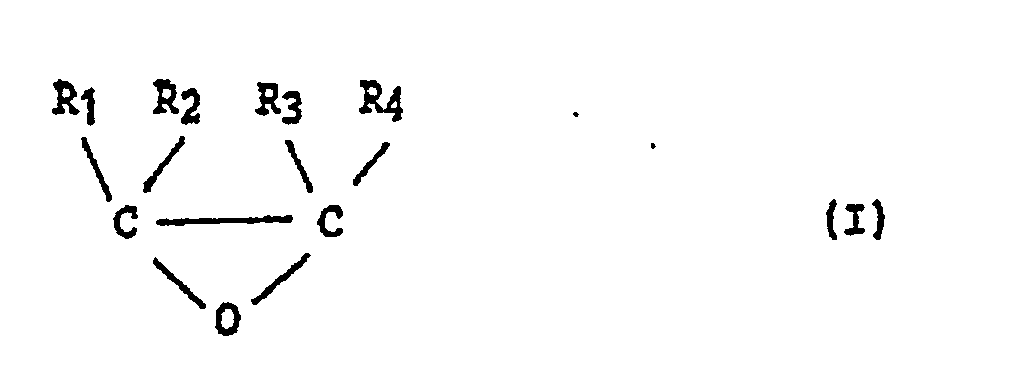
- Polymers with formaldehyde as a constituent unit used in the present invention include homopolymers or copolymers of formaldehyde and constituent units other than formaldehyde in copolymers with formaldehyde as a constituent unit are at least one kind of compound selected from the group consisting of alkylene oxide, lactone, cyclic carboxylic acid anhydride and carbon dioxide, preferably alkylene oxides, and in particular preferably compounds of Cg or less having an epoxy ring represented by the following general formula (I) or (II): (wherein Ri - Re are each a hydrogen atom or a hydrocarbon radical; any two of Ri - R 4 may be in a continuous ring construction).
- ethylene oxide is in particular preferable.
- formaldehyde which is obtained by the decomposition of paraformaldehyde, trioxane and the like, is preferably the formaldehyde used in the present invention. It can be used in the gaseous form or the liquid form. In either case formaldehyde is necessary to dry in the usual manner.
- Solvents used in the present invention include hydrocarbons such as benzene, toluene and xylene and halogenated hydrocarbons such as chlorinated methylene, chloroform and dichlorethane.
- the polymerization in the present invention is carried out by the polymerization between formaldehyde and a complex catalyzer, which is obtained by a reaction between tetraphenylporphyrin or derivatives thereof in the presence of solvents under an inert gas atmosphere, or by obtaining a prepolymer by adding at least one kind of compound selected from the group consisting of alkylene oxide, lactone, cyclic carboxylic acid anhydride and carbon dioxide and then adding formaldehyde to the resulting prepolymer without delay. It is also possible by repeating the above described reaction to increase a number of blocks. Since it is possible to control a quantity of constituent units to be used and a number of repeated times, the block length and the number of repeated blocks can be optionally designed. A ratio of block monomers in blockcopolymers can be optionally selected.
- Polymers obtained according to the present invention show a narrowed molecular weight distribution and copolymers containing an intended repeated unit construction can be obtained.
- a method of producing polymers with formaldehyde as a constituent unit according to the present invention can be used also as a method of producing oligomers having a remarkably low polymerization degree.
- Polymers and oligomers obtained according to the present invention can be used as materials for surface active agents, dispersion dyes, polyurethane and the like. In addition, they can be used as materials for setting paints and resists. Also they can be used as standard samples for measuring molecular weights and molecular weight distributions of other compounds.
- a catalyzer solution 20 ml containing a complex catalyzer 0.68 g therein was prepared by a reaction between diethylaluminium chloride 0.12 g and a, p, y, 5-tetraphenyiporphyrin of 0.61 g at room temperature in the presence of methylene chloride solvent of ml under a dry nitrogen atmosphere.
- Block copolymers were produced in the same manner as in Example 2 excepting that the ethylene oxide of 30 mmol was used in both the first time and the second time. After polymerization, the reaction products were tested in the same manner as in Example 1 with the results as shown in Table 1.
- Vapourized formaldehyde was introduced into a complex solution obtained in the same manner as in Example 1 and the resulting mixture was subjected to a reaction. After polymerization, the reaction products were tested on the molecular weight distribution and a melting point with the results as shown in Table 1.
Landscapes
- Chemical & Material Sciences (AREA)
- Health & Medical Sciences (AREA)
- Chemical Kinetics & Catalysis (AREA)
- Medicinal Chemistry (AREA)
- Polymers & Plastics (AREA)
- Organic Chemistry (AREA)
- Polyoxymethylene Polymers And Polymers With Carbon-To-Carbon Bonds (AREA)
- Polyethers (AREA)
- Organic Low-Molecular-Weight Compounds And Preparation Thereof (AREA)
Abstract
Description
- Various methods of producing polymers with formaldehyde as a constituent unit have been known. They are generally described in the Plastic Materials Lecture, Vol. 13 "Polyacetal Resin" written by Mat- sushima and the like. Since polymers with formaldehyde as a constituent unit are superior in mechanical properties, they have been widely used but the reaction is difficult to control, the produced polymers have a wide molecular weight distribution, and the arrangement of blocks in block copolymers is remarkably difficult to control, due to a remarkably high reactivity of formaldehyde.
- Japanese patent publication A (unexamined) No. 57-8223 teaches a process for preparing a block copolymer of two alkylene oxides in the presence of a complex catalyst comprising tetra-phenyl porphyrin and an organic aluminium compound.
- The present inventors investigated the matter that if the reaction of polymers with formaldehyde as a constituent unit can be controlled, mechanical properties of polymers can be controlled, thereby achieving a remarkably wide application. As a result, the present invention was achieved by finding that if a complex, which is obtained by a reaction between tetraphenylporphyrin or derivatives thereof and organometal compounds, is used as a catalyzer in the polymerization of polymers with formaldehyde as a constituent unit, the produced polymers have a narrowed molecular weight distribution and also the arrangement of blocks in block copolymers can be optionally designed.
- That is to say, the present invention relates to a method of producing polymers with formaldehyde as a constituent unit, characterized by that a complex, which is obtained by a reaction between tetraphenylporphyrin or derivatives thereof and organometal compounds, is used as a catalyzer.
- A polymer or copolymer of formaldehyde is obtained by the step of polymerizing formaldehyde and an optional co-monomer in the presence of a catalytically effective amount of a metal complex obtained between tetraphenylporphyrin or a derivative thereof and an organic metal compound. The compound is preferably a compound of a divalent or trivalent metal such as zinc, magnesium and aluminum. The co- monomer is selected from an alkylene oxide, a lactone compound, a cyclic anhydride of a carboxylic acid and carbon dioxide.
- It is possible in the invention that the comonomer(s) is added to the reaction system to obtain a block copolymer being controlled in the order of the blocks.
- It is preferable from a practical point of view that the polymerization is effected in an organic solvent in an inert gas atmosphere of and in the absence of water.
- It is preferable that formaldehyde forms the major part, 50 percent by weight or larger, of the obtained copolymer and that formaldehyde is contained in the copolymer in an amount of at least 1 percent by weight.
- Tetraphenylporphyrin or derivatives thereof are obtained by a reaction between benzaldehyde or derivatives thereof and pyrrole.
- Compounds of metals having a valence of 2 or 3 are preferably used as organometal compounds in the present invention. For example, compounds of metals such as zinc, magnesium and aluminium are preferably used, in particular preferably organoaluminium compounds. Specifically, diethylaluminium chloride and triethylaluminium are shown. In the latter case, compounds having an activated hydrogen as an anionic species such as compounds of alcohol, carboxylic acid, phenol and sulfonic acid may be additionally used.
- Usual ligands can be used as a complex catalyzer in the present invention. These ligands include tertiary amines, phosphines, phosphites, thiazolium and the like. Above all, imidazol derivatives are particularly preferable. The use of these ligands leads to a further narrowed molecular weight distribution. Ligands can be added at a ratio of 0.1 to 3.0 moles based on 1 mole of metal porphyrin, preferably 0.5 to 2.0 moles, and in particular preferably 0.8 to 1.5 moles.
- Polymers with formaldehyde as a constituent unit used in the present invention include homopolymers or copolymers of formaldehyde and constituent units other than formaldehyde in copolymers with formaldehyde as a constituent unit are at least one kind of compound selected from the group consisting of alkylene oxide, lactone, cyclic carboxylic acid anhydride and carbon dioxide, preferably alkylene oxides, and in particular preferably compounds of Cg or less having an epoxy ring represented by the following general formula (I) or (II):

- Of these compounds ethylene oxide is in particular preferable.
- Molecular formaldehyde, which is obtained by the decomposition of paraformaldehyde, trioxane and the like, is preferably the formaldehyde used in the present invention. It can be used in the gaseous form or the liquid form. In either case formaldehyde is necessary to dry in the usual manner.
- Solvents used in the present invention include hydrocarbons such as benzene, toluene and xylene and halogenated hydrocarbons such as chlorinated methylene, chloroform and dichlorethane.
- The polymerization in the present invention is carried out by the polymerization between formaldehyde and a complex catalyzer, which is obtained by a reaction between tetraphenylporphyrin or derivatives thereof in the presence of solvents under an inert gas atmosphere, or by obtaining a prepolymer by adding at least one kind of compound selected from the group consisting of alkylene oxide, lactone, cyclic carboxylic acid anhydride and carbon dioxide and then adding formaldehyde to the resulting prepolymer without delay. It is also possible by repeating the above described reaction to increase a number of blocks. Since it is possible to control a quantity of constituent units to be used and a number of repeated times, the block length and the number of repeated blocks can be optionally designed. A ratio of block monomers in blockcopolymers can be optionally selected.
- Polymers obtained according to the present invention show a narrowed molecular weight distribution and copolymers containing an intended repeated unit construction can be obtained.
- A method of producing polymers with formaldehyde as a constituent unit according to the present invention can be used also as a method of producing oligomers having a remarkably low polymerization degree.
- Polymers and oligomers obtained according to the present invention can be used as materials for surface active agents, dispersion dyes, polyurethane and the like. In addition, they can be used as materials for setting paints and resists. Also they can be used as standard samples for measuring molecular weights and molecular weight distributions of other compounds.
- 80 ml (84.8 g) benzaldehyde and 56 ml (53.6 g) pyrole were added to 3 liters propionic acid. The resulting mixture was subjected to a reaction under reflux for 30 min. and then left to stand for twenty-four hours. The reaction mixture was filtered and then a sediment was recrystallized from a methanol-chloroform solvent mixture to obtain a, p, y, 8-tetraphenyiporphyrin in a yield of 20%.
- A catalyzer solution 20 ml containing a complex catalyzer 0.68 g therein was prepared by a reaction between diethylaluminium chloride 0.12 g and a, p, y, 5-tetraphenyiporphyrin of 0.61 g at room temperature in the presence of methylene chloride solvent of ml under a dry nitrogen atmosphere.
- An additional methylene chloride solvent 20 ml was added to the tetraphenylporphyrin complex catalyzer solution 20 ml and then a solution of dry liquid formaldehyde in methylene chloride was added to the resulting mixture within 3 days in a divided manner. The resulting mixture was subjected to a polymerization reaction at room temperature under a nitrogen atmosphere. After stopping the polymerization reaction the reaction products were separated by the filtration and then subjected to an end acetylation. The reaction products were tested for molecular weight distribution and a melting point.
- The results are shown in Table 1.
- Methylene chloride 20 ml as a solvent was added to a complex catalyzer 1 mmol obtained in the same manner as in Example 1. Purified ethylene oxide 15 mmol was added to the resulting mixture. The resulting mixture was subjected to a reaction for 24 hours at room temperature under a nitrogen atmosphere and immediately liquid formaldehyde was added in the same manner as in Example 1. Subsequently, ethylene oxide 15 mmol was added again and then the resulting mixture was subjected to a reaction for 24 hours. After polymerization, the reaction products were tested in the same manner as in Example with the results as shown in Table 1. The composition ratio of blocks was calculated from a value of NMR.
- Block copolymers were produced in the same manner as in Example 2 excepting that the ethylene oxide of 30 mmol was used in both the first time and the second time. After polymerization, the reaction products were tested in the same manner as in Example 1 with the results as shown in Table 1.
- Vapourized formaldehyde was introduced into a complex solution obtained in the same manner as in Example 1 and the resulting mixture was subjected to a reaction. After polymerization, the reaction products were tested on the molecular weight distribution and a melting point with the results as shown in Table 1.
- 1-methylimidazol 1.2 mmol was added to a solution containing a complex catalyzer 1 mmol obtained in the same manner as in Example 1 and the resulting mixture was subjected to a reaction for 3 hours. Subsequently, the reaction mixture was subjected to a polymerization reaction in the same manner as in Example 1. After polymerization, the reaction products were tested on the molecular weight distribution and a melting point in the same manner as in Example 1 with the results as shown in Table 1.
- Dry trioxane (97 parts by weight), ethylene oxide (3 parts by weight) and methylal (0.3 parts by weight) as a molecular-weight controlling agent were put in an autoclave made of stainless steel. The mixture was subjected to a polymerization reaction in the presence of BFs as a catalyzer at 80°C under a nitrogen atmosphere. The resulting polymers and a melting point in the same manner as in Example 1 with the results as shown in Table 1.

Claims (7)
Priority Applications (1)
| Application Number | Priority Date | Filing Date | Title |
|---|---|---|---|
| AT86306884T ATE58149T1 (en) | 1985-09-09 | 1986-09-05 | PROCESS FOR PRODUCTION OF FORMALDEHYDE POLYMERS. |
Applications Claiming Priority (2)
| Application Number | Priority Date | Filing Date | Title |
|---|---|---|---|
| JP198750/85 | 1985-09-09 | ||
| JP60198750A JPH0730148B2 (en) | 1985-09-09 | 1985-09-09 | Method for producing polymer having formaldehyde as constitutional unit |
Publications (2)
| Publication Number | Publication Date |
|---|---|
| EP0217560A1 EP0217560A1 (en) | 1987-04-08 |
| EP0217560B1 true EP0217560B1 (en) | 1990-11-07 |
Family
ID=16396338
Family Applications (1)
| Application Number | Title | Priority Date | Filing Date |
|---|---|---|---|
| EP86306884A Expired - Lifetime EP0217560B1 (en) | 1985-09-09 | 1986-09-05 | Process for preparing polymer of formaldehyde |
Country Status (6)
| Country | Link |
|---|---|
| EP (1) | EP0217560B1 (en) |
| JP (1) | JPH0730148B2 (en) |
| KR (1) | KR930000372B1 (en) |
| AT (1) | ATE58149T1 (en) |
| CA (1) | CA1272841A (en) |
| DE (1) | DE3675488D1 (en) |
Families Citing this family (1)
| Publication number | Priority date | Publication date | Assignee | Title |
|---|---|---|---|---|
| CN110746602B (en) * | 2019-10-29 | 2021-04-20 | 大连理工大学 | A kind of metal cobalt porphyrin-based porous organic polymer and its preparation method and application |
Family Cites Families (3)
| Publication number | Priority date | Publication date | Assignee | Title |
|---|---|---|---|---|
| BE758688A (en) * | 1970-11-09 | 1971-05-10 | Angarsky Neftekhimichesky Kom | Trioxane copolymers prepared in the pres- - ence of alkylene carbonates |
| US3803094A (en) * | 1972-07-12 | 1974-04-09 | Ube Industries | Process for producing formaldehyde copolymer |
| JPS54161695A (en) * | 1978-06-13 | 1979-12-21 | Mitsubishi Gas Chem Co Inc | Method of mixing polymerizable materials and device therefor |
-
1985
- 1985-09-09 JP JP60198750A patent/JPH0730148B2/en not_active Expired - Lifetime
-
1986
- 1986-09-05 AT AT86306884T patent/ATE58149T1/en not_active IP Right Cessation
- 1986-09-05 KR KR1019860007441A patent/KR930000372B1/en not_active Expired - Fee Related
- 1986-09-05 DE DE8686306884T patent/DE3675488D1/en not_active Expired - Lifetime
- 1986-09-05 EP EP86306884A patent/EP0217560B1/en not_active Expired - Lifetime
- 1986-09-08 CA CA000517655A patent/CA1272841A/en not_active Expired - Fee Related
Also Published As
| Publication number | Publication date |
|---|---|
| CA1272841A (en) | 1990-08-14 |
| JPS6259617A (en) | 1987-03-16 |
| KR870003143A (en) | 1987-04-15 |
| DE3675488D1 (en) | 1990-12-13 |
| ATE58149T1 (en) | 1990-11-15 |
| KR930000372B1 (en) | 1993-01-16 |
| EP0217560A1 (en) | 1987-04-08 |
| JPH0730148B2 (en) | 1995-04-05 |
Similar Documents
| Publication | Publication Date | Title |
|---|---|---|
| US3998911A (en) | Polypropylene molding composition and process for its preparation | |
| CA1137067A (en) | Catalysts for polymerizing alpha-olefins | |
| US4382020A (en) | Process for the preparation of an olefin polymerization catalyst | |
| JP2935525B2 (en) | Method for producing propylene-ethylene block copolymer | |
| EP0217560A1 (en) | Process for preparing polymer of formaldehyde | |
| Hirabayashi et al. | Group transfer polymerization of 1-butadienyloxytrimethylsilane: effects of aldehydes on the initiation reaction | |
| US4695669A (en) | Process for propylene dimerization | |
| US4214065A (en) | Reinforced polylactams | |
| US3252937A (en) | Polymerization of aldehydes with catalysts containing metal-to-nitrogen bonds | |
| US3732333A (en) | Formaldehyde block copolymers and processes | |
| US4169925A (en) | Manufacture of olefin polymers | |
| EP0017456B1 (en) | Crystalline co-polybenzyls and process of producing them | |
| US3305530A (en) | Aldehyde polymerisation process | |
| US4835229A (en) | Catalyst and process for the preparation of tri-substituted silylalkynes | |
| EP0325174B1 (en) | Process for controlling the molecular weight of poly(trialkylsilylpropyne) polymers | |
| US5231164A (en) | Removal of catalyst residue from polyketone solution with silica gel or metal oxide containing water or hydroxyl functionality | |
| US4902763A (en) | Process for the polymerization tri-substituted silylalkynes | |
| US3442883A (en) | Palladium catalyzed polymerization of allene | |
| Yasuda et al. | Stereospecific Polymerization of o-Phthalaldehyde | |
| US3389126A (en) | Process for the production of high molecular weight polyoxymethylene | |
| KR930010737B1 (en) | Reduction of isomerization in solution process for polymerization of alpha-olefins | |
| US3225006A (en) | Polymerization of aldehydes using an organic compound or a salt of mercury as catalyst | |
| US3324083A (en) | Process for controlling the degree of polymerization of polyoxymethylenes | |
| RU2229480C1 (en) | Method for preparing highly reactive low-molecular polyisobutylene | |
| US4158729A (en) | Process for producing polyoxymethylene |
Legal Events
| Date | Code | Title | Description |
|---|---|---|---|
| PUAI | Public reference made under article 153(3) epc to a published international application that has entered the european phase |
Free format text: ORIGINAL CODE: 0009012 |
|
| AK | Designated contracting states |
Kind code of ref document: A1 Designated state(s): AT BE CH DE FR GB IT LI LU NL SE |
|
| 17P | Request for examination filed |
Effective date: 19870501 |
|
| 17Q | First examination report despatched |
Effective date: 19881020 |
|
| GRAA | (expected) grant |
Free format text: ORIGINAL CODE: 0009210 |
|
| AK | Designated contracting states |
Kind code of ref document: B1 Designated state(s): AT BE CH DE FR GB IT LI LU NL SE |
|
| REF | Corresponds to: |
Ref document number: 58149 Country of ref document: AT Date of ref document: 19901115 Kind code of ref document: T |
|
| REF | Corresponds to: |
Ref document number: 3675488 Country of ref document: DE Date of ref document: 19901213 |
|
| ITF | It: translation for a ep patent filed | ||
| ET | Fr: translation filed | ||
| PG25 | Lapsed in a contracting state [announced via postgrant information from national office to epo] |
Ref country code: AT Effective date: 19910905 |
|
| PG25 | Lapsed in a contracting state [announced via postgrant information from national office to epo] |
Ref country code: SE Effective date: 19910906 |
|
| PLBE | No opposition filed within time limit |
Free format text: ORIGINAL CODE: 0009261 |
|
| STAA | Information on the status of an ep patent application or granted ep patent |
Free format text: STATUS: NO OPPOSITION FILED WITHIN TIME LIMIT |
|
| PG25 | Lapsed in a contracting state [announced via postgrant information from national office to epo] |
Ref country code: LU Free format text: LAPSE BECAUSE OF NON-PAYMENT OF DUE FEES Effective date: 19910930 Ref country code: LI Effective date: 19910930 Ref country code: CH Effective date: 19910930 Ref country code: BE Effective date: 19910930 |
|
| 26N | No opposition filed | ||
| BERE | Be: lapsed |
Owner name: POLYPLASTICS CO. LTD Effective date: 19910930 |
|
| PG25 | Lapsed in a contracting state [announced via postgrant information from national office to epo] |
Ref country code: NL Effective date: 19920401 |
|
| NLV4 | Nl: lapsed or anulled due to non-payment of the annual fee | ||
| REG | Reference to a national code |
Ref country code: CH Ref legal event code: PL |
|
| EUG | Se: european patent has lapsed |
Ref document number: 86306884.7 Effective date: 19920408 |
|
| PGFP | Annual fee paid to national office [announced via postgrant information from national office to epo] |
Ref country code: GB Payment date: 19960827 Year of fee payment: 11 |
|
| PGFP | Annual fee paid to national office [announced via postgrant information from national office to epo] |
Ref country code: FR Payment date: 19960910 Year of fee payment: 11 |
|
| PGFP | Annual fee paid to national office [announced via postgrant information from national office to epo] |
Ref country code: DE Payment date: 19960913 Year of fee payment: 11 |
|
| PG25 | Lapsed in a contracting state [announced via postgrant information from national office to epo] |
Ref country code: GB Free format text: LAPSE BECAUSE OF NON-PAYMENT OF DUE FEES Effective date: 19970905 |
|
| PG25 | Lapsed in a contracting state [announced via postgrant information from national office to epo] |
Ref country code: FR Free format text: THE PATENT HAS BEEN ANNULLED BY A DECISION OF A NATIONAL AUTHORITY Effective date: 19970930 |
|
| GBPC | Gb: european patent ceased through non-payment of renewal fee |
Effective date: 19970905 |
|
| PG25 | Lapsed in a contracting state [announced via postgrant information from national office to epo] |
Ref country code: DE Free format text: LAPSE BECAUSE OF NON-PAYMENT OF DUE FEES Effective date: 19980603 |
|
| REG | Reference to a national code |
Ref country code: FR Ref legal event code: ST |
|
| PG25 | Lapsed in a contracting state [announced via postgrant information from national office to epo] |
Ref country code: IT Free format text: LAPSE BECAUSE OF NON-PAYMENT OF DUE FEES;WARNING: LAPSES OF ITALIAN PATENTS WITH EFFECTIVE DATE BEFORE 2007 MAY HAVE OCCURRED AT ANY TIME BEFORE 2007. THE CORRECT EFFECTIVE DATE MAY BE DIFFERENT FROM THE ONE RECORDED. Effective date: 20050905 |