EP0214600B1 - Cephalosporin derivatives - Google Patents
Cephalosporin derivatives Download PDFInfo
- Publication number
- EP0214600B1 EP0214600B1 EP86112120A EP86112120A EP0214600B1 EP 0214600 B1 EP0214600 B1 EP 0214600B1 EP 86112120 A EP86112120 A EP 86112120A EP 86112120 A EP86112120 A EP 86112120A EP 0214600 B1 EP0214600 B1 EP 0214600B1
- Authority
- EP
- European Patent Office
- Prior art keywords
- cephem
- compound
- acetamide
- imidazoliomethyl
- isomer
- Prior art date
- Legal status (The legal status is an assumption and is not a legal conclusion. Google has not performed a legal analysis and makes no representation as to the accuracy of the status listed.)
- Expired - Lifetime
Links
- 229930186147 Cephalosporin Natural products 0.000 title claims abstract description 13
- 229940124587 cephalosporin Drugs 0.000 title claims abstract description 13
- 150000001780 cephalosporins Chemical class 0.000 title 1
- -1 cephalosporin compound Chemical group 0.000 claims abstract description 41
- 150000003839 salts Chemical class 0.000 claims abstract description 33
- RAXXELZNTBOGNW-UHFFFAOYSA-N 1H-imidazole Chemical group C1=CNC=N1 RAXXELZNTBOGNW-UHFFFAOYSA-N 0.000 claims abstract description 13
- 125000004435 hydrogen atom Chemical group [H]* 0.000 claims abstract description 12
- 208000035143 Bacterial infection Diseases 0.000 claims abstract description 6
- 208000022362 bacterial infectious disease Diseases 0.000 claims abstract description 6
- 150000001782 cephems Chemical group 0.000 claims abstract description 3
- 125000000956 methoxy group Chemical group [H]C([H])([H])O* 0.000 claims abstract description 3
- DLFVBJFMPXGRIB-UHFFFAOYSA-N Acetamide Chemical compound CC(N)=O DLFVBJFMPXGRIB-UHFFFAOYSA-N 0.000 claims description 194
- 150000001875 compounds Chemical class 0.000 claims description 83
- 238000006243 chemical reaction Methods 0.000 claims description 26
- 239000002253 acid Chemical group 0.000 claims description 13
- 238000006722 reduction reaction Methods 0.000 claims description 10
- 239000002585 base Substances 0.000 claims description 9
- 125000003178 carboxy group Chemical group [H]OC(*)=O 0.000 claims description 8
- 229910052739 hydrogen Inorganic materials 0.000 claims description 8
- 239000001257 hydrogen Substances 0.000 claims description 8
- 229910052783 alkali metal Inorganic materials 0.000 claims description 7
- 229910052784 alkaline earth metal Inorganic materials 0.000 claims description 6
- 150000001768 cations Chemical class 0.000 claims description 6
- 150000002148 esters Chemical group 0.000 claims description 6
- 125000001495 ethyl group Chemical group [H]C([H])([H])C([H])([H])* 0.000 claims description 6
- 125000006239 protecting group Chemical group 0.000 claims description 6
- 150000001342 alkaline earth metals Chemical class 0.000 claims description 5
- 125000002496 methyl group Chemical group [H]C([H])([H])* 0.000 claims description 5
- 150000001340 alkali metals Chemical class 0.000 claims description 4
- 125000004429 atom Chemical group 0.000 claims description 4
- 125000001797 benzyl group Chemical group [H]C1=C([H])C([H])=C(C([H])=C1[H])C([H])([H])* 0.000 claims description 4
- 238000004519 manufacturing process Methods 0.000 claims description 4
- 229910052751 metal Chemical group 0.000 claims description 4
- 239000002184 metal Chemical group 0.000 claims description 4
- 125000006710 (C2-C12) alkenyl group Chemical group 0.000 claims description 3
- 125000006711 (C2-C12) alkynyl group Chemical group 0.000 claims description 3
- 125000000882 C2-C6 alkenyl group Chemical group 0.000 claims description 3
- 125000003601 C2-C6 alkynyl group Chemical group 0.000 claims description 3
- PXBRQCKWGAHEHS-UHFFFAOYSA-N dichlorodifluoromethane Chemical compound FC(F)(Cl)Cl PXBRQCKWGAHEHS-UHFFFAOYSA-N 0.000 claims description 3
- 239000003814 drug Substances 0.000 claims description 3
- 125000001997 phenyl group Chemical group [H]C1=C([H])C([H])=C(*)C([H])=C1[H] 0.000 claims description 3
- 125000004169 (C1-C6) alkyl group Chemical group 0.000 claims description 2
- 150000001412 amines Chemical class 0.000 claims description 2
- 239000003937 drug carrier Substances 0.000 claims description 2
- 239000008194 pharmaceutical composition Substances 0.000 claims description 2
- 125000000129 anionic group Chemical group 0.000 claims 1
- 125000005843 halogen group Chemical group 0.000 claims 1
- 239000003795 chemical substances by application Substances 0.000 abstract description 9
- 239000003782 beta lactam antibiotic agent Substances 0.000 abstract 1
- QJGQUHMNIGDVPM-UHFFFAOYSA-N nitrogen group Chemical group [N] QJGQUHMNIGDVPM-UHFFFAOYSA-N 0.000 abstract 1
- 239000002132 β-lactam antibiotic Substances 0.000 abstract 1
- 229940124586 β-lactam antibiotics Drugs 0.000 abstract 1
- IAZDPXIOMUYVGZ-WFGJKAKNSA-N Dimethyl sulfoxide Chemical compound [2H]C([2H])([2H])S(=O)C([2H])([2H])[2H] IAZDPXIOMUYVGZ-WFGJKAKNSA-N 0.000 description 88
- XMBWDFGMSWQBCA-UHFFFAOYSA-N hydrogen iodide Chemical compound I XMBWDFGMSWQBCA-UHFFFAOYSA-N 0.000 description 57
- 239000000203 mixture Substances 0.000 description 26
- YMWUJEATGCHHMB-UHFFFAOYSA-N Dichloromethane Chemical compound ClCCl YMWUJEATGCHHMB-UHFFFAOYSA-N 0.000 description 24
- OKKJLVBELUTLKV-UHFFFAOYSA-N Methanol Chemical compound OC OKKJLVBELUTLKV-UHFFFAOYSA-N 0.000 description 24
- HEDRZPFGACZZDS-MICDWDOJSA-N Trichloro(2H)methane Chemical compound [2H]C(Cl)(Cl)Cl HEDRZPFGACZZDS-MICDWDOJSA-N 0.000 description 24
- CSCPPACGZOOCGX-UHFFFAOYSA-N Acetone Chemical compound CC(C)=O CSCPPACGZOOCGX-UHFFFAOYSA-N 0.000 description 18
- RTZKZFJDLAIYFH-UHFFFAOYSA-N Diethyl ether Chemical compound CCOCC RTZKZFJDLAIYFH-UHFFFAOYSA-N 0.000 description 18
- 239000002904 solvent Substances 0.000 description 18
- 239000000243 solution Substances 0.000 description 17
- ZLMJMSJWJFRBEC-UHFFFAOYSA-N Potassium Chemical compound [K] ZLMJMSJWJFRBEC-UHFFFAOYSA-N 0.000 description 16
- 229960003975 potassium Drugs 0.000 description 16
- 229910052700 potassium Inorganic materials 0.000 description 16
- 239000011591 potassium Substances 0.000 description 16
- XEKOWRVHYACXOJ-UHFFFAOYSA-N Ethyl acetate Chemical compound CCOC(C)=O XEKOWRVHYACXOJ-UHFFFAOYSA-N 0.000 description 15
- ZMXDDKWLCZADIW-UHFFFAOYSA-N N,N-Dimethylformamide Chemical compound CN(C)C=O ZMXDDKWLCZADIW-UHFFFAOYSA-N 0.000 description 15
- HEDRZPFGACZZDS-UHFFFAOYSA-N Chloroform Chemical compound ClC(Cl)Cl HEDRZPFGACZZDS-UHFFFAOYSA-N 0.000 description 14
- 238000001816 cooling Methods 0.000 description 14
- ZMANZCXQSJIPKH-UHFFFAOYSA-N Triethylamine Chemical class CCN(CC)CC ZMANZCXQSJIPKH-UHFFFAOYSA-N 0.000 description 13
- QTBSBXVTEAMEQO-UHFFFAOYSA-N Acetic acid Chemical compound CC(O)=O QTBSBXVTEAMEQO-UHFFFAOYSA-N 0.000 description 12
- KQNPFQTWMSNSAP-UHFFFAOYSA-N isobutyric acid Chemical compound CC(C)C(O)=O KQNPFQTWMSNSAP-UHFFFAOYSA-N 0.000 description 12
- 239000000843 powder Substances 0.000 description 12
- 0 CC=C(C)C(C)=N* Chemical compound CC=C(C)C(C)=N* 0.000 description 11
- CDBYLPFSWZWCQE-UHFFFAOYSA-L Sodium Carbonate Chemical compound [Na+].[Na+].[O-]C([O-])=O CDBYLPFSWZWCQE-UHFFFAOYSA-L 0.000 description 10
- WEVYAHXRMPXWCK-UHFFFAOYSA-N Acetonitrile Chemical compound CC#N WEVYAHXRMPXWCK-UHFFFAOYSA-N 0.000 description 9
- UHOVQNZJYSORNB-UHFFFAOYSA-N Benzene Chemical compound C1=CC=CC=C1 UHOVQNZJYSORNB-UHFFFAOYSA-N 0.000 description 9
- 239000007864 aqueous solution Substances 0.000 description 9
- VLKZOEOYAKHREP-UHFFFAOYSA-N n-Hexane Chemical compound CCCCCC VLKZOEOYAKHREP-UHFFFAOYSA-N 0.000 description 9
- WYURNTSHIVDZCO-UHFFFAOYSA-N Tetrahydrofuran Chemical compound C1CCOC1 WYURNTSHIVDZCO-UHFFFAOYSA-N 0.000 description 8
- DTQVDTLACAAQTR-UHFFFAOYSA-N Trifluoroacetic acid Chemical compound OC(=O)C(F)(F)F DTQVDTLACAAQTR-UHFFFAOYSA-N 0.000 description 8
- VEXZGXHMUGYJMC-UHFFFAOYSA-N Hydrochloric acid Chemical compound Cl VEXZGXHMUGYJMC-UHFFFAOYSA-N 0.000 description 7
- KWOLFJPFCHCOCG-UHFFFAOYSA-N Acetophenone Chemical compound CC(=O)C1=CC=CC=C1 KWOLFJPFCHCOCG-UHFFFAOYSA-N 0.000 description 6
- XLYOFNOQVPJJNP-UHFFFAOYSA-N water Substances O XLYOFNOQVPJJNP-UHFFFAOYSA-N 0.000 description 6
- 238000010438 heat treatment Methods 0.000 description 5
- 230000007062 hydrolysis Effects 0.000 description 5
- 238000006460 hydrolysis reaction Methods 0.000 description 5
- 239000007788 liquid Substances 0.000 description 5
- 238000000034 method Methods 0.000 description 5
- 239000012044 organic layer Substances 0.000 description 5
- 229910000029 sodium carbonate Inorganic materials 0.000 description 5
- JOXIMZWYDAKGHI-UHFFFAOYSA-N toluene-4-sulfonic acid Chemical compound CC1=CC=C(S(O)(=O)=O)C=C1 JOXIMZWYDAKGHI-UHFFFAOYSA-N 0.000 description 5
- XLXCHZCQTCBUOX-UHFFFAOYSA-N 1-prop-2-enylimidazole Chemical compound C=CCN1C=CN=C1 XLXCHZCQTCBUOX-UHFFFAOYSA-N 0.000 description 4
- DGAQECJNVWCQMB-PUAWFVPOSA-M Ilexoside XXIX Chemical compound C[C@@H]1CC[C@@]2(CC[C@@]3(C(=CC[C@H]4[C@]3(CC[C@@H]5[C@@]4(CC[C@@H](C5(C)C)OS(=O)(=O)[O-])C)C)[C@@H]2[C@]1(C)O)C)C(=O)O[C@H]6[C@@H]([C@H]([C@@H]([C@H](O6)CO)O)O)O.[Na+] DGAQECJNVWCQMB-PUAWFVPOSA-M 0.000 description 4
- XEEYBQQBJWHFJM-UHFFFAOYSA-N Iron Chemical compound [Fe] XEEYBQQBJWHFJM-UHFFFAOYSA-N 0.000 description 4
- JUJWROOIHBZHMG-UHFFFAOYSA-N Pyridine Chemical compound C1=CC=NC=C1 JUJWROOIHBZHMG-UHFFFAOYSA-N 0.000 description 4
- VYPSYNLAJGMNEJ-UHFFFAOYSA-N Silicium dioxide Chemical compound O=[Si]=O VYPSYNLAJGMNEJ-UHFFFAOYSA-N 0.000 description 4
- UIIMBOGNXHQVGW-UHFFFAOYSA-M Sodium bicarbonate Chemical compound [Na+].OC([O-])=O UIIMBOGNXHQVGW-UHFFFAOYSA-M 0.000 description 4
- QAOWNCQODCNURD-UHFFFAOYSA-N Sulfuric acid Chemical compound OS(O)(=O)=O QAOWNCQODCNURD-UHFFFAOYSA-N 0.000 description 4
- 235000011054 acetic acid Nutrition 0.000 description 4
- 229960000583 acetic acid Drugs 0.000 description 4
- 125000003277 amino group Chemical group 0.000 description 4
- RDOXTESZEPMUJZ-UHFFFAOYSA-N anisole Chemical compound COC1=CC=CC=C1 RDOXTESZEPMUJZ-UHFFFAOYSA-N 0.000 description 4
- 230000000844 anti-bacterial effect Effects 0.000 description 4
- 238000010531 catalytic reduction reaction Methods 0.000 description 4
- 238000001914 filtration Methods 0.000 description 4
- BDAGIHXWWSANSR-UHFFFAOYSA-N methanoic acid Natural products OC=O BDAGIHXWWSANSR-UHFFFAOYSA-N 0.000 description 4
- XHXFXVLFKHQFAL-UHFFFAOYSA-N phosphoryl trichloride Chemical compound ClP(Cl)(Cl)=O XHXFXVLFKHQFAL-UHFFFAOYSA-N 0.000 description 4
- 229910000028 potassium bicarbonate Inorganic materials 0.000 description 4
- 235000015497 potassium bicarbonate Nutrition 0.000 description 4
- 239000011736 potassium bicarbonate Substances 0.000 description 4
- TYJJADVDDVDEDZ-UHFFFAOYSA-M potassium hydrogencarbonate Chemical compound [K+].OC([O-])=O TYJJADVDDVDEDZ-UHFFFAOYSA-M 0.000 description 4
- 229940086066 potassium hydrogencarbonate Drugs 0.000 description 4
- 239000000741 silica gel Substances 0.000 description 4
- 229910002027 silica gel Inorganic materials 0.000 description 4
- 229960001866 silicon dioxide Drugs 0.000 description 4
- 229910052708 sodium Inorganic materials 0.000 description 4
- 239000011734 sodium Substances 0.000 description 4
- 125000000999 tert-butyl group Chemical group [H]C([H])([H])C(*)(C([H])([H])[H])C([H])([H])[H] 0.000 description 4
- FYSNRJHAOHDILO-UHFFFAOYSA-N thionyl chloride Chemical compound ClS(Cl)=O FYSNRJHAOHDILO-UHFFFAOYSA-N 0.000 description 4
- RYHBNJHYFVUHQT-UHFFFAOYSA-N 1,4-Dioxane Chemical compound C1COCCO1 RYHBNJHYFVUHQT-UHFFFAOYSA-N 0.000 description 3
- PVNRLJJDLALBGG-UHFFFAOYSA-N 1-prop-2-enylbenzimidazole Chemical compound C1=CC=C2N(CC=C)C=NC2=C1 PVNRLJJDLALBGG-UHFFFAOYSA-N 0.000 description 3
- ZWEHNKRNPOVVGH-UHFFFAOYSA-N 2-Butanone Chemical compound CCC(C)=O ZWEHNKRNPOVVGH-UHFFFAOYSA-N 0.000 description 3
- 229920001817 Agar Polymers 0.000 description 3
- QOSSAOTZNIDXMA-UHFFFAOYSA-N Dicylcohexylcarbodiimide Chemical compound C1CCCCC1N=C=NC1CCCCC1 QOSSAOTZNIDXMA-UHFFFAOYSA-N 0.000 description 3
- LYCAIKOWRPUZTN-UHFFFAOYSA-N Ethylene glycol Chemical compound OCCO LYCAIKOWRPUZTN-UHFFFAOYSA-N 0.000 description 3
- CSNNHWWHGAXBCP-UHFFFAOYSA-L Magnesium sulfate Chemical compound [Mg+2].[O-][S+2]([O-])([O-])[O-] CSNNHWWHGAXBCP-UHFFFAOYSA-L 0.000 description 3
- HEMHJVSKTPXQMS-UHFFFAOYSA-M Sodium hydroxide Chemical compound [OH-].[Na+] HEMHJVSKTPXQMS-UHFFFAOYSA-M 0.000 description 3
- 239000008272 agar Substances 0.000 description 3
- 125000000484 butyl group Chemical group [H]C([*])([H])C([H])([H])C([H])([H])C([H])([H])[H] 0.000 description 3
- 238000000338 in vitro Methods 0.000 description 3
- XELZGAJCZANUQH-UHFFFAOYSA-N methyl 1-acetylthieno[3,2-c]pyrazole-5-carboxylate Chemical compound CC(=O)N1N=CC2=C1C=C(C(=O)OC)S2 XELZGAJCZANUQH-UHFFFAOYSA-N 0.000 description 3
- 150000007522 mineralic acids Chemical class 0.000 description 3
- 150000007524 organic acids Chemical class 0.000 description 3
- NLKNQRATVPKPDG-UHFFFAOYSA-M potassium iodide Chemical compound [K+].[I-] NLKNQRATVPKPDG-UHFFFAOYSA-M 0.000 description 3
- 238000002360 preparation method Methods 0.000 description 3
- 239000007787 solid Substances 0.000 description 3
- 238000003756 stirring Methods 0.000 description 3
- 239000000725 suspension Substances 0.000 description 3
- ASOKPJOREAFHNY-UHFFFAOYSA-N 1-Hydroxybenzotriazole Chemical class C1=CC=C2N(O)N=NC2=C1 ASOKPJOREAFHNY-UHFFFAOYSA-N 0.000 description 2
- KKKDZZRICRFGSD-UHFFFAOYSA-N 1-benzylimidazole Chemical compound C1=CN=CN1CC1=CC=CC=C1 KKKDZZRICRFGSD-UHFFFAOYSA-N 0.000 description 2
- OSSNTDFYBPYIEC-UHFFFAOYSA-N 1-ethenylimidazole Chemical compound C=CN1C=CN=C1 OSSNTDFYBPYIEC-UHFFFAOYSA-N 0.000 description 2
- PQZMMHPATJFNNP-UHFFFAOYSA-N 1-prop-1-ynylimidazole Chemical compound CC#CN1C=CN=C1 PQZMMHPATJFNNP-UHFFFAOYSA-N 0.000 description 2
- 125000000453 2,2,2-trichloroethyl group Chemical group [H]C([H])(*)C(Cl)(Cl)Cl 0.000 description 2
- 125000001494 2-propynyl group Chemical group [H]C#CC([H])([H])* 0.000 description 2
- BMYNFMYTOJXKLE-UHFFFAOYSA-N 3-azaniumyl-2-hydroxypropanoate Chemical compound NCC(O)C(O)=O BMYNFMYTOJXKLE-UHFFFAOYSA-N 0.000 description 2
- OSWFIVFLDKOXQC-UHFFFAOYSA-N 4-(3-methoxyphenyl)aniline Chemical compound COC1=CC=CC(C=2C=CC(N)=CC=2)=C1 OSWFIVFLDKOXQC-UHFFFAOYSA-N 0.000 description 2
- OYPRJOBELJOOCE-UHFFFAOYSA-N Calcium Chemical compound [Ca] OYPRJOBELJOOCE-UHFFFAOYSA-N 0.000 description 2
- WHXSMMKQMYFTQS-UHFFFAOYSA-N Lithium Chemical compound [Li] WHXSMMKQMYFTQS-UHFFFAOYSA-N 0.000 description 2
- FYYHWMGAXLPEAU-UHFFFAOYSA-N Magnesium Chemical compound [Mg] FYYHWMGAXLPEAU-UHFFFAOYSA-N 0.000 description 2
- BAVYZALUXZFZLV-UHFFFAOYSA-N Methylamine Chemical compound NC BAVYZALUXZFZLV-UHFFFAOYSA-N 0.000 description 2
- PHSPJQZRQAJPPF-UHFFFAOYSA-N N-alpha-Methylhistamine Chemical compound CNCCC1=CN=CN1 PHSPJQZRQAJPPF-UHFFFAOYSA-N 0.000 description 2
- ATHHXGZTWNVVOU-UHFFFAOYSA-N N-methylformamide Chemical compound CNC=O ATHHXGZTWNVVOU-UHFFFAOYSA-N 0.000 description 2
- PXHVJJICTQNCMI-UHFFFAOYSA-N Nickel Chemical compound [Ni] PXHVJJICTQNCMI-UHFFFAOYSA-N 0.000 description 2
- KDLHZDBZIXYQEI-UHFFFAOYSA-N Palladium Chemical compound [Pd] KDLHZDBZIXYQEI-UHFFFAOYSA-N 0.000 description 2
- SMWDFEZZVXVKRB-UHFFFAOYSA-N Quinoline Chemical compound N1=CC=CC2=CC=CC=C21 SMWDFEZZVXVKRB-UHFFFAOYSA-N 0.000 description 2
- XAKBSHICSHRJCL-UHFFFAOYSA-N [CH2]C(=O)C1=CC=CC=C1 Chemical group [CH2]C(=O)C1=CC=CC=C1 XAKBSHICSHRJCL-UHFFFAOYSA-N 0.000 description 2
- 150000008065 acid anhydrides Chemical class 0.000 description 2
- 150000007513 acids Chemical class 0.000 description 2
- HUMNYLRZRPPJDN-UHFFFAOYSA-N benzaldehyde Chemical compound O=CC1=CC=CC=C1 HUMNYLRZRPPJDN-UHFFFAOYSA-N 0.000 description 2
- SIOVKLKJSOKLIF-UHFFFAOYSA-N bis(trimethylsilyl)acetamide Chemical compound C[Si](C)(C)OC(C)=N[Si](C)(C)C SIOVKLKJSOKLIF-UHFFFAOYSA-N 0.000 description 2
- 125000004369 butenyl group Chemical group C(=CCC)* 0.000 description 2
- 229910052791 calcium Inorganic materials 0.000 description 2
- 239000011575 calcium Substances 0.000 description 2
- 239000003638 chemical reducing agent Substances 0.000 description 2
- XBDQKXXYIPTUBI-UHFFFAOYSA-N dimethylselenoniopropionate Natural products CCC(O)=O XBDQKXXYIPTUBI-UHFFFAOYSA-N 0.000 description 2
- ZZVUWRFHKOJYTH-UHFFFAOYSA-N diphenhydramine Chemical group C=1C=CC=CC=1C(OCCN(C)C)C1=CC=CC=C1 ZZVUWRFHKOJYTH-UHFFFAOYSA-N 0.000 description 2
- 238000003379 elimination reaction Methods 0.000 description 2
- 239000000706 filtrate Substances 0.000 description 2
- 235000019253 formic acid Nutrition 0.000 description 2
- 150000002460 imidazoles Chemical class 0.000 description 2
- 150000004693 imidazolium salts Chemical group 0.000 description 2
- 230000002401 inhibitory effect Effects 0.000 description 2
- 150000007529 inorganic bases Chemical class 0.000 description 2
- 229910052742 iron Inorganic materials 0.000 description 2
- 125000000959 isobutyl group Chemical group [H]C([H])([H])C([H])(C([H])([H])[H])C([H])([H])* 0.000 description 2
- 125000000555 isopropenyl group Chemical group [H]\C([H])=C(\*)C([H])([H])[H] 0.000 description 2
- 125000001449 isopropyl group Chemical group [H]C([H])([H])C([H])(*)C([H])([H])[H] 0.000 description 2
- 239000010410 layer Substances 0.000 description 2
- 229910052744 lithium Inorganic materials 0.000 description 2
- 229910052749 magnesium Inorganic materials 0.000 description 2
- 239000011777 magnesium Substances 0.000 description 2
- HQKMJHAJHXVSDF-UHFFFAOYSA-L magnesium stearate Chemical compound [Mg+2].CCCCCCCCCCCCCCCCCC([O-])=O.CCCCCCCCCCCCCCCCCC([O-])=O HQKMJHAJHXVSDF-UHFFFAOYSA-L 0.000 description 2
- UZKWTJUDCOPSNM-UHFFFAOYSA-N methoxybenzene Substances CCCCOC=C UZKWTJUDCOPSNM-UHFFFAOYSA-N 0.000 description 2
- 150000007530 organic bases Chemical class 0.000 description 2
- 239000003960 organic solvent Substances 0.000 description 2
- 125000006503 p-nitrobenzyl group Chemical group [H]C1=C([H])C(=C([H])C([H])=C1[N+]([O-])=O)C([H])([H])* 0.000 description 2
- BASFCYQUMIYNBI-UHFFFAOYSA-N platinum Chemical compound [Pt] BASFCYQUMIYNBI-UHFFFAOYSA-N 0.000 description 2
- 125000001436 propyl group Chemical group [H]C([*])([H])C([H])([H])C([H])([H])[H] 0.000 description 2
- WGYKZJWCGVVSQN-UHFFFAOYSA-N propylamine Chemical compound CCCN WGYKZJWCGVVSQN-UHFFFAOYSA-N 0.000 description 2
- UMJSCPRVCHMLSP-UHFFFAOYSA-N pyridine Natural products COC1=CC=CN=C1 UMJSCPRVCHMLSP-UHFFFAOYSA-N 0.000 description 2
- 229920006395 saturated elastomer Polymers 0.000 description 2
- 230000035945 sensitivity Effects 0.000 description 2
- 229910000030 sodium bicarbonate Inorganic materials 0.000 description 2
- 235000017557 sodium bicarbonate Nutrition 0.000 description 2
- VZGDMQKNWNREIO-UHFFFAOYSA-N tetrachloromethane Chemical compound ClC(Cl)(Cl)Cl VZGDMQKNWNREIO-UHFFFAOYSA-N 0.000 description 2
- YLQBMQCUIZJEEH-UHFFFAOYSA-N tetrahydrofuran Natural products C=1C=COC=1 YLQBMQCUIZJEEH-UHFFFAOYSA-N 0.000 description 2
- GETQZCLCWQTVFV-UHFFFAOYSA-N trimethylamine Chemical compound CN(C)C GETQZCLCWQTVFV-UHFFFAOYSA-N 0.000 description 2
- 125000000026 trimethylsilyl group Chemical group [H]C([H])([H])[Si]([*])(C([H])([H])[H])C([H])([H])[H] 0.000 description 2
- RIOQSEWOXXDEQQ-UHFFFAOYSA-N triphenylphosphine Chemical compound C1=CC=CC=C1P(C=1C=CC=CC=1)C1=CC=CC=C1 RIOQSEWOXXDEQQ-UHFFFAOYSA-N 0.000 description 2
- 125000002221 trityl group Chemical group [H]C1=C([H])C([H])=C([H])C([H])=C1C([*])(C1=C(C(=C(C(=C1[H])[H])[H])[H])[H])C1=C([H])C([H])=C([H])C([H])=C1[H] 0.000 description 2
- 125000000391 vinyl group Chemical group [H]C([*])=C([H])[H] 0.000 description 2
- 229920002554 vinyl polymer Polymers 0.000 description 2
- PBKFYMCZYNFVIA-WPZCJLIBSA-N (4-methoxyphenyl)methyl (6r)-7-amino-3-(chloromethyl)-8-oxo-5-thia-1-azabicyclo[4.2.0]oct-2-ene-2-carboxylate Chemical compound C1=CC(OC)=CC=C1COC(=O)C1=C(CCl)CS[C@H]2N1C(=O)C2N PBKFYMCZYNFVIA-WPZCJLIBSA-N 0.000 description 1
- VGRXAHXMIDCTNV-UHFFFAOYSA-N (6-chlorobenzotriazol-1-yl) 4-chlorobenzenesulfonate Chemical compound C1=CC(Cl)=CC=C1S(=O)(=O)ON1C2=CC(Cl)=CC=C2N=N1 VGRXAHXMIDCTNV-UHFFFAOYSA-N 0.000 description 1
- JSURBXNNBVKBGA-UHFFFAOYSA-N 1-(2-methylprop-2-enyl)benzimidazole Chemical compound C1=CC=C2N(CC(=C)C)C=NC2=C1 JSURBXNNBVKBGA-UHFFFAOYSA-N 0.000 description 1
- VKQVYBZUPJDNPA-UHFFFAOYSA-N 1-(3-methylbut-2-enyl)benzimidazole Chemical compound C1=CC=C2N(CC=C(C)C)C=NC2=C1 VKQVYBZUPJDNPA-UHFFFAOYSA-N 0.000 description 1
- MNEIJGDSFRHGMS-UHFFFAOYSA-N 1-(phenylmethyl)benzimidazole Chemical compound C1=NC2=CC=CC=C2N1CC1=CC=CC=C1 MNEIJGDSFRHGMS-UHFFFAOYSA-N 0.000 description 1
- LKWYEPWVDIBOIN-UHFFFAOYSA-N 1-but-2-enylbenzimidazole Chemical compound C1=CC=C2N(CC=CC)C=NC2=C1 LKWYEPWVDIBOIN-UHFFFAOYSA-N 0.000 description 1
- AKBNVSZFPAJJDT-UHFFFAOYSA-N 1-but-2-enylimidazole Chemical compound CC=CCN1C=CN=C1 AKBNVSZFPAJJDT-UHFFFAOYSA-N 0.000 description 1
- DIHJKNFBITXNKT-UHFFFAOYSA-N 1-but-3-enylbenzimidazole Chemical compound C1=CC=C2N(CCC=C)C=NC2=C1 DIHJKNFBITXNKT-UHFFFAOYSA-N 0.000 description 1
- LFXVROMKMIUYTC-UHFFFAOYSA-N 1-but-3-enylimidazole Chemical compound C=CCCN1C=CN=C1 LFXVROMKMIUYTC-UHFFFAOYSA-N 0.000 description 1
- MITDXNUXOAYFGC-UHFFFAOYSA-N 1-prop-2-ynylbenzimidazole Chemical compound C1=CC=C2N(CC#C)C=NC2=C1 MITDXNUXOAYFGC-UHFFFAOYSA-N 0.000 description 1
- UGOQKSGJGCADAG-UHFFFAOYSA-N 1-prop-2-ynylimidazole Chemical compound C#CCN1C=CN=C1 UGOQKSGJGCADAG-UHFFFAOYSA-N 0.000 description 1
- NGNBDVOYPDDBFK-UHFFFAOYSA-N 2-[2,4-di(pentan-2-yl)phenoxy]acetyl chloride Chemical compound CCCC(C)C1=CC=C(OCC(Cl)=O)C(C(C)CCC)=C1 NGNBDVOYPDDBFK-UHFFFAOYSA-N 0.000 description 1
- CFMZSMGAMPBRBE-UHFFFAOYSA-N 2-hydroxyisoindole-1,3-dione Chemical compound C1=CC=C2C(=O)N(O)C(=O)C2=C1 CFMZSMGAMPBRBE-UHFFFAOYSA-N 0.000 description 1
- BSKHPKMHTQYZBB-UHFFFAOYSA-N 2-methylpyridine Chemical compound CC1=CC=CC=N1 BSKHPKMHTQYZBB-UHFFFAOYSA-N 0.000 description 1
- 125000003903 2-propenyl group Chemical group [H]C([*])([H])C([H])=C([H])[H] 0.000 description 1
- SDXAWLJRERMRKF-UHFFFAOYSA-N 3,5-dimethyl-1h-pyrazole Chemical compound CC=1C=C(C)NN=1 SDXAWLJRERMRKF-UHFFFAOYSA-N 0.000 description 1
- NHQDETIJWKXCTC-UHFFFAOYSA-N 3-chloroperbenzoic acid Chemical compound OOC(=O)C1=CC=CC(Cl)=C1 NHQDETIJWKXCTC-UHFFFAOYSA-N 0.000 description 1
- CYKCUAPYWQDIKR-UHFFFAOYSA-N 4-(1h-imidazol-1-yl)phenol Chemical compound C1=CC(O)=CC=C1N1C=NC=C1 CYKCUAPYWQDIKR-UHFFFAOYSA-N 0.000 description 1
- CSDQQAQKBAQLLE-UHFFFAOYSA-N 4-(4-chlorophenyl)-4,5,6,7-tetrahydrothieno[3,2-c]pyridine Chemical compound C1=CC(Cl)=CC=C1C1C(C=CS2)=C2CCN1 CSDQQAQKBAQLLE-UHFFFAOYSA-N 0.000 description 1
- GUBGYTABKSRVRQ-XLOQQCSPSA-N Alpha-Lactose Chemical compound O[C@@H]1[C@@H](O)[C@@H](O)[C@@H](CO)O[C@H]1O[C@@H]1[C@@H](CO)O[C@H](O)[C@H](O)[C@H]1O GUBGYTABKSRVRQ-XLOQQCSPSA-N 0.000 description 1
- 239000005995 Aluminium silicate Substances 0.000 description 1
- CPELXLSAUQHCOX-UHFFFAOYSA-M Bromide Chemical compound [Br-] CPELXLSAUQHCOX-UHFFFAOYSA-M 0.000 description 1
- ICFCDVUGYUCRNI-BZWSEGBZSA-N C/C=C\N(/C=N/C)C(C)=C Chemical compound C/C=C\N(/C=N/C)C(C)=C ICFCDVUGYUCRNI-BZWSEGBZSA-N 0.000 description 1
- NSXYVOPYCXVFQE-JLOHTSLTSA-N C=CCN1C=[N+](CC(CS[C@@H]2C3N)=C(C([O-])=O)N2C3=O)C=C1 Chemical compound C=CCN1C=[N+](CC(CS[C@@H]2C3N)=C(C([O-])=O)N2C3=O)C=C1 NSXYVOPYCXVFQE-JLOHTSLTSA-N 0.000 description 1
- OXGRSTDRPMUBJW-UHFFFAOYSA-N CC=CON=C(C(O)=O)C1=CSC(N)=N1 Chemical compound CC=CON=C(C(O)=O)C1=CSC(N)=N1 OXGRSTDRPMUBJW-UHFFFAOYSA-N 0.000 description 1
- OKTJSMMVPCPJKN-UHFFFAOYSA-N Carbon Chemical compound [C] OKTJSMMVPCPJKN-UHFFFAOYSA-N 0.000 description 1
- 229910021555 Chromium Chloride Inorganic materials 0.000 description 1
- RYGMFSIKBFXOCR-UHFFFAOYSA-N Copper Chemical compound [Cu] RYGMFSIKBFXOCR-UHFFFAOYSA-N 0.000 description 1
- 229920002261 Corn starch Polymers 0.000 description 1
- BDAGIHXWWSANSR-UHFFFAOYSA-M Formate Chemical compound [O-]C=O BDAGIHXWWSANSR-UHFFFAOYSA-M 0.000 description 1
- 108010010803 Gelatin Proteins 0.000 description 1
- WHUUTDBJXJRKMK-UHFFFAOYSA-N Glutamic acid Natural products OC(=O)C(N)CCC(O)=O WHUUTDBJXJRKMK-UHFFFAOYSA-N 0.000 description 1
- CPELXLSAUQHCOX-UHFFFAOYSA-N Hydrogen bromide Chemical compound Br CPELXLSAUQHCOX-UHFFFAOYSA-N 0.000 description 1
- GUBGYTABKSRVRQ-QKKXKWKRSA-N Lactose Natural products OC[C@H]1O[C@@H](O[C@H]2[C@H](O)[C@@H](O)C(O)O[C@@H]2CO)[C@H](O)[C@@H](O)[C@H]1O GUBGYTABKSRVRQ-QKKXKWKRSA-N 0.000 description 1
- AFVFQIVMOAPDHO-UHFFFAOYSA-N Methanesulfonic acid Chemical compound CS(O)(=O)=O AFVFQIVMOAPDHO-UHFFFAOYSA-N 0.000 description 1
- NQTADLQHYWFPDB-UHFFFAOYSA-N N-Hydroxysuccinimide Chemical compound ON1C(=O)CCC1=O NQTADLQHYWFPDB-UHFFFAOYSA-N 0.000 description 1
- UEEJHVSXFDXPFK-UHFFFAOYSA-N N-dimethylaminoethanol Chemical compound CN(C)CCO UEEJHVSXFDXPFK-UHFFFAOYSA-N 0.000 description 1
- 235000019483 Peanut oil Nutrition 0.000 description 1
- YGYAWVDWMABLBF-UHFFFAOYSA-N Phosgene Chemical compound ClC(Cl)=O YGYAWVDWMABLBF-UHFFFAOYSA-N 0.000 description 1
- 229920000388 Polyphosphate Polymers 0.000 description 1
- GOOHAUXETOMSMM-UHFFFAOYSA-N Propylene oxide Chemical compound CC1CO1 GOOHAUXETOMSMM-UHFFFAOYSA-N 0.000 description 1
- 239000002262 Schiff base Substances 0.000 description 1
- 150000004753 Schiff bases Chemical class 0.000 description 1
- KEAYESYHFKHZAL-UHFFFAOYSA-N Sodium Chemical compound [Na] KEAYESYHFKHZAL-UHFFFAOYSA-N 0.000 description 1
- 235000021355 Stearic acid Nutrition 0.000 description 1
- CZMRCDWAGMRECN-UGDNZRGBSA-N Sucrose Chemical compound O[C@H]1[C@H](O)[C@@H](CO)O[C@@]1(CO)O[C@@H]1[C@H](O)[C@@H](O)[C@H](O)[C@@H](CO)O1 CZMRCDWAGMRECN-UGDNZRGBSA-N 0.000 description 1
- 229930006000 Sucrose Natural products 0.000 description 1
- LSNNMFCWUKXFEE-UHFFFAOYSA-N Sulfurous acid Chemical compound OS(O)=O LSNNMFCWUKXFEE-UHFFFAOYSA-N 0.000 description 1
- 244000299461 Theobroma cacao Species 0.000 description 1
- 235000005764 Theobroma cacao ssp. cacao Nutrition 0.000 description 1
- 235000005767 Theobroma cacao ssp. sphaerocarpum Nutrition 0.000 description 1
- ATJFFYVFTNAWJD-UHFFFAOYSA-N Tin Chemical compound [Sn] ATJFFYVFTNAWJD-UHFFFAOYSA-N 0.000 description 1
- HCHKCACWOHOZIP-UHFFFAOYSA-N Zinc Chemical compound [Zn] HCHKCACWOHOZIP-UHFFFAOYSA-N 0.000 description 1
- IKHGUXGNUITLKF-XPULMUKRSA-N acetaldehyde Chemical compound [14CH]([14CH3])=O IKHGUXGNUITLKF-XPULMUKRSA-N 0.000 description 1
- 230000002378 acidificating effect Effects 0.000 description 1
- 239000000654 additive Substances 0.000 description 1
- 239000002671 adjuvant Substances 0.000 description 1
- 235000010419 agar Nutrition 0.000 description 1
- 150000001299 aldehydes Chemical class 0.000 description 1
- 229910000288 alkali metal carbonate Inorganic materials 0.000 description 1
- 150000008041 alkali metal carbonates Chemical class 0.000 description 1
- 229910000102 alkali metal hydride Inorganic materials 0.000 description 1
- 150000008046 alkali metal hydrides Chemical class 0.000 description 1
- 150000008044 alkali metal hydroxides Chemical class 0.000 description 1
- 125000005910 alkyl carbonate group Chemical group 0.000 description 1
- 125000000217 alkyl group Chemical group 0.000 description 1
- 229910000147 aluminium phosphate Inorganic materials 0.000 description 1
- 235000012211 aluminium silicate Nutrition 0.000 description 1
- 150000001408 amides Chemical class 0.000 description 1
- 235000001014 amino acid Nutrition 0.000 description 1
- 150000001413 amino acids Chemical class 0.000 description 1
- 150000003863 ammonium salts Chemical class 0.000 description 1
- 150000001450 anions Chemical class 0.000 description 1
- 239000003242 anti bacterial agent Substances 0.000 description 1
- 150000001483 arginine derivatives Chemical class 0.000 description 1
- 150000001509 aspartic acid derivatives Chemical class 0.000 description 1
- SRSXLGNVWSONIS-UHFFFAOYSA-N benzenesulfonic acid Chemical compound OS(=O)(=O)C1=CC=CC=C1 SRSXLGNVWSONIS-UHFFFAOYSA-N 0.000 description 1
- 229940092714 benzenesulfonic acid Drugs 0.000 description 1
- 235000010290 biphenyl Nutrition 0.000 description 1
- 239000004305 biphenyl Substances 0.000 description 1
- 235000014121 butter Nutrition 0.000 description 1
- 235000001046 cacaotero Nutrition 0.000 description 1
- 159000000007 calcium salts Chemical class 0.000 description 1
- 239000002775 capsule Substances 0.000 description 1
- 229910052799 carbon Inorganic materials 0.000 description 1
- RBHJBMIOOPYDBQ-UHFFFAOYSA-N carbon dioxide;propan-2-one Chemical compound O=C=O.CC(C)=O RBHJBMIOOPYDBQ-UHFFFAOYSA-N 0.000 description 1
- 150000001728 carbonyl compounds Chemical class 0.000 description 1
- 150000001732 carboxylic acid derivatives Chemical class 0.000 description 1
- 239000003054 catalyst Substances 0.000 description 1
- 239000003153 chemical reaction reagent Substances 0.000 description 1
- WORJEOGGNQDSOE-UHFFFAOYSA-N chloroform;methanol Chemical compound OC.ClC(Cl)Cl WORJEOGGNQDSOE-UHFFFAOYSA-N 0.000 description 1
- IJOOHPMOJXWVHK-UHFFFAOYSA-N chlorotrimethylsilane Chemical compound C[Si](C)(C)Cl IJOOHPMOJXWVHK-UHFFFAOYSA-N 0.000 description 1
- QSWDMMVNRMROPK-UHFFFAOYSA-K chromium(3+) trichloride Chemical compound [Cl-].[Cl-].[Cl-].[Cr+3] QSWDMMVNRMROPK-UHFFFAOYSA-K 0.000 description 1
- WYYQVWLEPYFFLP-UHFFFAOYSA-K chromium(3+);triacetate Chemical compound [Cr+3].CC([O-])=O.CC([O-])=O.CC([O-])=O WYYQVWLEPYFFLP-UHFFFAOYSA-K 0.000 description 1
- 229910017052 cobalt Inorganic materials 0.000 description 1
- 239000010941 cobalt Substances 0.000 description 1
- GUTLYIVDDKVIGB-UHFFFAOYSA-N cobalt atom Chemical compound [Co] GUTLYIVDDKVIGB-UHFFFAOYSA-N 0.000 description 1
- 229910052802 copper Inorganic materials 0.000 description 1
- 239000010949 copper Substances 0.000 description 1
- 239000008120 corn starch Substances 0.000 description 1
- 238000003113 dilution method Methods 0.000 description 1
- 125000005982 diphenylmethyl group Chemical group [H]C1=C([H])C([H])=C(C([H])=C1[H])C([H])(*)C1=C([H])C([H])=C([H])C([H])=C1[H] 0.000 description 1
- 201000010099 disease Diseases 0.000 description 1
- 208000037265 diseases, disorders, signs and symptoms Diseases 0.000 description 1
- 239000000839 emulsion Substances 0.000 description 1
- ZUKSLMGYYPZZJD-UHFFFAOYSA-N ethenimine Chemical class C=C=N ZUKSLMGYYPZZJD-UHFFFAOYSA-N 0.000 description 1
- WMYNMYVRWWCRPS-UHFFFAOYSA-N ethynoxyethane Chemical group CCOC#C WMYNMYVRWWCRPS-UHFFFAOYSA-N 0.000 description 1
- 238000004108 freeze drying Methods 0.000 description 1
- 239000008273 gelatin Substances 0.000 description 1
- 229920000159 gelatin Polymers 0.000 description 1
- 235000019322 gelatine Nutrition 0.000 description 1
- 235000011852 gelatine desserts Nutrition 0.000 description 1
- 235000013922 glutamic acid Nutrition 0.000 description 1
- 239000004220 glutamic acid Substances 0.000 description 1
- 239000008187 granular material Substances 0.000 description 1
- 229940093915 gynecological organic acid Drugs 0.000 description 1
- 150000004820 halides Chemical class 0.000 description 1
- 125000001188 haloalkyl group Chemical group 0.000 description 1
- 150000002366 halogen compounds Chemical class 0.000 description 1
- 229910001385 heavy metal Inorganic materials 0.000 description 1
- 125000006038 hexenyl group Chemical group 0.000 description 1
- 239000012456 homogeneous solution Substances 0.000 description 1
- 239000005457 ice water Substances 0.000 description 1
- 238000011534 incubation Methods 0.000 description 1
- 229910000765 intermetallic Inorganic materials 0.000 description 1
- 239000012948 isocyanate Substances 0.000 description 1
- 150000002513 isocyanates Chemical class 0.000 description 1
- NLYAJNPCOHFWQQ-UHFFFAOYSA-N kaolin Chemical compound O.O.O=[Al]O[Si](=O)O[Si](=O)O[Al]=O NLYAJNPCOHFWQQ-UHFFFAOYSA-N 0.000 description 1
- 150000002576 ketones Chemical class 0.000 description 1
- 239000008101 lactose Substances 0.000 description 1
- 235000015122 lemonade Nutrition 0.000 description 1
- 239000000314 lubricant Substances 0.000 description 1
- 159000000003 magnesium salts Chemical class 0.000 description 1
- 235000019359 magnesium stearate Nutrition 0.000 description 1
- 229910052943 magnesium sulfate Inorganic materials 0.000 description 1
- 235000019341 magnesium sulphate Nutrition 0.000 description 1
- 125000005394 methallyl group Chemical group 0.000 description 1
- 125000004184 methoxymethyl group Chemical group [H]C([H])([H])OC([H])([H])* 0.000 description 1
- LKPFBGKZCCBZDK-UHFFFAOYSA-N n-hydroxypiperidine Chemical compound ON1CCCCC1 LKPFBGKZCCBZDK-UHFFFAOYSA-N 0.000 description 1
- 229910052759 nickel Inorganic materials 0.000 description 1
- ODUCDPQEXGNKDN-UHFFFAOYSA-N nitroxyl Chemical compound O=N ODUCDPQEXGNKDN-UHFFFAOYSA-N 0.000 description 1
- QIQXTHQIDYTFRH-UHFFFAOYSA-N octadecanoic acid Chemical compound CCCCCCCCCCCCCCCCCC(O)=O QIQXTHQIDYTFRH-UHFFFAOYSA-N 0.000 description 1
- OQCDKBAXFALNLD-UHFFFAOYSA-N octadecanoic acid Natural products CCCCCCCC(C)CCCCCCCCC(O)=O OQCDKBAXFALNLD-UHFFFAOYSA-N 0.000 description 1
- 239000004006 olive oil Substances 0.000 description 1
- 235000008390 olive oil Nutrition 0.000 description 1
- 230000003287 optical effect Effects 0.000 description 1
- 235000005985 organic acids Nutrition 0.000 description 1
- 125000001181 organosilyl group Chemical group [SiH3]* 0.000 description 1
- 229910052763 palladium Inorganic materials 0.000 description 1
- QNGNSVIICDLXHT-UHFFFAOYSA-N para-ethylbenzaldehyde Natural products CCC1=CC=C(C=O)C=C1 QNGNSVIICDLXHT-UHFFFAOYSA-N 0.000 description 1
- 239000000312 peanut oil Substances 0.000 description 1
- 239000001814 pectin Substances 0.000 description 1
- 235000010987 pectin Nutrition 0.000 description 1
- 229920001277 pectin Polymers 0.000 description 1
- 125000002255 pentenyl group Chemical group C(=CCCC)* 0.000 description 1
- 125000003884 phenylalkyl group Chemical group 0.000 description 1
- ZUOUZKKEUPVFJK-UHFFFAOYSA-N phenylbenzene Natural products C1=CC=CC=C1C1=CC=CC=C1 ZUOUZKKEUPVFJK-UHFFFAOYSA-N 0.000 description 1
- NBIIXXVUZAFLBC-UHFFFAOYSA-N phosphoric acid Substances OP(O)(O)=O NBIIXXVUZAFLBC-UHFFFAOYSA-N 0.000 description 1
- 150000003016 phosphoric acids Chemical class 0.000 description 1
- 150000003018 phosphorus compounds Chemical class 0.000 description 1
- FAIAAWCVCHQXDN-UHFFFAOYSA-N phosphorus trichloride Chemical compound ClP(Cl)Cl FAIAAWCVCHQXDN-UHFFFAOYSA-N 0.000 description 1
- 229910052697 platinum Inorganic materials 0.000 description 1
- 239000001205 polyphosphate Substances 0.000 description 1
- 235000011176 polyphosphates Nutrition 0.000 description 1
- XAEFZNCEHLXOMS-UHFFFAOYSA-M potassium benzoate Chemical compound [K+].[O-]C(=O)C1=CC=CC=C1 XAEFZNCEHLXOMS-UHFFFAOYSA-M 0.000 description 1
- 239000002244 precipitate Substances 0.000 description 1
- 239000000047 product Substances 0.000 description 1
- 125000004368 propenyl group Chemical group C(=CC)* 0.000 description 1
- 235000019260 propionic acid Nutrition 0.000 description 1
- IUVKMZGDUIUOCP-BTNSXGMBSA-N quinbolone Chemical compound O([C@H]1CC[C@H]2[C@H]3[C@@H]([C@]4(C=CC(=O)C=C4CC3)C)CC[C@@]21C)C1=CCCC1 IUVKMZGDUIUOCP-BTNSXGMBSA-N 0.000 description 1
- 150000003254 radicals Chemical class 0.000 description 1
- 239000011541 reaction mixture Substances 0.000 description 1
- 238000010992 reflux Methods 0.000 description 1
- 239000003507 refrigerant Substances 0.000 description 1
- 229910052703 rhodium Inorganic materials 0.000 description 1
- 239000010948 rhodium Substances 0.000 description 1
- MHOVAHRLVXNVSD-UHFFFAOYSA-N rhodium atom Chemical compound [Rh] MHOVAHRLVXNVSD-UHFFFAOYSA-N 0.000 description 1
- QDRKDTQENPPHOJ-UHFFFAOYSA-N sodium ethoxide Chemical compound [Na+].CC[O-] QDRKDTQENPPHOJ-UHFFFAOYSA-N 0.000 description 1
- 229910000104 sodium hydride Inorganic materials 0.000 description 1
- 239000012312 sodium hydride Substances 0.000 description 1
- 159000000000 sodium salts Chemical class 0.000 description 1
- AKHNMLFCWUSKQB-UHFFFAOYSA-L sodium thiosulfate Chemical compound [Na+].[Na+].[O-]S([O-])(=O)=S AKHNMLFCWUSKQB-UHFFFAOYSA-L 0.000 description 1
- 235000019345 sodium thiosulphate Nutrition 0.000 description 1
- 239000011877 solvent mixture Substances 0.000 description 1
- 239000003381 stabilizer Substances 0.000 description 1
- 239000008117 stearic acid Substances 0.000 description 1
- 239000000126 substance Substances 0.000 description 1
- 239000005720 sucrose Substances 0.000 description 1
- 150000003459 sulfonic acid esters Chemical class 0.000 description 1
- DHCDFWKWKRSZHF-UHFFFAOYSA-N sulfurothioic S-acid Chemical compound OS(O)(=O)=S DHCDFWKWKRSZHF-UHFFFAOYSA-N 0.000 description 1
- 239000006188 syrup Substances 0.000 description 1
- 235000020357 syrup Nutrition 0.000 description 1
- 239000003826 tablet Substances 0.000 description 1
- 239000000454 talc Substances 0.000 description 1
- 229910052623 talc Inorganic materials 0.000 description 1
- 235000012222 talc Nutrition 0.000 description 1
- 238000010998 test method Methods 0.000 description 1
- 229910052718 tin Inorganic materials 0.000 description 1
- 239000011135 tin Substances 0.000 description 1
- 125000005270 trialkylamine group Chemical group 0.000 description 1
- 229940066528 trichloroacetate Drugs 0.000 description 1
- YNJBWRMUSHSURL-UHFFFAOYSA-N trichloroacetic acid Chemical compound OC(=O)C(Cl)(Cl)Cl YNJBWRMUSHSURL-UHFFFAOYSA-N 0.000 description 1
- 125000001701 trimethoxybenzyl group Chemical group 0.000 description 1
- 125000004417 unsaturated alkyl group Chemical group 0.000 description 1
- 238000005406 washing Methods 0.000 description 1
- 229910052725 zinc Inorganic materials 0.000 description 1
- 239000011701 zinc Substances 0.000 description 1
Classifications
-
- C—CHEMISTRY; METALLURGY
- C07—ORGANIC CHEMISTRY
- C07D—HETEROCYCLIC COMPOUNDS
- C07D501/00—Heterocyclic compounds containing 5-thia-1-azabicyclo [4.2.0] octane ring systems, i.e. compounds containing a ring system of the formula:, e.g. cephalosporins; Such ring systems being further condensed, e.g. 2,3-condensed with an oxygen-, nitrogen- or sulfur-containing hetero ring
- C07D501/14—Compounds having a nitrogen atom directly attached in position 7
- C07D501/16—Compounds having a nitrogen atom directly attached in position 7 with a double bond between positions 2 and 3
- C07D501/20—7-Acylaminocephalosporanic or substituted 7-acylaminocephalosporanic acids in which the acyl radicals are derived from carboxylic acids
- C07D501/24—7-Acylaminocephalosporanic or substituted 7-acylaminocephalosporanic acids in which the acyl radicals are derived from carboxylic acids with hydrocarbon radicals, substituted by hetero atoms or hetero rings, attached in position 3
- C07D501/38—Methylene radicals, substituted by nitrogen atoms; Lactams thereof with the 2-carboxyl group; Methylene radicals substituted by nitrogen-containing hetero rings attached by the ring nitrogen atom; Quaternary compounds thereof
- C07D501/46—Methylene radicals, substituted by nitrogen atoms; Lactams thereof with the 2-carboxyl group; Methylene radicals substituted by nitrogen-containing hetero rings attached by the ring nitrogen atom; Quaternary compounds thereof with the 7-amino radical acylated by carboxylic acids containing hetero rings
Definitions
- the present invention relates to a novel cephalosporin compound substituted by an imidazolium ring in 3-position of cephem having the formula (I) or (I') and the pharmaceutically acceptable salts thereof: wherein
- the invention also covers the following compounds 7-[2-(2-Aminothiazole-4-yl)-2-(2-propenyloxyimino)-acetamide]-3-(3-acetophenyl-1-imidazoliomethyl)-3-cephem-4-carboxylate; 7-[2-(2-Aminothiazole-4-yl)-2-(2-propenyloxyimino)-acetamide]-3-(3-(4-hydroxyphenyl)-1-imidazoliomethyl)-3-cephem-4-carboxylate; 7- ⁇ 2-(2-Aminothiazole-4-yl)-2-[potassium-(2,2-dimethylacetate)oxyimino]acetamide ⁇ -3-(3-acetophenyl-1-imidazoliomethyl)-3-cephem-4-carboxylate; 7- ⁇ 2-(2-Aminothiazole-4-yl)-2-[potassium-(2,2-dimethylacetate)oxyimin
- the present invention also relates to processes for preparing these compounds and to pharmaceutical compositions containing these compounds.
- the compounds of the present invention are useful as pharmaceuticals.
- a particular aspect of the present invention is their use in the manufacture of a medicament for preventing and treating bacterial infections.
- the compounds of the present invention there may be at least one stereoisomer such as an optical isomer due to the presence of asymmetric atom(s) in the molecule.
- the present invention includes such isomers.
- alkali metal salts e.g. sodium salt, potassium salt
- alkaline earth metal salts e.g. calcium salt, magnesium salt
- ammonium salt organic amine salts (e.g. triethylamine salt, pyridinium salt)
- organic acid addition salts e.g. hydrochloride, hydrobromide
- organic acid addition salts e.g. formate, trichloroacetate, methanesulfonate
- salts with a basic or acidic amino acid e.g. arginine salt, aspartic acid salt, glutamic acid salt.
- R 9 is selected from methyl, ethyl, propyl, isopropyl, butyl, isobutyl, tert-butyl and like C 1 - C 6 alkyl; vinyl, propenyl, isopropenyl, butenyl, isobutenyl, pentenyl, hexenyl and like C 2 -C 6 alkenyl; acetylenyl, propargyl and like C 2 -C 6 alkynyl; or a group
- R 10 and R11 are same or different and are hydrogen, methyl or ethyl and R 12 is hydrogen atom; monovalent alkali metal such as sodium, potassium or lithium, preferably sodium or potassium; divalent alkaline earth metal such as calcium or magnesium; organic amine salts such as trimethylamine, triethylamine, methylamine, propylamine, N,N-dimethylethanolamine; a protective group for carboxyl such as tert-butyl, benzhydryl, 2,2,2-trichloroethyl, p-methoxybenzyl, p-nitrobenzyl, trimethylsilyl, methoxymethyl, benzyloxymethyl, dephenylmethane or phenacyl.
- monovalent alkali metal such as sodium, potassium or lithium, preferably sodium or potassium
- divalent alkaline earth metal such as calcium or magnesium
- organic amine salts such as trimethylamine, triethylamine, methylamine, propylamine, N,N-di
- B is one of the following carbon-containing groups constituting an imidazolium ring:
- R 14 is a hydrogen atom; metal atom such as sodium, potassium, etc; ester residue; salt-forming cation; or an anion charge when COO- forms an intra- or inter-molecular salt with a cation pair.
- ester residues are methyl, ethyl, propyl, isopropyl, butyl, isobutyl, tert-butyl and like C 1 ⁇ 6 lower alkyl; 2,2,2-trichloroethyl and like lower haloalkyl; benzyl, p-methoxybenzyl, trimethoxybenzyl, trimethoxydichlorobenzyl, p-nitrobenzyl, benzhydryl and like substituted or unsubstituted phenylalkyl; a protective group for carboxyl such as diphenylmethyl, trityl, ditolylmethyl, phenyl-p-methoxyphenylmethyl, a-p-methoxypheny
- R 4 is C 2 -C 12 alkenyl such as vinyl, allyl, isopropenyl, butenyl, methallyl; C 2 -C 12 alkynyl such as propargyl; benzyl or phenyl.
- cephalosporin compounds and salts thereof of the invention can be prepared by various methods. Preferred methods are shown by the following two synthetic routes. wherein R 1 and R 2 are same as above, R 14 is hydrogen atom, metal atom, ester residue, salt-forming cation, or amion charge when COO- forms intra- or inter-molecular salt with cation pair, n is 0 or 1 , X is a group which can be replaced by a substituted or unsubstituted imidazole compound.
- Compound (II) or salt thereof can be obtained by reacting Compound (VII), a reactive derivative in amino group or salt thereof and Compound (VI), a reactive derivative in carboxyl group or salt thereof.
- salts of Compounds (VII) and (VI) are used the same salts enumerated with respect to Compound (I).
- Examples of reactive derivatives of Compound (VII) in amino group are a silyl derivative obtained from Compound (VII) and a silyl compound [eg, bis(trimethylsilyl)acetamide, trimethylsilyl chloride, etc], a derivative obtained from Compound (VII) and an isocyanate or isothiocyanate compound, a Schiff base or its enamine-type tautomer formed by the reaction of Compound (VII) and a carbonyl compound [eg, acetaldehyde, benzaldehyde and like aldehydes, acetone, methyl ethyl ketone and like ketones], etc.
- a silyl derivative obtained from Compound (VII) and a silyl compound eg, bis(trimethylsilyl)acetamide, trimethylsilyl chloride, etc
- a derivative obtained from Compound (VII) and an isocyanate or isothiocyanate compound eg, acetone,
- Examples of reactive derivatives of Compound (VI) in carboxyl group are an acid chloride, acid bromide and like acid halides; an acid anhydride or symmetric acid anhydride with a substituted phosphoric acid, dialkylphosphorous acid, sulfurous acid, thiosulfuric acid, sulfuric acid, alkyl carbonate, organic carboxylic acid and like acids; an activated acid amide with an imidazole, dimethyl pyrazole, etc; an activated ester such as p-nitrophenyl ester, phenylthioester, carboxymethyl thioester, an ester with an N-hydroxypiperidine, N-hydroxysuccinimide, N-hydroxyphthalimide and like N-hydroxyl compounds; etc.
- reaction is usable a solvent such as water, acetone, dioxane, acetonitrile, chloroform, methylene chloride, benzene, ethyl acetate, N,N-dimethylformamide, pyridine, hexane, etc, which does not affect the reaction.
- the solvent can be used singly or in admixture.
- the reaction temperature is not particularly limited and the reaction can be conducted under cooling or heating and preferably at about -20 to + 40 ° C.
- the reaction can be conducted in the presence of an organic or inorganic base.
- useful bases are lithium, sodium, potassium and like alkali metals; calcium, magnesium and like alkaline earth metals; sodium hydroxide and like alkali metal hydroxides; sodium hydride and like alkali metal hydrides; calcium hydride and like alkaline earth metal hydrides; sodium carbonate and like alkali metal carbonates; potassium hydrogen carbonate and like alkali metal hydrogen carbonates; sodium ethoxide and like alkali metal alkoxides; triethylamine and like trialkylamime; pyridine, picoline, quinoline and like nitrogen-containing heterocyclic compounds; etc.
- bases preferably used are trialkylamine and nitrogen- containing heterocyclic compound.
- the amounts of the base to be used are not particularly limited but are usually up to 25 equivalents, preferably 0.25 to 4 equivalents per equivalent of Compound (VII).
- the proportions of Compound (VII) and Compound (VI) to be used are not particularly limited and are selected from a wide range. However, it is preferable to use in the equivalent ratio of the former : the latter of 1:5 to 5:1, more preferably of 1:2 to 2:1.
- the above condensing agent is used usually in an amount of up to 25 equivalents, preferably 0.25 to 4 equivalents per equivalent of Compound (VII). wherein R 1 , R 2 , R 4 , R' 4 , B, X e and n are same as above.
- the reaction of replacing C-3' position of Compound (II) by substituted or unsubstituted imidazoles (III) is preferably conducted in water or an organic solvent in the presence of a base or propylene oxide.
- organic solvents are acetonitrile, methanol, acetone, N,N-dimethyl formamide, tetrahydrofuran, etc. and these are used singly or in mixture thereof.
- the base includes sodium carbonate, sodium hydrogen carbonate, triethylamine, etc.
- the reaction temperature is not particularly limited but the reaction is carried out usually under cooling or heating and preferably at a temperature of about -10 ° C to 40 C.
- R 1 or R14 in Compound (IV) is amino-protecting group or carboxyl-protecting group, or when n is 1, Compound (I) is obtained by the reaction of removing amino-protecting group or carboxyl-protecting group, or by the reduction, respectively.
- the elimination reaction and reduction can be conducted by a usual manner such as by hydrolysis, reduction, etc. as shown below.
- the hydrolysis is conducted preferably in the presence of an acid.
- useful acids are hydrochloric acid, hydrobromic acid, sulfuric acid and like inorganic acids; formic acid, acetic acid, trifluoroacetic acid, propionic acid, benzenesulfonic acid, p-toluenesulfonic acid and like organic acids.
- the hydrolysis is usually conducted in water, methanol, tetrahydrofuran, N,N-dimethyl formamide, dioxane, benzene, hexane and the like, or mixtures of such solvents, and which does not affect the reaction.
- the acid is liquid, the acid can be used as a solvent.
- the reaction temperature is not particularly limited but the hydrolysis is preferably conducted under cooling or heating.
- the reduction includes usual methods such as chemical reduction, catalytic reduction, etc.
- Examples of chemical reducing agents are a combination of metal or metallic compound such as tin, zinc, iron, chromium chloride, chromium acetate and organic or inorganic acid such as formic acid, acetic acid, trifluoroacetic acid, p-toluenesulfonic acid, hydrochloric acid, hydrobromic acid; phosphorus tribromide; etc.
- metal or metallic compound such as tin, zinc, iron, chromium chloride, chromium acetate
- organic or inorganic acid such as formic acid, acetic acid, trifluoroacetic acid, p-toluenesulfonic acid, hydrochloric acid, hydrobromic acid; phosphorus tribromide; etc.
- Catalysts used in the catalytic reduction include usual one containing a heavy metal such as platinum, palladium, rhodium, nickel, copper, cobalt, iron, etc.
- the catalytic reduction is usually conducted in water, methanol, N, N-dimethyl formamide, hexane, benzene, dioxane and the like, or mixtures of such solvents, and which does not affect the reaction.
- the acid is liquid, the acid can be used as a solvent.
- the reaction temperature is not particularly limited but the catalytic reduction is preferably conducted under cooling or heating.
- R 1 , R 2 , R 4 , R 14 , B, X e and n are same as above.
- Compound (IV) or salt thereof can be obtained by reacting Compound (V), a reactive derivative in amino group or salt thereof and Compound (VI), a reactive derivative in carboxyl group or salt thereof.
- salts of Compounds (V) and (VI) are used the same salts enumerated with respect to Compound (I).
- Examples of reactive derivatives of Compound (V) in amino group are same compounds which are mentioned with respect to Compound (VII) in Synthetic route-1.
- reaction temperature is not particularly limited and the reaction can be conducted under cooling or heating and preferably at about -20 to + 40 ° C.
- the reaction can be conducted in the presence of an organic or inorganic base.
- bases are used the same compounds as mentioned in the above Synthetic route-1.
- the amounts of the base to be used are not particularly limited but are usually up to 25 equivalents, preferably 0.25 to 4 equivalents per equivalent of Compound (V).
- the proportions of Compound (V) and Compound (VI) to be used are not particularly limited and are selected from a wide range. However, it is preferable to use in the equivalent ratio of the former : the latter of 1:5 to 5:1, more preferably of 1:2 to 2:1.
- the reaction is conducted preferably in the presence of a condensing agent.
- the condensing agents are employed the same compounds as described in the above Synthetic route-1.
- the above condensing agent is used usually in an amount of up to 25 equivalents, preferably 0.25 to 4 equivalents per equivalent of Compound (V).
- R 1 in Compound (IV) is amino-protecting group or carboxyl-protecting group, or when n is 1, Compound (I) is obtained by removing amino- or carboxyl-protecting group, or by the reduction, respectively.
- the elimination reaction or reduction is conducted the same reaction as mentioned in the above Synthetic route-1.
- the present Compound (I) or (I') has an excellent anti-bacterial activity and is useful as an agent for preventing and treating bacterial infections.
- a usual preparation containing, as an effective component, the present Compound (I) or (I') or a salt thereof and a pharmaceutically acceptable carrier such as an organic, inorganic, solid or liquid adjuvant suitable to oral, parenteral or local administration.
- the preparation may be in the form of a tablet, granule, powder, capsule and like solid form, or solution, suspension, syrup, emulsion, lemonade and like liquid form.
- auxiliary substance such as lactose, magnesium stearate, kaolin, sucrose, corn starch, talc, stearic acid, gelatin, agar, pectin, peanut oil, olive oil, cacao butter, ethylene glycol, etc.
- the dosage of Compound (I ) or (I') varies depending on age and situation of a patient, kind of disease or compound to be administered, etc. Usually, about 1 to 4000mg or more of Compound (I) or (I') can be daily administered to a patient. For treating bacterial infections is administered Compound (I) or (I') in an average dosage per one time of about 50mg, 100mg, 250mg, 500mg, 1000mg or 2000mg.
- Tr is trityl group, tBu tertiary butyl group.
- Triethylamine (0.19ml) was added with stirring to a suspension of p-toluenesulfonic acid salt of 7-amino-3-chloromethyl-3-cephem-4-carboxylic acid p-methoxybenzyl ester (700mg) in methylene chloride (20ml) under a condition of ice-cooling. To the mixture was added (Z)-2-(2-allyloxyimino)-2-(2-tritylaminothiazole-4-yl)acetic acid (600mg) and stirred to obtain a homogeneous solution.
- the powder was collected by filtration, neutralized with an aqueous solution of potassium hydrogen carbonate and freeze-dried to obtain yellow crude powder.
- the powder was subjected to Sephadex LH-20 column (methanol) to obtain an eluate containing a desired compound. By removing a solvent at a reduced pressure was obtained 68.4mg of 7-[2-(2-aminothiazole-4-yl)-2-(2-propenyloxyimino)acetamide]-3-[3-(2-propenyl)-1-imidazoliomethyl]-3-cephem-4-carboxylate.
- Phosphorus oxychloride (0.6g) was added with ice-cooling to 2-propenyloxyimino-2-(2-aminothiazole-4-yl)aceticacid (syn-isomer) (0.53g) and the mixture was stirred for 20 minutes (B-solution).
- aqueous layer was adjusted to pH 2 with 10% hydrochloric acid and precipitates were collected by filtration, dried and dissolved into 5% aqueous solution of potassium hydrogen carbonate.
- the solution was passed through Sephadex LH-20 (H 2 0) to obtain 18mg of the same compound as in Example 7, ie, 7-[2-(2-aminothiazole-4-yl)-2-(2-propenoxyimino)acetamide]-3-[3-(2-propenyl)-1-imidazoliomethyl]-3-cephem-4-carboxylate (syn-isomer).
- the agent for preventing and treating bacterial infections was tested for in vitro anti-bacterial activity by the following two-fold agar plate dilution method. Each test strain was incubated for 20 hours in a bouillon for measuring sensitivity to obtain a test culture (containing about 10 8 live cells/ml). Portions of sensitivity measuring agar medium containing varying concentrations of the antibacterial agent were each innoculated with a 0.005ml portion of the culture, followed by incubation at 37 ° C for 20 hours. The minimum growth inhibitory concentration (MIC) in ⁇ g/ml was then determined. Table 1 shows the result.
Landscapes
- Chemical & Material Sciences (AREA)
- Organic Chemistry (AREA)
- Cephalosporin Compounds (AREA)
- Pharmaceuticals Containing Other Organic And Inorganic Compounds (AREA)
Abstract
Description
- The present invention relates to a novel cephalosporin compound substituted by an imidazolium ring in 3-position of cephem having the formula (I) or (I') and the pharmaceutically acceptable salts thereof:


- R1 is

- R2 is hydrogen or methoxy;
- R4 is C2-C12 alkenyl, C2-C12 alkynyl, benzyl or phenyl;
- R9 is C1-C6 alkyl, C2-C6 alkenyl, C2-C6 alkynyl or a group of formula

- The invention also covers the following compounds 7-[2-(2-Aminothiazole-4-yl)-2-(2-propenyloxyimino)-acetamide]-3-(3-acetophenyl-1-imidazoliomethyl)-3-cephem-4-carboxylate; 7-[2-(2-Aminothiazole-4-yl)-2-(2-propenyloxyimino)-acetamide]-3-(3-(4-hydroxyphenyl)-1-imidazoliomethyl)-3-cephem-4-carboxylate; 7-{2-(2-Aminothiazole-4-yl)-2-[potassium-(2,2-dimethylacetate)oxyimino]acetamide}-3-(3-acetophenyl-1-imidazoliomethyl)-3-cephem-4-carboxylate; 7-{2-(2-Aminothiazole-4-yl)-2-[potassium-(2,2-dimethylacetate)oxyimino]acetamide}-3-(3-(4-hydroxyphenyl)-1-imidazoliomethyl)-3-cephem-4-carboxylate.
- The present invention also relates to processes for preparing these compounds and to pharmaceutical compositions containing these compounds.
- The compounds of the present invention are useful as pharmaceuticals. A particular aspect of the present invention is their use in the manufacture of a medicament for preventing and treating bacterial infections.
- Among the compounds of the present invention, there may be at least one stereoisomer such as an optical isomer due to the presence of asymmetric atom(s) in the molecule. The present invention includes such isomers.
- Examples of useful pharmaceutically acceptable salts are alkali metal salts (e.g. sodium salt, potassium salt), alkaline earth metal salts (e.g. calcium salt, magnesium salt), ammonium salt, organic amine salts (e.g. triethylamine salt, pyridinium salt), inorganic acid addition salts (e.g. hydrochloride, hydrobromide), organic acid addition salts (e.g. formate, trichloroacetate, methanesulfonate) and salts with a basic or acidic amino acid (e.g. arginine salt, aspartic acid salt, glutamic acid salt).
- In the formula given for radical R1, R9 is selected from methyl, ethyl, propyl, isopropyl, butyl, isobutyl, tert-butyl and like C1- C6 alkyl; vinyl, propenyl, isopropenyl, butenyl, isobutenyl, pentenyl, hexenyl and like C2-C6 alkenyl; acetylenyl, propargyl and like C2-C6 alkynyl; or a group
-

- In the following, B is one of the following carbon-containing groups constituting an imidazolium ring:

- R14 is a hydrogen atom; metal atom such as sodium, potassium, etc; ester residue; salt-forming cation; or an anion charge when COO- forms an intra- or inter-molecular salt with a cation pair. Examples of ester residues are methyl, ethyl, propyl, isopropyl, butyl, isobutyl, tert-butyl and like C1~6 lower alkyl; 2,2,2-trichloroethyl and like lower haloalkyl; benzyl, p-methoxybenzyl, trimethoxybenzyl, trimethoxydichlorobenzyl, p-nitrobenzyl, benzhydryl and like substituted or unsubstituted phenylalkyl; a protective group for carboxyl such as diphenylmethyl, trityl, ditolylmethyl, phenyl-p-methoxyphenylmethyl, a-p-methoxyphenylethyl, a-p-methoxyphenyl-,8-trichloroethyl, a-diphenylethyl, trimethylsilyl, benzyloxymethyl or phenacyl.
- R4 is C2-C12 alkenyl such as vinyl, allyl, isopropenyl, butenyl, methallyl; C2-C12 alkynyl such as propargyl; benzyl or phenyl.
- The cephalosporin compounds and salts thereof of the invention can be prepared by various methods. Preferred methods are shown by the following two synthetic routes.

- Compound (II) or salt thereof can be obtained by reacting Compound (VII), a reactive derivative in amino group or salt thereof and Compound (VI), a reactive derivative in carboxyl group or salt thereof. As salts of Compounds (VII) and (VI) are used the same salts enumerated with respect to Compound (I). Examples of reactive derivatives of Compound (VII) in amino group are a silyl derivative obtained from Compound (VII) and a silyl compound [eg, bis(trimethylsilyl)acetamide, trimethylsilyl chloride, etc], a derivative obtained from Compound (VII) and an isocyanate or isothiocyanate compound, a Schiff base or its enamine-type tautomer formed by the reaction of Compound (VII) and a carbonyl compound [eg, acetaldehyde, benzaldehyde and like aldehydes, acetone, methyl ethyl ketone and like ketones], etc.
- Examples of reactive derivatives of Compound (VI) in carboxyl group are an acid chloride, acid bromide and like acid halides; an acid anhydride or symmetric acid anhydride with a substituted phosphoric acid, dialkylphosphorous acid, sulfurous acid, thiosulfuric acid, sulfuric acid, alkyl carbonate, organic carboxylic acid and like acids; an activated acid amide with an imidazole, dimethyl pyrazole, etc; an activated ester such as p-nitrophenyl ester, phenylthioester, carboxymethyl thioester, an ester with an N-hydroxypiperidine, N-hydroxysuccinimide, N-hydroxyphthalimide and like N-hydroxyl compounds; etc.
- In the reaction is usable a solvent such as water, acetone, dioxane, acetonitrile, chloroform, methylene chloride, benzene, ethyl acetate, N,N-dimethylformamide, pyridine, hexane, etc, which does not affect the reaction. The solvent can be used singly or in admixture. The reaction temperature is not particularly limited and the reaction can be conducted under cooling or heating and preferably at about -20 to + 40 ° C.
- The reaction can be conducted in the presence of an organic or inorganic base. Examples of useful bases are lithium, sodium, potassium and like alkali metals; calcium, magnesium and like alkaline earth metals; sodium hydroxide and like alkali metal hydroxides; sodium hydride and like alkali metal hydrides; calcium hydride and like alkaline earth metal hydrides; sodium carbonate and like alkali metal carbonates; potassium hydrogen carbonate and like alkali metal hydrogen carbonates; sodium ethoxide and like alkali metal alkoxides; triethylamine and like trialkylamime; pyridine, picoline, quinoline and like nitrogen-containing heterocyclic compounds; etc. Among these bases, preferably used are trialkylamine and nitrogen- containing heterocyclic compound. The amounts of the base to be used are not particularly limited but are usually up to 25 equivalents, preferably 0.25 to 4 equivalents per equivalent of Compound (VII).
- In the above reaction, the proportions of Compound (VII) and Compound (VI) to be used are not particularly limited and are selected from a wide range. However, it is preferable to use in the equivalent ratio of the former : the latter of 1:5 to 5:1, more preferably of 1:2 to 2:1.
- In case Compound (VI) is used in the form of free acid or salt thereof, the reaction is conducted preferably in the presence of a condensing agent. Examples of useful condensing agents are N,N'- dicyclohexyl carbodiimide and like carbodiimide compounds; diphenyl ketene-N-cyclohexylimine and like ketene-imine compounds; ethoxyacetylene, ,8-chlorovinyl ethyl ether and like unsaturated alkyl ether compounds; sulfonic acid ester of N-hydroxybenzotriazole derivative [eg, 1-(4-chlorobenzenesulfonyloxy)-6-chloro-1 H-benzotriazole etc]; trialkylphosphite or triphenylphosphine with carbon tetrachloride, ethyl polyphosphate, phosphorus trichloride and like phosphorus compounds; thionyl chloride; Vilsmeyer reagent (formed from the reaction of N,N-dimethyl formamide, N-methyl formamide and like amide compound and thionyl chloride, phosphoryl chloride, phosgene and like halogen compound); etc. The above condensing agent is used usually in an amount of up to 25 equivalents, preferably 0.25 to 4 equivalents per equivalent of Compound (VII).

- The reaction of replacing C-3' position of Compound (II) by substituted or unsubstituted imidazoles (III) is preferably conducted in water or an organic solvent in the presence of a base or propylene oxide. Examples of organic solvents are acetonitrile, methanol, acetone, N,N-dimethyl formamide, tetrahydrofuran, etc. and these are used singly or in mixture thereof. The base includes sodium carbonate, sodium hydrogen carbonate, triethylamine, etc. The reaction temperature is not particularly limited but the reaction is carried out usually under cooling or heating and preferably at a temperature of about -10 ° C to 40 C.
- When R1 or R14 in Compound (IV) is amino-protecting group or carboxyl-protecting group, or when n is 1, Compound (I) is obtained by the reaction of removing amino-protecting group or carboxyl-protecting group, or by the reduction, respectively. The elimination reaction and reduction can be conducted by a usual manner such as by hydrolysis, reduction, etc. as shown below.
- The hydrolysis is conducted preferably in the presence of an acid. Examples of useful acids are hydrochloric acid, hydrobromic acid, sulfuric acid and like inorganic acids; formic acid, acetic acid, trifluoroacetic acid, propionic acid, benzenesulfonic acid, p-toluenesulfonic acid and like organic acids.
- The hydrolysis is usually conducted in water, methanol, tetrahydrofuran, N,N-dimethyl formamide, dioxane, benzene, hexane and the like, or mixtures of such solvents, and which does not affect the reaction. In case the acid is liquid, the acid can be used as a solvent.
- The reaction temperature is not particularly limited but the hydrolysis is preferably conducted under cooling or heating.
- The reduction includes usual methods such as chemical reduction, catalytic reduction, etc.
- Examples of chemical reducing agents are a combination of metal or metallic compound such as tin, zinc, iron, chromium chloride, chromium acetate and organic or inorganic acid such as formic acid, acetic acid, trifluoroacetic acid, p-toluenesulfonic acid, hydrochloric acid, hydrobromic acid; phosphorus tribromide; etc.
- Catalysts used in the catalytic reduction include usual one containing a heavy metal such as platinum, palladium, rhodium, nickel, copper, cobalt, iron, etc.
- The catalytic reduction is usually conducted in water, methanol, N, N-dimethyl formamide, hexane, benzene, dioxane and the like, or mixtures of such solvents, and which does not affect the reaction. In case the acid is liquid, the acid can be used as a solvent.
- The reaction temperature is not particularly limited but the catalytic reduction is preferably conducted under cooling or heating.

- Compound (IV) or salt thereof can be obtained by reacting Compound (V), a reactive derivative in amino group or salt thereof and Compound (VI), a reactive derivative in carboxyl group or salt thereof. As salts of Compounds (V) and (VI) are used the same salts enumerated with respect to Compound (I). Examples of reactive derivatives of Compound (V) in amino group are same compounds which are mentioned with respect to Compound (VII) in Synthetic route-1.
- As reactive derivatives of Compound (VI) in carboxyl group are enumerated the same compounds as above.
- In the reaction are used the same solvents as described in the above Synthetic route-1. The reaction temperature is not particularly limited and the reaction can be conducted under cooling or heating and preferably at about -20 to + 40 ° C.
- The reaction can be conducted in the presence of an organic or inorganic base. As the bases are used the same compounds as mentioned in the above Synthetic route-1. The amounts of the base to be used are not particularly limited but are usually up to 25 equivalents, preferably 0.25 to 4 equivalents per equivalent of Compound (V).
- In the above reaction, the proportions of Compound (V) and Compound (VI) to be used are not particularly limited and are selected from a wide range. However, it is preferable to use in the equivalent ratio of the former : the latter of 1:5 to 5:1, more preferably of 1:2 to 2:1.
- In case Compound (VI) is used in the form of free acid or salt thereof, the reaction is conducted preferably in the presence of a condensing agent. As the condensing agents are employed the same compounds as described in the above Synthetic route-1. The above condensing agent is used usually in an amount of up to 25 equivalents, preferably 0.25 to 4 equivalents per equivalent of Compound (V).
- When R1 in Compound (IV) is amino-protecting group or carboxyl-protecting group, or when n is 1, Compound (I) is obtained by removing amino- or carboxyl-protecting group, or by the reduction, respectively. As the elimination reaction or reduction is conducted the same reaction as mentioned in the above Synthetic route-1.
- The present Compound (I) or (I') has an excellent anti-bacterial activity and is useful as an agent for preventing and treating bacterial infections.
- For preventing and treating is used a usual preparation containing, as an effective component, the present Compound (I) or (I') or a salt thereof and a pharmaceutically acceptable carrier such as an organic, inorganic, solid or liquid adjuvant suitable to oral, parenteral or local administration. The preparation may be in the form of a tablet, granule, powder, capsule and like solid form, or solution, suspension, syrup, emulsion, lemonade and like liquid form. To the preparation is added as required an auxiliary substance, stabilizer, lubricant, and other usual additives such as lactose, magnesium stearate, kaolin, sucrose, corn starch, talc, stearic acid, gelatin, agar, pectin, peanut oil, olive oil, cacao butter, ethylene glycol, etc.
- The dosage of Compound (I ) or (I') varies depending on age and situation of a patient, kind of disease or compound to be administered, etc. Usually, about 1 to 4000mg or more of Compound (I) or (I') can be daily administered to a patient. For treating bacterial infections is administered Compound (I) or (I') in an average dosage per one time of about 50mg, 100mg, 250mg, 500mg, 1000mg or 2000mg.
- The invention will be described with reference to Examples and Test Example. In the following, Tr is trityl group, tBu tertiary butyl group.
-

- Triethylamine (0.19ml) was added with stirring to a suspension of p-toluenesulfonic acid salt of 7-amino-3-chloromethyl-3-cephem-4-carboxylic acid p-methoxybenzyl ester (700mg) in methylene chloride (20ml) under a condition of ice-cooling. To the mixture was added (Z)-2-(2-allyloxyimino)-2-(2-tritylaminothiazole-4-yl)acetic acid (600mg) and stirred to obtain a homogeneous solution. To the solution were added with stirring and under a condition of ice-cooling, 1-hydroxybenzotriazole (265mg) and then dicyclohexylcarbodiimide (270mg). The mixture was further stirred for 3 hours under ice-cooling. The mixture was filtered and the resulting white solid was washed with a small amount of acetone. The filtrate and washing liquid were combined and concentrated to remove a solvent at a reduced pressure. The residue was eluted through silicagel column with use of chloroform-methanol (volume ratio 8:1). The eluted solution containing a desired product was collected and concentrated to obtain 7-[2-(2-propenyloxyimino)-2-(2-tritylaminothiazole-4-yl)acetamide]-3-chloromethyl-3-cephem-4-carboxylic acid p-methoxybenzyl ester (syn-isomer) (900mg).
- NMR 6 ppm (CDCI3):
- 3.50(2H,s), 3.78(3H,s), 4.45(2H,d,J=12Hz), 4.58(2H,d,J=5.5Hz), 4.96(1H,d,J=5.0Hz), 5.1-5.4(4H,m), 5.8-6.1 (2H,m), 6.7(1 H,s), 7.08-7.84(20H,m), 8.13(1 H,s)
-

- To a solution of 890mg of 7-[2-(2-propenyloxyimino)-2-(2-tritylaminothiazole-4-yl)acetamide]-3-chloromethyl-3-cephem-4-carboxylic acid p-methoxybenzyl ester (syn-isomer) in 50ml of acetone were added 237mg of potassium iodide and 157mg of sodium carbonate. The mixture was heated to reflux for one hour with stirring. The mixture was allowed to cool to room temperature and filtered. The filtrate was concentrated at a reduced pressure. The residue was dissolved in 50ml of methylene chloride and was washed with 30ml of 5% aqueous solution of sodium thiosulfate. The resulting organic layer was concentrated at a reduced pressure to obtain 820mg of 7-[2-(2-propenyloxyimino)-2-(2-tritylaminothiazole-4-yl)acetamide]-3-iodomethyl-3-cephem-4-carboxylic acid p-methoxybenzyl ester (syn-isomer). NMR δ ppm (CDCl3):
- 3.50(2H,m), 3.82(3H,s), 4.32(2H,s), 4.70(2H,d,J = 5.5Hz), 4.90(1 H,d,J = 5.OHz), 5.1~5.4(4H,m), 5.8~6.1(2H,m)-,6.7(1 H,s), 7.08-7.84(20H,m), 8.13(1 H,s)
-

- To a solution cooled at 0°C of 5.0g of 7-[2-(2-propenyloxyimino)-2-(2-tritylaminothiazole-4-yl)-acetamide]-3-iodomethyl-3-cephem-4-carboxylic acid p-methoxybenzyl ester (syn-isomer) in 160ml of methylene chloride was added dropwise a solution of 1.5g of m-chloroperbenzoic acid in 40ml of methylene chloride in 10 minutes and the mixture was stirred for 50 minutes at the same temperature. The mixture was allowed to cool to room temperature and was washed with an aqueous solution of sodium carbonate, water and saturated aqueous solution of NaCI. After dehydrated with use of magnesium sulfate, the organic layer was concentrated at a reduced pressure to remove a solvent, giving 5.1 g of 7-[2-(2-propenyloxyimino)-2-(2-tritylaminothiazole-4-yl)acetamide]-3-iodomethyl-3-cephem-1-oxido-4-carboxylic acid p-methoxybenzyl ester (syn-isomer).
- NMR δ ppm (CDCl3): 3.54(2H,m,), 3.78(3H,s), 4.41 (2H,m), 4.44(1 H,m), 4.73(2H,m), 4.97-5.42(2H,m), 5.22(2H,s), 5.65-6.21 (2H,m), 6.64(1 H,s), 7.08(4H,m), 7.25(16H,s)
-

- Into a mixture of THF (5ml) and chloroform (2.5ml) was dissolved 0.5g of 7-[2-(2-propenyloxyimino)-2-(2-tritylaminothiazole-4-yl)acetamide]-3-iodomethyl-3-cephem-I-oxido-4-carboxylic acid p-methoxybenzyl ester (syn-isomer). To the solution was added with ice-cooling 64.8mg of 1-(2-propenyl)imidazole. After the addition, the mixture was heated to room temperature and was further stirred for 3 hours. Solvents were removed at a reduced pressure. The residue was wade into a powder with use of diethyl ether and purified by a silicagel column (chloroform/methanol = 8/1, volume ratio) to collect eluate containing a desired compound. By removing a solvent was obtained 375.1mg of 7-[2-(2-propenyloxyimino)-2-(2-tritylaminothiazole-4-yl)acetamide]-3-[3-(2-propenyl)-1-imidazoliomethyl]-3-cephem-1-oxido-4-carboxylic acid p-methoxybenzyl ester•iodide (syn-isomer).
- NMR 6 ppm (DMSO-d6):
- 3.75(2H,m), 3.80(3H,s), 4.60(2H,m), 4.88-5.47(9H,m), 5.60-6.30(3H,m), 6.81 (1 H,s), 7.14(4H,m), 7.32(15H,s), 7.66(2H,m), 8.74(1 H,s), 8.94(1 H,m), 9.06(1 H,s)
-

- Into 20ml of acetone was dissolved 359.6mg of 7-[2-(2-propenyloxyimino)-2-(2-tritylaminothiazole-4-yl)-acetamide]-3-[3-(2-propenyl)-1-imidazoliomethyl]-3-cephem-1-oxido-4-carboxylic acid p-methoxybenzyl es- ter•iodide (syn-isomer). The solution was cooled to -40 °C with dry ice-acetone refrigerant and added dropwise 270µl of phosphorus tribromide thereto. The mixture was stirred for one hour. With cooling at the same temperature, 3ml of aqueous solution of 500mg of sodium carbonate was added to the mixture. After heated to room temperature, 60ml of water was added and the mixture was extracted twice with 100ml of ethyl acetate. The resulting organic layer was dried with anhydrous magnesium sulfate. By removing ethyl acetate was obtained 292.8mg of 7-[2-(2-propenyloxyimino)-2-(2-tritylaminothiazole-4-yl)acetamide)-3-[3-(2-propenyl)-1-imidazoliomethyl]-3-cephem-4-carboxylic acid p-methoxybenzyl ester•iodide (syn-isomer).
- NMR 6 ppm (DMSO-d6):
- 3.50(2H,s), 3.78(3H,s), 4.56(2H,m), 4.84(2H,m), 5.01-5.60(9H,m), 5.60-6.40(3H,m), 6.72(1 H,s), 7.15(4H,m), 7.31(15H,s), 7.62(2H,m), 9.05(1 H,s), 9.20(1 H,s), 9.53(1 H,m)
-

- Into 3ml of 80% aqueous solution of acetic acid was dissolved 280mg of 7-[2-(2-propenyloxyimino)-2-(2-tritylaminothiazole-4-yl)acetamide]-3-[3-(2-propenyl)-1-imidazoliomethyl]-3-cephem-4-carboxylic acid p-methoxybenzyl ester•iodide (syn-isomer). The solution was stirred at 35 to 40 °C for 2 hours and the solvent was removed by freeze-drying. To the residue was added diethyl ether and powder separated was collected by filtration to obtain 209.2mg of 7-[2-(2-aminothiazole-4-yl)-2-(2-propenyloxyimino)acetamide]-3-[3-(2-propenyl)-1-imidazoliomethyl]-3-cephem-4-carboxylic acid p-methoxybenzyl ester•iodide (syn-isomer). NMR 6 ppm (DMSO-d6):
- 3.54(2H,s), 3.76(3H,s), 4.58(2H,m), 4.83(2H,m), 5.0-5.54(9H,m), 5.61-6.35(3H,m), 6.78(1H,s), 6.83(2H,s), 7.13(4H,m), 7.68(2H,m), 9.22(1 H,s), 9.63(1 H,s)
-

- In a mixture of methylene chloride (3ml), trifluoroacetic acid (930µl) and anisole (650µl) was added 190mg of 7-[2-(2-aminothiazole-4-yl)-2-(2-propenyloxyimino)acetamide]-3-[3-(2-propenyl)-1-imidazoliomethyl]-3-cephem-4-carboxylic acid p-methoxybenzyl ester* iodide (syn-isomer). The mixture was stirred at ice-cooling for 2 hours. The solvent was removed at a reduced pressure. To the residue was added 100ml of diethyl ether to separate out powder. The powder was collected by filtration, neutralized with an aqueous solution of potassium hydrogen carbonate and freeze-dried to obtain yellow crude powder. The powder was subjected to Sephadex LH-20 column (methanol) to obtain an eluate containing a desired compound. By removing a solvent at a reduced pressure was obtained 68.4mg of 7-[2-(2-aminothiazole-4-yl)-2-(2-propenyloxyimino)acetamide]-3-[3-(2-propenyl)-1-imidazoliomethyl]-3-cephem-4-carboxylate.
- NMR 6 ppm (DMSO-d6):
- 3.65(2H,m), 4.57(2H,m), 4.82(2H,m), 5.01-5.5(7H,m), 5.55-6.35(3H,m), 6.83(1H,s), 7.17(2H,s), 7.63(2H,m), 9.23(1 H,s), 9.35(1 H,d,J = 8.0Hz)
-

- In the same manner as in Example 4, from 0.5g of 7-[2-(2-propenyloxyimino)-2-(2-tritylaminothiazole-4-yl)acetamide]-3-iodomethyl-3-cephem-I-oxido-4-carboxylic acid p-methoxybenzyl ester (syn-isomer) and 94.8mg of 1-benzylimidazole was obtained 418.3mg of 7-[2-(2-propenyloxyimino)-2-(2-tritylaminothiazole-4-yl)acetamide]-3-(3-benzyl-1-imidazoliomethyl)-3-cephem-1-oxido-4-carboxylic acid p-methoxybenzyl es- ter•iodide (syn-isomer).
- NMR δ ppm (DMSO-d6):
- 3.65(2H,m), 3.28(3H,s), 4.56(2H,m), 4.97(1H,m), 5.01-5.60(8H,m), 5.51-6.30(2H,m), 6.80(1H,s), 7.12(4H,m), 7.32(15H,s), 7.43(5H,s), 7.62(1 H,s), 7.73(1 H,s), 8.73(1 H,s), 8.91 (1 H,m), 9.40(1 H,s)
-
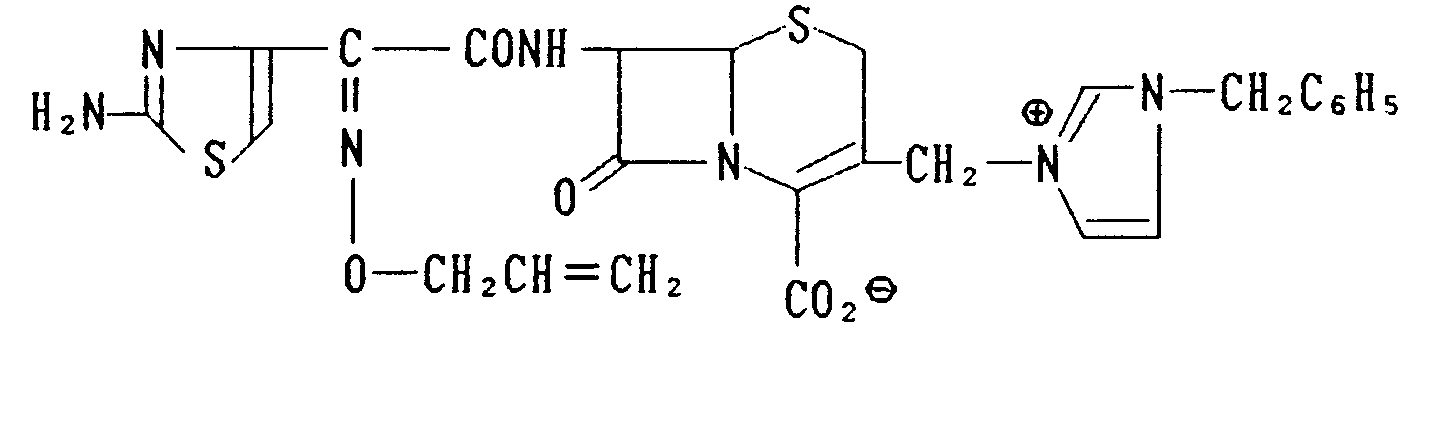
- In the same manner as in Examples 5, 6 and 7, from 408.3mg of 7-[2-(2-propenyloxyimino)-2-(2-tritylaminothiazole-4-yl)acetamide]-3-(3-benzyl-1-imidazoliomethyl)-3-cephem-1-oxido-4-carboxylic acid p-methoxybenzyl ester•iodide (syn-isomer) was obtained 37.2mg of 7-[2-(2-aminothiazole-4-yl)-2-(2-pro- penyloxyimino)acetamide]-3-(3-benzyl-1-imidazoliomethyl)-3-cephem-4-carboxylate (syn-isomer).
- NMR δ ppm (DMSO-d6):
- 3.47(2H,m), 4.68(2H,m), 4.80-5.50(5H,m), 5.41 (2H,s), 5.60-6.23(2H,m), 6.93(1 H,s), 7.37(5H,s), 7.67(2H,m), 9.23(1 H,s)
-

- NMR δ ppm (DMSO-d6):
- 3.75(2H,m), 3.80(3H,s), 4.60(2H,m), 4.85-5.47(9H,m), 7.32(15H,s), 7.66(2H,m), 8.74(1 H,s), 8.94(1 H,m), 9.06-(1 H,s)
-

- In the same manner as in Examples 5, 6 and 7, from 350mg of 7-[2-(2-propenyloxyimino)-2-(2-tritylaminothiazole-4-yl)acetamide]-3-(3-vinyl-1-imidazoliomethyl)-3-cephem-1-oxido-4-carboxylic acid p-methoxybenzyl ester•iodide (syn-isomer) was obtained 29mg of 7-[2-(2-aminothiazole-4-yl)-2-(2-propenylox- yimino)acetamide]-3-(3-vinyl-1-imidazoliomethyl) -3-cephem-4-carboxylate (syn-isomer).
- NMR δ ppm (DMSO-d6):
- 3.75(2H,m), 4.60(2H,m), 4.80-5.47(9H,m), 6.78(1 H,s), 6.83(2H,s), 7.17(2H,s), 9.23(1 H,s), 9.35-(1 H,d,J = 8.0Hz)
-

- In the same manner as in Example 4, from 0.5g of 7-[2-(2-propenyloxyimino)-2-(2-tritylaminothiazole-4-yl)acetamide]-3-iodomethyl-3-cephem-1-oxido-4-carboxylic acid p-methoxybenzyl ester (syn-isomer) and 100µl of 4-imidazole acetophenone was obtained 330mg of 7-[2-(2-propenyloxyimino)-2-(2-tritylaminothiazole-4-yl)acetamide]-3-(3-acetophenyl-1-imidazoliomethyl)-3-cephem-1-oxido-4-carboxylic acid p-methoxybenzyl ester•iodide (syn-isomer).
- NMR δ ppm (DMSO-d6):
- 3.80(3H,s), 3.75(2H,m), 4.50(2H,m), 4.56(2H,m), 5.0(2H,m), 5.15(4H,m), 6.60(1 H,s), 7.32(18H,m), 9.30-(1 H,d,J = 8.OHz)
-

- In the same manner as in Examples 5, 6 and 7, from 310mg of 7-[2-(2-propenyloxyimino)-2-(2-tritylaminothiazole-4-yl)acetamide]-3-(3-acetophenyl-1-imidazoliomethyl)-3-cephem-1-oxido-4-carboxylic acid p-methoxybenzyl ester•iodide (syn-isomer) was obtained 53mg of 7-[2-(2-aminothiazole-4-yl)-2-(2-pro- penyloxyimino)acetamide]-3-(3-acetophenyl-1-imidazoliomethyl)-3-cephem-4-carboxylate.
- NMR 6 ppm (DMSO-d6):
- 3.75(2H,m), 4.50(2H,m), 5.0(2H,m), 5.50(1 H,m), 6.65(1 H,s), 7.0(2H,s), 9.06(1 H,d,J = 8.0Hz)
-

- In the same manner as in Example 4, from 0.5g of 7-[2-(2-propenyloxyimino)-2-(2-tritylaminothiazole-4-yl)acetamide]-3-iodomethyl-3-cephem-I-oxido-4-carboxylic acid p-methoxybenzyl ester (syn-isomer) and 88µl of 4-imidazole acetophenone was obtained 310mg of 7-[2-(2-propenyloxyimino)-2-(2-tritylaminothiazole-4-yl)acetamide)-3-[3-(4-hydroxyphenyl)-1-imidazoliomethyl)-3-cephem-1-oxido-4-carboxylic acid p-methoxybenzyl ester•iodide (syn-isomer).
- NMR δ ppm (DMSO-d6):
- 3.80(3H,s), 3.75(2H,m), 4.50(2H,m), 4.56(2H,m), 5.75-6.10(4H,m), 7.0-7.32(17H,m), 9.20(1 H,d,J = 8.0Hz)
-

- In the same manner as in Examples 5, 6 and 7, from 290mg of 7-[2-(2-propenyloxyimino)-2-(2-tritylaminothiazole-4-yl)acetamide]-3-[3-(4-hydroxyphenyl)-1-imidazoliomethyl]-3-cephem-1-oxido-4-carboxylic acid p-methoxybenzyl ester•iodide (syn-isomer) was obtained 53mg of 7-[2-(2-aminothiazole-4-yl)-2-(2-propenyloxyimino)acetamide]-3-[3-(4-hydroxyphenyl)-1-imidazoliomethyl]-3-cephem-4-carboxylate (syn-isomer).
- NMR δ ppm (DMSO-d6):
- 3.75(2H,m), 4.50(2H,m), 4.56(2H,m), 5.75-6.10(4H,m), 7.2(6H,m), 9.20(1 H,d,J = 8.0Hz)
-

- In the same wanner as in Example 4, from 0.5g of 7-[2-(2-propenyloxyimino)-2-(2-tritylaminothiazole-4-yl)acetamide]-3-iodomethyl-3-cephem-I-oxido-4-carboxylic acid p-methoxybenzyl ester (syn-isomer) and 58µl of 1-propynylimidazole was obtained 325mg of 7-[2-(2-propenyloxyimino)-2-(2-tritylaminothiazole-4-yl)-acetamide]-3-[3-(2-propynyl)-1-imidazoliomethyl]-3-cephem-1-oxido-4-carboxylic acid p-methoxybenzyl es- ter•iodide (syn-isomer).
- NMR 6 ppm (DMSO-d6):
- 3.9-4.4(2H,m), 4.6(2H,s), 4.85(1 H,d,J = 5.0Hz), 5.45(1 H,m), 6.72(1 H,s), 7.25(15H,s), 9.45(1 H,d,J = 8.0Hz)
-

- In the same manner as in Examples 5, 6 and 7, from 315mg of 7-[2-(2-propenyloxyimino)-2-(2-tritylaminothiazole-4-yl)acetamide]-3-[3-(2-propynyl)-1-imidazoliomethyl]-3-cephem-1-oxido-4-carboxylic acid p-methoxybenzyl ester•iodide (syn-isomer) was obtained 38mg of 7-[2-(2-aminothiazole-4-yl)-2-(2-pro- penyloxyimino)acetamide)-3-[3-(2-propynyl)-1-imidazoliomethyl]-3-cephem-4-carboxylate.
- NMR δ ppm (DMSO-d6):
- 3.9-4.4(2H,m), 4.6(2H,s), 4.85(1 H,d,J = 5.0Hz), 5.45(1 H,m), 6.72(1 H,s), 7.10(2H,s), 9.45(1 H,d,J = 8.0Hz)
-

- In the same manner as in Example 4, from 0.5g of 7-[2-(2-propenyloxyimino)-2-(2-tritylaminothiazole-4-yl)acetamide]-3-iodomethyl-3-cephem-1-oxido-4-carboxylic acid p-methoxybenzyl ester (syn-isomer) and 68µl of 1-(2-butenyl)imidazole was obtained 365mg of 7-[2-(2-propenyloxyimino)-2-(2-tritylaminothiazole-4-yl)acetamide]-3-[3-(2-butenyl)-1-imidazoliomethyl]-3-cephem-1-oxido-4-carboxylic acid p-methoxybenzyl es- ter•iodide (syn-isomer).
- NMR δ ppm (DMSO-d6):
- 1.7(3H,d,J = 6.0), 3.9-4.4(2H,m), 4.6(2H,s), 4.85(1 H,d,J = 5.0Hz), 5.45(1 H,m), 6.72(1 H,s), 7.25(15H,s), 9.45-(1 H,d,J = 8.OHz)
-

- In the same manner as in Examples 5, 6 and 7, from 353mg of 7-[2-(2-propenyloxyimino)-2-(2-tritylaminothiazole-4-yl)acetamide]-3-[3-(2-butenyl)-1-imidazoliomethyl]-3-cephem-1-oxido-4-carboxylic acid p-methoxybenzyl ester•iodide was obtained 57mg of 7-[2-(2-aminothiazole-4-yl)-2-(2-propenyloxyimino)-acetamide]-3-[3-(2-butenyl)-1-imidazoliomethyl]-3-cephem-4-carboxylate (syn-isomer).
- NMR δ ppm (DMSO-d6):
- 1.7(3H,d,J=6.0), 3.9-4.4(2H,m), 4.6(2H,s), 4.85(1 H,d,J = 5.0Hz), 5.45(1 H,m), 6.73(1 H,s), 7.10(2H,s), 9.45-(1H,d,J = 8.0Hz)
-

- In the same manner as in Example 4, from 0.5g of 7-[2-(2-propenyloxyimino)-2-(2-tritylaminothiazole-4-yl)acetamide]-3-iodomethyl-3-cephem-4-carboxylic acid p-methoxybenzyl ester (syn-isomer) and 68µl of 1-(3-butenyl)imidazole was obtained 353mg of 7-[2-(2-propenyloxyimino)-2-(2-tritylaminothiazole-4-yl)-acetamide]-3-[3-(3-butenyl)-1-imidazoliomethyl)-3-cephem-1-oxido-4-carboxylic acid p-methoxy benzyl ester•iodide (syn-isomer).
- NMR δ ppm (DMSO-d6):
- 2.28(2H,m), 3.85(2H,m), 4.6(2H,s), 4.85(1H,d,J = 5.0Hz), 5.45(1 H,m), 6.76(1 H,s), 7.25(15H,s), 9.20-(1H,d,J = 8.0Hz)
-

- In the same manner as in Examples 5, 6 and 7, from 348mg of 7-[2-(2-propenyloxyimino)-2-(2-tritylaminothiazole-4-yl)acetamide]-3-[3-(3-butenyl)-1-imidazoliomethyl]-3-cephem-1-oxido-4-carboxylic acid p-methoxybenzyl ester•iodide (syn-isomer) was obtained 51 mg of 7-[2-(2-aminothiazole-4-yl)-2-(2-pro- penyloxyimino)acetamide]-3-[3-(3-butenyl)-1-imidazoliomethyl]-3-cephem-4-carboxylate (syn-isomer).
- NMR δ ppm (DMSO-d6):
- 2.28(2H,m), 3.85(2H,m), 4.6(2H,s), 4.85(1 H,d,J=5.0Hz), 5.45(1 H,m), 6.76(1 H,s), 7.01 (2H,s), 9.20-(1H,d,J = 8.0Hz)
-

- In the same manner as in Example 4, from 0.6g of 7-[2-methoxyimino-2-(2-tritylaminothiazole-4-yl)-acetamide]-3-iodomethyl-3-cephem-1-oxido-4-carboxylic acid p-methoxybenzyl ester (syn-isomer) and 79mg of 1-(2-propenyl)imidazole was obtained 390mg of 7-[2-methoxyimino-2-(2-tritylaminothiazole-4-yl)-acetamide]-3-[3-(2-propenyl)-1-imidazoliomethyl]-3-cephem-1-oxido-4-carboxylic acid p-methoxybenzyl es- ter•iodide (syn-isomer).
- NMR δ ppm (CDCl3):
- 3.77(3H,s), 4.0(3H,s), 4.95(1 H,d,J = 4Hz), 5.6-6.5(2H,m), 6.65(1 H,s), 6.7-7.5(19H,m), 7.7(1 H,s), 9.7(1 H,s)
-

- In the same manner as in Examples 5, 6 and 7, from 320mg of 7-[2-methoxyimino-2-(2-tritylaminothiazole-4-yl)acetamide]-3-[3-(2 -propenyl) -1-imidazoliomethyl]-3-cephem-1-oxido-4-carboxylic acid p-methoxybenzyl ester•iodide (syn-isomer) was obtained 26mg of 7-[2-(2-aminothiazole-4-yl)-2-methoxyiminoacetamide]-3-[3-(2-propenyl)-1-imidazoliomethyl]-3-cephem-4-carboxylate (syn-isomer).
- NMR δ ppm (DMSO-d6):
- 3.80(3H,s), 4.48-6.25(m8H), 6.65(1 H,s), 7.1 (2H,s), 7.6(1 H,s), 7.95(1 H,s), 9.25(1 H,s), 9.4(1 H,d,J = 8.0Hz)
-

- In the same manner as in Example 4, from 0.6g of 7-[2-methoxyimino-2-(2-tritylaminothiazole-4-yl)-acetamide]-3-iodomethyl-3-cephem-I-oxido-4-carboxylic acid p-methoxybenzyl ester (syn-isomer) and 88mg of 1-propynylimidazole was obtained 330mg of 7-[2-methoxyimino-2-(2-tritylaminothiazole-4-yl)-acetamide]-3-[3-(2-propynyl)-1-imidazoliomethyl)-3-cephem-1-oxido-4-carboxylic acid p-methoxybenzyl es- ter•iodide (syn-isomer).
- NMR δ ppm (CDCl3):
- 2.75(1 H,m), 3.75(3H,s), 4.0(3H,s), 4.75(1 H,d,J = 3.0Hz), 4.8-5.5(6H,m), 6.0-6.3(1 H,m), 6.70(1 H,s), 6.8-7.75-(20H,m), 9.8(1 H,s)
-

- In the same manner as in Examples 5, 6 and 7, from 300mg of 7-[2-methoxyimino-2-(2-tritylaminothiazole-4-yl)acetamide]-3-[3-(2-propynyl)-1-imidazoliomethyl]-3-cephem-1-oxido-4-carboxylic acid p-methoxybenzyl ester•iodide (syn-isomer) was obtained 52mg of 7-[2-(2-aminothiazole-4-yl)-2-methox- yiminoacetamide]-3-[3-(2-propynyl)-1-imidazoliomethyl]-3-cephem-4-carboxylate (syn-isomer).
- NMR δ ppm (DMSO-d6):
- 3.80(3H,s), 4.75-5.25(5H,m), 5.5(1 H,m), 6.65(1 H,s), 7.1(2H,s), 7.65(1 H,s), 7.95(1 H,s), 9.35(1 H,d,J = 8.0Hz), 9.45(1 H,s)
-

- Into a mixture of THF (5ml) and chloroform (2.5ml) was dissolved 0.6g of 7-[2-(2-tert-butoxycarbonyl)-prop-2-oxyimino-2-(2-tritylaminothiazole-4-yl)acetamide]-3-iodomethyl-3-cephem-1-oxido-4-carboxylic acid p-methoxybenzyl ester (syn-isomer). To the solution which was cooled to 0 °C was added 70mg of 1-(2-propenyl)imidazole. After the addition, the mixture was heated to room temperature and was further stirred for 3 hours. A solvent was removed at a reduced pressure. The residue was made into a powder with use of 50ml of diethyl ether and eluted by a silicagel column (chloroform/methanol = 8/1, volume ratio) to obtain 412.2mg of 7-[2-(2-tert-butoxycarbonyl)prop-2-oxyimino-2-(2-tritylaminothiazole-4-yl)-acetamide]-3-[3-(2-propenyl)-1-imidazoliomethyl]-3-cephem-1-oxido-4-carboxylic acid p-methoxybenzyl ester•iodide (syn-isomer). NMR 6 ppm (DMSO-d6):
- 1.36(15H,s), 3.75(2H,m), 3.79(3H,s), 4.83(2H,m), 5.00(1 H,m), 5.07-5.53(6H,m), 5.75-5.95(2H,m), 6.73(1 H,s), 7.18(4H,m), 7.23(15H,s), 7.70(2H,m), 8.75(1 H,s), 9.23(1 H,m), 9.42(1 H,s)
-

- In the same manner as in Examples 5 and 6, from 400mg of 7-[2-(2-tert-butoxycarbonyl)prop-2- oxyimino-2-(2-tritylaminothiazole-4-yl)acetamide]-3-[3-(2-propenyl)-1-imidazoliomethyl)-3-cephem-1-oxido-4-carboxylic acid p-methoxybenzyl ester•iodide (syn-isomer) was obtained 230mg of 7-[2-(2-aminothiazole-4-yl)-2-(2-tert-butoxycarbonyl)prop-2-oxyiminoacetamide]-3-[3-(2-propenyl)-1-imidazoliomethyl]-3-cephem-4-carboxylic acid p-methoxybenzyl ester•iodide (syn-isomer).
- NMR 6 ppm (DMSO-d6):
- 1.37(9H,s), 1.49(3H,s), 1.52(3H,s), 3.50(2H,s), 3.76(3H,s), 4.82(2H,m), 4.90-5.52(7H,m), 5.72-6.31(2H,m), 6.69(1 H,s), 7.13(4H,m), 7.22(2H,s), 7.66(2H,m), 9.21 (1 H,s), 9.30(1 H,m)
-

- Into a mixture of methylene chloride (3ml) and anisole (2.2ml) was dissolved 220mg of 7-[2-(2-aminothiazole-4-yl)-2-(2-tert-butoxycarbonyl)prop-2-oxyiminoacetamide]-3-[3-(2-propenyl)-1-imidazoliomethyl]-3-cephem-4-carboxylic acid p-methoxybenzyl ester•iodide (syn-isomer). To the solution which was cooled to 0 °C was added 3.1 ml of trifluoroacetic acid. The mixture was stirred at 0 °C for 2 hours and then at 10 °C for 4 hours. A solvent was removed at a reduced pressure. The residue was made into a powder with use of 50ml of diethyl ether, collected by filtration, neutralized with an aqueous solution of potassium hydrogen carbonate and freeze-dried, giving yellow powder. The powder was eluted by use of Sephadex LH-20 (methanol) to obtain 53.2mg of white powder of 7-{2-(2-aminothiazole-4-yl)-2-[potassium-(2,2-dimethylacetate)oxyimino]acetamidel-3-[3-(2-propenyl)-1-imidazoliomethyl]-3-cephem-4-carboxylate (syn-isomer).
- NMR 6 ppm (DMSO-d6):
- 1.38(3H,s), 1.43(3H,s), 3.50(2H,s), 4.83(2H,m), 4.91-5.60(5H,m), 5.75-6.37(2H,m), 6.68(1H,s), 7.07(2H,s), 7.58(1 H,s), 7.48(1 H,s), 9.46(1 H,s), 12.13(1 H,m)
-

- In the same manner as in Example 26, from 0.5g of 7-[2-(2-tert-butoxycarbonyl)prop-2-oxyimino-2-(2-tritylaminothiazole-4-yl)acetamide]-3-iodomethyl-3-cephem-1-oxido-4-carboxylic acid p-methoxybenzyl ester (syn-isomer) and 100µl of 4-imidazole acetophenone was obtained 340mg of 7-[2-(2-tert-butoxycarbonyl)-prop-2-oxyimino-2-(2-tritylaminothiazole-4-yl)acetamide]-3-(3-acetophenyl-1-imidazoliomethyl)-3-cephem-1- oxido-4-carboxylic acid p-methoxybenzyl ester* iodide (syn-isomer).
- NMR 6 ppm (DMSO-d6):
- 1.36(15H,s), 3.75(2H,m), 3.60(3H,s), 4.83(2H,m), 6.73(1 H,s), 7.18(4H,m), 7.25(15H,s), 9.42(1 H,d,J = 8.0Hz)
-

- In the same manner as in Examples 27 and 28, from 330mg of 7-[2-(2-tert-butoxycarbonyl)prop-2- oxyimino-2-(2-tritylaminothiazole-4-yl)acetamide]-3-(3-acetophenyl-1-imidazoliomethyl)-3-cephem-1-oxido-4-carboxylic acid p-methoxybenzyl ester•iodide (syn-isomer) was obtained 53mg of 7-{2-(2-aminothiazole-4-yl)-2-[potassium(2,2-dimethylacetate)oxyimino]acetamidel-3-(3-acetophenyl-1-imidazoliomethyl)-3-cephem-4-carboxylate (syn-isomer).
- NMR 6 ppm (DMSO-d6):
- 3.60(3H,s), 4.83(2H,m), 6.69(1 H,s), 7.13(2H,s), 7.66(2H,m), 9.30(1 H,d,J = 8.0Hz)
-

- In the same manner as in Example 26, from 0.5g of 7-[2-(2-tert-butoxycarbonyl)prop-2-oxyimino-2-(2-tritylaminothiazole-4-yl)acetamide]-3-iodomethyl-3-cephem-1-oxido-4-carboxylic acid p-methoxybenzyl ester (syn-isomer) and 57mg of 1-(2-propynyl)imidazole was obtained 294mg of 7-[2-(2-tert-butoxycarbonyl)prop-2-oxyimino-2-(2-tritylaminothiazole-4-yl)-acetamide]-3-[3-(2-propynyl)-1-imidazoliomethyl]-3-cephem-1-oxido-4-carboxylic acid p-methoxybenzyl ester• iodide (syn-isomer).
- NMR δ ppm (CDCl3):
- 1.41(9H,s), 1.57(6H,s), 3.80(3H,s), 5.24(2H,s), 6.40(1 H,m), 6.57(1 H,s), 7.06(4H,m), 7.28(15H,s)
-

- In the same manner as in Examples 27 and 28, from 290mg of 7-[2-(2-tert-butoxycarbonyl)prop-2- oxyimino-2-(2-tritylaminothiazole-4-yl)acetamide]-3-[3-(2-propynyl)-1-imidazoliomethyl]-3-cephem-1-oxido-4-carboxylic acid p-methoxybenzyl ester• iodide (syn-isomer) was obtained 34.2mg of 7-{2-(2-aminothiazole-4-yl)-2-[potassium(2,2-dimethylacetate) oxyimino]acetamide}-3-[3-(2-propynyl)-1-imidazoliomethyl]-3-cephem-4-carboxylate (syn-isomer).
- NMR 6 ppm (DMSO-d6):
- 1.40(3H,s), 1.45(3H,s), 3.62(2H,s), 3.72(1 H,m), 4.50-5.45(5H,m), 5.32(1 H,m), 6.74(1 H,s), 7.15(2H,s), 7.64-(1 H,s), 7.96(1 H,s), 9.15(1 H,s), 11.88(1H,m)
-

- In the same manner as in Example 26, from 0.6g of 7-[2-(2-tert-butoxycarbonyl)prop-2-oxyimino-2-(2-tritylaminothiazole-4-yl)acetamide]-3-iodomethyl-3-cephem-1-oxido-4-carboxylic acid p-methoxybenzyl ester (syn-isomer) and 101mg of 1-benzylimidazole was obtained 409mg of 7-[2-(2-tert-butoxycarbonyl)prop-2- oxyimino-2-(2-tritylaminothiazole-4-yl)acetamide]-3-(3-benzyl-1-imidazoliomethyl)-3-cephem-1-oxido-4-carboxylic acid p-methoxybenzyl ester• iodide (syn-isomer).
- NMR δ ppm (DMSO-d6):
- 1.36(15H,s), 3.65(2H,m), 3.73(3H,s), 4.85-5.32(5H,m), 5.42(2H,s), 5.72(1 H,m), 6.63(1 H,s), 7.13(4H,m), 7.28-(15H,s), 7.42(5H,s), 7.71 (2H,m), 8.76(1 H,s), 9.23(1 H,m, 9.32(1 H,s)
-

- In the same manner as in Examples 27 and 28, from 480mg of 7-[2-(2-tert-butoxycarbonyl)prop-2- oxyimino-2-(2-tritylaminothiazole-4-yl)acetamide]-3-(3-benzyl-1-imidazoliomethyl)-3-cephem-1-oxido-4-carboxylic acid p-methoxybenzyl ester• iodide (syn-isomer) was obtained 38.9mg of 7-{2-(2-aminothiazole-4-yl)-2-[potassium(2,2-dimethylacetate)oxyimino]acetamide}-3-(3-benzyl-1-imidazoliomethyl)-3-cephem-4-carboxylate (syn-isomer).
- NMR δ ppm (DMSO-d6):
- 1.34(9H,s), 1.43(6H,s), 3.50(2H,s), 5.45(2H,s), 5.68(1 H,m), 6.72(1 H,s), 7.12(2H,s), 7.42(5H,s), 7.64(1 H,s), 8.03(1 H,s), 9.65(1 H,s), 12.01 (1 H,m)
-

- In 20ml of dry ethyl acetate was suspended 0.56g of 7-amino-3-[3-(2-propenyl)-1-imidazoliomethyl]-3-cephem-4-carboxylic acid which was obtained from 7-phenylacetamide-3-[3-(2-propenyl)-1-imidazoliomethyl]-3-cephem-4-carboxylic acid p-methoxybenzyl ester (syn-isomer) by a conventional iminoether method. To the suspension was added 4.8g of bis(trimethylsilyl)acetamide and the mixture was stirred at room temperature (A-solution). Phosphorus oxychloride (0.6g) was added with ice-cooling to 2-propenyloxyimino-2-(2-aminothiazole-4-yl)aceticacid (syn-isomer) (0.53g) and the mixture was stirred for 20 minutes (B-solution).
- To A-solution was added dropwise B-solution at -20 ° C and the mixture was stirred at -10 ° C to -20 ° C for 1.5 hours. To the reaction mixture was added 30ml of ice-water with cooling at -20 ° C to -30 ° C, and further added 50ml of ethyl acetate. The mixture was stirred and the insolubles were filtered off to obtain an organic layer. To the organic layer was added a saturated aqueous solution of sodium hydrogen carbonate to adjust a pH to 7.5. The separated aqueous layer was washed with methylene chloride. The aqueous layer was adjusted to pH 2 with 10% hydrochloric acid and precipitates were collected by filtration, dried and dissolved into 5% aqueous solution of potassium hydrogen carbonate. The solution was passed through Sephadex LH-20 (H20) to obtain 18mg of the same compound as in Example 7, ie, 7-[2-(2-aminothiazole-4-yl)-2-(2-propenoxyimino)acetamide]-3-[3-(2-propenyl)-1-imidazoliomethyl]-3-cephem-4-carboxylate (syn-isomer).
-

- In the same manner as in Example 26, from 500mg of 7-[2-(2-tert-butoxycarbonyl)prop-2-oxyimino-2-(2-tritylaminothiazole-4-yl)acetamide]-3-iodomethyl-3-cephem-1-oxido-4-carboxylic acid p-methoxybenzyl ester (syn-isomer) and 68mg of 1-vinylimidazole was obtained 317.5mg of 7-[2-(2-tert-butoxycarbonyl)prop-2- oxyimino-2-(2-tritylaminothiazole-4-yl)acetamide]-3-(3-vinyl-1-imidazoliomethyl)-3-cephem-1-oxido-4-carboxylic acid p-methoxybenzyl ester. iodide (syn-isomer).
- NMR δ ppm (CDCl3):
- 1.39(9H,s), 1.55(6H,s), 3.71 (3H,s), 4.07(2H,m), 4.97(1 H,d,J=5.0Hz), 4.75-5.91(4H,m), 5.21 (2H,s), 6.10-(1 H,dd,J = 5.0,8.OHz), 6.72(1 H,s), 7.05(4H,dd,J = 8.0,35.0Hz), 6.61~8.09(5H,m), 7.25(15H,s), 9.68(1 H,s)
-

- In the same manner as in Examples 27 and 28, from 300mg of 7-[2-(2-tert-butoxycarbonyl)prop-2- oxyimino-2-(2-tritylaminothiazole-4-yl)acetamide]-3-(3-vinyl-1-imidazoliomethyl)-3-cephem-1-oxido-4-carboxylic acid p-methoxybenzyl ester• iodide (syn-isomer) was obtained 25.9mg of 7-{2-(2-aminothiazole-4-yl)-2-[potassium(2,2-dimethylacetate)oxyimino]acetamide}-3-(3-vinyl-1-imidazoliomethyl)-3-cephem-4-carboxylate (syn-isomer).
- NMR δ ppm (DMSO-d6):
- 1.38(3H,s), 1.44(3H,s), 3.10-3.77(2H,m), 4.65-5.50(4H,m), 4.98(1H,d,J = 5.0Hz), 5.64(1H,dd,J=5.0,8.0Hz), 6.75(1 H,s), 6.90-7.60(1 H,m), 7.12(1 H,s), 7.98(1 H,s), 8.11 (1 H,s), 9.70(1 H,s), 12.06(1 H,d,J = 8.0Hz)
-

- In the same manner as in Example 26, from 350mg of 7-[2-(2-tert-butoxycarbonyl)prop-2-oxyimino-2-(2-tritylaminothiazole-4-yl)acetamide]-3-iodomethyl-3-cephem-1-oxido-4-carboxylic acid p-methoxybenzyl ester (syn-isomer) and 65mg of 1-(4-hydroxyphenyl)imidazole was obtained 160.9mg of 7-[2-(2-tert-butoxycarbonyl)prop-2-oxyimino-2-(2-trityl aminothiazole-4-yl)acetamide]-3-[3-(4-hydroxyphenyl)-1-imidazoliomethyl]-3-cephem-1-oxido-4-carboxylic acid p-methoxybenzyl ester•iodide (syn-isomer).
- NMR δ ppm (CDCl3):
- 1.37(9H,s), 1.54(6H,s), 3.76(3Hs), 4.13(2H,m), 4.99(1 H,d,J=5.0Hz), 5.24(2H,s), 5.05-5.85(2H,m), 6.14-(1 H,dd,J = 5.0,8.0Hz), 6.63(1 H,s), 7.07(4H,dd,J = 8.0, 37.5Hz), 6.65~8.10(9H,m), 7.23(15H,s), 9.71 (1 H,s)
-

- In the same manner as in Examples 27 and 28, from 160mg of 7-[2-(2-tert-butoxycarbonyl)prop-2- oxyimino-2-(2-tritylaminothiazole-4-yl)acetamide]-3-[3-(4-hydroxyphenyl)-1-imidazoliomethyl]-3-cephem-1- oxido-4-carboxylic acid p-methoxybenzyl ester•iodide (syn-isomer) was obtained 9.0mg of 7-{2-(2-aminothiazole-4-yl)-2-[potassium(2,2-dimethylacetate)oxyimino]acetamide}-3-[3-(4-hydroxyphenyl)-1-imidazoliomethyl]-3-cephem-4-carboxylate (syn-isomer).
- NMR δ ppm (DMSO-d6):
- 1.39(3H,s), 1.41(3H,s), 3.20-3.72(2H,m), 4.95(1 H,d,J=5.0Hz), 5.05-5.40(2H,m), 5.47-5.84(1 H,m), 6.72-(1 H,s), 6.23-8.25(9H,m), 9.47(1 H,s), 12.03(1 H,d,J = 8.0Hz)
-

- In the same manner as in Example 26, from 500mg of 7-[2-(2-tert-butoxycarbonyl)prop-2-oxyimino-2-(2-tritylaminothiazole-4-yl)acetamide]-3-iodomethyl-3-cephem-1-oxido-4-carboxylic acid p-methoxybenzyl ester (syn-isomer) and 121mg of 1-benzylbenzimidazole was obtained 288.5mg of 7-[2-(2-tert-butoxycarbonyl)-prop-2-oxyimino-2-(2-tritylaminothiazole-4-yl)acetamide]-3-(benz-3-N-benzyl-1-imidazoliomethyl)-3-cephem-1-oxido-4-carboxylic acid p-methoxybenzyl ester•iodide (syn-isomer).
- NMR δ ppm (CDCl3):
- 1.39(9H,s), 1.54(6H,s), 3.74(3H,s), 4.16(2H,m), 5.13(1H,d,J=5.0Hz), 5.23(2H,s), 6.10(2H,s), 5.75(2H,m), 6.11-(1 H,dd,J = 5.0,8.0Hz), 7.02(4H,dd,J = 8.0,42.5Hz), 7.25(15H,s), 7.37(5H,s), 6.70-8.10(7H,m)
-

- In the same manner as in Examples 27 and 28, from 280mg of 7-[2-(2-tert-butoxycarbonyl)prop-2- oxyimino-2-(2-tritylaminothiazole-4-yl)acetamide]-3-(benz-3-N-benzyl-1-imidazoliomethyl)-3-cephem-1-oxido-4-carboxylic acid p-methoxybenzyl ester•iodide (syn-isomer) was obtained 30.lmg of 7-{2-(2-aminothiazole-4-yl)-2-[potassium(2,2-dimethylacetate)oxyimino]acetamide}-3-(benz-3-N-benzyl-1-imidazoliomethyl)-3-cephem-4-carboxylate (syn-isomer).
- NMR δ ppm (DMSO-d6):
- 1.35(3H,s), 1.40(3H,s), 3.08-3.76(2H,m), 4.93(1 H,d,J=5.0Hz), 5.45(2H,s), 5.77(2H,s), 5.46-5.82(1 H,m), 6.66-(1 H,s), 6.85-8.50(9H,m), 7.07(2H,s), 10.13(1 H,s), 11.84(1 H,d,J = 8.0Hz)
-

- In the same manner as in Example 26, from 350mg of 7-[2-(2-tert-butoxycarbonyl)prop-2-oxyimino-2-(2-tritylaminothiazole-4-yl)acetamide]-3-iodomethyl-3-cephem-1-oxido-4-carboxylic acid p-methoxybenzyl ester (syn-isomer) and 64mg of 1-(2-propynyl)benzimidazole was obtained 209.1mg of 7-[2-(2-tert-butoxycarbonyl)prop-2-oxyimino-2-(2-tritylaminothiazole-4-yl)acetamide]-3-[benz-3-N-(2-propynyl)-1-imidazoliomethyl]-3-cephem-1-oxido-4-carboxylic acid p-methoxybenzyl ester•iodide (syn-isomer).
- NMR δ ppm (CDCl3):
- 1.38(9H,s), 1.52(6H,s), 2.47(1 H,t,J = 2.8Hz), 3.72(3H,s), 4.07(2H,m), 4.88(2H,d,J = 2.8Hz), 5.16-(1H,d,J=5.0Hz), 5.25(2H,s), 6.03(2H,m), 6.23(1H,dd,J = 5.0,8.0Hz), 6.59(1 H,s), 7.01(4H,dd,J=8.0,42.5Hz), 7.26(15H,s), 6.62-8.10(6H,m), 10.31 (1 H,s)
-

- In the same manner as in Examples 27 and 28, from 217.6mg of 7-[2-(2-tert-butoxycarbonyl)prop-2- oxyimino-2-(2-tritylaminothiazole-4-yl)acetamide]-3-[benz-3-N-(2-propynyl)-1-imidazoliomethyl]-3-cephem-1- oxido-4-carboxylic acid p-methoxybenzyl ester•iodide (syn-isomer) was obtained 36.5mg of 7-{2-(2-aminothiazole-4-yl)-2-[potassium(2,2-dimethylacetate)oxyimino]acetamide}-3-[benz-3-N-(2-propynyl)-1-imidazoliomethyl]-3-cephem-4-carboxylate (syn-isomer).
- NMR δ ppm (DMSO-d6):
- 1.38(3H,s), 1.42(3H,s), 3.35-3.86(2H,m), 4.96(1H,d,J=5.0Hz), 5.05-5.82(5H,m), 6.67(1 H,s), 7.10(2H,s), 6.96-8.50(4H,m), 10.06(1 H,s), 11.17(1 H,d,J = 8.0Hz)
-

- In the same manner as in Example 26, from 500mg of 7-[2-(2-tert-butoxycarbonyl)prop-2-oxyimino-2-(2-tritylaminothiazole-4-yl)acetamide]-3-iodomethyl-3-cephem-1-oxido-4-carboxylic acid p-methoxybenzyl ester (syn-isomer) and 100mg of 1-(2-methyl-2-propenyl)benzimidazole was obtained 268.9mg of 7-[2-(2-tert-butoxycarbonyl)prop-2-oxyimino-2-(2-tritylaminothiazole-4-yl)acetamide]-3-[benz-3-N-(2-methyl-2-propenyl)-1-imidazoliomethyl]-3-cephem-l-oxido-4-carboxylic acid p-methoxybenzyl ester•iodide (syn-isomer).
- NMR δ ppm (CDCl3):
- 1.40(9H,s), 1.54(6H,s), 1.75(3H,s), 2.76(3H,s), 4.17(2H,m), 4.66(2H,s), 4.85-5.40(3H,m), 5.21 (2H,s), 5.75-(2H,m), 6.20(1 H,dd,J = 5.0,8.OHz), 6.59(1 H,s), 7.02(4H,dd,J = 8.0,42.5Hz), 7.25(15H,s), 6.70~8.15(7H,m)
-

- In the same manner as in Examples 27 and 28, from 265mg of 7-[2-(2-tert-butoxycarbonyl)prop-2- oxyimino-2-(2-tritylaminothiazole-4-yl)acetamide]-3-[benz-3-N-(2-methyl-2-propenyl-1-imidazoliomethyl]-3-cephem-1-oxido-4-carboxylic acid p-methoxybenzyl ester•iodide (syn-isomer) was obtained 30.8mg of 7-{2-(2-aminothiazole-4-yl)-2-[potassium(2,2-dimethylacetate)oxyimino]acetamide}-3-[benz-3-N-(2-methyl-2-propenyl)-1-imidazoliomethyl]-3-cephem-4-carboxylate (syn-isomer).
- NMR δ ppm (DMSO-d6):
- 1.37(3H,s), 1.42(3H,s), 2.24(3H,s), 3.32-3.75(2H,m), 4.55-5.25(2H,m), 4.95(1 H,d,J = 5.0Hz), 5.15(2H,s), 5.42-(2H,s), 5.62(1 H,dd,J = 5.0,8.0Hz), 6.67(1 H,s), 7.07(2H,s), 6.81~8.46(4H,m), 9.99(1 H,s), 11.58(1 H,d,J = 8.0Hz)
-

- In the same manner as in Example 26, from 350mg of 7-[2-(2-tert-butoxycarbonyl)prop-2-oxyimino-2-(2-tritylaminothiazole-4-yl)acetamide]-3-iodomethyl-3-cephem-1-oxido-4-carboxylic acid p-methoxybenzyl ester (syn-isomer) and 70mg of 1-(3-butenyl)benzimidazole was obtained 214mg of 7-[2-(2-tert-butoxycarbonyl)-prop-2-oxyimino-2-(2-tritylaminothiazole-4-yl)acetamide]-3-[benz-3-N-(3-butenyl)-1-imidazoliomethyl]-3-cephem-1-oxido-4-carboxylic acid p-methoxybenzyl ester•iodide (syn-isomer).
- NMR δ ppm (CDCl3):
- 1.38(9H,s), 1.52(6H,s), 2.72(2H,q,J=6.0Hz), 3.80(3H,s), 4.14(2H,m), 4.48(2H,t,J=6.0Hz), 5.20(2H,s), 4.80-5.26(3H,m), 5.67(2H,m), 5.70-6.20(1 H,m), 6.17(1 H,dd,J = 5.0,8.OHz), 6.58(1 H,s), 7.02-(4H,dd,J = 80,42.5Hz), 7.24(15H,s), 6.75-8.08(6H,m), 10.6(1 H,s)
-

- In the same manner as in Examples 27 and 28, from 210mg of 7-[2-(2-tert-butoxycarbonyl)prop-2- oxyimino-2-(2-tritylaminothiazole-4-yl)acetamide]-3-[benz-3-N-(3-butenyl)-1-imidazoliomethyl]-3-cephem-1- oxido-4-carboxylic acid p-methoxybenzyl ester•iodide (syn-isomer) was obtained 25.3mg of 7-{2-(2-aminothiazole-4-yl)-2-[potassium(2,2-dimethylacetate)oxyimino]acetamide}-3-[benz-3-N-(3-butenyl)-1-imidazoliomethyl]-3-cephem-4-carboxylate (syn-isomer).
- NMR δ ppm (DMSO-d6):
- 1.36(3H,s), 1.41(3H,s), 2.66(2H,q,J=6.0Hz), 3.30-3.75(2H,m), 4.58(2H,t,J=6.0Hz), 4.92(1H,d,J=5.0Hz), 5.04(2H,s), 5.25-6.22(4H,m), 6.67(1 H,s), 7.07(2H,s), 7.35-8.47(4H,m), 10.3(1 H,s), 11.91 (1 H,d,J = 8.0Hz)
-
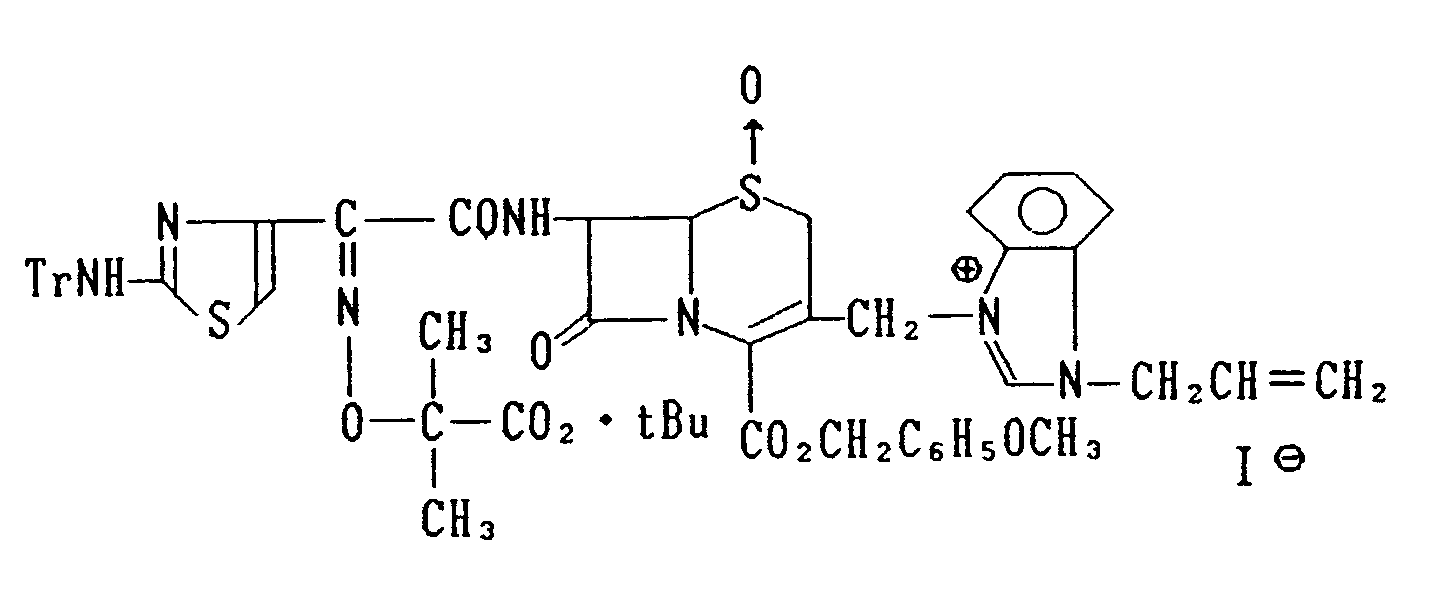
- In the same manner as in Example 26, from 350mg of 7-[2-(2-tert-butoxycarbonyl)prop-2-oxyimino-2-(2-tritylaminothiazole-4-yl)acetamide]-3-iodomethyl-3-cephem-1-oxido-4-carboxylic acid p-methoxybenzyl ester (syn-isomer) and 65mg of 1-(2-propenyl)benzimidazole was obtained 224.3mg of 7-[2-(2-tert-butoxycarbonyl)prop-2-oxyimino-2-(2-tritylaminothiazole-4-yl)acetamide]-3-[benz-3-N-(2-propenyl)-1-imidazoliomethyl]-3-cephem-1-oxido-4-carboxylic acid p-methoxybenzyl ester•iodide (syn-isomer).
- NMR δ ppm (CDCl3):
- 1.40(9H,s), 1.54(6H,s), 3.66(3H,s), 4.11(2H,m), 4.76(2H,d,J=6.3Hz), 5.02(1H,d,J = 5.0Hz), 5.23(2H,s), 5.05-6.14(2H,m), 6.37-6.70(4H,m), 6.61 (1 H,s), 7.04(4H,dd,J = 8.0,42.5Hz), 7.26(15H,s), 6.65-8.15(7H,m)
-

- In the same manner as in Example 27 and 28, from 200mg of 7-[2-(2-tert-butoxycarbonyl)prop-2- oxyimino-2-(2-tritylaminothiazole-4-yl)acetamide]-3-[benz-3-N-(2-propenyl)-1-imidazoliomethyl]-3-cephem-1- oxido-4-carboxylic acid p-methoxybenzyl ester•iodide (syn-isomer) was obtained 11.5mg of 7-{2-(2-aminothiazole-4-yl)-2-[potassium(2,2-dimethylacetate)oxyimino]acetamide}-3-[benz-3-N-(2-propenyl)-1-imidazoliomethyl]-3-cephem-4-carboxylate (syn-isomer).
- NMR δ ppm (DMSO-d6):
- 1.37(3H,s), 1.39(3H,s), 3.12-3.77(2H,m), 4.87(2H,d,J = 6.0Hz), 4.93(1 H,d,J = 5.0Hz), 5.02-5.74(3H,m), 5.40-(2H,s), 5.74-6.34(1 H,m), 6.65(1 H,s), 6.41-8.46(4H,m), 7.10(2H,s), 9.91 (1 H,s), 11.90(1 H,d,J = 8.0Hz)
-

- In the same manner as in Example 4, from 450mg of 7-[2-methoxyimino-2-(2-tritylaminothiazole-4-yl)-acetamide]-3-iodomethyl-3-cephem-1-oxido-4-carboxylic acid p-methoxybenzyl ester (syn-isomer) and 87mg of 1-(2-propenyl)benzimidazole was obtained 130mg of 7-[2-methoxyimino-2-(2-tritylaminothiazole-4-yl)-acetamide]-3-[benz-3-N-(2-propenyl)-1-imidazoliomethyl]-3-cephem-1-oxido-4-carboxylic acid p-methoxybenzyl ester•iodide (syn-isomer).
- NMR δ ppm (DMSO-d6):
- 3.75(3H,s), 3.80(3H,s), 4.1-4.3(2H,m), 4.45(2H,s), 4.90-5.10(2H,m), 5.22(4H,s), 5.45(2H,s), 5.5~5.65(1H,m), 6.75(1 H,s), 7.25(15H,s), 9.20(1 H,s)
-

- In the same manner as in Examples 5, 6 and 7, from 120mg of 7-[2-methoxyimino-2-(2-tritylaminothiazole-4-yl)acetamide]-3-[benz-3-N-(2-propenyl)-1-imidazoliomethyl]-3-cephem-1-oxido-4-carboxylic acid p-methoxybenzyl ester• iodide (syn-isomer) was obtained 17mg of 7-[2-(2-aminothiazole-4-yl)-2-methoxyiminoacetamide]-3-[benz-3-N-(2-propenyl)-1-imidazoliomethyl]-3-cephem-4-carboxylate (syn-isomer).
- NMR δ ppm (DMSO-d6):
- 3.10-3.70(2H,m), 3.80(3H,s), 4.1-4.3(2H,m), 4.40-4.50(2H,m), 4.98(2H,d,J=8.0Hz), 5.22-5.45(4H,m), 6.75-(1 H,s), 12.5(1 H,d,J = 8.0Hz)
-

- In the same manner as in Example 4, from 460mg of 7-[2-(2-propenyloxyimino)-2-(2-tritylaminothiazole-4-yl)acetamide]-3-iodomethyl-3-cephem-I-oxido-4-carboxylic acid p-methoxybenzyl ester (syn-isomer) and 87mg of 1-(2-propenyl)benzimidazole was obtained 140mg of 7-[2-(2-propenyloxyimino)-2-(2-tritylaminothiazole-4-yl)acetamide]-3-[benz-3-N-(2-propenyl)-1-imidazoliomethyl]-3-cephem-1-oxido-4-carboxylic acid p-methoxybenzyl ester• iodide (syn-isomer).
- NMR 6 ppm (DMSO-d6):
- 3.75(3H,s), 4.2-4.3(4H,m), 4.45(2H,s), 5.05-5.15(4H,m), 5.22-5.45(6H,m), 5.5-5.6(2H,m), 6.75(1 H,s), 7.08-7.15(4H,m), 7.25(15H,s), 9.20(1 H,s)
-

- In the same manner as in Examples 5, 6 and 7, from 130mg of 7-[2-(2-propenyloxyimino)-2-(2-tritylaminothiazole-4-yl)acetamide]-3-[benz-3-N-(2-propenyl)-1-imidazoliomethyl]-3-cephem-1-oxido-4-carboxylic acid p-methoxybenzyl ester• iodide (syn-isomer) was obtained 26mg of 7-[2-(2-aminothiazole-4-yl)-2-(2-propenyloxyimino)acetamide]-3-[benz-3-N-(2-propenyl)-1-imidazoliomethyl]-3-cephem-4-carboxylate (syn-isomer).
- NMR δ ppm (DMSO-d6):
- 3.60-3.65(2H,m), 4.2-4.3(4H,m), 4.45(2H,s), 5.05-5.15(4H,m), 5.22-5.45(4H,m), 5.5-5.6(2H,m), 6.75(1 H,s), 12.5(1H,d,J=8.0Hz)
-

- In the same manner as in Example 26, from 502mg of 7-[2-(2-tert-butoxycarbonyl)prop-2-oxyimino-2-(2-tritylaminothiazole-4-yl)acetamide]-3-iodomethyl-3-cephem-1-oxido-4-carboxylic acid p-methoxybenzyl ester (syn-isomer) and 103mg of 1-(2-butenyl)benzimidazole was obtained 410mg of 7-[2-(2-tert-butoxycarbonyl)-prop-2-oxyimino-2-(2-tritylaminothiazole-4-yl)acetamide]-3-[benz-3-N-(2-butenyl)-1-imidazoliomethyl]-3-cephem-1-oxido-4-carboxylic acid p-methoxybenzyl ester•iodide (syn-isomer).
- NMR 6 ppm (DMSO-d6):
- 1.34(9H,s), 1.44(3H,s), 1.7(3H,s), 4.7-4.85(3H,m), 5.30(2H,s), 5.5-5.9(3H,m), 6.60(1 H,s), 7.25(15H,s), 9.20-(1 H,s)
-

- In the same manner as in Examples 27 and 28, from 280mg of 7-[2-(2-tert-butoxycarbonyl)prop-2- oxyimino-2-(2-tritylaminothiazole-4-yl)acetamide]-3-[benz-3-N-(2-butenyl)-1-imidazoliomethyl]-3-cephem-1- oxido-4-carboxylic acid p-methoxybenzyl ester•iodide (syn-isomer) was obtained 21.5mg of 7-{2-(2-aminothiazole-4-yl)-2-[potassium(2,2-dimethylacetate) oxyimino]acetamide}-3-[benz-3-N-(2-butenyl)-1-imidazoliomethyl]-3-cephem-4-carboxylate (syn-isomer).
- NMR 6 ppm (DMSO-d6):
- 1.38(3H,s), 1.41(3H,s), 1.7(3H,s), 4.7-4.85(3H,m), 5.30(2H,s), 5.5-5.9(3H,m), 6.60(1 H,s), 9.80(1 H,s), 12.50-(1H,d,J=8.0Hz)
-
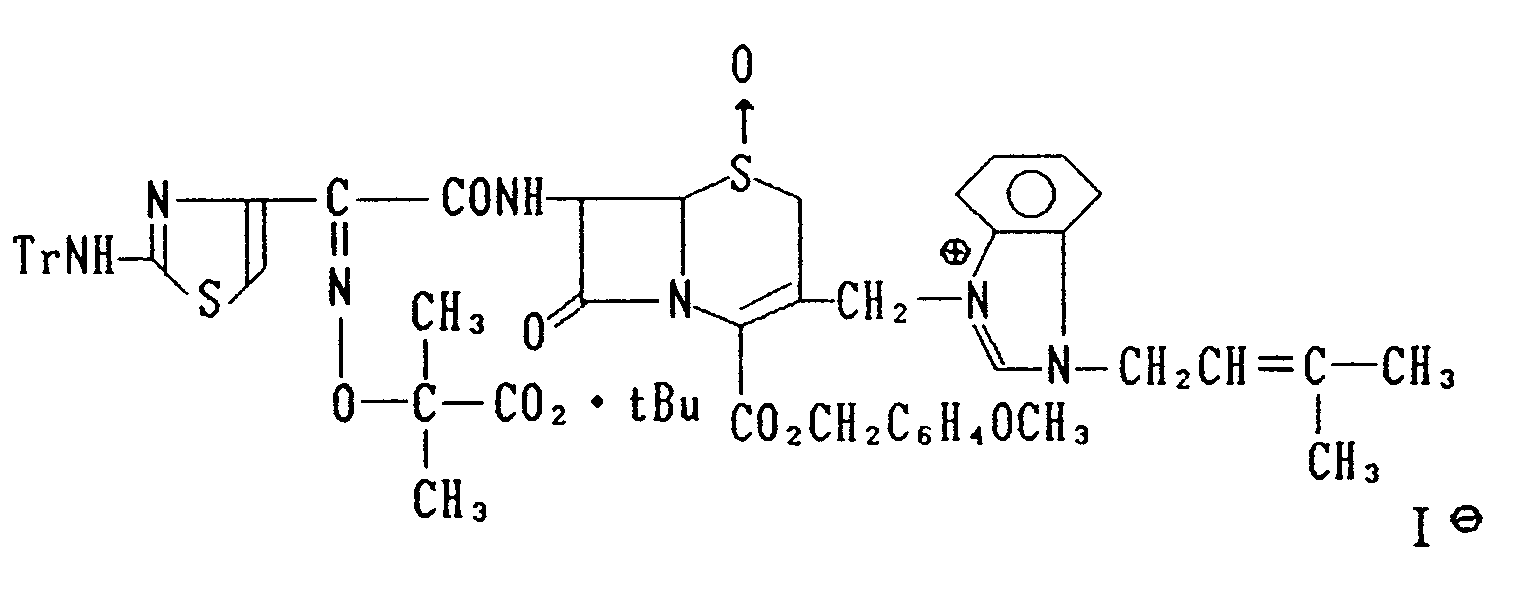
- In the same manner as in Example 26, from 502mg of 7-[2-(2-tert-butoxycarbonyl)prop-2-oxyimino-2-(2-tritylaminothiazole-4-yl)acetamide]-3-iodomethyl-3-cephem-1-oxido-4-carboxylic acid p-methoxybenzyl ester (syn-isomer) and 111mg of 1-(3-methyl-2-butenyl)benzimidazole was obtained 380mg of 7-[2-(2-tert-butoxycarbonyl)prop-2-oxyimino-2-(2-tritylaminothiazole-4-yl)acetamide]-3-[benz-3-N-(3-methyl-2-butenyl)-1-imidazoliomethyl]-3-cephem-1-oxido-4-carboxylic acid p-methoxybenzyl ester•iodide (syn-isomer).
- NMR 6 ppm (DMSO-d6):
- 1.34(9H,s), 1.39(6H,s), 1.80(6H,s), 4.7-4.85(3H,m), 5.30(2H,s), 5.3-5.6(2H,m), 6.60(1 H,s), 7.25(15H,s), 9.20-(1 H,s)
-

- In the same manner as in Examples 27 and 28, from 260mg of 7-[2-(2-tert-butoxycarbonyl)prop-2- oxyimino-2-(2-tritylaminothiazole-4-yl)acetamide]-3-[benz-3-N-(3-methyl-2-butenyl)-1-imidazoliomethyl]-3-cephem-1-oxido-4-carboxylic acid p-methoxybenzyl ester•iodide (syn-isomer) was obtained 12.6mg of 7-{2-(2-aminothiazole-4-yl)-2-[potassium(2,2-dimethylacetate)oxyimino]acetamide}-3-[benz-3-N-(3-methyl-2-butenyl)-1-imidazoliomethyl]-3-cephem-4-carboxylate (syn-isomer).
- NMR δ ppm (DMSO-d6):
- 1.38(6H,s), 1.80(6H,s), 4.7-4.85(3H,m), 5.30(2H,s), 5.3-5.6(2H,m), 6.60(1 H,s), 9.80(1 H,s), 12.50-(1H,d,J=8.0Hz)
-

- Into a solvent mixture of chloroform (600ml) and acetonitrile (1000ml) was dissolved 214.4g of 7-[2-(2-propenyloxyimino)-2-(2-tritylaminothiazole-4-yl)acetamide]-3-iodomethyl-3-cephem-4-carboxylic acid p-methoxybenzyl ester (syn-isomer) obtained in Example 2. To the solution was added with ice-cooling 41.1 g of 1-(2-propenyl)imidazole. After the addition, the mixture was heated to room temperature and was further stirred for 4 hours. Solvents were removed at a reduced pressure. The residue was purified by a silicagel column (chloroform/methanol = 3/1, volume ratio) to collect eluate containing a desired compound. By removing a solvent was obtained 268g of 7-[2-(2-propenyloxyimino)-2-(2-tritylaminothiazole-4-yl)acetamide)-3-[3-(2-propenyl)-1-imidazoliomethyl)-3-cephem-4-carboxylic acid p-methoxybenzyl ester•iodide (syn-isomer).
- NMR δ ppm (DMSO-d6):
- 3.55(2H,s), 3.77(3H,s), 4.58(2H,d,J=5.0Hz), 4.87(2H,d,J=5.0Hz), 4.98-5.60(9H,m), 5.62-6.35(3H,m), 6.76-(1H,s), 7.12(4H,dd,J=8.0Hz,32.5Hz), 7.32(15H,s), 7.68(1 H,s), 7.75(1 H,s), 9.28(1 H,s), 9.27(1 H,s), 9.58-(1 H,d,J = 8.OHz)
- In order to demonstrate use of Compound (I) of the invention, typical compounds of the formula (I) were tested for in vitro anti-bacterial activity. The results were shown below.
- Compounds tested:
- A: Compound of Example 7
- B: Compound of Example 13
- C: Compound of Example 15
- D: Compound of Example 17
- E: Compound of Example 21
- F: Compound of Example 23
- G: Compound of Example 25
- H: Compound of Example 28
- I: Compound of Example 30
- K: Compound of Example 32
- M: Compound of Example 36
- O: Compound of Example 38
- P: Compound of Example 40
- Q: Compound of Example 42
- R: Compound of Example 44
- S: Compound of Example 46
- U: Compound of Example 48
- V: Compound of Example 50
- W: Compound of Example 52
- X: Compound of Example 54
- Y: Compound of Example 56
- The agent for preventing and treating bacterial infections was tested for in vitro anti-bacterial activity by the following two-fold agar plate dilution method. Each test strain was incubated for 20 hours in a bouillon for measuring sensitivity to obtain a test culture (containing about 108 live cells/ml). Portions of sensitivity measuring agar medium containing varying concentrations of the antibacterial agent were each innoculated with a 0.005ml portion of the culture, followed by incubation at 37 ° C for 20 hours. The minimum growth inhibitory concentration (MIC) in µg/ml was then determined. Table 1 shows the result.
- MIC = minimum inhibitory concentration


Claims (6)


Priority Applications (1)
| Application Number | Priority Date | Filing Date | Title |
|---|---|---|---|
| AT86112120T ATE82976T1 (en) | 1985-09-03 | 1986-09-02 | CEPHALOSPORIN DERIVATIVES. |
Applications Claiming Priority (4)
| Application Number | Priority Date | Filing Date | Title |
|---|---|---|---|
| JP194385/85 | 1985-09-03 | ||
| JP19438585 | 1985-09-03 | ||
| JP61107262A JPH07107069B2 (en) | 1985-09-03 | 1986-05-10 | Novel derivative of cefalosporin compound, process for producing the same and pharmaceutical composition containing the derivative |
| JP107262/86 | 1986-05-10 |
Publications (3)
| Publication Number | Publication Date |
|---|---|
| EP0214600A2 EP0214600A2 (en) | 1987-03-18 |
| EP0214600A3 EP0214600A3 (en) | 1988-09-28 |
| EP0214600B1 true EP0214600B1 (en) | 1992-12-02 |
Family
ID=26447305
Family Applications (1)
| Application Number | Title | Priority Date | Filing Date |
|---|---|---|---|
| EP86112120A Expired - Lifetime EP0214600B1 (en) | 1985-09-03 | 1986-09-02 | Cephalosporin derivatives |
Country Status (6)
| Country | Link |
|---|---|
| US (1) | US4906623A (en) |
| EP (1) | EP0214600B1 (en) |
| AT (1) | ATE82976T1 (en) |
| CA (1) | CA1299564C (en) |
| DE (1) | DE3687200T2 (en) |
| ES (1) | ES2001773A6 (en) |
Families Citing this family (12)
| Publication number | Priority date | Publication date | Assignee | Title |
|---|---|---|---|---|
| US5194432A (en) * | 1985-11-22 | 1993-03-16 | Fujisawa Pharmaceutical Co., Ltd. | Cephem compounds |
| IE63094B1 (en) * | 1987-09-14 | 1995-03-22 | Fujisawa Pharmaceutical Co | Cephem compound and a process for preparation thereof |
| US5126336A (en) * | 1990-08-23 | 1992-06-30 | Bristol-Myers Squibb Company | Antibiotic c-3 catechol-substituted cephalosporin compounds, compositions and method of use thereof |
| US5194433A (en) * | 1990-11-13 | 1993-03-16 | Bristol-Myers Squibb Company | Antibiotic c-3 catechol-substituted cephalosporin compounds, compositions and method of use thereof |
| MX2011004636A (en) * | 2008-10-31 | 2011-06-20 | Shionogi & Co | CEPHAROSPORINS THAT HAVE A CATECOL GROUP. |
| CN102070655B (en) * | 2009-11-23 | 2012-09-26 | 山东轩竹医药科技有限公司 | Imidazole ring-containing cephalosporin derivative |
| EP2557082A4 (en) | 2010-04-05 | 2013-08-28 | Shionogi & Co | Cephem compound having catechol group |
| US8883773B2 (en) | 2010-04-05 | 2014-11-11 | Shionogi & Co., Ltd. | Cephem compound having pseudo-catechol group |
| KR101276121B1 (en) * | 2011-03-11 | 2013-06-18 | 대우조선해양 주식회사 | Movable marine power generation plant and management method of it |
| KR101279646B1 (en) * | 2011-12-27 | 2013-06-26 | 대우조선해양 주식회사 | Floating Offshore Power Plant |
| US12180318B2 (en) * | 2020-06-16 | 2024-12-31 | Johnson & Johnson Vision Care, Inc. | Imidazolium zwitterion polymerizable compounds and ophthalmic devices incorporating them |
| CN114144248B (en) * | 2020-06-16 | 2025-06-03 | 强生视力健公司 | Imidazolium zwitterionic polymerizable compounds and ophthalmic devices incorporating the same |
Family Cites Families (9)
| Publication number | Priority date | Publication date | Assignee | Title |
|---|---|---|---|---|
| FR5564M (en) * | 1964-03-14 | 1968-01-02 | ||
| GB2036724B (en) * | 1978-10-27 | 1983-01-19 | Glaxo Group Ltd | Cephalosporin compounds |
| GB2037281B (en) * | 1978-11-15 | 1983-01-19 | Glaxo Group Ltd | 7( -(2-amino-4-thiozolyl)-2-hydroximino-acetanuds)-cephalosporins |
| ES511101A0 (en) * | 1981-04-03 | 1983-05-01 | Fujisawa Pharmaceutical Co | "PROCEDURE TO PREPARE A NEW CEFEM COMPOUND". |
| DE3336757A1 (en) * | 1983-10-08 | 1985-04-25 | Hoechst Ag, 6230 Frankfurt | CEPHALOSPORINE DERIVATIVES AND METHOD FOR THEIR PRODUCTION |
| EP0137442A3 (en) * | 1983-10-08 | 1986-01-15 | Hoechst Aktiengesellschaft | Cephalosporin derivatives and process for their preparation |
| US4788185A (en) * | 1984-04-23 | 1988-11-29 | Takeda Chemical Industries, Ltd. | Cephalosporin compounds |
| PH22107A (en) * | 1984-06-07 | 1988-06-01 | Takeda Chemical Industries Ltd | 3-pyrazolo(1,5-a)pyrdinium cephem compounds |
| US4698336A (en) * | 1985-01-30 | 1987-10-06 | Eisai Co., Ltd. | 3-(pyrrolidinio)methyl-3-cephem derivatives |
-
1986
- 1986-09-02 EP EP86112120A patent/EP0214600B1/en not_active Expired - Lifetime
- 1986-09-02 DE DE8686112120T patent/DE3687200T2/en not_active Expired - Fee Related
- 1986-09-02 AT AT86112120T patent/ATE82976T1/en active
- 1986-09-02 CA CA000517326A patent/CA1299564C/en not_active Expired - Fee Related
- 1986-09-03 ES ES8601599A patent/ES2001773A6/en not_active Expired
-
1988
- 1988-03-25 US US07/172,937 patent/US4906623A/en not_active Expired - Fee Related
Also Published As
| Publication number | Publication date |
|---|---|
| ES2001773A6 (en) | 1988-06-16 |
| DE3687200T2 (en) | 1993-05-27 |
| EP0214600A3 (en) | 1988-09-28 |
| DE3687200D1 (en) | 1993-01-14 |
| EP0214600A2 (en) | 1987-03-18 |
| CA1299564C (en) | 1992-04-28 |
| ATE82976T1 (en) | 1992-12-15 |
| US4906623A (en) | 1990-03-06 |
Similar Documents
| Publication | Publication Date | Title |
|---|---|---|
| CS209878B2 (en) | Method of making the new alcyloxime derivatives of the 7-/2-(2-amino-4-thiazolyl)acetamido/cephalosporan acid | |
| HU198500B (en) | Process for producing cefemcarboxylic acid derivatives and pharmaceutical composition comprising same | |
| JPH0215556B2 (en) | ||
| KR830000853B1 (en) | Method for preparing acyl derivative | |
| DE3687200T2 (en) | CEPHALOSPORINE DERIVATIVES. | |
| EP0300121B1 (en) | New intermediates for the preparation of cephem compounds, processes for the preparation thereof and their use | |
| NO172893B (en) | ANALOGY PROCEDURE FOR THE PREPARATION OF NEW THERAPEUTICALLY ACTIVE CEFEM RELATIONS | |
| EP0002605B1 (en) | Cephalosporin compounds and formulations containing them for use in the treatment of bacterial infections and the preparation of the cephalosporin compounds | |
| US20050004094A1 (en) | Cephem compounds | |
| GB2053896A (en) | Heterocyclyl derivatives of oxyiminosubstituted cephalosporins | |
| HU188586B (en) | Process for producing new cepheme derivatives | |
| DD219195A5 (en) | PROCESS FOR THE PREPARATION OF CEMPHEM COMPOUNDS | |
| US4690921A (en) | Cephalosporin compounds and salts thereof | |
| JPH064646B2 (en) | New cefalosporin derivative | |
| US4576938A (en) | Cephalosporin compound and process for preparing the same | |
| JPH068300B2 (en) | New cefalosporin derivative | |
| KR870001797B1 (en) | Method for preparing cephalosporin derivative | |
| WO1997024359A1 (en) | Novel cephalosporin derivatives and processes for the preparation thereof | |
| KR870000828B1 (en) | Process for preparing acyl derivatives | |
| JPH0645630B2 (en) | New cephalosporin derivative | |
| JP2605096B2 (en) | Cephem derivative | |
| KR970010070B1 (en) | Cefem compound and preparation method thereof | |
| KR840002046B1 (en) | Process for preparing cepharosporins | |
| KR860000345B1 (en) | Method for preparing cephalosporin derivative | |
| JPH027316B2 (en) |
Legal Events
| Date | Code | Title | Description |
|---|---|---|---|
| PUAI | Public reference made under article 153(3) epc to a published international application that has entered the european phase |
Free format text: ORIGINAL CODE: 0009012 |
|
| AK | Designated contracting states |
Kind code of ref document: A2 Designated state(s): AT BE CH DE FR GB IT LI NL SE |
|
| PUAL | Search report despatched |
Free format text: ORIGINAL CODE: 0009013 |
|
| AK | Designated contracting states |
Kind code of ref document: A3 Designated state(s): AT BE CH DE FR GB IT LI NL SE |
|
| 17P | Request for examination filed |
Effective date: 19881209 |
|
| 17Q | First examination report despatched |
Effective date: 19900910 |
|
| GRAA | (expected) grant |
Free format text: ORIGINAL CODE: 0009210 |
|
| AK | Designated contracting states |
Kind code of ref document: B1 Designated state(s): AT BE CH DE FR GB IT LI NL SE |
|
| REF | Corresponds to: |
Ref document number: 82976 Country of ref document: AT Date of ref document: 19921215 Kind code of ref document: T |
|
| REF | Corresponds to: |
Ref document number: 3687200 Country of ref document: DE Date of ref document: 19930114 |
|
| ITF | It: translation for a ep patent filed | ||
| ET | Fr: translation filed | ||
| PLBE | No opposition filed within time limit |
Free format text: ORIGINAL CODE: 0009261 |
|
| STAA | Information on the status of an ep patent application or granted ep patent |
Free format text: STATUS: NO OPPOSITION FILED WITHIN TIME LIMIT |
|
| 26N | No opposition filed | ||
| EAL | Se: european patent in force in sweden |
Ref document number: 86112120.0 |
|
| PGFP | Annual fee paid to national office [announced via postgrant information from national office to epo] |
Ref country code: GB Payment date: 19950908 Year of fee payment: 10 |
|
| PGFP | Annual fee paid to national office [announced via postgrant information from national office to epo] |
Ref country code: FR Payment date: 19950918 Year of fee payment: 10 |
|
| PGFP | Annual fee paid to national office [announced via postgrant information from national office to epo] |
Ref country code: CH Payment date: 19950920 Year of fee payment: 10 |
|
| PGFP | Annual fee paid to national office [announced via postgrant information from national office to epo] |
Ref country code: AT Payment date: 19950921 Year of fee payment: 10 |
|
| PGFP | Annual fee paid to national office [announced via postgrant information from national office to epo] |
Ref country code: SE Payment date: 19950922 Year of fee payment: 10 Ref country code: NL Payment date: 19950922 Year of fee payment: 10 |
|
| PGFP | Annual fee paid to national office [announced via postgrant information from national office to epo] |
Ref country code: DE Payment date: 19950925 Year of fee payment: 10 |
|
| PGFP | Annual fee paid to national office [announced via postgrant information from national office to epo] |
Ref country code: BE Payment date: 19951009 Year of fee payment: 10 |
|
| PG25 | Lapsed in a contracting state [announced via postgrant information from national office to epo] |
Ref country code: GB Effective date: 19960902 Ref country code: AT Effective date: 19960902 |
|
| PG25 | Lapsed in a contracting state [announced via postgrant information from national office to epo] |
Ref country code: SE Effective date: 19960903 |
|
| PG25 | Lapsed in a contracting state [announced via postgrant information from national office to epo] |
Ref country code: LI Effective date: 19960930 Ref country code: FR Effective date: 19960930 Ref country code: CH Effective date: 19960930 Ref country code: BE Effective date: 19960930 |
|
| BERE | Be: lapsed |
Owner name: OTSUKA KAGAKU K.K. Effective date: 19960930 |
|
| PG25 | Lapsed in a contracting state [announced via postgrant information from national office to epo] |
Ref country code: NL Effective date: 19970401 |
|
| GBPC | Gb: european patent ceased through non-payment of renewal fee |
Effective date: 19960902 |
|
| REG | Reference to a national code |
Ref country code: CH Ref legal event code: PL |
|
| NLV4 | Nl: lapsed or anulled due to non-payment of the annual fee |
Effective date: 19970401 |
|
| PG25 | Lapsed in a contracting state [announced via postgrant information from national office to epo] |
Ref country code: DE Effective date: 19970603 |
|
| EUG | Se: european patent has lapsed |
Ref document number: 86112120.0 |
|
| REG | Reference to a national code |
Ref country code: FR Ref legal event code: ST |
|
| REG | Reference to a national code |
Ref country code: FR Ref legal event code: ST |
|
| PG25 | Lapsed in a contracting state [announced via postgrant information from national office to epo] |
Ref country code: IT Free format text: LAPSE BECAUSE OF NON-PAYMENT OF DUE FEES;WARNING: LAPSES OF ITALIAN PATENTS WITH EFFECTIVE DATE BEFORE 2007 MAY HAVE OCCURRED AT ANY TIME BEFORE 2007. THE CORRECT EFFECTIVE DATE MAY BE DIFFERENT FROM THE ONE RECORDED. Effective date: 20050902 |