EP0213484A1 - Alpha-Hydroxy-beta-2,2,6,6-tetramethyl piperidyl ethylene oxiranes as light and heat stabilizers for polyvinyl chloride resins - Google Patents
Alpha-Hydroxy-beta-2,2,6,6-tetramethyl piperidyl ethylene oxiranes as light and heat stabilizers for polyvinyl chloride resins Download PDFInfo
- Publication number
- EP0213484A1 EP0213484A1 EP86111175A EP86111175A EP0213484A1 EP 0213484 A1 EP0213484 A1 EP 0213484A1 EP 86111175 A EP86111175 A EP 86111175A EP 86111175 A EP86111175 A EP 86111175A EP 0213484 A1 EP0213484 A1 EP 0213484A1
- Authority
- EP
- European Patent Office
- Prior art keywords
- polyvinyl chloride
- bis
- hydroxy
- chloride resin
- phosphite
- Prior art date
- Legal status (The legal status is an assumption and is not a legal conclusion. Google has not performed a legal analysis and makes no representation as to the accuracy of the status listed.)
- Granted
Links
Classifications
-
- C—CHEMISTRY; METALLURGY
- C07—ORGANIC CHEMISTRY
- C07D—HETEROCYCLIC COMPOUNDS
- C07D303/00—Compounds containing three-membered rings having one oxygen atom as the only ring hetero atom
- C07D303/02—Compounds containing oxirane rings
-
- C—CHEMISTRY; METALLURGY
- C07—ORGANIC CHEMISTRY
- C07D—HETEROCYCLIC COMPOUNDS
- C07D211/00—Heterocyclic compounds containing hydrogenated pyridine rings, not condensed with other rings
- C07D211/04—Heterocyclic compounds containing hydrogenated pyridine rings, not condensed with other rings with only hydrogen or carbon atoms directly attached to the ring nitrogen atom
- C07D211/06—Heterocyclic compounds containing hydrogenated pyridine rings, not condensed with other rings with only hydrogen or carbon atoms directly attached to the ring nitrogen atom having no double bonds between ring members or between ring members and non-ring members
- C07D211/36—Heterocyclic compounds containing hydrogenated pyridine rings, not condensed with other rings with only hydrogen or carbon atoms directly attached to the ring nitrogen atom having no double bonds between ring members or between ring members and non-ring members with hetero atoms or with carbon atoms having three bonds to hetero atoms with at the most one bond to halogen, e.g. ester or nitrile radicals, directly attached to ring carbon atoms
- C07D211/40—Oxygen atoms
- C07D211/44—Oxygen atoms attached in position 4
- C07D211/46—Oxygen atoms attached in position 4 having a hydrogen atom as the second substituent in position 4
-
- C—CHEMISTRY; METALLURGY
- C08—ORGANIC MACROMOLECULAR COMPOUNDS; THEIR PREPARATION OR CHEMICAL WORKING-UP; COMPOSITIONS BASED THEREON
- C08K—Use of inorganic or non-macromolecular organic substances as compounding ingredients
- C08K5/00—Use of organic ingredients
- C08K5/16—Nitrogen-containing compounds
- C08K5/34—Heterocyclic compounds having nitrogen in the ring
- C08K5/3412—Heterocyclic compounds having nitrogen in the ring having one nitrogen atom in the ring
- C08K5/3432—Six-membered rings
- C08K5/3435—Piperidines
Definitions
- Polyvinyl chloride resins have a relatively low resistance to deterioration when exposed to elevated temperatures and to ultraviolet light, and various types of compounds have been combined therewith to improve their resistance to such deterioration.
- Metal compounds such as lead carboxylates and other polyvalent metal salts of carboxylic acids, as well as organotin compounds, have been widely used, alone and in combinations with other compounds such as epoxy compounds, aminocrotonates, diphenyl urea, alpha-phenyl indole, orthoesters, and dihydropyridines.
- the epoxy compounds are known not only as stabilizers but also as plasticizers.
- Epoxides such as Bisphenol A, diglycidylether, epoxidized unsaturated fatty acid esters, triglycidylisocyanurate and epoxidized polybutadiene have been used.
- the 2, 2,6, 6-tetramethylpiperidine compounds have also been combined with polyvinyl chloride resins to improve their resistance to ultraviolet light, and epoxy compounds have been used with 2, 2, 6, 6 tetramethyl piperidyl compounds for this purpose. However, some 2,2, 6, 6-tetramethyl piperidyl compounds impart a color to the polyvinyl chloride resin when heated.
- ⁇ -hydroxy- ⁇ -2, 2, 6, 6-tetramethyl piperidyl ethylene oxiranes which are effective to improve the resistance to deterioration when exposed to heat and light of polyvinyl chloride resin, and having the formula: in which at least one of R 1 , R 2 , R 3 and R 4 includes an oxirane group or ring the total of such oxirane groups in R 1 , R 2 , R 3 and R 4 being within the range from about one to about twenty, and preferably from about two to about ten, R 1 , R 29 R 3 and R 4 accordingly being selected from the group consisting of hydrogen, aliphatic, aromatic, mixed aromatic aliphatic cycloaliphatic and mixed cycloaliphatic aliphatic hydrocarbon groups having from one to about thirty carbon atoms and heterocyclic groups having from one to three ring nitrogen and/or oxygen atoms and five to three ring carbon atoms including, for example, alkyl, alkenyl, alkadien
- the compounds are prepared by the reaction of a polyethoxy compound having two or more oxirane rings in the molecule of formula Ta) in which R 1 , R 2 , R 3 and R 4 are as defined above, with a 2, 2, 6, 6-tetramethyl piperidyl compound containing in the molecule the group of formula Ib):
- the 2,2, 6, 6-tetramethyl piperidyl group becomes linked to one carbon of the oxirane ring, and the epoxy oxygen becomes a hydroxyl group attached to the other carbon atom of the oxirane ring, thus forming a compound having an a-hydroxy and ⁇ -2, 2, 6, 6-tetramethyl piperidyl group, with at least one oxirane ring in the compound left unreacted.
- R 1 , R 2 , R 3 and R 4 alkyl groups include methyl, ethyl, propyl, isopropyl, butyl, isobutyl, secondary butyl, tertiary butyl, amyl, isoamyl, secondary amyl, tertiary amyl, butyl, isobutyl, tertiary butyl, hexyl, isohexyl, tertiary hexyl, heptyl, isoheptyl, octyl, 2-ethylhexyl, isooctyl, tertiary octyl, nonyl, isononyl, tertiary nonyl, decyl, isodecyl, tertiary decyl, undecyl, dodecyl, tridecyl, tetradecyl, hexadecyl,
- R 1 , R 2 , R 3 and R 4 alkenyl and alkadienyl include hexenyl, allyl, octenyl, butenyl, butadienyl and isoprenyl.
- R 1 , R 2 , Rg and R 4 cycloalkyl and cycloalkenyl include cyclopropyl, cyclobutyl, cyclopentyl, cyclohexyl, cycloheptyl, cyclooctyl, and cyclododecyl; cyclopentenyl, cyclohexenyl, cyclopentadienyl and cyclobutadienyl.
- R 1 , R 2 , R 3 and R 4 aryl include phenyl and naphthyl.
- R 1 , R 2 , R 3 and R 4 alkaryl and arylalkyl include phenethyl, phenmethyl, phenpropyl, phenbutyl, xylyl, tolyl and mesityl.
- R 1 , R 2 , R 3 and R 4 heterocyclic include isocyanurate and triazine.
- R 1 , R 2 , Rg and R 4 can contain one or more oxirane rings in the molecule.
- Exemplary polyepoxy compounds containing such groups of Formula Ta include polyglycidylethers or poly- ⁇ -methylglycidylethers prepared from phenol compounds, such as Bisphenol A, bis(hydroxyphenyl) methane, resorcinol, tetra(hydroxyphenyl) methane and phenolic novolak reacted with epichlorohydrin or ⁇ -methylepichlorohydrin; polyglycidylethers or poly- ⁇ -methylglycidylethers prepared from polyols such as ethylene glycol, polyethylene glycol, 2, 2-bis(4-hydroxycyclohexyl) propane, glycerol and 1,1, 1-trimethylolpropane reacted with epichlorohydrin or ⁇ -methylepichloro- hydrin; polyglycidylesters or poly( ⁇ -methyl)glycidyl
- Exemplary 2,2, 6, 6-tetramethyl piperidine compounds which can be reacted with these polyepoxides include esters, amides or imides of 2, 2, 6, 6-tetramethyl-4-piperidinol, 8, 8, 10, 10-tetramethyl-3-ethyl, 1, 5-dioxaspiro [5.5] -3-undecylmethanol or 2, 2, 6, 6-tetramethyl-4-(alkyl)-amines with organic carboxylic acids or oxy acids; ketals of 2, 2, 6, 6-tetramethyl-4-piperidone with (poly)alcohols; and 7, 7, 9, 9 -tetramethyl-1, 3, 8-triazaspiro [4.5] decanes.
- Preferred 2, 2, 6, 6-tetramethyl piperidine compounds include:
- Reaction of the polyepoxide with the 2, 2, 6, 6-tetramethyl piperidyl compound proceeds rapidly at elevated temperatures within the range from about 80 to 250°C, preferably from about 120 to about 230°C.
- the reaction can be carried out in the presence of an inert organic solvent, but if the reactants are liquids, a solvent is unnecessary.
- the proportion of piperidine compound to polyepoxide is within the range from 0.01 to 0. 05, preferably from 0.03 to 0.3, moles of piperidyl group per mole of reacted oxirane group in the polyepoxide.
- Tris(2,3-epoxypropyl)isocyanurate 50 grams, was dissolved in 50 grams of pseudocumene and 25 grams of tetra(2, 2, 6, 6-tetramethyl-4-piperidyl)-1, 2, 3, 4-butanetetracarboxylate added. The solution was heated and stirred for two hours under a stream of nitrogen at reflux temperature. Analysis using high speed liquid chromotography showed that all of the piperidine compound had been consumed at the end of this time. The solvent was distilled off, obtaining 70 grams of a pale yellow glassy solid. The molar ratio oxirane groups to piperidine groups was 1:0.084.
- the amount of ⁇ -hydroxy- ⁇ -2, 2, 6, 6-tetramethyl piperidyl ethylene oxirane employed with polyvinyl chloride resin is sufficient to improve the resistance to deterioration when exposed to heat and light of the polymer, and is within the range from about 0. 01 to about 10 parts by weight, preferably within the range from about 0.1 to about 5 parts by weight, per 100 parts by weight of polyvinyl chloride resin.
- the stabilizer compositions of the invention can be used as stabilizers with any polyvinyl chloride resin.
- polyvinyl chloride as used herein is inclusive of any polymer formed at least in part of the recurring group: and having a chlorine content in excess of 49%. Tn this group, the X groups can each be either hydrogen or chlorine. In polyvinyl chloride homopolymers, each of the X groups is hydrogen. Thus, the term includes not only polyvinyl chloride homopolymers but also after-chlorinated polyvinyl chloride, such as those disclosed in British patent No.
- copolymers of vinyl chloride in a major proportion and'other copolymerizable monomers in a minor proportion such as copolymers of vinyl chloride and vinyl acetate, copolymers of vinyl chloride with maleic or fumaric acids or esters, and copolymers of vinyl chloride with styrene, propylene, and ethylene.
- the invention also is applicable to mixtures of polyvinyl chloride in a major proportion with other synthetic resins such as chlorinated polyethylene or a copolymer of acrylonitrile, butadiene and styrene.
- polyvinyl chlorides which can be stabilized are the uniaxially-stretch oriented polyvinyl chlorides described in U. S. patent No. 2, 934, 593 to Isaksem et al, that is, syndiotactic polyvinyl chloride, as well as atactic and isotactic polyvinyl chlorides.
- the ⁇ -hydroxy- ⁇ -2, 2, 6, 6 tetramethyl piperidyl ethylene oxiranes of the invention both with and without supplementary heat and light stabilizers are excellent stabilizers for both unplasticized or rigid polyvinyl chloride resins, as well as plasticized polyvinyl chloride resins.
- the rigid polyvinyl chloride resins are defined as those containing at most 10% plasticizer.
- Plasticized resins contain at least 10% plasticizer, and can contain as much as 50 to 60% plasticizer according to the degree of plasticization desired. When plasticizers are to be employed, they may be incorporated into the polyvinyl chloride resin using conventional means. Conventional plasticizers can be used, such as dioctyl phthalate, dioctyl sebacate and tricresyl phosphate.
- Particularly useful plasticizers are the epoxy higher fatty acid esters having from about twenty to about one hundred fifty carbon atoms. Such esters will initially have had unsaturation in the alcohol or acid portion of the molecule, which is taken up by the formation of the epoxy group.
- Typical polyhydric alcohols include pentaerythritol, glycerol, ethylene glycol, 1,2-propylene glycol, 1, 4-butylene glycol, neopentyl glycol, ricinoleyl alcohol, erythritol, mannitol and sorbitol, Glycerol is preferred. These alcohols may be fully or partially esterified with the epoxidized acid.
- epoxidized soybean oil is preferred.
- the alcohol can contain the epoxy group and have a long or short chain, and the acid can have a short or long chain, such as epoxy stearyl acetate, epoxy stearyl stearate, glycidyl stearate, and polymerized glycidyl methacrylate.
- a small amount, usually not more than 1.5%, of a parting agent or lubricant can also be included.
- Typical parting agents are the higher aliphatic acids, and alkali and alkaline earth metal salts of such acids, having twelve to twenty four carbon atoms, such as stearic acid, lauric acid, palmitic acid and myristic acid; for example, lithium stearate, calcium stearate and calcium palmitate; mineral lubricating oils, polyvinyl stearate, polyethylene and paraffin wax.
- Impact modifiers for improving the toughness or impact-resistance of unplasticized resins, can also be added to the resin composition stabilized by the present invention in minor amounts of usually not more than 10%.
- impact modifiers include chlorinated polyethylene, ABS polymers, and polyacrylate butadiene graft copolymers.
- the phenolic antioxidant contains one or more phenolic hydroxyl groups, and one or more phenolic nuclei, and can contain from about eight to about three hundred carbon atoms.
- the phenolic nucleus can contain an oxy or thio ether group.
- the alkyl substituted phenols and polynuclear phenols because of their molecular weight, have a higher boiling point, and therefore are preferred because of their lower volatility.
- the alkyl group or groups including any alkylene groups between phenol nuclei preferably aggregate at least four carbon atoms. The longer the alkyl or alkylene chain, the better the compatibility with polypropylene, inasmuch as the phenolic compound then acquires more of an aliphatic hydrocarbon character, and therefore there is no upper limit on the number of alkyl carbon atoms.
- the compound will not have more than about eighteen carbon atoms in an alkyl, alicyclidene and alkylene group, and a total of not over about fifty carbon atoms.
- the compounds may have from one to four alkyl radicals per phenol nucleus.
- the phenol contains at least one and preferably at least two phenolic hydroxyls, the two or more hydroxyls being in the same ring, if there is only one.
- the rings can be linked by thio or oxyether groups, or by alkylene, alicyclidene or arylidene groups.
- the monocyclic phenols which can be employed have the structure:
- the polycyclic phenol phenol is one having at least two aromatic nuclei linked by a polyvalent linking radical, as defined by the formula: wherein
- Typical aromatic nuclei include phenyl, naphthyl, phenanthryl, triphenylenyl, anthracenyl, pyrenyl, chrysenyl, and fluoroenyl groups.
- the polyhydric polycyclic phenol has the structure: wherein
- the hydroxyl groups are located ortho and/or para to Y.
- Exemplary Y groups are alkylene, alkylidene, and alkenylene; arylene, alkyl arylene, arylalkylene; cycloalkylene, cycloalkylidene; and oxa- and thia-substituted such groups; tetrahydrofuranes, esters and triazino groups.
- the Y groups are usually bi, tri, or tetravalent, connecting two, three or four Ar groups. However, higher valency Y groups connecting more than four Ar groups, can also be used. According to their constitution, the Y groups can be assigned to subgenera as follows:
- phenols Although the relation of effectiveness to chemical structure is insufficiently understood, many of the most effective phenols have Y groups of subgenus 1), and accordingly this is preferred. Some of these phenols can be prepared by the alkylation of phenols or alkyl phenols with polyunsaturated hydrocarbons such as dicyclopentadiene or butadiene.
- phenols include guaiacol, resorcinol monoacetate, vanillin, butyl salicylate, 2,6-di-tert-butyl-4-methyl phenol, 2-tert-butyl-4-methoxy phenol, 2,4-dinonyl phenol, 2, 3, 4, 5-tetradecyl phenol, tetrahydro- ⁇ -naphthol, o-, m- and p-cresol, o-, m- and p-phenylphenol, o-, m- and p-xylenols, the carvenols, symmetrical xylenol, thymol, o-, m-and p-nonylphenol, o-, m- and p-dodecyl-phenol, and o-, m-and p-octyl-phenol, o-, and m-tert-butyl-p-hydroxy-anisole
- Exemplary polyhydric phenols are orcinol, propyl gallate, catechol, resorcinol, 4-octyl-resorcinol, 4-dodecyl- resorcinol, 4-octadecyl-catechol, 4-isooctyl-phloroglucinol, pyrogallol, hexahydroxybenzene, 4-isohexylcatechol, 2,6-di- tertiary-butyl-resorcinol, 2,6-di-isopropyl-phloroglucinol.
- Exemplary polyhydric polycyclic phenols are methylene bis-(2,6-di-tertiary-butyl-phenol), 2,2-bis-(4-hydroxy phenyl)-propane, methylene-bis-(p-cresol), 4,4'-benzylidene bis (2-tertiary-butyl-5-methyl-phenol), 4,4'-cyclo-hexylidene bis-(2-tertiary-butylphenol), 2,2'-methylene-bis-(4-methyl-6-(1'-methyl-cyclohexyl)-phenol), 2,6-bis-(2'-hydroxy-3'-tertiarybutyl-5'-methylbenzyl)-4-methylphenol, 4,4'-bis-(2-tertiarybutyl-5-methyl-phenol), 2,2'-bis-(4-hydroxy-phenyl) butane, ethylene bis-(p-cresol), 4,4'-oxobis-phenol, 4,4'-oxobis-(3
- a particularly desirable class of polyhydric polycyclic phenols are the dicyclopentadiene polyphenols, which are of the type: in which
- the polyhydric polycyclic phenols used in the invention can also be condensation products of phenols or alkylphenols with hydrocarbons havingla bicyclic ring structure and a double bond or two or more double bonds, such as a-pinene, ⁇ -pinene, dipentene, limonene, vinylcyclohexene, dicyclopentadiene, allo-ocimene, isoprene and butadiene.
- These condensation products are usually obtained under acidic conditions in the form of more or less complex mixtures of monomeric and polymeric compounds. However, it is usually not necessary to isolate the individual constituents. The entire reaction product, merely freed from the acidic condensation catalyst and unchanged starting material, can be used with excellent results.
- the organic acid When the stabilizer composition is used in conjunction with a polyvalent metal salt of an organic acid, the organic acid will ordinarily have from about six to about twenty-four carbon atoms.
- the polyvalent metal can be any metal of Group II of the Periodic Table, such as zinc, calcium, cadmium, barium, magnesium and strontium.
- the alkali metal salts and heavy metal salts such as lead salts are unsatisfactory.
- the acid can be any organic non-nitrogenous monocarboxylic acid having from six to twenty-four carbon atoms.
- the aliphatic, aromatic, alicyclic and oxygen-containing heterocyclic organic acids are operable as a class.
- aliphatic acid any open chain carboxylic acid, substituted, if desired, with nonreactive groups, such as halogen, sulfur and hydroxyl.
- alicyclic it will be understood that there is intended any cyclic acid in which the ring is nonaromatic and composed solely of carbon atoms, and such acids may if desired have inert, nonreactive substituents such as halogen, hydroxyl, alkyl radicals, alkenyl radicals and other carbocyclic ring structures condensed therewith.
- the oxygen-containing heterocyclic compounds can be aromatic or nonaromatic and can include oxygen and carbon in the ring structure, such as alkyl-substituted furoic acid.
- the aromatic acids likewise can have nonreactive ring substituents such as halogen, alkyl and alkenyl groups, and other saturated or aromatic rings condensed therewith.
- acids which can be used in the form of their metal salts there can be mentioned the following: hexoic acid, 2-ethylhexoic acid, n-octoic acid, isooctoic acid, capric acid, undecylic acid, lauric acid, myrlstic acid, palmitic acid, margaric acid, stearic acid, oleic acid, ricinoleic acid, behenic acid, chlorocaproic acid, hydroxy capric acid, benzoic acid, phenylacetic acid, butyl benzoic acid, ethyl benzoic acid, propyl benzoic acid, hexyl benzoic acid, salicylic acid, naphthoic acid, 1-naphthalene acetic acid, orthobenzoyl benzoic acid, naphthenic acids derived from petroleum, abietic acid, dihydroabietic acid, hexahydrobenzoic acid, and methyl furoic acid.
- the water-insoluble salts are preferred, because they are not leached out when the plastic is in contact with water.
- these salts are not known, they are made by the usual types of reactions, such as by mixing the acid, or anhydride with the corresponding oxide or hydroxide of the metal in a liquid solvent, and heating, if necessary, until salt formation is complete.
- organic triphosphites and acid phosphites can be employed, of which the following are exemplary.
- the organic triphosphite can be any organic phosphite having three or more organic radicals attached to phosphorus through oxygen.
- the acid phosphite can be any organic phosphite having one or two organic radicals attached to phosphorus through oxygen. These radicals can be monovalent radicals, in the case of the triphosphites, diphosphites and monophisphites.
- organic triphosphites in which the radicals are monovalent radicals can be defined by the formula: in which the radicals are monovalent radicals can be defined by the formula: in which
- the acid phosphites are defined by the same formula, but one or two of R 1 , R 2 and R 3 is hydrogen or a cation of a metal or ammonium.
- organic triphosphites having a bivalent organic radical forming a heterocyclic ring with the phosphorus of the type: in which
- organic triphosphites are mixed heterocyclic-open chain phosphites of the type:
- More complex triphosphites are formed from trivalent organic radicals, of the type: in which
- a particularly useful class of complex triphosphites are the tetraoxadiphosphaspiro undecanes of the formula: where
- R 1 and R 2 are also hydrogen or a cation.
- organic triphosphites and acid phosphites have a bicyclic aromatic group attached to phosphorus through oxygen, with no or one or more phenolic hydroxyl groups on either or both of the aromatic rings.
- These phosphites are characterized by the formula: or in which
- Ar is a mono or bicyclic aromatic nucleus and m is an integer of from 0 to about 5.
- Z is one or a plurality of organic radicals as defined above for R l to R 6 , taken singly or together in sufficient number to satisfy the valences of the two phosphite oxygen atoms.
- One or both Z radicals is also hydrogen, in the case of the acid phosphites, and can include additional bicyclic aromatic groups of the type (HO) m -Ar.
- the cation in the case of acid phosphites can be a metal, such as an alkali metal, for instance, sodium, potassium or lithium; an alkaline earth metal, for instance, barium, calcium, or a nontoxic polyvalent metal, such as magnesium, tin and zinc.
- a metal such as an alkali metal, for instance, sodium, potassium or lithium
- an alkaline earth metal for instance, barium, calcium
- a nontoxic polyvalent metal such as magnesium, tin and zinc.
- triphosphites and acid phosphites will not have more than about sixty carbon atoms.
- triphosphites are monophenyl di-2-ethylhexyl phosphite, diphenyl mono-2-ethylhexyl phosphite, di-isooctyl monotolyl phosphite, tri-2-ethylhexyl phosphite, phenyl dicyclohexyl phosphite, phenyl diethyl phosphite, triphenyl phosphite, tricresyl phosphite, tri (dimethylphenyl) phosphite, trioctadecyl phosphite, triisooctyl phosphite, tridodecyl phosphite, isooctyl diphenyl phosphite, diisooctyl phenyl phosphite, tri(t-octylphenyl
- Exemplary pentaerythritol triphosphites are 3,9-diphenoxy-2,4,8,10-tetraoxa-3,9-diphosphaspiro-(5,5)-undecane (diphenyl-pentaerythritol diphosphite), 3,9-di(decyloxy)-2, 4, 8, 10-tetraoxa-3,9-diphosphaspiro (5,5)-undecane, 3,9-di (isodecyloxy)-2, 4, 8,10-tetraoxa-3, 9-diphosphaspiro-(5, 5)-undecane, 3,9-di(octadecyloxy)-2,4,8,10-tetraoxa-3,9- diphosphaspiro-(5, 5)-undecane, 3-phenoxy-9-isodecyloxy-2, 4, 8,10-tetraoxa-3, 9-diphosphaspiro-(5, 5)-unde
- Exemplary of the bis aryl triphosphites are: bis(4,4'-thio-bis(2-tertiary-butyl-5-methyl-phenol)) isooctyl phosphite, mono(4,4' -thio-bis(2-tertiary-butyl-5-methyl-phenol)) di-phenyl phosphite, tri-(4,4'-n-butylidene-bis(2-tertiary-butyl-5-methylphenol)) phosphite, (4,4-benzylidene-bis(2-tertiary-butyl-5-methyl-phenol)) diphenyl phosphite, isooctyl 2,2'-bis(-para-hydroxyphenyl) propane phosphite, decyl 4,4'-n-butylidene-bis (2-tertiary-butyl-5-methylphenol) phosphite, tri-4,4'-thio-bis (2-ter
- Exemplary acid phosphites are di(phenyl) phosphite, monophenyl phosphite, mono(diphenyl) phosphite, dicresyl phosphite, di-(o-isooctylphenyl) phosphite, di(p-ethylhehylphenyl) phosphite, di(p-t-octylphenyl) phosphite, di(dimethylphenyl) phosphite, di-n-butyl phosphite, di-2-ethylhexyl phosphite, mono-2-ethylhexylphosphite, diisooctyl phosphite, monoisooctyl phosphite, monododecyl phosphite, 2-ethylhexyl phenyl phosphi
- Exemplary of the bis aryl acid phosphites are:
- the thiodipropionic acid ester has the following formula: in which R i is an organic radical selected from the group consisting of hydrocarbon radicals such as alkyl, alkenyl, aryl, cycloalkyl and mixed alkyl aryl and mixed alkyl cycloalkyl radicals; hydroxyalkyl and hydroxyalkyloxyalkylene radicals; and esters thereof with aliphatic carboxylic acids; and Y is selected from the group consisting of (a) hydrogen, (b) a second R radical R 2 , which can be the same as or different from the R 1 radical, (c) a polymeric chain of n thiodipropionic acid ester units: - XO[OCCH 2 CH 2 SCH 2 CH 2 COOXO] n OCCH 2 CH 2 -S-CH 2 CH 2 COOZ where Z is hydrogen, R 2 or M, n is the number of thiodipropionic acid ester units in the chain, and X is
- the molecular weights of the R and Y radicals are taken such that with the remainder of the molecule the thiodipropionic ester has a total of from about ten to about sixty carbon atoms per sulfur atom.
- n 1 can range upwards from 1, but there is no upper limit on n, except as is imposed by the ratio of carbon atoms, as stated below.
- the total number of carbon atoms per sulfur atom is within the range from about ten to about sixty.
- the R radical of these esters is important in furnishing compatibility with the polymer.
- the Y radical is desirably a different radical, R 2 or M or a polymer, where R is rather low in molecular weight, so as to compensate for this in obtaining the optimum compatibility and nonvolatility.
- R is a metal
- the thiodipropionic acid ester furnishes the beneficial properties of the polyvalent metal salt which is described above.
- the aryl, alkyl, alkenyl, and cycloalkyl groups may, if desired, contain inert, nonreactive substituents such as halogen and other carbocyclic and heterocyclic ring structures condensed therewith.
- R radicals are, for example, methyl, ethyl, propyl, isopropyl, butyl, isobutyl, t-butyl, amyl, isoamyl, n-octyl, isooctyl, 2-ethyl hexyl, t-octyl, decyl, dodecyl, octadecyl, allyl, hexenyl, linoleyl, ricinoleyl, oleyl, phenyl, xylyl, tolyl, ethylphenyl, naphthyl, cyclohexyl, benzyl, cyclopentyl, methylcyclohexyl, ethylcyclohexyl, and naphthenyl, hydroxyethyl, hydroxypropyl, glyceryl, sorbityl, pentaerythrttt
- Typical X radicals are alkylene radicals such as ethylene, tetramethylene, hexamethylene, decamethylene, alkyl-substituted alkylene radicals such as 1,2-propylene, arylene radicals such as phenylene methylenephenylene dimethylene phenylene and alicyclylene such as cyclohexylene and cyclopentylene
- thiodipropionic acid esters which can be used, there can be mentioned the following: monolauryl thiodipropionic acid, dilauryl thiodipropionate, butyl stearyl thiodipropionate, 2-ethylhexyl lauryl thiodipropionate, di-2-ethylhexyl-thiodipropionate, diisodecyl thiodipropionate, isodecyl phenyl thiodipropionate, benzyl lauryl thiodipropionate, benzyl phenyl thiodipropionate, the diester of mixed coconut fatty alcohols and thiodipropionic acid, the diester of mixed tallow fatty alcohols and thiodipropionic acid, the acid ester of mixed cottonseed oil fatty alcohols and thiodipropionic acid, the acid ester of
- esters are for the most part known compounds, but where they are not available, they are readily prepared by esterification of thiodipropionic acid and the corresponding alcohol.
- Pentaerythritol tetra dodecyl thio propionate is an example of this group.
- hydroxybenzophenones such as 2-hydroxy-4-methoxybenzophenone, 2-hydroxy-4-n-octoxy benzophenone, 2,4-dihydroxybenzophenone
- benzotriazoles such as 2(2-hydroxy-5-methylphenyl) benzotriazoles, 2(2-hydroxy-3-t-butyl-5-methylphenyl)-5-chlorobenzotriazole, 2(2-hydroxy-3-5-di-t-butylphenyl) 5-chlorobenzotriazole, 2(2-hydroxy-3,5-di-t-amylphenyl) benzotriazole, benzoates such as phenylsalicylate, 2, 4-di-t-butylphenyl-3, 5-di t-butyl-4 hydroxy phenylbenzoate, nickel compounds such as nickel 2, 2'-thiobis(4-t-octyl phenolate), nickel mono ethyl(3, 5 di
- a sufficient amount of the stabilizer or combination is used to improve the resistance of the polyvinyl chloride to deterioration in physical properties when exposed to heat and light, including, for example, discoloration and embrittlement. Very small amounts are usually adequate. Amounts within the range from about 0.001 to about 10% total stabilizers including the oxirane of the invention by weight of the polymer are satisfactory. Preferably, from 0.01 to 5% is employed for optimum stabilization.
- the stabilizer systems of the invention are readily formulated as a blend of:
- polyvinyl chloride resins such as antistatic agents, flame-proofing agents, pigments and fillers, can be employed.
- the stabilizer or combination is incorporated in the polymer in suitable mixing equipment, such as a mill or a Banburn mixer. If the polymer has a melt viscosity which is too high for the desired use, the polymer can be worked until its melt viscosity has been reduced to the desired range before addition of the stabilizer. Mixing is continued until the mixture is substantially uniform. The resulting composition is then removed from the mixing equipment and brought to the size and shape desired for marketing or use.
- the stabilized polymer can be worked into the desired shape, such as by milling, calendering, extruding or injection molding or fiber-forming. In such operations, it will be found to have a considerably improved resistance to reduction in melt viscosity during the heating, as well as a better resistance to discoloration and embrittlement on ageing and heating.
- Rigid polyvinyl chloride resin compositions were prepared having the following formulation:
- compositions were thoroughly blended on a two-roll mill, and sheeted off to form sheets 1 mm thick. Pieces were cut off from the sheets, and heated at 190°C in a Geer oven to determine heat stability, as the time required for the pieces to turn black. The initial color of the sheets and the color of the test pieces after heating for 60 minutes at 175°C were also noted, and evaluated according to the following scale:
- Rigid polyvinyl chloride resin compositions were prepared according to the following formulation:
- compositions were thoroughly blended on a two-roll mill and sheeted off to form sheets 1 mm thick. Test pieces were cut off from the sheets and heated at 190°C in a Geer oven until black, to determine heat stability.
- Weatherability was also evaluated by exposing test pieces from the sheets for six months in the open air. The initial color of the pieces and the color of the test pieces after weathering were noted. Weatherability was rated according to the same color scale indicated above.
- the oxiranes in accordance with the invention are superior to the controls, the unreacted oxirane or piperidyl compound, taken singly or in admixture, in improving the resistance of the polyvinyl chloride resin to deterioration when exposed to heat and ultraviolet light.
- Polyvinyl chloride resin compositions plasticized with dioctyl phthalate and tricresol phosphate were prepared according to the following formulation:
- compositions were thoroughly blended on a two roll mill and then compression-molded to form sheets 1 mm thick. Pieces were cut off from the sheets and heated at 190f in a Geer oven until black to determine heat stability.
- Test pieces were also exposed to the open air for fourteen months to determine weatherability.
- the initial color of the pieces and the color of the test pieces after weathering was also rated according to the color scale above, and the results are shown in Table In.
- the oxiranes in accordance with the invention are superior to the controls, the unreacted oxirane or piperidyl compound, taken singly or in admixture, in improving the resistance of the polyvinyl chloride resin to deterioration when exposed to heat and ultraviolet light.
- Plasticized polyvinyl chloride resin compositions were prepared according to the following formulation:
- compositions were thoroughly blended on a two-roll mill and sheets 1 mm thick were prepared by compression molding. Pieces were cut off the sheets and heated at 190°C in a Geer oven until black to determine heat stability. The initial color of the sheet pieces and the color of the test pieces after heating for 60 minutes at 1750C were also noted. The results are shown in Table IV.
Landscapes
- Chemical & Material Sciences (AREA)
- Organic Chemistry (AREA)
- Health & Medical Sciences (AREA)
- Chemical Kinetics & Catalysis (AREA)
- Medicinal Chemistry (AREA)
- Polymers & Plastics (AREA)
- Compositions Of Macromolecular Compounds (AREA)
Abstract
Description
- Polyvinyl chloride resins have a relatively low resistance to deterioration when exposed to elevated temperatures and to ultraviolet light, and various types of compounds have been combined therewith to improve their resistance to such deterioration. Metal compounds, such as lead carboxylates and other polyvalent metal salts of carboxylic acids, as well as organotin compounds, have been widely used, alone and in combinations with other compounds such as epoxy compounds, aminocrotonates, diphenyl urea, alpha-phenyl indole, orthoesters, and dihydropyridines. The epoxy compounds are known not only as stabilizers but also as plasticizers. Epoxides such as Bisphenol A, diglycidylether, epoxidized unsaturated fatty acid esters, triglycidylisocyanurate and epoxidized polybutadiene have been used.
- The 2, 2,6, 6-tetramethylpiperidine compounds have also been combined with polyvinyl chloride resins to improve their resistance to ultraviolet light, and epoxy compounds have been used with 2, 2, 6, 6 tetramethyl piperidyl compounds for this purpose. However, some 2,2, 6, 6-tetramethyl piperidyl compounds impart a color to the polyvinyl chloride resin when heated.
- Soma, Moromura, Yoshioka and Kurumada U. S. patent No 4,371,644, patented February 1, 1983, provide piperidine derivatives having the general formula:

- R represents a hydrogen atom or a methyl group;
- X represents one of the groups of formulae -CH2-,

- Y represents one of the groups of formula -CH2CH(OZ)CH2-[OCH2CH(OZ)CH2] 2-, -CH2CH(OZ)CH2-(OCH2CH(R24)]m-OCH2CH-(OZ)CH2- and -CH2CH(OZ)CH2-[OWO-CH2CH(OZ)CH2]n-
- While these compounds are prepared by linking two or more piperidine rings with polyglycidyl compounds, the resulting compounds do not contain oxirane rings

- In accordance with the invention, α-hydroxy-β-2, 2, 6, 6-tetramethyl piperidyl ethylene oxiranes are provided which are effective to improve the resistance to deterioration when exposed to heat and light of polyvinyl chloride resin, and having the formula:


- The compounds are prepared by the reaction of a polyethoxy compound having two or more oxirane rings in the molecule of formula Ta)


- In the course of the reaction, the 2,2, 6, 6-tetramethyl piperidyl group becomes linked to one carbon of the oxirane ring, and the epoxy oxygen becomes a hydroxyl group attached to the other carbon atom of the oxirane ring, thus forming a compound having an a-hydroxy and β-2, 2, 6, 6-tetramethyl piperidyl group, with at least one oxirane ring in the compound left unreacted.
- Exemplary R1, R2, R3 and R4 alkyl groups include methyl, ethyl, propyl, isopropyl, butyl, isobutyl, secondary butyl, tertiary butyl, amyl, isoamyl, secondary amyl, tertiary amyl, butyl, isobutyl, tertiary butyl, hexyl, isohexyl, tertiary hexyl, heptyl, isoheptyl, octyl, 2-ethylhexyl, isooctyl, tertiary octyl, nonyl, isononyl, tertiary nonyl, decyl, isodecyl, tertiary decyl, undecyl, dodecyl, tridecyl, tetradecyl, hexadecyl, octadecyl, eicoscyl and behenyl.
- Exemplary R1, R2, R3 and R4 alkenyl and alkadienyl include hexenyl, allyl, octenyl, butenyl, butadienyl and isoprenyl.
- Exemplary R1, R2, Rg and R4 cycloalkyl and cycloalkenyl include cyclopropyl, cyclobutyl, cyclopentyl, cyclohexyl, cycloheptyl, cyclooctyl, and cyclododecyl; cyclopentenyl, cyclohexenyl, cyclopentadienyl and cyclobutadienyl.
- Exemplary R1, R2, R3 and R4 aryl include phenyl and naphthyl.
- Exemplary R1, R2, R3 and R4 alkaryl and arylalkyl include phenethyl, phenmethyl, phenpropyl, phenbutyl, xylyl, tolyl and mesityl.
- Exemplary R1, R2, R3 and R4 heterocyclic include isocyanurate and triazine.
- Any or all of R1, R2, Rg and R4 can contain one or more oxirane rings in the molecule. Exemplary polyepoxy compounds containing such groups of Formula Ta include polyglycidylethers or poly-β-methylglycidylethers prepared from phenol compounds, such as Bisphenol A, bis(hydroxyphenyl) methane, resorcinol, tetra(hydroxyphenyl) methane and phenolic novolak reacted with epichlorohydrin or β-methylepichlorohydrin; polyglycidylethers or poly-β-methylglycidylethers prepared from polyols such as ethylene glycol, polyethylene glycol, 2, 2-bis(4-hydroxycyclohexyl) propane, glycerol and 1,1, 1-trimethylolpropane reacted with epichlorohydrin or β-methylepichloro- hydrin; polyglycidylesters or poly(β-methyl)glycidylesters prepared from polycarbaxylic acids such as adipic acid, sebacic acid, phthalic acid, tetrahydrophthalic acid and hexahydrophthalic acid reacted with epichlorohydrin or β-methylepichlorohydrin; epoxidized polybutadiene; tris(2,3-epoxypropyl) isocyanurate; epoxidized natural oils such as epoxidized soybean oil, epoxidized linseed oil, epoxidized fish oil and epoxidized tallow; and cycloaliphatic polyepoxy compounds such as vinylcyclo- hexenediepoxide, dicyclopentadienediepoxide, and 3, 4-epoxycyclohexylmethyl-3, 4-epoxycyclohexanecarboxylate.
- Exemplary 2,2, 6, 6-tetramethyl piperidine compounds which can be reacted with these polyepoxides include esters, amides or imides of 2, 2, 6, 6-tetramethyl-4-piperidinol, 8, 8, 10, 10-tetramethyl-3-ethyl, 1, 5-dioxaspiro [5.5] -3-undecylmethanol or 2, 2, 6, 6-tetramethyl-4-(alkyl)-amines with organic carboxylic acids or oxy acids; ketals of 2, 2, 6, 6-tetramethyl-4-piperidone with (poly)alcohols; and 7, 7, 9, 9 -tetramethyl-1, 3, 8-triazaspiro [4.5] decanes.
- Preferred 2, 2, 6, 6-tetramethyl piperidine compounds include:
- 1. 4 -Benzoyloxy-2, 2, 6, 6-tetramethyl piperidine
- 2. 9-Aza-8, 8,10,10-tetramethyl 3 ethyl 1, 5-dioxaspiro [5.5]-3-undecylmethyllaurate
- 3. 4-Stearoyloxy-2, 2, 6, 6-tetramethyl piperidine
- 4. 4(3,5-Di-t-butyl-4-hydroxyphenylpropionyloxy)-2,2, 6, 6 tetramethyl piperidine
- 5. 4-(3, 5-Di-t-butyl-4-hydroxybenzoyloxy)-2,2,6,6-tetramethyl piperidine
- 6. Bis(2,2, 6, 6-tetramethyl-4-piperidyl) sebacate
- 7. Bis(2,2, 6, 6-tetramethyl-4 piperidyl) dodecanedioate
- 8. Bis(2,2, 6, 6-tetramethyl-4-piperidyl) terephthalate
- 9. Bis(9-aza-8, 8, 10, 10-tetramethyl-3-ethyl-1, 5-dioxaspiro [5.5] -3-undecylmethyl) methyliminodiacetate
- 10. Tris(2, 2, 6, 6 -tetramethyl-4 piperidyl) citrate
- 11. Tris(2,2, 6, 6-tetramethyl 4-piperidyl) nitrilotriacetate
- 12. Tris(2,2, 6, 6-tetramethyl-4-piperidyl) butane- tricarboxylate
- 13. Tris(2, 2, 6, 6 tetramethyl-4-piperidyl) trimellitate
- 14. Bis(2, 2, 6, 6-tetramethyl-4-piperidyl)-mono(tridecyl) trimellitate
- 15. Tetra(2,2, 6, 6-tetramethyl-4-piperidyl) pyromellitate
- 16. Tetra(2, 2, 6, 6-tetramethyl-4-piperidyl)-1, 3, - bis(aminomethyl) cyclohexanetetraacetate
- 17. Tetra(2, 2, 6, 6-tetramethyl 4-piperidyl)-1, 2, 3, 4-butanetetracarboxylate
- 18. Tris(2, 2, 6, 6-tetramethyl-4-piperidyl)-mono (isotridecyl)-1, 2, 3, 4-butanetetracarboxylate
- 19. Bis(2, 2, 6, 6-tetramethyl-4 piperidyl)-di(isotridecyl)-1, 2, 3, 4 -butanetetracarboxylate
- 20. N, N'-Bis(2, 2, 6, 6 tetramethyl-4 piperidyl) oxalamide
- 21. N-(2, 2, 6, 6-Tetramethyl-4-piperidyl)dodecyl- succinimide
- 22. 3,9-Bis(1, 1-dimethyl 2-(tris(2, 2, 6, 6-tetramethyl-4-piperidyloxycarbonyl)butylcarbonyloxy)ethyl)-2,4,8,10-tetraoxaspiro [5.5] undecane
- 23. 2, 4, 6-Tra(2,2,6,6-tetramethyl-4-piperidyloxy)-s-triazine
- 24. 2,4,6-Tris(2,2,6, 6-tetramethyl-4-piperidylamino)-s-triazine
- 25. 2-Dibutylamino-4, 6-bis(9-aza-8, 8, 10, 10-tetramethyl-3-ethyl 1,5-dioxaspiro [5.5]-3- undecylmethoxy)-s-triazine
- 26. N,N'-Bis(4,6-bis(9-aza-8,8,10,10-tetramethyl-3-ethyl 1,5-dioxaspiro [5.5] -3-undecylmethoxy)-s-triazine -2-yl) piperazine
- 27. Bis(9-aza-8, 8, 10, 10-tetramethyl-3-ethyl-1, 5-dioxaspiro [5.5] 3-undecylmethyl) carbonate
- 28. Bis(9-aza-8, 8, 10, 10-tetramethyl 3-ethyl-1, 5-dioxaspiro [5.5] 3-undecylmethyl)-hydrogenated Bisphenol A-dicarbonate
- 29. Tris(2,2,6,6 -tetramethyl-4-piperidyl) phosphite
- 30. Bis(2,2, 6, 6-tetramethyl-4 piperidyl)-pentaerythritol- diphosphite
- 31. Bis(9-aza-8, 8, 10, 10-tetramethyl-3-ethyl-1, 5-dioxaspiro [5.5] -3-undecylmethyl)-pentaerythritol- diphosphite
- 32. Tetra(2, 2, 6, 6-tetramethyl-4-piperidyl)-Bisphenol A-diphosphite
- 33. Tris(2, 2, 6, 6-tetramethyl-4-piperidyl) phosphate
- 34. 3,5-Di-t-butyl-4-hydroxybenzyl-bis(2,2,6,6-tetramethyl 4-piperidyl) phosphonate
- 35. Phenyl-bis(2, 2, 6, 6-tetramethyl 4-piperidyl) phosphinate
- 36. Bis(9-aza-8, 8,10, 10-tetramethyl-3-hydroxymethyl-1, 5-dioxaspiro [5.5] -3 undecylmethyl) ether
- 37. Bis(9 aza 8, 8, 10, 10-tetramethyl-3 octanoyloxymethyl 1,5-dioxaspiro[5.5] 3 undecylmethyl) ether
- 38. 3-Octyl 7, 7, 9, 9 -tetramethyl-1, 3, 8-triazaspiro [4.5] decane-2, 4-dione
- Reaction of the polyepoxide with the 2, 2, 6, 6-tetramethyl piperidyl compound proceeds rapidly at elevated temperatures within the range from about 80 to 250°C, preferably from about 120 to about 230°C. The reaction can be carried out in the presence of an inert organic solvent, but if the reactants are liquids, a solvent is unnecessary. The proportion of piperidine compound to polyepoxide is within the range from 0.01 to 0. 05, preferably from 0.03 to 0.3, moles of piperidyl group per mole of reacted oxirane group in the polyepoxide.
- The following Examples illustrate preparation of these compounds.
- Bisphenol A diglycidylether, 50 grams, and tetra(2, 2, 6, 6-tetramethyl-4 piperidyl)-1, 2, 3, 4-butanetetracarboxylate, 10 grams, were stirred at 200°C for one hours under a stream of nitrogen. Analysis using high speed liquid chromatography showed that all of the piperidine compound had been consumed at the end of this time. The reaction product was a pale yellow viscous liquid, 60 grams. The molar ratio of oxirane groups to piperidine groups was 1:0.172.
- Tris(2,3-epoxypropyl)isocyanurate, 50 grams, was dissolved in 50 grams of pseudocumene and 25 grams of tetra(2, 2, 6, 6-tetramethyl-4-piperidyl)-1, 2, 3, 4-butanetetracarboxylate added. The solution was heated and stirred for two hours under a stream of nitrogen at reflux temperature. Analysis using high speed liquid chromotography showed that all of the piperidine compound had been consumed at the end of this time. The solvent was distilled off, obtaining 70 grams of a pale yellow glassy solid. The molar ratio oxirane groups to piperidine groups was 1:0.084.
- Using the above procedure, the following α-hydroxy-β-2, 2, 6, 6 tetramethyl piperidyl ethylene oxiranes were prepared:


- The amount of α-hydroxy-β-2, 2, 6, 6-tetramethyl piperidyl ethylene oxirane employed with polyvinyl chloride resin is sufficient to improve the resistance to deterioration when exposed to heat and light of the polymer, and is within the range from about 0. 01 to about 10 parts by weight, preferably within the range from about 0.1 to about 5 parts by weight, per 100 parts by weight of polyvinyl chloride resin.
- The stabilizer compositions of the invention can be used as stabilizers with any polyvinyl chloride resin. The term "polyvinyl chloride" as used herein is inclusive of any polymer formed at least in part of the recurring group:

- The α-hydroxy-β -2, 2, 6, 6 tetramethyl piperidyl ethylene oxiranes of the invention both with and without supplementary heat and light stabilizers are excellent stabilizers for both unplasticized or rigid polyvinyl chloride resins, as well as plasticized polyvinyl chloride resins. The rigid polyvinyl chloride resins are defined as those containing at most 10% plasticizer. Plasticized resins contain at least 10% plasticizer, and can contain as much as 50 to 60% plasticizer according to the degree of plasticization desired. When plasticizers are to be employed, they may be incorporated into the polyvinyl chloride resin using conventional means. Conventional plasticizers can be used, such as dioctyl phthalate, dioctyl sebacate and tricresyl phosphate.
- Particularly useful plasticizers are the epoxy higher fatty acid esters having from about twenty to about one hundred fifty carbon atoms. Such esters will initially have had unsaturation in the alcohol or acid portion of the molecule, which is taken up by the formation of the epoxy group.
- Typical unsaturated acids are oleic, linoleic, linolenic, erucic, ricinoleic and brassidic acids, and these may be esterified with organic monohydric or polyhydric alcohols, the total number of carbon atoms of the acid and the alcohol being within the range stated. Typical monohydric alcohols include butyl alcohol, 2-ethylhexyl alcohol, lauryl alcohol, isooctyl alcohol, stearyl alcohol and oleyl alcohol. The octyl alcohols are preferred. Typical polyhydric alcohols include pentaerythritol, glycerol, ethylene glycol, 1,2-propylene glycol, 1, 4-butylene glycol, neopentyl glycol, ricinoleyl alcohol, erythritol, mannitol and sorbitol, Glycerol is preferred. These alcohols may be fully or partially esterified with the epoxidized acid. Also useful are the epoxidized mixtures of higher fatty acid esters found in naturally occurring oils such as epoxidized soybean oil, epoxidized olive oil, epoxidized cottonseed oil, epoxidized tall oil fatty acid esters, epoxidized linseed oil and epoxidized tallow. Of these, epoxidized soybean oil is preferred.
- The alcohol can contain the epoxy group and have a long or short chain, and the acid can have a short or long chain, such as epoxy stearyl acetate, epoxy stearyl stearate, glycidyl stearate, and polymerized glycidyl methacrylate.
- A small amount, usually not more than 1.5%, of a parting agent or lubricant can also be included. Typical parting agents are the higher aliphatic acids, and alkali and alkaline earth metal salts of such acids, having twelve to twenty four carbon atoms, such as stearic acid, lauric acid, palmitic acid and myristic acid; for example, lithium stearate, calcium stearate and calcium palmitate; mineral lubricating oils, polyvinyl stearate, polyethylene and paraffin wax.
- Impact modifiers, for improving the toughness or impact-resistance of unplasticized resins, can also be added to the resin composition stabilized by the present invention in minor amounts of usually not more than 10%. Examples of such impact modifiers include chlorinated polyethylene, ABS polymers, and polyacrylate butadiene graft copolymers.
- The α-hydroxy-β -2; 2, 6, 6-tetramethyl piperidyl ethylene oxiranes of the invention can be combined with conventional heat stabilizers, such as phenolic antioxidants, polyvalent metal salts of organic acids, organic phosphites , thioethers, organotin compounds, and other known heat stabilizers, thereby constituting light and heat stabilizer compositions of the invention.
- The phenolic antioxidant contains one or more phenolic hydroxyl groups, and one or more phenolic nuclei, and can contain from about eight to about three hundred carbon atoms. In addition, the phenolic nucleus can contain an oxy or thio ether group.
- The alkyl substituted phenols and polynuclear phenols, because of their molecular weight, have a higher boiling point, and therefore are preferred because of their lower volatility. There can be one or a plurality of alkyl groups of one or more carbon atoms. The alkyl group or groups including any alkylene groups between phenol nuclei preferably aggregate at least four carbon atoms. The longer the alkyl or alkylene chain, the better the compatibility with polypropylene, inasmuch as the phenolic compound then acquires more of an aliphatic hydrocarbon character, and therefore there is no upper limit on the number of alkyl carbon atoms. Usually, from the standpoint of availability, the compound will not have more than about eighteen carbon atoms in an alkyl, alicyclidene and alkylene group, and a total of not over about fifty carbon atoms. The compounds may have from one to four alkyl radicals per phenol nucleus.
- The phenol contains at least one and preferably at least two phenolic hydroxyls, the two or more hydroxyls being in the same ring, if there is only one. In the case of bicyclic phenols, the rings can be linked by thio or oxyether groups, or by alkylene, alicyclidene or arylidene groups.
- The monocyclic phenols which can be employed have the structure:

- R is selected from the group consisting of hydrogen; halogen; and organic radicals containing from one to about thirty carbon atoms, such as alkyl, aryl, alkenyl, alkaryl, aralkyl, cycloalkenyl, cycloalkyl, alkoxy, and acyl

- X1 and X2 are integers from one to four, and the sum of X1 and X2 does not exceed six.
- The polycyclic phenol phenol is one having at least two aromatic nuclei linked by a polyvalent linking radical, as defined by the formula:

- Y is a polyvalent linking group selected from the group consisting of oxygen; carbonyl; sulfur; sulfinyl; aromatic, aliphatic and cycloaliphatic hydrocarbon groups; and oxyhydro- carbon, thiohydrocarbon and heterocyclic groups. The linking group can have from one up to twenty carbon atoms.
- Ar is a phenolic nucleus which can be a phenyl or a polycarbocyclic group having condensed or separate phenyl rings; each Ar group contains at least one free phenolic hydroxyl group up to a total of five. The Ar rings can also include additional rings connected by additional linking nuclei of the type Y, for example, Ar-Y-Ar-Y-Ar.
- m1 and m2 are numbers from one to five, and nl and n2 are numbers of one or greater, and preferably from one to four.
- The aromatic nucleus Ar can, in addition to phenolic hydroxyl groups, include one or more inert substituents. Examples of such inert substituents include hydrogen, halogen atoms, e. g., chlorine, bromine and fluorine; organic radicals containing from one to about thirty carbon atoms, such as alkyl, aryl, alkaryl, aralkyl, cycloalkenyl, cycloalkyl, alkoxy, aryloxy and acyloxy


- Typical aromatic nuclei include phenyl, naphthyl, phenanthryl, triphenylenyl, anthracenyl, pyrenyl, chrysenyl, and fluoroenyl groups.
- When Ar is a benzene nucleus, the polyhydric polycyclic phenol has the structure:

- R1, R2 and R3 are inert substituent groups as described in the previous paragraph;
- m1 and m3 are integers from one to a maximum of five;
- m2 is an integer from one to a maximum of four;
- x1 and x3 are integers from zero to four, and
- x2 is an integer from zero to three;
- y1 is an integer from zero to about six and
- y2 is an integer from one to five, preferably one or two.
- Preferably, the hydroxyl groups are located ortho and/or para to Y.
- Exemplary Y groups are alkylene, alkylidene, and alkenylene; arylene, alkyl arylene, arylalkylene; cycloalkylene, cycloalkylidene; and oxa- and thia-substituted such groups; tetrahydrofuranes, esters and triazino groups. The Y groups are usually bi, tri, or tetravalent, connecting two, three or four Ar groups. However, higher valency Y groups connecting more than four Ar groups, can also be used. According to their constitution, the Y groups can be assigned to subgenera as follows:
- 1) Y groups where at least one carbon in a chain or cyclic arrangement connect the aromatic groups, such as:


- 2) Y groups where only atoms other than carbon link the aromatic rings, such as

- 3) Y groups made up of more than a single atom including both carbon and other atoms linking the aromatic nuclei, such as:

- Although the relation of effectiveness to chemical structure is insufficiently understood, many of the most effective phenols have Y groups of subgenus 1), and accordingly this is preferred. Some of these phenols can be prepared by the alkylation of phenols or alkyl phenols with polyunsaturated hydrocarbons such as dicyclopentadiene or butadiene.
- Representative phenols include guaiacol, resorcinol monoacetate, vanillin, butyl salicylate, 2,6-di-tert-butyl-4-methyl phenol, 2-tert-butyl-4-methoxy phenol, 2,4-dinonyl phenol, 2, 3, 4, 5-tetradecyl phenol, tetrahydro-α-naphthol, o-, m- and p-cresol, o-, m- and p-phenylphenol, o-, m- and p-xylenols, the carvenols, symmetrical xylenol, thymol, o-, m-and p-nonylphenol, o-, m- and p-dodecyl-phenol, and o-, m-and p-octyl-phenol, o-, and m-tert-butyl-p-hydroxy-anisole, p-n-decyloxy-phenol, p-n-decyloxy-cresol, nonyl-n-decyloxy-cresol, eugenol, isoeugenol, glyceryl monosalicylate, methyl-p-hydroxy-cinnamate, 4-benzyloxy-phenol, p-acetylaminophenol, p-stearyl-aminophenol, methyl-p-hydroxybenzoate, p-dichlorobenzoyl-aminophenol, p-hydroxysalicyl anilide, stearyl-(3, 5-di-methyl-4-hydroxy-benzyl) thioglycolate, stearyl-β-(4-hydroxy-3,5-di-t-butylphenyl) propionate, distearyl-3,5-di-t-butyl-4-hydroxybenzylphosphonate, and distearyl (4-hydroxy-3-methyl-5-t-butyl) benzylmalonate.
- Exemplary polyhydric phenols are orcinol, propyl gallate, catechol, resorcinol, 4-octyl-resorcinol, 4-dodecyl- resorcinol, 4-octadecyl-catechol, 4-isooctyl-phloroglucinol, pyrogallol, hexahydroxybenzene, 4-isohexylcatechol, 2,6-di- tertiary-butyl-resorcinol, 2,6-di-isopropyl-phloroglucinol.
- Exemplary polyhydric polycyclic phenols are methylene bis-(2,6-di-tertiary-butyl-phenol), 2,2-bis-(4-hydroxy phenyl)-propane, methylene-bis-(p-cresol), 4,4'-benzylidene bis (2-tertiary-butyl-5-methyl-phenol), 4,4'-cyclo-hexylidene bis-(2-tertiary-butylphenol), 2,2'-methylene-bis-(4-methyl-6-(1'-methyl-cyclohexyl)-phenol), 2,6-bis-(2'-hydroxy-3'-tertiarybutyl-5'-methylbenzyl)-4-methylphenol, 4,4'-bis-(2-tertiarybutyl-5-methyl-phenol), 2,2'-bis-(4-hydroxy-phenyl) butane, ethylene bis-(p-cresol), 4,4'-oxobis-phenol, 4,4'-oxobis-(3-methyl-5-isopropyl-phenol), 4,4'-oxobis-(3-methyl-phenol), 2,2'-oxobis-(4-dodecyl-phenol), 2,2'-oxobis-(4-methyl-5-tertiary-butyl-phenol), 4,4'-thio-bis-phenol; 4,4'-thio-bis-(3-methyl-6-tertiary-butyl-phenol), 2,2'-thio-bis-(4-methyl-6-tertiary-butyl-phenol), 4,4'-n-butylidene-(2-t-butyl-5-methylphenol), 2,2'-methylene bis-(4-methyl-6-(1'-methyl-cyclohexyl)-phenol), 4,4'-cyclohexylene bis-(2-tertiary-butyl-phenol), 2,6- bis- (2' -hydroxy-3 -t-butyl-5'-methyl-benzyl)-4-methyl-phenol, 4,4'-oxobis (naphthalene-1,5-diol), 1,3'-bis-(naphthalene-2,5- diol) propane, and 2, 2'-butylene bis-(naphthalene-2, 7-diol), (3-methyl-5-tert-butyl-4-hydroxyphenyl)-4'-hydroxy-phenyl) propane, 2,2'-methylene-bis-(4-methyl-5-isopropylphenol), 2,2'-methylene-bis-(4-methyl-5-isopropylphenol), 2,2'-methylene-bis-(5-tert-butyl-4-chlorophenol), (3,5-di-tert-butyl-4-hydroxyphenyl)-(4'-hydroxyphenyl) ethane, (2-hydroxy-phenyl)-(3',5'-di-tert-butyl-4',4-hydroxyphenyl) ethane, 2,2'-methylene- bis-(4-octylphenol), 4,4'-propylene-bis-(2-tert-butyl-phenol), 2,2'-isobutylene-bis-(4-nonylphenol), 2,4-bis-(4-hydroxy-3-t-butyl-phenoxy)-6-(n-octylthio)-1, 3,5-triazine, 2, 4, 6-tris-(4-hydroxy-3-t-butyl-phenoxy)-1, 3,5-triazine, 2,2'-bis-(3-t-butyl-4-hydroxyphenyl) thiazolo-(5,4-d) thiazole, 2,2'-bis-(3-methyl-5-t-butyl-4-hydroxyphenyl) thiazolo-(5, 4-d)-thiazole, 4,4'-bis-(4-hydroxyphenyl) pentanoic acid octadecyl ester, cyclopentylene-4,4'-bis-phenol, 2-ethylbutylene-4,4'-bisphenol, 4,4'-cyclooctylene-bis-(2-cyclohexylphenol), β,β-thiodiethanol- bis-(3-tert-butyl-4-hydroxyphenoxy acetate), 1,4-butanedio- bis-(3-tert-butyl-4-hydroxyphenoxy acetate), pentaerythritol tetra-(4-hydroxyphenol propionate), 2,4,4'-tri-hydroxy benzophenone, bis-(2-tert-butyl-3-hydroxy-5-methylphenyl) sulfide, bis-(2-tert-butyl-4-hydroxy-5-methylphenyl) sulfide, bis-(2-tert-butyl-4-hydroxy-5-methylphenyl )sulfoxide, bis-(3-ethyl-5-tert-butyl-4-hydroxybenzyl) sulfide, bis-(2-hydroxy-4-methyl-6-tert-butyl-phenyl) sulfide, 4,4'-bis-(4-hydroxyphenol) pentanoic acid octadecyl thiopropionate ester, 1,1,3-tris-(2'-methyl-4-hydroxy-5'-tert-butylphenyl) butane, 1, 1,3-tris-(1-methyl-3-hydroxy-4-tert-butylphenyl) butane, 1,8-bis-(2-hydroxy-5-methylbenzoyl-n-octane, 2,2'-ethylene- bis-[4'-(3-tert-butyl-4-hydroxyphenyl)-thiazole], 1-methyl-3-(3-methyl-5-tert-butyl-4-hydroxybenzyl)-naphthalene, 2,2'-(2-butene)-bis-(4-methoxy-6-tert-butylphenol)-bis-[3,3-bis-(4-hydroxy-3-t-butylphenyl) butyric acid] glycol ester, 4,4'-butylidene-bis-(6-t-butyl-m-cresol), 1,1,3-tris-(2-methyl-4-hydroxy-5-t-butylphenyl) butane, 1,3,5-tris-(3,5-di-t-butyl-4-hydroxybenzyl)-2,4,6-trimethylbenzene, tetrakis [methylene-3 (3,5-di-t-butyl-4-hydroxyphenyl)propionate] methane, 1,3,5- tris-(3,5-di-t-butyl-4-hydroxybenzyl) isocyanurate, 1,3,5-tris-(3,5-di-t-butyl-4-hydroxyphenyl) propionyl-oxyethyl isocyanurate, 2-octylthio-4,6-di-(4-hydroxy-3,5-di-t-butyl) phenoxy-1,3,5-triazine, 4,4'-thiobis-(6-t-butyl-m-cresol) and pentaerythritol hydroxyphenyl propionate.
- A particularly desirable class of polyhydric polycyclic phenols are the dicyclopentadiene polyphenols, which are of the type:

- R1 and R2 are lower alkyl, and can be the same or different, and
- n is the number of the groups enclosed by the brackets, and is usually from 1 to about 5. These are described in U.S. patent No. 3, 567, 683, dated March 2, 1971 to Spacht. A com- mercially available member of this class is Wingstay L, exemplified by dicyclopentadiene tri-(2-tert-butyl-4-methyl-phenoi) of the formula:

- The polyhydric polycyclic phenols used in the invention can also be condensation products of phenols or alkylphenols with hydrocarbons havingla bicyclic ring structure and a double bond or two or more double bonds, such as a-pinene, β-pinene, dipentene, limonene, vinylcyclohexene, dicyclopentadiene, allo-ocimene, isoprene and butadiene. These condensation products are usually obtained under acidic conditions in the form of more or less complex mixtures of monomeric and polymeric compounds. However, it is usually not necessary to isolate the individual constituents. The entire reaction product, merely freed from the acidic condensation catalyst and unchanged starting material, can be used with excellent results. While the exact structure of these phenolic condensation products is uncertain, the Y groups linking the phenolic nuclei all fall into the preferred subgenus 1. For method of preparation, see e.g., U. S. patent No. 3,124,555, U.S. patent No. 3,242,135, and British patent No. 961,504.
- When the stabilizer composition is used in conjunction with a polyvalent metal salt of an organic acid, the organic acid will ordinarily have from about six to about twenty-four carbon atoms. The polyvalent metal can be any metal of Group II of the Periodic Table, such as zinc, calcium, cadmium, barium, magnesium and strontium. The alkali metal salts and heavy metal salts such as lead salts are unsatisfactory. The acid can be any organic non-nitrogenous monocarboxylic acid having from six to twenty-four carbon atoms. The aliphatic, aromatic, alicyclic and oxygen-containing heterocyclic organic acids are operable as a class. By the term "aliphatic acid" is meant any open chain carboxylic acid, substituted, if desired, with nonreactive groups, such as halogen, sulfur and hydroxyl. By the term "alicyclic" it will be understood that there is intended any cyclic acid in which the ring is nonaromatic and composed solely of carbon atoms, and such acids may if desired have inert, nonreactive substituents such as halogen, hydroxyl, alkyl radicals, alkenyl radicals and other carbocyclic ring structures condensed therewith. The oxygen-containing heterocyclic compounds can be aromatic or nonaromatic and can include oxygen and carbon in the ring structure, such as alkyl-substituted furoic acid. The aromatic acids likewise can have nonreactive ring substituents such as halogen, alkyl and alkenyl groups, and other saturated or aromatic rings condensed therewith.
- As exemplary of the acids which can be used in the form of their metal salts there can be mentioned the following: hexoic acid, 2-ethylhexoic acid, n-octoic acid, isooctoic acid, capric acid, undecylic acid, lauric acid, myrlstic acid, palmitic acid, margaric acid, stearic acid, oleic acid, ricinoleic acid, behenic acid, chlorocaproic acid, hydroxy capric acid, benzoic acid, phenylacetic acid, butyl benzoic acid, ethyl benzoic acid, propyl benzoic acid, hexyl benzoic acid, salicylic acid, naphthoic acid, 1-naphthalene acetic acid, orthobenzoyl benzoic acid, naphthenic acids derived from petroleum, abietic acid, dihydroabietic acid, hexahydrobenzoic acid, and methyl furoic acid.
- The water-insoluble salts are preferred, because they are not leached out when the plastic is in contact with water. Where these salts are not known, they are made by the usual types of reactions, such as by mixing the acid, or anhydride with the corresponding oxide or hydroxide of the metal in a liquid solvent, and heating, if necessary, until salt formation is complete.
- A variety of organic triphosphites and acid phosphites can be employed, of which the following are exemplary.
- The organic triphosphite can be any organic phosphite having three or more organic radicals attached to phosphorus through oxygen. The acid phosphite can be any organic phosphite having one or two organic radicals attached to phosphorus through oxygen. These radicals can be monovalent radicals, in the case of the triphosphites, diphosphites and monophisphites.
- The organic triphosphites in which the radicals are monovalent radicals can be defined by the formula:

- R1, R2 and R3 are selected from the group consisting of alkyl, alkenyl, aryl, alkaryl, aralkyl, groups ) having from one to about thirty carbon atoms.
- The acid phosphites are defined by the same formula, but one or two of R1, R2 and R3 is hydrogen or a cation of a metal or ammonium.
- Also included are the organic triphosphites having a bivalent organic radical forming a heterocyclic ring with the phosphorus of the type:
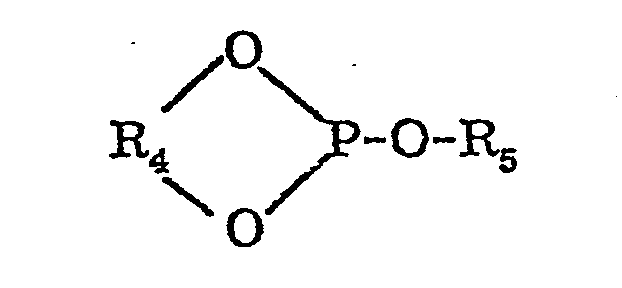
- R4 is a bivalent organic radical selected from the group consisting of alkylene, arylene, aralkylene, alkarylene and cycloalkylene radicals having from two to about thirty carbon atoms, and R5 is a monovalent organic radical as defined above in the case of R12 R2 and R3;
- R5 is hydrogen or a cation, in the case of the acid phosphites.
- Also useful organic triphosphites are mixed heterocyclic-open chain phosphites of the type:

- More complex triphosphites are formed from trivalent organic radicals, of the type:

- R6 is a trivalent organic radical of any of the types of R1 to R5, inclusive, as defined above.
- A particularly useful class of complex triphosphites are the tetraoxadiphosphaspiro undecanes of the formula:

- R1 and R2 are selected from the group consisting of aryl, alkyl, aryloxyethyl, alkyloxyethyl, aryloxyethoxyethyl, alkyloxyethoxyethyl and alkyloxypolyethoxyethyl having from about 1 to about 30 carbon atoms.
- In the case of the acid phosphites, one or both of R1 and R2 is also hydrogen or a cation.
- An especially preferred class of organic triphosphites and acid phosphites have a bicyclic aromatic group attached to phosphorus through oxygen, with no or one or more phenolic hydroxyl groups on either or both of the aromatic rings. These phosphites are characterized by the formula:


- Ar is a mono or bicyclic aromatic nucleus and m is an integer of from 0 to about 5. Z is one or a plurality of organic radicals as defined above for Rl to R6, taken singly or together in sufficient number to satisfy the valences of the two phosphite oxygen atoms.
- One or both Z radicals is also hydrogen, in the case of the acid phosphites, and can include additional bicyclic aromatic groups of the type (HO)m-Ar.
- The cation in the case of acid phosphites can be a metal, such as an alkali metal, for instance, sodium, potassium or lithium; an alkaline earth metal, for instance, barium, calcium, or a nontoxic polyvalent metal, such as magnesium, tin and zinc.
- Usually, the triphosphites and acid phosphites will not have more than about sixty carbon atoms.
- Exemplary triphosphites are monophenyl di-2-ethylhexyl phosphite, diphenyl mono-2-ethylhexyl phosphite, di-isooctyl monotolyl phosphite, tri-2-ethylhexyl phosphite, phenyl dicyclohexyl phosphite, phenyl diethyl phosphite, triphenyl phosphite, tricresyl phosphite, tri (dimethylphenyl) phosphite, trioctadecyl phosphite, triisooctyl phosphite, tridodecyl phosphite, isooctyl diphenyl phosphite, diisooctyl phenyl phosphite, tri(t-octylphenyl) phosphite, tri-(t-nonylphenyl) phosphite, benzyl methyl isopropyl phosphite, butyl dicresyl phosphite, isooctyl di(octylphenyl) phosphite, di(2-ethylhexyl) (isooctylphenyl) phosphite, tri (2-cyclohexylphenyl) phosphite), tri-a-naphthyl phosphite, tri (phenylphenyl) phosphite, tri(2-phenylethyl) phosphite, ethylene phenyl phosphite, ethylene t-butyl phosphite, ethylene isohexyl phosphite, ethylene isooctyl phosphite, ethylene cyclohexyl phosphite, 2-phenoxy-1, 3, 2-dioxaphosphorinane, 2-butoxy-1,3,2-dioxyphosphorinane, 2-octoxy-5, 5-dimethyl-dioxaphosphorinane, and 2-cyclohexyloxy-5, 5-diethyl dioxaphosphorinane.
- Exemplary pentaerythritol triphosphites are 3,9-diphenoxy-2,4,8,10-tetraoxa-3,9-diphosphaspiro-(5,5)-undecane (diphenyl-pentaerythritol diphosphite), 3,9-di(decyloxy)-2, 4, 8, 10-tetraoxa-3,9-diphosphaspiro (5,5)-undecane, 3,9-di (isodecyloxy)-2, 4, 8,10-tetraoxa-3, 9-diphosphaspiro-(5, 5)-undecane, 3,9-di(octadecyloxy)-2,4,8,10-tetraoxa-3,9- diphosphaspiro-(5, 5)-undecane, 3-phenoxy-9-isodecyloxy-2, 4, 8,10-tetraoxa-3, 9-diphosphaspiro-(5, 5)-undecane, 3,9-di (methoxy)-2,4,8,10-tetraoxa-3,9-diphosphaspiro-(5,5)-undecane, 3,9-di(lauryloxy)-2,4,8,10-tetraoxa-3,9-diphosphaspiro-(5,5)-undecane, 3,9-di-p-tolyloxy-2,4,8,10-tetraoxa-3,9-diphosphaspiro-(5,5)-undecane, 3,9-di(methoxyethyloxy)-2,4,8,10-tetraoxa-3, 9-diphosphaspiro-(5, 5)-undecane, 3-methoxyethyloxy-9-isodecyloxy-2,4, 8,10-tetraoxa-3, 9-diphosphaspiro-(5,5)-undecane, 3,9-di(ethohyethyloxy)-2, 4,8,10-tetraoxa-3, 9- diphosphaspiro-(5,5)-undecane, 3,9-di(butoxyethyloxy)-2, 4, 8, 10-tetraoxa-3,9-diphosphaspiro-(5, 5)-undecane, 3-methoxyethyloxy-9-butoxy-ethyloxy-2, 4, 8, 10-tetraoxa-3, 9- diphosphaspiro-(5,5)-undecane, 3,9-di(methoxyethoxyethyloxy)-2, 4, 8,10-tetra,oxa-3, 9-diphosphaspiro-(5, 5)-undecane, 3, 9-di-(butoxyethoxyethyloxy)-2, 4, 8,10-tetraoxa-3, 9-diphosphaspiro-(5,5)-undecane, 3, 9-di(methoxyethoxyethoxyethyloxy)-2, 4, 8,10-tetraoxa-3,9-diphosphaspiro-(5,5)-undecane, 3,9-di(methoxy (polyethoxy)ethyloxy)-2, 4, 8, 10-tetraoxa-3, 9-diphosphaspiro-(5, 5)-undecane where the (polyethoxy) ethyloxy group has an average molecular weight of 350),3, 9-di(methoxy(polyethoxy) ethyloxy)-2, 4,8,10-tetraoxa-3, 9-diphosphaspiro-(5, 5)-undecane (where the (polyethoxy) ethyloxy group has an average molecular weight of 550).
- Exemplary of the bis aryl triphosphites are: bis(4,4'-thio-bis(2-tertiary-butyl-5-methyl-phenol)) isooctyl phosphite, mono(4,4' -thio-bis(2-tertiary-butyl-5-methyl-phenol)) di-phenyl phosphite, tri-(4,4'-n-butylidene-bis(2-tertiary-butyl-5-methylphenol)) phosphite, (4,4-benzylidene-bis(2-tertiary-butyl-5-methyl-phenol)) diphenyl phosphite, isooctyl 2,2'-bis(-para-hydroxyphenyl) propane phosphite, decyl 4,4'-n-butylidene-bis (2-tertiary-butyl-5-methylphenol) phosphite, tri-4,4'-thio-bis (2-tertiary-butyl-5-methylphenol) phosphite, 2-ethylhexyl-2,2'-methylene-bis(4-methyl-6,1'-methylcyclohexyl) phenol phosphite, tri(2,2'-bis-(para-hydroxyphenyl) propane) phosphite, tri(4,4'-thio-bis(2-tertiary-butyl-5-methyl-phenol) phosphite, isooctyl-(2, 6-bis(2'-hydrohy-3, 5-dinonylbenzyl)-4-nonyl phenyl)) phosphite, tetra-tridecyl-4,4'-n-butylidene-bis(2-tertiary-butyl-5-methylphenyl) diphosphite, tetra-isooctyl-4,4'-thio-bis (2-tertiary-butyl-5-methylphenyl) diphosphite, 2,2'-methylene- bis(4-methyl-6, 1'-methyl cyclohexyl phenyl) polyphosphite, isooctyl-4, 4'-isopropylidene-bis-phenyl polyphosphite, 2-ethylhexyl-2, 2'-methylene-bis(4-methyl-6,1'-methyl-cyclohexyl) phenyl triphosphite, tetra-tridecyl-4, 4'-oxydiphenyl diphosphite, tetra-n-dodecyl-4, 4'-n-butylidene bis (2-tertiarybutyl-5-methylphenyl) diphosphite, tetra-tridecyl-4, 4'-isopropylidene bisphenyl diphosphite, hexa-tridecyl butane-1,1, 3- tris(2'-methyl-5'-tertiary-butylphenyl-4') triphosphite.
- Exemplary acid phosphites are di(phenyl) phosphite, monophenyl phosphite, mono(diphenyl) phosphite, dicresyl phosphite, di-(o-isooctylphenyl) phosphite, di(p-ethylhehylphenyl) phosphite, di(p-t-octylphenyl) phosphite, di(dimethylphenyl) phosphite, di-n-butyl phosphite, di-2-ethylhexyl phosphite, mono-2-ethylhexylphosphite, diisooctyl phosphite, monoisooctyl phosphite, monododecyl phosphite, 2-ethylhexyl phenyl phosphite, 2-ethylhexyl-(n-octylphenyl) phosphite, monocyclohexyl phosphite, dicyclohexyl phosphite, di(2-cyclohexyl phenyl) phosphite, di-α-naphthyl phosphite, diphenyl phenyl phosphite, di(diphenyl) phosphite, di-(2-phenyl ethyl) phosphite, dibenzyl phosphite, monobenzyl phosphite, n-butyl cresyl phosphite and didodecyl phosphite, cresyl phosphite, t-octylphenyl phosphite, ethylene phosphite, butyl cresyl phosphite, isooctyl monotolyl phosphite and phenyl cyclohexyl phosphite.
- Exemplary of the bis aryl acid phosphites are:
- bis(4, 4'-thio-bis(2-tertiary-butyl-5-methylphenol)) phosphite, (4,4'-thio-bis(2-tertiary-butyl-5-methylphenol)) phenyl phosphite, bis(4,4'-n-butylidene-bis(2-tertiary-butyl-5-methylphenol)) phosphite, mono(4,4'-benzylidene-bis(2-tertiary-butyl-5-methylphenol)) phosphite, mono(2,2'-bis-(parahydroxyphenyl) propane) phosphite, mono(4, 4' -butylidene-bis (2-tertiary-butyl-5-methylphenol) phosphite, bis(4,4'-thio-bis(2-tertiary-butyl-5-methylphenol)) phosphite, mono-2-ethylhexyl-mono-2,2'-methylene-bis(4-methyl-6,1'-methylcyclohexyl) phenol phosphite, bis (2,2' -bis (para-hydroxyphenyl) propane) phosphite, monoisooctyl- mono (4,4' -thio-bis(2-tertiary-butyl-5-methylphenol)) phosphite, isooctyl-(2, 6-bis(2'-hydroxy-3, 5-dinonylbenzyl)-4-nonylphenyl)) phosphite, tri-tridecyl-4,4'-n-butylidene-bis(2-tertiary-butyl-5-methylphenyl) diphosphite, triisooctyl-4,4'-thio-bis(2-tertiary-butyl-5-methylphenyl) diphosphite, bis(2, 2'-methylene- bis(4-methyl-6,1'-methyl cyclohexyl phenyl)) phosphite, isooctyl-4,4'-isopropylidene-bis-phenyl phosphite, monophenyl mono(2, 2'-methylene-bis(4-methyl-6,1'-methyl-cyclohexyl)) triphosphite, di-tridecyl-4,4'-oxydiphenyl diphosphite, di-n-dodecyl-4, 4' -n-butylidene-bis (2-tertiary-butyl-5-methylphenyl) diphosphite, di-tridecyl-4,4'-isopropylidene bisphenyl diphosphite, tetra-tridecyl butane-1,1, 3-tris(2'-methyl-5-tertiary-butylphenyl-4)-triphosphite.
- The thiodipropionic acid ester has the following formula:

- The molecular weights of the R and Y radicals are taken such that with the remainder of the molecule the thiodipropionic ester has a total of from about ten to about sixty carbon atoms per sulfur atom.
- Accordingly, the various thiodipropionic acid ester species coming within the above-designated categories within the general formula can be defined as follows:



- In the above formulae R, and R2, M, X and Z are the same as before and the value of n1 can range upwards from 1, but there is no upper limit on n, except as is imposed by the ratio of carbon atoms, as stated below. In the polymer (c), as in the other forms of thiodipropionic acid esters, the total number of carbon atoms per sulfur atom is within the range from about ten to about sixty.
- The R radical of these esters is important in furnishing compatibility with the polymer. The Y radical is desirably a different radical, R2 or M or a polymer, where R is rather low in molecular weight, so as to compensate for this in obtaining the optimum compatibility and nonvolatility. Where Y is a metal, the thiodipropionic acid ester furnishes the beneficial properties of the polyvalent metal salt which is described above.
- The aryl, alkyl, alkenyl, and cycloalkyl groups may, if desired, contain inert, nonreactive substituents such as halogen and other carbocyclic and heterocyclic ring structures condensed therewith.
- Typical R radicals are, for example, methyl, ethyl, propyl, isopropyl, butyl, isobutyl, t-butyl, amyl, isoamyl, n-octyl, isooctyl, 2-ethyl hexyl, t-octyl, decyl, dodecyl, octadecyl, allyl, hexenyl, linoleyl, ricinoleyl, oleyl, phenyl, xylyl, tolyl, ethylphenyl, naphthyl, cyclohexyl, benzyl, cyclopentyl, methylcyclohexyl, ethylcyclohexyl, and naphthenyl, hydroxyethyl, hydroxypropyl, glyceryl, sorbityl, pentaerythrttyl, and polyoxyalkylene radicals such as those derived from diethylene glycol, triethylene glycol, polyoxypropylene glycol, polyoxyethylene glycol, and polyoxypropyleneoxyethylene glycol, and esters thereof with any of the organic acids named below in the discussion of the polyvalent metal salts, including in addition those organic acids having from two to five carbon atoms, such as acetic, propionic, butyric and valeric acids.
- Typical X radicals are alkylene radicals such as ethylene, tetramethylene, hexamethylene, decamethylene, alkyl-substituted alkylene radicals such as 1,2-propylene,


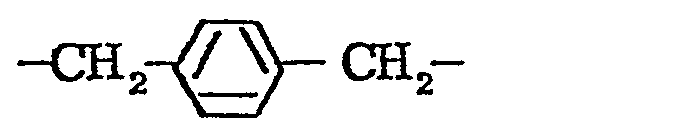


- As exemplary of the thiodipropionic acid esters which can be used, there can be mentioned the following: monolauryl thiodipropionic acid, dilauryl thiodipropionate, butyl stearyl thiodipropionate, 2-ethylhexyl lauryl thiodipropionate, di-2-ethylhexyl-thiodipropionate, diisodecyl thiodipropionate, isodecyl phenyl thiodipropionate, benzyl lauryl thiodipropionate, benzyl phenyl thiodipropionate, the diester of mixed coconut fatty alcohols and thiodipropionic acid, the diester of mixed tallow fatty alcohols and thiodipropionic acid, the acid ester of mixed cottonseed oil fatty alcohols and thiodipropionic acid, the acid ester of mixed soyabean oil fatty alcohols and thiodipropionic acid, cyclohexyl nonyl thiodipropionate, monooleyl thiodipropionic acid, hydroxyethyl lauryl thiodipropionate, monoglyceryl thiodipropionic acid, glyceryl monostearate monothiodipropionate, sorbityl isodecyl thiodipropionate, the polyester of diethylene glycol and thiodipropionic acid, the polyester of triethylene glycol and thiodipropionic acid, the polyester of hexamethylene glycol and thiodipropionic acid, the polyester of pentaerythritol and thiodipropionic acid, the polyester of octamethylene glycol and thiodipropionic acid, the polyester of p-dibenzyl alcohol and thiodipropionic acid, ethylbenzyl lauryl thiodipropionate, strontium stearyl thiodipropionate, magnesium oleyl thiodipropionate, calcium dodecyl- benzyl thiodipropionate, and mono(dodecylbenzyl) thiodipropionic acid.
- These esters are for the most part known compounds, but where they are not available, they are readily prepared by esterification of thiodipropionic acid and the corresponding alcohol.
- Also useful are:
- (1) Thioalkanoic acid amides of Tokuno et al Japanese patent No. 16,286/68 having the formula:

- (2) Thioalkanoic acid amides of 1,3, 5-triazines of Ozeki et al Japanese patent No. 20,366/68 having the formula:

- (3) Bis-thioalkanoic acid amides of Yamamoto et al Japanese patent No. 23,765/68 having the formula:

- (4) Bis-thioalkylanoic acid amides of Ozeki et al Japanese patent No. 26, 184/69 having the formula:

- (5) Bis-alkylene thioalkanoic acid amides of Ozeki Japanese patent No. 31,464/69 having the formula:

- (6) Thioalkanoic acid amide derivatives of Minagawa etal, published Japanese application Nol 106,484/74 having the formula:

- (7) Alkylene bis-thioalkanoic acid amides of U.S. patent No. 4, 279, 805 to Ohzeki et al, patented July 21, 1981, having the general formula:

- R1 is alkyl having from one to about fifty carbon atoms;
- R2 is alkylene having from one to about three carbon atoms; and
- R3 is alkylene having from about two to about twelve carbon atoms.
- β-Alkylthiopropionic acid esters having the general formula:

- R is alkyl of four to twenty carbon atoms;
- n is a number from 1 to 6; and
- R' is the residue of an alcohol having from one to six hydroxyl groups.
- Pentaerythritol tetra dodecyl thio propionate is an example of this group.
- Other conventional light stabilizers can be employed, such as hydroxybenzophenones such as 2-hydroxy-4-methoxybenzophenone, 2-hydroxy-4-n-octoxy benzophenone, 2,4-dihydroxybenzophenone, benzotriazoles, such as 2(2-hydroxy-5-methylphenyl) benzotriazoles, 2(2-hydroxy-3-t-butyl-5-methylphenyl)-5-chlorobenzotriazole, 2(2-hydroxy-3-5-di-t-butylphenyl) 5-chlorobenzotriazole, 2(2-hydroxy-3,5-di-t-amylphenyl) benzotriazole, benzoates such as phenylsalicylate, 2, 4-di-t-butylphenyl-3, 5-di t-butyl-4 hydroxy phenylbenzoate, nickel compounds such as nickel 2, 2'-thiobis(4-t-octyl phenolate), nickel mono ethyl(3, 5 di t butyl 4-hydroxybenzyl) phosphonate, substituted acrylonitriles such as methyl-a -cyano β -methyl-β -(p methoxy phenyl) acrylate and oxalic anilides such as N-2 ethyl phenyl-N'-2 ethoxy 5-t butyl phenyl oxalic diamide, N-2-ethyl phenyl-N'-2 ethoxy phenyl oxalic diamide.
- A sufficient amount of the stabilizer or combination is used to improve the resistance of the polyvinyl chloride to deterioration in physical properties when exposed to heat and light, including, for example, discoloration and embrittlement. Very small amounts are usually adequate. Amounts within the range from about 0.001 to about 10% total stabilizers including the oxirane of the invention by weight of the polymer are satisfactory. Preferably, from 0.01 to 5% is employed for optimum stabilization.
- The stabilizer systems of the invention are readily formulated as a blend of:
- (a) α-hydroxy-β-2, 2, 6, 6-tetramethyl piperidyl ethylene oxirane in an amount of from about 10 to about 35 parts by weight; and optionally:
- (b) a phenolic antioxidant in an amount from about 10 to about 35 parts by weight; and/or
- (c) other heat or. light stabilizers in an amount of from about 10 to about 35 parts by weight.
- In addition, other conventional additives for polyvinyl chloride resins, such as antistatic agents, flame-proofing agents, pigments and fillers, can be employed.
- The stabilizer or combination is incorporated in the polymer in suitable mixing equipment, such as a mill or a Banburn mixer. If the polymer has a melt viscosity which is too high for the desired use, the polymer can be worked until its melt viscosity has been reduced to the desired range before addition of the stabilizer. Mixing is continued until the mixture is substantially uniform. The resulting composition is then removed from the mixing equipment and brought to the size and shape desired for marketing or use.
- The stabilized polymer can be worked into the desired shape, such as by milling, calendering, extruding or injection molding or fiber-forming. In such operations, it will be found to have a considerably improved resistance to reduction in melt viscosity during the heating, as well as a better resistance to discoloration and embrittlement on ageing and heating.
- The following Examples represent preferred embodiments of polyvinyl chloride resin compositions in accordance with the invention.
- Rigid polyvinyl chloride resin compositions were prepared having the following formulation:

- The compositions were thoroughly blended on a two-roll mill, and sheeted off to form sheets 1 mm thick. Pieces were cut off from the sheets, and heated at 190°C in a Geer oven to determine heat stability, as the time required for the pieces to turn black. The initial color of the sheets and the color of the test pieces after heating for 60 minutes at 175°C were also noted, and evaluated according to the following scale:

- The results are shown in Table I.


- It is apparent from the results that the oxiranes in accordance with the invention are superior to the controls, the unreacted oxirane or piperidyl compound, taken singly or in admixture, in improving the resistance of the polyvinyl chloride resin to deterioration when exposed to heat.
- Rigid polyvinyl chloride resin compositions were prepared according to the following formulation:

- The compositions were thoroughly blended on a two-roll mill and sheeted off to form sheets 1 mm thick. Test pieces were cut off from the sheets and heated at 190°C in a Geer oven until black, to determine heat stability.
- Weatherability was also evaluated by exposing test pieces from the sheets for six months in the open air. The initial color of the pieces and the color of the test pieces after weathering were noted. Weatherability was rated according to the same color scale indicated above.
- The results are shown in Table II.


- It is apparent from the results that the oxiranes in accordance with the invention are superior to the controls, the unreacted oxirane or piperidyl compound, taken singly or in admixture, in improving the resistance of the polyvinyl chloride resin to deterioration when exposed to heat and ultraviolet light.
- Polyvinyl chloride resin compositions plasticized with dioctyl phthalate and tricresol phosphate were prepared according to the following formulation:

- The compositions were thoroughly blended on a two roll mill and then compression-molded to form sheets 1 mm thick. Pieces were cut off from the sheets and heated at 190f in a Geer oven until black to determine heat stability.
- Test pieces were also exposed to the open air for fourteen months to determine weatherability. The initial color of the pieces and the color of the test pieces after weathering was also rated according to the color scale above, and the results are shown in Table In.


- It is apparent from the results that the oxiranes in accordance with the invention are superior to the controls, the unreacted oxirane or piperidyl compound, taken singly or in admixture, in improving the resistance of the polyvinyl chloride resin to deterioration when exposed to heat and ultraviolet light.
- Plasticized polyvinyl chloride resin compositions were prepared according to the following formulation:

- The compositions were thoroughly blended on a two-roll mill and sheets 1 mm thick were prepared by compression molding. Pieces were cut off the sheets and heated at 190°C in a Geer oven until black to determine heat stability. The initial color of the sheet pieces and the color of the test pieces after heating for 60 minutes at 1750C were also noted. The results are shown in Table IV.

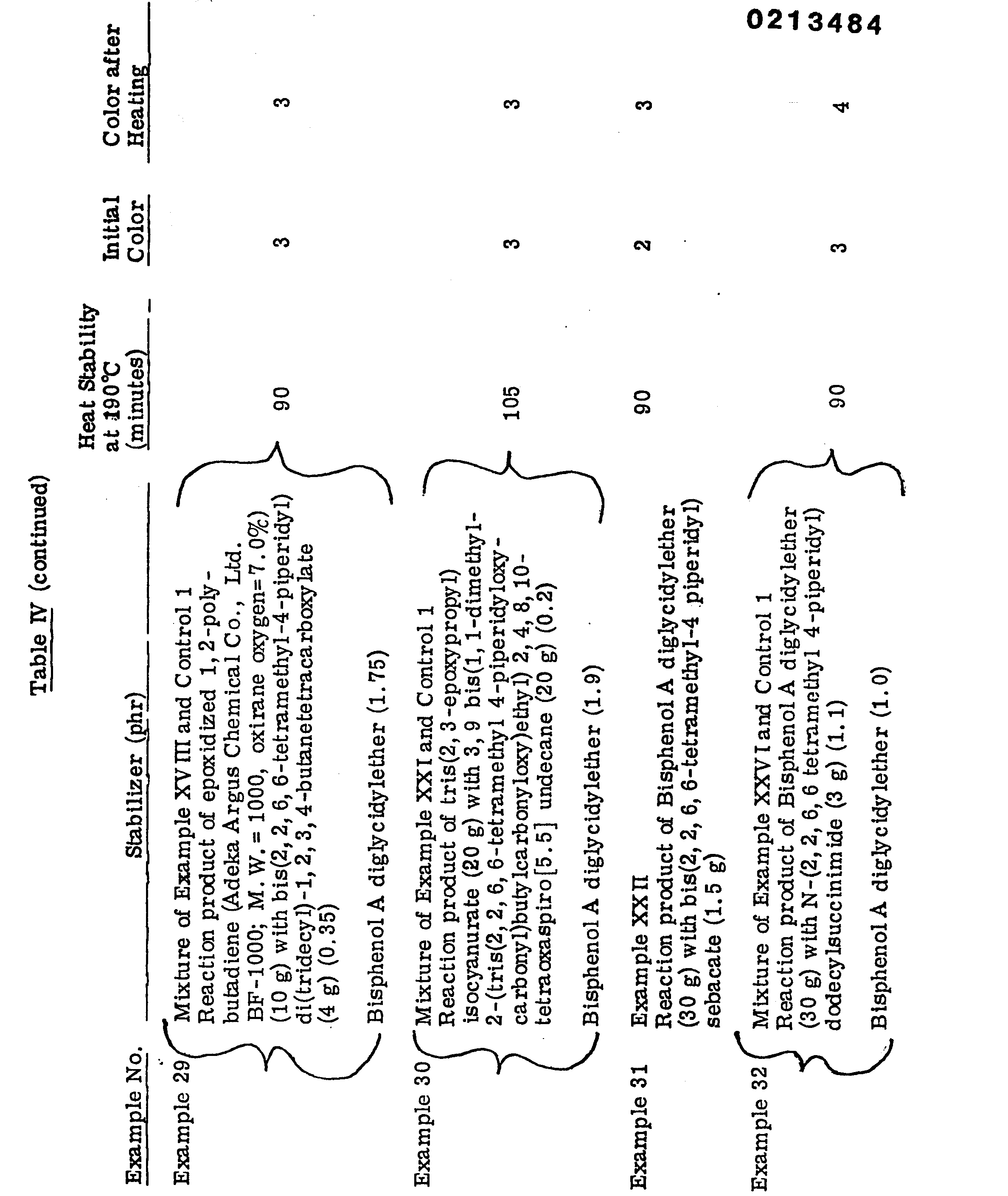
- It is apparent from the results that the oxiraines in accordance with the invention are superior to the controls, the unreacted oxirane or piperidyl compound, taken singly or in admixture, in improving the resistance of the polyvinyl chloride resin to deterioration when exposed to heat.
Claims (10)

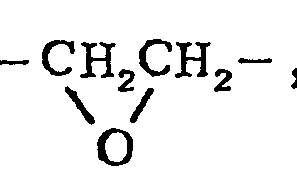


Applications Claiming Priority (2)
| Application Number | Priority Date | Filing Date | Title |
|---|---|---|---|
| JP178322/85 | 1985-08-13 | ||
| JP17832285A JPS6239651A (en) | 1985-08-13 | 1985-08-13 | Stabilized halogen-containing resin composition |
Publications (2)
| Publication Number | Publication Date |
|---|---|
| EP0213484A1 true EP0213484A1 (en) | 1987-03-11 |
| EP0213484B1 EP0213484B1 (en) | 1991-01-30 |
Family
ID=16046454
Family Applications (1)
| Application Number | Title | Priority Date | Filing Date |
|---|---|---|---|
| EP19860111175 Expired EP0213484B1 (en) | 1985-08-13 | 1986-08-12 | Alpha-hydroxy-beta-2,2,6,6-tetramethyl piperidyl ethylene oxiranes as light and heat stabilizers for polyvinyl chloride resins |
Country Status (3)
| Country | Link |
|---|---|
| EP (1) | EP0213484B1 (en) |
| JP (1) | JPS6239651A (en) |
| DE (1) | DE3677289D1 (en) |
Cited By (1)
| Publication number | Priority date | Publication date | Assignee | Title |
|---|---|---|---|---|
| US6593485B1 (en) | 1994-10-06 | 2003-07-15 | Clariant Finance (Bvi) Limited | Stabilizer composition |
Citations (4)
| Publication number | Priority date | Publication date | Assignee | Title |
|---|---|---|---|---|
| US3219612A (en) * | 1963-02-25 | 1965-11-23 | Evald L Skau | Vinyl chloride resins and butadiene rubbers with n-acyl derivatives of cyclic imines |
| FR2331556A1 (en) * | 1975-11-11 | 1977-06-10 | Sankyo Co | NEW DERIVATIVES OF 4-AMINO-2,6-DIMETHYLPIPERIDINE FOR USE AS SYNTHETIC POLYMER STABILIZERS |
| EP0097616A1 (en) * | 1982-06-17 | 1984-01-04 | Ciba-Geigy Ag | Polyalkylpiperidine esters of sulfonic acids |
| US4460725A (en) * | 1982-03-08 | 1984-07-17 | Leistner William E | Polyethers containing 2,2,6,6-tetramethyl piperidinyl carboxylic acid ester groups and synthetic resin compositions |
-
1985
- 1985-08-13 JP JP17832285A patent/JPS6239651A/en active Granted
-
1986
- 1986-08-12 DE DE8686111175T patent/DE3677289D1/en not_active Expired - Lifetime
- 1986-08-12 EP EP19860111175 patent/EP0213484B1/en not_active Expired
Patent Citations (4)
| Publication number | Priority date | Publication date | Assignee | Title |
|---|---|---|---|---|
| US3219612A (en) * | 1963-02-25 | 1965-11-23 | Evald L Skau | Vinyl chloride resins and butadiene rubbers with n-acyl derivatives of cyclic imines |
| FR2331556A1 (en) * | 1975-11-11 | 1977-06-10 | Sankyo Co | NEW DERIVATIVES OF 4-AMINO-2,6-DIMETHYLPIPERIDINE FOR USE AS SYNTHETIC POLYMER STABILIZERS |
| US4460725A (en) * | 1982-03-08 | 1984-07-17 | Leistner William E | Polyethers containing 2,2,6,6-tetramethyl piperidinyl carboxylic acid ester groups and synthetic resin compositions |
| EP0097616A1 (en) * | 1982-06-17 | 1984-01-04 | Ciba-Geigy Ag | Polyalkylpiperidine esters of sulfonic acids |
Cited By (1)
| Publication number | Priority date | Publication date | Assignee | Title |
|---|---|---|---|---|
| US6593485B1 (en) | 1994-10-06 | 2003-07-15 | Clariant Finance (Bvi) Limited | Stabilizer composition |
Also Published As
| Publication number | Publication date |
|---|---|
| DE3677289D1 (en) | 1991-03-07 |
| JPH0566412B2 (en) | 1993-09-21 |
| EP0213484B1 (en) | 1991-01-30 |
| JPS6239651A (en) | 1987-02-20 |
Similar Documents
| Publication | Publication Date | Title |
|---|---|---|
| EP0180992B1 (en) | Stabilizer compositions for synthetic resins imparting improved light stability | |
| US4957954A (en) | Stabilizer compositions for polyvinyl chloride resins and stabilized polyvinyl chloride resin compositions | |
| US4684679A (en) | Polyacetal resin compositions having improved resistance to deterioration when exposed to light and containing alkylidene bis(benzotriazolyl phenols) | |
| EP0107805B1 (en) | Mixed 2,2,6,6-tetramethyl piperidinyl carboxylic acid ester and amide light stabilizers and stabilized synthetic polymers | |
| EP0176106B1 (en) | N,n',n-tris((2,2,6,6-tetramethyl-4-piperidyl)triazinyl)-undecane triamines as stabilizers for synthetic polymers | |
| EP0094048A2 (en) | Poly(piperidylamine)alkanes and synthetic resin compositions stabilized thereby | |
| EP0108993B1 (en) | Oligomers of 2,2,6,6-tetramethylpiperidinol, polycarboxylic acid esters and synthetic polymer compositions | |
| EP0065655B1 (en) | Polymeric light stabilizers having at least one 2,2,6,6-tetraalkyl piperidyl group and synthetic resin compositions containing the same | |
| EP0209127A2 (en) | Poly(2,2,6,6-tetramethyl-piperidyl-amino)-1,3,5-triazines as stabilizers for synthetic polymer compositions | |
| EP0081688B1 (en) | Poly(piperidylamine) alkanes and synthetic resin compositions stabilized thereby | |
| EP0184203B1 (en) | Vinyl benzyl 2,2,6,6-tetramethyl piperidines | |
| EP0074598B1 (en) | Synthetic resin compositions containing 2,2,6,6-tetramethyl piperidinyl triazines | |
| EP0058434A1 (en) | N-2-hydroxypropyl piperidines and process for preparing the same | |
| EP0217149B1 (en) | Poly(2,2,6,6-tetramethylpiperidylaminospiroglycolether-1,3,5-triazines) | |
| EP0073386B1 (en) | Synthetic resin compositions containing 2,2,6,6-tetramethyl piperidyl ethers | |
| EP0069871A2 (en) | Copolymer light stabilizers having at least one 2,2,6,6-tetraalkyl piperidyl group and synthetic resin compositions containing the same | |
| EP0213484B1 (en) | Alpha-hydroxy-beta-2,2,6,6-tetramethyl piperidyl ethylene oxiranes as light and heat stabilizers for polyvinyl chloride resins | |
| EP0095571B1 (en) | Polyhydric alcohol ethers of 2,2,6,6-tetramethyl-4-piperidone ketals and synthetic resin compositions | |
| EP0148962B1 (en) | Bis(2,2,6,6-tetramethylpiperidyl-1,3,5-triazinyl)-spirodiamines and spiroglycol ethers and synthetic resin compositions containing the same | |
| US4469828A (en) | Alkylthiopropionyl hydrazino triazines and synthetic resin compositions | |
| EP0118578B1 (en) | Polyethers containing 2,2,6,6-tetramethyl piperidinyl carboxylic acid ester groups and synthetic resin compositions | |
| US4767834A (en) | Vinyl benzyl 2,2,6,6-tetramethyl piperidines | |
| EP0081235B1 (en) | Alkylthiopropionyl hydrazino triazines and synthetic resin compositions | |
| EP0128229A1 (en) | Hindered bisphenol diphosphonites and stabilized synthetic resin compositions containing the same |
Legal Events
| Date | Code | Title | Description |
|---|---|---|---|
| PUAI | Public reference made under article 153(3) epc to a published international application that has entered the european phase |
Free format text: ORIGINAL CODE: 0009012 |
|
| AK | Designated contracting states |
Kind code of ref document: A1 Designated state(s): BE CH DE FR GB LI NL |
|
| 17P | Request for examination filed |
Effective date: 19870901 |
|
| 17Q | First examination report despatched |
Effective date: 19880921 |
|
| GRAA | (expected) grant |
Free format text: ORIGINAL CODE: 0009210 |
|
| AK | Designated contracting states |
Kind code of ref document: B1 Designated state(s): BE CH DE FR GB LI NL |
|
| REF | Corresponds to: |
Ref document number: 3677289 Country of ref document: DE Date of ref document: 19910307 |
|
| ET | Fr: translation filed | ||
| PLBE | No opposition filed within time limit |
Free format text: ORIGINAL CODE: 0009261 |
|
| STAA | Information on the status of an ep patent application or granted ep patent |
Free format text: STATUS: NO OPPOSITION FILED WITHIN TIME LIMIT |
|
| 26N | No opposition filed | ||
| PGFP | Annual fee paid to national office [announced via postgrant information from national office to epo] |
Ref country code: GB Payment date: 19940811 Year of fee payment: 9 |
|
| PGFP | Annual fee paid to national office [announced via postgrant information from national office to epo] |
Ref country code: FR Payment date: 19940812 Year of fee payment: 9 Ref country code: CH Payment date: 19940812 Year of fee payment: 9 |
|
| PGFP | Annual fee paid to national office [announced via postgrant information from national office to epo] |
Ref country code: DE Payment date: 19940830 Year of fee payment: 9 |
|
| PGFP | Annual fee paid to national office [announced via postgrant information from national office to epo] |
Ref country code: NL Payment date: 19940831 Year of fee payment: 9 Ref country code: BE Payment date: 19940831 Year of fee payment: 9 |
|
| PG25 | Lapsed in a contracting state [announced via postgrant information from national office to epo] |
Ref country code: GB Effective date: 19950812 |
|
| PG25 | Lapsed in a contracting state [announced via postgrant information from national office to epo] |
Ref country code: LI Effective date: 19950831 Ref country code: CH Effective date: 19950831 Ref country code: BE Effective date: 19950831 |
|
| BERE | Be: lapsed |
Owner name: ADEKA ARGUS CHEMICAL CO. LTD Effective date: 19950831 |
|
| PG25 | Lapsed in a contracting state [announced via postgrant information from national office to epo] |
Ref country code: NL Effective date: 19960301 |
|
| GBPC | Gb: european patent ceased through non-payment of renewal fee |
Effective date: 19950812 |
|
| REG | Reference to a national code |
Ref country code: CH Ref legal event code: PL |
|
| PG25 | Lapsed in a contracting state [announced via postgrant information from national office to epo] |
Ref country code: FR Effective date: 19960430 |
|
| NLV4 | Nl: lapsed or anulled due to non-payment of the annual fee |
Effective date: 19960301 |
|
| PG25 | Lapsed in a contracting state [announced via postgrant information from national office to epo] |
Ref country code: DE Effective date: 19960501 |
|
| REG | Reference to a national code |
Ref country code: FR Ref legal event code: ST |